

Submitted:
28 April 2025
Posted:
29 April 2025
You are already at the latest version
Abstract
The rapid evolution of the battery electric vehicle (BEV) industry calls for a robust, specialized competency framework for maintenance technicians. This study develops such a framework through an extensive literature review and analysis of domestic and international standards, identifying a broad set of potential competency items. A three-round Delphi process was then employed with 15 experts—education directors, senior technical supervisors, and veteran maintenance technicians—to refine the framework. The first round gathered open-ended insights, which were synthesized into a structured questionnaire. Subsequent rounds used a five-point Likert scale and nonparametric tests (Kolmogorov-Smirnov and Kruskal-Wallis) to assess consensus and validate the framework.
Keywords:
Electric Vehicle Maintenance
; Competency Framework
; Battery Electric Vehicles
; Delphi Method
; Sustainable Mobility
; Technical Skills
; Industry Standards
1. Introduction
1.1. Background and Motivation
The battery electric vehicle (BEV) market is growing rapidly, driven by advancements in technology and a global shift towards sustainable transportation [1]. This transition necessitates new technical competencies among maintenance technicians, as traditional service practices are insufficient for the high-voltage and complex systems inherent in BEVs [2,3]. In this context, developing a comprehensive competency framework is critical for ensuring safety, efficiency, and long-term reliability in BEV maintenance [4,5].
1.2. ESG and Green Energy Context
Environmental, Social, and Governance (ESG) principles have become integral to the modern energy landscape [6,7]. The BEV industry is a key player in the global green energy transition, reducing greenhouse gas emissions and fostering sustainable mobility [8]. This study situates the competency framework within the broader ESG context, recognizing that the maintenance practices of BEVs contribute to overall environmental performance and corporate sustainability [9]. By aligning technical standards with green energy goals, the framework supports initiatives that enhance operational safety, reduce waste, and promote responsible energy use [10].
1.3. The Role of Electric Vehicle Maintenance Technicians
Electric vehicle maintenance technicians are at the frontline of this transition, ensuring that BEVs operate safely and efficiently. Their role goes beyond routine repairs; it involves the management of high-voltage systems, adherence to rigorous safety protocols, and the adoption of new diagnostic technologies [11]. This section outlines the evolving responsibilities of these technicians, highlighting the need for specialized training and a well-defined set of competencies that address both technical proficiency and critical soft skills [12].
1.4. Problem Statement
Despite the growth of the BEV market, existing competency frameworks primarily cater to conventional internal combustion engine systems. There is a notable gap in specialized frameworks designed to meet the unique challenges of BEV maintenance, including high-voltage battery management, advanced charging systems, and comprehensive diagnostic procedures [13]. This study addresses this gap by developing a validated competency framework explicitly tailored for BEV maintenance technicians [14].
1.5. Research Objectives and Questions
The primary objective of this research is to establish and validate a structured competency framework for BEV maintenance technicians. Key research questions include:
- What are the essential competencies required for effective BEV maintenance?
- How can these competencies be categorized into dimensions, sub-dimensions, and specific indicators?
- What level of consensus can be achieved among industry experts on the importance of these competencies?
1.6. Methodology Overview
A three-round Delphi process was utilized to refine the competency framework [15]. Initially, open-ended questionnaires were distributed to gather diverse expert insights, which were then synthesized into a structured instrument [16,17]. In subsequent rounds, a panel of 15 experts rated the importance of each competency using a five-point Likert scale. Statistical analyses—including descriptive statistics and nonparametric tests such as the Kolmogorov-Smirnov and Kruskal-Wallis tests—were employed to assess consensus and validate the reliability of the framework [18,19].
1.7. Significance and Contributions
The resulting competency framework is organized into four key dimensions, 24 sub-dimensions, and 106 specific indicators. This framework supports effective talent selection, targeted training, and systematic performance evaluation in the BEV maintenance industry and aligns with ESG and green energy objectives [20]. By addressing the unique demands of BEV systems, the study contributes to academic research [21] and practical industry applications, fostering safer, more sustainable maintenance practices in an era of rapid technological change [22].
2. Materials and Methods
2.1. Research Design
This study adopted a mixed-methods research design to develop and validate a competency framework tailored to electric small-passenger car maintenance technicians. The overall approach integrated qualitative and quantitative techniques, beginning with an exhaustive review of academic literature, industry reports, and international and domestic standards related to electric vehicle maintenance. The initial phase focused on identifying and categorizing relevant competency areas, while the subsequent phases were devoted to expert consensus-building. The framework is hierarchically organized into three layers: core dimensions, sub-dimensions, and specific indicators. This structured design not only facilitates a comprehensive evaluation of both technical and non-technical skills but also ensures that the final model reflects the complex requirements of the evolving BEV maintenance industry. By employing a rigorous Delphi method, the research design provided a systematic procedure for refining and validating the competencies, thereby enhancing the credibility and practical applicability of the framework.
2.2. Development of the Initial Instrument
The initial instrument was developed through a systematic literature review and relevant industry standards. Multiple databases and sources were consulted to gather information on competency requirements, safety protocols, technical skills, and regulatory standards in electric vehicle maintenance. The preliminary set of competency items was organized into four broad dimensions: Professional Knowledge, Professional Skills, Professional Attitude, and Personal Traits. These dimensions were subdivided into 24 sub-dimensions, yielding 106 specific indicators. Each indicator was designed to capture nuanced aspects of technician performance, ranging from high-voltage battery management to effective communication and teamwork. This comprehensive inventory was intended to serve as the foundation for the subsequent expert validation process, ensuring that both widely recognized and emerging competencies were included in the model.
2.3. Expert Selection and Content Validity
A rigorous two-stage expert review process was conducted to ensure the instrument’s content validity. Five experts with diverse expertise—spanning organizational behavior, technical education, engineering, and EV maintenance—were invited to review the draft instrument. Their feedback focused on the proposed indicators’ clarity, relevance, and comprehensiveness. Suggestions from this preliminary review were systematically incorporated, resulting in a revised questionnaire that addressed any ambiguities or redundancies. Subsequently, a panel of 15 experts was purposively selected based on their extensive knowledge and practical experience in the field. This panel was divided into three groups: education and training directors, senior technical supervisors, and veteran maintenance technicians, with five experts in each group. The diverse composition of the panel ensured that the instrument reflected a balanced perspective from both academic and industry viewpoints, thereby reinforcing the framework’s robustness and applicability in real-world settings.
2.4. Delphi Process
A structured three-round Delphi process was employed to refine and validate the competency framework. In the first round, open-ended questionnaires were distributed to all panel members to elicit broad and unfiltered insights regarding the initial set of competencies. The qualitative responses were meticulously analyzed and synthesized to generate a more structured questionnaire version. In the second round, the revised instrument was administered using a five-point Likert scale, allowing experts to rate the importance and relevance of each indicator quantitatively. Descriptive statistical methods, including the calculation of means, modes, and standard deviations, were used to summarize the responses. In addition, nonparametric tests such as the Kolmogorov–Smirnov test for distribution analysis and the Kruskal–Wallis test for inter-group comparisons were conducted to assess the level of consensus across different expert groups. The third round involved further refinement based on statistical feedback and expert comments from the second round. Experts were provided with the aggregated results and invited to reassess their ratings, fostering convergence towards a consensus. This iterative process continued until a satisfactory level of agreement was achieved across all dimensions, sub-dimensions, and indicators.
2.5. Data Analysis
Data analysis was performed using descriptive and inferential statistical techniques to ensure the robustness of the consensus reached among experts. For each round of the Delphi process, the mean, mode, and standard deviation of ratings were calculated to assess the central tendency and variability of the responses. The Kolmogorov–Smirnov test was employed to examine the normality of the distribution of responses, which provided insight into the consistency of expert ratings. Additionally, the Kruskal–Wallis test was used to compare the ratings among the different groups of experts, ensuring that there were no significant discrepancies based on professional background. These statistical methods collectively enabled a rigorous evaluation of the reliability and validity of the competency framework. The quantitative analysis confirmed the consensus on critical competencies and highlighted specific areas where expert opinions required further discussion and adjustment.
2.6. Ethical Considerations and Timeline
Ethical considerations were integral to the design and implementation of this study. Participation in the Delphi process was entirely voluntary, and all responses were treated with strict confidentiality. Informed consent was obtained from each expert before their involvement, and all data were anonymized to prevent any potential bias or conflict of interest. The study followed institutional ethical guidelines and received approval from the appropriate review board. The entire process, from the initial literature review to the final round of the Delphi study, was carried out between February and June 2023. This timeline ensured that sufficient time was allocated for iterative feedback, thorough analysis, and the refinement of the competency framework, ultimately contributing to a robust and validated instrument for the BEV maintenance industry.
3. Results
3.1. Expert Content Validity and Instrument Revision
The initial competency framework, derived from an extensive literature review and an analysis of domestic and international industry standards, comprised 106 detailed indicators organized into four core dimensions and 24 sub-dimensions. An initial content validity assessment was conducted with five domain experts representing diverse fields such as organizational behavior, technical education, engineering, and electric vehicle (EV) maintenance. Their feedback focused on several critical areas:
- Clarity and Precision: Many indicators required more precise wording to delineate technical specifications. For example, experts recommended that the description of high-voltage battery system configurations be more detailed to ensure that technicians understand the necessary safety protocols.
- Redundancy Elimination: Certain items, particularly within the Personal Traits dimension, exhibited overlap. For instance, the “Organizational Innovation Planning” indicator was found redundant compared to similar items addressing professional innovation.
- Addition of Specific Details: Experts suggested incorporating additional sub-indicators to capture nuanced competencies, such as accurately interpreting diagnostic data and adhering to standardized emergency response procedures.
Based on this input, systematic revisions were made to enhance clarity, reduce redundancy, and ensure that the framework comprehensively covered all necessary competencies. Table 1 summarizes the key modifications implemented after the expert review.
3.2. Delphi Process Results
The revised competency instrument was further validated through a structured three-round Delphi process involving a panel of 15 experts divided equally among education and training directors, senior technical supervisors, and experienced maintenance technicians. This iterative process was designed to refine the indicators and measure consensus on the importance and clarity of each item.
3.2.1. Round 1 Results
In the first Delphi round, experts provided ratings on all 106 indicators using a five-point Likert scale. Analysis of these responses revealed a strong consensus on technical competencies, particularly within the Professional Skills dimension, which achieved a perfect mean score of 5.00 (SD = 0.000). However, the Personal Traits dimension showed significant variability (mean = 3.80, SD = 1.146), suggesting that the evaluation of soft skills was more subjective. In addition to quantitative ratings, qualitative comments were collected to capture further nuances and suggestions for improvement. Table 2 provides a detailed summary of the descriptive statistics for the four main dimensions.
3.2.2. Round 2 Results
Based on Round 1 feedback, the instrument was refined and redistributed in Round 2. In this round, experts again rated the indicators on a five-point Likert scale. The revised questionnaire showed notable improvement in consensus:
- Both the Professional Knowledge and Professional Skills dimensions achieved unanimous ratings (mean = 5.00, SD = 0.000).
- The variability in the Professional Attitude and Personal Traits dimensions decreased, with mean scores of 4.47 (SD = 0.640) and 4.07 (SD = 0.704), respectively.
These improvements indicate that the iterative feedback process effectively addressed earlier ambiguities. Table 3 summarizes the key statistics for Round 2.
3.2.3. Round 3 Results
In the third and final Delphi round, experts reviewed the aggregated feedback and the revised instrument. The ratings further converged, leading to a high degree of consensus across all dimensions:
- Professional Knowledge and Professional Skills maintained perfect consensus (mean = 5.00, SD = 0.000).
- The Professional Attitude dimension improved slightly (mean = 4.53, SD = 0.516), while the Personal Traits dimension stabilized (mean = 4.20, SD = 0.561).
Table 4 displays the final statistical summary.
3.2.4. Comparison of Delphi Rounds
A detailed comparative analysis was performed to track the evolution of consensus over the Delphi rounds. The study revealed a significant reduction in the standard deviations, particularly in dimensions that initially exhibited higher variability. For example, the Personal Traits dimension’s standard deviation decreased from 1.146 in Round 1 to 0.704 in Round 2, demonstrating improved alignment among experts. Table 5 illustrates these changes.
3.3. Flow Chart of the Delphi Process
To provide a visual summary of the systematic refinement process, Figure 1 presents a flow chart of the Delphi process. The flow chart outlines the sequential steps, beginning with the initial literature review and instrument development, followed by three rounds of expert consultation, iterative revisions based on quantitative and qualitative feedback, and culminating in the final validated competency framework. This figure serves as a clear roadmap of the methodology employed.
3.4. Final Competency Framework Summary
The final competency framework is structured into three hierarchical layers:
- Dimensions: Four core dimensions encapsulating the overall competency requirements: Professional Knowledge, Professional Skills, Professional Attitude, and Personal Traits.
- Sub-dimensions: Within these dimensions, 24 sub-dimensions were identified to target specific areas of expertise, such as battery management, charging system protocols, and diagnostic capabilities.
- Indicators: A total of 106 detailed indicators were validated through the Delphi process, offering precise performance measures for each competency area.
This comprehensive framework is intended to serve as a strategic tool for improving technician selection, targeted training programs, and performance evaluation in the BEV maintenance industry.
3.5. Reliability and Statistical Considerations
Throughout the Delphi process, a series of statistical analyses were conducted to ensure the reliability and validity of the framework. Descriptive statistics were computed for each indicator across all rounds, including means, modes, and standard deviations. Nonparametric tests, such as the Kolmogorov–Smirnov test for normality and the Kruskal–Wallis test for group comparisons, provided additional evidence of consensus. The observed decrease in standard deviations across rounds confirms that iterative feedback successfully narrowed the variance in expert opinions, thereby enhancing the robustness of the final competency framework.
4. Discussion
4.1. Interpretation of Findings
The results of this study demonstrate that the developed competency framework for electric small passenger car maintenance technicians is comprehensive and robust. The framework, organized into four dimensions—Professional Knowledge, Professional Skills, Professional Attitude, and Personal Traits—and further delineated into 24 sub-dimensions with 106 specific indicators, reflects a high consensus among industry experts. Quantitative data from the Delphi process reveal that technical competencies, particularly those related to high-voltage battery management, diagnostic testing, and emergency response procedures, consistently achieved high ratings with minimal variability. This high level of agreement underscores the critical importance of these technical skills in ensuring safe and efficient BEV maintenance.
Furthermore, while evaluating soft skills such as Professional Attitude and Personal Traits exhibited more significant variability in earlier rounds, the iterative Delphi process led to a substantial convergence of expert opinions. The reduction in standard deviations from Round 1 to Round 3 provides robust evidence that the iterative feedback significantly improved the clarity and relevance of these indicators. In addition, the framework integrates SDG-specific considerations by addressing aspects such as sustainability in maintenance practices and the promotion of environmental stewardship, aligning with global objectives such as SDG 7 (Affordable and Clean Energy) and SDG 11 (Sustainable Cities and Communities). The integration of these elements enhances the technical robustness of the framework and ensures that the competencies support a broader agenda for sustainable development in the electric vehicle sector.
4.2. Practical Implications
The validated competency framework has numerous practical applications for stakeholders in the BEV maintenance industry. First, it provides a critical tool for talent selection by establishing clear, measurable criteria that can be integrated into recruitment processes. Employers can use these indicators to assess candidate suitability in technical and interpersonal domains. Second, the framework informs the development of targeted training programs. Organizations can design comprehensive curricula that address specific gaps and enhance overall technician performance by clearly outlining the required competencies—from technical proficiencies in high-voltage systems to soft skills such as effective communication and teamwork.
Moreover, the framework supports systematic performance evaluation. Organizations can use the detailed indicators as benchmarks to monitor technician progress over time, identify areas for improvement, and implement remedial measures. Notably, the framework aligns with broader ESG objectives and sustainable development goals by promoting maintenance practices that contribute to environmental sustainability and energy efficiency. For instance, by ensuring that technicians are well-versed in high-voltage safety protocols and diagnostic practices, the framework supports efforts to minimize environmental risks and optimize resource usage in accordance with SDG 9 (Industry, Innovation, and Infrastructure). This strategic alignment helps organizations meet regulatory standards and market expectations while fostering a culture of continuous improvement and sustainable operations.
4.3. Limitations of the Research
Despite the strengths and comprehensive nature of the competency framework, several limitations should be acknowledged. Firstly, the expert panel was relatively small (15 experts) and drawn from a limited number of organizations, which may constrain the generalizability of the findings across different regions or industry sectors. A more significant, diverse sample could provide additional insights, particularly regarding the more subjective soft-skill indicators. Secondly, the Delphi method inherently relies on expert judgment, which introduces a degree of subjectivity—especially in evaluating personal traits and professional attitudes. Although statistical measures were applied to mitigate bias, these assessments may reflect individual perspectives influenced by specific organizational cultures or regional practices.
Furthermore, the rapid pace of technological innovation in the BEV industry implies that the framework may require periodic updates to remain current with emerging technologies and maintenance practices. Finally, the study did not incorporate empirical field validation or integrate objective performance data, both of which would further substantiate the practical applicability of the framework. Future studies could address these limitations by including a broader range of experts and conducting longitudinal field evaluations.
4.4. Future Research Directions
Building upon the findings and limitations of this study, several future research directions are recommended. Future research should broaden the expert panel by incorporating international professionals and practitioners from a wider array of organizations, thereby enhancing the generalizability of the results. Additionally, incorporating objective performance metrics—such as on-site performance data, safety records, and longitudinal studies—would provide a more robust validation of the competency framework and offer insights into its practical impact on maintenance practices.
Further studies should also explore the dynamic integration of ESG considerations into the competency framework. This includes developing quantitative measures to assess how technician competencies influence environmental outcomes and aligning these measures with relevant Sustainable Development Goals (SDGs), such as SDG 7, SDG 9, and SDG 11. Moreover, research into adaptive frameworks that can be periodically updated to reflect rapid technological advances in BEV systems is essential. Finally, longitudinal studies examining the impact of competency-based training programs on technician performance, safety outcomes, and organizational sustainability will further validate the framework and support continuous improvement efforts.
4.5. Final Remarks
In summary, this study has contributed to a rigorously validated competency framework that addresses the complex requirements of BEV maintenance. The framework’s hierarchical structure—encompassing dimensions, sub-dimensions, and specific indicators—captures technical and soft skills essential for safe and efficient maintenance operations. Through a systematic Delphi process, expert consensus was achieved, reinforcing the reliability and applicability of the framework. Notably, the framework aligns with broader ESG and SDG objectives by promoting sustainable maintenance practices that support energy efficiency and environmental stewardship.
This comprehensive framework is a strategic tool for talent selection, targeted training, and systematic performance evaluation in the BEV maintenance industry. Bridging the gap between technical proficiency and sustainable practices contributes to the advancement of sustainable mobility and helps organizations meet regulatory and market demands. Future research and periodic updates will be essential to maintain the framework’s relevance in rapid technological and industry changes, ensuring its continued role as a foundation for sustainable and high-performance maintenance operations.
5. Conclusion
5.1. Summary of Findings
This study has successfully developed a comprehensive and rigorously validated competency framework tailored for electric small passenger car maintenance technicians operating within the rapidly evolving battery electric vehicle (BEV) industry. The framework is structured hierarchically into four principal dimensions—Professional Knowledge, Professional Skills, Professional Attitude, and Personal Traits—further delineated into 24 sub-dimensions and a total of 106 detailed indicators. The Delphi process, conducted in three iterative rounds, achieved a high level of consensus among a diverse panel of experts. Technical competencies such as high-voltage battery management, diagnostic testing, and emergency response procedures received near-unanimous ratings, underscoring their critical importance for operational safety and efficiency. Additionally, while the evaluation of soft skills showed more significant variability in earlier rounds, the iterative refinement process resulted in a robust convergence of expert opinions. These findings confirm the validity of the proposed framework and emphasize its relevance in addressing the specific demands of BEV maintenance in a sustainable and technologically advanced context.
5.2. Practical Implications and Contributions
The practical implications of this competency framework are multifaceted. Primarily, it serves as a strategic tool for talent selection, enabling organizations to benchmark and assess prospective maintenance technicians against clearly defined technical and interpersonal criteria. Furthermore, the framework offers a foundational basis for designing and implementing targeted training programs. By detailing specific competencies—from technical skills in handling high-voltage systems to soft skills such as effective communication and teamwork—the framework enables training curricula to be tailored to address identified competency gaps. Additionally, the framework provides a structured approach to performance evaluation, allowing organizations to systematically monitor technician progress, identify areas for improvement, and implement remedial actions. These applications are especially critical in the context of the BEV industry, where operational safety, efficiency, and sustainability are paramount.
5.3. Integration with Sustainable Development Goals
A distinctive contribution of this study is the alignment of the competency framework with the global Sustainable Development Goals (SDGs). In particular, the framework supports SDG 7 (Affordable and Clean Energy) by ensuring that maintenance practices promote energy efficiency and safety in BEV operations. It also contributes to SDG 9 (Industry, Innovation, and Infrastructure) by fostering continuous improvement and technological innovation in maintenance processes. SDG 11 (Sustainable Cities and Communities) enhances the reliability and sustainability of urban mobility services. Furthermore, by embedding sustainability principles within the training and performance evaluation processes, the framework aids organizations in meeting broader environmental, social, and governance (ESG) objectives, thereby promoting responsible resource management and sustainable operational practices. This integration strengthens the technical underpinnings of BEV maintenance and ensures that the industry’s evolution contributes positively to global sustainability efforts.
5.4. Limitations and Future Research Directions
Despite the robust methodology and significant contributions, several limitations warrant discussion. The expert panel, although diverse, was relatively small (15 experts) and primarily drawn from selected organizations, which may limit the generalizability of the findings across different geographic regions and industry segments. Additionally, the inherent subjectivity in the Delphi method, particularly in the evaluation of soft skills and personal traits, may introduce bias despite the statistical measures applied. Moreover, the rapid pace of technological advancements in the BEV sector necessitates periodic updates to the competency framework to ensure continued relevance. Future research should aim to:
- Broaden the expert panel to incorporate a wider, more international range of perspectives.
- Integrate objective performance metrics and conduct field validations to substantiate the practical applicability of the framework further.
- Explore longitudinal studies that assess the impact of competency-based training programs on technician performance, safety outcomes, and overall organizational sustainability.
- Develop adaptive protocols for regularly updating the framework in line with emerging BEV technologies and evolving maintenance practices.
5.5. Final Remarks
In conclusion, this study presents a meticulously constructed competency framework that meets the technical and operational needs of BEV maintenance technicians and aligns with global sustainability and ESG imperatives. The hierarchical structure of the framework—comprising dimensions, sub-dimensions, and specific indicators—provides a comprehensive and practical tool for talent selection, training development, and performance evaluation in the BEV maintenance industry. By ensuring that maintenance practices are both efficient and sustainable, the framework contributes significantly to advancing sustainable mobility and supports critical SDGs such as SDG 7, SDG 9, and SDG 11. Future updates and expanded research efforts will be essential to maintain the framework’s relevance in the face of continuous technological and industry changes, ensuring its role as a cornerstone for sustainable and high-performance maintenance operations.
Funding
This research received no external funding.
Data Availability Statement
Not applicable.
Conflicts of Interest
The authors declare no conflict of interest.
Abbreviations
The following abbreviations are used in this manuscript:
| BEV | Battery Electric Vehicle |
| K-S | Kolmogorov-Smirnov one sample test |
| K-W | Kruskal-Wallis one-way analysis of variance by ranks |
| SD | Standard Deviation |
| SDGs | Sustainable Development Goals |
| ESG | Environmental, Social, and Governance |
References
- Pelegov, D. V.; Pontes, J. "Main drivers of battery industry changes: Electric vehicles—A market overview,". Batteries 2018, 4(4), 65. [Google Scholar] [CrossRef]
- Genre, A. "Market Analysis and Strategic Management of Battery Cooling System for Electric Vehicle,". Diss. Politecnico di Torino 2022. [Google Scholar]
- Albatayneh, A. "The electric cars era transforming the car repairs and services landscape,". Advances in Mechanical Engineering 2024, 16(7), 16878132241266536. [Google Scholar] [CrossRef]
- Liao, C.-W.; Chang, C.-P.; Liao, Y.-C. "Research on Core Competency Indicators for Battery Electric Vehicle Sales Personnel: Aligning with SDG Goals for Sustainable Mobility and Workforce Development," (2025).
- Silfvenius, C. "Some Critical Thinking on EV Battery Reliability: from Enhancement to Optimization–Comprehensive Perspectives, lifecycle Innovation, System Cognition, and Strategic Insights. arXiv, arXiv:2401.04998, 2024.
- Zatonatska, T.; et al. "A comprehensive analysis of the best practices in applying environmental, social, and governance criteria within the energy sector,". Energies 2024, 17(12), 2950. [Google Scholar] [CrossRef]
- Popescu, C.; et al. "Social innovation, circularity and energy transition for environmental, social and governance (ESG) practices—a comprehensive review,". Energies 2022, 15(23), 9028. [Google Scholar] [CrossRef]
- Boscaro, L. "Innovation toward a higher degree of sustainability: Automotive and Mobility sector," (2024).
- Menyhart, J. "Overview of Sustainable Mobility: The Role of Electric Vehicles in Energy Communities,". World Electric Vehicle Journal 2024, 15(6), 275. [Google Scholar] [CrossRef]
- Adeoye, O. B.; et al. "A conceptual framework for data-driven sustainable finance in green energy transition," (2024).
- Cheberiachko, S. I.; et al. "Rational organization of the work of an electric vehicle maintenance station,". Natsional’nyi Hirnychyi Universiteit. Naukovyi Visnyk 2020, 5, 136–142. [Google Scholar] [CrossRef]
- Villegas, J.; et al. "The technician routing and scheduling problem with conventional and electric vehicle," (2018).
- Gautam, D.; Bolia, N. "Fostering second-life applications for electric vehicle batteries: A thorough exploration of barriers and solutions within the framework of sustainable energy and resource management,". Journal of Cleaner Production 2024, 456, 142401. [Google Scholar] [CrossRef]
- Gebhardt, M.; et al. "Determining requirements and challenges for a sustainable and circular electric vehicle battery supply chain: A mixed-methods approach,". Sustainable Production and Consumption 2022, 33, 203–217. [Google Scholar] [CrossRef]
- Liao, C.-W.; et al. "Exploring the sequential mediation model of coping humor, self-esteem, resilience, and subjective well-being among Taiwanese university students,". Acta Psychologica 2025, 255, 104879. [Google Scholar] [CrossRef]
- Liao, C.-W.; et al. "Fuzzy Delphi and DEMATEL Approaches in Sustainable Wearable Technologies: Prioritizing User-Centric Design Indicators,". Applied Sciences 2025, 15(1), 461. [Google Scholar] [CrossRef]
- Liao, C.-W.; Chang, C.-P.; Lee, H.-C.; Lee, H.-Y.; Liao, Y.-C. "Research on Core Competency Indicators for Battery Electric Vehicle Sales Personnel: Aligning with SDG Goals for Sustainable Mobility and Workforce Development," World Electr. Veh. J., 16, 213, 2025. [CrossRef]
- Liao, C.-W.; Lin, J.-H.; Chen, T.-W. "Research on a framework for sustainable campus eco-architecture selection: taking a Taiwan high school as an example,". Sustainability 2022, 14(10), 6265. [Google Scholar] [CrossRef]
- Liao, C.-W.; Lin, J.-H.; Chen, T.-W.; et al. "Elementary Teachers’ Environmental Education Cognition and Attitude: A Case Study of the Second Largest City in Taiwan,". Sustainability 2022, 14(21), 14480. [Google Scholar] [CrossRef]
- Aljbour, A.; French, E.; Ali, M. "An evidence-based multilevel framework of talent management: a systematic review,". International Journal of Productivity and Performance Management 2022, 71(8), 3348–3376. [Google Scholar] [CrossRef]
- Battisti, E.; et al. "Talent management and firm performance in emerging markets: a systematic literature review and framework,". Management Decision 2023, 61(9), 2757–2783. [Google Scholar] [CrossRef]
- Yildiz, R. O.; Esmer, S. "Talent management strategies and functions: a systematic review,". Industrial and Commercial Training 2023, 55(1), 93–111. [Google Scholar] [CrossRef]
Figure 1.
Flow Chart of the Delphi Process for Developing the Competency Framework
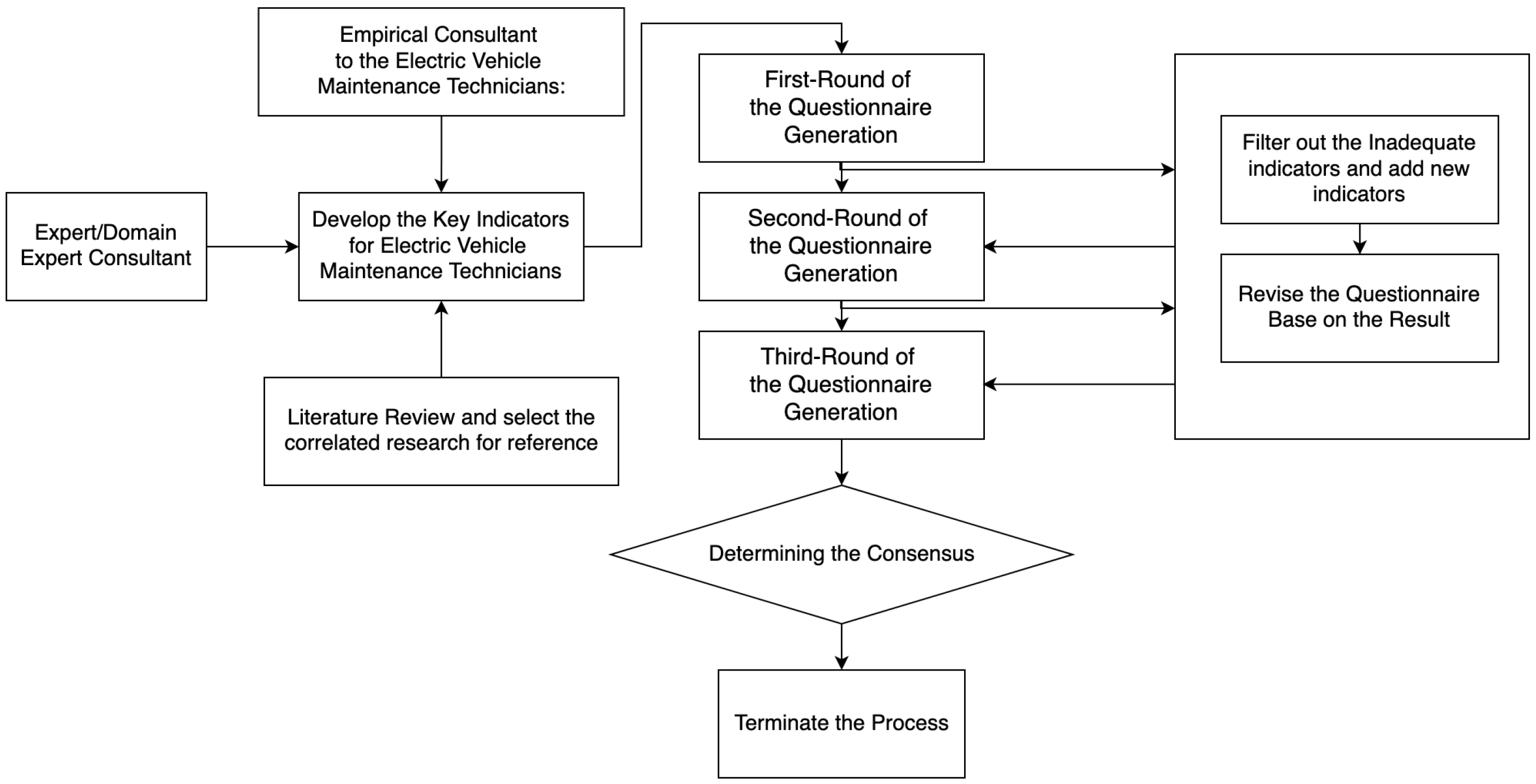

Table 1.
Summary of Expert Content Validity Feedback and Revisions.
| Expert | Feedback/Suggestion | Revision Made |
|---|---|---|
| Expert A | Specify configuration details for high-voltage battery systems. | Revised indicator A-1-1 to “Ability to identify and understand high-voltage battery assembly configuration.” |
| Expert B | Remove redundant soft-skill items. | Deleted indicator D-2 “Organizational Innovation Planning.” |
| Expert D | Includes detailed functionalities for DC/DC transformers. | Added indicator A-3-4, “Understanding DC/DC transformer functionality.” |
| Expert E | Enhance clarity in battery management indicators. | Revised indicator A-6-1 to “Ability to accurately assess battery module status information.” |
* This table summarizes the key expert feedback and corresponding revisions made to enhance the competency framework.
Table 2.
Round 1 Statistical Analysis of Competency Dimensions
| Dimension | Mode | Mean | Standard Deviation |
|---|---|---|---|
| Professional Knowledge | 5 | 4.87 | 0.352 |
| Professional Skills | 5 | 5.00 | 0.000 |
| Professional Attitude | 5 | 4.27 | 0.884 |
| Personal Traits | 5 | 3.80 | 1.146 |
Table 3.
Round 2 Statistical Analysis of Competency Dimensions
| Dimension | Mode | Mean | Standard Deviation |
|---|---|---|---|
| Professional Knowledge | 5 | 5.00 | 0.000 |
| Professional Skills | 5 | 5.00 | 0.000 |
| Professional Attitude | 5 | 4.47 | 0.640 |
| Personal Traits | 4 | 4.07 | 0.704 |
Table 4.
Round 3 Statistical Analysis of Competency Dimensions
| Dimension | Mode | Mean | Standard Deviation |
|---|---|---|---|
| Professional Knowledge | 5 | 5.00 | 0.000 |
| Professional Skills | 5 | 5.00 | 0.000 |
| Professional Attitude | 5 | 4.53 | 0.516 |
| Personal Traits | 4 | 4.20 | 0.561 |
Table 5.
Comparison of Standard Deviations between Round 1 and Round 2
| Dimension | Round 1 SD | Round 2 SD |
|---|---|---|
| Professional Knowledge | 0.352 | 0.000 |
| Professional Skills | 0.000 | 0.000 |
| Professional Attitude | 0.884 | 0.640 |
| Personal Traits | 1.146 | 0.704 |
Disclaimer/Publisher’s Note: The statements, opinions and data contained in all publications are solely those of the individual author(s) and contributor(s) and not of MDPI and/or the editor(s). MDPI and/or the editor(s) disclaim responsibility for any injury to people or property resulting from any ideas, methods, instructions or products referred to in the content. |
© 2025 by the authors. Licensee MDPI, Basel, Switzerland. This article is an open access article distributed under the terms and conditions of the Creative Commons Attribution (CC BY) license (http://creativecommons.org/licenses/by/4.0/).
Copyright: This open access article is published under a Creative Commons CC BY 4.0 license, which permit the free download, distribution, and reuse, provided that the author and preprint are cited in any reuse.


