
Submitted:
28 April 2025
Posted:
28 April 2025
You are already at the latest version
Abstract
Hydrogen is an environmentally friendly fuel with a high energy density and is a critical component of sustainable energy systems; however, storing hydrogen as an energy carrier is one of the most significant technological challenges. This review has reviewed hydrogen storage technologies, emphasizing physical storage methods, chemical hydrides, and emerging nanomaterials. This review gave special attention to the metals hydride, specifically magnesium hydride (MgH₂), lithium hydride (LiH), sodium alanate, and ammonia borane, while discussing the limitations of their thermodynamics and kinetics in addition to recent advances in the performance of these metal hydrides for hydrogen fuel. These advances in hydrogen storage using metal hydrides will employ advanced porous materials such as metalorganic frameworks (MOFs), covalent organic frameworks (COFs), and carbon nanostructures, showing promising adsorbability. One section of the review also assesses the role of computational screening and machine learning to expedite the discovery of new materials for hydrogen storage. The review synthesizes the most effective ways to design genomic hydrogen storage devices that improve safety, efficiency, and scaling.
Keywords:
Hydrogen storage
; Metal hydrides
; Magnesium hydride (MgH₂)
; MOFs
; COFs
; Nanostructures
; Cryo-compressed hydrogen
; Computational screening
; Machine learning
; Renewable energy
1. Introduction
For more than 150 years, non-renewable energy sources like coal, oil, and natural gas have been crucial in the global economy [1]. About 80% of global energy demand has been recorded in fossil fuels [2]. Despite this, these sources of fossil fuels are predicted to be depleted and will be restored [3]. Moreover, carbon is a central aspect of fossil fuels; at the time, burning fossil fuels creates energy and generates carbon dioxide circulating into the atmosphere, giving rise to various climate problems [4,5]. The exceptional growth of population and economy has caused the fast depletion of fossil fuel sources and has a diverse impact on climate [6,7,8]. Thus, governments of various countries are competing to change and replace energy sources with sustainable ones. To protect natural sources and participate in the Net Zero Emission Commitment (NEC). Through 2020, over 110 countries had agreed to succeed in the nZEC focus by 2050. China is one of the countries that has released abundant CO2 and has committed to succeeding through 2050[10,11] . The countries have net zero energy building (nZEB)[12,13]. That suggests the energy used yearly in construction should equal the volume of renewable energy change on site. Zero emission or carbon neutrality indicates that despite being given off, carbon is grabbed, retailed, and used for some role [14,15]. Renewable energy emerged with a captured utilization system can help abode the cause of energy insufficiency and global warming [16,17].
Fossil fuel, bio-mass, or their combination can be produced. Hydrogen is light energy-dense or storable [18]. Hydrogen energy [19,20] does not directly produce pollutants or radiate greenhouse gases. Consequently, hydrogen is one of the cleanest energy sources. Hydrogen participation is considered to obtain zero carbon emissions and can be considered the clean, safe, cost-effective energy source of the future [21,22,23,24,25]. Further renewable energy sources are solar and wind energy. Their development and expansion can encourage hydrogen that is not always accessible to complement the demand [26,27]. Hydrogen is the best choice for renewable energy transfer and storage, as it is inexpensive and long-term electricity storage. Now, hydrogen storage stays competitive in hydrogen energy applications [28,29,30].
Moreover, compresses and liquefying hydrogen storage materials are essential in widespread applications in the hydrogen industry [31,32,33]. Hydrogen material can safely store higher-density hydrogen related to compression and liquefication methods. Thus, this material can be easily operated [34,35]. Therefore, storage materials are most convenient for both oriented and stationary applications [36,37,38,39,40]. These materials are categorized into chemisorption and physisorption types and have benefits and drawbacks. Particularly, hydrogen storage material must counter the requirement of protecting inexpensive, fast kinetics, easy, manageable, suitable thermodynamics properties, and high gravimetric and volumetric density of hydrogen [41,42,43]. Figure 1 shows the classification of hydrogen storage materials. Chemical storage materials have high energy densities and use mainly similar liquid infrastructures, which involve systems or gas line refueling stations [44,45,46,47,48]. The dehydrogenation process with ammonia and other storage compounds is the most challenging because of the production of gaseous pollutants like nitrogen oxide and carbon oxides [49,50,51]. Metal hydride storage materials also rate at low pressure and ambient temperature with high volumetric energy density, although they have poor kinetics and lack dynamic stability [52,53,54,55]. Conversely, physical storage systems' control of conditions (pressure-temperature) and selection of absorbents can be classified as cryogenic liquefication and high-pressure compression technologies as pressure or temperature-controlled hydrogen gas storage systems [56]. Their shortcomings include safety concerns, expensiveness, and low storage capacities [57]. Applying novel porous material as a highly efficient hydrogen absorbent in physical hydrogen storage methods [58] will defeat the critical shortcomings of the physical storage system by presenting the strength of high storage densities, fast charging-discharging kinetics, and inexpensive [59,60,61] . In this review, we first prioritize the storage of compressed hydrogen in hollow structures or non-mesoporous structures used in physical storage absorbents like metalorganic framework (MOF), carbon-based materials, or zeolites.
2. Classification of Hydrogen Storage Methods
- •
- Physical Storage: Compressed, Liquefied, Cryo-compressed
- •
- Materials-Based Storage:
- ▪
- Metal Hydrides (MgH2, LiH, NaAlH4, etc.)
- ▪
- Sorbent Materials (MOFs, COFs, Activated Carbon)
2.1. Solid-State Physical Storage Material
Yujue wang showed different materials for hydrogen storage like zeolite, activated carbon, carbon nanotubes, and metalorganic framework [62]. The most dominant materials are MOFs, which are used for adsorption because of their hydrospheric properties, strong mechanical and thermal resistance, chemical inertness, and high physical adsorption capacity. By Wang, meanwhile, zeolite can adsorb gas molecules conditionally based on their size the exhibition of activated carbon and carbon nanotubes can be optimized by doping with other elements to increase connection with the gas molecules. Erdogan et al. [63] analyze zeolite-activated carbon (ZAC). Zeolite MWCNT zeolite graphene composite (ZGC) and ZAC had higher hydrogen capacity at 1.3wt% at 77K and controlled ambient pressure to pure activated carbon and zeolite. D. Broom et al. stated that the versatility of metalorganic framework and porous organic polyhedral melecules [64] enriched the hydrogen storage. It was noted that hydrogen composition increases directly when BET-specific surface area increases.
Xiahong Chen et al. [65] introduce an innovative precursor to fabricate organized structures specially for modified purposes. According to the findings, Li-F-PCNFs showed a hydrogen capacity of up to 2.4wt% at 0oC and 10MPa, 24 times better than pure porous carbon nanofibers. It was determined that 200 highly porous materials of NPF at high volume [66] hydrogen adsorption show potential. Arslan Munir [68] was found to enhance the crystallinity of carbon-based metalorganic model and carbon-based hybrids and consumption of 6.12 wt% at 40oC of hydrogen accompanied with a large surface area.
2.1.1. Mechanism of Hydrogen Adsorption on Solid-State Physical Storage Materials
Solid and gas phases enhance between gas molecules at physical adsorption. This occurrence is illustrated by Van der Woal's interaction along short-range repulsive interactions interphase [67]. As reported by Panella, the molecule carried out long-range forces that produced their charge distribution change and increased induced dipoles [69]. Conversely, when gas molecules are set close, they have a strong reputation by overlapping electron cloud [67]. The gas molecule binding with adsorbent might be classified using the Lennard Jones potential; due to this concept, there is no interaction when nearby particles are within the limit of infinite distance [70]. They are inclined to repel each other despite shorter distances, and at moderate distances, they govern attraction [71]. Figure 2 shows a relationship between potential energy and the distance from the surface of the adsorbent for chemisorbed (Ec) and physisorbed (Ep) hydrogen. It is essential to grasp that physical adsorbents have no energy barrier that stops gas molecules from reaching the surface. Therefore, physical adsorption has rapid kinetics and does not need activation due to the absence of diffusional hinderness. The molecular hydrogen adsorption range is 1-10kg/mol, about ten times smaller than chemisorption [72].
The following equation determines the intermolecular potential between hydrogen atoms and atoms on the surface.
Where adsorption energy is calculated by e, the distance between the hydrogen atom molecule and surface atom is r, and r m is the interaction of hydrogen atoms where physical and chemical adsorption occurs. Figure 2 explains hydrogen adsorption.
2.2. Metalorganic Framework (MOF)
The polynuclear clusters, which are also called secondary building units (SBN), are made of a metalorganic framework, which consists of metal ions at the nodes and organic linkers as the binding groups [73]. MOF structures variety can be explained by adjusting their geometry and connectivity. The long linker produced Iso-structure analogs in the early 90s, which are the uniform type of metalorganic framework that are interconnected to the amount by altering the pore size of the framework. The linker charger developed the neutral framework and improved the bond strength. Chelation to produce polynuclear clusters provides many advantages for achieving a more substantial structure, such that using SBUS and chelation of metal ions furnished the rigidity and directionality [74].
Using the slow vapor diffusion method, a mixture of trimethyl amine toluene into DMF/toluene solution of Zn(No3)3 6H2O and benzene carboxylic acid (HBDC) [75] was synthesized MOF2. The layer structure of MOF2 is produced by the dimeric Zn2(-Coo)4 paddle wheel SBUS instead of single metal nodes associated by BDC struts to form a square grid. The stability of the structure SBUS increased to make it possible to remove all the solvents without destroying the main body of the compound. Eventually, Li et al.[75] presented MOF- s with the SB nodes as Zn4O(BDC)3 (DMF)x [76]. Using terephthalic as an organic linker that synthesized the structure is given in Figure 3, and SBU units are developed on the zinc-based.
Almost 61% of the unit cell is shown by these substantial voids filled with solvent (DMF) molecules from the synthesis material. It is apparent from Figure 3 that the lack of a wall surrounding the pore is one of the striking features. The unusual empty builds allow the host molecules to pass without a hindered path, as pores have no wall present in them. In this material where diffusion occurs are always narrow and blocked spaces as zeolites made up walls which have a framework with accordance to Li et al. sorption isotherm at 78k and metalorganic framework having higher pore volume (0.54-0.6cm3cm-3) showed the Dubinin Rouskhvich equation than zeolites upto 0.47cm3cm-3 [76]. In humid air, MOFs are sensible, and decomposition is affected by moist solvent [77]. MOFs were first introduced when nitrogen adsorption was at 77k reversibility, and gas adsorption in MOFs.
2.3. Covalent Organic Framework (COF)
Crystalline porous polymers are a covalent organic framework that combines organic components accurately for gas storage catalysis and optoelectronic applications [78]. The well-defined structure is based on specific geometrical shapes and sizes, which contain unique molecular spaces leading to entirely different characteristics and applications [79]. As reported by Jiang et al., using dynamic bonds, carbon-based configurations are formed and make an architecture with well-defined pores and hollows [80]. These carbon-containing materials have a three-dimensional sp2 hybridization network connected by covalent bonds. Gas storage or separation within other areas requires that the material have some learning application [81]. As the CFO's final crystallinity and porosity are driven by their topological design before synthesis begins, it is essential to plan it. CFOs have adaptable polymer structural foundations built by monomer 2D and 3D, the most popular techniques for producing networks through chain propagation sequential growth polymerization. Numerous connections could occur in CFOs, such as planes having covalent links and layers formed in 2D material. Noncovalent interaction aromatics staking hydrogen bonds and van der Goals force these layers to be limited from isolation aggregation and forming layered material. Many conceptual ideas for designing COFs have been reported by Jiang et al. [82] . In the beginning, when one twist and coupler are occupied with getting the hexagonal, tetragonal, and trigonal topology by using one twist two or three couplers when CFOs can be designed. The irregular shape of multicomponent synthesis but ordered pores. Furthermore, the formation of a complex framework can be used by many components by the existence of adjacent edges where distinct electrical interactions are triggered. The topologies are generally hexagonal, rhombic, tetragonal, and trigonal.
MOFs and COFs have received more attention in hydrogen storage materials because of their porous structure, sizeable free volume, and high available surface area [83,84,85]. However, storing hydrogen in ambient conditions is almost impossible using MOFs and COFs. The binding energy ranges from 2.2 to 5.2 KJ/mol and is one central reason: The Van der Waals connection between hydrogen and porous material [86,87].
2.4. Hydrogen Storage Technology
Hydrogen is crucial for a sustainable future due to its high energy density on a weight basis. However, hydrogen's volumetric energy storage density presented a formidable challenge for efficient and safe storage. To face this problem, various physical technologies for hydrogen storage have been adopted. These techniques involved compression and liquefication. These are innovative methods for hydrogen storage in dense and stable forms. These techniques are efficient for hydrogen storage due to their small size, lightweight, and gaseous nature bling their efficient transportation and use in various applications [88]. These techniques unlock the green energy carrier potential of hydrogen [89]. Moreover, its application in spanning fuel cell vehicles and industrial processes [90,91].
2.5. Compressed Hydrogen Technique
The compressed hydrogen technique is efficient, particularly in transportation powered by fuel cell cars [92]. This method involved compressing hydrogen into pressure container tanks that can withstand high-pressure containers from 35MPa to 70MPa. During that time, safety is maintained, but this method has drawbacks, especially since it demands high compression energy, which reduces hydrogen potential. Secondly, the tank stores hydrogen; although it is lighter, it becomes heavy. The technique provides a volumetric storage capacity of 2ug/L to 40g/L at 3000 and 700 bar, respectively, a limiting factor [93]. Moreover, such demands a wide range of infrastructure, making it expensive. For hydrogen storage, different types of vessels are categorized into four categories;
- Type 1(seamless steel) withstands high pressure, has low energy density, and is heavier than other types. Withstand pressure up to 20MPa.
- Type 2 (steel liner reinforced with a composite wrap) is higher and more efficient than type 1; however, it is expensive to produce. It can withstand pressure of 30MPa and is suitable for industrial applications.
- Type 3( seamless aluminum liner fully enveloped by a composite material layer) is low-weight and maintains higher pressure. However, it has low thermal energy, so it is not ideal for hydrogen storage. It can withstand up to 70MPa.
- Type 4 (plastic liner fully wrapped with composite materials) vessels can withstand up to 70MPa and are lighter than all other vessels. However, they are expensive, which limits their usage.
2.6. Liquefied Hydrogen Storage
Cryogenic preservation of hydrogen in a liquid state prevented the low energy density of hydrogen associated with its gaseous phase94. To turn hydrogen into a liquid state, it is subjected to a cryogenic temperature less than the critical temperature of 33k [92]. Here, the advantages and drawbacks of liquid hydrogen storage have been described. Liquid hydrogen storage has a high energy density suitable for energy storage and long-distance hydrogen transportation [95]. Moreover, the technology associated with liquid hydrogen storage possesses a long history of practical applications [96]. The liquid hydrogen storage process demands formidable energy demand; additionally, establishing infrastructure for widespread adaptation poses a formidable challenge.
2.7. Cryo-Compressed Hydrogen Storage
Cryo-compressed hydrogen storage primarily aims to mitigate the challenges faced by high-pressure gas storage and cryogenic storage [97]. The voluminous storage requirements and heightened pressure of conventional high-pressure gas storage are the challenges that encircle aspects besides inevitable boil losses interact in the cryogenic hydrogen storage solutions through diverse applications, which are the central aim of this approach with an articulate emphasis on the automotive sector [98,99,100]. At cryogenic temperature, cryo-compressed hydrogen storage runs by pressuring hydrogen although [101,102,103].The rule of operational temperature usually ranges between 20 and 70k, and pressure can be expanded to 35MPa [104]. Significantly enhanced volumetric storage capacity gives this technique up to 80g/L compared to about 70g/L obtainable in the case of liquefied hydrogen storage. This technique incorporated with storage vessels complex construct that provided the required material with the capacity to undergo the terminal of high pressure and exceedingly low temperature. Generally, composite materials fortified with carbon fiber to certify structural robustness are made-up storage tanks. The hydrogen storage field's crucial challenge is an innovative solution for compressed hydrogen storage. Similarly, methodologies of cryo-compressed hydrogen storage show a spectrum of affirmative and negative facets on the consensual front in both gravimetric and volumetric terms equipped with higher energy density when aligned with the unique cryogenic and high-pressure storage system. The positive attributes are another protective aspect of the temperature yield of hydrogen, which is less reactive where operation occurs.
However, the cryo-compression storage model is not without challenges. The prominent concern of technological complexity is developing a system capable of safe and efficient hydrogen storage under the exacting conditions of high pressure and temperature involved in complex engineering solutions. Additionally, cryo-compressed storage essential infrastructure is continuously developed and filled with many challenges, including expedition materials capable of resisting operating conditions and the design of efficient cooling systems.
A significant aspect is that the expense of each storage technology depends on various factors, such as the scale of the system material used, the manufacturing process, and market demands. Compared to other methods, compressed hydrogen storage experiences lower capital costs. The more expensive is liquefied hydrogen storage because the cryogenic. Infrastructure that requires cryo-compressed hydrogen storage located between the two in terms of cost provides the central solution. The continuous research and development effect reduces the price of all storage technologies. Therefore, it improves the economic capability of hydrogen as an energy carrier. The crucial role within hydrogen technology is that these three distinctive hydrogen storage systems are furnished with diverting degrees of efficiency, safety consideration, and technological readiness. Continuous research is undertaken to solve each method's intrinsic challenges, therefore developing the outpost of hydrogen storage and transportation technologies.
2.8. Metal Hydrides
A class of metal and hydrogen-based materials have recently emerged as a promising space-saving hydrogen storage agent due to their large-scale hydrogen storage capacity and potential for use in hydrogen-based energy systems. Their relatively high energy density, low cost, and environmental characteristics make them attractive for applications ranging from portable electronics to electric vehicles to renewable energy systems. However, advancing metal hydrides for hydrogen storage remains a daunting challenge concerning identifying high-level hydrogen storage materials that retain stability, safety, and economic efficacy [104]. Studies are ongoing on developing metal hydrides that meet the above requirements. The performance of metal hydrides has several dependencies, including metal selection, particle size and morphology, purity of the material, and impurities present. Metal hydrides are formed by reversible chemical reactions when certain metals (or alloys) absorb hydrogen. Such hydrides have high volumetric hydrogen density and storage capability [105,106]. New research is pursuing the optimization of metal hydrides for hydrogen storage to store hydrogen securely and densely by expanding the metal lattice. At the same time, it is subjected to absorption and contracting when released. However, obtaining optimum hydrogen absorption and desorption capacity at suitable temperatures and pressures appears impossible. Metal hydrides with an average hydrogen storage capacity for hydrogen essentially amount to 1–2% of their weight. If active heating for hydrogen removal contributes to these higher storage capacities, they may range from 5–7% of their total weight. While metal hydride tanks can continually store and release hydrogen, their maximum storage capacity is compromised by clogging the spaces where hydrogen is usually stored, reducing the tank's capacity. The amount of heat transferred, hydrogen absorbed, and hydrogen desorbed in a reversible metal hydride operating at room temperature and atmospheric pressure generally depends on the metal alloy used for hydrogen storage [106]..
2.8.1. Magnasium Hydroxide MgH2
Magnesium hydroxide shows tendance gravimetric 7.6%, volumetric 110kg H2 m-3, cost-effective, lightweight, and high chemical stability [107]. However, its strong bond between hydrogen and Magnesium impedes the hydrogen release. To release the hydrogen gas at room pressure requires a high temperature greater than 300oC [108]. Various challenges are associated with its practical use due to its high operating temperature, slow kinetics, and high thermodynamic stability [109]. How to improve morphology using the catalyst and nanostructure by reducing the particle size [110]. This improves bulk Magnesium's kinetic and low surface area, resulting in low hydrogen dissociation. Suppose further morphology is improved, which results in a large surface area and ultimately reduces the hydrogen dissociation [111]. Using ball milling, hydrogen diffusion can be reduced, and hydrogen desorption and absorption kinetics can increase.
By the ball milling method discussed above, it was recently shown in study [112] that at 523 K, about 6.28 wt% hydrogen was absorbed and desorbed over 20 min and 50 min, respectively, under one and zero MPa pressure by using reactive ball milling (high-pressure hydrogen gas) of magnesium powder for 25h. However, agglomeration of the milled nanoparticles during the repeated cycles of hydrogen release and absorption may compromise the reversible hydrogen storage capacity [113]. Thus, using nano scaffolds is perceived as a suitable approach in general; magnesium hydride dehydrogenation is a thermally activated and endothermic process, which requires energy input to break bonds and release the hydrogen stored in the material. The energy barrier to this process can be expressed as the activation energy to initiate the dehydrogenation reaction while avoiding agglomeration. This approach was utilized in a more recent study [114] wherein a porous three-dimensional activated carbon nanostructure, modified with Ni and Fe, was utilized to impregnate MgH2, yielding a high hydrogen storage capacity of around 6.63 wt% at 453 K and 1 MPa in only 5 min, with a very high degree of stability of the nanoparticles. This activation energy is typically and generally in the 150 -200 kJ/mol range for magnesium hydride dehydrogenation. In a recent investigation by Meng et al. [115], it was determined that the activation energy decreased to 78 kJ/mol by catalyzing the reaction with V4Nb18O55 microspheres at room temperature with stable reversible capacity of 6.0 wt% magnesium hydride for ten cycles. In tandem with increasing the performance and stability of magnesium hydride, Wang et al. [109] identified that 6.5 Wt% H2 was released in 10 min at 573 K and began absorbing H2 at 313K with unalloyed alloys of different metals in the alloying process, including Cr, Mn, Fe, Co, and Ni. Furthermore, the same study maintained the hydrogen storage volume at 97% after twenty cycles of 573K.
2.8.2. Lithium Hydride (LiH)
Lithium hydride (LiH) is one of the lightweight metal hydrides available, possessing a high gravimetric hydrogen storage capacity (up to about 12.6 Wt%) 116, but requiring high temperatures (673–973 K) and pressures for hydrogen absorption and desorption. There continue to be challenges in the practical use of LiH relating to kinetics and reversibility. One significant aspect of this is its high formation energy (-90.5 kJ/mol) and the requirement of high desorption temperature (700–1000 K). LiH also interacts with humidity, leading to an irreversible corrosion layer, such as lithium oxide and hydroxide. Nonetheless, LiH has been recognized for efficiently producing hydrogen at low relative humidities via controlled hydrolysis, especially for mobility [117,118]. There have been many efforts to deal with the thermodynamic challenges of LiH. Mechanical milling is one example that was used to decrease the thermodynamic stability of the lithium hydride-silicon alloy to achieve 5 wt% hydrogen capacity and storage at 763 K [119]. Similarly, blending LiH with germanium has been evaluated, demonstrating decreased stability and storing 3wt% hydrogen at 673 K [120,121]. Lei Wang and co-workers [122] prepared LiH nanoparticles from catalytic hydrogenation of Li. They showed that when coated with Ni, these nanoparticles can release hydrogen from 373K.
Additionally, Pluengphon et al. [123] studied sodium-lithium-hydrogen amalgamations by collaborating sodium and lithium cations at high pressure, employing ab initio random structure searches and cluster expansion methods. Their research showed that pressure gives structural stabilization for Na3LiH12, Na2Li2H12, and NaLi3H12; phonon calculations and elastic constants endorsed this. Carbon is a common additive added previously to increase the adsorption/desorption of hydrogen below temperatures of 473 K [124]. Also, a new strategy of promoting vacancy defects in the LiH structure by changing the amount of these defects from 1%-25% concentration was recently examined by Bahou et al. [118] in 2023. Ultimately, it was demonstrated that gravimetric hydrogen storage capacities were increased from 12.6 wt% to 14.6 wt% with the use of 16% lithium vacancies.
2.8.3. Sodium Alanate (NaAlH4)
Sodium Alanate is a complex metal hydride that can reversibly store hydrogen. It has a relatively high gravimetric capacity (up to 5.5 wt%) yet extends high-temperature outputs for hydrogen while often suffering from reversibility and stability. Sodium Alanate will undergo decomposition to liberate hydrogen throughout three sequential steps, as described by the following reactions [125]:
3NaAlH4 ↔ Na3AlH6 + 2Al + 3H2 Tdec = 453 − 463 K; ΔH = 40.9 kJ mol− 1
Na3AlH6 ↔ 3NaH + Al + H2 Tdec = 463 − 498 K; ΔH = 15.6 kJ mol− 1
NaH ↔ Na + 1 / 2 H2 Tdec ≥ 673 K; ΔH = 120 kJ mol− 1
Most importantly, the last step takes place at about 673 K. The effective hydrogen content is mainly obtained from the first two reactions at temperatures below 498 K, providing a hydrogen storage capacity of 5.6 wt%. The high desorption temperature and limited reversibility diminish its practical effectiveness [125]. Transition metal compound dopants have been shown to reduce reaction temperatures, allowing hydrogen release at lower temperatures, improving reaction kinetics, and enhancing reversibility [126]. For example, Ren et al.[127] prepared titanium hydride in the form of nanoplates supported on graphene that completely dehydrogenated sodium alanate at 353K and rehydrogenated at 303K under 10MPa H2 with a reversible hydrogen capacity of 5 wt%. Furthermore, other materials, such as carbon nanomaterials, have been considered dopants [128,129].
2.8.4. Ammonia Borane (AB, H3NBH3)
Ammonia borane, produced at mild operating conditions, has a reported theoretical hydrogen content of 19.6 wt% [130]. Ammonia borane is a thermally or chemically hydrogen carrier, making it suitable for portable utilization. Extensive research has been performed on ammonia borane due to its remarkable stability and non-toxic nature. Conventional methods to release stored hydrogen from ammonia borane have been utilized for thermal dehydrogenation. Thermal dehydrogenation utilizes higher temperatures to produce hydrogen relative to ambient, usually temperatures greater than 373 K, to break the B–H and N–H bonds and liberate hydrogen gas [131]. Although it is a simple concept, it often requires comparatively high temperatures to achieve this reaction and has slow dehydrogenation reactions. Another possibility of releasing hydrogen via ammonia borane may be a higher efficacy of hydrogen release. The process of releasing hydrogen from ammonia borane occurs via hydrolysis. Still, ammonia borane exhibits significant resistance to hydrolysis in an aqueous phase (water). Therefore, a good catalyst is necessary for hydrolytic dehydrogenation under mild conditions (ambient temperature). Metal-catalyzed hydrolysis is a good option, allowing the release of a significant amount (7-8%) of hydrogen under mild conditions [132]. Another option is thermodynamically unstable metal nanoparticles that can be kinetically stabilized against agglomeration via solid support materials with high surface area or, in solution, via ligands. Although metal nanoparticles dispersed in solution (held in place by ions or polymers) have higher hydrogen release efficiency due to more significant active sites, nanoparticles typically supported on solid materials are less prone to aggregate, giving them longer lifetimes than those held in a solution [133]. Thus, there is no best material for hydrogen storage; each material has benefits and disadvantages.
2.9. Metal Nitrides, Including Amides (M(NH2)x) and Imides (M(NH)x)
Complex hydrides, such as lithium and magnesium amides and imides, a class of metal amides and imides, can provide gravimetric hydrogen storage capacities in roughly 4-10wt% or greater in some cases [134]. The formulae for metal amides and imides are represented by M(NH2)x and M(NH)x. The capacity will depend on the metal composition, and the conditions for hydrogen absorption will influence the capacity. Reports indicate the efficiency of hydrogen release from metal amides and imides depending on the compound being in the 50-90% efficiency range Still, a catalytic material is essential for realizing low-temperature reactions to get high hydrogen storage content with high release efficiency. Furthermore, amides and imides undergo a dehydrogenation reaction, liberating ammonia [135]. As a result, ammonia production lowers the hydrogen content available to fuel cells, poisons the catalyst, and can lead to complications. In a recent analysis by Che et al.[134], the catalytic impact of Li3VO4@LiVO2 was examined to improve the hydrogen absorption and desorption performance of a lithium-magnesium imide (Li – Mg – N – H) system, employing three catalyst weight ratios (5, 10, and 15 wt%). Li3VO4@LiVO2 with a 10 wt% ratio demonstrated the most significant improvement, enhancing absorption from 4.1 wt% with the parent hydride to 4.7 wt%, and desorption efficiency changed from approximately 4.2 wt% to 4.8 wt% at 523 K and 0 MPa. The activation energy for the hydrogen desorption process decreased from 117.86 kJ/mol to 99.44 kJ/mol with 10 wt% of Li3VO4@LiVO2.
2.10. Activated Carbon and Carbon Nanomaterials
Activated carbon has a hydrogen storage capacity of approximately 1-2 wt% at room temperature under moderate pressures, lower than various advanced materials such as metal hydrides. In addition, the desorption efficiency of hydrogen gas from activated carbon is often limited because it typically requires low temperatures ranging from 70 to 398 K for desorption and can be energy-intensive. Nevertheless, researchers are interested in investigating activated carbon materials in hydrogen storage due to their availability (and low cost) and high surface area. Furthermore, activated carbon can be used to adsorb impurities from hydrogen gas streams in an adsorption-based hydrogen purification and gas separation process, where it selectively adsorbs impurities such as carbon dioxide and moisture. One of the standard methods to enhance the hydrogen adsorption efficiency of various materials like activated carbon is ball milling, which increases the surface area. Twenty years ago, Shindo et al. [136] employed this approach and observed a hydrogen storage capacity of nearly 3 wt% after milling a commercial sample of activated carbon for 80 h. Another widespread approach for improving activated carbon's hydrogen adsorption efficiency involves cryogenic temperatures. In this vein, Jemma et al.[137] noted a hydrogen uptake efficiency of 1.8 wt% with carbon prepared from pyrolyzed lignin material of eucalyptus chips at 0.1 MPa and 77 K. Using the same temperatures, Wrobel-Iwaniec et al.[138] demonstrated storage capacities of 2.95 wt% and 5.61 wt% at 0.1 MPa and 4 MPa, respectively, with activated carbon derived from chitosan.
Additionally, Akasaka et al. [139] reported an increase in storage efficiency from 0.6 wt% to 4 wt% after cooling from 298 K to 77 K, with a carbon material made from coffee beans. These studies provided further evidence of the viability of enhanced storage efficiencies at cryogenic temperatures. Researchers have considered using carbon nanotubes as potential materials for hydrogen storage due to their unique structure and properties. The hydrogen storage capacity of carbon nanotubes also depends on certain factors, such as the diameter and length of the nanotubes, functionalization, and operating conditions. The hydrogen adsorption capacity of single-walled carbon nanotubes can be theoretically large at room temperature, up to 5 to 10 wt% hydrogen by weight [140]. There are still experimental challenges to realize that storage level is on-situ because of structure optimization, hydrogen adsorption/desorption kinetics, safety, and cycling. As a result, carbon nanotubes are not practical for broader commercial applications for onboard transportation systems [141]. The amount of hydrogen commercially available at room temperature and ambient pressure has consistently fallen short of the Department of Energy's target for onboard hydrogen storage systems in the different samples of carbon nanotubes.
However, upon interrogation at reduced temperatures such as 77 K, select samples of carbon nanotubes exceeded or met the Department of Energy target for hydrogen storage. Specific carbon nanotubes and their hybrid versions using metal and metal oxide nanoparticles can exceed the final goal set by the United States Department of Energy for onboard transportation applications in terms of hydrogen storage capacity. In this sense, Akbarzadeh et al. [142] reported a hydrogen storage capacity of 10.94 wt% for a nanocomposite of iron-silver/titania/carbon nanotube. Kadri et al. [143] used a composite of carbon nanotubes with magnesium hydride with a vanadium catalyst. They obtained a hydrogen storage capacity of 6.50 wt% in a minute and hydrogen release of 6.50 wt% in 10 min at 473 K and 573 K, respectively. Also, nitrogen-doped carbon nanotubes are very efficient hydrogen storage materials, such as the composite of nitrogen-doped carbon nanotubes with lanthanum oxide that Liang et al.[144] recently prepared. These showed a gravimetric capacity of 7.4 wt% at 373 K and 1.8 MPa.Therefore, it is true that many materials are continuously being studied to improve the storage capacity of carbon nanotubes. Figure 4 shows a comparative summary of various materials for hydrogen storage.
3. Designing Material for Hydrogen Storage
The design and optimization of chemical hydrogen storage materials incorporate thermodynamics feasibility for energy-efficient hydrogen uptake and release. Kinetics significantly influence hydrogen storage success, dictating hydrogen value absorption and release rates. Material stability is key for materials that undergo multiple cycles of absorption and desorption of hydrogen, being able to withstand those cycles without degrading. Materials with reversibility enable you to use the material numerous times.
3.1. Design Considerations and Strategies for Hydrogen Storage Material
The restriction in using hydrogen as an energy carrier usually arises from the difficulties in storing it. Hydrogen has a low volumetric energy density, only about 0.7 kJ L− 1 at 25oC under atmospheric pressure. Storing hydrogen compresses it to 70 MPa, where its volumetric energy density increases to ≈3 MJ L− 1 at a system level with composite tanks. These high-pressure hydrogen tanks have already been deployed in the early commercial adoption of hydrogen vehicles. However, compressed tanks are not economical for stationary applications due to their high costs, estimated to be about AUD 685 per kg H2 at system level [145].
Using proper and sustainable materials is essential for sustaining the growth of a hydrogen economy. There have been many theoretical and experimental studies on hydrogen storage. The main processes involved in hydrogen storage include physisorption (molecular hydrogen storage) and chemisorption (storage of atomic hydrogen)[146]. The performance of the storage materials depends on two primary considerations: gravimetric and volumetric density. These considerations require materials to be light and bulky. The gravimetric density is calculated as the stored hydrogen weight divided by the weight of the entire system (hydrogen + container). The volumetric density is calculated as the mass of stored hydrogen divided by the unit volume of the system [147,148].
Several key pathways exist under the banner of advanced storage materials, each offering different benefits and possibilities to improve hydrogen storage capacities. Metal hydrides, which can store relatively large amounts of hydrogen, have received significant attention. Research is actively searching for new metal hydrides and using alloying and nanostructuring approaches to increase their storage capacity and improve hydrogen absorption and desorption kinetics.
Metal hydrides are chemical storage systems that utilize an absorption process to charge hydrogen (as a solid) with potentially higher capacity than other storage methods. Certain materials, such as metals, intermetallics, or alloys, can absorb hydrogen at ambient temperature and moderate pressures, forming reversible solid compounds (i.e., metal hydrides)[149]. The absorption mechanism can provide hydrogen storage with high density and relatively low pressure because the formations of metal hydrides are high density and usually repeatable [150,151].
When analyzing different storage approaches, the gravimetric storage capacity or volumetric energy density is often the first important metric analyzed. For the evaluation of metal hydrides, the gravimetric capacity is the maximum mass of absorbed hydrogen divided by the weight of the hydride material, with results in weight percent (wt%). Typically, metal hydride materials in this group that can be classified as interstitial hydrides show gravimetric storage capacities in the 1 to 2 wt% range [152].
The selection criteria for metal hydrides for hydrogen storage and compression depends upon various essential factors. The first one is how reversible the hydride formation and decomposition occur at the specified operating temperatures and hydrogen pressures required by the application. The material must also have an ample, reversible hydrogen storage capacity under specified operational conditions. These characteristics are apparent in the pressure-composition-temperature characteristics for the hydrogen gas and hydride forming materials systems. The reversible capacity is dependent on the width of the plateau on the pressure-composition isotherm, where the process direction (hydrogenation/H2 up-take or dehydrogenation/H2 release) is dependent on the actual hydrogen pressure value compared to the plateau pressure at the temperature. In addition to the reversible capacity, other important properties of metal hydrides for hydrogen storage and compression include fast hydrogen absorption and desorption kinetics, resistance to poisoning from impurities in the supplied hydrogen, easy activation, long cyclic stability, low cost, and ease. These properties all contribute to the applicability of the metal hydrides for use in hydrogen applications [153,154].
Hydrogen storage in solid-state methods through metal hydrides has various benefits over conventional and alternative approaches. Metal hydrides can store large quantities of hydrogen with high density volumetrically and are at least inherently safer than mechanical storage methods. The safety features are because they operate at relatively low temperatures and pressures, similar to fuel cell vehicles, and upon release of hydrogen from metal hydrides, it is via fractional endothermicity. Metal hydrides can release hydrogen either through the addition of temperature or external pressure.
Developing a different meta has presented a practical method for improving metal hydrides' storage capacity. Alloying is the practice of mixing different metals to form a new material. Alloying can change metal hydrides' properties toward hydride storage without changing the metal's frequent value. Alloying different metals creates new synergistic properties in metallurgy, and benefits can be achieved by designing combinations and compositions tailored to the desired storage capacity and structural modifications [155].
Complex hydrides, a class of compounds with light elements like Li, Na, and/or Mg, have recently received significant attention. In complex hydrides, hydrogen forms (non)covalent bonds with another metal or non-metal element (X), which is typically documented as M[XHm]n. These complex hydrides are unique in the very high hydrogen contents they can achieve. This high hydrogen content has driven significant interest in researching the possibility of hydrogen storage applications [156]. Complex hydrides have been shown to have high hydrogen density, and more importantly, the de/rehydrogenation processes can occur without the necessity of applying high pressures or having them be at low temperatures, which inherently adds to the interest in investigating complex hydrides as potential hydrogen storage materials. This intense interest in complex hydrides is primarily based on the high hydrogen capacity and favorable conditions necessary to release and uptake hydrogen in solid-state materials.
Complex hydrides have a wide range of chemical compositions and bonding due to a wide variety of complex anionic species formed from the combination of hydrogen with elements such as boron, nitrogen, carbon, oxygen, aluminum, transition metals, and more. This variety allows for many different materials with tunable functionality and a wide range of possibilities for optimizing properties. Regarding hydrogen storage over complex hydrides, the steps of hydrogen storage involve dihydrogen dissociation into surface H atoms and the diffusion of H into the bulk.
The mechanisms for this dissociation, whether homolytic or heterolytic, occurring on the surface of complex hydrides share similarities to the activation and conversion of hydrogen on transition metal substrates. Some complex hydrides have a reductive, electron-rich nature, which enables them to deliver electrons that can assist with chemical conversion reactions. This further increases the versatility and possible routes for using complex hydrides to mediate chemical reactions involving hydrogen [157].
Complex hydrides such as alanates and borohydrides have recently emerged as attractive hydrogen storage media [158]. Though they have exhibited promise as potential hydrogen storage materials, their thermodynamic and kinetic properties are unsuitable for cycling at moderate pressure and temperature. Nanoscale hydrides have fast hydrogen desorption and absorption at moderate temperatures due to their high surface area, grain boundaries, and total diffusion distances compared to bulk hydride materials [159]. The conventional way of preparing nanoscale hydrides is by high-energy ball milling, which mechanically reduces the size of the hydride particles. High-energy ball milling tends to produce a large particle size distribution, generally obtaining the smallest size of 100 nm, even with crystallite sizes as small as a few nanometers. These particles do not typically show a side effect. Thus, other methods must be explored [160].
Conversely, nanoconfinement—the newer bottom-up synthesis strategy—produces smaller, more uniform nanoscale hydrides by filling scaffolds with hydrides. This technique has produced nanoconfined alanates [161,162], ammonia borane [163,164,165] borohydrides [166], magnesium hydrides in mesoporous silicas [167,168] nanostructured carbons [169], and MOFs [170]. Many studies focus on alanates, a type of complex hydride that includes a metal cation and [AlH4]−/[AlH6]3− anion. The focus of the publications on the reversible hydrogen storage properties of alanates, especially with the examples of NaAlH4 and Ti catalysts, has created tremendous momentum in hydrogen research altogether. NaAlH4 was the most studied alanate because of specific favorable characteristics. It produces moderate amounts of reaction heat de/rehydrogenating, relatively high gravimetric and volumetric hydrogen densities (7.4 wt% and 59 kg m−3) [171], and inexpensive raw materials (Al and NaH). The controversy for NaAlH4 as a practical hydrogen storage material comes from its slow reaction kinetics. Several strategies have been utilized to enhance response kinetics, including adding additives and catalysts such as transition metals (Ti, Sc, Nb), rare-earth metals (Ce, Sm, etc.), and carbon-based materials. These compounds are incorporated into NaAlH4 with wet doping, ball milling, or synthesis [172].
Additionally, nanoconfinement strategies using NaAlH4 in porous materials have been demonstrated to improve hydrogen storage properties. This new approach has successfully addressed NaAlH4 kinetic's limitations, thus paving the way for improving its applicable potential as a hydrogen storage material [173,174].
Alanates have received considerable attention because of their suitable enthalpies of dehydrogenation and high hydrogen capacities, yet they still experience limitations in reversible capacities. Similarly, amide-hydride composites have suitable thermodynamics and hydrogen capacities. However, they contend with undesired side reactions, such as the evolution of ammonia, and often suffer from slow kinetics when operating under suitable conditions. However, borohydrides offer high gravimetric amounts of hydrogen, and borohydrides experience slow kinetics, side-product evolution, and purely irreversible thermodynamics. Over the years, the scientific community has made viable attempts to ameliorate these drawbacks, leading to various strategic paths. Many viable strategies have been employed to overcome the limitations of hydrogen storage materials, including tuning compositional changes via substitutions of one of the anions and/or cations, forming composites with other hydrides or other compounds, and coordinating neutral molecules to the cation of the complex hydrides. Many efforts have been made to find catalytic modifications, associating and/or adding other catalysts or additives that may enhance various complex hydrides' hydrogen sorption and desorption kinetics. Others have attempted nanoconfinement by incorporating complex hydrides into nanoporous hosts to modify kinetics and/or thermodynamics.
In addition, new candidate materials are becoming available in hydrogen storage. For example, metalorganic hydrides, which combine inorganic and organic parts, have diverse chemistry, and there are possibilities for evolving materials design and development. Not to mention, organic complex hydrides (which use organic complex hydrides with various organic compounds and rich synthetic strategies) also hold much promise and still warrant investigation. We will continue collecting experimental and theoretical data to expand our understanding of the physical and chemical properties of complex hydrides. As new knowledge and experience are available, we will pursue different research avenues to provide complex hydrides with hybrid capabilities to resolve obstacles related to clean energy production, storage, and conversion. These approaches involve changes in compositional design, additions of catalytically driven species, and/or efforts for nanoconfinement. Each of these strategies serves as an avenue for increasing the performance of complex hydrides related to hydrogen storage and similarly related applications [201].
Porous materials, which are defined by their complex structure of pores and the fact that they usually have a high specific surface area, have become of interest due to their potential for adsorbing and storing huge volumes of hydrogen [115]. MOFs have gained significant attention as a highly-studied class of hydrogen adsorbents because of their unique structure of metal ions or clusters coordinated with organic ligands. This results in an infinite range of structural diversity and tunability, allowing for the development of custom-made frameworks with defined pore sizes and functionalities. This extraordinary feature positions MOFs as competitive options for hydrogen storage since they provide complete control over surface area and pore volume for enhanced hydrogen adsorption [175].
Microporous crystalline MOFs form via the self-assembly of metal clusters and organic linkers. This means that MOFs can be configured with a wide range of building blocks and many possible combinations. This is an advantage for obtaining a wide range of properties, especially in surface area, which typically exceeds that of other materials. While the flexibility in the design of MOFs allows for the specification of properties, this also complicates the determination of the best composition due to the vast parameter space [176,177].
In recent years, significant effort has been put into stimulating the performance of MOFs by adding a range of functional materials, including polymers [178], graphene [179], metal nanoparticles (NPs) [180], enzymes [181], and carbons [182]. In composite materials, combining components aims to optimize their intrinsic properties and create new physicochemical properties from mutualistic partnerships. Using functionalized MOFs to expedite progress in energy technologies such as hydrogen storage [183] has serious potential.
A meaningful way to improve the functionality of MOFs is through their pyrolysis, in which their organic ligands and metal nodes are converted to a range of materials necessary for energy applications, including porous carbons, metal oxides, metal sulfides, and multicomponent hybrids. These pyrolysis processes can be tuned for variations in temperature, time, and gas compositions, allowing for parameterization of product structures and ratio of components and adding different functionalities. Taking advantage of MOFs' benefits, such as ordered pore structures and high surface areas, these derivatives demonstrated improved performance compared to the traditional synthesized material. [184]
Adding nitrogen, oxygen, or any other electron-rich group into the structure of MOFs is yet another route to enhance hydrogen holding capacity [185]. These materials provide more active sites based on the altered electronics and geometric structure, thereby exhibiting enhanced properties that come from the change in the base composition and structure of the material186. This is exemplified in the work of Li et al. [202], which used nitrogen-heterocyclic carboxylate ligand 2,2-bipyridine-5,5'-dicarboxylate (bpdc) and a zirconium-based metal salt to produce UiO(bud). The hydrogen storage capacity obtained for this material was 5.7 wt % at 77 K and 2 MPa, compared to 4.5 wt % for the University of Oslo Framework 67 (UIO-67) 187, as the Lewis basic sites (bpdc) were anchored onto the surface of pore walls with no loss in the high original porosity when hydrogen was adsorbed. Furthermore, there are many other approaches where MOFs may be applicable in hydrogen storage.
Along similar lines, Ma et al. studied two composites made of magnesium hydride with cobalt (II) and iron (II)-based MOFs developed using ball milling with the following results. The gravimetric storage capacities were 6.91 wt% using magnesium hydride, which decreased to 5.19 wt%, and 5.37 wt% using the composites of the cobalt-based MOF and the iron-based MOF at 648 K and 1 MPa respectively. The activation energy also declined from almost 100 kJ/mol using magnesium hydride to 67 kJ/mol and 74 kJ/mol by the iron-based MOF and the cobalt-based MOF, respectively, for decomposition. The dehydrogenation temperatures for Magnesium hydride-cobalt MOF and magnesium hydride-iron MOF composites were 151 kJ/mol and 142 kJ/mol compared to 181 kJ/mol using pure magnesium hydride. Similarly, Lu et al. synthesized a composite of vanadium-based MOF and magnesium hydride, which successfully released hydrogen at an almost 6.4 wt% rate in just 5 min at 573 K and 3.2 MPa with an apparent decrease in absorption and release activation energies of 157 to 78 kJ/mol and 98 to 30 kJ/mol, respectively. Therefore, these MOFs' capacity has been verified to enhance hydrogen release kinetics from other storage materials.
Regarding porous materials, carbon-based materials, including activated carbons, carbon nanotubes, and graphene, are extensive considerations. These carbon-based materials are well known for their advantageous properties, such as high surface area, impressive mechanical strength, and extremely high thermal conductivity. They have also begun to understand their hydrogen storage capabilities better. Specifically, graphene and carbon nanotubes exhibit high hydrogen adsorption capacities that BENEFIT from more significant accessible surface areas Supported by porous structures.
Several carbon materials have been studied as hydrogen storage media, including activated carbon, carbon aerogel, templated carbon, carbon nanotubes, carbon fibers, and graphene. These carbon materials can be synthesized using various synthesis methods from traditional synthetic carbon precursors. However, they could also come from naturally recurring sources such as wood, coal, agricultural by-products, and biomass. The physicochemical properties of carbon material, specifically total pore volume, micropore surface area, total pore volume, and pore size, can be tailored as needed by selecting the correct methods of synthesis and the appropriate experimental parameters so that hydrogen uptake capacity can be optimized in these porous carbons.
Improving porous carbon materials' performance in physically adsorbing hydrogen includes methods to enhance the thermodynamics of hydrogen binding. Two main avenues have been pursued when trying to do this. The first is to increase the specific surface area of the carbon materials while creating engineered pore spaces on the nanometre scale to increase the number of adsorption sites and possible wells. The second method is to functionalize porous carbon materials by doping them with lightweight elements to create electron-deficient carbon, increasing the carbon frame's polarity and ultimately increasing hydrogen's interaction with the substrate. Developing porous carbon materials with high surface areas and intermediate hydrogen adsorption enthalpies is key to reversible hydrogen storage at ambient conditions, thus highlighting their material importance to future hydrogen economies [188].
4. High-Throughput Computational Screening and Machine Learning
Scientific computing has significantly advanced the discovery and development of new materials in the last few decades and has been key in supporting experimental work. With advances in, for example, physics, chemistry, materials science, and computer science, computational methods have evolved into a core area of materials science and technology, adding value directly and indirectly to the development of new materials, including low-dimensional nanomaterials [189], Li-ion battery materials [190], and topological insulators [191]. Early computational approaches, which were limited by the algorithms, software, and computing power available at the time, were constrained to the extraction and interpretation of experimental observations. However, over the years, their applications have expanded [192].
In present-day scientific research, computational techniques are widely used to investigate the fundamental principles of the physical and chemical properties of the material. They provide comprehensive quantitative relationships between composition, structure, and material properties. In technology development, computation is vital to rapidly screen new material compositions and structures and optimize the parameters of their virtual fabrication and processing [193]. In addition, computational methods are critical for deploying materials, enhancing new materials rapidly, optimizing performance characteristics, diagnosing accrued damages, and estimating the overall service life.
Design and development of materials have become more challenging due to the increasing complexity of materials. The challenges associated with developing and designing materials arise due to the numerous dimensions of the material, components, structures, processes, and service environment [194].
High-throughput screening, a second-generation method of discovery of materials, consists of modeling the properties of many structures to find those with a satisfying set of properties and those at low energy for selection for synthesis. Most computational methods of high-throughput screening have four basic steps: (1) identification of target properties, (2) specification of screening spaces, (3) prediction of properties, and (4) selection of candidate materials. Target properties vary widely regarding the prospective desirable functional materials being developed for specific applications, e.g., lithium-ion battery electrodes. However, for materials scientists, identifying the desirable macroscopic properties of function materials for energy conversion or storage devices is usually straightforward [195].
4.1. Designing New Materials Is a Complex Task with Many Parameters, Methods, and Paths
Virtually unlimited combinations of variables in materials design create enormous design space well beyond the scope of traditional trial-and-error experimentation. Efficient virtual screening methods have become critical to defining and implementing design space and allowing an experimental search to be more strategic and focused [196].
When modeling materials, interactions between the constituent atoms are generally described in energy-force methods classified as semiempirical and first-principles. Semiempirical methods utilize force fields or classical potentials, which are specified for particular parameters to represent experimental or quantum-chemistry-defined results. We can explore many hydrogen-storage materials in various thermodynamic bounds and limited complexity. They have exceptional known capabilities such as modeling chemical reactions, i.e., bond forming and bond breaking, using specialized reactive force fields as an example of a semiempirical or classical potential. However, they may have limitations with extrapolation to conditions different from those it was designed. These methods are valuable because they are cheaper and allow explicit modeling of thermal and structural disorder effects, which can be core to the simulation of hydrogen-storage materials. Quantum nuclear effects (QNE) are relevant to gases occupying these materials at room temperature. Following thorough analysis of hydrogen and deuterium gas adsorption onto carbon-based nanotubes using semiempirical potentials and quantum simulation approaches (e.g., path-integral Monte Carlo methods) [189], the role of QNE is now better established.
However, first-principle methodologies like quantum Monte Carlo provide atomic interaction information derived directly from quantum mechanics, increasing accuracy in computational studies. Density Functional Theory (DFT), in particular, balances accuracy and speed of computation, making it widely used for research on hydrogen-storage materials [196].
For MOFs, most computational studies utilize Grand Canonical Monte Carlo (GCMC) simulation techniques to calculate H2 adsorption on these materials, which is the primary driving force for their potential as hydrogen storage materials. GCMC helps estimate gas adsorption in porous materials and validates experimental gas adsorption isotherms. The required inputs to run a GCMC simulation include the MOF's crystallographic information file (CIF). The CIF of a MOF can be found in literature describing the synthesis of the MOF, computation-ready databases like CoRE-MOF that offer CIFs for molecular simulations, or in the Cambridge Structural Database where CIFs are deposited. In addition to the CIF, the GCMC simulation requires potentials for the H2 molecules ((this may include Buch's, Darkrim, and Levesque's potentials) and MOFs (Universal Force Field, Dreiding, etc.) as well as the temperature and pressure for the adsorption process [196].
A standard way of evaluating GCMC input parameters has been to assess gas uptakes from GCMC simulations by comparing them with gas uptakes determined experimentally, as long as the temperature and pressure conditions for the simulated and experimentally measured gas uptakes are identical. Since GCMC will generate data on how much H2 is adsorbed in a MOF for specific situations and can also give heat of adsorption data, which considers adsorbent-gas interactions at lower loads, the evaluated amount of adsorbed H2 is used as a reference for calculating the deliverable H2 of a material, which is defined as the amount of hydrogen that is released between adsorption and desorption pressures. Increasingly, as new MOFs are synthesized experimentally or designed theoretically and as computational tools have improved and computing speeds have increased, work on HTCS has progressed at a rapid rate in searching materials for H2 storage, and because HTCS has enabled the quick evaluation of countless materials, the most positive candidates can be identified if they are tailored to desired applications stemming from overall performance metrics [197].
The impact of the interaction between MOFs and H2 on deliverable H2 capacity affects both the saturation capacity at the adsorption pressure and the amount of gas released at the desorption pressure. Optimizing this interaction to establish an aspect that is neither weak nor too strong is critical for achieving high deliverable H2 capacities. Modifications have been employed to improve the adsorbent-H2 interactions at room temperature. Magnesium alkoxide functionalization has been utilized on MOFs and porous aromatic frameworks, resulting in the development and characterization of hypothetical materials, which were then subjected to GCMC simulations to evaluate their potential for improving adsorbent-H2 interactions [198].
Ahmed et al. [199] performed computational screening of MOFs and found some reasonable candidates with nice gravimetric and volumetric hydrogen densities. They experimentally tested these candidates, and one MOF, IRMOF-20, exhibited an unusual combination of highly usable volumetric and gravimetric capabilities. The IRMOF-20 measured capacities were better than the benchmark compound MOF-5, a reference for combined volumetric and gravimetric performance. They found the most accurate computational predictions using pseudo-Feynman-Hibbs-based grand canonical Monte Carlo calculations. This approach enabled the authors to estimate hydrogen capacities in MOFs and illustrated the role of computational screening in identifying materials that lead to optimal overall storage performance. The report addressed the trade-off between gravimetric and volumetric hydrogen densities in identifying MOFs, which is especially significant for maximizing the driving range of fuel cell vehicles.
Then, the same research team provides a systematic review of the hydrogen storage capability of MOFs. The authors computationally screened a dataset of about half a million real and hypothetical MOFs and experimentally assessed those with promising materials. They discovered three MOFs, SNU-70, UMCM-9, and PCN-610/NU100, which had useable capacities that exceeded the highest previous combined volumetric and gravimetric performance of MOF20. They also evaluated trends across the dataset, concluding that there is a volumetric ceiling of approximately 40g-H2 L− 1, meaning that it will be necessary to develop adsorbents with greater volumetric capacities. The useable capacities of the best-performing MOFs were negatively related to density and volumetric surface area but optimized with increasing gravimetric surface area and porosity, in contrast to prior studies. This suggests that property performance trends identified for total capacities do not follow through to useable capacities. The computed results also demonstrated that volumetric capacities increased with increasing gravimetric capacity up to around 10 wt%, but volumetric performance ended at a plateau. The study also reported 102 compounds with greater useable capacities than MOF20 relative to the volumetric and gravimetric evaluation bases [221].
Deniz et al. [200] conducted a computational study on Li-doped fullerene pillared graphene nanocomposites (Li-FPGNs) to evaluate their hydrogen storage capabilities. The study utilized grand canonical Monte Carlo (GCMC) simulations to evaluate hydrogen physisorption in Li-FPGNs at different temperatures and pressures. The GCMC simulations indicated that Li doping and other types of fullerenes could significantly improve the hydrogen adsorption performances of the undoped FPGNs. The authors optimized the gravimetric, volumetric, and deliverable hydrogen adsorption performances of the FPGNs by utilizing different doping types, ratios, and types of fullerene. The results indicated that Li-FPGNs with a doping ratio of Li: C = 15:100 can have the capability with promising performance characteristics. Overall, the gravimetric hydrogen adsorption for the Li-FPGNs reached 9.1 wt percent at 77 K and 1 bar, almost twice as much as the undoped FPGNs.
Moreover, Li doping increased the excess hydrogen storage capacity of the FPGNs up to three times at room temperature. This indicates that Li-FPGNs can be an effective material for hydrogen storage applications. The work also introduces computational aspects through GCMC simulations, which provide significant information for improving Li-FPGNs for hydrogen adsorption. In particular, value-based data, such as gravimetric adsorption capacity and improvement ratios, reflect how much Li doping contributed to the increases in the nanocomposites studied.
Bian et al. [201] investigated the structural features and hydrogen storage properties of five boron-phosphorus cube-based covalent organic frameworks (BP-COFs) via DFT and molecular simulations to study the hydrogen storage properties of COFs. The study focused on aspects of hydrogen storage concerning investigations into computational chemistry. The structures of the five BP-COFs were characterized, while hydrogen adsorption properties were obtained from GCMC simulations. Simulations were performed at a temperature of 77 K and 298 K with pressure ranges from 0.1 to 100 bar. The results indicated that BP-COF-4 and BP-COF-5 had significantly higher hydrogen adsorption capacities than BP-COF-1 to BP-COF-3 at both temperatures. The authors performed DFT calculations and molecular simulations on BP-COFs in computational chemistry to understand the hydrogen storage properties. The computational simulations allow materials and their structural properties to be explored and evaluated to design and develop efficient hydrogen storage materials.
Regarding metal hydrides, Li et al.[202] examined the potential of graphene as a catalyst to increase the dehydrogenation kinetics of MgH2 for hydrogen storage for the present study. The research employed computational chemistry techniques and utilized spin-polarized first-principles calculations based on DFT. The authors have now accounted for the graphene dopants in the hydrogen release from MgH2. It was shown that graphene dopants, specifically B/P codoped graphene (BP@graphene), can improve dehydrogenation by terming down the reaction barrier and, consequently, the reaction energy. Based on the authors' computational results, it was predicted that the MgH2/BP@graphene heterojunction has better dehydrogenation thermodynamics and kinetics.
In a recent work, Rana et al. [203] reported a computational method for the analysis and prediction of thermodynamic properties of metal hydrides, specifically for hydrogen storage applications. The authors built a computational method based on the lattice reverse Monte Carlo (RMC) and implemented it in the nickel hydride (NiHx) system. Their method enabled the authors to quickly construct the phase diagram of NiHx in minutes, using fewer than 10 configurations. Significantly quicker than the most commonly used method of GCMC, which would sample millions of configurations. The computation workflow presented in this study is a powerful tool to quickly analyze and predict the thermodynamic properties of metal hydrides to assist in the discovery of new materials for hydrogen storage. The results conveyed the efficiency of the RMC in integrating configurational terms and efficiently constructing phase diagrams. Aside from the negligible computational overhead of the RMC approach compared to the GCMC or the traditional form of thermodynamic modeling, it benefits systems with many atoms. The current study indicates the need to advance computational methods to increase the rate of discovery and optimization of materials for hydrogen storage.
In a research effort, Jing et al.[204] sought to make metalorganic hydrides for hydrogen storage by using both theory and experiment. They aimed to identify materials with elevated hydrogen capacities and favorable thermodynamic features to take up and release hydrogen efficiently. Through theory, they generally screen a ProSet of over 90 metalorganic hydrides, considering replacing the H in organic compounds with light alkali metals like lithium (Li) and sodium (Na). They identified 20 pairs of screened metalorganic hydrides that exhibited both high hydrogen capacity (≥ 5wt%) and favorable thermodynamic properties (heat of H2 desorption: 25-35 kJ/mol-H2) for hydrogen storage. Four metalorganic hydrides were selected for the study and synthesis. Theoretical predictions suggested that lithium indoline and lithium octahydroindolide pairs had a potential hydrogen capacity of 6.1 wt% and an ideal heat of hydrogen adsorption (ΔHd) of 33.7 kJ/mol-H2. Experiments demonstrated the Theoretical predictions and showed partially reversible hydrogen uptake and release at a relatively low temperature of 100 ◦C. A computational study was also conducted to determine the metalorganic hydrides' hydrogenation enthalpy change (ΔHh). Metal substitution significantly reduced the ΔHd of the organic compounds, indicating improved hydrogen storage properties of the metallated compounds. Meta-lation ensured stabilization of H-lean and H-rich compounds contributed to reducing ΔHd. This study identified the potential of metalorganic hydrides to address addressing storage issues. The combination of theoretical predictions and experimental validation successfully identified new materials for synthesis and proved effective in guiding synthesis. The computational study provided helpful information on the thermodynamic properties of the metalorganic hydrides, assisting in the rational design of suitable materials for hydrogen storage.
With the increasing data-driven approach to research and work at the forefront of digital advances today, particularly machine learning (ML) has the most traction at the moment in the pure research space as well as business space, being utilized across many areas of science and business, and in a variety of fields such as natural language processing [205,206], computer vision [207,208], biomedicine [209,210], robotics [211,212] data classification and mining [213], etc. Researchers have often applied ML models to assess specific material characteristics in databases. Moreover, for high-dimensional, complex systems, ML models better predict material behavior, reveal hidden relationships in the data with material performance, and dramatically accelerate the design process for new materials. The data-driven approach minimizes time and cost while providing precise direction to the projects researchers are trying to accomplish.
ML methods have uncovered many materials, including carbon materials [214], MOFs [215], lithium-ion batteries [216], and catalytic materials [217]. ML not only enhances materials' performance but also has the potential to relate performance to material composition and structure. In this regard, it enhances theoretical and computational methods, optimizes parameters, and determines settings for different systems, replacing traditional semiempirical parameters.
4.2. ML Techniques Can Be Grouped Broadly into Four General Categories:
Supervised learning, unsupervised learning, semi-supervised learning, and reinforcement learning. In supervised learning, algorithms are trained using labeled input and output data sets (x, y). This allows computers to build classified and/or regressed unknown data based on the learned mapping from input to output. Supervised learning models include neural networks (NN), decision trees (DT), support vector machines (SVM), k-nearest neighbors (KNN), and Naive Bayesian. In contrast, unsupervised learning does not have labeled data, requiring clustering based primarily on the similarities and associations among the input samples. Clustering and association rules minimize intra-class gaps and maximize inter-class gaps. Unsupervised learning approaches include principal component analysis (PCA), self-encoding algorithms, and deep learning.
Semi-supervised learning combines features of supervised and unsupervised learning by using a dataset with labeled and unlabeled data to identify patterns. Two common approaches in semi-supervised learning are transductive learning and inductive learning. The most fundamental difference is that the unlabeled data is used for testing in transductive approaches. In contrast, in incompleted inductive learning, the unlabeled data is treated as novel examples that must be used in model training and testing.
Reinforcement learning teaches computers to learn through trial and error to maximize rewards and performance in a given environment. It is based on rewarding and/or punishing signals from interacting with the environment. Temporal differential learning and Q-learning are two common approaches in reinforcement learning [218].
- First-Principles Methods Accurately Calculate Essential Physical.
Quantities relevant to hydrogen storage materials with appropriate characteristics, such as the free energy of storage/release reactions and the decomposition of materials processes. However, discovering the best...... reaction paths, adsorption sites, and chemical structures through these first-principles calculations ultimately required some combination of guesses across various possible processes and configurations based on chemical intuition. That instinct may or may not be complete and could be wrong, especially for complicated problems. The hope would be for theoretical methods that could predict the thermodynamically optimal reaction paths, states, and configurations while relying only on the chemical composition of the system (and analog information) for those "open" problems. Machine learning methods provide an alternative that relies on computational cost and objective nature instead of chemical intuition [189].
In hydrogen storage materials, ML uses different algorithms and statistical models to improve the computational aspect of specific tasks. An example of a task is predicting the lowest-energy configurations and the decomposition reaction pathways. However, ML models require training on data sets that are often of sufficient size and generated by first-principles methods, which may be challenging to obtain. ML is just beginning to develop systematic theoretical studies of hydrogen storage materials and is likely to continue to expand systematically. ML allows tremendous versatility for studying materials, thus enabling the screening of multiple systems and processes. Examples of these include assessing the catalytic activity of the hydrogen evolution reaction on nanoclusters, generating thousands of new alloy combinations with favorable enthalpies of formation that could be useful for high-pressure hydrogen compressor materials, and determining performance limits of physical hydrogen storage in a variety of nanoporous materials [219,220].
As such, the most recent article by Nations et al. [221] aimed to investigate machine learning methods to predict both the energy of formation and hydrogen storage capacity of metallic hydrides. The study used various machine learning methods, including ridge regression, decision trees, random forests, and ensembles of gradient-boosted methods. The researchers obtained relevant data from public domain resources, such as Materials Project and HydPark for metallic hydride system data. Additionally, the researchers performed various feature engineering to yield features like electronegativity, density, atomic density, d-character, f-character, band gap, hydrogen weight fraction, magnetization, temperature, and pressure. The model performance benchmarking was completed, and based on out-of-sample performance on the test set, the random forest had the lowest test set error. Subsequently, it was carried out to fill in acetate of energy of formation for missing entries. The materials were re-evaluated, focusing on hydrogen storage capacity and suitability based on the energy of formation. Based on the results, features could be relatively accessible, and there were promising features, including some derived solely based on chemical formulas that were good at predicting positively in the context of high-throughput screening of novel hydride formalization. This helpful study demonstrates how the machine learning methodologies in this study allowed for relationships to be established with property responses that would not necessarily be apparent through interpretation.
The research conducted by Kim et al. [222] aimed to predict the pressure-composition-temperature (PCT) curves of AB2-type hydrogen storage alloys using machine learning techniques. Three machine learning models were used: random forest, K-nearest neighbor, and deep neural network (DNN), for the predicted purposes. The study used two separate data generation techniques to strengthen the dataset and proposed a new type of PCT curve function to improve the accuracy of predictions. The study found that the DNN had the highest accuracy, with a high average correlation value (R2=0.93070), which indicates a strong linear relationship between the predicted and measured values. The accuracy of the predictions was determined by mean absolute error (MAE), and root mean squared error (RMSE), which was not specified in the provided content. However, the article did indicate that these accuracy metrics were applied. The study focused on predicting the hydrogen absorption behavior of AB2 alloys at a constant temperature (303 K) using machine learning models. Input features for the models included temperature, pressure, and nine alloy compositions. The prediction accuracy was evaluated by comparing the predicted values to the measured values, where higher correlation values indicated better predictive capability. Overall, the study illustrated that machine learning has the potential to predict the PCT curves of hydrogen storage alloys. The study elucidated the behavior of AB2-type alloys through machine learning models, which can help inform the selection and design of hydrogen storage materials for many applications.
Thanh et al. [223] focused on carbon-based materials by predicting hydrogen storage using ML models, specifically the random forest (RF) model combined with nature-inspired algorithms. The work aimed to establish a predictive model for hydrogen storage on porous carbon adsorbents (a process usually referred to in its entirety as physisorption). In developing their ML model, the authors employed many input variables, including carbon-based adsorbents, chemical activating agents, ratios, micro-structural characteristics, and operational parameters. High accuracy was achieved for the RF model coupled with particle swarm and grey wolf optimizations (PSO and GWO) within the training and test, with R2 values of around 0.98 and 0.91, respectively. Thus, the sensitivity analysis (the analysis allowing for evaluation of standard scores of selected inputs concerning their application) demonstrated temperature, total pore volume, specific surface area, and micropore volume being the most relevant factors contributing to hydrogen uptake, with relevance scores of 1 and 0.48, respectively. The authors also evaluated the feasibility of undertaking the relevant algorithms with differing training sizes of 80% and 60% relative to the dataset. The RMSE and MAE-related values ranged from 0.6 - 1 for RMSE values and 0.38 - 0.52 for MAE values, representing reasonable accuracy measures for the predictive model.
In summary, the study contributes towards developing sustainable energy resources by providing better design principles for porous carbon adsorbents for hydrogen storage. The ML model development process used in this study involved the application of nature-inspired algorithms that can also be utilized in other disciplines within materials science and engineering. This study demonstrates the capabilities of ML techniques to predict the performance of porous carbon materials for hydrogen adsorption.
Shekhar and Chowdhury [224] focused on predicting hydrogen storage in MOFs with machine-learning methods. The authors sought to advance the limitations in computational high-throughput investigation by predictively using machine learning methods compared to traditional approaches (e.g., experimentation and simulations). The study ultimately benchmarked a feed-forward neural network (FNN) and an extremely randomized tree (ERT) model, determining the hydrogen delivery capacity of a sizeable sample of MOFs. The FNN method ultimately provided the best model when predicting gravimetric capacity, whereas the ERT was more reliable when predicting volumetric capacity. The data set used for training/evaluation was 918,734 from various databases, including harvested data from the studies using GCMC simulations for machine-learning verification of predictive capacity. Overall, the research suggests machine learning solutions, especially FNN and ERT, have a potentially valuable ability to accurately predict the hydrogen storage capacities of MOFs with a substantial reduction in computational time, in contrast to traditional molecular simulations. The authors emphasized the promise of machine learning to speed the discovery of optimal MOFs, reduce the amount of input data required, and provide an efficient screening of large MOF databases for high-capacity materials. The research showcased the ability of machine learning to predict hydrogen storage capacities in MOFs, revealing the potential for the advancement of clean and sustainable fuels from a means of utilizing machine learning.
Like the work of Ahmed et al. 225 discussed their development and then the application of machine learning models to predict the hydrogen storage capacities of MOFs. This work can accelerate hydrogen adsorbent discovery for high-capacity hydrogen storage using models that can accurately predict hydrogen uptake across a range of MOFs. The authors used 918,734 MOFs in their dataset collected from 19 databases and built machine-learning models using seven structural features. The seven structural features enabled the authors to identify 8282 MOFs capable of surpassing the capacities of state-of-the-art materials. The MOFs identified had low densities (<0.31 g/cm3), high surface areas ( >5300 m2/g), large void fractions (>0.90), and large pore volumes (>3.3 cm3/g). The authors quantified the relative contributions of the input features in prediction and explored dependence on machine learning algorithms and training set size. Pore volume contributed most to prediction formation for gravimetric capacity, while void fraction was more critical for volumetric capacity. The authors have made the machine learning models publicly available, allowing for rapid and accurate hydrogen capacity predictions for new MOFs even with very few structural features additively considered. In this context, machine learning provides an excellent opportunity to address the concerns of the vast universe of MOFs and the limited experimental data available, enabling us to discover effective hydrogen storage materials.
Machine learning models have considerable advantages in predicting hydrogen storage capacities in MOFs. This allows researchers to screen and select the best MOFs for experimental studies by narrowing the possibilities to a more manageable and practical number. It also saves much experimental time and cost in screening many possible MOFs. Using machine learning models to accurately predict the hydrogen storage capacities of MOFs will lead to better operational conditions for hydrogen storage processes that utilize MOFs.
Conclusion
Hydrogen storage presents a key challenge to the uptake of hydrogen solutions for clean energy transition. In this review article, we have provided a comprehensive overview of the many materials and methods currently being studied to further the capabilities of hydrogen storage. Although physical storage through compressed and liquefied hydrogen can be immediately employed from a scientific perspective, cost and safety considerations highlight the need to continue investigating advanced materials. Metal hydrides like MgH₂ and LiH are strong candidates due to their high gravimetric densities, but it is crucial to address the thermodynamic and kinetic barriers. Advances in catalysis, nanoconfinement, and alloying have successfully studied these materials' capabilities. Porous adsorbent materials like MOFs and COFs have excellent physisorption of hydrogen gas due to their surface properties, but tuning for ambient conditions remains to be addressed. Computational methods, including machine learning paradigms on material discovery, are changing the entire field by employing predictive means of new candidates. Future research must consider the full range of hydrogen potential and how material design integrates with scalable manufacturing and supporting infrastructure.
References
- Ramesh, S. (2025). Renewable Energy Technologies. In The Political Economy of Contemporary Human Civilisation, Volume II: From Quantum Computing and Nuclear Fusion to War and Conflict (pp. 183-218). Cham: Springer Nature Switzerland.
- Bashir, M. F., Pata, U. K., & Shahzad, L. (2025). Linking climate change, energy transition and renewable energy investments to combat energy security risks: Evidence from top energy consuming economies. Energy, 314, 134175. [CrossRef]
- Bolton, P., Edenhofer, O., Kleinnijenhuis, A., Rockström, J., & Zettelmeyer, J. (2025). Why coalitions of wealthy nations should fund others to decarbonize. [CrossRef]
- Awan, T. I., Afsheen, S., & Mushtaq, A. (2025). Carbon-Free Energy—Free Energy Supply. In Influence of Noble Metal Nanoparticles in Sustainable Energy Technologies (pp. 19-47). Cham: Springer Nature Switzerland.
- Dave, G., Patel, T., & Mitra, S. (2025). Global scenario on renewable energy and net zero goal emphasizing Indian standpoint: a short review. Energy Systems, 1-22. [CrossRef]
- Awan, T. I., Afsheen, S., & Mushtaq, A. (2025). Introduction to Sustainable Energy and Climate Change. In Influence of Noble Metal Nanoparticles in Sustainable Energy Technologies (pp. 1-18). Cham: Springer Nature Switzerland.
- Dinçer, S. (2025). ALTERNATIVE RENEWABLE ENERGY SOURCES IN THE CONTEXT OF GLOBAL ENERGY CRISES AND SUSTAINABLE ENVIRONMENT. Kapanaltı Dergisi, (7), 19-30. [CrossRef]
- Zafarullah, H., & Mehnaz, M. (2025). Balancing economic growth and sustainability for environmental protection in Southeast Asia: a regional perspective. Southeast Asia: A Multidisciplinary Journal. [CrossRef]
- Chen, S., & Nouseen, S. (2025). Tackling economic policy uncertainty and improving energy security through clean energy change. Energy, 315, 134356. [CrossRef]
- Afrane, S., Ampah, J. D., Adun, H., Chen, J. L., Zou, H., Mao, G., & Yang, P. (2025). Targeted carbon dioxide removal measures are essential for the cost and energy transformation of the electricity sector by 2050. Communications Earth & Environment, 6(1), 227. [CrossRef]
- Wang, L., Li, K., Wen, D., Hao, W., Jin, X., & Jia, L. (2025). Prediction of energy need and zero-carbon China with renewables. Energy Sources, Part B: Economics, Planning, and Policy, 20(1), 2456060. [CrossRef]
- Mghazli, M. O., Bahrar, M., Charai, M., Lamdouar, N., & El Mankibi, M. (2025). Advancing the Net Zero emission building concept: Integrating photovoltaics and electrical storage for NZEB environmental performance in different energy and climate contexts. Solar Energy, 290, 113331. [CrossRef]
- Giama, E., Kyriaki, E., Fokaides, P., & Papadopoulos, A. M. (2025). Energy policy towards nZEB: The Hellenic and Cypriot case. Energy Sources, Part A: Recovery, Utilization, and Environmental Effects, 47(1), 5282-5295. [CrossRef]
- Li, J., Liang, L., Xie, J., & Zhang, G. (2025). Optimal emission reduction strategy for carbon neutral target: cap-and-trade policy and supply chain contracts with uncertain demand under SDG 13-climate action. Annals of Operations Research, 1-29. [CrossRef]
- Xu, Y., Hunjra, A. I., Mishra, T., & Zhao, S. (2025). Carbon neutrality and synergy between industrial and innovation chains: green finance perspective. International Journal of Production Research, 1-25. [CrossRef]
- Bera, M., Das, S., Garai, S., Dutta, S., Choudhury, M. R., Tripathi, S., & Chatterjee, G. (2025). Advancing energy efficiency: innovative technologies and strategic measures for achieving net zero emissions. Carbon Footprints, 4(1), N-A. [CrossRef]
- Khan, Aisha. Energy Technology. Publifye AS, 2025.
- Chauhan, I., AbdelRahman, M. A., Scopa, A., Mangat, A., & Kumar, A. (2025). Managing Livestock Manure: Mitigating Greenhouse Gas Emissions. In Smart Technologies for Sustainable Livestock Systems (pp. 35-52). CRC Press.
- Henao, D. C. R., Castrillón, D. Z., Colorado, A., & Amell, A. A. (2025). Impact of hydrogen addition to natural gas mixtures in a premixed combustion system and heat transfer by infrared radiation. International Journal of Hydrogen Energy. [CrossRef]
- Maka, A. O., & Mehmood, M. (2024). Green hydrogen energy production: current status and potential. Clean Energy, 8(2), 1-7. [CrossRef]
- Lee, Y., Kim, Y. J., & Lee, M. C. (2025). Navigating stakeholder perspectives on hydrogen generation technologies: A Q-methodology study of current hydrogen production policy in South Korea. International Journal of Hydrogen Energy, 113, 777-786. [CrossRef]
- Permana, C. T., Handoko, C. T., & Gomonov, K. (2025). Hydrogen’s Potential and Policy Pathways for Indonesia’s Energy Transition: The Actor-Network Analysis. Unconventional Resources, 100175. [CrossRef]
- Laimon, M., & Yusaf, T. (2024). Towards energy freedom: Exploring sustainable solutions for energy independence and self-sufficiency using integrated renewable energy-driven hydrogen system. Renewable Energy, 222, 119948. [CrossRef]
- Jain, R., Panwar, N. L., Agarwal, C., & Gupta, T. (2024). A comprehensive review on unleashing the power of hydrogen: Revolutionizing energy systems for a sustainable future. Environmental Science and Pollution Research, 1-31. [CrossRef]
- Khawaja, M. K., Al-Mohamad, R., Salameh, T., & Alkhalidi, A. (2024). Strategies to promote nuclear energy utilization in hydrogen production. International Journal of Hydrogen Energy, 82, 36-46. [CrossRef]
- Swadi, M., Kadhim, D. J., Salem, M., Tuaimah, F. M., Majeed, A. S., & Alrubaie, A. J. (2024). Investigating and predicting the role of photovoltaic, wind, and hydrogen energies in sustainable global energy evolution. Global Energy Interconnection, 7(4), 429-445. [CrossRef]
- Wang, Z., & Lao, G. (2025). Hydrogen production from renewable sources: Bridging the gap to sustainable energy and economic viability. International Journal of Hydrogen Energy, 117, 121-134. [CrossRef]
- Sun, H., Wang, Z., Meng, Q., & White, S. (2025). Advancements in hydrogen storage technologies: Enhancing efficiency, safety, and economic viability for sustainable energy transition. International Journal of Hydrogen Energy, 105, 10-22. [CrossRef]
- Gulraiz, A., Al Bastaki, A. J., Magamal, K., Subhi, M., Hammad, A., Allanjawi, A., ... & Said, Z. (2025). Energy Advancements and Integration Strategies in Hydrogen and Battery Storage for Renewable Energy Systems. iScience. [CrossRef]
- Permana, C. T., Handoko, C. T., & Gomonov, K. (2025). Hydrogen’s Potential and Policy Pathways for Indonesia’s Energy Transition: The Actor-Network Analysis. Unconventional Resources, 100175. [CrossRef]
- Mekonnin, A. S., Wacławiak, K., Humayun, M., Zhang, S., & Ullah, H. (2025). Hydrogen Storage Technology, and Its Challenges: A Review. Catalysts, 15(3), 260.
- Fang, W., Ding, C., Chen, L., Zhou, W., Wang, J., Huang, K., ... & Wang, J. (2024). Review of hydrogen storage technologies and the crucial role of environmentally friendly carriers. Energy & Fuels, 38(15), 13539-13564.
- Aziz, M. (2021). Liquid hydrogen: A review on liquefaction, storage, transportation, and safety. Energies, 14(18), 5917. [CrossRef]
- Karrabi, M., Jabari, F., & Foroud, A. A. (2025). 4 A Comprehensive Review on Green Hydrogen, CCSU, and Methane Production Technologies. Power-to-X in Regional Energy Systems: Planning, Operation, Control, and Market Perspectives, 86.
- Cavaliere, P. (2025). Hydrogen: Energy Vector and Fuel. In Hydrogen Embrittlement in Metals and Alloys (pp. 1-155). Cham: Springer Nature Switzerland.
- Korkua, S. K., Thubsuang, U., Sakphrom, S., Dash, S. K., Tesanu, C., & Thinsurat, K. (2025). Simulation-Driven Optimization of Thermochemical Energy Storage in SrCl2-Based System for Integration with Solar Energy Technology. Inventions, 10(1), 9. [CrossRef]
- Gharehveran, S. S., Shirini, K., & Abdolahi, A. (2025). Optimizing Energy Storage Solutions for Grid Resilience: A Comprehensive Overview.
- Abdin, Z. (2024). Shaping the stationary energy storage landscape with reversible fuel cells. Journal of Energy Storage, 86, 111354. [CrossRef]
- Baricco, M., Dematteis, E. M., Barale, J., Costamagna, M., Sgroi, M. F., Palumbo, M., & Rizzi, P. (2024). Hydrogen storage and handling with hydrides. Pure and Applied Chemistry, 96(4), 511-524. [CrossRef]
- Kebede, A. A., Kalogiannis, T., Van Mierlo, J., & Berecibar, M. (2022). A comprehensive review of stationary energy storage devices for large scale renewable energy sources grid integration. Renewable and sustainable energy reviews, 159, 112213. [CrossRef]
- Usman, M. R. (2022). Hydrogen storage methods: Review and current status. Renewable and Sustainable Energy Reviews, 167, 112743. [CrossRef]
- Panigrahi, P. K., Chandu, B., Motapothula, M. R., & Puvvada, N. (2024). Potential benefits, challenges and perspectives of various methods and materials used for hydrogen storage. Energy & Fuels, 38(4), 2630-2653. [CrossRef]
- Papoutsakis, A. (2025). Techno-economic feasibility study of retrofitting a double-ended Ro-Pax vessel with hydrogen fuel cells.
- Mekonnin, A. S., Wacławiak, K., Humayun, M., Zhang, S., & Ullah, H. (2025). Hydrogen Storage Technology, and Its Challenges: A Review. Catalysts, 15(3), 260.
- Sumathi, S. V., Rahman, R. K., Iyer, R., Freund, S., & Wygant, K. (2025). Gas-to-liquids and other decarbonized energy carriers. In Energy Transport Infrastructure for a Decarbonized Economy (pp. 397-412). Elsevier.
- Genovese, M., Blekhman, D., & Fragiacomo, P. (2024). An exploration of safety measures in hydrogen refueling stations: delving into hydrogen equipment and technical performance. Hydrogen, 5(1), 102-122. [CrossRef]
- Aziz, M. (2021). Liquid hydrogen: A review on liquefaction, storage, transportation, and safety. Energies, 14(18), 5917. [CrossRef]
- Genovese, M., Blekhman, D., & Fragiacomo, P. (2024). An exploration of safety measures in hydrogen refueling stations: delving into hydrogen equipment and technical performance. Hydrogen, 5(1), 102-122. [CrossRef]
- Mboyi, C. D., Poinsot, D., Roger, J., Fajerwerg, K., Kahn, M. L., & Hierso, J. C. (2021). The hydrogen-storage challenge: nanoparticles for metal-catalyzed ammonia borane dehydrogenation. Small, 17(44), 2102759.
- Park, Y. K., & Kim, B. S. (2023). Catalytic removal of nitrogen oxides (NO, NO2, N2O) from ammonia-fueled combustion exhaust: A review of applicable technologies. Chemical Engineering Journal, 461, 141958. [CrossRef]
- Cechanaviciute, I., & Schuhmann, W. (2025). Electrocatalytic Ammonia Oxidation Reactions: Selective Formation of Nitrite and Nitrate as Value-Added Products. ChemSusChem, e202402516. [CrossRef]
- Khan, D., & Ong, W. J. (2025). Tailoring Hydrogen Storage Materials Kinetics and Thermodynamics Through Nanostructuring, and Nanoconfinement With In-Situ Catalysis. Interdisciplinary Materials.
- Boretti, A. (2025). A Narrative Review of Metal and Complex Hydride Hydrogen Storage. Next Research, 100226. [CrossRef]
- Mishra, P., Acharya, S. K., Patnaik, P. P., Panda, B. S., Roy, A., Saha, S., & Singh, K. A. (2025). Low-pressure hydrogen storage using different metal hydrides: a review. International Journal of Global Warming, 35(2-4), 306-332. [CrossRef]
- Davis Cortina, M., Romero de Terreros Aramburu, M., Neves, A. M., Hurtado, L., Jepsen, J., & Ulmer, U. (2024). The Integration of Thermal Energy Storage Within Metal Hydride Systems: A Comprehensive Review. Inorganics, 12(12), 313. [CrossRef]
- Masood, M. I. (2024). Development of biomass based activated carbons for biogas upgrade (Doctoral dissertation, Heriot-Watt University).
- Nyamathulla, S., & Dhanamjayulu, C. (2024). A review of battery energy storage systems and advanced battery management system for different applications: Challenges and recommendations. Journal of Energy Storage, 86, 111179. [CrossRef]
- Attia, N. F., Elashery, S. E., Nour, M. A., Policicchio, A., Agostino, R. G., Abd-Ellah, M., ... & Oh, H. (2024). Recent advances in sustainable and efficient hydrogen storage nanomaterials. Journal of Energy Storage, 100, 113519. [CrossRef]
- Zhao, H., Bo, X., Xu, H., Wang, L., Daoud, W. A., & He, X. (2024). Advancing lithium-ion battery anodes towards a sustainable future: Approaches to achieve high specific capacity, rapid charging, and improved safety. Energy Storage Materials, 103696. [CrossRef]
- Zhao, H., Bo, X., Xu, H., Wang, L., Daoud, W. A., & He, X. (2024). Advancing lithium-ion battery anodes towards a sustainable future: Approaches to achieve high specific capacity, rapid charging, and improved safety. Energy Storage Materials, 103696. [CrossRef]
- Vanaraj, R., Arumugam, B., Mayakrishnan, G., & Kim, S. C. (2025). Advancements in Metal-Ion Capacitors: Bridging Energy and Power Density for Next-Generation Energy Storage. Energies, 18(5), 1253. [CrossRef]
- Wang Y. Application of different porous materials for hydrogen storage. J Phys. 2022. [CrossRef]
- Erdogan FO, Celik C, Turkmen AC, Sadak AE, Cücü E. Hydrogen storage behavior of zeolite/graphene, zeolite/multiwalled carbon nanotube and zeolite/green plum stones-based activated carbon composites. Journal of Energy Storage. 2023. [CrossRef]
- Broom DP, Webb CJ, Hurst KE, Parilla PA, Gennett T, Brown CM, Zacharia R, Tylianakis E, Klontzas E, Froudakis GE, Steriotis TA, Trikalitis PN, Anton DL, Hardy B, Tamburello D, Corgnale C, Van Hassel BA, Cossement D, Chahine R, Hirscher M. Outlook and challenges for hydrogen storage in nanoporous materials. Appl Phys A. 2016. [CrossRef]
- Chen X, Xue Z, Niu K, Liu X, Lv NW, Zhang B, Li Z, Zeng H, Ren Y, Wu Y, Zhang Y. Li–fluorine codoped electrospun carbon nanofibers for enhanced hydrogen storage. RSC Adv. 2021. [CrossRef]
- Stoddart A. Predicting perfect pores. Nat Rev Mater. 2020. [CrossRef]
- Steele, W. (1993). Molecular interactions for physical adsorption. Chemical reviews, 93(7), 2355-2378.
- Munir A, Ahmad A, Sadiq MT, Sarosh A, Abbas G, Ali A. Synthesis and characterization of carbon-based composites for hydrogenstorage application. Eng Proc. 2021. [CrossRef]
- Perrella, F., Petrone, A., & Rega, N. (2023). Understanding charge dynamics in dense electronic manifolds in complex environments. Journal of Chemical Theory and Computation, 19(2), 626-639.
- Lastoskie, C. M., Quirke, N., & Gubbins, K. E. (1997). Structure of porous adsorbents: Analysis using density functional theory and molecular simulation. In Studies in Surface Science and Catalysis (Vol. 104, pp. 745-775). Elsevier.
- Schlyter, F. (1992). Sampling range, attraction range, and effective attraction radius: Estimates of trap efficiency and communication distance in coleopteran pheromone and host attractant systems 1. Journal of Applied Entomology, 114(1-5), 439-454.
- Züttel A. Hydrogen storage methods. The science of nature; 2004. pp. 157–172; [CrossRef]
- Tranchemontagne DJ, Mendoza-Cortes JL, O’Keeffe M, Yaghi OM. Secondary building units, nets and bonding in the chemistry of metal-organic frameworks. Chem Soc Rev. 2009.
- Yaghi OM, Kalmutzki MJ, Diercks CS. Introduction to reticular chemistry. Wiley. 2019. [CrossRef]
- Li H, Eddaoudi M, Groy TL, Yaghi OM. Establishing microporosity in open metal-organic frameworks: gas sorption isotherms for Zn(BDC) (BDC = 1,4-Benzenedicarboxylate). J Am Chem Soc. 1998.
- Li H, Eddaoudi M, O’Keeffe M, Yaghi OM. Design and Synthesis of an Exceptionally Stable and Highly Porous Metal-organic Framework. Nature. 1999.
- Kaye SS, Dailly A, Yaghi OM, Long JR. Impact of preparation and handling on the hydrogen storage properties of Zn4O(1,4-benzenedicarboxylate)3 (MOF-5). J Am Chem Soc. 2007.
- Feng X, Ding X, Jiang D. Covalent organic frameworks. Chem Soc rev. 2012.
- Huang N, Wang P, Jiang D. Covalent organic frameworks: a materials platform for structural and functional designs. Nat Rev Mater. 2016. [CrossRef]
- Jiang D. Covalent organic frameworks: an amazing chemistry platform for designing polymers. Chem. 2020. [CrossRef]
- Lohse MS, Bein T. Covalent organic frameworks: structures, synthesis, and applications. Adv Func Mat. 2018. [CrossRef]
- Jiang D. Covalent organic frameworks: a molecular platform for designer polymeric architectures and functional materials. Bull Chem Soc Jpn. 2021. [CrossRef]
- Dixit M, Maark TA, Pal S. Ab initio and periodic DFT investigation of hydrogen storage on light metal-decorated MOF-5. Intl J Hydrogen Energy. 2011. [CrossRef]
- Butler KT, Hendon CH, Walsh A. Electronic chemical potentials of porous metal–organic frameworks. J Am Chem Soc. 2011. [CrossRef]
- Bodrenko IV, Avdeenkov AV, Bessarabov DG, Bibikov AV, Nikolaev AV, Taran MD, Tkalya EV. Hydrogen storage in aromatic carbon ring based molecular materials decorated with alkali or alkali-earth metals. J Phy Chem C. 2012. [CrossRef]
- Bordiga S, Vitillo JG, Ricchiardi G, Regli L, Cocina D, Zecchina A, Arstad B, Bjørgen M, Hafizovic J, Lillerud KP. Interaction of hydrogen with MOF-5. J of Phy Chem B. 2005. [CrossRef]
- Rowsell J, Yaghi O. Effects of functionalization, catenation, and variation of the metal oxide and organic linking units on the lowpressure hydrogen adsorption properties of metal−organic frameworks. J Am Chem Soc. 2006. [CrossRef]
- Tashie-Lewis BC, Nnabuife SG. Hydrogen production, distribution, storage andpower conversion in a hydrogen economy - a technology review. Chemical Engineering Journal Advances 2021;8:100172.
- Zhang L, Jia CQ, Bai FQ, Wang WS, An SY, Zhao KY, et al. A comprehensive review of the promising clean energy carrier: hydrogen production, transportation, storage, and utilization (HPTSU) technologies. Fuel 2024;355:129455.
- Du ZM, Liu CM, Zhai JX, Guo XY, Xiong YL, Su W, et al. A review of hydrogen purification technologies for fuel cell vehicles. Catalysts 2021;11:393. [CrossRef]
- Qazi UY. Future of hydrogen as an alternative fuel for next-generation industrial applications; challenges and expected opportunities. Energies 2022;15:4741. [CrossRef]
- Usman MR. Hydrogen storage methods: review and current status. Renew Sustain. Energy Rev 2022;167:112743. [CrossRef]
- Demirocak DE. Hydrogen storage technologies. Nanostructured Materials for Next-Generation Energy Storage and Conversion: Hydrogen Production, Storage, and Utilization 2017:117–42. [CrossRef]
- Abe JO, Popoola A, Ajenifuja E, Popoola OM. Hydrogen energy, economy and storage: review and recommendation. Int J Hydrogen Energy 2019;44:15072–86.
- Ahluwalia RK, Hua T, Peng J. On-board and Off-board performance of hydrogen storage options for light-duty vehicles. Int J Hydrogen Energy 2012;37:2891–910. [CrossRef]
- Schlapbach L, Züttel A. Hydrogen-storage materials for mobile applications.Nature 2001;414:353–8.
- Mekonnin, A. S., Wacławiak, K., Humayun, M., Zhang, S., & Ullah, H. (2025). Hydrogen Storage Technology, and Its Challenges: A Review. Catalysts, 15(3), 260.
- Ahad, M. T., Bhuiyan, M. M. H., Sakib, A. N., Becerril Corral, A., & Siddique, Z. (2023). An overview of challenges for the future of hydrogen. Materials, 16(20), 6680. [CrossRef]
- Barisic, V. (2024). Roadmap towards utilization of hydrogen technologies in the energy network (Bachelor's thesis, NTNU).
- Kamran, M., & Turzyński, M. (2024). Exploring hydrogen energy systems: A comprehensive review of technologies, applications, prevailing trends, and associated challenges. Journal of Energy Storage, 96, 112601. [CrossRef]
- Petitpas, G., Bénard, P., Klebanoff, L. E., Xiao, J., & Aceves, S. (2014). A comparative analysis of the cryo-compression and cryo-adsorption hydrogen storage methods. International journal of hydrogen energy, 39(20), 10564-10584. [CrossRef]
- Brunner, T., & Kircher, O. (2016). Cryo-compressed hydrogen storage. Hydrogen science and engineering: materials, processes, systems and technology, 711-732.
- Yanxing Z, Maoqiong G, Yuan Z, Xueqiang D, Jun S. Thermodynamics analysis of hydrogen storage based on compressed gaseous hydrogen, liquid hydrogen and cryo-compressed hydrogen. Int J Hydrogen Energy 2019;44:16833–40. [CrossRef]
- Kukkapalli VK, Kim S, Thomas SA. Thermal management techniques in metal hydrides for hydrogen storage applications: a review. Energies 2023;16:3444. [CrossRef]
- Lototskyy MV, Tolj I, Pickering L, Sita C, Barbir F, Yartys V. The use of metal hydrides in fuel cell applications. Prog Nat Sci: Mater Int 2017;27:3–20. [CrossRef]
- Tashie-Lewis BC, Nnabuife SG. Hydrogen production, distribution, storage and power conversion in a hydrogen economy - a technology review. Chemical Engineering Journal Advances 2021;8:100172. [CrossRef]
- Manoharan K, Sundaram R, Raman K. Expeditious re-hydrogenation kinetics of ball-milled magnesium hydride (B-MgH2) decorated acid-treated halloysite nanotube (A-HNT)/polyaniline (PANI) nanocomposite (B-MgH2/A-HNT/PANI) for fuel cell applications. Ionics 2023:1–17. [CrossRef]
- Bogdanovi´c B, Ritter A, Spliethoff B. Active MgH2 Mg systems for reversible chemical energy storage. Angew Chem Int Ed Engl 2003;29:223–34.
- Wang L, Zhang L, Lu X, Wu F, Sun X, Zhao H, et al. Surprising cocktail effect in high entropy alloys on catalyzing magnesium hydride for solid-state hydrogen storage. Chem Eng J 2023;465:142766. [CrossRef]
- Schneemann A, White JL, Kang S, Jeong S, Wan LF, Cho ES, et al. Nanostructured metal hydrides for hydrogen storage. Chem Rev 2018;118:10775–839. [CrossRef]
- Yang H, Ding Z, Li Y-T, Li S-Y, Wu P-K, Hou Q-H, et al. Recent advances in kinetic and thermodynamic regulation of magnesium hydride for hydrogen storage. Rare Met 2023:1–22. [CrossRef]
- El-Eskandarany MS, AlMatrouk H, Shaban E, Al-Duweesh A. Effect of the nanocatalysts on the thermal stability and hydrogenation/dehydrogenation kinetics of MgH2 nanocrystalline powders. Mater Today Proc 2016;3:2608–16.
- Zhou C, Peng Y, Zhang Q. Growth kinetics of MgH2 nanocrystallites prepared by ball milling. J Mater Sci Technol 2020;50:178–83. [CrossRef]
- Shinde S, Kim D-H, Yu J-Y, Lee J-H. Self-assembled air-stable magnesium hydride embedded in 3-D activated carbon for reversible hydrogen storage. Nanoscale 2017;9:7094–103. [CrossRef]
- Meng Y, Ju S, Chen W, Chen X, Xia G, Sun D, et al. Design of bifunctional Nb/V interfaces for improving reversible hydrogen storage performance of MgH2. Small Structures 2022;3:2200119.
- Bramwell PL, Ngene P, de Jongh PE. Carbon supported lithium hydride nanoparticles: impact of preparation conditions on particle size and hydrogen sorption. Int J Hydrogen Energy 2017;42:5188–98. [CrossRef]
- Milanese C, Jensen TR, Hauback BC, Pistidda C, Dornheim M, Yang H, et al. Complex hydrides for energy storage. Int J Hydrogen Energy 2019;44:7860–74.
- Bahou S, Labrim H, Lakhal M, Ez-Zahraouy H. Improving the hydrogen storage properties of lithium hydride (LiH) by lithium vacancy defects: ab initio calculations. Solid State Commun 2023;371:115167. [CrossRef]
- Vajo JJ, Mertens F, Ahn CC, Bowman RC, Fultz B. Altering hydrogen storage properties by hydride destabilization through alloy formation:: LiH and MgH destabilized with Si. J Phys Chem B 2004;108:13977–83. [CrossRef]
- Abbas MA, Grant DM, Brunelli M, Hansen TC, Walker GS. Reducing the dehydrogenation temperature of lithium hydride through alloying with germanium. Phys Chem Chem Phys 2013;15:12139–46. [CrossRef]
- Jain A, Kawasako E, Miyaoka H, Ma T, Isobe S, Ichikawa T, et al. Destabilization of LiH by Li insertion into Ge. J Phys Chem C 2013;117:5650–7. [CrossRef]
- Wang L, Quadir MZ, Aguey-Zinsou KF. Ni coated LiH nanoparticles for reversible hydrogen storage. Int J Hydrogen Energy 2016;41:6376–86. [CrossRef]
- Pluengphon P, Tsuppayakorn-aek P, Inceesungvorn B, Ahuja R, Bovornratanaraks T. Formation of lightweight ternary polyhydrides and their hydrogen storage mechanism. J Phys Chem C 2021;125:1723–30. [CrossRef]
- Miyaoka H, Ishida W, Ichikawa T, Kojima Y. Synthesis and characterization of lithium–carbon compounds for hydrogen storage. J Alloys Compd 2011;509: 719–23. [CrossRef]
- Schneemann A, White JL, Kang S, Jeong S, Wan LF, Cho ES, et al. Nanostructured metal hydrides for hydrogen storage. Chem Rev 2018;118:10775–839. [CrossRef]
- Beatrice CAG, Moreira BR, de Oliveira AD, Passador FR, Neto GRD, Leiva DR, et al. Development of polymer nanocomposites with sodium alanate for hydrogen storage. Int J Hydrogen Energy 2020;45:5337–46. [CrossRef]
- Ren Z, Zhang X, Li H-W, Huang Z, Hu J, Gao M, et al. Titanium hydride nanoplates enable 5 wt% of reversible hydrogen storage by sodium alanate below 80◦ C. Research. 2021. [CrossRef]
- Li YT, Fang F, Fu HL, Qiu JM, Song Y, Li YS, et al. Carbon nanomaterial-assisted morphological tuning for thermodynamic and kinetic destabilization in sodium alanates. J Mater Chem A 2013;1:5238–46. [CrossRef]
- Hudson MSL, Raghubanshi H, Pukazhselvan D, Srivastava ON. Carbon nanostructures as catalyst for improving the hydrogen storage behavior of sodium aluminum hydride. Int J Hydrogen Energy 2012;37:2750–5. [CrossRef]
- Li H, Yao Z, Wang X, Zhu Y, Chen Y. Review on hydrogen production from catalytic ammonia borane methanolysis: advances and perspectives. Energy Fuels 2022;36:11745–59. [CrossRef]
- Tang Z, Li S, Yang Z, Yu X. Ammonia borane nanofibers supported by poly (vinyl pyrrolidone) for dehydrogenation. J Mater Chem 2011;21:14616–21. [CrossRef]
- Wu H, Cheng Y, Fan Y, Lu X, Li L, Liu B, et al. Metal-catalyzed hydrolysis of ammonia borane: mechanism, catalysts, and challenges. Int J Hydrogen Energy 2020;45:30325–40. [CrossRef]
- Akbayrak S, ¨Ozkar S. Ammonia borane as hydrogen storage materials. Int J Hydrogen Energy 2018;43:18592–606.
- Sakintuna B, Lamari-Darkrim F, Hirscher M. Metal hydride materials for solid hydrogen storage: a review. Int J Hydrogen Energy 2007;32:1121–40.
- Che H, Wu Y, Wang X, Liu H, Yan M. Improved hydrogen storage properties of Li- Mg-N-H system by lithium vanadium oxides. J Alloys Compd 2023;931:167603. [CrossRef]
- Durbin D, Malardier-Jugroot C. Review of hydrogen storage techniques for on board vehicle applications. Int J Hydrogen Energy 2013;38:14595–617.
- Shindo K, Kondo T, Arakawa M, Sakurai Y. Hydrogen adsorption/desorption properties of mechanically milled activated carbon. J Alloys Compd 2003;359: 267–71. [CrossRef]
- Wr´obel-Iwaniec I, Díez N, Gryglewicz G. Chitosan-based highly activated carbons for hydrogen storage. Int J Hydrogen Energy 2015;40:5788–96.
- Akasaka H, Takahata T, Toda I, Ono H, Ohshio S, Himeno S, et al. Hydrogen storage ability of porous carbon material fabricated from coffee bean wastes. Int J Hydrogen Energy 2011;36:580–5. [CrossRef]
- Dillon AC, Jones K, Bekkedahl T, Kiang C, Bethune D, Heben M. Storage of hydrogen in single-walled carbon nanotubes. Nature 1997;386:377–9. [CrossRef]
- Su Rather. Preparation, characterization and hydrogen storage studies of carbon nanotubes and their composites: a review. Int J Hydrogen Energy 2020;45: 4653–72. [CrossRef]
- Akbarzadeh R, Ghaedi M, Kokhdan SN, Vashaee D. Remarkably improved electrochemical hydrogen storage by multi-walled carbon nanotubes decorated with nanoporous bimetallic Fe–Ag/TiO 2 nanoparticles. Dalton Trans 2019;48: 898–907. [CrossRef]
- Kadri A, Jia Y, Chen Z, Yao X. Catalytically enhanced hydrogen sorption in Mg- MgH2 by coupling vanadium-based catalyst and carbon nanotubes. Materials 2015;8:3491–507. [CrossRef]
- Liang H, Du X, Li J, Sun L, Song M, Li W. Manipulating active sites on carbon nanotube materials for highly efficient hydrogen storage. Appl Surf Sci 2023;619: 156740. [CrossRef]
- Lai Q, Sun Y, Wang T, Modi P, Cazorla C, Demirci UB, et al. How to design hydrogen storage materials? Fundamentals, synthesis, and storage tanks. Advanced Sustainable Systems 2019;3:1900043. [CrossRef]
- Zhang F, Zhao PC, Niu M, Maddy J. The survey of key technologies in hydrogen energy storage. Int J Hydrogen Energy 2016;41:14535–52. [CrossRef]
- Ramimoghadam D, Gray EM, Webb CJ. Review of polymers of intrinsic microporosity for hydrogen storage applications. Int J Hydrogen Energy 2016;41: 16944–65. [CrossRef]
- Kaur M, Pal K. Review on hydrogen storage materials and methods from an electrochemical viewpoint. J Energy Storage 2019;23:234–49. [CrossRef]
- Blackman JM, Patrick JW, Arenillas A, Shi W, Snape CE. Activation of carbon nanofibres for hydrogen storage. Carbon 2006;44:1376–85. [CrossRef]
- Aceves SM, Berry GD, Martinez-Frias J, Espinosa-Loza F. Vehicular storage of hydrogen in insulated pressure vessels. Int J Hydrogen Energy 2006;31:2274–83. [CrossRef]
- Wang Y, Adroher XC, Chen JX, Yang XG, Miller T. Three-dimensional modeling of hydrogen sorption in metal hydride hydrogen storage beds. J Power Sources 2009;194:997–1006. [CrossRef]
- Klopˇciˇc N, Grimmer I, Winkler F, Sartory M, Trattner A. A review on metal hydride materials for hydrogen storage. J Energy Storage 2023;72:108456. [CrossRef]
- Lototskyy MV, Yartys VA, Pollet BG, Bowman RC. Metal hydride hydrogen compressors: a review. Int J Hydrogen Energy 2014;39:5818–51. [CrossRef]
- Tarasov BP, Fursikov PV, Volodin AA, Bocharnikov MS, Shimkus YY, Kashin AM, et al. Metal hydride hydrogen storage and compression systems for energy storage technologies. Int J Hydrogen Energy 2021;46:13647–57. [CrossRef]
- Modi P, Aguey-Zinsou KF. Room temperature metal hydrides for stationary and heat storage applications: a review. Front Energy Res 2021;9:616115. [CrossRef]
- Salman MS, Lai QW, Luo XX, Pratthana C, Rambhujun N, Costalin M, et al. The power of multifunctional metal hydrides: a key enabler beyond hydrogen storage. J Alloys Compd 2022;920:165936.
- He T, Cao H, Chen P. Complex hydrides for energy storage, conversion, and utilization. Adv Mater 2019;31:e1902757. [CrossRef]
- Orimo S, Nakamori Y, Eliseo JR, Zuttel A, Jensen CM. Complex hydrides for hydrogen storage. Chem Rev 2007;107:4111–32.
- de Jongh PE, Adelhelm P. Nanosizing and nanoconfinement: new strategies towards meeting hydrogen storage goals. ChemSusChem 2010;3:1332–48. [CrossRef]
- Pang Y, Liu Y, Gao M, Ouyang L, Liu J, Wang H, et al. A mechanical-force-driven physical vapour deposition approach to fabricating complex hydride nanostructures. Nat Commun 2014;5:3519. [CrossRef]
- Balde CP, Hereijgers BP, Bitter JH, de Jong KP. Sodium alanate nanoparticles– linking size to hydrogen storage properties. J Am Chem Soc 2008;130:6761–5. [CrossRef]
- Pratthana C, Yang YW, Rawal A, Aguey-Zinsou KF. Nanoconfinement of lithium alanate for hydrogen storage. J Alloys Compd 2022;926:166834. [CrossRef]
- Gutowska A, Li L, Shin Y, Wang CM, Li XS, Linehan JC, et al. Nanoscaffold mediates hydrogen release and the reactivity of ammonia borane. Angew Chem Int Ed Engl 2005;44:3578–82. [CrossRef]
- Wahab MA, Zhao HJ, Yao XD. Nano-confined ammonia borane for chemical hydrogen storage. Front Chem Sci Eng 2012;6:27–33. [CrossRef]
- Valero-Pedraza MJ, Cot D, Petit E, Aguey-Zinsou KF, Alauzun JG, Demirci UB. Ammonia borane nanospheres for hydrogen storage. ACS Appl Nano Mater 2019; 2:1129–38. [CrossRef]
- Lai QW, Pratthana C, Yang YW, Rawal A, Aguey-Zinsou KF. Nanoconfinement of complex borohydrides for hydrogen storage. ACS Appl Nano Mater 2021;4:973–8. [CrossRef]
- Ngene P, Adelhelm P, Beale AM, de Jong KP, de Jongh PE. LiBH/SBA-15 nanocomposites prepared by melt infiltration under hydrogen pressure: synthesis and hydrogen sorption properties. J Phys Chem C 2010;114:6163–8. [CrossRef]
- Le TT, Pistidda C, Nguyen VH, Singh P, Raizada P, Klassen T, et al. Nanoconfinement effects on hydrogen storage properties of MgH and LiBH. Int J Hydrogen Energy 2021;46:23723–36. [CrossRef]
- Zhang QY, Huang YK, Ma TC, Li K, Ye F, Wang XC, et al. Facile synthesis of small MgH nanoparticles confined in different carbon materials for hydrogen storage. J Alloys Compd 2020;825:153953. [CrossRef]
- Ma Z, Zhang Q, Panda S, Zhu W, Sun F, Khan D, et al. In situ catalyzed and nanoconfined magnesium hydride nanocrystals in a Ni-MOF scaffold for hydrogen storage. Sustain Energy Fuels 2020;4:4694–703. [CrossRef]
- Pohlmann C, R¨ontzsch L, Hu J, Weißg¨arber T, Kieback B, Fichtner M. Tailored heat transfer characteristics of pelletized LiNH2–MgH2 and NaAlH4 hydrogen storage materials. J Power Sources 2012;205:173–9.
- Milanese C, Garroni S, Gennari F, Marini A, Klassen T, Dornheim M, et al. Solid state hydrogen storage in alanates and alanate-based compounds: a review. Metals 2018;8:567. [CrossRef]
- Gao Q, Xia G, Yu X. Confined NaAlH(4) nanoparticles inside CeO(2) hollow nanotubes towards enhanced hydrogen storage. Nanoscale 2017;9:14612–9.
- Broom DP, Webb CJ, Fanourgakis GS, Froudakis GE, Trikalitis PN, Hirscher M. Concepts for improving hydrogen storage in nanoporous materials. Int J Hydrogen Energy 2019;44:7768–79. [CrossRef]
- Shet SP, Priya SS, Sudhakar K, Tahir M. A review on current trends in potential use of metal-organic framework for hydrogen storage. Int J Hydrogen Energy 2021;46:11782–803. [CrossRef]
- Yuan S, Zou L, Qin JS, Li J, Huang L, Feng L, et al. Construction of hierarchically porous metal-organic frameworks through linker labilization. Nat Commun 2017; 8:15356. [CrossRef]
- Ahmed A, Seth S, Purewal J, Wong-Foy AG, Veenstra M, Matzger AJ, et al. Exceptional hydrogen storage achieved by screening nearly half a million metal-organic frameworks. Nat Commun 2019;10:1568. [CrossRef]
- Yang SL, Karve VV, Justin A, Kochetygov I, Espín J, Asgari M, et al. Enhancing MOF performance through the introduction of polymer guests. Coord Chem Rev 2021;427:213525.
- Zhang X, Zhang S, Tang Y, Huang X, Pang H. Recent advances and challenges of metal–organic framework/graphene-based composites. Compos B Eng 2022;230: 109532. [CrossRef]
- Kang PC, Ou YS, Li GL, Chang JK, Wang CY. Room-temperature hydrogen adsorption via spillover in Pt nanoparticle-decorated UiO-66 nanoparticles: implications for hydrogen storage. ACS Appl Nano Mater 2021;4:11269–80. [CrossRef]
- Chen L, Zhang X, Cheng X, Xie Z, Kuang Q, Zheng L. The function of metal-organic frameworks in the application of MOF-based composites. Nanoscale Adv 2020;2:2628–47. [CrossRef]
- Ren J, Huang Y, Zhu H, Zhang B, Zhu H, Shen S, et al. Recent progress on MOF-derived carbon materials for energy storage. Carbon Energy 2020;2:176–202. [CrossRef]
- Li X, Yang X, Xue H, Pang H, Xu Q. Metal–organic frameworks as a platform for clean energy applications. Inside Energy 2020;2:100027. [CrossRef]
- Niu S, Wang Z, Zhou T, Yu M, Yu M, Qiu J. A polymetallic metal-organic framework-derived strategy toward synergistically multidoped metal oxide electrodes with ultralong cycle life and high volumetric capacity. Adv Funct Mater 2016;27:1605332. [CrossRef]
- Shi W, Ye C, Xu X, Liu X, Ding M, Liu W, et al. High-performance membrane capacitive deionization based on metal-organic framework-derived hierarchical carbon structures. ACS Omega 2018;3:8506–13. [CrossRef]
- Bao W, Yu J, Chen F, Du H, Zhang W, Yan S, et al. Controllability construction and structural regulation of metal-organic frameworks for hydrogen storage at ambient condition: a review. Int J Hydrogen Energy 2023. [CrossRef]
- Chavan S, Vitillo JG, Gianolio D, Zavorotynska O, Civalleri B, Jakobsen S, et al. H 2 storage in isostructural UiO-67 and UiO-66 MOFs. Phys Chem Chem Phys 2012;14:1614–26.
- Xia YD, Yang ZX, Zhu YQ. Porous carbon-based materials for hydrogen storage: advancement and challenges. J Mater Chem A 2013;1:9365–81. [CrossRef]
- Xu H, Shang H, Wang C, Du Y. Low-dimensional metallic nanomaterials for advanced electrocatalysis. Adv Funct Mater 2020;30:2006317. [CrossRef]
- Van der Ven A, Deng Z, Banerjee S, Ong SP. Rechargeable alkali-ion battery materials: theory and computation. Chem Rev 2020;120:6977–7019.
- Wang ZF, Jin KH, Liu F. Computational design of two-dimensional topological materials. WIREs Computational Molecular Science 2017;7:e1304. [CrossRef]
- Mroz AM, Posligua V, Tarzia A, Wolpert EH, Jelfs KE. Into the unknown: how computation can help explore uncharted material space. J Am Chem Soc 2022; 144:18730–43. [CrossRef]
- Miracle DB, Li M, Zhang ZH, Mishra R, Flores KM. Emerging capabilities for the high-throughput characterization of structural materials. Annu Rev Mater Res 2021;51(2021):131–64. 51. [CrossRef]
- Xu D, Zhang Q, Huo X, Wang Y, Yang M. Advances in data-assisted high-throughput computations for material design. Materials Genome Engineering Advances 2023;1:e11. [CrossRef]
- Cazorla C. The role of density functional theory methods in the prediction of nanostructured gas-adsorbent materials. Coord Chem Rev 2015;300:142–63. [CrossRef]
- Altintas C, Keskin S. On the shoulders of high-throughput computational screening and machine learning: design and discovery of MOFs for H2 storage and purification. Mater Today Energy 2023;38:101426. [CrossRef]
- Ren E, Guilbaud P, Coudert FX. High-throughput computational screening of nanoporous materials in targeted applications. Digital Discovery 2022;1:355–74.
- Col´on YJ, Fairen-Jimenez D, Wilmer CE, Snurr RQ. High-throughput screening of porous crystalline materials for hydrogen storage capacity near room temperature. J Phys Chem C 2014;118:5383–9.
- Ahmed A, Liu YY, Purewal J, Tran LD, Wong-Foy AG, Veenstra M, et al. Balancing gravimetric and volumetric hydrogen density in MOFs. Energy Environ Sci 2017; 10:2459–71. [CrossRef]
- Deniz CU, Mert H, Baykasoglu C. Li-doped fullerene pillared graphene nanocomposites for enhancing hydrogen storage: a computational study. Comput Mater Sci 2021;186:110023. [CrossRef]
- Bian LY, Li XD, Huang XY, Yang PH, Wang YD, Liu XY, et al. Molecular simulation on hydrogen storage properties of five novel covalent organic frameworks with the higher valency. Int J Hydrogen Energy 2022;47:29390–8. [CrossRef]
- Li QY, Qiu SY, Wu CZ, Lau T, Sun CH, Jia BH. Computational investigation of MgH/graphene heterojunctions for hydrogen storage. J Phys Chem C 2021;125: 2357–63. [CrossRef]
- Rana S, Monder DS, Chatterjee A. Thermodynamic calculations using reverse Monte Carlo: a computational workflow for accelerated construction of phase diagrams for metal hydrides. Comput Mater Sci 2024;233:112727. [CrossRef]
- Jing ZJ, Yuan QQ, Yu Y, Kong XT, Tan KC, Wang JT, et al. Developing ideal metalorganic hydrides for hydrogen storage: from theoretical prediction to rational fabrication. ACS Mater Lett 2021;3:1417–25. [CrossRef]
- Liu H, Xu C, Liang J. Dependency distance: a new perspective on syntactic patterns in natural languages. Phys Life Rev 2017;21:171–93. [CrossRef]
- Montejo-R´aez A, Jim´enez-Zafra SM. Current approaches and applications in natural language processing. Appl Sci 2022;12:4859.
- Mahadevkar SV, Khemani B, Patil S, Kotecha K, Vora DR, Abraham A, et al. A review on machine learning styles in computer vision—techniques and future directions. IEEE Access 2022;10:107293–329. [CrossRef]
- Shetty SK, Siddiqa A. Deep learning algorithms and applications in computer vision. Int J Comput Sci Eng 2019;7:195–201. [CrossRef]
- Jovel J, Greiner R. An introduction to machine learning approaches for biomedical research. Front Med 2021;8:771607. [CrossRef]
- Athanasopoulou K, Daneva GN, Adamopoulos PG, Scorilas A. Artificial intelligence: the milestone in modern biomedical research. BioMedInformatics 2022;2:727–44. [CrossRef]
- Cebollada S, Paya L, Flores M, Peidr´o A, Reinoso O. A state-of-the-art review on mobile robotics tasks using artificial intelligence and visual data. Expert Syst Appl 2021;167:114195.
- Cully A, Clune J, Tarapore D, Mouret JB. Robots that can adapt like animals. Nature 2015;521. 503-U476. [CrossRef]
- Tsai C-W, Lai C-F, Chiang M-C, Yang LT. Data mining for internet of things: a survey. IEEE Communications Surveys & Tutorials 2014;16:77–97. [CrossRef]
- Wang T, Pan R, Martins ML, Cui J, Huang Z, Thapaliya BP, et al. Machine-learning-assisted material discovery of oxygen-rich highly porous carbon active materials for aqueous supercapacitors. Nat Commun 2023;14:4607.
- Borboudakis G, Stergiannakos T, Frysali M, Klontzas E, Tsamardinos I, Froudakis GE. Chemically intuited, large-scale screening of MOFs by machine learning techniques. npj Comput Mater 2017;3:40.
- Lv C, Zhou X, Zhong L, Yan C, Srinivasan M, Seh ZW, et al. Machine learning: an advanced platform for materials development and state prediction in lithium-ion batteries. Adv Mater 2022;34:e2101474. [CrossRef]
- Kim J, Kang D, Kim S, Jang HW. Catalyze materials science with machine learning. ACS Mater Lett 2021;3:1151–71. [CrossRef]
- Shi Z, Yang W, Deng X, Cai C, Yan Y, Liang H, et al. Machine-learning-assisted high-throughput computational screening of high performance metal–organic frameworks. Molecular Systems Design & Engineering 2020;5:725–42. [CrossRef]
- J¨ager MO, Morooka EV, Federici Canova F, Himanen L, Foster AS. Machine learning hydrogen adsorption on nanoclusters through structural descriptors, 4; 2018. p. 37.
- Hattrick-Simpers JR, Choudhary K, Corgnale C. A simple constrained machine learning model for predicting high-pressure-hydrogen-compressor materials. Molecular Systems Design & Engineering 2018;3:509–17.
- Nations S, Nandi T, Ramazani A, Wang SN, Duan YH. Metal hydride composition-derived parameters as machine learning features for material design and H2 storage. J Energy Storage 2023;70:107980. [CrossRef]
- Kim JM, Ha T, Lee J, Lee Y-S, Shim J-H. Prediction of pressure-composition-temperature curves of AB2-type hydrogen storage alloys by machine learning. Met Mater Int 2022;29:861–9. [CrossRef]
- Thanh HV, Taremsari SE, Ranjbar B, Mashhadimoslem H, Rahimi E, Rahimi M, et al. Hydrogen storage on porous carbon adsorbents: rediscovery by nature-derived algorithms in random forest machine learning model. Energies 2023;16: 2348. [CrossRef]
- Shekhar S, Chowdhury C. Prediction of hydrogen storage in metal-organic frameworks: a neural network based approach. Results in Surfaces and Interfaces 2024;14:100166. [CrossRef]
- Ahmed A, Siegel DJ. Predicting hydrogen storage in MOFs via machine learning. Patterns (N Y) 2021;2:100291. [CrossRef]
Figure 1.
Classification of Hydrogen Storage Technology.
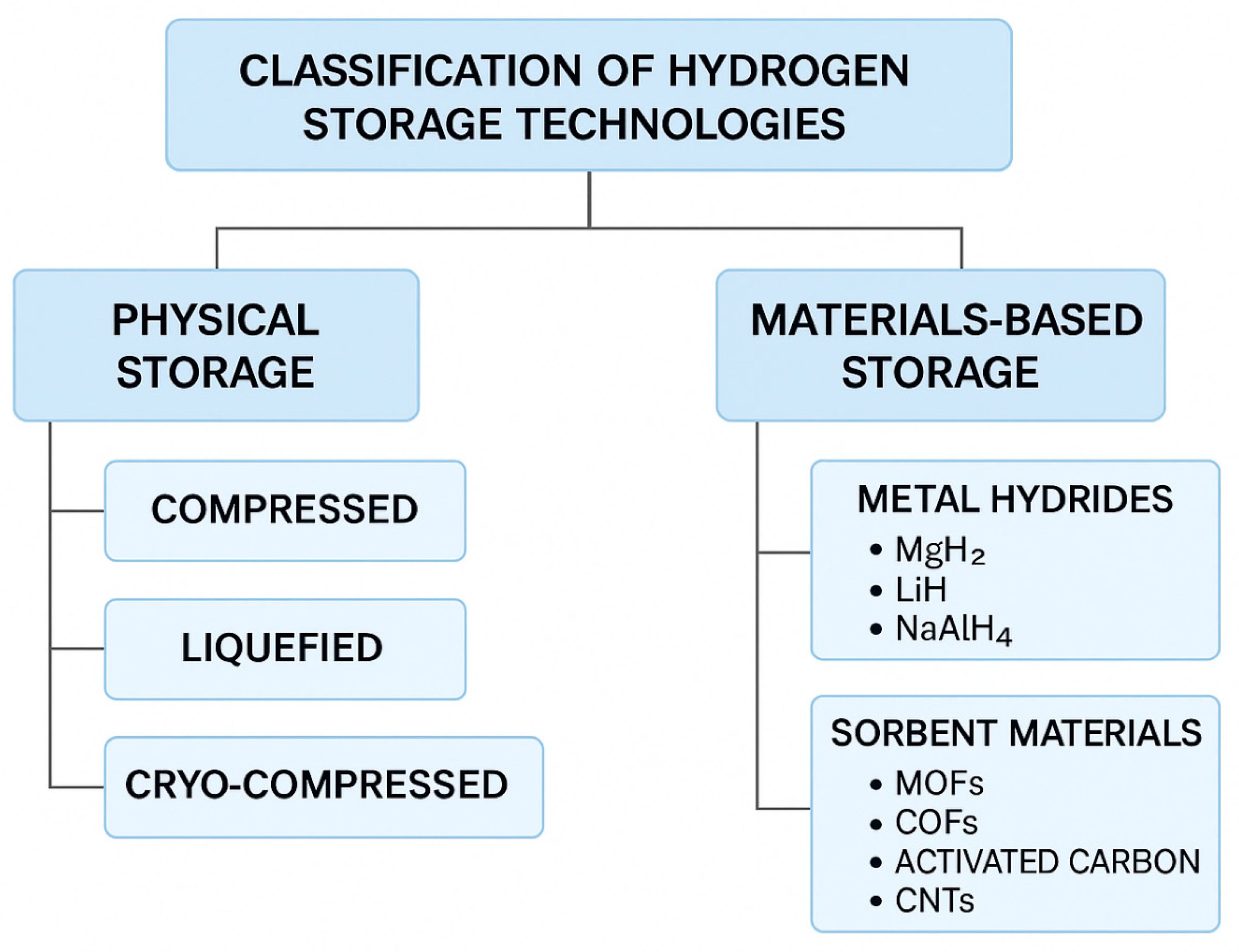
Figure 2.
A potential energy diagram (Lennard-Jones potential) comparing chemisorption and physisorption.
Figure 2.
A potential energy diagram (Lennard-Jones potential) comparing chemisorption and physisorption.
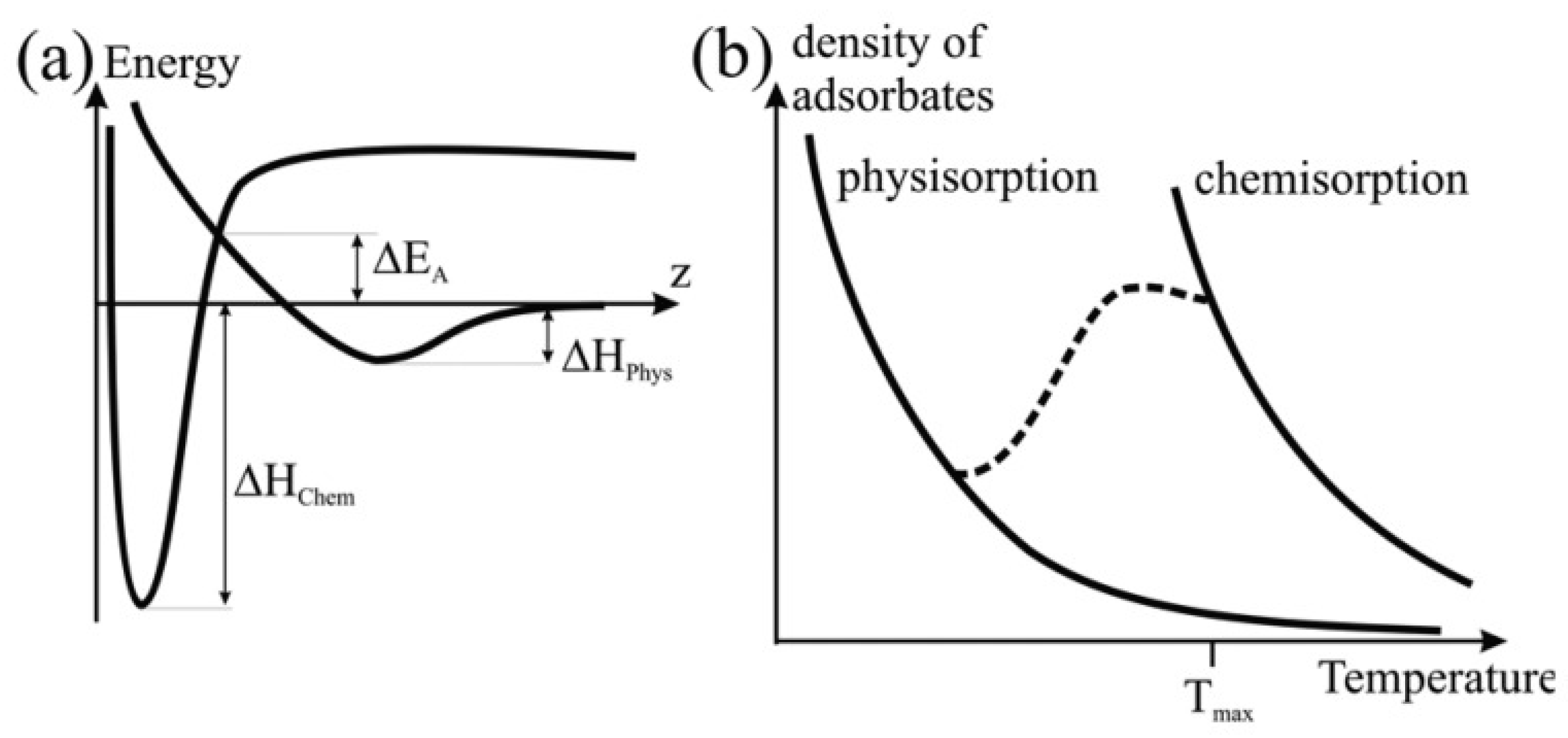
Figure 1.
A 3D structure of a MOF (e.g., MOF-5 or UiO-66) showing metal nodes and organic linkers.

Figure 4.
A bar chart comparing gravimetric and volumetric hydrogen storage capacities.
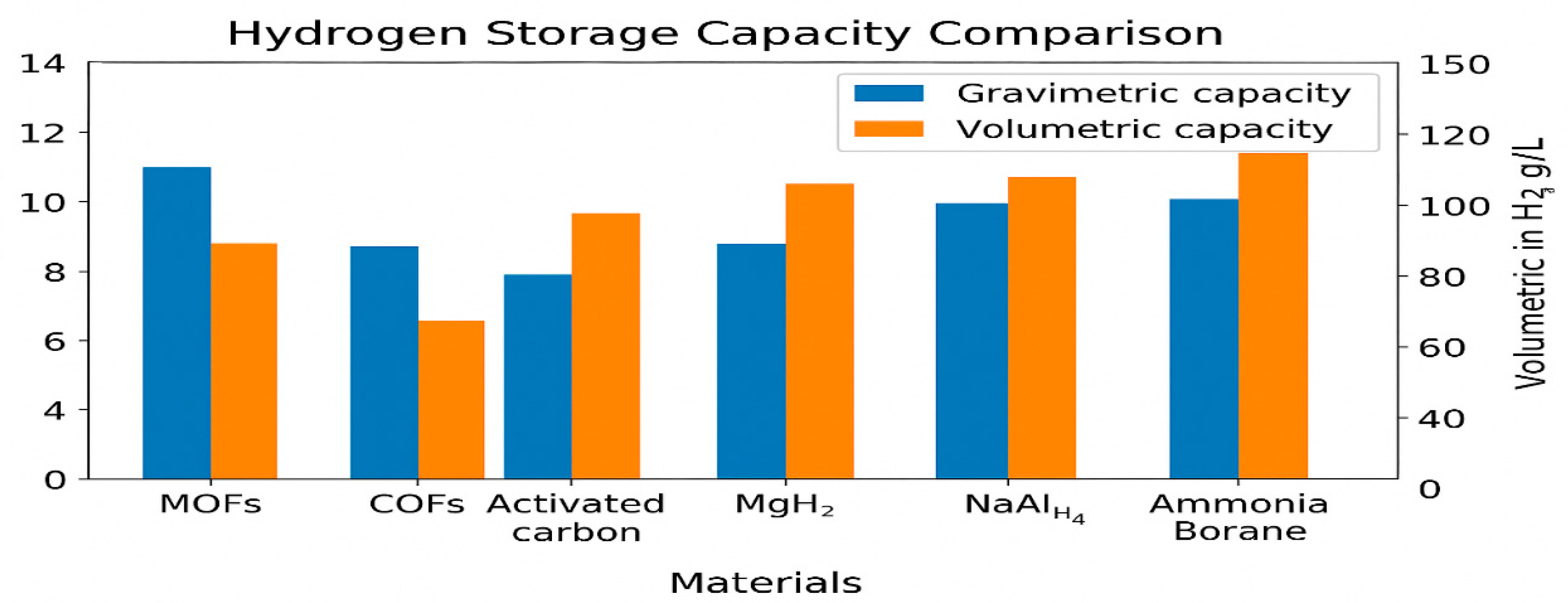
Disclaimer/Publisher’s Note: The statements, opinions and data contained in all publications are solely those of the individual author(s) and contributor(s) and not of MDPI and/or the editor(s). MDPI and/or the editor(s) disclaim responsibility for any injury to people or property resulting from any ideas, methods, instructions or products referred to in the content. |
© 2025 by the authors. Licensee MDPI, Basel, Switzerland. This article is an open access article distributed under the terms and conditions of the Creative Commons Attribution (CC BY) license (http://creativecommons.org/licenses/by/4.0/).
Copyright: This open access article is published under a Creative Commons CC BY 4.0 license, which permit the free download, distribution, and reuse, provided that the author and preprint are cited in any reuse.