

Submitted:
25 April 2025
Posted:
28 April 2025
You are already at the latest version
Abstract
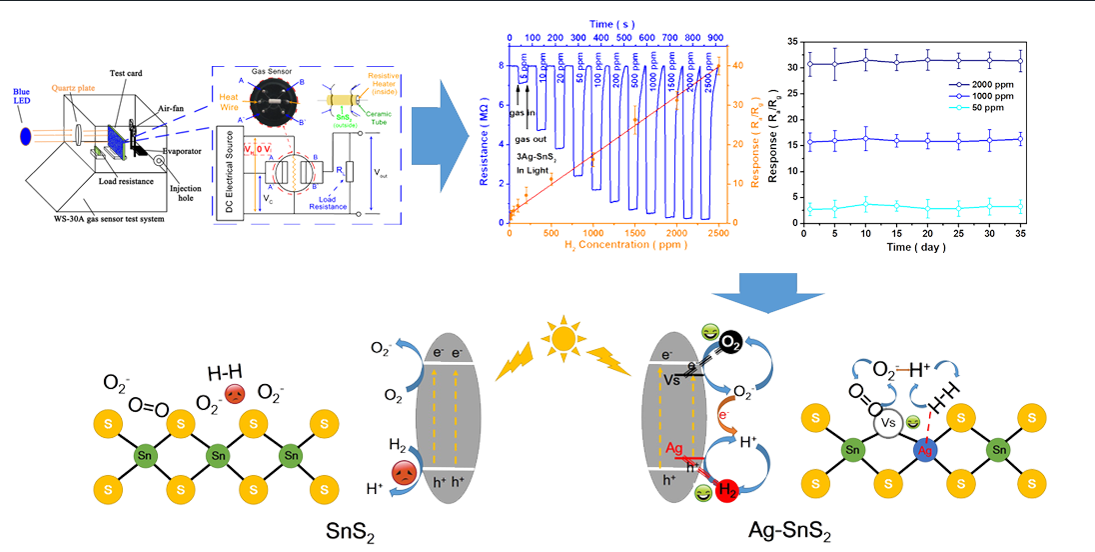
Hydrogen (H₂) monitoring demonstrates significant practical importance for safety assurance in industrial production and daily life, driving the demand for gas sensing devices with enhanced performance and reduced power consumption. This study presented a room-temperature (RT) hydrogen sensing platform utilizing two-dimensional (2D) Ag-doped SnS₂ nanomaterials activated by light illumination. The Ag-SnS₂ nanosheets, synthesized through hydrothermal methods, exhibited exceptional H₂ detection capabilities under blue LED light activation. The synergistic interaction between silver dopants and photoactivation enabled remarkable gas sensitivity across a broad concentration range (5.0-2500 ppm), achieving rapid response/recovery times (4 s/18 s) at 2500 ppm under RT. Material characterization revealed that Ag doping induced S vacancy, enhancing oxygen adsorption, while simultaneously facilitating photo-induced hole transfer for surface hydrogen activation. The optimized sensor maintained good response stability after five-week ambient storage, demonstrating excellent operational durability. Experimental results further elucidated that Ag dopants enhancing hydrogen adsorption-activation while S vacancy improved surface oxygen affinity. This work provided fundamental insights into defect engineering strategies for developing optically modulated gas sensors, proposing a viable pathway for constructing energy-efficient environmental monitoring systems.
Keywords:
SnS2
; gas sensor
; Ag doping
; light-activated
; H2 detection
1. Introduction
As a carbon-neutral energy carrier with high gravimetric energy density, hydrogen has emerged as a pivotal renewable energy source for applications ranging from chemical synthesis to fuel cell technologies and industrial combustion systems.[1] Yet, the widespread adoption of hydrogen energy necessitates urgent resolution of inherent safety concerns, particularly given its hazardous characteristics including a wide explosive concentration range (4.0-75.0 vol%), high diffusion coefficient (0.61 cm2/s), and substantial combustion enthalpy (285.5 kJ/mol).[2,3,4] thus, it is of great significance to selectively detect trace hydrogen[5]. These intrinsic properties underscore the critical requirement for developing reliable detection systems capable of selective trace-level hydrogen monitoring (particularly <1000 ppm) in operational environments. Recently, Current hydrogen detection methodologies primarily employ analytical techniques such as gas chromatography (GC), semiconductor gas-sensor, and optical spectroscopy approaches[1,5] In contrast, semiconductor-based chemiresistive sensors have garnered significant research interest due to their inherent advantages of low-cost fabrication, scalable manufacturing processes, and balanced performance metrics in sensitivity-stability-selectivity.
SnS2 materials, as a 2D layered transition metal disulfide, has been gradually regarded as promising gas-sensing materials, due to its large surface and great electrical character[6]. A series of SnS2 based materials exhibited the good gas-sensitive property for NO2, NH3, Xylene, C2H5OH and H2S molecules[7,8,9,10,11]. W. Gao et al. proven that Pd/SnS2/SnO2 sensor exhibited high response and response time to 500 ppm H2 at 300 oC[4]. However, for activating the gas-detection ability of semiconductor, a high operating temperature range of 100-450 oC was typically required with an additional heater[12,13]. Facing with its high resistance and weak adsorption to H2 molecule at room temperature(RT), the especial structure designing of SnS2 surface and external non-thermal field condition played two crucial roles for solving the above issues[13,14]. Due to the excellent light absorption capacity of SnS2, light irradiation could be an effective alternative to thermal driving to activate the adsorption behavior of gas molecules [14]. Under illumination, abundant electron-holes pairs could promote the electron transfer, further improving the gas-sensing properties. While UV illumination (λ < 400 nm) demonstrated effective photoactivation, its practical application is limited by photon-induced material degradation and potential health hazards. Recent advances in LED technology offer a safer alternative through visible light irradiation, combining sufficient photon energy for electron excitation with low power consumption[12]. Therefore, the synergistic combination of defect-engineered SnS2 nanostructures and LED photoactivation to develop an energy-efficient H2 sensor operating at RT.
Besides, the strategic introduction of sulfur vacancies (Vs) in SnS2 lattices enables selective oxygen chemisorption through isovalent orbital interactions, capitalizing on the chalcogen-group electronic affinity that facilitates superoxide radical(O2-) formation at defect sites. Simultaneously, noble metal dopants with high work functions demonstrated superior hydrogen spillover effects, their d-orbital electron configurations enabling optimized hydrogen binding energies through charge-transfer interactions[15,16]. In the intrinsic 2D SnS2 lattice, the Sn atom was sandwiched between two layers of S atoms maintained by van der Waals forces[17]. Doped Ag(I) impurity not only brought out the adsorbed-activate site for hydrogen, but also facilitated the formation of S vacancy due to charge and size difference between Ag(I) and Sn(IV) in SnS2[17]. Thus, it would be of great interest to investigate the synergistic effect of S vacancy and Ag impurity on the sensing performance of Ag doped SnS2 sensors.
In this regard, a series of Ag doped SnS2 (Ag-SnS2) sheet was synthesized and used as the sensing material in sensing H2 with the help of LED light illumination. The photo-activated Ag-SnS2 sheet showed a significantly enhanced H2 sensing performance with wide serviceable range from 5.0 ppm to 2500 ppm at RT. Such excellent gas-sensitivity was attributed to the effect of Ag doping and light illumination. The influence of Ag doping on the surface structure was investigated by ESR and TEM. Additionally, through O2 absorption measurement and in-situ X-ray photoelectron spectroscopy(XPS), the possible mechanism was proven.
2. Materials and Methods
The SnS2 based sample was synthesized through the one-step solvothermal method. Initially, 2.5 mL Triton X-100, 5.0 mmol citric acid and 5.0 mmol SnCl4·5H2O were orderly dissolved in 30 mL of deionized water and then added into 0.15 mmol of AgNO3 under stronger stirring conduction. The 5 mL of thioacetamide solution (2.0 mmol/mL) was slowly added into the above colloidal solution under stirring. After the ultrasonic processing for 30 min, the resulting mixture was transferred to the Teflon-lined autoclave and heated at 150 ℃ for 12 h. The Ag-SnS2 composite was finally obtained by centrifugation and washed by water/ethanol (three times) with subsequent drying at 70 ℃. This sample was named as xAg-SnS2, in which x was on behalf of the ideal ratio (mol/mol %) between Ag and Sn element. The pristine SnS2 sample was prepared using the above similar method without addition of AgNO3. The SnS2 based gas sensors were formed and the synthesized process was detailed in supplementary materials S1. The gas-sensitive property was measured using reconstructive W30-A gas-sensitive equipment (Figure S1)[18,19]. The structural characterization of the obtained SnS2 samples were detailed in supplementary materials S2.
3. Results
As shown in Figure 1, five obvious peaks at 15.0o, 28.2o, 32.1o, 50.0o and 52.5o were corresponding to the characteristic peaks of (0 0 1), (1 0 0), (1 0 1), (1 1 0) and (1 1 1) plane of hexagonal-2T SnS2 materials. With Ag addition, the intensity of one broad peak at about 22.0 o gradually increased, while no new peak appeared. Based on the ICP-OES result (Table S1), Ag impurity was existed in the Ag-SnS2 sample and its content increased with increasing Ag feedstock input. In the high resolution Sn 3d spectra (Figure 1b), two stronger peaks at the binding energies of 487.2 and 495.7 eV were associated with the Sn 3d5/2 and 3d3/2 of Sn(IV).[20,21] As displayed in Figure 1c, two peaks at 161.9 eV and 163.1 eV was corresponding to S 2p3/2 and 2p1/2, respectively (Figure 1c) [22,23]. In Figure 1d, two peaks at 368.0 and 374.1 eV were ascribed to 3d5/2 and 3d3/2 of Ag(I) [17,20]. The peak of both Sn and S shift negatively after Ag doping, indicating change of surroundings electronegativity around atom. In ESR spectra (Figure 1e), a clear sign of S vacancy (g=2.004) appeared in the sample of Ag doped SnS2 and its intensity enhanced with increasing Ag input[17]. Combined with XRD result, the ordered arrangement of Sn-S was destroyed by doped Ag impurity, further forming the S vacancy. As shown in Figure S2, the sheet morphology appeared in SnS2 and 3Ag-SnS2 samples. In Figure 1f, the lattice fringes with spacing 0.278 and 0.182 nm were corresponding to the (1 0 1) and (1 1 0) crystal faces of hexagonal-2T SnS2. Therefore, a series of Ag doped SnS2 sheet with S vacancy were obtained through one-step hydrothermal process.
The gas-sensitive property for H2 detection of SnS2 based materials was investigated. In Figure 2a, all SnS2 materials exhibited the sensitive property for H2 gas at room temperature, and its response under illumination was apparently higher than that in dark. With increasing Ag addition, the response value of Ag-SnS2 sensor was gradually promoted and 3Ag-SnS2 sample showed the highest response value for H2 detection. Beyond the optimal value, its sign exhibited a marked decline, which was caused by the excess defect in SnS2 surface, further decreasing the concentration of active electron. For further exploring the liner between gas concentration and sensor sign, the results(Figure 2b) manifested that, although the fast response rate of 3Ag-SnS2 photoinduced sensor appeared, its recovery time was gradually lengthened with increasing concentration of H2 gas. Lucky, its response and recovery time in 2500 ppm H2 condition still kept ~4 s and ~18 s, respectively. Besides, a linear correlation (y=0.01498x+2.428, R2 0.9923) could be determined between 5 ppm to 2500 ppm of H2 concentration. In Figure 2c, facing with multiple different target gases, the 3Ag-SnS2 sensor exhibited the good selectivity for H2 gas. The cycling stably of gas sensor was not ignored. As shown in Figure 2d, the photoinduced gas sensor of 3Ag-SnS2 exhibited the stable response value of H2 detection at room temperature in 35 days. Compared with the previous SnS2 or SnO2 based gas sensor as summarized in Table S2, the 3Ag-SnS2 photo-induced sensor exhibited the good sensitivity, selectivity and stability for H2 detection with wide concentration range(5.0 to 2500 ppm) in operating temperature of room temperature[24,25,26,27,28,29,30,31,32,33].
For exploring the reason about enhanced photo-induced gas sensitivity of Ag-SnS2, the band structure and surface state of the obtained samples were further investigated. Firstly, the influence of Ag impurity on the band structure of SnS2 was studied. In Figure 3a, the light-response ranges of 3Ag-SnS2 sample showed wider than that of pristine SnS2 and their Eg value were calculated and summarized in Table S3. Then the VB band position could be measured through VB-XPS measurement. With Ag doping, the VB value modest decreased in Figure 3b. Finally, the CB position could be calculated and the information about their band structure was summarized in Table S2. Additionally, the photoinduced current curve was showed in Figure S3. Although the photoinduced current density of Ag-SnS2 exhibited all higher than that of SnS2, excess Ag impurity never bring out more abundance photoinduced electrons. It was the possible reason that S vacancy was easily formed around doped Ag site due to the effect of charge balance, but superfluous vacancy made it a recombination center of photoinduced electron-holes, leading to the weak current density. This also explained that 3Ag-SnS2 sample exhibited the better gas-sensitive property, compared with other.
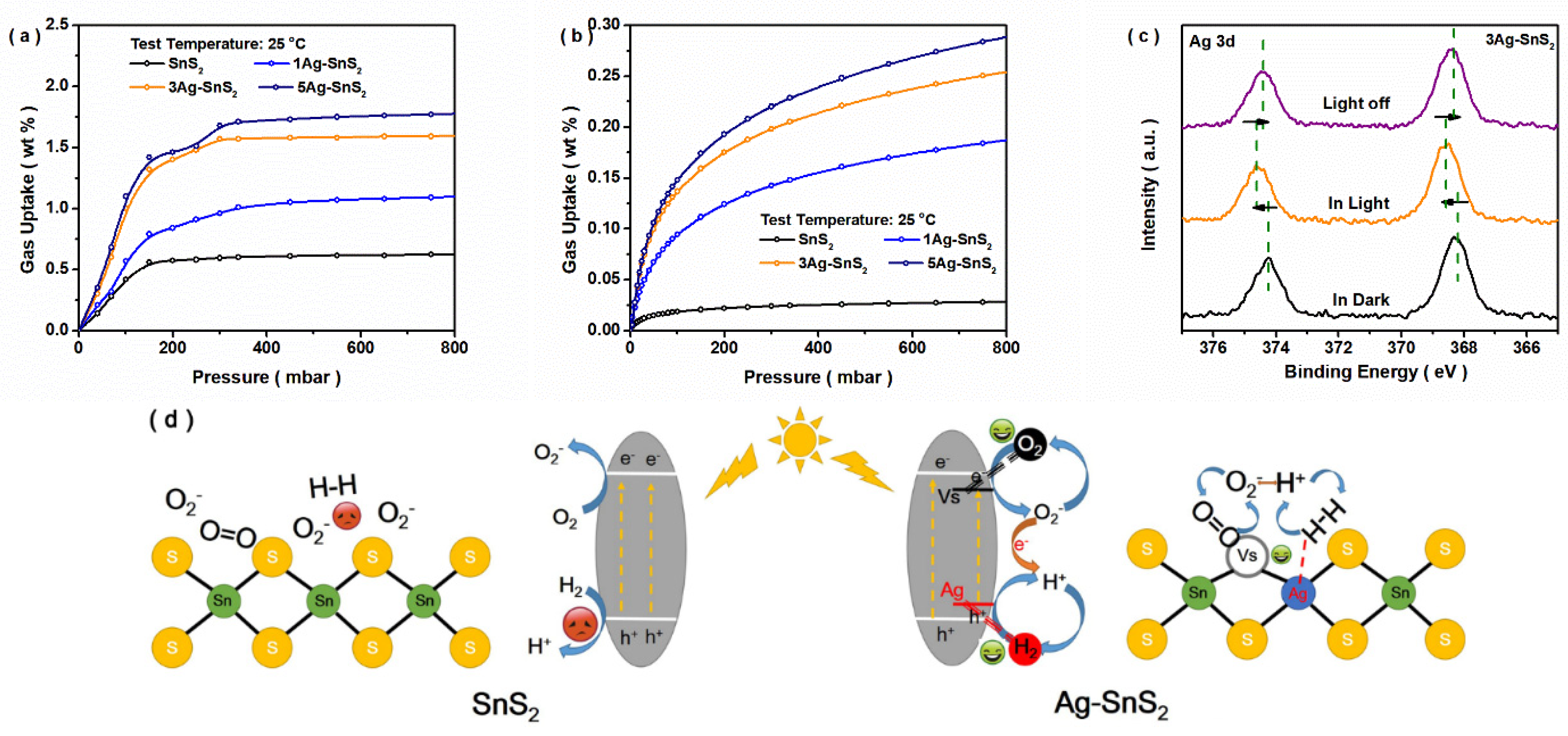
In Figure 4a, all obtained samples showed the adsorptive property of O2 gas at room temperature. It was notably that the existence of Ag impurity enhanced the O2 adsorbing capacity of SnS2 and its variation tendency agreed with the change of S vacancy(Figure 1e). In Figure 4b, the variation trend of H2 adsorption property was similar to that of O2 adsorbing. With increasing the density of Ag site on surface, the H2 adsorbing capacity of SnS2 was increased, which was due to the superior hydrogen-binding capability of high work function metal element. Additionally, the in situ-XPS result (Figure 4c) showed that the peak position of Ag impurity in light shifted toward high energy direction and it reversely moved after light off. It indicated that the electron in Ag site lose in light and this change of Ag atom in light/dark condition was reversible[34]. Hence, doped Ag site may play a role for surface transfer of photo-induced hole. Based on the above results, as shown in Figure 4c, the S vacancy around Ag site of surface could easily adsorbed the oxygen molecule. And then, metal Ag site could capture hydrogen molecule in air, which formed two neighboring adsorbed O2/H2 molecules. Simultaneously, under illumination, the photogenerated electron and hole transferred from SnS2 to adsorbed O2 and H2 molecules, respectively. The superoxide radical(O2-) and hydrogen ion(H+) were formed and reacted for each other, leading to electron consumption and the change resistance of SnS2. The possible mechanism for H2 detection of photoinduced gas sensor was showed in Figure 4d.
4. Conclusions
In conclusion, a series of sheet-like Ag doped SnS2 materials were prepared through the one-step hydrothermal method. The S vacancy was generated along with the Ag impurity doping, leading to enhanced O2 adsorbed property. Compared to the pristine SnS2, which was hard to sense H2 at RT, the Ag-SnS2 sample exhibited an excellent gas-sensitive property for H2 detection with wide concentration range from 5.0 ppm to 2500 ppm under blue LED illumination. Facing with the high concentration condition of H2 gas (2500 ppm), its response and recovery time still kept ~4 s and ~18 s, respectively. Moreover, the sensor maintained the gas response after five weeks of relaxation. The synergistic effect of S vacancy and Ag impurity on enhanced O2/H2 adsorbed property has been proven. The Ag impurity site played a key role for photo-induced hole transfer to active adsorbed hydrogen on SnS2 surface under illumination. On account of remarkable gas sensing performances, the formation of Ag doped SnS2 sheet contributed to enhance the potential and fueled the exploitation of next-generation high-performance gas sensing light modulated devices at RT.
Supplementary Materials
The following supporting information can be downloaded at the website of this paper posted on Preprints.org. S1. Gas sensing characterization. S2. Sample characterization. Figure S1. Gas sensing characterization. Figure S2. TEM images of SnS2 and 3Ag-SnS2 samples. Figure S3. Photoinduced current curve of SnS2 and Ag-SnS2 samples. Table S1. Element content of obtained SnS2 sample by ICP-OES. Table S2. Gas-sensitive property of SnS2 or SnO2 based materials for H2 detection in previous studies and researches. Table S3. Band structure of Ag-SnS2 and SnS2 materials. Figure S1. Schematic diagram of photoinduced-gas-sensor.
Author Contributions
Conceptualization, J.C.W. and X.S.; methodology, J.C.W.; software, R.J.L., N.F. and H.M.; validation, H.M.; formal analysis, R.J.L. and N.F.; investigation, H.M.; resources, R.J.L; data curation, S.W. and H.M.; writing—original draft preparation, S.W. and J.C.W.; writing—review and editing, J.C.W.; project administration, J.C.W.; funding acquisition, J.C.W. and X.S.. All authors have read and agreed to the published version of the manuscript.
Funding
This research was funded by Scientific and Technological Research Project of Henan Province(No. 252102230085 and 252102320178) and Training Program for Young Backbone Teachers in Higher Education Institutions in Henan Province (No. 2024GGJS101).
Conflicts of Interest
The authors declare no conflicts of interest.
References
- Hjiri, M.; Dhahri, R.; Benmansour, N.; Neri, G. Laser irradiated gas sensors: A review. Micro Nanostruct. 2025, 204, 208157. [CrossRef]
- Liu, Y.; Chen, S.; Xiao, B.; Chu, J.; Wang, H.; Chen, Y.; Yao, T.; Yang, A.; Han, X.; Rong, M.; Wang, X. Ultra-large Sn3O4 nanosheets with Sn2+ defect for highly efficient hydrogen sensing. Sens. Actuators, B 2024, 401, 135025. [CrossRef]
- Yin, X.-T.; Wu, S.-S.; Dastan, D.; Nie, S.; Liu, Y.; Li, Z.-G.; Zhou, Y.-W.; Li, J.; Faik, A.; Shan, K.; Shi, Z.; Tarighat, M. A.; Ma, X.-G. Sensing selectivity of SnO2-Mn3O4 nanocomposite sensors for the detection of H2 and CO gases. Surf. Interfaces 2021, 25, 101190. [CrossRef]
- Meng, X.; Bi, M.; Xiao, Q.; Gao, W. Ultrasensitive gas sensor based on Pd/SnS2/SnO2 nanocomposites for rapid detection of H2. Sens. Actuators, B 2022, 359, 131612. [CrossRef]
- Zhu, M.; Zhang, H.; Zhang, S.; Yao, H.; Shi, X.; Xu, S. Chemoresistive gas sensors based on noble-metal-decorated metal oxide semiconductors for H2 detection. Materials, 2025, 18, 451. [CrossRef]
- Mishra, R. K.; Choi, H. J.; Ryu, J. W.; Choi, G. J.; Kumar, V.; Kumar, P.; Singh, J.; Kumar, S.; Gwag, J. S. Recent progress in gas sensing based on 2D SnS2 and its heterostructure platforms: A review. Sens. Actuators, A 2024, 365, 114860. [CrossRef]
- Saggu, I. S.; Singh, S.; Chen, K.; Xuan, Z.; Swihart, M. T.; Sharma, S. Ultrasensitive room-temperature NO2 detection using SnS2/MWCNT composites and accelerated recovery kinetics by UV activation. ACS Sensors 2023, 8, 243-253. [CrossRef]
- Lee, S. M.; Kim, Y. J.; Park, S. J.; Cheon, W. S.; Kim, J.; Nam, G. B.; Kim, Y.; Jang, H. W. In-situ growth of 2D MOFs as a molecular sieving layer on SnS2 nanoflakes for realizing ultraselective H2S detection. Adv. Funct. Mater. 2025, 35, 2417019. [CrossRef]
- Qiu, P.; Qin, Y.; Wang, X. S-vacancies and Ag nanoparticles in SnS2 nanoflakes for ethanol sensing: A combined experimental and theoretical investigation. ACS Appl. Nano Mater. 2022, 5, 10839-10847. [CrossRef]
- Lu, Y.; Zhang, J.; Wang, W.; Fan, Y.; Liu, C.; Zhou, J.; Liu, D.; Ruan, S. Au-Pd modified SnS2 nanosheets for conductometric detection of xylene gas. Sens. Actuators, B 2022, 351, 130907. [CrossRef]
- Maria, K. H.; Sakhuja, N.; Jha, R. K.; Bhat, N. Ultra-sonication assisted synthesis of 2D SnS2 nanoflakes for room-temperature NO gas detection. IEEE Sens. J. 2021, 21, 10420-10427. [CrossRef]
- Eom, T. H.; Cho, S. H.; Suh, J. M.; Kim, T.; Lee, T. H.; Jun, S. E.; Yang, J. W.; Lee, J.; Hong, S.-H.; Jang, H. W. Substantially improved room temperature NO2 sensing in 2-dimensional SnS2 nanoflowers enabled by visible light illumination. J. Mater. Chem. A 2021, 9, 11168-11178. [CrossRef]
- Ramakrishnan, K.; Ajitha, B.; Ashok Kumar Reddy, Y. Review on metal sulfide-based nanostructures for photodetectors: From ultraviolet to infrared regions. Sens. Actuators, A 2023, 349, 114051. [CrossRef]
- Li, Q.; Wang, X.; Li, H.; Guo, X. Light-activated gas sensors. Chin. Sci. Bull. 2022, 67, 1837-1850. [CrossRef]
- Arain, S.; Usman, M.; Saeed, F.; Feng, S.; Rehman, W.; Liu, X.; Dai, H. Microemulsion-based synthesis of highly efficient Ag-doped fibrous SiO2-TiO2 photoanodes for photoelectrochemical water splitting. Catalysts, 2025, 15, 66. [CrossRef]
- An, Q.; Li, J.; Peng, J.; Hu, L. DFT study of small gas molecules (C2H2, CH4, CO and H2) adsorbed on Au, Ag-doped ZnO monolayer. Chem. Phys. Lett. 2025, 869, 142043. [CrossRef]
- Yang, H.; Du, Z.; Yang, Y.; Li, X.; Wu, Q.; Tang, J.; Wang, X.; Zeng, D. Ag intercalated SnS2 with S vacancy and expanded interlayer for enhancing NO2 sensing. Sens. Actuators, B 2023, 393, 134140. [CrossRef]
- Wang, J.-C.; Ma, H.; Shi, W.; Li, W.; Zhang, Z.; Hou, Y.; Zhang, W.; Chen, J. Designed synthesized step-scheme heterojunction of Bi2WO6 nanosheet supported on CuBi2O4 nanorod with remarkable photo-assisted gas sensing for N-butyl alcohol. J. Environ. Chem. Eng. 2024, 12, 112698. [CrossRef]
- Wang, J.-C.; Shi, W.; Sun, X.-Q.; Wu, F.-Y.; Li, Y.; Hou, Y. Enhanced photo-assisted acetone gas sensor and efficient photocatalytic degradation ssing Fe-doped hexagonal and monoclinic WO3 phase−junction. Nanomaterials, 2020, 10, 398. [CrossRef]
- Tian, W.; Han, J.; Wan, L.; Li, N.; Chen, D.; Xu, Q.; Li, H.; Lu, J. Enhanced piezocatalytic activity in ion-doped SnS2 via lattice distortion engineering for BPA degradation and hydrogen production. Nano Energy 2023, 107, 108165. [CrossRef]
- Lv, Y.-R.; Wang, Z.-L.; Yang, Y.-X.; Luo, Y.; Yang, S.-Y.; Xu, Y.-H. Tin bisulfide nanoplates anchored onto flower-like bismuth tungstate nanosheets for enhancement in the photocatalytic degradation of organic pollutant. J. Hazard. Mater. 2022, 432, 128665. [CrossRef]
- Lei, Z.; Wang, W.; Sun, T.; Liu, E.; Gao, T. Efficient photocatalytic H2 evolution over SnS2/twinned Mn0.5Cd0.5S hetero-homojunction with double S-scheme charge transfer routes. J. Mater. Sci. Technol. 2025, 216, 81-92. [CrossRef]
- Mamo, T. T.; Qorbani, M.; Hailemariam, A. G.; Putikam, R.; Chu, C.-M.; Ko, T.-R.; Sabbah, A.; Huang, C.-Y.; Kholimatussadiah, S.; Billo, T.; Hussien, M. K.; Chang, S.-Y.; Lin, M.-C.; Woon, W.-Y.; Wu, H.-L.; Wong, K.-T.; Chen, L.-C.; Chen, K.-H. Enhanced CO2 photoreduction to CH4 via *COOH and *CHO intermediates stabilization by synergistic effect of implanted P and S vacancy in thin-film SnS2. Nano Energy 2024, 128, 109863. [CrossRef]
- Qin, Y.; Zhang, Y.; Qiu, P.; Lei, S. SnO2-Co3O4 nanocomposite sensor: Achieving ultra-selective hydrogen detection in mixed gas environments. Sens. Actuators, B 2025, 422, 136521. [CrossRef]
- Li, A.; Zhao, S.; Bai, J.; Xiao, H.; Gao, S.; Shen, Y.; Yuan, Z.; Meng, F. The role of AuSn alloys in optimizing SnO2 nanospheres for chemoresistive hydrogen sensing. Sens. Actuators, B 2025, 427, 137214. [CrossRef]
- Liu, Y.; Chen, S.; Xiao, B.; Chu, J.; Wang, H.; Chen, Y.; Yao, T.; Yang, A.; Han, X.; Rong, M.; Wang, X. Ultra-large Sn3O4 nanosheets with Sn2+ defect for highly efficient hydrogen sensing. Sens. Actuators, B 2024, 401, 135025. [CrossRef]
- Liu, W.; Zou, J.; Li, S.; Li, J.; Li, F.; Zhan, Z.; Zhang, Y. Pd/In2O3-based bilayer H2 sensor with high resistance to silicone toxicity and ultra-fast response. Int. J. Hydrogen Energy 2023, 48, 5743-5753. [CrossRef]
- Meng, X.; Bi, M.; Xiao, Q.; Gao, W. Ultrasensitive gas sensor based on Pd/SnS2/SnO2 nanocomposites for rapid detection of H2. Sens. Actuators, B 2022, 359, 131612. [CrossRef]
- Lu, S.; Zhang, Y.; Liu, J.; Li, H.-Y.; Hu, Z.; Luo, X.; Gao, N.; Zhang, B.; Jiang, J.; Zhong, A.; Luo, J.; Liu, H. Sensitive H2 gas sensors based on SnO2 nanowires. Sens. Actuators, B 2021, 345, 130334. [CrossRef]
- Tang, C.; Jin, W.; Xiao, X.; Qi, X.; Ma, Y.; Ma, L. Graphene-based chemiresistive hydrogen sensor for room temperature operation. Sens. Actuators, B 2025, 424, 136889. [CrossRef]
- Kumar, G.; Li, X.; Du, Y.; Geng, Y.; Hong, X. UV-light enhanced high sensitive hydrogen (H2) sensor based on spherical Au nanoparticles on ZnO nano-structured thin films. J. Alloys Compd. 2019, 798, 467-477. [CrossRef]
- Wang, F.; Hu, K.; Liu, H.; Zhao, Q.; Wang, K.; Zhang, Y. Low temperature and fast response hydrogen gas sensor with Pd coated SnO2 nanofiber rods. Int. J. Hydrogen Energy 2020, 45, 7234-7242. [CrossRef]
- Pandey, G.; Lawaniya, S. D.; Kumar, S.; Dwivedi, P. K.; Awasthi, K. A highly selective, efficient hydrogen gas sensor based on bimetallic (Pd–Au) alloy nanoparticle (NP)-decorated SnO2 nanorods. J. Mater. Chem. A 2023, 11, 26687-26697. [CrossRef]
- Wang, Z.; Cheng, B.; Zhang, L.; Yu, J.; Tan, H. BiOBr/NiO S-scheme heterojunction photocatalyst for CO2 photoreduction. Sol. RRL 2022, 6, 2100587. [CrossRef]
Figure 1.
XRD, XPS, ESR and HR-TEM of SnS2 and doped SnS2 samples(a. XRD, b. XPS Sn 3d, c. XPS S 2p, d. XPS Ag 3d, e. ESR and f. HR-TEM of 3Ag-SnS2 sample).
Figure 1.
XRD, XPS, ESR and HR-TEM of SnS2 and doped SnS2 samples(a. XRD, b. XPS Sn 3d, c. XPS S 2p, d. XPS Ag 3d, e. ESR and f. HR-TEM of 3Ag-SnS2 sample).
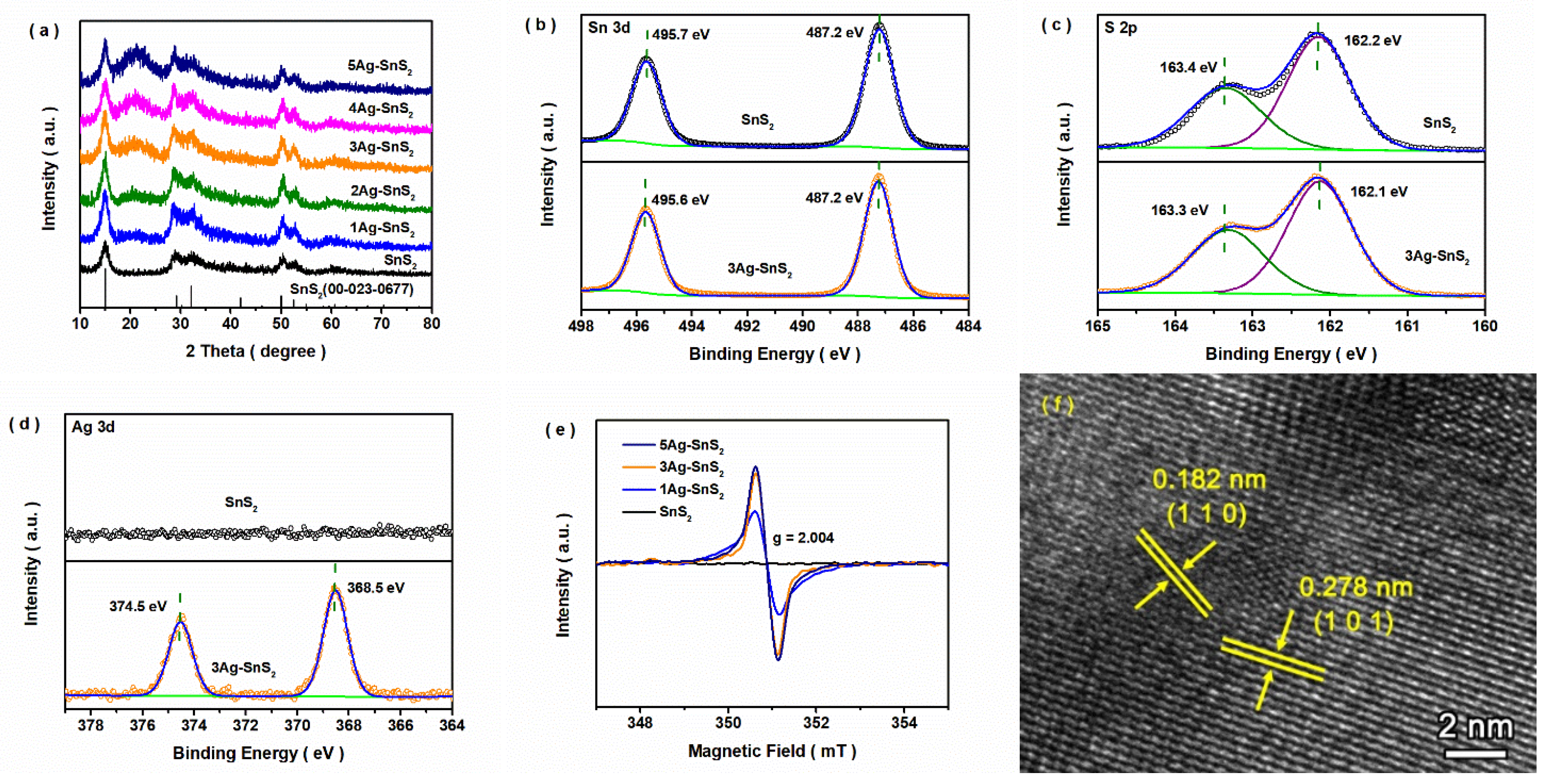
Figure 2.
Figure 2. Performance of SnS2 and Ag-SnS2 based gas sensor(a. gas sensitivity for different samples; b. resistance and response of 3Ag-SnS2 sensor for different H2 concentration; c. gas selectivity of 3Ag-SnS2 sensor for different sample; d. cycling stability of 3Ag-SnS2 sensor in 5 weeks).
Figure 2.
Figure 2. Performance of SnS2 and Ag-SnS2 based gas sensor(a. gas sensitivity for different samples; b. resistance and response of 3Ag-SnS2 sensor for different H2 concentration; c. gas selectivity of 3Ag-SnS2 sensor for different sample; d. cycling stability of 3Ag-SnS2 sensor in 5 weeks).
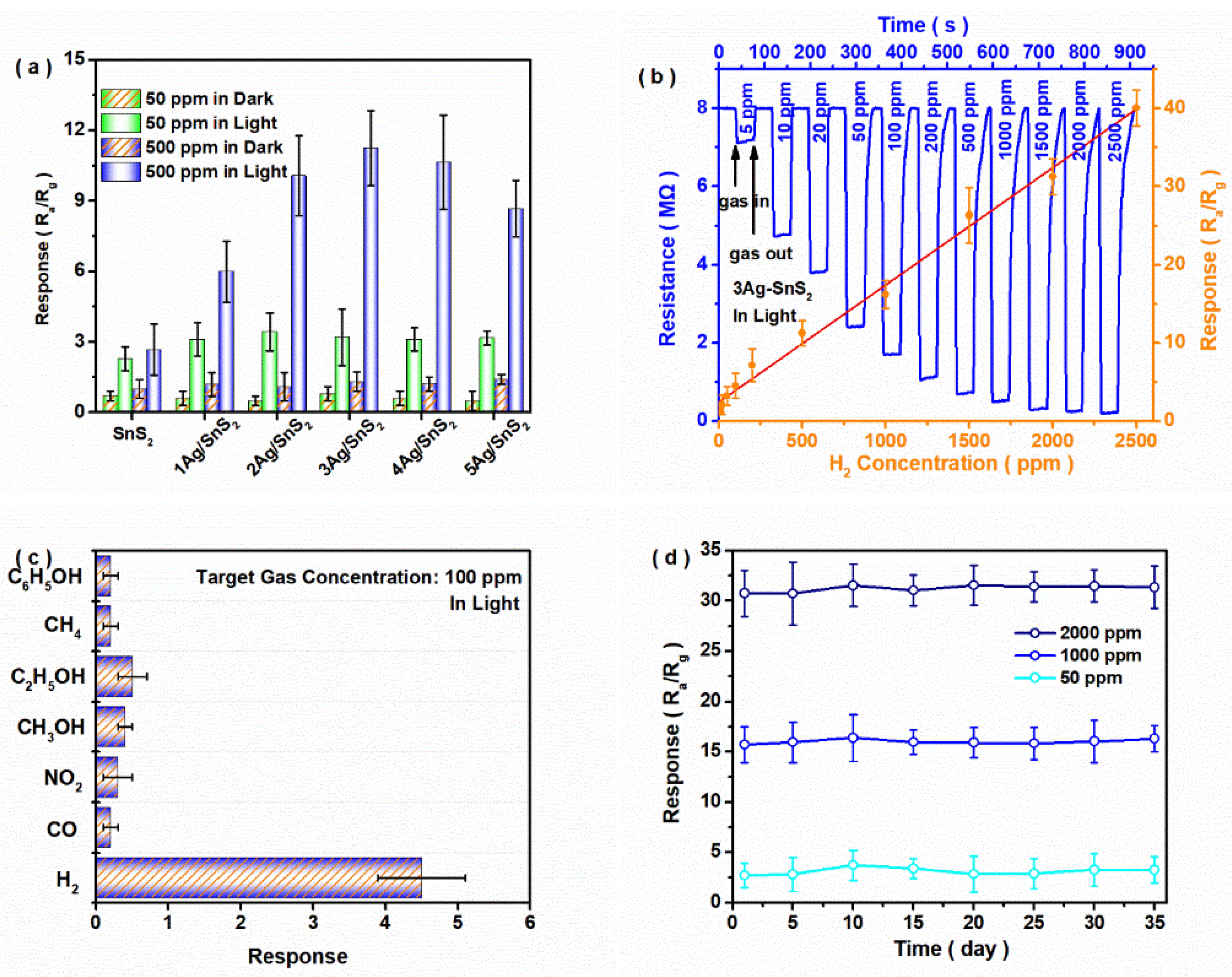
Figure 3.
(a)DRS and (b)VB-XPS of the SnS2 and 3Ag-SnS2 samples.
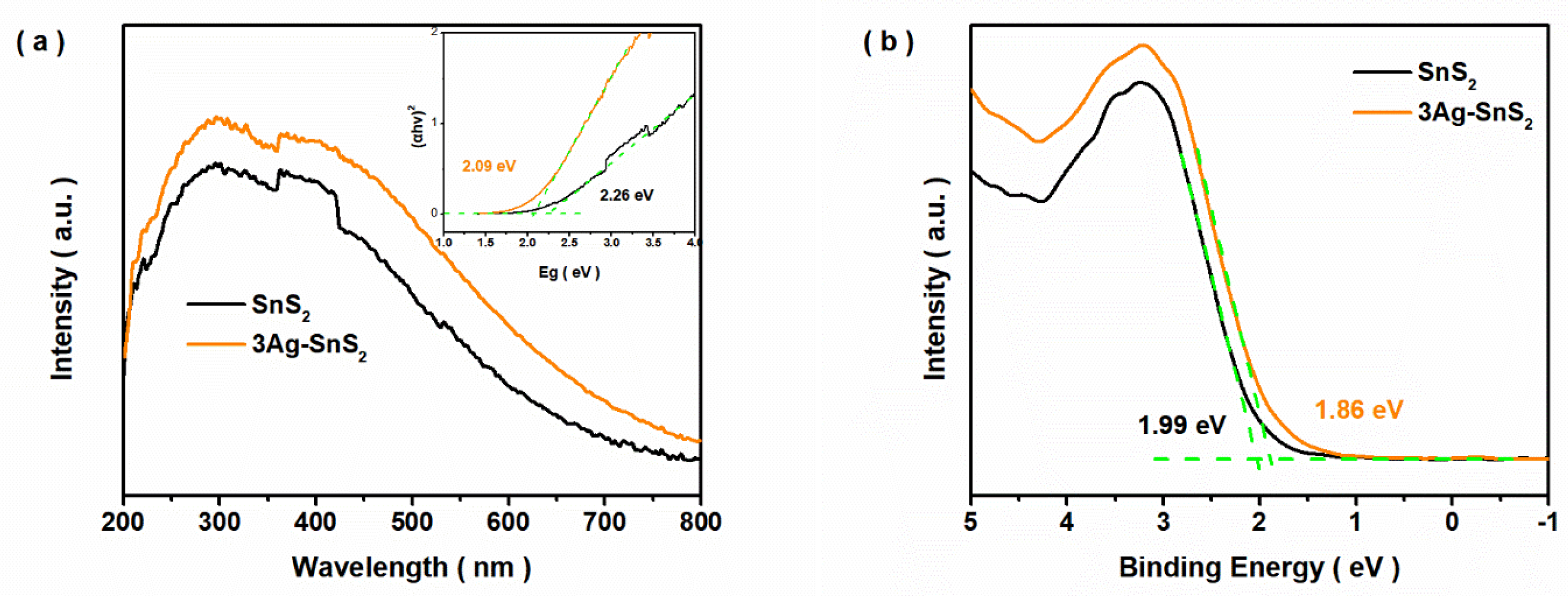
Figure 4.
Figure 4. O2 (a) and H2 (b) absorption property for SnS2 and Ag-SnS2 samples, in situ XPS of Ag element in light/dark (c) and Schematic diagram of gas sensing mechanism (d).
Figure 4.
Figure 4. O2 (a) and H2 (b) absorption property for SnS2 and Ag-SnS2 samples, in situ XPS of Ag element in light/dark (c) and Schematic diagram of gas sensing mechanism (d).
Disclaimer/Publisher’s Note: The statements, opinions and data contained in all publications are solely those of the individual author(s) and contributor(s) and not of MDPI and/or the editor(s). MDPI and/or the editor(s) disclaim responsibility for any injury to people or property resulting from any ideas, methods, instructions or products referred to in the content. |
© 2025 by the authors. Licensee MDPI, Basel, Switzerland. This article is an open access article distributed under the terms and conditions of the Creative Commons Attribution (CC BY) license (http://creativecommons.org/licenses/by/4.0/).
Copyright: This open access article is published under a Creative Commons CC BY 4.0 license, which permit the free download, distribution, and reuse, provided that the author and preprint are cited in any reuse.