

Submitted:
13 August 2023
Posted:
14 August 2023
You are already at the latest version
Abstract
Herein, we have fabricated graphitic carbon nitride (g-C3N4) nanosheets with embedded ZnCdS nanoparticles to form a type II heterojunction using a facile synthesis approach and used for photocatalytic H2 production. The morphologies, chemical structure and optical properties of the obtained g-C3N4‒ZnCdS samples were characterized by a battery of techniques such as, TEM, XRD, XPS and UV-Vis DRS. The as-synthesized g-C3N4‒ZnCdS, photocatalyst exhibits the highest hydrogen production rate of 108.9 μmol·g-1·h-1 compared to individual components (g-C3N4: 13.5 μmol·g-1·h-1, ZnCdS: 45.3 μmol·g-1·h-1). The improvement of its photocatalytic activity is mainly attributed to the heterojunction formation and resulting synergistic effect, which provide more channels for charge carrier migration and reduce the recombination of photogenerated electrons and holes. Meanwhile, the g-C3N4‒ZnCdS heterojunction catalyst also showed higher stability over a number of repeated cycles. Our work sheds insight of using g-C3N4 and metal sulfide combination to develop low-cost, efficient, visible-light active hydrogen production photocatalysts.
Keywords:
Heterojunction
; photocatalytic H2 production
; carbon nitride
; nanosheets
; ZnCdS
1. Introduction
The demand for energy is rising steadily as the world's population grows and living standards improve. Hydrogen is considered a clean, plentiful, and secure energy source to address this need [1]. The tremendous energy output of hydrogen combustion, which is far higher than that of gasoline or any other fossil fuel, makes it a better and more efficient alternate fuel. As no toxic byproducts are produced during hydrogen combustion it is also considered ecologically safe [2]. However, carbon dioxide is usually produced during the steam reforming of hydrocarbons and coal for hydrogen production. To avoid producing greenhouse gases, finding workable alternatives is essential. One viable solution to the present energy and environmental dilemma is using solar energy to produce hydrogen from water on the surface of a catalyst [3,4]. Semiconductor photocatalysts have been utilized widely for the photolysis of water, since their first use on the surface of TiO2[5]. To maximize the use of solar power, various attempts have been made to find renewable, efficient photocatalysts with an excellent visible light response [6,7].
The carbon nitride (g-C3N4) graphitic material has been used as a C-related and a potential candidate with characteristics of metal-free photocatalyst in hydrogen evolution and organic degradation due to its suitable band gap (ca. 2.7 eV) [8]. Additionally, the electronic structure of the triazine units in g-C3N4 forms conjugated graphitic planes, which are very stable and responsive to visible light. However, its photocatalytic performance is severely impacted by both the negligible or no absorption under the visible portion of light irradiation (beyond 460 nm) & the fast recombination for the photo-induced charge carriers species [9]. To enhance the catalytic performance and promote the separation of photo-generated holes and electrons, another semiconductor is usually coupled with g-C3N4, such as g-C3N4/CdS, g-C3N4/TiO2, g-C3N4/MoO3, g-C3N4/BiVO4, and g-C3N4/InVO4[10,11,12,13,14]. However, the complex preparation process and catalyst deterioration over a few cycles make it harder to use on a broader industrial scale.
Among other alternatives, solid sulfide solutions such as ZnIn2S4, CdIn2S4, ZnCdS, and MnxCd1-xS have been used in photocatalytic hydrogen production because of their appropriate band gap, high visible light response, and tunable structure [15,16,17,18]. The easily tunable band structure and superior reducing ability of ZnCdS mean it stands out among the solid sulfide solutions [19]. However, it does have several drawbacks, including inadequate photo-generated carrier transmission efficiency, low solar energy consumption, and rapid electron-hole pair recombination, which severely restricts its photocatalytic efficacy [20,21]. The charge recombination efficiency and energy output can be improved by combining ZnCdS with another photocatalyst, offering more active sites and reaction sites to promote oxidation and reduction processes.
Herein, we demonstrated a simple strategy to fabricate g-C3N4 with ZnCdS to form a type II heterojunction. The conjugated graphitic planes of g-C3N4 nanosheets provided a large surface area for ZnCdS, which acted efficiently to use the charge carrier and enhance H2 production.
2. Materials and Methods
2.1. Synthesis of g-C3N4 nanosheets
The preparation of g-C3N4 was performed in an alumina crucible with a cover, which could form a semi-closed atmosphere to prevent the sublimation of precursors. Melamine powder (3g) was placed into the crucible and heated to a temperature of 530 °C in a tube furnace with N2 atmosphere. Then, the sample was naturally cooled to room temperature, collected, and stored for further use.
2.2. Synthesis of g-C3N4‒ZnCdS heterojunction
The fabrication of g-C3N4 nanosheets with ZnCdS was achieved following our previous protocol, described briefly as [22]: first, g-C3N4 nanosheets were dispersed in DI water, and then the proper quantity of cadmium acetate and zinc acetate was slowly poured to the dispersion to achieve a 10wt% of ZnCdS on the g-C3N4 nanosheets. The mixture's pH was adjusted to 7.0. Subsequently, aqueous Na2S solution was added dropwise. The samples were stirred at room temperature for 12 hours and extracted using centrifugation, washed with ethanol and water, and then dried overnight at 60 °C in a vacuum oven. The samples were heat treated at 400 °C under nitrogen flow and stored for further use.
2.3. Photo and electrochemical measurements
Measurement for photocatalytic hydrogen production was performed under visible light over as-synthesized samples by means of a vacuumed closed cell circulation system and catalyst powder, following the method described in our previous report [22]. The catalyst films for electrochemical measurements were prepared by applying an appropriate amount of catalyst suspension onto Ti foil. The current generated after photo-irradiation was detected amperometrically in cyclic performance by switching them on/off with a bias voltage of 0.5 V under visible light.
3. Results
The morphologies of the as-prepared samples were determined by transmission electron microscope (TEM). As can be seen in Figure 1 and Figure S1, g-C3N4 exhibited planer nanosheet structure. ZnCdS were small irregular shaped nanoparticles distributed onto the nanosheets (yellow circles in Figure 1a). The high-resolution TEM image shows clear lattice dispersing of g-C3N4 and ZnCdS, with a value of 0.321 nm and 0.332 nm corresponding to a (002) plane distance (Figure 1b).
The XRD results of g-C3N4, ZnCdS, and g-C3N4‒ZnCdS heterojunctionsare depicted in Figure 2. As shown in the case of pristine g-C3N4, the peak at 27.9° for the (002) diffraction plane was derived from interplanar stacking peaks of conjugated aromatic systems of C3N4. The peak was well matched with JCPDS # of 87-1526 of g-C3N4[23].The XRD results of ZnCdS showed peaks indexed at 27.34°, 45.32°, and 53.66° corresponding to the (111), (220), and (311) planes of the cubic phase of Zinc blend related to (ICSD # 80-0020). In the g-C3N4‒ZnCdS heterojunction, there were no clear diffraction peaks of ZnCdS because of its relative low levels and smaller size compared to g-C3N4 [22].
X-ray photoelectron spectroscopic (XPS) analysis was applied for determination of the elemental composition of the prepared catalyst and chemical state of particular elements. The survey spectrum of the g-C3N4‒ZnCdS heterojunctions shown in Figure S2 indicates the sample primarily comprised C, N, Zn, Cd, and S elements. To further illustrate the elemental signal, high-resolution XPS spectra are provided in Figure 3. In the high-resolution XPS spectra of C1s shown in Figure 3a, the peak positioned at 284.8 eV can be related to sp2 carbon atoms (C-C and N-C=N bonding) originating from the surface exotic C in the instrument. The 2nd peak located at 288.3 eV can be attributed to sp3 hybridized C-bonded to nitrogen [C-(N)3 of g-C3N4]. The high resolution XPS spectrum of N1s shows a large peak centered at 398.8 eV which can be ascribed to a nitrogen atom bonded to carbon [C-N=C], while the shoulder peak at 401.1 eV can readily be ascribed to N-(C)3 and N-H [24,25] (Figure 3b).The high resolution XPS spectrum of Cd3d shows two spin-orbit components centered at 405.2 eV and 411.9 eV, which corresponded to Cd3d5/2 and Cd3d3/2, respectively (Figure 3b). Similarly, the Zn2p region also showed components indexed at 1022 eV and 1045 eV, ascribed to Zn2p3/2and Zn2p1/2, respectively (Figure 3c). Figure 3d denoted the high-resolution spectra of S2p that exhibit a peak centered at 161.87 eV, that is attributed to the S2− valent state of S in the ZnCdS segment. All the peaks are well-matched with the values reported previously for ZnCdS [26].
The optical properties of pure g-C3N4 nanosheets, ZnCdS nanoparticles, and g-C3N4‒ZnCdS heterojunctions were measured with UV-vis DRS. As shown in Figure 4a, the characteristic absorption peak of pure g-C3N4 nanosheets was at about 400 nm, arising from the intrinsic band gap of g-C3N4 at about 2.7 eV, that has low visible light absorption characteristic itself. On the other hand, ZnCdS showed strong absorption towards the visible region and the absorption edge extended towards 500 nm. After introducing ZnCdS nanoparticles into g-C3N4 nanosheets, heterojunction formation showed increased absorption intensity compared to bare g-C3N4 nanosheets, and the absorption edge also moved towards the visible region. Figure 4B displays the related Tauc plots and all samples was examined for evaluation of the band gap energies. Band gap energy were obtained from analysis of the plot and the intercept of the tangent of the curve (αhν)² vs. (hν) on the X-axis, as previously reported [27]. The calculated band gap energies for samples of g-C3N4 nanosheets, ZnCdS nanoparticles, and g-C3N4‒ZnCdS heterojunctions were determined from Tauc plot to be 2.72 eV, 2.25 eV, and 2.60 eV, respectively (Figure 4b). After the introduction of ZnCdS nanoparticles, the large band gap of g-C3N4 nanosheets decreased, which supported its photocatalytic performance.
The photocatalytic hydrogen evolution ability of bare g-C3N4 nanosheets, ZnCdS nanoparticles, and g-C3N4‒ZnCdS heterojunctions was evaluated under visible light irradiation, as shown in Figure 5a. The H2 production rate forg-C3N4 was observed at 13.5 μmol·g-1·h-1. In comparison, ZnCdS was 45.3 μmol·g-1·h-1. Compared to bare samples, the g-C3N4‒ZnCdS heterojunction showed an increase in photocatalytic H2 production (108.9 μmol·g-1·h-1). This was about eight times higher than g-C3N4 and 2.4 times higher than ZnCdS. The increase in the H2 production rate indicated that a heterojunction formed between the individual components, which facilitated the mobility of the charge carrier and enhanced the photocatalytic performance. Another issue to be considered in the applicability of photocatalysts is their performance in reusability. Therefore, reusability experiments were performed for g-C3N4‒ZnCdS heterojunctions, and after each run, the catalyst was recovered by centrifugation, washed with water and ethanol, and reused. As displayed in Figure 5b, the hydrogen generation rate was remarkably stable over five cycles (94% retention rate with a value decrease from 108.9 to 102.3 μmol·g-1·h-1), indicating the excellent stability and sustainable utilization of the photocatalyst.
In order to explore how theg-C3N4‒ZnCdS heterojunction shows better photocatalytic performance compared to individual components, the electron transfer mechanism was revealed, as shown in Figure 6. The conduction and valence band potentials of a photocatalyst can be calculated by the following equations:
EVB = X − Ee + 0.5Eg
ECB = EVB − Eg
Where EVB and ECB represent the valence and conduction band potentials, respectively. Eg is the band-gap energy, Ee denotes the energy of the free electrons on the hydrogen scale, and X represents the absolute electronegativity [28]. By using equations 1 and 2, the conduction and valence band potentials for ZnCdS were determinated as EVB = 1.85 eV and ECB = -0.39 eV, respectively, while for g-C3N4, they were calculated as EVB = 1.59 eV and ECB = -1.13 eV. Both the valence and conduction bands for ZnCdS were lower compared to g-C3N4 , which facilitates the formation of type II heterojunctions. Upon visible light irradiation, both ZnCdS and g-C3N4 can be excited, and then electrons from the CB of g-C3N4 can be transferred into the CB of ZnCdS, which then react with H+ for H2 production. At the same time, the photo-induced holes of g-C3N4 and ZnCdS can be used by oxidizing agents [29,30].
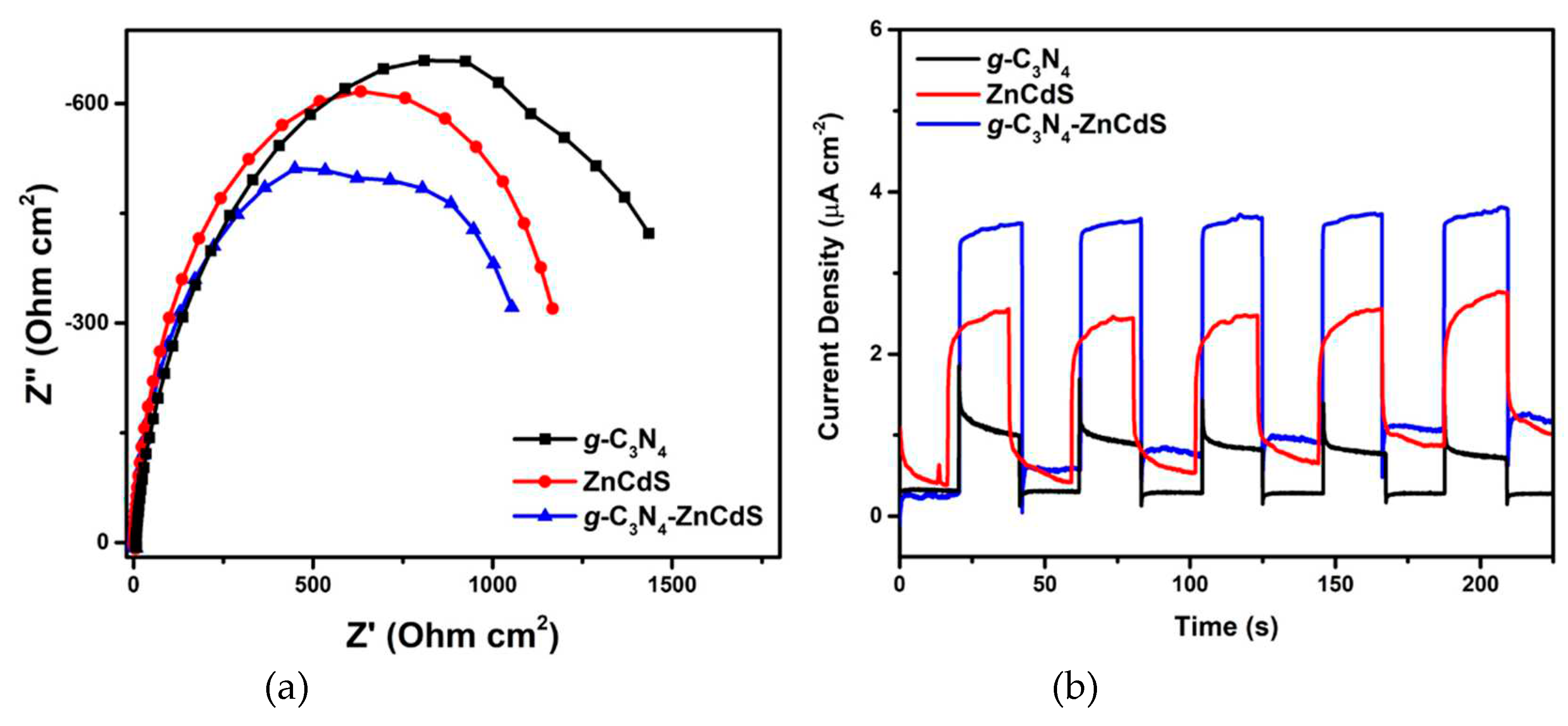
The photocatalytic conjecture was further verified by transient photocurrent response. It was recorded for g-C3N4, ZnCdS, and g-C3N4‒ZnCdS heterojunctions. Figure 7A shows I-t curves for as-synthesized electrodes film with five ON-OFF intermittent visiblelight irradiation consecutive cycles [31]. The responses of photocurrent were appeared in all the electrodes instantly as the light was turned on, then rapidly declined to zero (nearly) as the light was off, which was reproducible and stable. With the similar conditions of irradiation, the photo-current value of the ZnCdS electrode was about twice to that of bare g-C3N4, suggesting there was low-recombination and fast migration of photogenerated electron on theg-C3N4 nanosheets. Additionally, after heterojunction formation between individual components, g-C3N4‒ZnCdS showed a much higher photocurrent value by about 2.6 times, confirming the photogenerated electrons from the g-C3N4 were attacking part in the electron transfer process and shifted to the CB of ZnCdS efficiently.
EIS is another efficient technique to observe the charge transfer efficiency and the interface reaction ability, which explains charge transfer resistance [32]. Figure 7B shows the Nyquist plots of g-C3N4, ZnCdS, and g-C3N4‒ZnCdS heterojunctions. The smaller diameter implied a low impedance and fast interface charge transfer. The g-C3N4‒ZnCdS heterojunction had the smallest diameter compared to bare samples, which also showed less charge transfer resistance and coincided well with photocurrent response results. Overall, our results showed that the heterojunction formation between g-C3N4 and ZnCdS enables less recombination and faster photogenerated electron migration, resulting in a higher photocatalytic performance and enhanced durability.
5. Conclusions
In summary, we successfully synthesized g-C3N4‒ZnCdS heterojunctions via a facile physical mixture and calcination method. The as-synthesized material was characterized using battery of the techniques, such as TEM, XRD, XPS, and UV−vis DRS. The catalysts were used for photocatalytic H2 production, and among all synthesized materials, g-C3N4‒ZnCdS revealed the enhanced UV vis induced photocatalytic performance, with a hydrogen production of 108.9 μmol·g-1·h-1 under the visible light, which was significantly higher compared to individual components. The photocatalysts also possessed excellent repeatability over five cycles, with a mere 6% decrease in photocatalytic activity. The higher and modified photocatalytic performance mainly depended on synergistic effects among the components and heterojunction formation. The transient photocurrent responses and EIS further supported the enhanced performance due to decreased electron-hole recombination and low charge transfer resistance. The facile synthetic approach and better performance of g-C3N4‒ZnCdSprovides new opportunities for further study of the photocatalytic process of coupled semiconductors for hydrogen production.
Supplementary Materials
The following supporting information can be downloaded at the website of this paper posted on Preprints.org. S1 Material and methods; Figure S1: Low-resolution TEM image of theg-C3N4‒ZnCdS catalyst; Figure S2: XPS full scan survey for theg-C3N4‒ZnCdS catalyst.
Author Contributions
Conceptualization and methodology, A. B.Y. and M. I.; formal analysis, investigation, resources and data curation, all authors; writing—original draft preparation, A.B.Y. and M. I.; writing—review and editing, P.K..; visualization, all authors; supervision, M.F. and P.K.; project administration P.K. and M.F..; funding acquisition, P.K. All authors have read and agreed to the published version of the manuscript.
Funding
The authors acknowledge the financial support made possible by Qatar University grant # QUCG-CAM-22/23-504. The finding achieved herein are solely the responsibility of the authors.
Institutional Review Board Statement
Not applicable.
Informed Consent Statement
Not applicable.
Data Availability Statement
The data presented in this study are available on request from the corresponding authors.
Acknowledgments
The authors would like to thank the Center for Advanced Materials, Qatar University, for facilities support.
Conflicts of Interest
The authors declare no conflict of interest.
References
- Christoforidis, K.C.; Fornasiero, P. Photocatalytic Hydrogen Production: A Rift into the Future Energy Supply. ChemCatChem 2017, 9, 1523–1544. [Google Scholar] [CrossRef]
- Corredor, J.; Rivero, M.J.; Rangel, C.M.; Gloaguen, F.; Ortiz, I. Comprehensive review and future perspectives on the photocatalytic hydrogen production. J Chem Technol Biotechnol 2019, 94, 3049–3063. [Google Scholar] [CrossRef]
- Teets, T.S.; Nocera, D.G. Photocatalytic hydrogen production. Chem. Commun. 2011, 47, 9268–9274. [Google Scholar] [CrossRef]
- Yukesh Kannah, R.; Kavitha, S.; Preethi; Parthiba Karthikeyan, O.; Kumar, G.; Dai-Viet, N.V.; Rajesh banu, J. Techno-economic assessment of various hydrogen production methods – A review. Bioresour. Technol. 2021, 319, 12417. [Google Scholar] [CrossRef]
- Fujishima, A.; Honda, K. Electrochemical Photolysis of Water at a Semiconductor Electrode. Nature 1972, 238, 37–38. [Google Scholar] [CrossRef]
- Hisatomi, T.; Kubota, J.; Domen, K. Recent advances in semiconductors for photocatalytic and photoelectrochemical water splitting. Chem. Soc. Rev. 2014, 43, 7520–7535. [Google Scholar] [CrossRef]
- Chen, X.; Shen, S.; Guo, L.; Mao, S.S. Semiconductor-based photocatalytic hydrogen generation. Chem. Rev. 2010, 110, 6503–6570. [Google Scholar] [CrossRef]
- Ong, W.J.; Tan. L.L.; Ng. Y.H.; Yong, S.T.; Chai, S.P. Graphitic Carbon Nitride (g-C3N4)-Based Photocatalysts for Artificial Photosynthesis and Environmental Remediation: Are We a Step Closer to Achieving Sustainability? Chem. Rev. 2016, 116, 7159–7329. [Google Scholar] [CrossRef]
- Thomas, A.; Fischer, A.; Goettmann, F.; Antonietti, M.; Müller, J.O.; Schlögl, R.; Carlsson, J. M. Graphitic carbon nitride materials: Variation of structure and morphology and their use as metal-free catalysts. J. Mater. Chem. 2008, 18, 4893–4908. [Google Scholar] [CrossRef]
- Acharya, R.; Parida, K. A review on TiO2/g-C3N4 visible-light-responsive photocatalysts for sustainable energy generation and environmental remediation. J. Environ. Chem. Eng. 2020, 8, 103896. [Google Scholar] [CrossRef]
- Vu, N.N.; Kaliaguine, S.; Do, T.O. Synthesis of the g-C3N4/CdS Nanocomposite with a Chemically Bonded Interface for Enhanced Sunlig,ht-Driven CO2Photoreduction. ACS Appl. Energy Mater. 2020, 3, 6422–6433. [Google Scholar] [CrossRef]
- Huang, L.; Xu, H.; Zhang, R.; Cheng, X.; Xia, J.; Xu, Y.; Li, H. Synthesis and characterization of g-C3N4/MoO3 photocatalyst with improved visible-light photoactivity. Appl. Surf. Sci. 2013, 283, 25–32. [Google Scholar] [CrossRef]
- Li, Y.Y.; Qin, T.; Chen, W.; Huang, M.; Xu, J.; Lv, J. Construction of a Switchable g-C3N4/BiVO4Heterojunction from the Z-Scheme to the Type II by Incorporation of Pyromellitic Diimide. Cryst. Growth Des. 2022, 22, 1645–1653. [Google Scholar] [CrossRef]
- Hu, B.; Cai, F.; Chen, T.; Fan, M.; Song, C.; Yan, X.; Shi, W. Hydrothermal Synthesis g-C3N4/Nano-InVO4 Nanocomposites and Enhanced Photocatalytic Activity for Hydrogen Production under Visible Light Irradiation. ACS Appl. Mater. Interfaces 2015, 7, 18247–18256. [Google Scholar] [CrossRef] [PubMed]
- Peng, H.; Du, Y.; Zheng, X.; Wen, J. High-temperature sulfurized synthesis of MnxCd1-xS composites for enhancing solar-light driven H2 evolution. Int. J. Hydrogen Energy 2022, 47, 9925–9933. [Google Scholar] [CrossRef]
- Chen, J.; Chen, J.; Li, Y. Hollow ZnCdS dodecahedral cages for highly efficient visible-light-driven hydrogen generation. J. Mater. Chem. A 2017, 5, 24116–24125. [Google Scholar] [CrossRef]
- He, J.; Li, B.; Yu, J.; Qiao, L.; Li, S.; Zu, X.; Xiang, X. Ultra-thin CdIn2S4 nanosheets with nanoholes for efficient photocatalytic hydrogen evolution. Opt. Mater. (Amst) 2020, 108, 2–6. [Google Scholar] [CrossRef]
- Shi, X.; Dai, C.; Wang, X.; Hu, J.; Zhang, J.; Zheng, L.; et al. Protruding Pt single-sites on hexagonal ZnIn2S4 to accelerate photocatalytic hydrogen evolution. Nat. Commun. 2022, 13, 1–10. [Google Scholar] [CrossRef]
- Li, Q.; Meng, H.; Zhou, P.; Zheng, Y.; Wang, J.; Yu, J.; et al. Zn1-xCdxS solid solutions with controlled bandgap and enhanced visible-light photocatalytic H2-production activity. ACS Catal. 2013, 3, 882–889. [Google Scholar] [CrossRef]
- Chen, R.; Li, K.; Zhu, X.S.; Xie, S.L.; Dong, L.Z.; Li, S.L.; et al. In situ synthesis of porous ZnO-embedded Zn1-xCdxS/CdS heterostructures for enhanced photocatalytic activity. CrystEngComm 2016, 18, 1446–52. [Google Scholar] [CrossRef]
- Li, K.; Chen, R.; Li, S.L.; Xie, S.L.; Dong, L.Z.; Kang, Z.H.; et al. Engineering Zn1-xCdxS/CdS Heterostructures with Enhanced Photocatalytic Activity. ACS Appl. Mater. Interfaces 2016, 8, 14535–114541. [Google Scholar] [CrossRef]
- Imran, M.; Yousaf, A Bin. ; Kasak, P.; Zeb, A.; Zaidi, S.J. Highly efficient sustainable photocatalytic Z-scheme hydrogen production from an A-Fe2O3 engineered ZnCdS heterostructure. J. Catal. 2017, 353, 81–88. [Google Scholar] [CrossRef]
- Vijayan, M.; Manikandan, V.; Rajkumar, C.; Hatamleh, A.A.; Alnafisi, B.K.; Easwaran, G.; et al. Constructing Z-scheme g-C3N4/TiO2 heterostructure for promoting degradation of the hazardous dye pollutants. Chemosphere 2023, 311, c136928. [Google Scholar] [CrossRef] [PubMed]
- Ding, J.; Sun, X.; Wang, Q.; Li, D.S.; Li, X.; Li, X.; et al. Plasma synthesis of Pt/g-C3N4 photocatalysts with enhanced photocatalytic hydrogen generation. J. Alloys Compd. 2021, 873, 159871. [Google Scholar] [CrossRef]
- Tan, L.; Xu, J.; Zhang, X.; Hang, Z.; Jia, Y.; Wang, S. Synthesis of g-C3N4/CeO 2 nanocomposites with improved catalytic activity on the thermal decomposition of ammonium perchlorate. Appl. Surf. Sci. 2015, 356, 447–453. [Google Scholar] [CrossRef]
- Hao, X.; Xiang, D.; Jin, Z. Zn-Vacancy Engineered S-Scheme ZnCdS/ZnS Photocatalyst for Highly Efficient Photocatalytic H2 Evolution. ChemCatChem 2021, 13, 4738–4750. [Google Scholar] [CrossRef]
- Yang, Q, Yu, L. ; Zhao, X.; Wang, Y.; Zhu, H.; Zhang, Y. Highly stable γ-NiOOH/ZnCdS photocatalyst for efficient hydrogen evolution. Int. J. Hydrogen Energy 2022, 47, 27516–27526. [Google Scholar] [CrossRef]
- Butler, M.A.; Ginley, D.S. Prediction of Flatband Potentials at Semiconductor-Electrolyte Interfaces from Atomic Electronegativities. J. Electrochem. Soc. 1978, 125, 228–232. [Google Scholar] [CrossRef]
- Ge, F.; Li, X.; Wu, M.; Ding, H.; Li, X. A type II heterojunction α-Fe2O3/g-C3N4 for the heterogeneous photo-Fenton degradation of phenol. RSC Adv. 2022, 12, 8300–8309. [Google Scholar] [CrossRef]
- Wang, Y.; Fiaz, M.; Kim, J.; Carl, N.; Kim, Y.K. Kinetic Evidence for Type-II Heterojunction and Z-Scheme Interactions in g-C3N4/TiO2Nanotube-Based Photocatalysts in Photocatalytic Hydrogen Evolution. ACS Appl. Energy Mater. 2023, 6, 5197–206. [Google Scholar] [CrossRef]
- Serafin, J.; Ouzzine, M.; Sreńscek-Nazzal, J.; Llorca, J. Photocatalytic hydrogen production from alcohol aqueous solutions over TiO2-activated carbon composites decorated with Au and Pt. J.Photochem. Photobiol. A Chem. 2022, 425, 113726. [Google Scholar] [CrossRef]
- Dong, Z.; Wu, Y.; Thirugnanam, N.; Li, G. Double Z-scheme ZnO/ZnS/g-C3N4 ternary structure for efficient photocatalytic H 2 production. Appl. Surf. Sci. 2018, 430, 293–300. [Google Scholar] [CrossRef]
Figure 1.
Transmission electron microscopy (TEM) images for as-prepared g-C3N4‒ZnCdS samples (a) lower magnifications and (b) higher magnifications.
Figure 1.
Transmission electron microscopy (TEM) images for as-prepared g-C3N4‒ZnCdS samples (a) lower magnifications and (b) higher magnifications.
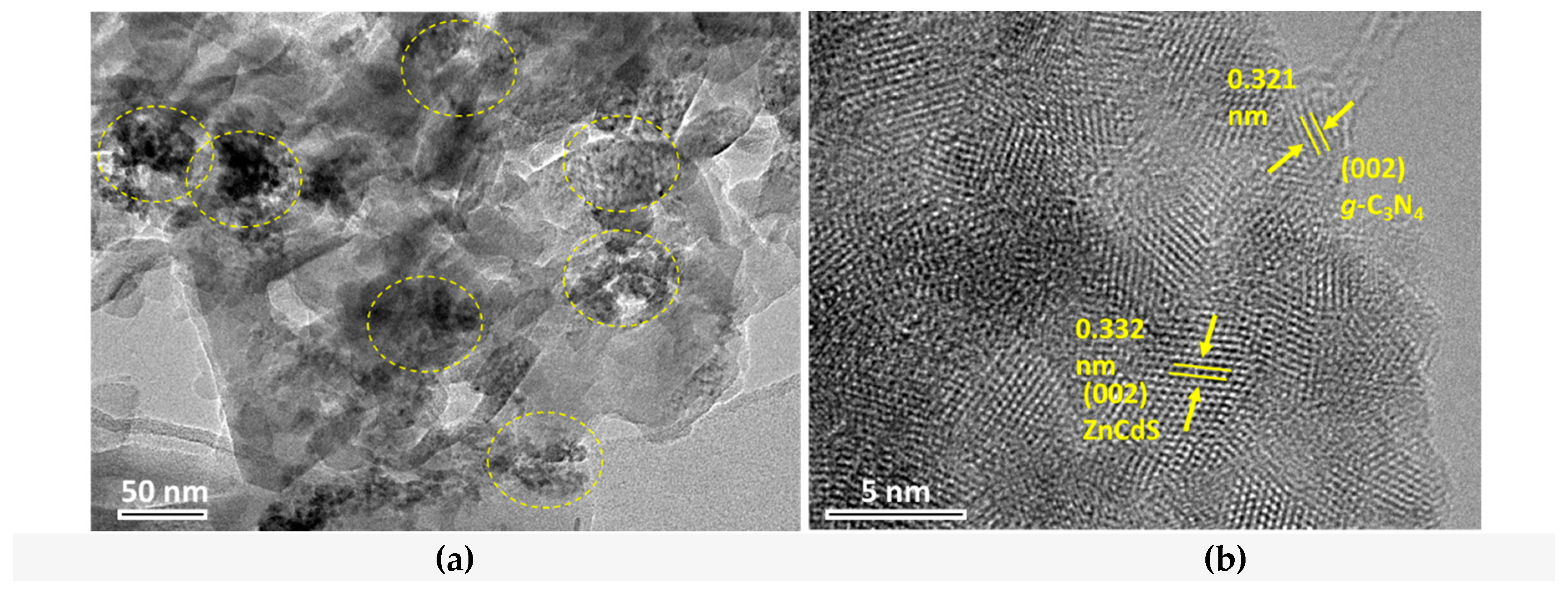
Figure 2.
XRD spectrum of g-C3N4 (black line), ZnCdS (red line), and g-C3N4‒ZnCdS (blue line) samples.
Figure 2.
XRD spectrum of g-C3N4 (black line), ZnCdS (red line), and g-C3N4‒ZnCdS (blue line) samples.
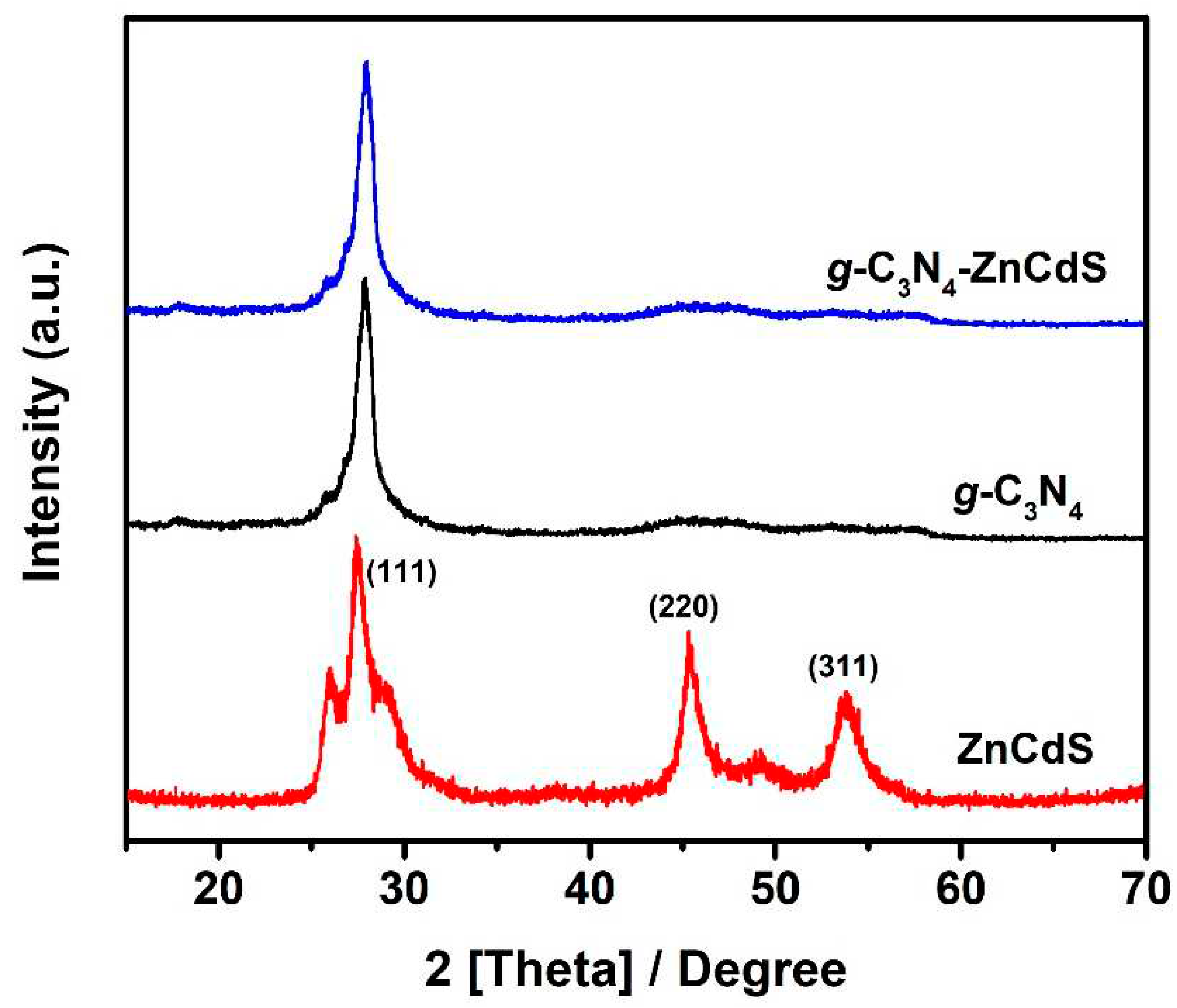
Figure 3.
High resolution XPS spectrum for a g-C3N4‒ZnCdS sample.Scans for (a) C1s, (b)Cd3d and N1s, (c)Zn2p, and (d) S2p regions.
Figure 3.
High resolution XPS spectrum for a g-C3N4‒ZnCdS sample.Scans for (a) C1s, (b)Cd3d and N1s, (c)Zn2p, and (d) S2p regions.
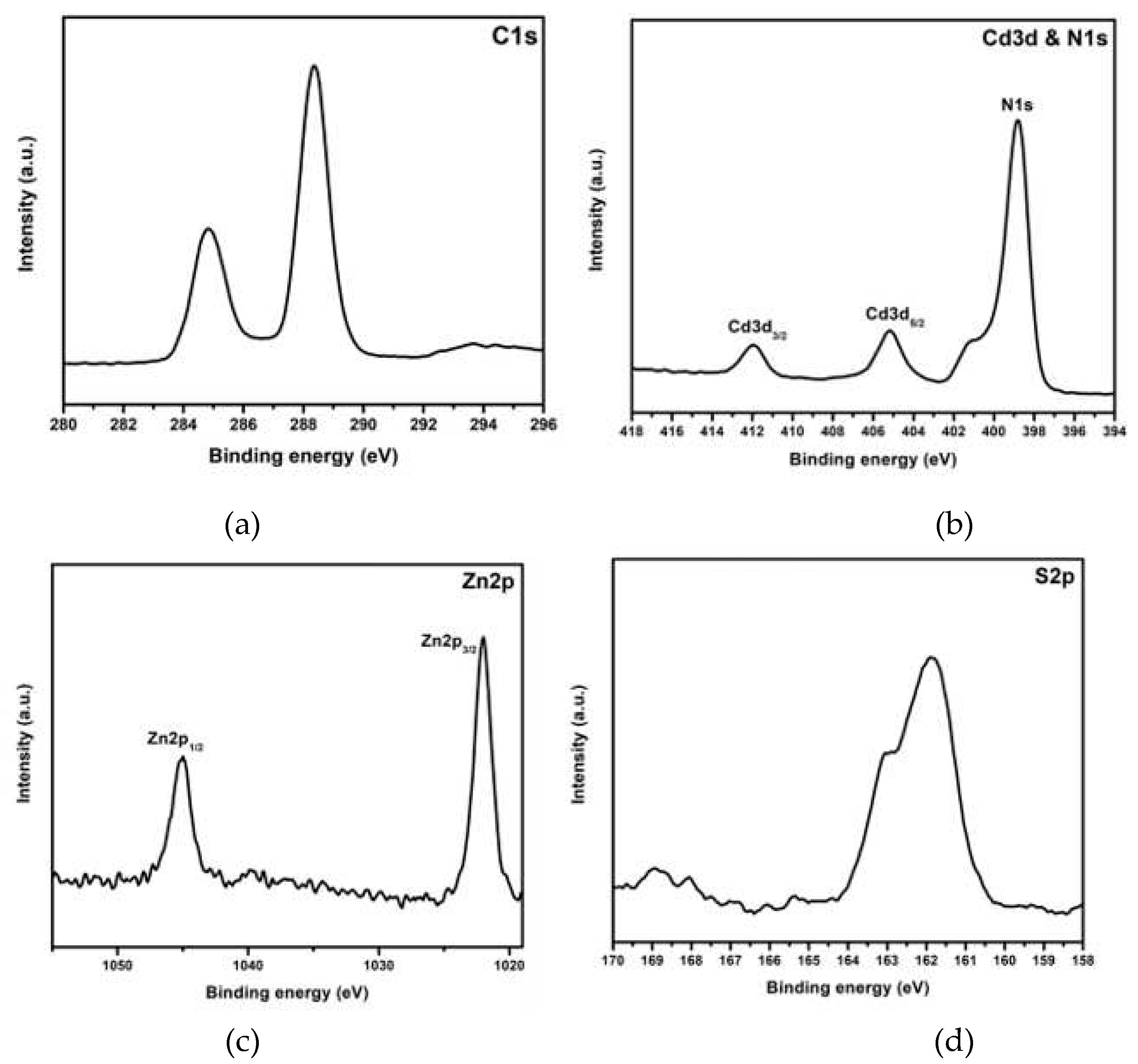
Figure 4.
(a) UV–visible diffuse reflectance spectra (DRS) and (b) related tauc plot for g-C3N4, ZnCdS, and g-C3N4‒ZnCdS. The insets (a) are the images of the samples of g-C3N4 (a), ZnCdS (b), and g-C3N4‒ZnCdS (c).
Figure 4.
(a) UV–visible diffuse reflectance spectra (DRS) and (b) related tauc plot for g-C3N4, ZnCdS, and g-C3N4‒ZnCdS. The insets (a) are the images of the samples of g-C3N4 (a), ZnCdS (b), and g-C3N4‒ZnCdS (c).
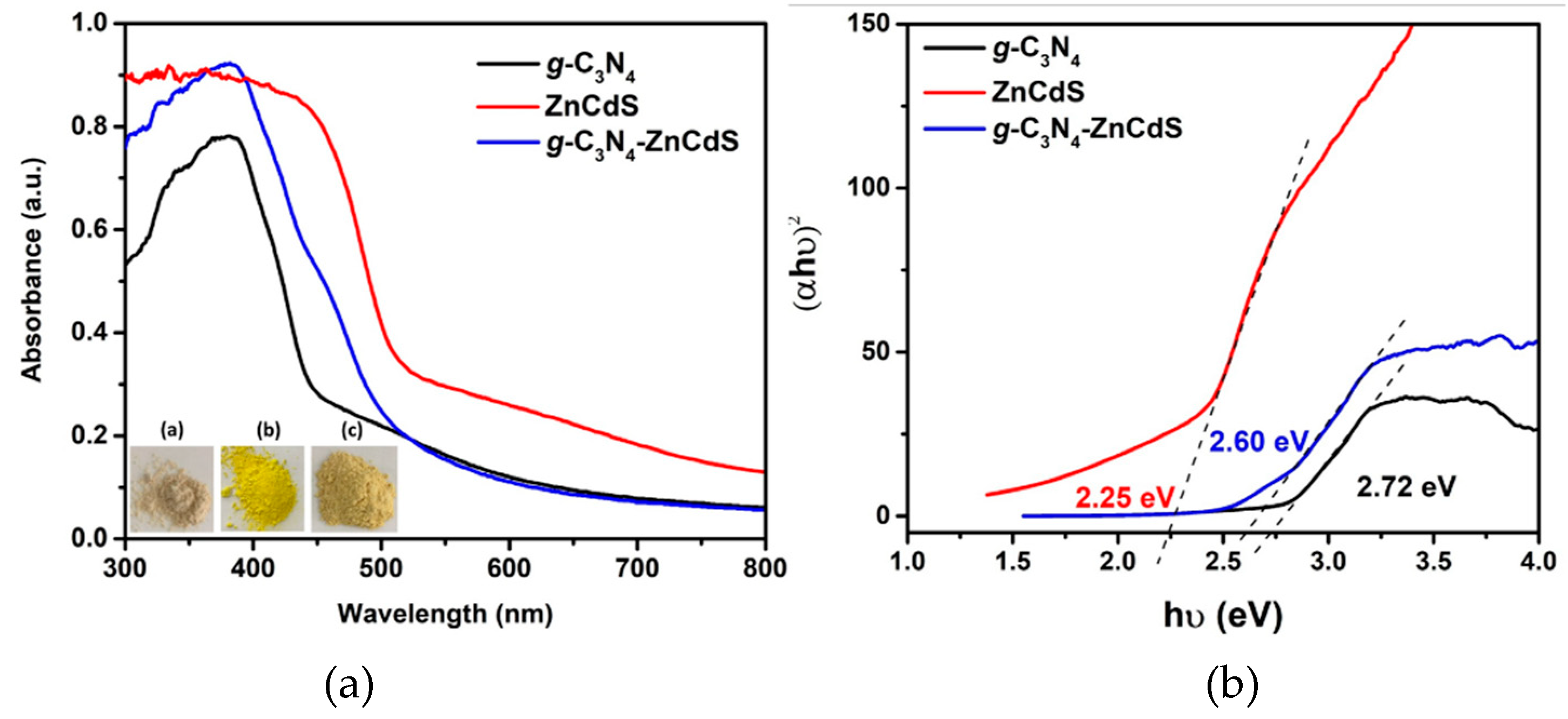
Figure 5.
(a) Photocatalytic H2 evolution activities from water splitting on samples from g-C3N4 nanosheets, ZnCdS nanoparticles, and g-C3N4‒ZnCdS under visible light illumination (λ ≥ 420 nm) over 5 hours. (b) Cyclic tests for photocatalytic H2 evolution activities from water solution on g-C3N4‒ZnCdS for four consecutive cycles.
Figure 5.
(a) Photocatalytic H2 evolution activities from water splitting on samples from g-C3N4 nanosheets, ZnCdS nanoparticles, and g-C3N4‒ZnCdS under visible light illumination (λ ≥ 420 nm) over 5 hours. (b) Cyclic tests for photocatalytic H2 evolution activities from water solution on g-C3N4‒ZnCdS for four consecutive cycles.
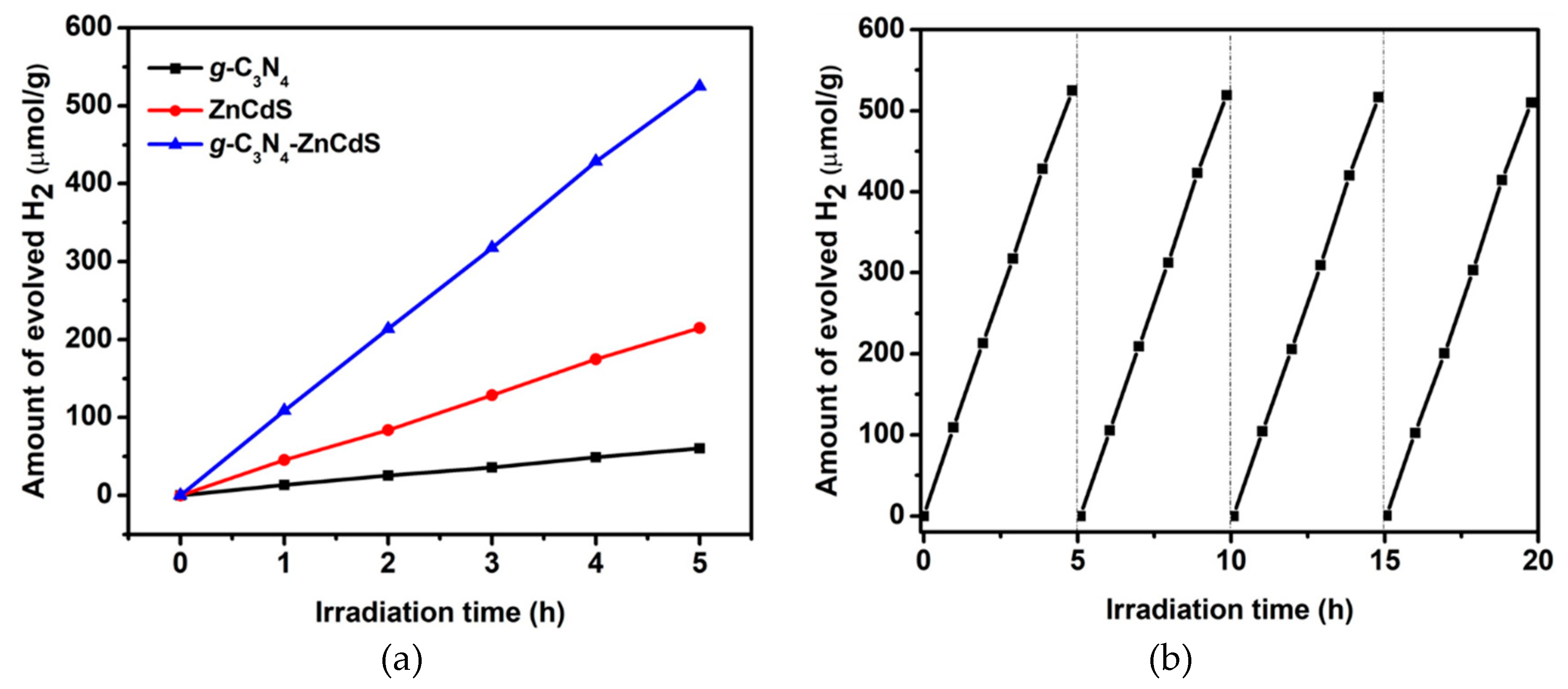
Figure 6.
A schematic representation showing the photocatalytic process, band positions, and charge transfer process for g-C3N4‒ZnCdS.
Figure 6.
A schematic representation showing the photocatalytic process, band positions, and charge transfer process for g-C3N4‒ZnCdS.
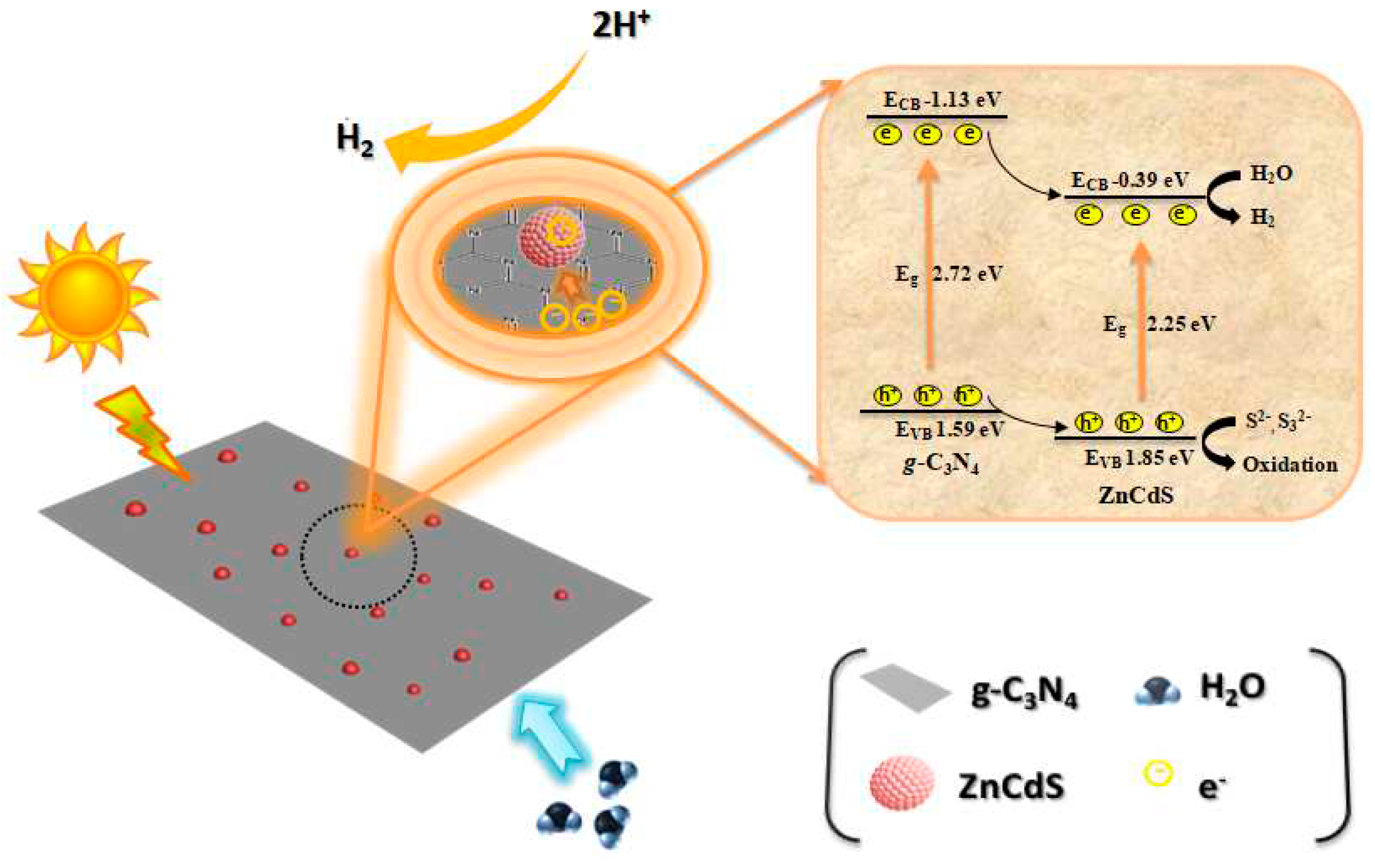
Figure 7.
(a) Nyquist plots from EIS measurement of g-C3N4, ZnCdS, and g-C3N4‒ZnCdS. (b) Cyclic performance of the response of the current from as-synthetized photocatalysts vs. time for g-C3N4, ZnCdS, and g-C3N4‒ZnCdS (irradiated at λ ≥ 420 nm).
Figure 7.
(a) Nyquist plots from EIS measurement of g-C3N4, ZnCdS, and g-C3N4‒ZnCdS. (b) Cyclic performance of the response of the current from as-synthetized photocatalysts vs. time for g-C3N4, ZnCdS, and g-C3N4‒ZnCdS (irradiated at λ ≥ 420 nm).
Disclaimer/Publisher’s Note: The statements, opinions and data contained in all publications are solely those of the individual author(s) and contributor(s) and not of MDPI and/or the editor(s). MDPI and/or the editor(s) disclaim responsibility for any injury to people or property resulting from any ideas, methods, instructions or products referred to in the content. |
© 2023 by the authors. Licensee MDPI, Basel, Switzerland. This article is an open access article distributed under the terms and conditions of the Creative Commons Attribution (CC BY) license (http://creativecommons.org/licenses/by/4.0/).
Copyright: This open access article is published under a Creative Commons CC BY 4.0 license, which permit the free download, distribution, and reuse, provided that the author and preprint are cited in any reuse.


