

Submitted:
26 April 2025
Posted:
28 April 2025
You are already at the latest version
Abstract
The development of sensitive, non-invasive methods is essential for the preservation and study of heritage books, allowing insights into their historical production processes and conservation needs. Volatile organic compound (VOC) analysis provides a valuable, non-destructive approach to assess paper composition and degradation in historical volumes. In this study, we analyzed VOC emissions from two books preserved at the Biblioteca Capitolare of Busto Arsizio, Italy: a 16th-century Latin grammar book and a 19th-century mathematics handbook for measurement conversions. Using headspace solid-phase microextraction (HS-SPME) and gas chromatography-mass spectrometry (GC-MS), VOCs were sampled after 24 hours of storage at room temperature. The results revealed distinct degradation markers: straight-chain aldehydes, indicative of lipid oxidation, were more prevalent in the 16th-century book, reflecting the higher quality and durability of its rag-based paper. In contrast, elevated furfural levels in the 19th-century book suggest accelerated cellulose hydrolysis typical of wood pulp paper. Additionally, the presence of menthol and anethole in both volumes points to the use of bacteriostatic agents for preservation. These findings not only highlight differences in material composition but also underscore the importance of tailored conservation approaches for historical documents from different eras.
Keywords:
Heritage preservation
; Volatile organic compounds
; Headspace SPME-GC/MS
; Paper degradation markers
; Non-invasive analysis
1. Introduction
The preservation of historical paper artifacts, including books and manuscripts, is vital to safeguarding cultural heritage [1,2,3,4,5]. These items embody a tangible connection to past knowledge, artistic practices, and social values, making their conservation essential for maintaining a link to history. However, due to varying materials and production techniques, books from different historical periods face diverse challenges of degradation [1,6]. Monitoring and understanding these degradation processes is therefore critical to developing conservation strategies that extend the longevity and accessibility of these valuable artifacts.
Paper degradation typically occurs through two primary mechanisms: acid-catalyzed hydrolysis and oxidative degradation [7,8,9]. Books made from wood pulp, especially those produced after the 19th century, are susceptible to rapid degradation. The acidic compounds in wood pulp catalyze the breakdown of cellulose fibers, producing byproducts like furfural, a marker of cellulose and hemicellulose hydrolysis. This degradation is associated with a significant decline in paper quality. In contrast, historical papers produced from plant-based rags, as in books from the 16th century, contain fewer acidic components and are thus more resistant to hydrolysis. Instead, these older papers tend to degrade via oxidation of residual lipids, releasing aldehydes like octanal and nonanal as byproducts, which serve as markers of oxidative degradation.
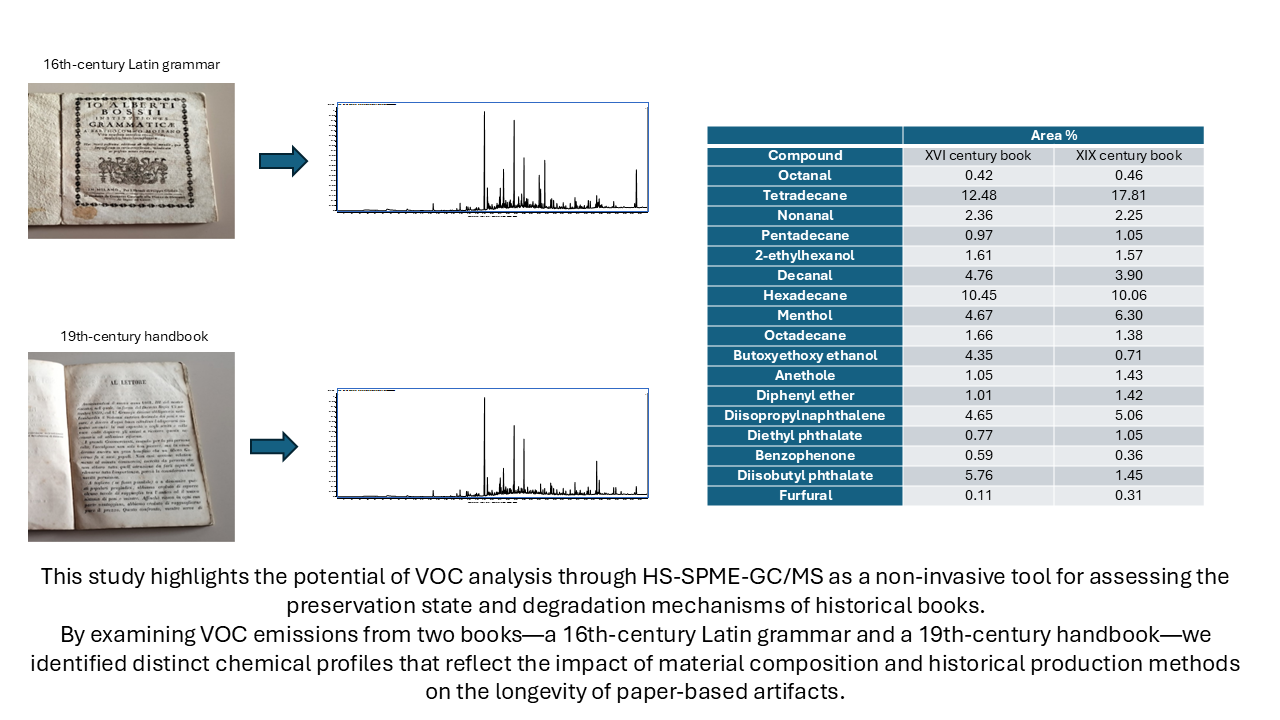
In this study, we analyzed volatile organic compounds (VOCs) emitted from two books preserved at the Biblioteca Capitolare of Busto Arsizio in Italy (Figure 1) [10]. The first volume, a Latin grammar book by Gian Alberto Bossi, was published in the late 16th century and widely used to teach noble families, with its content still relevant in some classrooms today. The second volume, a mathematics handbook published in 1860, was designed to standardize measurement conversions in post-unification Italy. The books represent distinct production materials and processes, offering insights into different degradation pathways and preservation needs.
Headspace solid-phase microextraction (HS-SPME) coupled with gas chromatography-mass spectrometry (GC-MS) enables non-invasive VOC analysis, preserving the structural integrity of valuable documents [9]. This approach allows for the identification of compounds linked to specific degradation mechanisms, such as aldehydes from lipid oxidation and furfural from cellulose hydrolysis. The technique provides conservators and researchers with a means to monitor the chemical health of historical documents, minimizing risk to the artifacts.
This study aims to identify and compare degradation markers in two heritage books from different centuries to assess their respective preservation states. Using non-invasive HS-SPME/GC-MS analysis, we analyzed the VOCs emitted from a 16th-century Latin grammar book and a 19th-century mathematics handbook preserved at the Biblioteca Capitolare of Busto Arsizio, Italy [9,11]. By examining specific VOC profiles, such as aldehydes and furfural, the research seeks to provide a clearer understanding of the degradation pathways affecting each type of paper, offering insights relevant to conservation science. This collaborative work between IIS G. Torno, Biblioteca Capitolare of Busto Arsizio, and InnovHub SSI highlights the importance of partnerships in heritage science, facilitating the preservation of historical artifacts for future generations.
2. Results
The analysis of VOCs emitted from the two historical books revealed distinct profiles that reflect differences in their material composition and degradation pathways. Each book’s VOC profile highlights its preservation state, providing insights into how historical manufacturing techniques influence long-term chemical stability.
2.1. VOC Profile of the 16th-Century Book
The 16th-century Latin grammar book exhibited a VOC profile rich in alkanes and aldehydes, which are indicative of lipid oxidation—a slower degradation pathway associated with high-quality rag-based paper (Figure 2) [8,9]. The profile was dominated by tetradecane (12.48% of total VOCs) and hexadecane (10.45%), long-chain alkanes likely originating from residual organic components in the plant-based rag fibers. These alkanes suggest the presence of stable, organic compounds within the paper, contributing to its durability. Additionally, moderate levels of aldehydes, such as nonanal (2.36%) and decanal (4.76%), support the presence of oxidative degradation as the primary pathway, while octanal was detected at a lower concentration of 0.42%.
Furfural, a typical marker of acid-catalyzed hydrolysis, was found in minimal amounts (0.11%), underscoring the rag paper’s chemical resistance to acid degradation [12]. Certain compounds such as butoxyethoxy ethanol (4.35%), menthol (4.67%), and anethole (1.05%) may be indicative of historical conservation efforts, as both menthol and anethole possess bacteriostatic properties that could inhibit microbial activity [13,14]. This VOC profile underscores the durability of the 16th-century book, with a slow, oxidative degradation pathway that aligns with the chemically stable nature of rag-based paper.
2.2. VOC Profile of the 19th-Century Book
The 19th-century mathematics handbook displayed a VOC profile that reflects the composition and degradation characteristics of wood pulp-based paper (Figure 3) [8,9]. The profile was rich in long-chain alkanes, with tetradecane comprising 17.81% of total VOCs and hexadecane at 10.06%. These alkanes are common in wood pulp paper and likely represent residual organic compounds within its structure. In addition to alkanes, furfural was detected at a concentration of 0.31%, indicating acid-catalyzed hydrolysis, which is prevalent in wood pulp due to its acidic nature.
The profile also included notable levels of menthol (6.30%) and synthetic compounds such as diphenyl ether (1.42%) and diethyl phthalate (1.05%). The higher menthol content suggests possible preservation treatments to counteract microbial damage, while synthetic additives like diethyl phthalate may have been introduced to extend the lifespan of the paper. The presence of furfural and synthetic compounds suggests a more chemically vulnerable paper type, susceptible to rapid degradation under acidic conditions, which may have prompted additional preservation efforts [12].
2.3. Comparative Analysis of VOC Profiles and Implications for Conservation
A comparative analysis of VOCs based on peak area integration highlights the distinct degradation mechanisms of each book (Table 1). The 16th-century book exhibited high levels of long-chain alkanes (e.g., tetradecane at 12.48% and hexadecane at 10.45%) and moderate levels of aldehydes (e.g., decanal at 4.76% and nonanal at 2.36%), indicating that oxidative degradation is the primary pathway, consistent with the stability of rag-based paper. The minimal concentration of furfural (0.11%) further supports the chemical resilience of this material against acid hydrolysis, demonstrating the durability of rag-based paper in historical artifacts.
In contrast, the 19th-century book showed a higher concentration of furfural (0.31%), reflecting its vulnerability to acid-catalyzed hydrolysis due to the inherent acidity of wood pulp paper [12]. This increased susceptibility to hydrolytic degradation in the 19th-century book underscores the rapid deterioration that acidic materials face, especially in environments where preservation conditions may fluctuate. The relatively lower levels of aldehydes in this book compared to the 16th-century book suggest that oxidation is a secondary degradation pathway, less significant in the chemically unstable environment created by acidic wood pulp.
These findings are relevant for heritage science as they reveal how historical manufacturing methods and material choices directly impact the longevity of cultural artifacts. The chemically stable nature of rag-based paper used in the 16th-century book suggests that such materials are inherently better suited for long-term preservation, with oxidative degradation occurring at a relatively slow pace. This durability makes rag-based artifacts more resilient to environmental fluctuations and less dependent on rigorous conservation efforts.
Conversely, the findings for the 19th-century book emphasize the inherent vulnerability of wood pulp paper to acidic degradation. The high furfural content highlights a pressing need for targeted conservation strategies, especially for collections dominated by 19th-century and early 20th-century materials [12]. Preservation efforts for such books may require more stringent environmental controls to limit acid hydrolysis, such as maintaining stable humidity levels, reducing temperature fluctuations, and possibly applying deacidification treatments to neutralize the acidic compounds within the paper fibers.
Additionally, the presence of menthol and synthetic compounds in both books points to historical or contemporary preservation interventions, reflecting an ongoing awareness of the need to mitigate microbial damage and extend paper longevity [13,14,15]. These findings underline the role of active preservation treatments and monitoring, especially for vulnerable wood pulp-based collections, and suggest that conservation strategies can benefit from regular VOC profiling to assess the effectiveness of these treatments over time.
3. Discussion
This comparative VOC profile demonstrates how historical paper composition and manufacturing methods significantly influence the preservation state of cultural artifacts. The findings advocate for conservation approaches tailored to the specific degradation mechanisms of each paper type, ensuring that valuable historical documents are preserved for future generations. This study highlights the potential of VOC analysis through HS-SPME-GC/MS as a non-invasive tool for assessing the preservation state and degradation mechanisms of historical books. By examining VOC emissions from two books—a 16th-century Latin grammar and a 19th-century mathematics handbook—we identified distinct chemical profiles that reflect the impact of material composition and historical production methods on the longevity of paper-based artifacts.
The 16th-century book, constructed from high-quality rag-based paper, exhibited a VOC profile dominated by aldehydes and long-chain alkanes, indicative of oxidative degradation—a slower process that aligns with its durable material. In contrast, the 19th-century book, made from wood pulp, showed elevated furfural levels, a marker of acid-catalyzed hydrolysis, pointing to rapid degradation characteristic of acidic wood pulp paper. These differences underscore the need for tailored conservation strategies to mitigate the degradation of historically significant books, particularly those vulnerable to acid-catalyzed decay.
This project was made possible through a collaborative effort between public education and private industry, specifically involving teachers and students from IIS G. Torno (Castano Primo, Italy) and the heritage science researchers at InnovHub SSI (Milan, Italy). This partnership not only facilitated access to unique historical materials and advanced analytical techniques but also provided educational and hands-on scientific experiences for students. The collaboration exemplifies how interdisciplinary efforts between academic institutions and industry can enrich both scientific research and cultural preservation efforts.
By fostering such partnerships, we can continue to develop and refine non-invasive methods to support the long-term preservation of cultural heritage, ensuring that these artifacts remain accessible to future generations.
4. Materials and Methods
4.1. Sample Collection and Storage
Two historical books—a 16th-century Latin grammar by Gian Alberto Bossi and a 19th-century mathematics handbook, sourced from the Biblioteca Capitolare of Busto Arsizio in Italy — were selected for VOC analysis, according to [9,11]. Each book was stored in a 12 L glass desiccator, equipped with a silicone septum to accommodate the insertion of an SPME fiber. To enhance headspace VOC concentration, the books were positioned upright with their pages fanned out, maximizing surface exposure within the chamber. Prior to sampling, each desiccator was evacuated to remove any potential environmental contaminants, then sealed and left undisturbed for 24 hours at an ambient temperature of 20 °C.
4.2. Headspace Solid-Phase Microextraction
The VOCs emitted were captured using HS-SPME. A 50/30 μm divinylbenzene/carboxen/polydimethylsiloxane (DVB/CAR/PDMS) fiber (Supelco, Bellefonte, PA, USA) was selected for its broad adsorption range, covering both polar and non-polar compounds. The SPME fiber was preconditioned by heating it to 270 °C for 1 hour to remove any potential contaminants, ensuring sample integrity. Following chamber incubation, the fiber was inserted through the septum and exposed to the headspace above the book for an additional 24 hours. This prolonged exposure period allowed for the accumulation of a wide range of VOCs, including both high and low molecular weight compounds, enhancing the sensitivity and representativeness of the analysis.
4.3. Gas Chromatography-Mass Spectrometry Analysis
After VOC collection, the fiber was immediately inserted into an Agilent 7890B gas chromatograph coupled with a 5977B mass spectrometer (Agilent Technologies, Santa Clara, CA, USA) for compound desorption and analysis. The chromatographic separation was conducted using a polar polyethylene glycol (PEG) capillary column (50 m in length, 0.2 mm internal diameter, 0.4 μm film thickness), ideal for separating complex organic mixtures. The oven temperature was initially set at 40 °C, then gradually increased at a rate of 10 °C per minute until reaching 250 °C, where it was held for 5 minutes. Helium served as the carrier gas at a constant flow rate of 1.0 mL/min.
The mass spectrometer operated in electron ionization (EI) mode at 70 eV, scanning mass-to-charge ratios (m/z) from 40 to 450 amu to capture a comprehensive VOC profile. Identification was based on comparing observed spectra to the NIST Mass Spectral Library (NIST 2020), focusing particularly on aldehydes, furans, alkanes, and alcohols as primary markers of lipid oxidation and cellulose hydrolysis, indicative of the primary degradation pathways in historical paper.
4.4. Semiquantitative Analysis of VOCs
To compare VOC concentrations between the two books, semiquantitative analysis was performed. Each compound’s chromatographic peak area was integrated and expressed as a percentage of the total ion chromatogram. This relative quantification enabled the comparison of VOC abundances, offering insights into specific degradation processes. Furfural, a byproduct of cellulose hydrolysis, served as an indicator of acid-catalyzed degradation, predominantly observed in the 19th-century volume. In contrast, the 16th-century book showed higher levels of straight-chain aldehydes, such as octanal, nonanal, and decanal, which are typical products of lipid oxidation, suggesting a greater oxidative stability. These peak area percentages provided a comparative basis for assessing each book’s preservation state.
4.5. Quality Control and Blank Runs
Quality control was maintained through weekly monitoring of the empty desiccator chamber using 24-hour blank SPME fiber exposures, ensuring minimal contamination from the laboratory environment. Additionally, each SPME fiber was reconditioned before each sample analysis, and blank fiber runs were performed after each book’s analysis to verify the absence of carry-over. This practice helped confirm the accuracy of the VOC profiles by ruling out potential contamination sources.
Author Contributions
Conceptualization, C.C. and M.C.; methodology, P.R. and D.B.; formal analysis, All; investigation, All.; writing—original draft preparation, L.G..; writing—review and editing, All; supervision, L.G.; All authors have read and agreed to the published version of the manuscript.
Funding
This research received no external funding.
Institutional Review Board Statement
Not applicable.
Informed Consent Statement
Not applicable.
Data Availability Statement
All data are available from the Corresponding Author upon reasonable request.
Conflicts of Interest
The authors declare no conflicts of interest.
Appendix A
Appendix A.1
The 5B IISS Torno Working Group
Susanna Andrani, Simone Barzizza, Samuele Busti, Pietro Carturan, Luca Casucci, Mathias Chiodini, Noemi Freddi, Michela Gallazzi, Andrea Maino, Sara Menescardi, Federica Milanti, Alessandro Pagano, Alessio Perlini, Mattia Rizzo, Davide Valente
References
- Yan, Y.; Tang, Y.; Yang, Y. Chemical Conservation of Paper-Based Cultural Heritage. Molecules 2024, 30, 122. [CrossRef]
- Botti, S.; Bonfigli, F.; Mezi, L.; Flora, F. Monitoring of Cleaning Treatments for Paper Heritage with Raman Spectroscopy Mapping. Molecules 2023, 29, 15. [CrossRef]
- Botti, S.; Bonfigli, F.; Nigro, V.; Rufoloni, A.; Vannozzi, A. Evaluating the Conservation State of Naturally Aged Paper with Raman and Luminescence Spectral Mapping: Toward a Non-Destructive Diagnostic Protocol. Molecules 2022, 27, 1712. [CrossRef]
- Nemoykina, A.L.; Shabalina, A.V.; Svetlichnyi, V.A. Restoration and conservation of old low-quality book paper using aqueous colloids of magnesium oxyhydroxide obtained by pulsed laser ablation. J. Cult. Heritage 2019, 39, 42–48. [CrossRef]
- Croitoru, C.; Roata, I.C. Ionic Liquids as Reconditioning Agents for Paper Artifacts. Molecules 2024, 29, 963. [CrossRef]
- Sequeira, S.O.; Pasnak, E.; Viegas, C.; Gomes, B.; Dias, M.; Cervantes, R.; Pena, P.; Twarużek, M.; Kosicki, R.; Viegas, S.; et al. Microbial Assessment in A Rare Norwegian Book Collection: A One Health Approach to Cultural Heritage. Microorganisms 2024, 12, 1215. [CrossRef]
- Zhang, M.; Zhao, J.; Wang, S.; Dai, Z.; Qin, S.; Mei, S.; Zhang, W.; Guo, R. Carbon Quantum Dots for Long-Term Protection against UV Degradation and Acidification in Paper-Based Relics. ACS Appl. Mater. Interfaces 2024, 16, 5009–5018. [CrossRef]
- Gaspar, E.M.; Santana, J.C.; Lopes, J.F.; Diniz, M.B. Volatile organic compounds in paper—an approach for identification of markers in aged books. Anal. Bioanal. Chem. 2010, 397, 369–380. [CrossRef]
- Verticchio, E.; Frasca, F.; Cavalieri, P.; Teodonio, L.; Fugaro, D.; Siani, A.M. Conservation risks for paper collections induced by the microclimate in the repository of the Alessandrina Library in Rome (Italy). Heritage Sci. 2022, 10, 1–15. [CrossRef]
- Clark, A.J.; Calvillo, J.L.; Roosa, M.S.; Green, D.B.; Ganske, J.A. Degradation product emission from historic and modern books by headspace SPME/GC–MS: evaluation of lipid oxidation and cellulose hydrolysis. Anal. Bioanal. Chem. 2011, 399, 3589–3600. [CrossRef]
- Stylianou, M.; Barlet, C.; Andreou, C.; Agapiou, A. Assessment of volatile emissions by aging books. Environ. Sci. Pollut. Res. 2023, 31, 17670–17677. [CrossRef]
- Battistel, D.; Padovani, I.; Dallo, F.; Barbante, C.; Zendri, E.; Balliana, E. Evaluation of the volatile organic compound emissions in modern and naturally aged Japanese paper. J. Cult. Heritage 2018, 33, 18–29. [CrossRef]
- Łojewski, T.; Sawoszczuk, T.; Łagan, J.M.; Zięba, K.; Barański, A.; Łojewska, J. Furfural as a marker of cellulose degradation. A quantitative approach. Appl. Phys. A 2010, 100, 873–884. [CrossRef]
- Ludwiczuk, A., Kieltyka-Dadasiewicz, A., Sawicki, R., Golus, D., & Ginalska, G. (2016). Essential oils of some Mentha species and cultivars, their chemistry and bacteriostatic activity. Natural Product Communications, 11, 1015–1018.
- Galgano, M.; Capozza, P.; Pellegrini, F.; Cordisco, M.; Sposato, A.; Sblano, S.; Camero, M.; Lanave, G.; Fracchiolla, G.; Corrente, M.; et al. Antimicrobial Activity of Essential Oils Evaluated In Vitro against Escherichia coli and Staphylococcus aureus. Antibiotics 2022, 11, 979. [CrossRef]
Figure 1.
The two heritage books examined in this study. Panel (A): XVI Century book. Written by Gian Alberto Bossi, this Latin grammar became a bestseller and was widely used by teachers instructing students from noble families. Preserved in Busto Arsizio, it remains relevant today, with examples still used in modern classrooms. Panel (B): XIX Century book. This 1860 book on mathematical conversions, acquired at an antique market, was widely used in early post-unification Italy to standardize local measurements according to the new national system.
Figure 1.
The two heritage books examined in this study. Panel (A): XVI Century book. Written by Gian Alberto Bossi, this Latin grammar became a bestseller and was widely used by teachers instructing students from noble families. Preserved in Busto Arsizio, it remains relevant today, with examples still used in modern classrooms. Panel (B): XIX Century book. This 1860 book on mathematical conversions, acquired at an antique market, was widely used in early post-unification Italy to standardize local measurements according to the new national system.
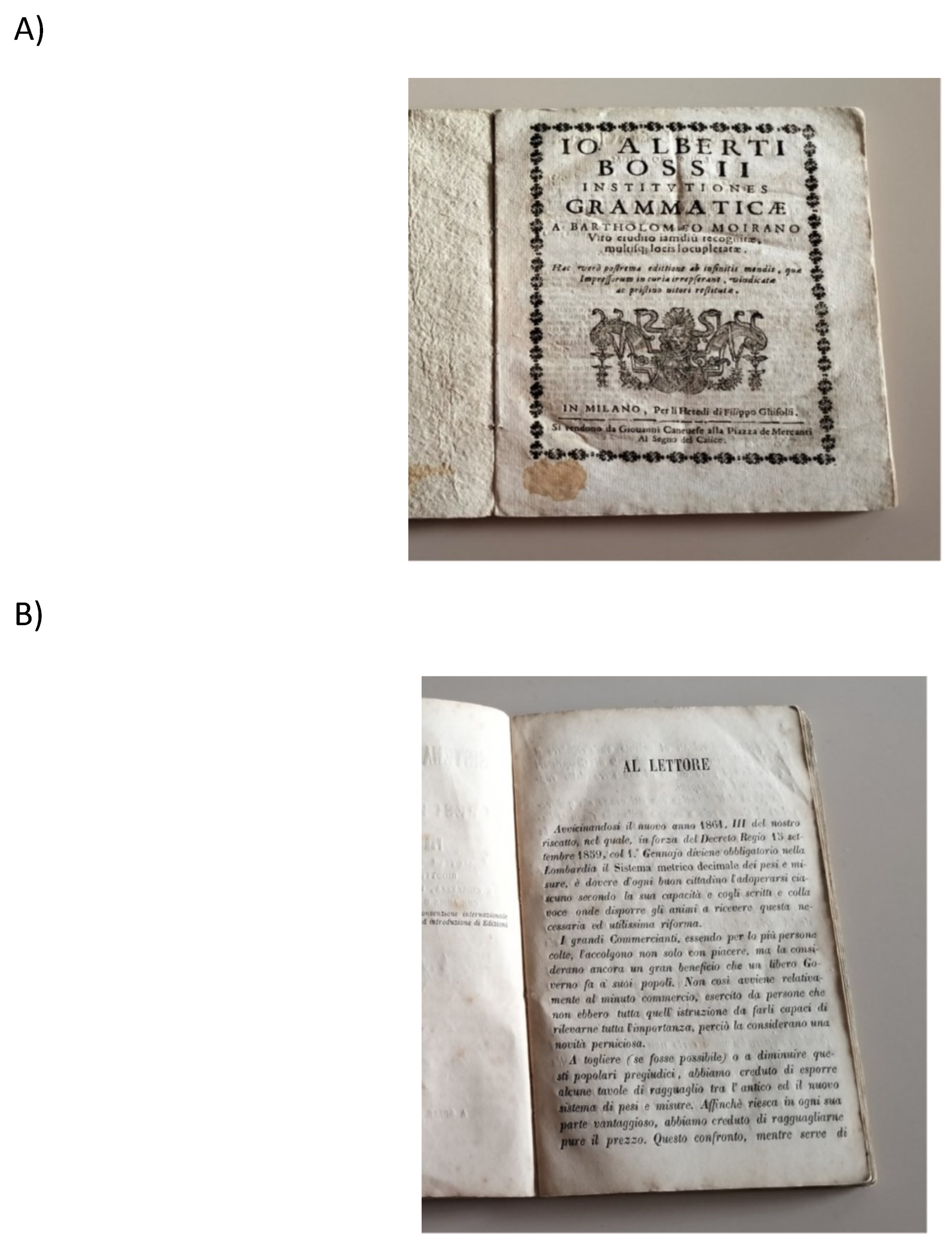
Figure 2.
GC spectrum of the VOC profile for the 16th-century Latin grammar book.
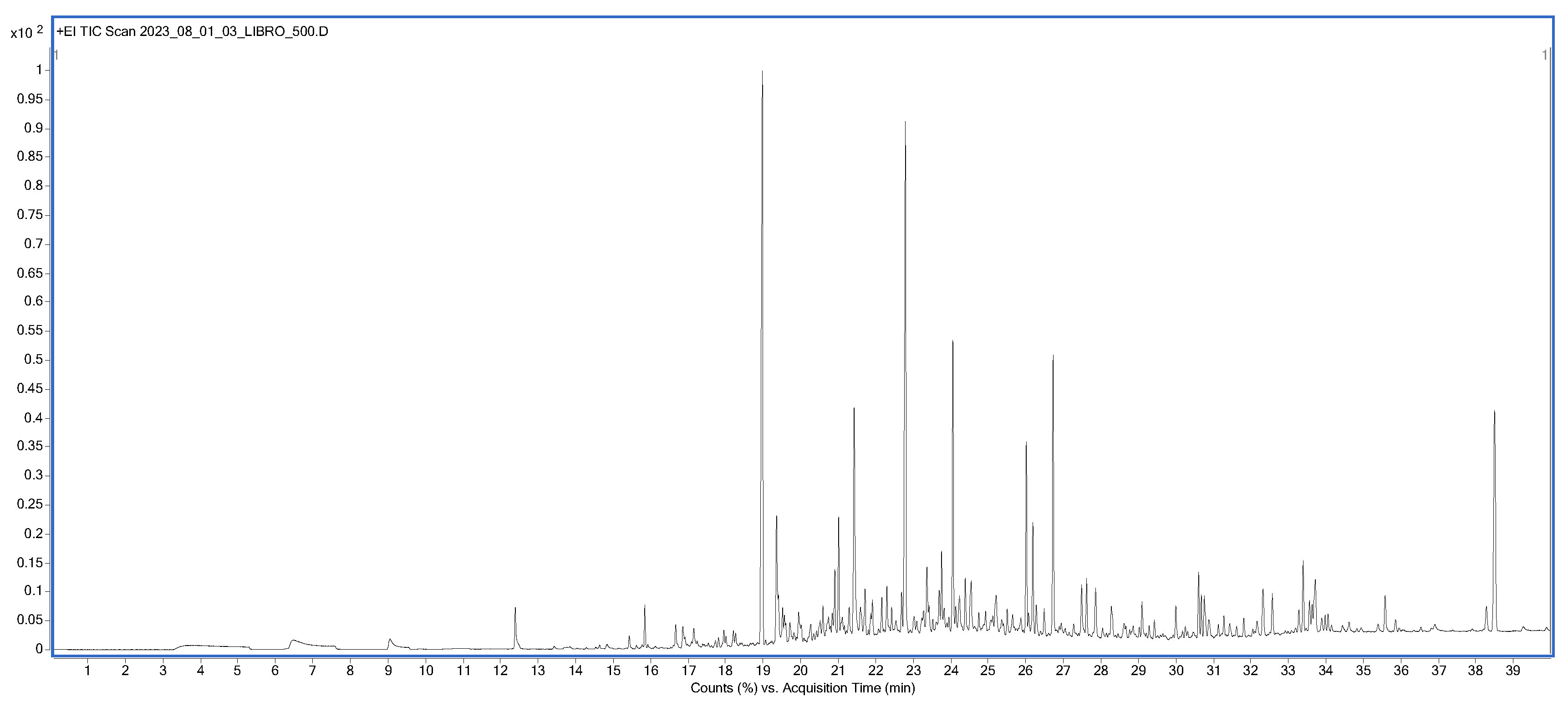
Figure 3.
GC spectrum of the VOC profile for the 19th-century mathematics handbook.
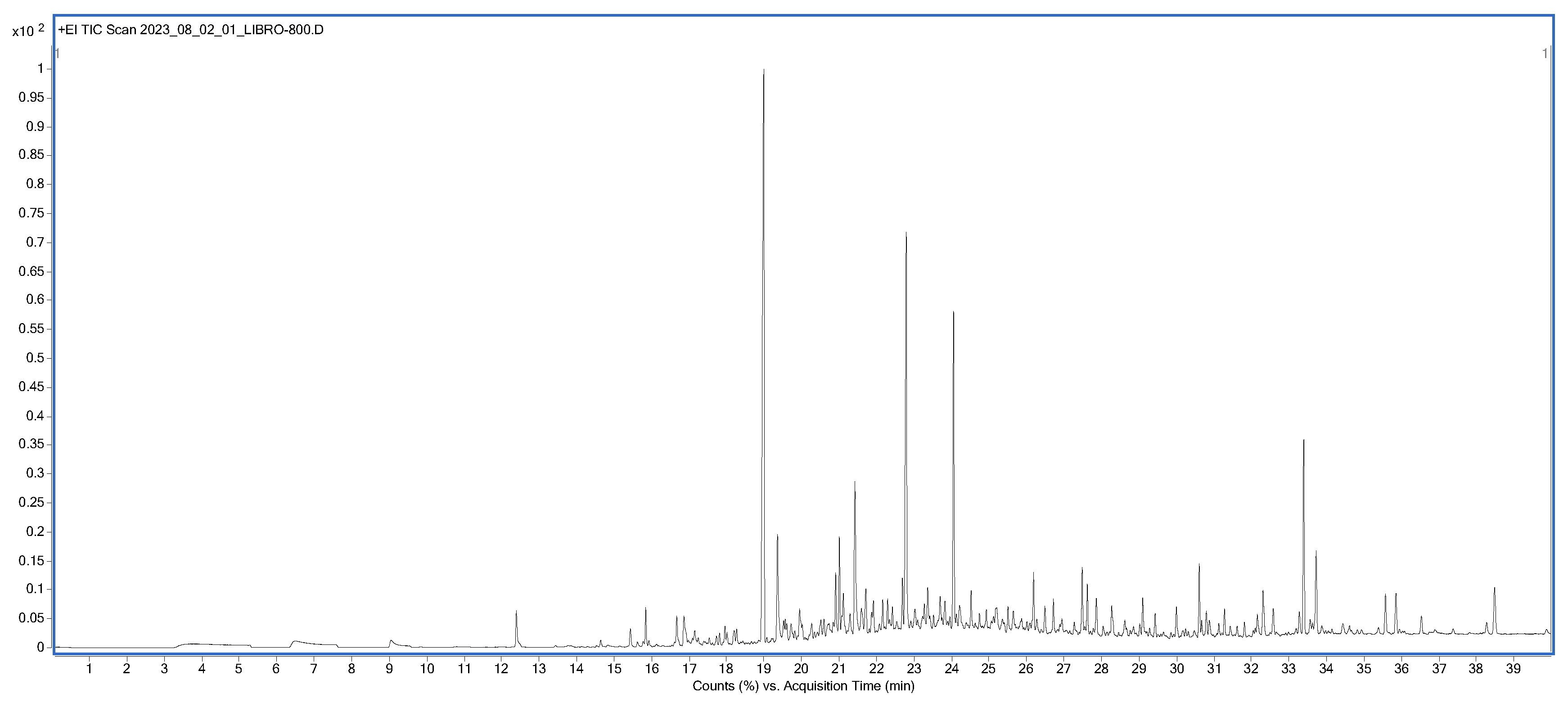

Table 1.
Retention times (minutes) and relative peak areas (%) of volatile organic compounds (VOCs) detected in the 16th-century Latin grammar book and the 19th-century mathematics handbook. The table highlights the presence of key compounds associated with oxidative degradation (e.g., aldehydes and alkanes) in the 16th-century book, and acid-catalyzed hydrolysis markers (e.g., furfural) in the 19th-century book, reflecting distinct degradation pathways due to differences in paper composition and manufacturing techniques.
Table 1.
Retention times (minutes) and relative peak areas (%) of volatile organic compounds (VOCs) detected in the 16th-century Latin grammar book and the 19th-century mathematics handbook. The table highlights the presence of key compounds associated with oxidative degradation (e.g., aldehydes and alkanes) in the 16th-century book, and acid-catalyzed hydrolysis markers (e.g., furfural) in the 19th-century book, reflecting distinct degradation pathways due to differences in paper composition and manufacturing techniques.
| Retention time (min) | Area % | ||
| Compound | XVI century book | XIX century book | |
| Octanal | 17.15 | 0.42 | 0.46 |
| Tetradecane | 18.98 | 12.48 | 17.81 |
| Nonanal | 19.35 | 2.36 | 2.25 |
| Pentadecane | 20.91 | 0.97 | 1.05 |
| 2-ethylhexanol | 21.01 | 1.61 | 1.57 |
| Furfural | 21.09 | 0.11 | 0.31 |
| Decanal | 21.42 | 4.76 | 3.90 |
| Hexadecane | 22.79 | 10.45 | 10.06 |
| Menthol | 24.05 | 4.67 | 6.30 |
| Octadecane | 26.19 | 1.66 | 1.38 |
| Butoxyethoxy ethanol | 26.73 | 4.35 | 0.71 |
| Anethole | 27.49 | 1.05 | 1.43 |
| Diphenyl ether | 30.61 | 1.01 | 1.42 |
| Diisopropylnaphthalene | 32.32 | 4.65 | 5.06 |
| Diethyl phthalate | 35.58 | 0.77 | 1.05 |
| Benzophenone | 38.72 | 0.59 | 0.36 |
| Diisobutyl phthalate | 38.49 | 5.76 | 1.45 |
Disclaimer/Publisher’s Note: The statements, opinions and data contained in all publications are solely those of the individual author(s) and contributor(s) and not of MDPI and/or the editor(s). MDPI and/or the editor(s) disclaim responsibility for any injury to people or property resulting from any ideas, methods, instructions or products referred to in the content. |
© 2025 by the authors. Licensee MDPI, Basel, Switzerland. This article is an open access article distributed under the terms and conditions of the Creative Commons Attribution (CC BY) license (http://creativecommons.org/licenses/by/4.0/).
Copyright: This open access article is published under a Creative Commons CC BY 4.0 license, which permit the free download, distribution, and reuse, provided that the author and preprint are cited in any reuse.


