

Submitted:
25 April 2025
Posted:
27 April 2025
You are already at the latest version
Abstract
The emergence of Generative Artificial Intelligence (GenAI) has profoundly transformed the educational landscape, necessitating a comprehensive reevaluation of curriculum design and teaching methodologies in higher education. This paper introduces the Core-Leveraging-Expansion Model, a novel framework for curriculum planning in the GenAI era. The model addresses the challenges educators face when balancing essential knowledge acquisition, AI tool integration, and fostering independent learning capabilities. By dividing the learning process into three complementary layers, the model provides educators with a structured approach to ensure students develop foundational knowledge, AI literacy, and self-directed learning skills. This paper outlines the theoretical underpinnings of the model, presents implementation strategies, and discusses implications for assessment practices. The Core-Leveraging-Expansion Model offers a practical solution for higher education institutions navigating the complexities of curriculum design in a rapidly evolving technological landscape, ensuring graduates possess both domain expertise and the adaptive capabilities required for success in an AI-augmented future.
Keywords:
Curriculum Design
; Generative AI (GenAI)
; Higher Education
; Teaching Methodologies
; Educational Assessment
; Self-Directed Learning
I. Introduction
In recent years, no technological advancement has disrupted educational practices as profoundly as Generative Artificial Intelligence (GenAI). The rapid development and widespread accessibility of tools like ChatGPT, Bard, Claude, and DALL-E have fundamentally altered how information is accessed, processed, and created [1]. As educators standing at this technological crossroads, we face unprecedented challenges that demand immediate attention and thoughtful reconsideration of our teaching approaches [2].
- A.
- The Challenge: Curriculum Design in an AI-Transformed Landscape
Higher education instructors increasingly find themselves confronting a fundamental dilemma: traditional curriculum design, assessment methodologies, and teaching approaches that have served for decades now appear increasingly misaligned with the realities of an AI-augmented learning environment [3]. Standing before students, educators can sense the transformation - GenAI has become an integral part of students’ academic lives, often without explicit integration into formal educational structures.
This technological shift raises critical questions that challenge the foundations of curriculum design:
- What constitutes essential knowledge in an era when information is instantly accessible through AI tools?
- How can educators verify genuine understanding rather than AI-assisted performance?
- What skills should be prioritized to prepare students for careers where AI collaboration will be inevitable?
- How can curriculum design promote responsible and effective use of AI tools?
Educators report significant concerns regarding academic integrity, the relevance of established teaching methodologies, and uncertainty about the appropriate integration of AI tools in educational contexts [4]. These challenges are particularly acute in higher education, where the tension between maintaining academic standards and adapting to technological change is most pronounced.
The traditional approach to curriculum design—characterized by content coverage, standardized assessment, and instructor-centered knowledge transmission—is increasingly insufficient in a world where GenAI can instantly generate plausible content across disciplines [5]. This necessitates a fundamental rethinking of what we teach, how we teach, and how we assess learning outcomes.
- B.
- The Core-Leveraging-Expansion Model
This paper introduces the Core-Leveraging-Expansion Model, a comprehensive framework for curriculum design that addresses these challenges by establishing three distinct but complementary layers of learning:
- Core: Essential foundational knowledge that students must master independently
- Leveraging: Developing skills to effectively utilize AI tools to enhance learning and productivity
- Expansion: Fostering self-directed learning and exploration beyond prescribed content
The primary contributions of this paper include: (1) a theoretical foundation for curriculum design in the GenAI era; (2) practical implementation strategies for higher education; (3) assessment methodologies aligned with the three-layered approach; and (4) a curriculum mapping process to guide instructors in course redesign.
The outline of the paper is as follows: Section II provides a brief review of current approaches to curriculum design in the context of AI integration and self-directed learning. Section III presents the theoretical framework of the Core-Leveraging-Expansion Model and its components. Section IV details the curriculum mapping and analysis process for implementing the model. Section V discusses assessment methodologies aligned with the model. Finally, Section VI offers concluding remarks, discussing the model’s flexibility and directions for future research.
II. Related Works
- A.
- Curriculum Design Traditions and Innovations
Curriculum design in higher education has been influenced by several theoretical traditions. Tyler’s classical model [6], with its focus on objectives, content selection, organization, and evaluation, has underpinned much of traditional curriculum development. This rational approach emphasizes systematic planning and clear alignment between objectives and assessment. However, critics argue that such linear models may be too rigid for the rapidly evolving educational landscape of the digital age [7].
Postmodern approaches to curriculum design, such as those proposed by Doll [8], emphasize complexity, reflexivity, and emergence. These perspectives view the curriculum as a dynamic, evolving system rather than a fixed blueprint. Such approaches may be particularly relevant in the context of GenAI, where technological capabilities are constantly evolving, and traditional boundaries between knowledge domains are increasingly fluid [9].
More recently, Barnett and Coate [10] have proposed a model of curriculum focused on ”knowing, acting, and being,” which acknowledges the importance of knowledge acquisition while emphasizing the development of capabilities and identities. This holistic approach aligns with the needs of higher education in the digital age, where graduates must not only possess knowledge but also develop adaptive capabilities and professional identities that can evolve with changing technological landscapes.
- B.
- GenAI and Educational Transformation
The integration of AI technologies in education has been an area of significant research interest, with early work focusing primarily on adaptive learning systems and personalized instruction [11]. However, the emergence of sophisticated GenAI tools has accelerated discussions about fundamental changes to curriculum design and pedagogical approaches.
Several researchers have explored the implications of GenAI for teaching and learning practices. Kasneci et al. [12] conducted a comprehensive review of ChatGPT’s impact on education, highlighting both opportunities for enhanced learning experiences and challenges related to academic integrity and assessment design. They emphasized the need for educational frameworks that integrate AI tools while preserving core educational values.
The concept of AI literacy has emerged as a critical component of education in the GenAI era. Long and Magerko [13] defined AI literacy as encompassing both technical understanding of AI systems and critical thinking skills necessary to evaluate AI outputs. Building on this work, Touretzky et al. [14] proposed a framework for AI education that emphasizes hands-on experience with AI tools combined with critical reflection on their capabilities and limitations.
Several studies have addressed the specific challenges of assessment in an AI-enabled educational environment. Swiecki et al. [15] critiqued traditional assessment methods as increasingly vulnerable to AI-assisted completion and proposed alternative approaches focused on process documentation and authentic problem-solving. Eaton and Watkins [16] explored academic integrity issues related to GenAI, advocating for assessment redesign rather than punitive approaches to address potential misuse.
- C.
- Self-Directed Learning and Higher Education
Self-directed learning (SDL) has been recognized as an essential approach in higher education, particularly in contexts of rapid technological change. Knowles [17] defined SDL as ”a process in which individuals take the initiative, with or without the help of others, in diagnosing their learning needs, formulating learning goals, identifying human and material resources for learning, choosing and implementing appropriate learning strategies, and evaluating learning outcomes.” This capacity for self-direction becomes increasingly critical in the GenAI era, where the ability to navigate complex information landscapes and adapt to emerging tools is essential for professional success.
Garrison’s comprehensive model of SDL [18] emphasizes three dimensions: self-management (controlling contextual factors), self-monitoring (responsibility for construction of meaning), and motivation (initiating and maintaining engagement). This multidimensional approach offers valuable insights for curriculum design that seeks to develop autonomous learners capable of thriving in an AI-augmented future.
The connection between SDL and technology-enhanced learning has been explored by several researchers. Candy [19] emphasized the importance of developing ”self-directed learning readiness” through educational experiences that gradually increase learner autonomy. Blaschke’s work on heutagogy [20], or self-determined learning, extends SDL concepts by emphasizing learner agency and capability development as central to education in complex, technology-rich environments.
While existing literature provides valuable insights into specific aspects of teaching with GenAI and self-directed learning, there remains a need for comprehensive frameworks that address curriculum design holistically. The present work builds upon these foundations while offering a structured approach that balances traditional knowledge acquisition with AI integration and self-directed learning.
III. The Core-Leveraging-Expansion Model Framework
The emergence of GenAI tools necessitates a fundamental reconsideration of what and how we teach in higher education. The Core-Leveraging-Expansion Model provides a structured framework for curriculum design that addresses these challenges by dividing the learning process into three complementary layers. Figure 1 illustrates the conceptual structure of the model.
- A.
- Core Layer
The Core layer represents essential foundational knowledge that all students must master independently. This includes fundamental concepts, theories, principles, terminology, and methodologies that form the intellectual foundation of a discipline. The Core knowledge represents ”what students must know” to engage meaningfully with the subject matter and develop critical thinking within the field.
Key characteristics of the Core knowledge layer include:
- Essential Knowledge: Foundational concepts, theories, definitions, and methodologies that constitute the intellectual backbone of the discipline
- Independent Mastery: Content that students must master without AI assistance to develop genuine understanding and critical thinking capabilities
- Verifiable Learning: Knowledge that can be assessed through traditional methods to ensure authentic understanding
The Core knowledge layer ensures that students develop a robust foundation of disciplinary knowledge, enabling them to critically evaluate AI outputs and engage in sophisticated problem-solving. Without this foundation, students risk becoming dependent on AI tools without the capacity to assess the validity or appropriateness of the information they provide.
- B.
- Leveraging Layer
The Leveraging layer focuses on developing students’ ability to effectively utilize GenAI tools to enhance learning, productivity, and problem-solving. This includes skills in prompt engineering, output evaluation, AI collaboration strategies, and ethical considerations in AI use.
Key characteristics of the Leveraging layer include:
- AI Literacy: Understanding the capabilities, limitations, biases, and ethical dimensions of GenAI tools
- Effective Utilization: Skills in crafting effective prompts, critically evaluating outputs, and integrating AI-generated content appropriately
- Augmented Problem-Solving: Strategies for combining human expertise with AI capabilities to address complex challenges
- Ethical Considerations: Understanding of copyright issues, attribution practices, and ethical boundaries in AI use
The Leveraging layer acknowledges that GenAI tools will be integral to future professional environments and prepare students to use these tools productively and ethically. Rather than prohibiting AI use, this layer explicitly teaches students how to leverage these tools effectively, developing what might be considered a new form of literacy essential for the 21st century.
- C.
- Expansion Layer
The Expansion layer cultivates students’ capacity for self-directed learning, exploration, and knowledge creation beyond prescribed content. This layer focuses on developing curiosity, research skills, and the ability to independently pursue areas of interest within and across disciplines.
Key characteristics of the Expansion layer include:
- Self-Directed Learning: Skills in identifying knowledge gaps, formulating questions, and independently pursuing learning objectives
- Depth and Breadth: Opportunities to explore specialized topics in depth or to make connections across disciplinary boundaries
- Knowledge Creation: Activities that involve original research, creative problem-solving, and the generation of new insights or artifacts
- Lifelong Learning: Development of habits and dispositions that support continuous learning throughout one’s career
The Expansion layer recognizes that in an era of rapidly evolving knowledge and technology, the capacity for self-directed learning may be more valuable than mastery of specific content. This layer encourages students to develop as independent scholars and thinkers who can navigate complex information landscapes and continue learning long after formal education concludes.
- D.
- Integration of Layers
Table 1 presents a comprehensive overview of the characteristics of each layer in the Core Knowledge-Leveraging-Expansion Model, highlighting the distinctive features and educational approaches associated with each component.
While presented as distinct layers, the Core-Leveraging-Expansion Model emphasizes that these components are deeply interconnected and mutually reinforcing. Core knowledge provides the foundation for effective AI use, while leveraging AI tools can support expansion into new areas of interest. Similarly, self-directed exploration often leads to deeper understanding of core concepts and more sophisticated AI utilization strategies.
IV. Curriculum Mapping and Analysis Process
Implementing the Core-Leveraging-Expansion Model requires a systematic approach to curriculum mapping and analysis. This section outlines a structured process for higher education instructors to redesign their courses using the model.
- A.
- Phase 1: Curriculum Analysis
The first phase involves a comprehensive analysis of the existing curriculum to identify components that align with each layer of the model. This process consists of the following steps:
- Learning Outcomes Review: Evaluate existing course learning outcomes to determine their continued relevance in the GenAI era. Consider which outcomes remain essential, which might be reconceptualized, and what new outcomes might be needed to address AI literacy and self-directed learning.
- Content Audit: Conduct a thorough inventory of course content, categorizing elements as:
Foundational knowledge essential for discipline (Core)
Content that could be enhanced through AI collaboration (Leveraging)
Areas suitable for independent exploration and expansion (Expansion)
- 3.
- GenAI Vulnerability Assessment: Analyze existing assignments and assessments to determine their vulnerability to completion using GenAI tools without meaningful learning. This analysis should inform decisions about assessment redesign.
- 4.
- Gap Analysis: Identify gaps in the current curriculum, particularly related to AI literacy and self-directed learning capabilities that may not be explicitly addressed in traditional course designs.
Figure 2 illustrates a template for curriculum analysis that can help instructors visualize the distribution of their current course components across the three layers.
- B.
- Phase 2: Curriculum Redesign
Based on the analysis conducted in Phase 1, instructors can proceed with intentional redesign of their curriculum. This phase involves the following steps:
- 1.
- Learning Outcomes Redefinition: Revise course learning outcomes to explicitly address the three layers of the model, ensuring balanced attention to foundational knowledge, AI literacy, and self-directed learning capabilities.
- 2.
-
Content Prioritization: Make deliberate decisions about what content falls into each layer:
- Core: Identify the minimum essential knowledge that must be mastered independently
- Leveraging: Determine specific AI skills and applications relevant to discipline
- Expansion: Create opportunities and structures for student-directed learning
- 3.
-
Instructional Strategy Selection: Choose appropriate teaching methods for each layer, considering how different approaches can support different types of learning:
- Core: Direct instruction, guided practice, structured discussions
- Leveraging: Demonstrations, workshops, guided experimentation with AI tools
- Expansion: Mentoring, inquiry-based learning, independent projects
- 4.
-
Assessment Redesign: Develop assessment strategies aligned with each layer:
- Core: ”AI-resistant” assessments focusing on fundamental understanding
- Leveraging: Process-oriented assessments documenting AI collaboration
- Expansion: Project-based assessments emphasizing independence and originality
- 5.
- Sequencing and Integration: Plan the temporal arrangement of course components, considering appropriate progression through the layers and opportunities for integration across layers.
- C.
- Phase 3: Implementation Planning
The final phase involves developing a concrete plan for implementing the redesigned curriculum. This phase includes:
- Resource Identification: Determine what resources (technological, informational, human) will be needed to support the redesigned curriculum, particularly for the Leveraging layer.
- Timeline Development: Create a realistic timeline for implementation, considering whether changes will be introduced gradually or comprehensively.
- Communication Strategy: Develop a plan for communicating the new approach to students, highlighting the rationale for the three-layered model and expectations for each component.
- Faculty Development: Identify necessary professional development to support effective implementation, particularly related to AI literacy and mentoring self-directed learning.
- Evaluation Plan: Design a process for evaluating the effectiveness of the redesigned curriculum, including mechanisms for gathering student feedback and assessing learning outcomes across all three layers.
Figure 3 presents a workflow diagram for the complete curriculum redesign process using the Core-Leveraging-Expansion Model.
V. Assessment Strategies
Assessment practices must align with the distinct learning objectives of each layer while supporting the integrated nature of the Core-Leveraging-Expansion Model. This section outlines assessment strategies for each layer and approaches to holistic evaluation.
- A.
- Core knowledge Layer Assessment
Assessment of Core knowledge focuses on verifying authentic understanding without AI assistance. Effective strategies include:
- Supervised Examinations: In-class assessments conducted without access to external resources or AI tools
- Oral Assessments: One-on-one or small group discussions that probe conceptual understanding through dialogue
- Practical Demonstrations: Hands-on activities that require application of core knowledge in controlled settings
- Concept Mapping: Visual representation of knowledge structures that reveal conceptual understanding
- Immediate Application: Problem-solving tasks that require spontaneous application of core knowledge
These assessment methods are designed to be ”AI-resistant” while avoiding a surveillance-oriented approach. Rather than focusing solely on preventing AI use, they emphasize demonstrating genuine understanding in contexts where AI assistance is not available or beneficial.
- B.
- Leveraging Layer Assessment
Assessment of Leveraging skills focuses on evaluating students’ ability to use AI tools effectively and ethically. Effective strategies include:
- Process Documentation: Requiring students to document their interactions with AI tools, including prompts, iterations, and decision-making
- Comparative Analysis: Evaluating students’ ability to compare, critique, and improve AI-generated outputs
- Prompt Engineering: Assessing students’ skill in crafting effective prompts for specific purposes
- Error Detection: Evaluating students’ ability to identify and correct errors or limitations in AI-generated content
- Ethical Analysis: Assessing understanding of ethical considerations in AI use through case studies or reflective essays
These assessment methods explicitly incorporate AI use while focusing on the quality of human-AI collaboration rather than the final product alone.
- C.
- Expansion Layer Assessment
Assessment of Expansion learning focuses on evaluating self-directed learning processes and outcomes. Effective strategies include:
- Research Portfolios: Collections of work that document the research process, including question formulation, resource identification, and iterative development
- Project Presentations: Formal presentations of independent work with opportunities for questioning and discussion
- Reflective Journals: Regular reflections on learning progress, challenges, and insights gained through independent exploration
- Peer Review: Structured feedback from peers on independent projects, fostering community engagement and critical evaluation skills
- Mentorship Dialogues: Regular discussions with faculty mentors about project development, with assessment based on growth and engagement
These assessment methods emphasize the quality of the learning process and the development of self-directed learning capabilities rather than solely evaluating the final product.
- D.
- Integrated Assessment Approaches
While each layer requires distinct assessment approaches, integrated assessment strategies can capture the interconnected nature of the Core-Leveraging-Expansion Model. Effective integrated approaches include:
- Learning Portfolios: Comprehensive collections that include evidence of learning across all three layers, with reflections on connections between them
- Progressive Assessments: Multi-stage assessments that begin with core knowledge evaluation, proceed to AI-assisted components, and culminate in independent exploration
- Capstone Projects: Culminating experiences that require students to integrate core knowledge, effective AI use, and independent inquiry
- Competency-Based Assessment: Evaluation based on demonstrated mastery of specific competencies across all three layers
Figure 4 illustrates an integrated assessment framework that incorporates evaluation strategies for all three layers.
VI. Conclusions and Future Directions
The emergence of Generative AI has catalyzed a fundamental reconsideration of educational practices in higher education, particularly in curriculum design and assessment. The Core-Leveraging-Expansion Model provides a structured framework for addressing these challenges by establishing three complementary layers of learning: Core knowledge acquisition, Leveraging AI tools effectively, and Expansion through self-directed exploration.
- A.
- Model Flexibility and Integration
While the Core-Leveraging-Expansion Model presents a schematic division into three distinct layers, it is important to recognize that these boundaries are inherently fluid in practical application. The model is not prescriptive in requiring strict sequential progression through these layers. Rather, it acknowledges that effective curriculum design may involve spiraling through these dimensions, with elements of all three layers potentially present simultaneously or interwoven throughout a course.
This spiral development approach allows for recursive engagement with core concepts at increasing levels of sophistication, progressive development of AI literacy, and expanding horizons of self-directed learning. In practice, a single learning activity might engage students with foundational knowledge (Core) while simultaneously developing AI collaboration skills (Leveraging) and encouraging personal exploration (Expansion).
The model’s flexibility enables its adaptation to diverse disciplinary contexts, institutional environments, and student needs. Instructors are encouraged to view the three layers as complementary dimensions of learning rather than strictly sequential stages, finding the optimal balance and integration that serves their specific educational goals.
- B.
- Contributions and Implications
This framework offers several advantages for educational practice in the GenAI era:
- It acknowledges the continued importance of foundational knowledge while embracing the reality of AI-augmented learning environments
- It explicitly develops AI literacy as an essential competency for contemporary students
- It cultivates self-directed learning capabilities that will serve students throughout their careers
- It provides a flexible structure that can be adapted to various disciplines, educational levels, and institutional contexts
- It offers a systematic process for curriculum mapping and redesign that respects both traditional educational values and emerging technological realities
For higher education instructors, the Core-Leveraging-Expansion Model provides a practical framework for navigating the challenges of teaching in an AI-transformed landscape. By clearly delineating what students must know independently, how they can effectively use AI tools, and how they can develop as self-directed learners, the model offers a balanced approach that neither rejects technological change nor abandons educational fundamentals.
- C.
- Future Research Directions
While this paper has outlined the theoretical framework and implementation strategies for the Core-Leveraging-Expansion Model, several areas warrant further investigation:
- Empirical Validation: Research is needed to evaluate the effectiveness of the Core-Leveraging-Expansion Model in enhancing learning outcomes across different disciplines and educational contexts
- Faculty Development: Investigation of effective approaches for preparing faculty to implement the model, particularly in developing their own AI literacy
- Institutional Implementation: Exploration of strategies for implementing the model at the program or institutional level, including necessary policy changes and resource allocation
- Long-term Impact: Longitudinal studies of how graduates educated through the Core-Leveraging-Expansion Model fare in professional environments and lifelong learning
- Disciplinary Adaptations: Research on how the model might be adapted to address the specific needs and characteristics of different academic disciplines
As GenAI tools continue to evolve, educational practices must adapt accordingly. The Core-Leveraging-Expansion Model provides a framework for this adaptation that maintains educational integrity while embracing technological innovation. By balancing essential knowledge acquisition, effective AI utilization, and self-directed learning, educators can prepare students for success in a rapidly changing world where human-AI collaboration will be increasingly central to professional practice.
References
- J. K. Brown, S. L. Morgan, and T. H. Davenport,” Educational disruption: How generative AI is reshaping teaching and learning,” Harvard Business Review, vol. 101, no. 4, pp. 52-61, 2023.
- Goldin, L. F. Katz, and D. Acemoglu,” Artificial intelligence, education, and the labor market,” Journal of Economic Perspectives, vol. 37, no. 2, pp. 3-32, 2023.
- C. Berliner and B. J. Biddle,” Curriculum in the AI age: Redefining what matters in education,” Educational Researcher, vol. 52, no. 3, pp. 168-183, 2023.
- M. Warschauer and T. Matuchniak,” Academic integrity and artificial intelligence: Challenges and opportunities,” International Journal of Educational Integrity, vol. 19, no. 1, pp. 1-15, 2023.
- L. Cao and C. Dede,” Navigating a world of generative AI: Suggestions for educators,” The Next Level Lab at Harvard Graduate School of Education, President and Fellows of Harvard College: Cambridge, 2023.
- R. W. Tyler, ”Basic principles of curriculum and instruction,” University of Chicago Press, Chicago, 1949.
- W. E. Doll, ”A post-modern perspective on curriculum,” Teachers College Press, New York, 1993.
- W. E. Doll, ”Complexity and the culture of curriculum,” Educational Philosophy and Theory, vol. 40, no. 1, pp. 190-212, 2008.
- R. Barnett, ”Knowing and becoming in the higher education curriculum,” Studies in Higher Education, vol. 34, no. 4, pp. 429-440, 2009.
- R. Barnett and K. Coate, ”Engaging the curriculum in higher education,” Open University Press, Maidenhead, 2005.
- R. Luckin, W. Holmes, M. Griffiths, and L. B. Forcier, ”Intelligence unleashed: An argument for AI in education,” Pearson Education, London, 2016.
- Kasneci, K. Sessler, S. Küchemann, M. Bannert, D. Dementieva, F. Fischer, U. Gasser, et al., ”ChatGPT for good? On opportunities and challenges of large language models for education,” Learning and Individual Differences, vol. 103, p. 102274, 2023.
- Long and B. Magerko, ”What is AI literacy? Competencies and design considerations,” in Proceedings of the 2020 CHI Conference on Human Factors in Computing Systems, pp. 1-16, 2020.
- S. Touretzky, C. Gardner-McCune, F. Martin, and D. Seehorn, ”Envisioning AI for K-12: What should every child know about AI?,” in Proceedings of the AAAI Conference on Artificial Intelligence, vol. 33, no. 01, pp. 9795-9799, 2019.
- Z. Swiecki, H. Khosravi, G. Chen, R. Martinez-Maldonado, J. M. Lodge, S. Milligan, N. Selwyn, and D. Gašević, ”Assessment in the age of artificial intelligence,” Computers and Education: Artificial Intelligence, vol. 3, p. 100075, 2022.
- S. E. Eaton and K. E. Watkins, ”Academic integrity in the age of artificial intelligence: Perspectives from educational leaders,” International Journal for Educational Integrity, vol. 19, pp. 16, 2023.
- M. S. Knowles, ”Self-directed learning: A guide for learners and teachers,” Association Press, New York, 1975.
- R. Garrison, ”Self-directed learning: Toward a comprehensive model,” Adult Education Quarterly, vol. 48, no. 1, pp. 18-33, 1997.
- P. C. Candy, ”Self-direction for lifelong learning: A comprehensive guide to theory and practice,” Jossey-Bass, San Francisco, 1991.
- L. M. Blaschke, ”Heutagogy and lifelong learning: A review of heutagogical practice and self-determined learning,” The International Review of Research in Open and Distributed Learning, vol. 13, no. 1, pp. 56-71, 2012.
- S. Brookfield, ”Self-directed learning: A critical review of research,” New Directions for Adult and Continuing Education, vol. 1985, no. 25, pp. 5-16, 1985.
- Wiggins and J. McTighe, ”Understanding by design,” Association for Supervision and Curriculum Development, Alexandria, VA, 2005.
- P. Griffin, B. McGaw, and E. Care, ”Assessment and teaching of 21st century skills,” Springer, Dordrecht, 2012.
- H. Jonassen, ”Computers as mindtools for schools: Engaging critical thinking,” Prentice Hall, Columbus, OH, 2000.
- Laurillard, ”Rethinking university teaching: A conversational framework for the effective use of learning technologies,” Routledge, London, 2002.
- J. Biggs and C. Tang, ”Teaching for quality learning at university,” Open University Press, Maidenhead, 2011.
- Mollick and L. Mollick, ”New modes of learning enabled by AI chatbots: Three methods and assignments,” SSRN Electronic Journal, 2022. [CrossRef]
- W. M. Lim, A. Gunasekara, J. L. Pallant, J. I. Pallant, and E. Pechenkina, ”Generative AI and the future of education: Ragnarök or reformation? A paradoxical perspective from management educators,” The International Journal of Management Education, vol. 21, no. 2, p. 100790, 2023.
- M. Binkley, O. Erstad, J. Herman, S. Raizen, M. Ripley, M. Miller-Ricci, and M. Rumble, ”Defining twenty-first century skills,” in Assessment and teaching of 21st century skills, P. Griffin, B. McGaw, and E. Care, Eds. Springer, Dordrecht, pp. 17-66, 2012.
- L. Moorhouse, M. A. Yeo, and Y. Wan, ”Generative AI tools and assessment: Guidelines of the world’s top-ranking universities,” Computers and Education Open, vol. 5, p. 100151, 2023.
Figure 1.
Conceptual framework of the Core-Leveraging-Expansion Model showing the three layers: Core, Leveraging, and Expansion.
Figure 1.
Conceptual framework of the Core-Leveraging-Expansion Model showing the three layers: Core, Leveraging, and Expansion.
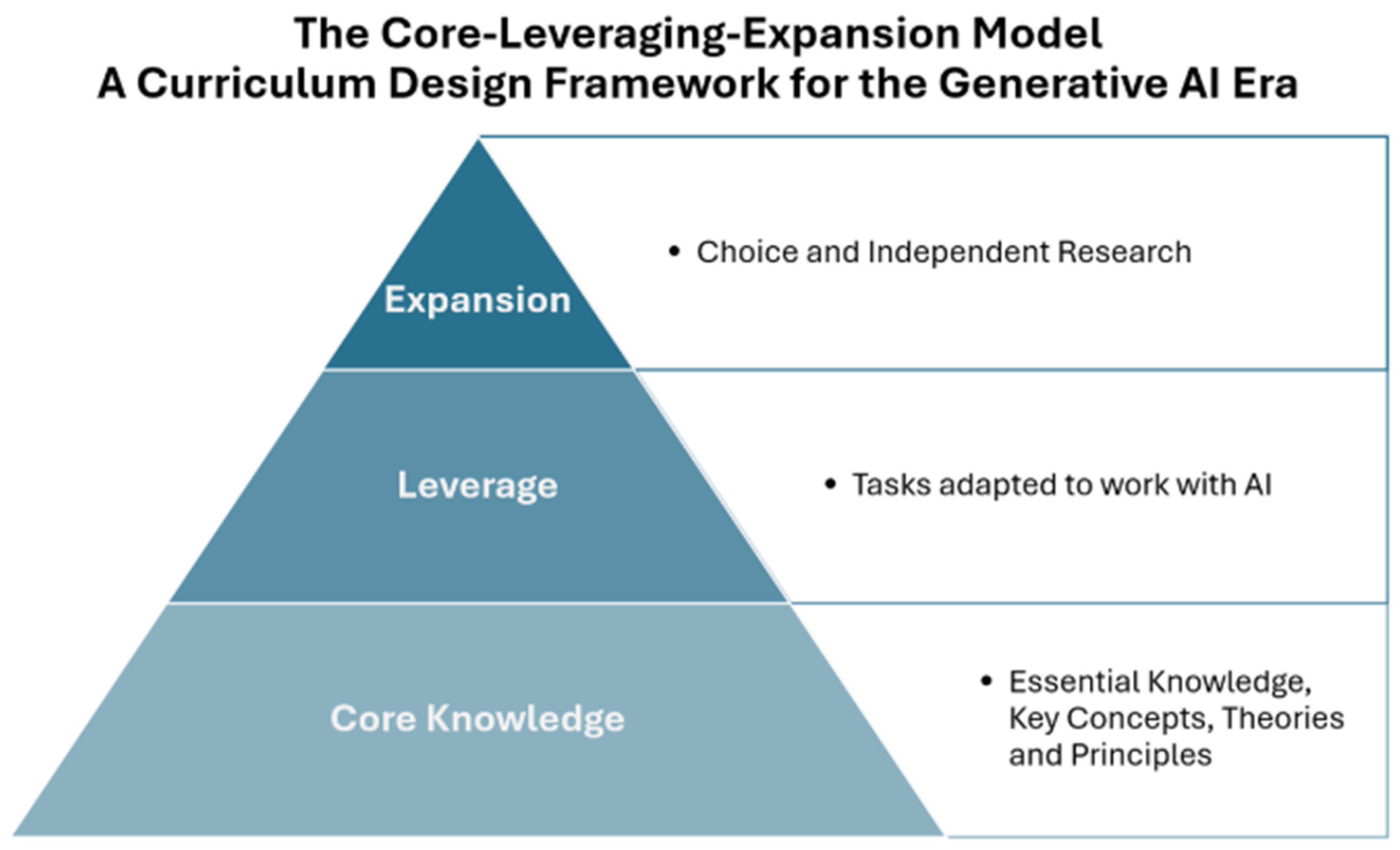
Figure 2.
Template for analyzing existing curriculum components according to the Core-Leveraging-Expansion Model.
Figure 2.
Template for analyzing existing curriculum components according to the Core-Leveraging-Expansion Model.
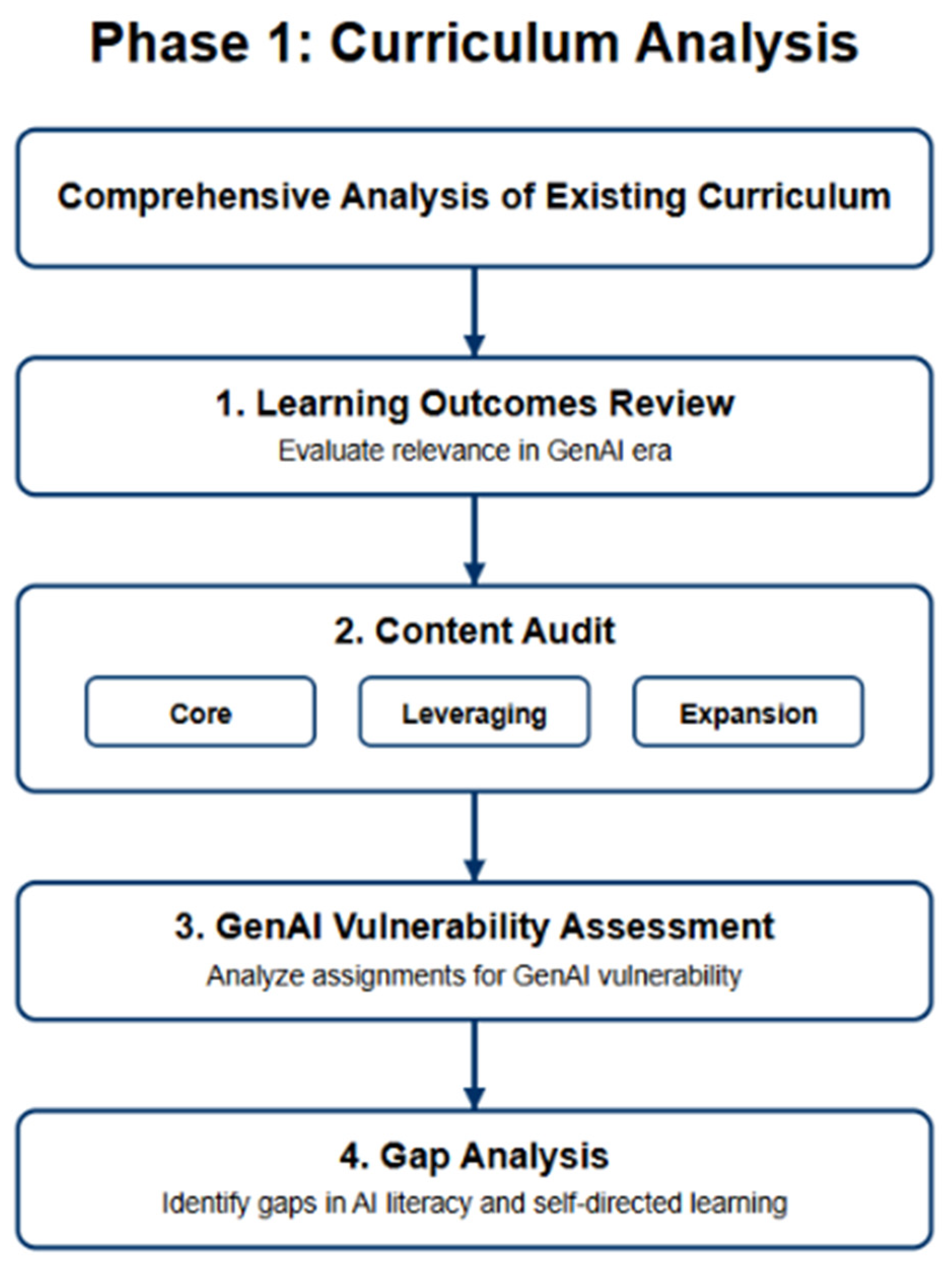
Figure 3.
Workflow for curriculum redesign using the Core-Leveraging-Expansion Model.
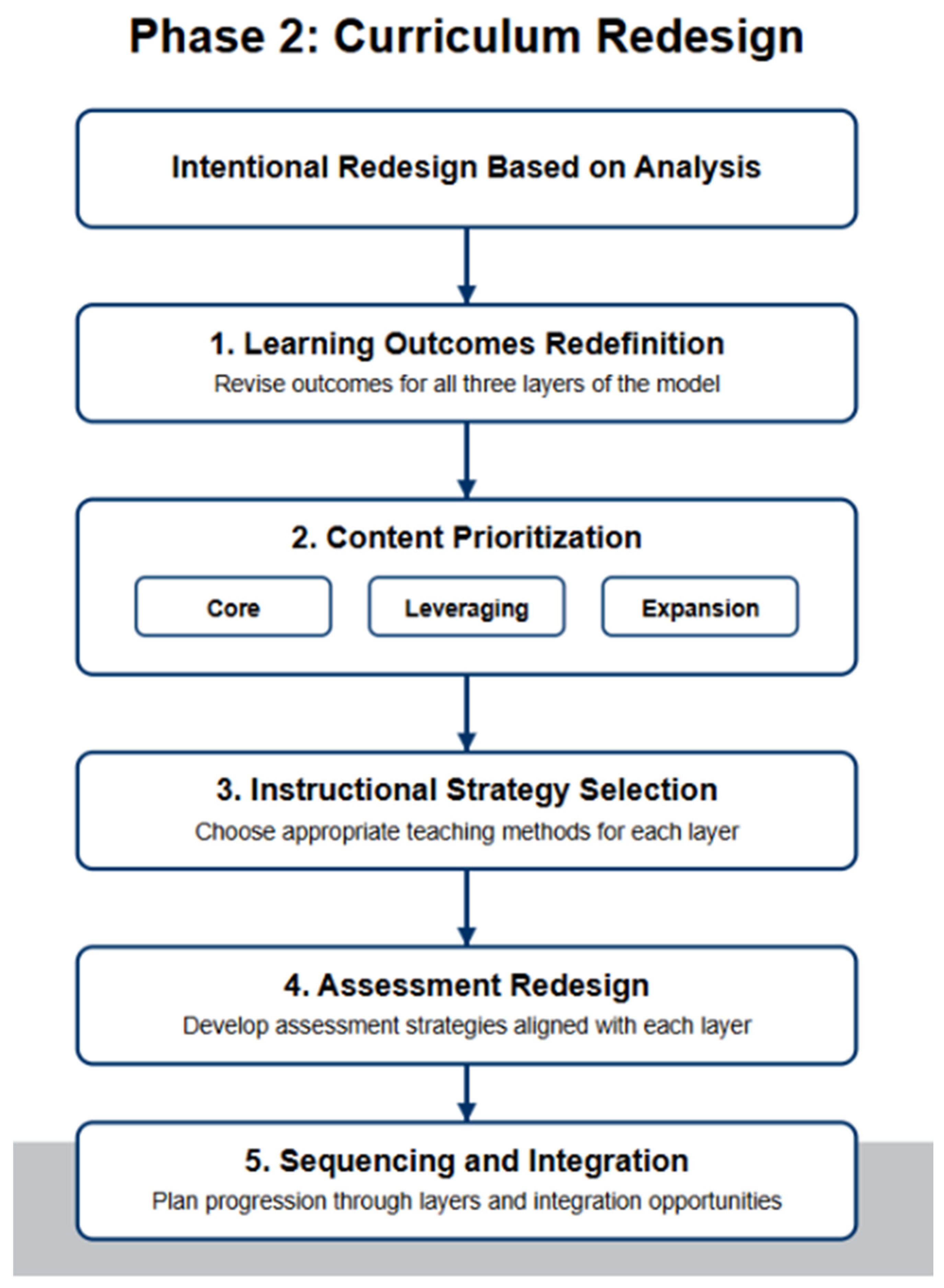
Figure 4.
Integrated assessment framework incorporating strategies for Core, Leveraging, and Expansion layers.
Figure 4.
Integrated assessment framework incorporating strategies for Core, Leveraging, and Expansion layers.
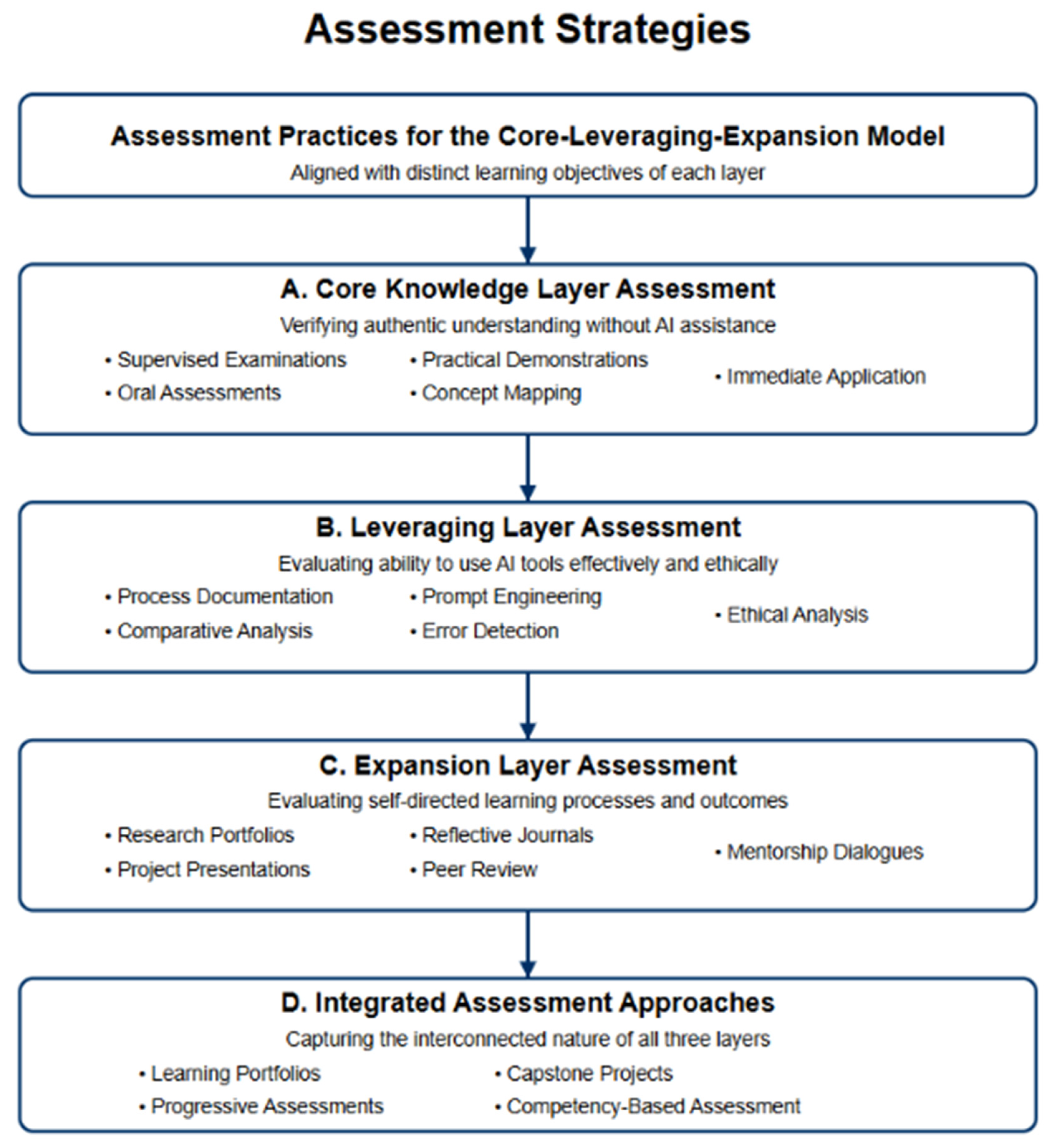

Table 1.
CHARACTERISTICS OF THE CORE-LEVERAGING-EXPANSION MODEL LAYERS.
| Characteristic | Core knowledge Layer | Leveraging Layer | Expansion Layer |
|---|---|---|---|
| Essence | Knowledge Core knowledge:” What must be known” | Learning with AI:” Leveraging information into knowledge with AI” | Independent Learning:” Exploring in depth driven by curiosity” |
| Primary Purpose | Ensuring mastery of disciplinary foundations (concepts, principles, base theories) | Developing effective, critical, and ethical use of AI tools as learning and creation aids | Fostering intellectual curiosity, self-directed learning capacity, and deeper exploration of personal interests |
| Content Examples | Key definitions, central theories, essential facts, basic formulas, historical timelines, terminology | Effective prompt engineering, AI output evaluation, using AI for research, data analysis, drafting, brainstorming, creating visualizations | Student-selected topic/research question, personal research project, initiative development, original content creation (article, blog, video, code), in-depth case analysis |
| Teaching Approaches | Focused lectures, guided reading of foundational texts, structured practice, guided discussions in class | Performance tasks using AI tools, workshop-based learning, developing AI competency | Mentoring and individual guidance, providing access to diverse resources, encouraging initiative-taking, creating a learning community for sharing and inspiration |
| Assessment Methods | ”AI-resistant”: In-class closed exams (without resources/computers), oral exams, short performance tasks under supervision | Process and product-based: Evaluation of projects including learning process documentation, intermediate outputs, peer assessment, presentations, digital portfolio | Inquiry and process-based: Personal project presentation (emphasis on depth, originality, and learning process), reflective learning journal, feedback and evaluation conversation with mentor, assessment of effort, initiative, and personal progress |
| Importance/Rationale in AI Era | Building solid knowledge foundation enabling critical thinking and ability to thoughtfully evaluate AI outputs (identifying errors, biases) | Preparing students for reality where AI is a common work tool. Developing critical AI literacy and ability to leverage technology responsibly and productively | Developing essential ”soft skills” for the future: independent learner, cognitive flexibility, creativity, complex problem-solving, self-management, adaptability to change |
Disclaimer/Publisher’s Note: The statements, opinions and data contained in all publications are solely those of the individual author(s) and contributor(s) and not of MDPI and/or the editor(s). MDPI and/or the editor(s) disclaim responsibility for any injury to people or property resulting from any ideas, methods, instructions or products referred to in the content. |
© 2025 by the authors. Licensee MDPI, Basel, Switzerland. This article is an open access article distributed under the terms and conditions of the Creative Commons Attribution (CC BY) license (http://creativecommons.org/licenses/by/4.0/).
Copyright: This open access article is published under a Creative Commons CC BY 4.0 license, which permit the free download, distribution, and reuse, provided that the author and preprint are cited in any reuse.


