

Submitted:
23 April 2025
Posted:
24 April 2025
You are already at the latest version
Abstract
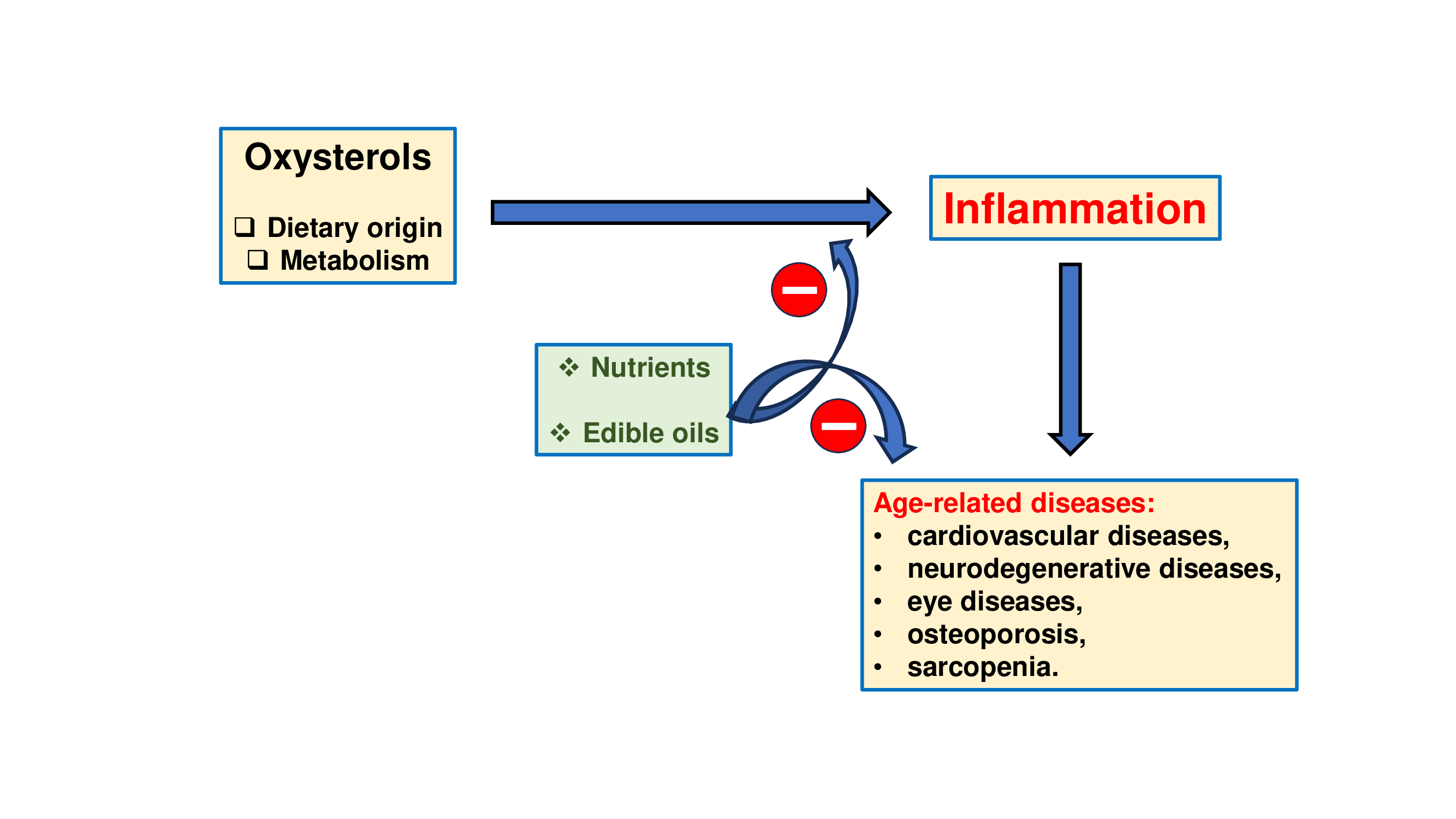
Oxysterols can be derived from the dietary origin, physiologically produced via specific enzymes, or are generated by autoxidation. These molecules have physiological prop-erties and can also adversely affect vital organs. Indeed, some of them have pro-oxidant and pro-inflammatory activities and can lead to major pathologies. The present review focuses on oxysterols (7-ketocholesterol, 7β-hydroxycholesterol, 25-hydroxycholesterol, 27-hydroxycholesterol, 5,6α-epoxycholesterol, 5,6β-epoxycholesterol and cholestane-3β, 5α, 6β-triol) involved either in cholesterol metabolism, age-related diseases (such as cardiovascular, neurodegenerative, and eyes diseases, sarcopenia), and inflammatory diseases (especially Behcet’s disease, bowel and lung diseases (sarcoidosis, COVID-19)). Metabolic pathways associated with oxysterol-induced inflammation are discussed con-sidering the cytokinic TLR4 pathway, non-cytokinic pathways and the contribution of Ca2+ and K+ channels. Therapeutic approaches targeting oxysterol-induced inflammation ei-ther by natural or synthetic molecules are also presented.
Keywords:
oxysterols
; inflammatory diseases
; natural molecules
; nutrients
; edible oils
; synthetic molecules
1. Introduction
1.1. Oxysterols: Origins and Biogenesis
In humans; there are several sources of oxysterols which result from cholesterol oxidation. These compounds can be formed endogenously in different tissues, in the digestive tract and brought by diet [1]. Oxysterols can be generated either by auto-oxidation of cholesterol following a free radical attack [2], or by specific enzymes, usually of the cytochrome P450 type [3]. In general, the oxysterols oxidised on the steroid nucleus are generated by auto-oxidation, while those oxidised on the side chain result from enzymatic attack [4].
1.1.1. Dietary Origin of Oxysterols
Cholesterol is an important component of many foods. During industrial processes, cholesterol can be subjected to oxidation, leading to the formation of oxysterols [5]. Foods rich in cholesterol such as eggs, egg powder commonly used in processed-foods, clarified butter, dairy products, red meat, ham (bacon) and dried or tinned fish are the richest in the following oxysterols: 7-ketocholesterol (7KC), 7β-hydroxycholesterol (7β-OHC), 5,6 α-epoxycholesterol, and 5,6 β-epoxycholesterol [6,7]. During food storage and preparation, cholesterol can easily undergo oxidation when exposed to high temperatures, oxygen or ozone, or light (ultraviolet exposure) [8] . Dehydrated products are particularly sensitive to oxidation [9]. The oxysterols found mainly in food are those oxidised at C7 (7KC, 7β-OHC) as well as epoxycholesterols (5, 6α/5, 6β-epoxycholesterol), but also 25-hydroxycholesterol (25-OHC) formed both enzymatically and by autoxidation [7,10].
In food products, the level of oxysterols can reach 10 to 100 μM [11]. After ingestion of a meal rich in oxysterols (salami, parmesan), assays showed that plasma concentrations of oxysterols (7KC, 7β-OHC) were increased, mainly in chylomicrons, after 5 hours. Similar results were shown in rats after gastric infusion of oxysterols [12]. This shows that intestinal absorption varies according to the type of sterol. Also in rats, it was shown that 92% of dietary oxysterols were absorbed [13]. The majority of ingested oxysterols are absorbed in the form of esters in the upper intestinal tract and taken up in plasma by chylomicrons. Oxysterols can be found in all types of lipoproteins, but the majority are present in low density lipoprotein (LDL) [14,15]. Depending on their esterification oxysterols can be transported in the plasma either by albumin or LDL [16]. Measurements carried out with 7KC, 20 α-hydroxycholesterol (20 α-OHC) and 25-OHC have shown that albumin preferentially transports 25-OHC [16,17].
1.1.2. Enzymatic Formation of Oxysterols
Several oxysterols can be produced physiologically by enzymatic oxidation during cholesterol metabolism. A large proportion of oxysterols are formed in this way. In terms of the major oxysterols, 4β-hydroxycholesterol (4β-OHC), 27-hydroxycholesterol (27-OHC), 24(S)-hydroxycholesterol (24(S)-OHC), 7α-OHC and 25-OHC are produced respectively by CYP3A4, CYP27A1, CYP46A1, CYP7A1 and cholesterol 25-hydroxylase (CH25H) [4]. Other enzymes are responsible for the formation of oxysterols, which are generally detected in trace amounts in biological fluids or tissues. Most of these are intermediates in cholesterol metabolism reactions, some of which probably have very short lifetimes [18].
The enzymes involved in cholesterol oxidation are most often members of the cytochrome P450 superfamily of enzymes, but they may also belong to the hydroxysteroid dehydrogenase (HSD) family [19]. CH25H is the exception and is not produced by either of these enzyme families [10]. Not all of these enzymes are ubiquitously expressed, leading to cell-type specific oxysterol profiles.
CYP3A4 enables the conversion of cholesterol to 4β-OHC, the major oxysterol found in plasma, but also the conversion of cholesterol to 25-OHC [20]. This cytochrome enzyme is expressed in the in the endoplasmic reticulum (ER) of the liver. It is also involved in the metabolism of many xenobiotics. It is estimated that it is capable of metabolising almost half of the drugs used [4,21].
CYP27A1 or 27-hydroxylase converts cholesterol into 27-OHC and is involved in the ‘acidic’ pathway of bile acid formation. This mitochondrial enzyme is expressed in a wide variety of tissues but mainly in the liver, endothelial cells and monocytes/macrophages [4,21].
CYP46A1 or 24-hydroxylase converts cholesterol to 24(S)-OHC. It is expressed in the ER, mainly in the neurons of the central nervous system, but also in small quantities in the testes and ovaries. It enables the excretion of cerebral cholesterol, as cholesterol cannot cross the blood brain barrier (BBB), whereas 24(S)-OHC can [4,21].
CYP7A1 or 7α-hydroxylase is the first enzyme involved in the ‘classic’ bile acid formation pathway. It converts cholesterol into 7α-OHC. It is highly expressed in the liver and more specifically in within the ER of hepatocytes. Its expression is regulated by bile acid levels [21]. It can also produce 7KC from 7-dehydrocholesterol [4].
1.1.3. Formation of Oxysterols by Autoxidation
The carbons in rings A and B of the sterane nucleus are the most sensitive to free radical attack, particularly carbons 5, 6 and 7. There are two types of autoxidation, type I and II.
Type I autoxidation involves oxidation by free radicals (superoxide anion (O2•-), hydrogen peroxide (H2O2), hydroxyl radical (HO•), nitric oxide (NO), peroxynitrites ONOO-). They can be generated by cellular metabolism, or by their subsequent decomposition into hydroxyl radicals, by the dismutation of two superoxide anions into hydrogen peroxide (2 O2•- → H2O2) or by the Fenton reaction (H2O2 + Men+ → HO• + Me(n+1)+) where Me is a transition metal such as copper, iron or aluminum [8]. Most often, oxidation by ROS or reactive nitrogen species (RNS) result in the loss of a hydrogen on carbon 7, due to the weak bond between carbon and hydrogen. The dissociation energy of this bond is 88 kcal/mol [23]. As this local oxidation at C7 is fairly stable, it can then easily react with molecular oxygen to form a peroxyl radical (COO•). Subsequently, by reacting with another hydrogen lost by another molecule, the peroxyl radical will form a cholesterol hydroperoxide (7α- or 7β-OOHC). As the hydroperoxide function is very unstable, hydroperoxide cholesterol breaks down into 7α-OHC, 7β-OHC or 7KC. These three oxidised C7 oxysterols are the ones formed mainly by auto-oxidation [24]. 7KC is the major oxysterol in OxLDL, accounting for around 30% of total sterols [25,26].
Type II cholesterol auto-oxidation involves non-radical attack by oxygen singletons (1ΔgO2), hypoclorous acid (HOCl) or ozone (O3). The involvement of ozone is interesting given that it is linked to atmospheric pollution. Oxygen singletons can be formed by the reaction of hydrogen peroxide (H2O2) with HOCl, both of which are produced during inflammatory reactions in the presence of myeloperoxidase. According to Iuliano [8] C5, C6, C7 hydroperoxides, 5,6-epoxides (α/β), as well as secosterols, are formed as primary compounds in these reactions [23]. The 5,6α/β-epoxycholesterols can be taken up by the enzyme cholesterol epoxide hydrolase to form cholestane-3β, 5α, 6β-triol. It has been shown that aminolysis of α-epoxycholesterols can give alkylamino-oxysterols. These include dendrogenin A which can be formed when a 5,6α-epoxycholesterol reacts with a histamine through the action of an enzyme that has yet to be identified at the molecular level, dendrogenin A synthase [27,28,29].
2. Involvement of Oxysterols in Inflammatory Human Diseases
There is a substantial evidence that oxysterols can adversely affect certain major and vital organs such as the heart, brain, vessels, bones, pancreas, and eyes [30]. These oxysterols might play a role in the development and course of chronic illness [30,31] and also of infectious diseases especially COVID-19 [32,33,34] (Figure 1). Actually, a number of clinical studies have shown that people with type 2 diabetes, obesity, hypercholesterolemia, and atherosclerosis have higher levels of various oxysterols formed by autoxidation or enzymatically [35,36]. These latter can be used as useful indicators to diagnose certain pathologies, or to forecast the occurrence and progression of diseases such as cardiovascular diseases, Alzheimer’s disease, diabetes mellitus, multiple sclerosis, osteoporosis, lung cancer, breast cancer, and infertility [37]. In addition, some oxysterols could be also used as biomarkers of some rare diseases such as X-linked adrenoleukodystrophy (X-ALD) [38] and Nieman Pick disease [39,40]. It is noteworthy that oxysterols involved in inflammatory diseases have often simultaneously pro-oxidant and pro-inflammatory properties contributing to the aggravation of symptoms via an overproduction of pro-inflammatory cytokines at the system is level or in the tissues affected by the disease [41,42,43].
2.1. Cardiovascular Diseases
Cardiovascular diseases, often associated with atherosclerosis, is the main cause of morbidity and death. Atherosclerosis is a lipid metabolic issue in addition to a chronic inflammatory illness [44]. Oxysterols are the main component that can aid in the development of atherosclerosis and have been demonstrated in numerous empirical investigations to have a role at different stages of the atherosclerotic process [30,45]. Patients with atherosclerotic lesions or cardiovascular illnesses have higher plasma levels of oxysterols [37]. The oxysterols found mainly in atheromatous plaques are mainly 7KC, 7β-OHC, 7α-OHC, 5,6α-epoxycholesterol, 5, 6β-epoxycholesterol and cholestane-3β, 5α, 6β-triol; they can reach levels up to 100 times higher than normal plasma levels [46,47]. 7α- and 7β-OHC comprise 75–85% of oxysterols present in the plaques at various locations. They are also among the most important oxysterols that are present in an atherosclerotic lesion. Their amount increases with the degree of atherosclerosis and is almost directly correlated with cholesterol levels [30]. Atherosclerotic patients’ plasma and atheromatous plaques have been found to include certain oxysterols (7β-OHC, 7KC, and 25OHC). These oxysterols are strong in vitro inducers of MCP-1, MIP-1β, TNF-α, and/or IL-8 secretion, the latter of which involves the MEK/ERK1/2 cell signaling pathway [42].
An increase in 7β-OHC appears to be a biomarker of cardiovascular risk [48]. Björkhem showed that there was a considerable rise in 7β-OHC levels in patients exhibiting rapid progression of carotid atherosclerosis [49].
Due to its pro-oxidant and pro-inflammatory properties, it is now well established that 7KC contributes to the development of atherosclerosis [31]. 7KC has been shown to contribute to the pathophysiology of atherosclerotic plaques. It induces an increase in the expression of cell adhesion molecules (Inter Cellular Adhesion Molecule-1 (ICAM-1), Vascular Cell Adhesion Protein-1 (VCAM-1) and E-selectin due to the elevation of ROS at vascular endothelial cells level, which promotes the recruitment of macrophages to plaques in the early stages of the pathology [26].
A recent study investigated in-depth proteomic profiling and showed the effects of 7KC on the macrophage proteome. Atherogenic/M1 indicators, cholesterol metabolism, biosynthesis and transport, and nutrient transport in general were among the dynamic alterations that 7KC independently mediated. These effects prime the macrophage, increasing the release of important pro-inflammatory enzymes including TNFα triggered by LPS [50].
In human atherosclerotic plaque-derived monocytes and macrophages, 25-OHC contributes to the production of foam cells and stimulates the release of pro-inflammatory cytokines and chemokines, including IL-1, IL-6, IL-8, CCL5, and M-CSF. However, in certain situations, 25-OHC can block the Akt/NFB signaling pathway, induce IFN, repress SREBP, and antagonize inflammasomes, all of which can reduce the activity of inflammasomes [51].
Other oxysterols aid in the rupture and erosion of plaque in advanced atherosclerotic lesions. For instance, it was noted that α-triol promoted smooth muscle cell calcification, which damaged the artery wall [52].
2.2. Neurodegenerative Diseases
Among the neurodegenerative diseases where the increase of the oxysterols amount was noticed are Alzheimer’s disease, Parkinson’s disease, amyotrophic lateral sclerosis (ALS), Huntington’s disease, multiple sclerosis and X-ALD. The most commonly accepted forms of oxysterols that may contribute to the pathophysiology of neurodegenerative disease phases are 24(S)-OHC and 27-OHC, 7KC, 7β-OHC, 7α-OHC, 24-OHC, 25-OHC, 27-OHC, 5,6α-epoxycholesterol, 5,6 β-epoxycholesterol, 4β-OHC and 4α-OHC [53].
Variations in the levels of 24-OHC and 27-OHC in the blood and/or cerebrospinal fluid have been linked to a number of neurological illnesses. To remove extra cholesterol from the brain, CYP46A1 almost exclusively produces 24(S)-OHC in neurons; this oxysterol, unlike cholesterol, can pass through the BBB [54] which is linked to an activation of nicotinamide adenine dinucleotide phosphate oxidase (NADPH-oxidase or NOX). whose activity is itself modulated by oxysterols [55].
7KC influences neurodegeneration by acting on the interactions of the Aβ 1-42 peptide with the plasma membrane, promoting its incorporation into fibrillar deposits [56]. These results on the relationships between 7KC and Aβ 1-42 on synthetic lipid membranes, or cells in culture, are in agreement with in vivo observations of patient brains [57]. In addition, the effects of 7KC on microglia, particularly at the lysosomal level, could lead to a reduction in the efficiency of phagocytosis of the Aβ 1-42 peptide and promote the appearance of amyloid plaques [58]. Izumi, et al. [59] demonstrated the impact of 25-OHC on hippocampal plasticity and learning involve NLRP3 inflammasome and cellular stress responses in multiple neuropsychiatric illnesses.
Apart from these general findings, we will indicate the impact of oxysterols in the most pronounced neurodegenerative diseases separately and in a more detailed manner.
2.2.1. Alzheimer’s Disease
The most prevalent kind of dementia, Alzheimer’s disease (AD), causes cognitive impairment and progressive cognitive loss. Numerous studies, with varying methodologies and findings, have been conducted and are currently underway in various directions to examine the significance of circulating oxidized cholesterols in AD [60].
The identification of the apolipoprotein E (ApoE) ε4 allele’s genetic link with both familial and sporadic late-onset AD raised the prospect of lipid metabolism and transport abnormalities in AD patients’ brains [61].
In early-onset Alzheimer’s disease, there is an elevation of 27-OHC in the blood plasma and CSF fluid, which is thought to be a risk factor. In addition to decreasing brain glucose uptake, GLUT4 expression, and spatial memory, the release of 27-OHC from circulation into the brain can also activate the renin-angiotensin system (RAS), which can result in ischemia brain injury, oxidative stress, and compromised cognitive performance. Furthermore, hypertension and insulin resistance, two risk factors for Alzheimer’s disease, may be exacerbated by RAS activation [62].
One of the primary ways that excess cholesterol is eliminated from the brain is by the neuron-specific enzyme CYP46A1 converting it to 24-OHC [63]. When comparing to control in AD, some studies indicated elevated amounts of 24-OHC in the blood [64,65,66] but others discovered tiny quantities [67,68]. In rats, cognitive performance and cholesterol metabolism were adversely affected when 26-OHC was administered via the tail vein [69]. High plasma levels of 26-OHC were found to be strongly associated with moderate cognitive impairment (MCI) [70]. In comparison to controls, Popp, Meichsner, Kölsch, Lewczuk, Maier, Kornhuber, Jessen and Lütjohann [65] and Zarrouk, Hammouda, Ghzaiel, Hammami, Khamlaoui, Ahmed, Lizard and Hammami [66] reported high amounts of 26-OHC in the bloodstream while Mateos, et al. [71] and Hughes, Kuller, Lopez, Becker, Evans, Sutton-Tyrrell and Rosano [64] reported low levels, and Costa, Joaquim, Nunes, Kerr, Ferreira, Forlenza, Gattaz and Talib [67] found no difference. Otherwise, there were reports of elevated levels of 7-oxycholesterol in AD [66,72].
When 24(S)-OHC and 27-OHC are present, β-amyloidogenesis—which is connected to Alzheimer’s disease—increases and proteins linked to Parkinson’s disease fluctuate in expression [73].
Radhakrishnan, et al. [74] noticed increased 7KC levels in the 3xTg mouse model of AD brains. Microglia activation and elevated oxidative stress in astrocytes were the outcomes of applying 7KC to a microglia cell line alone or to mixed astrocyte and microglia cultures.
According to Choi, et al. [75], 25-OHC in AD, when administered in vivo, mechanistically increase the esterification of cholesterol, alters the dynamics of cell membranes, further decrease phagocytosis, raises the synthesis of pro-inflammatory cytokines, and hinders microglial surveillance. Furthermore, it has been demonstrated that amyloid-beta (Aβ) increases 25-OHC levels and CH25H expression in microglia, worsening these functional deficits.
2.2.2. Parkinson’s Disease
Recognition of Parkinson disease (PD) is primarily based on clinical findings that link numerous nonmotor characteristics, including hyposmia, sleep disorders, behavioral or mental health issues, and dysautonomia, with complex motor impairment, or Parkinsonism, which includes rigidity, akinesia, rest tremor, and gait disturbance [76]. Oxysterols have the ability to control proteins implicated in Parkinson’s disease progression. LXR and estrogen receptors are two types of nuclear receptors that were engaged in the mechanisms of this regulation, which were investigated in SH-SY5Y cells [77].
By enhancing LXR-mediated transcription of alpha-synuclein and decreasing estrogen receptor-mediated transcription of tyrosine hydroxylase, 27-OHC favorably regulates the expression of this protein [77]. It has also been demonstrated that the LXR pathway, namely 27-OHC, regulates alpha-synuclein expression in SK-N-SH neuroblastoma cells and MO3.13 oligodendrocyte cell lines [78].
The severity of the disease was associated with 24-OHC levels in CSF, and some patients have higher 27-OHC levels in their CSF [49]. Feeding of rabbits with a diet supplemented with 2% cholesterol for 12 weeks revealed that long-term ingestion of this kind of food caused an increase in alpha-synuclein in the substantia nigra of these animals [79].
2.2.3. Multiple Sclerosis
Immune-mediated demyelination and axon loss in the central nervous system are hallmarks of multiple sclerosis (MS). Based on an array of investigations, oxysterols in MS patients may serve as indicators of particular disease stages [81]. In MS, 24(S)-OHC may be an appropriate biomarker of brain damage and neuronal metabolism [82].
Research revealed that individuals with MS experienced a considerable drop in 24-OHC levels [83]. Furthermore, 24(S)-OHC diffuses into the cerebrospinal fluid in cases of neuronal degeneration and may have lipotoxic effects on many central nervous system cells, including oligodendrocytes [84].
Serum 24(S)-OHC levels show a negative correlation with normalized brain volume measurements in patients with MS who have relapses [85]. This discovery also indicates a potential involvement of these oxysterols in MS, since elevated levels of 24(S)-OHC and 27-OHC have been documented in patients with a comparable illness [86]. Patients with MS in the progressive phase also had higher circulating levels of 15-OHC and 15-KC [83].
Higher levels of total hydroxy-octadecanoic acid (total HODEs), including 9-HODE and 12-HODE, were also found in patients with MS. This oxidative stress biomarker (total HODEs) was linked to an elevated level of 7KC and 7β-OHC, which are primarily produced by auto-oxidation, and additionally to an enhance in 24(S)-OHC, which may be a sign of neuronal death [87].
2.2.4. Amyotrophic Lateral Sclerosis
Amyotrophic lateral sclerosis (ALS) is an adult-onset non-demyelinating neurodegenerative illness, leading to motor impairments. There are two types: sporadic (90 percent of cases) and familial (caused by mutations in over 20 genes). Oxysterols may be involved in ALS because of their partial capacity to bind the LXR receptors, as well as other receptors like oxysterol binding proteins (OSBP) [88].
Compared to the control (persons without ALS) and treatment groups (ALS patients treated with riluzole), the untreated ALS group had greater amounts of 24-OHC and 25-OHC in their CSF. 25-OHC may also be directly involved in the pathophysiology of ALS through GSK3-ß activation and neuronal apoptosis [89]. It has been shown that 25-OHC can restore the membrane and functional characteristics of neuromuscular junctions in the early stages of the disease [90]. The CYP27A1 enzyme is shown to be less active in ALS patients, which makes it more difficult for the central nervous system to eliminate excess cholesterol that could be harmful to neuronal cells. This is further exacerbated by a decrease in the neuroprotective LXR ligands such as 3,7-diHCA [91]. On the other hand, in spite of the fact that levels of 24S-OHC, 27-OHC, and 25-OHC are typically higher in ALS patients, there was no statistically significant association between the presence of ALS and the levels of these oxysterols in the plasma of ALS patients [92].
2.2.5. X-Linked Adrenoleukodystrophy
Adrenoleukodystrophy (ALD) is caused by an ABCD1 mutation, a genetic condition that often follows an X-linked inheritance pattern (X-ALD). The buildup of very long-chain fatty acids (VLCFA) is linked to this progressive neurodegenerative disorder. Severe cerebral inflammatory demyelination and milder spinal cord axonopathy are the primary manifestations of X-ALD [93]. The primary impacted areas of X-ALD are the adrenal cortex and inflammatory demyelinating lesions, where lipid peroxidation, particularly that generating oxysterols, primarily develops [94].
Patients with X-ALD have elevated levels of 7KC in their plasma. According to Nury, et al. [95], 7KC stimulates oxidative stress and peroxisomal dysfunction in microglial cells, which results in microglial cell activation and proliferation, which may be a factor in demyelination and dementia. By promoting brain inflammation through the activation of the NLRP3 inflammasome pathway, which is essential for demyelination and oligodendrocyte loss, 25-OHC was found to be a powerful mediator in the pathophysiology of X-ALD [96]. By triggering mitochondrial ROS, 25-OHC facilitates the assembly and activation of the NLRP3 inflammasome, which in turn causes oligodendrocyte death, IL-1β release, and microglia recruitment, ultimately resulting in severe neuroinflammation and demyelination [97].
2.2.6. Autism Spectrum Disorder (ASD)
The hallmarks of autism spectrum disorder (ASD) include limited-repetitive patterns of behavior, interests, or hobbies, as well as ongoing deficiencies in social communication and engagement. It is now known that neuro-immune disorders and neuro-inflammation play a major role in the development and maintenance of ASD [98]. 24-OHC was high in children and as a potential marker of ASD, although 7α-OHC and 25-OHC were only marginally significant. Age and 24-OHC in patients had an inverse relationship [99]. Variants in the liver X receptor gene and oxysterol dysregulation in ASD were examined and it was indicated that 27-OHC may be used as an ASD diagnostic indicator [100]. While 27-R-OHC levels were lower in the ASD group than in the control group, 24-OHC and 25-OHC levels were significantly greater. The autistic group had a significantly greater ratio of 24-OHC to 27-OHC. According to the receiver operating characteristic study, this ratio had “acceptable discrimination potential” and was statistically significant in its ability to distinguish between diagnoses of ASD and non-ASD [101].
2.3. Eye Diseases
The quality of life of millions of people is impacted by ocular degeneration, a significant public health concern, that includes cataracts, glaucoma, macular degeneration, and diabetic retinopathy. Oxysterols cause inflammation and cell death pathways and are linked to the pathogenesis of eye degeneration [102].
2.3.1. Cataract
The most common cause of blindness globally is a cataract, which is defined as the loss of transparency in the natural lens of the eye [103]. Oxysterols could have a function in the formation of cataracts. They may change intracellular lipid homeostasis and Na+/K+ ATPase activity, which may be significant risk factors in cataract physiopathology [49]. Cataract development is linked to abnormalities in the metabolism of cholesterol, such as sterol 27-hydroxylase (CYP27A1) or 7-dehydrocholesterol reductase [104].
Studies conducted in clinics revealed that cataractous human lenses had higher levels of cholesterol, 7β-OHC, 7KC, 5α,6-α-epoxycholestanol, 20α-OHC, and 25-OHC than normal lenses [102].
Certain oxysterols, including 7β-OHC, 7KC, 5α, 6α-epoxycholestanol, 20α-OHC, and 25-OHC, were detected by gas chromatography in human cataracts retrieved after conventional eye surgery, but no cholesterol oxides were found in any healthy lens [105]. 7KC has also been detected in the lenses of cataract patients (around 4 nmol/mol of free cholesterol while it is undetectable in controls) [105,106].
2.3.2. Age-Related Macular Degeneration (AMD)
In the retina, the macula is responsible for central vision and color perception. Disorders of the macula can be of genetic origin or linked to age, such as AMD.
AMD and atherosclerosis may have comparable mechanisms. It is commonly recognized that oxysterols play a part in the development of atherosclerosis. Due to their cytotoxic, pro-inflammatory, and pro-oxidant qualities, oxysterols may be implicated in the retinal pigment epithelium and photoreceptor lesions that occur in AMD, since cholesterol is a component of drusens [107].
During AMD, oxidative stress appears in retinal pigment epithelial cells leading to the formation of oxysterols [26,108]. In primary cultures of pig retinal pigment epithelial cells, 24-OHC, 25-OHC, or 7KC caused minor mitochondrial dysfunctions but a notable 2- to 4-fold increase in reactive oxygen species generation. Additionally, in decreasing order (25 OHC > 24 HOC > 7KC), they increased IL-8 gene expression and IL-8 protein secretion [43].
Studies have shown a correlation between oxysterols and AMD, either at the level of the oxysterols or the genes that produce or bind them. In fact, substantial levels of 7KC have been discovered in the drusen, a type of proteolipidic deposit that is typical in cases of AMD [102].
7KC accumulates in the neural retina fractions of monkeys between 3 and 5 times more than in the pigment epithelium and choriocapillaris fractions. This accumulation occurs mainly at the level of drusen [109]. It has been shown that 7KC could have chemoattractant activity towards retinal microglia, which would trigger their activation and migration into the subretinal space, probably by a mechanism involving the inflammasome [110]. Additionally, on retinal pigment epithelial cells, 7KC induces the secretion of vascular endothelial growth factor (VEGF) [111].
Without any risk alleles in genes coding for complement factor H members, an allele in the cholesterol-24S-hydroxylase (CYP46A1) gene may increase the risk of exudative AMD [112].
2.4. Osteoporosis
Osteoporosis (OP), a systemic bone disease, is characterized by reduced bone strength, microarchitectural alterations, and an elevated risk of fracture. As they are involved in a number of critical biological processes, cholesterol oxidation products are significant substances in the preservation of bone metabolic equilibrium [113]. Certain research indicates that oxysterols such α-triol may have a role in osteoporosis [114]. Comparably, it was demonstrated that a major decrease in trabecular and cortical bone resulted from an increase in 27-OHC, either by injection or by genetically altering the CYP7B1 enzyme [115].
An endogenous selective estrogen receptor modulator (SERM), 27-OHC, controls bone homeostasis by competitively binding to the estrogen receptor [116]. When 27-OHC concentration is raised pharmacologically, bone trabeculae and cortical bone are significantly reduced, which ultimately leads to OP [117].
22S-HOC and 20S-HOC, influence bone homeostasis by encouraging mesenchymal stem cells to differentiate osteogenically while preventing their lipogenic development [118]. 22R-OHC, 22S-OHC, and 20S-OHC have been shown to have pro-osteogenic effects on M2-B104 cells, whereas 7KC and cholestane-3beta-5alpha-6beta-triol have been shown to have anti-osteogenic effects on rat bone marrow stromal cells [114,119].
Using alveolar bone healing models and periodontal ligament stem cells, 22S-OHC and 20S-OHC together encourage periodontal regeneration [113,120].
According to Nelson, Wardell and McDonnell [116] and He and Nelson [121], 27-OHC interacts with the estrogen receptor and may also encourage osteoporosis [122]. Osteoblast differentiation is inhibited by 25-OHC [123]. The process of bone damage caused by exposure to combined metals (Fe and Pb) may involve 7KC. This could be connected to variations in inflammatory levels in vivo that promote osteoclast proliferation [124].
2.5. Sarcopenia
Sarcopenia is defined by a progressive loss of skeletal muscle mass and strength that occurs naturally with age [125]. Elevated amounts of pro-inflammatory cytokines like interleukin-6 (IL-6) and tumor necrosis factor-α (TNF-α), as well as C-reactive protein (CRP), are linked to sarcopenia. These pro-inflammatory cytokines change intercellular communication, raise adiposity, and disrupt insulin-like growth factor 1 (IGF-1) signalling in the skeletal muscles [126]. Skeletal muscle contraction can result in the production and release of cytokines known as myokines, such as apelin, which can impact skeletal muscle function and act on oxidative stress and inflammation [127]. It is likely that the positive effects of apelin on muscle metabolism are achieved by activating AMP-activated protein kinase and Akt, which in turn triggers mitochondriogenesis [128].
There was an increase in 7KC and particularly 7β-OHC in the plasma of sarcopenic patients [129]. The same authors established that the cytotoxic effects of 7β-OHC on myoblasts are somewhat greater than those of 7KC. These two oxysterols had less of an adverse effect on differentiated C2C12 cells (myotubes). Furthermore, apelin implicated in sarcopenia and inflammatory biomarkers (CRP, TNF-α, IL-6, IL-8, and LTB4) were also measured in the serum [130,131].
In their clinical investigation, Priyadarsini, Nanda, Devi and Mohapatra [125] verified that oxidative stress and inflammation are present in sarcopenic individuals and found new oxidative stress biomarkers, particularly oxysterols (7KC, 7β-OHC) produced by cholesterol autoxidation that may influence the skeletal muscle atrophy that is a hallmark of sarcopenia.
Song, et al. [132] investigated how muscle-specific proliferator-activated receptor gamma coactivator-1 alpha (PGC-1α) regulates Nrf2 to modify mitochondrial oxidative stress in elderly sarcopenia. PGC-1α) and nuclear factor erythroid 2-related factor 2 (Nrf2) expression in C2C12 cells were decreased by either PGC-1α silencing or 7β-OHC treatment. Moreover, PGC-1α silence reduced the expression of the Nrf2 protein and elevated damaging ROS in the cells treated with 7β-OHC. Conversely, PGC-1α overexpression raised the production of the Nrf2 protein and reduced the damaging ROS in cells treated with 7β-OHC.
2.6. Bowel Diseases
Among the inflammatory diseases of the gastrointestinal tract are Crohn’s disease, ulcerative colitis and inflammatory bowel diseases (IBD). The first area of the body to be exposed to the effects of oxysterols is the gut, where the dietary sources of oxysterols, primarily foods high in cholesterol, come from. This main interaction may disrupt the balance of the human digestive system and contribute to injury to the intestinal mucosa [133].
Oxysterols could contribute to the evolution and worsening of these pathologies through their pro-inflammatory and pro-oxidant effects. Secretion of pro-inflammatory cytokines has been described on colon epithelial cells (Caco-2) treated with a mixture of 7KC, 5,6α-epoxycholesterol, 5,6β-epoxycholesteol, 7α-OHC and 7β-OHC [134]. In inflammatory bowel diseases, oxysterols can participate in the alteration of the intestinal barrier via the activation of matrix metalloproteinases (MMP) which degrade cell junctions. Addition of a mixture of oxysterols composed of 7KC, 7α-OHC, 7β-OHC and 5,6-epoxycholesterol to colonic epithelial cells induces their death by apoptosis [31,135]. The integrity of the intestinal epithelium and the vascular endothelium barrier can be weakened by 7KC and 25-OHC [136].
EBI2 (Epstein-Barr virus-Induced gene, or GPR183) is a G-protein coupled receptor that is activated by certain oxysterols, such as 7,25-diOHC [137]. In both steady state and during inflammation, production of colonic lymphoid structures is mediated via the EBI2-7,25-diOHC axis and enhanced oxysterol synthesis. Likewise, oxysterols encourage the downregulation of the CH25H enzyme, which may have multiple roles in the pathophysiology of intestinal fibrosis and inflammatory bowel disorders [138].
Independent of EBI2-mediated cell migration, a large intake of 25-OHC has been demonstrated to modify intestinal immunity, limit plasma cell differentiation, and impair IgA production and the response through SREBP2 restricting [139].
Inflammatory signals raise 7,25-diOHC, and during colitis, EBI2 regulated the recruitment of inflammatory cells. As a result, studies using EBI2-deficient mice show that in an innate model of intestinal inflammation, these animals were less prone to colitis. Increased synthesis of the EBI2 ligand 7,25-diOHC links colonic inflammation to the oxysterol EBI2 pathway. Furthermore, in patients with ulcerative colitis, there is a strong association between colonic inflammation and the expression of CH25H and CYP7B1 [140].
2.7. Lung Diseases
Three respiratory infections, tuberculosis (TB), severe acute respiratory syndrome-coronavirus-2 (SARS-CoV-2), and silicosis have been demonstrated to raise the local synthesis of oxysterol in the lung [141].
2.7.1. Tuberculosis
Mycobacterium tuberculosis (Mtb) is the causative agent of tuberculosis (TB), an infectious respiratory disease. A novel finding is that the host immunological response to Mtb infection is regulated by oxysterols and their receptors [141].
Compared to animals that were not infected, mice with Mtb infections had higher lung expression of the oxysterol-producing enzymes CH25H and CYP7B1 and increased levels of 25-OHC which correlated with this [142].
7α,25-OHC is the most powerful endogenous agonist, and both it and 25-OHC are ligands for the oxysterol-sensing receptor EBI2. Dendritic cells, eosinophils, macrophages, innate lymphoid cells (ILCs), T cells, and B cells are among the immune cells that express EBI2/GPR183 [141].
According to Bohrer, et al. [143], oxysterol synthesis triggers the migration of TB EBI2/GPR183+ immune cells to the lung, indicating the potential utility of EBI2/GPR183 and oxysterols as biomarkers for early TB diagnosis and prediction of disease severity. MTb catalyzes the change from 25-OHC to 25-hydroxycholest-4-en-3-one using the 3HSD enzyme. Consequently, MTb interferes with the human immune response by modulating the activity of 25-OHC through its enzymatic system [144]. However, people with chronic obstructive pulmonary disease, another illness linked to persistent infection, have higher than normal amounts of 25-OHC in their lungs [145].
In humans, the enzyme 3-hydroxysteroid dehydrogenase type 7 controls the amount of 7,25-dihydroxycholesterol. Besides, 3HSD found in MTb may functionally resemble 3-hydroxysteroid dehydrogenase type 7 enzyme, obstructing immune cell movement driven by oxysterol [144].
When 7α,25-OHC activates EBI2/GPR183 in primary human monocytes, Mtb and Mycobacterium bovis BCG were restricted intracellularly. The addition of an EBI2/GPR183 antagonist eliminated this effect, indicating that this receptor regulates the intracellular growth of mycobacteria and maybe other microorganisms [146].
Investigation on THP-1-derived macrophages and primary human monocyte-derived macrophages showed that Mtb infection causes the production of IL-36, which in turn promotes synthesis of the LXR ligands 25-OHC and 27-OHC. The synthesis of antimicrobial peptides like cathelicidin and defensins, which improve mycobacterial control, is triggered by LXR activation [147].
2.7.2. SARS-CoV-2 and Respiratory Diseases
In COVID-19 and influenza, there is evidence that oxysterols play a role in the immune response to severe viral respiratory infections [148]. Numerous investigations have demonstrated that oxysterol concentrations vary during SARS-CoV-2 infection. According to a study that tracked the kinetics of serum 25-OHC over time in a single female COVID-19 patient, 25-OHC levels significantly increased later in the infection when the patient’s clinical condition significantly deteriorated and peaked two days before the patient’s death [149]. In a different study, serum concentrations of 27-OHC were inversely correlated with disease severity, and 7 KC and 7β-OHC were higher than in healthy matched controls [33].
In a different study of COVID-19 patients with various degrees of metabolic comorbidities there was a drop in 7KC and an increase in 25-OHC, 24S-OHC, and 27-OHC compared to healthy controls. The concentrations of 4β-OHC and 7α-OHC did not differ [150].
Single-cell sequencing of bronchoalveolar lavage samples from COVID-19 patients with moderate and severe disease revealed that the oxysterol-producing enzymes CH25H and CYP7B1 are increased in lung macrophages and myeloid dendritic cells, compared to those of healthy controls. Increased expression is associated with the severity of the disease. In addition, EBI2/GPR183 expression in macrophages increased with COVID-19 infection [147].
In a murine model of COVID-19 infection using a mouse-adapted strain of the virus, SARS-CoV-2 causes upregulation of CH25H and CYP7B1 in the lung, leading to increased synthesis of both 25-OHC and 7α,25-OHC [147]. In SARS-CoV-2 infection, the plasma level of 7KC and 7β-OHC are slightly but significantly increased [33]. 7KC is also increased in a serious inflammatory lung condition: silicosis [151].
The slowly progressing chronic respiratory disease known as Chronic Obstructive Pulmonary Disease (COPD) is distinguished by an obstructive ventilatory pattern [133]. In COPD, levels of ROS and oxysterols (7KC, 24(S)-OHC and 27-OHC) are increased [152]. Even at high levels of 27-OHC in their patients’ sputum, Kikuchi, et al. [153] showed an increase in the expression of CYP27A1 in the lung of COPD patients. Additionally, it has been shown that there is a negative correlation between lung function and the sputum level of 27-OHC. Through the activation of NF-kB and upregulation of TGF-1, 27-OHC is associated with the differentiation of lung fibroblasts into myofibroblasts and the synthesis of extracellular matrix protein [153]. The pathophysiology of COPD involves 27-OHC in cellular senescence as well. In vitro, 27-OHC treatment of lung cells from COPD patients increased the expression of proteins linked to senescence. Furthermore, these patients have increased CYP27A1 expression in their alveolar macrophages and lung fibroblasts [154].
The progression of COPD has been linked to inducible bronchus-associated lymphoid tissue. The expression of CH25H and CYP7B1 in airway epithelial cells is upregulated in patients with COPD, which controls the establishment of inducible bronchus-associated lymphoid tissue in conjunction with B cell migration. Thus, the primary EBI2 ligand associated with inducible bronchus-related lymphoid tissue formation is 7,25-diOHC [155].
Pneumocytes and alveolar macrophages of COPD patients had elevated CH25H expression. Furthermore, sputum of COPD patients has higher levels of 25-OH, which is connected with neutrophil counts and sputum interleukin-8 levels [156].
Acute Lung Injury (ALI) is an acute systemic inflammatory process in lungs, which is clinically characterized by pulmonary infiltrates, hypoxemia, and edema [157].
In both of the ALI murine models examined, 25-OHC was the only oxysterol with altered levels during lung inflammation, according to Bottemanne, et al. [158]. After intratracheal administration of LPS, most of the model’s characteristics, including leukocyte recruitment, mRNA expression, and inflammatory cytokine secretion, decreased whereas 25-OHC levels increased [158].
According to Zanjani, et al. [159], individuals with allergic asthma have higher plasma concentrations of 7KC, cholestane-3~, 5-, 6-triol, and malondialdehyde (MDA), a marker of oxidative stress. Leukocyte recruitment occurs in allergic inflammation, and this recruitment is reliant on the local synthesis of chemokines, cytokines, and other possible mediators. Thus, through a complicated signaling cascade including Gai, cAMP, ERK, and Pin1, oxysterol–EBI2 signaling contributes to human asthma. Furthermore, even in patients with moderate asthma, Shen, et al. [160] showed a large spike in the count of eosinophils in their bronchoalveolar lavage, despite the patients having higher levels of 25-OHC, 7,27-diOHC, 27-OHC, and 7OHC. Increased numbers of inflammatory cells, including neutrophils, lymphocytes, and eosinophils, are associated with this elevated level of oxysterols.
2.7.3. Silicosis
Silicosis is one of the chronic and irreversible occupational diseases. Crystalline silica dust, which has been connected to silicosis, is found in a variety of industrial settings, including pottery, ceramics, quarrying, and building. In addition to inflammatory respiratory conditions, patients with silicosis may also experience consequences like vasculitis, systemic sclerosis, and rheumatoid arthritis. Oxysterols and silicosis were found to be correlated. Patients with silicosis had considerably greater levels of plasma 7-KC and C-triol than controls [151]. In silicosis, inflammation brought on by oxidative stress can lead to cholesterol auto-oxidation. The mean levels of 7 KC in the silicosis patient and control groups were 40.61 ± 2.07 ng/mL and 20.26 ± 1.38 ng/mL, respectively [161].
2.8. Behcet’s Disease
Behçet’s disease (BD) is an acute systemic vasculitis which causes significant vascular damage and tissue ischemia at several body levels [162]. Oxysterols may play a role in the pathogenesis of BD, which is marked by immune system activation and significant changes in vascular wall cells, that result in vasculitis. Notably, patients with BD showed a raised carotid intima thickening and an atherogenic lipid level [163].
Through processes including cytotoxicity, oxidative stress, and inflammation, crucial for endothelial dysfunction, disruptions in the metabolism of cholesterol and lipoproteins which have been previously documented in BD, can affect vascular function [163,164].
Tunisian patients with BD have been shown to have abnormal levels of cholestane-3β,5α,6β-triol and 7-KC in their plasma. There has also been a substantial reduction in 25-OHC levels in BD patients when compared to controls, but there has also been a significant increase in 27-OHC and cholestan-3β-ol (cholestanol) amounts in BD patients [165].
3. Mechanisms Associated with Oxysterol-Induced Inflammation
3.1. Cytokinic Pathways
Numerous researchers have detailed the pathological effects of oxysterols, and various studies have linked them to a variety of inflammatory conditions, as described in Section 2. Research on the molecular pathways by which oxysterols influence the development and course of inflammation is an area of active investigation.
Since oxysterols are polyvalent structures, they have a variety of proinflammatory effects. Nevertheless, it is very challenging to investigate every pathway, and the molecular mechanisms by which oxysterols cause inflammation remain unclear. Numerous transcriptional regulators most likely control the expression of genes that are reliant on cholesterol [168].
Many chronic inflammatory diseases, including atherosclerosis, neurodegenerative disorders like Alzheimer’s and multiple sclerosis, dermatological diseases like psoriasis and bacterial skin infections, chronic neuropathic pain, adipose tissue inflammation linked to obesity, and non-alcoholic steatohepatitis (NASH) have been shown to have increased Toll-Like Receptor (TLR) expression, activity, and ligand availability [169].
Herein we focus on the fact that the exposure to oxysterols induce the activation of two opposing routes which results in the proinflammatory phenomena. The first pathway is mediated by activating the TLR4 signaling complex and NF-kB signaling, whereas the second pathway includes activating liver X receptor (LXR) and reducing the amount of cholesterol in membranes [170].
3.2. Cytokinic/TLR4 Pathway
3.2.1. Membrane Receptors
The most thoroughly researched and defined innate immune receptors are the type I transmembrane receptors, also referred to as TLRs of which 10 functional members have been identified in humans (TLR1 to TLR10), are essential components of this system. One of the most significant and extensively researched of these is TLR4 [170,171].
TLRs can be activated through the binding of a range of extrinsic and intrinsic ligands to their extracellular domain. This activation initiates receptor dimerization and subsequent binding of either the adaptor protein myeloid differentiation factor 88 (MyD88) or the Toll/IL-1R (TIR) domain-containing adaptor that triggers the interferon-β (TRIF)-dependent pathway [172]. Ultimately, this cascade leads to the activation of interferon-regulating factor 3 (IRF3). Certainly, TLRs necessitate the activation of either the MyD88-dependent pathway (applicable to all TLRs except TLR3) or the TRIF-dependent pathway (pertinent to TLR4 and TLR3) to initiate subsequent signaling events [173].
This activation, in turn, triggers the activation of mitogen-activated protein kinases (MAPKs) and nuclear factor-kB (NF-kB) [174].
Subsequently, this cascade results in the release of various inflammatory molecules, thereby enhancing the local inflammatory response and/or contributing to matrix breakdown. So, mounting evidence suggests the participation of TLRs, particularly TLR2 and TLR4, in the initiation, advancement, and vulnerability of various inflammatory diseases [173].
In addition to the traditional endogenous ligands, the endogenously generated TLR ligands include minimally modified low-density lipoproteins (LDLs) and oxidized LDLs. These ligands encompass active components such as oxidized phospholipids, oxysterols, and both free and esterified aldehydes [171]. For example, TLR4 is adept at identifying endogenous damage-associated molecular patterns (DAMPs), such as oxidized low-density lipoprotein (Ox-LDL), molecules affected by reactive oxygen species, and apoptotic cells. Upon engagement, TLR4 activates the production of inflammatory cytokines through co-receptors MD-2 and CD14, involving the signaling adaptors MyD88 and either MAL or TRIF [169] (Figure 2).
In addition, through a mechanism involving TLR2 and TLR4, it has been shown that components of oxLDLs, notably oxysterols, activate human and murine monocytes and macrophages during inflammatory processes. They also increase the expression of these receptors to promote and maintain the production of pro-inflammatory molecules [175].
Amongst oxysterols, 27-OHC plays a pivotal role in atherosclerosis pathogenesis, by activating diverse signal transduction pathways associated with immune and inflammatory responses, as well as oxidative stress [171].
In this theme, growing research indicates that exposure to oxysterols including 25-OHC and 7KC increases the synthesis of several inflammatory mediators in a range of cell types, such as IL-1α, IL-6, IL-8, monocyte chemoattractant protein-1 (MCP-1), and MIP-1β [170].
3.2.2. Nuclear Receptors
Numerous cellular signaling pathways that affect cellular receptors, such as nuclear receptors, can be activated or inhibited by oxysterols. In their capacity as intracellular receptors, these proteins bind to lipophilic ligands that can pass through the plasma membrane. Members of the nuclear receptor superfamily that control cholesterol homeostasis include the liver X receptors [176].
LXRs are nuclear receptors that function as a security regulator to limit free cholesterol in tissues [177]. Numerous LXR target genes, such as ABCA1, ABCG1, SREBP-1c, and fatty acid synthase, are implicated in the metabolism of cholesterol and fatty acids. AIM/SPa is one of the other targets that regulates innate immune responses [176]. The physiologically principal endogenous LXR ligands are 20(S)-OHC, 24(S),25-EPOX, 24(S)-OHC, 27-OHC, and 22(R)-OHC [178,179]. LXRs are involved in the regulation of important metabolic pathways such as cholesterol homeostasis, glucose homeostasis, and lipogenesis in both humans and rats [180]. Oxysterol binding to LXRs regulates the protein expression of insulin-susceptible glucose transporter GLUT4 in fat tissue and muscle, thereby modulating glucose uptake. It has been demonstrated that LXRs may decrease inflammation through simulation-dependent and independent operations. It has been suggested that LXRs bind to NF-κB transcriptional complexes in an SUMOylation-dependent way to suppress the production of inflammatory genes in transcription. ABCA1 is an essential mediator of anti-inflammatory actions of LXRs [181].
Through the control of ABCG1 (cholesterol transporter) expression, LXR signaling links T-cell proliferation in the acquired immune response to cellular sterol metabolism. According to these studies, LXRs regulate a variety of inflammatory and immunological pathways [182].
As concerns pathway activating LXR, in their study, [183] discovered that in endothelial cells, oxysterol LXR agonists fully activate inflammatory pathways, which results in the down-regulation of eNOS and the up-regulation of adhesion molecules (ICAM1, VCAM1, SELE), chemokines (IL8, IL1α, CCLs and CXCLs), transcription factors (EGR1, FOS), and enzymes (COX2).
3.3. Non-Cytokinic Pathways: Leukotrienes, and Prostaglandin
Enzyme systems liberate and oxygenate arachidonic acid, which results in the production of eicosanoids, a significant class of inflammatory mediators. Eicosanoid release is now understood to be essential in the inflammatory process. For instance, the cyclo-oxygenase enzyme pathway produces prostaglandins and other prostanoids, which have strong inflammatory qualities [184].
Non-cytokine inflammation is characterized by the secretion of pro-inflammatory molecules such as arachidonic acid, prostaglandins, leukotrienes, thromboxanes and prostacyclins [185].
Oxysterols can increase phospholipase A2 (PLA2) activity and arachidonic acid levels, which can lead to non-cytokine inflammation. Oxysterols enhanced the release of arachidonic acid and the formation of 11,15-dihydroxy-9-oxoprosta-5,13-dien-1-oic acid (PGE2) in normal rat kidneys that were activated by foetal calf serum [186]. At 24 and 48 hours, 7KC dramatically increased the mRNA expression of COX-2 and 12-LOX, with both enzymes exhibiting considerably greater expression at 24 hours compared to 48 hours. Along with lipoxygenase and cyclooxygenase activities, prostaglandin E2 (PGE2) can also be elevated [187].
Panini, et al. [188] demonstrated that treatment with 25-OHC greatly boosted arachidonate release. Furthermore, an elevation in the concentration of intracellular Ca2+ activates cytosolic phospholipase A2 (cPLA2), causing the enzyme to relocate from the cytosol to the nuclear envelope/ER. Phosphorylation of Ser-505 by mitogen-activated protein kinases is the second mechanism by which cPLA2 is activated [188].
3.4. Contributions of Calcium and Potassium to Oxysterol-Induced Inflammation
3.4.1. Calcium Channels
Ca2+ is a cytoplasmic second messenger that regulates most cellular processes, including gene expression, membrane transport, metabolism, motility, growth and death [189]. Ca2+ also controls inflammation, modulating migration, chemotaxis, phagocytosis and transcription and secretion of cytokines [190] (Figure 3). The immune system is regulated by oxysterols, acting via a diverse range of ion channels and receptors [191]. In many cell types, certain oxysterol congeners influence cytoplasmic Ca2+ concentrations, but the molecular mechanisms underlying this signaling have not been fully resolved [192]. Consequently, it is anticipated that oxysterols can provoke inflammatory responses through Ca2+ signaling. The current review will address ion transport mechanisms whose function is influenced by oxysterols and which play roles in inflammation.
The phospholipase C (PLC) family of enzymes cleaves the membrane lipid phosphatidylinositol-4,5-bisphosphate (PIP2) into the second messenger inositol-1,4,5-trisphosphate (IP3) and diacylglycerol. For most PLC isozymes, enzymatic activity is stimulated by the Gaq/ll subunits of G-protein coupled receptors (PLC-b subtypes) or by receptor tyrosine kinases (PLC-g subtypes) [193]. IP3 binds to receptors (IP3Rs) located predominately in the ER, to open an intrinsic ion channel and release Ca2+ into the cytoplasm. PLCg subtypes can modulate TLR4 signaling by promoting endocytosis and by blocking the recruitment of the TIRAP adaptor protein [194]. In cystic fibrosis bronchial epithelial cells, PLC-b3 activation potentiates the pro-inflammatory release of IL8 stimulated by TLRs [195]. Even though it is coupled to Gai and not Gaq/11, the oxysterol-binding G-protein coupled receptor EBI2/GPR183 increases cytoplasmic Ca2+ in B-lymphocytes and in astrocytes [137,196].
TLRs modulate the PLC-IP3-IP3R signaling pathways. In rat cardiomyocytes, the pro-inflammatory mediator high-mobility group box 1 acts through TLR4 to enhance Ca2+ leak from the SR via oxidation of the RyR2 channel, thereby suppressing contractile function [197]. Similarly, in a rat model of sepsis, TLR4 activation by LPS in cardiomyocytes promotes mitochondrial ROS production, oxidation of RyR2 and SR Ca2+ leak [198]. In Porphyromonas gingivalis LPS-induced sepsis in mice, TLR4 caused cardiac dysfunction by activating NADPH oxidase-4, increasing ROS, stimulating calmodulin-dependent protein kinase-II with phosphophorylation of RyR2 and of phospholamban, a negative regulator of SR Ca2+ uptake [199].
In human macrophages, an oxysterol mixture increased levels of b1-integrin, a pro-inflammatory molecule involved in cell-adhesion. This increase in b1-integrin required both Gaq and PLC [200]. In a rat aortic smooth muscle cell-line, incubation for 24 hours with 7b-OHC, b-epoxide or 7KC all increased resting cytoplasmic Ca2+ concentrations. This treatment also decreased the abundance of two intracellular Ca2+-release channels, IP3R1 and the type 1 ryanodine receptor (RyR1) [201]. The anti-viral oxysterol, 25-OHC, is produced in an inflammatory response by immune cells. At the neuromuscular junction of the mouse diaphragm, submicromolar concentrations of 25-OHC suppressed neurotransmitter release, whereas levels above 1 mM enhanced neurotransmission. This potentiating effect required rapid non-genomic signaling through LXR, and IP3R-dependent Ca2+ release [90].
In many cell types, depletion of SR/ER Ca2+ stores by Ca2+ release channels and leak pathways is sensed by the stromal interaction molecules 1 (STIM1) and 2 (STIM2). Subsequently, these proteins translocate to junctions between the ER and cell-surface membrane, where they open Orai Ca2+-influx channels. This process is termed store-operated calcium entry (SOCE) [202] and potentially acts as a nexus between inflammation and oxysterol-mediated signaling. Oxysterols exert their effects on SOCE by binding to oxysterol binding protein-related proteins (ORPs). ORP5 and 8 bind to PIP2, increase mitochondrial Ca2+ and enhance cell proliferation [203]. In T-lymphocytes, ORP5L recruits PLC-g1 to membrane regions enriched in PIP2 to facilitate IP3 production and Ca2+ release [204]. Also in T-lymphocytes, ORP4L promotes translocation of PLC-b3 from the nucleus to the plasma membrane [205], where it activates subplamalemmal IP3R1 channels [206]. 25OHC is produced by macrophages during inflammation and increases intracellular Ca2+ in diaphragm skeletal muscle, a tissue with abundant macrophages and which is continually exposed to oxidative stress. These increases in Ca2+ suppress contraction and involve release from intracellular Ca2+ stores, but does not require RyRs, LXRs, or EBI/GPR183. However, 25OHC can act as a selective estrogen receptor modulator and an estrogen receptor antagonist blocks diaphragm Ca2+ increases caused by this oxysterol [207].
TLRs also modulate SOCE in the regulation of inflammatory processes. In human mesenchymal stem cells, the TLR3 agonist polyinosinic-polycytidylic acid increases the abundance of IP3R3, Orai2, Orai3 and STIM1, promotes SOCE and leads to increased cytokine secretion [208]. BV2 microglial cells contain Orai1 and STIM1, with SOCE being activated by TLR agonists. A SOCE inhibitor (CM-EX-137) reduced Ca2+ influx, iNOS activation, and suppressed TLR-dependent inflammatory transcription through NFATc and NFkB [209]. Stimulation of human endothelial progenitor cells with LPS activated TLR4 to promote exosome release, through a mechanism requiring IP3Rs and SOCE [210]. In mouse spinal astrocytes, Orai1 is required for full TLR4 activated cytokine production [211]. In breast cancer cells, the SOCE antagonist BTP2 suppressed migration, proliferation and the production of inflammatory cytokines [212]. In contrast, LPS attenuated SOCE, downregulated Orai1 and STIM1, and upregulated TLR4 in the satellite glial cells of rat sympathetic ganglia [213].
Furthermore, suppression of TLR3 stimulated release anti-viral cytokines in human airway epithelial cells by extracellular nucleotides or histamine utilised Gaq, but did not involve SOCE [214].
The transient receptor potential (TRP) superfamily are cation channels which are gated by a variety of stimuli, including changes in membrane potential, temperature, membrane lipids, acidic pH and noxious substances. Although inflammatory stimuli, particularly those involving TLR4, can provoke Ca2+ influx via a wide range of TRP channels [215,216], the reported effects of oxysterols are more restricted. In THP1 monocytes, 7KC induces apoptosis by recruiting the TRP canonical type 1 (TRPC1) to lipid rafts and promoting Ca2+ influx [217]. TRPC1 also activates oxLDL-stimulated Ca2+-dependent apoptosis of vascular smooth muscle cells [218].
The ionotropic purine receptors P2X7R and P2X1R are known to be gated by TLR4 and TLR2 respectively [219,220]. In human pigmented retinal epithelial cells, oxysterols activate P2X7R causing cell-death. In the case of 25-OHC, this required recruitment of pannexin-1 (a protein that forms large membrane pores), but cell-death was pannexin-independent for 7KC [221]. In human keratinocytes, 25-OHC caused P2X7R-dependent pyroptosis [222].
3.4.2. Potassium Channel
In addition to Ca2+ transporters, K+ channels play key roles in inflammatory processes, by modifying membrane potential (and consequently the gating of voltage-dependent ion channels), regulating cell-volume and controlling cell motility [223]. In mouse 158N oligodendrocytes and in BV2 microglia, 7KC and 24S-OHC increased the abundance of the voltage-gated potassium channel Kv3.1b, leading to elevated cytoplasmic K+ levels and cell-death [224]. At low micromolar concentrations, side-chain modified oxysterols (20S-OHC, 22R-OHC, 24S-OHC, 25-OHC, 27-OHC) inhibited opening of the large conductance Ca2+-dependent K+ channel, Slo1 [225]. In intestinal epithelial cells, TLR2, TLR4 and TLR7 activation decrease K+ conductance, whereas TLR5 increases it. The Ca2+-dependent KCa3.1 and the inwardly rectifying Kir6 are key sites of TLR4 action, and were proposed as targets for therapeutic approaches the treatment of inflammatory bowel disease [226].
4. Prevention of Oxysterol-Induced Inflammation
In an effort to regulate inflammatory and/or chronic immunological processes, a number of researchers are attempting to modify the immune response that is triggered in human immune cells by dietary and endogenous cholesterol oxidation products.
Despite the ineffectiveness of TLR4 antagonists, like eritoran, to successfully prevent acute sepsis, the discovery of TLR4 modulators as prospective therapeutics for chronic inflammatory disorders whose pathophysiology appears to involve TLR4 remains an active area [169].
On the other side, diseases where oxysterols may be engaged can be avoided, diminished, or treated using natural or synthetic molecules, as well as combinations of molecules. Vitamins, fatty acids, phospholipids, terpenes, phenols, plant colors, antioxidants, oils, and plant extracts are among these molecules. Synthetic molecules such as memantine and simvastatine are also included, as well as dimethyl fumarate (DMF) and its main metabolite, monomethylfumarate (MMF) [227].
4.1. Natural Molecules
Numerous studies have used a variety of models mimicking pathophysiological settings to examine the ability of dietary phytochemicals to protect against oxysterol toxicity.
4.1.1. Tocopherols
Tocopherols are fat-soluble substances, including vitamin E. They comprise group of eight chemical molecules, including four tocopherols (α-, β-, γ-, and δ-tocopherol) and four tocotrienols (α-, β-, γ-, and δ-tocotrienol) [228].
α-tocopherol is an antioxidant that is a strong suppressor of the generation of superoxide anions (O2• −) that occurred during treatment with 7KC and prevented subsequent apoptosis [45,84,229]. Likewise, several studies have demonstrated that α-tocopherol has a cytoprotective impact on numerous cell types such as human promonocytic leukemia cells (U937) treated with 7KC [230]. Furthermore, the effects of α-tocopherol on murine microglial BV-2 cells was examined by Debbabi, Nury, Zarrouk, Mekahli, Bezine, Sghaier, Grégoire, Martine, Durand and Camus [58]. These authors demonstrated that α- and γ-tocopherol could inhibit the loss of mitochondrial transmembrane potential (ΔΨm) caused by 7KC. In 7KC-induced oxiapoptophagy, downregulation of the GSK3/Mcl-1, Nrf2, and PDK1/Akt signaling pathways was concurrently noted and α-tocopherol stopped the occurrence of these events [231].
α-tocopherol significantly reduced all cytotoxic effects caused by 7β-OHC in on murine C2C12 myoblasts, which is why this bioactive substance is so valuable in preventing peroxisomal damage (pexotherapy) [228]. When combined with DHA, α-tocopherol has a higher cytoprotective effect on 7β-OHC than when taken separately [84]. The toxicity caused by 24(S)-OHC is also prevented by α-tocopherol and DHA [232].
At least one explanation for α-tocopherol’s cytoprotective function is its capacity to stop oxysterol from building up in lipid rafts, which inhibits the activation of signals that cause cell death [233].
4.1.2. Carotenoids and Other Terpenoids
Carotenoids are terpene group compounds that are created when 5-carbon isoprene molecules bond together. They have light yellow to dark red color and dissolve in chemical solvents and oils [228].
Astaxanthin, lutein, canthaxanthin, and β-carotene all prevented the production of 7KC caused by 2,20-azobis-isobutyronitrile (AIBN) [234]. The oxidative stress, apoptosis, and pro-inflammatory cytokine cascade in human THP-1 macrophages were inhibited by co-incubating β-carotene (1 μM) [235] or lycopene (2 μM) [236] with 7KC (15–25 μM). This was achieved by reducing ROS formation by NADPH-oxidase (NOX–4), blocking redox-sensitive MAP kinases, increasing PPARγ levels (known for its anti-inflammatory properties), and blocking pro-inflammatory NF-κB transcription factor. In another study, lycopene inhibited the rise in pro-inflammatory cytokine expression and secretion caused by oxysterols (7KC and 25-OHC). This resulted in a reduction of NF-κB activation, p38 mitogen-activated protein kinase (MAPK) phosphorylation, and ROS generation produced by oxysterol. The NF-κB inhibitor pyrrolidine dithiocarbamate similarly imitated the suppression of cytokine activation mediated by oxysterol. Furthermore, in THP-1 macrophages, the carotenoid raised the levels of receptor γ, activated by peroxisome proliferator [237]. However, in human monocytic U937 cells, 7β-OHC (30 μM)-induced apoptosis resulted in downregulated Akt/PKB activity, which could not be stopped by lycopene or astaxanthin (0.1–1 μM) [238].
Through TLR4 reduction and improved ABCA1 mediated clearance, the SH-SY5Y cells stimulated with 7-KC after being co-treated with bornyl acetate (BA) and menthol (ME) significantly decreased lipid accumulation and amyloid production. In these cells, co-treatment with BA and ME concurrently regulated intracellular calcification, mitochondrial damage, acetylcholinesterase activity, and oxidative stress that was modified by 7KC. Additionally, cells exposed to 7KC exhibit higher amounts of misfolded protein indicators and apoptotic mediator mRNA, whereas cells cotreated with BA and ME showed considerably lower levels of these markers. Moreover, co-treatment of 7KC-induced cells with BA and ME reduced the protein production of amyloidogenic, proinflammatory, and proapoptotic markers [239].
Phytosterols are phytonutrients which can resemble to cholesterol in both structure and activity. There are two types of phytosterols: 24 methylsterols (campesterol) and 24 ethylsterols (sitosterol and stigmasterol) [2].
In rat glioma cells 158N and C6 treated with 7KC, spinasterol decreased mitochondrial activity (30–50%), while schottenol decreased 50% mitochondrial activity in 158N and 10–20% in C6 [240].
4.1.3. Phenolic Compounds
Phenolic chemicals are naturally occurring metabolites which are defined by an aromatic ring with one or more hydroxyl substituents. Polyphenols are divided into flavonoids such as flavonols, flavones, flavan-3-ols, anthocyanidins, flavanones, and isoflavones, and non-flavonoids such as stilbenes and phenolic acids [241].
Numerous phenolic substances, such as phenolic acids, tannins and flavonoids have demonstrated cytoprotective properties against oxysterols. The majority of these substances are found in large amounts in the Mediterranean diet. So, resvestrol, at 1 μM, displayed cytoprotective action against 7-KC (5–40 μM) in human retinal ARPE-19 cells. Therefore, compared to cells treated with 7KC alone, the total number of viable cells in ARPE-19 cells treated with 7KC and this phenolic acid was significantly higher, and the amount of Vascular Endothelial Growth Factor (VEGF) secreted by 7KC was significantly decreased [242].
Resvesetrol can also skew the M1 (pro-inflammatory)/M2 (anti-inflammatory) balance towards an anti-inflammatory profile by inhibiting the upregulation of several pro-inflammatory and proangiogenic molecules in human monocytes isolated from peripheral blood that are induced by 7KC (15 μM) [243]. The toxicity caused by 7KC (50 μM; 48 h) in mouse neuronal N2a cells was greatly decreased when it was combined with resveratrol, quercetin and apigenin (3.125 and 6.25 μM). The reduction of ROS production in whole cells and prevention mitochondrial dysfunction were noticed [231]. Trans-resveratrol, quercetin, and apigenin are strong inhibitors of 7KC-induced oxiapoptophagy [244].
Monocyte–endothelial cell adhesion mediated by 7KC is inhibited by epigallocatechin 3-gallate (EGCG) [245]. The protective effect of epigallocatechin-3-gallate at 1 mM against the pro-inflammatory effect of an oxysterol mixture (30 mM) was also demonstrated on human CaCo-2 cells. This was achieved by caspase-3 activation, reduction of pro-inflammatory and chemotactic genes (IL-8, IL-1a, IL-6, IL-23, MCP-1, TGF-b-1, TLR2 and TLR9), and overexpression of the ROS-generating NADPH oxidase isoform NOX1 [246].
The polyphenols found in Sardinian wine may also have an indirect effect by completely inhibiting the pro-oxidant and pro-inflammatory processes that dietary oxysterols cause by obstructing oxysterol-related NOX1 activation [247]. In the same way, according to Testa, Gamba, Badilli, Gargiulo, Maina, Guina, Calfapietra, Biasi, Cavalli and Poli [53], pretreatment with quercetin (5 mM for 1 h) loaded in b-cyclodextrin nanoparticles prevented the neuro-inflammatory activity exerted by 24-OHC, 27-OHC, and 7b-OHC alone (5 mM), or as a mixture (15 mM), in human neuroblastoma SH-SY5Y cells through the TLR4/cyclooxygenase-2/membrane bound prostaglandin E synthase signaling cascade. Similarly, wine phenolics can down-modulate the signaling pathway involving NOX1 and p38 MAPK activation, which is activated by oxysterols in intestinal cells, they reduce NF-κB activity in intestinal inflammation [248].
The phenolic alcohols of olive oil, hydroxytyrosol and tyrosol, along with their sulfate metabolites, were found to be able to prevent the pro-oxidative activity of an oxysterol combination that contained 7KC and 7β-OHC [249]. Through the modification of p38 and JNK pathways, extra virgin olive oil polyphenols, hydroxytyrosol, tyrosol, and homovanillic alcohol significantly inhibited the production of reactive oxygen species (ROS) and MAPK phosphorylation in human peripheral blood mononuclear cells. These effects were observed in response to oxysterol-induced cytokine secretion [250]. The same authors demonstrated that pretreatment with the olive oil phenolic extract counteracted the effects of oxysterols on the human colon adenocarcinoma cell line (Caco-2). This was achieved, at least in part, by modulating the MAPK-NF-kB pathway. This extract directly modulates p38 and JNK1/2 phosphorylation and activation of NF-kB [251]. Theobromine also inhibits oxysterol-induced cell damage in Caco-2 cells. Theobromine is found in dark chocolate and cocoa bean shell extracts with varying polyphenol levels [134,252].
4.1.4. Betalains
Betalains are nitrogen naturally occurring pigments that dissolve in water and are found in large quantities in plants including red and yellow beets, amaranth, prickly pears, pitaya, and others. Red-violet betacyanin and yellow betaxanthin are two examples of betalains. For ages, they have been used extensively as food coloring additives [253].
These compounds impacted significantly the oxysterols negative outcomes. In this line, indicaxanthine, which is a betalain isolated from cactus pear, inhibits apoptosis caused by 7KC in human monocytic THP-1 cells [254]. Indicaxanthine also prevents eryptosis, the depletion of glutathione (GSH), the release of PGE2, and the influx of Ca2+ in healthy human erythrocytes caused by a mixture of oxysterols (7KC, 7α-OHC, 7β-OH, cholestan-3β, 5α,6β-triol, 5α,6α-epoxycholesterol, and 5β,6β-epoxycholesterol) for 48 hours [255].
4.2. Plant Extracts
Plant extracts demonstrated a cytoprotective effect against oxysterols such as methanolic extract of Clinacanthus nutans [256], ethanolic mint leaf extracts [229], red yeast rice extract (Xuezhikang) [160], ethanol-water extract from Carpobrotus edulis [257], and anthocyanin-rich Aronox extract from Aronia melanocarpa E that inhibits apoptosis, ROS generation and the fall of the transmembrane mitochondrial potential induced by 7β-OHC [258]. Besides, by altering Krüppel-Like Factor 2 and adhesion molecules in 7KC-treated HUVECs, soy leaf extract exhibits also atheroprotective properties [259].
Digera muricata, which is rich in sitosterol, was also used to modulate the NF-KB/iNOS signaling pathway in macrophages to counteract atherogenic reactions mediated by lipopolysaccharide and 7-KC. Treatment with D. muricata resulted in decreased gene expression of proatherogenic mediators (iNOS, COX-2, MMP9, IL-6, IL-1β, CD36, and CD163) and increased gene expression of anti-atherogenic mediators (MRC1 and PPARγ) in macrophages [260].
4.3. Edible Oils and Fatty Acids
4.3.1. Edible Oils
Vegetable oils including olive, argan oils and milk thistle seed oil that are prevalent in the mediterranean diet are considered to be cytoprotective molecules against the deleterious effects of oxysterols. Using 158N and BV-2 cells Badreddine, et al. [261] and Meddeb, et al. [262] demonstrated that a 7KC-induced cell death mechanism, could be prevented by argan, olive, and milk thistle seed oil. Argan oils and milk thistle seed oil enhanced plasma membrane permeability to propidium iodide (PI) in 158N rat oligodendrocytes and inhibited 7KC (25 μM)-induced ROS overproduction [261]. Olive and argan oils have the ability to stop the loss of plasma membrane esterase activity caused by 7KC (25 μM) on 158N and BV-2 cells. This activity is assessed by staining with fluorescein diacetate (FDA), which is also employed as a criteria for cell death [263,264].
Regarding Nigella seed oil, Meddeb, Rezig, Zarrouk, Nury, Vejux, Prost, Bretillon, Mejri and Lizard [262] found that while it does not exhibit any cytoprotective impact against 7KC on 158 N cells, it does shield C2C12 murine myoblasts from the oxysterol-induced death of cells.
Maaloul, et al. [265] studied the effects of Silybum marianum (SMSO), Silybum eburneum (SESO), and Silybum marianum commercial (SMCSO) seed oils on 7 KC and 7β-OHC induced oxidative ROS overproduction in THP-1 cells. SMCSO significantly reduced the oxidative damage of 7KC on THP-1 by 30.38% when compared to 7KC, with this being the most effective method, according to the study. SMSO also showed a significant diminution of 27.87% and 22.51%, respectively. Nevertheless, SESO only resulted in a non-significant reduction of 19.27%.
Sea urchin egg oil normalizes the fatty acid profile and lessens cell death, which are negative effects caused by 7β-OHC. Additionally, this oil reduces the synthesis of MDA and CD and regulates the activity of antioxidant enzymes [266].
Numerous compounds present in these oils, such as α-tocopherol, fatty acids and polyphenols, have been demonstrated to dramatically reduce 7KC- and 7β-OHC-induced cytotoxicity, and may be responsible for these cytoprotective properties [232].
4.3.2. Fatty Acids
The vegetable oils include several kinds of fatty acids for instance ω3, ω6, and ω9 including α-linoleic acid (C18:2 n-6); eicosapentaenoic acid (C20:5 n-3); doco-sahexaenoic acid (DHA; C22:6 n-3); oleic acid (C18:1 n-9); and sporadic acid (a C19 cyclopropene fatty acid). These fatty acids are effective in preventing 7KC- and 7β-OHC-induced cytotoxicity in human retinal epithelial ARPE-19 cells and murine and human nerve cells (158 N, BV-2, N2-a, and SK-N-BE) [232,263]. Oleic acid has a protective impact on 7KC-induced mitochondrial and peroxisomal dysfunction in BV2 cells of murine microglia [267]. When 7KC was esterified with oleic acid no negative effects are seen in human monocytic U937 cells [268]. Elaidic acid was shown to increase plasma membrane fluidity in murine microglial BV-2 cells, and oleic acid was able to stop the rise in plasma membrane fluidity caused by 7KC [267].
The fatty acids could operate via lowering oxidative stress and mitochondrial malfunction that results in cell death, as well as neutralizing 7KC by esterification [233].
Important changes in glutathione peroxidase, superoxide dismutase, and catalase activities, as well as in the amount and expression of glutathione peroxidase-1, superoxide dismutase-1, and catalase, were also linked to the breakdown of oxidative stress in 7KC-induced oxiapoptophagy. α-linolenic acid, eicosapentaenoic acid, docosahexaenoic acid, and oleic acid, also counteracted these effects. DHA regulates the expression of the Gpx4 gene and activates the glutathione and thioredoxin antioxidant systems in murine hippocampus HT22 cells for neuroprotection [244].
Fatty acids such as ω-3 and ω-9 fatty acids (α-linolenic acid (C18:3n-3), eicosapentaenoic acid (C20:5n-3), docosahexaenoic acid (C22:6n-3), erucic acid (C22:1n-9) and oleic acid (C18:1n-9)), and Lorenzo’s oil (a 4:1 mixture of oleic and erucic acid) were tested for their cytoprotective effects using 158N oligodendrocytes [233].
It is hypothesized that the plasma membrane modification seen with MC540 and in the presence of 7KC may be, at least partially, the result of lipid peroxidation as the same FAs (ALA, EPA, DHA, and OA) decreases the 7KC-induced ROS overproduction shown with DHE on both 158N and ARPE-19 cells [233].
Short chain fatty acids (SCFAs) sterculic acid inhibit the toxic effects of 7 KC and 7β-OHC on retinal epithelial cells. Sterculic acid prevents choroidal neovascularization and counteracts inflammation caused by 7 KC [269].
Sterculic acid antagonizes 7 KC-mediated inflammation and inhibits choroidal neovascularization, decrease the formation and the activation of Nlrp3 inflammasome induced by 7KC [270].
In murine macrophagic RAW264.7 cells, phospholipid bis(monoacylglycero)phosphate (BMP) inhibits the production of 7KC [271].
4.4. Probiotics and Microbial Enzymes
Probiotics are live bacteria that enhance or replenish the gut microbiota, which has been connected to better health. Probiotics are seen to be the contemporary equivalent of a panacea, with claims that they may treat or prevent a variety of illnesses in both adults and children [272].
Casula, et al. [273] discovered the probiotics Lactiplantibacillus plantarum 299v and L. casei DG’s capacity to protect intestinal cells from dietary oxysterol pro-oxidant and pro-inflammatory effects. These probiotics reduced the alteration of intestinal epithelial Caco-2 cell monolayer permeability caused by oxysterols. They were implicated in the regulation of ZO-1, JAM-A, occludin, and tight junctions (TJs) proteins in connection to redox-sensitive MAPK p38 activation.
Butyrate, a member of a family of gut microbial metabolites, prevents choroidal neovascularization and lessens the development and activation of the 7KC-induced Nlrp3 inflammasome [270].
A possible strategy to address the deficiency of 7KC catabolism is medical bioremediation, which relies on the employment of microbial enzymes to make up for lost catabolic capabilities. Schloendorn [274] reported 7 KC degradation by a Pseudomonas aeruginosa. Degradation from an initial value of 7KC (1000 ppm) was 88%. One potential enzyme implicated in the breakdown process is cholesterol oxidase [275]. Rhodococcus erythropolis MTCC 3591 is also identified as a potential degrader strain of 7 KC. Under optimized conditions, this strain is able to degrade 93% of an initial concentration of 1 g/L 7 KC [276].
Thermobifida fusca IP1 was evaluated for its capacity to break down 7 KC in an M9 liquid media and demonstrated that it used 7 KC as its only source of carbon and energy. When 7 KC was tested in liquid culture, it was completely degraded and after twelve days it had completely disappeared from the sample [277].
4.5. Synthetic Molecules
4.5.1. Monomethylfumarate and Dimethyl Fumarate
Among the synthesized compounds that have been demonstrated to be effective in avoiding 7KC toxicity in 158 N cells monomethylfumarate (MMF), the primary metabolite of dimethyl fumarate (DMF), and AG126, a tyrosine kinase inhibitor [232]. DMF is thought to work by activating the Nrf2 pathway. On 158 N murine oligodendrocytes cells, DMF attenuates 7KC-induced apoptosis, 7KC -induced LC3-I activation into LC3-II and reduces 7KC -induced overproduction of O2− and H2O2 [278]. In 158 N cells, 7β-OHC-induced cytotoxicity is significantly reduced by DMF and its primary metabolite MMF [279]. In 158N cells incubated with 7KC or 7β-OHC, the cytoprotective effect of dimethylfumarate (DMF; Tecfidera) and biotin (vitamin B8), which are used for the treatment of MS, have been shown [279].
4.5.2. UDP-003
A brand-new family of cyclodextrin (CD) molecules was created to encapsulate harmful oxidized fats. To create CDs that eliminate atherogenic oxidized cholesterol from cells and tissues, a synergistic rational drug design approach combining in vitro, ex vivo, and in silico techniques is employed. In this direction, has a great safety record and selectively binds and removes 7KC from both in-vivo and ex-vivo systems [280]. In mouse and human monocyte and macrophage cell lines, Bhargava, et al. [281] clarified the molecular processes of UDP-003 in reducing the deleterious effects of 7KC. In RAW 264.7 cells, UDP-003 inhibits and reverses the buildup of intracellular lipids. UDP-003 successfully removed 7KC from human vascular tissue. They also showed that administering UDP-003 can rejuvenate foam cells by restoring phagocytic function and reducing the buildup of intracellular lipid droplets and reactive oxygen species (ROS).
4.5.3. Sulfo-N-Succinimidyl Oleate
As regards sulfo-N-succinimidyl oleate (SSO) which a synthetic derivative of oleic acid, its cytoprotective impact on 7KC-induced cell death was further assessed using ARPE-19 epithelial retinal cells. SSO did not exhibit any harmful effects throughout a broad concentration range. It is noteworthy that the cytoprotective effects of SSO on 7KC-induced oxiapoptophagy, a caspase-dependent mechanism of cell death on 158N cells, were not linked to a buildup of lipid droplets. Furthermore, inhibited 7KC-induced oxidative stress and cell death in ARPE-19 cells [233]. SSO attenuate the toxicity of 7KC on 158N oligodendrocytes, these compounds strongly reduced 7KC-induced plasma membrane disorganization, oxidative stress, mitochondrial and peroxisomal dysfunction, as well as oxiapoptophagy, which is a caspase-dependent mode of cell death associated with oxidative stress and autophagy [232]. On retinal epithelial ARPE19 cells, these different compounds also strongly reduced 7KC-induced oxidative stress, mitochondrial dysfunction, ROS overproduction, and cell death [242]. Noteworthy, among the different compounds studied, SSO as well as α-tocopherol (used as reference cytoprotective molecule) were the only compounds preventing the toxicity of 7KC without simultaneous accumulation of lipid droplets [233]. According to these authors, the SSO acts on mitochondrial interaction proteins (Mcl-1, Bad) to activate signaling pathways that restore ΔΨm and stop cell death. In addition, SSO is also able to protect against 24S-OHC- and Triol-induced cell death considered to play key roles in age-related diseases. SSO opposes peroxisomal metabolic dysfunctions which is not currently described with DMF, MMF and UDP- 003.
4.5.4. Other Molecules
Although their effects against 7KC toxicity have not yet been assessed, other compounds have been shown to be cytoprotective in a variety of cell types, including monocytes, endothelial cells, and nerve cells. These include mangafodipir (a contrast agent used in liver magnetic resonance imaging) [282], dimethylsulfoxide (DMSO), which prevents 7β-OHC-induced apoptosis in U937 cells by preserving lysosomes and mitochondria [282], and mitochondrial permeability transition pore (MPTP) inhibitors (ADP analogues; but not carboxya- tractyloside) [283].
In vitro, oxysterol-induced inflammatory activation can be inhibited and the endothelium barrier restored by the non-vitamin K antagonis (VKA) oral anticoagulant rivaroxaban. Rivaroxaban reduced the mRNA expression of IL-33, TNF-α, chemokines MCP-1, ICAM-1, VEGF, and tissue factor in HUVECs pre-stimulated with oxysterol [284].
Simvastatine, an inhibitor of the hydroxymethylglutaryl-CoA reductase (HMG-CoA) significantly attenuate 7KC-induced apoptosis in ARPE-19 cells as evidenced by a significant decrease in caspase 3/7 activity [227].
Certain molecules have activity against 7β-OHC, but not against 7KC. This is the situation with Trolox, a hydrophilic counterpart of vitamin E that is 3,4-dihydro-6-hydroxy-2,5,7,8-tetramethyl-2H-1-benzopyran-2-carboxylic acid [285]
Oxy210 and related analogs have anti-inflammatory effects on macrophages exposed with lipopolysaccharide in vitro. These effects are achieved through suppression of toll-like receptor 4 (TLR4), TLR2, and AP-1 signaling. The suppression of macrophage polarization is associated with Oxy210’s anti-inflammatory properties [169].
Azelnidipine, a calcium channel blocker, inhibits ROS- dependent expression of vascular cell adhesion molecule 1 (VCAM-1) induced by 7 KC [286].
K-80003, a non-steroidal anti-inflammatory medication, is a retinoid X receptor α (RXRα) modulator that prevents 7 KC-induced RXRα cytoplasmic translocation [287].
A novel regulator, 3β-Sulfate-5-4 cholestenoic acid (3SCA), of cholestenoic acid (CA), 25-OHC, and 27-HOC metabolism and inflammation was discovred. 3SCA inhibited the gene expression of pro-inflammatory cytokines produced by LPS in human macrophages and markedly decreased the expression of genes involved in their metabolism in hepatocytes [288].
Fingolimod (2-ami- no-2-[2-(4-octylphenyl)ethyl]propane-1,3-diol; glatiramer acetate; FTY720; used at 30 and 500 nM) evaluated in 158 N and N2a cells did not demonstrate any cytoprotective effects [232]. Ebselen, an organo-selenium medicinal molecule recognized for its antioxidant qualities, has not been shown to have also any cytoprotective benefits against 7β-OHC-induced cell death [285].
5. Conclusions
Though extensive research has been done on a number of oxysterol-related topics. It has been clear that oxysterols have a significant impact on human diseases and inflammation. However, less is known about how these compounds affect the different organs and disorders associated with them. It is also extremely difficult to look into each pathway, and it is still unknown how exactly oxysterols produce inflammation at the molecular level. The achieved studies are undoubtedly challenging due to the multitude of oxysterol forms, routes, and cell types involved.
It is worthwhile to investigate the inflammatory activity of oxysterol pathways in many organs. The possible therapeutic potential of natural and synthetic of human inflammatory diseases related to oxysterols was investigated nevertheless it is recommended to determine their mechanism of action extensively and to try other multiple substances and even the synergy of several molecules.
Author Contributions
Conceptualization: F.B., J.J.M and G.L.; study management: F.B., G.L. and J.J.M.; writing—original draft: F.B., J.J.M and G.L.; proofreading: F.B., J.J.M and G.L.; mainly, L.R., R.B., A.Z., P.J., and A.V. All authors have read and agreed to the published version of the manuscript.
Funding
Not applicable.
Institutional Review Board Statement
Not applicable.
Informed Consent Statement
Not applicable.
Data Availability Statement
Not applicable.
Acknowledgments
This work was supported by the Université de Bourgogne Europe (Dijon, France), Université de Bejaia (Bejaia, Algeria) and University College of Cork, Irland). Gérard Lizard is also co-founding member of ENOR (European Network for oxysterol research; https://www.oxysterols.net/; accessed on 20 april 2024) [289,290]. John Mackrill, Anne Vejux, Imen Ghzaiel, Leila Rezig and Amira Zarrouk are also ENOR’s members. In addition, the work carried out falls within the prerogatives of the Association ’Mediterranean Association of Biogerontology’ (AMeBio, law 1901, Dijon, France). Gérard Lizard and Pierre Jouanny are members of AMeBio.
Conflicts of Interest
The authors declare no conflict of interest.
References
- Canzoneri, F.; Leoni, V.; Rosso, G.; Risso, D.; Menta, R.; Poli, G. Oxysterols as reliable markers of quality and safety in cholesterol containing food ingredients and products. Front. Nut 2022, 9, 853460. [Google Scholar] [CrossRef] [PubMed]
- Ghzaiel, I.; Sassi, K.; Zarrouk, A.; Ghosh, S.; Dias, I.H.; Nury, T.; Ksila, M.; Essadek, S.; Joutey, M.T.; Brahmi, F. Sources of 7-ketocholesterol, metabolism and inactivation strategies: food and biomedical applications. Redox. Exp. Med 2022, R40–R56. [Google Scholar] [CrossRef]
- Brown, A.J.; Sharpe, L.J.; Rogers, M.J. Oxysterols: From physiological tuners to pharmacological opportunities. Br. J. Pharmacol 2021, 178, 3089–3103. [Google Scholar] [CrossRef]
- Mutemberezi, V.; Guillemot-Legris, O.; Muccioli, G.G. Oxysterols: From cholesterol metabolites to key mediators. Prog. Lipid. Res 2016, 64, 152–169. [Google Scholar] [CrossRef] [PubMed]
- Poli, G.; Leoni, V.; Biasi, F.; Canzoneri, F.; Risso, D.; Menta, R. Oxysterols: from redox bench to industry. Redox. Biol 2022, 49, 102220. [Google Scholar] [CrossRef] [PubMed]
- Boselli, E.; Velazco, V.; Caboni, M.F.; Lercker, G. Pressurized liquid extraction of lipids for the determination of oxysterols in egg-containing food. J. Chromatogr A A 2001, 917, 239–244. [Google Scholar] [CrossRef]
- Leonarduzzi, G.; Sottero, B.; Poli, G. Oxidized products of cholesterol: dietary and metabolic origin, and proatherosclerotic effects. J. Nutr. Biochem 2002, 13, 700–710. [Google Scholar] [CrossRef]
- Iuliano, L. Pathways of cholesterol oxidation via non-enzymatic mechanisms. Chem. Phys. Lipids 2011, 164, 457–468. [Google Scholar] [CrossRef]
- Sabolová, M.; Pohořelá, B.; Fišnar, J.; Kouřimská, L.; Chrpová, D.; Pánek, J. Formation of oxysterols during thermal processing and frozen storage of cooked minced meat. J. Sci. Food. Agri 2017, 97, 5092–5099. [Google Scholar] [CrossRef]
- Nguyen, C.; Saint-Pol, J.; Dib, S.; Pot, C.; Gosselet, F. 25-Hydroxycholesterol in health and diseases. J. Lipid. Res 2024, 65, 100486. [Google Scholar] [CrossRef]
- Kanner, J. Dietary advanced lipid oxidation endproducts are risk factors to human health. Mol. Nutr. Food. Res 2007, 51, 1094–1101. [Google Scholar] [CrossRef]
- Vine, D.; Croft, K.; Beilin, L.; Mamo, J. Absorption of dietary cholesterol oxidation products and incorporation into rat lymph chylomicrons. Lipids 1997, 32, 887–893. [Google Scholar] [CrossRef] [PubMed]
- Brzeska, M.; Szymczyk, K.; Szterk, A. Current knowledge about oxysterols: a review. J. Food. Sci 2016, 81, R2299–R2308, https://ift.onlinelibrary.wiley.com/journal/17503841. [Google Scholar] [CrossRef] [PubMed]
- Addis, P.B.; Emanuel, H.A.; Bergmann, S.D.; Zavoral, J.H. Capillary GC quantification of cholesterol oxidation products in plasma lipoproteins of fasted humans. Free Radic. Biol. Med 1989, 7, 179–182. [Google Scholar] [CrossRef]
- Viens, L.; Athias, A.; Lizard, G.; Simard, G.; Gueldry, S.; Braschi, S.; Gambert, P.; Lallemant, C.; Lagrost, L. Effect of lipid transfer activity and lipolysis on low density lipoprotein (LDL) oxidizability: evidence for lipolysis-generated non-esterified fatty acids as inhibitors of LDL oxidation. J. Lipid. Res 1996, 37, 2179–2192. [Google Scholar] [CrossRef] [PubMed]
- Babiker, A.; Diczfalusy, U. Transport of side-chain oxidized oxysterols in the human circulation. Biochim. Biophys Acta (BBA)-Lipids Lipid Metabolism 1998, 1392, 333–339. [Google Scholar] [CrossRef]
- Brown, R.B. Phospholipid packing defects and oxysterols in atherosclerosis: Dietary prevention and the French paradox. Biochimie 2019, 167, 145–151. [Google Scholar] [CrossRef]
- Griffiths, W.J.; Yutuc, E.; Abdel-Khalik, J.; Crick, P.J.; Hearn, T.; Dickson, A.; Bigger, B.W.; Wu, T.H.-Y.; Goenka, A.; Ghosh, A. Metabolism of non-enzymatically derived oxysterols: clues from sterol metabolic disorders. Free. Radic. Biol. Med 2019, 144, 124–133. [Google Scholar] [CrossRef]
- Walker, B.R.; Andrew, R. Tissue production of cortisol by 11β-hydroxysteroid dehydrogenase type 1 and metabolic disease. Ann. N. Y. Acad. Sci 2006, 1083, 165–184. [Google Scholar] [CrossRef]
- Nury, T.; Samadi, M.; Zarrouk, A.; Riedinger, J.M.; Lizard, G. Improved synthesis and in vitro evaluation of the cytotoxic profile of oxysterols oxidized at C4 (4α-and 4β-hydroxycholesterol) and C7 (7-ketocholesterol, 7α-and 7β-hydroxycholesterol) on cells of the central nervous system. Eur. J. Med. Chem 2013, 70, 558–567. [Google Scholar] [CrossRef]
- Meaney, S. Epigenetic regulation of oxysterol formation. Biochimie 2013, 95, 531–537. [Google Scholar] [CrossRef]
- Griffiths, W.J.; Wang, Y. Oxysterols as lipid mediators: Their biosynthetic genes, enzymes and metabolites. Other Lipid. Mediat 2020, 147, 106381. [Google Scholar] [CrossRef] [PubMed]
- Zerbinati, C.; Iuliano, L. Cholesterol and related sterols autoxidation. Free Radic. Biol. Med 2017, 111, 151–155. [Google Scholar] [CrossRef]
- Brown, A.J.; Jessup, W. Oxysterols: sources, cellular storage and metabolism, and new insights into their roles in cholesterol homeostasis. Mol. Asp. Med 2009, 30, 111–122. [Google Scholar] [CrossRef] [PubMed]
- Brown, A.J.; Dean, R.T.; Jessup, W. Free and esterified oxysterol: formation during copper-oxidation of low density lipoprotein and uptake by macrophages. J. Lipid. Res 1996, 37, 320–335. [Google Scholar] [CrossRef] [PubMed]
- Anderson, A.; Campo, A.; Fulton, E.; Corwin, A.; Jerome III, W.G.; O’Connor, M.S. 7-Ketocholesterol in disease and aging. Redox. Biology 2020, 29, 101380. [Google Scholar] [CrossRef]
- De Médina, P.; Paillasse, M.R.; Segala, G.; Voisin, M.; Mhamdi, L.; Dalenc, F.; Lacroix-Triki, M.; Filleron, T.; Pont, F.; Saati, T.A. Dendrogenin A arises from cholesterol and histamine metabolism and shows cell differentiation and anti-tumour properties. Nat. Commun 2013, 4, 1840. [Google Scholar] [CrossRef]
- Poirot, M.; Soules, R.; Mallinger, A.; Dalenc, F.; Silvente-Poirot, S. Chemistry, biochemistry, metabolic fate and mechanism of action of 6-oxo-cholestan-3β, 5α-diol (OCDO), a tumor promoter and cholesterol metabolite. Biochimie 2018, 153, 139–149. [Google Scholar] [CrossRef]
- de Medina, P.; Diallo, K.; Huc-Claustre, E.; Attia, M.; Soulès, R.; Silvente-Poirot, S.; Poirot, M. The 5, 6-epoxycholesterol metabolic pathway in breast cancer: Emergence of new pharmacological targets. Br. J. Pharmacol 2021, 178, 3248–3260. [Google Scholar] [CrossRef]
- Zarrouk, A.; Vejux, A.; Mackrill, J.; O’Callaghan, Y.; Hammami, M.; O’Brien, N.; Lizard, G. Involvement of oxysterols in age-related diseases and ageing processes. Ageing. Res. Rev 2014, 18, 148–162. [Google Scholar] [CrossRef]
- Testa, G.; Rossin, D.; Poli, G.; Biasi, F.; Leonarduzzi, G. Implication of oxysterols in chronic inflammatory human diseases. Biochimie 2018, 153, 220–231. [Google Scholar] [CrossRef] [PubMed]
- Foo, C.X.; Bartlett, S.; Ronacher, K. Oxysterols in the immune response to bacterial and viral infections. Cells 2022, 11, 201. [Google Scholar] [CrossRef]
- Marcello, A.; Civra, A.; Bonotto, R.M.; Alves, L.N.; Rajasekharan, S.; Giacobone, C.; Caccia, C.; Cavalli, R.; Adami, M.; Brambilla, P. The cholesterol metabolite 27-hydroxycholesterol inhibits SARS-CoV-2 and is markedly decreased in COVID-19 patients. Redox. Biol 2020, 36, 101682. [Google Scholar] [CrossRef] [PubMed]
- Ghzaiel, I.; Sassi, K.; Zarrouk, A.; Nury, T.; Ksila, M.; Leoni, V.; Bouhaouala-Zahar, B.; Hammami, S.; Hammami, M.; Mackrill, J.J. 7-Ketocholesterol: Effects on viral infections and hypothetical contribution in COVID-19. J. Steroid. Bioch. Mol. Biol 2021, 212, 105939. [Google Scholar] [CrossRef] [PubMed]
- Ahmed, A.M.; Khabour, O.F.; Yousuf, A.; Mohammedsaeed, W.; Alahmadi, N.F.; Alshangeety, A.M.; Alotaibi, O.H.; Alhaidary, A.A. The relationships between 7-kchol, 7β-ohchol, chol-triol, Lp (A) and PON1 with coronary heart disease in patients with diabetes mellitus T1DM and T2DM. Pak J Pharm Sci 2022, 35, 761–768. [Google Scholar]
- Dias, I.H.; Shokr, H. Oxysterols as Biomarkers of Aging and Disease. In Implication of Oxysterols and Phytosterols in Aging and Human Diseases; Springer: 2023; pp. 307-336.
- Samadi, A.; Isikhan, S.Y.; Tinkov, A.A.; Lay, I.; Doşa, M.D.; Skalny, A.V.; Skalnaya, M.G.; Chirumbolo, S.; Bjørklund, G. Zinc, copper, and oxysterol levels in patients with type 1 and type 2 diabetes mellitus. Clin. Nutr 2020, 39, 1849–1856. [Google Scholar] [CrossRef]
- Nury, T.; Zarrouk, A.; Ragot, K.; Debbabi, M.; Riedinger, J.-M.; Vejux, A.; Aubourg, P.; Lizard, G. 7-Ketocholesterol is increased in the plasma of X-ALD patients and induces peroxisomal modifications in microglial cells: Potential roles of 7-ketocholesterol in the pathophysiology of X-ALD. J. Steroid. Biochem. Mol. Biol 2017, 169, 123–136. [Google Scholar] [CrossRef]
- Griffiths, W.J.; Wang, Y. Sterolomics in biology, biochemistry, medicine. TrAC Trends. Anal. Chem 2019, 120, 115280. [Google Scholar] [CrossRef]
- Sitarska, D.; Ługowska, A. Laboratory diagnosis of the Niemann-Pick type C disease: an inherited neurodegenerative disorder of cholesterol metabolism. Metab. Brain. Dis 2019, 34, 1253–1260. [Google Scholar] [CrossRef]
- Poli, G.; Biasi, F.; Leonarduzzi, G. Oxysterols in the pathogenesis of major chronic diseases. Redox. Biol 2013, 1, 125–130. [Google Scholar] [CrossRef]
- Prunet, C.; Montange, T.; Véjux, A.; Laubriet, A.; Rohmer, J.F.; Riedinger, J.M.; Athias, A.; Lemaire-Ewing, S.; Néel, D.; Petit, J.M. Multiplexed flow cytometric analyses of pro-and anti-inflammatory cytokines in the culture media of oxysterol-treated human monocytic cells and in the sera of atherosclerotic patients. J. Quant. Cell Sci.Cytometry Part A 2006, 69, 359–373. [Google Scholar] [CrossRef] [PubMed]
- Joffre, C.; Leclère, L.; Buteau, B.; Martine, L.; Cabaret, S.; Malvitte, L.; Acar, N.; Lizard, G.; Bron, A.; Creuzot-Garcher, C. Oxysterols induced inflammation and oxidation in primary porcine retinal pigment epithelial cells. Curr. Eye. Res 2007, 32, 271–280. [Google Scholar] [CrossRef]
- Shibata, N.; Glass, C.K. Macrophages, oxysterols and atherosclerosis. Circ. J 2010, 74, 2045–2051. [Google Scholar] [CrossRef] [PubMed]
- Vejux, A.; Lizard, G. Cytotoxic effects of oxysterols associated with human diseases: Induction of cell death (apoptosis and/or oncosis), oxidative and inflammatory activities, and phospholipidosis. Mol. Asp. Med 2009, 30, 153–170. [Google Scholar] [CrossRef]
- Zmysłowski, A.; Szterk, A. Oxysterols as a biomarker in diseases. Clin. Chim. Acta 2019, 491, 103–113. [Google Scholar] [CrossRef]
- Prunet, C.; Petit, J.; Ecarnot-Laubriet, A.; Athias, A.; Miguet-Alfonsi, C.; Rohmer, J.; Steinmetz, E.; Neel, D.; Gambert, P.; Lizard, G. High circulating levels of 7β-and 7α-hydroxycholesterol and presence of apoptotic and oxidative markers in arterial lesions of normocholesterolemic atherosclerotic patients undergoing endarterectomy. Pathologie Biologie 2006, 54, 22–32. [Google Scholar] [CrossRef]
- Ziedén, B.; Kaminskas, A.; Kristenson, M.; Kucinskienê, Z.; Vessby, B.; Olsson, A.G.; Diczfalusy, U. Increased plasma 7β-hydroxycholesterol concentrations in a population with a high risk for cardiovascular disease. Thromb Vasc. Bio 1999, 19, 967–971. [Google Scholar] [CrossRef] [PubMed]
- Björkhem, I. Five decades with oxysterols. Biochimie 2013, 95, 448–454. [Google Scholar] [CrossRef]
- Phair, I.R.; Sovakova, M.; Alqurashi, N.; Nisr, R.B.; McNeilly, A.D.; Lamont, D.; Rena, G. In-depth proteomic profiling identifies potentiation of the LPS response by 7-ketocholesterol. J. Mol. Cell. Cardiol. Plus 2025, 100285. [Google Scholar] [CrossRef]
- Zhao, J.; Chen, J.; Li, M.; Chen, M.; Sun, C. Multifaceted functions of CH25H and 25HC to modulate the lipid metabolism, immune responses, and broadly antiviral activities. Viruses 2020, 12, 727. [Google Scholar] [CrossRef]
- Liu, H.; Yuan, L.; Xu, S.; Zhang, T.; Wang, K. Cholestane-3β, 5α, 6β-triol promotes vascular smooth muscle cells calcification. Life. Sci 2004, 76, 533–543. [Google Scholar] [CrossRef] [PubMed]
- Testa, G.; Gamba, P.; Badilli, U.; Gargiulo, S.; Maina, M.; Guina, T.; Calfapietra, S.; Biasi, F.; Cavalli, R.; Poli, G. Loading into nanoparticles improves quercetin’s efficacy in preventing neuroinflammation induced by oxysterols. PloS one 2014, 9, e96795. [Google Scholar] [CrossRef] [PubMed]
- Björkhem, I.; Cedazo-Minguez, A.; Leoni, V.; Meaney, S. Oxysterols and neurodegenerative diseases. Mol. Asp. Med 2009, 30, 171–179. [Google Scholar] [CrossRef] [PubMed]
- Kuriakose, M.; Younger, D.; Ravula, A.R.; Alay, E.; Rama Rao, K.V.; Chandra, N. Synergistic role of oxidative stress and blood-brain barrier permeability as injury mechanisms in the acute pathophysiology of blast-induced neurotrauma. Sci. Rep 2019, 9, 7717. [Google Scholar] [CrossRef]
- Phan, H.T.; Shimokawa, N.; Sharma, N.; Takagi, M.; Mun’delanji, C.V. Strikingly different effects of cholesterol and 7-ketocholesterol on lipid bilayer-mediated aggregation of amyloid beta (1-42). Biochem. Biophys. Rep 2018, 14, 98–103. [Google Scholar] [CrossRef]
- Iriondo, A.; Garcia-Sebastian, M.; Arrospide, A.; Arriba, M.; Aurtenetxe, S.; Barandiaran, M.; Clerigue, M.; Ecay-Torres, M.; Estanga, A.; Gabilondo, A. Cerebrospinal fluid 7-ketocholesterol level is associated with amyloid-β 42 and white matter microstructure in cognitively healthy adults. J. Alzheimer’s. Dis 2020, 76, 643–656. [Google Scholar] [CrossRef]
- Debbabi, M.; Nury, T.; Zarrouk, A.; Mekahli, N.; Bezine, M.; Sghaier, R.; Grégoire, S.; Martine, L.; Durand, P.; Camus, E. Protective effects of α-tocopherol, γ-tocopherol and oleic acid, three compounds of olive oils, and no effect of trolox, on 7-ketocholesterol-induced mitochondrial and peroxisomal dysfunction in microglial BV-2 cells. Int. J Mol. Sci 2016, 17, 1973. [Google Scholar] [CrossRef]
- Izumi, Y.; O’Dell, K.A.; Mennerick, S.; Zorumski, C.F. Effects of acute pro-inflammatory stimulation and 25-hydroxycholesterol on hippocampal plasticity and learning involve NLRP3 inflammasome and cellular stress responses. Sci. Rep 2025, 15, 6149. [Google Scholar] [CrossRef]
- Ademowo, O.S.; Dias, I.H. Circulating oxysterols in Alzheimer’s disease: a systematic review and meta-analysis. Redox. Exp. Med 2022, 2022, R116–R126. [Google Scholar] [CrossRef]
- Minagawa, H.; Gong, J.S.; Jung, C.G.; Watanabe, A.; Lund-Katz, S.; Phillips, M.C.; Saito, H.; Michikawa, M. Mechanism underlying apolipoprotein E (ApoE) isoform-dependent lipid efflux from neural cells in culture. J. Neurosci. Res 2009, 87, 2498–2508. [Google Scholar] [CrossRef]
- Kim, D.; Lee, K.M.; Lee, C.; Jo, Y.S.; Muradillaevna, M.S.; Kim, J.H.; Yoon, J.H.; Song, P. Pathophysiological role of 27-hydroxycholesterol in human diseases. Adv. Biol. Regul 2022, 83, 100837. [Google Scholar] [CrossRef]
- Gamba, P.; Giannelli, S.; Staurenghi, E.; Testa, G.; Sottero, B.; Biasi, F.; Poli, G.; Leonarduzzi, G. The controversial role of 24-S-hydroxycholesterol in Alzheimer’s disease. Antioxidants 2021, 10, 740. [Google Scholar] [CrossRef] [PubMed]
- Hughes, T.M.; Kuller, L.H.; Lopez, O.L.; Becker, J.T.; Evans, R.W.; Sutton-Tyrrell, K.; Rosano, C. Markers of cholesterol metabolism in the brain show stronger associations with cerebrovascular disease than Alzheimer’s disease. J. Alzheimer’s. Dis 2012, 30, 53–61. [Google Scholar] [CrossRef] [PubMed]
- Popp, J.; Meichsner, S.; Kölsch, H.; Lewczuk, P.; Maier, W.; Kornhuber, J.; Jessen, F.; Lütjohann, D. Cerebral and extracerebral cholesterol metabolism and CSF markers of Alzheimer’s disease. Biochem. Pharmacol 2013, 86, 37–42. [Google Scholar] [CrossRef]
- Zarrouk, A.; Hammouda, S.; Ghzaiel, I.; Hammami, S.; Khamlaoui, W.; Ahmed, S.H.; Lizard, G.; Hammami, M. Association between oxidative stress and altered cholesterol metabolism in Alzheimer’s disease patients. Curr. Alzheimer Res 2020, 17, 823–834. [Google Scholar] [CrossRef] [PubMed]
- Costa, A.C.; Joaquim, H.P.; Nunes, V.S.; Kerr, D.S.; Ferreira, G.S.; Forlenza, O.V.; Gattaz, W.F.; Talib, L.L. Donepezil effects on cholesterol and oxysterol plasma levels of Alzheimer’s disease patients. Eur. Arch Psychiatry. Clin. Neurosci 2018, 268, 501–507. [Google Scholar] [CrossRef]
- Roy, D.; Chakrabarti, S.S.; Banerjee, A.; Sharma, P.; Biswas, A.; Chakrabarti, S. Serum 24-hydroxycholesterol in probable Alzheimer’s dementia: Reexploring the significance of a tentative Alzheimer’s disease biomarker. Aging. Med 2019, 2, 74–81. [Google Scholar] [CrossRef]
- Zhang, D.-D.; Yu, H.-L.; Ma, W.-W.; Liu, Q.-R.; Han, J.; Wang, H.; Xiao, R. 27-Hydroxycholesterol contributes to disruptive effects on learning and memory by modulating cholesterol metabolism in the rat brain. Neurosci 2015, 300, 163–173. [Google Scholar] [CrossRef]
- Liu, Q.; An, Y.; Yu, H.; Lu, Y.; Feng, L.; Wang, C.; Xiao, R. Relationship between oxysterols and mild cognitive impairment in the elderly: a case–control study. Lipids. Health Dis 2016, 15, 1–6. [Google Scholar] [CrossRef]
- Mateos, L.; Ismail, M.-A.-M.; Gil-Bea, F.-J.; Leoni, V.; Winblad, B.; Bjoerkhem, I.; Cedazo-Minguez, A. Upregulation of brain renin angiotensin system by 27-hydroxycholesterol in Alzheimer’s disease. J. Alzheimer’s. Dis 2011, 24, 669–679. [Google Scholar] [CrossRef]
- Iuliano, L.; Monticolo, R.; Straface, G.; Spoletini, I.; Gianni, W.; Caltagirone, C.; Bossù, P.; Spalletta, G. Vitamin E and enzymatic/oxidative stress-driven oxysterols in amnestic mild cognitive impairment subtypes and Alzheimer’s disease. Journal of Alzheimer’s disease 2010, 21, 1383–1392. [Google Scholar] [CrossRef] [PubMed]
- Gamba, P.; Guglielmotto, M.; Testa, G.; Monteleone, D.; Zerbinati, C.; Gargiulo, S.; Biasi, F.; Iuliano, L.; Giaccone, G.; Mauro, A. Up-regulation of β-amyloidogenesis in neuron-like human cells by both 24-and 27-hydroxycholesterol: protective effect of N-acetyl-cysteine. Aging. Cell 2014, 13, 561–572. [Google Scholar] [CrossRef]
- Radhakrishnan, K.; Zhang, Y.; Mustapha, O.; Weigel, T.K.; Upchurch, C.M.; Tian, X.; Herbert, F.; Huang, W.; Leitinger, N.; Eyo, U.B. 7-ketocholesterol contributes to microglia-driven increases in astrocyte reactive oxygen species in Alzheimer’s disease. bioRxiv 2025. [Google Scholar] [CrossRef]
- Choi, H.; Kim, H.J.; Lee, S.-E.; Song, H.H.; Kim, J.; Han, J.; Jeong, J.-H.; Lee, D.Y.; Chang, S.; Mook-Jung, I. 25-Hydroxycholesterol modulates microglial function and exacerbates Alzheimer’s disease pathology: mechanistic insights and therapeutic potential of cholesterol esterification inhibition. J.Neuroinflammation 2025, 22, 50. [Google Scholar] [CrossRef]
- Doria, M.; Maugest, L.; Moreau, T.; Lizard, G.; Vejux, A. Contribution of cholesterol and oxysterols to the pathophysiology of Parkinson’s disease. Free. Radic. Biol. Med 2016, 101, 393–400. [Google Scholar] [CrossRef]
- Marwarha, G.; Rhen, T.; Schommer, T.; Ghribi, O. RETRACTED: The oxysterol 27-hydroxycholesterol regulates α-synuclein and tyrosine hydroxylase expression levels in human neuroblastoma cells through modulation of liver X receptors and estrogen receptors–relevance to Parkinson’s disease. J. Neurochem 2011, 119, 1119–1136. [Google Scholar] [CrossRef]
- Cheng, D.; Kim, W.S.; Garner, B. Regulation of α-synuclein expression by liver X receptor ligands in vitro. Neuroreport 2008, 19, 1685–1689. [Google Scholar] [CrossRef] [PubMed]
- Marwarha, G.; Ghribi, O. Does the oxysterol 27-hydroxycholesterol underlie Alzheimer’s disease–Parkinson’s disease overlap? Exp. Gerontol 2015, 68, 13–18. [Google Scholar] [CrossRef]
- Cheng, Y.; Tang, K.; Wu, S.; Liu, L.; Qiang, C.; Lin, X.; Liu, B. Astragalus polysaccharides lowers plasma cholesterol through mechanisms distinct from statins. PloS one 2011, 6, e27437. [Google Scholar] [CrossRef]
- Vejux, A.; Ghzaiel, I.; Nury, T.; Schneider, V.; Charrière, K.; Sghaier, R.; Zarrouk, A.; Leoni, V.; Moreau, T.; Lizard, G. Oxysterols and multiple sclerosis: Physiopathology, evolutive biomarkers and therapeutic strategy. J. Steroid. Biochem. Mol. Biol 2021, 210, 105870. [Google Scholar] [CrossRef]
- Teunissen, C.E.; Dijkstra, C.; Polman, C. Biological markers in CSF and blood for axonal degeneration in multiple sclerosis. J. Neurosci. Res 2005, 4, 32–41. [Google Scholar] [CrossRef] [PubMed]
- Luu, W.; Sharpe, L.J.; Capell-Hattam, I.; Gelissen, I.C.; Brown, A.J. Oxysterols: old tale, new twists. Annu. Rev. Pharmacol. Toxicol 2016, 56, 447–467. [Google Scholar] [CrossRef] [PubMed]
- Nury, T.; Zarrouk, A.; Mackrill, J.J.; Samadi, M.; Durand, P.; Riedinger, J.-M.; Doria, M.; Vejux, A.; Limagne, E.; Delmas, D. Induction of oxiapoptophagy on 158N murine oligodendrocytes treated by 7-ketocholesterol-, 7β-hydroxycholesterol-, or 24 (S)-hydroxycholesterol: Protective effects of α-tocopherol and docosahexaenoic acid (DHA; C22: 6 n-3). Steroids 2015, 99, 194–203. [Google Scholar] [CrossRef]
- Van de Kraats, C.; Killestein, J.; Popescu, V.; Rijkers, E.; Vrenken, H.; Lütjohann, D.; Barkhof, F.; Polman, C.; Teunissen, C. Oxysterols and cholesterol precursors correlate to magnetic resonance imaging measures of neurodegeneration in multiple sclerosis. Mult. Scler. J 2014, 20, 412–417. [Google Scholar] [CrossRef]
- Teunissen, C.; Floris, S.; Sonke, M.; Dijkstra, C.; De Vries, H.; Lütjohann, D. 24S-hydroxycholesterol in relation to disease manifestations of acute experimental autoimmune encephalomyelitis. J. Neurosci. Res 2007, 85, 1499–1505. [Google Scholar] [CrossRef] [PubMed]
- Leoni, V.; Lütjohann, D.; Masterman, T. Levels of 7-oxocholesterol in cerebrospinal fluid are more than one thousand times lower than reported in multiple sclerosis. J. Lipid. Res 2005, 46, 191–195. [Google Scholar] [CrossRef]
- Vejux, A.; Namsi, A.; Nury, T.; Moreau, T.; Lizard, G. Biomarkers of amyotrophic lateral sclerosis: current status and interest of oxysterols and phytosterols. Front. Mol. Neurosci 2018, 11, 12. [Google Scholar] [CrossRef]
- Kim, S.-M.; Noh, M.-Y.; Kim, H.; Cheon, S.-Y.; Lee, K.M.; Lee, J.; Cha, E.; Park, K.S.; Lee, K.-W.; Sung, J.-J. 25-Hydroxycholesterol is involved in the pathogenesis of amyotrophic lateral sclerosis. Oncotarget 2017, 8, 11855. [Google Scholar] [CrossRef]
- Zakyrjanova, G.F.; Tsentsevitsky, A.N.; Kuznetsova, E.A.; Petrov, A.M. Immune-related oxysterol modulates neuromuscular transmission via non-genomic liver X receptor-dependent mechanism. Free. Radic. Biol. Med 2021, 174, 121–134. [Google Scholar] [CrossRef]
- Abdel-Khalik, J.; Yutuc, E.; Crick, P.J.; Gustafsson, J.-Å.; Warner, M.; Roman, G.; Talbot, K.; Gray, E.; Griffiths, W.J.; Turner, M.R. Defective cholesterol metabolism in amyotrophic lateral sclerosis. J. Lipid. Res 2017, 58, 267–278. [Google Scholar] [CrossRef]
- Wuolikainen, A.; Acimovic, J.; Lövgren-Sandblom, A.; Parini, P.; Andersen, P.M.; Björkhem, I. Cholesterol, oxysterol, triglyceride, and coenzyme Q homeostasis in ALS. Evidence against the hypothesis that elevated 27-hydroxycholesterol is a pathogenic factor. PloS one 2014, 9, e113619. [Google Scholar] [CrossRef] [PubMed]
- Cappa, M.; Todisco, T.; Bizzarri, C. X-linked adrenoleukodystrophy and primary adrenal insufficiency. Front. Endocrinol 2023, 14, 1309053. [Google Scholar] [CrossRef] [PubMed]
- Vigne, S.; Pot, C. Implication of oxysterols and phytosterols in aging and human diseases. 2023, 231-260. [CrossRef]
- Nury, T.; Yammine, A.; Menetrier, F.; Zarrouk, A.; Vejux, A.; Lizard, G. 7-Ketocholesterol-and 7β-hydroxycholesterol-induced peroxisomal disorders in glial, microglial and neuronal cells: potential role in neurodegeneration: 7-ketocholesterol and 7β-hydroxycholesterol-induced peroxisomal disorders and neurodegeneration. In Peroxisome Biology: Experimental Models, Peroxisomal Disorders and Neurological Diseases; 2020; pp. 31–41. [Google Scholar] [CrossRef]
- Jha, S.; Srivastava, S.Y.; Brickey, W.J.; Iocca, H.; Toews, A.; Morrison, J.P.; Chen, V.S.; Gris, D.; Matsushima, G.K.; Ting, J.P.-Y. The inflammasome sensor, NLRP3, regulates CNS inflammation and demyelination via caspase-1 and interleukin-18. J. Neurosci 2010, 30, 15811–15820. [Google Scholar] [CrossRef]
- Jang, J.; Park, S.; Jin Hur, H.; Cho, H.-J.; Hwang, I.; Pyo Kang, Y.; Im, I.; Lee, H.; Lee, E.; Yang, W. 25-hydroxycholesterol contributes to cerebral inflammation of X-linked adrenoleukodystrophy through activation of the NLRP3 inflammasome. Nat. Commun 2016, 7, 13129. [Google Scholar] [CrossRef]
- Siniscalco, D.; Schultz, S.; Brigida, A.L.; Antonucci, N. Inflammation and neuro-immune dysregulations in autism spectrum disorders. Pharmaceuticals 2018, 11, 56. [Google Scholar] [CrossRef]
- Grayaa, S.; Zerbinati, C.; Messedi, M.; HadjKacem, I.; Chtourou, M.; Touhemi, D.B.; Naifar, M.; Ayadi, H.; Ayedi, F.; Iuliano, L. Plasma oxysterol profiling in children reveals 24-hydroxycholesterol as a potential marker for Autism Spectrum Disorders. Biochimie 2018, 153, 80–85. [Google Scholar] [CrossRef] [PubMed]
- Menteşe Babayiğit, T.; Gümüş-Akay, G.; Uytun, M.Ç.; Doğan, Ö.; Serdar, M.A.; Efendi, G.Y.; Erman, A.G.; Yürümez, E.; Öztop, D.B. Investigation of Liver X Receptor Gene Variants and Oxysterol Dysregulation in Autism Spectrum Disorder. Children 2024, 11, 551. [Google Scholar] [CrossRef] [PubMed]
- Babayiğit, T.M.; Uytun, M.Ç.; Doğan, Ö.; Akay, G.G.; Serdar, M.A.; Efendi, G.Y.; Yürümez, E.; Öztop, D.B. Oxysterol Metabolism Balance as a Candidate Biomarker in Autism Spectrum Disorder. J. Clin. Pract. Res 2024, 46, 46. [Google Scholar] [CrossRef]
- Olivier, E.; Rat, P. Role of Oxysterols in Ocular Degeneration Mechanisms and Involvement of P2X7 Receptor. In Implication of Oxysterols and Phytosterols in Aging and Human Diseases; Springer: 2023; pp. 277-292. [CrossRef]
- Vrensen, G.F. Early cortical lens opacities: a short overview. Acta. Ophthalmol 2009, 87, 602–610. [Google Scholar] [CrossRef]
- Cenedella, R.J. Cholesterol and cataracts. Surv. Ophthalmol 1996, 40, 320–337. [Google Scholar] [CrossRef]
- Girao, H.; Mota, M.C.; Ramalho, J.; Pereira, P. Cholesterol oxides accumulate in human cataracts. Exp. Eye. Res 1998, 66, 645–652. [Google Scholar] [CrossRef] [PubMed]
- Vejux, A.; Samadi, M.; Lizard, G. Contribution of cholesterol and oxysterols in the physiopathology of cataract: implication for the development of pharmacological treatments. J. Ophthalmol 2011, 2011, 471947. [Google Scholar] [CrossRef] [PubMed]
- Malvitte, L.; Montange, T.; Joffre, C.; Vejux, A.; Maiza, C.; Bron, A.; Creuzot-Garcher, C.; Lizard, G. Analogies between atherosclerosis and age-related maculopathy: expected roles of oxysterols. J. Fr. Ophtalmol 2006, 29, 570–578. [Google Scholar] [CrossRef]
- Pariente, A.; Peláez, R.; Pérez-Sala, Á.; Larráyoz, I.M. Inflammatory and cell death mechanisms induced by 7-ketocholesterol in the retina. Implications for age-related macular degeneration. Exp. Eye. Res 2019, 187, 107746. [Google Scholar] [CrossRef]
- Moreira, E.F.; Larrayoz, I.M.; Lee, J.W.; Rodríguez, I.R. 7-Ketocholesterol is present in lipid deposits in the primate retina: potential implication in the induction of VEGF and CNV formation. Invest. Ophthalmol. Vis. Sci 2009, 50, 523–532. [Google Scholar] [CrossRef] [PubMed]
- Indaram, M.; Ma, W.; Zhao, L.; Fariss, R.N.; Rodriguez, I.R.; Wong, W.T. 7-Ketocholesterol increases retinal microglial migration, activation and angiogenicity: a potential pathogenic mechanism underlying age-related macular degeneration. Sci. Rep 2015, 5, 9144. [Google Scholar] [CrossRef]
- Javitt, N.B.; Javitt, J.C. The retinal oxysterol pathway: a unifying hypothesis for the cause of age-related macular degeneration. Curr. Opin Ophthalmol 2009, 20, 151–157. [Google Scholar] [CrossRef]
- Fourgeux, C.; Dugas, B.; Richard, F.; Björkhem, I.; Acar, N.; Bron, A.M.; Korobelnik, J.-F.; Leveziel, N.; Zerbib, J.; Puche, N. Single nucleotide polymorphism in the cholesterol-24S-hydroxylase (CYP46A1) gene and its association with CFH and LOC387715 gene polymorphisms in age-related macular degeneration. Invest. Ophthalmol. Vis. Sci 2012, 53, 7026–7033. [Google Scholar] [CrossRef]
- Che, Y.; Yang, J.; Tang, F.; Wei, Z.; Chao, Y.; Li, N.; Li, H.; Wu, S.; Dong, X. New function of cholesterol oxidation products involved in osteoporosis pathogenesis. Int. J. Mol. Sci 2022, 23, 2020. [Google Scholar] [CrossRef]
- Liu, H.; Yuan, L.; Xu, S.; Wang, K.; Zhang, T. Cholestane-3β, 5α, 6β-triol inhibits osteoblastic differentiation and promotes apoptosis of rat bone marrow stromal cells. J. Cell. Biochem 2005, 96, 198–208. [Google Scholar] [CrossRef]
- DuSell, C.D.; Nelson, E.R.; Wang, X.; Abdo, J.; Mo<monospacëdder, U.I.; Umetani, M.; Gesty-Palmer, D.; Javitt, N.B.; Khosla, S.; McDonnell, D.P. The endogenous selective estrogen receptor modulator 27-hydroxycholesterol is a negative regulator of bone homeostasis. Endocrinol 2010, 151, 3675–3685. [Google Scholar] [CrossRef] [PubMed]
- Nelson, E.R.; Wardell, S.E.; McDonnell, D.P. The molecular mechanisms underlying the pharmacological actions of estrogens, SERMs and oxysterols: implications for the treatment and prevention of osteoporosis. Bone 2013, 53, 42–50. [Google Scholar] [CrossRef] [PubMed]
- Nelson, E.R.; DuSell, C.D.; Wang, X.; Howe, M.K.; Evans, G.; Michalek, R.D.; Umetani, M.; Rathmell, J.C.; Khosla, S.; Gesty-Palmer, D. The oxysterol, 27-hydroxycholesterol, links cholesterol metabolism to bone homeostasis through its actions on the estrogen and liver X receptors. Endocrinol 2011, 152, 4691–4705. [Google Scholar] [CrossRef]
- Aghaloo, T.L.; Amantea, C.M.; Cowan, C.M.; Richardson, J.A.; Wu, B.M.; Parhami, F.; Tetradis, S. Oxysterols enhance osteoblast differentiation in vitro and bone healing in vivo. J. Orthop. Res 2007, 25, 1488–1497. [Google Scholar] [CrossRef]
- Kha, H.T.; Basseri, B.; Shouhed, D.; Richardson, J.; Tetradis, S.; Hahn, T.J.; Parhami, F. Oxysterols regulate differentiation of mesenchymal stem cells: Pro-bone and anti-fat. J. Bone. Miner. Res 2004, 19, 830–840. [Google Scholar] [CrossRef] [PubMed]
- Lee, J.-S.; Kim, E.; Han, S.; Kang, K.L.; Heo, J.S. Evaluating the oxysterol combination of 22 (S)-hydroxycholesterol and 20 (S)-hydroxycholesterol in periodontal regeneration using periodontal ligament stem cells and alveolar bone healing models. Stem Cell Res. Ther 2017, 8, 1–12. [Google Scholar] [CrossRef]
- He, S.; Nelson, E.R. 27-Hydroxycholesterol, an endogenous selective estrogen receptor modulator. Maturitas 2017, 104, 29–35. [Google Scholar] [CrossRef]
- Chang, P.Y.; Feldman, D.; Stefanick, M.L.; McDonnell, D.P.; Thompson, B.M.; McDonald, J.G.; Lee, J.S. 27-hydroxycholesterol, an endogenous SERM, and risk of fracture in postmenopausal women: a nested case-cohort study in the Women’s Health Initiative. J. Bone. Miner. Res 2019, 34, 59–66. [Google Scholar] [CrossRef]
- Moseti, D.; Regassa, A.; Chen, C.; O, K.; Kim, W.K. 25-Hydroxycholesterol inhibits adipogenic differentiation of C3H10T1/2 pluripotent stromal cells. Int. J. Mol. Sci 2020, 21, 412. [Google Scholar] [CrossRef]
- Zhang, J.; Ma, H.; Yang, Y.; Liu, L.; Luo, D.; Yu, D.; Chen, T. Iron-lead mixed exposure causes bone damage in mice: A multi-omics analysis. Ecotoxicol. Environ. Saf 2025, 292, 117967. [Google Scholar] [CrossRef]
- Priyadarsini, N.; Nanda, P.; Devi, S.; Mohapatra, S. Sarcopenia: an age-related multifactorial disorder. Curr. Aging. Sci 2022, 15, 209–217. [Google Scholar] [CrossRef] [PubMed]
- Chhetri, J.K.; de Souto Barreto, P.; Fougère, B.; Rolland, Y.; Vellas, B.; Cesari, M. Chronic inflammation and sarcopenia: A regenerative cell therapy perspective. Exp. Gerontol 2018, 103, 115–123. [Google Scholar] [CrossRef] [PubMed]
- Luo, J.; Liu, W.; Feng, F.; Chen, L. Apelin/APJ system: a novel therapeutic target for locomotor system diseases. European J. Pharmacol 2021, 906, 174286. [Google Scholar] [CrossRef]
- Vinel, C.; Lukjanenko, L.; Batut, A.; Deleruyelle, S.; Pradere, J.-P.; Le Gonidec, S.; Dortignac, A.; Geoffre, N.; Pereira, O.; Karaz, S. The exerkine apelin reverses age-associated sarcopenia. Nat. Med 2018, 24, 1360–1371. [Google Scholar] [CrossRef] [PubMed]
- Ghzaiel, I.; Zarrouk, A.; Pires, V.; de Barros, J.-P.P.; Hammami, S.; Ksila, M.; Hammami, M.; Ghrairi, T.; Jouanny, P.; Vejux, A. 7β-Hydroxycholesterol and 7-ketocholesterol: New oxidative stress biomarkers of sarcopenia inducing cytotoxic effects on myoblasts and myotubes. J. Steroid Biochem. Mol. Biol 2023, 232, 106345. [Google Scholar] [CrossRef]
- Liang, Z.; Zhang, T.; Liu, H.; Li, Z.; Peng, L.; Wang, C.; Wang, T. Inflammaging: The ground for sarcopenia? Exp. Gerontol 2022, 168, 111931. [Google Scholar] [CrossRef]
- Jang, I.-Y.; Lee, S.; Kim, J.H.; Lee, E.; Lee, J.Y.; Park, S.J.; Kim, D.A.; Hamrick, M.W.; Park, J.H.; Kim, B.-J. Lack of association between circulating apelin level and frailty-related functional parameters in older adults: a cross-sectional study. BMC geriatrics 2020, 20, 1–9. [Google Scholar] [CrossRef]
- Song, L.; Xue, J.; Xu, L.; Cheng, L.; Zhang, Y.; Wang, X. Muscle-specific PGC-1α modulates mitochondrial oxidative stress in aged sarcopenia through regulating Nrf2. Exp. Gerontol 2024, 193, 112468. [Google Scholar] [CrossRef]
- de Freitas, F.A.; Levy, D.; Reichert, C.O.; Cunha-Neto, E.; Kalil, J.; Bydlowski, S.P. Effects of oxysterols on immune cells and related diseases. Cells 2022, 11, 1251. [Google Scholar] [CrossRef]
- Rossin, D.; Dias, I.; Solej, M.; Milic, I.; Pitt, A.R.; Iaia, N.; Scoppapietra, L.; Devitt, A.; Nano, M.; Degiuli, M. Increased production of 27-hydroxycholesterol in human colorectal cancer advanced stage: Possible contribution to cancer cell survival and infiltration. Free. Radic. Biol. Med 2019, 136, 35–44. [Google Scholar] [CrossRef]
- Biasi, F.; Mascia, C.; Astegiano, M.; Chiarpotto, E.; Nano, M.; Vizio, B.; Leonarduzzi, G.; Poli, G. Pro-oxidant and proapoptotic effects of cholesterol oxidation products on human colonic epithelial cells: a potential mechanism of inflammatory bowel disease progression. Free. Radic. Biol.Med 2009, 47, 1731–1741. [Google Scholar] [CrossRef] [PubMed]
- Chalubinski, M.; Zemanek, K.; Skowron, W.; Wojdan, K.; Gorzelak, P.; Broncel, M. The effect of 7-ketocholesterol and 25-hydroxycholesterol on the integrity of the human aortic endothelial and intestinal epithelial barriers. Inflamm. Res 2013, 62, 1015–1023. [Google Scholar] [CrossRef]
- Liu, C.; Yang, X.V.; Wu, J.; Kuei, C.; Mani, N.S.; Zhang, L.; Yu, J.; Sutton, S.W.; Qin, N.; Banie, H. Oxysterols direct B-cell migration through EBI2. Nature 2011, 475, 519–523. [Google Scholar] [CrossRef]
- Raselli, T.; Wyss, A.; Gonzalez Alvarado, M.; Weder, B.; Mamie, C.; Spalinger, M.R.; Van Haaften, W.T.; Dijkstra, G.; Sailer, A.W.; Imenez Silva, P. The oxysterol synthesising enzyme CH25H contributes to the development of intestinal fibrosis. J. Crohn’s. Colitis 2019, 13, 1186–1200. [Google Scholar] [CrossRef]
- Trindade, B.C.; Ceglia, S.; Berthelette, A.; Raso, F.; Howley, K.; Muppidi, J.R.; Reboldi, A. The cholesterol metabolite 25-hydroxycholesterol restrains the transcriptional regulator SREBP2 and limits intestinal IgA plasma cell differentiation. Immunity 2021, 54, 2273–2287. e2276. [Google Scholar] [CrossRef] [PubMed]
- Emgård, J.; Kammoun, H.; García-Cassani, B.; Chesné, J.; Parigi, S.M.; Jacob, J.-M.; Cheng, H.-W.; Evren, E.; Das, S.; Czarnewski, P. Oxysterol sensing through the receptor GPR183 promotes the lymphoid-tissue-inducing function of innate lymphoid cells and colonic inflammation. Immunity 2018, 48, 120–132. e128. [Google Scholar] [CrossRef] [PubMed]
- Foo, C.X.; Fessler, M.B.; Ronacher, K. Oxysterols in infectious diseases. In Implication of Oxysterols and Phytosterols in Aging and Human Diseases; Springer: 2023; pp. 125–147. [CrossRef]
- Ngo, M.D.; Bartlett, S.; Bielefeldt-Ohmann, H.; Foo, C.X.; Sinha, R.; Arachchige, B.J.; Reed, S.; Mandrup-Poulsen, T.; Rosenkilde, M.M.; Ronacher, K. A blunted GPR183/oxysterol axis during dysglycemia results in delayed recruitment of macrophages to the lung during mycobacterium tuberculosis infection. J. Infect. Dis 2022, 225, 2219–2228. [Google Scholar] [CrossRef]
- Bohrer, A.C.; Castro, E.; Tocheny, C.E.; Assmann, M.; Schwarz, B.; Bohrnsen, E.; Makiya, M.A.; Legrand, F.; Hilligan, K.L.; Baker, P.J. Rapid GPR183-mediated recruitment of eosinophils to the lung after Mycobacterium tuberculosis infection. Cell reports 2022, 40. [Google Scholar] [CrossRef]
- Varaksa, T.; Bukhdruker, S.; Grabovec, I.; Marin, E.; Kavaleuski, A.; Gusach, A.; Kovalev, K.; Maslov, I.; Luginina, A.; Zabelskii, D. Metabolic fate of human immunoactive sterols in Mycobacterium tuberculosis. J. Mol. Biol 2021, 433, 166763. [Google Scholar] [CrossRef]
- Lathe, R.; Sapronova, A.; Kotelevtsev, Y. Atherosclerosis and Alzheimer-diseases with a common cause? Inflammation, oxysterols, vasculature. BMC geriatrics 2014, 14, 1–30. [Google Scholar] [CrossRef]
- Bartlett, S.; Gemiarto, A.T.; Ngo, M.D.; Sajiir, H.; Hailu, S.; Sinha, R.; Foo, C.X.; Kleynhans, L.; Tshivhula, H.; Webber, T. GPR183 regulates interferons, autophagy, and bacterial growth during Mycobacterium tuberculosis infection and is associated with TB disease severity. Front. Immunol 2020, 11, 601534. [Google Scholar] [CrossRef]
- Foo, C.X.; Bartlett, S.; Chew, K.Y.; Ngo, M.D.; Bielefeldt-Ohmann, H.; Arachchige, B.J.; Matthews, B.; Reed, S.; Wang, R.; Smith, C. GPR183 antagonism reduces macrophage infiltration in influenza and SARS-CoV-2 infection. Eur. Respir. J 2023, 61, 61. [Google Scholar] [CrossRef] [PubMed]
- Conlon, T.M.; Yildirim, A.Ö. Oxysterol metabolism dictates macrophage influx during SARS-CoV-2 infection. 2023, 61. [CrossRef]
- Zu, S.; Deng, Y.-Q.; Zhou, C.; Li, J.; Li, L.; Chen, Q.; Li, X.-F.; Zhao, H.; Gold, S.; He, J. 25-Hydroxycholesterol is a potent SARS-CoV-2 inhibitor. Cell. Res 2020, 30, 1043–1045. [Google Scholar] [CrossRef] [PubMed]
- Asano, T.; Wakabayashi, T.; Kondo, Y.; Okada, K.; Yamamuro, D.; Koga, Y.; Oka, K.; Sakurai, M.; Sawayama, N.; Takahashi, M. Serum 25-hydroxycholesterol levels are increased in patients with coronavirus disease 2019. J. Clin. Lipidol 2023, 17, 78–86. [Google Scholar] [CrossRef]
- Aksu, N.; Samadi, A.; Yalçınkaya, A.; Çetin, T.; Eser, B.; Lay, İ.; Öziş, T.N.; Öztaş, Y.; Sabuncuoğlu, S. Evaluation of oxysterol levels of patients with silicosis by LC–MS/MS method. Mol. Cell. Biochem 2020, 467, 117–125. [Google Scholar] [CrossRef]
- Fischer, B.M.; Voynow, J.A.; Ghio, A.J. COPD: balancing oxidants and antioxidants. Int. J Chron. Obstruct. Pulmon. Dis 2015, 261–276. [Google Scholar] [CrossRef]
- Kikuchi, T.; Sugiura, H.; Koarai, A.; Ichikawa, T.; Minakata, Y.; Matsunaga, K.; Nakanishi, M.; Hirano, T.; Akamatsu, K.; Yanagisawa, S. Increase of 27-hydroxycholesterol in the airways of patients with COPD: possible role of 27-hydroxycholesterol in tissue fibrosis. Chest 2012, 142, 329–337. [Google Scholar] [CrossRef]
- Hashimoto, Y.; Sugiura, H.; Togo, S.; Koarai, A.; Abe, K.; Yamada, M.; Ichikawa, T.; Kikuchi, T.; Numakura, T.; Onodera, K. 27-Hydroxycholesterol accelerates cellular senescence in human lung resident cells. Am. J. Physiol-Lung Cell. Mol. Physiol 2016, 310, L1028–L1041. [Google Scholar] [CrossRef] [PubMed]
- Jia, J.; Conlon, T.M.; Sarker, R.S.; Taşdemir, D.; Smirnova, N.F.; Srivastava, B.; Verleden, S.E.; Güneş, G.; Wu, X.; Prehn, C. Cholesterol metabolism promotes B-cell positioning during immune pathogenesis of chronic obstructive pulmonary disease. EMBO Mol. Med 2018, 10, e8349. [Google Scholar] [CrossRef]
- Sugiura, H.; Koarai, A.; Ichikawa, T.; Minakata, Y.; Matsunaga, K.; Hirano, T.; Akamatsu, K.; Yanagisawa, S.; Furusawa, M.; Uno, Y. Increased 25-hydroxycholesterol concentrations in the lungs of patients with chronic obstructive pulmonary disease. Respirology 2012, 17, 533–540. [Google Scholar] [CrossRef]
- Butt, Y.; Kurdowska, A.; Allen, T.C. Acute lung injury: a clinical and molecular review. Arch. Path. Lab. Med 2016, 140, 345–350. [Google Scholar] [CrossRef] [PubMed]
- Bottemanne, P.; Paquot, A.; Ameraoui, H.; Guillemot-Legris, O.; Alhouayek, M.; Muccioli, G.G. 25-Hydroxycholesterol metabolism is altered by lung inflammation, and its local administration modulates lung inflammation in mice. The FASEB J 2021, 35, e21514. [Google Scholar] [CrossRef]
- Zanjani, B.N.; Samadi, A.; Isikhan, S.Y.; Lay, I.; Beyaz, S.; Gelincik, A.; Buyukozturk, S.; Arda, N. Plasma levels of oxysterols 7-ketocholesterol and cholestane-3β, 5α, 6β-triol in patients with allergic asthma. J. Asthma 2023, 60, 288–297. [Google Scholar] [CrossRef]
- Shen, Z.-J.; Hu, J.; Kashi, V.P.; Kelly, E.A.; Denlinger, L.C.; Lutchman, K.; McDonald, J.G.; Jarjour, N.N.; Malter, J.S. Epstein-Barr virus–induced gene 2 mediates allergen-induced leukocyte migration into airways. Am. J. Respir. Crit. Care. Med 2017, 195, 1576–1585. [Google Scholar] [CrossRef] [PubMed]
- Konuşma, D. Anormal GM2 gangliosit birikiminin hücre metabolizmasındaki etkisi: erken başlangıçlı Tay-Sachs hastalığının fare modeli. Acta Medica 2017, 48. [Google Scholar]
- Emmi, G.; Bettiol, A.; Hatemi, G.; Prisco, D. Behçet’s syndrome. The Lancet 2024, 403, 1093–1108. [Google Scholar] [CrossRef]
- Messedi, M.; Frigui, M.; Mahfoudh, K.B.; Feki, H.; Mahfoudh, S.T.B.; Mnif, J.; Bahloul, Z.; Ayadi, F. Intima-media thickness of carotid artery in patients with Behçet’s disease. Arch. Med. Res 2011, 42, 398–404. [Google Scholar] [CrossRef]
- Acar, O.; Sarac, G.A.; Rota, D.D.; Aksoy, H. Evaluation of pro-atherogenic lipid profile and high atherohenic indexes in patients with Behçet’s disease: A case–control study. J. Cosmet. Dermatol 2023, 22, 1887–1892. [Google Scholar] [CrossRef]
- Messedi, M.; Guidara, W.; Grayaa, S.; Khrouf, W.; Snoussi, M.; Bahloul, Z.; Bonnefont-Rousselot, D.; Lamari, F.; Ayadi, F. Selected plasma oxysterols as a potential multi-marker biosignature panel for Behçet’s disease. J. Steroid Biochem. Mol. Biol 2022, 221, 106122. [Google Scholar] [CrossRef]
- Dang, E.V.; McDonald, J.G.; Russell, D.W.; Cyster, J.G. Oxysterol restraint of cholesterol synthesis prevents AIM2 inflammasome activation. Cell 2017, 171, 1057–1071. e1011. [Google Scholar] [CrossRef]
- Chekaoui, A.; Lahmar, K.; Belguendouz, H.; Mazari, F.; Terahi, M.; Hakem, D.; Youinou, P.; Touil-Boukoffa, C. Increased IL-1β levels are associated with an imbalance of “oxidant/antioxidant” status during Behçet’s disease. Eur. Cytokine. Net 2018, 29, 95–102. [Google Scholar] [CrossRef] [PubMed]
- Leonarduzzi, G.; Gamba, P.; Gargiulo, S.; Biasi, F.; Poli, G. Inflammation-related gene expression by lipid oxidation-derived products in the progression of atherosclerosis. Free. Radic. Biol. Med 2012, 52, 19–34. [Google Scholar] [CrossRef] [PubMed]
- Wang, F.; Stappenbeck, F.; Tang, L.-Y.; Zhang, Y.E.; Hui, S.T.; Lusis, A.J.; Parhami, F. Oxy210, a semi-synthetic oxysterol, exerts anti-inflammatory effects in macrophages via inhibition of toll-like receptor (TLR) 4 and TLR2 signaling and modulation of macrophage polarization. Int. J. Mol. Sci 2022, 23, 5478. [Google Scholar] [CrossRef]
- Aye, I.L.; Waddell, B.J.; Mark, P.J.; Keelan, J.A. Oxysterols exert proinflammatory effects in placental trophoblasts via TLR4-dependent, cholesterol-sensitive activation of NF-κB. MHR: Basic. Sci. Reprod. Med 2012, 18, 341–353. [Google Scholar] [CrossRef]
- Gargiulo, S.; Gamba, P.; Testa, G.; Rossin, D.; Biasi, F.; Poli, G.; Leonarduzzi, G. Relation between TLR4/NF-κB signaling pathway activation by 27-hydroxycholesterol and 4-hydroxynonenal, and atherosclerotic plaque instability. Aging. Cell 2015, 14, 569–581. [Google Scholar] [CrossRef]
- Hedayat, M.; Netea, M.G.; Rezaei, N. Targeting of Toll-like receptors: a decade of progress in combating infectious diseases. Lancet. Infect. Dis 2011, 11, 702–712. [Google Scholar] [CrossRef]
- Moghimpour Bijani, F.; Vallejo, J.G.; Rezaei, N. Toll-like receptor signaling pathways in cardiovascular diseases: challenges and opportunities. Int. Rev. Immunol 2012, 31, 379–395. [Google Scholar] [CrossRef]
- Kawai, T.; Akira, S. Signaling to NF-κB by Toll-like receptors. Trends. Mol. Med 2007, 13, 460–469. [Google Scholar] [CrossRef]
- Chávez-Sánchez, L.; Madrid-Miller, A.; Chávez-Rueda, K.; Legorreta-Haquet, M.; Tesoro-Cruz, E.; Blanco-Favela, F. Activation of TLR2 and TLR4 by minimally modified low-density lipoprotein in human macrophages and monocytes triggers the inflammatory response. Hum. Immunol 2010, 71, 737–744. [Google Scholar] [CrossRef]
- de Freitas, F.A.; Levy, D.; Zarrouk, A.; Lizard, G.; Bydlowski, S.P. Impact of oxysterols on cell death, proliferation, and differentiation induction: current status. Cells 2021, 10, 2301. [Google Scholar] [CrossRef]
- Cummins, C.; Mangelsdorf, D. Liver X receptors and cholesterol homoeostasis: spotlight on the adrenal gland. Bioch. Soc. Trans 2006, 34, 1110–1113. [Google Scholar] [CrossRef] [PubMed]
- Lu, R.; Ito, J.; Iwamoto, N.; Nishimaki-Mogami, T.; Yokoyama, S. FGF-1 induces expression of LXRα and production of 25-hydroxycholesterol to upregulate the apoE gene in rat astrocytes. J. Lipid. Res 2009, 50, 1156–1164. [Google Scholar] [CrossRef] [PubMed]
- Willinger, T. Oxysterols in intestinal immunity and inflammation. J. Int. Med 2019, 285, 367–380. [Google Scholar] [CrossRef]
- Guillemot-Legris, O.; Mutemberezi, V.; Muccioli, G.G. Oxysterols in metabolic syndrome: from bystander molecules to bioactive lipids. Trends. Mol. Med 2016, 22, 594–614. [Google Scholar] [CrossRef] [PubMed]
- Ito, A.; Hong, C.; Rong, X.; Zhu, X.; Tarling, E.J.; Hedde, P.N.; Gratton, E.; Parks, J.; Tontonoz, P. LXRs link metabolism to inflammation through Abca1-dependent regulation of membrane composition and TLR signaling. elife 2015, 4, e08009. [Google Scholar] [CrossRef]
- Bensinger, S.J.; Bradley, M.N.; Joseph, S.B.; Zelcer, N.; Janssen, E.M.; Hausner, M.A.; Shih, R.; Parks, J.S.; Edwards, P.A.; Jamieson, B.D. LXR signaling couples sterol metabolism to proliferation in the acquired immune response. Cell 2008, 134, 97–111. [Google Scholar] [CrossRef]
- Morello, F.; Saglio, E.; Noghero, A.; Schiavone, D.; Williams, T.A.; Verhovez, A.; Bussolino, F.; Veglio, F.; Mulatero, P. LXR-activating oxysterols induce the expression of inflammatory markers in endothelial cells through LXR-independent mechanisms. Atherosclerosis 2009, 207, 38–44. [Google Scholar] [CrossRef]
- Wang, T.; Fu, X.; Chen, Q.; Patra, J.K.; Wang, D.; Wang, Z.; Gai, Z. Arachidonic acid metabolism and kidney inflammation. Int. J. Mol. Sci 2019, 20, 3683. [Google Scholar] [CrossRef]
- Chen, L.; Deng, H.; Cui, H.; Fang, J.; Zuo, Z.; Deng, J.; Li, Y.; Wang, X.; Zhao, L. Inflammatory responses and inflammation-associated diseases in organs. Oncotarget 2018, 9, 7204. [Google Scholar] [CrossRef]
- Lahoua, Z.; Vial, H.; Michel, F.; De Paulet, A.C.; Astruc, M. Oxysterol activation of arachidonic acid release and protaglindin E2 biosynthesis in NRK 49F cells is partially dependent on protein kinase activity. Cell. Signal 1991, 3, 559–567. [Google Scholar] [CrossRef]
- Watanabe, Y.; Yamaguchi, T.; Ishihara, N.; Nakamura, S.; Tanaka, S.; Oka, R.; Imamura, H.; Sato, Y.; Ban, N.; Kawana, H. 7-Ketocholesterol induces ROS-mediated mRNA expression of 12-lipoxygenase, cyclooxygenase-2 and pro-inflammatory cytokines in human mesangial cells: Potential role in diabetic nephropathy. Prostaglandins. Other. Lipid Mediat 2018, 134, 16–23. [Google Scholar] [CrossRef] [PubMed]
- Panini, S.R.; Yang, L.; Rusinol, A.E.; Sinensky, M.S.; Bonventre, J.V.; Leslie, C.C. Arachidonate metabolism and the signaling pathway of induction of apoptosis by oxidized LDL/oxysterol. J. Lipid. Res 2001, 42, 1678–1686. [Google Scholar] [CrossRef] [PubMed]
- Berridge, M.J.; Bootman, M.D.; Roderick, H.L. Calcium signalling: dynamics, homeostasis and remodelling. Nat. Rev. Mol. Cell. Biol 2003, 4, 517–529. [Google Scholar] [CrossRef]
- Ramirez, G.A.; Coletto, L.A.; Sciorati, C.; Bozzolo, E.P.; Manunta, P.; Rovere-Querini, P.; Manfredi, A.A. Ion channels and transporters in inflammation: special focus on TRP channels and TRPC6. Cells 2018, 7, 70. [Google Scholar] [CrossRef] [PubMed]
- Reinmuth, L.; Hsiao, C.-C.; Hamann, J.; Rosenkilde, M.; Mackrill, J. Multiple targets for oxysterols in their regulation of the immune system. Cells 2021, 10, 2078. [Google Scholar] [CrossRef]
- Mackrill, J.J. Oxysterols and calcium signal transduction. Chem. Physics. Lipids 2011, 164, 488–495. [Google Scholar] [CrossRef]
- Kanemaru, K.; Nakamura, Y. Activation mechanisms and diverse functions of mammalian phospholipase C. Biomolecules 2023, 13, 915. [Google Scholar] [CrossRef]
- 184. Baek, A.E.; Yu, Y.-R.A.; He, S.; Wardell, S.E.; Chang, C.-Y.; Kwon, S.; Pillai, R.V.; McDowell, H.B.; Thompson, J.W.; Dubois, L.G. The cholesterol metabolite 27 hydroxycholesterol facilitates breast cancer metastasis through its actions on immune cells. Nat. Commun 2017, 8, 864. [Google Scholar] [CrossRef]
- Bezzerri, V.; d’Adamo, P.; Rimessi, A.; Lanzara, C.; Crovella, S.; Nicolis, E.; Tamanini, A.; Athanasakis, E.; Tebon, M.; Bisoffi, G. Phospholipase C-β3 is a key modulator of IL-8 expression in cystic fibrosis bronchial epithelial cells. J. Immunol 2011, 186, 4946–4958. [Google Scholar] [CrossRef]
- Rutkowska, A.; Preuss, I.; Gessier, F.; Sailer, A.W.; Dev, K.K. EBI2 regulates intracellular signaling and migration in human astrocyte. Glia 2015, 63, 341–351. [Google Scholar] [CrossRef]
- Zhang, C.; Mo, M.; Ding, W.; Liu, W.; Yan, D.; Deng, J.; Luo, X.; Liu, J. High-mobility group box 1 (HMGB1) impaired cardiac excitation–contraction coupling by enhancing the sarcoplasmic reticulum (SR) Ca2+ leak through TLR4–ROS signaling in cardiomyocytes. J. Mol. Cell. Cardiol 2014, 74, 260–273. [Google Scholar] [CrossRef] [PubMed]
- Yang, J.; Zhang, R.; Jiang, X.; Lv, J.; Li, Y.; Ye, H.; Liu, W.; Wang, G.; Zhang, C.; Zheng, N. Toll-like receptor 4–induced ryanodine receptor 2 oxidation and sarcoplasmic reticulum Ca2+ leakage promote cardiac contractile dysfunction in sepsis. J. Biol. Chem 2018, 293, 794–807. [Google Scholar] [CrossRef] [PubMed]
- Matsuo, I.; Kawamura, N.; Ohnuki, Y.; Suita, K.; Ishikawa, M.; Matsubara, T.; Mototani, Y.; Ito, A.; Hayakawa, Y.; Nariyama, M. Role of TLR4 signaling on Porphyromonas gingivalis LPS-induced cardiac dysfunction in mice. Plos one 2022, 17, e0258823. [Google Scholar] [CrossRef] [PubMed]
- Gargiulo, S.; Gamba, P.; Testa, G.; Sottero, B.; Maina, M.; Guina, T.; Biasi, F.; Poli, G.; Leonarduzzi, G. Molecular signaling involved in oxysterol-induced β1-integrin over-expression in human macrophages. Int. J. Mol. Sci 2012, 13, 14278–14293. [Google Scholar] [CrossRef]
- Hammoud, Y.; Rice, T.; Mackrill, J.J. Oxysterols modulate calcium signalling in the A7r5 aortic smooth muscle cell-line. Biochimie 2013, 95, 568–577. [Google Scholar] [CrossRef]
- Smyth, J.T.; Hwang, S.Y.; Tomita, T.; DeHaven, W.I.; Mercer, J.C.; Putney, J.W. Activation and regulation of store-operated calcium entry. J. Cell. Mol. Med 2010, 14, 2337–2349. [Google Scholar] [CrossRef]
- Pulli, I.; Lassila, T.; Pan, G.; Yan, D.; Olkkonen, V.M.; Törnquist, K. Oxysterol-binding protein related-proteins (ORPs) 5 and 8 regulate calcium signaling at specific cell compartments. Cell calcium 2018, 72, 62–69. [Google Scholar] [CrossRef]
- Xu, M.; Zhu, B.; Cao, X.; Li, S.; Li, D.; Zhou, H.; Olkkonen, V.M.; Zhong, W.; Xu, J.; Yan, D. OSBP-Related Protein 5L Maintains Intracellular IP3/Ca2+ Signaling and Proliferation in T Cells by Facilitating PIP2 Hydrolysis. J. Immunol 2020, 204, 1134–1145. [Google Scholar] [CrossRef]
- Pan, G.; Cao, X.; Liu, B.; Li, C.; Li, D.; Zheng, J.; Lai, C.; Olkkonen, V.M.; Zhong, W.; Yan, D. OSBP-related protein 4L promotes phospholipase Cβ3 translocation from the nucleus to the plasma membrane in Jurkat T-cells. J. Biol. Chem 2018, 293, 17430–17441. [Google Scholar] [CrossRef]
- Cao, X.; Chen, J.; Li, D.; Xie, P.; Xu, M.; Lin, W.; Li, S.; Pan, G.; Tang, Y.; Xu, J. ORP4L couples IP3 to ITPR1 in control of endoplasmic reticulum calcium release. The FASEB J 2019, 33, 13852–13865. [Google Scholar] [CrossRef]
- Kuznetsova, E.A.; Fedorov, N.S.; Zakyrjanova, G.F.; Malomouzh, A.I.; Petrov, A.M. 25-Hydroxycholesterol as a negative regulator of diaphragm muscle contractions via estrogen receptor and Ca2+-dependent pathway. Histochem. Cell. Biol 2025, 163, 1–15. [Google Scholar] [CrossRef] [PubMed]
- Park, K.S.; Kim, S.H.; Das, A.; Yang, S.-N.; Jung, K.H.; Kim, M.K.; Berggren, P.-O.; Lee, Y.; Chai, J.C.; Kim, H.J. TLR3-/4-priming differentially promotes Ca2+ signaling and cytokine expression and Ca2+-dependently augments cytokine release in hMSCs. Sci. Rep 2016, 6, 23103. [Google Scholar] [CrossRef] [PubMed]
- Mizuma, A.; Kim, J.Y.; Kacimi, R.; Stauderman, K.; Dunn, M.; Hebbar, S.; Yenari, M.A. Microglial calcium release-activated calcium channel inhibition improves outcome from experimental traumatic brain injury and microglia-induced neuronal death. J. Neurotrauma 2019, 36, 996–1007. [Google Scholar] [CrossRef] [PubMed]
- Xia, L.; Wang, X.; Yao, W.; Wang, M.; Zhu, J. Lipopolysaccharide increases exosomes secretion from endothelial progenitor cells by toll-like receptor 4 dependent mechanism. Biol. Cell 2022, 114, 127–137. [Google Scholar] [CrossRef]
- Birla, H.; Xia, J.; Gao, X.; Zhao, H.; Wang, F.; Patel, S.; Amponsah, A.; Bekker, A.; Tao, Y.-X.; Hu, H. Toll-like receptor 4 activation enhances Orai1-mediated calcium signal promoting cytokine production in spinal astrocytes. Cell. Calcium 2022, 105, 102619. [Google Scholar] [CrossRef]
- Alqinyah, M.; Alhamed, A.S.; Alnefaie, H.O.; Algahtani, M.M.; Badr, A.M.; Albogami, A.M.; Mohany, M.; Alassmrry, Y.A.; Alghaith, A.F.; Alhamami, H.N. Targeting store-operated calcium entry regulates the inflammation-induced proliferation and migration of breast cancer cells. Biomedicines 2023, 11, 1637. [Google Scholar] [CrossRef]
- Kim, S.; Kang, S.J.; Nguyen, H.S.; Jeong, S.-W. Store-operated calcium entry in the satellite glial cells of rat sympathetic ganglia. Korean. J. Physiol. Pharmacol: Official Journal of the Korean Physiological Society and the Korean Society of Pharmacology 2024, 28, 93–103. [Google Scholar] [CrossRef] [PubMed]
- Kountz, T.S.; Biyasheva, A.; Schleimer, R.P.; Prakriya, M. Extracellular Nucleotides and Histamine Suppress TLR3-and RIG-I–Mediated Release of Antiviral IFNs from Human Airway Epithelial Cells. J. Immunol 2022, 208, 2390–2402. [Google Scholar] [CrossRef]
- Santoni, G.; Cardinali, C.; Morelli, M.B.; Santoni, M.; Nabissi, M.; Amantini, C. Danger-and pathogen-associated molecular patterns recognition by pattern-recognition receptors and ion channels of the transient receptor potential family triggers the inflammasome activation in immune cells and sensory neurons. J. Neuroinflammation 2015, 12, 1–10. [Google Scholar] [CrossRef]
- Boonen, B.; Alpizar, Y.A.; Meseguer, V.M.; Talavera, K. TRP channels as sensors of bacterial endotoxins. Toxins 2018, 10, 326. [Google Scholar] [CrossRef]
- Berthier, A.; Lemaire-Ewing, S.; Prunet, C.; Monier, S.; Athias, A.; Bessede, G.; Pais de Barros, J.; Laubriet, A.; Gambert, P.; Lizard, G. Involvement of a calcium-dependent dephosphorylation of BAD associated with the localization of Trpc-1 within lipid rafts in 7-ketocholesterol-induced THP-1 cell apoptosis. Cell. Death. Differ 2004, 11, 897–905. [Google Scholar] [CrossRef]
- Ingueneau, C.; Huynh-Do, U.; Marcheix, B.; Athias, A.; Gambert, P.; Nègre-Salvayre, A.; Salvayre, R.; Vindis, C. TRPC1 is regulated by caveolin-1 and is involved in oxidized LDL-induced apoptosis of vascular smooth muscle cells. J. Cell. Mol. Med 2009, 13, 1620–1631. [Google Scholar] [CrossRef] [PubMed]
- Franchi, L.; Kanneganti, T.-D.; Dubyak, G.R.; Nunez, G. Differential requirement of P2X7 receptor and intracellular K+ for caspase-1 activation induced by intracellular and extracellular bacteria. J. Biol. Chem 2007, 282, 18810–18818. [Google Scholar] [CrossRef] [PubMed]
- Kälvegren, H.; Skoglund, C.; Helldahl, C.; Lerm, M.; Grenegård, M.; Bengtsson, T. Toll-like receptor 2 stimulation of platelets is mediated by purinergic P2X1-dependent Ca2+ mobilisation, cyclooxygenase and purinergic P2Y1 and P2Y12 receptor activation. Thromb. Haemost 2010, 103, 398–407. [Google Scholar] [CrossRef]
- Olivier, E.; Dutot, M.; Regazzetti, A.; Leguillier, T.; Dargère, D.; Auzeil, N.; Laprévote, O.; Rat, P. P2X7-pannexin-1 and amyloid β-induced oxysterol input in human retinal cell: Role in age-related macular degeneration? Biochimie 2016, 127, 70–78. [Google Scholar] [CrossRef] [PubMed]
- Olivier, E.; Dutot, M.; Regazzetti, A.; Laprévote, O.; Rat, P. 25-Hydroxycholesterol induces both P2X7-dependent pyroptosis and caspase-dependent apoptosis in human skin model: New insights into degenerative pathways. Chem. Phys. Lipids 2017, 207, 171–178. [Google Scholar] [CrossRef]
- Ohya, S.; Kito, H. Ca2+-activated K+ channel KCa3. 1 as a therapeutic target for immune disorders. Biol. Pharm. Bull 2018, 41, 1158–1163. [Google Scholar] [CrossRef]
- Bezine, M.; Maatoug, S.; Khalifa, R.B.; Debbabi, M.; Zarrouk, A.; Wang, Y.; Griffiths, W.J.; Nury, T.; Samadi, M.; Vejux, A. Modulation of Kv3. 1b potassium channel level and intracellular potassium concentration in 158N murine oligodendrocytes and BV-2 murine microglial cells treated with 7-ketocholesterol, 24S-hydroxycholesterol or tetracosanoic acid (C24: 0). Biochimie 2018, 153, 56–69. [Google Scholar] [CrossRef]
- Tajima, N.; Xiaoyan, L.; Taniguchi, M.; Kato, N. 24S-hydroxycholesterol alters activity of large-conductance Ca2+-dependent K+ (slo1 BK) channel through intercalation into plasma membrane. Biochim. Biophys. Acta (BBA)-Mol. Cell. Biol. Lipids 2019, 1864, 1525–1535. [Google Scholar] [CrossRef]
- Cosme, D.; Soares-da-Silva, P.; Magro, F. Effect of Toll-like receptor-2,-4,-5,-7, and NOD2stimulation on potassium channel conductance in intestinal epithelial cells (vol 323, pg G410, 2022). Am. J. Physiol. Gastrointest. Liver Physiol. 2023, 324, G89–G89. [Google Scholar] [CrossRef]
- Neekhra, A.; Tran, J.; Esfahani, P.R.; Schneider, K.; Pham, K.; Sharma, A.; Chwa, M.; Luthra, S.; Gramajo, A.L.; Mansoor, S. Memantine, simvastatin, and epicatechin inhibit 7-ketocholesterol-induced apoptosis in retinal pigment epithelial cells but not neurosensory retinal cells in vitro. J. Ophthalmic. Vis. Res 2020, 15, 470. [Google Scholar] [CrossRef] [PubMed]
- Ghzaiel, I.; Zarrouk, A.; Essadek, S.; Martine, L.; Hammouda, S.; Yammine, A.; Ksila, M.; Nury, T.; Meddeb, W.; Joutey, M.T. Protective effects of milk thistle (Sylibum marianum) seed oil and α-tocopherol against 7β-hydroxycholesterol-induced peroxisomal alterations in murine C2C12 myoblasts: Nutritional insights associated with the concept of pexotherapy. Steroids 2022, 183, 109032. [Google Scholar] [CrossRef]
- Brahmi, F.; Nury, T.; Debbabi, M.; Hadj-Ahmed, S.; Zarrouk, A.; Prost, M.; Madani, K.; Boulekbache-Makhlouf, L.; Lizard, G. Evaluation of antioxidant, anti-inflammatory and cytoprotective properties of ethanolic mint extracts from algeria on 7-ketocholesterol-treated murine RAW 264.7 macrophages. Antioxidants 2018, 7, 184. [Google Scholar] [CrossRef] [PubMed]
- Lizard, G.; Miguet, C.; Besséde, G.; Monier, S.; Gueldry, S.; Neel, D.; Gambert, P. Impairment with various antioxidants of the loss of mitochondrial transmembrane potential and of the cytosolic release of cytochrome c occuring during 7-ketocholesterol-induced apoptosis. Free. Radic. Biol. Med 2000, 28, 743–753. [Google Scholar] [CrossRef] [PubMed]
- Yammine, A.; Zarrouk, A.; Nury, T.; Vejux, A.; Latruffe, N.; Vervandier-Fasseur, D.; Samadi, M.; Mackrill, J.J.; Greige-Gerges, H.; Auezova, L. Prevention by dietary polyphenols (resveratrol, quercetin, apigenin) against 7-ketocholesterol-induced oxiapoptophagy in neuronal N2a cells: Potential interest for the treatment of neurodegenerative and age-related diseases. Cells 2020, 9, 2346. [Google Scholar] [CrossRef]
- Nury, T.; Yammine, A.; Ghzaiel, I.; Sassi, K.; Zarrouk, A.; Brahmi, F.; Samadi, M.; Rup-Jacques, S.; Vervandier-Fasseur, D.; de Barros, J.P. Attenuation of 7-ketocholesterol-and 7β-hydroxycholesterol-induced oxiapoptophagy by nutrients, synthetic molecules and oils: Potential for the prevention of age-related diseases. Ageing. Res. Rev 2021, 68, 101324. [Google Scholar] [CrossRef]
- Nury, T.; Ghzaiel, I.; Hichami, A.; Caccia, C.; Leoni, V.; Pires, V.; Atanasov, A.G.; Zarrouk, A.; Lizard, G.; Vejux, A. Lipid droplets dependent or independent cytoprotective activities of unsaturated fatty acids, Lorenzo’s oil and sulfo-N-succinimidyl oleate on 7-ketocholesterol-induced oxidative stress, organelle dysfunction and cell death on 158N and ARPE-19 cells: Cell targets and benefits of sulfo-N-succinimidyl oleate. Curr. Res. Biotechnol 2024, 7, 100195. [Google Scholar] [CrossRef]
- Palozza, P.; Barone, E.; Mancuso, C.; Picci, N. The protective role of carotenoids against 7-keto-cholesterol formation in solution. Mol. Cell. Biochem 2008, 309, 61–68. [Google Scholar] [CrossRef]
- Palozza, P.; Serini, S.; Verdecchia, S.; Ameruso, M.; Trombino, S.; Picci, N.; Monego, G.; Ranelletti, F.O. RETRACTED: Redox regulation of 7-ketocholesterol-induced apoptosis by β-carotene in human macrophages. Free. Radic. Biol. Med 2007. [Google Scholar] [CrossRef]
- Palozza, P.; Simone, R.; Catalano, A.; Boninsegna, A.; Böhm, V.; Fröhlich, K.; Mele, M.C.; Monego, G.; Ranelletti, F.O. Lycopene prevents 7-ketocholesterol-induced oxidative stress, cell cycle arrest and apoptosis in human macrophages. J. Nutr. Biochem 2010, 21, 34–46. [Google Scholar] [CrossRef]
- Palozza, P.; Simone, R.; Catalano, A.; Monego, G.; Barini, A.; Mele, M.C.; Parrone, N.; Trombino, S.; Picci, N.; Ranelletti, F.O. Lycopene prevention of oxysterol-induced proinflammatory cytokine cascade in human macrophages: inhibition of NF-κB nuclear binding and increase in PPARγ expression. J. Nutr. Biochem 2011, 22, 259–268. [Google Scholar] [CrossRef] [PubMed]
- Lordan, S.; O’Neill, C.; O’Brien, N.M. Effects of apigenin, lycopene and astaxanthin on 7β-hydroxycholesterol-induced apoptosis and Akt phosphorylation in U937 cells. Br. J. Nutr 2008, 100, 287–296. [Google Scholar] [CrossRef]
- Krishnan, M.; Kumaresan, M.; Ravi, S.; Martin, L.C.; Duraisamy, P.; Munusamy, A.; Ramar, M. 7-ketocholesterol enhances BACE1-amyloid precursor protein cleavage and amyloidogenic peptide generation targeted by natural molecules. 2024. [CrossRef]
- Badreddine, A.; Zarrouk, A.; Nury, T.; El Kharrassi, Y.; Nasser, B.; Malki, M.C.; Lizard, G.; Samadi, M. An expeditious synthesis of spinasterol and schottenol, two phytosterols present in argan oil and in cactus pear seed oil, and evaluation of their biological activities on cells of the central nervous system. Steroids 2015, 99, 119–124. [Google Scholar] [CrossRef]
- Susanti, I.; Pratiwi, R.; Rosandi, Y.; Hasanah, A.N. Separation methods of phenolic compounds from plant extract as antioxidant agents candidate. Plants 2024, 13, 965. [Google Scholar] [CrossRef] [PubMed]
- Dugas, B.; Charbonnier, S.; Baarine, M.; Ragot, K.; Delmas, D.; Ménétrier, F.; Lherminier, J.; Malvitte, L.; Khalfaoui, T.; Bron, A. Effects of oxysterols on cell viability, inflammatory cytokines, VEGF, and reactive oxygen species production on human retinal cells: cytoprotective effects and prevention of VEGF secretion by resveratrol. Eur. J. Nutr 2010, 49, 435–446. [Google Scholar] [CrossRef]
- Buttari, B.; Profumo, E.; Segoni, L.; D’Arcangelo, D.; Rossi, S.; Facchiano, F.; Saso, L.; Businaro, R.; Iuliano, L.; Riganò, R. Resveratrol counteracts inflammation in human M1 and M2 macrophages upon challenge with 7-oxo-cholesterol: potential therapeutic implications in atherosclerosis. Oxid. Med. Cell. Longev 2014, 2014, 257543. [Google Scholar] [CrossRef]
- Yammine, A.; Ghzaiel, I.; Pires, V.; Zarrouk, A.; Kharoubi, O.; Greige-Gerges, H.; Auezova, L.; Lizard, G.; Vejux, A. Cytoprotective effects of α-linolenic acid, eicosapentaenoic acid, docosahexaenoic acid, oleic acid and α-tocopherol on 7-ketocholesterol–Induced oxiapoptophagy: Major roles of PI3-K/PDK-1/Akt signaling pathway and glutathione peroxidase activity in cell rescue. Curr. Res. ToxicoL 2024, 6, 100153. [Google Scholar] [CrossRef] [PubMed]
- Yamagata, K.; Tanaka, N.; Suzuki, K. Epigallocatechin 3-gallate inhibits 7-ketocholesterol-induced monocyte–endothelial cell adhesion. Microvasc. Res 2013, 88, 25–31. [Google Scholar] [CrossRef]
- Mascia, C.; Maina, M.; Chiarpotto, E.; Leonarduzzi, G.; Poli, G.; Biasi, F. Proinflammatory effect of cholesterol and its oxidation products on CaCo-2 human enterocyte-like cells: effective protection by epigallocatechin-3-gallate. Free. Radic. Biol. Med 2010, 49, 2049–2057. [Google Scholar] [CrossRef]
- Biasi, F.; Guina, T.; Maina, M.; Cabboi, B.; Deiana, M.; Tuberoso, C.I.; Calfapietra, S.; Chiarpotto, E.; Sottero, B.; Gamba, P. Phenolic compounds present in Sardinian wine extracts protect against the production of inflammatory cytokines induced by oxysterols in CaCo-2 human enterocyte-like cells. Biochem. Pharmacol 2013, 86, 138–145. [Google Scholar] [CrossRef]
- Guina, T.; Deiana, M.; Calfapietra, S.; Cabboi, B.; Maina, M.; Tuberoso, C.I.; Leonarduzzi, G.; Gamba, P.; Gargiulo, S.; Testa, G. The role of p38 MAPK in the induction of intestinal inflammation by dietary oxysterols: modulation by wine phenolics. Food. Funct 2015, 6, 1218–1228. [Google Scholar] [CrossRef] [PubMed]
- Atzeri, A.; Lucas, R.; Incani, A.; Peñalver, P.; Zafra-Gómez, A.; Melis, M.P.; Pizzala, R.; Morales, J.C.; Deiana, M. Hydroxytyrosol and tyrosol sulfate metabolites protect against the oxidized cholesterol pro-oxidant effect in Caco-2 human enterocyte-like cells. Food. Funct 2016, 7, 337–346. [Google Scholar] [CrossRef]
- Serra, G.; Deiana, M.; Spencer, J.P.; Corona, G. Olive Oil Phenolics Prevent Oxysterol-Induced Proinflammatory Cytokine Secretion and Reactive Oxygen Species Production in Human Peripheral Blood Mononuclear Cells, Through Modulation of p38 and JNK Pathways. Mol. Nutr. Food. Res 2017, 61, 1700283. [Google Scholar] [CrossRef] [PubMed]
- Serra, G.; Incani, A.; Serreli, G.; Porru, L.; Melis, M.P.; Tuberoso, C.I.; Rossin, D.; Biasi, F.; Deiana, M. Olive oil polyphenols reduce oxysterols-induced redox imbalance and pro-inflammatory response in intestinal cells. Redox. Biol 2018, 17, 348–354. [Google Scholar] [CrossRef] [PubMed]
- Iaia, N.; Rossin, D.; Sottero, B.; Venezia, I.; Poli, G.; Biasi, F. Efficacy of theobromine in preventing intestinal CaCo-2 cell damage induced by oxysterols. Arch Biochem. Biophys 2020, 694, 108591. [Google Scholar] [CrossRef]
- Murthy, H.N.; Joseph, K.S.; Paek, K.Y.; Park, S.-Y. Production of betalains in plant cell and organ cultures: A review. Plant Cell Tissue Organ Cult (PCTOC) 2024, 158, 28. [Google Scholar] [CrossRef]
- Tesoriere, L.; Attanzio, A.; Allegra, M.; Gentile, C.; Livrea, M.A. Phytochemical indicaxanthin suppresses 7-ketocholesterol-induced THP-1 cell apoptosis by preventing cytosolic Ca2+ increase and oxidative stress. Br. J. Nutr 2013, 110, 230–240. [Google Scholar] [CrossRef]
- Tesoriere, L.; Attanzio, A.; Allegra, M.; Livrea, M.A. Dietary indicaxanthin from cactus pear (Opuntia ficus-indica L. Mill) fruit prevents eryptosis induced by oxysterols in a hypercholesterolaemia-relevant proportion and adhesion of human erythrocytes to endothelial cell layers. Br. J. Nutr 2015, 114, 368–375. [Google Scholar] [CrossRef]
- Kuo, X.; Herr, D.R.; Ong, W.-Y. Anti-inflammatory and cytoprotective effect of Clinacanthus nutans leaf but not stem extracts on 7-ketocholesterol induced brain endothelial cell injury. Neuromol. Med 2021, 23, 176–183. [Google Scholar] [CrossRef]
- Zarrouk, A.; Martine, L.; Grégoire, S.; Nury, T.; Meddeb, W.; Camus, E.; Badreddine, A.; Durand, P.; Namsi, A.; Yammine, A. Profile of fatty acids, tocopherols, phytosterols and polyphenols in mediterranean oils (argan oils, olive oils, milk thistle seed oils and nigella seed oil) and evaluation of their antioxidant and cytoprotective activities. Curr. Pharm. Des 2019, 25, 1791–1805. [Google Scholar] [CrossRef]
- Zapolska-Downar, D.; Nowicka, G.; Sygitowicz, G.; Jarosz, M. Anthocyanin-rich Aronox extract from Aroniamelanocarpa E protects against 7β-hydroxycholesterol-induced apoptosis of endothelial cells. Ann. Nutr. Metab 2009, 53, 283–294. [Google Scholar] [CrossRef] [PubMed]
- Han, J.-M.; Li, H.; Cho, M.-H.; Baek, S.-H.; Lee, C.-H.; Park, H.-Y.; Jeong, T.-S. Soy-leaf extract exerts atheroprotective effects via modulation of Krüppel-like factor 2 and adhesion molecules. Int. J. Mol. Sci 2017, 18, 373. [Google Scholar] [CrossRef]
- Ravi, S.; Duraisamy, P.; Krishnan, M.; Martin, L.C.; Manikandan, B.; Ramar, M. Sitosterol-rich Digera muricata against 7-ketocholesterol and lipopolysaccharide-mediated atherogenic responses by modulating NF-ΚB/iNOS signalling pathway in macrophages. 3 Biotech 2023, 13, 331. [Google Scholar] [CrossRef] [PubMed]
- Badreddine, A.; Zarrouk, A.; Karym, E.M.; Debbabi, M.; Nury, T.; Meddeb, W.; Sghaier, R.; Bezine, M.; Vejux, A.; Martine, L. Argan oil-mediated attenuation of organelle dysfunction, oxidative stress and cell death induced by 7-ketocholesterol in murine oligodendrocytes 158N. Int. J. Mol. Sci 2017, 18, 2220. [Google Scholar] [CrossRef]
- Meddeb, W.; Rezig, L.; Zarrouk, A.; Nury, T.; Vejux, A.; Prost, M.; Bretillon, L.; Mejri, M.; Lizard, G. Cytoprotective activities of milk thistle seed oil used in traditional Tunisian medicine on 7-ketocholesterol and 24S-hydroxycholesterol-induced toxicity on 158N murine oligodendrocytes. Antioxidants 2018, 7, 95. [Google Scholar] [CrossRef] [PubMed]
- Rezig, L.; Ghzaiel, I.; Ksila, M.; Yammine, A.; Nury, T.; Zarrouk, A.; Samadi, M.; Chouaibi, M.; Vejux, A.; Lizard, G. Cytoprotective activities of representative nutrients from the Mediterranean diet and of Mediterranean oils against 7-ketocholesterol-and 7β-hydroxycholesterol-induced cytotoxicity: Application to age-related diseases and civilization diseases. Steroids 2022, 187, 109093. [Google Scholar] [CrossRef]
- Badreddine, A.; Zarrouk, A.; Meddeb, W.; Nury, T.; Rezig, L.; Debbabi, M.; Bessam, F.Z.; Brahmi, F.; Vejux, A.; Mejri, M. Antioxidant and neuroprotective properties of Mediterranean oils: Argan oil, olive oil, and milk thistle seed oil. In Oxidative stress and dietary antioxidants in neurological diseases; Elsevier: 2020; pp. 143-154. [CrossRef]
- Maaloul, S.; Ghzaiel, I.; Mahmoudi, M.; Mighri, H.; Pires, V.; Vejux, A.; Martine, L.; de Barros, J.-P.P.; Prost-Camus, E.; Boughalleb, F. Characterization of Silybum marianum and Silybum eburneum seed oils: Phytochemical profiles and antioxidant properties supporting important nutritional interests. Plos one 2024, 19, e0304021. [Google Scholar] [CrossRef]
- Zarrouk, A.; Salem, Y.B.; Hafsa, J.; Sghaier, R.; Charfeddine, B.; Limem, K.; Hammami, M.; Majdoub, H. 7β-hydroxycholesterol-induced cell death, oxidative stress, and fatty acid metabolism dysfunctions attenuated with sea urchin egg oil. Biochimie 2018, 153, 210–219. [Google Scholar] [CrossRef]
- Debbabi, M.; Zarrouk, A.; Bezine, M.; Meddeb, W.; Nury, T.; Badreddine, A.; Sghaier, R.; Bretillon, L.; Guyot, S.; Samadi, M. Comparison of the effects of major fatty acids present in the Mediterranean diet (oleic acid, docosahexaenoic acid) and in hydrogenated oils (elaidic acid) on 7-ketocholesterol-induced oxiapoptophagy in microglial BV-2 cells. Chem. Physics. Lipids 2017, 207, 151–170. [Google Scholar] [CrossRef]
- Monier, S.; Samadi, M.; Prunet, C.; Denance, M.; Laubriet, A.; Athias, A.; Berthier, A.; Steinmetz, E.; Jürgens, G.; Nègre-Salvayre, A. Impairment of the cytotoxic and oxidative activities of 7β-hydroxycholesterol and 7-ketocholesterol by esterification with oleate. Biochem. Biophys. Res. Commun. 2003, 303, 814–824. [Google Scholar] [CrossRef]
- Huang, J.-D.; Amaral, J.; Lee, J.W.; Larrayoz, I.M.; Rodriguez, I.R. Sterculic acid antagonizes 7-ketocholesterol-mediated inflammation and inhibits choroidal neovascularization. Biochim. Biophys. Acta, Mol. Cell Biol. Lipids 2012, 1821, 637–646. [Google Scholar] [CrossRef]
- Yuan, X.; Wang, L.; Bhat, O.M.; Lohner, H.; Li, P.-L. Differential effects of short chain fatty acids on endothelial Nlrp3 inflammasome activation and neointima formation: antioxidant action of butyrate. Redox. Biol 2018, 16, 21–31. [Google Scholar] [CrossRef] [PubMed]
- Arnal-Levron, M.; Chen, Y.; Greimel, P.; Calevro, F.; Gaget, K.; Riols, F.; Batut, A.; Bertrand-Michel, J.; Hullin-Matsuda, F.; Olkkonen, V.M. Bis (monoacylglycero) phosphate regulates oxysterol binding protein-related protein 11 dependent sterol trafficking. Biochim. Biophys. Acta, Mol. Cell Biol. Lipids 2019, 1864, 1247–1257. [Google Scholar] [CrossRef] [PubMed]
- Maftei, N.-M.; Raileanu, C.R.; Balta, A.A.; Ambrose, L.; Boev, M.; Marin, D.B.; Lisa, E.L. The potential impact of probiotics on human health: An update on their health-promoting properties. Microorganisms 2024, 12, 234. [Google Scholar] [CrossRef] [PubMed]
- Casula, E.; Pisano, M.B.; Serreli, G.; Zodio, S.; Melis, M.P.; Corona, G.; Costabile, A.; Cosentino, S.; Deiana, M. Probiotic lactobacilli attenuate oxysterols-induced alteration of intestinal epithelial cell monolayer permeability: Focus on tight junction modulation. Food. Chem. Toxicol 2023, 172, 113558. [Google Scholar] [CrossRef]
- Schloendorn, J. Progress towards medical bioremediation by enzymatic transformation of 7-ketocholesterol and the pyridinium bisretinoid A2E; Arizona State University: 2009.
- Ghosh, S.; Khare, S. Biodegradation of cytotoxic 7-Ketocholesterol by Pseudomonas aeruginosa PseA. Bioresour. Technol 2016, 213, 44–49. [Google Scholar] [CrossRef]
- Ghosh, S.; Khare, S. Biodegradation of 7-Ketocholesterol by Rhodococcus erythropolis MTCC 3951: Process optimization and enzymatic insights. Chem. Physics Lipids 2017, 207, 253–259. [Google Scholar] [CrossRef]
- Perveen, I.; Sehar, S.; Naz, I.; Raza, M.A.; Jahangir, A. Biodegradation of 7-ketocholestrol (7-KC) by Thermobifidafusca IP1. Int J Biosci 2016, 8, 83–93. [Google Scholar] [CrossRef]
- Zarrouk, A.; Nury, T.; Karym, E.-M.; Vejux, A.; Sghaier, R.; Gondcaille, C.; Andreoletti, P.; Trompier, D.; Savary, S.; Cherkaoui-Malki, M. Attenuation of 7-ketocholesterol-induced overproduction of reactive oxygen species, apoptosis, and autophagy by dimethyl fumarate on 158 N murine oligodendrocytes. J. Steroid Biochem. Mol. Biol 2017, 169, 29–38. [Google Scholar] [CrossRef]
- Sghaier, R.; Zarrouk, A.; Nury, T.; Badreddine, I.; O’Brien, N.; Mackrill, J.J.; Vejux, A.; Samadi, M.; Nasser, B.; Caccia, C. Biotin attenuation of oxidative stress, mitochondrial dysfunction, lipid metabolism alteration and 7β-hydroxycholesterol-induced cell death in 158N murine oligodendrocytes. Free. Radic. Res 2019, 53, 535–561. [Google Scholar] [CrossRef]
- Oconnor, M.; Clemens, D. Cyclodextrin dimers for the remediation of atherosclerotic plaque. Atherosclerosis 2022, 355, 94. [Google Scholar] [CrossRef]
- Bhargava, P.; Dinh, D.; Teramayi, F.; Silberg, A.; Petler, N.; Anderson, A.M.; Clemens, D.M.; O’Connor, M.S. Selective Removal of 7KC by a Novel Atherosclerosis Therapeutic Candidate Reverts Foam Cells to a Macrophage-like Phenotype. bioRxiv 2023. [Google Scholar] [CrossRef]
- Laskar, A.; Miah, S.; Andersson, R.G.; Li, W. Prevention of 7β-hydroxycholesterol-induced cell death by mangafodipir is mediated through lysosomal and mitochondrial pathways. Eur. J. Pharmacol 2010, 640, 124–128. [Google Scholar] [CrossRef] [PubMed]
- Ryan, L.; O’Callaghan, Y.C.; O’Brien, N.M. The role of the mitochondria in apoptosis induced by 7β-hydroxycholesterol and cholesterol-5β, 6β-epoxide. Br. J. Nutr 2005, 94, 519–525. [Google Scholar] [CrossRef] [PubMed]
- Gorzelak-Pabis, P.; Broncel, M.; Wojdan, K.; Gajewski, A.; Chalubinski, M.; Gawrysiak, M.; Wozniak, E. Rivaroxaban protects from the oxysterol-induced damage and inflammatory activation of the vascular endothelium. Tissue barriers 2021, 9, 1956284. [Google Scholar] [CrossRef]
- Ryan, L.; O’Callaghan, Y.C.; O’Brien, N.M. Comparison of the apoptotic processes induced by the oxysterols 7β-hydroxycholesterol and cholesterol-5β, 6β-epoxide. Cell. Biol. Toxicol 2004, 20, 313–323. [Google Scholar] [CrossRef]
- Naito, Y.; Shimozawa, M.; Manabe, H.; Nakabe, N.; Katada, K.; Kokura, S.; Yoshida, N.; Ichikawa, H.; Kon, T.; Yoshikawa, T. Azelnidipine, a new calcium channel blocker, inhibits endothelial inflammatory response by reducing intracellular levels of reactive oxygen species. Eur. J. Pharmacol 2006, 546, 11–18. [Google Scholar] [CrossRef]
- Shen, L.; Sun, Z.; Nie, P.; Yuan, R.; Cai, Z.; Wu, C.; Hu, L.; Jin, S.; Zhou, H.; Zhang, X. Sulindac-derived retinoid X receptor-α modulator attenuates atherosclerotic plaque progression and destabilization in ApoE−/− mice. Br. J. Pharmacol 2019, 176, 2559–2572. [Google Scholar] [CrossRef]
- Wang, Y.; Sanyal, A.J.; Hylemon, P.; Ren, S. Discovery of A Novel Regulator, 3β-Sulfate-5-Cholestenoic Acid, of Lipid Metabolism and Inflammation. Am. J. Physiol-Endocrinol. Metab 2025. [Google Scholar] [CrossRef]
- Lizard, G.; Poirot, M.; Iuliano, L. European network for oxysterol research (ENOR): 10 th anniversary. The J. Steroid. Biochem. Mol. Biol 2021, 214, 105996. [Google Scholar] [CrossRef]
- Lizard, G.; Poirot, M.; Iuliano, L. European Network for Oxysterol Research (ENOR). 10th ENOR symposium-Web meeting. Steroids 2023, 195. [Google Scholar] [CrossRef]
Figure 1.
Involvement of cholesterol oxidized products in inflammatory diseases. Focus on cardiovascular, neurodegenerative, eye, osteoporosis, sarcopenia, bowel, lung and Behcet’s diseases.
Figure 1.
Involvement of cholesterol oxidized products in inflammatory diseases. Focus on cardiovascular, neurodegenerative, eye, osteoporosis, sarcopenia, bowel, lung and Behcet’s diseases.
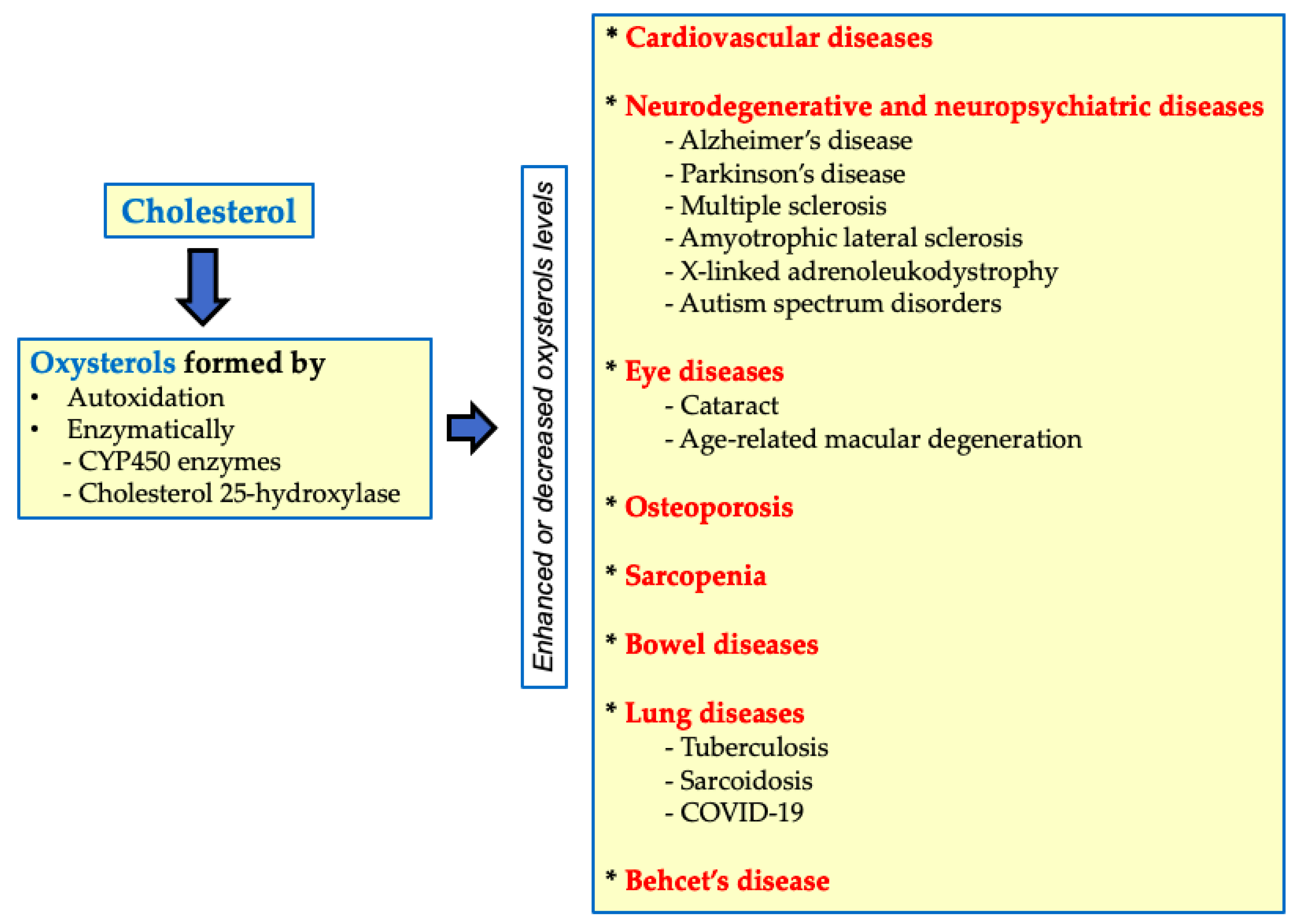
Figure 2.
Oxysterol-induced cytokinic effects. Since they are fat-soluble, oxysterols can diffuse directly from the extracellular fluid, into the cytoplasm and across the nuclear envelope. Certain oxysterols are agonists on the nuclear LXRs, which can activate transcription of pro-inflammatory cytokines either directly, or via the MAPK and NF-kB pathways. Oxysterol components of oxLDL can also exert cytokinic effects through TLR4. At the cell-surface, oxysterols activate TLR4, recruiting toll-interleukin-1 (TIR) domain containing adaptor protein (TIRAP) and myeloid differentiation primary response 88 (MyD88), stimulating transcription of type 1 interferon cytokines. Binding of oxysterols also promotes dimerization and internalization of TLR4. Endocytosed TLR4 associates with TRIF-related adaptor molecule (TRAM) and TIR-domain-containing adaptor-inducing interferon-β (TRIF), enhancing transcription of pro-inflammatory cytokines through the the MAPK and NF-kB pathways.
Figure 2.
Oxysterol-induced cytokinic effects. Since they are fat-soluble, oxysterols can diffuse directly from the extracellular fluid, into the cytoplasm and across the nuclear envelope. Certain oxysterols are agonists on the nuclear LXRs, which can activate transcription of pro-inflammatory cytokines either directly, or via the MAPK and NF-kB pathways. Oxysterol components of oxLDL can also exert cytokinic effects through TLR4. At the cell-surface, oxysterols activate TLR4, recruiting toll-interleukin-1 (TIR) domain containing adaptor protein (TIRAP) and myeloid differentiation primary response 88 (MyD88), stimulating transcription of type 1 interferon cytokines. Binding of oxysterols also promotes dimerization and internalization of TLR4. Endocytosed TLR4 associates with TRIF-related adaptor molecule (TRAM) and TIR-domain-containing adaptor-inducing interferon-β (TRIF), enhancing transcription of pro-inflammatory cytokines through the the MAPK and NF-kB pathways.
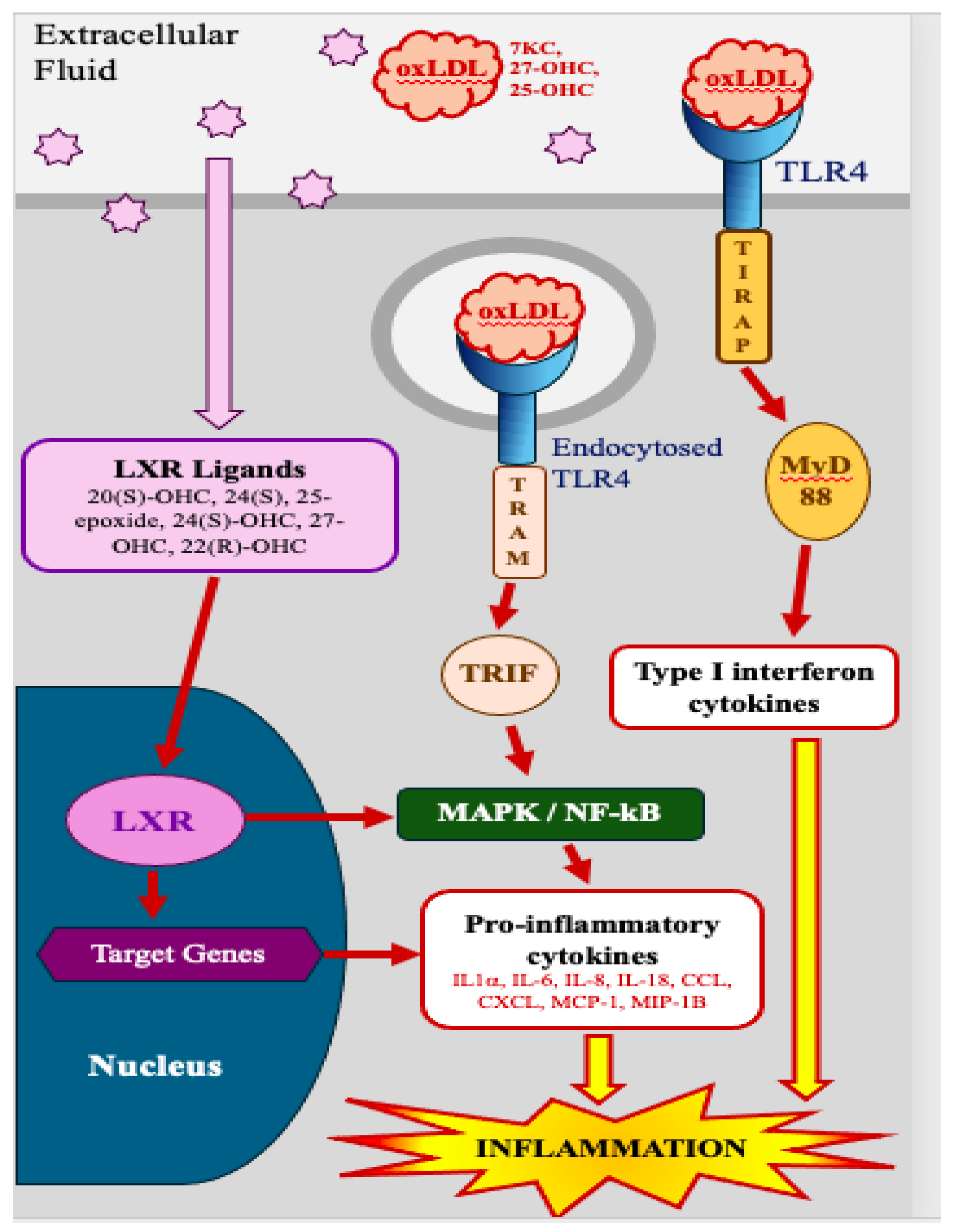
Figure 3.
Pro-inflammatory effects of oxysterols through altered Ca2+ signalling. Certain oxysterols act as agonists for G-protein coupled receptors (GPCRs), including EBI2/GPR183. This activates phospholipase C (PLC) enzymes, through the alpha subunits of heterotrimeric G-proteins. PLC cleaves the membrane lipid phosphatidylinositol 4.5-bisphosphate (PIP2) into the second messengers diacylglycerol (DAG) and inositol-1,4,5-trisphosphate (IP3). The oxysterol-binding-protein-related proteins ORP4L and ORP5L also stimulate IP3 production, by recruiting PLC isozymes to PIP2 in the inner leaflet of the cell-surface membrane. IP3 is a cytoplasmic second messenger, which causes Ca2+ release from the endoplasmic reticulum (ER) by binding to IP3R/Ca2+ channels. On binding 25-OHC, LXRs can also stimulate IP3R Ca2+ release, via a non-genomic mechanism. Release of Ca2+ from the ER is sensed by stromal interaction molecules (STIM1 and 2), which migrate to sites of contact with the cell-surface membrane, where they activate Orai channels (Orai1, 2 and 3), in a process termed store-operated Ca2+-entry. By binding to TLR2 and TLR4, oxysterols can activated Ca2+ influx through the purinoreceptor channels P2X1R and P2X7R. Both oxLDL and 7KC can also stimulate Ca2+ entry through transient receptor potential, canonical type 1 (TRPC1) cation channels. Together, increases in Ca2+ via these mechanisms can promote inflammation, by enhancing the transcription and secretion of cytokines, stimulating the migration of pro-inflammatory cells and triggering cell-death, leading to the release of pro-inflammatory factors.
Figure 3.
Pro-inflammatory effects of oxysterols through altered Ca2+ signalling. Certain oxysterols act as agonists for G-protein coupled receptors (GPCRs), including EBI2/GPR183. This activates phospholipase C (PLC) enzymes, through the alpha subunits of heterotrimeric G-proteins. PLC cleaves the membrane lipid phosphatidylinositol 4.5-bisphosphate (PIP2) into the second messengers diacylglycerol (DAG) and inositol-1,4,5-trisphosphate (IP3). The oxysterol-binding-protein-related proteins ORP4L and ORP5L also stimulate IP3 production, by recruiting PLC isozymes to PIP2 in the inner leaflet of the cell-surface membrane. IP3 is a cytoplasmic second messenger, which causes Ca2+ release from the endoplasmic reticulum (ER) by binding to IP3R/Ca2+ channels. On binding 25-OHC, LXRs can also stimulate IP3R Ca2+ release, via a non-genomic mechanism. Release of Ca2+ from the ER is sensed by stromal interaction molecules (STIM1 and 2), which migrate to sites of contact with the cell-surface membrane, where they activate Orai channels (Orai1, 2 and 3), in a process termed store-operated Ca2+-entry. By binding to TLR2 and TLR4, oxysterols can activated Ca2+ influx through the purinoreceptor channels P2X1R and P2X7R. Both oxLDL and 7KC can also stimulate Ca2+ entry through transient receptor potential, canonical type 1 (TRPC1) cation channels. Together, increases in Ca2+ via these mechanisms can promote inflammation, by enhancing the transcription and secretion of cytokines, stimulating the migration of pro-inflammatory cells and triggering cell-death, leading to the release of pro-inflammatory factors.
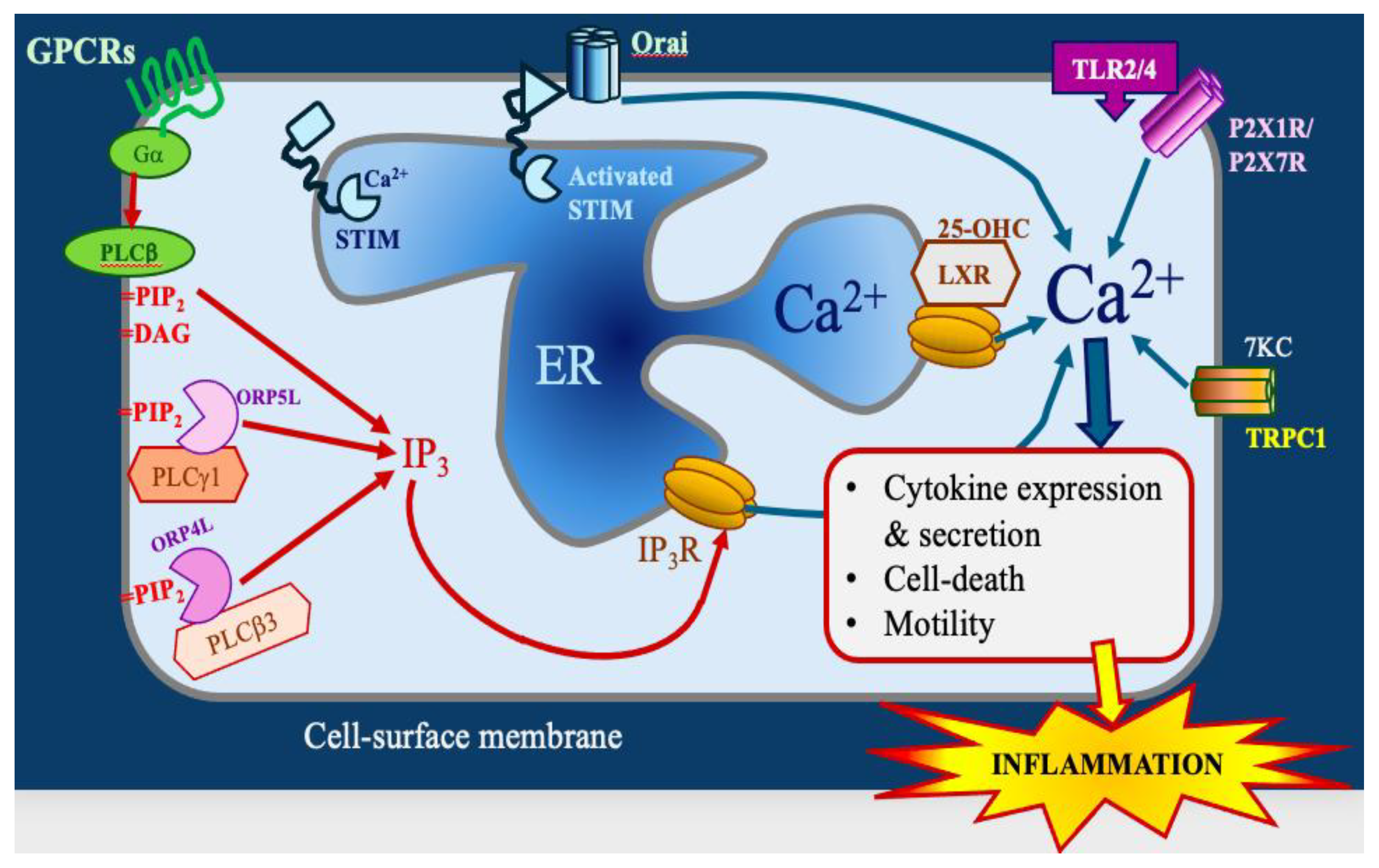
Disclaimer/Publisher’s Note: The statements, opinions and data contained in all publications are solely those of the individual author(s) and contributor(s) and not of MDPI and/or the editor(s). MDPI and/or the editor(s) disclaim responsibility for any injury to people or property resulting from any ideas, methods, instructions or products referred to in the content. |
© 2025 by the authors. Licensee MDPI, Basel, Switzerland. This article is an open access article distributed under the terms and conditions of the Creative Commons Attribution (CC BY) license (http://creativecommons.org/licenses/by/4.0/).
Copyright: This open access article is published under a Creative Commons CC BY 4.0 license, which permit the free download, distribution, and reuse, provided that the author and preprint are cited in any reuse.


