

Submitted:
22 April 2025
Posted:
23 April 2025
You are already at the latest version
Abstract
Wildlife strikes in aviation are among the most reported safety incidents. As such, strikes have become the fundamental unit of understanding of the risk posed by wildlife. However, with the management of wildlife strike risk shifting to a hazard management philosophy, this literature review considers the contention that current wildlife strike reporting systems are not suited to modern wildlife hazard management techniques. This review sourced academic literature from Web of Science (n=684) and, using bibliometric analysis software, identified relevant papers (n=257). Additional industry material completed the final catalogue (n=542). These papers were reviewed for their treatment and use of wildlife strikes with respect to modern risk and hazard management approaches. This analysis noted three potential challenges with current wildlife strike reporting systems, including the focus on collision events, the potential to introduce other adverse effects and the skewing of risk assessment results. The paper’s analysis was supplemented with a review of international standards and relevant national requirements and concludes that while academics and industry have adopted systemized safety and hazard management concepts and that international guidance material has been keeping pace, international standards, the foundation for many national reporting systems, remains decades behind.
Keywords:
airport
; air traffic management
; aviation
; bird strike
; incident reporting
; risk
; safety
; safety reporting
; wildlife management
; wildlife strike
1. Introduction
While aviation is considered “ultra-safe”, with accidents and incidents relatively rare [1], collisions between aircraft and animals are one of the most commonly reported safety incidents [2]. Known today as wildlife strikes, the Australian Transport Safety Bureau’s (ATSB) national aviation occurrence database shows that, in the ten years to 2023 (inclusive), events involving wildlife accounted for 33% of safety reports in Australia [3]. As Dolbeer et al. [4] noted in their regular report on wildlife strikes in the United States, wildlife strikes “have become an increasing concern for aviation safety” (p. v).
The outcome of any single wildlife strike event will vary from negligible to catastrophic. Where a wildlife strike leads to some form of adverse outcome, the consequences may be limited to the impact area or trigger a “critical sequence of a rapidly occurring chain of events” [5] (p. 12) that leads to a serious accident. The preceding quote is from the 1960 accident report of Eastern Air Lines Flight 375, a Lockheed Electra L-188 that struck multiple birds on departure, resulting in an accident in which 62 passengers and crew were killed.
Research into the costs of wildlife strikes and associated events has recognized the economic impact on aviation. One of the most cited works on wildlife strikes in aviation is Allan [6], later followed up by Allan and Orosz [7], in which the annual worldwide costs of wildlife strikes in aviation were estimated at US$1.2 billion. Adjusted for inflation, this would equal more than US$2.2 billion in 2025. This figure, which includes direct and indirect components, will also likely underestimate the actual cost [7].
Wildlife strikes as a safety issue have been the focus of international standards [8] and national regulations [9,10,11] that require or otherwise influence aerodrome operators to implement wildlife hazard management programs or similar systems.
As noted in this paper, the wildlife strike event is currently the fundamental unit of understanding across nearly all facets of wildlife hazard management. Wildlife strike events are used in various ways to describe the impact of wildlife on aviation as well as form regulatory triggers for study, review, and action. However, issues with international and national wildlife strike reporting systems continue to be noted in academic literature [12,13] and at industry conferences [14].
In the following literature review, we will examine the contention that wildlife strike reporting systems are not currently meeting the needs of academics and industry in managing the conflict between wildlife and aircraft. As a first step, we provide a broad survey of academic research articles using bibliometric techniques to identify significant sections of research activity and acknowledge the role of industry research. From here, the literature review is divided into two parts. In part one, we use the collected literature to review the nature of wildlife hazard management in terms of harm and risk and then dive deeper into key areas where we believe the industry’s focus on strikes, to the exclusion of other wildlife-related events, may be limiting the industry’s hazard mitigation efforts. In part two, we explore how wildlife strike events are used in research and the role of international standards and national legislation. Our final discussion outlines the interplay between academic research, industry practice and the international standards development process, and how future research may address the issues identified in the literature.
2. Survey of Relevant Literature
A broad search of academic research relating to wildlife strikes in aviation shows that it spans a diverse range of disciplines. To help identify relationships between related, complementary and seemingly disparate sources, we used software-based bibliometric analysis to survey the academic literature landscape. Using bibliometric analysis software, such as VOSviewer, researchers can visualize and interpret patterns in literature. These patterns are based on relationships between authors, keywords and [15]. When used in cross-disciplinary research, its capability to cluster items and present visual maps provides a method for identifying relationships within a field of research.
Using a relative board search query, we obtained a library of relevant research from the Web of Science database. The query searched for a combination of wildlife or bird strike with aviation-related terms across all database fields. Throughout this paper, the term wildlife is used to refer to the hazard at the center of research. However, for much of its history, the term “bird strike” has been more common, with over 95% of reported wildlife strikes in 2023 attributed to birds [4]. The resulting search provided 684 documents.
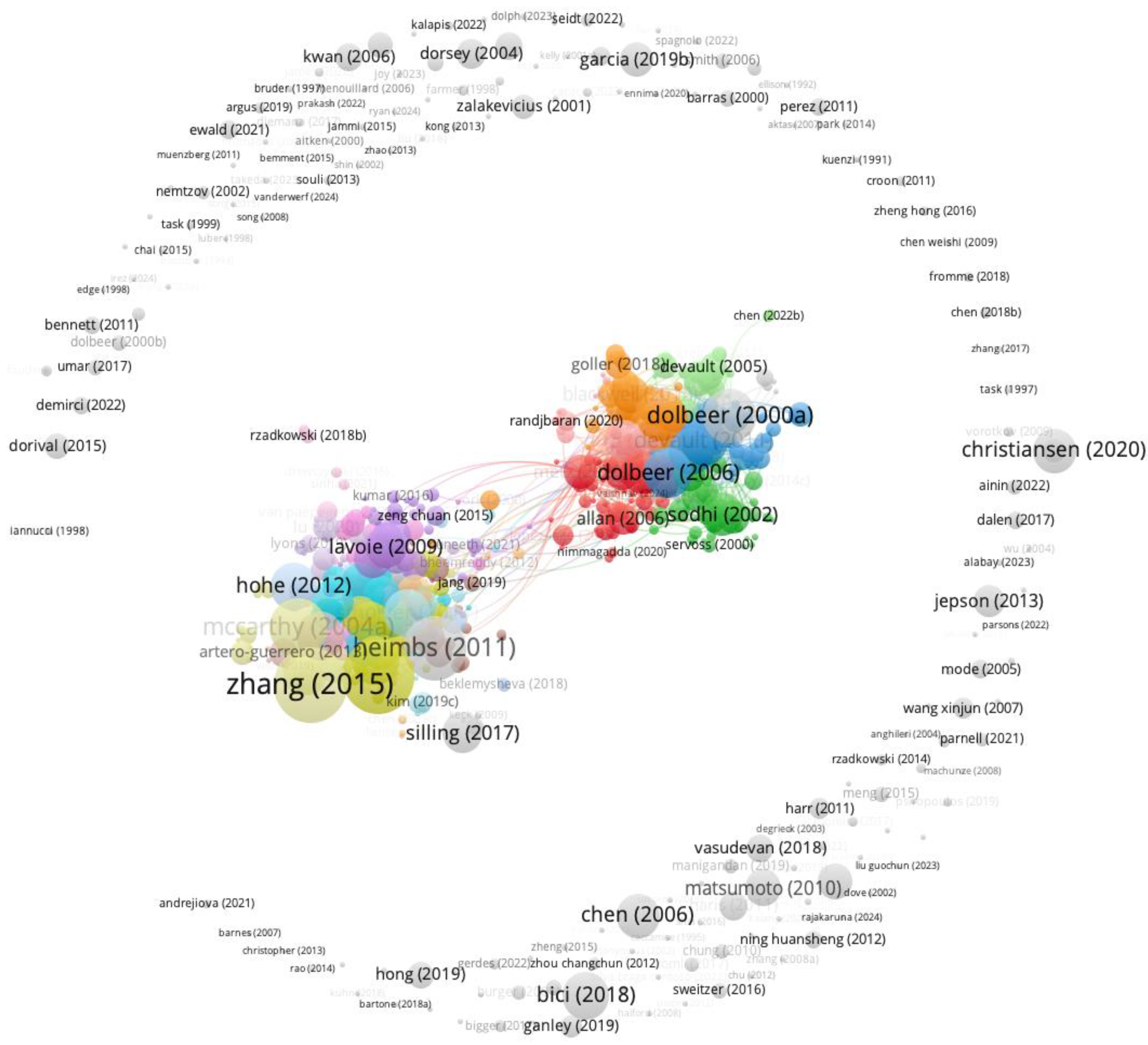
Using VOSviewer, we produced a visualization of the relationships between the documents downloaded from the database using citations. The resulting visualization, shown in Figure 1, shows three groups of documents. The first group, shown as a grey ring, indicate unconnected documents covering a variety of topics, including general biology and ecology [16,17], and unrelated aviation and aerospace topics [18,19].
At least one relevant paper [20] was identified in this group. However, its record did not include citations to other documents, so it was not connected to the central clusters. A paper of a similar name was located in the proceedings of the 1994 International Bird Strike Committee (IBSC) meeting [21]. This paper’s absence from the Web of Science results suggests that industry resources are not treated like academic literature and could have been missed in our analysis.
The second group is the super-cluster located in the lower-left quadrant. We identified this group as relating to aircraft-engineering-related topics. We analyzed the six largest clusters in this group (each n > 20) using VOSviewer’s clustering algorithm [22]. These clusters covered topics like impact assessments and simulation on aircraft structures [23,24,25], involving jet engines [26,27,28], and involving laminate materials [29,30,31],.
The last group, located in the upper-right quadrant of the diagram and the focus of this literature review, could be described as the wildlife hazard management super-cluster. We also identified six clusters within this group with more than 20 documents each. There appeared to be greater overlap between clusters, but some of the more significant papers explored risk management [32,33,34], wildlife biology and behaviors and their impact on wildlife strikes [35,36], wildlife strike statistical analysis [37], habitat management [38], intervention strategies [13,39] and wildlife strike outcomes [40,41,42]. This super-cluster consisted of 257 articles and other documents.
As noted above, industry papers were absent from the Web of Science results. To complete our literature review, we searched the proceedings of foremost industry conferences and fora for relevant material. After reviewing the indexes of the IBSC/World Birdstrike Association (WBA), the North American Bird Strike Conference, and the Australian Aviation Wildlife Hazard Group (AAWHG) Forum, we collated a catalogue of 542 documents.
3. The Evolution of Wildlife Hazard Management
The management of wildlife strikes tends to fall under the business activity of wildlife hazard management, a systemized business activity often undertaken by but not necessarily exclusive to an airport operator [43]. While wildlife hazard management could be considered broader than just the impact on aviation from wildlife strikes, the literature tends to equivocate and define these terms in a one-to-one relationship or to use them interchangeably.
For example, the Airport Services Manual, the International Civil Aviation Organisation’s (ICAO) primary source of guidance on the subject, defines wildlife hazard, in general terms, as “the presence of wildlife (i.e. birds and other animals, both wild and domestic) that could result in damage to aircraft” [44] (p. 1-1). Yet, the subsequent discussion focuses on historical wildlife strike events before explicitly tying together the two concepts with the statement that the “objective of wildlife hazard management at aerodromes is to reduce the risk of a wildlife strike” [44] (p. 1-2).
Wildlife, as a term for all animals, including feral and domesticated specimens, can impact aviation in various ways. Therefore, we began by reviewing the definitions of important terms. Scheer et al. [45] noted a significant issue in risk communication regarding distinctions between hazard and risk. They outlined research examining how the use of each word impacted the management approach taken by different organizations and how they communicated, often depending on the circumstances. As an example, regulatory bodies would use the terms interchangeably when talking to the public but distinctly when communicating with professionals. Scheer et al. [45] also noted that the term used when describing the management strategy also influences the approach aims.
When hazard management is used, the management strategy leans towards “rigorous limiting” [45] (p. 1272) of the hazard without considering exposure to or severity of harm. It is easier to understand and communicate these concepts over a risk-based approach. Risk management requires a deeper analysis of exposure and impact stemming from the hazard. Scheer et al. [45] posited that “the large majority of people do not fully understand the process and results of risk assessment” (p. 1272).
So, do these observations apply to the concept of wildlife hazard management? Our answer is no. A significant amount of wildlife hazard management research is devoted to risk assessment methodologies, including Allan [46], Dolbeer et al. [47], Zakrajsek and Bissonette [32], Shaw [48], Paton [49], Pfeiffer et al. [50], and DeVault et al. [51]. These risk assessment techniques provide structures for wildlife hazard managers to undertake that deeper analysis involving severity of harm, exposure and probability. As such, wildlife hazard management is generally approached from a risk-based perspective. We then explored the natural follow-up question: are impact assessments limited to wildlife strikes?
As with any hazard, wildlife, as a “source of potential harm” [52] (p. 3), can realize that harm in more ways than just wildlife strikes. We found the following examples of non-strike-related harm in the literature. House et al. [53] detailed their research on the impact of keyhole wasps on aircraft through blockages to pitot tubes. Their analysis described a 2013 incident involving an Airbus A330 that declared a Mayday due to airspeed discrepancies. An investigation found sand and mud deposited by wasps blocking a pitot tube. Bridgman [54] observed bird nesting activities during his career in the Royal Air Force. He discussed the difficulty in removing found nests and noted that some nests could impact flight safety. However, he reported that he could not find any records of accidents attributed to this hazard. Solman and Thurlow [55] detailed aerodrome damage by mammals, including flooding caused by beavers and noted that “failure at a critical phase of landing could cause a serious hazard” (p. 109). Finally, Marcus [56] reported on the impact on aviation from wildlife infiltrating aircraft with the diversion of an AirAsia flight due to a stowaway snake in Malaysia. The airline cited safety as its top priority when deciding to divert. The report also referenced other snake-related events, including a smuggled cobra biting the hand of the smuggler in 2012 and a stowaway python in 2016.
To identify research that discussed wildlife hazard management without a focus on wildlife strikes, the literature catalogue was filtered for titles that included the words hazard and management. The resulting list contained 67 documents (including one podcast). Nine documents that related to the general topics of risk management, safety management systems, and land use management were excluded, as was one document on wildlife research that merely occurred on an airport.
Of those documents left to be examined, sixteen referenced wildlife strikes in the title. Further analysis found that, when discussing the hazard posed by wildlife to aviation, all but one of the 41 remaining documents referred to wildlife strikes as the primary focus of the problem. These documents covered a range of research topics and purposes, including wildlife hazard management [57,58], wildlife risk assessment [34,47,50,59], habitat management [60,61,62], case studies [63,64,65], avian radar technologies [66,67,68], and regulatory guidance [69,70,71,72,73].
The close relationship between wildlife hazard and wildlife strike can be exemplified by a quote from Davis et al. [59], who, in reviewing the wildlife hazard extant at a proposed airport site, state that “the final goal of the exercise is to reduce the risk of bird-strikes to aircraft” (p. 5). However, to explore this paper’s contention further, we examined the one paper that bucked this trend with a view to identifying key issues with the current approach to wildlife hazard management and research.
4. Challenges Associated with Wildlife Strike Reporting
As a summary of issues resulting from not having a set of standard requirements for wildlife hazard event reporting, Eekeren [14] made a strong call to action on the need for common definitions of wildlife hazard events. He identified confusion regarding regulatory triggers following wildlife strikes, legal liability disputes and miscalculation of wildlife risk, as potential issues with incomplete and inconsistent definitions. Discussions between conference participants highlighted frustrations with previous industry-based attempts to address this issue.
Unfortunately, these were not new issues. Dekker and Buurma [74] raised the importance of definitions and conventions in their discussion on mandatory reporting. Their concerns included whether non-avian strikes would be included and if there would be a minimal impact threshold for reporting. They suggest an expectation that agreement on these issues would be reached as a matter of course. Eekeren [14] indicated that little progress has been made.
The following sections will discuss some of these issues as they appear in academic and industry literature.
4.1. More than Just Wildlife Strikes
The sole exceptional document referred to above as taking a broader approach to wildlife hazard is Mendonca [75]. In their analysis of safety management system principles, as they applied to wildlife hazard management, they consistently used the word “hazard”, which, while defined with significant reference to wildlife strike scenarios, also included “incidents where the presence of birds on or around the airfield has any effect on a flight whether or not evidence of a strike can be found” [75] (p. 8). Here, Mendonca [75] combined the definitions for three categories of wildlife incidents established by the IBSC [76], which noted that such incidents are also “potentially dangerous” (p. 14) and do not necessarily involve a wildlife strike.
Mendonca [75] supported the addition of non-strike events with reference to Heinrich and Granniss’ safety triangle and the benefits of investigating near-miss events [77,78]. These considerations often conjure the image of an iceberg with the visible portion above the water representing the reports we receive but the bulk of the “problem”, near-miss events and hazard reports, sits below the surface and hidden.
Swissair were capturing near miss event reports as early as 1978 but were not using them in their statistical analysis [79]. Klope et al. [80] examined the role of near-miss wildlife event reports further and highlights that, on any given airport, wildlife strikes are underreported and de-coupled from management actions. This makes them insensitive to changes in the environment that may precede wildlife strike events. The authors propose the “augmentation” [80] (p. 213) of wildlife strike data to provide the granularity required to manage wildlife hazards.
Despite this research and guidance for US operators to report near-misses that have a negative effect on flight, the latest report analyzing the data contained in the US National Wildlife Strike Database only discusses negative effect on flight in relation to wildlife strikes [81]. Likewise, Smallie and Froneman [82] described the approach taken at South African airports as incorporating the non-collision negative effect on flight concept in their definition of bird strike, but subsequent discussion appears to omit these reports as such reports are not even assign a bird strike level.
This suggests further work is required to define and support the reporting of non-collision wildlife hazard events.
4.2. Potential Tunnel Vision on Success
While wildlife hazard mitigation is a multi-pronged endeavor, McKee et al. [58] explain that the prevailing airport-centric approach of attempting to establish a wildlife exclusion zone around airport is flawed. They advocate for separation of aircraft and wildlife, and they recommend greater involvement of Air Traffic Control (ATC) in this strategy.
Such a strategy was developed by Metz [83] as an air traffic control advisory system designed to prevent wildlife strikes (bird strikes, in particular). Through fast-time simulation, they showed that the introduction of an advisory system could prevent a significant percentage of wildlife strikes [84]. In the real-world, such a positive impact would likely register in existing systems as they focus on wildlife strike events.
Metz [83] acknowledges that the safety benefit must be weighed against airport capacity, delays and, eventually, costs. Their analysis, again through simulations, shows that delays would fall within acceptable limits and that the costs would be outweighed by the costs saved from prevented wildlife strikes.
These results are encouraging from a feasibility point of view, but real-world tracking of these factors would not be possible under the current system. Instead, aerodrome operators may identify the reduction in wildlife strikes and curtail wildlife control measures as the advisory system carries the weight of the wildlife hazard management program. Aircraft operators would register an increase in costs after the changes have come into effect, and much like tracking wildlife strike events, this would be too late. This scenario further supports the need for consistent and standardized reporting of non-collision or wildlife avoidance events.
4.3. Impact on Wildlife Risk Assessment
Eekeren [14] specifically mentioned that differences in definitions can the impact on risk assessment techniques used by wildlife hazard managers. At least two of the most prominent risk assessment methods utilize percentage of damaging and/or negative effect on flight strikes as indicators for the potential risk severity for specific wildlife species. Allan’s [33,46] model and the Dolbeer et al. [47] Relative Hazard Score (RHS) approach both consider the portions of total strikes resulting in an adverse outcome and, through different methods, calculate a severity/impact score to be used in further risk assessment.
If the basis of reporting changes, the results from these techniques will also change. Allan et al. [12] found this when they revisited the Allan [33] risk assessment matrix after the introduction of mandatory bird strike reporting in the United Kingdom. The data showed that increases in reporting rates of non-damaging strikes had caused an apparent increase in risk which could cause airport-based wildlife hazard managers to invest resources into managing unnecessary species.
Allan et al. [12] also noted that reporting culture, differing reporting requirements, and varying application of existing requirements meant that risk analysis using similar techniques needs to be undertaken on a national basis using its own data. This would pose a challenge for smaller countries with limited data and those looking to benchmark against other countries.
5. The Use of Wildlife Strike Data in Research
When outlining the impact of wildlife on aviation and to justify the research being reported, most authors will employ wildlife strike report data in one of the following ways.
The historical justification involves detailing early and/or significant wildlife strike events using, primarily, the work of Thorpe [85,86,87,88], who has provided a detailed account of “all known fatalities and destroyed aircraft” (p. 1). This work has been carried on by Shaw and Dolbeer [89], while Richardson [90,91] and Richardson and West [92] collated similar summaries for military aircraft. Wildlife hazard researchers using this approach, such as MacKinnon [70], Cleary and Dolbeer [71], and Viljoen and Bouwman [93], will mention the first recorded wildlife strike from 1905, which involved Orville Wright, while other researchers, such as Dolbeer [94], McKee et al. [58], and Tatlier and Baran [95] describe the first fatal wildlife strike that took the life of celebrity pilot Cal Rodgers, who was also flying a Wright Flyer.
Historical data from Thorpe [85,86,87,88], Shaw and Dolbeer [89], Richardson and West [92] and other sources are also summarized to form a safety-based justification. The safety-based justification is typically constructed as the total number of human fatalities and aircraft destroyed over the period described in the relevant source. Examples include Rochard [69], Swaddle et al. [96], and Jeffery and Buschke [97]. The current total stands at 534 fatalities and 618 destroyed aircraft [89].
A relatively recent variation of the safety-based justification uses a well-known significant event as justification in its own right. An example of this is the January 2009 wildlife-strike-induced ditching of American Airlines flight 1549, known as the “Miracle on the Hudson” [98]. While authors such as Hesse et al. [64], Martin et al. [99], and Chen et al. [66] use this event as justification for research into aerodrome-based management practices, it is important to note that during a public hearing on this accident, a Federal Aviation Administration (FAA) representative advised that the location and altitude of the wildlife strike fell “well outside the area expected to be covered by the LGA (aerodrome’s) WHMP (Wildlife Hazard Management Plan)” [100] (p. 26).
As most recorded wildlife strikes do not lead to catastrophe, they have been used in various forms to create statistical justifications. Authors have used the total number of reports [48,101], the percentage of reports indicating damage [102] and the general increasing trend in reporting rates [103] to provide background for their research. With respect to making a statistical justification, research showing that wildlife strikes are generally underreported [104,105] could be considered a positive as the accurate scale of the problem is likely to be larger. However, the phenomenon has a negative effect when wildlife strikes are used in risk analysis.
Also born out of non-catastrophic wildlife strike events, costs associated with wildlife strikes have also been used as an economic justification. For worldwide civilian aviation, the most quoted figure is a conservative US$1.2B calculated by Allan [106] and used by authors like Allan et al. [107], Dolbeer and Wright [108] and Metz et al. [13]. Research focusing on United States civilian air traffic tends to use annual FAA/US Department of Agriculture - Wildlife Services (USDA-WS) reports [81,109] and can be seen in the work of DeFusco [110], Barras and Seamans [111], and DeVault et al. [102]. More recent research into estimating costs has focused on barriers to capturing such information [112] and machine learning analysis of existing wildlife strike data [41,42].
6. International/National Standards & Guidance
As an international endeavor, the regulatory system surrounding aviation is substantial and complex. In the aftermath of World War II, the international community understood that aviation was essential to global harmony and a threat to security. They sought to cooperate in the development of standards and recommended practices that promote safety, order, equality, and sound economics [113]. Wildlife hazard management has been included in these standards and recommended practices and guidance material for over five decades.
Despite the expectation that ongoing obligations on states should be published in annexes to the Convention on International Civil Aviation [113], as early as 1965, ICAO, via various State Letters, requested bird strikes involving aircraft be reported [114]. This expectation has since been incorporated into Annex 14 – Aerodromes [8] along with several other wildlife strike hazard reduction specifications. Initially, as a recommendation and now as a standard, signatory states are required to establish a reporting system for wildlife strikes as a means of assessing the wildlife hazards on and around the aerodrome [44,115]. States must also collect and forward wildlife strike reports to ICAO for inclusion in the ICAO Bird Strike Information System (IBIS) and to take action to decrease the risk of collisions between wildlife and aircraft [44].
These provisions firmly place the emphasis of hazard management and reporting on wildlife strikes as actual collisions. The IBIS Manual [116], being of a similar era to these specifications, aligns closely with this approach, stating that “reports should be submitted only when a bird strike has actually taken place” (p. 4) and that “occurrences of birds flying near aircraft should not be reported” (p. 4).
But later guidance material developed by ICAO sought to broaden the scope of wildlife hazard event reporting. Doc 9981 – Procedures for Air Navigation Services – Aerodromes [117] uses the phrase “wildlife strike-related events” when outlining accident and serious incident as well as IBIS reporting requirements. This document also establishes expectations for aerodrome operators to have procedures for recording, analyzing and reporting wildlife incidents. It also expects WHMPs to contain procedures for collecting, reporting and recording wildlife strike and observation data and to warn aircraft operating on or nearby the aerodrome of wildlife hazards. However, it should be noted that the wildlife incident reporting criteria established in Appendix 2 to Chapter 6 [117], is focussed on wildlife strike reporting only.
In the newer Doc 9137 – Airport Services Manual – Part 3 – Wildlife Hazard Management [44], the objective of wildlife hazard management is established as wildlife strike risk management and then defines a strike in collision terms. And yet, it then expands the scope of recordable events to include occurrences where the presence of wildlife could have a negative effect on a flight.
There may, however, be a difference between reportable and recordable events. This document describes recordable events as being reported to the aerodrome operator, but whether they are to be reported to the National Aviation Authority (NAA) and/or the IBIS is unclear. It expects wildlife incidents, which may or may not include the events above, to be reported per the aerodrome operator’s national incident reporting regulations. Relevant guidance to national aviation authorities merely repeats the requirements of Annex 14.
Given the numerous references to incidents above, it is necessary to consider Annex 13 – Aircraft Accident and Incident Investigation [118], which defines incident in tandem with accident and serious incident as follows:
- An accident is an event involving the operation of an aircraft that results in the death or serious injury of a person, the aircraft sustains significant damage or the aircraft is missing. However, this definition excludes specific types of damage resulting from a bird strike.
- A serious incident is a situation that had a high probability of being an accident.
- An incident is any other type of occurrence that affects or could affect safety.
Finally, we explored the topic of safety reporting within the ICAO Safety Management System (SMS) framework as described in Annex 19 – Safety Management [119]. This model establishes a much broader concept of safety reporting, and yet, the details of these specifications describe a system geared towards incident reporting separate from mandatory reporting requirements to a national aviation authority. They also include the collection and analysis of a wide variety of safety data, which, for aerodrome operators, could include inspection records, risk assessment results and voluntary reports [120].
However, ICAO SARPs and guidance material do not directly impose a legal obligation within any specific state or operator. States, either through their national aviation authorities and/or independent safety bodies, establish national regulations on topics such as wildlife hazard management and event reporting. The following paragraphs will detail the approach taken by the United States, the European Union and Australia.
At a regulatory level, the United States has created the obligation to monitor wildlife strikes as a potential trigger for formal wildlife hazard management processes [9]. Further details on wildlife strike reporting are contained in advisory material with the national reporting system considered voluntary [121]. The FAA [121] did, however, define two aspects of a wildlife strike in detail.
Firstly, a wildlife strike should be reported if it involves a bird, a bat, a terrestrial mammal larger than one kilogram or a reptile larger than one kilogram. Secondly, a strike is deemed to have occurred when:
- someone witnesses a collision between wildlife and an aircraft;
- there is evidence on an aircraft, including damage, of a collision with wildlife;
- the remains of wildlife are found either on or near a runway, on a taxiway or anywhere else near an aerodrome where there is no other explanation for the animal’s death, or a collision is suspected; or
- wildlife on or near an aerodrome have had a “significant negative effect on a flight” [121] (p. 3).
Within the European Union aviation regulatory system, aerodrome operators are required to minimize wildlife collision risk, including having procedures to record and report wildlife strikes and to use this data in their wildlife risk assessment [11]. Aircraft operators and air traffic service providers must also report wildlife strikes [122]. There was no specific definition provided for wildlife strike nor any commentary on the reporting of suspected wildlife strikes or other wildlife hazard-related events.
The European air navigation service provider Eurocontrol has defined a wildlife strike as a collision between an animal and an aircraft either in flight, taking off, or in the landing roll [123]. They also suggested that incidents where a collision is “narrowly avoided” should be reported [124].
In Australia, aerodrome operator regulations and standards have established the requirement for a wildlife hazard management system [125] and the monitoring of wildlife strikes on or near the aerodrome [10]. The requirement to report wildlife strikes that do not result in an air accident can be found in a different set of regulations [126] and establishes that collisions with animals involving air transport operations or that occur on certified aerodromes as routine reportable matters.
This analysis shows variations in the specificity and scope of reporting requirements, especially where evidence of a collision is limited or a collision was narrowly averted. This is not surprising given that international standards and guidance span multiple documents written over a thirty-year period.
Even beyond the weight and momentum behind wildlife strike reporting as a regulatory and academic standard, the process of amending ICAO standards is complex and time-consuming. While the ICAO development and amendment process offers a range of methods for proposing changes and new material [127], all proposals must be approved by the Air Navigation Commission (ANC). The ANC reviews such proposals in consideration of its Work Programme and judiciously assigns Job Cards to the relevant Panel [129]. The relevant panel, in the case of wildlife hazard management, the Aerodrome Design and Operations Panel (ADOP), then seeks experts to contribute their time to actioning the proposal laid out in the Job Card.
However, the standards development process at ICAO is slow [128]. The International Federation of Air Traffic Controllers’ Associations (IFATCA) [127] notes that this process may take up to five years. However, there are examples of Job Cards taking much longer. The review of Obstacle Limitation Surface (OLS) standards commenced in 2013 and was only finalized a decade later [130]. Even after this, the process may take another two years for the final amendment to become applicable [127].
The role of guidance material in this system is to support the application of standards and recommended practices [131]. Yet, where specific provisions of the Chicago Convention obligate contracting States to adopt the standards and recommended practices produced by ICAO, States may not incorporate guidance into their national legislation [132]. Nonetheless, guidance material can be considered easier to produce and amend under the expectation that this material, typically contained in technical manuals, is updated regularly [131]. Although Salih [131] also identifies areas where such material has become obsolete.
Only one of the ICAO documents discussed above, the IBIS Manual, was published or updated more than ten years ago. This document was recently reviewed with an update expected to be delivered by the end of 2023 [133]. But despite the modernization of these supporting documents, do their inconsistencies and stagnant foundation, a standard rooted in a 50-year-old letter, best serve the industry today?
7. Conclusions
Under the broadest view of hazard, wildlife present a complex and continued risk to aviation safety. While wildlife can interact with the aviation system in a variety of ways, collisions between animals and aircraft are the predominant concern for the industry. Previous research has established the nature and, in some cases, quantum of the wildlife strike problem. Yet, a holistic, systemic approach to hazard management calls on safety professionals to look beyond the ultimate manifestation of the hazard. Near-miss and other related events may provide as much actionable context and information to wildlife hazard managers as they do other safety managers.
The literature review above shows a dynamic and diverse sub-industry of professionals of varying stripes and academics working to develop structures that support analysis and intervention. The history of this sub-industry shows its pragmatic approach to managing what has been measured, wildlife strikes. Advances in systemized safety and hazard management have made inroads into the field with the adoption of wildlife hazard management practices becoming the norm.
However, the research and regulations still focus on the occurrence of wildlife strikes as the primary performance measure. The discussion above highlighted three areas where this focus may not lead to optimal outcomes. Near miss events may not be given their due and the avoidance of strikes may lead to unintended adverse effects on operations. These and other effects also impact broad risk assessment methodologies which could mask underlying, latent conditions.
For the most part, ICAO’s guidance material has been keeping pace with industry advancements. But the basis for wildlife strike reporting remains the standard established in the 1970s. Standards compliance is the obligation on contracting States and the short analysis above showed variation between major regulatory systems where guidance material provisions were involved.
If these inconsistencies are to be resolved, the industry might have to establish a consensus before approaching ICAO to revise the standard. The resource limitations that drive ICAO to manage their Work Programme closely must be overcome with clear evidence that there is a need for change. Academia has a role to play in supporting efforts to build and show consensus on such issues through robust methods and engagement with the industry.
Author Contributions
Conceptualization, D.P.; methodology, D.P.; formal analysis, D.P.; writing—original draft preparation, D.P.; writing—review and editing, D.P., S.L. and W.M.; supervision, S.L., and W.M. All authors have read and agreed to the published version of the manuscript.
Funding
This research received no external funding.
Conflicts of Interest
The authors declare no conflicts of interest.
Abbreviations
The following abbreviations are used in this manuscript:
| AAWHG | Australian Aviation Wildlife Hazard Group |
| ADOP | Aerodrome Design and Operations Panel |
| ANC | Air Navigation Commission |
| ATC | Air Traffic Control |
| ATSB | Australian Transport Safety Bureau |
| FAA | Federal Aviation Administration |
| IBIS | ICAO Bird Strike Information System |
| IBSC | International Bird Strike Committee |
| ICAO | International Civil Aviation Organisation |
| IFATCA | International Federation of Air Traffic Controllers’ Associations |
| NAA | National Aviation Authority |
| OLS | Obstacle Limitation Surface |
| RHS | Relative Hazard Score |
| USDA-WS | US Department of Agriculture – Wildlife Services |
| WBA | World Birdstrike Association |
| WHMP | Wildlife Hazard Management Plan |
References
- Lofquist, E.A. The art of measuring nothing: The paradox of measuring safety in a changing civil aviation industry using traditional safety metrics. Safety Science 2010, 48, 1520–1529. [CrossRef]
- Australian Transport Safety Bureau. Australian aviation wildlife strike statistics 2008 – 2017 [Data set]. Australian Transport Safety Bureau: Canberra, Australia, 2019. https://www.atsb.gov.au/publications/2018/ar-2018-035.
- Australian Transport Safety Bureau. ATSB national aviation occurrence database: Detailed data search. Available online: http://data.atsb.gov.au/DetailedData (accessed on 11 November 2024).
- Dolbeer, R.A.; Begier, M.J.; Miller, P.R.; Weller, J.R.; Anderson, A.L. Wildlife strikes to civil aircraft in the United States 1990-2023; Federal Aviation Administration: Washington DC, United States, 2022. https://www.faa.gov/airports/airport_safety/wildlife/wildlife-strike-report-1990-2023-USDA-FAA.
- Civil Aeronautics Board. Aircraft accident report: Eastern air lines, inc., Lockheed Electra L-188, N 5533, Logan International Airport, Boston, Massachusetts, October 4, 1960, 1962. https://www.faa.gov/lessons_learned/transport_airplane/accidents/N5533.
- Allan, J.R. The costs of bird strikes and bird strike prevention. Human Conflicts with Wildlife: Economic Considerations 2000, 18. https://digitalcommons.unl.edu/nwrchumanconflicts/18.
- Allan, J.R.; Orosz, A.P. The costs of birdstrikes to commercial aviation. In 2001 Bird Strike Committee-USA/Canada, Third Joint Annual Meeting, Calgary, Canada, August 2001; pp. 218–226. https://digitalcommons.unl.edu/cgi/viewcontent.cgi?article=1001&context=birdstrike2001.
- International Civil Aviation Organisation. Annex 14 to the Convention on International Civil Aviation: Aerodromes, Volume I (9th ed.). International Civil Aviation Organisation: Montreal, Canada, 2022. https://portal.icao.int/icao-net/Annexes/an14_v1_cons.pdf.
- Title 14, Code of Federal Regulations [CFR] 2004 [US]. https://www.ecfr.gov/current/title-14.
- Civil Aviation Safety Authority. Part 139 (aerodromes) manual of standards 2019, Civil Aviation Safety Authority: Canberra, Australia, 2019. https://www.legislation.gov.au/Details/F2020C00797.
- European Union Aviation Safety Agency. Easy access rules for aerodromes (Regulation (EU) no 139/2014), 3rd ed.; European Union, 2020. https://www.easa.europa.eu/sites/default/files/dfu/Easy%20Access%20Rules%20for%20Aerodromes%20%28Revision%20from%20November%202020%29.pdf.
- Allan, J.; Baxter, A.; Callaby, R. The impact of variation in reporting practices on the validity of recommended birdstrike risk assessment processes for aerodromes. Journal of Air Transport Management 2016, 57, 101–106. https://canadianbirdstrike.ca/wp-content/uploads/2018/02/Allan_et_al_2016.pdf.
- Metz, I.C.; Ellerbroek, J.; Mühlhausen, T.; Kügler, D.; & Hoekstra, J.M. The bird strike challenge. Aerospace 2020, 7, 26. https://www.mdpi.com/2226-4310/7/3/26/pdf.
- Eekeren, R. van. Wildlife strike definition. In Proceedings of the World Birdstrike Association 2021 Conference, virtual (13–14 January 2021). https://www.worldbirdstrike.com/wba-conferences/66-wba-conferences/167-wba-1st-virtual-conference-2021.
- Van Eck, N.; Waltman, L. Software survey: VOSviewer, a computer program for bibliometric mapping. Scientometrics 2010, 84, 523–538. https://akjournals.com/downloadpdf/view/journals/11192/84/2/article-p523.pdf.
- Christiansen, F.; Dawson, S.M.; Durban, J.W.; Fearnbach, H;. and others. Population comparison of right whale body condition reveals poor state of the North Atlantic right whale. Marine Ecology Progress Series 2020, 640, 1–16. [CrossRef]
- Jepson, P.D.; Deaville, R.; Acevedo-Whitehouse, K.; Barnett, J.; Brownlow, A.; Brownell Jr., R.L.; and others. What Caused the UK's Largest Common Dolphin (Delphinus delphis) Mass Stranding Event? PLoS ONE 2013, 8, e60953. [CrossRef]
- Bici, M.; Brischetto, S.; Campana, F.; Ferro, C.G.; Seclì, C.; Varetti, S.; Maggiore, P.; Mazza, A. Development of a multifunctional panel for aerospace use through SLM additive manufacturing. Procedia CIRP 2018, 67, 215–220. [CrossRef]
- Parnell, K.J.; Wynne, R.A.; Griffin, T.G C.; Plant, K.L.; Stanton, N.A. Generating Design Requirements for Flight Deck Applications: Applying the Perceptual Cycle Model to Engine Failures on Take-off. International Journal of Human–Computer Interaction 2021, 37, 611–629. [CrossRef]
- Caccamise, D.F.; Reed, L.M.; Dosch, J.J.; Bennett, K. Management of bird strike hazards at airports: A habitat approach. In Proceedings of the 82nd Annual Meeting of the New Jersey Mosquito Control Association, Inc., Atlantic City, NJ, (01 January 1995). https://www.webofscience.com/wos/woscc/full-record/WOS:000076630200008.
- Caccamise, D.F.; Dosch, J.J.; Benett, K.; Reed, L.M.; DeLay, L. Management of bird strike hazards at airports: a habitat approach. Proceedings of the International Bird Strike Committee Meeting, Vienna, Austria, (29 August – 02 September 1994).
- Van Eck, N.J.; Waltman, L. Citation-based clustering of publications using CitNetExplorer and VOSviewer. Scientometrics 2017, 111, 1053–1070. https://link.springer.com/content/pdf/10.1007/s11192-017-2300-7.pdf.
- Meo, M.; Morris, A.J.; Vignjevic, R.; Marengo, G. Numerical simulations of low-velocity impact on an aircraft sandwich panel. Composite Structures 2003, 62, 353–360. [CrossRef]
- Guida, M.; Marulo, F.; Meo, M.; Riccio, M. Analysis of bird impact on a composite tailplane leading edge. Applied Composite Materials 2008, 15, 241–257. https://link.springer.com/article/10.1007/s10443-008-9070-6.
- Guida, M.; Marulo, F.; Meo, M.; Grimaldi, A.; Olivares, G. SPH–Lagrangian study of bird impact on leading edge wing. Composite Structures 2011, 93, 1060–1071. [CrossRef]
- Vignjevic, R.; Orłowski, M.; De Vuyst, T.; Campbell, J.C. A parametric study of bird strike on engine blades. International Journal of Impact Engineering 2013, 60, 44–57. [CrossRef]
- Zhang, D.; Fei, Q. Effect of bird geometry and impact orientation in bird striking on a rotary jet-engine fan analysis using SPH method. Aerospace Science and Technology 2016, 54, 320–329. [CrossRef]
- Zhang, Z.; Li, L.; Zhang, D. Effect of arbitrary yaw/pitch angle in bird strike numerical simulation using SPH method. Aerospace Science and Technology 2018, 81, 284–293. [CrossRef]
- Wang, J.; Xu, Y.; Zhang, W. Finite element simulation of PMMA aircraft windshield against bird strike by using a rate and temperature dependent nonlinear viscoelastic constitutive model. Composite Structures 2014, 108, 21–30. [CrossRef]
- Mohagheghian, I.; Charalambides, M.N.; Wang, Y.; Jiang, L.; Zhang, X.; Yan, Y.; Kinloch, A.J.; Dear, J.P. Effect of the polymer interlayer on the high-velocity soft impact response of laminated glass plates. International Journal of Impact Engineering 2018, 120, 150–170. [CrossRef]
- Zhou, Y.; Sun, Y.; Huang, T. Bird-Strike Resistance of Composite Laminates with Different Materials. Materials 2020, 13, 129. [CrossRef]
- Zakrajsek, E.J.; Bissonette, J.A. Ranking the risk of wildlife species hazardous to military aircraft. Wildlife Society Bulletin 2005, 33, 258–264. https://www.proquest.com/docview/230200803.
- Allan, J. A heuristic risk assessment technique for birdstrike management at airports. Risk Analysis 2006, 26, 723–729. https://onlinelibrary.wiley.com/doi/pdf/10.1111/j.1539-6924.2006.00776.x.
- DeVault, T.L.; Belant, J.L.; Blackwell, B.F.; Seamans, T. W. Interspecific variation in wildlife hazards to aircraft: Implications for airport wildlife management. Wildlife Society Bulletin 2011, 35, 394–402. [CrossRef]
- Blackwell, B.F.; DeVault, T.L.; Seamans, T.W.; Lima, S.L.; Baumhardt, P.; Fernández-Juricic, E. Exploiting avian vision with aircraft lighting to reduce bird strikes. Journal of Applied Ecology 2012, 49, 758–766. https://besjournals.onlinelibrary.wiley.com/doi/pdfdirect/10.1111/j.1365-2664.2012.02165.x.
- Lima, S.L.; Blackwell, B.F.; DeVault, T.L.; Fernández-Juricic, E. Animal reactions to oncoming vehicles: a conceptual review. Biological Reviews 2015, 90, 60–76. https://onlinelibrary.wiley.com/doi/pdf/10.1111/brv.12093.
- Dolbeer, R.A. Height distribution of birds recorded by collisions with civil aircraft. The Journal of Wildlife Management 2006, 70, 1345–1350. https://www.proquest.com/docview/234183927.
- Blackwell, B.F.; DeVault, T.L.; Fernández-Juricic, E.; Dolbeer, R.A. Wildlife collisions with aircraft: a missing component of land-use planning for airports. Landscape and Urban Planning 2009, 93, 1–9. [CrossRef]
- van Gasteren, H.; Krijgsveld, K.L.; Klauke, N.; Leshem, Y.; Metz, I.C.; Skakuj, M.; Sorbi, S.; Schekler, I.; Shamoun-Baranes, J. Aeroecology meets aviation safety: early warning systems in Europe and the Middle East prevent collisions between birds and aircraft. Ecography 2019, 42, 899–911. https://nsojournals.onlinelibrary.wiley.com/doi/pdfdirect/10.1111/ecog.04125.
- Marra, P.P.; Dove, C.J.; Dolbeer, R.; Dahlan, N.F.; Heacker, M.; Whatton, J.F.; Diggs, N.E.; France, C.; Henkes, G.A. Migratory Canada geese cause crash of US Airways Flight 1549. Frontiers in Ecology and the Environment 2009, 7, 297–301. https://esajournals.onlinelibrary.wiley.com/doi/pdf/10.1890/090066.
- Altringer, L.; Navin, J.; Begier, M.J.; Shwiff, S.A.; Anderson, A. Estimating wildlife strike costs at US airports: A machine learning approach. Transportation research part D: transport and environment 2021, 97, 102907. [CrossRef]
- Parsons, D.; Ryan, J.; Malouf, M.; Martin, W. Estimating the Cost of Wildlife Strikes in Australian Aviation Using Random Forest Modeling. Aerospace 2023, 10, p. 648. [CrossRef]
- Eschenfelder, P. Successful Strategies for Aviation Wildlife Mitigation. In Proceedings of the 11th Joint meeting of Bird Strike Committee USA & Canada, Victoria BC, Canada, (14–17 September 2009). https://digitalcommons.unl.edu/birdstrike2009/5.
- International Civil Aviation Organisation. Airport Services Manual – Part 3 – Wildlife Hazard Management, 5th ed.; International Civil Aviation Organisation: Montreal, Canada, 2020. https://www.bazl.admin.ch/dam/bazl/en/dokumente/Fachleute/Flugplaetze/ICAO/icao_doc_9137_airportsevicesmanual-part3.pdf.download.pdf/icao_doc_9137_airportsevicesmanual-part3.pdf.
- Scheer, D.; Benighaus, C.; Benighaus, L.; Renn, O.; Gold, S.; Röder, B.; Böl, G. The distinction between risk and hazard: understanding and use in stakeholder communication. Risk Analysis 2014, 34, 1270–1285. https://www.academia.edu/download/39716097/The_Distinction_Between_Risk_and_Hazard_20151105-8133-7ftuqa.pdf.
- Allan, J.R. The use of risk assessment in airport bird control. In the Proceedings of the Bird-Strike Committee annual meeting, (August 2001). https://canadianbirdstrike.ca/wp-content/uploads/2018/02/Allan_2001.pdf.
- Dolbeer, R.A.; Wright, S.E.; Cleary, E.C. Ranking the hazard level of wildlife species to aviation. Wildlife Society Bulletin 2000, 28, 372–378. [CrossRef]
- Shaw, P. A model for assessing bird strike risk at airports, 2006. Unpublished manuscript.
- Paton, D.C. Bird risk assessment model for airports and aerodromes, 3rd ed.; University of Adelaide, Adelaide, 2010. https://canadianbirdstrike.ca/wp-content/uploads/2018/02/Paton_2010.pdf.
- Pfeiffer, M.B.; Blackwell, B.F.; DeVault, T.L. Quantification of avian hazards to military aircraft and implications for wildlife management. PloS ONE 2018, 13, 1–16. [CrossRef]
- DeVault, T.L.; Blackwell, B.F.; Seamans, T.W.; Begier, M.J.; Kougher, J.D.; Washburn, J.E.; Miller, P.R.; Dolbeer, R.A. Estimating interspecific economic risk of bird strikes with aircraft. Wildlife Society Bulletin 2018, 42, 94–101. [CrossRef]
- Standards Australia. Risk management: AS/NZS 4360:2004. Standards Australia International Ltd, Sydney, 2004.
- House, A.P.N.; Ring, J.G.; Hill, M.J.; Shaw, P.P. Insects and aviation safety: The case of the keyhole wasp Pachodynerus nasidens (Hymenoptera: Vespidae) in Australia. Transportation Research Interdisciplinary Perspectives 2020, 4, 1–11. https://www.sciencedirect.com/science/article/pii/S2590198220300075.
- Bridgman, C.J. Birds nesting in aircraft. British Birds 1962, 55, 461–470. https://britishbirds.co.uk/wp-content/uploads/article_files/V55/V55_N11/V55_N11_P461_470_A062.pdf.
- Solman, V.E.F.; Thurlow, W.J. Reduction of wildlife hazards to aircraft. In the Proceeding of the 18th Meeting of the Bird Strike Committee Europe, Copenhagen, Denmark, (26–30 May 1986). https://apps.dtic.mil/sti/tr/pdf/ADA368046.pdf.
- Marcus, L. AirAsia flight in Malaysia rerouted after snake found on board plane. CNN. Available online: https://edition.cnn.com/travel/article/airasia-malaysia-snake-plane-rerouted-intl-hnk/index.html (accessed on 10 December 2024).
- Ntampakis, D.; Biermann, T. Applying SMS and sustainability principles to airport wildlife hazard management. Revista Conexão SIPAER 2014, 5, 8–21. http://conexaosipaer.cenipa.gov.br/index.php/sipaer/article/view/255/278.
- McKee, J.; Shaw, P.; Dekker, A.; Patrick, K. Approaches to wildlife management in aviation. In Problematic wildlife. A cross-disciplinary approach; Angelici, F.M., Ed.; Springer: Switzerland, 2016; pp. 465–488. [CrossRef]
- Davis, R.A.; Kelly, T.F.; Sowden, R.J.; Lang, A. L. Bird use, bird hazard risk assessment, and design of appropriate bird hazard zoning criteria design of appropriate bird hazard zoning criteria for lands surrounding the Pickering airport site. Transport Canada: Ontario, Canada, 2002. https://ininet.org/bird-use-bird-hazard-risk-assessment-and.html.
- Marateo, G.; Grilli, P.; Bouzas, N.; Ferretti, V.; Juarez, M.; Soave, G.E. Habitat use by birds in airports: A case study and its implications for bird management in South American airports. Applied Ecology and Environmental Research 2015, 13, 799–808. http://sedici.unlp.edu.ar/bitstream/handle/10915/86192/Documento_completo.pdf?sequence=1.
- Iglay, R.B.; Buckingham, B.N.; Seamans, T.W.; Martin, J.A.; Blackwell, B.F.; Belant, J.L.; DeVault, T.L. Bird use of grain fields and implications for habitat management at airports. Agriculture, ecosystems & environment 2017, 242, 34-42. [CrossRef]
- Zhao, S.; Li, Z.; Duo, L. Effects of vegetation management on the composition and diversity of the insect community at Tianjin Binhai International Airport, China. Bulletin of Entomological Research 2021, 111, 553-559. [CrossRef]
- Servoss, W.; Engeman, R.M.; Fairaizl, S.; Cummings, J.L.; Groninger, N.P. Wildlife hazard assessment for Phoenix Sky Harbor International Airport. International Biodeterioration & Biodegradation 2000, 45, 111–127. [CrossRef]
- Hesse, G.; Rea, R.V.; Booth, A.L. Wildlife management practices at western Canadian airports. Journal of Air Transport Management 2010, 16, 185–190. https://web.unbc.ca/~reavweb/pdfs/rea_2010_wildlife_management_canadian_airports.pdf.
- Arshad, S.; Malik, A.M. Bird species richness, evenness and habitat management around airports: a case study of Benazir Bhutto International Airport Islamabad, Pakistan. Asian Journal of Agriculture and Biology 2020, 8, 413–421. [CrossRef]
- Chen, W.S.; Ning, H.S.; Li, J. Flying Bird Detection and Hazard Assessment for Avian Radar System. Journal of Aerospace Engineering 2012, 25, 246–255. http://www.cybermatics.org/lab/paper_pdf/2011/Flying%20bird%20detection%20and%20hazard%20assessment%20for%20avian%20radar%20system.pdf.
- Ning, H.S.; Hu, S.; He, W.; Xu, Q.Y.; Liu, H.; Chen, W.S. nID-based Internet of Things and Its Application in Airport Aviation Risk Management. Chinese Journal of Electronics 2012, 21, 209–214. http://www.cybermatics.org/lab/paper_pdf/2012/nID-based%20Internet%20of%20Things%20and%20Its%20Application%20in%20Airport%20Aviation%20Risk%20Management.pdf.
- Muller, B.M.; Mosher, F.R.; Herbster, C.G.; Brickhouse, A.T. Aviation Bird Hazard in NEXRAD Dual Polarization Weather Radar Confirmed by Visual Observations. International Journal of Aviation Aeronautics and Aerospace 2015, 2. [CrossRef]
- Rochard, J.B.A. The UK civil aviation authority’s approach to bird hazard risk assessment. In the Proceedings of the 25th Meeting of the International Bird Strike Committee, Amsterdam, Netherlands, (12–21 April 2000). https://www.worldbirdstrike.com/images/Resources/IBSC_Documents_Presentations/Amsterdam/IBSC25_WPSA4.pdf.
- MacKinnon, B. Sharing the skies. An aviation industry guide to the management of wildlife hazards, 2nd ed.; Transport Canada: Ontario, Canada, 2004. https://tc.canada.ca/sites/default/files/migrated/tp13549e.pdf.
- Cleary, E.C.; Dolbeer, R.A. Wildlife hazard management at airports: A manual for airport personnel, 2nd ed.; Federal Aviation Administration, Washington DC, United States, 2005. https://digitalcommons.unl.edu/cgi/viewcontent.cgi?article=1127&context=icwdm_usdanwrc.
- Civil Aviation Safety Authority. AC 139-26(0) – Wildlife Hazard Management at Aerodromes. Civil Aviation Safety Authority: Canberra, Australia, 2011. https://www.casa.gov.au/file/152501/download?token=sup4rVxS.
- Federal Aviation Administration. Advisory circular 150/5200-38 – protocol for the conduct and review of wildlife hazard site visits, wildlife hazard assessments, and wildlife hazard management plans. U.S. Department of Transportation, Washington DC, United States, 2018. https://www.faa.gov/documentLibrary/media/Advisory_Circular/150-5200-38.pdf.
- Dekker, A.; Buurma, L. Mandatory reporting of bird strikes in Europe. In the Proceedings of the 27th Meeting of the International Bird Strike Committee, Athens, Greece, (23–27 May 2005). https://www.worldbirdstrike.com/images/Resources/IBSC_Documents_Presentations/Athens/IBSC27_WPII-1.pdf.
- Mendonca, F.A.C. SMS for bird hazard: Assessing airlines pilots’ perceptions (Order No. 1458347), Master’s thesis, University of Central Missouri, Warrensburg, 2008. https://www.researchgate.net/profile/Flavio-Mendonca/publication/279931558_SMS_for_bird_hazard_assessing_airlines'_pilots'_perceptions/links/5e18d4eea6fdcc2837688eba/SMS-for-bird-hazard-assessing-airlines-pilots-perceptions.pdf.
- International Birdstrike Committee. Recommended practices no. 1 – standards for aerodrome bird/wildlife control, Issue 1, 2006. https://www.worldbirdstrike.com/images/Documents/BestPractices/Standards_for_Aerodrome_bird_wildlife_control.pdf.
- Reason, J. Managing the risks of organizational accidents. Routledge, London, United Kingdom, 2016. https://www.taylorfrancis.com/books/mono/10.4324/9781315543543/.
- Lupoli, L.C. Discovering the Brazilian Air Force squadron commanders’ perceptions regarding organisational accidents, Master’s thesis, University of Central Missouri, Warrensburg, 2006. https://search.proquest.com/openview/669df2ecd6c94f31493f2597f8409d33/1?pq-origsite=gscholar&cbl=18750&diss=y.
- Schwarzenbach, T. (1978, May 29 – June 2). The bird strike reporting system in Swissair. In the Proceedings of the 13th Meeting of the Bird Strike Committee Europe, Berne, Germany, (29 May – 2 June 1978). https://www.worldbirdstrike.com/images/Resources/IBSC_Documents_Presentations/Bern/IBSC13_WP6.pdf.
- Klope, M.W.; Beason, R.C.; Nohara, T.J.; Begier, M.J. Role of near-miss bird strikes in assessing hazards. Human-Wildlife Conflicts 2009, 3, 208–215. https://digitalcommons.usu.edu/cgi/viewcontent.cgi?article=1269&context=hwi.
- Dolbeer, R.A.; Begier, M.J.; Miller, P.R.; Weller, J.R.; Anderson, A.L. Wildlife strikes to civil aircraft in the United States 1990-2020. Federal Aviation Administration, Washington DC, United States, 2021. https://www.faa.gov/airports/airport_safety/wildlife/media/Wildlife-Strike-Report-1990-2020.pdf.
- Smallie, J.; Froneman, A. Bird strike data analysis at South African airports and spatial representation of bird patrols in relation to bird strike occurrences. In the Proceeding of the 27th Meeting of the International Bird Strike Committee, Athens, Greece, (23–27 May 2005). https://www.worldbirdstrike.com/images/Resources/IBSC_Documents_Presentations/Athens/IBSC27_WPV-4.pdf.
- Metz, I.C. Air Traffic Control Advisory System for the Prevention of Bird Strikes, Doctoral thesis, Delft University of Technology, Netherlands, 2021. https://research.tudelft.nl/files/90772572/20210519_Dissertation_ICMetz_Final.pdf.
- Metz, I.C.; Ellerbroek, J.; Mühlhausen, T.; Kügler, D.; Kern, S.; Hoekstra, J.M. The Efficacy of Operational Bird Strike Prevention. Aerospace 2021, 8, 1–15. [CrossRef]
- Thorpe, J. Conflict of wings: birds versus aircraft. In Problematic wildlife. A cross-disciplinary approach; Angelici, F.M., Ed.; Springer: Switzerland, 2016, 443–463. [CrossRef]
- Thorpe, J. 100 years of fatalities and destroyed civil aircraft due to bird strikes. In the Proceedings of the 30th Meeting of the International Bird Strike Committee, Stavanger, Norway, (25–29 June 2012).
- Thorpe, J. Fatalities and destroyed civil aircraft due to bird strikes, 2002 to 2004. In the Proceedings of the 27th Meeting of the International Bird Strike Committee, Athens, Greece, (23–27 May 2005). https://www.worldbirdstrike.com/images/Resources/IBSC_Documents_Presentations/Athens/IBSC27_WPII-3.pdf.
- Thorpe, J. Fatalities and destroyed civil aircraft due to bird strikes, 1912 – 2002. In the Proceedings of the 26th Meeting of the International Bird Strike Committee, Warsaw, Poland, (5–9 May 2003). https://www.worldbirdstrike.com/images/Resources/IBSC_Documents_Presentations/Warsaw/IBSC26_WPSA1.pdf.
- Shaw, P.; Dolbeer, R. Avisure - about us: incident database. Available online: https://avisure.com/wp/incident-database/ (accessed on 15 November 2024).
- Richardson, W.J. Serious birdstrike-related accidents to military aircraft of ten countries: Preliminary analysis of circumstances. In the Proceedings of the 22nd Meeting of the Bird Strike Committee Europe, Vienna, Austria, (29 August – 2 September 1994). http://www.lgl.com/images/pdf/Richardson_1994_BSCE-Vienna.pdf.
- Richardson, W. J. Serious birdstrike-related accidents to military aircraft of Europe and Israel: List and analysis of circumstances. In the Proceedings of the 23rd Meeting of the Bird Strike Committee Europe, London, United Kingdom, (13–17 May 1996). http://www.lgl.com/images/pdf/Richardson_1996_BSCE-London.pdf.
- Richardson, W.J.; West, T. Serious birdstrike accidents to military aircraft: updated list and summary. In the Proceedings of the 25th Meeting of the International Bird Strike Committee, Amsterdam, Netherlands, (17–21 April 2000). https://www.worldbirdstrike.com/images/Resources/IBSC_Documents_Presentations/Amsterdam/IBSC25_WPSA1.pdf.
- Viljoen, I.M.; Bouwman, H. Conflicting traffic: characterization of the hazards of birds flying across an airport runway. African Journal of Ecology 2016, 54, 308–316. [CrossRef]
- Dolbeer, R.A. The history of wildlife strikes and management at airports. In Wildlife in airport environments: Preventing animal-aircraft collisions through science-based management; DeVault, T.L, Blackwell, B.f., Belant, J.L., Eds.; John Hopkins University Press: Baltimore, United States, 2013, 1–6. https://digitalcommons.unl.edu/cgi/viewcontent.cgi?article=2657&context=icwdm_usdanwrc.
- Tatlier, M.S.; Baran, T. Structural and CFD analysis of an airfoil subjected to bird strike. European Journal of Mechanics B-Fluids 2020, 84, 478–486. [CrossRef]
- Swaddle, J.P.; Moseley, D.L.; Hinders, M.K.; Smith, E.P. A sonic net excludes birds from an airfield: implications for reducing bird strike and crop losses. Ecological Applications 2016, 26, 339–345. [CrossRef]
- Jeffery, R.F.; Buschke, F.T. Urbanization around an airfield alters bird community composition, but not the hazard of bird-aircraft collision. Environmental Conservation 2019, 46, 124–131. [CrossRef]
- History.com Editors. Pilot Sully Sullenberger performs “miracle on the Hudson.” Available online: https://www.history.com/this-day-in-history/sully-sullenberger-performs-miracle-on-the-hudson (accessed on 16 November 2024).
- Martin, J.A.; Belant, J.L.; DeVault, T.L.; Blackwell, B.F.; Burger, L.W.J.; Riffell, S.K.; Wang, G. Wildlife risk to aviation: A multi-scale issue requires a multi-scale solution. Human-Wildlife Interactions 2011, 5, 198–203. [CrossRef]
- National Transportation Safety Board. Aircraft accident report – loss of thrust in both engines after encountering a flock of birds and subsequent ditching on the Hudson River US Airways flight 1549 Airbus A320-214, N106US Weehawken, New Jersey January 15, 2009 (NTSB/AAR-10/03 PB2010-910403). Available online: https://www.ntsb.gov/investigations/AccidentReports/Pages/AAR1003.aspx (accessed 14 November 2024).
- Blackwell, B.F.; Schafer, L.M.; Helon, D.A.; Linnell, M.A. Bird use of stormwater-management ponds: Decreasing avian attractants on airports. Landscape and Urban Planning 2008, 86, 162–170. https://digitalcommons.unl.edu/cgi/viewcontent.cgi?article=1797&context=icwdm_usdanwrc.
- DeVault, T.L.; Blackwell, B.F.; Seamans, T.W.; Belant, J.L. Identification of off airport interspecific avian hazards to aircraft. Journal of Wildlife Management 2016, 80, 746–752. [CrossRef]
- Soldatini, C.; Albores-Barajas, Y.V.; Lovato, T.; Andreon, A.; Torricelli, P.; Montemaggiori, A.; Corsa, C.; Georgalas, V. Wildlife strike risk assessment in several Italian airports: lessons from BRI and a new methodology implementation. PLoS ONE 2011, 6, 1–6. [CrossRef]
- Wright, S.; Dolbeer, R. Percentage of wildlife strikes reported and species identified under a voluntary reporting system. In the Proceedings of the 2005 Bird Strike Committee-USA/Canada 7th Annual Meeting, Vancouver, Canada, (14–18 August 2005). https://digitalcommons.unl.edu/cgi/viewcontent.cgi?article=1010&context=birdstrike2005.
- Dolbeer, R. Trends in reporting of wildlife strikes with civil aircraft and in identification of species struck under a primarily voluntary reporting system, 1990-2013. Other Publications in Zoonotics and Wildlife Disease 2015, 1–15. https://digitalcommons.unl.edu/cgi/viewcontent.cgi?article=1190&context=zoonoticspub.
- Allan, J.R. The costs of bird strikes and bird strike prevention. Human Conflicts with Wildlife: Economic Considerations 2000, 18, 147–153. https://digitalcommons.unl.edu/nwrchumanconflicts/18/.
- Allan, J.R.; Orosz, A.; Badham, A.; Bell, J. The development of birdstrike risk assessment procedures, their use on airports, and the potential benefits to the aviation industry. In the Proceedings of the 26th Meeting of the International Bird Strike Committee, Warsaw, Poland, (5–9 May 2003). https://www.worldbirdstrike.com/images/Resources/IBSC_Documents_Presentations/Warsaw/IBSC26_WPOS7.pdf.
- Dolbeer, R.A.; Wright, S.E. Safety management systems: how useful will the FAA national wildlife strike database be? Human – Wildlife Conflicts 2009, 3, 167–178. https://digitalcommons.unl.edu/cgi/viewcontent.cgi?article=1005&context=hwi.
- Dolbeer, R.A.; Wright, S.E.; Weller, J.R.; Anderson, A.L.; Begier, M.J. Wildlife strikes to civil aircraft in the United States 1990–2014. Federal Aviation Administration, Washington DC, United States, 2015. [CrossRef]
- DeFusco, R.P. The U.S. Air Force bird avoidance model. Proceedings of the Vertebrate Pest Conference 1998, 18. [CrossRef]
- Barras, S.C.; Seamans, T.W. Habitat management approaches for reducing wildlife use of airfields. Proceedings of the Vertebrate Pest Conference 2002, 20, 309–315. https://escholarship.org/content/qt5m88878j/qt5m88878j.pdf.
- Navin, J.; Weiler, S.; Anderson, A. Wildlife strike cost revelation in the US domestic airline industry. Transportation Research Part D 2020, 78, 1–16. [CrossRef]
- International Civil Aviation Organisation. Convention on international civil aviation, 4th ed.; International Civil Aviation Organisation: Montreal, Canada, 2006. https://www.icao.int/publications/Documents/7300_cons.pdf.
- International Civil Aviation Organisation. State Letter: Damage to aircraft caused by bird strikes – provision of bird strike data to ICAO, AN 3/32 – 76/111, (14 July 1976).
- Hoon, A. de; Wong, Y. ICAO WHM Update. In the Proceedings of the WBA 2021 Conference, virtual, (13–14 January 2021). https://www.worldbirdstrike.com/wba-conferences/66-wba-conferences/167-wba-1st-virtual-conference-2021.
- International Civil Aviation Organisation. Manual on the ICAO bird strike information system (IBIS), 3rd ed.; International Civil Aviation Organisation: Montreal, Canada, 1989. https://www.icao.int/SAM/Documents/2013-BIRDH-STD/9332_3ed_en.pdf.
- International Civil Aviation Organisation. Doc 9981 – procedures for air navigation services – aerodromes, 2nd ed.; International Civil Aviation Organisation: Montreal, Canada, 2016. https://www.bazl.admin.ch/dam/bazl/de/dokumente/Fachleute/Flugplaetze/ICAO/icao_doc_9981_pans-aerodromes.pdf.download.pdf/ICAO%20doc%209981%20PANS-Aerodromes.pdf.
- International Civil Aviation Organisation. Annex 13 to the convention on international civil aviation – aircraft accident and incident investigation, 12th ed.; International Civil Aviation Organisation: Montreal, Canada, 2020. https://www.bazl.admin.ch/dam/bazl/de/dokumente/Fachleute/Regulationen_und_Grundlagen/icao-annex/icao_annex_13_aircraftaccidentandincidentinvestigation.pdf.download.pdf/AN13_cons.pdf.
- International Civil Aviation Organisation. Annex 19 to the convention on international civil aviation – safety management, 2nd ed.; International Civil Aviation Organisation: Montreal, Canada, 2016. https://www.bazl.admin.ch/dam/bazl/en/dokumente/Fachleute/Regulationen_und_Grundlagen/icao-annex/icao_annex_19_second-edition.pdf.download.pdf/an19_2ed.pdf.
- International Civil Aviation Organisation. Doc 9859 – safety management manual, 9th ed.; International Civil Aviation Organisation: Montreal, Canada, 2018. https://www.bazl.admin.ch/dam/bazl/en/dokumente/Fachleute/Flugplaetze/ICAO/icao_doc_9859_safetymanagementmanualsmm.pdf.download.pdf/icao_doc_9859_safetymanagementmanualsmm.pdf.
- Federal Aviation Administration. Advisory circular 150/5200-32b – reporting wildlife aircraft strikes. U.S. Department of Transportation, Washington DC, United States, 2013. https://www.faa.gov/documentLibrary/media/Advisory_Circular/AC_150_5200-32B.pdf.
- European Union Aviation Safety Agency. Easy access rules for occurrence reporting (Regulation (EU) no 376/2014), 3rd ed.; European Union, 2020. https://www.easa.europa.eu/sites/default/files/dfu/easy_access_rules_for_occurrence_reporting_regulation_eu_no_376-2014.pdf.
- SKYbrary. Wildlife strike. SKYbrary, 2020. https://www.skybrary.aero/index.php/Wildlife_Strike.
- SKYbrary. Bird strike reporting. SKYbrary, 2020. https://www.skybrary.aero/index.php/Bird_Strike_Reporting.
- Civil Aviation Safety Amendment (Part 139) Regulations 2019 (Cth) (Austl.). https://www.legislation.gov.au/F2019L00176/latest/text.
- Transport Safety Investigation Regulations 2003 (Cth) (Austl.). https://www.legislation.gov.au/F2003B00171/latest/text.
- International Federation of Air Traffic Controllers’ Associations. Making SARPs : how does it work? Available online: https://ifatca.org/icao-activities/making-sarps-how-does-it-work/ (accessed on 13 February 2025).
- Bliss, D.T. ICAO's Strength: Reinventing itself to address the challenges facing international aviation. Air & Space Law 2019, 32, 3–7. https://www.americanbar.org/content/dam/aba/publications/air_space_lawyer/Winter2019/as_bliss.pdf.
- International Civil Aviation Organisation. Making an ICAO SARP. Available online: https://www.icao.int/about-icao/AirNavigationCommission/Documents/How%20to%20Build%20an%20ICAO%20SARP.pdf (accessed on 13 February 2025).
- International Civil Aviation Organisation. State Letter: Proposal for the amendment of Annex 14, Volume I and PANS-Aerodromes (Doc 9981) relating to aerodrome design and operations, AN 4/1.1.58 – 23/33, (30 May 2023). https://slcaa.gov.sl/wp-content/uploads/2024/01/Proposal-for-Amendment-of-Annex-14-Vol-I_compressed.pdf.
- Salih, C. International Aviation Law for Aerodrome Planning; Sringer, Cham, Switzerland, 2021. [CrossRef]
- Abeyratne, R. Rulemaking in Air Transport; Springer International, Switzerland, 2016. [CrossRef]
- Weller, J.R.; Anderson, A.L. IBIS Manual for Strike Reporting (Doc 9332). Available online: https://www.icao.int/ESAF/Documents/meetings/2024/Wildlife%20Hazrd%20Management%205-9%20February%20Nairobi%20Kenya/IBIS-Nairobi-2024.pdf (accessed 13 February 2025).
Figure 1.
VOSviewer produced Network Visualization showing two main groups of connected and interconnected papers surrounded by a third group of unconnected papers.
Figure 1.
VOSviewer produced Network Visualization showing two main groups of connected and interconnected papers surrounded by a third group of unconnected papers.
Disclaimer/Publisher’s Note: The statements, opinions and data contained in all publications are solely those of the individual author(s) and contributor(s) and not of MDPI and/or the editor(s). MDPI and/or the editor(s) disclaim responsibility for any injury to people or property resulting from any ideas, methods, instructions or products referred to in the content. |
© 2025 by the authors. Licensee MDPI, Basel, Switzerland. This article is an open access article distributed under the terms and conditions of the Creative Commons Attribution (CC BY) license (http://creativecommons.org/licenses/by/4.0/).
Copyright: This open access article is published under a Creative Commons CC BY 4.0 license, which permit the free download, distribution, and reuse, provided that the author and preprint are cited in any reuse.


