

Submitted:
22 April 2025
Posted:
22 April 2025
You are already at the latest version
Abstract
We propose a tunable multi-functional metamaterial composed of two pairs of gold corner resonators interconnected with photosensitive silicon, operating in the terahertz range. This design achieves dual-band unidirectional reflectionlessness, polarization conversion, and asymmetric transmission for linearly polarized waves, regardless of whether the photosensitive silicon is in its insulating or metallic state. When photosensitive silicon transitions from the insulating state to metallic state, its conductivity increases significantly, resulting in a frequency shift phenomenon in the functional peak frequencies. Numerical simulations demonstrate the structure’s robust performance in dual-band unidirectional reflectionlessness and significant asymmetric transmission, with minimal sensitivity to variations in the incident angle and photosensitive silicon sheet length. By integrating multiple functionalities and enabling frequency tunability through photosensitive silicon conductivity control, this design offers a reconfigurable solution for THz applications such as switches, polarization converters and modulators.
Keywords:
unidirectional reflectionlessness
; polarization conversion
; asymmetric transmission
; metamaterial
1. Introduction
Terahertz (THz) waves, spanning the frequency range of 0.1 THz to 10 THz, occupy the transitional region of macroscopic electronics and microscopic photonics within the electromagnetic spectrum, which makes the boundary between microwaves and infrared radiation[1,2,3]. THz waves exhibit exceptional properties, including a broad bandwidth, high penetration efficiency, low photon energy and strong coherence[4,5,6,7]. However, the lack of functional materials that can efficiently interact with THz waves has severely limited their practical applications, as most natural materials show only weak interactions in this frequency range. In this context, metamaterials have emerged as a promising solution. They are artificially engineered periodic structures made of subwavelength unit cells, enabling unique control over THz waves[8,9,10]. At specific THz frequencies, metamaterials exhibit unique physical properties that are unattainable with traditional materials, such as negative refraction[11], electromagnetic invisibility[12,13,14], and electromagnetic shielding[15]. As research in this field progresses, precise control over the amplitude, phase and polarization of electromagnetic waves has become achievable through the meticulous design of the shape, size and arrangement of the unit cells within metamaterials[16,17]. Moreover, metamaterials have been instrumental in the design and fabrication of optical devices with advanced functionalities, including unidirectional reflectionlessness(UR)[18,19,20], polarization conversion(PC)[21] and asymmetric transmission(AT)[22,23,24]. For instance, a metamaterial composed of double-layer double i-shaped resonators has been proposed, enabling control over UR and AT by adjusting the angle of incidence[25]. In the THz regime, a broadband bi-functional metasurface combining a double split ring resonator with a bar resonator has been designed to significantly enhance the bandwidth and efficiency of PC and AT[26]. Additionally, an ultra-broadband multilayer metasurface, resembling a Fabry-Perot cavity, has demonstrated ultra-broadband cross-polarization conversion and efficient AT, with both functionalities remaining stable at an incidence angle of 0°∼45° [27]. However, once the geometric parameters of these structures are fixed, their performance becomes unchanging. To overcome this limitation, researchers have integrated tunable materials into metamaterials, thereby combining tunability with multifunctionality[28].
For tunable THz metamaterials, their key to achieve the tunability lies in utilizing active materials to modulate conductivity[29]. So far, three typical active materials have emerged for tunable THz metamaterials: vanadium dioxide (VO2)[30,31,32,33], graphene[34,35,36] and photosensitive silicon (PSi)[37,38,39]. PSi enables fast optical tuning without thermal constraints, unlike VO2 and offers easier fabrication compared to graphene’s complex doping requirements[40,41]. In contrast, PSi has been widely recognized owing to its conductivity modulation mechanism, where the conductivity can be tuned by adjusting the intensity of the pump beam[42]. The tunable metamaterial has been demonstrated based on silicon state modulation[43]. In the insulating state, the metamaterial has achieved a polarization conversion ratio (PCR) exceeding 0.9 within 3.82 THz to 4.43 THz, while in the metallic state, it exhibits broadband absorption from 1.45 THz to 3.36 THz. Besides, a dual-frequency switch utilizing PSi has been developed[40], where the conductivity has been modulated by varying the pump beam intensity to enable switching between on and off states. Up to now, although numerous designs of multifunctional metamaterials have been proposed, achieving metamaterials that simultaneously possess tunability, UR, PC and AT optical properties remain a significant challenge.
In this study, we propose a tuanble multi-functional THz metamaterial based on PSi that integrates UR, PC and AT for linearly polarized waves. When PSi acts as an insulator with the conductivity of 1 S/m, the structure demonstrates dual-band UR and PC capabilities, exhibiting the higher PCRs for both x- and y-polarized waves. Conversely, when PSi is metallic state with the conductivity of 1×10⁵ S/m, the metamaterial achieves all desired functionalities across a broader frequency range, accompanied by frequency shifts in UR, PC and AT. Additionally, there are better AT parameters for both x- and y-polarized waves. That highlights the versatility, superior performance and adjustability of the design.
2. Structure Design and Methods
Figure 1 illustrates the geometric configuration and dimensional specifications of the proposed metamaterial unit cell, featuring a composite structure of PSi integrated with two pairs of gold corner resonators. Figure 1a depicts its unit cell configuration that comprises a SiO2 substrate with the dielectric constant of 2.07[44]. The polyimide dielectric layer, characterized by a dielectric constant of 2.4 and a loss tangent of 0.005, encapsulates two pairs of gold corner resonators integrated with PSi. Figure 1b and 1c present the front views of the lower and upper resonators, respectively. As depicted in Figure 1b, the unit cell exhibits a periodicity of P = 100 m, while the metallic corner resonators are characterized by the following geometric parameters: outer side length R = 44 m, inner side length r = 30 m, resonator width w = 14 m and PSi length b = 4 m. The two pairs of metallic corner resonators are geometrically identical and symmetrical about the central point O. The upper resonator is generated by rotating the lower one counterclockwise by an angle of = 40°, as illustrated in Figure 1c. Figure 1d presents a side view of the unit cell in y-z plane, illustrating the layered structure with precise dimensional parameters. The substrate thickness (t1) measures 10 m, while the resonator and dielectric layer have thicknesses of t2 = 0.2 m and s = 30 m, respectively. Additionally, the vertical separation distance (h) between the upper and lower resonators is maintained at 20 m. Numerical simulations are conducted using CST Microwave Studio, employing the frequency-domain finite integration technique. The boundary conditions are configured with unit cell periodicity along both the x- and y-axes, while an open boundary condition is applied in the z-axis. In the simulation, the conductivity of gold is set to 4.561×10⁷ S/m, while the dielectric constant of PSi is assigned a value of 11.9[45]. Moreover, its conductivity demonstrates a dynamic dependence on the power of the applied optical pump beam. Under illumination by a near-infrared laser pulse centered at 800 nm, which serves as the optical pump for carrier generation in PSi, the conductivity of PSi varies with the incident energy flux. This relationship can be mathematically expressed as: = 4.863××I2+0.1856×I+1.569[46], where denotes the conductivity of PSi and I represents the pump beam power. In the absence of optical pumping (I = 0), the conductivity of PSi measures approximately 1 S/m. However, when subjected to a pump beam power of 294.6 J/cm2, the conductivity undergoes a significant enhancement, reaching approximately 1×10⁵ S/m.
To facilitate the analysis of the reflection and transmission characteristics of electromagnetic waves in structure, we use Jones matrix to establish the relationships between the incident field and reflected field as well as the transmitted field[47]
where represents the angular frequency of the incident wave, and k denotes the wave vector. The complex amplitudes of the incident wave along the x- and y- directions are given by and , respectively. Correspondingly, and signify the complex amplitudes of the reflected wave in the x- and y- directions, while and represent those of the transmitted wave, respectively. Additionally, the Jones matrices utilized to characterize the relationships between the transmitted wave, reflected wave and the incident linearly polarized wave can be expressed as
where, the subscript “” refers to linearly polarized wave, and the superscript “f” indicates forward () incidence. The terms () and () represent the transmitted and reflected waves in the x (y)-direction when the polarization of the incident wave is along the x (y)-direction. Similarly, () and () denote the transmitted and reflected waves in the x (y)-direction when the polarization of the incident wave is along the y (x)-direction. Based on the reciprocity theorem, the Jones matrices for backward () propagation can be expressed as follows
So, the total transmissions and reflections of x- and y-polarized incident waves along the forward and backward directions can be written as, respectively,
In addition, the performance of metamaterial in PC is characterized by the PCR, defined as follows[48]
Besides, AT effect of the metamaterial can be characterized by the AT parameter ▵. This parameter quantifies the difference in total transmissions for the same polarized wave between the forward and backward directions and that for polarized waves can be derived directly from the Jones matrix, as
3. Results and Discussion
3.1. Unidirectional reflectionlessness
Figure 2a,b show the co-polarized reflection spectra for forward and backward directions under x- and y-polarized waves, respectively. In these figures, the dash-dotted and solid lines correspond to the cases of the insulating ( = 1 S/m) and metallic ( = 1×10⁵ S/m) states of PSi, with color-coded representations: blue (black) and green (red) dash-dotted (solid) lines indicate forward and backward reflections in insulating (metallic) state of PSi, respectively, for x- and y-polarized waves. For x-polarized wave (Figure 2a), the insulating state of PSi demonstrates co-polarized reflection of approximately 0.69 and 0.59 at 1.27 THz and 1.79 THz (green dash-dotted line) where remains near zero (blue dash-dotted line), respectively. In the metallic state of PSi, value reaches about 0.71 and 0.51 at 1.06 THz and 1.71 THz (red solid line), with maintaining near-zero (black solid line), clearly indicating the dual-band UR phenomenon for x-polarized wave. Regarding y-polarized wave (Figure 2b), the insulating state of PSi shows co-polarized reflection of approximately 0.75 and 0.61 at 1.26 THz and 1.86 THz (blue dash-dotted line) where approaches zero (green dash-dotted line), respectively. In the metallic state of PSi, value increases to about 0.80 and 0.65 at 1.05 THz and 1.76 THz (black solid line), with remaining nearly zero (red solid line), confirming the dual-band UR phenomenon for y-polarized wave. These observations demonstrate that the UR phenomenon can be effectively modulated through PSi state transitions, exhibiting the distinct red shift behavior when PSi changes from insulating to metallic state. Therefore, the structure exhibits robust dual-band UR characteristic.
To gain deeper insights into the generation mechanism of UR, the z-component electric field distributions are presented in Figure 3 and Figure 4 for PSi in the insulating state. For conciseness, the analysis focuses solely on the electric field distributions of x- and y-polarized waves in the insulating state of PSi. Figure 3 illustrates the electric field distributions of the upper and lower resonators for the x-polarized wave at frequencies of 1.27 THz and 1.79 THz, respectively. As shown in Figure 3a1 and Figure 3a2, at 1.27 THz, when the x-polarized wave is incident in the forward direction, both the upper and lower resonators are strongly excited with a phase difference approaching , leading to the near-zero reflection (Figure 2a blue dash-dotted line) due to destructive interference. Conversely, Figure 3b1 and 3b2 reveal that, for backward incidence, the upper resonator is weakly excited while the lower resonator is strongly excited, resulting in a high reflection of ∼0.69 (Figure 2a green dash-dotted line). A similar behavior is observed at 1.79 THz, as depicted in Figure 3c1–3d2, confirming the UR phenomenon at this frequency. In contrast, for the y-polarized wave, the excitation characteristics differ significantly. As demonstrated in Figure 4a1–4d2, in the forward direction, the upper resonator is strongly excited while the lower resonator is weakly excited, yielding high reflection of ∼0.75 and ∼0.61 at 1.26 THz and 1.86 THz, respectively (Figure 2b blue dash-dotted line). However, in the backward direction, both resonators are strongly excited with the phase difference close to , resulting in near-zero reflection at these frequencies (Figure 2b green dash-dotted line). Through detailed analysis of the electric field distributions, the dual-band UR phenomenon is clearly observed, highlighting the critical role of resonator excitations and phase difference in achieving UR.
3.2. Polarization Conversion
Next, we analyze the PC characteristics of the transmission waves in both forward and backward directions for x- and y-polarized incident waves, as illustrated in Figure 5. From Figure 5a and 5c, it is observed that when PSi is in the insulating state, the cross-polarized transmission exceeds 0.6 within the frequency ranges of 1.22 THz∼1.39 THz and 1.64 THz∼1.90 THz, while, in the corresponding frequeny ranges, the transmissions , and remain below 0.20. In contrast, when PSi is in the metallic state, surpasses 0.6 in the frequency ranges of 1.02 THz∼1.12 THz and 1.67 THz∼1.70 THz, while, in the corresponding frequeny ranges, the transmissions , and remain below 0.20. This demonstrates that a y-polarized wave incident in the backward direction is predominantly converted into an x-polarized wave. Similarly, from Figure 5b and 5d, it is evident that the cross-polarized transmission exceeds 0.6 in the frequency ranges of 1.22 THz∼1.39 THz and 1.66 THz∼1.92 THz for the forward direction when PSi is in the insulating state, while, in the corresponding frequeny ranges, the transmissions , and all remain below 0.2. When PSi is in the metallic state, exceeds 0.6 in the frequency ranges of 1.02 THz∼1.12 THz and 1.67 THz∼1.70 THz, while, in the corresponding frequeny ranges, the transmissions , and all remain below 0.2. This indicates that an x-polarized wave incident in the forward direction is predominantly converted into a y-polarized wave. These results highlight that the proposed structure not only achieves efficient PC but also exhibites exceptional AT performance.
The PCR is a critical parameter for evaluating the PC capability, as Equations (10) and (11) define. The transmission PCR curves versus frequency for both insulating and metallic states of PSi are illustrated in Figure 6a and Figure 6b for the forward and backward directions, respectively, when x- and y-polarized waves are incident. As shown in Figure 6a, when x-polarized wave propagates in the forward direction with PSi in the insulating state, the value exceeds 0.8 within the frequency ranges of 1.23 THz∼1.35 THz and 1.74 THz∼1.88 THz. The peak value of reach approximately 0.86 and 0.82 at 1.28 THz and 1.82 THz, respectively. When PSi is in the metallic state, the value for the frequency ranges of 1.00 THz∼1.10 THz and 1.66 THz∼1.88 THz also surpasses 0.8, with peak values of approximately 0.86 and 0.99 at 1.04 THz and 1.84 THz, respectively. Similarly, for y-polarized wave incident in the backward direction with PSi in the insulating state (Figure 6b), the values exceed 0.9 within the frequency ranges of 1.26 THz∼1.36 THz and 1.70 THz∼1.78 THz. The peak reach approximately 0.94 and 0.90 at 1.30 THz and 1.74 THz, respectively. When PSi is in the metallic state, the value for the frequency ranges of 1.03 THz∼1.10 THz and 1.63 THz∼1.84 THz also exceeds 0.9, with peak values of approximately 0.93 and 0.94 at both 1.06 THz and 1.78 THz, respectively. These results clearly demonstrate that when the x (y)-polarized wave propagates in the forward (backward) direction, the majority of the x (y)-polarized wave is converted into the y (x)-polarized wave. These findings confirm that the designed metamaterial exhibits well PC capability.
3.3. Asymmetric Transmission
In the following, the AT parameter curves, denoted as , are plotted in Figure 7 based on Equations (12) and (13) for both insulating and metallic states of PSi. Notably, the AT parameters display entirely opposite trends for x- and y-polarized waves. Specifically, when PSi is in the insulating (metallic) state, the values of are approximately 0.69 (0.63) and 0.60 (0.52) at frequencies of 1.29 THz (1.06 THz) and 1.77 THz (1.67THz), respectively, while the corresponding values of are approximately −0.69 (−0.63) and −0.60 (−0.52). These findings demonstrate that the AT effect can be effectively achieved for both x- and y-polarized waves, underscoring the polarization-independent AT characteristics of the structure.
3.4. The Effect of Incident Angle and PSi Sheet Length on UR and AT
To investigate the influences of the incident angle and the length b of the PSi sheet on UR, we plot the co-polarized reflections of the linearly polarized incident waves as the functions of the incident angle and the length b of the PSi sheet, respectively. Figure 8a–d illustrate the co-polarized reflections for forward and backward directions of the x- and y-polarized waves versus incident angle and frequency when PSi is in the insulating state. As shown in Figure 8a (8d), the co-polarized reflection () approaches nearly zero around 1.27 THz (1.26 THz) and 1.79 THz (1.86 THz) within the incident angle range of ∼, which correspond to high reflection () in Figure 8b (8c). From Figure 8a-8d, it is evident that dual-band UR phenomena occur for both x- and y-polarized waves, respectively. Similarly, when PSi is in the metallic state, as shown in Figure 8e and 8f, the co-polarized reflection approaches nearly zero around frequencies of 1.06 THz and 1.71 THz within the incident angle range of ∼, while exhibits relatively high reflection. In Figure 8g and 8h, around frequencies of 1.05 THz and 1.76 THz, the co-polarized reflection approaches nearly zero within the incident angle range of ∼, while exhibits relatively high reflection. These results demonstrate that the proposed structure exhibits dual-band UR phenomena over the wide ranges of incident angle.
The co-polarized reflection spectra of x- and y-polarized waves for both forward and backward directions are presented in Figure 9, respectively, showing the dependences on the length b of the PSi sheet for both insulating and metallic states. As depicted in Figure 9a-9d, when PSi is in the insulating state, the co-polarized reflection () remains consistently high and stable at frequencies of 1.27 THz (1.26 THz) and 1.79 THz (1.86THz) as the length b of the PSi sheet increases from 3.5 m to 4.5 m. In contrast, the co-polarized reflection () approaches nearly zero at the same frequencies. Similarly, when PSi is in the metallic state, as illustrated in Figure 9e-9h, the co-polarized reflection () demonstrates high stability at frequencies of 1.06 THz (1.05 THz) and 1.71 THz (1.76 THz) with increasing the length b of the PSi sheet from 3.5 m to 4.5 m, while () approaches nearly zero at the same frequencies. From Figure 9a–9h, it is concluded that the structure exhibits dual-band UR over a wide range of PSi sheet length, and the peak positions of UR exhibiting the slight red shift.
Finally, we investigats the AT parameter by varying the incidence angle and the length b of the PSi sheet, respectively, with Figure 10 presenting a comprehensive analysis of its variations under different conditions. In the insulating state of PSi, the AT parameter demonstrates distinct characteristics across different frequencies. As shown in Figure 10a, the AT parameter maintains stable values of ∼0.69 and ∼0.60 around the frequencies of 1.29 THz and 1.77 THz when the incident angle is in the ranges of 0°∼45° and 0°∼26°, respectively, with b fixed at 4 m. Furthermore, Figure 10c reveals that when the PSi sheet length b is varied from 3.5 m∼4.5 m, the AT parameter exhibits remarkable stability at values of ∼0.69 and ∼0.60 around the frequencies of 1.29 THz and 1.77 THz, respectively, with incidence angle = 0°. When PSi is in the metallic state, the AT parameter behavior undergoes significant changes, maintaining stable values of ∼0.63 at 1.06 THz and ∼0.52 at 1.67 THz as the incident angle increases from 0°∼45° and 0°∼19° with b fixed at 4 m (Figure 10b), respectively. when the PSi sheet length b varies from 3.5 m∼4.5 m at = 0° (Figure 10d), the AT parameter remaining ∼0.63 and ∼0.52 unchanged around 1.06 THz and 1.67 THz. Obviously, the AT parameter in the insulating state consistently exhibits the higher values compared to metallic state, and the transition to the metallic state induces the red shifts with peak values of AT parameter. Notably, the AT parameter demonstrates remarkable stability to variations over the wide ranges of the incident angle and PSi sheet length.
3.5. Relative Advantages and Potential Fabrication Processes
Compared with the existing literature summarized in Table 1 [49,50,51,52,53,54], the proposed structure exhibits significant advantages: it simultaneously achieves UR, PC and AT, while supporting dynamic tuning and enabling red shift of their peak frequencies. Moreover, the structure demonstrates robust performance against variations in the wider ranges of the incident angle and PSi sheet length. These findings provide new insights for the design of multifunctional optical devices, highlighting their broad technological potential.
Next, we outline the fabrication processes for the proposed structure. According to Ref.[55], the metamaterial can be fabricated using conventional lithography technique. Initially, a photoresist layer is spin-coated and deposited onto the substrate. Gold corner resonators are then patterned via photolithography and lift-off processes[56], while the PSi layer is prepared using photolithography combined with high-power magnetron pulsed sputtering. Subsequently, a dielectric material is deposited onto the first layer. By repeating these steps, a second resonator can be fabricated. As supported by the previous study[48], the proposed structure is feasible to fabricate under the current technical conditions.
4. Conclusions
We design a tunable THz multifunctional metamaterial using the metal corner resonators connected with PSi, which integrates three key functionalities-unidirectional reflectionlessness, polarization conversion and asymmetric transmission-in one. Remarkably, regardless of whether the PSi is in the insulating or metallic state, the structure supports dual-band unidirectional reflectionlessness and polarization conversion for x- (y-) polarized wave, reaching polarization conversion ratio () of up to 0.86 (0.94) for insulating state and 0.99 (0.93) for metallic state, while maintains the higher AT parameters. The phase transition of PSi from insulating to metallic states enables tunability of peak frequencies, accompanied by the slight red shift. Furthermore, the structure exhibits robust unidirectional reflectionlessness and asymmetric transmission performances over broad incident angle (0°∼45°) and the PSi sheet length (3.5 m∼4.5 m), demonstrating its exceptional performance stability and structural robustness. To summarize, this design overcomes the single-function constraint of traditional metamaterials by integrating unidirectional reflectionlessness, polarization conversion and asymmetric transmission into an unified platform, thereby enabling synergistic control of these functionalities within a single structure. Additionally, the functional peak frequency red shift through control of the conductivity state of PSi opens the possibilities for reconfigurable terahertz switches, polarization converters, modulators and so on.
Author Contributions
Conceptualization, X.R.; simulation, writing - original draft, Y.Z.; supervision, Y.Z. and X.J.; writing - review and editing. X.R., Y.Z., Y.Z. and X.J. All authors have read and agreed to the published version of the manuscript.
Funding
This work is supported by the National Natural Science Foundation of China (Grant No.12064045).
Institutional Review Board Statement
Not applicable.
Informed Consent Statement
Not applicable.
Data Availability Statement
Data Availability Statement: The original contributions presented in this study are included in the article. Further inquiries can be directed to the corresponding author(s).
Acknowledgments
Special thanks to Dexiu Qiu and Wenxuan Yuan for their assistance with the manuscript during the simulation process.
Conflicts of Interest
The authors declare no conflicts of interest.
Abbreviations
The following abbreviations are used in this manuscript:
| THz | Terahertz |
| UR | Unidirectional Reflectionlessness |
| PC | Polarization Conversion |
| AT | Asymmetric Transmission |
| PSi | Photosensitive Silicon |
| PCR | Polarization Conversion Rate |
| T | Transmission |
| R | Reflection |
| A | Absorption |
| LPL | Linearly Polarized Light |
| CPL | Circularly Polarized Light |
| LTCPC | Linear to Circular Polarization Conversion |
| CDR | Circular Dichroism of Reflection |
| CDT | Circular Dichroism of Transmission |
| EIT | Electromagnetically Induced Transparency |
References
- Xu, C.; Ren, Z.H.; Wei, J.X.; Lee, C.K. Reconfigurable terahertz metamaterials: From fundamental principles to advanced 6G applications. Iscience 2022, 25, 103799. [Google Scholar] [CrossRef] [PubMed]
- Kumar, A.; Gupta, M.; Pitchappa, P.; Wang, N.; Szriftgiser, P.; Ducournau, G.; Singh, R.J. Phototunable chip-scale topological photonics: 160 Gbps waveguide and demultiplexer for THz 6G communication. Nat. Commun. 2022, 13, 5404. [Google Scholar] [CrossRef] [PubMed]
- Aghoutane, B.; El Ghzaoui, M.; El Faylali, H. Spatial characterization of propagation channels for terahertz band. SN Appl. Sci. 2021, 3, 1–8. [Google Scholar] [CrossRef]
- Jin, Q.; Williams, K.; Dai, J.M.; Zhang, X.C.; et al. Observation of broadband terahertz wave generation from liquid water. Appl. Phys. Lett. 2017, 111, 071103. [Google Scholar] [CrossRef]
- Reddy, I.V.K.; Elmaadawy, S.; Furlani, E.P.; Jornet, J.M. Photothermal effects of terahertz-band and optical electromagnetic radiation on human tissues. Sci. Rep. 2023, 13, 14643. [Google Scholar] [CrossRef]
- Chen, Y.L.; Li, J.Q.; He, C.P.; Qin, J.S.; Chen, X.H.; Li, S.L. Enhancement of high transmittance and broad bandwidth terahertz metamaterial filter. Opt. Mater. 2021, 115, 111029. [Google Scholar] [CrossRef]
- Xie, X.; Dai, J.M.; Zhang, X.C. Coherent control of THz wave generation in ambient air. Phys. Rev. Lett. 2006, 96, 075005. [Google Scholar] [CrossRef]
- Lu, Y.L.; Wang, Y. Structural optimization of metamaterials based on periodic surface modeling. Comput. Methods Appl. Mech. Eng. 2022, 395, 115057. [Google Scholar] [CrossRef]
- Billa, M.B.; Hakim, M.L.; Alam, T.; Almutairi, A.F.; Misran, N.; Soliman, M.S.; Islam, M.T. Near-ideal absorption high oblique incident angle stable metamaterial structure for visible to infrared optical spectrum applications. Opt. Quantum Electron. 2023, 55, 1115. [Google Scholar] [CrossRef]
- Wei, J.X.; Ren, Z.H.; Lee, C. Metamaterial technologies for miniaturized infrared spectroscopy: Light sources, sensors, filters, detectors, and integration. J. Appl. Phys. 2020, 128, 240901. [Google Scholar] [CrossRef]
- Suzuki, T.; Sekiya, M.; Sato, T.; Takebayashi, Y. Negative refractive index metamaterial with high transmission, low reflection, and low loss in the terahertz waveband. Opt. Express 2018, 26, 8314–8324. [Google Scholar] [CrossRef]
- Manjappa, M.; Pitchappa, P.; Wang, N.; Lee, C.; Singh, R. Active control of resonant cloaking in a terahertz MEMS metamaterial. Adv. Opt. Mater. 2018, 6, 1800141. [Google Scholar] [CrossRef]
- Islam, S.; Hasan, M.; Faruque, M. A new metamaterial-based wideband rectangular invisibility cloak. Appl. Phys. A 2018, 124, 1–6. [Google Scholar] [CrossRef]
- Wang, B.X.; He, Y.H.; Lou, P.C.; Huang, W.Q.; Pi, F.W. Penta-band terahertz light absorber using five localized resonance responses of three patterned resonators. Results Phys. 2020, 16, 102930. [Google Scholar] [CrossRef]
- Shin, H.; Heo, N.; Park, J.; Seo, I.; Yoo, J. All-dielectric structure development for electromagnetic wave shielding using a systematic design approach. Appl. Phys. Lett. 2017, 110, 021908. [Google Scholar] [CrossRef]
- Devendran, M.; Beno, A.; Kannan, K.; Dhamodaran, M.; Sorathiya, V.; Patel, S.K. Numerical investigation of cross metamaterial shaped ultrawideband solar absorber. Opt. Quantum Electron. 2022, 54, 323. [Google Scholar] [CrossRef]
- Sun, R.; Li, W.Y.; Meng, T.H.; Zhao, G.Z. Design and optimization of terahertz metamaterial sensor with high sensing performance. Opt. Commun. 2021, 494, 127051. [Google Scholar] [CrossRef]
- Han, G.F.; Bai, R.P.; Jin, X.R.; Zhang, Y.Q.; An, C.S.; Lee, Y. Dual-band unidirectional reflectionless propagation in metamaterial based on two circular-hole resonators. Materials 2018, 11, 2353. [Google Scholar] [CrossRef]
- Lv, Y.L.; Xu, D.Y.; Yin, F.H.; Yang, Y.L.; Zhang, Y.Q.; An, C.S.; Jin, X.R. A versatile meta-device for linearly polarized waves in terahertz region. Phys. Scripta 2024, 99, 025517. [Google Scholar] [CrossRef]
- Li, Z.T.; Li, X.; Liu, G.D.; Wang, L.L.; Lin, Q. Analytical investigation of unidirectional reflectionless phenomenon near the exceptional points in graphene plasmonic system. Opt. Express 2023, 31, 30458–30469. [Google Scholar] [CrossRef]
- Park, H.; Lee, J.; Shim, J.; Son, H.; Park, J.; Baek, S.; Kim, T.T. Broadband metamaterial polarizers with high extinction ratio for high-precision terahertz spectroscopic polarimetry. APL Photonics 2024, 9, 110807. [Google Scholar] [CrossRef]
- Singh, R.; Plum, E.; Menzel, C.; Rockstuhl, C.; Azad, A.; Cheville, R.; Lederer, F.; Zhang, W.; Zheludev, N. Terahertz metamaterial with asymmetric transmission. Phys. Rev. B 2009, 80, 153104. [Google Scholar] [CrossRef]
- Qureshi, U.U.R.; Deng, B.; Wu, X.D.; Xiong, C.J.; Jalal, A.; Khan, M.I.; Hu, B. Chiral terahertz metasurface with asymmetric transmission, polarization conversion and circular dichroism. Opt. Express 2024, 32, 32836–32848. [Google Scholar] [CrossRef]
- Xu, D.Y.; Lv, Y.L.; Zhang, Y.Q.; Jin, X.R. Unidirectional reflectionlessness, asymmetric reflection, and asymmetric transmission with linear and circular polarizations in terahertz metamaterial. Aip Adv. 2024, 14, 095121. [Google Scholar] [CrossRef]
- Yin, F.H.; Zhang, Y.Q.; Jin, X.R. Manipulation of unidirectional reflectionlessness and asymmetric transmissionlessness in terahertz metamaterials. Opt. Commun. 2023, 533, 129309. [Google Scholar] [CrossRef]
- Nguyen, T.Q.H.; Nguyen, T.M.; Nguyen, H.Q. High efficient bi-functional metasurface with linear polarization conversion and asymmetric transmission for terahertz region. J. Opt. 2025, 27, 015104. [Google Scholar] [CrossRef]
- Ahmed, A.; Cao, Q.S.; Khan, M.I.; Shah, G.; Ahmed, F.; Khan, M.I.; Abidin, Z.U. An angular stable ultra-broadband asymmetric transmission chiral metasurface with efficient linear-polarization conversion. Phys. Scripta 2024, 99, 035519. [Google Scholar] [CrossRef]
- Li, Y.; Zeng, L.; Zhang, H.; Zhang, D.; Xia, K.; Zhang, L. Multifunctional and tunable metastructure based on VO2 for polarization conversion and absorption. Opt. Express 2022, 30, 34586–34600. [Google Scholar] [CrossRef]
- Wang, Q.Z.; Zhang, H.W.; Ren, G.J.; Xue, L.F.; Yao, J.Q. Photosensitive silicon-based tunable multiband terahertz absorber. Opt. Commun. 2022, 523, 128681. [Google Scholar] [CrossRef]
- Song, Z.Y.; Zhang, J.H. Achieving broadband absorption and polarization conversion with a vanadium dioxide metasurface in the same terahertz frequencies. Opt. Express 2020, 28, 12487–12497. [Google Scholar] [CrossRef]
- Zhao, Y.J.; Yang, R.C.; Wang, Y.X.; Zhang, W.M.; Tian, J.P. VO 2-assisted multifunctional metamaterial for polarization conversion and asymmetric transmission. Opt. Express 2022, 30, 27407–27417. [Google Scholar] [CrossRef] [PubMed]
- Xu, B.L.; Zhong, R.B.; Liang, Z.K.; Fang, Z.; Fang, J.H.; Zhang, H.M.; Wu, Z.H.; Zhang, K.C.; Hu, M.; Liu, D.W. A tunable multifunctional terahertz asymmetric transmission device hybrid with vanadium dioxide blocks. Front. Mater. 2022, 9, 881229. [Google Scholar] [CrossRef]
- Yuan, W.X.; Zhang, Y.Q.; Jin, X.R. Tunable unidirectional reflectionlessness based on vanadium dioxide in a non-Hermitian metamaterial. Phys. Scripta 2024, 99, 125550. [Google Scholar] [CrossRef]
- Chen, D.B.; Yang, J.B.; Huang, J.; Bai, W.; Zhang, J.J.; Zhang, Z.J.; Xu, S.Y.; Xie, W.L. The novel graphene metasurfaces based on split-ring resonators for tunable polarization switching and beam steering at terahertz frequencies. Carbon 2019, 154, 350–356. [Google Scholar] [CrossRef]
- Sajjad, M.; Kong, X.K.; Liu, S.B.; Ahmed, A.; Rahman, S.U.; Wang, Q. Graphene-based THz tunable ultra-wideband polarization converter. Phys. Lett. A 2020, 384, 126567. [Google Scholar] [CrossRef]
- Yang, Y.P.; Fan, S.T.; Zhao, J.J.; Xu, J.Z.; Zhu, J.F.; Wang, X.R.; Qian, Z.F. A multi-functional tunable terahertz graphene metamaterial based on plasmon-induced transparency. Diam. Relat. Mater. 2024, 141, 110686. [Google Scholar] [CrossRef]
- Xu, J.; Tang, J.; Cheng, Y.; Chen, M.; Wang, H.X.; Xiong, J.F.; Wang, T.R.; Wang, S.Z.; Zhang, Y.D.; Wen, H.; et al. Multifunctional analysis and verification of lightning-type electromagnetic metasurfaces. Opt. Express 2022, 30, 17008–17025. [Google Scholar] [CrossRef]
- Wu, R.L.; Li, J.S. Bi-directional multi-function terahertz metasurface. Opt. Commun. 2023, 529, 129105. [Google Scholar] [CrossRef]
- Zhu, W.C.; Jiang, H.; Zhao, S.L.; Zhang, H.; Zhao, W.R. Large and active circular dichroism in a photosensitive silicon based metasurface. J. Opt. 2024, 26, 035101. [Google Scholar] [CrossRef]
- Cai, X.S.; Xiao, Z.Y.; Zheng, Q.; Liu, Y.L.; Huang, J.Z.; Zhu, J.W.; Guo, C.P. Monolayer actively tunable dual-frequency switch based on photosensitive silicon metamaterial. Opt. Commun. 2024, 562, 130557. [Google Scholar] [CrossRef]
- Wang, Q.Z.; Liu, S.Y.; Ren, G.J.; Zhang, H.W.; Liu, S.C.; Yao, J.Q. Multi-parameter tunable terahertz absorber based on graphene and vanadium dioxide. Opt. Commun. 2021, 494, 127050. [Google Scholar] [CrossRef]
- Zhou, Q.G.; Li, Y.Z.; Wu, T.T.; Qiu, Q.X.; Duan, J.X.; Jiang, L.; Mao, W.C.; Yao, N.J.; Huang, Z.M. Terahertz metasurface modulators based on photosensitive silicon. Laser Photonics Rev. 2023, 17, 2200808. [Google Scholar] [CrossRef]
- Jiang, X.X.; Xiao, Z.Y.; Wang, X.W.; Cheng, P. Integrated metamaterial with the functionalities of an absorption and polarization converter. Appl. Opt. 2023, 62, 3519–3527. [Google Scholar] [CrossRef]
- Schubert, E.F.; Kim, J.K.; Xi, J.Q. Low-refractive-index materials: A new class of optical thin-film materials. phys. stat. sol. (b) 2007, 244, 3002–3008. [Google Scholar] [CrossRef]
- Zhang, X.; Wang, G.; Liu, J.; Zuo, S.; Li, M.; Yang, S.; Jia, Y.; Gao, Y. Switchable and tunable terahertz metamaterial based on vanadium dioxide and photosensitive silicon. Nanomaterials 2023, 13, 2144. [Google Scholar] [CrossRef]
- Cheng, Y.Z.; Gong, R.Z.; Zhao, J.C. A photoexcited switchable perfect metamaterial absorber/reflector with polarization-independent and wide-angle for terahertz waves. Opt. Mater. 2016, 62, 28–33. [Google Scholar] [CrossRef]
- Li, J.S.; Li, X.J. Switchable tri-function terahertz metasurface based on polarization vanadium dioxide and photosensitive silicon. Opt. Express 2022, 30, 12823–12834. [Google Scholar] [CrossRef]
- Luo, B.; Qi, Y.P.; Zhou, Z.H.; Shi, Q.; Wang, X.X. Switchable bi-functional metasurface for absorption and broadband polarization conversion in terahertz band using vanadium dioxide and photosensitive silicon. Nanotech. 2024, 35, 195205. [Google Scholar] [CrossRef]
- Wang, J.Y.; Yang, R.C.; Li, Z.H.; Tian, J.P. Reconfigurable multifunctional polarization converter based on asymmetric hybridized metasurfaces. Opt. Mater. 2022, 124, 111953. [Google Scholar] [CrossRef]
- Wang, X.W.; Xiao, Z.Y.; Wang, X.Y.; Miao, X.; Jiang, X.X.; Li, A.Q. Tunable and switchable common-frequency broadband terahertz absorption, reflection and transmission based on graphene-photosensitive silicon metamaterials. Opt. Commun. 2023, 541, 129555. [Google Scholar] [CrossRef]
- Wang, G.; Zuo, S.Y.; Liu, J.; Zhang, X.; Li, M.C.; Yang, S.; Jia, Y.; Gao, Y.C. Difunctional terahertz metasurface with switchable polarization conversion and absorption by VO 2 and photosensitive silicon. Phys. Chem. Chem. Phys. 2023, 25, 19719–19726. [Google Scholar] [CrossRef] [PubMed]
- Cui, Y.; Wang, X.; Ren, B.; Jiang, H.; Jiang, Y. High-efficiency and tunable circular polarization selectivity in photosensitive silicon-based zigzag array metasurface. Opt. Laser Technol. 2022, 156, 108453. [Google Scholar] [CrossRef]
- Liu, H.; Zhao, J.; Chen, C.; Gao, P.; Dai, Y.; Lu, X.; Wan, Y.; Zhao, S.; Wang, X. Switchable multifunctional metasurface based on electromagnetically induced transparency and photosensitive silicon. Opt. Quantum Electron. 2024, 56, 176. [Google Scholar] [CrossRef]
- Yuan, S.; Yang, R.; Xu, J.; Wang, J.; Tian, J. Photoexcited switchable single-/dual-band terahertz metamaterial absorber. Mater. Res. Express. 2019, 6, 075807. [Google Scholar] [CrossRef]
- Chen, H.T.; O’hara, J.F.; Azad, A.K.; Taylor, A.J.; Averitt, R.D.; Shrekenhamer, D.B.; Padilla, W.J. Experimental demonstration of frequency-agile terahertz metamaterials. Nature Photon. 2008, 2, 295–298. [Google Scholar] [CrossRef]
- Shabanpour, J.; Beyraghi, S.; Cheldavi, A. Ultrafast reprogrammable multifunctional vanadium-dioxide-assisted metasurface for dynamic THz wavefront engineering. Sci. Rep. 2020, 10, 8950. [Google Scholar] [CrossRef]
Figure 1.
(a) Unit cell diagram of metamaterial. (b) Front view of the lower resonator. (c) Front view of the upper resonator. (d) Side view of the unit cell in the y-z plane.
Figure 1.
(a) Unit cell diagram of metamaterial. (b) Front view of the lower resonator. (c) Front view of the upper resonator. (d) Side view of the unit cell in the y-z plane.
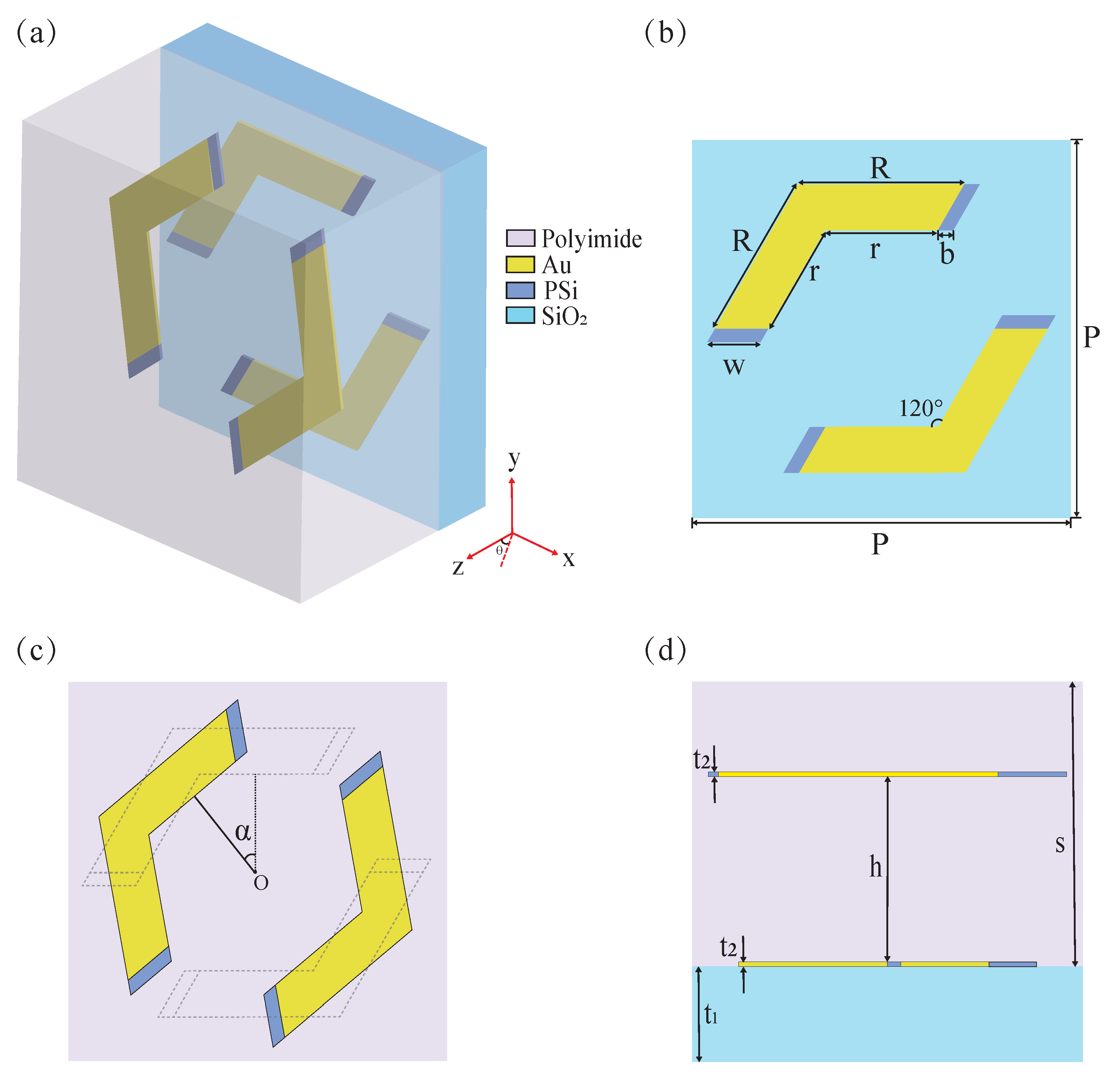
Figure 2.
The co-polarized reflections for x-polarized wave(a) and y-polarized wave(b), respectively, for forward and backward directions when PSi is in insulating state or metallic state.
Figure 2.
The co-polarized reflections for x-polarized wave(a) and y-polarized wave(b), respectively, for forward and backward directions when PSi is in insulating state or metallic state.
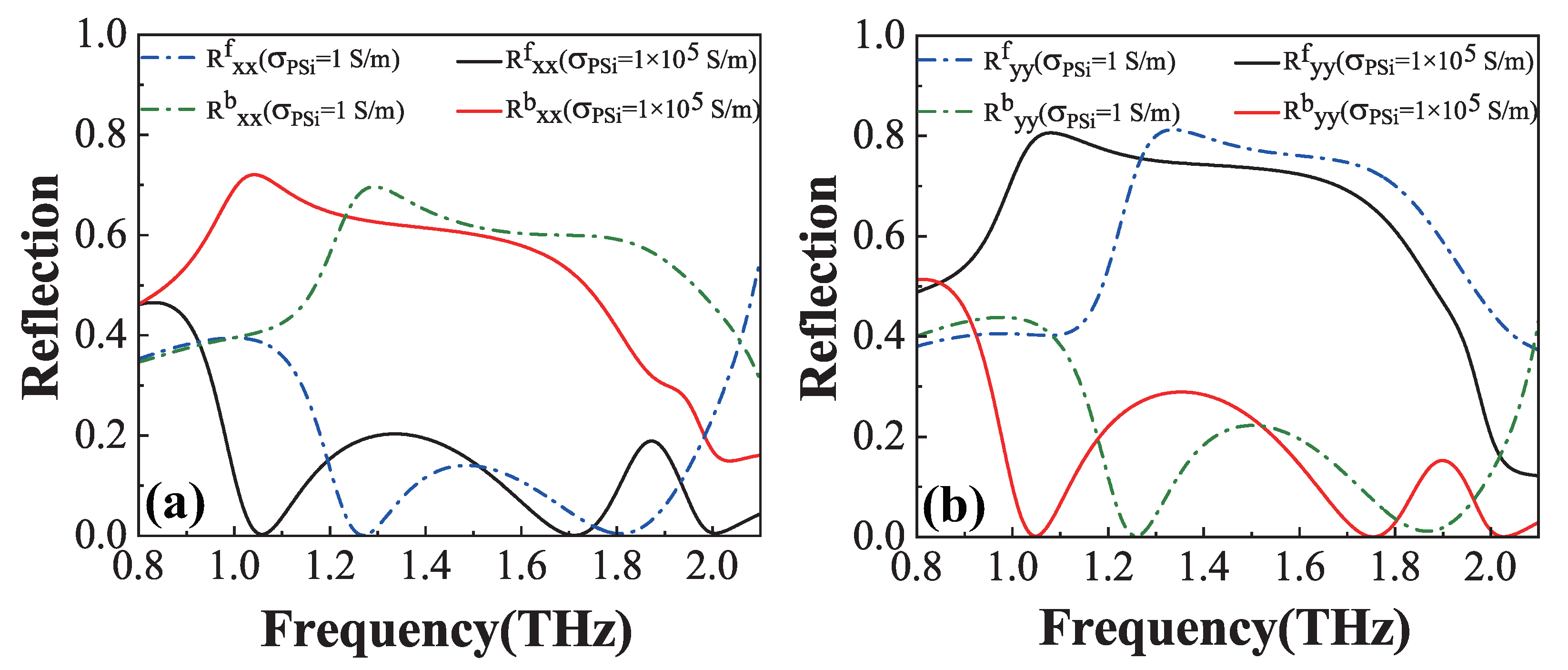
Figure 3.
The z-component electric field distributions for the upper (a1) - (d1) and lower (a2) - (d2) resonators at 1.27 THz and 1.79 THz for x-polarized wave along the forward and backward directions, respectively.
Figure 3.
The z-component electric field distributions for the upper (a1) - (d1) and lower (a2) - (d2) resonators at 1.27 THz and 1.79 THz for x-polarized wave along the forward and backward directions, respectively.
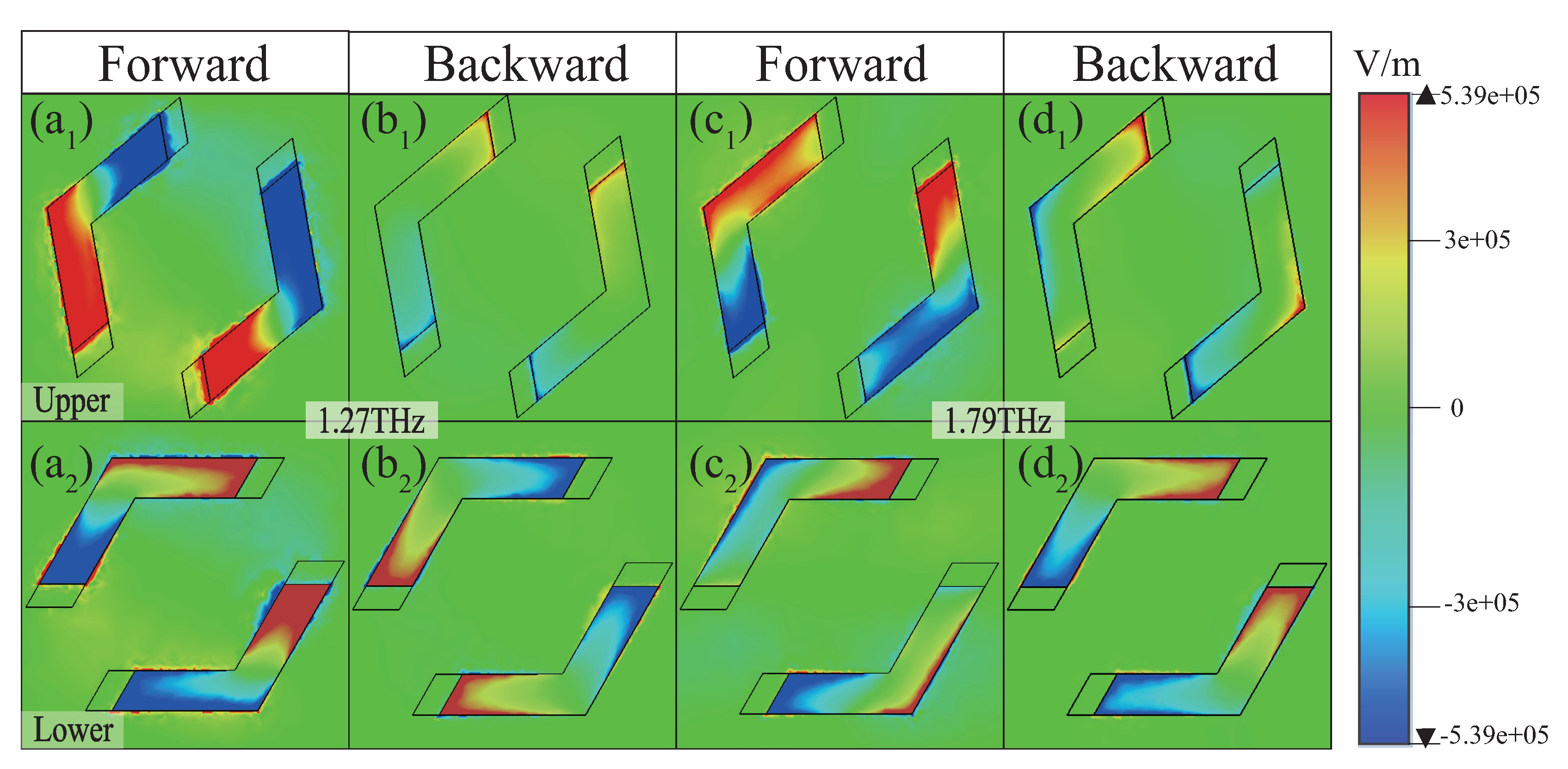
Figure 4.
The z-component electric field distributions for the upper (a1) - (d1) and lower (a2) - (d2) resonators at 1.26 THz and 1.86 THz for y-polarized wave along the forward and backward directions, respectively.
Figure 4.
The z-component electric field distributions for the upper (a1) - (d1) and lower (a2) - (d2) resonators at 1.26 THz and 1.86 THz for y-polarized wave along the forward and backward directions, respectively.
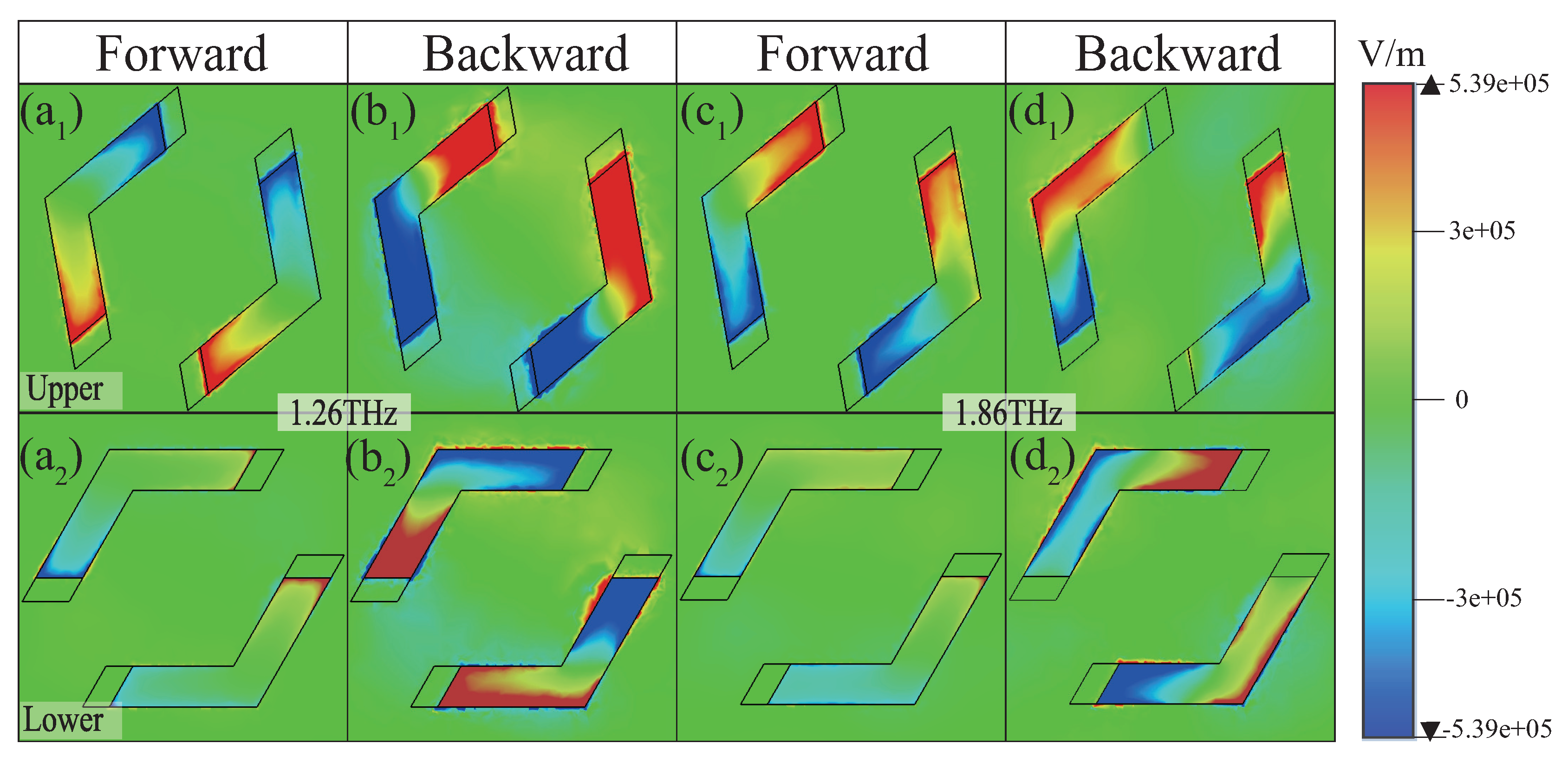
Figure 5.
The transmission characteristics of linearly polarized waves for both insulating and metallic states of PSi. The transmission spectra of y-polarized wave incident in the forward (a) and backward (c) directions, as well as x-polarized wave incident in the forward (b) and backward (d) directions.
Figure 5.
The transmission characteristics of linearly polarized waves for both insulating and metallic states of PSi. The transmission spectra of y-polarized wave incident in the forward (a) and backward (c) directions, as well as x-polarized wave incident in the forward (b) and backward (d) directions.
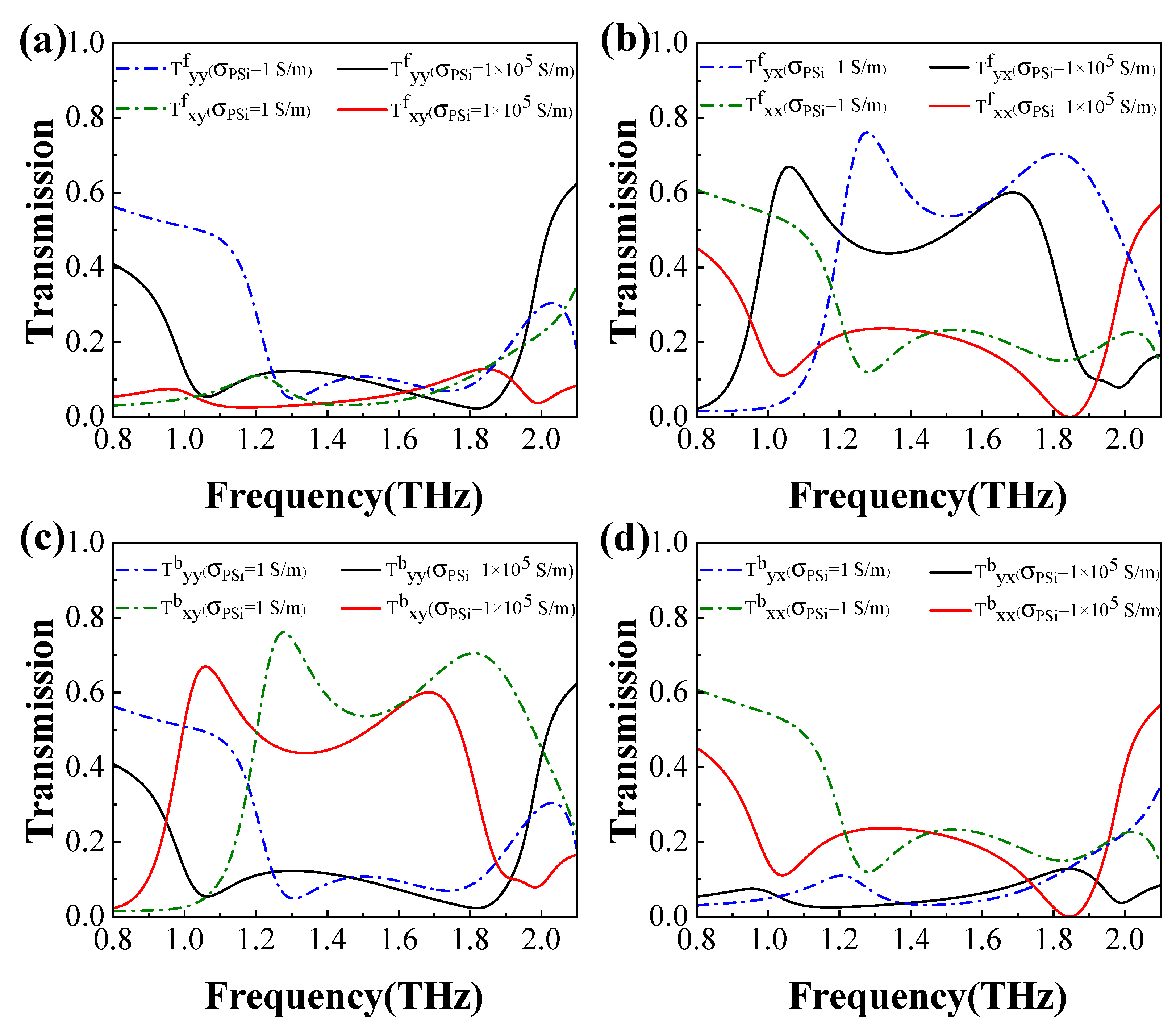
Figure 6.
The for forward (a) and for backward (b) directions, respectively, with PSi in the insulating and metallic states.
Figure 6.
The for forward (a) and for backward (b) directions, respectively, with PSi in the insulating and metallic states.
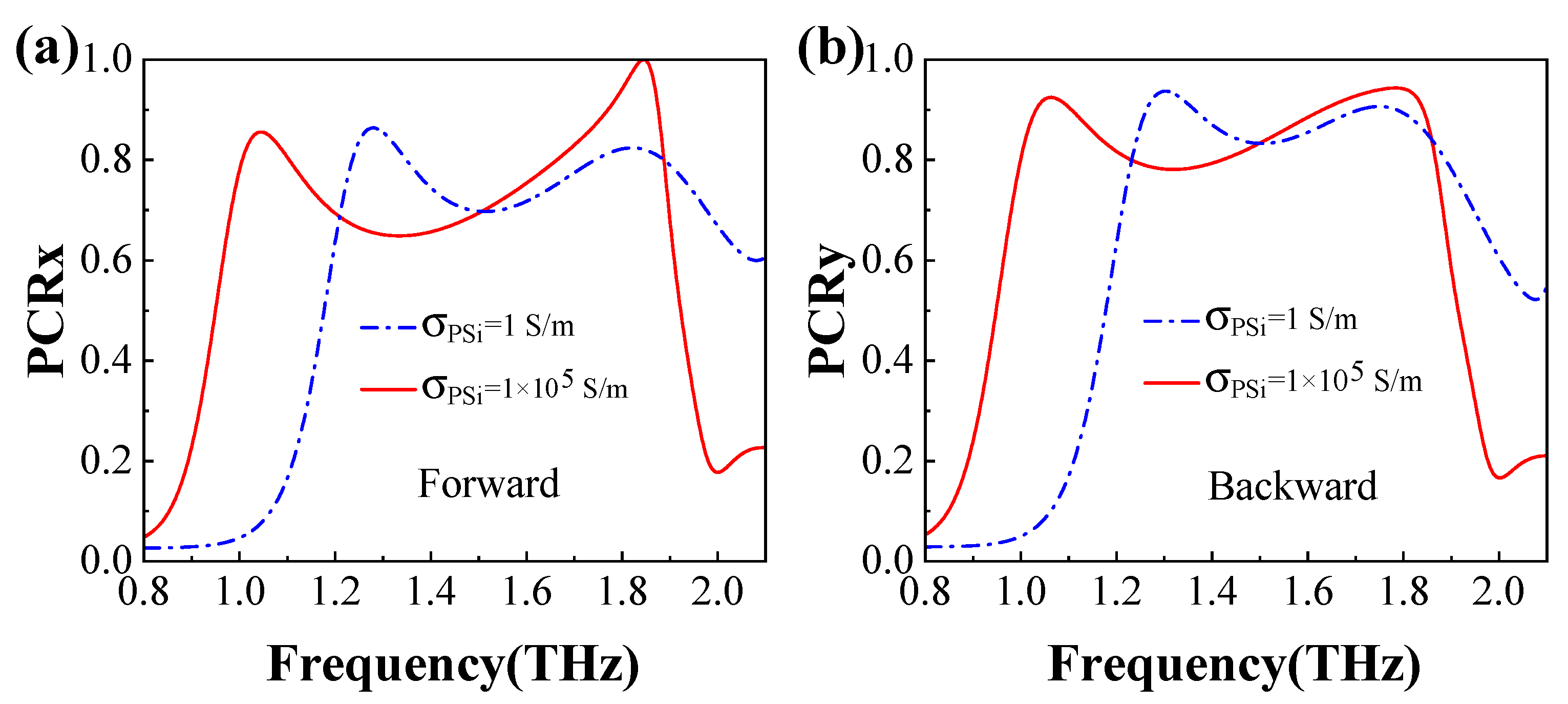
Figure 7.
The AT parameters of x- and y-polarized incident waves under insulating and metallic states of PSi.
Figure 7.
The AT parameters of x- and y-polarized incident waves under insulating and metallic states of PSi.
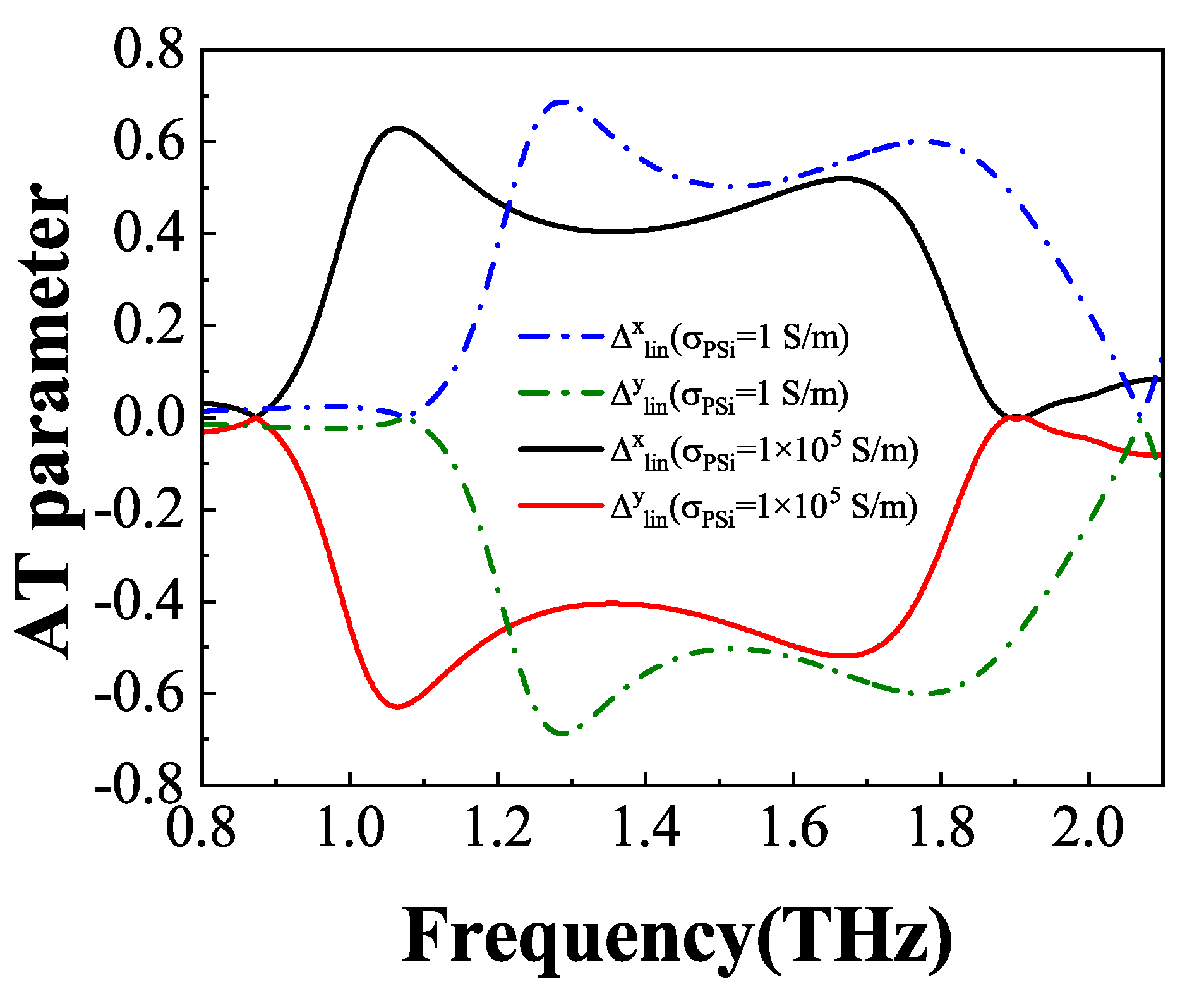
Figure 8.
The dependences of co-polarized reflections of the linearly polarized incident waves on the incident angle and frequency for both forward and backward directions when PSi is in insulating state (a-d) and metallic state (e-h), respectively, in the case of PSi sheet length b=4 m.
Figure 8.
The dependences of co-polarized reflections of the linearly polarized incident waves on the incident angle and frequency for both forward and backward directions when PSi is in insulating state (a-d) and metallic state (e-h), respectively, in the case of PSi sheet length b=4 m.
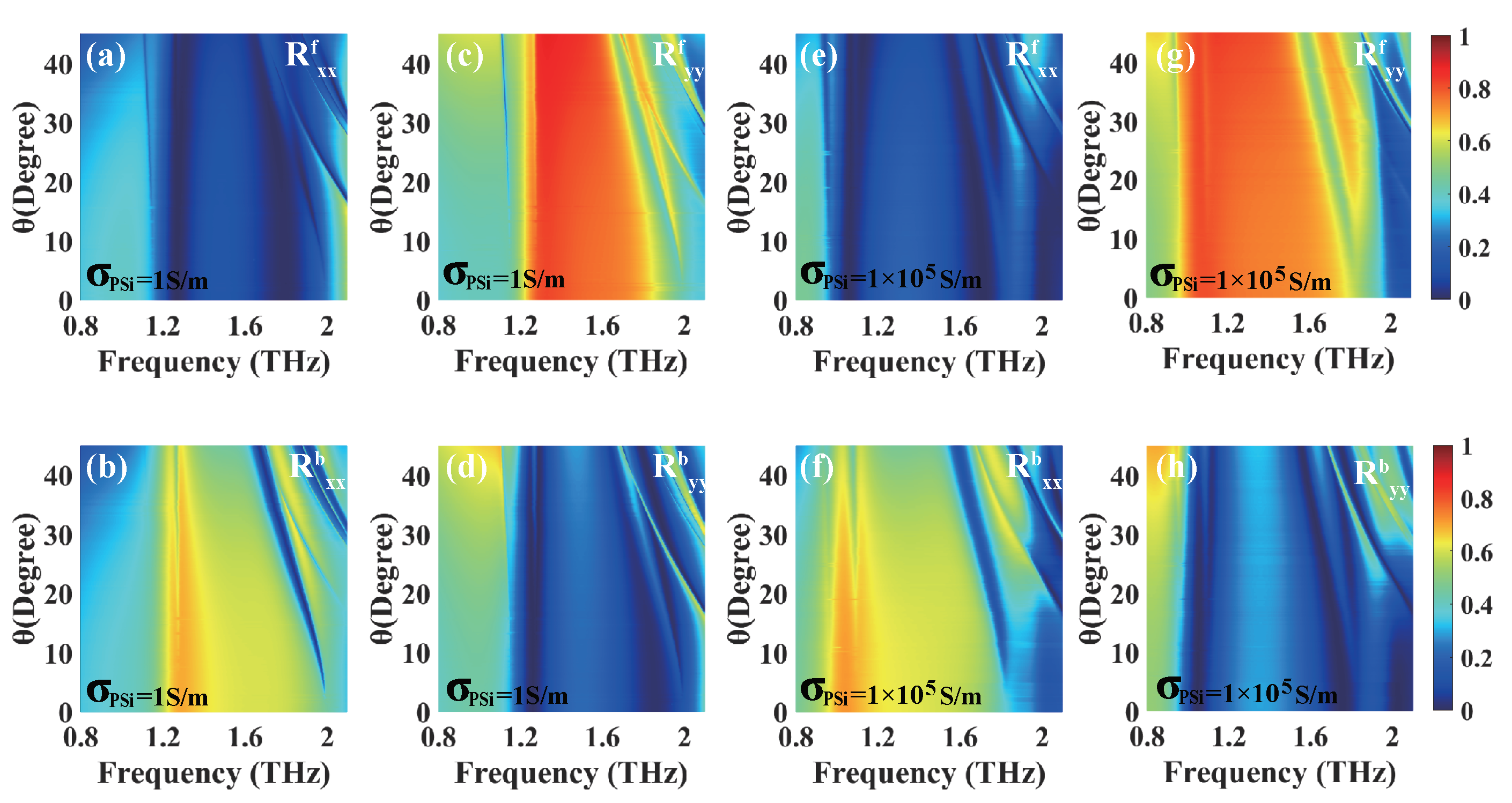
Figure 9.
The dependences of co-polarized reflections on the length b of the PSi sheet and frequency for both forward and backward directions when PSi is in insulating state (a-d) and metallic state (e-h), respectively, in the case of incident angle =0°.
Figure 9.
The dependences of co-polarized reflections on the length b of the PSi sheet and frequency for both forward and backward directions when PSi is in insulating state (a-d) and metallic state (e-h), respectively, in the case of incident angle =0°.
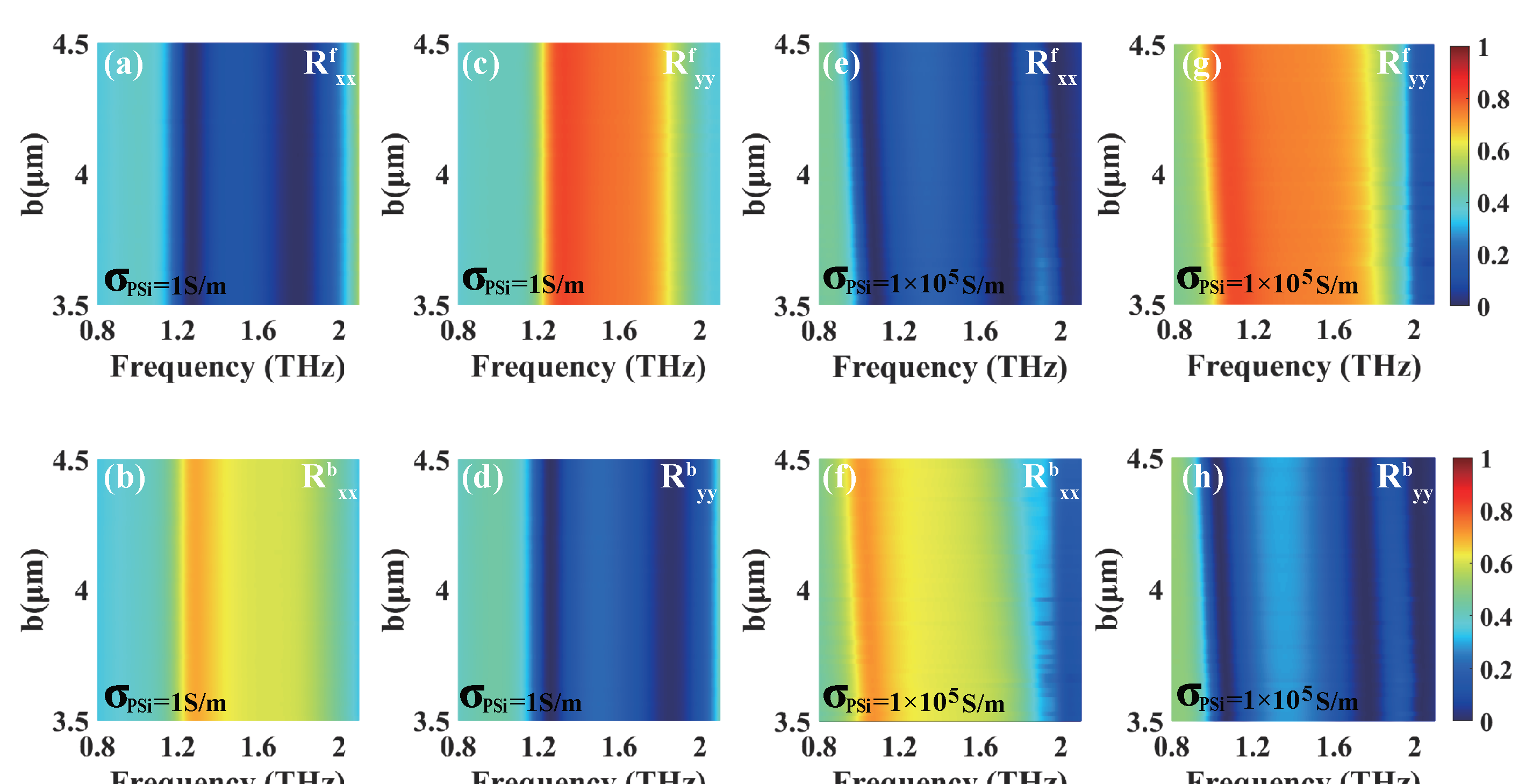
Figure 10.
AT parameter varied with the incident angle ((a),(b)) and the length b of PSi sheet ((c),(d)) in insulating ((a),(c)) and metallic ((b),(d)) states of PSi, respectively, when the length b=4 m and incident angle =0°.
Figure 10.
AT parameter varied with the incident angle ((a),(b)) and the length b of PSi sheet ((c),(d)) in insulating ((a),(c)) and metallic ((b),(d)) states of PSi, respectively, when the length b=4 m and incident angle =0°.
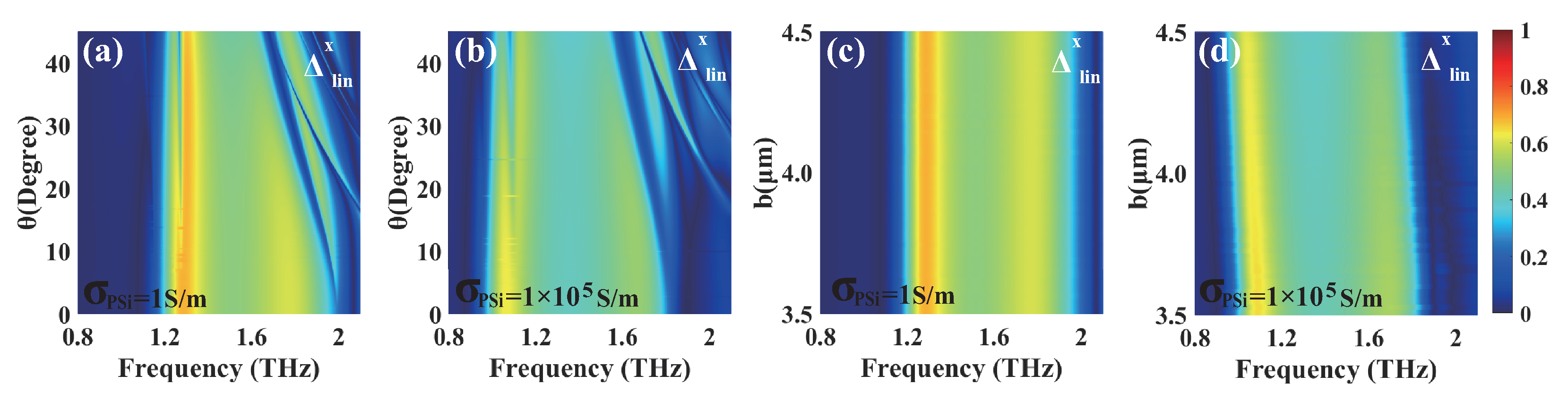

Table 1.
Comparison with other functional devices.
| References | Incident light type | Tunable material | Function | PC type | Spectrum range | Frequency shift |
|---|---|---|---|---|---|---|
| LPL | PSi,VO2 | PC, LTCPC | R,T | THz | No | |
| LPL | PSi,Graphene | T,A,R | No | THz | No | |
| LPL | PSi,VO2 | PC,A | T | THz | No | |
| CPL | PSi | CDR,CDT | No | THz | No | |
| LPL | PSi | EIT | No | THz | No | |
| LPL | PSi | A | No | THz | Red-shift, Blue-shift | |
| This work | LPL | PSi | UR,PC,AT | T | THz | Red-shift |
* Explanation of abbreviations: LPL: linearly polarized light, CPL: circularly polarized light, LTCPC: linear to circular polarization conversion, R: reflection, T: transmission, A: absorption, CDR: circular dichroism of reflection, CDT: circular dichroism of transmission, EIT: electromagnetically induced transparency.
Disclaimer/Publisher’s Note: The statements, opinions and data contained in all publications are solely those of the individual author(s) and contributor(s) and not of MDPI and/or the editor(s). MDPI and/or the editor(s) disclaim responsibility for any injury to people or property resulting from any ideas, methods, instructions or products referred to in the content. |
© 2025 by the authors. Licensee MDPI, Basel, Switzerland. This article is an open access article distributed under the terms and conditions of the Creative Commons Attribution (CC BY) license (http://creativecommons.org/licenses/by/4.0/).
Copyright: This open access article is published under a Creative Commons CC BY 4.0 license, which permit the free download, distribution, and reuse, provided that the author and preprint are cited in any reuse.


