
Submitted:
20 April 2025
Posted:
21 April 2025
You are already at the latest version
Abstract
Gardenia jasminoides Ellis is an evergreen plant of the genus Gardenia in the Rubiaceae Juss. trehalose (Tre), as a stress metabolite of plants adapted to environmental stress, can enhance the stress resistance of plants and ensure the normal growth and development of crops. In order to explore the effect and mechanism of trehalose on the growth and cold resistance of gardenia seedlings under low temperature stress, this study treated the seedlings with trehalose under different degrees of low temperature stress, observed their growth conditions, and discussed the effects of trehalose on cold resistance of Gardenia from the perspectives of phenotype, photosynthesis, active oxygen species, antioxidant system, endogenous hormones and respiratory metabolic products. To provide a theoretical basis for trehalose to improve cold resistance of plants. The results show that: Low temperature stress at − 3℃ significantly inhibited the growth of Gardenia, while trehalose at 15 mmol/L restored plant height, number of leaves, total plant weight, fresh weight of above ground and underground parts to 88.10%, 81.05%, 98%, 87.61% and 96.68% of the normal temperature conditions at 20℃. The total length of root, number of lateral roots, total root surface area and root volume recovered to 88.48%, 74.08%, 104.03% and 83.77% under normal temperature at 20℃. The chlorophyll content, chlorophyll fluorescence parameters and photosynthetic intensity parameters in leaves of gardenia jasminoides were significantly decreased under low temperature stress at − 3℃, while the contents of chlorophyll a, chlorophyll b and total chlorophyll were significantly increased under 15 mmol/L trehalose treatment (by 90.56%, 45.16% and 74.39%, respectively). Meanwhile, chlorophyll fluorescence parameters (φPSII, Fv '/Fm' and qP increased by 18.60%, 73.17% and 81.82%, respectively) and photosynthetic intensity parameters (Pn, Gs, Ci and Tr increased by 33.33%, 70.86%, 14.83% and 116.50%, respectively) were also increased. At -3℃, trehalose treatment at 15 mmol/L could significantly increase the activities of SOD, POD and CAT in roots of Gardenia (increased by 12.76%, 32.64% and 10.69%, respectively), and reduce the content of reactive oxygen species (H2O2 and superoxide anion radical decreased by 20.49% and 3.39%, respectively). At the same time, the contents of root osmotic regulatory substances (proline and malondialdehyde) were decreased by 15.16% and 12.65%, respectively. At -3℃, trehalose treatment at 15 mmol/L significantly increased root auxin content (32.03%) and significantly decreased trans-zeanoside content (14.92%), but had no significant effects on gibberellin and abscisic acid contents. 15 mmol/L trehalose can also regulate the content of root respiratory metabolites under low temperature stress, and increase malic acid content by 96.77% under -3℃ low temperature stress, while decrease succinic acid content by 56.34%. In conclusion, low temperature stress inhibited the growth of Gardenia. Trehalose could increase chlorophyll content and chlorophyll fluorescence parameters in leaves of Gardenia and enhance photosynthesis to promote the growth of Gardenia. Under low temperature stress, trehalose can reduce the content of active oxygen by improving the antioxidant capacity of roots of gardenia seedlings, so as to reduce the damage of active oxygen, maintain the level of active oxygen metabolism and enhance the cold resistance of plants. Trehalose also enhanced the osmoregulation ability and the stability of cell membrane by reducing the content of root osmoregulation substances, and enhanced the cold resistance of Gardenia by regulating the content of root hormones and aerobic respiratory metabolites.
Keywords:
Trehalose
; Low temperature stress
; Gardenia
; Photosynthesis
; Hormone
1. Introduction
There are about 250 species of Gardenia (Gardenia jasminoides) in the world. Gardenia is suitable for growing in warm and humid environments, mainly distributed in tropical and subtropical regions. It is also found in temperate regions [1]. Gardenia belongs to the four seasons evergreen plant. The flowers have ornamental, medicinal, tea, dye extraction, oil extraction, spices and other uses. The fruits have gallbladder, liver protection, blood pressure reduction, swelling and sedation, antipyretic, anti-inflammatory and other functions [2].
Low temperature is a natural disaster often encountered in the process of crop growth and development, which will cause physiological damage to crops, resulting in yield decline and economic losses. Short-term low temperature stress will slow the growth and development of crops and reduce the protoplasmic capacity. With the intensification of low temperature stress, various tissues and organs of crops will be damaged, growth and metabolic activities will be inhibited, and even lead to cell death [3]. The root system is an important organ for plants to absorb water and nutrients [4,5]. After different degrees of low temperature stress, the root system will show different changes. Under mild low temperature, the root surface area and root volume increase, and the root tip cell structure is intact. Under heavy and low temperature conditions, root growth stops, cell wall begins to disintegrate, and root tip cells become loose and seriously cause death [6].
When plants are subjected to low temperature stress, a large number of reactive oxygen species will accumulate in the body, which will destroy the dynamic balance between the production and removal of original free radicals in the cell. A large amount of reactive oxygen species will not only induce membrane lipid peroxidation, which will destroy the cell membrane, but also cause serious damage to some macromolecules. Or a series of physiological and biochemical reactions in the body can cause serious effects [7]. Studies have confirmed that low temperature stress significantly increases the production rate of reactive oxygen species in maize seedlings, resulting in dynamic imbalance of free radicals in plants [8]. Therefore, improving the ability to remove reactive oxygen species in plants is an important way to improve the resistance of crops. Under stress conditions, plants can improve their resistance by self-regulation of protective enzyme system to resist the toxic effects of free radicals. Superoxide dismutase (SOD), catalase (POD) and peroxidase (CAT) are a class of enzymatic systems that can effectively remove reactive oxygen species from plants [8]. Previous studies have shown that low temperature stress significantly decreased the activities of three antioxidant enzymes (SOD, POD, CAT) in Phalaenopsis leaves, and high intensity low temperature inhibited or destroyed the intracellular antioxidant enzyme system [9]. Under normal growth conditions, free radicals in rice are in a dynamic level of continuous generation and elimination, but under low temperature conditions, the free radical generation rate in rice is far greater than the removal rate [10]. Within a certain range, antioxidant substances such as SOD increase, but after strong low temperature stress, the antioxidant oxidase activity in rice rapidly increases and then significantly decreases. This indicates that strong low temperature destroys the protease synthesis mechanism in rice, affects the normal life activities, and ultimately affects the yield [10].
Osmotic adjustment ability is an important reflection of plant adaptation to low temperature. The normal metabolic activities of plant cells will change under stress, forcing the increase of osmoregulatory substances in the body. Osmoregulatory substances can not only maintain cell turgor pressure and prevent excessive water loss of protoplasm, but also stabilize organelle structure, thereby regulating certain physiological functions and alleviating the damage to plants under stress [11]. Osmoregulatory substances in plants mainly include proline, soluble protein and soluble sugar [11]. With the change of external environment, the contents of the three substances in plants will change significantly, and their contents are related to the low temperature tolerance of plants [11]. Research results confirmed that soluble protein content in plants was positively correlated with their ability to resist low temperature [12]. As a protective substance of plant tissues, the increase of soluble protein content can improve the water retention ability of cells, reduce the freezing point of cells, and alleviate the damage caused by low temperature to plants [12]. As an important osmoregulatory substance in plants, proline can prevent water loss and protect membrane proteins, and its content will change greatly under the influence of temperature, and it is of great significance for maintaining the integrity of cell membranes [13]. As an important osmoregulatory substance, soluble sugar content is the most sensitive index to reflect plant metabolism under low temperature stress [14]. When plants are stressed by stress, they will actively accumulate osmoregulatory substances such as soluble protein, proline and soluble sugar through osmoregulation, improve the water holding capacity of cells and enhance plant stress resistance [11].
Photosynthesis can promote the cold resistance of plants. Sugars (such as glucose) and amino acids produced by photosynthesis can directly increase the concentration of cell fluid, reduce the freezing point, and prevent the formation of intracellular ice crystals [15]. For example, cactus produces ‘cactin’ through photosynthesis, which can both resist drought and stabilize cell membrane structure to resist low temperature damage [16]. The fatty acid composition (such as cis-unsaturated fatty acid content) of chloroplast membrane is closely related to cold resistance. High content of cis-unsaturated fatty acids can maintain the fluidity of chloroplast membrane and ensure normal photosynthesis at low temperatures, thus enhancing cold tolerance [17]. Spraying potassium dihydrogen phosphate and other fertilizers can improve photosynthetic efficiency of leaves and increase cell fluid concentration [18]. Brassinolides promote the accumulation of photosynthates by regulating endogenous hormone balance, and increase cold resistance by more than 8 times [19]. Photosynthesis is not only the material basis of plant cold resistance (through sugar accumulation and membrane structure optimization), but also dynamically adjusted by low temperature environment. Exogenous substances supplement, such as the addition of trehalose, can jointly improve the photosynthetic efficiency and cold resistance of plants, forming a virtuous cycle [20,21].
Trehalose is a typical stress metabolite, which can form a unique protective film on the cell surface under harsh environmental conditions such as high temperature, high cold, high osmotic pressure and dry water loss, effectively protecting the structure of biomolecules from being destroyed, so as to maintain the life process and biological characteristics of living organisms. Current studies have shown that trehalose biosynthesis mainly consists of two reactions: first, trehalose 6-phosphate is produced by uridine diphosphate glucose and 6-phosphate glucose under the catalysis of trehalose 6-phosphate synthetase, and then trehalose 6-phosphate trehalose is produced under the hydrolysis of trehalose 6-phosphatase [22]. Trehalose is a safe, stable and very reliable natural sugar, which has a non-specific protective effect on biological macromolecules and organisms, especially under adverse conditions such as low temperature, drought, salt damage and high heat, and has an efficient protective effect on a series of biological macromolecules that maintain normal plant life activities [23].
Exogenous trehalose spray can protect plant proteins from damage under abiotic stress conditions such as low temperature, drought and salt damage [24]. Studies have shown that exogenous trehalose spray can reduce MDA content and relative permeability of plasma membrane under salt stress, and increase SOD and POD activities [25]. Under high temperature stress, exogenous trehalose spray increased ascorbic acid content, enhanced CAT and ascorbate peroxidase activities, and decreased MDA and hydrogen peroxide content in wheat seedlings [26]. At the same time, exogenous spray of trehalose can improve POD and CAT activities and ascorbic acid content of maize under drought stress, and alleviate oxidative damage under drought stress [27]. Under the condition of low temperature treatment, exogenous trehalose spray increased the relative water content, proline content and soluble sugar content of wheat, decreased MDA content, and alleviated the damage caused by low temperature stress [28]. Other studies have shown that trehalose has a promoting effect under salt stress, and salt stress leads to a significant decrease in plant height, stem diameter, dry and fresh weight, strong seedling index, etc., of muskmelon seedlings. However, after applying different concentrations of trehalose, various indexes of muskmelon seedlings are improved, and root activity and soluble sugar content are increased, indicating that within a certain concentration range of trehalose, It also has a alleviating effect on physiological and biochemical characteristics of plants and seedlings [29].
As a landscape plant, gardenia is suitable for growing in a warm and humid environment, but the harsh climate such as cold spring occurs frequently, which seriously affects the growth of gardenia. Trehalose, as the stress metabolite of plants adapted to environmental stress, can enhance the stress resistance of plants and ensure the normal growth and development of crops. The main purpose of this study was to explore the effect and mechanism of trehalose on the growth and cold resistance of gardenia seedlings under low temperature stress. The main significance of this study was to provide new technology and theoretical support for cold resistance cultivation of gardenia from the perspective of exogenous trehalose.
2. Materials and Methods
2.1. Plant Material and Experimental Design
The experiment adopted a two-factor design: (1) trehalose treatment (including 0 mmol/L Tre and 15 mmol/L Tre); (2) Low temperature treatment (20℃, 10℃, 0℃ and -3℃). The experiment consisted of 8 treatments with 5 replicates per treatment group (1 basin per replicate) and a total of 40 POTS. In this experiment, gardenia seedlings were transplanted into plastic POTS on April 12, 2023, and then the plastic POTS were placed in light incubators at four temperatures (20℃, 10℃, 0℃ and -3℃). Hoaglang nutrient solution was irrigated from the day of planting, and the nutrient solution with corresponding concentration of trehalose was irrigated once every three days. Plants were harvested on June 11, 2023 after 2 months of trehalose treatment at 4 temperatures and corresponding concentrations.
2.2. Plant Growth Index and Root System Configuration
Before harvest, the plant height was measured with a ruler (cm), and the number of fully unfolded leaves was measured by counting method. After harvest, the total weight of plants, fresh weight of above-ground parts and underground parts were measured by electronic balance. After the plants were harvested, root images were obtained by Epson V700 color image scanner, and root configuration parameters (root length, number of lateral roots, total root surface area, root volume, etc.) were obtained by WinRHIZO root analyzer.
2.3. Chlorophyll in Leaves, Chlorophyll Fluorescence Parameters and Photosynthetic Intensity Parameters
Multifunctional leaf measuring instrument was used to measure the content of chlorophyll in plants. Before harvesting plants, healthy and fully unfolded leaves were selected, and the content of chlorophyll a, chlorophyll b and total chlorophyll were measured after wiping the leaves with a clean wet cloth. The chlorophyll fluorescence parameters were determined by IMAGING-PAM, a German M-series modulated chlorophyll fluorescence meter. Before harvesting, Gardenia of different treatments were completely unfolded and measured from 09:00-11:00. After dark adaptation treatment for 20 min, the blades were fixed on the loading platform. The actual photochemical efficiency (φPSII), maximum photochemical efficiency (Fv'/Fm'), non-photochemical quenching coefficient (NPQ) and photochemical quenching coefficient (qP) in the blades were measured to evaluate the light energy utilization efficiency. Before harvesting plants, leaf photosynthetic parameters were determined by Li-6400 photosynthesator. Functional leaves at the 4th to 5th positions with good physiological status were selected as the measurement objects, and parameters such as transpiration rate (Tr), net photosynthetic rate (Pn), intercellular CO2 concentration (Ci) and stomatal conductance (Gs) were obtained.
2.4. Activities of Reactive Oxygen Species and Antioxidant Enzymes and Contents of Osmotic Substances in Roots
By hydroxylamine oxidation method, hydroxylamine (NH2OH) and O2⁻· specific reoxidation reaction, determination of absorbance at 540 nm wavelength, calculate the concentration of NO2- by the standard curve, can reflect the content of superoxide anion. Hydrogen peroxide (H2O2) is analyzed by titanium sulfate colorimetry. Titanium sulfate reacts with hydrogen peroxide to produce yellow precipitate. The precipitate can detect the concentration of hydrogen peroxide by measuring OD value at 415 nm.
The activities of superoxide dismutase (SOD), peroxidase (POD) and catalase (CAT) were determined by nitrogen blue tetrazole photoreduction method, guaiacol color development method and ammonium molybdate color development method.
The proline content was determined by sulfosalicylic acid extraction and acid indanhydrin color development method. The product was obtained by this method and placed at 520 nm wavelength, and then the concentration of proline was converted by detecting OD value of the wavelength. The soluble sugar was detected by anthrone color development method. The product obtained by this method was placed at 620 nm wavelength, and then the content of soluble sugar could be converted by detecting the OD value of the wavelength. The content of malondialdehyde was determined by thiobarbituric acid (TBA) color development method. The concentration of malondialdehyde was obtained by detecting OD600, OD532 and OD450 of the reaction products on the spectrophotometer. Soluble protein content was determined by Coomasil bright blue (G-250) staining method. 20 μL extract solution (enzyme solution) was added to 80 μL, 0.05 mol·L-1, pH 7.8 phosphate buffer, then 2.9 mL Coomasil bright blue solution was added, and OD595 was measured after reaction for 2 min. The soluble protein concentration can be obtained by calculating the value.
2.5. Endogenous Hormones, Malic Acid and Succinic Acid in Roots
Determination of endogenous hormones in roots using kit (Nanjing Jiancheng Bioengineering Research Institute Co., LTD.) They were plant growth hormone (IAA) ELISA kit, plant trans-zeaxin nucleoside (tZR) ELISA kit, plant abscisic acid (ABA) ELISA kit and plant gibberellin (GA3) ELISA kit. The above kits are based on the principle of double antibody sandwich method to detect hormone content in plant samples. Malic acid and succinic acid contents were determined by high performance liquid chromatography (HPLC) : 1.00 g of gardenia root was accurately weighed and mixed by a blender, ground with 4 mL of extraction solution, centrifuged for 10 min at 10000 r/min, and the residue was added with 2 mL of extraction solution and then extracted, combined with the supernatant, dried in a water bath at 90℃, at a fixed volume of 10 mL, and then extracted with a disposable syringe after whirlpool mixing. It was filtered by 0.45 μm filter membrane and analyzed by machine.
2.6. Statistical Analysis
We performed a variance analysis (ANOVA) (SAS software 8.1v, SAS Institute, Gaston County, North Carolina, USA) to statistically analyze the data. Microsoft Excel (Version 2013, Microsoft Institute, Redmond, WA, USA) was used for data processing and graphing, and Duncan’s multirange experiment compared significant differences between treatments with p < 0.05.
3. Results
3.1. Effects of Trehalose on the Growth of Gardenia Under Low Temperature Stress
The effect of trehalose on the growth of gardenia under low temperature stress was shown in Figure 1. The plant height, leaf number and fresh weight of Gardenia were decreased by low temperature stress. Compared with 20℃ treatment, 10℃, 0℃ and -3℃ treatment significantly reduced plant height by 9.12%, 13.78% and 20.54%, respectively (Table 1). Compared with 20 ℃, treatments at 10℃ and 0℃ had no significant effects on the number of leaves, total plant weight, fresh weight in above ground and fresh weight in underground part, but treatment at -3℃ significantly reduced the number of leaves, total plant weight, fresh weight in above ground and fresh weight in underground part by 43.81%, 24.48%, 22.39% and 23.46% (Table 1). In conclusion, low temperature stress inhibited the growth of Gardenia, especially at -3℃.
It can also be seen from Table 1 that exogenous Tre significantly promoted the growth of gardenia. Compared with 0 mmol/L Tre treatment, 15 mmol/L Tre treatment significantly increased the plant height of gardenia at 20℃, 10℃, 0℃ and -3℃, by 9.88%, 17.26%, 12.65% and 10.88% respectively (Table 1). Compared with 0 mmol/L Tre treatment, at 20℃, 10℃, 0℃ and -3℃, 15 mmol/L Tre treatment also increased the number of leaves, total plant weight, above-ground fresh weight and subsurface fresh weight of Gardenia in different degrees, and the number of leaves increased by 11.64%, 3.33%, 5.49% and 44.24%, respectively. Total plant weight increased by 30.56%, 16.08%, 27.52% and 29.77%, above ground fresh weight increased by 21.25%, 24.14%, 27.92% and 12.88%, and underground fresh weight increased by 42.65%, 31.13%, 21.65% and 26.32%, respectively (Table 1). It can be concluded that Tre can effectively promote the growth of gardenia.
It is worth noting that under -3℃ low temperature stress, 15 mmol/L Tre treatment can significantly alleviate the inhibitory effect of low temperature stress on the growth of Gardenia. Compared with 20℃ without Tre, plant height, leaf number, total plant weight, above-ground and subsurface fresh weight of Gardenia under low temperature stress at -3℃ without Tre significantly decreased by 20.54%, 43.81%, 24.48%, 22.39% and 23.46%. However, exogenous addition of 15 mmol/L Tre at -3℃ reduced plant height, leaf number, total plant weight, above-ground significance and subsurface fresh weight to 88.10%, 81.05%, 90.01%, 87.61% and 96.68% (Table 1). In conclusion, Tre can effectively alleviate the inhibitory effect of low temperature stress on the growth of Gardenia.
3.2. Influence of Trehalose on Root Configuration of Gardenia Under Low Temperature Stress
The effects of trehalose on root configuration indexes of gardenia seedlings under low temperature stress were shown in Figure 2. Low temperature stress decreased the root length, lateral root number and root volume, but had no significant effect on total root surface area. Compared with 20℃, 10℃, 0℃ and -3℃ reduced the total length of roots by 7.10%, 13.94% and 20.28%, respectively; 10℃, 0℃ and -3℃ reduced the number of lateral roots by 3.44%, 22.35% and 37.72%, respectively. Treatment at 10℃, 0℃ and -3℃ reduced root volume by 7.46%, 15.79% and 20.61%, respectively (Table 2). It should be noted that compared with the 20℃ treatment, the root length, lateral root number and root volume were significantly reduced by 20.28%, 37.72% and 20.61% at -3℃, but the total root surface area was not significantly affected (Table 2). In conclusion, low temperature stress inhibited the root growth of Gardenia, especially at -3℃.
Table 2 also showed that exogenous Tre significantly promoted the root development of Gardenia. Compared with 0 mmol/L Tre treatment, 15 mmol/L Tre treatment significantly increased the total root length of gardenia at 20℃, 10℃, 0℃ and -3℃, by 15.77%, 17.12%, 22.63% and 10.99%, respectively (Table 2). Compared with 0 mmol/L Tre treatment, at 20℃, 10℃, 0℃ and -3℃, 15 mmol/L Tre treatment also increased the number of lateral roots, total root surface area and root volume to varying degrees, and the number of lateral roots increased by 3.29%, 13.45%, 38.91% and 18.94%, respectively. The total root surface area increased by 19.88%, 24.45%, 27.99% and 14.36%, and the root volume increased by 0.88%, 9.21%, 6.77% and 5.52%, respectively (Table 2).
It is worth noting that under -3℃ low temperature stress, 15 mmol/L Tre treatment can significantly alleviate the inhibitory effect of low temperature stress on root growth and development of Gardenia. Compared with 20℃ without Tre, the total root length, lateral root number, total root surface area and root volume of Gardenia under low temperature stress at -3℃ without Tre significantly decreased by 20.28%, 37.72%, 9.03% and 20.61%. However, the total root length, lateral root number, total root surface area and root volume recovered to 88.48%, 74.08%, 104.03%, and 83.77% after exogenous addition of 15 mmol/L Tre under -3℃ low temperature stress (Table 2). In conclusion, Tre can effectively alleviate the inhibitory effect of low temperature stress on root growth of Gardenia.
3.3. Effects of Trehalose on Chlorophyll Content of Gardenia Under Low Temperature Stress
The effects of trehalose on chlorophyll content and chlorophyll fluorescence parameters of leaves of Gardenia seedlings under low temperature stress are shown in Table 3. The contents of chlorophyll a, chlorophyll b and total chlorophyll of gardenia were decreased by low temperature stress. Compared with 20℃, 10℃, 0℃ and -3℃ reduced chlorophyll a content by 3.81%, 35.24% and 49.52%, respectively, and 10℃, 0℃ and -3℃ reduced chlorophyll b content by 4.08%, 28.57% and 36.73%, respectively. Treatment at 10℃, 0℃ and -3℃ reduced total chlorophyll content by 1.32%, 32.45% and 43.71%, respectively (Table 3). It is worth noting that compared with 20℃ temperature treatment, -3℃ treatment significantly reduced the contents of chlorophyll a, chlorophyll b and total chlorophyll by 49.52%, 36.73% and 43.71% (Table 3). In conclusion, low temperature stress inhibited the synthesis of chlorophyll in leaves of Gardenia to different degrees, especially at -3℃.
It can also be seen from Table 3 that exogenous Tre significantly promoted the growth of gardenia. Compared with 0 mmol/L Tre treatment, at 20℃, 10℃, 0℃ and -3℃, 15 mmol/L Tre treatment significantly increased chlorophyll a of gardenia by 19.05%, 10.89%, 52.94% and 90.57%, respectively (Table 3). Compared with 0 mmol/L Tre treatment, at 20℃, 10℃, 0℃ and -3℃, 15 mmol/L Tre treatment also increased chlorophyll b and total chlorophyll to varying degrees, in which chlorophyll b increased by 12.24%, 6.38%, 28.57% and 45.16%, respectively. Total chlorophyll increased by 19.87%, 8.05%, 47.06% and 71.76%, respectively (Table 3). It can be concluded that Tre can effectively promote the synthesis of chlorophyll in gardenia leaves.
It is worth noting that under -3℃ low temperature stress, 15 mmol/L Tre treatment significantly alleviated the inhibition of low temperature stress on chlorophyll synthesis of gardenia leaves. Compared with 20℃ without Tre, low temperature stress at -3℃ without Tre significantly reduced chlorophyll a, chlorophyll b and total chlorophyll of gardenia by 49.52%, 36.73% and 43.71%. However, exogenous addition of 15 mmol/L Tre under -3℃ low temperature stress caused chlorophyll a, chlorophyll b and total chlorophyll to recover to 96.19%, 91.84% and 96.69% (Table 3). In conclusion, Tre can effectively alleviate the inhibition effect of low temperature stress on chlorophyll synthesis in leaves of Gardenia.
3.4. Effects of Trehalose on Chlorophyll Fluorescence Parameters of Gardenia Under Low Temperature Stress
The effects of trehalose on chlorophyll fluorescence parameters of gardenia under low temperature stress are shown in Table 4. Low temperature stress decreased the values of φPSII, Fv'/Fm' and qP, but had no significant effect on NPQ. Compared with 20℃, 10℃, 0℃ and -3℃ can reduce φPSII by 3.23%, 25.81% and 30.65%, and Fv'/Fm' by 6.17%, 28.39% and 49.38%, respectively. qP decreased by 6.45%, 58.06% and 64.52% in varying degrees (Table 4). Compared with the 20℃ treatment, although the 10℃ treatment has no significant effect on the φPSII, Fv'/Fm' and qP, the -3℃ treatment significantly reduces the φPSII, Fv '/Fm' and qP values (Table 4). It can be seen that the chlorophyll fluorescence parameters in leaves of Gardenia were reduced to different degrees under low temperature stress, especially under -3℃ low temperature stress.
It can also be seen from Table 4 that exogenous Tre improves chlorophyll fluorescence parameters in leaves to varying degrees. Compared with 0 mmol/L Tre treatment, φPSII values in leaves of Gardenia treated with 15 mmol/L Tre at 20℃, 10℃, 0℃ and -3℃ were increased by 1.61%, 3.33%, 28.26% and 18.60%, respectively (Table 4). Compared with 0 mmol/L Tre treatment, at 20℃, 10℃, 0℃ and -3℃, the Fv '/Fm' and qP values of 15 mmol/L Tre treatment also increased by 1.23%, 2.63%, 24.14% and 70.73%, respectively. qP increased by 3.23%, 3.45%, 69.23% and 81.81%, respectively (Table 5). Compared with 0 mmol/L Tre treatment, 15 mmol/L Tre treatment at 20℃, 10℃, 0℃ and -3℃ reduced the NPQ value by 2.47%, 2.44%, 6.82% and 5.62%, respectively, but there were no significant differences (Table 4). It can be concluded that Tre can effectively improve chlorophyll fluorescence parameters in leaves of Gardenia and improve light use efficiency.
It is worth noting that under -3℃ low temperature stress, 15 mmol/L Tre treatment can significantly alleviate the effect of low temperature stress on chlorophyll fluorescence parameters. Compared with 20℃ without Tre, the values of φPSII, Fv '/Fm' and qP were significantly reduced by 30.65%, 49.38% and 64.52% under low temperature stress at -3℃ without Tre. However, exogenous addition of 15 mmol/L Tre at -3℃ reduced the values of φPSII, Fv '/Fm' and qP to 82.26%, 86.42% and 64.52% (Table 4). In conclusion, Tre can effectively alleviate the effect of low temperature stress on chlorophyll fluorescence parameters in leaves of Gardenia, and enhance the light use efficiency.
3.5. Effects of Trehalose on Photosynthesis of Gardenia Leaves Under Low Temperature Stress
The effects of trehalose on photosynthetic intensity parameters of leaves of Gardenia seedlings under low temperature stress are shown in Table 5. Low temperature stress decreased Pn, Gs, Ci and Tr of Gardenia in different degrees. Compared with 20℃, 10℃, 0℃ and -3℃ reduced Pn by 3.33%, 19.85% and 36.00%, Gs by 3.20%, 35.23% and 46.26%, and Ci by 2.01%, 3.64% and 16.41%, respectively. Tr decreased by 10.57%, 36.01% and 70.57% in different degrees (Table 5). It is worth noting that Pn, Gs, Ci and Tr at -3℃ showed the most serious decline, which significantly decreased by 36.00%, 46.26%, 16.41% and 70.57%, respectively, compared with 20℃ treatment (Table 5). In conclusion, low temperature stress inhibited the photosynthetic intensity and photosynthetic efficiency of Gardenia, especially at -3℃.
It can also be seen from Table 5 that exogenous Tre enhances the photosynthetic intensity and photosynthetic efficiency of gardenia leaves in different degrees. Compared with 0 mmol/L Tre treatment, at 20℃, 10℃, 0℃ and -3℃, the leaf Pn of 15 mmol/L Tre treatment increased by 9.86%, 2.3%, 12.62% and 33.33%. The leaf Gs of gardenia increased by 3.91%, 14.23%, 47.80% and 70.86%, the leaf Ci of gardenia increased by 2.26%, 1.92%, 2.90% and 14.83%, and the leaf Tr of gardenia increased by 1.43%, 2.88%, 27.23% and 116.50%, respectively (Table 5). In conclusion, Tre can effectively enhance the photosynthetic intensity, light and efficiency of Gardenia leaves.
It is worth noting that under -3℃ low temperature stress, 15 mmol/L Tre treatment can significantly alleviate the inhibition of low temperature stress on the photosynthetic intensity and photosynthetic efficiency of gardenia leaves. Compared with 20℃ without Tre, the Pn, Gs, Ci and Tr of Gardenia leaves under low temperature stress at -3℃ without Tre significantly decreased by 36.00%, 46.26%, 16.41% and 70.57%. However, the exogenous addition of 15 mmol/L Tre restored Pn, Gs, Ci and Tr to 85.33%, 91.81%, 96.02% and 63.71% (Table 5). In conclusion, Tre can effectively alleviate the inhibition effect of low temperature stress on photosynthetic intensity and photosynthetic efficiency of Gardenia leaves.
3.6. Effect of Trehalose on Active Oxygen Content of Gardenia Root Under Low Temperature Stress
The effects of trehalose on active oxygen species in the root system of Gardenia after low temperature stress were shown in Table 6. The contents of H2O2 and superoxide anion radical were increased by low temperature stress. Compared with treatment at 20℃, treatment at 10℃, 0℃ and -3℃ increased H2O2 content by 6.84%, 59.91% and 84.50%, respectively (Table 6). Compared with the treatment at 20℃, although the treatment at 10℃ and 0℃ had no significant effect on the content of superoxide anion free radicals, the treatment at -3℃ significantly increased the content by 10.62% (Table 6). In conclusion, low temperature stress promoted ROS production in the roots of Gardenia, especially at -3℃, which resulted in the highest ROS content in the roots.
It can also be seen from Table 6 that exogenous Tre can regulate ROS metabolism and reduce ROS accumulation. Compared with 0 mmol/L Tre treatment, at 20℃, 10℃, 0℃ and -3℃, 15 mmol/L Tre treatment reduced H2O2 content in roots of Gardenia by 1.08%, 4.76%, 12.71% and 20.49%, respectively. The treatment with 15 mmol/L Tre also reduced the content of superoxide anion radical by 4.36%, 0.97%, 1.08% and 3.39%, respectively (Table 6). In conclusion, Tre can effectively regulate the metabolism of ROS and reduce the accumulation of ROS.
It is worth noting that under -3℃ low temperature stress, 15 mmol/L Tre treatment can significantly alleviate the effect of low temperature stress on the ROS content in the roots of Gardenia. Compared with 20℃ and no Tre, the contents of H2O2 and superoxide anion radical in roots of Gardenia under low temperature stress at -3℃ and no Tre increased by 84.50% and 10.62%. However, exogenous addition of 15 mmol/L Tre under -3℃ low temperature stress only increased the content of H2O2 and superoxide anion radical by 46.70% and 6.87%, respectively (Table 6). In conclusion, Tre can effectively regulate the effect of low temperature stress on ROS metabolism in the roots of Gardenia, reduce the accumulation of ROS, and protect the structure and function of cell membrane.
3.7. Effect of Trehalose on Antioxidant Oxidase Activity of Gardenia Root Under Low Temperature Stress
The changes of antioxidant enzyme activity in roots were shown in Table 7. The activities of SOD, POD and CAT were increased by low temperature stress. Compared with 20℃, 10℃, 0℃ and -3℃ treatments increased SOD activity by 2.01%, 23.92% and 42.04%, POD activity by 15.45%, 38.43% and 92.39%, and CAT activity by 2.07%, 8.29% and 9.65%, respectively (Table 7). Compared with 20℃ treatment, although -3℃ treatment had no significant effect on CAT activity, it significantly increased SOD and POD activity by 42.04% and 92.39%, respectively (Table 7). In conclusion, low temperature stress enhanced the activity of antioxidant enzymes in the roots of Gardenia, especially at -3℃.
It can also be seen from Table 7 that exogenous Tre can enhance the activity of antioxidant enzymes in the root system of Gardenia, which can promote the removal of free radicals and reactive oxygen species in the root system, thus protecting cells from oxidative damage. Compared with 0 mmol/L Tre treatment, SOD activity of root of Gardenia at 20℃, 10℃, 0℃ and -3℃ was significantly increased at 15 mmol/L Tre treatment by 10.36%, 10.15%, 42.23% and 12.75%, respectively (Table 7). Compared with 0 mmol/L Tre treatment, at 20℃, 10℃, 0℃ and -3℃, 15 mmol/L Tre treatment also enhanced POD and CAT lady activities to varying degrees, with POD activities increased by 9.22%, 7.99%, 28.98% and 32.64%, respectively. CAT activity was increased by 7.59%, 7.43%, 5.74% and 10.71%, respectively (Table 7). It can be concluded that Tre can effectively enhance the activity of antioxidant enzymes, and effectively improve the ability of plants to remove reactive oxygen species and free radicals in vivo.
It is worth noting that under -3℃ low temperature stress, 15 mmol/L Tre treatment can further enhance the activities of antioxidant enzymes in the root system of Gardenia, so as to promote the removal of free radicals and reactive oxygen species in the root system of Gardenia. Compared with 20℃ and no Tre, the activities of SOD, POD and CAT of Gardenia root under -3℃ and no Tre increased by 42.04%, 92.39% and 9.65%. However, the activities of SOD, POD and CAT of gardenia root increased by 60.16%, 155.19% and 21.39%, respectively, when exogenous addition of 15 mmol/L Tre at a low temperature stress of -3℃ (Table 7). In conclusion, Tre can effectively enhance the antioxidant enzyme activity of gardenia root under low temperature stress, maintain the REDOX balance in plant cells, protect the structure and function of cells, and effectively improve the antioxidant defense ability.
3.8. Effects of Trehalose on the Content of Osmoregulatory Substances in Roots of Gardenia Under Low Temperature Stress
The effects of trehalose on the contents of osmoregulatory substances (Pro, MDA, soluble protein and soluble sugar) in the roots of Gardenia seedlings under low temperature stress were shown in Table 8. The contents of Pro, MDA, soluble protein and soluble sugar in root of Gardenia were increased by low temperature stress. Compared with treatment at 20℃, treatment at 10℃, 0℃ and omega -3 ℃ increased Pro content by 0.71%, 14.80% and 25.65%, respectively, and MDA content by 6.52%, 48.65% and 61.67%, but had no significant effect on soluble protein and soluble sugar (Table 8). In conclusion, low temperature stress increased the content of osmoregulatory substances in the roots of Gardenia by Pro and MDA, especially at -3℃.
Table 8 also shows that exogenous Tre can reduce the content of osmoregulatory substances in the roots of Gardenia. Compared with 0 mmol/L Tre treatment, at 20℃, 10℃, 0℃ and -3℃, 15 mmol/L Tre treatment reduced Pro content in roots of Gardenia by 11.58%, 8.07%, 8.89% and 15.16%, respectively. MDA content in roots decreased by 10.68%, 10.02%, 9.24% and 12.65%, respectively, while soluble sugar content in roots increased by 10.35%, 11.76%, 9.15% and 11.58%, respectively (Table 8). There was no significant change in the content of soluble protein in all treatments. In conclusion, Tre can effectively reduce the content of Pro and MDA in roots, but significantly increase the content of soluble sugar. The content of soluble protein did not change regularly after the addition of trehalose, indicating that it was not affected by trehalose.
It is worth noting that under -3℃ low temperature stress, 15 mmol/L Tre treatment can effectively alleviate the abnormal accumulation of osmoregulatory substances induced by low temperature. Compared with 20℃ without Tre, the contents of Pro and MDA of Gardenia were significantly increased by 25.65% and 61.67% under low temperature stress at -3℃ without Tre. However, exogenous addition of 15 mmol/L Tre under -3℃ low temperature stress only increased Pro and MDA contents by 6.60% and 41.22% (Table 8). In conclusion, Tre can effectively alleviate the abnormal accumulation of osmoregulatory substances induced by low temperature, but extreme low temperature still has a significant effect on the osmoregulatory substances of Gardenia root, and the protective strength of trehalose is limited to a certain extent by the low temperature intensity.
3.9. Effect of Trehalose on Endogenous Hormone Content in Roots of Gardenia Under Low Temperature Stress
The effect of trehalose on hormone concentration in the root of Gardenia was shown in Table 9. Low temperature stress significantly decreased the contents of IAA in root system, and significantly increased the contents of tZR, GA3 and ABA in root system. Compared with 20℃ treatment, 10℃, 0℃ and 3℃ treatment significantly reduced auxin by 19.04%, 27.89% and 66.16%, respectively (Table 9). Compared with 20℃, 10℃, 0℃ and -3℃ treatments significantly increased tZR by 17.97%, 37.77% and 37.89%, GA3 by 22.49%, 42.16% and 42.99%, and ABA by 19.15%, 31.94% and 37.01%, respectively (Table 9). In conclusion, low temperature stress decreased the contents of IAA but increased the contents of tZR, GA3 and ABA in roots of Gardenia, especially at -3℃, which severely inhibited the growth of plants.
Table 9 also showed the effects of exogenous Tre on IAA, tZR, GA3 and ABA contents in roots of Gardenia. Compared with 0 mmol/L Tre treatment, at 20℃, 10℃, 0℃ and -3℃, 15 mmol/L Tre treatment significantly increased the auxin of gardenia by 0.53%, 5.71%, 4.03% and 32.03%, respectively (Table 9). Compared with 0 mmol/L Tre treatment, at 20℃, 10℃, 0℃ and -3℃, 15 mmol/L Tre treatment reduced tZR and GA3 contents to varying degrees, and tZR content decreased by 0.16%, 12.40%, 16.29% and 14.92%, respectively. The content of GA3 decreased by 32.96%, 40.70%, 38.97% and 7.76%, respectively (Table 9). However, exogenous addition of 15 mmol/L Tre had no significant effect on ABA content of gardenia root. In conclusion, Tre could increase the content of IAA but decrease the contents of tZR and GA3, but had no significant effect on ABA content.
It is worth noting that under -3℃ low temperature stress, 15 mmol/L Tre treatment alleviated the decreasing effect of low temperature stress on IAA content in roots of Gardenia, and weakened the increasing effect of low temperature stress on tZR and GA3 content. Compared with 20℃ without Tre, low temperature stress at -3℃ without Tre reduced IAA content by 66.16%, and increased tZR and GA3 contents by 37.89% and 42.99%. However, exogenous addition of 15 mmol/L Tre restored IAA to 44.68%. tZR and GA3 contents only increased by 17.31% and 31.90% (Table 9). Similarly, 15 mmol/L Tre treatment had no significant effect on ABA content in roots of Gardenia. In conclusion, Tre can effectively alleviate the decreasing effect of low temperature stress on IAA and weaken the increasing effect of low temperature stress on tZR and GA3 contents of Gardenia.
3.10. Effect of Trehalose on Malic Acid and Succinic Acid Content of Gardenia Root Under Low Temperature Stress
The effects of trehalose on malic acid and succinic acid in roots of Gardenia under low temperature stress are shown in Table 10. Low temperature stress decreased malic acid content and increased succinic acid content in roots of Gardenia to different degrees. Compared with the treatment at 20℃, the malic acid content at 10℃, 0℃ and -3℃ was reduced by 9.21%, 43.42% and 59.21% respectively (Table 9). Compared with 20 ℃ treatment, 10℃, 0℃ and -3℃ treatment significantly increased the content of succinic acid by 12.26%, 52.83% and 61.32%, respectively (Table 10). In conclusion, low temperature stress can reduce the malic acid content in the root of Gardenia, but significantly increase the succinic acid content, which affects the metabolism of carbohydrates in the plant, and then affect the growth of Gardenia.
It can also be seen from Table 10 that exogenous Tre promoted malic acid formation but inhibited succinic acid formation in the roots of Gardenia. Compared with 0 mmol/L Tre treatment, malic acid content in roots of Gardenia was increased by 1.32%, 2.90%, 53.49% and 96.77% under 15 mmol/L Tre treatment at 20℃, 10℃, 0℃ and -3℃, respectively (Table 10). Compared with 0 mmol/L Tre treatment, 15 mmol/L Tre treatment at 20℃, 10℃, 0℃ and -3℃ reduced the content of succinic acid by 0.94%, 2.52%, 24.07% and 23.40%, respectively. In conclusion, Tre can regulate the metabolism of endogenous acids such as malic acid and succinic acid, and affect the growth of Gardenia.
It is worth noting that under -3℃ low temperature stress, 15 mmol/L Tre treatment can alleviate the effect of low temperature stress on the reduction of malic acid content, but also weaken the effect of low temperature stress on the increase of succinic acid content. Compared with 20℃ without Tre, the malic acid content significantly decreased by 59.21% and the succinic acid content significantly increased by 61.32% under low temperature stress at − 3℃ without Tre, while the malic acid content only decreased by 19.74% after exogenous addition of 15 mmol/L Tre. Succinic acid increased by only 23.58% (Table 10). In conclusion, Tre can regulate the metabolism of endogenous acids such as malic acid and succinic acid in Gardenia, and establish a dynamic balance between energy supply, osmotic protection and REDOX homeostasis, thereby alleviating the inhibitory effect of low temperature stress on the growth of Gardenia.
4. Discussion
The growth of Gardenia is regulated not only by cultivation measures, but also by exogenous substances, which is one of the effective means for plants to resist the stress of adversity. At present, few studies have reported the regulation of exogenous trehalose on the growth of gardenia seedlings under low temperature stress, but the regulation of other crops and adversity has been reported. Based on low-temperature stress experiments on Catharanthus roseus as the experimental material, Wei et al. [30] discovered that exogenous application of trehalose effectively increased plant growth, leaves’ chlorophyll content and antioxidant enzyme activity, and then improve its cold resistance. Aldesuquy et al. [31] found that the exogenous application of trehalose appeared to mitigate the damage effect of drought with different magnitude throughout counteracting the negative effects of water stress on all growth criteria of wheat root and improving wheat leaf turgidity by decreasing the rate of transpiration, increasing relative water content and decreasing saturation water deficit as well as increasing water use efficiency for wheat economic yield. In this study, exogenous application of trehalose solution under low temperature stress significantly improved the growth potential of gardenia seedlings, such as plant height, leaf number, total plant weight, above-ground fresh weight, underground fresh weight, root total length, lateral root number, total root surface area and root volume, etc., especially under -3℃ low temperature stress. Exogenous trehalose had the best effect on restoring the growth potential of Gardenia. This is similar to the results of Raza et al. [32] study on exogenous trehalose's effect on cold tolerance of Rapeseed (Brassica napus L.) seedlings under low temperature stress.
Photosynthesis of plants requires the participation of many pigments, and photosynthetic pigments are a crucial component. Photosynthetic pigments mainly include chlorophyll and carotenoids, and light energy is transferred and transformed in the body after being absorbed by them during photosynthesis [33]. Chlorophyll is divided into chlorophyll a and chlorophyll b, which are responsible for the capture and transfer of light energy. When plants encounter low temperature stress, it will have adverse effects on their own photosynthesis process. It is generally believed that the original chlorophyll will be destroyed by low temperature, and the chlorophyll content will be forced to decrease, which will eventually weaken the photosynthetic capacity of plants and inhibit the carbon assimilation pathway, resulting in slow plant growth [34]. Tang et al. [35] proved that exogenous trehalose (10 mmol·L-1) could significantly increase the contents of chlorophyll a, chlorophyll b and total chlorophyll in the leaves of wheat seedlings under low temperature stress. This is consistent with the results of this study: low temperature stress inhibited the synthesis of chlorophyll in leaves of Gardenia to varying degrees, and exogenous trehalose of 15 mmol/L could effectively alleviate the inhibition of low temperature stress on chlorophyll synthesis in leaves of Gardenia, and moderately restored the contents of chlorophyll a, chlorophyll b and total chlorophyll.
When plant growth is subjected to abiotic stress, the inner membrane of chloroplast will be destroyed, thus affecting plant photosynthesis and growth and development [36]. The photosynthetic mechanism PSII on chloroplast thylakoid membrane is the most sensitive to environmental changes [36]. The chlorophyll fluorescence parameters φPSII, Fv '/Fm', qP and NPQ can represent the initial photochemical capacity of PSII and are important indicators to reflect the effects of environmental stress on photosynthesis [37]. In the photosynthetic apparatus PSII, Fv '/Fm' is decreased when plants are subjected to photoinhibition, which indicates that photosystem II is destroyed [37]. Pilon-Smits [38] showed that trehalose treatment significantly improved the Fv '/Fm' value in leaves under abiotic stress and restored it to the control level, effectively alleviating the damage of abiotic stress on PSII reaction center, indicating that trehalose can alleviate or even restore the damage of abiotic stress on PSII. This results also showed that trehalose increased φPSII in leaves under abiotic stress, indicating that the actual photochemical utilization efficiency of leaves increased [38]. Trehalose also slows down the decrease of qP and ETR in leaves caused by abiotic stress, and decreases NPQ, indicating that trehalose can alleviate the problems such as the decrease of photochemical efficiency and fluorescence yield in leaves caused by abiotic stress [38]. The above results were similar to the present study: φPSII, Fv '/Fm' and qP values of Gardenia leaves decreased to varying degrees under low temperature stress, and exogenous trehalose treatment could effectively restore these parameters to the control level, so as to improve the adverse effect of low temperature stress on PSII reaction center.
Photosynthesis is very sensitive to abiotic stress, including strong light, water stress, high temperature, salt damage, etc., which will reduce plant photosynthetic efficiency and thus affect the normal growth of plants [39]. The photosynthetic intensity parameters can accurately reflect the photosynthetic intensity of plants, which mainly include net photosynthetic rate (Pn), stomatal conductance (Gs), intercellular carbon dioxide concentration (Ci) and transpiration rate (Tr) [40]. Plants mainly rely on stomata to exchange with external gases (CO2 and H2O2), and CO2 is the substrate of plant photosynthesis, so the level of Ci and Tr will be affected by Gs, further affecting the strength of photosynthesis [40]. Tr represents the amount of water evaporated per unit leaf area of plant leaves within a certain period of time, and the transpiration pull generated by Tr can absorb and transport water, providing material sources for plant photosynthesis process [40]. It has been reported that stress can affect the normal level of various photosynthetic intensity parameters [41]. With the aggravations of stress, Pn, Tr and Gs of leaves of Leymus chinensis showed a gradual decline, while Ci showed an upward trend [41]. In order to reduce the damage caused by stress on plant growth and development, researchers adopted the addition of exogenous substances (such as trehalose) to alleviate the adverse effects of stress on plant photosynthesis. Studies have shown that the exogenous addition of trehalose can affect the parameters of photosynthetic intensity in wheat leaves under drought stress, and the appropriate concentration of trehalose can significantly increase the chlorophyll content and enhance the values of Pn, Tr and Gs in wheat leaves [42]. Razzaq et al. [43] showed that chromium (Cr) stress (100 uM) significantly reduced the Pn, Gs and Tr in Zea mays leaves, and the increase of Cr concentration (500 uM) further exacerbated this adverse effect. However, exogenous trehalose treatment can effectively reduce these adverse effects caused by Cr stress on Zea mays leaves, and the effect of trehalose of 50 mM is better than that of trehalose of 25 mM. These results are consistent with the results of this study: low temperature stress inhibited the photosynthetic intensity parameters and photosynthetic efficiency of Gardenia, especially the low temperature stress of -3℃ significantly decreased Pn, Gs, Ci and Tr, while 15 mmol/L trehalose effectively mitigated the inhibition effects of low temperature stress on the photosynthetic intensity and photosynthetic efficiency of Gardenia leaves.
Plants will produce reactive oxygen species (ROS) when they are subjected to environmental stress. When ROS is generated too much but cannot be removed in time, it will destroy macromolecular substances such as DNA, proteins and membrane structures in plant tissues [44,45,46]. In order to avoid the damage caused by excessive ROS accumulation to cells, plants will relieve the damage by antioxidant enzymes such as superoxide dismutase (SOD), peroxidase (POD), catalase (CAT), glutathione reductase (GR) and ascorbate peroxidase (APX) [47,48,49,50]. Luo and Li [51] has shown that heat stress can significantly increase ROS content (hydrogen peroxide, superoxide anion radical, etc.) in wheat, while exogenous trehalose can scavenge ROS content (hydrogen peroxide, superoxide anion, etc.) by increasing the activities of antioxidant enzymes such as APX, SOD, and CAT, that alleviate the damage caused by abiotic stress in wheat. Trehalose treatment significantly enhanced the activities of antioxidant-related enzymes such as APX, CAT, SOD, and GR, as well as the transcription levels AsA-GSH cycle related gene, which led to the reduction of ROS (such as hydrogen peroxide) content in peach during cold storage [52]. According to the study of Akram et al. [53] in radish (Raphanus sativus L.), spraying trehalose (25 mM) can alleviate the damage caused by water stress on seedlings by enhancing the activities of SOD and POD. Zheng et al. [54] also confirmed that exogenous trehalose (5.0 mM) could induce the increase of antioxidant enzyme activity (such as SOD and POD) in tea plant under heat stress, indicating that trehalose could further stimulate the enzymatic defense system of tea seedling under heat stress, enhance the antioxidant capacity of plants, and alleviate the damage to cell membrane caused by high-temperature stress. These results are consistent with the results of this study: low temperature stress promotes the production of excessive ROS in Gardenia, and exogenous trehalose can effectively enhance the activity of antioxidant enzymes in Gardenia under low temperature stress, improve its antioxidant defense ability to reduce the ROS content in vivo, maintain the reoxygen-reduction balance in cells, and protect the structure and function of cell membranes.
Plants under abiotic stress will produce a large number of osmoregulatory substances. Osmoregulatory substances can not only maintain cell turgor pressure, prevent excessive water loss of protoplasm, but also stabilize organelle structure, regulate some physiological functions, and alleviate the damage to plants under stress. Proline (Pro), malondialdehyde (MDA), soluble protein and soluble sugar are osmoregulatory substances of plants. Hasanuzzaman et al. [55] has confirmed that drought increased Pro and MDA contents along with altered antioxidant and glyoxalase systems in three Brassica species (B. napus, B. campestris and B. juncea), while trehalose reduced MDA and Pro contents, and LOX activity, that further enhanced its drought tolerance capability. It is consistent with the conclusions of this study: low temperature stress increased the contents of osmoregulatory substances (Pro and MDA) in the roots of Gardenia, and exogenous trehalose could effectively alleviate the abnormal accumulation of osmoregulatory substances induced by low temperature, reduce the damage of membrane lipid peroxidation, and improve the cold resistance of Gardenia. In addition, this study also found that soluble protein and soluble sugar were not affected by low temperature stress and exogenous trehalose. However, our results are not quite the same as Zheng et al. [54]: the contents of PRO and soluble sugar exhibited a significant increase, while MDA content decreased following treatment with 5.0 mM trehalose under 24 h high-temperature stress (38 °C/29 °C, 12 h/12 h). This may be due to the different responses of trehalose to different plants under different abiotic stress conditions, and the specific reasons need to be further explored.
Plant hormones are widely involved in plant stress signaling substances, play an important role in plant stress response, and can cause adaptive regulatory responses in plants [56,57,58]. When plants encounter abiotic stress such as low temperature, high temperature, drought, salt and alkali, they can cope with environmental stress by regulating related hormones in the plants [59,60]. Cui et al. [61] treated Cabernet Sauvignon seedlings with 15 mmol·L-1 trehalose and determined and analyzed the contents of four endogenous hormones (tZR, GA3, IAA and ABA) under low temperature stress. Compared with the control group, the contents of tZR, GA3 and ABA in trehalose treatment group at -3 ℃ were increased by 80.03%, 27.66% and 39.14%, respectively, while the contents of IAA were decreased to 0.94 ng·g-1 [61]. This is consistent with the findings of this study: low temperature stress decreased IAA content but increased tZR, GA3 and ABA contents in roots of Gardenia; and 15 mmol/L trehalose treatment alleviated the decreasing effect of low temperature stress on IAA content in roots of Gardenia, and weakened the increasing effect of low temperature stress on tZR and GA3 contents, but had no significant effect on ABA. It can be concluded from the above that trehalose treatment has a certain protective effect on plant hormone synthesis system under low temperature stress, especially can restore the auxin content to a certain extent to restore plant growth.
The normal development of respiratory metabolism plays a vital role in the process of plant growth and development [62]. When plants face abiotic stress, the appropriate amount of intermediate metabolites is the basis for their adaptation to low temperature [62]. As intermediate products of plant respiratory metabolism, succinic acid and malic acid are closely related to plant metabolism [63]. The succinic acid produced during the tricarboxylic acid cycle, under the action of SDH, produces fumaric acid, which is converted into malic acid by hydration [63]. Previous study has shown that the concentration of root respiratory metabolites is significantly correlated with root activity in rhizosphere soil, and malic acid and succinic acid as root respiratory metabolites can enhance root activity and promote plant growth [64]. However, trehalose treatment in this study increased the content of malic acid in roots of gardenia, but decreased the content of succinic acid. This may be different from the response of different plants to trehalose stimulation. Gardenia may respond to the stimulation of exogenous trehalose on root respiration through malic acid. Therefore, the application of appropriate concentration of trehalose can promote the production of root respiratory metabolites, enhance root vitality, promote plant growth, and improve plant resistance to low temperature.
5. Conclusion
Trehalose treatment increased the growth potential of Gardenia to varying degrees under low temperature stress, especially under -3℃ low temperature stress. According to the results of root scanning, trehalose treatment under low temperature stress restored the root biomass of Gardenia to varying degrees. Similarly, trehalose treatment under low temperature stress at -3℃ can effectively alleviate the phenomenon of dwarfism of Gardenia and the decrease of substance accumulation caused by low temperature stress. Trehalose treatment under low temperature stress increased the content of chlorophyll, chlorophyll fluorescence parameters and photosynthesis intensity. Especially under the low temperature stress condition of -3℃, trehalose can effectively alleviate the decrease of chlorophyll content accumulation and photosynthesis in leaves of Gardenia due to low temperature stress. Trehalose treatment under low temperature stress can significantly improve the antioxidant enzyme activity in the roots of gardenia seedlings, enhance the antioxidant capacity of plants, reduce the content of reactive oxygen species to reduce the damage of reactive oxygen species, maintain the level of reactive oxygen metabolism, and enhance the cold resistance of plants. Trehalose treatment under low temperature stress can effectively reduce the content of osmoregulatory substances in seedling roots, effectively enhance the osmoregulatory ability of the roots of gardenia seedlings, reduce cell osmotic potential, maintain cellular fluid concentration, prevent osmotic damage to root cells caused by low temperature stress, reduce the generation of harmful substances and oxidation products, and maintain cell membrane stability. The plant can maintain strong vitality under low temperature stress. Under low temperature stress, trehalose treatment significantly promoted the biosynthesis of auxin and increased the content of respiratory metabolite (malic acid) in the roots of gardenia seedlings, so as to increase the adaptability and resistance of plants to low temperature.
Although the effects and mechanism of trehalose on the growth of Gardenia under low temperature stress were analyzed from phenotypic and physiological perspectives, the transport route of trehalose in the plant was not studied. In the future, the mechanism of trehalose regulating plant growth and enhancing stress resistance can be further explored from the aspects of trehalose transport pathway and signal transduction in plants.
Author Contributions
Conceptualization, Q.P.Y.; Data curation, D.J.Z.; Formal analysis, J.H.Z.; Funding acquisition, Q.P.Y.; Investigation, J.H.Z.; Project administration Q.P.Y.; Supervision, Q.P.Y.; Writing, D.J.Z. All authors have read and agreed to the published version of the manuscript.
Funding
This work was supported by the Research Fund Project for Joint Training of Postgraduate Students of Jingchu University of Technology (No. ZDYIS2506).
Data Availability Statement
The original contributions presented in this study are included in the article. Further inquiries can be directed to the corresponding author.
Conflicts of Interest
The authors declare no conflicts of interest.
References
- Chen, Q .; Wang, M.; Gao, L.; Lou, Q.; Gan, Y.T.; Li, X.Y.; Li, Y.F.; Xin, T.Y.; Xu, W.J.; Song, J.Y. A pivotal switch in β-domain determines the substrate selectivity of terpene synthases involved in Gardenia jasminoides floral scent synthesis. Int J Biol Macromol, 2025, 288, 138333. [CrossRef]
- Jin, C.; Zongo, W.S.; Du, H.;Lu, Y.C.; Yu, N.X.; Nie, X.H. Gardenia (Gardenia jasminoides Ellis) fruit: a critical review of its functional nutrients, processing methods, health-promoting effects, comprehensive application and future tendencies. Crit rev food sci, 2025, 65, 165-192. [CrossRef]
- Yu, M.; Luobu, Z.; Zhuoga, D.; Wei, X.H.; Tang, Y.W. Advances in plant response to low-temperature stress. Plant Growth Regul, 2025, 105, 167-185. [CrossRef]
- Zhang, D.J.; Liu, C.Y.; Yang, Y.J.; Wu, Q.S.; LI, Y.Y. Plant Root Hair Growth in Response to Hormones. Not Bot Horti Agrobo, 2019, 47, 278-281. [CrossRef]
- Li, M.; Xu, Y.J.; Wang, H.; Yuan, L.Y.; Wang, X.R.; Li, J.Z.; Zhang ,D.J. Study on soil quality characteristics and spatial difference of the walnut producing area in Hubei province of China. J Anim Plant Sci-Pak, 2022, 32, 1682-1690. [CrossRef]
- Zhu, L.; Liu, H.; Zhang, Y.; Cao, Y.; Hu, Y.; Wang, Y.; Zheng, H.; Liu, M. Humic Acid Alleviates Low-Temperature Stress by Regulating Nitrogen Metabolism and Proline Synthesis in Melon (Cucumis melo L.) Seedlings. Horticulturae 2025, 11, 16. [CrossRef]
- Lin, S.Q.; Song, W.; Gan, L.Z.; Wei, W.; han, W.; Kuang, J.F.; Chen J.Y.; Lu W.J. Low temperature downregulates MabHLH355 and its associated target genes responsible for scavenging ROS in banana peel under cold stress. Pos Tharvest Biol Tec, 2024, 213, 112956. [CrossRef]
- Zhang, Y.; Li, J.; Li, W.; Gao, X.; Xu, X.; Zhang, C.; Yu, S.; Dou, Y.; Luo, W.; Yu, L. Transcriptome Analysis Reveals POD as an Important Indicator for Assessing Low-Temperature Tolerance in Maize Radicles during Germination. Plants 2024, 13, 1362. [CrossRef]
- Hong, Y.Y.; Kim, K.S. Effect of Low Temperature and Plant Age on Growth and Photosynthesis of Phalaenopsis ‘Hwasu 3551’and ‘White-Red Lip’during Vegetative Stage. J. Korean Soc, 2014, 17, 497-505. [CrossRef]
- Gao, Y.; Li, Y.; Huang, L.; Zhao, J.S.; Li, S.M.; Lu, J.X.; Li, X.H.; Yang, T.W. Identification of the effects of low temperature on grain-setting rate of different types of late-season rice (Oryza sativa) during heading. Field Crop Res, 2024, 318, 109584. [CrossRef]
- Chai, J.; Yang, H.; Chen, Z.; Li, W.; Li, D.; Yu, X. Biochar and Nitrogen Fertilizer Promote Alfalfa Yield by Regulating Root Development, Osmoregulatory Substances and Improve Soil Physicochemical Properties. Agriculture 2025, 15, 239. [CrossRef]
- Yu, J.; Weng, J.; Li, P.; Huang, J.Y.; Chang, L.Y.; Niu, Q.L. Physiological and biochemical responses to short-term cold stimulation of pak choi under heat stress. Plant Growth Regul, 2022, 100, 495-507. [CrossRef]
- Ying, B.I.; Wang, X.; Hui, L.I.; Huang, S.; Zhang, Q.; Lei, Y.X.; Wan, X.; Wang F.X.; Xu, W.C.; Wang, J. Proline Metabolism of Different Varieties of Hami Melon Fruits in Response to Low Temperature. Food Sci, 2024, 45, 216-224. [CrossRef]
- Bodelon, O.G.; Blanch, M.; Sanchez-Ballesta, Escribano, M.I.; Merodio, C. The effects of high CO2 levels on anthocyanin composition, antioxidant activity and soluble sugar content of strawberries stored at low non-freezing temperature. Food Chem, 2010, 122, 673-678. [CrossRef]
- Liang, Y.; Liu, H.; Fu, Y.; Li, P.; Li, S.; Gao, Y. Regulatory effects of silicon nanoparticles on the growth and photosynthesis of cotton seedlings under salt and low-temperature dual stress. BMC Plant Biol, 2023, 23, 504. [CrossRef]
- Lahbouki, S.; Fernando, A.L.; Rodrigues, C.; Ben-Laouane, R.; Ait-El-Mokhtar, M.; Outzourhit, A.; Meddich, A. Effects of Humic Substances and Mycorrhizal Fungi on Drought-Stressed Cactus: Focus on Growth, Physiology, and Biochemistry. Plants 2023, 12, 4156. [CrossRef]
- Sabehat, A. Expression of Small Heat-Shock Proteins at Low Temperatures A Possible Role in Protecting against Chilling Injuries. Plant physiol, 1998, 117, 651-658. [CrossRef]
- Ashraf, M.; Akram, M.S. Exogenous application of potassium dihydrogen phosphate can alleviate the adverse effects of salt stress on sunflower. J Plant Nut, 2011, 34, 1041-1057. [CrossRef]
- Ye, K.; Shen, W.; Zhao, Y. External application of brassinolide enhances cold resistance of tea plants (Camellia sinensis L.) by integrating calcium signals. Planta 2023, 258, 6, 114. [CrossRef]
- Yu, Q.H.; Fei, L.; Adan, L.; Xu, D.D.; Zhang, H.Y.; Liu, T.; Qi, H.Y. Aquaporin CmPIP2;3 links H2O2 signal and antioxidation to modulate trehalose-induced cold tolerance in melon seedlings. Plant Physiology, 2025, 197, kiae477. [CrossRef]
- Lu, Q.; Jin, L.; Tong, C.; Feng, L.; Bei, H.; Zhang, D.J. Research Progress on the Growth-Promoting Effect of Plant Biostimulants on Crops. Phyton-Int J Exp Bot, 2024, 93, 661-679. [CrossRef]
- Lunn, J.E.; Delorge, I.; Figueroa, C.M.; Dijck, P.V.; Stitt, M. Trehalose metabolism in plants. Plant J, 2014, 79, 544-567. [CrossRef]
- Wingler, A. The function of trehalose biosynthesis in plants. Phytochemistry 2002, 60, 437-440. [CrossRef]
- Han, Y.; Liang, A.; Xu, D.; Zhang, YJ.; Shi, J.L.; Li, M.; Liu, T.; Qi, H.Y. Versatile roles of trehalose in plant growth and development and responses to abiotic stress. Vegetable Research, 2024, 4, e007. [CrossRef]
- Wang, F.; Jiang, Z.; Wang, H.; Liang, F.; Wang, Y.S.; Zhang, J.R.; Liu, Z.L.; Luo L.; Chen, X.H.; Wang, F.B. Exogenous trehalose alleviates the inhibitory effects of salt and drought stresses in okra plants. Hortic Environ Biote, 2025, 66, 25-38. [CrossRef]
- Luo, Y.; Gao, Y.M.; Wang, W.; Zou, C.J. Application of trehalose ameliorates heat stress and promotes recovery of winter wheat seedlings. Biol Plantarum, 2014, 58, 395-398. [CrossRef]
- Ali, Q.; Ashraf, M. Induction of Drought Tolerance in Maize ( Zea mays, L.) due to Exogenous Application of Trehalose: Growth, Photosynthesis, Water Relations and Oxidative Defence Mechanism. J Agron Crop Sci, 2011, 197, 258-271. [CrossRef]
- Liang, Z.; Luo, J.; Wei, B.; Liao, Y.; Liu, Y. Trehalose can alleviate decreases in grain number per spike caused by low-temperature stress at the booting stage by promoting floret fertility in wheat. J Agro Crop Sci, 2021, 207, 717–732. [CrossRef]
- Shen, Z.X.; Welbaum, G.E. Exogenous trehalose inhibits hypocotyl elongation of alyssum and muskmelon seedlings. Acta Horticulturae, 2004, 631, 135-139. [CrossRef]
- Wei, X.; Gao, C.Y.; Chang, C.H.; Tang Z.H.; Li, D. Metabonomics Reveals the Mechanism of Trehalose Protecting Catharanthus roseus Against Low-Temperature. J Plant Growth Regul, 2023, 42, 3730-3742. [CrossRef]
- Aldesuquy, H.S.; Ibraheem, F.L.; Gahnem, H.E. Impact of Salicylic Acid and Trehalose on Root Growth and Water Relations of Droughted Wheat Cultivars. Nutri Food Sci Int J, 2018, 7, 555701.
- Raza, A.; Su, W.; Jia, Z.; Luo, D.; Zhang, Y.; Gao, A.; Hussain, M.A.; Mehmood, S.S.; Cheng, Y.; Lv, Y.;Zou, X.L. Mechanistic Insights Into Trehalose-Mediated Cold Stress Tolerance in Rapeseed (Brassica napus L.) Seedlings. Front plant sci, 2022, 13, 857980. [CrossRef]
- Jahanbani, S.; Mumivand, H.; Zahedi, B.; Argento, S. Foliar Application of Urea and Amino Acids Regulates Growth, Photosynthesis, Pigments, Antioxidant Activity, and the Essential Oil Content and Composition of Basil (Ocimum basilicum L.). Agronomy 2024, 14, 2950. [CrossRef]
- Li, J.; Bai, X.; Ran, F.; Zhang C.Z.; Yan, Y.B.; Li, P.; Chen, H. Effects of combined extreme cold and drought stress on growth, photosynthesis, and physiological characteristics of cool-season grasses. Scientific Rep-UK, 2024, 14, 19. [CrossRef]
- Tang, S.H.; Wei, L.C.; Zhao, X.P.; Yang, L.; Zhou, Y. "Effect of DMSO and trehalose on physiological characteristics of wheat seedlings under low temperature stress." 2011 International Conference on Remote Sensing, Environment and Transportation Engineering. IEEE, 2011. [CrossRef]
- Ding, S.; Lei, M.; Lu, Q.; Zhang, A.H.; Yin, Y.; Wen, X.G.; Zhang L.X.; Lu C,M. Enhanced sensitivity and characterization of photosystem II in transgenic tobacco plants with decreased chloroplast glutathione reductase under chilling stress. Biochimica Et Biophysica Acta, 2012, 1817, 1979-1991. [CrossRef]
- Mehta, P.; Jajoo, A.; Mathur, S.; Bharti, S. Chlorophyll a fluorescence study revealing effects of high salt stress on Photosystem II in wheat leaves. Plant Physiol Bioch, 2010, 48, 16-20. [CrossRef]
- Pilon-Smits, E.A.H.; Terry, N.; Sears, T.; Kim, H.; Zayed, A.; Hwang, S.B.; Dun K.V.; Voogd, E.; Verwoerd, T.C.; Krutwagen R.W.H.H.; Goddijn, O.J.M. Trehalose-producing transgenic tobacco plants show improved growth performance under drought stress. J Plant Physiol, 1998, 152, 525–532. [CrossRef]
- Sharma, A.; Kumar, V.; Shahzad, B.; Ramakrishnan, M.; Sidhu, G.P.S.; Bali, A.S.; Handa, N.; Kapoor, D.; Yadav, P.; Khanna, K.K.; Bakshi, Palak.; Rehman, A.; Kohli, S.K.; Khan, E.A.; Parihar, R.D.; Yuan, H.W.; Thukral, A.K.; Bhardwaj, R.; Zheng, B.S. Photosynthetic Response of Plants Under Different Abiotic Stresses: A Review. J Plant Growth Regul, 2020, 39, 509–531. [CrossRef]
- Jiang, X.; Zhou, H.; Zhao, W.; Cui, Y.; Hou, Y.; Zhou, T.; Hu, F.; Wu, P. The Impact of Microhabitat and Microtopography on the Photosynthetic Characteristics of Typical Karst Forest Plants in Guizhou, China. Forests 2025, 16, 532. [CrossRef]
- Huang, L.H.; Liang, Z.W.; Ma, H.Y.; Effects of saline-sodic stress on the photosynthesis rate,transpiration rate and water use efficiency of Leymus chinensis. Acta Pratacultural Science, 2009, 18, 25-30. (with Chinese Abstract).
- Aparjot, K.; Thind, S.K. Photosynthetic attributes and biological yield of wheat genotypes as influenced by exogenous trehalose and cytokinins under field drought stress. Agricultural Research Journal, 2020, 57, 333-342. [CrossRef]
- Razzaq, M.; Akram, N.A.; Chen, Y.; Shahzad, S.M.; Parvaiz, A. Alleviation of chromium toxicity by trehalose supplementation in Zea mays through regulating plant biochemistry and metal uptake. Arab J Chem, 2024, 17, 105505. [CrossRef]
- Hu, C.H.; Zheng, Y.; Tong, C.L.; Zhang, D.J. Effects of exogenous melatonin on plant growth, root hormones and photosynthetic characteristics of trifoliate orange subjected to salt stress. Plant Growth Regul. 2022, 97, 551-558. [CrossRef]
- Lu, Q.; Jin, L.F.; Wang, P.; Liu, F.; Huang, B.; Wen, M.X.; Wu, S.H. Effects of interaction of protein hydrolysate and arbuscular mycorrhizal fungi effects on citrus growth and expressions of stress-responsive genes (Aquaporins and SOSs) under salt stress. J Fungi. 2023, 9, 983. [CrossRef]
- Zhang, D.J.; Tong, C.L.; Wang, Q.S.; Bie, S. Mycorrhizas Affect physiological performance, antioxidant system, photosynthesis, endogenous hormones, and water content in cotton under salt stress. Plants 2024, 13, 1-15. [CrossRef]
- Huang, B.; Wang, P.; Jin, L.F.; Yv, X,F.; Wen, M,X.; Wu, S.L.; Liu, F.; Xu, J.G. Methylome and transcriptome analysis of flowering branches building of citrus plants induced by drought stress. Gene 2023, 880, 147595. [CrossRef]
- Zhang, N.; Li, J.X.; Qiu, C.Y.; Wei, W.; Huang, S.; Li, Y.; Deng, W.; Mo, R.L.; Lin, Q. Multivariate Analysis of the Phenological Stages, Yield, Bioactive Components, and Antioxidant Capacity Effects in Two Mulberry Cultivars under Different Cultivation Modes. Horticulturae 2023, 9, 1334. [CrossRef]
- Hu, C.H.; Li, H.; Tong, C.; Zhang, D.J. Integrated transcriptomic and metabolomic analyses reveal the effect of mycorrhizal colonization on trifoliate orange root hair. Sci Hortic-Amsterdam. 2024, 336, 113429. [CrossRef]
- Jian, P.; Zha, Q.; Hui, X.; Tong, C.; Zhang, D. Research progress of arbuscular mycorrhizal fungi improving plant resistance to temperature stress. Horticulturae 2024, 10, 855. [CrossRef]
- Luo, Y.; Li, W.M.; Wang, W. Trehalose: Protector of antioxidant enzymes or reactive oxygen species scavenger under heat stress?. Environ Exp Bot, 2008, 63, 378-384. [CrossRef]
- Wang, X.; Wei, Y.; Jiang, S.; Ye, J.F.; Chen, Y.; Xu, F.; Shao, X.F. Transcriptome analysis reveals that trehalose alleviates chilling injury of peach fruit by regulating ROS signaling pathway and enhancing antioxidant capacity. Food Res Int, 2024, 186, 114331. [CrossRef]
- Akram, N.A.; Waseem, M.; Ameen, R.; Muhammad, A. Trehalose pretreatment induces drought tolerance in radish (Raphanus sativus L.) plants: some key physio-biochemical traits. Ac Ta Physiol Plant, 2016, 38, 3. [CrossRef]
- Zheng, S.; Liu, C.; Zhou, Z.; Xu, L.; Lai, Z. Physiological and Transcriptome Analyses Reveal the Protective Effect of Exogenous Trehalose in Response to Heat Stress in Tea Plant (Camellia sinensis). Plants 2024, 13, 1339. [CrossRef]
- Hasanuzzaman, M.; Alam, M.M.; Nahar, K.; Fujita, M. Trehalose-induced drought stress tolerance: A comparative study among different Brassica species. Plant Omics, 2014, 7, 271-283. [CrossRef]
- Sun, M.F.; Yuan, D.; Hu, X.C.; Zhang, D.J.; Li, Y.Y. Effects of mycorrhizal fungi on plant growth, nutrient absorption and phytohormones levels in tea under shading condition. Not Bot Horti Agrobo, 2020, 48, 2006-2020. [CrossRef]
- Xu, Y.J.; Xu, C.Y.; Zhang, D.J.; Deng, X.Z. Phosphorus-induced change in root hair growth is associated with IAA accumulation in walnut. Not Bot Horti Agrobo, 2021, 49, 12504. [CrossRef]
- Hu, C.H.; Yuan, S.D.; Tong, C.L.; Zhang, D.J.; Huang, R.H. Ethylene modulates root growth and mineral nutrients levels in trifoliate orange through the auxin-signaling pathway. Not Bot Horti Agrobo, 2023, 51, 13269. [CrossRef]
- Zhan,g D.J.; Yang, Y.J.; Liu, C.Y.; Zhang, F.; Hu, W.; Gong, S.B.; Wu, Q.S. Auxin modulates root-hair growth through its signaling pathway in citrus. Sci Hortic-Amsterdam, 2018, 236, 73-78. [CrossRef]
- Shi, G.; Zhou, X.; Tong, C.; Zhang, D. The Physiological and Molecular Mechanisms of Fruit Cracking Alleviation by Exogenous Calcium and GA3 in the Lane Late Navel Orange. Horticulturae 2024, 10, 1283. [CrossRef]
- Cui, Y.; Wu, J.P.; Zhang, J.X.; Hao, X.Y.; Xu, W.R. Physiological and biochemical mechanism of the effect of exogenous trehalose on cold resistance in Cabernet Sauvignon seedlings. Journal of Fruit Science, 2023, 40, 505-515. (with Chinese Abstract) . [CrossRef]
- Chen, X.; Zhao, B.; Mi, J.; Xu, Z.; Liu, J. Label-Free Proteomics Reveals the Response of Oat (Avena sativa L.) Seedling Root Respiratory Metabolism to Salt Stress. Int. J. Mol. Sci. 2025, 26, 2630. [CrossRef]
- Pan, T.; Ali, M.M.; Gong, J.; She, W.; Pan, D.; Guo, Z.; Yu, Y.; Chen, F. Fruit Physiology and Sugar-Acid Profile of 24 Pomelo (Citrus grandis (L.) Osbeck) Cultivars Grown in Subtropical Region of China. Agronomy 2021, 11, 2393. [CrossRef]
- Redillas, M.C.F.R.; Park, S.H.; Lee, J.W.; Kim, Y.S.; Jeong J.S.; Jung, H.; Bang, S.W.; Hahn, T.R.; Kim, J.K. Accumulation of trehalose increases soluble sugar contents in rice plants conferring tolerance to drought and salt stress. Plant Biotechnol Rep, 2012, 6, 89-96. [CrossRef]
- Paul, M.J.; Stitt, M. Effects of nitrogen and phosphorus deficiencies on levels of carbohydrates, respiratory enzymes and metabolites in seedlings of tobacco and their response to exogenous sucrose. Plant Cell Environ, 1993, 16, 1047-1057. [CrossRef]
Figure 1.
Whole plant morphology in Gardenia jasminoides seedlings treated by exogenous trehalose (Tre) under different temperature conditions.
Figure 1.
Whole plant morphology in Gardenia jasminoides seedlings treated by exogenous trehalose (Tre) under different temperature conditions.
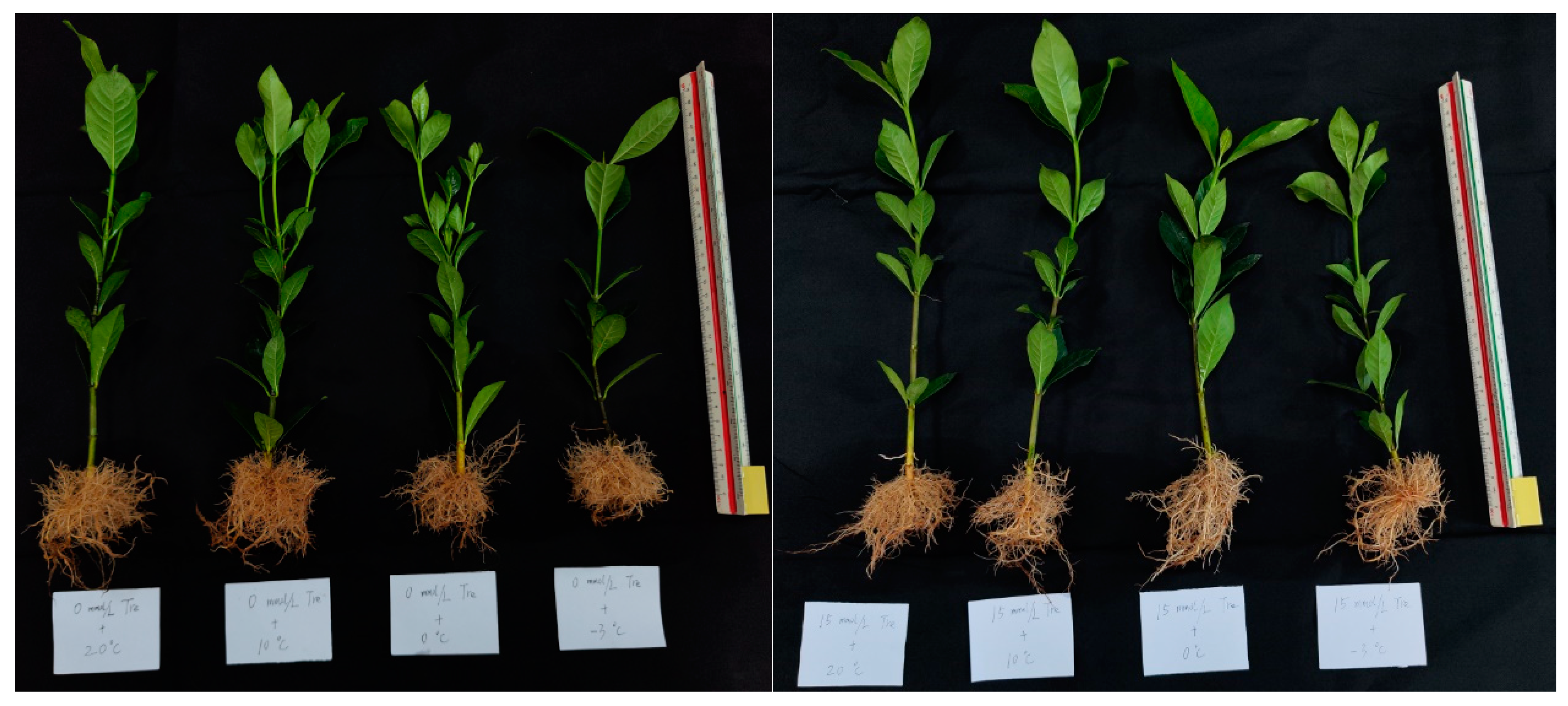
Figure 2.
Root system architecture of Gardenia jasminoides seedlings treated by exogenous trehalose (Tre) under different temperature conditions.
Figure 2.
Root system architecture of Gardenia jasminoides seedlings treated by exogenous trehalose (Tre) under different temperature conditions.
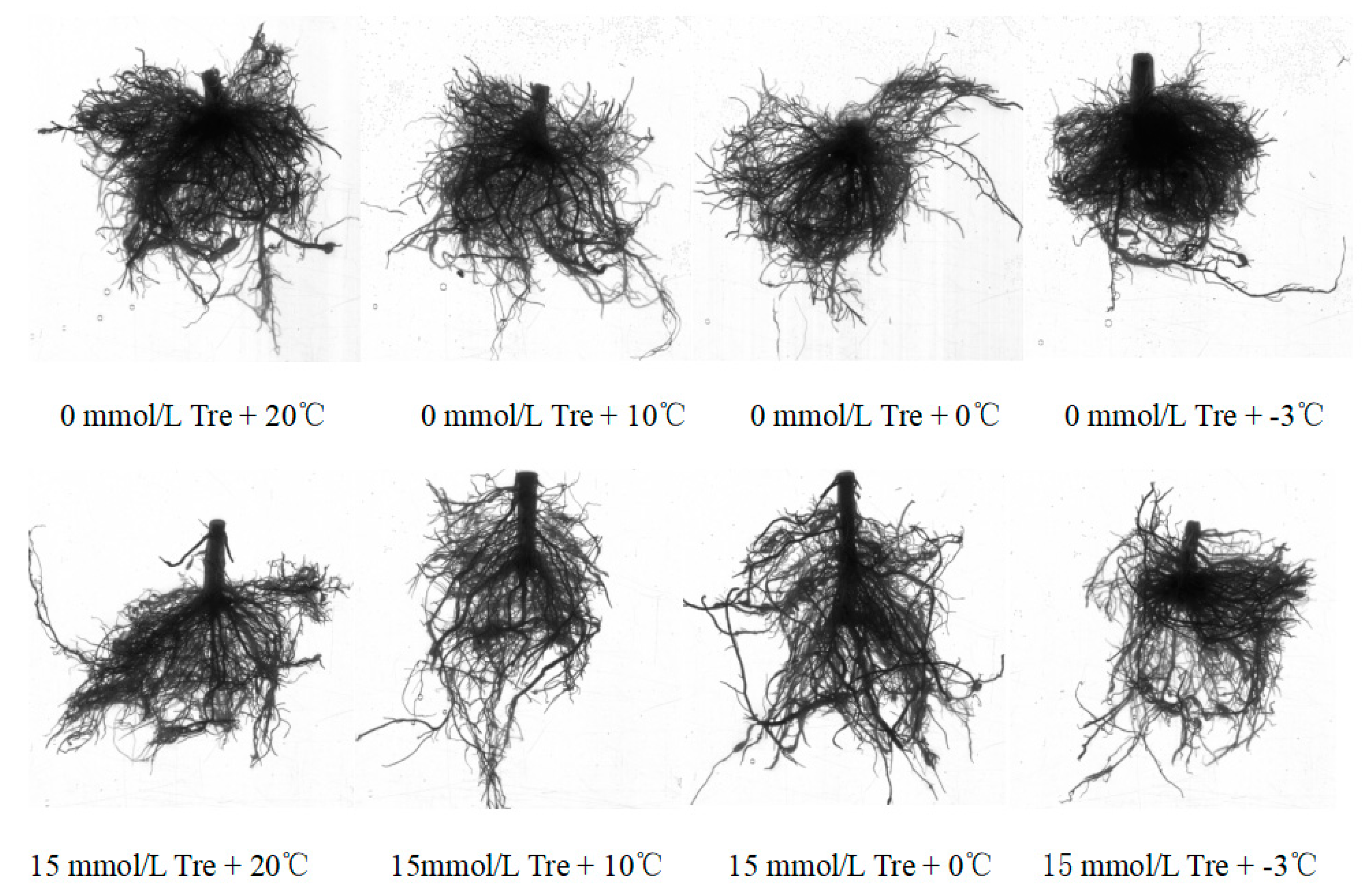

Table 1.
Effects of exgenous trehalose (Tre) on plant growth performance of Gardenia jasminoides seedlings under different temperature conditions.
Table 1.
Effects of exgenous trehalose (Tre) on plant growth performance of Gardenia jasminoides seedlings under different temperature conditions.
| Treatments | Plant height (cm) | Leaf number (#) | Totol weight (g) | Root weight (g) | Shoot weight (g) | |
|---|---|---|---|---|---|---|
| 0 mmol/L Tre | 20 ℃ | 29.16±1.96b | 22.85±1.12b | 12.01±0.42b | 8.80±0.58b | 4.22±0.38c |
| 10 ℃ | 26.59±1.89c | 22.83±1.46b | 11.88±0.88b | 7.83±0.49bc | 4.24±0.39c | |
| 0 ℃ | 25.14±2.34c | 23.85±2.17b | 10.10±0.79c | 6.84±0.47c | 4.25±0.21c | |
| -3 ℃ | 23.17±1.78d | 12.84±1.12d | 9.07±0.63d | 6.83±0.45c | 3.23±0.22d | |
| 15 mmol/L Tre | 20 ℃ | 32.04±2.01a | 25.51±1.54a | 15.68±1.09a | 10.67±1.01a | 6.02±0.57a |
| 10 ℃ | 31.18±2.36a | 23.59±2.12b | 13.79±1.28ab | 9.72±0.58ab | 5.56±0.48ab | |
| 0 ℃ | 28.32±1.75b | 22.54±2.15b | 12.88±1.07b | 8.75±0.78b | 5.17±0.39b | |
| -3 ℃ | 25.69±2.17c | 18.52±1.19c | 11.77±1.06b | 7.71±0.66bc | 4.08±0.37c | |
Note: Data (means ± SD) followed by different letters among treatments indicate significant differences at the p<0.05 level. The same below.
Table 2.
Effects of exgenous trehalose (Tre) on root system architecture of Gardenia jasminoides seedlings under different temperature conditions.
Table 2.
Effects of exgenous trehalose (Tre) on root system architecture of Gardenia jasminoides seedlings under different temperature conditions.
| Treatments | Total root length (cm/plant) | Lateral root number (#) | Total root surface area (cm2/plant) | Root volume (cm3/plant) | |
|---|---|---|---|---|---|
| 0 mmol/L Tre | 20 ℃ | 142.73±11.16bc | 58.75±5.05ab | 10.41±0.82b | 2.28±0.12a |
| 10 ℃ | 132.59±10.11c | 56.73±5.36b | 10.51±0.89b | 2.11±0.20ab | |
| 0 ℃ | 122.83±10.14c | 45.62±4.17c | 9.61±0.63b | 1.92±0.12ab | |
| -3 ℃ | 113.78±10.12d | 36.59±3.02d | 9.47±0.83b | 1.81±0.15b | |
| 15 mmol/L Tre | 20 ℃ | 165.24±14.05a | 60.68±4.63a | 12.48±1.09a | 2.26±0.19a |
| 10 ℃ | 155.29±12.06ab | 64.36±5.84a | 13.08±1.14a | 2.07±0.18ab | |
| 0 ℃ | 150.63±13.09b | 63.37±6.03a | 12.30±1.17a | 2.05±0.17ab | |
| -3 ℃ | 126.29±10.07c | 43.52±4.15c | 10.83±1.02b | 1.91±0.14ab | |
Table 3.
Effects of exgenous trehalose (Tre) on the chlorophyll content in leaves of Gardenia jasminoides seedlings under different temperature conditions.
Table 3.
Effects of exgenous trehalose (Tre) on the chlorophyll content in leaves of Gardenia jasminoides seedlings under different temperature conditions.
| Treatments | Chlorophyl a (mg/g) | Chlorophyl b (mg/g) | Total chlorophyll (mg/g) | |
|---|---|---|---|---|
| 0 mmol/L Tre | 20 ℃ | 1.05±0.08b | 0.49±0.04ab | 1.51±0.12b |
| 10 ℃ | 1.01±0.07b | 0.47±0.04ab | 1.49±0.11b | |
| 0 ℃ | 0.68±0.04c | 0.35±0.03c | 1.02±0.09c | |
| -3 ℃ | 0.53±0.04d | 0.31±0.02c | 0.85±0.07d | |
| 15 mmol/L Tre | 20 ℃ | 1.25±0.11a | 0.55±0.05a | 1.81±0.12a |
| 10 ℃ | 1.12±0.09ab | 0.50±0.04ab | 1.61±0.08ab | |
| 0 ℃ | 1.04±0.09b | 0.45±0.04b | 1.50±0.09b | |
| -3 ℃ | 1.01±0.07b | 0.45±0.03b | 1.46±0.11b | |
Table 4.
Effects of exgenous trehalose (Tre) on the parameters of chlorophyll fluorescence in leaves of Gardenia jasminoides seedlings under different temperature conditions.
Table 4.
Effects of exgenous trehalose (Tre) on the parameters of chlorophyll fluorescence in leaves of Gardenia jasminoides seedlings under different temperature conditions.
| Treatments | φPSII | Fv’/Fm’ | qP | NPQ | |
|---|---|---|---|---|---|
| 0 mmol/L Tre | 20 ℃ | 0.62±0.06a | 0.81±0.05a | 0.31±0.02a | 0.81±0.04ab |
| 10 ℃ | 0.60±0.05a | 0.76±0.06ab | 0.29±0.02a | 0.82±0.05ab | |
| 0 ℃ | 0.46±0.04c | 0.58±0.04c | 0.13±0.01c | 0.88±0.05a | |
| -3 ℃ | 0.43±0.03c | 0.41±0.03d | 0.11±0.01c | 0.89±0.06a | |
| 15 mmol/L Tre | 20 ℃ | 0.63±0.04a | 0.82±0.07a | 0.32±0.02a | 0.79±0.04b |
| 10 ℃ | 0.62±0.04a | 0.78±0.04ab | 0.30±0.02a | 0.80±0.06b | |
| 0 ℃ | 0.59±0.03ab | 0.72±0.05b | 0.22±0.02b | 0.82±0.07ab | |
| -3 ℃ | 0.51±0.04b | 0.70±0.06b | 0.20±0.01b | 0.84±0.06ab | |
Table 5.
Effects of exgenous trehalose (Tre) on the photosynthetic parameters in leaves of Gardenia jasminoides seedlings under different temperature conditions.
Table 5.
Effects of exgenous trehalose (Tre) on the photosynthetic parameters in leaves of Gardenia jasminoides seedlings under different temperature conditions.
| Treatments | Pn (μmol/m2.s) | Gs (μmol/m2.s) | Ci (μmol/mol) | Tr (mmol/m2.s) | |
|---|---|---|---|---|---|
| 0 mmol/L Tre | 20 ℃ | 8.11±0.72ab | 2.81±0.21ab | 250.03±22.15a | 3.50±0.29a |
| 10 ℃ | 7.84±0.59b | 2.72±0.13b | 245.08±20.11a | 3.13±0.29ab | |
| 0 ℃ | 6.50±0.34c | 1.82±0.12c | 240.90±18.19a | 2.24±0.21c | |
| -3 ℃ | 5.19±0.46d | 1.51±0.11d | 209.07±19.12b | 1.03±0.10d | |
| 15 mmol/L Tre | 20 ℃ | 8.91±0.71a | 2.92±0.27a | 255.68±21.29a | 3.55±0.21a |
| 10 ℃ | 8.02±0.69ab | 2.85±0.22a | 249.79±15.18a | 3.22±0.22ab | |
| 0 ℃ | 7.32±0.61bc | 2.69±0.21b | 247.88±16.37a | 2.85±0.21b | |
| -3 ℃ | 6.92±0.42bc | 2.58±0.24b | 240.07±14.22a | 2.23±0.18c | |
Table 6.
Effects of exgenous trehalose (Tre) on the ROS contents in root of Gardenia jasminoides seedlings under different temperature conditions.
Table 6.
Effects of exgenous trehalose (Tre) on the ROS contents in root of Gardenia jasminoides seedlings under different temperature conditions.
| Treatments | H2O2 (μmol/g) | O2.- (μmol/g) | |
|---|---|---|---|
| 0 mmol/L Tre | 20 ℃ | 104.13±9.26c | 80.01±2.15b |
| 10 ℃ | 111.25±9.59c | 81.32±0.16b | |
| 0 ℃ | 166.51±13.34b | 81.40±0.17b | |
| -3 ℃ | 192.12±14.98a | 88.51±0.12a | |
| 15 mmol/L Tre | 20 ℃ | 103.01±10.01c | 76.52±0.10c |
| 10 ℃ | 105.95±9.36c | 80.53±0.12b | |
| 0 ℃ | 145.35±13.79b | 80.52±0.15b | |
| -3 ℃ | 152.76±13.47b | 85.51±0.14ab | |
Table 7.
Effects of exgenous trehalose (Tre) on the antioxidant enzyme activity in root of Gardenia jasminoides seedlings under different temperature conditions.
Table 7.
Effects of exgenous trehalose (Tre) on the antioxidant enzyme activity in root of Gardenia jasminoides seedlings under different temperature conditions.
| Treatments | SOD (U/g) | POD (U/g) | CAT (U/g) | |
|---|---|---|---|---|
| 0 mmol/L Tre | 20 ℃ | 502.01±40.12e | 13.01±1.12d | 145.01±11.12b |
| 10 ℃ | 512.08±41.11e | 15.02±1.32cd | 148.02±12.42b | |
| 0 ℃ | 622.08±51.11c | 18.01±1.71c | 157.03±14.87ab | |
| -3 ℃ | 713.08±57.23b | 25.03±2.11b | 159.01±12.62ab | |
| 15 mmol/L Tre | 20 ℃ | 554.01±40.32d | 14.21±1.19d | 156.03±13.18ab |
| 10 ℃ | 564.01±48.12d | 16.22±1.25cd | 159.02±12.42ab | |
| 0 ℃ | 714.01±61.19b | 23.23±1.14b | 166.05±14.85ab | |
| -3 ℃ | 804.01±70.92a | 33.20±3.11a | 176.04±13.11a | |
Table 8.
Effects of exgenous trehalose (Tre) on the osmotic regulating substances in root of Gardenia jasminoides seedlings under different temperature conditions.
Table 8.
Effects of exgenous trehalose (Tre) on the osmotic regulating substances in root of Gardenia jasminoides seedlings under different temperature conditions.
| Treatments | Pro (ug/g) | MDA (μmol/g) | Soluble protein (mg/g) | Soluble sugar (mg/L) |
|
|---|---|---|---|---|---|
|
0 mmol/L Tre |
20 ℃ | 70.13±6.26bc | 30.81±2.15c | 12.01±1.12a | 509.01±40.12b |
| 10 ℃ | 70.65±6.59bc | 32.82±3.16c | 12.08±1.11a | 512.08±45.15b | |
| 0 ℃ | 80.51±7.34ab | 45.80±3.17ab | 12.10±1.19a | 522.10±31.19b | |
| -3 ℃ | 88.12±7.98a | 49.81±4.12a | 12.27±1.03a | 512.27±41.03b | |
|
15 mmol/L Tre |
20 ℃ | 62.01±5.01c | 27.52±2.19c | 11.68±1.09a | 561.68±53.09a |
| 10 ℃ | 64.95±4.36c | 29.53±2.16c | 12.29±1.08a | 572.29±54.08a | |
| 0 ℃ | 73.35±6.79b | 41.52±4.11b | 11.88±1.07a | 569.88±41.07a | |
| -3 ℃ | 74.76±5.47b | 43.51±3.14ab | 11.57±1.06a | 571.57±43.06a | |
Table 9.
Effects of exgenous trehalose (Tre) on the concentrations of root endogenous hormones of Gardenia jasminoides seedlings under different temperature conditions.
Table 9.
Effects of exgenous trehalose (Tre) on the concentrations of root endogenous hormones of Gardenia jasminoides seedlings under different temperature conditions.
| Treatments | IAA (ng/g FW) | tZR (ng/g FW) | GA3 (ng/g FW) | ABA (ng/g FW) | |
|---|---|---|---|---|---|
| 0 mmol/L Tre | 20 ℃ | 15.13±1.26a | 500.81±40.15c | 356.01±30.12c | 156.80±10.02c |
| 10 ℃ | 12.25±1.19b | 590.82±51.16b | 436.08±40.11b | 186.83±10.02b | |
| 0 ℃ | 10.91±1.04c | 689.96±60.17a | 506.10±40.19a | 206.88±20.03ab | |
| -3 ℃ | 5.12±0.48e | 690.55±59.12a | 509.07±20.13a | 214.83±20.02a | |
| 15 mmol/L Tre | 20 ℃ | 15.21±1.01a | 500.01±40.10c | 238.68±20.09d | 156.97±15.01c |
| 10 ℃ | 12.95±1.06b | 517.53±40.12c | 258.59±22.08d | 187.02±10.02b | |
| 0 ℃ | 11.35±1.09bc | 577.52±50.12b | 308.88±26.07cd | 207.11±18.03ab | |
| -3 ℃ | 6.76±0.47d | 587.51±52.14b | 469.57±31.06ab | 217.01±19.01a | |
Table 10.
Effects of exgenous trehalose (Tre) on the contents of malic acid and succinic acid in root of Gardenia jasminoides seedlings under different temperature conditions.
Table 10.
Effects of exgenous trehalose (Tre) on the contents of malic acid and succinic acid in root of Gardenia jasminoides seedlings under different temperature conditions.
| Treatments | Malic acid (μmol·g-1 FM) | Succinic acid (μmol·g-1 FM) | |
|---|---|---|---|
| 0 mmol/L Tre | 20 ℃ | 0.76±0.06a | 1.06±0.06c |
| 10 ℃ | 0.69±0.05ab | 1.19±0.11b | |
| 0 ℃ | 0.43±0.04c | 1.62±0.12a | |
| -3 ℃ | 0.31±0.02d | 1.71±0.14a | |
| 15 mmol/L Tre | 20 ℃ | 0.77±0.06a | 1.05±0.09c |
| 10 ℃ | 0.71±0.06a | 1.16±0.11b | |
| 0 ℃ | 0.66±0.05ab | 1.23±0.12b | |
| -3 ℃ | 0.61±0.04b | 1.31±0.08ab | |
Disclaimer/Publisher’s Note: The statements, opinions and data contained in all publications are solely those of the individual author(s) and contributor(s) and not of MDPI and/or the editor(s). MDPI and/or the editor(s) disclaim responsibility for any injury to people or property resulting from any ideas, methods, instructions or products referred to in the content. |
© 2025 by the authors. Licensee MDPI, Basel, Switzerland. This article is an open access article distributed under the terms and conditions of the Creative Commons Attribution (CC BY) license (http://creativecommons.org/licenses/by/4.0/).
Copyright: This open access article is published under a Creative Commons CC BY 4.0 license, which permit the free download, distribution, and reuse, provided that the author and preprint are cited in any reuse.


