
Submitted:
18 April 2025
Posted:
21 April 2025
You are already at the latest version
Abstract
The modern power grid faces mounting challenges, including growing renewable energy integration, aging infrastructure, and increasing demand. Traditional methods for expanding transmission capacity, like building new lines, are costly, time-consuming, and subject to regulatory and public barriers. The U.S. Department of Energy’s Innovative Grid Deployment Liftoff report identifies pathways to accelerate deployment of Grid Enhancing Technologies (GETs). This paper focuses on key GETs such as Dynamic Line Ratings (DLRs), Advanced Power Flow Control (APFC), and Topology Optimization (TO). These technologies can boost capacity, improve power flow, and facilitate renewable integration in targeted applications. However, GETs are not universally applicable; in cases of rapid load growth, aging assets, or large physical distances between generation and demand centers, traditional infrastructure remains essential. This paper provides a technical analysis, highlighting optimal use cases and limitations, to guide informed decisions on deploying GETs in conjunction with conventional transmission solutions.
Keywords:
Advanced power flow control
; Dynamic Line Ratings
; Grid Enhancing Technologies
; Topology Optimization
; Transmission planning and operations
I. Introduction
The modern power grid faces unprecedented challenges driven by the accelerated integration of renewable energy sources, the retirement of fossil-fuel-based generation, surging electricity demand, and aging infrastructure. Traditional solutions for expanding transmission capacity, such as constructing new power lines or upgrading existing infrastructure, face considerable obstacles: they are often costly, time-intensive, and prone to delays due to regulatory and public opposition. Recently, the U.S. Department of Energy’s Innovative Grid Deployment Liftoff report [1] identified pathways for expediting the deployment of advanced but underutilized grid technologies on existing transmission and distribution systems. Among these Grid Enhancing Technologies (GETs), tools such as Dynamic Line Ratings (DLRs), Advanced Power Flow Control (APFC), and Topology Optimization (TO) have emerged as valuable options for optimizing grid performance using existing infrastructure.
GETs are hardware and software tools that enhance grid throughput, efficiency, and reliability. However, these technologies are not universally applicable and are most effective in specific scenarios where targeted improvements can yield significant benefits. This paper will explore the applications, advantages, and limitations of GETs, emphasizing the importance of strategically integrating these technologies alongside traditional infrastructure expansions to meet long-term grid needs effectively. This paper provides insights for grid operators, planners, and policymakers on how GETs can enhance grid performance while complementing conventional transmission solutions.[2,3]
II. Decision Makers & Stakeholders
The deployment of GETs involves a diverse set of decision- makers and stakeholders, each playing a critical role in the adoption, implementation, and success of these technologies. The roles of various stakeholders vary from regulatory approvals to technical deployment and investment decisions.[4] Figure 1 provides an overview of the key decision- makers and their respective roles:
While utilities are at the forefront of initiating, making decisions, and approving GETs deployment strategies, their activities are closely coordinated with regulators and market operators. Ultimately, the success of GETs deployment depends on the collaboration of these diverse stakeholders, all working toward the goal of creating a more efficient, reliable, and flexible power grid.
III. Overview of Grid Enhancing Technologies
A. Dynamic Line Ratings
Dynamic Line Ratings (DLRs) enhance transmission line capacity by adjusting ratings in real-time based on environmental conditions like wind speed, temperature, and solar radiation. Unlike traditional static ratings, which are conservative estimates based on worst-case conditions to prevent overheating, DLRs use actual weather data to optimize thermal capacity. Static ratings often underutilize transmission potential, as the extreme conditions they account for rarely occur. According to IEEE Standard 738, a conductor’s rating is influenced by its heat dissipation capabilities, including its thermal properties and environmental factors. Current flow and solar heating add heat to the conductor, while convection and radiation cool it. Cooling effectiveness varies with wind speed, direction, and temperature differentials between the conductor and surroundings.[2]
Ideal lines for DLR deployment include those in high- wind, low-temperature areas, and thermally congested regions. Priority is often given to lines with peak-hour congestion. DLRs typically yield higher ratings during favorable conditions but can fall below static ratings during adverse weather, like extreme heat or low wind. This variability, while beneficial under normal conditions, requires careful management to ensure reliability during less favorable periods. An example analysis using IEEE 738 illustrates seasonal versus DLR-based ratings for a 230kV line in Virginia. The analysis indicated the following: 1.) DLR provides a significant increase in transmission capacity over static ratings for most of the year, especially during favorable environmental conditions. This is particularly true during cooler periods and off-peak hours. There was a boost of as high as 40% on average higher ratings during these periods.
2.) There are several hours in the year where DLR ratings were found to be lower than static ratings, highlighting the need for contingency planning. 3.) Figure 2 highlights the average incremental capacity available across months and hours of a day. The months of April and May benefit from the highest wind speeds in the region, which also coincide with lower average temperatures (than the peak months of July and August). During the months of November and December, the wind speeds are relatively lower during morning hours and late evening hours, driving ratings below limits. It is also important to highlight that the summer static ratings (April to October) are lower than the winter static ratings.
B. Advanced Power Flow Control
Advanced Power Flow Control (APFC) devices provide grid operators with precise control over power flows by adjusting the impedance of specific transmission lines. Unlike traditional phase-shifting transformers (PSTs), which can take significant time to implement, APFC devices purport to be modular, scalable and offer rapid deployment. These devices allow operators to redistribute power away from congested lines and toward underutilized lines, thereby optimizing the use of the existing transmission network. APFC systems use power electronics to adjust the reactance of a line, influencing the power flows. These real-time adjustments help manage congestion, defer the need for new infrastructure, and improve system reliability, particularly during periods of high demand or generation variability.
Some of the key characteristics of the candidate transmission lines/areas for deployment include 1.) Parallel lines with imbalanced power flows, and one of the lines is the limiting constraint. 2.) Voltage or stability-induced reliability issues, especially in radially connected lower voltage and higher impedance areas. 3.) Meshed areas with underutilized transmission capacity. This technology can be used to shift power flows to make better use of available capacity on less- utilized lines.[3]
C. Topology Optimization
Topology Optimization (TO) involves the reconfiguration of the transmission grid by opening or closing circuit breakers to reroute power flows. This software-based solution leverages the meshed nature of the transmission grid, allowing operators to dynamically adjust the network topology to relieve congestion and balance power flows. TO can identify underutilized lines and divert power away from congested corridors, thereby improving the efficiency of the grid without the need for new physical assets. Topology optimization is most common in the operational framework and is often treated as an operation tool. There are several ongoing discussions on how TO can be applied to the planning framework.[5]
Some of the key characteristics of the candidate transmission lines/areas for deployment include: 1.) Lower voltage lines run in parallel with high voltage lines that connect a generation hub to a load pocket. 2.) Substation busbars that can be split to create radialized paths (require knowing bus connections within a substation) 3.) Areas with over-voltage issues and lack of shunt reactors (to lower voltage) during light load conditions 4.) Areas with planned or unplanned outages that occur frequently 5.) Regions with aging infrastructure to minimize stress on older assets.
IV. Planning Applications For GETs
Grid Enhancing Technologies (GETs) offer utilities and grid operators a valuable set of tools for long-term transmission planning, allowing for optimization of existing infrastructure to address growing demands and renewable integration. These technologies help reduce or delay the need for costly new infrastructure while enhancing grid capacity, efficiency, and reliability. However, integrating GETs into long-term planning requires a nuanced understanding of their capabilities and limitations, as well as adjustments to traditional planning approaches, regulatory frameworks, and data requirements.
GETs offer significant advantages in long-term planning by enabling utilities to manage grid capacity dynamically. However, each technology presents specific challenges and requires a targeted approach. GETs can defer new transmission projects and reduce costs, but understanding the limitations of each technology is crucial for their successful deployment. Table 1 summarizes the key planning benefits, challenges, and ideal use cases for each technology:
Incorporating GETs into long-term planning requires a shift from traditional practices, which focus on new infrastructure. Historically, transmission planning has used static, worst-case ratings based on seasonal assumptions, which do not account for real-time changes in line capacity. Moving toward a dynamic, data-driven model that incorporates GETs requires a fundamental adjustment in planning methodologies, including the use of real-time data and predictive analysis.
For DLR, historical and forecasted weather data, such as wind speeds and ambient temperatures, are essential for estimating line capacities accurately. Using this data, planners can identify lines that benefit from dynamic ratings and adjust capacity expectations accordingly. APFC and TO require analysis of network topology and the effects of flow adjustments on stability and efficiency. Planning frameworks must adapt to integrate real-time data feeds, model dynamic conditions, and ensure that these technologies can reliably enhance capacity and flexibility without compromising grid reliability. Weather-dependent technologies like DLR introduce variability, as ratings fluctuate based on environmental conditions. While DLR offers capacity gains during cool, windy weather, ratings may drop during hot or calm conditions, introducing potential reliability challenges. In high-reliability areas, planners must ensure that mitigations, such as renewable curtailment or demand response programs, are in place to maintain grid stability when DLR ratings fall below static levels.
GETs offer a valuable bridge solution, providing additional capacity as new transmission projects are planned or constructed. This is particularly useful in regions facing environmental or regulatory delays in new infrastructure development. By using GETs, grid operators can manage growing demand and relieve congestion without fully committing to infrastructure expansions, allowing utilities to maintain operational flexibility.
The successful integration of GETs into planning models depends on data-driven insights. For DLR, analyzing historical and forecasted weather patterns enables planners to identify suitable lines for dynamic ratings and establish more granular capacity assumptions. Scenario-based analysis can help simulate the impact of various weather and load conditions on GETs’ performance, improving confidence in the technology’s reliability and effectiveness.
TO requires reviewing congestion trends to identify bottlenecks where topology adjustments can enhance power flows. By leveraging data on past congestion patterns and forecasting future conditions, planners can implement TO effectively, using historical insights to refine planning models for dynamic, real-time applications.
The effectiveness of GETs varies based on network topology and existing constraints. APFC and TO are highly effective in meshed networks, where multiple pathways for power flows exist, allowing them to redistribute flows efficiently. However, in radial networks with limited rerouting options, GETs may provide limited benefits, necessitating traditional infrastructure expansions to meet long-term needs. Additional considerations must be made towards the ratings of terminal equipment at the substations that could limit any increase in ratings of transmission lines without upgrades.
GETs align with certain established frameworks, such as Remedial Action Schemes (RAS) and System Integrity Protection Schemes (SIPS), which are designed to manage contingencies dynamically. Similar to RAS and SIPS, GETs can respond to changing grid conditions, reducing overloads and supporting grid stability. By treating GETs within this regulatory context, policymakers can facilitate their integration into planning frameworks, using GETs to manage system events and enhance reliability.
To maximize the benefits of GETs, utilities must design grid systems with flexibility. This includes configuring substations and transmission lines to support dynamic adjustments, incorporating advanced sensing and analytics, and ensuring redundancy in critical areas. Designing substations with reconfigurable options, like double bus double breaker configurations, can enhance the applicability of TO, while meshed network redundancy enables DLR and APFC to deliver dynamic, real-time improvements. [8,9,10,11,12,13]
V. Operational Aspects of GETs
Grid Enhancing Technologies (GETs) play a vital role in modern grid operations by enabling dynamic management of power flows, reducing congestion, and maximizing the capacity of existing transmission assets. Technologies such as Dynamic Line Ratings (DLR), Advanced Power Flow Control (APFC), and Topology Optimization (TO) allow grid operators to respond to changing conditions in real-time, improving system reliability and supporting renewable energy integration. By adjusting transmission capacity and rerouting power flows, GETs offer operational flexibility that can delay or reduce the need for new infrastructure investments. However, effective deployment of these technologies requires robust data infrastructure, advanced control systems, and skilled operators to manage the dynamic nature of these tools. Table 2 summarizes the key planning benefits, challenges, and ideal use cases for each technology:
Successful integration of GETs into real-time operations hinges on several factors. The availability of real-time data is essential for technologies like DLR and TO, which require accurate, up-to-the-minute information on grid conditions to function effectively. Grid operators must invest in sensors, analytics platforms, and data integration tools to enable timely and informed decision-making. Additionally, when DLR ratings fall below static thresholds due to adverse weather conditions, operators face the decision of either adjusting operations or reverting to static ratings to ensure system stability. This choice depends on real-time system conditions, the severity of the DLR drop, and the availability of backup options such as load shedding or ancillary services.
The configuration of the grid also influences the effectiveness of GETs. Meshed networks, which provide multiple pathways for power flows, are well-suited for technologies like APFC and TO that dynamically redistribute power to alleviate congestion. In contrast, radial networks, which lack the flexibility to reroute power flows, may require complementary infrastructure upgrades to fully benefit from GETs. Additionally, GETs offer valuable operational flexibility by enabling adjustments in grid configurations in response to fluctuating conditions. However, they also require highly trained operators and sophisticated control systems to manage these dynamic changes effectively.
GETs like DLR are highly dependent on environmental conditions, with line ratings fluctuating based on real-time weather data such as wind speed, temperature, and solar radiation. During favorable weather, DLR can increase line capacity, supporting renewable integration and reducing congestion. However, during extreme heat or low wind conditions, DLR ratings may drop below static ratings, necessitating a return to conservative ratings or alternative operational measures. This variability requires operators to plan for capacity fluctuations, especially during extreme weather events, to maintain grid reliability. Cost and deployment considerations are also essential when evaluating GETs for operational use, as some technologies, particularly APFC, involve high initial costs. A comprehensive cost- benefit analysis is crucial to assess the long-term operational value of each technology.
GETs provide specific operational advantages, but they also come with challenges. DLR, for example, offers real-time capacity adjustments that align with weather conditions, making it highly effective in wind-heavy regions and congested corridors. However, its dependency on weather conditions introduces variability that can complicate operational planning. APFC, on the other hand, enables real- time control over power flows, reducing overloads and enhancing grid reliability, especially in urban or industrial areas with frequent congestion. Its integration into existing infrastructure, however, can be complex and costly, particularly in older grid systems that may require substantial upgrades. TO provides a cost-effective solution for temporarily alleviating congestion by reconfiguring grid topology, but it is most effective in meshed networks with flexibility for rerouting power.
Several case studies demonstrate the operational effectiveness of GETs in diverse regions. Incorporating GETs into grid operations requires strategic planning and robust support systems. Data infrastructure is essential for effective deployment, as real-time monitoring, data analytics, and sensor networks provide operators with the information needed for timely decisions. Environmental factors are a constant consideration, particularly for DLR, which adjusts capacity based on real-time weather conditions. Operators must be prepared for capacity reductions during unfavorable weather, ensuring system stability by curtailing renewable energy or adjusting demand as needed. Furthermore, the high upfront cost of some GETs, especially APFC, necessitates a thorough cost-benefit analysis to evaluate their long-term advantages in improving operational efficiency, reducing congestion, and enhancing flexibility.[8,9,10,11,12,13,14]
VI. Policy And Economic Consdierations
The deployment of Grid Enhancing Technologies (GETs) offers utilities opportunities to optimize grid performance, reduce congestion, and defer expensive infrastructure projects. However, for these benefits to be fully realized, economic and policy considerations must be addressed. Effective cost- benefit analysis, regulatory reforms, and financial incentives are essential to overcoming barriers and enabling the integration of GETs. These technologies have the potential to create a resilient, efficient, and cost-effective grid that supports future energy needs.
Grid Enhancing Technologies (GETs), such as Dynamic Line Ratings (DLR), Advanced Power Flow Control (APFC), and Topology Optimization (TO), offer utilities a way to defer costly transmission infrastructure investments by optimizing existing assets. This is particularly beneficial in regions with high renewable penetration, where GETs can dynamically manage grid capacity to accommodate fluctuations in generation. However, the significant upfront costs of GETs, including the need for advanced control systems and real- time data integration, may deter utilities, especially those operating older grids. Detailed cost-benefit analyses are essential to assess the long-term savings from deferred infrastructure, reduced congestion, and increased efficiency, which often outweigh initial costs. Additionally, while GETs promise long-term benefits, initial deployment costs might lead to short-term rate increases for consumers, so rate structures should be designed to spread these costs over time.
Regulatory and policy support is critical for the broad adoption of GETs. Current regulatory frameworks often favor traditional infrastructure projects over non-wire alternatives like GETs, creating a misalignment between GETs’ potential benefits and available financial incentives. Policymakers can encourage GETs adoption by offering financial incentives, such as grants, tax credits, or performance-based rate adjustments, to offset initial costs. Harmonizing federal and state policies would also help create a unified framework, promoting consistent deployment across regions. Additionally, adjusting market structures to compensate utilities for benefits like congestion reduction and improved transmission efficiency would encourage investment in GETs. By aligning regulatory frameworks and market incentives with the operational advantages of GETs, utilities can better integrate these technologies into grid management strategies, enhancing efficiency, reducing congestion, and supporting renewable integration.
VII. Conclusions
Grid Enhancing Technologies (GETs) are transforming grid management by offering scalable, cost-effective solutions for congestion, renewable integration, and system reliability. Technologies like Dynamic Line Ratings (DLR), Advanced Power Flow Control (APFC), and Topology Optimization (TO) dynamically adjust transmission capacity and optimize power flows, benefiting both real-time operations and long- term planning. However, deploying GETs successfully requires overcoming technical and regulatory barriers, as well as ensuring access to real-time data and advanced control systems. A multi-faceted approach is essential for GETs adoption 1.) Planning Frameworks: Utilities must shift from traditional infrastructure expansion to a mindset focused on optimizing existing assets. Data-driven decision-making and flexible planning models are essential, though real-time data may initially be approximated with engineering assumptions and historical data. 2.) Technical Infrastructure: Investment in real-time data systems, control platforms, and sensor networks is crucial, along with advanced Energy Management Systems and cybersecurity measures. 3.) Regulatory Reforms: Policies that recognize GETs over traditional projects, such as performance-based incentives and streamlined approvals, can drive adoption. 4.) Market Mechanisms: Modifying market structures to reward GETs’ benefits, like congestion reduction and renewable integration, will incentivize utilities. 5.) Education and Financial Support: Financial incentives and operational training for utilities reduce the risk and complexity associated with GETs deployment.
Through these measures, GETs can significantly enhance grid efficiency, reliability, and flexibility
References
- U.S. Department of Energy. (2021, Oct.). “Grid-enhancing technologies: Unlocking the full potential of transmission capacity,” Grid Deployment Office, Washington, D.C. [Online]. Available: https://www.energy.gov/gdo/grid-enhancing-technologies.
- D. Li, K. Tomsovic, and A. Bose, “Dynamic line rating systems and applications,” IEEE Trans. Power Syst., vol. 33, no. 3, pp. 2394-2402, May 2018.
- National Renewable Energy Laboratory (NREL), Golden, CO, “Grid- enhancing technologies: A case study on congestion and renewable integration,” Tech. Rep. NREL/TP-5D00-79227, Oct. 2020. [Online]. Available: https://www.nrel.gov/docs/fy21osti/79227.pdf.
- Sheth, K., Patel, D., & Swami, G. (2024). Reducing electrical consumption in stationary long-haul trucks. Open Journal of Energy Efficiency, 13(3), Article 6. [CrossRef]
- P. Ruiz and B. Hobbs, “Impact of dynamic line ratings on renewable integration and transmission efficiency,” Electric Power Research Institute (EPRI), Palo Alto, CA, Tech. Brief EPRI-3002009514, Dec. 2021.
- Sheth, K., & Patel, D. (2024). Comprehensive examination of solar panel design: A focus on thermal dynamics. Smart Grid and Renewable Energy, 15(1), Article 2. [CrossRef]
- International Renewable Energy Agency (IRENA), “Smart grid investment in dynamic line ratings and advanced power flow control,” IRENA, Abu Dhabi, UAE, Tech. Rep. IRENA-ES-TP-2020-03, Feb. 2020.
- Sheth, K., & Patel, D. (2024). Strategic placement of charging stations for enhanced electric vehicle adoption in San Diego, California. Journal of Transportation Technologies, 14(1), Article 5. [CrossRef]
- S. M. Khalid, B. Hodge, and S. Bahramirad, “Economic and regulatory considerations for grid enhancing technologies,” IEEE Power Eng. Soc. General Meeting, Boston, MA, 2019. [Online]. Available: https://ieeexplore.ieee.org/document/8819850.
- Electric Power Research Institute (EPRI), “The role of advanced power flow controllers in grid modernization,” Tech. Rep. EPRI-3002019445, 2021.[Online].
- Swami, G., Sheth, K., & Patel, D. (2024). PV capacity evaluation using ASTM E2848: Techniques for accuracy and reliability in bifacial systems. Smart Grid and Renewable Energy, 15(9), Article 12. [CrossRef]
- M. Milano, “Policy barriers to grid enhancing technologies and proposed solutions,” presented at the FERC Technical Conference on Transmission, Washington, D.C., 2021. [Online]. Available: https://www.ferc.gov/media/policy-barriers-grid-enhancing.
- Sheth, K., Patel, D., & Swami, G. (2024). Strategic insights into vehicles fuel consumption patterns: Innovative approaches for predictive modeling and efficiency forecasting. International Journal of Engineering Research & Technology (IJERT), 13(6).
- Federal Energy Regulatory Commission (FERC), “Order 881: Managing transmission line ratings for efficiency and reliability,” FERC, Washington, D.C., Order 881, Dec. 2021. [Online]. Available: https://www.ferc.gov/media/ferc-order-881.
Figure 1.
Key Stakeholders that enable GETs.
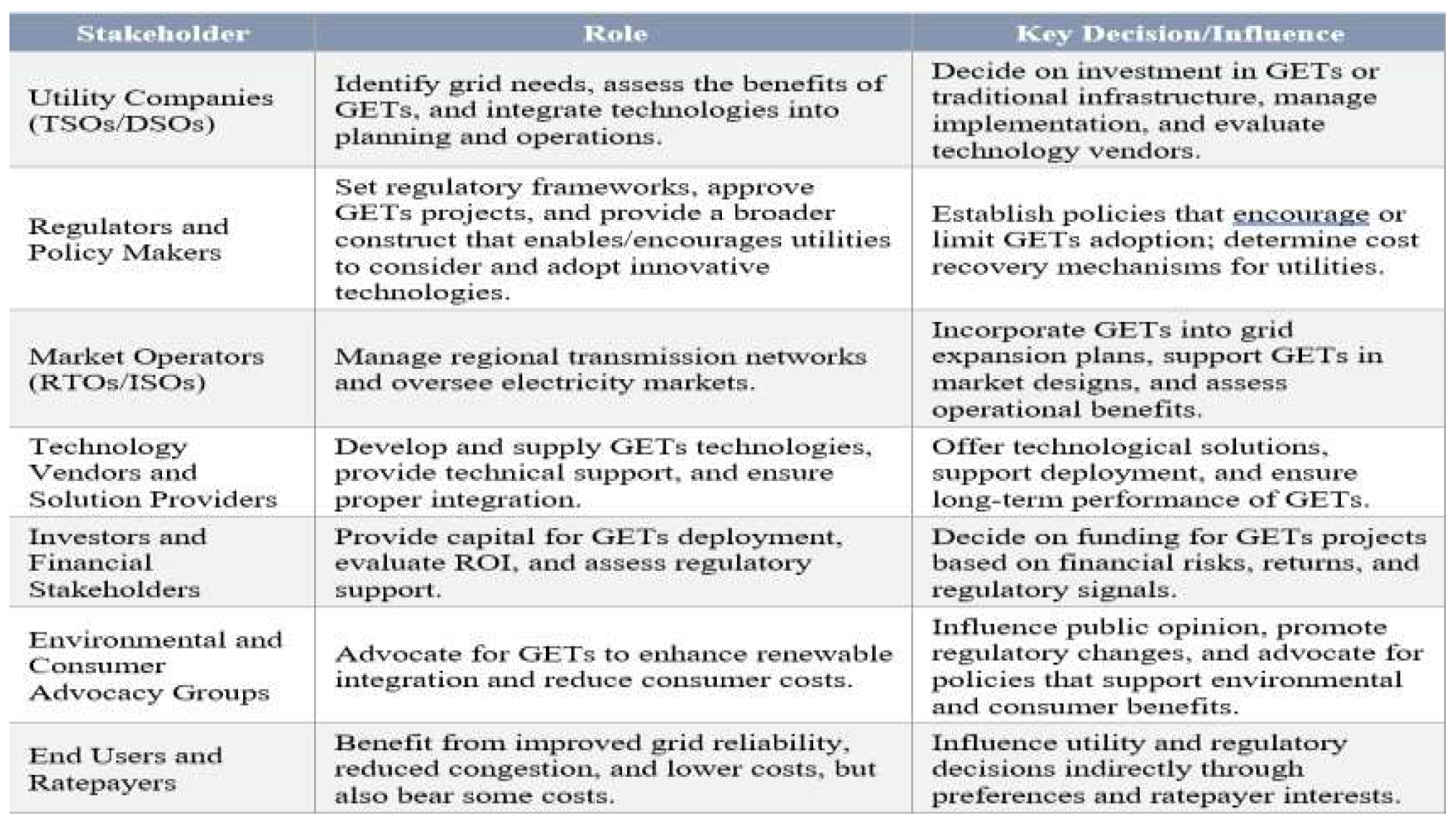
Figure 2.
DLR vs Static Rating.
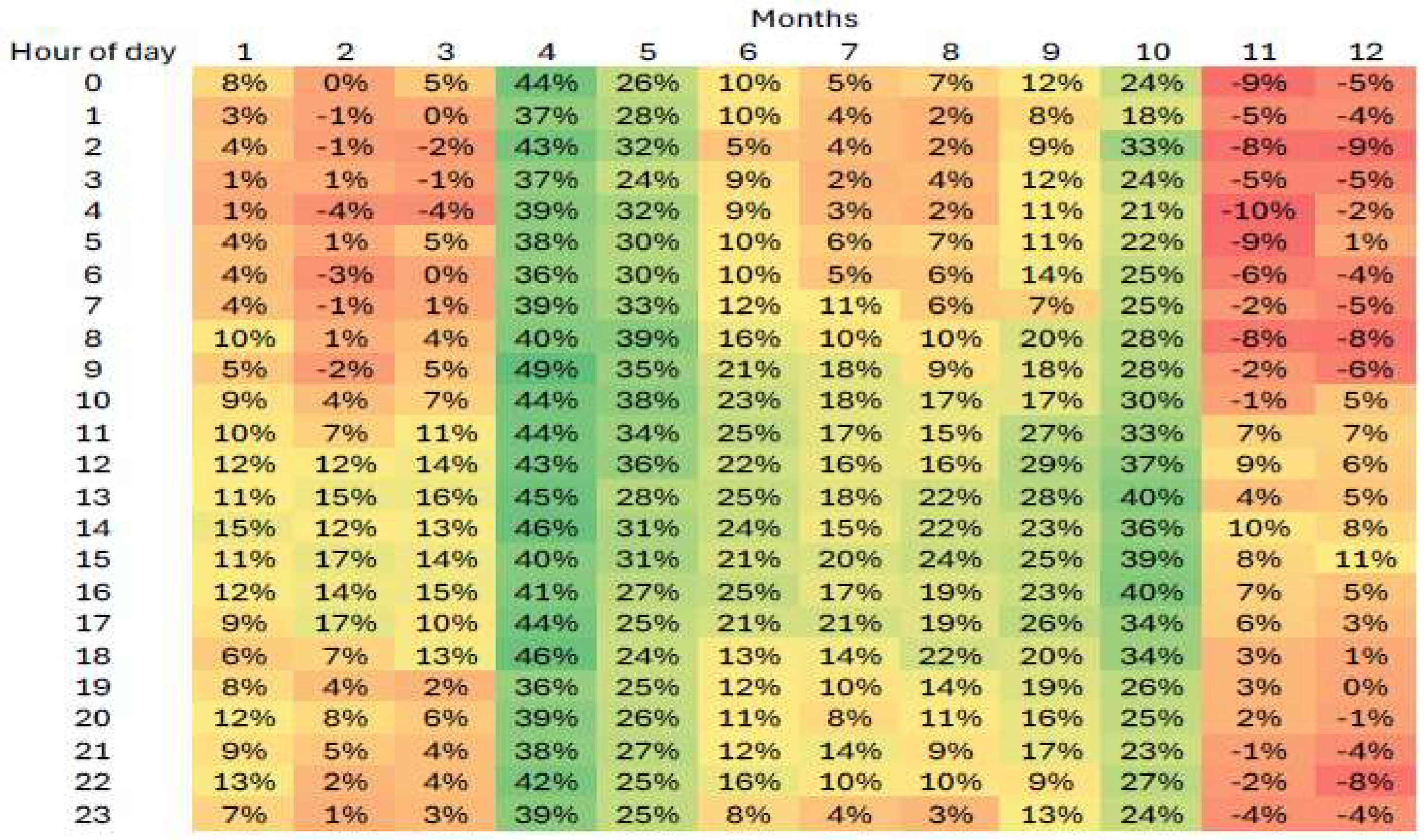

Table 1.
Summary of the benefits, challenges and use cases in Planning.
| Technology | Planning Benefits | Challenges | Ideal Use Cases |
| Dynamic Line Ratings (DLR) | Increases line capacity during favorable weather; supports renewable integration | Weather-dependent; may reduce ratings in adverse conditions; requires continuous environmental data | Wind-heavy zones with favorable weather conditions |
| Advanced Power Flow Control (APFC) | Optimizes power flows in meshed networks; modular and scalable | Requires substation upgrades and control systems; higher upfront costs in older systems | Urban or congested areas with meshed networks |
| Topology Optimization (TO) | Software-based with minimal infrastructure changes; relieves congestion temporarily | Limited capacity increase; requires real- time data integration and advanced control platforms | Areas with temporary congestion due to construction or maintenance |
Table 2.
Summary of the benefits, challenges and use cases in Operations.
| Technology | Operational Advantages | Operational Challenges | Ideal Applications |
|---|---|---|---|
| Dynamic Line Ratings (DLR) | Enhances capacity in real-time by adjusting for weather conditions; reduces renewable curtailment. |
Weather-dependent ratings can drop during adverse conditions, needing contingency measures. | Wind-heavy regions; congested corridors. |
| Advanced Power Flow Control (APFC) | Controls power flows dynamically, reducing overloads and enhancing reliability. | Requires integration with existing systems; high initial costs in older grids. | Urban centers; areas where adding new lines is impractical. |
| Topology Optimization (TO) | Cost-effective; dynamically adjusts topology to alleviate congestion. | Limited in radial networks; requires advanced data analytics. | Temporary congestion areas; urban grids with meshed networks. |
Disclaimer/Publisher’s Note: The statements, opinions and data contained in all publications are solely those of the individual author(s) and contributor(s) and not of MDPI and/or the editor(s). MDPI and/or the editor(s) disclaim responsibility for any injury to people or property resulting from any ideas, methods, instructions or products referred to in the content. |
© 2025 by the authors. Licensee MDPI, Basel, Switzerland. This article is an open access article distributed under the terms and conditions of the Creative Commons Attribution (CC BY) license (http://creativecommons.org/licenses/by/4.0/).
Copyright: This open access article is published under a Creative Commons CC BY 4.0 license, which permit the free download, distribution, and reuse, provided that the author and preprint are cited in any reuse.


