

Submitted:
22 August 2025
Posted:
25 August 2025
You are already at the latest version
Abstract
Media shape and reflect social imaginaries, influencing collective beliefs, norms, and aspirations. Video games and films frequently depict themes like urbanization, dystopian futures, and resource-driven expansion, often envisioning humanity colonizing new planets after depleting Earth's resources. Such narratives risk reinforcing exploitative attitudes toward the environment, extending them to new frontiers. Research has shown that media, especially video games, influence societal perceptions and shape future possibilities. While largely reflecting anthropocentric worldviews, these media also have the potential to promote ecocentric perspectives. In the context of biodiversity loss and planetary imbalance, media’s role in fostering non-anthropocentric values is crucial. This study introduces the Non-Anthropocentric Media Evaluation Questionnaire (NAMEQ), a tool designed to help media producers assess whether their work aligns with ecocentric principles, and to support academic researchers and students in the study and analysis of media from a biocentric perspective. Applying this framework to 138 widely distributed video games and films reveals a strong dominance of anthropocentric narratives. While some works incorporate ecocentric themes, they remain inconsistent. The findings underscore the need for a more deliberate and coherent representation of bio-centric values in media, advocating for a shift in cultural narratives toward perspectives that recognize and respect the intrinsic value of the non-human world.
Keywords:
deep ecology
; video games
; movies
; media communication
; non-anthropocentrism
; social imaginary
; biocentrism
; overpopulation
; sustainable population decline
; NAMEQ
; biocentric imagination
; non-human relationality
; post-humanism
; degrowth theory
1. Anthropocentrism as the Dominant Social Paradigm
1.1. Introduction
In the context of ecosystems suffering under the stress of the Anthropocene, it becomes increasingly important to critically examine and question our collective social imaginaries. To our knowledge, few, if any, instruments currently exist that allow for a systematic evaluation of the anthropocentric or non-anthropocentric character of media. The introduction of our semantic tool, the Non-Anthropocentric Media Evaluation Questionnaire (NAMEQ), seeks to address part of this gap. Designed primarily as a scholarly evaluation framework, the NAMEQ enables researchers to systematically assess the degree to which media artifacts reflect non-anthropocentric or biocentric values. Its standardized questionnaire format also makes it adaptable for pedagogical contexts, where students can use it as a guided tool to critically analyze films, games, or advertisements. Additionally, in professional media practice, creators and producers may employ NAMEQ as a reflective device to interrogate the anthropocentric or biocentric orientations of their own productions. This tiered structure of use clarifies the instrument’s main scholarly anchor while acknowledging its secondary pedagogical and applied relevance.
1.2. Reframing the Systemic Narrative
Traditional human-centered narratives and social imaginaries have long served as a primary framework for understanding the world and guiding our collective actions. However, these narratives often have harmful environmental consequences, as they prioritize human interests over those of other living beings and the natural world [1]. Drawing on Arne Naess’s biocentric philosophy—which emphasizes the intrinsic worth of all living beings, regardless of their utility to humans [2]—this approach proposes a shift toward reimagining cultural narratives, expectations, and shared imaginaries. Rather than maintaining a hierarchical worldview with humans at the center, a biocentric orientation encourages the development of stories and symbolic systems that reflect an ethic of coexistence with the more-than-human world. This transformation is particularly urgent, given the ecological limitations of dominant anthropocentric paradigms that have persisted for over three millennia. By incorporating biocentric and ecocentric values into cultural expressions—such as films, animated works, video games, and social media, which serve as powerful vectors of imagination in contemporary society—it becomes possible to reconfigure collective worldviews toward more sustainable futures [3,4]. This approach is founded on the recognition of the inherent value of all living and non-living components, paving the way for a more inclusive and sustainable global narrative.
1.3. Man as the Enduring Measure of the World
In the 5th century BCE, the Sophist thinker Protagoras articulated the principle that “man is the measure of all things”. This foundational assertion situates humans as the central criterion for evaluating the paradigm in which they exist. According to this perspective, morals and laws are understood as human constructs, emphasizing that values and norms are inherently anthropocentric. Such values are thus seen as contingent on human society, with no existence independent of human interpretation and interaction [5,6]. While polytheistic religions were sometimes more integrative, monotheistic cults reinforced an anthropocentric vision by giving humanity a central role [7,8]. The Renaissance brought forward the anthropocentric idea of humans creating meaning and progress, thus moving away from the theological framework in favor of human reason [9]. John McNeill shows how, in the modern era, the development of science, technology, and the industrial age reinforced the idea that nature existed solely for exploitation by humanity [10]. In recent years, ecological concerns have prompted a gradual shift from anthropocentric paradigms toward more ecosystemic and biocentric perspectives. This emerging reevaluation challenges human-centered principles by advocating for approaches that emphasize the intrinsic value and interconnectedness of all living systems [11,12,13,14]. However, this biocentric awareness still struggles to take hold, even in the face of mounting evidence linking anthropocentric activity to the destruction of biodiversity. Recent scientific findings leave little doubt about the strong connection between human-driven activities and the accelerating decline of biodiversity. A large-scale meta-analysis, encompassing more than 2,000 studies and close to 100,000 sites worldwide, has shown that pressures such as land-use change, overexploitation of natural resources, pollution, invasive species, and climate disruption contribute to an average loss of nearly 20 percent in species richness in impacted areas [15]. Numerous studies conducted during and after the COVID-19 confinement have demonstrated, for example, that levels of nitrogen dioxide (NO2) and carbon dioxide (CO2) in the atmosphere fell significantly—by 45 to 54%—due to the halt in fossil fuel exploitation for cars and industries [16,17,18]. Emissions of fine particles PM2.5 and PM10 decreased by 31 to 43% due to the interruption of construction activities. SPMs were also reduced by 15.9%, leading to a notable improvement in ocean water quality [18,19,20]. In many cities, noise pollution decreased by 60 dB [21,22]. On the banks of certain rivers, where all human activities had ceased, a new, rich biodiversity was observed. Globally, increases in the activity of insects, butterflies, bees, and wild and urban animals were noted during confinement [23,24,25]. For the first time, a global correlation was highlighted between the cessation of human activities and the rebirth of ecosystems. Recent research in the EEE field has also begun to address how technological systems and media interfaces can be redesigned to promote ecocentric values [26,27], further supporting the call for a paradigm shift in our collective imaginaries [4].
1.4. Anthropocentrism in Historical Perspective: Growth, Exploitation, and Crisis
Research on mitochondrial DNA has shown that for nearly 100,000 years, while humans were nomads, the population did not exceed 10 million individuals [28]. It seems that tribal nomadism, like the movements of groups of numerous animals, quadrupeds, birds, marine mammals, insects, has allowed human beings to live together for more than 100,000 years in a tenuous balance with the rest of biodiversity. Paleolithic hunter-gatherers did not seem anthropocentric and probably considered other species as their equal, like certain nomadic populations still present at the beginning of the 19th century [29,30]. The Neolithic period beginning in - 8,000 BC will have lastingly modified human society by introducing agriculture, sedentarism develops the notion of property and promotes awareness of hereditary transmission requiring descendants [31]. Wars are no longer clashes between tribes, but battles between nations, and the need to create powerful armies generate a pronatalist policy which often persists today. Humans who seemed naturally attentive to their ecosystem, particularly through shamanic rituals, are gradually detaching themselves from a wild nature that frightens them in order to constrain and control it [32,33].
Historical records indicate that the world’s population was approximately 188 million in 1 CE, and it grew slowly until it reached a volume of 990 million people in 1800 at the dawn of industrialization [34]. In fact, the population growth was only 990 million individuals in 1800 years and 7.10 billion in just 225 years, reaching with the phenomenon known as “demographic transition” currently 8 billion individuals [35,36]. The massive use of the principles of vaccination, antibiotics, hygiene and food diversification have allowed humanity to prosper exponentially over the last two centuries [37,38]. Nothing in the dizzying curve of the growth curve of humanity, neither wars, nor even major epidemics like the plague or the Spanish flu, nor COVID-19 have started the demographic growth of the human species [39]. Indeed, even pandemics are only difficult to observe in the dizzying growth curve of the human population, they have, in fact, no more effects than the bloodiest conflicts, Figure 1.
Despite a certain decline in the Birth Rate that began in the 1970s [40], the scientific developments of the last half century, correlated with capitalist, war-like populationist policies, as well as theological or dogmatic thoughts based on expansion, continue to produce population growth which follows the less optimistic forecasts of the second Meadow report 30- Year Update [41,42] report whose projections have been updated with data provided by the UN in the World 3/2000 simulation model published by the organization: “Institute for Policy and Social Science Research” [43].
Indeed, reality has exceeded the projections of this 1972 report and its 30-Year Update regarding population growth. The world’s population will reach around 8 billion in 2022, much earlier than predicted in the pessimistic scenarios of the 1970s and 2000s. In 2020, a study published in The Lancet by IHME projected that even with continued declines in birth rates, the world’s population could peak at around 9.7 billion in 2064 [44]. Recent contributions have also illuminated the links between technological systems, resource exploitation, and population dynamics. For instance, Nguyen and Chen [45] integrated IoT and AI technologies for smart population monitoring in urban environments. Rodriguez and Lee [46] modeled energy consumption using non-anthropocentric frameworks, while Patel and Kumar [47] assessed the impact of overpopulation on sustainable power systems. In another field Zhang and Wang [48] explored eco-innovations in urban infrastructure to mitigate resource overexploitation. These studies underscore the technological dimensions of our challenges, enhancing the need for a paradigm shift in our collective narratives, social imaginaries and infrastructures. Published by the United Nations Department of Economic and Social Affairs, the World Population Prospects report projects that the global population could reach around 10.4 billion people by 2080 [49]. With potentially disastrous impacts on biodiversity and the climate. Paradoxically, the decline in the birth rate continues to frighten economists and reports from the World Bank and the World Economic Forum (WEF) further emphasize the socioeconomic implications of demographic transitions, particularly for regions where rapid aging and reduction working populations could create economic challenges [50]. The WEF’s Global Risks Report and World Bank reports also discuss the effects of depopulation in some countries. The WEF’s concerns are economic stimuli much more frightening for populations than those produced by the disappearance of biodiversity or climate change. They produce social imaginaries inclined to favor demographic growth to the detriment of a decline synonymous with loss of wealth and loss of economic comfort [51].
Anthropocentrism supports a social imaginary of power and human control over all biodiversity, as well as continuous growth aimed at ultimately conquering and subduing the limits of the universe [52,53,54]. This growth inevitably follows the law of economic entropy, according to which any exploitation of limited resources produces chaos [55]. Thousands of vertebrate and invertebrate species are already permanently extinct, and millions more remain threatened, in what scientists like Gerardo Ceballos describe as the sixth wave of extinction—the only one directly attributable to human activities. Humanity itself risks suffering from its irrational growth [56]. Heritage accumulated over several millennia has enabled humans and other animals to survive through primary cerebral mechanisms that favor reproduction and the accumulation of resources [57]. At the dawn of this new century, having managed to overcome the mechanisms of its greatest benefactors and predators—viruses and bacteria—humankind should have been able to reassess the essential loop for the survival of all species [58].
Yet, even though the innate capacity of many mammals leads them to cease reproductive activity and enter downscaled life cycles when resources diminish too rapidly in relation to population size [59], our anthropocentric social imaginaries fail to stimulate reflection on demographic growth or consumption principles [60]. All reports from the International Institute for Sustainable Development (IISD)—even the most optimistic—forecast an inevitable deterioration in human well-being as a result of our actions in coming decades [61]. Chained by cognitive, optimism, and status quo biases (SQB) [62,63], humanity appears locked in inaction, incapable of pragmatism or genuine reflection. Recent studies have shown that this optimism bias persists even with the advent of advanced technologies [64]. Thus, SQB becomes a significant issue in periods when progress is most crucial [65].
2. Non-Anthropocentric Approaches
2.1. Shifting from Anthropocentrism to Biocentrism: Deep Ecology as a Paradigm Shift
The concept of Deep Ecology, an eco-philosophy rooted in intuitive ethical principles, was articulated by Norwegian philosopher Arne Naess, one of its founders, as "biospheric egalitarianism in principle" [13]. It appears to have been first inspired by the nascent modern ecological consciousness, notably with works by conservationist Rachel Carson [66], biologist Paul R. Ehrlich and his book “The Population Bomb” [67], and the advocacy of environmentalist David Brower [68]. Deep ecologists analyze the shortcomings of anthropocentrism through the lens of capitalism since the industrial era [69]. According to them, this accentuated anthropocentrism—characterized by ever-increasing growth and resource exploitation—risks leading not only biodiversity, but also humanity itself, toward possible extinction. At a time when the population was only 4 billion, Naess and other leaders of deep ecology argued that the consumerist and materialist paradigm must be replaced, and that both economic and population growth must cease, giving way to a global phase of decline [13]. From the 1980s, echoing the Meadows report, several deep ecologists suggested that the world population should not exceed 1.5 billion to ensure, in a holistic vision, the development of a global ecosystemic balance [70]. Arne Naess, for his part, maintained that the world should have no more than 100 million people to guarantee this balance [72], essentially proposing a return to the population level that persisted for more than 40,000 years. While advocates of Ecopedagogy strive to advance environmental education [73], the latest alarming reports on global warming and its long-term effects on biodiversity, as well as the exponential loss of species caused by human activity [74,75,76,77,78], reveal that non-anthropocentric principles of deep ecology have yet to find substantial resonance in contemporary societies. This lack of integration calls for a critical reassessment of their practical influence. Consequently, it seems both timely and necessary to explore alternative paths for fostering ecological consciousness. Media forms such as cinema, video games, and digital platforms play a central role in shaping collective imaginaries, thus offering powerful means to reach broader audiences. Through these cultural vectors, collective worldviews can evolve toward non-anthropocentrism—not by positioning humanity as steward or guardian of life on Earth, but as one participant among many, recognizing the intrinsic value of all living beings.
2.2. Proposing New Social Imaginaries Through Biocentric Imagination
The concept of Biocentric Imagination highlights the cognitive and ethical capacities required to envision a world centered not only on humans but also on non-human living beings. Aldo Leopold first developed this notion, promoting the idea that “an action is right when it preserves the integrity, stability, and beauty of the biotic community” [79]. This approach encourages us to perceive the Earth as a coherent organism, or a mountain, in Leopold’s metaphor. Building on this, Arne Naess introduced nine principles of deep ecology, aiming to foster an expanded empathy for all living beings and challenge anthropocentric dominance [69]. Contemporary streams of posthumanism and new animism likewise develop the concept of non-human relationality, which proposes thinking about relationships among beings beyond the anthropocentric framework. This perspective pays ethical, ontological, and epistemological attention to relations between humans and non-humans—whether animals, plants, geological entities, or even artificial objects and intelligences [80]. As such, non-human relationality challenges anthropocentric paradigms by advancing a relational ontology, where existence is understood through entanglements between human and non-human agents [81,82].
On the philosophical level, film scholar David Ingram asserts that media-based imaginaries do not merely reflect dominant cultural values; they actively fashion them through narrative and aesthetic strategies [83]. An ecological critique of cinema (and, by extension, video games) thus examines how human representations of nature shape everyday ideology. Biocentric imagination opens the possibility of crafting stories, scenarios, or interactive mechanics where the main viewpoint is neither human nor machinic, but ecosystemic. Narrative structures can then incorporate non-human perspectives (e.g., river, mountain, plant, animal, herd, or virus) as agent-actors, fostering a logic of interdependence rather than human exploitation. As a core element of Biocentric Imagination, social imaginaries refer to the collective frameworks through which a society defines and understands its world. Such frameworks have been discussed by thinkers such as Cornelius Castoriadis and, more recently, Charles Taylor [84,85]. These collective structures shape social interactions and, as Ingram explains, also generate visions of the future with the power to influence the destiny of societies. Combining norms, values, beliefs, and symbolic interactions, these imaginaries help individuals forge social relationships and establish a collective historical narrative [86].
Within contemporary social imaginaries, media forms—video games, films—do not merely entertain; they actively construct, reinforce, and disseminate cultural values and collective beliefs. As Janet Murray demonstrates in Hamlet on the Holodeck [87], narrative media are essential in shaping how people imagine agency, possibility, and the future. Ian Bogost, in Persuasive Games [88], highlights the procedural rhetoric of game mechanics, showing how games implicitly teach players ways of thinking about systems, power, and human exceptionalism. More recently, Lee and Patel [89], via computational analysis of video game content, observe how mainstream games persistently reflect and reinforce anthropocentric ideologies—privileging human control over nature and narratives driven by progress. Wang and Li [90] extend this by demonstrating that dominant science fiction and adventure games often frame ecological crises as solvable exclusively through technological advancement, reinforcing the belief that human innovation is both cause and solution to environmental decline.
The construction of anthropocentric futures by media mirrors patterns observed during the Industrial Revolution, when imaginaries of collective flourishing were closely bound to technological progress and human dominance over nature. As Charles Taylor [85] explains, Enlightenment and post-Enlightenment visions of society were built upon faith in reason, development, and mastery—ideals that still underpin much contemporary digital storytelling. In building new imaginaries, non-anthropocentric media can draw on concepts such as ecological temporalities—understandings of time that extend beyond human lifespans or social cycles to include the rhythms of ecosystems, species evolution, and geological processes. Several illustrative cases make this concept concrete: in cinema, Princess Mononoke [130] features forest spirits whose lives far exceed human temporalities, while 2001: A Space Odyssey [131]situates human evolution within a cosmic scale. In games, Eco (Strange Loop Games) requires players to consider ecological impacts over multiple generations, directly engaging long-term ecological temporalities. While such media are rare, they show how narratives can increase awareness of ecological rhythms and intergenerational responsibility. By tuning stories to these scales, media can cultivate a biocentric perspective that values long-term stability and environmental stewardship across generations.
Proposing the development of a non-anthropocentric systemic approach, aiming to foster social imaginaries that reduce the impact of humans on ecosystems and the biodiversity that sustains them, may appear ethically fragile. In a world where many humans struggle against social injustices, or even merely to survive in their search for basic resources [91]—it might seem inappropriate, or even ethically questionable, to be more concerned about the disappearance of animal species, insects, rivers, or forests than about the suffering of fellow human beings. Malthus highlighted this paradox, noting the inconsistency of human expansionism: “If it is not curbed, the population increases in geometric progression. Subsistence only increases in arithmetic progression.” [92]. Later, communism opposed this view, promising that industrialization and technological advances in agriculture and livestock would provide ample resources. Marx and Engels argued that social misery stems not from demographic surplus but from the capitalist structures of economy and society; they rejected the notion that poverty is a natural consequence of resource overexploitation and anthropocentrism [93,94]. Many political and theological doctrines continue to reject Malthusian and biocentric principles [95]. Authors like Boserup, adopting a progressive anthropological stance, claim that technology will always provide solutions to prevent famine and the destruction of biodiversity [96]. Moreover, as philosopher Luc Ferry points out, ecologists who criticize demographic growth and overconsumption are sometimes seen as extremist reactionaries, accused of blaming the failures of humanity on developing countries while ignoring the consumerism prevalent among richer nations [97,98]. He describes Arne Næss as anti-humanist, essentially defending a supposed right to anthropocentrism [97].
However, adopting a non-anthropocentric approach does not reveal a lack of empathy. The causal relationship between demographic overgrowth, resource consumption, and ecosystem destruction is now undeniable [41,42]. Rapid population growth increases resource pressure and drives unsustainable energy patterns, in turn exacerbating environmental degradation [99]. Ultimately, changes to the Earth’s climate—which, in light of Fermi’s paradox, might be uniquely suited to support life in the universe [100,101]—likely intensify the hardships faced by disadvantaged social groups and minorities of all kinds [102]. By hastening the scarcity of essential resources for human survival, environmental change foments tension, war, and the rise of identity-based, community, and nationalist withdrawal [103]. While the world’s two greatest conflicts occurred during times of resource abundance, what will become of empathy and compassion in an era of declining vital resources such as freshwater and energy?
The construction of anthropocentric social imaginaries, shaped by cognitive and social psychology biases such as judgment heuristics and optimism bias [104], leads humanity to adopt a haughty stance and an inability to objectify the imbalances generated by growth. Some of these social imaginaries, influenced by the rejection of environmental determinism in Lucien Febvre’s foundational anthropocentric historiography [105]—in contrast to thinkers like Friedrich Ratzel or Élisée Reclus—once fulfilled a functional role. They supported revolutions, social and industrial, that aimed to reduce inequalities and gain control over hostile aspects of nature, at least for certain populations [106]. Yet today, these imaginaries are ill-suited to address the proportion and harmony required by contemporary ecological imperatives.
It is precisely this alternative future—this non-anthropocentric field of possibilities grounded in balance and sharing within our ecosystem—that we wish to uphold and promote through collective constructions of new social imaginaries, notably via media such as video games and cinema. In her analysis of media’s influence on the creation of a new environmental culture, Vesselina Valkanova concludes: “today’s decisive media influence regarding the formation of values and worldview positions should be directed to the preservation and protection of the environment, biodiversity, and cultural diversity.” [107]. The construction of ecological ethics specific to the media domain is already a research topic in communication ethics. This subfield asks how human beings ought to behave in relation to non-human nature [108]; and is considered by many communication scholars a fundamental challenge of our time [109].
Forging new perspectives on the social imaginary through an ecological ethic now seems an urgent imperative. This ethic envisions a humanity whose population is balanced in relation to other species, respects the intrinsic value of all living beings, and commits its intelligence to remaining as unobtrusive as possible—limiting its interaction with the ecosystem to which it belongs.
3. Developing a Framework for the Assessment of Non-Anthropocentric Media Values
The creation of a tool to evaluate the non-anthropocentric value of media represents, in our view, an essential step toward fostering the development of non-anthropocentric media capable of transforming social imaginaries. This subjective semantic questionnaire is designed to assess the relevance and impact of non-anthropocentric perspectives within media—whether in the context of academic research or during the creative process, for game directors, filmmakers, or writers, irrespective of whether their media explicitly engage with these issues.
We developed the questionnaire based on the recommendations of Osgood, Suci, and Tannebaum, key references in the field [110,111], as well as on the systematic, iterative evaluation processes described by leading authors such as DeVellis and Nunnally [112,113].
3.1. Conception of the NAMEQ Semantic Questionnaire
The design of the semantic subjective form followed a structured approach grounded in psychometrics, measurement theory, and semantic analysis. By following the steps described below: Finding the Non-Anthropocentric value , defining the respective dimension values of the value. Definition and application of coefficients for each dimension. Calculating the value of is expressed in the following equation:
Developing questions for each dimension is an essential part of the process; each dimension is assessed through 5 semantic questions designed through the Schwarz recommendation [114] structured on an odd Likert scale from 0 to 5 [115] with differential semantic scales included (from “Never!” to “All the time!”). The questionnaire is thus structured in 5 dimensions containing a total of 25 questions. As recommended by the Michael Furr process, we conducted several iterative pilot tests with small groups to ensure the questions are cleared and the data collected is valid [123]. Building on a synthesis of established theoretical models and previous evaluation instruments (including the NEP, New Ecological Paradigm [124], the Media Health Literacy scale MeHLit, [125] and the Ecocentric and Anthropocentric Scales [126]) we outline the following development process. The first step involves a clear theoretical definition of the construction to be measured. This is followed by the generation of a large and diverse pool of items, formulated to be both clear and unbiased. A suitable Likert-type scale is then selected [115], to capture gradations in participant responses. The questionnaire is subsequently pilot tested with a small sample, allowing for refinement based on feedback. Statistical validation is performed through factor analysis and internal consistency measures such as Cronbach’s alpha [127], ensuring that the instrument reliably reflects the intended dimensions. The next stage involves assessing validity by comparing the results with existing instruments and expected theoretical patterns. Iteration is incorporated throughout the process to optimize both conceptual alignment and psychometric robustness.
3.2. Dimensions, Items, and Coefficients
Initially the first of the dimensions that we included in our questionnaire corresponded to the dimension of FI of the “Fun Interest” of each media. Supported by a large scientific literature, we evaluated the relevance of each media in terms of interest to ensure its impact in terms of social imagination. After our first iterations, it appeared to us that the “Fun interest” dimension of all the test questionnaires was high and corresponded to strong interest, which seems consistent with the fact that each evaluator chooses a media of which he has a strong knowledge. However, this high value introduced a bias into our evaluation by affirming that none of the media evaluated reached extreme low values and suggesting that none of the media were totally anthropocentric. A media like the soccer simulation video game FIFA [128], for example, did not appear to be totally anthropocentric, even though nothing in this video game allows us to assert that it is not. Also, this dimension of “Fun interest” was deleted to retain only dimensions corresponding to an evaluation of non-anthropocentrism. The definition of the dimensions of non-anthropocentric and biocentric value of media led us to the development of 5 interconnected dimensions through 25 questions. The questions items both emerging from iterative reflective analysis and previous evaluation tools such as: NEP [124], MeHLit the Media Health Lit [125], and the Ecocentric and Anthropocentric Scales [126]. Like NEP and MeHLit, every item in the NAMEQ is scored using a discrete Likert-like format 0–5; [115] paired with a semantic-differential anchor ranging from “Never!” (0) to “All the time!” (5), thereby preserving interpretive alignment across survey instruments. The NAMEQ was explicitly crafted to function in both large-scale and customized media evaluation environments. It is thus equally suitable for academic researchers and students conducting comprehensive, cross-medium assessments, as for media producers aiming to critically appraise the non-anthropocentric dimension of their own creations. The first section of the questionnaire is dedicated to collecting demographic background data, such as age, gender, and education level in an academic context. In situations where a more focused, individualized analysis of a single medium is desired, this section may be streamlined or omitted. This is followed by a segment that gathers key details about the evaluated media, including its title, format (e.g., film, animated feature, video game), publisher or director, and year of release. The development of the NAMEQ was guided by the need to ground each questionnaire dimension in robust theoretical frameworks. Rather than designing items in an isolated or purely empirical manner, the construction process explicitly mapped theoretical influences into practical items. Table 1 illustrates this theory–dimension mapping, making visible how abstract concepts were operationalized into measurable statements.
For example, biocentrism informed the emphasis on non-anthropocentric perspectives, ensuring that media representations of biodiversity were not reduced to their utility for humans. Degrowth theory provided the rationale for items addressing the reduction of human footprint and practices that minimize negative impacts on ecosystems, directly linking sustainability values to the questionnaire. Ecological economics shaped the items related to demographic growth, resource use, and the reconsideration of other species as co-inhabitants rather than exploitable resources. Finally, ecolinguistics inspired items exploring the power of language and media to promote immediate, positive ecological actions, even within gamified or applied contexts.
This conceptual alignment strengthens the academic validity of NAMEQ by showing that each item is not arbitrary, but the result of a systematic translation of theory into measurable dimensions. Even if partly conceptual, the rationale connecting theoretical perspectives with item formulation enhances both the interpretability and the legitimacy of the instrument. Table 1 therefore serves as a foundation for understanding the questionnaire’s structure, making explicit the theoretical anchors behind each group of items.

Table 1.
NAMEQ: Theory–Dimension mapping with sample items.
| Dimension | Theoretical anchor & example item (0–5; “Never!”–“All the time!”) |
|---|---|
| Ec | Ecocentrism & Biocentrism (Taylor) [129]. Example: Recognises intrinsic value of non-human beings and natural entities. |
| St | Degrowth; planetary boundaries [132]. Example: Alarms about climate change, biosphere integrity, or pollution. |
| Sd | Ecological economics; population ethics [41,70]. Example: Highlights population growth as a driver of biodiversity loss. |
| Ma | Ecolinguistics; applied media / AFM [133,134,135]. Example: Encourages concrete AFM actions that reduce human impact. |
| Ai | Non-anthropocentric philosophy; posthumanism [136,137,138]. Example: Recenters human insignificance relative to biodiversity/cosmos. |
Ecocentrism/Biocentrism:
The first dimension is listed under the name: Ec, for Ecocentric Dimension. This dimension highlights the Ecocentric & Biocentric values of the media and its capacity to consider that all forms of life, human and non-human, have dynamic values and deserve equal respect [13,69]. Thus, for Taylor each living organism is considered as a “teleological center of life” with its own value [129]. This dimension consists of the 5 following items:
- 1- The media was considering the intrinsic (inherent) value of all forms of life (like animals, or insects)?
- 2- The media was considering humans as not inherently superior to other living things. (like animals or insects)?
- 3- The media considered intrinsic (inherent) value of all forms of natural things (like mountains, forest, or rivers)?
- 4- The media was considering all species are part of a system of interdependence.
- 5- Did the media not promote the exploitation of other species or environments as resources for humanity?
Degrowth:
The second dimension: St, reflects the Sustainability values of the media by focusing questions on Global Warming, the destruction of the integrity of the biosphere and pollution by measuring to what extent the media alarms on these facts. This dimension evaluates the media’s desire to induce a reduction in the human footprint by adjusting practices to minimize their negative impacts on other species and more generally on the planet [132]. This dimension comprises five items:
- 1- Does the media alarming about climate change?
- 2- Does the media alarm about Biosphere integrity (acceleration of species extinction)?
- 3- Does the media alarm about pollution / contamination?
- 4- Does the media promote better lifestyle Consumption / habits (lifestyles away from excessive consumption of resources like energy)?
- 5- Does the media alarm about land system change (Land use) change in the amount of forest cover, change in the amount of cropland?
Ecological economics:
The value of the third dimension Sd reflects the media’s desire to alarm the consequences of a constantly growing demographic [41,70]. As well as on the impact and responsibility of each human being in the consumption of limited resources as well as in putting into perspective the anthropocentric perception of other species as resources in the service of humanity [13,77]. This dimension comprises five items:
- 1- Does the media alarm about population growth impact?
- 2- Does the media promote human population regulation?
- 3- Does the media alarm population growth impact on biodiversity?
- 4- Does the media promote a fair balance of human population regarding other species volume of populations?
- 5- Does the media promote more discreet human activities and behavior regarding other living forms?
Ecolinguistics:
The fourth dimension explored is the Ma, questionnaire, for “Away from Media” AFM, focuses on the supposed real direct effects of the media in producing positive consequences on biodiversity. For example, by instantly offsetting carbon production or by generating greater human discretion regarding biodiversity in gamified applications or games. This dimension responds to the need for immediate actions noted by biocentric or non-anthropocentric authors highlighting the need for direct and immediate action in the face of environmental crises and threats to biodiversity [13,129,133,134,135]. This dimension comprises five items:
- 1- Does the media have real AFM positive impacts to biodiversity preservation?
- 2- Does the media have real positive AFM impacts on energy consumption?
- 3- Does the media have AFM real positive effects on human population regulation?
- 4- Does the media have real AFM impact on humans vanishing in their natural environment? Making humans more discreet, more invisible to other species?
- 5- Does the media have any real AFM positive effects?
Non-Anthropocentric philosophy:
Finally, the last of the dimensions evaluated by the questionnaire is the Ai, for “Anthropocentric Insignificance”. This dimension rejects anthropocentrism from a perspective of decentering according to which humans are neither the center nor the summit of existence or value in the universe [136,137,138]. This dimension comprises five items:
- 1- In the media human feelings are insignificant (A little value or importance)?
- 2- Does the media promote the idea of human insignificance compared to the rest of biodiversity?
- 3- Does the media promote the idea of human insignificance compared to the rest of Universe?
- 4- Does the media promote naturalist philosophy? Nothing is supernatural, nature would be the only reality.
- 5- Does the media promote the exclusion of all forms of exploitation of, and cruelty to, animals for food, clothing or any other purpose?
- Ec="Dimension Ecocentric"
- St=”Dimension Degrowth Sustainability”
- Sd=”Dimension Ecological economics / Demographic Decline”
- Ma=”Dimension Ecolinguistics Media AFM Effects”
- Ai=”Dimension Anthropocentric Insignificance”
Are the respective dimension values. Using the systematic framework for creating subjective semantic questionnaire measurement scales proposed by DeVellis, emphasizing the need for multiple iterations [112]. As well as the principles listed by Nunnally [113], we refined the values of each dimension during exploratory factor analysis to best reflect a balance in all the responses before our Cronbach reliability evaluation tests [127]. These iterations made it possible to add the following coefficients to each of the dimensions:
The resulting scores for each group are first calculated by summing the item scores and applying the respective weight for the group. The weighted group scores are then summed and divided by the total sum of weights (5 + 4 + 1 + 1 + 4 = 15) to yield the normalized composite score.
- Ecocentrism/Biocentrism (Ec): sum of item scores × 5
- Degrowth (St): sum of item scores × 4
- Ecological economics / Population / Sobriety (Sd): sum of item scores × 1
- Ecolinguistics (Ma): sum of item scores × 1
- Non-anthropocentric philosophy (Ai): sum of item scores × 4
3.3. Evaluation
A Cronbach alpha reliability analysis [127] was conducted on data collected from 242 participants, based on 138 media items evaluated using the NAMEQ subjective semantic questionnaire designed to assess the non-anthropocentric value attributed to media content [139,140,141]. A total of 3450 responses on a Likert scale from 0 to 5 [115]. Scale reliability Statistics: Cronbach’ . Analysis of internal consistency, measured by Cronbach’s alpha coefficient, revealed excellent reliability of the scale with a coefficient , which indicates very high consistency of the questionnaire items [140].
3.4. Worked Example of NAMEQ Application
To demonstrate the practical application of the NAMEQ, we present a worked example using the film The Lion King (1994). This film is often cited as biocentric due to its focus on animal characters and ecological themes. However, upon closer inspection, the narrative remains deeply anthropocentric: the story revolves around human-like conflicts, moral choices, and succession issues projected onto animal characters. By applying the NAMEQ to this film, we illustrate how the questionnaire captures both the apparent ecological messaging and the underlying anthropocentric framing, highlighting the nuances of media content evaluation. This example provides readers with a concrete understanding of how the NAMEQ operates in practice, bridging the gap between conceptual design and empirical application. For illustrative purposes, one anonymized student submission was randomly selected from the classroom test of the NAMEQ. This example does not intend to provide statistical evidence but simply demonstrates how the tool operates in practice and how the scoring can be interpreted.
Table 2.
Illustrative application of NAMEQ to *The Lion King* - Dimensions: Ecocentrism, Degrowth.
| Dimension | Item | Score (0–5) |
|---|---|---|
| Ecocentrism | 1. The media was considering the intrinsic (inherent) value of all forms of life (like animals, or insects)? | 4 |
| 2. The media was considering humans as not inherently superior to other living things. (like animals or insects)? | 3 | |
| 3. The media considered intrinsic (inherent) value of all forms of natural things (like mountains, forest, or rivers)? | 0 | |
| 4. The media was considering all species are part of a system of interdependence? | 3 | |
| 5. Did the media not promote the exploitation of other species or environments as resources for humanity? | 5 | |
| Degrowth | 1. Does the media alarming about climate change? | 0 |
| 2. Does the media alarm about Biosphere integrity (acceleration of species extinction)? | 0 | |
| 3. Does the media alarm about pollution / contamination? | 0 | |
| 4. Does the media promote better lifestyle Consumption / habits (lifestyles away from excessive consumption of resources like energy)? | 0 | |
| 5. Does the media alarm about land system change (Land use) change in the amount of forest cover, change in the amount of cropland? | 1 |
Table 3.
Illustrative application of NAMEQ to *The Lion King* - Dimensions: Ecological economic, Ecolinguistics, Non-Anthropocentric philosophy.
Table 3.
Illustrative application of NAMEQ to *The Lion King* - Dimensions: Ecological economic, Ecolinguistics, Non-Anthropocentric philosophy.
| Dimension | Item | Score (0–5) |
|---|---|---|
| Ecological economic | 1. Does the media alarm about population growth impact? | 0 |
| 2. Does the media promote human population regulation? | 0 | |
| 3. Does the media alarm population growth impact on biodiversity? | 0 | |
| 4. Does the media promote a fair balance of human population regarding other species volume of populations? | 0 | |
| 5. Does the media promote more discreet human activities and behavior regarding other living forms? | 2 | |
| Ecolinguistics | 1. Does the media have real AFM positive impacts to biodiversity preservation? | 0 |
| 2. Does the media have real positive AFM impacts on energy consumption? | 0 | |
| 3. Does the media have AFM real positive effects on human population regulation? | 0 | |
| 4. Does the media have real AFM impact on humans vanishing in their natural environment?Making humans more discreet, more invisible to other species? | 0 | |
| 5. Does the media have any real AFM positive effects? | 0 | |
| Non-anthropocentric philosophy | 1. In the media human feelings are insignificant (A little value or importance)? | 2 |
| 2. Does the media promote the idea of human insignificance compared to the rest of biodiversity? | 3 | |
| 3. Does the media promote the idea of human insignificance compared to the rest of Universe? | 3 | |
| 4. Does the media promote naturalist philosophy? Nothing is supernatural, nature would be the only reality. | 4 | |
| 5. Does the media promote the exclusion of all forms of exploitation of, and cruelty to, animals for food, clothing or any other purpose? | 1 |
Example of scoring for this illustrative case, the distribution of points across the five NAMEQ dimensions was as follows:
- Ecocentrism/Biocentrism (Ec): 15 × 5 = 75
- Degrowth (St): 1 × 4 = 4
- Ecological economics / Population / Sobriety (Sd): 2 × 1 = 2
- Ecolinguistics (Ma): 0 × 1 = 0
- Non-anthropocentric philosophy (Ai): 13 × 4 = 52
The total score obtained is therefore
which corresponds to an average of 8.4 points across the NAMEQ dimensions.
The obtained score of 8.8 places The Lion King within the “Anthropocentric” range of the NAMEQ scale (see Section Suggested Scale Range for the NAMEQ Questionnaire). It is important to note, however, that this result is based on the evaluation of a single student and therefore does not claim representativeness. Rather, it serves as an illustrative example of how the tool can be applied in practice. Despite this limitation, the score aligns with the interpretation that, beneath its apparently biocentric aesthetics, the narrative remains largely human-centered in its values and conflicts.
4. Experiment
A total of 138 media works were evaluated using the NAMEQ questionnaire by paid adult participants (n = 242) from UK and USA, via the online research platform Prolific Academic Ltd. Mean age 41.3 years, Median age: 40 years, standard deviation 13.1. “Informed consent” was obtained electronically from all participants, who were assured of voluntary participation, anonymity, and data confidentiality. Our sample shows a wide age distribution ranging from 18 to 79 years, with a mean age around 41, suggesting that our participant group includes a broad spectrum of adult age groups, from young adults to seniors. The distribution appears skewed to the right, indicating a small concentration of older participants. Among the 242 participants included in the study, 154 identified as female (63.64%) and 88 as male (36.36%). This gender distribution indicates a predominance of female participants within the sample. Most participants (n = 175; 72.3%) reported being employed full-time. A smaller part (n = 34; 14.0%) indicated part-time employment. Individuals not currently in paid work (including retirees, homemakers, and those with disabilities) constituted a notable minority (n = 20; 8.3%), while a smaller proportion (n = 6; 2.5%) re-ported being unemployed and actively seeking employment. Additionally, two participants (0.8%) were due to begin new employment within the following month, and ten participants (4.1%) selected “Other” as their employment status. A total of 7 cases (2.9%) were reported as expired or invalid data Employment status. The initial sample included 356 participants; however, a few responses were excluded from the final analysis to ensure the reliability and integrity of the data. These exclusions were made on ethical and methodological grounds, as some responses appeared to have been generated randomly or failed to align with the expected evaluative patterns, indicating a lack of engagement with the questionnaire’s content. Several independent studies have reported superior data quality and participant attention on the alternative online platform Prolific, compared to that of CloudResearch, MTurk, Qualtrics and SONA [142,143]. Participants were explicitly instructed to evaluate only those video games or films they had personally played or viewed. Each participant was permitted to complete the questionnaire up to four times, selecting a different media item from a predefined list curated by the research team for each submission. The distribution of these media was carried out in four groups: G1 is 50 bestselling video games since 1984, related to compilation of sources such as AFJV, Gamesider, VGChartz, NDP group and IGN. G3 corresponds to the list of the 50 films and animated films, having generated the most revenue since 1993, with sources from IMDbPro, Box Office, Mojo and Nash Information’s Services "The Numbers". G2 corresponds to a selection of 20 supposedly non-anthropocentric video games selected by the CNAP, Center for Non-Anthropocentric Play [144]. Finally, the G4 group corresponds to a selection of 17 movies and animated movies for which the specialized press has noted the non-anthropocentric or biocentric character. The distribution of the results of these media is reported in the chart below, Figure 2.
General data: Score range: Values vary between 0 (lowest score) and 22.20 (highest score). These scores represent an underuse of the total scale, which ranges from 0 to 25. The absence of a high score can be revealed by the very low scores of the dimension Ma In fact, few media really have real AFM effects at this stage with an overall positive response score of only 0.58%.
Interpretation: Concentration around low to average scores: The Average (): 7.35 shows that many media studied have an overall anthropocentric character. Higher scores >20 but they are in the minority. This likely reflects a strong inclination of video games and movie media to represent the world from an anthropocentric point of view, with a more activist tendency of some of these media to be intentionally non-anthropocentric and biocentric. The absence of a high score is evident in the very low values of the Ma dimension. Currently, few media generate tangible AFM effects, with an overall positive response score of only 0.58%. The low Ma score, which reflects the potential of media to elicit concrete positive impacts beyond their immediate ecological context, can be attributed to the limited willingness of creators to actively foster such AFM-type effects. Indeed, few media, software applications or video games provide users with opportunities to interact with the environment in a more discreet, humble, or unobtrusive manner—minimizing their visibility, noise, and ecological footprint. We anticipate that the introduction of this dimension, which resonates with the aims of certain researchers and producers [144], will encourage greater integration of these considerations in future media development. The Standard Deviation (): 6.63 indicates a concentration around the mean with a wide variation. These data illustrate a dominant anthropocentric balance with more limited attempts at non-anthropocentrism.
4.1. Score Distributions
For the G1 group representing the 50 Best-selling video games, the mean is (): 3.76 for possible scores range from 0 to 25. Suggest that most of the media evaluated are concentrated at the lower end of the range. This may reflect an overall anthropocentric bias in the most sold video game in the world, failing to prioritize biocentric or non-anthropocentric narratives. G1 Standard Deviation (): 2.50 reflects moderate variability, with most scores relatively consistent and close to the mean.
In the G2 representing the results of Video Games “presumed to be Non-Anthropocentric and Ecocentric” mean (): 16.3 3 is 65.2% of the maxi-mum possible score (25) which suggests strong adherence to non-anthropocentric or biocentric principles. This is consistent with media explicitly designed to prioritize ecological and biocentric narratives. The Standard Deviation (): 4.28 reflects moderate to high variability, this spread could reflect a diversity of interpretation of non-anthropocentric and biocentric values in G2.
As for the G1 group G3, which represents the best-selling movies and animated movies, the mean () indicates these films exhibit only a weak alignment with non-anthropocentric values. They are predominantly anthropocentric in nature. 95% Confidence Interval: Within , about 95% of the scores are expected to fall between –5.42 and 14, further demonstrating that most scores cluster in the low range. G3 Standard Deviation () indicates substantial variability in the scores. Some films achieve moderate alignment with non-anthropocentric values, while others score near 0, showing minimal alignment.
The G4 score representing the group presumed to be non-anthropocentric and biocentric movies and animated movies span from 0 to 25, with a mean (): 16.2 2 positioned relatively higher on the scale compared to previous groups like G1 (): 3.76 and G3 (): 4.36, but close to the G2 (): 16.3. The average indicates a moderate alignment with non-anthropocentric and biocentric values. With 64.8% of the maximum score (25), this suggests that movies and animated movies of this selected group generally adhere to ecocentric narratives more than anthropocentric ones but still leave room for improvement. G4 Standard Deviation (): 3.21 21 indicates if the group is largely consistent in its alignment with non-anthropocentric themes, there are still some considerable variabilities.
4.2. Experimental Conclusions and Scoring Scale Proposal for the NAMEQ
Inside group G1 Mainstream media, might naturally prioritize hu-man-centered narratives due to audience expectations. When G2 represents a group with a strong and consistent alignment with non-anthropocentric or biocentric principles. While there is some variability, most media perform well, positioning this group as a benchmark for ecocentric values. While G1 and G3 share low mean scores, the greater variability in G3 suggests more opportunities for films to achieve moderate alignment, albeit inconsistently. G4’s meaning is comparable to G2, indicates that selected presumed movies and animated movies are generally with similar values as the group of CNAP selected presumed non-anthropocentric video games. Which means that these media are sharing a similar focus on non-anthropocentrism. Moderate Variability: High scores (up to 20.82) show that some media outlets are attempting to move beyond anthropocentric narratives, but these efforts remain isolated. We performed a one-way Kruskal-Wallis ANOVA. The high value of suggests a substantial difference between groups. There is a significant variation in scores among the different groups, with this difference being statistically significant (), allowing us to reject the null hypothesis of equal group medians. Finally, indicates a moderate to large effect size. Thus, the differences between groups are not only statistically significant but also substantial in magnitude. Notable differences exist among the G1, G2, G3, and G4 groups, and these differences are large enough to be considered significant from both a statistical and practical standpoint. We then carried out an independent Samples T-test between the two groups G2 and G4 Media Scores which correspond to the two presumed Biocentric groups, to see if differences existed between the presumed biocentric group of video games and that presumed biocentric of Movies and animated movies.
Figure 3.
NAMEQ Distribution of Non-Anthropocentric Media scores.
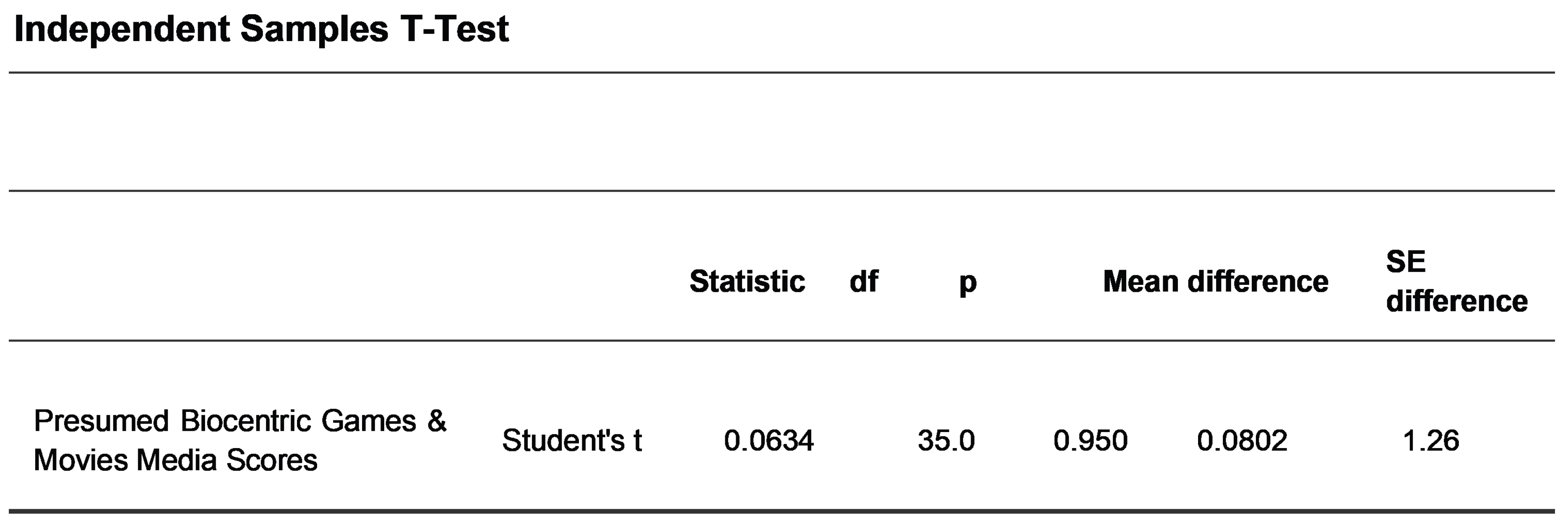
It appears that p-value 0.950 indicates no statistically significant difference between the presumed biocentric video games scores (group G2) and biocentric movies media scores (group G4). The null hypothesis (: ()G2 = ()G4) cannot be rejected, as there is insufficient evidence to suggest that the means of the two groups differ. The test provides strong evidence that the scores for presumed biocentric games (G2) and biocentric movies (G4) are not significantly different, supporting the idea that both types of media may be perceived as equally biocentric in terms of the evaluation criteria. This gives a good indicator of the markers of the biocentric and non-anthropocentric values of the expected scores in the NAMEQ questionnaire during the evaluations. The 2 groups scores may be perceived as moderate to highly non-anthropocentric. A second Independent Samples T-test was also carried out on the two dependent variables G1 representing the 50 best-selling video games and G3 representing the 50 best-selling movies. The p-value 0.445 indicates no statistically significant difference between the 2 groups, the null hypothesis (: ()G1 = ()G3) cannot be rejected, and the test provide strong evidence that the groups scores may be perceived as equally very to anthropocentric.
4.3. Suggested Scale Range for the NAMEQ Questionnaire
Considering the average results of the groups, here is the suggested range for each category based on the scoring system provided:
- Below 5 points: Very anthropocentric
This category represents media that are heavily anthropocentric and emphasize human interests and perspectives.
- 6–10 points: Anthropocentric
This category represents media that are still human centered, but with some subtle inclusion of environmental or non-anthropocentric themes.
- 11–15 points: Moderately non-anthropocentric
This category includes media that gradually incorporate more biocentric or ecocentric values, though they still retain a focus on human perspectives to some extent.
- 16–22 points: Highly non-anthropocentric
This range represents media that strongly emphasize non-anthropocentric or biocentric narratives, reflecting a deep concern for environmental and non-human perspectives.
- 23–30 points: Non-anthropocentric activist
This category includes media that actively advocate non-anthropocentric or biocentric values, often aiming to inspire environmental or social change, and showing a clear commitment to activism.
5. In-Depth Comparison with NEP
Although several instruments exist to measure individuals’ecological worldviews or their connectedness to nature, there does not appear to be a standardized questionnaire specifically designed to assess the non-anthropocentric dimension or the ecological content of media. While instruments such as the Connectedness to Nature Scale [117] and the Nature Relatedness Scale [145] could serve as indirect benchmarks for our NAMEQ tool, these scales primarily focus on individual cognitive, emotional, and affective interpretations, and therefore do not offer a direct basis for comparison. In contrast, the New Ecological Paradigm (NEP) Scale [124] measures the endorsement of ecological values and a non-anthropocentric worldview among individuals. The questionnaire consists of 15 items, divided into odd- and even-numbered statements. Agreement with the even-numbered items reflects alignment with the Dominant Social Paradigm (DSP), which corresponds to current anthropocentric social imaginaries. Conversely, agreement with the odd-numbered items indicates support for the NEP, which is more closely associated with biocentric and ecocentric, non-anthropocentric perspectives. The original NEP items have been slightly adapted to suit the analysis of media content in video games and cinema. The resulting reformulated items are as follows:
- 1- The media content suggests that humanity is approaching the ecological limits of the Earth’s capacity to support human life.
- 2- The media portrays the belief that humans have the right to alter the natural environment to fulfill their needs.
- 3- The media implies that human interference with nature frequently results in harmful or disastrous consequences.
- 4- The media conveys confidence that human ingenuity will prevent the Earth from becoming uninhabitable.
- 5- The media depicts humanity as significantly contributing to environ-mental degradation.
- 6- The media promotes the view that Earth has abundant natural resources, provided we develop them appropriately.
- 7- The media supports the idea that non-human life—plants and animals—possesses equal rights to exist as humans do.
- 8- The media reflects the belief that nature’s balance is robust enough to withstand the impact of modern industrial societies.
- 9- The media acknowledges that, despite their unique capabilities, humans remain subject to the fundamental laws of nature.
- 10- The media downplays the severity of the current ecological crisis, implying it has been largely overstated.
- 11- The media likens Earth to a spaceship, emphasizing its finite space and limited resources.
- 12- The media supports the anthropocentric notion that humans are destined to dominate the rest of nature.
- 13- The media represents the balance of nature as fragile and easily disturbed.
- 14- The media suggests that humans will eventually acquire sufficient knowledge of nature to fully control it.
- 15- The media warns that, if current trends continue, a major ecological catastrophe is likely soon.
As for the NAMEQ questionnaire, a Likert scale ranging from 0 (“Never”) to 5 (“All the time!”) was employed to evaluate each item [115]. A total of 69 media previously used in the NAMEQ study were subsequently assessed with the modified NEP questionnaire; comprising 32 video games, 4 animated films, and 33 movies; by 155 paid adult participants via the same online research platform (Prolific Academic Ltd) used in earlier experiments and participants University. “Informed consent” was also obtained electronically from all participants, who were assured of voluntary participation, anonymity, and data confidentiality. Although the initial sample included 223 participants, a subset of responses was excluded from the final analysis to ensure the reliability and integrity of the data. Since the total number of NEP items is odd, resulting in an uneven distribution between paradigms, the NEP score was computed using 8 items while the DSP score was derived from 7 items. To address this imbalance and enable meaningful comparisons, a normalization algorithm was developed and ex-pressed in percentage terms. This approach incorporates an inverted DSP value into a unified global NEP index, thereby representing a continuous measure of the biocentric orientation of the evaluated media. We employ a normalization algorithm wherein DSP responses are inverted and integrated into a unified global NEP index, reflecting a continuous eco-logical orientation.
NEP global normalization:
- : score for NEP item number i, ranging from 0 to 5.
- : score for item number j, ranging from 0 to 5.
- : (the lower the value, the more ecological oriented it becomes).
The final global NEP score ranges from –100 to 100, with values below 0 indicating a fully anthropocentric perspective consistent with the prevailing Dominant Social Paradigm, values above 0 (up to 100) reflecting a fully eco-centric stance, and a score of 0 representing a neutral, balanced position be-tween NEP and DSP orientations, without a clear ideological leaning.
5.1. Results
An analysis of the dataset reveals a considerable spread in the scores, Figure 4. The observed values range from approximately -25.71 to about 78.73, resulting in a spread of roughly 104.44. With an overall mean near 12.5, the responses tend to be modestly skewed toward the positive end. Based on prior observations from the NAMEQ results, the data appears to reflect a median DSP value slightly above 0, which is likely around 10. This suggests that most media within groups G1 and G3 typically do not incorporate ecocentric perspectives, but rather display consumerist orientations strongly aligned with the DSP framework. Additionally, the high standard deviation indicates significant dispersion around the mean, reflecting marked variability among respondents. This distribution suggests that the underlying concept reflects a continuum of orientations, with some media showing a pronounced anthropocentric bias, while others lean strongly toward an ecocentric perspective. At this stage in the analysis, the dispersion observed in the distribution of Non-Anthropocentric Media Scores (NEP), Figure 4. Closely mirrors that observed in the distribution of the NAMEQ, Figure 2.
Table 4.
– Descriptives of the NAMEQ NEPglobal analyses.
| NAMEQ | NEPglobal | |
|---|---|---|
| N | 69 | 69 |
| Mean | 7.97 | 12.5 |
| Std. error mean | 0.858 | 3.27 |
| Median | 5.13 | 7.94 |
| Mode | 5.13 | 17.7 |
| Standard deviation | 7.13 | 27.2 |
| Variance | 50.8 | 740 |
| Minimum | 0.00 | -25.7 |
| Maximum | 22.2 | 78.7 |
| Skewness | 0.768 | 0.753 |
| Std. error skewness | 0.289 | 0.289 |
| Shapiro-Wilk W | 0.839 | 0.934 |
| Shapiro-Wilk p | <0.001 | 0.00 1 |
The descriptive statistics indicate that the NAMEQ variable, designed to assess the non-anthropocentric engagement of media content, has a mean of 7.97, a median of 5.13, and a standard deviation of 7.13. These figures suggest a moderate inclination towards ecocentric perspectives. In contrast, the NEPglobal measure, which encompasses both anthropocentric and ecocentric orientations, exhibits a mean of 12.5, a median of 7.94, and a notably higher standard deviation of 27.2. The NEPglobal scores range from -25.7 to 78.7, reflecting substantial variability. Negative values indicate media with strong anthropocentric characteristics, whereas positive scores denote a shift towards ecocentric evaluations. Both variables display moderate positive skewness (approximately 0.75), and the Shapiro–Wilk tests (p < 0.001 for NAMEQ and p = 0.001 for NEPglobal) confirm significant deviations from normality in their distributions. These findings suggest that while a significant portion of the evaluated media tends to exhibit anthropocentric orientations, there is a notable minority that reflects ecocentric perspectives, contributing to a heterogeneous pattern of media engagement.
Table 5.
NEP global Paired Samples T-Test.
| Variable 1 | Variable 2 | Test | Statistic | df | p |
|---|---|---|---|---|---|
| NAMEQ | NEPglobal | Student’s t | -1.70 | 68.0 | 0.093 |
Note.:
Our analysis shows that NAMEQ and NEPglobal yield statistically similar scores. The paired samples t-test (t = -1.70, df = 68, p = 0.093) found no significant difference between the two, suggesting that any observed gap in mean scores is most likely due to random variation rather than a meaningful divergence. Figure 7 presents the set of media items evaluated in both the NAMEQ and NEPglobal questionnaires. The variable N indicates the number of repeated evaluations submitted by participants. A paired-samples t-test revealed a significant difference in evaluation counts between the two instruments, with t (68) = –4.35, p < .001, indicating that participants completed the NEPglobal assessments more frequently, on average, than the NAMEQ evaluations. This disparity in total evaluations between the NAMEQ (N = 223) and NEPglobal (N = 356) measures can be largely attributed to the differing participant pool sizes and the allowance of up to four submissions per individual. In repeated-measures designs, larger samples and multiple entries per participant naturally produce higher overall counts, particularly when the number of repeats varies between subjects. However, this well-documented phenomenon of sample ratio mismatch, when considered alongside the interpretation of the paired-samples t-test comparing NAMEQ and NEPglobal scores for the same media items; yielding t (68) = –1.70, p = 0.093, not significant; suggests that, despite differences in sampling protocols and tolerance for repeated submissions, the two questionnaires produce comparable overall scores. The absence of a significant mean difference demonstrated in paired testing confirms the reliability of the NAMEQ instrument, as its results closely align with those of the established NEP scale on the same sample. The consistency of these findings across varying group sizes and response frequencies further underscores the robustness of the NAMEQ, affirming that its scores are not unduly influenced by methodological artifacts but genuinely reflect non-anthropocentric engagement in media content.
Figure 5.
– Comparative Results of NAMEQ and NEP Questionnaires Across Selected Media. 2
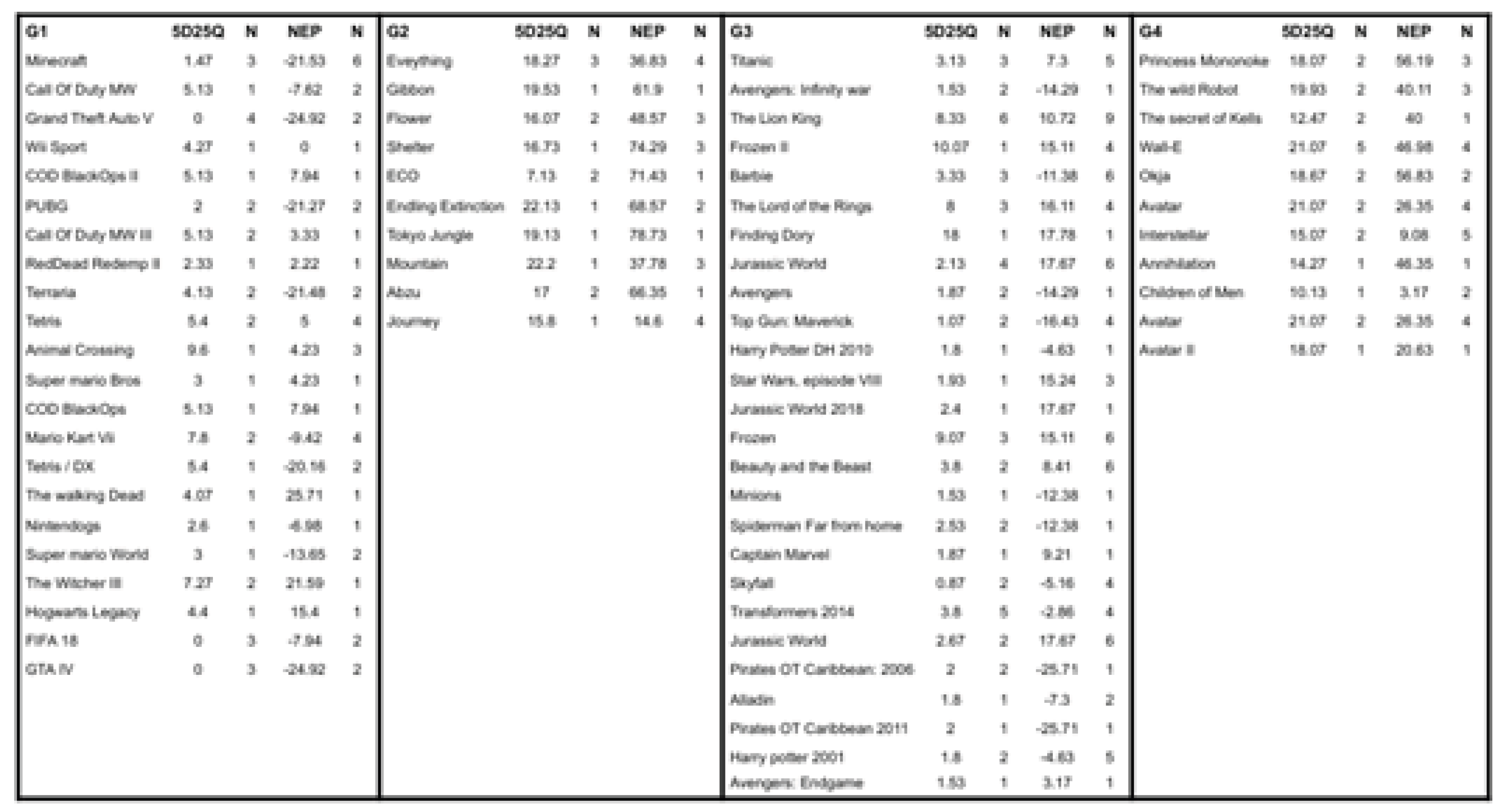
Results indicate similarity in the average scores of the two questionnaires. As the revised NEP questionnaire is considered the most widely used environmental values and attitude measure in the world [124], this consolidates the reliability of the results of our NAMEQ questionnaire of the non-anthropocentric nature of the media.
5.2. Positioning NAMEQ Among Existing Instruments
Several established instruments exist to measure ecological values and attitudes, but they primarily focus on individuals rather than media artefacts. As for the previously studied New Ecological Paradigm (NEP) scale measures general pro-ecological worldviews but is not media-specific [124]. Similarly, Thompson and Barton’s scale distinguishes ecocentric from anthropocentric attitudes in people [121], while the Connectedness to Nature Scale (CNS)[117], the Nature Relatedness Scale (NR-21) [118], and the Environmental Identity Scale (EID) [119] all focus on personal identity or psychological connection with nature. Behavioral indices such as the General Ecological Behavior scale (GEB) similarly measure individual-level pro-environmental actions [120].
In ecolinguistics and environmental communication, methods tend to emphasize qualitative discourse analysis of ecological framings in texts rather than standardized, quantitative scoring [122]. While such approaches offer valuable insights, they lack replicable, itemized metrics suitable for cross-media comparisons.
By contrast, NAMEQ is explicitly designed to evaluate media texts themselves. It differs from existing scales in several important ways:
- Object of measurement: NAMEQ scores films, games, and advertisements directly, whereas most instruments assess people’s beliefs, identities, or behaviors.
- Non-anthropocentric orientation: It operationalizes biocentrism and ecocentrism alongside dimensions of degrowth, resource sobriety, and non-anthropocentric philosophy, none of which are integrated together in other instruments.
- Usability for producers: NAMEQ is formulated so that researchers, students, and media creators can apply it during content development, whereas most existing scales target survey respondents.
- Quantification of ecolinguistics: The Ma (ecolinguistic) dimension translates discourse and action-related impacts into scorable prompts, bridging qualitative ecolinguistic frameworks with quantitative evaluation.
- Transparency and comparability: NAMEQ includes weighting and item–theory mapping, offering replicable scoring across artefacts and enabling reliability reporting similar to psychological scales.
In sum, unlike existing instruments that measure audiences’ environmental attitudes, NAMEQ provides the first validated, multi-dimensional, and weighted questionnaire to evaluate media artefacts from a non-anthropocentric perspective, including ecolinguistic impact and the role of media in shaping collective imaginaries.
6. Conclusions on the NAMEQ Section
The evaluation outcomes of our subjective semantic questionnaire, developed to measure non-anthropocentric media values, indicate a high degree of reliability. Iterative refinements during its creation contributed to the development of a robust instrument capable of encompassing a wide range of anthropocentric and non-anthropocentric values across diverse media types, both interactive and non-interactive. The NAMEQ differs from traditional biocentrism instruments such as the NEP scale in that it embeds its evaluation directly into media content rather than assessing abstract environmental attitudes. If established measures like the Connectedness to Nature Scale (CNS) are valuable for capturing an individual’s emotional or cognitive disposition toward nature, they neglect the specific role that media, such as films, video games, or animations, play in shaping social imaginaries. By contrast, the NAMEQ is purpose-built to analyze how such media portray non-anthropocentric themes and cultivate ecocentric and biocentric engagement. This media-centered approach offers advantages over broader environmental questionnaires currently used in sustainability and media studies, providing granular insights into the representations that influence social imaginaries. As such, NAMEQ enriches sustainability media research by combining the rigor of psychological measurement with the specificity required to understand media-driven environmental narratives. The findings also demonstrate a consistent correlation in value assessments regardless of the media’s origins or the subjective evaluations previously con-ducted. The application of the NAMEQ questionnaire appears promising, offering potential for more detailed analyses of the biocentric dimensions of media, whether during the production process or post-release. The reliability of our questionnaire is further substantiated through its comparative analysis with the widely recognized NEP scale. The observed alignment in results between the two instruments underscores the robustness of our tool, particularly in its capacity to assess non-anthropocentric values within media content. Moreover, our questionnaire offers a tailored framework that is more attuned to the nuances of media analysis and the imperative of transitioning towards a non-anthropocentric paradigm. This paradigm shift is pivotal in reshaping social imaginaries and fostering a deeper ecological consciousness.
7. Discussion
If more video game companies seem concerned by sustainable development and the desire to clearly display a green ecological positioning to meet the expectations of some of their customers [146,147]. In fact, it appears that very few of them compensate for their carbon production [148]. The same goes for the film and animation industries [149,150,151]. In many cases it seems that green washing could be described as shallow ecology, rather than deep questioning with the desire to promote a biocentricity, which could by nature be opposed to the anthropocentric narrative expectations of their customers. If real non-anthropocentric positions exist, in the field of video games, they are often the result of individuality or small indies studios of committed and activist in-dependents [152,153,154]. In the field of movies and animated movies, the analysis of our results shows that some of the block buster’s clearly show a non-anthropocentric commitment. However, these successes only represent a tiny portion of the best-selling movies, and it is unlikely that they will revolutionize the paradigm of our social imaginations. If it seems important to us that the major players in the fields of interactive and non-interactive media take their responsibilities as creators of collective imaginations. It is important to note that with the advent of social networks, social imaginations seem less collective than in the past. A growing body of research links social networks to societal fragmentation, reinforcing divisions within collective consciousness [155,156,157,158]. As digital interactions increasingly reshape societies into fragmented and tribal like structures, the necessity of reorienting collective social imaginaries toward a non-anthropocentric paradigm becomes even more pressing. This shift entails moving beyond the anthropocentric view that regards both living and non-living entities solely as resources for human consumption, emphasizing instead the intrinsic value and inter-connectedness of all forms of life.
8. Conclusions
Current interactive and non-interactive AAA media seldom offers viable solutions to the ongoing crisis by significantly influencing collective social imaginaries. In fact, these media rarely present pathways that could rapidly halt the decline of biodiversity, facilitate the adoption of sustainable democratic practices, or promote a reduction in the consumption of natural resources, all while advancing a non-anthropocentric philosophy. Achieving such a utopian vision would require, at the very least, the widespread adoption of a biocentric approach, fostering a balanced paradigm of population management that ac-counts for the finite nature of resources and acknowledges the intrinsic value of all forms of life. Most contemporary media remain entrenched in anthropocentric perspectives, often reflecting societal challenges such as urbanization, dystopian narratives, and consumer culture. Some media even entertain the notion of humanity’s future in extraterrestrial colonization, should the planet’s ecosystems fail. This trajectory suggests that humanity could perpetuate its patterns of exploitation and consumption of both natural resources and non-human life across distant environments, paralleling the detrimental consequences we are currently witnessing in biodiversity and climate degradation. Our hypothesis, supported by numerous scholarly sources cited within this work, asserts that humanity does not have the luxury of such an outlook. Adopting a biocentric posture may be a crucial factor in addressing the necessary paradigm shift confronting our species. This transition could be facilitated through the incorporation of novel, non-anthropocentric narrative frameworks that generate new collective social imaginaries capable of redefining our future and safe-guarding biodiversity. Based on our results, the subjective semantic questionnaire designed to assess the non-anthropocentric value of media appears poised to assist influential stakeholders in shaping media that promotes biocentric equilibrium. Future research should prioritize extending the evaluation of non-anthropocentric values to other influential media platforms, particularly social networks. These platforms play a pivotal role in shaping social imaginaries, yet their growing influence has often contributed to societal fragmentation and the emergence of tribalized communities with diverging perspectives. This underscores the urgency for a paradigm shift that integrates a non-anthropocentric philosophy into the design and conceptualization of such systems. Educating system designers about the broader social imaginaries they influence is crucial to this transformation. Given the historical shortcomings of anthropocentric approaches, tools like the NAMEQ questionnaire hold significant potential for facilitating this shift. By promoting a coherent, non-anthropocentric vision, such frameworks can serve as a foundation for reimagining the future of collective social imaginaries and fostering more sustainable interactions between humanity and the natural world.
Supplementary Materials
The following supporting information can be accessed and downloaded from ResearchGate at the following link: https://www.researchgate.net/publication/388753101_E_Geslin_Non-Anthropocentric_Media_Evaluation_Questionnaire_NAMEQ. NAMEQ Questionnaire. Complete version of the Non-Anthropocentric Media Evaluation Questionnaire used in the study. The NAMEQ Non-Anthropocentric Media Score Subjective Semantic Questionnaire is made available under a Creative Commons Attribution 4.0 (CC BY 4.0) license, allowing for unrestricted use, distribution, and adaptation, provided that appropriate credit is given to the author. Consent Text. Full information and consent paragraph presented to participants before accessing the questionnaire. Additionally, it is referenced under the DOI: 10.13140/RG.2.2.19804.71042, ensuring its traceability and proper attribution in academic and research con-texts.
Institutional Review Board Statement
The study was conducted in accordance with the Declaration of Helsinki. Ethical review and approval were not required for this non-interventional research because no personal data were collected or processed; responses were fully anonymous and could not be linked to individuals. Under GDPR Recital 26 and national guidance from Sikt (Norwegian Agency for Shared Services in Education and Research), projects in which the entire data collection is anonymous fall outside the scope of data protection review/notification.
Informed Consent Statement
Informed consent for participation was obtained from all subjects involved in the study. Before accessing the questionnaire, participants were presented with an information and consent page stating: “I confirm that my participation in this survey is entirely voluntary, that I may withdraw at any time without penalty, and that only anonymous data are collected. My responses will be used solely for research purposes and for general statistical analysis, and will remain confidential. By selecting ’Yes,’ I consent to participate.” Only participants who confirmed consent proceeded to the survey.
Data Availability Statement
The dataset generated and analyzed during the current study consists solely of fully anonymized survey responses. The anonymized dataset is available from the corresponding author on reasonable request.
Conflicts of Interest
The authors declare no conflict of interest.
References
- A. J. Ivakhiv, Ecologies of the moving image: Cinema, affect, nature, Wilfrid Laurier Press, 2013.
- A. Naess, The ecology of wisdom, Catapult, 2009.
- A. B. Smith and C. D. Johnson, “Integrating ecocentric perspectives in digital media design: A framework for sustainable ICT.,” IEEE Access, 10, p. 12345–12356., 2022.
- E. F. Lee and R. Kumar, “Towards a sustainable digital future: Evaluating media technologies through an ecocentric lens.,” IEEE Transactions on Sustainable Computing, 8(1),, p. 34–45., 2023.
- W. K. C. Guthrie, The sophists., Cambridge University Press, 1969.
- G. B. Kerferd, “The Sophistic Movement.,” in The Sophistic Movement., Cambridge University Press, 1981, p. Vol. 84.
- B. Taylor, “The Greening of Religion Hypothesis (Part One): From Lynn White, Jr and Claims That Religions Can Promote Environmentally Destructive Attitudes and Behaviors to Assertions They Are Becoming Environmentally Friendly.”, Journal for the Study of Religion, Nature & Culture, p. 10.3, 2016.
- S. H. Nasr, Man and nature: The spiritual crisis of modern man., 1968.
- J. Hankins, The Cambridge companion to Renaissance philosophy, Cambridge University Press, 2007.
- J. R. McNeill, Something new under the sun: An environmental history of the twentieth-century world (the global century series)., WW Norton & Company, 2001.
- V. De Lucia, "Beyond Anthropocentrism and Ecocentrism: A Biocentric Approach to Environmental Law," Journal of Environmental Law and Practice, pp. vol. 12, no. 2, 2013, pp. 189-215., 2013.
- A. Grear, "Human Rights and New Nature Relations.," Journal of Human Rights and the Environment, pp. vol. 8, no. 1, 2017, pp. 63-86., 2017.
- A. Naess, "The Shallow and the Deep, Long-Range Ecology Movement. A Summary," An Interdisciplinary Journal of Philosophy, p. 16 (1–4): 95–100, 1973 S2CID 52207763. [CrossRef]
- M. Tallacchini, "Environmental Ethics: Nature as Law, Nature as Rights.," International Journal for Philosophy of Law, pp. vol. 9, no. 4, 1996, pp. 211-229., 1996.
- Keck, F., Peller, T., Alther, R., Barouillet, C., Blackman, R., Capo, E., ... & Altermatt, F. (2025). The global human impact on biodiversity. Nature, 1–6.
- Le Quéré, C. “Temporary Reduction in Daily Global CO2 Emissions During the COVID-19 Forced Confinement,” Nature Climate Change, vol. 10, no. 7, 2020, pp. 647–653. [CrossRef]
- Zeng, N. , et al. (2020). Global to local impacts on atmospheric CO2 caused by COVID-19 lockdown. Atmospheric and Oceanic Physics, arXiv:2010.13025.
- Liu, Z. (2020). Near-real-time monitoring of global CO2 emissions reveals the effects of the COVID-19 pandemic. Scientific Reports, 10(1), 1–12. [CrossRef]
- Lam, K. S., Liu, H., Wong, C. M., & et al. (2022). Public health co-benefits of PM2.5 reduction during the COVID-19 pandemic: An analysis of fifteen cities worldwide. Environmental Research, 204, 111897. [CrossRef]
- Y. Zeng, &. W. H., "COVID-19 Pandemic, Air Quality, and PM2.5 Reduction-Induced Health Benefits: A Comparative Study.," Air Quality, Atmosphere & Health, pp. 14, 591–604, 2021.
- G. e. a. Sordello, "Positive global environmental impacts of the COVID-19 pandemic lockdown.," Environmental Science & Policy., 2020.
- Letzing, J. (2020, mai 27). COVID-19 lockdowns have silenced urban noise. Now it’s coming back. World Economic Forum. https://www.weforum.org/stories/2020/05/covid19-lockdowns-silenced-urban-noise-now-its-coming-back/ www.weforum.org/stories/2020/05/covid19-lockdowns-silenced-urban-noise-now-its-coming-back/.
- Bates, A. E., Primack, R. B., Moraga, P., & Duarte, C. M. (2021). Global wildlife responses to COVID-19 lockdowns. Nature Ecology & Evolution, 5, 1255–1261, 2021. [CrossRef]
- B. Owens, " The positive and negative impacts of COVID on nature.," Smithsonian Magazine, p. https://www.smithsonianmag.com, 2021.
- A. e. a. Woodley, " The impact of COVID-19 on biodiversity and conservation efforts.," Biological Conservation, pp. 253, 108876, 2021. [CrossRef]
- G. H. Chen and S. Patel, "Non-anthropocentric design in cyber-physical systems: Implications for sustainable media and social change.," In Proceedings of the 2024 IEEE International Conference on Green and Sustainable Computing (ICGSC), p. (pp. 210–217)., 2024.
- L. M. Rodriguez and T. P. Nguyen, "Reimagining media narratives for sustainability: A cybernetic approach.," IEEE Transactions on Cybernetics, 52(4), p. 556–568., 2022.
- G. Cochran, &. H. H., The 10,000 year explosion: How civilization accelerated human evolution., Basic Books., 2009.
- B. V. M. Hayden, Complex hunter-gatherers and the evolution of social complexity., T C. Price & J. Brown, 2011.
- Hill, K. , Walker, R. S., Božičević, M., & Hurtado, M. (2011). Hunter-gatherer intergroup conflict and cooperation. In M. R. Ember & C. R. Ember (Eds.), Encyclopedia of Social and Cultural Anthropology. Taylor & Francis.
- O. Galor, &. M. O., "Natural selection and the origin of economic growth.," The Quarterly Journal of Economics, pp. 117(4), 1133–1191, 2002.
- R. Rowthorn &. S. P., "Property rights, warfare, and the Neolithic transition.," TSE Working Paper, pp. No. 10-207, 2010.
- M. A. Zeder, "Domestication and early agriculture in the Mediterranean Basin: Origins, diffusion, and impact.," Proceedings of the National Academy of Sciences, pp. 105(33), 11597–11604., 2008.
- C. J. R. Mc Evedy, Atlas of World Population History., Penguin Books., 1978.
- D. Canning, "The causes and consequences of the demographic transition," PGDA Working Paper No. 79, p. Harvard School of Public Health., 2011.
- O. Galor, "From stagnation to growth: Unified growth theory.," in Handbook of Economic Growth, Elsevier, 2005, pp. pp. 171-293.
- Mc Kinsey Global Institute., "Life expectancy more than doubled over the past century.," 2020. [Online]. Available: https://www.mckinsey.com.
- Macquarie University, "Why has the world population grown so much so quickly?," 2018. [Online]. Available: https://lighthouse.mq.edu.au.
- K.-E. Norrman, "World population growth: A once and future global concern".World, pp. 4(4), 684-697., 2023. [CrossRef]
- R. Lesthaeghe, "The unfolding story of the second demographic transition.," Population and Development Review, pp. 36(2), 211–251., 2010.
- Meadows, D. H., Meadows, D. L., Randers, J., & Behrens, W. W. (1972). The limits to growth: A report for the Club of Rome’s project on the predicament of mankind. Universe Books.
- Meadows, D. H., Randers, J., & Meadows, D. L. (2004). Limits to growth: The 30-year update. Chelsea Green Publishing.
- J. Randers, &. M. D. L., Beyond the Limits: Confronting Global Collapse, Envisioning a Sustainable Future., Chelsea Green Publishing., 2004.
- Vollset, S. E., Goren, E., Yuan, C.-W., Cao, J., Smith, A. E., Hsiao, T., Bisignano, C., Azhar, G. S., Castro, E., Chalek, J., Dolgert, A. J., Frank, T., Fukutaki, K., Kenny, A., Liu, J., Nandakumar, V., Pierce, M., Pletcher, M. A., Robalik, T., ... Murray, C. J. L. (2020). Fertility, mortality, migration, and population scenarios for 195 countries and territories from 2017 to 2100: A forecasting analysis for the Global Burden of Disease Study. The Lancet, 396(10258), 1285–1306. [CrossRef]
- T. P. Nguyen and G. H. Chen, "Smart sensing for sustainable population monitoring: Integrating IoT and AI for environmental management.," IEEE Internet of Things Journal, 10(3), p. 1545–1557, 2023. [CrossRef]
- L. M. Rodriguez, &. L. E. F., "Modeling energy consumption in urban environments: A non-anthropocentric approach.," in Proceedings of the 2022 IEEE International Conference on Sustainable Energy Technologies (ICSET), 2022.
- S. Patel and R. Kumar, "Renewable energy and population dynamics: Assessing the impact of overpopulation on sustainable power systems.," IEEE Transactions on Sustainable Energy, 15(2), p. 123–132, 2024. [CrossRef]
- X. Zhang and Y. Wang, "Eco-innovations in urban infrastructure: Integrating EEE solutions for mitigating overexploitation of resources.," IEEE Access, 11, p. 2543–2554., 2023.
- United Nations, Department of Economic and Social Affairs, Population Division. (2022). World Population Prospects 2022: Summary of results. United Nations. https://www.un.org/development/desa/pd/content/World-Population-Prospects-2022.
- World Economic Forum, "The Global Risks Report 2022.," https://www.weforum.org, 2022.
- World Bank, "World Development Report 2022: Finance for an Equitable Recovery. Washington, D.C.," https://www.worldbank.org, 2022.
- E. M. C. Crist & E. R., "The interaction of human population, food production, and biodiversity protection.," Science, pp. 356(6335), 260–264, 2017. [CrossRef]
- L. Robin, "Anthropocene: The human era and its environmental consequences.," Environmental History, pp. 18(1), 5–10, 2013. [CrossRef]
- J. W. Moore, "Anthropocene or Capitalocene? Nature, History, and the Crisis of Capitalism.," Oakland: PM Press., 2016.
- M. Silverman, "Nicholas Georgescu-Roegen and ecological economics.," Portland State University Economics Working Papers, p. No. 54. https://archives.pdx.edu/ds/psu/37815, 2022.
- Ceballos, G., Ehrlich, P. R., Barnosky, A. D., García, A., Pringle, R. M., & Palmer, T. M. (2015). Accelerated modern human–induced species losses: Entering the sixth mass extinction. Science Advances, 1(5), e1400253. [CrossRef]
- A. E. Kelley, & B. K. C., "The neuroscience of natural rewards: Relevance to addictive drugs.," Journal of Neuroscience, pp. 22(9), 3306-3311, 2002. [CrossRef]
- M. Estrella, & S. N., "The role of ecosystems in disaster risk reduction," United Nations University Press., pp. pp. 1-486, 2013.
- J. A. Perry, & W. D. A., "Evolution of innate behavioral strategies through competitive population dynamics.," PLOS Computational Biology, pp. 16(2), e1009934, 2020. [CrossRef]
- H. Washington, & K. H., " The Limits of Growth: Challenges of Ecological and Demographic Sustainability.," Environmental Studies Review, pp. 26(2), 35-47, 2020. [CrossRef]
- World Happiness Report., "World Happiness Report 2024: Assesses Happiness Across Generations. Sustainable Development Solutions Network.," 2024. [Online]. Available: https://sdg.iisd.org/news/world-happiness-report-2024-assesses-happiness-across-generations:contentReference[oaicite:0]index=0.
- T. Sharot, The Optimism Bias: A Tour of the Irrationally Positive Brain., Pantheon Books., 2011.
- W. Samuelson, & Z. R. J., "Status quo bias in decision making.," Journal of Risk and Uncertainty, pp. 1(1), 7-59, 1988. [CrossRef]
- M. Wang and L. Chen, "Investigating status quo bias in adaptive energy management systems.," in Proceedings of the 2022 IEEE International Conference on Smart Grid Communications (SmartGridComm), 2022.
- M. Godefroid, R. Plattfaut and B. Niehaves, " How to measure the status quo bias?," A review of current literature. Management Review Quarterly, 73(4), pp. 1667-1711., 2023.
- R. Carson, Silent spring., Houghton Mifflin., 1962.
- Ehrlich, P. R. (The population bomb., Sierra Club/Ballantine Books., 1968.
- Thoreau, H. D. (Author); Porter, E. (Photographer) (1962). In Wildness Is the Preservation of the World. Sierra Club / Ballantine Books.
- A. Naess, Ecology, community and lifestyle: Outline of an ecosophy (D. Rothenberg, Trans.)., Cambridge University Press., 1989.
- B. Devall, & S. G., Deep ecology: Living as if nature mattered., Gibbs Smith., 1985.
- W. Fox, Toward a transpersonal ecology: Developing new foundations for environmentalism., State University of New York Press., 1995.
- S. Bodian, "Simple in Means, Rich in Ends - A Conversation with Arne Naess", 1982.
- S. Harding, "Deep ecology in the holistic science programme.,"2010. [Online]. Available: https://www.schumachercollege.org.uk.
- H.-O.Pörtner, S. R. J, A. A, J. e. a., "Climate change and biodiversity: Synergies, challenges, and solutions.," Nature Climate Change, pp. 13(4), 312–319., 2023.
- World Resources Institute., "State of Climate Action 2023: Biodiversity at the crossroads.," 2023. [Online]. Available: https://www.wri.org.
- IPBES, "The nexus between climate change and biodiversity loss: Impacts, adaptation, and policy implications.," 2023. [Online]. Available: https://www.ipbes.net.
- Finn, C., & Duffy, P.-D. (2023). The global loss of biodiversity is significantly more alarming than previously suspected. Biological Reviews. [CrossRef]
- University of Birmingham., "Exponential biodiversity loss linked to human activities.," 2023. https://www.birmingham.ac.uk.
- A. Leopold, A Sand County Almanac: And Sketches Here and There., 1949.
- P. Jääskeläinen, & K. E. , "Data Ethics and Practices of Human-Nonhuman Sound Technologies and Ecologies.," arXiv preprint, p. preprint arXiv:2408.10756., 2025.
- D. J. Haraway, Staying with the trouble: Making kin in the Chthulucene., Duke University Press., 2020.
- N. Cooper, "Would the trees dim the lights? Adopting the intentional stance for more-than-human participatory design.," in Proceedings of the Participatory Design Conference, 2022.
- D. Ingram, Green Screen: Environmentalism and Hollywood Cinema., University of Exeter Press., 2004.
- C. Castoriadis, L’institution imaginaire de la société., Éditions du Seuil., 1998.
- C. Taylor, Modern Social Imaginaries., Duke University Press., 2004.
- M. L. Garcia and F. Chen, "Digital storytelling and its impact on social values: A study of interactive media.," in Proceedings of the 2023 IEEE International Conference on Digital Media Technology (ICDMT), 2023.
- J. H. Murray, Hamlet on the Holodeck: The Future of Narrative in Cyberspace., MIT Press., 2017.
- I. Bogost, Persuasive Games: The Expressive Power of Videogames., MIT Press., 2007.
- Lee, E. F. & Patel, S., "A computational analysis of video game content.," IEEE Transactions on Affective Computing, 13(2), p. 345–356., 2022.
- Q. Wang and J. Li, "Shaping social imaginaries: The role of video games in disseminating cultural beliefs.," IEEE Access, 12, p. 12345–12353, 2024.
- A. Sen, Development as freedom., Alfred A. Knopf., 1999.
- T. R. Malthus, An essay on the principle of population (1st ed.), J. Johnson., 1798.
- K. Marx, & E. F., Die heilige Familie, oder Kritik der kritischen Kritik: Gegen die Philosophie der Elenden., Verlag von Otto Meissner., 1845.
- K. Marx, E. F., La Sainte Famille, ou Critique de la Critique de la Philosophie de la Religion de Hegel, Éditions Sociales., 1975.
- M. Harris, Cows, pigs, wars, and witches: The riddles of culture., Random House., 1994.
- E. Boserup, Population and technological change: A study of long-term trends., University of Chicago Press., 1981.
- L. Ferry, Le nouvel ordre écologique : L’arbre, l’animal et l’homme., Éditions Grasset., 1992.
- M. Sagoff, The economy of the Earth: Philosophy, law, and the environment., Cambridge University Press., 2008.
- J. Doe and A. Smith, "Impact of demographic growth on resource consumption and environmental sustainability: An IEEE perspective.," IEEE Transactions on Sustainable Computing, 9(1), p. 23–34, 2023.
- E. Fermi, " Ẅhat is the evidence for the existence of extraterrestrial civilizations?," in Conference on the Origin of Life, Chicago, 1950.
- B. Zuckerman, "The search for extraterrestrial life: The paradox of Fermi’s question.," Scientific American, pp. 272(6), 44-51., 1995.
- M. E. Kahn, "The death toll from natural disasters: The role of income, geography, and institutions.," The Review of Economics and Statistics, pp. 87(2), 271-284, 2005. [CrossRef]
- T. F. Homer-Dixon, Environment, scarcity, and violence., Princeton University Press., 1999.
- D. Kahneman, Thinking, fast and slow., Farrar, Straus and Giroux., 2011.
- L. Febvre, A geographical introduction to history., Routledge., 2013.
- Y. N. Harari, Sapiens: A brief history of humankind., Harvill Secker., 2014.
- V. Valkanova, & M. N., "Perspective Chapter: Sustainability and Media Influence–The Role of Global Media in Creating a New Environmental Culture.," Globalization and Sustainability-Ecological, Social and Cultural Perspectives. IntechOpen., 2024.
- P. Curry, Ecological ethics: An introduction., Cambridge: Polity Press., 2011.
- R. Maxwell, & M. T., "Ecological ethics and media technology.," International Journal of Communication,, pp. 2-23, 2008.
- C. E. Osgood, The measurement of meaning., Urbana: University of Illinois Press., 1957.
- G. J. Suci, & T. P. H., The measurement of meaning., University of Illinois Press., 1967.
- R. F. DeVellis, Scale development: Theory and applications (4th ed.)., SAGE Publications., 2016.
- J. C. Nunnally, & B. I. H., Psychometric theory (3rd ed.)., McGraw-Hill., 1994.
- N. Schwarz, & S. H., Asking questions: The definitive guide to questionnaire design., Jossey-Bass., 1994.
- R. Likert, " A technique for the measurement of attitudes.," Archives of Psychology, pp. 140, 1-55., 1932.
- Thompson, S. Barton, & , M. A. (1994). Ecocentric and anthropocentric attitudes toward the environment. Journal of Environmental Psychology, 14(2), 149–157. [CrossRef]
- Mayer, F. S. Frantz, &, C. M. (2004). The connectedness to nature scale: A measure of individuals’ feeling in community with nature. Journal of Environmental Psychology, 24(4), 503–515. [CrossRef]
- Nisbet, E. K. , Zelenski, J. M., & Murphy, S. A. (2009). The nature relatedness scale: Linking individuals’ connection with nature to environmental concern and behavior. Environment and Behavior, 41(5), 715–740. [CrossRef]
- Clayton, S. Opotow, &, S. (Eds.). (2003). Identity and the natural environment: The psychological significance of nature. MIT Press.
- Kaiser, F. G.Wilson, & , M. (2004). Environmental attitude and ecological behavior. Journal of Environmental Psychology, 24(4), 369–384. [CrossRef]
- Frawley, J. Horn, & , M. (2018). Ecolinguistics and discourse analysis: Approaches for evaluating environmental communication. Language & Ecology, 3(2), 45–63. [CrossRef]
- Stibbe, A. (2021). Ecolinguistics: Language, Ecology and the Stories We Live By (2nd ed.). Routledge. https://www.routledge.com/Ecolinguistics-Language-Ecology-and-the-Stories-We-Live-By/Stibbe/p/book/9780367428419.
- M. Furr, Psychometrics: An introduction., SAGE Publications., 2011.
- R. E. Dunlap, K. D. Van Liere, A. G. Mertig and R. E. Jones, "New trends in measuring environmental attitudes: Measuring endorsement of the New Ecological Paradigm: A revised NEP scale.," Journal of Social Issues, 56(3), pp. 425–442, 2000. [CrossRef]
- M. Koc & B. E., "Development and validation of the Media Health Literacy scale (MeHLit).," BMC Public Health, p. 14221, 2022.
- S. Thompson& B. J., "Ecocentric and anthropocentric attitudes toward the environment.," Journal of Environmental Psychology, pp. 149-157, 1994.
- L. J. Cronbach, "Coefficient alpha and the internal structure of tests.," Psychometrika, pp. 16(3), 297–334, 1951. [CrossRef]
- Electronic Arts, "FIFA 18," 2017.
- P. W. Taylor, Respect for Nature: A Theory of Environmental Ethics, Princeton University Press., 1986.
- Miyazaki, H. (Director). (1997). Princess Mononoke [Film]. Studio Ghibli; Miramax Films.
- Kubrick, S. (Director). (1968). 2001: A space odyssey [Film]. Metro-Goldwyn-Mayer.
- J. B. Callicott, Earth’s Insights: A Survey of Ecological Ethics from the Mediterranean Basin to the Australian Outback., University of California Press., 1994.
- J. Lovelock, The Revenge of Gaia: Why the Earth is Fighting Back – and How We Can Still Save Humanity., Penguin Books., 2006.
- M. Bookchin, The Ecology of Freedom: The Emergence and Dissolution of Hierarchy., Cheshire Books., 1982.
- D. Jensen, Endgame, Vol. 1: The Problem of Civilization., Seven Stories Press., 2006.
- C. Sagan, Pale Blue Dot: A Vision of the Human Future in Space., Random House., 1994.
- T. Berry, The Great Work: Our Way into the Future., Bell Tower., 1999.
- T. Morton, The Ecological Thought., Harvard University Press., 2010.
- B. G. Tabachnick & F. L. S., Using Multivariate Statistics (7th ed.), Pearson., 2019.
- M. Tavakol & D. R., "Making sense of Cronbach’s alpha.," International Journal of Medical Education, pp. 2, 53-55, 2011. [CrossRef]
- A. Field, Discovering Statistics Using IBM SPSS Statistics (4th ed.), Sage Publications., 2013.
- Douglas, B. D., & Bates, M. E. (2023). Data quality in online human-subjects research: Comparisons between MTurk, Prolific, CloudResearch, Qualtrics, and SONA. PLOS ONE, 18(3), e0279720. [CrossRef]
- D. A. Albert & S. D., "Comparing attentional disengagement between Prolific and MTurk samples.," Scientific Reports, pp. 13(1), 20574., 2023.
- CNAP, "Center for Non-Anthropocentric Play," 2025. [Online]. Available: https://www.cnap.no/.
- E. K. Nisbet, J. M. Zelenski and S. A. Murphy, "The Nature Relatedness Scale: Linking individuals’ connection with nature to environmental concern and behavior.," Environment and Behavior, 41(5), p. 715–740, 2009. [CrossRef]
- A. Ischenco, "Gamification in sustainable development: Applying game design to motivate environmental action.," p. UC Berkeley International & Executive Programs., 2024.
- K. S. Fjællingsdal & K. C. A., "Gaming Green: The Educational Potential of Eco – A Digital Simulated Ecosystem.," Frontiers in Psychology, 2023.
- Earth.Org., "The Environmental Impacts of the Video Game Industry.," 2024. [Online]. Available: https://earth.org/.
- M. Scott, "Greening the screen: Environmental sustainability in the global film industry.," Film Quarterly, pp. 70(4), 30–42, 2017. [CrossRef]
- R. Bevan, "The carbon footprint of the entertainment industry: Analyzing the impact of film and television production.," Environmental Research Letters, pp. 14(10), 104008, 2019. [CrossRef]
- T. Ravettine & M. J., "Sustainable animation practices: Challenges and opportunities," Journal of Animation Studies, pp. 13(2), 55–69., 2020.
- F. Pais, "Exploring more-than-human worlds and becoming with living and non-living entities through play.," In Gray, C., Ciliotta Chehade, E., Hekkert, P., Forlano, L., Ciuccarelli, P., Lloyd, P. (Eds.), 2024.
- F. Pais & E. G, "Manifesto para um design de jogo nao-anthropocentrico.," in PPG Design Caderno Científico., 2024.
- P. Ruffino, Independent Videogames: Cultures, Networks, Techniques, and Politics., Routledge., 2021.
- D. Boyd, It’s Complicated: The Social Lives of Networked Teens., Yale University Press., 2014.
- D. Fayon, "Les réseaux sociaux menacent-ils nos libertés individuelles?," Terminal, pp. 108-109, 61-63., 2011.
- D. Cardon, La Démocratie Internet., Seuil., 2010.
- J. Van Dijck, The Culture of Connectivity: A Critical History of Social Media., Oxford University Press., 2013.
Figure 1.
© Ourworldindata.org 2021.Based on the History of the Global Environment (HYDE) and United Nations.
Figure 1.
© Ourworldindata.org 2021.Based on the History of the Global Environment (HYDE) and United Nations.
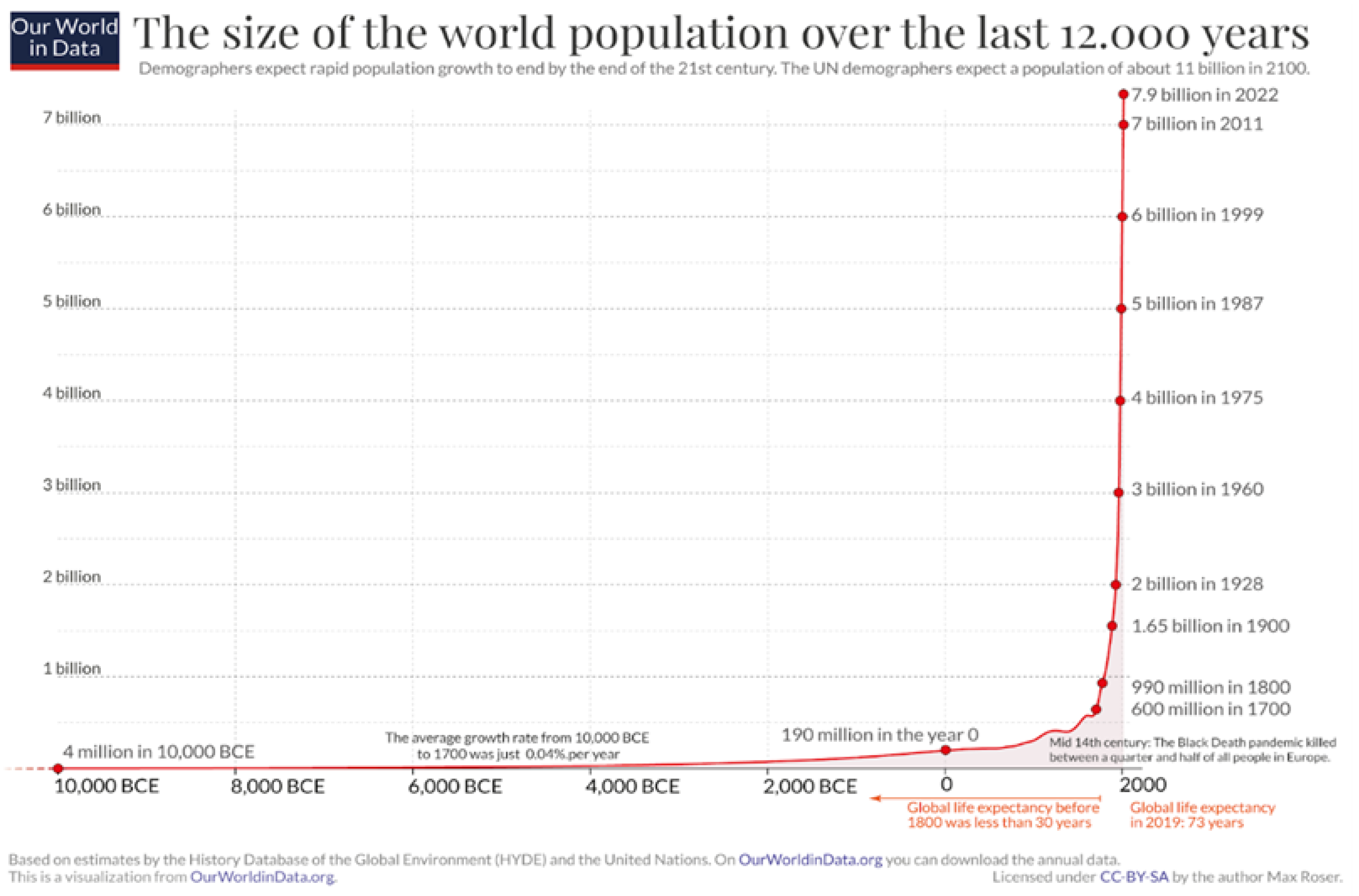
Figure 2.
NAMEQ Distribution of Non-Anthropocentric Media scores.
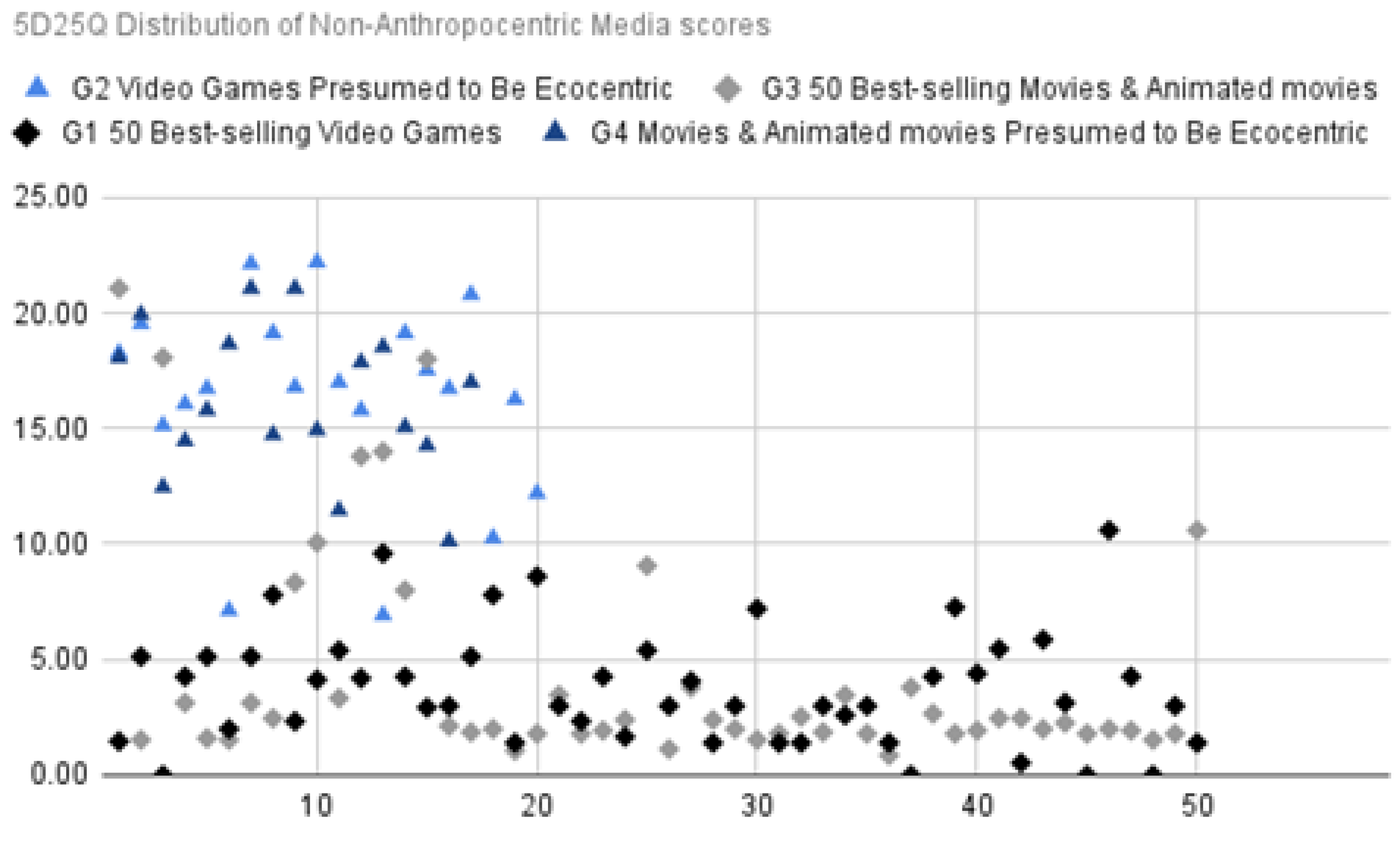
Figure 4.
– NEP Distribution of Non-Anthropocentric Media scores.
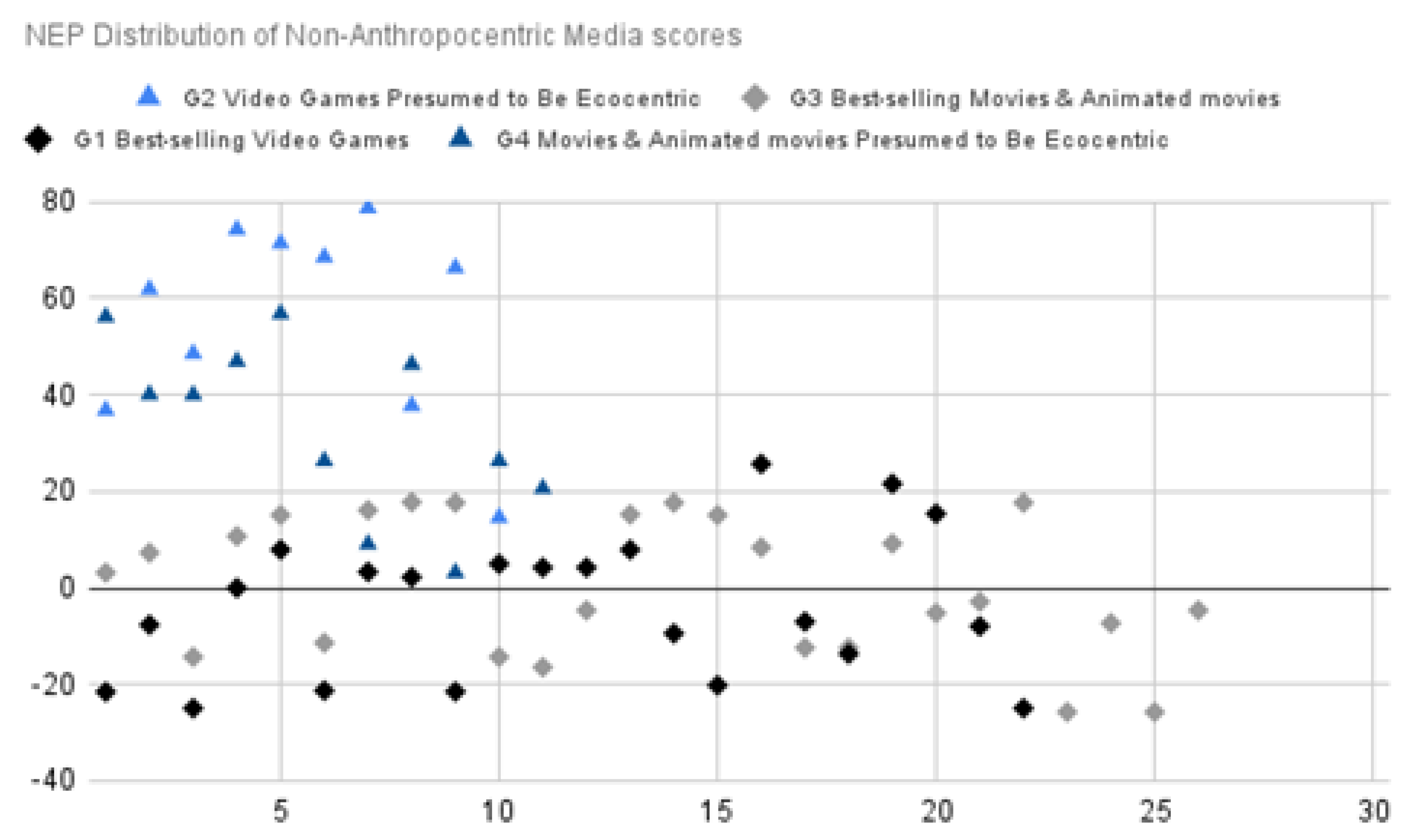
Disclaimer/Publisher’s Note: The statements, opinions and data contained in all publications are solely those of the individual author(s) and contributor(s) and not of MDPI and/or the editor(s). MDPI and/or the editor(s) disclaim responsibility for any injury to people or property resulting from any ideas, methods, instructions or products referred to in the content. |
© 2025 by the authors. Licensee MDPI, Basel, Switzerland. This article is an open access article distributed under the terms and conditions of the Creative Commons Attribution (CC BY) license (http://creativecommons.org/licenses/by/4.0/).
Copyright: This open access article is published under a Creative Commons CC BY 4.0 license, which permit the free download, distribution, and reuse, provided that the author and preprint are cited in any reuse.


