

Submitted:
17 April 2025
Posted:
21 April 2025
You are already at the latest version
Abstract
Regenerative agriculture has emerged as an alternative approach to food production, offering the potential to achieve reduced or even positive environmental and social outcomes compared to the soil degradation and greenhouse gas emissions of conventional agriculture. Simultaneously, a sophisticated dual-use system combining solar energy generation from photovoltaics with agricultural production called agrivoltaics is rapidly expanding. Combining these approaches into regenerative agrivoltaics offers a promising solution to the food challenge in a rapidly warming world. This review theoretically examines the compatibility and mutual benefits of combining agrivoltaics and regenerative agriculture, while also identifying the challenges, opportunities, and pathways for implementing this system. A foundation for advancing regenerative agrivoltaics is made by identifying areas for research, which include: 1) carbon sequestration, 2) soil health and fertility, 3) soil moisture, 4) soil microbial activity, 6) soil nutrients, 7) crop performance, 8) water-use efficiency, and 9) economics. By addressing the intersection of agriculture, renewable energy, and sustainability, regenerative agrivoltaics emphasizes the transformative potential of integrated systems in reshaping land use and resource management. This evaluation underscores the importance of policy and industry collaboration in facilitating adoption of regenerative agrivoltaics, advocating for tailored support mechanisms to enable widespread implementation of low-cost, zero-carbon, resilient food systems.
Keywords:
agrivoltaics
; agriculture
; regenerative agriculture
; photovoltaics
; sustainability
; renewable energy
; land use
1. Introduction
As the world population continues to grow so does the agricultural system that feeds humanity. To meet this need, farmers rely on fertilizers, pesticides, and land expansion, leading to a more than 60% rise in methane emissions from agriculture over the past four decades [1,2]. Although modern techniques have boosted productivity, they have also contributed to soil degradation, nutrient depletion, and pollution [3]. Practices including monoculture and excessive chemical application, have led to declining soil health, water contamination, and biodiversity loss, threatening ecological stability [4]. Agriculture remains a primary driver of greenhouse gas emissions (GHGs), responsible for over 11% of global anthropogenic emissions from direct sources [5]. If GHG emissions remain unchanged until 2100, crop yields will be reduced approximately by 45%, wheat yields by 50%, and rice yields by 30% [6]. These alarming projections highlight the urgent need to explore sustainable food production systems that can mitigate environmental impacts while ensuring long-term agricultural resilience.
1.1. Regenerative Agriculture: A Sustainable Approach to Food Production
Regenerative agriculture (RA) has emerged as an alternative approach to food production, offering the potential to achieve reduced or even positive environmental and social outcomes [7]. Schreefel et al. defined RA as “an approach to farming that uses soil conservation as the entry point to regenerate and contribute to multiple provisioning, regulating and supporting ecosystem services, with the objective that this will enhance not only the environmental, but also the social and economic dimensions of sustainable food production” [8]. It is increasingly recognized as a method to promote sustainability in food systems, with the added potential of contributing to climate change mitigation [9]. Project Drawdown [10], a nonprofit organization, with the aim to help the world stop climate change, emphasizes that RA improves soil health by replenishing carbon content, leading to greater productivity—an outcome that contrasts sharply with conventional farming practices [11]. Key agronomic challenges linked to RA include rebuilding soil health, capturing carbon to combat climate change, and reversing biodiversity loss [12]. With its numerous co-benefits, such as the production of nutritious food, RA is seen as a vital component in addressing the challenges posed by escalating climate instability [13].
1.2. Agrivoltaics: Integrating Energy and Agriculture
Clean energy technologies are taking a central role to achieving global sustainability goals [14]. Among these, solar photovoltaics (PV) has gained prominence as a cost-effective and rapidly expanding energy solution [15,16]. The extensive land requirements for traditional PV installations to meet the growing energy demands of an expanding global population often result in land use conflicts [17]. This is a particular problem if PV systems displace food production on agricultural land thereby running the risk of repeating the ethanol debacle and increasing food prices and global hunger [18].
Agrivoltaics, a dual-use system combining solar energy generation with agricultural production, offers a promising solution to this challenge [19]. Thie agrivoltaics approach provides numerous benefits, including lower greenhouse gas emissions (GHGs) [20], increased economic and environmental advantages [21], enhanced water-use efficiency [22,23,24,25], better land use efficiency [26] and perhaps most importantly increased crop yields of a wide variety of human food crops (basil [27], broccoli [28], celery [29], chiltepin peppers [26], lettuce [30,31], tomatoes [26], corn [32], strawberries [33,34], pasture grass [35,36], potatoes [37], Swiss chard [38,39,40], kale [38,39,40], and common bean [38,39,40], and grapes [40,41]).
Beyond agricultural productivity, agrivoltaics delivers multiple co-benefits, including protection of crops from environmental stressors such as wind [42], mitigation of soil erosion [43], and reversal of desertification [44]. Furthermore, the system improves solar module efficiency because of plant transpiration cooling the modules [45,46,47], alleviate agricultural displacement for energy requirements [48,49,50], localizes food production [51,52,53], improves health due to reduced pollution [54], acts as a hedge against inflation [55], provides energy for computing [56] and opportunities for integrating renewable fuel production, such as hydrogen [57,58,59], anhydrous ammonia [60] as well as the production of on-farm nitrogen fertilizers [61]. In addition improved nutrients (protein content) was also observed for spinach and basil under agrivoltaics configuration [27], which can further help to feed everyone [62].
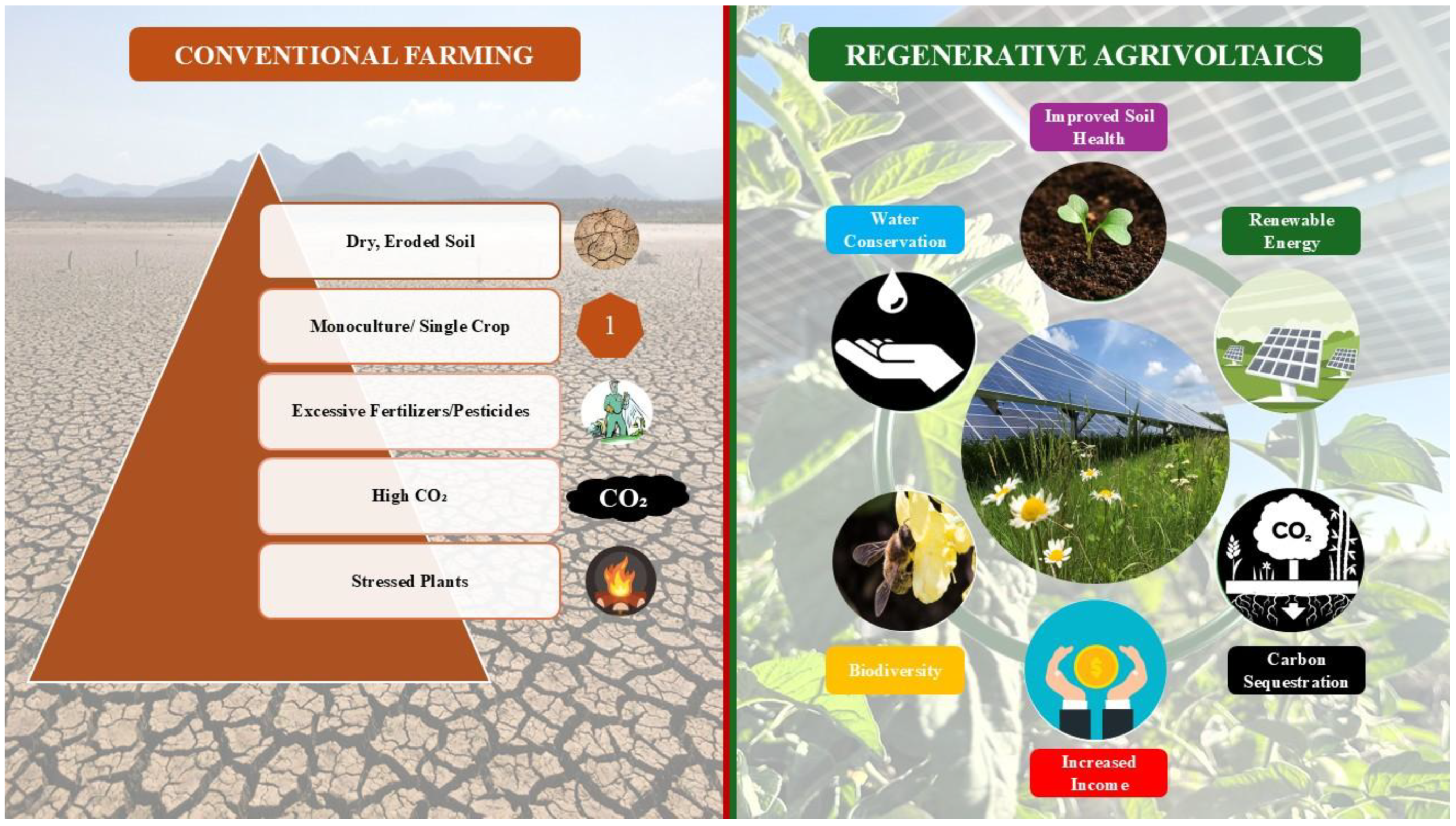
The differences between regenerative agrivoltaics and conventional agriculture are summarized in Figure 1.
1.3. Economics and Market Growth of Agrivoltaics
From an economic perspective, agrivoltaics generates dual revenue streams through agricultural outputs and energy sales, enhancing farmers’ financial stability [63]. For instance, spinach grown under agrivoltaic systems demonstrated financial gains of up to 35% alongside improved nutritional value [27]. Similarly, grazing sheep beneath PV arrays, not only creates a better environment for sheep but is highly profitable for solar shepherds that earn additional income from controlling vegetation on the solar farm [64]. These opportunities have been driving rapid growth in agrivoltaics, whose market is valued at over $3.64 billion in 2022 and is projected to grow at a compound annual growth rate (CAGR) of 38% between 2024 and 2030 [65]. As a strategy addressing both food security and energy sustainability, agrivoltaics holds significant potential to tackle critical global challenges, [66,67], highlighting the need for continued research and development in this area.
1.4. Combining Regenerative Farming and Agrivoltaics
Despite the growing interest in agrivoltaics and regenerative agriculture as independent approaches to sustainable land management, no prior research has explored the integration of these two systems. The potential synergy between agrivoltaics and regenerative agriculture remains largely unexplored, leaving a significant gap in understanding how these approaches could complement one another. This mini-review aims to theoretically examine the compatibility and mutual benefits of agrivoltaics and regenerative agriculture, while also identifying the challenges, opportunities, and pathways for implementing this innovative dual-use system. By bridging these fields, this article seeks to lay the groundwork for future research and practical applications in sustainable food and energy systems.
2. Fostering Resilience: Agrivoltaics Meets Regenerative Agriculture – Regenerative Agrivoltaic
The integration of agrivoltaics and regenerative agriculture offers a unique opportunity to enhance the environmental and economic benefits of each system.
By leveraging the complementary strengths of these approaches, society can address pressing challenges in sustainable agriculture and energy production. Agrivoltaics not only provides a means of clean energy generation, but also creates microclimatic conditions [68] that can bolster regenerative practices [69] such as cover cropping, composting, and organic annual cropping. Similarly, regenerative agriculture principles [70] scan enhance the sustainability of agrivoltaic systems by improving soil health, reducing chemical inputs, and increasing biodiversity. This convergence represents a holistic approach to land management that prioritizes resilience, productivity, and ecological health, creating a pathway to achieve multiple sustainability goals simultaneously. Specifically the U.N. Sustainable Development Goals [71] of : 2. Zero hunger, 3. Good health and well-being and 7. Affordable and clean energy, 14. Climate action, and 15. Life on land.
The following sections explore key areas of synergy between these two approaches, focusing on their potential to integrate cover cropping, composting, increasing crop diversity, and organic annual cropping within agrivoltaic systems. These innovations provide insights into how dual-use systems can be optimized to maximize co-benefits and establish a sustainable future for food and energy production.
3. Innovative Agrivoltaic Strategies for Regenerative Agriculture
Cover cropping, as highlighted in regenerative agriculture frameworks, has the potential to capture atmospheric carbon dioxide (CO2) and sequester it in the form of soil organic matter [72]. This practice enhances soil biology, contributes essential nutrients to the soil [73], and mitigates soil erosion [74], thereby promoting healthier and more sustainable agroecosystems [75].
Agrivoltaics can bolster the efficacy of cover cropping, particularly under extreme weather conditions where the PV modules can act as shields for hail, for example. The shade provided by solar modules enhances the resilience of cover crops, preventing heat stress during high temperatures [76]. This might improve the ability of cover crops to build soil organic matter and sequester carbon. The combination of agrivoltaic systems and cover cropping can contribute to improved soil structure, and a reduction in erosion, furthering the goals of regenerative agriculture.
3.1. Cover Cropping
Cover cropping, as highlighted in regenerative agriculture frameworks, has the potential to capture atmospheric carbon dioxide (CO2) and sequester it in the form of soil organic matter [72]. This practice enhances soil biology, contributes essential nutrients to the soil [73], and mitigates soil erosion [74], thereby promoting healthier and more sustainable agroecosystems [75].
Agrivoltaics can bolster the efficacy of cover cropping, particularly under extreme weather conditions where the PV modules can act as shields for hail, for example. The shade provided by solar modules enhances the resilience of cover crops, preventing heat stress during high temperatures [76]. This might improve the ability of cover crops to build soil organic matter and sequester carbon. The combination of agrivoltaic systems and cover cropping can contribute to improved soil structure, and a reduction in erosion, furthering the goals of regenerative agriculture.
3.2. Increasing Crop Diversity
Agrivoltaic systems can facilitate intercropping and polyculture practices by providing a modular layout that supports diverse planting configurations. This design enhances biodiversity [77,78] and builds resilience against climate variability [79,80]. Moreover, the microclimatic effects of agrivoltaics, such as moderated temperatures [29,45,81,82] and improved water efficiency [29,83,84], create favorable conditions for a variety of crops to thrive simultaneously. The integration of crop diversity into agrivoltaic systems aligns with regenerative goals of enhancing ecosystem services and increasing farm productivity.
3.3. Organic Annual Cropping
The integration of organic annual cropping into agrivoltaic systems offers a dual benefit of sustainable land use and environmental health. Organic farming practices, which rely on natural soil amendments and reduced chemical inputs [85,86], seems inherently compatible with agrivoltaics. The absence of synthetic pesticides and fertilizers minimizes the risk of PV module contamination or corrosion, reducing maintenance needs and associated costs. Additionally, the shade from modules can support crops prone to heat stress [87,88], aligning with the principles of low-impact, sustainable agriculture.
3.4. Composting
3.5. Animal Integration
Solar grazing presents an ideal opportunity for on-site soil improvement creating a closed-loop system for nutrient recycling. Animal waste from solar grazing can contribute significantly to enhance soil nutrients. The shade from solar modules can facilitate animal grazing [92], making the soil enrichment process more efficient in extreme climates as more animals would graze and benefit from shade [92]. Compost application within these systems not only improves soil fertility [93] but also reduces the need for external chemical fertilizers [94], contributing to energy-efficient and waste-reducing food production. This approach provides an avenue that enhances both soil health and environmental sustainability, while also lowering operational costs for farmers.
Agrivoltaics offer opportunities for livestock integration, combining vegetation management with enhanced soil fertility. Animals used on solar farms include sheep [64,83,95], rabbits [96,97] and now cows [92,98]. Grazing animals can maintain under-module vegetation, reducing the need for mechanical mowing [96], while their manure enriches soil organic content [99,100]. Furthermore, the shade provided by solar modules improves animal welfare by protecting livestock from heat stress [19,92,101], which can enhance productivity and health [95]. Integration of pasture based agrivotlaics systems have resulted in 69.3% less emission and 82.9% less energy requirements indicating highly sustainable food-energy system [97]. This synergy exemplifies a holistic approach to regenerative agriculture, optimizing land use for food, energy, and livestock production.
3.6. Managed Grazing
Rotational grazing under solar modules presents a viable strategy for pasture regeneration and carbon storage [102]. By controlling grazing patterns, farmers can ensure even vegetation coverage, and reducing overgrazing risks [96]. The shade from modules creates microclimate that promote diverse forage growth [35,103], supporting livestock nutrition and ecosystem health. Managed grazing within agrivoltaic systems offers a scalable solution contributing to dual-use land management.
3.7. Reduced/No-Till Farming Practices
Undisturbed soils foster an increase in both the abundance and diversity of soil microbial communities, contributing to enhanced soil structure and overall microbiome health [104]. Farmers who implement reduced or no-till practices can experience numerous advantages that not only improve soil health but also provide long-term economic benefits [105]. These practices enhance water infiltration and retention, improve nutrient retention and availability for crops, reduce soil crusting, and lead to a gradual accumulation of soil organic matter, collectively promoting more sustainable and resilient agricultural systems [105,106].
Pairing no-till farming with agrivoltaic systems presents significant potential to enhance soil health and water retention. The partial shade provided by solar modules reduces soil surface temperatures [33,68,107], minimizing water evaporation and fostering a microclimate conducive to moisture retention [84,108]. This synergy supports no-till practices by reducing the likelihood of soil compaction, especially as the shade mitigates the direct impact of heavy rain. Furthermore, the reduced soil disturbance inherent in no-till systems aligns with the fixed nature of agrivoltaic infrastructure, promoting long-term soil stability and resilience. From the PV side, reduced tilling would also reduce the risk of module soiling, which can cause a decrease in energy conversion efficiency [109].
3.8. Silvopasture/Agroforestry
Integrating silvopasture or agroforestry with agrivoltaics presents a promising avenue for long-term sustainability. Integrating agrivoltaics with apple trees have shown reduced water needs [108]. Designs that incorporate trees, solar modules, and grazing animals create a multi-layered system capable of delivering carbon sequestration [110,111], soil fertility [111], and diversified farm incomes [27,80,112,113,114]. The shade from trees and modules moderates temperature extremes, improving animal welfare [19,92,101] and forage quality [103]. Additionally, the long-term carbon storage provided by trees [115] complements the renewable energy benefits of agrivoltaics, positioning these systems as a cornerstone of sustainable land-use practices.
4. Unlocking the Potential of Regenerative Agrivoltaics: Synergies, Challenges, and Theoretical Contributions
4.1. Synergies and Opportunities
Agrivoltaics serves as a powerful catalyst for advancing regenerative agricultural practices by addressing land-use competition while enhancing economic viability. By integrating solar energy systems with farming, agrivoltaics enables dual land use, reducing the need to dedicate vast areas solely for energy production. This synergy creates opportunities to scale regenerative practices, fostering climate resilience through improved soil health, water retention, and carbon sequestration. Additionally, agrivoltaics enhances ecosystem services by supporting biodiversity, providing shade, and creating microclimates conducive to crop growth. With the potential to diversify farm outputs and generate renewable energy, agrivoltaics not only bolsters farm income but also strengthens the sustainability and resilience of agricultural landscapes.
4.2. Challenges and Barriers
Despite its promise, agrivoltaics faces significant challenges in aligning system design and operations with regenerative agricultural goals. The complexities of optimizing dual-use systems to balance energy production, crop growth, and ecological benefits require innovative engineering and site-specific solutions. For instance, specialized racking solutions may be required for integrating solar PV modules with agriculture on which limited work/research has so far been performed [116,117,118]. Furthermore, the absence of tailored financial models and incentives for dual-use regenerative systems hinders widespread adoption, as farmers and developers often lack the economic support necessary to transition.
The absence of well-defined government policies integrating sustainable agriculture and renewable energy development presents another barrier to the widespread adoption of regenerative agrivoltaics. Establishing clear policy frameworks could provide crucial guidance and incentives, encouraging stakeholders to adopt practices that enhance both food production and clean energy generation. These policies, however, should be informed by empirical research exploring the intersection of agrivoltaics and regenerative agriculture.
Future experimental studies could focus on addressing the knowledge gaps to generate empirical evidence that demonstrates the long-term viability and benefits of agrivoltaics. Assessing soil health and fertility under agrivoltaic systems, evaluating carbon sequestration potential, and analyzing the benefits of incorporating animal and crop waste as soil amendments are important parameters to examine during such experiments. Additionally, trials could investigate the impacts of shading from solar modules on soil moisture retention, microbial activity, and nutrient cycling. Evaluating crop performance under varying solar modules configurations and transparency levels, as well as measuring water-use efficiency and microclimatic modifications, would further contribute to optimizing system design. These research efforts are essential for generating the empirical evidence needed to shape effective policies and scale regenerative agrivoltaics as a viable solution for sustainable food and energy production. Addressing these challenges is crucial for unlocking its full potential as a sustainable farming and energy solution.
5. Conclusions
This review lays a critical foundation for advancing regenerative agrivoltaics by identifying key areas ripe for innovation and development, which include: 1) carbon sequestration, 2) soil health and fertility, 3) soil moisture, 4) soil microbial activity, 6) soil nutrient, 7) crop performance, 8) water-use efficiency, and 9) regenerative-agrivotlaics economics. By addressing the intersection of agriculture, renewable energy, and sustainability, regenerative agrivoltaics emphasizes the transformative potential of integrated systems in reshaping land use and resource management. Furthermore, the evaluation underscores the importance of policy and industry collaboration in facilitating the adoption of regenerative agrivoltaics, advocating for tailored support mechanisms to enable widespread implementation. By bridging knowledge gaps (soil health impacts, optimal module configuration, water-use and microclimate effects, biodiversity implications, livestock and composting integration effects, economic feasibility, policy gaps, long term empirical field studies, farmer engagement research) and highlighting opportunities (biodiversity benefits, enhancement of soil regeneration, improving water efficiency, increasing farm revenue streams) for synergies, this research provides a framework to guide future studies and inform practical applications in dual-use agricultural systems.
Author Contributions
Conceptualization, J.M.P.; methodology, U.J.; validation, J.M.P. and U.J.; formal analysis, J.M.P. and U.J.; investigation, J.M.P. and U.J.; resources, J.M.P. and U.J.; data curation, J.M.P. and U.J.; writing—original draft preparation, J.M.P. and U.J.; writing—review and editing, J.M.P. and U.J.; visualization, U.J.; supervision, J.M.P.; funding acquisition, J.M.P.
Acknowledgments
This work was supported by the Thompson Endowment and the Natural Sciences and Engineering Research Council of Canada.
Conflicts of Interest
The authors declare no conflicts of interest.
References
- Fróna, D.; Szenderák, J.; Harangi-Rákos, M. The Challenge of Feeding the World. Sustainability 2019, 11, 5816. [Google Scholar] [CrossRef]
- Hofstra, N.; Vermeulen, L.C. Impacts of Population Growth, Urbanisation and Sanitation Changes on Global Human Cryptosporidium Emissions to Surface Water. International Journal of Hygiene and Environmental Health 2016, 219, 599–605. [Google Scholar] [CrossRef] [PubMed]
- Hamuda, H.E.A.F.B.; Patko, I. Relationship between Environmental Impacts and Modern Agriculture 2010.
- Padhiary, M.; Kumar, R. Assessing the Environmental Impacts of Agriculture, Industrial Operations, and Mining on Agro-Ecosystems. In Smart Internet of Things for Environment and Healthcare; Azrour, M., Mabrouki, J., Alabdulatif, A., Guezzaz, A., Amounas, F., Eds.; Springer Nature Switzerland: Cham, 2024; ISBN 978-3-031-70102-3. [Google Scholar]
- Maraseni, T.N.; Qu, J. An International Comparison of Agricultural Nitrous Oxide Emissions. Journal of Cleaner Production 2016, 135, 1256–1266. [Google Scholar] [CrossRef]
- Arora, N.K. Impact of Climate Change on Agriculture Production and Its Sustainable Solutions. Environmental Sustainability 2019, 2, 95–96. [Google Scholar] [CrossRef]
- Rhodes, C.J. The Imperative for Regenerative Agriculture. Science Progress 2017, 100, 80–129. [Google Scholar] [CrossRef]
- Schreefel, L.; Schulte, R.P.O.; de Boer, I.J.M.; Schrijver, A.P.; van Zanten, H.H.E. Regenerative Agriculture – the Soil Is the Base. Global Food Security 2020, 26, 100404. [Google Scholar] [CrossRef]
- Newton, P.; Civita, N.; Frankel-Goldwater, L.; Bartel, K.; Johns, C. What Is Regenerative Agriculture? A Review of Scholar and Practitioner Definitions Based on Processes and Outcomes. Front. Sustain. Food Syst. 2020, 4. [Google Scholar] [CrossRef]
- Drawdown, P. About Project Drawdown | Project Drawdown. Available online: https://drawdown.org/about (accessed on 30 January 2025).
- Eichler, S. ; Mamta Mehra; Eric Toensmeier; Chad Frischmann Regenerative Annual Cropping | Project Drawdown. Available online: https://drawdown.org/solutions/regenerative-annual-cropping (accessed on 27 January 2025).
- Giller, K.E.; Hijbeek, R.; Andersson, J.A.; Sumberg, J. Regenerative Agriculture: An Agronomic Perspective. Outlook Agric 2021, 50, 13–25. [Google Scholar] [CrossRef]
- White, C. Why Regenerative Agriculture? The American Journal of Economics and Sociology 2020, 79. [Google Scholar] [CrossRef]
- Østergaard, P.A.; Duic, N.; Noorollahi, Y.; Kalogirou, S. Advances in Renewable Energy for Sustainable Development. Renewable Energy 2023, 219, 119377. [Google Scholar] [CrossRef]
- Choudhary, P.; Srivastava, R.K. Sustainability Perspectives- a Review for Solar Photovoltaic Trends and Growth Opportunities. Journal of Cleaner Production 2019, 227, 589–612. [Google Scholar] [CrossRef]
- National Renewable Energy Laboratory Documenting a Decade of Cost Declines for PV Systems. Available online: https://www.nrel.gov/news/program/2021/documenting-a-decade-of-cost-declines-for-pv-systems.html (accessed on 7 September 2024).
- Späth, L. Large-Scale Photovoltaics? Yes Please, but Not like This! Insights on Different Perspectives Underlying the Trade-off between Land Use and Renewable Electricity Development. Energy Policy 2018, 122, 429–437. [Google Scholar] [CrossRef]
- Pimentel, D.; Marklein, A.; Toth, M.A.; Karpoff, M.; Paul, G.S.; McCormack, R.; Kyriazis, J.; Krueger, T. Biofuel Impacts on World Food Supply: Use of Fossil Fuel, Land and Water Resources. Energies 2008, 1, 41–78. [Google Scholar] [CrossRef]
- Jamil, U.; Bonnington, A.; Pearce, J.M. The Agrivoltaic Potential of Canada. Sustainability 2023, 15, 3228. [Google Scholar] [CrossRef]
- Fthenakis, V.M.; Kim, H.C.; Alsema, E. Emissions from Photovoltaic Life Cycles. Environ. Sci. Technol. 2008, 42, 2168–2174. [Google Scholar] [CrossRef]
- Wade, K. The Impact of Climate Change on the Global Economy 2017.
- Elamri, Y.; Cheviron, B.; Lopez, J.-M.; Dejean, C.; Belaud, G. Water Budget and Crop Modelling for Agrivoltaic Systems: Application to Irrigated Lettuces. Agricultural Water Management 2018, 208, 440–453. [Google Scholar] [CrossRef]
- Al-Saidi, M.; Lahham, N. Solar Energy Farming as a Development Innovation for Vulnerable Water Basins. Development in Practice 2019, 29, 619–634. [Google Scholar] [CrossRef]
- Giudice, B.D.; Stillinger, C.; Chapman, E.; Martin, M.; Riihimaki, B. Residential Agrivoltaics: Energy Efficiency and Water Conservation in the Urban Landscape. In Proceedings of the 2021 IEEE Green Technologies Conference (GreenTech), April 2021; pp. 237–244. [Google Scholar]
- Miao, R.; Khanna, M. Harnessing Advances in Agricultural Technologies to Optimize Resource Utilization in the Food-Energy-Water Nexus. Annual Review of Resource Economics 2020, 12, 65–85. [Google Scholar] [CrossRef]
- Trommsdorff, M.; Kang, J.; Reise, C.; Schindele, S.; Bopp, G.; Ehmann, A.; Weselek, A.; Högy, P.; Obergfell, T. Combining Food and Energy Production: Design of an Agrivoltaic System Applied in Arable and Vegetable Farming in Germany. Renewable and Sustainable Energy Reviews 2021, 140, 110694. [Google Scholar] [CrossRef]
- Thompson, E.P.; Bombelli, E.L.; Shubham, S.; Watson, H.; Everard, A.; D’Ardes, V.; Schievano, A.; Bocchi, S.; Zand, N.; Howe, C.J.; et al. Tinted Semi-Transparent Solar Panels Allow Concurrent Production of Crops and Electricity on the Same Cropland. Advanced Energy Materials 2020, 10, 2001189. [Google Scholar] [CrossRef]
- Hudelson, T.; Lieth, J.H. Crop Production in Partial Shade of Solar Photovoltaic Panels on Trackers. AIP Conference Proceedings 2021, 2361, 080001. [Google Scholar] [CrossRef]
- Weselek, A.; Bauerle, A.; Zikeli, S.; Lewandowski, I.; Högy, P. Effects on Crop Development, Yields and Chemical Composition of Celeriac (Apium Graveolens L. Var. Rapaceum) Cultivated Underneath an Agrivoltaic System. Agronomy 2021, 11, 733. [Google Scholar] [CrossRef]
- Jamil, U.; Rahman, M.; Pearce, J.M. Complexities in Agrivoltaic Policy Mandates Illustrated with Semitransparent Photovoltaic Yields 2024.
- Jamil, U.; Rahman, M.M.; Hayibo, K.S.; Alrayes, L.; Fordjour, E.; Thomas, R.; Pearce, J.M. Impacts of Transparency in Agrivoltaics Lettuce Cultivation Using Uniform or Non-Uniform Semitransparent Solar Photovoltaic Modules 2024.
- Sekiyama, T.; Nagashima, A. Solar Sharing for Both Food and Clean Energy Production: Performance of Agrivoltaic Systems for Corn, A Typical Shade-Intolerant Crop. Environments 2019, 6, 65. [Google Scholar] [CrossRef]
- Jamil, U.; Pearce, J.M. Impacts of Type of Partial Transparency on Strawberry Agrivoltaics Uniform Illumination Thin Film Cadmium-Telluride and Non-Uniform Crystalline Silicon Solar Photovoltaic Modules 2024.
- Jamil, U.; Pearce, J.M. Experimental Impacts of Transparency on Strawberry Agrivoltaics Using Thin Film Photovoltaic Modules Under Low Light Conditions 2024.
- Adeh, E.H.; Selker, J.S.; Higgins, C.W. Remarkable Agrivoltaic Influence on Soil Moisture, Micrometeorology and Water-Use Efficiency. PLOS ONE 2018, 13, e0203256. [Google Scholar] [CrossRef]
- Jamil, U.; Pearce, J.M. Maximizing Biomass with Agrivoltaics: Potential and Policy in Saskatchewan Canada. Biomass 2023, 188–216. [Google Scholar] [CrossRef]
- Weselek, A.; Ehmann, A.; Zikeli, S.; Lewandowski, I.; Schindele, S.; Högy, P. Agrophotovoltaic Systems: Applications, Challenges, and Opportunities. A Review. Agron. Sustain. Dev. 2019, 39, 35. [Google Scholar] [CrossRef]
- SJ Herbert Yield Comparisons UMass Farm NREL Co-Location Project 2016-17 2018.
- SJ Herbert; K Oleskewicz UMass Dual-Use Solar Agricultural Report and Final Report Summary 2019.
- Trommsdorff, M.; Dhal, I.S.; Özdemir, Ö.E.; Ketzer, D.; Weinberger, N.; Rösch, C. Chapter 5 - Agrivoltaics: Solar Power Generation and Food Production. In Solar Energy Advancements in Agriculture and Food Production Systems; Gorjian, S., Campana, P.E., Eds.; Academic Press, 2022; pp. 159–210. ISBN 978-0-323-89866-9. [Google Scholar]
- B. Tiffon-Terrade Effect of Transient Shading on Phenology and Berry Growth in Grapevine 2020.
- Willockx, B.; Kladas, A.; Lavaert, C.; Uytterhaegen, B.; Cappelle, J. HOW AGRIVOLTAICS CAN BE USED AS A CROP PROTECTION SYSTEM. In Proceedings of the EUROSIS, 2022. [Google Scholar]
- Xiao, Y.; Zhang, H.; Pan, S.; Wang, Q.; He, J.; Jia, X. An Agrivoltaic Park Enhancing Ecological, Economic and Social Benefits on Degraded Land in Jiangshan, China.; Freiburg, Germany, 2022; p. 020002.
- Williams, J. How China Uses Renewable Energy to Restore the Desert. The Earthbound Report 2022.
- Barron-Gafford, G.A.; Pavao-Zuckerman, M.A.; Minor, R.L.; Sutter, L.F.; Barnett-Moreno, I.; Blackett, D.T.; Thompson, M.; Dimond, K.; Gerlak, A.K.; Nabhan, G.P.; et al. Agrivoltaics Provide Mutual Benefits across the Food–Energy–Water Nexus in Drylands. Nat Sustain 2019, 2, 848–855. [Google Scholar] [CrossRef]
- Dupraz, C.; Marrou, H.; Talbot, G.; Dufour, L.; Nogier, A.; Ferard, Y. Combining Solar Photovoltaic Panels and Food Crops for Optimising Land Use: Towards New Agrivoltaic Schemes. Renewable Energy 2011, 36, 2725–2732. [Google Scholar] [CrossRef]
- Schindele, S.; Trommsdorff, M.; Schlaak, A.; Obergfell, T.; Bopp, G.; Reise, C.; Braun, C.; Weselek, A.; Bauerle, A.; Högy, P.; et al. Implementation of Agrophotovoltaics: Techno-Economic Analysis of the Price-Performance Ratio and Its Policy Implications. Applied Energy 2020, 265, 114737. [Google Scholar] [CrossRef]
- Mavani, D.D.; Chauhan, P.M.; Joshi, V. Beauty of Agrivoltaic System Regarding Double Utilization of Same Piece of Land for Generation of Electricity & Food Production. IJSER 2019, 10. [Google Scholar]
- Mow, B. Solar Sheep and Voltaic Veggies: Uniting Solar Power and Agriculture. Available online: https://www.nrel.gov/state-local-tribal/blog/posts/solar-sheep-and-voltaic-veggies-uniting-solar-power-and-agriculture.html (accessed on 2 April 2023).
- Adeh, E.H.; Good, S.P.; Calaf, M.; Higgins, C.W. Solar PV Power Potential Is Greatest Over Croplands. Sci Rep 2019, 9, 11442. [Google Scholar] [CrossRef]
- Brain, R. The Local Food Movement: Definitions, Benefits, and Resources. USU Extension Publication 2012, 1–4. [Google Scholar]
- Martinez, S.; Hand, M.; Pra, M.; Pollack, S.; Ralston, K.; Smith, T.; Vogel, S.; Clark, S.; Lohr, L.; Low, S.; et al. Local Food Systems: Concepts, Impacts, and Issues. In Local Food Systems: Background and Issues; 2010; pp. 1–75. [Google Scholar]
- Feenstra, G.W. Local Food Systems and Sustainable Communities. American Journal of Alternative Agriculture 1997, 12, 28–36. [Google Scholar] [CrossRef]
- Prehoda, E.W.; Pearce, J.M. Potential Lives Saved by Replacing Coal with Solar Photovoltaic Electricity Production in the U.S. Renewable and Sustainable Energy Reviews 2017, 80, 710–715. [Google Scholar] [CrossRef]
- Sommerfeldt, N.; Pearce, J.M. Can Grid-Tied Solar Photovoltaics Lead to Residential Heating Electrification? A Techno-Economic Case Study in the Midwestern U.S. Applied Energy 2023, 336, 120838. [Google Scholar] [CrossRef]
- McDonald, M.T.; Hayibo, K.S.; Hafting, F.; Pearce, J.M. Economics of Open-Source Solar Photovoltaic Powered Cryptocurrency Mining 2022.
- Tributsch, H. Photovoltaic Hydrogen Generation. International Journal of Hydrogen Energy 2008, 33, 5911–5930. [Google Scholar] [CrossRef]
- Fereidooni, M.; Mostafaeipour, A.; Kalantar, V.; Goudarzi, H. A Comprehensive Evaluation of Hydrogen Production from Photovoltaic Power Station. Renewable and Sustainable Energy Reviews 2018, 82, 415–423. [Google Scholar] [CrossRef]
- Pal, P.; Mukherjee, V. Off-Grid Solar Photovoltaic/Hydrogen Fuel Cell System for Renewable Energy Generation: An Investigation Based on Techno-Economic Feasibility Assessment for the Application of End-User Load Demand in North-East India. Renewable and Sustainable Energy Reviews 2021, 149, 111421. [Google Scholar] [CrossRef]
- Fasihi, M.; Weiss, R.; Savolainen, J.; Breyer, C. Global Potential of Green Ammonia Based on Hybrid PV-Wind Power Plants. Applied Energy 2021, 294, 116170. [Google Scholar] [CrossRef]
- Du, Z.; Denkenberger, D.; Pearce, J.M. Solar Photovoltaic Powered On-Site Ammonia Production for Nitrogen Fertilization. Solar Energy 2015, 122, 562–568. [Google Scholar] [CrossRef]
- Meyer, T.K.; Pearce, J.M. How Easy Is It to Feed Everyone? Economic Alternatives to Eliminate Human Nutrition Deficits. Food ethics 2022, 8, 3. [Google Scholar] [CrossRef]
- Jamil, U.; Pearce, J.M. Energy Policy for Agrivoltaics in Alberta Canada. Energies 2023, 16, 53. [Google Scholar] [CrossRef]
- Gasch, A.; Lara, R.; Pearce, J.M. Financial Analysis of Agrivoltaic Sheep: Breeding and Auction Lamb Business Models. Applied Energy 2025, 381, 125057. [Google Scholar] [CrossRef]
- MarkNtel Advisors Agrivoltaics Market Share, Size, & Industry Growth Report 2030 | Latest. Available online: https://www.marknteladvisors.com/research-library/agrivoltaic-market.html (accessed on 7 September 2024).
- Singh, S. Energy Crisis and Climate Change. In Energy; John Wiley & Sons, Ltd, 2021; pp. 1–17. ISBN 978-1-119-74150-3. [Google Scholar]
- Peterson, E. The Coming Global Food Crisis. Cornhusker Economics 2022. [Google Scholar]
- Weselek, A.; Bauerle, A.; Hartung, J.; Zikeli, S.; Lewandowski, I.; Högy, P. Agrivoltaic System Impacts on Microclimate and Yield of Different Crops within an Organic Crop Rotation in a Temperate Climate. Agron. Sustain. Dev. 2021, 41, 59. [Google Scholar] [CrossRef]
- Khangura, R.; Ferris, D.; Wagg, C.; Bowyer, J. Regenerative Agriculture—A Literature Review on the Practices and Mechanisms Used to Improve Soil Health. Sustainability 2023, 15, 2338. [Google Scholar] [CrossRef]
- Schulte, L.A.; Dale, B.E.; Bozzetto, S.; Liebman, M.; Souza, G.M.; Haddad, N.; Richard, T.L.; Basso, B.; Brown, R.C.; Hilbert, J.A.; et al. Meeting Global Challenges with Regenerative Agriculture Producing Food and Energy. Nat Sustain 2022, 5, 384–388. [Google Scholar] [CrossRef]
- UN THE 17 GOALS | Sustainable Development. Available online: https://sdgs.un.org/goals (accessed on 24 May 2023).
- Poeplau, C.; Don, A. Carbon Sequestration in Agricultural Soils via Cultivation of Cover Crops – A Meta-Analysis. Agriculture, Ecosystems & Environment 2015, 200, 33–41. [Google Scholar] [CrossRef]
- Fageria, N.K.; Baligar, V.C.; Bailey, B.A. Role of Cover Crops in Improving Soil and Row Crop Productivity. Communications in Soil Science and Plant Analysis 2005, 36, 2733–2757. [Google Scholar] [CrossRef]
- Frye, W.W.; Blevins, R.L.; Smith, M.S.; Corak, S.J.; Varco, J.J. Role of Annual Legume Cover Crops in Efficient Use of Water and Nitrogen. In Cropping Strategies for Efficient Use of Water and Nitrogen; ASA Special Publications, 1988; Vol. 51. [Google Scholar]
- Lal, R. Soil Carbon Sequestration to Mitigate Climate Change. Geoderma 2004, 123, 1–22. [Google Scholar] [CrossRef]
- Fernández-Solas, Á.; Fernández-Ocaña, A.M.; Almonacid, F.; Fernández, E.F. Potential of Agrivoltaics Systems into Olive Groves in the Mediterranean Region. Applied Energy 2023, 352, 121988. [Google Scholar] [CrossRef]
- Agostini, A.; Colauzzi, M.; Amaducci, S. Innovative Agrivoltaic Systems to Produce Sustainable Energy: An Economic and Environmental Assessment. Applied Energy 2021, 281, 116102. [Google Scholar] [CrossRef]
- Chen, X.; Jia, L.; Jia, T.; Hao, Z. An Carbon Neutrality Industrial Chain of “Desert-Photovoltaic Power Generation-Ecological Agriculture”: Practice from the Ulan Buh Desert, Dengkou, Inner Mongolia. zgdzyw 2022, 5, 549–552. [Google Scholar] [CrossRef]
- Ramos-Fuentes, I.A.; Elamri, Y.; Cheviron, B.; Dejean, C.; Belaud, G.; Fumey, D. Effects of Shade and Deficit Irrigation on Maize Growth and Development in Fixed and Dynamic AgriVoltaic Systems. Agricultural Water Management 2023, 280, 108187. [Google Scholar] [CrossRef]
- Semeraro, T.; Scarano, A.; Curci, L.M.; Leggieri, A.; Lenucci, M.; Basset, A.; Santino, A.; Piro, G.; De Caroli, M. Shading Effects in Agrivoltaic Systems Can Make the Difference in Boosting Food Security in Climate Change. Applied Energy 2024, 358, 122565. [Google Scholar] [CrossRef]
- Uchanski, M.; Hickey, T.; Bousselot, J.; Barth, K.L. Characterization of Agrivoltaic Crop Environment Conditions Using Opaque and Thin-Film Semi-Transparent Modules. Energies 2023, 16, 3012. [Google Scholar] [CrossRef]
- Zhang, Z.; Zhang, F.; Zhang, W.; Li, M.; Liu, W.; Ali Abaker Omer, A.; Zheng, J.; Zhang, X.; Liu, W. Spectral-Splitting Concentrator Agrivoltaics for Higher Hybrid Solar Energy Conversion Efficiency. Energy Conversion and Management 2023, 276, 116567. [Google Scholar] [CrossRef]
- Handler, R.; Pearce, J.M. Greener Sheep: Life Cycle Analysis of Integrated Sheep Agrivoltaic Systems. Cleaner Energy Systems 2022, 3, 100036. [Google Scholar] [CrossRef]
- Verheijen, F.G.A.; Bastos, A.C. Discussion: Avoid Severe (Future) Soil Erosion from Agrivoltaics. Science of The Total Environment 2023, 873, 162249. [Google Scholar] [CrossRef]
- Gomiero, T.; Pimentel, D.; Paoletti, M.G. Environmental Impact of Different Agricultural Management Practices: Conventional vs. Organic Agriculture. Critical Reviews in Plant Sciences 2011, 30, 95–124. [Google Scholar] [CrossRef]
- Watson, C. a.; Atkinson, D.; Gosling, P.; Jackson, L. r.; Rayns, F. w. Managing Soil Fertility in Organic Farming Systems. Soil Use and Management 2002, 18, 239–247. [Google Scholar] [CrossRef]
- Lamaoui, M.; Jemo, M.; Datla, R.; Bekkaoui, F. Heat and Drought Stresses in Crops and Approaches for Their Mitigation. Front. Chem. 2018, 6. [Google Scholar] [CrossRef]
- Vasyl Cherlinka Heat Stress In Plants: Symptoms, Prevention, And Recovery. Available online: https://eos.com/blog/heat-stress-in-plants/ (accessed on 28 January 2025).
- Lal, R. Challenges and Opportunities in Soil Organic Matter Research. European Journal of Soil Science 2009, 60, 158–169. [Google Scholar] [CrossRef]
- De Corato, U. Agricultural Waste Recycling in Horticultural Intensive Farming Systems by On-Farm Composting and Compost-Based Tea Application Improves Soil Quality and Plant Health: A Review under the Perspective of a Circular Economy. Science of The Total Environment 2020, 738, 139840. [Google Scholar] [CrossRef] [PubMed]
- Scotti, R.; Pane, C.; Spaccini, R.; Palese, A.M.; Piccolo, A.; Celano, G.; Zaccardelli, M. On-Farm Compost: A Useful Tool to Improve Soil Quality under Intensive Farming Systems. Applied Soil Ecology 2016, 107, 13–23. [Google Scholar] [CrossRef]
- Sharpe, K.T.; Heins, B.J.; Buchanan, E.S.; Reese, M.H. Evaluation of Solar Photovoltaic Systems to Shade Cows in a Pasture-Based Dairy Herd. Journal of Dairy Science 2021, 104, 2794–2806. [Google Scholar] [CrossRef]
- Diacono, M.; Montemurro, F. Long-Term Effects of Organic Amendments on Soil Fertility. In Sustainable Agriculture Volume 2; Lichtfouse, E., Hamelin, M., Navarrete, M., Debaeke, P., Eds.; Springer Netherlands: Dordrecht, 2011; pp. 761–786. ISBN 978-94-007-0394-0. [Google Scholar]
- Bedada, W.; Karltun, E.; Lemenih, M.; Tolera, M. Long-Term Addition of Compost and NP Fertilizer Increases Crop Yield and Improves Soil Quality in Experiments on Smallholder Farms. Agriculture, Ecosystems & Environment 2014, 195, 193–201. [Google Scholar] [CrossRef]
- Andrew, A.C.; Higgins, C.W.; Smallman, M.A.; Graham, M.; Ates, S. Herbage Yield, Lamb Growth and Foraging Behavior in Agrivoltaic Production System. Front. Sustain. Food Syst. 2021, 5. [Google Scholar] [CrossRef]
- Lytle, W.; Meyer, T.K.; Tanikella, N.G.; Burnham, L.; Engel, J.; Schelly, C.; Pearce, J.M. Conceptual Design and Rationale for a New Agrivoltaics Concept: Pasture-Raised Rabbits and Solar Farming. Journal of Cleaner Production 2021, 282, 124476. [Google Scholar] [CrossRef]
- Pascaris, A.S.; Handler, R.; Schelly, C.; Pearce, J.M. Life Cycle Assessment of Pasture-Based Agrivoltaic Systems: Emissions and Energy Use of Integrated Rabbit Production. Cleaner and Responsible Consumption 2021, 3, 100030. [Google Scholar] [CrossRef]
- Heins, B.J.; Sharpe, K.T.; Buchanan, E.S.; Reese, M.H. Agrivoltaics to Shade Cows in a Pasture-Based Dairy System. AIP Conference Proceedings 2022, 2635, 060001. [Google Scholar] [CrossRef]
- Mao, J.; Olk, D.C.; Fang, X.; He, Z.; Schmidt-Rohr, K. Influence of Animal Manure Application on the Chemical Structures of Soil Organic Matter as Investigated by Advanced Solid-State NMR and FT-IR Spectroscopy. Geoderma 2008, 146, 353–362. [Google Scholar] [CrossRef]
- Wilkinson, S.R. Plant Nutrient and Economic Valus of Animal Manures. Journal of Animal Science 1979, 48, 121–133. [Google Scholar] [CrossRef]
- UDROIU, N.-A. THE USE OF AGRIVOLTAIC SYSTEMS, AN ALTERNATIVE FOR ROMANIAN FARMERS. Scientific Papers. Series D. Animal Science. 2023, LXVI, No. 2. [Google Scholar]
- Díaz de Otálora, X.; Epelde, L.; Arranz, J.; Garbisu, C.; Ruiz, R.; Mandaluniz, N. Regenerative Rotational Grazing Management of Dairy Sheep Increases Springtime Grass Production and Topsoil Carbon Storage. Ecological Indicators 2021, 125, 107484. [Google Scholar] [CrossRef]
- Sturchio, M.A.; Kannenberg, S.A.; Knapp, A.K. Agrivoltaic Arrays Can Maintain Semi-Arid Grassland Productivity and Extend the Seasonality of Forage Quality. Applied Energy 2024, 356, 122418. [Google Scholar] [CrossRef]
- Seitz, T.J.; Schütte, U.M.E.; Drown, D.M. Soil Disturbance Affects Plant Productivity via Soil Microbial Community Shifts. Front. Microbiol. 2021, 12. [Google Scholar] [CrossRef]
- Nunes, M.R.; van Es, H.M.; Schindelbeck, R.; Ristow, A.J.; Ryan, M. No-till and Cropping System Diversification Improve Soil Health and Crop Yield. Geoderma 2018, 328, 30–43. [Google Scholar] [CrossRef]
- Sharma, P.; Singh, G.; Singh, R.P. Conservation Tillage and Optimal Water Supply Enhance Microbial Enzyme (Glucosidase, Urease and Phosphatase) Activities in Fields under Wheat Cultivation during Various Nitrogen Management Practices. Archives of Agronomy and Soil Science 2013, 59, 911–928. [Google Scholar] [CrossRef]
- Amaducci, S.; Yin, X.; Colauzzi, M. Agrivoltaic Systems to Optimise Land Use for Electric Energy Production. Applied Energy 2018, 220, 545–561. [Google Scholar] [CrossRef]
- Juillion, P.; Lopez, G.; Fumey, D.; Lesniak, V.; Génard, M.; Vercambre, G. Shading Apple Trees with an Agrivoltaic System: Impact on Water Relations, Leaf Morphophysiological Characteristics and Yield Determinants. Scientia Horticulturae 2022, 306, 111434. [Google Scholar] [CrossRef]
- Maghami, M.R.; Hizam, H.; Gomes, C.; Radzi, M.A.; Rezadad, M.I.; Hajighorbani, S. Power Loss Due to Soiling on Solar Panel: A Review. Renewable and Sustainable Energy Reviews 2016, 59, 1307–1316. [Google Scholar] [CrossRef]
- Krasner, N.Z.; Fox, J.; Armstrong, A.; Ave, K.; Carvalho, F.; Li, Y.; Walston, L.J.; Ricketts, M.P.; Jordaan, S.M.; Abou Najm, M.; et al. Impacts of Photovoltaic Solar Energy on Soil Carbon: A Global Systematic Review and Framework. Renewable and Sustainable Energy Reviews 2025, 208, 115032. [Google Scholar] [CrossRef]
- Towner, E.; Karas, T.; Janski, J.; Macknick, J.; Ravi, S. Managed Sheep Grazing Can Improve Soil Quality and Carbon Sequestration at Solar Photovoltaic Sites. 2022. [Google Scholar] [CrossRef]
- Grubbs, E.K.; Gruss, S.M.; Schull, V.Z.; Gosney, M.J.; Mickelbart, M.V.; Brouder, S.; Gitau, M.W.; Bermel, P.; Tuinstra, M.R.; Agrawal, R. Optimized Agrivoltaic Tracking for Nearly-Full Commodity Crop and Energy Production. Renewable and Sustainable Energy Reviews 2024, 191, 114018. [Google Scholar] [CrossRef]
- Willockx, B.; Reher, T.; Lavaert, C.; Herteleer, B.; Van de Poel, B.; Cappelle, J. Design and Evaluation of an Agrivoltaic System for a Pear Orchard. Applied Energy 2024, 353, 122166. [Google Scholar] [CrossRef]
- Zheng, J.; Meng, S.; Zhang, X.; Zhao, H.; Ning, X.; Chen, F.; Omer, A.A.A.; Ingenhoff, J.; Liu, W. Increasing the Comprehensive Economic Benefits of Farmland with Even-Lighting Agrivoltaic Systems. PLOS ONE 2021, 16, e0254482. [Google Scholar] [CrossRef]
- Nowak, D.J.; Greenfield, E.J.; Hoehn, R.E.; Lapoint, E. Carbon Storage and Sequestration by Trees in Urban and Community Areas of the United States. Environmental Pollution 2013, 178, 229–236. [Google Scholar] [CrossRef]
- Jamil, U.; Vandewetering, N.; Sadat, S.A.; Pearce, J.M. Wood- and Cable-Based Variable Tilt Stilt-Mounted Solar Photovoltaic Racking System. Designs 2024, 8, 6. [Google Scholar] [CrossRef]
- Jamil, U.; Vandewetering, N.; Pearce, J.M. Solar Photovoltaic Wood Racking Mechanical Design for Trellis-Based Agrivoltaics. PLOS ONE 2023, 18, e0294682. [Google Scholar] [CrossRef]
- Vandewetering, N.; Jamil, U.; Pearce, J.M. Ballast-Supported Foundation Designs for Low-Cost Open-Source Solar Photovoltaic Racking. Designs 2024, 8, 17. [Google Scholar] [CrossRef]
Figure 1.
A comparison of conventional farming and regenerative agrivoltaics.
Disclaimer/Publisher’s Note: The statements, opinions and data contained in all publications are solely those of the individual author(s) and contributor(s) and not of MDPI and/or the editor(s). MDPI and/or the editor(s) disclaim responsibility for any injury to people or property resulting from any ideas, methods, instructions or products referred to in the content. |
© 2025 by the authors. Licensee MDPI, Basel, Switzerland. This article is an open access article distributed under the terms and conditions of the Creative Commons Attribution (CC BY) license (http://creativecommons.org/licenses/by/4.0/).
Copyright: This open access article is published under a Creative Commons CC BY 4.0 license, which permit the free download, distribution, and reuse, provided that the author and preprint are cited in any reuse.


