

Submitted:
15 April 2025
Posted:
16 April 2025
You are already at the latest version
Abstract
Conflict is a common term in today’s personal and professional life, which means active disagreements between people with separate opinions. It is harmful when spread across the entire business organization, which is unavoidable while running a project. Moreover, conflicts that originate from too many emotional involvements of the team members mostly complicate the work environments. Hence, the obvious outcome is project failure. In this regard, the role of a project manager is very important while approaching any conflicting situation within a team with efficient time administration. This fact generates an urgent need for the project leaders to standardize professional, effective, and systematic ways of functional conflict managements with controlled emotions to obtain positive effects on time, cost, quality, and productivity of a project; though ways of approaching functional conflicts are very distinct for different personalities and situations. Hence, this manuscript emphasizes the development of conflict resolution tools, which are effective to prevent or manage functional conflicts while running a project, after a proper understanding of conflict dysfunctional issues through investigating the sources and emotional escalation factors. As well as the experiences of specific employees within different project teams of different multinational companies regarding conflict administration were collected from secondary data sources like census surveys, governmental data, the company’s website, and annual reports. Furthermore, a proper correlation of these data highlights the mode of conflict prevention through increasing concern about the behaviour and emotional triggers of the team members as well as the project managers themselves. Again, enhancement of understanding level is another essentiality for conflict competent project leaders to visualize conflict from an independent viewpoint in order to resolve any dispute within projects.
Keywords:
functional conflict
; conflict managements
; conflict dysfunctional issues
Introduction
Background of the Research
In today’s generation, conflict affects most of the employees within an organization, this not only lowers down the morale of the employees but also their overall productivity gets affected (Donkor, et al., 2015). Hence, most of the big multinational and project management companies are majorly concerned about managing conflicts within a project because if conflicts are not managed properly then it leads to the failure of projects (Donkor, et al., 2015; Gitau, 2016).
Research Problem
Conflicts are mostly observed in project management companies. The major reason lies in the various backgrounds of the co-workers. The stakeholders/employees coming from various environments, values, races, and languages meet up and work together (Gitau, 2016). As a result, difficult framework conditions and misunderstanding within a project enhance the difficulty of tasks that needs to be performed with the entire project lifecycle (Riyaz, 2012). This problem needs to be addressed in this research work.
Research Aim
Workplace conflicts have a vast aspect and are unavoidable. But proper management of dysfunctional issues can result in controlled functional conflict, which can enhance the company/business's productivity. Hence, the main aim for choosing this topic is to investigate functional conflict management within a project stakeholders/employees and to come up with probable solutions by answering the research questions that will be listed further. Finally, this research aims to come up with a concrete systematic approach to regulate functional conflict.
Objectives
The major objective of this project work is to investigate the effect of conflicts dysfunctional issues within project team members, which can result in project failure. In today’s world, most of the project management organizations are spending much time on conflict management, which results in the deviation of their focus from the main project work (Hayes, 2008). Hence, adapting proper measurement to alleviate conflicts can alter the focus on the project performance and enhancement of organizational values further. This fact leads to an urgency to develop a systematic way of conflict management to help project leaders, his team members, and project management companies while dealing with disputes in an efficient way. In this regard, this research will assist the readers as well as the companies with new knowledge of functional conflict management and to gain awareness about using appropriate conflict resolution tools while handling the situation.
Questions
The research questions that will be answered at the end of the research project in regards to functional conflicts are:
a) What is/are the root causes of conflicts and how do conflicts start (Functional conflict)?
b) Investigate and explore different approaches for conflict management within teams.
c) What are the tools and techniques that can be used to manage and resolve disputes amongst project team members?
Research Methodology Overview
The research work is done without performing any experiments. The focus is shifted to the secondary data analysis and evaluation process instead. An overview of reported literature will form the basis for this thesis and is collected from relevant journal papers and books related to the management of conflicts within project team members. Theories and hypotheses are relatable and a detailed comparison was made between them based on the pieces of evidence obtained from the experiences of employees inside different project teams regarding conflict resolution and management. Several interview information was collected as secondary data from the company’s annual reports and website, governmental data, and census surveys. After analysing their experiences, a correlation can be made between their understanding of conflict management and the theories based on relevant literature.
Literature Review
Contextual Foundations
This section demonstrates all key terms and concepts regarding conflict dysfunctional issues from literature because if a project manager wants to address functional conflicts within a project, they should gain knowledge about the dysfunctional factors. In this regard, the basic understanding of conflict sources and types is essential as discussed below in three subsections.
What Is Conflict
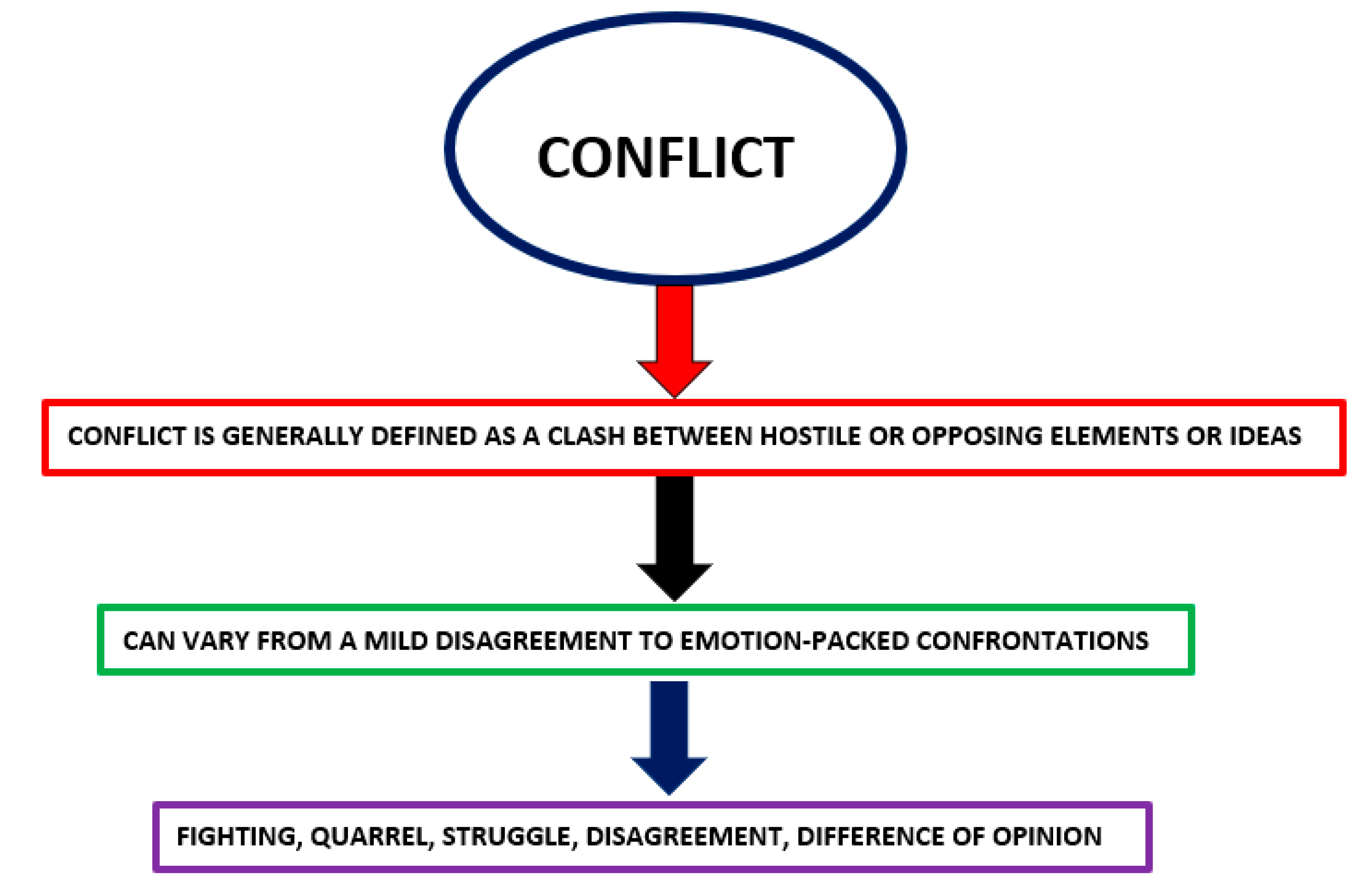
Conflict is well understood by the statement “an active disagreement between people with opposing opinions or principles” (Cambridge Press, 2005). We have to face the situation in both personal and professional life as this situation is unavoidable. It’s a matter of fact that once in a lifetime we have been involved in conflicts as represented by Figure 1. Conflicts between individuals can result in internal disagreements in an organization regarding competing targets and inadequate capitals discussed as follows. (Airth & Pisano, 2019).
- ➢
- Interpersonal disagreement - Between two individuals
- ➢
- Intragroup disagreement - Among individuals within a team
- ➢
- Intergroup disagreement - Miscommunication among different teams
Figure 1.
Definitions of conflicts (Guan, 2007).
Sources of Conflicts
Human activities always trigger conflicts (Windsor, 2019). In the workplace, conflict arises due to various reasons. “The cause of conflict in a team within projects can be related to differences in values, attitudes, needs, expectations, perceptions, resources, and personalities” (Ohlendorf, 2001). Coworkers from diverse backgrounds, providing insufficient time to complete a project with shorter budgets and higher expectations of project head from coworkers can originate conflicting views amongst project team members (Guan, 2007). Missing a deadline can result in a dispute between the project head and the employee. Moreover, coworkers’ underestimating tendency to each other can result in internal conflict. Frequent conflict can also arise from disagreement with fellow leaders or coworkers about which idea serves the company best (McAbee, 2020). Project managers must have a sound understanding of the conflict triggers to prevent them from happening in the future. Otherwise, their absentmindedness will fail to resolve the problems at the grass-root level (Kerzer, 2011).
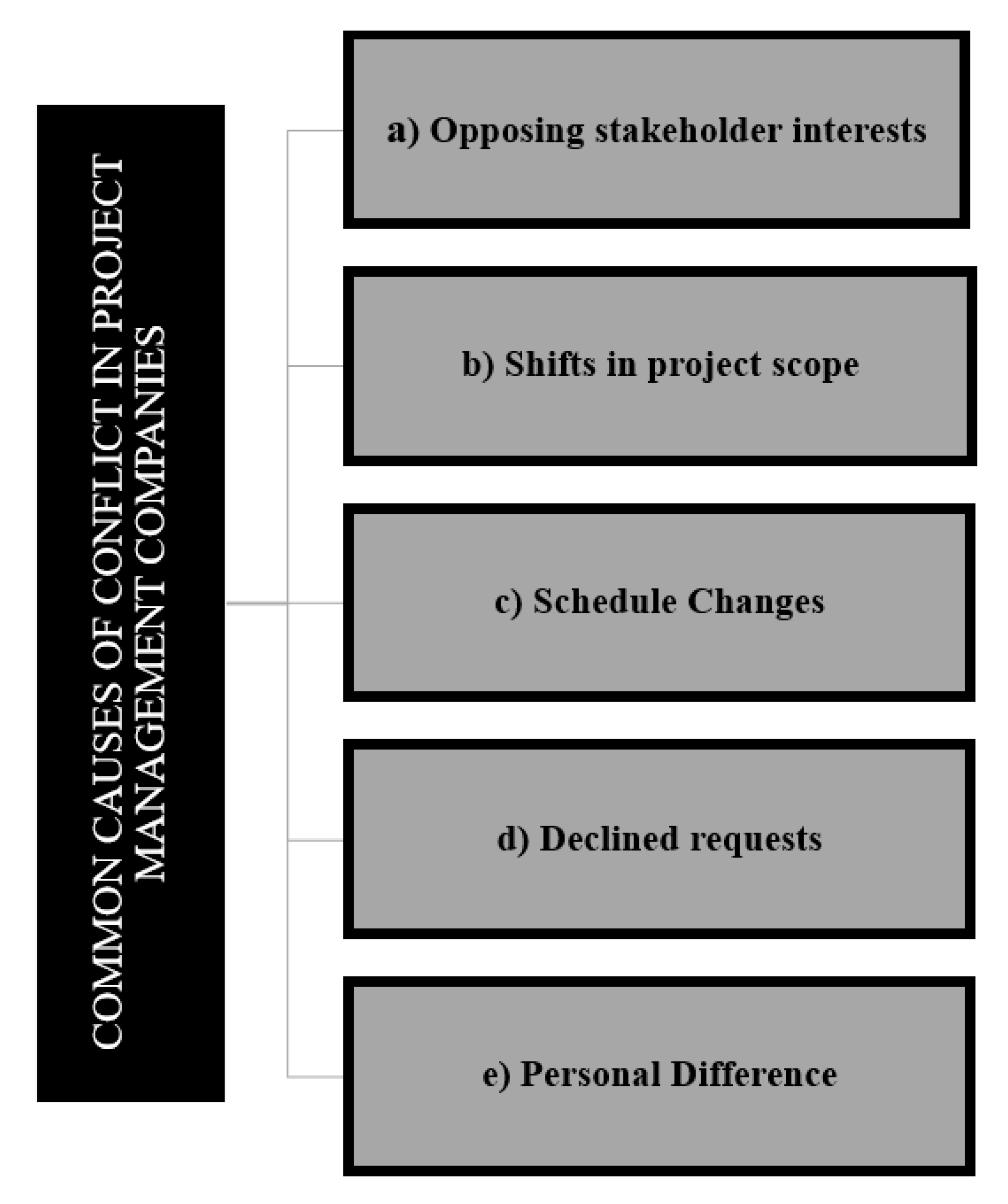
There are many causes of conflicts that arise with project management companies which are represented in Figure 2 and described below.
a) Opposing stakeholders' interests can originate internal conflicts in organizations and hence result in termination of projects.
b) A shift in a project’s scope is one of the main reasons for conflicts while running projects. It is observed in most project management consultancy companies when the scope of the project is suddenly changed by the clients. This incident frustrates project managers and his/her team members, who put in their hard work and finally get to know the scope is changed.
c) Unlike the change in project scope, schedule change is considered to be one of the important sources of conflicts within a project. This usually happens when a project timeline is planned and all of a sudden client asks the project manager to prepone or postpone the project handover date.
d) When a project team member raises a request regarding project betterment and if the request gets declined, that affects the morale of the project team members and opens doors for disputes. These disputes can affect the upcoming projects also.
e) Personal differences can be one of the reasons for conflict with project management companies. However, steps have been taken to minimize the risk of conflicts resulting from clashing personalities, as poor project performance can be experienced if the problems remain unattended.
Figure 2.
Causes of conflicts in managing project.
Types of Conflicts
Three types of conflicts that are common in the organization are task conflicts, relationship conflicts, and value conflicts based on the triggers (Shonk, 2021).
1. Task conflict
Majorly originates from coworkers’ arguments regarding task distribution, for example, who should attend national or international meetings or conferences amongst everyone. Moreover, different opinions on work process and meeting work expectations, disputes about resource distribution to run the project can be included in task-based conflicts. Early-stage resolution is easier for this case compared to the other two types. Team performances can be linearly correlated to task-based conflicts and can be advantageous sometimes unlike the other types (Kurtzberg & Mueller, 2005) as thinking in an innovative and creative pattern through promoting different perspectives is a positive consequence. But too many conflicts can affect the group members physiologically. In this regard, active listening is recommended to target the problem related to task conflicts involving the steps following.
- ➢
- Question asking
- ➢
- Repeating back to confirm understanding
- ➢
- Asking a deeper question to get more clarity
- ➢
- Problem-solving through collaboration
2. Relationship conflict
Originates from personality differences as every individual has a different style of interactions and even disputes, hence it results in an obvious relationship conflict among those people who are not personally known to each other, but thrown together in a professional work environment. Sometimes, long-lasting tension with a coworker commonly originates from overwork issues or personality differences.
Before involving the project head, they both can go out might be for a lunch to understand each other in a better way. This helps to discover the common perspectives between them and make them closer.
Working on the following points helps to reciprocate with another person.
- ➢
- Seeking the source of tension
- ➢
- Listening to other’s perspective
- ➢
- Showing empathy instead of defending own viewpoint
- ➢
- Resisting impulsive arguments
- ➢
- However, the involvement of the project head is needed if the conflict persists or accelerates
3. Value conflict
Arises from basic differences of values, expectations, and individualities. Different political, religious, or ethical views are involved here. However, disagreements regarding religion or politics are offensive in workplaces, hence common value conflict originates from individual decisions on work policies. According to (Susskind, 2020) a defensive, doubtable, and unfriendly work atmosphere results from this situation. Additionally, (Susskind, 2020) emphasizes “including universal beliefs such as equal rights or nonviolence, rather than focusing on the differences in beliefs that precipitated the dispute”.
To address this situation, several recommendations were obtained from the various kinds of literature are as follows
- ➢
- Respect each other through conversation
- ➢
- Resonating mentality
- ➢
- Mutual understanding with “values-neutral” ability, which doesn’t essentially need any sympathy or emotions (Mnookin, et al., 2004)
Other types of classification of conflicts include two other terms as follows. (Ohbuchi & Suzuki, 2003)
- ➢
- “Conflict of interest” arises from the disputes between the person and their interests
- ➢
- “Cognitive conflict” originates from perspective differences of people
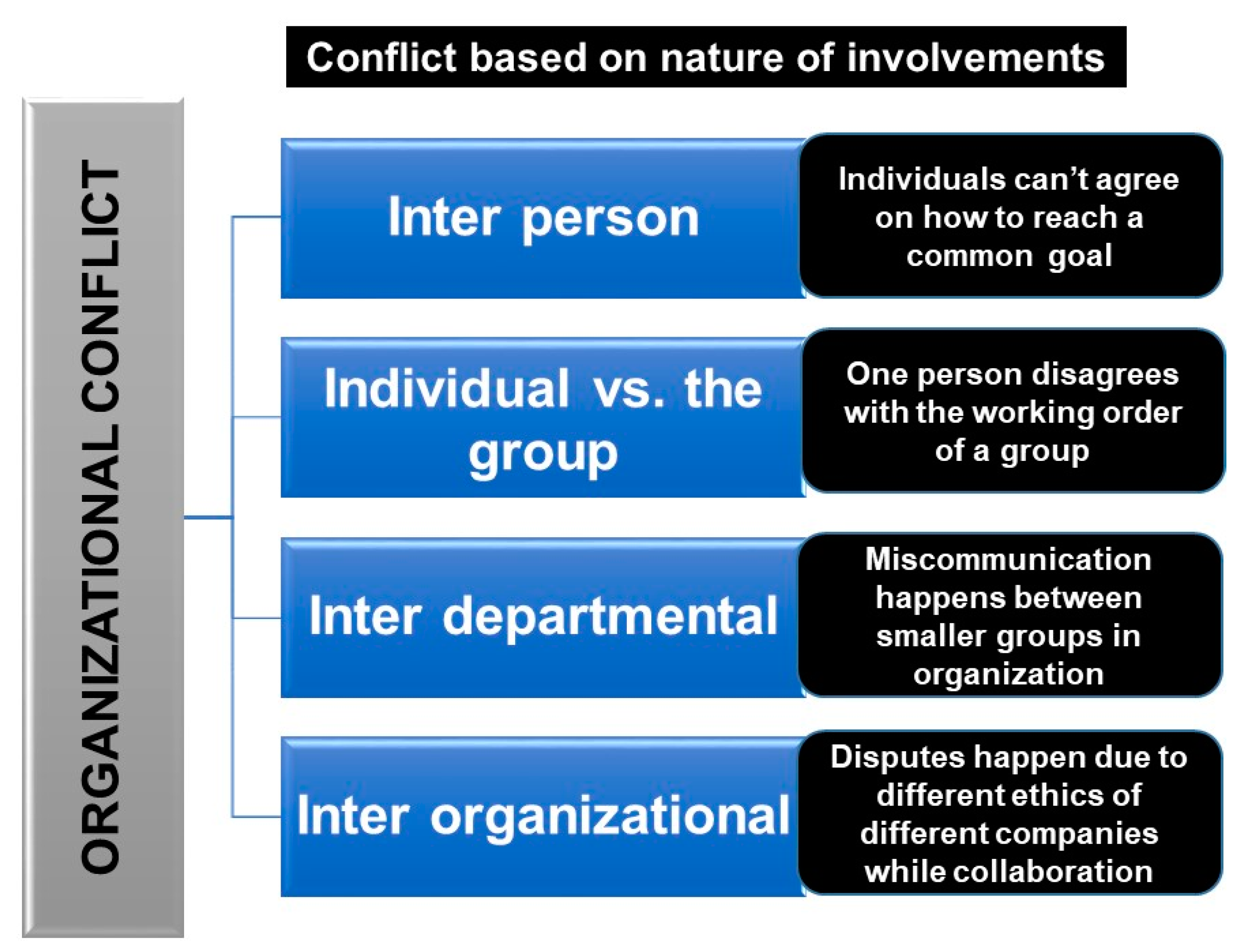
When organization conflicts during project management are focused, major types based on the above discussion are listed as follows (Pollack Peacebuilding system) (Figure 3).
Figure 3.
Major types of organizational conflict based on a person’s involvements.
Critical Review
After getting clear aspects about dysfunctional issues, a detailed literature review on functional conflict approaching and resolution methods has been performed in this section as the area of interest is to address functional conflicts within a project. To obtain a strong theoretical framework in this area, three areas of interest were chosen, which are suitable for this thesis work to create a hypothesis. In the last subsection, I tried to find the literature gap through a critical overview, in the area the research will be conducted.
Conflict Approaching
When conflict during running a project “enables teams to generate higher quality decisions”, it can be considered as a constructive one (Holahan & Mooney, 2004). But if proper management is not done then the situation turns to a destructive one, where coworkers involve in disputes which are “emotional and personal in nature”. Effective management is a result of a suitable approach towards conflicting situations. In this regard, (Myers, et al., 2009) recommends three basic stages before approaching
- A proper understanding of the problem
- Finding a common area of arguments
- Selection of solution approach
In order to get solutions, Project Management Institute (2008) recommends that “Conflict should be addressed early and usually in private, using a direct, collaborative approach”. The most common five ways of approaching areas are represented in Figure 4 and discussed below (Kerzner, 2009)
- Problem solving / Collaboration / Confronting
The conflict between two parties can be solved by this approach through meeting and discussing the disputes. This approach generally results in a ‘win-win’ solution for both sides through mutual contracts.
- Compromising/Reconciling
This approach is closer to the first one where agreement between both parties can happen as a result of negotiation to some extent and also leads to a ‘win-win’ situation.
Figure 4.
Five most effective conflict approaching way (Darkazanli, 2020).
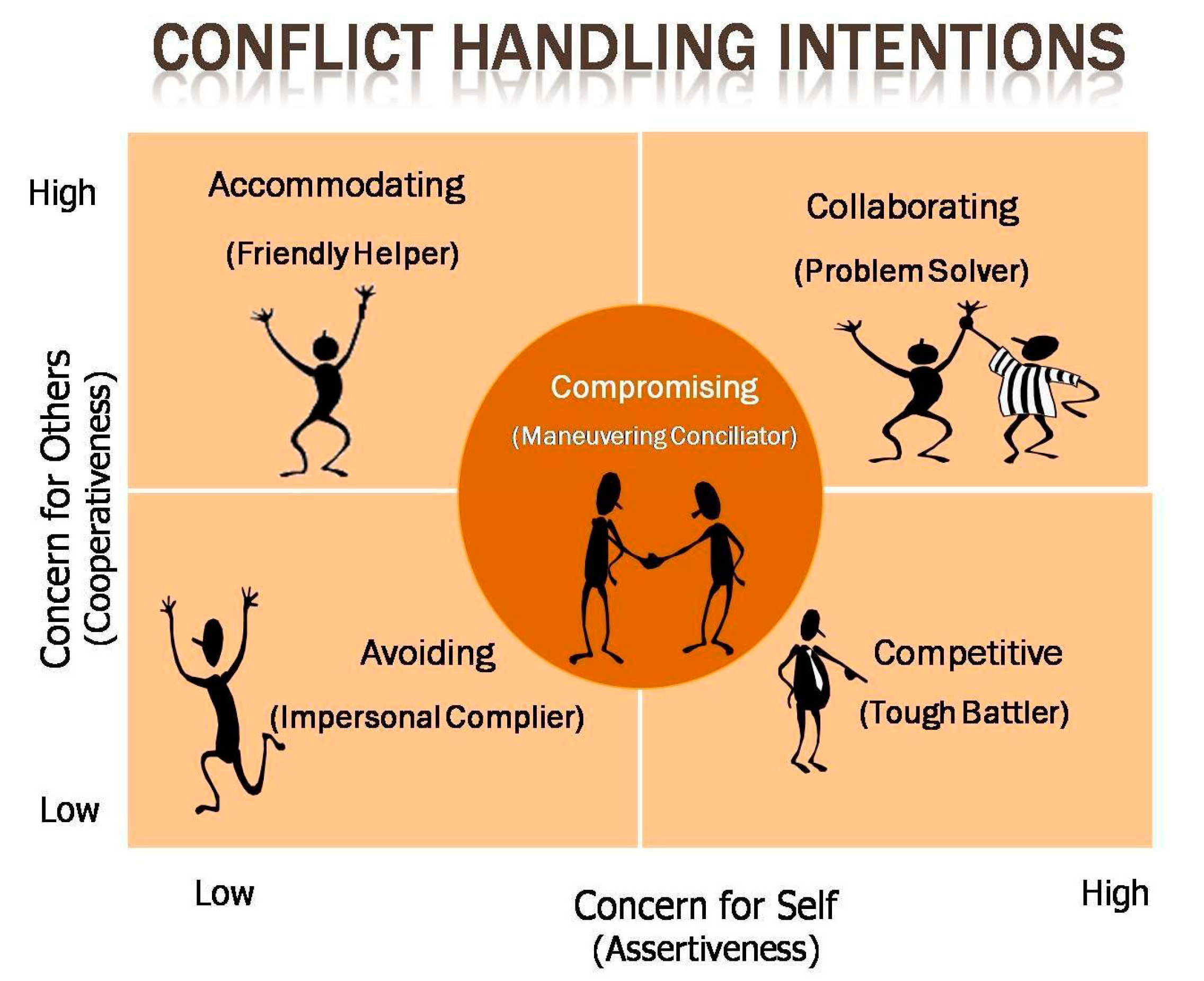
- Withdrawing/Avoiding
This is a provisional approach when time is needed for conflict resolution. Sometimes slowing down a decision or argument is really helpful to get victory without confrontation.
- Forcing/Competing
In this approach, one party enforces their opinion to the opposition party in case of complete disagreements resulting in a win-lose solution. This can happen if one party is more powerful than the other one. The weaker party is dissatisfied through this mode.
- Smoothing/Accommodating
This is an effective mode to minimize conflict effects by highlighting the agreement zone of a particular conflicting situation. The point of dispute is disregarded by this approach.
Another approach involves the “dual concern” model (Desivilya & Yagil, 2005), where five active and passive conflict administration strategies are regulated by the extent of “dual concern” i.e. “concern for self” and “concern for others” as described below (Table 1).

Table 1.
Relation between conflict administration strategies and extent of concern .
| Conflict administration strategies | Extent | ||
|---|---|---|---|
| Concern for self | Concern for others | ||
| Active | Domination | High | Low |
| Integration | High | High | |
| Compromise | Moderate | Moderate | |
| Passive | Obligation | Low | High |
| Avoidance | Low | Low | |
Four major zones for literature review were selected to establish theoretical framework as follows (Table 2)
Table 2.
Major zones for literature review and theoretical framework.
| Zones for literature study | Theoretical framework |
|---|---|
| Team arrangements | The relation between team arrangements and conflict type plays an important role to decide conflict approaching technique (Madalina, 2016) A greater controlling attitude of project manager leads to an active dominating approach, again lower control over employees results in a passive avoiding approach (Aritzeta, 2005) Collaboration and competing modes are facile to maintain a good relationship within a team, which directly affects the creative side and group performance. The competing approach is highly assertive, though lower at cooperation scale (Flori, 2021) While developing a team, competing mode is applied in the early stage, while the cooperative approach is preferred later.‟Team’s cooperative conflict management style will be positively associated with team performance” (Somech, 2009) “Team member’s positive emotions toward teammates” will be preferred for ‘integrating, compromising and obliging’ conflict management patterns (Desivilya & Yagil, 2005) |
| Interdependency for work | Higher interdependency among group members for work leads to greater interaction, hence resulting in a higher probability of disputes (Somech, 2009) On the other hand, enhanced interaction can facile collaborative mentality and group planning |
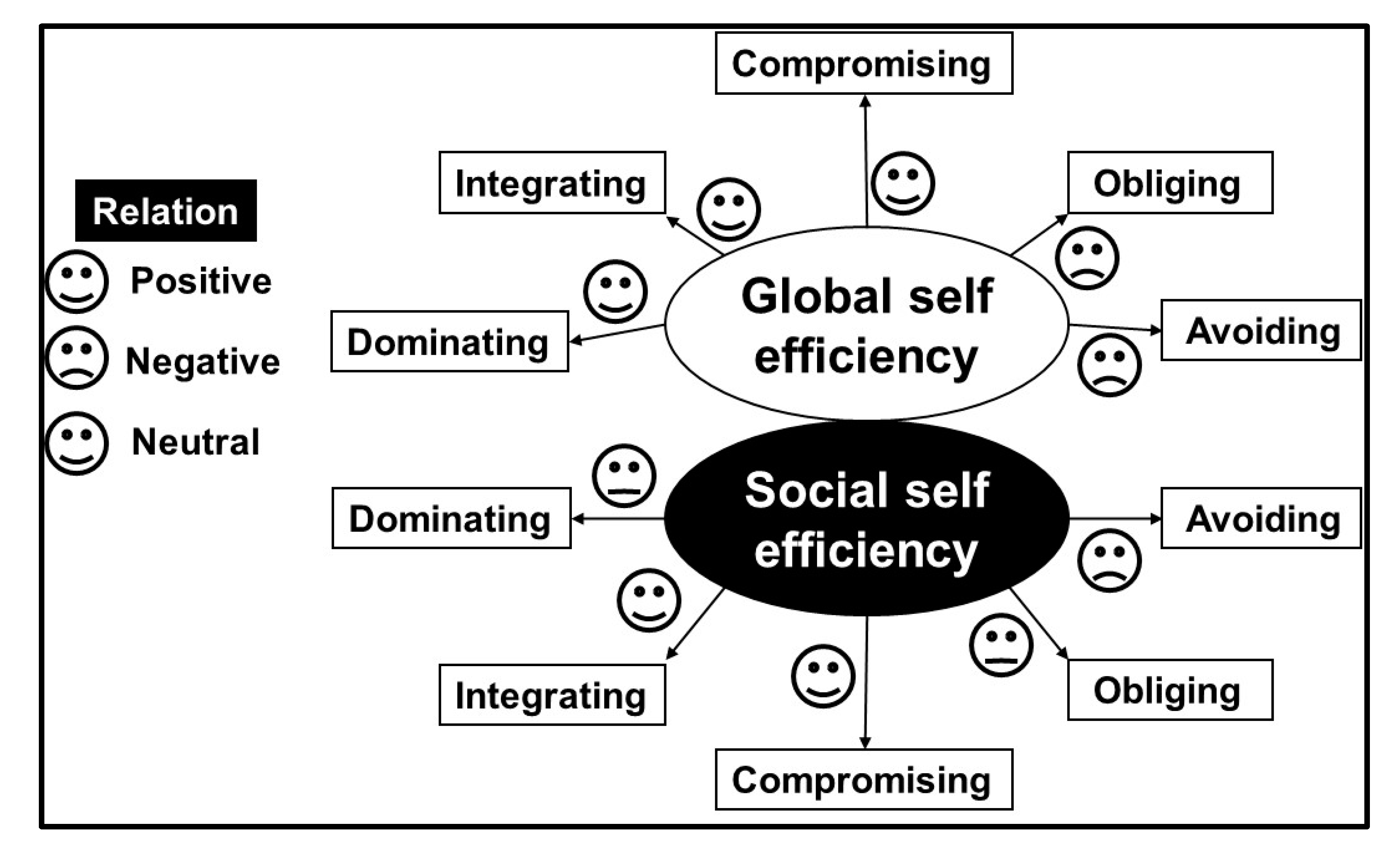
| Self-efficiency | Efficiency is linked to confidence. Individual’s confidence to successfully perform certain work is termed as global self-efficiency, whereas a person’s capability to maintain social relations is known as social self-efficiency (Eizen, 2005) Both can be linked to conflict resolution approaches as represented by Figure 5 Individuals with higher self-efficiency generally apply integration mode for conflict resolution within a team, on the contrary compromising and avoiding modes are preferred by the persons, who are not efficient enough (Ergeneli, et al., 2010) “The effects of self-efficacy on domination and obliging conflict-handling styles were found not to be significant with either superiors or peers” (Ergeneli, et al., 2010) |
| Developing certain conflict management style | Sometimes, a definite conflict management style can be introduced by certain team members depending on the situation for example (Dixita, 2020) Isolation of the member from the problem Instead of ‘You’ utilizing ‘I’ statements Focusing on open-ended questions asking and active listening Diversity of interest from the conflicting situation |
Figure 5.
Relation between self-efficiency and conflict resolution approaches.
Conflict Escalation
Understanding of the conflict escalating factors and theoretical models are mandatory for approaching a dispute within a team and resolving further. Proper explanations in this regard have been presented in the literature (Table 3) ( Runde & Flanagan)
Table 3.
A theoretical framework for conflict escalators.
| Literature review zones | Theoretical framework ( Runde & Flanagan, 2007) |
|---|---|
| Hot buttons/ Conflict triggers | This term is related to the factors which initiate conflicts Too much emotional involvement can trigger conflicts as a result of losing self-control and responding without thinking The experienced team leader must be aware of their own ‘hot buttons’ and try to avoid conflicts regarding these |
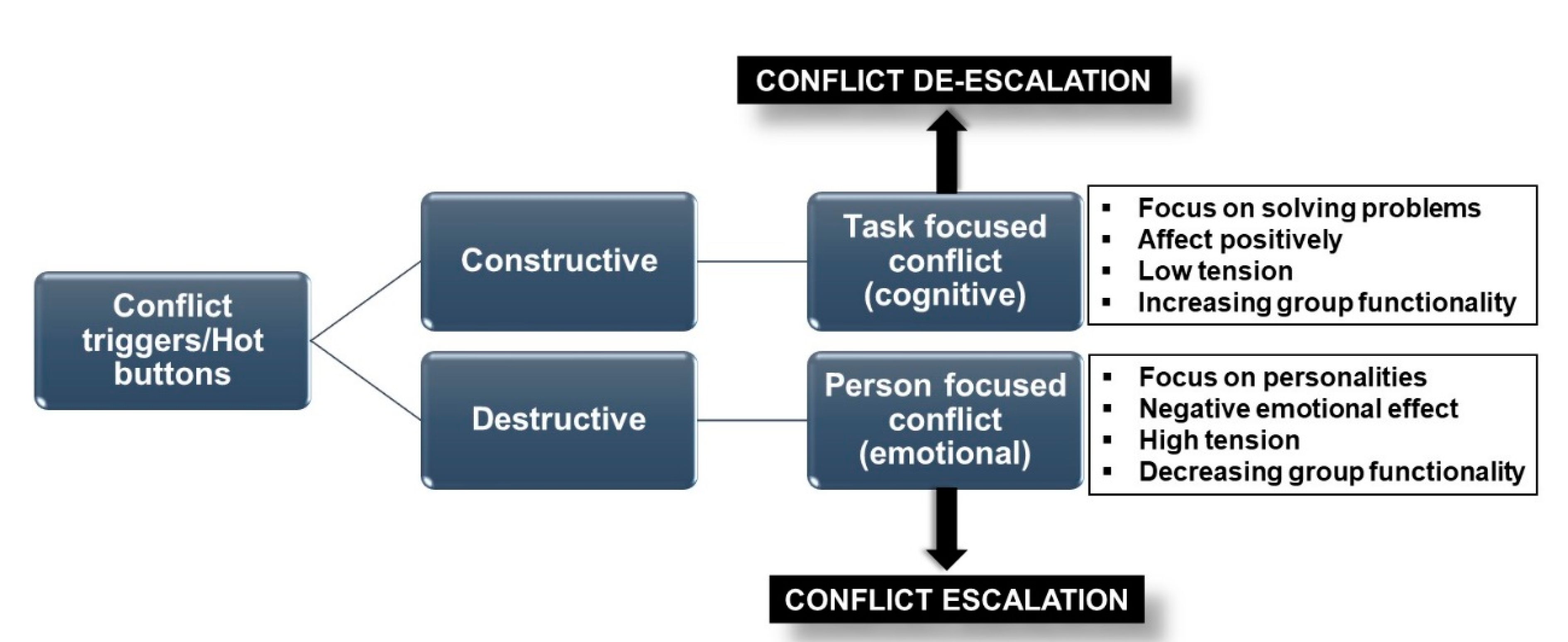
| Dynamic conflict model | Peoples’ response towards conflict dynamically affect conflict resolution positively or negatively after triggering through ‘hot buttons’ as represented by Figure 6 |
Figure 6.
Dynamic conflict model
Emotional consciousness and regulation can stop conflict escalation (Boros, 2020). A conflict escalation outline can be represented by Figure 7.
Figure 7.
A cyclic outline of conflict escalation, “retaliatory cycle” ( Runde & Flanagan, 2007)
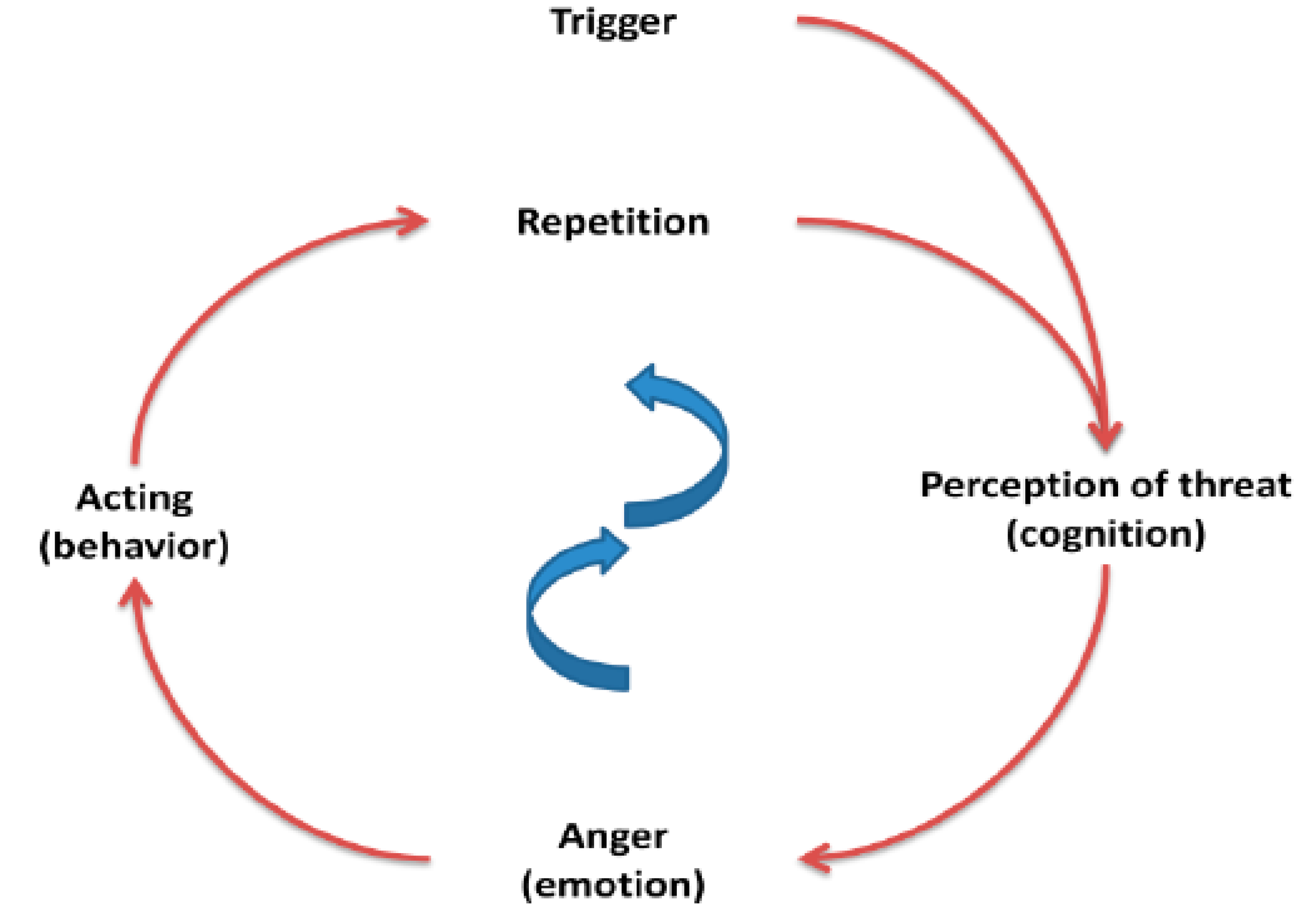
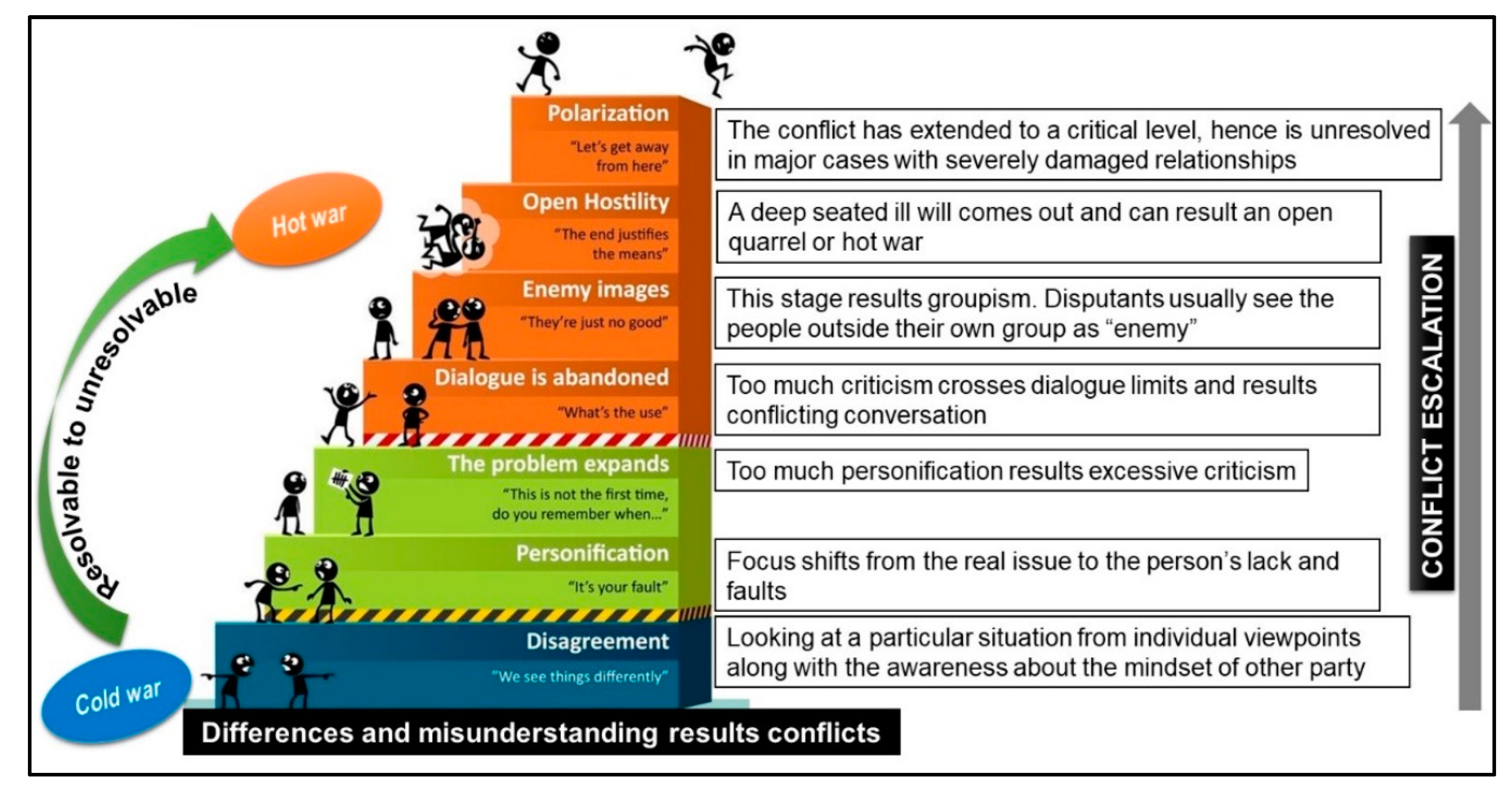
Figure 8.
Step by step intensity level of conflict
Conflict Resolution Process
Till now the connection between the way of conflict resolution within a project and their effects on the outcomes have been extensively studied by several groups. In this regard, research was performed (Klastorin, 2004) by selecting two high-performing and moderate-performing project teams. A comparative study after one-to-one interviews indicated that the high-performing team could handle conflicts within a project in several efficient ways and the team leaders always listened and encouraged their coworkers to share their perspectives especially when an enhancement of frustration levels happened within the projects. On the contrary, the moderate-performing project heads were least bothered about managing conflicts and always emphasized giving efforts to complete the whole task at any cost. Thus, the leadership capability of a team manager is one of the most important factors while resolving any disputes (Kerzner, 2010). Again, conflicts can only be minimized and overcome further through proper training of the employees on supporting mentality to the team, leadership capacity, and probable direction for running a project efficiently.
A few important characteristics of an experienced project head, who can easily handle any conflicting situation are
- ➢
- Holding a calm attitude in any situation
- ➢
- Implementing a constructive side of a conflict
- ➢
- Adopting a critical attitude to perspectives, not team members
- ➢
- Separating personal values while criticizing one’s perspective
- ➢
- The inflexible mentality about best consequences for the project instead of winning
- ➢
- Trying to understand the situation from all sides
- ➢
- Listening to coworkers
- ➢
- Inspiring safety and justice in workplaces
( Runde & Flanagan, 2007)
Seven major zones for literature review were selected to establish further theoretical framework as follows (Table 4).
Table 4.
Literature review zones and theoretical framework for conflict resolution.
| Zones for literature review | Theoretical framework |
|---|---|
| Fairness in workplace | A positive attitude is encouraged to facile conflict resolution through “cooperative (integrating, obliging and compromising) styles of managing conflict” with project heads if a fair work atmosphere is provided |
| Employee’s emotional participations | “Conflict is mired in emotion. When people are locked in a retaliatory cycle of behavior, their emotions can rise rapidly” (Bodtker & Jameson) “Abilities of problem-solving, social responsibility and impulse control were the most directly related to how participants managed conflict at the workplace” (Hopkins & Yonker, 2015) Conflict is composed of three different parts while considering the emotional participation of employees (Bodtker & Jameson)
Too much focus has to be altered from the resolution method to succeed over conflict Simplification of complex conflicting situations is needed most (Bodtker & Jameson, 2001) |
| Conflict dynamics profile (CDP) | Feedback based process Opinion about a person’s behavior is collected first from themselves followed by a comparison with the feedback from other coworkers Measurement of behavior is done through surveys ( Runde & Flanagan, 2007) |
| Considering viewpoints | One of the most important conflict resolution process Implementation of this tool requires one’s ability to view the conflicts from several perspectives, not just their own. This step is effective to resolve task and emotion-based conflicts both This resolution mode results in redirection of the conflict towards productivity and the consequences are accepted involving all parties (Runde & Flanagan, 2012) |
| Plotting logical arguments | Logical arguments can be plotted by considering a standard opinion to connect the reason and claim of a dispute
This tool majorly resolve conflicts through
(Hoffmann, 2005) |
| Ability to manage conflict actively | This tool facile conflict resolution through open group discussion and confrontation of arguments An active method is beneficial for team efficacy. Innovative ideas can only develop when coworkers openly talk to each other regarding conflict issues instead of avoiding confrontation (Longe, 2015) |
| Compromising attitude |
Ø Interaction based approach leads to the establishment of a connection between the condition and the consequence (Donohue, 2003) This mode of conflict resolution involves an informal way of collaboration through communication without any external influences (Carneiro, et al., 2011) The effective communication pattern while compromising should be very precise in terms of behavior, relevancy, quality, quantity, and emotional intelligence (Fulmer & Barry, 2004) (Donohue, p. 173) Understanding of own “BATNA” i.e. “best alternative to a negotiated agreement” level is necessary along with the information about the “BATNA’ levels of opposite parties during compromising (Murtoaro & Kujala, 2007) Sometimes one party does not feel comfortable sharing information for collaboration as they have a fear that the other side can take advantage. As a result, their compromising attitude by taking decisions jointly is hindered. To get equal benefits for both parties without any exploitation, the coupling of cooperative and competitive style is facile. (Murtoaro & Kujala, 2007) The compromising attitude of a party involves several actions like ignorance, acceptance, refusal, response with a new idea or a counter idea. Mutual agreement between two parties during compromising is mandatory “A three-phase game framework to solve financial conflicts in the PPP projects, and claimed that the framework could reduce the range of negotiation, the time needed to negotiate, and the damage caused by conflicts” (Jang, 2018) Conflict resolution strategies through compromising are as follows (Wang & Wo, 2020)
|
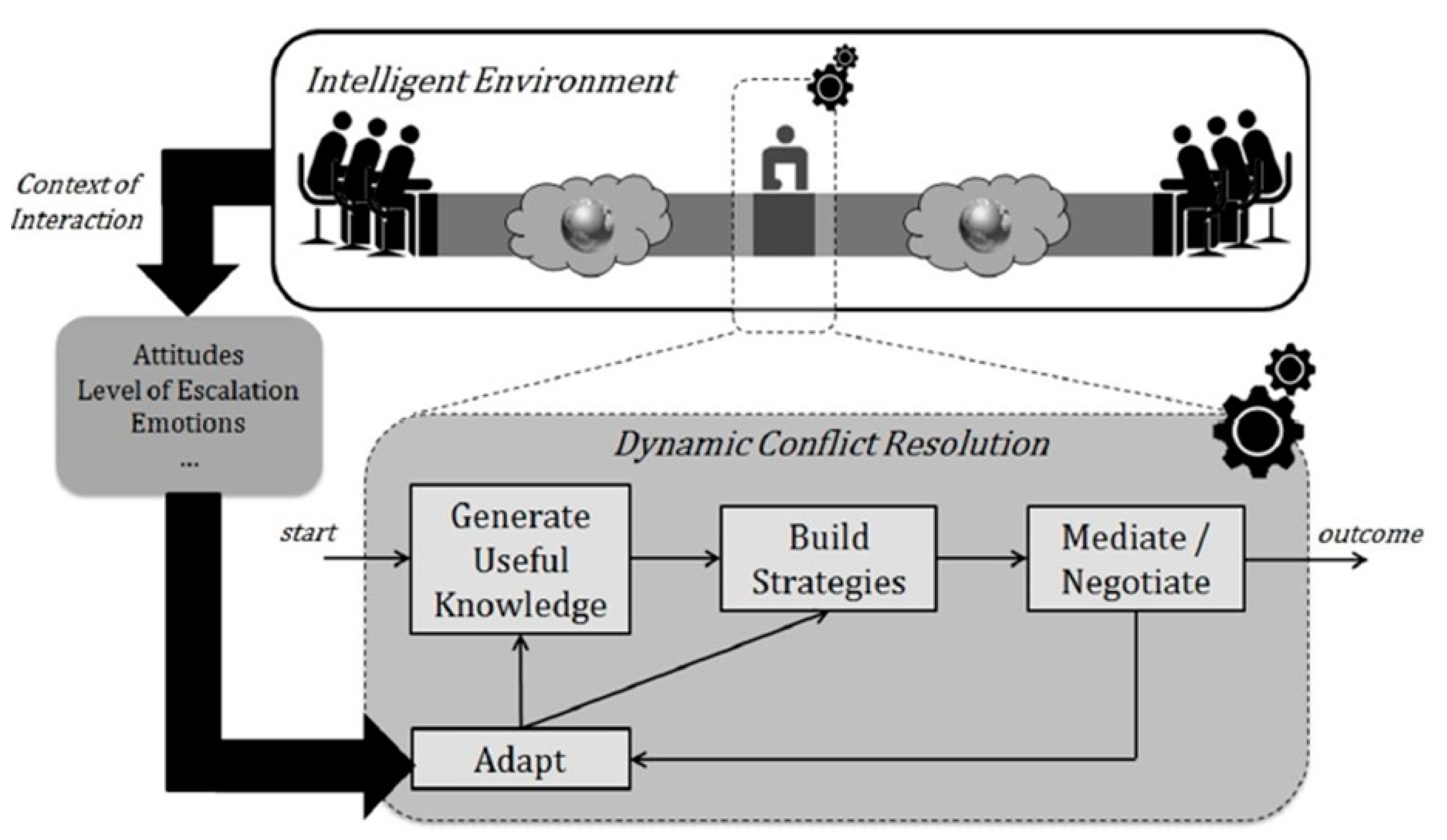
Moreover, a mutually satisfactory outcome after resolving conflict can be achieved by applying a ‘dynamic conflict resolution model’ (Carneiro, et al., 2011) (Figure 9). This model involves dynamic and skilled personalities, who are capable to understand the changing mode of interaction context and take decisions about altering strategy before it's too late. For example, if a party is under a stressed condition or does not like the interactive mode, these human experts can sense the situation and readily take a break to avoid or handle any possible conflicts.
Figure 9.
A high-level view of the dynamic conflict resolution model (Carneiro, et al., 2011).
Summary and Literature Gap
From the literature review, it is clear that functional conflict is essential to run a project successfully, but a proper way of handling is necessary left from the preliminary stage of the project until it's getting done. In this regard, the theoretical postulates obtained through literature study, mainly emphasize conflict dysfunctional issues from sources and type of conflicts; followed by functional conflict handling approaches, understanding of conflict escalating triggers, and conflict resolution, where CDP is presented as an effective conflict resolution tool through feedback-based behaviour measurement. The literature also focuses on considering others’ viewpoints to transform conflicts towards productivity and logical arguments plotting to explore one’s weak points of arguments. Both are considered as other two conflict resolution modes. Although there had been much research done in this context, none of them provides a concrete answer on a systematic pattern while managing functional conflicts within a project from a practical perspective, as every personality has different emotional triggers and understanding levels. In order to bridge them, it’s essential to point out the gap in the project manager's thoughts, which need to be addressed to get practical implications of these theoretical concepts. This is only possible by doing systematic research and correlation by wisely choosing interview zones while collecting secondary data and recording the points that the project managers did not consider as important for functional conflict management, probably due to a lack of proper knowledge. But, little improvements in these areas can explore more effective conflict resolution modes in the future. Again, very little attention has been paid to the conflict-preventing approach while designing resolution tools till now, which also need to be addressed. Hence, this research tries to bridge the gap through correlating the literature-based hypothesis and the facts obtained from secondary interview data; and further, explore effective conflict resolution tools with systematic classification. Though we don’t know if more complex functional conflicts come in the future, this work will impact how effectively since we know that human natures are always complicated.
Research Methodology
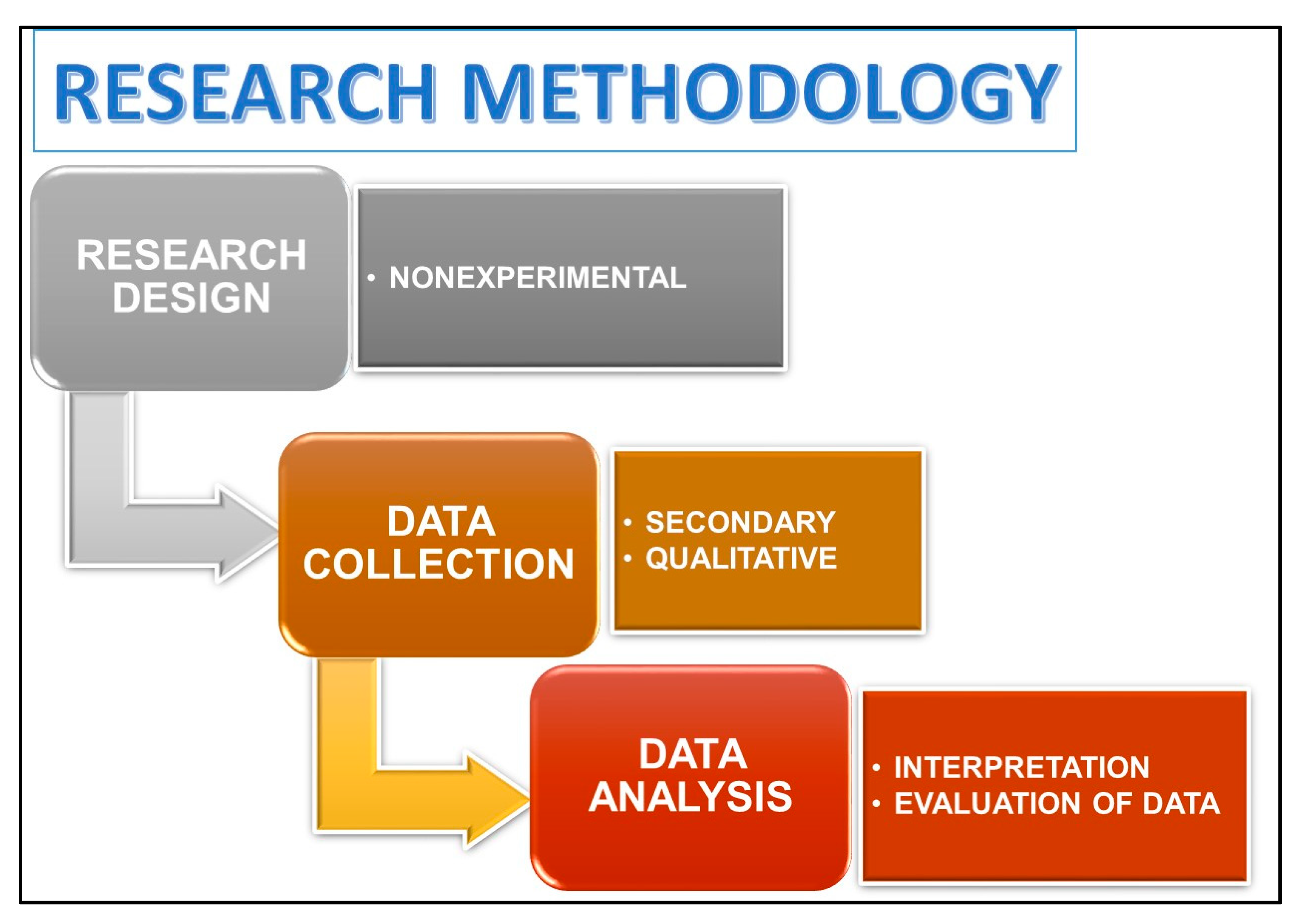
This section will demonstrate the process of investigation for this thesis, selected methodologies, and the reason behind their usability. The data collection method along with their investigation process and consistency of those data will be further explored. This portion will also emphasize the restrictions, faced during this research work and the major factors, needed to be considered to run the process ethically and morally. A detailed outline of the research procedure applied for the thesis to get effective conclusions through data interpretation and evaluation is illustrated by Figure 10.
Figure 10.
A structural representation of research methodology.
Data Collection Methods
Relevant data for this research were collected in text format from published articles and books obtained from the university library or the internet through an online search to establish the hypothesis. Furthermore, annual reports based on information published in project management company's websites, governmental sites, and census survey data are considered as the major sources of secondary interview data through nonprobability sampling.
Secondary data reliability is related to consistency and quality of research (Olabode & Ibrahim, 2019). In present research work, the consistency is highly maintained as data of nonprobability sampling are collected in such a way that different interviewers from different projects and companies have given similar answers. Again, the quality of this research work is controlled through regulating accuracy and relevance, where all relevant and advanced information for hypothesis construction are gathered from recent literature.
The established hypothesis and theoretical framework for this research work are not connected directly to the research questions to maintain the ethics of secondary data collection, though the logical approach is to review substantial literature directly linked to research questions to obtain a clear idea about the conflict-related problems and solutions through proper management. This challenge limited the choice of literature used from the research subject standpoint. Each literature having high relevance and confirmed credibility, accompanied with an indirect relation to research questions is chosen carefully.
Secondary Qualitative Approach
Secondary qualitative theory-based research was conducted, where appropriate data were gathered from relevant literature. Several hypotheses and a specific methodological approach regarding active conflict management and resolution were constructed after extensive review and evaluation of those data. The development of theoretical background based on models and theories from well-known professors and scholars is the major requirement here to support the outcomes of interviews collected as secondary data.
Secondary Nonprobability Data Sampling Method This method (Wisniowski, et al., 2020) was chosen to gather the experiences of employees working on different projects by semi-standardized interviews to develop and elaborate the explanations (Berg, 2009). These one-to-one interviews have been organized by selecting precise questions from a particular area of interest to understand their thoughts clearly. Specific team members of several industries and companies like IT, pharmaceutical or multinational were considered as samples for this method. Their experiences were assembled as secondary data collected from different sources like companys' websites, annual reports of government sites. During collecting the interview data, the questions have been chosen very attentively which can serve our purposes. Again, according to Silverman, more focus should be given to the question throwing approach than how many questions are triggered (Silverman, 2018). A diverse perspective of conflict addressing and its possible effects on team management can be obtained from the interview results. Moreover, these data delivered clarity regarding major causes of conflicts and how to address the situation by making constructive decisions, fruitful discussions, beneficial compromises with coworkers; recording feedback; and enhancing workplace liberty, etc. Deductive Approach
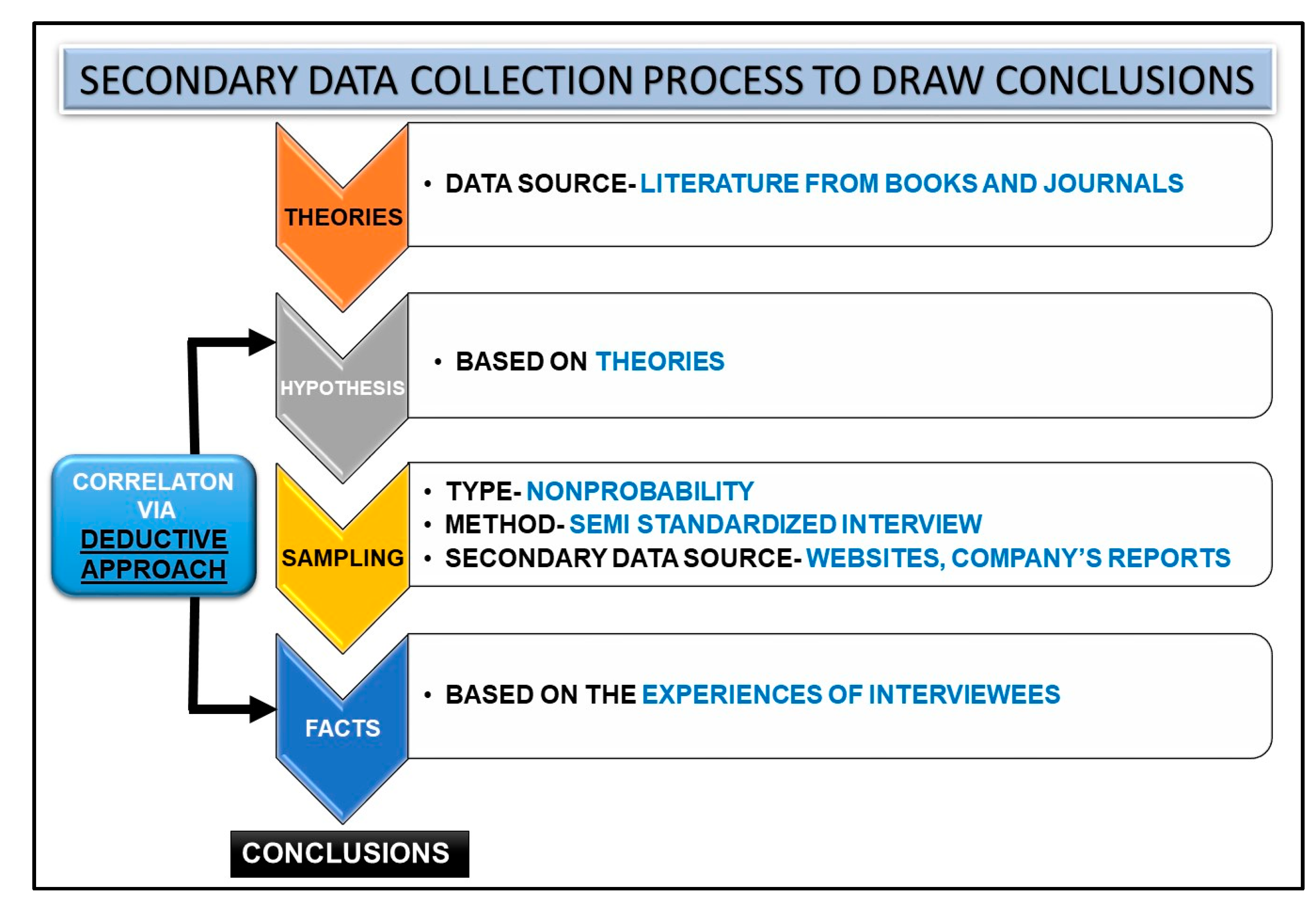
This approach was applied in the final stage to establish the correlation between the hypothesis originated from literature study and the experiences of specific employees from different project teams. Furthermore, an insightful investigation of those secondary data leads to constructive conclusions. Figure 11 represents a systematic approach of secondary data collection process to conclude via correlation.
Figure 11.
A structural representation of secondary data collection method.
This approach is reported as an ethical process with lots of advantages, for example, the research process is highly transparent and easy with authentic data collection (Eynden, et al., 2011). Again, the data reproducibility is confirmed. In this research work, all ethical advantages have been included by concealing the identities of the interviewees, which results in data de-identification and thus any risk of future misconceptions are avoided. All sensitive issues were excluded further from this research during interview data collection. The data evaluation was done only for methodology purposes instead of directly answering the research questions chosen for this project (Tripathy, 2013). Additionally, the theoretical framework was established through proper acknowledgments and referencing, where each rule for citation is followed.
Analysis of Data
The theoretical process applied in this thesis helps to get clarity about the basic concept of conflicts types and sources. Additionally, the data collected from secondary nonprobability sampling and literature were analyzed thoroughly with exact clarification. “A good fit between the research question and the dataset” (Boo & Froelicher, 2013) established proper understanding, which can correctly explain the answer to the questions. Thus, the theories, suggestions, and skills help to make decisions effectively. The outcomes are established after the interpretation of data through proper discussion. Furthermore, this part scrutinized the effective contribution and urgency of this thesis while managing conflicts. Additionally, effective clarification is helpful enough for readers to create a flexible understanding level, which leads to workplace conflict resolution through negotiation. Thus, a concrete outline to manage conflicts is established efficiently. At the last stage, a correlation between the interviewees' experiences gathered from secondary sources and literature-based information leads to the conclusions.
Research Results and Discussion
Results of Semi Standardized Interview
In order to get an indirect correlation with the mentioned research questions, eight different zones for interview were selected while secondary data collection, as discussed following. The detailed results are represented in Table 5. The interview questions were precise as mentioned in the appendices. The purpose of the interview was to explore the perspective of several interview contributors, who are the employees of different multinational companies or industries, on conflict management and resolution. All the data were collected from the sources where the interviewees acquired a professional attitude.
- 1)
- Conflict approaching technique (Renee, 2021)
Best companies are the major concern for most of them. They have shown high preference to work with a known person as knowing each other facile good communications minimizing the risk of conflicts. Moreover getting an idea about possible reactions is easier for a team leader when he knows the coworkers.
- 2)
- Major causes (Davy, 2019-2020)
The interviewees have pointed out discreet triggers for conflicts according to their own experiences. One of them pointed out the initial stage of conflict management.
- 3)
- Procedure to make decisions (BODEPUDI, 2020)
Fair decision-making is only possible through each coworker’s involvement, though it’s highly time-consuming as pointed out by interview results.
- 4)
- Effect of recording feedback (INFOSYS, 2020)
All the interviewees showed a positive attitude to the feedback process and most of them have experienced good results of it. One of them has pointed out the unwillingness of a large no of people to give feedback as they are scared.
- 5)
- Plotting logical arguments (United States Environmental Protection Agency, 2020)
The interviewees shared individual views about plotting logical arguments approach based on their experiences. The common result shows that the idea is good for major conflict resolution instead of minor ones.
- 6)
- Fair work atmosphere (Queensland Government, 2021)
The common interview result indicates too much frankness in the workplace leads to personal conflicts. Excessive criticism has to be avoided, though constructive disputes are welcome.
- 7)
- Compromising attitude (Renee, 2021)
Three interview participants gave preference on ‘win-win’ negotiation between both parties whereas the other two agreed to compromise only if the advantageous result can’t be obtained by other methods.
- 8)
- Ability to manage conflicts (INDEED, 2021)
These results pointed out participants’ perspectives on required skills to manage conflicts, which need to be improved within themselves. Several factors like understanding level, argument skills, and compromising ability have come out in this regard.
Table 5.
Detailed interview results as collected through secondary nonprobability sampling.
| ZONES OF SEMI STANDARDIZED INTERVIEW | INTERVIEWEE | ||||
|---|---|---|---|---|---|
| CEO (Multinational car production company) | Project Leader (Medical industry) | Project Director (IT company) | Project Manager (Telephone company) | Manager (Travelling agency) | |
| Conflict approaching technique | I prefer to deal with internal conflicts in a strict manner. At the same time, I always try hard to stand on my views and make it understandable to team members. Working with known people always gives extra privileges to predict their response to a particular situation. More formal and commanding attitude always helps me to deal with completely unknown coworkers. | I believe, in the fast resolution of conflicts, immediately after it originates within a team. Only a strict attitude can prevent its future negative impact on the project. I prefer to listen to everyone’s desires and opinions with full freedom. But the most crucial part of dealing with conflict is everybody should have a flexible mentality about their opinion to take some decision. A good work atmosphere always triggers a profitable communication among team members, which becomes easier for known person. | If I feel confident about the discussion, always prefer to apply a forward attitude. My belief is, I have to win the situation, especially when the other party is unknown to me. In order to solve any conflicts, I prefer to use my knowledge. Arguments with known coworkers always give safe feelings, which helps to handle a lot of situations in my company. | As a project manager, I definitely try to avoid conflicts always, though I dare to face them. I have already experienced several conflict issues in my office based on task distribution. In order to handle the situation, I always try to find out a ‘win-win’ condition for both sides through little compromise. As this process always gives a better experience over long duration according to my experience. Discussion with a known person is much easy to me without any escalation of conflicts further. | I generally adopt a professional attitude while approaching conflicts. My target is to get a victory over the situation by prioritizing my opinion. However, I compromise sometimes to get a solution for the company’s best. While working with the unknown people, I prefer to take extra caution. On the contrary, working with known people leads to an efficient team work according to me, as everyone’s strength and weakness is well known to each other. |
| Major causes | According to me, the major trigger for conflict is the unwillingness of some team members to give effort in learning. They always prefer asking for help from others even before trying, which is not good. As a project head, I prefer to stay cool sometimes, as the attitude of response to such situations makes things easier. | Unwanted conflicts within a project team often arise from broken promises according to my experience. For instance, when some team member is unable to present something according to the contracts made at previous group meetings, he/she obviously failed to meet the expectations of the whole group and another party as well. Though it is not a big deal for me to handle those types of frequent conflicts. | I feel, lots of factors can trigger conflicts. My job role demands attending several meetings per day, where I experience longer discussions about the present and possible future status of a particular situation, which is just a wastage of time. This situation really makes me anxious, as I prefer to focus on the progress of the projects. Moreover, broken agreements along with a lack of time management skills and are really annoying to me. Hence, I always prefer to handle conflicts at the primary phase to control my anxiety issues. | Fake attitude and silliness of some employees can result in a conflicting as well as the annoying situation. Again, I have faced some situations where people are wasting their time to prepare colorful charts instead of showing proper reports according to the company’s demands, that’s really ridiculous. Though I haven’t been affected by conflict triggers directly so far. | Lame excuses and broken agreements are two major causes of conflicts, I faced. I prefer to give a time-to-time reminder to avoid that. |
| Procedure to make decision | I believe, decision making has highest significance while managing any project. According to me, sometimes you have to accept the gap between your demands and outcomes. You can’t stand for each decision obviously. Although it’s always helpful to take inputs from each team members to carry forward the decisions. | Sometimes I need to take prompt decision based on situation, then also I like to welcome the participation from each team members with their own viewpoints. Although some self-governed decisions have to take in a democratic situation which is really time taking. | Consulting with everyone is not my choice while taking decisions. Most of the cases, I have to decide depending on the situation. Hence, unlike many project leaders, I prefer to come forward and take decisions based on my own experiences. Moreover, I like to take guidance from knowledgeable person if needed, instead of asking random group members. | Decisions involving everyone’s point of view is always preferred to me. But sometimes very active attitude is needed, especially while taking self-ruled decisions. | According to me, a fair decision can only be taken when everybody involves with full freedom to share their opinions and perspectives. |
| Effect of recording feedback | I am always in favor of recording a feedback as it helps me to grow as a team leader by knowing the thoughts of my teammates about my behavior and actions. I prefer to get feedback through meeting sometimes in a proper format instead of hearing naked truth. Again, customer’s feedback on provided facilities is very important tool for increasing service quality. | If you really want to grow as professional, recording feedback is a must step. Our organization always encourages giving feedback to each other without hesitation. Based on the feedback from the socially affable employees, our company guides us about profitable customer services with best behavior. | To me, recording feedback regarding each other’s work or behavior is an essential part to maintain healthy work atmosphere. We get accustomed to criticism with time, although it’s really challenging initially. But lots of learning and experiences result from it. In order to get proper feedback, choosing left time of recording is very important. You can’t record just after a conflicting situation. | According to my experience, people scare to give feedback to one another, though they are facing attitude problems sometimes. As a result they can feel frustrated in such work atmosphere. Hence, according to my opinion, feedback sharing is very important at initial step, if someone’s activity affects others within same project. | I feel, that in order to grow in personal and professional level, feedback is a must step. You will be evaluated as a project worker as well as a person through this process. I am really thankful to feedback method as it points out merits and demerits of each other’s behavior and work process, hence the whole team become more interconnected. |
| Plotting logical arguments | It’s a good concept indeed and must be helpful to resolve conflicts smoothly in some of the companies, though my company excludes the method as it’s really time taking. | To me, this method is applicable to a particular situation, where conflict arises from serious misunderstanding, hence of major type. Only then a logical arguments results a fruitful discussion to release confusion. | I think, arguments can only solve conflicts, if proper understanding among coworkers is created and the team leader should be very active in this regard. Moreover, a proper plotting may involve those employees in conflict resolution, who were absent at the initial stage. | According to me, this process may not be beneficial while dealing with minor conflicts, though people can resolve major ones through logical discussion. | I think, this is a great approach to resolve misconception. Only a logical confrontation and deep conversation helps you to understand the viewpoints of the other person and reason of dissatisfaction. |
| Fair work atmosphere | I strongly feel, fair work environment can be created by giving work freedom to the employees, so that they can share their own viewpoints about problems and solutions. But too much criticism has to be avoided as it can cause personal conflicts sometimes. | It’s alleft to discuss openly, as this helps to take decisions based on neutral arguments. I think healthy criticism based on some real facts is fine. | In my opinion, too much frankness as a part of workplace freedom can result too much criticism. It can’t be advantageous in long run. Unfortunately, in most cases criticism is presented in negative way. Only an efficient project leader can regulate the situation. I personally think, criticism should be avoided among the group members because of restricted knowledge in all areas of the particular project. | Fair work atmosphere comes from transparency. We should not consider only the negative pattern of criticism, but the positive effects also. For example, if you can share your true feelings and thoughts regarding work, the workplace environment becomes more constructive. | I strongly feel, that speaking freedom in workplace can result bigger disputes. Though in my opinion, mutual respect to one another’s arguments are mandatory. One must learn to understand from other’s point of views before criticizing. Again, you can’t criticize without knowledge.. |
| Attitude to compromise | In order to get a win-win situation, little compromise is fine to me; especially when I deal with known coworkers. I like to value their opinions, especially when I realize few drawbacks of my idea after the disputes with the other parties. Otherwise I prefer to stick on my opinions, while dealing with unknown parties. | I prefer little compromise, only when it is advantageous to me. I like to deal the situation confidently while choosing negotiation, so that company objective is not sacrificed. If you want to win in such situation; you have to present your deal in such a manner, so that you can satisfy both the company and the opposite party. | I prefer to gain knowledge before choosing negotiation as I want to predict the possible arguments from both side. I like to say my opinions in a precise manner. Sometimes ‘win-win’ solution is okay with me; but I don’t compromise with anything, if I strongly feel that my idea is best for the project. But if there is lack of flexibility from both sides, decision making is really tough. | An effective compromise involves logical disputes and a good understanding other’s viewpoint. Reciprocation is mandatory instead of winning anyway. Still I prefer to stick to my decision in a great extent. At the same time everybody should be happy with the consequences of compromises, that’s the perfect win-win situation. | Understanding the entire situation should be the first step before you are going to compromise with. I believe to use the weak points of opposite parties to gain strength. At the same time, the solutions should be beneficial for both parties. |
| Ability to manage conflicts | According to me, patient attitude and understanding other’s way of thinking are two key skills to manage conflicts. I want to improve my flexibility, so that I could overlook even my personal experiences if needed to understand the situation in a liberal way. | As a project leader, I strongly believe, understanding the work atmosphere, reasons behind coworker’s happiness and their perspective are most important to manage conflict. I want to work more on these factors. Again, I want to be a better negotiator too. | When we argue about something passionate to us, it automatically comes from our emotions majorly and not from real evidences all the time. You can’t avoid that. Listening and understanding the conflict background are the best skills at that situation and results solution. Again, old commanding configuration should be changed. | I like to work on several areas like my understanding level, logical argument skills, compromising ability etc. to get better in conflict managements. | Lots of learning is left for me in this regard. If the solution comes up with the satisfaction of both sides, the credit goes to the conflict management team. Their ability of manipulation results the ‘win-win’ situation. |
Discussion Through Correlation
Different tactics to manage conflicts have been explored to form a theoretical hypothesis (Hughes, et al., 2019). The interview results prominently focus on the controlling as well as negotiating attitude of project leaders. Here most of the interviewees tried to come up with some fruitful plans to resolve conflicts before compromising. The most satisfactory result is a ‘win-win’ negotiation between both parties, where every expectation can’t be fulfilled. However, some points that need to be considered while discussing conflicts resolution are as follows (Table 6).
Table 6.
Considerable points to manage conflicts.
| Category | Aspects need to consider |
|---|---|
| Conflict triggers |
|
| Open work culture |
|
| Feedback |
|
| Compromising attitude |
|
It’s not necessary to become a conflict expert for all project heads. But understanding of conflict dynamics and proper response can make them competent leaders. Some theoretical hypotheses are established from the facts. Later they are correlated properly with the interview results (Table 7).
Table 7.
Correlation data between theory and interview results.
| The model used to compete with conflicts |
|
Theoretical framework( Runde & Flanagan, 2007)(Boros, 2020) | Correlation with interview results |
|
These statements are correlated very well by the interview results as most of the interviewees focused on the major roles of project leaders in conflict resolutionThe managers emphasized on a good work culture and a careful attitude about emotional triggers | ||
| Model behavior of competent leader |
|
|
All the points are supported by interview results, though some new aspects also come outSome of the interviewees pointed out that everyone’s involvement in discussion is time consuming. Again, too much emotional participation can end up with conflictsIt is the manager’s duty to choose efficient people for discussion while making decisions, but it must be in a fair way |
Major TOOLS designed for conflict resolutions are discussed here on the basis of interview results and presented by Figure 12.
Figure 12.
Major tools for conflict resolution.
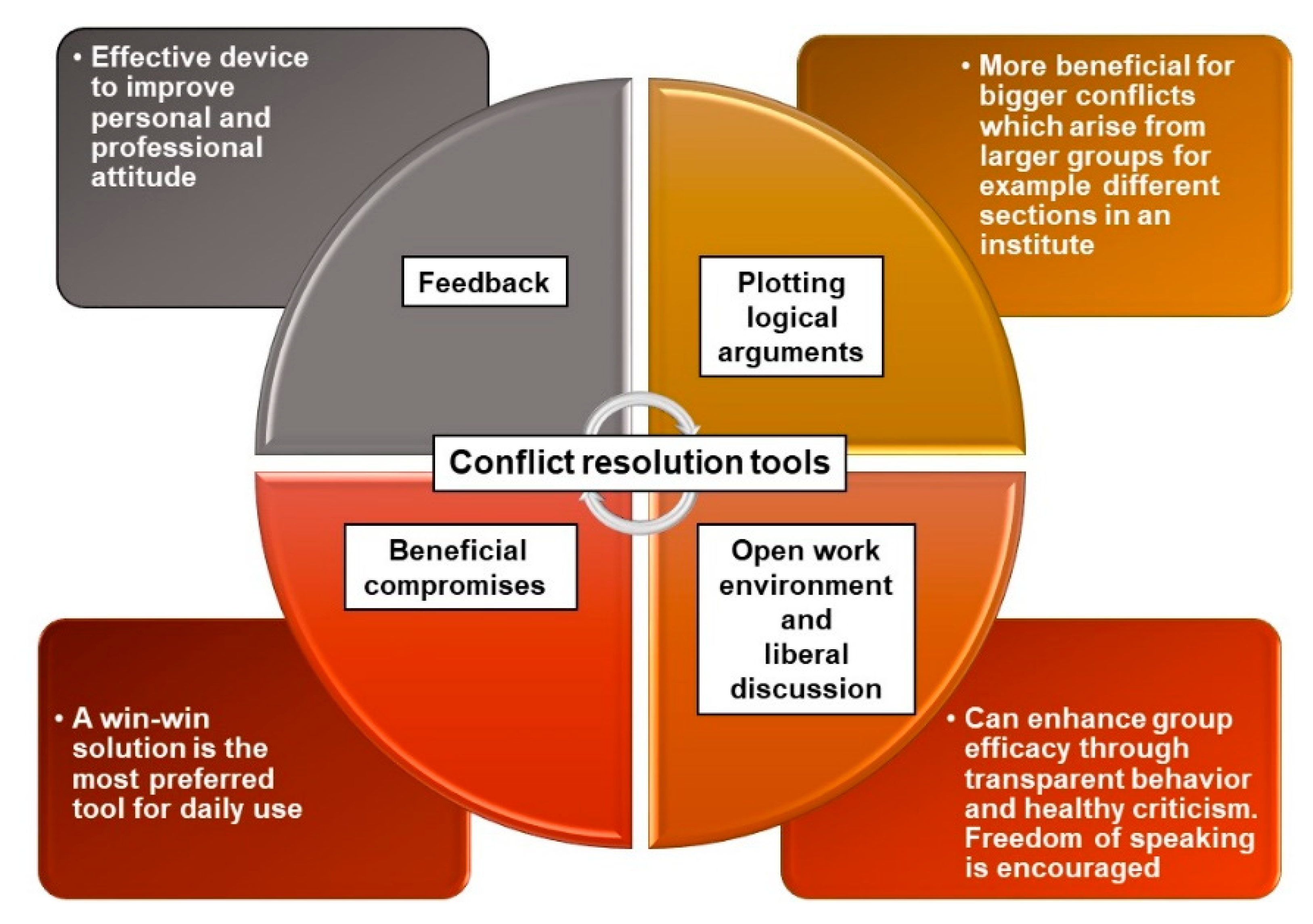
- FEEDBACK --- It is an effective device to improve personal and professional attitude though limited in some cases. The ways of recording feedback could be versatile like questioning or meeting. This tool helps to improve the situation considering individual’s perspective.
- PLOTTING LOGICAL ARGUMENTS --- This tool is more beneficial for bigger conflicts that arise from larger groups, for example different sections in an institute. It’s very helpful to clear out misconceptions in a straightforward way. But this device can not be used on daily basis in companies as it is a time-consuming process.
- OPEN WORK ENVIRONMENT AND LIBERAL DISCUSSION --- In terms of conflict resolution, this tool does not affect directly the methodology. But it can enhance group efficacy through transparent behavior and healthy criticism. Freedom of speaking is encouraged by this device.
- BENEFICIAL COMPROMISES --- A little negotiation with a ‘win-win’ solution is the most preferred tool for daily use according to most of the interviewees. In order to communicate effectively, a little preparation is needed as pointed out by the project managers. Different industries apply variable approaches while using this tool in conflict resolution.
Conclusions
Conclusive Findings
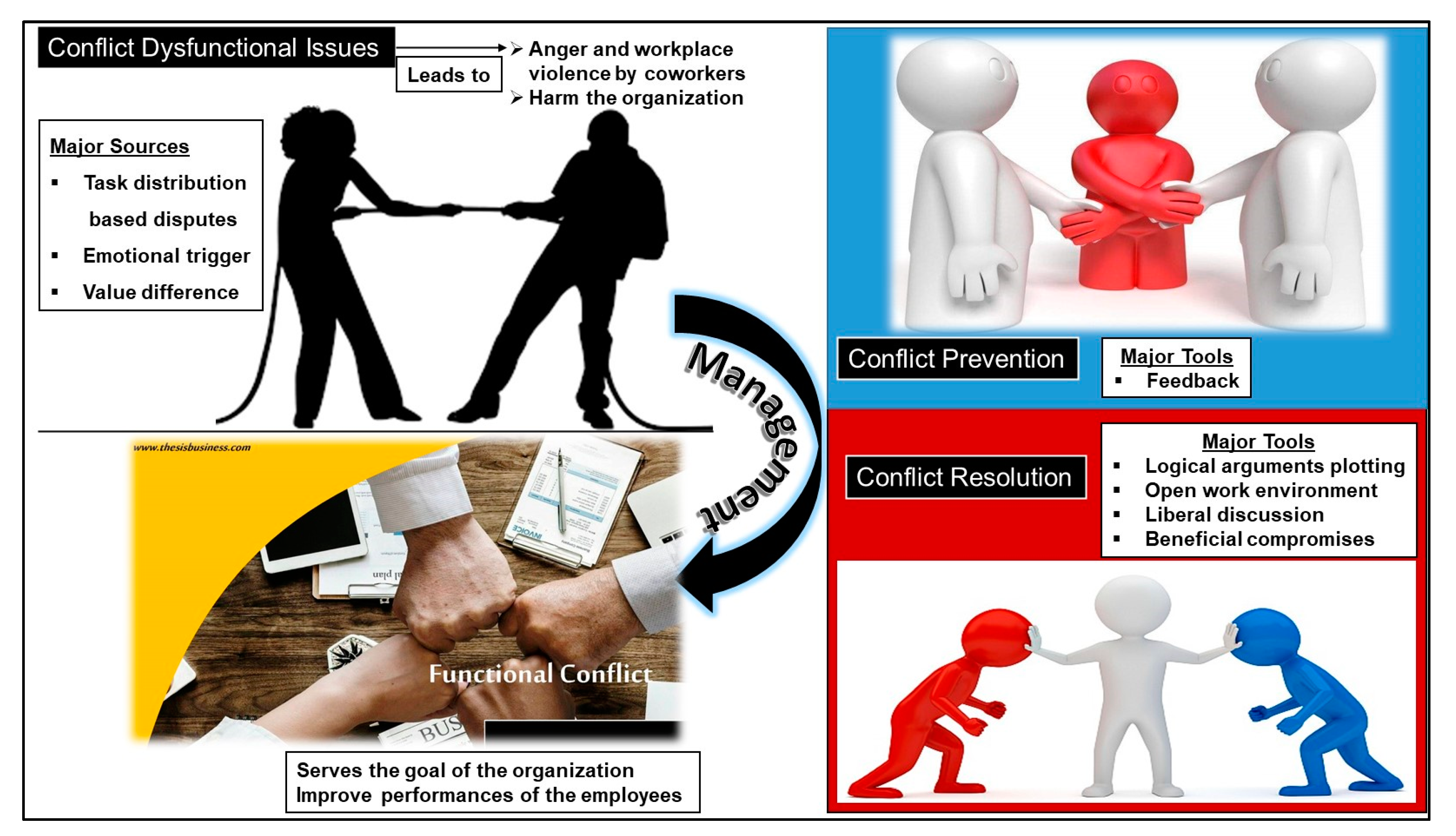
This research project studied and analyzed the reason for functional conflicts i.e the dysfunctional issues through secondary data analysis and came up with a concrete solutions on how functional conflicts in projects can be either restricted or prevented (Figure 13) (Verdhan, 2021).
Figure 13.
The overall conclusive findings.
Theoretical Implications
This research work gives a clear theoretical information about the conflict types and sources to the project managers which help them to catagorize any functional disputes faced in workplaces and standardize a systematic conflict management approach.
Practical Implications
- Increasing applications of feedback modes to record the team member’s perspective on the behaviour of the project leader with open mindset
- The development of an active work environment through managing conflicts by controlling too much emotional participation
- Increasing awareness about the weakpoints and conflict triggers of individual team members as well as the project manager themselves through logical arguments sometimes
- Enhancing understanding level to visualize any conflicting situation from an independent viewpoint
Addressing Research Questions
The targeted research questions and the answers obtained from our research are concluded in this section.
Research question 1
a) What is/are the root causes of conflicts and how do conflicts start (Functional conflict)?
The root causes of conflicts are distinct for individual personalities. However, the interview results explored that lack of awareness among project heads regarding their own emotional hot buttons, which acts as an essential and common conflict trigger for everyone.
b) Investigate and explore different approaches for conflict management within teams.
Too much emotional participation of coworkers escalates conflicts through focusing on personality instead of task and as a result productivity is sacrificed. Hence, early-stage regulation is mandatory to avoid further complexity of the situation. However, controlled task based conflict can enhance group functionality, lowering the tenson between coworkers. As a result, involvement of the project heads in a task conflict is a great approach to get its benefits. But, an open work environments, careful attitude and proper control over the situation by the project heads are required.
c) What are the tools and techniques that can be used to manage and resolve disputes amongst project team members?
When a conflicting situation arises within a project, either it should be prevented or can be managed to functional conflicts, supporting the goals of the group and improving the performances. This research implements a clear idea about the two types of conflict resolution tools. Feedback can be considered as preventive one through improving project leader’s behavior. This mode definitely make sure that they should share their perspectives and feelings with controlled emotions. It’s the project manager’s responsibility to remove emotional triggers while managing a conflict within project. On the other hand; plotting logical arguments, open work culture, liberal discusson and beneficial compromises are considered as a functional conflict management tools. Considering other’s viewpoints and designing the procedure to make fair dicisions are essential charteristics of a conflict competent leader to resolve disputes as supported by both theoretical frameworks and interview results, which fascile work place fairness with low time consumsion.
Limitations
Several limitations involved in this research work are listed below.
a) Time limitations did not permit any primary data collection through experiments. Hence, this research was conducted via secondary data collection, available through governmental sites, census reports, published data from the company’s websites, and annual survey reports.
b) Conflicts have very broad aspect while running a project. In our present research work, the only focus was managing functional conflicts within projects and project management companies. Additionally, this research investigated the types of conflicts that can arise in project management companies and suggestions on conflict resolution before starting a project was explored further.
c) Conflicts related to religious beliefs, cultural influence, and variances between project management organizations were excluded from this research.
Future Perspective of This Research
- The suggested method in this research work can be successfully applied in workplaces to manage and resolve conflicts in future
- Our research data will definitely help the project managers in an efficient thinking about functional conflict management and resolution
- The additional understanding regarding conflict types and triggers will help them further to categorize and address any disputes
- The major benefits of this study can be explored in some real conflicting situation, though positive and negative sides could be disclosed through arranging a workshop
- Future research should emphasize more on development of a standard feedback procedure, which can be established through surveys, group meetings or open conversation about some other relevant areas.
References
- Runde, C. & Flanagan, T., 2007. Becoming a Conflict Competent Leader. 1st ed. San Francisco: Jossey Bass.
- Airth, M. & Pisano, G., 2019. Conflict: Definition, Sources & Types. [Online]. Available online: https://study.com/academy/lesson/conflict-definition-sources-types.html (accessed on 22 October 2021).
- Aritzeta, A. A. S. S. S. , 2005. Team Role Preference and Conflict Management Styles. The International Journal of Conflict Management, 16(2), pp. 157-182.
- Berg, 2009. Qualitative research methods: For the social sciences, Bostan: Pearson Education.
- Bodepudi, M., 2020. Top 57 Project Management Interview Questions and Answers (Updated for 2021). Available online: https://www.greycampus.com/blog/project-management/top-thirty-project-management-interview-questions-and-answers (accessed on 4 November 2021).
- Bodtker, A. & Jameson, 2001. Emotion in Conflict Formation and its Transformation: Application to Organizational Conflict Management. The International Journal of Conflict Management, 12(3), pp. 259-275.
- Boo, S. & Froelicher, E. S., 2013. Secondary Analysis of National Survey Datasets. Japan Journal of Nursing Science, 10(1), pp. 130-135.
- Boros, S. , 2020. Controversy without conflict: How group emotional awareness and regulation can prevent conflict escalation. Group Decision and Negotiation, Volume 29, pp. 251-269.
- Cambridge Press, 2005. Cambridge Advanced Learner's Dictionary. [Online]. Available online: https://dictionary.cambridge.org/dictionary/english/conflict (accessed on 4 October 2021).
- Carneiro, D. , Gomes, M., Novais, P. & Neves, J., 2011. Developing Dynamic Conflict Resolution Models Based on the Interpretation of Personal Conflict Styles. In: L. Antunes & H. S. Pinto, eds. Progress in Artificial Intellegence. Berlin, Heidelberg: Springer, pp. 44-58.
- Darkazanli, W., 2020. Conflict in Project Management. [Online]. Available online: https://www.researchgate.net/publication/339999915 (accessed on 28 November 2021).
- Davy, 2019-2020. Management & Board Reports, s.l.: https://www.wipro.com/content/dam/nexus/en/investor/annual-reports/2019-2020/annual-report-for-fy-2019-20.pdf.
- Desivilya, H. & Yagil, D., 2005. The role of Emotions in Conflict Management: The Case of Work Teams. The International Journal of Conflict Management, 16(1), pp. 55-69.
- Dixita, 2020. 5 Conflict Management Styles To Improve Your Productivity. [Online]. 29 October. Available online: http://matterapp.com/blog/5-conflict-management-styles-to-improve-your-productivity (accessed on 29 October 2021).
- Donkor, P. , Afriyie, S. & AdjeiDanquah, B., 2015. Effect of Conflict on Employees Performance: Evidence from Coca Cola Company Limited, Kumasi Branch. American Scientific Research Journal for Engineering, Technology, and Sciences (ASRJETS), 14(3), pp. 44-53.
- Donkor, P. , Afriyie, S. & AdjeiDanquah, B., 2015. Effect of Conflict on Employees Performance: Evidence from Coca Cola Company Limited, Kumasi Branch. American Scientific Research Journal for Engineering, Technology, and Sciences (ASRJETS), 14(3), pp. 44-53.
- Donohue, A. , 2003. The Promise of an Interaction-Based Approach to Negotiation. The International Journal of Conflict Management, 14(3), pp. 167-176.
- Eizen, D. D. S. , 2005. Conflict Management in Work Teams. The International Journal of Conflict Management, 16(2), pp. 183-208.
- Ergeneli, A. , Camgoz, S. M. & Karapinar, P. B., 2010. The Relationship Between Self-Efficacy and Conflict-Handling Stylea in Terms of Relative Authority Positions of the Two Parties. Social Behavior and Personality An International Journal, 38(1), pp. 13-28.
- Eynden, V. V. d.; et al. , 2011. Managing and Sharing Research Data. 3 ed. Colchester: UK Data Archive, University of Essex.
- Flori, C., 2021. What Is the Competing Conflict Management Style and When Should You Use It?. [Online]. Available online: http://mtcopeland.com/blog/what-is-the-competing-conflict-management-style-and-when-should-you-use-it/ (accessed on 29 October 2021).
- Fulmer, I. & Barry, 2004. The smart negotiator: cognitive ability and emotional intelligence in negotiation. The International Journal of Conflict Management, 15(3), pp. 245-272.
- Gitau, B. W. , 2016. EFFECTS OF CONFLICTS ON PROJECT PERFORMANCE IN GOVERNMENT INSTITUTIONS IN KENYA. The strategic Journal of Business and Change Management, 3(3(9)), pp. 144-156.
- Guan, D. , 2007. Conflicts in the project environment. Hong Kong, People's Republic of China. Newtown Square, Project Management Institute.
- Guan, D. , 2007. Conflicts in the project environment. Newtown Square, Asia Pacific, Hong Kong, People's Republic of China.
- Hayes, J. , 2008. WORKPLACE CONFLICT AND HOW BUSINESSES CAN HARNESS IT TO THRIVE, s.l.: CPP Global: Human Capital Report.
- Heerden, F. v. & Krie, D., 2016. The project management triangle conundrum:, s.l.: Owner Team Consultation.
- Hoffmann, G. , 2005. Logical Argument Mapping: A Method for Overcoming Cognitive Problems of Conflict Management. The International Journal of Conflict Management, 16(4), pp. 304-334.
- Holahan, P. & Mooney, A., 2004. Conflict In Project Teams: Gaining The Benefits,Avoiding The Costs. Stevens Alliance For Technology Management, 8(3), pp. 1-7.
- Hopkins, M. M. & Yonker, R. D., 2015. Managing conflict with Emotional Intellegence: Abilities That Make A Difference. Journal of Management Development, 34(2), pp. 226-244.
- Hughes, R. , Ginnett, R. & Curphy, G., 2019. Leadership: Enhancing the Lessons of Experience. 9th ed. New york: McGraw Hill Education.
- Indeed, E. T., 2021. Interview Question: "How Do You Handle Conflict in the Workplace?". Available online: https://www.indeed.com/career-advice/interviewing/handle-conflict-in-workplace (accessed on 4 November 2021).
- Infosys, 2020. Resilience: What Differentiates, s.l.: https://www.infosys.com/investors/reports-filings/annual-report/annual/documents/infosys-ar-20.pdf.
- Jang, W. J. W. Y. G. K. D. H. H. , 2018. Financial Conflict Resolution For Public-Private Partnership Projects Using A Three-Phase Game Framework. Journal of Construction Engineering and Managemen, 144(3), pp. 1-10.
- Kerzer, W. , 2011. Project Management: A Systems Approach To Planning, Scheduling and Controlling. Washington: John Wileys and Sons Inc.
- Kerzner, 2010. Project Management Workbook, New Jersey: John Wileys and Sons Inc.
- Kerzner, H. , 2009. Project Management: A System Approach to Planning, Scheduling, and Controlling. 10th ed. New Jersey: John Wiley & Sons.
- Klastorin, T. , 2004. Project Management: Tools and Trade-offs, Washington;: John Wileys and Sons Inc.
- Kurtzberg, T. R. & Mueller, J., 2005. The Influence of Daily Conflict on Perceptions of Creativity. The International Journal of Conflict Management, 16(4), pp. 335-353.
- Longe, O. , 2015. Impact of Workplace Conflict Management on Organizational Performance: A Case of Nigerian Manufacturing Firm. Journal of Management and Strategy, 6(2), pp. 83-92.
- Madalina, O. , 2016. Conflict Management, A New Challenge. Procedia Economics and Finance, Volume 39, pp. 807-814.
- McAbee, J. , 2020. How Do You Handle Conflict in Project Management?, s.l.: Wrike, A Citrix Company.
- Mnookin, R. , Peppet, S. R. & Tulumello, A. S., 2004. Beyond Winning: Negotiating to Create Value in Deals and Disputes. London: Harvard University Press.
- Murtoaro & Kujala, J. , 2007. Project Negotiation Analysis. International Journal of Project Management, Volume 25, pp. 722-733.
- Myers, D. , Smith, S. N. & Ostergren, G., 2009. Consensus Building, Negotiation, and Conflict Resolution for Heritage Place Management. California, The Getty Conservation Institute, Los Angeles.
- Nyathi, G. L. & Risman, H., 2020. Africa’s Search For Peace And Stability: Defense Diplomacy And Conflict Resolution in the Democratic Republic Of Congo. Jurnal Pertahanan, 6(2), pp. 138-150.
- Ohbuchi, K.-i. & Suzuki, M., 2003. Three Dimensions of Conflict Issues and Their Effects on Resolution Strategies in Organizational Settings. The International Journal of Conflict Management, 14(1), pp. 61-73.
- Ohlendorf, A., 2001. Conflict Resolution in Project Management MSIS 488. Available online: http://www.umsl.edu/~sauterv/analysis/488_f01_papers/Ohlendorf.h tm (accessed on 23 October 2021).
- Olabode, O. S. & Ibrahim, O. O., 2019. An Assessment of the Reliability of Secondary Data in Management Science Research. International Journal of Business and Management Review, Volume 7, pp. 27-43.
- Pollack Peacebuilding system, n.d. Four Types of Conflicts in Organizations. 22 October. Available online: https://pollackpeacebuilding.com/articles/four-types-of-conflicts-in-organizations/ (accessed on 22 October 2021).
- Project Management Institute, I. , 2008. A Guide of the Project Management Body of Knowledge. 4th ed. Pennsylvania: Project Management Institute, Inc.
- Queensland Government, 2021. Workplace Conflict Resource. Available online: https://www.business.qld.gov.au/running-business/employing/conflict/conflict-resources (accessed on 4 November 2021).
- Renee, A., 2021. Top 50 Project Manager Interview Questions & Answers (2021). Available online: https://career.guru99.com/50-interview-questions-for-project-managers-2/ (accessed on 4 November 2021).
- Riyaz, P. , 2012. Project Management: Guidelines for the Management of Projects, s.l.: Linde International.
- Runde, C. E. & Flanagan, T. A., 2012. Becoming a Conflict Competent Leader: How You and Your Organization Can Manage conflict Effectively. 2nd ed. San Francisco: Jossey-Bass.
- Shonk, K., 2021. 3 Types of Conflict and How to Address Them. Available online: https://www.pon.harvard.edu/daily/conflict-resolution/types-conflict/ (accessed on 4 November 2021).
- Silverman, D. , 2018. Doing Qualitative Research. 5 ed. London: SAGE Publishing.
- Somech, A. D. S. L. H. , 2009. Team conflict Management and Team Effectiveness: The Effects of Task Interdependence and Team Identification. Journal of Organizational Behaviour, Volume 30, pp. 359-378.
- The Danish Centre, 2021. Centre for Conflict Resolution. Available online: https://in.pinterest.com/pin/145381894198417081/ (accessed on 29 October 2021).
- Tripathy, J. P. , 2013. Secondary Data Analysis: Ethical Issues and Challenges. Iran J Public Health, 42(12), pp. 1478-1479.
- United States Environmental Protection Agency, 2020. Conflict Resolution in Public Participation. Available online: https://www.epa.gov/international-cooperation/conflict-resolution-public-participation (accessed on 4 November 2021).
- Verdhan, R., 2021. Functional Conflict – Benefits, Resolution -Explained! with Example. Available online: https://www.thesisbusiness.com/functional-conflict.html (accessed on 4 November 2021).
- Wang, N. & Wo, G., 2020. A Systematic Approach to Effective Conflict Management for Program. sage Open, Issue journals.sagepub.com/home/sgo, pp. 1-15.
- Windsor, G., 2019. How to Deal With Conflict in Project Teams. Available online: https://www.bleftwork.com/blog/dealing-conflict-project-teams (accessed on 23 October 2021).
- Wisniowski, A. , Sakshaug, J. W. & Ruiz, D. A. P., 2020. Integration Probability and Nonprobability Samples for Survey Inference. Journal of Survey Statistics and Methodology, 8(1), pp. 120-147.
Disclaimer/Publisher’s Note: The statements, opinions and data contained in all publications are solely those of the individual author(s) and contributor(s) and not of MDPI and/or the editor(s). MDPI and/or the editor(s) disclaim responsibility for any injury to people or property resulting from any ideas, methods, instructions or products referred to in the content. |
© 2025 by the authors. Licensee MDPI, Basel, Switzerland. This article is an open access article distributed under the terms and conditions of the Creative Commons Attribution (CC BY) license (http://creativecommons.org/licenses/by/4.0/).
Copyright: This open access article is published under a Creative Commons CC BY 4.0 license, which permit the free download, distribution, and reuse, provided that the author and preprint are cited in any reuse.


