

Submitted:
10 April 2025
Posted:
16 April 2025
Read the latest preprint version here
Abstract
Despite the expectation that young people will exercise their agency as they transition into adulthood, young forced migrants encounter administrative, legal and normative borders that impede their ability to shape their life courses. The present article aims to explore these borders, their consequences, and the ways in which young migrants can surmount these obstacles. Based on quantitative data from the French survey Trajectoires et Origines 2 as well as on interviews and observations conducted in Rennes (France), we outline the disruption of young migrants’ life courses. The findings highlight a porous border of adulthood that seems specific to young migrants’ experiences. Whether they arrived in France feeling as adults or not, they either feel that they were brought back to a state akin to that of a child or that their transition to adulthood was accelerated and their childhood robbed. Nevertheless, young migrants can leverage different strategies to regain control over their life trajectories. The present study demonstrates that artistic practices may act as a catalyst for the exercise of agency.
Keywords:
agency
; forced migration
; youth
; adulthood
; art
1. Introduction
This paper will study the intersection of youth and migration, two domains of sociology that have been extensively discussed but scarcely mobilised conjointly in an exploration of the transition to adulthood of migrants. Since the end of the 20th century, the life course is no longer conceptualised as a linear path [1]. Rather, it is seen as a complex arrangement of successive periods that are not marked by immutable boundaries. Individuals experience the characteristic events of each period in a subjective way, with the possibility of moving back and forth between certain periods [2]. More specifically, ‘youth’ is the period between childhood/teenagerhood and adulthood – also known as the ‘transition to adulthood’ or ‘emerging adulthood’ [3]. During this period, young people are supposed to gain autonomy and independence [4] through several important steps, such as leaving the family home, entering the labour market or getting married [5]. However, it is subject to destandardisation and deritualisation [6], which means that the transition to adulthood is “longer and more complex, diversified, uncertain, reversible, and dissociated” [7] (p. 51). The great uncertainty of this period is caused by the vastness of the opportunities available, coupled with the weight of the choices to be made [3] but it is also conducive to exploration, discovery and freedom [3].
The border between emerging adulthood and ‘solidified’ adulthood [8] is therefore blurred, and becoming an adult requires a display of agency as “individuals construct their own life course through the choices and actions they take within the opportunities and constraints of history and social circumstance” [9] (p. 11). Crossing this border implies that individuals’ life courses are set on a particular path by constraints and choices, and that some opportunities are therefore unavailable – it is therefore essential to consider the ways in which young people exert their agency to shape their life courses according to their own aspirations. The corollary of this consideration is that we need to take into account the ways in which adulthood provides a normative frame of reference against which young people’s opportunities, constraints and aspirations are shaped and managed.
In parallel, the question of agency is also essential to a study of migrants and their installation in host countries, in our case France. Indeed, forced migration, which is our focus here, implies an experience of crisis that undermines the agency of individuals. Migrants experience crisis at several points in their migratory experience. Crisis can be defined as a “radically disturbing event that is unpredictable and threatens or brings down institutionalised routines” [10] (p. 4). The whole series of stages that make up exile can thus be understood as a series of crises: the events leading up to departure are disruptive and unpredictable, followed by an irreversible departure, and then a journey that is hardly controlled or guided by those involved. The culmination of these stages is the arrival in France, which typically leads to a situation of precariousness, vulnerability and the absence of previously acquired institutionalised routines.
This situation is the result of overlapping legal, administrative and normative borders that prevent migrants from accessing a stable status that would allow them to earn a secure income, have access to decent and stable accommodation or, in general, to live according to their needs and desires. At this point, migrants’ life courses have completely diverged and all their trajectories have been redirected in unpredictable and irreversible ways. The experience of such a multidimensional crisis has a direct impact on the subjectivity of migrants, who have to face a series of unprecedented situations while finding the necessary resources to adapt. Here we can see how migration affects individuals’ identity and undermines their agency, as they are left with few means to regain control over their life courses.
This is the central question of this paper: while young people are expected to exercise agency and make the ‘right’ choices in order to orient their life courses towards the normative expectations of adulthood, the agency of migrants is denied and undermined. Thus, young migrants are subject to the overlapping difficulties of being young and being a migrant. This paper aims to further the understanding of young migrants’ experiences of their transition to adulthood and their installation in France. It will explore the ways in which young migrants can cross the borders of adulthood and migration in order to act on their aspirations, to regain control over their lives – in short, to exercise their agency.
While a number of works have explored the enactment of agency and the empowerment of individuals through ‘important’ actions, choices and bifurcations (such as buying a home: [11; 12]; or through work and the workplace: [13; 14]; or at the time of resolving a major life crisis: [15]), we believe that a significant display of agency can be seen through everyday, ordinary actions. Indeed, the inherent subjectivity of agency [16; 17] requires us to shift our focus from the pivotal moments in an individual’s life course to the seemingly banal events that occur at the scale of lived experience or within the everyday temporal framework of their life. The frequency of these events and their continuous occurrence in the lives of individuals – as opposed to occasional major turning points – may more accurately reveal how individuals construct their social reality through their aspirations and the choices they make to pursue them. Thus, we believe it is necessary to approach this topic by “paying attention to ordinary, everyday events […], just as sociology does with extraordinary events” [18] (p. 26).
Against this backdrop, a central hypothesis of this paper is that ordinary artistic practices can be central to the development of young migrants’ agentic capabilities. Here, ordinary artistic practices are not to be understood as part of the artistic process that results in a creation being qualified as aesthetically valuable or as a ‘work of art’ [19]. That is to say that we move away from Art as an institutionally and professionally recognised activity [20] and turn to the unnoticed creative act [21]. We do not wish to study Artists who have “incorporated the specific artistic interest” to make Art their livelihood or main activity [22] (p. 157), as their life courses would already be somehow structured by their artistic practices. Rather, our interest lies in purely amateur and ordinary artistic expression, which can take place in everyday life and go unnoticed – and which may at first seem trivial, such as someone drawing, painting, writing or singing without being aware of the significance of this act. However, the pregnancy of such artistic expression through times and places leads us to consider this as a total social fact [23; 24] that results in emancipation [25]. As such, we believe it bears the potential to foster resilience, serve as a means of resistance, and support young migrants’ reflective and subjectivation capabilities [26,27,28] – all of which are essential factors in the enactment of agency.
2. Materials and Methods
This paper is informed by two previous pieces of research and our current PhD thesis, with a particular focus on the resilience of migrants during the COVID pandemic and the agency of undocumented migrants in Rennes, France. Building on these earlier works, our current PhD research focuses on aspects of youth studies and artistic expression. The present study utilizes a range of qualitative materials, including 30 semi-directive and biographical interviews with young migrants, and over 80 hours of participant observation in associations providing support to migrants. These interviews were analysed qualitatively, with a focus on the experiences of young migrants. A mixed methods approach [29] was employed, integrating quantitative data from the French national survey Trajectoires et Origines 2 [30]. Multivariate analysis is applied to this data to contextualise life trajectories of young migrants and the importance of artistic activities for this group. First, the database was recoded to identify relevant variables; second, several groups were isolated to allow for different levels of analysis (all participants 18-30 years old; French 18-30 years old; forced migrants 18-30 years old). Thirdly, multiple correspondence analysis (MCA) [31], binomial regressions [32] and contingency tables [32] were used to analyse the data. All results implying a correlation are only shown here if the relationship is statistically significant.
The selection of groups of interest (18-30 years olds; forced migrants) was informed by our review of existing literature and preliminary observations in the database. The age interval was selected based on the literature, particularly the recognition that the concept of youth is now a broad period that is significantly detached from certain normative brackets (primarily 18-25) [33]. The selection of countries of origin from which individuals qualify as ‘forced migrants’ was made by utilizing three pertinent variables (having sought asylum, having lived as an undocumented migrant for any duration, and having migrated due to instability. A score was allocated to each country of origin by calculating the mean of individuals from a country who responded affirmatively to the question, divided by the total number of individuals from the same country who responded to the question. Consequently, countries in sub-Saharan Africa, the Middle East, Eastern Europe and Southeastern Asia have been categorized as countries of forced migration, and being a citizen of such countries is used as a proxy to identify forced migrants. However, this presents limitations as the first two variables may include individuals who might not be considered forced migrants, while the third variable may exclude other types of forced migration. Notwithstanding this, the methodology employed in the construction of this group has yielded results that are consistent with the extant literature and the experiences of migrants we’ve met, thereby attesting to its relevance.
3. Results and Discussion
3.1. The Porous Border of Adulthood
3.1.1. Different Profiles of Youth
The effects of migration on the transition to adulthood can be observed through various quantitative data. The French national survey Trajectoires et Origines 2 [30] was conducted by the national statistics office and the national demographic studies institute. This study aimed to survey nationals, non-nationals and descendants of immigration residing in France, exploring their perspectives on past and present trajectories. This provides insights into various aspects of individuals’ life courses, particularly those of young people.
The initial objective was to precise what defines the border of adulthood, that is to say the set of norms that differentiate between children and adults and that constitute markers of the transition to adulthood. There has been much debate on the norms prevailing in this definition, therefore the work presented here focuses on variables serving as proxies for these conventional markers [5]: age at first independent accommodation, age at first employment, age at first relationship, age at first marriage, age at first cohabitation with a partner, age at completion of education, age at first child, whether one still lives with their parents, whether one receives help from parents or relatives, matrimonial status. We employed a multiple correspondence analysis, incorporating these variables, along with forced migration and other salient socio-economic factors. This method allows us to visualise our different modalities in a factorial plan, with their coordinates attributed according to their respective correlations. The clustering of variables and their modalities offers a way to refine the accepted definitions of youth. The following graph offers a simplified representation of the factorial variables plot that was obtained.
Figure 1.
Simplified MCA variables plot.
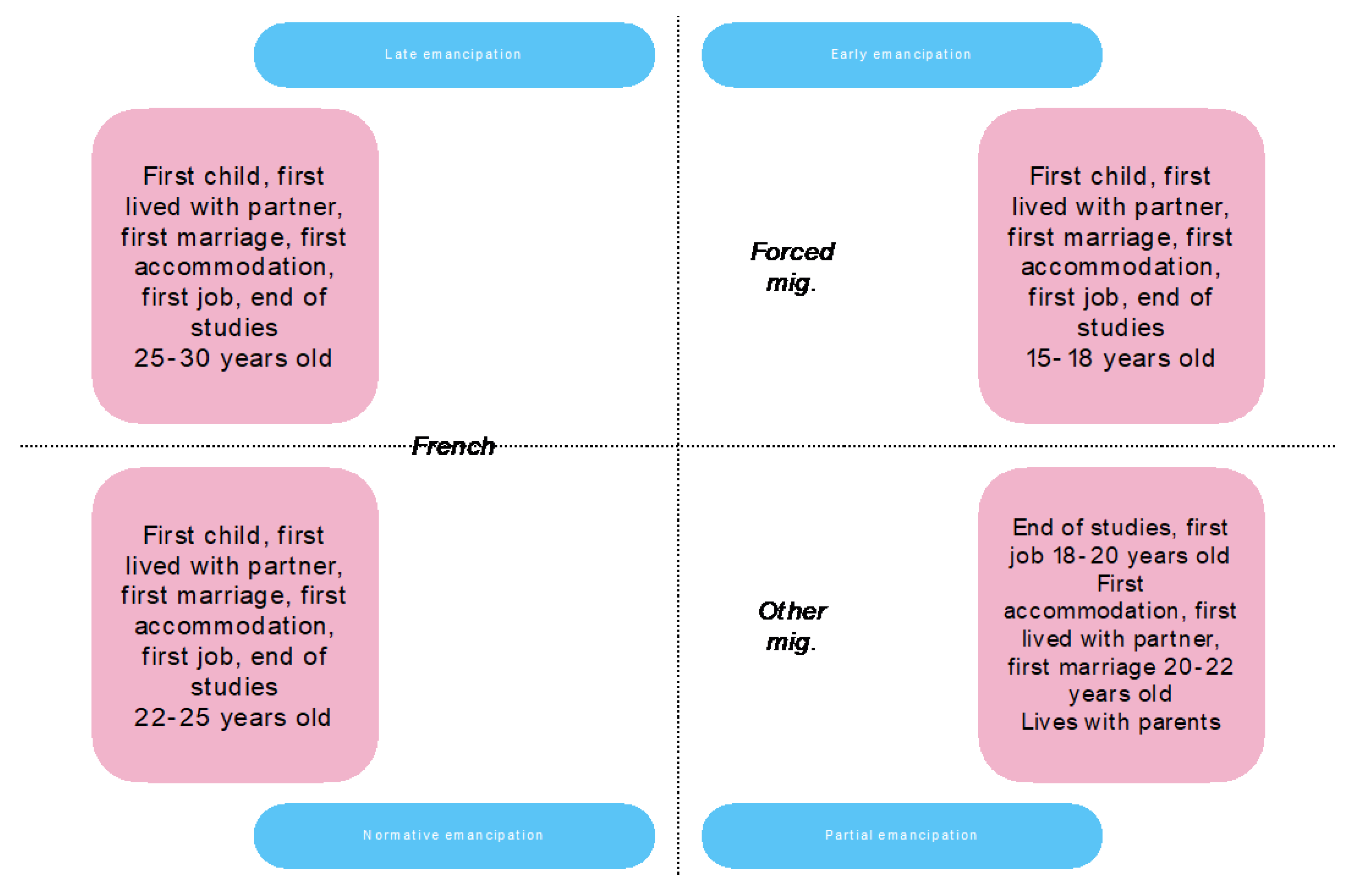
The intersection of the two axes delineates four distinct youth profiles. The first profile, designated as ‘late emancipation,’ characterises individuals who have attained the conventional milestones of adulthood between the ages of 25 and 30, a timing that could be regarded as ‘delayed.’ In contrast, the ‘early emancipation’ profile encompasses individuals who have crossed the threshold of adulthood prior to the age of 18. A third profile can be designated as ‘normative emancipation’, signifying an emancipation that is neither too early nor too late according to established norms. Finally, individuals may also be represented in the fourth profile, ‘partial emancipation,’ where they have achieved certain milestones (e.g. completing their studies of securing their first job before the age 20), yet their full independence remains elusive (either due to extended residence in the family home or actually still living with parents).
The inclusion of our variable of forced migration provides a preliminary insight into the impact of migration on life courses, and highlights the need for a study of young migrants’ transition to adulthood. While the majority of French individuals aged 18 to 30 years old exhibit either late or normative emancipation, indicative of the trend described in the introduction of a lengthening of the period of transition into adulthood, forced migrants are observed in the 'early emancipation' profile, while other migrants are in 'partial emancipation'. The latter observation can be attributed to the reasons for migration between the two groups of migrants. Indeed, more than a third of the individuals in the 'other migrants' group have migrated to reunite with family, and so may have needed to gain financial independence earlier in order to pay for their migration, for example, before moving in with their family in France and settling into a full independence. In contrast, forced migrants do not come primarily for family reunification, but to flee from insecurity and instability. This often results in a state of isolation, as these individuals must navigate their new environment independently, often with little to not support.
A notable finding is that young forced migrants are 1.4 times more likely than French individuals to experience a downgrade in their professional status. This indicates that they are currently engaged in roles that do not fully align with their skill sets. Furthermore, they are 3.8 times more likely to have had to discontinue their studies earlier than planned. In addition, 58% of them cannot have their degree or diploma recognised in France. Among those who had a job before migrating, 30% are now out of the labour force, a figure that rises to 53% if they cannot have their degree/diploma recognised. The residential trajectories of young French people and forced migrants also differ: 16% of the latter have experienced precarious accommodation (2% for the French), 9% own their home (41% for the French), and 47% live in rented social housing (15% for the French). In general, their socioeconomic status is lower than that of their French counterparts. A significant proportion of these individuals, 38%, perceive their living conditions as being comfortable, while 29% encounter difficulties in their current circumstances. This is in contrast to the 58% and 11% of French respondents who share these sentiments. However, it is crucial to consider the situation prior to migration, as young people who felt well off before migrating may face fewer difficulties than those who were already in a tough situation. The data indicates that 33% of young migrants from affluent backgrounds have had to discontinue their studies earlier than planned, a figure that increases to 59% for those originating from less privileged backgrounds. This phenomenon extends to housing, with 12% of the formerly well-off reporting having experienced precarious accommodation in France, compared to 28% of their counterparts.
3.1.2. A Backward Crossing of the Normative Border of Adulthood
The quantitative analysis provides a snapshot of the disruptive impact of migration on various aspects of the life course, including employment, education, housing, and familial circumstances. The findings underscore the adverse consequences of being a forced migrant on these key trajectories of the life course. This phenomenon was further observed through biographical interviews with 30 young individuals in Rennes, France. The interviews covered various aspects of their life courses, including current circumstances and aspirations. This methodological approach allows us to adopt a multi-temporal perspective in our analysis of the fractured life trajectories of these young migrants. Our analysis encompasses a comparison of their past and present circumstances, as well as an examination of their aspirations, the manner in which these aspirations were formed and subsequently modified, or relinquished. A recurrent phenomenon we observed was that of individuals who had effectively entered a state of solidified adulthood prior to migrating, and for whom reinstallation means discarding pre-existing life trajectories.
I finished High School, I have all the diplomas. I started two years of University, but I stopped because I had my wife and my son. I chose to work because we didn’t have money. Here, I want to get the papers because… the years go on, I’ve been here for five years and I lost five years here in France – Male, 28 years old
I left my village to go to Kinshasa. […] I stayed there a while. I wanted to leave the village to make my life. I worked in a restaurant, I did hair for women. Then, there was a problem so I left. […] I don’t work here in France, I’ve never worked here in France. […] Life has no balance, we’re just here, we stay here like people who know nothing – Female, 23 years old
Over there in Tchad, I lived with my family. When I arrived here, I know nobody. I have to make my choices on my own. – Male, 27 years old
People around me see me like a child, because I don’t have the language. They don’t look at my body, at what’s inside my head, they just look at my… speaking. And so it’s the child who speaks, because he doesn’t know how to speak French. You’re not an adult, an old person, because here, every time, you’re helped. – Male, 24 years old
It is evident that a considerable number of young adults encounter a disruption in their professional trajectories, not being able to go back to their original domains. At the time of the interviews, very few of the forced migrants were in a domain for which they had studied or in which they had worked previously. Furthermore, they rarely considered returning to their original domains. While some expressed a desire to do so, they recognised the likelihood of this being unlikely, and others had simply given up. This phenomenon can be attributed to various administrative and legal borders, one of which is the cumbersome process of diploma/degree recognition. A number of interviewees required diplomas in their domains, such as healthcare. This was often impossible due to the perception of their credentials as inferior to those obtained in France by administrations or employers. The only option for these individuals would be to repeat their entire courses in France, but their precarious economic circumstances often rendered this possibility non-viable. Their sudden independence, coupled with high rent and only being able to access low-paid jobs would limit their ability to save or cease working to study. Their economic situation is further worsened by the need to send remittances to family members who remained in their country of origin in order to pay back the cost of migration or simply to ensure their survival. Because professional choices are explored by young people before being consolidated as they become adults, the break in their professional trajectories equals to leaving behind the lives they had built. This participates in a backward crossing of the border of adulthood as their professional trajectories are curtailed, forcing them to start anew their exploration of possible opportunities.
Furthermore, those who left considering themselves as adults now find themselves stripped of their autonomy and the capacity to make independent decisions. This can be observed in the last excerpt above, as the interviewee explains not being an adult as being ‘helped’ – depending on others. Individual and associative solidarities are essential for young migrants to survive in France [34], as they usually struggle to access legal and stable employment for some time after their installation [35,36,37]. As asylum-seekers, they receive a very low income and as irregular migrants they may receive (next to) nothing – in Rennes, lone irregular migrant adults can receive 60€ from local authorities. Therefore, NGOs and non-institutional solidarities are necessary to access food, clothing, hygiene products, health services and administrative/legal support [38,39,40]. In material terms, young migrants’ lives no longer depend on themselves which participates in a feeling of having regressed to a state reminiscent of childhood. The re-establishment of adult status is challenging, resulting from difficulties in securing employment or accessing adequate accommodation. Furthermore, their state of dependency may persist for an indeterminate period. This has also been covered in youth studies, regarding other vulnerable young groups – such as young homeless people, for example [41]
However, young migrants seem to experience a regression on the markers of adulthood that is unique to their circumstances. Indeed, the excerpts above show individuals who had created their own households. This is an important marker of having transitioned into adulthood. Creating a household is usually strongly correlated to being an adult: one leaves the parental household, gets married, becomes a parent. It has been shown in the past that some elements of this are reversible, especially as today’s transition into adulthood is recognised as a longer process made of back-and-forth [2]. Yet, parenthood is particularly significant here as it is generally considered irreversible. While in itself becoming a parent does not appear to be a mandatory step to become an adulthood [42], having become a parent is associated with one’s perception of being an adult. To our knowledge, there are very few cases where adults experience fluctuations in this status in the same way they might when leaving the parental household or even getting married. This irreversibility of the status of ‘parent’ seems to persist even in the case of child loss: such an event does not erase one’s identity as a parent. The apparent absence of a term analogous to ‘orphan’ or ‘widow’ in many languages to describe a bereaved parent suggests a perception of adulthood as an irreversible state. In the study at hand, several interviewees had started families in their home countries, until they were forced to migrate. They left their children behind, sometimes with no way of being in contact with them. While they describe being a parent as an essential part of being an adult – “I was a child myself until I had my first child, it’s responsibilities that you don’t even think about before”, Female, 26 years old – they also express the void they feel from not being a parent anymore. This affects their core identity as adults. This observation is essential in our discussion of youth studies and life course studies, as it questions the irreversibility of some markers of adulthood. As mentioned, some elements have been recognised as reversible yet parenthood hasn’t been discussed in this way. Here, it is possible to consider that for young migrants parenthood is reversible. This means that they regress on all the markers of adulthood, as for them the border between adult and child is a lot more porous than for other groups – even those that are considered vulnerable and thus prone to differentiated experiences of transition to adulthood compared to non-vulnerable youth.
3.1.3. An Accelerated Transition into Adulthood
For other individuals, who on the contrary could still be considered as being in a period of transition to adulthood when migrating, a similar disruption of life trajectories was described. For those who were still living with their families, the severance from the family household is the first element that emerges as a particularly salient and challenging experience.
When I left Guinea, I was a child. I didn’t know how long it would take to arrive to France. And I felt like an adult when I arrived, because I know nobody here. I don’t have my parents here. So you have to manage. – Male, 26 years old
When you leave your mom and dad, we can neglect some things. We think ‘mom is here, dad is here’. Then, bam, you end up in a place like in a dream. You fall asleep, you wake up, you’re in another world. And you’re told ‘here, it’s like that, you have to learn that and that’. […] And that made me feel really responsible of myself. If I trip, I don’t have my mom to call. I have to fight, myself and I. – Male, 24 years old
The present excerpts reveal a sense of dislocation from familial roots. Those young people, who described themselves as still being dependent from their families before leaving – be it in financial and material terms, or in more abstract ways such as taking life decisions – now highlight the abrupt transition to self-sufficiency, and therefore taking up responsibilities suddenly. A recurrent theme was that of now undergoing the consequences of their own choices. The literature and the interviewees portray youth as a period of exploration and experimentation with diverse pathways and opportunities, « doing dumb things but knowing you’re not alone to fix it afterwards » – Female, 21 years old. This phase of experimentation is pivotal in determining one’s future path. For those who have already chosen a direction, particularly in the context of studies, migration signifies a deviation from this path.
After High School, I went to do economics to work in a bank. But I didn’t have time… I didn’t finish university because I left everything. […] Now if I study, it’s for a job and I already chose. I’ll do electricity, or mechanic. [- It’s quite different from economics and banking!] It’s not banking but here, when I left my country, I had to change my project. Someone in banking in Afghanistan, it’s… it’s not difficult. But here, things need a lot of time to be learnt. And I have a problem with the language. […] I am sad because in Afghanistan, I didn’t choose any other career. Banking is the first thing I chose, but here I was changed, I am sad. – Male, 26 years old
Studying, here, is tightly linked to the aspirations of the young migrants we met. The interruption of studies upon arrival in France is indicative of the necessity for migrants to establish economic and living stability, whether temporarily or permanently. Their aspirations are significantly impacted by the transition to a state of uncertainty. They are no longer in control of who they are, or who they want to be. In fact, young migrants that arrive in France between the ages of 16 and 18 years old often suffer significantly from this forced replacement of their aspirations. All of the young individuals we’ve meet, who arrived in France after the age of 16 and enrolled in secondary education were involuntarily enrolled in vocational training programmes, which were selected for them following a brief evaluation.
I arrived… I wasn’t enrolled yet. I went to the orientation centre, I did the test and everything… So I did the test, and then they told me I should start school and they put me in the first year of vocational in electricity. I’d never done electricity. In Congo, I’ve never done that. – Male, 20 years old
This young man’s experience is shared by many other young migrants, and additionally reveals the important part that local actors play in shaping the aspirations and life trajectories of young migrants. One salient example is that of unaccompanied minors. Indeed, these minors are accommodated in designated centres that include socio-educational support. According to several social workers and unit managers, the primary objective of this support is to facilitate the timely entry of these individuals into the workforce upon reaching the age of 18.
When they arrive at 16, we’re so happy because we have more time; when they’re 17, it’s a rush. We have to get them papers as fast as possible, and for that they have to check very precise boxes. They have to be integrated through school, work, social life, culture, as fast as possible, with concrete proofs. The major part of our support is to help this integration. – Unit manager, NGO managing an unaccompanied minors centre
Here, we’re convinced they should be able to change paths if they want, we try to defend that with the Department Council. The Department for them, they want the fastest way out. You have work placement, you have an income, you don’t take the risk to change. – Unit manager, NGO managing an unaccompanied minors centre
Upon reaching the age of 18, these young individuals are expected to depart the centre, unless they have not secured a stable situation. In such cases, they are permitted to remain in the centre until their 21st birthday, provided they are engaged in a professional project that is showing tangible progress. Consequently, social workers themselves impose considerable pressure on young migrants to become independent and secure employment by the age of 18, a goal they recognize as being distinct from the expectations typically faced by ‘other’ 18-years-olds.
In general, the experience of migration for young migrants represents an accelerated transition into adulthood. If it is possible to describe the border of adulthood as porous in the case of young adult migrants regressing on the markers of adulthood, the same can be said regarding not-yet-adults. The profound crisis of migration, and the set of circumstances once in France create a situation whereby young migrants are forcibly taken out of their childhood to become adults at a faster pace than what would be expected of non-migrants.
When I was in Afghanistan I was like a child. But now I went through all those problems, bad things; now I think I’m… an adult. […] Before, when I was with my family I was not an adult. Now I help my family. I went through a lot of problems, so I’m an adult because it’s not easy for someone to spend four months, everyday through problems, through forests, through mountains, that’s not something that children do, it’s not normal. I changed a lot. – Male, 26 years old
Being an adult, you know how to make decisions. The challenges I went through, they allow me to anticipate a lot of things, to make thought through decisions. I didn’t have this level of maturity before leaving Benin. The challenges I experienced, in Europe, they allowed me to become mature. – Male, 29 years old
This phenomenon is contingent on different factors. Firstly, as previously mentioned, they are severed from the experimentation and ‘dumb’ phase of youth [7] and are compelled to make decisions that are often of life-or-death nature. In addition to these sudden responsibilities, they may also assume financial responsibility for their families, thereby inverting the family roles of parent and child. This inversion of roles has been documented in the youth and migration literature and was coined as parentification [43]. This can also be observed in young persons who have migrated with their families and who, as a result of their faster adaptation – whether perceived or real – may assume an adult role by taking on administrative duties and generally managing daily lives.
I feel like an adult since I’m in France, because as soon as I learnt French, I’m the one who brought my parents to appointments. I translate, I explain the e-mails, the mail. I make appointments, I… our roles are swapped. Now they speak French, A2 or B1. So with the doctors, with anything administrative, it’s complicated. I don’t know, it’s a very different relationship with your parents. – Female, 26 years old
This excerpt illustrates parentification, and the subsequent frustration experienced by the interviewee. The repercussions of this phenomenon have been extensively documented in the literature in psychology, highlighting its profound impact on the development of young people into adulthood and their mental well-being [44]. Young people often liken their experience to ‘being robbed of their childhood,’ due to the expectation that they should assume the responsibilities typically associated with adulthood.
In this context, it is relatively easy to assume that the crisis that migration represents as well as the circumstances of being a young migrant in France render these individuals incapable of making choices that matter to them. However, they may put in place strategies and tactics in order to enact their agency and to experience adulthood or its transition on their own terms. This paper will highlight artistic practices as minor acts of resistance to regain agentic capabilities.
3.2. Artistic Practices as Acts of Resistance to Reclaim the Adulthood Border
3.2.1. The Everyday Enactment of Agency
Agency constitutes a fundamental element of the life course paradigm [9], with individuals acting as the primary agents of their own life trajectories. It manifests during pivotal moments of the life course, such as the transition to adulthood, when young people make decisions that will most likely define their future. Yet, agency can be constrained by structural obstacles, as is the case of young migrants. However, it would be erroneous to state that this agency is entirely denied to young migrants; there are instances where they demonstrate the enactment of their agency, thereby illustrating how a life course can be constructed and aspirations pursued while agency is bounded [45].
It is crucial to emphasise a term we have used previously: the ‘enactment’ of agency, or its ‘exercise.’ Agency is frequently regarded as a type of resource that needs to be ‘developed.’ Elder and Hitlin [17] mention a dilemma that is not always answered clearly in the literature: « is it a differential property that some—whether through structural advantage or individual attributes—possess more than others? » (p. 173). The assertion that agency is not a differential property but a shared characteristic of individuals is made by speaking of its ‘exercise.’ As individuals navigate life, its opportunities and constraints, they make choices in diverse spheres and to varying degrees. Thereby, their agency may be ‘bounded,’ yet, despite the salience of environments and structures, this ability to make choices that matter to individuals at varying scales [45] demonstrates that agency should not be regarded as a ‘stock’ or a finite resource, but as a potential for action inherent in each individual. Consequently, in order to understand the ways in which young migrants enact their agency, it is necessary to examine both the pivotal moments in their life courses – the points of bifurcation [46] – and the everyday displays of choice-making. Indeed, Bidart’s concept of ‘routines’ [47] is instrumental to these bifurcations: they refer to recurrent choices that are made without full awareness and that can contribute to the long-term shaping of turning points in the life course.
This phenomenon is of particular relevance in the context of our research, as we have observed that these pivotal moments are often not the result of young migrants’ own will. Structural pressures may compel them to pursue a professional trajectory that does not align with their original aspirations. However, despite the denial of their agency in these critical junctures, they may still exercise it at the level of their daily lives. We have observed this in situations that initially appear anecdotal, but which may unveil crucial social mechanisms [48]. One such example is that of food – is there anything more routine? During an observation at an asylum seekers’ accommodation centre, the unit manager took us to visit the centre. We entered through a corridor with a wall of letter boxes – on top of them, several unopened cans of food. The manager explained that people go to different food banks, usually one a day, organising their schedules around the distributions. He then gestures dismissively towards the abandoned cans, remarking on the residents’ alleged ingratitude. They’re very picky, and they won’t eat what they don’t know – one of the cans is choucroute, a dish of fermented cabbage, potatoes, sausage and other meats. The manager interprets this as evidence of the residents’ pickiness and lack of integration. However, this also demonstrates that the migrants receiving this food make the assertive choice of throwing away food that they need – resisting, in a way, what is imposed on them through charity. Another observation we conducted provided a complementary insight to this minor act of resistance. We shadowed a social worker at an NGO tasked with distributing financial support to undocumented migrants – who are not allowed to any state social welfare receipts. While waiting for her next appointment, the social worker tells me about the way their beneficiaries receive the financial support, which consists of a book of checks amounting to 60€ per month. These checks are exclusively utilized within a designated list of partner retailers, and the beneficiaries decide whether to allocate the checks to food, clothing, hygiene, or leisure. The social worker recounts regularly asking beneficiaries how they spend their checks. They would typically use the money to purchase spices from an African shop, or to buy phone credit to keep in touch with relatives back home. After recounting this anecdote, the social worker made a confused face and laughed.
These two examples demonstrate a significant display of agency: in situations of strong financial constraints, people go out of their way to carefully choose what they eat; something that is both an important tie to their origins and thus a source of comfort, but also a way of resisting a situation that would make them accept what they do not want in the first place. In doing so, the administrative, legal and normative borders of youth and migration are crossed; moving from a place of constraints and denied agency, to the possibility of choosing for oneself, be it in the most intimate sphere. This phenomenon is underpinned by the concept of ‘self-efficacy’, defined as the “perception of oneself as a causal agent in one’s environment, having some control over one’s circumstances, and being capable of carrying out actions to produce intended effects” [49] (p. 370). Given that “self-efficacy is a key factor in life course construction” [49] (p. 371), the everyday displays of choice and agency are essential in fostering the ability to make other important choices at pivotal points in life trajectories. Faced with greater structural constraints, these appear as a sort of an everyday form of resistance from migrants, similar to what has been described with dominated groups resisting class or colonial oppression [50; 51]. As the border of adulthood is a lot more porous for young migrants, these acts of resistance may play a role in reclaiming the border of adulthood in order to be, or become, an adult on one’s own terms.
3.2.2. Exploration and Expression of the Self
Given the challenges of observing these quotidian acts of resistance outside of in-depth ethnological and nanosociological research, we have opted to turn our PhD research on artistic practices as an entry point into the intimate displays of agency. In conducting our fieldwork, we encountered 30 young forced migrants at different points of their administrative trajectories, all between the ages of 18 and 30, originating from different countries, and representing both genders. None of the interviewees had pursued a career in the arts professionally, nor had they constructed their life courses around it. Some had engaged in artistic activities as a hobby, while others had little to no experience with creative pursuits. However, for those who had experimented with art, it was evident that it served as a medium for self-expression and exploration.
Painting, it’s something you do in discussion, in interaction. It’s only by interacting with yourself that… it’s a communication. The canvas speaks, if you do not converse you… you have to be in symbiosis with it. The proof being sometimes when you paint, you want to bring the canvas somewhere but if it doesn’t want, you’re blocked and you feel a void of creativity, of passion. You need that, this contact. – Male, 29 years old
It's true that with art, I feel like we can express, we can say things. Art changed so much through time, the look on art changes every year. It’s something that changes and people change as well. Art changes me as well, I think we use art to change ourselves. It’s a relationship between art and myself, art and us. – Female, 19 years old
I really believe in the idea that an artist is someone who practices. If the artist doesn’t practice, he’s not an artist: you don’t write ideas on paper and tell people “I do that.” Rather, you have to go and do, try, fail, try, fail; for me, that’s the real artist. – Male, 24 years old
In these excerpts, artistic practice is an important medium to express and discover oneself. This practice requires introspection and an understanding of one’s identity, followed by the determination to express it. It bridges the immaterial and the material realms, utilizing a language that solidifies both the actual and the aspirational identity. It is further argued that artistic expression holds transformative power by facilitating an exploration of one’s desired future self. This introspection is a critical component of the transition to adulthood, a period of experimentation and of mistakes. Art can facilitate the process of choosing a path, as it provides a tangible representation of one’s journey and aspirations. Moreover, artistic practice can serve as a means to reflect on past decisions and experiences, offering a framework for understanding one’s present circumstances and the choices available to them.
Sometimes I go back to what I drew before, and I see… my thought before and my thoughts now. How I had these problems before, how I tried to deal with them… I see that the problems that were very difficult then, now it’s the past. They’re over, they seem easy. I wrote about my problems, but then when I managed, I reread what I wrote and I saw that they were actually very easy. Now I went through all this to succeed after. It helps me a lot, it gives me courage to continue. – Female, 19 years old
In this case, the young woman consults her previous drawings and writings, which are tinted by her prevailing mood at the time of creation. This process serves as a means of reflecting on memories and the emotions attached to them that have been crystallised on paper, thereby reinforcing her feeling of self-efficacy. Remembering her migration path, what she went through, and seeing a snapshot of herself at this moment, making choices that matter to her becomes easier.
3.2.3. Projection of the Self and Aspirations
For individuals with no prior experience in artistic pursuits, our methodological approach was devised to encourage the exploration of drawing during interviews. We provided each interviewee with paper and pencils, and invited them to draw the first thing that came to mind for four ideas: yourself; your life; a memory; home, with no clarification or further instruction. Surprisingly, only two respondents rejected this request. We highlight two results from this experiment here, allowing us to gain an understanding of agency in action. The act of drawing themselves prompted our respondents to display a variety of interpretations of the self. Several of them expressed a lack of self-awareness prior to commencing the drawing, yet their drawings encapsulated elements of their past, present and future self. This reveals that, unsettled by the task of drawing themselves, they reached deeper than their physical traits, choosing to portray an identity that is complex and multilayered.
Figure 2.
Rodrigo’s drawing of himself.
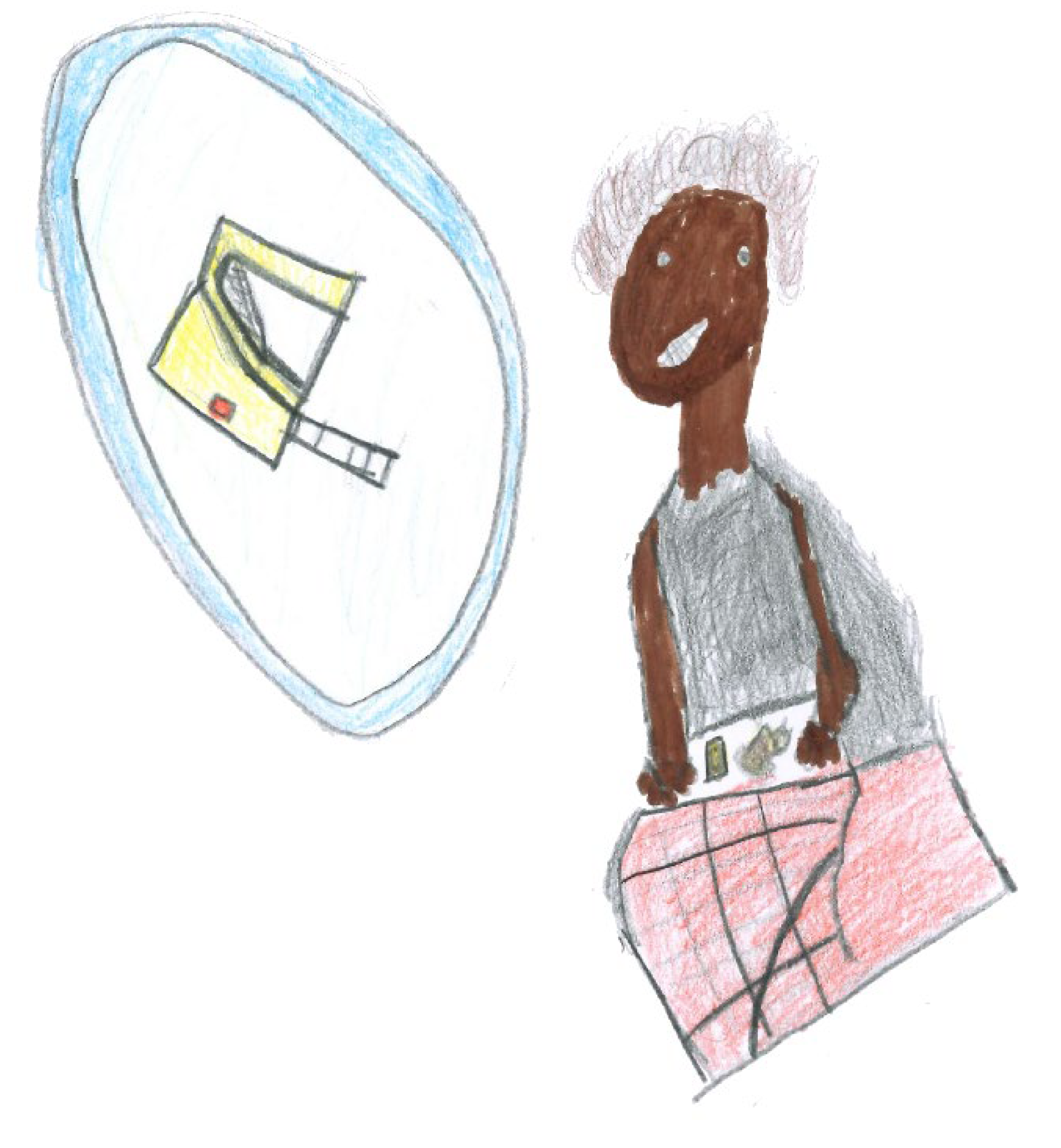
Figure 3.
Mireille’s drawing of herself (adjusted for sharpness).
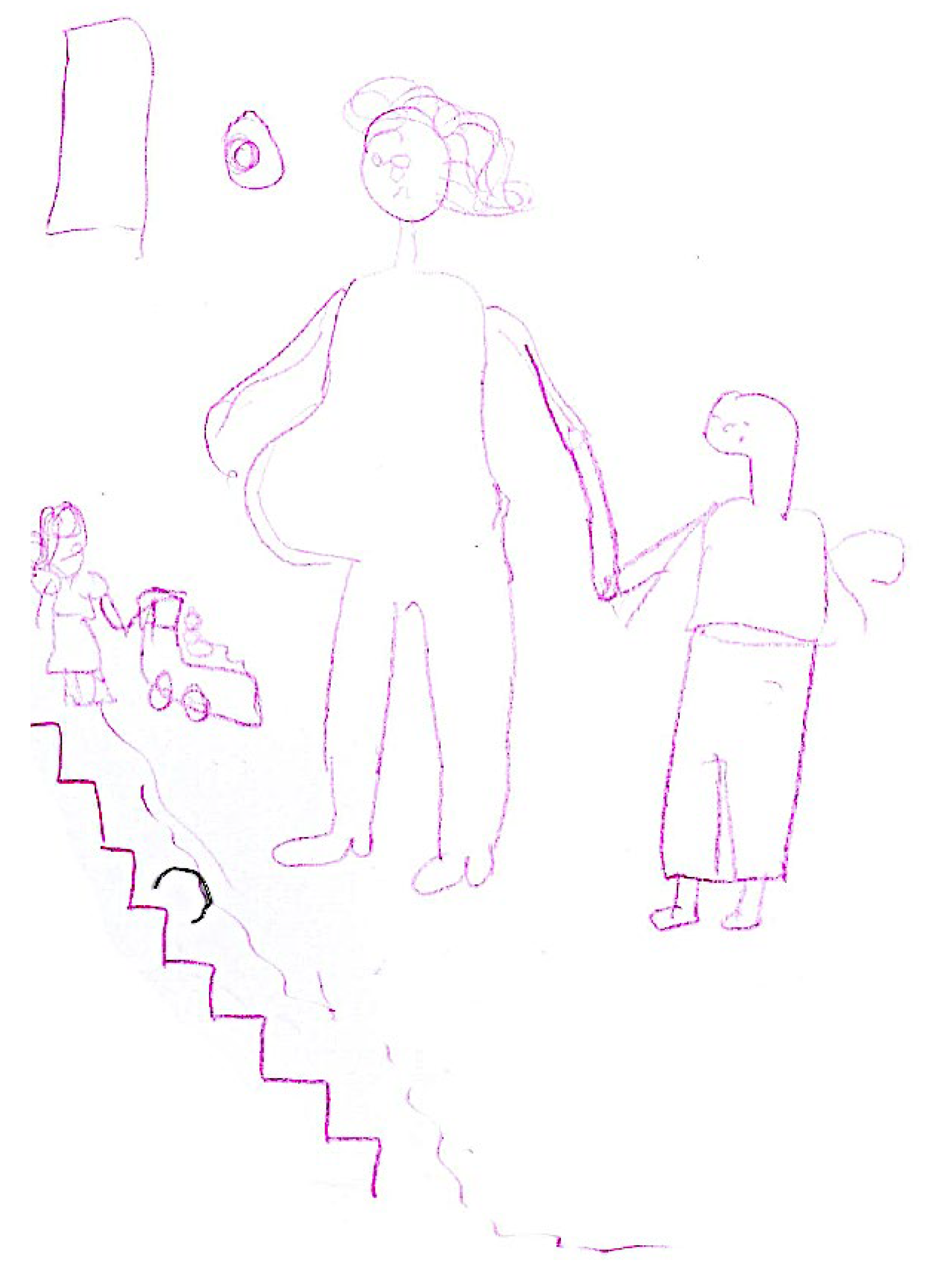
The first drawing portrays Rodrigo in a seated position, a choice influenced by his sentiment of finally being able to take some time for himself after his migration trajectory. The belongings that matter to him are on his lap, and he is looking in a mirror. His reflection reveals a ladder leading to a door, which he interprets as a visualization of his past and future self. He describes struggling with making sense of who he was, who he is and who he will be. Mireille opted to depict an event from her past, namely her arrival in France with her first child and unborn second child. As she was about to board the metro, another woman struggled with her stroller, and Mireille offered to assist despite the physical strain. She instructed her child to wait, and proceeded to climb the stairs with the stroller. It is noteworthy that during the interview, this particular detail was not recalled by Mireille, likely due to its irrelevance to the questions. However, when invited to draw herself the memory resurfaced, serving as a representation of her identity and aspirations: she considers herself kind and helpful and aspires to helping others. This exploration of the self through drawing emerged as a significant element in the interview, particularly when questioning interviewees’ post-drawing reflections. The majority of them reported feelings of calm and expressed satisfaction at having had the opportunity to reflect on different aspects of their lives and identities.
It’s like… you’re taking a minute, you’re looking inside and you look back. It helps. – Male, 19 years old
‘Looking back’, here, means seeing yourself. This notion is of particular significance when making decisions in life as engaging in introspection enables the envisioning of one’s future trajectory. This projection of the self is a pivotal result of this experiment. It is evident when individuals are requested to illustrate the concept of ‘home.’ Given the other drawings clearly inviting reflection on the past and the present, we hypothesised that the ambiguity of this last instruction could lead to different interpretations (home as in home country, their house now, or what makes them feel ‘at home’). However, most of the respondents drew what they wanted as their future home.
Figure 4.
Mei Lin’s drawing of home.

Figure 5.
Melina’s drawing of home.
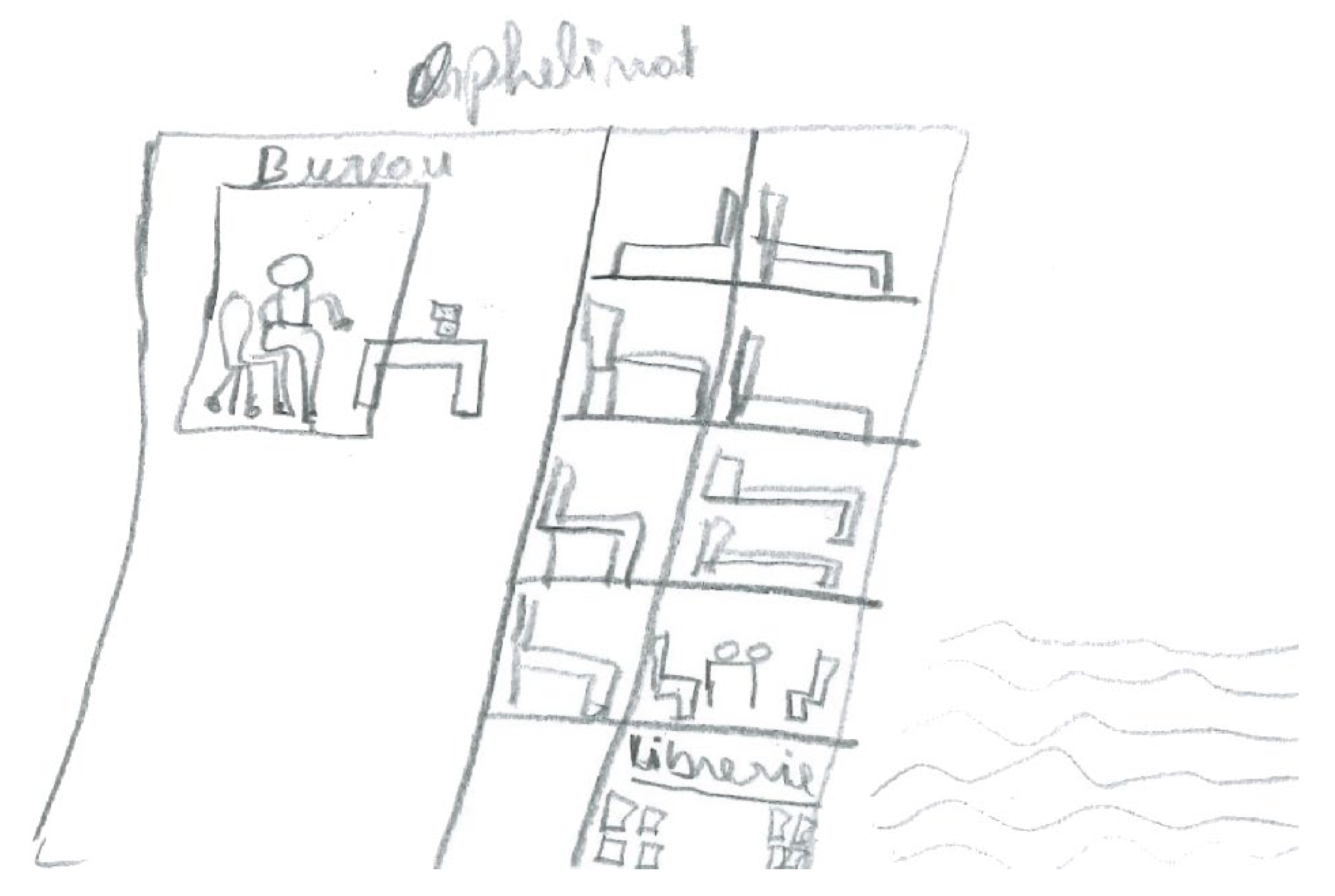
In the case of Mei Lin, she explained that she had drawn the house she would like to have in Rennes with her girlfriend – she was single at the time of meeting her. She would have two cats and a garden, and she added a motto that she follows in life: “simply be happy.” Melina’s depiction was of a home that she wants to construct later in life – but not directly for herself, as it is an orphanage that she would like to open in her home country. In the depiction, she is seated in her office within the orphanage, envisioning herself at home in this long-cherished dream. The respondents’ drawings and explanations all contained very clear ideas of their aspirations, encapsulating the type of accommodation, its location, the fact they would own it, who they would share it with. Although during the interview we had asked them, ‘where do you see yourself in the future?’, the act of drawing prompted respondents to give greater details of the intimate and concrete future they aspired to. In doing so, they projected themselves as a self that is neither present nor future; rather, they expressed how they imagined themselves, thereby setting the conditions necessary for the exercise of their agency by materialising their objectives, giving structure to the actions they should take and the choices they should make.
These examples are pivotal in understanding the exercise of agency. Doing so requires a form of multi-temporal self-reflection, putting the individual at the intersection of their past, present and future selves. This introspection entails a projection into a future that is not only nonexistent but potentially unattainable outside the realm of one’s aspirations and dreams, thereby creating an imagination of self that is inextricable from the concept of agency. Finally, the enactment of agency requires the ability to voice, or to express in language, this imagined and aspired self. The act of making a choice, regardless of its perceived significance, necessitates the verbal or physical expression of that decision. Artistic practice can serve as a conduit for these different aspects of the enactment of agency, by supporting the crossing of administrative, legal and normative borders in a daily act of resistance.
4. Conclusions
This article has proposed to study the transition to adulthood of young forced migrants, intersecting both youth and migration studies. A principal finding is that the border of adulthood is a lot more porous for young migrants than for other vulnerable groups. While they experience an accelerated transition to adulthood as has also been described for vulnerable youth, they also fluctuate from adult to a status akin to that of a child. This is because previously solidified trajectories in the educational, professional or familial spheres are disrupted. More specifically, we find that young adult migrants are particularly affected by the latter when it comes to parenthood. This finding highlights a phenomenon that has been scarcely described in the literature regarding the reversibility of parenthood as a marker of adulthood. While it is no longer required to be a parent in order to be an adult, individuals who have become parents underline this event as an integral part of their transition to adulthood. For young forced migrants who had created families in their countries of origin, the uprootal from their familial units and more specifically from their children represents a regression and a loss of responsibilities that constituted their adult identities. In a broader sense, young adult migrants regress on all markers of adulthood due to forced migration.
However, the present study has also shown that different strategies and tactics are available to young migrants in order to reclaim their crossing of the adulthood border. That is to say that they can leverage different acts of resistance in order to become adult at their own pace, or to affirm their adult identities. These acts of resistance can be said to be particularly significant when they are displayed at a daily level. While a priori anecdotal, certain behaviours at this scale can reveal attempts at enacting one’s agency. We argue that this is the case for artistic practices in the daily life. Indeed, for young migrants this can be a way to explore their identities, express them, and project themselves.
While this paper does explore a crossing of youth and migration studies that is scarcely present in the literature, several limits must be highlighted. As mentioned, the process of an accelerated transition to adulthood and of parentification have already been covered in details. The reverse phenomenon is less covered, and therefore requires a greater body of work to understand its implications. One consideration is that other vulnerable groups might experience this backward crossing of adulthood. Another is that parenthood may also be reversible in other cases than for forced migrants, but this is not yet apparent in the literature. Furthermore, it has been essential in this article to focus on the micro scale but broader structures and local systems must be integrated in order to capture a fuller picture of the process of transitioning to adulthood in young forced migrants. Indeed, structures of constraints shape the opportunities available to young migrants in their transition to adulthood, while local actors may play an integral part in hindering or fostering the agentic capabilities of young migrants. Integrating this second point here would render this article too broad, but the understanding of the processes described here would benefit from integrating the macro and meso angles.
Funding
Remove for Peer-review.
Informed Consent Statement
Informed consent was obtained from all subjects involved in the study.
Data Availability Statement
Remove for Peer-review.
Acknowledgments
Remove for Peer-review.
Conflicts of Interest
The authors declare no conflicts of interest. The funders had no role in the design of the study; in the collection, analyses, or interpretation of data; in the writing of the manuscript; or in the decision to publish the results.
References
- Galland, O. Les jeunes; La Découverte: Paris, France, 2009.
- Biggart, A.; Walther, A. Coping with Yo-Yo Transitions. Young Adults’ Struggle for Support, between Family and State in Comparative Perspective. In A New Youth?; Leccardi, C., Ruspini, E., Eds.; Routledge: London, United Kingdom, 2006.
- Reifman, A.; Arnett, J.J.; Colwell, M.J. Emerging Adulthood: Theory, Assessment and Application. Journal of Youth Development 2007, 2, pp. 37-48. [CrossRef]
- De Valk, H. Pathways into Adulthood: a Comparative Study on Family Life Transitions among Migrant and Dutch Youth; Universiteit Utrecht: Utrecht, Netherlands, 2006.
- Lesnard, L.; Cousteaux, A.S.; Le Hay, V.; Chanvril, F. Trajectoires d’entrée dans l’âge adulte et États-providence. Informations sociales 2011, 3, pp. 16-24. [CrossRef]
- Ferreira, V.S.; Nunes, C. Les trajectoires de passage à l’âge adulte en Europe. Politiques sociales et familiales 2010, 1, pp. 21-38. [CrossRef]
- Bidart, C. Les temps de la vie et les cheminements vers l’âge adulte. Lien social et Politiques 2006, 54, pp. 51-63. [CrossRef]
- Reifman, A.; Niehuis, S. Extending the Five Psychological Features of Emerging Adulthood into Established Adulthood. Journal of Adult Development 2023, 30, pp. 6-20. [CrossRef]
- Elder, G.H.; Johnson, M.K.; Crosnoe, R. The Emergence and Development of Life Course Theory. In Handbook of the Life Course; Mortimer, J.T., Shanahan, M.J., Eds.; Springer: Boston, MA, United States, 2003, pp. 3-19.
- Mazade, O. La crise dans les parcours biographiques : un régime temporal spécifique ? Temporalités 2011, 13, pp. 1-17. [CrossRef]
- Kleinhans, R.; Elsinga, M. ‘Buy Your Home and Feel in Control’ Does Home Ownership Achieve the Empowerment of Former Tenants of Social Housing? International Journal of Housing Policy 2010, 10, pp. 41-61. [CrossRef]
- Somerville, P. Empowerment through Residence. Housing Studies 1998, 13, pp. 233-257. [CrossRef]
- Laschinger, H.; Finegan, J.E.; Shamian, J.; Wilk, P. A Longitudinal Analysis of the Impact of Workplace Empowerment on Work Satisfaction. Journal of Organizational Behavior 2004, 25, pp. 527-545. [CrossRef]
- Clot, Y.; Simonet, P. Pouvoirs d’agir et marges de manoeuvre. Le travail humain 2015, 78, pp. 31-52. [CrossRef]
- Deverchère, N. Innovations et engagement des travailleurs sociaux en faveur du développement du pouvoir d’agir. Vie sociale 2017, 3, pp. 91-105. [CrossRef]
- Frank, K. Agency. Anthropological Theory 2006, 6, pp. 281-302. [CrossRef]
- Hitlin, S.; Elder, G.H. Time, Self, and the Curiously Abstract Concept of Agency. Sociological Theory 2007, 25, pp. 170-191. [CrossRef]
- Coulon, A. Ethnométhodologie et education; Presses Universitaires de France: Paris, France, 1993.
- Séguy-Duclot, A. Définir l’art; Belin: Paris, France, 2017.
- Rampley, M. De l’art considéré comme système social : observations sur la sociologie de Niklas Luhmann. Sociologie de l’art 2005, 7, pp. 157-185. [CrossRef]
- Fabiani, J.L. Des arts à la théorie de l’action : le travail sociologique de Pierre-Michel Menger. Annales. Histoires, sciences sociales 2016, 71, pp. 951-978.
- Chateau, D. Qu’est-ce que l’art ?; L’Harmattan: Paris, France, 2000.
- Wendling, T. Us et abus de la notion de fait social total : turbulences critiques. Revue du MAUSS 2011, 2, pp. 87-99. [CrossRef]
- Mauss, M. Essai sur le don : forme et raison de l’échange dans les sociétés archaïques; Presses Universitaires de France: Paris, France, 2012.
- Rancière, J. Et tant pis pour les gens fatigues : entretiens; Éditions Amsterdam: Paris, France, 2009.
- Langar, S. Les pratiques artistiques entre reconnaissances et emancipation : trajets d’artistes, de la rue à la scène internationale. Le Télémaque 2022, 2, pp. 109-124. [CrossRef]
- Calkin, S. Healthcare not Airfare! Art, Abortion and Political Agency in Ireland. Gender, Place & Culture 2019, 26, pp. 338-361. [CrossRef]
- Escafré-Dublet, A. Un allié précieux : l’art dans les mouvements immigrés à Paris et à Londres (1958-1978). Hommes & migrations 2019, 1325, pp. 47-55. [CrossRef]
- Aguilera, T.; Chevalier, T. Les méthodes mixtes pour la science politique : apports, limites et propositions de strategies de recherche. Revue française de science politique 2021, 71, pp. 365-389. [CrossRef]
- Beuchemin, C.; Ichou, M.; Simon, P. Trajectoires et Origines 2019-2020 (TeO2) : presentation d’une enquête sur la diversité des populations en France. Population 2023, 78, pp. 11-28. [CrossRef]
- Abdi, H.; Valentin, D. Multiple Correspondence Analysis. In Encyclopedia of Measurement and Statistics; Salkind, N.J., Ed.; SAGE Publications: Thousand Oaks, CA, United States, 2007, pp. 1-13.
- Larmarange, J. guide-R. Available online: https://larmarange.github.io/guide-R/ (accessed on 20 January 2025).
- Roudet, B. Qu’est-ce que la jeunesse ? Après-demain 2012, 4, pp. 3-4. [CrossRef]
- Bourgeois, L.; Liève, M. Les bénévoles, artisans institutionnalisés des politiques migratoires locales ? Lien social et Politiques 2019, 83, pp. 184-203. [CrossRef]
- Dunezat, X. Une figure racisée de la précarité : les sans-papiers. Raison présente 2011, 178, pp. 83-94. [CrossRef]
- Siméant, J. La cause des sans-papiers; Presses de Sciences Po: Paris, France, 1998.
- Le Bars, J. Le coût d’une existence sans droits. La trajectoire résidentielle d’une femme sans-papiers. Espaces et sociétés 2018, 1, pp. 19-33. [CrossRef]
- Byrne, M. On the Streets of Paris: The Experience of Displaced Migrants and Refugees. Social Sciences 2021, 10. [CrossRef]
- D’Halluin-Mabillot, E. Les épreuves de l’asile : associations et réfugiés face aux politiques du soupçon. Editions de l’EHESS: Paris, France, 2012.
- D’Halluin, E.; Hoyez, A.-C. L’initiative associative et les reconfigurations locales des dispositifs d’accès aux soins pour les migrants primo-arrivants. Humanitaire 2012, 33. https://journals.openedition.org/humanitaire/1407.
- McCarthy, B.; Williams, M.; Hagan, J. Homeless Youth and the Transition to Adulthood. In Handbook of Youth and Young Adulthood; Furlong, A., Ed.; Routledge: London, United Kingdom, 2009.
- Lisiecka-Bednarczyk, A. Parenthood as a Disappearing Determinant of Adulthood. Quarterly Journal Fides et Ratio 2024, 59, pp. 54-63. [CrossRef]
- Walsh, S.; Shulman, S.; Bar-On, Z.; Tsur, A. The Role of Parentification and Family Climate Adaptation Among Immigrant Adolescents in Israel. Journal of Research on Adolescence 2006, 16, pp. 321-350. [CrossRef]
- Chase, N. Burdened Children: Theory, Research, and Treatment of Parentification; SAGE Publications: Thousand Oaks, CA, United States, 1999.
- Evans, K. Concepts of Bounded Agency in Education, Work, and the Personal Lives of Young Adults. International Journal of Psychology 2007, 42, pp. 85-93. [CrossRef]
- Bessin, M.; Bidart, C.; Grossetti, M. Introduction générale. In Bifurcations; Bessin, M., Bidart, C., Grossetti, M., Dirs.; La Découverte: Paris, France, 2009, pp. 7-19.
- Bidart, C. Bifurcations biographiques et ingrédients de l’action. In Bifurcations; Bessin, M., Bidart, C., Grossetti, M., Dirs.; La Découverte: Paris, France, 2009, pp. 224-238.
- Author, 2025.
- Mortimer, J.T.; Shanahan, M.J. Handbook of the Life Course; Springer: New York, United States, 2003.
- Scott, J.C. Weapons of the Weak: Everyday Forms of Peasant Resistance; Yale University Press: London, United Kingdom, 1985.
- Merle, I. Les subaltern studies : retour sur les principes fondateurs d’un projet historiographique de l’Inde coloniale. Genèses 2004, 56, pp. 131-147. [CrossRef]
Disclaimer/Publisher’s Note: The statements, opinions and data contained in all publications are solely those of the individual author(s) and contributor(s) and not of MDPI and/or the editor(s). MDPI and/or the editor(s) disclaim responsibility for any injury to people or property resulting from any ideas, methods, instructions or products referred to in the content. |
© 2025 by the authors. Licensee MDPI, Basel, Switzerland. This article is an open access article distributed under the terms and conditions of the Creative Commons Attribution (CC BY) license (http://creativecommons.org/licenses/by/4.0/).
Copyright: This open access article is published under a Creative Commons CC BY 4.0 license, which permit the free download, distribution, and reuse, provided that the author and preprint are cited in any reuse.


