

Submitted:
14 April 2025
Posted:
15 April 2025
You are already at the latest version
Abstract
Urban allotment gardens are increasingly recognised as multifunctional spaces that contribute not only to ecological sustainability, but also to social cohesion, civic engagement and community resilience. This study explores the role of urban gardens in the city of Valencia as green spaces that (re)produce social capital, as well as spaces produced by consolidated social capital. Using a qualitative methodology, fifteen in-depth interviews were conducted with key informants involved in the coordination, participation and study of urban gardening initiatives. The analysis focuses on three interconnected dimensions: the strategic objectives guiding organisations involved, the core elements of social capital (networks, belonging, trust, reciprocity and values) and the governance models underpinning these initiatives. The results reveal that urban gardens function as relational infrastructures, facilitating intergenerational learning, intercultural exchange and inclusive participation through both formal and informal mechanisms. These processes are often rooted in local traditions and are underpinned by shared responsibilities and symbolic reciprocity. However, exclusionary attitudes and fragmented governance can limit their potential. In general, the results emphasise the value of urban gardens as platforms for the creation and reproduction of social capital and the improvement of community well-being, which suggests important implications for urban policy and sustainable development.
Keywords:
urban allotments
; social capital
; senior citizens
; elements
; Valencia
1. Introduction and Background
Urban allotment gardens (AGs) in Spain have evolved from their origins associated with subsistence during periods of crisis [1,2] to acquiring from the 1970s onwards a multifunctional role as spaces for urban regeneration, social inclusion, environmental education and community development [2,3]. Currently, urban AGs not only provide ecological benefits, but also physical, psychological and social ones, becoming recognised as spaces particularly valued by the elderly [4,5]. Their consolidation as nodes of neighbourhood participation and collective management [6] positions them as key instruments for the generation of social capital, fostering community cohesion, the integration of vulnerable groups and the construction of networks of trust and reciprocity [7,8].
The concept of social capital has been defined by different authors over time. However, there is a notable lack of research evaluating the role of urban agricultural green spaces in its development. Some references include Alaimo et al. [9], Okvat and Zautra [10] or Litt et al. [11], among others. The concept of social capital has generated considerable academic interest from various disciplines, such as sociology, economics and public policy, partially due to a lack of consensus on its definition and the challenges in its operationalisation and measurement, with the greatest contributions coming from the field of social sciences [3,12]. In order to understand its complexity and evaluate its relationship with urban gardening, it is essential to analyse its conceptual evolution, which has been successively enriched by multidisciplinary contributions [13,14,15,16,17]. The most influential authors from the social sciences include Pierre Bordieu, James Coleman and Robert Putnam, whose contributions have been fundamental in the construction of the concept [18,19].
Bourdieu [20] defines social capital as a set of actual or potential resources linked to a durable network of institutionalised relationships, highlighting its role in producing unequal advantages even among individuals with comparable economic and cultural capital [21,22,23]. According to Bourdieu and Richardson [24], this form of capital arises from group membership, enabling individuals to access or preserve power relations – an essential mechanism in the reproduction of social classes and the perpetuation of hierarchical structures [18,25]. Bourdieu’s framework identifies four core elements of social capital: (1) belonging to a stable and clearly defined group; (2) disinterested material and symbolic exchanges that generate enduring obligations and social cohesion; (3) institutionalisation through formal or informal structures; and (4) the production of tangible or symbolic benefits derived from membership in exclusive networks [18,20,22].
Coleman [26] (p. 94), conceptualises social capital as the “resources inherent in social relations that facilitate cooperation and collective efficiency in areas such as education or community life”, emphasising its functional role in addressing collective challenges [18,21]. In contrast to Bourdieu, Coleman [27] identifies six distinct forms of social capital: (1) obligations and expectations (reciprocity based on trust); (2) information potential (access to knowledge through networks); (3) norms and sanctions (shared rules and enforcement mechanisms); (4) authority relations (delegation of control rights); (5) intentional organisations (such as firms); and (6) adaptable social structures (e.g., social organisations) [18,28,29]. A key element of his theory is the concept of “social closure”, which posits that stable, trust-based relationships enhance social capital, whereas individual mobility or self-interest undermines it [27,28,30].
Putnam et al. [31] define social capital as “the networks, norms, and trust that enable collective cooperation and improve institutional performance,” a conceptualisation grounded in their comparative study of regional governments in Italy. Their findings suggest that differences in governmental efficiency were better explained by the presence of a civic community – characterized by political equality, solidarity, trust, tolerance, cooperation, and strong civic associationism – than by socio-economic variables [31,32]. Later, Putnam [33] expanded this framework, identifying four key components of social capital: (1) trust, (2) norms, (3) reciprocity, and (4) networks of civic engagement [18,28]. He also distinguished eight types of social capital – such as formal/informal, strong/weak ties, inward/outward, and bonding/bridging – emphasizing “bridging” social capital as essential for promoting social cohesion [18,28,33]. Unlike Bourdieu and Coleman, Putnam [34] frames social capital as a public good closely tied to economic development and democratic governance [35].
Given that social capital functions as a polysemic signifier shaped by diverse multidisciplinary contributions, the need to establish an operational definition for the purposes of this analysis becomes evident. In this research, social capital is defined as the set of resources or benefits accessible to individuals or groups through networks of stable relationships, provided that these networks meet key conditions: (1) stability and internalised norms that generate belonging [20,26]; (2) material/symbolic reciprocity that fosters trust and solidarity [33,36]; (3) institutionalisation based on common objectives [21,27]; (4) horizontal authority relationships that strengthen participation [28]; and (5) inclusivity that values diversity [33]. This theoretical synthesis suggests that social capital—comprising networks, shared norms, reciprocity, and trust within relationships—functions as a compensatory resource in contexts of economic or social deprivation [37,38]. This role is particularly significant for vulnerable populations, such as the elderly.
Several studies have explored how urban gardens serve as fertile ground for the development and mobilisation of social capital, albeit with varying approaches and emphases. Quantitative research in China has shown that design features such as accessibility, garden size, visual openness and integration with green infrastructure, as well as social elements such as participatory governance, intergenerational diversity and regular collective activities, contribute significantly to the formation of trust, shared norms and social networks within community gardens [39]. In the European context, it has been shown that the AGs in Valencia foster “collectivity” through shared learning processes, collaborative management of resources and participation in broader political or environmental movements, revealing how pre-existing social networks and political cultures shape their emergence and functioning [40]. In Gothenburg, a similar relational dynamic is observed where informal and unplanned encounters across socioeconomic divides allow for bridging ties to emerge, although the inclusive potential of the gardens varies according to local social composition and governance structures [41].
In Australia and America, urban AGs are consistently identified as catalysts for the creation of emotional support networks, a sense of belonging and active civic engagement. A study conducted in Melbourne highlights that, although community gardens can foster forms of social capital that bring people together, these benefits are not always equitably distributed. They may be hindered by internal exclusion dynamics or by external factors such as limited institutional support [42]. In North and South American contexts, allotments are also seen as entry points for community empowerment and broader social participation, facilitating access to material and symbolic resources, but also reproducing inequalities when participation is limited to homogeneous groups [43,44]. Furthermore, it has been shown that the social dimension of gardening as a leisure activity acts as a catalyst for trust-building and collective action, underlining the importance of informal relational dynamics in the production of social capital [45]. However, recent literature has also pointed to the phenomenon of green gentrification, whereby the creation or improvement of green spaces, such as community gardens, can attract higher-income residents to previously marginalised neighbourhoods, leading to the displacement of the original inhabitants and the disruption of existing social networks [46,47]. In such cases, gardens can paradoxically undermine social capital by fostering exclusion, reducing diversity and eroding a sense of belonging among long-standing residents [48,49]. Taken together, these findings suggest that AGs are not merely outcomes of existing social capital, but also active sites for its production. However, their potential to foster social capital may be constrained – or even undermined – by broader socio-spatial dynamics, such as gentrification and uneven patterns of urban development.
This study analyses how urban AGs in Valencia contribute to the generation and reproduction of local social capital. It also studies how consolidated social capital facilitates and promotes the implementation and effective functioning of urban AGs, vectorising local action towards a shared project. Figure 1 presents the directed acyclic graph (DAG) illustrating the causal relationships underpinning the theoretical framework of this research. The diagram reflects both top-down dynamics, driven by the public administration, and bottom-up and mixed processes, emerging from neighbourhood social networks, in the implementation and management of AGs. In turn, the functioning of these gardens serves as a catalyst for the (re)production of social capital, which flows bidirectionally between the gardens and the local community.
Framed within the European project U-GARDEN – Promoting capacity building and knowledge for the extension of urban gardens in European cities –, this research adopts a qualitative approach based on in-depth interviews with 15 key informants, including participants and experts involved in the socio-territorial dynamics surrounding urban gardens. The relevance of this study lies, first, in the limited number of previous works that examine how community urban gardens can serve as platforms for building and enhancing social capital by addressing the full complexity of its components and constraints [50,51]). Second, there is a notable gap in the literature regarding the importance of analysing the pre-existing reserves of social capital within communities as a means to reinforce such initiatives [42,52]. Third, this study seeks to explore governance structures as critical factors in the generation and reproduction of social capital [53,54,55,56].
The analysis focuses on three interconnected dimensions: (1) the organisational objectives of these spaces as community-based projects; (2) the core components of social capital—including networks, a sense of belonging, safety, reciprocity, and shared values; and (3) the governance models and organisational cultures that activate and sustain these dynamics. This multidimensional framework enables a deeper understanding of the mechanisms through which social capital is generated and reproduced, offering valuable insights for the development of public policies in the fields of community development and urban agriculture.
2. Materials and Methods
2.1. Socio-Spatial Context
According to data from the National Institute of Statistics [57], the Functional Urban Area (FUA) of Valencia comprises 63 municipalities, with a total population of 1,811,626 inhabitants—representing 68.19% of the province’s total population. This functional area extends over 1,741.1 km² and is centred on the city of Valencia, which serves as its functional core (see Figure 2). Although the FUA is not an institutionalised territorial entity, its geographical scope includes a significant number of strategies, plans, and regulations concerning regional and supra-municipal spatial planning and development. A prominent example is the Territorial Action Plan for the Huerta de Valencia [58], which governs both the preservation of the region’s agricultural heritage and land-use initiatives, including AGs.
Within the framework of this study, all interviewees were permanent residents of municipalities within the FUA of Valencia. Similarly, all AGs in which the directly involved informants participated are located within this same territorial scope.
The city of Valencia, along with its FUA, has a deeply rooted horticultural tradition, still visible in its peri-urban and pre-rural landscapes, where agricultural land use continues to predominate. However, in recent decades, this territory has experienced progressive land abandonment, driven by urbanisation, the ageing of the agricultural population, and transformations in production models. Urban AGs, by contrast, are a more recent phenomenon, emerging as spaces for reviving traditional agricultural practices and revaluing the connection between citizens and their territory.
These allotments are situated in a variety of locations. Many are found on the borders of the urban fabric, forming transitional zones between urban and rural environments, while others are embedded within the city itself. Some are established on undeveloped educational land, on consolidated green spaces, or in so-called “transitional” areas. Certain AGs are even located within protected orchard zones, which may contravene the Territorial Action Plan when these initiatives are not directly managed by the competent municipal authority. This spatial diversity is paralleled by a wide range of implementation and management models. Among them, we can identify bottom-up citizen-led initiatives; hybrid models combining community participation with institutional support; and top-down initiatives promoted by public administrations. In terms of governance, existing models include self-management by citizen collectives, direct municipal oversight, and mixed arrangements involving associations operating under formal agreements with public entities.
This heterogeneity in the urban AG landscape of Valencia gives rise to a broad array of mechanisms for the generation and reproduction of social capital. In some cases, AGs function as catalysts for pre-existing networks of cooperation and trust; in others, they serve as entry points for building new social ties, collaborative practices, and participatory governance structures.
2.2. Sample
The objective of the sample recruitment process was to identify and include key informants residing in the FUA of Valencia, whose knowledge of participatory dynamics in urban AGs could be considered both relevant and well-founded. Priority was given to individuals with direct experience in these spaces, either through active involvement or through roles in coordination and/or management. In addition, the sample also included profiles with indirect expertise, derived from their research activities or participation in local initiatives related to the study’s focus.
An intentional non-probabilistic sampling design was employed. Initial contact was made via telephone with a convenience sample, with the objective of identifying potential key informants. Each person contacted was asked to provide an email address, through which they received detailed information about the research project and the purpose of the interview. All selected participants met the previously established inclusion criteria. Most had direct experience with urban gardens, with many holding formal coordination roles. Other informants possessed a strong academic background in the analysis of urban gardens and related social dynamics, as well as experience in local activism aimed at defending and promoting such spaces.
In total, 15 in-depth interviews were conducted. The data collection process concluded upon reaching the point of theoretical saturation, that is, when subsequent interviews no longer yielded novel or relevant insights for the research objectives. The resulting sample was heterogeneous in terms of age, role, and organisational affiliation, and included: (i) activists and representatives of neighbourhood associations; (ii) public administration technicians; (iii) academic researchers; and (iv) primary and secondary school teachers. Table 1 presents a summary of the sociodemographic characteristics of the participants.
2.3. Qualitative Study
The qualitative interviews (n = 15) were conducted in person between March 2023 and March 2025 with key informants residing in the FUA of Valencia, Spain. All interviews were audio-recorded using digital devices and subsequently transcribed in full for analysis. To ensure privacy and confidentiality, appropriate measures were taken to anonymise the informants at every stage of the research process. Participants were fully informed about the aims and scope of the study and provided written informed consent prior to their participation. Interviews lasted between 40 and 60 minutes, depending on the interviewee’s profile and the course of each conversation.
The final sample size was determined upon reaching saturation within a relatively narrow range of interviews, based on a dual strategy combining code saturation and meaning saturation [59,60,61]. An in-depth review of the 15 interviews revealed that code saturation – understood as the point at which no new themes emerge – was reached after 11 interviews, establishing the thematic scope of the study. However, achieving meaning saturation – the point at which a deeper understanding of those themes is reached – required between 12 and 14 interviews. The final sample size is consistent with the parameters proposed by Hennink and Kaiser [62], who suggest that saturation is typically achieved between the ninth and seventeenth interview.
While much of the literature on social capital has relied on quantitative approaches – particularly through surveys and standardised indicators – these methods often face limitations in capturing the contextual complexity, subjective meanings, and relational dynamics that constitute social capital in specific settings [51]. In this regard, qualitative studies offer a valuable complement, providing a more situated and in-depth understanding of the underlying social processes.
This research employed the technique of semi-structured in-depth interviews, aimed at capturing informants’ perceptions regarding the capacity of urban gardens to generate and foster social capital. A flexible interview guide was developed in advance, designed to avoid closed responses, enable transversal reflections, and encourage the open expression of participants’ knowledge and experiences [63]. This methodological flexibility allowed the sequence and phrasing of questions to be adapted to the natural flow of each interview, in accordance with the principles of semi-structured interviewing [64,65,66]. Given the complex and multidimensional nature of social capital, the interviews adopted a holistic perspective that enabled the exploration of a wide range of interconnected topics. The main areas of inquiry included: (a) the objectives of organisations involved in urban gardens; (b) the constituent elements of social capital identified in these spaces—such as social networks, sense of belonging, safety, reciprocity, participation, citizen empowerment, shared values, and diversity; and (c) the governance models and organisational cultures present in urban AGs
2.4. Analysis
Audio recordings were used to produce verbatim transcripts of the interviews, enabling the literal capture of information and subsequent systematic coding. A comprehensive and iterative approach guided the identification of codes and themes, as well as the selection of representative quotations from the informants. Following an initial review of the interview content, a codebook was developed using open coding procedures, which were subsequently refined with the assistance of ATLAS.ti software. The interview data were examined in depth to identify both recurring and emerging themes by categorising the content through the assignment of keywords. This process enabled the establishment of conceptual links between different information blocks. The codebook included detailed definitions for each theme and subtheme, as well as illustrative quotations from the participants that reflected the diversity and depth of their perspectives
3. Results
The results of this study are structured around three main analytical categories that shed light on how the relationship between urban AGs and social capital is configured in the Valencian context. First, we examine the shared objectives that guide the organisations and groups involved in the management of urban AGs, considering perspectives such as environmental sustainability, food security, and social inclusion. Second, we address the various elements of social capital that are either generated within or required by these spaces – namely, social networks, sense of belonging, safety, reciprocity, and shared values. Third, we analyse the models of governance and organisational culture underpinning these initiatives, with particular attention to the dynamics of public management, citizen-led self-management, and hybrid forms of co-responsibility. Additionally, a cross-cutting section is dedicated to the benefits of social capital generation in urban AGs for older adults – a particularly vulnerable population that finds in these spaces opportunities for social bonding, active participation, and enhanced community well-being.
A) Organisational Objectives and Strategic Functions
Among the objectives of the organisations to which the informants belong, the following are highlighted:
1. Environmental Sustainability and Land Regeneration:
Environmental sustainability is emerging as a central strategic axis in urban gardens, conceived not only as productive spaces, but also as green infrastructures capable of contributing to the mitigation of climate change, the restoration of the peri-urban landscape and the ecological management of the territory. The people interviewed situate these spaces within a logic of environmental regeneration that combines the conservation of agricultural land, ecological education and citizen participation.
I1: “We also work on the alert line, for example, about new urban development projects that could affect the vegetable garden according to the government. Yes, a law has been passed to protect the vegetable garden, but that law is often not complied with (...) we work to ensure that it is complied with and that no more agricultural land is actually consumed than has already been consumed.” [# Social capital → urban garden]
I5: “... what we want with the school garden is to encourage friendship because, in the end, [the pupils] go there and make friends, but they are also calmer, they eat healthily... There are some who have already joined the organic food group we have at school and, as the land is for those who work it, of course they take away what they produce...” [# Urban garden → social capital]
I7: “Urban gardens can form part of a strategy to mitigate climate change, as they help to reduce heat islands in cities.”
I9: “It makes it possible for owners who have abandoned land and are not going to cultivate it to make it available to people interested in cultivating it, through the initiative proposed by the Provincial Council to the town councils, with the land banks.”
I10: “The ecological impact of these allotments is not only local, but is part of a global trend towards the recovery of green spaces in urban environments (...) they have the potential to act as nodes of sustainability, where environmental education and food production go hand in hand.”[# Urban garden → social capital]
I11: “… here we have a large green lung with the urban gardens and the forest [next to the gardens] that we have created, and with that we are helping to reduce CO2 and the impact of the heat island, (...) which benefits all citizens, regardless of whether they have a plot in the garden or not (...) we cannot allow urban growth to destroy this transitional green structure that protects our quality of life.” [# Urban garden → social capital]
I13. “Urban gardens are an opportunity to promote the value of agriculture that is being lost, growing typical Valencian products without the need to import them from other countries, favouring the environment by reducing the pollution of imported local products and valuing the profession of farmers. Through the urban garden initiative, young people can be educated and society in general can be made aware of the role they can play.”[# Urban garden → social capital]
2. Recovery and Conservation of Indigenous Culture.
Urban gardens function as devices that allow for the revaluation of local culture and the preservation of traditional knowledge linked to the cultivation of the land. Through the recovery of agricultural practices, indigenous products and community customs, these spaces are configured as living platforms for cultural transmission and the strengthening of identity, especially among diverse generations and migrant communities.
I1: “We must recover (...) the ancestral knowledge (...) of the people who have lived in this territory (...). We reclaim learning linked to the territory to which one belongs, maintaining a balance [with] the environment or the ecosystem.”[# Social capital → urban garden]
I3: “One of the main objectives of the garden was to grow vegetables and other products from our culture of origin, which we couldn't find in the supermarkets (...) when I started with the gardens, what I wanted to do was to plant ethnic products from my country that I couldn't find in the local market (...) we also organised community events, such as shared meals where everyone contributes something from their culture.”[# Urban garden → social capital]
I5: The space is not only for growing, but also for generating community, strengthening support networks and creating a sense of belonging in the neighbourhood.”[# Urban garden → social capital]
3. Promote Food Security and Self-Sufficiency.
In a context of growing food insecurity and a crisis in global distribution systems, urban gardens represent a strategy for resilience. Through self-sufficiency, these spaces allow people to stock up on fresh, healthy and affordable products, strengthening food sovereignty and reducing dependence on the market. The organisations also highlight their role in family self-sufficiency and feeding vulnerable groups.
I1: “… food security, because, many times, the problems of food transportation that have already occurred, for example, in the [pandemic of] COVID, show how important it is to have a peri-urban garden to guarantee food security in cities, with Valencia being an example to follow.”
I2: “… fruit isn't cheap to buy. It used to be the other way round, and now it's more expensive than meat. So it facilitates family self-management systems, because at home they eat what they grow and produce [in the gardens].”
I3: “We also seek to raise awareness of the need for better food that is not so processed.”[# Urban garden → social capital]
I9: “And the thing about (...) migrants is that when they arrive in Valencia they don't have any land. (...) It's in their interest to grow their own food: they don't have to go and buy vegetables in a shop and spend that money because they can grow them on the plot.”
I11: “Self-sufficiency is very important because, because if I grow there [points to a plot of land] look at the impact it has: I don't go to a supermarket or any shop, so if you go to the shop you might look at the origin and it comes from South America or Brazil, so imagine the journey that food has made in a container on a ship until it reaches the point of distribution, the impact is terrible.”
4. Promote the Consumption of Local Products.
The promotion of local consumption is part of a critical view of globalised agri-food systems. Urban gardens promote more sustainable food models, where local and seasonal products are prioritised, the ecological footprint of transport is reduced and a circular economy linked to the territory is promoted. This approach is presented as an alternative to agro-industry and as a mechanism for defending local agriculture.
I1: “The vegetable garden must also be understood as a tool in the fight against the job insecurity derived from the exploitation of agricultural products. For example, when we consume oranges from Morocco, when we have our Valencian oranges here at zero kilometre distance...”
I3: “… also have the chance to reflect on how we can fight against macro-industry, on the difference between supermarkets and (…) local shops, local products…”
I7: “Today, many Cubans have vegetable gardens for their own consumption, but would it be viable to incorporate them into the local commercial circuit? It's a complex question, because it could generate competition with professional farmers (...) perhaps the key is not to compete, but to look for collaborative models, such as associating collective gardens with restaurants or catering offers, as happens in some cases in the United States.”
6. Promote Learning About Biodiversity.
Urban gardens are also conceived as pedagogical environments where ecological knowledge, direct observation of nature and agroecological practice are promoted. In this sense, they function as living laboratories for environmental education and as spaces where agricultural, floral and faunal biodiversity is protected and promoted, integrating ecosystemic and cultural values.
I1: "The garden has a great diversity of crops and we often work with crop rotation, and then we would also like to recover the garden as a biodiverse space, with infrastructures such as irrigation channels, vegetation (...) with ecosystemic values that are achieved by promoting the garden as a biodiverse space, so there are people who are working, for example, to separate the gardens, for example with trees or vegetation of pollinating plants.”[# Urban garden → social capital]
I6: “... the school garden network consists, above all, of teaching students the value of ecology, biodiversity, climate change (...). They are taking a subject that talks about nature, but they see the images in a book, when in the playground they have a garden so they can see what they are studying in a real way...” [# Urban garden → social capital]
I13: “Through the urban garden initiative, young people can be educated and society in general can be made aware of the role they can play. We don't even know where our food comes from because it is hidden from us in the supermarkets. I think we should go back to growing our own food. And that means education in the sense of being able to go back to it.”[# Urban garden → social capital]
7. Promotion of Participatory and Community Spaces.
These urban agricultural spaces are also settings for meeting, dialogue and cooperation. The garden becomes a social space where bonds of trust, a sense of belonging and reciprocity flourish, thus fostering relationships of mutual support among users. Shared work and the collective construction of norms favour neighbourhood cohesion and social inclusion.
I2: “The respect we, as the administration, have for the users of the plots is very important, because the urban garden tends to generate a feeling of belonging, (...) even of ownership. They know that the plot is not theirs, but the fact that they take care of it and organise themselves gives them that feeling, (...) not only because of the food, which is theirs, but also because of the relationships they build with the person next door.” [# Urban garden → social capital]
I3: “...every Thursday we have our assembly to organise ourselves. In other words, a place where we talk, where everyone gives their opinion. A place to feel heard, to build together and to generate what we call collective intelligence.”[# Urban garden → social capital]
I4: “The good thing about the garden is that it slows things down a bit, so you have the chance to listen actively, build with others and generate collective intelligence.”[# Urban garden → social capital]
I5: “This is one of the keys in urban environments, (...) that it is conceptualised from the community, from the vision that space is something shared and that, if one day you can't water it, your neighbour will (...) space is not only for cultivation, but also for generating community, strengthening support networks and creating a sense of belonging in the neighbourhood.”[# Urban garden → social capital]
8. Bringing the Urban Population Closer to Agriculture and the Rural World.
These urban agricultural spaces are also scenarios for meeting, dialogue and cooperation. The garden is transformed into a social space where bonds of trust, a sense of belonging and reciprocity flourish, thus fostering relationships of mutual support among users. Shared work and the collective construction of norms favour neighbourhood cohesion and social inclusion.
I2: “… being here [in the garden] has many positive things. First of all, because it brings urban society closer to agriculture, which is always the rural world, linking people who are overwhelmed by the city with a space of nature that is increasingly difficult to have nearby.”[# Urban garden → social capital]
I4: "… it's about looking after the link (…) with nature, that binomial of nature and people: the living. The living can be a flower that you have at home and you look after, what you plant on the balcony, the pot in the kitchen (…) the prerequisite is to have the desire for biophilia and then the experience is what makes you live it. I want to go to the garden, so you have to take a step, a push, you have to discover with others the things that make you stay...” [# Social capital → urban garden]
I14: “In the specific case of the gardens, I don't know, we've all got the bug of having a piece of land, and of planting, and of harvesting, and of being with others.” [# Urban garden → social capital]
I15: “People come here to enjoy themselves and spend the day in the countryside. It's about spending time in nature and with other people.”[# Urban garden → social capital]
9. Social Inclusion and Diversity.
One of the most powerful values of urban gardens is their capacity to integrate diverse groups, including migrants, the elderly, young people, people with functional diversity or in situations of exclusion. These initiatives offer safe and accessible spaces for intercultural and intergenerational interaction, contributing to social justice, equity, coexistence and, ultimately, creating a model of social capital that builds bridges.
I2: “Many associations participate in the gardens of [name of the garden], they have their garden and they have an agreement [...] the majority are migrant women, they are not Spanish, they are Romanian, Bulgarian, Latin American and then we have others who are functionally diverse or have mental health issues [...] we are helping them to have a space where they can go to spend time, to grow their food...”[# Urban garden → social capital]
I3: “The garden has also served as a space where refugees and migrants find a supportive and integrating environment.”[# Urban garden → social capital]
I4: “... there is also diversity in the garden because everyone can go there and very different people can have a plot, each with their own knowledge, their own culture (...) learning from others, from different opinions and from how we each feel. (...) we do have a network (...) of schools, occupational centres, workshops, that work with children with functional diversity.” [# Urban garden → social capital]
I5: “... in the Benicalap neighbourhood there are no civic centres or community spaces (...). So, the garden enables us to have community life in a natural space where new relationships can be created. (...) older and younger people, immigrants and locals have interrelated. What each person proposes in the garden is different, and a kind of cool symbiosis has been produced (...) there is a scout group, a group of Africans, the parish, the school parents” association, the neighbourhood association, which are almost all older people...”[# Urban garden → social capital]
I13: “There is diversity because there are different associations here, we have a group with functional diversity, then there are people from other countries, and older people, there are also kids from a secondary school, and you can see that there is a lot of variety, different profiles.” [# Urban garden → social capital]
I15: “We decided to collaborate with schools and, as I was saying, with foundations, because we work mainly with the [name of foundation]. So, we do agricultural workshops with them, focused on the reintegration of undocumented immigrants into the labour market.”[# Urban garden → social capital]
10. Creation of Relational Networks and Intercultural and Intergenerational Exchange.
AGs act as relational nodes where networks of cooperation, solidarity and shared learning are woven. Through working together, people establish lasting relationships, exchange traditional and contemporary knowledge, and strengthen bonds between generations and cultures. These networks form a valuable social capital that transcends the physical space of the garden.
I5: “... the garden has generated bonds of friendship between them [users of the plots] who did not know each other, which indicates that the initiative will not be broken in the future... You see that synergies are created between diverse people (...), and that gives you the feeling that (...) it is possible to live together despite the differences.”[# Urban garden → social capital]
I7: “A good idea would be if we could bring together some of these older farmers who have traditional knowledge (...), it could also serve to transfer this knowledge to younger people, and they could teach them other things they don't know as much about, like technology.”[# Urban garden → social capital]
I10: “… [garden users] feel that they are participating in something interesting, (…) because they have values that connect with that and they exchange knowledge.” [# Urban garden → social capital]
I11: “In this green space it is possible for older people to interact with young people (…), giving rise to a very important educational and social action, because we also have (…) social action groups. For example, we have a group that uses the products they grow here to run cookery workshops for immigrants who have just arrived and are not familiar with our culinary customs. “ [# Urban garden → social capital]
I15: “... we have also created a kitchen with the intention of bringing together food and a sustainable culture. Right now, we are building that kitchen so that we can integrate all of that into the garden itself.” [# Urban garden → social capital]
B) Social Capital and Its Elements: Networks, Belonging, Security, Reciprocity, Values.
Networks
On the one hand, the generation of networks as an element of social capital in urban gardens is manifested in the continuous and collaborative interaction between people with different sociodemographic characteristics and associations formed by different groups. The gardens become key spaces for building strong relationships, where collective intelligence and a common goal strengthen social cohesion. Through shared practices such as community meetings, openness to diverse groups and working together, a sense of belonging, territorial roots and a structure of mutual support between actors with complementary knowledge are fostered.
I1: “The urban garden is a basic space for building networks, because in the end there are many people working towards the same goal, and this space makes it possible for us to be in contact and share efforts...”[# Urban garden → social capital]
I3: “...yes, because from the space of [Name of the association] and various organisations, we work with them in a network... one Sunday we all make a meal from the things that are part of the garden, and we encourage participation in an effective way and try to make sure that everyone can participate.”[# Urban garden → social capital]
I4: “... here, for example, at school we have a lot of networks, because it's a school and the garden opens its doors to other associations, so we have the neighbourhood network, the city network, the Valencian Community network, the network of environmental associations...”
I6: “Being in a vegetable garden allows you to complement each other with the rest of the people who are also there, and what one person can't do, another can, you join forces in the same direction, that's what you get, you create a network, a diversity and yes, that's the way to go.”[# Urban garden → social capital]
I11: "Even though we have 30,000 inhabitants, here in (names the municipality) we have a fantastic associative fabric, thanks to the fact that in the village we have 11 Fallas and 35 Moors and Christians groups, and all that makes for a very good associative fabric that other villages don't have. So, the fact that people can go down to a park or to the urban garden to socialise, to be in harmony with their neighbours (...) makes people consider this as a village (...) that has a feeling of community, of closeness, of rootedness.” [# Social capital → urban garden]
However, the generation of networks is not always easy. There are obstacles such as exclusionary attitudes on the part of older people towards young people or migrants, mistrust between groups or a lack of dynamism in the spaces, which limits inclusion and hinders the development of community ties. In these cases, the potential of the gardens as relational nodes is conditioned by the need for active initiatives that promote encounter, openness and social cohesion.
I2: “...the older people don't let just anyone in, they don't want problematic profiles, or people they consider untrustworthy either because they won't take them seriously like young people, or migrants, because they don't want to get to know them, they're more closed-minded, more prejudiced...”
I12: “I can tell you that the people here, who have more or less well-kept vegetable gardens, the ones that look more decent, are normally the people from here, so these people are very distrustful, they are older people who have an archaic way of thinking and they think that you want to take their women away from them or that you are going to take their tomatoes away (...) it is difficult to accept, especially for people who come from abroad, who are from other countries...”
I14: “...I mean, and with regard to, for example, origins, well yes, there were some cases of people who came from, or were originally from other countries and in that case I don't know if that's where they ended up going (...) I don't know if it was a question of origin or personal circumstances...”
I15: “Now we've opened a café as part of the project so that they can socialise a bit and, well, a training area with a kitchen, a greenhouse and a workshop area. This is to see if it brings together a bit the idea of belonging to the project. I mean, it doesn't really exist, but maybe that's because the responsibility falls on me.”
Belonging
A sense of belonging appears to be a key element of social capital in urban gardens, understood as the emotional and cultural bond that is established between people and the territory they inhabit and cultivate. Several interviewees emphasised the need to recover the city-garden binomial as a way of strengthening this rootedness, especially in contexts where that bond has weakened over time.
I1: “...belonging, of course in the sense of the garden and the entity, the culture, the prior knowledge, the ancestral knowledge of the people who have lived in this territory, of how to evolve together with it, creating once again this city-garden binomial because in the beginning it was seen as a whole, so to speak, right? There was a relationship of contact between the city and the garden and it is important to recover that, right? Learning from the past in order to re-establish that link that perhaps no longer exists...” [# Social capital → urban garden]
I9: “As the years go by, the children stop working and when two generations have passed, the children have studied at university and very few work the land, but the land is still there and is inherited from grandparents to parents and children, but they don't want to work it, so the fields are abandoned (...) they don't inherit that sense of belonging to the land, if it's profitable they can still find someone to work it, but if not, it is abandoned with the environmental risk that entails."
I14: “… the allotments are allocated on a temporary basis (…). So, even though we tell them that they can't leave things in the allotments on a permanent basis, (…) it sometimes happens that people set up their allotment and spend time here (…) they take ownership of it, in a way.”[# Urban garden → social capital]
In the case of migrants, this sense of belonging is manifested through the cultivation of products from their places of origin, which allows them to maintain a connection with their food cultures and create links with the local community. This process, in addition to reinforcing personal identity, facilitates intercultural encounters within the garden.
I3: “In this case I would also talk about the sense of belonging that comes from being able to produce food, especially local food (...) when I started with the vegetable gardens, what I wanted was to plant ethnic products from my country that I couldn't find in the local market, like okra, many products that I have tried to plant in order to be able to cook my food from my culture (...) in that vegetable garden, but also the possibility of meeting people from here...”[# Urban garden → social capital]
I11: “Immigrants who have just arrived here and don't know our culinary customs (...) grow their own things and then take them home, and they do cooking workshops so that we can get to know them too (...). These people grow native products from their own country and this allows them to maintain that connection with their country of origin through cultivation, through their food.”[# Urban garden → social capital]
Likewise, vegetable gardens allow a sense of belonging to be built based on the diversity of the groups involved. The fact of sharing and caring for the same space, from different backgrounds and ways of thinking, creates a common feeling of rootedness, where plurality does not hinder, but rather enriches the sense of community.
I4: “... we can all feel a sense of belonging to the garden, we are all here because we want to be, but each in their own way, because each person in each association is different (...) that belonging in the sense that we are here, looking after the same space, but from the perspective of diversity and different opinions and how each person feels.”[# Urban garden → social capital]
I10: “... rootedness or belonging is similar, the more associations are created where people have common interests and can share with people from other associations, and the more networks are built, the better. If all the users of the associations participate in the urban gardens, they get to know each other, a feeling of belonging to the neighbourhood is created, and also to the garden of course, transforming the territory.”[# Urban garden → social capital]
Security
In Valencia's urban AGs, security is conceived as a broad concept that encompasses food, environmental and social dimensions, positioning them as spaces of collective care, resilience and generation of social capital. Food and climate security emerge as key aspects, as gardens offer a sustainable alternative to global crises such as the climate emergency or the collapse of agri-food systems, highlighting their capacity to produce organic and local food. At the same time, security is linked to social inclusion, guaranteeing the participation of vulnerable groups in accessible, comprehensible and violence-free environments, which fosters relationships of cooperation, empathy and cohesion. Thus, urban gardens are consolidated as spaces of integral security that reinforce the community fabric and promote social capital.
I1: “... of climate emergency, there are a lot of problems, right now we have a very worrying drought, because there is the irrigation system, but in summer we are going to have serious problems, especially in coastal areas... and also food security, because often with the food transport problems that there have already been, for example with COVID, highlight how important it is to have a peri-urban vegetable garden to guarantee food security in cities.”
I3: ’By growing vegetables in the garden, we can achieve better food security by obtaining better food by replacing genetically modified food with organic food."
I7: “By cultivating in the garden, users are more aware and strive for greater food security by obtaining better food, then genetically modified food is replaced by organic food, then a didactic is generated around the garden and they can do projects related to food security, agroecology...”[# Urban garden → social capital]
I4: "… accessibility and safety are something that we have to take special care with. Here there are people who can come in with their wheelchairs because the corridors are wide (he points to the path that goes around the plots). Then there are the visual aids with pictograms to organise the tasks and help them understand the order of things, the name, because on the one hand they have to have the freedom to move around and on the other hand they have to have knowledge of where they are and what they are doing."
However, there are also risks to social capital linked to the physical insecurity of the environment. In some cases, there have been thefts, acts of vandalism or a lack of adequate protective infrastructure, which can weaken the sense of community and generate mistrust among the participants.
I2: “There is security, but as it is a public park that anyone can access, there have been small thefts by people from “outside”and also among the neighbours of the plots (...) this gives rise to what they call the bag route, (...) as in the pandemic people went out for a walk, and well, nothing is going to happen for four artichokes that I take, no, so they go with their bag and take things while they walk."
I5: “We may not have security, yes, because the result of vandalism in these spaces is high, so they have a perimeter fence that is taller than a person and they have a door with a lock and a key, the key is given to each association, but there is one, you know, so they keep an eye on the space so that there is no vandalism in the garden.”
I6: “Here there is security (school garden) and many of the things that are done are based on values and there is reciprocity and no altercations occur, the agreements that are made are consensual and there is no imposition in decision-making.”
I11: “There isn't much security, starting with the fact that the fence around us needs to be higher so that no one can jump it or find it more difficult to do so, starting with the fact that there is a pond with water for irrigation that should be more protected because it has been vandalised on three occasions”.
I13: “In the end it's a lack of civic-mindedness on the part of the municipality's citizens... people have to be a little more civic-minded and not come here to steal or do harm. But they can't just come in here because you have your field and suddenly you go to harvest and you find that you have nothing.”
I14: “For example, for a long time they were demanding a fence because there was a kind of enclosure, but it was not much. So, they came in to steal. And they were fighting for the fence and finally it was put up.”
Reciprocity
Reciprocity, understood as the exchange of favours, knowledge and support between participants, is a central component in the construction of social capital in Valencia's urban gardens. Far from a logic of immediate equivalence, the exchanges are based on trust and the expectation of future reciprocity, which reinforces the lasting nature of the social bonds. This notion is deeply rooted in Valencian cultural references such as tornallom, a traditional agricultural practice based on mutual aid; the African expression “una sola mano no aplaude”(one hand alone does not clap), which emphasises the need for collective collaboration; and the Anglo-Saxon concept of win to win, which incorporates a contemporary vision of shared benefit.
I2: “... we have a vegetable garden for primary school pupils at [name of school], vegetable gardens for associations, for the elderly, so great, it's what the modern people call a win-win situation, so the grandparents are there, they help the children, the children go and they are all happy and content (...) and one day they take a potato, the next day they take two tomatoes and they are super happy and have made some great contacts..." [# Urban garden → social capital]
I3: “We don't like it when people come and try to show off, which is what some people are looking for, nor do we like that kind of paternalism because you can collaborate with respect, a healthy and respectful collaboration, it's what we say about, one hand alone does not clap [an African saying] ... we want collaboration based on respect, taking respect as a common thread that can merge freedom, participation...”[# Urban garden → social capital]
I4: “... there is a thing called tornallom and tornallom requires many hands, coordinated teamwork, involves a lot of learning and requires motivation, solidarity, care and, above all, reciprocity, you help me and I help you.”[# Urban garden → social capital]
I5: “This is one of the keys in urban environments, that it is something communal and not conceptualised from an individualistic perspective, that it is conceptualised from the community, from the vision that the space is something common, shared... and that, if one day you can't water it, your neighbour will.”[# Urban garden → social capital]
Values
Valencia's urban AGs are not only spaces for agricultural production and community coexistence, but also environments in which fundamental social values for the construction of social capital are generated, reinforced and practised. Among the values most frequently mentioned by the people interviewed are solidarity, respect and empathy.
I2: “The values of solidarity, empathy and respect, especially respect, are very important in urban gardens because they generate a feeling of belonging, even of ownership, even if they are only administrative concessions of three years plus one optional (...) this generates administrative work because almost everyone extends it, but it is necessary because when someone has a very well-kept garden, it is a shame to have to leave it at the end of the period...”[# Urban garden → social capital]
I3: “The love of the land, of the things that are born of the land and being a participant and aware of the capacity we have to take advantage of the opportunities that nature offers us (...) we as Africans alone cannot change things, and it is true that we do welfare work, but we also do it with Valencian and Spanish colleagues from the north and south, Italians, and other communities.”[# Urban garden → social capital]
I4: “What happens is that, of course, anarchist values such as mutual support, which is one of the most important values, the common good, reciprocity are almost the same, and diversity in the sense that everyone can feel they belong to the space, to the garden, but each in their own way...”[# Urban garden → social capital]
I12: “I was a firefighter, but before that I was a farmer... now I volunteer here in the gardens and of course there has to be respect for the people around you, if they don't know something you have to have empathy and you can teach them and be supportive.”[# Urban garden → social capital]
I13: “If I had to say three values that people should have for urban gardens to work well (...) respect of course, empathy, solidarity (...) urban gardens are an opportunity to promote the value of agriculture that is being lost... and make society in general aware of the role they can play.”[# Urban garden → social capital]
C) Governance Models and Organisational Culture in Urban AGs
1. Public Governance: Institutional Management by Administrations
Allotments managed directly by public administrations (town halls, provincial councils, etc.) are characterised by the existence of defined regulatory frameworks, calls for applications, allocation by periods and institutional supervision. This model allows for the generation of formal and institutionalised social capital through clear rules, organisational stability and public legitimation, although it can sometimes limit the autonomy and spontaneity of community dynamics.
I2: "I just want to point out that the allotments in [name of allotment] are well organised because in the end there is always someone higher up [he refers to them as the administration] who controls things. However, in other places the allotments are self-managed and self-governed and that causes problems, because the same person who is working their little plot is also the one who makes the decisions, but not here (...) The Consell Agrari has regulations with regulatory bases for the concession of a plot, it forbids you and there are 500 things that you can't do (...) when an organisation needs to make a critical decision or resolve a conflict, they have to ask us for permission."
I11: “We have to facilitate the waiting list because we have a lot of people who want to get into the urban gardens and it is important that these spaces exist for social cohesion because we see people's interest in agriculture and they want to establish that connection.”[# Urban garden → social capital]
I14: “I believe that, in principle, the space, as there are bylaws, the conditions are established in those bylaws, so the allocation is for a certain period of time, in this case two years, and that allocation can be lost or revoked if there is a breach of the rules. And the rules are also established.”
I15: “Come on, I've never had to seriously impose myself, the people here are normal, they understand the few rules that are set and they trust us without any doubt ... I think that ability of the organisation to find a balance is necessary.”
Within the framework of the public management of urban gardens, governance models have been consolidated in which the municipal administration maintains ownership and regulation of the space, but opens up mechanisms of co-responsibility with citizen entities towards what would be a mixed governance model. The administration offers resources, technical support and regulations, while citizens maintain an active role in decision-making and the day-to-day running of the garden. As a result, a type of hybrid social capital is generated, combining formal structures with spontaneous initiatives, promoting the symbolic appropriation of space, the consolidation of networks of trust, co-responsibility and a participatory and democratic culture.
I2: “If someone wants to carry out an activity, they have to ask us for permission (...) for example, the vegetable gardens are organic and fertilisation is done with organic compost (...) people used to complain a lot because they wanted to throw on what they call guano (...) so an agreement has been reached between them which I think also facilitates that governance, that the administration gets out and that they also learn to manage themselves..."
I3: “We have a board of directors (within the association) and with the board we make decisions and also in coordination with [name of the garden, which comes from a European project], which is dealing with anything that may be a conflict or plot reviews to see if the plots have not been worked and to leave them to others who are also on a waiting list, as there are people who want to join....”.
I5: “... the European project [name of the European project] that began in 2017 developed nature-based solutions within the city of Valencia (...) we structured it as a competition for collaborative green initiatives, so that the citizens of the neighbourhood of [name of the neighbourhood] where the Valencia Pilot was based, could propose actions related to greening and nature-based solutions in their neighbourhood. One of the proposals put forward was to create urban gardens (at the request of local residents) and what they called a green civic centre, which is a communal area for meetings and for the urban garden to be used as a community space. Then, as a result of the fact that, I don't remember how many projects were presented, about twenty projects there was a deliberative committee and one of the winners that did get a budget to be able to execute it was this one, in an area that they have called [name of the garden], there are 15 urban gardens, 15 plots, a common space of trees and then the space that I'm telling you about (he refers to the civic centre) covered with photovoltaic pergolas”. [# Social capital → urban garden].
I5: “This is one of the keys in urban environments, that it should be something communal and not conceptualised from an individualistic perspective, that it should be conceptualised from the perspective of the community, from the vision that the space is something common, shared... and that, if one day you can't water it yourself, your neighbour will water it (...) the garden cannot be exploited by an individual, it has to be managed by an association or a group, to guarantee its continuity and the community sense of the space.” [# Urban garden → social capital]
I11: “… this was mobilised by the Town Hall (responding to the demand from the population for the implementation of urban gardens) a Citizens' Forum was set up with different themes, such as industry, employment, the environment, and there the first proposal to create urban gardens was made (…) a forum was organised in which the Town Hall wanted the citizens to make proposals.” [# Social capital → urban garden]
2. Self-Managed Governance: Community-Organised Allotments
Self-managed urban AGs are spaces where the community plays a leading role in decision-making, internal organisation, conflict resolution and resource management. These forms of governance are based on assemblies, horizontal structures, operational autonomy and a culture based on trust, solidarity, reciprocity and respect. Through the testimonies collected, it is clear that self-management favours the creation of horizontal social capital, strengthened by informal networks, personal ties and inclusive community practices.
I1: “We meet every week, so we have a lot of participation. All decisions are made in the assembly or in open assemblies in which anyone can participate, whether or not they are a member.”[# Urban garden → social capital]
I3: “Horizontal governance is essential to ensure that everyone participates equally.”[# Urban garden → social capital]
I4: "There are more CSOAs (he is referring to a Self-Managed Squatted Social Centre) than I can tell you about, like this one in Benimaclet, where there are several collectives and each collective has its own assembly, and then there is another assembly that is for all the garden collectives and we meet and talk (...) and then we have an assembly where we all share (...) everyone who comes is given an explanation saying: the garden means taking part in the assemblies to give your opinion, and vote, well vote, reach consensus and also participate in the tasks of maintaining the garden.”[# Social capital → urban garden]
I5: “... in the neighbourhood of [name of neighbourhood] there are no civic centres or community spaces where people can meet, so the garden enables us to promote community life in a natural space where new relationships can be created... right now there are 15 plots for 15 associations (...) so they have their assemblies, their meetings, they have dinners, the young children of the families that go there get together to play (...) the associations hold assemblies every two weeks to make decisions about the management of the space.”[# Urban garden → social capital]
I6: “We have diversity, because there are teachers, there are three of us teachers, then there are students from different years, from the first year of secondary school, from the third year, from the fourth year. We form groups and work according to the seasons of the year, rotating the tasks in the garden and deciding together what to plant or what activities to do at any given time, each group keeps a record... but it's very horizontal, very much our own, each year brings something different.”[# Urban garden → social capital]
I13: “Here each association is autonomous, there is no controlling entity, instead we organise ourselves, we coordinate when we have to do something together and each one takes care of their own part of the garden freely.”[# Urban garden → social capital]
BENEFITS OF URBAN AGS FOR ELDERLY
In a context marked by an ageing population, individualism and an increase in unwanted loneliness, urban AGs in Valencia are becoming fundamental spaces for the social inclusion and empowerment of at-risk groups. This study shows how the participation of older people in these spaces not only improves their quality of life, but also contributes significantly to the construction of social capital, understood as a network of relationships, values, norms and interactions that promote cooperation and trust.
1. Reduction of Unwanted Loneliness and Generation of Social Ties
Urban gardens allow older people to develop meaningful routines, establish stable relationships and combat social isolation:
I8: “Here we have people who are 90 years old and they come every day (...) they come simply to take a walk, to say hello, to talk to each other and on Saturdays they often get together in small groups to have lunch, so it's a reason to leave the house and a source of motivation.” [# Urban garden → social capital]
I9: "La Eliana is a curious municipality because there are a lot of detached houses, a lot of terraced houses, that is to say, a lot of people have a little piece of garden in their own house, where they can grow whatever they want. Well, there are several urban gardens and sometimes some of the users of urban gardens tell us that they go there precisely for that reason, to get out of the house because at home they are alone and there they interact and they benefit from it.” [# Urban garden → social capital]
I11: “One of the problems that is being observed is the loneliness that exists among the elderly, and the garden can be a space for socialisation for them, a place to get out of the house, meet other people and work together.” [# Urban garden → social capital]
2. Intergenerational Exchange and Valorisation of Knowledge
The gardens also promote the exchange of ancestral knowledge and generate dynamics of mutual learning with younger generations:
I2: “Look, all these grandparents (...) they are also the ones who look after a garden that we have now for primary school pupils (...) they help the children (...) it gives them life too, so there is a relationship between the older people and the younger ones.” [# Urban garden → social capital]
I4: “That thing they say about grandparents and grandchildren teaching each other (...) if you don't have grandchildren it's OK, you're in the garden and there are young people here, well you'll learn from them (...) it can be a different way of bringing different generations together.” [# Urban garden → social capital]
I4: “Imagine, it could also be useful for transferring their knowledge to younger people.” [# Urban garden → social capital]
3. Sense of Usefulness, Belonging and Empowerment
Participating in urban gardens gives older people a meaningful occupation, allowing them to reconnect with their rural roots and feel useful in a community environment:
I2: “For the elderly it's a way of getting out of the house and doing something and that helps, and they're delighted.” [# Urban garden → social capital]
I7: “I think the urban garden is fundamental for them, because older people who have a purpose in their life (...) live a lot, with a much richer, much more social life.” [# Urban garden → social capital]
I8: “Having an activity to which you can dedicate time and that is going to benefit you physically and, furthermore (...) it is an activity that makes you leave your house and meet other people and work together in the same space.”
I9: “...it's a way of developing and having a motivation, a goal in your daily life.” [# Urban garden → social capital]
I11: “...older people or people who are not older but who are in a delicate personal situation, well this (the urban garden) is a very important means of personal development. Here [in the gardens] we have people who are ninety years old and they come every day. I am sure that if they were not in the garden and were on a sofa, their situation would be worse, because many of them are retired and have a lot of free time, (...) some come every morning and evening and often have nothing to do (...), but they come simply to take a walk, to say hello, to talk to each other (...). So it is a reason to leave the house, and a motivation [# Urban garden → social capital]
I6: “We have diversity, because there are teachers, there are three of us teachers, then there are students from different years, from the first year of secondary school, from the third year, from the fourth year. We form groups and we work according to the seasons of the year, rotating the tasks in the garden and deciding together what we are going to sow or what activities we are going to do at any given time, each group keeps a record... but it is very horizontal, very much our own, each year group contributes something different.” [# Urban garden → social capital]
I13: “Here each association is autonomous, there is no controlling entity, instead we organise ourselves, we coordinate when we have to do something together and each one takes care of their own part of the garden freely.” [# Urban garden → social capital]
4. Discussion
The results of this study confirm that urban gardens in Valencia function as catalysts for the generation of diverse social networks, encompassing both individual participants and community organisations. This dynamic aligns with our theoretical framework, according to which urban gardens do not arise solely from institutional or grassroots processes, but also act as places that strengthen pre-existing social capital, allowing for its reproduction and consolidation within the local urban fabric. Participants frequently described collective practices, inter-associational collaboration and the exchange of complementary knowledge as mechanisms that foster a sense of cohesion and mutual support.
In our study, urban gardens were described not only as meeting places, but as relational infrastructures, spaces where social ties are forged and maintained through shared practices, mutual support and a collective sense of purpose. Participants emphasised how working side by side, coordinating tasks and solving problems together fostered trust and reinforced the feeling of belonging to a wider community. These dynamics did not emerge as incidental by-products, but as central elements to the functioning and experience of the gardens, echoing previous studies [42,67].
However, this potential is not automatic. The formation of inclusive networks is sometimes hampered by exclusionary attitudes, particularly towards migrants or younger participants, and by limited capacity for active facilitation. These findings coincide with Wallinder's [41] observations on the conditional nature of social capital generation, which depends on the socio-spatial context and the management practices deployed to bridge the divides within segregated urban environments.
It is important to emphasise that the interviewees often referred to the objectives they pursued through their participation in these gardens, objectives closely related to the production of social capital. One of the most recurrent aspirations was the desire to establish the garden as a community-managed space for civic engagement and the participatory governance of public land, which reflects the arguments put forward by de Casadevante and Alonso [1] and Del Viso et al. [68]. In this sense, the gardens function not only as physical places of cultivation, but also as civic commons, spaces where responsibilities and rights over urban space are collectively negotiated, reinforcing community action and social responsibility.
Interviewees also emphasised the importance of cultural preservation and intergenerational learning. Gardens were often described as repositories of traditional knowledge, spaces where ancestral practices could be revived and passed on, both within and between communities. This included the recovery of indigenous crop varieties, the practice of seasonal rituals, and the use of local agricultural infrastructures such as irrigation canals. Among migrants, the cultivation of culturally significant plants allowed for the maintenance of identity and heritage, while facilitating intercultural exchange. As suggested by Palau-Salvador et al. [40] and Glover et al. [45], gardens therefore serve not only as ecological or social infrastructures, but as cultural landscapes in which diverse forms of knowledge and memory are mobilised.
The gardens also served as inclusive community spaces where diverse groups (older adults, young people, migrants, people with disabilities) could come together to collaborate, share resources and foster mutual understanding. Several interviewees emphasised how this diversity enriched the social fabric of the garden and fostered values such as empathy, solidarity and respect. Participation was often guided by principles of coexistence and mutual care, positioning social capital both as a means of facilitating engagement and as a desirable outcome in itself. The inclusive nature of these gardens corresponds to Wallinder's [41] characterisation of them as ‘green living rooms’, capable of hosting encounters between people with different social characteristics, although they require careful facilitation to maintain accessibility and cohesion. Alongside this inclusive spirit, a strong sense of belonging emerged as a recurring theme. Interviewees described their attachment to the land, to the neighbourhood and to the collective identity that is formed within the garden space. In some cases, this attachment was based on inherited traditions and local agricultural knowledge. In the case of migrant participants, it was often expressed through the cultivation of plants of cultural significance, creating a bridge between their heritage and the host community. These practices not only maintained cultural memory, but also opened channels for intercultural exchange, reinforcing the role of the gardens as spaces of recognition and symbolic inclusion, forms of bridging social capital that coincide to a large extent with the dynamics discussed by Ding et al. [39].
These localised dynamics were further reflected in the formation of networks between social groups and organisational actors. The allotments of Valencia often functioned as contact zones between community associations, individual citizens and local authorities, contributing to a broader sense of rootedness and shared territorial identity. These cross-cutting connections align with Putnam's [33] understanding of bridging social capital, described as the most valuable, by forging ties between diverse groups. However, several interviewees pointed to the absence of an overarching network linking the city's various allotments. This fragmentation was seen as a missed opportunity to coordinate waiting lists, pool resources or share agricultural knowledge between sites. Strengthening collaboration between plots can therefore enhance the collective capacity and resilience of the urban gardening movement as a whole, amplifying its contribution to inclusive and participatory forms of urban governance.
Beyond networking and a sense of belonging, the analysis also points to how Valencia's urban gardens contribute to a broader notion of security, encompassing not only physical safety but also food security, social inclusion and environmental resilience. Participants consistently described the gardens as spaces that enhance the collective capacity to respond to external challenges, from disruptions in food systems to the social isolation of vulnerable groups. These findings resonate with recent literature that frames urban gardens as infrastructures of care and sustainability. For example, Lindner [43] highlights the political potential of gardens as spaces that counter marginalisation by offering safe environments where diverse forms of participation can flourish. Similarly, Caldas and Christopoulos [44] emphasise the role of urban agriculture in creating symbolic and practical forms of protection against socioeconomic and ecological vulnerabilities. The empirical material also illustrates how these spaces function as informal governance environments, where security is produced through shared norms, trust and mutual vigilance. However, several interviewees identified challenges to this security, including acts of vandalism, theft and a lack of institutional support to safeguard the garden perimeters. These concerns echo the limitations observed by Kingsley et al. [42], who noted that the social potential of gardens is often limited by weak organisational structures and exposure to external threats. While urban gardens are places for building trust, they are also exposed to dynamics that can undermine community cohesion unless adequate physical and relational infrastructures are in place.
Equally significant is the role of reciprocity as a fundamental logic that underpins relationships in the gardens. The relational dynamics observed in community gardens are largely based on practices of reciprocity that participants describe through cultural references laden with symbolic meaning. Examples such as the Valencian tornallom —a traditional form of mutual aid in the agricultural sphere— or popular African proverbs such as ‘one hand alone cannot clap’ illustrate a moral economy that structures social bonds in these spaces. These forms of exchange refer directly to the notions of social capital proposed by Bourdieu [24], who understands it as a network of lasting relationships based on the principle of ‘give and take’, as well as to the vision of Coleman [26], who emphasises systems of shared obligations and expectations or ‘favours and promissory notes’ as the basis for cooperation. Far from being understood as an instrumental transaction, reciprocity manifests itself here as a relational ethic based on trust, continuity and collective responsibility. The flow of resources, time and knowledge does not follow a formal logic, but is integrated into the daily dynamics where mutual support has both a practical and a symbolic value. In this sense, community gardens function as social spaces where these logics of reciprocity are embodied, reactivated and transmitted, reinforcing horizontal solidarity and contributing to the construction of forms of community autonomy.
On the other hand, the reinforcement of shared values further strengthens the capacity of the gardens to generate and reproduce social capital. The interviewees systematically referred to values such as respect, empathy and solidarity as an integral part of the functioning of these spaces. These values are not mere abstract ideals; they are put into practice in everyday life, such as the collective maintenance of the plots, the intergenerational exchange of knowledge and the support offered to those facing difficulties. In this sense, urban gardens reflect what Glover et al. [45] called ‘leisure episodes’ that serve as social lubricants: moments of conviviality that consolidate trust and cooperation. Moreover, these values intersect with political commitments to environmental stewardship, food justice and the commons, in line with the findings of Palau-Salvador et al. [40], who documented the political and affective dimensions of gardening as expressions of collectivity.
At the same time, the capacity of allotments to enact these values is not guaranteed. As some participants pointed out, generational tensions, cultural misunderstandings and a lack of inclusive practices can limit the scope of these principles. Echoing Wallinder's [41] conclusions, the present study confirms that the potential of urban gardens to act as inclusive ‘green living rooms’ is conditioned by the social composition of their participants and the degree to which efforts are made to bridge differences. Without intentional facilitation and infrastructural support, solidarity practices may remain partial or symbolic.
Overall, the results indicate that urban gardens generate and channel social capital, in line with our theoretical model. They are not mere recipients of existing networks or vertical interventions, but active places where social ties are built, questioned and reproduced, contributing to the broader collective capacity of local communities. In this sense, the empirical evidence supports our central hypothesis: that urban gardens function as socio-territorial nodes that activate, sustain and expand social capital through relational, affective and symbolic practices, integrating both bottom-up initiatives and public sector frameworks. Ultimately, the results suggest that the social capital generated in and through urban gardens is multidimensional and contingent. It is expressed through networks, materialises in belonging, is realised through reciprocity and is anchored in shared values. As highlighted in our theoretical model, social capital can precede, support and emerge from the existence of urban gardens. Our findings reinforce this bidirectional dynamic, demonstrating how gardens are simultaneously products and producers of social capital, sites where the relational, material
5. Conclusions
This article has examined the urban gardens in the FUA of Valencia as spaces that foster the generation and reproduction of social capital in the context of increasing urbanisation and social fragmentation. Far from being mere productive or recreational zones, these gardens function as relational infrastructures that promote intergenerational exchange, community resilience and civic engagement. Through shared practices, symbolic reciprocity and participatory governance, they contribute to the construction of inclusive networks and a sense of belonging. Special attention was paid to their positive impact on older people, for whom participation in these spaces provides not only meaningful routines, but also opportunities to combat loneliness, have a purpose in life and reconnect with nature and the community. In a context marked by ecological disconnection, demographic ageing and the weakening of community ties, this study highlights the potential of urban gardens as strategic tools for strengthening social capital. It is essential that policy makers recognise the socio-territorial value of these green environments and incorporate them into broader strategies of urban sustainability, inclusion and public health.
Author Contributions
Conceptualization, N.F.S. and N.F.S and A.G.V.; methodology, N.F.S. and A.G.V.; analysis, N.F.S. and C.S.C.; discussion; NFS., A.G.V., C.S.C. and J.G.F.; writing of the manuscript, A.G.V., C.S.C. and J.G.F.; critical review. All authors have read and accepted the published version of the manuscript
Funding
This study has received funding from the FPU (University Teacher Training) contract of the Spanish Ministry of Universities with the reference FPU19/04167 and from the AEI within the framework of the Horizon 2020 ERA-NET Cofound Urban Transformation Capacities (ENUTC) call (ref. 101003758).
Institutional Review Board Statement
This study will be conducted in accordance with the European and national guidelines and received a statement of support based on a previous ethical evaluation by the Human Research Ethics Committee (CEIH) of the Experimental Research Ethics Committee of the University of Valencia (13 October 2025).
Informed Consent Statement
Digital or paper informed consent is obtained from all subjects participating in the study.
Data Availability Statement
The data that support the findings of this study are available from the corresponding author upon reasonable request.
Conflicts of Interest
The authors declare no conflicts of interest.
References
- De Casadevante, JLF; Alonso, NM. ¡Nos plantamos! Urbanismo participativo y agricultura urbana en los huertos comunitarios de Madrid. Hábitat Soc.: 2012, (4), 55–71. [CrossRef]
- Richter Iturregui, F. Los huertos urbanos y el cultivo de sí: La agricultura urbana en España y el País Vasco como experiencia de ocio emergente y fenómeno social en expansión; Tesis doctoral, Universidad de Deusto: España, 2017.
- Vargas, RL; Rivas, JJN; Herrera, DC. Los huertos urbanos como estrategia de transición urbana hacia la sostenibilidad en la ciudad de Málaga. Bol. Asoc. Geogr. Esp.: 2020, (86), 1–20. [CrossRef]
- Morán Alonso, N. Huertos urbanos en tres ciudades europeas: Londres, Berlín, Madrid. Bol. CF+S: 2011, (47/48), 1–71. .
- Arroyo, E.B. Análisis de gestión y valoración socio-cultural de los huertos urbanos comunitarios de la ciudad de Córdoba (España). Rev. Iberoam. Vitic. Agroind. Rural.: 2015, 2(6), 87–109.
- Aragay Esmerats, A. Els horts urbans a la ciutat de Barcelona: les experiències d'horts urbans comunitaris com a formes d'intervenció social i ambiental. Trabajo de fin de grado, Universitat Autònoma de Barcelona, Barcelona, España, 2010.
- Gómez-Cuenca, DM. La primavera florece con los Huertos Urbanos Vecinales de Benimaclet. TS nova: trab. soc. serv. soc.: 2012, (6), 81–84.
- Goralnik, L.; Radonic, L.; Polanco, V.; Hammon, A. Growing Community: Factors of Inclusion for Refugee and Immigrant Urban Gardeners. Land 2023, 12, 68. [CrossRef]
- Alaimo, K.; Reischl, T.M.; Allen, J.O. Community gardening, neighborhood meetings, and social capital. J. Community Psychol. 2010, 38, 497–514. [CrossRef]
- Okvat, H.A.; Zautra, A.J. Community gardening: A parsimonious path to individual, community, and environmental resilience. Am. J. Community Psychol. 2011, 47, 374–387. [CrossRef]
- Litt, JS; Schmiege, SJ; Hale, JW; Buchenau, M.; Sancar, F. Explorando los factores ecológicos, emocionales y sociales de la salud autoevaluada para jardineros urbanos y no jardineros: Un análisis de trayectoria. Soc. Sci. Med. 2015 , 114 , 1–8. [CrossRef]
- Woolcock, M.; Narayan, D. Capital social: Implicaciones para la teoría, la investigación y las políticas sobre desarrollo. World Bank Res. Obs. 2000, 15, 225–249. [CrossRef]
- Dasgupta, P.; Serageldin, I., Eds. Social capital: a multifaceted perspective; World Bank Publications: Washington D.C., EE. UU., 2000.
- Johnston, G.; Percy-Smith, J. En busca del capital social. Policy Polit. 2003 , 31 , 321–334. [CrossRef]
- Farr, J. Capital social: Una historia conceptual. Teor. Polít.: 2004, 32, 6–33. [CrossRef]
- Hauberer, J. Teoría del capital social: hacia una base metodológica ; Springer: Berlín/Heidelberg, Alemania, 2011.
- Portes, A.; Vickstrom, E. Diversidad, capital social y cohesión. Rev. Esp. Sociol.: 2012, (17), 83–108.
- Plascencia, J. Tres visiones sobre capital social: Bourdieu, Coleman y Putnam. Acta Repub.: polít. soc.: 2005, 4, 21–36.
- Hintze, S. Capital social. En El sujeto y la ley. El retorno del sujeto reprimido, 1.ª ed.; Miño y Dávila Editores: Buenos Aires, Argentina, 2009; págs. 57–74.
- Bourdieu, P. The forms of capital.(1986). Cult. Theory Anthol. 2011, 1, 81–93.
- Azuero Rodríguez, AR. Capital Social e Inclusión Social: algunos elementos para la política social en Colombia. Cuad. Adm. (Univ. Valle): 2009, (41), 151–168.
- Jiménez, MFC; Rincón, CLI. Capital social estructural y educación, un estudio desde la perspectiva de Pierre Bourdieu: Estudio de caso Universidad ECCI. Acad. Virtual.: 2016, 9, 105–122. [CrossRef]
- Eloire, F. The Bourdieusian conception of social capital: a methodological reflection and application. Forum Soc. Econ.: 2018, 47, 322–341. [CrossRef]
- Bourdieu, P.; Richardson, J.G. Handbook of Theory and Research for the Sociology of Education. Forms Cap. 1986, 241, 258.
- Medina, JIGV. Una definición estructural de capital social. Redes Rev. Hisp. Anal. Red Soc.: 2011, 20, 132–160. [CrossRef]
- Coleman, J.S. Social capital in the creation of human capital. Am. J. Sociol. 1988, 94, S95–S120.
- Coleman, JS. Foundations of social theory; Harvard University Press: Cambridge, MA, EE. UU., 1994.
- Millán, R.; Gordon, S. Capital social: una lectura de tres perspectivas clásicas. Rev. Mex. Sociol.: 2004, 66, 711–747.
- Minaya Hidalgo, O.; Yaranga Mendoza, C. El capital social en la pequeña agricultura comercial de la provincia de Chanchamayo. Tesis de licenciatura, Universidad Nacional del Centro del Perú, Huancayo, Perú, 2012.
- Gilsanz, L.; Javier, F. Vínculos sociales e integración: Estudio intergeneracional sobre capital social e integración; Fundación FOESSA: Madrid, España, 2015.
- Putnam, RD; Leonardi, R.; Nanetti, RY. Making democracy work: Civic traditions in modern Italy; Princeton University Press: Princeton, NJ, EE. UU., 1994.
- Putnam, R.; Helliwell, J. Economic growth and social capital in Italy. East. Econ. J.: 1995, 21, 295–307.
- Putnam, RD. Bowling alone: The collapse and revival of American community; Simon & Schuster: Nueva York, EE. UU., 2000.
- Putnam, R.D. La comunidad próspera. Am. Prospect 1993, 4(13), 35–42.
- Cázares, AR; Figueroa, JR. Capital social y democracia: una revisión crítica de Robert Putnam. Polít. Gob.: 1999, 6, 513–528.
- Flores, M.; Rello, F. Capital social: virtudes y limitaciones. En Capital social y reducción de la pobreza en América Latina y el Caribe: en busca de un nuevo paradigma, 1.ª ed.; Durston, J.; Duran, R., Eds.; CEPAL: Santiago de Chile, Chile, 2003; págs. 203–227.
- Woolcock, M. Social capital and economic development: Toward a theoretical synthesis and policy framework. Theory Soc.: 1998, 27, 151–208. [CrossRef]
- Ezquerra, S.; Iglesias, M. Crisis económica y capital social: comunitarización y rehogarización de la inclusión. Lan Harremanak–Rev. Relac. Labor.: 2014, (29), 1–23.
- Ding, X.; Zhang, Y.; Zheng, J.; Yue, X. Diseño y factores sociales que afectan la formación de capital social en huertos comunitarios chinos. Sustainability 2020 , 12 , 10644. 10.3390/su122410644.
- Palau-Salvador, G.; de Luis, A.; Pérez, J.J.; Sanchis-Ibor, C. Greening the post crisis. Collectivity in private and public community gardens in València (Spain). Cities 2019, 92, 292–302. [CrossRef]
- Wallinder, Y. Urban gardens as inclusive green living rooms? Gardening activities in Gothenburg, across and within social divides. J. Organ. Ethnogr.: 2024, 13, 410–426. [CrossRef]
- Kingsley, J.; Foenander, E.; Bailey, A. “It’s about community”: Exploring social capital in community gardens across Melbourne, Australia. Urban For. Urban Green. 2020, 49, 126640. [CrossRef]
- Lindner, C. “Rooted in community”: The importance of community gardens. Liberated Arts 2021, 8(1), Art. 3.
- Caldas, LC; Christopoulos, TP. Social capital in urban agriculture initiatives. Rev. Gest.: 2023, 30, 92–105. [CrossRef]
- Glover, T.; Parry, D.; Shinew, K. Building relationships, accessing resources: Mobilizing social capital in community garden contexts. J. Leis. Res. 2005, 37, 450–474. [CrossRef]
- Gould, K.A.; Lewis, T.L. Green Gentrification: Urban Sustainability and the Struggle for Environmental Justice; Routledge: Abington, UK, 2016.
- Anguelovski, I.; Connolly, J.J.; Garcia-Lamarca, M.; Cole, H.; Pearsall, H. New scholarly pathways on green gentrification: What does the urban ‘green turn’ mean and where is it going? Prog. Hum. Geogr. 2019, 43, 1064–1086. [CrossRef]
- Checker, M. Wiped out by the “greenwave”: Environmental gentrification and the paradoxical politics of urban sustainability. City Soc. 2011, 23, 210–229. [CrossRef]
- Iyanda, A.E.; Lu, Y. Percepción del impacto de la gentrificación en la salud y el bienestar: Explorando el capital social y las estrategias de afrontamiento en barrios gentrificados. Prof. Geogr. 2021, 73(4), 713–724.
- Glover, T.D. Social capital in the lived experiences of community gardeners. Leis. Sci. 2004, 26(2), 143–162. [CrossRef]
- ‘Yotti’ Kingsley, J.; Townsend, M. ‘Dig In’ to Social Capital: Community Gardens as Mechanisms for Growing Urban Social Connectedness. Urban Policy Res. 2006, 24, 525–537. [CrossRef]
- Christensen, S.; Dyg, P.M.; Allenberg, K. Urban Community Gardening, Social Capital, and “integration”—A Mixed Method Exploration of Urban “integration-Gardening” in Copenhagen, Denmark. Local Environ. 2019, 24, 231–248. [CrossRef]
- Van der Jagt, A.P.N.; Szaraz, L.R.; Delshammar, T.; Cvejić, R.; Santos, A.; Goodness, J.; Buijs, A. Cultivating nature-based solutions: The governance of communal urban gardens in the European Union. Environ. Res. 2017, 159, 264–275. [CrossRef]
- Hou, J. Governing urban gardens for resilient cities: Examining the ‘Garden City Initiative’ in Taipei. Urban Stud. 2020, 57, 1398–1416. [CrossRef]
- Schoen, V.; Caputo, S.; Blythe, C. Valoración de la producción física y social: Una evaluación rápida de un huerto comunitario londinense. Sustainability 2020 , 12 , 5452.
- Zhang, X.; Pan, D.; Wong, K.; Zhang, Y. Un nuevo enfoque de gobernanza descendente para huertos comunitarios: Un estudio de caso del experimento comunitario "We Garden" en Shenzhen, China. Urban Sci. 2022 , 6 , 41.
- Instituto Nacional de Estadística (INE). Indicadores Urbanos 2023. INE: Madrid, España, 2023.
- Generalitat Valenciana. Plan de Acción Territorial de Ordenación y Dinamización de la Huerta de València. Generalitat Valenciana: Valencia, España, 2018.
- Hennink, M.M.; Kaiser, B.N.; Marconi, V.C. Code saturation versus meaning saturation: How many interviews are enough? Qual. Health Res. 2017, 27(4), 591–608. [CrossRef]
- Hennink, M.; Kaiser, B.N. Sample sizes for saturation in qualitative research: A systematic review of empirical tests. Soc. Sci. Med. 2021, 292, 114523. [CrossRef]
- Janis, I. Strategies for establishing dependability between two qualitative intrinsic case studies: A reflexive thematic analysis. Field Methods: 2022, 34, 240–255. [CrossRef]
- Hennink, M.; Kaiser, B.N. Sample sizes for saturation in qualitative research: A systematic review of empirical tests. Soc. Sci. Med. 2022, 292, 114523. [CrossRef]
- Lopezosa, C.; Codina, L.; Freixa Font, P. ATLAS.ti para entrevistas semiestructuradas: guía de uso para un análisis cualitativo eficaz; DigiDoc Research Group: Barcelona, España, 2022.
- De Toscano, G.T. La entrevista semi-estructurada como técnica de investigación. In Reflexiones latinoamericanas sobre investigación cualitativa; Tonon, G., Ed.; CINDE: Manizales, Colombia, 2009; pp. 45–[fin de capítulo].
- Trindade, V.A. Entrevistando en investigación cualitativa y los imprevistos en el trabajo de campo: de la entrevista semiestructurada a la entrevista no estructurada. Téc. Estrateg. Investig. Cualit. 2016, 18(34), 1–19.
- Cadena-Iñiguez, P.; Rendón-Medel, R.; Aguilar-Ávila, J.; Salinas-Cruz, E.; Cruz-Morales, F.D.R.D.L.; Sangerman-Jarquín, D.M. Métodos cuantitativos, métodos cualitativos o su combinación en la investigación: un acercamiento en las ciencias sociales. Rev. Mex. Cienc. Agríc. 2017, 8(7), 1603–1617.
- Glover, T.D.; Shinew, K.J.; Parry, D.C. Association, sociability, and civic culture: The democratic effect of community gardening. Leis. Sci. 2005, 27, 75–92. [CrossRef]
- Del Viso, N.; De Casadevante, J.L.F.; Morán, N. Cultivando relaciones sociales. Lo común y lo “comunitario” a través de la experiencia de dos huertos urbanos de Madrid. Rev. Antropol. Soc. 2017, 26(2), 449–472.
Figure 1.
DAG of the relationship between urban AGs and the generation and reproduction of social capital.
Figure 1.
DAG of the relationship between urban AGs and the generation and reproduction of social capital.
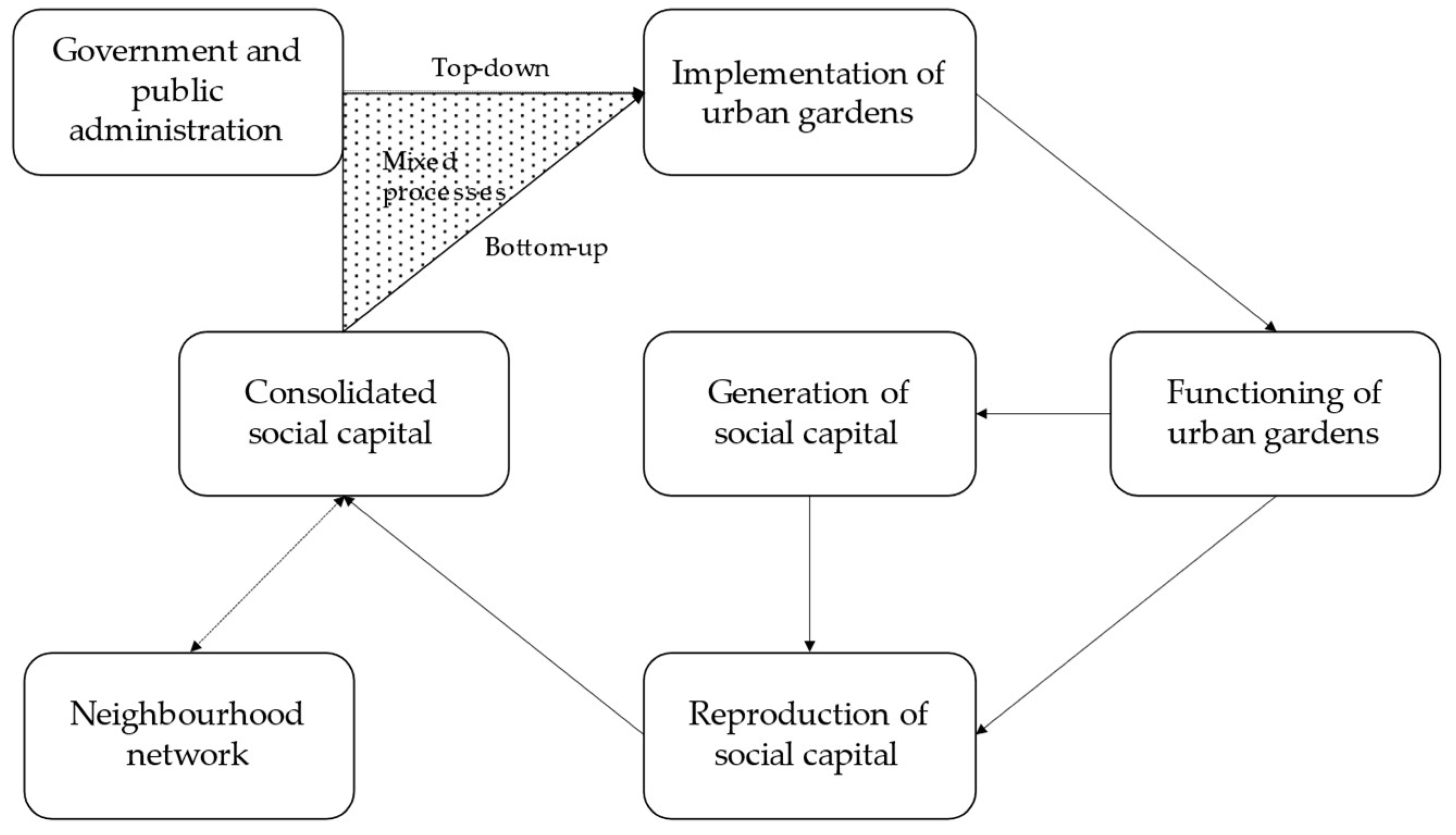
Figure 2.
Location of the FUA of Valencia. Produced by the author. Base map: OpenStreetMap.
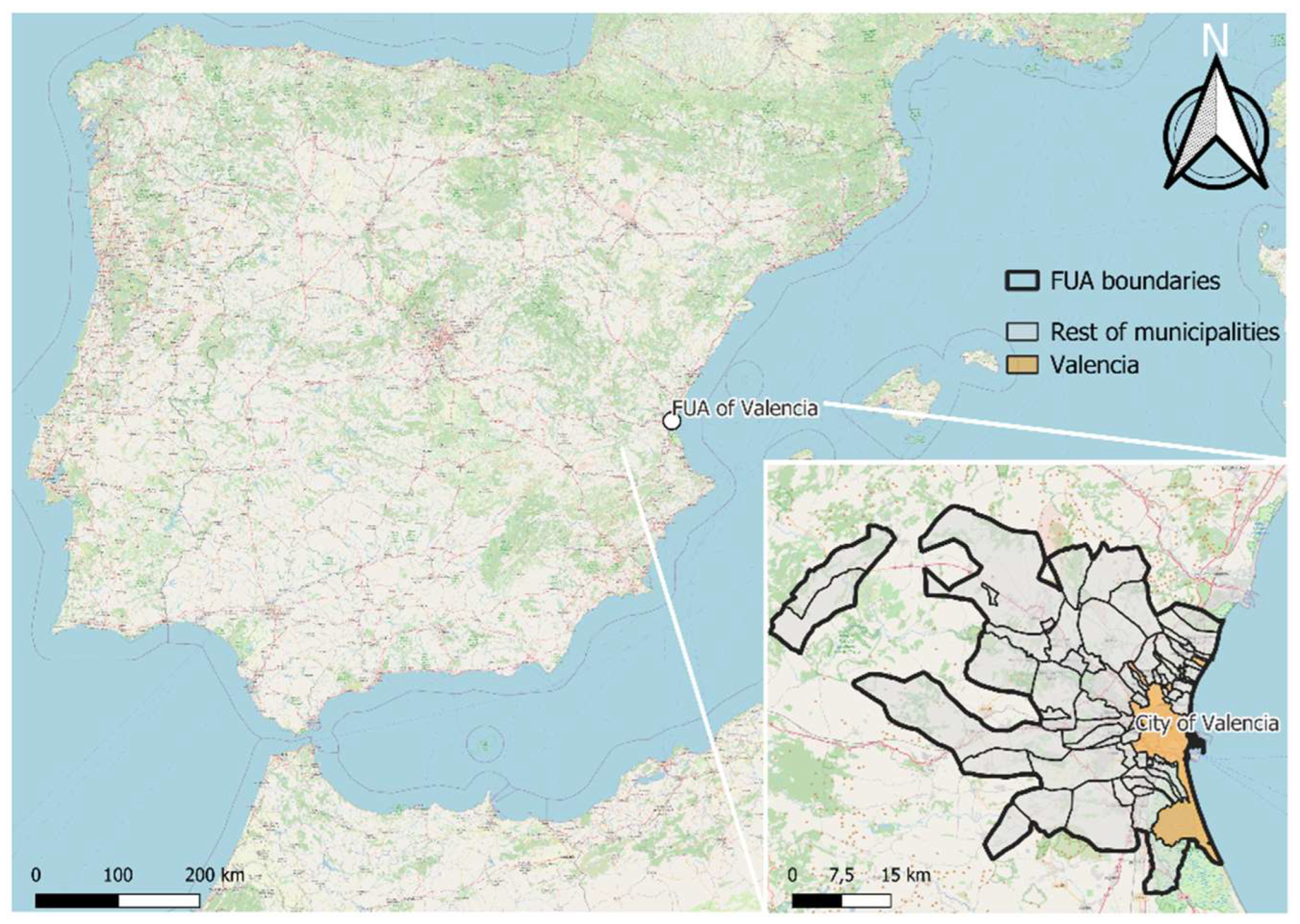

Table 1.
Characteristics of the sample (n=15).
| ID | Gender | Role | Organisation |
|---|---|---|---|
| I1 | Woman | Tecnhician | Association |
| I2 | Man | Coordinator | Public administration |
| I3 | Man | Activist | Association |
| I4 | Man | Teacher | School |
| I5 | Woman | Technician | Public Administration |
| I6 | Man | Teacher | School |
| I7 | Man | Teacher | University |
| I8 | Woman | Technician | Association |
| I9 | Man | Technician | Public administration |
| I10 | Man | Professor | University |
| I11 | Man | Councillor | Public administration |
| I12 | Woman | Corrdinator | Public administration |
| I13 | Man | Activist | Public administration |
| I14 | Man | Coordinator | Other |
| I15 | Woman | Technician | Public administration |
Disclaimer/Publisher’s Note: The statements, opinions and data contained in all publications are solely those of the individual author(s) and contributor(s) and not of MDPI and/or the editor(s). MDPI and/or the editor(s) disclaim responsibility for any injury to people or property resulting from any ideas, methods, instructions or products referred to in the content. |
© 2025 by the authors. Licensee MDPI, Basel, Switzerland. This article is an open access article distributed under the terms and conditions of the Creative Commons Attribution (CC BY) license (http://creativecommons.org/licenses/by/4.0/).
Copyright: This open access article is published under a Creative Commons CC BY 4.0 license, which permit the free download, distribution, and reuse, provided that the author and preprint are cited in any reuse.


