

Submitted:
11 April 2025
Posted:
14 April 2025
You are already at the latest version
Abstract
This study recognizes the significance of young people as future consumers and industry decision-makers by examining their knowledge of and attitudes toward electric vehicles (EVs) in Bangladesh. People's awareness of and attitudes regarding electric cars (EVs) vary, according to preliminary findings from a poll of 102 participants. The study addresses the critical role of young people as future consumers and decision-makers by examining their knowledge and attitudes toward electric vehicles (EVs) in Bangladesh. Despite the global push for sustainability, awareness and acceptance of EVs in Bangladesh remain limited, partly due to a lack of targeted education campaigns. This underscores the need for targeted education campaigns. The study explores the relationship between acceptability and awareness of electric vehicles, identifying key factors influencing young people's perspectives. Beyond its scholarly significance, the research offers insights to industry stakeholders, educators, and legislators that will facilitate the development of tailored strategies to promote teenagers' use of electric vehicles. By encouraging optimistic and knowledgeable attitudes, this research aims to assist Bangladesh's transition to a greener, more sustainable future.
Keywords:
Electric Vehicles
; Awareness
; Attitudes
; Survey
; Sustainability
; Transportation
1. Introduction
In search of climate change mitigation and sustainable development, the global community pays more attention to renewable energy solutions [1]. As a promising approach to carbon emission reduction, energy security improvement, and promotion of sustainable economic growth [2,3], Electric Vehicles (EVs) are at the center of it all. Nevertheless, public awareness and attitudes towards these technologies play an important role in varying EV adoption rates by region [4].
Electric Vehicles (EVs) are a burgeoning division of the motor industry that offers a more environmentally friendly and sustainable alternative to conventional internal combustion engine vehicles that depend on fossil fuels. It is therefore important to understand public awareness, attitudes, and perceptions about the possibility of using EVs in Bangladesh and other countries facing severe environmental problems and escalating transport demand [5].
Renewable energy sources have gained significant global attention in addressing the issue of climate change and diversifying the energy mix. Despite mostly focusing on transition in power generation; transportation still plays a central role in attaining sustainability goals. Electric Vehicles become appealing due to their reduced emissions, less reliance on fossil fuel supplies as well as potential long-term cost savings [6,7].
Several hurdles obstruct the acceptance of electric vehicles in Bangladesh, including infrastructural barriers [8,9], affordability concerns, and lack of knowledge among the populace, especially the youth [10,11].
Most of the studies have conducted investigations into citizen perspectives on Electric Vehicles (EVs) including Austria [12], India [13,14], South Africa [15], Italy [16], and Nepal [17]. However, these studies are not common in Bangladesh. This calls for research on what young citizens think about EVs that may have the potential to shape future transportation patterns and energy consumption trends. A similar Research on EVs was conducted among youths and young adults in Austria (Total participants: 351; Age: 18-30 years old). Participants were asked to fill out an online survey containing various items and scale measurements. Results concluded that 22% of participants already purchased an EV or intend to buy an EV as their next car and 38% stated an interest in purchasing an EV. This helped to identify potential adopters, which aligns with the aims of this study, which is intended to identify perceptions of young people whether they want to adopt EVs or not.
Hence, this study endeavors to bridge that gap by examining how much young people know about them, what they perceive, and whether they think of having EVs. Through these variables, this work aims to provide insights for policy formulation, educational initiatives, and public awareness campaigns towards sustainable transport alternatives for rapid transit solutions and facilitating a shift to a low-carbon economy. This research builds on findings from studies conducted in Austria and India, adapting them to the unique socio-economic and infrastructural context of Bangladesh to provide actionable insights for stakeholders
2. Methodological Approach
2.1. Methodology
This study used a cross-sectional survey, conducted on a predetermined population at a single point in time, and a quantitative research methodology to investigate how young people perceive Electric Vehicles. The study began with an examination of Bangladesh's current energy policies [18]. The participants for the survey were mostly engineering undergraduate students from the Military Institute of Science and Technology (MIST), Bangladesh. This is because of the presence of diverse types of students (both Civilians & Military students). The rest of the data were from pupils known to the authors. To collect responses for the e-survey questionnaire, the authors contacted about 400 undergraduate students from several departments and disciplines and gave them a Google Form-based questionnaire created especially for this study. The young people were informed about the survey's themes. The goal of this thorough investigation was to comprehend Bangladesh’s transportation strategy and young perceptions.
2.2. Research Questions
A total of 102 responses were received. For this study, a questionnaire consisting of two parts and 10 multiple-choice questions was created, following a five-point Likert scale. Section 1 began with standard inquiries on the gender, age, institution, educational history, and qualifications of the students. In Section 2, students' perceptions and awareness of Electric Vehicles are examined. Multiple-choice questions are included, with the options "agree" and "strongly agree" denoting agreement with the policy, "disagree" and "strongly disagree" denoting disagreement, and "neutral," which denotes neither strong support nor opposition to the policies under discussion. The Questionnaire was developed and verified with the help of an Expert and with the help of previously conducted research.

Table 1.
Questionnaire.
| Symbols | Questions |
| Q1 | Have you been hearing about Electric Vehicles (EVs) more frequently in recent times before participating in this survey? |
| Q2 | Would you highly rate your level of knowledge about Electric Vehicles (EVs)? |
| Q3 | I believe Electric Vehicles (EVs) are a practical transportation solution for Bangladesh. |
| Q4 | I would consider purchasing or using an Electric Vehicle (EV) in the future. |
| Q5 | After a 10-20km distance, a charging station should be available |
| Q6 | Electric Vehicles (EVs) offer significant environmental benefits compared to traditional vehicles |
| Q7 | The cost of Electric Vehicles (EVs) is justified by their long-term benefits and savings. |
| Q8 | The government should offer more incentives and subsidies to encourage the adoption of Electric Vehicles (EVs). |
| Q9 | Electric Vehicles (EVs) will become the dominant mode of transportation in Bangladesh in the future. |
| Q10 | Concerns about the limited range of Electric Vehicles (EVs) are a significant barrier to their widespread adoption. |
3. Results and Discussion
3.1. Demographic Information
The total number of complete or partially complete questionnaires was 102. Among them the number of female respondents was 29, the number of male respondents was 66, and 7 participants preferred not to disclose. The gender disparity occurred due to the presence of fewer female students in engineering universities in Bangladesh. In terms of age, the majority (87) falls within the 18-24 age group, followed by 10 participants in the 25-34 while the rest are in under 18 and other categories. Regarding educational background, 69 participants are undergraduate students, 21 are high school students, and 9 are pursuing master's or above degrees, and the distribution across engineering, medical, business, and social/environmental/other fields is 88, 10, 2, and 2, respectively.
Table 2.
The demographic composition of the samples.
| Demographic profile | N(number) | % |
|---|---|---|
|
Gender Female Male Preferred not to say |
29 66 7 |
28.4 64.7 6.9 |
|
Age Under 18 18-24 25-34 Other |
1 87 10 4 |
0.98 85.3 9.8 3.9 |
|
Education High school students Bachelor’s students Master’s degree or above Other |
21 69 9 3 |
20.58 67.64 8.82 2.94 |
|
Field of study Engineering Business/management Medical/health science Other |
88 2 10 2 |
86.28 1.96 9.8 1.96 |
Figure 1.
(a) Respondents' opinion on Q1. (b) Respondents' opinion on Q2. (c) Respondents' opinion on Q3. (d) Respondents' opinion on Q4. (e) Respondents' opinion on Q5. (f) Respondents' opinion on Q6. (g) Respondents' opinion on Q7. (h) Respondents' opinion on Q8. (i) Respondents' opinion on Q9. (j) Respondents' opinion on Q10.
Figure 1.
(a) Respondents' opinion on Q1. (b) Respondents' opinion on Q2. (c) Respondents' opinion on Q3. (d) Respondents' opinion on Q4. (e) Respondents' opinion on Q5. (f) Respondents' opinion on Q6. (g) Respondents' opinion on Q7. (h) Respondents' opinion on Q8. (i) Respondents' opinion on Q9. (j) Respondents' opinion on Q10.
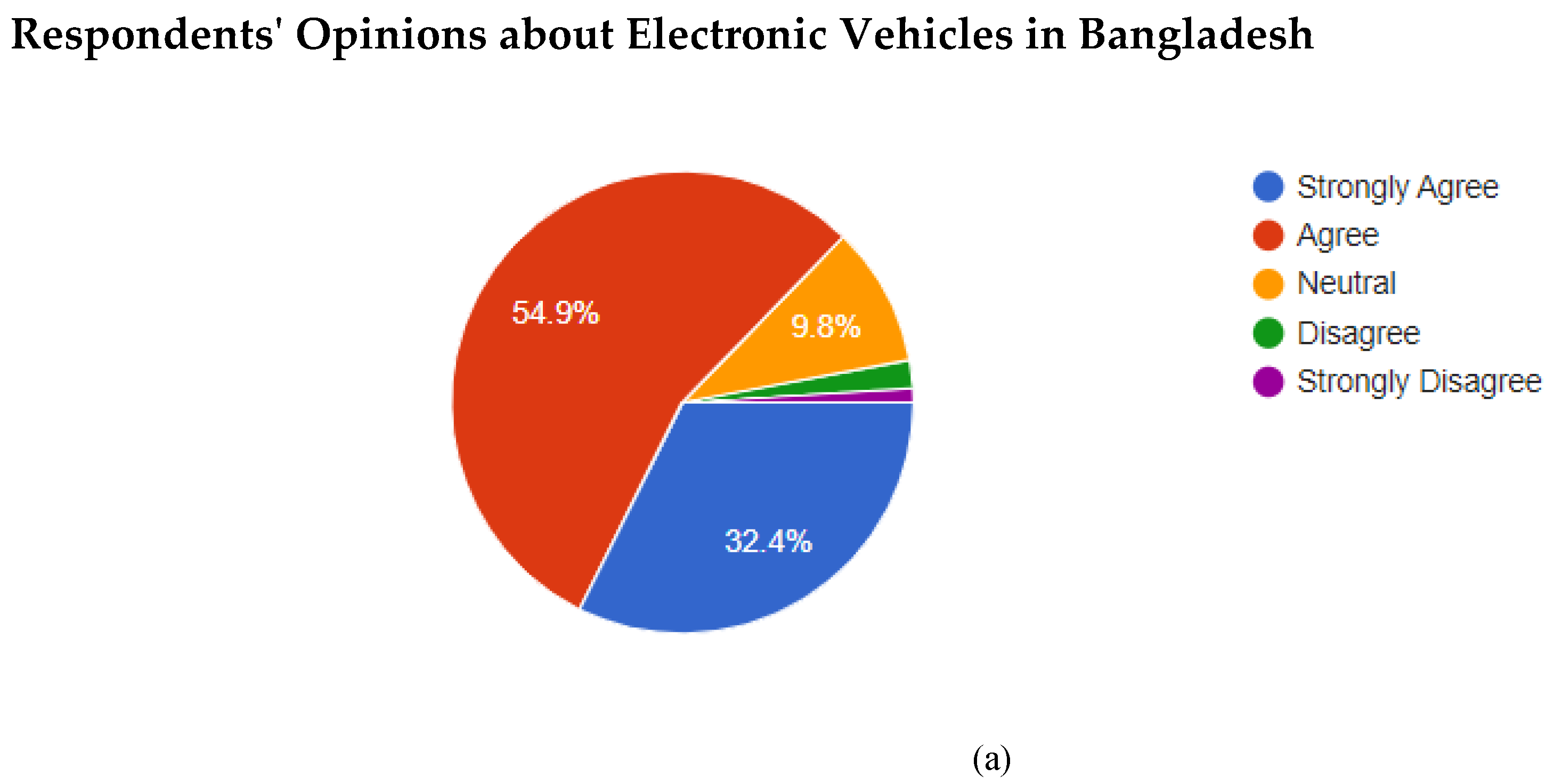
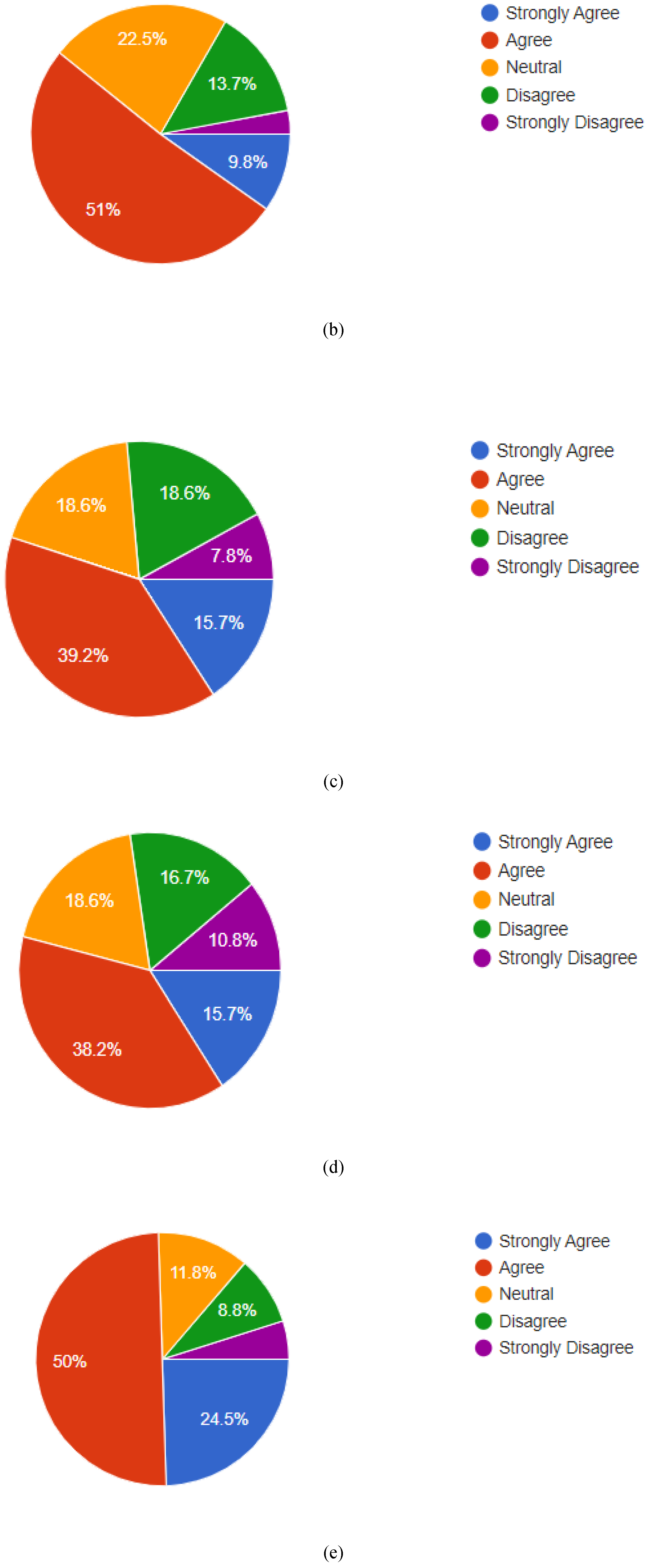

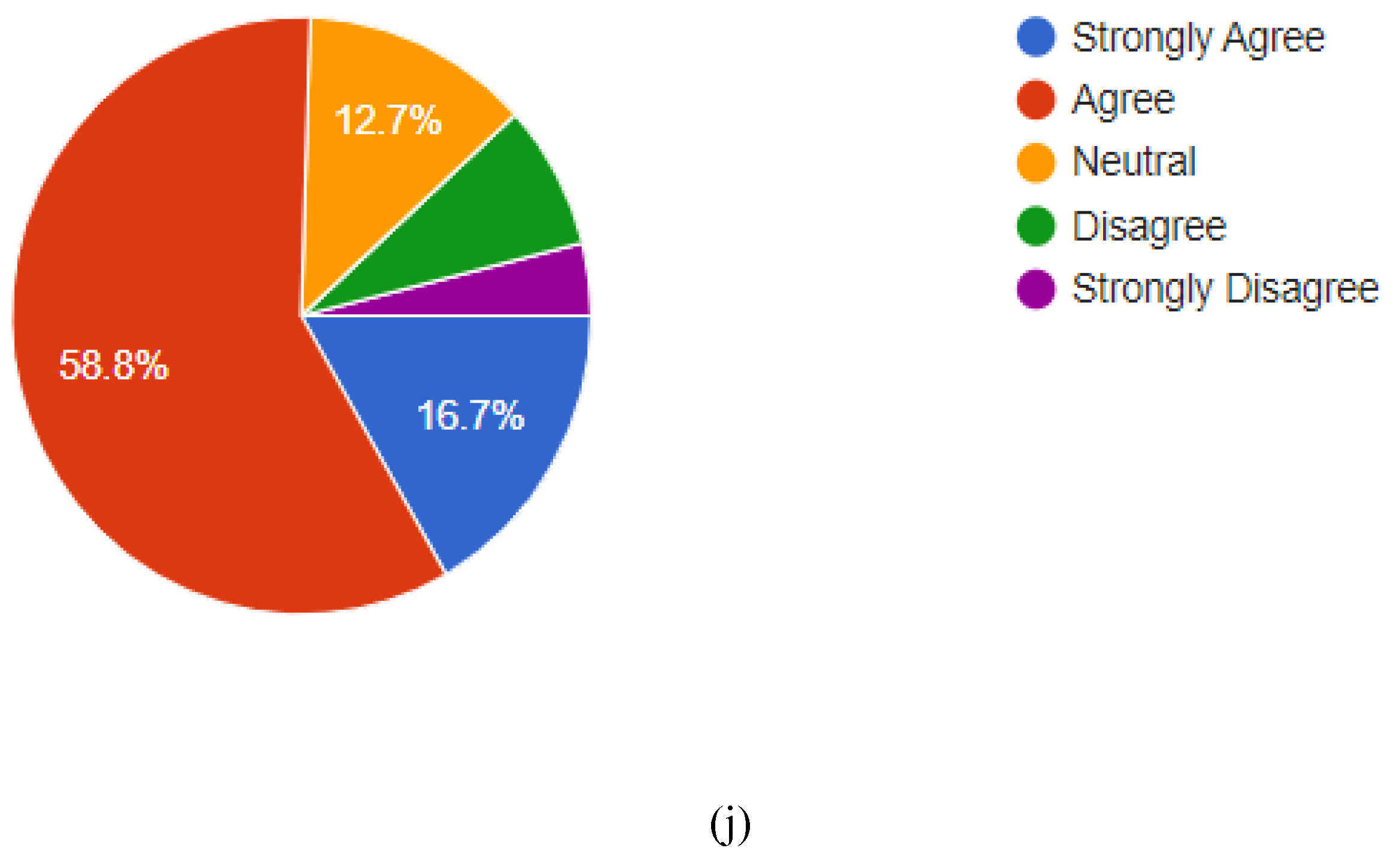
The survey's findings show that respondents have a definite preference for adopting electric vehicles (EVs), with 39.2% of respondents saying that EVs are a workable transportation option for Bangladesh. Regarding their degree of understanding of EVs, a sizable portion of respondents—22.5 percent—express neutrality or disagreement (13.7%), while 51% of respondents believe they know enough. This implies that additional educational efforts to raise knowledge and awareness of EV technology would be necessary. While 18.6% of respondents are neutral and another 18.6% disagree, the majority of respondents either strongly agree (15.7%) or agree (39.2%) that EVs are a feasible transportation alternative for Bangladesh suggesting that people have a favorable opinion of EVs' potential to solve the nation's transportation problems and regarding their desire to buy or use an EV in the future, a sizable portion of respondents expresses uncertainty (18.6% are neutral and 16.7% strongly disagree). However, 38.2% of respondents say they would be likely to buy an EV in the future, indicating that they are open to utilizing emerging technologies. 50% of respondents agreed and 24.5% strongly agreed that a charging station should be accessible after traveling 10–20 km. This emphasizes how crucial infrastructure growth is to encouraging the use of EVs. The majority of responders (70.6%) accept that EVs are far more environmentally friendly than conventional cars. This indicates that people have a favorable opinion of EVs' ability to reduce environmental concerns. Although the majority indicated agreement, a sizeable percentage (34.4%) expressed doubt about the EVs' ability to justify their prices in the long run and 49% unanimously agreed that additional subsidies and incentives should be provided by the government to promote the use of EVs. This emphasizes how crucial it is for policies to support environmentally friendly transportation options and to lower costs and taxes. Over 50% of the participants express optimism and concur that electric vehicles will dominate transportation in the future. The majority of those who participated (75.5%) acknowledge that one of the main obstacles to EVs becoming widely adopted is worries about their short range. This emphasizes how crucial infrastructural development and technology improvements are to reducing range anxiety and boosting customer trust in EVs. The findings align with studies from developing regions like Nepal and South Africa, emphasizing the critical role of governmental incentives and infrastructure development in fostering EV adoption.
3.2. Statistical Analysis
Table 3.
Data analysis.
| Questionnaire | Mean | Standard Deviation | ModeMode |
|---|---|---|---|
| Awareness | 4.15 | 3.70 | Agree |
| Knowledge | 3.51 | 3.11 | Agree |
| Practicality of EVs | 3.36 | 3.05 | Agree |
| Willingness to Purchase | 3.31 | 3.03 | Agree |
| Access to Charging Stations | 3.80 | 3.43 | Agree |
| Environmental benefits | 3.81 | 3.46 | Agree |
| Cost effectivity | 3.58 | 3.21 | Agree |
| More Govt Incentives | 3.88 | 3.47 | Agree |
| Dominance of EVs in the future | 3.26 | 2.93 | Agree |
| Limited range of options | 3.76 | 3.36 | Agree |
It can be understood that the majority are concerned about the infrastructural limitations, lack of innovation in the battery, and lack of inclination towards renewable energy sources makes them concerned about the dominance of EVs in transportation in Bangladesh in the future. However, if the government is willing to create more policies and undertake more projects toward creating a favorable future for EVs, the respondents are more than willing to switch to the more environment-friendly solution that EVs will bring forth.
3.3. Limitations or Biases
This study primarily surveyed engineering undergraduate students from the Military Institute of Science and Technology (MIST), with a specific emphasis on those with a potential interest or exposure to EVs due to the presence of a Mechanical Engineering Department. As such, the findings may reflect a higher level of awareness and favorable perceptions of EVs than might be observed in a broader, more demographically diverse sample. The purposive sampling approach and reliance on respondents known to the authors further introduce the potential for sample bias. Future studies should consider more diverse and representative sampling strategies to ensure broader generalizability of the results.
4. Conclusions
The research highlights the need for policy interventions, such as subsidies and infrastructure development, alongside educational initiatives to bridge the knowledge gap and promote EV adoption among youth in Bangladesh. The examination of youth sentiments unveiled insights, such as understanding of opinions, which allowed us to assess the awareness and acceptance, that entails the perception and attitude towards Electric Vehicles in Bangladesh, five central findings come to light:
1. The survey findings indicate a notable increase in awareness and attention towards Electric Vehicles (EVs) among respondents before their participation
2. Although exposure to EVs has increased, a notable proportion of respondents remain uncertain or lack confidence in their knowledge, underscoring the need for targeted awareness campaigns.
3. Respondents positively perceive the environmental benefits of EVs; however, challenges such as cost, inadequate infrastructure, and range anxiety remain significant barriers to adoption.
4. Government initiatives and technological innovations will be crucial in fostering the widespread adoption of EVs as a sustainable transportation solution in Bangladesh.
5. The survey results suggest a promising trajectory toward the integration of EVs into the transportation sector of Bangladesh. Continued efforts in education, infrastructure development, policy creation, and technological advancement can ease the process of EVs' dominant mode of transportation.
The study provides a foundational understanding of youth perspectives on EVs, offering valuable insights for tailoring policies and educational campaigns to accelerate the transition to sustainable transportation in Bangladesh.
Acknowledgment
The authors would like to acknowledge Assistant Professor Md. Insiat Islam Rabby (Military Institute of Science and Technology) for his insightful remarks and essential support during this research work. Additionally, the authors express their sincere gratitude to every one of the participants who so kindly gave their time and wisdom to do the survey. The effectiveness of this research has been greatly attributed to the insightful comments that were gathered.
Conflicts of Interest
The authors declare no conflicts of interest
Abbreviations:
EV: Electric Vehicles
References
- Ona Egbue, Suzanna Long, Barriers to widespread adoption of electric vehicles: An analysis of consumer attitudes and perceptions. Energy Policy 2012, 48, 717–729. [CrossRef]
- Pradeep Kautish, Rambabu Lavuri, David Roubaud, Oksana Grebinevych, Electric vehicles’ choice behaviour: An emerging market scenario. Journal of Environmental Management 2024, 354. [CrossRef]
- C. M. Costa, J.C. Barbosa, H. Castro, R. Gonçalves, S. Lanceros-Méndez, Electric vehicles: To what extent are environmentally friendly and cost effective? – Comparative study by european countries. Renewable and Sustainable Energy Reviews 2021, 151. [Google Scholar] [CrossRef]
- Patrick Jochem, Sonja Babrowski, Wolf Fichtner, Assessing CO2 emissions of electric vehicles in Germany in 2030. Transportation Research Part A: Policy and Practice 2015, 78, 68–83. [CrossRef]
- Nana, O. Bonsu, Towards a circular and low-carbon economy: Insights from the transitioning to electric vehicles and net zero economy. Journal of Cleaner Production 2020, 256. [Google Scholar] [CrossRef]
- Paula Bastida-Molina, Elías Hurtado-Pérez, Elisa Peñalvo-López, María Cristina Moros-Gómez, Assessing transport emissions reduction while increasing electric vehicles and renewable generation levels. Transportation Research Part D: Transport and Environment 2020, 88. [CrossRef]
- Lluc Canals Casals, Egoitz Martinez-Laserna, Beatriz Amante García, Nerea Nieto, Sustainability analysis of the electric vehicle use in Europe for CO2 emissions reduction. Journal of Cleaner Production 2016, 127, 425–437. [CrossRef]
- Nathaniel, S. Pearre, Willett Kempton, Randall L. Guensler, Vetri V. Elango, Electric vehicles: How much range is required for a day’s driving? Transportation Research Part C: Emerging Technologies 2011, 19, 1171–1184. [Google Scholar] [CrossRef]
- Stephen Skippon, Mike Garwood, Responses to battery electric vehicles: UK consumer attitudes and attributions of symbolic meaning following direct experience to reduce psychological distance. Transportation Research Part D: Transport and Environment 2011, 16, 525–531. [CrossRef]
- Habib, Salman, et al. "A study of implemented international standards and infrastructural system for electric vehicles." 2018 IEEE International Conference on Industrial Technology (ICIT). IEEE. 2018. [CrossRef]
- Juan, Angel Alejandro, et al. Electric vehicles in logistics and transportation: A survey on emerging environmental, strategic, and operational challenges. Energies 2016, 9, 86. [Google Scholar] [CrossRef]
- Brezovec, P., Sposato, R., & Hampl, N., Generation Z Ready to Embrace the Electric Vehicle Revolution? Predictors of Electric Vehicle Adoption by Youths and Young Adults in Austria, 2019.
- Sahoo, D. , Harichandan, S., Kar, S. K., & Sreejesh, S., An empirical study on consumer motives and attitude towards adoption of electric vehicles in India: Policy implications for stakeholders. Energy Policy 2022, 165. [Google Scholar] [CrossRef]
- Bhat, F. A. , Verma, M., & Verma, A., Measuring and modeling electric vehicle adoption of Indian consumers. Transportation in Developing Economies 2022, 8, 6. [Google Scholar] [CrossRef]
- Sefora, R. I. Factors that influence young consumer's acceptance of electronic cars in South Africa. Doctoral dissertation, University of the Witwatersrand, Faculty of Commerce, Law and Management, School of Business and Economic Sciences, 2017. [Google Scholar]
- Andriosopoulos, K. , Bigerna, S., Bollino, C. A., & Micheli, S., The impact of age on Italian consumers' attitude toward alternative fuel vehicles. Renewable energy 2018, 119, 299–308. [Google Scholar] [CrossRef]
- Neupane, S. SOCIO-TECHNICAL ANALYSIS TOWARDS THE ADAPTATION OF ELECTRIC VEHICLE IN KATHMANDU. Doctoral dissertation, Lincoln University College, 2022. [Google Scholar]
- Government of Bangladesh. Renewable Energy Policy of Bangladesh. 2008. Available online: https://bpmi.portal.gov.bd/.
Disclaimer/Publisher’s Note: The statements, opinions and data contained in all publications are solely those of the individual author(s) and contributor(s) and not of MDPI and/or the editor(s). MDPI and/or the editor(s) disclaim responsibility for any injury to people or property resulting from any ideas, methods, instructions or products referred to in the content. |
© 2025 by the authors. Licensee MDPI, Basel, Switzerland. This article is an open access article distributed under the terms and conditions of the Creative Commons Attribution (CC BY) license (http://creativecommons.org/licenses/by/4.0/).
Copyright: This open access article is published under a Creative Commons CC BY 4.0 license, which permit the free download, distribution, and reuse, provided that the author and preprint are cited in any reuse.


