
Submitted:
30 August 2023
Posted:
30 August 2023
You are already at the latest version
Abstract
Existence of hybrid electric vehicles nowadays is one of the emerging technologies worldwide. Different countries are using this technology on their transportation, and nowadays, a lot of other countries are gradually adapting on using this kind of innovation in their transport system. Philippines is among these countries which aims to have a sustainable mobility by embracing the use of hybrid - electric vehicles but still lots of consumers are lacking awareness on this technology. Lack of information on the social, environmental, and economic potential benefits are among the main issues of Philippines consumers that really affect its uptake. The goal of this study was to evaluate the consumer’s perception and purchase intention on the transition of hybrid - electric vehicles for sustainable mobility and transportation here in the Philippines. It aimed to assess consumer awareness with hybrid - electric vehicles and its potential benefits to human beings in terms of social, environmental, and economic aspects. The study also gauged the impact of this perception on consumer’s purchase intention on hybrid - electric vehicles. These objectives were attained using the Descriptive Statistics and Correlation Analysis. Using these methods, the results revealed that majority of the consumers believed on the positive benefits of transitioning to hybrid - electric vehicles in terms of social, environmental, and economic aspects. This study also showed that these benefits have high impact on the consumer’s intention of buying or having a hybrid – electric vehicle. Electric vehicle is one of the most effective measure of decarbonizing the transport system. Furthermore, government and automotive businesses must strengthen their drive in spreading awareness of hybrid – electric vehicle’s benefits to consumers to further support country’s effort for development.
Keywords:
hybrid - electric vehicle
; emerging technology
; sustainable mobility and transportation
; consumer perception
; consumer purchase intention
I. INTRODUCTION
Transportation is very important to all human beings in different aspect. It allows people to conveniently go to different places they need to. It also enables trade, business, and even employment nowadays. But we all know that transport vehicle is one of the main contributor to pollution.
Based on an article in 2018 by the UN Intergovernmental Panel on Climate Change, it was explained that global warming is anticipated to reach above pre-industrial levels of about 1.5 degree Celsius and it will happen around 2030 to 2050. In Philippines, vehicle emission was the leading factor to air pollution [1]. With these, there is a great call for sustainable mobility particularly from the transport sectors.
Sustainable mobility is described as the evolution of modern automotive engineering and involves skills different from the old automotive engineering [2]. One of the evolution on automotive nowadays is the used of hybrid and electric vehicles. In fact, most countries are shifting to hybrid and electric vehicle production which is more environment friendly [3]. And Philippines is now adopting to this emerging technology in mobility.
Former president of the Philippines, President Rodrigo Duterte signed an Act on April 15, 2022, the Electric Vehicle Industry Development Act or also known as the Republic Act No. 11697. It is an Act that expresses the policy on the country’s goal for the development of the electric vehicle (EV) industry. This applies to the manufacture, transport, production, maintenance, services, and research and development of EVs, parts and materials, and other related infrastructure. The compliance on this policy specific matters for all automotive industries, business owners and government agencies. This Act was said to take effect 15 days after its promulgation [4].
Hybrid System is a combination of two or more technology. A combination of the traditional or conventional combustion engine and the electric system is considered a hybrid – electric vehicle [5]. Most automotive industry are embracing this technology because of its advantage and benefits from the traditional mobility designs. Despite of this, there is still a problem in the availability of information for the consumers of the impact of using this kind of technology. Lack of awareness whether in terms of social, environmental, and economic benefits are among the main issues of Philippines that greatly affect its fast acceptance [6].
The main goal of this research is to assess the consumer’s perception and purchase intention on the transition of hybrid - electric vehicles to sustainable mobility and transportation here in the Philippines. It aims to assess consumer awareness with hybrid - electric vehicles and its potential benefits to human beings. The study also wants to see the impact of this perception on consumer’s purchase intention on hybrid - electric vehicles.
II. EXPERIMENTAL METHOD/S
- Conceptual Framework
Figure 1 shows input data which is the transition to hybrid - electric vehicles as it undergoes the processes of gathering data through survey questionnaires, and descriptive statistics and correlation analysis to determine consumer’s perception and purchase intention on hybrid - electric vehicles.
- 2.
- Participants
The researcher gathered all the necessary statistics in this study from the respondents who were the usual and possible car consumers in the Philippines.
- 3.
- Questionnaire
A survey questionnaire was used in this research. It contains queries on Philippine consumer’s perception on the transition to hybrid - electric vehicles in the Philippines and their purchase intention. This is an effective method of gathering people’s opinion. Public opinion is the most suitable method of collecting information from large population [7]. Survey questionnaires were distributed to all the potential respondents through their direct e-mails, and direct messages using social media. The respondents answered this set of survey questions for the researcher to gather sufficient data for the study. Related articles, research studies, internet, and journals also aided the researcher to gain other relative information.
- 4.
- Statistical Analysis
The most suitable approach in order to analyze the data in a study were used in this research. Descriptive Statistics and Correlation Analysis were among the methods that were applied in this study to determine the consumer’s perception and purchase intention on the transition to hybrid - electric vehicles in the Philippines.
- 4.1
- Descriptive Statistics
Descriptive Statistics was used in this research to summarize a data set. This basically means that descriptive statistics were not developed based only on theory of probability [8].
- 4.2
- Correlation Analysis
The researcher also used the Correlation Analysis in this study. This was used to identify the effect of different variables on a single variable to which they are associated [9]. This approach helped the researcher to identify if consumer’s perception in terms of social, environmental, and economic benefits of hybrid – electric vehicles in the Philippines has a significant relationship on consumer’s purchase intention.
III. RESULTS AND DISCUSSION
- 1.
- Descriptive Statistics
- 1.1.
- Demographic Profile of the Respondents
The respondents in this study came from the different car consumers and possible future car consumers in the Philippines. The respondents were also grouped according to gender, age, educational attainment, current job, and monthly salary or income as presented in Table 1.
Gender. Of the 100 respondents, 52 percent were male, 45 percent were female, and 3 percent answered not prefer to say.
Age. Of the 100 respondents, 72 percent were 26 to 50 years old, 21 percent were 25 years old and below, and 7 percent were 51 years old and above.
Educational Attainment. Of the 100 respondents, 66 percent were college graduates, 19 percent have post-graduate degrees, 8 percent answered others - which includes undergraduate or still studying, and 7 percent were diploma holders.
Current Job. Of the 100 respondents, 55 percent were employed in a private sector, 17 percent were employed in a public sector, 11 percent were unemployed, as well as 11 percent represents the self-employed individuals, and 6 percent answered others.
Monthly Salary or Income. Of the 100 respondents, 43 percent answered 25,000 and below of their monthly income, 38 percent answered 25,001 to 50,000 monthly income, 11 percent answered 75,001 and above, and 8 percent answered 50,001 to 75,000 of their monthly income.
- 1.2.
- Consumer Perception on the Transition to Hybrid - Electric Vehicles in the Philippines
Respondents were asked on their perception on the benefits of hybrid – electric vehicle in the Philippines in terms of social, environmental, and economic benefits. The rating scale used for this assessment were: 5 for “Strongly Agree”, 4 for “Somewhat Agree”, 3 for “Neither Agree nor Disagree”, 2 for “Somewhat Disagree”, and 1 for “Strongly Disagree”.
Social Benefits. Of the 100 respondents, the average results or response per respondents shows that 51 percent answered they “Somewhat Agree” that the use of hybrid – electric vehicles has social benefits in the Philippines, 40 percent answered “Strongly Agree”, 8 percent answered “Neither Agree nor Disagree”, 1 percent answered they “Somewhat Disagree”, and no one answered for “Strongly Disagree” as shown in Table 2. This shows that majority of the respondents believes on the positive social impact of the use of hybrid – electric vehicles in the Philippines.
Environmental Benefits. Of the 100 respondents, the average results or response per respondents shows that 75 percent “Strongly Agree” that the use of hybrid – electric vehicles has environmental benefits in the Philippines, 21 percent answered “Somewhat Agree”, 3 percent answered “Neither Agree nor Disagree”, 1 percent answered “Strongly Disagree”, while no one answered for “Somewhat Disagree” as shown in Table 3. This section of the survey shows that majority of the respondents see the great positive impact of the use of hybrid – electric vehicles has social benefits in the Philippines to the environment.
Economic Benefits. Of the 100 respondents, the average results or response per respondents shows that 52 percent “Strongly Agree” ” that the use of hybrid – electric vehicles has benefits to the Philippines economically, while 42 percent answered “Somewhat Disagree”, 5 percent answered “Neither Agree nor Disagree”, 1 percent answered “Strongly Disagree”, and no one answered for “Somewhat Disagree” as shown in Table 4. Surprisingly, the results showed that majority of the respondents believes on the high positive effects of the use of hybrid – electric vehicles in the Philippines’ economy.
- 1.3
- Consumer’s Purchase Intention on Hybrid - Electric Vehicles in the Philippines
The last part of the survey aimed to assess the consumer’s intention to purchase a hybrid – electric vehicle. Also, the rating scale used for this assessment were: 5 for “Strongly Agree”, 4 for “Somewhat Agree”, 3 for “Neither Agree nor Disagree”, 2 for “Somewhat Disagree”, and 1 for “Strongly Disagree”.
Overwhelmingly, out of the 100 respondents, 53 percent answered they “Somewhat Agree” on purchasing a hybrid – electric vehicle, 36 percent “Strongly Agree”, 10 percent “Neither Agree nor Disagree”, 1 percent “Somewhat Disagree”, and no one answered for “Strongly Disagree” as shown in Table 5. The results showed that majority of the respondents whether they currently owned a vehicle or not were planning to purchase a hybrid – electric vehicle in the near future, probably because of what they see as the overall positive benefits of the use of hybrid – electric vehicle in the Philippines.
- 2.
- Correlation Analysis
For other results of this study, a Correlation Analysis was used to determine if consumer’s perception in terms of social, environmental, and economic benefits of hybrid – electric vehicles in the Philippines has a significant relationship on consumer’s purchase intention.
- 2.1.
- Social Benefits and Purchase Intention
Ho: Social benefits has no significant impact to consumer’s purchase intention on hybrid – electric vehicle.
Ha: Social benefits has significant impact to consumer’s purchase intention on hybrid – electric vehicle.
Figure 2 shows the results between social benefits and purchase intention using the correlation analysis. This showed a correlation (r) value of 0.686 which is an indication of a “moderate positive correlation” of the two variables and a p-value of 0.000 which discards the null hypothesis for having a level of significance lower than 0.05 [10]. This mean that social benefits of hybrid – electric vehicle has a significant relationship on consumer’s purchase intention. This implies that consumer’s believed on efficiency, comfort, experience, durability, and overall enhance performance of the hybrid - electric vehicles more than the conventional one. Previous studies also states that social concerns is one factor that affects consumer behaviour and demands [11].
- 2.2.
- Environmental Benefits and Purchase Intention
Ho: Environmental benefits has no significant impact to consumer’s purchase intention on hybrid – electric vehicle.
Ha: Environmental benefits has significant impact to consumer’s purchase intention on hybrid – electric vehicle.
Figure 3 shows the analysis results for the environmental benefits and purchase intention. The outcome presented a correlation (r) value of 0.542 which is an indication of a “moderate positive correlation” between the two variables and a p-value of 0.000 which discards the null hypotheses for having a level of significance lower than 0.05. This mean that environmental benefits of hybrid – electric vehicle has a significant relationship also on consumer’s purchase intention. This proved that consumer’s sees the hybrid - electric vehicle’s direct effect on the environment in reducing pollutions and improving air quality as it is known that air pollution is one of the major problem of different developing countries [12]. This will lead to a cleaner environment which contributes to a better health and well-being of different individuals.
- 2.3.
- Economic Benefits and Purchase Intention
Ho: Economic benefits has no significant impact to consumer’s purchase intention on hybrid – electric vehicle.
Ha: Economic benefits has significant impact to consumer’s purchase intention on hybrid – electric vehicle.
Figure 4 shows the analysis results between the variables economic benefits and purchase intention. This showed a correlation (r) value of 0.670 which is an indication of a “moderate positive correlation” of the two variables and a p-value of 0.000 which discards the null hypothesis for having a level of significance lower than 0.05. This mean that economic benefits of hybrid – electric vehicle has a significant relationship on consumer’s purchase intention. This shows that consumer’s sees the hybrid - electric vehicle’s potential economic benefits like lower cost due to lower fuel consumption, job opportunities for vehicle production and infrastructure, creates potential businesses relative to this vehicle, and country’s higher savings particularly when it comes to oil and fuel [13]. A related study in China also discussed the electric vehicle as a solution to energy conservation and economic development [14].
The correlation analysis of the three variables: social, environmental, and economic benefits all shows a significant relationship on consumer’s intention to purchase a hybrid – electric vehicle. This implies that their positive perception on the vehicle’s benefits give them a higher expectation and interest to purchase or switch into a hybrid – electric vehicle.
IV. CONCLUSION
Our world nowadays is concentrating on ecological practices to reduce carbon emissions, pollutions, and finding energy alternatives [15]. Most countries see innovation as an effective approach for their development and one of these is align with the transport system. Electric vehicles are being introduced to the market by different developing countries as a solution to different issues like fuel, energy, environmental, and economic concerns [16]. Vehicle electrification is one of the most capable measures of reducing carbon emissions on the transport system [17].
Philippines as one of the developing countries which also aims to address current issues on social, environmental, and economics are also gradually adopting to this emerging technology of transitioning to hybrid and/or electric vehicles for sustainable mobility in the country. However, some individuals or consumers are not fully aware of hybrid – electric vehicle’s features and potential benefits. In general, some consumer do not prefer hybrid – electric vehicle because of its high maintenance cost compare to the traditional type of vehicle or the internal combustion engine [18]. But surprisingly, this study revealed that still majority of the consumers in the Philippines believed on the positive benefits of transitioning to hybrid - electric vehicles particularly in terms of social, environmental, and economic aspects. A lot of consumers were also showing their interests on purchasing a hybrid – electric vehicle in the near future because of what they expect on its potential benefits to human beings and their lifestyle.
The government as well as private sectors especially the automotive industries must strengthen their drive on hybrid – electric vehicles adoption. They must joint effort in spreading awareness on the effect of transitioning to hybrid – electric vehicles to further support the country’s effort for development.
The researcher suggested to explore other possible methods and approach on related research study. The researcher also advocated to explore all the potential benefits of adopting to hybrid and electric vehicles other than the variable presented in this study. Future research can discuss the impact of hybrid and electric vehicles with other countries.
Acknowledgments
The researcher would like to express sincere and deep appreciation to all the respondents who participated in this study. The researcher would also like to thank Polytechnic University of the Philippines – Open University System for the knowledge and experience gained throughout the course.
Appendix
Survey Questionnaires.
- Demographic Profile
- Name (Optional):
-
Gender:
- ∘
- Male
- ∘
- Female
- ∘
- Prefer not to say
-
Age:
- ∘
- 25 years old and below
- ∘
- 26 to 50 years old
- ∘
- 51 years old and above
-
Educational Attainment:
- ∘
- Diploma
- ∘
- College Degree
- ∘
- Post-graduate Degree
- ∘
- Others
-
Current Job:
- ∘
- Unemployed
- ∘
- Employed (Private Sector)
- ∘
- Employed (Public Sector)
- ∘
- Self-employed
- ∘
- Others
-
Monthly Salary/Income (Php):
- ∘
- 25,000 and below
- ∘
- 25,001 to 50,000
- ∘
- 50,001 to 75,000
- ∘
- 75,001 and above
- 2.
- Consumer Perception on the Transition to Hybrid Electric Vehicles in the Philippines
| Answer the following statements by checking the column that corresponds to your answer. | |||||
| Rating Scale: | |||||
| 5 - Strongly Agree | |||||
| 4 - Somewhat Agree | |||||
| 3 - Neither Agree or Disagree | |||||
| 2 - Somewhat Disagree | |||||
| 1 - Strongly Disagree | |||||
| Social Benefits | 5 | 4 | 3 | 2 | 1 |
| 1. Energy efficiency. | |||||
| 2. Higher fuel efficiency. | |||||
| 3. Up-to-date technological features for consumers. | |||||
| 4. Better riding comfort. | |||||
| 5. Better driving experience. | |||||
| 6. High-powered / performance vehicle. | |||||
| 7. Longer vehicle parts lifespan. | |||||
| 8. Consumer-friendly affordability of hybrid - electric vehicles (including parts and maintenance). | |||||
| 9. Greater consumer awareness on hybrid - electric's real benefits. | |||||
| 10. Overall social benefits of hybrid electric vehicle. | |||||
| Environmental Benefits | 5 | 4 | 3 | 2 | 1 |
| 1. Fewer gas emissions. | |||||
| 2. Reduced carbon dioxide emissions. | |||||
| 3. Better air quality. | |||||
| 4. Reduced noise pollution. | |||||
| 5. Reduced possible water pollution (fuel/oil waste) | |||||
| 6. Reduced overall pollution significantly. | |||||
| 7. Cleaner environment. | |||||
| 8. Greater environmental awareness to consumers. | |||||
| 9. Environmental impact contributes to health and well-being improvement. | |||||
| 10. Overall environmental benefits of hybrid - electric vehicle. | |||||
| Economic Benefits | 5 | 4 | 3 | 2 | 1 |
| 1. Less fuel consumption. | |||||
| 2. Less money spent on fuel pumps. | |||||
| 3. Lower running cost. | |||||
| 4. Lower maintenance cost due to longer parts lifespan. | |||||
| 5. Create more jobs for the vehicles' production. | |||||
| 6. Create more jobs for infrastructure construction like charging stations. | |||||
| 7. Creates potential business (charging stations and service centers). | |||||
| 8. Create more jobs for hybrid - electric vehicle related business. | |||||
| 9. Country's higher savings from exporting oil/fuel. | |||||
| 10. Overall economic benefits of hybrid - electric vehicle. | |||||
- 3.
- Consumer's Purchase Intention on Hybrid Electric Vehicles in the Philippines
| Answer the following statements by checking the column that corresponds to your answer. | |||||
| Rating Scale: | |||||
| 5 - Strongly Agree | |||||
| 4 - Somewhat Agree | |||||
| 3 - Neither Agree or Disagree | |||||
| 2 - Somewhat Disagree | |||||
| 1 - Strongly Disagree | |||||
| Purchase Intention | 5 | 4 | 3 | 2 | 1 |
| 1. Understand the potential positive benefits of hybrid - electric vehicles over the conventional types. | |||||
| 2. Understand the overall social benefits of hybrid - electric vehicles. | |||||
| 3. Understand the overall environmental benefits of hybrid - electric vehicles. | |||||
| 4. Understand the overall economic benefits of hybrid - electric vehicles. | |||||
| 5. Choose hybrid electric vehicle due to affordability. | |||||
| 6. Choose hybrid electric vehicle due to high fuel efficiency, | |||||
| 7. Willing to spend extra cost (parts and maintenance) for a hybrid - electric vehicle. | |||||
| 8. Consider hybrid - electric as an alternative vehicle. | |||||
| 9. Willing to switch from conventional to hybrid - electric vehicles as soon as possible. | |||||
| 10. Willing to purchase hybrid - electric vehicle in the future. | |||||
References
- E. Valdez. Driving sustainable mobility in the Philippines with hybrid cars. (2019) DOI=https://www.philstar.com/business/2019/06/21/1927247/driving-sustainable-mobility-philippines-hybrid-cars.
- Western Michigan University, Mobility Engineering. DOI=https://wmich.edu/sites/default/files/attachments/u607/2021/42.%20Mobility%20Engineering.pdf.
- U. Ahmed et. al, Investigating Consumers’ Perception on Hybrid Cars in Oman, Journal of Business and Management, 45-50 (2022).
- H. Nao. Philippines Enacts Electric Vehicle Industry Development Act. (2022) DOI=https://enviliance.com/regions/southeast-asia/ph/report_7168.
- K. Prajapati et. al, Hybrid Vehicle: A Study on Technology, International Journal of Engineering Research & Technology, ISSN: 2278-0181, Vol. 3 Issue 12 (2014).
- T. Ha et. al, ELECTRIC VEHICLES IN THE PHILIPPINES: business opportunities, market barriers, and policy signals. (2009) DOI=https://eb-production-media.s3.amazonaws.com/clients/research_paper_reports/EB-Report-BE-Manila-Electric-Vehicles-2021-2.pdf.
- M. Martin. Introduction to Survey Research Online. (2020) DOI=https://www.osba.org/-/media/Files/EventMaterials/BBB/2020/Presentations/Intro-Survey-Research---hand-out.pdf?la=en.
- W. Trochim. Descriptive Statistics. (2020) DOI=https://conjointly.com/kb/descriptive-statistics/.
- M. Franzese. Correlation Analysis. (2019) DOI= https://www.sciencedirect.com/topics/computer-science/correlation-analysis#:~:text=Correlation%20analysis%20is%20a%20statistical,the%20variables%20are%20hardly%20related.
- P. Schober et. al, Correlation Coefficients: Appropriate Use and Interpretation, Anesthesia & Analgesia, 1763-1768 (2018). [CrossRef]
- K. Buhmann et. al, Consumers’ preferences for electric vehicles: The role of status and reputation, Transportation Research Part D 114, 103530 (2023). [CrossRef]
- G. Pignatta et. al, Hybrid Vehicles as a Transition for Full E-Mobility Achievement in Positive Energy Districts: A Comparative Assessment of Real-Driving Emissions, Energies (2022), 15, 2760. [CrossRef]
- G. Mpoi et. al, Factors and Incentives that Affect Electric Vehicle Adoption in Greece, International Journal of Transportation Science and Technology (2023). [CrossRef]
- D. Ouyang et. al, 2018. Review of Market Surveys on Consumer Behavior of Purchasing and Using Electric Vehicle in China, Energy Procedia 152, 612-617 (2018). [CrossRef]
- N. Shanmugavel et. al, Exploring the marketing related stimuli and personal innovativeness on the purchase intention of electric vehicles through Technology Acceptance Model, Cleaner Logistics and Supply Chain 3 (2022). [CrossRef]
- Z. Rezvani et. al, Advances in consumer electric vehicle adoption research: A review and research agenda, Transportation Research Part D 34, 122–136 (2015). [CrossRef]
- S. Hasan, S. Assessment of electric vehicle repurchase intention: A survey-based study on the Norwegian EV market, Transportation Research Interdisciplinary Perspectives 11, 100439 (2021). [CrossRef]
- M. Hamzah et. al, Consumer perceptions of hybrid electric vehicle adoption and the green automotive market: the Malaysian evidence, Environment, Development and Sustainability (2021). [CrossRef]
Figure 1.
Conceptual Framework.
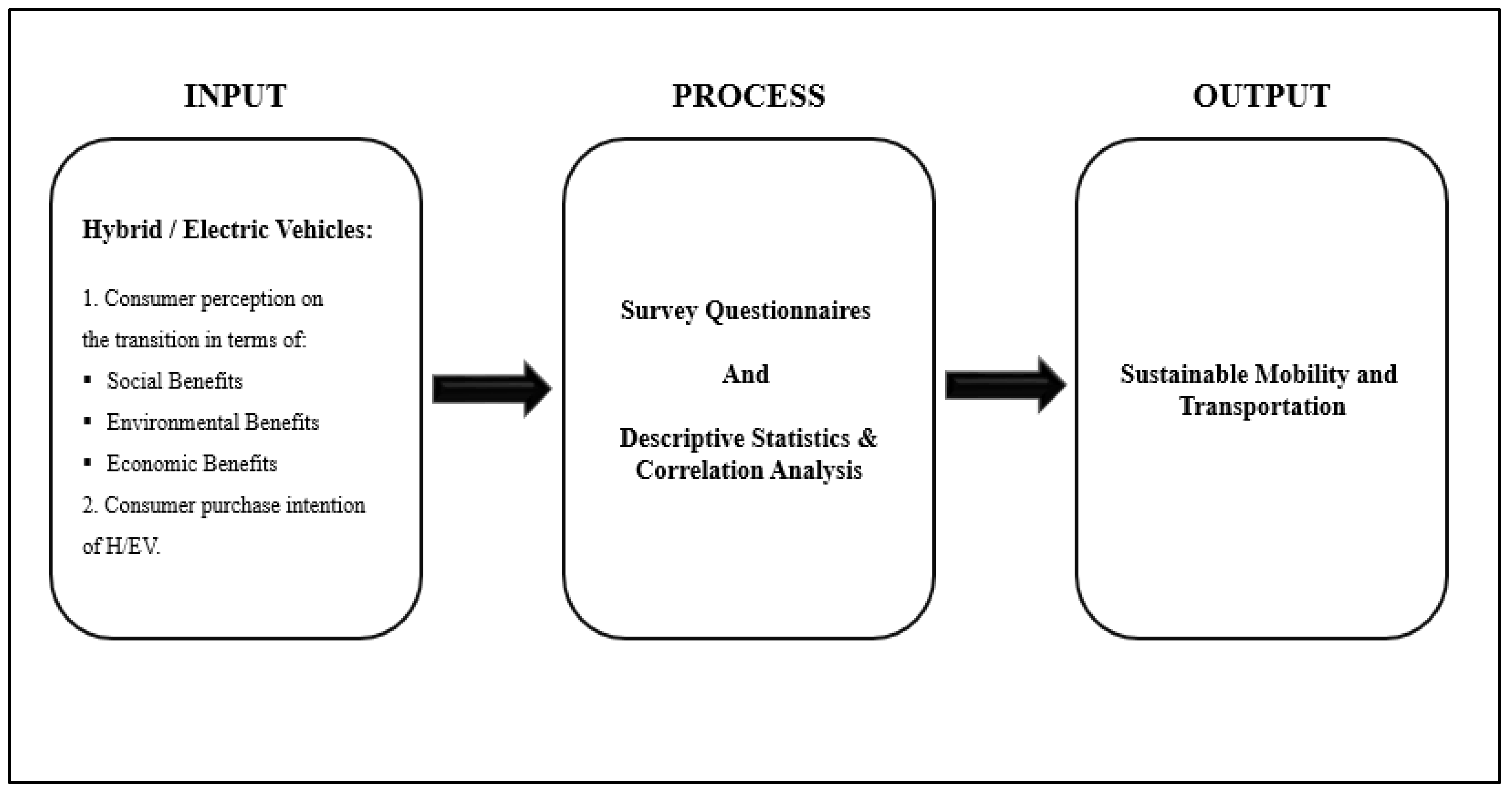
Figure 2.
Social Benefits and Purchase Intention Correlation Analysis.
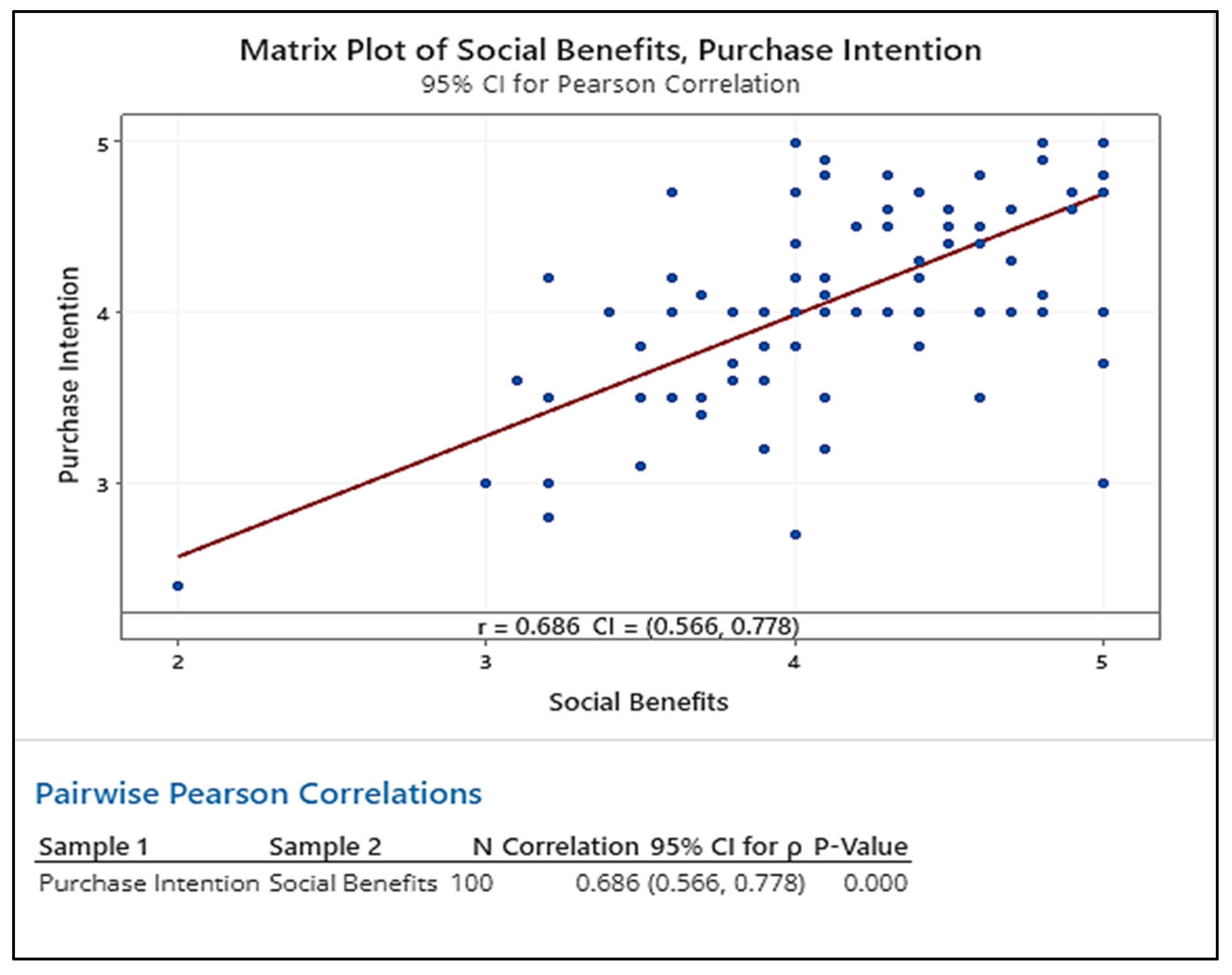
Figure 3.
Environmental Benefits and Purchase Intention Correlation Analysis.
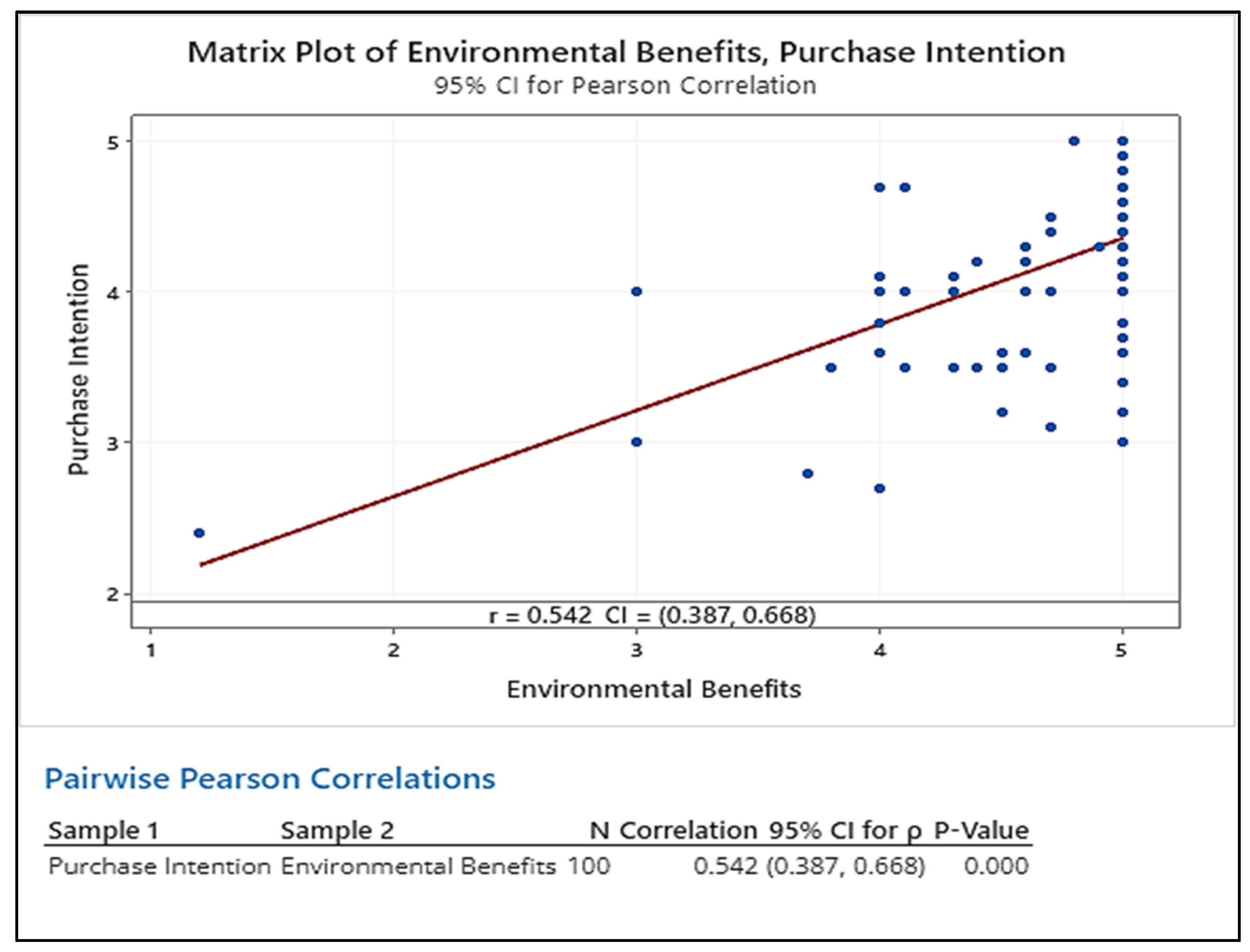
Figure 4.
Economic Benefits and Purchase Intention Correlation Analysis.
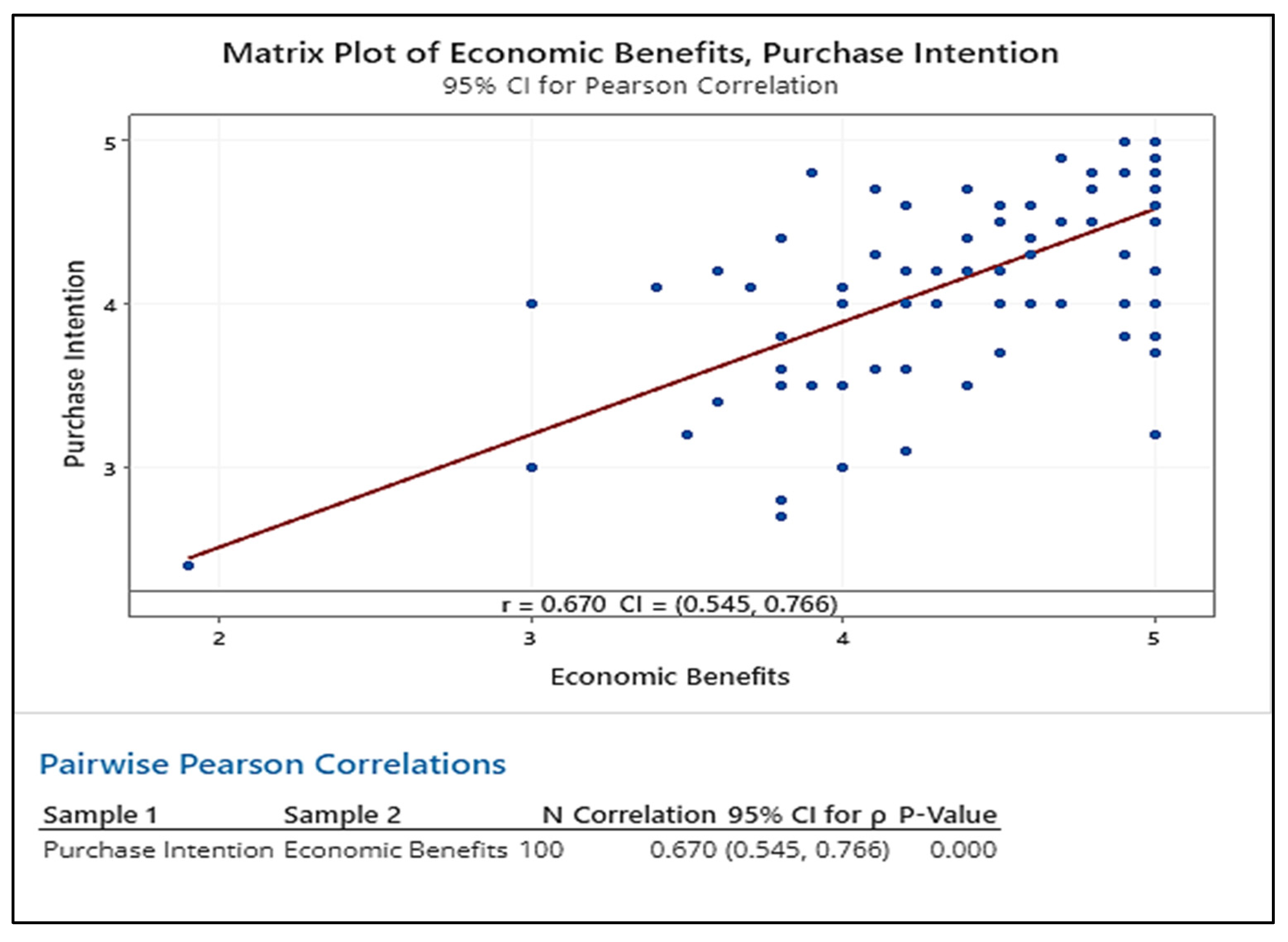

Table 1.
Demographic Profile of the Respondents.
| Demographic Information | Frequency n=100 |
Percentage | |
|---|---|---|---|
| Gender | Male | 52 | 52% |
| Female | 45 | 45% | |
| Prefer not to say | 3 | 3% | |
| Age | 25 years old and below | 21 | 21% |
| 26 to 50 years old | 72 | 72% | |
| 51 years old and above | 7 | 7% | |
| Educational Attainment | Diploma | 7 | 7% |
| College Degree | 66 | 66% | |
| Post-graduate Degree | 19 | 19% | |
| Others | 8 | 8% | |
| Current Job | Unemployed | 11 | 11% |
| Employed (Private Sector) | 55 | 55% | |
| Employed (Public Sector) | 17 | 17% | |
| Self-employed | 11 | 11% | |
| Others | 6 | 6% | |
| Monthly Salary/Income (Php) | 25,000 and below | 43 | 43% |
| 25,001 to 50,000 | 38 | 38% | |
| 50,001 to 75,000 | 8 | 8% | |
| 75,001 and above | 11 | 11% | |
Table 2.
Consumer Perception on Social Benefits.
| Consumer Perception on Social Benefits | Frequency n=100 |
Percentage |
|---|---|---|
| 5 - Strongly Agree | 40 | 40% |
| 4 - Somewhat Agree | 51 | 51% |
| 3 - Neither Agree nor Disagree | 8 | 8% |
| 2 - Somewhat Disagree | 1 | 1% |
| 1 - Strongly Disagree | 0 | 0% |
Table 3.
Consumer Perception on Environmental Benefits.
| Consumer Perception on Environmental Benefits | Frequency n=100 |
Percentage |
|---|---|---|
| 5 - Strongly Agree | 75 | 75% |
| 4 - Somewhat Agree | 21 | 21% |
| 3 - Neither Agree nor Disagree | 3 | 3% |
| 2 - Somewhat Disagree | 0 | 0% |
| 1 - Strongly Disagree | 1 | 1% |
Table 4.
Consumer Perception on Economic Benefits.
| Consumer Perception on Economic Benefits | Frequency n=100 |
Percentage |
|---|---|---|
| 5 - Strongly Agree | 52 | 52% |
| 4 - Somewhat Agree | 42 | 42% |
| 3 - Neither Agree nor Disagree | 5 | 5% |
| 2 - Somewhat Disagree | 1 | 1% |
| 1 - Strongly Disagree | 0 | 0% |
Table 5.
Consumer’s Purchase Intention.
| Consumer's Purchase Intention | Frequency n=100 |
Percentage |
|---|---|---|
| 5 - Strongly Agree | 36 | 36% |
| 4 - Somewhat Agree | 53 | 53% |
| 3 - Neither Agree nor Disagree | 10 | 10% |
| 2 - Somewhat Disagree | 1 | 1% |
| 1 - Strongly Disagree | 0 | 0% |
Disclaimer/Publisher’s Note: The statements, opinions and data contained in all publications are solely those of the individual author(s) and contributor(s) and not of MDPI and/or the editor(s). MDPI and/or the editor(s) disclaim responsibility for any injury to people or property resulting from any ideas, methods, instructions or products referred to in the content. |
© 2023 by the authors. Licensee MDPI, Basel, Switzerland. This article is an open access article distributed under the terms and conditions of the Creative Commons Attribution (CC BY) license (http://creativecommons.org/licenses/by/4.0/).
Copyright: This open access article is published under a Creative Commons CC BY 4.0 license, which permit the free download, distribution, and reuse, provided that the author and preprint are cited in any reuse.


