

Submitted:
13 April 2025
Posted:
14 April 2025
You are already at the latest version
Abstract
Wicked problems defy simple solutions. From climate change to mass shootings, their causes are not singular but systemic, interconnected, and often politicized. Yet in both public discourse and policy design, one-cause and root-cause thinking continue to dominate. This paper introduces Webs of Causality (WoC) and Connect-the-Dots (CtD) thinking as cognitively grounded, empirically supported frameworks for understanding and addressing wicked problems. Drawing on four complementary studies—including experimental interventions, national surveys, and systematic literature reviews—we demonstrate: (1) the persistent human tendency to select and politicize a single cause from a known WoC, and (2) the effectiveness of six DSRP-based cognitive moves in improving causal reasoning and solution design. Together, these studies validate a new cognitive protocol for mapping complex problems and designing systemic, simultaneous interventions. We argue for a paradigm shift in policy and education—away from partial, politicized solutions and toward comprehensive, coordinated responses that reflect the real-world complexity of the problems we face.
Keywords:
Webs of Causality (WoC)
; Systems Thinking
; Wicked Problems
; Policy Design
; DSRP-483
; Connect the Dots (CtD)
; Causal Complexity
; Root Cause Thinking
; One-Cause Thinking
; Metacognition
; Cognitive Complexity
; Perspective Circle (Pcircle)
; Simultaneous Solutions
; Polarization and Ideology
; Public Policy Frameworks
; 6 Cognitive Moves
; Empirical Systems Thinking
1. Introduction
The 21st century is defined by wicked problems—ill-structured, systemic issues that resist definitive solutions. Examples range from global climate crises to local school shootings. What makes them wicked is not just complexity, but our inability to align our mental models with the systemic nature of these problems. In a world increasingly volatile, uncertain, complex, and ambiguous (VUCA), our thinking remains largely linear, anthropocentric, mechanistic, and ordered (LAMO) [1].
Solving wicked problems requires a shift in thinking—a move from one-cause explanations to understanding and acting on Webs of Causality (WoC). These webs represent the interconnected nature of causes that must be addressed simultaneously, not in isolation. Equally important is the practice of Connecting the Dots (CtD), which turns systemic analysis into action. This paper explores how our mental models obstruct or enable systemic solutions and presents empirical data to support cognitive interventions that improve our ability to think in WoC and CtD terms.
To ground this paper in empirical evidence, we draw upon three distinct but complementary studies that collectively build a robust case for the adoption of Webs of Causality (WoC) thinking in addressing wicked problems.
2. Contribution of This Paper
This paper introduces the concept of Webs of Causality (WoC) as a cognitively grounded, empirically supported framework for understanding and intervening in wicked problems. While the literature on systems thinking is rich with calls to “think systemically,” few studies provide:
- Clear contrast between one-cause, root-cause, and systems-based models of causality;
- Empirical validation for metacognitive tools that improve systems thinking;
- A practical, teachable protocol for applying causal complexity in policy contexts.
Drawing on four complementary studies this paper demonstrates that:
- One-cause and root-cause thinking dominate public and policy discourse;
- Even minimal exposure to structured metacognitive prompts can significantly improve systems reasoning;
- The 6 Moves framework offers a replicable, scalable method for analyzing complex causal systems and designing integrated solutions.
3. Methods
This paper draws upon four independent but thematically aligned studies that collectively form the empirical and conceptual basis for the Webs of Causality (WoC) framework and its associated analytical method, the 6 Moves. Each study contributes evidence—experimental, survey-based, or case-based—highlighting the limitations of traditional causal frameworks and the need for cognitively grounded, systems-based approaches to wicked problem solving.
Study 1: The Fish Tank Experiments [2]
This collection of four studies tested whether brief exposure to prompts based on the DSRP theory (Distinctions, Systems, Relationships, and Perspectives) would increase cognitive complexity. Participants (N = 1,400) from a nationally representative U.S. sample were asked to describe an image of a fish tank. After giving an initial description, participants received a short cognitive prompt aligned with one of the four DSRP structures, and then gave a second description. The researchers conducted four separate experiments (one for each DSRP structure) and analyzed the before/after responses using multiple metrics of conceptual and linguistic complexity. Results showed statistically significant increases in systems thinking and conceptual richness following DSRP-based interventions, suggesting that even minimal exposure to metacognitive structures can meaningfully improve complex reasoning.
Study 2: Framework Effectiveness and Prevalence in Public Policy [3]
This study used a mixed-methods design consisting of a systematic literature review (SLR) and a national survey experiment to examine the effectiveness and usage of frameworks in policy design. The SLR reviewed 59 peer-reviewed publications across multiple disciplines to identify the most common frameworks used in public policy contexts. The analysis revealed that most frameworks—such as SWOT, logic models, and cost-benefit analysis—are applied descriptively and lack empirical validation. Only 13 of the 59 studies reported statistically significant findings, highlighting a major gap in evaluation rigor. In parallel, the study conducted a survey experiment with (N= 286) participants from various sectors: policy professionals, educators, and public-sector workers across domains. Results showed that despite facing complex and interdependent challenges, respondents primarily relied on non-systemic tools, with SWOT and logic models being the most frequently used. The study concludes that the mismatch between tool complexity and problem complexity presents a significant barrier to effective policy design, and calls for the adoption of agent-based, systems-oriented frameworks aligned with the nature of wicked problems.
Study 3: Wicked Solutions for Wicked Problems [4]
This study combined a systematic literature review with an original survey experiment to introduce and evaluate the Webs of Causality (WoC) model as a systems-based alternative to one-cause and root-cause approaches. The literature review examined 59 peer-reviewed publications on policy frameworks, of which only 13 reported statistically significant findings, highlighting a general lack of empirical validation across existing tools. In the empirical portion of the study, a national survey was conducted with 413 participants representing a demographically balanced sample of U.S. residents. Participants were shown an evidence-based WoC map of causes contributing to mass killings—derived from the Violence Project dataset—and asked to evaluate the effectiveness of various policy solutions. Despite the systemic presentation, most respondents selected a single dominant cause, typically aligned with their political ideology. Only 29% of participants demonstrated any systemic reasoning, and no respondent rated all policy interventions as “extremely effective”—despite expert consensus that all are necessary for meaningful changeWicked Solutions for Wi…. These findings reinforce the idea that access to causal data is insufficient; cognitive tools and structured metacognitive training are necessary to counter one-cause bias and foster integrative problem solving.
Study 4: New Hope for Policy Schools [5]
This study employed a mixed-methods approach, combining a systematic literature review (SLR) with a quasi-experimental survey intervention to evaluate the effectiveness of systems thinking frameworks in policy education. The SLR component reviewed scholarly and curricular literature on systems thinking in public policy education, revealing a continued overreliance on conceptual models and a lack of empirically validated approaches. The review supported the need for cognitive tools that could help students better navigate the complexity of wicked problems.
To test one such tool, the authors implemented a short video-based intervention introducing participants to one of five cognitive “moves” derived from DSRP theory. Each participant (N=988) responded to a hypothetical policy scenario before and after viewing a brief educational video illustrating one of the DSRP-based moves, yielding 1,976 paired observations. The results showed significant improvements in participants’ systems thinking capabilities, with 200–500% increases in move usage post-intervention. These findings provide the first population-level empirical evidence that brief training in the 6 Moves can improve causal modeling and problem framing, offering direct implications for curriculum design in policy education.
4. Results
Study 1: The Fish Tank Experiments [2]
- Brief DSRP prompts led to statistically significant increases in cognitive complexity across four experiments (Distinctions, Systems, Relationships, Perspectives).
- For example, Distinction prompts increased word use by 43% and conceptual complexity by 41% (IRR = 1.43 and 1.41, p < .001).
Study 2: Framework Effectiveness in Policy [3]
- Survey (N=286) showed that 46% of policy professionals use no framework.
- Of those who do, most use SWOT and CBA—tools with little empirical support and poor fit for complexity.
- 59-study literature review found that only 13 reported statistically significant results.
Study 3: Wicked Solutions Survey [4]
- Survey of 413 U.S. adults asked participants to rate solutions to a mass shooting WoC.
- 71% selected a single dominant cause, aligned with ideology.
- No participant rated all causes as “extremely effective,” despite expert consensus.
Study 4: New Hope for Policy Schools [5]
- 988 participants tested 6 Moves via short video prompts.
- Participants showed 200–500% increases in causal reasoning and problem-solving across the moves.
- Move usage improved significantly post-intervention (1,976 paired responses).
5. Contrasting Mental Models of Causality
Figure 1 illustrates the cognitive evolution from simplistic to complex models of causality. One-cause thinking, while intuitively appealing, assumes that a single factor is responsible for an outcome—often aligning with ideological preferences and leading to oversimplified solutions. Root-cause thinking takes a step further by identifying a single foundational factor from which all others supposedly emerge, yet still neglects interaction effects and systemic complexity and is overly linear for problems that are nonlinear in nature. In contrast, Webs of Causality (WoC) thinking embraces the dynamic interplay of multiple, interconnected causes.
Table 1 expands on this progression by comparing the assumptions, solution styles, policy implications, and common cognitive errors associated with each model. Together, the figure and table reveal the limitations of traditional causal models and highlight the need for a paradigm shift toward WoC thinking in addressing wicked problems.
Understanding these three models is not a matter of preference—it determines the success or failure of policy interventions.
One-cause thinking operates on the assumption that every problem can be traced back to a single dominant cause. This logic is appealing because it simplifies complexity into a manageable narrative, offering a clear culprit and a seemingly straightforward solution. It reflects the kind of linear, cause-effect logic often seen in headlines or political soundbites—e.g., “Mass shootings are caused by lack of gun control.” However, this model fails catastrophically in complex systems because it ignores the interacting variables, contextual dynamics, and feedback loops that generate the problem in the first place. Worse, one-cause thinking is highly susceptible to political and ideological hijacking, as individuals or groups attach their values to a preferred explanation, dismissing alternative or complementary causes. As a result, it often leads to ineffective policy responses and misdirected resources.
Root-cause thinking goes a step further than one-cause thinking by attempting to trace surface-level problems back to their most fundamental origin. It assumes a hierarchy of causation—where one deeper issue is the “true” source from which all others emerge. This logic is frequently used in business, engineering, and organizational development through methods like “5 Whys” or fishbone diagrams. While seemingly more sophisticated than one-cause thinking, root-cause analysis still falls short in the context of wicked problems because it prioritizes linear depth over lateral interconnection. Complex problems, like trees, are rarely reducible to a single root; they emerge from multiple, interacting, and co-evolving factors. Root-cause thinking can obscure important surface-level dynamics, reinforce confirmation bias, and lead to paralysis by analysis—endlessly searching for a mythical “core” issue instead of engaging with the system as a whole.
Figure 2.
Trees don’t have one straight root, neither do problems.

Webs of Causality (WoC) thinking embraces the reality that most meaningful problems—especially wicked ones—arise from a network of interacting, co-dependent causes. Instead of seeking a single cause or root, WoC thinking maps the system of causes and their relationships, acknowledging that each one may be necessary but not sufficient on its own. This model reflects how real-world problems function: dynamically, contextually, and often non-linearly. Its logic aligns with systems science and complex adaptive systems theory, recognizing that solutions must also be simultaneous, systemic, and iterative. While WoC thinking requires more cognitive effort and coordination, its strength lies in its accuracy and efficacy. It prevents simplistic fixes and politicized blame games, and instead offers a path toward multi-lever, collaborative interventions that match the complexity of the problem.
Where one-cause thinking seeks a single villain, and root-cause thinking hunts for the crime boss behind it all, Webs of Causality tracks all the co-conspirators working together. This shift is not semantic—it redefines how we must think, plan, and intervene.
6. Mass Shooting WoC and Political Polarization
One study [4] investigated how people respond to a well-documented WoC surrounding mass shootings. Despite being presented with a list of interrelated causes (i.e., Firearm Access, Mental Health Gaps, Lack of Mentorship, Violent Media Exposure, Unaddressed Trauma, Crisis Response Failures, Low Community Reporting, Mental Health Stigma, Safety Team Deficits, Shooter Glorification, Social Isolation, Public Unawareness) empirically derived from the largest database of mass shootings, most participants selected one cause as dominant, often aligning with their political affiliation. This tendency to isolate and politicize a single node in the WoC shows how polarization undermines collective understanding and action.
Figure 3.
Screenshot/Sketch of Mass Shooting WoC Map.
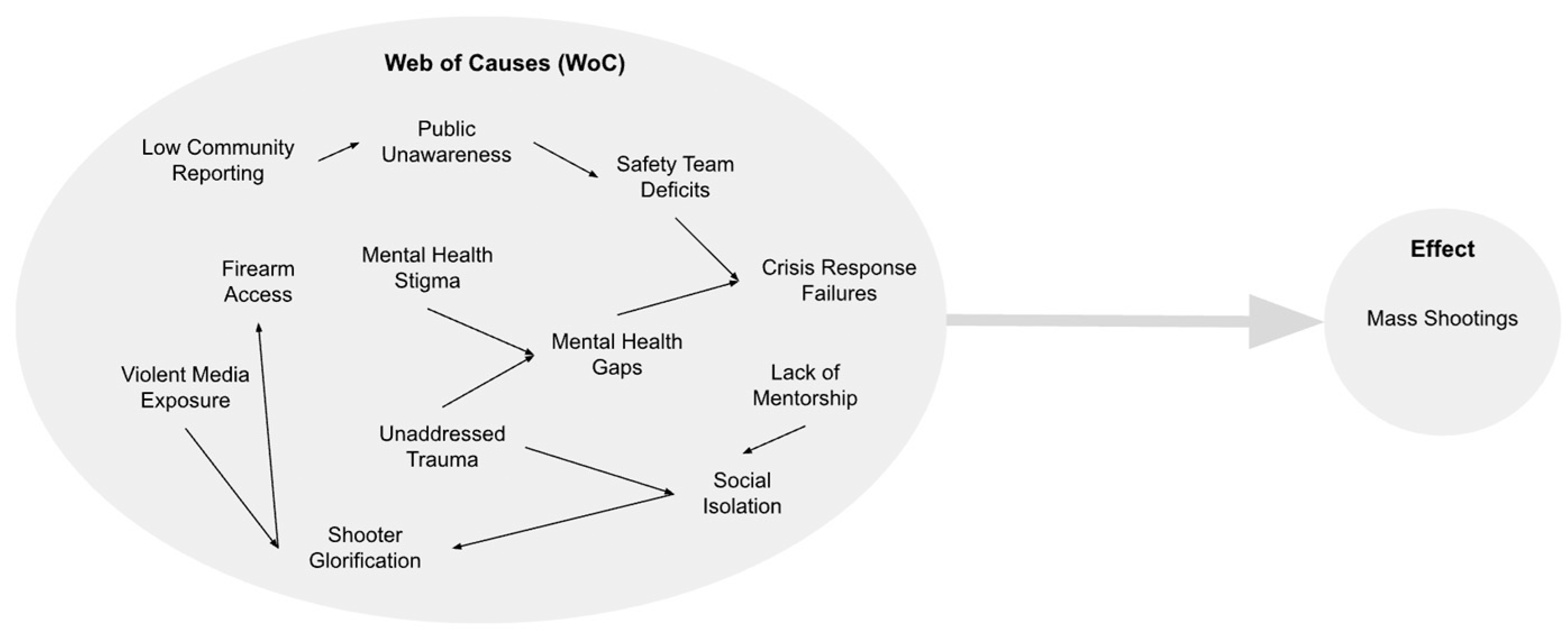
The study demonstrates a key insight: even when the public is made aware of a complex web of contributing factors, they revert to one-cause thinking that conforms to their ideological bias. This warrants concern because it also means that the general public, as voters, will lean toward one-cause or root-cause political messages and platforms that don’t connect the dots.
7. Politicization of Causes and the Role of Perspective
Figure 4 visualizes the dynamics involved with a WoC structure when combined with a perspective-circle (P-Circle) resulting in a failure of collective analysis, in which individuals or groups fixate on a single cause within a larger causal web based on their perspective or ideological alignment. This diagram demonstrates how two distinct ideological camps can each elevate different nodes in the same Web of Causality—such as focusing exclusively on gun access or mental health in the context of mass shootings—while ignoring the broader systemic interplay. The result is a fractured understanding of the problem, with each group advocating for isolated solutions and often dismissing or discrediting alternative views. This polarization not only undermines constructive dialogue but also impedes the implementation of integrated, systemic solutions.
This diagram uses the Perspective Circle (Pcircle) move (read more below) to illustrate how different ideological groups engage with a shared Web of Causality (WoC) surrounding mass shootings. Although the central causal map includes multiple empirically supported contributors—such as access to firearms, mental health gaps, school security, social isolation, and media violence—each stakeholder group tends to focus on just one cause that aligns with their worldview. Gun control advocates emphasize firearms access; others point to mental health gaps and shooter glorification in the news. This selective emphasis fragments the system and impedes coordinated, multi-lever solutions.
Table 2 provides real-world examples of how specific nodes within a Web of Causality become ideologically captured, turning multifactorial problems into battlegrounds of political identity. In the case of climate change, for example, progressive narratives may disproportionately emphasize fossil fuels while minimizing other systemic contributors such as consumption patterns or global inequality. Conversely, conservative narratives around school shootings often highlight mental health issues while downplaying or rejecting the role of gun access. This selective attention distorts the overall problem space and creates barriers to collaborative, systems-based policymaking. By mapping these ideological captures, the table underscores the urgent need for depolarized, perspective-inclusive approaches to wicked problems.
8. From Problem to Solution: Webs of Anti-Causes (WoAC)
While a Web of Causality maps the multiple interacting causes of a wicked problem, its inverse—the Web of Anti-Causes (WoAC)—offers a solution space. Anti-causes are interventions that reduce the likelihood, severity, or recurrence of causal contributors. For example, if “Access to Firearms” increases risk, then “Safe Storage Laws” may reduce it. If “Social Isolation” contributes to radicalization, then “Community Engagement Programs” can disrupt that pathway. The WoAC is not a list of isolated fixes; it is a network of coordinated interventions designed to work together. This model explains why one-at-a-time policies often appear to fail: not because they are ineffective, but because they are deployed in isolation, without reinforcement from the broader causal system they aim to address.
In the Web of Causality (WoC), we map the multiple interacting causes that contribute to a wicked problem. But embedded in that web—like a mirror image—is a powerful structure we call the Web of Anti-Causes (WoAC).
An anti-cause is a factor that has the opposite directional effect of a cause. Where a cause increases the likelihood, severity, or persistence of a problem, an anti-cause decreases it. Where a cause increases the problem an anti-cause decreases the problem. For example: If a cause of cancer is increased smoking, then an anti-cause is reduced smoking. If social isolation increases depression, then social support networks act as anti-causes.
When we map out all the anti-causes for a given WoC, we get the Web of Anti-Causes (WoAC)—a structurally parallel map that highlights the most leveraged points for systems-level change.
Figure 5.
WoC vs WoAC.
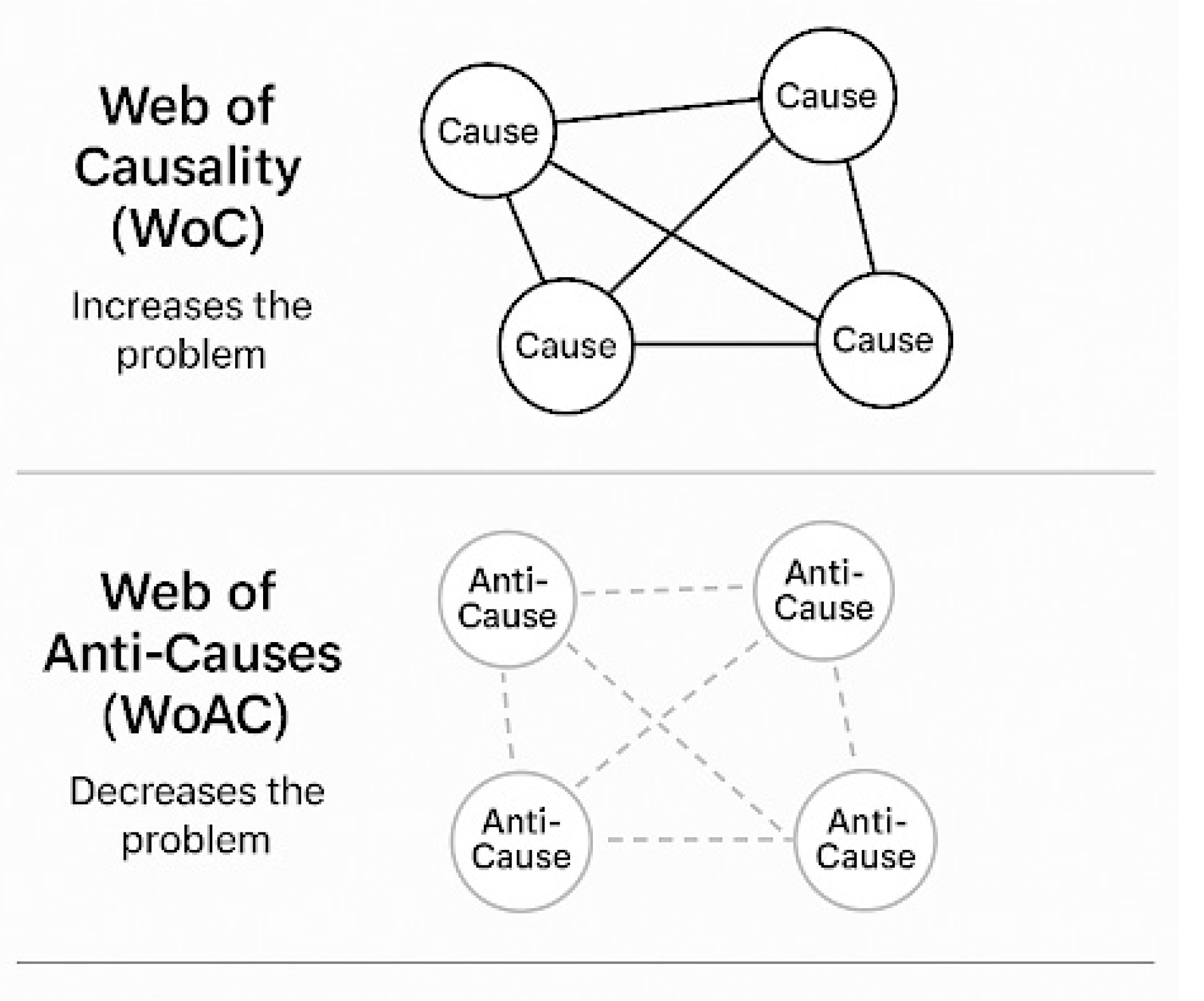
By flipping a web of causes into a web of anti-causes, we get a critical insight:
Solutions to problems are a Web of Anti-Causes.
Solutions are not merely a list of good ideas, they are a simultaneous, systemic activation of multiple anti-causes, designed to reverse the problem state. A one-at-a-time solution may fail because it relies on a single anti-cause, which is often insufficient against the full complexity of the WoC. An effective solution uses the entire WoAC—multiple anti-causes in concert—to make real systems change. Thus CtD is the process of connecting the dots on the WoC and the WoAC. The question then becomes how to effectively build the WoC so that you can flip it into a WoAC solution.
To support the shift from fragmented to systemic analysis, we introduce a validated, teachable cognitive method: the 6 Moves.
9. The 6 Moves: A Cognitive Protocol for Mapping Webs of Causality
To operationalize Webs of Causality (WoC) thinking, we introduce a validated cognitive framework called the 6 Moves. Derived from DSRP theory (Distinctions, Systems, Relationships, and Perspectives), these Moves provide a structured yet flexible method for surfacing causal complexity, mapping systems, and designing multi-lever interventions. Where traditional policy frameworks like SWOT or logic models offer linear or siloed views, the 6 Moves enable practitioners to think systemically—identifying boundaries, components, interdependencies, feedback loops, and ideological perspectives that influence both the problem and its proposed solutions.

Table 3.
The 6 Most Effective Cognitive Moves.
| Move | Purpose |
|---|---|
| Is / Is Not | Defines the problem by clarifying what it is and what it is not—exposing boundary assumptions and surfacing overlooked variables. |
| Zoom In | Scales the problem contextually, helping users understand micro-level details |
| Zoom Out | Scales the problem contextually, helping users macro-level dynamics simultaneously. |
| Part Party! | Identifies parts, agents, and nested subsystems involved in the problem—making visible the components often left implicit. |
| RDS Barbell | Surfaces relationships, directionality, and feedback loops—revealing how causes interact and co-determine outcomes. |
| Perspective Circle | Makes visible the perspectives that stakeholders hold, and how these perspectives shape what causes they see, prefer, or ignore. |
| Mapping | Integrates all the above into a cohesive visual model that reveals the full Web of Causality, supporting collective understanding and intervention design. |
The Moves are not merely conceptual—they are designed to be practiced, repeated, taught, and evaluated. In New Hope for Policy Schools [5] (Study 4), brief video-based interventions introducing participants to one of the 6 Moves led to statistically significant increases in causal reasoning, systems awareness, and problem-framing quality. Over 1,900 paired observations showed 200–500% increases in accurate usage of systems concepts after just one exposure. This provides strong empirical evidence that the Moves can shift how individuals conceptualize and address wicked problems. Each Move targets a specific dimension of systems thinking:Together, the 6 Moves function as a repeatable protocol for cognitively navigating complex problems. They are designed to be simple enough to teach, yet powerful enough to surface the deep structure of wicked issues. In this paper, we propose that the 6 Moves represent a viable step toward standardizing systems thinking as a practical cognitive methodology—not just a theoretical aspiration.
10. The Empirical Basis for DSRP-483 and 6 Moves
Empirical research into the cognitive impact of DSRP patterns and their associated “Moves” demonstrates a significant increase in cognitive complexity, problem solving, and higher-order thinking—even following minimal exposure. In a large-scale experimental study [2] involving over 1,400 participants, the Fish Tank Experiments revealed that a brief (<1 minute) metacognitive intervention on each DSRP pattern led to statistically significant gains in the complexity and richness of participants’ thinking across all four cognitive structures: Distinctions, Systems, Relationships, and Perspectives [6,7,8,9].
Specifically, the Distinction pattern (identity vs. other) produced a 43% increase in word use and a 41% increase in the complexity of those words, as measured by character length—a robust proxy for conceptual complexity. This effect size (IRR = 1.43 and 1.41, p < .001) suggests that simply prompting individuals to identify and differentiate elements in a system immediately improves their descriptive and analytical precision.
The Systems pattern (part-whole structuring) led to a 13.2% increase in total word use (p = .13), a 41.6% increase in unique word usage (p < .001), and a remarkable 49.2% increase in the complexity of those unique words (p = .13). While the change in total word use was not statistically significant, the increase in unique word usage—reflecting broader conceptual differentiation—was statistically significant, indicating enhanced part-whole reasoning.
Similarly, the Relationships pattern (action-reaction) increased word use by 15.5% (p < .001) and enriched the relational language and conceptual depth participants employed. Subjects were more likely to describe the interactions among elements, rather than listing them as isolated entities.
The Perspectives pattern (point-view) intervention resulted in a 16.5% increase in word use (p = .064), a statistically significant increase in character complexity (p = .013), and a significant increase in the number of concepts described (p = .002). These findings demonstrate that perspective-taking, even when briefly introduced, can enhance narrative complexity and foster more inclusive or multidimensional reasoning.
In parallel, the Moves study ([5], in review) tested these same cognitive patterns operationalized as “thinking moves” and assessed their practical efficacy. The results showed dramatic improvements across domains of problem solving, higher-order thinking, and emotional intelligence. The Is/Is Not List Move (linked to Distinction) resulted in a 5.51x (or 551%) increase in performance. Zoom In/Zoom Out Moves (related to Systems) showed a 2.66x (266%) improvement. The Part Party! Move and RDS Barbell Move (both reflecting the Relationships pattern) led to 2.47x and 5.08x gains, respectively. Finally, the Perspective Circle Move, which engages the Perspective pattern, produced a 4.47x (447%) increase in problem solving and emotional intelligence scores.
Together, these two lines of evidence—from cognitive complexity measures and applied problem-solving performance—provide a strong empirical foundation for the use of DSRP-based interventions and thinking Moves in increasing systems thinking capacities. They also underscore the potency of even short-term interventions, suggesting that long-term or repeated use would likely lead to transformative cognitive and practical gains.
The moves study [5] tested a quasi-experimental intervention involving short video trainings on six DSRP-based cognitive moves: Is/Is Not, Zoom In, Zoom Out, Part Party!, RDS Barbell, and P-Circle. Each move targets a core aspect of systems thinking and is designed to be content-agnostic and universally applicable.
Figure 6.
The 6 Moves as Tools for Building and Acting on Webs of Causality Each cognitive move contributes to forming and operationalizing a full causal web, culminating in the integrative act of Connecting the Dots.
Figure 6.
The 6 Moves as Tools for Building and Acting on Webs of Causality Each cognitive move contributes to forming and operationalizing a full causal web, culminating in the integrative act of Connecting the Dots.
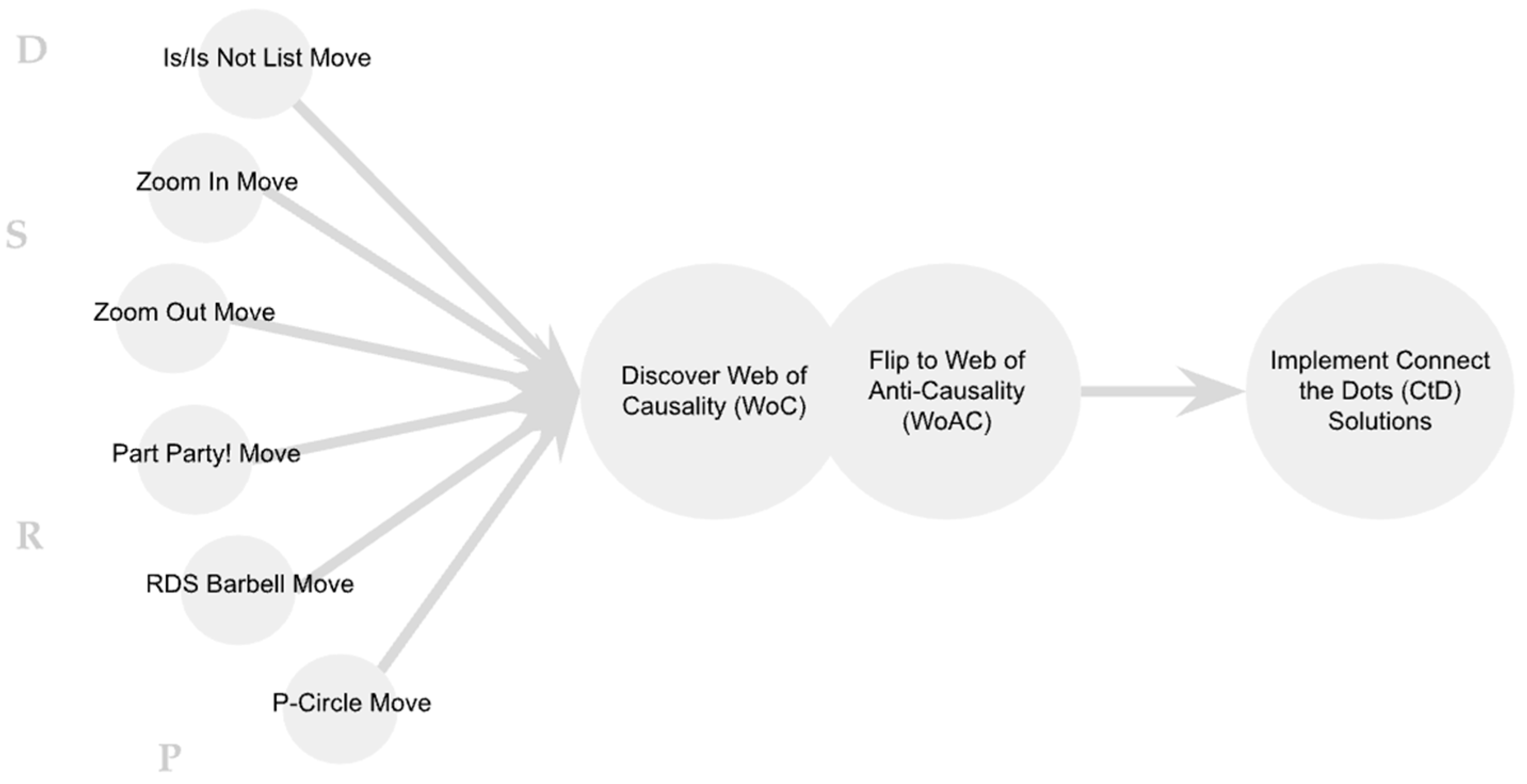
Table 4.
Effects of Minimal Interventions of DSRP and Cognitive Moves based on DSRP.
| Pattern & Elements | DSRP Findings after <1m intervention | Move(s) | Moves Findings after <1m intervention |
|---|---|---|---|
|
Distinction (D) = identity (i) ⇔ other (o) D =i ⇔o |
+43% increase in word use, +41% increase in character complexity (IRR = 1.43 and 1.41, p < .001) | Is/Is Not List Move | 5.51x or 551% increase in problem solving, higher order thinking and emotional intelligence (p < 0.01) |
|
Systems (S) = part (p) ⇔ whole (w) S = p ⇔w |
+13.2% word use, +41.6% unique words, +49.2% increase in character complexity of unique words (p < 0.001 for number of concepts) |
Zoom In Move Zoom Out Move |
2.66x or 266% increase in problem solving, higher order thinking and emotional intelligence (p < 0.01) |
|
Relationships (R) = action (a) ⇔ reaction (r) R = a ⇔r |
+15.5% in word use (p < .001), richer relational language and concept depth |
Part Party! Move RDS Barbell Move |
2.47x or 247% increase in problem solving, higher order thinking and emotional intelligence (p < 0.01) 5.08x or 508% increase in problem solving, higher order thinking and emotional intelligence (p < 0.01) |
|
Perspectives (P) = view (v) ⇔ point (ṗ) P = v ⇔ṗ |
+16.5% increase in word use, significant increase in varied perspectives and narrative complexity (p = 0.002 for concepts; p = 0.013 for characters) |
Perspective Circle Move (P-Circle) | 4.47x or 447% increase in problem solving, higher order thinking and emotional intelligence (p < 0.01) |
11. The Connect-the-Dots Model: From Analysis to Synthesis
Once we understand the web, we must act on it. CtD represents the synthesis phase: designing simultaneous interventions that address multiple nodes in a WoC. This approach avoids the trap of discrediting a valid solution simply because it was tried in isolation. Instead, it combines causal levers in coordinated strategies.
Figure 7.
Sequential vs. Simultaneous Implementation of WoC Policies Contrasts the common failure pattern of isolated intervention with the effectiveness of multi-node, synchronized approaches in wicked problems.
Figure 7.
Sequential vs. Simultaneous Implementation of WoC Policies Contrasts the common failure pattern of isolated intervention with the effectiveness of multi-node, synchronized approaches in wicked problems.
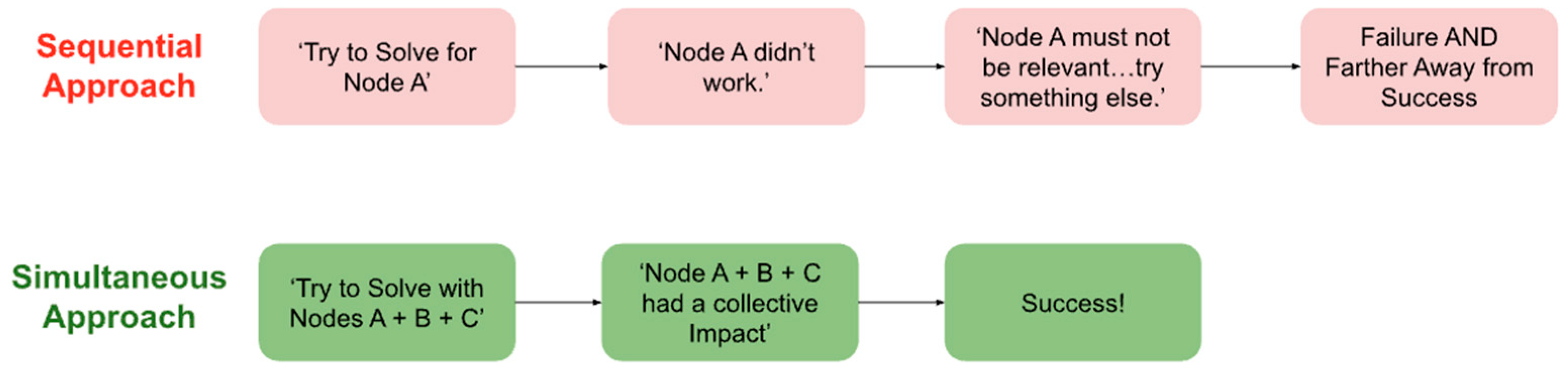
The six moves offer practical tools to design such multi-pronged solutions. For example, using P-Circle helps depolarize perspectives by mapping various stakeholder views; Part Party! and RDS Barbell reveal relationships and leverage points; Zoom In and Zoom Out balance the micro and macro; and Is/Is Not clarifies boundaries.
12. Implementation: Practicing the 6 Moves
The 6 Moves are not theoretical abstractions—they are actively used in educational, organizational, and policy settings. Because they are grounded in how people actually think (via DSRP), they are teachable, flexible, and scalable. We have used the Moves with students, leaders, analysts, and practitioners to unpack real-world problems ranging from youth violence and PTSD to climate adaptation and school reform. In practice, users often cycle through the Moves non-linearly, gradually refining their WoC map and translating it into a Web of Anti-Causes. This recursive process builds shared understanding and supports multi-lever, systems-informed action.
Case Vignette: Using the 6 Moves in a School District
In a mid-sized public school district facing a sharp increase in chronic absenteeism and student disengagement, district leaders used the 6 Moves to unpack the problem systemically. The initial framing—“kids just don’t care about school anymore”—reflected one-cause thinking. Using Is/Is Not, the team clarified what absenteeism was and wasn’t, surfacing issues like food insecurity and transportation barriers. Zoom In/Out revealed how day-to-day decisions (e.g., punitive attendance policies) intersected with broader community factors like housing instability. Part Party! mapped the relationships between these multiple causes. RDS Barbell zoomed into these relationships to reveal reinforcing loops between disengagement and academic performance, punitive policies and demotivation, lack of engagement and agency in curriculum. P-circle exposed how different stakeholders saw completely different causes—and blamed each other. The final Mapping session produced a Web of Causality that led directly to a solution plan (WoAC) including home visit outreach, community mentorship, and changes to how attendance was communicated. The Moves helped shift the conversation from blame to systems change and a solution that worked.
13. Discussion
From the boardroom to the clinic, and from national policy to personal well-being, problem-solving frameworks are central to how we navigate complexity. Yet most conventional frameworks in use today—such as SWOT or cost-benefit analysis (CBA)—are empirically unvalidated and cognitively misaligned with the reality of complex adaptive systems (CAS). As a systematic review of policy frameworks confirms, these tools persist due to institutional inertia, not evidence of effectiveness.
In contrast, the Connect the Dots (CtD) framework—grounded in DSRP Theory (Distinctions, Systems, Relationships, and Perspectives)—has been empirically shown to increase cognitive complexity and systems thinking. The Fish Tank Experiments demonstrate that even a one-minute intervention on DSRP patterns yields statistically significant gains in systemic cognition. CtD isn’t merely another framework—it’s a generalizable, metacognitive infrastructure for understanding webs of causality (WoC) and crafting effective interventions.
The application of WoC and CtD thinking extends across a continuum of complexity and across domains, including:
- Public Policy and Mass Shootings: Research (2021) [10] shows that despite widespread awareness of the multifactorial causes of mass shootings [10], public opinion and political discourse consistently reduce the issue to a single politicized cause (e.g., guns or mental health), ignoring the full web of causality. This leads to ineffective, polarized policy responses. CtD enables policymakers to embrace the multi-causal reality and design simultaneous interventions.
- Medicine and Holistic Health: Physician and metabolic health expert Dr. Casey Means [11] argues that chronic diseases are not isolated events but symptoms of a dysregulated system. Like CtD, her approach to medicine emphasizes seeing the whole system, recognizing upstream drivers, and intervening on multiple fronts simultaneously—metabolic, environmental, lifestyle, and emotional.
- Longevity and the 12 Gets: Dr. Peter Attia [12] highlights that optimizing for longevity is not a single variable challenge but a multi-system, multi-causal puzzle. His work aligns with the Cabrera’s [13] emphasis on the 12 Gets (e.g., Get Strong, Get Stable, Get Nourished, Get Sleep, etc.), which require parallel development, not sequential or one-cause interventions. This model exemplifies simultaneous WoC-based solutions in practice.
- Nutritional Health: It is often the case that the next new thing is one thing–fad diets that encourage you to focus on eating or not eating one thing or taking one silver bullet supplement. This, despite the fact that nutrition is a web of causality. CtD helps us move beyond the fads.
- Business Strategy and Organizational Design: Businesses often suffer from single-metric optimization (e.g., profit, KPIs), leading to downstream dysfunction. CtD reframes strategy as a dynamic system of interdependent parts—culture, operations, stakeholders, external forces—helping leaders balance tradeoffs and adapt across multiple feedback loops.
- Therapy and PTSD Recovery: Mental health protocols that focus only on trauma narratives without stabilizing the nervous system or social environment are often ineffective. CtD-informed PTSD recovery protocols use WoC logic to address the biological, relational, behavioral, and cognitive anti-causes in tandem—shifting from one-cause trauma theory to systemic healing maps.
- Cybersecurity and Threat Analysis: Attack vectors are not linear or isolated. A systems approach enabled by CtD helps analysts map threat surfaces, understand attacker behavior, and intervene at multiple weak points simultaneously—aligning defense strategies with the ecology of risk.
- Engineering and Product Design: CtD supports resilient design by making visible the interdependencies between parts, users, environments, and unintended consequences. It enhances failure analysis and supports agile, iterative cycles aligned with real-world feedback.
- Education: Learning is shaped by more than teaching—it emerges from the interaction of students, environments, and systems. CtD helps scaffold interconnected concepts and cultivate systems literacy across these layers, preparing learners for a complex, VUCA world.
- Technology and Systems Design: As technology systems scale in complexity (e.g., AI ethics, data governance), CtD supports better anticipation of emergent behavior and more responsible systems architecture.
- Everyday Problem Solving: From relationships to career choices, CtD helps individuals avoid overgeneralization and reductionism, encouraging a deeper understanding of underlying patterns and multiple interacting causes.
What unites all these domains is a shared challenge: the mismatch between the complexity of the problem and the simplicity of the tool used to solve it. Traditional frameworks impose linear logic on nonlinear problems, favor root causes when reality presents webs, and encourage isolated interventions instead of simultaneous strategies.
This mismatch is not just technical—it’s cognitive and cultural. Our brains favor simplicity, ideological alignment, and confirmation bias. Public narratives reinforce this with headlines that identify “the” cause, “the” solution. Over time, individuals align their identities and politics with specific causes in a WoC, leading to polarization, paralysis, and misdiagnosis.
The six CtD Moves—Is-Is Not, Zoom In-Zoom Out, Part Party!, RDS Barbell, and Perspective Circle—combat these biases directly. They train users to:
- See boundaries and exclusions (Is-Is Not),
- Adjust granularity (Zoom In),
- Consider the wider context (Zoom Out),
- Recognize webs of causality in systems (Part Party!),
- Adjust granularity in relationships to see dynamics and feedback (RDS Barbell),
- Map diverse stakeholder perspectives (Pcircle).
- Together, they transform how people see, think, and act.
14. Limitations and Future Directions
While this paper presents a novel, empirically supported framework for mapping and intervening in Webs of Causality, several limitations warrant acknowledgment. First, while the studies span experimental, survey, and review methods, more longitudinal research is needed to assess the sustained impact of the 6 Moves over time and in field-based implementations. Second, although the WoC and WoAC models are conceptually transferable, their operationalization across domains may require contextual adaptation, although the power of DSRP remedies this contextual problem. Finally, future research should explore integration with existing policy design protocols and evaluate the Moves in collaborative, high-stakes decision-making environments. We encourage further investigation of how WoC thinking can be scaled in institutions, education, and governance.
15. Conclusion
The demand for systemic solutions has never been higher, and yet our cognitive tools remain outdated. Whether tackling climate change, metabolic health, organizational dysfunction, or personal growth, the key is seeing and acting on webs of causality—not isolated factors. Connect the Dots, grounded in DSRP and supported by empirical research, offers a scientific, scalable, and flexible method to meet this challenge. It is not just a better framework—it is a cognitive upgrade for a complex world.
To solve the most wicked problems of our time, we must stop blaming and start mapping. We must move from asking "What's the cause?" to "What's the web?" and from implementing isolated fixes to designing coordinated solutions. Webs of Causality and Connect-the-Dots thinking, powered by the six DSRP-based moves, represent a scientifically grounded, pragmatically powerful, and urgently needed shift in how we understand and act in the world.
References
- Cabrera D, Cabrera L. Systems Thinking Made Simple: New Hope for Solving Wicked Problems in a Complex World. Odyssean Press. Ithaca: Odyssean Press; 2015.
- Cabrera D, Cabrera L, Cabrera E. The “Fish Tank” Experiments: Metacognitive Awareness of Distinctions, Systems, Relationships, and Perspectives (DSRP) Significantly Increases Cognitive Complexity. Systems. 2022;10. [CrossRef]
- Wen, A. , Hock, A., Carver, B., Ortega, A., Corsi, P., Jordan, J., Nicholson, A., Cabrera, L., & Cabrera, D. Framework Effectiveness and Prevalence in Public Policy: A survey of the field and a discussion of the need for an agent-based systems approach. Journal of Systems Thinking. 2022.
- Steinhall N, McPettit R, Bond J, Parks M, Khan M, Sharfarz D, et al. Wicked Solutions for Wicked Problems: Misalignment in Public Policy. Journal of Systems Thinking. 2023; 20.
- Aljrarri W ’ad, Bustamante J, Ingwell A, Labrada T, Nadig B, Shin J, et al. New Hope for policy schools: Examining systems thinking solutions to improve policy education. Journal of Systems Thinking. 2024; 1–61. [CrossRef]
- Cabrera D, Cabrera L, Cabrera E. Distinctions Organize Information in Mind and Nature: Empirical Findings of Identity–Other Distinctions (D) in Cognitive and Material Complexity. Systems. 2022;10. [CrossRef]
- Cabrera D, Cabrera L, Cabrera E. Systems Organize Information in Mind and Nature: Empirical Findings of Part-Whole Systems (S) in Cognitive and Material Complexity. Systems. 2022.
- Cabrera D, Cabrera L, Cabrera E. Relationships Organize Information in Mind and Nature: Empirical Findings of Action-Reaction Relationships (R) in Cognitive and Material Complexity. Systems. 2022.
- Cabrera D, Cabrera L, Cabrera E. Perspectives Organize Information in Mind and Nature: Empirical Findings of Point-View Perspective (P) in Cognitive and Material Complexity. Systems. 2022.
- Peterson J, Densley J. The Violence Project: How to Stop a Mass Shooting Epidemic. Abrams; 2021. Available: https://play.google.com/store/books/details?
- Means, C. Good Energy: The Surprising Connection Between Metabolism and Limitless Health. New York, NY: Avery Publishing Group; 2024.
- Attia, P. The Straight Dope on Cholesterol: 10 Things You Need to Know - Part 5. 2019.
- Cabrera, D. The 12 Gets. Cabrera Research Lab; 2024.
Figure 1.
Evolution of Causal Models Illustrates the cognitive progression from One-Cause to Root Cause to Webs of Causality (WoC) thinking, aligned with increasing realism and complexity.
Figure 1.
Evolution of Causal Models Illustrates the cognitive progression from One-Cause to Root Cause to Webs of Causality (WoC) thinking, aligned with increasing realism and complexity.

Figure 4.
Politicization of Webs of Causality (Pcircle Failure) Shows how ideological groups focus selectively on different causes within a causal web, reinforcing polarization and impeding systemic solutions.
Figure 4.
Politicization of Webs of Causality (Pcircle Failure) Shows how ideological groups focus selectively on different causes within a causal web, reinforcing polarization and impeding systemic solutions.
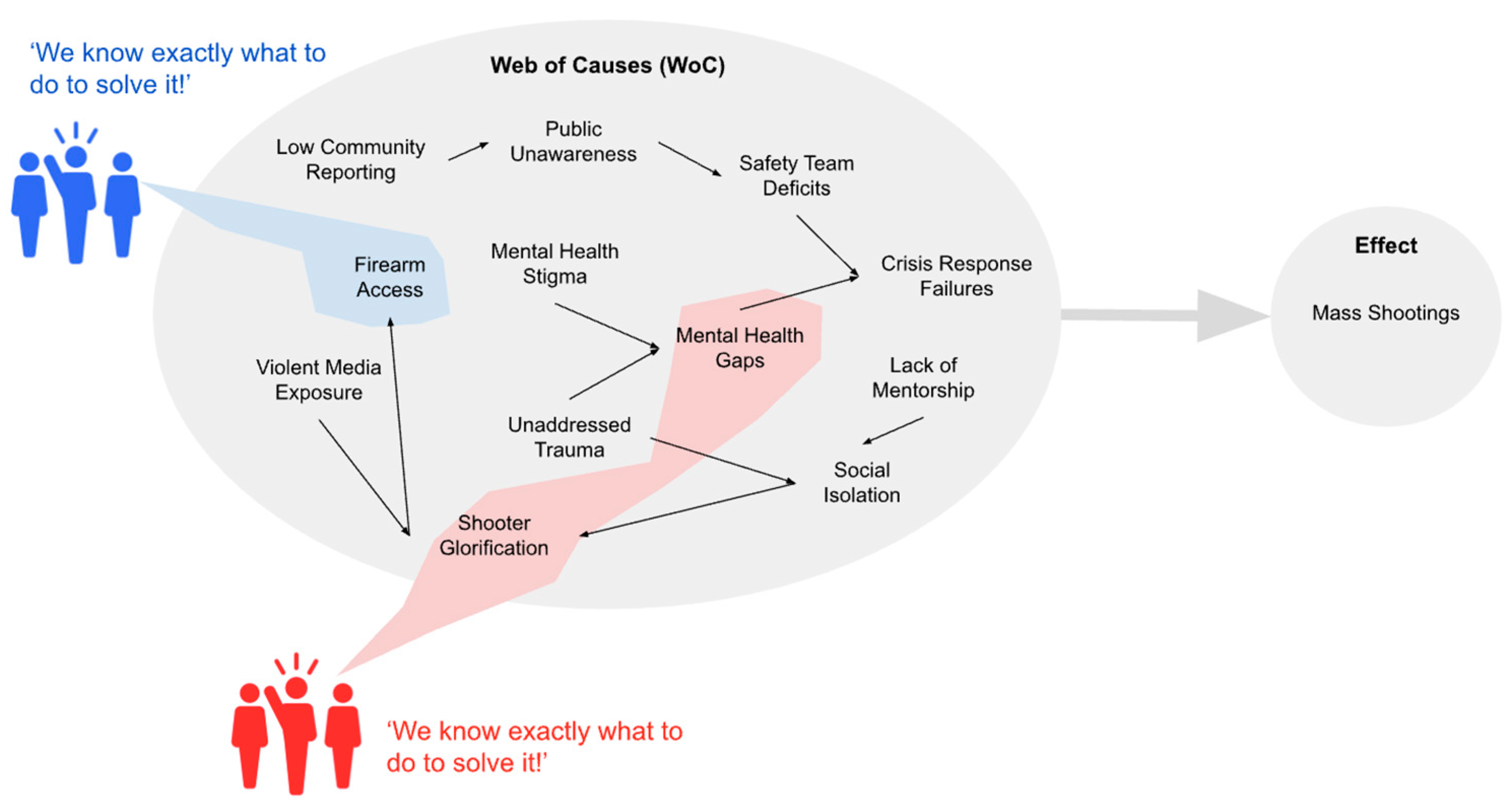
Table 1.
Comparison of Thinking Models.
| Causality Model | Core Logic | Strengths | Limitations | Example |
|---|---|---|---|---|
| One-Cause Thinking | A single factor explains the problem | Simplicity; persuasive storytelling | Oversimplifies; ignores interacting variables | “Mass shootings are caused by mental illness.” |
| Root-Cause Thinking | A linear path leads to a fundamental source | Deeper than surface symptoms | Assumes hierarchy; neglects feedback and co-causality |
“The real cause is family breakdown.” |
| Webs of Causality (WoC) | Multiple interdependent causes interact to co-create outcome |
Matches real-world complexity; supports multi-lever intervention | Harder to teach and act on; cognitively demanding | “Mass shootings arise from a complex mix of factors: access to guns, mental health, school security, social fragmentation.” |
| “Where one-cause thinking seeks a single villain, and root-cause thinking hunts for the crime boss, WoC tracks all the co-conspirators.” | ||||
Table 2.
Examples of Ideological Capture of Causal Nodes.
| Wicked Problem | WoC Node | Political Ideology | Polarizing Narrative |
|---|---|---|---|
| Climate Change | Fossil Fuels | Progressive/Green | 'It's all oil companies' |
| Conservative/ Conspiratorial |
'It's a hoax.’ | ||
| School Shootings | Gun Access | Conservative | 'It's not guns, it's mental health' |
| Liberal | 'It's not mental health, it's the guns’ |
Disclaimer/Publisher’s Note: The statements, opinions and data contained in all publications are solely those of the individual author(s) and contributor(s) and not of MDPI and/or the editor(s). MDPI and/or the editor(s) disclaim responsibility for any injury to people or property resulting from any ideas, methods, instructions or products referred to in the content. |
© 2025 by the authors. Licensee MDPI, Basel, Switzerland. This article is an open access article distributed under the terms and conditions of the Creative Commons Attribution (CC BY) license (http://creativecommons.org/licenses/by/4.0/).
Copyright: This open access article is published under a Creative Commons CC BY 4.0 license, which permit the free download, distribution, and reuse, provided that the author and preprint are cited in any reuse.


