
Submitted:
12 April 2025
Posted:
14 April 2025
You are already at the latest version
Abstract
Green entrepreneurship is a potent force in constructing a more sustainable future. Green entrepreneurs can drive breakthrough ideas, encourage the creation of sustainable businesses, and foster sustainable development through advocating sustainable behaviors and technology. This study addresses Climate Change and Environmental Issues, adding to the recent wave of research on green entrepreneurship. It evaluates empirically whether green economic, social, and environmental performance and green entrepreneurial activities are correlated. Every Maharashtrian entrepreneur or startup business owner who participates in the survey provides data. Structural Equation Modeling was used to statistically analyze the data and show the predictions made based on the literature research. The study's conclusions showed that green entrepreneurship has a favorable influence on green social, economic, and environmental performance. Also, the result shows that green social, economic, and environmental performance has a significant connection between the firms’ climatic change and environmental issues. The study recommends that entrepreneurs who are managing or want to launch new green businesses should receive help from policy initiatives. Policies should thus address other obstacles that green entrepreneurs have to conquer.
Keywords:
Green Entrepreneurship
; Sustainable Business
; Green Business
; Green Entrepreneurs
; Green Entrepreneurial Activities
1. Introduction
Since the late 1990s, the idea of green entrepreneurship has gained popularity, and it has continued in recent years. [1]. The idea of "green entrepreneurship" encompasses aspects of entrepreneurship such as creativity, risk, a fresh business model, and the environmental commitment of individuals doing business [2]. A green entrepreneur is a person who establishes a company to produce goods, provide services, or employ environmentally friendly practices technology and products are developed through green entrepreneurship to address environmental issues [3]. A new form of entrepreneurship termed "green entrepreneurship" is dedicated to environmental sustainability and blends a fierce sense of business with an understanding of sustainability and other environmental movement tenets, according to which environmental compatibility must always be established and defined [4]. Identifying technical advancements that lessen human influence on the environment and taking into account global environmental challenges like climate change are the primary goals of the majority of policy mechanisms that enable green growth [5].
Although the phenomenon is to develop green entrepreneurship, more research is needed. To give firms a competitive edge, green entrepreneurship strives to combine the environmental and social benefits of their operations [6]. Sustainable development entails the process of attaining economic and social development in a way that doesn't completely deplete a nation's natural resources while preserving and enhancing the standard of living for people who depend on the ecosystems around them [7]. Focusing on environmental protection is one of the forms of growth, particularly sustainable development, thus over the past two decades, policy-making has always placed a high priority on sustainable development as a business problem [8]. Sustainable business owners aim to maximize "gain," where "gain" is broadly defined as the advantages that accrue to people, the economy, and society in both a financial and non-financial sense [9].
In search of chances to create future profitable products, processes, and services, is executed to "preserve nature, life support, and community." In comparison to "social" and "environmental" entrepreneurship, "sustainable" entrepreneurship takes into account the demands of future generations [10]. However, since it combines the creation of 3 values (environmental, social, and economic), the sustainability of entrepreneurship is seen as a unique strategy. The idea of business growth is most frequently discussed in conjunction with another important idea which is entrepreneurship [11]. The development that entrepreneurship brings about positive growth, performance, or stability is the result of several circumstances and actions [12]. Creating, modifying, and integrating processes that result in sustainable and lucrative business possibilities is the goal of sustainable entrepreneurs [13]. These goals give growing business owners a foundation on which to build something enduring. Entrepreneurship is a key factor in creating domestic markets, networks, and systems since it propels institutional growth [14]. However, the level of effect on the overall sector is conditional and varied across national boundaries because of systemic pressures and institutional differences [15].
Growing the number of business owners who are committed to environmental sustainability also helps to grow the number of recent graduates who are interested in breaking into this field [16]. Consumer behavior is changing in favor of ecological and environmentally conscious goods due to the growing interest in environmental protection among consumers worldwide today. The market for green firms can benefit both corporations and the environment of social acceptance [17]. The study looks into environmentally sustainable business practices and the purpose of green entrepreneurship in addressing climate change and environmental issues in Maharashtra.
To comprehensively examine the role of green entrepreneurship in fostering sustainable development in Maharashtra, a novel framework is proposed that integrates variables and explores their interrelationships. Green entrepreneurship in this context encompasses innovative approaches, proactive initiatives towards environmental issues, and risk-taking tendencies in adopting sustainable practices within startup businesses. The framework will analyze how these entrepreneurial behaviors impact environmental and climate change outcomes specific to Maharashtra. It aims to uncover pathways through which green entrepreneurship influences environmental quality, economic performance linked to sustainability, and social impacts. Methodologically, the study will employ both quantitative analyses to statistically model relationships and qualitative insights to delve into contextual nuances and stakeholder perceptions. By introducing novel variables and considering local socio-economic factors, the framework seeks to offer original contributions to the discourse on green entrepreneurship's role in sustainable development. Ultimately, the framework will provide actionable recommendations for policymakers and stakeholders to enhance the effectiveness of green entrepreneurship initiatives in mitigating environmental challenges and promoting sustainable growth in Maharashtra.
- To examine the role of green entrepreneurship that affects the sustainable development of Maharashtra.
- To determine the impact of innovation, proactiveness, risk tendency, green social, environmental, and economic performance on climate change and environmental issues in startup businesses in Maharashtra.
Specifically, the research questions for the present study are:
RQ1: Do environmental concerns and climate change benefit from greenentrepreneurship and sustainable business practices?
RQ2: What impact does green entrepreneurship have on Maharashtra's environmental problems and climate change?
2. Literature Review
The success of businesses may be influenced by several things. These factors include an individual's capacity for entrepreneurship, which is the ability to translate ideas into deeds [18]. Table 1 lists the sources that were consulted to establish this study's framework for environmental practices, green entrepreneurship, and sustainable development, along with their contributions.
2.1. Related Works:
In 2018 Maryam Lotf et al., [19] investigated how emerging green markets, sustainable development, and green entrepreneurship are related to one another. Based on the literature, a comprehensive study model has been created. The study's findings suggested that sustainable growth and eco-friendly entrepreneurship in knowledge-driven companies had been positively and significantly impacted by the establishment of the green market.
In 2018 Yu-Hsien Lin and Hsin-Chung Chen [20] studied the effects of green relationship quality (GRQ) and green entrepreneurial orientation (GEO) on green service innovation (GSI).After that, exploratory factor analysis (EFA) with varimax rotation was used to determine whether the scale indicators were suitable for gauging all three dimensions. The study's findings suggested that GRQ mediates the link between GEO and GSI and has a beneficial impact on GSI.
In 2019 ArdjoumanDiabate et al., [21] analyzed information about how entrepreneurs' skills (EAs) impact SMESG in Côte d'I voire and evaluated how much entrepreneurial orientation (EO) affects the relationship between EA-SMESG. Except for learning capacity, the findings of hypothesis testing supported a relationship between SMESG and every aspect of EA. Regarding the EO's moderating function, entrepreneurial innovation considerably and positively influences EA and SMESG interaction is regulated.
In 2020 Wasim Qazi et al., [22] developed to investigate the moderating effects of environmental values on the influence of personality traits and university support for green entrepreneurship on green entrepreneurial ambitions. Analysis of confirmatory factor and PLS-SEM were the statistical methods used on the data. The findings showed Personal characteristics are strongly and favorably connected with the green business, while risk-averse students showed negligible outcomes.
In 2021 Chaiyawit Muangmee et al., [23] analyzed the benefits of a green entrepreneurial approach to green innovations and sustainable business performances in Thailand's automotive components sector. Data analysis has been carried out using the PLS-SEM method. The outcome indicated that ecological and economic impacts were most pronounced with green technologies. Green innovation was included in the present research as a strategic talent for SMEs' performance.
In 2021 Wenke Wang et al., [24] green entrepreneurial self-effacing, optimism, ecological ideals, and social responsibility were examined, as well as the mediating function of green entrepreneurial motivation examined the impact of the COVID-19 program on college students' intention to be green entrepreneurs. On samples of 410 Chinese college students, the study tested the hypothesis using a structural equation model. Results showed a substantial positive association connecting optimism and sustainable entrepreneurial self-efficacy, along with a strong positive relationship between ethical behavior and ecological values.
In 2021 Zahid Yousaf et al., [25] explored how sustainable development (SD) in the hospitality industry is directly impacted by green motives (GM) and green business strategies (GBS). It looked at the connections between GM and SD. Gathered data from top owners (451) and managers of the hotels (54) that are now operating in Pakistan. Used quantitative methods such as regression, and correlation. Results showed that GM and GBS help the hotel business reach its SD goals. An additional finding illustrated how GBS functions as a mediator in the relationship between the GM and SD.
In 2023 Nosheena Yasir et al., [26] studied the influence of environmental value, perceived behavioral control, subjective standards, and attitudes towards sustainable entrepreneurship on intentions for sustainable business. The study examined an updated version of the theory of planned behavior in addition to collecting survey data from 418 students in Pakistan's Lahore and Faisalabad. The findings of the study demonstrated that environmental value, perceived behavioral control, and the significance of the surrounding environment all have an impact on attitudes toward sustainable business, both directly and indirectly.
In 2024 Marcos Carchano et al., [27] investigated the influence of top management commitment on green entrepreneurship in the Spanish wine sector. They used a Structural Equation Model (SEM) and found that demand for sustainable products, regulation, and top management's environmental commitment positively influence environmental innovation. Their findings have significant implications for environmental management and political regulation literature, particularly in the context of the wine sector.
2.2. Research Gap
The most current research publications are included in Table 1. As for the green market on green entrepreneurship, enhancing green service innovation, and personality traits on green entrepreneurial are a few current research studies. Due to the very limited amount of research publications available about the role of green entrepreneurship in environmentally sustainable business practices, there was a significant gap in the collection of information. A structural equation model was necessary to have a deeper comprehension of green entrepreneurship in environmentally sustainable development. The primary concern was the spread of pollution and its negative impacts and repercussions, as well as the putting greater pressure on the environment surrounding humans, are the fundamental causes of these changes. Inferential statistics are commonly employed in quantitative approaches to test hypotheses. So, the purpose is to investigate the role of green entrepreneurship in environmentally sustainable business practices in addressing climate change and environmental issues in Maharashtra.
2.3. Theoretical Background
This research examines how green entrepreneurship contributes to the growth of environmentally sustainable businesses for startup business owners in Maharashtra. It is predicated on the resource-based view's (RBV) theories. This study's main focus is on the social, economic, and environmental effects of sustainable development. Wernerfelt, 1984 [28] pioneered the resource-based perspective concept, which illustrates how an organization's specific capabilities provide it with a competitive advantage in the marketplace. According to RBV, the distinctive and unusual characteristics of an organization contribute to its capacity to retain a competitive edge [29,30,31]. Furthermore, specific internal and external resources are crucial components that develop competitive advantage, according to Xie, 2019 [32]. As a consequence of overwhelming internal and external pressure to respect environmental standards, businesses are completely implementing green initiatives [33,34]. Businesses must employ green technology, manufacture green goods, and apply green supply chain techniques to accomplish green strategies [35,36]. A green entrepreneurial strategy, by the resource-based view (RBV) paradigm, results in sustainable development, which offers firms a competitive edge and influences their output in all aspects of the environment, society, and the economy.
The paper builds a conceptual model that reflects the relationships between green entrepreneurship and its impact on social, economic, and environmental performance. A summary of the current theoretical background and related previous research served as the basis for providing the study's structure. The most significant sources consulted for this study's paths in sustainable development, green entrepreneurship, and environmental practices are listed in Figure 1.
2.3.1. Green Entrepreneurship and Firm Performance
The Triple Bottom Line (TBL) model emphasizes the significance of economics, society, and the environment as factors of business performance [37,38]. This study addressed all three variables from the standpoint of SMEs since they are crucial for long-term innovation and company performance [38]. By this, experts have highlighted the relevance of financial success, social welfare, and environmental quality in the general public's well-being [39,40]. Scholars contend, however, that businesses are more concerned with the economic aspect than the social and environmental. Some authors attempted to strike a balance between the economic and social on the one hand [41] and the economic and environmental on the other [42].
Organizations all around the world are using environmental strategies to improve environmental performance and gain a competitive advantage [43,44]. In this regard, environmental rules provide additional pressure on managers to meet environmental standards [45]. Environmental performance is an essential component of organizational strategy since it covers green innovation and market-leading business strategies [46]. As a result, firms that have incorporated environmental performance into their business objectives have a competitive edge [47]. According to the current research, enhanced operational activities and increased productivity contribute to better environmental performance of enterprises [38,48,49].
All components play an important part in the achievement of company performance [42] for the effective running of the firm. Green strategy execution increases business market position and financial performance from an economic standpoint [50,51]. Green initiatives influence organizations as well as financial indices, consumers, vendors, and the government [38,52]. Other researchers have concluded that green innovation has a direct impact on operational effectiveness, which leads to firm economic success [38,53,54].
Organizations all across the world are using environmental strategies to improve environmental performance and gain a competitive advantage [55]. Environmental performance is a vital element of structural policy that covers green invention and market-leading commercial policies. As a result, firms that have incorporated environmental performance into their business objectives have a competitive edge [47].
The following hypothesis is put forward in context with the prior research demonstrating how green entrepreneurship (Innovation, Proactiveness, and Risk Tendency) improves the social, economic, and environmental performance of the firms:
H1:
Green entrepreneurship (Innovation, Proactiveness, Risk tendency) has a significant impact on social performance.
H2:
Green entrepreneurship (Innovation, Proactiveness, Risk tendency) has a significant impact on economic performance.
H3:
Green entrepreneurship (Innovation, Proactiveness, Risk tendency) has a significant impact on environmental performance.
2.3.2. Green Performance in Climate Change and Environmental Issues
Entrepreneurship is described as the act of starting a firm and growing it to make a profit. A broader meaning of the phrase is frequently employed, particularly in economics. In this context, an entrepreneur is a person or entity with the capacity to identify and capitalize on chances to transform innovations or technologies into novel products [56]. Green entrepreneurs identify possibilities and approaches to environmental and climate change challenges that the normal person simply sees as obstructions and hurdles. The notion of green entrepreneurship arose as an outcome of environmental issues such as pollution, climate change, global warming, natural resource shortages, and other ecosystem disruptions [57].
Green entrepreneurship is the practice of deliberately dealing with social, economic, as well as environmental needs through the development of high-risk entrepreneurial ideas that have a net beneficial impact on the natural environment while remaining financially viable [58]. Individual businesses and numerous organizations have grown more environmentally responsive as a result of rising awareness of environmental obstacles, sustainable development, and green economy; these factors are also responsible for influencing customer attitudes toward green products and their opinion of green products, which creates possibilities for the growth of the green market [59].
Although entrepreneurs are individuals or entities who foresee new businesses and creative opportunities and take the risks required to make those dreams a reality, there is a differentiation to be made between the green businessman/entrepreneur and the traditional entrepreneur. Both are produced, launched, summarized, and managed with the purpose of creating profit in new firms and innovation [60]. However, the green entrepreneur, on the contrary, strives to generate a business model that is both profitable financially and gives social and environmental advantages in climate change resilience and business sustainable growth. To address the aforementioned idea, the following hypotheses (H4, H5, and H6) were developed.
H4:
Green social performance has a significant impact on climate change and environmental issues.
H5:
Green Economic performance has a significant impact on climate change and environmental issues.
H6:
Green environmental performance has a significant impact on climate change and environmental issues.
3. Research Methodology
3.1. Theoretical Framework
The theoretical framework of the methodology revolves around examining the role of green entrepreneurship that affects the sustainable development of Maharashtra. To determine the impact of innovation, proactiveness, risk tendency, green social, environmental, and economic performance on climate change and environmental issues in startup businesses in Maharashtra. The framework integrates related sustainable development, green entrepreneurship, and environmental practices (fig 1)
3.2. Data Collection and Sample
The study's target audience included Ghanaian green entrepreneurs who registered their firms in the Maharashtra Registrar of Companies (ROC) in the previous 5 years. Based on the list of authorized enterprises, 800 entrepreneurs were chosen at random, with 200 of them working in textiles, recycling and waste management, solar energy, and some other industries. The particular firms were contacted by telephone to request their permission to take part in the investigation; 24 industries were rejected, and 15 were unable to be reached. The surveys were distributed to the 110 firms who showed an interest in participating. Each company's CEO or owner was given a questionnaire to complete. In all, 420 questionnaire forms were sent back, with 41 of them being discarded owing to erroneous or incomplete replies. As a result, 379 usable questionnaires were employed for the study, yielding a 90.2 percent response rate, which is comparable with previous research [38,43]. Participants were chosen using both random sampling and stratified methods. The categories of green entrepreneurs were utilized as strata in the study, and after reaching the 379-sample size, data were collected from every stratum. Random sampling promotes equitable representation and decreases sample mistakes.
3.2.1. Sample Description
Based on a frequency analysis with SPSS software, Table 2 presents the results. The entrepreneurs' attributes include gender, age, the greatest degree of schooling, and business age. In terms of gender, 74.7% of businesspeople in Ghana who register their industries with the Maharashtra Administrator of Companies are males, while just around 25.3% of entrepreneurs are female. Data generally show that men and women with varying degrees of education, ranging in age from 25 to over 50, manage SMEs in Maharashtra. Since the majority of respondents (41.7%) were over 25, it may be inferred that most businessmen start their enterprises after they turn 25.Additionally, the data reveals that 45.1% of the owners have graduate degrees. The features of the businesses that were measured were their business age. It indicates that most of the company's age ranges from 4 to 6 years (40.9%).
3.2.2. Measures
Questionnaires including information on Innovation, Proactiveness, Risk tendency, Green environmental, Economic, and social performance, climate change, and environmental issues will be used to gather the data. Emails, social networking sites (such as Facebook, LinkedIn, etc.), and in-person meetings will be used to distribute the questionnaires. The participant will be given a Likert scale containing five options for startup business owners in Maharashtra (1-Strongly Agree, 2- Agree, 3-Neutral, 4-Disagree, 5-Strongly Disagree). Table 3 shows Questionnaire Measures and Constructs/Item
3.3. Research Design
Quantitative research on "Analysis of the emergence of environmentally sustainable business practices and the role of green entrepreneurship in addressing climate change and environmental issues" was determined. Every startup business owner in Maharashtra will be surveyed for the study. Non-probability convenience sampling methods will be used for data gathering. The objectivist assumption, as applied in this work, implies that the investigators are unaffected by the factors under consideration. Throughout the inquiry process, the quantitative method encourages the use of statistical and mathematical frameworks in scientific research [61]. These study approaches and procedures have been employed in previous relevant studies [38,43,62].
3.3.1. Tools
Structural Equation Modelling, or SEM, techniques were used to examine the study. When analyzing predictive research frameworks and models at the beginning of theoretical development, like in this work [63]. Because the study of the emergence of environmentally sustainable business practices and the role of green entrepreneurship in addressing climate change and environmental issues is still in the initial phases of the observed study, the main goal was to investigate how establishing an innovative green entrepreneurship model might enhance actor the measuring model's outcomes are initially shown via SEM analysis, followed by the results of the entire structural model. To confirm that the necessary good fit levels were satisfied, the models were examined using suitable tests. The fit of metric weights was tested. Data with loads less than 0.70 were eliminated, as suggested. The constructs' internal consistency study revealed that the recommended overall reliability for all constructs was at least 0.70. The AVE was regarded as greater than 0.5 when testing convergent validity, suggesting adequate convergent validity. Finally, linear regression is performed to test the proposed hypothesis.
4. Result & Discussion
4.1. Descriptive Statistics
Every construct was given together with its mean and standard deviation, as shown in Table 4. A Likert scale of five points with equal-sized groups was employed in the present study. The findings can be interpreted as follows: mean level ranges from1.00 to 2.33 is regarded as low, 2.34 to 3.66 is regarded as moderate, and 3.67 to 5.00 is regarded as high. Therefore, the table indicates the mean level ranges from 3.1166 to 4.0303, which is regarded as high.
4.2. Measurement of the Model
To assess the model of measurement both the validity and reliability of this data investigation, internally as well as externally, this utilized a method known as confirmatory factor analysis. Composite reliability (CR) and Cronbach's alpha were all above the 0.07 cutoff, demonstrating strong measurement internal consistency and satisfying the recommended value as stated in Hair et al.'s recommendations [23]. The convergence validity of each factor was assessed using the average value extracted (AVE). Furthermore, as indicated by the present body of research, the average variance obtained and factor loadings of all of the constructs were found to be greater than 0.50, as seen in Table 5.
To make sure a factor is distinct and that events not represented by other factors in the model may be understood, the test for validity of the discriminant is employed to compare a factor's degree of difference from other factors [26].The capacity of the concept under investigation to differentiate across groups was tested for validity using the criterion of Franklin–Lercker. According to the Fornell–Larcker criteria, discriminant validity has to be shown when the latent construct's average of the variance extracted (AVE) has a greater squared correlation than the most strongly correlated factor in the predictive model. The findings shown in Table 6 demonstrate that every factor satisfied the Fornell–Laracker criterion [23], hence verifying the attainment of discriminant validity. As a result, the results proved the study's validity as discriminatory and its multiple components revealed discriminant validity.
This study assessed the model's validity internally and externally as well as its fitness as part of the confirmatory factor evaluation. Along with evaluating the model's fitness, SPSS AMOS established each factor's validity through CFA by utilizing the highest likelihood estimation. The fit of goodness indices, appropriate cutoff points, and models with reality are shown in Table 6. It is recommended to utilize at least three different fitness indicators, one for each type of model fit ( fit of absolute, fit of incremental, and fit of parsimonious), according to Hair et al. and Zainudin [26]. Researchers ought to report on a minimum of one fitness metric from each category, according to the previously reviewed literature. As this analysis's findings demonstrated, the model had a satisfactory fit since at least one index from each of the 3 fit segments fell within a suitable range. Table 7 presents the information.
4.3. Structural Model
The results of the modeling of structural equations are shown in Table 8. As expected, the results about the control variables were obtained. In particular, the findings showed a significant and positive connection between green entrepreneurship and green social performance, with a coefficient of path (β = 0.476, p < 0.05), supporting H1. Likewise, there was a significant and robust correlation between green economic success and green entrepreneurship (β = 0.522, p < 0.05), hence verifying hypothesis H2. There was a substantial (β = 0.369, p < 0.05) correlation between green environmental performance and green entrepreneurship, with a functional significance of 0.000. Therefore, the evidence is consistent with Hypothesis 3. Moreover, the results demonstrated a strong and favorable relationship between environmental concerns and green social performance and climate change, with a coefficient of path (β = 0.198, p < 0.05) that supported hypothesis H4. Also, the green economic performance was strongly and substantially linked with climate change and environmental issues (β = 0.202, p < 0.05), validating hypothesis H5. There was a substantial (β = 0.284, p < 0.05) correlation between green environmental performance, climate change, and environmental issues, with a functional significance of 0.000. Thus, the evidence is consistent with Hypothesis 6.
Figure 2 shows that Green Entrepreneurship (GE) is linked to three key performance areas: Green Social Performance (GSP), Green Economic Performance (GEP), and Green Environmental Performance (GNP). These areas measure the social, economic, and environmental impacts of green business practices, respectively. All three are evaluated based on Climatic Change and Environmental Issues (CCE). This means that Green Entrepreneurship is assessed through its effects on social well-being, economic growth, and environmental outcomes, all within the context of addressing climate and environmental issues.
4.4. Discussion
The purpose of this study is to clarify the complex connections between sustainable development and green entrepreneurship, with a particular focus on Maharashtra. It integrates key dimensions of green entrepreneurship namely, innovation, proactiveness, and risk tendency alongside performance indicators such as green social, economic, and environmental performance. The framework suggests that these entrepreneurial behaviors positively influence performance outcomes, which in turn affect environmental factors such as climate change mitigation, resource efficiency, and ecosystem health. Additionally, it incorporates mediating factors like stakeholder engagement and policy support, as well as moderating influences such as market conditions and regulatory frameworks. Methodologically, the framework employs both quantitative analyses using Structural Equation Modeling (SEM) to validate the relationships among variables and qualitative insights from interviews with green entrepreneurs to capture contextual nuances. This approach not only provides a theoretical contribution to the field but also offers practical recommendations for policymakers and stakeholders, aiming to enhance the effectiveness of green entrepreneurship initiatives and promote sustainable practices in Maharashtra. Ultimately, this model seeks to fill the existing gaps in research while demonstrating the critical role of green entrepreneurship in fostering sustainable development.
This study, which was motivated according to the triple bottom line concept, designed a theoretical framework that was based on the RBV, or resource-based view., theory and evaluated how green entrepreneurship affected environmental issues and climate change, which in turn affected the firms' environmental, economic, and social performance. The study's conclusions support the resource-based perspective theory and offer entrepreneurs insightful advice on how to use green business practices. The available research shows that not much has been studied on how green entrepreneurship affects environmental problems and climate change, giving businesses a competitive edge and enhancing their long-term performance. According to other studies, green entrepreneurship is still in the beginning stages [23], this study will make a theoretical contribution and give green entrepreneurial activities sector entrepreneurs insightful information that will enable them to achieve sustainable company performance.
For businesspeople who are concerned about the environment, this finding is essential. This study backs up other findings that indicate green value will boost environmentally friendly corporate practices. The results of this investigation align with those of earlier investigations [24]. The results of St-Jean and colleagues' study [26], however, run counter to this inquiry. This means that in addition to other activities based on environmental principles, green marketing, and green manufacturing enterprises may be inspired to create and produce environmentally friendly goods and services as a result of these practices [37]. Green marketing increases people's incentive to begin an eco-friendly enterprise, making it easier for individuals to take advantage of opportunities for the environment. Reaching ecological goals is usually a macro issue connected to global issues., while economic and social principles are more likely to be handled at the company level. But it's becoming more and more crucial to give the environmental values' consequences more weight. A fresh perspective on environmental values will benefit the environment and the natural resources that are now being wasted, which may encourage the use of cleaner industrial methods. Based on their conduct toward sustainable business, this result contributes to the enhancement of entrepreneurs' ambitions to become sustainable entrepreneurs [38]. Sustainable entrepreneurial intention is also impacted by how their economic and environmental ideals clash while making judgments about their business ventures. According to other research, small businesses may face substantial expenses as a result of environmental limitations, which will hinder their ability to compete with larger companies. A comparison of the reliability measures between our study and previous research reveals several key findings. For green entrepreneurship, previous studies, such as those by Lotf et al., [19] report reliability values of 0.82. In contrast, our study shows a reliability score of 0.792 for green entrepreneurship, slightly lower than the earlier research. Regarding economic performance, prior studies like those by AmerSaeed et al. have reported reliability values of 0.881. Our study, however, presents a reliability score of 0.701 for economic performance, indicating lower reliability compared to the earlier work. For environmental performance, AmerSaeed et al. [64] report a reliability value of 0.933. Our study shows a reliability score of 0.850 for environmental performance, which is somewhat lower but still relatively high compared to the previous research. Overall, while our study presents slightly lower reliability scores in some areas compared to previous studies, the measures remain within acceptable ranges. Entrepreneurs, however, may make better decisions that balance their environmental and economic objectives if they are aware of the trade-offs and conflicts between these three principles [41].
5. Conclusion
Developing a comprehensive framework to explain the connection between green entrepreneurship and businesses' environmental performance was the main objective. Also, intends to study the impact of green social, economic, and environmental performance on firms’ climatic change and environmental issues. The study has integrated resource-based view theory and triple bottom line model. The study discovered that green economic, social, and environmental performance is positively impacted by green entrepreneurship. Additionally, the outcome demonstrates a strong correlation between the enterprises' climate change and environmental challenges and green social, economic, and environmental performance. These findings have social, practical, and theoretical implications.
5.1. Practical, Social, and Theoretical Implications
Policymakers and practitioners should utilize the recently established method as a guide to teach appropriate entrepreneurship skills to young people and adults to foster decent work in addition to taking immediate action to prevent weather variation and its consequences. Green stakeholders might use the outcome of this investigation to produce and provide knowledge about sustainability, which they could then apply to various areas of operation. The article demonstrated that theoretical structures related to green entrepreneurship, climate changes, environmental challenges, and long-term company success are all important. Green entrepreneurs are more likely to succeed than their traditional counterparts because they may assist society and the environment in addition to making money, which gives them an advantage in any sector of the economy. The study's practical and societal consequences include that green entrepreneurs are more essential than other enterprises in tackling poverty, and destitution, and establishing green practices including environmental stewardship. The outcome also provides a significant contribution to the social achievement of the Sustainable Development Goals. The remainder of the paper is provided in the following way. The paper's theoretical conclusion includes the need for a novel combined model to improve the interaction along with green entrepreneurship growth and the sustainability of the environment in the circumstances of emerging countries.
The study has important implications for research, practice, and society. It provides practical guidance for policymakers and educators to teach essential entrepreneurship skills that create jobs while addressing environmental challenges. Stakeholders in green initiatives use these findings to promote sustainable practices across different sectors. The study also emphasizes the theoretical integration of green entrepreneurship with climate action and long-term business success, highlighting how prioritizing social and environmental impact alongside profitability can benefit diverse economic sectors. Socially, the study suggests that green entrepreneurship contributes significantly to reducing poverty, and inequality, and advancing sustainable development goals. Overall, it bridges theory and practice by offering insights that can inform economic strategies, educational programs, and policy-making toward a sustainable future.
5.2. Limitation and Future Scope
It is advised that the contextual and geographical scope of future investigations be expanded. Additionally, because there is a lack of appropriate data on green company owners and entrepreneurs in Maharashtra, the current study concentrates on the broader subject of green entrepreneurs. It is recommended that a certain industry be the focus of future research. Furthermore, the focus of the current study is Maharastra, a single metropolis. As a result, we advise the authors to investigate the population of additional locations in future studies. Conducting qualitative research is a further recommendation as it will assist in gathering the narratives of the intended audience and ascertain whether or not green entrepreneurship contributes to the reduction of environmental deterioration. It will also provide fresh perspectives on green enterprises and how to incorporate eco-friendly methods into the overall endeavor.
References
- Yi, G. From green entrepreneurial intentions to green entrepreneurial behaviors: The role of university entrepreneurial support and external institutional support. International Entrepreneurship and Management Journal, 2021, 17, 963–979. [Google Scholar] [CrossRef]
- Alwakid, W.; Aparicio, S.; Urbano, D. The influence of green entrepreneurship on sustainable development in Saudi Arabia: The role of formal institutions. International journal of environmental research and public health, 2021, 18, 5433. [Google Scholar] [CrossRef] [PubMed]
- Habib, M.A.; Bao, Y.; Ilmudeen, A. The impact of green entrepreneurial orientation, market orientation, and green supply chain management practices on sustainable firm performance. Cogent Business & Management, 2020, 7, 1743616. [Google Scholar]
- Tien, N.H.; Hiep, M.; Dai, N.Q.; Duc, N.M.; Hong, T.T.K. Green entrepreneurship understanding in Vietnam. International Journal of Entrepreneurship, 2020, 24, 1–14. [Google Scholar]
- Demirel,, Li, Q. C.; Rentocchini, F.; Tamvada, J.P. Born to be green: new insights into the economics and management of green entrepreneurship. Small Business Economics, 2019, 52, 759–771.
- Nuringsih, K. Role of green entrepreneurship in raising the effect of green value toward sustainable development. International Journal of Economics, 2020, Business, and Entrepreneurship, 3, 117-131.
- Soomro, B.A.; Ghumro, I.A.; Shah, N. Green entrepreneurship inclination among the younger generation: An avenue towards a green economy. Sustainable Development, 2020, 28, 585–594. [Google Scholar] [CrossRef]
- Karimi, R.F.; NabaviChashmi, S.A. Designing a green entrepreneurship model in sustainable development consistent with the performance of Tehran industrial towns. Journal of business-to-business marketing, 2019, 26, 95–102. [Google Scholar] [CrossRef]
- Domańska, A.; Żukowska, B.; Zajkowski, R. Green entrepreneurship as a connector among social, environmental, and economic pillars of sustainable development. Why some countries are more agile? ProblemyEkorozwoju, 2018, 13, 67–76. [Google Scholar]
- Gupta, M.; Dharwal, M. Green entrepreneurship and sustainable development: A conceptual framework. Materials Today: Proceedings, 2022, 49, 3603–3606. [Google Scholar] [CrossRef]
- Nikolaou, E.I.; Ierapetritis, D.; Tsagarakis, K.P. An evaluation of the prospects of green entrepreneurship development using a SWOT analysis. International Journal of Sustainable Development & World Ecology, 2011, 18, 1–16. [Google Scholar]
- Sarkar, A.; Qian, L.; Peau, A.K. Overview of green business practices within the Bangladeshi RMG industry: competitiveness and sustainable development perspective. Environmental Science and Pollution Research, 2020, 27, 22888–22901. [Google Scholar] [CrossRef] [PubMed]
- Makhloufi, L.; Laghouag, A.A.; Meirun, T.; Belaid, F. Impact of green entrepreneurship orientation on environmental performance: The natural resource-based view and environmental policy perspective. Business Strategy and the Environment, 2022, 31, 425–444. [Google Scholar] [CrossRef]
- Ovharhe, O.H.; Okolo, B.S. Sustainable development goals: Lean entrepreneurship and Green entrepreneurship. International Journal of Research and Scientific Innovation, 2022, 9, 59–71. [Google Scholar]
- Amankwah, J.; Sesen, H. On the relation between green entrepreneurship intention and behavior. Sustainability, 2021, 13, 7474. [Google Scholar] [CrossRef]
- Mia, M.M.; Rizwan, S.; Zayed, N.M.; Nitsenko, V.; Miroshnyk, O.; Kryshtal, H.; Ostapenko, R. The impact of green entrepreneurship on social change and factors influencing AMO theory. Systems, 2022, 10, 132. [Google Scholar] [CrossRef]
- Li, W.; Sun, Y.; Gao, Y. Relationship between green entrepreneurship orientation, integration of opportunity and resource capacities, and sustainable competitive advantage. Frontiers in Psychology, 2022, 13, 1068734. [Google Scholar] [CrossRef]
- Guan, N.H.; Ahmad, N.H.; Rahman, S.A.; Halim, H.A. Towards a sustainable agenda: Enhancing green entrepreneurship image among manufacturing SMEs. World Review of Entrepreneurship, Management and Sustainable Development 2020, 16, 466–491. [Google Scholar] [CrossRef]
- Lotfi, M.; Yousefi, A.; Jafari, S. The effect of the emerging green market on green entrepreneurship and sustainable development in knowledge-based companies. Sustainability, 2018, 10, 2308. [Google Scholar] [CrossRef]
- Lin, Y.H.; Chen, H.C. Critical factors for enhancing green service innovation: Linking green relationship quality and green entrepreneurial orientation. Journal of Hospitality and Tourism Technology, 2018, 9, 188–203. [Google Scholar] [CrossRef]
- Diabate, A.; Sibiri, H.; Wang, L.; and Yu, L. Assessing SMEs’ sustainable growth through entrepreneurs’ ability and entrepreneurial orientation: An insight into SMEs in Côte d’Ivoire. Sustainability, 2019, 11, 7149. [Google Scholar] [CrossRef]
- Qazi, W.; Qureshi, J.A.; Raza, S.A.; Khan, K.A.; Qureshi, M.A. Impact of personality traits and university green entrepreneurial support on students' green entrepreneurial intentions: the moderating role of environmental values. Journal of Applied Research in Higher Education, 2020, 13, 1154–1180. [Google Scholar] [CrossRef]
- Muangmee, C.; Dacko-Pikiewicz, Z.; Meekaewkunchorn, N.; Kassakorn, N.; Khalid, B. Green entrepreneurial orientation and green innovation in small and medium-sized enterprises (SMEs). Social Sciences, 2021, 10, 136. [Google Scholar] [CrossRef]
- Wang, W.; Cao, Q.; Zhuo, C.; Mou, Y.; Pu, Z.; and Zhou, Y. COVID-19 to green entrepreneurial intention: Role of green entrepreneurial self-efficacy, optimism, ecological values, social responsibility, and green entrepreneurial motivation. Frontiers in Psychology, 2021, 12, 732904. [Google Scholar] [CrossRef] [PubMed]
- Yousaf, Z.; Radulescu, M.; Sinisi, C.I.; Serbanescu, L.; Paunescu, L.M. Harmonization of green motives and green business strategies towards sustainable development of hospitality and tourism industry: Green environmental policies. Sustainability, 2021, 13, 6592. [Google Scholar] [CrossRef]
- Yasir, N.; Babar, M.; Mehmood, H.S.; Xie, R.; Guo, G. The Environmental Values Play a Role in the Development of Green Entrepreneurship to Achieve Sustainable Entrepreneurial Intention. Sustainability, 2023, 15, 6451. [Google Scholar] [CrossRef]
- Carchano, M.; Cardebat, J.M.; Gonzalez, A.; Carrasco, I. Moving toward environmental sustainability through green entrepreneurship: assessing the moderating role of managerial environmental commitment. International Entrepreneurship and Management Journal 2024, 1–32. [Google Scholar] [CrossRef]
- Wernerfelt, B. A resource-based view of the firm. Strategic Management Journal, 1984, 5, 171–180. [Google Scholar] [CrossRef]
- Jiang, W.; Chai, H.; Shao, J.; and Feng, T. Green entrepreneurial orientation for enhancing firm performance: A dynamic capability perspective. Journal of cleaner production, 2018, 198, 1311–1323. [Google Scholar] [CrossRef]
- Sirmon, D.G.; Hitt, M.A.; Ireland, R.D.; Gilbert, B.A. Resource orchestration to create competitive advantage: Breadth, depth, and life cycle effects. Journal of Management, 2011, 37, 1390–1412. [Google Scholar] [CrossRef]
- Varanavicius, V.; Navikaite, A. Competitive advantage attainment via synergy in green offices. Journal of International Studies, 2015, 8, 8–3. [Google Scholar]
- Xie, X.; Huo, J.; and Zou, H. Green process innovation, green product innovation, and corporate financial performance: A content analysis method. Journal of business research, 2019, 101, 697–706. [Google Scholar] [CrossRef]
- Asadi, S.; Pourhashemi, S.O.; Nilashi, M.; Abdullah, R.; Samad, S.; Yadegaridehkordi, E.; Aljojo, N.; Razali, N.S. Investigating the influence of green innovation on sustainability performance: A case on Malaysian hotel industry. Journal of cleaner production, 2020, 258, 120860. [Google Scholar] [CrossRef]
- Weng, H.H.; Chen, J.S.; Chen, C. Effects of green innovation on environmental and corporate performance: A stakeholder perspective. Sustainability, 2015, 7, 4997–5026. [Google Scholar] [CrossRef]
- Rosenbusch, N.; Brinckmann, J.; Bausch, A. Is innovation always beneficial? A meta-analysis of the relationship between innovation and performance in SMEs. Journal of Business Venturing, 2011, 26, 441–457. [Google Scholar]
- Chiou, T.Y.; Chan, H.K.; Lettice, F.; Chung, S.H. The influence of greening the suppliers and green innovation on environmental performance and competitive advantage in Taiwan. Transportation research part E: logistics and transportation review, 2011, 47, 822–836. [Google Scholar] [CrossRef]
- Elkington, J. Partnerships from cannibals with forks: The triple bottom line of 21st-century business. Environmental quality management, 1998, 8, 37–51. [Google Scholar] [CrossRef]
- Asadi, S.; Pourhashemi, S.O.; Nilashi, M.; Abdullah, R.; Samad, S.; Yadegaridehkordi, E.; Aljojo, N.; Razali, N.S. Investigating the influence of green innovation on sustainability performance: A case on Malaysian hotel industry. Journal of cleaner production, 2020, 258, 120860. [Google Scholar] [CrossRef]
- Mahrinasari, M.S.; Bangsawan, S. The impact of entrepreneurial and environmental factors on entrepreneurial intention of the banking sector of Indonesia. Polish Journal of Management Studies, 2020, 21.
- Shahzad, M.; Qu, Y.; Zafar, A.U.; Rehman, S.U.; Islam, T. Exploring the influence of knowledge management process on corporate sustainable performance through green innovation. Journal of Knowledge Management, 2020, 24, 2079–2106. [Google Scholar] [CrossRef]
- Rajapathirana, R.J.; Hui, Y. Relationship between innovation capability, innovation type, and firm performance. Journal of Innovation & Knowledge, 2018, 3, 44–55. [Google Scholar]
- Fernando, Y.; Jabbour, C.J.C.; Wah, W.X. Pursuing green growth in technology firms through the connections between environmental innovation and sustainable business performance: does service capability matter? Resources, conservation and recycling 2019, 141, 8–20. [Google Scholar] [CrossRef]
- Pakurár, M.; Khan, M.A.; Benedek, A.; Oláh, J. The impact of green practices, cooperation, and innovation on the performance of supply chains using the statistical method of meta-analysis. Journal of International Studies (2071-8330), 2020, 13.
- Rodríguez-Antón, J.M.; del Mar Alonso-Almeida, M.; Celemín, M.S.; Rubio, L. Use of different sustainability management systems in the hospitality industry. The case of Spanish hotels. Journal of Cleaner Production, 2012, 22, 76–84. [Google Scholar] [CrossRef]
- DiPietro, R.B.; Cao, Y.; Partlow, C. Green practices in upscale foodservice operations: Customer perceptions and purchase intentions. International Journal of Contemporary Hospitality Management, 2013, 25, 779–796. [Google Scholar] [CrossRef]
- Dangelico, R.M.; Pujari, D. ; Pontrandolfo,, Green product innovation in manufacturing firms: A sustainability-oriented dynamic capability perspective. Business Strategy and the Environment, 2017, 26, 490–506. [Google Scholar] [CrossRef]
- Zhang, H.; Yang, F. On the drivers and performance outcomes of green practices adoption: an empirical study in China. Industrial Management & Data Systems, 2016, 116, 2011–2034. [Google Scholar]
- Kozubíková, L.; Kubálek, J.; Novotná, A.; Petráková, Z. ; 2023, March. The impact of selected environmental factors on the perception of a company’s financial performance in the SME segment. In Forum Scientiae Oeconomia (Vol. 11, No. 1, 133-148).
- Montabon, F.; Sroufe, R.; Narasimhan, R. An examination of corporate reporting, environmental management practices, and firm performance. Journal of Operations Management, 2007, 25, 998–1014. [Google Scholar] [CrossRef]
- Battisti, M.; Perry, M. Walking the talk? Environmental responsibility from the perspective of small-business owners. Corporate Social Responsibility and Environmental Management, 2011, 18, 172–185. [Google Scholar] [CrossRef]
- Inman, R.A.; Green, K.W. Lean and green combine to impact environmental and operational performance. International Journal of Production Research, 2018, 56, 4802–4818. [Google Scholar] [CrossRef]
- Virglerová, Z.; Dobeš, K.; Vojtovič, S. The perception of the state’s influence on its business environment in the SMEs from the Czech Republic. Administratiesi Management Public.
- Roca, 2016, L. C.; Searcy, C. An analysis of indicators disclosed in corporate sustainability reports. Journal of cleaner production, 2012, 20, 103–118.
- Bock, J.; Hasenkamp, H. Innovation through Craftmanship. Management & Marketing, 2013, 8, 451. [Google Scholar]
- Pakurár, M.; Khan, M.A.; Benedek, A.; Oláh, J. The impact of green practices, cooperation, and innovation on the performance of supply chains using the statistical method of meta-analysis. Journal of International Studies (2071-8330), 2020, 13(3).
- Ardia, D.; Bluteau, K.; Boudt, K.; Inghelbrecht, K. 2020. Climate change concerns and the performance of green versus brown stocks. Available at SSRN 371 7722.
- Prudham, S. Pimping climate change: Richard Branson, global warming, and the performance of green capitalism. Environment and Planning A, 2009, 41, 1594–1613. [Google Scholar] [CrossRef]
- Chen, Y.S.; Chang, C.H. The determinants of green product development performance: Green dynamic capabilities, green transformational leadership, and green creativity. Journal of Business Ethics, 2013, 116, 107–119. [Google Scholar] [CrossRef]
- Menguc, B.; Ozanne, L.K. Challenges of the “green imperative”: A natural resource-based approach to the environmental orientation–business performance relationship. Journal of Business Research, 2005, 58, 430–438. [Google Scholar] [CrossRef]
- Lotfi, M.; Yousefi, A.; Jafari, S. The effect of the emerging green market on green entrepreneurship and sustainable development in knowledge-based companies. Sustainability, 2018, 10, 2308. [Google Scholar] [CrossRef]
- Saunders, B.; Sim, J.; Kingstone, T.; Baker, S.; Waterfield, J.; Bartlam, B.; Burroughs, H.; Jinks, C. Saturation in qualitative research: exploring its conceptualization and operationalization. Quality & quantity, 2018, 52, 1893–1907. [Google Scholar]
- Tze San, O.; Latif, B.; Di Vaio, A. GEO and sustainable performance: the moderating role of GTD and environmental consciousness. Journal of Intellectual Capital, 2022, 23, 38–67. [Google Scholar] [CrossRef]
- Hair, J.F.; Risher, J.J.; Sarstedt, M.; Ringle, C.M. When to use and how to report the results of PLS-SEM. European Business Review, 2019, 31, 2–24. [Google Scholar] [CrossRef]
- Saeed, A.; Jun, Y.; Nubuor, S.A.; Priyankara, H.P.R.; Jayasuriya, M.P.F. Institutional pressures, green supply chain management practices on environmental and economic performance: A two theory view. Sustainability 2018, 10, 1517. [Google Scholar] [CrossRef]
Figure 1.
Theoretical Framework.
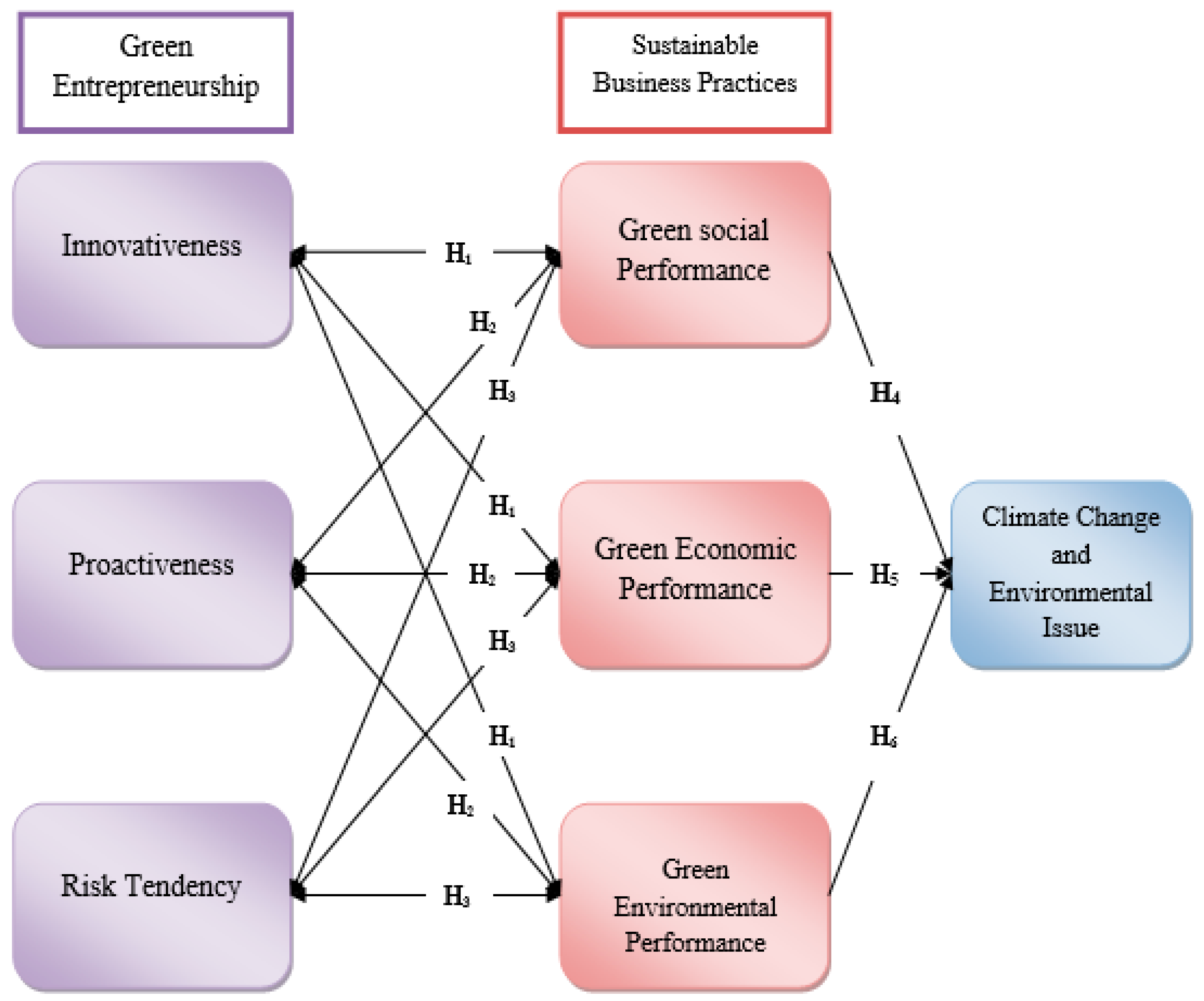
Figure 2.
Relationship Diagram for H1, H2, H3, H4, H5, H6.
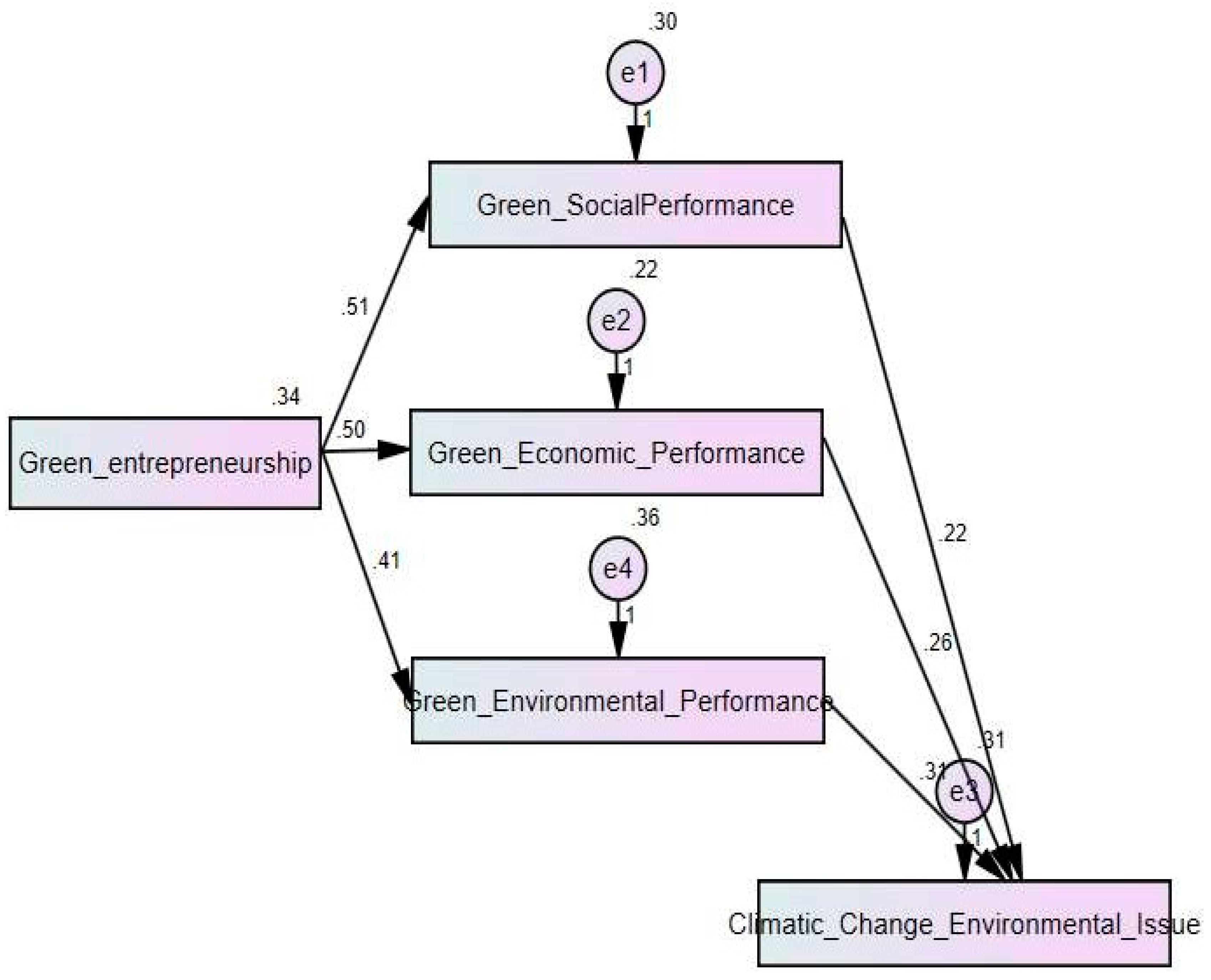

Table 1.
Review Table.
| [Citation] | Method/Analysis | Data Collection | Outcome |
|---|---|---|---|
| [19] | Comprehensive Research Model | Tehran University's Science and Technology Park. | Sustainable development is positively and significantly impacted by green entrepreneurship. |
| [20] | Exploratory Factor Analysis | Energetic and successful Taiwanese hotel businesses | The connection between GEO and GSI is GRQ and has a beneficial impact on GSI. |
| [21] | Confirmatory Factor Analysis | 320 small and medium-sized businesses (SMEs) in Ivory | The association between practically all EA aspects and SMESG is positively regulated by proactiveness. |
| [22] | Modeling Partial Least Square Structural Equations. | Students attending Pakistani private universities | The intention to pursue green entrepreneurship is positively and significantly connected with personality attributes. |
| [23] | PLS-SEM Analysis | Thailand's automobile components industry | Positive effects of a green entrepreneurial attitude on green innovation. |
| [24] | Structural Equation Model | 410 Chinese college students | Green entrepreneurial intentions are significantly and favorably impacted by optimism, ecological ideals, and a sense of social duty. |
| [25] | Regression Analysis | 451 top managers and owners oversee 54 hotels in Pakistan, including 5, 4, and 3-star establishments. | Green business strategies as a connection between sustainable growth and environmental goals. |
| [26] | Structural Equation Model | 418 students in Lahore and Faisalabad, Pakistan | Subjective norms were found to have no impact on the intent of sustainable entrepreneurs. |
| [27] | Structural Equation Model | Spanish wine sector | Demand for sustainable products, regulation, and top management's environmental commitment positively influence environmental innovation. |
Table 2.
Profile of the Respondents.
| Variables | Frequency | Percent | |
|---|---|---|---|
| Gender | Male | 283 | 74.7 |
| Female | 96 | 25.3 | |
| Total | 379 | 100.0 | |
| Entrepreneurs Age | 25& below | 61 | 16.1 |
| 26-30 | 158 | 41.7 | |
| 31-40 | 124 | 32.7 | |
| 41-50 | 23 | 6.1 | |
| 50 & above | 13 | 3.4 | |
| Total | 379 | 100.0 | |
| Level of Education | Senior high school | 26 | 6.9 |
| Diploma | 57 | 15.0 | |
| UG | 171 | 45.1 | |
| PG | 87 | 23.0 | |
| Others | 38 | 10.0 | |
| Total | 379 | 100.0 | |
| Business Age | Less than 3 years | 68 | 17.9 |
| 4 to 6 | 155 | 40.9 | |
| 7 to 9 | 86 | 22.7 | |
| More than 10 years | 70 | 18.5 | |
| Total | 379 | 100.0 | |
Table 3.
Questionnaire Measures and Constructs/Item.
| Measures | Items | Source |
|---|---|---|
| Green Entrepreneurship | 10 | [44,51,47] |
| Green Social Performance | 4 | [56] |
| Green Economic Performance | 4 | [57] |
| Green Environmental Performance | 4 | [59] |
| Climatic Change and Environmental Issues | 4 | [60] |
Table 4.
Descriptive analysis.
| Constructs | Mean | Std. Deviation |
|---|---|---|
| Green Entrepreneurship | 3.1166 | .58143 |
| Green social performance | 4.0303 | .62181 |
| Green Economic Performance | 3.9083 | .55158 |
| Green Environmental Performance | 3.8087 | .64730 |
| Climatic Change & Environmental Issues | 3.5752 | .70285 |
Table 5.
Constructs' validity and reliability test.
| Constructs | Loading of factors | Alpha | CR | AVE | |
|---|---|---|---|---|---|
| Green Entrepreneurship | GE1 | .762 | .850 | 0.792 | .525 |
| GE2 | .674 | ||||
| GE3 | .709 | ||||
| GE4 | .766 | ||||
| GE5 | .795 | ||||
| GE6 | .680 | ||||
| GE7 | .729 | ||||
| GE8 | .671 | ||||
| GE9 | .730 | ||||
| GE10 | .756 | ||||
| Green Social Performance | GSP1 | .773 | .914 | .898 | .688 |
| GSP2 | .814 | ||||
| GSP3 | .789 | ||||
| GSP4 | .679 | ||||
| Green Economic Performance | GEP1 | .638 | .734 | .701 | .770 |
| GEP2 | .553 | ||||
| GEP3 | .582 | ||||
| GEP4 | .733 | ||||
| Green Environmental Performance | GNP1 | .799 | .868 | .850 | .586 |
| GNP2 | .689 | ||||
| GNP3 | .731 | ||||
| GNP4 | .563 | ||||
| Climatic Change and Environmental Issues | CCE1 | .630 | .815 | .991 | 0.881 |
| CCE2 | .757 | ||||
| CCE3 | .802 | ||||
| CCE4 | .825 | ||||
Table 6.
Discriminant validity of constructs.
| GSP | CE | GEP | GNP | CCE | |
|---|---|---|---|---|---|
| GSP | 0.829 | ||||
| CE | 0.972 | 0.774 | |||
| GEP | 1.018 | 0.986 | 0.608 | ||
| GNP | 0.701 | 0.708 | 0.940 | 0.766 | |
| CCE | 0.684 | 0.746 | 0.993 | 1.023 | 9.530 |
Table 7.
Evaluation of Model Fit.
| Categories | Acceptance Level | Obtained Value | Fitness |
|---|---|---|---|
| Absolute Fit | |||
| CMIN/Df | P < 0.05 | 0.000 | Significant |
| GFI (Goodness of Fit) | ≥ 0.7 satisfactory fit, ≥ 0.8 perfect fit, ≥ 0.9 excellent fit | 0.814 | Perfect fit |
| Incremental Fit | |||
| AGFI (Adjusted GFI) | ≥ 0.7 satisfactory fit, ≥ 0.8 perfect fit, ≥ 0.9 excellent fit | 0.724 | Satisfactory fit |
| NFI (Normal Fit Index) | ≥ 0.7 satisfactory fit, ≥ 0.8 perfect fit, ≥ 0.9 excellent fit | 0.840 | Perfect fit |
| Parsimonious Fit | |||
| PNFI (Parsimonious Normed Fit Index) | 0.50 or 0.60 above | 0.628 | Satisfactory fit |
| CFI (Comparative Fit Index) | ≥ 0.7 satisfactory fit, ≥ 0.8 perfect fit, ≥ 0.9 excellent fit | 0.865 | Perfect fit |
| TLI (Tucker-Lewis Coefficient) | ≥ 0.7 satisfactory fit, ≥ 0.8 perfect fit, ≥ 0.9 excellent fit | 0.815 | Perfect fit |
Table 8.
Path Analysis's Direct Relation.
| Hypothesis | Beta | t | P value | Outcome | |
|---|---|---|---|---|---|
| H1 | GE ←→GSP | .476 | 10.501 | .000 | Accepted |
| H2 | GE ←→GEP | .522 | 11.895 | .000 | Accepted |
| H3 | GE ←→GNP | .369 | 7.710 | .000 | Accepted |
| H4 | GSP ←→ CCE | .198 | 3.223 | .001 | Accepted |
| H5 | GEP ←→ CCE | .202 | 2.573 | .010 | Accepted |
| H6 | GNP ←→ CCE | .284 | 4.558 | .000 | Accepted |
Disclaimer/Publisher’s Note: The statements, opinions and data contained in all publications are solely those of the individual author(s) and contributor(s) and not of MDPI and/or the editor(s). MDPI and/or the editor(s) disclaim responsibility for any injury to people or property resulting from any ideas, methods, instructions or products referred to in the content. |
© 2025 by the authors. Licensee MDPI, Basel, Switzerland. This article is an open access article distributed under the terms and conditions of the Creative Commons Attribution (CC BY) license (http://creativecommons.org/licenses/by/4.0/).
Copyright: This open access article is published under a Creative Commons CC BY 4.0 license, which permit the free download, distribution, and reuse, provided that the author and preprint are cited in any reuse.


