
Submitted:
09 April 2025
Posted:
10 April 2025
You are already at the latest version
Abstract
This study investigates the impact of flare tariff on the volume of gas flared in Nigeria. Using 52 years data, we find that the imposition of flare tariffs significantly reduces the volume of gas flared; however, the extent of this reduction varies depending on the stringency of the tariff. To better capture these differences, the analysis distinguishes between tariff regimes implemented before and after 2018, when a more substantial tariff was introduced under new regulations. The results reveal that pre-2018 tariffs led to a minimal reduction of 0.08% in gas flaring volumes, whereas post-2018 tariffs resulted in a more pronounced reduction of 6.92%. Other factors that significantly influence gas flaring volume include oil production and oil price. These findings underscore the importance of setting adequate flare tariffs to achieve meaningful reductions in global gas flaring.
Keywords:
flare regimes
; energy conservation and utilization policy
; gas pricing
1. Introduction
Despite being widely condemned for its severe environmental consequences, the flaring of associated natural gas remains a prevalent industry practice. This inefficient and wasteful process contradicts global sustainability efforts, including the United Nations Sustainable Development Goals, which promote sustainable production and consumption to safeguard the needs of future generations[1,2]. The gas industry argues that flaring is necessary for various operational reasons, including stabilising pressure and flow from oil wells during testing, managing waste gas that cannot be captured or processed, and addressing safety or emergency concerns [3]. However, substantial scientific evidence demonstrates that gas flaring contributes to significant economic losses [4,5,6], exacerbates environmental degradation [7,8], causes damage to human health and safety [9], and negatively impacts local communities [10,11,12].
Several countries have engaged in gas flaring for decades, having it a long-standing practice in their oil and gas industries. According to the World Bank’s 2022 Global Gas Flaring Tracker, 144 billion cubic metres (bcm) of gas were flared in 2021, resulting in the release of 400 million tonnes of carbon dioxide equivalent (CO₂e) into the atmosphere. Notably, 75% of flaring volumes come from the top 10 flaring nations who also account for 50% of global oil production. These countries include Russia, Iraq, Iran, the United States, Venezuela, Algeria, Nigeria, Mexico, Libya and China. The top seven flaring nations retained their positions for a decade, while Mexico, Libya and China have seen increases in their flaring activities in recent years [13] Figure 1 shows the top ten flaring nations by volume and intensity as of 2021.
The World Bank has set a goal of achieving zero routine gas flaring by 2030, yet the progress towards this target has been slow [14]. The latest data shows that the volume of gas flared decreased from 144 billion cubic metres (bcm) in 2021 to 139 bcm in 2022, with flaring intensity also falling from 5.2 cubic metres per barrel of oil produced in 2021 to 4.7 m³/bbl [15]. This represents a 3% reduction in global flaring volumes compared to 2021. However, this progress was short-lived, as flaring volumes rebounded in 2023, surging by 7% to reach 148 bcm—levels last seen in 2019 [14]. This is a course for concern with only six years left in the declaration for zero routine flaring by 2030 [14].
Among the top flaring nations, Nigeria has made significant contributions to global flaring reductions in recent years. In 2023, Nigeria reduced its flaring volume by 1.3 bcm, representing a 20% reduction from the 2021 level [15]. The reduction resulted in Nigeria moving to the nineth position on the ranking of top ten global flare nations from its seventh position in 2021 surpassing both Mexico and Libya. The present study aims to investigate the determinants of gas flaring reduction in Nigeria in recent five decades, focusing on the gas flare tariff regimes. A review of the existing literature reveals that most studies examining the effects of gas flaring policies are qualitative in nature, with quantitative research typically focusing on the environmental impacts. Therefore, the aim of this study is to quantitatively analyse the impact of changes in flare policy regimes on the volume of gas flared. To the best of our knowledge, this study is the first to assess the effectiveness of gas flare tariff in reducing flare volume quantitatively. By examining the effectiveness of the market-based instruments within the context of Nigeria’s regulatory framework and energy market, the findings of our study offer valuable insights into enhancing the country's flaring reduction efforts and supporting its transition towards more sustainable gas utilisation practices.
Employing multivariate linear regression models, we study the effect of oil production, oil price, gas price and flare tariff on the volume of gas flared. Nigeria enacted a new regulation (Flare gas (Prevention of Waste and Pollution) Regulation) in 2018 which increased the flare tariff by 38 times. The results show that the effect of the new tariff after 2018 is much more effective in reducing the volume of gas flared.
Research on the determinants of gas flaring has identified a wide range of factors that contribute to the persistence of the practice. Some studies suggest that the insufficient pricing of gas, either domestically or close to the flare point, is a key inhibitor [16,17,18] while others point to insufficient punitive governance, policy, and regulation as the cause of the persistence of gas flaring [19,20,21,22]. Other reasons such as lack of gas treatment infrastructure, lack of matured domestic gas markets, the sparse nature of gas flaring points and insufficient monitoring by regulatory bodies are also noted [23,24,25]. Most of these studies are qualitative. Only a few have attempted to quantify the effect of some of the determinants in eliminating gas flaring [26,27,28]. Among these, [28] developed econometric models to investigate the determinants of gas flaring, focusing on variables such as gas price, crude oil production, gas utilization, and GDP growth. They find that increasing utilization reduces flaring, while increasing fossil fuel consumption also reduces the propensity to flare gas. The study concluded that gas flaring in Nigeria is largely determined by the consumption and pricing of gas, as well as past activities of oil and gas companies that sustain the practice. They recommended the introduction of policies to address associated gas flaring and to encourage greater private sector participation in both the upstream and downstream.
Various global attempts have been made to identify strategies for reducing and ultimately eliminating gas flaring, such as the completion of the largest flare gas to power project in the Middle East commissioned by Aggreko in Southeast Kurdistan[29], Hoerbiger’s eleven flare gas projects in Ecuador [30] and Nigeria’s gas flare commercialization programme [31]. These policies, governing structures and regulations have been applied in different contexts and locations, and in general, most recommendations centre around legalizing the prohibition of gas flaring and promoting market-based initiatives for flaring reduction. Nigeria for instance has gone through various efforts to reduce gas flaring from as early as 1969 when the Petroleum (Drilling & Production) Regulation mandated operators to submit gas utilization proposals for new fields coming on stream. This was closely followed by the Petroleum (Amendment) Act of 1973 that empowers the government to take gas at the flare site without payment to the operator[32]. By 1979, the Associated Gas Reinjection Act declared flaring illegal with effect from January 1st, 1984, [33]. The same act introduced the first penalty regime for flaring gas with an effective date of 1985 [34]. Since then, the flare penalty has been reviewed upward three times in 1992, 1998 and the most recent in 2018 by the signing of the Flare Gas (Prevention of Waste and Pollution) Regulations 2018. Other notable policies targeted at gas flaring include the 1989 NLNG Act, the Associated Gas Framework Agreement of 1992, the Finance Decree 18 of 1998 and decree 30 of 1999 that extends all incentives relating to associated gas to non-associated gas, the National Domestic Gas Supply & Pricing Policy/Regulations that mandated the allocation of gas reserves for domestic use as well as providing framework for establishing minimum gas price.
Following Nigeria’s ratification of the Paris Agreement in 2016, in which the country committed to reducing and ultimately eliminating gas flaring as part of its efforts to curb carbon and methane emissions, the Gas Flare (Prevention of Waste and Pollution) Regulations 2018 was enacted. This regulation established a nationwide framework for gas flare elimination by facilitating the auctioning of flare sites to interested project developers for gas monetization. Additionally, the regulation increased flare tariffs to an average of $2.50 per thousand cubic feet [35]. Furthermore, the passage of the Petroleum Industry Act (PIA) 2021 by the National Assembly, followed by its ratification by the President and the Minister of Petroleum Resources, introduced a revised tariff for unauthorized flaring, venting, or wastage of natural gas, set at $3.50 per thousand standard cubic feet (Mscf)[36]. Figure 2 illustrates these regulatory measures aimed at addressing gas flaring in Nigeria.
2. Literature Review
2.1. Theoretical Evidence
A survey of the existing literature suggest that a change of policy is a vital action for combatting gas flaring both globally and locally. At the global level, [37] discusses measures to put in place to ensure the elimination of gas flaring. The enablers to such measures include the development of specifically appropriate legal and regulatory framework by governments, reformation of the gas markets, eliminating subsidies for competing alternative fuels as well as involving the private sector in the development of gas infrastructure. They also recommend the amendments of royalty and tax systems that discourage gas utilization by operators. Writing on the effects flaring had on the Niger Delta during the period 169 to 2001, [38] opined that the regulations and incentives put in place by the Nigerian government to abate gas flaring was not enough to discourage the practice by the perpetrating oil industry operators. As a result, the study recommended an upward review of the tax/penalties on gas flared and the amendments of property rights that would foster sustainable energy utilization as well as community participation. [39] on the other hand compares Nigeria's legal and institutional frameworks on gas flaring to that of Canada, the UK, and Saudi Arabia. They recommend amendments to the legal framework governing the sector responsible for flaring as well as the institutions for law enforcement. This opinion was echoed by [40] who showed that flaring in the Niger Delta region of Nigeria persist due to the failure of government and government institutions responsible for regulating the industry to raise to their expectation as well as multi-national companies operating in the region to operate responsibly. The issues, he argued, are linked to corruption as well as inept attitudes of the MNCs. [23] reviewed the applicable laws governing the oil and gas industry in Nigeria especially those on gas flaring and their flaws in ensuring elimination of flares. Their recommendation also borders on the enactment of more stringent laws that outlawed flaring all together rather than paying fines.
[41,42], both argued that the passage of the PIB and strict improvement of its monitoring for implementation can be a game changer in the sustainable development of gas in Nigeria and the elimination of gas flaring. [22] reveals hindrances that prevent the success of such laws and policies and recommends measures to overcome them. [21] reviewed literature on the effect of gas flaring on ecosystems and suggest stricter measures be adopted by the government to end the wasteful process.
Discussing Nigeria’s recent gas flare commercialization program (NGFCP) and other policies in the same area, [43] recommended that with proper implementation and relaxation of some strict conditions imposed by the government for participation in the flaring program, the NGFCP could change the narrative of addressing gas flaring in the Nigerian Delta region. [25] argues that imposing flaring ban as a law or regulation does not work. He believed flaring happens when two conditions are met. First, the country has saturated oil reservoirs with rich solution gas and gas caps making reinjection as an enhance oil recovery method for maintaining reservoir pressure to be non-viable. The second condition is when the domestic market for natural gas is not developed or where the pricing for the product is not profitable enough to warrant infrastructure investment. Lack of gas transport and processing infrastructure can also promote flaring as the gas, even after capture, cannot be further processed and transported to the market. [44] compares the gas flaring legal framework of Nigeria to that of Russia, the US and Norway. The analysis identified weak enforcement of existing laws as the enabler to gas flaring in Nigeria. A recommendation for the stringent enforcement of the PIA 2021 was made and the adoption of other laws as identified in the advance climes compared with Nigeria in the study.
From the cited theories published within the last decade, a narrative suggesting more stringent laws, effective monitoring, and supervision of such laws, creating an enabling environment for the promotion of gas projects development as well as enabling the creation of sustainable gas markets (especially local markets) led the recommended actions. As clear as these recommendations can be though, empirical studies backing them are sparse. All these can be lumped into policy. Though some of the policies may be challenging to be represented in an empirical study, others can be appropriately represented by some indicators. The following section reviews the recent most relevant empirical studies conducted on the issue of gas flaring covering some of these policies.
2.2. Empirical Evidence
A large strand of empirical studies focusses on the effect of gas flaring on the environment or the economy. See, for example, [27,28,45] for instance studied the vulnerability of Nigeria’s GDP to environmental pollution caused by gas flaring using the auto regressive distributed lag (ARDL) model and granger causality to run the regression. The study found that gas utilization policies and transparencies introduced in the oil sector reduced the level of environmental pollution through flaring as well as increased gas utilization projects.
Following Hassan’s work, [28] developed an econometric model to investigate the determinants of gas flaring with a focus on some identified contributing variables such as gas price, crude oil production, utilization, and GDP growth. Flaring was found to be persistent as there is an increase in flaring activities by about 0.37% to 0.38% as compared to flaring in the recent past. His research shows that gas flaring in Nigeria is largely determined by consumption and pricing of gas, as well as past activities of oil and gas companies that sustain the practice. Introducing policies to address associated gas flaring and increasing private sector participation in both the upstream and downstream were recommended. In a similar study of the effect of gas flaring on the GDP, [26] discovered that gas flared has significant negative effect on the GDP. On the other hand, the amount of gas utilized in-country is found to have an insignificant effect on the GDP. [46] used time series model for the period of 1965-2009to measure the effect of oil and gas production, investment in gas utilization, export price of gas, on gas flared. The study found that the size and the environmental philosophy in the industry have a strong positive impact on gas flaring related carbon dioxide emission.
Using an ARDL error correction model, [45] test the relationship between oil rent, fossil fuel production and gas flaring on the economy of Nigeria. The result of the estimation found a significant long-run positive contribution of oil rent and fossil fuel production on the economy while gas flaring is found to depress the economic performance. Another study by [20] along this line compares the flaring activities of seven (7) major oil exploration companies in Nigeria and how it affects the economy. Results obtained indicated a clear negative impact on the economy. The writer recommended the imposition of stricter fines on flaring as a mitigating factor and designing a program that will ensure gradual reduction of flaring over time.
3. Materials and Methods
3.1. Data Collection and Preparation
Historical annual time series data on gas flared volumes (Billion Standard Cubic Feet (BSCF)) covering the period 1970 to 2021 was collected from the Nigerian National Petroleum Corporation (NNPC) Annual Statistical Bulletin (ASB). The ASB published by the NNPC is the official source for Nigeria’s oil and gas statistics. Records of gas produced, utilized and flared are collected by both the upstream regulatory commission and the NNPC, and published annually by the bulletin. Gas flaring volume is our dependent variable and is labelled as total gas flared (TGF). Data on Nigerian oil production (thousand barrels per day) and historical oil prices (US$/bbl) were obtained from the databank of the Organization of Petroleum Exporting Countries (OPEC) and denoted as total oil produced (TOP) and oil prices (OPR), respectively. Nigeria, being a member of OPEC, is obligated to submit the monthly production and supply statements (PSS) as well as complete the OPEC questionnaire that gathers data on member countries economic indicators in an annual basis. Historical gas flare tariff data was obtained from the Nigerian Upstream Petroleum Regulatory Commission (NUPRC), the regulator responsible for administering the tariffs and other regulatory functions in the Nigerian oil and gas industry. The gas flare tariff is the main variable of interest and is denoted as Adjusted Flare Tariff (AFT), which accounts for the conversion of the tariff value from Nigerian Naira to US Dollars using the exchange rate obtained from the World Bank [47]. Finally, gas price (GPR) was obtained from the US Energy Information Administration (EIA) website in the form of LNG import price. All monetary values (tariffs, oil price and gas price) are adjusted for inflation using the Nigerian Consumer Price Index to the 2010 base year.
3.2. Data Visualization
Figure 3 provides a snapshot of the total volume of gas flared during the period under consideration. A sharp and steady increase of the volume being flared between 1970 – 1974 corresponds to a surge in oil production following the end of the civil war that rages in the country during the period 1967 – 1970 [48]. In contrast, the sharp decline in the volume of gas flared witnessed in the 1980s marked the global oil glut [49] and the military coup that overthrew Nigeria’s democratically elected government [50]. This political and economic instability led to a significant drop in crude production and associated gas flaring. From the early 2000s, a steady decline in gas flaring is witnessed marking the commissioning of the Nigerian Liquefied Natural Gas (NLNG) company, which has a combined nameplate capacity of 8.85 million tons per year of liquefied natural gas and natural gas liquids supplied to the global natural gas market [51]. Other monetization projects targeting the power sector, particularly the construction of seven integrated power projects, also significantly improved gas utilization in Nigeria [52].
The historical oil production pattern over the same period closely mirrors that of gas flaring, as shown in Figure 4. The steady increase in production from 2003 to a peak in 2006 corresponds to the period where the then Nigerian government offered amnesty to restive youth in the Niger Delta regions. This act helped reduce disruptions to oil and gas activities and allowed operators to expand production.
Figure 5 depicts the historical evolution of crude oil price with OPEC reference basket weighted average prices of oil. Prices picked up after that to reach a new peak in 2012. The U.S Energy Information Administration (EIA) attributed the price surge to three factors. The first factor was the change in global economic growth expectations, followed by concerns over supply disruptions from producing nations such as Syria, Yemen, and Sudan with a potential cut of about one million barrels per day from the global oil market. The last factor was the sanction on Iranian oil import by EU and US aimed at pressuring the Persian nation to abandon its nuclear program [53]. Global oil price is employed in all models as 60% of oil produced in Nigeria is exported, while only 40% is allocated for domestic refining and utilization (combined refining capacity of 445,000 barrels/day).
Figure 6 presents the historical trend of flare tariff rates starting from the 1970s when no tariff exists. The first tariff regime was introduced in 1984 at a rate of US$0.02/mscf, which remained in place until 1992. This was followed by an upward review to US$0.003/mscf during the period 1992 – 1998. By 1999, a new regime kicked in with an average tariff rate of US$0.142/mscf until 2018. Before the recent review, the 1999 rate has dipped to US$0.028 due to currency exchange depreciation. The current tariff that became effective in 2019 saw a rise of the rate to an average of US$1.066/mscf following the passing of the Gas flare (prevention of waste and pollution) regulations, 2018.
3.3. Model Specification
To analyze the effect of gas flaring tariffs on the volume of gas flared, the flare volume was expressed as a function of key determinants of flaring identified by Okoye et al., (2022) and (Okoro et al., 2021). These determinants include oil production, oil price, gas price and flare tariff. The first linear econometric model was specified as shown in eqation-1 below. TOP is the total oil production (million barrels), OPR denotes oil price (US$/barrel), and GPR refers to the price of LNG imported to the United States (US) used as a proxy for gas price in Nigeria due to the lack of domestic price data. AFT represents the adjusted gas flaring tariff (US$/Mscf). The subscript t indicates the period, which covers 1970 to 2021 in this case.
The represent the magnitude and direction of the estimated coefficients including the intercept. The error term is denoted by εt. The a-priori expectation is that the volume of gas flared is positively associated with the volume of oil production. Similarly, oil price is expected to have a positive impact on the volume of gas flared as higher oil price incentivise producers to increase oil production, thereby leading to higher associated gas production and flaring. As favourable gas price may motivate producers to invest in gas utilization technologies, higher gas price is expected to cause a reduction in the volume of gas flared. As flare tariffs serve as a disincentive for gas flaring, it is expected that the higher the flare tariff, the lower the volume of gas flared. To check the robustness of the model, we estimate a semi-log form of the equation. The re-specified model takes the following form: -
The third model we estimate is the log-log form as follows: -
The AFT in equations 1 – 3 is a continuous variable that represents the cost of flaring. Therefore, the corresponding coefficient indicates the average marginal change of gas flared associated with one incremental change in flare tariff.
Figure 6 highlights a significant increase in the flaring tariff over the years, with recent tariff levels nearly 50 times higher than the previous rates. Given this substantial change, the average marginal effect may not adequately capture its impact. In fact, during the period considered, there were five distinct regimes covering 1970 to 1984, 1985 to 1992, 1993 to 1998, then 1999 to 2018 and finally 2019 to date. To account for the shift in tariff regimes, the continuous tariff variable AFT was divided into two dummy variables: Pre2019AFT and Post2019AFT. Since tariff variations before 2018 were relatively minor, all pre-2018 rates were grouped together under Pre2019AFT, which takes a value of one for the years 1970–2018 and zero otherwise. The variable Post2019AFT is equal to one for 2018 onwards and zero otherwise, capturing the implementation of the Flare Gas (Prevention of Waste and Pollution) Regulation in 2018 and the significantly higher flaring tariff that followed. Splitting the continuous tariff variable into two dummy variables to assess the effects of different tariff regimes was inspired by [55], who applied a similar approach to examine whether Chinese national oil companies paid a premium for acquiring foreign assets compared to their counterparts across two distinct periods. Three other models like equations 1-3 were specified with the two dummy variables. However, only the log-log model is presented in equation 4 as follows:
When the flare tariff in the pre-2019 period was relatively low compared to oil prices in the international market, producers would rather flare and pay the penalty rather than investing in monetizing associated gas. Following the introduction of the 2018 Regulation, however, the increased flare penalty is expected to have a significant impact on reducing gas flaring. As the Nigerian government opined, the penalty was designed to “bite but not kill” the operators [56].
4. Results and Discussions
4.1. Summary statistics
Table 1 presents the descriptive statistics of the dependent and independent variables employed in this study. Total gas flared serves as the dependent variable (TGF) while the independent variables consist of oil production (TOP) in thousand barrels per day (Mbbls/d), oil price (OPR) in United States Dollars per barrel (US$/barrel), gas price (GPR) in United States Dollars per thousand standard cubic feet (US$/Mscf), and adjusted flare tariff (AFT) in United States Dollars per thousand standard cubic feet (US$/Mscf). All monetary variables are in real terms.
4.2. Results of Level, Semi-Log and Log-Log Transforms
The log transforms were employed to the data series to address the normality issues to improve model fitness. In the first instance, both the dependent and independent variables were specified in their level forms. The result of the level form is shown in column (1) of Table 2. Thereafter, the dependent variable was log-transformed while the independent variables were maintained in their level values. The result of the semi-logged model is presented in column (2) of Table 2. To further improve model fitness, the log-log transformed model was specified and the results are presented in column (3) of Table 2 below.
The baseline model estimated using equation-1 contains the full sample of variables in their level form. The variables include total gas flare volumes, total oil produced, oil price, gas price, and flare tariff adjusted for inflation and currency exchange. As seen from the value of the adjusted R2, 78% of variations in the volume of gas flared is explained by the model at the adopted 5% significance level. Three out of the four explanatory variables were found to be statistically significant at 1% except for the gas price. This might be because the US LNG import price used as proxies for the price of gas are not a true representation of the domestic price of the commodity in local markets. Additional reasons may be related to various missing data points that could result in generating a result with few degrees of freedom to give validity to the overall outcome. Total oil produced has a positive relationship with volume of gas flared. This is logical as the more crude is produced the more associated gas is produced as well.
The prevailing relationship between the volume of gas flared and gas price is also an inverse one but statistically insignificant in the model. The size of the gas price coefficient obtained shows that a 1-US$/mscf increase in the price of gas would cause a 5.33 billion scf reduction in the amount of gas flared. This is expected as favourable gas pricing can motivate the producers to find alternative use for the associated gas as against flaring it. This contradicts findings by [28] who found that gas price exerts a positive and significant impact on gas flaring. The coefficient of flare tariff indicated that a 1-US$/mscf increase in the amount of penalty charged by the regulators would result in a 277 billion scf reduction in the volume of flared gas. Thus, the model indicated that there is a statistically significant inverse correlation between the amount charged for penalty and the volume of gas flared.
The semi-log transformation indicated that 80% of variations in the dependent variable were explained by the independent variables while the log-log transform indicated that 83% of variations were explained with both models being statistically significant at the 1% level. The semi-log results show that a 1 Mbbl/d increase in the volume of oil produced would lead to a corresponding increase of 0.1% in the volume of gas flared. Thus, the relationship between oil production and gas flared is directly proportional. On the other hand, the inverse relation between gas flared and the price of oil shows that a 1-US$/bbl increase in the price of oil would yield a reduction of 0.8% in the volume of gas flared. Similarly, a 1-US$/mscf increase in the price of gas shows no change in the volume of gas flared. Finally, a 1-US$/mscf increase in the amount of chargeable flare tariff would result in a 78% reduction in the volume of gas flared. All variables are statistically significant except for gas price. The insignificance of the gas price to the volume of gas flared can be attributed to the relatively high skewness of the gas price data, which is partially eased after the log-log transformation in column (3) of Table 2.
The log-transformed specification presented in column (3) of Table 2 provides the best fit for the data based on the post diagnostic tests of normality and constant variance. The adjusted R2 value suggests that the model explains 83% of variations in the volume of gas flared. The signs and significance levels of the estimates remain largely consistent with those in column (2). Specifically, oil price and flare tariff are inversely related to gas flaring, while oil production and gas price are positively associated with the dependent variable. A detailed breakdown of the results shows that a 1% increase in the amount of oil produced leads to a 1.77% increase in the volume of gas flared. A 1% increase in the price of oil on the other hand leads to a 0.35% decrease in the volume of gas flared. This negative relationship between oil price and volume of gas flared can be attributed to Nigeria’s membership in OPEC. As a member of OPEC, Nigeria must adhere to production quotas, which may have restricted its ability to expand oil production during the study period. Gas prices show a positive relationship with the volume of gas flared in that a 1% increase in the gas price leads to a 0.31% increase in the volume of gas flared. The key variable of interest, flare tariff, exhibits an inverse relationship with the volume of gas flared. Results show that a 1% increase in the tariff rate leads to a 0.11% reduction in the volume of gas flared. All variables in the log-transformed model are statistically significant at the 1% level.
4.3. Results of the Tariff Regime Change
To effectively evaluate the impact of changes in the gas flaring tariff regime, the tariff data was divided into two distinct periods. The first period, spanning 1970 to 2018, corresponds to the regime when the gas flaring tariff remained below $1/MScf. The second period began with the enforcement of the Flare Gas (Prevention of Waste and Pollution) Regulations 2018, signed into law by the President and Minister of Petroleum Resources. This regulation introduced a revised tariff regime, effective from 2019, with an average flare penalty of $1.50/MScf.
Equation 4 was estimated using two dummy variables to represent these tariff regimes. Pre2019AFT represents flare tariff regime for the period prior to the implementation of the 2018 regulation, from the introduction of the flaring tariff in the early 1980s to mid-2018. Post2019AFT represents the tariff regime from 2019, when the revised tariff regime became operational. Table 3 below presents the results.
Since the results for alternative specifications (presented in columns 1 and 2 of Table 3) are consistent with those reported in Table 2, the analysis primarily emphasizes the two newly introduced variables, Pre2019AFT and Post2019AFT, as presented in column 3 of Table 3. The results show that both periods of flare tariffs are statistically significant at the 1% level. However, the magnitudes of the estimated coefficients differ substantially between the two periods with much smaller values observed in the pre-2019 period as compared to that of post-2019. This implies that although the tariff rates before 2019 had a statistically significant effect, their practical impact was limited. Contrary to the findings of [19,20,21,22,23,24,25,26,27,28,29,30,31,32,33,34,35,36,37,38,39,40,41,42,43,44,57], who claimed that the pre-2019 tariff rates were ineffective in curbing gas flaring, our findings reveals that these earlier tariffs did have a measurable impact, albeit a minimal one. Specifically, the implementation of the pre-2019 rates result in only a 0.08% decrease in the volume of gas being flared, compared to a substantial 6.92% reduction under the post-2019 regime.
The inverse relationship between flaring tariffs and the volume of gas flared is in line with the findings of [58] that finds an inverse relationship between flaring tax and volume of gas flared in North Dakota. The results also upheld the recommendation by [38], who advocates for an upward revision of flare penalty in Nigeria but dispute the claims of [23] that said paying fines cannot reduce flaring. Although the implementation of appropriate penalties is not the only factor driving reductions in gas flaring, the findings of this research contribute to quantifying the significance of the tariffs and setting the appropriate tariff that could bite but not kill the operators [59]. Finding an appropriate tariffing rate coupled with other incentives could therefore help Nigeria in putting out its flares for good.
5. Conclusion/Policy Implication
This paper investigated the effect of policy change on the volume of gas flared in Nigeria with particular emphasis on flare penalty regimes. By collating time series data on the determinants of gas flaring and specifying econometric models, we were able to determine the effect of flare tariffs on the volume of gas flared in Nigeria. The regression results indicated that while all tariff regimes have significant effect on the volume of gas flared, the magnitudes of the effects vary widely. The applicable tariff regimes prior to 2018 (with very low penalty rates) though significant, have a very small magnitude to motivate producers in finding alternative uses for the gas being flared. This is because the low magnitude of the effect as compared to the magnitude of investments the producers would have to make in flare capture technologies to utilize gas at the flare is negligible. As a result, the producers found it more economically beneficial to flare and pay rather than capture the resource and utilize. With the substantial increase in payable tariff that became effective in 2019 by the passing of the Gas Flare (Prevention of Waste and Pollution) regulations 2018, the tariff was found to be statistically significant in reducing gas flaring in Nigeria with a much larger magnitude as compared to the regime prior. The initial regime covering periods prior to 2018 contributed 0.08% reduction in the volume of gas being flared while the regime after 2018 led to the witnessing of a 6.92% in the volume of gas flared. Hence the study proves that finding an appropriate tariff that would motivate producers to find alternative uses for gas being flared while maintaining their production operations is essential to the elimination of gas flaring all together particularly in the Nigerian context.
The decision by the government of Nigeria to significantly increase the tariff rates is in response to various academic research pointing that as a significant disincentive to the more than six-decade activity. As mentioned within the body of the work, additional measures should be put in place to work together with the increased tariff rates to promote the utilization of gas at the flare. It is interesting to note that Nigeria is walking the talk by approaching this menace from multiple fronts. The policy change that inspires this research also introduced the Nigerian Gas Flare Commercialization Programme which aim to open access to flare sites for third party investors for the purpose of commercializing the resource. Subsequent papers in this research aim to explore the viability of the commercialization programs being promoted as well as the prospect of the implementation framework in ending flaring in Nigeria.
These initiatives must be followed by well targeted monitoring and supervision of the entire program to ensure its full implementation and curve any potential diversion from laid-out processes and procedures. How effectively the nation enforces these regulations and the sustainability of flare reduction from such could be an area for further research when more data becomes available.
Author Contributions
Validation, X.M., and T.Z.; writing—original draft preparation, I.Y.; writing—review and editing, X.M., and I.Y.; supervision, X.M. and T.Z.; All authors have read and agreed to the published version of the manuscript
Funding
This research was funded by NIGERIAN PETROLEUM TECHNOLOGY DEVELOPMENT FUND (PTDF), grant number PTDF/ED/OSS/PHD/AUU/1662/19.
Data Availability Statement
Data is available upon request from the corresponding author subject to authorization by the funders.
Acknowledgments
We wish to acknowledge the support of the staff and management of Nigerian Upstream Petroleum Regulatory Commission (NUPRC) for providing some of the data necessary for this work.
Conflicts of Interest
The authors declare no conflicts of interest.
Abbreviations
The following abbreviations are used in this manuscript:
| BCM | Billion Cubic Metre |
| M3/BBl | Cubic Metre per Barrel |
| MSCF | Thousand Standard Cubic Feet |
| MNCs | Multi National Companies |
| NGFCP | Nigerian Gas Flare Commercialization Programme |
| PIA | Petroleum Industry Act |
| BSCF | Billion Standard Cubic Feet |
| AFT | Adjusted Flare Tariff |
References
- United Nations. Sustainable Development Goals [Internet]. 2024 [cited 2024 Nov 27]. Available online: https://sdgs.un.org/goals.
- Okoye, LU.Adeleye, BN.Okoro, EE.Okoh, JI.Ezu, GK.Anyanwu, FA. Effect of gas flaring, oil rent and fossil fuel on economic performance: The case of Nigeria. Resources Policy [Internet]. 2022;77(December 2021):102677. [CrossRef]
- Hughes, B. bakerhughes.com. 2022 [cited 2023 Jan 13]. 5 things you should know about flaring. Available online: https://www.bakerhughes.com/company/energy-forward/5-things-you-should-know-about-flaring.
- Joshua, OI.Wisdom, PE.Queendarlyn, AN. Re-evaluating the problems of gas flaring in the Nigerian petroleum industry. World Sci News. 2020;147(June):76–87.
- Ejiogu, A. Gas flaring in nigeria: Costs and policy. Energy and Environment [Internet]. 2013;24(6):983–98. [CrossRef]
- Nwanya, SC. Climate change and energy implications of gas flaring for Nigeria. International Journal of Low-Carbon Technologies. 2011;6(3):193–9. [CrossRef]
- Anejionu, OCD.Whyatt, JD.Blackburn, GA.Price, CS. Contributions of gas flaring to a global air pollution hotspot: Spatial and temporal variations, impacts and alleviation. Atmos Environ [Internet]. 2015;118:184–93. [CrossRef]
- Ismail, OS.Umukoro, GE. Global impact of gas flaring. Energy Power Eng. 2012;04(04):290–302.
- Ajugwo, a. O. Negative effects of gas flaring: The Nigerian experience. Journal of Environment Pollution and Human Health [Internet]. 2013;1(1):6–8. Available online: http://pubs.sciepub.com/jephh/1/1/2/index.html.
- Ubani, E.Onyejekwe, I. Environmental impact analyses of gas flaring in the Niger delta region of Nigeria. American Journal of Scientific and Industrial Research. 2013;4(2):246–52.
- Edino, MO.Nsofor, GN.Bombom, LS. Perceptions and attitudes towards gas flaring in the Niger Delta, Nigeria. Environmentalist. 2010;30(1):67–75. [CrossRef]
- Teye, ET.Rufai, OH.Alademomi, RO.Ashu, HA.Said, F hiya A.Oludu, VO.et al. A mixed method inquiry of gas flaring consequences, mitigation strategies and policy implication for environmental sustainability in Nigeria. Journal of Environment and Earth Science. 2019;46–58. [CrossRef]
- GGFR. 2022 Global Gas Flaring Tracker Report. Https://Thedocs.Worldbank.Org. 2022.
- World Bank. Global Gas Flaring Tracker Report [Internet]. 2024 Jun. Available online: www.worldbank.org.
- World Bank. Global Gas Flaring Tracker Report [Internet]. 2023 Mar. Available online: www.worldbank.org.
- Rodrigues, ACC. Decreasing natural gas flaring in Brazilian oil and gas industry. Resources Policy. 2022;77(December 2021):102776.
- Hagos, FY.Abd Aziz, AR.Zainal, EZ.Mofijur, M.Ahmed, SF. Recovery of gas waste from the petroleum industry: a review. Environ Chem Lett. 2022;20(1):263–81. [CrossRef]
- Agerton, M.Gilbert, B.Upton, G. The Economics of Natural Gas Flaring: An Agenda for Research and Policy. SSRN Electronic Journal. 2020.
- Teye, ET.Rufai, OH.Alademomi, RO.Ashu, HA.Said, F hiya A.Oludu, VO.et al. A mixed method inquiry of gas flaring consequences, mitigation strategies and policy implication for environmental sustainability in Nigeria. Journal of Environment and Earth Science. 2019;46–58. [CrossRef]
- Madueme, S. Gas Flaring activities of major oil companies in Nigeria: An economic investigation. International Journal of Engineering Science and Technology. 2010;2(4):610–7.
- E. Ite, A.J. Ibok, U. Gas flaring and venting associated with petroleum exploration and production in the Nigeria’s Niger Delta. American Journal of Environmental Protection. 2013;1(4):70–7. [CrossRef]
- Orji, UJ. Moving from gas flaring to gas conservation and utilisation in Nigeria: a review of the legal and policy regime. OPEC Energy Review. 2014;38(2):149–83. [CrossRef]
- Udok, U.Enobong, &.Akpan, B. Gas flaring in Nigeria: Problems and prospects. Global Journal of Politics and Law Research. 2017;5(1):16–28.
- Aregbe, AG. Natural gas flaring—Alternative solutions. World Journal of Engineering and Technology. 2017;05(01):139–53. [CrossRef]
- Thurber, M. Gas Flaring : Why does it happen and what can stop it ? 2019. p. 7–9.
- Diugwu, IA.Mohammed, M.Egila, AE.Ijaiya, MA. The effect of gas production, utilization, and flaring on the economic growth of Nigeria. Natural Resources. 2013;04(04):341–8. [CrossRef]
- Hassan, A. Dealing with vulnerability to carbon emission from gas flaring: the roles of transparency and utilisation policies in Nigeria. OPEC Energy Review. 2020;44(4):369–403. [CrossRef]
- Okoro, EE.Adeleye, BN.Okoye, LU.Maxwell, O. Gas flaring, ineffective utilization of energy resource and associated economic impact in Nigeria: Evidence from ARDL and Bayer-Hanck cointegration techniques. Energy Policy. 2021;153(March):112260. [CrossRef]
- Hydrocarbon Processing. Aggreko completes Middle East’s largest flare gas to power project. 2022 Jan 24 [cited 2025 Jan 30]. Available online: https://www.hydrocarbonprocessing.com/news/2022/01/aggreko-completes-middle-east-s-largest-flare-gas-to-power-project.
- Hoerbiger. Hoerbiger’s Sacha Central Project [Internet]. [cited 2025 Jan 30]. Available online: https://issuu.com/world.bank.publications/docs/9781464818509/s/15716421.
- NUPRC. About NGFCP [Internet]. 2021 [cited 2025 Jan 30]. Available online: https://ngfcp.nuprc.gov.ng/about-ngfcp/.
- World Bank. Global flaring and venting regulations [Internet]. 2023 Dec [cited 2024 Dec 9]. Available online: https://flaringventingregulations.worldbank.org/nigeria.
- Abu, R.Patchigolla, K.Simms, N. A Review on qualitative assessment of natural gas utilisation options for eliminating routine Nigerian gas flaring. Gases. 2023;3(1):1–24. [CrossRef]
- Ejiogu, AR. Gas flaring in Nigeria: Costs and policy. Sage Publications. 2018;24(6):983–98. [CrossRef]
- Department of Petroleum Resources. Nigerian Gas Flare Commercialization Programme (NGFCP): Key to Nigeria flare-out agenda Nigeria. In: DPR & Press Stakeholders retreat. Lagos; 2018.
- NUPRC. Gas flaring, venting and methane emissions (Prevention of Waste and Pollution) Regulations, 2023 [Internet]. Vol. 110. Lagos: The Federal Government Printer; 2023 [cited 2025 Jan 29]. Available online: https://www.nuprc.gov.ng/gazetted-regulations/.
- Gerner, F.Svensson, B.Djumena, S. Gas Flaring and Venting: A regulatory framework and incentives for gas utilization. The World Bank Group (Public Policy Journal). 2004;(279):4.
- Aghalino, SO. Gas flaring, environmental pollution and abatement measures in Nigeria. Journal of Sustainable Development in Africa. 2009;11(4):219–38.
- Olujobi, OJ.Olusola-Olujobi, T. Comparative appraisals of legal and institutional framework governing gas flaring in Nigeria’s upstream petroleum sector: How satisfactory? Environmental Quality Management. 2020;1–14.
- Akinola, AO. Resource misgovernance and the contradictions of gas flaring in Nigeria: A theoretical conversation. J Asian Afr Stud. 2018;53(5):749–63. [CrossRef]
- Adekomaya, O.Jamiru, T.Sadiku, R.Huan, Z.Sulaiman, M. Gas flaring and its impact on electricity generation in Nigeria. J Nat Gas Sci Eng. 2016;29:1–6. [CrossRef]
- Nelson, N. National energy policy and gas flaring in Nigeria. Journal of Environment and Earth Science. 2015;5(14):58–65.
- Dike, SC.Odimabo-nsijilem. Evaluating the gas flaring commercialisation policy in Nigeria: An agenda for mitigating gas flaring. Journal of Law, Policy and Globalization. 2020;96(2224–3259):130–40.
- Olujobi, OJ.Yebisi, TE.Patrick, OP.Ariremako, AI. The legal framework for combating gas flaring in Nigeria’s oil and gas industry: Can it promote sustainable energy security? Sustainability (Switzerland). 2022;14(13). [CrossRef]
- Okoye, LU.Adeleye, BN.Okoro, EE.Okoh, JI.Ezu, GK.Anyanwu, FA. Effect of gas flaring, oil rent and fossil fuel on economic performance: The case of Nigeria. Resources Policy. 2022;77(December 2021):102677.
- Hassan, A.Kouhy, R. Gas flaring in Nigeria: Analysis of changes in its consequent carbon emission and reporting. Accounting Forum. 2013;37(2):124–34. [CrossRef]
- The World Bank. World Development Indicators [Internet]. 2023 [cited 2023 Jul 6]. Available online: https://databank.worldbank.org/home.aspx.
- Korieh, CJ. The nigeria-biafra war, oil and the political economy of state induced development strategy in eastern nigeria, 1967–1995. Social Evolution and History. 2018 Mar 1;17(1):76–107.
- Smith, WE. The light that failed: Nigeria. Time Magazine [Internet]. 1984 Jan 16 [cited 2024 Dec 11]. Available online: https://time.com/archive/6855357/the-light-that-failed-nigeria/.
- The Washington Post. Oil, Coups and Nigeria. 1985 Aug 28 [cited 2024 Dec 11]. Available online: https://www.washingtonpost.com/archive/politics/1985/08/29/oil-coups-and-nigeria/c373f952-131e-4871-a6d0-a38d56b31654/.
- NLNG. Who we are [Internet]. 2024 [cited 2024 Jul 13]. Available online: https://www.nigerialng.com/the-company/Pages/Who-We-Are.aspx.
- Punch. Obasanjo’s $8bn power plants helping Nigeria. 2024 Feb 21.
- EIA. Crude oil prices peaked early in 2012 [Internet]. 2023. Available online: https://www.eia.gov/todayinenergy/detail.php?id=7630.
- Okoro, EE.Adeleye, BN.Okoye, LU.Maxwell, O. Gas flaring, ineffective utilization of energy resource and associated economic impact in Nigeria: Evidence from ARDL and Bayer-Hanck cointegration techniques. Energy Policy [Internet]. 2021;153(March):112260. [CrossRef]
- Mu, X. Have the Chinese national oil companies paid too much in overseas asset acquisitions? International Review of Financial Analysis [Internet]. 2024;92(September 2023):103074. [CrossRef]
- Derefaka, J. Nigerian Gas Flare Commercialization Programme: Roadmap to end routine gas flaring by 2020. In: Nigerian International Petroleum Summit. Abuja; 2019.
- Yunusa, N.Idris, IT.Zango, AG.Kibiya, MU. Gas flaring effects and revenue made from crude oil in Nigeria. International Journal of Energy Economics and Policy. 2016;6(3):617–20.
- Lade, GE.Rudik, I. Costs of inefficient regulation: Evidence from the Bakken. J Environ Econ Manage. 2020;102.
- Derefaka, J. Nigerian Gas Flare Commercialization Programme: Roadmap to end routine gas flaring by 2020. In: Nigerian International Petroleum Summit. Abuja; 2019.
Figure 1.
Flaring volume and Intensity by country.
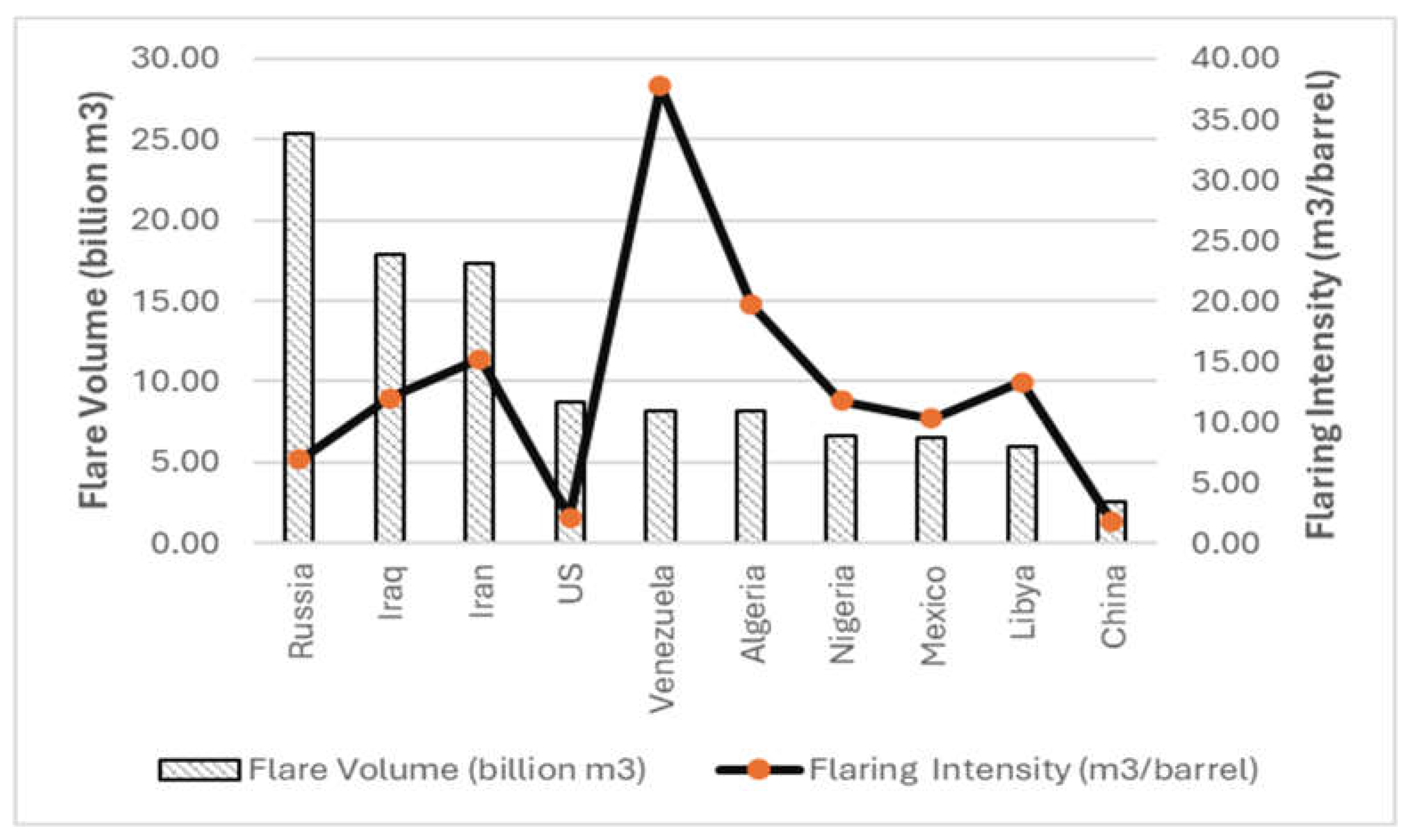
Figure 2.
Evolution of enactments targeting gas flare elimination in Nigeria.
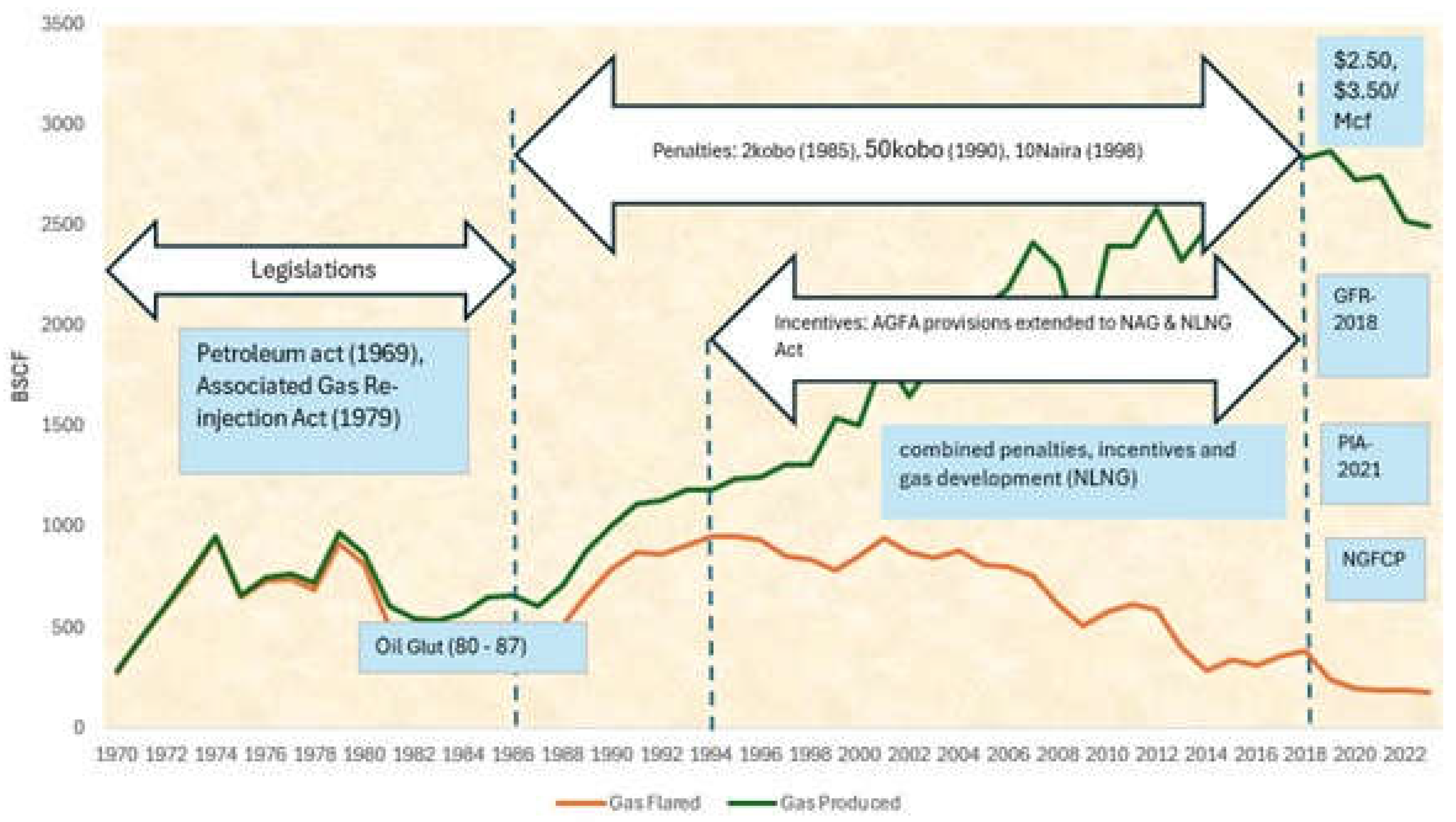
Figure 3.
Volumes of gas flared in Nigeria (Billion Standard Cubic Feet).
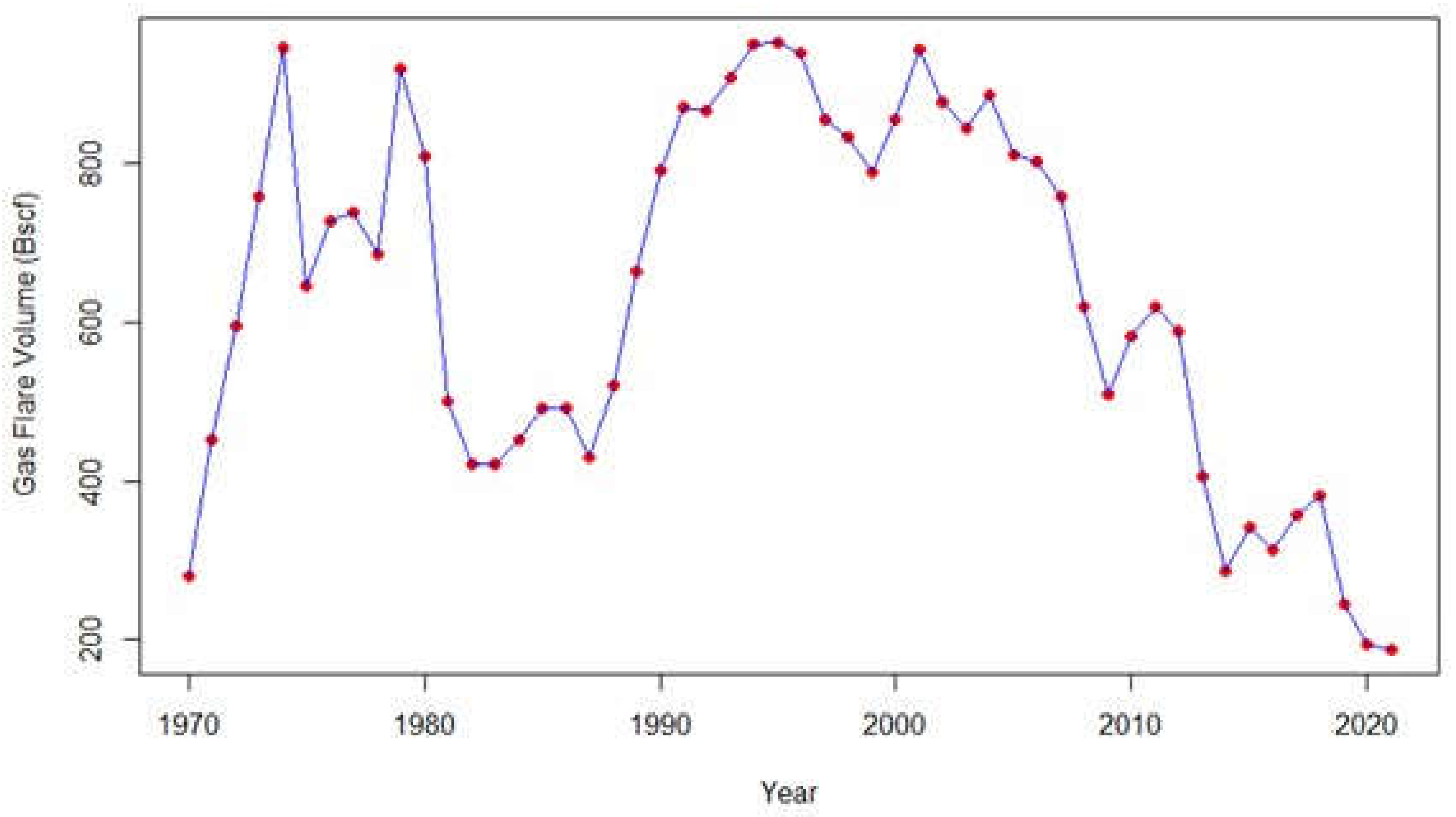
Figure 4.
Volumes of oil produced in Nigeria (Million barrels).
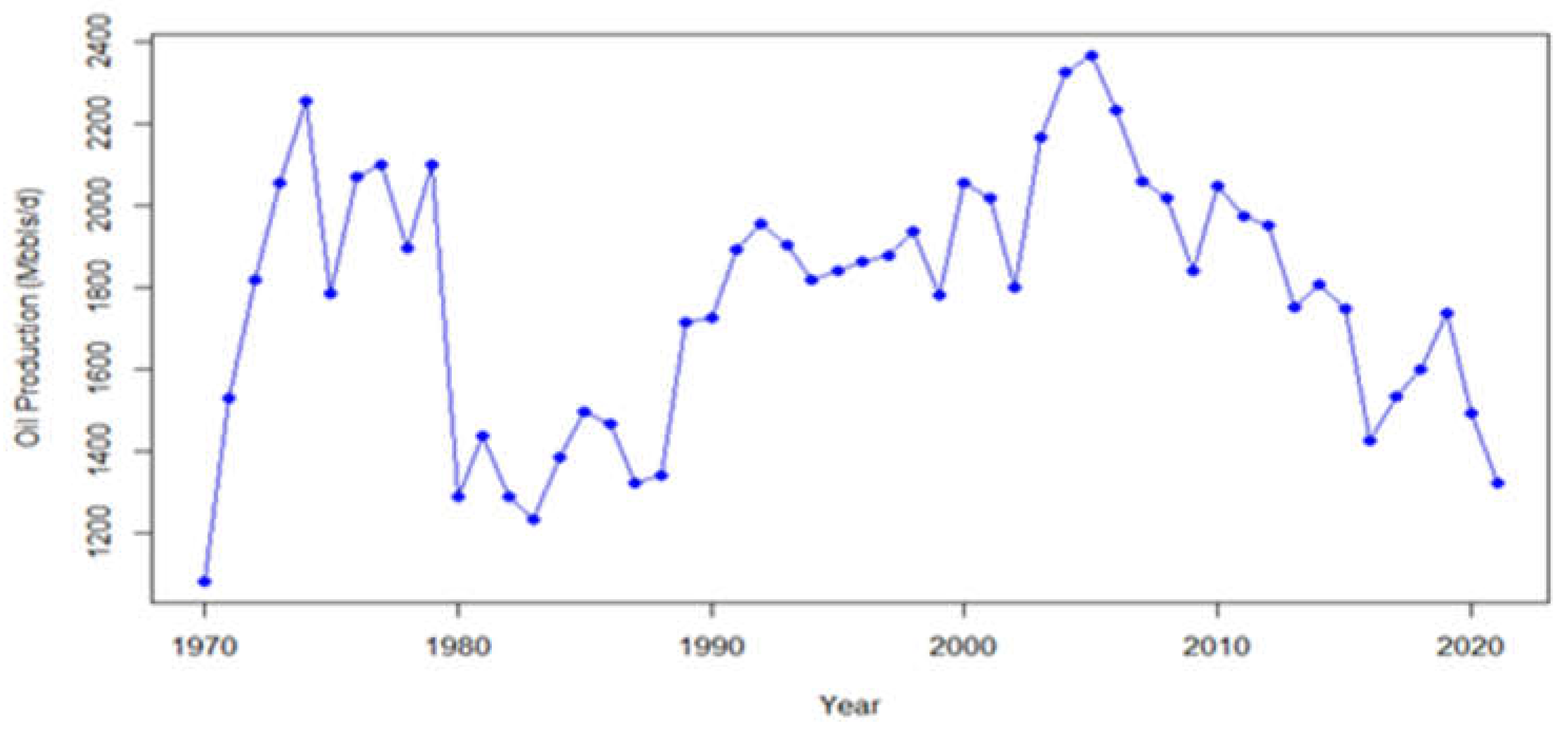
Figure 5.
Global oil prices movement (US$/barrel).
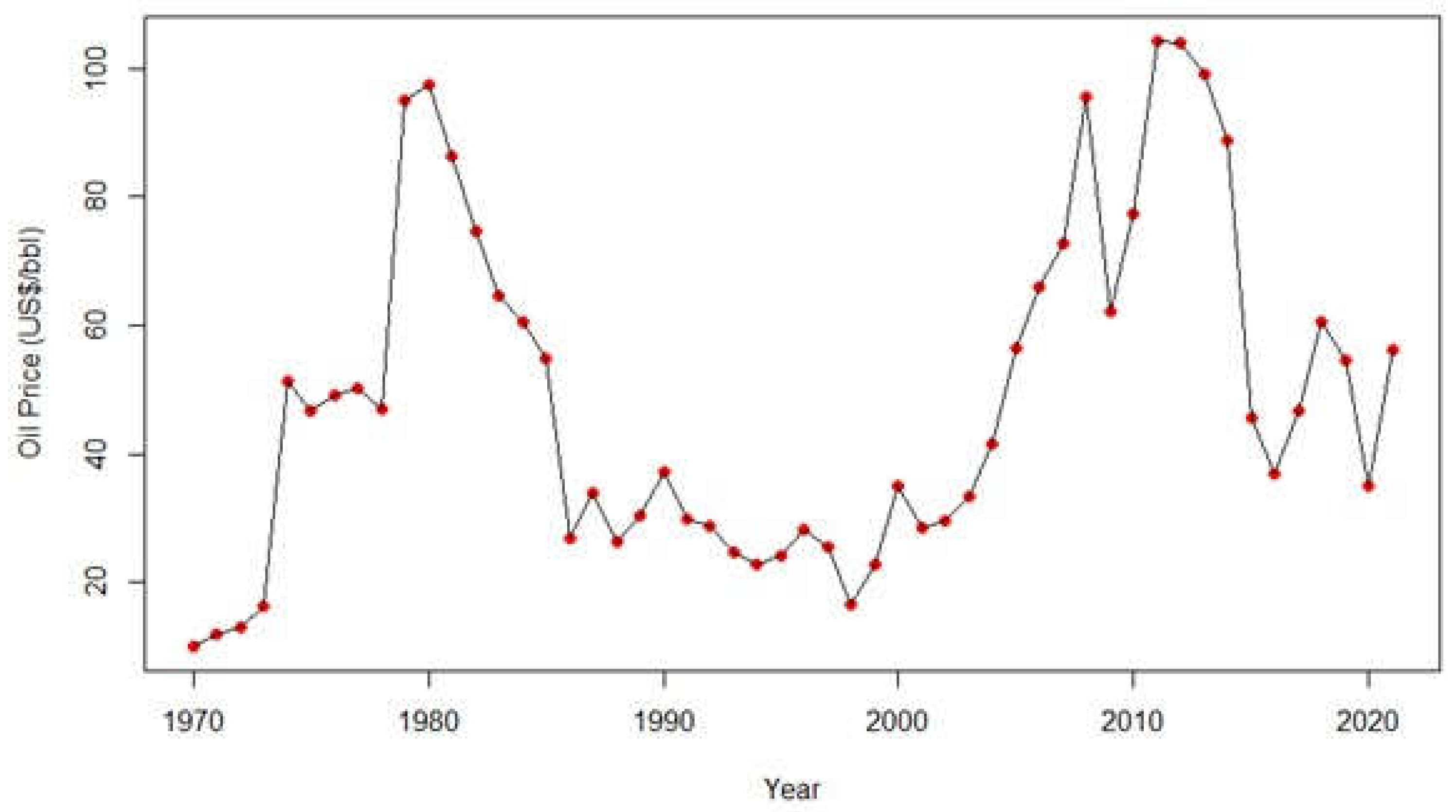
Figure 6.
Historical Gas flare tariff (US$/Mscf).
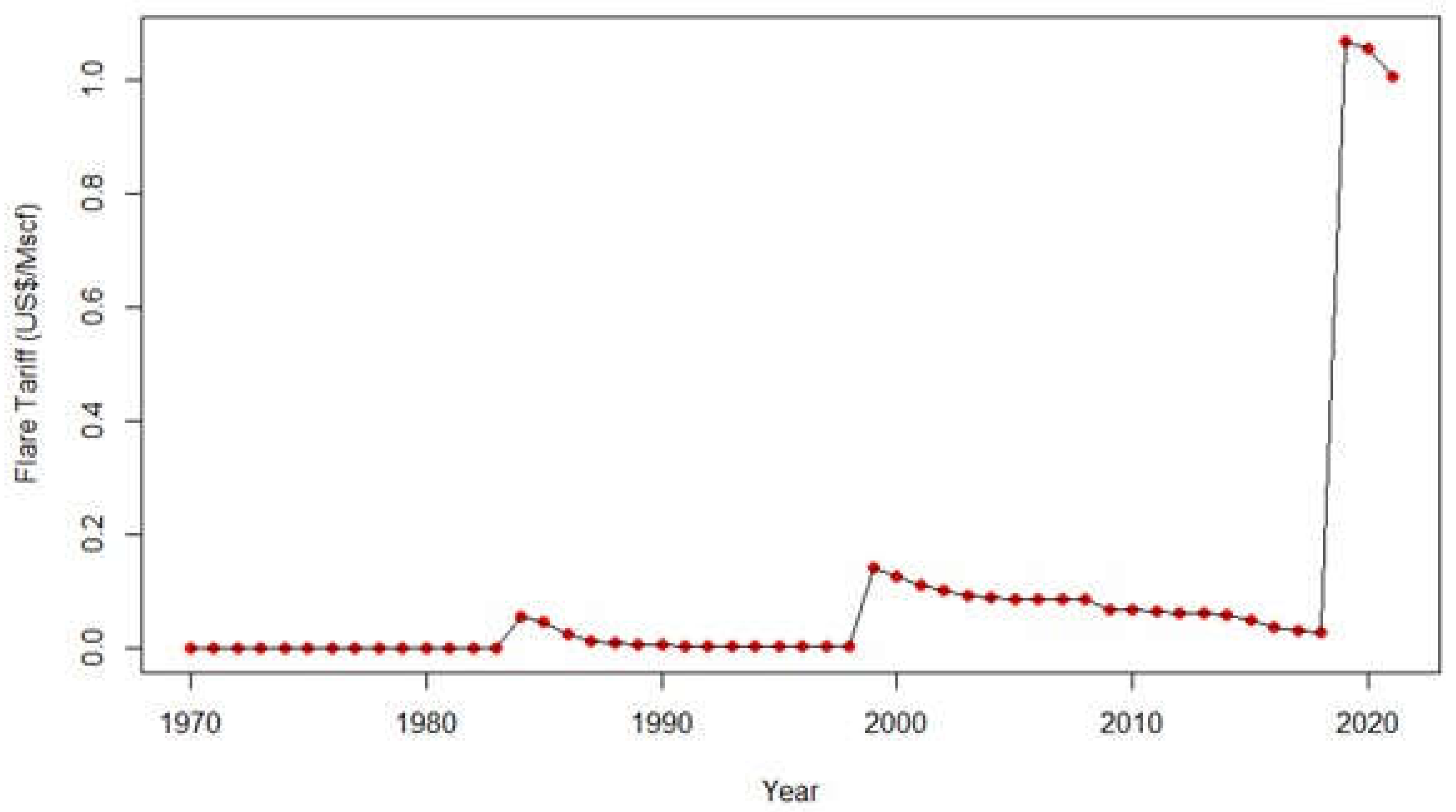

Table 1.
Descriptive statistics of variables.
| Total Gas flared (Bscf) | Total Oil produced (Mbbls/d) | Oil Price (US$/bbl) | Gas price (US$/Mscf) | Adjusted flare tariff (US$/Mscf) | |
| Statistics | TGF | TOP | OPR | GPR | AFT |
| Mean | 637.199 | 1780.385 | 48.773 | 8.152 | 0.217 |
| Median | 655.385 | 1819.350 | 46.095 | 6.830 | 0.005 |
| Maximum | 953.000 | 2366.000 | 104.210 | 16.900 | 3.417 |
| Minimum | 187.820 | 1084.500 | 10.120 | 2.650 | 0.000 |
| Kurtosis | -1.170 | -0.628 | -0.540 | 0.640 | 12.951 |
| Skewness | -0.300 | -0.295 | 0.656 | 1.193 | 3.739 |
| Range | 765.180 | 1281.500 | 94.090 | 14.250 | 3.417 |
| Std. Dev | 231.011 | 307.093 | 26.346 | 3.681 | 0.772 |
| Obs | 52 | 52 | 52 | 33 | 52 |
Source: Authors (Generated with collected data).
Table 2.
Estimation results for level, semi-log and log-log models.
| (1) | (2) | (3) | |
| Variables | Level form model | Semi-log model | Log-log model |
| Oil produced | 0.636*** | 0.001*** | 1.767*** |
| (0.089) | (0.000) | (0.252) | |
| Oil price | -4.856*** | -0.008*** | -0.350*** |
| (0.815) | (0.001) | (0.079) | |
| Gas price | -5.335 | -0.000 | 0.311*** |
| (12.841) | (0.023) | (0.094) | |
| Flare tariff | -277.324*** | -0.783*** | -0.115*** |
| (72.531) | (0.133) | 0.022 | |
| Constant | -224.160 | 4.886 | -6.366*** |
| (146.416) | (0.268) | (1.829) | |
| Observations | 52 | 52 | 52 |
| Adj. R2 | 0.779 | 0.80 | 0.83 |
| p-value of F-stat. | 0.000 | 0.000 | 0.000 |
Note: *** represent statistical significance at 1%, ** represent 5% and * represent 10% levels respectively. Robust standard errors in parenthesis; Adj.R2 represents the adjusted r squared. All price items are in real terms adjusted to 2010 prices using historical CPI sourced from the Worl Bank data bank. Local currencies in the form of flare tariff were also converted to their US$ equivalent using prevailing exchange rate data. Source: Authors’ computations.
Table 3.
Estimation results showing the before and after the 2018 gas flare regulation.
| (1) | (2) | (3) | |
| Variables | Level form model | Semi-log model | Log-log model |
| Oil produced | 0.642*** | 4.281*** | 1.837*** |
| (0.083) | (0.280) | (0.242) | |
| Oil price | -4.188*** | -0.006*** | -0.376*** |
| (0.820) | (0.000) | (0.076) | |
| Gas price | 2.033 | 0.020 | 0.199*** |
| (13.361) | (0.026) | (0.104) | |
| Pre2019AFT | -35.843*** | -0.089*** | -0.078*** |
| (15.101) | (0.029) | (0.027) | |
| Post2019AFT | -3223.327*** | -7.969*** | -6.918*** |
| 1799.598 | 3.467 | 3.299 | |
| Constant | -446.063*** | 4.281*** | -6.495*** |
| (145.229) | (0.280) | (1.744) | |
| Observations | 52 | 52 | 52 |
| Adj. R2 | 0.814 | 0.813 | 0.848 |
| P-value | 0.00 | 0.00 | 0.00 |
Note: Other variables were included as with the previous models but not explained. Interpretation center on the before and after the passage of the 2018 gas flare regulations. *** represents statistical significance at 1%, ** represents 5% and * represents 10% levels respectively. Robust standard errors in parenthesis; Adj.R2 represents the adjusted r squared. All price items are in real terms adjusted to 2010 prices using historical CPI sourced from the Worl Bank data bank. Local currencies in the form of flare tariff were also converted to their US$ equivalent using prevailing exchange rate data. Source: Authors’ computations
Disclaimer/Publisher’s Note: The statements, opinions and data contained in all publications are solely those of the individual author(s) and contributor(s) and not of MDPI and/or the editor(s). MDPI and/or the editor(s) disclaim responsibility for any injury to people or property resulting from any ideas, methods, instructions or products referred to in the content. |
© 2025 by the authors. Licensee MDPI, Basel, Switzerland. This article is an open access article distributed under the terms and conditions of the Creative Commons Attribution (CC BY) license (http://creativecommons.org/licenses/by/4.0/).
Copyright: This open access article is published under a Creative Commons CC BY 4.0 license, which permit the free download, distribution, and reuse, provided that the author and preprint are cited in any reuse.


