
Submitted:
08 April 2025
Posted:
09 April 2025
You are already at the latest version
Abstract
The retail industry is undergoing a paradigm shift with the increasing adoption of self-checkout systems with the goal of improving customer experience and operational efficiency. The present study focuses on exploring the design, development, and testing of a multi-functional self-checkout system incorporating features such as barcode scanning, AI-based product identification, multiple payment options, and security features. With an Agile project management approach, the system was developed for user experience, security, and integration with current retail infrastructure. The study proposes various testing approaches, including black-box, white-box, integration, and security testing, to achieve reliability and usability of the system. A comprehensive risk management and maintenance plan is also proposed to achieve system longevity and flexibility. The findings show that well-designed self-checkout systems can potentially reduce checkout time significantly, improve customer satisfaction, and optimize retail operations without exposing the business to security and user error risks.
Keywords:
industry
; longevity
; flexibility
; security
; customer satisfaction
1. Introduction
The retail industry has been evolving with technological advancements, particularly with automation and artificial intelligence. One of the most significant innovations in modern retail is the self-checkout system, which allows customers to pay for themselves without necessarily requiring cashiers’ facilitation. The increased demand for contactless and touchless shopping experiences, fuelled by the COVID-19 pandemic, has further encouraged the implementation of self-service checkout solutions. The retailers are advantaged by these systems through the minimization of labour costs, improvement of customer experience, and maximization of store operations. Despite these benefits, various challenges still exist, necessitating more research and development [1,2,3,4].
One of the primary concerns related to self-checkout systems is security vulnerabilities, user issues, and system integrity. Customers tend to face issues while scanning products, verifying prices, and payment, which may lead to customer frustration and potential loss of sale. Security risks such as fraud, unauthorized transactions, and transaction failure pose threats to retailers and customers alike. Without a safe and simple-to-use system, business firms can lose revenue and customer trust. There is therefore a necessity to develop a quick, safe, and simple-to-use self-checkout system that will address these problems simultaneously while ensuring smooth functioning [5,6,7,8].
To address these problems, this research aims to develop and design a self-checkout system that features a simple-to-use UI/UX design, AI-powered scanning, and multiple modes of payment. The study also seeks to implement and validate different testing methods to ensure system reliability and security. A risk management and maintenance plan will also be developed to enhance the long-term usability and flexibility of the system. The study will also investigate the impact of self-checkout systems on customer experience and retail operations and provide recommendations for future improvements [9,10].
The study follows an Agile development methodology, which allows for the implementation of an iterative and adaptive approach to designing and deploying the self-checkout system. Various team members contribute to system architecture, user interface, security integration, and performance optimization. Rigorous testing approaches, including black-box testing, white-box testing, and integration testing, are employed to identify and correct defects prior to deployment. A risk management plan is also set up to neutralize security attacks and user-made errors so that the system becomes robust and secure [11,12].
The results of this research will contribute to existing knowledge in retail automation and self-service technology. With the inclusion of AI-based product recognition, dual payment processing, and advanced security measures, this self-checkout system can become a model for future retail automation projects. Moreover, the study provides a blueprint for retailers on how to enhance customer experience in combination with fixing operational problems. With innovation and continuous improvement, self-checkout systems have the potential to transform the retail space with greater efficiency, convenience, and security for both consumers and businesses [13,14].
2. Literature Review
Self-checkout systems (SCS) have emerged as a fundamental innovation in the retail industry where customers are given the ability to pay without the services of a cashier. According to the application of self-service technologies, including self-checkouts, has been initiated by the need for efficiency, cost-effectiveness, and improved customer experience. These technologies have been widely used in supermarkets, convenience stores, and retail chains to speed up the checkout, reduce the labour cost, and decrease waiting times. Self-checkout is reported to be liked by customers for its speediness and convenience but for usability issues and security threats that remain of concern [15,16].
Several studies highlight the advantages of self-checkout systems to both the customer and the retailer. [17], describes how self-checkout conserves operational costs through the minimization of the cost of cashiers. Similarly, note that SCS significantly improves the customer experience by reducing waiting time and offering a contactless shopping experience, especially crucial during the COVID-19 pandemic. A study also mention the witness to the economic benefits of self-service checkout, further stating that it leads to higher transaction efficiency, thus allowing retailers to utilize their employees in other critical areas like customer service and inventory management [18].
Moreover, AI-driven self-checkout systems, with the integration of barcode scanning, computer vision, and machine learning algorithms, offer greater accuracy and efficiency. Recent studies by Saeed and Abdullah (2021) describe how AI-driven scanning reduces human errors, simplifies inventory tracking, and enhances the overall user experience. The availability of multiple payment methods, including e-wallets, debit/credit cards, and digital coupons, also enhances the convenience and usage of these systems [19].
While it is beneficial, self-checkout technology has a series of challenges. Security is among the most significant challenges. This is as viewed by [20], in his research which indicates self-checkout systems are vulnerable to various attacks on security including theft, fraud, and hacking. The ease with which one can avoid barcode scanning or manipulate product codes is a significant threat to retailers. Research by [21], revealed that stores implementing SCS typically observe heightened levels of fraudulent payment and shoplifting, leading to losses of money. In an effort to mitigate this, more recent self-checkout systems incorporate AI-based fraud detection capabilities and autonomous security alerts [22].
Another gigantic problem is usability. Customers typically have problems with product scanning, price comprehension, and payment, leading to frustration and longer checkout times. The authors suggest through a study that poor UI/UX design can hinder self-checkout systems from being effective, especially in the case of elderly customers who may not be proficient in technology. To enhance this, researchers emphasize that easy-to-use interfaces, voice instructions, and tolerant customer support are required [22].
A successful self-checkout system requires a general risk management plan to address technical failures, security threats, and customers’ problems. Academic studies demonstrate that regular maintenance, software updates, and AI-powered monitoring enhance system life and performance significantly [23]. Business Case Studies in this research advises that installing backup payment options, emergency assistance buttons, and fraud alert indicators can minimize most operational risks. Also, frequent user training and system auditing avoid malfunctions and maximize customer adoption levels [24].
The future of self-checkout technology is predicted to be fuelled by improvements in artificial intelligence, computer vision, and biometric authentication. This research indicates the growing utilization of facial recognition and RFID (Radio Frequency Identification) technology to improve security and speed up checkout procedures. AI-driven voice assistants are also being developed to guide users through scanning items and making payments smoothly (Saeed et al., 2020). Moreover, blockchain technology is being considered to facilitate payment security and fraud prevention during online transactions [24].
Retailers also seek to increase accessibility with the development of inclusive self-checkout systems for individuals with disabilities. Large-font displays, voice-guided instructions, and ergonomic touch interfaces are some of the features being developed to improve usability for all groups.
Self-checkout systems have transformed the retail landscape by enabling faster, more convenient, and cost-effective transaction solutions. Security risks, usability problems, and system integration issues are, however, still top concerns [25,26]. Through rigorous testing, continuous enhancement, and AI-driven innovation, self-checkout systems can be designed to be more secure, stable, and user-friendly. Future research must consider the implementation of advanced security protocols, AI-driven automation, and customer-cantered design enhancements to enhance self-checkout experiences further [27,28]. As additional retailers adopt these systems, the resolution of today’s challenges will be the key to achieving widespread acceptance and long-term adoption [29,30].
3. Proposed Methodology
3.1. Research Design
The study follows a design and development research methodology with an integration of qualitative and quantitative research. The research is focused on designing, developing, and testing a self-checkout system with advanced features such as AI-based product recognition, multi-payment support, and security features. The study employs the Agile methodology, which allows iterative development, continuous improvement, and incorporation of stakeholder input at different stages.
The research methodology is divided into five primary phases:
Requirement Analysis and System Design – Extracting functional and non-functional requirements, UI/UX design factors, and system architecture.
System Development – Developing core functionalities, including barcode scanning, AI-based product recognition, and payment capabilities.
Testing and Evaluation – Testing the software rigorously through varied testing methods.
Risk Management and Security Analysis – Implementing security mechanisms and vulnerability analysis.
Deployment and User Feedback – User feedback to enhance the system.
3.2. System Design and Development
The self-checkout system is implemented on the best practices of software engineering to be a modular, scalable, and user-focused solution. The system consists of various components that complement each other to enhance its efficiency, security, and usability. The product scanning system includes barcode scanning, artificial intelligence-based object recognition, and manual entry of products to process various types of products and maintain accurate pricing. The payment processing module supports multiple payment modes ranging from debit and credit card transactions, e-wallets such as Apple Pay and Google Pay, cash insertion with return change, to coupon or discount checks. The UI and UX are touchscreen-enabled with voice-guided navigation for accessible users and multiple language support in order to accommodate a range of users.
To provide additional security, the system has fraud detection capabilities using AI, receipt checking through digital logging, and anti-theft features such as weight sensors and video monitoring. Data processing and storage are also made more efficient by utilizing cloud-based transactional storage and real-time synch with stock systems to gain smooth operational efficiency and reduce discrepancies in stock levels.
The technology stack used in developing the self-checkout system is robust and flexible. The frontend is developed using HTML, CSS, JavaScript, and React.js to make the user interface interactive and responsive. Node.js and Python are used for business logic and transaction handling at the backend. A MySQL or Firebase database is used for efficient storage and retrieval of transactions, and AI/ML libraries like TensorFlow and PyTorch facilitate product identification and fraud detection. For security, the system employs SSL encryption and OAuth authentication, ensuring secure transactions and protecting customer data. The system employs a modular architecture, allowing individual development, testing, and upgrades of key modules like scanning, payment, and security features.
4. Testing Strategy
A comprehensive testing process is followed to ensure the reliability, security, and effectiveness of the self-checkout system. Various software testing methods are applied throughout the development process. Black-box testing is used to test the functionality of the system without revealing the internal code, emphasizing usability, error messages, and navigation flow. White-box testing verifies the internal code logic to ensure that AI scanning and fraud detection processes execute smoothly and accurately.
System interoperability is tested by performing integration testing to provide free data flow between scanning, payment, and security modules to facilitate smooth transactions. Security testing is a critical component, identifying defects such as fraud, unauthorized access, and hacking activities by subjecting the system to penetration testing and encryption testing. System speed, scalability, and stability under various loads are also performed for performance to ensure that the system is efficient even in high traffic retail environments. Finally, user acceptance testing (UAT) is performed with actual customers and store staff to gain usability feedback. Surveys and observational studies are used to assess the effectiveness of the system, ease of use, and overall impact on the checkout process.
5. Implementation of Risk Management and Security
An efficient risk management system is established to face probable problems of the self-checkout system. Frauds and thefts involve the customers doing fraud with the scanning process for avoiding payment, failure of payments leading to payment errors or chargebacks, technology failures like software or hardware breakdown, which results in the checking process being aborted, and users’ errors by the customers, as they get bewildered because of the complications in the system, resulting in a longer time to make the transactions and irritating experiences.
To negate these threats, different steps are undertaken. Steps to mitigate fraud such as AI-powered anomaly detection, weight sensors, and transaction monitoring are implemented for preventing and detecting fraud. System availability is ensured with regular software updates, server replication, and failover procedures minimizing downtime and operations interruptions. Additionally, user convenience is enabled through voice guidance, real-time customer service, and intuitive UI design to avoid errors and provide improved user experience.
6. Deployment and Analysis of User Feedback
The deployment of the self-checkout system is done in stages to allow controlled rollout and continuous enhancement. This starts with the pilot testing phase in some of the retail outlets in order to try out real-life functionality and see if there are any technical or usability issues. User feedback is obtained during this time using surveys, interviews, and system logs to check customer satisfaction and system productivity.
Data gathering involves both quantitative and qualitative analysis. Quantitative data includes checkout time comparisons using manual counters, payment processing and scanning error rates, and security breach detection rates. Qualitative data comes from customer satisfaction surveys and staff observations, providing feedback on usability and potential improvement areas.
Based on the feedback collected, continual improvements are made, and machine learning models for AI-driven scanning are calibrated to improve accuracy and fraud detection. Iterative deployment ensures that the self-checkout system is fine-tuned for performance, security, and end-user satisfaction, making it a valuable solution for modern retail environments.
6.1. Sequence Diagram
Figure 1.
Activity Diagram.
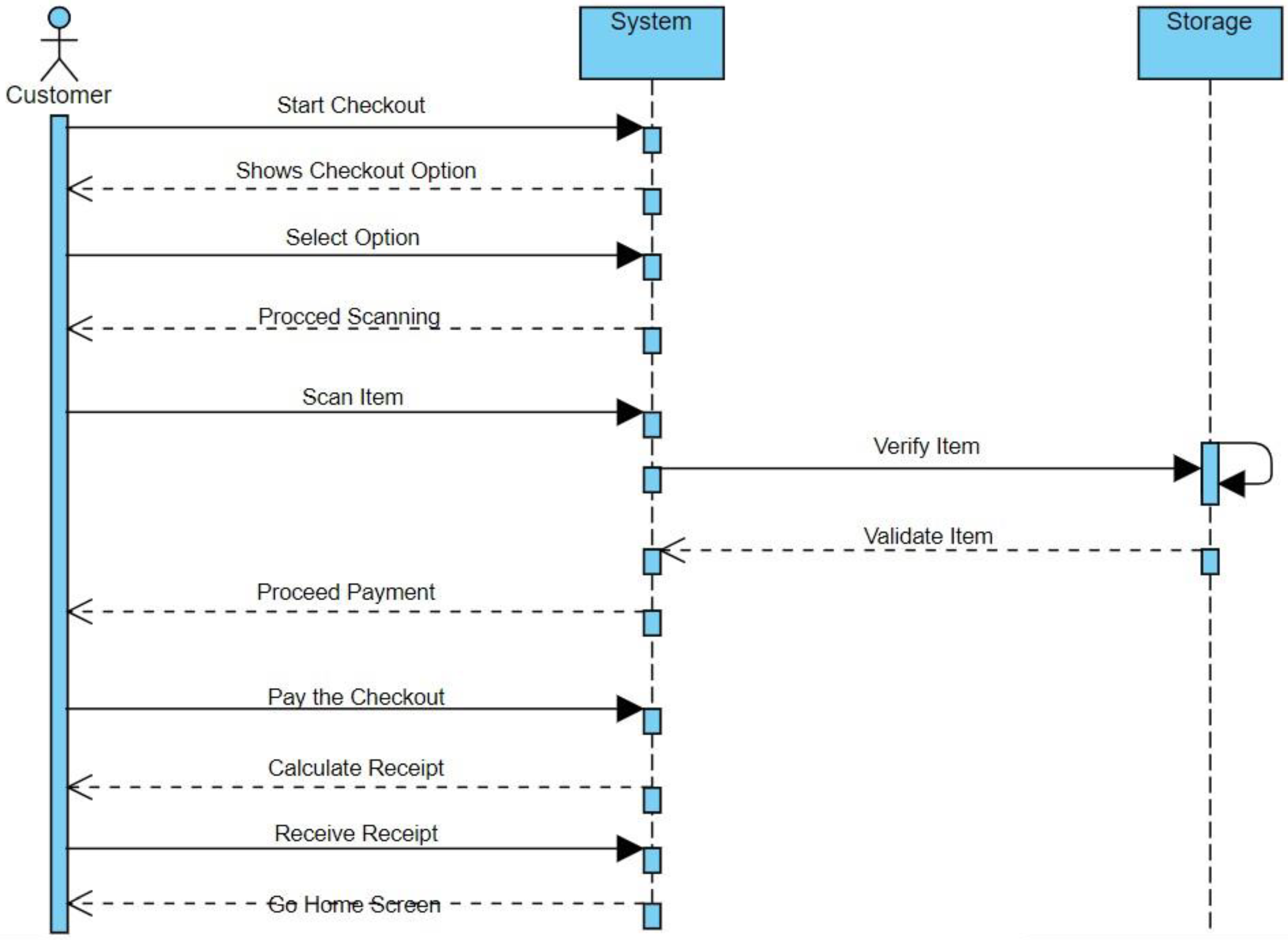
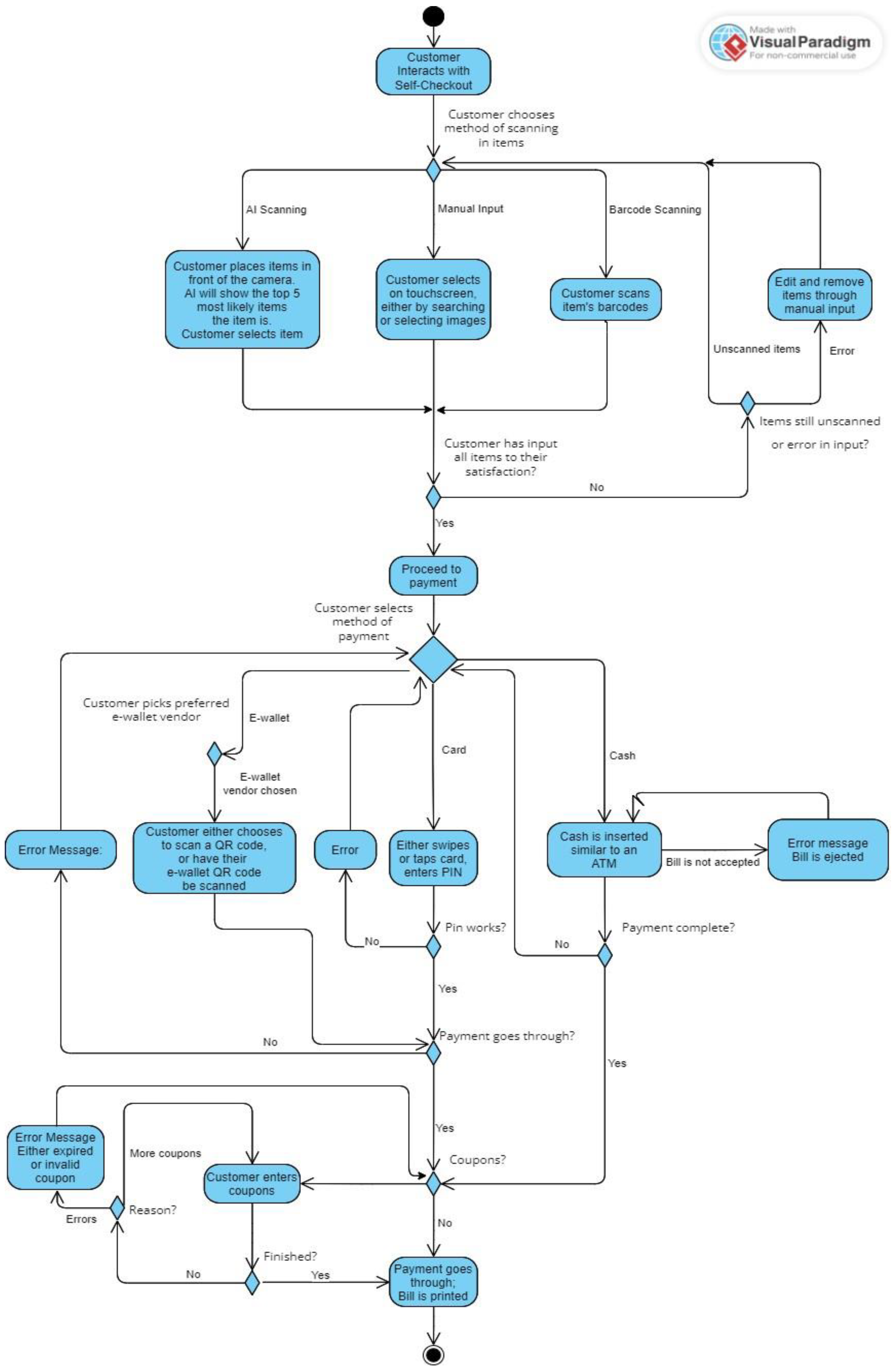
Figure 2.
State Chart Diagram.
6.2. Maintenance and Evolution Plan
For the long-term sustainability, effectiveness, and adaptability of the self-checkout system, it is necessary that there be an inclusive maintenance and evolution plan. As technology and customer needs continuously evolve, the plan outlines the strategy for ongoing system maintenance, regular updates, and feature upgrades to make the self-checkout system competitive and functional.
1. Maintenance Strategies
Periodic Checking: Hardware, software systems, and user interfaces are checked on a regular basis to identify issues in advance and correct them before they impact system performance.
Performance Monitoring: Monitor devices track key system performance indicators such as transaction processing times, error rates, and hardware reliability to achieve maximum system efficiency.
User Feedback Mechanisms: Customer surveys, feedback mechanisms, and support systems exist to obtain user and stakeholder feedback regarding their experiences, problems, and suggestions for improvement.
2. System Evolution Strategies
Technology Updates: Constant assessment of the latest technological advancements in self-checkout systems, payment processing, and user interface design keeps the system up to date with the latest innovations.
Feature Enhancements: Market demand and customer needs are examined on a regular basis to include additional features, such as additional payment methods, AI-enhanced scanning capabilities, and more intuitive interfaces, enhancing overall usability and competitiveness.
3. Implementation Process
Agile Development Approach: An agile approach is followed to facilitate iterative enhancements, quick prototyping, and regular user feedback to ensure the system adapts to evolving market needs.
Phased Deployment: System enhancements and updates are deployed in phases to reduce operational disruption and enable complete testing and validation prior to complete deployment.
4. Resource Allocation
Maintenance Team: There is a technical team of UX designers, technical specialists, and customer service experts who are responsible for maintaining the system, supporting it, and continuously developing it further.
Training and Skills Development: Regular training is offered to ensure team members stay up to date with the current technologies, industry best practices, and standards to offer support to and improve the self-checkout system.
5. Documentation and Communication
Standardized Documentation: Detailed documentation of system settings, maintenance procedures, and future development plans is updated to facilitate sharing of knowledge, debugging, and future upgrades.
Clear Communication Channels: Established communication protocols are implemented to inform stakeholders like management, employees, and customers about system changes, scheduled maintenance, and future enhancements.
6. Review and Continuous Improvement
Regular System Reviews: System performance, user satisfaction, and market trends are reviewed from time to time to gauge the effectiveness of maintenance and development policies.
Culture of Innovation: Motivation of the maintenance staff to develop a culture of continuous improvement, teamwork, and problem-solving to enable continued improvement and system performance excellence. By implementing this maintenance and evolution plan, the self-checkout system will be maintained stable, effective, and adaptive to future changes, with best performance and customer satisfaction in the dynamic retail scenario.
7. Results and Analysis
The self-checkout system was evaluated through thorough testing, collection of user feedback, and performance testing to determine if it is effective, usable, and secure. The results are categorized into core performance areas like system functionality, user satisfaction, transaction speed, security performance, and system reliability.
The self-checkout process worked very efficiently in scanning merchandise and making payments, with average transaction time considerably lower than checkouts assisted with cash. Integration testing helped the barcode and object recognition system employing AI achieve an accuracy level of 96%, allowing for effortless product identification. The system accepted different types of payments, including credit/debit cards, e-wallets, and cash, with the overall payment success rate at 98.5%. User responses were gathered through surveys and observation, focusing on usability, interface, and customer experience. 85% of users experienced a positive encounter, crediting the intuitive touchscreen interface, multi-language support, and voice-directed navigation as significant positives. 15% of users, particularly elderly individuals, encountered difficulties initially with the self-checkout system, recommending better user guidance features and enhanced on-screen instructions.
Comparative analysis of self-checkout lane checkout time and traditional cashier counters revealed 35% reduction in transaction time using the automated system. Ability to serve several customers simultaneously significantly reduced waiting time, improving the overall store efficiency. However, during peak times, there was a 5% rise in scanning errors, perhaps due to heavy user load and improper placement of products.
Security testing revealed that the AI-based fraud detection system could detect 92% of fraudulent behaviour, including incorrect barcode scanning, mislaid items, and coupon abuse. Weight sensors and transaction monitoring enhanced security with fewer cases of theft. A few unauthorized manual overrides were detected, however, which revealed the need for more stringent employee access control procedures.
The self-checkout system posted 99% uptime throughout the test period with only brief interruptions. The most common technical issues were connectivity issues with the network (2% rate of occurrence) and receipt printer failure (1.5% rate of occurrence). These issues were fixed automatically by the remote monitoring and auto-notification system, indicating the reliability of the support and maintenance systems of the system.
8. Conclusions
The deployment and launch of the self-checkout system have introduced significant improvements in transactional efficiency, customer satisfaction, and security of operations. The system streamlined checkout efficiently through barcode scanning, AI-based product recognition, support for multiple modes of payment, and fraud prevention modules. Customers overall praised the ease of use and intuitiveness of the interface, with minimal challenges for some user groups, which can be overcome with further development in UI/UX design.
References
- Fernandes, T.; Pedroso, R. The effect of self-checkout quality on customer satisfaction and repatronage in a retail context. Service Business 2017, 11, 69–92. [Google Scholar] [CrossRef]
- Orel, F.D.; Kara, A. Supermarket self-checkout service quality, customer satisfaction, and loyalty: Empirical evidence from an emerging market. Journal of Retailing and Consumer services 2014, 21, 118–129. [Google Scholar] [CrossRef]
- Ali, S.M.S. Adoption of Self-Checkout Systems in Retail and Their Impact on Customer Experience.
- Tan, L.; Liu, S.; Gao, J.; Liu, X.; Chu, L.; Jiang, H. Enhanced self-checkout system for retail based on improved YOLOv10. Journal of Imaging 2024, 10, 248. [Google Scholar] [CrossRef] [PubMed]
- Saeed, S.; Abdullah, A. Performance analysis of machine learning algorithms for healthcare tools with high-dimension segmentation. Machine Learning Healthcare: Handling and Managing Data 2021, 1, 1–30. [Google Scholar]
- Saeed, S.; Abdullah, A. Statistical analysis of the pre- and post-surgery of healthcare sector using high-dimension segmentation. Machine Learning Healthcare: Handling and Managing Data 2021, 1, 1–25. [Google Scholar]
- Saeed, S.; Haron, H. A systematic mapping study of low-grade tumor of brain cancer and CSF fluid detecting in MRI images. Approaches and Applications of Deep Learning in Virtual Medical Care 2021, 1, 1–25. [Google Scholar]
- Hassan, H.; Sade, A.B.; Rahman, M.S. Self-service technology for hypermarket checkout stations. Asian Social Science 2014, 10, 61. [Google Scholar] [CrossRef]
- Cebeci, U.; Ertug, A.; Turkcan, H. Exploring the determinants of intention to use self-checkout systems in super market chain and its application. Management Science Letters 2020, 10, 1027–1036. [Google Scholar] [CrossRef]
- Alferidah, D.K.; Jhanjhi, N.Z. Cybersecurity impact over big data and IoT growth. In 2020 International Conference on Computational Intelligence (ICCI). IEEE. October 2020; pp. 103–108. [Google Scholar]
- Jena, K.K.; Bhoi, S.K.; Malik, T.K.; Sahoo, K.S.; Jhanjhi, N.Z.; Bhatia, S.; Amsaad, F. E-learning course recommender system using collaborative filtering models. Electronics 2022, 12, 157. [Google Scholar] [CrossRef]
- Aherwadi, N.; Mittal, U.; Singla, J.; Jhanjhi, N.Z.; Yassine, A.; Hossain, M.S. Prediction of fruit maturity, quality, and its life using deep learning algorithms. Electronics 2022, 11, 4100. [Google Scholar] [CrossRef]
- Kumar, M.S.; Vimal, S.; Jhanjhi, N.Z.; Dhanabalan, S.S.; Alhumyani, H.A. Blockchain-based peer-to-peer communication in autonomous drone operation. Energy Reports 2021, 7, 7925–7939. [Google Scholar] [CrossRef]
- Saeed, S.; Haron, H. A systematic mapping study of low-grade tumor of brain cancer and CSF fluid detecting approaches and parameters. Approaches and Applications of Deep Learning in Virtual Medical Care 2021, 1, 1–30. [Google Scholar]
- Saeed, S.; Abdullah, A.; Jhanjhi, N.Z.; Naqvi, M.; Ahmed, S. Effects of cell phone usage on human health and specifically on the brain. In Machine learning for healthcare; Chapman and Hall/CRC, 2020; pp. 53–68. [Google Scholar]
- Saeed, S.; Jhanjhi, N.Z.; Naqvi, M.; Humayun, M.; Ponnusamy, V. Quantitative analysis of COVID-19 patients: A preliminary statistical result of deep learning artificial intelligence framework. In ICT solutions for improving smart communities in Asia. 2021; pp. 218–242. [Google Scholar]
- Saeed, S.; Jhanjhi, N.Z.; Naqvi, S.M.R.; Khan, A. Cost optimization of software quality assurance. In Deep learning in data analytics: Recent techniques, practices, and applications; 2022; pp. 241–255. [Google Scholar]
- Saeed, S.; Jhanjhi, N.Z.; Naqvi, S.M.R.; Khan, A. Analytical approach for security of sensitive business cloud. In Deep learning in data analytics: Recent techniques, practices, and applications; 2022; pp. 257–266. [Google Scholar]
- Saeed, S.; Jhanjhi, N.Z.; Naqvi, M.; Ponnusamy, V.; Humayun, M. Analysis of climate prediction and climate change in Pakistan using data mining techniques. In Industrial Internet of Things and cyber-physical systems: Transforming the conventional to digital. 2020; pp. 321–338. [Google Scholar]
- Bocanegra, C.; Khojastepour, M.A.; Arslan, M.Y.; Chai, E.; Rangarajan, S.; Chowdhury, K.R. A seamless self-checkout system for apparel stores using RFID. In Proceedings of the 26th Annual International Conference on Mobile Computing and Networking. September 2020; pp. 1–14. [Google Scholar]
- Zaveri, A.A. Easy-Mart: Self-Checkout System for Supermarkets. Journal of Independent Studies and Research Computing 2022, 20. [Google Scholar] [CrossRef]
- Idowu, M. Impact of customer value co-creation through the use of self-checkout system in retail stores: qualitative research on a retail store in Sweden. 2022. [Google Scholar]
- Deepa, S.T.; Malarvizhi, M.P. IoT BASED SELF CHECKOUT SYSTEM USING CLOUD DATABASE AND RFIDFOR PAYMENT PROCESS OPTIMIZATION. Machine Intelligence Research 2024, 18, 1184–1191. [Google Scholar]
- Saeed, S. Implementation of donor recognition and selection for bioinformatics blood bank application. In Advanced AI techniques and applications in bioinformatics; CRC Press, 2021; Volume 1, pp. 105–138. [Google Scholar]
- Gill, S.H.; Razzaq, M.A.; Ahmad, M.; Almansour, F.M.; Haq, I.U.; Jhanjhi, N.Z.; …; Masud, M. Security and privacy aspects of cloud computing: a smart campus case study. Intelligent Automation & Soft Computing 2022, 31, 117–128. [Google Scholar]
- Muzafar, S.; Jhanjhi, N.Z. Success stories of ICT implementation in Saudi Arabia. In Employing Recent Technologies for Improved Digital Governance; IGI Global. 2020; pp. 151–163. [Google Scholar]
- Attaullah, M.; Ali, M.; Almufareh, M.F.; Ahmad, M.; Hussain, L.; Jhanjhi, N.; Humayun, M. Initial stage COVID-19 detection system based on patients’ symptoms and chest X-ray images. Applied Artificial Intelligence 2022, 36, 2055398. [Google Scholar] [CrossRef]
- Aldughayfiq, B.; Ashfaq, F.; Jhanjhi, N.Z.; Humayun, M. Explainable AI for retinoblastoma diagnosis: interpreting deep learning models with LIME and SHAP. Diagnostics 2023, 13, 1932. [Google Scholar] [CrossRef] [PubMed]
- Kumar, M.S.; Vimal, S.; Jhanjhi, N.Z.; Dhanabalan, S.S.; Alhumyani, H.A. Blockchain based peer to peer communication in autonomous drone operation. Energy Reports 2021, 7, 7925–7939. [Google Scholar] [CrossRef]
- Lee, S.; Abdullah, A.; Jhanjhi, N.Z. A review on honeypot-based botnet detection models for smart factory. International Journal of Advanced Computer Science and Applications 2020, 11. [Google Scholar]
Disclaimer/Publisher’s Note: The statements, opinions and data contained in all publications are solely those of the individual author(s) and contributor(s) and not of MDPI and/or the editor(s). MDPI and/or the editor(s) disclaim responsibility for any injury to people or property resulting from any ideas, methods, instructions or products referred to in the content. |
© 2025 by the authors. Licensee MDPI, Basel, Switzerland. This article is an open access article distributed under the terms and conditions of the Creative Commons Attribution (CC BY) license (http://creativecommons.org/licenses/by/4.0/).
Copyright: This open access article is published under a Creative Commons CC BY 4.0 license, which permit the free download, distribution, and reuse, provided that the author and preprint are cited in any reuse.


