

Submitted:
08 April 2025
Posted:
09 April 2025
You are already at the latest version
Abstract
The study posits the need for a conceptual multi-risk management approach for fresh produce, an essential product category for societal resilience, and one constantly affected by climate change, policy volatility, and geopolitical disruptions. The research starts from a literature-informed risk typological mapping, leading to Gephi visualizations of networks related to this trade. Network analysis using 2024 bilateral trade data reveals a core-periphery topology, with the United States, Spain, and the Netherlands as central hubs. A gravity-based simulation model is, lastly, used to address the question: what structural vulnerabilities and flow-based sensitivities define the global fresh produce trade, and how do they respond to simulated multi-risk disruptions? The model uses the case of USA as a global trade hub and induces two compounding risks: a protectionist tariff policy shock and a climate-related shock in its main supplier. The conclusion is that the fragility in the fresh produce trade enhances the cascading effects that any risk event may have across environmental, economic, and social sustainability dimensions. The paper emphasizes the need for anticipatory governance, diversification of trade partners, and investment in cold chain resilience, offering an image for policymakers to acknowledge the risk and mitigate this increasingly fragile fresh produce trade.
Keywords:
fresh produce trade
; multi-risk assessment
; supply chain resilience
; trade flow vulnerability
; global value chains
; perishable goods
; gravity model
; network analysis
1. Introduction
Before being able to become hunters, humans were gatherers, so fresh produce is an intrinsic part of human evolution and a staple for diet for millennia. Even in modern times, its role remains foundational to human health and nutritional well-being. And yet, more than “1.7 million deaths worldwide are being attributed to low fruit and vegetable consumption” [1]. Fresh produce, defined as “fresh fruits and vegetables […] that is likely to be sold to consumers in an unprocessed or minimally processed (i.e., raw) form” [2], is essential for global health, nutritional security and central to achieving Sustainable Development Goals: SDG 2 (Zero Hunger) and SDG 3 (Good Health and Well-being).
It is also a significant part of the international agri-food trade, with the revenue in 2025 amounting to 1,653.56 billion USD (875.19 billion USD from fresh vegetables and 778.37 billion USD from fresh fruit) [3,4]. Both markets are expected to grow annually by more than 6% (CAGR 2025-2030 for vegetables – 6.68% and for fruits – 6.28%) [3,4]. This significant growth is supported by complex supply chains that enable year-round and worldwide access to products that are seasonal and regional.
However, fresh produce is perishable, with short shelf life, temperature and other sanitary and phytosanitary (SPS) sensitivity, and seasonal availability. Thus, its logistics are complex and specific and require specialized infrastructure—most notably cold chain systems and rapid distribution networks. These characteristics distinguish it from other commodities, but they also increase the vulnerability of its supply chain to local as well as systemic disruptions. Of particular importance is the fact that, unlike cereals or processed foods, fresh produce depends on cold chains and, thus, has little buffer time, which means its trade is more exposed to even minor delays or disruptions.
At the same time, the structure of the global trade in produce is growing in complexity. Studies from the past decade mention that it displays scale-free and small-world topologies [5,6], concentrating flows amongst several hubs, such as the USA, Netherlands, or China. Among these hubs, the USA stands out as a major consumer market equivalent to a gravitational centre, a status quo that increases the systemic stakes of any unilateral disruption originating there.
Still, there is also a growing role for intermediary countries that may redistribute flows across trade corridors to enhance connectivity [7]. These additions increase, however, the network complexity, which may become more efficient but also increase the risks associated and create fragility. This is also due to the fact that chokepoints and central nodes can propagate shocks rapidly across the network and expose downstream actors to cascading effects [7,8,9]. Although the perception of risk events as siloed is easier to handle, particularly in research, the interconnection of risks (as also considered by the World Economic Forum in its yearly Global Risks Reports) is evermore relevant, as the result is often non-linear amplification, generating disruptions that exceed the sum of their parts.
The fragility of the structure adds to the fragility of the produce, affected mainly by climate change, water availability, and increased postharvest spoilage [10]. But there are other types of risks to take into consideration, from crop diseases to price surges due to export bans or tariffs, to nutrient loss, to geopolitical tensions (such as the war in Ukraine) impacting trade and exposing import-reliant regions like Sub-Saharan Africa to critical supply shocks. All these disruptions, many as they may be, are exacerbated by the scale-free, core-periphery nature of global fresh produce networks, in which just a few central hubs handle disproportionately high volumes of trade. Most analytical models isolate these risks, focusing only on one at a time, and often fail to capture their compound effects and flow-sensitive risks, which are so relevant for this type of commodity.
Although the literature on the topic is numerous and growing, most studies focus either on cereals (wheat and maize) or food in general and predominantly employ single-risk modeling [9,11,12]. Very few analyses provide integrated multi-risk models, and even less so based on fresh produce, which highlights a lack of hybrid modeling frameworks that integrate trade flow forecasting (via gravity models) with network-based mapping of structural and dynamic vulnerabilities for this particular type of commodity.
In this context, this paper comes to fill this literature gap by proposing a hybrid model meant to answer this research question
"Using a hybrid approach (integrating various methodologies), what structural vulnerabilities and flow-based sensitivities define the global fresh produce trade, and how do they respond to simulated multi-risk disruptions, including climate volatility and policy shocks?"
The model will, thus, (a) map structural vulnerabilities in the global fresh produce trade, (b) analyze flow-based sensitivities under compound, systemic shocks, and (c) simulate responses to multi-risk scenarios.
In theory, this study advances trade modeling by linking it to a risk assessment that econometrically captures both structural and dynamic dimensions of trade risk. Empirically, the study provides a perspective on fresh produce, which, in turn, may equip policymakers with insights relevant to potential mitigations to country-specific risks, enhancements of food system resilience, and/or trade diversification. If the food system resilience is often referred to logistical terms, in this study, we consider it from a broader sustainability perspective – environmental (waste and spillage), social (access to nutritious food), and economic (cost and market stability). To conclude, the study integrates typological, network-based, and econometric perspectives to assess structural and dynamic vulnerabilities in the global fresh produce trade system, framing them as potentially eroding factors for the aforementioned sustainability.
To address the central research question, the paper is structured in a linear manner, from Section 2 presenting the hybrid model methodology and data sources, to Section 3 reviewing the relevant literature to inform a typological risk mapping, Section 4 detailing the results of the hybrid model and, lastly, Section 5 concluding the study including sustainability, resilience and governance implications and directions for future work.
2. Materials and Methods
As the search term “fresh produce trade vulnerability” yields more than 338,000 results on Google Scholar (as of March 2025), and “fresh produce trade network vulnerability” returns roughly 226,000, of which 14,700 in the last 5 years, a multirrisk framework requires both systematic search, screening protocol and multiple methodologies to ensure both methodological rigor and comprehensive coverage.
In this view, this study uses a three-pronged approach to capture the unique structural and flow-based vulnerabilities of the global fresh produce trade system: by integrating (a) typological risk mapping of structural vulnerabilities, (b) network analysis of trade structure and flow sensitivities, and (c) a gravity-based trade simulation model under multi-risk disruption scenarios. This triangulated approach ensures the proper (both descriptive and predictive) identification of systemic chokepoints, a suitable quantification of flow sensitivity, and the ability to simulate the potential impacts of compounding events, leading to a clearer image of how trade shocks may reverberate through the global fresh produce system.
The first step is a literature-informed typological risk mapping. The method is used increasingly in research pertaining to agri-food systems due to its ability to enhance the interpretability of network-based models see studies using similar methodological approaches in [13,14,15,16,17]. This step consists of a systematic review of literature on the topic, from which relevant disruptions were extracted and coded for the global food network and, more specifically, for the fresh produce trade. The resulting typology is not an end in itself. This step acts as a filter for identifying relevant compound risks to be modeled and tested in the simulation layer.
By referring to previous work [9], we grouped risks into three categories:
- Climate-related risks (e.g., heat stress, water scarcity, post-harvest spoilage)
- Policy shocks (e.g., export bans, SPS restrictions, tariff volatility)
- Geopolitical disruptions (e.g., conflict-induced route closures, trade embargoes).
To create a risk typology matrix, these risks were cross-tabulated against known sensitivity indicators, such as import dependence, supply concentration, perishability, and cold chain reliance, to synthesize multi-risk exposure. The matrix builds upon a methodology from cyber security – the vulnerability prioritization framework [18].
The second step is focused on identifying the structural topology of the global fresh produce trade and uses a network based on 2024 bilateral trade data from UN Comtrade, using HS-4 level product codes corresponding to fresh fruit and vegetable categories. Nodes represent countries; edges represent trade volumes in USD. The network is visualized with Gephi, and applies specific filtering methods and algorithms to identify core–periphery structures. The hypothesis is that, consistent with the literature ([6,8]), the network will exhibit scale-free and small-world properties. The method is widely used in the identification of agri-food trade vulnerabilities [19,20]. The aim of this step is not to run a formal network simulation but to understand how the architecture of trade, particularly the structural centrality of major trade hubs, sets the stage for vulnerability, especially in a multi-risk context (paired with a permacrisis background).
The third step is a gravity model of trade flows meant to assess the flow-based sensitivity of global fresh produce trade. It is of particular importance for this step to stress that fresh produce markets, due to their perishability and trade concentration, are particularly sensitive to cost changes.
To stress-test the network, we use a scenario based on a single exogenous policy shock which evaluates the ripple effects of a major policy intervention by a central actor, more specifically, a 10% across-the-board tariff imposed by the United States of America on all fresh produce imports, increased to 25% for shipments from Mexico and Canada. The scenario is based on the real baseline tariff imposed by President Donald Trump on April 2nd, 2025, and it encapsulates both a plausible geopolitical and a protectionist policy shock with global systemic ramifications, mainly due to the central role of the country in the global produce flows. This central role has already been indicated by the two previous steps. This trade shock (which builds on the work of [21] based on the measures from the first Trump administration) is treated both as a standalone disruption and in a compound scenario alongside climate-related production losses. The simulation uses a modified gravity model, with trade volume responses estimated using elasticity values ([21]), treated as heuristic parameters, not calibration outputs. The
For this, we estimate a basic log-linear gravity model with the following equation:
| ln(T_iUS) = b0 + b1*ln(GDP_i) + b2*ln(Distance_iUS) + b3*Border_iUS + b4*Tariff_iUS + b5*SPS_iUS + e_iUS | (1) |
| Where: - T_iUS: Value of fresh produce exports from country i to the United States. Data source: UN Comtrade (HS 07–08, USA imports only); - GDP_i: Gross Domestic Product of exporter. Data source: World Bank WDI; - Distance_iUS: Geographic distance between country i and USA. Data source: CEPII GeoDist (to U.S. only); - Border_iUS: Dummy variable indicating shared border. Manual: 1 for Mexico, Canada; 0 otherwise; - Tariff_iUS: Applied ad valorem tariff rate on fresh produce exports from country i to US. Data source: MacMap (to U.S. by HS6); - SPS_iUS: Dummy variable for the presence of non-tariff SPS measures that constrain trade in perishables (1 = SPS restriction in place; 0 = otherwise). Data source: WTO SPS IMS database; - b1-b5: Estimated coefficients; - e_iUS: Error term. |
The data is collected for 2024 to eliminate the shock effects of the pandemic and the war in Ukraine, both extremely significant in the agrifood trade as exhibited by literature. The simulation for the 10% across-the-board tariff for the United States uses the following method:
- We assume baseline trade values – as predicted from the gravity model
- We assume the elasticity of trade to tariff shocks as -0.95 [21]. (the detailed reason the value is explained in the Results section). (Baseline elasticity values used range from -0.8 to -1.2, depending on the commodity and source country, with demand-side price sensitivity assumed to remain constant across scenarios.)
- The model outputs a predicted reduction in trade volumes and identifies the most affected exporters.
- We presume no retaliatory measures from the exporters.
- We revise trade flows following this equation:
T̂_{iUS}^{tariff} = T_{iUS}^{baseline} × (1 + Δτ_{iUS})^ε,
- -
- T̂_{iUS}^{tariff} is the adjusted trade volume after the tariff shock;
- -
- T_{iUS}^{baseline} is the predicted trade flow from the gravity model (from equation (1));
- -
- Δτ_{iUS} is the change in tariff rate (e.g., from 0% to 10% or 25%);
- -
- ε is the price elasticity of trade (e.g., -0.95).
The reason for choosing this third step of the methodology resides in the fact that gravity models are a traditional method in policy analysis and have proven effective in modeling tariff effects ([22]). Moreover, the scenario design allows for basic sensitivity testing and shows if trade volumes decline linearly or exponentially under dual stress conditions.
Lastly, building on these three steps, we link in the final analytical layer these potential shocks to sustainability impacts across three dimensions: (a) environmental (e.g., increased emissions and food waste); (b) economic (e.g., price volatility, supply instability); and (c) social (e.g., reduced access to affordable, nutritious food). These impacts are qualitatively assessed and, where applicable, supported by secondary data estimates, in view of highlighting where systemic shocks may erode long-term sustainability in disproportionate ways.
3. Understanding Fresh Produce Trade Networks: A Critical Literature Review
To properly identify relevant disruptions and classify them in a way that supports both network interpretation and simulation design, we use the typological risk mapping method used in agri-food systems research, as previously mentioned.
For this, we retrieved between February and March 2025 a set of 500 articles and expert reports from various databases (Scopus, Semantic Scholar and other sources: FAO, WTO, USDA) through hybrid keyword strings (e.g., "fresh produce trade AND network analysis", "gravity model AND agricultural shocks", "food trade resilience AND climate change"), starting from the research question. We included studies based on relevance to international fresh produce trade, application of gravity or network models, and coverage of climate, policy, or geopolitical disruptions and excluded those focused solely on domestic trade or non-agricultural commodities, and the screening questions, taken holistically, were the following:
- Does the study analyze international (rather than purely domestic) trade networks of agricultural products or fresh produce?
- Is the primary focus on agricultural/fresh produce supply chains?
- Does it include analysis of fresh/unprocessed agricultural products?
- Does it employ gravity models and/or network analysis methods with the potential for integrated analysis?
- Does it include quantitative analysis rather than purely descriptive analysis?
- Does it refer to at least one of the following risks: climate change, trade policy, or geopolitical events?
The final selection of 150 papers related to global food trade issues and 40 related to fresh produce trade covers various methodological approaches and includes both theoretical and empirical contributions, mapping the state of the art and highlighting critical gaps motivating the hybrid gravity-network model proposed in this paper. Only those studies explicitly referenced in the paper were included in the list of references, and the list of revised supplementary papers is found in Appendix A.
Based on the entire corpus of 150 papers on global food trade networks, we identify three thematic clusters: (1) structural vulnerabilities in global produce networks, (2) flow-based sensitivities to systemic risk, and (3) adaptive capacities and resilience mechanisms, moving a linear way from why some countries and flows are at risk to how disruptions impact them to what can be done about it. A conceptual synthesis of these clusters is presented in Figure 1. While they emerge from the broader literature on global food trade networks, they are still relevant for fresh produce, given its sensitivity to disruption and dependence on concentrated trade flows. Basically, we infer that fresh produce networks are more fragile versions of the larger global food trade systems.
The first thematic cluster refers to the structural risks related to the global food and fresh produce trade networks, more specifically derived from their core-periphery topology. A detailed insight mapping may be found in Table 1 and Table 2. The findings reflect that in the landscape of this particular commodity, a few central exporters act as systemic hubs, and the numerous rest function as peripheral, import-reliant nations. Seven entities (countries and supranational economic unions) form the core of the International Food Trade Network. They collectively engage with over 77% of global trade partners and account for nearly a third of the trade volume [6], a status quo that has held for more than a decade.
These hub-and-spoke networks exhibit scale-free and small-world properties, meant to enhance efficiency (provided the conditions are stable) with short average path lengths, high clustering, and power-law distributions of trade flow [20]. The same characteristics also become risk factors and intensify fragility under systemic stress. This fragility may be quantified by using network metrics, such as network density (which [32] find to reflect limited redundancy), clustering coefficients (moderate, as per [32]) or chokepoints and exposure pathways [31]. These metrics may also inform sub-national and regional insights, such as the case of identifying bridging countries that connect modular trade regions [34]. Along the same line, studies also highlight that community clustering can either buffer or amplify shocks, depending on the geographic configuration and the commodity in question [29].
The core-periphery topology as a structural vulnerability is based on asymmetric dependencies between exporting and importing countries. Regions such as Sub-Saharan Africa and the Middle East rely heavily on a narrow set of suppliers, having an increased sensitivity to even modest trade flow perturbations ([43] and [11]). This systemic exposure has intensified with the pandemic-era trade dynamics [25]. It is to be noted that both these regions are also affected by significant geopolitical risks not directly related to food networks, and hence, this (latent) risk factor may rapidly trigger cascading failures under compound disruptions.
Even if the referenced studies refer to the entire food network, the structural traits keep for fresh produce with a certain number of distinctive vulnerabilities being applied solely to them. These are mapped in Table 2. They start from the foundational works of [45] and [46], who model the effects of spoilage and inventory decay and show that perishability is a systemic constraint on trade flow flexibility. [47] show that fresh produce is more infrastructure-dependent than most dry goods by simulating logistics networks where temperature control and cold chain reliability are essential for system resilience. Adding to the landscape are regional trade agreements (such as NAFTA or the Chinese-Myanmar melon link) that shape the topology and path-dependence of produce exports, in a linkage of structural trade flows to regulatory frameworks [48]. Lastly, works such as [49] show that regions like the U.S. Southwest are structurally exposed due to water-intensive production under climatic stress, highlighting the position of fresh produce within the broader Food-Energy-Water (FEW) nexus.

Table 2.
Structural Vulnerabilities in Global Fresh Produce Trade Networks
| Structural element | Empirical Evidence / Metrics | Key Interpretation | Implications for Vulnerability | Referenced Key Studies |
|---|---|---|---|---|
| Cold chain dependency | Cold chain failures account for up to 30% postharvest losses in perishables (especially fruits and leafy greens). | High reliance on temperature-controlled logistics. | Breakdowns cause large-scale spoilage and supply loss. | [50,51,52] |
| Postharvest decay & perishability | Spoilage rates are exponentially time-sensitive; up to 40% loss within 3–5 days if not refrigerated or delayed in transit. | Perishability acts as a hard constraint on trade flexibility. | Supply chain rigidities amplify effects of shocks. | [45,46,51] |
| Climate exposure in yield zones | Berry and lettuce production show strong correlation with climate volatility. Yield drops by 10–15% under high-heat or drought conditions. | Climate-sensitive crops cluster in vulnerable geographies. | Climate volatility disrupts both production and flow stability. | [49,53] |
| Regional trade dependencies | The U.S. imports ~70% of fresh vegetables from Mexico and 25% of fresh fruit from Mexico and Chile. | Highly asymmetric dependency on a few partners. | Exposure to bilateral shocks and seasonal bottlenecks. | [54,55] |
| Seasonality and NAFTA corridors | Fresh produce trade shows seasonal surges tied to trade agreements like NAFTA. Regulatory shifts cause disproportionate seasonal impact. | Seasonality and path dependency increase systemic sensitivity. | Disruptions coincide with peak demand, increasing systemic fragility. | [48,52,53] |
| Homogenization of supply sources | Export concentration in a few hubs (e.g., Mexico, Chile) has intensified since 2000, especially in off-season produce like berries, peppers, and tomatoes. | Trade centralization reduces adaptive capacity. | Risk of synchronized disruption and limited substitution options. | [49,50,55] |
In a nutshell, similarly to the global food network, the fresh produce supply chain is fragilized by unbalanced supply and demand, transport bottlenecks, and seasonal cycles [56]. Certain countries, although hubs, rely heavily on imports for certain produce (for instance, China and soybeans), thus becoming vulnerable to trade disruptions like tariffs and other types of trade frictions and policy changes [28,57,58]. Lastly, the governance structure of the value chain in some regions (see the Myanmar-China melon trade in which brokers control the chain instead of retailers [48]) significantly affects the risk-reward distribution and may possibly inhibit upgrades, technological innovation, and, consequently, increase risk.
If the first thematic cluster allows for the identification of high-risk nodes and flows, which are further assessed in the network modeling phase of the hybrid framework, the second thematic cluster refers to the link of flow-based sensitivities to systemic risk. The former refers to how external shocks, such as climate events, geopolitical instability, or policy shifts, affect the movement of fresh produce across global supply chains. A detailed insight mapping may be found in Table 3.
In literature, the most interest is given to climate change and how climate-induced yield loss poses a major disruption risk for fresh vegetables and fruits. This is mainly true for vulnerable production zones like the U.S. Southwest, Northern China, and parts of Sub-Saharan Africa [59,60]. The second largest impact comes from trade policy disruptions (for instance, Brexit or the emergence of other trade regimes, like AfCFTA) [61,62], which cause reductions in flow volumes up to 30%, hence highlighting the high sensitivity of fresh produce trade to regulatory volatility. This is the main reason why the simulation scenario we test the network on is a compound of both these risks. Particular attention must be given to the importance of shock propagation, beyond isolated shocks, to the non-linear cascading impact of dual disruptions (such as climate change + tariffs), evermore so for time-sensitive perishables [64,65].
Other elements mentioned in the literature talk about the geopolitical conflicts (such as the Ukraine war) in connection to transport bottlenecks and limited dual-channel flexibility as risk amplifiers, and the lack of mitigation measures such as rerouting alternatives due to rigid logistics [40] or substitution which is less agile for non-perishable commodities [69,70]. Another additional significant trigger linked to adaptive innovation is the COVID-19 pandemic ([69,72,74]). Lastly, other underlying environmental constraints (such as water stress, which arguably may be lumped up under the larger climate change risks), demand stochasticity, or seasonal factors contribute to systemic fragility ([48,60,74,76]).
The third and last thematic cluster refers to the adaptive capacity of fresh produce networks. If previous elements referred to why some countries (or flows) are at risk and how disruptions impact them, this last part talks about what can be done about it by mapping the strategic responses and resilience-enhancing mechanisms identified in the literature on fresh produce trade. Five main levers are identified, with four others as secondary mitigation mechanisms: cold chain infrastructure, trade partner diversification, regionalization, dynamic rerouting, and overall system responsiveness. As in the case of interconnected risks, these “solutions” are often discussed in conjunction as interdependent elements that may help reduce sensitivity to disruptions. An example in this respect comes from the robustness of the cold chain, which is a prerequisite for rerouting as a mitigation measure ([51,52]) but which also hinges on the logistical and contractual flexibility of suppliers ([61,66]). Another potential mitigator is regionalization, by shifting trade dependency to neighbors (geographically proximate) ([49,57,60]). This is yet another reason to test the resulting framework for the USA case, as it functioned under more or less this logic, however decides to go against the flow and tax its neighbors more. The mapped insights for this thematic cluster are presented in Table 4, which shows a structured synthesis of resilience-building in perishable commodity systems.
The three clusters were analyzed often through diverse methodologies, but often in a siloed manner, either by referring to a geographical area, to a type of constraint, or to a certain research method. However, there are also studies that adddress them in a more holistic manner. For instance, [83] develop a synthetic modeling framework to simulate commodity flows under compound stress scenarios and link, albeit with limited empirical validation, structural bottlenecks to systemic disruptions. Similarly, [84] propose a multi-objective optimization model that captures the trade-offs between environmental constraints and food availability, which is limited by its theoretical framing to data-constrained contexts. The adaptive capacity (mentioned in thematic cluster 3) may be advanced by technological implementation with, for example, AI-based risk prediction tools tailored to green logistics ([85]), but its effects are still to be proven by reality. Similarly, institutional arrangements and smallholder configurations are proven, albeit qualitatively, by [86] to shape both systemic fragility and adaptive potential and, thus, contribute to thematic clusters 1 and 3. Finally, thematic cluster 2 is enhanced by the work of [87] who highlight the compounding effect of social and environmental risks in China. Our study comes to enrich this landscape of interconnectedness and provide a multi-risk view of the plethora of complexly linked pain points described before.
The thematic clusters were foundational work for the creation of a risk typology map, for filtering relevant compound risks to be modeled and tested in the simulation layer. By referring to previous work [9], we grouped risks into three categories:
- Climate-related risks (e.g., heat stress, water scarcity, post-harvest spoilage)
- Policy shocks (e.g., export bans, SPS restrictions, tariff volatility)
- Geopolitical disruptions (e.g., conflict-induced route closures, trade embargoes).
- We cross-tabulate them against several sensitivity indicators, as follows:
- Four core indicators: import dependence, supply concentration, perishability, and cold chain reliance;
The resulting risk typology matrix, using a simplified version of the vulnerability prioritization framework [18], is detailed in Table 5 and visually represented in Figure 2.
From the risk typology and based on the literature, we derive a rudimentary risk matrix (see Figure 3), connecting probability with impact at a global level. This risk matrix is highly general, as it must be adjusted for each country, region as well as each type of produce. However, it depicts a dire situation in which even siloed risks are significant, and the potential of them functioning in conjunction and, hence, leading to cascading effects is rather large, as evidenced in the previous thematic clusters.
This first methodological insight, exhibited in the typological risk mapping, tells us what and how, leading the way for the next two persectives: the where and the how much.
4. Results
Building on the findings from the previous section (a), we investigate towards proposing a multi-risk management approach that allows to (b) analyze flow-based sensitivities under compound, systemic shocks, and (c) simulate responses to multi-risk scenarios. The methods we use for this purpose are
- a visualization of the structural typology for global fresh produce trade by using Gephi and 2024 bilateral trade data from UN Comtrade, using HS-4 level product codes corresponding to fresh fruit and vegetable categories. Its results are presented in Section 4.1.
- a gravity model, stress tested with a compounded risk made of a climate event + a trade policy shock. Its results are presented in Section 4.2.
The two methods inform a discussion on the impact on sustainability and the interconnection between this topic and the systemic risks (see Section 4.3.) across three dimensions: (i) environmental (e.g., increased emissions and food waste); (ii) economic (e.g., price volatility, supply instability); and (iii) social (e.g., reduced access to affordable, nutritious food).
4.1. The Structural Typology of the Global Fresh Produce Trade
To properly use the Gephi visualization software, the data related to fresh produce trade had to be collected for 2024 for UN Comtrade at HS-4 level product codes corresponding to fresh fruit and vegetable categories, as follows:
- Vegetables (fresh): the entire HS 0701 to 0709 range.
- Fruits (fresh): the entire HS 0803 to 0811 range (nuts were excluded).
For analytical tractability, we limit the dataset to the top 20 exporters and top 20 importers of fresh produce and all their counterparts (vegetables and fruits, HS4 level), as ranked by total FOB trade value in 2024. We remove duplicates from the list of 40 and add China and Mexico. Thus, we have the following countries included:
- For vegetables: 25 countries: Argentina, Australia, Belgium, Brazil, Canada, Czechia, Denmark, Germany, Ireland, Italy, Japan, Malaysia, Myanmar, Netherlands, Poland, Portugal, Spain, Sweden, Switzerland, Thailand, Türkiye, United Kingdom, USA, Uzbekistan plus the People’s Republic of China and Mexico
- For fruits: 29 countries: Argentina, Australia, Azerbaijan, Belgium, Brazil, Canada, Czechia, Denmark, Germany, Greece, Israel, Italy, Japan, Malaysia, Netherlands, New Zealand, Norway, Poland, Portugal, South Africa, Spain, Sweden, Switzerland, Thailand, Türkiye, United Kingdom, USA, Uzbekistan plus the People’s Republic of China and Mexico
The Gephi visualizations are thus build based on data at HS-4 level for the following 32 countries: Argentina, Australia, Azerbaijan, Belgium, Brazil, Canada, China, Czechia, Denmark, Germany, Greece, Ireland, Israel, Italy, Japan, Malaysia, Mexico, Myanmar, Netherlands, New Zealand, Norway, Poland, Portugal, South Africa, Spain, Sweden, Switzerland, Thailand, Türkiye, United Kingdom, USA, Uzbekistan.
The Gephi visualizations work with nodes and edges. The nodes are countries involved, and the edges are directed trade relationships, represented by the trade volume (FOB value for exports and CIF value for imports). The larger the node, the bigger the importance of that particular country in the analyzed trade. The thicker the edge, the larger the trade flow, allowing to trace the dominant bilateral relationships. The node color refers to the modularity class which allows to detect communities. Each color shows a cluster of countries that trade more intensely among themselves than with others.
First, we analyze with Gephi the situation for the 32 countries for vegetables. The initial generation issues 229 nodes and 1751 edges. As the initial visualization has too much noise, first, we filter out the edges (bilateral trade) lower than 1 million USD, to allow for a focus on structurally significant relationships. This results in 163 nodes and 662 edges. We run a modularity report to identify communities using the Gephi-suggested algorithm [88], and we implement the Yifan Hu graph drawing method [89] to generate the graph from Figure 4.
As can be noticed from the Figure, key actors in the vegetable trade are the USA, Germany, Spain, the Netherlands, witch USA – Mexico and Spain – Germany representing large trade flows. The pink cluster may be Europe-centric (e.g., Spain, Portugal, Italy, Netherlands), the blue cluster is the North American trade block (e.g., USA, Canada, Mexico), and the other colors, like green and orange, represent other regional or structural clusters. Other insights derived from the visualization:
- USA is the most likely largest fresh vegetable importer and connected to multiple clusters;
- Spain and Netherlands may act as re-export hubs in Europe;
- Mexico, Türkiye, Poland show up as likely strong regional suppliers;
- Germany appears as a central node with high import intensity from Southern Europe.
We implement the same algorithm to generate the graph for fruits in Figure 5. It contains initially 230 nodes and 2324 edges. After filtering trade flows of larger than 1 million USD, the number of nodes is 171 and the number of edges is 929.
The graph shows that
- USA, Germany, Netherlands and Spain are highly key connected players ;
- Some countries (like Mexico and Canada) serve as bridge nodes between clusters, and they are structurally significant even if smaller in size;
- trade is not random rather but regionally or geopolitically clustered, as shown by the clear community structures (unlike the vegetable trade in Figure 4);
- More central nodes (like Germany or the Netherlands) have many high-volume connections and are likely hubs;
- Peripheral nodes are either low-volume traders or specialized exporters/importers with limited partners;
- The green cluster indicates strong intra-European or EU-centric fruit trade (with Germany, Netherlands, Spain);
- The purple cluster (which includes the USA) shows a different group of high-volume bilateral links (esp. with Mexico and Canada).
By analyzing the two images comparatively, it is easily noticeable that the fruits network is more radially structured and centralized (visible hub-and-spoke) around countries like the USA, Spain, and the Netherlands. In contrast, the vegetables network is denser and more interconnected, suggesting a more multipolar system. It has overlapping clusters and shorter path lengths which may be interpreted as it is more regionally connected via medium-sized hubs such as Germany, Poland or Türkiye. While the fruits network highlights sharper regional segmentation, the vegetables network indicates a more globalized, interwoven flow. The reasons for these significant differences may reside in perishability profiles, regional production specialization, or tariff/nontariff trade dynamics.
To present a clearer image of the situation for fresh produce (considering both vegetables and fruits), we run the algorithm again for the aggregate data, resulting in the map from Figure 6. After filtering to initial values of both vegetable and fruit trade of above 1 million USD, the network presented 170 nodes and 1003 edges.
The purple and orange communities represent areas with high-intraregional trade: Europe and South America. The green nodes are Southeast Asian and Oceania countries with niche roles, but less connectivity. The clear radial structures indicate dependency for smaller nodes which rely heavily on one or two hubs.
It is easily noticeable that there are several core hubs: Netherlands, Spain, Germany, Italy, made of exporting powers (Spain and the Netherlands), as well as importing and redistribution hubs (Germany, Italy). These hubs also act as cross-cluster bridges, linking different global communities. They are all part of the European Union.
Also noticeable is the North American cluster, in which the USA, Canada and Mexico form a distinct North American modular community, supported by the USMCA trade agreement. Moreover, the USA acts as both an importer and a significant intermediary to Latin America and Asia, seen in its extended network.
Albeit close to the core, China has moderate connectivity, while it interacts with multiple communities (Europe, North America, Asia). This status quo reflects its diverse sourcing and export relationships.
In terms of the vulnerability of the networks, and, in consequence, risks associated with them, the following takeaways are relevant:
-
The fruits network:
- o
- is a highly centralized hub-and-spoke around Spain, the Netherlands and the USA. If any of these central nodes were disrupted (e.g., due to climate events, trade bans, or logistics breakdown), entire communities would be cut off, especially those with few alternative partners;
- o
- many nodes rely heavily on a single or few connections, indicating less resilience to shocks. More precisely, if a key edge is removed, rerouting may not be possible without major cost or time;
- o
- The communities are segmented, showing less inter-community spillover. This is both a positive (as it is good for contaiment of contamination and disease), and a negative (less flexibility), as a shock in one module may not be absorbed easily by others.
- o
- All these aspects make the fruit network rather fragile.
-
The vegetables network:
- o
- has more overlapping connections, equating to multiple trade routes and redundancies. This makes the network more adaptable when individual countries or links are disrupted;
- o
- Trade appears more distributed across several medium hubs (Germany, Poland, Türkiye), not over-reliant on one node. That reduces systemic fragility. Moreover, most of these hubs are in the EU, so policy shocks are less probable.
- o
- There is more entaglement in the visualization, meaning there is greater interdependence, which may prove beneficial for rapid rerouting and resilience.
- o
- All these aspects make the vegetables network more robust (at least in comparison the fruit).
-
The aggregated fresh produce network:
- o
- has moderate redundancy, therefore an increased resilience;
- o
- overall, central nodes (Netherlands, Spain, USA) are single points of failure. Their disruption could cascade across clusters.
- o
- Geographic clustering is evident: countries mostly trade within regional blocs but key global intermediaries link these blocs and act as both facilitators and bottlenecks / chokepoints;
- o
- The existence of many peripheral nodes highlights limited integration of some producers or importers in global flows.
- o
- The network is globally integrated but asymmetrically dependent on key hubs, amongst which the USA.
- o
- Its resilience is uneven – some regions are very well-connected and more robust, with the potential for rerouting, while others rely on a few bridges.
The findings in this method serve as foundation, alongside the literature-informed typological risk mapping, for the simulation of compound risks on the gravity model in the following section. They underscore the crucial role the United States of America play in the fresh produce landscape, and, thus, the risk associated to this particular country in the entire network.
4.2. A Simulation of a Compound Risk Based on a Gravity Model
4.2.1. The Gravity Model
The first element prior to constructing the simulation is the development of the gravity model, according to the methodology.
The following data is to be collected:
- T_iUS: Value of fresh produce exports from country i to the United States. Data source: UN Comtrade (HS 07–08, USA imports only);
- GDP_i: Gross Domestic Product of exporter. Data source: World Bank WDI;
- Distance_iUS: Geographic distance between country i and USA. Data source: CEPII GeoDist (to U.S. only);
- Border_iUS: Dummy variable indicating shared border. Manual: 1 for Mexico, Canada; 0 otherwise;
- Tariff_iUS: Applied ad valorem tariff rate on fresh produce exports from country i to US. Data source: MacMap (to U.S. by HS6);
- SPS_iUS: Dummy variable for the presence of non-tariff SPS measures that constrain trade in perishables (1 = SPS restriction in place; 0 = otherwise). Data source: WTO SPS IMS database.
We collect UN Comtrade data for 2024 related to fresh produce trade, more precisely to US imports. The data is at HS-4 level product codes corresponding to fresh fruit and vegetable categories, as follows:
- Vegetables (fresh): the entire HS 0701 to 0709 range.
- Fruits (fresh): the entire HS 0803 to 0811 range (nuts were excluded).
This collection ensures comparability with the results of Section 4.1. Initial insights into the data show that:
- There are 50 countries from which the USA imports fresh produce
- Only 9 countries have more than 1% of the total imports. (see Table 6) and they are all in North and South America – proving the assertation about the regional focus of the US hub. They make up for 93.2% of the total imports in fresh produce by the US.
The second term is GDP: data for 2024 was not available for all countries at the time of writing. As such, 2023 GDP values were used as proxies, assuming continuity in economic output (except for New Caledonia – with 2022 data, the latest available). For three sources of fresh produce imports there is no available data for GDP: Syria, Tonga, Other Asia (nes).
For the third term, distances, we use the Weighted distance, population-adjusted, with CEPII standard corrections, as it accounts for the distribution of population across the country and reflects the actual economic geography.
For the fifth term: tariffs: we rely on MAcMap-HS6 data for 2018 (source: WITS and [90]). We use the Effectively Applied Rates, which reflect the actual tariff in force during trade, including preferences under trade agreements. This is the most realistic input for the model simulating tariff shocks. The data is for USA as importer with the list of analyzed countries as exporters, for the year 2024. After data collection, a significant number of values are missing, therefore we use a simplified version: grouping countries as per US trade preference, and assigning tariff rate groups, extrapolated at country level, as follows:
- USMCA (Mexico, Canada) 0%;
- GSP or bilateral FTAs (e.g., Chile, Peru, Colombia) 0–1% (avg);
- WTO MFN (e.g., EU, China, India) 4.3%;
- Least Developed Countries (some Africa, etc.) 0% or GSP reduced;
- Others (fallback) 5%.
This approach both ensures methodological clarity, as the US Trade policy is (often) applied through structured trade regimes (e.g., USMCA, GSP, MFN) and it allows for WTO-compliant treatments. Moreover, as the gravity model simulates responses to relative price shifts, instead of pure regulatory texts, grouping tariff rates permits reducing the noise from marginal tariff differences without significant behavioral impact. Lastly, differentiating between 0%, reduced and MFN rates allows for accounting for trade cost tiers that influence flows most, as per literature cited in Section 3. Similar approaches are to be found in WTO impact assessments, GTAP-based models, and FAO trade resilience work and in research modeling general equilibrium shocks or climate-tariff compound risks [91,92,93].
This approach emphasizes systemic vulnerability, which is the main goal of this study, instead of granular tariff precision. From a sustainability perspective, this simplified mechanism refocuses the study on what matters most: exposure to structural trade costs, not the prediction of exact losses per country. This is in line with the extremely volatile trade environment as per April 2025 in the United States.
For the last term in the gravity model, the SPS dummy variable, by keeping in line with the focus on the overall vulnerability perspective, we create it heuristically (similar to follows recent practice in agri-trade modeling under data constraints as in [84] or [94]) based on whether the exporting country is known to face explicit SPS restrictions or complex import protocols for perishables into the U.S, as follows:
- Non-USMCA developing country: SPS_iUS-=1 if they export fresh fruits/vegetables and are frequently flagged in USDA/APHIS alerts or require complex phytosanitary certification.
- LDCs or countries with emerging markets: SPS_iUS-=1 if they are not covered by streamlined FTA phytosanitary frameworks.
- Others (EU, USMCA, Chile, etc.): SPS_iUS = 0 if they're under harmonized or aligned SPS standards.
The SPS dummy was cross-checked against public USDA/APHIS inspection alerts and WTO SPS notifications for selected countries. This cross-check confirmed that higher values generally aligned with stricter or more complex phytosanitary protocols.
The gravity model is created by applying to this constructed database a regression in Excel, and its results are in Table 7.
Table 7.
Gravity Model Regression Results for U.S. Fresh Produce Imports (2024)
| Regression statistics | |
| Multiple R | 0,58912645 |
| R Square | 0,34706997 |
| Adjusted R Square | 0,3147467 |
| Standard Error | 3,11425446 |
| Observations | 107 |
| ANOVA | df | SS | MS | F | Significance F |
| Regression | 5 | 520,690863 | 104,138173 | 10,737465 | 2,705E-08 |
| Residual | 101 | 979,556666 | 9,69858086 | ||
| Total | 106 | 1500,24753 |
| Coefficients | Standard Error | t Stat | P-value | Lower 95% | Upper 95% | Lower 95,0% | Upper 95,0% | |
| Intercept | 11,6157463 | 6,55463767 | 1,77214164 | 0,07938651 | -1,3868916 | 24,6183843 | -1,3868916 | 24,6183843 |
| X Variable 1 | 0,85138992 | 0,18759345 | 4,53848419 | 1,5669E-05 | 0,47925497 | 1,22352487 | 0,47925497 | 1,22352487 |
| X Variable 2 | -1,965442 | 0,71220002 | -2,759677 | 0,00687128 | -3,3782553 | -0,5526288 | -3,3782553 | -0,5526288 |
| X Variable 3 | 1,29402861 | 2,68026655 | 0,48279848 | 0,63028366 | -4,0228992 | 6,61095645 | -4,0228992 | 6,61095645 |
| X Variable 4 | -0,3096853 | 0,16450321 | -1,8825489 | 0,06263964 | -0,6360155 | 0,01664478 | -0,6360155 | 0,01664478 |
| X Variable 5 | -0,2443112 | 0,79903562 | -0,3057575 | 0,76041857 | -1,8293829 | 1,34076057 | -1,8293829 | 1,34076057 |
R square = 0.347 and the significance F = 2.705E-08 indicate that the model as a whole is highly statistically significant, and it explains 34.7% of the variation in trade flows.
The rather limited influence may be affected by the application of the model for cross-country gravity models, especially with limited variables and heuristic inputs. Nonetheless, it may be considered a valid influence, as it is within the expected range for cross-country gravity models in agriculture, especially in case non-linear effects (e.g., SPS constraints) are included. As mentioned in [22], policy simulations often prioritize a balance between interpretability and fit over the maximization of predictive power. We adhere to this perspective, focusing on the vulnerabilities and shock simulations instead of the actual causal inference.
GDP and distance behave as expected with bigger and closer economies trading more; the SPS dummy is not statistically significant (probably also due to the heuristic construction and may represent a future work direction). The Border effect may be weaker because Canada and Mexico already trade at high levels, approaching saturation. Lastly, tariffs are close to significance and could be more impactful if modeled in more granularity (this again representing a future line of work). The interpretation for each coefficient is in Table 8.
Model limitations and robustness considerations:
- The model uses trade values to predict trade outcomes. This may trigger an endogeneity risk and possibly lead to circular reasoning, as, for instance, countries with high trade flows might negotiate lower tariffs or harmonize SPS rules. However, the model is heuristic and aimed at a scenario-based sensitivity analysis instead of causal inference. This means that this particular limitation is unlikely to undermine the interpretive value of the results, as the potential for reverse causality does not impair the use of the model to simulate relative impacts under different policy shocks. It is also in line with similar literature [92,93,94].
- The use of 2023 GDP data as proxy for 2024 may be another limitation. However, given the historical continuity, the validation with the previous two steps of this methodology and the limited year-on-year variation for most exporters, we can assume that this substitution is not expected to bias the estimates significantly.
- Multicollinearity: markets with high tariffs may also impose non-tariff barriers. Considering the analysis runs on a small sample size and uses some regressors with categorical nature, a formal Variance Inflation Factor (VIF) analysis was not conclusive. However, no instability was detected in the estimated coefficients. We consider this to be a structural limitation and include it in future work.
- Due to data constraints, residual patterns were not formally tested but are acknowledged as a potential source of bias.
That being considered, we define the gravity model as:
| ln(T_iUS) = 11.62 + 0.851*ln(GDP_i) – 1.965*ln(Distance_iUS) + 1.294*Border_iUS – 0.310*Tariff_iUS + -0.244*SPS_iUS + e_iUS | (3) |
| Where: - T_iUS: Value of fresh produce exports from country i to the United States; - GDP_i: Gross Domestic Product of exporter; - Distance_iUS: Geographic distance between country i and USA; - Border_iUS: Dummy variable indicating shared border; - Tariff_iUS: Applied ad valorem tariff rate on fresh produce exports from country i to US; - SPS_iUS: Dummy variable for the presence of non-tariff SPS measures that constrain trade in perishables; - e_iUS: Error term. |
4.2.2. The Scenario
The scenario used to stress-test the network on a multi-risk management approach is based on a single exogenous policy shock which evaluates the ripple effects of a major policy intervention by a central actor, more specifically, a 10% across-the-board tariff imposed by the United States of America on all fresh produce imports, increased to 25% for shipments from Mexico and Canada. The scenario starts on the real baseline tariff imposed by President Donald Trump on April 2nd, 2025, and it encapsulates both a plausible geopolitical and a protectionist policy shock with global systemic ramifications, mainly due to the central role of the country in the global produce flows.
This trade shock (which builds on the work of [21] based on the measures from the first Trump administration) is treated both as a standalone disruption and in a compound scenario alongside climate-related production losses.
The simulation uses a modified gravity model, with trade volume responses estimated using elasticity values ([21]), treated as heuristic parameters, not calibration outputs.
The simulation for the 10% across-the-board tariff for the United States uses the following method:
- We assume baseline trade values – as predicted from the gravity model. For this, we estimate a basic log-linear gravity model following equation (3) and calculate baseline trade values, corresponding to the exponentiated results of the log-linear equation.
-
We assume the elasticity of trade to tariff shocks as -0.95 [21].
- o
- Baseline elasticity values used range from -0.8 to -1.2, depending on the commodity and source country, with demand-side price sensitivity assumed to remain constant across scenarios.
- o
- The chosen value aligns with [21] and other empirical simulations assessing the impact of U.S. import demand shifts. This holds in particular for Latin American exporters.
- o
- The elasticity is applied as a heuristic parameter, imposed based on credible external research. Thus, it allows us to simulate policy scenarios under plausible behavioral responses.
- The model outputs a predicted reduction in trade volumes and identifies the most affected exporters.
-
We presume no retaliatory measures from the exporters.
- o
- This may simplify the analysis and isolate the sensitivity to U.S. tariff shocks
- o
- However, it is in line with current (as of April 2025) exporter behaviour looking to reduce the probability of a global trade war.
- o
- In a theoretical context, through, this assumption may understate systemic feedback loops in a real-world geopolitical scenario, as is the case with China, for instance.
- o
- This represents also a direction for future research.
- We revise trade flows following this equation:
T̂_{iUS}^{tariff} = T_{iUS}^{baseline} × (1 + Δτ_{iUS})^ε,
- -
- T̂_{iUS}^{tariff} is the adjusted trade volume after the tariff shock;
- -
- T_{iUS}^{baseline} is the predicted trade flow from the gravity model (from equation (1));
- -
- Δτ_{iUS} is the change in tariff rate (e.g., from 0% to 10% or 25%);
- -
- ε is the price elasticity of trade (e.g., -0.95).
By processing this algorithm, we find that in the first case (of solely a tariff shock – as per the real geopolitical event of April 2nd, 2025, there is a substantial decline in total import volumes (see Figure 7).
On average, countries see a reduction in trade ranging between 9.5% and 21%, depending on their tariff exposure. Countries with the highest tariffs (Mexico and Canada), as expected, show the most substantial absolute declines in trade volume. Notably, Mexico, which accounts for 59% of U.S. imports in fresh produce experiences a sharp absolute contraction due to both its tariff increase and central position. This effect is an important supply-side shock, with substitution capacity, as the percentage of imports provenant from Mexico is close to two-thirds of the overall US market. Taking into consideration the perishability, trade concentration and, in subsidiary, the diplomatic complications in securing and alternative supplier, the impact on the US national market may be considered as severe to societal resilience.
The blunt protectionist measure is considered in the second stage of our scenario in conjunction with a climate-change induced drought in Mexico. This risk is informed by [95] and resides in this context: “Mexico’s 2025 dry season could last around six months, according to predictions by the National Water Commission (Conagua) — from late November 2024 to May 2025 — meaning a potentially difficult year ahead in states by no means fully recuperated from drought conditions in 2024. ‘The water crisis in Mexico is severe and represents a paradox because although torrential rains have occurred in recent months, drought persists in large areas of the country’”. [95].
We assume that this localized climate-change shock induces a 20% export loss for Mexico. This is another heuristic approximation and it is reductionist, as it assumes that all other countries are not affected. However, in reality, there are shifts in export capacity due to climate change which are not easily mitigated by technology. Thus, the two scenarios forming the compound multi-risk one are: Scenario 1: New tariff = 10% (all), 25% (Mexico, Canada) and Scenario 2: Same tariff + Mexico export reduction of 20% (climate shock). The algorithm indicates that the reduction in trade is even more significant for Mexico under the constraints of limited number of alternative routes or substituents (See Figure 8).
With the resulting data from this scenario, we return to Gephi to respond to a series of questions: Does Mexico's centrality drop? Does another node rise (e.g. Costa Rica or Chile may gain influence as alternative routes?) Are communities more fragmented? Does US lose hub power? The new Gephi map, post-compound scenario is in Figure 9.
The following insights may be observed: Mexico’s weighted degree centrality drops significantly as it exports much less fresh produce to the U.S. There's no single replacement for Mexico as supplier for the US market, but a redistribution of trade flows strengthens secondary hubs, such as Chile, Costa Rica, Colombia and Peru. However, this considers that the US market retains its purchase power and no other risks are compounded to reduce it. Mexico has a hub role linking Latin America to North America, and its weakening reduces intermodular connectivity, leading to slightly more fragmented or regionalized clusters. The U.S. retains centrality due to its global trade volume but suffers a decline in connectivity strength with key partners, especially in Latin America. This assumption is, of course, under this reductionist compound scenario, in which no other elements affect the situation.
5. Sustainability Implications and Other Conclusions
The study offers a multi-risk management integrative method to analyze the structural vulnerabilities and flow-based sensitivities in the global produce trade system. It works towards demonstrating that the current configuration of fruit and vegetable trade flows are highly sensitive to exogenous shocks, as they are structurally centralized and increasingly fragile. The research uses the United States of America as a simulation case, due to its position as a global hub, but also due to its current trade policy volatility, as the main focus of the study is to focus on governance issues, rather than technical fixes (such as SPS harmonization or the food reserve systems). The vulnerability induced in the system by the fact that a global trade hub like the USA imports over 90% of its fresh produce from a tightly clustered group of Latin American countries (at climate change risk) and, moreover, behaves eratically in terms of trade policy. The structural dependency is exacerbated by perishability, cold chain reliance, as proven by literature, just to make the interconnectedness of risks even greater, and is underscored by the simulation scenarios. Even unilateral protectionist moves when compounded with climate induced localized risk events depress trade flows and fragment the network’s connectivity.
This fragility has both sustainability, resilience and governance implications:
- It is almost a truism that sustainability in food systems depends on both environmental and logistical resilience and diversifying sourcing strategies should become part of a sustainability agenda. This is underlined by the risks raised by, for instance, the current concentration of U.S. import dependence on a narrow set of regional suppliers.
- The poli-crisis and multi-risk VUCA world (volatile, uncertain, complex and ambigous) reveal a high risk for critical supply chains destabilization, as caused by converging events in a “perfect storm” scenario. In this context, it is crucial to develop integrative governance frameworks that address multiple risks in conjunction.
- In all disruption scenarios, the small exporters are at risk. This raises questions about local and global societal resilience and how mitigation mechanisms may be at play.
- Another truism comes from the need for redundancy as multi-risk mitigator. Particularly in terms of fresh produce, this translates into multiple, overlapping supply routes, with proper cold chain infrastructure.
Risk-informed governance, including anticipatory policy tools, as well as data-driven decision-making, represent other significant risk mitigators, and this study comes to fill such a landscape. It offers a tool for anticipatory governance and allows policymakers to assess system-wide tradeoffs before shocks occur. It provides evidence that fresh produce trade is facing a convergence of risks that cannot be adequately addressed through siloed approaches. This particular range of products in global trade are essential for human well-being and thus, their adequate provision, in all countries, is more than fundamental for societal resilience.
Albeit ambitious, the study suffers from a heuristic approach and several reductionist decisions, in a setting of policy rather than causal inference. Future research should address these challenges and, for instance, refine the compound scenario modeling by incorporating dynamic elasticity values, differentiated by product type and seasonality. Another potential direction is to integrate climate foresight models with network-based trade analytics and / or to couple with other risk factors from sources such as trade finance, logistics chokepoints, or geopolitical risk indices.
Fresh produce is where the multi-risk context becomes tangible, both for countries and for people, so that is why this is the perfect spot to start properly addressing societal resilience, through whichever means necessary.
Author Contributions
Conceptualization, methodology, validation, formal analysis, resources, data curation, writing, R.V-D. The author read and agreed to the published version of the manuscript.
Funding
This research received no external funding.
Conflicts of Interest
The authors declare no conflicts of interest.
Abbreviations
The following abbreviations are used in this manuscript:
| Abbreviation | Full Term |
| AfCFTA | African Continental Free Trade Area |
| CAGR | Compound Annual Growth Rate |
| CEPII | Centre d'Études Prospectives et d'Informations Internationales |
| FAO | Food and Agriculture Organization |
| FOB | Free on Board |
| GSP | Generalized System of Preferences |
| HS | Harmonized System (tariff classification) |
| LDC | Least Developed Country |
| MFN | Most Favored Nation |
| NAFTA | North American Free Trade Agreement |
| SPS | Sanitary and Phytosanitary Measures |
| SDG | Sustainable Development Goal |
| UN Comtrade | United Nations Commodity Trade Statistics Database |
| USMCA | United States–Mexico–Canada Agreement |
| VUCA | Volatile, Uncertain, Complex, and Ambiguous |
| WTO | World Trade Organization |
Appendix A
Consulted literature not directly cited in the paper:
- o
- Adamopoulos et al. “Trade Risk and Food Security ∗,” n.d.
- o
- Adams et al. “Climate Risks to Trade and Food Security: Implications for Policy,” 2021.
- o
- Aguiar. “The Role of International Trade in Climate Change,” 2020.
- o
- Al-Abdelmalek et al. “Transforming Challenges into Opportunities for Qatar’s Food Industry: Self- Sufficiency, Sustainability, and Global Food Trade Diversification.” 2023
- o
- Arreyndip. “Identifying Agricultural Disaster Risk Zones for Future Climate Actions”. 2021.
- o
- Baker et al. “Evaluating the Effects of Climate Change on US Agricultural Systems: Sensitivity to Regional Impact and Trade Expansion Scenarios.” 2018.
- o
- Baldos et al. “The Biophysical and Economic Geographies of Global Climate Impacts on Agriculture,” 2018.
- o
- Baldos et al. “Understanding the Spatial Distribution of Welfare Impacts of Global Warming on Agriculture and Its Drivers.” 2019.
- o
- Baum et al “Adaptive Shock Compensation in the Multi-Layer Network of Global Food Production and Trade,” 2024.
- o
- Beach & Cai “Assessing Climate Change Impacts on Global Agricultural Production and Trade,” 2013.
- o
- Bozzola et al. “Impacts of Climate Change on Global Agri-Food Trade.” 2023.
- o
- Breukers et al. “Sustainable Sourcing: How to Anticipate Climate Change? : Guidance in Identifying Risks and Opportunities of Climate Change for Sustainable Import of Fruits and Vegetables,” 2016.
- o
- Brgm et al. “Climate Change and the Water Capability to Export Agricultural Goods,” 2020.
- o
- Brooks et al. “Bilateral Trade and Food Security,” 2013.
- o
- Cai & Song. “The State’s Position in International Agricultural Commodity Trade: A Complex Network,” 2016.
- o
- Chepeliev et al. “Climate Change Impacts on Agriculture Using Improved Multi-Region Input-Output Framework,” 2018.
- o
- Chepeliev et al. “U. S. Trade Policies and Their Impact on Domestic Vegetables, Fruits and Nuts Sector: Application of the GTAP-HS Modelling Framework,” 2020.
- o
- Civín & L. Smutka. “Vulnerability of European Union Economies in Agro Trade.” 2020.
- o
- Cox et al. “Risk-Sharing with Network Transaction Costs.” 2023.
- o
- Coyle et al. “Understanding the Determinants of Structural Change in World Food Markets.” 1998.
- o
- Dadakas et al. “Global Agricultural Trade Impact of the 2011 Triple Disaster in Japan: A Gravity Approach*.” s, 2021.
- o
- Dalin et al. “Modeling Past and Future Structure of the Global Virtual Water Trade Network,” 2012.
- o
- Distefano et al. “Shock Transmission in the International Food Trade Network.” 2017.
- o
- Distefano et al. “Tools for Reconstructing the Bilateral Trade Network: A Critical Assessment.” 2019.
- o
- Dumortier et al. “Impacts of Geopolitics and Policy on Latin American Biodiversity and Water Resources.” 2024.
- o
- Elimbi Moudio et al. “Data-Driven Planning in the Face of Supply Disruption in Global Agricultural Supply Chains.” 2021.
- o
- Eun et al. “Study of Trade Network Among Agricultural Product and Export Attribute Effect Using Social Network Analysis,” 2016.
- o
- Fair et al. “Dynamics of the Global Wheat Trade Network and Resilience to Shocks.” 2017.
- o
- Ferguson & Gars. “Measuring the Impact of Agricultural Production Shocks on International Trade Flows.” 2018.
- o
- Ferike Thom et al. “EU Agriculture Under an Import Stop for Food and Feed.” 2023.
- o
- Foong et al. “Supply Chain Disruptions Would Increase Agricultural Greenhouse Gas Emissions.” 2023.
- o
- Gaskin et al. “Modelling Global Trade with Optimal Transport.” 2024.
- o
- Ghazalian. “The New Tomato Suspension Agreement: What Are the Implications for Trade Flows?” 2015.
- o
- Golding et al. “Trade Strategies to Mitigate the Global Impact of Regional Wheat Production Shocks.”, 2021.
- o
- Grassia et al. “Insights into Countries’ Exposure and Vulnerability to Food Trade Shocks from Network-Based Simulations.” 2022.
- o
- Gunasekera. “Potential Effects of Variation in Agriculture Sector Response to Climate Change: An Integrated Assessment,” 2011.
- o
- Hakobyan. “Divided We Fall: Differential Exposure to Geopolitical Fragmentation in Trade.” 2023.
- o
- Hassani et al. “A Multiperiod, Multicommodity, Capacitated International Agricultural Trade Network Equilibrium Model with Applications to Ukraine in Wartime.”, 2024.
- o
- Hedlund et al. “Impacts of Climate Change on Global Food Trade Networks”, 2022.
- o
- Heerman & Sheldon. “Increased Economic Integration in the Asia-Pacific Region: What Might Be the Potential Impact on Agricultural Trade?” 2018.
- o
- Hussein & Knol. “The Ukraine War, Food Trade and the Network of Global Crises.” 2023.
- o
- Jafari et al. “The Multiple Dimensions of Resilience in Agricultural Trade Networks.” 2024.
- o
- Karapinar & Tanaka. “How to Improve World Food Supply Stability Under Future Uncertainty: Potential Role of WTO Regulation on Export Restrictions in Rice,” 2013.
- o
- Karov. “Trade Barriers or Trade Catalysts? The Effects of Phytosanitary Measures on U.S. Fresh Fruit and Vegetable Imports,” 2009.
- o
- Khadka et al. “Friendshoring in Global Food Supply Chains.” 2025.
- o
- Konar et al. “Water for Food: The Global Virtual Water Trade Network,” 2011.
- o
- Krivko et al. “Rebalancing Agri-Food Trade Flows Due to Russian Import Ban: The Case of Direct Neighbors.” 2024.
- o
- Kubiczek et al.“Modeling Sub-Annual Price and Trade Flow Anomalies in Agricultural Markets: The Dynamic Agent-Based Model Agrimate.”. 2023.
- o
- L'Her et al. “Transport Resilience and Adaptation to Climate Impacts - A Case Study on Agricultural Transport in Brazil.” 2023.
- o
- Laber et al. “Shock Propagation from the Russia–Ukraine Conflict on International Multilayer Food Production Network Determines Global Food Availability.” 2022.
- o
- Laber et al. “Shock Propagation in International Multilayer Food-Production Network Determines Global Food Availability: The Case of the Ukraine War,” 2022.
- o
- Larue et al. “Climate Change, Production and Trade in Apples.” 2024.
- o
- Lee & Kennedy. “Analyzing Collective Trade Policy Actions in Response to Cyclical Risk in Agricultural Production: The Case of International Wheat,” 2016.
- o
- Leibovici & Adamopoulos. “Trade Risk and Food Security,” 2024.
- o
- Li et al. “Unpacking the Global Rice Trade Network: Centrality, Structural Holes, and the Nexus of Food Insecurity.” 2024.
- o
- Lybbert et al. “Weather Shocks And Inter-Hemispheric Supply Responses: Implications For Climate Change Effects On Global Food Markets,” 2014.
- o
- Marchand et al. “Reserves and Trade Jointly Determine Exposure to Food Supply Shocks,” 2016.
- o
- Monit et al. “Linking Material Flow Analysis with Resilience Using Rice: A Case Study in Global, Visual MFA of a Key Food Product,” 2016.
- o
- Nagurney et al. “Multicommodity International Agricultural Trade Network Equilibrium: Competition for Limited Production and Transportation Capacity Under Disaster Scenarios with Implications for Food Security.” 2023.
- o
- Naqvi & Monasterolo. “Assessing the Cascading Impacts of Natural Disasters in a Multi-Layer Behavioral Network Framework.” 2021.
- o
- Naqvi & Monasterolo. “Natural Disasters, Cascading Losses, and Economic Complexity: A Multi-Layer Behavioral Network Approach,” 2019.
- o
- Natalini et al. “Global Food Security and Food Riots – an Agent- Based Modelling Approach.” 2019.
- o
- Nath et al. “Using Network Reliability to Understand International Food Trade Dynamics.” 2018.
- o
- Nes et al. “Extreme Weather Events, Climate Expectations, and Agricultural Export Dynamics.” 2025.
- o
- Popp et al. “Network Analysis for the Improvement of Food Safety in the International Honey Trade,” 2018.
- o
- Porfirio et al. “Economic Shifts in Agricultural Production and Trade Due to Climate Change.” 2018.
- o
- Qin et al. “Snowmelt Risk Telecouplings for Irrigated Agriculture.” 2022.
- o
- Reimer. “Agricultural Trade and Freshwater Resources,” 2012.
- o
- Rezitis et al. “Investigating Factors Affecting Trade Flows in Pork and Poultry Global Markets Using Gravity Models.” 2024.
- o
- Rosenberger. “Measuring Community Significance and State Vulnerability After Nuclear Winter,” n.d.
- o
- Sandström et al. “Dependency on Imported Agricultural Inputs - Global Trade Patterns and Recent Trends.” 2024.
- o
- Sartori & Schiavo. “Virtual Water Trade and Country Vulnerability: A Network Perspective,” 2014.
- o
- Sartori. “Connected We Stand : A Network Perspective on Global Food Security,” 2015.
- o
- Schletz. “Rice Trade in a Changing Climate of National Adaptation Plans,” 2014.
- o
- Seekell et al. “Food, Trade, and the Environment.” 2018.
- o
- Seville. “A Visual Analytics Process for Exploring Risk and Vulnerability in International Food Trade Networks,” 2017.
- o
- Sixt & Strzepek. “Assessing the Food Security Implications of Climate Change on Global Food Trade.” 2022.
- o
- Steinbach. “Exchange Rate Volatility and Global Food Supply Chains.” 2021.
- o
- Stokeld et al. “Climate Change, Crops and Commodity Traders: Subnational Trade Analysis Highlights Differentiated Risk Exposure.”, 2020.
- o
- Stokeld et al. “Stakeholder Perspectives on Cross-Border Climate Risks in the Brazil-Europe Soy Supply Chain.” 2023.
- o
- Sun et al. “The Influence of Country Risks on the International Agricultural Trade Patterns Based on Network Analysis and Panel Data Method.” 2022.
- o
- Suweis et al. “Structure and Controls of the Global Virtual Water Trade Network,” 2011.
- o
- Talebian et al. “Solutions for Managing Food Security Risks in a Rapidly Changing Geopolitical Landscape,” 2024.
- o
- Tamea et al. “Propagation of Crises in the Virtual Water Trade Network,” 2015.
- o
- Tamea et al. “Global Effects of Local Food-Production Crises: A Virtual Water Perspective.” 2016.
- o
- Verschuur et al. “The Risk of Large-Scale Trade Bottlenecks Due to Simultaneous Port Disruptions,” 2021.
- o
- Villoria et al. “The Roles of Agricultural Trade and Trade Policy in Climate Change Adaptation and Mitigation.” 2024.
- o
- Vishwakarma et al. “Wheat Trade Tends to Happen Between Countries with Contrasting Extreme Weather Stress and Synchronous Yield Variation.” 2022.
- o
- Wang et al. “Quantifying Global Food Trade: A Net Caloric Content Approach to Food Trade Network Analysis,” 2024.
- o
- Wang et al. “Trade for Food Security: The Stability of Global Agricultural Trade Networks.” 2023.
- o
- Willenbockel et al. “Climate Policy and the Energy-Water-Food Nexus: A Model Linkage Approach,” 2016.
- o
- Wu & Guclu. “Global Maize Trade and Food Security: Implications from a Social Network Model.” 2013.
- o
- Xia & Yan. “Energy-Food Nexus Scarcity Risk and the Synergic Impact of Climate Policy: A Global Production Network Perspective.” 2022.
- o
- Xie & Ali. “How Domestic and International Policies Affect the Outcome of Climate Change On China's Grain Production? A CGE Model Analysis,” 2017.
- o
- Xie et al. “Response of Food Production and Trade to the Global Socio-Ecological System Network.” Land, 2023.
- o
- Yarlagadda et al, “Trade and Climate Mitigation Interactions Create Agro-Economic Opportunities With Social and Environmental Trade-Offs in Latin America and the Caribbean.” 2023.
- o
- Yu et al. “Evolution of the Spatial Patterns of Global Egg Trading Networks in the 21 Century.” 2023.
- o
- Zhang & Zhou. “Quantifying the Status of Economies in International Crop Trade Networks: A Correlation Structure Analysis of Various Node-Ranking Metrics.” 2023.
- o
- Zhang et al. “Agriculture, Bioenergy, and Water Implications of Constrained Cereal Trade and Climate Change Impacts.” 2023.
- o
- Zhang et al. “Global Environmental Impacts of Food System from Regional Shock: Russia-Ukraine War as an Example.” 2024.
- o
- Zhang et al. “Impact of the Russia-Ukraine Conflict on the International Staple Agrifood Trade Networks,” 2024.
- o
- Zhao et al. “Global Agricultural Responses to Interannual Climate and Biophysical Variability.” 2021.
- o
- Zhao et al. “Natural Disasters and Agricultural Trade in China: Analyzing the Role of Transportation, Government and Diplomacy.” 2024.
References
- World Health Observatory. Available online: https://www.who.int/data/gho/indicator-metadata-registry/imr-details/3417 (accessed on 12 March 2025).
- FDA – US Food and Drug Administration. Available online: https://www.fda.gov/regulatory-information/search-fda-guidance-documents/guidance-industry-guide-minimize-microbial-food-safety-hazards-fresh-fruits-and-vegetables#i (accessed on 12 March 2025).
- Statista – Fresh Vegetables -. Available online: https://www.statista.com/outlook/cmo/food/vegetables/fresh-vegetables/worldwide (accessed on 12 March 2025).
- Statista – Fresh Fruit -. Available online: https://www.statista.com/outlook/cmo/food/fruits-nuts/fresh-fruits/worldwide (accessed on 12 March 2025).
- Ji, G.; Zhong, H.; Nzudie, H.L.F.; Wang, P.; Tian, P. The Structure, Dynamics, and Vulnerability of the Global Food Trade Network. J. Clean. Prod. 2024, 434, 140439. Available online: https://doi.org/10.1016/j.jclepro.2023.140439 (accessed on 12 March 2025). [CrossRef]
- Ercsey-Ravasz, M.; Toroczkai, Z.; Lakner, Z.; Baranyi, J. Complexity of the International Agro-Food Trade Network and Its Impact on Food Safety. PLoS ONE 2012, 7, e37810. Available online: https://doi.org/10.1371/journal.pone.0037810 (accessed on 12 March 2025). [CrossRef]
- Burkholz, R.; Schweitzer, F. International Crop Trade Networks: The Impact of Shocks and Cascades. Environ. Res. Lett. 2019, 14, 114013. Available online: https://doi.org/10.1088/1748-9326/ab4864 (accessed on 5 March 2025). [CrossRef]
- Xu, H.; Niu, N.; Li, D.; Wang, C. A Dynamic Evolutionary Analysis of the Vulnerability of Global Food Trade Networks. Sustainability 2024, 16, 3998. Available online: https://doi.org/10.3390/su16103998 (accessed on 5 March 2025). [CrossRef]
- Puma, M.J.; Bose, S.; Chon, S.Y.; Cook, B.I. Assessing the Evolving Fragility of the Global Food System. Environ. Res. Lett. 2015, 10, 024007. Available online: https://doi.org/10.1088/1748-9326/10/2/024007 (accessed on 4 March 2025). [CrossRef]
- Kunimitsu, Y.; Sakurai, G. Systemic Risks Caused by Worldwide Simultaneous Bad and Good Harvests in Agricultural Market and Trade under Future Climate Change: Stochastic Simulation by the Computable General Equilibrium Model. Presented at the 2021 Conference of the Australian Agricultural and Resource Economics Society (AARES). 2021. Available online: https://ageconsearch.umn.edu/record/333228 (accessed on 4 March 2025).
- d’Amour, C.B.; Wenz, L.; Kalkuhl, M.; Steckel, J.C.; Creutzig, F. Teleconnected Food Supply Shocks. Environ. Res. Lett. 2016, 11, 035007. Available online: https://doi.org/10.1088/1748-9326/11/3/035007 (accessed on 5 March 2025). [CrossRef]
- d’Amour, C.B.; Anderson, W. International Trade and the Stability of Food Supplies in the Global South. Environ. Res. Lett. 2020, 15, 074005. Available online: https://www.doi.org/10.1088/1748-9326/ab832f (accessed on 5 March 2025). [CrossRef]
- Jacinto, M. Assessing the Stability of the Core/Periphery Structure and Mobility in the Post-2008 Global Crisis Era: A World-Systems Analysis of the International Trade Network. J. World-Syst. Res. 2023, 29, 401–430. Available online: https://doi.org/10.5195/jwsr.2023.1148 (accessed on 3 March 2025). [CrossRef]
- Zhao, G.; Liu, S.; Lopez, C.; Chen, H.; Lu, H.; Mangla, S.K.; Elgueta, S. Risk analysis of the agri-food supply chain: A multi-method approach. Int. J. Prod. Res. 2020, 58, 4851–4876. Available online: https://doi.org/10.1080/00207543.2020.1725684 (accessed on 3 March 2025). [CrossRef]
- Rosales, F.; Batalha, M.; Raimundo, L.; Mazuchelli, J.A. Agri-food supply chain: Mapping particular risks. In Proceedings of the EurOMA Conference, Neuchatel, Switzerland; 2015. Available online: https://www.researchgate.net/publication/279925596_Agri-food_supply_chain_mapping_particular_risks (accessed on 4 March 2025).
- Zhao, G.; Olan, F.; Liu, S.; Hormazabal, J.H.; Lopez, C.; Zubairu, N.; Zhang, J.; Chen, X. Links between risk source identification and resilience capability building in agri-food supply chains: A comprehensive analysis. IEEE Trans. Eng. Manag. 2022, 69, 1–18. Available online: https://doi.org/10.1109/TEM.2022.3221361 (accessed on 4 March 2025). [CrossRef]
- Kuizinaitė, J.; Morkūnas, M.; Volkov, A. Assessment of the most appropriate measures for mitigation of risks in the agri-food supply chain. Sustainability 2023, 15, 9378. Available online: https://doi.org/10.3390/su15129378 (accessed on 4 March 2025). [CrossRef]
- Jiang, Y.; Oo, N.; Meng, Q.; Lim, H.W.; Sikdar, B. A survey on vulnerability prioritization: Taxonomy, metrics, and research challenges. arXiv 2024, arXiv:2502.11070. Available online: https://doi.org/10.48550/arXiv.2502.11070 (accessed on 4 March 2025). [CrossRef]
- Karakoc, D.B.; Konar, M. A Complex Network Framework for the Efficiency and Resilience Trade-Off in Global Food Trade. Environ. Res. Lett. 2021, 16, 105003. Available online: https://doi.org/10.1088/1748-9326/ac1a9b (accessed on 3 March 2025). [CrossRef]
- Gutiérrez-Moya, E.; Adenso-Díaz, B.; Lozano, S. Analysis and vulnerability of the international wheat trade network. Food Secur. 2020, 13, 113–128. Available online: https://doi.org/10.1007/s12571-020-01117-9 (accessed on 3 March 2025). [CrossRef]
- Mnatsakanyan, H.; Lopez, J.A. An empirical investigation of U.S. demand for fresh-fruit imports. J. Agribus. 2019, 37, 117–140. Available online: https://doi.org/10.22004/ag.econ.302413 (accessed on 3 March 2025). [CrossRef]
- Anderson, J.E.; Van Wincoop, E. Trade costs. J. Econ. Lit. 2004, 42, 691–751. [Google Scholar] [CrossRef]
- Kostoska, O.; Mitikj, S.; Jovanovski, P.; Kocarev, L. Core-Periphery Structure in Sectoral International Trade Networks: A New Approach to an Old Theory. PLoS ONE 2020, 15, e0229547. Available online: https://doi.org/10.1371/journal.pone.0229547 (accessed on 4 March 2025). [CrossRef]
- Smith, M.; Sarabi, Y. How Does the Behaviour of the Core Differ from the Periphery?–An International Trade Network Analysis. Soc. Netw. 2022, 70, 1–15. Available online: https://doi.org/10.1016/j.socnet.2021.11.001 (accessed on 3 March 2025). [CrossRef]
- Hu, Q.; Guo, M.; Wang, F.; Shao, L.; Wei, X. External Supply Risk of Agricultural Products Trade Along the Belt and Road under the Background of COVID-19. Front. Public Health 2023, 11. Available online: https://doi.org/10.3389/fpubh.2023.1122081 (accessed on 1 March 2025). [CrossRef]
- Suweis, S.; Carr, J.A.; Maritan, A.; Rinaldo, A.; D’Odorico, P. Resilience and reactivity of global food security. Proc. Natl. Acad. Sci. USA 2015, 112, 6902–6907. Available online: https://doi.org/10.1073/pnas.1507366112 (accessed on 1 March 2025). [CrossRef]
- Liu, K.; Wang, P.; Zhang, B.; Yan, K.; Shao, L. Network structures and mitigation potential of trade linked global agricultural greenhouse gas emissions. Sci. Rep. 2024, 14, 30973, Available online: https://doi.org/10.1038/s41598-024-82050-1 and author correction: https://doi.org/10.1038/s41598-025-89353-x (accessed on 15 March 2025). [Google Scholar] [CrossRef] [PubMed]
- Wang, M.; Liu, D.; Wang, Z.; Li, Y. Structural Evolution of Global Soybean Trade Network and the Implications to China. Foods 2023, 12, 1550. Available online: https://doi.org/10.3390/foods12071550 (accessed on 10 March 2025). [CrossRef]
- Torreggiani, S.; Mangioni, G.; Puma, M.J.; Fagiolo, G. Identifying the community structure of the international food-trade multi network. Environ. Res. Lett. 2018, 13, 054026. Available online: https://doi.org/10.1088/1748-9326/aabf23 (accessed on 11 March 2025). [CrossRef]
- Clemente, G.P.; Cornaro, A.; Della Corte, F. Unraveling the key drivers of community composition in the agri-food trade network. Sci. Rep. 2023, 13, 13966. Available online: https://doi.org/10.1038/s41598-023-41038-z (accessed on 11 March 2025). [CrossRef] [PubMed]
- Aleskerov, F.T.; Dutta, S.D.; Egorov, D.S.; Tkachev, D.S. Networks under deep uncertainty concerning food security. J. New Econ. Assoc. 2024, 64, 12–29. Available online: https://doi.org/10.31737/22212264_2024_3_12-29 (accessed on 3 March 2025). [CrossRef]
- Erdőháti-Kiss, A.; Naár-Tóth, Zs.; Erdei-Gally, Sz. The impact of Russian import ban on the international peach trade network. Acta Polytech. Hung. 2023, 20, 181–198. Available online: https://doi.org/10.12700/APH.20.10.2023.10.11 (accessed on 3 March 2025). [CrossRef]
- Odey, G.; Adelodun, B.; Lee, S.; Adeyemi, K.A.; Choi, K.-S. Assessing the impact of food trade centric on land, water, and food security in South Korea. J. Environ. Manag. 2023, 332, 117319. Available online: https://doi.org/10.1016/j.jenvman.2023.117319 (accessed on 3 March 2025). [CrossRef]
- Raj, S.; Brinkley, C.; Ulimwengu, J. Connected and extracted: Understanding how centrality in the global wheat supply chain affects global hunger using a network approach. PLoS ONE 2022, 17, e0269891. Available online: https://doi.org/10.1371/journal.pone.0269891 (accessed on 3 March 2025). [CrossRef]
- Robu, R.G.; Alexoaei, A.P.; Cojanu, V.; Miron, D. The cereal network: a baseline approach to current configurations of trade communities. Agric. Food Econ. 2024, 12, 1–20. Available online: https://doi.org/10.1186/s40100-024-00316-8 (accessed on 3 March 2025). [CrossRef]
- Liu, L.; Wang, W.; Yan, X.; Shen, M.; Chen, H. The cascade influence of grain trade shocks on countries in the context of the Russia-Ukraine conflict. Humanit. Soc. Sci. Commun. 2023, 10, 1–28. Available online: https://doi.org/10.1057/s41599-023-01944-z (accessed on 3 March 2025). [CrossRef]
- Bajaj, K.; Mehrabi, Z.; Kastner, T.; Jägermeyr, J.; Müller, C.; Schwarzmüller, F.; Hertel, T.W.; Ramankutty, N. Current food trade helps mitigate future climate change impacts in lower-income nations. PLoS ONE 2025, 20, e0314722. Available online: https://doi.org/10.1371/journal.pone.0314722 (accessed on 3 March 2025). [CrossRef] [PubMed]
- Scheelbeek, P.F.D.; Moss, C.; Kastner, T.; Alae-Carew, C.; Jarmul, S.; Green, R.; Taylor, A.; Haines, A.; Dangour, A.D. United Kingdom's fruit and vegetable supply is increasingly dependent on imports from climate-vulnerable producing countries. Nat. Food 2020, 1, 705–712. Available online: https://doi.org/10.1038/s43016-020-00179-4 (accessed on 3 March 2025). [CrossRef]
- Heslin, A.; Puma, M.J.; Marchand, P.; Carr, J.A.; Dell’Angelo, J.; D’Odorico, P.; Gephart, J.A.; Kummu, M.; Porkka, M.; Rulli, M.C.; Seekell, D.A.; Suweis, S.; Tavoni, A. Simulating the cascading effects of an extreme agricultural production shock: Global implications of a contemporary US Dust Bowl event. Front. Sustain. Food Syst. 2020, 4, 26. Available online: https://doi.org/10.3389/fsufs.2020.00026 (accessed on 3 March 2025). [CrossRef]
- Zhang, Z.; Abdullah, M.J.; Xu, G.; Matsubae, K.; Zeng, X. Countries' vulnerability to food supply disruptions caused by the Russia–Ukraine war from a trade dependency perspective. Sci. Rep. 2023, 13, 16591. Available online: https://doi.org/10.1038/s41598-023-43883-4 (accessed on 3 March 2025). [CrossRef]
- Tanaka, T.; Geyik, Ö.; Karapinar, B. Short-term implications of climate shocks on wheat-based nutrient flows: A global “nutrition at risk” analysis through a stochastic CGE model. Foods 2021, 10, 1414. Available online: https://doi.org/10.3390/foods10061414 (accessed on 3 March 2025). [CrossRef] [PubMed]
- Horn, B.; Ferreira, C.; Kalantari, Z. Links between food trade, climate change and food security in developed countries: A case study of Sweden. Ambio 2022, 51, 943–954. Available online: https://doi.org/10.1007/s13280-021-01623-w (accessed on 3 March 2025). [CrossRef]
- Duan, J.-N.; Xu, Y.; Jiang, H. Trade vulnerability assessment in the grain-importing countries: A case study of China. PLoS ONE 2021, 16, e0255300. Available online: https://doi.org/10.1371/journal.pone.0255300 (accessed on 3 March 2025). [CrossRef]
- Key, R.; Parrado, R.; Delpiazzo, E.; King, R.; Bosello, F. Potential climate-induced impacts on trade: The case of agricultural commodities and maritime chokepoints. J. Shipp. Trade 2024, 9, 11. Available online: https://doi.org/10.1186/s41072-024-00170-3 (accessed on 3 March 2025). [CrossRef]
- Wijngaard, J. Decision Systems for Inventory Management and Production Planning: Rein Peterson and Edward A. Silver Wiley, New York, 1979. J. Oper. Res. Soc. 1981, 32, 469–470. [Google Scholar]
- de Keizer, M.; Haijema, R.; van der Vorst, J.G.A.J.; Bloemhof-Ruwaard, J.M. Hybrid simulation and optimization approach to design and control fresh product networks. In Proceedings of the 2012 Winter Simulation Conference, Berlin, Germany, 9–12 December 2012; Laroque, C., Himmelspach, J., Pasupathy, R., Rose, O., Uhrmacher, A.M., Eds.; IEEE: Piscataway, NJ, USA, 2012; pp. 1–12. Available online: https://doi.org/10.1109/WSC.2012.6465011 (accessed on 6 March 2025). [CrossRef]
- MacKenzie, C.A.; Apte, A. Modeling disruption in a fresh produce supply chain. Int. J. Logist. Manag. 2017, 28, 656–679. Available online: https://doi.org/10.1108/IJLM-04-2016-0097 (accessed on 1 March 2025). [CrossRef]
- Palma, M.A.; Ribera, L.A.; Bessler, D.A.; Paggi, M.S.; Knutson, R.D. Potential impacts of foodborne illness incidences on market movements and prices of fresh produce in the U.S. J. Agric. Appl. Econ. 2010, 42, 731–741. Available online: https://doi.org/10.1017/S1074070800003928 (accessed on 7 March 2025). [CrossRef]
- Berardy, A.J.; Chester, M. Climate change vulnerability in the food, energy, and water nexus: concerns for agricultural production in Arizona and its urban export supply. Environ. Res. Lett. 2017, 12, 035004. Available online: https://iopscience.iop.org/article/10.1088/1748-9326/aa5e6d/meta (DOI: 10.1088/1748-9326/aa5e6d) (accessed on 26 February 2025). [CrossRef]
- Uyttendaele, M.; Jacxsens, L.; Van Boxstael, S. Issues surrounding the European fresh produce trade: a global perspective. In Global Safety of Fresh Produce: A Handbook of Best Practice, Innovative Commercial Solutions and Case Studies; Hoorfar, J., Ed.; Woodhead Publishing: Cambridge, UK, 2014; pp. 33–51. Available online: https://doi.org/10.1533/9781782420279.1.33 (accessed on 7 March 2025). [CrossRef]
- Seshadri, N.M.; Palanisamy, A.S.; Mohanavelu, T.; McDermott, O. Minimization of losses in postharvest of fresh produce supply chain. J. Agribus. Dev. Emerg. Econ. 2024, 14, 23–45. Available online: https://doi.org/10.1108/JADEE-04-2024-0139 (accessed on 2 March 2025). [CrossRef]
- Yu, M.-N.; Nagurney, A. Competitive food supply chain networks with application to fresh produce. Eur. J. Oper. Res. 2012, 224, 273–282. Available online: https://doi.org/10.1016/j.ejor.2012.07.033 (accessed on 2 March 2025). [CrossRef]
- Woods, M.; Thornsbury, S.; Raper, K.C.; Weldon, R.N. Regional trade patterns: the impact of voluntary food safety standards. Can. J. Agric. Econ. 2006, 54, 531–546. Available online: https://doi.org/10.1111/j.1744-7976.2006.00065.x (accessed on 3 March 2025). [CrossRef]
- Cook, R. The U.S. Fresh Produce Industry: An Industry in Transition. UC Davis. n.d. 2002. Available online: https://ageconsearch.umn.edu/record/9089/files/aer626.pdf (accessed on 27 February 2025).
- Mwebaze, P.; Monaghan, J.; Spence, N.; MacLeod, A.; Hare, M.; Revell, B. Modelling the risks associated with the increased importation of fresh produce from emerging supply sources outside the EU to the UK. J. Agric. Econ. 2010, 61, 97–121. Available online: https://doi.org/10.1111/j.1477-9552.2009.00231.x (accessed on 2 March 2025). [CrossRef]
- Yang, J.; Liu, H. Research of Vulnerability for Fresh Agricultural-Food Supply Chain Based on Bayesian Network. Math. Probl. Eng. 2018, 2018, 6874013. Available online: https://doi.org/10.1155/2018/6874013 (accessed on 2 March 2025). [CrossRef]
- Ma, J.; Zhao, P.; Li, M.; Niu, J. The Evolution of Global Soybean Trade Network Pattern Based on Complex Network. Appl. Econ. 2024, 56, 3133–3149. Available online: https://doi.org/10.1080/00036846.2023.2288561 (accessed on 2 March 2025). [CrossRef]
- Qiao, C.; Cheng, C.; Ali, T. How Climate Change and International Trade Will Shape the Future Global Soybean Security Pattern. J. Clean. Prod. 2023, 422, 138603. Available online: https://doi.org/10.1016/j.jclepro.2023.138603 (accessed on 2 March 2025). [CrossRef]
- Van Hoyweghen, K.; Fabry, A.; Feyaerts, H.; Wade, I.; Maertens, M. Resilience of global and local value chains to the Covid-19 pandemic: Survey evidence from vegetable value chains in Senegal. Agric. Econ. 2021, 52, 423–440. Available online: https://doi.org/10.1111/agec.12627 (accessed on 6 March 2025). [CrossRef]
- Hess, T.M.; Sutcliffe, C. The exposure of a fresh fruit and vegetable supply chain to global water-related risks. Water Int. 2018, 43, 746–761. Available online: https://doi.org/10.1080/02508060.2018.1515569 (accessed on 22 February 2025). [CrossRef]
- Mahfouz, A.; Allen, D.; Arisha, A.; Elbert, R.; Gleser, M. A Post-Brexit Transportation Scenario Analysis for an Agri-Fresh Produce Supply Chain. In Proceedings of the Online World Conference on Soft Computing in Industrial Applications; Online. 2019. Available online: https://ieeexplore.ieee.org/abstract/document/9004790 (accessed on 25 February 2025). [CrossRef]
- Carrico, C.; Cui, H.D.; Tabeau, A. Disaggregating underlying drivers of fruit and vegetables trade: an HS-level modelling analysis of the AfCFTA. In Proceedings of the 24th Annual Conference on Global Economic Analysis, Virtual Conference, 15–17 June 2021; Available online: https://ageconsearch.umn.edu/record/333288/?v=pdf (accessed on 26 February 2025).
- Gephart, J.A.; Rovenskaya, E.; Dieckmann, U.; Pace, M.L.; Brännström, Å. Vulnerability to shocks in the global seafood trade network. Environ. Res. Lett. 2016, 11, 035008. Available online: https://iopscience.iop.org/article/10.1088/1748-9326/11/3/035008/meta (accessed on 11 March 2025). [CrossRef]
- Esteso, A.; Alemany, M.; Ottati, F.; Ortiz, Á. System dynamics model for improving the robustness of a fresh agri-food supply chain to disruptions. Oper. Res. 2023. Available online: https://link.springer.com/article/10.1007/s12351-023-00769-7 (accessed on 26 February 2025).
- Nagurney, A.; Besik, D.; Yu, M.-N. Dynamics of quality as a strategic variable in complex food supply chain network competition: The case of fresh produce. Chaos 2018, 28, 043119. Available online: https://doi.org/10.1063/1.5023683 (accessed on 25 February 2025). [CrossRef]
- Rossi, R.; Rijpkema, W.A.; van der Vorst, J.G.A.J. The impact of dual sourcing on food supply chain networks: The case of Egyptian strawberries. In Proceedings of the 10th Wageningen International Conference on Chain and Network Management (WICaNeM 2012), Wageningen, The Netherlands, 23–25 May 2012; pp. 1–10. Available online: https://www.academia.edu/download/49126806/The_impact_of_dual_sourcing_on_food_supply_chain_networks_the_case_of_Egyptian_20strawberries.pdf (accessed on 27 February 2025).
- Hong, J.; Quan, Y.; Tong, X.; Lau, K.H. A hybrid ISM and fuzzy MICMAC approach to modeling risk analysis of imported fresh food supply chain. J. Bus. Ind. Mark. 2023, 38, 1304–1320. Available online: https://doi.org/10.1108/JBIM-11-2022-0502 (accessed on 11 March 2025). [CrossRef]
- Zhao, G.; Liu, S.; Wang, Y.; Lopez, C.; Zubairu, N.; Chen, X.; Xie, X.; Zhang, J. Modelling enablers for building agri-food supply chain resilience: insights from a comparative analysis of Argentina and France. Prod. Plan. Control 2022, 35, 283–307. Available online: https://doi.org/10.1080/09537287.2022.2078246 (accessed on 10 March 2025). [CrossRef]
- Nagurney, A. Perishable Food Supply Chain Networks with Labor in the Covid-19 Pandemic. In Dynamics of Disasters; Springer: Cham, Switzerland, 2021. [Google Scholar]
- Yang, M.; Qu, S.; Ji, Y.; Abdoulrahaman, D. Vulnerability of fresh agricultural products supply chain: assessment, interrelationship analysis and control strategies. Socio-Econ. Plan. Sci. 2024, 96, 101257. Available online: https://doi.org/10.1016/j.seps.2024.101928 (accessed on 3 March 2025). [CrossRef]
- Villalobos, J.R.; Soto-Silva, W.E.; González-Araya, M.C.; González-Ramírez, R.G. Research directions in technology development to support real-time decisions of fresh produce logistics: A review and research agenda. Comput. Electron. Agric. 2019, 167, 105092. Available online: https://doi.org/10.1016/j.compag.2019.105092 (accessed on 9 March 2025). [CrossRef]
- Shanker, S.; Barve, A.; Muduli, K.; Kumar, A.; Garza-Reyes, J.A.; Joshi, S. Enhancing resiliency of perishable product supply chains in the context of the COVID-19 outbreak. Int. J. Logist. Res. Appl. 2021, 25, 1219–1243. Available online: https://doi.org/10.1080/13675567.2021.1893671 (accessed on 27 February 2025). [CrossRef]
- Suryawanshi, P.; Dutta, P. Distribution planning problem of a supply chain of perishable products under disruptions and demand stochasticity. Int. J. Prod. Perform. Manag. 2021, 72, 246–278. Available online: https://doi.org/10.1108/IJPPM-12-2020-0674 (accessed on 2 March 2025). [CrossRef]
- Li, Z.; Liu, Q.; Ye, C.; Dong, M.; Zheng, Y. Achieving resilience: Resilient price and quality strategies of fresh food dual-channel supply chain considering the disruption. Sustainability 2022, 14, 6645. Available online: https://doi.org/10.3390/su14116645 (accessed on 24 February 2025). [CrossRef]
- Orjuela-Castro, J.A.; Jaimes, W.A. Evaluating the supply chain design of fresh food on food security and logistics. In Proceedings of the 5th Workshop on Engineering Applications (WEA 2018), Medellín, Colombia, 17–19 October 2018; Springer: Cham, Switzerland, 2018; pp. 14–25. Available online: https://link.springer.com/chapter/10.1007/978-3-030-00350-0_22 (accessed on 8 March 2025).
- Anand, S.; Barua, M.K. Modeling the key factors leading to post-harvest loss and waste of fruits and vegetables in the agri-fresh produce supply chain. Comput. Electron. Agric. 2022, 198, 106936. Available online: https://doi.org/10.1016/j.compag.2022.106936 (accessed on 27 February 2025). [CrossRef]
- Zuurbier, P.J.P. Supply chain management in the fresh produce industry: a mile to go? J. Food Distrib. Res. 1999, 30, 20–30. Available online: https://ageconsearch.umn.edu/record/26781/?v=pdf (accessed on 2 March 2025). [CrossRef]
- Li, Z.; Zhao, P. Designing a resilient retail supply network for fresh products under disruption risks. Front. Public Health 2023, 11, 1099227. Available online: https://doi.org/10.3389/fpubh.2023.1099227 (accessed on 24 February 2025). [CrossRef] [PubMed]
- Orjuela-Castro, J.A.; Adarme-Jaimes, W. Dynamic impact of the structure of the supply chain of perishable foods on logistics performance and food security. J. Ind. Eng. Manag. 2017, 10, 687–710. Available online: https://doi.org/10.3926/jiem.2147 (accessed on 11 March 2025). [CrossRef]
- Altendorf, S. Strengthening the resilience of agricultural supply chains – The case of fresh fruits and vegetables. In FAO Commodity and Trade Policy Research Working Paper; No. 55; FAO: Rome, Italy, 2023; Available online: https://doi.org/10.4060/cc7240en (accessed on 7 March 2025). [CrossRef]
- García-Flores, R.; Allen, S.; Gaire, R.; Johnstone, P.; Yi, D.; Johnston, J.; White, T.; Scotland, D.; Lim-Camacho, L. Understanding and building resilience in food supply chains. In Food Engineering Innovations Across the Food Supply Chain; Elsevier: Amsterdam, The Netherlands, 2022; pp. 1–14. Available online: https://doi.org/10.1016/B978-0-12-821292-9.00017-0 (accessed on 27 February 2025). [CrossRef]
- Namany, S.; Govindan, R.; Al-Fagih, L.; McKay, G.; Al-Ansari, T. Sustainable food security decision-making: An agent-based modelling approach. J. Clean. Prod. 2020, 255, 120296. Available online: https://doi.org/10.1016/j.jclepro.2020.120296 (accessed on 17 February 2025). [CrossRef]
- Adiga, A.; Palmer, N.; Sinha, S.; Waghalter, P.; Dave, A.; Lazarte, D.; Brévault, T.; et al. Realistic commodity flow networks to assess vulnerability of food systems. In Proceedings of the International Workshop on Complex Networks & Their Applications, Madrid, Spain, 2021; Available online: https://link.springer.com/chapter/10.1007/978-3-030-93409-5_15 (accessed on 25 February 2025).
- Hassna, B.; Namany, S.; Alherbawi, M.; Elomri, A.; Al-Ansari, T. Multi-objective optimization for food availability under economic and environmental risk constraints. Sustainability 2024, 16, 4336. Available online: https://doi.org/10.3390/su16114336 (accessed on 26 February 2025). [CrossRef]
- Zhang, G.; Li, G.; Peng, J. Risk assessment and monitoring of green logistics for fresh produce based on a support vector machine. Sustainability 2020, 12, 7569. Available online: https://doi.org/10.3390/su12187569 (accessed on 8 March 2025). [CrossRef]
- Perdana, T.; Tjahjono, B.; Kusnandar, K.; Sanjaya, S.; Wardhana, D.; Hermiatin, F.R. Fresh agricultural product logistics network governance: Insights from small-holder farms in a developing country. Int. J. Logist. Res. Appl. 2022, 25, 1–24. Available online: https://doi.org/10.1080/13675567.2022.2107625 (accessed on 24 February 2025). [CrossRef]
- Bian, X.; Yao, G.; Shi, G. Social and natural risk factor correlation in China's fresh agricultural product supply. PLoS ONE 2020, 15, e0232836. Available online: https://doi.org/10.1371/journal.pone.0232836 (accessed on 24 February 2025). [CrossRef]
- Blondel, V.D.; Guillaume, J.-L.; Lambiotte, R.; Lefebvre, E. Fast unfolding of communities in large networks. J. Stat. Mech. Theory Exp. 2008, 2008, P10008. Available online: https://doi.org/10.1088/1742-5468/2008/10/P10008 (accessed on 15 February 2025). [CrossRef]
- Hu, Y. Efficient, high-quality force-directed graph drawing. Math. J. 2005, 10, 37–71. [Google Scholar]
- Orefice, G.; Fontagné, L.; Guimbard, H. Tariff-Based Product-Level Trade Elasticities. Mendeley Data 2024, V10. Available online: https://doi.org/10.17632/wd52cwgw73.10 (accessed on 15 February 2025). [CrossRef]
- World Trade Organization (WTO). Structural Gravity. Available online: https://www.wto.org/english/res_e/reser_e/structural_gravity_e.htm (accessed on 7 March 2025).
- Global Trade Analysis Project (GTAP). Data & Models. Available online: https://www.gtap.agecon.purdue.edu/about/data_models.asp (accessed on 7 March 2025).
- Food and Agriculture Organization (FAO). Managing Risks to Build Climate-Smart and Resilient Agrifood Value Chains: The Role of Climate Services; FAO: Rome, Italy, 2022; Available online: https://doi.org/10.4060/cb8297en (accessed on 7 March 2025). [CrossRef]
- Disdier, A.-C.; Fontagné, L.; Mimouni, M. The impact of regulations on agricultural trade: Evidence from the SPS and TBT agreements. Am. J. Agric. Econ. 2008, 90, 336–350. [Google Scholar] [CrossRef]
- MND Staff. Drought watch: Mexico’s 2025 dry season could last 6 long months. Mexico News Daily. 8 January 2025. Available online: https://mexiconewsdaily.com/news/drought-mexico-2025/ (accessed on 8 March 2025).
Figure 1.
Adapted conceptual clusters from global food trade literature, applied to fresh produce.
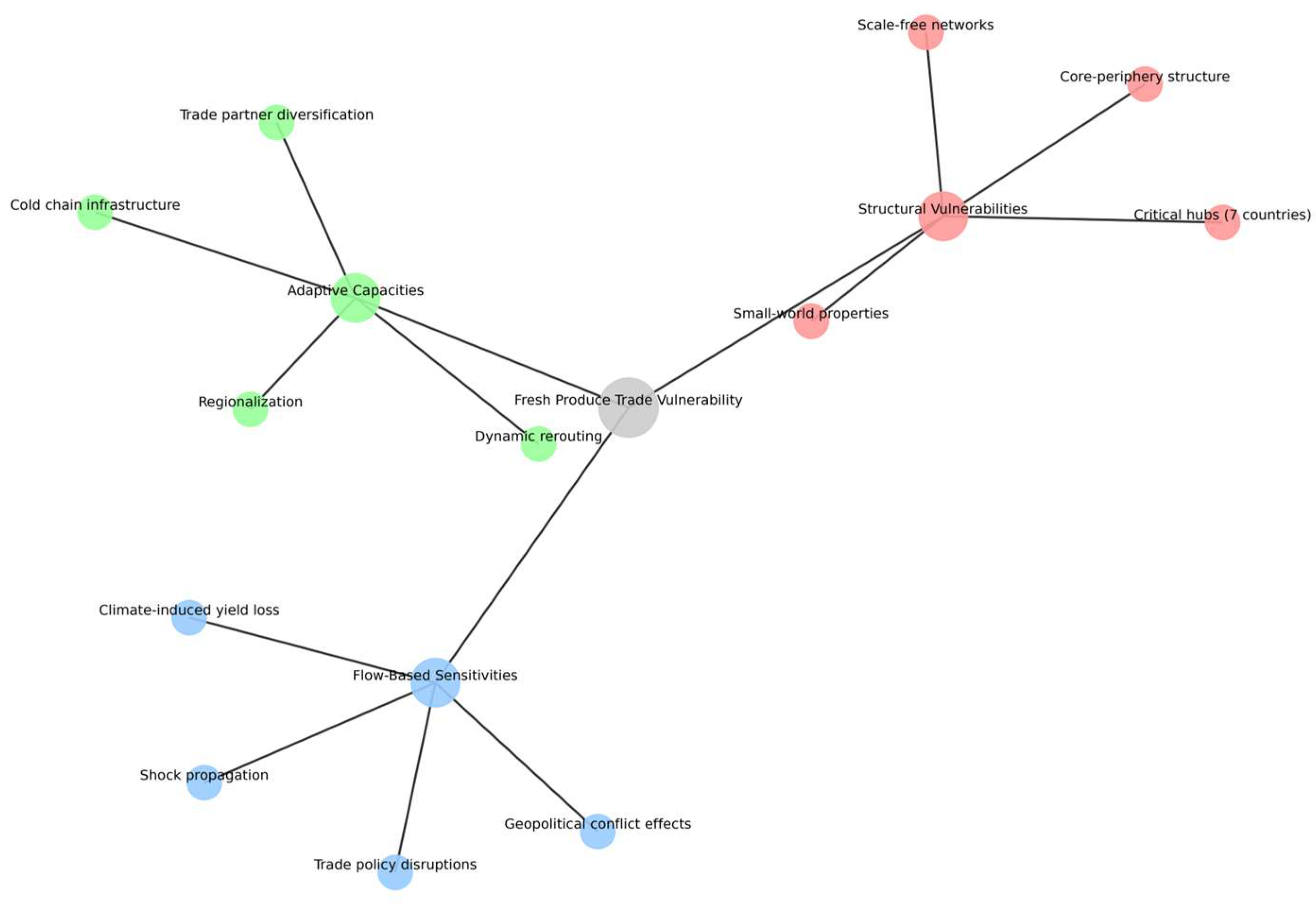
Figure 2.
A visual representation of the risk typology matrix for fresh produce trade.
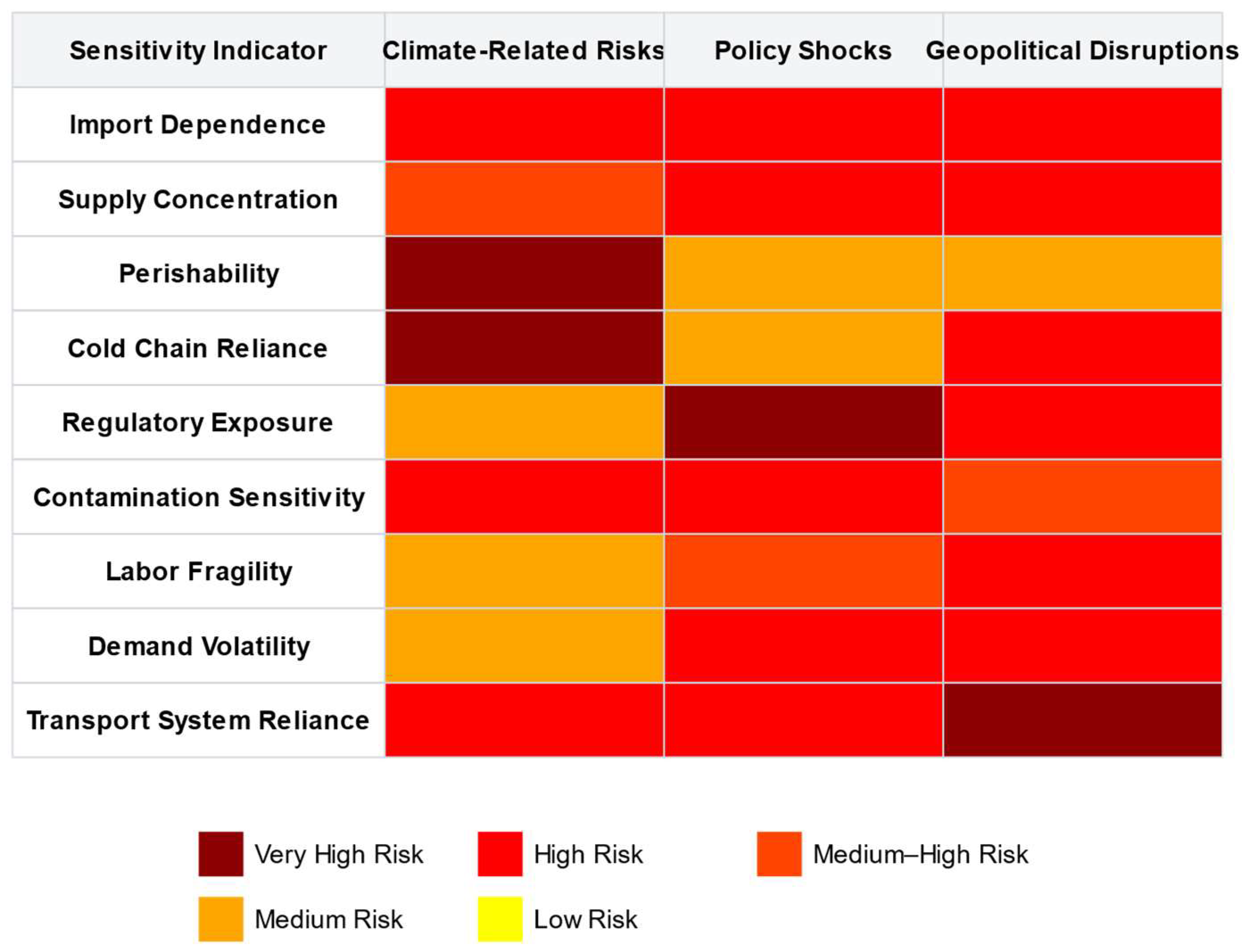
Figure 3.
A rudimentary version of a literature-informed Risk matrix for fresh produce trade. Legend for the Figure: Climate-Related Risks – olive (color code: #808000), Policy Shocks – blue (color code: #0000CD, Geopolitical Disruptions – cyan (greenish blue, color code: #00CCCC). ID – Import dependence, SC – Supply concentration, P – Perishability, CC – Cold Chain Reliance, RE – Regulatory Exposure, CS – Contamination sensitivity, LF – Labor Fragility, DV – Demand Volatility and TSR – Transport system reliance.
Figure 3.
A rudimentary version of a literature-informed Risk matrix for fresh produce trade. Legend for the Figure: Climate-Related Risks – olive (color code: #808000), Policy Shocks – blue (color code: #0000CD, Geopolitical Disruptions – cyan (greenish blue, color code: #00CCCC). ID – Import dependence, SC – Supply concentration, P – Perishability, CC – Cold Chain Reliance, RE – Regulatory Exposure, CS – Contamination sensitivity, LF – Labor Fragility, DV – Demand Volatility and TSR – Transport system reliance.
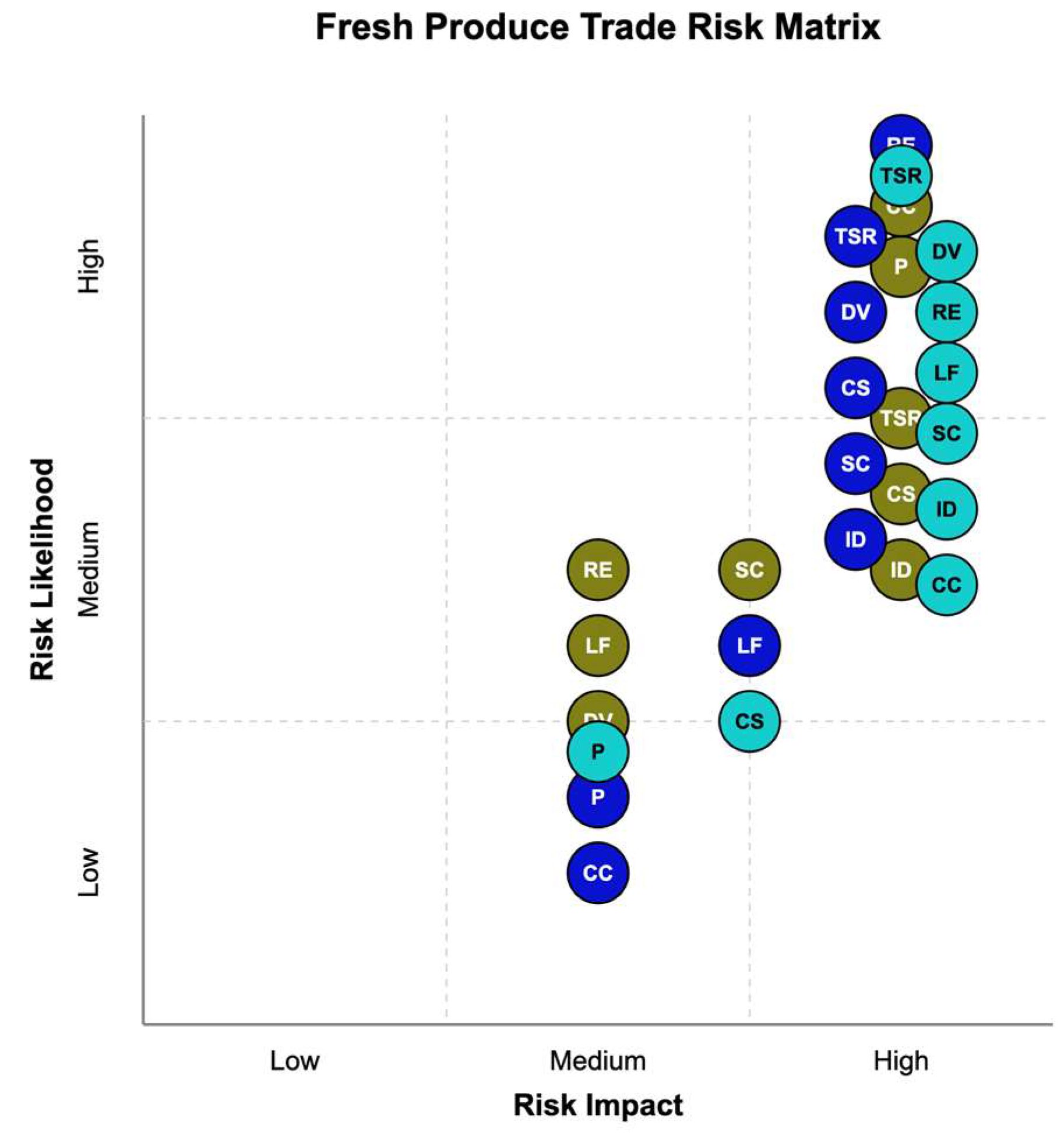
Figure 4.
Global Trade Network of Fresh Vegetables (HS07) by FOB Value (2024).
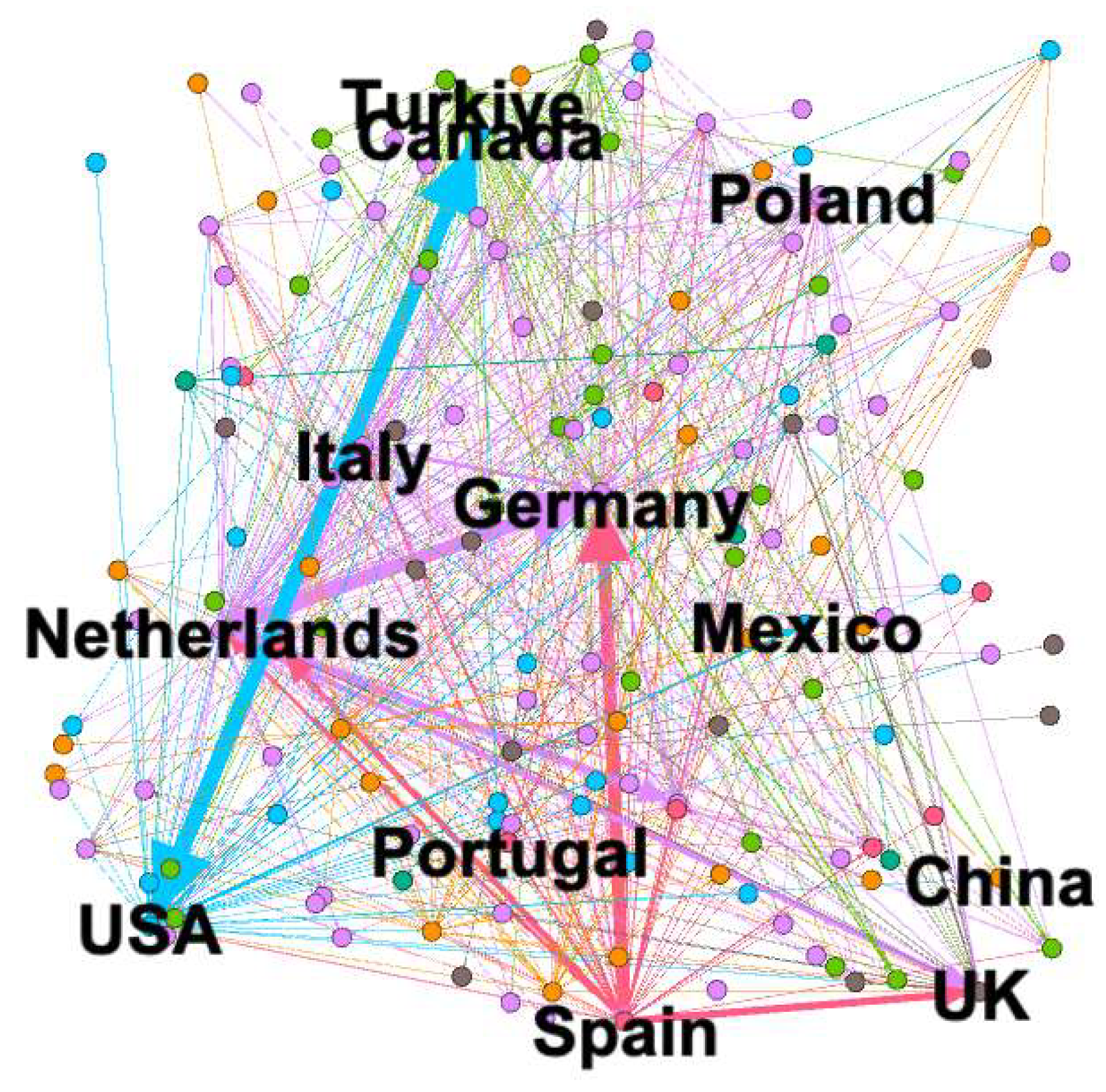
Figure 5.
Global Trade Network of Fresh Fruits (HS08) by FOB Value (2024).
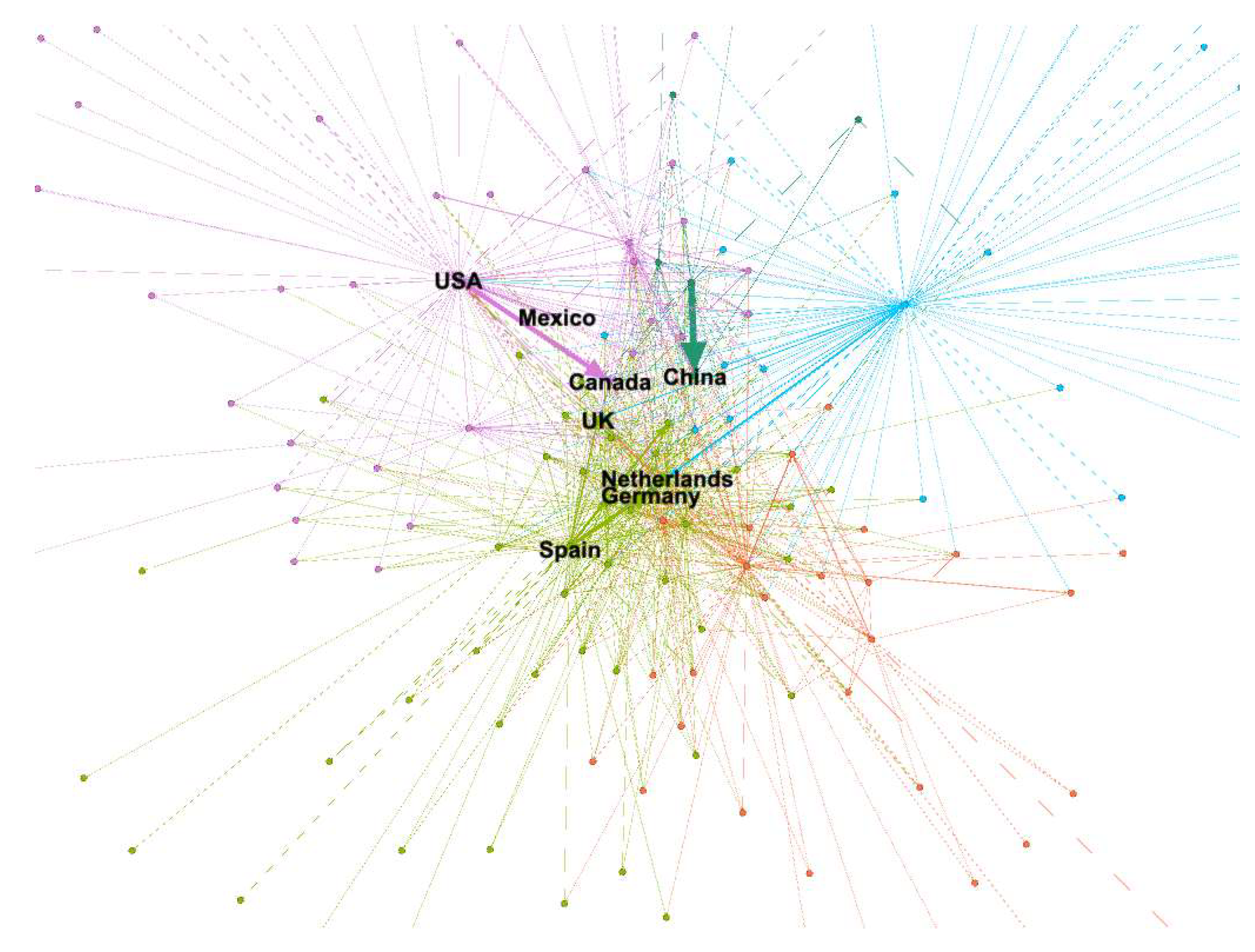
Figure 6.
Global Trade Network of Fresh Produce (Fruits and Vegetables) (HS07 and HS08) by FOB Value (2024).
Figure 6.
Global Trade Network of Fresh Produce (Fruits and Vegetables) (HS07 and HS08) by FOB Value (2024).
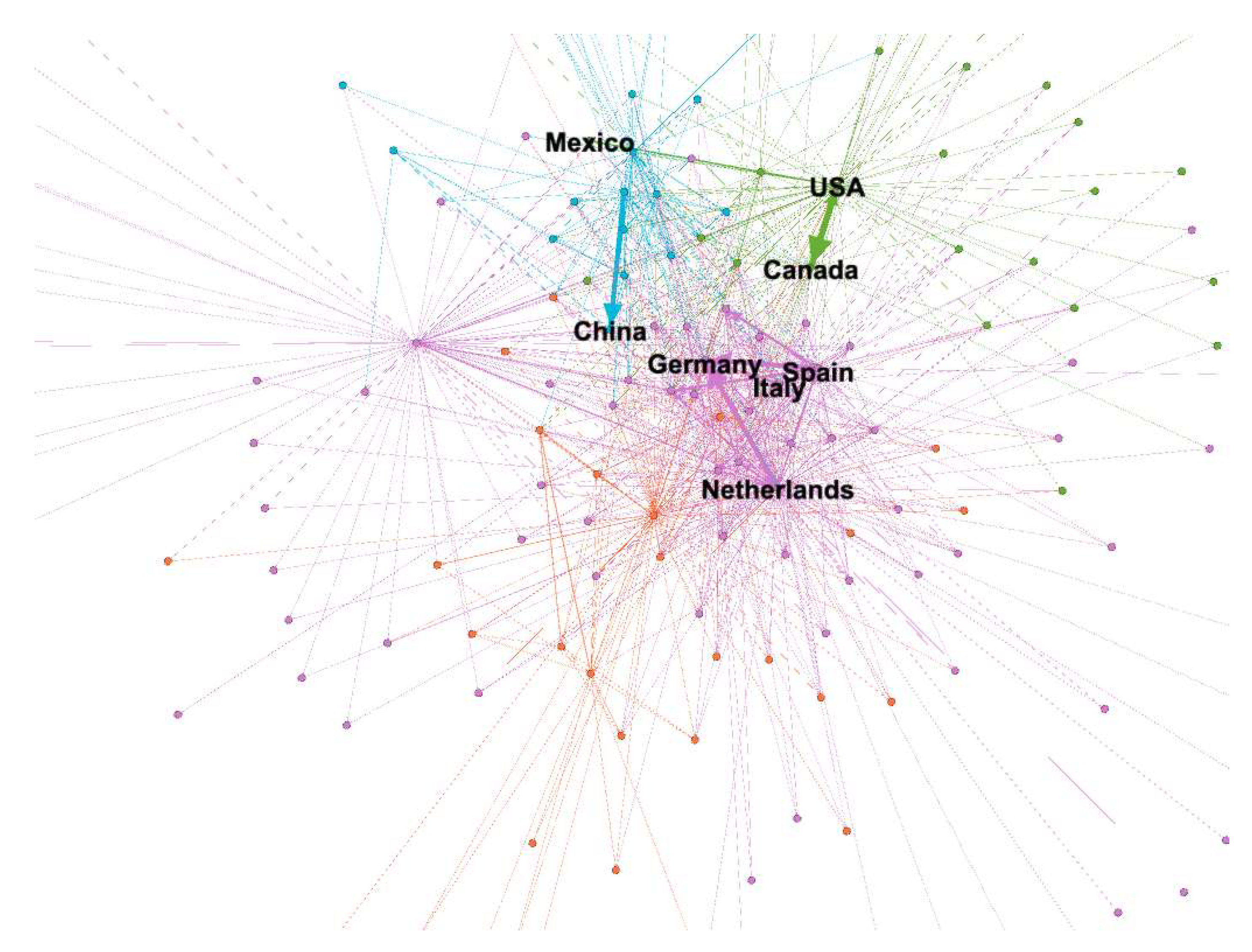
Figure 7.
Baseline vs Post Tariff Trade volume for the top 10 exporters to US under the tariff shock scenario.
Figure 7.
Baseline vs Post Tariff Trade volume for the top 10 exporters to US under the tariff shock scenario.
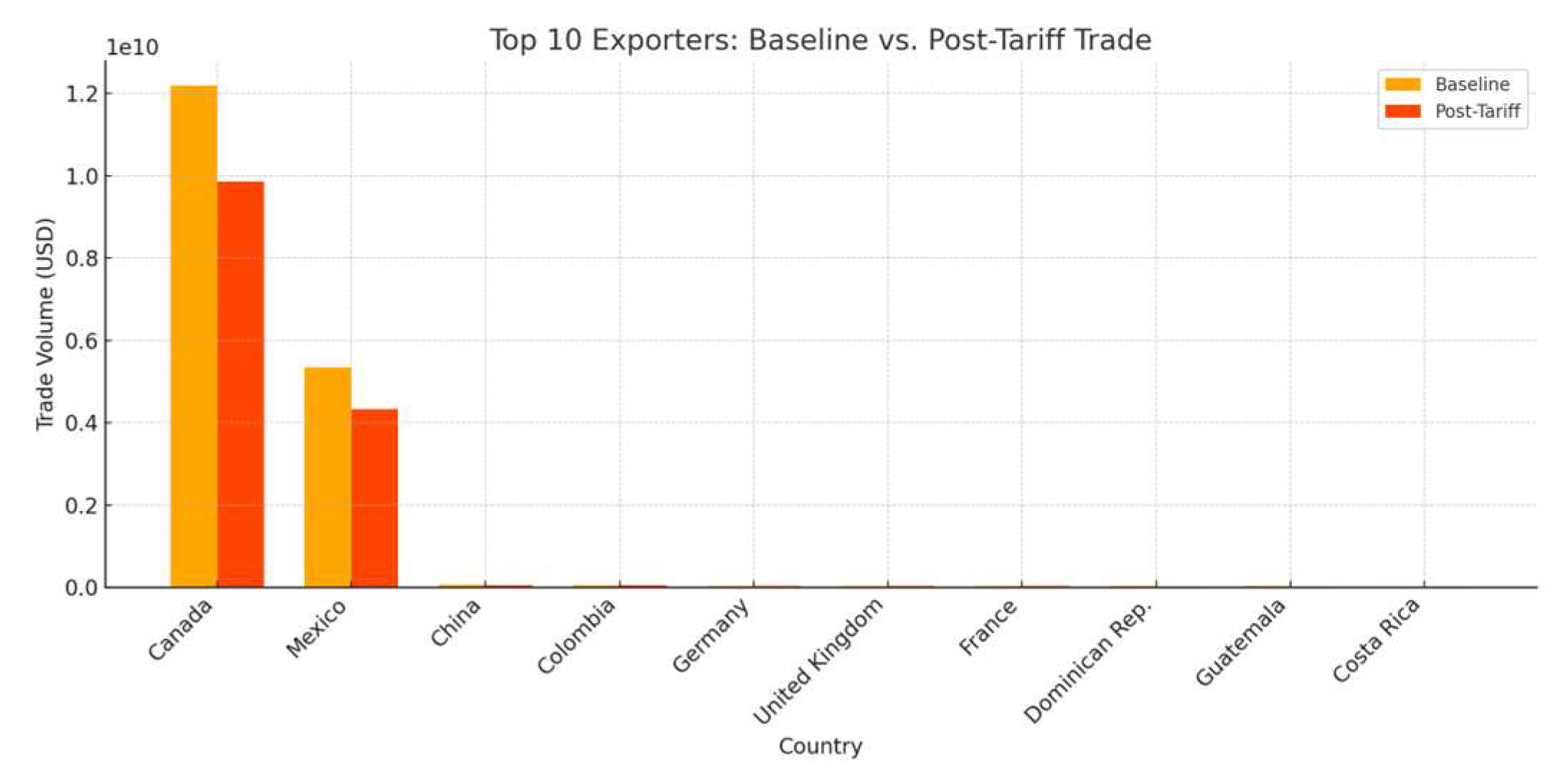
Figure 8.
Baseline vs Post Tariff vs Compound Scenario Trade volume for the top 10 exporters to US under the multi-risk scenario.
Figure 8.
Baseline vs Post Tariff vs Compound Scenario Trade volume for the top 10 exporters to US under the multi-risk scenario.
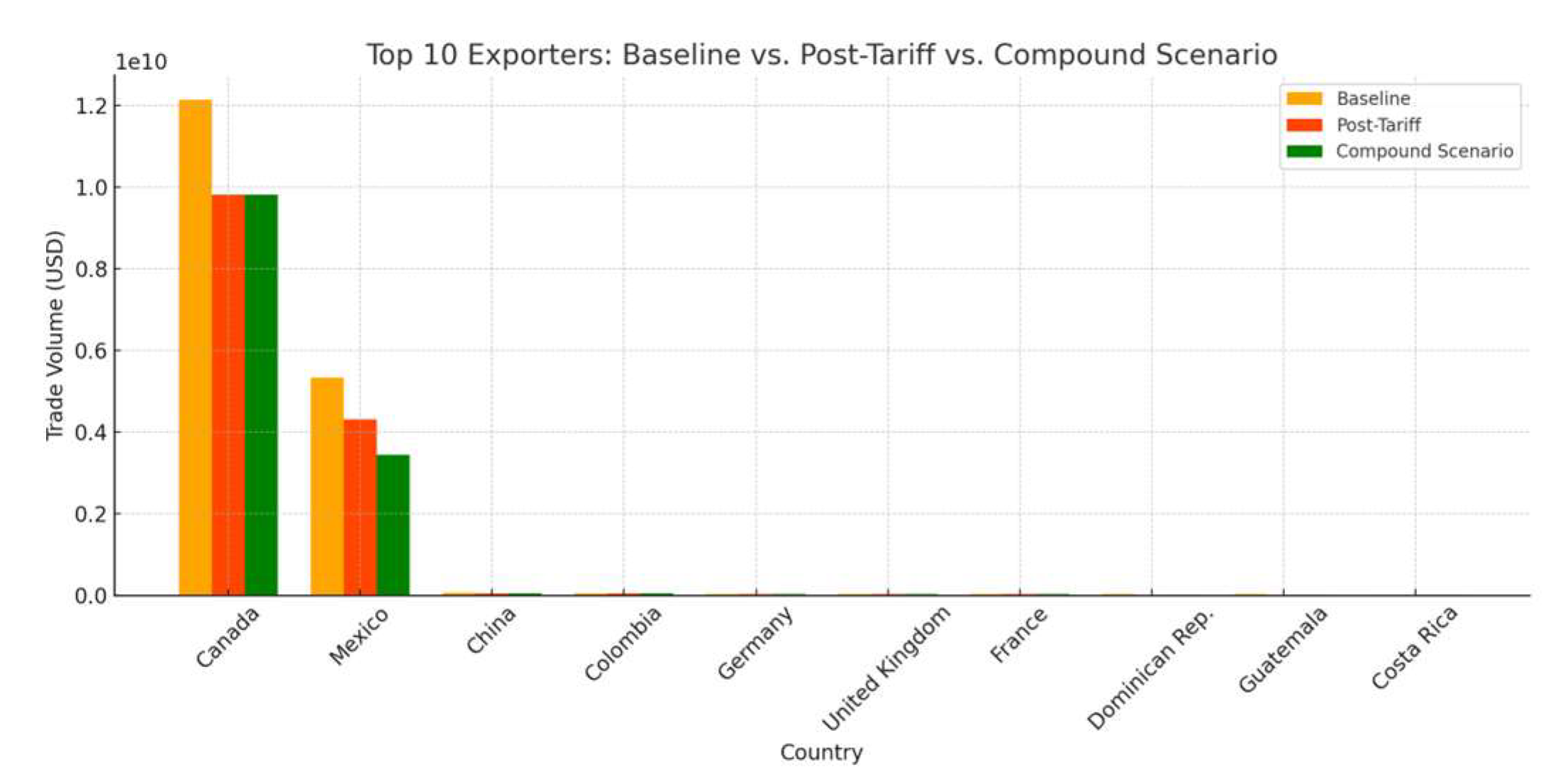
Figure 9.
Global Trade Network of Fresh Produce (Fruits and Vegetables) (HS07 and HS08) by FOB Value (2024) under the multi-risk scenario.
Figure 9.
Global Trade Network of Fresh Produce (Fruits and Vegetables) (HS07 and HS08) by FOB Value (2024) under the multi-risk scenario.
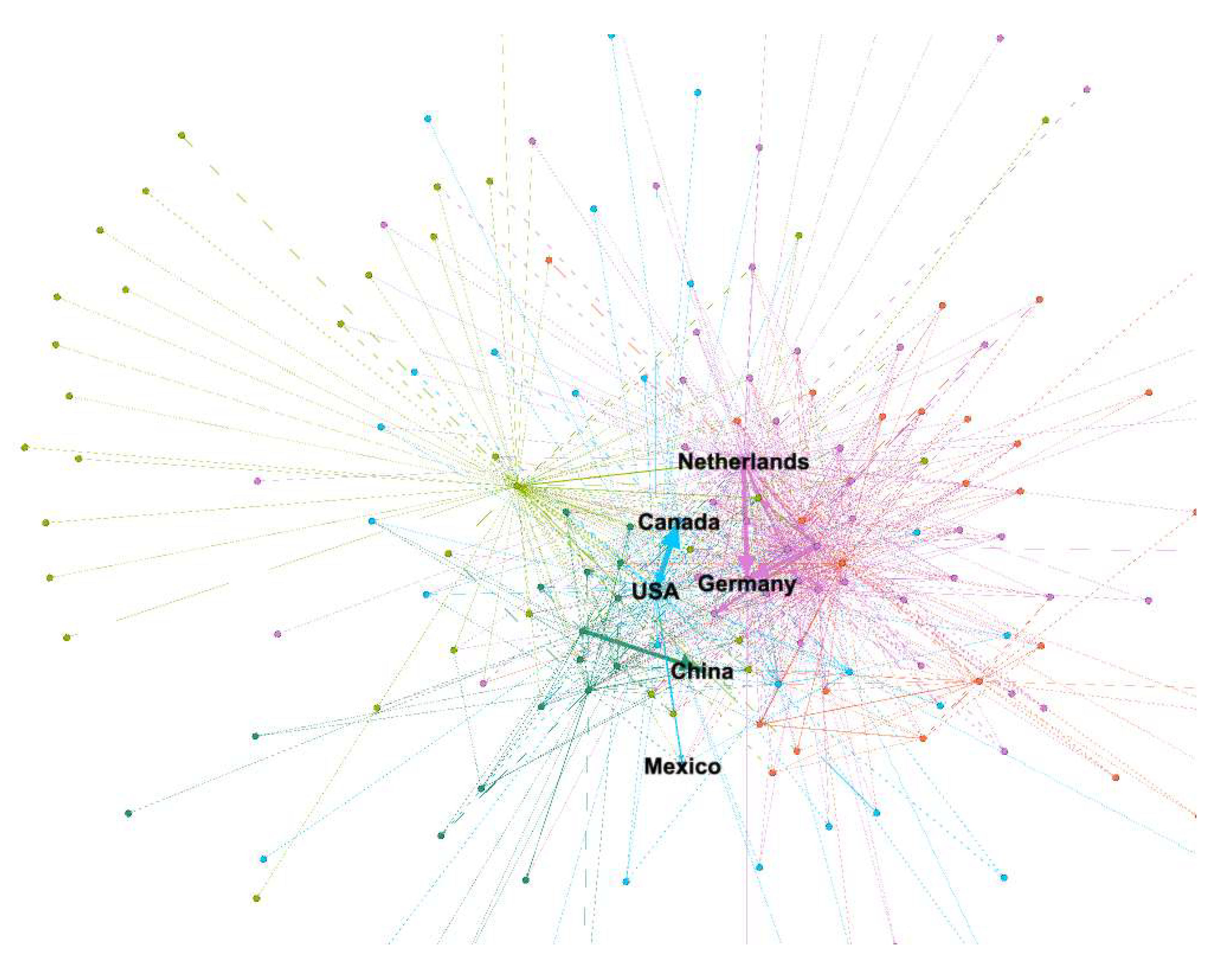
Table 1.
Structural Vulnerabilities in Global Food Trade Networks
| Structural element | Empirical Evidence / Metrics | Key Interpretation | Implications for Vulnerability | Referenced Key Studies |
|---|---|---|---|---|
| Core-periphery structure | 7 countries (USA, EU, China, India, Brazil, Russia, Japan) manage >77% of all trade links; ~30% of global flux | Trade is concentrated in a few global hubs | Shock in one core node affects global system | [6,8,23,24,25] |
| Network topology | Scale-free, small-world networks with high clustering; average path length L ≈ 1.52 | Efficient under normal conditions, vulnerable to cascading failures | Fast propagation of risk due to short paths | [20,25,26,27] |
| Modularity & clustering | Regional modularity: Europe ~0.49 stability, Africa lower | Clustering enhances regional resilience but can also isolate | Weak communities = higher regional sensitivity | [28,29,30,31,32,33] |
| Critical nodes (centrality) | High betweenness/PageRank: Netherlands, Ukraine, USA, China are key | Key actors act as bridges—failure leads to major disruption | Systemic chokepoints elevate fragility | [34,35,36,37] |
| Import dependency (periphery) | Sub-Saharan Africa, MENA show low connectivity and high import reliance | Peripheral zones face exposure from few redundant sources | High exposure to price and supply shocks | [11,33,38,39,40] |
| Commodity-specific flow vulnerability | Vulnerability varies by product: wheat, grains, magnesium-rich products are high-risk | Certain commodities are more prone to risk from single-point failures | Risk varies by trade structure of each crop | [20,41,42,43,44] |
Table 3.
Flow-based Sensitivities in Fresh Produce Trade Networks
| Flow sensitivity element | Empirical Evidence / Metrics | Key Interpretation | Implications for Vulnerability | Referenced Key Studies |
|---|---|---|---|---|
| Climate-induced yield loss | Heatwaves/droughts cause 10–25% yield loss in fresh vegetables and berries (US, China, Senegal) | Yield zones are climate-sensitive | Exposure to production shocks increases volatility | [49,59,60,61] |
| Trade policy disruptions | Brexit, AfCFTA, and COVID-19 led to up to 30% trade flow reduction in short term | Trade highly responsive to policy shocks | Sudden regulatory shifts amplify fragility | [59,61,62,63] |
| Shock propagation | Simulated dual-disruption scenarios (e.g., tariffs + climate) cause non-linear trade flow collapse | Shocks ripple through key corridors | Compounding risks generate systemic volatility | [64,65,66,67] |
| Geopolitical conflict effects | Russia–Ukraine war impacted EU & MENA imports of tomatoes, apples, cucumbers | Conflict-induced rerouting slows trade | Limited alternative corridors for perishable products | [40,63,68] |
| Transport bottlenecks | Fresh produce logistics disrupted by COVID-19 port closures and labor shortages | Cold chain logistics are rigid and time-sensitive | Delays result in spoilage, loss, and instability | [69,70,71,72] |
| Dual-channel and rerouting limits | Simulation shows constrained ability to shift between retail and wholesale or between corridors (esp. China, India, Egypt) | Path-dependence limits rerouting | Exposure remains high under constrained substitution | [65,73,74,75] |
| Seasonal asymmetry | Seasonal peaks in NAFTA corridors amplify stress during disruptions | Certain months carry disproportionate trade load | Higher vulnerability during high season (e.g., winter citrus imports) | [48,76,77] |
| Yield risk and water scarcity | High water footprint for citrus, berries; global sourcing not aligned with water resilience | Trade patterns may ignore environmental limits | Supply zones collapse under water stress | [60,76,78] |
| Demand stochasticity | Dynamic modeling shows unpredictable retail demand during COVID-19 and political shocks | Unstable demand increases stress on inventory & logistics | Higher stockouts and excess spoilage risk | [69,70,73] |
Table 4.
Adaptive capacity in Fresh Produce Trade Networks
| Adaptive element | Empirical Evidence / Metrics | Key Interpretation | Implications for Vulnerability | Referenced Key Studies |
|---|---|---|---|---|
| Cold chain infrastructure | Cold chain failures linked to 30–40% losses in fruits/vegetables | Temperature-sensitive goods need controlled logistics to avoid spoilage | Breakdowns in temperature control systems result in massive loss | [51,76] |
| Trade partner diversification | Higher diversification reduces supply volatility | Diverse partners reduce overreliance and create fallback options | Low diversity raises exposure to targeted or regional risks | [56,60] |
| Dynamic rerouting capability | Simulation models show rerouting shortens restoration times | Flexible networks can redirect flows to adapt under disruption | Rigid networks increase downtime post-shock | [61,64,72] |
| Technology-based real-time tracking | IoT/logistics tech enhances visibility, prevents mismatch | Digital systems allow for agile decision-making | Blind spots in the supply chain delay mitigation | [71,79] |
| Resilience-oriented regulation | FAO & EU food safety compliance enhance reliability | Strong standards prevent large-scale quality failures in crises | Lack of standards exposes to regulatory and quality shocks | [50,80] |
| Redundant sourcing & stock buffering | Dual sourcing and buffer stocks dampen ripple effects | Redundancy spreads risk across multiple suppliers | Overconcentration increases system fragility | [66,73] |
| Market-based price/quality stabilization | Quality-price mechanisms ensure flexible coordination in disruptions | Market design incentivizes adaptive supply behavior | Volatile prices without buffers reduce long-term reliability | [65,74] |
| Regionalization of supply chains | COVID-19 case studies on regional chains in Senegal | Local/regional networks insulate from global shocks | Over-globalization weakens adaptation to local stressors | [59,81] |
| Public-private resilience coordination | Multi-agent systems improve preparedness under compound risks | Institutional collaboration improves governance and early response | Weak coordination leads to fragmented responses | [82] |
Table 5.
Risk Typology Matrix: Fresh Produce Trade
| Sensitivity Indicator | Climate-Related Risks | Policy Shocks | Geopolitical Disruptions |
|---|---|---|---|
| Import Dependence (ID) |
High (esp. in arid & tropical zones) |
High (for countries with low food self-sufficiency) |
High (e.g., landlocked and import-reliant countries) |
| Supply Concentration (SC) |
Medium–High (where climate-vulnerable regions dominate exports) |
High (esp. where few suppliers dominate) |
High (e.g., those dependent on specific corridors) |
| Perishability (P) |
Very High (fresh produce highly sensitive to temperature, water) |
Medium (disruption timing impacts shelf life) |
Medium (spoiled if rerouting is slow) |
| Cold Chain Reliance (CC) |
Very High (requires refrigerated transport & storage) |
Medium (custom delays increase spoilage) |
High (alternative routes often lack cold chain infrastructure) |
| Regulatory Exposure (RE) |
Medium (climate-driven SPS barriers increasing) |
Very High (susceptible to export bans, border protocols) |
High (rapid shifts in border governance or embargoes) |
| Contamination Sensitivity (CS) |
High (heat, water scarcity linked to contamination risk) |
High (e.g., rejection from stricter SPS inspections) |
Medium–High (poor handling in rerouting corridors) |
| Labor Fragility (LF) |
Medium (heat waves affect farm labor productivity) |
Medium–High (labor policy impacts trade flows) |
High (conflict zones or migrant labor routes) |
| Demand Volatility (DV) |
Medium (climate events affect consumer behavior) |
High (price swings due to policy uncertainty) |
High (supply interruptions drive demand spikes) |
| Transport System Reliance (TSR) |
High (infrastructure failure under climate extremes) |
High (border delays, inspection lags) |
Very High (blockades, port closures, rerouting needs) |
Table 6.
Top sources for fresh produce imports in the USA, in 2024
| Source country | Imports of Fresh Produce to US - %of total |
|---|---|
| Canada | 8,74% |
| Chile | 6,60% |
| Colombia | 1,53% |
| Costa Rica | 4,10% |
| Ecuador | 2,33% |
| Guatemala | 5,40% |
| Honduras | 1,48% |
| Mexico | 53,83% |
| Peru | 9,19% |
Table 8.
Gravity Model Regression Results for U.S. Fresh Produce Imports (2024) - Interpretation
| Variable | Coefficient | p-value | Interpretation |
|---|---|---|---|
| X1 (ln GDP) | +0.851 | 0.000015 | Strong, positive effect — larger economies export more. |
| X2 (ln Distance) | -1.965 | 0.00687 | Strong, negative effect — matches classic gravity theory. |
| X3 (Border dummy) | +1.294 | 0.630 | Not significant — having a shared border did not help much in 2024. |
| X4 (Tariff) | -0.310 | 0.0624 | Marginally significant — higher tariffs reduce trade (as expected). |
| X5 (SPS dummy) | -0.244 | 0.760 | Not significant, but still directionally negative. |
| X1 (ln GDP) | +0.851 | 0.000015 | Strong, positive effect — larger economies export more. |
Disclaimer/Publisher’s Note: The statements, opinions and data contained in all publications are solely those of the individual author(s) and contributor(s) and not of MDPI and/or the editor(s). MDPI and/or the editor(s) disclaim responsibility for any injury to people or property resulting from any ideas, methods, instructions or products referred to in the content. |
© 2025 by the authors. Licensee MDPI, Basel, Switzerland. This article is an open access article distributed under the terms and conditions of the Creative Commons Attribution (CC BY) license (http://creativecommons.org/licenses/by/4.0/).
Copyright: This open access article is published under a Creative Commons CC BY 4.0 license, which permit the free download, distribution, and reuse, provided that the author and preprint are cited in any reuse.


