
Submitted:
07 April 2025
Posted:
08 April 2025
You are already at the latest version
Abstract
Urban environments are complex systems shaped by diverse factors such as land-use patterns and service structures, which constitute an important asset to urban living. The relatively high living standards and economic opportunities they bring about are frequently characterized as a centripetal factor attracting people to urban areas. However, the need for urban services and a diversity of land uses is increasing competition for land. Unequal land-use also makes it more difficult for poor residents to acquire essential services such as nutritious food sources, thereby aggravating health disparities. Lack of sufficient mobility and widespread urbanization may also hinder inner-city inhabitants’ access to food. Therefore, understanding the current practice and policy regarding land-use and urban services structure and the intricate linkages between land-use and service allocation is key to addressing systemic health inequities affecting the urban poor. Furthermore, eliminating these gaps is critical to developing equitable urban environments that benefit everyone. Nonetheless, managing increasing competition for land-use and the supply of urban services while accounting for increasing population and diverse stakeholders’ interests requires efficient allocation and use of urban land. The review findings show a close relationship between urban planning and community well-being. For instance, the analysis of findings shows an African urban system, which is often associated with chaotic life, informal development, and environmental deterioration as a result of a lack of strict adherence to statutory land-use planning requirements and regulations. The review findings also suggest that efficient land-use may improve service accessibility and inhabitants’ health outcomes, indicating the need for policies that give integrated planning a top priority.
Keywords:
urban land-use patterns
; urban services structure
; urbanisation and sprawl
; urban landuse planning
; urban land tenure and administration
; and urban land-use policy
1. Introduction
1.1. Background to the Study
The complex relationship between land-use and environment produces a variety of cultural landscapes that are mostly or partially shaped by human activity. Because of ongoing soil sealing and landscape fragmentation brought about by ongoing land transformation, land used for infrastructure and urban areas, in particular, frequently puts strain on ecosystem services (Gaasch et al. 2021). Therefore, human activity has an effect on humanity by speeding up global change. Additionally, urban landscapes appear to be undergoing ongoing processes of transformation. For centuries, humans have mostly shaped the earth’s natural environment, leading to various land-use patterns. Numerous studies in the literature indicate that the agricultural revolution and the industrial revolution, which offered new opportunities for mobility and urban development, caused drastic changes in land-use in the 19th and 20th centuries (Niewöhner et al. 2016; and Plieninger et al. 2016).
According to reports from international organisations like the Intergovernmental Panel on Climate Change (IPCC, 2019) and the Intergovernmental Panel on Biodiversity and Ecosystem Services (IPBES, 2018), land-use changes are a crucial factor in discussions about sustainability, which led to the United Nations adopting the Sustainable Development Goals (SDGs). Relevant goals in the land-use policy domain are included in a number of SDGs. SDG 11 (Sustainable Cities and Communities) and SDG 13 (Climate Action) address additional significant aspects by emphasising the need for transformation across sectors, in addition to the extensive range of suggestions covered by SDG 15 (Life on Land). Nonetheless, it is argued that these goals are seen to be implemented at the local and regional levels, necessitating the need for modifications to governance procedures (Weith et al. 2019).
Therefore, understanding the different land uses in urban areas and the trends that are occurring would assist relate them to the planning and spatial distribution of services and infrastructure in urban areas. This is because most urban areas’ morphology and the availability of infrastructure and services appear to have been adversely affected by the issue of land-use fragmentation combined with a notable increase in the number of suburban and informal housing areas (Hakwendenda, 2021). Therefore, it was hoped that a clear link between the planning of urban services and the use of urban land in Africa would be brought forth in order to inform policy and help prevent land misuse in urban regions.
1.2. Rationale and Aim
This review paper was aimed at conducting a detailed review of literature on current research and policy on urban land-use and services structure in Africa. The rationale behind the review, therefore, was based on the premise that understanding the different land uses in urban areas and the trends that are occurring would assist relate them to the planning and spatial distribution of services and infrastructure in urban areas. The review paper therefore examined the following key research questions: What kinds of land-use are currently available to indicate different functions in urban areas? What kinds of land-use change could be the reasons behind the current patterns of land-use? What kinds of spatial disparities in access to infrastructure and services are experienced by urban residents? And what kinds of laws and/or policies regulate the use of land in urban areas?
The results of this review were expected to enhance the understanding of the current practice and policy governing the use of urban land and the complex linkages between urban land-use and service allocation, which are key to addressing systemic health inequities often affecting the urban poor. The results were also aimed at contributing additional information to the existing body of literature in this area. The review paper is therefore organized as follows: the methods are explained in the next section. This is followed by the results section, which includes an overview of literature, a bibliographic analysis, a brief theoretical review and a detailed results of literature review on current research on urban land-use patterns; land-use dynamics and their implications for urban planning; urban land tenure and administration in sub-Saharan Africa; policy frameworks governing urban land-use and service organisation; and the existing policies affecting urban service delivery and land-use integration. Finally, the review paper concludes with the section on discussion and conclusion, which highlights a detailed discussion of results, gaps in literature and their implications and lastly the conclusion.
2. Methodology
Using document reviews from local, regional, and global contexts, this review paper used a cross-sectional design. Efforts were undertaken to track down as many documents as possible, including journal articles, pertinent publications, and reports, in order to identify the body of existing literature in the field of land-use patterns and urban services structure. The documents were searched for inclusion in the evaluation using keywords such as “urban land-use change and patterns,” “urban services structure,” “urban land-use planning,” “urbanisation and sprawl” “urban land tenure and administration,” and “urban land-use policy.” Thereafter, documents were manually searched to find further relevant information about the developing problems of urban land-use and the delivery of urban services in Africa.
In order to find high-quality papers for in-depth research, the study also employed a qualitative and evidence-systematic review approach, screening and classifying studies. This required gathering pertinent data from peer-reviewed academic articles as well as other pertinent reports and publications. Thus, with the help of Google Scholar web search engine, 70 papers in all—51 articles, 7 reports, and 12 publications—were found and added to the review. The theoretical assessment of the literature supporting studies on urban structure and growth takes up the first part of the literature review, while the empirical review of the literature on current research and policy on urban land-use patterns and urban services structure takes up the second part. The combined articles’ thematic synthesis produced a broad but connected range of conclusions for academics and decision-makers.
Figure 1.
Data selection and review process.
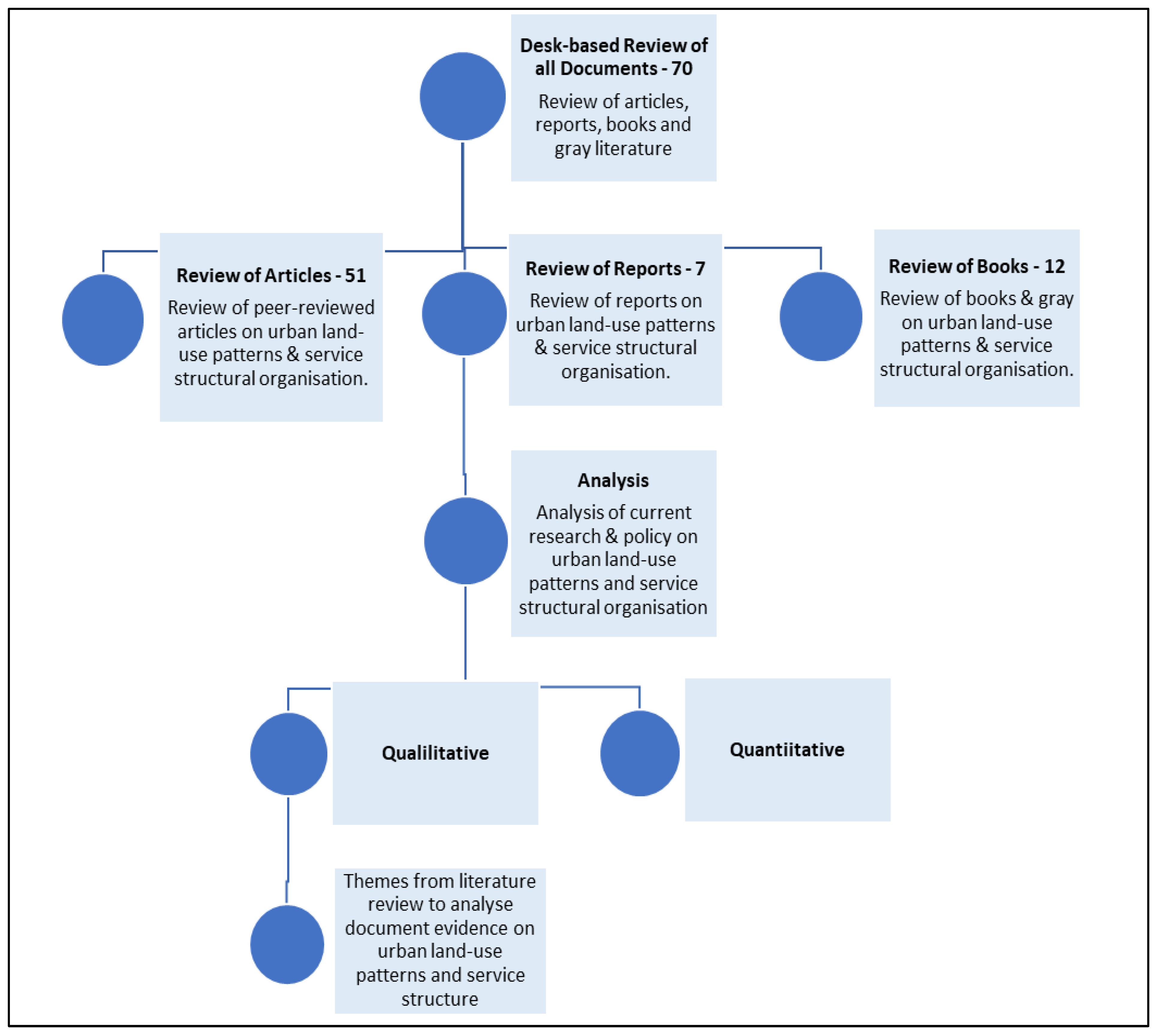
The first search was carried out in December 2024 using the Google Scholar web search engine. The abstracts and conclusions of the documents received were examined and the documents on land-use change and patterns, urban services structure, urbanisation and sprawl, urban land-use planning and urban land-use policy were selected for detailed analysis. In the examination of the selected documents, it was also found necessary to include other relevant terms such as urban land tenure and administration. An updated literature search including these terms was therefore carried out later in February 2025. The abstracts and conclusions of the new documents were also examined and documents on urban land-use planning, urban services structure and urban land-use patterns were selected for consideration.
During the review process, the alert function of the Google Scholar web search engine was also activated to include recent publications in the same field. Further relevant information on the drivers of urban land-use changes and the structure of urban services has been collected through a detailed analysis of the content of selected documents.
3. Results
3.1. Overview of the Literature
In this section, the author presents findings from the literature review. The author begins with a brief discussion of urban land-use theories, which were first developed in the United States of America (USA) and have now been shown to be useful in understanding all towns and cities worldwide. The author next presents an empirical review of the literature, which begins with current research on urban land-use patterns and progresses to contemporary studies on land-use dynamics and their implications for urban planning. The following section discusses urban land tenure and administration in sub-Saharan Africa. The author concludes the review of the literature with sections on policy frameworks governing urban land-use and service organisation, as well as actual policies affecting urban service delivery and land-use integration.
The evaluated papers are split into four major categories based on their focus on land-use patterns, urban service structural organisation, urban land tenure and administration, and urban land policy and legislation, notably in sub-Saharan Africa. In terms of document type, the majority of the examined documents are research papers, with a few review papers and the remainder being book releases and reports. Regarding research methodologies, the author agrees with Sharifi’s (2020) study that three major kinds can be recognised namely social science, scientific and engineering, and economic. Literature reviews, content analysis, qualitative case studies, grounded participatory research, and questionnaires are some of the most often used social science methods, along with a few science and engineering approaches. From the studies evaluated, it appears that social science methods are prominent, followed by science and engineering methods.
3.2. Bibliographic Analysis
The chart below (Figure 2) shows the number of documents identified and selected for examination with a focus on the year of publication.
Figure 2 shows that four (4) of the documents examined were published between 2000 and 2004 while five (5) of them were published between 2005 and 2009. Eight (8) of the examined documents were published between 2010 and 2014 while the largest number of 35 documents examined were published between 2015 and 2019. The second largest number of 18 documents examined were published between 2020 and 2024. Thus, the trend shows that the majority of documents examined were published at least within the last five to ten years.
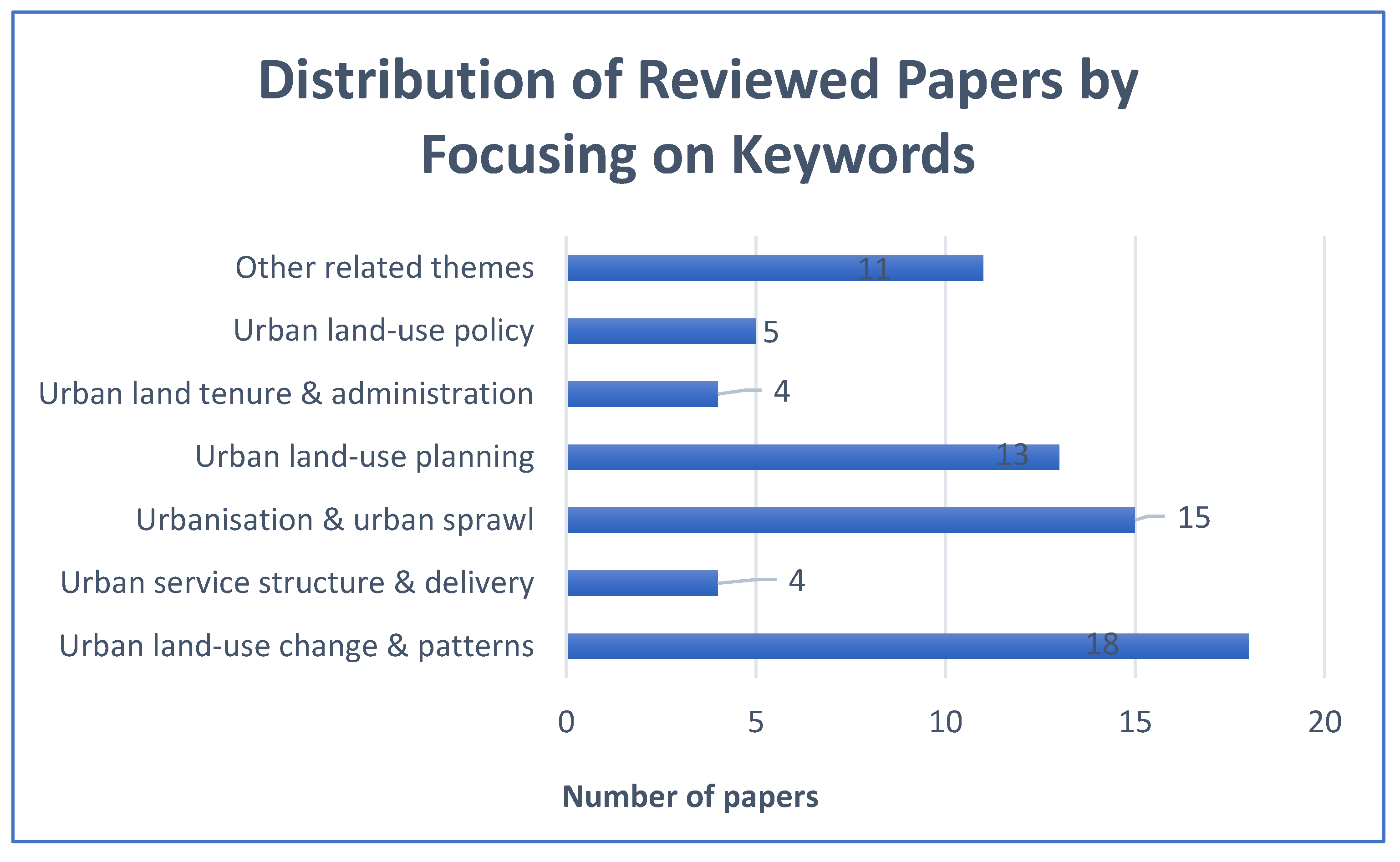
The next chart (Figure 3) shows the distribution of selected documents for examination with a focus on keywords or themes.
Figure 3 indicates that the examined documents focusing on urban land-use change and patterns topped the list at 18 while those on urban services structure and delivery were four (4). Documents focusing on urbanisation and urban sprawl were 15 followed by those focusing on urban land-use planning at 13. Documents focusing on urban land tenure and administration were four (4) while those focusing on urban land-use policy were five (5). The rest of the examined documents on other related themes were 11. Thus, the trend shows that the majority of the documents examined were those focusing on urban land-use change and patterns while those focusing on urban services structure and land tenure and administration were the least.
3.3. Review of Literature
3.3.1. A Brief Theoretical Review
When a town’s information is mapped, a spatial pattern is revealed. These patterns have been examined and utilized as the foundation for the development of urban theories or models, which have helped in the understanding of urban concepts. A number of these theories were first developed in the USA and have since been proven to be helpful in comprehending all towns and cities globally. Nevertheless, recent studies demonstrate that these theories have become increasingly and evidently insufficient as urban systems have grown more intricate and as the differences between cities around the globe have become more apparent (Hakwendenda, 2021). Research, for example, shows that in most African cities, there was often a historic Central Business District (CBD) with colonial buildings and some rebuilding although cities frequently tended to feature an ‘open air market zone’ where informal economic activity usually occurred. Residential districts were distinguished not only by household wealth but also by ethnicity (Burdett, 2018). This is mainly because certain African countries were formed by arbitrary colonial borders rather than tribal or national affiliations, so ethnically similar individuals congregated together when they relocated to the city. Currently, literature indicates that there is no recognised model that offers a thorough explanation of this seemingly constant land-use change, despite the fact that several incomplete models have been created for diverse land-use types (Plieninger et al. 2016; EEA, 2017).
3.3.2. Current Research on Urban Land-Use Patterns
It is important to recognize that any pattern of growth tends to reflect historical influences as well as the physical disparities that existed during the settlement pattern’s formation. It is also important to realize that urban places cannot exist or endure based just on the goals and ideals that are developed to accompany them. For urban areas to be the most productive and aesthetically pleasant places to live in, there must be a minimum, and ideally an optimum, of specific mechanics, supplies, and services as observed by (Hakwendenda, 2021).
Literature indicates that various land-use patterns are caused by a variety of factors, including direct variables like infrastructure changes and population increase, as well as indirect variables like energy transformations (Jiang and Tagtachian, 2022). The demand for various land uses and urban services, as well as the growing population of metropolitan regions, are driving up competition for land. As the population grows, there is also a corresponding rise in pressure to convert agricultural land to other uses (Appiah, Assante and Nketiah, 2019). Efficient allocation and use of urban land is necessary to manage growing competition for the provision of urban services while taking into consideration the interests of various stakeholders (Metternicht, 2018).
Current research shows that one of the main factors influencing the development of the land-use systems of today is urbanisation (World Bank, 2018). Africa, for instance, has experienced unusually rapid urbanisation, with the proportion of urban people more than doubling over the last three decades [United Nations Statistics Division (UNDESA) (2018)]. Cities’ growth drivers have also shifted dramatically in recent years (Duranton, 2015; Farrell, 2017). For example, informal settlements, insufficient infrastructure, and the growing impact of climate change all contribute to differences in access to services and opportunities between urban and rural locations (de Bruin et al. 2021; van Vliet et al. 2020). In order to make room for additional urban settlers, urbanisation nearly invariably entails converting property from non-urban to urban usage. Urban sprawl, which is a very large-scale type of land-take for urban uses with negative environmental implications, has been used to describe a large portion of modern urbanisation (Gaasch et al. 2021). However, there are a number of ways that urban land-use change might manifest itself, including variations in building density, layout, and rate of change. Because of this, urban issues are still not fully resolved everywhere in the world, and they get worse the bigger the city.
Urbanisation has also typically been associated with favourable economic results such as greater income and growth, and it can encourage economic growth in both urban and rural areas by improving farmers’ access to goods, services, job opportunities, and markets (Dorosh and Thurlow, 2012). Integrating urban and rural areas can boost productivity, growth, and living standards by facilitating the flow of goods and services, such as agricultural and industrial products, while also helping to reduce disparities between urban and rural households (OECD and European Commission, 2020; Michaels, Rauch, and Redding, 2012). Well-managed urbanisation can set countries on a long-term path to prosperity (World Bank, 2022).
Current research on land-use patterns also highlights how urbanisation and agricultural practices are intricately connected to socioeconomic factors. This relationship fosters a direct impact on resource management, including water governance, which is particularly crucial in urban areas dealing with rapid growth (Magigi, 2013). The mismanagement of water resources exacerbates challenges faced by vulnerable populations, leading to adverse living conditions and threatening food security, as indicated by the ongoing water crisis documented in recent studies (Javan et al. 2024). Moreover, the transformation of land-use is heavily influenced by market demands, notably the shift towards higher-value agricultural products as consumer preferences evolve in urban environments (Westlund and Nilsson, 2022). Therefore, understanding these dynamics is essential for developing effective policies that promote sustainable urban planning and equitable resource distribution. Consequently, ongoing research must focus on aligning land-use strategies with urban service structures to enhance resilience against emerging challenges in urbanisation.
The examination of land-use patterns and urban service structural organization in urban areas also reveals critical disparities and emerging trends that shape modern cities. In recent decades, transit-oriented development has gained traction as a strategic response to the complexities of urban growth, notably aiming to enhance accessibility while promoting mixed-use centres. The Mineta Transportation Institute underscores that non-work trips, crucial for shopping and cultural engagement, account for four of every five urban journeys, necessitating a shift in planning methodologies to better accommodate these patterns (Hibshoosh et al. 2001). Additionally, the World Resources Report (2011) highlights the challenges faced by burgeoning cities, particularly in the global South, where rapid urbanization outpaces available public resources per capita (Mahendra et al. 2021). As cities strive for sustainability and equity, integrating innovative policies that address both work and non-work travel will be essential for fostering inclusive urban landscapes that benefit all residents.
Oftentimes, land-use decisions are seen as an invisible part of urban areas across the globe even though their effects are anything but invisible as well. It is a well-established fact that urban land-use patterns have a direct influence on people in many regions, and that these effects are not uniform across racial and economic divisions of the population (Nuissl and Siedentop, 2021). Fortunately, studies reveal that urban land-use planners are becoming more aware of the necessity of effective and meaningful community engagement techniques to address the effects of past land-use choices and create more resilient, healthy communities in the future (Etingoff, 2017).
Therefore, critical concerns facing researchers, urban planners, and politicians today include housing difficulties, environmental degradation, climate change consequences, urban mismanagement, and insecurity related to the water-food-energy nexus (Bravi, 2019). While encouraging sustainable land-use options, land-use planning can help strike a balance between conflicting and occasionally incompatible uses. By addressing problems with conflicting land uses and land tenure and bolstering land governance, land-use planning can help with the sustainable management of urban land in regions of communal land tenure (Metternicht, 2018).
3.3.3. Recent Studies on Land-Use Dynamics and Their Implications for Urban Planning
Recent studies on land-use dynamics reveal critical insights for urban planning, particularly as they relate to the evolving nature of urban spaces and their functions. The increasing complexity of urban environments necessitates a planning paradigm that moves beyond traditional methods, focusing on both residential and commercial land utilization (Nuissl and Siedentop, 2021). As noted in the literature (Ni, 2023), understanding the interplay between various land-use patterns can significantly influence urban service structural organization, which is vital for enhancing liveability and sustainability in metropolitan areas. For example, the integration of non-work travel into transit-oriented development frameworks emphasize the need for planners to rethink accessibility and connectivity within urban settings, ultimately facilitating mixed-use centres that cater to diverse activities and needs, as highlighted by (Hibshoosh et al. 2001).
Because there are various types of urban land-use change with a wide range of effects, it has been argued that focusing just on the size or growth of urban areas would only offer limited insights into the dynamics of urban land-use change (McGranahan and Marcotullio, 2005). Similarly, the growth of several tiny, disconnected areas of urban land affects the landscape matrix more than new development near existing settlements. It is therefore necessary to take into account not just the amount of land transformed to urban purposes but also:
- the location and layout of new urban land;
- the predominant use of the new urban use (residential, commercial, industrial, recreational, or other) and the land cover characteristics (such as the imperviousness of surfaces and the emission of pollutants);
- the prior land-use and land cover (agricultural, forest, and natural); and
- the efficiency of land-use.
Therefore, understanding these above outlined factors is essential for both urban planning and management as well as for gaining a thorough grasp of the dynamics of land-use change and how it affects environmental attributes (Gaasch et al. 2021).
It is a well-documented fact that land-use planning, land-use design, and land-use development are all components of sustainable land management (GIZ, 2012). This viewpoint is shared by Hersperger et al.’s (2015) study which points to the fact that one goal of land-use planning is to minimise conflict while coordinating present and future social needs. Research indicates that technologies for the adoption, dissemination, adaption, and application of sustainable land management techniques rely on methods that empower and enable people to achieve this goal (Bryan et al. 2015). Therefore, by recognising stakeholders, their varying goals, and the necessity of balancing the various, frequently conflicting interests of these actors, land-use planning and spatial planning can promote sustainable land-use and management.
The provision of open spaces, green spaces, and other public land uses, as well as the efficient exercise of the development control function of physical planning, have been impacted by issues with land administration, including fragmented landownership, land commodification, documentation difficulties, land speculation, an increase in land conflicts, and family heads’ disdain for physical planning standards and protocols, according to a study done in Ghana by (Afiik et al. 2021). The authors contend that while land fragmentation slows down collaborative planning due to the involvement of several parties, growing conflict has an impact on the efficient production of planning schemes. They also contend that a strong land administration system that successfully balances the conflicting interests involved can enable physical planning to endure the pressures of urban growth. To enhance the environment for efficient physical planning, they advise enforcing land laws regarding paperwork, educating trustees and trustors about land transactions, and bolstering institutional cooperation (Afiik et al. 2021).
3.3.4. Urban Land Tenure and Administration
According to research, the effectiveness of land administration systems in sub-Saharan Africa has been questioned in recent decades due to the numerous land reform initiatives that different governments have undertaken on the continent (Collins and Mitchell, 2018; Moreri, 2020; Mowoe, 2019). Customary tenure is given a large amount of weight by the land administration systems that oversee the continent's developing land markets (Chimhowu, 2019; Collins and Mitchell, 2018). These systems, along with the statutory land administration setup, are ill-coordinated with ineffective land information management systems, insufficient institutional configurations, and insufficient human capacity (Knight, 2010). Self-serving conduct, corruption, and bureaucratic processes devoid of accountability and transparency are said to be widespread in the continent's land administration services delivery as a result (Banda, 2019; Potel et al. 2020). With its dispersed and fragmented urban physical development, this exacerbates the problems caused by the continent's ongoing urbanisation (Korah et al. 2019; Yao et al. 2019).
Intricate formal and informal physical planning processes are at the heart of sub-Saharan African cities’ explosive urban growth and emerging physical development (Sumari et al. 2019). More than half of the projects take place outside of the official physical planning processes, despite the fact that state land institutions typically implement physical planning systems to direct physical growth in metropolitan centres (Amoako and Boamah, 2017). According to Akaateba et al. (2018), traditional landowners in Tamale, Ghana, use private agreements to start physical planning schemes independently of formal physical planning institutions. Banda (2019) noted that fraudulent procedures allow residents in unplanned areas in Tanzania to acquire building licenses. Urban expansion without formal planning schemes and poor coordination among formal planning authorities are the main causes of the growth of illicit planning schemes in Nigeria (Zakka et al. 2017). According to Asabere et al. (2020), a considerable amount of physical development that occurs within the urbanisation cycle tends to defy official physical planning norms and recommendations. Amin et al. (2021) questioned the regulatory frameworks that underpin the random manifestations of physical planning in Africa.
Though there are many different viewpoints on how physical planning manifests itself, two extremes can be identified, particularly in the context of sub-Saharan Africa. Liberal market proponents contend that landowners ought to have the freedom to use their property anyway they see fit (Byamugisha, 2013). However, proponents of fundamental planning, primarily in Western Europe, advocated that landowners should only take actions that are allowed under the rules as they stand (Acheampong, 2019). Due to Western Europe's colonial influence, sub-Saharan Africa’s physical planning systems, which essentially reflect the ideas of fundamental planning proponents, have a very low percentage of adherence (Williamson et al. 2010).
3.3.5. Policy Frameworks Governing Urban Land-Use and Service Organization
Because of the complexity of urban service organisation, strong policy frameworks that may change to meet changing environmental and societal demands are required. Urban planning must incorporate environmental services as cities expand, highlighting the significance of flexibility in policy responses. According to Berry et al. (2015), for example, a stress-testing technique can assess how well different response options preserve ecosystem services in dynamic situations, indicating that combining different strategies could produce more resilient results. Additionally, the rise of smart cities is another area where creative approaches to urban service delivery are being used to enhance general urban administration and mobility. Understanding the metrics and assessing pilot initiatives within these frameworks might provide avenues for the effective replication and scalability of intelligent interventions, as Cohen et al. (2019) emphasise. Therefore, for sustainable urban service organisation, a multidimensional approach to policy creation that includes both traditional and innovative features is essential.
In both emerging and wealthy nations, public planning policies are said to be crucial for attaining sustainable urban structure and containing urban sprawl. It is crucial for local governments to establish demand allocation mechanisms for industries, housing, and transportation in metropolitan areas that are expanding. In the meantime, one of the key responsibilities of local governments is to balance ecological and social quality in the process of economic development (Kawakami et al. 2013). Effective public planning policy decisions are crucial for city governments in urban decline-affected cities in order to boost centrality, enhance urban regeneration, and stop population decrease. To improve access to central areas, a new public transit system must also be implemented (Kawakami et al. 2013).
One of the first reasons for spatial planning was the desire to regulate the dynamics of land consumption. However, this desire has grown to be one of the main concerns in land-use policy, although previously it was of little relevance compared to the objective of reducing land-use conflicts and protecting the most sensible form of urban growth (Gallent, 2006). This topic is arguably the most contentious in the US, where there is a strong anti-sprawl movement as a result of the public’s growing worry over sprawl in recent years (Bengston et al. 2005). Unsatisfactory settlement brought about by previous planning has resulted in inefficient resource usage, higher development expenses, and an uneven distribution of costs and benefits.
Nonetheless, a wide range of planning and policy tools have been put out to carry out the objective of controlling urban land-use change. Classifying policy and planning tools based on whether they are focused on (i) regulation, (ii) expenditure, taxation, and subsidies, or (iii) lobbying is a popular method (Bengston et al. 2004). By adopting and slightly altering this strategy, they suggest classifying policy and planning tools based on where they fall on the spectrum between the two fundamental planning principles:
- Planning, which reflects the “traditional” regulatory approach of spatial planning to establish legally binding guidelines for land-use through regulatory plans, and
- The “economic” approach to land-use policy is reflected in the market, which uses “market-based instruments” to alter incentives so that actors use the land as planned. For example, one of the most effective strategies to reduce the overall quantity of land that has been urbanised is to implement taxing schemes that impose additional costs on land development (Song and Zenou, 2006).
A vast range of tools that are essentially managerial in nature can be found somewhere in the midst of these two extremes since they essentially concentrate on influencing the decision-making processes of actors who may consume land or create land-use policies. A third planning concept can be applied to this collection of tools:
- Management; illustrating the “persuasive” strategy that seeks to alter the conduct of land-using actors by either informing them of the repercussions of their actions or incorporating them in a dialogue with those who want to limit land consumption (Song and Zenou, 2006).
Of course, these are ideal forms of planning ideas. In practice, planning tools and policy responses that tackle the issue of land consumption are often a combination of many tools that need the adoption of different concepts.
3.3.6. Existing Policies Affecting Urban Service Delivery and Land-Use Integration
The examination of existing policies and regulations governing urban service delivery and land-use integration reveals significant challenges and opportunities for improvement in urban areas. Policymakers face the urgent task of reconciling rapid urbanization with sustainable development, necessitating a rigorous analysis of current frameworks. For instance, the adoption of smart cities strategies has highlighted the critical role of technology and data in enhancing urban infrastructure and service efficiency (Cohen et al. 2019). However, historical patterns of migration, as observed in southern Africa, demonstrate how entrenched regulations can hinder effective service delivery and create inequalities within urban populations (Crush et al. 2006). Therefore, to promote a more holistic approach to urban planning, it is essential that policies not only address immediate service needs but also incorporate considerations of migration dynamics and land-use patterns, ultimately fostering greater resilience and inclusivity within urban environments.
4. Discussion and Conclusions
4.1. Discussion
A total of 70 papers, divided into 51 articles, 7 reports, and 12 publications, were reviewed and chosen for this systematic review. The knowledge of land-use patterns, the structure of urban services, and the rules and policies controlling the use of urban land were all covered in these studies in qualitative form. Although the review also considered some development planning issues, the assessment was restricted to and mostly focused on land-use pattern, urban service structural organisation, and planning. In order to support the goal of the literature review, growth and settlement trends have been addressed as parallel studies. However, according to Hakwendenda’s (2021) study, ambiguous residential constructions, particularly in informal housing areas, typically made it impossible to map accessibility to infrastructure and services.
Discussing the issue of development plans, Hakwendenda’s (2021) study observed that, in many urban areas of developing countries, these plans have not performed as expected because, among other things, the plans have not been reviewed and improved upon as required by the Town and Country Planning Acts at designated time intervals. This has made it challenging to realistically estimate the social, economic, physical, and management factors based on implicit assumptions when the planning time is too long. It’s also possible that a shortage of skilled and knowledgeable technical management personnel has severely limited the plans’ ability to be implemented. The review findings indicate that land-use patterns typically showed a lot of influence from past colonial periods, which could have led to a bad interface between the planning of urban services and the pattern of urban land-use infrastructure as observed by (Hakwendenda, 2021).
According to the analysis of findings as reviewed by Afiik et al. (2021), the effectiveness of land administration systems in sub-Saharan Africa has been questioned in recent decades due to the numerous land reform initiatives that different governments have undertaken throughout the continent. The review notes that complex official and informal physical planning processes lie at the heart of sub-Saharan African cities’ rapid urban growth and emerging physical development (Sumari et al. 2019). It is reviewed that more than half of the developments in sub-Saharan Africa take place outside of the official physical planning processes, despite the fact that state land institutions typically implement physical planning systems to direct physical growth in metropolitan centres (Amoako and Boamah, 2017).
Existing reviews of land-use pattern, urban service structure, and some of the factors that influence urban land-use, recognise several important themes. However, a number of significant deficiencies with regard to the absence of technical management personnel with the necessary training and experience to examine and improve development plans were also observed (Getimis et al. 2014). These deficiencies related to modern land-use governance systems, which were characterised by inconsistencies and/or other dysfunctions such as a lack of integrative land-use legislation, which may have encouraged unsustainable land usage. Adeagbo’s (2000) research further shows that most cities in sub-Saharan Africa face challenges such as informal or illegal development, as well as bureaucratic procedures for obtaining formal land titles and development rights. Property developers’ refusal to comply with statutory land-use planning requirements and ignorance of their presence are seen to be the common causes of these issues.
Significant findings about how land-use patterns affect urban service systems in Africa are highlighted in the systematic review, suggesting a close relationship between urban planning and community well-being. According to the analysis, efficient land-use can improve service accessibility and inhabitants' health outcomes, indicating the necessity for policies that give integrated planning approaches top priority. The analysis of findings also indicate that land-use in sub-Saharan African cities is often characterised by chaotic life, informal development, and environmental deterioration as property developers often fail to comply with land-use planning requirements. Importantly, as highlighted in the forgoing, future research projects should focus on the health component of the decision-making process to determine how environmental influences impact levels of physical activity and general public health. In order to promote economic prosperity and quality of life in urban environments, more empirical study on the implications of the proposals made in the GO TO 2040 plan is crucial (Kosarko et al. 2011).
4.2. Conclusions
In conclusion, the thorough analysis of recent studies and policy on land-use patterns and urban service structure emphasises how important it is to apply integrated methods to urban planning. This is because understanding of how different socioeconomic processes affect the quality of life in an urban area can better be achieved when they are incorporated into pre-existing spatial concepts as a means of explaining how these processes affect urban surroundings, as observed by (Croton, 2019). The results of the review demonstrate that strong frameworks, which prioritise mapping and evaluating urban green infrastructure and services, are necessary for the efficient management of urban ecosystems, as evidenced by (ORTI et al. 2016). In addition to facilitating efficient policy implementation, these frameworks provide a better understanding of urban socioecological systems. Furthermore, it is critical to acknowledge the importance of local contexts and stakeholder engagement as these elements impact the effectiveness of land-use policies and their execution, as shown by (Balázs et al. 2013). In the end, promoting urban sustainability calls for further study, community engagement, and policy modification to address the particular difficulties posed by various urban settings.
Therefore, more thorough urban land-use studies that specifically examine different influences or drivers of land-use and service structure in urban areas would need to be added to the relatively small body of literature in this field in order to fully appreciate and comprehend the contextual and varied patterns of urban land-use and service structural organisation. Some academics, (Metternicht, 2018), have suggested that land-use planning, as a process carried out at the local and/or national level, can address systemic issues identified as crucial factors to strengthen the means for the implementation of the SDGs. This can be done by adhering to well-established principles of participation, integration, and assessment of land-use and available urban services. Additionally, ongoing research must focus on aligning land-use strategies with urban service structures to enhance resilience against emerging challenges in urbanisation.
Acknowledgments
The author wishes to acknowledge the following for their contribution towards the successful completion of this literature review paper: Prof. R.Y. Singh: Retired and Former University Professor of Geography at University of Zambia.
Conflicts of Interest
I, the Author declare that I have no known competing financial interests or personal relationships that could have appeared to influence the work reported in this review article.
References
- Acheampong, R.A. Spatial Planning in Ghana; Springer Nature: New York, 2019. [Google Scholar]
- Afiik, B.; Akanbang, A.; Ibrahim, A.; Yakubu, Z. The evolving dynamics of land administration and its implications for physical planning in Sub-Saharan Africa: Experiences from Wa, Ghana; Springer Nature, 2021; volume 1, p. 259. [Google Scholar]
- Akaateba, M.A.; Huang, H.; Adumpo, E.A. Between co-production and institutional hybridity in land delivery: Insights from local planning practice in peri-urban Tamale, Ghana. Land Use Policy 2018, 72, 215–226. [Google Scholar] [CrossRef]
- Amin, A.; Lewis-Lettington, R.; Njuguna, S. Effectiveness of planning law in Sub-Saharan Africa. In Land issues for urban governance in Sub-Saharan Africa; Springer: Cham, 2021; pp. 103–120. [Google Scholar]
- Amoako, C.; Boamah, E.F. Build as you earn and learn: informal urbanism and incremental housing financing in Kumasi, Ghana. J. Hous. Built Environ. 2016, 32, 429–448. [Google Scholar] [CrossRef]
- Appiah, D.O.; Asante, F.; Nketiah, B. Perspectives on Agricultural Land Use Conversion and Food Security in Rural Ghana. Sci 2019, 1, 14. [Google Scholar] [CrossRef]
- Asabere, S.B.; Acheampong, R.A.; Ashiagbor, G.; Beckers, S.C.; Keck, M.; Erasmi, S.; Schanze, J.; Sauer, D. Urbanization, land use transformation and spatio-environmental impacts: Analyses of trends and implications in major metropolitan regions of Ghana. Land Use Policy 2020, 96. [Google Scholar] [CrossRef]
- Balázs, B.; Nemes, G.; Tisenkopfs, T. (2013). “Urban food strategies in Central and Eastern Europe: What's specific and what's at stake?” ‘Universita degli Studi di Milano-Bicocca Symphonya Emerging Issues in Management,’ doi: https://core.ac.uk/download/18544754.pdf.
- Banda, L. (2019). Corruption in urban land administration in Lusaka city: Drivers and forms. Lusaka: The University of Zambia. Unpublished Doctoral Thesis.
- Bengston, D.N.; Fletcher, J.O.; Nelson, K.C. Public policies for managing urban growth and protecting open space: policy instruments and lessons learned in the United States. Landsc. Urban Plan. 2004, 69, 271–286. [Google Scholar] [CrossRef]
- Bengston, D.N.; Potts, R.S.; Fan, D.P.; Goetz, E.G. An analysis of the public discourse about urban sprawl in the United States: Monitoring concern about a major threat to forests. For. Policy Econ. 2005, 7, 745–756. [Google Scholar] [CrossRef]
- Brown, I.; Berry, P.; Everard, M.; Firbank, L.; Harrison, P.; Lundy, L.; Quine, C.; Rowan, J.; Wade, R.; Watts, K. Identifying robust response options to manage environmental change using an Ecosystem Approach: A stress-testing case study for the UK XXX. Environ. Sci. Policy 2015, 52, 74–88. [Google Scholar] [CrossRef]
- Bryan, B.A.; Crossman, N.D.; Nolan, M.; Li, J.; Navarro, J.; Connor, J.D. Land use efficiency: anticipating future demand for land-sector greenhouse gas emissions abatement and managing trade-offs with agriculture, water, and biodiversity. Global Change Biology 2015, 21, 4098–4114. [Google Scholar] [CrossRef]
- Burdett, M. (2018). Urban land use patterns and models.
- Byamugisha, F.F. Securing Africa’s land for shared prosperity: A program to scale up reforms and investments; The World Bank: Geneva, 2013. [Google Scholar]
- Chimhowu, A. The ‘new’ African customary land tenure. Characteristic, features and policy implications of a new paradigm. Land Use Policy 2019, 81, 897–903. [Google Scholar] [CrossRef]
- Chino, M.; Clark, W.; Compher, C.; Graham et al. (2010). “Indigenous health – Australia, Canada, New Zealand and the United States - Laying claim to a future that embraces health for us all.” Digital Scholarship@UNLV, doi: https://digitalscholarship.unlv.edu/cgi/viewcontent.cgi?article=1206&context=community_health_sciences_fac_articles.
- Shaheen, S.; Cohen, A.; Dowd, M.; Davis, R. (2019). “A framework for integrating transportation into smart cities,” SJSU Scholar Works, doi: https://core.ac.uk/download/289097213.pdf.
- Collins, A.; Mitchell, M.I. Revisiting the World Bank's land law reform agenda in Africa: The promise and perils of customary practices. J. Agrar. Chang. 2017, 18, 112–131. [Google Scholar] [CrossRef]
- Croton, B.S. (2019). How urban land use contributes to inequitable health outcomes: An interdisciplinary review & analysis. University Honors Theses. Paper 817. [CrossRef]
- Crush, J.; Peberdy, S.; Williams, V. (2006) “No. 17: International migration and good governance in the Southern African Region” Scholars Commons @ Laurier, doi: https://core.ac.uk/download/159478659.pdf.
- de Bruin, S.; Dengerink, J.; van, V.l.i.e.t. J. Urbanisation as driver of food system transformation and opportunities for rural livelihoods. Food Secur. 2021, 13, 781–798. [Google Scholar] [CrossRef] [PubMed]
- Dorosh, P.; Thurlow, J. Agglomeration, Growth and Regional Equity: An Analysis of Agriculture- versus Urban-led Development in Uganda. J. Afr. Econ. 2011, 21, 94–123. [Google Scholar] [CrossRef]
- Duranton, G. Growing through Cities in Developing Countries. World Bank Res. Obs. 2014, 30, 39–73. [Google Scholar] [CrossRef]
- EEA. Landscapes in transition. An account of 25 years of land cover change in Europe; EEA Report No 10/2017: https://www.eea.europa.eu/publications/landscapes-in-transition/at_download/file; 2017. [Google Scholar]
- Etingoff, K. Urban land use community-based planning; Apple Academic Press: Waretown, NJ, USA, 2017. [Google Scholar]
- Farrell, K. The Rapid Urban Growth Triad: A New Conceptual Framework for Examining the Urban Transition in Developing Countries. Sustainability 2017, 9, 1407. [Google Scholar] [CrossRef]
- Gaasch, N.; Rogga, S.; Strauß, C.; Zscheischler, J. (Eds.) Sustainable land management in a European context: A co-design approach; Human-Environment Interactions Series; Springer, 2021; vol. 8. [Google Scholar]
- Gallent, N. The rural-urban fringe: A new priority for planning policy? Planning Practice and Research 2006, 21, 383–393. [Google Scholar] [CrossRef]
- Getimis, P.; Reimer, M.; Blotevogel, H. Conclusion: Multiple trends of continuity and change. Spatial planning systems and practices in Europe, Reimer, M., Blotevogel, H., Eds.; Routledge: London and New York, 2014. [Google Scholar]
- GIZ; DGFIZ. Land use planning: Concept, tools and applications.; Federal Ministry for Economic Cooperation and Development (BMZ): Eschborn, Germany, 2012. [Google Scholar]
- Hersperger, A.M.; Ioja, C.; Steiner, F.; Tudor, C.A. Comprehensive consideration of conflicts in the land-use planning process: A conceptual contribution. Carpathian Journal of Earth and Environmental Sciences 2015, 10, 5–13. [Google Scholar]
- Hibshoosh, A.; Nelson, D.; Niles, J. (2001). “A Planning Template for Non-work Travel and Transit Oriented Development, MTI Report 01-12” SJSU Scholar Works. https://core.ac.uk/download/70413516.pdf.
- https://core.ac.uk/download/18544754.pdf.
- Appiah, D.O.; Asante, F.; Nketiah, B. Perspectives on Agricultural Land Use Conversion and Food Security in Rural Ghana. Sci 2019, 1, 14. [Google Scholar] [CrossRef]
- https://unstats.un.org/sdgs/indicators/indicators-list.
- https://www.ipcc.ch/site/assets/uploads/2019/11/SRCCL-Full-Report. Compiled-191128.pdf.
- IPBES/Montanarella, L.; Scholes, R.; Brainich, A. (Eds.) The IPBES assessment report on land degradation and restoration. Secretariat of the Intergovernmental Science-Policy Platform on Biodiversity and Ecosystem Services: Bonn, Germany, 2018; p. 744. [Google Scholar]
- IPCC. Climate change and land: An IPCC special report on climate change, desertification, land degradation, sustainable land management, food security, and greenhouse gas fluxes in terrestrial ecosystems. 2019.
- Javan, K.; Altaee, A.; BaniHashemi, S.; Darestani, M.; Zhou, J.; Pignatta, G. A review of interconnected challenges in the water–energy–food nexus: Urban pollution perspective towards sustainable development. Sci. Total. Environ. 2023, 912, 169319. [Google Scholar] [CrossRef]
- Jepsen, M.R.; Kuemmerle, T.; Müller, D.; Erb, K.; Verburg, P.H.; Haberl, H.; Vesterager, J.P.; Andrič, M.; Antrop, M.; Austrheim, G.; et al. Transitions in European land-management regimes between 1800 and 2010. Land Use Policy 2015, 49, 53–64. [Google Scholar] [CrossRef]
- Kawakami, M.; Shen, J.Z.; Pai, J.; GAO, X.; Zhang, M. (Eds.) Spatial Planning and Sustainable Development Approaches for Achieving Sustainable Urban Form in Asian Cities; www.doi10.1007/978-94-007-5922-0; Springer Science, 2013. [Google Scholar]
- Knight, R.S. Statutory recognition of customary land rights in Africa: An investigation into best practices for law-making and implementation; FAO Legislative Study 105, 2010. [Google Scholar]
- Korah, P.I.; Matthews, T.; Tomerini, D. Characterising spatial and temporal patterns of urban evolution in Sub-Saharan Africa: The case of Accra, Ghana. Land Use Policy 2019, 87, 104049. [Google Scholar] [CrossRef]
- Kosarko, G.; Weissbourd, R. (2011). “Economic Impacts of GO TO 2040” Chicago Community Trust, doi: https://core.ac.uk/download/71345969.pdf.
- Magigi, W. Urbanization and Its Impacts to Food Systems and Environmental Sustainability in Urban Space: Evidence from Urban Agriculture Livelihoods in Dar es Salaam, Tanzania. J. Environ. Prot. 2013, 04, 1137–1148. [Google Scholar] [CrossRef]
- Venter, C.; Mahendra, A.; Lionjanga, N. Urban expansion and mobility on the periphery in the global south. In Urban Form and Accessibility; Mulley, C., Nelson, J.D., Eds.; Elsevier, 2021. [Google Scholar] [CrossRef]
- McCann, B. (2007). “Community design for healthy eating: How land use and transportation solutions can help” Robert Wood Johnson Foundation, doi: https://core.ac.uk/download/71346379.pdf.
- McGranahan, G.; Marcotullio, P. Urban systems. Ecosystems and human well-being: Current state and trends. The Millennium Ecosystem Assessment Project, Hassan, R., Scholes, R.J., Ash, N., Eds.; 2005; vol. 1, 797–825. [Google Scholar]
- Metternicht, G. (2017). Land use planning. Global Land Outlook Working Paper.
- Metternicht, G. (2018). “Land use and spatial planning: Enabling sustainable development of land resources,” Springer Briefs in Earth Sciences, https://doi.org/10.100/978-3-319-71861-3. Accessed 12 Nov. 2021.
- Michaels, G.; Rauch, F.; Redding, S.J. Urbanization and Structural Transformation. Q. J. Econ. 2012, 127, 535–586. [Google Scholar] [CrossRef]
- Moreri, K.K. Documenting informal and customary land rights in Africa challenges of using participatory means. Afr J Land Policy Geospatial Science 2020, 3, 1–20. [Google Scholar]
- Mowoe, M. Land policies in Africa: a case study of Nigeria and Zambia. In Trajectory of land reform in post-colonial African states; Springer: Cham, 2019; pp. 75–90. [Google Scholar]
- Ni, S. Study on the Influence Mechanism of Land Use Patterns on Land Economic Benefits. BCP Bus. Manag. 2023, 49, 70–75. [Google Scholar] [CrossRef]
- Niewöhner, J.; Bruns, A.; Hostert, P.; Krueger, T.; Nielsen, J.Ø.; Haberl, H. (Eds.) Land use competition; Springer: Switzerland, 2016. [Google Scholar]
- Nuissl, H.; Siedentop, S. Urbanisation and land use change. In Sustainable land management in a European context.; Weith, T., Barkmann, T., Gaasch, N., Rogga, S., Strauß, C., Zscheischler, J., Eds.; Human-Environment Interactions, 2021. [Google Scholar] [CrossRef]
- OECD; Commission, E. Cities in the World; Organisation for Economic Co-Operation and Development (OECD): Paris, France, 2020. [Google Scholar]
- ORTI; A; MARIA; M; Alzetta, C.; Attorre Fabio Azzella et al. (2016). “Mapping and assessment of ecosystems and their services. Urban ecosystems” ‘Publications Office of the European Union,’ 2016, doi:https://core.ac.uk/download/74319726.pdf.
- Plieninger, T.; Draux, H.; Fagerholm, N.; Bieling, C.; Bürgi, M.; Kizos, T.; Kuemmerle, T.; Primdahl, J.; Verburg, P.H. The driving forces of landscape change in Europe: A systematic review of the evidence. Land Use Policy 2016, 57, 204–214. [Google Scholar] [CrossRef]
- Potel, J.; Owona, G.; Tumsherure, W. The Paradox of poverty amidst potentially plentiful natural resources of land in Rwanda. In Responsible and smart land management interventions: An African context; 2020; p. 37. [Google Scholar]
- Sharifi, A. Co-benefits and synergies between urban climate change mitigation and adaptation measures: A literature review. Sci. Total. Environ. 2021, 750, 141642. [Google Scholar] [CrossRef]
- Shumba, E. (2006). Service centre planning for rural development: A case of Mwense district. Lusaka: University of Zambia. Unpublished M.Sc. Thesis.
- Song, Y.; Zenou, Y. Property tax and urban sprawl: Theory and implications for US cities. J. Urban Econ. 2006, 60, 519–534. [Google Scholar] [CrossRef]
- Sumari, N.S.; Xu, G.; Ujoh, F.; Korah, P.I.; Ebohon, O.J.; Lyimo, N.N. A Geospatial Approach to Sustainable Urban Planning: Lessons for Morogoro Municipal Council, Tanzania. Sustainability 2019, 11, 6508. [Google Scholar] [CrossRef]
- United Nations, Department of Economic and Social Affairs (UNDESA) (2018). United Nations Statistics Division. Webpage on Sustainable Development Goal Indicators, Global Indicator framework for the Sustainable Development Goals and Targets of the 2030 Agenda for Sustainable Development. New York.
- van Vliet, J.; Birch-Thomsen, T.; Gallardo, M.; Hemerijckx, L.-M.; Hersperger, A.M.; Li, M.; Tumwesigye, S.; Twongyirwe, R.; van Rompaey, A. Bridging the rural-urban dichotomy in land use science. J. Land Use Sci. 2020, 15, 585–591. [Google Scholar] [CrossRef]
- Weith, T.; Warner, B.; Susman, R. Implementation of International Land Use Objectives - Discussions in Germany. Plan. Pr. Res. 2019, 34, 454–474. [Google Scholar] [CrossRef]
- Westlund, H.; Nilsson, P. Agriculture's transformation and land-use change in a post-urban world: A case study of the Stockholm region. J. Rural. Stud. 2022, 93, 345–358. [Google Scholar] [CrossRef]
- Williamson, I.; Enemark, S.; Wallace, J.; Rajabifard, A. Land administration for sustainable development.; ESRI Press Academic: Redlands, 2010; p. 487. [Google Scholar]
- World Bank. Democratic Republic of Congo urbanization review: Productive and inclusive cities for an emerging Congo; Directions in Development—Environment and Sustainable Development World Bank: Washington DC, 2018. [Google Scholar]
- World Bank (2022). Development Indicators, https://datacatalog.worldbank.org/search/dataset/0037712/ World-Development-Indicators.
- Yao, R.; Cao, J.; Wang, L.; Zhang, W.; Wu, X. Urbanization effects on vegetation cover in major African cities during 2001–2017. Int. J. Appl. Earth Obs. Geoinf. 2019, 75, 44–53. [Google Scholar] [CrossRef]
- Dyachia, Z.S.; Permana, A.S.; Ho, C.S.; Baba, A.N.; Agboola, O.P. Implications of Present Land Use Plan on Urban Growth and Environmental Sustainability in a Sub Saharan Africa City. Int. J. Built Environ. Sustain. 2017, 4. [Google Scholar] [CrossRef]
Figure 2.
showing number of selected papers by year of publication.
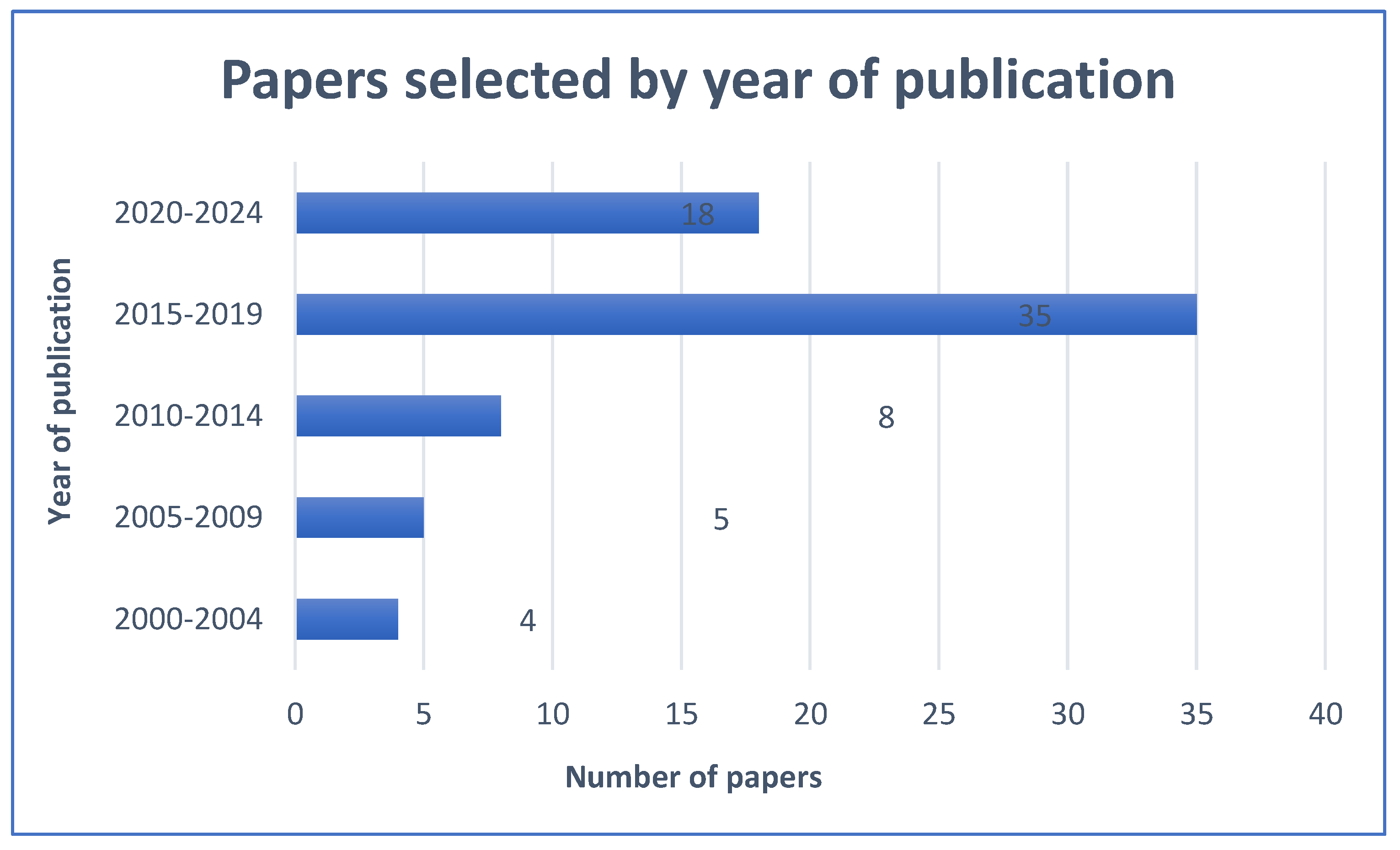
Figure 3.
showing distribution of selected papers by keywords.
Disclaimer/Publisher’s Note: The statements, opinions and data contained in all publications are solely those of the individual author(s) and contributor(s) and not of MDPI and/or the editor(s). MDPI and/or the editor(s) disclaim responsibility for any injury to people or property resulting from any ideas, methods, instructions or products referred to in the content. |
© 2025 by the authors. Licensee MDPI, Basel, Switzerland. This article is an open access article distributed under the terms and conditions of the Creative Commons Attribution (CC BY) license (http://creativecommons.org/licenses/by/4.0/).
Copyright: This open access article is published under a Creative Commons CC BY 4.0 license, which permit the free download, distribution, and reuse, provided that the author and preprint are cited in any reuse.


