

Submitted:
02 April 2025
Posted:
03 April 2025
You are already at the latest version
Abstract
Background. An inflammatory foreign-body reaction and the neosynthesis of collagen and the extracellular matrix through injectable collagen stimulators have coexisted since the introduction of the first sterile water-reconstituted poly-L-lactic acid (PLLA) formulation around the turn of the century. The PLLA-LASYNPRO™ microspheres for subdermal implants are a groundbreaking technological advancement that challenges the foreign-body reaction paradigm. The concept of non-inflammatory collagen and extracellular matrix regeneration, along with the initial insights into the rationale and role of the new-technology subdermal implants in aesthetic and regenerative medicine, was central to the discussions among thirteen distinguished experts in micro-invasive aesthetic medicine, aesthetic plastic surgery, and dermatology. This document summarizes their conclusions regarding the PLLA-LASYNPRO™ concept—subdermal microsphere implants designed to facilitate collagen and extracellular matrix regeneration while negligibly triggering persistent inflammation. Additionally, it offers preliminary yet authoritative suggestions from the board for the safe and effective use of the novel JULÄINE™ medical device based on the new-technology microspheres.
Methods. An online survey of the experts, preceded by a board discussion in Milan, Italy, focused on skin regeneration and the rationale for the new PLLA technology, drawing on the board experts’ direct experience. The topics surveyed included the anticipated benefits of the new JULÄINE™ medical device and some initial suggestions for its safe and effective use.
Results and Conclusions. This document outlines the board’s considerations regarding the shift, driven by the innovative PLLA-LASYNPRO™ ingredient and the CE-approved JULÄINE™ medical device, from the historically dominant FBR paradigm to a new strategy focusing on non-inflammatory collagen and extracellular matrix regeneration. Additionally, it presents practical, albeit preliminary, suggestions based on current clinical research for utilizing the new JULÄINE™ medical device and reaping its anticipated benefits.
Keywords:
Earlier-generation poly-L-lactic acid
; extracellular matrix regeneration
; foreign body response
; injectable collagen stimulators
; expert board
; PLLA-LASYNPRO™
; skin quality
Introduction
The concept of inflammatory foreign-body reaction (FBR) has been crucial for understanding how injectable resorbable agents, starting with earlier-generation sterile water-reconstituted poly-l-lactic acid (PLLA) at the turn of the century, promote the synthesis of collagen and other components of the extracellular matrix [1]. Thus far, endeavors to overcome the FBR paradigm and the related burden of late inflammatory side effects, such as nodules and occasional granulomas, have met with only partial success, as acknowledged in another paper by the thirteen distinguished members of “The Next-Generation PLLA-LASYNPRO™ Regenerative Medicine Italian Expert Board” following a literature review [1]. According to the board, the innovative PLLA-LASYNPRO™ microspheres for subdermal implantation in the new JULÄINE medical device (Nordberg Medical AB, Huddinge, Sweden) might signal the shift from the long-dominant FBR paradigm to a novel paradigm of non-inflammatory collagen and extracellular matrix regeneration [1].
This document reflects the collaborative efforts of the thirteen board specialists. It summarizes their discussions on the non-inflammatory PLLA-LASYNPRO™ rationale and the role of the new-technology microspheres for subdermal implants in aesthetic and regenerative medicine. At this early research stage, the board’s insights into the PLLA development rationale and its role in aesthetic and regenerative medicine may be only preliminary. However, the board specialists aspire to offer their European colleagues some preliminary yet authoritative suggestions for the safe and effective use of the novel CE-approved JULÄINE™ medical device.
Methods
In January 2025, thirteen distinguished specialists with extensive practical experience and teaching expertise in skin regeneration and related treatments convened in Milan, Italy. During the board meeting, a non-voting member coordinated the twelve voting board members. All board experts actively participate in exploratory and formal studies with the innovative JULÄINE™ medical device and its PLLA-LASYNPRO™ microspheres for subdermal implants.
Before the Milan meeting, the board’s initial activities centered on identifying and reviewing the recent literature on skin regeneration and treatment strategies indexed in PubMed/MEDLINE and other leading databases and discussing the available evidence with fellow board members online. This collaborative literature review laid the groundwork for examining the profile of the new-technology microspheres and the wealth of preliminary information emerging from the developing preclinical and clinical program. The discussions on skin regeneration and available treatments also helped the development of a digital 27-item multiple-choice survey questionnaire—chronologically, the second preparatory board activity leading up to the Milan meeting. Given the exploratory nature of the survey and its goal of encouraging lively discussions during the Milan meeting, most questions did not allow yes-or-no binary responses.
The first part, the digital questionnaire, was administered double-blindly on a secure survey website to all voting board experts. It focused on how each board member perceived the PLLA-LASYNPRO™ rationale and the shift towards a non-inflammatory paradigm for promoting the neosynthesis of collagen and extracellular matrix in facial connective tissues.
The clinical experience of the board members with the new-technology microspheres (international brand: JULÄINE™) inspired the second part of the questionnaire. Drawing on their newly acquired expertise, the board proposed several suggestions for integrating the novel non-inflammatory rationale into everyday ambulatory practice within the framework of current and potential future indications and approved reconstitution and administration procedures. Board members were instructed not to discuss these suggestions with one another while completing their online questionnaires. For details on the twenty-seven proposals and statements addressed at the Milan meeting and the survey outcomes, please refer to Supplemental File S1.
The Delphi conventions establish the consensus thresholds for classifying an indication as a preliminary “Recommendation” or a “Consensus statement”—at least 80% agreement among participants and between 60% and 80%, respectively [2]. The proposed final recommendations do not need to adhere strictly to the survey results. The ongoing clinical research program will encompass studies based on these preliminary suggestions, which will either validate the concepts outlined in this document or make slight adjustments. A follow-up board meeting will convene when more preclinical and clinical evidence becomes available in the international peer-reviewed literature.
Results
Considerations of the board regarding the PLLA-LASYNPRO™ rationale, identification and assessment of candidate subjects, and communication (Section 1 of the survey).
All board experts agreed with the first proposed statement (cf. Supplementary File S1, Statement 1):
“Since the introduction of the first conventional poly-l-lactic acid formulation, a variably
severe inflammatory foreign-body reaction has been the cornerstone of
exogenously induced neocollagenesis by injectable collagen stimulators. The
new goal is to abandon the reactive inflammation-ignited neocollagenesis
paradigm for a novel non-inflammatory paradigm based on a physiological
cascade of events.”
Before the Milan meeting, ten of twelve experts had agreed with the second proposed statement in its original form (cf. Supplementary File S1, Statement 2). After a brief discussion at the board meeting, all twelve voting experts accepted the statement revised as follows:
The “PLLA-LASYNPRO™ microspheres can be considered an
innovative treatment in regenerative aesthetic medicine. After injection,
they act as unique deep bio-regenerators that should not be confused with
traditional fillers whose purpose is to fill hollow spaces transitorily.”
Eleven voting experts had concurred before the meeting on the third proposed statement in its original wording (cf. Supplementary File S1, Statement 3). All experts reached a consensus that the ideal candidate for the new PLLA technology is a subject who complains of degraded skin quality and seeks a rejuvenated appearance:
“It is essential to evaluate whether the patient
requires immediate or gradual results. A patient pursuing instant
gratification may not be an ideal candidate. Patients desiring a rejuvenated
appearance with lasting results are more appropriate candidates for
PLLA-LASYNPRO™ treatment with the JULÄINE medical device.”
Before the meeting, only seven voting experts agreed to the fourth proposed statement in its original wording—35 to 65 years is the ideal age range for candidates to the new PLLA technology (cf. Supplementary File S1, Statement 4). Four experts agreed partially. After discussing the issue at the board meeting, the twelve voting experts stated that subjects of all ages report benefits based on their experiences with the ongoing clinical studies they coordinate. Consequently, the twelve voting experts concurred with the statement reformulated as follows:
“Since adult subjects of all ages report benefits from
PLLA-LASYNPRO™ and the JULÄINE medical device, the appropriate age for
treatment is at least eighteen.”
The fifth survey item addressing the ideal candidates for treatment with the novel PLLA microspheres, or the likely “best responders,” was not articulated in a single statement (cf. Supplementary File S1, Statement 5, which outlines multiple profiles of candidate subjects and proposals across two slides). All board members, except for one, agreed with all proposed statements. For the profiles of candidate subjects, a severity score of two or three on a four-point scale indicated a potential candidate, reflecting moderate to advanced severity of skin aging and laxity and impairment of skin quality [3], along with mild to moderate loss of skin thickness and firmness (Table 1). The amended fourth statement had already addressed the issue of age.
There was only one exception to universal agreement: the experts agreed to replace all references to “volume loss” with “mild to moderate loss of thickness and firmness.” This change aimed to prevent confusion between the new-technology PLLA microspheres and volume-repleting fillers. For instance, the sixth statement(cf. Supplementary File S1, Statement 5, first slide) was revised to read: “Faces objectively demonstrate measurable mild to moderate firmness and thickness loss of the skin over a selected area or the entire face (pinch test), slight to moderate laxity of soft tissues, and poor skin quality.”
All board experts concurred with Supplementary File S1, Statement 6 about the importance of ensuring that the subject has reasonable expectations:
“Effective communication between physicians and patients
is crucial for setting realistic treatment goals. The gradual effects of the
PLLA-LASYNPRO™ microspheres should be clearly explained to patients, who need
to be informed about the aging process and how responses to treatment vary
according to individual profiles.”
Along with supporting the statement in Supplementary File S1, Statement 7, the experts noted that the skin pinch test may be particularly valuable due to its ease of performance and ability to offer a qualitative assessment of skin firmness recovery.
“Some procedures can help demonstrate objective and
quantitative changes during the PLLA-LASYNPRO™ treatment. Patient assessments
may include standard photography (considering background, posture, lighting,
and facial expression), skin analysis imaging systems (e.g., VISIA and
Antera3D®, among others), and the skin pinch test.”
Providing comprehensive information about the new-technology PLLA ingredient and JULÄINE is essential. It is equally important to ensure that the candidate subject understands all details (cf. Supplementary File S1, Statement 8):
“After a preliminary investigation of the medical
history (including skin condition, medications, allergies, prior procedures,
etc.), have the subject sign a thorough informed consent form and provide
complete information about the PLLA-LASYNPRO™ microspheres of the JULÄINE
medical device.”
Considerations of the board regarding the anticipated results with PLLA-LASYNPRO™, contra-indications, and reconstitution (Section 2 of the survey)
Drawing from their preliminary experience with the clinical studies they coordinate, the twelve voting experts observe early benefits in all four dimensions contributing to skin quality—skin firmness, skin tone evenness, skin surface evenness, and skin glow [3]. However, given the early stage of the new-technology PLLA microspheres clinical research, they prefer to wait for more long-term follow-up data before expressing their views on how long the early benefits may persist or evolve (cf. Supplementary File S1, Statements 9 and 10). Despite this caution, the experts agreed that a third injection session may not be required, particularly for younger subjects. They recommended revising the proposed Statement 9 into a confident yet less conclusive version:
“Improvement in skin quality is typically noticeable
within one to three months.”
In contrast, there were no changes to Supplementary File S1, Statement 11:
“The PLLA-LASYNPRO™ contraindications and precautions
stated in the approved Instructions For Use internal leaflet are similar to
those of any aesthetic treatment and include acute or chronic skin conditions
(such as infections or inflammations), a history of allergies to ingredients,
age under 18 years, pregnancy or breastfeeding, a history of bleeding
disorders or current anticoagulant therapy, a known tendency to keloids or
hypertrophic scarring, and a history of immune deficiencies.”
The experts achieved unanimous agreement on the procedures for product reconstitution as stated in Supplementary File S1, Statement 12:
“Remove the flip-off cap from the vial and clean the
butyl stopper with an antiseptic. Dissolve the lyophilized powder with 5 mL
of sodium chloride solution (0.9%, Ph. Eur.) using a sterile, single-use 5 mL
syringe with a sterile 18-gauge needle inserted through the butyl stopper.
Rotate the vial for one minute until the microsphere suspension appears
translucent and homogeneous. Reconstitution is generally complete within one
minute without agglomeration. The vial can be used immediately after reconstitution.
Reconstituted JULÄINE can be stored at room temperature (18-25°C) for up to
72 hours. Do not freeze.”
Considerations of the board regarding the injection device and technique, treatment plan, and safety (Section 3 of the survey)
After discussing it at the Milan meeting, the board modified the proposed statements 13, 14, and 15, emphasizing the standard first option of using a 25-gauge, 38-mm, or 50-mm cannula with a retrograde fanning technique. Although a less precise 22-gauge cannula may help decolletage of tissue layers and reduce trauma, it requires advanced manual skills with fluid suspensions (cf. Supplementary File S1, Statements 13 to 15).
“Use a fresh, sterile 18-gauge needle to draw an
adequate volume of the PLLA-LASYNPRO™ suspension into a one mL or three mL
sterile syringe, then switch to a sterile 25-gauge cannula (38 mm or 50 mm,
at the operator’s discretion) as the preferred injection device using a
retrograde fanning technique. A 22-gauge cannula may be suitable in expert
hands to achieve tissue layer separation with minimal trauma. A linear
injection technique with a sterile 13 mm, 26-gauge, or 30-gauge needle may
also be considered.”
Although the experts agreed that cannulas are always ideal for injecting the novel next-generation microspheres, injections using 26-gauge or 32-gauge needles are possible (cf. Supplementary File S1, Statements 16). After some discussions at the Milan meeting, all experts agreed to revise the statement as follows:
“While injecting PLLA-LASYNPRO™ through a cannula is the
preferred method in all situations, using 13-mm 26-gauge or 30-gauge needles
with a linear injection technique is also feasible. In every instance, the
injection target should be the superficial subcutaneous layer just beneath
the dermis.”
So far, no subject has experienced significant pain in the ongoing clinical research program. Given these considerations, the board unanimously agreed to the following slightly revised statement of Supplementary File S1, Statement 17:
“Given the mild discomfort associated with the
PLLA-LASYNPRO™ treatment, there is no need to add lidocaine to the suspension
during the first and later sessions.”
All board experts agreed on the proposed considerations regarding the treatment plan detailed in Supplementary File S1, Statement 18:
“A PLLA-LASYNPRO™ treatment plan with the JULÄINE
medical device can entail up to three injection sessions per patient. The
recommended dose of reconstituted JULÄINE is 5 mL (one vial) for each
treatment session per face (2.5 mL for half a face). Injections can be
repeated every 6 to 8 weeks.”
After discussing the issue at the Milan meeting, the experts unanimously identified the superficial subcutaneous layer of the skin as the target for injection, revising the surveyed statement (cf. Supplementary File S1, Statement 19). The microspheres can rapidly diffuse from this superficial subcutaneous layer into the deeper dermis and underlying subcutaneous layers.
“The PLLA-LASYNPRO™ microspheres of the JULÄINE medical
device should be injected into the superficial subcutaneous layer of the skin
immediately below the dermis at a tangential angle to the epidermis.”
Regarding the indications of the novel medical device based on the new-technology PLLA ingredient (see Supplementary File S1, Statement 20), the experts concurred with the proposed modifications, shifting the focus from the initially suggested wording to the effectiveness of PLLA-LASYNPRO™ microspheres in enhancing skin thickness, thereby establishing it as a primary objective:
“The PLLA-LASYNPRO™ medical device for facial treatment
effectively addresses aging concerns. Its main goals are to enhance skin
thickness, provide a tightening effect (reducing skin laxity and boosting
elasticity), and improve overall skin quality in its four articulations: skin
radiance, skin tone, smooth texture, and firmness. PLLA-LASYNPRO™ subdermal
implants are also beneficial for treating skin depressions caused by
imperfections in connective tissue and scarring.”
There was a consensus on the suggestions regarding the safety and side effects of the novel medical device (cf. Supplementary File S1, Statement 21), only adding “erythema” to the original wording. The experts noted that no serious adverse events had been reported during the current clinical study program. The minor side effects observed are common and expected for all micro-invasive procedures. Some experts suggested using bromelain to prevent frequent and transient post-injection edema, and all experts agreed that there are no contraindications.
“Treatment with the PLLA-LASYNPRO™ medical device is
safe, with only occasional, expected, mild, and transient side effects.
Common immediate reactions to PLLA-LASYNPRO™ treatment include short-term
mild pain, erythema, swelling, and slight bleeding at the injection site,
typically resolving spontaneously within a few hours and no longer than 24 to
48 hours. Current evidence shows late inflammatory side effects, such as
nodules and granulomas, have a negligible or nil incidence.”
As illustrated in Figure 1, the recommended injection point for the next-generation PLLA microspheres in the middle-third area is lateral malar, positioned just below the zygomatic arch (cf. the several surveyed suggestions in Supplementary File S1, Statement 22).
The medial and lateral mandibular and submalar points (Figure 2) are recommended for injecting the PLLA-LASYNPRO™ microspheres in the lower-third region (cf. the two proposed options in File S1, Statement 23).
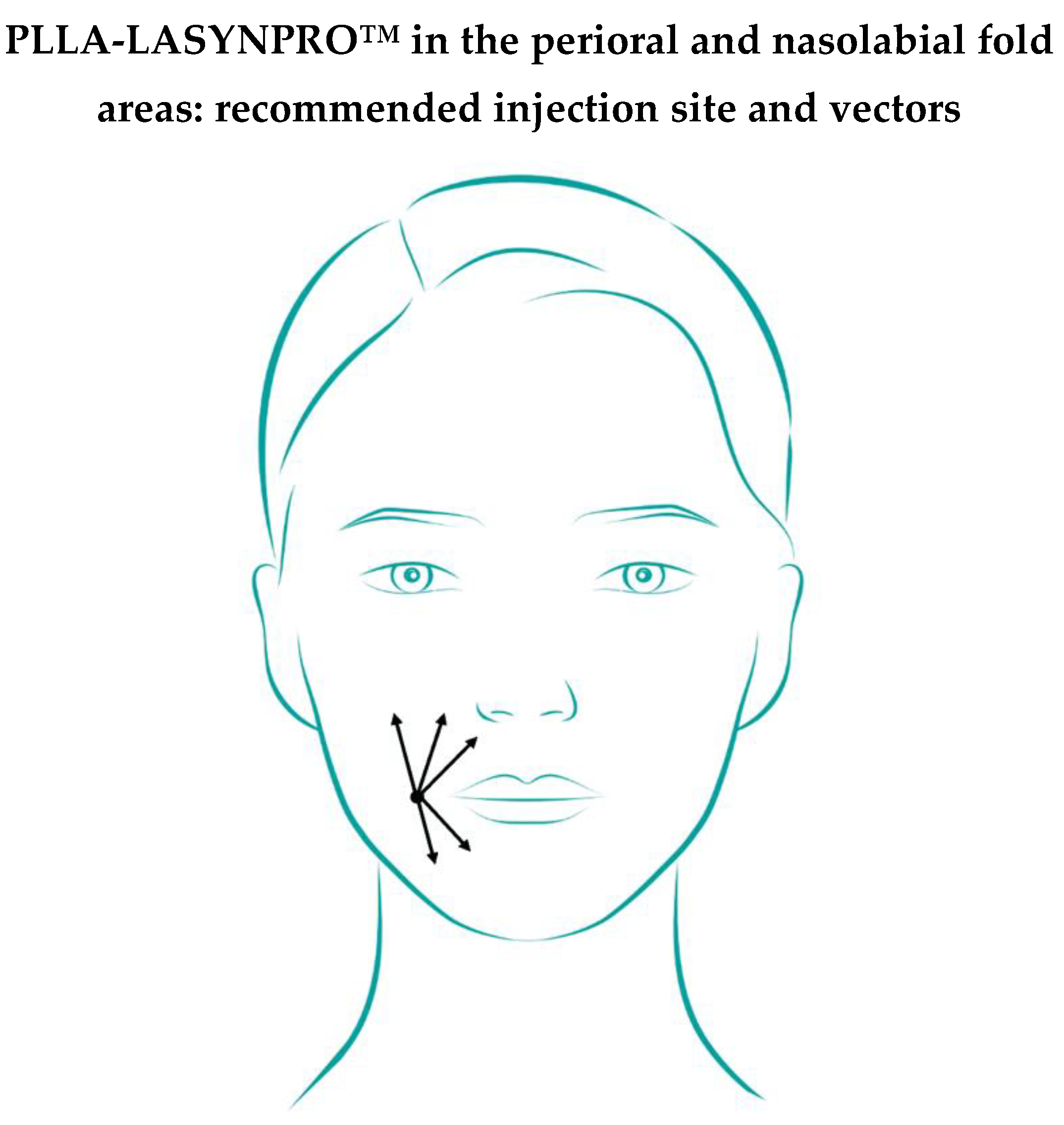
The board unanimously agreed on “One centimeter laterally from the oral commissure” as the recommended injection point in the perioral area. The “Lower part (base) of the nasolabial fold” might also be considered as an injection point in the area affected by nasolabial folds (cf. the several proposed options in Supplementary File S1, Statements 24 and 25). A recent interim prospective multicenter analysis on 36 subjects confirmed the safety and rejuvenating efficacy of the PLLA-LASYNPRO™ microsphere implants on mild to severe nasolabial folds [4]. Adverse effects, such as occasional edema, erythema, and infrequent local irritation, were mild, transient, and expected as typical of all micro-invasive procedures. Regarding efficacy, 44.4% and 63.9% reported highly significant improvements compared to baseline on both the five-grade WSRS (Wrinkle Severity Rating Scale) and the six-point MFVDS (Midface Volume Deficit Scale) photo-numeric assessment tools after, respectively, one and two months after the first microsphere injection [4].
Figure 3.
The injection site and vectors suggested in the diagram are not mandatory. The operator’s assessments
and the subject’s specific needs may suggest other or alternative injection vectors. Diagram drawn and owned
by the authors.
Figure 3.
The injection site and vectors suggested in the diagram are not mandatory. The operator’s assessments
and the subject’s specific needs may suggest other or alternative injection vectors. Diagram drawn and owned
by the authors.
Likewise, the board unanimously agreed that the temple and neck are additional facial areas that could benefit from PLLA-LASYNPRO™ treatment (cf. Supplementary File S1, Statement 26).
The final statement proposed for discussion centered on the need for post-treatment massages (cf. Supplementary File S1, Statement 27). Based on available preclinical evidence [1] and their experiences in the ongoing clinical research program, the board agreed that the tiny, regular, and smooth-surfaced new-technology PLLA microspheres diffuse rapidly in the treated area from the superficial subcutaneous layer with no early or late tendency to clump. Consequently, the board unanimously concluded that immediate post-injection massages may be beneficial and are recommended, although they are not strictly essential. Self-massage at home is not required.
“Post-treatment massage is recommended but not
mandatory: the purpose is verifying the even distribution of PLLA-LASYNPRO™
microspheres. Thanks to the optimal tissue integration of the microspheres,
no self-massage at home is warranted.”
Discussion
The survey results and subsequent discussions at the in-person board meeting highlight the value of the PLLA-LASYNPRO™ innovation in addressing the inflammatory foreign-body response paradigm. The accompanying paper (First Insights on the Upcoming Role of Next-Generation PLLA-LASYNPRO™ in Aesthetic and Regenerative Medicine. A Survey of Experts — Foundations and Rationale) discusses how the next-generation PLLA microspheres, after subdermal implantation, show no pro-inflammatory tendency while promoting (non-pharmacologically) the synthesis of new collagen and other components of the extracellular matrix in the dermis and subdermal connective tissues [1]. The thesis proposed in the survey—that the non-inflammatory, next-generation PLLA ingredient of the novel JULÄINE medical device may overcome the long-prevalent FBR paradigm—appears to persuade the board of distinguished experts.
The suggestions for integrating JULÄINE and its non-inflammatory microspheres into the everyday practice of regenerative medicine specialists are preliminary, as the preclinical and clinical program designed to confirm the benefits of transitioning away from the FBR paradigm is still in development. Nonetheless, all thirteen experts are directly involved in planning and conducting the studies, and their suggestions stem from hands-on experience. A follow-up board meeting will review the new preclinical and clinical evidence once it becomes available in the international peer-reviewed literature.
Conclusions
A board of distinguished experts in micro-invasive aesthetic medicine, aesthetic plastic surgery, and dermatology discussed whether the introduction of the CE-approved JULÄINE™ medical device heralds a departure from the historically dominant FBR paradigm to a new paradigm centered on more physiological collagen and extracellular matrix regeneration. The key lies in the innovative main ingredient of JULÄINE™, the new-technology PLLA-LASYNPRO™ microspheres, which are negligibly likely to induce persistent inflammation. The “Next-Generation PLLA-LASYNPRO™ Regenerative Medicine Expert Board” also offers practical, albeit preliminary, suggestions arising from the current clinical research program to incorporate the new JULÄINE™ medical device into routine clinical practice.
Supplementary Materials
The following supporting information can be downloaded at the website of this paper posted on Preprints.org. Set of statements focusing on: (1) the profile of the novel non-inflammatory PLLA-LASYNPRO™ subdermal implants, contrasting with the long-prevalent foreign body reaction paradigm regarding the neosynthesis of collagen and extracellular matrix; (2) details about the approval rates of statements emerging from the online survey of board experts, proposed for discussion at the board in-person meeting. Format: PDF slides.
Author Contributions
All authors contributed to designing the survey and engaging in subsequent discussions, reviewed the manuscript drafts, and consented to its submission. The authors are responsible for the clinical and editorial accuracy and integrity of the manuscript submitted to the Journal of Clinical Medicine. They confirm that they have followed the journal’s ethical policies as outlined in the guidelines for authors.
Funding
No board activities involved interactions with human subjects, thus waiving the need for formal preliminary Institutional Review Board approval.
Institutional Review Board Statement
No board activities involved interactions with human subjects, thus waiving the need for formal preliminary Institutional Review Board approval.
Informed Consent Statement
Not relevant.
Data Availability Statement
Minutes from the discussion at the final board meeting are available upon reasonable request.
Acknowledgments
The board would like to thank Dr. Mauro Raichi for his contributions to discussions about the manuscript structure and his assistance with medical writing.
Conflicts of Interest
Over the past three years, all board members have received grants and fees from companies involved in aesthetic medicine and surgery, serving as consultants in research and development programs, investigators in national and international clinical studies, and lecturers or tutors in Continuous Medical Education activities and sponsored educational meetings. However, the authors declare no conflicts of interest in the manuscript submission. Nordberg Medical AG, the holder of the international patents for PLLA-LASYNPRO™ and the manufacturer and exclusive marketer of the JULÄINE™ medical device, provided support only for the secretarial and logistical expenses of the board members and will also financially assist with publication costs after the manuscript undergoes peer review and acceptance.
References
- Dario Bertossi, Maurizio Cavallini, Alessandra Camporese on behalf of The Next-Generation PLLA-LASYNPRO™ Regenerative Medicine Expert Board. First insights on the upcoming role of next-generation PLLA-LASYNPRO™ in aesthetic and regenerative medicine. A survey of experts — Foundations and Rationale. This accompanying manuscript is under contemporary review by J Clin Med.
- Diamond, I.R.; Grant, R.C.; Feldman, B.M.; Pencharz, P.B.; Ling, S.C.; Moore, A.M.; Wales, P.W. Defining consensus: a systematic review recommends methodologic criteria for reporting Delphi studies. J Clin Epidemiol 2014, 67, 401–409. [Google Scholar] [CrossRef] [PubMed]
- Goldie, K; Kerscher, M; Fabi, SG; et al. Skin Quality – A holistic 360° view: Consensus results. Clin Cosmet Investig Dermatol 2021, 14, 643–654.
- Urdiales-Gálvez, F; Benítez, PA; Díaz, I. Facial rejuvenation with an innovative poly-l-lactic acid (juläine) for nasolabial folds: interim data analysis of a prospective, non-randomized, multicenter, open-label spanish study. J Cosm Dermatol 2025, 24, e70137. [CrossRef]
Figure 1.
The diagram and vectors indicate the recommended site and directions for the microsphere injection; however, they do not claim to be exhaustive. The operator’s assessments and the subject’s specific needs may suggest other injection vectors. Diagram drawn and owned by the authors.
Figure 1.
The diagram and vectors indicate the recommended site and directions for the microsphere injection; however, they do not claim to be exhaustive. The operator’s assessments and the subject’s specific needs may suggest other injection vectors. Diagram drawn and owned by the authors.
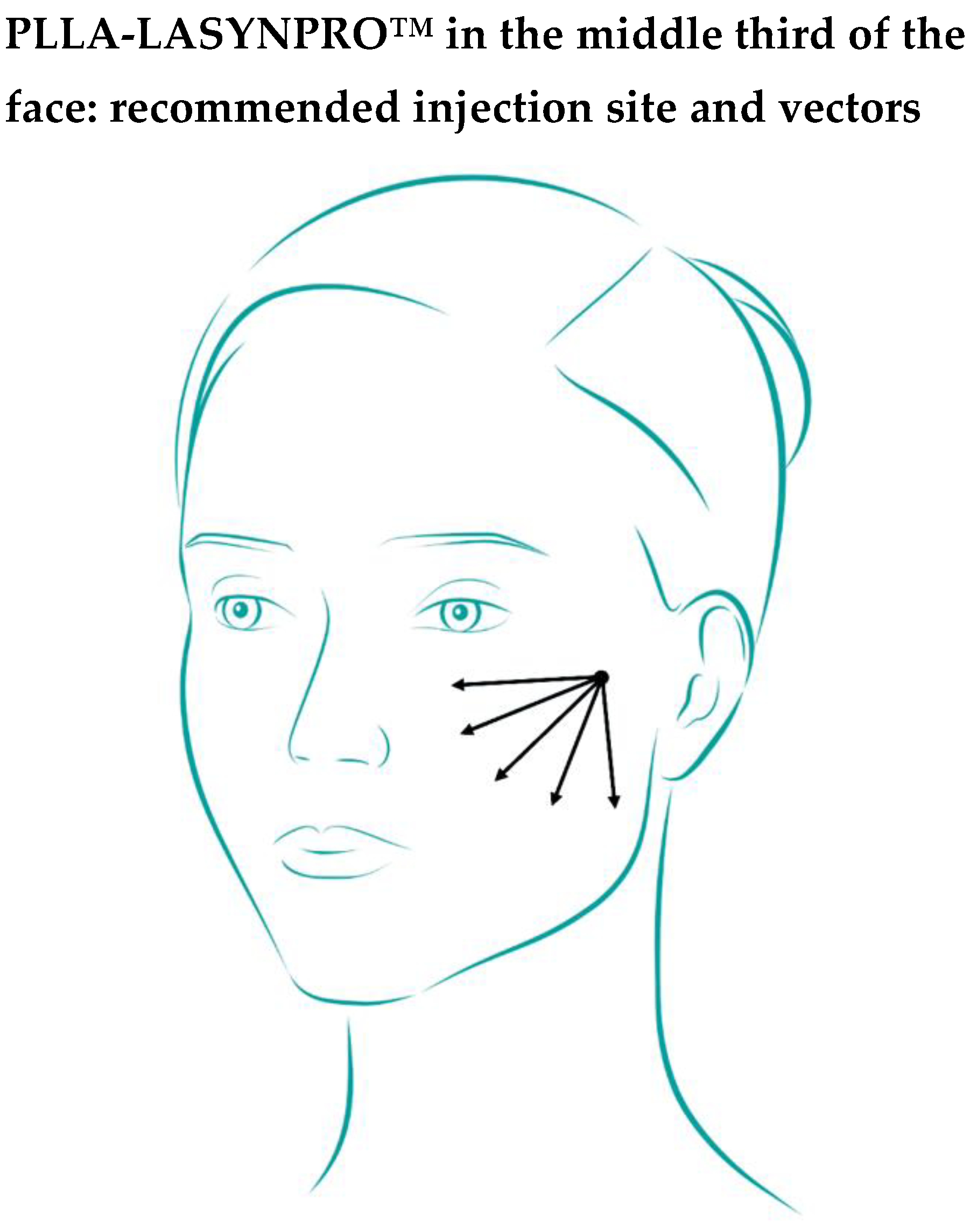
Figure 2.
The illustrated directions for microsphere injections in the lower third of the face are only suggested and not mandatory. The operator’s assessments and the subject’s needs may suggest other or alternative injection sites and vectors. Diagram drawn and owned by the authors.
Figure 2.
The illustrated directions for microsphere injections in the lower third of the face are only suggested and not mandatory. The operator’s assessments and the subject’s needs may suggest other or alternative injection sites and vectors. Diagram drawn and owned by the authors.
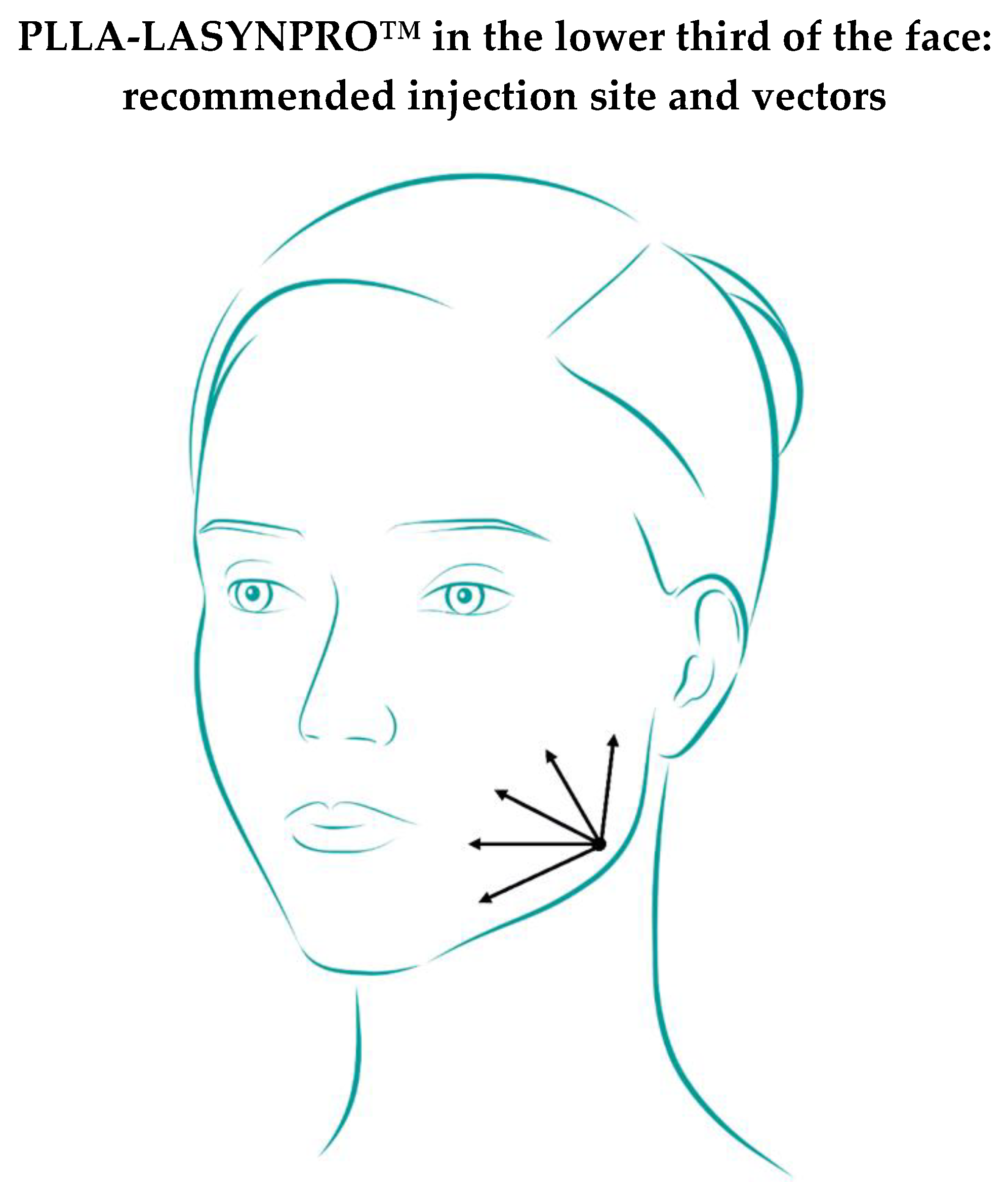

Table 1.
The suggested profiles of candidate subjects (highlighted in blue) most likely to benefit from PLLA-LASYNPRO™ treatment, according to the preliminary experiences of experts in the clinical studies they lead.
Table 1.
The suggested profiles of candidate subjects (highlighted in blue) most likely to benefit from PLLA-LASYNPRO™ treatment, according to the preliminary experiences of experts in the clinical studies they lead.
| I | II | III | IV | |
|---|---|---|---|---|
| Aging | Mild | Moderate | Advanced | Severe |
| Skin quality impairment | Mild | Moderate | Advanced | Severe |
| Skin laxity | Mild | Moderate | Advanced | Severe |
| Loss of skin thickness and firmness | Mild | Moderate | Advanced | Severe |
Disclaimer/Publisher’s Note: The statements, opinions and data contained in all publications are solely those of the individual author(s) and contributor(s) and not of MDPI and/or the editor(s). MDPI and/or the editor(s) disclaim responsibility for any injury to people or property resulting from any ideas, methods, instructions or products referred to in the content. |
© 2025 by the authors. Licensee MDPI, Basel, Switzerland. This article is an open access article distributed under the terms and conditions of the Creative Commons Attribution (CC BY) license (http://creativecommons.org/licenses/by/4.0/).
Copyright: This open access article is published under a Creative Commons CC BY 4.0 license, which permit the free download, distribution, and reuse, provided that the author and preprint are cited in any reuse.