

Submitted:
01 April 2025
Posted:
02 April 2025
You are already at the latest version
Abstract
A series (n=22) of glasses from the site Kapucinski vrt (garden of the Capuchin monastery, 5th-17th c. CE) in Koper (Capodistria), a port town in northern Adriatic, was measured by a combined PIXE and PIGE method. Koper has been continuously populated since late Roman period with a rich medieval history, thus offering an opportunity to study Early Medieval glass. Stemmed goblet fragments, in the original publication dated between the 6th-9th c. CE, and several other vessel types (beakers, flasks or bottles, lamps) were selected for analysis. The measurements were expected to show the trends in glass production and consumption from Late Antiquity until the Middle Ages, notably the transition between the natron to plant ash glass and supply of fresh glass. Among the set of 22 glass vessel fragments both natron and plant ash glass were identified. For finer classification we relied on a newly developed method of Euclidean distances with respect to major concentrations. Natron glass was of the types of Foy 2.1 (9 examples), Magby (2 examples) and Levantine I (Apollonia; 2 examples). Two glasses remain undetermined but testify Egyptian origin. Most natron glasses show signs of recycling. Among the three unrecycled glasses (about 20% of the whole set) there are the two examples of Levantine glass and a Magby glass lamp; this may indicate a modest supply of fresh glass during the period. Plant ash glass may be attributed to the Early or High Middle Ages, exploiting purified alkalis of the Levantine coasts (known as alume catino in later Venetian glassmaking), while the admixture of impurities in the siliceous sands suggest circulation and consumption of glass that was produced and traded in the eastern Mediterranean since the 10th centuries onwards.
Keywords:
glass analysis
; natron glass
; plant-ash glass
; Northen Adratic
; PIXE
; PIGE
1. Introduction
In glass studies, the 8th-10th centuries CE represent the transition period between the use of natron and plant ash glass compositions. In a broader historical context, this reflects the availability of material supplies and intensity of trade routes, especially important is the ratio between the old, recycled material and freshly supplied raw glass. In Egypt and Mesopotamia, the production of plant ash glass never completely disappeared. In the Roman world outside this region, it appears already in the 1st c. CE, though limited to intensively colored blue or green glass [1,2]. A few examples of plant ash glass during Late Antiquity are mentioned in the eastern part of the Roman Empire, such as Crete [3], or Moesia [4,5]. In Italy, the first examples of plant ash or mixed natron-plant ash glass are dated to the 8th c. CE, in Lombardy and around Venice [6,7,8]. An earlier occurrence, such as the 7th c. CE from Comacchio [9], was opposed in [10]: high MgO values were hypothetically explained as contamination in the crucible. Most of the secondary glass production still used recycled natron glass at least until the 12th-13th c. CE [7,9,11].
At the same time as the compositions, vessel forms were also changing, especially the stemmed goblet. In the development of glass goblets between the ubiquitous Isings 111 form of the 6th-8th c. CE and the reappearance of new tall-stemmed variants in the 13th-14th c. CE there is a large gap. In central Italy and Caput Adriae region a small group of rare and unique goblet types, usually linked to high status sites where the demand for drinking vessels and consumer power continued after the 8th c. CE [12,13] represents an opportunity to study the mechanisms of the survival of the stemmed goblet during its dark ages.
To deepen our understanding of the trends in glass production from the Late Antiquity until the Middle Ages we selected 22 samples of vessels from the excavations of the garden of the Capuchin monastery in the port town of Koper / Capodistria in the Slovenian part of Istria. Situated on the Adriatic coast, the archaeology of Koper, previously an island, displays Byzantine, Carolingian/Ottonian and later Venetian influence. The garden of the Capuchin monastery revealed a complex stratigraphy of stone buildings from the 5th to the 17th c. CE, when the monastery was built. Only the first two, Late Antique and Early Medieval, phases were published, dated between the 5th-10th c. CE (Figure 1). Among the small finds a 10th c. CE Byzantine belt buckle was discovered in the same building as a coin of Charlemagne and a fitting of a Carolingian spur set [14]. Two illegible dirhems have also been discovered, dated to the beginning of the 9th c. CE as well as a coin of Constantine VII and Zoe from the beginning of the 10th c. CE [15]. Historical sources report a bishop in Koper (Caprae) in 599 CE. In 908 CE Italian king Berengar I promised protection to Adlegida, the abbess of a female cenobium in Koper, named as civitas Justinopolitana [16]. A detailed study of the social and political situation of the time revealed the abbess might have stemmed from the highest Italian noble families. Caught in the conflicts between the Istrian margrave and the Venetians in the 10th c. CE the town signed multiple agreements with Venice. Between the 12th-13th c. CE the city prospered as an independent commune and in 1279 Koper eventually came under Venetian dominance. Historical analysis of the only recently available archival sources for 13th-14th c. CE shows the town was comparable to the most important late medieval cities on the Adriatic coast, Zadar and Dubrovnik, and that it represented one of Venice’s most important supplying areas. The beginnings of the town’s elevated status can be traced back to the 10th c. CE [17,18].
Excavations in the garden of the Capuchin monastery (45⁰32’53’’, 13⁰44’03’’) in the 1980s uncovered settlement remains, dated from the 5th c. CE onwards [14]. They are represented by several houses, built in local stone bound with clay, and additional buildings in post-hole technique (Figure 1). Stone-paved hearths, water channels and graves of small children were also discovered among the walls. During the excavations, several Isings 111 goblets, lamps and window glass were found, but also some exceptional Early Medieval goblet types (Cunja types 2 and 4; Figure 4: 1, 3 in ref. [19]). Mainly goblet feet and stems and parts thereof were chosen for analyses because among the heavily fragmented material they could most reliably be assigned to the vessel forms. One sample (22) can be identified as Cunja 2 type. The vessels were given an approximate age estimation (Late Antique: 6th-7th c. CE; Early Medieval: 8th-11th c. CE) according to their stratigraphic position and phasing of the site published by Cunja [14] and according to excavation documentation, kept in the Regional Museum in Koper. At the time the ceramic and especially glass typo-chronologies of the period between the 10th and 13th c. CE were sketchy and representative objects were not recognized [20], thus the end of the Early Medieval phase at the 10th c. CE may have been set too early. A more confident dating of the ceramics from the 13th c. CE on allowed the authors to define the late medieval phase [21]. The site stratigraphy remains to be published in detail.
Goblet feet with a small diameter (ca. 3 cm) belong to the Late Antique phase and the large ones (ca. 4 cm in diameter) to the Early Medieval. This increase in feet size over time is visible in the published goblet types from Koper [14,19] and elsewhere [22,23]. Among the glass material, not published in 1996, a part of a long and thin aqua colored stem with a disc was discovered and selected for analysis (without context, Figure 2). Comparable tall-stemmed goblets are relatively rare and in Italy usually dated between the 9th-11th c. CE [24,25,26]. Apart from goblets we also sampled a lamp handle, concave beaker bases and bottles. We also sampled five pushed-in bases and a bottle or flask rim with a bulge, found during the excavation of one of the Early Medieval houses, but at the time of sampling estimated to be post-Early Medieval on account of their typological similarity with European Medieval goblet and bottle forms (Figure 2, Table 1).
Our main research question was whether the putative early and high medieval goblet types and other vessels were made using natron or plant ash and how our results compare to the other analyses of early medieval glass in northern Italy conducted so far.
2. The analytical Method
2.1. Experimental
The glasses were analyzed by the method of proton-induced X-rays (PIXE) and gamma rays (PIGE), using the in-air beam of the Tandetron accelerator at the Jožef Stefan Institute in Ljubljana. The cleanest part of the samples (where oxide layers peeled off) and washed by alcohol were used for the measurements. The nominal energy of the beam was 3 MeV, but after passing a 200 nm exit window of Si3N4 and a 7 mm air gap, the impact energy at the target was about 2.94 MeV. The beam intensity was a few nA, and the proton current was measured by an RBS signal from a gold foil on a chopper, periodically intersecting the beam in vacuum. Measurement of the proton number was checked according to the intensity of the argon signal induced in the fixed airgap between the exit window and target. As the fluctuations of the signal ratio were below 3%, chopper measurements were recognized as reliable. Typical measurements were about 30 minutes per sample. The induced X-rays were detected by a Si(Li) detector of 160 eV resolution at 5.89 keV, positioned about 6 cm from the target. The exact distance was determined by measuring a series of elemental and simple chemical compound targets. The detector was further equipped with a pinhole filter made of 0.05 mm thick aluminum foil with a relative opening of 9%; the pinhole transmission function was carefully measured and modelled. The combination of airgap as an X-ray absorber and the pinhole filter allowed detection of X-rays from silicon until antimony in a single spectrum (including, however, the L-lines of heavier elements). The lighter elements, Na, Mg, and Al, were then detected according to their gamma rays, induced by inelastic scattering of protons on the nuclei. The gamma lines used in the analysis were 440 keV for Na, 585 keV for Mg, and 844 and 1014 keV for Al; they were detected by an intrinsic germanium detector of 40% relative efficiency positioned about 10 cm from the target. The concentrations were determined according to the method of fundamental physical parameters for X-rays, and according to the surface approximation based of NIST 620 glass standard for gamma rays, considering the effects of proton stopping and photon absorption simultaneously for both sets of data. The sum of elemental concentrations in oxide form was set to unity, yet for control purposes, it was also compared to the calculated virtual concentration of argon induced in the air gap between exit window in target. Departure from the argon nominal value signaled sample mis-orientation or its roughness, which was then considered as a correction in the calculation. The detection limit for Na was about 50 μg/g, for Mg about 0.2%, and for Al about 0.1%. Here the most critical was measurement of Mg, on account of low counting statistics of its 585 keV line; getting a satisfactory result thus regulated the measuring time. The detection limits for X-ray based elements were about 10 μg/g for mid-Z elements until Z=30 but worsened to about 50 μg/g around Z=50, on account of smaller ionization cross section. Accuracy of the method, measured according to the NIST 620 and 621 glass standards, was about 5% for major elements, but worsened to 10-15% for minor and trace elements.
2.2. Determination of Glass Types According to the Euclidean Distance
For designation of glass types, we designed a numerical method, which calculates a Euclidean distance of an unknown glass sample n from the multi-dimensional ellipsoid of a specific glass type. The Euclidean distances replaced the method of score numbers, tentatively introduced in [27]; this approach often produced undeterminable results, as several glass samples could achieve the same number of scores. A stricter criterion is the Euclidean distance defined as
where xi are the oxide concentrations in the unknown glass, and mi and σi are the mean concentrations and their standard deviations in the specific glass group or series. For a 95% agreement with the specific group, we take t=2. Identification with a specific type is successful if d<1. The ellipsoid has nine dimensions (N=9), considering the major and minor glass composition with the oxides of Na, Mg, Al, Si, K, Ca, Ti, Mn, and Fe. The elements with concentrations around 0,05% and lower, such as Sr and Zr, or trace elements like Li and B, are presently not considered in the calculation, but are rather studied in graphs or considered as complementary criteria. The number of variables N in (1) should not be too large as a disagreement for one selected concentration can be screened by good agreement of the remaining N-1.
Characterizing glass groups by mi and σi is an approximate method which avoids using large sets of data, indispensable in other discriminative methods, such as PCA. Its main uncertainty lies in the distribution of characteristic elements which may deviate from Gaussian; however, the convenience of the method is that we can rely on the published data, as several authors publish group averages and standard deviations. In the calculation, we tried several data sets for natron and plant ash glass, which we discuss in the subsequent section.
3. Results
3.1. Elemental Concentrations and Broad Distribution into Groups
The list of samples (Figure 2) with their description is given in Table 1; the last two columns describe the glass group or series, as follows from the analytical results in Table 2. The concentration values in oxide form in Table 2 are given in mass % and µg/g; single zeros denote values below the detection limits.
The glasses were first distributed according to the type of the flux, which can be resolved from the MgO-K2O diagram (Figure 3); the natron glass has typically MgO below 1.6%, the plant ash above 2.2% [28]. In this and the following graphs, we use different symbols for different glass vessel forms, and different colors for the historic periods, as suggested by available typological designation and stratigraphic data.
Two groups are evident from Figure 3, the natron type-glass, which involves both Late Antique and Early Medieval glass forms, as well as the sample dated to the 9th-11th century (no. 14), and glass made from the ash of halophytes, which involves presumably post-Early Medieval glass and one chronologically undeterminable example. Only two glasses are largely extant from the two groups. One is Late Antique goblet no. 8, which shows a somewhat higher concentration of potassium (1.5% K2O); however, this value is not exceptionally high and might have been caused by pollution during remelting - additional potassium might have resulted from the minerals in stone walls and/or from fuel fume [29,30]. The second sample is Late Antique lamp no. 20, which is found in the intermediate region between the natron and plant-ash glass. This indicates that it was produced either of mixed alkalis or from a mixture of natron and plant-ash glass. Its position is also close to the so-called Byzantine Magby glass, as specified in [31].
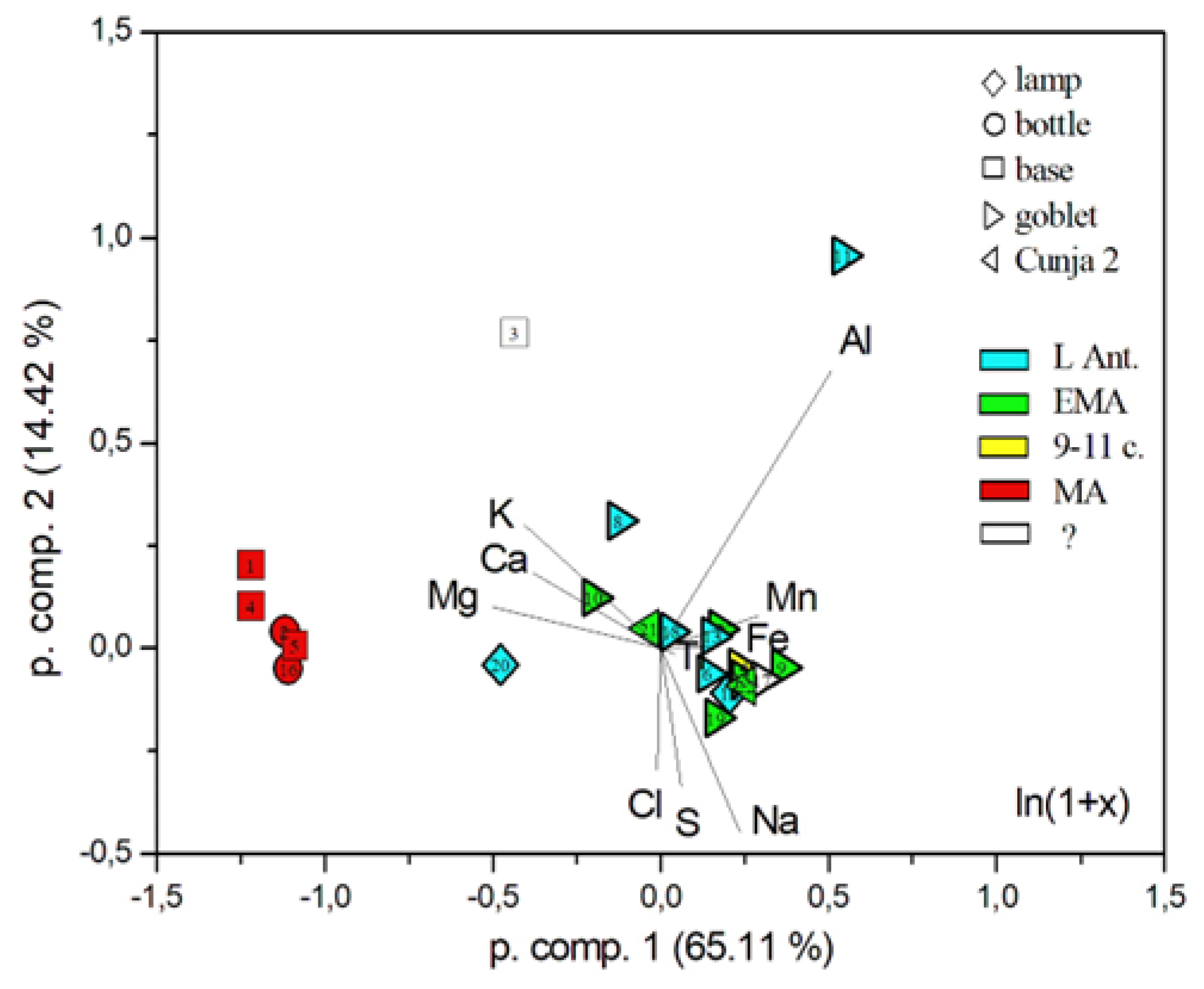
For a broad distribution into groups, we study the glasses by the principal component analysis, considering 11 elemental oxides; to overcome the influence of very large and very small concentrations, we use the logarithmic transform x’=ln(1+x) [32]. Figure 4 again shows that the presumably earlier glasses (up to the 11th century) form a rather compact group, with slightly different samples nos. 8, 10 and 20. There are two rather different samples, undeterminable no. 3 and the beaker no. 11; it is located far in the direction of the aluminum eigen vector, which is due to its high Al2O3 content. On the other hand, the plant ash glass of the presumably post-Early Medieval group forms an independent compact group.
Figure 4.
Distribution of the analyzed glasses according to the principal component analysis (PCA). The concentrations of 11 metal oxides were logarithmically transformed.
Figure 4.
Distribution of the analyzed glasses according to the principal component analysis (PCA). The concentrations of 11 metal oxides were logarithmically transformed.
3.2. Natron-Type Glass
Distribution of natron-type glass into groups or series has a complex history; in this work we will operate with the following terms:
Roman Mn and Roman Sb [33] will designate pre-4th c. AD Roman glass discolored with Mn and Sb, respectively. These two glasses approximately agree with Foy Série 3.1 non-tardif and Foy Groupe 4 glasses [34] or RBGY2 and RBGY1 [35]. The first glass type is of Levantine and the second of Egyptian origin, respectively. We will not specifically consider naturally colored blue-green-yellow glass [36]. Glass with a higher content of impurities encountered after the 4th c. AD was identified as Foy Groupe 1, or as HIMT (high iron, manganese and titanium) by Freestone [37], though it was experimentally detected earlier [38]. Several subspecies were identified by several authors, though only HIMT1 or strong HIMT is now recognized as true HIMT. According to its iron content it is divided into HIMTa and HIMTb [39]. The other derivatives of HIMT glasses are then rather related to Late Antique glasses of the Foy scheme. Glass Foy Série 3.2 also involves HIMT2, while Foy Série 2.1 includes weak HIMT, HLIMT (high lime), and Ca-rich HIMT [40]. All HIMT glasses are now considered of Egyptian origin; their Levantine counterparts were designated as Levantine I by Freestone and include 4th c. glasses from Jalame and 6th c. glasses from Apollonia [41]. Of the glasses that appear after the 6th century we considered Egypt I (7th to 8th century), Egypt II (8th to 10th century), as well as Levantine II (or Bet Elie’zer, 6th to 8th century) [42]. Egypt II was split by Schibille into Egypt 2 (< 815 CE) and Egypt 2 (>815 CE) [43]. We further added High Al glasses produced from the evaporitic source of alkalis in Asia Minor [44] and a mixed-alkali Magby glass [45].
The data of mean elemental concentrations and their standard deviations (mi and σi) are given in Table 3. For Roman Sb they were taken from [46] (Table 1: 269-680 data of refs. [47,48,49,50,51,52,53]. For Roman Mn we used compilation [46] (Table 4: 138-239 data of refs. [48,49,52,53,54,55,56,57]. Two subgroups of Roman Mn glass are taken from [40]: Roman Mn – Britain (7 glasses of [50]), Roman Mn – Italy (12 glasses of [53]). Data for HIMTa (14 glasses) and HIMTb (5 glasses) are from [58]. The compilation of [46] is used for Foy Série 3.2 (Table 1: 65-99 data of [34,59,60,61,62], Foy Série 2.1 (Table 1: 157-180 data of [31, 34, 58) and Jalame (Levantine I) (Table 4: 50 data of [63]). Balvanović [64] distinguished two subgroups: Jalame Mn (14 glasses of [65]), Jalame no Mn (28 glasses of [65]). Schibille [46] further provides data for Apollonia (Levantine I) (Table 4: 30 data of [66,67]) and Bet Eli’ezer (Table 4, 27-79 data of [41, 66, 68, 69). Phelps [69] summarizes data for Egypt I (24 glasses of [70]) and Egypt II (17 glasses of [70]). Data for both Egypt 2 groups are taken from [43] (12 and 24 glasses, respectively, data of [34, 41, 71), and for Magby from [46] (Table 1, 55-65 data of [31,72,73].
The relation between Egypt II and Egypt 2 glasses was inspected from the point of Euclidean distances. There is close relation between Egypt II and Egypt 2 (<815 CE) (d=0.383), while Egypt 2 (>815 CE) differs from Egypt II (d=4.581) and is closer to Magby glass (d=1.336).
As natron is chemically a relatively pure agent, distinction between different glass groups is based on the impurities of the siliceous sand, including aluminum, titanium, iron and zirconium. The main distinction is between the Egyptian sands, rich in heavy elements brought by the Nile, and Levantine sands rich in feldspars, composed of lighter elements such as aluminum. In 2005, Freestone proposed to distinguish the glass types according to the Al2O3-CaO diagrams [42]. In Figure 5, we can distinguish post-Early Medieval plant ash glasses as a separate group, while among the Early Medieval glasses there are two in the Levantine I area (nos. 8 and 13), one or possibly two are HIMT (nos. 22 and 7), and two (nos. 10 and 18), possibly also no. 20, are in the Egypt II region. All other glasses form a compact group between these groups. As such characterization is now regarded as not sufficient, Freestone later [33] presented another diagram, which is based on the Al2O3/SiO2 vs. TiO2/Al2O3 diagram initially proposed by Schibille [57]. In Figure 6 we display our data against the shaded areas of glass types which Freestone plotted as individual points; additionally, we added the data points of Magby glass [31,45,67]. We can again see that the post-Early Medieval plant ash glasses form an individual group, while most of the glasses up to the 11th c. form a compact group of Foy Série 2.1. There are three glasses in the region of Levantine glass (nos. 3, 8, and 13). Two glasses are in the boundary region of Egypt II and HIMT glass (nos. 10 and 18), while one (no. 20) seems to be at the other edge of Egypt II glass. There is also an outsider at the high Al side, no 11.
The results of the calculation of Euclidean distances (eq. 1) largely agree with Figure 6 – the resulting glass groups and the distances from their centroids are given in Table 1. Among the natron-type glass, 9 glasses were identified as Foy Série 2.1, and two as Magby. The two glasses (nos. 8 and 13) that appear among the Levantine glass in Figure 4 and Figure 5, are Levantine also according to the calculation: both are closest to the glass from Apollonia.
Characterization of two glasses (nos. 10 and 18), which in Figure 6 lie in the region intersecting the areas of HIMT, Egypt II and Magby glasses is problematic. Magby glasses are characterized by the mean values of A2O3/SiO2=0.0314±0.0052 and TiO2/Al2O3=0.0832±0.0150 (calculated from 53 data points in [31,45,67], while individual points spread between the upper region of Foy 2.1 and lower region of Egypt II (Figure 6). For no. 10 we calculate the following distances with respect to HIMTa (d=1.355), Egypt 2 (d=1.062) and Magby (d=0.880). For no. 18 we get for HIMTa (d=1.017), Egypt 2 (d=0.852) and Magby (d=0.893). For distinction between the three types, we further inspect SrO and ZrO2 concentrations, which in both glasses amount 300-400 µg/g and about 200 µg/g, respectively. The mean values for HIMTa are 519 µg/g and 276 µg/g (from the data of [58], for Egypt 2 (>815 CE) they are 221 µg/g and 244 µg/g, respectively, and for Magby 890 µg/g and 118 µg/g, respectively [46]. Nos. 10 and 18 lie somewhere in between these values and therefore cannot be assigned to any definite type. The common property of the three glass types considered is their Egyptian origin, therefore we will use for nos. 10 and 18 the notation Egypt (?).
3.3. Plant Ash Glass
According to MgO-K2O diagram in Figure 3, all post-Early Medieval glasses (nos. 1, 2, 4, 5, 16) appear as made of alkalis obtained from the ash of halophytic plants; among them is also the undeterminable base no. 3. Glass no. 20, with its mixed alkali composition, has been determined as Magby glass and is studied among the natron glasses.
Plant ash glass was also subject to the calculation of Euclidean distances. For the database, we used the data compilations and measurement from [74] (Tables 11.4 and 11.6), [43] (Table 1), [46] (Table 3), [75] (Supplementary tables 4, 5), and [76] (Table 1). Here the most consistent results were obtained with the data compiled by Phelps, as the plant ash glasses nos. 1-5 and 16 were characterized as Tyre (10th-11th c.) or Raqqa (8th-11th c.) – see Table 1; experimental data were taken from [41,77] (8 glasses) and [78] (90 glasses). Distances calculated according to his own data for Ramla (P1, P3, P4) were greater than unity. According to [43], the classification was Levantine plant ash (data of [78] ; 40 glasses) - except for no. 16, which resulted here as Mesopotamian due to a slightly smaller distance (d=1.158) in comparison with d=1.166 for the Levantine plant ash). Distances for Egyptian plant ash glasses E1-E4 [46] were greater than unity. According to the data collected by [75], the plant ash samples also appeared as made in Tyre (13 glasses 8th-12th c.) according to the data of [77]; however, this classification was consequence of very large data spread of values [77], as large σ make the distances smaller. If we consider as a potential source all distances smaller than unity, possible proveniences also include Ctesifon (9 glasses of [78]), Raqqa 1 (91 glasses of [78,79]), Bayreuth (7 glasses of [78]), Raqqa 4 (74 glasses of [78,79]) and Siraf Main A 9th-12th c. (15 glasses of [80]– for no. 2 only). According to the data compiled and calculated by [76], glasses 1-3 were determined as Raqqa 1 (data base 103 glasses of [79]). For the glasses 4, 5 and 16, Raqqa 1 remained the second closest, though smaller distances were obtained for Khirbet al Minya (no. 4, d=0.651; data base 6 glasses of [78]) and Sagalassos (no. 5, d=0.612; no. 16, d=0.611; data base 11 glasses of [81]).
Though these locations are quite diverse, most of them are on the Mediterranean coast or its close background, with three exceptions: Sagalassos in Asia Minor (glass could have travelled there by trade), Siraf in Iran (encountered as a modest possibility for glass no. 2) and Ctesifon near Baghdad (attribution to this site may results dure to large standard deviation of reference concentrations).
4. Discussion
4.1. Natron Glass
Natron-type glass of Late Antiquity was produced in two regions sufficiently close to exploit the dry deposits of Egyptian lakes, Egypt itself and the Levantine coast. The two regions producing primary raw glass differ according to the impurities in the siliceous sand. Figure 7, showing Al2O3 vs. Fe2O3, clearly distinguishes between Levantine and Egyptian sands: Levantine (nos. 8, 13) are characterized by higher aluminum values and smaller iron content. The situation is similar in TiO2 vs. ZrO2 plot (Figure 8). Glasses of Levantine sands (nos. 8, 13, as well as the plant ash glass no. 3) show both low titanium and zirconium values. Higher values of both elements, showing a linear correlation are perceived in Egyptian sands, with the highest values in the undetermined Egyptian glasses of nos. 10, 18. The glass 20, which is made of mixed natron and plant ash alkalis, and glass 21 are then among the Egyptian glass, in accordance with their characterization as Magby glass.
Strontium can be used to distinguish mineral sources of calcium from its source in mollusks or plant ash [42]. Figure 9 (showing SrO vs. CaO) reveals that SrO concentrations are typically larger than 300 µg/g, which excludes mineral source of calcium. The lowest SrO values are observed in the two Egyptian glasses nos. 10 and 18. Though these values are closest to Sr concentrations in HIMT glass, such classification can be excluded on account of major composition. Juan de Ares [72] noted the structured distribution of HIMTa and HIMTb glass in the Easten and Western Mediterranean, with the absence of temporally later (beginning of the 5th c. CE) HIMTb in certain regions, including the north-eastern Mediterranean. This may indicate a limited supply of HIMT glasses since the beginning of the 5th c. CE, caused by specific political or economic events. In the region of Koper this overlaps with changed supply routes as reflected in amphorae imports. Until mid-5th c. CE North Africa predominates as the export region while in the 6th c. CE most of ceramic imports arrive from the Eastern Mediterranean. This change follows a decline in Tunisian pottery workshops, most probably linked to wine and oil production and circulation dynamics [82].
Manganese can enter glass either as an impurity or as a decolorizer added intentionally, for example in the form of pyrolusite (MnO2). In Figure 10 (showing MnO vs. SrO) it is evident that two Levantine glasses (8 and 13) were made of glass that was not discolored with MnO, while glass no. 3 exhibits the highest MnO level of 1.47%. Of the two Egyptian (?) glasses, one (no. 18) exhibits 0.53% MnO, while in no. 10, its content is only 0.2 % - for this reason no. 10 departs from HIMTa more than no. 18.
It is further important to consider the percentage of recycled/non-recycled glass. There are several criteria for distinction of recycled glass: the content of antimony below the level that ensures discoloration [52] and admixture of heavy elements that enter the glass batch through the colored glass. In our glasses we did not detect antimony and tin (the detection limit for both elements were about 50 µg/g), which means that the recycling process did not involve significant amount of glass discolored with antimony and glass opacified with tin. Therefore, we could only rely on the admixture of heavy elements Cu, Zn and Pb whose values in the recycled glass are typically above 100 µg/g, though Zn values may be slightly below this value even in the recycled glass [9]. According to these criteria, all natron glasses in our set are recycled, except for both Levantine glasses (8 and 13). Another example includes the lamp 20 (Magby) produced of mixed alkalis – the siliceous component points to be non-recycled; this finding makes the possibility of mixing natron and plant ash glass less probable.
Compared to the vessel typology, both non-recycled Levantine glasses are goblet feet with a diameter of ca. 3 cm, found in the Late Antique (6th-7th c. CE) phase layers at the site. The typology, stratigraphy and composition of these two samples fit very well. One Magby glass is a lamp handle (no. 20), here again the stratigraphy, typology and glass composition fit. The second Magby (no. 21) is a rim of a further undetermined vessel, quite possibly a goblet or a lamp. It was found together with sample no. 22, a Cunja 2 goblet of recycled Foy 2.1 composition, on a stone floor of the Early Medieval phase. Recycled Foy 2.1 glasses are represented mainly by goblet feet with a diameter of ca. 4 cm or by parts of goblets (nos. 9 and 17) and one lamp or balsamarium. They belong to the Early Medieval phase of the site. Among them are the Cunja 2 type goblet (no. 22) and the thin-stemmed goblet stem (no. 14). As to where they were produced it is of course not possible to give a definitive answer, but it seems worth stressing that Cunja type 2 goblets are very similar to a goblet from the workshop at Torcello, now dated to the 9th c. CE or even slightly later [[22]; Figure 46]. They are both composed of two pieces, with a hollow stem and a narrow knob at the top of the stem. The thin-stemmed goblet (no. 14) confirms the reuse of old glass until the 10th or 11th c. CE in the workshop where it was made. To our knowledge these types of goblets are not found in the same layers as the sturdier Cunja 2 and 4 types or similar vessels. They are also more widely found in the Italian Peninsula and their development continues into the Middle Ages. It may well be that they were produced in different workshops and, more importantly, in different social and political contexts of the 10th c. CE and later. The second half of the 10th c. marks the beginning of the consolidation of the Ottonian Empire and the rise of the power of Venice. More political stability allowed the now firmly established elites also to pursue their demand for luxury tableware. It also allowed the workshops to meet this demand with a slightly more constant supply than in the two centuries before yet still relying on the circulation of recycled material. A high percentage of recycled earlier glass was also detected in Medieval sites from Italy, such as in Nogara [83], Vetricella [84] or medieval castle of San Giuliano [85], while fresh Levantine glass still reached the Islamic Sicily [85].
The glass no. 11 is a fragment of a concave beaker base which was found on a layer of fired clay and ash, probably a hearth of the Early Medieval phase. It contains a low level of MgO, which points to a mineral source of alkalis, but contains a high amount of aluminum. The reason for the high aluminum content is not clear: if we exclude surface pollution, high-Al glasses may be associated with the production in Asia Minor exploiting evaporitic mineral sources of soda [44]. Their characteristic is also the contents of boron and lithium, whose presence we could detect as gamma lines at 429 keV and 478 keV, respectively [87] – but the two lines in this object could not be discerned from the background in our measured spectra. Using another set of data ([76] and unpublished results), the detection limits for Li and B were estimated to be 10 µg/g and 300 µg/g, respectively. The range of both elements in 11 glasses from Asia Minor is between 16 and 438 µg/g for Li and between 657 and 1810 µg/g, so both elements could have been observed. On the other hand, agreement with the major composition of High Al glasses is quite good (d=0.636). Another possible origin is glass produced in central Asia and used for beads [88], which is characterized by high K2O concentration and low CaO and SrO concentrations. No. 11 does not match these properties, so the question of its origin remains open.
4.2. Plant Ash Glass
Plant ash glasses are produced of cleaner silica sources, as the vegetal ash contains oxides both of alkali and earth alkaline elements, as well as several impurities. Investigations of the silica matrix usually determine the cleanliness of the silica source [89], or connections with the geological background according to neodymium isotopes [90]. Significant differences are then sought according to the plant ash component.
The Euclidean distances show little differences between the plant ash glasses of our samples and do not allow distinction within quite a broad region involving present Lebanon and Syria, with a small probability including Mesopotamia and Asia Minor. As glass was a trading material in within the Islamic-Byzantine world, we explore the relation between our glasses and the glass cullet from the shipwreck of Serçe Limani, sunk around 1025 CE. The Euclidean distances according to the mean values of Serçe Limani glass ([76] from 99 data of [63]) calculated for the plant ash glasses nos. 1-5 and 16 vary between 0.637 and 0.837. These values show high similarity between our and traded glass.
As Venice was also a renowned trading city in the Mediterranean world closely interacting with Constantinople and North Africa [91], we compared our glasses (nos. 1-5, 16) with the Venetian soda glass: greenish-brown and uncolored of the 11th-14th centuries, and later 15th and 16th c. Venetian commune and vitrum blanchum glass according to the data compiled by Verità ([92], Tables 6.2.3, 6.2.4). The smallest distances in the range 0.500-0.658 were obtained for the uncolored glass of the 11th-14th centuries (except no. 3 which was closest to the green-blue glass of the same period; d=0.345). The distances for the commune glass were in the range 0.655-0.834, and the distances for vitrum blanchum in the range 0.738-0.988. For glass no. 3, both distances were greater than unity (1.047 and 1.528, respectively). Summarily, the mean distances were 0.563 for the glass of the 11th-14th centuries, and 0.797 for the later vitrum commune and 1.017 for vitrum blanchum, respectively. These values argue strongly towards earlier dating of our plant ash samples and point to the type of glass that was produced in the Levantine area and matter of extensive trade since the 10th c. CE.
Next, we inspected the properties of the alkali component. The quality of the plant ash can be monitored from the diagram that shows the relative fraction of sodium and potassium oxides in the total sum of alkaline and earth-alkaline oxides (Figure 11). All samples are sorted within an area that in our previous works embraced certain fractions of glass from Ljubljana and Celje in Slovenia, Antwerp in Belgium, and Lezha in Albania [93,94]. Within this group there are also glasses with original Venetian provenance, and according to the conclusion of de Raedt [95] they are made of the finest plant ash, named allume catino in the 15th and 16th c. CE Venetian glass making and which was harvested along the Levantine coasts. All our post-Early Medieval glasses were then also made of alkalis matching allume catino; we do not encounter any glass made of lower quality alkalis harvested elsewhere. Measurements of strontium isotopes suggest two production areas of harvesting halophytic plants in the Levant: coastal and interior around Euphrates River [96]. In Figure 11 we also plotted data for Banias (a representative of the coastal region; data of [41], Raqqa (region around Euphrates; data of [79] and Samarra (region around Tigris towards the Zagros mountains; data of [78]). The plot shows differences between the coastal alkalis and those harvested inland (the Raqqa and Banias data sets contain some natron-type glass as well). Our data agrees better with the centroid of Banias values, confirming that alkalis from the coastal region were more frequently used in the maritime trade.
Considering the origin of siliceous sand material, we again rely on the admixtures of light and heavy elements, presented in Figure 5, Figure 6, Figure 7, Figure 8, Figure 9 and Figure 10. In all these figures, all presumably Medieval glasses appear as a compact group, suggesting its common origin. In Figure 5 (CaO vs. Al2O3), the Medieval glasses exhibit the lowest Al2O3 (below 1%) and highest CaO values (above 12%). High CaO implies high SrO values, between 700 and 930 µg/g (Figure 9). The sample no. 3 departs the group due to its high Al2O3 concentration, which in Figure 6 puts it among the Levantine glass. The local origin of plant-ash glass is also evident in the MgO/CaO vs. Al2O3 diagram according to [74]. Figure 12 shows that all post-Early Medieval glasses are made of Eastern Mediterranean ingredients, while the indeterminable no. 3 is rather of Mesopotamian Type I. The Euclidean distance for no. 3 is inconclusive and is larger from unity both for Levantine and Mesopotamian glass (d=1.317 for Nishapur). It also bears resemblance to the Egyptian E4 glass (d=1.297), though details about this type of glass, dated to 1035-1149 CE are not yet clear [46]; in Figure 12, E4 would be characterized as Mesopotamian Type I.
All post-Early Medieval samples have MgO/CaO ratio between 0.2 and 0.3. This ratio was also studied in [96]: MgO/CaO values around and below 0.3 refer to glasses from Banias, Ramla, Beirut and Damascus, i.e., to the glasses from the Levantine coast. This confirms the hypothesis that the exported glass was mainly coming from the coastal area [96].
We also consider the possibility that the post-Early Medieval plant ash glasses (nos. 1, 2, 4, 5, 16) were imported to Koper from Venice that mastered the Mediterranean glass market in later centuries. For this we inspected the minor and trace elements. The content of TiO2 varies between 0.087% and 0.125%, and ZrO2 between 210 and 330 µg/g. Both elements are then present at concentrations that highly exceed the values for original Venetian production. De Raedt [95] set the zirconium limit at 30 µg/g for distinction between the imported Venetian glass in Antwerp and domestic production. Similarly, original Venetian glass according to [97] should not exceed the concentrations 2% Al2O3, 0.07% TiO2 and 40 µg/g ZrO2. Since our titanium values exceed this limits moderately, while the zirconium values considerably, our glasses were not produced of glass using siliceous sands of Venetian glassworks. This would imply they were imported to Koper from a site different from Venice. However, as Venice also imported large amounts of raw glass or its raw materials from the Levant and elsewhere [92,98], it is also possible that the objects were manufactured in the Venetian or other workshops from the imported raw glass or cullet.
High Zr values reopen the question of import from Egypt, as its prehistoric glass contains significantly high values of zirconium. However, high Zr values are also found in glass from Islamic Ramla, where raw glass chunks were imported from Mesopota-mia and Iran during the Abbasid period [74]. This complies with our previous state-ment that the plant ash from Koper relates to the locations of the present Palestine, Lebanon, Syria, possibly also Mesopotamia and Asia Minor, different from Egypt.
The presence of six plant ash glass samples in Koper also fits well into the picture sketched by Italian colleagues, especially for Lombardy and the area around Venice [7,8,92]. It is not possible to determine with any certainty whether the glasses are the result of trade with finished products (e.g., the cape Stoba shipwreck [99], raw materials, or cullet (e.g., the Serçe Limani shipwreck [100]). But in line with the raising mercantile role of Venice between major forces such as the Ottonian empire, the Byzantines and the Arabs [101] the major pull of the north Adriatic for long distance tradesmen is hardly surprising. Perhaps Istrian ports and sites in the hinterland benefited from this success indirectly, trading with Venice or other large centers. But it is also possible that some of the maritime trade supplied the eastern Adriatic coast directly. Beside the more widely known Cape Stoba case, shipwrecks near Savudrija, Umag and Poreč carrying Byzantine amphorae indicate that some of the merchants sailed along the Istrian coast as well [102]. The dating of the plant ash glass compositions from Koper is not precise, but revolves around the 10th or 11th c. In a wide sense then, the plant ash glasses arrived in the same time window as the much more strongly represented reused old natron glass. The typology of plant ash glasses is more difficult. The pushed-in bases (nos. 1, 3-5) most probably represent beakers. They are incompletely preserved, so the base diameters cannot be determined with certainty. The bases could also belong to small flasks or bottles, like the rim sample no. 16. In this case, if they arrived as complete vessels, they may have represented containers, perhaps for precious liquids or perfumes. The shape of the partially preserved neck with a bulge (no. 2) has analogies in bottles in the Syro-Palestine since the Umayyad period and becomes particularly popular since the 10th and 11th c. CE [103]. In Europe bottles with bulges on the neck appear from the 13th c. onwards [26,104]. The pushed-in bases (in contrast to the merely concave earlier form) appear in Europe around the 12th-13th c. [26] but they are already present in Umayyad contexts in Jerusalem [105] and continue into the following centuries. Based on typology alone then an occasional import of vessels, perhaps even as containers, seems more likely than a very early production of these vessel forms.
5. Conclusions
Glass from Koper exhibits two major groups. One is natron-type glass according to the Roman tradition, though with properties specific to Late Antiquity and Early Middle Ages. The most numerous is glass of the type of Foy Série 2.1 (9 samples, 8 goblet feet and one lamp or balsamarium). This type of glass includes a Cunja 2 type and a 9th-11th c. thin-stemmed CE goblet. Two Late Antique goblet feet of small dimensions were made of the Levantine sands, attributed to the 6th c. Apollonia. Two glasses, a rim and a lamp handle, are of the late 6th-7th c. CE type Magby, and two goblets are indeterminable, but point to Egyptian origin. Such a composition shows predominance of Egyptian glass, which has recently been confirmed also for Italy [106] and the Balkans [64].
It is interesting to note an absence of unaltered HIMT glass, which is normally more frequent in the western Europe [107], and a small percentage of the high-quality Levantine glass which is unusual in the Adriatic cities. Glass Foy Série 2.1 was imported to the Balkans mostly along the major rivers Danube and Sava and from the Aegean ports [40,64]. This is certainly not an optimal way for Koper, and we may rather imagine maritime trade through the Adratic, as in the case of Croatian islands [108]. This trade might have also continued inland for a certain distance, until Korinjski hrib for instance, which also contains a considerable fraction of Foy Série 2.1 glass [109].
The second group of six samples is composed of halophytic plant ash of the type alume catino, harvested in the Levant. The siliceous component shows rather uniform properties, yet its titanium and zirconium concentrations exclude its Venetian origin. Present calculation also excludes import from Egypt, but points towards Lebanon and Syria, with a small probability also to Iraq and Iran. The glass might have been imported from there as vessels or containers; the other possibility is that the glass vessels were made in (Venetian?) workshops from imported raw glass or cullet. In any case, they seem to predate the ubiquitous Renaissance period glass and give an important insight into the very rare presence of Islamic glass on the Adriatic coast.
The role of Egyptian glassworks in the period of Islamic glassmaking is unclear. A shipwreck on the Israel coast loaded with glass cullet testifies contacts with Egypt [110]. According to [46], the Egyptian glassworks were overloaded by the production of architectural glass for the monumental mosques since the end of the 7th c. CE.
Three glasses are out of this scheme. A beaker base was made of plant ash alkalis, but its aluminum content suggests Mesopotamian origin, yet its specifics is a high manganese content (no. 3). Though its precise attribution is not so clear, it matches very well the traded glass, found in the shipwreck of Serçe Limani. One lamp handle was made of mixed alkalis (composed of natron and plant ash), while its siliceous component is likely of Egyptian origin (no. 20), in accordance with the Magby glass. The third sample, a beaker base, was made of natron glass, but shows a high aluminum content, which points towards some other, not yet determinable provenience (no. 11).
Our analysis confirmed the reuse of old natron glass for Early Medieval vessels and for the 9th-11th c. CE thin-stemmed goblet, as has previously been observed in northern, central and southern Italy [7,9,11,12,111,112]. It is characteristic that all natron glass of Egyptian provenience is recycled. A small presence of non-recycled glass (3 samples or roughly 20%) is of Levantine or (in one case) of Mesopotamian origin and suggests a modest supply of fresh glass from this region during the Late Antiquity.
The goblet feet of larger dimensions were made of the following glass types: Foy 2.1 (6), Levantine I (Apollonia; 2), Magby (1) and underminable glass of Egyptian origin (2). All these types represent natron glass, which is in literature dated from the end of the 5th c. CE (Foy 2.1) to the 7th century (Foy 2.1 and Magby) until the 9th century (Egypt 2 > 815 CE). In Koper, this type of glass circulated for two centuries longer, as the last object made of (recycled) natron glass can be dated into the 10th-11th century. The glass market re-intensifies after the 10th c. CE, with the influx of plant ash glass from the Syrian and neighboring glassworks.
From the point of methodology, the method of Euclidean distances proved effective and discriminative enough for natron-type glass. For plant ash glass it seems less selective, probably on account of larger dispersion of the plant ash elemental concentrations, which also partly overshadow the elements of the siliceous component. A solution may be an improved database with recalculated standard deviations based on critically evaluated experimental data.
Author Contributions
Ž.Š. executed the measurements, conceived mathematical models, performed calculations and created the graphs. T.M. initiated the study, described the archaeological part of the paper and selected the samples. Both authors discussed and interpreted the results and contributed to the final conclusions.
Funding
This research received no external funding. .
Acknowledgments
We are grateful to dr. Maša Saccara and Špela Prunk from Pokrajinski muzej Koper for the permission to analyze the material of the Kapucinski vrt excavations.
The source of funding that has supported the work of one of us (T.M.) is Slovenian Research and Innovation Agency grant number P6-0247 and the MATRES project, approved as part of the first (preparatory) phase for the preparation of large interdisciplinary projects of the University of Ljubljana, funded by the Slovenian Research Agency development pillar (ARIS, RSF-A).
Measurements were enabled through the Slovenian node of the European Research Infrastructure for Heritage Science (E-RIHS.si; Infrastructure Programme I0-E012 founded by the Slovenian Research and Innovation Agency).
Conflicts of Interest
The authors declare no conflicts of interest.
Abbreviations
The following abbreviations are used in this manuscript:
| PIXE | Particle-Induced X-ray Emission |
| PIGE | Proton-Induced Gamma-ray Emission |
| PCA | Principle Component Analysis |
References
- Nenna, M.-D.; Gratuze, B. Étude diachronique des compositions de verre employés dans les vases mosaïqués antiques: Résultats préliminaire. In Annales du 17e Congrès de l’AIHV; Janssens, K.; Degryse, P.; Cosyns, P.; Caen, J.; Van’t dack, L., Eds.; AIHV: Antwerp, 2006; pp. 199-205.
- Jackson, C.M.; Cottam, S. ‘A green thought in a green shade’; Compositional and typological observations concerning the production of emerald green glass vessels in the 1st century A.D. J. Archaeol. Sci. 2015, 61, 139-148. [CrossRef]
- Oikonomou, A.; Rehren, Th.; Fiolotaki, A. An Early Byzantine glass workshop at Argyroupolis, Crete: Insights into complex glass supply networks. J. Archaeol. Sci. Rep. 2021, 35, 102766. [CrossRef]
- Drauschke, J.; Greiff, S. Early Byzantine glass from Caričin grad/Iustiniana prima (Serbia): First results concerning the composition of raw glass chunks. In Glass along the Silk Road from 200 BC to AD 100; Zorn, B.; Hilgner, A., Eds.; RGZM Mainz: Mainz, 2010; pp. 53-67.
- Balvanović, R.; Šmit, Ž.; Marić-Stojanović, M.; Spasić-Đurić, D.; Špehar, P.; Milović, O. Late Roman glass fromViminacium and Egeta (Serbia): glass making patterns on Iron Gates Danubian Limes. Archaeol. Anthropol. Sci. 2022, 14, 79. [CrossRef]
- Silvestri, A.; Pescarin Volpato, M.; Marcante, A. A review of medieval glass composition from northern and central Italy: a statistical approach. In Le verre du VIIIe du XVIe siècle en Europe occidentale. Actes du 8e Colloque international de l’AFAV, Collection les Cahiers de la MSHE Ledoux. Série Dynamiques Territoriales, Besançon 5-7 Dicembre 2016; Pactat, I.; Munier, C. Eds.; Presses universitaires de Franche-Comté: Besançon, 2020, pp. 47-79.
- Neri, E. Produzione e circolazione del vetro nell’alto medioevo: une entrée en matière. In Il vetro in transizione (IV-XII secolo) Produzione e commercio in Italia meridionale e nell’Adriatico; Coscarella, A.; Noyé, G.; Neri, E., Eds.; Firenze University Press: Florence, 2021, pp. 19–31.
- Uboldi, M.; Verità, M. Composizione chimica e processi produttivi del vetro tra tarda antichità e medioevo in Lombardia. In Il vetro in transizione (IV-XII secolo) Produzione e commercio in Italia meridionale e nell’Adriatico; Coscarella, A.; Noyé, G.; Neri, E., Eds.; Firenze University Press: Florence, 2021, pp. 235-244.
- Bertini, C.; Henderson, J.; Chenery, S. Seventh to eleventh century CE glass from Northern Italy: between continuity and innovation. Archaeol. Anthropol. Sci. 2020, 12, 120. [CrossRef]
- Gliozzo, E.; Braschi, E.; Ferri, M. New data and insights on the secondary glass workshop in Comacchio (Italy): MgO contents, steatite crucibles and alternatives to recycling. Archaeol. Anthropol. Sci. 2024, 16, 114. [CrossRef]
- Boschetti, C.; Kindberg Jacobsen, J.; Parisi Presicce, C.; Raja, R.; Schibille, N.; Vitti, M. Glass in Rome during the transition from late antiquity to the early Middle Ages: materials from the Forum of Caesar. Herit. Sci. 2022, 10, 95. [CrossRef]
- Sannazaro, M.; Guglielmetti, A. Uboldi, M. Manufatti del quotidiano: pietra ollare, ceramiche e vetri tra VIII e XIII secolo. In 1287 e dintorni. Ricerche su Castelseprio a 730 anni dalla distruzione; Sannazaro, M.; Lusuardi Siena, S.; Giostra, C., Eds. SAP Società Archeologica: Quingentole, 2017, pp. 129-159.
- Uboldi, M. San Tomé di Carvico: I vetri. In San Tomé di Carvico. Archeologia di una chiesa altomedievale; Brogiolo, G.P. Ed.; Comune di Carvico: Carvico, 2016, pp. 197-204.
- Cunja, R. Poznoantični in srednjeveški Koper. Arheološka izkopavanja na bivšem Kapucinskem vrtu v letih 1986-1987 v luči drobnih najdb od 5. do 9. stoletja stoletja /Capodistria tardoromana e altomedievale. Lo scavo archeologico nell’ex orto dei Cappuccini negli anni 1986-1987 alla luce dei reperti dal V al IX secolo d. C. ZRS Koper: Koper, 1996.
- Kos, P. Die Fundmünzen der römischen Zeit in Slowenien. Mann: Berlin, 1988.
- Štih, P. Il diploma del re Berengario I del 908 e il monastero femminile di Capodistria. Atti del Centro di Ricerche Storiche Rovigno 2010, 40, 67-98.
- Mlacović, D. Koper v poznem srednjem veku: opažanja o mestu in njegovih portah po pregledu knjig koprskih vicedominov s konca 14. stoletja (Late Medieval Koper: Observations about the Town and Its Portae from a Survey of the Books of the Koper Vicedomini from the End of the 14th Century). Acta Histriae 2022, 30, 819–854. [CrossRef]
- Mlacović, D. Kartuzija Bistra in Koper v 14. stoletju (The Bistra Carthusian Monastery and Koper in the 14th Century). Zgodovinski časopis 2023, 77, 98–346. [CrossRef]
- Milavec, T. The elusive early medieval glass. Remarks on vessels from the Nin – Ždrijac cemetery, Croatia. Prilozi Instituta za arheologiju u Zagrebu 2018, 35, 239-250.
- Cunja, R. Archeologia urbana in Slovenia. Alcuni risultati e considerazioni degli scavi a Capodistria. Archeologia medievale 1998, 25, 199-212.
- Cunja, R. Koper med Rimom in Benetkami. Izkopavanje na vrtu kapucinskega samostana: [razstava] = Capodistria tra Roma e Venezia. Gli scavi nel convento dei Cappuccini: [mostra]. Medobčinski zavod za varstvo naravne in kulturne dediščine = Istituto intercomunale per la tutela dei beni naturali e culturali: Piran, 1989.
- Gelichi, S.; Negrelli, C.; Ferri, M., Cadamuro, S.; Cianciosi, A.; Grandi, E. Importare, produrre e consumare nella laguna di Venezia dal IV al XII secolo Anfore, vetri e ceramiche. In Adriatico altomedievale (VI-XI secolo) Scambi, porti, produzioni; Gelichi, S.; Negrelli, C., Eds.; Studi e Ricerche 4: Venezia, 2017, pp. 23-114. [CrossRef]
- Ferri, M. Il vetro nell’alto Adriatico fra V e XV secolo. All’insegna del Giglio: Sesto Fiorentino, 2022.
- Arena, M.S.; Delogu, P.; Paroli, L.; Ricci, M.; Saguì, L.; Vendittelli, R.; Eds. Roma dall’antichità al Medioevo, Archeologia e storia. Museo Nazionale Romano Crypta Balbi: Milano, 2004.
- Del Vecchio, F. I vetri di IX-XII secolo dalla domus porticata del foro di Nerva. In Il vetro nell’alto medioevo. Atti VII giornate di studio A.I.H.V.; Ferrari, D.; Ed.; Comitato Nazionale Italiano: Imola, 2005, pp 45–48.
- Uboldi, M.; Lerma, S.; Marcante, A.; Medici, T.; Mendera, M. Le verre au Moyen Âge en Italie (VIIIe-XVIe siècle): état des connaissances et mise à jour. In Le verre du VIIIe au XVIe siècle en Europe occidentale; Pactat, I.; Munier, C.; Eds.; Presses universitaires de Franche-Comté: Besançon, 2020, pp. 31-47. [CrossRef]
- Šmit, Ž. Glass analysis in relation to historical questions. In Bridging science and heritage in the Balkans: studies in archaeometry, cultural heritage restoration and conservation; Palincaş, N.; Ponta, C.C.; Eds.; Archaeopress: Oxford, 2019, pp. 103-109.
- Lilyquist, C.; Brill, R.H. Studies in early Egyptian glass. The Metropolitan Museum of Art: New York, 1993, p. 56.
- Paynter, S.; Jackson, C. Re-used Roman rubbish: a thousand years of recycling glass. European Journal of Postclassical Archaeologies 2016, 6, 31–52.
- Al-Bashaireh, K.; Al-Mustafa, S.; Freestone, I.C.; Al Housan, A.Q. Composition of Byzantine glasses from Umm el Jimal, northeast Jordan: Insights into glass origins and recycling. J. Cult. Her. 2016, 21, 809–818. [CrossRef]
- Schibille, N.; Meek, A.; Tobias, B.; Entwistle, C.; Avisseau-Broustet, M.; Da Mota, H.; Gratuze, B. Comprehensive chemical characterization of Byzantine glass weights. PLoS ONE 2016, 11, e0168289. [CrossRef]
- Duewer, D.L.; Kowalski, B.R. Source identification of oil spills by pattern recognition analysis of natural elemental composition. Anal. Chem. 1975, 47, 1573-1583. [CrossRef]
- Freestone, I.C.; Degryse, P.; Lankton, J.; Gratuze B.; Schneider, J. HIMT, glass composition and commodity branding in the primary glass industry. In Things that travelled. Mediterranean glass in the first millennium CE; Rosenow, D.; Phelps, M.; Meek, A.; Freestone, I.; Eds.; UCL Press: London, 2018, pp. 159-190. [CrossRef]
- Foy, D.; Picon, M.; Vichy, M.; Thirion-Merle, V. Caractérisation des verres de la fin de l’Antiquité en Méditerranée occidentale: l’émergence de nouveaux courants commerciaux. In Échange et commerce du verre dans le monde antique. Actes du colloque de l’Association Française pour l’Archéologie du Verre, Aix-en-Provence et Marseille 2001; Foy, D.; Nenna, M.D.; Eds.; Éditions Monique Mergoil: Montagnac, 2003, pp. 41-85.
- Gliozzo, E.; Santagostino, A.; D’Acapito, F. Waste glass, vessels and window-panes from Thamusida (Morocco): grouping natron-based blue-green and colorless Roman glasses. Archaeometry 2013, 55, 609-639. [CrossRef]
- Gliozzo, E, The composition of colourless glass: a review. Archaeol. Anthropol. Sci. 2017, 9, 455-483. [CrossRef]
- Freestone, I.C. Appendix: Chemical analysis of ‘raw’ glass fragments. In Excavations of Carthage Vol. II 1. The circular Harbour North Side. The Site and Finds other than Pottery. British Academy Monographs in Archaeology No. 4; Hurst. H.R. Ed.; Oxford University Press: Oxford, 1994, pp. 290.
- Mirti, P.; Casoli, A.; Appolonia, L. Scientific analysis of Roman glass from Augusta Praetoria. Archaeometry 1993, 35, 225-240. [CrossRef]
- Ceglia, A.; Cosyns, P.; Nys, K.; Terryn, H.; Thienpont, H.; Meulenbroeck, W. Late antique glass distribution and consumption in Cyprus: a chemical study. J. Archaeol. Sci. 2015, 61, 213-222. [CrossRef]
- Balvanović, R.; Šmit, Ž. Emerging Glass Industry Patterns in Late Antiquity Balkans and Beyond: New Analytical Findings on Foy 3.2 and Foy 2.1 Glass Types. Materials 2022, 15: 1086. [CrossRef]
- Freestone, I.C.; Gorin-Rosen, Y.; Hughes, M.J. Primary glass from Israel and the production of glass in Late Antiquity and the Early Islamic period. In La route du verre; Nenna, M.D.; Ed.; Maison de l’Orient et de la Méditerranée Jean Pouilloux: Lyon, 2000, pp. 64-83.
- Freestone, I.C. The provenance of ancient glass through compositional analysis. Material Research Society Proceeding 2005, 852, OO8.1.1-13. [CrossRef]
- Schibille, N.; Gratuze, B.; Ollivier, E.; Blondeau, E. Chronology of early Islamic glass compositions from Egypt. J. Archaeol. Sci. 2019, 104, 10-18. [CrossRef]
- Schibille, N. Late Byzantine mineral soda high alumina glasses from Asia Minor: A new primary glass production group. PLoS ONE 2011, 6, e1897. [CrossRef]
- De Juan Ares, J.; Vigil-Escalera Guirado, A.; Cáceres Gutiérez, Y.; Schibille, N.; Change in the supply of eastern Mediterranean glasses to Visigothic Spain. J. Archaeol. Sci. 2019, 107, 23-31. [CrossRef]
- Schibille, N. Islamic Glass in the making – chronological and geographic dimensions. Leuven University Press: Leuven, 2022. [CrossRef]
- Baxter, M.J.; Cool, H.E.M.; Jackson, C.M. Further studies in the compositional variability of colourless Romano-British vessel glass. Archaeometry 2005, 47, 47-68. [CrossRef]
- Degryse, P.; Glass Making in the Greco-Roman World: Results of the ARCHGLASS project. Leuven University Press: Leuven, 2014. [CrossRef]
- Gratuze, B. Contribution à l’étude des verres décolorés à l’antimoine produits le 1er s. et la fin du IIIe s. de notre ère: nouvelles données analytiques. In Verres incolores de l’Antiquité romaine en Gaule at aux marges de la Gaule. Vol. 2: Typologie et Analyses; In Foy, D. et al.; Eds.; Archaeopress Roman Archaeology 42: Oxford, 2018, pp. 682-714.
- Jackson, C.M. Making colourless glass in the Roman period. Archaeometry 2005, 47, 763-780. [CrossRef]
- Paynter, S. Analyses of colourless Roman glass from Binchester, County Durham. J. Archaeol. Sci. 2006, 33, 1037-1057. [CrossRef]
- Silvestri, A. The coloured glass of Iulia Felix. J. Archaeol. Sci. 2008, 35, 1489-1501. [CrossRef]
- Silvestri, A.; Molin, G.; Salviulo, G. The colourless glass of Iulia Felix. J. Archeol. Sci. 2008, 35, 331-341. [CrossRef]
- Silvestri, A.; Molin, G.; Salviulo, G. Roman and medieval glass from the Italian area: bulk characterization and relationships with production technologies. Archaeometry 2005, 47, 797-816. [CrossRef]
- Jackson, C.M.; Paynter, S. A great big melting pot: exploring patterns of glass supply, consumption and recycling in Roman Coppergate, York. Archaeometry 2016, 58, 68, 95. [CrossRef]
- Schibille, N.; Degryse, P.; O’Hea, M.; Izmer, A.; Vanhaecke, F.; McKenzie, J. Late Roman glass from the ‘Great Temple’ at Petra and Khirbet et-Tannur, Jordan – Technology and Provenance. Archaeometry 2012, 54, 997-1022. [CrossRef]
- Schibille, N.; Sterrett-Krause, A.; Freestone, I.C. (2017) Glass groups, glass supply and recycling in late Roman Carthage. Archaeol. Anthropol. Sci. 2017, 9, 1223-1241. [CrossRef]
- Ceglia, A.; Cosyns, P.; Schibille, N.; Meulebroeck, W. Unravelling provenance and recycling of late antique glass from Cyprus with trace elements. Archaeol. Antropol. Sci. 2019, 11, 279-291. [CrossRef]
- Balvanović, R.; Stojanović Marić, M.; Šmit, Ž. Exploring the unknown Balkans: Early Byzantine glass from Jelica Mt. in Serbia and its contemporary neighbours. J. Radioanal. Nucl. Chem. 2018, 317, 1175-1189. [CrossRef]
- Cholakova, A.; Rehren, Th. A late antique manganese decolourised glass composition: Interpreting patterns and mechanisms of distribution. In Things that Travelled: Mediterranean Glass in the First Millenium CE; Rosenow, D.; Phelps, M.; Meeks, A.; Freestone I.; Eds.; UCL Press: London, 2018, pp. 46-71.
- Gallo, F.; Marcante, A.; Silvestri, A.; Molin, G. The glass of the “Casa delle Bestie Ferite”: a first systematic archaeometric study on late Roman vessels from Aquileia. J. Archaeol. Sci. 2014, 41, 7-20. [CrossRef]
- Maltoni, S.; Chinni, T.; Vandini, M.; Cirelli, E.; Silvestri, A.; Molin, G. Archaeological and archaeometric study of the glass finds from the ancient harbour of Classe (Ravenna-Italy): New evidence. Heritage Sci. 2015, 3, 13. [CrossRef]
- Brill, R.H.; Rising, B.A. Chemical analyses of early glasses, Vol. 2. The Corning Museum of glass: Corning, 1999, pp. 178-187.
- Balvanović, R.; Šmit, Ž.; Marić Stojanović, M.; Špehar, P.; Milović, O. (2023) Sixth-century Byzantine glass form Limes Fortifications on Serbian Danube. Archaeol. Anthrop. Sci. 2023, 15, 166. [CrossRef]
- Brill, R.H. Scientific investigations of Jalame glass and related finds. In Excavations in Jalame: site of a glass factory in Late Roman Palestine: excavations conducted by a joint expedition of the University of Missouri and the Corning Museum of Glass; Weinberg, G.D.; Ed.; University of Missouri: Columbia, 1988, pp. 257-294.
- Brems, D.; Freestone, I.C.; Gorin-Rosen, Y.; Scott, R.; Devulder, V.; Vanhaecke, F.; Degryse, P. Characterisation of Byzantine and early Islamic primary tank furnace glass. J Archaeol. Sci. Reports 2018, 20, 722-735. [CrossRef]
- Freestone, I.C.; Hughes, M.J.; Stapleton, C.P. The composition and production of Anglo-Saxon glass. In Catalogue of Anglo-Saxon Glass in the British Museum; Evison, V.I.; Ed.; British Museum: London, 2008, pp. 29-46.
- Freestone, I.C. The recycling and reuse of Roman glass: analytical approaches. J. Glass Studies 2015, 57, 29-40.
- Phelps, M.; Freestone, I.C.; Gorin-Rosen, Y.; Gratuze, B. Natron glass production and supply in the late antique and early medieval Near East: The effect of the Byzantine-Islamic transition. J. Archaeol. Sci. 2016, 75, 57-71. [CrossRef]
- Gratuze, B.; Barrandon, J.N. Islamic glass weights and stamps: analysis using nuclear techniques. Archaeometry 1990, 32, 155-162. [CrossRef]
- Kato, N.; Nakai, I.; Shindo, Y. Change in chemical composition of early Islamic glass excavated in Raya, Sinai Peninsula, Egypt: on-site analysis using a portable X-ray fluorescence spectrometer. J. Archaeol. Sci. 2009, 36, 1698-1707. [CrossRef]
- De Juan Ares, J.; Schibille, N.; Molina Vidal, J.; Sánchez de Prado, M.D. The supply of glass at Portus Ilicitanus (Alicante, Spain): A meta-analysis of HIMT glasses. Archaeometry 2019, 61, 647-662. [CrossRef]
- Freestone, I.C.; Jackson-Tal, R.E.; Tal, O. Raw glass and the production of glass vessels at late Byzantine Apollonia-Arsuf, Israel. J. Glass Studies 2008, 50, 67-80.
- Phelps, M. Glass supply and trade in early Islamic Ramla: An investigation of the plant ash glass. In Things that Travelled: Mediterranean Glass in the First Millenium CE; Rosenow, D.; Phelps, M.; Meeks, A.; Freestone I.; Eds.; UCL Press: London, 2018, pp. 236-282.
- Gliozzo, E.; Braschi, E.; Langone, A.; Ignelzi, A.; Favia, P.; Giuliani, R. New geochemical and Sr-Nd isotopic data on medieval plant ash-based glass: The glass collection from San Lorenzo in Carmignano (12th-14th centuries AD, Italy). Microchem. J. 2021, 168, 106371. [CrossRef]
- Balvanović, R.; Šmit, Ž.; Marić Stojanović, M.; Spasić-Đurić, D.; Branković, T. Colored glass bracelets from Middle Byzantine (11th – 12th century CE) Morava and Braničevo (Serbia). J. Arch. Sci. Reports 2025, 61, 104950. [CrossRef]
- Freestone, I.C. Composition and affinities of glass from the furnaces on the island site, Tyre. J. Glass Studies 2002, 44, 67-76.
- Henderson, J.; Chenery, S.; Faber, E.; Kröger, J. The use of electron probe microanalysis and laser ablation-inductively coupled plasma-mass spectrometry for the investigation of 8th-14th century plant ash glasses from the Middle East. Microchemical J. 2016, 128, 134-152. [CrossRef]
- Henderson, J.; McLoughlin, S.D.; McPhal, D.S. Radical changes in Islamic glass technology: evidence for conservatism and experimentation with new glass recipes from early and middle Islamic Raqqa, Syria. Archaeometry 2004, 46, 439-468. [CrossRef]
- Swan, C.M.; Rehren, T.; Lankton, J.; Gratuze, B.; Brill, R.H. Compositional observations for Islamic Glass from Sirāf, Iran, in the Corning Museum of Glass collection. J. Archaeol. Sci. Reports 2017, 16, 102-116. [CrossRef]
- Lauwers, V.; Degryse, P.; Waelkens, M. Middle Byzantine (10-13th century A.D.) glass bracelets at Sagalassos (SW Turkey). In Glass in Byzantium – Production, Usage, Analyses. RGZM Tagungen, Band 8; Drauschke, J.; Keller, D.; Eds.; Verlag des Römisch – Germanischen Zentralmuseum: Mainz, 2010, pp. 145-152.
- Modrijan, Z. Pottery. In Late Antique fortified settlement Tonovcov grad near Kobarid. Finds; Modrijan, Z.; Milavec, T. Opera Instituti Archaeologici Sloveniae 2011, 24, 121–219.
- Silvestri, A.; Marcante, A. The glass of Nogara (Verona): a “window” on production technology of mid-Medieval times in Northern Italy. J Archaeol. Sci. 2011, 38, 2509-2522. [CrossRef]
- Gratuze, B.; Castelli, L.M.; Bianchi, G. The glass finds from the Vetricella site (9th-12th c.) Introduction. Mélanges de l’École française de Rome, 2023, 135-2, 349-359. [CrossRef]
- Zori, C.; Fulton, J.; Tropper, P.; Zori, D. Glass from the 11th-13th century medieval castle of San Giuliano (Lazio Province, Central Italy). J. Archaeol. Sci, Reports 2023, 47, 103731. [CrossRef]
- Colangeli, F.; Schibille, N. Glass from Islamic Sicily: typology and composition from an urban and a rural site. Mélanges de l’École française de Rome 2023, 135-2, 321-331. [CrossRef]
- Neri, E.; Biron, I.; Verità, M. New insights into Byzantine glass technology from loose mosaic tesserae from Hierapolis (Turkey): PIXE/PIGE and EPMA analyses. Archaeol. Anthropol. Sci. 2018, 10, 1751-1768. [CrossRef]
- Siu, I.; Henderson, J.; Dashu, Q.; Ding, Y.; Ciu, J. A study of 11th -15th century AD glass beads from Mambrui, Kenya: An archaeological and chemical approach. J. Archaeol. Sci. Reports 2021, 36, 102750.
- Cagno, S.; Mendera, M.; Jeffries, T.; Janssens, K. Raw materials for medieval to post-medieval Tuscan glassmaking: new insight from LA-ICP-MS analyses. J. Archaeol. Sci. 2010, 37, 3030-3036. [CrossRef]
- Henderson, J.; Ma, H.; Evans, J. Glass production of the Silk Road? Provenance and trade of Islamic glasses using isotopic and chemical analyses in a geological context. J. Archaeol. Sci. 2020, 119, 105164. [CrossRef]
- Lane, F.C. Venice, A Maritime Republic. John Hopkins University Press: Baltimore, 1973.
- Verità, M. Venetian Soda Glass. In Modern Methods for Analysing Archaeological and Historical Glass; Janssens, K.; Ed.; John Wiley & Sons: Chichester, 2013, pp. 515-536. [CrossRef]
- Šmit, Ž.; Janssens, K.; Schalm, O; Kos, M. Spread of façon-de-Venise glassmaking through central and western Europe. Nucl. Instr. Meth. Phys. Res. Sec. B 2004, 213, 717-722. [CrossRef]
- Šmit, Ž.; Stamati, F.; Civici, N.; Vevecka-Priftaj, A.; Kos, M.; Jezeršek, D. (2009) Analysis of Venetian-type glass fragments from the ancient city of Lezha (Albania). Nucl. Instr. Meth. Phys. Res. Sec. B 2009, 267, 2538-2544. [CrossRef]
- De Raedt, I.; Janssens, K.; Veeckman, J.; Vincze, L.; Vekemans, B.; Jeffries, T.E. Trace analysis for distinguishing between Venetian and façon-de-Venise glass vessels of the 16th and 17th century. J. Anal. At. Spectrom. 2001, 16, 1012-1017. [CrossRef]
- Lü, Q.-Q.; Chen, Y.-X.; Henderson, J.; Bayon, G. A large-scale Sr and Nd isotope baseline for archaeological provenance in Silk Road regions and its application in plant-ash glass. J. Arhaeol. Sci. 2023, 149, 105695. [CrossRef]
- Coutinho, I.; Medici, T.; Alves, L.C.; Gratuze, B.; Vilarigues, M. Provenance studies on façon-de-Venise glass excavated in Portugal. J. Archaeol. Sci. Reports 2017, 13, 185-198. [CrossRef]
- Occari, V.; Freestone, I.C.; Fenwick, C. Raw materials and technology of Medieval Glass from Venice: The Basilica of SS. Maria e Donato in Murano. J Archaeol. Sci. Reports 2021, 37, 102981. [CrossRef]
- Zmaić Kralj, V.; Beltrame, C.; Miholjek, I.; Ferri, M. A Byzantine shipwreck from Cape Stoba, Mljet, Croatia: an interim report. Int. J. Nautical. Archaeol. 2016, 45, 42–58. [CrossRef]
- Bass, G.F.; Matthews, S.D.; Steffy, J.R.; van Doorninck, F.H. Serce Limani. An Eleventh-Century shipwreck. Volume I and II. College station, TX: 2004.
- Gasparri, S.; Gelichi, S.; Eds. The Age of Affirmation. Venice, the Adriatic and the Hinterland between the 9th and 10th Centuries. Brepols: Turnhout, 2018.
- Miholjek, I.; Zmaić, V.; Ferri, M. The Byzantine Shipwreck of Cape Stoba (Mljet, Croatia) In Adriatico altomedievale (VI-XI secolo) Scambi, porti, produzioni; Gelichi, S.; Negrelli, C.; Eds.; Studi e Ricerche 4: Venezia, 2017, pp. 227-246.
- Gorin Rosen, Y. The Hospitaller Compound: The Glass Finds. In Akko III: the 1991–1998 excavations: the late periods. Part I, The Hospitaller Compound; Stern, E.; Syon, D.; Eds.; Israel Antiquities Authority reports 2023, pp. 181-239. [CrossRef]
- Chinni, T. Le bottiglie kropfflasche: testimonianze dal monastero di San Severo di Classe (Ravenna). Archeologia medievale 2017, 44, 297-304.
- Winter, T. Lucid Transformations. The Byzantine–Islamic transition as reflected in glass assemblages from Jerusalem and its environs, 450–800 CE. BAR International series: Oxford, 2019, pp. 136-139. [CrossRef]
- Gliozzo, E.; Ferri, M.; Giannetti, F.; Turchiano, M. Glass trade through the Adriatic Sea: preliminary report of an ongoing project. J. Archaeol. Sci. Reports 2023, 51, 104180. [CrossRef]
- Foster, H.; Jackson, C. The composition of ‘naturally colored’ late Roman vessel glass from Britain and the implications for models of glass production and supply. J. Archaeol. Sci. 2009, 36, 189-204. [CrossRef]
- Pactat, I.; Čaušević-Bully, M.; Bully, S.; Perović, Š.; Starac, R.; Gratuze, B.; Schibille, N. Origines et usages du verre issu de quelques sites ecclésiaux et monastiques tardo-antiques et haut médiévaux du littoral nord Croate. In Il vetro in transizione (IV-XII secolo) Produzione e commercio in Italia meridionale e nell’Adriatico; In Coscarella, A.; Noyé, G.; Neri, E.; Eds.; Edipuglia: Bari, 2021, pp. 289–302.
- Milavec, T.; Šmit, Ž. Glass from late antique hilltop site Korinjski hrib above Veliki Korinj / Steklo s poznoantične višinske postojanke Korinjski hrib nad Velikim Korinjem. Arheološki vestnik 2020, 71, 271–282.
- Natan, E.; Gorin-Rosen, Y.; Benzonelli, A.; Cvikel, D. Maritime trade in early Islamic-period glass: New evidence from the Ma’agan Mikhael B shipwreck. J. Archaeol. Sci. Reports 2021, 37, 102903. [CrossRef]
- Ferri, M. Il vetro nell’alto Adriatico fra V e XV secolo. All’insegna del Giglio: Sesto Fiorentino, 2022.
- Schibille, N.; Colangeli, F. Transformations of the Mediterranean glass supply in medieval Mazara del Vallo (Sicily). In Mazara/Māzar: nel ventre della città medievale (secoli VII-XV). Edizione critica degli scavi (1997) in via Tenente Gaspare Romano; Molinari, A.; Meo, A.; Eds.; All’Insegna del Giglio: Sesto Fiorentini, 2021, pp. 491-505.
Figure 1.
Drawing of the excavation area (after [14]).
Figure 1.
Drawing of the excavation area (after [14]).
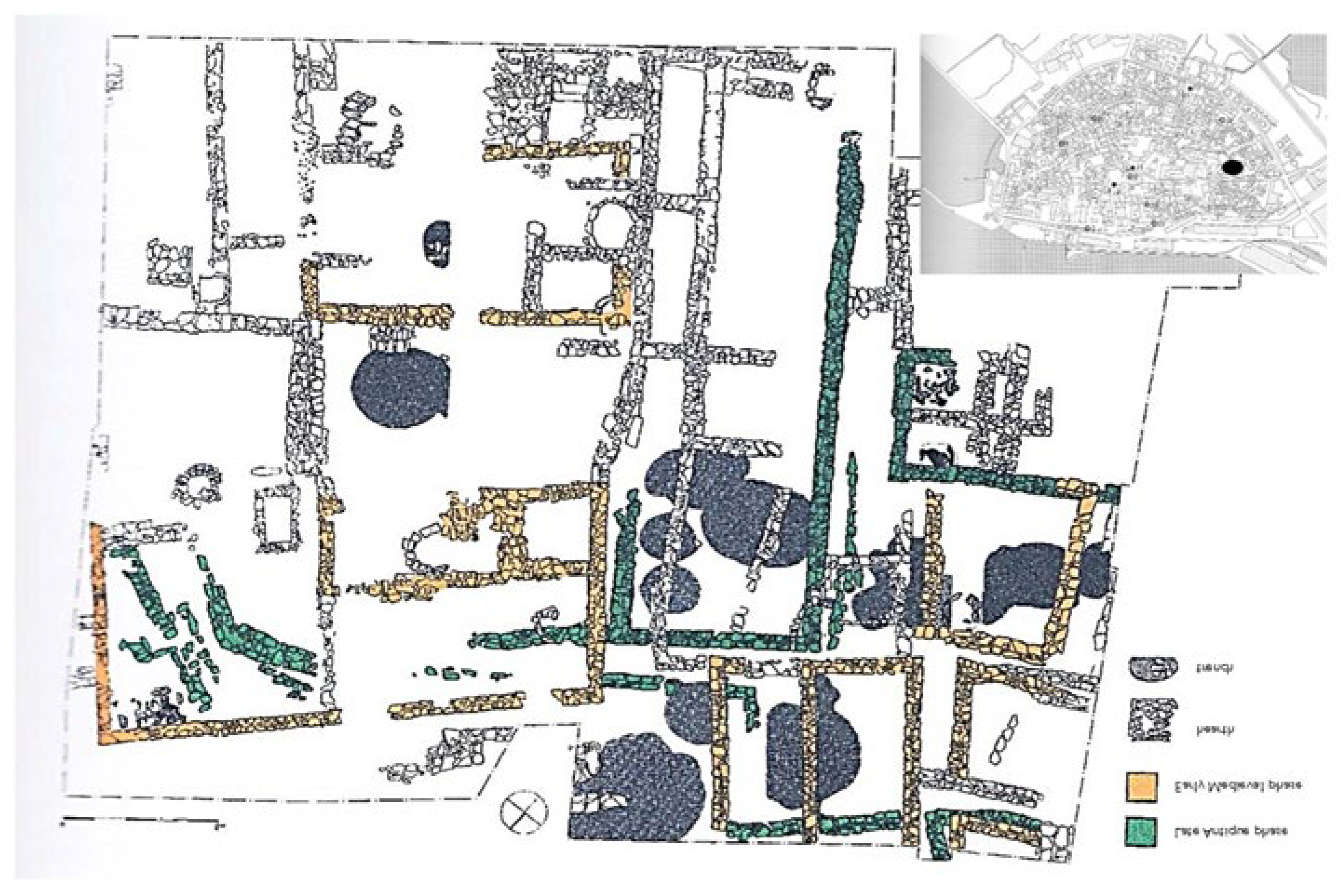
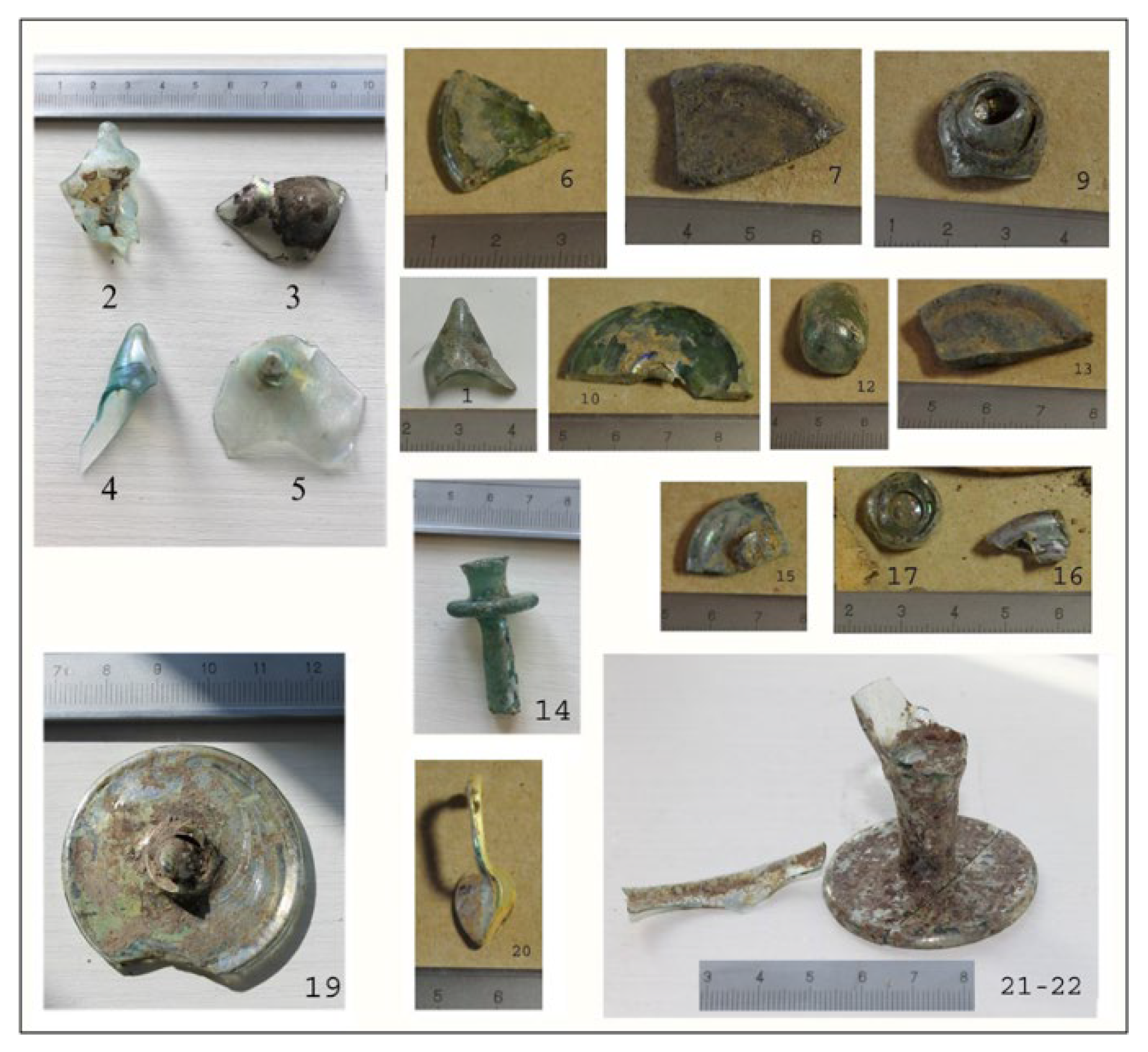
Figure 3.
Distribution of measured glasses according to MgO and K2O oxides reveals the source of alkalis: natron or halophytic plant ash.
Figure 3.
Distribution of measured glasses according to MgO and K2O oxides reveals the source of alkalis: natron or halophytic plant ash.
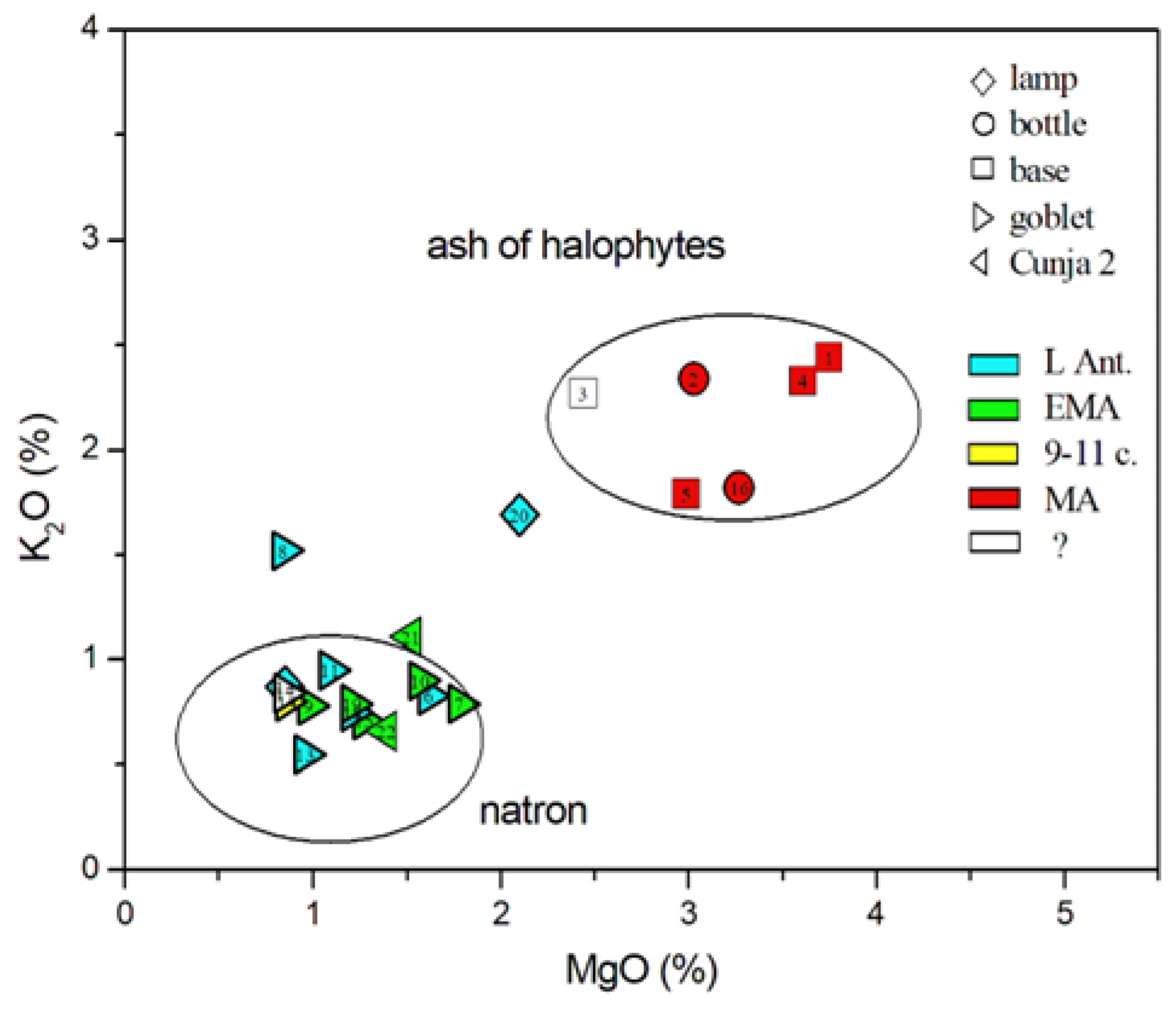
Figure 5.
Al2O3 vs. CaO concentrations approximately distinguish between Levantine and Egyptian sands.
Figure 5.
Al2O3 vs. CaO concentrations approximately distinguish between Levantine and Egyptian sands.
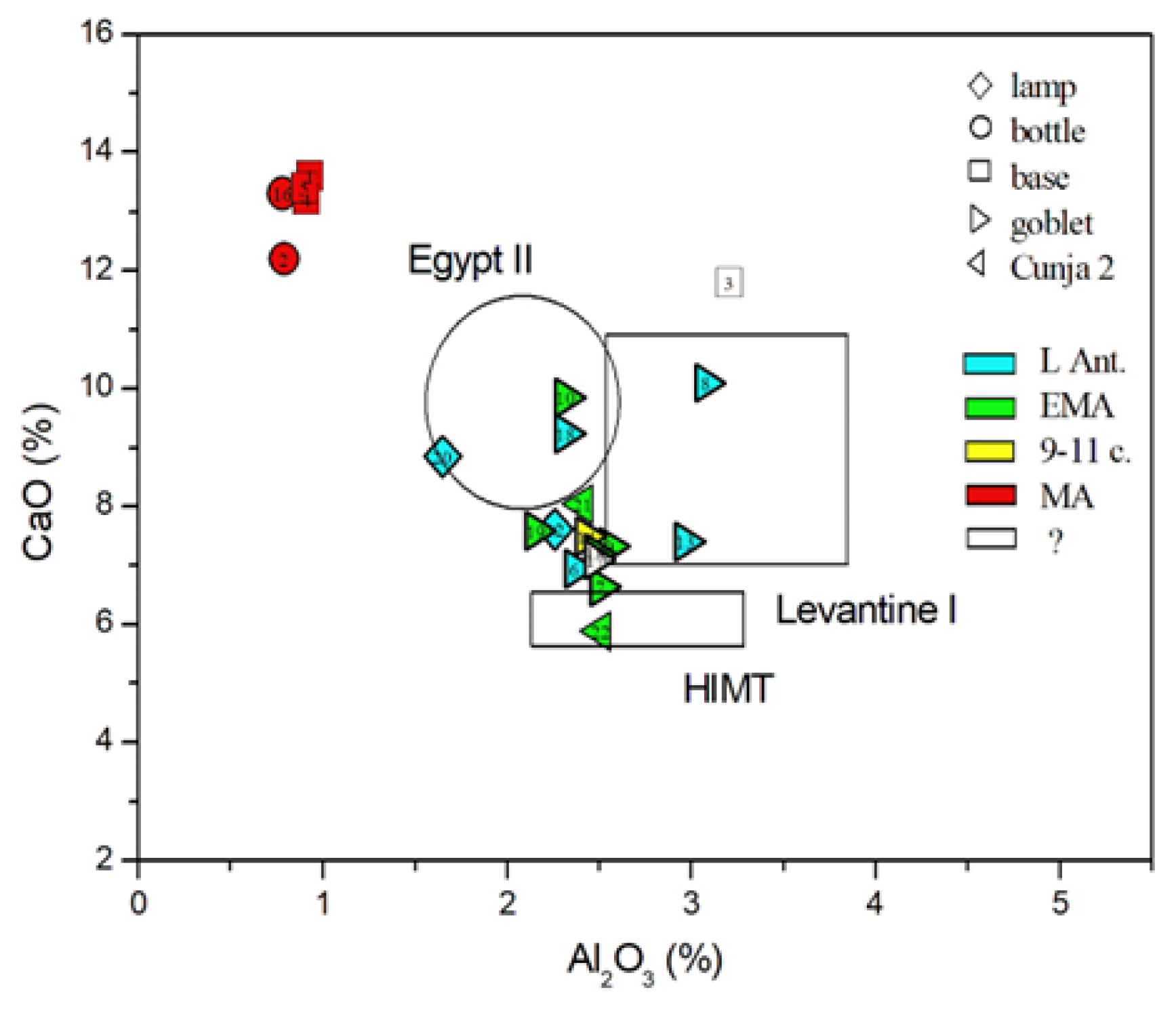
Figure 6.
Distribution of measured glasses according to titanium and aluminum oxides. Regions of individual glass types according to the data collected by [33]. Magby data (see references in the text) are added by points.
Figure 6.
Distribution of measured glasses according to titanium and aluminum oxides. Regions of individual glass types according to the data collected by [33]. Magby data (see references in the text) are added by points.
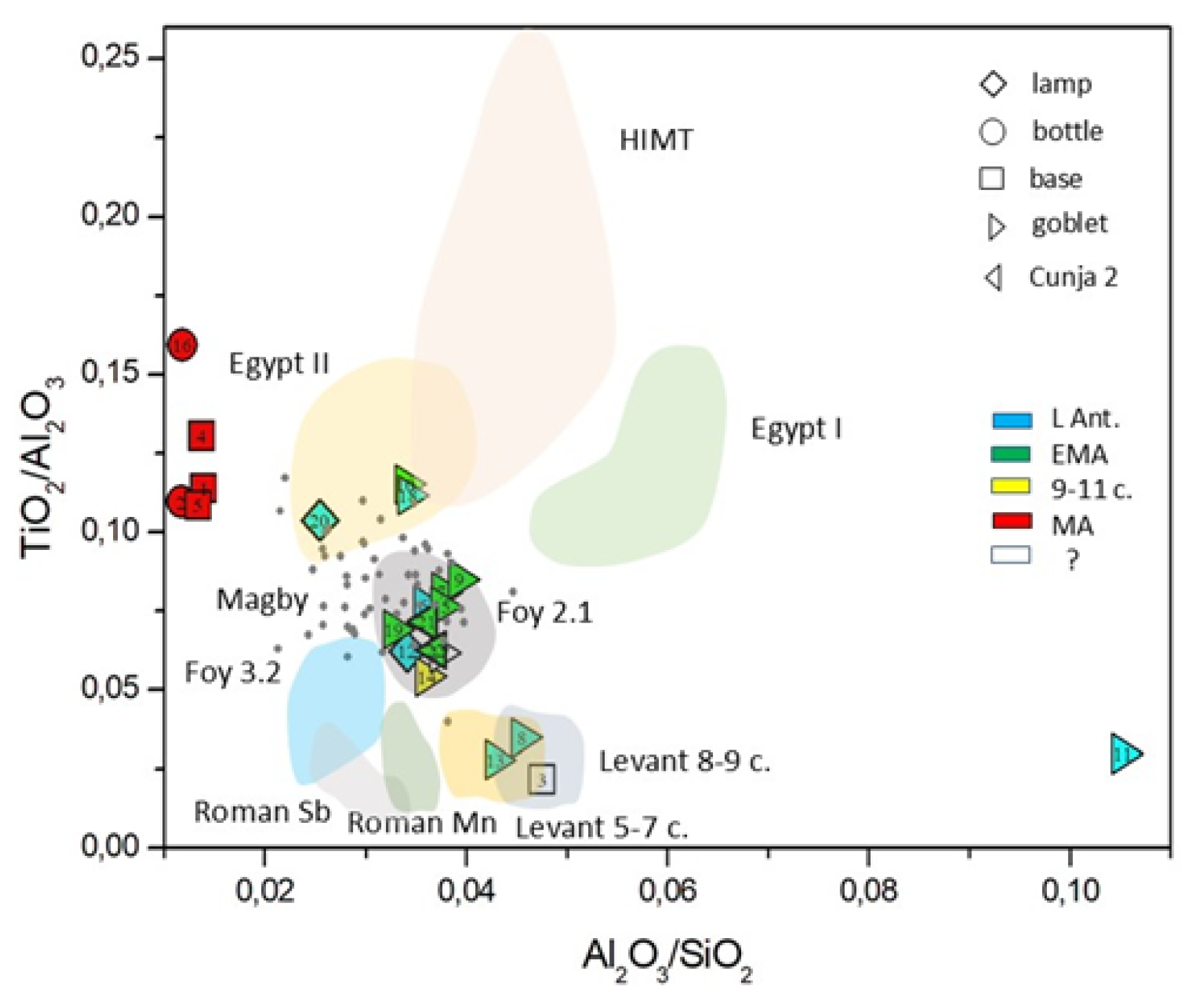
Figure 7.
Distribution of glasses according to iron and aluminum oxides.
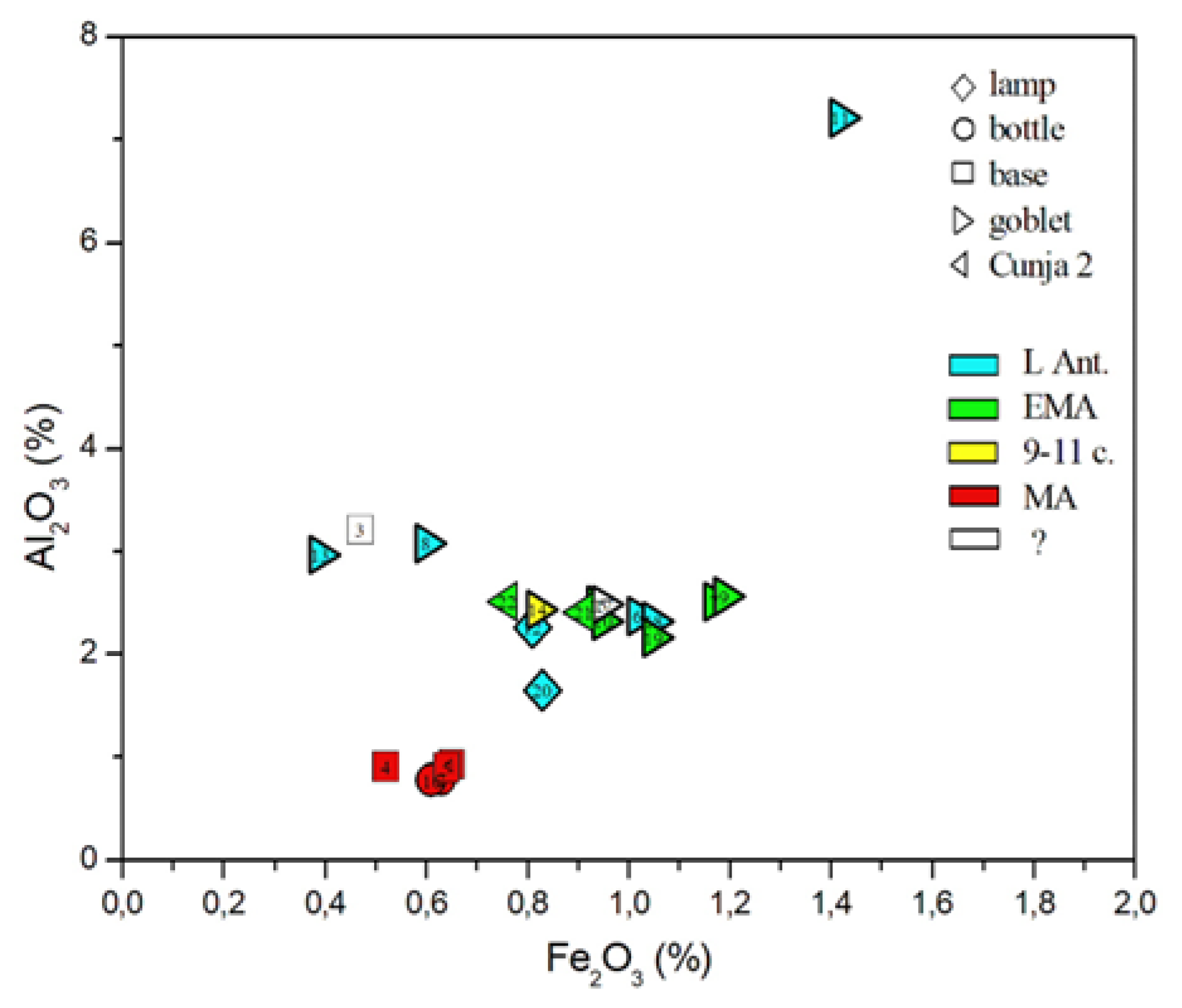
Figure 8.
Distribution of glasses according to titanium and zirconium oxides.
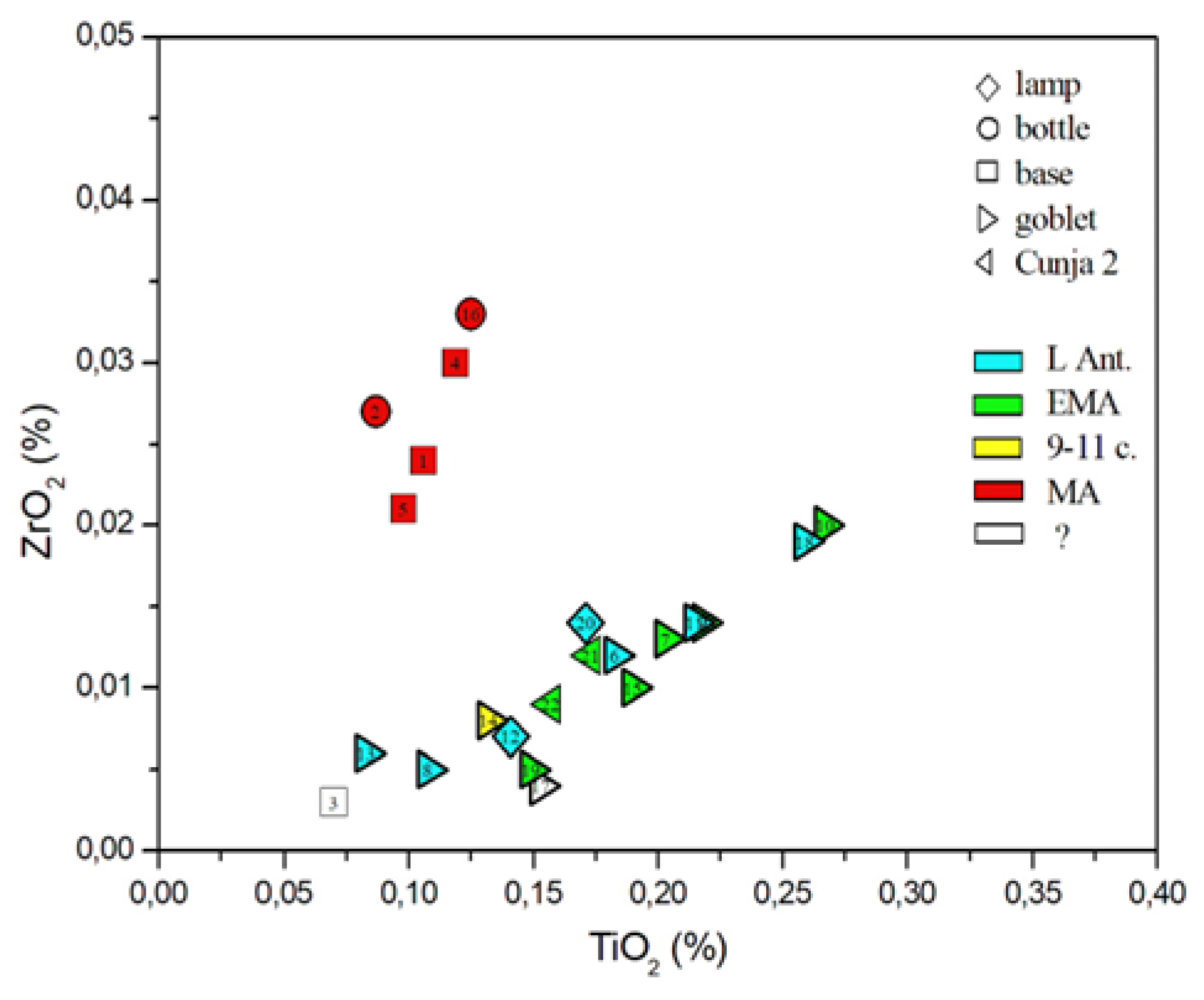
Figure 9.
Strontium oxide content with respect to calcium oxide.
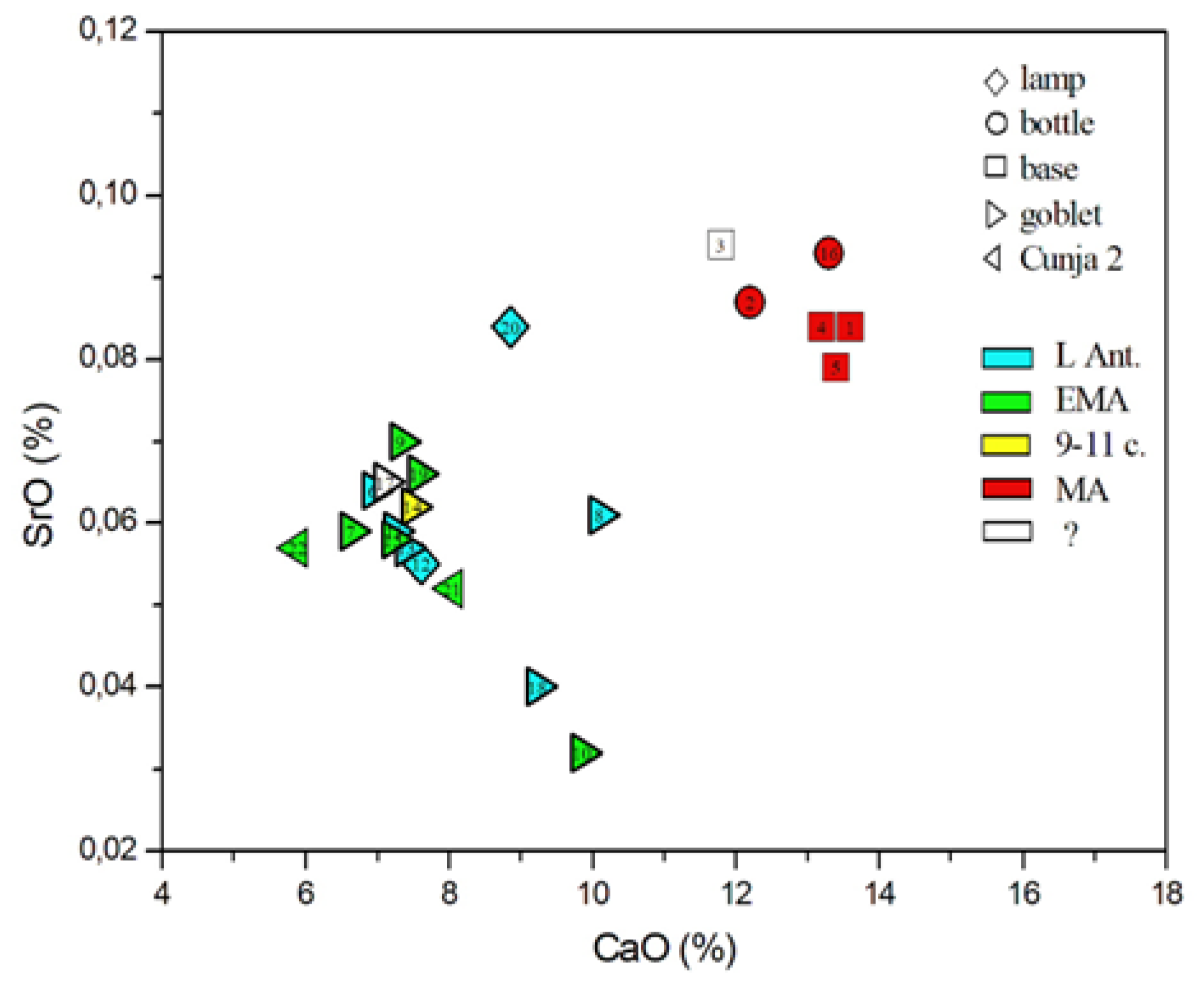
Figure 10.
Glasses according to manganese and strontium oxides (right).
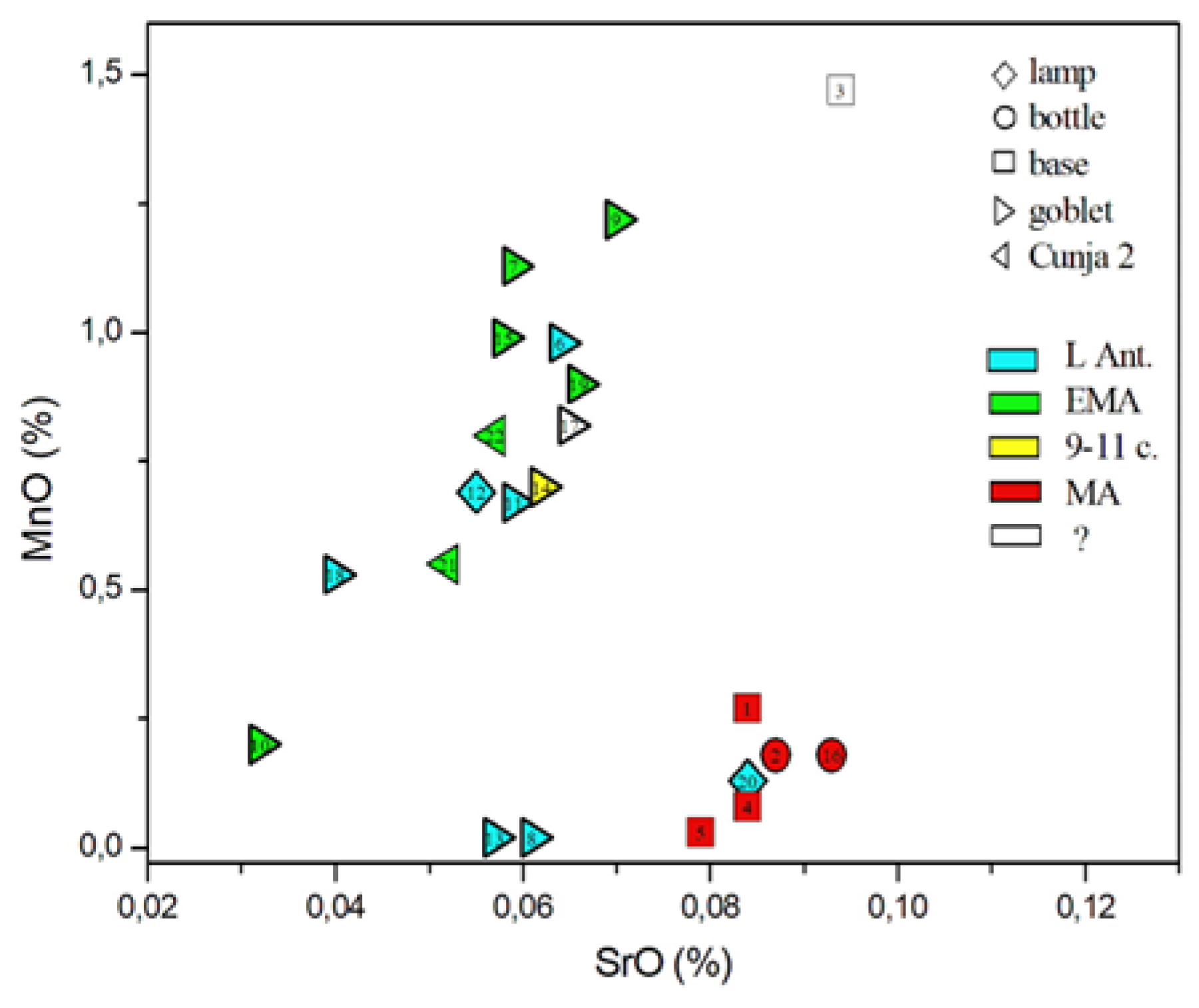
Figure 11.
Relative fraction of sodium and potassium oxides reveals the source of plant ash alkalis. Smaller symbols show published data for Banias [41], Raqqa [79] and Samarra [78].
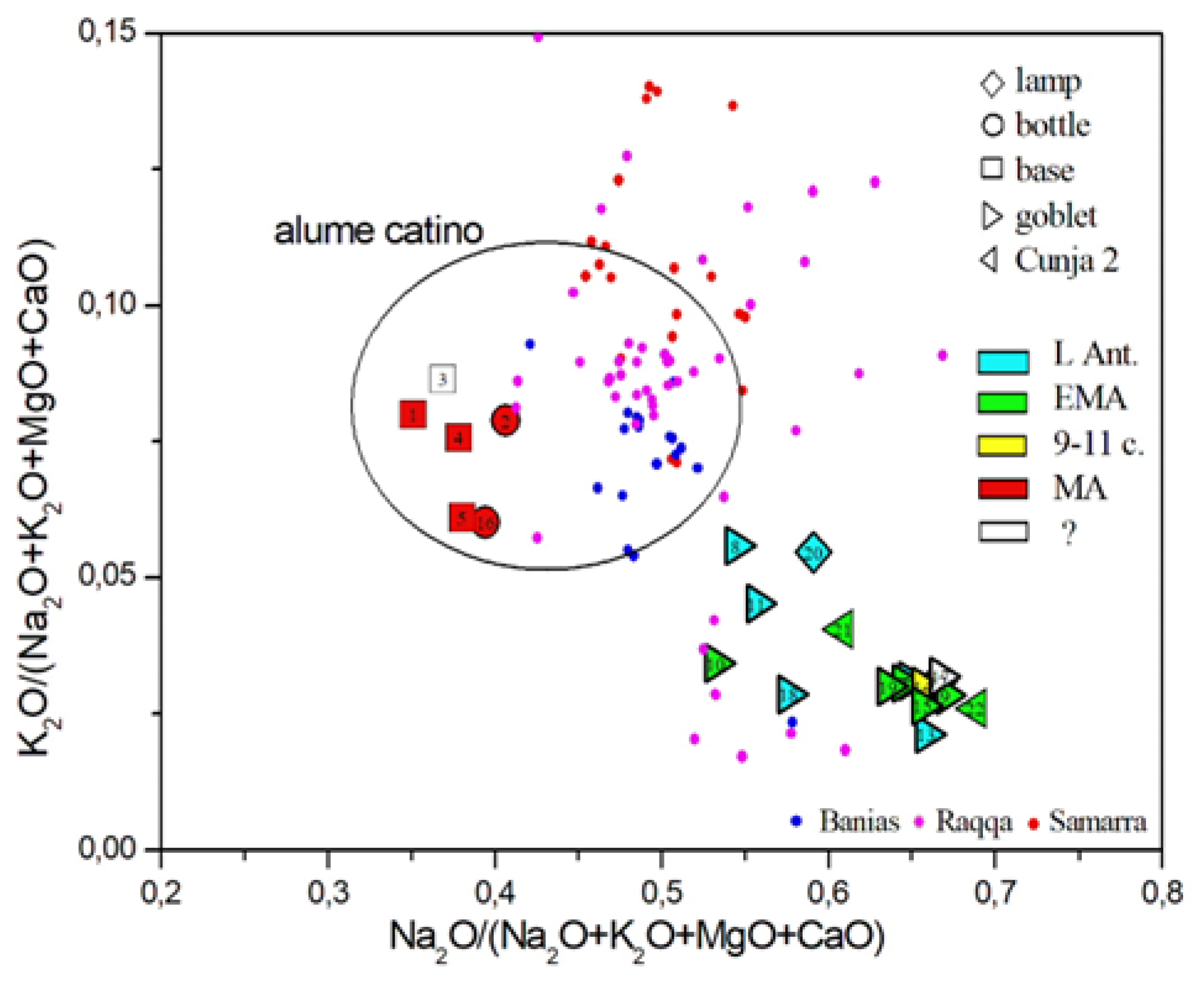
Figure 12.
Distinction between the Mediterranean and Mesopotamian glass according to Al, Mg, and Ca oxides according to [74].
Figure 12.
Distinction between the Mediterranean and Mesopotamian glass according to Al, Mg, and Ca oxides according to [74].
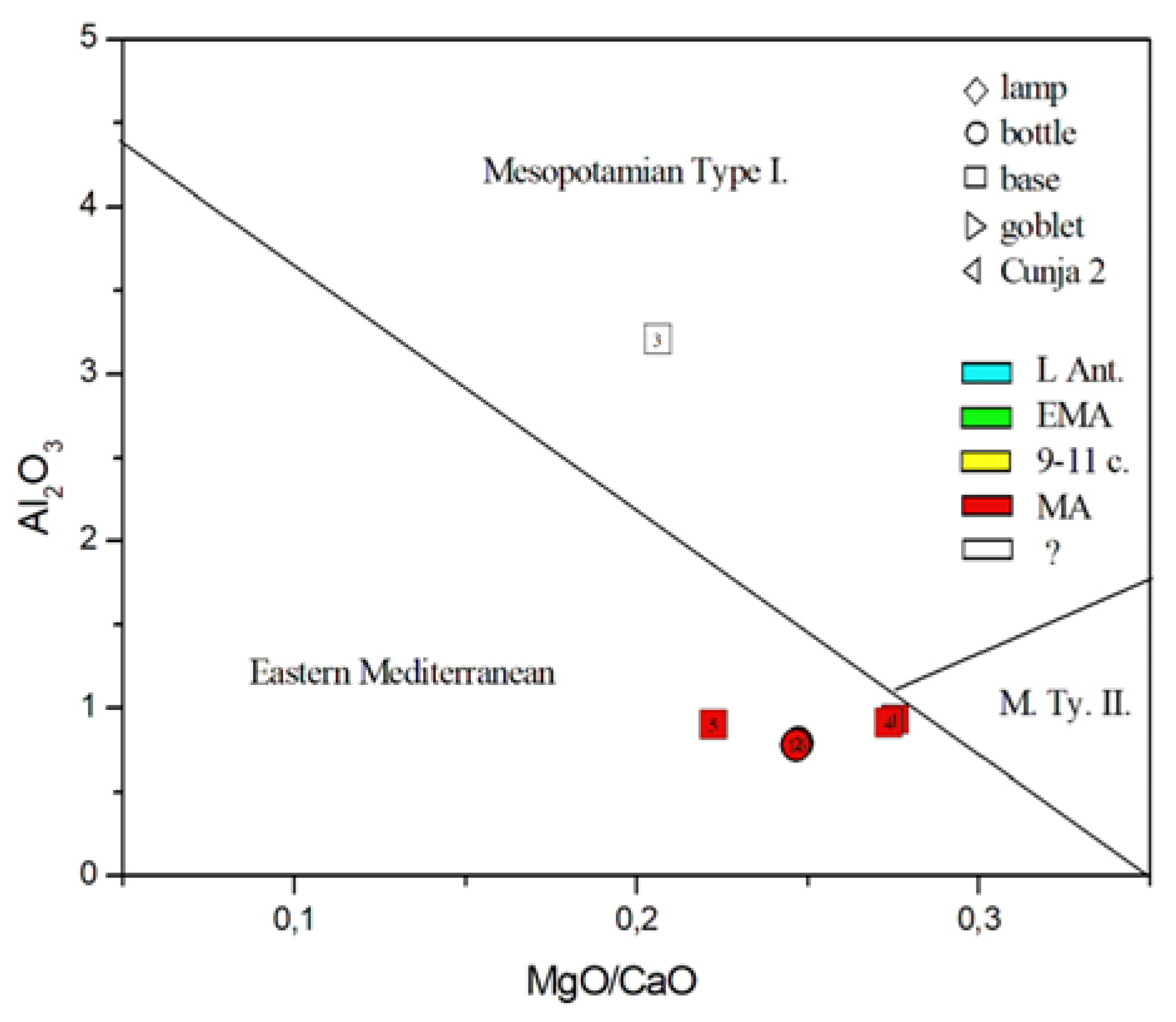

Table 1.
Description of the samples with approximate typological (C2 – type Cunja 2) and available stratigraphic dating. The last two columns show classification of the glass type, with the distance to the nearest type from eq. (1). For the plant-ash glass and indeterminable types, the distance to nearest type is given in the last column. Foy 2.1 is a shorthand notation for Foy Série 2.1. The symbol ‘r’ denotes the presence of recycling markers.
Table 1.
Description of the samples with approximate typological (C2 – type Cunja 2) and available stratigraphic dating. The last two columns show classification of the glass type, with the distance to the nearest type from eq. (1). For the plant-ash glass and indeterminable types, the distance to nearest type is given in the last column. Foy 2.1 is a shorthand notation for Foy Série 2.1. The symbol ‘r’ denotes the presence of recycling markers.
| No. | ID | Description | Color | Archaeological dating | Compositional dating | Glass Type | d (eq. 1) |
|---|---|---|---|---|---|---|---|
| 1 | 626 | vessel base | aqua | Middle Ages? | 10th-11th c. | plant ash | 0.803; Tyre |
| 2 | 429a | bottle neck | aqua | Middle Ages? | 10th-11th c. | plant ash | 0.638; Raqqa 1 |
| 3 | 429b | vessel base | brown | indeterminable | 10th-11th c. | plant ash | 1.227; Tyre; 1.317 Nishapur |
| 4 | 429c | vessel base | aqua | Middle Ages? | 10th-11th c. | plant ash | 0.785; Tyre |
| 5 | 429d | vessel base | aqua | Middle Ages? | 10th-11th c. | plant ash | 0.912; Raqqa 1 |
| 6 | 624 | goblet foot | aqua (patina) | Early Middle Ages? | 6th-7th c. | Foy 2.1 r | 0.534 |
| 7 | 646 | goblet foot | greenish (patina) | Early Middle Ages? | 6th-7th c. | Foy 2.1 r | 0.709 |
| 8 | 633 | goblet foot | aqua | Late Antiquity | 6th c. | Apollonia (Lev. I) | 1.009 |
| 9 | 695 | vessel fragment | aqua | Early Middle Ages? | 6th-7th c. | Foy 2.1 r | 0.610 |
| 10 | 601 | goblet foot | aqua | Early Middle Ages? | ? | Egypt (?) r | 0.888 Magby |
| 11 | 447 | beaker base | indeterm. (patina) | Antiquity/Late Antiquity | ? | indeterminable | 0.636 High Al |
| 12 | 619 | lamp/balsamarium | aqua | LA/EMA | 6th-7th c. | Foy 2.1 r | 0.449 |
| 13 | 151 | goblet foot | aqua | Late Antiquity | 6th c. | Apollonia (Lev. I) | 0.668 |
| 14 | 594 | goblet stem | aqua | EMA/MA | 6th-7th c. | Foy 2.1 r | 0.432 |
| 15 | 715 | goblet foot | aqua | Early Middle Ages? | 6th-7th c. | Foy 2.1 r | 0.429 |
| 16 | 417a | rim of a small bottle | indeterm. (patina) | Middle Ages? | 10th-11th c. | plant ash | 0.990; Tyre |
| 17 | 417b | vessel fragment | aqua | Early Middle Ages? | 6th-7th c. | Foy 2.1 r | 0.364 |
| 18 | 875 | goblet foot | aqua | Late Antiquity? | ? | Egypt (?) r | 0.852 Magby |
| 19 | 647 | goblet foot | greenish (patina) | Early Middle Ages? | 6th-7th c. | Foy 2.1 r | 0.376 |
| 20 | 186 | lamp handle | aqua (patina) | Late Antiquity? | late 6th-7th c. | Magby | 0.471 |
| 21 | 170a | goblet rim | aqua | Early Middle Ages | late 6th-7th c. | Magby r | 0.531 |
| 22 | 170b | goblet stem and foot | greenish (patina) | Early Middle Ages (C2) | 6th-7th c. | Foy 2.1 r | 0.574 |
Table 2.
Oxide concentrations in mass % (Na2O-Fe2O3) and µg/g (CuO-PbO). Single zeros denote values below the detection limit.
Table 2.
Oxide concentrations in mass % (Na2O-Fe2O3) and µg/g (CuO-PbO). Single zeros denote values below the detection limit.
| Na2O | MgO | Al2O3 | SiO2 | SO3 | Cl | K2O | CaO | TiO2 | MnO | Fe2O3 | CuO | ZnO | Br | Rb2O | SrO | ZrO2 | BaO | PbO | |
|---|---|---|---|---|---|---|---|---|---|---|---|---|---|---|---|---|---|---|---|
| 1 | 10.7 | 3.75 | 0.93 | 66.2 | 0.43 | 0.77 | 2.44 | 13.6 | 0.106 | 0.27 | 0.65 | 57 | 127 | 33 | 14 | 841 | 241 | 0 | 95 |
| 2 | 12.1 | 3.03 | 0.79 | 67.3 | 0.43 | 0.84 | 2.34 | 12.2 | 0.087 | 0.18 | 0.63 | 29 | 83 | 61 | 19 | 866 | 271 | 0 | 12 |
| 3 | 9.65 | 2.44 | 3.21 | 67.3 | 0.33 | 0.83 | 2.27 | 11.8 | 0.070 | 1.47 | 0.47 | 16 | 34 | 55 | 27 | 937 | 32 | 446 | 0 |
| 4 | 11.7 | 3.61 | 0.91 | 66.1 | 0.48 | 0.86 | 2.33 | 13.2 | 0.119 | 0.08 | 0.52 | 39 | 157 | 59 | 12 | 837 | 299 | 0 | 58 |
| 5 | 11.2 | 2.99 | 0.90 | 67.3 | 0.63 | 0.92 | 1.79 | 13.4 | 0.098 | 0.03 | 0.64 | 19 | 348 | 49 | 12 | 791 | 209 | 0 | 15 |
| 6 | 17.3 | 1.62 | 2.37 | 66.3 | 0.81 | 1.00 | 0.83 | 6.94 | 0.183 | 0.98 | 1.02 | 1300 | 74 | 7 | 8 | 645 | 117 | 0 | 2230 |
| 7 | 16.7 | 1.78 | 2.51 | 66.8 | 0.63 | 0.79 | 0.79 | 6.63 | 0.203 | 1.13 | 1.17 | 1950 | 96 | 10 | 9 | 590 | 125 | 0 | 4830 |
| 8 | 14.8 | 0.84 | 3.08 | 67.6 | 0.37 | 0.91 | 1.52 | 10.1 | 0.108 | 0.02 | 0.60 | 13 | 11 | 5 | 11 | 609 | 53 | 0 | 30 |
| 9 | 18.5 | 0.98 | 2.56 | 65.0 | 0.71 | 0.95 | 0.78 | 7.32 | 0.218 | 1.22 | 1.19 | 1290 | 62 | 13 | 5 | 697 | 136 | 0 | 2470 |
| 10 | 14.0 | 1.57 | 2.32 | 68.4 | 0.45 | 0.96 | 0.90 | 9.85 | 0.267 | 0.20 | 0.95 | 430 | 35 | 7 | 5 | 319 | 198 | 0 | 172 |
| 11 | 11.7 | 1.09 | 7.21 | 68.5 | 0.26 | 0.24 | 0.95 | 7.24 | 0.215 | 0.67 | 1.42 | 1050 | 69 | 10 | 7 | 588 | 145 | 0 | 2770 |
| 12 | 18.6 | 0.85 | 2.26 | 66.4 | 0.58 | 1.09 | 0.87 | 7.61 | 0.141 | 0.69 | 0.81 | 355 | 36 | 7 | 11 | 550 | 72 | 0 | 438 |
| 13 | 17.2 | 0.96 | 2.97 | 69.1 | 0.56 | 0.69 | 0.55 | 7.40 | 0.083 | 0.02 | 0.39 | 4 | 6 | 3 | 8 | 567 | 58 | 0 | 8 |
| 14 | 17.5 | 0.86 | 2.43 | 67.4 | 0.55 | 1.03 | 0.80 | 7.49 | 0.132 | 0.70 | 0.82 | 649 | 55 | 7 | 9 | 624 | 79 | 0 | 703 |
| 15 | 17.6 | 1.27 | 2.48 | 66.2 | 0.74 | 1.09 | 0.71 | 7.21 | 0.190 | 0.99 | 0.94 | 1070 | 54 | 10 | 9 | 580 | 102 | 0 | 2620 |
| 16 | 11.9 | 3.27 | 0.78 | 66.2 | 0.61 | 0.99 | 1.82 | 13.3 | 0.125 | 0.18 | 0.61 | 14 | 594 | 53 | 10 | 930 | 326 | 0 | 63 |
| 17 | 17.6 | 0.85 | 2.48 | 66.2 | 0.88 | 0.87 | 0.84 | 7.10 | 0.153 | 0.82 | 0.95 | 3030 | 177 | 15 | 0 | 649 | 39 | 0 | 6000 |
| 18 | 15.2 | 1.21 | 2.32 | 67.7 | 0.52 | 0.97 | 0.75 | 9.23 | 0.259 | 0.53 | 1.05 | 399 | 78 | 4 | 11 | 399 | 187 | 0 | 1150 |
| 19 | 16.7 | 1.21 | 2.16 | 65.8 | 1.14 | 1.07 | 0.79 | 7.58 | 0.149 | 0.90 | 1.05 | 3190 | 102 | 11 | 19 | 656 | 49 | 0 | 7160 |
| 20 | 18.3 | 2.10 | 1.65 | 64.8 | 0.64 | 0.70 | 1.69 | 8.85 | 0.171 | 0.13 | 0.83 | 12 | 17 | 4 | 9 | 845 | 138 | 0 | 19 |
| 21 | 16.6 | 1.52 | 2.41 | 66.7 | 0.66 | 0.92 | 1.11 | 8.04 | 0.173 | 0.55 | 0.91 | 895 | 96 | 4 | 7 | 522 | 123 | 0 | 1980 |
| 22 | 17.5 | 1.39 | 2.51 | 68.0 | 0.72 | 0.98 | 0.66 | 5.88 | 0.157 | 0.80 | 0.76 | 576 | 36 | 9 | 2 | 566 | 94 | 0 | 2110 |
Table 3.
Glass types of natron glass applied in the numerical classification of the measured glasses according to eq. (1), with their reference mean concentrations and standard deviations. Data were taken from the compilations [46] (1, 4, 7, 8, 11-13, 16, 17, 19), [5] (2, 3), [67] (9, 10), [58] (5, 6), [69] (14, 15), [44] (18; averaging 11 individual data).
Table 3.
Glass types of natron glass applied in the numerical classification of the measured glasses according to eq. (1), with their reference mean concentrations and standard deviations. Data were taken from the compilations [46] (1, 4, 7, 8, 11-13, 16, 17, 19), [5] (2, 3), [67] (9, 10), [58] (5, 6), [69] (14, 15), [44] (18; averaging 11 individual data).
| Na2O | MgO | Al2O3 | SiO2 | K2O | CaO | TiO2 | MnO | Fe2O3 | ||
|---|---|---|---|---|---|---|---|---|---|---|
| 1 | Roman Sb | 18.7 ± 1.3 | 0.41 ± 0.11 | 1.91 ± 0.21 | 71.4 ± 1.8 | 0.45 ± 0.09 | 5.53 ± 0.84 | 0.06 ± 0.02 | 0.01 ± 0.01 | 0.36 ± 0.1 |
| 2 | Roman Mn (Britain) | 18.31 ± 2.09 | 0.67 ± 0.14 | 2.32 ± 0.17 | 69.62 ± 2.62 | 0.74 ± 0.14 | 6.66 ± 1.06 | 0.10 ± 0.03 | 0.99 ± 0.12 | 0.59 ± 0.17 |
| 3 | Roman Mn (Italy) | 15.18 ± 0.84 | 0.57 ± 0.10 | 2.59 ± 0.13 | 70.29 ± 1.08 | 0.51 ± 0.07 | 7.83 ± 0.3 | 0.07 ± 0.01 | 1.39 ± 0.21 | 0.20 ± 0.16 |
| 4 | Roman Mn | 16.1 ± 1.3 | 0.54 ± 0.10 | 2.62 ± 0.24 | 69.6 ± 2.3 | 0.65 ± 0.23 | 7.92 ± 0.76 | 0.07 ± 0.02 | 0.74 ± 0.56 | 0.4 ± 0.15 |
| 5 | HIMTa | 18.33 ± 1.21 | 1.05 ± 0.18 | 2.99 ± 0.33 | 65.43 ± 1.44 | 0.47 ± 0.14 | 6.30 ± 1.02 | 0.43 ± 0.15 | 1.92 ± 0.57 | 1.79 ± 0.38 |
| 6 | HIMTb | 18.25 ± 0.11 | 1.17 ± 0.12 | 3.31 ± 0.25 | 63.8 1± 0.55 | 0.40 ± 0.03 | 5.70 ± 0.24 | 0.54 ± 0.07 | 1.69 ± 0.16 | 3.81 ± 0.22 |
| 7 | Foy Série 3.2 | 19.0 ± 1.1 | 0.64 ± 0.21 | 1.94 ± 0.19 | 68.1 ± 1.7 | 0.47 ± 0.16 | 6.61 ± 0.86 | 0.10 ± 0.03 | 0.83 ± 0.27 | 0.68 ± 0.16 |
| 8 | Foy Série 2.1 | 17.7 ± 1.3 | 1.12 ± 0.25 | 2.53± 0.23 | 65.7 ± 1.7 | 0.75 ± 0.19 | 8.12 ± 0.92 | 0.15 ± 0.02 | 1.41 ± 0.44 | 1.16 ± 0.5 |
| 9 | Jalame Mn | 15.89 ± 0.85 | 0.59 ± 0.10 | 2.69 ± 0.15 | 68.4 ±1.36 | 0.80 ± 0.08 | 8.77 ± 0.46 | 0.08 ± 0.02 | 1.93 ± 1.11 | 0.47 ± 0.08 |
| 10 | Jalame no Mn | 15.74 ± 0.81 | 0.60 ± 0.15 | 2.70 ± 0.13 | 70.55 ± 1.18 | 0.76 ± 0.12 | 8.77 ± 0.71 | 0.08 ± 0.02 | 0.11 ± 0.09 | 0.38 ± 0.06 |
| 11 | Jalame | 15.7 ± 0.9 | 0.59 ± 0.12 | 2.73 ± 0.17 | 69.9 ± 1.6 | 0.78 ± 0.13 | 8.74 ± 0.67 | 0.09 ± 0.02 | 0.65 ± 0.94 | 0.44 ± 0.19 |
| 12 | Apollonia (Lev. I) | 14.2 ± 1.1 | 0.68 ± 0.28 | 3.25 ± 0.18 | 71.2 ± 1.4 | 0.62 ± 0.19 | 8.43 ± 0.79 | 0.09 ± 0.02 | 0 .02 ± 0.005 | 0.50 ± 0.11 |
| 13 | Bet Eli’ezer (Lev. II) | 12.3 ± 1.2 | 0.59 ± 0.12 | 3.38 ± 0.3 | 74.4 ± 1.5 | 0.48 ± 0.08 | 7.35 ± 0.7 | 0.11 ± 0.03 | 0.02± 0.004 | 0.69 ± 0.24 |
| 14 | Egypt I | 18.25 ± 1.38 | 0.93 ± 0.14 | 4.05 ± 0.29 | 70.05 ± 1.21 | 0.40 ± 0.11 | 3.03 ± 0.23 | 0.50 ± 0.12 | 0.051 ± 0.007 | 1.74 ± 0.28 |
| 15 | Egypt II | 17.26 ± 1.96 | 0.58 ± 0.13 | 2.19 ± 0.35 | 67.85 ± 1.90 | 0.32 ± 0.24 | 9.34 ± 1.27 | 0.27 ± 0.06 | 0.03 ± 0.015 | 0.98 ± 0.23 |
| 16 | Egypt 2 (<815) | 16.5 ± 1.0 | 0.47 ± 0.09 | 2.00 ± 0.31 | 69.7 ± 1.9 | 0.33 ± 0.09 | 8.51 ± 1.32 | 0.20 ± 0.03 | 0.045 ± 0.083 | 0.84 ± 0.31 |
| 17 | Egypt 2 (>815) | 13.4 ± 0.6 | 0.70 ± 0.15 | 2.52 ± 0.20 | 70.1 ± 1.4 | 0.51 ± 0.25 | 9.57 ± 0.54 | 0.27 ± 0.03 | 0.44 ± 0.47 | 1.18 ± 0.32 |
| 18 | High Al | 16.34 ± 1.74 | 1.14 ± 0.22 | 6.08 ± 2.30 | 62.38 ± 3.67 | 1.57 ± 0.37 | 8.38 ± 2.31 | 0.29 ± 0.25 | 1.22 ± 0.69 | 1.02 ± 0.52 |
| 19 | Magby | 16.3 ± 1.3 | 1.87 ± 0.25 | 2.03 ± 0.29 | 65.1 ± 1.7 | 1.54 ± 0.28 | 9.09 ± 0.78 | 0.17 ± 0.03 | 1.25 ± 0.92 | 1.27 ± 0.41 |
Disclaimer/Publisher’s Note: The statements, opinions and data contained in all publications are solely those of the individual author(s) and contributor(s) and not of MDPI and/or the editor(s). MDPI and/or the editor(s) disclaim responsibility for any injury to people or property resulting from any ideas, methods, instructions or products referred to in the content. |
© 2025 by the authors. Licensee MDPI, Basel, Switzerland. This article is an open access article distributed under the terms and conditions of the Creative Commons Attribution (CC BY) license (http://creativecommons.org/licenses/by/4.0/).
Copyright: This open access article is published under a Creative Commons CC BY 4.0 license, which permit the free download, distribution, and reuse, provided that the author and preprint are cited in any reuse.


