

Submitted:
16 July 2024
Posted:
17 July 2024
You are already at the latest version
Abstract
This paper focuses on the role of the most common mineralogical techniques applied to the identification of the different statuary qualities in white, grey and black Göktepe marble. For this purpose, a Roman case of sculpture marble collection from the rural villa of Valdetorres de Jarama (central Iberia), of the 4th century AD, is presented. The mythological statuary, combining white, grey and black marbles, are one of the most outstanding marble collections in Aphrodisian style found in Hispania. The analytical results (Petrography, Cathodoluminescence, C and O isotopes, and Sr and Mn concentration) support the identification of two varieties of “black” Göktepe, traditionally named as bigio morato and bigo antico, as well as the best statuary quality on white Göktepe. In addition, the analytical identification of other Asiatic marbles in Valdetorres collection, a white coarse-grained originally from the quarries of Aphrodisias city and one small piece identified as Carian red from Iasos, corroborates the already suggested strong connection existing between artists and the stone material they chose for their works. Finally, it is noteworthy the identification carried out on the marble of the bases that served as seats for the sculptures, as it is a white marble of lower quality whose analytical characteristics are consistent with the Microasiatic marble of Denizli. The use of these exotic and exceptional raw materials confirms the taste for luxury and decorative richness in Late Antique Hispanic rural villae and contributes to a better understanding of the distribution of Aphrodisian productions in the Western Roman provinces.
Keywords:
archaeometry
; marble identification
; marble quarry
; Göktepe marble
; Aphrodisian workshops
; Late Antique Hispanic villae
1. Introduction
After its recent discovery, the marble from the Turkish quarries of Göktepe (Muğla province, Western Turkey) has aroused great interest on the part of the scientific community. The richness of the materials exploited in them with respect to the diversity of chromatic tones and their excellent properties for sculpturing, made them essential raw materials to carry out high-quality artistic works related to Aphrodisian workshops. Before going to the subject of this paper and as a preamble to the importance of petrographic studies as a basic initial tool in any stone characterisation study, a brief historic background of the Göktepe marble discovery and its characterization in both, quarry samples and archaeological pieces, is given.
1.1. Göktepe Quarries and Göktepe Marble Identification
In 1996, A.B. Yavuz, professor at the School of Geological Engineering in İzmir (Turkey), conducted a prospecting for an ornamental rock exploitation project, discovered near the town of Göktepe, about 40 km SW of Aphrodisias and 30 km NE of Muğla, a quarry area in which there were traces of ancient exploitation on white, black and grey marbles [1,2]. In that area of approximately 1 km2, four quarry districts and two work areas were found where more than twenty blocks, already extracted, and various semi-elaborated artifacts were located. Quarry marks, inscriptions and the presence in some blocks of a cavity to be sealed in the imperial style, evidenced the importance of the finding. These circumstances, together with the fact that some quarries had been exploited underground, made clear the high interest of the extracted material and the possibility of having been under imperial control at Roman times.
The finding was made known to the scientific community at the ASMOSIA VIII Congress, held in 2006 in Aix-en-Provence and until the publication of its Proceedings [2] followed one another a series of papers where the main characteristics of these materials were presented in a preliminary way [3,4].
In parallel, over the same time, in the context of the cataloguing task of the sculptural marbles deposited in the reserves of Villa Adriana at Tivoli, we undertook an analytical study of marble provenance. During the 2008 campaign, a sampling of 67 pieces selected from the hundreds stored in different states of fragmentation, was carried out. The initial archaeometric study of those sculptural marble pieces published in the Proceedings of the ASMOSIA IX held in 2009 at Tarragona [5,6], was for us a challenge of first scale since the characterization of the important imperial quarries recently discovered in ancient Caria had not yet been addressed in depth. Consequently, the comparative archaeometric study had to be approached with the scarce analytical data provided so far [3,4]. Nevertheless, the conclusions of the marble origin related to sculpture of Villa Adriana were very valuable, for a double reason. On the one hand, the use of such magnificent material in the decorative programs of the Villa was verified without doubts in a group of extremely fine grained marbles, but also highlighted the complexity of identifying some other white statuary variety due to its petrographic similarity with the statuary marble of Luni-Carrara. With this uncertainty, some conclusions were left open waiting to know more analytical data about the newly found Turkish marbles. This situation was reflected in our contribution to the Hadrian research published in 2013 where a group of pieces shared analytical parameters with both origins [7]. It was needed therefore, some time to know which analytical parameters could discriminate between both sources, Carrara and some white Göktepe [8]. In 2018, we returned to this archaeometric aspect to make clear the coexistence of two white Göktepe varieties among the statuary of VA, highlighting its high percentage of representation (50.5%) with respect to Carrara (9%) from all the marble varieties archaeometrically identified in the selected studied pieces [9].
The analytical characteristics of Göktepe marble has been happening in several papers along the last years. The first was focused on the multi-method study of 160 marble samples collected in thirteen quarries and two work areas, mainly based on Maximum Grain Size (MGS), C and O stable isotopes, Electron Paramagnetic Resonance (EPR) and trace elements [1]. However, the whole petrographic and mineralogical study, including qualitative cathodoluminiscence (CL) on white, black and grey quarry marbles was published twelve years after the Göktepe discovery [10]. In it, two petrographic varieties were distinguished on white marble (wG1 and wG2) using, not only MGS, but also Most Frequent Size (MFS), microstructure and CL. The first is of very fine to extremely fine grain which makes it very distinctive, and the second is similar to the most common petrography of Carrara marble. Concerning the petrography of “black” Göktepe quarry samples, the study [10] showed the impure composition (clays and organic matter) of its carbonate protolith, together with the presence of bioclasts with thick shelled-walls, partially or totally recrystallized in an ultrafine grained groundmass of calcite. The variable texture with different degrees of recrystallization at the boundary between advanced diagenesis and very low metamorphism, served to define two “black” lithotypes (bG1 and bG2). Therefore, the petrographic observation, along with the macroscopic presence of whitish to yellowish veins and patches, resolves the identification of black Göktepe, as other characteristics such as CL and C and O isotopes are not conclusive due to their wide dispersion.
Other analytical subjects have contributed to a better knowledge of the keys for white Göktepe identification. Among them, the range on trace elements composition [1,11], in which not only the low Mn and high Sr, but also rare earth elements (REE) were found useful. On the other hand, analyzing the same Göktepe quarry samples by different analytical protocols, differences in elemental concentration were detected [12,13]. Finally, the white Göktepe characterization was completed using new data of 87Sr/86Sr [14]. Additional successful intends are based on the quantifications of CL [15], on the importance of the specific profile of the solid-state Nuclear Magnetic Resonance (NMR) [16] or on the precise use of a standard X-Ray Powder Diffractometer (XRPD) with the refinement of the unit cell parameters and volume of calcite [17].
With all, the identification of Göktepe is now solved, but is it actually needed to apply all the mentioned analytical techniques to certainly identify the white Göktepe marbles? From our petrological perspective, the answer is no, since using the most common methodology, that is petrography with the stable C and O isotopes completed with qualitative CL, served us to differentiate the varieties of white Göktepe and discriminate them from Carrara and from other fine-grained classical marbles. This common methodology was successfully applied to white sculptural marbles of VA [5,9,10] whose identifications were checked and confirmed using additional uncommon methods [14,16,17], validating our sequential analytical protocol to authenticate the provenance of white Göktepe. On the other hand, the identification of “black” Göktepe is also benefited from the petrographic study, as mentioned above [10]. The same sequential analytical protocol has been applied on this archaeometric study of the sculptural pieces of Valdetorres de Jarama villa found in central Tarraconensis province of Hispania (Figure 1).
1.2. The Case of Valdetorres de Jarama Marble Collection. The Aim of This Archaeometric Study
In 1977, the area near the village of Valdetorres de Jarama was excavated after a spectacular sculpture of a Giant had been found by chance [18,19]. As part of a rural complex, the foundations of a large octagonal building were exhumed from a strategic position on the regional plain [20]. Apart from its monumentality and original morphology, made up of three concentric octagons with apsidal ends and rooms distributed radially, a lavish decoration with mosaic tesserae underlined the importance of the archaeological site. Among the material elements recovered, a profuse collection of ceramic fragments of the Theodosian period dating the site, as well as a collection of coins from the 4th century AD [21], apart from other materials such as glass, domestic metal objects and a set of Coptic ivories from Egypt described as the decoration of chests and furniture, dated to the 4th-5th centuries AD [22].
This Late Antique rural villa was also ostentatiously decorated with marble sculptures in white and diverse tones in black and gray marbles of remarkable quality. Several profiled bases in white marble to set in the sculptures and one small piece in red marble were also found. The assortment of recovered sculptures is exceptional and, despite having been intentionally fragmented, has well recognized iconography, with mythological representations of small format pieces, following similar typology to other well-known parallels linked with Aphrodisian workshops [23,24]. The hundreds of fragments make up a collection of at least thirteen marble statues, representing among others Aesculapius, Ganymede with the eagle, Bacchus with the panther, Apollo with the griffin, Apollo the Archer and the Giant, another Apollo the Archer and a Niobid, an unknown probably another Apollo, a satyr with a wineskin (Marsyas?), a kneeling and offering Nubian slave carved mostly on black stone, an unknown hero and other difficult to interpret. Some examples are shown in Figure 2 and Figure 3, among which stands out an Anguiped body or Giant in black of high technical and stylistic level, with well-known typological parallels in the collection of Silahtaraga [23,24] and in the Late Roman villa of Quinta das Longas, in Lusitania [24,25].
The examination of the pieces as a whole allows us to draw some general remarks: their scale is diverse, as there are ideal statues and statuettes of different sizes, but they all have an evident artistic quality. Their state of preservation shows the combined effect of the collapse of the building and the constant looting and intentional destruction of the artistic works. In particular, the heads of the personages were not found or recovered, with the exception of that of a Nubian slave, on two fragments (Figure 2d). The wide dispersion of the fragments indicates that they were not found in their original location, except for two of them, one Apollo Archer and the Niobid, which were located in the collapsed peristyle.
The sculptures were carved on different stone materials, which were analyzed four decades ago at an early stage of the excavation project using a combination of petrography, xR diffraction and chemical analysis [26]. Four varieties of sculptural marble were detected (one fine-grained and one coarse-grained in white, two dark stones, one gray and one black). In addition, a red marble from a small statuary fragment was visually assigned to the famous rosso antico, the only variety of this colour well-known in the 80´s of last century. After that meticulous analytical study, the authors concluded the imported character of the marbles with a possible Italian origin in Carrara for most of them, but also a Hispanic provenance in Macael was not discharged.
However, some years later on, the whole iconographic study of the fragments found during several excavation campaigns pointed out to be pieces mostly sculpted by Aphrodisian workshops [23]. This assumption was based on the homogeneous group of the dark grey veined marble pieces, which make up almost half of the collection. There are seven statues with an average height of 90 cm, whose quality and aesthetics are quite homogeneous. Especially the Giant and those dedicated to the deeds of Apollo with two Archers and the Niobid were thought to have been carved in Anatolia using different varieties tentatively associated with dark bigio antico to dark bigio morato, between the 2nd and 3rd centuries AD [23]. Nevertheless after the stylistic parallels founds on the white sculptures they could not associate with a particular Italian or Greek workshop. As for the white roughly profiled bases they suggested a probably origin local for the artisans and material. Finally, while this work was in preparation, a couple of papers encourage us the convenience of reinforce the analyses made four decades ago to definitely identify the marble provenance of the Valdetorres de Jarama collection since in other Late Antique mythological sculptures tested, the analyses all proved to be Asiatic marbles with a high percentage from Göktepe quarries [27,28].
In summary, in the current state of knowledge of the exploitation and use of marble in Roman times, including Late Antique, and in particular knowing the intrinsic relationship between Göktepe marble and the Aphrodisian workshops, the main aim of this contribution is to identify which sculptural marble varieties, including the red piece, were used by those artisans and elucidate the marble provenance of all of them, including the profiled bases.
The importance of the results obtained provides a double perspective: on the one hand, it claims the basic role of petrography as the initial point of marble identification since not only MGS is important but also MFS and microstructure to differentiate the sculptural quality varieties of marbles. At the same time, this analytical study reveals the use of seven petrographic types of marble including the red one, all modalities of Asiatic provenance. This marble origin, with different white, grey and black Göktepe marbles as well as other varieties from Caria region, supports the close relationship between Aphrodisian artisans and sculptural stones.
2. Materials and Methods
After a meticulous visual observation of the hundreds of marble fragments recovered from Valdetorres de Jarama, stored at the National Archaeological Museum (MAN) of Madrid, a selection of 16 samples were taken (Table 1). The assortment took into account the groupings previously made four decades ago [23] and, at the same time, ensuring that all variants were represented, in terms of colour or shade and grain size. Thus, five samples of light grey (numbered as 1, 2, 3, 5 and 11), four samples of very dark grey (4, 6, 7 and 8), the only red piece (12) and six samples of white marble were collected, of which four are fine to very fine grained (9, 13, 16 and 15) and two are medium to coarse grained (14 and 10). All are sculptural fragments, with the exception of number 10 which corresponds to a chip sample of a pedestal to seat one sculpture.
Several analytical techniques were applied following a usual sequential approach [29] to identify the marble provenance. They combine first, the results of three techniques: Polarized-light optical microscopy (OM), qualitative Cathodoluminescence microscopy (CL-Optical) and, Isotope Ratio Mass Spectrometry (IRMS) to determine C and O isotopic fractionations. Then, to confirm the probable Göktepe identification, an additional analysis was carried out in some samples, the Optical Emission Spectroscopy (ICP-OES) to obtain the concentration of Sr and Mn trace elements.
One thin section from each sample was made from a small millimetric chip discretely chiseled off and, before powdering, its weathered surface was previously abraded to avoid possible contamination. OM was used to examine the mineralogy, fabric, texture, grain boundary shape (GBS) and to determine the maximum grain size (MGS). This parameter was obtained by the direct measurement of the coarser calcite crystal visualized in the thin section under the microscope. Additionally, the most frequent size (MFS was estimated following the method already explained elsewhere [10].
CL technique is, on the other hand, a very useful tool to better discriminate Göktepe and Carrara always used in combination with other parameters, since the CL characteristics of carbonates are related to their chemical impurities and in particular to the Mn concentration [30]. The CL behaviour was observed with CL8200Mk5–1 cold equipment coupled to a NIKON Eclipse 50iPOL OM. The electron energy was 15–20 kV, and the beam current was operated at 250–300 mA. The luminescent colours, their intensity and distribution in the sample were recorded with an automatic digital NIKON COOLPIX5400 camera. The CL images taken were automatically controlled (29 mm focal length, f/4.6 aperture, 1 s exposure, ISO-200) to obtain comparative images to be checked with those available from several classical quarrying areas [15] and the most important Hispanic ones [31,32].
Oxygen and Carbon isotopic ratios were determined by IRMS with Finnigan MAT 252 equipment. CO2 extraction was done in a Thermo Finnigan Carbonate Kiel Device III, which reproduces in an automated way a modified version of the McCrea method [33]. Carbonate is attacked with 103% phosphoric acid at 70°C, with a 4 minutes reaction time. Results were calibrated with secondary standards (RC-1 and CECC), traceable to NBS-18 and NBS-19 international standards. The results were expressed in terms of usual delta notation (δ13C and δ18O) in parts per 1000 relative to the international reference standard V-PDB. The analytical error was less than ±0.02 for δ13C and ±0.06 for δ18O (corresponding to the Standard Deviation of the secondary standards included with the sample analyses). The isotopic signatures of the marble pieces were compared with those of the main classical and Hispanic marbles.
Geochemical trace elements were performed by ICP-OES Thermo Scientific i CAP PRO XP Duo at the Servicio de Análisis químicos (Servicio General de Apoyo a la Investigación – SAI) of Zaragoza University. Sample aliquots were dissolved in solutions of HNO3 3M at 60°C for 2 h to measure Sr and Mn elemental concentrations.
3. Results and Discussion
The analytical results, the petrographic and CL characteristics including the parameters measured and observed under the microscope of each sample are summarized in Table 2, Table 3, Table 4 and Table 5. Each Table includes the samples of the same group of marbles, classified by their external appearance, basically their colour, whose main features will be described below. For a better understanding, the origin of the marble in each group will be discussed along with the respective results.
3.1. “Black” Stone (Samples 4, 6, 7-Dark Part of the Bichrome Head- and 8)
Most of the fragmented pieces of the Valdetorres de Jarama collection belong to this group. Macroscopically it is a very fine-grained carbonate stone, with great compactness and smoothness favored by the presence of carbonaceous matter which facilitates shining on polished surfaces. In fact, the luster gives it the appearance of being a black stone with almost metallic sheen. This heterogeneous stone is, in fresh cut, a dark grey rock which often shows patchy areas of much lighter, whitish/yellowish to light grey tones, sometimes with signs of milonitization, even exhibits small white isolated relicts of recrystallized bioclasts, as can be seen in the piece of Figure 2e.
In more detail, all samples of this group have the same characteristics in hand specimen and thin section, as can be observed in Table 2. They are a partially recrystallized limestone with organic matter, in which abundant spots of opaques (probably graphite) are disseminated in a very fine calcite matrix of sparite quite uniform in size (MFS of 0.05 mm) with rare isolated large calcite (MGS of 0.3 mm). The original carbonate protolith was partially obliterated by recrystallization of advanced diagenesis to very low metamorphisms and according to the classification of Wright, this rock ranges from dismicrite to sparstone [34], being the probable original sediment a mud-supported bioclasts, mudstone-wackestone [35] or a fossiliferous micrite or sparse biomicrite [36]. A selection of microphotographs taken on each sample of this group is shown in Table 2. Their uniform CL-pattern of very low intensity in reddish luminescence is in concordance with the very low Mn content (9 ppm, in sample 7).
To date, few black stone quarries have been considered important for Roman sculpture, and black Göktepe named as bigio morato of the classical nomenclature is recognized to be the most significant for the Aphrodisian workshops [27,28]. The petrographic description of this Dark Grey variety has been compared to the characteristics of the sculptural black stone commonly used in Roman times. All are in agreement not only with the macroscopic aspect of black Gögtepe [1,2,3,4,10,27], but also with the petrographic description and more specifically with Lithotype 1 defined in black Göktepe quarry stones (bG1) [10]. At the same time, it is similar to the petrography of the black statuary artifact (a bull head) studied from Villa Adriana (TI-VA 46) archaeometrically attributed to black Göktepe [6].
Concerning the isotopic signature of this group of “black” stone, two samples have been analyzed whose results are quite different: +2.60‰ (δ13C), -3.31‰ (δ18O) in sample 4 and +1.08‰ (δ13C), -3.31‰ (δ18O) in sample 7. However, they are in total agreement with the wide dispersion of the isotopic values obtained in Black Göktepe stone quarries, as can be seen in the scatterplot of Figure 3a, where they are drawn not only along with isotopic data of Black Göktepe [2,3,10] but also those quarry samples thought to be a possible provenance in South of Peloponesos proposed in the past [23], with data of Mani marbles [37]. Additionally in the same diagram, the isotopic signature of several emblematic archaeological samples clearly assigned to Black Göktepe are also drawn ([4] Table 3, p. 334-335). Note the proximity of the values obtained for sample 4 with respect to other archaeological pieces, in particular matches well with the black sample of Europa on the bull exhibited at Aphrodisian Museum (plotted in green symbol). While sample 7 is projected away towards lower δ18O and δ13C values, a circumstance that could be attributed to the heterogeneity of the sample (see the appearance of the fragments of the Nubian head in Figure 2d). On this point, it should be recalled that Göktepe marbles have been recognised to have undergone processes of interaction with aqueous fluids during their geological history that chemically and isotopically altered the rock since the data distribution is evidently tailed toward more negative values for both carbon and oxygen[10].
The same two samples are also shown in the general isotopic diagram proposed in different papers from Attanasio and collaborators [27 and references therein] for the Göktepe quarry marbles (Figure 3b). Both pieces are included inside the 90% probabilistic ellipse traced for the isotopic values of Black Göktepe.
Finally, the results of the Sr (163 ppm) and Mn (9 ppm) concentrations analyzed in one sample of this group, sample 7, are in agreement with the ranges published for Black Göktepe [2,3,10,27]. They are, respectively, inside the range from 69 to 298 ppp (with mean in 223 ppm) and from 7 and 46 ppm (with mean in 16 ppm) measured in 46 samples of black Göktepe quarry, districts 1 and 2.
3.2. Light Grey Marble (Samples 1, 2, 3, 5 and 11)
Macroscopically this group includes samples of fragmented pieces of various grey scale tones but with a predominance of light grey (Table 3). It should be noted that some of them could be named as bigio antico, but more probably in this case are part of the heterogeneity manifested in the “black” sculptures (bigio morato), for which the most illustrative example is the head of the bichrome Nubian slave, which shows both tonalities in the same piece (Figure 2d).
Despite the apparent surface heterogeneity, this stone is, in fresh cut, a homogeneous microcrystalline stone. Its petrographic study has allowed us to observe that it is, in detail, an ultrafine crystalline rock made up of a mosaic of calcite crystals with very homogeneous size, whose MFS (ranges from 0.1, in sample 11, to 0.3 mm in samples 2 and 3, with intermediate values in the other samples), but contains patches of larger calcite associated with recrystallized bioclasts, as can be seen in the photomicrographs of samples 2 and 3 of Table 3, which directly influences the MGS parameter. All analyzed samples in this group show small disperse opaque crystals, presumed to be graphite. One piece (sample 11) exhibits signs of dynamic recrystallization, visible by the foliation in hand specimen and by the anisotropic microstructure, slightly foliated with apparent crystallographic preferred orientation of cacite microcrystals visible in the photomicrograph of Table 3.
Related to the previous group of “black” stone (Lithotype 1 of Section 3.1.) this Light Grey metacarbonate rock exhibits a total grade of recrystallization that can be interpreted as an up-step of the aggrading process which affected differentially to the same “black” stone. Apart from the recrystallized bioclasts, the grain size of calcite in the groundmass of this group is, in fact, slightly larger than that exhibited by the Dark Grey samples (MFS ≤ 0.05 mm). A further point in favor of this interpretation is supported by the drastic change in colour observed in some pieces, such as the Nubian head (sample 7). Indeed, its anomalous isotopic value (above explained) can be also connected to the differential transit of fluid circulation with higher recrystallization on the light grey part.
Compared to the petrographic varieties defined in the Göktepe quarry stones [10], this group of Light Grey stones can be associated with Lithotype 2 of Black Göktepe (bG2), a total recrystallized carbonate rock, in transition to the true Grey marbles not too frequent in the quarries of Göktepe.
The CL of this subgroup is not uniform, ranging from very low to medium high intensity, in concordance with the variability obtained in the Mn content (from 20 to 85, in samples 11 and 5, respectively). These CL features are in agreement with those observed in the Black and Grey Göktepe quarries, for what they never been considered useful as a technique for identifying the provenance of ancient black stones [10].
Regarding C and O isotopes, all five samples of this group were analyzed, whose results are displayed on Table 3. They range from +2.38 to +2.77‰ (δ13C), and from -1.41 to -3.31‰ (δ18O) and plotted on the isotopic diagram for Göktepe quarry marbles [1,4,27], they clearly fall inside the 90% probabilistic ellipse drawn from quarry samples of Grey marbles (Figure 4).
3.3. Red Stone
The only one fragmented small piece of red statuary recovered from Valdetorres de Jarama collection has been analyzed and their main features are displayed in Table 4. It was interpreted as part of a fold of fabric weaving worked on both sides and perhaps associated with the flying chlamys wearing the Niobid figure [23].
At hand specimen scale, the homogeneous red stone shows some rare brownish irregularities. It is a microcrystalline carbonate rock with abundant fe-oxides (hematite) finely dispersed along the boundaries of calcite but also concentrate in small nodules which are both visible on the petrographic photomicrograph taken in PPL, but they are still much more perceptible on the background of the bright high intensity CL image. The very fine calcite matrix of sparite is quite uniform in size (MFS of 0.05 mm) with rare larger crystals (MFG of 0,2 mm), but due to the small size of the sample taken for analysis it has not been possible to determine if the rock has any other characteristic accessory minerals that could facilitate their petrographic identification.
However, the results of their C and O isotopic δ13C (+2.63‰) and δ18O (-1.47) allow a better characterization to discriminate it among the possible rosso antico marbles. In fact, red marble quarries used in antiquity, have not been identified in many places. Two principal region of the Mediterranean are supplied this precious stone, Peloponnesus (Mani, Cape Tainaron) in Greece and Caria region (Iasos and Milas) in modern Turkey. In Figure 5a, the isotopic signature is plotted in the isotopic diagram of rosso antico proposed by Lazzarini for red marbles of Iasos compared with the quarries of Mani and different archaeological artifacts assigned to one or the other provenance [38].
The isotopic signature of the red piece from Valdetorres de Jarama falls inside the marmor Iassense isotopic field and outside the global isotopic diagram of the Mani quarries. Moreover it matches the isotopic signature of another red sculpture (sample A-2) that was assigned to Iasos [[38], Table 6, p. 89]. Therefore, although the petrographic characteristics are scarce, the isotopic values support its provenance in the Carian Red quarries of Iasos. This marble was used for statuary from the Hadrian period, as attested by the two Isaic priests, one at the Palazzo dei Conservatori in Rome and the other now in the Archaeological Museum of Venice (referred as samples A-7 and A-8) in the study of Lazzarini, mentioned above [38]. The use of Iasos red marble continued into Late Antiquity, the 5th and 6th centuries AD [27]. In addition in Figure 5b, the isotopic signature of the sample under consideration is also inside the Iasos isotopic field proposed in [39].
3.4. White Marbles
The visual inspection of the white sculptures of the Valdetorres de Jarama collection stored at MAN confirmed the groupings made four decades ago [23]. Regarding their grain size observed in hand specimen, they are grouped in two subcategories: Fine-grained and coarse-grained white marbles. In total six fragmented pieces were selected for analyses, four from the first subcategory (Table 5) and two from the second one (Table 6). Their macroscopic appearance, photomicrographs and CL-patterns are displayed on their respective Tables.
3.4.1. Fine-Grained White Marble (Samples 9, 13, 15 and 16)
All samples of this subgroup are pure calcitic marbles of statuary quality. They have no accessory minerals visible at either the macro- or microscale. They show apparent isotropic microstructure in a mosaic granoblastic texture of fine to very fine-grained calcite. Some subtle differences in texture (heteroblastic/homeoblastic) and crystalline development (MGS and MFS) have enabled to differentiate two petrographic varieties among them:
- Defined by samples 9, 13 and 16, this variety shows a slightly heteroblastic texture with MGS of 0.6 mm and MFS ≤ 0.4 mm with grain boundaries shapes from curved to slightly indented or embayed and very small subgrains which reveal intracrystalline plasticity as a result of a deformation mechanism.
- On the other hand, sample 15 displays a polygonal mosaic of predominantly homeoblastic texture made of extremelly fine calcite grains (MGS of 0.4 mm and MFS ≤ 0.2 mm), with curved to straight boundaries shapes and occasionally to embayed but without signs of extensive intracrystalline deformation. This extremely fine petrographic variety is relatively different from the rest of the white marbles used in this collection (especially in terms of MGS), but taking into account all the analytical results and compared to the main classical statuary marbles, both types are quite similar as described and discussed below.
CL patterns in both types exhibit very low intensity in concordance with the very low Mn concentration (between 5 and 6 ppm, Table 5). Only sample 9 displays heterogeneous CL behavior with rare brighter intensity related to the sporadic presence of small calcite veins. (See Table 5, CL-pattern of sample 9). These CL features are very common in white Göktepe marble and in combination with petrography facilitate its discrimination from Carrara marbles [10,14,15,30].
In terms of MGS, the petrographic varieties described in the Valdetorres collection have been compared to the parameters of the main fine-grained white quarry marbles (Figure 6) where all samples perfectly match the measures obtained from the white Göktepe statuary lithotype (wG1) defined in pieces of Villa Adriana [5,9,10]. From the observation of this figure, it could be thought that the MGS parameter also coincides with that of other classical marbles such as Carrara, Pentelicon and Afyon, however, the MFS and the microstructure of the marble pieces under consideration along with the very low CL intensity are typical for many white Göktepe quarry samples and, moreover, serve to decline Pentelicon and Afyon provenance, as these show a high heterogeneous CL intensity [15,30].
Indeed, the CL-pattern, the microstructure, texture and size parameters (MGS and MFS) measured in the extremely fine sample 15 (0.4 and 0.2 mm, respectively) coincide with that identified as white Göktepe in the pieces of Quinta das Longas villa, marble collection clearly connected, by chronology, style and iconography, to the one under consideration here [25].
Concerning the C and O isotopes shown in Table 5, both petrographic varieties described above, have almost the same isotopic signature, with values ranging from -2.76 to -2.48 ‰ (δ18O) and from +2.65 to +2.80 ‰ (δ13C). They are compatible with white Göktepe marble, as can be seen in the two different isotopic diagrams (Figure 7a,b) for classical fine-grained marbles with respect to different databases [1,10,14,40,43,44].
In addition, the high elemental concentration of Sr obtained (ranging from 360 to 468 ppm) and the low concentration of Mn, confirm their Göktepe origin.
3.4.2. Coarse-Grained White Marble (Samples 10 and 14)
Among the coarse-grained marbles, two varieties were distinguished: a) one of statuary quality and b) the other more roughly worked, corresponding to the bases or pedestals that served as seats for the sculptures. One sample of each was selected for analyses. Their macroscopic aspects, photomicrographs and CL-patterns are displayed on Table 6.
Both types are clearly distinct in all their characteristics. Regardless of the different quality of the sculptural work, the statuary marble of sample 14 presents a very translucent bright crystalline appearance, while sample 10 is relatively an opaque white, denoting its impurity content.
Certainly, under the petrographic microscope, the difference in quality is much more evident:
- The statuary coarse-grained white petrographic variety (sample 14) corresponds to a pure calcite marble, with isotropic fabric and clearly heterogranoblastic texture ranging from medium to coarse-grained sized, MGS of 2.5 mm and MFS of 1.2 mm. The boundaries between grains are invariably curved to embayed, giving an interlocked and compact aspect. No evidences of accessories, but traces of stress indicated by some undulatory extinction and polysynthetic twinning are present. CL-pattern is very distinctive with homogeneous very low intensity, in agreement with very low Mn content (4 ppm) but singular bluish CL tone. All these features point to the Aphrodisias marble from the proper city quarry [15,40,41], provenance which is also corroborated by the MGS parameter (Figure 6).
- The coarse-grained white marble used in the bases or pedestals (sample 10) is petrographically different from the statuary marbles described above. It shows an isotropic fabric with a variable mosaic of homeoblastic texture, occasionally heteroblastic, with crystal grain boundaries curved and slightly indented. The grain size is moderately coarse with MGS of 2mm and MFS of medium size (1.2 mm). What is most peculiar about this variety is the impurities content, mostly lodged between the boundaries of calcite crystals, but also in the cleavage planes, with accumulation of small opaques (presumably Fe-oxides but also graphite). Rare accessories of quartz, plagioclase and white mica are also observed. CL-pattern is relatively faint in intensity (Mn content of 13 ppm) but its heterogeneous distribution, with high intense luminescence visible in the borders between calcite grains, seems to be significant for its identification.
Concerning C and O isotopes, both varieties are plotted in the isotopic diagram for medium-coarse grained pure calcite marbles which includes the most important ones used in classical antiquity in the Eastern Mediterranean territories [43], and those of Estremoz Anticline, Almadén de la Plata and Macael district in Iberia [31,32], (Figure 8). In this diagram, the isotopic signature of sample 14 falls outside any of the isotopic fields of the most important coarse-grained classical marbles. In this respect, two issues must be pointed out, on the one hand it cannot be related to any of the projected Hispanic marbles (despite its isotopic proximity to those of Macael, since neither petrographic nor its CL characteristics are comparable with this Hispanic marble). On the other hand, it should be noted that the isotopic field indicated as representative of the marble from the quarries of the city of Aphrodisias has received the attention of various studies in the last twenty years, so the number of samples analyzed has led to expand its field towards higher values ofδ13C, in the most recent proposals [40,41,42].
- Therefore, and taking into account the Aphrodisian artistic style, the isotopic signature of both types are also plotted in the isotopic diagram provided for marbles of coarse grain originated from Asia Minor (Caria and Phrygia) (Figure 9a).
Thus, representing sample 14 in the isotopic diagram of Figure 9a, its isotopic signature falls within the 90% probability ellipse of the Aphrodisas marble, confirming the petrographic and CL features [41,42].
Regarding the provenance of sample 10, from its petrographic characteristics and especially from the observations of its luminescent behavior, this white marble agrees with the descriptions of certain varieties of Denizcli white marble [41,42]. Provenance which is corroborated by both, the isotopic signature (Figure 9a) and the MGS parameter (Figure 9b). This Anatolian quarry district, although located in the SW of Phrygia, at the border with Caria, is very close to the city of Aphrodisias (about 20 km upstream of the Dandalas river, on the NE slopes of the Bada Bağ mountain range) [40]. Therefore, from the analytical data of quarries analyzed so far, it is the most plausible provenance.
The importance, diffusion and usage of Denizli marbles have not been sufficiently valued due to the lack of historical information and the destruction of ancient fronts for the present exploitations, however the extent of the district with a large number of quarries, some still with ancient vestiges, as well as the existence of a well preserved Roman road, point to have being an important marble quarrying site in ancient times [40].
4. Archaeological Considerations
The extraordinary collection of sculptures of the villa of Valdetorres de Jarama is one more excellent example of Late Antique ideal statuary associated to rural private mansions, a clear exponent of the social prestige and economic power of their social elites.
The high quality of the marble used, mostly black and white Göktepe, and their skilled craftsmen allowed them to make a particular refined artwork, following mythological models associated with the school of Aphrodisias [23,24]. Their similar typology to other well-known parallels spread throughout the Empire, all manufactured using almost exclusively Asiatic marbles and particularly Göktepe, represent a perfect model of the strong connection between artists and the selection of materials to work with [28].
Indeed, the present study has analytically shown the exclusively use of Anatolian marbles, mostly different sculptural varieties of Göktepe, but also white from the proper Aphrodisias city and Carian Red from Iasos. Concerning the material used for the seat bases of the statues, following the same analytical protocol, has been identified a white marble from the quarries of Denizli, a district close to the city of Aphrodisias. This result is also very significant, since the importation of marble to this inland enclave in central Iberia was not only limited to statuary marble but the artisans also opted for local marble from their homeland to less sophisticated works. It should be noted that there are no marble quarries in the area around Valdetorres, but other supraregional Hispanic marbles, such as those from the Lusitanian Estremoz Anticline, widely distributed throughout the Iberian Peninsula, may have been used as pavements and other decorative of architectural use, material that remains to be analyzed.
The discovery in Hispania of other sculptural groups of identical uniform artistic style, figures and statuettes of medium and small format, such as that of Quinta das Longas [45], recently identified as white Göktepe [25], represented a turning point in the study of the decorations of Roman villae. The analytical results of the marbles studied so far from Quinta das Longas and now in Valdetorres de Jarama, demonstrate the essential role played by Göktepe marbles and Aphrodisian workshops in the Late Antique of the Iberian Peninsula, in agreement with other places in the Empire [28]. Themes, materials and style show that they were part of a wider social and artistic trend [47]. Given the diversity of finds and the perpetuation of classical mythological themes it is considered that the owners of these rural villae were collectors who treasured exotic and sumptuous artworks in their mansions [48].
Despite their rigorous study, scholars still debate the formal characteristics of the pieces of Valdetorres. Among other aspects, its chronology (3rd or 4th century?) and the origin trade of the sculptural pieces. Were they imported directly from the workshop connected to Aphrodisias, even Constantinople? Or were acquired from collectors and accumulated to sumptuously decorate the rooms? To date, there is no consensus on the functional character of the archaeological site, and diverse opinions have been expressed, from being a residence of singular character, to a market for others, even a rural worship center. So, no definitive interpretation of the site has been given. Consequently, the ensemble maintains its enigma, provoking an enriching controversy that is still open.
Other rural archaeological sites in Hispania benefited from the same phenomenon. In this way, sculptural materials from the villa of Noheda, among others villae scattered throughout the Iberian territory, are being analyzed from the same perspective [46].
5. Conclusions
The sequential multi-method approach (OM, CL, C and O isotopes) followed in this paper has served to definitely determine the provenance of the marbles used in the Valdetorres de Jarama collection. Black, grey, white and red marbles, all originally from Asia Minor, were selected from the homeland of their Aphrodisian sculptors.
In this sequential approach, complemented in some cases with the Sr and Mn content, the comparative study of thin sections (OM and CL) has played an important role for their identification. Indeed, the reference collection of quarry marbles from ancient Caria and Phrygia provided by “The Marmora Phrygiae Project” has resulted essential in the comparative study of marble provenance. Furthermore, in black archaeological statuary of small to medium formats, the size of the piece does not always offer the possibility of observing its distinctive irregularities of colour and texture that facilitate its macroscopic identification. Moreover, the direct observation of microstructure and size parameters, not only MGS but also MFS in each marble provide other aspects related to its statuary quality.
The petrographic study of the Valdetorres collection has facilitated the identification of a total of seven varieties of marble, six of them of statuary quality. More than half of the collection is composed of the dark grey variety, black Göktepe lithotype-1 (bG1) already defined in the Göktepe quarry material (10). This is assimilated to the classical bigio morato, in concordance with the relevant literature (27).
Grey Göktepe marble has been identified in several fragmented pieces, one bichrome black/ light grey, being most of them associated to the heterogeneities in colour, texture, and degree of recrystallization shown by black Göktepe, generated by interaction processes with aqueous fluids suffered during its geological history.
Two petrographic types of pure white compact marble, one of fine grain (MGS of 0.6 and MFS ≤ 0.4 mm) and other of very fine (MGS of 0.4 and MFS ≤ 0.2 mm) have been identified in white Göktepe. However both present common characteristics of CL and isotopes, so that both have been assimilated with one unique white Göktepe lithotype-1 (wG1) already defined on the white statuary of Villa Adriana (5,7,9,10). The selection of this fine to extremelly fine marble allowed the artists to make an exceptionally refined sculptural work. This white variety presents no archaeometric difficulty for its identification, as the artistic style together with the purity of the marble and its extremely fine grain size, make this white marble unique. This wG1 type was also recently identified in the parallel collection of Late Antique mythological sculptures of Quinta das Longas (25). Their mutual and close iconography and style, along with the selection of the same marble for their manufacture, show that they may have been carved by Aphrodisias craftsmen from the same officina.
As a minority in the fragmented pieces of Valdetorres, an additional white statuary marble has been identified. This variety characteristic for its medium to coarse grain size, texture and CL, all features proved to be the marble from the quarries of the proper city of Aphrodisias. Lastly, among the sculptures, it has been established with certainty that the only red-coloured sculptural piece is not, as was thought, rosso antico from the Peloponnese, but the Carian Red from the city of Iasos. Once again, this result provides relevant information highlighting the connection between the choice of material among the varieties of the homeland of the sculptors.
Finally, it is clear that the artists had separate blocks to set the statues, either to facilitate the transport of the carved pieces, but even in order to save costs, as they also selected another Anatolian marble (from Denizli, not so far from Aphrodisias) to work the bases more roughly with a white marble of lower quality.
The marble collection of Valdetorres de Jarama is one more Late Antique set of Aphrodisian ideal statues and statuettes distributed from all around the Empire. They are the artistic expression of a distinctive technical style and identical iconography, carved on selected stones from their homeland among the most prized marble varieties. In particular this of Valdetorres is singular by the quantity of black sculptures recovered.
Future research on other ideal statuary of Late antiquity found in other Hispanic rural villae will help to better understanding how wide was the diffusion and trade connections with this western part of the Empire.
Author Contributions
Conceptualization, M.P.L.M. and T.N-B.; methodology, M.P.L.M.; software, M.P.L.M.; validation, M.P.L.M. and T.N.-B. formal analysis, T.N.-B.; investigation, M.P.L.M. and T.N.-B.; resources, M.P.L.M. and T.N.-B.; data curation, M.P.L.M., writing—original draft preparation, M.P.L.M.and T.N.-B.; writing—review and editing, M.P.L.M.; funding acquisition, M.P.L.M. and T.N.-B. Both authors have read and agreed to the published version of the manuscript.
Funding
This research was partially funded by the Spanish Government, Ministerio de Ciencia e Innovación, and is part of the objectives of the project “Sulcato marmore ferro. Canteras, talleres, artesanos y comitentes de las producciones artísticas en piedra en la Hispania Tarraconensis” (PID2019-106967GB-I00) and its continuity in the the project “La fascinacion del mármol. Agentes, significado y procesos de las producciones lapídeas en el mundo romano“ (PID2023-147282NB-I00); and the proyect “Augusta Emerita: modelo urbano, arquitectónico y decorativo en Lusitania-I” (PID2020-114954GB-I00).
Data Availability Statement
Data is contained within the article.
Acknowledgments
M.P.L.M. would like to express her gratitude to Dr. M. Brilli and Dr. G. Scardozzi coordinators of the interdisciplinary “The Marmora Phrygiae Project” (funded by the Italian Ministry as part of the FIB 2012 -Futur in Recerca-) for offering the opportunity to participate in it with the coordination of the CL analyses carried out at the UEA-ICAC of Tarragona. The authors are grateful for the facilities provided by the staff of the National Archaeological Museum (MAN, Madrid) for the sampling of the collection, and professor R.H. Goette for providing photographs of some pieces. They also thank Servicio General de Apoyo a la Investigación-SAI, Universidad de Zaragoza for technical support and in particular to M. Tricás for his careful elaboration of thin sections in millimeter-size museum pieces, and to E. Oliver for his help at the Geochemical Laboratory. The authors also acknowledge the reviewers for their constructive and useful remarks.
Conflicts of Interest
The authors declare no conflicts of interest.
References
- Attanasio, D.; Bruno, M.; Prochaska, W.; Yavuz, A.B. A multi-method database of the black and white marbles of Göktepe (Aphrodisias), including isotopic, EPR, trace and petrographic data. Archaeometry 2015, 57, 217–245. [Google Scholar] [CrossRef]
- Yavuz, A.B.; Attanasio, D.; Elçi, H.; Brilli, M.; Bruno, M. Discovery and preliminary investigation of the Göktepe marble quarries (Muğla, Turkey): an alternative source of Aphrodisias marbles. In: Marbres et autres roches de la Méditerranée antique: études interdisciplinaires, Proceedings of 8th International ASMOSIA Conference, Aix-en-Provence 2006, Jockey, Ph. Ed.; Maisonneure & Larose, Maison Méditerranéenne des Sciences de l'Homme, Aix-en-Provence, 2009, 93–109.
- Attanasio, D.; Bruno, M.; Yavuz, A.B.; Elçi. H. Aphrodisias and the Newly Discovered Quarries at Göktepe. In Roman Portraits from Aphrodisias, Smith, R.R.R.; Lenaghan, J.L. Eds.; Yapı. Kredi Publishing, Istanbul, Turkey, 2008, pp. 217–227.
- Attanasio, D.; Bruno, M.; Yavuz, A.B. Quarries in the region of Aphrodisias: The black and white marbles of Göktepe (Muğla, Turkey). J. Rom. Archaeol. 2009, 22, 312–348. [Google Scholar] [CrossRef]
- Lapuente, M.P.; León, P.; Nogales, T.; Royo, H.; Preite Martinez, M.; Blanc, P. White sculptural materials from Villa Adriana: Study of provenance. In Interdisciplinary Studies on Ancient Stone, Proceedings of the IX ASMOSIA Conference, Tarragona, Spain, 8–13, June 2009; Gutiérrez Garcia, M.A., Lapuente, P., Rodà, I., Eds.; ICAC: Tarragona, Spain, 2012; pp. 364–375. [Google Scholar]
- Lapuente, M.P.; Nogales, T.; León, P.; Royo, H.; Preite Martinez, M. Black sculptural materials from Villa Adriana: Study of provenance. In Interdisciplinary Studies on Ancient Stone, Proceedings of the IX ASMOSIA Conference, Tarragona, Spain, 8–13, June 2009; Gutiérrez Garcia, M.A., Lapuente, P., Rodà, I., Eds.; ICAC: Tarragona, Spain, 2012; pp. 376–383. [Google Scholar]
- Lapuente, M.P.; León, P.; Nogales-Basarrate, T. Variedades de mármol escultórico de Villa Adriana. Un ejemplo de estudio arqueométrico. In Roma, Tibur, Baetica. Investigaciones Adrianeas; Hidalgo, R., León, P., Eds.; Universidad de Sevilla: Sevilla, Spain, 2013; pp. 210–225. [Google Scholar]
- Prochaska, W.; Attanasio, D.; Bruno, M. Unraveling the Carrara-Göktepe entanglement. In Interdisciplinary Studies of Ancient Stone, Proceedings of the 11th International Conference of ASMOSIA, Split, Croatia, 18–22 May 2015; Poljak, D.M., Marasovi´c, K., Eds.; University of Split: Split, Croatia, 2018; pp. 175–183. [Google Scholar]
- Lapuente (2018). Analíticas marmóreas: Actualización de las variedades escultóricas de Villa Adriana. In: P. León and T. Nogales (Editors), Villa Adriana. Escultura de los almacenes. (Hispania Antigua, Serie Arqueológica, 9). L’ERrma di Bretschneider, Roma, Italy, pp. 402–416.
- Brilli, M.; Lapuente Mercadal, M.P.; Giustini, F.; Royo Plumed, H. Petrography and mineralogy of the white marble and black stone of Göktepe (Muğla, Turkey) used in antiquity: New data for provenance determination. J. Archaeol. Sci. Rep. 2018, 19, 625–642. [Google Scholar] [CrossRef]
- Poretti, G.; Brilli, M.; De Vito, C.; Conte, A.M.; Borghi, A.; Günther, D.; Zanetti, A. New considerations on trace elements for quarry provenance investigation of ancient white marbles. J. Cult. Herit. 2017, 28, 16–26. [Google Scholar] [CrossRef]
- Attanasio, D.; Bruno, M.; Prochaska, W.; Yavuz, A.B. Comments on the paper “Petrography and mineralogy of the white marble and black stone of Göktepe (Muğla, Turkey) used in antiquity: New data for provenance determination” by M. Brilli, M.P. Lapuente Mercadal, F. Giustini and H. Royo Plumed (JAS Reports 2018, 19, 625–642). J. Archaeol. Sci. Rep. 2020, 30, 102070. [Google Scholar] [CrossRef]
- Brilli, M.; Lapuente Mercadal, M.P.; Giustini, F.; Royo Plumed, H. Reply to Comments on the paper “Petrography and Mineralogy of the white marble and black stone of Göktepe (Mu˘ gla, Turkey) used in antiquity: New data for provenance determination” by M. Brilli, M.P. Lapuente Mercadal, F. Giustini and H. Royo Plumed (JAS Reports 2018, 19, 625–642). J. Archaeol. Sci. Rep. 2020, 30, 102071. [Google Scholar] [CrossRef]
- Wielgosz-Rondolino, D.; Antonelli, F.; Bojanowski, M.J.; Gładki, M.; Göncüoğlu, M.C.; Lazzarini, L. Improved methodology for identification of Göktepe white marble and the understanding of its use: A comparison with Carrara marble. J. Archaeol. Sci. 2020, 113, 105059. [Google Scholar] [CrossRef]
- Blanc, P.; Lapuente Mercadal, M.P.; Gutiérrez Garcia, M.A. A new database of the quantitative cathodoluminescence of the main quarry marbles used in antiquity. Minerals 2020, 10, 381. [Google Scholar] [CrossRef]
- Gutiérrez Garcia, M.A.; Savin, M.C.; Cantin, N.; Boudoumi, S.; Lapuente, P.; Chapoulie, R.; Pianet, I. NMR as a new tool for cultural heritage application: The provenance of ancient white marbles. Archaeometry 2019, 61, 795–808. [Google Scholar] [CrossRef]
- Antonelli, F.; Nestola, F. An innovative approach for provenancing ancient white marbles: the contribution of x-ray diffraction to disentangling the origins of Göktepe and Carrara marbles. Scientific Reports, 2021, 11, 22312. [Google Scholar] [CrossRef] [PubMed]
- Arce, J.; Caballero Zoreda, L.; Elvira Barba, M.A. Valdetorres del Jarama (Madrid): Informe preliminar de las excavaciones arqueológicas: primera campaña 1978. Diputación Provincial de Madrid. Madrid, Spain, 1980.
- Baquedano, E. Excavaciones en Valdetorres de Jarama, Revista de Arqueología, 1982, 22, 56–63.
- Arce, J.; Caballero Zoreda, L.; Elvira Barba, M.A. El edificio octogonal de Valdetorres de Jarama (Madrid). In Congreso internacional La Hispania de Teodosio. Pérez González, C.; Teja, R. Eds., Valladolid, Spain, 1997, pp. 321–337.
- Gimeno, J. El conjunto monetario de Valdetorres de Jarama (Madrid). Reflexiones sobre la circulación monetaria en el área central de la Península Ibérica a finales del siglo IV. In Actes du XIe Congrès Internacional de Numismatique (Bruxelles, 1991), Louvain-la-Neuve, 1993; vol. 2, pp. 371–380.
- Carrasco, M.; Elvira Barba, M.A. Marfiles coptos en Valdetorres del Jarama (Madrid). AEspA 1994, 67, 201–208. [Google Scholar] [CrossRef]
- Puerta, C.; Elvira, M.A.; Artigas,T. La colección de esculturas hallada en Valdetorres de Jarama. AEspA 1994, 69, 179–200. [Google Scholar] [CrossRef]
- Nogales-Bassarrate, T. Ciclos escultóricos de la villa de Quinta das Longas. Talleres de Afrodisias en Hispania. In Tituli-Imagines-Marmora Materia y prestigio en mármol Homenaje a Isabel Rodà de Llanza; Gorostidi, D., Gutiérrez, A., Eds.; Anejos de Archivo Español de Arqueología, XCV. Madrid: Editorial CSIC, Spain, 2022; pp. 237–247. [Google Scholar]
- Lapuente Mercadal, M.P.; Nogales-Basarrate, T.; Carvalho, A. Mineralogical Insights to Identify Göktepe Marble in the Sculptural Program of Quinta Das Longas Villa (Lusitania). Minerals 2021, 11, 1194. [Google Scholar] [CrossRef]
- Mingarro Matín, F.; López de Azcona, M.C.; Elvira, M.A.; Puerta, C.; Artigas, T. Petrología arqueológica de esculturas procedentes de la villa romana de Valdetorres de Jarama (Madrid). Rev. Mat. Proc. Geol. 1987, V, 45–70. [Google Scholar]
- Attanasio, D.; Bruno, M.; Prochaska, W.; Yavuz, A.B. Göktepe marbles. White, black and two-tone “L’Erma” di Bretschneider, Roma-Bristol, 2021; Bibliotheca Archaeologica, 71.
- Attanasio, D.; Prochaska, W. Studies on the presence and role of Göktepe marbles in Late Antique ideal sculpture. In Spätantike Ideal-und Portraitplastik: Stilkritik, Kontexte, naturwissenschaftliche Untersuchungen. Beiträge eines Workshops an der Martin-Luther-Universität Halle-Wittenberg 13.-16. Juni 2018, Brands, G., Goette, H.R. Eds.; Deutsches Archäeologisches Institut, Reichert Verlag, Wiesbaden, Germany, 2023. Tagungen und Kongresse 2, pp. 1–24.
- Lapuente, P. Archaeometry on stones. Multi-method approach to investigate stone provenance. Studied cases from Roman Hispanic marmora. In: Archaeometry Workshop 2014/XI./3. Hungarian National Museum e-journal, pp. 149–158.
- Lapuente, P.H. Archaeometry on stones. Multi-method approach to investigate stone provenance. Studied cases from Roman Hispanic marmora. In Archaeometry Workshop 2014/XI./3. Hungarian National Museum e-journal; pp. 149–158.
- Lapuente, M.P.; Turi, B.; Blanc, Ph. Marbles from Roman Hispania - Stable-Isotope and Cathodoluminescence Characterization, Applied Geochemistry, 2000, 15-10, 1469–1493. [CrossRef]
- Lapuente Mercadal, M.P.; Nogales-Basarrate, T.; Royo, H.; Brilli, M. White marble sculptures from the National Museum of Roman Art (Mérida, Spain): sources of local and imported marbles. Eur. J. Mineral. 2014, 26, 333–354. [Google Scholar] [CrossRef]
- Mc Crea, J.M. On the isotopic chemistry of carbonates and a paleotemperature scale. The Journal of Chemical Physics, 1950, 18(6), 849–857.
- Wright, V.P. A revised classification of limestones. Sediment. Geol., 1992, 76, 177–185. [Google Scholar] [CrossRef]
- Dunham, R.J. Classification of carbonate rocks according to depositional texture. In Classification of Carbonate Rocks; Ham, W.E. Ed.; Amer. Ass. Petrol. Geol. Tulsa, 1962, Memoir 1. pp. 108–121.
- Folk, R.L. Spectral subdivision of limestone types. In Classification of Carbonate Rocks; Ham, W.E. Ed.; Amer. Ass. Petrol. Geol. Tulsa, 1962, Memoir 1, pp. 62–84.
- Bruno, M.; Pallante, P. The Lapis Taenarius quarries of Cape Tainaron (Mani Peninsula, S. Peloponnesus, Greece), In: Interdisciplinary studies on ancient stone. Proc. 6th Int. ASMOSIA Conference, Venice 2000; Lazzarini, L., Ed.; Aldo Ausilio Editore: Padova, Italy, 2002; pp. 163–176. [Google Scholar]
- Lazzarini, L. Poiquiloi lithoi, versicvlores macvlae: I mamrmi colorati della Grecia antica, Fabrizio Serra Ed.; 2007, Pisa-Roma, Italy.
- Attanasio, D.; Bruno, M.; Prochaska, W.; Yavuz, A.B. The Asiatic marbles of the Hadrian’s Villa at Tivoli. JAS, 2013, 40, 4358–4368. [Google Scholar] [CrossRef]
- Attanasio, D.; Brilli, M.; Ogle, N. The Isotopic Signature of Classical Marbles; L’Erma di Bretschneider: Rome, Italy, 2006; p. 336. [Google Scholar]
- Brilli, M.; Giustini, F.; Conte, A.M.; Lapuente Mercadal, P.; Quarta, G.; Royo Plumed, H.; Scardozzi, G.; Belardi, G. Petrography, geochemistry, and cathodoluminescence of ancient white marble from quarries in the southern Phrygia and northern Caria regions of Turkey: Considerations on provenance discrimination. J. Archaeol. Sci. Rep. 2015, 4, 124–142. [Google Scholar] [CrossRef]
- Brilli, M.; Conte, A.M.; Giustini, F.; Lapuente Mercadal, M.P.; Melica, D.; Quarta, G.; Royo-Plumed, H.; Scardozzi, G. Archaeometric characterization of the white marble. In Ancient quarries and building sites in Asia minor. Research on Hierapolis in Phrygia and other cities in South-Western Anatolia: archaeology, archaeometry, conservation, Ismaelli, T., Scardozzi, G., Eds.; Edipuglia: Bari, Italy, 2016; pp. 101–118. [Google Scholar]
- Gorgoni, C.; Lazzarini, L.; Pallante, P.; Turi, B. An updated and detailed mineropetrographic and C–O stable isotopic reference database for the main Mediterranean marbles used in antiquity. In Interdisciplinary Studies on Ancient Stone; Asmosia, 5, Herrmann, J.J., Jr., Herz, N., Newman, R., Eds.; Archetype Pub.: London, UK, 2002; pp. 115–131. [Google Scholar]
- Antonelli, F.; Lazzarini, L. An updated petrographic and isotopic reference database for white marbles used in antiquity. Rend. Lincei-Sci. Fis. 2015, 26, 399–413. [Google Scholar] [CrossRef]
- Nogales-Basarrate, T.; Carvalho, A.; de Almeida, M.J. El programa decorativo de la Quinta das Longas (Elvas, Portugal): Un modelo excepcional de las uillae de la Lusitania. In Actas de la IV Reunión sobre Escultura Romana en Hispania; Nogales-Basarrate, T., Goncalves, L.J., Eds.; Universidade de Lisboa: Lisboa, Portugal, 2004; pp. 103–156. [Google Scholar]
- Lapuente Mercadal, M.P.; Gutiérrez Garcia, M.A.; Noguera Celdrán, J.M.; Ruiz Molina, L. Göktepe marble identification in the Hadrian portrait of Los Torrejones (Yecla, Murcia) and some considerations on the presence of this marble in Hispania. Zephyrus 2024 , XCIII, 151–170. [Google Scholar] [CrossRef]
- Brands,G.; Goette, H. R. Eds. Spätantike Ideal-und Portraitplastik: Stilkritik, Kontexte, naturwissenschaftliche Untersuchungen. Beiträge eines Workshops an der Martin-Luther-Universität Halle-Wittenberg 13.-16. Juni 2018, Deutsches Archäeologisches Institut, Reichert Verlag, Wiesbaden, Germany, 2023.
- Stirling, L.M. The Learned Collector. Mythological Statuettes and Classical Taste in Late Antique Gaul. The University of Michigan Press, Ann Arbor, USA, 2005. Tagungen und Kongresse 2.
Figure 1.
Geographical setting of Valdetorres de Jarama and other Late Antique Roman villas in Hispania with Aphrodisian ideal sculptures. Location of Göktepe marble quarries in the Microasiatic Caria region.
Figure 1.
Geographical setting of Valdetorres de Jarama and other Late Antique Roman villas in Hispania with Aphrodisian ideal sculptures. Location of Göktepe marble quarries in the Microasiatic Caria region.
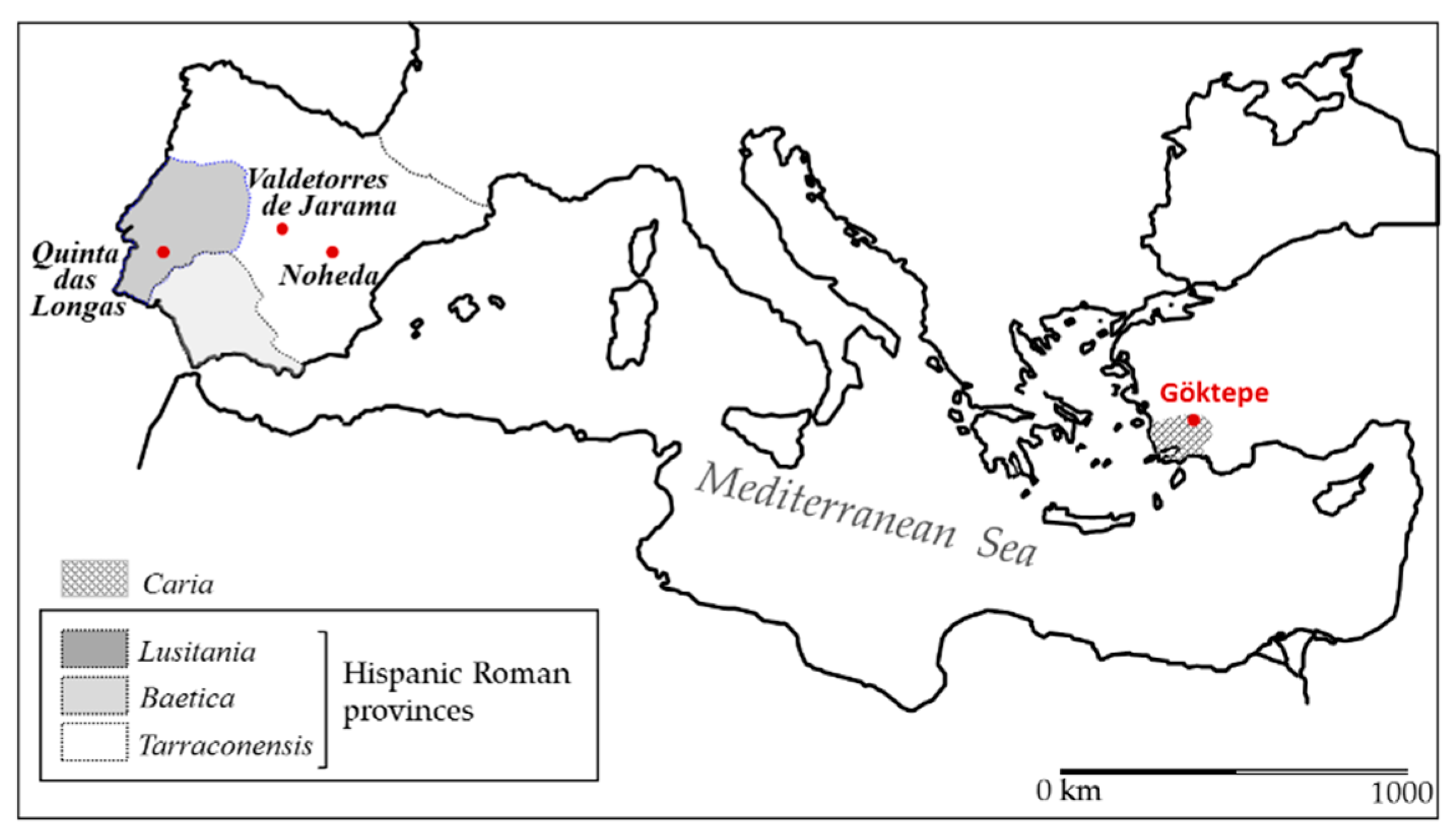
Figure 2.
The most representative figures in “Black” stone. Observe the stone heterogeneity, the polished surface made them almost black, but in fact are carved on a dark grey with whitish/yellowish to light grey patches. The attributed iconography is: (a) Anguiped Giant ; (b) Niobid on horseback at the moment of being struck down by Apollo's arrows; (c) Apollo Archer 1; (d) Two views of the Nubian slave Head carved in a bichrome black and grey stone; (e) Fragment of the Nubian slave body in black stone with white areas of recrystallized bibalve shells. The preserved statues (a) and (b) measure 61 cm and (c) 75 cm in high. The rule visible in (b) is 15 cm long; (d) and (e) images are with the same scale. (a) (c) and (d) images by R.H. Goette.
Figure 2.
The most representative figures in “Black” stone. Observe the stone heterogeneity, the polished surface made them almost black, but in fact are carved on a dark grey with whitish/yellowish to light grey patches. The attributed iconography is: (a) Anguiped Giant ; (b) Niobid on horseback at the moment of being struck down by Apollo's arrows; (c) Apollo Archer 1; (d) Two views of the Nubian slave Head carved in a bichrome black and grey stone; (e) Fragment of the Nubian slave body in black stone with white areas of recrystallized bibalve shells. The preserved statues (a) and (b) measure 61 cm and (c) 75 cm in high. The rule visible in (b) is 15 cm long; (d) and (e) images are with the same scale. (a) (c) and (d) images by R.H. Goette.
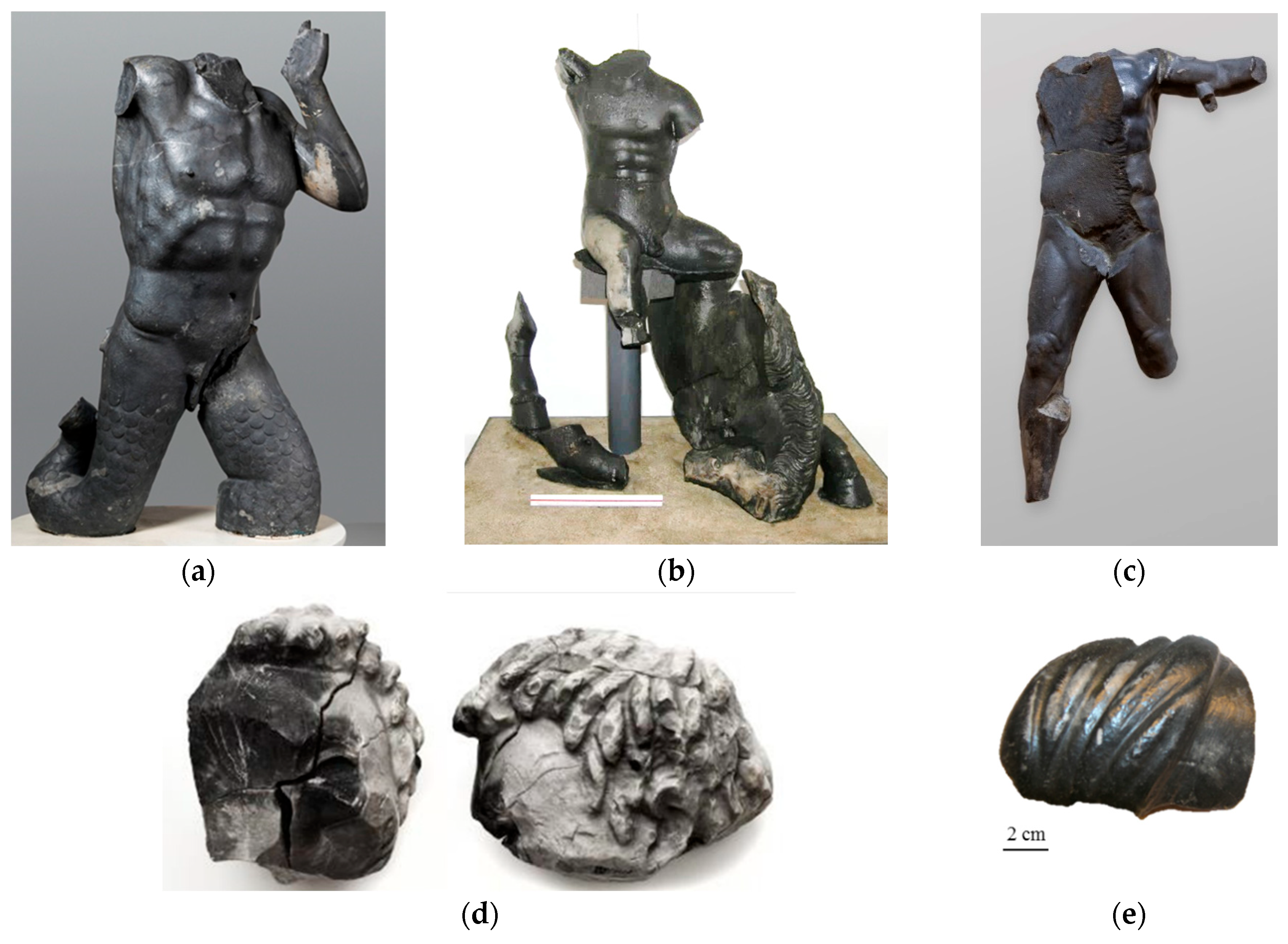
Figure 3.
Examples of white marble pieces of Valdetorres de Jarama; (a) Aesculapio; (b) Fragmented Male leg of Apollo?; (c) Two views of a fragment of a wing feather; (d) Two views of a small panther head; (e) several fragments assigned to Ganymede with eagle; (f) pedestal or profiled base for seating one sculpture; (a), (b), (c) and (d) are examples of fine-grained white marbles; (e) and (f) are examples of medium-coarse-grained white marbles. Note the wide halo of translucency in most of the pieces. (d) left and (e) top images taken by R.H. Goette.
Figure 3.
Examples of white marble pieces of Valdetorres de Jarama; (a) Aesculapio; (b) Fragmented Male leg of Apollo?; (c) Two views of a fragment of a wing feather; (d) Two views of a small panther head; (e) several fragments assigned to Ganymede with eagle; (f) pedestal or profiled base for seating one sculpture; (a), (b), (c) and (d) are examples of fine-grained white marbles; (e) and (f) are examples of medium-coarse-grained white marbles. Note the wide halo of translucency in most of the pieces. (d) left and (e) top images taken by R.H. Goette.
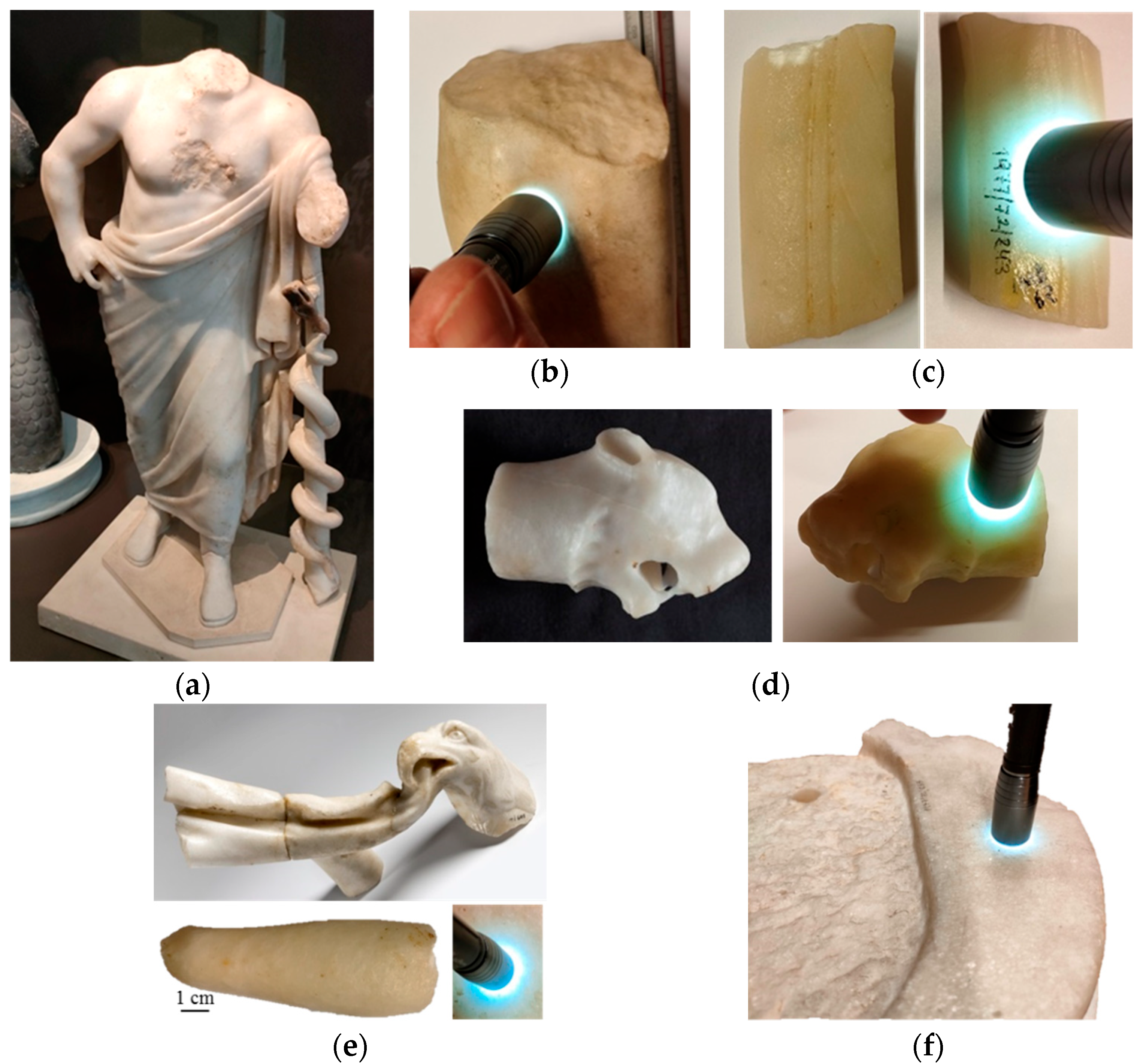
Figure 3.
Isotopic signature of “Black”, Dark Grey samples (MAN4, MAN7), from Valdetorres de Jarama in two isotopic diagrams, in red symbol; (a) In the isotopic diagram of data of two different quarries of Black and some important archaeological pieces to compare [2,4,37]; (b) In the general isotopic diagram for Göktepe quarries [27 and references therein].
Figure 3.
Isotopic signature of “Black”, Dark Grey samples (MAN4, MAN7), from Valdetorres de Jarama in two isotopic diagrams, in red symbol; (a) In the isotopic diagram of data of two different quarries of Black and some important archaeological pieces to compare [2,4,37]; (b) In the general isotopic diagram for Göktepe quarries [27 and references therein].

Figure 4.
Isotopic signature of Light Grey samples in red symbol (MAN1, MAN2, MAN3, MAN5, MA11) from Valdetorres de Jarama in the general isotopic diagram for Göktepe quarry marbles [1,4,27].
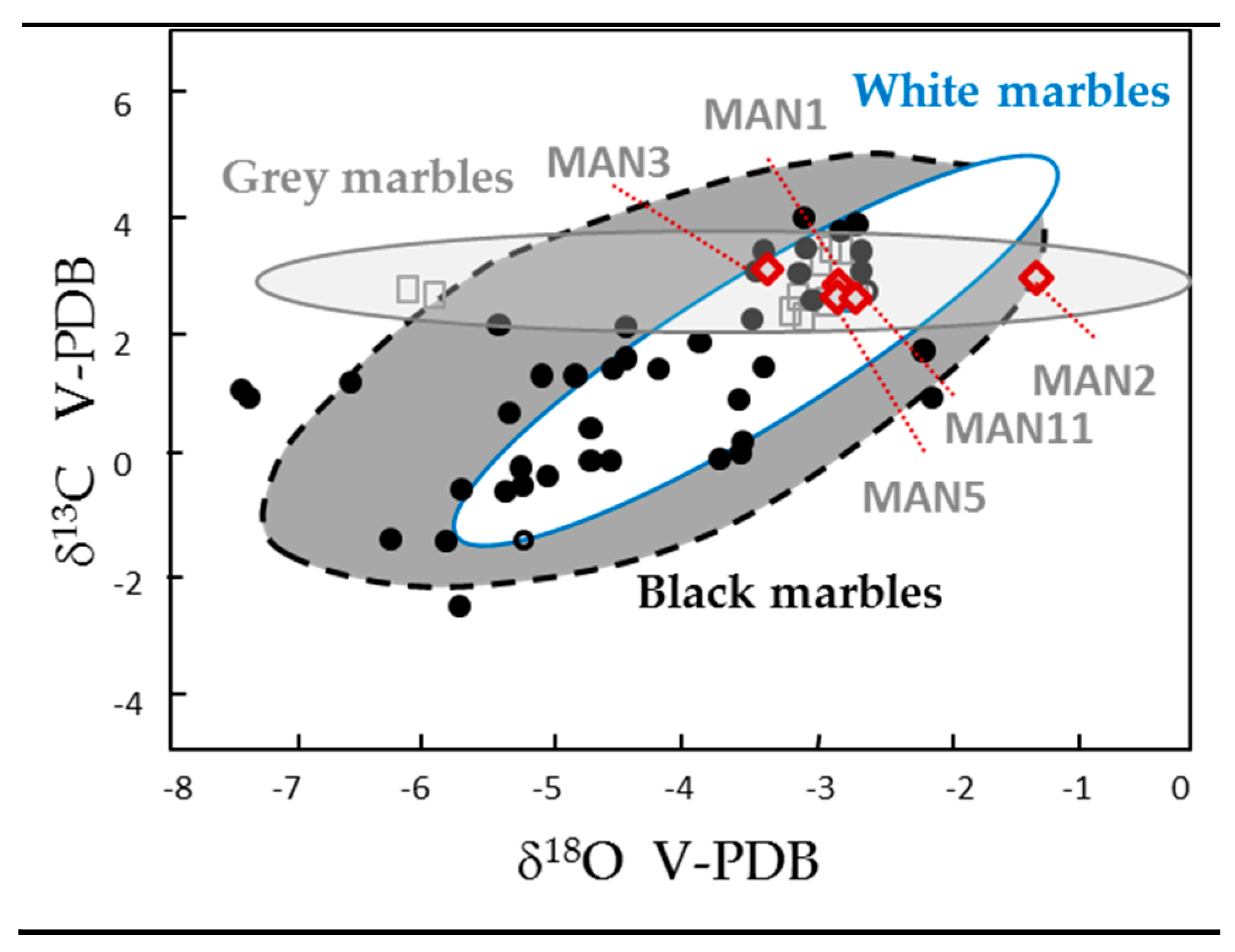
Figure 5.
Isotopic signature of the red marble under study (MAN12). (a) In the diagram for Iasos and Mani quarry red marbles and twelve archaeological artifacts (A-1 to A-12) from literature [38]; (b) In the isotopic diagram proposed in [39] which includes both Carian red from Milas and Iasos.
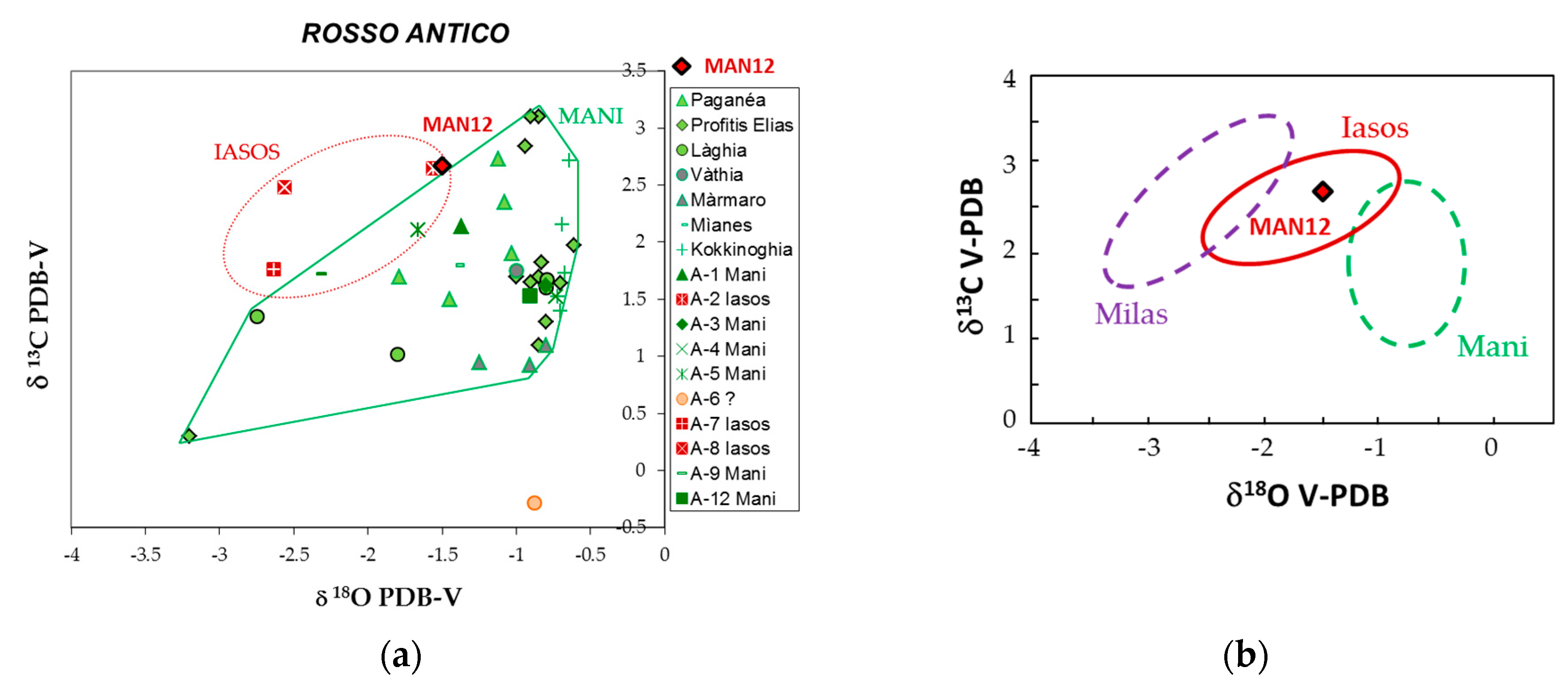
Figure 6.
Maximum Grain Size (dashed red line) of the white sculptural marbles studied from Valdetorres de Jarama collection Fine-grained marbles (samples 9, 13 and 16) and Extremely fine (sample 15) are compared to the MGS of the most important fine-grained marbles of statuary quality. Both types are associated to the wG1 statuary white Göktepe. Medium to Coarse-grained marble (sample 14) is discussed in section 3.4.2.
Figure 6.
Maximum Grain Size (dashed red line) of the white sculptural marbles studied from Valdetorres de Jarama collection Fine-grained marbles (samples 9, 13 and 16) and Extremely fine (sample 15) are compared to the MGS of the most important fine-grained marbles of statuary quality. Both types are associated to the wG1 statuary white Göktepe. Medium to Coarse-grained marble (sample 14) is discussed in section 3.4.2.
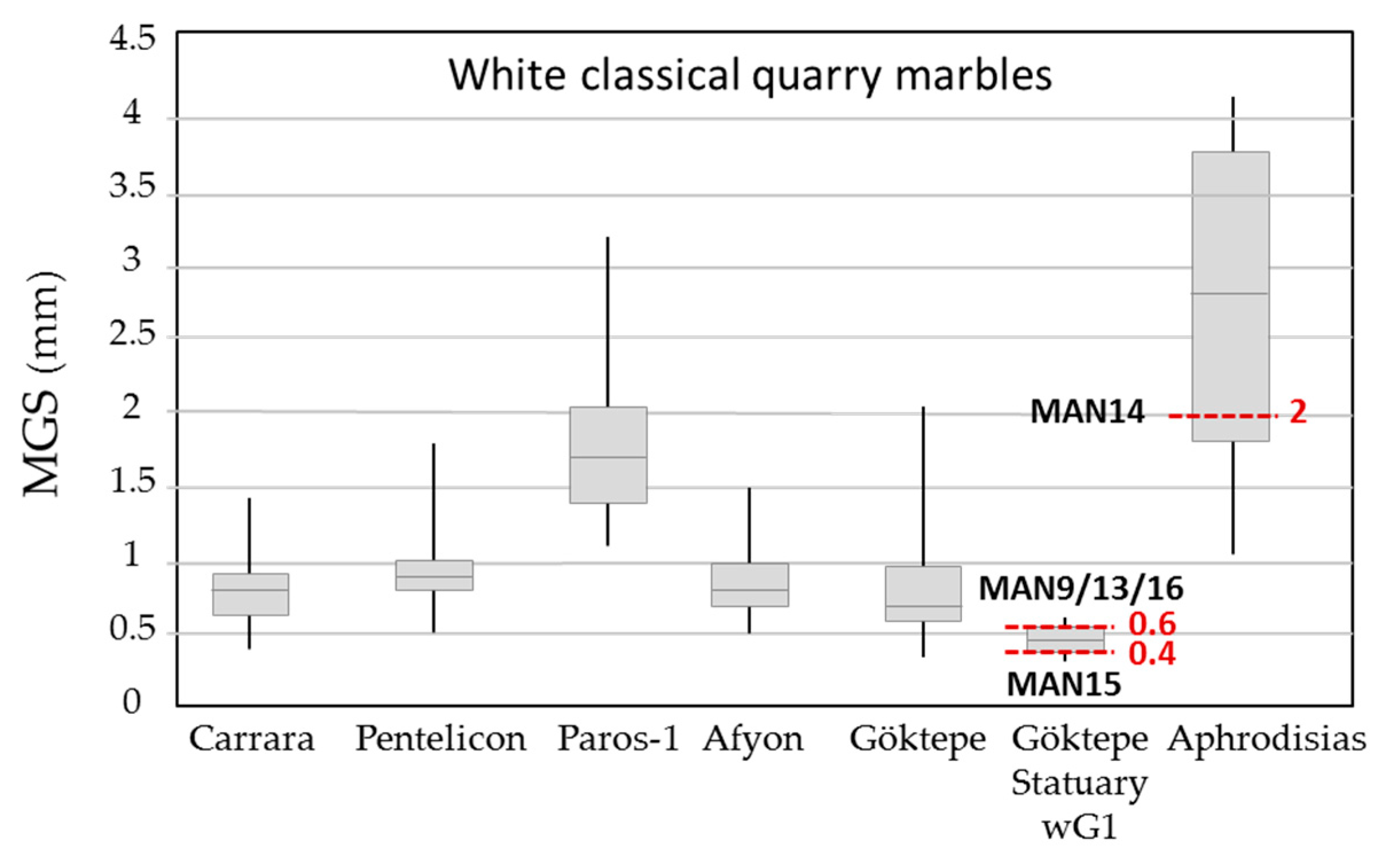
Figure 7.
Isotopic signature of the archaeological samples (in red) of fine-grained white marbles plotted on two different isotopic diagrams; (a) Isotopic diagram with the 90% probability ellipses of the most important classical marbles [40] with the data points of white Göktepe quarry marbles [10]; (b) Scatterplot of the C and O isotopic values of the white Göktepe quarry marble with its 90% probability ellipse (in blue) adapted from [27] and papers therein.
Figure 7.
Isotopic signature of the archaeological samples (in red) of fine-grained white marbles plotted on two different isotopic diagrams; (a) Isotopic diagram with the 90% probability ellipses of the most important classical marbles [40] with the data points of white Göktepe quarry marbles [10]; (b) Scatterplot of the C and O isotopic values of the white Göktepe quarry marble with its 90% probability ellipse (in blue) adapted from [27] and papers therein.
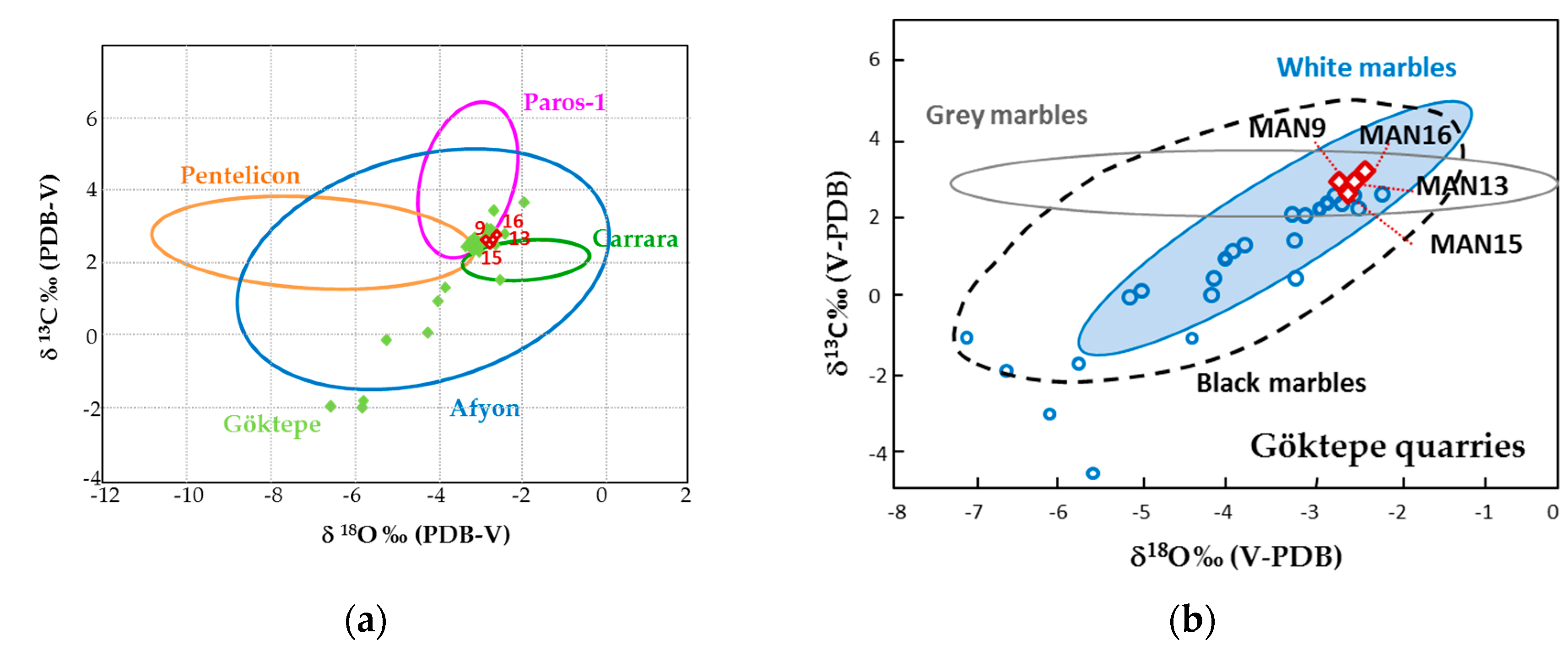
Figure 8.
Isotopic signature of the archaeological samples (in red) plotted on the general isotopic diagram for medium-coarse-grained marbles modified from [43] with data of Hispanic marbles: Estremoz Anticline, Almadén de la Plata and Macael [31,32]. The hypothetical idea of a local marble being used in the bases of the figures (sample 10) must be completely ruled out, not only by isotopes but also by petrography and CL. On the contrary, its assignment to the marble from the city of Aphrodisias, although isotopically compatible, must be rejected due to the rest of the analyzed features (explained in the text). The isotopic signature of sample 14 is discussed by Figure 9.
Figure 8.
Isotopic signature of the archaeological samples (in red) plotted on the general isotopic diagram for medium-coarse-grained marbles modified from [43] with data of Hispanic marbles: Estremoz Anticline, Almadén de la Plata and Macael [31,32]. The hypothetical idea of a local marble being used in the bases of the figures (sample 10) must be completely ruled out, not only by isotopes but also by petrography and CL. On the contrary, its assignment to the marble from the city of Aphrodisias, although isotopically compatible, must be rejected due to the rest of the analyzed features (explained in the text). The isotopic signature of sample 14 is discussed by Figure 9.
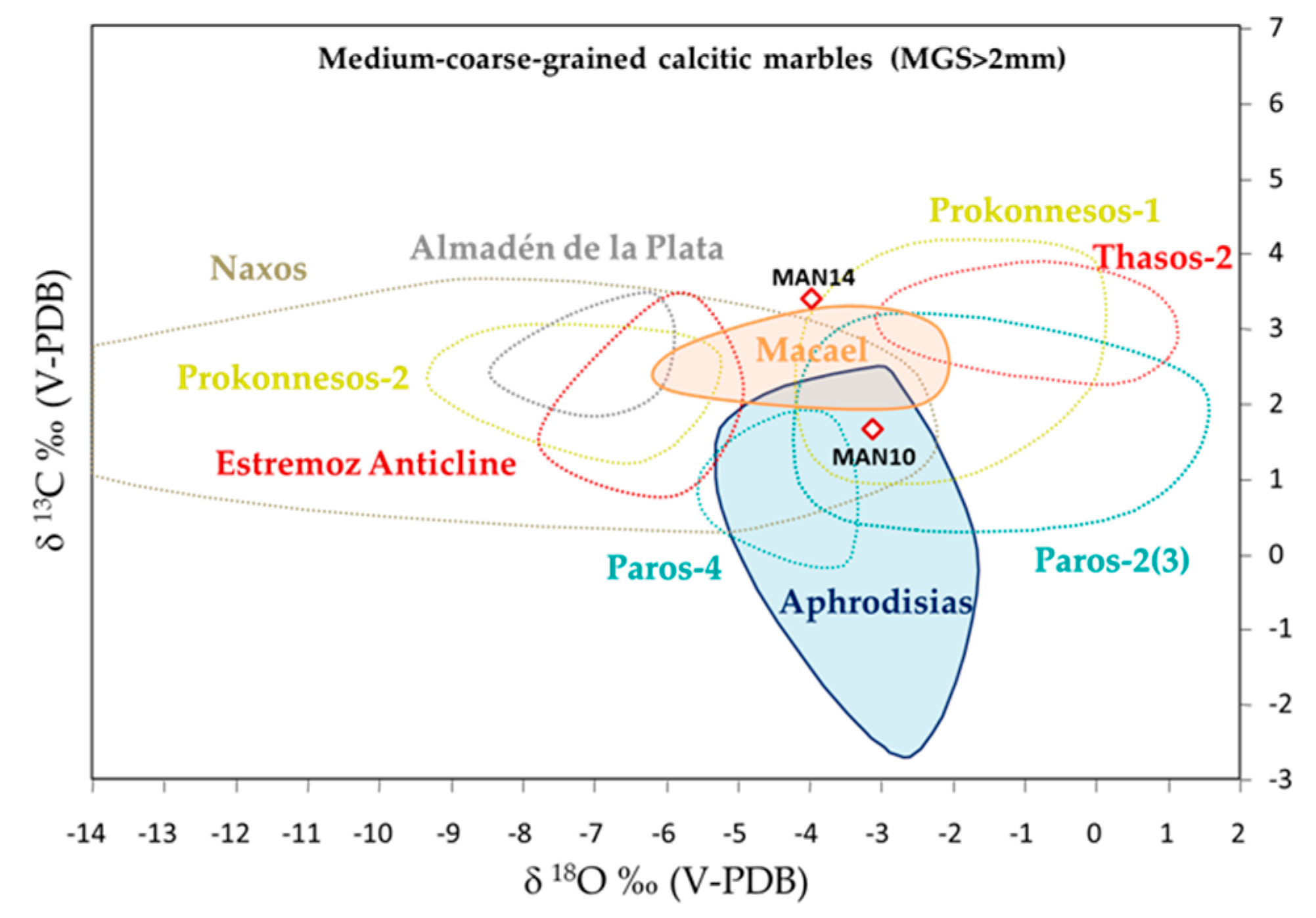
Figure 9.
Analytical diagrams referring to Anatolian quarries with medium-coarse-grained white marbles (Caria and Phrygia regions): Th (Thiounta), Göl (Gölemezli), Den (Denizli), Hier (Hierapolis-Gök Dere), MT (Marmar Tepe), Aph (Aphrodisias). (a) isotopic diagram; (b) grain size diagram (MGS) [40,41,42].
Figure 9.
Analytical diagrams referring to Anatolian quarries with medium-coarse-grained white marbles (Caria and Phrygia regions): Th (Thiounta), Göl (Gölemezli), Den (Denizli), Hier (Hierapolis-Gök Dere), MT (Marmar Tepe), Aph (Aphrodisias). (a) isotopic diagram; (b) grain size diagram (MGS) [40,41,42].
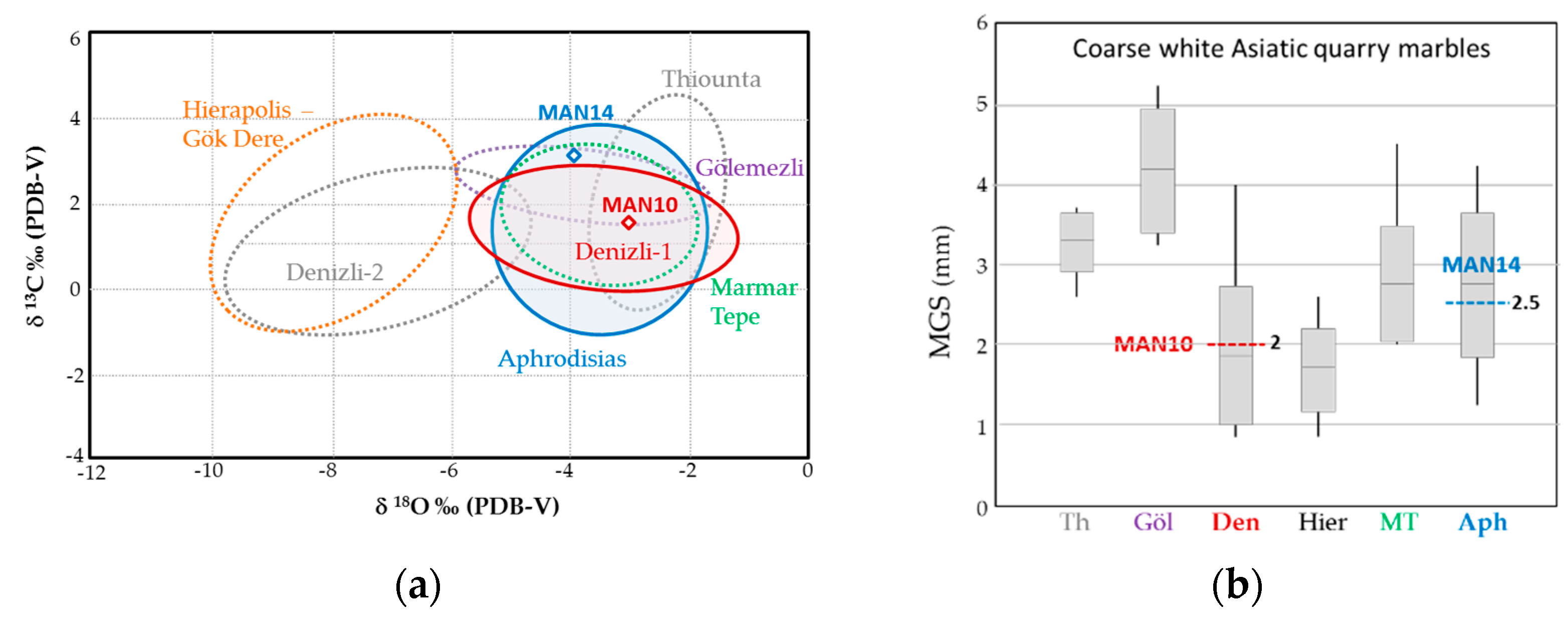

Table 1.
Samples under analytical study, their iconography and macroscopic appearance.
| Sample number MAN reference 1977/72/ |
Archaeological piece | Macroscopic appearance | |||
|---|---|---|---|---|---|
| Colour | Grain size Translucency (T) | ||||
| 1 | 167 | Rounded piece fragment (Niobid?) | Light grey | Fine crystalline | |
| 2 | 174 | Flattened piece fragment (Niobid?) | |||
| 3 | 153 | Rounded piece fragment (Niobid?/Archer 2?) | |||
| 4 | 170 | Rounded piece fragment (Niobid?) | Dark grey | Very fine compact | |
| 5 | 154 | Body (Archer 2?) | Light grey | Fine crystalline | |
| 6 | 152 | Rounded piece (Archer 2?) | Dark grey | Very fine compact | |
| 7 | 232 | Head (Nubian slave) | |||
| 8 | 142 | Body (Nubian slave) | |||
| 9 | 68 | Male leg (unknown, Hero?) | White | Very Fine(high T) | |
| 10 | 55 | Pedestal (statuary base) | Coarse (high T) | ||
| 11 | 229 | Male leg (unknown, Hero?) | Light grey | Fine crystalline | |
| 12 | 234 | Small sculptured fragment (Niobid?) | Red | Fine | |
| 13 | 60 | Male leg (Bacchus with panther?) | White | Very fine (high T) | |
| 14 | 63 | Arm (Ganymede with eagle?) | Coarse (high T) | ||
| 15 | 61 | Male leg (unknow, Apollo?) | Fine (medium T) | ||
| 16 | 243 | Wing feather (Griffin) | Very fine (high T) | ||
Table 2.
Selection of “Black” stone (Black to dark Grey). Photomicrographs of samples 4 and 6 in Parallel Polarized Light (PPL) and samples 7 and 8 in Crossed Polarizers Light (CPL). CL images were taken in 1 second (s); Int: Intensity of CL.
Table 2.
Selection of “Black” stone (Black to dark Grey). Photomicrographs of samples 4 and 6 in Parallel Polarized Light (PPL) and samples 7 and 8 in Crossed Polarizers Light (CPL). CL images were taken in 1 second (s); Int: Intensity of CL.
| Num. Sample |
Macroscopic view | Petrographic view | CL image (1s) | Parameters |
|---|---|---|---|---|
| 4 | 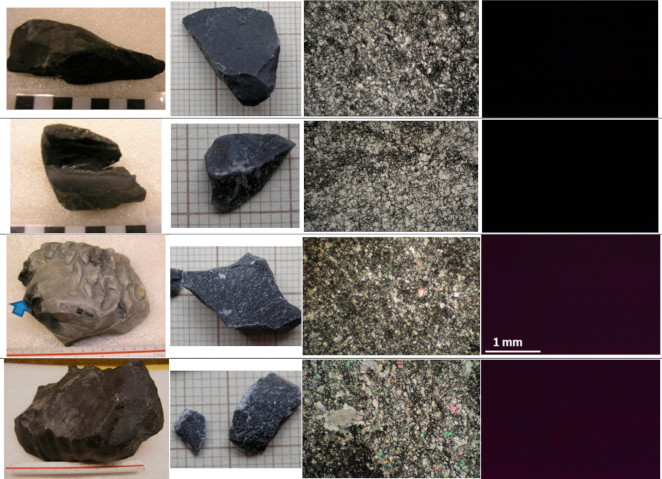 |
Very Low Int CL δ13C (+2.60‰) δ18O (-3.31‰) |
||
| 6 |
Very Low Int CL |
|||
| 7* | Sr (163 ppm) Mn (9 ppm) Very Low Int CL δ13C (+1.08‰) δ18O (-6.64‰) |
|||
| 8 |
Very Low Int CL |
|||
* Sample 7 was taken in the dark part of the bichrome head piece.
Table 3.
Selection of the heterogeneous Light Grey Marble to be analyzed. Their macroscopic aspect in hand specimen, a detail in fresh cut, some photomicrographs in CPL (samples 1 and 11), in PLL (samples 2, 3 and 5) and their respective CL-patterns taken during 1 second. The results of the analyses are also included. MGS: Maximum Grain Size; MFS: Most Frequent size; Het: Heterogeneous; Int (Intensity); Med-H: Medium-High.
Table 3.
Selection of the heterogeneous Light Grey Marble to be analyzed. Their macroscopic aspect in hand specimen, a detail in fresh cut, some photomicrographs in CPL (samples 1 and 11), in PLL (samples 2, 3 and 5) and their respective CL-patterns taken during 1 second. The results of the analyses are also included. MGS: Maximum Grain Size; MFS: Most Frequent size; Het: Heterogeneous; Int (Intensity); Med-H: Medium-High.
| Num. Sample |
Macroscopic view | Petrographic view | CL image (1s) | Parameters |
|---|---|---|---|---|
| 1 | 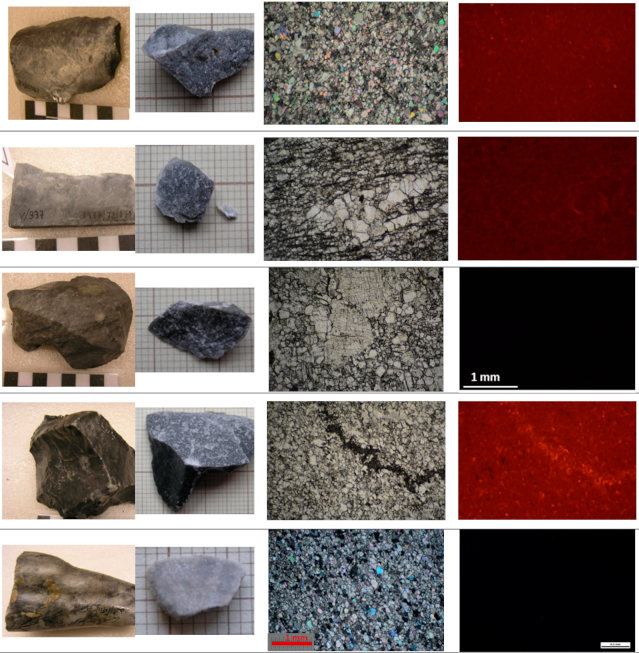 |
MGS (0.25 mm) MFS (0.15 mm) Sr, Mn (300, 59 ppm) Medium Int CL δ13C (+2.49‰) δ18O (-2.95‰) |
||
| 2 | MGS (bioclasts) MFS (0.3 mm) Sr, Mn (252, 47 ppm) Medium Int CL δ13C (+2.38‰) δ18O (-1.41‰) |
|||
| 3 | MGS (bioclasts) MFS (0.3 mm) Very Low Int CL δ13C (+2.73‰) δ18O (-3.39‰) |
|||
| 5 | MGS (0.3 mm) MFS (0.2 mm) Sr, Mn (305, 85 ppm) Het Med-H Int CL δ13C (+2.41‰) δ18O (-2.89‰) |
|||
| 11 | MGS (0.25 mm) MFS (0.1 mm) Very Low Int CL δ13C (+2.77‰) δ18O (-3.33‰) |
|||
Table 4.
Red piece analyzed from Valdetorres de Jarama collection. MGS: maximum Grain Size; MFS: Most Frequent Size; Het: Heterogeneous; Int: Intensity.
Table 4.
Red piece analyzed from Valdetorres de Jarama collection. MGS: maximum Grain Size; MFS: Most Frequent Size; Het: Heterogeneous; Int: Intensity.
| Num. Sample |
Macroscopic view | Petrographic view | CL image (1s) | Parameters |
|---|---|---|---|---|
| 12 | 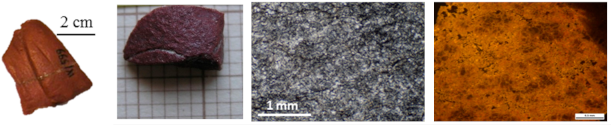 |
MGS (0.2 mm) MFS (0.05 mm) Het. High Int CL δ13C (+2.63‰) δ18O (-1.47‰) |
||
Table 5.
Samples selected for analyses from the Fine-grained white marble. MGS: Maximum Grain Size; MFS: Most Frequent size; (Het): Heterogeneous; Int (Intensity).
Table 5.
Samples selected for analyses from the Fine-grained white marble. MGS: Maximum Grain Size; MFS: Most Frequent size; (Het): Heterogeneous; Int (Intensity).
| Num. Sample |
Macroscopic view | Petrographic view |
CL image (1s) | Parameters |
|---|---|---|---|---|
| 9 | 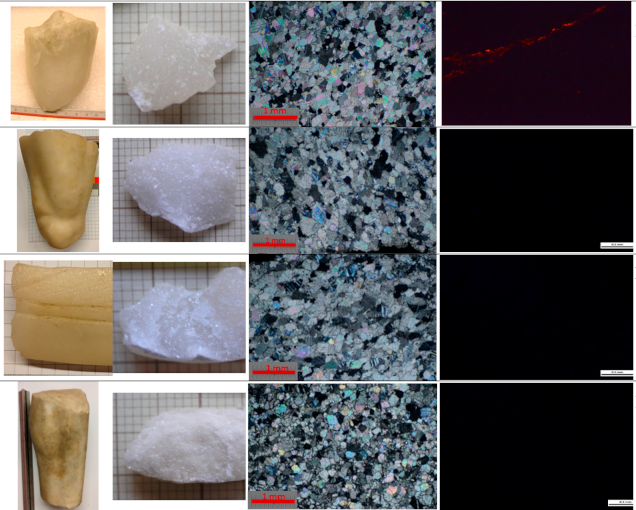 |
MGS; MGS (0.6; ≤ 0.4mm) Het Very Low Int CL δ13C (+2.78‰) δ18O (-2.76‰) |
||
| 13 |
) δ18O (-2.51‰) |
|||
| 16 |
) |
|||
| 15 | MGS;MGS (0.4; ≤ 0.2 mm) Sr, Mn (468, 6 ppm) Very Low Int CL δ13C (+2.65‰) δ18O (-2.55‰) |
|||
Table 6.
Samples selected for analyses from the Coarse-grained white marble. MGS: Maximum Grain Size; MFS: Most Frequent size; (Het): Heterogeneous; Int (Intensity); (L): low; (H): high in the borders between calcite grains.
Table 6.
Samples selected for analyses from the Coarse-grained white marble. MGS: Maximum Grain Size; MFS: Most Frequent size; (Het): Heterogeneous; Int (Intensity); (L): low; (H): high in the borders between calcite grains.
| Num. Sample |
Macroscopic view | Petrographic view |
CL image (1s) | Parameters |
|---|---|---|---|---|
| 14 | 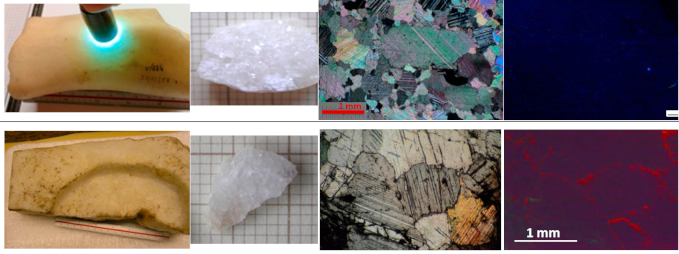 |
MGS, MFS (2.5; 0.9) Sr, Mn (149, 4 ppm) Very L Int Bluish CL δ13C (+3.33‰) δ18O (-4.03‰) |
||
| 10 | MGS; MFS (2; 1.2) Sr, Mn (186, 13 ppm) Het faint (H) Int CL δ13C (+1.73‰) δ18O (-3.10‰) |
|||
Disclaimer/Publisher’s Note: The statements, opinions and data contained in all publications are solely those of the individual author(s) and contributor(s) and not of MDPI and/or the editor(s). MDPI and/or the editor(s) disclaim responsibility for any injury to people or property resulting from any ideas, methods, instructions or products referred to in the content. |
© 2024 by the authors. Licensee MDPI, Basel, Switzerland. This article is an open access article distributed under the terms and conditions of the Creative Commons Attribution (CC BY) license (http://creativecommons.org/licenses/by/4.0/).
Copyright: This open access article is published under a Creative Commons CC BY 4.0 license, which permit the free download, distribution, and reuse, provided that the author and preprint are cited in any reuse.


