

Submitted:
31 March 2025
Posted:
01 April 2025
You are already at the latest version
Abstract
Background/Objectives: Nonverbal synchrony—the temporal coordination of physical behaviors such as head movement and gesture—is a critical component of effective social communication. Individuals with autism spectrum disorder (ASD) are often described as having impairments in such synchrony, but objective and scalable tools to measure these disruptions remain limited. This study aims to assess body motion synchrony in ASD using phase-based features as potential markers of social timing impairments. Methods: We applied a phase difference detection algorithm to high-resolution triaxial accelerometer data obtained during structured, unidirectional verbal communication. Seventy-two participants (36 typically developing [TD]–TD and 36 TD–ASD) were divided into dyads. ASD participants always assumed the listener role, enabling the isolation of receptive synchrony. Four distribution-based features—synchrony activity, directionality, variability, and coherence—were extracted from the phase difference data to assess synchrony dynamics. Results: Compared to the TD group, the ASD group exhibited significantly lower synchrony activity (ASD: 5.96 vs. TD: 9.63 times/min, p = 0.0008, Cohen’s d = 1.23), greater temporal variability (ASD: 384.4 ms vs. TD: 311.1 ms, p = 0.0036, d = 1.04), and reduced coherence (ASD: 0.13 vs. TD: 0.81, p = 0.036, d = 0.73). Although the mean phase difference did not differ significantly between groups, the ASD group displayed weaker and more irregular synchrony patterns, indicating impaired temporal stability. Conclusions: Our findings highlight robust impairments in nonverbal head motion synchrony in ASD, not only frequency but also in terms of temporal stability and convergence. The use of phase-based synchrony features provides a continuous, high-resolution, language-independent metric for social timing. These metrics offer substantial potential as behavioral biomarkers for diagnostic support and intervention monitoring in ASD.
Keywords:
autism spectrum disorder
; body motion synchrony
; phase difference detection algorithm
; behavioral biomarker
; diagnostic marker
1. Introduction
Autism spectrum disorder (ASD) is a neurodevelopmental condition characterized by persistent deficits in social communication and interaction, as well as restricted, repetitive patterns of behavior, interests, or activities [1]. According to the DSM-5 [1], individuals with ASD often struggle with nonverbal communication, including eye contact, gestures, facial expressions, and body language. Whereas typically developing (TD) individuals are capable of integrating both verbal and nonverbal cues to infer others’ intentions, individuals with ASD tend to rely more heavily on verbal information due to impairments in central coherence [2,3]. This often results in inefficient referential processing, such as difficulty identifying the target of a gesture or overreliance on mouth movements rather than the eyes for emotion recognition [4].
Interpersonal synchrony—particularly in body movements—reflects the dynamic structure of communication between individuals [5,6,7]. This phenomenon, known as body motion synchrony, refers to the temporal alignment of physical behaviors during communication and is increasingly recognized as a meaningful metric for evaluating interaction quality [8,9]. Previous studies have shown that synchronized movements enhance cooperation [10], create favorable impressions [11], and are positively associated with feelings of closeness [12], intimacy [13], bonding [14], and empathy [15,16]. For instance, physical synchrony is known to occur more frequently with familiar partners [17] and has been linked to enhanced positive affect in dyadic interactions [18,19]. Moreover, counselors who exhibit higher levels of body motion synchrony with clients tend to receive more favorable evaluations [20]. Thus, body motion synchrony is now viewed as a powerful and quantifiable indicator of communication quality and social attunement.
Previous studies have increasingly shown that individuals with ASD exhibit reduced frequencies of body motion synchrony compared to TD peers. Marsh et al. [21], using rocking chairs to measure synchrony between children with ASD and their caregivers, reported significantly fewer synchrony events in ASD dyads. Comparable results were found in Fitzpatrick et al.'s [22] pendulum-swinging experiment, and in a communicative finger-tapping task [23], where ASD participants displayed reduced synchrony and empathy relative to TD individuals. Furthermore, Isaksson et al. [24] found that ASD participants not only tapped with less synchrony but also exhibited faster and more variable timing than their TD counterparts. These findings suggest that synchrony in ASD is both less frequent and more temporally irregular; however, relatively few studies have examined such disruptions under naturalistic verbal communication settings.
In recent years, Motion Energy Analysis (MEA) has emerged as a widely used tool for quantifying interpersonal synchrony in naturalistic conversations, including studies on autism spectrum disorder (ASD) that examine real-time social dynamics during dyadic interactions. For example, studies by Georgescu et al. (2019) and Koehler et al. (2022) have successfully applied MEA to analyze movement synchrony between autistic and neurotypical individuals during semi-structured interviews and diagnostic assessments [25,26]. MEA offers several advantages: it is non-invasive, requires no physical markers or wearable sensors, and can be applied retrospectively to video recordings [27]. These features have made MEA especially appealing for clinical and ecologically valid research settings [9]. However, MEA also has several methodological limitations. As a 2D, pixel-based technique with low temporal resolution (10 fps), MEA is sensitive to video quality, camera angle, lighting conditions, and background noise. [27,28,29]. More critically, it tends to capture global motion energy rather than fine-grained movement dynamics, making it difficult to distinguish between temporally aligned versus misaligned micro-movements. Moreover, MEA provides limited insight into the temporal structure of coordination—such as lag patterns, convergence strength, or variability—which are increasingly recognized as key features of nonverbal synchrony.
To address these shortcomings, the present study introduces a phase difference detection algorithm grounded in triaxial accelerometer data, as a robust and temporally precise alternative to video-based methods [30,31]. Unlike MEA, this algorithm captures three-dimensional head motion with high temporal resolution and minimal environmental constraints. Building on prior work by Kwon et al. [30], the algorithm computes the instantaneous phase of acceleration signals along each axis and derives phase differences between interlocutors, thereby quantifying the temporal alignment of head movements. Critically, this method extracts distribution-based synchrony features—including relative frequency of synchrony, mean phase difference, standard deviation (SD), and kurtosis—which together provide a multifaceted profile of interpersonal coordination. These metrics go beyond simple co-occurrence by capturing not only how often synchrony occurs, but also its temporal alignment, consistency and convergence strength, essential for evaluating the quality of alignment. Recent studies have demonstrated the algorithm's utility in distinguishing bidirectional vs. unidirectional verbal communication dynamics [31]. Thus, the phase difference framework enables a more nuanced, scalable, and quantitative assessment of nonverbal synchrony, making it highly suitable for both basic research and diagnostic innovation in autism studies.
The current study builds on this methodological advancement by analyzing head motion synchrony during structured, face-to-face communication between typically developing (TD) individuals and individuals with ASD. Critically, we employed a unidirectional verbal communication paradigm in which the ASD participants always assumed the listener role, thereby isolating the receptive aspect of synchrony without the confound of role-switching or expressive language production. Prior work suggests that listener behaviors—particularly backchannel feedback such as nodding or brief vocal affirmations—are tightly coupled with speaker rhythms and contribute to mutual alignment [32,33,34]. Thus, this design allowed for a precise investigation of implicit synchrony in ASD under ecologically valid yet experimentally controlled conditions. Our approach utilized triaxial accelerometers and a phase difference detection algorithm to extract high-resolution head motion data, from which we computed four statistical descriptors of synchrony: relative frequency, mean phase difference, SD, and kurtosis. These features captured both the activity level and the temporal precision of interpersonal alignment.
By comparing TD–TD dyads (TD condition) with TD–ASD dyads (ASD condition), this study aimed to:
- Quantify group differences in body motion synchrony under unidirectional verbal communication;
- Characterize the variability and timing of listener synchrony in ASD;
- Assess the utility of phase-based synchrony features as potential behavioral markers for ASD.
Ultimately, this research contributes to the growing body of work linking sensorimotor timing to social cognition and offers a framework for objective, scalable, and clinically meaningful assessments of nonverbal social function in autism.
2. Materials and Methods
2.1. Participants
A total of 72 participants took part in this study, divided equally into the typically developing (TD) group and the autism spectrum disorder (ASD) group. Each group comprised 36 participants (18 males and 18 females). The mean age of the TD group was 21 years (SD = 0.92), and that of the ASD group was 23 years (SD = 1.65). All participants were native Japanese speakers with normal or corrected-to-normal vision and normal hearing. To control for the potential effects of interpersonal familiarity on body motion synchrony [12,14,17], each dyad was composed of two same-gender individuals who had no prior acquaintance. Gender ratios were strictly balanced (1:1) across all conditions. In every dyad, one participant was assigned the role of speaker and the other the listener. In the TD condition, speaker–listener roles were randomly assigned. In the ASD condition, the TD participant always served as the speaker, while the ASD participant was always assigned the listener role.
Inclusion criteria for the ASD group required a formal diagnosis of ASD by a licensed physician, along with official diagnostic documentation. Individuals with intellectual disabilities, severe psychiatric comorbidities, or major neurological conditions were excluded. TD participants reported no history of psychiatric, developmental, or neurological disorders. For all participants, information regarding comorbid conditions, current medication use (if any), and intellectual functioning—measured via either intelligence quotient (IQ) or developmental quotient (DQ)—was obtained from participants themselves or their legal guardians. All ASD participants (n = 18; 9 males, 9 females) provided written informed consent, with additional parental consent obtained for 17 of them. Prior to participation, all individuals completed the Japanese version of the Autism-Spectrum Quotient (AQ) for adults.
Table 1 summarizes the clinical, cognitive, and diagnostic characteristics of participants in the ASD group, including comorbidities, medication status (noted as [+] for current medication, [–] for no medication), IQ or DQ scores, and AQ scores. Comorbid conditions such as attention-deficit/hyperactivity disorder (ADHD), specific learning disorder (SLD), epilepsy, and color vision deficiency are indicated on an individual basis. For some participants, IQ or DQ values were not explicitly reported but confirmed to be within the normal range (WNR). Missing or unavailable information is marked with an em-dash (“—”). These data were used to evaluate individual differences within the ASD group and to explore potential associations between participant profiles and synchrony performance.
This study was approved by the Ethics Committee of Kyoto University of Education (Approval No. 1805) and conducted in accordance with the Declaration of Helsinki. Written informed consent was obtained from all participants after they were provided with a comprehensive explanation of the study's objectives, procedures, and data confidentiality measures. For ASD participants, verbal and written instructions were provided with time allocated for clarification. A trained researcher remained present to monitor for signs of fatigue or discomfort throughout the session.
2.2. Experimental Environment and Apparatus
Figure 1 illustrates the experimental setting. Each participant pair sat face-to-face at a table spaced 1.8 meters apart, without wearing face coverings or headwear. The room temperature was maintained at an average of 20.7°C, illumination was 1,432 lx (CANA-0010, Tokyo Photoelectric Co., Japan), and ambient noise was 31.4 dB (CHE-SD1, Sanwa Supply, Japan).
Body motion synchrony was measured using three wireless, three-axis accelerometers. Two sensors (TSND121, ATR-Promotions, Japan) were attached to each participant’s forehead with hypoallergenic adhesive tape. A third sensor (TSND151, ATR-Promotions, Japan) served as a synchronization marker by recording timestamped signals at the start and end of each trial. Each device (37 mm × 46 mm × 12 mm; weight 22 g) transmitted time-series data via Bluetooth to a personal computer (Inspiron 15 7000, Dell Inc., USA) at a sampling rate of 100 Hz. Data quality was monitored in real time to prevent Bluetooth dropouts, and sessions with >5% missing data were excluded. Calibration of accelerometers was performed prior to each session using the manufacturer's protocol.
To capture behavioral cues, a video camera (HDC-TM45, Panasonic, Japan) recorded both participants during the experiment. These recordings were used only to verify behavioral compliance and were not subjected to further analysis. Video data were securely stored and anonymized.
2.3. Experimental Procedures
The procedure followed the paradigms developed in previous studies on head motion synchrony during communication [31]. Participants engaged in a unidirectional verbal communication task, seated face-to-face. Prior to each trial, participants were randomly assigned as either speaker or listener.
Speakers were provided with a Japanese Wikipedia article titled "Cashless Society" before the experiment and instructed to prepare to explain its contents in their own words. The article contained 2,599 characters, which was sufficient for a 5–10-minute explanation. Participants (particularly listeners) who were familiar with the topic were excluded from participation.
Speakers were instructed to maintain natural eye contact and speak clearly without deviating from the assigned topic. Listeners were not permitted to ask questions or initiate conversation, but were encouraged to demonstrate engagement through nonverbal behaviors such as nodding, facial expressions, and short vocal acknowledgments (e.g., “un,” “hai,” “ee,” which are equal to “mmhm,” “uh huh”, and “yeah” in English) [35,36,37]. Participants were instructed not to touch or adjust the sensors during the session.
Each session began with the experimenter announcing, "The experiment is starting," and clapping once to log a timestamp on the synchronization accelerometer. The experimenter then exited the room. Upon completing the explanation, the speaker rang a bell to indicate the end of the task. The experimenter re-entered the room and concluded the session with the statement, "The experiment is ending," accompanied by a single clap, which was again recorded by the synchronization sensor.
After the experiment, participants completed a brief questionnaire to assess subjective concentration and comprehension using the following items:
Q1: "Were you able to concentrate on the explanation?"
Q2: "Was the content of the explanation easy to understand?"
Each item was rated on a five-point semantic differential (SD) scale ranging from 1 (strongly disagree) to 5 (strongly agree).
3. Data Analysis
3.1. Phase Difference Detection Algorithm
To detect body motion synchrony, we employed a phase difference detection algorithm previously proposed by Kwon et al. [30,31], which identifies temporal coordination in head movements based on acceleration signals. The raw tri-axial (X, Y, Z) acceleration data, corresponding to sagittal, coronal, and transverse planes of head motion, were collected at a sampling frequency of 100 Hz (10 ms intervals).
The magnitude of the acceleration vector was computed as the Euclidean norm:
To eliminate individual differences in head movement amplitude caused by variation in speaking style or head size, normalization was performed using the z-score method:
Here, and are calculated as
where and denote the mean and standard deviation of the acceleration over the entire recording duration, respectively.
To reduce high-frequency noise, the normalized signal was smoothed using a moving average over a 100 ms window:
The smoothed signal was then used to detect local maxima (peaks), which indicate rhythmic head movements such as nodding or speaking-related oscillations. A sample was considered a peak if it satisfied the following condition:
To ensure that only meaningful movements were captured (i.e., strong enough to reflect communicative behavior), a peak amplitude threshold of 2.0 was applied, as established in previous studies [30,31].
For each pair of participants, the phase difference was defined as the smallest temporal offset between a peak from participant A and the nearest peak from participant B within a ±1.0 second window:
Here, ti and tj denote the timestamps of the detected peaks for participant A and B, respectively. The resulting set of phase differences formed the basis for synchrony analysis.
3.2. Synchrony Feature Extraction
Using the distribution of detected phase differences over the course of each session, four statistical features were extracted to quantitatively characterize head motion synchrony:
- Density (Synchrony Activity): The number of synchronized events per minute, reflecting the overall activity level of synchrony within a dyad.
- Mean Phase Difference (Synchrony Directionality): The average temporal lead or lag between paired movements. Positive values indicate that the speaker's movements consistently preceded those of the listener, while negative values indicate the opposite. This measure captures the directional dynamics of synchrony and reflects potential leader–follower roles within the interaction.
- Standard Deviation (Synchrony Variability): The dispersion of phase differences around the mean. Smaller values indicate more temporally precise alignment, whereas larger values reflect greater inconsistency in coordination.
- Kurtosis (Synchrony Coherence): A measure of the peakedness of the phase difference distribution. Higher kurtosis indicates stronger convergence of synchronized movements around the mean phase, implying greater coherence and temporal stability.
Together, these four features—activity, directionality, variability, and coherence—offer a multidimensional representation of body motion synchrony during interpersonal communication.
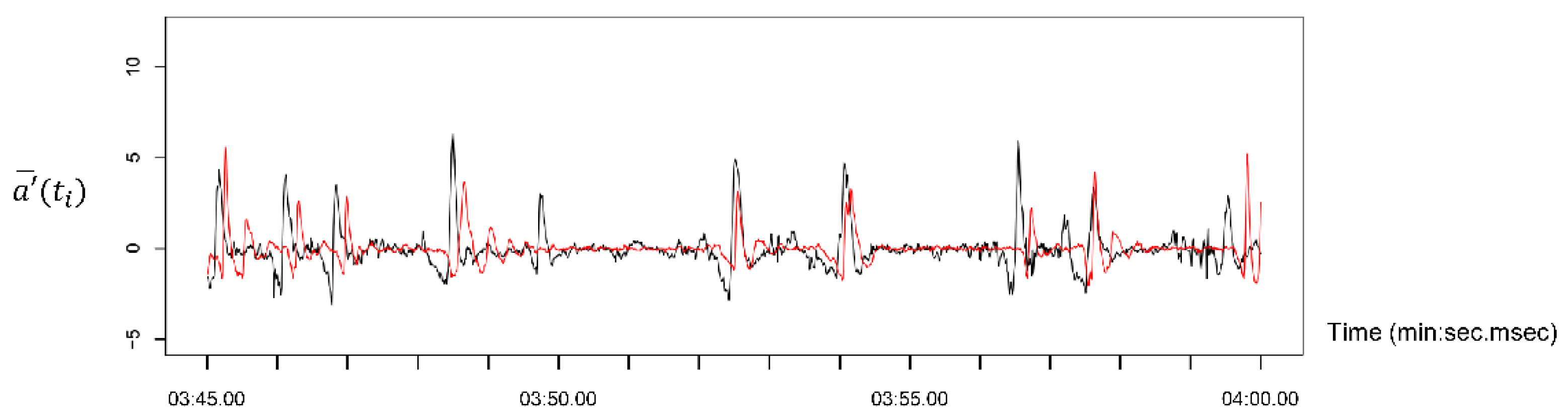
Figure 2.
Representative time-series data of head movement during the unidirectional verbal communication task [31]. The black line represents the speaker’s head acceleration, while the red line depicts the listener’s head acceleration.
Figure 2.
Representative time-series data of head movement during the unidirectional verbal communication task [31]. The black line represents the speaker’s head acceleration, while the red line depicts the listener’s head acceleration.
4. Results
4.1. Phase Difference Distributions
To assess the temporal characteristics of head motion synchrony, we examined the distribution of phase differences between speaker and listener head movements in both the TD and ASD groups. Figure 3 illustrates the normalized distributions of head motion phase differences for the TD and ASD groups, aggregated across all dyads. The x-axis represents the temporal offset in milliseconds between peak head movements of paired participants (with positive values indicating that the listener lagged behind the speaker), while the y-axis indicates the relative frequency within 100 ms bins.
In the TD group, approximately 67.4% of all synchrony events occurred within the ±300 ms window centered around the mean phase difference, indicating tightly clustered, highly coordinated, and temporally precise alignment. The distribution was sharply peaked and symmetrically centered near the mean, consistent with high temporal coherence and rapid mutual entrainment. The phase difference distribution showed a rapid decline on either side of the peak, suggesting that most synchrony events occurred with minimal temporal delay.
In contrast, the ASD group exhibited a significantly flatter and more dispersed distribution, with only 41.7% of events falling within the ±300 ms range. The distribution showed long tails extending beyond ±500 ms, particularly toward positive lags, indicating delayed and inconsistent listener responses. In addition, the histogram revealed irregular, non-uniform fluctuations across the entire distribution, including an unexpected secondary rise near –1000 ms, which may reflect atypical anticipatory movements, or mismatched rhythmic cycles. These patterns suggest that head motion synchrony in the ASD group not only lacks precision but also exhibits unstable entrainment dynamics. Collectively, these findings reflect lower synchrony precision and weaker temporal convergence in the ASD group, consistent with the increased standard deviation and reduced kurtosis observed in the statistical analysis.
Together, these findings support the interpretation that TD pairs exhibit stronger and more temporally precise synchrony, while ASD pairs show weaker and temporally diffuse coordination. These distributional patterns are consistent with the statistical results reported in the subsequent sections for standard deviation and kurtosis.
4.2. Synchrony Metrics Across Groups
To characterize body motion synchrony, we employed four quantitative indices derived from the phase difference distributions: synchrony activity, directionality, variability, and coherence. Figure 4 shows raincloud plots illustrate group-level differences between TD and ASD participants across four synchrony-related metrics. Each violin plot shows the distribution of data, boxplots show the median and interquartile range, and individual observations are marked with scatter points. Detailed pair-level data for each group are provided in the Supplementary Materials.
Synchrony Activity
The mean relative frequency was 9.63 times/min (SD = 3.23) for the TD group and 5.96 times/min (SD = 2.73) for the ASD group. An independent samples t-test revealed a statistically significant difference in synchrony activity between groups, t(34) = 3.68, p = 0.0008, Cohen’s d = 1.23, indicating a large effect size. ASD participants exhibited less frequent synchronized head movements compared to TD participants.
Synchrony Directionality
The mean phase difference was 90.0 ms (SD = 61.6) for the TD group and 84.4 ms (SD = 187.2) for the ASD group. Although both groups exhibited positive phase differences, suggesting listener-delayed responses, the ASD group showed considerably larger variance and more outliers. However, the difference between groups was not statistically significant, t(34) = 0.12, p = 0.91, Cohen’s d = 0.04.
Synchrony Variability
The TD group exhibited a mean standard deviation of 311.1 ms (SD = 51.8), while the ASD group showed a significantly greater mean of 384.4 ms (SD = 86.1). This difference was statistically significant, t(34) = -3.10, p = 0.0039, Cohen’s d = -1.03, indicating a large effect size, with ASD dyads showing greater temporal variability than TD dyads.
Synchrony Coherence
Kurtosis, which reflects the convergence of the phase difference distribution toward the mean, was higher in the TD group (M = 0.81, SD = 0.84) than in the ASD group (M = 0.13, SD = 1.01). This difference was statistically significant, t(34) = 2.20, p = 0.036, Cohen’s d = 0.73, suggesting weaker temporal convergence and reduced synchrony coherence in ASD interactions.
5. Discussion
This study provides novel insights into the temporal dynamics of nonverbal synchrony in face-to-face communication between typically developing (TD) individuals and individuals with autism spectrum disorder (ASD). Using a phase difference detection algorithm and four statistical measures—relative frequency, mean phase difference, standard deviation, and kurtosis—we have systematically quantified synchrony not only in terms of frequency but also in terms of its temporal consistency and convergence strength. Our results demonstrate clear group-level differences, particularly in the dispersion and stability of synchrony patterns, shedding light on the sensorimotor basis of social interaction in ASD. This study advances the field by refining methodological approaches to measuring synchrony and by identifying novel markers of impaired coordination that can contribute to both theoretical models of autism and clinical applications.
- Methodological Advancements and Novel Contributions to Synchrony Research
A key contribution of this study lies in its methodological innovation using a phase difference detection algorithm, which enables high-resolution, time-continuous quantification of nonverbal synchrony based on triaxial acceleration data. Unlike traditional approaches that rely on cross-correlation [25] or discrete event counts of co-occurring behaviors [17], this algorithm captures the instantaneous phase relationship between dyadic movements, offering a finer-grained analysis of temporal coordination. By computing phase differences at each moment in time and constructing full distributions, the method provides dynamic, directional, and data-rich insights into interpersonal alignment. This level of temporal precision is particularly advantageous in studying ASD, where subtle disruptions in synchrony may occur even in the absence of gross behavioral abnormalities.
Furthermore, the integration of distribution-based statistical features enhances the utility of the phase difference detection algorithm by enabling multidimensional characterization of synchrony patterns. Relative frequency quantifies the overall activity level of synchrony within a session, while mean phase difference captures the directional lead-lag structure between speaker and listener. Standard deviation reflects temporal variability, and kurtosis indicates the convergence strength of synchronization events around the central phase. Together, these features allow researchers to move beyond binary classifications of synchrony presence or absence, and instead to evaluate the richness, consistency, and directionality of coordination over time. This level of granularity is particularly valuable for identifying atypical social timing profiles in ASD populations, and for exploring individual differences that may relate to cognitive, sensory, or affective traits.
Additionally, this study uniquely focuses on a controlled unidirectional communication context, in which ASD participants exclusively assumed the listener role. This design isolates the receptive dimension of social timing and allows for a more precise assessment of implicit synchrony processes. Many prior studies on ASD-related synchrony deficits have focused on interactive or reciprocal paradigms [22,24,38,39], where compensatory mechanisms—such as explicit effortful imitation—may obscure underlying impairments in automatic timing mechanisms. By eliminating bidirectional conversational demands, our study provides a cleaner test of nonverbal entrainment deficits.
- Synchrony Activity and Temporal Precision: Quantitative and Qualitative Divergences
Consistent with prior research emphasizing the role of sensorimotor coupling in social bonding [11,12,13,14,40,41], we found that TD pairs exhibited significantly higher relative frequencies of synchronized head movements compared to ASD pairs. This suggests that TD individuals engage in spontaneous, fine-grained sensorimotor alignment more frequently, even in the absence of explicit verbal cues and during structured, one-way verbal communication. Such synchronization has been considered an implicit social mechanism for enhancing rapport and shared understanding [13,15,16,40]. It has also been linked to affiliation, social cohesion, and shared attention, reflecting both the interpersonal quality of dyadic interactions and the broader social bonding functions of synchrony [12,14,18,42,43,44].
In contrast, the ASD group demonstrated significantly reduced frequency of synchronized movements. These findings extend previous reports of attenuated social motor synchronization in individuals with ASD [22,25] and suggest that even in the absence of explicit conversational turn-taking, implicit nonverbal synchrony is diminished. These outcomes align with findings by Koehler et al. (2022), who reported reduced synchrony in adults with ASD across various social dyad types, especially in head and upper body motion [26].
Additionally, the ASD group exhibited significantly greater variability in phase differences, as reflected in increased standard deviation and reduced kurtosis. These results indicate that even when synchrony occurs, it is more temporally dispersed and lacks the convergence observed in TD dyads. Notably, the presence of extreme phase lags (exceeding ±500 ms) suggests that while ASD individuals can align their head movements with their communication partners, the reliability and precision of that alignment are impaired. This pattern is consistent with findings from Oberman et al. (2009) [24] and Isaksson et al. (2018) [45], who reported timing irregularities in motor and social behaviors among individuals with ASD. Given the growing evidence that ASD-related social difficulties may stem, at least in part, from predictive coding deficits [46,47], our findings further support the idea that disruptions in temporal coordination may underlie broader social impairments.
- Phase Distributions and Entrainment Signatures
A key insight from this study comes from the distributional analysis of phase differences. TD dyads displayed tightly clustered, symmetrical phase distributions centered near zero, whereas ASD dyads exhibited flatter and broader distributions, with long tails—particularly toward positive lags. These patterns suggest a breakdown in fine-grained interpersonal entrainment [48,49]. In neurotypical interactions, phase distributions are expected to exhibit a sharp peak near zero, reflecting robust and temporally stable coordination. The flatter distributions observed in ASD dyads indicate that synchrony, when present, is highly inconsistent and less precisely timed.
This divergence aligns with research on neural and behavioral entrainment in ASD, which has demonstrated weaker phase-locking to external stimuli [50,51,52]. Importantly, disrupted synchrony is not merely a consequence of general motor impairments; rather, it appears to be specifically linked to difficulties in dynamically adjusting one’s behavior to social cues in real time [53].
- Contextual and Individual Variability in ASD Synchrony Patterns
Although group-level differences were robust, notable within-group variability was observed among ASD participants. While some ASD pairs (e.g., participants A4, A10, A11, A12) demonstrated high synchrony frequency, others (e.g., A1, A5, A9) showed minimal synchrony. One pair (A11) showed high frequency but low synchrony strength. Video analyses revealed that high-synchrony ASD participants exhibited frequent backchannel feedback, whereas low-synchrony pairs rarely displayed such behavior. This suggests that frequent backchannel behaviors—such as nodding and vocal affirmations ("uh-huh", "yes")—are strongly associated with higher synchrony scores, supporting prior research linking feedback timing to interpersonal fluency [54,55,56,57,58]. It also raises the possibility that individuals with ASD may engage in such feedback through camouflage and masking behaviors [59,60].
Moreover, comparisons of AQ and IQ/DQ scores suggest that cognitive and neuropsychological factors may influence synchrony outcomes. ASD participants with lower synchrony scores tended to show higher levels of autistic traits (as measured by AQ) and lower intellectual functioning (IQ/DQ), with some also receiving psychiatric medication or presenting comorbidities. These patterns indicate a possible association between synchrony characteristics and ASD symptom severity, cognitive profile, and medical status. Importantly, they highlight the need for a dimensional, rather than categorical, framework for understanding synchrony impairments—one that accounts for the heterogeneity within the ASD population. These factors warrant further investigation in studies with larger, more diverse cohorts.
- Implications for ASD Assessment and Intervention
The synchrony metrics used in this study—particularly standard deviation and kurtosis—offer promising new tools for ASD assessment. Unlike traditional behavioral coding, which relies on subjective interpretation, these measures provide continuous, quantifiable, and nonverbal indices of dyadic coordination. Such metrics could be particularly valuable for individuals with limited expressive language, as they do not require explicit verbal responses.
From a clinical perspective, synchrony-based interventions may be beneficial for individuals with ASD. Sensorimotor training programs, virtual reality social simulations, and biofeedback paradigms could leverage synchrony metrics to provide real-time feedback and improve social coordination skills. Recent studies have shown that targeted motor and rhythm training can enhance social responsiveness in ASD [23,61,62,63,64], suggesting that synchronization-based therapies may hold promise for intervention.
Furthermore, these findings align with dynamical systems models of social interaction, which emphasize continuous real-time coupling between agents [53]. Understanding ASD-related impairments in social timing from this perspective shifts the focus away from static social "deficits" and toward more dynamic, context-dependent explanations.
- Limitations and Future Directions
Despite its contributions, this study has several limitations. First, while our use of unidirectional verbal communication allowed for controlled comparisons, it does not fully capture the complexities of natural social interactions. Future studies should examine synchrony in both dyadic and multi-party conversations involving reciprocal turn-taking to provide a more holistic understanding of interpersonal coordination. Furthermore, incorporating multimodal data encompassing multisensory input, nonverbal behavior, and physiological signals may enhance the analytical framework for investigating complex social dynamics [65,66,67,68,69].
Second, future work could benefit from the integration of Kinect-based motion capture systems, which offer markerless, three-dimensional tracking of full-body movements with high spatial and temporal resolution. Recent work by Kwon (2025) demonstrated the feasibility of using Kinect and phase difference analysis to detect subtle synchrony patterns in naturalistic settings, suggesting that such systems could enhance ecological validity while maintaining analytical rigor [70]. Incorporating Kinect technology may allow for a richer depiction of bodily coordination beyond head motion alone, including postural shifts and gesture synchrony.
Third, the use of machine learning techniques—such as support vector machines or logistic regression—could enable the classification of ASD based on synchrony features. By training models on features like relative frequency, standard deviation, and kurtosis, researchers may identify distinct synchrony profiles predictive of diagnostic status. This approach has already shown promise in pilot studies and could pave the way for scalable, data-driven tools to support early detection and individualized intervention strategies.
Finally, while synchrony metrics show promise as potential diagnostic markers, they should be integrated with other behavioral indicators to enhance sensitivity and specificity. Given the observed variability within the ASD group, personalized approaches to assessment and intervention may be necessary.
6. Conclusions
This study provides compelling evidence that individuals with ASD exhibit significant impairments in nonverbal synchrony, particularly in the temporal precision and stability of interpersonal coordination. By leveraging a phase difference detection algorithm and distribution-based features, we offer a robust and high-resolution framework for quantifying synchrony and identifying its disruptions in ASD. These synchrony metrics—continuous, nonverbal, and language-independent—show strong potential as behavioral biomarkers for autism, supporting scalable, objective tools for clinical assessment. Our findings contribute to the growing literature emphasizing social timing as a core component of autism-related difficulties and highlight the clinical utility of synchrony-based approaches in both research and practice.
Supplementary Materials
The following supporting information can be downloaded at the website of this paper posted on Preprints.org
Author Contributions
Author contributions: J.K. and H.K. Designed the study: J.K. and H.K. Performed the experiments: J.K. and H.K. Analyzed the data: JK and H.K. Contributed reagents and unpublished analytic tools: J.K. and H.K. Wrote the paper: J.K. and H.K.
Funding
Please add: This work was supported by JSPS KAKENHI Grant Number 21K13726.
Institutional Review Board Statement
The study was conducted in accordance with the Declaration of Helsinki, and approved by the Ethics Committee of the Kyoto University of Education (protocol code: 1805 and date of approval: 1 April 2019).
Informed Consent Statement
Informed consent was obtained from all subjects involved in the study. Written informed consent was also obtained from the patients for publication of this paper.
Data Availability Statement
The original contributions presented in this study are included in this article, and further inquiries can be directed to the corresponding author. Code Availability: Made available on request.
Conflicts of Interest
There are no conflicts of interest among the authors of the manuscript.
References
- American Psychiatric Association. Diagnostic and Statistical Manual of Mental Disorders, 5th ed.; American Psychiatric Publishing: Arlington, VA, USA, 2013. [Google Scholar]
- Frith, U. Autism: Explaining the Enigma; Blackwell: Oxford, UK, 1989. [Google Scholar]
- Happé, F. Autism: Cognitive deficit or cognitive style? Trends Cogn. Sci. 1999, 3, 216–222. [Google Scholar] [CrossRef] [PubMed]
- Klin, A.; Jones, W.; Schultz, R.; Volkmar, F.; Cohen, D. Defining and quantifying the social phenotype in autism. Am. J. Psychiatry 2002, 159, 895–908. [Google Scholar] [CrossRef] [PubMed]
- Schmidt, R.C.; Morr, S.; Fitzpatrick, P.; Richardson, M.J. Measuring the dynamics of interactional synchrony. J. Nonverbal Behav. 2012, 36, 263–279. [Google Scholar] [CrossRef]
- Schmidt, R.C.; Richardson, M.J. Dynamics of interpersonal coordination. In Coordination: Neural, Behavioral and Social Dynamics; Springer: Berlin/Heidelberg, Germany, 2008; pp. 281–308. [Google Scholar]
- Mayo, O.; Gordon, I. In and out of synchrony—Behavioral and physiological dynamics of dyadic interpersonal coordination. Psychophysiology 2020, 57, e13574. [Google Scholar] [CrossRef]
- Delaherche, E.; Chetouani, M.; Mahdhaoui, A.; Saint-Georges, C.; Viaux, S.; Cohen, D. Interpersonal synchrony: A survey of evaluation methods across disciplines. IEEE Trans. Affect. Comput. 2012, 3, 349–365. [Google Scholar] [CrossRef]
- Ramseyer, F.; Tschacher, W. Nonverbal synchrony in psychotherapy: Coordinated body movement reflects relationship quality and outcome. J. Consult. Clin. Psychol. 2011, 79, 284–295. [Google Scholar] [CrossRef]
- Valdesolo, P.; Ouyang, J.; DeSteno, D. The rhythm of joint action: Synchrony promotes cooperative ability. J. Exp. Soc. Psychol. 2010, 46, 693–695. [Google Scholar] [CrossRef]
- Cheng, M.; Kato, M.; Saunders, J.A.; Tseng, C.H. Paired walkers with better first impression synchronize better. PLoS ONE 2020, 15, e0229658. [Google Scholar] [CrossRef]
- Hove, M.J.; Risen, J.L. It’s all in the timing: Interpersonal synchrony increases affiliation. Soc. Cogn. 2009, 27, 949–960. [Google Scholar] [CrossRef]
- Lakin, J.L.; Chartrand, T.L. Using nonconscious behavioral mimicry to create affiliation and rapport. Psychol. Sci. 2003, 14, 334–339. [Google Scholar] [CrossRef]
- Fujiwara, K.; Kimura, M.; Daibo, I. Rhythmic features of movement synchrony for bonding individuals in dyadic interaction. J. Nonverbal Behav. 2020, 44, 173–193. [Google Scholar] [CrossRef]
- Behrends, A.; Müller, S.; Dziobek, I. Moving in and out of synchrony: A concept for a new intervention fostering empathy through interactional movement and dance. Arts Psychother. 2012, 39, 107–116. [Google Scholar] [CrossRef]
- Finset, A.; Ørnes, K. Empathy in the clinician–patient relationship: The role of reciprocal adjustments and processes of synchrony. J. Patient Exp. 2017, 4, 64–68. [Google Scholar] [CrossRef] [PubMed]
- Bernieri, F.J.; Reznick, J.S.; Rosenthal, R. Synchrony, pseudosynchrony, and dissynchrony: Measuring the entrainment process in mother-infant interactions. J. Pers. Soc. Psychol. 1988, 54, 243–253. [Google Scholar] [CrossRef]
- Tschacher, W.; Rees, G.M.; Ramseyer, F. Nonverbal synchrony and affect in dyadic interactions. Front. Psychol. 2014, 5, 1323. [Google Scholar] [CrossRef]
- Mogan, R.; Fischer, R.; Bulbulia, J.A. To be in synchrony or not? A meta-analysis of synchrony's effects on behavior, perception, cognition and affect. J. Exp. Soc. Psychol. 2017, 72, 13–20. [Google Scholar] [CrossRef]
- Ramseyer, F.; Tschacher, W. Synchrony in dyadic psychotherapy sessions. In Simultaneity: Temporal Structures and Observer Perspectives; World Scientific: Singapore, 2008; pp. 329–347. [Google Scholar]
- Marsh, K.L.; Isenhower, R.W.; Richardson, M.J.; Helt, M.; Verbalis, A.D.; Schmidt, R.C.; Fein, D. Autism and social disconnection in interpersonal rocking. Front. Integr. Neurosci. 2013, 7, 1–8. [Google Scholar] [CrossRef]
- Fitzpatrick, P.; Frazier, J.A.; Cochran, D.M.; Mitchell, T.; Coleman, C.; Schmidt, E.R. Impairments of social motor synchrony evident in autism spectrum disorder. Front. Psychol. 2016, 7, 1–13. [Google Scholar] [CrossRef]
- Koehne, S.; Hatri, A.; Cacioppo, J.T.; Dziobek, I. Perceived interpersonal synchrony increases empathy: Insights from autism spectrum disorder. Cognition 2016, 146, 8–15. [Google Scholar] [CrossRef]
- Isaksson, S.; Salomäki, S.; Tuominen, J.; Arstila, V.; Falter-Wagner, C.M.; Noreika, V. Is there a generalized timing impairment in Autism Spectrum Disorders across time scales and paradigms? J. Psychiatr. Res. 2018, 99, 111–121. [Google Scholar] [CrossRef]
- Georgescu, A.L.; Koeroglu, S.; Hamilton, A.F.D.C.; Vogeley, K.; Falter-Wagner, C.M.; Tschacher, W. Reduced nonverbal interpersonal synchrony in autism spectrum disorder independent of partner diagnosis: A motion energy study. Mol. Autism 2020, 11, 1–14. [Google Scholar] [CrossRef]
- Koehler, J.C.; Georgescu, A.L.; Weiske, J.; et al. Brief Report: Specificity of Interpersonal Synchrony Deficits to Autism Spectrum Disorder and Its Potential for Digitally Assisted Diagnostics. J. Autism Dev. Disord. 2022, 52, 3718–3726. [Google Scholar] [CrossRef]
- Ramseyer, F.T. Motion energy analysis (MEA): A primer on the assessment of motion from video. J. Couns. Psychol. 2020, 67, 536–549. [Google Scholar] [CrossRef]
- Fujiwara, K.; Yokomitsu, K. Video-based tracking approach for nonverbal synchrony: A comparison of Motion Energy Analysis and OpenPose. Behav. Res. 2021, 53, 2700–2711. [Google Scholar] [CrossRef] [PubMed]
- Cornejo, C.; Cuadros, Z.; Morales, R.; Paredes, J. Interpersonal Coordination: Methods, Achievements, and Challenges. Front. Psychol. 2017, 8, 1685. [Google Scholar] [CrossRef] [PubMed]
- Kwon, J.; Ogawa, K.I.; Ono, E.; Miyake, Y. Detection of nonverbal synchronization through phase difference in human communication. PLoS ONE 2015, 10, e0133881. [Google Scholar] [CrossRef] [PubMed]
- Kwon, J.; Kotani, H. Head motion synchrony in unidirectional and bidirectional verbal communication. PLoS ONE 2023, 18, e0286098. [Google Scholar] [CrossRef]
- Bavelas, J.B.; Gerwing, J. The listener as addressee in face-to-face dialogue. Int. J. Listen. 2011, 25, 178–198. [Google Scholar] [CrossRef]
- Stivers, T. Stance, alignment and affiliation during story telling: When nodding is a token of affiliation. Res. Lang. Soc. Interact. 2008, 41, 31–57. [Google Scholar] [CrossRef]
- Dittmann, A.T.; Llewellyn, L.G. Relationship between vocalizations and head nods as listener responses. J. Pers. Soc. Psychol. 1968, 9, 79–84. [Google Scholar] [CrossRef]
- Kita, S.; Ide, S. Nodding, aizuchi, and final particles in Japanese conversation: How conversation reflects the ideology of communication and social relationships. J. Pragmat. 2007, 39, 1242–1254. [Google Scholar] [CrossRef]
- White, S. Backchannels across cultures: A study of Americans and Japanese. Lang. Soc. 1989, 18, 59–76. [Google Scholar] [CrossRef]
- Angles, J.; Nagatomi, A.; Nakayama, M. Japanese responses hai, ee, and un: Yes, no, and beyond. Lang. Commun. 2000, 20, 55–86. [Google Scholar] [CrossRef]
- Quiñones-Camacho, L.E.; Fishburn, F.A.; Belardi, K.; Williams, D.L.; Huppert, T.J.; Perlman, S.B. Dysfunction in interpersonal neural synchronization as a mechanism for social impairment in autism spectrum disorder. Autism Res. 2021, 14, 1585–1596. [Google Scholar] [CrossRef]
- Zampella, C.J.; Csumitta, K.D.; Simon, E.; Bennetto, L. Interactional synchrony and its association with social and communication ability in children with and without autism spectrum disorder. J. Autism Dev. Disord. 2020, 50, 3195–3206. [Google Scholar] [CrossRef] [PubMed]
- Chartrand, T.L.; Bargh, J.A. The chameleon effect: The perception–behavior link and social interaction. J. Pers. Soc. Psychol. 1999, 76, 893–910. [Google Scholar] [CrossRef]
- Lakin, J.L.; Jefferis, V.E.; Cheng, C.M.; Chartrand, T.L. The chameleon effect as social glue: Evidence for the evolutionary significance of nonconscious mimicry. J. Nonverbal Behav. 2003, 27, 145–162. [Google Scholar] [CrossRef]
- Miles, L.K.; Nind, L.K.; Macrae, C.N. The rhythm of rapport: Interpersonal synchrony and social perception. J. Exp. Soc. Psychol. 2009, 45, 585–589. [Google Scholar] [CrossRef]
- Hoehl, S.; Fairhurst, M.; Schirmer, A. Interactional synchrony: Signals, mechanisms and benefits. Soc. Cogn. Affect. Neurosci. 2021, 16, 5–18. [Google Scholar] [CrossRef]
- Liu, D.; Liu, S.; Liu, X.; Zhang, C.; Li, A.; Jin, C.; Lu, C. Putting our heads together: Interpersonal neural synchronization as a biological mechanism for shared intentionality. Soc. Cogn. Affect. Neurosci. 2016, 11, 633–643. [Google Scholar]
- Oberman, L.M.; Winkielman, P.; Ramachandran, V.S. Slow echo: Facial EMG evidence for the delay of spontaneous, but not voluntary, emotional mimicry in children with autism spectrum disorders. Dev. Sci. 2009, 12, 510–520. [Google Scholar] [CrossRef] [PubMed]
- Van de Cruys, S.; Evers, K.; Van der Hallen, R.; Van Eylen, L.; Boets, B.; de-Wit, L.; Wagemans, J. Precise minds in uncertain worlds: Predictive coding in autism. Psychol. Rev. 2014, 121, 649–675. [Google Scholar] [CrossRef]
- Palmer, C.J.; Lawson, R.P.; Hohwy, J. Bayesian approaches to autism: Towards volatility, action, and behavior. Psychol. Bull. 2017, 143, 521–542. [Google Scholar] [CrossRef]
- Wilson, M.; Wilson, T.P. An oscillator model of the timing of turn-taking. Psychon. Bull. Rev. 2005, 12, 957–968. [Google Scholar] [CrossRef] [PubMed]
- McNaughton, K.A.; Redcay, E. Interpersonal synchrony in autism. Curr. Psychiatry Rep. 2020, 22, 1–11. [Google Scholar] [CrossRef] [PubMed]
- Lense, M.D.; Ladányi, E.; Rabinowitch, T.C.; Trainor, L.; Gordon, R. Rhythm and timing as vulnerabilities in neurodevelopmental disorders. Philos. Trans. R. Soc. B 2021, 376, 20200327. [Google Scholar] [CrossRef]
- Simon, D.M.; Wallace, M.T. Dysfunction of sensory oscillations in autism spectrum disorder. Neurosci. Biobehav. Rev. 2016, 68, 848–861. [Google Scholar] [CrossRef]
- Boets, B.; Verhoeven, J.; Wouters, J.; Steyaert, J. Fragile spectral and temporal auditory processing in adolescents with autism spectrum disorder and early language delay. J. Autism Dev. Disord. 2015, 45, 1845–1857. [Google Scholar] [CrossRef]
- Fuchs, T.; Koch, S.C. Embodied affectivity: On moving and being moved. Front. Psychol. 2014, 5, 508. [Google Scholar] [CrossRef]
- Bone, D.; Lee, C.C.; Chaspari, T.; Black, M.P.; Williams, M.E.; Lee, S.; Narayanan, S.S. Acoustic-Prosodic, Turn-Taking, and Language Cues in Child-Psychologist Interactions for Varying Social Demand. In Proc. Interspeech 2013, 2400–2404. [Google Scholar]
- Corps, R.E.; Gambi, C.; Pickering, M.J. Coordinating utterances during turn-taking: The role of prediction, response preparation, and articulation. Discourse Process. 2018, 55, 230–240. [Google Scholar] [CrossRef]
- Levinson, S.C.; Torreira, F. Timing in turn-taking and its implications for processing models of language. Front. Psychol. 2015, 6, 731. [Google Scholar] [CrossRef] [PubMed]
- Riest, C.; Jorschick, A.B.; de Ruiter, J.P. Anticipation in turn-taking: Mechanisms and information sources. Front. Psychol. 2015, 6, 89. [Google Scholar] [CrossRef] [PubMed]
- Skantze, G. Turn-taking in conversational systems and human-robot interaction: A review. Comput. Speech Lang. 2021, 67, 101178. [Google Scholar] [CrossRef]
- Alaghband-Rad, J.; Hajikarim-Hamedani, A.; Motamed, M. Camouflage and masking behavior in adult autism. Front. Psychiatry 2023, 14, 1108110. [Google Scholar] [CrossRef]
- Cook, J.; Hull, L.; Crane, L.; Mandy, W. Camouflaging in autism: A systematic review. Clin. Psychol. Rev. 2021, 89, 102080. [Google Scholar] [CrossRef]
- Bharathi, G.; Jayaramayya, K.; Balasubramanian, V.; Vellingiri, B. The potential role of rhythmic entrainment and music therapy intervention for individuals with autism spectrum disorders. J. Exerc. Rehabil. 2019, 15, 180. [Google Scholar] [CrossRef]
- Srinivasan, S.M.; Kaur, M.; Park, I.K.; Gifford, T.D.; Marsh, K.L.; Bhat, A.N. The effects of rhythm and robotic interventions on the imitation/praxis, interpersonal synchrony, and motor performance of children with autism spectrum disorder (ASD): A pilot randomized controlled trial. Autism Res. Treat. 2015, 2015, 736516. [Google Scholar] [CrossRef]
- Hardy, M.W.; LaGasse, A.B. Rhythm, movement, and autism: Using rhythmic rehabilitation research as a model for autism. Front. Integr. Neurosci. 2013, 7, 19. [Google Scholar] [CrossRef]
- Yoo, G.E.; Kim, S.J. Dyadic drum playing and social skills: Implications for rhythm-mediated intervention for children with autism spectrum disorder. J. Music Ther. 2018, 55, 340–375. [Google Scholar] [CrossRef]
- Kwon, J.; Park, S.; Sakamoto, M.; Mito, K. The effects of vibratory frequency and temporal interval on tactile apparent motion. IEEE Trans. Haptics 2021, 14, 675–679. [Google Scholar] [CrossRef] [PubMed]
- Thepsoonthorn, C.; Yokozuka, T.; Kwon, J.; Yap, R.M.S.; Miura, S.; Ogawa, K.-I.; Miyake, Y. Look at you, look at me: Detection and analysis of mutual gaze convergence in face-to-face interaction. In Proc. IEEE/SICE Int. Symp. Syst. Integr. (SII) 2015, 581–586. [CrossRef]
- Kwon, J.; Miyake, Y. Motion-binding property contributes to accurate temporal-order perception in audiovisual synchrony. Multisens. Res. 2023, 36, 557–572. [Google Scholar] [CrossRef] [PubMed]
- Hao, Q.; Ogata, T.; Ogawa, K.-I.; Kwon, J.; Miyake, Y. The simultaneous perception of auditory–tactile stimuli in voluntary movement. Front. Psychol. 2015, 6, 1429. [Google Scholar] [CrossRef] [PubMed]
- Kwon, J.; Ogawa, K.-I.; Miyake, Y. The effect of visual apparent motion on audiovisual simultaneity. PLoS ONE 2014, 9, e110224. [Google Scholar] [CrossRef]
- Kwon, J. Synchrony Vision: Capturing Body Motion Synchrony Through Phase Difference Using the Kinect. IEEE Access 2025, 13, 41658–41669. [Google Scholar] [CrossRef]
Figure 1.
Experimental setup and placement of the acceleration sensors.
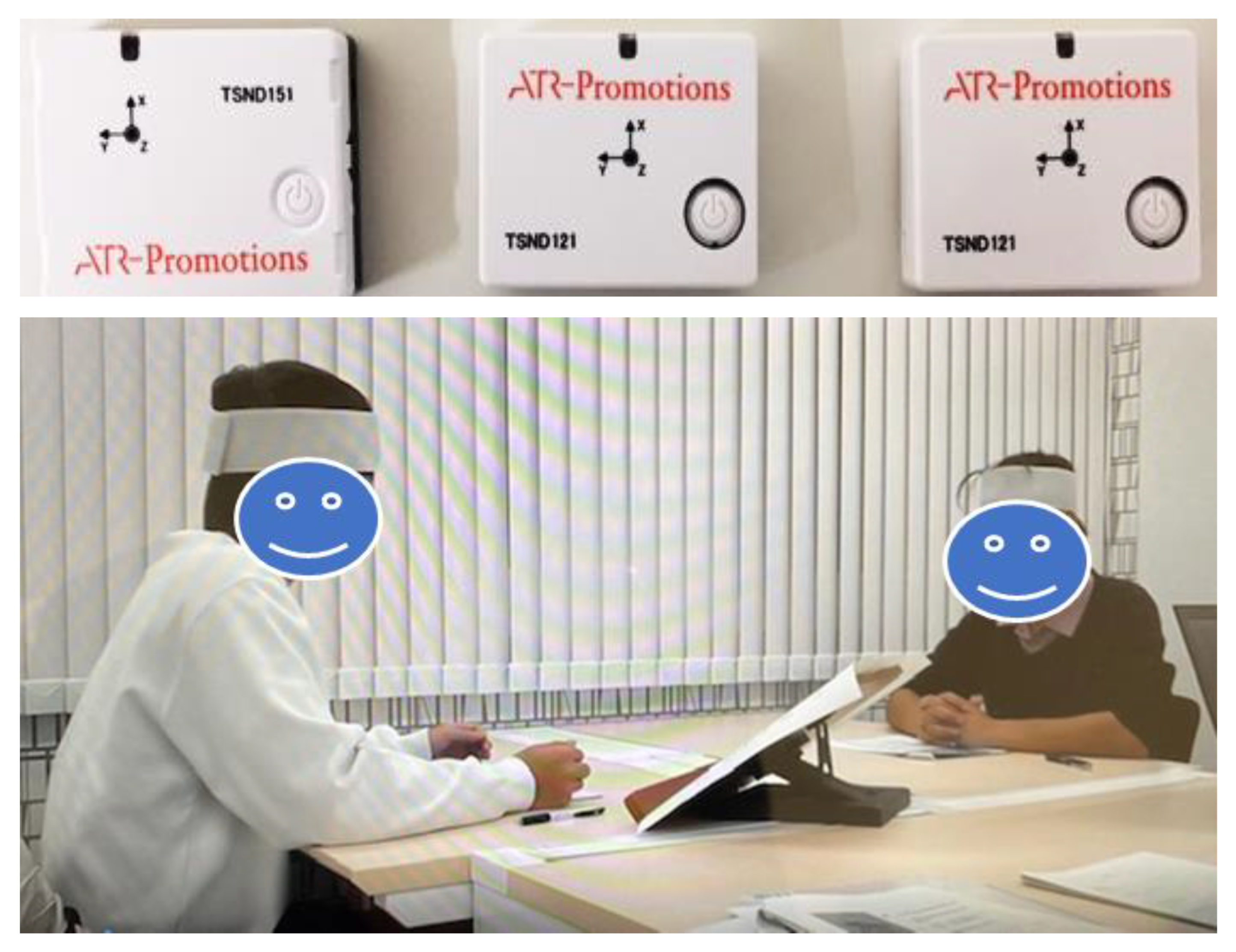
Figure 3.
Phase difference distributions of head movements across all dyads in the TD group (A) and the ASD group (B). The horizontal axis denotes the phase difference between speaker and listener head movements (in milliseconds), where positive values indicate that the listener’s movement lags behind the speaker’s, and negative values indicate the reverse. The vertical axis represents the relative frequency of phase difference occurrences, binned in 100 ms intervals. The grey vertical line marks the overall mean of the distribution, and the red curve represents a smoothing spline fitted to the data. The TD group displays a sharply peaked, symmetrical distribution centered near the mean, reflecting high temporal precision in interpersonal synchrony. In contrast, the ASD group exhibits a flatter, more dispersed distribution, indicative of reduced synchrony precision and greater temporal variability.
Figure 3.
Phase difference distributions of head movements across all dyads in the TD group (A) and the ASD group (B). The horizontal axis denotes the phase difference between speaker and listener head movements (in milliseconds), where positive values indicate that the listener’s movement lags behind the speaker’s, and negative values indicate the reverse. The vertical axis represents the relative frequency of phase difference occurrences, binned in 100 ms intervals. The grey vertical line marks the overall mean of the distribution, and the red curve represents a smoothing spline fitted to the data. The TD group displays a sharply peaked, symmetrical distribution centered near the mean, reflecting high temporal precision in interpersonal synchrony. In contrast, the ASD group exhibits a flatter, more dispersed distribution, indicative of reduced synchrony precision and greater temporal variability.
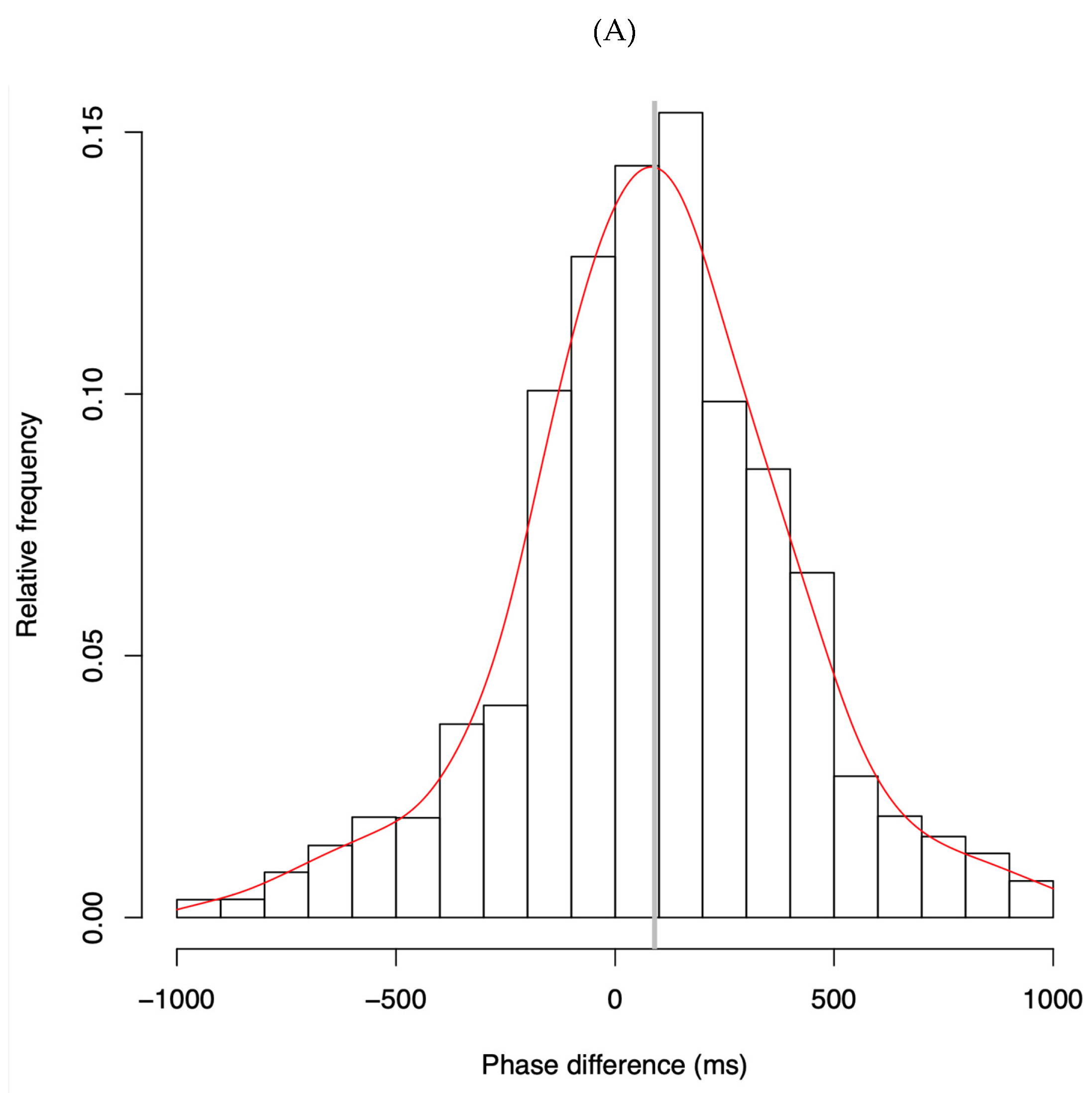
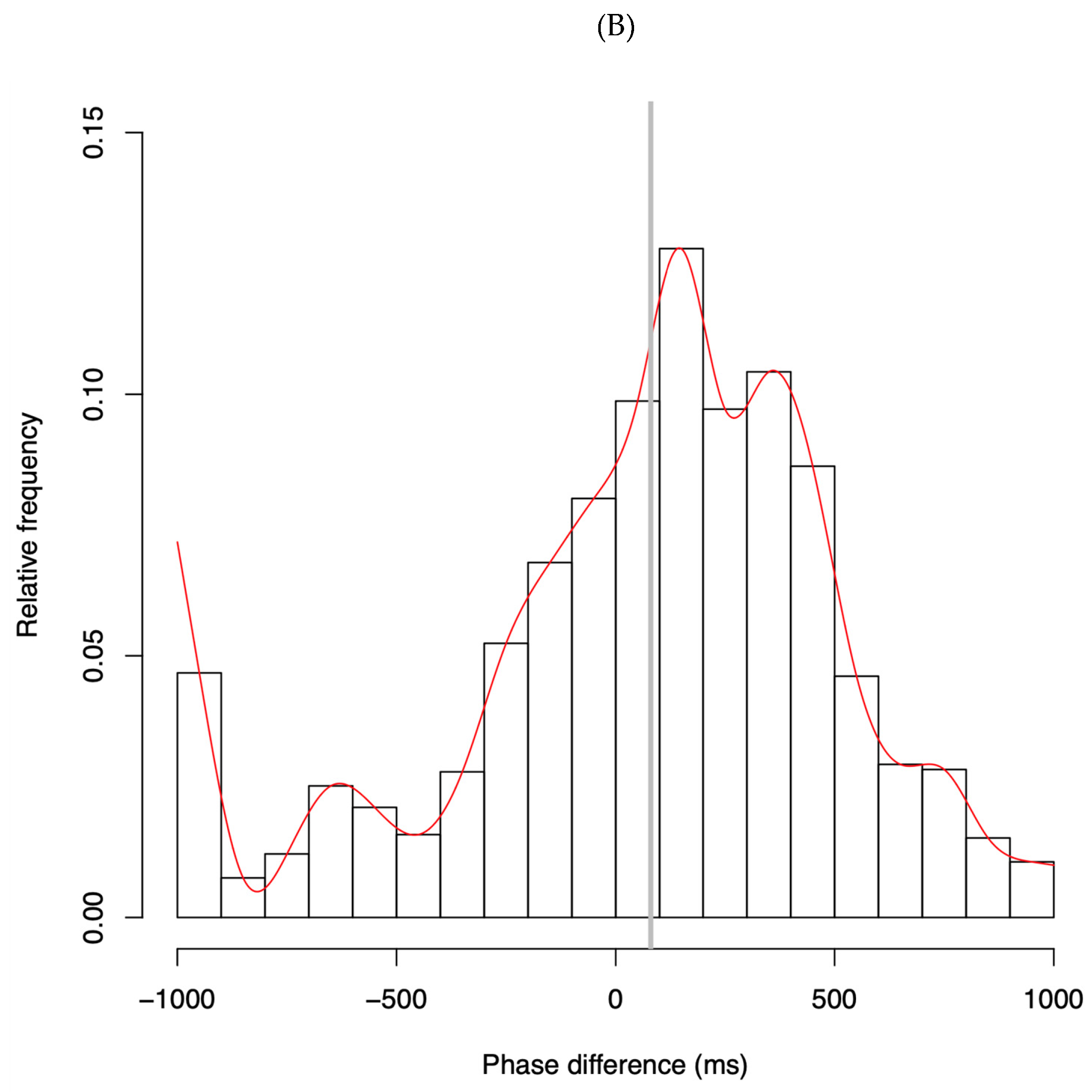
Figure 4.
Raincloud plots illustrate group-level differences between TD and ASD participants across four synchrony-related metrics. Each plot combines a violin plot (distribution), a boxplot (median and interquartile range), and individual data points. Panels show: (A) Relative Frequency, (B) Mean Phase Difference, (C) Standard Deviation, and (D) Kurtosis. Asterisks indicate statistically significant differences (*p < .05, **p < .01, *p < .001); “n.s.” denotes non-significance.
Figure 4.
Raincloud plots illustrate group-level differences between TD and ASD participants across four synchrony-related metrics. Each plot combines a violin plot (distribution), a boxplot (median and interquartile range), and individual data points. Panels show: (A) Relative Frequency, (B) Mean Phase Difference, (C) Standard Deviation, and (D) Kurtosis. Asterisks indicate statistically significant differences (*p < .05, **p < .01, *p < .001); “n.s.” denotes non-significance.
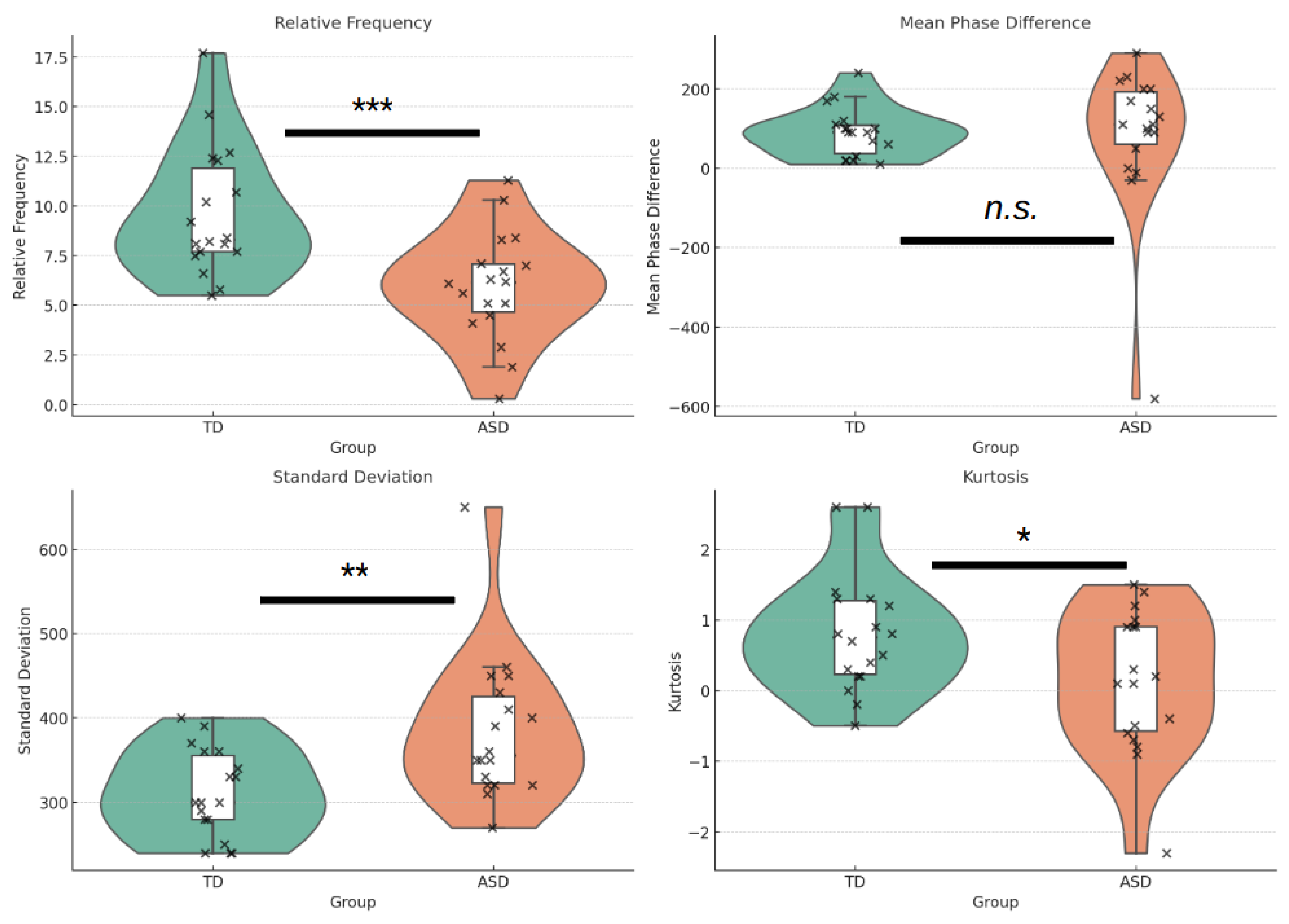

Table 1.
Clinical, cognitive, and diagnostic characteristics of ASD participants.
| ASD Participant No.(Gender) | Comorbidities & Medication (+/–) | IQ/DQ | AQ |
| A1(F) | ADHD (-) | 92 | 30 |
| A2(F) | — | Average Range | 28 |
| A3(F) | — | Average Rage | 30 |
| A4(F) | — | 97 | 21 |
| A5(M) | Epilepsy (+) | 87 | 38 |
| A6(M) | — | 121 | 33 |
| A7(M) | — | 102 | 35 |
| A8(M) | — | 75 | 34 |
| A9(F) | ADHD (+) | 87 | 38 |
| A10(M) | ADHD (-) | 115 | 36 |
| A11(M) | SLD | 86 | 35 |
| A12(F) | — | 139 | 30 |
| A13 (M) | — | 86 | 10 |
| A14 (M) | Color Vision Deficiency | 93 | 32 |
| A15 (M) | — | 93 | 22 |
| A16 (F) | SLD, ADHD (-) | 111 | 37 |
| A17 (F) | — | 97 | 38 |
| A18 (F) | — | 69 | 23 |
Disclaimer/Publisher’s Note: The statements, opinions and data contained in all publications are solely those of the individual author(s) and contributor(s) and not of MDPI and/or the editor(s). MDPI and/or the editor(s) disclaim responsibility for any injury to people or property resulting from any ideas, methods, instructions or products referred to in the content. |
© 2025 by the authors. Licensee MDPI, Basel, Switzerland. This article is an open access article distributed under the terms and conditions of the Creative Commons Attribution (CC BY) license (http://creativecommons.org/licenses/by/4.0/).
Copyright: This open access article is published under a Creative Commons CC BY 4.0 license, which permit the free download, distribution, and reuse, provided that the author and preprint are cited in any reuse.


