

Submitted:
31 March 2025
Posted:
01 April 2025
You are already at the latest version
Abstract
Education is an effective tool for influencing pupils’ perceptions and understanding of climate change, which impacts their pro-environmental behaviours in response to the adverse effects of climate change. This research employed a pre- and post-design to ex-amine fifth- and sixth-graders perceptions, knowledge, and motivations of climate change. A survey was used to examine pupils' perceptions, knowledge, and motivations regarding climate change among fifth- and sixth-graders, with a sample of 114 pupils randomly selected from two primary schools. The findings revealed that pupils currently have low perceptions of climate change and limited knowledge of its causes, impacts, mitigation, and adaptation. Pupils were less motivated to act on climate change. How-ever, they found it more important to learn about it. Following the climate change edu-cation, fifth- and sixth-graders reported increased perceptions, knowledge, and motiva-tions about climate change. This study contributes to addressing the gaps in climate change education by enhancing the climate change literacy of young minds, including their concerns, attitudes, and awareness, as well as their understanding of climate change causes, effects, and mitigation and adaptation strategies. The research appeals to all ed-ucational stakeholders to consider initiatives for climate change education among early learners.
Keywords:
climate change education
; fifth and sixth-grade pupils
; primary school
1. Introduction
Climate change is a significant concern for African countries, and the continent is projected to be among the most affected by climate change impacts, such as widespread drought, flooding, and catastrophic storms [1,2], particularly among the poorest countries. Specifically in the Sahel region, agricultural productivity, primarily reliant on rain-fed systems, is suffering, resulting in crop failures and livestock losses. In this view, food security and malnutrition rates increase, particularly among vulnerable people [3].
In Africa, many young people no longer attend school regularly [4]. Consequently, when Cyclone Freddy struck Southern Africa in March 2023, almost 5% of children in Malawi faced school closures [3]. Additionally, 42% of primary schools were closed in 2015 due to the drought, resulting in approximately 130,000 children missing school due to severe weather events in Malawi [3]. Almost 57% of schools in Zimbabwe reported destruction of certain infrastructure due to Cyclone Idai, which struck the country in 2019 [3]. Extreme weather events, such as flooding and wind, have been leading to the destruction of bridges, highways, and educational institutions. During the 2016/2017 agricultural season, substantial rainfall occurred nationwide, destroying around 18.0% of the country's schools and disrupting the education of around 500,000 students in Zimbabwe [5]. In 2014, weather-related diseases, including malaria and diarrhoea, resulted in the deaths of 4.5% of all primary school children and 1.4% of secondary school dropouts. In 2015, 3.8% of secondary school children and 1.3% of secondary school students dropped out of school due to illness. Child marriage serves as a coping strategy in response to climate catastrophes, as the bride's price helps the family provide sustenance, clothing, and education, thereby enhancing food security. Consequently, in 2015 in Zimbabwe, 20.5% of girls who discontinued their education due to marriage and 14.6% who did so due to pregnancy encountered this situation [5].
Moreover, strong winds have destroyed some of the Nigerian school buildings, and the mangroves protecting the coastline have been significantly depleted due to human activities [6]. Recent floods in Nigeria have caused extensive damage to dwellings, resulting in a significant displacement of individuals seeking improved living conditions. Schools and educational materials were destroyed, negatively impacting children's learning experiences. The destruction of homes due to flooding has intensified the insecurity faced by secondary school students in Nigeria, undermining their safety and education [6]. Furthermore, like the rest of the Sahel, Mali has faced severe climate changes over the past three decades, preventing its varied ecosystems from returning to their old equilibrium. Climate austerity has been gradually implemented, with disastrous consequences: recurrent rainfall shortfalls have led to famine, exodus, and death for humans and animals, and the reactivation of dunes in Mali's northern Sahel [7]. In 2024, the United Nations Children's Fund (UNICEF) reported that Mali, Niger, and Senegal are part of eight countries throughout the world where children are subjected to temperatures above 35 degrees Celsius for more than half the year [8]. Moreover, since 2019, the education authorities of Mali have adjusted the working hours in basic education from March to June to accommodate heat waves, resulting in a loss of 1 hour and 30 minutes from working hours [9,10].
On the other hand, from July to September 2024, the Office for the Coordination of Humanitarian Affairs (OCHA) reported that Mali experienced exceptional rainfall, the heaviest since 1967. Consequently, torrential rains and overflowing rivers have caused significant damage to property and human life in Mali. Many schools have been designated as emergency shelters for victims in all nine regions and the Bamako district. Faced with this extraordinary scenario, on September 30th, the government postponed the start of the school year for primary, lower secondary, and secondary schools, allowing schools to continue their activities under acceptable conditions. The beginning of the 2024-2025 school year, initially scheduled for October 1st, has been postponed to Monday, November 4th. This decision aims to preserve the safety of students and educational staff and allow the authorities to better manage the consequences of the ongoing crises [11,12]. Given the above context, significant efforts are required to empower schoolchildren's capacity to mitigate and adapt to climate change in Mali.
The experts who comprise the Intergovernmental Panel on Climate Change (IPCC) have created global awareness of addressing climate change mitigation and adaptation through educational programmes [13]. Other scholars [2,3,4,5,6,7,8,9,10,11,12,13,14,15] have written about this issue globally. [14] suggests that education provides the necessary knowledge to achieve “successful climate change mitigation and adaptation.” Climate change education aims to develop and implement educational responses based on informed assessments that are effective in the context of climate-related disasters. Therefore, addressing climate change-related curricula in basic education could effectively restrict the cycle of gaps in adulthood [16].
Although, in the face of environmental and climate issues, education has long been perceived as the main lever for sustainable development insofar as it makes it possible to better inculcate in citizens the foundations of good citizenship and to build in them the values of their nation while taking into account the emotional, artistic, cultural, critical and practical. However, significant efforts have been made at primary and lower secondary through the Plan for the Generalization of Environmental Education in Mali (PAGEEM) since 1990. Moreover, in 2020, in the context of revitalising PAGEEM through the project to strengthen the resilience of the education system as an alternative for preventing and fighting climate change, the Ministry of Education and its partners undertook a socioeconomic, cultural, and political analysis. These results, the integration of climate change education into the national curriculum [17,18,19]. Consequently, the implementation of this project is impacted by the low technical, financial, and logistical capacity, as well as the lack of training. In addition, the project recommended increasing the duration of the training to address several limited practical cases, making documents on climate change topics available to schools, and continuing to strengthen the capacities of teachers and pupils on environmental and protection themes. This research extends to the point that pupils and teachers of Koulikoro understand, teach, and learn about climate change, which becomes the interest of the study. The study aims to examine the perceptions, knowledge, and motivations of fifth- and sixth-grade pupils regarding climate change before and after climate change education. It also seeks to explore the views of fifth- and sixth-grade pupils on the status of climate change in the curriculum before and after a climate change education initiative. The study is among the first research to examine the integrated climate change education curriculum in the nation's primary education system. Although Malian citizens need to be aware of climate change mitigation and adaptation strategies. The study findings can help policymakers and educational stakeholders inform further policy development in response to climate change.
2. Materials and Methods
2.1. Study Design and Setting
This study employed a descriptive statistics pretest, instruction, and post-test research design. According to [20] the descriptive research approach is a fundamental research design that analyses the situation as it already exists. Additionally, it determines the characteristics of a specific thing through observation or examines the relationship between two or more occurrences. Several scholars have applied descriptive research pre/post-test design in their work. The study conducted by [21,22,23] used this research design in their work. In these studies, the authors employed a survey to collect quantitative data about climate change-related issues among student respondents. In this study, the pre-tests and post-tests were identical and featured a series of four- and five-point Likert scale statements about CC perceptions, knowledge, motivations and the status of climate change in the curriculum. This study is situated within the context of a broader multidisciplinary curriculum-based climate change education intervention in primary schools in Koulikoro. In this context, teachers received forty hours of professional development on climate change. The intervention was implemented from January 17, 2024, to March 22, 2024. The post-test was administered after the teaching/learning sessions. This paper presents the findings of pre-tests and post-tests among fifth- and sixth-graders. In contrast, a previous study focused on pre-test findings, while future research will discuss the teaching sessions, approaches, and conclusions related to the dependent variables. The pre-test data were collected in November 2023, and the post-test data were collected after sessions of climate change education in May and June 2024.
2.2. Study Area and Selected Schools
This study was conducted in Koulikoro city. Koulikoro is the second administrative region of Mali. According to the 2017 census by the town hall, the commune's population is estimated at 59,213 inhabitants, comprising 29,404 women and 29,808 men, over an area of 228 square kilometres [24]. The city is located on the left bank of the Niger River, 60 km northeast of Bamako, by the RN 27 national road. It extends over the plain on the banks of the river, overlooking a plateau, an extension of the Manding Mountains called the Niana Koulou [24]. This study was conducted in two primary schools in Koulikoro. The Pedagogic Animation Centre (CAP) of Koulikoro gathered the two schools. The CAP is the board of the Ministry of Education and manages primary and lower secondary schools. The schools included Primary School “C,” among the Lassana Fofana of Koulikoro school group. It welcomes approximately 300 pupils annually, while Primary School Bachaka Keita, a private school, welcomes around 400 pupils annually. The selected schools and the localisation of the city of Koulikoro are illustrated in Figure 1.
2.3. Study Sampling Procedures
The participants in this study were selected from two primary schools, one public and one private, designated by the Pedagogical Animation Centre of Koulikoro. The targeted respondents were fifth- and sixth-grade pupils aged 11 to 12. 11 to 12 years were set as the benchmark because respondents were expected to respond to the questionnaire, which led to the development of a climate change educational system, and respondents below this age bracket in primary education could have difficulty completing such activities. The selection criteria assumed that each pupil started school at age six. The Malian educational law enshrined in Article 34 stipulates that primary education admits children as young as six [25]. The study utilised a survey questionnaire employing probability sampling, namely the simple random sampling approach, to select participants. The Rao soft [26]sampling determination formula was used to estimate a sample size of 114 respondents. The confidence interval and margin of error for the sample size estimation were 95% and 5%, respectively.
We compiled a list of each class's population and randomly selected a sample by name, following the sample frame and the established selection criteria. Furthermore, the sample size comprises 54 public school pupils, 30 fifth-grade pupils, 15 boys and 15 girls. However, 24 sixth-grade pupils were chosen, with 11 boys and 13 girls. We randomly selected 60 pupils from the private school, 30 from each grade, including 15 boys and 15 girls. Of the research sample of 114 pupils, 58 were female (50.9%), and 56 were male (49.1%). The Raosoft (2004) sample determination formula used for the sampling is presented below.
Where: n = Population size, r = responses, Z (C/100) = critical value and C = confidence level.
2.4. Study Instrument
The questionnaire was structured in four parts and included different sections (sections A to E) to assess pupils' perceptions of climate change (concerns, attitudes, and awareness), knowledge of climate change (causes, impacts, mitigation, and adaptation), motivations for climate change (motivation to act and desire to learn about), and views of the status of climate change in their syllabus.
Section A addresses the “Personal Information” part at the beginning. It elicits information about gender, age, type of school, and grade. Section B indicated, “Please explain what you believe climate change (CC) is”. Section C focused on perceptions of climate change (CC), comprising three subsections. Section C1 consists of four items about pupils' concerns about CC. Section C2 focuses on attitudes towards CC, with four items assessing pupils' attitudes towards this concept. Therefore, section C3 includes four items that assess CC awareness. Section D focuses on knowledge of CC. Twenty-three items were included in the causes of CC in section D1. In Section D2, the questionnaire contains thirteen items to assess pupils' knowledge of the impacts of CC. To investigate pupils' knowledge of CC mitigation, the questionnaire provides eighteen items in section D3. In the next section, Section D4, twelve items are used to assess pupils' knowledge regarding CC adaptation. Section E of the questionnaire addresses pupils’ motivation to act on CC, and their desire to learn about CC. Therefore, Section E1 includes eight questions on motivation to act on climate change (CC). Section E2, with six items, addresses the desire to learn about CC. The last part of the questionnaire (Section F) consists of seven items to determine pupils’ views about the status of CCE in the curriculum. Except for Section E2 of the questionnaire, a Likert scale ranging from 1 (strongly disagree) to 5 (strongly agree) is used in the other sections. A Likert scale with options ranging from 1 (not important) to 4 (very important) was used in section E2.
According to [27], validity assesses the accuracy of a quantitative study, whereas reliability evaluates its consistency. Therefore, [20] stated that validity and reliability are critical factors influencing correlation coefficients. This was achieved through the use of a carefully constructed questionnaire developed and reviewed by four professionals: an associate professor from Taraba State University in Nigeria, a professor from Hamburg University of Applied Sciences in Germany, a professor from the University of Cape Coast in Ghana, and a professor from Institut Polytechnique Rural de Formation et de Recherche Appliquée de Katibougou in Mali. Several recommendations were incorporated into the final version of this study. After obtaining approval, the questionnaire was pilot-tested on 54 pupils from two primary schools, following the reliability testing selection criteria using the Kobo Collect Tool. Internal consistency was assessed using the Cronbach alpha scale coefficient and reliability, and a value of 90% was attained, surpassing the 50% threshold considered appropriate by previous investigations [28,29,30].
2.5. Statistical Analysis and Testing
Data was extracted and arranged in a single spreadsheet with the questions and responses for each section. The spreadsheet was imported into the IBM Statistical Package for Social Sciences (SPSS version 29) software for analysis. Primarily, the items of each section were self-computed into unique variables. In this view, the perception variables comprised concerns, attitudes, and awareness. Knowledge of CC variables consisted of causes, impacts, mitigation, and adaptation. Motivation variables included the motivation to act, the desire to learn and the status of CC in the curriculum.
At the same time, the researchers administered the Shapiro-Wilk Normality Test to analyse the sample and verify whether the independent variables of perceptions, knowledge, and motivations regarding climate change, along with the status of climate change in the curriculum, conformed to a normal probability distribution. The null hypothesis (H0) was rejected. For the correlation analysis, we believed that the samples do not adhere to a normal distribution based on the requisite criteria for parametric tests and the results of the Shapiro-Wilk normality test, where the null hypothesis (H0) states that the data are normally distributed. The p-value for the variables examined was p < 0.05. In this view, we applied the non-parametric Spearman Rank Order Correlation analysis.
The non-parametric data do not presume any particular population characteristics, typically due to the uncertain nature of their numerical variables. They are often nominal and ordinal data derived from questionnaires and surveys [31]. Spearman correlation was used to determine the relationship between climate change perceptions (concerns, attitudes, and awareness), knowledge (causes, impacts, mitigation, and adaptation), motivations (motivation to act and desire to learn), and gender among pupil participants. The Spearman’s correlation coefficient is a non-parametric measure of the relationship between at least two ordinal variables. A correlation allows a researcher to determine whether and to what degree a link exists between two variables [32]. Correlation measurements assess the strength and direction of the relationship between two variables [16,17,18,19,20,21,22,23,24,25,26,27,28,29,30,31,32,33]. This test was performed at a significance level (α) of 0.05 during the analysis of the correlations. The mathematical formula of the Spearman Rank Order Correlation (rs) is given as follows:
where d = the difference between each pair of scores, Σ = the sum of the population, and N = the total number of scores. We calculate that this perfect correlation yields an index of association with a coefficient of correlation of +1.00 [34].
Frequencies and Percentages were used in pre-and post-tests to assess pupils’ definitions, perceptions, knowledge, motivation regarding climate change, and views on the status of climate change in the curriculum for descriptive statistics. The Spearman Order rank correlation Test was applied with a 95% confidence interval to determine the degree of association of pupils' perceptions, knowledge, and motivations. The relationship between pupils’ gender and motivation was examined using correlation tests, as illustrated by the correlation coefficient and p-value.
2.6. Ethics Statement
The Pedagogical Animation Centre (CAP) ethics committee of Koulikoro provided the ethical clearance for this study (CK: 217). This guaranteed that the study complied with the national and international ethical standards applicable in the country of the research. Additionally, the consent letter for pupil participants was sent to their parents, who gave their permission for their participation in the study. The informative letter was orally communicated to pupils before the commencement of the survey. Participants were notified that their participation was voluntary and could choose not to answer questions or engage in the survey. The names and residential status of the students were not necessary for confidentiality purposes. The study addressed the questions in both French and Bambara, the predominant languages of the study area.
3. Results
3.1. Primary School Pupils’ Definition of Climate Change
To better understand pupils' perceptions and knowledge of climate change (CC), they were asked, “Please explain what you believe CC is.” Then, pupils' definitions were compared to those put forward by the Intergovernmental Panel on CC (IPCC), which defines CC as “any change in climate over time, whether due to natural variability or as a result of human activity” [45],( p.22). The grading rubric adopted by [36] was used as a criterion for grading pupils' definitions. A total score of four was given to definitions that addressed all four aspects: change in climate over time, the result of natural processes, human activity, and the impacts of CC. A score of three was given if they cited three of the four elements, two if they stated two of the four elements and one if they mentioned only one. A response which failed to address any of the four elements or provide irrelevant responses and different points of view on CC obtained a score of 0.
The pre-test data indicate that none of the 114 respondents included all four or at least three aspects in their definitions. Seven pupils included two elements in their definitions, nine pupils mentioned only one of the aspects, and ninety-eight pupils mentioned none of the aspects. The last category consists of ninety-eight students who either held alternative conceptions of CC or provided irrelevant answers to what was required. The findings indicate that pupils do not understand CC in their pre-test, with most respondents reporting misconceptions. On the other hand, data showed that most respondents included some aspects in their definition of CC. Sixty-eight out of one hundred-fourteen pupils included one aspect, twenty pupils cited two factors, and eighteen included three. However, in the last category, eight pupils revealed alternative conceptions or irrelevant answers to what was required. Therefore, Table 1 explicitly showed that pupils revealed more understanding of the meaning of CC after climate change education intervention compared to their pre-test.
Table 2 data from the pre-test showed that 86% of the pupils' definitions of CC were more focused on alternative conceptions. CC was commonly defined as the shift from the rainy to the dry season. Some also considered it as the change from the cold to the hot season. 6.1% of pupils' definitions revealed impacts and causes, including waste (industrial and household) thrown in the river Niger and a reduction in water suppliers and resources. Only 4.4% of pupils’ definitions included rising temperatures during the dry season and a lack of rain during the rainy season, while 3.5% cited deforestation as contributing to CC. The post-test findings (Table 2) reported that 43.0% of respondents mentioned the causes of CC in their definitions. The pupils mainly focused on cutting down trees, firewood production, industrial activities, wastes and river sand mining as causes of CC. Therefore, 33.3% of respondents mentioned CC's impacts, including rising temperatures, flooding, droughts, air pollution, and water pollution. Moreover, 16.7% of pupils mentioned both CC causes and effects. Some noted that cutting down trees and charcoal production could increase temperature, and wastes could pollute water and air and degrade the environment. However, only 7.0% of respondents continued to indicate that they did not comprehend CC, even though it changes the seasons from rainy to dry.
3.2. Fifth and Sixth-Grade Pupils’ Perceptions of Climate Change
To explore pupils’ perceptions of climate change (CC) concerns, attitudes and awareness of CC were included. According to the data (Table 3), the pre-assessment revealed that most respondents (89.5%) were neutral about the fact that CC is occurring, a new societal and environmental issue. The same perception remained neutral, indicating that there were existing or immediate actions to solve CC, compared to the post-test, in which all respondents expressed concern about CC. While CC is real, environmental problems and immediate actions are available to address it. Regarding attitudes towards CC, Table 3 shows that 92.98% of respondents were neutral, whereas 4.39% disagreed, and 2.63% of pupils agreed that they asked questions about CC and took action to address it. In the post-test, the CCE improved this state by reporting that 99.1% of respondents agreed with the statements. Findings from the pre-test indicate that 92.1% of pupils reported being neutral, 7.02% disagreed, and 0.88% agreed with the awareness of CC. As a result, fifth- and sixth-grade pupils were unaware of the adverse effects of CC and did not believe that humanity could mitigate them. They were also not aware of CC forecasting. However, only 0.88% of the pupils were aware of CC. In the post-test, most pupils (97.4%) reported paying attention to CC information on radio, TV, social media, and newspapers.
3.3. Fifth and Sixth-Grade Pupils’ Knowledge of Climate Change
The data in Table 4 revealed that the majority, 93.86%, of the pupils were neutral towards the causes of CC, while 6.14% disagreed with the statements included in the questionnaire. In contrast, 97.4% of fifth- and sixth-grade pupils agreed that burning fossil fuels, cutting down trees, waste (household and agricultural), and cooling systems such as air conditioners cause CC, while the remaining percentage neither disagreed nor agreed in the post-test. Table 4 shows that 96.5% of the pupils reported being neutral, with the remaining 3.5% distributed among the other responses, indicating a low overall knowledge of CC impacts in the pre-test. However, the post-test data revealed that 97.4% of pupils agreed with the impacts of CC, including floods, droughts, loss of food production, air and water pollution, and damage to forests and wildlife. Regarding CC mitigation, 97.4% of the pupils had neutral opinions, while the remaining 3.0% were selected from the remaining responses. These findings revealed that fifth— and sixth-grade pupils knew little about CC mitigation strategies from the pre-test, including renewable energy, wildlife protection, agroforestry, tree planting, waste management, compost, and pesticide production. From the post-test, all pupil respondents (100.0%) agreed with these measures.
3.4. Fifth and Sixth-Grade Pupils’ Climate Change Adaptation, Motivation, and Status in the Curriculum
The assessment of pupils’ comprehension of CC adaptation resulted in a pre-test, with the majority of respondents, 97%, being neutral with the statements. This indicates that pupils have a limited understanding of issues related to climate change (CC) adaptation, such as climate-smart agriculture, windbreak techniques, septic tanks, water harvesting for irrigation, and awareness-raising strategies; however, the post-test results show that 96.5% of pupils reported agreeing with these adaptation measures to CC. Table 5 indicated that 93.9% of the fifth—and sixth-grade pupils reported being neutral in their motivation for CC. Accordingly, only 4.4% of the pupils were motivated to act on CC. The post-test findings showed that all respondents (100.0%) would be ready to use less electricity, plant more trees, help homeless people, and make an early warning system for parents and communities. Before the intervention, the majority, 96.5% of the respondents, were neutral regarding CC activities in their school and their status in the curriculum. Therefore, the data indicate that CC-related issues are not explicitly integrated into the modules, including physics and chemistry, natural sciences, history and geography, and French, as well as civic and moral education. Following the post-test, after the curriculum-based CC education intervention, pupils were asked about the status of CC in the fifth- and sixth-grade syllabus. As a result, 96.5% of pupils stated that they had learned about CC in French, moral and civic education, history and geography, observational and natural sciences, and physics and chemistry. Only 3.5% remained neutral regarding remarks on curriculum-based teaching on CC.
3.5. Fifth and Sixth-Grade Pupils’ Desire to Learn About Climate Change
The findings from the pre-test, as shown in Table 6, indicate that the majority of pupils, 62.3%, stated that learning about CC is important, followed by 30.7% of respondents, who indicated that it is moderately important to know about CC. In comparison, 6.1% mentioned that it is very important. The post-test data revealed that 84.2% of pupils indicated that learning about the greenhouse effect, its causes, impact, mitigation, and adaptation to CC is very important. Moreover, 15.8% of respondents reported that learning about CC is important.
3.6. Relationship Between Fifth and Sixth-Grade Pupils’ Perception, Knowledge and Motivations
The correlation analysis between pupils' concerns about CC and their attitudes towards CC was negligible; however, a positive relationship was observed in the pre-test (rs = 0.075). However, this association was low, with a positive statistical relationship in the post-test (rs = 0.148). This means that the more concerned they are about CC, the more action they take towards it. This relationship was significant at an alpha level of 5%. A negligible and low association was found between pupils’ concerns about CC and their CC awareness, with positive statistical relationships on the pre-test (r = 0.117) and post-test (r = 0.115), respectively, as shown in Table 7. Therefore, the more pupils are concerned about CC, the more they know it. This relationship was significant at an alpha level of 5%. The correlation analysis between pupils' awareness of CC and their knowledge of CC causes revealed a low correlation, with a positive association in the pre-test (rs = 0.031) and statistical significance in the post-test (rs = 0.228). The data conclude that the greater the pupils' awareness of CC, the more likely they were to understand its causes. This relationship was significant at an alpha level of 5%. The correlation analysis between fifth- and sixth-grade pupils' knowledge of CC causes and mitigation revealed a substantial and statistically significant positive relationship in both the pre-test (rs = 0.518) and post-test (rs = 0.585). This means that the more pupils know the causes of CC, the more likely they are to understand how to mitigate it. This relationship was significant at an alpha level of 5%. The correlation analysis revealed a moderate, positive, and statistically significant relationship in the pre-test (rs = 0.393) and a substantial statistical significance in the post-test (rs = 0.636) between the causes of CC and adaptation to CC. Accordingly, the more likely pupils are to know the causes of CC, the more likely they are to understand its adaptation. This relationship was significant at an alpha level of 5%. Table 7 indicates that the correlation analysis revealed a moderate and statistically significant positive relationship between pupils' knowledge of CC impacts and their motivation to act on CC in both the pre-test (rs = 0.234) and post-test (rs = 0.203). Therefore, when pupils better understand the impacts of CC, they will likely be more motivated to take action. This relationship was significant at an alpha level of 5%. There was a negligible association, with a positive statistical relationship, between pupils' gender and their desire to learn about CC in both the pre-test (rs = 0.056) and post-test (rs = 0.038). The pupil's willingness to learn about CC is not significantly associated with gender, as it is observed in both males and females. This relationship was significant at an alpha level of 5%.
4. Discussion
This research evaluated the perceptions, knowledge, and motivations of fifth- and sixth-grade pupils regarding climate change (CC) before and after a climate change education (CCE) session. Initially, pupils showed low perceptions and limited knowledge of CC. They were less motivated and indicated that CC was missing from their syllabus. However, they reported the importance of learning about it. The post-test findings explicitly indicate that participants reported enormous improvement in their concerns, attitudes and awareness of CC. They significantly increased their knowledge of climate change causes, impacts, mitigation, and adaptation, as well as their motivation to act on climate change and desire to learn more about it. Finally, pupils agreed that they had learned CC from their syllabus.
The pre-test data indicated that 86.0% of the pupils' definitions of CC predominantly reflect alternative conceptions. CC is sometimes characterised as transitioning from the wet to the arid seasons. Some also regarded it as a transition from the cold season to the summer season. These findings align with the research conducted by [37], which indicated that Finnish and Tanzanian pupils were unable to articulate the concept of CC. The Finnish students mainly mentioned that “it will be warmer” or “some things are changing.” Tanzanian students emphasised that CC is “weather changes recorded for a long time” or changes in the “atmosphere and weather.” The study was conducted in Nigeria [38] reveals that 37.3% of secondary pupils are unaware of CC, 53.2% possess limited knowledge, and 9.5% have a substantial understanding of the subject. The post-test data revealed that most pupils believe CC raises the average temperatures over long periods due to human activity and natural processes that significantly impact the environment, people, and their livelihoods. The research findings are in accordance with a study conducted in Tonga [36], the post-intervention data indicate that students resolved their misunderstanding of climate and weather and gained a more scientific understanding of climate change (CC). According to the data, students indicated CC impacts include more cyclones and droughts, rising sea levels, migration, and health problems.
Pupils reported low perceptions of CC in the first assessment. A few pupil (8.8%) believed CC was happening and stated it was a new societal and environmental problem for Mali. Other studies are consistent with these findings, which found that middle school students revealed low concerns about CC in North Carolina [39,40]; in Nigeria, [41] report that 87% of respondents were unsure of their feelings, felt helpless to address CC, or did not believe it was occurring. Similar to findings shown in Mozambique, where around 90.0% of the students did not believe that CC is happening, and 50% of the remaining percentage stated their disbelief [42]. However, the post-test showed that 100.0% of pupils believe CC is happening. Most of them highlight that CC is a societal problem for Mali. Moreover, 89.3% of respondents are hopeful that there are actions we can implement to lessen the effects of CC. The research findings are comparable to research carried out in other countries, in Austria [43] assessed the responses to global warming among last year's primary students, supporting this study's findings, reported that 75.0% of primary students believed that global warming was currently happening, and 66.0% worried about it; [44] majority of Algerian students were either very (42.6%) or moderately (40%) concerned about CC and, in Ghana, [45] most undergraduate students believe CC is real and mostly human-caused, and they raised concerns about it.
Regarding attitudes toward CC, pupils often lack positive responses in recognising it before they experience it firsthand and are unwilling to ask questions about it, with 93.0% of respondents expressing neutrality. These findings are comparable to the earlier study in Finland [33], which reported that a lack of concern for young people can reduce environmental behaviour by denying environmental problems. Although their findings show that some students are aware of the causes and effects of CC, their attitudes and ability to influence others' actions are pessimistic and doubtful. On the other hand, the post-test data indicated that pupils strongly agreed (99.12%) that they would act to prevent CC before experiencing its impacts. These findings aligned with those [46] who studied the attitudes of ninth-grade Finnish students toward CC consequences. The data indicate that most students perceive CC as a risk; 55.0% of respondents expressed concern about its consequences.
Pupils revealed low awareness of CC from the pre-test. They did not pay attention to CC news on television, radio, social media, or in the newspaper; most participants (90.0%) remained neutral. These aligned with worldwide research [47,48,49] shows that 40% of people have never heard of CC. The findings of this research are featured in other countries [50] 61.0% of Palembang City students did not believe that CC information from social media was accurate and [41] 28.0% of Nigeria's students and civil servants were unaware of the concept of CC. Data post instruction revealed that 97.4% of pupils agreed that the government and everyone in Mali should help reduce CC. They also indicate that they pay attention to CC news on television, radio, social media, and newspapers. Comparatively, these findings are higher than those from the national study conducted by [51] which found that six out of ten Malians (64.0%) are aware of CC. Our findings are in line with other countries [52] who claimed that 90.0% of Malaysian students believed everyone is responsible for preserving the environment; [41] 58% of Nigerian students were aware of CC.
From the pre-test, pupil participants (93.9%) reported misunderstandings about what activities could cause CC, such as burning fossil fuels, bushfires, cutting down trees, and livestock production, as well as damaging the ozone layer and cooling systems. These findings are comparable to those [51] who reported that their national survey indicated that 47.0% of Malians believe CC is caused by human activities, compared to 38.0% who attribute it to natural processes. This is consistent with studies conducted in other countries [53] claiming that Indonesian students' knowledge of global warming is very low; [48] showing that 43% of students in America do not realise that human activities are the primary cause of global warming. However, evaluation after education shows that 97.4% of pupils agreed that human action mainly causes CC, including burning fossil fuels such as oil, coal and natural gas, cutting down trees, rice, cotton, and maize production and cooling systems; they also natural processes such as water vapour, and bush or forest fires. This result is higher than the one obtained from the national survey [51], which found that 47% of Malians reported that human activities contribute to climate change. Our findings from the post-test align with those of [37] who discussed primary school students' knowledge of CC in Finland and Tanzania. The findings revealed varied views of students about the causes of CC. Accordingly, Finnish students identified carbon dioxide emissions from fossil fuel combustion, as well as from the frequent use of cars, aircraft, and boats, the clothing industry, water pollution, and sea plastic, as contributing to climate change (CC). Conversely, Tanzanian students emphasised both human activities and natural processes as the causes of CC. Therefore, they indicated that CC is caused by charcoal production from wood, tree harvesting and cutting, air and water pollution, tobacco smoking, weather changes, and certain electrical charges in the clouds.
Most pupils (93.9%) are unaware that CC exacerbates floods and droughts, forces people to migrate from their land, and impacts food production, health, and financial issues for people in Mali. The same respondents are unaware of the impacts of CC on water, crop, and livestock production failures, pollution, rising temperatures, and forest disappearance. This is much better than the findings in the United States [54], in which none of the students described the impacts of global warming on crops and livestock; in Nigeria [41], only 0.9% of students and civil servants associated CC impacts with damage to public services. At the same time, no one linked them to the destruction of private businesses and properties or the intrusion of salt into drinking water supplies. According to the post-assessment, 97.4% of pupils agreed that CC exacerbates floods and droughts. They also indicate that it significantly impacts the health and finances of families, as well as food production, water resources, and supply chains. These findings are consistent with a national study conducted by [51] which found that 74.0% of Malians are aware of CC and recognise its impacts, such as drought, floods, and extreme heat. Our results mirrored those of [50], who reported that 68.4% of students knew CC increases the likelihood of forest fires, a clean water crisis, the severity of overflowing rivers, storm intensity, and even big floods yearly in many regions worldwide. Similarly, studies on overseas students in Austria and Denmark found that 68.0% of students considered CC a significant issue for the survival of the next generation of human beings [55]. At the same time, according to [56], a large percentage of students believe that CC affects both communicable and non-communicable diseases, as noted in their study on the perceptions of nursing students in the Philippines. The students mainly indicate the impacts of CC, such as a rise in mortality rates and diseases (human and animal) due to droughts and flooding, scarcity of food and water, unusual weather patterns, animal deaths, wildfires, diseases in humans, hurricanes, and severe heatwaves.
Findings show that most of the pupils (96.5%) do not know that biking or walking instead of using cars could reduce CC; also, they mostly (96.5%) remained neutral about producing energy from water, solar, wind, biomass, solar ovens, improved stoves, and geothermal rather than oil, coal, charcoal, and natural gas. Pupil participants report unknown, with overall (97.4%) remaining neutral on CC adaptation techniques such as intercropping, half-moon, half-moon, stone barriers, windbreak, Live hedges and windbreak, zai and dune fixation techniques, construction of septic tanks for schools and households, raising awareness of parents and community capacity building, organise an exhibition for parents and community members, write opinion pieces on CC for the school newspaper. These findings mirrored those reported by [22], who, based on the pre-test, demonstrated that students presently conflate CC mitigation techniques with unrelated environmental issues to a lesser extent than in prior surveys. Students exhibited a limited comprehension of adaptive strategies for CC. Moreover, findings from the post-intervention indicate that most pupils strongly believe that biking or walking mitigates CC, rather than using cars. All respondents (100.0%) agree that adopting renewable energy sources, such as wind, solar, biomass, water, and geothermal, mitigates climate change (CC) more effectively than non-renewable sources, including oil, natural gas, and coal. They strongly believe that solar ovens and improved stoves for cooking, as well as measures such as prohibiting bushfires, promoting agroforestry, reducing pesticide production, managing waste and wildlife, and planting trees, mitigate climate change. Regarding adaptation, most pupils (96.5%) understood climate-smart agriculture techniques, including crop rotation, intercropping, zai, and the half-moon method. Some respondents agreed that stone barriers, live hedges and windbreaks, septic tanks, and dune fixation help people adapt to climate change (CC). The respondents agreed that awareness, exhibition and writing opinion pieces on CC adapt to its impacts. These findings aligned with those from the post-test [22] indicating that pupils demonstrated an enhanced understanding of the climate system and knowledge of mitigation and adaptation strategies. A similar result was found by [50], revealed that 69.5% of junior high school students agree that using products that can be recycled and reused is one strategy to mitigate the consequences of global warming; [37] found that Finnish primary students indicate mitigation strategies for CC, including sorting waste, picking up rubbish, throwing away chewing gum properly, using textile shopping bags, reusing clothes, using electric bicycles and cars, riding bicycles, walking, and using public transport instead of mopeds and flying; their study further stated that Tanzanian students claimed the power of education to mitigate and actively adapt to CC. According to the findings, pupils indicated that the best way to mitigate and adapt to CC could be to educate friends, parents, and families about the benefits of the environment, such as teaching children about planting trees and stopping the cutting down of trees.
Pupils indicate low motivation to take action against climate change (CC). They remained neutral (93.9%) regarding planting trees, walking or biking more, using less electricity in their homes, and helping people who have lost their land and homes due to climate change. They remained less motivated to strengthen parents’ and communities’ resilience to protect their lives and livelihoods against climate change (CC) and establish an early warning system, and only 4.4% agreed with the motivations to act on CC. These findings are lower than those of the study by [50] in Palembang claimed that 47.4% of students are ready and believe their actions can help solve environmental concerns. The post-test data indicate that 100.0% of pupils either strongly agreed or agreed that they would be prepared to solve the problems of climate change (CC) by planting trees, using less electricity in their homes, and walking or biking more. They also revealed that they will be ready to help homeless people due to CC and establish early warning systems for communities and parents. Our findings are consistent with studies [53] that indicate senior high school students are willing to save electricity and are willing to ride bicycles or buses instead of motorcycles to reduce their environmental contribution to greenhouse gases.
In the pre-test, pupils mostly (90.5%) remained neutral when asked if they had CC-related issues in their subjects, such as physics, chemistry, natural science, civic and moral education, and French; however, 8.8% agreed that CC was present in the curriculum. These findings suggest a lack of inclusion of CC in the curriculum or the inability of teachers to effectively teach CC-related topics in the syllabi, thereby preventing pupils from becoming familiar with them. These findings align with [37] show that the Tanzanian Science and Technology Syllabus for Primary School Education does not include CC but discusses renewable energy and gases that constitute air components. Similarly, it align with [57], who found that in Zambia, 47% of teachers believe the current curriculum lacks content on CC, 44% believe it provides insufficient knowledge, and only 9% think it provides adequate knowledge. After conducting the instruction sessions, most fifth and sixth-grade pupils (96.5%), stated that CC awareness is well-established in their school. They also revealed they have learned about CC in natural science, physics, chemistry, history, geography, civic and moral education and French modules. This study's findings are comparable to those from [22] in which students learned mitigation and adaptation strategies for climate change, greenhouse gases, and energy balance. They were introduced to four mitigation strategies: energy efficiency, transportation conservation, building efficiency via decreased heat and energy usage or alternative energy sources, and efficient power generation. Students were also introduced to units on sea level rise and the effects of melting ice on land.
Data from the pre-test revealed that approximately half of the pupils (62.3%) stated that it is important to learn about the causes, impacts, greenhouse gases, mitigation, and adaptation of climate change. After the intervention, pupils showed a high level of interest in the findings, which indicated that most fifth- and sixth-graders (84.2%) stated that it is important to learn about the greenhouse effect, its causes, and its impacts on people, the economy, and the environment of Mali, including mitigation and adaptation strategies. These findings corroborate those found in earlier studies among Ghanaian students [45], which report that 86.7% of students desire to learn about CC, and 65.8% of respondents are willing to take a CC course as a free choice. The study by [36] found that most Tongan students (85.0%) indicated that it is very important to learn about the causes, impacts, and effects of climate change on their families (83.0%). All participants, 84.2%, of the teachers indicated that learning about CC mitigation, adaptation, and its impact on nature is very important. Most teachers found it important to learn about CC causes, the effects of greenhouse gases, and their impact on families, the economy, and nature.
The overall assessment (pre and post-test) showed that the correlation between pupils' concern about and attitudes towards CC is not statistically significant. However, a positive association was observed. According to the findings, pupils' concerns about CC are positively associated with their awareness. Their CC awareness correlates positively with their knowledge of CC causes. Therefore, these relationships show no statistically significant association. This result is consistent with a study in North Carolina [40], which found a positive association between CC concern and pro-environmental behaviour [58], indicating that hope and concerns about CC are significantly associated with changes in knowledge. This study builds upon previous research results by [53], which found that the knowledge of senior high school students about global warming significantly correlates with their environmental attitudes. The findings indicate that the correlation analysis between pupils' knowledge of CC causes and their understanding of CC mitigation and adaptation is statistically significant in both the pre-and post-tests. Data also report that pupils' perceptions of CC impacts significantly correlate to their motivation to act on CC. Moreover, the participants' gender was positively associated with their desire to learn about CC, and no statistical significance was reported. These mirrored the studies of other countries [40,41,42,43,44,45,46,47,48,49,50,51,52,53,54,55,56,57,58] who claimed that CC concerns of the United States students are associated with pro-environmental behaviour, including household behaviour such as turning off lights and closing the refrigerator door, addressing information-seeking behaviour such as asking others about what to do about environmental problems, and addressing transportation choices: walking for transportation. The research findings are comparable to the studies conducted on Finnish students' knowledge of and attitudes towards CC, views of mitigation and its predictors of willingness to act [33,46] indicate that gender is positively associated with CC mitigation and adaptation, including the desire to act on it. In addition, the study findings mirrored those reported in Israel [59], which indicated that teachers' knowledge about CC impacts significantly correlated to their concerns and willingness to act.
5. Conclusion
This research aims to examine the perceptions, knowledge, motivations, and views of fifth- and sixth-graders regarding climate change education in the curriculum. This study proved that pupils revealed misconceptions about climate and weather in their current views. Therefore, they mostly addressed the conflation between climate and weather in their post-test findings. Although climate change is a serious problem for Mali, pupils' perceptions and knowledge of climate change-related issues were limited, particularly regarding the causes of climate change and the adaptation and mitigation strategies to mitigate its impacts. Considering perceptions and knowledge, the respondents were motivated to act on climate change, and this motivation was not directly related to their desire to learn more about it. This could be explained by the absence of climate change-related topics in their respective syllabi. Whereas they mostly reported being neutral about climate change-related topics in their syllabus, such as modules in geography, history, sciences, physics, chemistry, moral and civic education, and French education.
The post-test findings explicitly indicate that climate change education was productive. Therefore, pupils reported being able to clarify the concepts of climate and weather. Pupils were more concerned about climate change and hoped for something to be done about it. Climate change education enhanced the study participants' understanding of climate change causes, impacts, mitigation strategies, and adaptation measures. It provided an intellectual space for pupils to explore what they both knew and did not know about climate change by putting them at the forefront of the teaching process to address their shortcomings. They were highly motivated to take action against climate change. Learning about climate change was mostly important among learners, as it is integrated across their subjects. As we can see, a statistical relationship exists between pupils' awareness, knowledge and motivations.
This research assessed the significance of climate change curriculum-based education among young learners by evaluating their current thoughts about climate change-related issues and exploring what they understood about the subject matter during the instruction. This study emphasized the value of climate change education in providing Malian fifth— and sixth-graders with sufficient, sophisticated information about the causes, consequences, mitigation, and adaptation to climate change, as well as pro-environmental behaviours.
However, the relatively small sample size, comprising fifth— and sixth-grade pupils from two primary schools in Koulikoro, may not fully represent the broader population of primary schools in Mali. The reliance on self-reported data could introduce bias or inaccuracies. Additionally, the study did not account for external factors such as family background, media exposure, or community engagement, which could influence pupils' perceptions, knowledge and motivations of climate change. The pedagogical approaches and tools were not explicitly discussed and the multidisciplinary education was conducted within a short duration. To address these limitations, future research could expand the sample size and include schools from various regions of Mali to obtain a more comprehensive understanding of pupils' CC perceptions, knowledge and motivations. Longitudinal studies could assess how these perceptions, knowledge, and motivations evolve using a qualitative approach, particularly following specific educational interventions. Investigating the influence of family, community, and media would provide a more holistic view, and exploring the effectiveness of different pedagogical approaches in under-resourced schools could identify the most impactful strategies for fostering climate-conscious citizens in Mali and similar contexts.
This research could facilitate the reevaluation of educational systems to be more climate change-conscious, enabling students to become more engaged, coherent, and responsible citizens. Therefore, we suggest extending climate literacy beyond the geography and natural sciences to include it in other academic disciplines, such as technology, history, physics, chemistry, moral and civic education, and the arts. We also suggest encouraging teachers to develop their capacity for addressing climate change. This study also suggests the prominent integration of climate change into curricula and educational materials, encompassing both initial and ongoing training for educators and teachers.
Author Contributions
ABD: Conceptualization, Investigation, Methodology, Visualization; Data Curation, Formal Analysis, Validation, Writing – Original Draft Preparation. AC, VNO, WLF and CAK: Supervision, Review, and Editing. All authors read and approved the final manuscript.
Funding
This research received no external funding.
Data Availability Statement
The data for this study were collected among fifth- and sixth-grade pupils from two primary schools in Koulikoro. The participants were assured that their information would be used only for research purposes. and the data will be destroyed five years after collection.
Acknowledgments
The authors first acknowledge the West African Science Service Centre on Climate Change and Adapted Land-Use (WASCAL) doctoral program at the University of The Gambia. The authors secondly acknowledge the IPCC Scholarship Programme Round 7 Awardee under the Prince Albert of Monaco Foundation. The authors of this study would like to express their sincere thanks to the authorities of the Pedagogic Animation Centre of Koulikoro staff and directors for giving them access to conduct the study.
Conflicts of Interest
The authors declare no conflicts of interest.
Abbreviations
The following abbreviations are used in this manuscript:
| CC | Climate Change |
| CCE | Climate Change Education |
| CAP | Pedagogical Animation Centre |
| WASCAL | West African Science Service Centre on Climate Change and Adapted Land Use |
| IPCC | Intergovernmental Panel on Climate Change |
| PAGEEM | Plan for the Generalization of Environmental Education in Mali |
| OCHA | Office for the Coordination of Humanitarian Affairs |
| UNICEF | United Nations Children's Fund |
| RN | National Road |
References
- F. O. Boadu, “Climate Change,” in Agricultural Law and Economics in Sub-Saharan Africa, 2016, pp. 555–571.
- N. Stern, “The economics of climate change: The stern review,” Econ. Clim. Chang. Stern Rev., vol. 9780521877, pp. 1–692, 2008. [CrossRef]
- World Bank, The Impact of Change Climate on Education and What to Do About It. 2024.
- J. O. Adejuwon, “Effect of climate variability on school attendance: a case study of Zamfara State in the semi-arid zone of Nigeria,” Weather, vol. 71, no. 10, pp. 247–248, 2016. [CrossRef]
- Zimbabwe Human Development Report, “Towards Building a Climate Resilient Nation,” 2017.
- J. M. Jimada, “Concepts of Climate change and its Impacts on Education,” pp. 1–16, [Online]. Available: https://buk.academia.edu/JimadaJimada?swp=tc-au-10887884.
- I. M. Diallo, C. H. Konde, F. Traore, and M. L. Fofana, “Changement Climatique au Mali et Tendance à la Désertification,” 1995.
- Relief web, “Au Mali, au Niger et au Sénégal, les enfants confrontés à des températures supérieures à 35°C plus de la moitié de l’année - Mali _ ReliefWeb,” 2024.
- Malijet, “Malijet - Canicule _ Réaménagement de l’emploi du temps pour le bonheur des élèves et des enseignants,” 2019. malijet.com (accessed Jan. 12, 2025).
- B. Fomba, “Canicule au Mali _ Nouveaux horaires dans les écoles — Sahel Tribune,” Sahel Tribune, Apr. 06, 2024.
- Hamana, “Mali _ Report de la rentrée scolaire suite aux inondations – Hamama Média,” 2024.
- OCHA, “Mali: Aperçu des régions affectées par les inondations de 2024.” 2024.
- D. Ssekamatte, “The Opportunities and Challenges for Climate Change Education at Universities in the African Context: A Comparative Case Study of Makerere University (Uganda) and University of Dar es Salaam (Tanzania),” Carl von Ossietzky University of Oldenburg, Germany, 2018.
- A. Anderson, “Combating Climate Change Through Quality Education,” Washington, DC, 2010. [CrossRef]
- W. L. Filho, Climate Change Management, Springer H. 21033 Hamburg: Springer-Verlag Berlin Heidelberg 2010, 2010.
- R. Ramos, M. J. Rodrigues, and I. Rodrigues, “Children’s Perception of Climate Change in North-Eastern Portugal,” Societies, vol. 13, no. 1, pp. 1–12, 2023. [CrossRef]
- MEADD Mali, “Ministère de l’environnement de l’assainissement et du développement durable. Contribution déterminée au niveau national révisée (CDN semptebr 2021),” 2017. [Online]. Available: http://scioteca.caf.com/bitstream/handle/123456789/1091/RED2017-Eng-8ene.pdf?sequence=12&isAllowed=y%0Ahttp://dx.doi.org/10.1016/j.regsciurbeco.2008.06.005%0Ahttps://www.researchgate.net/publication/305320484_SISTEM_PEMBETUNGAN_TERPUSAT_STRATEGI_MELESTARI.
- UNESCO, “L’UNESCO s’engage auprès du Gouvernement du Mali pour l’intégration dans les programmes scolaires l’éducation à la prévention et à la lutte contre des changements climatiques,” United Nations Educational, Scientific and Cultural Organization, Bamak, pp. 1–7, 2022.
- S. M. Tounkara and M. Soudani, “L’ Education au Développement Durable par Problématisation de Phénomènes de Pollution Environnementale en Formation Initiale des Enseignants au Mali,” ESI Prepr., vol. 32, pp. 1–9, 2024.
- C. Williams, “Research Methods,” J. Bus. Econ. Res., vol. 5, no. 3, pp. 81–82, 2007. [CrossRef]
- A. E. Bozdo, “the Effects of Instruction With Visual Materials on the Development of Preservice Elementary Teachers ’ Knowledge,” Educ. Technol., vol. 10, no. 2, 2011.
- L. Bofferding and M. Kloser, “Middle and high school students ’ conceptions of climate change mitigation and adaptation strategies,” Environ. Educ. Res., vol. 21, no. 2, pp. 275–294, 2015.
- T. Kox, M. Göber, B. Wentzel, E. Freundl, and H. W. Rust, “Fostering weather and climate literacy among pupils by engagement in a weather citizen science project,” Proc. Sci., vol. 393, no. September, 2021. [CrossRef]
- Rapport de Koulikoro, “Rapport 2021 sur la Performance de la Gestion des Finances publiques locales sur la période 2018-2020 selon le cadre méthodologique PEFA 2016,” 2023.
- Gouvernement du Mali, “Loi 99-046 AN RM, portant loi d’orientation sur l’éducation,” National Assembly, Bamako, Mali, Loi 99-046 AN RM, 1999.
- Raosoft, “Raosoft Sample Size Calculator.” Raosoft. https://www.raosoft.com/samplesize.html, 2004. [CrossRef]
- C. L. Kimberlin and A. G. Winterstein, “Validity and reliability of measurement instruments used in research,” Am. J. Heal. Pharm., vol. 65, no. 23, pp. 2276–2284, 2008. [CrossRef]
- L. J. Cronbach, “Coefficient alpha and the internal structure of tests,” Psychometrika, vol. 16, no. 3, pp. 297–334, 1951. [CrossRef]
- R. P. Bagozzi and Y. Yi, “On the evaluation of structural equation models,” J. Acad. Mark. Sci., vol. 16, no. 1, pp. 74–94, 1988. [CrossRef]
- L. J. Cronbach and R. J. Shavelson, My Current Thoughts on Coefficient Alpha and Successor Procedures, vol. 1522, no. 310. 2004.
- G. Upton and I. Cook, A Dictionary of Statistics. Oxford University Press, 2008.
- L. Cohen, L. Manion, and K. Morrison, Research Methods in Education 8th Edition, vol. 11, no. 1. 2018.
- I. Ratinen and S. Uusiautti, “Finnish students’ knowledge of climate change mitigation and its connection to hope,” Sustain., vol. 12, no. 6, 2020. [CrossRef]
- J. W. Creswell, Research Design Qualitative, Quantitative and Mixed Methods Approaches 4th edition, SAGE., vol. 1999, no. December. California, 2014.
- C. K. Folland et al., “Observed Climate Variability and Change. In: Climate Change 2001: The Scientific Basis. Contribution of Working Group I to the Third Assessment Report of the Intergovernmental Panel on Climate Change [Houghton, J.T., Y. Ding, D.J. Griggs, M. Noguer, P.J.,” 2001.
- E. H. Havea, “Climate Change Education in Tongan secondary schools.,” The University of Waikato, 2021.
- P. Sjöblom, L. A. Wolff, S. Vuorenpää, and R. Grahn, “Primary school students and climate change an interview study in Finland and Tanzania,” J. Clean. Prod., vol. 380, no. September, 2022. [CrossRef]
- O. T. Odekeye, J. B. Fakokunde, R. OyebolabIwintolu, A. O. Alaba, and M. A. Adewusi, “Assessment of Climate Change Awareness among Secondary School Students in Osun State, Nigeria,” J. Teach. Learn. ( UJTL ), vol. 4, no. 1, pp. 1–12, 2024.
- R. X. Valdez, M. N. Peterson, and K. T. Stevenson, “How communication with teachers, family and friends contributes to predicting climate change behaviour among adolescents,” Environ. Conserv., vol. 45, no. 2, pp. 183–191, 2018. [CrossRef]
- K. Stevenson and N. Peterson, “Motivating action through fostering climate change hope and concern and avoiding despair among adolescents,” Sustain., vol. 8, no. 1, 2016. [CrossRef]
- D. Akinyoade and E. Akinwande, “Awareness of Causes, Consequences, and Issues in Climate Change among Selected Nigerians,” J. Inst. Econ. Niger., vol. 2, no. 4, pp. 1–18, 2016.
- A. García Vinuesa, S. A. Rui Mucova, U. M. Azeiteiro, P. Á. Meira Cartea, and M. Pereira, “Mozambican students’ knowledge and perceptions about climate change: an exploratory study in Pemba City,” Int. Res. Geogr. Environ. Educ., vol. 31, no. 1, pp. 5–21, 2022. [CrossRef]
- K. Skamp, E. Boyes, and M. Stannistreet, “Global warming responses at the primary secondary interface 2. Potential effectiveness of education,” Aust. J. Environ. Educ., vol. 25, no. May 2014, pp. 31–44, 2009. [CrossRef]
- M. Lounis, A. Madani, and S. E. Boutebal, “Perception and Knowledge of Algerian Students about Climate Change and Its Putative Relationship with the COVID-19 Pandemic: A Preliminary Cross-Sectional Survey,” Climate, vol. 11, no. 4, 2023. [CrossRef]
- B. Y. Ofori, E. P. K. Ameade, F. Ohemeng, Y. Musah, J. K. Quartey, and E. H. Owusu, “Climate change knowledge, attitude and perception of undergraduate students in Ghana,” PLOS Clim., vol. 2, no. 6, pp. 1–27, 2023. [CrossRef]
- M. Hermans and J. Korhonen, “Ninth graders and climate change: Attitudes towards consequences, views on mitigation, and predictors of willingness to act,” Int. Res. Geogr. Environ. Educ., vol. 26, no. 3, pp. 223–239, 2017. [CrossRef]
- A. Leiserowitz, E. Maibach, C. Roser-Renouf, G. Feinberg, and S. Rosenthal, “Climate change in the American mind: April, 2014,” Yale Proj. Clim. Chang. Commun., no. April, pp. 1–30, 2014.
- A. Leiserowitz, N. Smith, and J. Marlon, “American teens’ knowledge of climate change,” Igarss 2014, vol. 46, no. 1, pp. 1–5, 2014.
- B. Chryst, J. Marlon, S. van der Linden, A. Leiserowitz, E. Maibach, and C. Roser-Renouf, “Global Warming’s ‘Six Americas Short Survey’: Audience Segmentation of Climate Change Views Using a Four Question Instrument,” Environ. Commun., vol. 12, no. 8, pp. 1109–1122, 2018. [CrossRef]
- C. Chairunnisa, I. Sriyanti, M. Meilinda, N. Aisyah, and I. Ismet, “Knowledge, Beliefs, and Attitudes of Junior High School Students in Palembang Towards Climate Change Issues,” J. Res. Sci. Educ., vol. 8, no. 2, pp. 798–804, 2022. [CrossRef]
- B. Bougoudogo and M. Coulibaly, “Les Maliens dénoncent les effets néfastes des changements climatiques,” Afro Baromètre, no. 222, pp. 1–9, 2018, [Online]. Available: www.afrobarometer.org.
- S. W. Y. Wan Ahmad et al., “Environmentalism among Primary’s Students Based on Awareness, Knowledge, and Attitude Study,” Int. J. Acad. Res. Bus. Soc. Sci., vol. 9, no. 12, pp. 1–12, 2019.
- U. Rosidin and A. Suyatna, “Teachers and Students Knowledge about Global Warming:a Study in Smoke Disaster Area of Indonesia,” Int. J. Environ. Sci. Educ., vol. 12, no. 4, pp. 777–786, 2017, [Online]. Available: https://eric.ed.gov/?id=EJ1144822.
- D. P. Shepardson, D. Niyogi, S. Choi, and U. Charusombat, “Students’ conceptions about the greenhouse effect, global warming, and climate change,” Clim. Change, vol. 104, no. 3–4, pp. 481–507, 2011. [CrossRef]
- I. Harker-Schuch and C. Bugge-Henriksen, “Opinions and knowledge about climate change science in high school students,” R. Swedish Acad. Sci., vol. 42, no. 6, pp. 755–766, 2013. [CrossRef]
- J. P. Santos and E. M. S. Gumabay, “Nursing Students’ Perceptions about the Effects of Climate Change on Health: A Descriptive Exploratory Study,” Nurse Media J. Nurs., vol. 14, no. 1, pp. 16–28, 2024. [CrossRef]
- K. H. Mubanga, K. Mazyopa, B. Chirwa, A. Musonda-Mubanga, and R. Kayumba, “Trained Climate Change Educators: Are Secondary School Pupils Getting Quality Climate Change Education? Views from Teachers and Pupils in Lusaka, Zambia,” Eur. J. Dev. Stud., vol. 2, no. 4, pp. 14–23, 2022. [CrossRef]
- K. T. Stevenson, M. Nils Peterson, and H. D. Bondell, “Developing a model of climate change behavior among adolescents,” Clim. Change, vol. 151, no. 3–4, pp. 589–603, 2018. [CrossRef]
- D.-E. Seroussi, N. Rothschild, E. Kurzbaum, Y. Yaffe, and T. Hemo, “Teachers’ Knowledge, Beliefs, and Attitudes about Climate Change,” Int. Educ. Stud., vol. 12, no. 8, p. 33, 2019. [CrossRef]
Figure 1.
Localisation of the study schools in Koulikoro City.
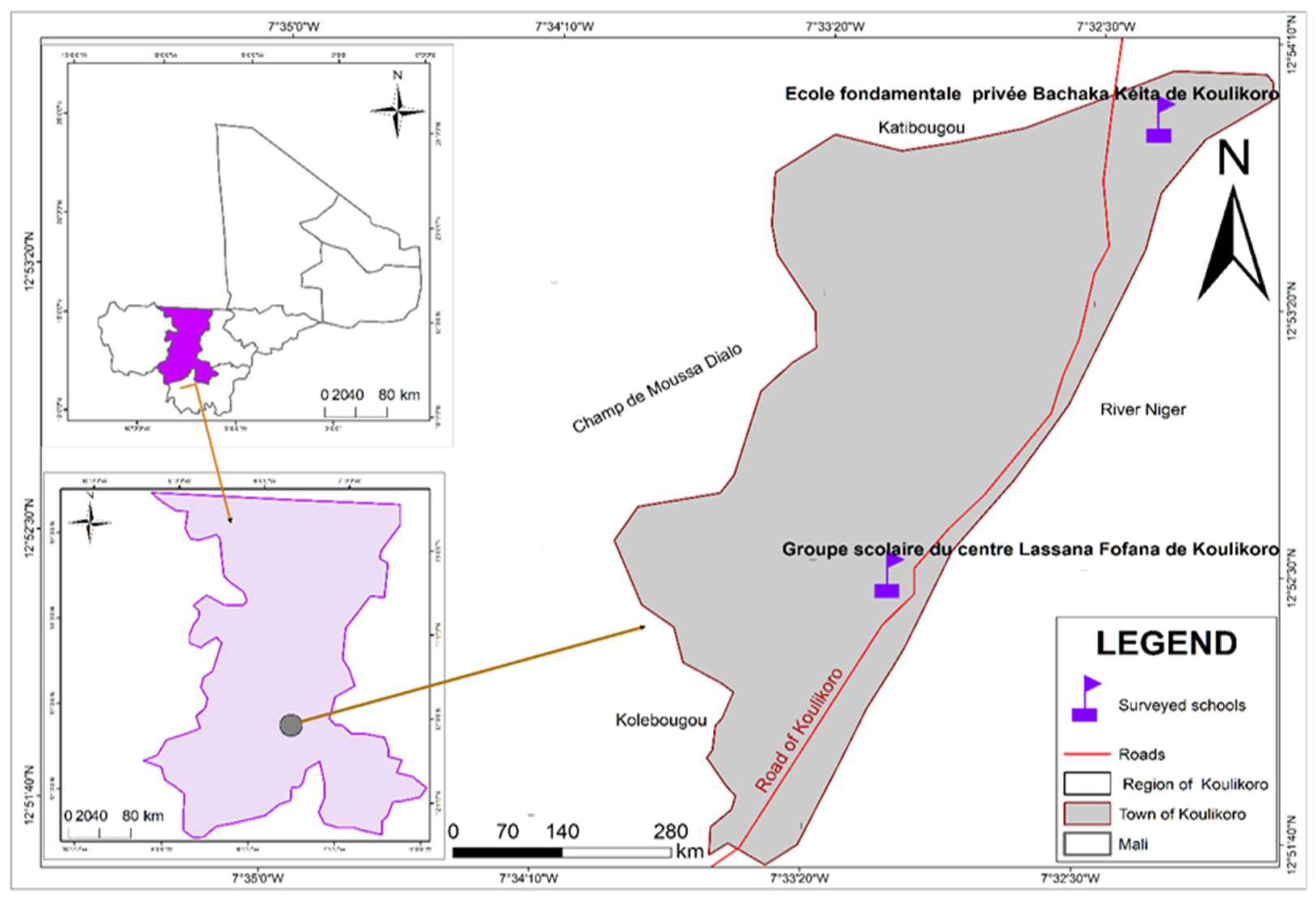

Table 1.
Frequencies of pupils’ responses in comparing their definitions to the IPCC’s definitions of climate change (N=114):.
Table 1.
Frequencies of pupils’ responses in comparing their definitions to the IPCC’s definitions of climate change (N=114):.
| Grading Rubric | ||||||||||
| List of aspects | Pupils cite four from the list below | Pupils cite any three of the lists below | Pupils cite any two from the list below | Pupils cite any one from the list below |
Pupils cite none from the list below |
|||||
| Test | pre | post | pre | post | pre | post | pre | post | pre | post |
| Count | 0 | 0 | 0 | 18 | 7 | 20 | 9 | 68 | 98 | 8 |
Expected response: “Change in climate over time, result of natural process, Result of human activity, Impact”.
Table 2.
Frequencies of pupils’ responses to their definitions of climate change by category (N=114).
Table 2.
Frequencies of pupils’ responses to their definitions of climate change by category (N=114).
| Category | Pre-test | Post-test | ||
|---|---|---|---|---|
| Items | Freq. | % | Freq. | % |
| Impacts | 5 | 4.4 | 38 | 33.3 |
| Causes | 4 | 3.5 | 49 | 43.0 |
| Impacts & Causes | 7 | 6.1 | 19 | 16.7 |
| Alternative Conceptions & Irrelevant Answers | 98 | 86.0 | 8 | 7.0 |
Table 3.
Fifth and sixth-grade pupils’ perceptions of climate change.
| Responses | Concerns | Attitudes | Awareness | |||
|---|---|---|---|---|---|---|
| Pre-test | Post-test | Pre-test | Post-test | Pre-test | Post-test | |
| Scale | % | % | % | % | % | % |
| Strongly disagree | 0.0 | 0 | 0.0 | 0 | 0.0 | 0 |
| Disagree | 2.6 | 0 | 4.4 | 0 | 7.0 | 0 |
| Neutral | 89.3 | 0 | 93.0 | 0.9 | 90.0 | 2.6 |
| Agree | 8.8 | 100 | 2.6 | 99.12 | 0.9 | 97.4 |
| Strongly agree | 0.0 | 0 | 0.0 | 0 | 0 | 0 |
Note: The real limit of scale “1.00-1.49 = Strongly disagree, 1.50-2.49 = disagree, 2.50-3.49 = neutral, 3.50-4.49 = agree and 4.50-5.00 = strongly agree”.
Table 4.
Fifth and sixth-grade pupils’ knowledge of climate change.
| Responses | Causes | Impacts | Mitigation | |||
|---|---|---|---|---|---|---|
| Pre-test | Post-test | Pre-test | Post-test | Pre-test | Post-test | |
| Scale | % | % | % | % | % | % |
| Strongly disagree | 0.0 | 0 | 0.0 | 0 | 0.0 | 0 |
| Disagree | 6.1 | 0 | 6.1 | 0 | 2.4 | 0 |
| Neutral | 93.9 | 2.6 | 93.9 | 1.7 | 96.5 | 0 |
| Agree | 0.0 | 97.4 | 0.0 | 97.4 | 0.9 | 100 |
| Strongly agree | 0.0 | 0 | 0.0 | 0.9 | 0 | 0 |
Note: The measurement scale is: “1.00-1.49 = strongly disagree, 1.50-2.49 = disagree, 2.50-3.49 = neutral, 3.50-4.49 = agree, and 4.50-5.00 = strongly agree”.
Table 5.
Fifth and sixth-grade pupils’ climate change adaptation, motivation, and status in the curriculum.
Table 5.
Fifth and sixth-grade pupils’ climate change adaptation, motivation, and status in the curriculum.
| Responses | Adaptation | Motivation to act | Status in the curriculum | |||
|---|---|---|---|---|---|---|
| Pre-test | Post-test | Pre-test | Post-test | Pre-test | Post-test | |
| Scale | % | % | % | % | % | % |
| Strongly disagree | 0.0 | 0 | 0.0 | 0 | 0.0 | 0 |
| Disagree | 2.4 | 0 | 0.8 | 0 | 0.8 | 0 |
| Neutral | 97.4 | 2.6 | 93.9 | 0 | 96.5 | 3.5 |
| Agree | 0.0 | 96.5 | 4.4 | 72.8 | 8.7 | 96.5 |
| Strongly agree | 0.0 | 0 | 0.0 | 27.2 | 0.0 | 0 |
Note: The measurement scale is: “1.00-1.49 = strongly disagree, 1.50-2.49 = disagree, 2.50-3.49 = neutral, 3.50-4.49 = agree, and 4.50-5.00 = strongly agree”.
Table 6.
Fifth and sixth-grade pupils’ desire to learn about climate change.
| Responses | Pre-test desire to learn | Post-test desire to learn |
|---|---|---|
| Scale | % | % |
| Not important | 0.9 | 0 |
| Moderate important | 30.7 | 0 |
| Important | 62.3 | 15.8 |
| Very important | 6.1 | 84.2 |
Note: The measurement scale is “1.00-1.49 = not important, 1.50-2.49 = moderately important, 2.50-3.49 = important, and 3.50-4.49 = very important.”.
Table 7.
Relationshipa between pupils’ perceptions, knowledge and motivations.
| Perceptions, Knowledge and Motivations | Pre-test | Post-test | |||
|---|---|---|---|---|---|
| rs | P-value | rs | P-value | ||
| Concerns | Attitudes | 0.075 | 0.429 | 0.148 | 0.117 |
| Concerns | Awareness | 0.117 | 0.217 | 0.115 | 0.225 |
| Awareness | Causes | 0.031 | 0.744 | 0.228 | 0.015 |
| Causes | Mitigation | 0.518 | 0.000*** | 0.585 | 0.000*** |
| Adaptation | 0.393 | 0.000*** | 0.636 | 0.000*** | |
| Impacts | Motivation to act | 0.234 | 0.012** | 0.203 | 0.030** |
| Gender | Desire to learn | 0.056 | 0.551 | 0.038 | 0.689 |
Note. aSpearman Rank Order Correlation Coefficient; *p<0.05; *** significant at 1% level, ** significant at 5% level.
Disclaimer/Publisher’s Note: The statements, opinions and data contained in all publications are solely those of the individual author(s) and contributor(s) and not of MDPI and/or the editor(s). MDPI and/or the editor(s) disclaim responsibility for any injury to people or property resulting from any ideas, methods, instructions or products referred to in the content. |
© 2025 by the authors. Licensee MDPI, Basel, Switzerland. This article is an open access article distributed under the terms and conditions of the Creative Commons Attribution (CC BY) license (http://creativecommons.org/licenses/by/4.0/).
Copyright: This open access article is published under a Creative Commons CC BY 4.0 license, which permit the free download, distribution, and reuse, provided that the author and preprint are cited in any reuse.


