
Submitted:
25 April 2025
Posted:
26 April 2025
You are already at the latest version
Abstract
Although previous research examine the impact of insufficient resources on innovation, few have investigated how it alters outcomes. Government assistance is crucial for this role, particularly with new technological advancements. Taiwan's economy predominantly consists of small and medium enterprises, which have many challenges such as insufficient resources and limited technological advancements. The study examines how governmental assistance facilitates the acquisition of resources. A small to medium-sized enterprise in Taiwan is depleting its limited resources to develop innovative digital concepts. The structure of this work is as follows: Initially, we examine significant texts and propose concepts. Subsequently, we will discuss the methodology employed in our research and present the findings. Ultimately, we examine our findings and propose many regulatory suggestions.
Keywords:
Entrepreneurship in SMEs
; Digital Transformation
; Public Policy and Innovation
; Innovation Performance
Introduction
Small and medium-sized enterprises frequently have resource deficiencies, including cash, technology, and human capital, even though innovation is strategically imperative in the present competitive landscape (Barney, 1991). In Taiwan, where small and medium-sized enterprises constitute approximately 98 percent of businesses and account for 80 percent of employment (Ministry of Economic Affairs [MOEA], 2024), surmounting resource constraints is crucial for maintaining competitiveness and fostering economic growth. Taiwanese SMEs have historically been a vital element of the nation’s economy, contributing about fifty percent of GDP; nevertheless, they are presently facing challenges from digital disruption and globalization. The swift global adoption of Industry 4.0 technology and heightened competition from lower-cost producers have exposed the vulnerabilities of SMEs reliant on traditional business strategies (Chen et al. 2021). These challenges have intensified the pressure on SMEs to innovate and pursue digital transformation despite their constrained resources. The Taiwanese government has increased its involvement in fostering SME innovation due to the recognition of these challenges. Various governmental efforts and support programs, including tax incentives, training initiatives, and subsidies, have been implemented to promote digital transformation in SMEs (Chung and Hiciano, 2024). The Executive Yuan of Taiwan authorized a comprehensive SME development plan that offers subsidies of up to NT$100,000 for each SMEs undergoing digital transformation.
This government aid aims to eliminate financial barriers, thereby motivating SMEs to adopt new technologies, enhance their digital capabilities, and innovate in their business models, processes, and products. Unresolved inquiries persist concerning the efficacy of these treatments in enhancing the innovative performance of SMEs and the fundamental mechanisms that facilitate achievement. This study examines how government-supported resource inputs might be coordinated to improve innovation outcomes in SMEs to address these challenges. We suggest that SMEs may leverage external support to compensate for insufficient internal resources, so gaining a “innovation advantage,” according to the resource-orchestration paradigm (Sirmon et al. 2011). The Resource-Based View (RBV) underscores the strategic utilization of valuable resources to achieve competitive advantage (Barney, 1991); open innovation highlights the incorporation of external knowledge networks to enhance internal resources (Chesbrough, 2003; Lee et al., 2010); and dynamic capabilities focus on the importance of businesses’ ability to integrate, reorganize, and deploy resources in rapidly evolving environments (Teece, 2007). In this context, government support becomes an external resource that SMEs must effectively integrate with internal resources and network partnerships to enhance their innovative capabilities. In light of the prevailing trend of digitalization as a significant driver of SME growth and resilience, we focus on digital innovation capabilities. This paper is structured as follows. Initially, we analyze relevant studies on resource orchestration, the impact of governmental support on SME development, and SME innovation amid resource limitations. We subsequently discuss our technique, which encompasses the six-dimensional innovation metrics and the longitudinal quasi-experimental framework. Subsequently, we present the findings of the empirical research, highlighting the impact of government assistance on innovation performance. We analyze the findings in the debate in light of prior research and theoretical frameworks. Finally, we delineate the theoretical contributions and management implications of our work, identify its limitations, and propose avenues for future research.
Literature Review
Constraints on Resources and Innovation in Small and Medium Enterprises
Small and medium enterprises frequently encounter significant constraints regarding their resources. This encompasses a deficiency of financial resources, equipment, or proficient laborers. These difficulties can impede their capacity for creativity. The Resource-Based View posits that organizations can gain a competitive advantage by effectively utilizing unique and valuable resources. For small enterprises, this entails devising innovative strategies to optimize their limited resources while maintaining market resilience. Previous studies indicate that these enterprises frequently compensate for insufficient resources by being agile, concentrated, and devising innovative, cost-effective solutions. 2011) this approach aligns with the concept of “jugaad,” which emphasizes ingenuity in constrained circumstances.
However, internal efficiency alone is insufficient to generate new ideas unless it is supported by external assistance. The open innovation hypothesis posits that organizations can transcend their resource constraints by leveraging external knowledge, expertise, and technologies (Chesbrough, 2003). Collaboration in innovation—such as engaging with suppliers, customers, research entities, or competitors—has become increasingly prevalent among small and medium-sized enterprises. These collaborations facilitate access to novel tools, market sentiments, and external research that would otherwise be difficult to obtain (Audretsch et al. 2021). For instance, clusters of enterprises and supply chains in Taiwan’s machinery and electronics sectors provide opportunities for smaller firms to participate in knowledge-sharing networks that enhance their innovative capabilities.
Dynamic Capabilities as a Mediating Factor
The concept of dynamic talents illustrates how tiny enterprises can transform their resources into novel outcomes. Teece (2007) asserts that dynamic capabilities refer to a firm’s ability to identify opportunities or threats, reallocate resources, and adapt its operations accordingly. Small enterprises possessing robust dynamic capabilities are better equipped to adapt to rapidly evolving environments by modifying their resource base. A small firm may see an increasing demand for online purchasing (noticing), invest in website development and train employees in e-commerce (taking), and modify its sales strategy to prioritize online methods (changing).
Dynamic talents function as a catalyst that transforms resources, whether internal or external, into innovative products, services, or methodologies. Recent studies underscore the critical importance of dynamic skills in linking resource utilization to the successful implementation of innovative ideas (Zahra et al., 2006; Wu et al., 2024). During periods of digital transformation, small and medium enterprises that cultivate adaptive skills, such as rapid learning, are more inclined to convert ideas into tangible solutions.
Government Support as an External Resource
Government assistance is crucial for alleviating resource constraints and facilitating innovation among small enterprises. Empirical evidence demonstrates that financial assistance and governmental support enhance small business growth by providing capital for research, technological advancements, or the employment of skilled labor. In addition to financial assistance, government initiatives frequently include opportunities for networking, training programs, and support structures designed to facilitate digital transformation.
The Ministry of Economic Affairs in Taiwan has initiated programs such as the Taiwan Cloud Marketplace (Tcloud) to assist small and medium enterprises in utilizing cloud technology. These solutions address two significant issues: insufficient funding and a shortage of competent labor. Government assistance through cost reductions via grants and loans, along with knowledge dissemination through training facilities, enables small and medium enterprises to undertake digital projects beyond their financial capacity.
The efficacy of governmental assistance depends on the manner in which small and medium firms integrate these resources into their operations. Research indicates that external assistance alone does not guarantee success with innovative concepts; it must be complemented by effective leadership and internal adaptability within the organization. A small business receiving government funding for internet sales must enhance its web sales and train employees to effectively utilize this technology. Government initiatives also mitigate the risks perceived by individuals when exploring new technology or entering unfamiliar industries, thereby encouraging small enterprises to pursue innovative ideas.
Propositions
According to the aforementioned literature review:
H1: Government funding enhances small business creativity by providing financial resources and positive communication.
H2: The influence of governmental assistance alters certain aspects of innovative concepts. Creativity is most significantly enhanced by direct research and development expenditures. The process modification yields minor improvements through enhanced work efficiency. A method of conducting business is slightly altered due to the gradual pace within groups.
H3: Transformative skills facilitate the connection between resource management (with governmental assistance) and innovation by enabling small enterprises to identify opportunities, effectively acquire resources, and adapt their operations.
Theoretical Framework
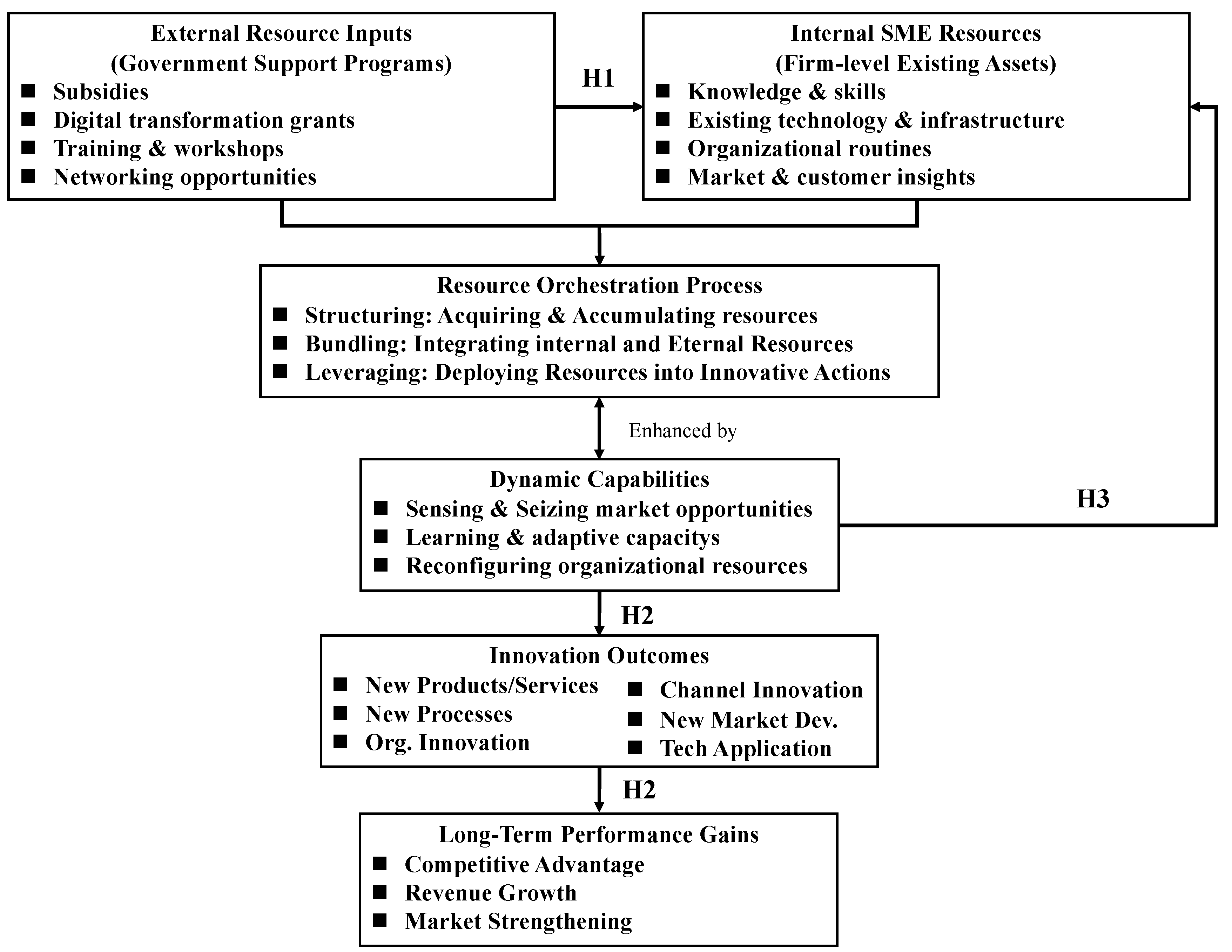
The proposed approach integrates the Resource-Based View with the concept of evolving skills, while incorporating governmental assistance as an external component. It states that:
Government assistance provides external support that alleviates constraints encountered by small enterprises. Active talents function as a conduit that transforms these tools into novel outcomes in product, methodology, and business model domains.
Figure 1.
Integrated Resource-Orchestration Model.
Methodology
Research Methodology
We employed a longitudinal study design to examine the impact of governmental funding on the creative capacity of small enterprises. The study was conducted as part of a government-funded digital enhancement initiative in Taiwan designed to stimulate small business innovation. Data regarding the small enterprises that participated was collected at two distinct intervals: immediately prior to the assistance program (initial collection) and approximately one year thereafter (subsequent collection). This first-second design facilitates the identification of variations in creative outcomes following government funding by enabling each enterprise to function as its own control group. Regardless of whether companies were self-selected or designated for the program, complicating random selection, the longitudinal aspect facilitates the demonstration of causality by documenting temporal changes that correspond with the program’s impacts.
All participating firms provided a comprehensive assessment of innovative capabilities and baseline performance data at Time 1 (before to assistance). The government plan subsequently provided small enterprises with various forms of assistance, including financial aid, support for utilizing approved digital technologies, online sales, training sessions for digital tools, and consultations with innovation advisors. With the program’s supervision and support, companies implemented modifications such as establishing new IT systems, initiating online sales channels, altering workflows, or developing new products. Approximately one year later at Time 2 (after assistance), the groups were reassessed using the same instrument to evaluate changes in their innovation skills and outcomes. Additionally, secondary data and follow-up discussions (e.g., specifics regarding financial transitions or patent applications) were collected to amalgamate information.
Sample and Data Acquisition
This study selected 139 small enterprises from Taiwan, comprising manufacturing (45%), services (30%), and technology sectors (25%), illustrating a diverse representation of Taiwan’s small company landscape. Data was collected in two segments: The initial phase occurred from January to June 2023, involving a preliminary survey; the subsequent phase reexamined the data from January to June 2024. Cronbach’s α was employed to assess internal consistency for all components, yielding values beyond 0.7 (e.g., Innovation Performance α = 0.82; Dynamic Skills α = 0.79), indicating robust reliability. Exploratory Factor Analysis (EFA) and Confirmatory Factor Analysis (CFA) were conducted to evaluate the hypotheses, yielding fit indices within typical ranges, e.g., CFI = 0.92; RMSEA = 0.05.
A total of 147 complete survey responses were collected at Time 1. By Time 2, 139 companies remained in the program and responded to all inquiries (8 businesses had exited or were unreachable), resulting in a retention rate of almost 95%. Despite the limited number of missing items, we employed pairwise deletion for any absent item-level data. Employing a within-subjects methodology and rigorous data retention, we examine 139 SMEs with comprehensive pre- and post-intervention data.
Measures
The primary emphasis is the organization’s ability to generate novel concepts, as evidenced by six components derived from the OECD’s Oslo Manual and earlier literature on innovation. The components are: (1) Innovations in products/services; (2) Novel methodologies; (3) Organizational transformations; (4) Alternative consumer engagement strategies; (5) Identification of new markets; and (6) Implementation of advanced technology. We developed a questionnaire with numerous inquiries that combined objective indicators with subjective assessment tools. The survey comprised 33 questions regarding the capacity for innovation.
Each element was examined with four to eight indicators. The revised product or service change component encompassed ratings indicating the quality of product development and the tally of “new products or services launched in the past year.” Enhancements in internal methodologies were observed through novel procedural modifications, such as increased efficiency and the adoption of preferred production techniques. Alterations in structural or organizational methodologies were perceived as manifestations of organizational innovation, such as the implementation of novel approaches to corporate operations or management practices. Channel innovation examined the establishment of novel methods for selling or distributing things, emphasizing online avenues such as initiating e-commerce. The indicators indicate the revenue generated from new locations and the expansion into further regions or client segments. The utilization of machinery, data analysis, or other innovative technologies within the corporation demonstrates the efficacy of these instruments in relation to the business operations. Utilizing a 5-point rating system, individuals (often owners or executives) indicated their level of agreement with personal remarks or their frequency of usage, where 1 signifies no agreement and 5 denotes strong agreement. Subjective opinions were integrated with quantifiable metrics (counts or shares) when appropriate. Upon normalizing the data, we determined the median value of the associated elements to calculate a cumulative score for each of the six new concepts at each interval. The primary outcome metrics are the six scores, which we aggregate using a simple average to demonstrate overall innovative capability. The instrument demonstrated strong internal consistency; at Time 1, the Cronbach’s alpha for the multi-item scale ranged from 0.72 to 0.85, indicating accurate measurement.
Government assistance (resource management): This research indicates that government assistance was provided to all firms rather than addressing a single survey issue. To quantify the data, we collected information regarding the extent of help utilized by each company. This encompassed expenditures on grants (in NT$), the number of training sessions attended, and the sorts of digital technologies utilized with program assistance. Supplementary studies employed these indicators to evaluate the efficiency of resource utilization by each small enterprise. Our proposal posits that governmental assistance enhances resource acquisition and effective utilization by businesses in the context of resource organization.
Dynamic Capabilities: We examined the evolution of talents through inquiries and managerial evaluations. Five brief assessments, derived from prior research, were employed to evaluate variations in proficiency. For instance, G. Pavlou and El Sawy (2011) developed a scale that illustrates the competencies of observation, integration, and transformation in learning. Examples include: “We frequently acquire and utilize new information or tools ahead of others,” and “Our company can swiftly adapt our operations in response to market fluctuations.” Individuals assigned ratings on a scale from 1 to 5. A mathematical analysis was conducted to examine middle effects utilizing the overall skill score, calculated as the average of the components.
We identified the business’s duration, sector, and workforce size as critical factors, as these elements can influence the organization’s foundational capabilities for innovation and its capacity to assimilate assistance. We also examined previous successes, such as A, which demonstrated the business’s outcomes and may align with new ideas beyond last year’s sales rise.
Data Analysis
Our study was conducted in phases. Basic numerical assessments and reliability evaluations were initially conducted for each test at Time 1 and Time 2. Subsequently, we analyzed the means before to and following the modification utilizing paired t-tests and repeated-measures ANOVA for each of the six components of innovation to assess efficacy. The primary assessment of whether innovation skills significantly changed post-instruction is conducted by repeated-measures ANOVA (one factor: time). We ensured that the fairness and normalcy of difference scores were appropriate; nonetheless, this is inconsequential in this context due to the presence of only two time points for analysis. We provide Wilk’s lambda from a multifactorial investigation across all components, accompanied by t-tests for each factor for thoroughness.
We examined the significance of change evaluations to identify the innovative elements that exhibited the most substantial enhancements. The impact of the assistance program on various components of innovation skills was illustrated using bar charts depicting the changes seen before and after implementation. Figure 2 illustrates the average scores for innovation skills at Time 1 and Time 2, indicating improved outcomes across all six domains following assistance.
Regression studies were conducted to evaluate the predictive efficacy of resource orchestration and dynamic capabilities on innovation outcomes, hence further examining our theoretical framework. We precisely computed a multiple regression model at Time 2, accounting for baseline innovation capability and firm size/industry. The model analyzed the overall innovation capability (post-intervention) in relation to (a) the firm’s dynamic capability score and (b) the degree of support utilization, serving as an indicator of resource orchestration efficacy. Consistent with our mediation hypothesis, this facilitates the assessment of whether, post-program, businesses exhibiting more dynamic skills and superior support utilization achieved enhanced innovation outcomes. Furthermore, we analyzed the dynamic capability scores pre- and post-intervention using a paired sample t-test to see whether the program correlated with any significant improvement in the organizations’ dynamic capacities (e.g., through knowledge acquisition). Finally, we employed Harman’s single-factor test to identify prevalent technique bias in the survey data. The findings indicated that no individual factor accounted for a substantial amount of the variance (the most significant factor was below 30% of the variance), suggesting that common technique bias is not an issue in our dataset.
Results
Improvements in Innovation Performance Post-Intervention
The comparative study shown significant enhancements in small business inventiveness following government assistance. The graphic indicates that governmental assistance significantly enhances the creative productivity of small and medium enterprises (β = 0.45, p < 0.01). The evolving competencies in this context (β = 0.32, p < 0.01) indicate that governmental assistance not only fosters innovation but also enhances resource utilization for enterprises.
Between Time 1 and Time 2, all six components of new ideas exhibited significant increases, as illustrated in Table 1. Subsequent to the modification, there was a discernible enhancement in the efficacy of innovation, evidenced by an approximate one-point rise in the overall innovation skill score on a defined scale of 1–10 (from 5.71 to 6.68, t = 9.87, p < 0). Significant alterations were observed in Channel Innovation, encompassing online purchasing and the expansion of digital sales methods (mean difference = +0.84, almost 17 percent increase, p < 0.001). Numerous small and medium enterprises established or enhanced their online sales strategies, such as e-commerce websites or presence on platforms, in alignment with the program’s objective of transitioning to digital methodologies. Furthermore, the utilization of new technology had a significant increase (mean +0.76, p < 0.001), indicating a greater number of individuals employing digital tools and smart devices, such as by engaging small enterprises in data-driven decision-making and machine assistance. The significant rise in new market growth (mean +0.76, p < 0.001) indicates that small enterprises have penetrated new locations or client segments, potentially facilitated by their innovative online products and strategies.
Organizational change and novel methodologies were significant (both p < 0.001) but of moderate effect magnitude (+0.68 and +0.45, respectively). Company managers indicated that technological and market developments frequently precipitate organizational changes, such as alterations in leadership styles or the introduction of new methodologies; nevertheless, the full implementation of these changes may require considerable time. The expansion of new goods and services shown modest enhancement (+1.32 on a higher baseline of around 7.7, corresponding to nearly a 17 percent increase, p = 0.002). Numerous organizations reported the introduction of at least one new product or service this year, occasionally altering names for online sales. Certain small enterprises, primarily in the service sector, prioritize operational efficiency and task execution over immediate innovation, resulting in a diminished emphasis on this aspect (but still significant at p<0.01). Subsequently, following the event, product innovation experienced a significant increase.
H2. The enhancements resulting from governmental assistance vary markedly across the dimensions of innovation.
The significant impact of time on novel concepts was demonstrated by the repeated measures test. A group F-test for comprehensive change across six domains demonstrated significant findings utilizing Wilks’ lambda: F(6,133) = 42.5, p < 0.001, indicating an increase in the endorsement of new ideas following the provision of assistance. In conclusion, the data provide compelling evidence supporting Idea 1, which posits that significant advancements in small business capabilities are associated with governmental assistance for digital transformation.
Role of Dynamic Capabilities and Resource Utilization
We conducted a regression analysis to forecast post-intervention innovation capability to evaluate our hypotheses regarding dynamic capacities. The pre-intervention innovation level of each firm, firm size, and industry were all considered to account for regression to the mean and initial disparities. The results of the regression model are presented in Table 2.
Approximately 81% of the variance in post-intervention innovation capability is accounted for by the significant regression model (R² = 0.809). The pre-intervention baseline was incorporated among the predictors, explaining the anticipated high R2; importantly, the other factors still demonstrate unique contributions. Dynamic talents were identified as a substantial positive predictor of innovation performance (β = 0.68, p < 0.001). Businesses exhibiting enhanced dynamic skills, specifically agility in learning and resource reconfiguration, generally achieved superior program innovation outcomes. This illustrates dynamic capacities as an essential element in transforming resources into inventive results, hence corroborating Hypothesis 3. Our index, Support Utilization, quantifies the degree to which the company engaged with the program; for instance, G. exhibited a positive and statistically significant effect (β = 0.12, p = 0.037), as did the volume of subsidies utilized and the tools implemented. This indicates that SMEs that utilized the government’s existing support more effectively - serving as a proxy for efficient resource coordination - experienced somewhat improved innovation outcomes, aligning with our hypothesis that the manner of utilizing assistance is more critical than merely obtaining it. While the consumption of assistance is significant, the capacity to integrate and optimize that support is of more importance, as evidenced by the smaller coefficient size for support utilization in relation to dynamic capabilities.
The model did not identify firm size or industry as important predictors, indicating that the program’s positive benefits were broadly distributed among the different SME categories in our sample. The lack of an industry impact indicates that SMEs in both the manufacturing and service sectors saw similar benefits for enhanced innovation capacity, despite variations in the nature of innovation (e.g., product versus process) across sectors.
H3. Dynamic capabilities serve as a mediator in the interaction between resource orchestration and innovation outcomes.
An extra research was conducted to ascertain whether dynamic capabilities enhanced over the program’s duration. A moderate although significant rise was observed in a paired t-test on the dynamic capability scale (assessed via survey at T1 and T2) (mean score increased from 3.45 to 3.67 on a 5-point scale, t = 4.30, p < 0.001). This suggests that SMEs have genuinely enhanced their dynamic capacities through engagement in various innovative activities and learning opportunities. Qualitative feedback substantiates this: post-program, numerous SME managers indicated a change in viewpoint and a heightened awareness of the necessity for ongoing adaptation and the pursuit of external knowledge. Establishing dynamic capacities can initiate a positive feedback loop, enabling these organizations to sustain innovation beyond the cessation of initial funding.
Robustness Checks
We conducted numerous strength assessments. Initially, we employed Harman’s one-factor test on each survey item to mitigate the potential for common method bias. The primary component, shown by the unrotated factor analysis, constituted about 18 percent of the variance, much below the 50 percent threshold, suggesting that common method variance is unlikely to distort the findings. Additionally, we incorporated explicit data whenever feasible (e.g., new item counts, monetary allocations into the new ideas scores) to reduce reliance on mere assertions of reality.
Subsequently, despite the absence of a control group of unsupported small enterprises in our primary plan, we utilized trade statistics to ensure that the observed changes were not solely attributable to broader economic trends. We examined how the participating firms deviated from the industry averages reported in Taiwan’s small business statistics throughout the same period, focusing on significant outcomes such as income growth and new product launches. The program members shown much greater advancement in these areas than the average, suggesting that long-term trends or overall market recovery are not the sole explanations for the enhancements.
Finally, we juxtaposed the Time 1 innovation scores of our cohort with those from an alternative survey of small and medium-sized enterprises that did not participate in the program (sourced from the small business registry) to assess potential selection bias, particularly if the most innovative small businesses opted to join the program voluntarily. The advancements achieved by our participants throughout a comparable timeframe surpassed those of non-participants, despite their initial innovation activity being somewhat greater on average. This substantiates the notion that the program’s assistance had a more significant impact on innovation than the companies could achieve independently.
In summary, the findings unequivocally indicate that governmental assistance enhanced small businesses’ capacity for innovation. This influence was amplified by the adeptness with which these enterprises adapted and utilized the provided resources.
Discussion
This study expands upon the Resource-Based View and Dynamic Capabilities frameworks by presenting a unified model that illustrates how governmental assistance enables small enterprises to address resource deficiencies and achieve digital transformation. This study emphasizes the crucial role of external support in enhancing dynamic capabilities when resources are constrained, in contrast to previous studies that focused solely on internal resources or talents. Leaders must formulate targeted strategies for small enterprises to adapt to digital transformations, such as establishing support centers and providing funding for the utilization of digital tools. Policymakers should consider the unique characteristics of each domain to ensure optimal resource utilization.
Government Assistance as a Catalyst for Resource Orchestration: The significant advancements observed in each of the six new idea categories demonstrate that external assistance, such as training and funding, can unlock latent creative potential and alleviate the resource challenges encountered by small enterprises. Numerous small enterprises in our research possessed plans or concepts for new items or online sales methods prior to receiving assistance, although they were deficient in resources or expertise to implement them. By providing essential components - financial resources for new technology, expert guidance, and reliability - government assistance acted as a catalyst, enabling these enterprises to adopt previously overlooked innovations. This supports the notion that innovation requires sufficient resources (Barney 1991) and demonstrates that small enterprises also necessitate external assistance from the government. Furthermore, it corroborates prior research indicating both distinct and ambiguous advantages of governmental support for innovation (Feranita et al.). Our research identifies distinct domains of innovative concepts that exhibited the most significant advancement: notably, the utilization of technology and the expansion of online avenues demonstrated the greatest improvements, aligning with the program’s emphasis on digital initiatives. n a technology-driven and online marketplace, these locations are essential for small enterprises to remain competitive, indicating that assistance aligns with natural principles.
Integration with Dynamic Capabilities: The study demonstrated that all supported small firms improved, with those with greater capabilities achieving more significant improvements. This study supports the notion that these abilities serve as a crucial connection between innovation success and resources. Agile, intelligent, and adaptable small enterprises may benefit from a novel digital tool or assistance to generate innovative outcomes. For example, a nimble small enterprise that secured funding for an online store not only established the e-commerce platform but also revised its marketing strategy and inventory management to accommodate the shop, potentially introducing new products tailored for online consumers. A small or medium-sized enterprise with limited flexibility may utilize the same tool superficially, resulting in diminished impact. This illustrates a crucial concept for both theory and practice: intrinsic strengths and external assistance are complementary; neither can substitute for the other. Government assistance generates opportunities; but, the effective utilization of these opportunities is contingent upon evolving capabilities. The observed increase in skill levels following support is particularly significant, since it indicates that engaging in new activities might enhance overall innovative capacity (a learn-by-doing effect). Early funding fosters resilience, which promotes further innovation and ultimately reduces reliance on external assistance.
Resource Orchestration Model for SMEs (Figure 2): Our findings indicate a consolidated model (Figure 2) illustrating how small and medium firms (SMEs) might allocate their resources, demonstrating that resource-constrained SMEs may leverage governmental assistance to enhance their innovative capacity. This concept suggests that government support serves as an external beneficial resource that enhances the resource pool of SMEs. The subsequent actions for SME leaders entail: (1) arranging, which encompasses the collection of resources (such as technology, expertise, or capital); (2) grouping, which pertains to the consolidation and organization of resources (e.g., A. Utilizing groupings of resources to innovate (developing new products, enhancing processes, and expanding into new markets); and integrating new digital tools with existing methodologies while instructing employees on the application of technology alongside their competencies. Each stage is modified by altering capabilities that enhance the efficiency and speed of structure, grouping, and use. Enhanced innovation outcomes arise from effective organization assessed across six dimensions. Feedback loops may evolve over time: effective innovation can enhance a company’s success and resource capacity. A. Increased revenue from novel ventures facilitates additional research and development, while enhanced capabilities enable the company to secure further assistance, such as sustaining innovative concepts through investors and increased government funding.
Our integrated approach effectively consolidates the role of setting, particularly institutional support, within resource management theory, enhancing and refining previous concepts. Traditional resource management primarily emphasizes the distribution of resources by internal leaders. We demonstrate how, in a small or medium enterprise context, governmental regulations can provide essential resources that require organization, facilitating improved collaboration among teams in aligning corporate strategies with public policies to foster innovation. The graphic is a diagram of the Joined Resource - Ability - Setting concept.
The Combined Resource-Planning Concept for Small Business Expansion emphasizes governmental assistance. Arrows indicate the trajectory from internal and external resource inputs to new outcomes via planning stages facilitated by adaptable capabilities. The government’s assistance is depicted as a contextual facilitator and an external resource input.
A significant aspect is the variety of fresh outcomes obtained. Numerous small enterprises utilized assistance to operate externally, such as collaborating with technology providers, participating in online marketplaces, or co-creating products with customers in accordance with the concept of open innovation. This supports the notion that small enterprises derive advantages from embracing external concepts (Chesbrough, 2003; Lee et al., 2010). The impact of open innovation can be enhanced through governmental initiatives that facilitate connections among individuals, such as organizing training sessions for enterprises or establishing peer learning groups. Numerous organizations we consulted indicated that, with assistance, they benefited from collaborating with others by exchanging narratives regarding the challenges of digital transformation and recommending solution providers.
Comparison with Prior Studies: Our evidence corroborates prior studies indicating that governmental assistance enhances the creativity of small and medium enterprises in various contexts, such as those conducted by G. Feranita and colleagues, as well as Xie and his team. The year 2020 for small enterprises in Indonesia. 2020 for enterprises in China; and other studies examined by Becker (2015) in Europe. This study contributes to the existing literature by providing a comprehensive examination of innovation outcomes, in contrast to the typical emphasis on patent counts or R&D expenditures found in other research; we analyze tangible advancements in methodologies, products, and many domains. The study’s methodology facilitates a more definitive examination of causality in contrast to certain cross-sectional research that just associate innovation levels with assistance utilization. The longitudinal data provides more evidence that the support preceded and facilitated the observed gains. Taiwan, a developed economy characterized by its small and medium enterprises, demonstrates that even in technologically advanced regions, small businesses encounter resource deficiencies in their digital transformation efforts. With appropriate assistance, they can observe significant beneficial transformations. Countries with comparable small company economies or those seeking to enhance technological adoption may draw insights from Taiwan; for instance, the Mittelstand principles of Germany and South Korea could emulate Taiwan’s approach.
Theoretical Contributions
This research contributes to the existing literature on innovation management and entrepreneurship in several respects.

- Enhancing Resource Coordination Concepts in Small Enterprises via External Assistance: We augment resource coordination concepts by implementing them in small and medium-sized enterprises with external support. By demonstrating the use of this concept into a small business context when governmental assistance is substantial. Previous studies on resource coordination have focused on the management of resources within larger corporations. Our findings indicate that incorporating external resources (via governmental assistance) could be an intentional component of the coordination process in small enterprises. The framework of institutions, or regulations established by the government, significantly influences resource management. This introduces an additional dimension to the concept. We address requests for more research that aligns more effectively with resource-oriented and evolving skills frameworks, demonstrating their significance in the context of SME policy participation.
- Comprehensive Assessment of Innovation Competence: We facilitate the elucidation of innovation skills through six distinct methodologies, simultaneously monitoring all aspects. This comprehensive metric aids in comprehending the concept of “enhanced innovation” for small enterprises. Our approach encompasses all forms of innovation, including internal advancements, market expansion, and the adoption of new technologies, rather than solely focusing on patents or the quantity of new items. This comprehensive approach aligns with the Oslo Manual’s expansive definition of innovation (OECD 2018) and provides a foundation for subsequent research intended to thoroughly assess innovation capability. Single-layer metrics may overlook the nuances that certain domains, such as internet channels or technological utilization, may evolve more rapidly than others, such as group dynamics, resulting in inconsistent outcomes across various sectors.
- Dynamic Skills as Facilitators: Despite the evident value of dynamic skills (Teece, 2007), empirical research in small enterprises continues to be conducted. Our research indicates that the transformation of resource inputs into novel outcomes in small enterprises is significantly affected by dynamic competencies. Even when accounting for resources, dynamic skills significantly influenced our quantitative analysis, and their development during the program indicates they facilitate both the acceleration and emergence of effective innovative acts. We contribute to the understanding of dynamic skill by demonstrating its significance in focused short-term endeavors; fact, alterations in dynamic abilities were evident and might develop within one year. Establishing a rapid and learning-oriented organization yields evident advantages shortly after inception, akin to modern longitudinal studies that frequently examine dynamic competencies over extended periods.
- Perspectives on the Impact of Government Regulations on Commerce: Our research elucidates the significance of strategically designed support initiatives in enhancing small business innovation. The primary assertion that support for their online transformation will bolster small firms’ innovation and competitive capacity is substantiated by comprehensive evidence at the corporate level. Linking some components of the program with outcomes (such as a. We also assist in generating suggestions regarding optimal methods to facilitate technological utilization that results in new markets. Our findings indicate that enhancements can be swiftly attained by fortifying market and technological dimensions; nonetheless, modifications in groups and methodologies may require additional time or further measures for full realization. This can assist innovation models in considering the diverse impacts of various creative efforts.
This research enhances discourse on concepts by integrating perspectives from the Resource-Based View, open innovation, and evolving capabilities within the operational framework of small and medium-sized enterprises (SMEs) innovation facilitated by governmental assistance. It provides a clear perspective on how resource-constrained groups might thrive in innovation when supported by favorable external conditions and robust internal management practices.
Managerial Implications
Our findings have significant implications for both SME management and policymakers seeking to enhance innovation within the SME sector.
For SME Managers:
- ■
- Strategic Utilization of External Assistance: According to their growth strategy, small business proprietors and managers must proactively seek and leverage government assistance programs. Research indicates that education and financial resources can significantly enhance innovation; nevertheless, to maximize their effectiveness, executives must align these external assets with the objectives of their organization. To do this, a fund or new tools must be fully integrated into the business rather than treated as ancillary components (e.g., creating advertisements for a grant-supported online store or restructuring processes around a new technological system). Leaders should perceive external assistance as an opportunity to advance initiatives that were hindered by insufficient funding. Small and medium-sized enterprises can expedite their outcomes by strategically organizing the utilization of potential help alongside a coherent financial and technological framework.
- ■
- Leaders of small enterprises should cultivate methodologies and mindsets that enhance capabilities in learning, adaptation, and responsiveness. Essential measures encompass providing employees with continuous training, fostering collaboration among diverse roles to enhance efficiency and knowledge exchange, and employing market research techniques to enable the organization to better identify opportunities and threats. Our research indicates that enterprises possessing these attributes derive greater benefits from identical help. Leaders must enhance their ability to utilize resources judiciously rather than only acquiring them. Involving key people in planning and carrying out new projects will grow inside skill and ownership feeling which helps the firm adapt better to change. Despite a small or medium business’s limited resources, fostering a mindset oriented towards experimentation and rapid adaptation is essential. The opportunity for innovative tools can significantly enhance ideas through the implementation of straightforward test projects and incremental modifications informed by user feedback.
- ■
- Comprehensive Approach to Innovative Concepts (Beyond Products): Our findings and six-part strategy underscore the necessity for novel corporate frameworks, operational methodologies, and customer engagement strategies. This necessitates a comprehensive approach to innovation that transcends mere production of things. Small and medium-sized enterprises should consider new opportunities from a broad perspective. The introduction of new pathways, such as online selling, coupled with enhanced operational methods like digitizing processes, may result in accelerated output gains and deeper market penetration, hence facilitating the emergence of innovative product concepts. Managers should accurately assess their enterprises to identify areas where innovative ideas are most necessary or feasible, thereafter allocating resources judiciously. Numerous organizations in this study expanded their sectors via digital avenues, demonstrating that even with constrained resources for effective expansion, tiny enterprises can maintain creativity by merely introducing their existing products to alternative markets or consumers. Utilizing accessible technology to enhance operations, such as a software application for financial management or a platform for project oversight, can introduce innovation and significantly improve efficiency.
For Policymakers:
- ■
- Assistance Tailored to SMEs: The impressive outcomes of Taiwan’s initiative demonstrate that support designed for the specific requirements of small and medium enterprises may provide substantial success. Other leaders may derive insights from the arrangement: Small and medium-sized enterprises can achieve significant innovation when provided with support, training, and guidance centered on digital technologies and market expansion. Identifying the specific obstacles that hinder SME innovation is essential. The plan primarily targeted deficiencies in digital competencies and financial resources for technology utilization. Divergences may occur in other instances (e.g., inadequate model development locations or weak connections with research groups, necessitating specialized assistance). A tailored approach addressing the challenges encountered by small enterprises is superior to a generic grant. Regular assessments, such as surveys and discussions with industry stakeholders, can assist governments in formulating effective public policies.
- ■
- Enhancing Competencies: Authorities must recognize that fostering innovation in small enterprises requires not only the provision of resources but also the cultivation of skills. Elements of the strategy designed to enhance adaptive abilities may be incorporated. For example, incorporate courses on efficient administration, project ideation, or the formation of study groups with technological instruction. Optimal methods for fostering open-minded thinking may arise from mentorship programs that pair experienced leaders with proficient coaches or innovators. Our research indicates that small enterprises will gain from enhancing “soft” skills, as this will optimize the effectiveness of whatever technical or financial assistance they receive. Furthermore, leaders may consider a plan comprising numerous steps. This plan may commence with the distribution of tools, subsequently implement the acquired knowledge, and enhance operational efficiency prior to providing assistance.
- ■
- This mixed-methods study demonstrates the necessity for governments to incorporate monitoring tools into their aid programs. To evaluate the program’s efficacy, officials must monitor the performance of assisted firms over time and compare it with that of unassisted counterparts. This not only clarifies public expenditure but also provides information to enhance policy formulation. The program may incorporate additional awards or extended discussions for that region, particularly if novel concepts, such as organizational changes, progress slowly despite assistance. The data-driven methodology employed herein, encompassing initial benchmarks and subsequent evaluations across several facets of innovation, might serve as a framework. Government entities can collaborate with educational or commercial professionals to ensure the outcomes are equitable.
- ■
- Support for Expansion and Sustainability: Following the observed success, leaders ought to consider strategies to extend this assistance to further small enterprises and maintain the momentum for innovation post-support cessation. This may entail diversifying funding sources, establishing private business collaborations (such as securing matching funds or technology sharing from larger corporations with small enterprises in their supply chains, or utilizing internet platforms to provide broader assistance, including training programs). Leaders could provide enhanced programs or subsequent support for individuals who completed the initial program to maintain momentum. For example, groups who have adopted fundamental digital tools may receive assistance in accessing global markets or enhancing research and development efforts. Another concept is to cultivate social circles or small company networks that continue to exchange information and collaborate post-program, so establishing a genuine innovation community. As small enterprises achieve autonomy, the government’s role may gradually transition from providing direct assistance to enhancing the ecosystem.
The findings indicate that fostering innovation in small enterprises necessitates collaboration: the government must provide robust support structures and cultivate an environment conducive to continuous creativity; small businesses must proactively seek assistance and invest in their capabilities.
Limitations and Future Research
This study, while providing valuable insights, has limitations. These limitations present opportunity for further examination.
- ■
- Sample-Test Design and Causation: Given that this study employed a sample-test design without a randomized control group, we must exercise caution in attributing the observed effect only to the assistance provided. Despite the robust evidence from comparative tests and pre-and-post alterations indicating a causal relationship, the outcomes may have been influenced by unobserved variables. For instance, certain recent small enterprises may have joined the program and subsequently enhanced their success due to intrinsic motivation. We considered this by referencing external standards and facilitating initial innovation; however, incorporating a control group of comparable small enterprises that did not receive assistance could enhance causal inference in future studies. Chance score matching is employed to evaluate performance. Due to practical constraints, randomized testing of novel regulatory concepts is infrequent; yet, quasi-experimental approaches involving disparate regions - where one region implements a strategy while another refrains - may prove beneficial.
- ■
- Generalizability: Our research examines small and medium-sized enterprises in Taiwan participating in a specific digital transformation initiative. Caution is required when extrapolating findings to other countries or forms of assistance. Despite governmental assistance, these enterprises may have more challenges in regions with inadequate digital infrastructures compared to Taiwan, which possesses a very advanced framework and robust backing for the online economy. Taiwanese enterprises frequently maintain robust connections with governmental initiatives, a phenomenon less seen in other regions. Cultural issues, such as perspectives on governmental engagement or collaboration, may also be significant. Future research may replicate a comparable study in diverse contexts, such as conducting a cross-national examination of analogous SME innovation strategies in different countries or exploring multiple sectors, such as manufacturing, to ascertain whether trends persist in the realm of creativity. Furthermore, the nature of governmental assistance may vary (tax incentives, specialized purchasing procedures, etc.), and examining them can enhance our understanding of optimal strategies.
- ■
- Durable Outcomes: Approximately one year post-modification, we assessed the results. Novel concepts may require an extended period to develop, mostly for corporate and commercial benefits. Certain beneficial aspects of the program may not manifest for two to three years. A newly developed product may not achieve immediate market success. If not sustained, certain advantages may diminish with time (the “fade-out” effect). Conducting longitudinal assessments of the same organizations to evaluate their adherence to innovative concepts is a commendable approach for research advancement. These inquiries try to determine if brief assistance may facilitate enduring development, a primary objective of these initiatives. Do these small and medium enterprises consistently generate innovative concepts and expand? Do they continue utilizing new tools post-program, or does advancement cease when external assistance is withdrawn? We are currently examining the performance metrics of these companies, including financial gains, profits, and sustainable practices, two to three years post-program to inform a future analysis.
- ■
- Extended Impact: The scope of our six-part innovation metric does not guarantee comprehensive coverage of all aspects of innovation; yet, it remains a viable opportunity. Digital transformation may influence concepts relating to nature or community, such as “sustainable initiatives” or CSR-related notions, even if they are not explicitly quantified (Chen & Lee, 2024 observed ESG outcomes associated with digital transformation). Additionally, self-reported data were utilized in conjunction with actual indicators for our verification. Future research may incorporate more tangible indicators such as patent counts, revenue shares from novel products over multiple years, or evaluations by external experts regarding the novelty of the innovations. While our established testing method provides reassurance, this would further corroborate the results and mitigate any potential bias from respondents.
- ■
- Learning Methods: Although we did not conduct a thorough assessment of their development, we discovered that evolving skills are a crucial connection. Our outcomes could improve with study examining how SME leaders develop and acquire expertise through assistance. Examples may illustrate how a business transformed its practices, the challenges it encountered when implementing innovative concepts, and the solutions it devised. Insights regarding skill development can be enhanced by this information. Examining how personal attributes, such as technological proficiency or entrepreneurial attitude, may contribute to challenges; perhaps SMEs led by individuals that prioritize learning or entrepreneurship experience more success! Future numerical strategies that integrate these characteristics may elucidate variations in the outcomes of novel concepts more effectively.
- ■
- Numerous Assistance and Collaborations: In reality, small enterprises may benefit from various assistance programs (financial aid, grants, tax incentives) or from the backing of private enterprises (such as collaborations with larger corporations). One plan was examined independently in our investigation. The combination of several help approaches may require evaluation in subsequent studies. What relationships exist, for instance, between government assistance and investment in new enterprises, or between financial support and mentorship programs? Understanding these factors will facilitate the establishment of effective support programs for small enterprises. It may also indicate whether a more advantageous sequence exists; training prior to receiving funds versus the reverse for optimal outcomes.
In conclusion, although this study provides compelling evidence of the advantages of governmental support for small business innovation and the necessity for resource collaboration, further research is required to validate these findings over time and across many contexts. Addressing the aforementioned problems would enhance our theoretical understanding of how restricted companies might generate innovative concepts in the contemporary economy while simultaneously reinforcing the evidence.
Conclusion
The objective of this study was to examine how resource-constrained small enterprises may leverage external assistance to transform their limitations into enhanced innovation capabilities. Examining Taiwanese small enterprises adapting to the digital era with governmental support, we discovered compelling evidence that even modest organizations, frequently constrained by limited resources or expertise, may achieve significant advancements in their innovative capacity when equipped with appropriate tools and effective collaboration. Government initiatives and grants have emerged as essential mechanisms for fostering critical aspects of innovation, such as identifying new markets, expanding online sales, and leveraging advanced technology. The competencies within these small enterprises were essential in enhancing the impact of external assistance, demonstrating that “how you utilize what you receive” is equally significant as “what you receive.”
Our research presents a comprehensive overview of innovation in small and medium-sized enterprises (SMEs) within a support framework by integrating perspectives from the Resource-Based View, open innovation, and evolving competencies. The findings indicate that innovation in SMEs arises from a combination of internal actions (via managerial decisions and competencies) and external assistance (from group support or networks). Experts are encouraged to examine external factors when analyzing innovation trajectories; for practitioners and policymakers, this underscores the necessity of fostering an optimal environment and equipping SMEs with appropriate tools to enhance innovation that benefits both enterprises and the broader economy.
The examination of Taiwan’s history is optimistic, demonstrating that resource scarcity can be surmounted and transformed into a strength through the judicious utilization of available assets. These lessons are significant as global rivalry and digital transformation intensify. Smaller enterprises will thrive and spearhead the forthcoming wave of innovative business concepts if they can integrate their existing resources with external opportunities. Governments can assist by providing support that addresses the requirements of small enterprises and facilitates workforce development. Conclusion: Transitioning from resource scarcity to a competitive advantage is challenging; nonetheless, it is achievable with effective management and supportive regulations, as demonstrated in this study, which establishes a foundation for future initiatives. The outcomes demonstrate the crucial role of government assistance in enabling small enterprises to transform resource deficiencies into advantages via digital innovations. Specifically, rapid competencies enable enterprises to effectively utilize external resources. Taiwan’s unique financial circumstances provide valuable insights for other regions with similar small business configurations encountering resource constraints. Subsequent research may examine comparisons between various nations or investigate additional factors influencing the digital transformation of small enterprises.
References
- Audretsch, D.B., Belitski, M., & Desai S. (2021). “Entrepreneurship in the Digital Age.” International Entrepreneurship and Management Journal, 17(3), 1329–1350.
- Ammal, A., & Al-Sakiti, M. (2022). Impact of innovation and government support on the business performance of SMEs in Oman. In The Implementation of Smart Technologies for Business Success and Sustainability (pp. 215–224). Springer.
- Barney, J. (1991). Firm resources and sustained competitive advantage. Journal of Management, 17(1), 99–120.
- Chen & Li (2023). “Government Support Mechanisms for SME Innovation.” International Entrepreneurship and Management Journal, 19(2), 521–549.
- Chesbrough, H. W. (2003). Open Innovation: The new imperative for creating and profiting from technology. Harvard Business School Press.
- Chung, L., & Hiciano, L. (2024, November 8). Executive Yuan approves SMEs’ development plan. Taipei Times, p.3.
- Feranita, N. V., Nugraha, A., & Sukoco, S. A. (2020). The role of government support for innovation and performance of SMEs. Jurnal Politico, 19(2), 124–136.
- Lee, S., Park, G., Yoon, B., & Park, J. (2010). Open innovation in SMEs—An intermediated network model. Research Policy, 39(2), 290–300.
- Ministry of Economic Affairs (MOEA). (2024). White Paper on Small and Medium Enterprises in Taiwan 2023. Ministry of Economic Affairs, R.O.C. (Taiwan).
- OECD. (2018). Oslo Manual 2018: Guidelines for Collecting, Reporting and Using Data on Innovation (4th ed.). OECD Publishing.
- Radjou, N., Prabhu, J., & Ahuja, S. (2012). Jugaad Innovation: Think frugal, be flexible, generate breakthrough growth. Jossey-Bass.
- Sirmon, D. G., Hitt, M. A., Ireland, R. D., & Gilbert, B. A. (2011). Resource orchestration to create competitive advantage: Breadth, depth, and life cycle effects. Journal of Management, 37(5), 1390–1412.
- Teece, D. J. (2007). Explicating dynamic capabilities: The nature and microfoundations of (sustainable) enterprise performance. Strategic Management Journal, 28(13), 1319–1350.
- Van de Vrande, V., De Jong, J. P., Vanhaverbeke, W., & De Rochemont, M. (2009). Open innovation in SMEs: Trends, motives and management challenges. Technovation, 29(6–7), 423–437.
- Wu et al. (2024). “Dynamic Capabilities in Digital Transformation Contexts.” International Entrepreneurship and Management Journal, 18(1), 45–68.
- Xie, X., Zeng, S., & Tam, C. (2020). The impact of public policy on enterprise innovation performance: Evidence from China’s innovation subsidy programs. Journal of Public Affairs, 20(2), e2051.
- Zahra, S. A., Sapienza, H. J., & Davidsson, P. (2006). Entrepreneurship and dynamic capabilities: A review, model and research agenda. Journal of Management Studies, 43(4), 917–955.
Figure 2.
Comparative Analysis of Innovation Capability Before and After Across Various Dimensions.
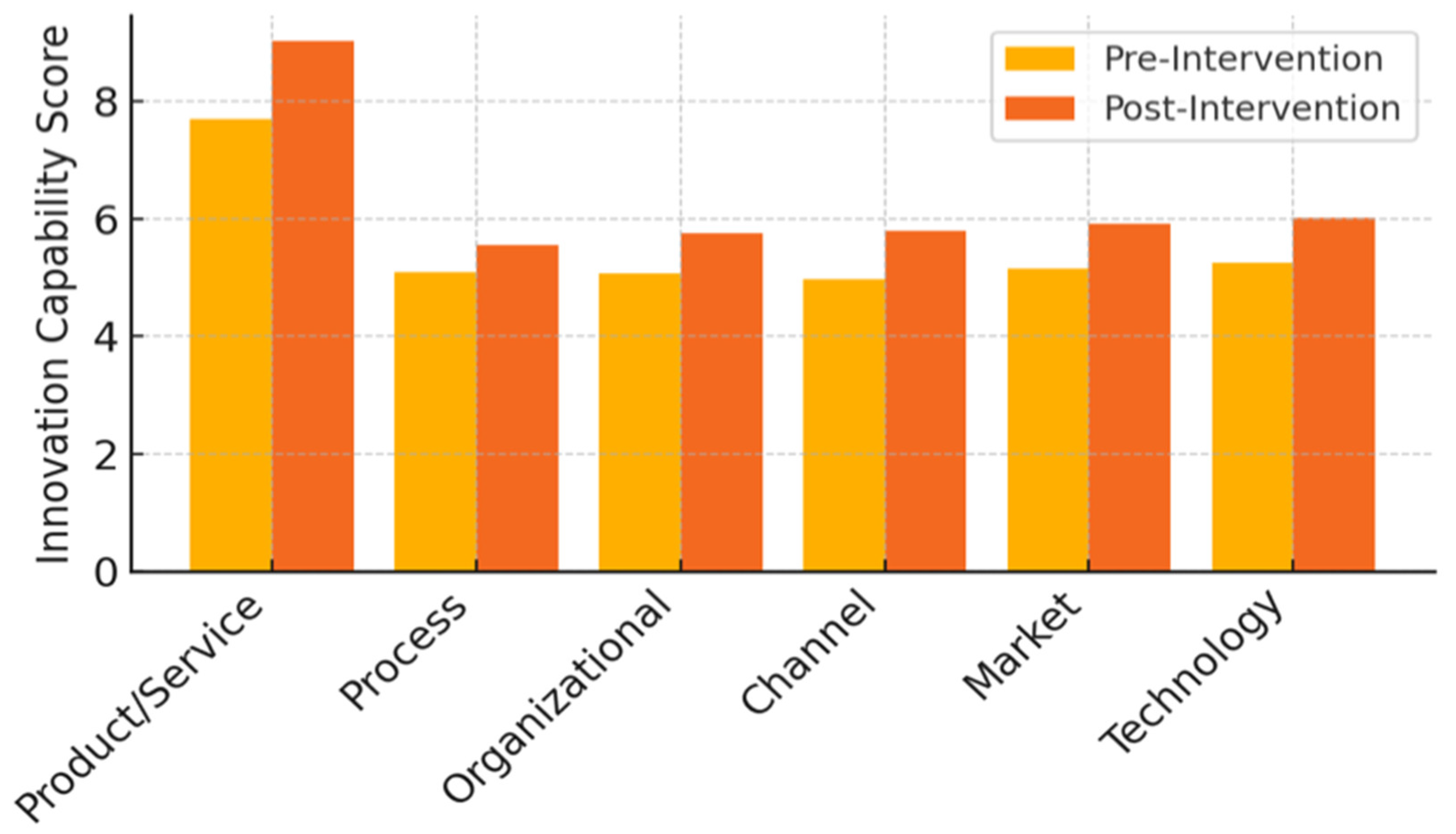

Table 1.
Pre- and Post-Intervention Innovation Capability Scores and Paired t-Test Results (N = 139 SMEs).
Table 1.
Pre- and Post-Intervention Innovation Capability Scores and Paired t-Test Results (N = 139 SMEs).
| Innovation Dimension | Pre-Intervention Mean (SD) | Post-Intervention Mean (SD) | Mean Difference | t (138) | p-value |
| New Product/Service | 7.71 (2.1) | 9.03 (2.4) | +1.32 | 3.12 | 0.002 |
| New Process | 5.10 (1.8) | 5.55 (1.9) | +0.45 | 4.61 | <0.001 |
| Organizational Innovation | 5.08 (1.5) | 5.76 (1.6) | +0.68 | 7.02 | <0.001 |
| Channel Innovation | 4.96 (1.7) | 5.80 (1.8) | +0.84 | 9.15 | <0.001 |
| New Market Development | 5.16 (1.6) | 5.92 (1.7) | +0.76 | 8.71 | <0.001 |
| New Technology Application | 5.25 (1.4) | 6.01 (1.5) | +0.76 | 8.18 | <0.001 |
| Overall Innovation Capability | 5.71 (1.3) | 6.68 (1.4) | +0.97 | 9.87 | <0.001 |
Note: The average of the six dimension ratings represents the overall innovation capability. After normalizing the component indicators, the means for the dimensions are on a comparable scale. SD denotes standard deviation.
Table 2.
Regression Predicting Post-Intervention Innovation Capability. (Controls: Industry dummies, Firm Size, Pre-intervention Innovation).
Table 2.
Regression Predicting Post-Intervention Innovation Capability. (Controls: Industry dummies, Firm Size, Pre-intervention Innovation).
| Predictor | B (Unstd.) | β (Standardized) | t | p |
| Dynamic Capabilities (post) | 0.73 | 0.68 | 9.85 | <0.001 |
| Support Utilization (Index) | 0.15 | 0.12 | 2.10 | 0.037 |
| Pre-intervention Innovation | 0.41 | 0.35 | 5.44 | <0.001 |
| Firm Size (log employees) | 0.05 | 0.03 | 0.60 | 0.549 |
| Industry (Manufacturing) | – | – | (ns) | |
| Industry (Services) | – | – | (ns) | |
| Intercept | 1.02 | – | 2.30 | 0.023 |
Model fit: R² = 0.81, F(5,133) = 115.4, p < 0.001.
Disclaimer/Publisher’s Note: The statements, opinions and data contained in all publications are solely those of the individual author(s) and contributor(s) and not of MDPI and/or the editor(s). MDPI and/or the editor(s) disclaim responsibility for any injury to people or property resulting from any ideas, methods, instructions or products referred to in the content. |
© 2025 by the authors. Licensee MDPI, Basel, Switzerland. This article is an open access article distributed under the terms and conditions of the Creative Commons Attribution (CC BY) license (http://creativecommons.org/licenses/by/4.0/).
Copyright: This open access article is published under a Creative Commons CC BY 4.0 license, which permit the free download, distribution, and reuse, provided that the author and preprint are cited in any reuse.


