
Submitted:
25 March 2025
Posted:
26 March 2025
You are already at the latest version
Abstract
This article addresses the issue of designing compound curves, i.e. a geometric system consisting of two (or more) circular arcs of different radii, pointing in the same direction and directly connected to each other. Nowadays, compound curves are mainly used on tram lines; they also occur on railways (e.g. on mountain lines), but new ones are generally no longer being built there. Therefore, in relation to railway lines, the aim is to be able to recreate (i.e. model) the existing geometric layout with compound curves, so that it is then possible to correct this layout. An analytical method for designing track geometric systems was used, adapted to the mobile satellite measurement technique, in which calculations are carried out in the appropriate local Cartesian coordinate system.The basis of this system is the symmetrically arranged adjacent main directions of the route, and the beginning is located at the point of intersection of these directions. A number of detailed issues have been clarified and basic characteristic quantities have been determined, and the computational algorithm described in the paper leads to the solution of the problem in a sequential manner. The obtained possibilities of modeling the compound curves are illustrated by the provided calculation example.
Keywords:
railway road
; compound curve
; analytical design method
; computational algorithm
; sample geometric layout
1. Introduction
Since for many years the development of design documentation in the field of railways has been carried out using commercial computer software [1,2], it has become established that conducting research work on the methodology of designing track geometrical systems is now less important. Of course, such work is carried out [3,4,5], but its scope is often limited to detailed issues, such as transition curves [6] or railway turnouts [7,8].
Due to the competitive conditions with other transport systems, new railway lines are usually adapted to the increased speed of trains; in fact, a significant part of them are high-speed railways. On the other hand, traditional lines (existing, most often built in the 19th century) are disappearing from the field of research interest, as they would have to be modified to adapt to contemporary requirements. This applies especially to railway lines running in difficult terrain conditions (e.g. in mountainous terrain), where there are small radii of horizontal curves, and additionally controversial geometric arrangements, such as compound curves and reverse curves. Improving the quality of these lines, leading to an increase in travel speed, requires appropriate modernization activities. In the case of compound curves and reverse curves, this would consist in introducing transition curves between the occurring horizontal curves.
This article addresses the issue of designing compound curves, i.e. a geometric system consisting of two circular arcs of different radii, pointing in the same direction and directly connected to each other. Compound curves are currently used on tram lines; they also occur on railways, but new ones are not built there any more. Therefore, in relation to railway lines, the aim is to obtain the possibility of reproducing (i.e. modeling) the existing geometric layout with compound curves, so that it is then possible to correct the horizontal ordinates in the area where the circular arches connect. For this purpose, it was necessary to develop an effective method for designing such a system, which, however, by assumption, will not be used to determine the coordinates of a new compound curve, but to model the existing system (with a view to its later modification).
At this point it should be noted that the analytical method of designing compound curves had already been developed and presented in [9]. It concerned a model solution, i.e. creating a geometric system from scratch, in which circular arcs of different radii are connected with each other by means of an appropriate transition curve. A classic compound curve, in which the transition curve does not occur, was a special case in this method. The issue of modifying the existing geometric system was not considered. Meanwhile, as it seems, the real problem lies somewhere else. After all, it is not about creating new model systems of compound curves (with appropriate transition curves), but modernizing the existing systems. In this situation, the classic compound curve becomes the subject of interest.
In this paper, the solution to the problem is obtained analytically. The standard procedure of the analytical design method in its previous versions [10,11,12] requires operating in the local coordinate system and is characterized – in its initial phase – by the lack of knowledge of the location of the origin of this system in relation to the appropriate global system (in Poland – in relation to flat coordinates – it is the national spatial reference system PL-2000 [13]). Full integration of both of these systems requires carrying out the design procedure in the local system until the very end. The location of the origin of this system in relation to the appropriate main point of the route and its resulting coordinates in the global system are determined only in the final phase of the procedure. This may constitute the basic methodological reservation to the discussed design method. For this reason, certain interpretation problems may also arise.
As it turns out, these difficulties can be avoided by locating the origin of the local coordinate system at the point of intersection of both main directions of the route, whose Cartesian coordinates in the global system are known. Such a version of the analytical design method was presented in [14]; it is universal in nature and covers the areas of connection of adjacent main directions of the railway route (both symmetrical and asymmetrical). In this paper, an analogous approach was used in the design of classic compound curves.
2. Local Coordinate System
Similarly to other variants of the analytical design method, when designing classic compound curves (in which horizontal arcs of different radii are directly connected to each other), it was assumed that the design of a given area of route direction change will be carried out in the appropriate local Cartesian coordinate system x, y (marked as LCS). The basis of this system is the symmetrically set adjacent main directions. In order to obtain such a setting of the main directions, an appropriate transformation (i.e. shift and rotation) of the global system must be performed.
Design activities carried out in the global rectangular coordinate system, i.e. creating a polygon of the main directions of the route and determining the mathematical equations of these directions, the coordinates of their intersection points (i.e. main points) and the angles of return, were presented in [14]. This work also explains the method of creating a local coordinate system for a given area of changing the route direction, consisting in shifting the origin of the global system to the point of intersection of two adjacent main directions (i.e. to point W), and then rotating the shifted system YP, XP by such an angle β as to obtain a symmetrical setting of the main directions in the local coordinate system x, y. Examples of this operation are shown in Figure 1 and Figure 2.
It should be noted that the setting of the main directions of the route in the PL-2000 system can be very diverse; Figure 1a and Figure 2a show only two selected cases. However, after the transformation to the local coordinate system (as shown in Figure 1b and Figure 2b), there are only two possibilities for locating the designed geometric system: under the x axis, with negative ordinates and the convexity of the curvilinear elements directed upwards, and above the x axis, with positive ordinates and the convexity of the curvilinear elements directed downwards. Therefore, when considering the procedure in detail, it is necessary to present the computational algorithms related to these two situations. This means that when determining the formulas for the coordinates of characteristic points in the local coordinate system, two possible cases should be taken into account:
The paper presents the procedure for creating a geometric system covering Case I. The design of the geometric system is carried out in several stages, which are presented later in the article.
3. Determination of Basic Calculation Quantities
In order to be able to operate in the local coordinate system, it is necessary to first perform an auxiliary procedure, which aims to determine the basic calculation quantities. These quantities refer to the regions of the geometric system connecting the ends of the extreme straight segments (i.e. the beginnings of the transition curves) with the connection point of both circular arcs. This refers to the lengths of the projections of the transition curve () and the circular arc () on the horizontal axis, as well as
the lengths of the projections of the transition curve () and the circular arc () on the vertical axis. The
calculations of the searched parameters, separately for both occurring
horizontal arcs, are carried out in the system shown in Figure 3.
We start by drawing a straight
line simulating the main direction i through point A(0, 0) in
the coordinate system ; it is described by the equation
This straight line is the abscissa
axis of the coordinate system xc, yc , associated with the transition curve of length lc, which is connected to a circular arc of radius R. We are
interested in the coordinates of the end point of the curve in this system,
which result from the corresponding parametric equations xc(l)
and yc(l) for l = lc . In the case of using the transition curve in the form of a clothoid,
these coordinates are as follows:
while the angle Θc(lc)
of inclination at the end of the curve is determined from the dependence
The transformation of the transition curve to the coordinate system is performed by rotating the
reference system by an angle of α/2. The appropriate formulas depend on the
direction of rotation. As a result of this operation, the required value of the
projection of the transition curve onto the horizontal and vertical axes is
obtained. In the case of a right rotation of the xc, yc
system (as in Figure 3), the following
values are obtained:
The value of the tangent at the end is described by
the formula
Knowing the position of the
transition curve, we can inscribe a circular arc of radius R in the
geometric system. The center of this arc (point S) lies on the line
perpendicular to the tangent at the end of the transition curve (i.e. at point B),
at a distance R from this point. The coordinates of point S are
as follows:
A circular arc is described by the equation
and the value of the tangent to the geometric
system is
The important characteristic point is point H,
where the slope of the tangent to the geometric system is zero (i.e. = 0). Its coordinates are as follows: , . The connection of both circular arcs (i.e. point C)
should be located to the left or right of point H. The condition must be met.
The value of the abscissa of point C
results from the arbitrarily assumed difference , relating to a circular arc of
radius R1; it is
The ordinate of this point is determined based on
equation (10).
The difference for the circular arc CA1,
associated with the first transition curve (TC1), is determined from the
formula
The key quantity for further actions is the slope
of the tangent at point C, which is the same for both connected arcs. It
is
When constructing the entire circular
arc, the differences and for the transition curve TC1
(determined using formulas (5) and (6)) should be used, as well as the arbitrarily assumed difference and difference (determined by formula (14)) for the
circular arc CA1. After entering the radius R2, the differences and for the transition curve TC2
are obtained. Determining the values and for the circular arc CA2
requires an additional calculation procedure.
Knowing the position of the
transition curve TC2 in the system shown in Figure 3, we can inscribe a
circular arc of radius R2 in the
geometric system. The coordinates of the center of this arc (i.e. point S2) result from equations (8) and (9). In the coordinate system, the second
circular arc is also described by equation (10), and the value of the tangent
at its end by equation (11).
In the target geometric system (i.e.
in a compound curve), this arc will be mirrored relative to the abscissa , so the tangent at its end point
must satisfy the condition
After taking into account formula (12) we get
The right hand side of the above
expression is already known at this stage, as it results from equation (15).
Therefore, we need to solve the following equation with the unknown :
As a result of this operation we get
The coordinates of the end of the second circular
arc are as follows:
The difference is determined by the formula
The position of a circular arc of
radius R2 in the system, with marked the differences and , is shown in Figure 3.
4. Connection of Both Horizontal Arcs
The construction of a compound curve, i.e.
connecting the existing horizontal arcs with radii R1 and R2
, will be performed in the auxiliary coordinate system shown in Figure 4. The case of a geometric system
located below the vertex W (i.e. shown in Figure 1) was considered.
For the transition curve TC1 and the
circular arc CA1, this system is identical to the system ; this means that and . Therefore, the coordinates of the characteristic
points are:

For the TC2 curve and the CA2 arc it
will be necessary to perform an appropriate transformation, consisting in
performing a mirror reflection with respect to the abscissa . The characteristic points , and , obtained as a result of this operation do not yet occupy their final position and will require correction. Their coordinates are as follows:
As can be seen in Figure 4, at the assumed connection point of both arcs there is a difference in ordinates , which is
In order to obtain a smooth connection of both parts of the geometric system, the ordinates of this system related to the arc of radius R2 should be corrected (while maintaining the abscissa values). For Case I, we obtain
Figure 5 shows the geometric system of the corresponding compound curve in the coordinate system.
For the geometric system located above the vertex W (Case II in Figure 2b), the same formulas for the abscissa values apply, but the ordinates take negative values. This means that
5. Transferring the Solution to the Local Coordinate System
Knowing the coordinates of the extreme points of the geometric system A1(0,0) and , we can transfer the obtained solution to the local coordinate system x, y (shown in the given case in Figure 1b). To do this, we need to derive from these points two tangent lines inclined at an angle α/2 – positive from point A1 and negative from point A2 (Figure 6). The equations of these lines are as follows:
The intersection point of lines (21) and (22) is the origin of the local coordinate system. Its coordinates in the system are as follows:
In Case II, the coordinates of point W are described by the formulas:
Thanks to their knowledge, it is possible to transform the points of the geometric system into the local coordinate system using the formulas:
Figure 7 shows the geometric system of the compound curve from Figure 6 transferred to the local coordinate system.
Knowing the assumed values of the radii R1 and R2 of the compound curve and the lengths l1 and l2 of the transition curves, one must first determine – using the appropriate formulas – the values and , and , and , and , and and . In the local coordinate system x, y, the beginning of the transition curve TC1 (point A1) is located in the main direction (i), and the beginning of the curve TC2 (point A2) is located in the main direction (i+1). The list of formulas for the coordinates of all characteristic points is provided in Table 1.
The values and appearing in Table 1 result from formulas (23-26), and from formula (20).
6. Computational Algorithms
After determining the coordinates of the characteristic points, the design process should be finalized by determining the course of the route sections located between these points. The differentiation of calculation algorithms related to the directions of rotation of the coordinate systems related to the transition curves must be taken into account. In practice, this involves separate determination of coordinates in the x, y system for the geometric system located below the W vertex (i.e. for Case I) and above the W vertex (i.e. for Case II). In Case I, the situation is shown in Figure 8, while in Case II – the situation is shown in Figure 9.
To determine the computational algorithms, we must first determine the coordinates of the centers of both connected arcs in the local coordinate system. This is done using the knowledge of the computational parameters of point C – the abscissa xC, the ordinate yC and the slope of the tangent sC. The centers of both arcs (points S1 and S2) lie on the line perpendicular to the tangent at point C, at distances R1 and R2 from this point. The corresponding formulas are presented in Table 2. In the formulas for the abscissa values, the sign of the slope of the tangent sC plays an important role.
Table 3 presents a list of formulas necessary to determine the coordinates of individual elements of the designed geometric system. It includes:
- parametric equations of the transition curve TC1 in the auxiliary x1, y1 coordinate system (for ),
- equation of the angle of inclination of the tangent in the x1, y1 auxiliary coordinate system (for ),
- parametric equations of the transition curve TC1 in the local coordinate system x, y (for ),
- formula for the tangent value at the end of the transition curve TC1,
- equation of a circular arc CA1 with radius R1,
- equation of a circular arc CA2 with radius R2,
- parametric equations of the transition curve TC2 in the auxiliary x2, y2 coordinate system (for ),
- equation of the angle of inclination of the tangent in the auxiliary x2, y2 coordinate system (for ),
- parametric equations of the transition curve TC2 in the local coordinate system x, y (for ),
- formula of the tangent value at the end of the transition curve TC2.
7. Calculation Example
In the presented calculation example, a system of main directions of the route was assumed, intersecting at point W, whose coordinates in the PL-2000 system are: YW = 6,751,176.928 m, XW = 6,249,641.342 m. We are dealing with a turn of the route to the left, with increasing mileage from right to left (which corresponds to the situation in Figure 2).
The assumed train speed on the designed compound curve is V = 90 km/h. It results from the smaller radius of the circular arc R2 = 450 m and the cant h2 = 125 mm, where the unbalanced acceleration is am = 0.571 m/s2. The length of the corresponding transition curve in the form of a clothoid is l2 = 115 m (the wheel lifting speed on the gradient due to cant is f = 27.174 mm/s). The circular arc radius R1 = 600 m and cant h1 = 75 mm were assumed, which determines the unbalanced acceleration am = 0.551 m/s2. The length of the transition curve in the form of a clothoid is l1 = 75 m (the wheel lifting speed on the gradient due to cant is f = 25.000 mm/s). In the PL-2000 system, the straight line representing the main direction (i) is described by the formula
and the line describing the direction (i +1) by equation
From the given equations of the main directions it follows that the angles of inclination of the lines are: φi = 0.324 rad and φi+1 = 1.258 rad. On this basis, the angle of return of the route α = φi+1 – φi = 0.934 rad.
Obtaining the local coordinate system x, y, with symmetrically set adjacent main directions, requires shifting the origin of the PL-2000 system to point W and rotating it with respect to this point to the left by an angle β = (φi + α/2) + π = 3.284 rad. In the coordinate system x, y, the angles of inclination of the straight lines will be: = – α/2 = – 0.467 rad, = α/2 = 0.467 rad.
The actual design begins with an auxiliary operation to determine the coordinates of characteristic points using the formulas given in Chapter 3. The following values were obtained: = 67.646 m, = 32.358 m, = 0.428108, = 300 m (assumed value), = 45.012 m, = 104.721 m, = 47.321 m, = 0.352862, = 101.841 m and = 23.087 m. The formulas given in Table 1 allowed us to determine the coordinates of points A1, B1, C, B2 and A2 (Figure 8). The values of these coordinates (and the tangents) are given in Table 4.
Further design operations are performed in the local coordinate system x, y, using the formulas given in Table 3. First, an auxiliary coordinate system x1, y1 is assumed, related to the transition curve TC1. The beginning of this curve (i.e. point A1) is also the beginning of the designed geometric system. The clothoid coordinates x1(l) and y1(l) were determined for m. The value of the angle of inclination of the tangent at the end of the curve was Θ1(l1) = – 0.0625 rad. The next stage of the operations is to rotate the system x1, y1 to the right by an angle α/2. For the parametric equations x(l) and y(l) of the curve TC1, the condition m applies. The coordinates of the circular arc related to the curve TC1 were determined for m.
Then, the auxiliary coordinate system x2, y2, related to the transition curve TC2, was used. The beginning of this curve (i.e. point A2) is the end of the designed geometric system. The clothoid coordinates x2(l) and y2(l) were determined for m. The value of the angle of inclination of the tangent at the end of the curve was Θ2(l2) = – 0.12778 rad. As a result of rotating the system x2, y2 to the left by an angle α/2, the parametric equations x(l) and y(l) of the curve TC2 were obtained, and the condition m is valid. The coordinates of the circular arc related to the curve TC2 were determined for m.
The length of the projection of the entire system on the abscissa axis was 574.208 m. Figure 10 shows the modeled geometric system in the local coordinate system. The green color indicates the circular arc CA1, the red color indicates the arc CA2, the blue color indicates the transition curves, and the purple color indicates the straight sections.
Finally, the obtained solution was transformed to the PL-2000 system, performing the reverse operation than was done when creating the LCS. Therefore, in the formulas used [15]
there is a negative value of the angle β. The final form of the geometric system is presented in Figure 11 (the colors of the markings are as in Figure 10).
8. Conclusions
This article addresses the issue of designing classic compound curves, i.e. a geometric system consisting of two circular arcs of different radii, pointing in the same direction and connected directly to each other. Compound curves are currently used on tram lines; they also occur on railways, but new ones are not built there any more. Therefore, in relation to railway lines, the aim is to obtain the possibility of reproducing (i.e. modeling) the existing geometric layout with compound curves, so that it is then possible to correct the horizontal ordinates in the area where the circular arches connect. For this purpose, it was necessary to develop an effective method for designing such a system, which, however, by assumption, will not be used to determine the coordinates of a new compound curves, but to model the existing system (with a view to its later modification).
To solve the problem, an analytical design method was used, in which individual elements of these geometric systems are described by mathematical equations. The design itself is carried out in the appropriate local Cartesian coordinate system, the basis of which are the symmetrically set adjacent main directions of the route. The origin of the local coordinate system is located at the intersection point of the adjacent main directions, the coordinates of which in the global system are known.
In order to be able to operate in the local coordinate system, one must first perform an auxiliary procedure aimed at determining the basic computational quantities. These quantities refer to the regions of the geometric system connecting the ends of the extreme straight segments (i.e. the beginnings of transition curves) with the connection point of both circular arcs. This refers to the lengths of the projections of transition curves and circular arcs on the horizontal and vertical axes.
The construction of a compound curve, i.e. the connection of the existing horizontal arcs with radii R1 and R2, is carried out in the auxiliary coordinate system and then transferred to the local coordinate system. The formulas for the coordinates of characteristic points are presented, in order to then finalize the design process by determining the course of the route sections located between these points. The obtained possibilities of modeling the compound curve are illustrated by the included calculation example.
Funding
This research received no external funding.
Institutional Review Board Statement
Not applicable.
Informed Consent Statement
Not applicable.
Data Availability Statement
The original contributions presented in this study are included in the article. Further inquiries can be directed to the author.
Conflicts of Interest
The author declares no conflicts of interest.
Abbreviations
The following abbreviations are used in this manuscript:
| PL-2000 | The Polish national spatial reference system |
| LCS | Local coordinate system |
| CA | Circular arc |
| TC | Transition curve |
References
- AutoCAD Civil 3D: Design, Engineering and Construction Software. Available online: http://www.autodesk.pl/products/civil-3d (accessed on 15 March 2025).
- Bentley Rail Track: Rail Infrastructure Design and Optimization. Available online: https://www.bentley.com/software/rail-design (accessed on 15 March 2025).
- Hodas, S. Design of Railway Track for Speed and High-speed Railways. Procedia Eng. 2014, 91, 256–261. [Google Scholar] [CrossRef]
- Soleymanifar, M.; Tavakol, M. Comparative study of geometric design regulations of railways based on standard optimization. In Proceedings of the 6th International Conference on Researches in Science and Engineering & 3rd International Congress on Civil, Architecture and Urbanism in Asia, Bangkok, Thailand, 9th September 2021. [Google Scholar]
- Aghastya, A.; Prihatanto, R.; Rachman, N.F.; Adi, W.T.; Astuti, S.W.; Wirawan, W.A. A new geometric planning approach for railroads based on satellite imagery. VII INTERNATIONAL CONFERENCE “SAFETY PROBLEMS OF CIVIL ENGINEERING CRITICAL INFRASTRUCTURES” (SPCECI2021). LOCATION OF CONFERENCE, RussiaDATE OF CONFERENCE; p. 050005.
- Zboiński, K.; Woźnica, P. Optimisation of polynomial railway transition curves of even degrees. Arch. Transp. 2015, 35, 71–86. [Google Scholar] [CrossRef]
- Bugarín, M.R.; Orro, A.; Novales, M. Geometry of High-Speed Turnouts. Transp. Res. Rec. J. Transp. Res. Board 2011, 2261, 64–72. [Google Scholar] [CrossRef]
- Fellinger, M.; Marschnig, S.; Wilfling, P.A. Innovative track geometry data analysis for turnouts – Preparations to enable the turnout behaviour description. In Proceedings of the 12th World Congress on Railway Research: Railway Research to Enhance the Customer Experience, Tokyo, Japan, October 2019. [Google Scholar]
- Koc, W. Design of compound curves adapted to the satellite measurements. Arch. Transp. 2015, 34, 37–49. [Google Scholar] [CrossRef]
- Koc, W. Design of Rail-Track Geometric Systems by Satellite Measurement. J. Transp. Eng. 2012, 138, 114–122. [Google Scholar] [CrossRef]
- Koc, W. The analytical design method of railway route’s main directions intersection area. Open Eng. 2016, 6, 1–9. [Google Scholar] [CrossRef]
- Koc, W. Design of Reverse Curves Adapted to the Satellite Measurements. Adv. Civ. Eng. 2016, 2016, 1–9. [Google Scholar] [CrossRef]
- Regulation of the Council of Ministers of on the national spatial reference system (in Polish). J. Laws 2012, pos. 1247. 15 October.
- Koc, W. Determination of Track Axis Coordinates in the Analytical Method of Designing Railway Route Geometry. Adv. Image Video Process. 2024, 12, 339–362. [Google Scholar] [CrossRef]
- Korn, G.A.; Korn, T.M. Mathematical Handbook for Scientists and Engineers; McGraw-Hill: New York, NY, USA, 1961. [Google Scholar]
Figure 1.
(a) Local coordinate system x, y against the background of the intersecting main directions of the route in the shifted PL-2000 system (with the kilometer running from left to right); (b) System x, y after the transformation.
Figure 1.
(a) Local coordinate system x, y against the background of the intersecting main directions of the route in the shifted PL-2000 system (with the kilometer running from left to right); (b) System x, y after the transformation.
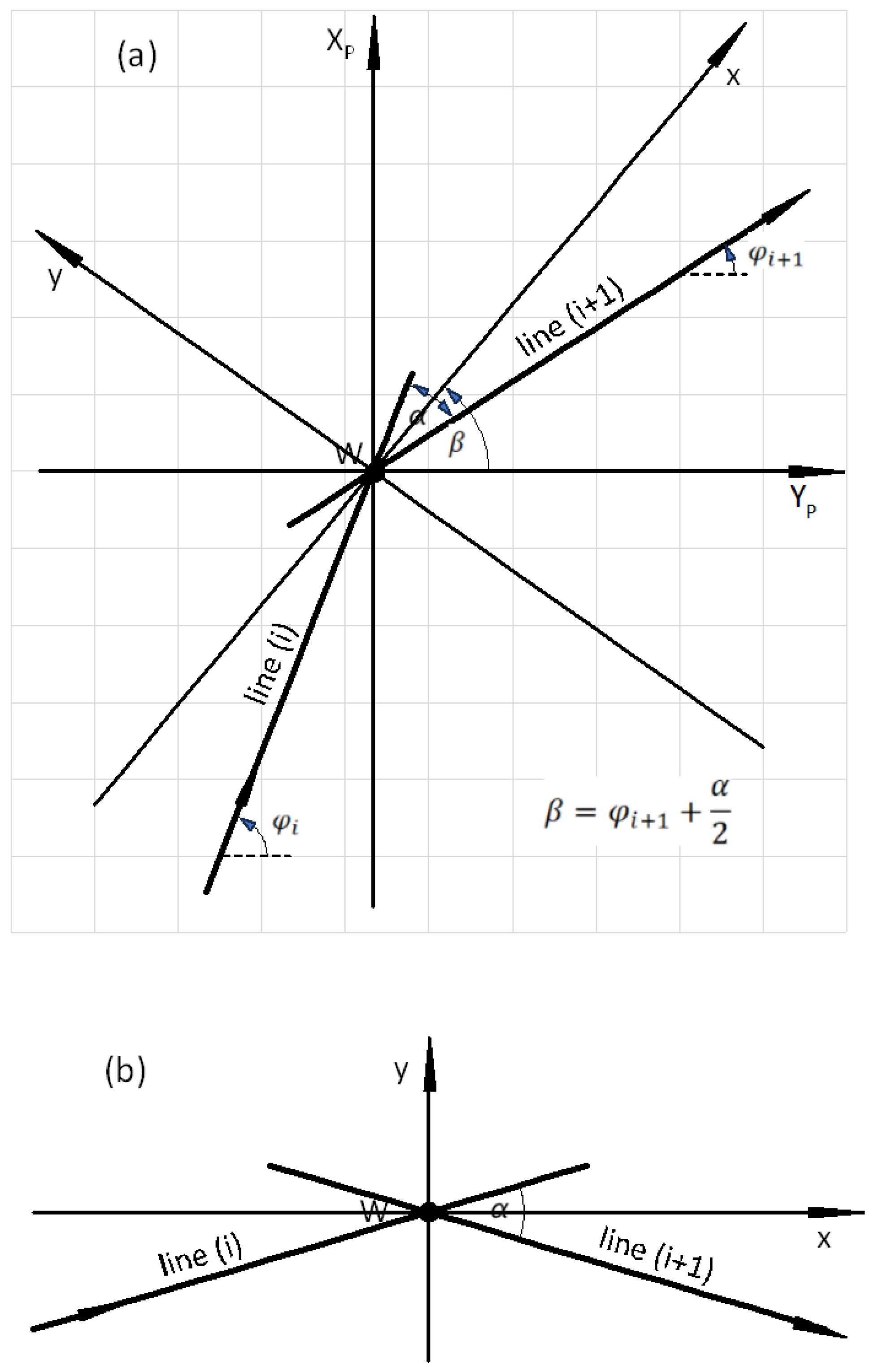
Figure 2.
(a) Local coordinate system x, y against the background of the intersecting main directions of the route in the shifted PL-2000 system (with the kilometer running from right to left); (b) System x, y after the transformation.
Figure 2.
(a) Local coordinate system x, y against the background of the intersecting main directions of the route in the shifted PL-2000 system (with the kilometer running from right to left); (b) System x, y after the transformation.
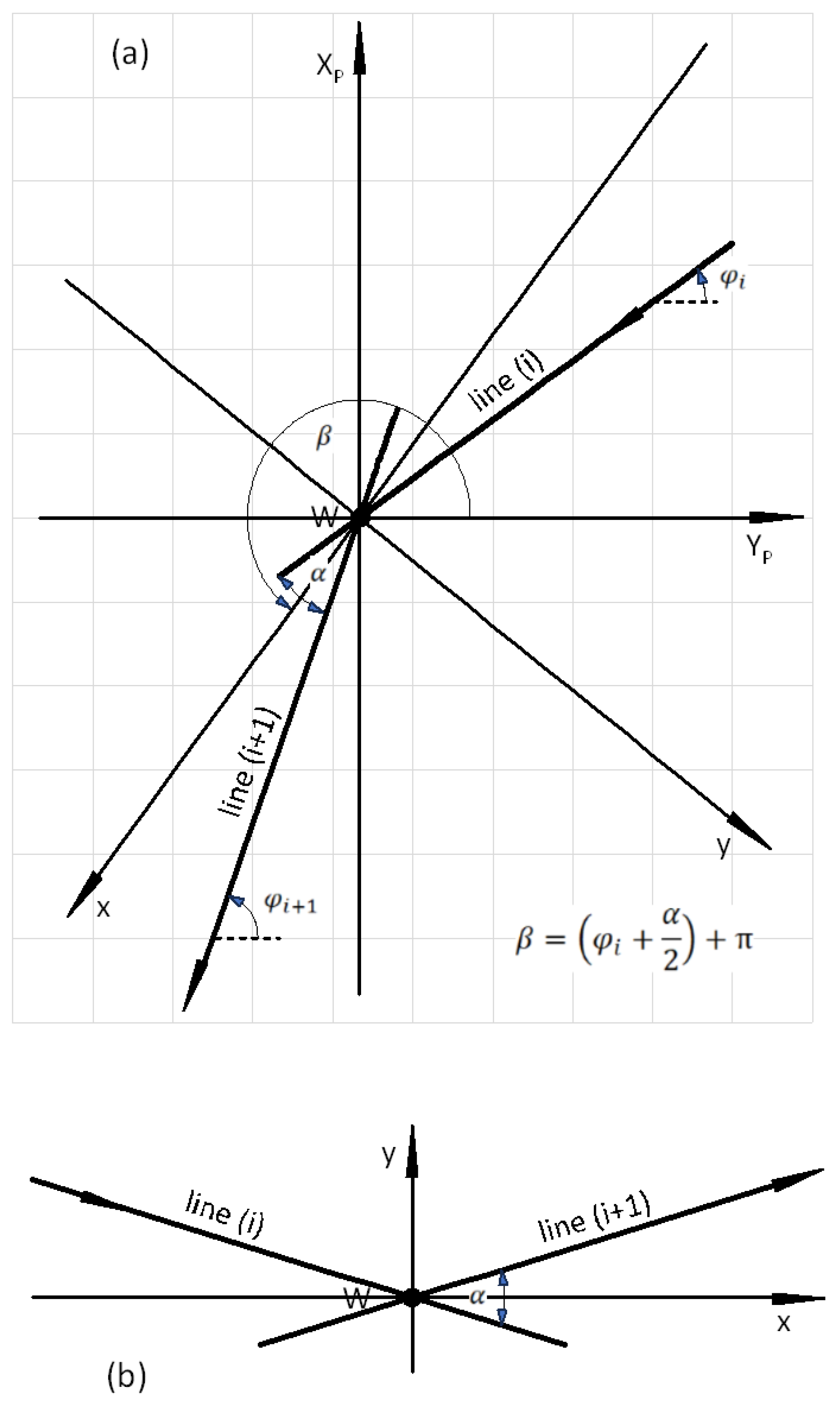
Figure 3.
Scheme for determining the basic characteristic quantities of a geometric system.

Figure 4.
Geometric system created as a result of mirror reflection of TC2 and CA2 with respect to the abscissa
Figure 4.
Geometric system created as a result of mirror reflection of TC2 and CA2 with respect to the abscissa
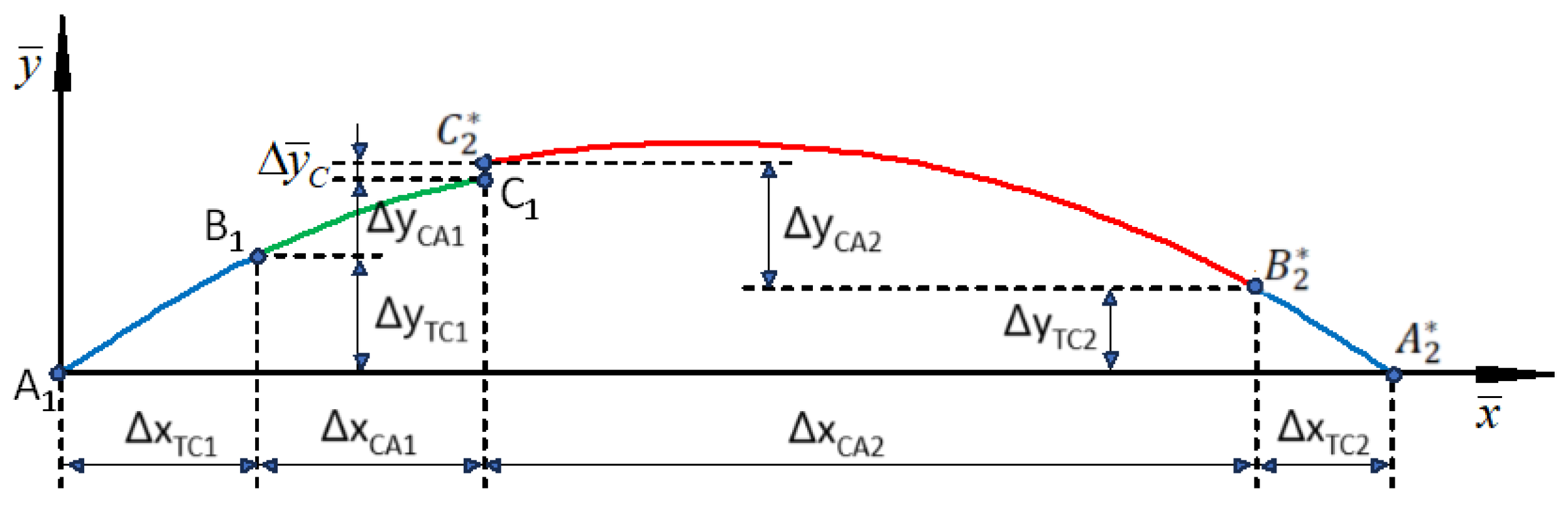
Figure 5.
Geometric system for Case I created after correcting the TC2 and CA2 ordinates from Figure 4.
Figure 5.
Geometric system for Case I created after correcting the TC2 and CA2 ordinates from Figure 4.
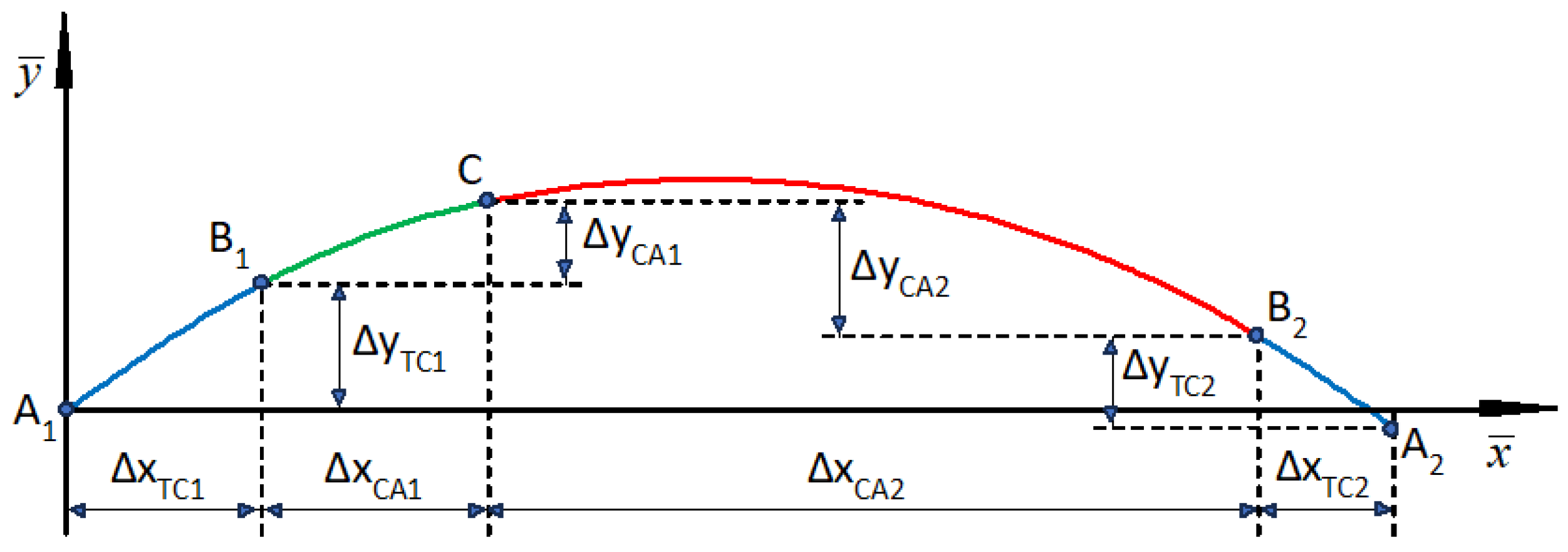
Figure 6.
Geometric system of the compound curve against the background of the introduced main directions of the route.
Figure 6.
Geometric system of the compound curve against the background of the introduced main directions of the route.
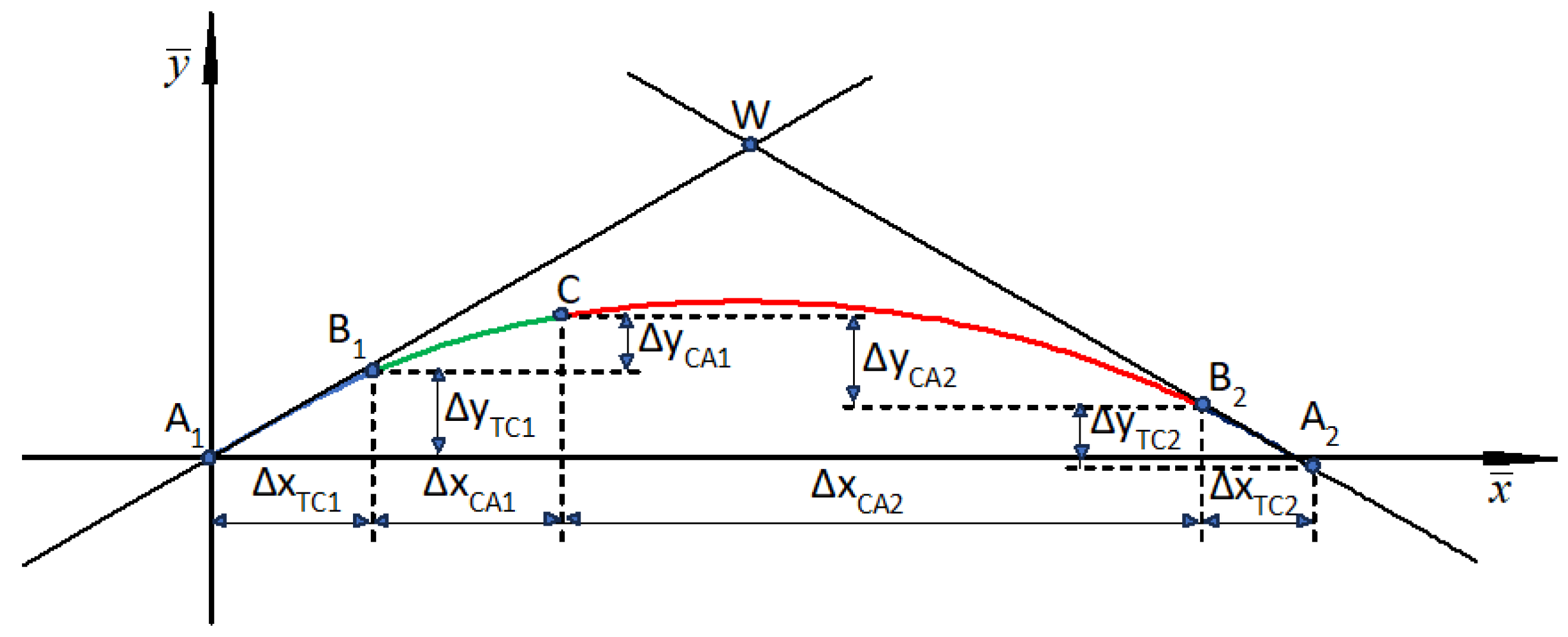
Figure 7.
Geometric system of the compound curve in the local coordinate system.

Figure 8.
Designed compound curve in the local coordinate system for the case of the geometric system located below the W vertex.
Figure 8.
Designed compound curve in the local coordinate system for the case of the geometric system located below the W vertex.
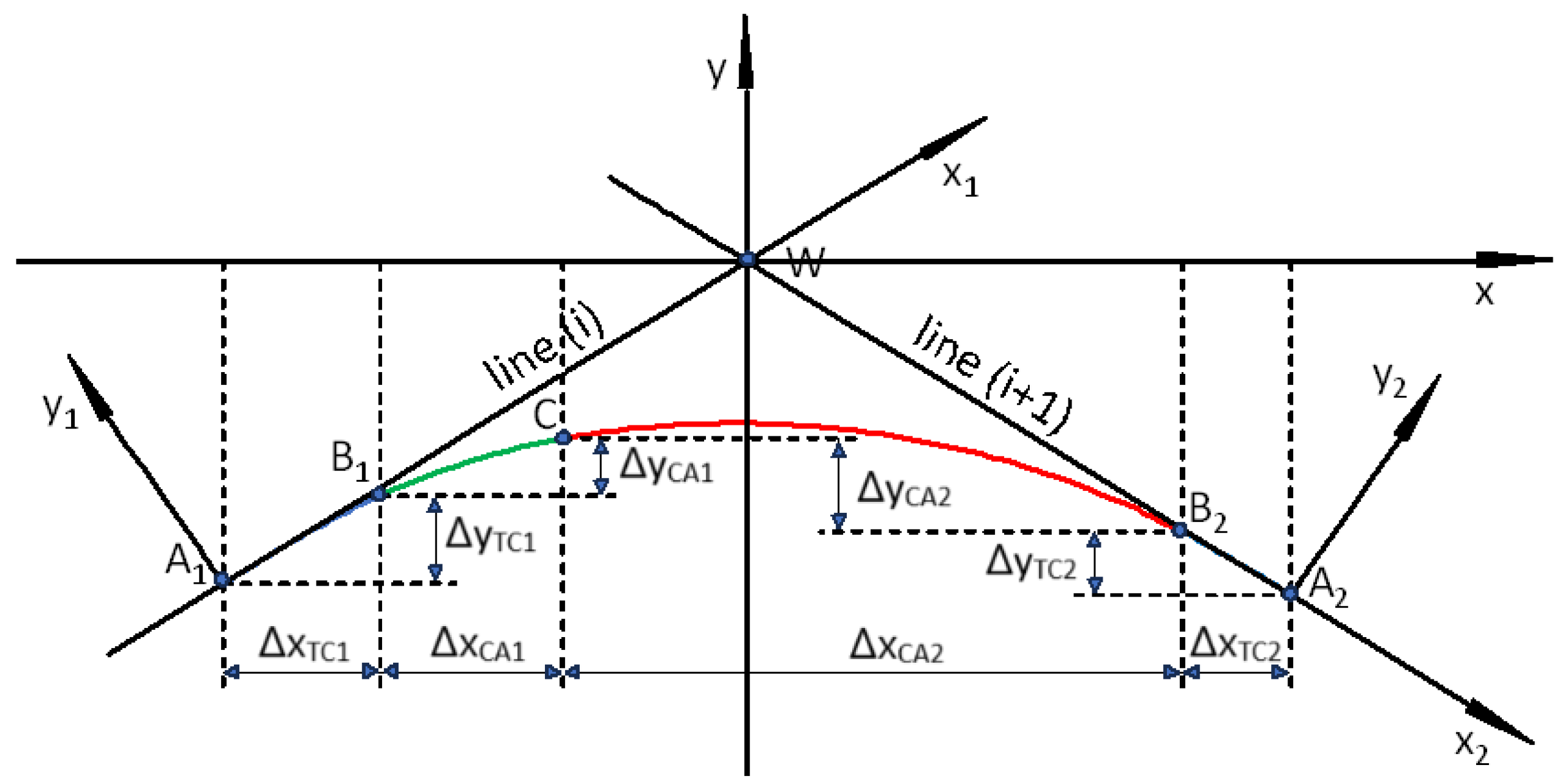
Figure 9.
Designed compound curve in the local coordinate system for the case of the geometric system located above the W vertex.
Figure 9.
Designed compound curve in the local coordinate system for the case of the geometric system located above the W vertex.
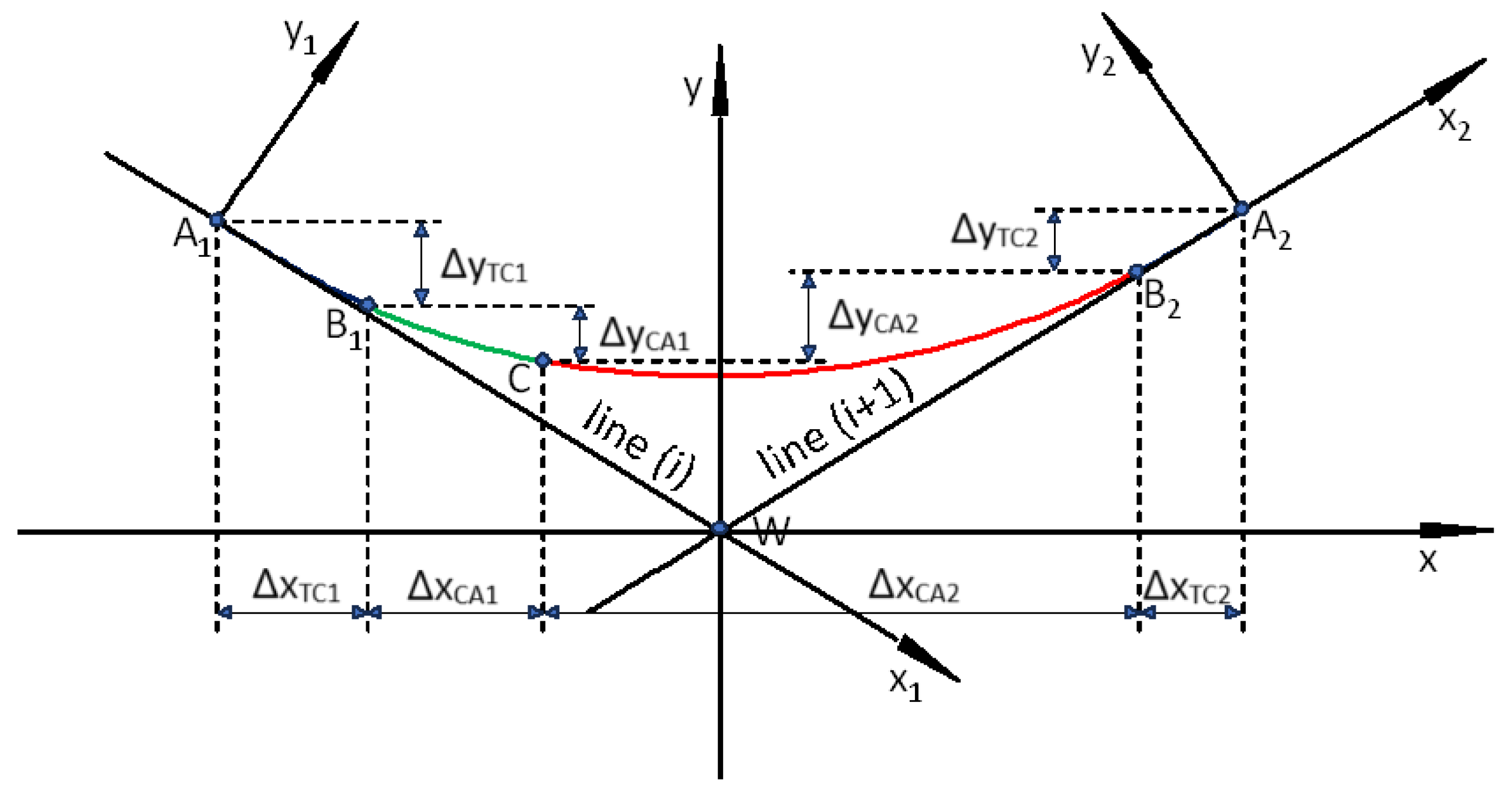
Figure 10.
Geometric system of the compound curve modeled using the analytical method in the local coordinate system.
Figure 10.
Geometric system of the compound curve modeled using the analytical method in the local coordinate system.
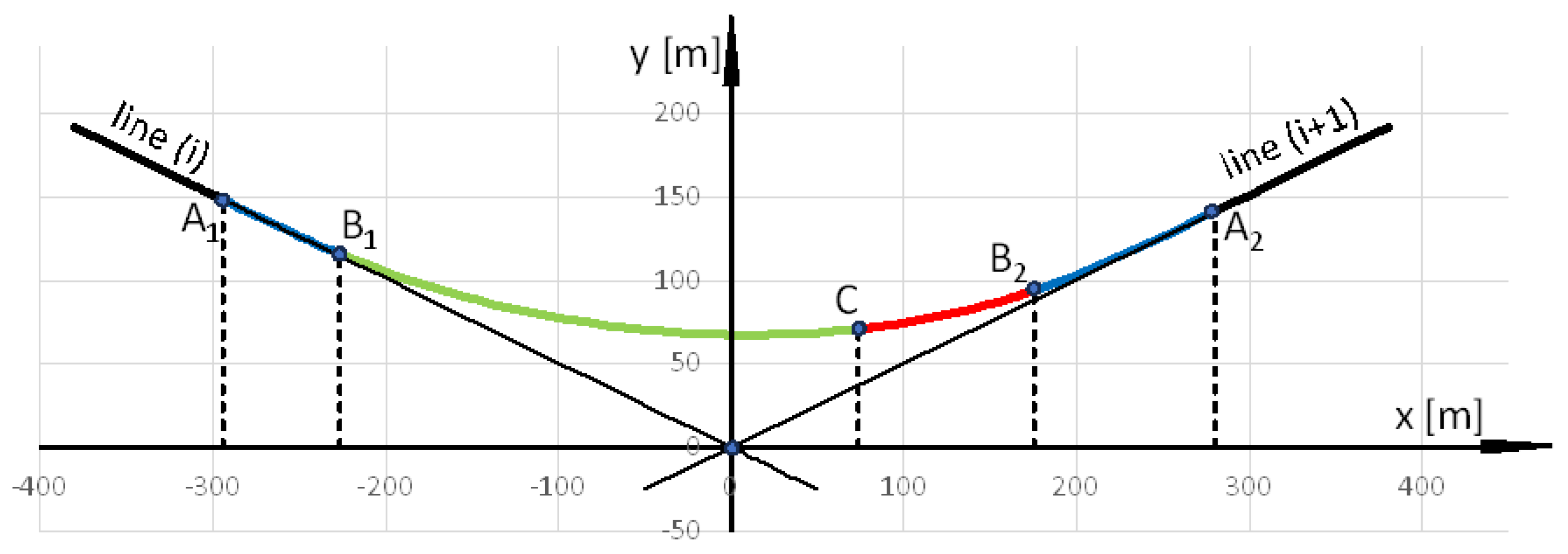
Figure 11.
Geometric system of the compound curve modeled using the analytical method in the PL-2000 system.
Figure 11.
Geometric system of the compound curve modeled using the analytical method in the PL-2000 system.
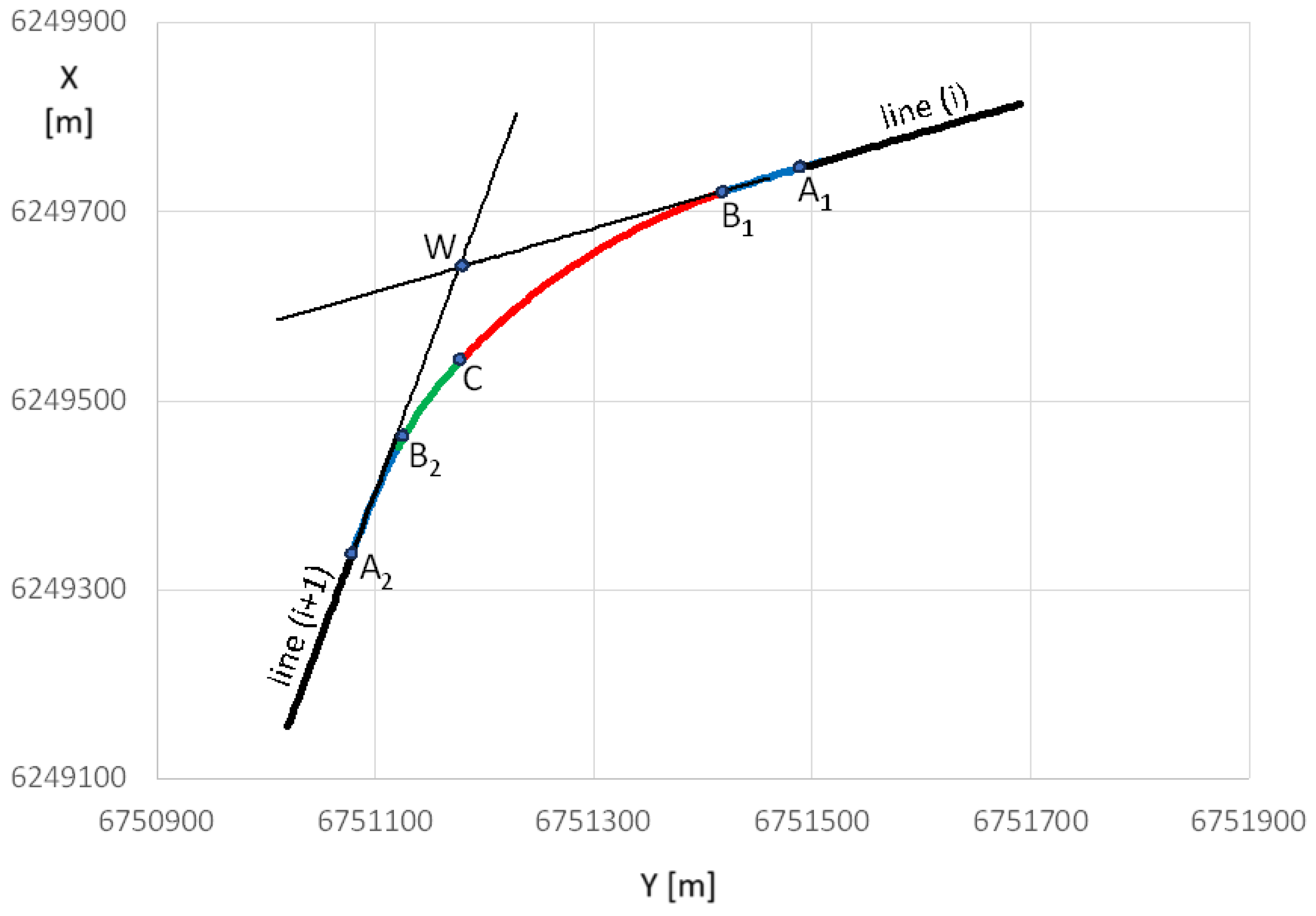

Table 1.
List of formulas for the coordinates of characteristic points.
| Point | Abscissa x | Ordinate y (Case I) | Ordinate y (Case II) |
|---|---|---|---|
| A1 | |||
| B1 | |||
| C | |||
| B2 | |||
| A2 |
Table 2.
List of formulas for the coordinates of the centers of connected circular arcs.
| Tangent | Case I | Case II |
|---|---|---|
| sC > 0 | ||
| sC < 0 | ||
Table 3.
List of formulas for determining the coordinates of a geometric system.
| Geometric element | Case I | Case II | |
|---|---|---|---|
| Transition curve TC1 | |||
| Circular arc CA1 | |||
| Circular arc CA2 | |||
| Transition curve TC2 | |||
Table 4.
The values of the parameters of the characteristic points for the geometric system in the presented calculation example.
Table 4.
The values of the parameters of the characteristic points for the geometric system in the presented calculation example.
| Parameter | Point A1 | Point B1 | Point C | Point B2 | Point A2 | |
|---|---|---|---|---|---|---|
| Abscissa x [m] | – 294.007 | – 226.361 | 73.639 | 175.480 | 280.201 | |
| Ordinate y [m] | 148.238 | 115.880 | 70.868 | 93.956 | 141.277 | |
| Tangent s | – 0.50420 | – 0.42811 | 0.10705 | 0.35286 | 0.50420 |
Disclaimer/Publisher’s Note: The statements, opinions and data contained in all publications are solely those of the individual author(s) and contributor(s) and not of MDPI and/or the editor(s). MDPI and/or the editor(s) disclaim responsibility for any injury to people or property resulting from any ideas, methods, instructions or products referred to in the content. |
© 2025 by the authors. Licensee MDPI, Basel, Switzerland. This article is an open access article distributed under the terms and conditions of the Creative Commons Attribution (CC BY) license (http://creativecommons.org/licenses/by/4.0/).
Copyright: This open access article is published under a Creative Commons CC BY 4.0 license, which permit the free download, distribution, and reuse, provided that the author and preprint are cited in any reuse.


