
Submitted:
21 March 2025
Posted:
26 March 2025
You are already at the latest version
Abstract
The remarkable progress of generative AI has brought fresh air to linguistics. In animal communication and language translation, generative AI has been used to deepen consideration at the semantic space level, and as a result, geometric similarities in semantic space have been discovered. Even if the expressions in concrete space are different, when they are mapped to semantic space, the existence of geometric similarities that had been hidden until now has been discovered. In the end, this may seem obvious, but it is a surprising discovery. Inspired by this discovery, this paper proposes a basic mathematical theory necessary for understanding linguistic space. This study aims to clarify the geometric properties of the translation process, which are difficult to explain using conventional linguistic theory. In this study, linguistic space is regarded as a mathematical coordinate space, and translation between different languages is treated as a coordinate transformation, assuming the existence of a common invariant, the meaning of language. From this perspective, the approach of this study is called ''geometric linguistic space''.
Keywords:
Linguistic space
; Mathematical approach to linguistics
; word2vec
; Transformation of words into numerical vectors
; Linguistic translation as coordinates transformation
1. Introduction
The author has studied multiple natural languages and artificial languages such as C for many years as a language hobby. In the process, he has developed a deep interest in language itself and the function of the brain that manipulates language [1]. This study aims to clarify the geometric properties of the translation process, which are difficult to explain using conventional linguistic theory.
In this study, we regard language space as a mathematical coordinate space, and treat translation between different languages as a coordinate transformation, assuming the existence of an invariant called the meaning of language. From this perspective, different languages correspond to relative coordinate systems, and translation is expressed as a transformation (mapping) between them, so we call this approach "geometric language space."
Even though English is linguistically close to German and French, an English speaker with no knowledge of German or French would not be able to understand the meaning of a German or French sentence.
However, through the process of translation, it becomes possible to understand. Why is the process of translation possible?
What does the translation process do mathematically? The introduction of generative AI into language analysis provided a clue to this question [2,3,4,5,6,7,8,9,10,11,12,13,14].
If we consider a sentence to be a point in language space, or a vector set or vector sum of "words: the smallest element vectors", it becomes possible to introduce geometry into language. If we consider a sentence to be a substance, then words correspond to the atoms or molecules that make up the sentence. Language space is ultra-multidimensional.
Thinking about it this way, a sentence vector becomes a set of point vectors that give a sequence (trajectory) of point vectors in a language space based on words.
Words in different languages can be matched up using the meaning of the word as a medium. Specifically, between English and French, there is a correspondence at the word level, for example, between "apple" in English and "pomme" in French. As a result, a close geometric relationship is created between the two different language spaces.
"A delicious apple" in English becomes "pomme délicieuse" in French, and "I eat a delicious apple" in English becomes "Je mange une pomme délicieuse" in French.
If you wanted to say "I eat a delicious apple at a restaurant" in English, you'd say "Je mange une pomme délicieuse au restaurant" in French.
If you wanted to say "I eat a delicious apple recommended by my friend at a restaurant" in English, you'd say "Je mange une pomme délicieuse recommandée par mon ami au restaurant" in French.
"I eat a delicious apple recommended by my friend at a restaurant, but I am disappointed" in English would be "Je mange une pomme délicieuse recommandée par mon ami au restaurant, mais je suis déçu".
At first glance, this unexpected correlation between languages seems puzzling. In the concrete space, the differences between different languages are large, but in the abstract space abstracted through meaning, the differences are small. This is to be expected as long as we are dealing with languages between humans on Earth.
In the above discussion, we have assumed that words are the basis, but other elements can also be used as the basis. For example, in the case of linguistic communication between humans and dolphins or whales, a communication medium and basis from a physically different perspective would be chosen.
In this direction, linguistics is likely to make great strides in the future.
2. Linguistic Geometry Space
Intuitively, the following equations seem to make sense:
USA-Washington = Japan-Tokyo
USA-Washington + Tokyo = Japan
Why? The abstractions of America and Japan are nations, and the abstractions of Washington and Tokyo are capitals, so at the abstract level, the following equations hold:
USA-Washington = nation-capital, Japan-Tokyo = nation-capital
→ US-Washington = Japan-Tokyo
The same goes for the following examples:
king-Man = Queen-Woman
king-Man+Woman = Queen
Such algebraic properties suggest that linguistic spaces have invariants and linearity, like the distance between two points in mathematical Euclidean space.
The simplest way to vectorize words is to arrange the words in a row and assign an N-dimensional one-hot vector from the beginning of the row:
where N is the number of words.
(1,0,0,…,0), (0,1,0,…,0), …, (0,0,0,…,1)
Words in a language have various relationships with each other. For example, they may have similar meanings, or they may be often used side by side, such as "cute baby." Although one-hot vectors can convert words into numeric vectors, they do not reflect the relationships between words at all. Therefore, this method is useless as it is.
To convert words into useful numeric vectors, the distributed representation of words described in references [2,3,4] is useful. An actual calculation method is word2vec. An explanation of the CBOW model, which is one of the word2vec models, is given in Appendix A. Below, we explain how to estimate the middle word of a sequence of three consecutive words from the two words to the left and right of it, using the idea of CBOW.
Each of the ten 10-dimensional one-hot vectors for the ten words (five fruit words and five animal words) shown in Figure 1 is compressed into ten 2- to 4-dimensional vectors using the neural network (NN) shown in Figure 3 by solving the fill-in-the-blank problem in Figure 2. In this way, the classification problem (feature extraction: fruit or animal) hidden in the fill-in-the-blank problem is solved.
In the NN shown in Figure 3, two 10-dimensional one-hot vectors are given to the input layer, each of which is multiplied by the weight matrix WHI, and an offset OH is added, and then the average of the two is taken and becomes the input to the middle layer. The dimensions are compressed in the middle layer. Assuming a linear relationship between input and output, the input to the middle layer becomes the production of the middle layer as is. The output of the middle layer is multiplied by the weight matrix WOH and an offset OO is added, which becomes the input to the output layer and the production of the output layer as is. The dimensions are expanded in the output layer. The training data is given a single 10-dimensional one-hot vector used as the input data. Finally, it is converted to a probability by sofmax.
The structure of the neural network, i.e., the number of layers NLYR, the number of input cells IU, the number of hidden layer cells HU, and the number of output cells OU, are given in the SYSTEM.dat file. The parameters required for calculations are given in the PARAM.dat file. The number of learning iterations is specified by times.

Table 1.
SYSTEM.dat file.
| NLYR 3 |
| IU 20 |
| HU 2 |
| OU 10 |
| NT 40 |
Table 2.
PARAM.dat file.
| u0 0.5 |
| intwgt 0.3 |
| intoff 0.2 |
| alpha 0.025 |
| beta 0.025 |
| moment 0.025 |
| dmoment 0.002 |
| erlimit 0.001 |
| times 10000 |
We consider 40 pairs of three words in total, including 10 pairs taken only from fruits with no duplicates, 10 pairs taken only from animals in the same way, and 20 pairs created by swapping the two words on either side, for a total of 40 pairs (NT = 40).
Table 3.
INPUT-TEACH.dat file.
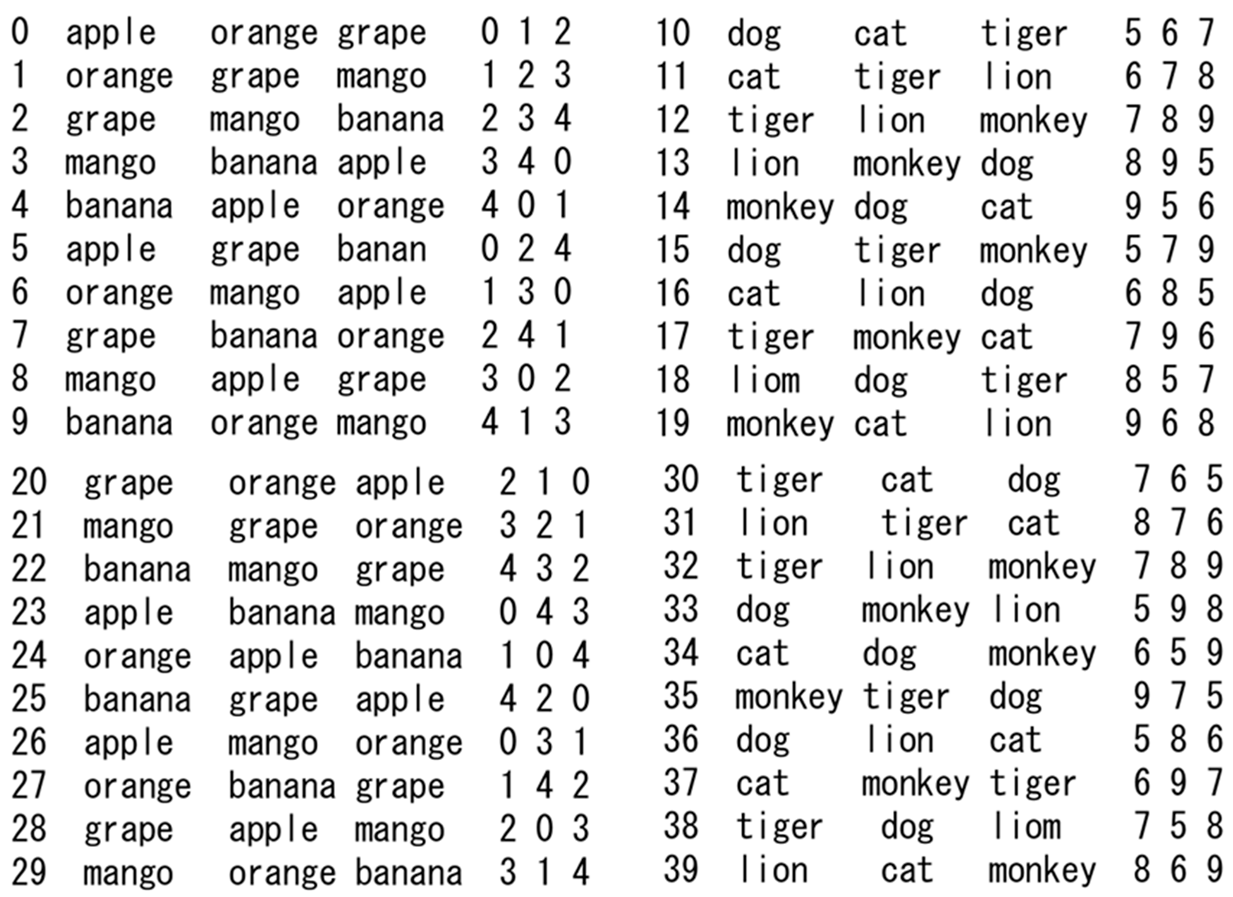
When we calculate the fill-in-the-blank problem, we get the following interesting result in the dimensionally reduced hidden layer. The output cell of each cell is
input = output.
Therefore, this problem is linear. This gives linear algebraic properties to the number vector. The number vector numvec here is calculated as follows:
where, WHI and OH are the weights and offset between the hidden layer and the input layer, and the one-hot vectors of each word are given as input, respectively.
By solving the fill-in-the-blank problem, number vectors with a distributed word representation are obtained. The Figure 4, Figure 5, Figure 6 and Figure 7 shows the learning results using the above input data and training data for the case where the number of training data pieces is NT = 40. This data has a hidden meaning of being classified into two categories, fruits and animals, and compact number vector representation is obtained from the one-hot vectors with this meaning reflected.
Figure 4 shows the number vector numvec when there is one hidden cell (HU = 1). We can see that the 40 data are classified into two categories, fruits and animals (two points on the line), according to the hidden meaning. However, since the fruit words and animal words are not separated, this representation cannot be used for translation or other purposes.
Figure 5 shows the number vector numvec when there are two hidden cells (HU = 2). We can see that the 40 data points are classified into two categories: fruits and animals (two point groups on a plane). However, each fruit word is not separated, and the five animal words are reduced to four numeric vectors, so this representation is also unusable for purposes such as translation.
Figure 5 shows the number vector numvec when there are three hidden cells (HU = 3). It shows that the 40 data points are classified into two categories: fruits and animals (two point clouds in three-dimensional space). Furthermore, the components of the two point clouds for fruits and animals are completely separated. This representation seems usable for purposes such as translation.
Figure 6 shows the number vector numvec when there are four hidden cells (HU = 4). It can be seen that the 40 data points are classified into two categories: fruits and animals (two point clouds in four-dimensional space). Furthermore, the components of the two point clouds for fruits and animals are clearly separated. This expression seems to be useful for purposes such as translation.
The number vector numvec for HU = 3 is shown in Table 4. From this result, for example, the inner product of apples and oranges (apple, orange), the inner product of dogs and cats (dog, cat), and the inner product of apples and dogs (apple, dog) are
If we introduce Euclidean distance as the distance between words, for example, the distance d(apple, orange) between apples and oranges and the distance d(dog, cat) between dogs and cats are calculated as
In addition, the average position of fruits (xf, yf, zf) and the average position of animals (xa, ya, za) are calculated as
Table 4.
Number vector numvec for HU = 3.
| k: | word | x | y | z |
| 0 | apple | -0.584172 | 0.00403 | 0.065173 |
| 1 | orange | -0.002623 | 0.366662 | -0.229709 |
| 2 | grape | -0.508273 | 0.051358 | 0.026687 |
| 3 | mango | -0.075167 | 0.321426 | -0.192925 |
| 4 | banana | -0.487712 | 0.064179 | 0.016262 |
| 5 | dog | 0.287074 | -0.52356 | -0.128992 |
| 6 | cat | 0.057498 | -0.666714 | -0.012583 |
| 7 | tiger | 0.157732 | -0.684748 | -0.439977 |
| 8 | lion | 0.215578 | -0.45749 | 0.424644 |
| 9 | monkey | 0.245844 | -0.37816 | 0.691991 |
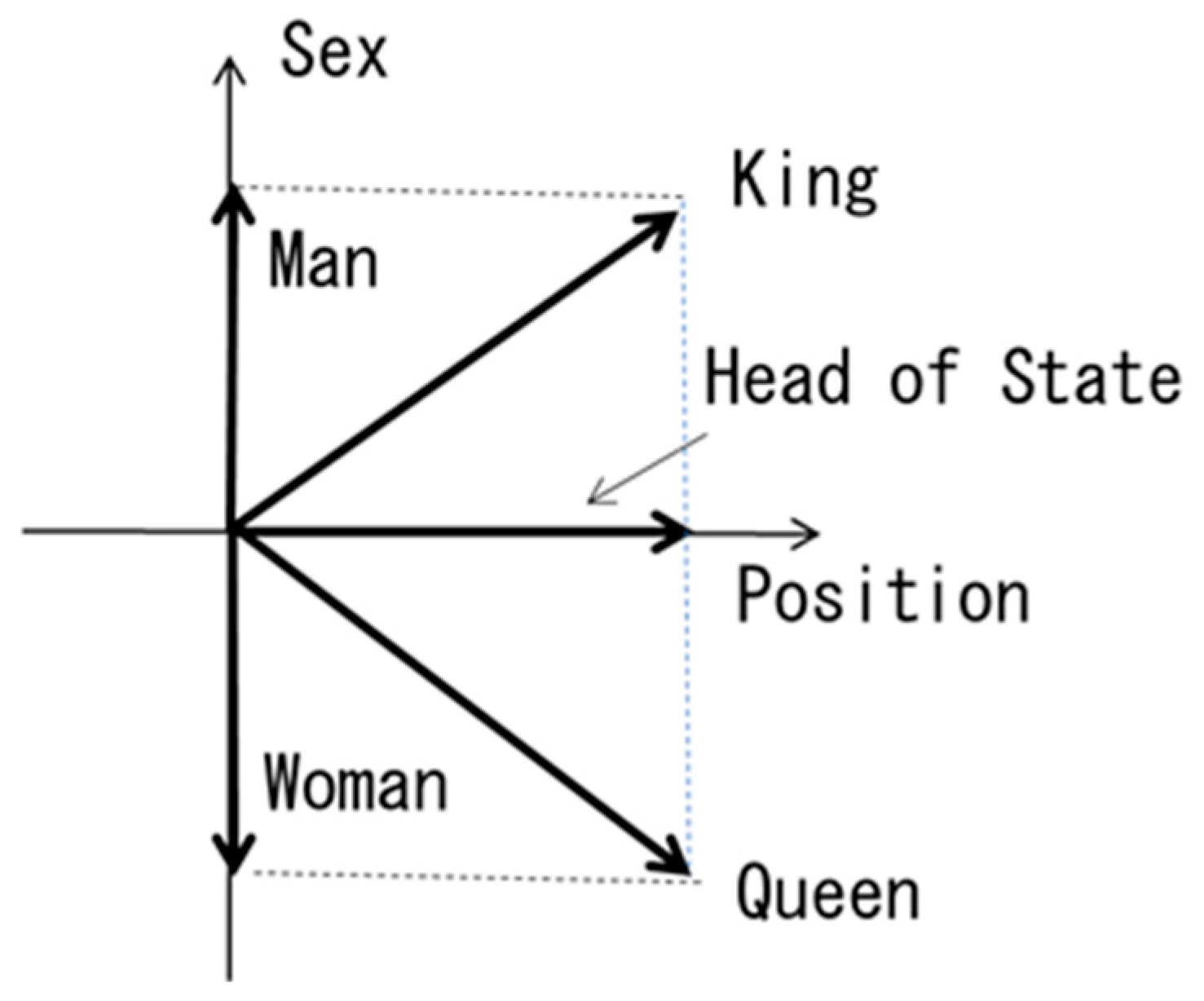
Although it cannot be confirmed by simple learning with a small amount of data as described above, the number vectors based on distributed word representations by word2vec can realize very interesting algebraic properties as described below. Figure 8 shows the algebraic properties of such number vectors:
King – Man + Woman = Queen
Queen – Woman + Man = King
Figure 8 illustrates the reason. This is probably because in learning methods like word2vec, the implicit relationships contained in the input data:
are also learned during the explicit learning process of fill-in-the-blank questions, and these relationships are accumulated in the weights between the input layer and the hidden layers.
King = Head_of_State + Man
Queen = Head_of_State + Woman
Let's consider this using the following data. For five words, Head (Head of State), King, Man, Queen, and Woman, we use the following three types of INPUT-TEACH.dat files:
Table 5.
INPUT-TEACH.dat file (OU=5, HU=2, IU=10, NT=4).
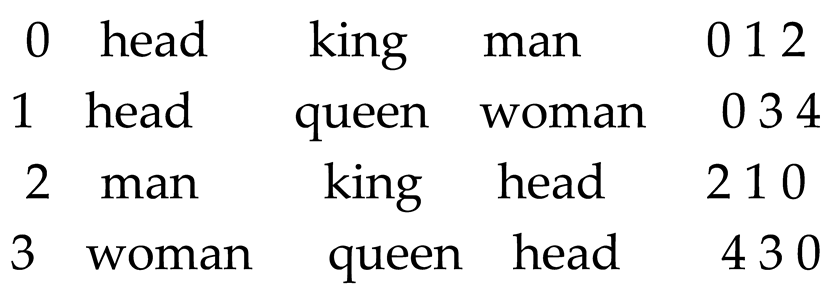
Table 6.
INPUT-TEACH.dat file (OU=5, HU=2, IU=10, NT=12).
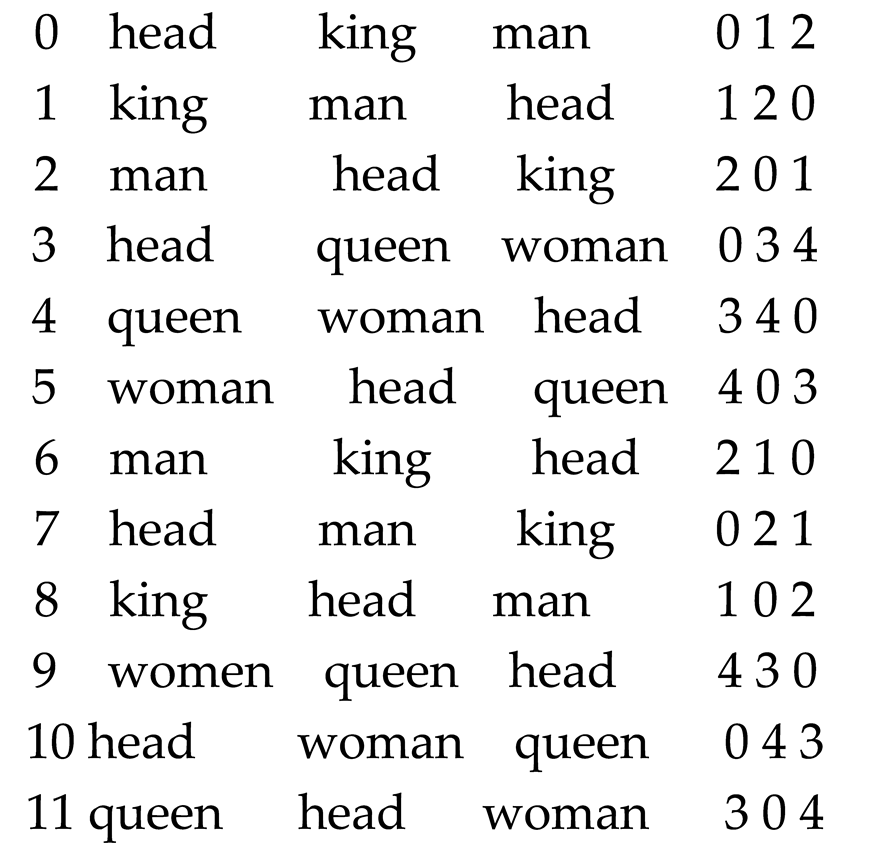
Table 7.
INPUT-TEACH.dat file (OU=5, HU=2, IU=10, NT=16).
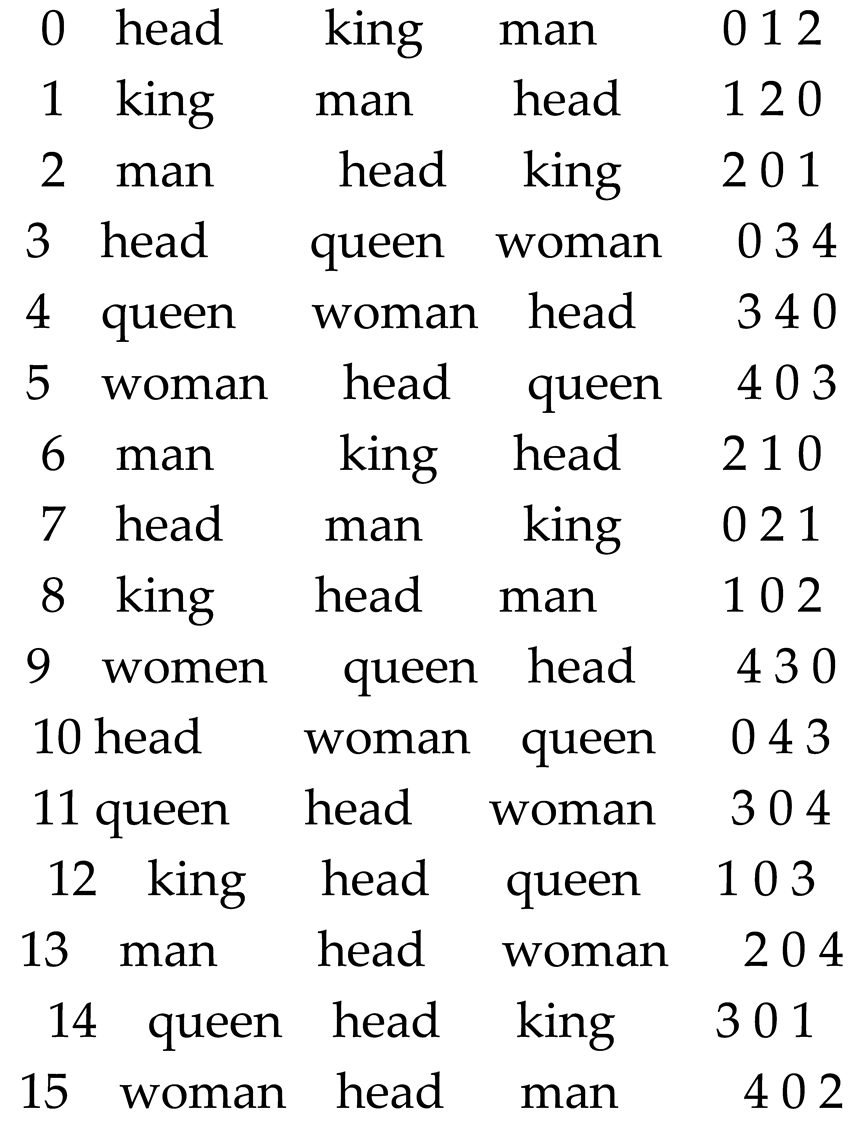
The data includes information about the heads of state, including the King and Queen, and the genders of the King and Queen, Man and Woman. Therefore, the interesting relationships between titles (King, Queen) and job titles (Head of state) and gender (Man, Woman) mentioned above can be derived.
For NT = 4, NT = 12, and NT = 16, the distributed representation of the number vectors by the NN for the fill-in-the-blank problem in Figure 3 is as follows:
Table 8.
Number vector (NT = 4).
| Head | King | Man | Queen | Woman | |
| x | -0.01387 | 0.185897 | 0.635359 | 0.33299 | -0.65818 |
| y | 0.049428 | -0.1526 | 0.785826 | 0.130928 | -0.69117 |
Table 9.
Number vector (NT = 12).
| Head | King | Man | Queen | Woman | |
| x | -0.5415 | 0.767788 | -0.08519 | 0.327094 | -0.1742 |
| y | -0.5789 | -0.27271 | 0.482651 | 0.117548 | 0.561467 |
Table 10.
Number vector (NT = 12).
| Head | King | Man | Queen | Woman | |
| x | -0.54611 | 0.703868 | -0.06764 | 0.307364 | -0.14322 |
| y | -0.74313 | -0.06512 | 0.469316 | 0.209544 | 0.521668 |
From these vectors, we perform the algebraic operation King - Man + Woman.
Table 11.
Algebraic operations King - Man+Woman.
| NT = 4 | NT = 12 | NT = 16 | |
| x | -1.10764 | 0.678785 | 0.628294 |
| y | -1.6296 | -0.19389 | -0.01277 |
When calculating the correlation coefficient ρ:
between King - Man + Woman and each of the words Head, King, Man, Queen, and Woman, it is seen that in the cases of NT = 12 and NT = 16, where the relationships between each word are sufficiently embedded, the correlation with Queen is large, except for King. In NT = 16, the correlation coefficients with Queen, Man, and Woman are higher than in NT = 12, and the correlation coefficients with King and Head are lower.
Table 12.
Correlation coefficients between King - Man + Woman and Head, King, Man, Queen, and Woman.
Table 12.
Correlation coefficients between King - Man + Woman and Head, King, Man, Queen, and Woman.
| Head | King | Man | Queen | Woman | |
| NT = 4 | -0.64441 | 0.090258 | -0.99656 | -0.82579 | 0.986585 |
| NT = 12 | -0.45679 | 0.997775 | -0.43692 | 0.812236 | -0.54657 |
| NT = 16 | -0.57570 | 0.997461 | -0.16275 | 0.814677 | -0.28429 |
Similarly, if we perform the algebraic operation Queen - Woman + Man from these vectors, the following results are obtained:
Table 13.
Algebraic operations Queen - Woman + Man.
| NT = 4 | NT = 12 | NT = 16 | |
| x | 1.626527 | 0.416097 | 0.382938 |
| y | 1.607926 | 0.038732 | 0.157192 |
Calculating the correlation coefficient ρ between Queen - Woman + Man and each word Head, King, Man, Queen, and Woman, we can see that in the cases of NT = 12 and NT = 16, where the relationships between each word are sufficiently embedded, the correlation with King is large, except for Queen. In NT = 16, the correlation coefficient with Queen, Man, and Woman is higher than in NT = 12, and the correlation coefficient between King and Head is lower.
Table 14.
Correlation coefficients between Queen - Woman + Man and Head, King, Man, Queen, and Woman.
Table 14.
Correlation coefficients between Queen - Woman + Man and Head, King, Man, Queen, and Woman.
| Head | King | Man | Queen | Woman | |
| NT = 4 | 0.484746 | 0.10361 | 0.99382 | 0.919092 | -0.99954 |
| NT = 12 | -0.74787 | 0.907247 | -0.0818 | 0.96837 | -0.20652 |
| NT = 16 | -0.85381 | 0.886176 | 0.243888 | 0.978269 | 0.121283 |
The mathematics of translating from English to French will be explained using a simple example:
“delicious apple” → ”pomme délicieuse”,
”I ate a delicious apple” → ”Je mange une pomme délicieuse”.
Roughly speaking, when a human translates, they follow the following steps: first, they look up the dictionary and translate word by word, then they rearrange the word order. This can be expressed mathematically as follows:
When we consider this together with the numerical vector representation of words by word2vec mentioned above, we can replace translation with computation. This is why we think of translation as coordinate transformation.
Let a sentence SA1 in the concrete space of a language A be mapped to a point T A SA1 in the semantic space by a transformation T A from the concrete space A to the semantic space.
It seems that by introducing an abstract space, we can uniquely define distance. Thinking in this way, we can introduce scalar distance that is independent of the coordinate system into linguistic space, which becomes a traditional geometric space:
Distance in concrete space = Distance in abstract space,
Namely,
The distance between sentence SA1 and sentence SA2 in concrete space A =
.
To turn mathematical linguistic space into a physical space, we will need a mathematical expression of the state of the brain.
3. Mathematical Representation of the State of the Brain
If the state of brain cell i is represented as , and assuming binary nature and the basis as , then the state of the brain cell can be represented as
[1], where, as in quantum mechanics, the square of the absolute value of the coefficient represents the probability.
The state of the entire cerebrum, , can be written as
if it is the direct product of the individual cells.
On the other hand, the mathematical representation of a linear language space
holds.
If we consider a word to be the smallest unit of a sentence and a word to be the basis of a sentence, then it will be
The numerical vector representation of words described in the previous section corresponds to the above basis. In this way, the physical cellular space of the brain and the mathematical language space can be corresponded.
If we consider the process of translation from the above perspective,
translation from English to Japanese
= coordinate transformation from English space to Japanese space.
= coordinate transformation from English space to Japanese space.
In other words, it can be thought of as a coordinate transformation between different language spaces:
Then, we can think as
Words = basis vectors in language space = eigenfunctions of an eigenvalue problem
of the time-independent Schrödinger equation.
of the time-independent Schrödinger equation.
The evolution of the state of the brain over time is given by a time-dependent Schrödinger equation:
and consideration may also arise from the aspect of the energy minimization problem.
In other words, the stability of memory can be thought of as the state of the brain having multiple stable states, each of which is assigned a word, and sentences being formed by combining multiple stable states.
4. Conclusion
Linguistics is an important academic field with a long history. Still, with the introduction of generative AI such as ChatGPT, it seems to be on the verge of achieving groundbreaking developments.
The introduction of generative AI has revealed clear geometric similarities between different languages. In hindsight, this may seem obvious, but it is a major discovery that exceeded expectations.
We can also expect groundbreaking advances in communication between different species of animals, such as humans and dogs, dolphins, and whales. As communication between humans and animals progresses, it will be required for changing the way humans treat animals significantly.
In the future, this will also bring about major changes in communication between animals and plants.
In this paper, we have described a basic mathematical method for treating language as a geometric space. The discussion in this paper focuses on words and is limited to methods for treating words as numerical vectors. Since a sentence is a connection (a trajectory in language space) of words (distributed representation of numerical vectors), if we can train a neural network to learn these connections between different languages, for example between English and French, by using one language as input and the other as training data, it will be possible to convert (translate) sentences that have the same meaning between different languages. Through this, the mathematical meaning of translation will become clear.
In this study, we described the language space geometrically and showed that the distributional representation of words is related to the concept of coordinate transformation, which deepens the mathematical understanding of translation.
Appendix A: Explanation of word2vec
In actual calculations, words are represented as vectors with a finite, fixed length. This is called a distributed representation of words. If words can be represented as vectors, the meaning of the words can be quantified, and processes such as translation can be mathematically modeled. word2vec [2,3] is a method that aims to acquire a distributed representation of words.
In natural language processing research, there is a distribution hypothesis based on co-occurrence, which posits that the meaning of a word is created with surrounding words. word2vec is also based on the distribution hypothesis. There are two methods for acquiring embedded representations of words: one that statistically determines co-occurrence, and one that determines it by learning neural networks. Here we will explain the latter.
In the field of linguistics, there is a database of language called a corpus. The CBOW model, one of the word2vec models, is a neural network that aims to infer targets from context.
By training using this CBOW model, it is possible to acquire a distributed representation of words. If one word before and after is used as the context, for example, in the following example (fill-in-the-blank question):
the (English) word is inferred from (studying) and (recently).
(I) (am) (always) (studying) (English) (recently) (.)
Then, we consider a fill-in-the-blank problem in which the t-th word in a sentence is estimated from a sequence of c words before and after it:
Although we are trying to find a word embedding, we are trying to solve a fill-in-the-blank problem that may seem unrelated at first glance. However, solving this problem actually results in finding the word embedding. The Softmax part or its input becomes the training data.
The one-hot vector of each word is used as input. The training data can be interpreted as providing data (probabilities) in which the t-th element is 1 and the others are 0. Alternatively, the one-hot vector of the answer is used. The word distributed representation is calculated as follows:
References
- H. Isshiki, Human Thoughts and Quantum Mechanics (predictive study through mathematical model), Scientific & Academic Publishing, (2025) To be published.
- Tomas Mikolov, Kai Chen, Greg Corrado & Jeffrey Dean, Efficient estimation of word representation in vector space,Cornell arXiv:1301.3781v3, 2013.
- Tomas Mikolov, Ilya Sutskever, Kai Chen, Greg Corrado & Jeffrey Dean, Distributed Representations of words and prases and their compositionality, Cornell arXiv:1310.4546v1, 2013.
- WikipediA, word2vec,(https://en.wikipedia.org/wiki/Word2vec).
- LeCun, Y.; Bengio, Y.; Hinton, G. Deep learning. Nature 2015, 521, 436–444. [Google Scholar] [CrossRef] [PubMed]
- Radford, T. Salimane & I. Sutskever, Improving Lanuag Understanding by Generative Pre-traing, 2018. (https://cdn.openai.com/research-covers/language-unsupervised/language_understanding_paper.pdf).
- Redford, J. W. R. Child, D. Luan, D. Amodei, & I. Sitskever, Language Models are UnsupervisedMultitask Lerners, OpenAI, Preprint 2019. (https://cdn.openai.com/better-language-models/language_models_are_unsupervised_multitask_learners.pdf).
- J. Kaplan, S. McCandish, T. Henighan, T. B. B. Chess, C. Rewond, S. Gray, A. Radfold, J. Wu, & D. Amodei, Scaling Laws for Neural Language Models, Cornell University, arXiv:2001.08361, 2020.
- Z. Yang, Z. Dai, Y. Yang, J. Carbonell, R. Salakhutdinov, Q. & V. Le, XLNet: Generalized Autoregressive Pre Training for Language Understanding, Cornell University, arXiv:1906.08237, 2020.
- Raffel, N. Shazeer, A. Roberts, K. Lee, S. Narang, M. Matena, Y. Zhou, W. Li & P. J. Liu, Exploring the Limit of Transfer Learning with a Unified Text-to-Text Transformer, Cornell University, arXiv:1910.10683, 2023.
- Masato Hagiwara, Benjamin Hoffman, Jen-Yu Liu, Maddie Cusimano Felix Effenberger, Katie Zacarian, BEANS: The Benchmark of Animal Sounds, Cornell ArXiv:22110.12300v1, 2022.
- Masato Hagiwara, AVES: Animal Vocalization Encoder Based on Self-Supervision, Cornell ArXiv: 2210.14493v1, 2022.
- Christian Rutz, Michael Bronstein, Aza Raskin, Sonja C. Vernes, Katherine Zacarian, Damián E. Blasi, Using machine learning to decode animal communication, Science, 2023.
- Using AI to Decode Animal Communication with Aza Raskin, 2024. (https://www.youtube.com/watch?v=3tUXbbbMhvk).
Figure 1.
Two types of words: fruit and animal.

Figure 2.
Fill-in-the-blank question to guess the middle word from the two words on the left and right. (Choose 3 words from either fruits or animals).
Figure 2.
Fill-in-the-blank question to guess the middle word from the two words on the left and right. (Choose 3 words from either fruits or animals).
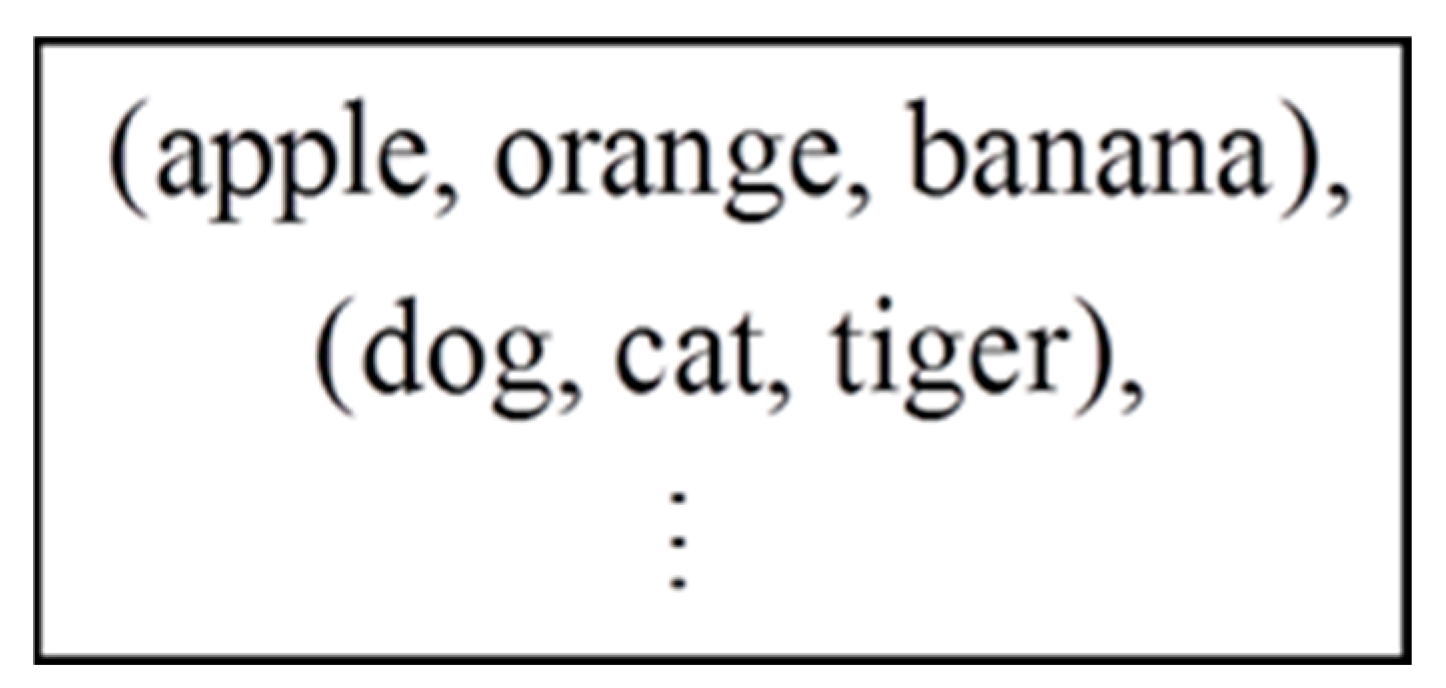
Figure 3.
NN for fill-in-the-blank problems (red numbers indicate vector dimensions).
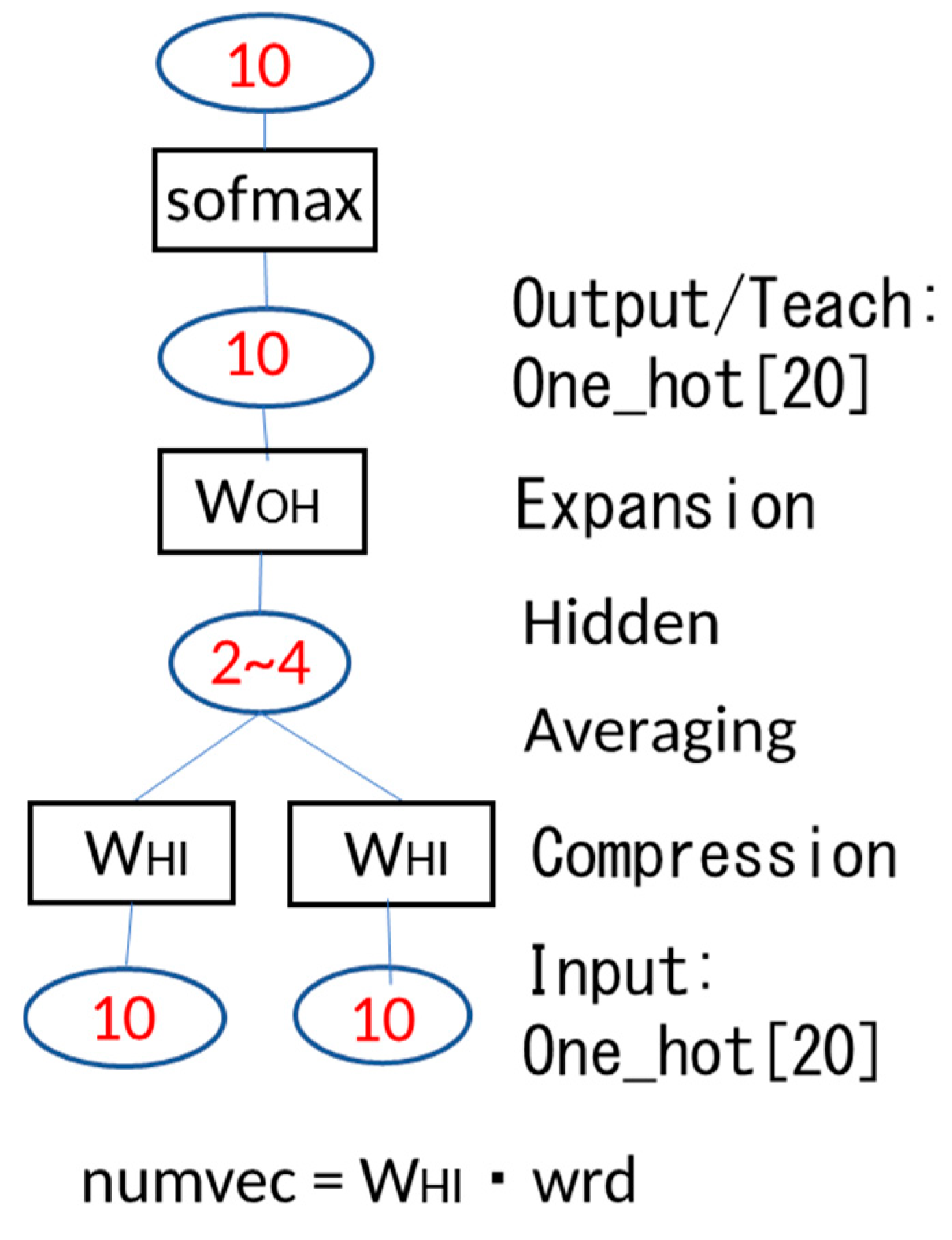
Figure 4.
Numeric vector numvec for HU = 1.
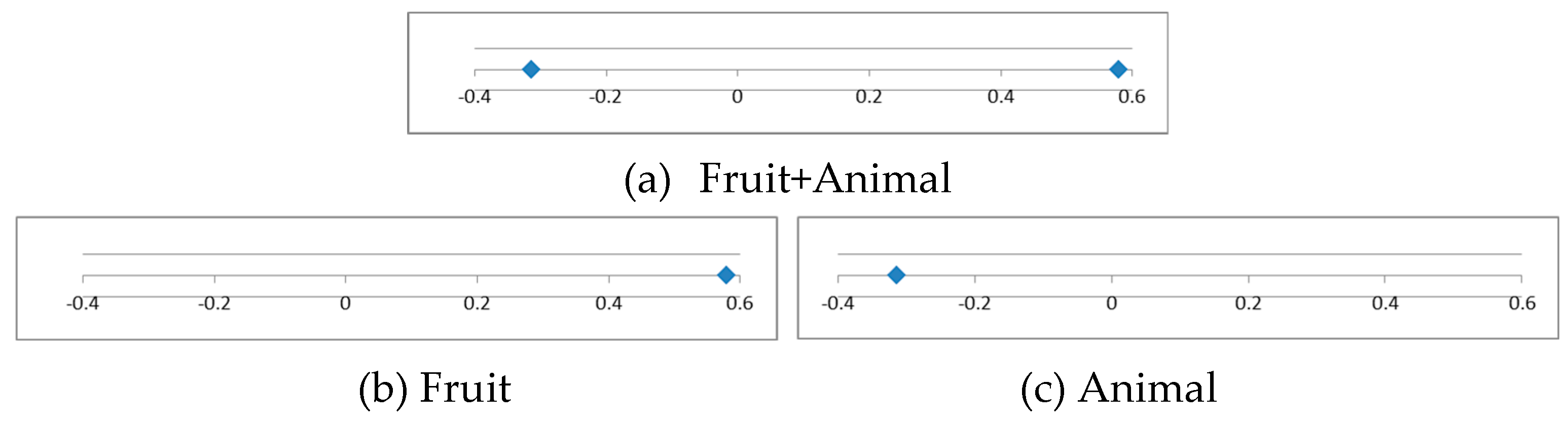
Figure 5.
Numeric vector numvec for HU = 2.
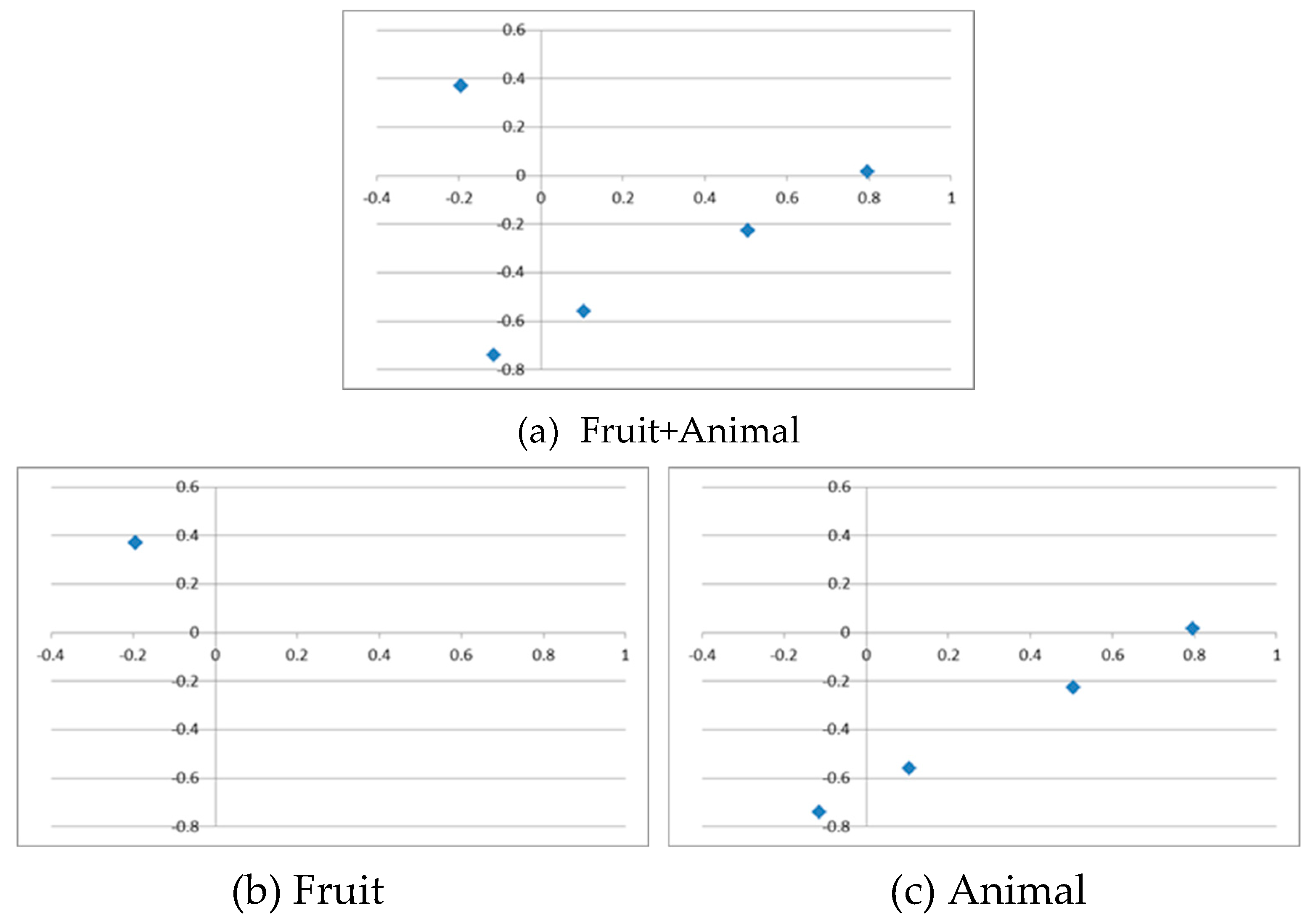
Figure 6.
Numeric vector numvec for HU = 3.
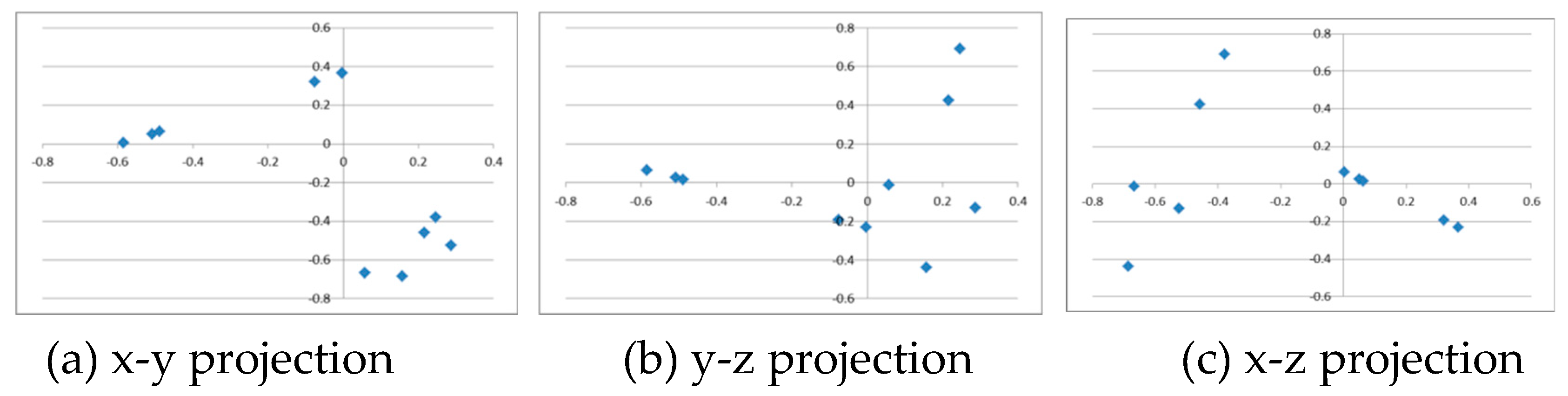
Figure 7.
Numeric vector numvec for HU = 4.
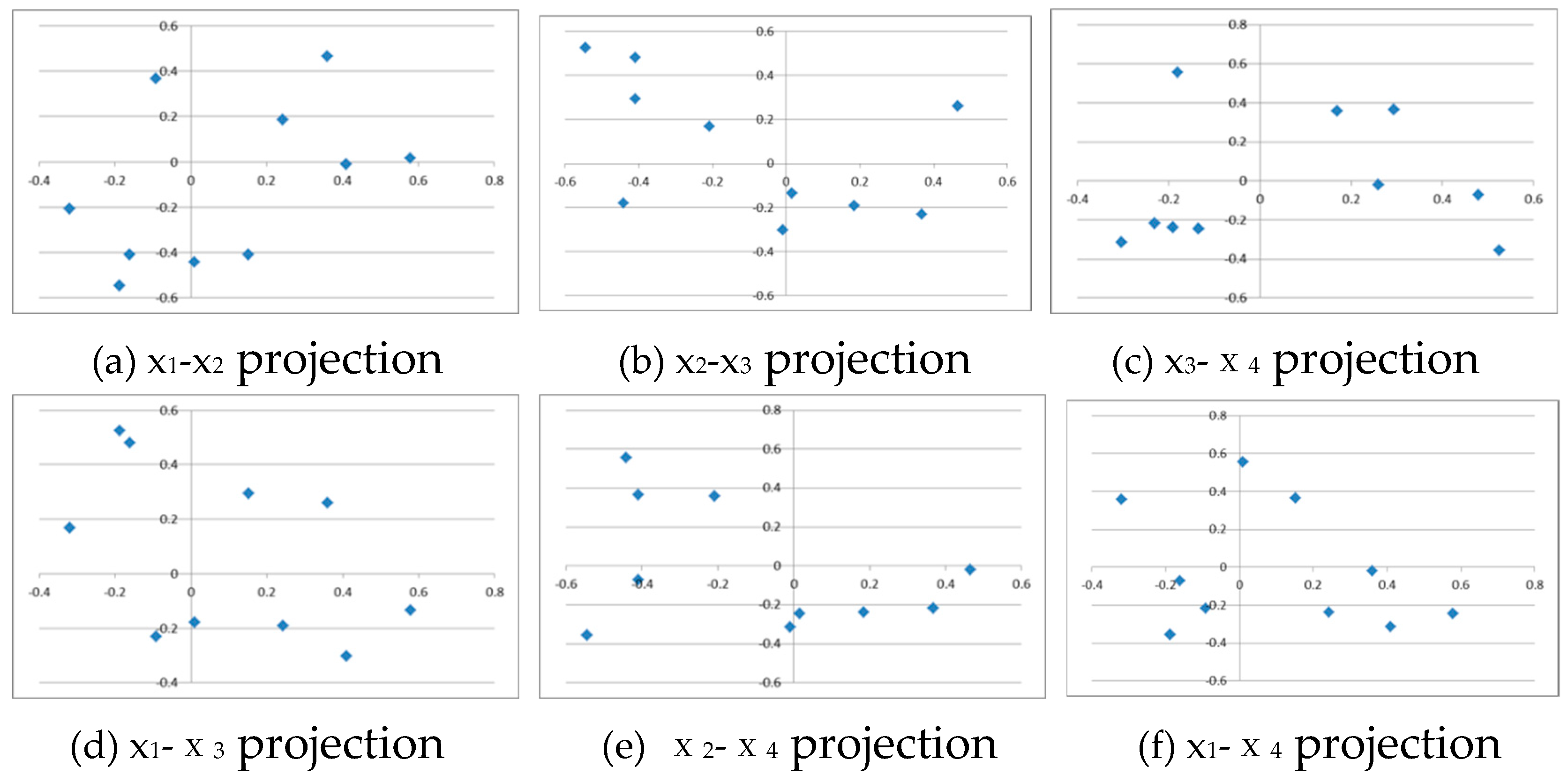
Figure 8.
Algebraic properties.
Disclaimer/Publisher’s Note: The statements, opinions and data contained in all publications are solely those of the individual author(s) and contributor(s) and not of MDPI and/or the editor(s). MDPI and/or the editor(s) disclaim responsibility for any injury to people or property resulting from any ideas, methods, instructions or products referred to in the content. |
© 2025 by the authors. Licensee MDPI, Basel, Switzerland. This article is an open access article distributed under the terms and conditions of the Creative Commons Attribution (CC BY) license (http://creativecommons.org/licenses/by/4.0/).
Copyright: This open access article is published under a Creative Commons CC BY 4.0 license, which permit the free download, distribution, and reuse, provided that the author and preprint are cited in any reuse.


