

Submitted:
24 March 2025
Posted:
25 March 2025
You are already at the latest version
Abstract
Our study aims to analyze the relationship between ethical leadership and affective commitment, introducing a model mediated by ethical climate and moderated by psychological empowerment to enhance understanding of the underlying mechanisms involved in these relationships. The sample consisted of 175 women and 273 men from the Colombian electrical sector. The model was analyzed using structural equation modeling. The results show that ethical leadership is positively related to affective commitment, and ethical climate is a mediating factor that justifies this relationship. Furthermore, psychological empowerment acts as a moderating variable between ethical leadership, ethical climate, and affective commitment. Specifically, the positive effect of ethical leadership on ethical climate increases as the perception of psychological empowerment strengthens. The positive relationship between ethical climate and affective commitment increases when psychological empowerment is medium or high. Additionally, as psychological empowerment progresses, the positive relationship between ethical leadership and affective commitment increases. Consequently, organizations in the Colombian electrical sector should implement measures that support the management of ethical leadership as it influences the perception of ethical climate, psychological empowerment, and affective commitment. Lastly, it is crucial to contrast the proposed model through cross-cultural research lines.
Keywords:
ethical climate
; ethical leadership
; affective commitment
; psychological empowerment
; Colombian electrical sector
; energy sustainability
1. Introduction
Ethical behavior has been a subject of debate and concern over the years [1]. In fact, there is still a global trend aiming to establish a concrete relationship between organization, ethics, and outcomes [2]. In this sense, various studies have focused on leadership and ethical climates as critical antecedents that directly influence organizational outcomes [3,4,5,6,7].
Ethical leadership refers to the demonstration of high moral standards, aligned with universally accepted rules, visible through personal and interpersonal actions [8]. Previous research has shown that the ethical leader is a role model that directly impacts the moral behavior of employees and the climate surrounding them [9,10,11]. Therefore, the role of the ethical leader is key when a business sector aims to build an ethical climate that seeks to establish an optimal fit between person and organization [12]. Ethical climate is defined as the shared perceptions that employees have of what is correct behavior and how ethical issues should be managed [13]. When employees perceive that the ethical climate impacts institutional policies and optimizes work-related processes, they improve their attitude and commitment to organizational goals [2].
Indeed, the ethical climate not only serves as a lens through which workers analyze and assess situations, but it also represents an opportunity for the organization and its leaders to make decisions that favor common interests and show significant concern for others [14]. In this sense, a caring and supportive climate focused on employee welfare generates attraction and positive feelings towards the task, which translates into high affective commitment [2,15]. Affective commitment is an employee’s response to positive experiences with the organization and is reflected through a strong sense of belonging, acceptance of organizational goals and values, and a strong emotional bond [16,17].
Various studies focused on ethical leadership have demonstrated its relationship with ethical climates. For example, Al Halbusi et al. [3] and Lu and Lin [18] consider that the ethical leader has a strong impact on employee moral behavior through the mediating effect of the ethical climate, defending that ethical leaders are key elements in shaping the moral framework of the organization and promoting positive employee behavior that benefits others.
However, few studies have analyzed in depth the effect of leadership and ethical climates on employees’ psychological state and specifically on affective commitment. For instance, Demirtas & Akdogan [2] propose that the behavior of the ethical leader favors individual development by strengthening their affective commitment both directly and indirectly. The indirect effect of ethical leadership involves shaping perceptions of the ethical climate, which in turn generates greater affective commitment. Loi et al. [19] establish a relationship between ethical leadership and affective commitment through the mediating effect of perceived organizational support (POS). On the other hand, Asif et al. [20] and Negiş Işik [21] suggest that affective commitment is a useful mediating mechanism to explain the relationship between ethical leadership, creativity, and job satisfaction, respectively. Finally, Huang et al. [22] and Kaur [23] consider that a supportive ethical climate is related to higher job satisfaction and leads to strong affective commitment.
Due to the limited number of studies that have addressed this topic, it is vital to analyze the effect of ethical leadership on affective commitment through the mediating effect of a caring and supportive ethical climate. On this note, although ethical leadership may be positively related to affective commitment through the ethical climate, it is likely that some circumstances or factors may moderate the mediating process between ethical leadership, ethical climate, and affective commitment, intensifying these relationships. Previous studies have shown that affective commitment is higher in people who feel supported by their leader when making a decision [24]. For this reason, psychological empowerment may be a potential moderator of the mediating process in this research since the empowered employee has a greater sense of influence, more autonomy, and a higher perception of competence, which can enhance the link between ethical leadership, ethical climate, and affective commitment. Psychological empowerment can be defined as a motivating element that highlights the perceptions of the empowered follower and plays a significant role in the employee’s work behavior [25].
In this line of thought, the study by Qing et al. [26] demonstrates that ethical leadership affects employees’ attitudes and specifically their affective commitment through psychological empowerment as a mediating mechanism. In this regard, Kim & Vandenberghe [27] indicate that the positive relationship between ethical leadership and affective commitment is expanded when psychological empowerment acts as a moderating element. On the other hand, Akkoç et al. [28] and Liu et al. [29] suggest that an ethical climate facilitates psychological empowerment. Indeed, a climate focused on people’s well-being buffers unethical behavior and increases employee self-confidence and safety. In addition, psychological empowerment represents strong organizational support for professional self-management, to which the employee responds with strong affective commitment [30,31,32].
Therefore, the general objective of this research is to clarify the relationship between ethical leadership and affective commitment, introducing a model mediated by the ethical climate and moderated by psychological empowerment, to enhance the understanding of the underlying mechanisms that intervene in these relationships within the Colombian electrical sector, which has a significant environmental impact in the country.
1.1. Study Contextualization
The electrical industry in Colombia plays a crucial role in national sustainability through the diversification of the energy matrix, the optimization of energy efficiency, and the reduction of emissions. The optimization of energy resource use remains a pending issue for the Colombian electrical sector due to the considerable inequality present in the country. In addition, the Colombian electrical sector needs to continue building a robust reputation after decades in which its administrative transparency has been questioned. Colombia is immersed in an energy transition process that is vital for increasing the electrical supply throughout the country. Indeed, the delay that has been experienced in new projects could hinder a stable electricity supply starting in 2026. On the other hand, the Colombian electrical sector has been affected by the complications suffered by the country’s economy since 2022. The change of government in the country has directly conditioned the electrical sector due to a lack of liquidity and delays in subsidy payments from the national government.
In 2015, the Colombian electrical sector made a commitment to transparency in an attempt to create and implement a comprehensive anti-corruption program, based on ethical principles, in order to combat bribery and improve its financial and legal image internationally. From a transparent management perspective, organizational reputation has become fundamental. Therefore, the Colombian electrical sector is intentionally seeking to strengthen the ethics of its employees through a leadership style and ethical climates that prioritize social interests over individual ones. As such, the Colombian electrical sector is unaware of the effect of a complex and changing environment on its employees’ commitment, or how psychological empowerment can act as a theoretically beneficial mechanism that helps improve all its internal and external processes.
1.2. Ethical Leadership and Affective Commitment
The leader, as the organizational spokesperson, directly influences the behavior of the followers. Therefore, their behavior will be interpreted as part of the policies that the organization wants to convey. In this sense, if the follower establishes an emotional connection with the leader, they will also establish it with the organization [33]. The ethical leader adopts a series of daily behaviors that accentuate their emotional side. For example, they care about the interests of the employees, listen to their concerns, and provide constant feedback [34]. This attitude suggests that between the ethical leader and the follower, a relationship of trust is established that is valuable enough to improve the employee’s affective commitment. Indeed, trust in the leader and affective commitment are aspects that are closely related [35].
In addition, ethical leaders focus on organizational sustainability [36]. When making decisions, ethical leaders prioritize actions that are supported by norms, thus ensuring the organization’s long-term growth. This context of security increases the follower’s affective commitment by making them feel that their future in the organization is guaranteed [37]. In this regard, Ilyas et al. [38] argue that ethical leadership improves affective commitment, especially in individuals with low work self-efficacy. This indicates that the ethical leader, being considered open, reliable, and honest, allows the follower, regardless of their skill level, to have no doubts about their job position, even if their performance is not optimal [9]. In reality, the ethical leader relies on social exchange rather than economic exchange. This type of exchange refers to reciprocal care relationships that are sustained through affection and trust, which improves the loyalty and affective commitment of employees [39,40]. Based on the previously described contributions, we proposed the following hypothesis: H1 Ethical leadership and affective commitment are positively correlated.
1.3. The Mediating Role of Ethical Climate
The ethical behavior of the leader is an essential requirement for building an ethical organization. Therefore, the ethical leader must assume a central role in the development and sustainability of ethical climates [2]. In this sense, the sociocultural environment, the institutional structure, and the particular direction of each entity are the factors that determine the type of dominant ethical climate within an organization [41].
The ethical leader, through their two main facets, moral person and moral manager, plays a determining role in the creation of the ethical climate [42]. The ethical leader possesses multiple positive personal characteristics that influence the follower and how they actively manage their ethical behavior. For example, the ethical leader is integrous, fair, reliable, cares about others, and rewards or punishes the follower’s actions, which make them a convincing interpretive filter of organizational policies and processes [43]. In this study, we refer to social learning theory [44,45,46] to explain the influence of ethical leadership on ethical climates. Social learning theory maintains that people learn forms of behavior through a role imitation process by observing the behaviors of others. This theory suggests that people pay more attention to behavior patterns that are striking and convincing [47].
Social learning theory allows the individual to learn forms of social behavior through direct and indirect observation of the people around them. In this context, employees receive precise indications from the ethical leader about what is expected of them and what is considered ethically correct. In addition, ethical leaders prepare their followers to avoid the pressure from achieving organizational goals which arise from transforming their ethical principles [12]. Indeed, Grojean et al. [48] affirm that the factor that most intensely influences an organization’s climate is the daily behavior of the leaders who direct it. In this regard, Schminke et al. [49] suggest that the relationship between leadership and ethical climates is stronger when leaders are able to translate their moral arguments into ethical actions. Under such circumstances, if leaders and followers have similar moral development, the climate surrounding them is supportive and caring. Therefore, ethical leadership has a significant influence on the formation of an ethical climate [2,3,6,12,15,18,42,50,51].
On the other hand, a supportive ethical climate focuses on benevolence and care for others. This atmosphere of interest in other people facilitates the individual’s desire to remain in the organization and have a strong emotional connection with it. Therefore, the ethical climate may be closely related to affective commitment [22,52]. Affective commitment is characterized by the acceptance of the organization’s goals and values, which translates into better performance, a proactive attitude, and a greater sense of belonging [53,54]. According to Demirtas and Akdogan [2], affective commitment is related to the environment and organizational structure. Therefore, an ethical climate that, in addition to offering clear standards and procedures for managing an ethical dilemma, provides security, fair treatment, and a strong perception of support is more than likely to increase affective commitment. Based on the previous explanation, we proposed the following hypothesis: H2 The ethical climate acts as a mediating variable in the relationship between ethical leadership and affective commitment.
1.4. The Moderating Role of Psychological Empowerment
The Moderating Role of Psychological Empowerment
Ethical leaders have a significant impact on the ethical behavior of followers. In addition, ethical leaders are decisive elements in the development of the ethical climate. The ethical leader not only promotes equality among their followers but also shows deep respect for the characteristics of others and intentionally seeks relationships based on mutual support. Likewise, the ethical leader shares information with followers and expresses their feelings transparently and honestly [9,11]. Because ethical leaders strive to make fair decisions and create a positive work environment, where the emotional state of the follower is valued, it is easy to think that processes of psychological empowerment are established between leader and follower [24].
Psychological empowerment acts as a motivational tool that positively influences employee behavior [55]; since psychological empowerment creates an optimal emotional state because the employee feels that they have control over their work and are in better conditions to demonstrate their skills and abilities. This psychological atmosphere encourages the follower to identify with the work climate surrounding them [56,57,58]. Studies such as those by Dehghani-Tafti et al. [59] suggest that as psychological empowerment increases, employee work involvement improves, work discouragement is reduced, and communication between team members is strengthened. Therefore, the positive relationship between ethical leadership and ethical climate can be reinforced through the psychological empowerment of followers [59]. Psychological empowerment reflects the conviction that an employee has about their ability to influence a work environment when they experience harmony between their principles and those of the organization they belong to. Under the guidance of the ethical leader, greater psychological empowerment not only promotes corporate social responsibility but also friendly relationships that are critical elements of an ethical climate focused on solidarity and benevolence [60,61]. Based on these arguments, we proposed the following hypothesis: H3a. Psychological empowerment will moderate the positive relationship between ethical leadership and ethical climate. As the employee feels more psychologically empowered, the positive relationship between ethical leadership and ethical climate will be stronger.
Moreover, the ethical climate has received significant attention in the literature as a factor that is highly likely to positively influence organizational commitment and specifically affective commitment [2,14,16,22,52]. An ethical climate builds an environment of trust and security within organizations. This context of protection promotes initiative and psychological empowerment of employees by considering them relevant components of emotional health [62].
Spreitzer [25] defines psychological empowerment as an individual experience associated with motivation that enhances work efficiency and control through four dimensions: meaning, competence, self-determination, and impact. Meaning refers to the employee feeling important and competent enough to perform their work activities. Competence refers to possessing the skills to successfully carry out work tasks. Self-determination alludes to the motivation of people to take on work responsibilities through their own initiative. And impact refers to the employee’s ability to achieve relevant results [63].
Seibert et al. [64] suggest that psychological empowerment is one of the elements that can enhance affective commitment, as a positive and desired employee behavior. For example, meaning increases affective commitment since it reflects the balance between the employee’s role within the organization and their principles. The perception of competence and impact allows the employee to externalize their needs and convictions [55]. Consequently, employees perceive their work as meaningful, which leads to feelings of satisfaction that increase affective commitment [30,65]. These arguments invite us to formulate the following hypothesis: H3b. Psychological empowerment will moderate the positive relationship between ethical climate and affective commitment. As the employee feels more psychologically empowered, the positive relationship between ethical climate and affective commitment will be stronger.
It is necessary to emphasize that the relationship between ethical leadership and affective commitment through the potential effect of psychological empowerment has not received sufficient attention from the scientific community. For example, Qing et al. [26] verify that psychological empowerment fully mediates the relationship between ethical leadership and affective commitment, while Chao et al. [66] establish a positive relationship between ethical leadership and organizational commitment using psychological empowerment as a mediating variable. However, to the best of our literature review, the moderating effect of psychological empowerment has gone unnoticed in the academic world.
Psychological empowerment intentionally seeks to decentralize decision-making power, which involves giving lower-level employees the ability to make decisions autonomously [55]. In this regard, the ethical leader seeks to align the organizational strategy with the development needs and strengths of each employee. In addition, the ethical leader defends the follower’s rights, ensures dignity and independence in the workplace, and offers their trust, which usually results in a strong perception of psychological empowerment [67]. When an organization and especially its leaders emphasize the importance of employee development through proper job role adjustment, it is more likely that the employee will respond with a higher level of commitment [32]. In fact, when employees perceive that the leader recognizes their effort and expands their autonomy, their psychological security and affective commitment improve [29]. Specifically, psychological empowerment makes employees more proactive and independent, which enhances the emotional bond between employee and organization [30]. Consequently, we proposed the following hypothesis: H3c. Psychological empowerment will moderate the positive relationship between ethical leadership and affective commitment. As the employee feels more psychologically empowered, the positive relationship between ethical leadership and affective commitment will be stronger.
1.5. Presentation of the Study
This research reviewed the relationship between ethical leadership and affective commitment of employees in the Colombian electrical sector. Secondly, this research verified whether the ethical climate acted as a mediating construct of the relationship between ethical leadership and affective commitment. Finally, this study verified whether psychological empowerment could moderate the effect of ethical leadership on ethical climate and affective commitment, along with the independent effect of ethical climate on affective commitment. Figure 1 represents the proposed moderated mediation model.
2. Materials and Methods
2.1. Participants
The study is quantitative, cross-sectional, non-experimental, and correlational. A total of 448 professionals from six organizations in the Colombian Electrical Sector participated in the research. Following the suggestions proposed by Sedgwick [68], a probabilistic cluster sampling method was used with a 95% confidence level. This technique is particularly useful for studying specific departments (clusters). The cities with the largest concentration of companies in the analyzed sector were purposefully examined. The effective response rate of the questionnaire was 100% since the participating organizations designated specific times within working hours to accommodate the employee and ensure valid responses. We established only two selection criteria when choosing participants: a minimum of one year of seniority and an indefinite contract. These criteria aimed to ensure that the employee understood the work environment and that a having fixed-term contract did not influence their responses.
The 61% of the total sample were men (273). The average age was 37.18 (SD=10.06), with a range of 20 to 69 years. The average number of years in work was 13.06 (SD=8.82), ranging from 1 to 38. As for education, 100% held university studies and 57.42% held specialized master’s degrees or doctorates. Regarding the type of contract, 100% had indefinite contracts. Lastly, 42.40% of the participants did not have children.
2.2. Measures
2.2.1. Ethical Leadership
To measure ethical leadership, the 10-question scale suggested by Brown et al. [8] was used. Recent studies have confirmed its reliability and validity [69]. Some of the items used were “My leader can be trusted.” Each item was measured on a Likert scale from 1 (strongly disagree) to 6 (strongly agree).
2.2.2. Ethical Climate
To measure ethical climate, the 11-question scale suggested by Victor & Cullen [13], divided into three subscales, was used: (1) Friendship (3 items), (2) Group interest (4 items), and (3) Social responsibility (4 items). Recent studies have confirmed its reliability and validity [70]. Some of the items used were “The most important concern is the good of all people in the company.” Each item was measured from 1 (strongly disagree) to 6 (strongly agree).
2.2.3. Psychological Empowerment
To measure psychological empowerment, the 12-question scale suggested by Spreitzer [25] was used. It is divided into four subscales: (1) Meaning (3 items), (2) Competence (3 items), (3) Self-determination (3 items), and (4) Impact (3 items). Recent studies have confirmed its reliability and validity [60]. Some of the items used were “The work I do is very important to me.” Each item was measured from 1 (strongly disagree) to 6 (strongly agree).
2.2.4. Affective Commitment
To measure affective commitment, the 6-question scale suggested by Meyer et al. [71] was used. Recent studies have confirmed its reliability and validity [72]. Some of the items used were “I really feel the organization’s problems as my own.” Each item was measured from 1 (strongly disagree) to 6 (strongly agree).
2.3. Procedure
The link with the Colombian Electrical Sector was established through the collective action of ethics and transparency driven by the company XM in 2021. In reality, the objectives of this research were established through a presentation and various suggestions.
A group of specialists, proposed by the organizations studied, validated both the questionnaire and the scales used. The survey was translated into Spanish by a bilingual researcher using the conventional method of back translation [73]. Two academics, specialized in the field, reviewed the translation for consistency. An ethics committee of the University of Vic (Catalonia, Spain) approved the research project on July 2021 (170/2021). A series of documents were sent to the participating organizations via email to guarantee confidentiality, authorization, data protection, and possible voluntary withdrawal of each participant. Data collection processes were conducted on separate days [74], and each organization provided respondents with a sixty-minute time slot to ensure a significant number of responses. The survey was answered online using Google Forms. The principal investigator was present in all processes to briefly explain the research objectives and resolve any doubts of the participants. Additionally, data were collected from six different organizations. Lastly, the anonymity of participants was ensured to reduce the mistrust that respondents might experience when providing personal information. All these strategies sought to reduce the effects of common method bias [74].
2.3. Data Analysis
Firstly, potential outlier data that could influence the analysis of the results were identified using the probability identifier (p < 0.01) with the statistical software SPSS v.25. To determine the normality of the variables, skewness and kurtosis values were defined; the different variables were below 2, which, according to Kline [75], shows normality. Secondly, through the test of homogeneity of variances, it was deduced that there was homoscedasticity as the p > 0.05.
Thirdly, multiple regression analyses were performed using the PROCESS v. 3.5 macro. The structural equation modeling number 59 proposed by Hayes [76] – (moderated mediation) with a 95% CI and a bootstrapping sampling of 10,000 through the AMOS v. 26 macro was used. Fourthly, to review the issues of collinearity, it was verified that the VIF indices were below 5.
3. Results
3.1. Confirmatory Factor Analysis
The confirmatory factor analysis (CFA) was conducted with the following absolute fit indices (AMOS macro v.26): (χ²), likelihood ratio; (χ²/df), chi-square with respect to degrees of freedom; (GFI), goodness of fit index; (RMSR), mean squared residual; (RMSEA), root mean square error of approximation. These values indicate the level at which the model can predict the examined covariance matrix. At the same time, other incremental adaptation factors are used. (IFI), incremental fit index; (NFI), normed fit index; (CFI), comparative fit index. These values contrast the proposed model with another that does not usually explain the relationship between variables. It is worth mentioning that the CFA confirms the validity of the proposed theoretical model. From the results: χ² = 611.25, p< 0.01; χ²/df = 2.44; GFI = 0.911; IFI = 0.928; NFI = 0.916; CFI = 0.927; RMSEA = 0.0511; RMSR = 0.0528, it is concluded that the adjustment is acceptable. χ²/df<3; IFI, NFI, GFI, CFI > .90; RMSEA< .006; RMSR< .008 [77].
3.2. Descriptive Statistics and Discriminant Validity
The number of items (N), means (M), standard deviations (SD), and correlations among the research variables are presented in Table 1.
The ethical climate showed positive correlations with all variables, e.g., with ethical leadership (r = 0.55, p < 0.01).
Psychological empowerment also showed positive correlations with all variables, e.g., with affective commitment (r = 0.39, p < 0.01). Ethical leadership showed positive correlations with all variables, e.g., with affective commitment (r = 0.29, p < 0.01). Given that ethical leadership was positively correlated with affective commitment, Hypothesis 1 was accepted. Lastly, affective commitment also showed positive correlations with all variables, e.g., ethical climate (r = 0.39, p < 0.01).
To verify the reliability of the constructs, Cronbach’s alphas were calculated. All obtained values were between 0.86 and 0.92; Bonett and Wright [78] consider a Cronbach’s alpha value equal to or greater than 0.70 standard for the elements analyzed to be reliable. In this research, all the main dimensions meet this parameter (Table 2). The model used is reviewed through the method proposed by Chin [79]. All factor loadings are above 0.50. In addition, convergent and discriminant validity are verified through composite reliability (CFC), average variance extracted (AVE) values, and finally discriminant validity (DV).
The extracted AVE values are between 0.51 and 0.80, which according to Bagozzi et al. [80] is relevant. The same applies to CFC indices, which are above 0.70. Likewise, critical coefficients (CR) are suitable according to the suggestions by Hair et al. (2011) [81]. Lastly, discriminant validity depends on the square root of AVE being greater than the different correlations between variables [82] (Table 1 and Table 2).
3.3. Mediating Effect Analysis
In Hypothesis 2, we anticipated that ethical climate would mediate the relationship between ethical leadership and affective commitment. To examine this hypothesis, we followed the four-step procedure to establish the mediation effect [83], which requires (a) a significant association between ethical leadership and affective commitment; (b) a significant association between ethical leadership and ethical climate; (c) a significant association between ethical climate and affective commitment after controlling for ethical leadership; (d) a significant coefficient for the indirect path between ethical leadership and affective commitment through ethical climate. The percentile bootstrap method with bias correction determines whether the last condition is met. The regression analysis revealed that, in the first step, ethical leadership positively predicted affective commitment, β = 0.20, p < 0.01 [0.06; 0.34] (see Model 1, Table 3). In the second step, ethical leadership positively predicted ethical climate, β = 0.59, p < 0.01 [0.49; 0.688] (Model 2, Table 3). In the third step, after controlling for ethical leadership, ethical climate positively predicted affective commitment, β = 0.50, p < 0.01 [0.37; 0.63] (Model 3, Table 3). Lastly, the bias-corrected percentile bootstrap method showed that the indirect effect of ethical leadership on affective commitment through ethical climate was significant (ab=0.59*0.50=0.29, SE=0.02, 95% CI = [0.22; 0.64]). The mediation effect accounted for 36% of the total effect. Overall, the four previous criteria were met to establish a mediation effect, which supports Hypothesis 2.
3.4. Moderated Mediation Analysis
Moderated Mediation Analysis
In Hypothesis 3, the present study assumed that psychological empowerment would moderate the association between ethical leadership and ethical climate, ethical climate and affective commitment, as well as ethical leadership and affective commitment. The moderating effects of psychological empowerment on the relationship between ethical leadership and ethical climate (Model 1), the relationship between ethical leadership and affective commitment (Model 2), and the relationship between ethical climate and affective commitment (Model 3) were estimated. The specifications of the three models are summarized in Table 4 and Figure 2.
The results revealed that the relationship between ethical leadership and ethical climate was moderated by psychological empowerment. (b= 0.03, SE=0.02, 95% CI = [0.22, 0.56]) (Figure 3). Additionally, Figure 3 explains the detail of the moderation. As the individual feels greater psychological empowerment, the impact of ethical leadership on ethical climate increases. The effects, high, medium, and low of psychological empowerment are significant. Therefore, H3a is accepted.
In the second place, the relationship between ethical climate and affective commitment was moderated by psychological empowerment (b= 0.02, SE=0.01, 95% CI = [0.19, 0.64]) (Figure 4). Additionally, Figure 4 explains the detail of the moderation. At medium and high levels of psychological empowerment, the association between ethical climate and affective commitment increases. Low psychological empowerment slightly influences the relationship between ethical climate and affective commitment. The effects of low, medium, and high psychological empowerment are significant. Therefore, H3b is accepted.
In the third place, the relationship between ethical leadership and affective commitment was moderated by psychological empowerment (b= 0.02, SE=0.01, 95% CI = [0.07, 0.62]) (Figure 5). Additionally, Figure 5 explains the detail of the moderation. At medium and high levels of psychological empowerment, the association between ethical leadership and affective commitment increases. Low psychological empowerment marginally influences the relationship between ethical leadership and affective commitment. The effects of low, medium, and high psychological empowerment are significant. Therefore, H3c is accepted.
4. Discussion
This study explored the relationship and underlying mechanisms that enhance the association between ethical leadership and affective commitment in the Colombian Electrical Sector. The results showed that ethical leadership was positively related to employees’ affective commitment in the Colombian Electrical Sector. The ethical climate played a mediating role between ethical leadership and affective commitment. Lastly, psychological empowerment moderated the mediating effect.
In line with the confirmation of Hypothesis 1, the results indicate a positive correlation between ethical leadership and affective commitment. This finding coincides with the research conducted by Abuzaid [84]; Asif et al. [20]; Bahadori et al. [34]; Demirtas & Akdogan [2] and Torlak et al. [85].
The leader establishes different types of relationships and exchanges with their subordinates [86]. Moreover, the ethical leader is characterized by their strong moral principles, e.g., integrity, credibility, and genuine concern for the follower and for the people around them. Therefore, the ethical leader intentionally seeks to build a positive and high-quality relationship with the follower. Within this specific context, affective commitment is a way for the employee to reciprocate the support perceived from the ethical leader [85]. In fact, affective commitment originates not only from the acceptance of organizational goals and values but also from the behavior and characteristics of the leader [2]. For this reason, the strength and reciprocity that arise from the relationship between ethical leader and follower enhance the feeling of belonging and the emotional attachment that the employee has with the organization and with the members who lead it [9,11].
Guevara Bedoya et al. [87] in a study that included 1,037 leaders from 13 Colombian organizations conclude that when employees perceive benevolence and protection from their leaders, an affective bond is established with the organization and employees develop favorable behaviors that are not previously defined in their position. Affective commitment and motivation have similar cognitive components. Therefore, the energetically committed employee directs all their effort towards certain specific goals that are aligned with the policies and objectives of the organization [88].
Our results also demonstrated that ethical climate significantly mediates the relationship between ethical leadership and affective commitment (Hypothesis 2). As far as we know, only Demirtas & Akdogan [2] and Halbusi and Tehseen [89] have established similar relationships. Various researchers have used slightly different processes to explain how ethical leadership affects the organization’s ethical climate, e.g., role modeling, rewards, or two-way communication [3,39,51]. However, there is broad consensus that the ethical leader has sufficient skills to create and maintain ethical norms and processes that construct a specific ethical climate [18].
Ethical leaders not only define the moral tone of the organization by establishing practices and policies that promote ethical behavior and reduce the likelihood of misconduct: they also serve as interpretive filters of organizational policies and procedures for group members [90]. For example, the ethical leader usually has a greater concern for their followers and social needs than for their own interests [91]. In this regard, Saha et al. [92] suggest that the ethical leader is an advocate for corporate social responsibility as they focus on improving the work environment for their employees and the living conditions of the community in which they operate. In fact, corporate social responsibility and commitment to society as a whole are essential aspects of a supportive and caring ethical climate [16,93,94]. In this direction, various studies in Colombia establish a significant relationship between leadership and collective interests such as corporate social responsibility [95].
Social learning theory maintains that individuals learn appropriate and inappropriate forms of behavior through a role modeling process by observing the behaviors of others [45,46,96]. The ethical leader and the follower share experiences constantly, and most studies have shown that the most important factor of an organization’s climate is the daily behavior of the leaders who direct it [51,97,98,99].
On the other hand, this study establishes a significant relationship between ethical climate and affective commitment, which is consistent with the results of Cullen et al. [16] or Demirtas & Akdogan [2]. This finding suggests that when people perceive a supportive work environment, where decisions seek alternatives that maximize general welfare, they develop a greater emotional attachment to the organization because they feel a higher level of support. In fact, a cooperative work environment fosters higher levels of cohesion among organization members, e.g., strong friendships that lead to greater affective commitment and overall better emotional well-being [100,101]. In this regard, recent studies in Colombian organizations have shown that the perception of support and organizational justice, through equitable distribution of power and cooperative work, lead to positive outcomes and higher levels of job satisfaction [102,103]. Job satisfaction is the most important factor within organizational commitment and is the main antecedent of affective commitment [104,105].
Lastly, our results demonstrate the importance of psychological empowerment as a moderating factor in the relationships between ethical leadership, ethical climate, and affective commitment. Specifically, psychological empowerment moderates the positive relationship between ethical leadership and ethical climate (Hypothesis 3a). This finding partially coincides with the research by Dehghani-Tafti et al. [59]. Ethical leaders play a significant role in the empowerment experience of employees, as their characteristics are directly related to the internal motivation of followers [24]. An ethical leader considers the growth and development needs of each person and places employees in positions where they can experience relevant job roles in their career paths. In addition, the ethical leader enhances the self-efficacy and independence of employees to make decisions about the tasks they carry out. Autonomy in the workplace promotes a strong sense of empowerment and builds greater trust between ethical leaders and their followers [27]. In fact, when the employee feels heard and actively participates in decision-making, they feel that their rights are respected and their sense of empowerment increases [55].
The theory of psychological empowerment suggests that empowered workers maintain a positive orientation towards their work and the climate surrounding them [60]. According to this approach, psychological empowerment can influence organizational identification through a process of reciprocity; that is, as employees feel more empowered, they improve their job satisfaction and there are more possibilities for them to identify with the values and objectives of the organization [106]. Additionally, when the employee frequently participates in the organization’s decision-making processes, they tend to perceive organizational objectives as their own, which favors their connection with the work climate surrounding them [59]. In fact, there is evidence that certain cognitive resources, such as psychological empowerment, function as channels linking leadership with key components of an ethical climate, e.g., corporate social responsibility [60,107].
In the same direction, psychological empowerment moderates the positive relationship between ethical climate and affective commitment (Hypothesis 3b). As far as we know, no other study has previously analyzed this result. A climate that promotes support and solidarity among organization members positively influences the attitudes and behaviors of followers. Specifically, a work context that intentionally seeks to meet the needs of employees and values their contributions facilitates a greater emotional bond between the person and the organization [22]. This atmosphere of well-being facilitates the individual’s valuation of their work and the independence it offers them. Additionally, a climate that cares for organization members increases the employee’s security to successfully solve their tasks, which improves their self-perception of self-efficacy and performance. In other words, a supportive ethical climate broadens the perception of psychological empowerment [108]. Psychological empowerment represents the employee’s vision of their work environment and how this context influences their behaviors. If the employee perceives that the task they perform is meaningful and adds value, their affective commitment increases [30]. In fact, both psychological empowerment and affective commitment have been explained in terms of intrinsic motivation towards the task. Therefore, psychological empowerment and affective commitment function as feelings of emotional attachment to the organization that are closely related [109].
To conclude, psychological empowerment moderates the positive relationship between ethical leadership and affective commitment (Hypothesis 3c). This result is consistent with the findings obtained by Kim and Vandenberghe [27]. Ethical leaders promote fundamental aspects of work, e.g., respect, dignity, and autonomy. Therefore, they enhance the employee’s role and confer strong feelings of competence and self-determination, thus fostering the notion of empowerment. The theory of self-determination proposes that people are more motivated and fulfilled when they feel autonomous, competent, and related in their activities [110,111]. In this regard, the exchange that occurs between the ethical leader and the follower is transformed into empowerment, since the supervision of the ethical leader is associated with a greater perception of support and control by the subordinate [112]. In fact, the positive impact of the ethical leader on psychological empowerment has been widely analyzed [24,26,67].
Psychological empowerment refers to the process of increasing self-efficacy and intrinsic motivation towards the task [55]. On the other hand, affective commitment is understood as the cognitive and emotional energy that employees use to feel linked to their organization [113]. Empowered employees appreciate their work more, especially when they feel that they have valuable work tasks. The value and meaning of work fosters work commitment among employees and especially affective commitment [109].
Oldham and Hackman [114] suggest that positive job evaluations, in addition to being related to higher levels of trust, can make employees feel more empowered, committed, and less fearful of failure. Therefore, psychological empowerment stimulates the employee’s enthusiasm for their work, which generally translates into greater affective commitment and other positive outcomes for the organization, such as better performance and lower turnover [109,113,115,116].
4.1. Theoretical Implications
This research expands the current knowledge on the influence of ethical leadership in the social exchange process, at least within countries with idiosyncrasies similar to those of Colombia. Additionally, the results allow us to consider new approaches within the context facing the ethical leader. For example, breaking with the belief that the relationship between ethical leadership and affective commitment is linear without considering other variables, mediators or moderators, that influence this association. From that perspective, it is essential that organizations promote ethical climates and psychological empowerment if their primary goal is to build ethical and transparent companies with solid commitment from their employees. In general, researchers assume that the characteristics of the ethical leader generate a favorable perception of social exchanges with followers, which encourages employees to reciprocate beneficially to the organization, for example, by increasing their affective commitment [85]. The results of this research suggest that there is not necessarily a direct relationship between ethical leadership and affective commitment, without any intermediation. This study reveals that the behavior of ethical leadership improves affective commitment and this effect is completely mediated by the ethical climate and moderated by psychological empowerment. In other words, the affective commitment of followers is a form of reciprocity that results from certain perceptions, such as the ethical climate and psychological empowerment, and does not come exclusively from ethical leadership.
Our findings reveal that the ethical leader plays a crucial role in the development of a benevolent ethical climate based on solidarity, care, and autonomy. An ethical climate congruent with the values of its employees, with explicit support policies, and associated with a collaborative work culture acts as an essential element in the functioning of an organization, given that it has a direct impact on the actions and behaviors of individuals. In fact, certain ethical climates can function as useful tools in the positive emotional regulation of followers, through a strong identification between the employee and the organization, which translates into affective commitment [22,23,52,117]. However, leaders do not always act as organizational agents. That is, their goal is not necessarily to improve organizational behaviors by improving the working conditions of its members [19].
In this regard, our findings indicate that the ethical leader is ideal for fostering psychological empowerment [24,67]. The altruistic motivation of the ethical leader ensures that their personal interests play a secondary role and prioritize the interests of their followers. Additionally, ethical leaders, being honest and fair, become credible models that the follower wants to imitate. Based on this perspective, we suggest that the ethical leader guides followers in the way they should approach and participate in their work, which positively influences the perception of competence, meaning, self-determination, and impact that the employee has regarding the task they perform [27]. The fact that ethical leaders are able to align work demands with personal values allows followers to have greater control over tasks, increase their self-efficacy, and perceive that their work contributes to achieving strategic objectives, which makes them feel psychologically empowered. Therefore, this study integrates ethical leadership and psychological empowerment in an emerging economy like Colombia, responding to previous calls in the literature on the importance of exploring the potential mechanisms that link ethical climates with employee behaviors [118,119].
This study makes another notable advancement in organizational behavior theory by examining the interaction between an ethical climate and psychological empowerment. This result suggests that a compassionate work climate, which prioritizes the job security of the employee and integrates moral values with professional rules, becomes a collaborative space that increases psychological empowerment [28,29].
Finally, the moderating effect of psychological empowerment on the relationship between ethical leadership, ethical climate, and affective commitment, along with the indirect relationship between ethical leadership and affective commitment through the ethical climate, sheds light on the social conditions currently facing the Colombian electrical sector and allows addressing significant knowledge gaps in the literature.
4.2. Practical Implications
Our findings indicate that ethical leaders are essential for building an ethical climate that enhances employees’ perceived support from the organization, which in turn increases affective commitment. Therefore, organizations in the Colombian electrical sector should focus all their efforts on developing ethical behavior among their executives. Additionally, these results can easily be extrapolated to companies with a significant impact on sustainability and “green” or clean economies. In reality, the Colombian electrical sector is in a process of energy transition towards renewable sources. The goal is for 30% of the national energy matrix to be of renewable origin by 2030.
For example, it is crucial that in the selection processes, the values and behaviors of future ethical leaders are evaluated. Additionally, organizations should socialize the ethical guidelines related to their strategic objectives and offer ethical training to their employees. Establishing ethical patterns to imitate for leaders in training can develop a solid moral conscience that is effective in decision-making [19]. On the other hand, ethical leaders should strive to establish solid relationships with followers. The bonds of reciprocity between leader and follower lead to greater affective commitment. In fact, the ability to reconcile social exchanges with emotional exchanges, through psychological rewards, may be crucial for employees’ affective responses [20].
This research suggests that a benevolent ethical climate promotes an atmosphere of trust that drives cooperation, teamwork, and affective commitment. A climate that prioritizes concern for the well-being of its employees not only increases affective commitment but also reduces unjustified absenteeism, intentions to quit, and increases organizational citizenship behavior. This result is especially important for organizations in the Colombian electrical sector and for all entities that provide basic services to citizens. Building a climate of care and autonomy will facilitate the reduction of corporate fraud and increase business volume in an electrical sector marked by malpractices and corruption at all levels. In this regard, the results suggest that a combination of benevolence and a principle-based approach that can enhance the interests of the organization and its members is necessary. This shared approach increases employee commitment and involvement.
Lastly, ethical leaders and an inclusive, positive, and ethical climate increase the psychological empowerment of employees. The Colombian electrical sector can use ethical leadership to improve the psychological empowerment of its employees from various perspectives. Firstly, the ethical leader must be aware of the capabilities of their employees. Balancing the workload and the resources available to the follower will improve the perception of psychological empowerment. In fact, synergistic relationships between leaders and followers can increase understanding of each other’s capabilities. Secondly, the interaction between leader and follower must be based on transparency, constant communication, and the ease of expressing feelings and thoughts without prejudice. Thirdly, the ethical leader should act as a guide in solving problems that employees in the Colombian electrical sector may face. Fourthly, the ethical leader should clearly define the role and scope of responsibilities of their employees. Defining the follower’s role can influence the perception of meaning, competence, self-determination, and impact. Lastly, the Colombian electrical sector should be able to avoid concentrating power in specific individuals. In this regard, the Colombian electrical sector has been characterized for decades by leadership that had clear dominance and control over relevant information. That is, subordinates were limited to following orders without being able to participate in decision-making. In fact, it has been demonstrated that a healthy and supportive work environment through policies that improve the perception of justice and equity positively influences psychological empowerment [24].
4.3. Limitations and Future Research
This study presents some limitations that should be addressed in future research. Firstly, our investigation was based on theories proposed in Anglo-Saxon countries, but the data were collected in a different social context, such as that of Colombia and specifically within organizations in the Colombian electrical sector. Although previous studies have confirmed the relationship between ethical leadership and employees’ affective commitment, no research has been conducted using the ethical climate as a potential mediator in this relationship while simultaneously using psychological empowerment as a potential moderator of the associations between ethical leadership, ethical climate, and affective commitment. Therefore, the results of this study can be utilized across different cultures, and the reproduction of our findings will have a more significant impact.
Secondly, we attempted to mitigate common method bias by collecting information from six different sources, randomly ordering the questions in each questionnaire, and administering the survey on separate days, one for each organization. Additionally, we applied Harman’s single-factor test to check for bias and found no significant effects [74]. On the other hand, the principal investigator was present during all six processes and addressed any concerns participants might have, which helped avoid the bias of subjective interpretation. However, we could not eliminate the consent bias associated with a Likert scale. This bias occurs when respondents more frequently select positive response options.
Thirdly, we attempted to neutralize the social desirability bias through an anonymous survey and also through preliminary awareness sessions, in which all participating organizations were involved, so that the surveyed workers understood the importance of answering each question honestly. Fourthly, we collected our sample in Colombia, specifically within its electrical sector. To generalize our results, it is necessary to test our model using samples from other similar energy sectors, e.g., the hydrocarbon sector or the coal sector, which together comprise the fossil fuel sector. Fifthly, establishing causal relationships through cross-sectional studies is challenging. Although we used a structural equation model to carry out the simultaneous assessment of our proposal, the results should be interpreted with caution. We suggest that future research could address the relationship between ethical leadership and affective commitment by obtaining data from experimental and longitudinal studies with different mediators or moderators. Indeed, affective commitment is affected by various factors that could be analyzed, e.g., job satisfaction, organizational communication, trust relationships, learning and internal promotion opportunities, values associated with different ethical climates, or the work culture.
5. Conclusions
Leaders are critical factors for organizational success through their influence on employee behavior. This study analyzed a moderated mediation model that links ethical leadership and employees’ affective commitment. In this research, we argue that the ethical leader, as a role model in their organizations, establishes valuable connections with their followers and becomes a moral authority that has an inspiring influence on organization members. Furthermore, we argue that the influence of ethical leadership extends through the work context and the process of social contagion shapes the ethical climate, which in turn contributes to affective commitment. In other words, if ethical leaders are honest and trustworthy, these behaviors create a positive cycle where the leader’s attitude promotes an ethical work climate, which in addition to facilitating organizational development confers security and self-confidence to the employee. Lastly, psychological empowerment moderated the relationship between ethical leadership, ethical climate, and affective commitment. Through psychological empowerment, ethical leaders and a benevolent ethical climate can enhance the level of organizational affective commitment. Together, these findings provide a better understanding of ethical leadership and suggest various actions that can promote ethical behavior and affective commitment in organizations within the Colombian electrical sector. Although our sample is limited to a specific type of organization, we hope that the high significance of the results of the proposed model provides a solid foundation for future research in this field.
Author Contributions
Conceptualization, C.S.-T., Y.J.-P. and E.T.-P.; methodology, C.S.-T., Y.J.-P. and E.T.-P.; validation, C.S.-T.; formal analysis, C.S.-T.; investigation, C.S.-T., Y.J.-P. and E.T.-P.; resources, C.S.-T., Y.J.-P. and E.T.-P.; data curation, C.S.-T.; writing—original draft preparation, C.S.-T.; writing—review and editing, C.S.-T., Y.J.-P. and E.T.-P.; visualization, C.S.-T., Y.J.-P. and E.T.-P.; supervision, E.T.-P.; project administration, C.S.-T., Y.J.-P. and E.T.-P.; funding acquisition, C.S.-T., Y.J.-P. and E.T.-P. All authors have read and agreed to the published version of the manuscript.
Funding
This research received no external funding.
Institutional Review Board Statement
The study was conducted in accordance with the Decla-ration of Helsinki and approved by the University of Vic—Central University of Catalonia (pro-tocol code170/2021 and 20 July2021).
Informed Consent Statement
Informed consent was obtained from all subjects involved in the study.
Data Availability Statement
The original data presented in the study and the used questionnaire are openly available in The Open Science Framework repository athttps://osf.io/w2g5b/?view_only=f8b9995262ed469eab5413f302dd83c4 (accessed on 10 February 2025). Conflicts of Interest: The authors declare no conflicts of interest.
Conflicts of Interest
The authors declare no conflicts of interest.
Abbreviations
The following abbreviations are used in this manuscript:
| CFA | confirmatory factor analysis |
| GFI | goodness of fit index |
| RMSR | mean squared residual |
| RMSEA | root mean square error of approximation |
| IFI | incremental fit index |
| NFI | normed fit index |
| CFI | comparative fit index |
| N | number of items |
| M | means |
| SD | standard deviations |
| EC | ethical climate |
| EL | ethical leadership |
| PE | psychological empowerment |
| AC | affective commitment |
| AVE | average variance extracted |
| DV | discriminant validity |
| CFC | composite reliability |
| CR | critical coefficients |
| IM | intrinsic motivation |
References
- Suhonen, R.; Stolt, M.; Virtanen, H.; Leino-Kilpi, H. Organizational ethics: A literature review. Nurs. Ethics 2011, 18, 285–303. [Google Scholar] [CrossRef] [PubMed]
- Demirtas, O.; Akdogan, A.A. The Effect of Ethical Leadership Behavior on Ethical Climate, Turnover Intention, and Affective Commitment. J. Bus. Ethics 2015, 130, 59–67. [Google Scholar] [CrossRef]
- Al Halbusi, H.; Ruiz-Palomino, P.; Morales-Sánchez, R.; Abdel Fattah, F.A.M. Managerial ethical leadership, ethical climate and employee ethical behavior: does moral attentiveness matter? Ethics Behav. 2021, 31, 604–627. [Google Scholar] [CrossRef]
- Al Halbusi, H.; Williams, K.A.; Mansoor, H.O.; Hassan, M.S.; Hamid, F.A.H. Examining the impact of ethical leadership and organizational justice on employees’ ethical behavior: Does person–organization fit play a role? Ethics Behav. 2019, 30, 514–532. [Google Scholar] [CrossRef]
- Cai, H.; Zhu, L.; Jin, X. Construed Organizational Ethical Climate and Whistleblowing Behavior: The Moderated Mediation Effect of Person–Organization Value Congruence and Ethical Leader Behavior. Behav. Sci. 2024, 14, 293. [Google Scholar] [CrossRef]
- Dey, M.; Bhattacharjee, S.; Mahmood, M.; Uddin, M.A.; Biswas, S.R. Ethical leadership for better sustainable performance: Role of employee values, behavior and ethical climate. Journal of Cleaner Production 337, 2022, 130527. [CrossRef]
- Kim, D.; Vandenberghe, C. Ethical Leadership and Team Ethical Voice and Citizenship Behavior in the Military: The Roles of Team Moral Efficacy and Ethical Climate. Group Organ. Manag. 2020, 45, 514–555. [Google Scholar] [CrossRef]
- Brown, M.E.; Treviño, L.K.; Harrison, D.A. Ethical leadership: A social learning perspective for construct development and testing. Organizational Behavior and Human Decision Processes, 2005, 97, 117–134. [Google Scholar] [CrossRef]
- Kamilah, M.; Mamduh, U.; Damayanti, I.A.; Anshori, M.I. Ethical Leadership: Literature Study. Indones. J. Contemp. Multidiscip. Res. 2023, 2, 655–680. [Google Scholar] [CrossRef]
- Kim, B.-J.; Kim, M.-J.; Kim, T.-H. “The Power of Ethical Leadership”: The Influence of Corporate Social Responsibility on Creativity, the Mediating Function of Psychological Safety, and the Moderating Role of Ethical Leadership. Int. J. Environ. Res. Public Health 2021, 18, 2968. [Google Scholar] [CrossRef]
- Lee, J.; Cho, J.; Baek, Y.; Pillai, R.; Oh, S.H. Does ethical leadership predict follower outcomes above and beyond the full-range leadership model and authentic leadership?: An organizational commitment perspective. Asia Pac. J. Manag. 2019, 36 821–847. [CrossRef]
- Al Halbusi, H.; Williams, K.A.; Ramayah, T.; Aldieri, L.; Vinci, C.P. Linking Ethical leadership and ethical climate to employees’ ethical behavior: the moderating role of person–organization fit. Pers. Rev. 2021, 50, 159–185. [Google Scholar] [CrossRef]
- Victor, B.; Cullen, J.B. The Organizational Bases of Ethical Work Climates. Adm. Sci. Q. 1988, 33, 101. [Google Scholar] [CrossRef]
- Pradesa, H.A.; Dawud, J.; Affandi, M.N. Mediating Role of Affective Commitment in The Effect of Ethical Work Climate on Felt Obligation Among Public Officers. JEMA: J. Ilm. Bid. Akunt. Dan Manaj. 2019, 16, 133. [Google Scholar] [CrossRef]
- Al Halbusi, H.; Tang, T.L.P.; Williams, K.A.; Ramayah, T. Do ethical leaders enhance employee ethical behaviors? Organizational justice and ethical climate as dual mediators and leader moral attentiveness as a moderator: Empirical support from Iraq’s emerging market. In Monetary Wisdom; Thomas Li-Ping Tang; Academic Press: Murfreesboro, TN, USA, 2024; pp. 317–337. [Google Scholar] [CrossRef]
- Cullen, J.B.; Parboteeah, K.P.; Victor, B. The Effects of Ethical Climates on Organizational Commitment: A Two-Study Analysis. J. Bus. Ethics 2003, 46, 127–141. [Google Scholar] [CrossRef]
- Meyer, J.P.; Maltin, E.R. Employee commitment and well-being: A critical review, theoretical framework and research agenda. J. Vocat. Behav. 2010, 77, 323–337. [Google Scholar] [CrossRef]
- Lu, C.-S.; Lin, C.-C. The Effects of Ethical Leadership and Ethical Climate on Employee Ethical Behavior in the International Port Context. J. Bus. Ethics 2014, 124, 209–223. [Google Scholar] [CrossRef]
- Loi, R.; Lam, L.W.; Ngo, H.Y.; Cheong, S. Exchange mechanisms between ethical leadership and affective commitment. J. Manag. Psychol. 2015, 30, 645–658. [Google Scholar] [CrossRef]
- Asif, M.; Qing, M.; Hwang, J.; Shi, H. Ethical Leadership, Affective Commitment, Work Engagement, and Creativity: Testing a Multiple Mediation Approach. Sustainability 2019, 11, 4489. [Google Scholar] [CrossRef]
- Işik, A.N. Ethical leadership and school effectiveness: The mediating roles of affective commitment and job satisfaction. International Journal of Educational Leadership and Management 2020, 8, 60–87. [Google Scholar] [CrossRef]
- Huang, C.-C.; You, C.-S.; Tsai, M.-T. A multidimensional analysis of ethical climate, job satisfaction, organizational commitment, and organizational citizenship behaviors. Nurs. Ethics 2012, 19, 513–529. [Google Scholar] [CrossRef]
- Kaur, J. Exploring relationships among ethical climate types and organizational commitment. J. Indian Bus. Res. 2017, 9, 20–40. [Google Scholar] [CrossRef]
- Sahraei Beiranvand, M.; Beiranvand, S.; Beiranvand, S.; Mohammadipour, F. Explaining the effect of authentic and ethical leadership on psychological empowerment of nurses. J. Nurs. Manag. 2021, 29, 1081–1090. [Google Scholar] [CrossRef] [PubMed]
- Spreitzer, G.M. Psychological Empowerment in the Workplace: Dimensions, Measurement, and Validation. Acad. Manag. J. 1995, 38, 1442–1465. [Google Scholar] [CrossRef]
- Qing, M.; Asif, M.; Hussain, A.; Jameel, A. Exploring the impact of ethical leadership on job satisfaction and organizational commitment in public sector organizations: the mediating role of psychological empowerment. Rev. Manag. Sci. 2020, 14, 1405–1432. [Google Scholar] [CrossRef]
- Kim, D.; Vandenberghe, C. Ethical leadership and organizational commitment: the dual perspective of social exchange and empowerment. Leadersh. Organ. Dev. J. 2021, 42, 976–987. [Google Scholar] [CrossRef]
- Akkoç, İ.; Türe, A.; Arun, K.; Okun, O. Mediator effects of psychological empowerment between ethical climate and innovative culture on performance and innovation in nurses. J. Nurs. Manag. 2022, 30, 2324–2334. [Google Scholar] [CrossRef]
- Liu, Y.; Zhang, Y.; Jin, J. The relationships of ethical climate, physician–nurse collaboration and psychological empowerment with critical care nurses’ ethical conflict in China: A structural equation model. J. Nurs. Manag. 2022, 30, 2434–2441. [Google Scholar] [CrossRef]
- Al Otaibi, S.M.; Amin, M.; Winterton, J.; Bolt, E.E.T.; Cafferkey, K. The role of empowering leadership and psychological empowerment on nurses’ work engagement and affective commitment. Int. J. Organ. Anal. 31, 2536–2560. [CrossRef]
- Yao, J.; You, Y.; Zhu, J. Principal–Teacher Management Communication and Teachers’ Job Performance: The Mediating Role of Psychological Empowerment and Affective Commitment. Asia-Pac. Educ. Res. 2020, 29, 365–375. [Google Scholar] [CrossRef]
- Yogalakshmi, J.A.; Suganthi, L. Impact of perceived organizational support and psychological empowerment on affective commitment: Mediation role of individual career self-management. Curr. Psychol. 2020, 39, 885–899. [Google Scholar] [CrossRef]
- Cheng, J.; Sun, X.; Lu, J.; He, Y. How Ethical Leadership Prompts Employees’ Voice Behavior? The Roles of Employees’ Affective Commitment and Moral Disengagement. Front. Psychol. 2022, 12, 1–15. [Google Scholar] [CrossRef]
- Bahadori, M.; Ghasemi, M.; Hasanpoor, E.; Hosseini, S.M.; Alimohammadzadeh, K. The influence of ethical leadership on the organizational commitment in fire organizations. Int. J. Ethics Syst. 2021, 37, 145–156. [Google Scholar] [CrossRef]
- Xiong, K.; Lin, W.; Li, J.C.; Wang, L. Employee Trust in Supervisors and Affective Commitment. Psychol. Rep. 2016, 118, 829–848. [Google Scholar] [CrossRef] [PubMed]
- Sarmawa, I.W.G.; Widyani, A.A.D.; Sugianingrat, I.A.P.W.; Martini, I.A.O. Ethical entrepreneurial leadership and organizational trust for organizational sustainability. Cogent Bus. Manag. 2020, 7, 1818368. [Google Scholar] [CrossRef]
- Tan, Z.C.; Tan, C.E.; Choong, Y.O. Occupational Safety & Health Management and Corporate Sustainability: The Mediating Role of Affective Commitment. Saf. Health Work 2023, 14, 415–424. [Google Scholar] [CrossRef] [PubMed]
- Ilyas, S.; Abid, G.; Ashfaq, F. Ethical leadership in sustainable organizations: The moderating role of general self-efficacy and the mediating role of organizational trust. Sustain. Prod. Consum. 2020, 22, 195–204. [Google Scholar] [CrossRef]
- Mayer, D.M.; Kuenzi, M.; Greenbaum, R.L. Examining the Link Between Ethical Leadership and Employee Misconduct: The Mediating Role of Ethical Climate. J. Bus. Ethics 2010, 95 (Suppl. S1), 7–16. [Google Scholar] [CrossRef]
- Santiago-Torner, C. Selfish Ethical Climate and Teleworking in the Colombian Electricity Sector. The Moderating Role of Ethical Leadership. Acta Colomb. De Psicol. 26, 169–182. [CrossRef]
- Santiago-Torner, C. Ethical leadership and benevolent climate. The mediating effect of creative self-efficacy and the moderator of continuance commitment. Rev. Galega De Econ. [CrossRef]
- Aloustani, S.; Atashzadeh-Shoorideh, F.; Zagheri-Tafreshi, M.; Nasiri, M.; Barkhordari-Sharifabad, M.; Skerrett, V. Association between ethical leadership, ethical climate and organizational citizenship behavior from nurses’ perspective: a descriptive correlational study. BMC Nurs. 2020, 19, 15–23. [Google Scholar] [CrossRef]
- Ali Awad, N.H.; Al-anwer Ashour, H.M. Crisis, ethical leadership and moral courage: Ethical climate during COVID-19. Nurs. Ethics 2022, 29, 1441–1456. [Google Scholar] [CrossRef]
- Bandura, A. Self-referent mechanisms in social learning theory. Am. Psychol. 1979, 34, 439–441. [Google Scholar] [CrossRef]
- Bandura, A. Model of Causality in Social Learning Theory. In Cognition and Psychotherapy; Springer: US, 1985; pp. 81–99. [Google Scholar] [CrossRef]
- Bandura, A.; Barbaranelli, C.; Caprara, G.V.; Pastorelli, C. Self-Efficacy Beliefs as Shapers of Children’s Aspirations and Career Trajectories. Child Dev. 2001, 72, 187–206. [Google Scholar] [CrossRef]
- Rumjaun, A.; Narod, F. Social Learning Theory—Albert Bandura. In Science Education in Theory and Practice; Akpan, B., Kennedy, T.J., Eds.; Springer Texts in Education; Springer: Cham, Switzerland, 2020; pp. 85–99. [Google Scholar] [CrossRef]
- Grojean, M.W.; Resick, C.J.; Dickson, M.W.; Smith, D.B. Leaders, Values, and Organizational Climate: Examining Leadership Strategies for Establishing an Organizational Climate Regarding Ethics. J. Bus. Ethics 2004, 55, 223–241. [Google Scholar] [CrossRef]
- Schminke, M.; Ambrose, M.L.; Neubaum, D.O. The effect of leader moral development on ethical climate and employee attitudes. Organ. Behav. Hum. Decis. Process. 2005, 97, 135–151. [Google Scholar] [CrossRef]
- Özden, D.; Arslan, G.G.; Ertuğrul, B.; Karakaya, S. The effect of nurses’ ethical leadership and ethical climate perceptions on job satisfaction. Nurs. Ethics 2019, 26, 1211–1225. [Google Scholar] [CrossRef] [PubMed]
- Shin, Y. CEO Ethical Leadership, Ethical Climate, Climate Strength, and Collective Organizational Citizenship Behavior. J. Bus. Ethics 2012, 108, 299–312. [Google Scholar] [CrossRef]
- Tsai, M.-T.; Huang, C.-C. The Relationship among Ethical Climate Types, Facets of Job Satisfaction, and the Three Components of Organizational Commitment: A Study of Nurses in Taiwan. J. Bus. Ethics 2008, 80, 565–581. [Google Scholar] [CrossRef]
- Khan, A.J.; Bashir, F.; Nasim, I.; Ahmad, R. Understanding Affective, Normative & Continuance Commitment through the Lens of Training & Development. IRASD J. Manag. 2021, 3, 105–113. [Google Scholar] [CrossRef]
- Odoardi, C.; Battistelli, A.; Montani, F.; Peiró; JM. Affective Commitment, Participative Leadership, and Employee Innovation: A Multilevel Investigation. Rev. De Psicol. Del Trab. Y De Las Organ. 2019, 35, 103–113. [Google Scholar] [CrossRef]
- Llorente-Alonso, M.; García-Ael, C.; Topa, G. A meta-analysis of psychological empowerment: Antecedents, organizational outcomes, and moderating variables. Current Psychology, 2024, 43, 1759–1784. [Google Scholar] [CrossRef]
- Bibi, A.; Afsar, B. Leader-member exchange and innovative work behavior: The role of intrinsic motivation, psychological empowerment, and creative process engagement. Perspect. Innov. Econ. Bus. 2018, 18, 25–43. [Google Scholar] [CrossRef]
- Dust, S.B.; Resick, C.J.; Margolis, J.A.; Mawritz, M.B.; Greenbaum, R.L. Ethical leadership and employee success: Examining the roles of psychological empowerment and emotional exhaustion. Leadersh. Q. 2018, 29, 570–583. [Google Scholar] [CrossRef]
- Zhou, H.; Chen, J. How Does Psychological Empowerment Prevent Emotional Exhaustion? Psychological Safety and Organizational Embeddedness as Mediators. Front. Psychol. 2021, 12. [Google Scholar] [CrossRef] [PubMed]
- Dehghani-Tafti, M.; Barkhordari-Sharifabad, M.; Nasiriani, K.; Fallahzadeh, H. Ethical leadership, psychological empowerment and caring behavior from the nurses’ perspective. Clin. Ethics 2022, 17, 248–255. [Google Scholar] [CrossRef]
- Almasradi, R.B.; Sarwar, F.; Droup, I. Authentic Leadership and Socially Responsible Behavior: Sequential Mediation of Psychological Empowerment and Psychological Capital and Moderating Effect of Perceived Corporate Social Responsibility. Sustainability 2024, 16, 6508. [Google Scholar] [CrossRef]
- Kim, M.-S.; Thapa, B. Relationship of Ethical Leadership, Corporate Social Responsibility and Organizational Performance. Sustainability 2018, 10, 447. [Google Scholar] [CrossRef]
- Santiago-Torner, C. Liderazgo ético y compromiso organizacional. El rol inesperado de la motivación intrínseca. Rev. Univ. Y Empresa. [CrossRef]
- Ochoa Pacheco, P.; Coello-Montecel, D.; Tello, M. Psychological Empowerment and Job Performance: Examining Serial Mediation Effects of Self-Efficacy and Affective Commitment. Adm. Sci. 2023, 13, 76. [Google Scholar] [CrossRef]
- Seibert, S.E.; Wang, G.; Courtright, S.H. Antecedents and consequences of psychological and team empowerment in organizations: A meta-analytic review. J. Appl. Psychol. 2011, 96, 981–1003. [Google Scholar] [CrossRef]
- Yao, J.-H.; Xiang, X.-T.; Shen, L. The impact of teachers’ organizational silence on job performance: a serial mediation effect of psychological empowerment and organizational affective commitment. Asia Pac. J. Educ. 2024, 44, 355–373. [Google Scholar] [CrossRef]
- Chao, H.; Fanbo, M.; Patwary, A.K. Examining Organizational Commitment to Environmental Performances Among Hotel Employees: The Role of Ethical Leadership, Psychological Ownership and Psychological Empowerment. Sage Open 2024, 14. [Google Scholar] [CrossRef]
- Javed, B.; Khan, A.A.; Bashir, S.; Arjoon, S. Impact of ethical leadership on creativity: the role of psychological empowerment. Curr. Issues Tour. 2017, 20, 839–851. [Google Scholar] [CrossRef]
- Sedgwick, P. Stratified cluster sampling. BMJ 2013, 347, f7016–f7016. [Google Scholar] [CrossRef]
- Aslam, H.D.; Căpușneanu, S.; Javed, T.; Rakos, I.-S.; Barbu, C.M. The Mediating Role of Attitudes towards Performing Well between Ethical Leadership, Technological Innovation, and Innovative Performance. Adm. Sci. 2024, 14, 62. [Google Scholar] [CrossRef]
- Weber, J.; Opoku-Dakwa, A. Ethical Work Climate 2.0: A Normative Reformulation of Victor and Cullen’s 1988 Framework. J. Bus. Ethics 2022, 178, 629–646. [Google Scholar] [CrossRef]
- Meyer, J.P.; Allen, N.J.; Smith, C.A. Commitment to organizations and occupations: Extension and test of a three-component conceptualization. J. Appl. Psychol. 1993, 78, 538–551. [Google Scholar] [CrossRef]
- Park, J.G.; Zhu, W.; Kwon, B.; Bang, H. Ethical leadership and follower unethical pro-organizational behavior: examining the dual influence mechanisms of affective and continuance commitments. The International. J. Hum. Resour. Manag. 2023, 34, 4313–4343. [Google Scholar] [CrossRef]
- Brislin, R.W. Cross-Cultural Research Methods. In Environment and Culture; Altman, I., Rapoport, A., Wohlwill, J.F., Eds.; Springer, Boston, MA. USA, 1980; Volume 4, pp. 47–82. [CrossRef]
- Podsakoff, P.M.; MacKenzie, S.B.; Podsakoff, N.P. Sources of Method Bias in Social Science Research and Recommendations on How to Control It. Annu. Rev. Psychol. 2012, 63, 539–569. [Google Scholar] [CrossRef] [PubMed]
- Kline, R.B. Software review: Software programs for structural equation modeling: Amos, EQS, and LISREL. J. Psychoeduc. Assess. 1998, 16, 343–364. [Google Scholar] [CrossRef]
- Hayes, A.F. Partial, conditional, and moderated moderated mediation: Quantification, inference, and interpretation. Commun. Monogr. 2018, 85, 4–40. [Google Scholar] [CrossRef]
- Hu, L.T.; Bentler, P.M. Cutoff criteria for fit indexes in covariance structure analysis: Conventional criteria versus new alternatives. Struct. Equ. Model. : A Multidiscip. J. [CrossRef]
- Bonett, D.G.; Wright, T.A. Cronbach’s alpha reliability: Interval estimation, hypothesis testing, and sample size planning. J. Organ. Behav. 2015, 36, 3–15. [Google Scholar] [CrossRef]
- Chin, W.W. The partial least squares approach for structural equation modeling. In Marcoulides; George, A., Ed.; Modern Methods for Business Research, Lawrence Erlbaum Associates, 1998; pp. 295–336.
- Bagozzi, R.P.; Yi, Y.; Nassen, K.D. Representation of measurement error in marketing variables: Review of approaches and extension to three-facet designs. J. Econom. 1998, 89, 393–421. [Google Scholar] [CrossRef]
- Hair, J.F.; Ringle, C.M.; Sarstedt, M. PLS-SEM: Indeed a Silver Bullet. J. Mark. Theory Pract. 2011, 19, 139–152. [Google Scholar] [CrossRef]
- Fornell, C.; Larcker, D.F. Structural Equation Models with Unobservable Variables and Measurement Error: Algebra and Statistics. J. Mark. Res. 1981, 18, 382–388. [Google Scholar] [CrossRef]
- Baron, R.M.; Kenny, D.A. The moderator–mediator variable distinction in social psychological research: Conceptual, strategic, and statistical considerations. J. Personal. Soc. Psychol. 1986, 51, 1173–1182. [Google Scholar] [CrossRef] [PubMed]
- Abuzaid, A.N. The relationship between ethical leadership and organizational commitment in banking sector of Jordan. J. Econ. Adm. Sci. 2018, 34, 187–203. [Google Scholar] [CrossRef]
- Torlak, N.G.; Kuzey, C.; Dinç, M.S.; Güngörmüş, A.H. Effects of ethical leadership, job satisfaction and affective commitment on the turnover intentions of accountants. Journal of Modelling in Management, 16. [CrossRef]
- Buch, R. Leader–member exchange as a moderator of the relationship between employee–organization exchange and affective commitment. Int. J. Hum. Resour. Manag. 2015, 26, 59–79. [Google Scholar] [CrossRef]
- Guevara Bedoya, L.M.; Sanín Posada, A.; Tobar García, L.E. Mediación del compromiso afectivo entre las prácticas de gestión humana y las conductas de ciudadanía organizacional en jefes colombianos. Cuad. Hispanoam. De Psicol. 2020, 19, 1–16. [Google Scholar] [CrossRef]
- Santiago-Torner, C.; González-Carrasco, M.; Miranda Ayala, R.A. Ethical Leadership and Emotional Exhaustion: The Impact of Moral Intensity and Affective Commitment. Adm. Sci. 2024, 14, 233. [Google Scholar] [CrossRef]
- Halbusi, H.A.; Tehseen, S. Impact of ethical leadership on affective commitment through mediating impact of ethical climate: A Conceptual study. Durreesamin J. 2018, 4, 1–18. [Google Scholar]
- Santiago-Torner, C. Ethical climate and creativity: The moderating role of work autonomy and the mediator role of intrinsic motivation. Cuad. De Gestión 2023, 23, 93–105. [Google Scholar] [CrossRef]
- Brown, M.E.; Treviño, L.K. Do Role Models Matter? An Investigation of Role Modeling as an Antecedent of Perceived Ethical Leadership. J. Bus. Ethics 2014, 122, 587–598. [Google Scholar] [CrossRef]
- Saha, R.; Shashi; Cerchione, R. ; Singh, R.; Dahiya, R. Effect of ethical leadership and corporate social responsibility on firm performance: A systematic review. Corp. Soc. Responsib. Environ. Manag. 2020, 27, 409–429. [Google Scholar] [CrossRef]
- Martin, K.D.; Cullen, J.B. Continuities and Extensions of Ethical Climate Theory: A Meta-Analytic Review. J. Bus. Ethics 2006, 69, 175–194. [Google Scholar] [CrossRef]
- Simha, A.; Cullen, J.B. Ethical Climates and Their Effects on Organizational Outcomes: Implications From the Past and Prophecies for the Future. Acad. Manag. Perspect. 2012, 26, 20–34. [Google Scholar] [CrossRef]
- Díaz, Y.C.; Andrade, J.M.; Ramírez, E. Liderazgo Transformacional y Responsabilidad Social en Asociaciones de Mujeres Cafeteras en el Sur de Colombia. Inf. Tecnológica 2019, 30, 121–130. [Google Scholar] [CrossRef]
- Bandura, A. Fearful expectations and avoidant actions as coeffects of perceived self-inefficacy. Am. Psychol. 1986, 41, 1389–1391. [Google Scholar] [CrossRef]
- Sookdawoor, O.; Grobler, A. The dynamics of ethical climate: mediating effects of ethical leadership and workplace pressures on organisational citizenship behaviour. Cogent Bus. Manag. 2022, 9. [Google Scholar] [CrossRef]
- Stewart, R.; Volpone, S.D.; Avery, D.R.; McKay, P. You Support Diversity, But Are You Ethical? Examining the Interactive Effects of Diversity and Ethical Climate Perceptions on Turnover Intentions. J. Bus. Ethics 2011, 100, 581–593. [Google Scholar] [CrossRef]
- Teresi, M.; Pietroni, D.D.; Barattucci, M.; Giannella, V.A.; Pagliaro, S. Ethical Climate(s), Organizational Identification, and Employees’ Behavior. Front. Psychol. 2019, 10. [Google Scholar] [CrossRef]
- Guohao, L.; Pervaiz, S.; Qi, H. Workplace Friendship is a Blessing in the Exploration of Supervisor Behavioral Integrity, Affective Commitment, and Employee Proactive Behavior – An Empirical Research from Service Industries of Pakistan. Psychol. Res. Behav. Manag. 2021, 14, 1447–1459. [Google Scholar] [CrossRef]
- Zhang, Y.; Sun, J.; Shaffer, M.A.; Lin, C. High commitment work systems and employee well-being: The roles of workplace friendship and task interdependence. Hum. Resour. Manag. 2022, 61, 399–421. [Google Scholar] [CrossRef]
- Garces, E.; Tomei, J.; Franco, C.J.; Dyner, I. Lessons from last mile electrification in Colombia: Examining the policy framework and outcomes for sustainability. Energy Res. Soc. Sci. 2021, 79, 102156. [Google Scholar] [CrossRef]
- Santiago, N. Role of Emotional Intelligence in Conflict Resolution and Prevention in Colombia. J. Confl. Manag. 2024, 4, 14–25. [Google Scholar] [CrossRef]
- Demircioglu, M.A. The Effects of Innovation Climate on Employee Job Satisfaction and Affective Commitment: Findings from Public Organizations. Rev. Public Pers. Adm. 2023, 43, 130–158. [Google Scholar] [CrossRef]
- Meredith, C.; Moolenaar, N.; Struyve, C.; Vandecandelaere, M.; Gielen, S.; Kyndt, E. The importance of a collaborative culture for teachers’ job satisfaction and affective commitment. Eur. J. Psychol. Educ. 2023, 38, 43–62. [Google Scholar] [CrossRef]
- Kariri, H.D.H.; Radwan, O.A. The Influence of Psychological Capital on Individual’s Social Responsibility through the Pivotal Role of Psychological Empowerment: A Study Towards a Sustainable Workplace Environment. Sustainability 2023, 15, 2720. [Google Scholar] [CrossRef]
- Dekoulou, P.; Anastasopoulou, A.; Trivellas, P. Employee Performance Implications of CSR for Organizational Resilience in the Banking Industry: The Mediation Role of Psychological Empowerment. Sustainability 2023, 15, 11946. [Google Scholar] [CrossRef]
- Chinomona, E.; Popoola, B.A.; Imuezerua, E. The Influence Of Employee Empowerment, Ethical Climate, Organisational Support And Top Management Commitment On Employee Job Satisfaction. A Case Of Companies In The Gauteng Province Of South Africa. J. Appl. Bus. Res. (JABR) 2016, 33, 27–42. [Google Scholar] [CrossRef]
- Jha, S. Influence of psychological empowerment on affective, normative and continuance commitment. J. Indian Bus. Res. 2011, 3, 263–282. [Google Scholar] [CrossRef]
- Ryan, R.M.; Deci, E.L. Research on intrinsic and extrinsic motivation is alive, well, and reshaping 21st-century management approaches: Brief reply to Locke and Schattke (2019). Motiv. Sci. 2019, 5, 291–294. [Google Scholar] [CrossRef]
- Ryan, R.M.; Deci, E.L. Intrinsic and extrinsic motivation from a self-determination theory perspective: Definitions, theory, practices, and future directions. Contemp. Educ. Psychol. 2020, 61, 101860. [Google Scholar] [CrossRef]
- Rantika, S.D.; Yustina, A.I. Effects of ethical leadership on employee well-being: the mediating role of psychological empowerment. J. Indones. Econ. Bus. 2017, 32, 121–137. [Google Scholar] [CrossRef]
- Albasal, N.A.; Eshah, N.; Minyawi, H.E.; Albashtawy, M.; Alkhawaldeh, A. Structural and psychological empowerment and organizational commitment among staff nurses in Jordan. Nurs. Forum 2022, 57, 624–631. [Google Scholar] [CrossRef] [PubMed]
- Oldham, G.R.; Hackman, J.R. Relationships Between Organizational Structure and Employee Reactions: Comparing Alternative Frameworks. Adm. Sci. Q. 1981, 26, 66–80. [Google Scholar] [CrossRef]
- Ibrahim, A.M. Psychological empowerment and organizational commitment among employees in the lodging industry. J. Hum. Resour. Hosp. Tour. 2020, 19, 277–295. [Google Scholar] [CrossRef]
- Liu, A.M.M.; Chiu, W.M.; Fellows, R. Enhancing commitment through work empowerment. Eng. Constr. Archit. Manag. 2007, 14, 568–580. [Google Scholar] [CrossRef]
- Shafer, W.E. Ethical climate, organizational-professional conflict and organizational commitment. Account. Audit. Account. J. 2009, 22, 1087–1110. [Google Scholar] [CrossRef]
- Santiago-Torner, C.; González-Carrasco, M.; Miranda-Ayala, R. Relationship Between Ethical Climate and Burnout: A New Approach Through Work Autonomy. Behav. Sci. 2025, 15, 121. [Google Scholar] [CrossRef]
- Santiago-Torner, C. The influence of teleworking on creative performance by employees with high academic training: The mediating role of work autonomy, self-efficacy, and creative self-efficacy. Rev. Galega De Econ. 2023, 32, 1–26. [Google Scholar] [CrossRef]
Figure 1.
The proposed moderated mediation model.
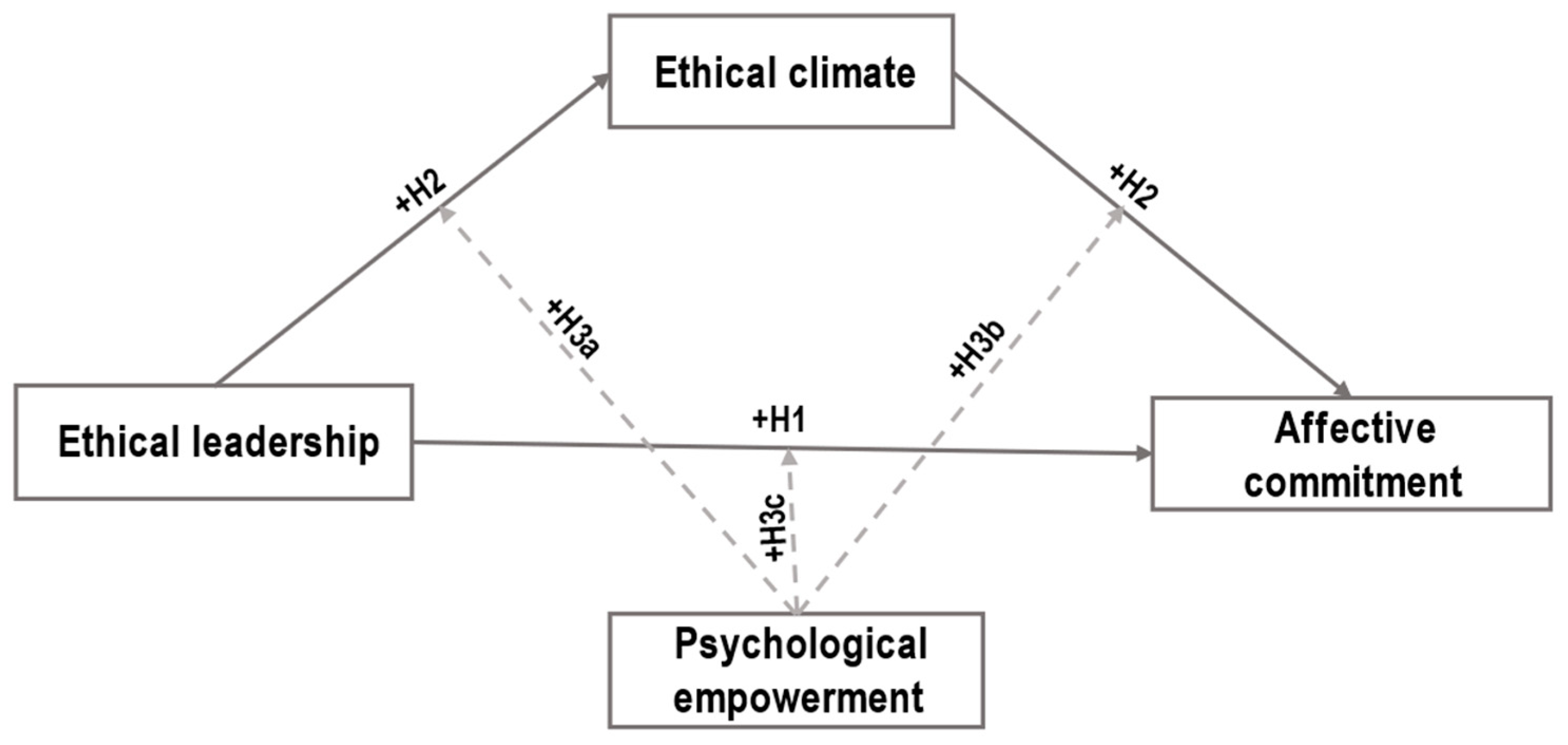
Figure 2.
The proposed moderated mediation model unstandardized coefficients. 4 Note. The dotted line represents the mediating effects and the solid line represents the moderating effects.
Figure 2.
The proposed moderated mediation model unstandardized coefficients. 4 Note. The dotted line represents the mediating effects and the solid line represents the moderating effects.
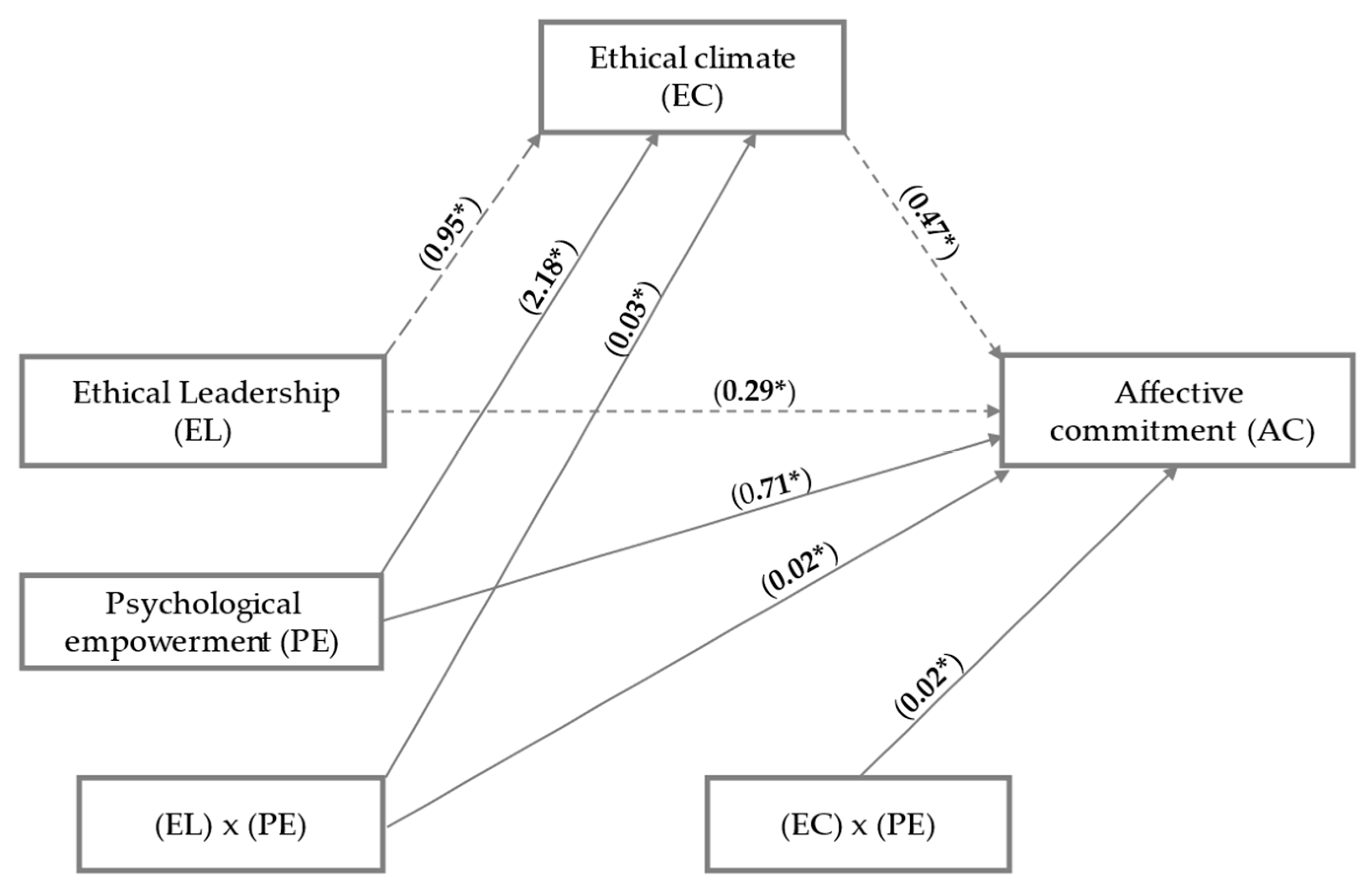
Figure 3.
Moderation process ethical leadership and ethical climate.
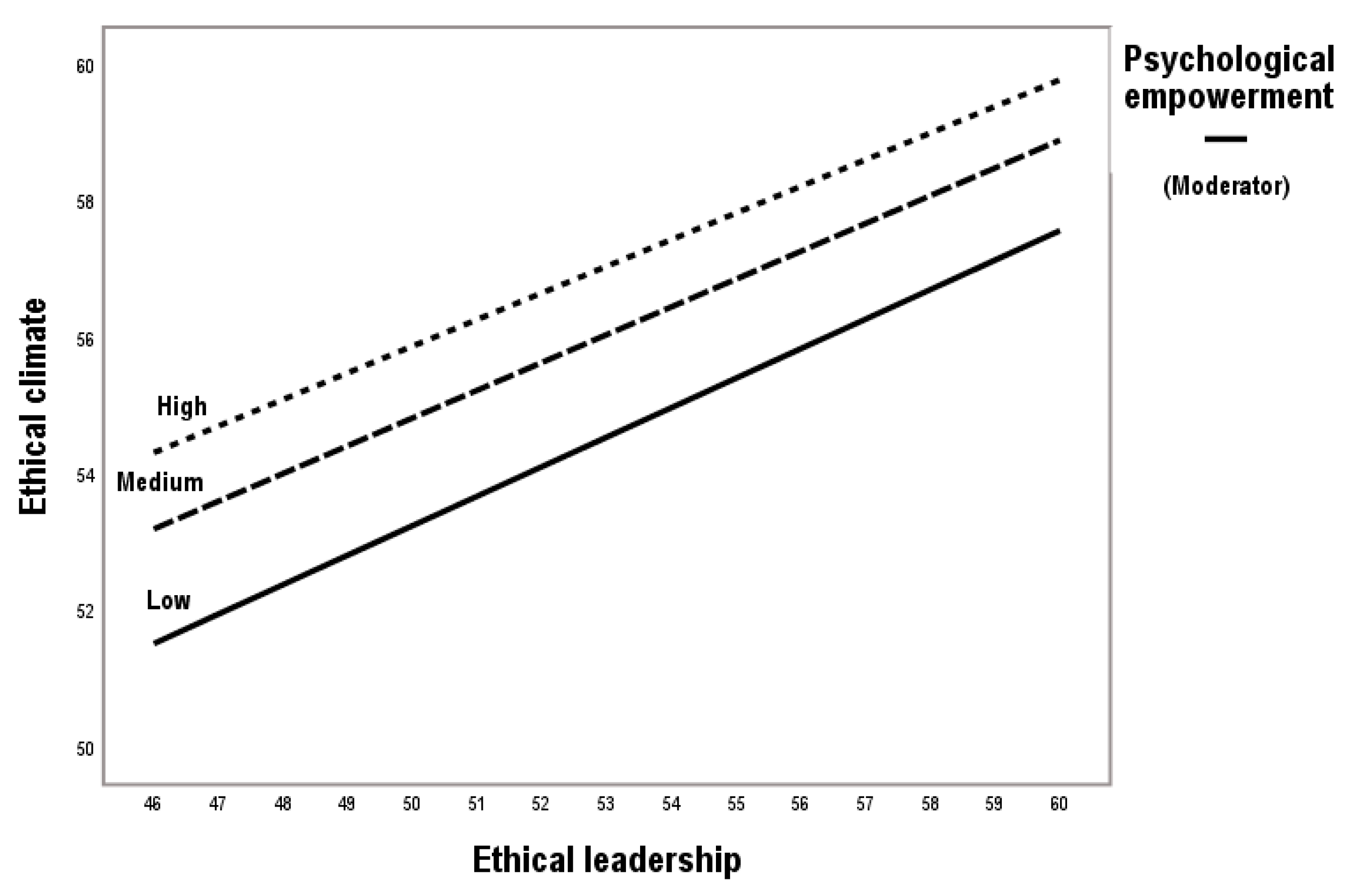
Figure 4.
Moderation process ethical climate and affective commitment.
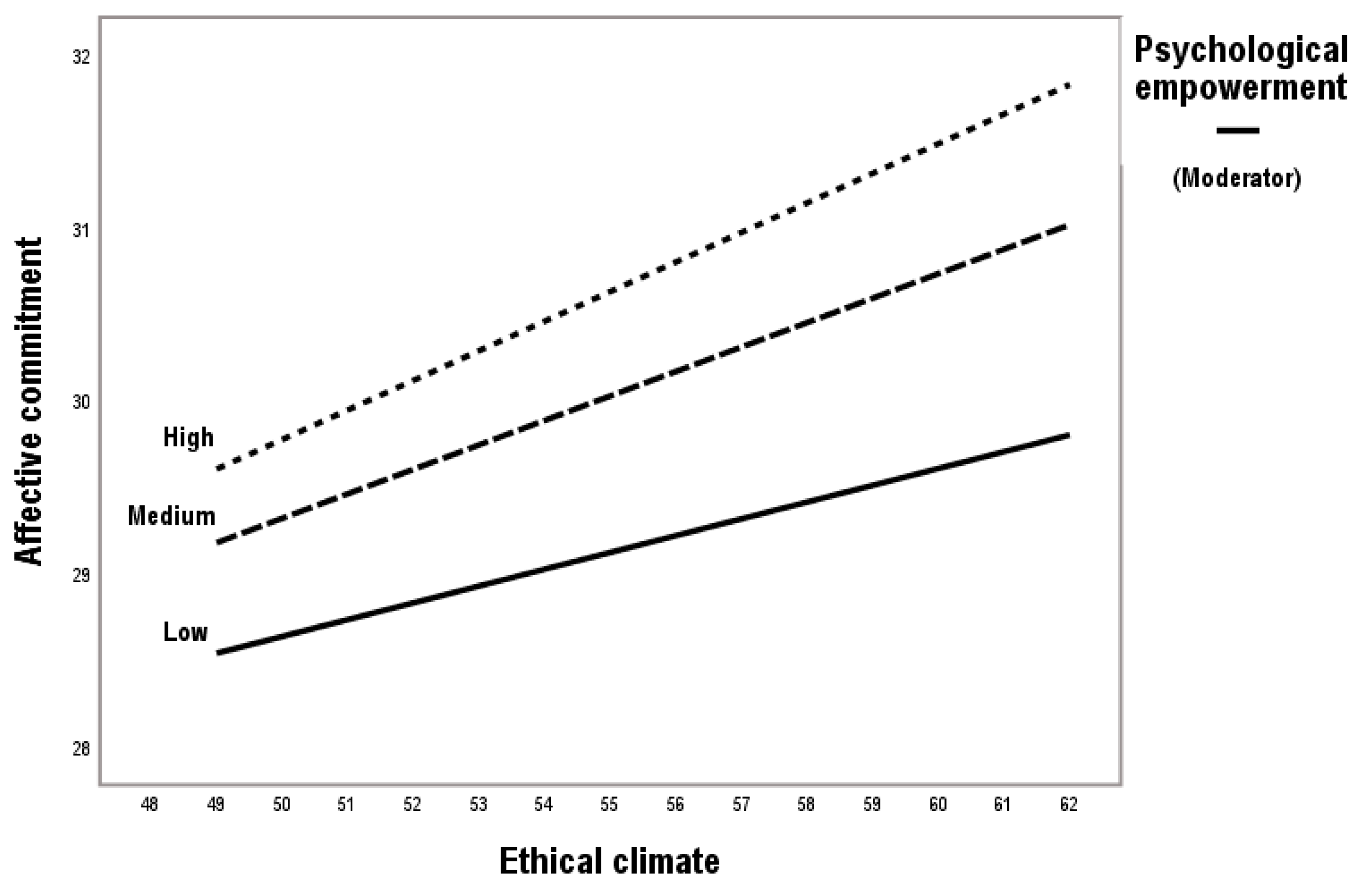
Figure 5.
Moderation process ethical leadership and affective commitment.
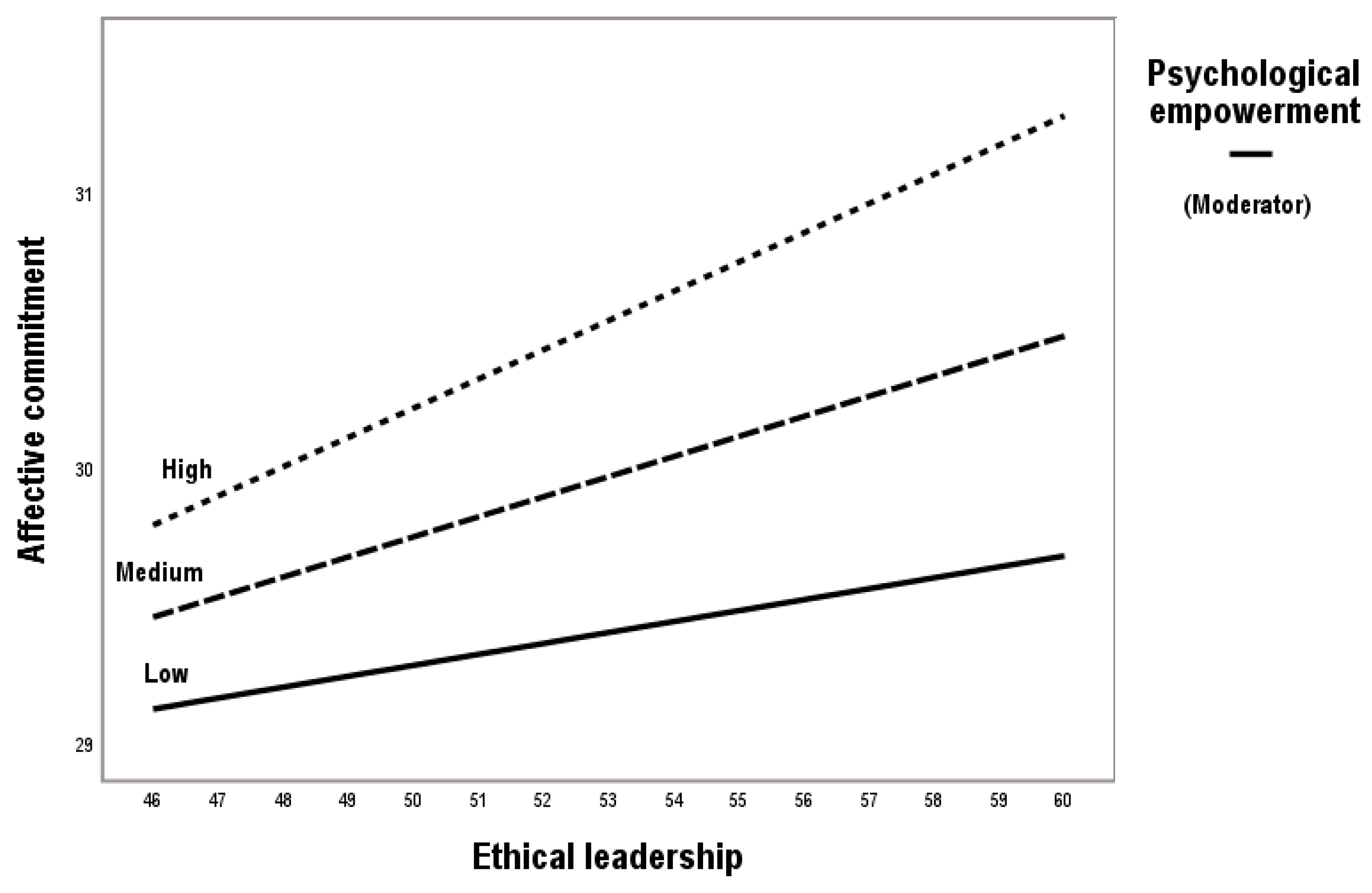

Table 1.
Means Standard Deviations and Correlations for the Main Study Variables.
| Variables | N | M | SD | EC | EL | PE | AC |
| Ethical climate (EC) | 11 | 54.96 | 7.06 | 0.71 | |||
| Ethical leadership (EL) | 10 | 51.60 | 8.22 | 0.55** | 0.83 | ||
| Psychological empowerment (PE) | 12 | 58.91 | 7.54 | 0.36** | 0.38** | 0.89 | |
| Affective commitment (AC) | 6 | 29.81 | 4.82 | 0.34** | 0.29** | 0.39** | 0.83 |
1 Note. N=448. **p< 0.01.
Table 2.
Convergent and Discriminant Validity.
| ALPHA1 | CR2 | CFC3 | AVE4 | VD5 | |
| EC | 0.88 | > 1.96 | 0.740 | 0.510 | 0.710 |
| EL | 0.92 | > 1.96 | 0.850 | 0.690 | 0.830 |
| PE | 0.87 | > 1.96 | 0.730 | 0.800 | 0.890 |
| AC | 0.86 | > 1.96 | 0.860 | 0.690 | 0.830 |
2 Note. The table shows the degree to which the measurement of items that collect the same concept are correlated (convergent validity) and the theoretical difference between different constructs (discriminant validity). 1. Cronbach’s Alpha. 2. Critical Coefficients. 3. Composite Reliability. 4. Average Variance Extracted. 5. Discriminant Validity. Own elaboration.
Table 3.
Testing the mediating effect of ethical leadership on affective commitment.
| Predictors | Model 1 (AC) | Model 2 (EC) | Model 3 (AC) | ||||||
| β | SE | t | β | SE | t | β | SE | t | |
| EL | 0.20** | 0.07 | 4.84** | 0.59** | 0.05 | 7.04** | 0.16** | 0.02 | 6.34** |
| EC | 0.50** | 0.06 | 12.16** | ||||||
| R² | 0.21** | 0.31** | 0.43** | ||||||
| F | 41.85** | 66.98** | 97.70** | ||||||
| Indirect effect EC of EL on AC: β = 0.05; SE = 0.02 [0.02; 0.08] | |||||||||
3 Note. N=448. Each column is a regression model that predicts the criterion at the top of the column. EL= ethical leadership; EC= ethical climate; AC=affective commitment; IM= intrinsic motivation. * p<0.05, **p<0.01.
Table 4.
Testing the moderated mediation.
| Predictors | Model 1 (EC) | Model 2 (AC) | Model 3 (AC) | ||||||
| β | SE | t | β | SE | t | β | SE | t | |
| EL | 0.95** | 0.18 | 5.26** | 0.29** | 0.20 | 3.18** | |||
| PE | 2.18** | 0.61 | 3.59** | 0.71** | 0.60 | 2.17** | |||
| EL(x) PE | 0.03** | 0.02 | 3.08** | 0.02** | 0.01 | 2.90** | |||
| EC | 0.47** | 0.22 | 3.43** | ||||||
| EC (x) PE | 0.02** | 0.03 | 2.24** | ||||||
| R² | 0.34** | 0.15** | 0.15** | ||||||
| F | 75.17** | 34.20** | 34.20** | ||||||
5 Note N=448. EL= ethical leadership; PE = psychological empowerment; EC = ethical climate; AC= affective commitment. * p<0.05, **p<0.01.
Disclaimer/Publisher’s Note: The statements, opinions and data contained in all publications are solely those of the individual author(s) and contributor(s) and not of MDPI and/or the editor(s). MDPI and/or the editor(s) disclaim responsibility for any injury to people or property resulting from any ideas, methods, instructions or products referred to in the content. |
© 2025 by the authors. Licensee MDPI, Basel, Switzerland. This article is an open access article distributed under the terms and conditions of the Creative Commons Attribution (CC BY) license (http://creativecommons.org/licenses/by/4.0/).
Copyright: This open access article is published under a Creative Commons CC BY 4.0 license, which permit the free download, distribution, and reuse, provided that the author and preprint are cited in any reuse.


