

Submitted:
20 March 2025
Posted:
21 March 2025
You are already at the latest version
Abstract
This study explores the relationship between Climate Change Awareness and consumer willingness to pay for Urban Short Food Chains, focusing on the mediating role of biospheric, egoistic, and altruistic concerns. Whether driven by egoistic or altruistic motivations, the reduction of ultra-processed food consumption emerges as a key factor in consumers' willingness to pay a premium for products from urban short-food chains (USFC). The studies also show that urban residents often maintain a strong connection to the food traditions and products of their native regions, even after relocating to cities. This connection influences their food preferences and purchasing decisions, effectively bringing their "territory" with them to urban settings. This dynamic underscores the importance of promoting local, minimally processed foods, which align with these traditional preferences, while also addressing the broader environmental and social impacts of industrialised food production. By fostering these connections, urban food systems can become more sustainable, balancing cultural heritage with modern dietary needs.
Keywords:
Climate Change Awareness
; Urban Short Food Chains
; Environmental Concerns
; Food Waste
; Processed Food
; woman
1. Introduction
Urban agriculture (UA), while contributing less to helping cities achieve food self-sufficiency, can set up a pathway to feed the citizens differently (Hume et al., 2021). The ’In a different way’ approach involves commercialising quality local products via short circuits, a sustainable model significantly reducing the environmental footprint (Edwards-Jones, 2010; Guiné et al., 2021; Hale et al., 2011; Kropp et al., 2021; Marsden et al., 2000; Owen et al., 2020; Pulighe & Lupia, 2020). Urban Short Food Supply Chains (USFSCs) refer to localised food systems that shorten the distance between food producers and consumers within urban areas or their immediate surroundings. These systems typically involve direct sales models such as farmers’ markets, community-supported agriculture (CSA), cooperatives, and urban food hubs, reducing intermediaries and increasing traceability (Chiffoleau & Dourian, 2020a; Evola et al., 2022; Grando et al., 2017). Although some definitions emphasise direct producer-consumer interactions, recent research suggests that USFSCs can take multiple forms, including municipal food procurement, cooperative models, and urban food networks (Grando et al., 2017; Doernberg et al., 2022).”
USFSCs aim to promote fresh, minimally processed food, enhance food security, and support local economies, aligning with urban agriculture’s broader sustainability goals.
While USFSCs are widely promoted as environmentally friendly alternatives, some scholars argue that their sustainability depends on the efficiency of their logistics (Hale et al., 2011; Hesty et al., 2021; Majewski et al., 2020, 2020; Malak-Rawlikowska et al., 2019). Unlike large-scale food distribution networks that benefit from optimised transportation routes and economies of scale, USFSCs may increase per-unit emissions due to fragmented and non-optimized transport, mainly when deliveries involve multiple small-scale producers serving dispersed urban consumers (Majewski et al., 2020). This challenge suggests that while USFSCs provide advantages in terms of food quality, consumer engagement, and support for local economies, their environmental impact requires careful assessment, particularly in urban contexts where transport efficiency varies.
Building on this perspective, USFSCs emerge as a key mechanism for bridging the gap between food producers and urban consumers. By localising food production and minimising intermediaries, USFSCs align with the broader objectives of urban agriculture, fostering more direct and transparent food networks. However, the effectiveness of these systems depends not only on logistical efficiency but also on consumer engagement and the social acceptance of local food models.
UA brings producers and consumers closer and encourages cities to reinvent and rethink their deep-rooted relationship with food. In this relationship, local products are essential in creating producer-consumer relations in a globalised agro-food system (Malak-Rawlikowska et al., 2019). Their unique selling proposition is based on the localisation of production and the supply chain length in terms of the number of actors involved (Chiffoleau & Dourian, 2020a; Evola et al., 2022; Grando et al., 2017; Hume et al., 2021). The direct contact and partnership between producers and consumers underscore the distinctive nature of these systems. However, these partnerships can only be established with a shared narrative among stakeholders regarding short food chains in urban areas, which rapidly evolve in a continuous food system’s industrialisation. Understanding the initiating factors is essential for building a shared collective UA story and creating sustainable partnerships, emphasising the need for collaboration.
Research shows that public CCA significantly influences consumer behaviour toward sustainable food practices, including participation in USFC (Born & Purcell, 2006; Evola et al., 2022; Grando et al., 2017). However, a gap between intention and action is often observed, motivating research into potential mediators like environmental concern (Druen & Zawadzki, 2021; Kaçani et al., 2024; Kollmuss & Agyeman, 2002). Schultz’s (2001) environmental concern scale outlines three dimensions—biospheric, egoistic, and social-altruistic concern—which influence sustainable behaviour in distinct ways (Helm et al., 2018; P. et al., 2001). CCA is a significant predictor of biospheric concern, motivating individuals to prioritise ecological health and adopt sustainable consumption habits (Bamberg, 2003; Howell, 2013). Personal benefits drive egoistic concern, while altruistic concern stems from a desire to help others and reduce environmental impact.
Research indicates that awareness of climate change is a significant predictor of biospheric concern, as individuals who are more informed about environmental issues are more likely to prioritise the planet’s well-being and other living beings (Schultz, 2001; Stern, 2000). This heightened biospheric concern can lead to more sustainable consumption behaviours, such as increased participation in USFC, where the environmental impact of food choices is minimised (Doernberg et al., 2022; Grando et al., 2017; Vittersø et al., 2019). Thus, the link between CCA and Biospheric Concern provides a foundation for promoting sustainable food systems through USFCs. From this perspective, we suggest hypothesis H1, as presented in Table 1.
Similarly, studies have shown that CCA can also enhance Egoistic Concern as individuals become more aware of the potential impacts of environmental issues on their personal health, finances, and well-being (Franzen & Vogl, 2013; Gifford, 2011; Gifford & Nilsson, 2014). This egoistic concern, in turn, can drive behaviours that align with personal benefits, such as participating in USFC, which offers access to fresher, healthier, and potentially less contaminated food (Vermeir & Verbeke, 2006). Moreover, the awareness of climate change fosters concern for the environment and highlights the personal advantages of sustainable practices; with that in mind, we suggest that CCA positively influences Egoistic Concern, subsequently enhancing participation in USFCs. See Table 1 for the suggested hypotheses and pathway.
CCA can significantly foster altruistic concern (Howell, 2013; Snelgar, 2006; Xu et al., 2021). This concern, when embraced, often motivates actions that benefit the wider community and the environment. One such action is the support of the USFC, which emphasises local, sustainable food production and reduces food distribution’s environmental footprint (Seyfang, 2006; Zepeda & Nie, 2012). Thus, an increased awareness of climate change issues can drive individuals to participate in USFCs, driven by a sense of responsibility and concern for others’ well-being. CCA positively impacts Altruistic Concerns, promoting engagement in USFCs.
Finally, our research proposes a significant positive relationship between CCA and participation in USFC, as illustrated in Figure 1 (Path c`: CCA → USFC). This relationship suggests that individuals more aware of climate change issues tend to perceive a greater personal responsibility to mitigate their environmental impact. This, in turn, leads to more sustainable consumption behaviours, such as buying locally produced food (Hines et al., 1987; Kollmuss & Agyeman, 2002). The importance of this direct relationship lies in its ability to independently motivate consumers to choose sustainable food practices, even without mediating specific environmental concerns like biospheric, egoistic, or altruistic motivations (Vermeir & Verbeke, 2008; Wolf & Moser, 2011) see Figure 1a.
In the second step, climate change concerns are used as initiators to explore the possible pathways leading to the willingness to participate in USFC (See Table 2 and Figure 1b).
USFC participation is often linked to eight key drivers of climate change concerns influencing consumer participation in USFC. These drivers include limiting food waste (Conrad & Blackstone, 2021; O’Neill, 2019; Thyberg & Tonjes, 2016), buying seasonal products (Tobler et al., 2011, 2012), stimulating local production (Edwards-Jones, 2010; Endrizzi et al., 2021; Jarzębowski et al., 2020), protecting the environment, buying local products, increasing natural consumption, reducing impulsive buying, and reducing highly processed food consumption.
The hypotheses in Table 2 explore how the three climate change concerns (CCC) lead to consumer behaviours, such as limiting food waste, buying seasonal and local products, supporting local production, and engaging in environmentally protective actions, aligning with USFC participation. Through the suggested framework, we will comprehensively explore the distinct pathways through which different concerns affect consumer behaviour and provide critical insights into sustainable food systems supported by UFSC. The rest of the paper is structured as follows: The second section presents the methodology. The third section presents the analysis of the results. The last section deals with the conclusions and discussions. The following section details the measurement and operationalisation of each variable proposed in the conceptual framework.
2. Material and Method
2.1. Questionnaire and Measurement
The instrument employed for the aims of this study is composed of four sections. In the first section, the demographic variables of respondents are collected. These variables, such as age, gender, household income, education, number of children, respective group age, etcetera, are crucial for understanding how different groups perceive and respond to environmental issues. See Table 3. The second section presents a question about CCA and Environmental Concerns (EC). The CCA is measured by six statements as presented in Table 1: Are you aware of the danger of gas emission from vehicles that harm people’s health, etcetera? The participants evaluated each statement with a five-point Likert scale see Table 3. Environmental Concern is explored through the Schultz (2001) scale. The scale is made of three subscales measuring: Biospheric Concern ( e.g., “I am concerned about environmental problems because of the consequences for birds, plants, marine life, animals”), Egoistic Concern (e.g., “I am concerned about environmental problems because of the consequences for me”), and Social-altruistic Concern (e.g., “I am concerned about environmental problems because of the consequences for all people”. Concerns are also measured through the five-point Likert scale (1=not at all concerned, 5=extremely concerned).
Section three explores preferences for food origin and willingness to pay for sustainable food options. The questionnaire assessed consumer preferences for food sourcing locality, willingness to engage with municipal food programs, and willingness to pay (WTP) for locally sourced food in school catering. Respondents were asked where they preferred school food to come from, with options ranging from imports (EU and general), regional sources, national (Albania), and local (municipality level). Additionally, WTP was measured through a yes/no question and percentage-based increase options (10%, 20%, 50%, or above 50%). To explore engagement with municipal-led food programs, respondents were asked whether they would support a system where school food is sourced from seasonal agricultural production under municipal oversight. These questions provide insights into consumer attitudes toward local and urban food networks, aligning with the study’s focus on USFSCs. This study examines consumer engagement with localised food-sourcing practices as a proxy for participation in USFSCs. While not all models explicitly require direct sales, literature on urban food networks suggests that short supply chains in cities often involve intermediary-supported initiatives (Jarzębowski et al., 2020). Therefore, our questionnaire assessed engagement with locally produced seasonal food rather than strictly measuring direct producer-consumer relationships.
This section asks respondents about their propensity to participate in UFSC and their motivation; see Table 3. Finally, the questionnaire assesses the respondents’ understanding of sustainable food consumption.
2.2. Data Collection
The questionnaire was distributed online using convenient sampling. A sample of 230 respondents was collected from October 2023 to January 2024 in Albania, Tirana. The latter is the capital and the largest city in Albania. The number of inhabitants in Tirana is forecasted to increase from 891,526,560 in 2021 to 954,280 in 2031 (up to 30%) (INSTAT, 2020). Table 4 shows the primary demographics of the participants in the survey. About 90% are women, and 96% of the respondents are parents, with the majority corresponding at age 26-45, about 80%. This reflects that urban short-food chains often attract individuals in their prime working years with greater purchasing power and autonomy over their food choices.
The younger age group (18-25) is underrepresented (2.6%), likely due to their reliance on family-based food purchasing decisions, reducing their direct participation in short food chains. Similarly, individuals over 55 (2.6%) may exhibit different consumption behaviours, preferring traditional food retail formats over short food chain initiatives. The majority are highly educated. These sample characteristics are linked with the higher propensity of women to respond to online questionnaires and the expertise in using online survey instruments. However, the analysis of this population segment is interesting to explore since they might serve as part of the Albanian Urban Community that can snowball the partnership process between the producers and parents. Half of the participants have two children, and exploring whether this indicator impacts the parent’s behaviour toward USFC participation is interesting. The predominance of women respondents and the high percentage of parents aged 26-45 could be considered a limitation due to potential sample bias, limiting the generalizability of the findings to a more diverse population. However, this also presents an opportunity, as the sample reflects a demographic with a keen interest in the topic and a higher propensity for engaging with online surveys, potentially providing rich insights into the behaviour and attitudes of this specific group. The Agriculture University of Tirana, Albania Ethics Committee approved the questionnaire design and data collection process, ensuring compliance with ethical research standards.
2.3. Data Analysis
To achieve the paper’s objectives, we applied a conditional process analysis that integrates mediation and moderation models (Hayes, 2018a; Hayes & Montoya, 2017; Hayes & Rockwood, 2020; Igartua & Hayes, 2021)The first model examines the mediating role of three types of Environmental Concerns (EC)—biospheric, egoistic, and altruistic concerns—in the relationship between Climate Change Awareness (CCA) and willingness to participate in USFCs. Mediation occurs when CCA influences EC, which in turn affects USFC participation. This model helps identify which type of EC is most affected by CCA and which EC type has the strongest effect on willingness to engage in USFCs.
The second model incorporates moderation analysis, where demographic factors (e.g., gender) may influence the strength of the relationship between EC and USFC participation. Moderation implies an interaction effect, meaning that the predictor’s effect (CCA or EC) on USFC participation can be enhanced, weakened, or even reversed depending on the moderating variable.
The PROCESS macro in SPSS was used to estimate these relationships, applying Model 4 for mediation and Model 5 for moderation, with bias-corrected 95% confidence intervals and bootstrapping to ensure robust estimations (Hayes, 2018a). The equations for Model 4 and Model 5 are as follows:
Mediation Model (Model 4 - Step 1 Equation) (Figure 1a)
M(Biospheric)= iM+ a1(CCA)+e
M(Egoistic) = iM+ a2(CCA)+e
M(Altruistic) = iM+ a3(CCA)+e
Y(USFC)= iy+b1(Biospheric)+e
Y(USFC)= iy+b2(Egoistic)+e
Y(USFC)= iy+b3(Altruistic)+e
USFC=b1EC+c′CCA+e2USFC
Where:
EC represents Environmental Concerns (biospheric, egoistic, or altruistic)
CCA Climate Change Awareness
USFC is the willingness to participate in USFC
a pathways captures the effect of CCA on EC
b pathways captures the effect of EC on USFC participation
c′ is the direct effect of CCA on USFC
e1 and e2 are the error terms
Moderation Model (Model 5 - Step 2 Equation) See Figure 1b
USFC=b2EC+b3(EC×Moderator)+c′CCA+e3USFC
Where:
The interaction term EC×Moderator (e.g., Gender) measures whether the strength of EC’s effect on USFC participation changes based on the moderator
indicates the magnitude of the moderation effect
The conceptual model integrates these variables by reducing their scales to regression scores, ensuring simplicity while retaining their statistical significance. Reliability tests (Cronbach’s Alpha) confirmed high internal consistency for each construct: biospheric concerns (0.949), egoistic concerns (0.929), altruistic concerns (0.788), and CCA (0.947).
3. Results and Discussion
The study’s findings on CCA among respondents are significant, revealing a high overall awareness level. A mean score of 4 on a 5-point scale indicates that respondents generally consider themselves well-informed about various environmental issues, underscoring the importance of the study’s findings. The highest mean score of 4.21 is related to awareness of the dangers of air pollution. This suggests that air pollution is particularly salient among the respondents, possibly due to visible effects such as smog or health advisories in Tirana City. Awareness of the environmental damage caused by chemical fertilisers and pesticides is also high, with a mean score of 4.17 (See Table 5). This could be linked to increasing public discourse around sustainable agriculture and the push for organic products, highlighting conventional farming practices’ environmental and health impacts. The score for awareness of water pollution dangers is 4.12, indicating a significant concern about water quality issues. An awareness of the dangers of insufficient green space and the degradation of cultivated land quality is lower, with mean scores of 4.03 and 3.86, respectively. This suggests that while these issues are recognised, air and water pollution may take longer for the respondents. Overall, the high levels of awareness across these areas suggest a well-informed respondent group, particularly regarding issues that have immediate health implications or are frequently highlighted in public discussions on environmental sustainability.
The analysis of types of environmental concerns among respondents reveals varying degrees of concern across different issues, with an overall mean score of 4.4 on a 5-point scale (See Table 5). Respondents expressed the highest level of concern for children’s well-being (mean 4.78) and personal health (mean 4.69), indicating a solid awareness of the direct impact of environmental issues on human health. This result is expected given the sample composition and the age of children in the household. The high concern for children’s health and future can be attributed to 96% of the respondents being parents, with most having children in the household. This emotional connection to the issue likely influences prioritising the environmental problems that directly affect their families and future generations.
Concerns about the future (mean 4.67) and the welfare of all individuals (mean 4.59) also ranked highly, reflecting a broader sense of responsibility towards global and future generations. Additionally, there are notable concerns for aquatic life (mean 4.01), plants (mean 3.98), and birds (mean 3.92). This underscores the respondents’ understanding of the interconnectedness of environmental issues and their recognition of the impact of environmental degradation on biodiversity and ecosystems.
Parents’ preference for food product origins indicates a strong inclination towards supporting local products, with 64% opting for Albanian origin and 32% preferring EU origin. However, the preference drops significantly to 13% when considering a narrower territory like Tirana. This disparity might be attributed to concerns over product availability, quality, or perceived reliability from a smaller geographic area. Despite this, 88% of parents are willing to pay an extra price for food products from their preferred origin, typically willing to pay an additional 10-20%. This willingness to pay suggests a substantial market demand for origin-specific products driven by factors such as perceived quality, safety, and support for local economies. The same high level of willingness (88%) to participate in the USFC initiative of Tirana further underscores the community’s commitment to supporting local food systems. About 10% of parents were uncertain, and only 2% were unwilling to participate. Surprisingly, there were no statistical differences in the mean of the WTP for the made-in-Albania label and the made-in-Tirana label. This contradicts the assumption that the WTP for Tirana agricultural products would be higher due to the narrower production area. Other studies have shown that when the local claim is expressed with ’small farm or terroir ‘, the difference in WTP was even more remarkable. The narrower the territory, the higher the WTP (Deselnicu et al., 2013; Stefani et al., 2006). The well-defined origin increases the ability of the consumer to process the information coming from this information stimulus (Bytyçi et al., 2024). However, the present study has yet to support this result. One possible explanation is the parents’ need for knowledge regarding the capacity of the territory of Tirana to provide agricultural and food products. The collective illusion that cities do not produce food continues; parents, as consumers, play a crucial role in shaping this perception. They do not associate Tirana as a specific agricultural production area. Also, the characteristics of the Tirana population play a role. In the last thirty years, Tirana has hosted Albanian individuals immigrating from different areas from north to south; 30% of the Albanian population moved toward Tirana. This trend persists; the new parents come to Tirana with their terroir associations in their pockets. A study by Dimitrova et al. (2017) shows that young Albanians are highly attached to and aware of national issues. However, a commonly shared story linked to Tirana’s territory and agricultural products is needed in this case.
This study examines consumer preferences for local food sourcing in school catering, including urban-scale procurement. However, it does not explicitly differentiate short food supply chains based on the number of intermediaries. Future research should investigate consumer willingness to engage with short food supply chains (0 or 1 intermediary) versus broader local food systems, ensuring a clearer distinction in food network structures.
The analysis of the demographics concerning motivation shows that gender, age, education and the age of the children significantly influence the motivation to give an additional price to participate in USFC. This underscores the importance of understanding the demographics of the consumer base. Parents with higher education having children aged three to five years to 5 years old express the highest WTP, 30%. Concerning the relationship with the demographics, parents with two children (Fvalue=3.434; pvalue=0.034) above five years (Fvalue=5.535; pvalue=0.000) prefer made-in Albania over other options. Parents with children under five years prefer the EU origin because they trust EU food Safety institutions more than Albanian ones and due to high-risk food illnesses perceptions for that specific age (Hida et al., 2022; Karaulli et al., 2022).
The municipality of Tirana and the related stakeholders should play a crucial role in transforming citizens’ perceptions of agriculture in urban areas and creating the city’s food identity. The latter can be built by understanding the parents’ leading motivations for participating in the USFC of Tirana.
In addition, parents’ understanding of sustainable consumption and whether it is associated with their willingness to pay show that about 60% of the participants claim they understand the concept of sustainable consumption, while 40% still need to. Among those who understand, most link sustainable consumption to the energetic aspect, such as the balance of energy intake and expenditure, while 24% associate it with the environmental impact of consumption. Most respondents (around 35%) believe that food consumption is sustainable when the energy value of the consumed is equal to the body’s energy expenditure. This highlights a significant focus on the nutritional aspect of sustainability, indicating that many parents prioritise the balance between food intake and bodily energy needs. Interestingly, about 25% of respondents associate sustainable consumption with minimising the environmental impact of daily food consumption, showing an awareness of the broader environmental implications of their food choices. Approximately 15% of respondents consider zero food waste as a critical component of sustainable consumption, which reflects an understanding of waste reduction as part of sustainability efforts. Furthermore, around 12-15% of respondents link sustainable consumption to balancing plant and animal products in their diet and adjusting food costs to the family’s financial capacity. These perspectives highlight a diverse understanding of sustainability, encompassing nutritional balance, economic considerations, and environmental impacts.
This analysis indicates that while there is a substantial awareness of the energy balance aspect of sustainable consumption, there is also significant recognition of environmental impacts and waste reduction. Similarly, another factor that increases consumer interest in local products and SFCs is the evolution of consumer preferences due to globalisation. Consumers, increasingly faced with uncertainty regarding the products they consume and their health effects, are considering alternatives, such as local products or fresh products. These schemes are of particular interest to the agricultural systems of developing countries because they comfort the growing uncertainty of a particular segment of consumers concerning the food they consume (Guri et al., 2019; Kokthi et al., 2021).
Various motivations for participating in USFC show that the most highly rated are ’Increasing the consumption of natural foods’ and ’Purchasing and consuming seasonal foods,’ scoring above 4.5. This high rating highlights the value of fresh and seasonal products and the deep appreciation for natural foods. Other important motivations include promoting local agricultural/livestock production and protecting the natural environment, which scored around 4.1. This high rating suggests a strong concern for local economies and environmental sustainability. Conversely, ’Reducing food waste’ and ’Reducing the consumption of highly processed foods’ have slightly lower scores, indicating that while these factors are essential, they may only be the primary motivators for some respondents. Exploring behavioural motivations within a rapidly evolving urban food environment—shaped by industrialisation, urbanisation, and globalisation of food systems—provides valuable insights beyond pre-existing urban food chain structures. However, future research should further differentiate urban food chain mechanisms from broader short food supply chain (SFSC) engagement, ensuring a clearer understanding of consumer drivers and food system dynamics.
These motivations are critical components of the moderation mediation model used in the study, as they help to understand the pathways through which climate change concerns and environmental awareness influence consumer behaviour and the willingness to engage with USFCs. The analysis investigates first the direct and indirect effects of CCA on the willingness to pay (WTP) for USFC, mediated by biospheric, egoistic, and altruistic concerns, as presented in Table 6.
CCA significantly increases Biospheric, Egoistic, and Altruistic concerns. However, these concerns do not consistently translate into a willingness to pay for USFC. While CCA can increase concerns related to the environment—such as biospheric, egoistic, and altruistic concerns, these concerns do not always lead to actual behaviour changes like willingness to pay for USFC. This disconnect, often called the “value-action gap,” is well-documented in environmental psychology (Balundė et al., 2019; Druen & Zawadzki, 2021; Gifford, 2011; Mayflor et al., 2022). It occurs because of various factors, such as financial constraints, perceived inconvenience (Liu et al., 2014; E. et al., 2018), lack of trust (E. et al., 2018), and competing priorities can inhibit the translation of environmental concerns into actionable behaviours. Additionally, the perceived personal relevance and urgency of environmental issues may vary among individuals (Kollmuss & Agyeman, 2002) (Liu et al., 2014; Poortinga et al., 2023), contributing to inconsistent behavioural outcomes despite similar levels of concern.
Altruistic Concern’s significant positive mediation effect on USFC participation suggests that altruistic motivations can enhance engagement in sustainable practices. This finding aligns with existing literature emphasising the importance of social and ethical considerations in consumer decision-making, particularly sustainability (Chao & Yu, 2024; Xu et al., 2021). Individuals motivated by the well-being of others and the broader community can engage in behaviours supporting environmental sustainability, such as participating in USFCs. Additionally, 90% of the respondents are women parents, which is significant, as studies have shown that women are often more engaged in sustainability issues due to their roles in household management and childcare, which heightens their concern for future generations and environmental health (Khurana, 2021; Low, 1996). Conversely, Egoistic Concern has a significant negative mediation effect, indicating that higher egoistic concern may reduce willingness to pay for USFC (See Table 6). Egoistic concern focuses on personal benefits rather than collective or environmental well-being. This perspective often leads individuals to prioritise immediate personal gains, such as cost savings or convenience, over long-term environmental benefits (Gifford, 2011; Snelgar, 2006). As a result, individuals with higher egoistic concerns may be less willing to pay for sustainable options like USFCs, which often require higher upfront costs or sacrifices for convenience.
The finding that the overall and direct effects of CCA on Urban Short Food Chain participation are insignificant highlights the complexity of translating awareness into sustainable consumer behaviour.
As shown in the methodology section, the second step involves analysing the impact of three types of environmental concern—Biospheric, Egoistic, and Altruistic—on the willingness to pay (WTP) for USFC and the mediators linked to USFC.
The analysis reveals that biospheric concern (EC Biospheric) has a significant and positive impact on several drivers of willingness to pay (WTP) for USFC. The most pronounced direct effects of EC Biospheric are seen in stimulating local production (effect size: 0.4389, p < 0.000) and protecting the environment (effect size: 0.403, p < 0.000). This underscores the potential for positive changes in the food system, offering an anticipative pathway. Moreover, increasing natural consumption (effect size: 0.393, p < 0.000) and reducing processed food consumption (effect size: 0.414, p < 0.000) are also strongly influenced by EC Biospheric, further reinforcing the potential for a healthier and more sustainable food system. While the direct effect of biospheric environmental concern (EC Biospheric) on WTP) is not significant (effect size: 0.717, p = 0.093), the study reveals significant indirect effects of limiting food waste (effect size: 0.456, p = 0.004) on WTP, underscoring their importance in the context of USFC and making the audience feel informed and aware of these crucial factors.
Increasing natural consumption shows a significant negative mediation effect (effect size: -0.595, p = 0.033). Cognitive dissonance might play a role (Watson & Spence, 2007). Consumers already engaged in increasing natural consumption might feel they are contributing sufficiently to sustainable practices. Therefore, they might perceive less need to further engage in USFC initiatives, viewing it as an additional or redundant effort rather than a complementary one. It leads to a decreased willingness to pay for such initiatives, as they believe their existing actions are adequate. Secondly, perceived costs and accessibility issues associated with natural products can contribute to this negative mediation effect. Even though consumers recognise the benefits of natural products, they may associate them with higher costs or limited availability, especially in urban settings. This perception can make them reluctant to pay more for USFC, which might also be perceived as an expensive or less convenient option. Lastly, saturation and prioritisation of concerns might be at play. Consumers with a high focus on natural consumption may prioritise sustainability concerns, such as reducing plastic use or energy consumption, over supporting local food chains (Beitzen-Heineke et al., 2017). This prioritisation can result in a lower WTP for USFC, as these consumers allocate their resources and efforts to other environmental areas, they consider more impactful or immediate.
Gender significantly moderates the relationship between EC Biospheric and WTP, with an important negative interaction effect (effect size: -0.865, p = 0.024). Specifically, EC Biospheric negatively impacts WTP for females (effect size: -1.013, p = 0.007) but not for males (effect size: -0.148, p = 0.227). One possibility is that women, who constituted 90% of the sample, might have a more nuanced view of environmental concerns, potentially reflecting greater awareness of the complexity and challenges involved in sustainable practices. Women are often more directly involved in food purchasing and preparation and may thus be more cautious about changes that could affect household routines or budgets, especially in urban areas where time and resources are limited. Prior research suggests women are more engaged in sustainable food networks and local food purchasing decisions.
The role of women in sustainable food networks such as USFCs and their influence on local food purchasing decisions is becoming increasingly important within the discourse on food security and environmental sustainability (A & Deepika, 2020; Bowden et al., 2018; Gamhewage et al., 2015).Their involvement is critical for ensuring food security at the household level and advancing community sustainability efforts (A & Deepika, 2020; Doss, 2018). Women’s participation in sustainable food networks is underscored by their unique purchasing behaviours and motivations (Barak et al., 2023; Bowden et al., 2018; L G & N, 2024; Som Castellano, 2016). Research shows that women tend to prioritise environmental and social considerations more strongly than men, making them more likely to engage in purchasing local and sustainably produced foods (Chen & Antonelli, 2020). For example, studies highlight that women are often the primary decision-makers regarding food purchases, which profoundly impacts family dietary diversity and overall nutrition (Barak et al., 2023; Shourove et al., 2023). Furthermore, women are increasingly aware of the social implications of their food choices, fostering more substantial support for local economies through informed purchasing decisions (Nakajima, 2022).
Women are also significantly involved in establishing and maintaining alternative food networks (AFNs), which emphasize local food production and consumption. Their engagement in these networks often reflects a commitment to sustainable practices, community well-being, and ethical considerations in food sourcing (Bean & Sharp, 2011; Plender, 2022; Som Castellano, 2016)). For instance, initiatives such as food cooperatives, where women play a central role, enable collective action towards sustainable food sourcing while simultaneously fostering community ties (Plender, 2022). Such cooperative structures empower women through shared leadership and decision-making and address barriers linked to individual purchasing power and access to sustainable food options (Plender, 2022). In urban contexts, women’s networks can enhance food security by enabling access to local and fresh produce while negotiating better purchasing conditions, such as buying on credit from informal vendors (Bowden et al., 2018).
Women’s active participation in urban sustainable food networks is critical for advancing environmental and social sustainability.
Findings reveal that egoistic environmental concern (EC Egoistic) significantly influences various drivers of willingness to pay (WTP) for USFC. The highest direct effects of EC Egoistic are observed in reducing processed food consumption (effect size: 0.405, p < 0.00) and increasing natural consumption (effect size: 0.320, p < 0.000). Stimulating local production (effect size: 0.303, p < 0.000) and protecting the environment (effect size: 0.294, p < 0.000) are also significantly impacted.
Although the direct effect of EC Egoistic on WTP is not significant (effect size: 0.338, p = 0.317), significant indirect effects through limiting food waste indicate an important mediation pathway (effect size: 0.447, p = 0.006). Increasing natural consumption shows a significant negative mediation effect (effect size: -0.731, p = 0.011). Gender significantly moderates the relationship between EC Egoistic and WTP, with a notable negative interaction effect. An interaction effect is the combined effect of two or more variables on the dependent variable (WTP). Consumers’ budget constraints may influence the negative mediation effect of increasing natural consumption on WTP for USFCs, as natural or organic products are often perceived as more expensive (Yiridoe et al., 2005). Additionally, it is important to understand that urban lifestyle constraints, such as time and convenience, play a significant role in consumer choices (Eisinger-Watzl et al., 2015). Scepticism about the benefits of natural foods and these lifestyle constraints may deter consumers from opting for natural consumption despite potential benefits (Smith et al., 2009).
The analysis also uncovers the significant influence of altruistic concern (ECA) on various drivers of willingness to pay (WTP) for USFC. The highest direct effect is observed in reducing processed food (effect size: 0.545, p < 0.000) and increasing natural consumption (effect size: 0.472, p < 0.000). These results highlight the potential of altruistic concern. The overall model for WTP reveals a non-significant direct effect of ECA (effect size: 0.652, p = 0.091). However, the indirect effects through various mediators are of paramount importance. Limiting food waste shows the highest positive indirect effects on WTP (effect size: 0.502, p = 0.002), indicating intense mediation. Increasing natural consumption has a significant negative mediation effect (effect size: -0.663, p = 0.021). Gender plays a significant moderating role, particularly for WTP (interaction effect size: -0.729, p = 0.021).
The suggested conceptual model advances our understanding of how environmental concerns mediate the relationship between CCA and sustainable consumer behaviours. This comprehensive approach can guide future research and policy development, particularly in addressing the challenges of food system industrialisation and the rise in ultra-processed food consumption. Emphasising pathways such as reducing impulsive buying and promoting local production provides a foundation for building a more sustainable and resilient urban food system. Women are often key decision-makers in sustainable food choices, which aligns with global trends recognising their influence in shaping food systems. Their role in Urban Short Food Supply Chains (USFSCs) is critical as they can act as change agents in promoting sustainable food networks.
Given the United Nations Sustainable Development Goals (SDGs), particularly SDG 5 (Gender Equality) and SDG 12 (Responsible Consumption and Production), our study provides valuable insights into how women’s engagement in sustainable food choices can contribute to a more resilient and equitable urban food system.
The study provides valuable insights into the drivers of willingness to pay for USFC, highlighting the significant roles of biospheric, egoistic, and altruistic concerns. However, some limitations should be acknowledged. While the sample size (n = 230) is relatively modest, it aligns with prior research employing mediation and moderation models in behavioural and consumer studies. To enhance statistical robustness, we applied the PROCESS macro (Hayes, 2018b; Hayes & Rockwood, 2020; Igartua & Hayes, 2021) with bootstrapping techniques, strengthening our findings’ validity despite the sample size constraints. Furthermore, we conducted reliability tests, including Cronbach’s alpha, to ensure the statistical validity of our constructs. However, we acknowledge that the demographic composition of our sample, particularly the predominance of women aged 26-45, may limit broader generalizability. Future research should seek to expand the sample to include a more diverse demographic representation, allowing for a more comprehensive analysis of consumer engagement in USFSCs). Also, another limitation of our study is that the questionnaire did not explicitly distinguish between different USFSC structures, such as direct farm-to-consumer sales versus municipal food procurement. However, existing research supports the idea that urban short-food chains can include multiple intermediary-driven formats (Doernberg et al., 2022). Future research could refined measurement tools to capture a broader range of USFSC models.
4. Conclusions
The findings of this study align with previous research on environmental concerns and sustainable food choices. Like Tobler et al., 2011, 2012) and Bimbo et al., (2020), our results confirm that biospheric concerns strongly influence preferences for natural and minimally processed foods, reflecting a broader trend in sustainable consumer behaviour. Additionally, the indirect effect of limiting food waste as a driver of willingness to pay (WTP) for USFCs reflects the conclusions of Thyberg & Tonjes, (2016) who highlight food waste reduction as a critical component of sustainability in local food systems.
Moreover, our findings regarding the role of egoistic concerns in processed food reduction are consistent with Migliore et al., (2020) who found that personal health concerns significantly drive sustainable food choices. However, unlike studies that emphasise a strong direct effect CCA on behavior Fu et al., 2020; García-Salirrosas et al., (2024). our results indicate that CCA alone does not directly translate into WTP for USFCs but operates through mediating factors. This suggests that awareness must be paired with targeted interventions to bridge the value-action gap, a finding that expands on Bouman et al., (2021) and Camanzi et al., (2024) work on consumer trust in short food supply chains.
The demographic challenge of urban food perceptions in Tirana also connects with literature on urbanisation and food system restructuring (Chiffoleau & Dourian, 2020b; Edwards-Jones, 2010). Similar to findings from Jarzębowski et al., (2020), our results indicate that urban consumers often lack strong associations between their city and food production, reinforcing the need for a shared narrative to integrate urban agriculture into food policy discussions.
The findings of this study highlight the need for policy interventions that bridge the gap between CCA and actual consumer engagement in Urban Short Food Chains. While awareness alone does not directly translate into WTP, policies can leverage behavioural nudges, financial incentives, and local food initiatives to encourage sustainable choices. Strengthening urban agriculture in Tirana’s food narrative is crucial, requiring public procurement policies favouring local produce, educational programs, and incentives for urban farming. Health and environmental concerns can also be harnessed to promote locally sourced, minimally processed foods through certifications, tax incentives, and marketing regulations. Municipal governments should actively structure USFCs by facilitating producer-consumer connections, supporting logistics infrastructure, and engaging citizens through participatory food governance. By integrating economic, environmental, and social sustainability goals, these policy measures can enhance urban food resilience and promote more sustainable consumption patterns in Albania’s evolving food system.
The interplay between ultra-processed food (UPF) consumption and urban short-food chains highlights critical public health concerns. It underscores the need for targeted interventions to improve dietary habits in urban populations. Respondents in this study perceive USFCs as an opportunity to avoid UPF consumption, indicating that the motivation to engage in short food chains is driven by concerns over the industrialisation of the food system and its impact on health and nutrition. In Albania, women play a pivotal role in shaping household food choices, and findings suggest a high willingness among women to participate in USFCs if supported by the municipality, reinforcing their role as key agents of change in promoting healthier, locally sourced food alternatives and strengthening sustainable urban food networks.
In addition, Albania’s commitment to the EU approximation agenda requires alignment with key European Green Deal policies, particularly those outlined in the Farm to Fork Strategy. A crucial aspect of this alignment involves strengthening green public procurement a mechanism that integrates sustainability criteria into public purchasing decisions, particularly in the food sector. Given that public institutions, such as schools and child canteens, represent a significant portion of food procurement, leveraging USFCs could serve as a practical and strategic pathway to activate green procurement.
Author Contributions
Conceptualization EK and FG,..; methodology EK and ZD; software EK,.; validation FG, formal analysis EK and FG, and ZD.; investigation EK and ZD.; writing EK, FG and ZD—. All authors have read and agreed to the published version of the manuscript.
Ethical statement
This research was conducted following the ethical regulations of the Ethics Committee of the Agriculture University of Tirana. The Ethics Committee reviewed and approved the study protocol. All participants provided informed consent before they participated in the study. The study complies with all institutional and national regulations governing human subjects research.
Informed Consent Statement
Informed consent was obtained from all participants before their involvement in the study. Participants were informed that their participation was voluntary and that they could withdraw at any time without consequence. The study involved completing a questionnaire, and participants were assured that their data would be kept confidential and used solely for research purposes. Anonymity was guaranteed, and no identifying information was collected or disclosed. Data privacy protocols were followed under the ethical guidelines of the Agriculture University of Tirana Ethics Committee.
Data Availability Statement
The data supporting this study’s findings are available from the corresponding author upon reasonable request. Due to privacy and ethical restrictions, participants’ data cannot be shared publicly. However, anonymised data can be provided to qualified researchers who meet the criteria for access to confidential information, which aligns with the guidelines set by the Agriculture University of Tirana Ethics Committee.
Acknowledgments
“Our sincere gratitude to the generous support of the National Agency for Scientific Research and Innovation (NASRI) in Albania enabled us to carry out this study. The financial support received for our project “Measuring Women’s Social and Economic Impact as the Leading Actor for Poverty Reduction and Sustainable Development of Food Systems in Albani”, based on Decision No. 10, date 21.07.2023, “On the approval of the financing of winning projects of the National Research and Development Program for the Period 2023-2024”, is responsible for the significant success of the study.
Competing interests
The authors declare that they have no known competing financial interests or personal relationships that could have appeared to influence the work reported in this paper.
References
- A, E.R.; P, D. Role of women and youth in food security and rural livelihood. Int. J. Agric. Ext. Soc. Dev. 2020, 3, 68–70. [Google Scholar] [CrossRef]
- Allaire, G.; Vandecandelaere, E. Linking people, places and products: A guide for promoting quality linked to geographical origin and sustainable geographical indications, 2nd ed; FAO, 2010. [Google Scholar]
- Bahl, S.; Milne, G.R.; Ross, S.M.; Mick, D.G.; Grier, S.A.; Chugani, S.K.; Chan, S.S.; Gould, S.J.; Cho, Y.-N.; Dorsey, J.D.; et al. Mindfulness: Its Transformative Potential for Consumer, Societal, and Environmental Well-Being. J. Public Policy Mark. 2016, 35, 198–210. [Google Scholar] [CrossRef]
- Balundė, A.; Perlaviciute, G.; Steg, L. The Relationship Between People’s Environmental Considerations and Pro-environmental Behavior in Lithuania. Front. Psychol. 2019, 10, 2319. [Google Scholar] [CrossRef]
- Bamberg, S. How does environmental concern influence specific environmentally related behaviors? A new answer to an old question. J. Environ. Psychol. 2003, 23, 21–32. [Google Scholar] [CrossRef]
- Barak, F.; Efitre, J.; Odong, R.; Melgar-Quiñonez, H. Women's agency in nutrition in the association between women's empowerment in agriculture and food security: A case study from Uganda. World Food Policy 2023, 9, 228–249. [Google Scholar] [CrossRef]
- Bean, M.; Sharp, J.S. Profiling alternative food system supporters: The personal and social basis of local and organic food support. Renew. Agric. Food Syst. 2011, 26, 243–254. [Google Scholar] [CrossRef]
- Beitzen-Heineke, E.F.; Balta-Ozkan, N.; Reefke, H. The prospects of zero-packaging grocery stores to improve the social and environmental impacts of the food supply chain. J. Clean. Prod. 2017, 140, 1528–1541. [Google Scholar] [CrossRef]
- Bimbo, F.; Russo, C.; Di Fonzo, A.; Nardone, G. Consumers' environmental responsibility and their purchase of local food: evidence from a large-scale survey. Br. Food J. 2020, 123, 1853–1874. [Google Scholar] [CrossRef]
- Born, B.; Purcell, M. Avoiding the Local Trap: Scale and Food Systems in Planning Research. J. Plan. Educ. Res. 2006, 26, 195–207. [Google Scholar] [CrossRef]
- Bouman, T.; Steg, L.; Perlaviciute, G. From values to climate action. Curr. Opin. Psychol. 2021, 42, 102–107. [Google Scholar] [CrossRef]
- Bowden, R.; Even-Zahav, E.; Kelly, C. Innovative Food Procurement Strategies of Women Living in Khayelitsha, Cape Town. Urban Forum 2018, 29, 315–332. [Google Scholar] [CrossRef]
- Bytyçi, P.; Kokthi, E.; Hasalliu, R.; Fetoshi, O.; Salihu, L.; Mestani, M. Is the local origin of a food product a nexus to better taste or is just an information bias. Int. J. Gastron. Food Sci. 2024, 35. [Google Scholar] [CrossRef]
- Camanzi, L.; Kaliji, S.A.; Prosperi, P.; Collewet, L.; El Khechen, R.; Michailidis, A.C.; Charatsari, C.; Lioutas, E.D.; De Rosa, M.; Francescone, M. Value seeking, health-conscious or sustainability-concerned? Profiling fruit and vegetable consumers in Euro-Mediterranean countries. Br. Food J. 2024, 126, 303–331. [Google Scholar] [CrossRef]
- Casas, R. Moving towards a Healthier Dietary Pattern Free of Ultra-Processed Foods. Nutrients 2021, 14, 118. [Google Scholar] [CrossRef] [PubMed]
- Chao, C.; Yu, T. How emotions and green altruism explain consumer purchase intention toward circular economy products: A multi-group analysis on willingness to be environmentally friendly. Bus. Strat. Environ. 2023, 33, 2803–2816. [Google Scholar] [CrossRef]
- Chen, P.-J.; Antonelli, M. Conceptual Models of Food Choice: Influential Factors Related to Foods, Individual Differences, and Society. Foods 2020, 9, 1898. [Google Scholar] [CrossRef]
- Chiffoleau, Y.; Dourian, T. Sustainable Food Supply Chains: Is Shortening the Answer? A Literature Review for a Research and Innovation Agenda. Sustainability 2020, 12, 9831. [Google Scholar] [CrossRef]
- Chiffoleau, Y.; Dourian, T. Sustainable Food Supply Chains: Is Shortening the Answer? A Literature Review for a Research and Innovation Agenda. Sustainability 2020, 12, 9831. [Google Scholar] [CrossRef]
- Conrad, Z.; Blackstone, N.T. Identifying the links between consumer food waste, nutrition, and environmental sustainability: a narrative review. Nutr. Rev. 2020, 79, 301–314. [Google Scholar] [CrossRef]
- Dentoni, D. , Tonsor, G. T., Calantone, R. J., Peterson, H. C., Dentoni, D., Tonsor, G. T., Calantone, R. J., Peterson, H. C. (2009). The Direct and Indirect Effects of ‘Locally Grown’ on Consumers’ Attitudes towards Agri-Food Products. [CrossRef]
- Deselnicu, O. C. , Costanigro, M., Souza-Monteiro, D. M., McFadden, D. T. A Meta-Analysis of Geographical Indication Food Valuation Studies: What Drives the Premium for Origin-Based Labels? Journal of Agricultural and Resource Economics 2013, 38, 204–219. [Google Scholar]
- Dimitrova, R.; Musso, P.; Naudé, L.; Zahaj, S.; Solcova, I.P.; Stefenel, D.; Uka, F.; Jordanov, V.; Jordanov, E.; Tavel, P. National collective identity in transitional societies: Salience and relations to life satisfaction for youth in South Africa, Albania, Bulgaria, the Czech Republic, Kosovo and Romania. J. Psychol. Afr. 2017, 27, 150–158. [Google Scholar] [CrossRef]
- Doernberg, A.; Piorr, A.; Zasada, I.; Wascher, D.; Schmutz, U. Sustainability assessment of short food supply chains (SFSC): developing and testing a rapid assessment tool in one African and three European city regions. Agric. Hum. Values 2022, 39, 885–904. [Google Scholar] [CrossRef]
- Doss, C.R. Women and agricultural productivity: Reframing the Issues. Dev. Policy Rev. 2017, 36, 35–50. [Google Scholar] [CrossRef] [PubMed]
- Druen, P.B.; Zawadzki, S.J. Escaping the Climate Trap: Participation in a Climate-Specific Social Dilemma Simulation Boosts Climate-Protective Motivation and Actions. Sustainability 2021, 13, 9438. [Google Scholar] [CrossRef]
- Edwards-Jones, G. Does eating local food reduce the environmental impact of food production and enhance consumer health? Proc. Nutr. Soc. 2010, 69, 582–591. [Google Scholar] [CrossRef]
- Eisinger-Watzl, M.; Wittig, F.; Heuer, T.; Hoffmann, I. Customers Purchasing Organic Food - Do They Live Healthier? Results of the German National Nutrition Survey II. Eur. J. Nutr. Food Saf. 2015, 5, 59–71. [Google Scholar] [CrossRef]
- Endrizzi, I.; Cliceri, D.; Menghi, L.; Aprea, E.; Gasperi, F. Does the ‘Mountain Pasture Product’ Claim Affect Local Cheese Acceptability? Foods 2021, 10, 682. [Google Scholar] [CrossRef]
- Ericson, T.; Kjønstad, B.G.; Barstad, A. Mindfulness and sustainability. Ecol. Econ. 2014, 104, 73–79. [Google Scholar] [CrossRef]
- Evola, R.S.; Peira, G.; Varese, E.; Bonadonna, A.; Vesce, E. Short Food Supply Chains in Europe: Scientific Research Directions. Sustainability 2022, 14, 3602. [Google Scholar] [CrossRef]
- Fardet, A.; Rock, E. Ultra-Processed Foods and Food System Sustainability: What Are the Links? Sustainability 2020, 12, 6280. [Google Scholar] [CrossRef]
- Fischer, D.; Stanszus, L.; Geiger, S.; Grossman, P.; Schrader, U. Mindfulness and sustainable consumption: A systematic literature review of research approaches and findings. J. Clean. Prod. 2017, 162, 544–558. [Google Scholar] [CrossRef]
- Franzen, A.; Vogl, D. Time Preferences and Environmental Concern. Int. J. Sociol. 2013, 43, 39–62. [Google Scholar] [CrossRef]
- Fu, L.; Sun, Z.; Zha, L.; Liu, F.; He, L.; Sun, X.; Jing, X. Environmental awareness and pro-environmental behavior within China’s road freight transportation industry: Moderating role of perceived policy effectiveness. J. Clean. Prod. 2020, 252. [Google Scholar] [CrossRef]
- Gamhewage, M.I.; Sivashankar, P.; Mahaliyanaarachchi, R.P.; Wijeratne, A.W.; Hettiarachchi, I.C. Women participation in urban agriculture and its influence on family economy - Sri Lankan experience. J. Agric. Sci. 2015, 10, 192–206. [Google Scholar] [CrossRef]
- García-Salirrosas, E.E.; Escobar-Farfán, M.; Gómez-Bayona, L.; Moreno-López, G.; Valencia-Arias, A.; Gallardo-Canales, R. Influence of environmental awareness on the willingness to pay for green products: an analysis under the application of the theory of planned behavior in the Peruvian market. Front. Psychol. 2024, 14, 1282383. [Google Scholar] [CrossRef]
- Garg, R.; Bansal, S.; Rathi, R.; Bhowmick, S. Mindful consumption – A systematic review and research agenda. J. Clean. Prod. 2024, 459. [Google Scholar] [CrossRef]
- Gifford, R. The dragons of inaction: Psychological barriers that limit climate change mitigation and adaptation. Am. Psychol. 2011, 66, 290–302. [Google Scholar] [CrossRef] [PubMed]
- Gifford, R.; Nilsson, A. Personal and social factors that influence pro-environmental concern and behaviour: A review. Int. J. Psychol. 2014, 49, 141–157. [Google Scholar] [CrossRef]
- Grando, S.; Carey, J.; Hegger, E.; Jahrl, I.; Ortolani, L. Short Food Supply Chains in Urban Areas: Who Takes the Lead? Evidence from Three Cities across Europe. Urban Agric. Reg. Food Syst. 2017, 2, 1–11. [Google Scholar] [CrossRef]
- Guiné, R.P.F.; Bartkiene, E.; Florença, S.G.; Djekić, I.; Bizjak, M.Č.; Tarcea, M.; Leal, M.; Ferreira, V.; Rumbak, I.; Orfanos, P.; et al. Environmental Issues as Drivers for Food Choice: Study from a Multinational Framework. Sustainability 2021, 13, 2869. [Google Scholar] [CrossRef]
- Guri, F., Kokthi, E., Kelemen-Erdős, A. (2019). Consumers’ Perceptions about Food Safety Issues: Evidence from Albania. Management, Enterprise and Benchmarking in the 21st Century.
- Hale, J.; Knapp, C.; Bardwell, L.; Buchenau, M.; Marshall, J.; Sancar, F.; Litt, J.S. Connecting food environments and health through the relational nature of aesthetics: Gaining insight through the community gardening experience. Soc. Sci. Med. 2011, 72, 1853–1863. [Google Scholar] [CrossRef]
- Hayes, A.F. Partial, conditional, and moderated moderated mediation: Quantification, inference, and interpretation. Commun. Monogr. 2018, 85, 4–40. [Google Scholar] [CrossRef]
- Hayes, A.F. Partial, conditional, and moderated moderated mediation: Quantification, inference, and interpretation. Commun. Monogr. 2018, 85, 4–40. [Google Scholar] [CrossRef]
- Hayes, A.F.; Montoya, A.K. A Tutorial on Testing, Visualizing, and Probing an Interaction Involving a Multicategorical Variable in Linear Regression Analysis. Commun. Methods Meas. 2017, 11, 1–30. [Google Scholar] [CrossRef]
- Hayes, A.F.; Rockwood, N.J. Conditional Process Analysis: Concepts, Computation, and Advances in the Modeling of the Contingencies of Mechanisms. Am. Behav. Sci. 2019, 64, 19–54. [Google Scholar] [CrossRef]
- Helm, S.V.; Pollitt, A.; Barnett, M.A.; Curran, M.A.; Craig, Z.R. Differentiating environmental concern in the context of psychological adaption to climate change. Glob. Environ. Chang. 2018, 48, 158–167. [Google Scholar] [CrossRef]
- Hesty, W.; Hidayati, F.; Noor, I. A Proposed Sustainable Model of Food Systems. In Proceedings of the 3rd Annual International Conference on Public and Business Administration (AICoBPA 2020), Bogor, Indonesia; 2021; pp. 545–550. [Google Scholar] [CrossRef]
- Hida, L., Karaulli, E., Kokthi, E., & Hasani, A. (2022). The impact of origin in the selection of children’s food-the-case of Albania and Kosovo.
- Howell, R.A. It's not (just) “the environment, stupid!” Values, motivations, and routes to engagement of people adopting lower-carbon lifestyles. Glob. Environ. Chang. 2013, 23, 281–290. [Google Scholar] [CrossRef]
- Hughner, R.S.; McDonagh, P.; Prothero, A.; Shultz, C.J.; Stanton, J. Who are organic food consumers? A compilation and review of why people purchase organic food. J. Consum. Behav. 2007, 6, 94–110. [Google Scholar] [CrossRef]
- Hume, I.; Summers, D.; Cavagnaro, T. Self-sufficiency through urban agriculture: Nice idea or plausible reality? Sustain. Cities Soc. 2021, 68. [Google Scholar] [CrossRef]
- Igartua, J.-J.; Hayes, A.F. Mediation, Moderation, and Conditional Process Analysis: Concepts, Computations, and Some Common Confusions. Span. J. Psychol. 2021, 24, e49. [Google Scholar] [CrossRef]
- Iori, E.; Masotti, M.; Falasconi, L.; Risso, E.; Segrè, A.; Vittuari, M. Tell Me What You Waste and I’ll Tell You Who You Are: An Eight-Country Comparison of Consumers’ Food Waste Habits. Sustainability 2022, 15, 430. [Google Scholar] [CrossRef]
- Jarzębowski, S.; Bourlakis, M.; Bezat-Jarzębowska, A. Short Food Supply Chains (SFSC) as Local and Sustainable Systems. Sustainability 2020, 12, 4715. [Google Scholar] [CrossRef]
- Kaçani, K.; Kokthi, E.; López-Bonilla, L.M.; González-Limón, M. Social tipping and climate change: The moderating role of social capital in bridging the gap between awareness and action. J. Int. Dev. 2024, 36, 2537–2556. [Google Scholar] [CrossRef]
- Karaulli, E., Hida, L., Kokthi, E., & Hasani, A. (2022). Will nutritionists reduce uncertainty in parents food choices? The case of baby food in Albania and Kosovo.
- Khurana, T. (2021). Role of women in sustainability (1).
- Kokthi, E.; Kruja, D.; Guri, F.; Zoto, O. Are the consumers willing to pay more for local fruits and vegetables? An empirical research on Albanian consumers. Prog. Agric. Eng. Sci. 2021, 17, 19–27. [Google Scholar] [CrossRef]
- Kollmuss, A.; Agyeman, J. Mind the Gap: Why do people act environmentally and what are the barriers to pro-environmental behavior? Environ. Educ. Res. 2002, 8, 239–260. [Google Scholar] [CrossRef]
- Kropp, C.; Antoni-Komar, I.; Sage, C. Food system transformations: Social movements, local economies, collaborative networks; Routledge, 2021. [Google Scholar]
- G, N.L.; N, P. Role of Women in Sustainable Agricultural Growth. In M. Kappagantual, B.N., P. V. Babu (Eds.), A Modern Approach to AI- Integrating Machine Learning with Agile Practices (pp. 125–133). QTanalytics India. [CrossRef]
- Liao, C.; Qiao, L.; Wang, X.; Lu, S. Exploring food waste prevention through advent food consumption: The role of perceived concern, consumer value, and impulse buying. Front. Sustain. Food Syst. 2022, 6. [Google Scholar] [CrossRef]
- Liu, Y.; Xie, C.; She, S. Perception of delayed environmental risks: beyond time discounting. Disaster Prev. Manag. Int. J. 2014, 23, 112–122. [Google Scholar] [CrossRef]
- Low, B.S. Men, women, and sustainability. Popul. Environ. 1996, 18, 111–141. [Google Scholar] [CrossRef]
- Majewski, E.; Komerska, A.; Kwiatkowski, J.; Malak-Rawlikowska, A.; Wąs, A.; Sulewski, P.; Gołaś, M.; Pogodzińska, K.; Lecoeur, J.-L.; Tocco, B.; et al. Are Short Food Supply Chains More Environmentally Sustainable than Long Chains? A Life Cycle Assessment (LCA) of the Eco-Efficiency of Food Chains in Selected EU Countries. Energies 2020, 13, 4853. [Google Scholar] [CrossRef]
- Malak-Rawlikowska, A.; Majewski, E.; Wąs, A.; Borgen, S.O.; Csillag, P.; Donati, M.; Freeman, R.; Hoàng, V.; Lecoeur, J.-L.; Mancini, M.C.; et al. Measuring the Economic, Environmental, and Social Sustainability of Short Food Supply Chains. Sustainability 2019, 11, 4004. [Google Scholar] [CrossRef]
- Marsden, T.; Banks, J.; Bristow, G. Food Supply Chain Approaches: Exploring their Role in Rural Development. Sociol. Rural. 2000, 40, 424–438. [Google Scholar] [CrossRef]
- Mayflor, G. Agustin. (2022). Development and Validation of a Test to Measure Student’s Climate Change Awareness (CCA) Toward Sustainable Development Goals. [CrossRef]
- Migliore, G.; Thrassou, A.; Crescimanno, M.; Schifani, G.; Galati, A. Factors affecting consumer preferences for “natural wine”. Br. Food J. 2020, 122, 2463–2479. [Google Scholar] [CrossRef]
- Nakajima, M. Sustainable Food Consumption: Demand for Local Produce in Singapore. Sustainability 2022, 14, 12330. [Google Scholar] [CrossRef]
- Nelson, M.E.; Hamm, M.W.; Hu, F.B.; Abrams, S.A.; Griffin, T.S. Alignment of Healthy Dietary Patterns and Environmental Sustainability: A Systematic Review. Adv. Nutr. 2016, 7, 1005–1025. [Google Scholar] [CrossRef] [PubMed]
- O’neill, C.; Hashem, S.; McCarthy, M.; Moran, C. (2024). Infrastructure, Impulsivity, and Waste. Exploring the (Un)sustainable Routines of Mainstream Food Shoppers. In A. Dulsrud, F. Forno (Eds.), Digital Food Provisioning in Times of Multiple Crises: How Social and Technological Innovations Shape Everyday Consumption Practices (pp. 93–118). Springer International Publishing. [CrossRef]
- O'Neill, K. Linking wastes and climate change: Bandwagoning, contention, and global governance. WIREs Clim. Chang. 2018, 10. [Google Scholar] [CrossRef]
- Owen, L.; Udall, D.; Franklin, A.; Kneafsey, M. Place-Based Pathways to Sustainability: Exploring Alignment between Geographical Indications and the Concept of Agroecology Territories in Wales. Sustainability 2020, 12, 4890. [Google Scholar] [CrossRef]
- Schultz, P.W. THE STRUCTURE OF ENVIRONMENTAL CONCERN: CONCERN FOR SELF, OTHER PEOPLE, AND THE BIOSPHERE. J. Environ. Psychol. 2001, 21, 327–339. [Google Scholar] [CrossRef]
- Plender, C. “It’s a Co-op in Spirit, That’s What It Is”: Fostering Collaboration, Collectivity, and Egalitarianism in Food Cooperatives. Krit. etnografi: Swed. J. Anthr. 2022, 5, 77–92. [Google Scholar] [CrossRef]
- Poortinga, W.; Demski, C.; Steentjes, K. Generational differences in climate-related beliefs, risk perceptions and emotions in the UK. Commun. Earth Environ. 2023, 4, 1–8. [Google Scholar] [CrossRef]
- Pulighe, G.; Lupia, F. Food First: COVID-19 Outbreak and Cities Lockdown a Booster for a Wider Vision on Urban Agriculture. Sustainability 2020, 12, 5012. [Google Scholar] [CrossRef]
- Seyfang, G. (2006). Community currencies: A new tool for sustainable consumptions? (CSERGE Working Paper EDM 06–09). University of East Anglia, The Centre for Social and Economic Research on the Global Environment (CSERGE). https://hdl.handle.net/10419/80270.
- Shen, M.; Wang, J. The Impact of Pro-environmental Awareness Components on Green Consumption Behavior: The Moderation Effect of Consumer Perceived Cost, Policy Incentives, and Face Culture. Front. Psychol. 2022, 13, 580823. [Google Scholar] [CrossRef]
- Shourove, J.H.; Meem, F.C.; Rahman, M.; Islam, G.M.R. Is women’s household decision-making autonomy associated with their higher dietary diversity in Bangladesh? Evidence from nationally representative survey. PLOS Glob. Public Heal. 2023, 3, e0001617. [Google Scholar] [CrossRef]
- Smith, E.K.; Mayer, A. A social trap for the climate? Collective action, trust and climate change risk perception in 35 countries. Glob. Environ. Chang. 2018, 49, 140–153. [Google Scholar] [CrossRef]
- Smith, T.A.; Huang, C.L.; Lin, B.-H. Does Price or Income Affect Organic Choice? Analysis of U.S. Fresh Produce Users. J. Agric. Appl. Econ. 2009, 41, 731–744. [Google Scholar] [CrossRef]
- Snelgar, R.S. Egoistic, altruistic, and biospheric environmental concerns: Measurement and structure. J. Environ. Psychol. 2006, 26, 87–99. [Google Scholar] [CrossRef]
- Castellano, R.L.S. Alternative Food Networks and the Labor of Food Provisioning: A Third Shift? Rural Sociol. 2016, 81, 445–469. [Google Scholar] [CrossRef]
- Stefani, G.; Romano, D.; Cavicchi, A. Consumer expectations, liking and willingness to pay for specialty foods: Do sensory characteristics tell the whole story? Food Qual. Preference 2006, 17, 53–62. [Google Scholar] [CrossRef]
- Stern, P.C. New environmental theories: Toward a coherent theory of environmentally significant behavior. J. Soc. Issues 2000, 56, 407–424. [Google Scholar] [CrossRef]
- Tandon, A.; Dhir, A.; Kaur, P.; Kushwah, S.; Salo, J. Why do people buy organic food? The moderating role of environmental concerns and trust. J. Retail. Consum. Serv. 2020, 57. [Google Scholar] [CrossRef]
- Thyberg, K.L.; Tonjes, D.J. Drivers of food waste and their implications for sustainable policy development. Resour. Conserv. Recycl. 2016, 106, 110–123. [Google Scholar] [CrossRef]
- Tobler, C.; Visschers, V.H.; Siegrist, M. Eating green. Consumers’ willingness to adopt ecological food consumption behaviors. Appetite 2011, 57, 674–682. [Google Scholar] [CrossRef] [PubMed]
- Tobler, C.; Visschers, V.H.; Siegrist, M. Addressing climate change: Determinants of consumers' willingness to act and to support policy measures. J. Environ. Psychol. 2012, 32, 197–207. [Google Scholar] [CrossRef]
- Vermeir, I.; Verbeke, W. Sustainable Food Consumption: Exploring the Consumer “Attitude—Behavioral Intention” Gap. J. Agric. Environ. Ethics 2006, 19, 169–194. [Google Scholar] [CrossRef]
- Vermeir, I.; Verbeke, W. Sustainable food consumption among young adults in Belgium: Theory of planned behaviour and the role of confidence and values. Ecol. Econ. 2008, 64, 542–553. [Google Scholar] [CrossRef]
- Verplanken, B.; Sato, A. The Psychology of Impulse Buying: An Integrative Self-Regulation Approach. J. Consum. Policy 2011, 34, 197–210. [Google Scholar] [CrossRef]
- Vittersø, G.; Torjusen, H.; Laitala, K.; Tocco, B.; Biasini, B.; Csillag, P.; de Labarre, M.D.; Lecoeur, J.-L.; Maj, A.; Majewski, E.; et al. Short Food Supply Chains and Their Contributions to Sustainability: Participants’ Views and Perceptions from 12 European Cases. Sustainability 2019, 11, 4800. [Google Scholar] [CrossRef]
- Watson, L.; Spence, M.T. Causes and consequences of emotions on consumer behaviour: A review and integrative cognitive appraisal theory. Eur. J. Mark. 2007, 41, 487–511. [Google Scholar] [CrossRef]
- Wells, V.K.; Ponting, C.A.; Peattie, K. Behaviour and climate change: Consumer perceptions of responsibility. J. Mark. Manag. 2011, 27, 808–833. [Google Scholar] [CrossRef]
- Wolf, J.; Moser, S.C. Individual understandings, perceptions, and engagement with climate change: insights from in-depth studies across the world. WIREs Clim. Chang. 2011, 2, 547–569. [Google Scholar] [CrossRef]
- Xu, Y.; Li, W.; Chi, S. Altruism, Environmental Concerns, and Pro-environmental Behaviors of Urban Residents: A Case Study in a Typical Chinese City. Front. Psychol. 2021, 12. [Google Scholar] [CrossRef]
- Yiridoe, E.K.; Bonti-Ankomah, S.; Martin, R.C. Comparison of consumer perceptions and preference toward organic versus conventionally produced foods: A review and update of the literature. Renew. Agric. Food Syst. 2005, 20, 193–205. [Google Scholar] [CrossRef]
- Zepeda, L.; Nie, C. What are the odds of being an organic or local food shopper? Multivariate analysis of US food shopper lifestyle segments. Agric. Hum. Values 2012, 29, 467–480. [Google Scholar] [CrossRef]
Figure 1.
(a) Conceptual model illustrating the mediating role of biospheric, egoistic, and altruistic concerns in the relationship between climate change awareness and USFC engagement. Source: Author’s elaboration. (b) The conceptual model illustrates the influence of biospheric, egoistic, and altruistic concerns on USFC engagement, mediated by specific sustainable behaviours. Source: Author’s elaboration.
Figure 1.
(a) Conceptual model illustrating the mediating role of biospheric, egoistic, and altruistic concerns in the relationship between climate change awareness and USFC engagement. Source: Author’s elaboration. (b) The conceptual model illustrates the influence of biospheric, egoistic, and altruistic concerns on USFC engagement, mediated by specific sustainable behaviours. Source: Author’s elaboration.
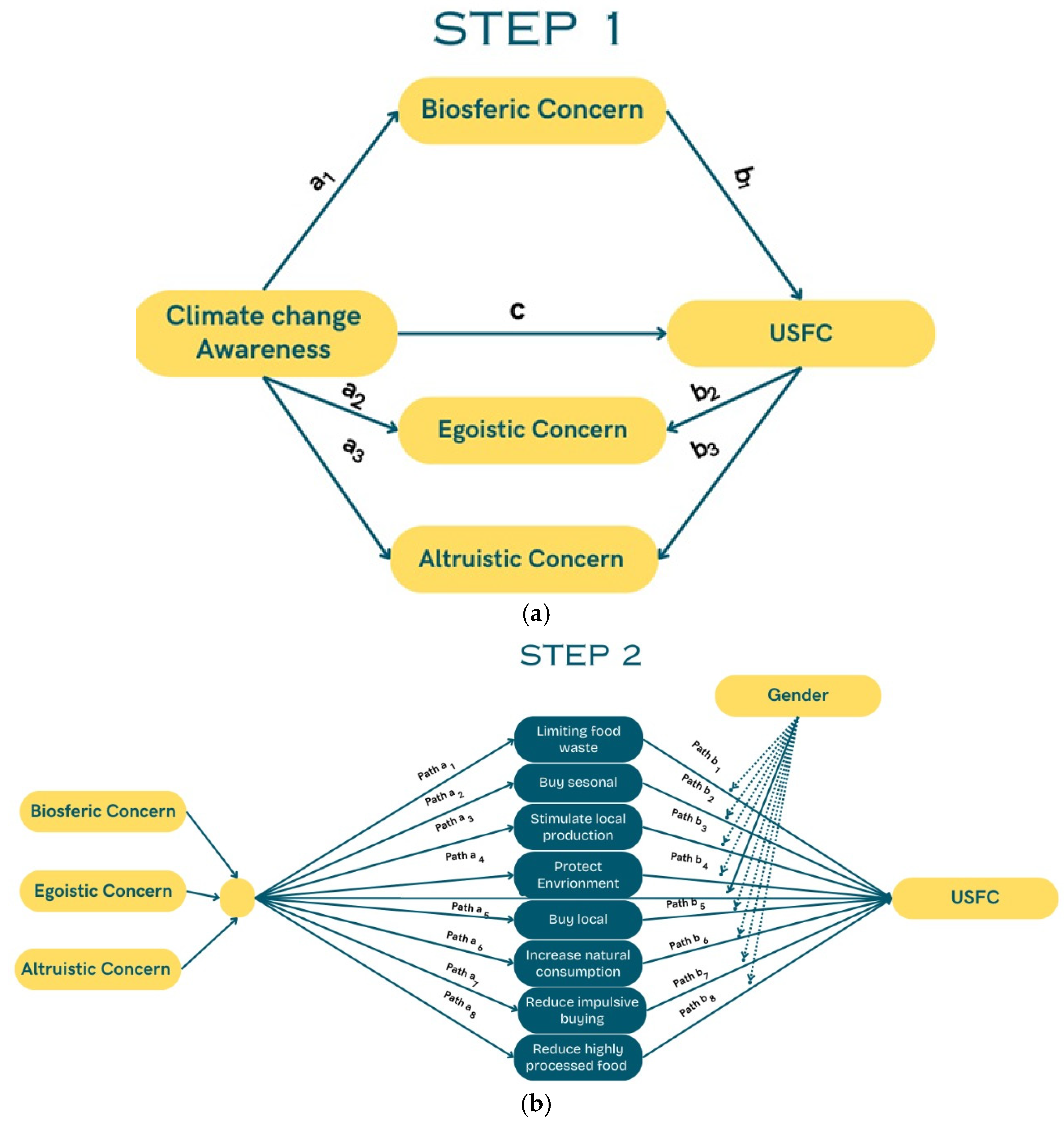

Table 1.
Hypotheses Linking CCA and Environmental Concerns to Participation in Urban Short Food Chains.
Table 1.
Hypotheses Linking CCA and Environmental Concerns to Participation in Urban Short Food Chains.
| Drivers | Pathway | Hypotheses |
|---|---|---|
| Biospheric concern |
Path a1: CCA → Biospheric Concern; Path b1: Biospheric Concern → USFC |
H1:1a CCA positively influences Biospheric Concern, |
| H1: 1b Biospheric Concern, positively affecting participation in USFC | ||
|
Egoistic concern |
Path a2: CCA → Egoistic Concern; Path b2: Egoistic Concern → USFC |
H1:2a CCA positively influences Egostic Concern, |
| H1:2b Egostic Concern, positively affecting participation in USFC | ||
| Altruistic concern |
Path a3: CCA → Altruistic Concern; Path b3: Altruistic Concern → USFC |
H1:3a CCA positively influences Altruistic Concern, |
| H1:3b Altruistic Concern, positively affecting participation in USFC |
Source: Author’s elaboration.
Table 2.
Possible pathways leading to the willingness to participate in USFC.
| Drivers | Hypotheses | References |
|---|---|---|
|
Limiting Food Waste |
H 2.1: Climate Change Concern (CCC)
→
Limiting Food Waste
→
USFC
|
(Iori et al., 2022; Liao et al., 2022) (O’Neill, 2019). (Conrad & Blackstone, 2021;, Thyberg & Tonjes, 2016) |
| Buying Seasonal Products | H2.2: CCC → Buying Seasonal Products → USFC | (Dentoni et al., 2009; Edwards-Jones, 2010; Jarzębowski et al., 2020). |
| Stimulating Local Production | H2.3: CCC → Stimulating Local Production → USFC | (Chiffoleau & Dourian, 2020a; Edwards-Jones, 2010; Evola et al., 2022; Vittersø et al., 2019) |
| Protecting the Environment | H2.4: CCC → Protecting the Environment → USFC | (Bimbo et al., 2020; Shen & Wang, 2022; Tobler et al., 2012; Wells et al., 2011) |
| Buying Local Products | H2.5: CCC → Buying Local Products → USFC | (Dentoni et al., 2009; Edwards-Jones, 2010). |
| Increasing Natural Consumption | H2.6: CCC → Increasing Natural Consumption → USFC | (Hughner et al., 2007; Migliore et al., 2020; Tandon et al., 2020) (Bimbo et al., 2020; Endrizzi et al., 2021; Jarzębowski et al., 2020; Kokthi et al., 2021) |
| Reducing Impulsive Buying |
H2.7: CCC → Reducing Impulsive Buying → USFC |
(Ericson et al., 2014) (O’Neill et al., 2024, 2024; Verplanken & Sato, 2011) (Bahl et al., 2016; Fischer et al., 2017; Garg et al., 2024). |
| Reducing Highly Processed Food Consumption |
H2.8: CCC → Reducing Highly Processed Food Consumption → USFC | (Casas, 2022; Fardet & Rock, 2020)(Nelson et al., 2016). (Allaire & Vandecandelaere, 2010) |
Source: Author’s elaboration.
Table 3.
The description of the variables considered in the study.
| Category | Description |
|---|---|
| Socio-Demographic Characteristics | City (Tirana), Age, Gender, Educational level, Family Income, Parenthood status, Number and Age of children |
| Climate Change Awareness (CCA) | Awareness of air pollution, vehicle emissions, water pollution, chemical fertilizers, green space loss, and land degradation (1=Not informed, 5=Very informed) |
| Environmental Concerns | Concerns about environmental impact on plants, marine life, birds, animals, self, health, future, all people, and children (1=Not concerned, 5=Extremely concerned) |
| Sustainable Consumption & Food Preferences | Preferred food sourcing for school catering, willingness to pay more, motivations for paying more (e.g., limiting waste, seasonal food, reducing processed food), understanding of sustainable food consumption |
Source: Author’s elaboration.
Table 4.
Demographics.
| Demographics | Value | Frequency | Frequency percentage |
|---|---|---|---|
| Gender | Female | 208 | 91% |
| Male | 20 | 9% | |
| Age | 18-25 | 6 | 2.6% |
| 26-35 | 110 | 47.8% | |
| 36-45 | 78 | 33% | |
| 46-55 | 30 | 13% | |
| Over 55 | 6 | 2.6% | |
| Educational Level | Up to 9 years | 4 | 1% |
| 12 years | 14 | 5% | |
| University degree | 108 | 47% | |
| Post university degree | 108 | 47% | |
| Monthly incomes Eur |
100 – 300 | 6 | 2.6 |
| 3001 – 600 | 24 | 10.4 | |
| 601 – 900 | 74 | 32.5 | |
| 1000+ | 124 | 53.8 | |
| Parent | Yes | 220 | 95.7 |
| No | 10 | 4.3 | |
| Number of children | 1 | 102 | 44.3 |
| 2 | 118 | 51.3 | |
| 3 | 10 | 4.3 | |
| 4 | - | - | |
| Over 4 | - | - | |
| Children’s age | Six months-3years | 56 | 24.3 |
| 3 years-5 years | 56 | 24.3 | |
| 5 years-12 years | 64 | 27.8 | |
| 12-15years | 16 | 7 | |
| 15-18 years | 38 | 16.5 |
Source: Author’s elaboration.
Table 5.
1: Climate Change Awareness items. 2: Environmental Concerns items. 3: Drivers Toward USFC Participation.
Table 5.
1: Climate Change Awareness items. 2: Environmental Concerns items. 3: Drivers Toward USFC Participation.
| 1 | ||
| Question | Mean | StdD |
| Are you aware of the danger of vehicle gas emissions that harm people’s health? | 3.96 | 1.061 |
| Are you aware that using chemical fertilisers and pesticides will cause environmental damage? | 4.17 | 0.952 |
| Are you aware of the dangers of air pollution due to urbanisation? | 4.21 | 0.881 |
| Have you been informed about the dangers of water pollution? | 4.12 | 1.046 |
| Are you aware of the dangers of insufficient green space? | 4.03 | 1.113 |
| Have you been informed about the damage caused by the degradation of cultivated land quality? | 3.86 | 1.214 |
| 2 | ||
| Concern for... | Mean | StdD |
| Plants | 3.98 | 0.771 |
| Aquatic life | 4.01 | 0.778 |
| Birds | 3.92 | 0.831 |
| Myself | 4.55 | 0.660 |
| My health | 4.69 | 0.557 |
| Children’s Health | 4.78 | 0.479 |
| My future | 4.67 | 0.595 |
| All individuals | 4.59 | 0.640 |
| 3 | ||
| Driver | Mean | StdD |
| Buy locally produced foods to limit transportation | 3.87 | 1.070 |
| Increasing the consumption of natural foods | 4.55 | 0.860 |
| Promotion of local agricultural/livestock production | 4.08 | 0.950 |
| Purchase and consumption of seasonal foods | 4.61 | 1.040 |
| Reducing food waste | 3.78 | 0.890 |
| Reducing the consumption of highly processed foods | 4.38 | 1.020 |
| Reduction of excessive consumption that comes from impulsive purchases | 4.15 | 1.010 |
| The need to protect the natural environment | 3.92 | 1.050 |
Source: Author’s elaboration.
Table 6.
Linking climate change with USFC.
| Hypothesis | Path | R-squared | (Effect) | p-value | Interpretation |
|---|---|---|---|---|---|
| H: CCA → Biospheric Concern | Path a1 | 0.111 | 0.252 | <0.001 | CCA significantly increases Biospheric Concern |
| H: Biospheric Concern → USFC | Path b1 | 0.036 | 0.028 (Indirect) | >0.05 | No significant indirect effect on USFC participation |
| H1: CCA → Egoistic Concern | Path a2 | 0.041 | 0.113 | 0.003 | CCA significantly increases Egoistic Concern |
| H:Egoistic Concern → USFC | Path b2 | 0.036 | -0.102 (Indirect) | <0.05 | Egoistic Concern negatively mediates the effect on USFC participation. |
| H:CCA → Altruistic Concern | Path a3 | 0.024 | 0.076 | 0.023 | CCA significantly increases Altruistic Concern |
| H: Altruistic Concern → USFC | Path b3 | 0.036 | 0.062 (Indirect) | 0.044 | Altruistic Concern positively mediates the effect on USFC participation. |
| Total Effect of CCA on USFC | Total Path | 0.036 | -0.141 | 0.16 | No significant total effect of CCA on USFC participation |
| Direct Effect of CCA on USFC | Direct Path | 0.036 | -0.129 | 0.223 | No significant direct effect of CCA on USFC participation |
| Interaction Effects | M1- Biospheric, M2- Egoistic, M3-Altruistic | - | Not significant | - | Interaction effects were not significant. |
Source: Author’s elaboration.
Table 7.
Results of Biospheric, Egoistic, and Altruistic Concerns as Drivers of USFC.
| H | OV | R2 (ECB) | Coefficient ECB |
p-value ECB | R2 ECE | Effect ECE | p-value ECE | R2 (ECA) | Coefficient ECA | p-value ECA |
|---|---|---|---|---|---|---|---|---|---|---|
| H2.1 | Limiting Food Waste | 0.090 | 0.349 | <0.000 | 0.036 | 0.200 | 0.009 | 0.111 | 0.393 | <0.0001 |
| H2.2 | Buying Seasonal | 0.101 | 0.304 | <0.000 | 0.110 | 0.287 | <0.000 | 0.188 | 0.423 | <0.0001 |
| H2.3 | Stimulating Local Prod | 0.156 | 0.439 | <0.000 | 0.088 | 0.304 | <0.000 | 0.172 | 0.468 | <0.0001 |
| H2.4 | Protecting Environment | 0.154 | 0.404 | <0.000 | 0.097 | 0.294 | <0.000 | 0.166 | 0.425 | <0.0001 |
| H2.5 | Buying Local Products | 0.065 | 0.280 | 0.000 | 0.034 | 0.188 | 0.010 | 0.096 | 0.345 | <0.0001 |
| H2.6 | Increasing Natural Cons | 0.156 | 0.394 | <0.0001 | 0.126 | 0.321 | <0.0001 | 0.218 | 0.473 | <0.000 |
| H2.7 | Reducing Impulsive Buy | 0.074 | 0.301 | 0.000 | 0.086 | 0.299 | <0.0001 | 0.113 | 0.377 | <0.000 |
| H2.8 | Reducing Processed Food | 0.136 | 0.415 | <0.0001 | 0.156 | 0.406 | <0.0001 | 0.230 | 0.546 | <0.000 |
| H2.9 | WTP (Overall Model) | 0.131 | 0.6520 (Direct effect) | 0.092 | 0.146 | 0.3387 (Direct effect) | 0.318 | 0.122 | 0.6520 (Direct effect) | 0.092 |
| Limiting waste | - | 0.502 | 0.002 | - | 0.448 | 0.006 | - | 0.502 | 0.002 | |
| Buying Seasonal | - | -0.207 | 0.534 | - | -0.236 | 0.476 | - | -0.207 | 0.534 | |
| Protecting environment | - | -0.297 | 0.158 | - | -0.213 | 0.306 | - | -0.297 | 0.158 | |
| Stimulating local production | - | 0.067 | 0.775 | - | 0.047 | 0.837 | - | 0.067 | 0.775 | |
| Increasing natural consumption | - | -0.663 | 0.022 | - | -0.731 | 0.011 | - | -0.663 | 0.022 | |
| Reducing Impulsive bying | - | -0.323 | 0.096 | - | -0.291 | 0.120 | - | -0.323 | 0.096 | |
| Reducing Processed food consumption | - | 0.370 | 0.095 | - | 0.418 | 0.054 | - | 0.370 | 0.095 | |
| Buying Local | - | 0.000 | 1.000 | - | -0.017 | 0.919 | - | 0.000 | 1.000 | |
| Interaction (Gender) | - | -0.730 | 0.021 | - | -0.560 | 0.032 | - | -0.730 | 0.021 |
Source: Author’s elaboration. Outcome Variable=OV, EC(Biospheric)=ECB, EC(Egoistic)=ECE, EC(Altruistic)=ECA,.
Disclaimer/Publisher’s Note: The statements, opinions and data contained in all publications are solely those of the individual author(s) and contributor(s) and not of MDPI and/or the editor(s). MDPI and/or the editor(s) disclaim responsibility for any injury to people or property resulting from any ideas, methods, instructions or products referred to in the content. |
© 2025 by the authors. Licensee MDPI, Basel, Switzerland. This article is an open access article distributed under the terms and conditions of the Creative Commons Attribution (CC BY) license (http://creativecommons.org/licenses/by/4.0/).
Copyright: This open access article is published under a Creative Commons CC BY 4.0 license, which permit the free download, distribution, and reuse, provided that the author and preprint are cited in any reuse.


