

Submitted:
19 March 2025
Posted:
20 March 2025
You are already at the latest version
Abstract
Nanotubes (NTs) are nanosized tube-like structured materials made from various substances such as carbon, boron, or silicon. Carbon nanomaterials (CNMs), including carbon nanotubes (CNTs), graphene/graphene oxide (G/GO), and fullerenes have good interatomic interactions and possess special characteristics, exploitable in several applications, because of the presence of sp2 and sp3 bonds. Among NTs, CNTs are the most studied compounds, due to their nonpareil electrical, mechanical, optical and biomedical properties. Moreover, particularly single-walled carbon nanotubes (SWNTs) have demonstrated high ability as drug delivery systems and in transporting a wide range of chemicals across membranes and into living cells. Therefore, SWNTs more than other NT-structures, have piqued interest in medicinal applications, such as target delivery, improved imaging, tissue regeneration, medication and gene delivery, providing nanosized devices with higher efficacy and fewer side effects. SWNTs and multi walled CNTs (MWCNTs) have recently gained a great deal of attention for their antibacterial effects. Unfortunately, numerous recent studies have revealed unanticipated toxicities caused by CNTs. However, on these findings, contradictory opinions exist. Moreover, the problem of controlling CNTs-based products has become particularly evident, especially in relation to their high-scale production and the nanosized forms of the carbon constituting them. Important directive rules have been approved over the years, but further research and regulatory measures should be introduced for a safer production and utilization of CNTs. Upon this background, after an overview on CNMs and CNTs, the antimicrobial properties of SWNTs, as well as the most recent in vitro and in vivo studies on their possible toxicity with strategies to limit it have been provided and discussed in this review. Finally, a debate on the regulatory issues has been also included.
Keywords:
Carbon nanotubes (CNTs)
; mechanical
; electrical
; and optical properties
; CNTs biomedical applications
; antibacterial nanotubes
; nanotubes toxicity
; CNTs regulation
1. Introduction
Nanotechnology is one of the most exciting 21st-century knowhows [1,2], having the capability to observe, measure, control, assemble, and manufacture materials at the nanoscale, thus translating the theory of nanoscience into practical applications[3,4,5]. Nanotechnology is a discipline of global interest in constant growing[6,7,8], which deals with a variety of materials produced at < 100 nm through different chemical and physical methods[9]. Since conducted at the nanoscale (1-100nm), unique phenomena enable novel applications in a wide range of fields, including chemistry, physics, biology, medicine, engineering, and electronics[10,11]. To keep up with the rate of advancements in science and technology, new types of nanomaterials with unconventional-edge and innovative properties are incessantly required[12]. Nanotubes (NTs) belong to a promising group of nanomaterials which allow approaching several new electronic, magnetic, optical, and mechanical properties[13].
Many of the nanotube’s structures extensively studied contain boron, silicon, and molybdenum atoms, but carbon nanotubes (CNTs) are the most researched group among existing NTs structure [14]. In fact, carbon nanomaterials (CNMs), including CNTs, graphene/graphene oxide (G/GO), and fullerenes, are allotropes of sp2 and sp3 hybridized caron atom and their sp2 and sp3 bonds, are thought to be responsible for their unique characteristics [12]. They have good interatomic interactions[14], and are very interesting nanostructures in terms of their special properties and possible applications[15]. CNTs are composed of graphite sheets rolled up in an unbreakable and non-stop hexagonal-like lattice structure, in which carbon atoms appear at the tops of the hexagon-type forms. Based on the number of carbon sheets, CNTs are categorized as single wall carbon nanotubes (SWCNTs), double wall carbon nanotubes (DWCNTs) and multi wall carbon nanotubes (MWCNTs)[13]. Although also MWCNTs have been extensively studied for their demonstrated antimicrobial potential, SWCNTs have displayed excellent antibacterial action, according to some research, due to the smaller size of these materials which play a significant part in the inhibition of microbes [12]. By a search made on Scopus on March 1, 2025, by using as keyword “nanotubes”, in the last fifty years (2010-2025), 87,798 documents concerned “nanotubes”, while 80,535 concerned specifically “carbon nanotubes” (Figure 1). By an additional survey using as key word “single walled nanotubes” publications limited to 17,225 were found (Figure 1).
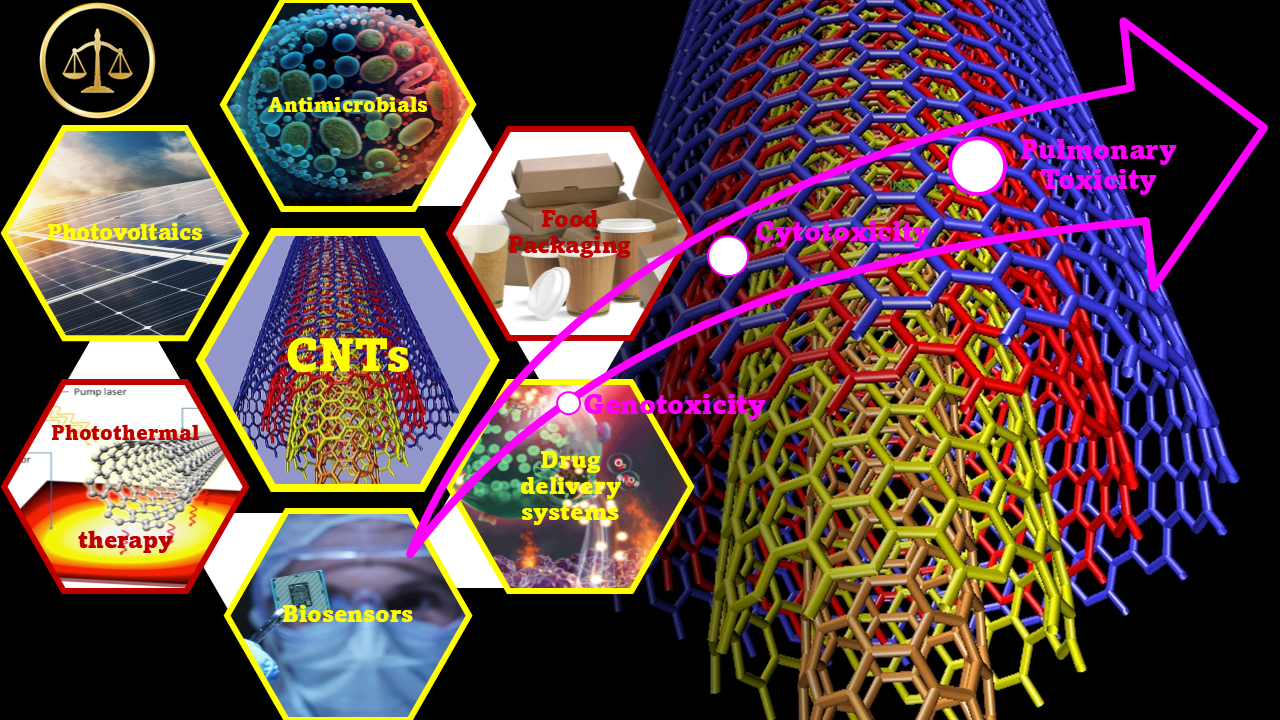
Generally, CNMs offer great surface area, mechanical resistance, thermal conductivity, photoluminescence, transparency, and constructional durability in addition to antibacterial activities against pathogens and remarkable electrical conductivity[16]. These properties increasingly encourage the application of CNMs in several nanocomposites, such as thin-film transistors, transparent conducting electrodes, photovoltaics, supercapacitors, biosensors, drug delivery systems, tissue engineering, photothermal therapy, and antimicrobial food packaging. As the larger family of CNMs, also CNTs are materials with extraordinary properties which are useful across a variety of new, state-of-the-art applications in sensors, printed electronics, e-readers, flexible displays, energy storage medical treatments and more. Specifically, since their discovery in 1991 by Ijima[17], SWNTs have influenced a significant amount of activity in both research and industry across the world. Furthermore, SWNTs have stimulated considerable investment in manufacturing methods, characterization techniques and applications development. However, the main drawback of CNTs immediately recognized, consists of their scarce solubility in most solvents, which limits their application [16]. To address this issue, and amplify CNTs use, researchers have focused on surface modifications [14,15,16]. Surface modifications, together with other several factors, including their chemical composition, target bacteria, and reaction environment, can affect the CNMs’ antimicrobial activity[18]. The antimicrobial effects of CNMs derive mainly by their capacity to physically isolate pathogen cells from their supportive environment. Anyway, their capacity to penetrate the microbial cell wall/membrane, thus causing irreversible structural damage, supports their antimicrobial activity to a major extent[12]. Finally, the interaction of CNMs with bacterial cells stimulate the generation of noxious substances, as the reactive oxygen species (ROS), triggering oxidative stress (OS) to cells thus promoting their death. Additionally, the interactions between CNMs and microorganisms result in an electron transfer, which induces ROS-independent OS and causes biological death of pathogens [19]. To confirm that the OS plays an additional role in the CNTs and SWCNTs antimicrobial mechanisms [20], Haung et al investigated the mechanical effects that influenced the antimicrobial properties of CNTs, such as low wear rates, low friction coefficients, favourable tribological characteristics, and high corrosion resistance[21]. Among different types of CNMs and CNTs, the antimicrobial activity of SWCNTs resulted to be higher, due to their advantageous physicochemical properties [22,23,24,25]. In this regard, Kang and co-workers, in their first report on the antimicrobial activity of purified SWCNTs and MWCNTs, demonstrated that both materials showed significant antimicrobial effects. Anyway, those of SWCNTs seemed to be stronger than those of MWCNTs [26]. Since they found that CNTs’ antibacterial effect mainly depended on their ruinous impact on the integrity of bacterial membranes upon direct contact, the higher activity of SWCNTs could depend on their small size which provides a larger surface area to facilitate the membrane perturbation[26,27]. The morphology and metabolic activities of pathogens were also compromised [27]. Also, based on studies conducted by Chen et al, the SWCNTs played a significant role as “nano-darts” which penetrated bacterial cell walls, reduced membrane potential, released intracellular constituents (DNA and RNA), and ultimately disrupted the bacterial membrane [28]
2. Approaching Carbon Nanotubes
Carbon is a chemical element that has atomic number 6. It is one of the most abundant elements in the Universe by mass, capable of providing approximately 10 million different pure organic compounds. Such compounds possess the uncommon ability to form polymers at earth temperatures, thus being the chemical basis of all known life [29]
CNTs are thin and long cylinders made of carbon, which were found for the first time in 1991 by Sumio Iijima [17]. Many physical properties of CNTs are still obscure and need to be disputed, as well as technical and not technical hurdles, which still limit the CNTs’ success, and their extensive application. Anyway, it is generally recognized that CNTs possess a plethora of thermal, electronic, mechanical, and structural properties that can vary based on their different existing forms [29]. In this regard, CNTs differ mainly for their diameter, length, chirality, or twist. Table A1, in Appendix A reproduced from our previous work [29], collects the key properties and potential uses of CNTs, as well as the current remaining technical and not technical hurdles. References in Table A1 do not belong to this work but are those contained in Alfei and Schito, 2022[29]. We have decided for this solution, so as not to overly burden the already significantly long list of references of this work. In addition to those reported in Table A1, a plethora of other possible applications for CNTs exist, including solar collectors, conductive and/or waterproof paper, catalyst supports, nano-porous filters, and coatings of all types. Since possessing the capability to absorb infrared light, CNTs may be applied in the I/R Optics Industry. We are confident that many unexpected applications for these nonpareil materials will be found in the next years, which will reinforce the belief that CNTs could be the most important and valuable nanomaterial ever used until now.
2.1. Synthesis of CNTs
Table A2 in Appendix A, reproduced by our previous work [29]collects the three most used methods to synthetize CNTs. Following is a brief description of methods reported in Table A2 plus other minor used methods.
2.1.1. Arc Discharge (AD)
Before 1991, AD process was finalized to produce fullerenes. In that year, using a current of 100 amps, the formation of CNTs in the carbon soot of graphite electrodes was found[17]. By the same method, in 1992, the first macroscopic production of CNTs was started [30]. The high temperatures (> 1,700 °C) used in this method typically cause the CNTs’ expansion, and CNTs with less structural defects, in comparison with other methods, can be obtained[31].
2.1.2. Laser Ablation (LA)
This process is described in Table A2 and was developed by Dr. Richard Smalley and co-workers at Rice University. Following the procedure commonly used to produce different metal molecules based on blasting metals with a laser, they created MWCNTs, by replacing metals with graphite [32]. Later SWCNTs were obtained using a composite of graphite and a cobalt/nickel mixture as metal catalyst particles [33].
2.1.3. Chemical Vapor Deposition (CVD)
CVD is the most widely used method to produce CNTs [34]. Among the other methods to synthetize CNTs, CVD is the most suitable for scaling-up and their industrial production, due to its low cost. Moreover, CVD popularity derives also by the possibility of growing CNTs directly on a desired substrate by careful deposition of the catalyst [35]. It consists of preparing a substrate of nickel, cobalt, iron, or a combination catalyst NPs [36,37], in the reactor by several possible ways, including reduction of oxides or their solid solutions. Such substrate is then heated at about 700 °C under a flux of a “process gas” (ammonia, nitrogen, or hydrogen), and a “carbon-containing gas” (acetylene, ethylene, ethanol, or methane), to promote CNTs growing[38,39]. The main inconvenience of CVD technique can occur when supports for catalyst NPs are used. In this case, there is need to remove the catalyst support via an acid treatment, which sometimes could destroy the original structure of CNTs [34,40]. An advanced CVD technique is named plasma-enhanced chemical vapor deposition (PECVD) and consists of generating plasma by the application of a strong electric field during CNTs growth[41]. By adapting the reactor’s geometry, it is possible to synthesize vertically aligned CNTs[29], whose morphology is of interest to researchers attracted by electron emission from CNTs.
2.1.4. High-Pressure Carbon Monoxide (HiPco) Process
HiPco method was optimized at Rice University. In this procedure, a high-pressure carbon monoxide (CO) gas was reacted with iron pentacarbonyl, thus creating SWCNTs. SWCNTs derive from the transformation of CO into carbon on the nucleation surface made of iron NPs, which are initially produced. SWCNTs production was possible using from milligrams to grams scale, avoiding environmental release of wastes[29].
2.1.5. Super-Growth CVD (SGCVD)
Also known as water-assisted chemical vapor deposition, SGCVD was introduced by Kenji Hata, Sumio Iijima and colleagues at AIST (Japan)[42]. The novel introduction of water into the CVD reactor enhanced the activity and lifetime of the catalyst, allowing the achievement of both dense millimetre-high vertically aligned nanotube arrays (VANTAs) and "forests" materials, which are normally aligned to the substrate. SGCVD is superior to laser ablation strategy by 100 times and to HiPco, permitting to obtain low-mass density, highly pure (>99.98%), 2.5 mm height SWNT forests very rapidly (10 minutes), by easy separation from the catalyst without additional purification [29]. Additionally, more than 1 mm long VANTAs are achievable in several shapes, including sheets and bars, by applying weak compression during the process[43].
2.1.6. Plasma Torch (PT)
Plasma torch was an invention by Olivier Smiljanic in the year 2000, working at Institut National de la Recherche Scientifique (INRS) located in Varennes (Canada). Argon, ethylene and ferrocene were entered into a microwave plasma torch (PLASMOTRON), which is a device designed to generate plasma and supply a continuous plasma jet into a plasma chemical reactor. An intense 'flame' developed, whose fumes contained SWNTs, metallic, carbon NPs and amorphous carbon [29,44]. The consumed energy was 10-fold lower than that consumed during graphite vaporization, as happens in LA or AD. The ITP method was a modified PT procedure developed later in the year 2005, by researchers from Sherbrooke University and the National Research Council of Canada [45]. In this method, the thermal plasma is generated by high-frequency oscillating currents in a loop and is conserved in flowing inert gas, allowing the achievement of SWCNTs with different diameter distributions.
2.1.7. Liquid Electrolysis Method (LEM)
LEM allowed to obtain MWCNTs by electrolysis of molten carbonates [46]. In this method, metal ions reduced to their metal form attached on the cathode, formed the nucleation surface for CNTs growth. In this method, the reactant was a carbon dioxide greenhouse gas, and highly valued CNTs products can be achieved. For these reasons, this method could represent a possible strategy for carbon dioxide capture and conversions [29,47].
2.1.8. Natural, Incidental, and Controlled Flame Environments
In addition to all these artificial inventions by human researcher, CNTs can form naturally in commonly originated flames emitted by burning methane [48], ethylene [49], and benzene [50]. Indeed, highly irregular in dimensions and quality CNT-based structures, due to uncontrolled conditions, can exist in smoke from both indoor and outdoor air[51]. Anyway, lacking the high degree of uniformity necessary to satisfy the many needs of both research and industry, their practical application is hampered. Despite this, efforts have been focusing on control environmental flames by theoretical models to produce less irregular CNTs[52,53,54,55,56], thus going towards large-scale, low-cost CNTs synthesis competitive with large scale CVD production.
2.2. Architecture and Other Features of CNTs
CNTs deserved the prefix "nano", due to their very small size of 1/50,000th the diameter of a human hair.
Pure carbon can develop in several carbon-based architectures and CNTs are one of them. As examples, diamond is the tetrahedron crystalline structure of carbon, while graphite or graphene owns a planar structure, with linked carbon atoms forming hexagons[29]. Buckyballs, from the name of F. Buckminister Fuller, who first designed geodesic spheres also called fullerenes[57], are made of hexagons of pure carbon atoms linked to form a sphere. The typical structure of CNTs instead derives by the rolling up of a sheet of carbon atoms associated to form hexagons (graphene), thus forming cylinders (Figure 2a).
Different structures that CNTs can assume are represented in Figure 2b. While SWCNTs (left side) are not naturally formed CNTs, MWCNTs are more complex CNTs formed naturally[57].
Additionally, when CNTs consist of two or three graphene complete cylinders one inside the other, they are termed double- and triple-walled carbon nanotubes (DWCNTs and TWCNTs). Figure 3 shows the representative structure of a DWCNT.
CNTs are atomically speaking very stable, being SWCNTs more stable than MWCNTs. Researchers in the field consider as CNTs, tubes with diameters less than 100 nm[58]. Differently, no intrinsic limit exists on how long CNTs can develop[29]. However, their length is usually much larger than diameter [29]. Table A3 in Appendix A summarizes the physical limits of CNTs. References in the Table do not belong to this work but are those contained in Alfei and Schito, 2022 [29]. We have decided for this solution, for the reasons previously described. The production of SWCNTs is more difficult than that of MWCNTs, which can exhibit behaviours different from SWCNTs. In this regard, despite the dispersion of SWCNTs to obtain nanocomposites is more difficult than that of MWCNTs, generally, SWCNTs demonstrated better properties than MWCNTs. For this reason, scientists are focused mainly in finding more practical ways to mass-produce SWCNTs. Concerning the production of CNTs-based nanocomposites, the possible junctions between two or more CNTs have been widely discussed theoretically[59,60], while those between CNTs and graphene have been considered both theoretically [61] and experimentally [62] (Table A4, Appendix A, references in the Table do not belong to this work but are those contained in Alfei and Schito, 2022 [29], according to reasons previously described). Junctions between CNTs were observed in CNTs prepared by AD or CVD methods. Lambin et al were the first experts, who studied theoretically the electronic properties of such junctions, starting from the assumption that a connection between a metallic tube and a semiconducting one could form a component of a CNTs-based electronic circuit [63]. CNTs-graphene junctions are instead the basis of pillared graphene, characterized by three-dimensional (3D)-carbon nanotube (3D-CNTs) architectures, studied as building blocks to fabricate three-dimensional macroscopic structures [64]. Using these materials, it is possible to obtain free-standing, porous scaffolds, made only of carbon, possessing macro-, micro-, nano-structured pores and tailorable porosity with several applications. They could be used for the fabrication of the next generation energy storages, supercapacitors, field emission transistors, high-performance catalysts, photovoltaics, and biomedical devices, such as implants, and biosensors [65,66,67].
2.2.1. Relationships Structure/Properties
The study of CNTs formations remains a cutting-edge field, where new discoveries are being made regularly. Among the possible intimate structures that a SWCNT can assume the armchair, zigzag and chiral configurations are extensively recognized, based on the graphene mode to package into the CNTs cylinder (Figure 4).
The structural conformation of CNTs has a direct effect on their properties, and mainly, on the mechanical and electrical ones. As an example, in MWCNTs, the outer walls of MWCNTs can protect the inner carbon tubes from chemical interactions with outside materials. Over the years, possible structure-related mechanical properties and structure-related electrical and thermal properties of CNTs have been reported in several studies. Structure-related mechanical investigations established that CNTs are the greatest nanomaterials discovered so far. Particularly, CNTs were better than other nanomaterials in terms of elastic modulus and tensile strength [29,68,69,70]. Anyway, it has been also reported that defects in the structure of CNTs, due to atomic vacancies or rearrangements of the carbon bonds, can cause weak points in small segments of the CNT, which reduce their elasticity and weaken their tensile strength [29]. On the other hand, structure-related electrical and thermal investigations showed that the structure of CNTs affect their conductive potency, both in terms of electrical and thermal conductivity [29,71,72,73,74,75,76].
3. Biomedical Applications of CNTs
CNTs belonging to all categories, including SWCNTs, DWCNTs and MWCNTs can differ in purity, length, and functionality. Anyway, all own a plethora of properties, such as high electrical conductivity, high tensile strength, light weight [77,78,79], high biocompatibility[80]. All possess the capability to load molecules for their transport and delivery, large surface area, chemical inertness. All can be enriched with functional groups, and demonstrated good elasticity, thermal conductivity, capability to expand, electron emission capacity, and high aspect ratio[77,78,79].
These properties added to peculiar composition and geometry make CNTs suitable for numerous potential applications, including energy storage, biomedical uses, air and water filtration. Also, CNTs could become molecular electronics, thermal materials, structural materials, electrical conductors, fabrics and fibres, catalyst supports, conductive plastics, conductive adhesives, as well as ceramics [77].
For this reason, scientists working in this sector are involved in efforts aimed at increasingly lower the costs of CNTs production up to commercially viable levels, by scaling up their synthesis.
Interestingly, CNTs have great potential to be applied in nanomedicine for disease diagnosis and drug targeting, as well as to transport various biomolecules such as proteins, DNA, RNA, immune-active compounds, and lectins [81,82,83].
CNTs are also extensively applied to develop electrochemical sensors, DNA based sensors, as well as piezoelectric and gas sensor[77]. Additionally, opportunely structured CNTs, such as cationic CNTs have been revealed to possess interesting antibacterial and antifungal activity [77]. Table A5 in Appendix A, reproduced from our previous article [29]summarizes the several applications that CNTs could have in the biomedical area. References in the Table do not belong to this work but are those contained in Alfei and Schito, 2022[29]. We have decided for this solution, for the reasons previously described.
3.1. Antimicrobial Properties of Carbon Nanotubes
It has been reported that CNTs and especially SWCNTs and MWCNTs possess excellent antibacterial and antifungal activity. Several mechanisms have been suggested to justify the CNTs toxicity against bacteria. Kang et al reported for the first time in 2007, that SWCNTs demonstrated strong antibacterial activity against Escherichia coli, by cell membrane impairment via direct contact, thus inhibiting the 80% of bacterial cells [26]. Another study by the same authors, using E. coli, on the gene expression analysis, disclosed that the potency of antibacterial activity of CNTs mainly depended on their size and that the a-specific disruption of bacterial membrane was the main mechanism of their antibacterial effects [27]. In the same year, the same authors demonstrated, that when exposed to MWCNTs, E. coli revealed significant oxidative stress (OS), complemented by cell membranes disruption, cells lysis and release of intracellular contents[20]. Nagai and Toyokuni who studied the differences and similarity between carbon nanotubes and asbestos fibres effects on cells during mesothelial carcinogenesis also reported that the mechanism by which CNTs enter non-phagocytic cells was mainly based on the impairment of cell membrane by direct pore formation on their surface[84]. On the other hand, Kang et al. reported that the length of CNTs is pivotal for their interactions with bacterial membrane, where shorter tubes showed higher toxicity against bacteria [27]. Additionally, Aslan et al remarked that shorter SWCNTs were more toxic to target cell, due to the higher density of open tube ends [85]. A similar observation was also reported by Johnson, showing that nanotubes with smaller diameters manage to impair membranes of target cells via easier interactions with their surface. Concerning more specifically the inhibition of some bacteria and fungi, including E. coli, Bacillus subtilis, Staphylococcus aureus, Pseudomonas aeruginosa and Candida albicans caused by exposure to SWNT, DWNT, and MWNT, it was demonstrated that their death was induced by the accumulation of CNTs following their entrapment onto the microbial cell surface [86,87]. Differently, Arias et al observed that SWCNTs functionalized with -OH and -COOH groups used in buffered suspension caused Salmonella cells aggregation and the formation of SWCNTs-pathogens aggregates with an increasing size depending on SWCNTs concentrations [88]. Although the authors admitted that additional mechanisms for toxicity of SWCNTs to bacterial cells could exist, this was assumed to be the main one. The toxicity of SWCNTs to bacterial cells was also dependent on buffer of suspensions[88]. Many studies have confirmed that SWCNTs are more toxic to different pathogen than MWCNTs causing their membrane disruption[20,28]. Kang et al found that, while SWCNTs kill most E. coli bacterial cells after one hour treatment, incubation with MWCNTs leave bacteria alive [20,27]. The authors also evidenced that E. coli exposed to SWCNTs displayed higher level of stress-related genes compared to MWCNTs treatments. On the contrary, Young et al demonstrated that the MWCNTs are more toxic than SWCNTs to E. coli (study not included in Table 5) [89]. Also, Saleemi et al, who have assessed the antimicrobial effects of DWCNTs and MWCNTs against S. aureus, P. aeruginosa, Klebsiella pneumoniae, and C. albicans, demonstrated that non-covalently dispersed MWCNTs exhibited higher antimicrobial activity than DWCNTs[90]. Despite the contradictory reports, which need further investigations, CNT are very competitive compared to other nanomaterials in inhibiting a broad range of microorganisms including both Gram-positive and Gram-negative species and fungi, such as S. aureus, E. coli, Enterococcus faecalis, Lactobacillus acidophilus, and Bifidobacterium adolescentis [20,26,28]. The following Table 1 collects some relevant case studies reported over the years about the antimicrobial properties of not modified CNTs.
Several other studies investigating the antimicrobial properties of SWCNTs and MWCNTs have been focused specifically on assessing the effect of their functionalization with different groups, nanocomposites, antibodies etc. on their antimicrobial ability towards various bacterial and fungi strains. Following is a brief description of the most relevant achievements.
3.1.1. Functionalized SWCNTs
CNTs can be functionalized by both covalent and non-covalent methods. The functionalization of the surface of CNTs could have different goals, including the avoidance of desorption processes and of undesired absorption of molecules from the biological media, as well as to enhance the effectiveness of their antimicrobial activity[95,96,97,98,99]. Correlations between the toxicity to bacteria, and the physicochemical properties or the agglomeration status of functionalized SWCNTs (f-SWCNTs) were studied by Pasquini et al, discovering that no direct correlation was identified between the bacterial cytotoxicity and thermal, physicochemical, and structural properties of f-SWCNTs[100]. On the contrary, they found that the aggregation of nanoparticles had more incidence than the single chemical and physical properties of functional groups, on the f-SWCNTs cytotoxicity[100]. Arias et al. functionalized SWCNTs with different groups and tested them in suspension to evaluate the possible increase of their interaction with pathogens and the effects on their antimicrobial activity [88]. Specifically, the authors studied the effects of various surface functional groups, including -NH2, -COOH, and -OH ones, on their antimicrobial effects against S. aureus, B. subtilis, and Salmonella typhimurium. SWCNTs bearing cationic – NH2 group inhibited bacterial growth only at high concentrations. On the contrary, SWCNTs bearing anionic – COOH and neutral – OH groups reduced viability of pathogens by 7 log CFU/g. To explain this fact authors assumed that the long carbon chain used to attach the NH2 groups to SWCNTs surface impede to the cylindrical shape of SWCNTs to be in close direct contact with microbial cell wall, thus probably reducing their inhibitory effects. On the contrary, –COOH and – OH groups were derived directly from the surface of SWCNTs, thus allowing the direct contact of bacteria with SWCNTs surface, thus sustaining and enhancing their antimicrobial potency. Several authors have reported on the antimicrobial activity of silver nanoparticles (AgNPs) and other metal oxides together with their inhibitory effects on the infections[101]. Chaudhari et al observed that the antimicrobial properties of silver coated SWCNTs on S. aureus, when applied in a skin model, can be modified with antimicrobial peptide (AMPs)[102]. In this regard, they observed that the proliferation of bacteria was reduced by 105 CFU/g by silver coated functionalized CNT after skin treatment[102]. Generally, AgNPs bind and penetrate the bacterial cell membrane causing cell death by altering the permeability of membrane and ROS increase induction [103], while AMPs have shown antimicrobial effect on various fungi, bacteria, and viruses by the same mechanisms[104]. Therefore, the synergistic effects of AgNPs with AMPs increase the toxic effects of SWCNTs thus allowing the possible development of novel antimicrobial therapies [102]. The same authors tested their functionalized SWCNTs against S. aureus, Streptococcus pyogenes, Salmonella enterica serovar Typhimurium, and E. coli[105], finding that the conjugation led to a strong synergistic antibacterial effect of TP359 with SWCNTs-adsorbed AgNPs. Kumar et al reported the excellent antibacterial potency of SWCNTs enriched with AgNPs inserted in cotton fabrics against S. aureus and E. coli[106]. Moreover, AgNPs embedded in silica-coated SWCNTs substrate inactivated E. coli growth better, respect to AgNPs plasma-treated SWCNTs substrates [107]. Eco-designed biohybrids based on liposomes containing cholesterol, mint–nanosilver and carbon nanotubes demonstrated antioxidant and antimicrobial properties against S. aureus, E. coli, and E. faecalis[108]. Chang et al by a simple one-step procedure synthesized nanocomposites encompassing CNTs, graphene oxide and AgNPs effective against E. coli and S. aureus, exhibiting high disinfection property [109]. Further investigation proved that the nanocomposite of Chang and colleagues were able to induce O2-based OS on bacteria, which damaged cell membrane integrity, thus triggering cell death. SWCNTs coated with Ag-doped TiO2 nanoparticles demonstrated strong antibacterial activity against both E. coli and S. aureus, although S. aureus was more tolerant than E. coli under illumination by UV light [95]. Park et al manufactured pegylated SWCNTs (pSWCNTs) covered AgNPs and their antibacterial effects were investigated on foodborne pathogenic bacteria[110]. A significant reduction in proteins associated with bacterial biofilm formation and quorum sensing, as well as of proteins necessary for the conservation of cellular structure were observed, associated to a decrease in cell motility in foodborne pathogens remained alive. Also, by a simple and low-cost one-pot synthetic procedure, Singh et al produced a SWCNTs/Ag/PPy based nanocomposite which succeed in fully inhibiting the growth of S. aureus, P. aeruginosa, E. coli and B. cereus completely within 24 h treatment [111]. A new antimicrobial nano system made of mesoporous silica and AgNPs-coated SWCNTs (SWCNTs@mSiO2-TSD@Ag) which demonstrated strong antimicrobial activity against multidrug resistant (MDR) bacterial strains, by impairing cell membrane and releasing of Ag ions was projected by Zhu et al[112]. Yun et al manufactured CNTs-Ag and GO-Ag demonstrating antibacterial effects against both Gram-positive and Gram-negative species, even if the effects of CNTs-Ag was higher than that of GO-Ag nanocomposites[113]. Additionally, a carbon-Ag nanosized complex inhibited the microbial growth of methicillin-resistant S. aureus, K. pneumoniae, Acinetobacter baumannii, Yersinia pestis and Burkholderia cepacian[114]. SWCNTs were also modified with natural enzymes, such as lysozyme (LSZ) succeeding in enhancing their antibacterial impact against different bacterial species including S. aureus, and Micrococcus lysodeikticus, by causing cell wall lysis via hydrolytic breck of the β-1, 4 bonds in peptidoglycan [115,116,117]. Chemical modifications of SWCNTs were mainly finalized to enhance their dissolution properties and chemical compatibility. On the contrary, the functionalization of SWCNTs with polymers, achieving deposited aggregates and membrane coatings, improved their dispersibility and solubility and increased the interfacial interaction to polymeric matrices in their composites, thus demonstrating high chemical stability and high toxicity towards the microbes. Differently from pristine SWCNTs, polymer-modified SWCNTs are less expensive, provide an enlarged range of mechanical, degradation, and structural properties, thus been suitable to develop ideal antimicrobial nanomaterials. Several case studies have been available in literature reporting on the antibacterial activity of these carbon-based nanocomposites. Aslan et al ideated SWCNTs with poly-(lactic-co-glycolic acid) (PLGA) and explored their antibacterial effects against S. epidermidis and E. coli, observing a 98% viability reduction and a significant decrease of the metabolic activity of the bacteria[85]. On the other hand, the SWCNTs modified with polyvinyl-N-carbazole demonstrated a 90 and 94% inhibition of planktonic cells for B. subtilis and E. coli, respectively, while reduced their biofilm formation [118]. Nanocomposite deriving by refashioning SWCNTs with poly-(L-glutamic acid) and poly-(L-lysine) resulted in 90% inhibition rate of E. coli and S. epidermidis[119]. Goodwin et al synthesized a SWCNTs-poly-(vinyl alcohol) nanosized composite which gradually inactivated P. aeruginosa cells depending on increasing concentrations of SWCNTs [120]. SWCNTs reformulated with porphyrin possessing appreciable antibacterial effects against S. aureus in the presence of visible light using tungsten-halogen lamp were reported by Sah et al [121]. The activity of these materials was based on a photochemical reaction which ultimately transferred an electron to the atmospheric molecular oxygen to form ROS, which destructed the bacterial cell wall, thus driving to the bacterial death [121]. Also, SWCNTs covalently bound with polyamide membranes showed a 66% inactivation of bacteria, translating in a delay in membrane biofouling[122]. The well-known poly-(ethylene glycol) (PEG) coating agents, recognised for its high hydrophilicity and biocompatibility was attached in its linear and branched form by Cajero-Zul et al to the surface of CNTs, achieving a nanoplatform suitable to manufacture medical devices [123]. Even if SWCNTs-copolymer of star-shaped PEG and poly-(ε caprolactone) (PCL) did not possess antimicrobial activity, demonstrated thermal and mechanical characteristics superior of those of polymeric matrix. On the contrary, the star-shaped PCL-PEG copolymer structure prevented bacterial growth [123].
3.1.2. Functionalized MWCNTs
MWCNTs with surface enriched with -COOH group caused a 30, 27, 20-40 and 15~50% reduction in the viability of bacteria including B. subtilis, P. aeruginosa, E. coli, and S. aureus [124,125,126]. Chen et al showed that MWCNTs possessing -OH, or -COOH functional groups showed a significant dose-dependent antimicrobial effect on microbes such as E. coli, S. aureus, Enterococcus faecalis, Lactobacillus acidophilus, and B. adolescentis [28]. Ding et al observed similar properties against Vibrio parahaemolyticus[127], while Arias et al discovered that MWCNTs functionalized with -COOH, -NH2, and -OH did not exert appreciable antimicrobial effects with respect to analogous SWCNTs[88]. Various studies evaluated the antimicrobial action of non-covalently dispersed DWCNTs and MWCNTs against S. aureus, K. pneumoniae, P. aeruginosa, and C. albicans finding time- and concentration-dependent mechanisms[90]. MWCNTs decorated with ethanolamine suppressed the microorganism’s growth at a major extent than not-modified MWCNTs [128]. Another study showed that MWCNTs modified with oxygen groups could increase the antimicrobial properties[129]. MWCNTs added with Ag NPs revealed significant antimicrobial performance as the SWCMTs counterpart. Specifically silver/MWCNTs complex caused 94-99,57,100 and 70% inactivation of S. epidermidis and E. coli, S. aureus, Sphingomonas spp. and Methylobacterium spp, as well as P. aeruginosa, respectively [126,130,131]. Silver-coated-MWCNTs complexed with amphiphilic poly-(propyleneimine) (PPIs) dendrimers inactivated >90% of S. aureus, B. subtilis, and E. coli strains[124]. When silver/MWCNTs complex were functionalized with polymer colloids displayed strong antimicrobial effect against S. aureus and E. coli[132]. Also, silver sulfide (Ag2S) quantum dots associated to poly-(amidoamine) (PAMAMs)-grafted MWCNTs showed better antimicrobial activity than cadmium sulphide quantum dots coated-MWCNTs resulting in a microbial growth inhibition by 56, 98 and 79% when S. aureus, E. coli, and P. aeruginosa were exposed[126]. Aiming at more favourable results, MWCNTs were also amalgamated with copper nanoparticles, thus decreasing the bacteria viability by 75%[133], zinc oxide evidencing strong antimicrobial activity against E. coli[134], titanium and gold observing remarkable microbial growth inhibition against B. subtilis, K. pneumoniae, S. aureus, C. albicans, Streptococcus pneumoniae, Proteus vulgaris, and Shigella dysenteriae[135]. Moreover, titanium alloy-coated-MWCNTs combined with rifampicin inhibited the formation of biofilm for up to 5 days[136]. As in the case of SWCNTs, enzymes like chloroperoxidase (CPO) and laccase were impaled on MWCNTs surface achieving nanocomplexes capable to reduce viability of S. aureus and E. coli by 99%. It was observed that the laccase-MWCNTs were even capable to reduce the microbial growth and spore formation of B. cereus and B. anthracis by > 99%[137]. Additionally, it was demonstrated that CPO in CPO-MWCNTs acted oxidating chloride into HOCl by H2O2 in the acidic conditions, driving to the formation of singlet oxygen. It and HOCl functioned as strong oxidants capable to inhibit, control, or reduce microbial growth of E. coli and S. aureus [137]. On the contrary, it was understood that the main antimicrobial agent in the laccase-methyl syringate (MS) system was the hydroxyl radical produced mainly by the Haber–Weiss reaction starting from H2O2 and superoxide radical, which instigated detrimental and irreversible impairments in the bacterial cells leading to their destruction[137]. When MWCNTs merged with polymers the antimicrobial activity was maintained. The bacterial growth of E. coli, B. subtilis, and S. aureus was inhibited by 87% and 97% using MWCNTs modified with amphiphilic PPIs dendrimer synthesized by Murugan et al [124]. Similarly, Neelgund et al formulated MWCNTs with an aromatic polyamide dendrimer, which exerted good antimicrobial effects on P. aeruginosa (65.2%) and E. coli by inhibiting their grow by 65 and 73%, respectively[125]. Also, MWCNTs functionalized with PAMAMs inhibited the grow of several selected bacteria in a NTs concentration-dependent way [126], as also reported by Goodwin et al for MWCNT-poly (vinyl alcohol) nanocomposites [120]. A current trend is increasingly driving the interest of researcher toward the evaluation of the antimicrobial activity of MWCNTs-based chitosan hydrogels, due to the biocompatibility of the hydrogel-based materials. In this regard, a robust antimicrobial activity of MWCNTs-based chitosan hydrogels was confirmed against S. aureus, E. coli, and C. tropicalis [138], while Mohamed et al informed that MWCNTs-based chitosan possessed a broad-spectrum antimicrobial activity [139]. The following Table 2 and Table 3 collect schematically the most relevant case studies concerning the antimicrobial effects of modified SWCNTs and MWCNTs here reported.
4. Impediments to the Extensive Application of CNTs: Toxicity Issues
From the invention of CNTs in 1991 [17], thinking about possible negative effects deriving from their use and contact, on human, animals and environment health, was out of the researcher mind and were not investigated[146]. This attitude was mostly due to the limited production processes available at that time, which forced researchers to generate CNTs only on a laboratory level and at a high cost[147]. Only from the beginning of the years 2000, when novel methods, such as CVD, made their production possible on a massive scale, the impact of CNTs on health was progressively studied through toxicological studies [148]. It was mainly their shape, like that of asbestos fibres, that prompted the very first health warnings. In fact, asbestos’ fibres were already identified as material causing inflammation and leading to lung cancer, which starts when macrophages cells try to absorb the needle-like asbestos’ fibres, but fail because they are too long, thus causing the activation of the so-called giant cells. The constant activation of these cells can drive to the establishment of a nodular tissue (granuloma), which may translate into mesothelioma over a long latency period of thirty to forty years. On the other hand, since a huge range of CNTs exists, their possible negative biological effects depend mainly on their shape. To check this assumption, most studies included and include experiments on cells and animal models, using rats or mice. Animals were exposed to CNTs, thus inhaling them through the nose, or were subjected to fibres application directly to their lung or thorax. The surface’ characteristics of CNTs also affect the possible biological outcomes deriving from cells and animals’ exposure to these materials. An injection of 400 μg/mouse of water-soluble SWCNTs has been shown to be quickly expelled through the kidneys with a half-life of 3 h. Similarly, other researchers reported that hydroxylated SWCNTs, regardless of the form of administration, were quickly removed from the body through the urine[149], thus establishing that the contact of body with these non-bio persistent CNTs could be very short and not worrying[146].
4.1. Introduction to Environmental and Human Safety
Generally, the results from some reported case studies concerning the impact of exposure of human and environment to CNTS are contradictory. Indeed, fruit fly larvae nourished with a CNTs-rich diet developed normally[29], while, despite the fish foetus appeared normal, CNTs delayed embryo development in zebrafish[150]. A few months during inflammation of lung like that caused by asbestos’ fibres was perceived in mice exposed to CNTs[151]. Certain human tumour cells proliferated more rapidly when exposed to CNTs[152]. CNTs-based solar cells need a cadmium-telluride mixture coating, which is extremely toxic, thus impeding the widespread use of such solar devices[152]. This establishes that frequently, coatings applied to the CNTs, rather than CNTs themselves, are environmentally dangerous. A highly worrying concern about the massive use of CNTs regards their slow biodegradation, which leads to the release of tubes in the environment, their passage into our food supply, and from food, into our bodies, with consequences not fully clear until now. It must however be considered, that CNTs application in electronics, unlikely could be very risky, because of the small volumes involved. Collectively, more inspections and regulation measures are necessary in this field, and it would be suggestable to treat CNTs as a new chemical material, rather than as an allotrope of the inert carbon [152].
4.1.1. Other Hurdles Are Close to Solution
Although the potential of CNTs is huge, obstacles endure their production and application on a large scale. First CNTs-based devices were manufactured at prohibitive costs for typical consumers [83]. From years, both researchers in industry and in the academic laboratories, have and are making efforts to develop automated systems for growing CNTs, endowed with uniform and predictable properties, thus making possible reducing their unclear toxicity. Indeed, until they realize a method of ideally structurally perfect CNTs production on huge scale, most of their possible applications will remain in the research laboratory, and silicon will manage most technologies including the computing one [83]. Fortunately, nowadays, this era is closer than we might think. Very recently, a carbon copilot (CARCO), an artificial intelligence (AI)-driven platform that integrates transformer-based language models, robotic chemical vapor deposition (CVD), and data-driven machine learning models, has been developed by Li et al[153]. Employing CARCO, the authors found a new titanium-platinum bimetallic catalyst for high-density horizontally aligned carbon nanotube (HACNT) array synthesis. This catalyst outperformed traditional ones and treasuring millions of virtual experiments, an unprecedented 56% precision in synthesizing predetermined densities of HACNT arrays was achieved [153].
4.2. In Vitro and In Vivo Studies
4.2.1. In Vitro Studies
Over the years, increasing in vitro investigations about the cytotoxicity and genotoxicity of CNTs have been reported. Following is a collection of early studies developed in the years 2003-2011. The cytotoxic effect of titanium oxide (TiO2) nanoparticles (NPs) and MWCNTs was studied in A549 human pneumocytes by Simon-Deckers et al, who evaluated cell viability and intracellular accumulation of both nanomaterials and comparing results [154]. Both CNTs and TiO2 NPs were capable to enter cells and pass in the cytoplasm. Anyway, TiO2 NPs showed lower toxicity. Moreover, it was found that neither the presence of metallic impurities nor the length of CNTs influenced their cytotoxicity[154]. The capability of CNTs to penetrate the cellular membrane of both NR8383 rat macrophages and human pneumocytes A549, thus causing alteration of physiology and cellular functions, was reported by Pulskamp et al [155]. Disfunctions derived from a dose-dependent increase in intracellular reactive oxygen species (ROS) and from a decrease in the potential of the mitochondrial membrane in both rat NR8383 cells and human A549 lung ones. Interesting, CNTs deprived or with reduced metal content, due to purification work-up, demonstrated few or none of these undesired effects [155]. Collectively, several researchers proposed that the main responsible of negative biological effects of commercial CNTs could be the metals impurities. Moreover, it was reported that the cytotoxic effects of CNTs could heavily depend on their different degrees of agglomeration. Studies on human MSTO-211H cells revealed that the dispersion of CNTs in surfactant was less toxic compared to agglomerated CNTs, especially when CNTs agglomerated in string forms which are more voluminous, more rigid, and more solid [156]. In this regard, Montero et al studied the possible per se toxicity of different surfactants finding that Pluronic F127 was the less toxic [157]. MWCNTs as well as MWCNTs coated with Pluronic F127 were tested on human keratinocytes evidencing that the uncoated MWCNTs were found to be more cytotoxic [157]. On results from several studies which confirmed the capability of CNTs to cross cell membranes [154,158], the intracellular distribution of modified SWCNTs was analysed in human fibroblasts 3T6 and murine 3T3 cells, by Pantarotto et al[158]. The results of this study demonstrated that functionalized CNTs could cross the cytoplasmic membrane and accumulate in cytosol or reach the nucleus, without toxicity for the cells up to 10 µM concentrations[158]. Pantarotto et al. and Manna et al investigated the toxicity of SWCNTs in HaCaT, HeLa, H1299, and A549 cells at different concentrations and exposure timings, finding a major loss of cell viability in keratinocytes (HaCaT), probably due to the activation of keratinocyte-specific transcription factor NF-κB by increased oxidative stress (OS) [158,159]. Anyway, Shvedova et al. have already explained that the unpleasant consequences demonstrated by SWCNTs in HaCaT and bronchial epithelial (BEAS-2B) cells, including alterations in cell ultrastructure and morphology, loss of cellular integrity and cellular apoptosis, OS, and depletion of antioxidants in the cells is specifically based on the alteration of certain genes following exposure to SWCNTs. Additionally, the authors declared that exposure to SWCNTs can trigger cutaneous and pulmonary toxicity [160]. Later, the same authors administered mouse macrophages (RAW 264.7) with different concentrations of SWCNTs, finding that even well-dispersed SWCNTs penetrated through alveolar epithelium, caused interstitial fibrosis and alveolar wall thickening[161]. The production of TGF-β1 was triggered similarly to the effect of zymosan. Anyway, neither oxidative response nor nitric oxide production or cellular apoptosis was induced by CNTs [161]. The uptake of SWCNTs enriched with fluorescein-isothiocyanate by lymphocytes and macrophages reported by Dumortier et al [162], upon in vitro experiments, did not lead to any changes in cell viability. These findings confirmed previous reports on in vitro cytotoxicity studies using human dermal fibroblasts, exposed to modified SWCNTs, which demonstrated toxic effects lower than those observed using not modified SWCNTs [163]. Unexpectedly, while streptavidin-conjugated SWCNTs exhibited low toxicity in HL60 cells, the SWCNT–biotin–streptavidin complex caused cell death [164]. However, despite generally the functionalization of SWCNTs enhances their potential by reducing their toxic effects, a general increase in toxicity was observed for the MWCNTs bearing carbonyl (C=O), carboxyl (COOH), and/or hydroxyl (OH) groups [165]. Moreover, an indirect cytotoxicity of CNTs was reported deriving from their capability to stimulate immune-mediated cytotoxicity in various human cells, even at low concentration (0.001–0.1 mg/ml). In this regard, it was reported that CNTs at lower concentrations may stimulate the secretion of cytokines with consequent activation of lymphocytes and upregulation of the NF-κB expression in immune cells [166]. The effect of SWCNTs on human epidermal keratinocytes (HEK293T) was investigated by Cui et al, using several techniques [167]. A dose- and time-dependent decrease in cell proliferation and adhesive ability was observed, with formation of nodular structures, induction of G1 arrest and apoptosis. SWCNTs (10–20 nm in diameter) showed higher toxicity than MWCNTs of same dimensions, while fullerenes did not show any cytotoxicity, when they were administered to alveolar macrophages in guinea pigs. These results suggested that the geometric structures of carbon nanomaterials are discriminant for cytotoxicity [168]. Pacurari et al [169] demonstrated that SWCNTs induced ROS generation, increased cell death, and enhanced DNA damage and H2AX phosphorylation, due to their fibrous characteristics involved in ROS generation. The DNA damage occurring upon exposure of lung V79 fibroblasts to acid-purified SWCNTs was confirmed by Kisin et al [170]. Patapovich found that, while iron-rich SWCNTs activated the macrophages and catalysed the transformation of extracellular O2– into detrimental hydroxyl radicals, thus encouraging IL-6 production, and causing OS and inflammation, the iron-deprived SWCNTs stimulated TGF-β production, thus promoting apoptosis [171]. MWCNTs were found capable to cause the release of proinflammatory cytokines (TNF-α) in rat peritoneal macrophages [172]. The cytotoxic effects of MWCNTs in rat and mouse peritoneal macrophages (J774.1) was assessed by Muller et al and Hirano et al. They found a higher cytotoxicity of CNTs respect to that of crocidolite in mouse macrophages, due to the action of MWCNTs with MARCO (macrophage receptor with collagenous structure), resulting in the disruption of plasma membrane[172,173]. Human embryonic kidney 293 cells (HEK-293) exposed for prolonged times to high concentrations of MWCNTs showed reduced viability, significant increase in IL-8 and altered expression of several proteins, supported by an increasing penetration of MWCNTs via cell membrane, over time [174,175]. Also, MWCNTs induced cytotoxicity through GSH depletion, ROS generation, OS, cell inflammation, membrane leakage, lipid peroxidation, and protein release [176]. When human aortic endothelial cells were treated with CNTs, an increase in the messenger RNA of MCP-1, VCAM-1 and IL-8 were observed[171], while when human skin fibroblasts (HSF42) were exposed to MWCNTs and multi-walled carbon nano-onions (MWCNO), inhibition of the cellular cycle and an increase in apoptosis and necrosis, were detected [177]. Several intracellular signalling pathways were altered after exposure to CNTs, depending on the material tested and the dose, establishing that MWCNTs are more toxic than MWCNO, by an interferon and p38/ERK-MAPK mediated toxicity. Soto et al, using chrysotile as a positive control, explained that the cellular response to MWCNTs aggregates was like that observed for the chrysotile-induced response [178]. Similarly, Murr et al showed that SWCNTs aggregates, two types of MWCNTs aggregates and chrysotile aggregate provoked cell death starting at 2.5 µg/mL with similar cytotoxic response in mouse alveolar macrophages [179]. Also, Bottini et al compared the time- and dose-dependent toxicity to T-lymphocytes caused by not modified MWCNTs- and oxidized MWCNTs finding that the latter induced significant apoptosis, being more toxic than hydrophobic pristine MWCNTs, which can result toxic only at high concentrations [180]. The studies reported on cytotoxicity of CNTs are summarized in Table 4.
4.2.2. In Vivo Studies: Pulmonary Toxicity
Over the years, experts in the field have developed increasing specialization in devising synthetic and characterization methods for obtaining improved CNTs in large scale. At the same time, the application possibilities of CNTs have grown exponentially to the point of making more studies on their possible cytotoxicity and genotoxicity imperative, also in vivo. The almost daily use of CNTs in novel nanotubes-based products increased greatly the possibility of contact with humans, animal and environment. CNTs can enter the body through various routes of exposure, including derma, mouth and nose. Among the possible contact opportunities, CNTs can enter the respiratory airways of the workers and accumulate in the lungs, first during manufacture. Also, since CNTs are used as fillers in food packaging products, they can reach the gastrointestinal tract (GIT) of the consumers. Several reports from in vivo studies on rodents have demonstrated that the ingestion of SWCNTs and MWCNTs is toxic. On these results, the possibility that CNTs could be risky also to humans has become an increasingly worrying reality and confirming or refuting it is a necessity. Pulmonary toxicity of raw CNTs, containing iron impurities, acid-purified CNTs, and CarboLex CNTs-rich in nickel and yttrium impurities, was investigated by Lam et al. They dispersed all samples in serum and carbon black, or quartz particles were used as negative and positive control, respectively [183]. The samples were administered intratracheally to mice at different concentrations. After 7 days, in the mice group treated with CNTs, epithelioid granulomas and interstitial inflammation was observed, in a dose-dependent way, which augmented after 90 days. Moreover, peri-bronchial inflammation and necrosis were also discovered in the lungs of animals that were treated with CNTs via alveolar septa, thus establishing that CNTs are more toxic than carbon black and quartz, which led to negative health effects only in chronic inhalation exposures [183]. Pulmonary toxicity of pristine SWCNTs was assessed by Warheit et al, which used quartz particles as positive control and carbonyl iron particles as negative control, using rodents as animal model[184]. Rats were administered intratracheally with SWCNTs at 1 and 5 mg/kg. Upon administration of the latter dose, 15% of rats died within 24 h, probably due to the mechanical obstruction of the airways by the SWCNTs. Anyway, transient inflammatory and cell damage were found in surviving animals, while multifocal granulomas, attributable to tissue reactions against foreign body, were observed. These early findings confirmed the cytotoxic power of SWCNTs, while demonstrated the huge necessity for more chronic study. Shvedova et al showed that pharyngeal aspiration of SWCNTs induced anomalous pulmonary effects in C57BL/6 mice, that brought to acute inflammation, rapid progressive fibrosis, granuloma and alveolar wall thickening in the lungs[161]. These pathological lesions were associated to functional respiratory deficiencies and decreased bacterial clearance. To complete this worrying scenario, increased clinical markers values were detected in bronchoalveolar lavage (BAL) fluid, which endorsed that the SWCNTs were more toxic than crystalline silica[161]. Even higher inflammatory response, OS, collagen deposition, and fibrosis were observed in C57BL/6 mice, when SWCNTs were inhaled, rather than pharyngeal aspirated. Anyway, pharyngeal aspiration of SWCNTs provoked faster atherosclerotic plaque formation in ApoE mice[185]. Mutlu et al administered intratracheally raw aggregated, and highly dispersed SWCNTs in 1% Pluronic F 108NF to mice, at a 40-µg dose, which was higher than the dose used by Shvedova et al [161] to induce pulmonary fibrosis in mice[186]. Lung inflammation was induced by aggregated SWCNTs in PBS, while highly dispersed SWCNTs do not cause any adverse phenomena. Muller et al reported the respiratory toxicity of both MWCNTs and ground MWCNTs suspended in sterile saline (0.9% NaCl), which was observed after 2 months exposure, in form of pulmonary lesions characterized by collagen-rich granulomas, dose-related pulmonary fibrosis and increased production of TNF-α[172]. The dangerousness of the inflammatory effect produced by MWCNTs was anyway halved respect to asbestos and carbon black [172]. Mitchel et al reported that the exposure of mice to MWCNTs at high dose caused immunosuppression after 14 days whole-body inhalation. On the contrary, inflammation and granuloma formation was not observed, differently from what previously reported[187]. Later, Muller et al administered intratracheally to rats (2 mg/rat) MWCNTs in the forms of both tubes heated to 600°C and 2400°C and ground MWCNTs heated at 2400°C[188]. Observations revealed that pulmonary toxicity of MWCNTs was less compared to those of ground MWCNTs, thus indicating that the toxicity of the tubes mostly depends on the imperfect sites in their carbon architecture. Differently, the group of Donaldson showed that the toxicity of ground MWCNTs may depend either on their larger dispersion in the lungs and on the effects of the released metals upon grinding[189]. Poland and his group reported that mice showed an asbestos-like pathogenic behaviour, after exposition to long MWCNTs, which translated in inflammation and granulomas formation. Such pathogenic scenario was also observed also in the mice administered directly into the abdominal cavity with CNTs[190]. The additional exposure of lungs, with allergen-based inflammation, to SWCNTs caused increased pulmonary toxicity characterized by increased lung protein levels of T helper cytokines and chemokines, augmented the level of OS-related biomarkers and accessory allergen-specific IgG1 and IgE activity[191]. By light microscopic examination technique, Kobayashi et al showed that MWCNT aggregates, accumulated in the lungs, were phagocytized by alveolar macrophages and remained up to 6-months post-exposure[192]. Granulomatous lesions or collagen accumulations were observed only in animals exposed to highly dispersed MWCNTs, through intratracheal administration, but not in those administered with MWCNTs by inhalation, thus demonstrating that MWCNTs produce pulmonary lesions, based on the route of administration and dose [193]. Also, Grubek-Jaworska et al showed that four different commercial MWCNTs and SWCNTs, characterized by very low content of iron intratracheally administered, caused pneumonia with an interstitial non-specific focal reaction in guinea pigs, treated for 3 months[194]. Significantly increased concentrations of IL-8 in the bronchoalveolar lavage (BAL) fluids and augmented macrophages and eosinophils were instead caused by other types of CNTs. Additionally, carbon sediments were found mainly in the bronchioles, while the alveolar ducts and the alveoli were free. No granulomas were detected in lungs, while CNTs aggregates, and mechanical obstructions were found in certain airways of some animals. More recently, Francis et al showed that the single exposure of rats to MWCNTs per se induced inflammation, epithelial cell membrane damage, and cell lysis, confirmed by augmented inflammation markers concentrations, including TNF-α, IL-4, LDH, WBC and increased ALP activity[195]. Histopathological experiments revealed that dispersion of MWCNT in lungs caused fibrosis and granuloma. Since with large-scale production of CNTs, the occupational and intentional exposure to the MWCNTs is exponentially increasing over the years, it is mandatory to investigate their toxicity upon prolonged exposure timings. For an easier understanding by the readers of the scenario of experiments carried out to accredit the possible pulmonary toxicity of CTNs, the early pulmonary toxicity studies discussed in this section on CNTs have been summarized in Table 5.
CNTs Cytotoxic Effects to Other Tissues
Initial animal studies reported previously in this section evidenced that exposure of rodents to different forms of CNTs can cause acute and chronic pulmonary inflammation, based on increasing OS and on the assumption of inflammatory effects of atherosclerosis and air pollution [161,172,183,184]. On these results, it was presumed that the toxic effects of CNTs could affect also other tissues. In this regard some authors such as Simenova and Erdely, and Li et al investigated the cardiovascular toxicity of CNTs on rodents by different ways of administration. The studies revealed that CNTs are capable to activate the blood cells via inflammatory markers release, that led to cardiovascular adverse effects. Damage to the mitochondrial DNA of the aorta was observed in a stress-dependent and dose-dependent mode. The effects caused by CNTs can dispose for atherogenesis. An activated oxidative marker was found in the aorta, and cardiac tissues of mice with high blood cholesterol levels exposed to SWCNTs, which also developed aortic DNA damage. Atherosclerotic plaques on the surface of the aorta and increased atherosclerotic lesions in the brachiocephalic arteries were observed in mice that had been exposed to SWCNTs, [171,185,196]. Pietroiusti et al, Philbrook et al, Bai et al, and Yoshida et al, studied the toxic effects of CNTs on the reproductive and developmental system. It was reported that functionalized CNTs administered at low dose were capable to trigger high resorption processes, progressive malformations in the survived infant rodents and induced ROS generation in the placentas of exposed animals. Higher percentage of resorptions, as well as huge morphological defects, and skeletal abnormalities in foetuses, were discovered in Drosophila melanogaster and CD-1 mice exposed to functionalized CNTs. CNTs accumulated in the testicles causing OS, tissue damage and alterations, which raised concerns about possible adverse effects on male fertility [197,198,199]. A collection of more recent case studies on the in vitro and in vivo CNTs toxicity has been reported in the following Table 6, while Table 7 collects case studies on CMTs toxicity to various organs. Tables already contain detailed explanations of observed outcomes, and do not need additional discussion.
5. Possible Strategies to Moderate CNTs’ Toxic Effects
CNTs cause a cascade of events that are noxious to human and animal body's tissues. In this regard, Lettiero et al and Moghimi et al have reported that inhibitors of such events, achievable by CNTs surface modifications and functionalization, could prevent the activation of the toxic system in the body tissues [225,226]. Generally, PEG-modified SWCNTs were not toxic and biocompatible to mice, achieving the longest blood circulation in 1 day and being fully eliminated from the vital tissues of mice in about 2 months[227]. Longer circulation time, minor uptake in the reticule-endothelial system, and reduced accumulation in the spleen and liver were observed for PEG-CNTs by Yang et al[228]. Coating CNTs with C1q recombinant globular proteins and adding functional groups of different types to their side walls are other methods to minimize CNTs toxicity [229,230]. Silva et al reported that the onset of CNTs toxicity is strictly correlated with the route of administration [231]. CNTs administered by inhalation provided no sign of inflammation after 1 day, but inflammation appeared after 21 days. On the contrary instilled CNTs caused inflammation after 1 day of exposure, which disappeared after 21 days [231].
By adding catalytic horseradish peroxidase that promoted -COOH CNTs degradation in an acidic medium led to no toxic or inflammatory effects on the lungs of mice used for toxicity experiments.
Collectively, limiting the toxicity of CNTs remains a serious aspect of their safer use in various applications. Table 8 collects some relevant strategies proposed over the years until now, to mitigate the potential harmful effects which could derive by an extensive exposure to CNTs.
Proper modification of the surface of CNTs with biocompatible materials or selected molecules can enhance their dispersion in biological fluids and reduce toxicity. Functionalization can also influence cellular uptake and interactions [246,247]. One of the main causes of the hazardous effects of CNTs on the human and animal body is their poor water solubility. This is a problem that may be solved by CNTs surface modification[248,249]. A current trend followed by scientists in the sector consists of searching for biocompatible substances that may be smeared with CNTs to improve their characteristics [250]. Much research has been done on the detrimental effects of CNTs on pulmonary systems, with confirming results on A549 cells [251,252]. By covering MWCNTs with curcumin, their propensity to induce OS, inflammation, and cell death was significantly reduced[253]. Wu et al enriched MWCNTs-COOH and pegylated MWCNTs with oxaliplatin, a cisplatin derived chemotherapeutic, by both their surface functionalization with the drug and its encapsulation in CNTs cavities[238]. The authors demonstrated that, in an aqueous environment, the entrapped oxaliplatin could easily exit MWCNT-COOH and MWCNT-polyethylene glycol (PEG) and that Pegylated MWCNTs were capable of an oxaliplatin controlled release, thus augmenting its therapeutic effects.
Shorter and well-dispersed CNTs with a high specific surface area and robust transmembrane mobility showed lower toxicity compared to longer aggregates[239]. These substances can harm proteins and cellular components, leading to macrophage malfunction or even death [214]. Sohaebuddin et al demonstrated that, MWCNTs with large diameters provided minimal harm to lysosomes, while those with tiny diameters might create membrane instability[240]. Highly pure CNTs not containing residual metals or catalysts induce lower harmful effects[244]. Considerable progress has been achieved in the purification of CNTs[254]. Also, CNTs with structures that favour biodegradation over time could reduce their persistence in the circulation, thus reducing tissue toxicity[255]. Concerning CNTs-based delivery systems, the choice of alternative administration routes, including topical or transdermal ones, can minimalize the direct exposure of sensitive organs or tissues to CNTs, thus reducing their systemic harmful impact.
Quercetin has good bioavailability and possesses formidable analgesic, antioxidant, anti-inflammatory, and anti-atherosclerotic properties [256]. Additionally, quercetin reduces reactive oxygen species (ROS) generation and increases the antioxidant enzymes activity [257]. It could be exploited as adjuvant to prevent the oxidative damage, inflammatory, and immune-toxic effects of MWCNTs[245].
5.1. Future Perspective and Preventive Actions
Despite the several strategies developed so far to limit the toxic outcomes of extensive use of CNTs to humans and environment, it is mandatory to conduct a preventive behaviour to limit the large diffusion of their possible cytotoxic impacts. Biocompatibility assays using appropriate in vitro and in vivo models are always necessary before a CNT widespread use. Knowing the individual biological responses to different types of CNTs is critical to assess their specific risk[258]. Although a more specific regulation is urgently needed for these nonpareil nanomaterials, adhere to existing regulations and guidelines on nanomaterial safety is obligatory. A responsible development and use of CNTs could be assured only by ensuring compliance with regulatory standards[259]. Education training for workers, who produce, handle, and apply CNTs, thus making them aware of potential risks which could derived by CNTs identified until now and implementing proper safety protocols can help to minimize harmless exposure. Concerning the environment, monitoring programs to evaluate the dispersion and potential impact of CNTs in workplaces and surrounding environments, can help in updating risk management strategies. The invention and development of environmentally friendly or "green" synthesis procedures for creating CNTs, as alternative options to the in use complicated machineries, could reduce the usage of dangerous chemicals and toxic precursors and can lead to CNTs with fewer impurities and lower toxicity. Duraia et al recently proposed a straightforward, simple method to generate CNTs on graphitic layers using corn seeds[260]. Alternative nanomaterials to CNTs with similar functionalities, but lower toxicity risks should be considered. It is the case of graphene, which could be less hazardous than CNTs[261]. Indeed, being graphene more robust than CNTs to immune cell destruction, thus limiting the possible release of hazardous compounds deriving from such degradation, it could be a promising option to CNTs. Particularly, graphene oxide (GO) was less vulnerable to macrophage destruction than SWCNTs. Unfortunately, efficient standardized techniques to assess the toxicity of these nanomaterials are still troubled with difficulties and restrictions [262]. A permanent research and collaboration between scientists, engineers, and regulators are pivotal to develop safe routines for CNT production and use in various industries.
6. Regulatory Considerations
The National Institute for Occupational Safety and Health (NIOSH) is the most important federal agency in the United States, which makes research and offers supervision on the occupational safety and on the consequences for human health, which could derive from the extensive applications of and exposure to nanomaterials. Studies have revealed that nanoparticles (NPs) may put a greater health risk than bulk materials, due to their grater surface area/unit mass ratio [29]. In 2013, NIOSH published a Current Intelligence Bulletin, detailing the potential hazards of CNTs and recommended the exposure limit for CNTs and nanosized fibres [263]. Subsequently, on October 2016, SWCNTs have been registered within the European Union's Registration, Evaluation, Authorization and Restriction of Chemicals (REACH) regulations, as compounds to be studied concerning their possible dangerous effects. As direct consequence, the commercialization of SWCNT in UE was permitted up to 10 metric tons. REACH has a centralized database that records all chemicals produced or imported into the EU in quantities of one ton per year or more per supplier or importer. A chemical safety report must be submitted to REACH when the quantity of its production is ten tonnes or more. REACH has been frequently complained about not having taken in sufficient account the nano-specific characteristics of materials, but only the amount of their production. Fundamentally, substances of a specific interest may be subjected to REACH restrictions. If such restraints can be fulfilled by the European Chemicals Agency (ECHA), a thorough comment and consultation procedure must be carried out, and the approval of the Member States’ committee must be pursued for that substance. A Candidate List of Very High Concern Substances (SVHC) containing almost 40 substances was compiled in 2010 by ECHA, but no compound was a nanomaterial. This was mainly due to the high thresholds of production quantity for nanomaterials—1 ton per year or more to impose their registration and 10 tonnes per year or more to make necessary to submit chemical safety report. Chemical Regulation in the EU and the US (TSCA; Toxic Substances Control Act) used the chemical composition of a material to define regulation measure, without considering particle size or nano-specific features. The problem of controlling carbon-based products has become particularly apparent, especially with the advent of their large-scale production. In REACH, carbon was initially considered no issue (“minimum risk owing to its intrinsic features”). This status of immunity was eliminated at the end of the year 2008, when a clear differentiation was made between carbon and carbon in its nano-scale forms. In this regard, C60-fullerene got a distinct CAS (Chemical Abstracts Service) registration number according to the worldwide norms of chemical denomination in relation to carbon, carbon black and graphite, since these materials, despite their same molecular character, necessitate to be dissociated from each other. (Nano)tubes, that would have a diameter smaller than 1 nm and a length exceeding 100 nm, were not considered as nanomaterials until 2011 in EU. To address this potential omission, Recommendation 2011/696/EU included in the definition both fullerenes, graphene flakes and single wall carbon nanotubes, with one or more external dimensions below 1 nm, as nanomaterials [264]. Unlike the EU, the US introduced CNTs under the Toxic Substances Control Act to strict notification requirements in October 2010. Their production, import or usage (also as a continuation of ongoing activity) shall be notified to the authority, which will decide whether to import or process the substance within 90 days. The only exclusion was agreed to CNTs stalwartly integrated into a matrix. Concerning health and safety at the job, in 2011, the European Agency of Safety at Work (EU-OSHA) compiled a literature review in the field of CNTs, dealing with occupational exposure, toxicology and protective measures in the work environment [265]. It was also a compilation of advice and guidelines for technical occupational safety and personal protective equipment. The toxicological data available for SWCNTs and MWCNTs have also been summarized[265]. The purpose of the overview was to provide the Swedish Work Environment Authority with information and basis for various types of measures[265]. In the United Kingdom—the Health and Safety Executive (HSE), referred to the “10 Recommendations” to be considered for health and safety purposes at the job, published by the Royal Society and the Royal Academy of Engineering, 25 years earlier on the application of nanotechnologies. Based on these rules, the HSE advised on precautionary measures and risk avoidance practises. In 2009, HSE considered CNTs as “extremely concerned substances”. The British Standards Institution (BSI) suggested an exposure limit of 0.01 fibres/mL, even if investigations to monitor this limit test were time-consuming[266]. In the US, the National Institute for Occupational Safety and Health (NIOSH) recommended an occupational exposure limit of less than 7 μg CNTs per m3 of air [266], being this exposure limit the smallest concentration that can be correctly measured[267]. On the other hand, the exposure limit for 5 mg/m3 of airborne graphite dust set by the EU Occupational Safety and Health Administration (EU-OSHA) is about 1000 times higher [266]. It should also be stressed, that dust particles are bigger and therefore heavier. Anyway, despite only a few types of CNTs may be utilized, the precautionary principles should provide indications for health, safety and risk limitation to be applied to all types of CNT-based existing products. Indeed, since the CNT handling cannot be fully prevented, it should be guaranteed a high standard of safety and control, as well [268].
6.1. Authors Considerations and Future Perspectives
Although the determination of a correct occupational limit for CNTs exposure is mainly contingent to exposure data and measurement technology, the US limits concentrations dictated for CNTs are considered by NIOSH high-risk to develop adverse effects on respiratory health. In this context, the promotion of research in this area is essential and mandatory. Also, measures to limit hazardous by CNTs need improvement, and measures to maintain airborne CNTs to a minimum level and below the limits of exposure should be developed. Studies have demonstrated that high concentrations of needle-shaped, long, thin and bio-persistent CNTs have a serious adverse effect on respiratory tract. In this context, the mechanisms of action and the dose-effect relationship for a as high as possible number of CNTs types need to be clarified, to be capable to compile a dangerous chart. Also, the life cycle of CNTs in the environment has not still thoroughly assessed, and argumentative information on CNT ecotoxicity and credible exposure data are limited and needs improvement to better assess their environmental risk. Although a sort of legislation on hazardous chemicals and regulations on occupational health and safety exists, it still does not offer specific requirements for handling CNTs. Even though specifications of REACH on the volume-thresholds for registration (1 JT) and for the obligatory of a chemical safety report (10 JT) exist, they have been set at levels that do not include all CNT manufacturers and do not consider CNT-specific features. Although efforts are proceeding at international levels in occupational health and safety to set limits for occupational airborne exposure to CNTs, specific regulation are still not adopted. Analytical and detection methods need improvements through further research and development. Lawmakers, regulators, or environmental activists’ interest in nanomaterials has incessantly increased over the years and the interrogation about the correct nanotechnology regulations is a daily challenge. The incessant development of nanomaterials and daily application of nanotechnology has led to rigid regulatory standards in both animal and human manufacturing and utilization. The U.S. Environmental Protection Agency (EPA) reported that CNTs encompass substantial regulatory concern regarding toxicity and environmental safety[266]. The US National Environmental Policy Act (NEPA) has published a series of rules, regarding the main factors for controlling nanomaterials, including quality control and manufacturing and product safety evaluation, like toxicity, clearance, biodistribution and metabolism.
7. Conclusions
In this article, the main knowledge and findings gathered so far about CNTs, have been reviewed, finding that these tube-like nanomaterials made only of carbon atoms or functionalized carbonaceous tubes possess nonpareil properties which enable them to be applied in several sectors with excellent results and fantastic improvements. A particular attention has also been paid to their antimicrobial effects and toxic aspects towards human, animal and environment. These were confirmed by several case studies reporting in vitro and in vivo experiments developed over the years, which were inserted in our reader-friendly Tables. By a survey on Scopus database, we have evidenced that the interest of researcher for CNTs in the years 2010-2025 has remained constant, with peaks of publications in 2016 and 2017. A feature probably due to the passage to CNTs larger scale production due to the development of more efficient production procedures that have been discussed in the text. Our specific research about their biomedical applications has revealed that both variant of CNTs, referred to as SWCNTs and MWCNTs find application in numerous areas of nanomedicine. Also, concerning the more restricted field of their applicability as antimicrobial agents, our study have highlighted that these carbon-based nanomaterials (CNMs) are very promising as novel antimicrobial agents, due to their extensively reported detrimental effects against both Gram-positive, Gram-negative bacteria, fungi and biofilm. For their inhibiting effects on biofilm and excellent mechanical properties, CNTs could represent new option ingredients for orthopaedical implant construction. Unfortunately, early and recent investigations have unveiled that CNTs could be toxic to human, animal and environment, mainly due to their surface structure and residual impurities, depending on concentration and exposure timings. Although initially, their possible toxicity was disregarded because they are made mainly of harmless carbon, investigations prompted by the similarity of CNTs fibres with those of asbestos evidenced that they can be remarkably toxic and genotoxic to several cells, organs and animal models. As asbestos, the higher toxicity has resulted to be the pulmonary one, which is particularly worrying for CNTs manufacturers who are long-time exposed to them and at risk of inhaling their fibres. Toxicity to cardiovascular system, as well as immune and reproductive systems, embryos and neurotoxicity have also been reported. Fortunately, several strategies, which have been discussed here, have been already developed to limit CNTs toxic effects, but more and incessant studies should be implemented to make their production and employment safer. This study has also evidenced that despite the significant advancements in terms of regulations concerning CNTs production, possible applications and about health and safety at the production sites, several unsolved regulatory issues survive, which need urgent solutions. The incessant development of nanomaterials and CNTs and their daily application has led to rigid regulatory standards in both animal and human manufacturing and utilization. Anyway, substantial regulatory concern regarding toxicity and environmental safety remain. Surely, better quality estimations and improved manufacturing techniques, as well as incessant product safety evaluations, including toxicity, clearance, biodistribution and metabolism, can help in CNTs inspection. However, it must be recognized that CNTs, despite their still not clear toxicity and insufficient regulation, are ubiquitously exploitable for improving the quality of human life. In this regard, we hope that this review could stimulate further research on these materials aimed to allow their safer high-scale production and utilization.
Author Contributions
Conceptualization, investigation, writing—original draft preparation, supervision, project administration, S.A. Writing—review and editing S.A. and G.C.S. The authors have read and agreed to the published version of the manuscript.
Funding
This research received no external funding.
Data Availability Statement
Not applicable.
Conflicts of Interest
We declare no conflict of interest.
Appendix A

Table A1.
Key properties and potential uses of CNTs, as well as the residual current hurdles which limit CNTs extensive applications.
Table A1.
Key properties and potential uses of CNTs, as well as the residual current hurdles which limit CNTs extensive applications.
| Key Properties | Potential uses | Current hurdles |
|---|---|---|
| Size [61] | Nano-electronics [64] | Electronic heterogeneity [76] |
| Crystallographic defects | ||
| Stone–Wales defects | ||
| Ø < 100 nm Thickness = 1-2 nm Ideally infinite length |
Conductors (SWCNTs) Superconductors Semi-conductors 1 Supercapacitors |
Not tunable conductivity |
| Electrical and electrochemical properties | Interconnects | ⇩ Controllable orientation |
| ⇧ Electrical conductivity Constant resistively [63] Electrons emission capacity |
Chips manufacture [65] Conductivity-enhancing components |
⇩ Organized configuration |
| Thermal Properties | ⇧ Variation in size and density [76] | |
| ⇧ Heat conductivity Expansion |
Optics and photonics | |
| Mechanical properties | Light-emitting diodes (LEDs) [66,67] 2 | Export restrictions |
| ⇧ Tensile strength ⇧Elastic modulus |
Photodetectors [68] 2 | |
| Optical Properties | Bolometers [69] 2 | |
| Absorption properties | Optoelectronic memory devices [70] 2 | |
| Photoluminescence (fluorescence) | ||
| Raman spectroscopy properties | ||
| Others | Batteries [71] | Environmental concerns [76] |
| Easily modifiable structure | ||
| Presence of functional groups | Supercapacitors production Ultra-thin flexible batteries Implantable medical devices |
|
| Chemical inertness | ||
| Easily optimizable solubility and dispersion | Cleaning up polluted environments | |
| Water filtration Air filters, such as smokestacks [72] | ||
| Others | ||
| Transistors production [73,74] | ||
| Energy production | ||
| Solar cells [75] | ||
| Light weight | Energy Storage | |
| ⇧ Biocompatibility | CNT based fibres and fabrics | |
| Capability of molecules immobilization | CNT based ceramics | |
| Transport of protein, DNA, RNA | ||
| Large surface area | Sources of light | |
| High capability of absorbing chemicals from their surroundings | Entrenched dominance of other material |
1 Conductive capacity of CNTs depends on the chirality degree, i.e. the twist degree and dimension of the diameter of the actual nanotube; 2 SWCNTs; ⇧ = high, wide; ⇩.= scarcely.
Table A2.
The three most used methods to synthetize CNTs.
| Method | Process Type | Products Purity | Conditions Yields (%) | Advantages | Disadvantages |
|---|---|---|---|---|---|
| Arc discharge (AC) |
The carbon in the negative electrode sublimates due to the high discharge temperatures (T) |
SWCNTs short tubes Ø=0.6-1.4 nm MWCNTs short tubes Inner Ø=1-3 nm Outer Ø= 10 nm Medium purity |
Argon/N2 500 torr T ≤ 4,000 °C 20-100% |
Few structural defects | Length ≤ 50 µm |
| Laser ablation (LA) |
Graphite samples are vaporized in a reactor at ⇧ T by a pulsed laser in presence of an inert gas CNTs grow up on the cooler reactor’s surfaces as the vaporized carbon condenses |
SWCNTs 5-20 µm Ø=1-2 nm MWCNTs Low purity |
500-1000°C at ⇧ energy laser beam 25-1000°C ≤ 70% |
Controllable Ø by the reaction temperature |
⇧ Expensive than AC, CVD |
| Chemical Vapor Deposition (CVD) |
Layered metal catalyst particles are heated in a reactor where a process gas and a carbon-containing gas are bled into |
SWCNTs long tubes Ø=0.6-4 nm MWCNTs long tubes Ø=10-240 nm Medium-High purity |
Low pressure inner gas (argon) 500-1200°C 60-90% |
⇧ Economic and simple than AD and LA Synthesis at ⇩ temperature and AP ⇧ Yield and purity than AD and LA Versatile in the control of CNTs structure/architecture Suitable for scale up |
⇩ Crystallinity than that by AD and LA Removal of the catalyst support |
⇧ Denotes high, higher, increase, major; ⇩ denotes low, lower, decrease, minor; AP = ambient pressure.
Table A3.
Physical limits of CNTs produced so far.
| Physical property | Largest | Smallest | Ref. |
|---|---|---|---|
| Diameter | N.R. | 0.30 nm (MWCNT) 1 0.43 nm (SWCNT) |
[148] |
| Length | 0.5 m 2 | Cycloparaphenylenes (2.49 Å) 3 | [149] [150] |
| Density | 1.6 g/cm* | N.R. | [151,152] |
Table A4.
Possible associations between the different known allotropes of carbon and particular morphologies of CNTs.
Table A4.
Possible associations between the different known allotropes of carbon and particular morphologies of CNTs.
| Associations Morphologies |
Type of interaction Arrangement |
Possible products | Applications/Properties | Refs |
|---|---|---|---|---|
| CNTs/CNTs* | Junctions s | Metallic CNTs/semiconducting CNTs | Component of NTs-based electronic circuits |
[153,154,157] |
| CNTs/GF* | Junctions | Pillared GF (3D-CNTs) | Energy storage Supercapacitors Field emission Transistors High-performance catalysis Photovoltaics Biomedical devices Implants Sensors |
[158,159,160,161] |
| 2 CNTs/fullerenes* | Covalent Bond | Fullerene-like nanobuds | Field emitters | [162] |
| CNT/fullerenes* | Entrapment | Carbon peapods (CPPs) | Heating devices Irradiating devices Oscillators |
[163,164,165,166] |
| Doughnut shape** | CNTs twisted into a toroid (Annulus shape). |
Nano tori (NTRs) | ⇧ magnetic moment ⇧ stability |
[167,168] |
| GF/MWCNTs* | GFs integrated MWCNTs | GFCNTs | ⇧ Surface area 3D-framework ⇧Total charge capacity per unit of nominal area |
[169,170] |
| 1D carbon structures** | Stacking microstructure of GF layers |
Cup-stacked CNTs (CSCNTs) | Semiconductors | [171] |
GF = graphene; * Associations; ** particular morphologies; ⇧ denotes high, higher, increase, major; ⇩ denotes low, lower, decrease, minor.
Table A5.
Main biomedical application of CNTs.
| Applications | Principle | Detection Target | Year Ref. |
|
|---|---|---|---|---|
| Sensors | Electrochemical sensors | Made of AuNPs + MWCNTs Mannan-Os Adducts | Dopamine | 2015 [9] |
| Made of glassy carbon electrodes modified with MWCNTs and CuMPs dispersed in PEIs | Amino acids and glucose | 2016 [10] | ||
| Based on MWCNTs | Clostridium tetani | 2016 [11] | ||
| Based on AgNPs/ Bi NPs/MWCNTs nafion modified | Lead and Cadmium | 2020 [12] | ||
| Based on carbon sensor fabricated with coalesced Ru–TiO2 NPs and MWCNTs | Cetrizine | 2019 [13] | ||
| Based on glassy carbon sensor modified with MWCNT in pH 9.0 PBS |
Methdilazine | 2019 [14] | ||
| Based on (Ru–TiO2) NPs and MWCNTs | Flufenamic acid (FFA) Mefenamic acid (MFA) |
2019 [15] | ||
| Based on Bi-MWCNT/MCPE at physiological pH | Gallic Acid (GA) | 2020 [16] | ||
| Function | ||||
| Piezoelectric sensors |
Based on MWCNTs on PDMS as substrate | N.R. | 2017 [17] | |
| Based on graphene, CNTs and graphene-CNTs composite | N.R. | 2018 [18] | ||
| Based on MWCNT on PDMS as substrate | For developing robotic hands (rehabilitation) Strain detecting needle for tissue characterization |
2019 [19] | ||
| Based on MWCNTs on thermoplastic urethane as substrate | Sensors integrated in gloves and bandages for assessing specific human functions | 2019 [20] | ||
| Based on MWCNTs on PDMS substrate | To measure pressure directly without the use of deformation materials. | 2019 [21] | ||
| Detection Target | ||||
| Gas sensors | Based on a resonant electromagnetic transducer in microstrip technology | Volatile Organic Compounds (VOCs) | 2019 [22] | |
| Based on dye functionalized matrix anchored onto MWCNTs ammonia | Sulphur dioxide and chlorine | 2018 [23] | ||
| Based on WxOy nano-bricks and MWCNTs | Ammonia gas | 2019 [24] | ||
| Transported Drugs | ||||
| Drug Targeting | Based on MWCNT and pH responsive gel of chitosan-coated magnetic nanocomposites | Doxorubicin (DOX) to U-87 Glioblastoma cells | 2019 [25] | |
| Based on stimuli responsive CNTs using Ag nanowires to stimulate the drug release from the core of NTs | Cisplatin | 2017 [26] | ||
| Based on electro responsive polymer-MWCNT hybrid hydrogel | Sucrose | 2013 [27] | ||
| Based on MWCNTs biodegradable, biocompatible nanocomposite hydrogel |
Diclofenac sodium | 2016 [28] | ||
| Cancer diagnosis and treatment | Based on MTX-loaded MWCNTs releasing drugs by enzymatic cleavage | Methotrexate to in vitro breast cells | 2010 [29] | |
| Based on DOX loaded dendrimer modified MWCNTs releasing drugs at low pH | DOX | 2013 [30] | ||
| Based on cationic MWCNTs-NH3þ for direct intertumoral injections | Apoptotic siRNA against polo-like kinase (siPLK1) in calu6 tumour xenografts | 2015 [31] | ||
| Target bacteria/Applications | ||||
| Antibacterial agents |
Based on chitosan/MWCNTs nanocomposites |
Enterococcus faecalis Staphylococcus epidermidis Escherichia coli |
[32,33,34,35,36,37,38] | |
| Based on Fe3O4/SWCNTs | E. coli | 2018 [39] | ||
| Based on Ag–Fe3O4/SWCNTs | N.R. | 2018 [40] | ||
| Based on CDX/Ag/MWCNTs | N.R. | 2014 [41] | ||
| Based on MWCNTs containing carboxylic functions | N.R. | 2015 [42] | ||
| Based on PA/graphene/CNTs | Staphylococcus aureus, E. coli | 2018,2012 [43,44] | ||
| Based on MWCNTs | Treatment of drinking water through removal and inactivation of virus and bacteria | 2011 [45] | ||
| Based on MWCNTs functionalized with mono-, di-, and tri-ethanolamine |
E. coli, Klebsiella pneumonia Pseudomonas aeruginosa Salmonella typhimurium, Bacillus subtilis S. aureus, Bacillus cereus Streptococcus pneumonia |
2014 [46] | ||
| Based on dispersion SWCNTs/TABM derivative with carboxy groups | E. coli, S. aureus | 2019 [47] | ||
| Target fungi | ||||
| Antifungal agents | Based on chitosan/MWCNTs |
Aspergillus niger, Candida trobicalis C. neoformans |
2000 [48] | |
| Based on functionalized CNTs |
A. niger, C. albicans, A. fumigatus, Penicillium chrysogenum Saccharomyces cerevisiae, Fusarium culmorum Microsporum canis, Trichophyton mentagrophytes T. rubrum, P. lilacinum |
2013 [49] | ||
| Based on dispersion SWCNTs/TABM derivative with carboxy groups | C. albicans | 2019 [47] | ||
AuNPs = silver nanoparticles (AuNPs); CuMPs = copper microparticles; PEIs = polyethylenimine; Bi = bismuth; Ru–TiO2 = ruthenium-doped titanium dioxide; PBS = phosphate buffer solution; Bi-MWCNT/MCPE = BiNPs decorated MWCNTs modified carbon paste electrode; PDMS = polydimethylsiloxane; WxOy = tungsten oxide; MTX = methotrexate; DOX = doxorubicin; Fe3O4 = iron oxide; CDX = cyclodextrin; PA = polyaniline; TABM = tetra-arylbimesityl.
References
- Ifijen, I.H.; Maliki, M.; Omorogbe, S.O.; Ibrahim, S.D. Incorporation of Metallic Nanoparticles Into Alkyd Resin: A Review of Their Coating Performance. In; 2022; pp. 338–349.
- Omorogbe, S.O.; Ikhuoria, E.U.; Ifijen, H.I.; Simo, A.; Aigbodion, A.; Maaza, M. Fabrication of Monodispersed Needle-Sized Hollow Core Polystyrene Microspheres. In; 2019; pp. 155–164.
- Ifijen, H.I.; Ikhuoria, E.U.; Omorogbe, S.O. Correlative Studies on the Fabrication of Poly(Styrene-Methyl-Methacrylate-Acrylic Acid) Colloidal Crystal Films. J Dispers Sci Technol 2019, 40, 1023–1030. [Google Scholar] [CrossRef]
- Ifijen, I.H.; Ikhuoria, E.U.; Omorogbe, S.O.; Aigbodion, A.I. Ordered Colloidal Crystals Fabrication and Studies on the Properties of Poly (Styrene–Butyl Acrylate–Acrylic Acid) and Polystyrene Latexes. In; 2019; pp. 125–135.
- Ifijen, I.H.; Maliki, M.; Ovonramwen, O.B.; Aigbodion, A.I.; Ikhuoria, E.U. Brilliant Coloured Monochromatic Photonic Crystals Films Generation from Poly (Styrene-Butyl Acrylate-Acrylic Acid) Latex. Journal of Applied Sciences and Environmental Management 2019, 23, 1661. [Google Scholar] [CrossRef]
- Omorogbe, S.O.; Aigbodion, A.I.; Ifijen, H.I.; Simo, A.; Ogbeide-Ihama, N.L.; Ikhuoria, E.U. Low-Temperature Synthesis of Superparamagnetic Fe3O4 Morphologies Tuned Using Oleic Acid as Crystal Growth Modifiers. In; 2020; pp. 619–631.
- Ifijen, I.H.; Ikhuoria, E.U.; Maliki, M.; Otabor, G.O.; Aigbodion, A.I. Nanostructured Materials: A Review on Its Application in Water Treatment. In; 2022; pp. 1172–1180.
- Ifijen, I.H.; Aghedo, O.N.; Odiachi, I.J.; Omorogbe, S.O.; Olu, E.L.; Onuguh, I.C. Nanostructured Graphene Thin Films: A Brief Review of Their Fabrication Techniques and Corrosion Protective Performance. In; 2022; pp. 366–377.
- Ciambelli, P.; La Guardia, G.; Vitale, L. Nanotechnology for Green Materials and Processes. In; 2020; pp. 97–116.
- SO, O.; AI, A.; EU, I.; IH, I. Impact of Varying the Concentration of Tetraethyl-OrthoSilicate on the Average Particle Diameter of Monodisperse Colloidal Silica Spheres. Chem Sci J 2018, 09. [Google Scholar] [CrossRef]
- Ifijen, I.H.; Maliki, M.; Odiachi, I.J.; Aghedo, O.N.; Ohiocheoya, E.B. Review on Solvents Based Alkyd Resins and Water Borne Alkyd Resins: Impacts of Modification on Their Coating Properties. Chemistry Africa 2022, 5, 211–225. [Google Scholar] [CrossRef]
- Ifijen, I.H.; Omonmhenle, S.I. Antimicrobial Properties of Carbon Nanotube: A Succinct Assessment. Biomedical Materials & Devices 2024, 2, 113–120. [Google Scholar] [CrossRef]
- Anzar, N.; Hasan, R.; Tyagi, M.; Yadav, N.; Narang, J. Carbon Nanotube - A Review on Synthesis, Properties and Plethora of Applications in the Field of Biomedical Science. Sensors International 2020, 1, 100003. [Google Scholar] [CrossRef]
- Su, Q.; Gan, L.; Liu, J.; Yang, X. Carbon Dots Derived from Pea for Specifically Binding with Cryptococcus Neoformans. Anal Biochem 2020, 589, 113476. [Google Scholar] [CrossRef]
- Salari, S.; Jafari, S.M. Application of Nanofluids for Thermal Processing of Food Products. Trends Food Sci Technol 2020, 97, 100–113. [Google Scholar] [CrossRef]
- Abd-Elsalam, K.A. Carbon Nanomaterials: 30 Years of Research in Agroecosystems. In Carbon Nanomaterials for Agri-Food and Environmental Applications; Elsevier, 2020; pp. 1–18.
- Iijima, S. Helical Microtubules of Graphitic Carbon. Nature 1991, 354, 56–58. [Google Scholar] [CrossRef]
- Azizi-Lalabadi, M.; Hashemi, H.; Feng, J.; Jafari, S.M. Carbon Nanomaterials against Pathogens; the Antimicrobial Activity of Carbon Nanotubes, Graphene/Graphene Oxide, Fullerenes, and Their Nanocomposites. Adv Colloid Interface Sci 2020, 284, 102250. [Google Scholar] [CrossRef]
- Chong, Y.; Ge, C.; Fang, G.; Wu, R.; Zhang, H.; Chai, Z.; Chen, C.; Yin, J.-J. Light-Enhanced Antibacterial Activity of Graphene Oxide, Mainly via Accelerated Electron Transfer. Environ Sci Technol 2017, 51, 10154–10161. [Google Scholar] [CrossRef] [PubMed]
- Kang, S.; Mauter, M.S.; Elimelech, M. Physicochemical Determinants of Multiwalled Carbon Nanotube Bacterial Cytotoxicity. Environ Sci Technol 2008, 42, 7528–7534. [Google Scholar] [CrossRef] [PubMed]
- Haung, C.-F.; Chan, Y.-H.; Chen, L.-K.; Liu, C.-M.; Huang, W.-C.; Ou, S.-F.; Ou, K.-L.; Wang, D.-Y. Preparation, Characterization, and Properties of Anticoagulation and Antibacterial Films of Carbon-Based Nanowires Fabricated on Surfaces of Ti Implants. J Electrochem Soc 2013, 160, H392–H397. [Google Scholar] [CrossRef]
- Lee, E.-S.; Kim, Y.-O.; Ha, Y.-M.; Lim, D.; Hwang, J.Y.; Kim, J.; Park, M.; Cho, J.W.; Jung, Y.C. Antimicrobial Properties of Lignin-Decorated Thin Multi-Walled Carbon Nanotubes in Poly(Vinyl Alcohol) Nanocomposites. Eur Polym J 2018, 105, 79–84. [Google Scholar] [CrossRef]
- Azizi-Lalabadi, M.; Hashemi, H.; Feng, J.; Jafari, S.M. Carbon Nanomaterials against Pathogens; the Antimicrobial Activity of Carbon Nanotubes, Graphene/Graphene Oxide, Fullerenes, and Their Nanocomposites. Adv Colloid Interface Sci 2020, 284, 102250. [Google Scholar] [CrossRef]
- Oyelami, A.O.; Semple, K.T. Impact of Carbon Nanomaterials on Microbial Activity in Soil. Soil Biol Biochem 2015, 86, 172–180. [Google Scholar] [CrossRef]
- Maleki Dizaj, S.; Mennati, A.; Jafari, S.; Khezri, K.; Adibkia, K. Antimicrobial Activity of Carbon-Based Nanoparticles. Adv Pharm Bull 2015, 5, 19–23. [Google Scholar] [CrossRef]
- Kang, S.; Pinault, M.; Pfefferle, L.D.; Elimelech, M. Single-Walled Carbon Nanotubes Exhibit Strong Antimicrobial Activity. Langmuir 2007, 23, 8670–8673. [Google Scholar] [CrossRef]
- Kang, S.; Herzberg, M.; Rodrigues, D.F.; Elimelech, M. Antibacterial Effects of Carbon Nanotubes: Size Does Matter! Langmuir 2008, 24, 6409–6413. [Google Scholar] [CrossRef]
- Chen, H.; Wang, B.; Gao, D.; Guan, M.; Zheng, L.; Ouyang, H.; Chai, Z.; Zhao, Y.; Feng, W. Broad-Spectrum Antibacterial Activity of Carbon Nanotubes to Human Gut Bacteria. Small 2013, 9, 2735–2746. [Google Scholar] [CrossRef]
- Alfei, S.; Schito, G.C. Nanotubes: Carbon-Based Fibers and Bacterial Nano-Conduits Both Arousing a Global Interest and Conflicting Opinions. Fibers 2022, 10, 75. [Google Scholar] [CrossRef]
- Ebbesen, T.W.; Ajayan, P.M. Large-Scale Synthesis of Carbon Nanotubes. Nature 1992, 358, 220–222. [Google Scholar] [CrossRef]
- Eatemadi, A.; Daraee, H.; Karimkhanloo, H.; Kouhi, M.; Zarghami, N.; Akbarzadeh, A.; Abasi, M.; Hanifehpour, Y.; Joo, S.W. Carbon Nanotubes: Properties, Synthesis, Purification, and Medical Applications. Nanoscale Res Lett 2014, 9, 393. [Google Scholar] [CrossRef] [PubMed]
- Guo, T.; Nikolaev, P.; Rinzler, A.G.; Tomanek, D.; Colbert, D.T.; Smalley, R.E. Self-Assembly of Tubular Fullerenes. J Phys Chem 1995, 99, 10694–10697. [Google Scholar] [CrossRef]
- Guo, T.; Nikolaev, P.; Thess, A.; Colbert, D.T.; Smalley, R.E. Catalytic Growth of Single-Walled Nanotubes by Laser Vaporization. Chem Phys Lett 1995, 243, 49–54. [Google Scholar] [CrossRef]
- Kumar, M.; Ando, Y. Chemical Vapor Deposition of Carbon Nanotubes: A Review on Growth Mechanism and Mass Production. J Nanosci Nanotechnol 2010, 10, 3739–3758. [Google Scholar] [CrossRef]
- Neupane, S.; Lastres, M.; Chiarella, M.; Li, W.; Su, Q.; Du, G. Synthesis and Field Emission Properties of Vertically Aligned Carbon Nanotube Arrays on Copper. Carbon N Y 2012, 50, 2641–2650. [Google Scholar] [CrossRef]
- Inami, N.; Mohamed, M.A.; Shikoh, E.; Fujiwara, A. Synthesis-Condition Dependence of Carbon Nanotube Growth by Alcohol Catalytic Chemical Vapor Deposition Method. Sci Technol Adv Mater 2007, 8, 292–295. [Google Scholar] [CrossRef]
- Ishigami, N.; Ago, H.; Imamoto, K.; Tsuji, M.; Iakoubovskii, K.; Minami, N. Crystal Plane Dependent Growth of Aligned Single-Walled Carbon Nanotubes on Sapphire. J Am Chem Soc 2008, 130, 9918–9924. [Google Scholar] [CrossRef]
- Naha, S.; Puri, I.K. A Model for Catalytic Growth of Carbon Nanotubes. J Phys D Appl Phys 2008, 41, 065304. [Google Scholar] [CrossRef]
- Banerjee, S.; Naha, S.; Puri, I.K. Molecular Simulation of the Carbon Nanotube Growth Mode during Catalytic Synthesis. Appl Phys Lett 2008, 92. [Google Scholar] [CrossRef]
- Eftekhari, A.; Jafarkhani, P.; Moztarzadeh, F. High-Yield Synthesis of Carbon Nanotubes Using a Water-Soluble Catalyst Support in Catalytic Chemical Vapor Deposition. Carbon N Y 2006, 44, 1343–1345. [Google Scholar] [CrossRef]
- Ren, Z.F.; Huang, Z.P.; Xu, J.W.; Wang, J.H.; Bush, P.; Siegal, M.P.; Provencio, P.N. Synthesis of Large Arrays of Well-Aligned Carbon Nanotubes on Glass. Science (1979) 1998, 282, 1105–1107. [Google Scholar] [CrossRef] [PubMed]
- Hata, K.; Futaba, D.N.; Mizuno, K.; Namai, T.; Yumura, M.; Iijima, S. Water-Assisted Highly Efficient Synthesis of Impurity-Free Single-Walled Carbon Nanotubes. Science (1979) 2004, 306, 1362–1364. [Google Scholar] [CrossRef]
- Futaba, D.N.; Hata, K.; Yamada, T.; Hiraoka, T.; Hayamizu, Y.; Kakudate, Y.; Tanaike, O.; Hatori, H.; Yumura, M.; Iijima, S. Shape-Engineerable and Highly Densely Packed Single-Walled Carbon Nanotubes and Their Application as Super-Capacitor Electrodes. Nat Mater 2006, 5, 987–994. [Google Scholar] [CrossRef]
- Smiljanic, O.; Stansfield, B.L.; Dodelet, J.-P.; Serventi, A.; Désilets, S. Gas-Phase Synthesis of SWNT by an Atmospheric Pressure Plasma Jet. Chem Phys Lett 2002, 356, 189–193. [Google Scholar] [CrossRef]
- Kim, K.S.; Cota-Sanchez, G.; Kingston, C.T.; Imris, M.; Simard, B.; Soucy, G. Large-Scale Production of Single-Walled Carbon Nanotubes by Induction Thermal Plasma. J Phys D Appl Phys 2007, 40, 2375–2387. [Google Scholar] [CrossRef]
- Ren, J.; Li, F.-F.; Lau, J.; González-Urbina, L.; Licht, S. One-Pot Synthesis of Carbon Nanofibers from CO 2. Nano Lett 2015, 15, 6142–6148. [Google Scholar] [CrossRef]
- Service, R.F. Conjuring Chemical Cornucopias out of Thin Air. Science (1979) 2015, 349, 1160–1160. [Google Scholar] [CrossRef]
- Yuan, L.; Saito, K.; Pan, C.; Williams, F.A.; Gordon, A.S. Nanotubes from Methane Flames. Chem Phys Lett 2001, 340, 237–241. [Google Scholar] [CrossRef]
- Yuan, L.; Saito, K.; Hu, W.; Chen, Z. Ethylene Flame Synthesis of Well-Aligned Multi-Walled Carbon Nanotubes. Chem Phys Lett 2001, 346, 23–28. [Google Scholar] [CrossRef]
- Duan, H.M.; McKinnon, J.T. Nanoclusters Produced in Flames. J Phys Chem 1994, 98, 12815–12818. [Google Scholar] [CrossRef]
- Murr, L.E.; Bang, J.J.; Esquivel, E.V.; Guerrero, P.A.; Lopez, D.A. Carbon Nanotubes, Nanocrystal Forms, and Complex Nanoparticle Aggregates in Common Fuel-Gas Combustion Sources and the Ambient Air. Journal of Nanoparticle Research 2004, 6, 241–251. [Google Scholar] [CrossRef]
- Vander Wal, R.L. Fe-Catalyzed Single-Walled Carbon Nanotube Synthesis within a Flame Environment. Combust Flame 2002, 130, 37–47. [Google Scholar] [CrossRef]
- Saveliev, A. V.; Merchan-Merchan, W.; Kennedy, L.A. Metal Catalyzed Synthesis of Carbon Nanostructures in an Opposed Flow Methane Oxygen Flame. Combust Flame 2003, 135, 27–33. [Google Scholar] [CrossRef]
- Height, M.J.; Howard, J.B.; Tester, J.W.; Vander Sande, J.B. Flame Synthesis of Single-Walled Carbon Nanotubes. Carbon N Y 2004, 42, 2295–2307. [Google Scholar] [CrossRef]
- Sen, S.; Puri, I.K. Flame Synthesis of Carbon Nanofibres and Nanofibre Composites Containing Encapsulated Metal Particles. Nanotechnology 2004, 15, 264–268. [Google Scholar] [CrossRef]
- Naha, S.; Sen, S.; De, A.K.; Puri, I.K. A Detailed Model for the Flame Synthesis of Carbon Nanotubes and Nanofibers. Proceedings of the Combustion Institute 2007, 31, 1821–1829. [Google Scholar] [CrossRef]
- Rathinavel, S.; Priyadharshini, K.; Panda, D. A Review on Carbon Nanotube: An Overview of Synthesis, Properties, Functionalization, Characterization, and the Application. Materials Science and Engineering: B 2021, 268, 115095. [Google Scholar] [CrossRef]
- Monthioux, M.; Kuznetsov, V.L. Who Should Be given the Credit for the Discovery of Carbon Nanotubes? Carbon N Y 2006, 44, 1621–1623. [Google Scholar] [CrossRef]
- Chernozatonskii, L.A. Carbon Nanotube Connectors and Planar Jungle Gyms. Phys Lett A 1992, 172, 173–176. [Google Scholar] [CrossRef]
- Menon, M.; Srivastava, D. Carbon Nanotube “T Junctions”: Nanoscale Metal-Semiconductor-Metal Contact Devices. Phys Rev Lett 1997, 79, 4453–4456. [Google Scholar] [CrossRef]
- Ma, K.L.; Yan, X.H.; Guo, Y.D.; Xiao, Y. Electronic Transport Properties of Junctions between Carbon Nanotubes and Graphene Nanoribbons. Eur Phys J B 2011, 83, 487–492. [Google Scholar] [CrossRef]
- Harris, P.J.F.; Suarez-Martinez, I.; Marks, N.A. The Structure of Junctions between Carbon Nanotubes and Graphene Shells. Nanoscale 2016, 8, 18849–18854. [Google Scholar] [CrossRef]
- Lambin, Ph.; Vigneron, J.P.; Fonseca, A.; Nagy, J.B.; Lucas, A.A. Atomic Structure and Electronic Properties of a Bent Carbon Nanotube. Synth Met 1996, 77, 249–252. [Google Scholar] [CrossRef]
- Dimitrakakis, G.K.; Tylianakis, E.; Froudakis, G.E. Pillared Graphene: A New 3-D Network Nanostructure for Enhanced Hydrogen Storage. Nano Lett 2008, 8, 3166–3170. [Google Scholar] [CrossRef]
- Lalwani, G.; Kwaczala, A.T.; Kanakia, S.; Patel, S.C.; Judex, S.; Sitharaman, B. Fabrication and Characterization of Three-Dimensional Macroscopic All-Carbon Scaffolds. Carbon N Y 2013, 53, 90–100. [Google Scholar] [CrossRef]
- Lalwani, G.; Gopalan, A.; D’Agati, M.; Srinivas Sankaran, J.; Judex, S.; Qin, Y.-X.; Sitharaman, B. Porous Three-Dimensional Carbon Nanotube Scaffolds for Tissue Engineering. J Biomed Mater Res A 2015, 103, 3212–3225. [Google Scholar] [CrossRef]
- Noyce, S.G.; Vanfleet, R.R.; Craighead, H.G.; Davis, R.C. High Surface-Area Carbon Microcantilevers. Nanoscale Adv 2019, 1, 1148–1154. [Google Scholar] [CrossRef]
- Yu, M.-F.; Lourie, O.; Dyer, M.J.; Moloni, K.; Kelly, T.F.; Ruoff, R.S. Strength and Breaking Mechanism of Multiwalled Carbon Nanotubes Under Tensile Load. Science (1979) 2000, 287, 637–640. [Google Scholar] [CrossRef]
- Peng, B.; Locascio, M.; Zapol, P.; Li, S.; Mielke, S.L.; Schatz, G.C.; Espinosa, H.D. Measurements of Near-Ultimate Strength for Multiwalled Carbon Nanotubes and Irradiation-Induced Crosslinking Improvements. Nat Nanotechnol 2008, 3, 626–631. [Google Scholar] [CrossRef]
- Jensen, K.; Mickelson, W.; Kis, A.; Zettl, A. Buckling and Kinking Force Measurements on Individual Multiwalled Carbon Nanotubes. Phys Rev B 2007, 76, 195436. [Google Scholar] [CrossRef]
- Mingo, N.; Stewart, D.A.; Broido, D.A.; Srivastava, D. Phonon Transmission through Defects in Carbon Nanotubes from First Principles. Phys Rev B 2008, 77, 033418. [Google Scholar] [CrossRef]
- Kumanek, B.; Janas, D. Thermal Conductivity of Carbon Nanotube Networks: A Review. J Mater Sci 2019, 54, 7397–7427. [Google Scholar] [CrossRef]
- Koziol, K.K.; Janas, D.; Brown, E.; Hao, L. Thermal Properties of Continuously Spun Carbon Nanotube Fibres. Physica E Low Dimens Syst Nanostruct 2017, 88, 104–108. [Google Scholar] [CrossRef]
- Hong, S.; Myung, S. A Flexible Approach to Mobility. Nat Nanotechnol 2007, 2, 207–208. [Google Scholar] [CrossRef]
- Wang, X.; Li, Q.; Xie, J.; Jin, Z.; Wang, J.; Li, Y.; Jiang, K.; Fan, S. Fabrication of Ultralong and Electrically Uniform Single-Walled Carbon Nanotubes on Clean Substrates. Nano Lett 2009, 9, 3137–3141. [Google Scholar] [CrossRef]
- Lu, X.; Chen, Z. Curved Pi-Conjugation, Aromaticity, and the Related Chemistry of Small Fullerenes (<C 60 ) and Single-Walled Carbon Nanotubes. Chem Rev 2005, 105, 3643–3696. [Google Scholar] [CrossRef]
- Anzar, N.; Hasan, R.; Tyagi, M.; Yadav, N.; Narang, J. Carbon Nanotube - A Review on Synthesis, Properties and Plethora of Applications in the Field of Biomedical Science. Sensors International 2020, 1, 100003. [Google Scholar] [CrossRef]
- Khan, M.U.; Reddy, K.R.; Snguanwongchai, T.; Haque, E.; Gomes, V.G. Polymer Brush Synthesis on Surface Modified Carbon Nanotubes via in Situ Emulsion Polymerization. Colloid Polym Sci 2016, 294, 1599–1610. [Google Scholar] [CrossRef]
- Che, J.; Çagin, T.; Goddard, W.A. Thermal Conductivity of Carbon Nanotubes. Nanotechnology 2000, 11, 65–69. [Google Scholar] [CrossRef]
- Smart, S.K.; Cassady, A.I.; Lu, G.Q.; Martin, D.J. The Biocompatibility of Carbon Nanotubes. Carbon N Y 2006, 44, 1034–1047. [Google Scholar] [CrossRef]
- Negri, V.; Pacheco-Torres, J.; Calle, D.; López-Larrubia, P. Carbon Nanotubes in Biomedicine. Top Curr Chem 2020, 378, 15. [Google Scholar] [CrossRef]
- Lamberti, M.; Pedata, P.; Sannolo, N.; Porto, S.; De Rosa, A.; Caraglia, M. Carbon Nanotubes: Properties, Biomedical Applications, Advantages and Risks in Patients and Occupationally-Exposed Workers. Int J Immunopathol Pharmacol 2015, 28, 4–13. [Google Scholar] [CrossRef]
- Kumar, S.; Rani, R.; Dilbaghi, N.; Tankeshwar, K.; Kim, K.-H. Carbon Nanotubes: A Novel Material for Multifaceted Applications in Human Healthcare. Chem Soc Rev 2017, 46, 158–196. [Google Scholar] [CrossRef]
- Nagai, H.; Toyokuni, S. Differences and Similarities between Carbon Nanotubes and Asbestos Fibers during Mesothelial Carcinogenesis: Shedding Light on Fiber Entry Mechanism. Cancer Sci 2012, 103, 1378–1390. [Google Scholar] [CrossRef]
- Aslan, S.; Loebick, C.Z.; Kang, S.; Elimelech, M.; Pfefferle, L.D.; Van Tassel, P.R. Antimicrobial Biomaterials Based on Carbon Nanotubes Dispersed in Poly(Lactic-Co-Glycolic Acid). Nanoscale 2010, 2, 1789. [Google Scholar] [CrossRef]
- Olivi, M.; Zanni, E.; De Bellis, G.; Talora, C.; Sarto, M.S.; Palleschi, C.; Flahaut, E.; Monthioux, M.; Rapino, S.; Uccelletti, D.; et al. Inhibition of Microbial Growth by Carbon Nanotube Networks. Nanoscale 2013, 5, 9023. [Google Scholar] [CrossRef]
- Liu, S.; Ng, A.K.; Xu, R.; Wei, J.; Tan, C.M.; Yang, Y.; Chen, Y. Antibacterial Action of Dispersed Single-Walled Carbon Nanotubes on Escherichia Coli and Bacillus Subtilis Investigated by Atomic Force Microscopy. Nanoscale 2010, 2, 2744. [Google Scholar] [CrossRef]
- Arias, L.R.; Yang, L. Inactivation of Bacterial Pathogens by Carbon Nanotubes in Suspensions. Langmuir 2009, 25, 3003–3012. [Google Scholar] [CrossRef]
- Young, Y.-F.; Lee, H.-J.; Shen, Y.-S.; Tseng, S.-H.; Lee, C.-Y.; Tai, N.-H.; Chang, H.-Y. Toxicity Mechanism of Carbon Nanotubes on Escherichia Coli. Mater Chem Phys 2012, 134, 279–286. [Google Scholar] [CrossRef]
- Saleemi, M.A.; Fouladi, M.H.; Yong, P.V.C.; Wong, E.H. Elucidation of Antimicrobial Activity of Non-Covalently Dispersed Carbon Nanotubes. Materials 2020, 13, 1676. [Google Scholar] [CrossRef]
- Vassallo, J.; Besinis, A.; Boden, R.; Handy, R.D. The Minimum Inhibitory Concentration (MIC) Assay with Escherichia Coli: An Early Tier in the Environmental Hazard Assessment of Nanomaterials? Ecotoxicol Environ Saf 2018, 162, 633–646. [Google Scholar] [CrossRef]
- Hartono, M.R.; Kushmaro, A.; Chen, X.; Marks, R.S. Probing the Toxicity Mechanism of Multiwalled Carbon Nanotubes on Bacteria. Environmental Science and Pollution Research 2018, 25, 5003–5012. [Google Scholar] [CrossRef]
- Zhang, Q.; Nghiem, J.; Silverberg, G.J.; Vecitis, C.D. Semiquantitative Performance and Mechanism Evaluation of Carbon Nanomaterials as Cathode Coatings for Microbial Fouling Reduction. Appl Environ Microbiol 2015, 81, 4744–4755. [Google Scholar] [CrossRef]
- Kim, J.; Shashkov, E. V.; Galanzha, E.I.; Kotagiri, N.; Zharov, V.P. Photothermal Antimicrobial Nanotherapy and Nanodiagnostics with Self-assembling Carbon Nanotube Clusters. Lasers Surg Med 2007, 39, 622–634. [Google Scholar] [CrossRef]
- Mohammad, M.R.; Ahmed, D.S.; Mohammed, M.K.A. Synthesis of Ag-Doped TiO2 Nanoparticles Coated with Carbon Nanotubes by the Sol–Gel Method and Their Antibacterial Activities. J Solgel Sci Technol 2019, 90, 498–509. [Google Scholar] [CrossRef]
- Mocan, T.; Matea, C.T.; Pop, T.; Mosteanu, O.; Buzoianu, A.D.; Suciu, S.; Puia, C.; Zdrehus, C.; Iancu, C.; Mocan, L. Carbon Nanotubes as Anti-Bacterial Agents. Cellular and Molecular Life Sciences 2017, 74, 3467–3479. [Google Scholar] [CrossRef]
- Huang, Y.-P.; Lin, I.-J.; Chen, C.-C.; Hsu, Y.-C.; Chang, C.-C.; Lee, M.-J. Delivery of Small Interfering RNAs in Human Cervical Cancer Cells by Polyethylenimine-Functionalized Carbon Nanotubes. Nanoscale Res Lett 2013, 8, 267. [Google Scholar] [CrossRef]
- Martincic, M.; Tobias, G. Filled Carbon Nanotubes in Biomedical Imaging and Drug Delivery. Expert Opin Drug Deliv 2015, 12, 563–581. [Google Scholar] [CrossRef]
- Zhang, B.; Wang, H.; Shen, S.; She, X.; Shi, W.; Chen, J.; Zhang, Q.; Hu, Y.; Pang, Z.; Jiang, X. Fibrin-Targeting Peptide CREKA-Conjugated Multi-Walled Carbon Nanotubes for Self-Amplified Photothermal Therapy of Tumor. Biomaterials 2016, 79, 46–55. [Google Scholar] [CrossRef] [PubMed]
- Pasquini, L.M.; Hashmi, S.M.; Sommer, T.J.; Elimelech, M.; Zimmerman, J.B. Impact of Surface Functionalization on Bacterial Cytotoxicity of Single-Walled Carbon Nanotubes. Environ Sci Technol 2012, 46, 6297–6305. [Google Scholar] [CrossRef] [PubMed]
- Saleemi, M.A.; Kong, Y.L.; Yong, P.V.C.; Wong, E.H. An Overview of Antimicrobial Properties of Carbon Nanotubes-Based Nanocomposites. Adv Pharm Bull 2022, 12, 449–465. [Google Scholar] [CrossRef] [PubMed]
- Chaudhari, A.A.; Joshi, S.; Vig, K.; Sahu, R.; Dixit, S.; Baganizi, R.; Dennis, V.A.; Singh, S.R.; Pillai, S. A Three-Dimensional Human Skin Model to Evaluate the Inhibition of Staphylococcus Aureus by Antimicrobial Peptide-Functionalized Silver Carbon Nanotubes. J Biomater Appl 2019, 33, 924–934. [Google Scholar] [CrossRef]
- Prabhu, S.; Poulose, E.K. Silver Nanoparticles: Mechanism of Antimicrobial Action, Synthesis, Medical Applications, and Toxicity Effects. Int Nano Lett 2012, 2, 32. [Google Scholar] [CrossRef]
- Zhu, Z.; Wang, Z.; Li, S.; Yuan, X. Antimicrobial Strategies for Urinary Catheters. J Biomed Mater Res A 2019, 107, 445–467. [Google Scholar] [CrossRef]
- Chaudhari, A.A.; Ashmore, D.; Nath, S. deb; Kate, K.; Dennis, V.; Singh, S.R.; Owen, D.R.; Palazzo, C.; Arnold, R.D.; Miller, M.E.; et al. A Novel Covalent Approach to Bio-Conjugate Silver Coated Single Walled Carbon Nanotubes with Antimicrobial Peptide. J Nanobiotechnology 2016, 14, 58. [Google Scholar] [CrossRef]
- Kumar, A.; Dalal, J.; Dahiya, S.; Punia, R.; Sharma, K.D.; Ohlan, A.; Maan, A.S. In Situ Decoration of Silver Nanoparticles on Single-Walled Carbon Nanotubes by Microwave Irradiation for Enhanced and Durable Anti-Bacterial Finishing on Cotton Fabric. Ceram Int 2019, 45, 1011–1019. [Google Scholar] [CrossRef]
- Karumuri, A.K.; Oswal, D.P.; Hostetler, H.A.; Mukhopadhyay, S.M. Silver Nanoparticles Supported on Carbon Nanotube Carpets: Influence of Surface Functionalization. Nanotechnology 2016, 27, 145603. [Google Scholar] [CrossRef]
- Barbinta-Patrascu, M.E.; Ungureanu, C.; Iordache, S.M.; Iordache, A.M.; Bunghez, I.-R.; Ghiurea, M.; Badea, N.; Fierascu, R.-C.; Stamatin, I. Eco-Designed Biohybrids Based on Liposomes, Mint–Nanosilver and Carbon Nanotubes for Antioxidant and Antimicrobial Coating. Materials Science and Engineering: C 2014, 39, 177–185. [Google Scholar] [CrossRef]
- Chang, Y.-N.; Gong, J.-L.; Zeng, G.-M.; Ou, X.-M.; Song, B.; Guo, M.; Zhang, J.; Liu, H.-Y. Antimicrobial Behavior Comparison and Antimicrobial Mechanism of Silver Coated Carbon Nanocomposites. Process Safety and Environmental Protection 2016, 102, 596–605. [Google Scholar] [CrossRef]
- Park, S.B.; Steadman, C.S.; Chaudhari, A.A.; Pillai, S.R.; Singh, S.R.; Ryan, P.L.; Willard, S.T.; Feugang, J.M. Proteomic Analysis of Antimicrobial Effects of Pegylated Silver Coated Carbon Nanotubes in Salmonella Enterica Serovar Typhimurium. J Nanobiotechnology 2018, 16, 31. [Google Scholar] [CrossRef] [PubMed]
- Singh, A.; Goswami, A.; Nain, S. Enhanced Antibacterial Activity and Photo-Remediation of Toxic Dyes Using Ag/SWCNT/PPy Based Nanocomposite with Core–Shell Structure. Appl Nanosci 2020, 10, 2255–2268. [Google Scholar] [CrossRef]
- Zhu, Y.; Xu, J.; Wang, Y.; Chen, C.; Gu, H.; Chai, Y.; Wang, Y. Silver Nanoparticles-Decorated and Mesoporous Silica Coated Single-Walled Carbon Nanotubes with an Enhanced Antibacterial Activity for Killing Drug-Resistant Bacteria. Nano Res 2020, 13, 389–400. [Google Scholar] [CrossRef]
- Yun, H.; Kim, J.D.; Choi, H.C.; Lee, C.W. Antibacterial Activity of CNT-Ag and GO-Ag Nanocomposites Against Gram-Negative and Gram-Positive Bacteria. Bull Korean Chem Soc 2013, 34, 3261–3264. [Google Scholar] [CrossRef]
- Leid, J.G.; Ditto, A.J.; Knapp, A.; Shah, P.N.; Wright, B.D.; Blust, R.; Christensen, L.; Clemons, C.B.; Wilber, J.P.; Young, G.W.; et al. In Vitro Antimicrobial Studies of Silver Carbene Complexes: Activity of Free and Nanoparticle Carbene Formulations against Clinical Isolates of Pathogenic Bacteria. Journal of Antimicrobial Chemotherapy 2012, 67, 138–148. [Google Scholar] [CrossRef]
- Nepal, D.; Balasubramanian, S.; Simonian, A.L.; Davis, V.A. Strong Antimicrobial Coatings: Single-Walled Carbon Nanotubes Armored with Biopolymers. Nano Lett 2008, 8, 1896–1901. [Google Scholar] [CrossRef]
- Upadhyayula, V.K.K.; Gadhamshetty, V. Appreciating the Role of Carbon Nanotube Composites in Preventing Biofouling and Promoting Biofilms on Material Surfaces in Environmental Engineering: A Review. Biotechnol Adv 2010, 28, 802–816. [Google Scholar] [CrossRef]
- Levashov, P.A.; Sedov, S.A.; Shipovskov, S.; Belogurova, N.G.; Levashov, A. V. Quantitative Turbidimetric Assay of Enzymatic Gram-Negative Bacteria Lysis. Anal Chem 2010, 82, 2161–2163. [Google Scholar] [CrossRef]
- Ahmed, F.; Santos, C.M.; Vergara, R.A.M. V.; Tria, M.C.R.; Advincula, R.; Rodrigues, D.F. Antimicrobial Applications of Electroactive PVK-SWNT Nanocomposites. Environ Sci Technol 2012, 46, 1804–1810. [Google Scholar] [CrossRef]
- Aslan, S.; Deneufchatel, M.; Hashmi, S.; Li, N.; Pfefferle, L.D.; Elimelech, M.; Pauthe, E.; Van Tassel, P.R. Carbon Nanotube-Based Antimicrobial Biomaterials Formed via Layer-by-Layer Assembly with Polypeptides. J Colloid Interface Sci 2012, 388, 268–273. [Google Scholar] [CrossRef] [PubMed]
- Goodwin, D.G.; Marsh, K.M.; Sosa, I.B.; Payne, J.B.; Gorham, J.M.; Bouwer, E.J.; Fairbrother, D.H. Interactions of Microorganisms with Polymer Nanocomposite Surfaces Containing Oxidized Carbon Nanotubes. Environ Sci Technol 2015, 49, 5484–5492. [Google Scholar] [CrossRef]
- Sah, U.; Sharma, K.; Chaudhri, N.; Sankar, M.; Gopinath, P. Antimicrobial Photodynamic Therapy: Single-Walled Carbon Nanotube (SWCNT)-Porphyrin Conjugate for Visible Light Mediated Inactivation of Staphylococcus Aureus. Colloids Surf B Biointerfaces 2018, 162, 108–117. [Google Scholar] [CrossRef]
- Tiraferri, A.; Vecitis, C.D.; Elimelech, M. Covalent Binding of Single-Walled Carbon Nanotubes to Polyamide Membranes for Antimicrobial Surface Properties. ACS Appl Mater Interfaces 2011, 3, 2869–2877. [Google Scholar] [CrossRef]
- Cajero-Zul, L.R.; López-Dellamary, F.A.; Gómez-Salazar, S.; Vázquez-Lepe, M.; Vera-Graziano, R.; Torres-Vitela, M.R.; Olea-Rodríguez, M.A.; Nuño-Donlucas, S.M. Evaluation of the Resistance to Bacterial Growth of Star-Shaped Poly(ε-Caprolactone)-Co-Poly(Ethylene Glycol) Grafted onto Functionalized Carbon Nanotubes Nanocomposites. J Biomater Sci Polym Ed 2019, 30, 163–189. [Google Scholar] [CrossRef]
- Murugan, E.; Vimala, G. Effective Functionalization of Multiwalled Carbon Nanotube with Amphiphilic Poly(Propyleneimine) Dendrimer Carrying Silver Nanoparticles for Better Dispersability and Antimicrobial Activity. J Colloid Interface Sci 2011, 357, 354–365. [Google Scholar] [CrossRef]
- Neelgund, G.M.; Oki, A. Deposition of Silver Nanoparticles on Dendrimer Functionalized Multiwalled Carbon Nanotubes: Synthesis, Characterization and Antimicrobial Activity. J Nanosci Nanotechnol 2011, 11, 3621–3629. [Google Scholar] [CrossRef]
- Neelgund, G.M.; Oki, A.; Luo, Z. Antimicrobial Activity of CdS and Ag2S Quantum Dots Immobilized on Poly(Amidoamine) Grafted Carbon Nanotubes. Colloids Surf B Biointerfaces 2012, 100, 215–221. [Google Scholar] [CrossRef]
- Ding, L.; Stilwell, J.; Zhang, T.; Elboudwarej, O.; Jiang, H.; Selegue, J.P.; Cooke, P.A.; Gray, J.W.; Chen, F.F. Molecular Characterization of the Cytotoxic Mechanism of Multiwall Carbon Nanotubes and Nano-Onions on Human Skin Fibroblast. Nano Lett 2005, 5, 2448–2464. [Google Scholar] [CrossRef]
- Zardini, H.Z.; Davarpanah, M.; Shanbedi, M.; Amiri, A.; Maghrebi, M.; Ebrahimi, L. Microbial Toxicity of Ethanolamines—Multiwalled Carbon Nanotubes. J Biomed Mater Res A 2014, 102, 1774–1781. [Google Scholar] [CrossRef]
- Gilbertson, L.M.; Goodwin, D.G.; Taylor, A.D.; Pfefferle, L.; Zimmerman, J.B. Toward Tailored Functional Design of Multi-Walled Carbon Nanotubes (MWNTs): Electrochemical and Antimicrobial Activity Enhancement via Oxidation and Selective Reduction. Environ Sci Technol 2014, 48, 5938–5945. [Google Scholar] [CrossRef] [PubMed]
- Choi, J.; Seo, Y.; Hwang, J.; Kim, J.; Jeong, Y.; Hwang, M. Antibacterial Activity and Cytotoxicity of Multi-Walled Carbon Nanotubes Decorated with Silver Nanoparticles. Int J Nanomedicine 2014, 4621. [Google Scholar] [CrossRef] [PubMed]
- Jung, J.H.; Hwang, G.B.; Lee, J.E.; Bae, G.N. Preparation of Airborne Ag/CNT Hybrid Nanoparticles Using an Aerosol Process and Their Application to Antimicrobial Air Filtration. Langmuir 2011, 27, 10256–10264. [Google Scholar] [CrossRef] [PubMed]
- Rusen, E.; Mocanu, A.; Nistor, L.C.; Dinescu, A.; Călinescu, I.; Mustăţea, G.; Voicu, Ş.I.; Andronescu, C.; Diacon, A. Design of Antimicrobial Membrane Based on Polymer Colloids/Multiwall Carbon Nanotubes Hybrid Material with Silver Nanoparticles. ACS Appl Mater Interfaces 2014, 6, 17384–17393. [Google Scholar] [CrossRef]
- Mohan, R.; Shanmugharaj, A.M.; Sung Hun, R. An Efficient Growth of Silver and Copper Nanoparticles on Multiwalled Carbon Nanotube with Enhanced Antimicrobial Activity. J Biomed Mater Res B Appl Biomater 2011, 96B, 119–126. [Google Scholar] [CrossRef]
- Sui, M.; Zhang, L.; Sheng, L.; Huang, S.; She, L. Synthesis of ZnO Coated Multi-Walled Carbon Nanotubes and Their Antibacterial Activities. Science of The Total Environment 2013, 452–453, 148–154. [Google Scholar] [CrossRef]
- Karthika, V.; Arumugam, A. Synthesis and Characterization of MWCNT/TiO 2 /Au Nanocomposite for Photocatalytic and Antimicrobial Activity. IET Nanobiotechnol 2017, 11, 113–118. [Google Scholar] [CrossRef]
- Hirschfeld, J.; Akinoglu, E.M.; Wirtz, D.C.; Hoerauf, A.; Bekeredjian-Ding, I.; Jepsen, S.; Haddouti, E.-M.; Limmer, A.; Giersig, M. Long-Term Release of Antibiotics by Carbon Nanotube-Coated Titanium Alloy Surfaces Diminish Biofilm Formation by Staphylococcus Epidermidis. Nanomedicine 2017, 13, 1587–1593. [Google Scholar] [CrossRef]
- Grover, N.; Borkar, I. V.; Dinu, C.Z.; Kane, R.S.; Dordick, J.S. Laccase- and Chloroperoxidase-Nanotube Paint Composites with Bactericidal and Sporicidal Activity. Enzyme Microb Technol 2012, 50, 271–279. [Google Scholar] [CrossRef]
- Venkatesan, J.; Jayakumar, R.; Mohandas, A.; Bhatnagar, I.; Kim, S.-K. Antimicrobial Activity of Chitosan-Carbon Nanotube Hydrogels. Materials 2014, 7, 3946–3955. [Google Scholar] [CrossRef]
- Mohamed, N.A.; Al-Harby, N.F.; Almarshed, M.S. Synthesis and Characterization of Novel Trimellitic Anhydride Isothiocyanate-Cross Linked Chitosan Hydrogels Modified with Multi-Walled Carbon Nanotubes for Enhancement of Antimicrobial Activity. Int J Biol Macromol 2019, 132, 416–428. [Google Scholar] [CrossRef] [PubMed]
- Ding, L.; Wang, H.; Liu, D.; Zeng, X.-A.; Mao, Y. Bacteria Capture and Inactivation with Functionalized Multi-Walled Carbon Nanotubes (MWCNTs). J Nanosci Nanotechnol 2020, 20, 2055–2062. [Google Scholar] [CrossRef] [PubMed]
- Levi-Polyachenko, N.; Young, C.; MacNeill, C.; Braden, A.; Argenta, L.; Reid, S. Eradicating Group A Streptococcus Bacteria and Biofilms Using Functionalised Multi-Wall Carbon Nanotubes. International Journal of Hyperthermia 2014, 30, 490–501. [Google Scholar] [CrossRef]
- Bai, Y.; Park, I.S.; Lee, S.J.; Bae, T.S.; Watari, F.; Uo, M.; Lee, M.H. Aqueous Dispersion of Surfactant-Modified Multiwalled Carbon Nanotubes and Their Application as an Antibacterial Agent. Carbon N Y 2011, 49, 3663–3671. [Google Scholar] [CrossRef]
- Khazaee, M.; Ye, D.; Majumder, A.; Baraban, L.; Opitz, J.; Cuniberti, G. Non-Covalent Modified Multi-Walled Carbon Nanotubes: Dispersion Capabilities and Interactions with Bacteria. Biomed Phys Eng Express 2016, 2, 055008. [Google Scholar] [CrossRef]
- Akhavan, O.; Azimirad, R.; Safa, S. Functionalized Carbon Nanotubes in ZnO Thin Films for Photoinactivation of Bacteria. Mater Chem Phys 2011, 130, 598–602. [Google Scholar] [CrossRef]
- Amiri, A.; Zardini, H.Z.; Shanbedi, M.; Maghrebi, M.; Baniadam, M.; Tolueinia, B. Efficient Method for Functionalization of Carbon Nanotubes by Lysine and Improved Antimicrobial Activity and Water-Dispersion. Mater Lett 2012, 72, 153–156. [Google Scholar] [CrossRef]
- Hasnain, M.S.; Nayak, A.K. Regulatory Considerations of Carbon Nanotubes. In; 2019; pp. 103–106.
- Ma-Hock, L.; Treumann, S.; Strauss, V.; Brill, S.; Luizi, F.; Mertler, M.; Wiench, K.; Gamer, A.O.; van Ravenzwaay, B.; Landsiedel, R. Inhalation Toxicity of Multiwall Carbon Nanotubes in Rats Exposed for 3 Months. Toxicological Sciences 2009, 112, 468–481. [Google Scholar] [CrossRef]
- wikipedia Toxicology of Carbon Nanotubes Available online:. Available online: https://en.wikipedia.org/wiki/Toxicology_of_carbon_nanomaterials#:~:text=The%20toxicity%20of%20carbon%20nanotubes%20has%20been%20an,in%20evaluating%20the%20toxicity%20of%20this%20heterogeneous%20material. (accessed on 7 March 2025).
- Wang, H.; Wang, J.; Deng, X.; Sun, H.; Shi, Z.; Gu, Z.; Liu, Y.; Zhaoc, Y. Biodistribution of Carbon Single-Wall Carbon Nanotubes in Mice. J Nanosci Nanotechnol 2004, 4, 1019–1024. [Google Scholar] [CrossRef]
- Cheng, J.; Flahaut, E.; Cheng, S.H. Effect of Carbon Nanotubes on Developing Zebrafish ( Danio Rerio ) Embryos. Environ Toxicol Chem 2007, 26, 708–716. [Google Scholar] [CrossRef]
- Li, J.G.; Li, Q.N.; Xu, J.Y.; Cai, X.Q.; Liu, R.L.; Li, Y.J.; Ma, J.F.; Li, W.X. The Pulmonary Toxicity of Multi-Wall Carbon Nanotubes in Mice 30 and 60 Days After Inhalation Exposure. J Nanosci Nanotechnol 2009, 9, 1384–1387. [Google Scholar] [CrossRef] [PubMed]
- Scoville, C.; Cole, R.; Hogg, J.; Farooque, O.; Russel, A. Carbon Nanotubes. Available online: https://courses.cs.washington. edu/courses/csep590a/08sp/projects/CarbonNanotubes.pdf#:~:text=The%20structure%20of%20a%20carbon%20nanotube% 20is%20formed,and%20bonded%20together%20to%20form%20a%20carbon%20nanotube (accessed on 7 March 2025).
- Li, Y.; Wang, S.; Lv, Z.; Wang, Z.; Zhao, Y.; Xie, Y.; Xu, Y.; Qian, L.; Yang, Y.; Zhao, Z.; et al. Transforming the Synthesis of Carbon Nanotubes with Machine Learning Models and Automation. Matter 2025, 8, 101913. [Google Scholar] [CrossRef]
- Simon-Deckers, A.; Gouget, B.; Mayne-L’Hermite, M.; Herlin-Boime, N.; Reynaud, C.; Carrière, M. In Vitro Investigation of Oxide Nanoparticle and Carbon Nanotube Toxicity and Intracellular Accumulation in A549 Human Pneumocytes. Toxicology 2008, 253, 137–146. [Google Scholar] [CrossRef] [PubMed]
- PULSKAMP, K.; DIABATE, S.; KRUG, H. Carbon Nanotubes Show No Sign of Acute Toxicity but Induce Intracellular Reactive Oxygen Species in Dependence on Contaminants. Toxicol Lett 2007, 168, 58–74. [Google Scholar] [CrossRef]
- WICK, P.; MANSER, P.; LIMBACH, L.; DETTLAFFWEGLIKOWSKA, U.; KRUMEICH, F.; ROTH, S.; STARK, W.; BRUININK, A. The Degree and Kind of Agglomeration Affect Carbon Nanotube Cytotoxicity. Toxicol Lett 2007, 168, 121–131. [Google Scholar] [CrossRef]
- Monteiro-Riviere, N.A.; Inman, A.O.; Wang, Y.Y.; Nemanich, R.J. Surfactant Effects on Carbon Nanotube Interactions with Human Keratinocytes. Nanomedicine 2005, 1, 293–299. [Google Scholar] [CrossRef]
- Pantarotto, D.; Briand, J.-P.; Prato, M.; Bianco, A. Translocation of Bioactive Peptides across Cell Membranes by Carbon NanotubesElectronic Supplementary Information (ESI) Available: Details of the Synthesis and Characterization, Cell Culture, TEM, Epifluorescence and Confocal Microscopy Images of CNTs 1, 2 and Fluorescein. See Http://Www.Rsc.Org/Suppdata/Cc/B3/B311254c/. Chemical Communications. [CrossRef]
- Manna, S.K.; Sarkar, S.; Barr, J.; Wise, K.; Barrera, E. V.; Jejelowo, O.; Rice-Ficht, A.C.; Ramesh, G.T. Single-Walled Carbon Nanotube Induces Oxidative Stress and Activates Nuclear Transcription Factor-ΚB in Human Keratinocytes. Nano Lett 2005, 5, 1676–1684. [Google Scholar] [CrossRef]
- Shvedova, A.; Castranova, V.; Kisin, E.; Schwegler-Berry, D.; Murray, A.; Gandelsman, V.; Maynard, A.; Baron, P. Exposure to Carbon Nanotube Material: Assessment of Nanotube Cytotoxicity Using Human Keratinocyte Cells. J Toxicol Environ Health A 2003, 66, 1909–1926. [Google Scholar] [CrossRef]
- Shvedova, A.A.; Kisin, E.R.; Mercer, R.; Murray, A.R.; Johnson, V.J.; Potapovich, A.I.; Tyurina, Y.Y.; Gorelik, O.; Arepalli, S.; Schwegler-Berry, D.; et al. Unusual Inflammatory and Fibrogenic Pulmonary Responses to Single-Walled Carbon Nanotubes in Mice. American Journal of Physiology-Lung Cellular and Molecular Physiology 2005, 289, L698–L708. [Google Scholar] [CrossRef]
- Dumortier, H.; Lacotte, S.; Pastorin, G.; Marega, R.; Wu, W.; Bonifazi, D.; Briand, J.-P.; Prato, M.; Muller, S.; Bianco, A. Functionalized Carbon Nanotubes Are Non-Cytotoxic and Preserve the Functionality of Primary Immune Cells. Nano Lett 2006, 6, 1522–1528. [Google Scholar] [CrossRef]
- Sayes, C.M.; Liang, F.; Hudson, J.L.; Mendez, J.; Guo, W.; Beach, J.M.; Moore, V.C.; Doyle, C.D.; West, J.L.; Billups, W.E.; et al. Functionalization Density Dependence of Single-Walled Carbon Nanotubes Cytotoxicity in Vitro. Toxicol Lett 2006, 161, 135–142. [Google Scholar] [CrossRef] [PubMed]
- Shi Kam, N.W.; Jessop, T.C.; Wender, P.A.; Dai, H. Nanotube Molecular Transporters: Internalization of Carbon Nanotube−Protein Conjugates into Mammalian Cells. J Am Chem Soc 2004, 126, 6850–6851. [Google Scholar] [CrossRef] [PubMed]
- Fenoglio, I.; Tomatis, M.; Lison, D.; Muller, J.; Fonseca, A.; Nagy, J.B.; Fubini, B. Reactivity of Carbon Nanotubes: Free Radical Generation or Scavenging Activity? Free Radic Biol Med 2006, 40, 1227–1233. [Google Scholar] [CrossRef] [PubMed]
- Sun, Z.; Liu, Z.; Meng, J.; Meng, J.; Duan, J.; Xie, S.; Lu, X.; Zhu, Z.; Wang, C.; Chen, S.; et al. Carbon Nanotubes Enhance Cytotoxicity Mediated by Human Lymphocytes In Vitro. PLoS One 2011, 6, e21073. [Google Scholar] [CrossRef]
- Cui, D.; Tian, F.; Ozkan, C.S.; Wang, M.; Gao, H. Effect of Single Wall Carbon Nanotubes on Human HEK293 Cells. Toxicol Lett 2005, 155, 73–85. [Google Scholar] [CrossRef]
- Jia, G.; Wang, H.; Yan, L.; Wang, X.; Pei, R.; Yan, T.; Zhao, Y.; Guo, X. Cytotoxicity of Carbon Nanomaterials: Single-Wall Nanotube, Multi-Wall Nanotube, and Fullerene. Environ Sci Technol 2005, 39, 1378–1383. [Google Scholar] [CrossRef]
- Pacurari, M.; Yin, X.J.; Zhao, J.; Ding, M.; Leonard, S.S.; Schwegler-Berry, D.; Ducatman, B.S.; Sbarra, D.; Hoover, M.D.; Castranova, V.; et al. Raw Single-Wall Carbon Nanotubes Induce Oxidative Stress and Activate MAPKs, AP-1, NF-ΚB, and Akt in Normal and Malignant Human Mesothelial Cells. Environ Health Perspect 2008, 116, 1211–1217. [Google Scholar] [CrossRef]
- Kisin, E.R.; Murray, A.R.; Keane, M.J.; Shi, X.-C.; Schwegler-Berry, D.; Gorelik, O.; Arepalli, S.; Castranova, V.; Wallace, W.E.; Kagan, V.E.; et al. Single-Walled Carbon Nanotubes: Geno- and Cytotoxic Effects in Lung Fibroblast V79 Cells. J Toxicol Environ Health A 2007, 70, 2071–2079. [Google Scholar] [CrossRef]
- Francis, A.P.; Devasena, T. Toxicity of Carbon Nanotubes: A Review. Toxicol Ind Health 2018, 34, 200–210. [Google Scholar] [CrossRef]
- Muller, J.; Huaux, F.; Moreau, N.; Misson, P.; Heilier, J.-F.; Delos, M.; Arras, M.; Fonseca, A.; Nagy, J.B.; Lison, D. Respiratory Toxicity of Multi-Wall Carbon Nanotubes. Toxicol Appl Pharmacol 2005, 207, 221–231. [Google Scholar] [CrossRef]
- Hirano, S.; Kanno, S.; Furuyama, A. Multi-Walled Carbon Nanotubes Injure the Plasma Membrane of Macrophages. Toxicol Appl Pharmacol 2008, 232, 244–251. [Google Scholar] [CrossRef] [PubMed]
- Monteiro-Riviere, N.A.; Nemanich, R.J.; Inman, A.O.; Wang, Y.Y.; Riviere, J.E. Multi-Walled Carbon Nanotube Interactions with Human Epidermal Keratinocytes. Toxicol Lett 2005, 155, 377–384. [Google Scholar] [CrossRef] [PubMed]
- Monteiro-Riviere, N.A.; Inman, A.O. Challenges for Assessing Carbon Nanomaterial Toxicity to the Skin. Carbon N Y 2006, 44, 1070–1078. [Google Scholar] [CrossRef]
- Yang, H.; Liu, C.; Yang, D.; Zhang, H.; Xi, Z. Comparative Study of Cytotoxicity, Oxidative Stress and Genotoxicity Induced by Four Typical Nanomaterials: The Role of Particle Size, Shape and Composition. Journal of Applied Toxicology 2009, 29, 69–78. [Google Scholar] [CrossRef]
- Ding, L.; Stilwell, J.; Zhang, T.; Elboudwarej, O.; Jiang, H.; Selegue, J.P.; Cooke, P.A.; Gray, J.W.; Chen, F.F. Molecular Characterization of the Cytotoxic Mechanism of Multiwall Carbon Nanotubes and Nano-Onions on Human Skin Fibroblast. Nano Lett 2005, 5, 2448–2464. [Google Scholar] [CrossRef]
- Soto, K.F.; Carrasco, A.; Powell, T.G.; Garza, K.M.; Murr, L.E. Comparative in Vitro Cytotoxicity Assessment of Some Manufacturednanoparticulate Materials Characterized by Transmissionelectron Microscopy. Journal of Nanoparticle Research 2005, 7, 145–169. [Google Scholar] [CrossRef]
- Murr, L.E.; Garza, K.M.; Soto, K.F.; Carrasco, A.; Powell, T.G.; Ramirez, D.A.; Guerrero, P.A.; Lopez, D.A.; Venzor, J. Cytotoxicity Assessment of Some Carbon Nanotubes and Related Carbon Nanoparticle Aggregates and the Implications for Anthropogenic Carbon Nanotube Aggregates in the Environment. Int J Environ Res Public Health 2005, 2, 31–42. [Google Scholar] [CrossRef]
- Bottini, M.; Bruckner, S.; Nika, K.; Bottini, N.; Bellucci, S.; Magrini, A.; Bergamaschi, A.; Mustelin, T. Multi-Walled Carbon Nanotubes Induce T Lymphocyte Apoptosis. Toxicol Lett 2006, 160, 121–126. [Google Scholar] [CrossRef]
- Pantarotto, D.; Briand, J.-P.; Prato, M.; Bianco, A. Translocation of Bioactive Peptides across Cell Membranes by Carbon NanotubesElectronic Supplementary Information (ESI) Available: Details of the Synthesis and Characterization, Cell Culture, TEM, Epifluorescence and Confocal Microscopy Images of CNTs 1, 2 and Fluorescein. See Http://Www.Rsc.Org/Suppdata/Cc/B3/B311254c/. Chemical Communications. [CrossRef]
- Manna, S.K.; Sarkar, S.; Barr, J.; Wise, K.; Barrera, E. V.; Jejelowo, O.; Rice-Ficht, A.C.; Ramesh, G.T. Single-Walled Carbon Nanotube Induces Oxidative Stress and Activates Nuclear Transcription Factor-ΚB in Human Keratinocytes. Nano Lett 2005, 5, 1676–1684. [Google Scholar] [CrossRef]
- Lam, C.-W. Pulmonary Toxicity of Single-Wall Carbon Nanotubes in Mice 7 and 90 Days After Intratracheal Instillation. Toxicological Sciences 2003, 77, 126–134. [Google Scholar] [CrossRef]
- Warheit, D.B. Comparative Pulmonary Toxicity Assessment of Single-Wall Carbon Nanotubes in Rats. Toxicological Sciences 2003, 77, 117–125. [Google Scholar] [CrossRef] [PubMed]
- Li, Z.; Hulderman, T.; Salmen, R.; Chapman, R.; Leonard, S.S.; Young, S.-H.; Shvedova, A.; Luster, M.I.; Simeonova, P.P. Cardiovascular Effects of Pulmonary Exposure to Single-Wall Carbon Nanotubes. Environ Health Perspect 2007, 115, 377–382. [Google Scholar] [CrossRef] [PubMed]
- Mutlu, G.M.; Budinger, G.R.S.; Green, A.A.; Urich, D.; Soberanes, S.; Chiarella, S.E.; Alheid, G.F.; McCrimmon, D.R.; Szleifer, I.; Hersam, M.C. Biocompatible Nanoscale Dispersion of Single-Walled Carbon Nanotubes Minimizes in Vivo Pulmonary Toxicity. Nano Lett 2010, 10, 1664–1670. [Google Scholar] [CrossRef]
- Mitchell, L.A.; Lauer, F.T.; Burchiel, S.W.; McDonald, J.D. Mechanisms for How Inhaled Multiwalled Carbon Nanotubes Suppress Systemic Immune Function in Mice. Nat Nanotechnol 2009, 4, 451–456. [Google Scholar] [CrossRef]
- Muller, J.; Huaux, F.; Fonseca, A.; Nagy, J.B.; Moreau, N.; Delos, M.; Raymundo-Piñero, E.; Béguin, F.; Kirsch-Volders, M.; Fenoglio, I.; et al. Structural Defects Play a Major Role in the Acute Lung Toxicity of Multiwall Carbon Nanotubes: Toxicological Aspects. Chem Res Toxicol 2008, 21, 1698–1705. [Google Scholar] [CrossRef]
- Donaldson, K.; Aitken, R.; Tran, L.; Stone, V.; Duffin, R.; Forrest, G.; Alexander, A. Carbon Nanotubes: A Review of Their Properties in Relation to Pulmonary Toxicology and Workplace Safety. Toxicological Sciences 2006, 92, 5–22. [Google Scholar] [CrossRef]
- Poland, C.A.; Duffin, R.; Kinloch, I.; Maynard, A.; Wallace, W.A.H.; Seaton, A.; Stone, V.; Brown, S.; MacNee, W.; Donaldson, K. Carbon Nanotubes Introduced into the Abdominal Cavity of Mice Show Asbestos-like Pathogenicity in a Pilot Study. Nat Nanotechnol 2008, 3, 423–428. [Google Scholar] [CrossRef]
- Inoue, K.; Yanagisawa, R.; Koike, E.; Nishikawa, M.; Takano, H. Repeated Pulmonary Exposure to Single-Walled Carbon Nanotubes Exacerbates Allergic Inflammation of the Airway: Possible Role of Oxidative Stress. Free Radic Biol Med 2010, 48, 924–934. [Google Scholar] [CrossRef]
- Kobayashi, N.; Naya, M.; Ema, M.; Endoh, S.; Maru, J.; Mizuno, K.; Nakanishi, J. Biological Response and Morphological Assessment of Individually Dispersed Multi-Wall Carbon Nanotubes in the Lung after Intratracheal Instillation in Rats. Toxicology 2010, 276, 143–153. [Google Scholar] [CrossRef]
- Morimoto, Y.; Hirohashi, M.; Ogami, A.; Oyabu, T.; Myojo, T.; Todoroki, M.; Yamamoto, M.; Hashiba, M.; Mizuguchi, Y.; Lee, B.W.; et al. Pulmonary Toxicity of Well-Dispersed Multi-Wall Carbon Nanotubes Following Inhalation and Intratracheal Instillation. Nanotoxicology 2012, 6, 587–599. [Google Scholar] [CrossRef]
- Grubek-Jaworska, H.; Nejman, P.; Czumińska, K.; Przybyłowski, T.; Huczko, A.; Lange, H.; Bystrzejewski, M.; Baranowski, P.; Chazan, R. Preliminary Results on the Pathogenic Effects of Intratracheal Exposure to One-Dimensional Nanocarbons. Carbon N Y 2006, 44, 1057–1063. [Google Scholar] [CrossRef]
- Francis, A.P.; Ganapathy, S.; Palla, V.R.; Murthy, P.B.; Ramaprabhu, S.; Devasena, T. One Time Nose-Only Inhalation of MWCNTs: Exploring the Mechanism of Toxicity by Intermittent Sacrifice in Wistar Rats. Toxicol Rep 2015, 2, 111–120. [Google Scholar] [CrossRef] [PubMed]
- Simeonova, P.P.; Erdely, A. Engineered Nanoparticle Respiratory Exposure and Potential Risks for Cardiovascular Toxicity: Predictive Tests and Biomarkers. Inhal Toxicol 2009, 21, 68–73. [Google Scholar] [CrossRef]
- Pietroiusti, A.; Massimiani, M.; Fenoglio, I.; Colonna, M.; Valentini, F.; Palleschi, G.; Camaioni, A.; Magrini, A.; Siracusa, G.; Bergamaschi, A.; et al. Low Doses of Pristine and Oxidized Single-Wall Carbon Nanotubes Affect Mammalian Embryonic Development. ACS Nano 2011, 5, 4624–4633. [Google Scholar] [CrossRef]
- Bai, Y.; Zhang, Y.; Zhang, J.; Mu, Q.; Zhang, W.; Butch, E.R.; Snyder, S.E.; Yan, B. Repeated Administrations of Carbon Nanotubes in Male Mice Cause Reversible Testis Damage without Affecting Fertility. Nat Nanotechnol 2010, 5, 683–689. [Google Scholar] [CrossRef]
- Philbrook, N.A.; Walker, V.K.; Afrooz, A.R.M.N.; Saleh, N.B.; Winn, L.M. Investigating the Effects of Functionalized Carbon Nanotubes on Reproduction and Development in Drosophila Melanogaster and CD-1 Mice. Reproductive Toxicology 2011, 32, 442–448. [Google Scholar] [CrossRef]
- Møller, P.; Wils, R.S.; Di Ianni, E.; Gutierrez, C.A.T.; Roursgaard, M.; Jacobsen, N.R. Genotoxicity of Multi-Walled Carbon Nanotube Reference Materials in Mammalian Cells and Animals. Mutation Research/Reviews in Mutation Research 2021, 788, 108393. [Google Scholar] [CrossRef]
- Sargent, L.M.; Hubbs, A.F.; Young, S.-H.; Kashon, M.L.; Dinu, C.Z.; Salisbury, J.L.; Benkovic, S.A.; Lowry, D.T.; Murray, A.R.; Kisin, E.R.; et al. Single-Walled Carbon Nanotube-Induced Mitotic Disruption. Mutation Research/Genetic Toxicology and Environmental Mutagenesis 2012, 745, 28–37. [Google Scholar] [CrossRef]
- Lash, L.H. Special Issue: Membrane Transporters in Toxicology. Toxicol Appl Pharmacol 2005, 204, 197. [Google Scholar] [CrossRef]
- Lam, C.-W. Pulmonary Toxicity of Single-Wall Carbon Nanotubes in Mice 7 and 90 Days After Intratracheal Instillation. Toxicological Sciences 2003, 77, 126–134. [Google Scholar] [CrossRef]
- Murray, A.R.; Kisin, E.; Leonard, S.S.; Young, S.H.; Kommineni, C.; Kagan, V.E.; Castranova, V.; Shvedova, A.A. Oxidative Stress and Inflammatory Response in Dermal Toxicity of Single-Walled Carbon Nanotubes. Toxicology 2009, 257, 161–171. [Google Scholar] [CrossRef] [PubMed]
- Orecchioni, M.; Bedognetti, D.; Sgarrella, F.; Marincola, F.M.; Bianco, A.; Delogu, L.G. Impact of Carbon Nanotubes and Graphene on Immune Cells. J Transl Med 2014, 12, 138. [Google Scholar] [CrossRef] [PubMed]
- Svadlakova, T.; Holmannova, D.; Kolackova, M.; Malkova, A.; Krejsek, J.; Fiala, Z. Immunotoxicity of Carbon-Based Nanomaterials, Starring Phagocytes. Int J Mol Sci 2022, 23, 8889. [Google Scholar] [CrossRef]
- Kan, H.; Pan, D.; Castranova, V. Engineered Nanoparticle Exposure and Cardiovascular Effects: The Role of a Neuronal-Regulated Pathway. Inhal Toxicol 2018, 30, 335–342. [Google Scholar] [CrossRef]
- Alidori, S.; Bowman, R.L.; Yarilin, D.; Romin, Y.; Barlas, A.; Mulvey, J.J.; Fujisawa, S.; Xu, K.; Ruggiero, A.; Riabov, V.; et al. Deconvoluting Hepatic Processing of Carbon Nanotubes. Nat Commun 2016, 7, 12343. [Google Scholar] [CrossRef]
- Reddy, A.R.N.; Reddy, Y.N.; Krishna, D.R.; Himabindu, V. Multi Wall Carbon Nanotubes Induce Oxidative Stress and Cytotoxicity in Human Embryonic Kidney (HEK293) Cells. Toxicology 2010, 272, 11–16. [Google Scholar] [CrossRef]
- Jia, G.; Wang, H.; Yan, L.; Wang, X.; Pei, R.; Yan, T.; Zhao, Y.; Guo, X. Cytotoxicity of Carbon Nanomaterials: Single-Wall Nanotube, Multi-Wall Nanotube, and Fullerene. Environ Sci Technol 2005, 39, 1378–1383. [Google Scholar] [CrossRef]
- Facciolà, A.; Visalli, G.; La Maestra, S.; Ceccarelli, M.; D’Aleo, F.; Nunnari, G.; Pellicanò, G.F.; Di Pietro, A. Carbon Nanotubes and Central Nervous System: Environmental Risks, Toxicological Aspects and Future Perspectives. Environ Toxicol Pharmacol 2019, 65, 23–30. [Google Scholar] [CrossRef]
- Zheng, W.; McKinney, W.; Kashon, M.; Salmen, R.; Castranova, V.; Kan, H. The Influence of Inhaled Multi-Walled Carbon Nanotubes on the Autonomic Nervous System. Part Fibre Toxicol 2015, 13, 8. [Google Scholar] [CrossRef]
- Aragon, M.J.; Topper, L.; Tyler, C.R.; Sanchez, B.; Zychowski, K.; Young, T.; Herbert, G.; Hall, P.; Erdely, A.; Eye, T.; et al. Serum-Borne Bioactivity Caused by Pulmonary Multiwalled Carbon Nanotubes Induces Neuroinflammation via Blood–Brain Barrier Impairment. Proceedings of the National Academy of Sciences 2017, 114. [Google Scholar] [CrossRef]
- Gholamine, B.; Karimi, I.; Salimi, A.; Mazdarani, P.; Becker, L.A. Neurobehavioral Toxicity of Carbon Nanotubes in Mice. Toxicol Ind Health 2017, 33, 340–350. [Google Scholar] [CrossRef] [PubMed]
- Larner, S.F.; Wang, J.; Goodman, J.; O’Donoghue Altman, M.B.; Xin, M.; Wang, K.K.W. In Vitro Neurotoxicity Resulting from Exposure of Cultured Neural Cells to Several Types of Nanoparticles. J Cell Death 2017, 10, 117967071769452. [Google Scholar] [CrossRef]
- Chen, H.; Zheng, X.; Nicholas, J.; Humes, S.T.; Loeb, J.C.; Robinson, S.E.; Bisesi, J.H.; Das, D.; Saleh, N.B.; Castleman, W.L.; et al. Single-Walled Carbon Nanotubes Modulate Pulmonary Immune Responses and Increase Pandemic Influenza a Virus Titers in Mice. Virol J 2017, 14, 242. [Google Scholar] [CrossRef]
- Park, E.-J.; Choi, J.; Kim, J.-H.; Lee, B.-S.; Yoon, C.; Jeong, U.; Kim, Y. Subchronic Immunotoxicity and Screening of Reproductive Toxicity and Developmental Immunotoxicity Following Single Instillation of HIPCO-Single-Walled Carbon Nanotubes: Purity-Based Comparison. Nanotoxicology 2016, 10, 1188–1202. [Google Scholar] [CrossRef]
- Khang, D.; Lee, S.; Kim, S.-H. High Dispersity of Carbon Nanotubes Diminishes Immunotoxicity in Spleen. Int J Nanomedicine 2015, 2697. [Google Scholar] [CrossRef]
- Qi, W.; Bi, J.; Zhang, X.; Wang, J.; Wang, J.; Liu, P.; Li, Z.; Wu, W. Damaging Effects of Multi-Walled Carbon Nanotubes on Pregnant Mice with Different Pregnancy Times. Sci Rep 2014, 4, 4352. [Google Scholar] [CrossRef]
- Cheng, J.; Cheng, S.H. Influence of Carbon Nanotube Length on Toxicity to Zebrafish Embryos. Int J Nanomedicine 2012, 3731. [Google Scholar] [CrossRef]
- Huang, X.; Zhang, F.; Sun, X.; Choi, K.-Y.; Niu, G.; Zhang, G.; Guo, J.; Lee, S.; Chen, X. The Genotype-Dependent Influence of Functionalized Multiwalled Carbon Nanotubes on Fetal Development. Biomaterials 2014, 35, 856–865. [Google Scholar] [CrossRef]
- Zhu, B.; Zhu, S.; Li, J.; Hui, X.; Wang, G.-X. The Developmental Toxicity, Bioaccumulation and Distribution of Oxidized Single Walled Carbon Nanotubes in Artemia Salina. Toxicol Res (Camb) 2018, 7, 897–906. [Google Scholar] [CrossRef]
- Bai, Y.; Zhang, Y.; Zhang, J.; Mu, Q.; Zhang, W.; Butch, E.R.; Snyder, S.E.; Yan, B. Repeated Administrations of Carbon Nanotubes in Male Mice Cause Reversible Testis Damage without Affecting Fertility. Nat Nanotechnol 2010, 5, 683–689. [Google Scholar] [CrossRef]
- Lindberg, H.K.; Falck, G.C.-M.; Singh, R.; Suhonen, S.; Järventaus, H.; Vanhala, E.; Catalán, J.; Farmer, P.B.; Savolainen, K.M.; Norppa, H. Genotoxicity of Short Single-Wall and Multi-Wall Carbon Nanotubes in Human Bronchial Epithelial and Mesothelial Cells in Vitro. Toxicology 2013, 313, 24–37. [Google Scholar] [CrossRef] [PubMed]
- Lettiero, B.; Andersen, A.J.; Hunter, A.C.; Moghimi, S.M. Complement System and the Brain: Selected Pathologies and Avenues toward Engineering of Neurological Nanomedicines. Journal of Controlled Release 2012, 161, 283–289. [Google Scholar] [CrossRef]
- Moghimi, S.M.; Peer, D.; Langer, R. Reshaping the Future of Nanopharmaceuticals: Ad Iudicium. ACS Nano 2011, 5, 8454–8458. [Google Scholar] [CrossRef]
- Liu, Z.; Davis, C.; Cai, W.; He, L.; Chen, X.; Dai, H. Circulation and Long-Term Fate of Functionalized, Biocompatible Single-Walled Carbon Nanotubes in Mice Probed by Raman Spectroscopy. Proceedings of the National Academy of Sciences 2008, 105, 1410–1415. [Google Scholar] [CrossRef]
- Yang, S.; Fernando, K.A.S.; Liu, J.; Wang, J.; Sun, H.; Liu, Y.; Chen, M.; Huang, Y.; Wang, X.; Wang, H.; et al. Covalently PEGylated Carbon Nanotubes with Stealth Character In Vivo. Small 2008, 4, 940–944. [Google Scholar] [CrossRef]
- Pondman, K.M.; Pednekar, L.; Paudyal, B.; Tsolaki, A.G.; Kouser, L.; Khan, H.A.; Shamji, M.H.; ten Haken, B.; Stenbeck, G.; Sim, R.B.; et al. Innate Immune Humoral Factors, C1q and Factor H, with Differential Pattern Recognition Properties, Alter Macrophage Response to Carbon Nanotubes. Nanomedicine 2015, 11, 2109–2118. [Google Scholar] [CrossRef]
- Sayes, C.M.; Liang, F.; Hudson, J.L.; Mendez, J.; Guo, W.; Beach, J.M.; Moore, V.C.; Doyle, C.D.; West, J.L.; Billups, W.E.; et al. Functionalization Density Dependence of Single-Walled Carbon Nanotubes Cytotoxicity in Vitro. Toxicol Lett 2006, 161, 135–142. [Google Scholar] [CrossRef]
- Silva, R.M.; Doudrick, K.; Franzi, L.M.; TeeSy, C.; Anderson, D.S.; Wu, Z.; Mitra, S.; Vu, V.; Dutrow, G.; Evans, J.E.; et al. Instillation versus Inhalation of Multiwalled Carbon Nanotubes: Exposure-Related Health Effects, Clearance, and the Role of Particle Characteristics. ACS Nano 2014, 8, 8911–8931. [Google Scholar] [CrossRef]
- Liu, Y.; Zhao, Y.; Sun, B.; Chen, C. Understanding the Toxicity of Carbon Nanotubes. Acc Chem Res 2013, 46, 702–713. [Google Scholar] [CrossRef]
- Zhu, Y.; Li, W.; Li, Q.; Li, Y.; Li, Y.; Zhang, X.; Huang, Q. Effects of Serum Proteins on Intracellular Uptake and Cytotoxicity of Carbon Nanoparticles. Carbon N Y 2009, 47, 1351–1358. [Google Scholar] [CrossRef]
- Dong, X.; Sun, Z.; Wang, X.; Leng, X. An Innovative MWCNTs/DOX/TC Nanosystem for Chemo-Photothermal Combination Therapy of Cancer. Nanomedicine 2017, 13, 2271–2280. [Google Scholar] [CrossRef] [PubMed]
- Yan, Y.; Wang, R.; Hu, Y.; Sun, R.; Song, T.; Shi, X.; Yin, S. Stacking of Doxorubicin on Folic Acid-Targeted Multiwalled Carbon Nanotubes for in Vivo Chemotherapy of Tumors. Drug Deliv 2018, 25, 1607–1616. [Google Scholar] [CrossRef] [PubMed]
- Awasthi, S.; De, S.; Pandey, S.K. Surface Grafting of Carbon Nanostructures. In Handbook of Functionalized Carbon Nanostructures. In Handbook of Functionalized Carbon Nanostructures; Springer International Publishing: Cham, 2024; pp. 1–45. [Google Scholar]
- Rele, S.; Thakur, C.K.; Khan, F.; Baral, B.; Saini, V.; Karthikeyan, C.; Moorthy, N.S.H.N.; Jha, H.C. Curcumin Coating: A Novel Solution to Mitigate Inherent Carbon Nanotube Toxicity. J Mater Sci Mater Med 2024, 35, 24. [Google Scholar] [CrossRef] [PubMed]
- Wu, L.; Man, C.; Wang, H.; Lu, X.; Ma, Q.; Cai, Y.; Ma, W. PEGylated Multi-Walled Carbon Nanotubes for Encapsulation and Sustained Release of Oxaliplatin. Pharm Res 2013, 30, 412–423. [Google Scholar] [CrossRef]
- Costa, P.M.; Bourgognon, M.; Wang, J.T.-W.; Al-Jamal, K.T. Functionalised Carbon Nanotubes: From Intracellular Uptake and Cell-Related Toxicity to Systemic Brain Delivery. Journal of Controlled Release 2016, 241, 200–219. [Google Scholar] [CrossRef]
- Sohaebuddin, S.K.; Thevenot, P.T.; Baker, D.; Eaton, J.W.; Tang, L. Nanomaterial Cytotoxicity Is Composition, Size, and Cell Type Dependent. Part Fibre Toxicol 2010, 7, 22. [Google Scholar] [CrossRef]
- Heras, A.; Colina, A.; López-Palacios, J.; Ayala, P.; Sainio, J.; Ruiz, V.; Kauppinen, E.I. Electrochemical Purification of Carbon Nanotube Electrodes. Electrochem commun 2009, 11, 1535–1538. [Google Scholar] [CrossRef]
- Mercier, G.; Hérold, C.; Marêché, J.-F.; Cahen, S.; Gleize, J.; Ghanbaja, J.; Lamura, G.; Bellouard, C.; Vigolo, B. Selective Removal of Metal Impurities from Single Walled Carbon Nanotube Samples. New Journal of Chemistry 2013, 37, 790. [Google Scholar] [CrossRef]
- Pełech, I.; Narkiewicz, U.; Kaczmarek, A.; Jędrzejewska, A.; Pełech, R. Removal of Metal Particles from Carbon Nanotubes Using Conventional and Microwave Methods. Sep Purif Technol 2014, 136, 105–110. [Google Scholar] [CrossRef]
- Madani, S.Y.; Mandel, A.; Seifalian, A.M. A Concise Review of Carbon Nanotube’s Toxicology. Nano Rev 2013, 4, 21521. [Google Scholar] [CrossRef]
- Sallam, A.A.; Ahmed, M.M.; El-Magd, M.A.; Magdy, A.; Ghamry, H.I.; Alshahrani, M.Y.; Abou El-Fotoh, M.F. Quercetin-Ameliorated, Multi-Walled Carbon Nanotubes-Induced Immunotoxic, Inflammatory, and Oxidative Effects in Mice. Molecules 2022, 27, 2117. [Google Scholar] [CrossRef] [PubMed]
- Zhang, D.; Deng, X.; Ji, Z.; Shen, X.; Dong, L.; Wu, M.; Gu, T.; Liu, Y. Long-Term Hepatotoxicity of Polyethylene-Glycol Functionalized Multi-Walled Carbon Nanotubes in Mice. Nanotechnology 2010, 21, 175101. [Google Scholar] [CrossRef] [PubMed]
- Pérez-Luna, V.; Moreno-Aguilar, C.; Arauz-Lara, J.L.; Aranda-Espinoza, S.; Quintana, M. Interactions of Functionalized Multi-Wall Carbon Nanotubes with Giant Phospholipid Vesicles as Model Cellular Membrane System. Sci Rep 2018, 8, 17998. [Google Scholar] [CrossRef]
- Adenuga, A.A.; Truong, L.; Tanguay, R.L.; Remcho, V.T. Preparation of Water Soluble Carbon Nanotubes and Assessment of Their Biological Activity in Embryonic Zebrafish. Int J Biomed Nanosci Nanotechnol 2013, 3, 38. [Google Scholar] [CrossRef]
- Lay, C.L.; Liu, H.Q.; Tan, H.R.; Liu, Y. Delivery of Paclitaxel by Physically Loading onto Poly(Ethylene Glycol) (PEG)-Graftcarbon Nanotubes for Potent Cancer Therapeutics. Nanotechnology 2010, 21, 065101. [Google Scholar] [CrossRef]
- Naqvi, S.T.R.; Rasheed, T.; Hussain, D.; Najam ul Haq, M.; Majeed, S.; shafi, S.; Ahmed, N.; Nawaz, R. Modification Strategies for Improving the Solubility/Dispersion of Carbon Nanotubes. J Mol Liq 2020, 297, 111919. [Google Scholar] [CrossRef]
- Saleemi, M.A.; Hosseini Fouladi, M.; Yong, P.V.C.; Chinna, K.; Palanisamy, N.K.; Wong, E.H. Toxicity of Carbon Nanotubes: Molecular Mechanisms, Signaling Cascades, and Remedies in Biomedical Applications. Chem Res Toxicol 2021, 34, 24–46. [Google Scholar] [CrossRef]
- Barosova, H.; Karakocak, B.B.; Septiadi, D.; Petri-Fink, A.; Stone, V.; Rothen-Rutishauser, B. An In Vitro Lung System to Assess the Proinflammatory Hazard of Carbon Nanotube Aerosols. Int J Mol Sci 2020, 21, 5335. [Google Scholar] [CrossRef]
- Rele, S.; Thakur, C.K.; Khan, F.; Baral, B.; Saini, V.; Karthikeyan, C.; Moorthy, N.S.H.N.; Jha, H.C. Curcumin Coating: A Novel Solution to Mitigate Inherent Carbon Nanotube Toxicity. J Mater Sci Mater Med 2024, 35, 24. [Google Scholar] [CrossRef]
- Hou, P.-X.; Liu, C.; Cheng, H.-M. Purification of Carbon Nanotubes. Carbon N Y 2008, 46, 2003–2025. [Google Scholar] [CrossRef]
- Yang, M.; Zhang, M. Biodegradation of Carbon Nanotubes by Macrophages. Front Mater 2019, 6. [Google Scholar] [CrossRef]
- Yang, H.; Yang, T.; Heng, C.; Zhou, Y.; Jiang, Z.; Qian, X.; Du, L.; Mao, S.; Yin, X.; Lu, Q. Quercetin Improves Nonalcoholic Fatty Liver by Ameliorating Inflammation, Oxidative Stress, and Lipid Metabolism in Db / Db Mice. Phytotherapy Research 2019, 33, 3140–3152. [Google Scholar] [CrossRef]
- Di Petrillo, A.; Orrù, G.; Fais, A.; Fantini, M.C. Quercetin and Its Derivates as Antiviral Potentials: A Comprehensive Review. Phytotherapy Research 2022, 36, 266–278. [Google Scholar] [CrossRef]
- Nakanishi, J.; Morimoto, Y.; Ogura, I.; Kobayashi, N.; Naya, M.; Ema, M.; Endoh, S.; Shimada, M.; Ogami, A.; Myojyo, T.; et al. Risk Assessment of the Carbon Nanotube Group. Risk Analysis 2015, 35, 1940–1956. [Google Scholar] [CrossRef] [PubMed]
- KUMAR BABELE, P.; KUMAR VERMA, M.; KANT BHATIA, R. Carbon Nanotubes: A Review on Risks Assessment, Mechanism of Toxicity and Future Directives to Prevent Health Implication. BIOCELL 2021, 45, 267–279. [Google Scholar] [CrossRef]
- Duraia, E.M.; Opoku, M.; Beall, G.W. Efficient Eco-Friendly Synthesis of Carbon Nanotubes over Graphite Nanosheets from Yellow Corn: A One-Step Green Approach. Sci Rep 2024, 14, 16405. [Google Scholar] [CrossRef]
- Fisher, C.; E. Rider, A.; Jun Han, Z.; Kumar, S.; Levchenko, I.; Ostrikov, K. (Ken) Applications and Nanotoxicity of Carbon Nanotubes and Graphene in Biomedicine. J Nanomater 2012, 2012. [Google Scholar] [CrossRef]
- Gendron, D.; Bubak, G. Carbon Nanotubes and Graphene Materials as Xenobiotics in Living Systems: Is There a Consensus on Their Safety? J Xenobiot 2023, 13, 740–760. [Google Scholar] [CrossRef]
- Zumwalde, R.D. Current Intelligence Bulletin 65: Occupational Exposure to Carbon Nanotubes and Nanofibers. 2013. [Google Scholar]
- European Union Eur-Lex Available online:. Available online: https://eur-lex.europa.eu/legal-content/EN/TXT/?uri=OJ:JOC_2022_229_R_0001 (accessed on 13 March 2025).
- EU-OSHA - The Swedish Work Environment Authority Carbon Nanotubes – Exposure, Toxicology and Protective Measures in the Work Environment.
- Hasnain, M.S.; Nayak, A.K. Regulatory Considerations of Carbon Nanotubes. In; 2019; pp. 103–106.
- Schulte, P.A.; Murashov, V.; Zumwalde, R.; Kuempel, E.D.; Geraci, C.L. Occupational Exposure Limits for Nanomaterials: State of the Art. Journal of Nanoparticle Research 2010, 12, 1971–1987. [Google Scholar] [CrossRef]
- Kerr, R.; McHugh, M.; McCrory, M. HSE Management Standards and Stress-Related Work Outcomes. Occup Med (Chic Ill) 2009, 59, 574–579. [Google Scholar] [CrossRef]
Figure 1.
The number of publications per year during the last 15 years according to Scopus, concerning nanotubes (purple bars), carbon nanotubes (light purple bars) and SWNTs (blue bars).
Figure 1.
The number of publications per year during the last 15 years according to Scopus, concerning nanotubes (purple bars), carbon nanotubes (light purple bars) and SWNTs (blue bars).
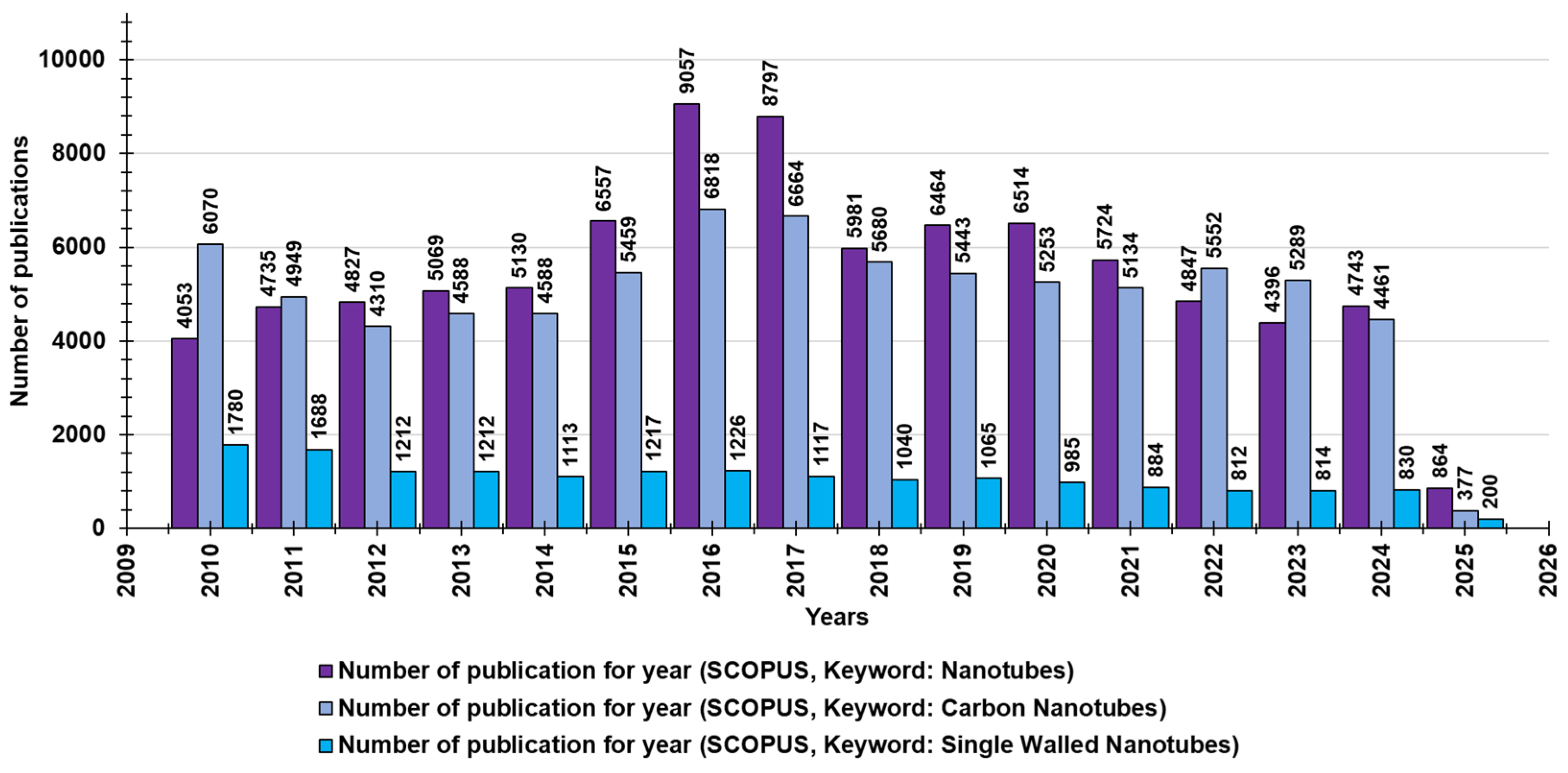
Figure 2.
Structure of CNTs (a); structures of a SWCNT (left), of two different shapes of a MWCNT (centre and right). Specifically, a MWCNT made of a single graphene sheet rolled up (centre) and a MWCNT made of more than two graphene cylinders one inside the other (right). These images, by an unknown author, are licensed under CC BY and have been reproduced from our previous work [29].
Figure 2.
Structure of CNTs (a); structures of a SWCNT (left), of two different shapes of a MWCNT (centre and right). Specifically, a MWCNT made of a single graphene sheet rolled up (centre) and a MWCNT made of more than two graphene cylinders one inside the other (right). These images, by an unknown author, are licensed under CC BY and have been reproduced from our previous work [29].
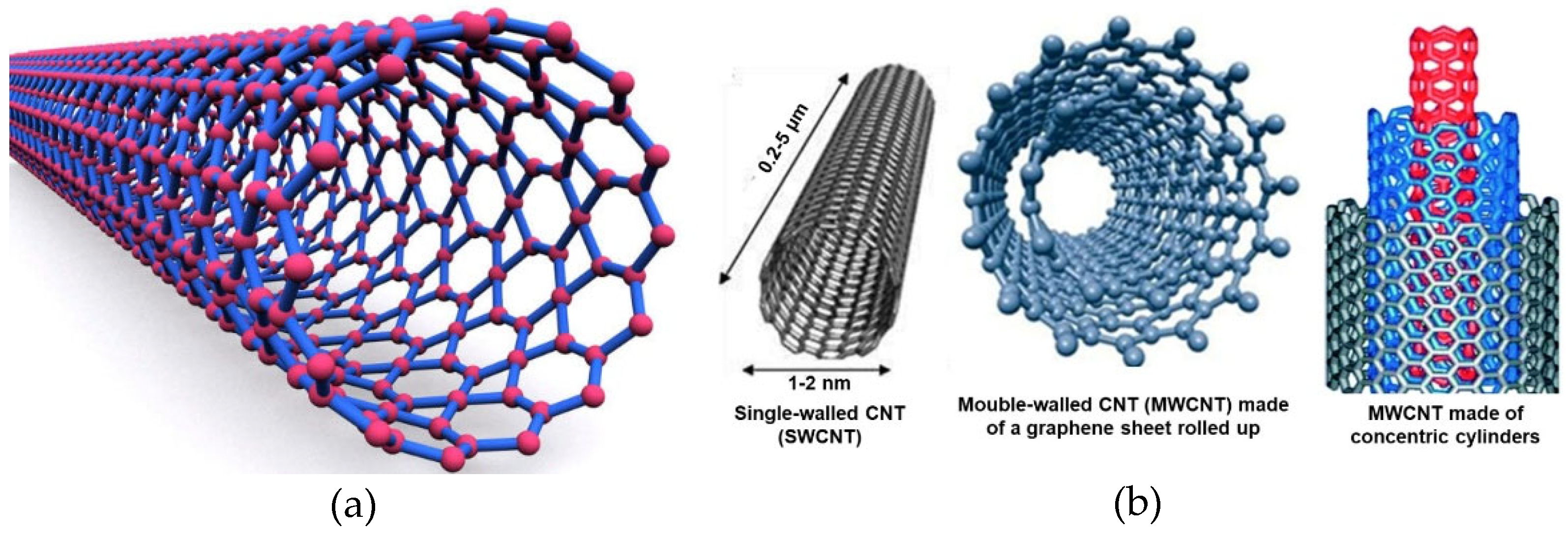
Figure 3.
Structure of a DWCNT. This image by unknown author is licensed under CC BY and was reproduced from our previous work [29].
Figure 3.
Structure of a DWCNT. This image by unknown author is licensed under CC BY and was reproduced from our previous work [29].
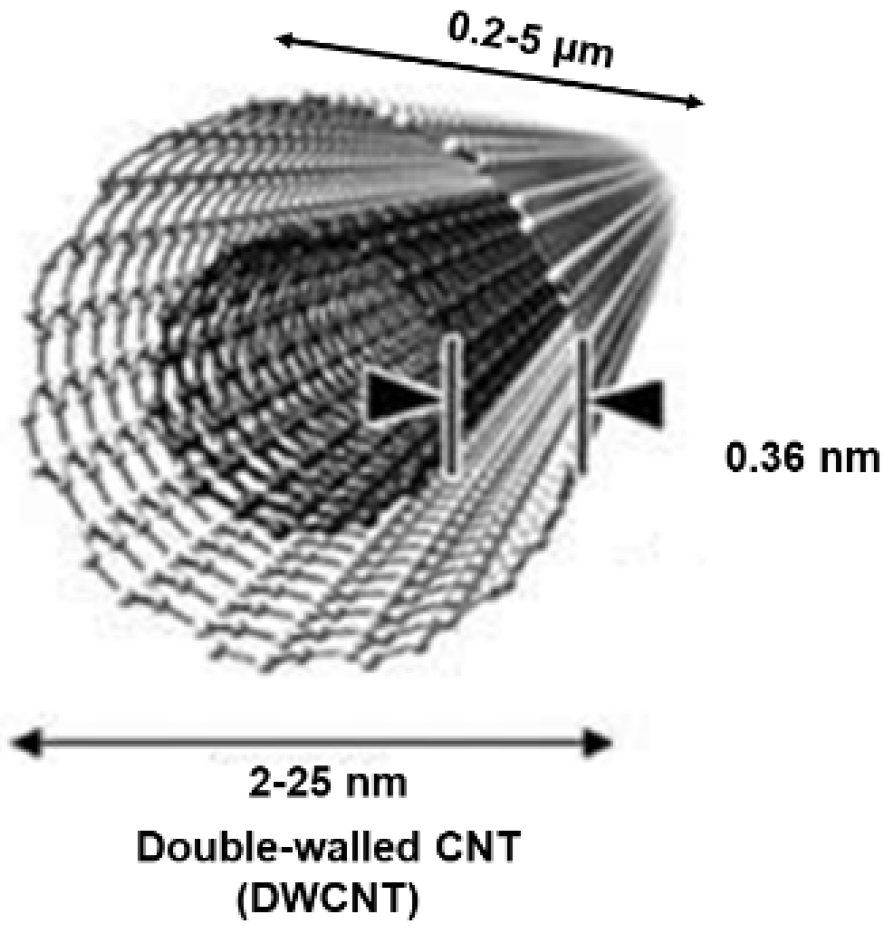
Figure 4.
Armchair, zigzag, and chiral structures of SWCNTs. This images by unknown author are licensed under CC BY and are reproduced by our previous work [29].
Figure 4.
Armchair, zigzag, and chiral structures of SWCNTs. This images by unknown author are licensed under CC BY and are reproduced by our previous work [29].
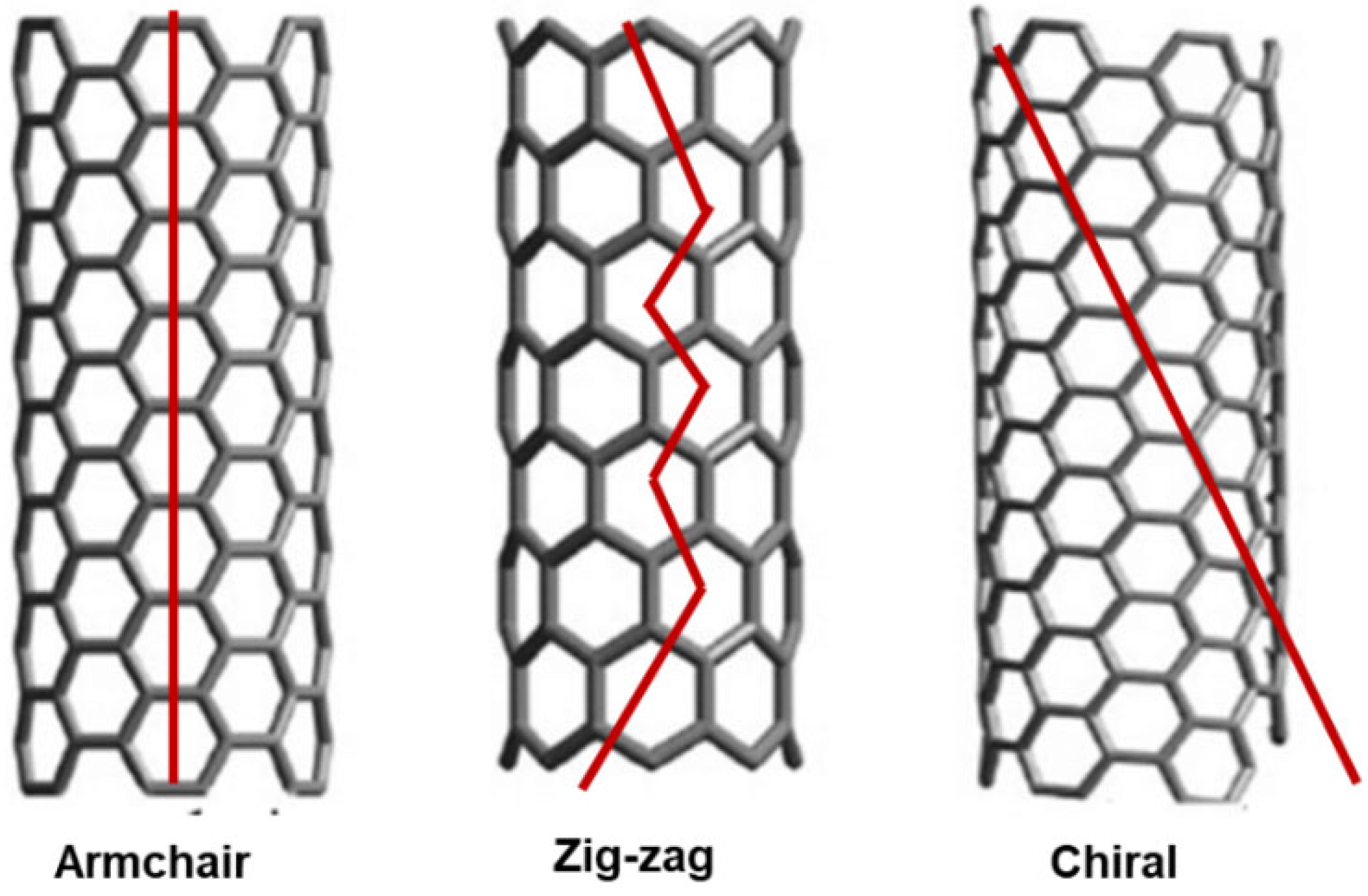
Table 1.
The antimicrobial performance of pristine carbon nanotubes in different studies.
| Types of CNTs | Synthesis method | Concentration | Species | Main findings | Refs. |
|---|---|---|---|---|---|
| SWCNTs | CO disproportionation | 5 µg/mL | E. coli | Releasing intracellular content due to irrecoverable outer membrane damage | [26] |
| SWCNTs | CO disproportionation | 5 µg/mL | E. coli | Microbial cells lost their cellular integrity | [27] |
| MWCNTs | CVD method | 5 µg/mL | E. coli | Many of the bacterial cells remain intact and preserve their outer membrane | [20] |
| SWCNTs/MWCNTs | CVD method | 20, 50, 100 µg/mL |
L. acidophilus, E. coli B. adolescentis, E. faecalis S. aureus |
Antimicrobial mechanism associated with length-dependent wrapping and diameter-dependent piercing upon microbial cell membrane damage and the release of intracellular contents | [28] |
| MWCNTs | Nanocycle productions | 1.5–100 mg/L | E. coli | Low microbial toxicity. | [91] |
| MWCNTs | - | - |
E. coli, B. subtilis P. aeruginosa |
2-log cell density reduction in viability of pathogens | [92] |
| DWCNTs/MWCNTs | NE scientific productions | 20/100 µg/mL |
S. aureus, P. aeruginosa K. pneumoniae, C. albicans |
MWNTs antimicrobial activity higher than DWNTs | [90] |
| MWCNTs | Nanotech Labs productions | 20 mg/20 mL | P. fluorescens | 44% of inactivated bacteria MWNTs showed a significant effect on the inhibition of microbial adhesion due to the electrochemical Potential |
[93] |
| SWCNTs | - | 5 µg/mL | E. coli, B. subtilis | No physical destruction was observed below 10 nN of applied force | [87] |
| SWCNT/DWCNT MWCNT | Electric arc discharge, and CCVD | 100 µg/mL |
S. aureus, P. aeruginosa, C. albicans |
Microbial death induced by the aggregation of CNTs trapped on the microbial cell surface | [86] |
| SWCNTs/MWCNTs | - | 0.2 mg/mL | E. coli | Control bacteria grow by laser-activated CNTs | [94] |
| SWCNT-OHs | - | 50 to 250 µg/mL | Salmonella | - 7log reduction in cell viability at 200-250 µ | [88] |
Table 2.
Overview on the antimicrobial activity of functionalized SWCNTs-based nanocomposites in different studies.
Table 2.
Overview on the antimicrobial activity of functionalized SWCNTs-based nanocomposites in different studies.
| Material blend | Concentration | Species | Main findings | Refs |
|---|---|---|---|---|
| SWCNTs-OH, -COOH, -NH2 | 50-200 µg/mL | S. aureus, B. Subtilis, S. typhimurium | SWCNTs-OH and -COOH showed higher microbial inhibition rate (7-log reduction) than SWCNTs-NH2 | [88] |
| Ag-SWCNTs containing TP226, TP359, TP557 peptides | 5 µg/mL | S. aureus | In skin models treated with silver-SWCNTs antimicrobial activity of only 1-log reduction was observed | [102] |
| SWCNTs functionalized with DNA and LSZ | ~25 mg/L | S. aureus, M. lysodeikticus | DNA- and LSZ-SWCNTs caused 84% microbial reduction | [115] |
| SWCNTs-PLGA complexes | < 2% by weight | E. coli, S. epidermidis | SWCNTs-PLGA caused the 98% reduction of metabolic activity | [85] |
| SWCNTs- PVK nanocomposite | 3 wt.% | E. coli, B. subtilis | SWCNTs-PVK induced 90% and 94% of B. subtilis and E. coli inhibition in the planktonic cells and showed a significant reduction of biofilm formation | [118] |
| SWCNTs-PGA/PLL (layer-by-layer) |
< 2% by weight | E. coli, S. epidermidis | SWCNTs/PGA/PLL showed a 90% reduction of pathogens | [85] |
| Oxidized SWCNTs-PVOH) nanocomposite |
0-10% (w/w) | P. aeruginosa | O-SWCNTs-PVOH gradually decreased viability of cells with increasing in nanotubes loading | [120] |
| SWCNTs/porphyrin composite | 0.04 mg/mL | S. aureus | SWCNTs/porphyrin caused a visible light induced damage to the cell membrane | [121] |
| SWCNTs-PEG)/poly-(ε caprolactone) composites | 0.5-1.0 wt.% | P. aeruginosa, S. aureus | SWCNT/copolymer complex caused lower bacteria inhibition than pure polymer complex | [123] |
| SWCNTs-polyamide membranes |
0.1-0.2 mg/mL | E. coli | Nanocomposite inactivated the microbial cells by 60% after 1 h of contact time | [121] |
LSZ = lysozyme; PLGA = poly-(lactic-co-glycolic acid); PVK = polyvinyl-N-carbazole; PGA = poly-(L-glutamic acid); PLL = poly-(L-lysin); PVOH = poly-(vinyl alcohol); PEG = poly-(ethylene glycol).
Table 3.
Overview on the antimicrobial activity of functionalized MWCNTs-based nanocomposites in different studies.
Table 3.
Overview on the antimicrobial activity of functionalized MWCNTs-based nanocomposites in different studies.
| Material blend | Concentration | Species | Main findings | Refs |
|---|---|---|---|---|
| MWCNTs-OH, -COOH, -NH2 | 50-200 µg/mL |
S. aureus, B. subtilis S. typhimurium |
MWCNTs-OH and -COOH did not significantly induce antimicrobial activity | [88] |
| 25 µg/mL | E. coli, B. subtilis, S. aureus | MWCNTs-COOH caused 30, 40, 50% inactivation for B. subtilis, E. coli, S. aureus, respectively |
[124] | |
| 20 μg/mL |
S. aureus, E. coli P. aeruginosa |
MWCNTs-COOH caused 27, 34, 23% inactivation for P. aeruginosa, E. coli, S. aureus, respectively |
[125] | |
| 20 mg/20 mL | MWCNTs-COOH inactivated the bacterial cells by 27, 20, 15% for P. aeruginosa, E. coli, S. aureus, respectively | [126] | ||
| 20, 50, 100 µg/mL |
E. coli, S. aureus, E. faecalis L. acidophilus, B. adolescentis |
MWCNTs-COOH and MWNTs-OH induced dose-dependent microbial inhibition |
[90] | |
| 1000 µg/mL | V. parahaemolyticus | Time-dependent antimicrobial activity CNTs did not pierce the cell membrane CNTs wrapped around the surface of pathogens |
[140] | |
| Surfactant-functionalized MWCNTs with SDBS, SC, SDS TX-100, DTAB, CTAB, PVP |
0–100 mg/mL | Group A Streptococcus | Carboxylated-MWCNTs with antibodies mitigate soft tissue infections | [141] |
| 20–100 µg/mL |
S. aureus, P. aeruginosa K. pneumoniae, C. albicans |
Non-covalently dispersed CNTs inhibited bacteria by a time and concentration-dependent mechanism | [90] | |
| 1.0, 0.5, 0.25 0.125 mg/mL | S. mutans | Functionalized-MWCNTs caused cell membrane rupture via direct contact | [142] | |
| 0.1, 0.5, 1 mg/mL | E. coli | Functionalized-MWCNTs penetrated the bacterial cell membrane due to electrostatic forces | [143] | |
| AgNPs-coated MWCNTs | 2-30 wt% | Cell membrane of bacteria damaged via direct contact | [144] | |
| MWCNTs-lysine | 0.01875-0.6 mg/mL |
S. aureus, E. coli, S. agalactiae S. typhimurium, S. dysgalactiae K. pneumoniae |
Electrostatic adsorption | [145] |
| MWCNTs-PPI | 25 µg/mL | E. coli, B. subtilis, S. aureus | MWCNTs-nanocomposite caused 97, 87% inactivation for S. aureus/B. subtilis, and E. coli, respectively | [124] |
| MWCNTs-aromatic dendrimer polyamide |
20 μg/mL | S. aureus, E. coli, P. aeruginosa | MWCNTs-nanocomposite caused 36, 65, 73% inactivation for S. aureus, P. aeruginosa, E. coli, respectively | [125] |
| PAMAM-grafted MWCNTs | 20 mg/20 mL | S. aureus, E. coli, P. aeruginosa | MWCNTs-nanocomposite caused 60, 34, 23% for P. aeruginosa, E. coli, S. aureus, respectively |
[126] |
| Oxidized MWCNTs/PAOH nanocomposite |
0-10% (w/w) | P. aeruginosa | MWCNTs-poly-(vinyl alcohol) reduced bacteria viability by increasing concentrations | [120] |
| MWCNTs-chitosan hydrogels | 25, 50, 100 mg/40 mL | S. aureus, E. coli, C. tropicalis | MWCNTs-chitosan hydrogels exhibited higher antimicrobial activity against S. aureus and C. tropicalis than E. coli. | [138] |
| 0.01%, 0.1% and 0.2% (w/w) |
E. coli, S. pneumoniae S. racemosum, C. albicans P. aeruginosa G. candidum, A. fumigatus |
MWCNTs nanocomposite showed higher microbial inhibition rate against Gram-positive bacteria | [139] |
PPI = poly-(propyleneimine); PAMAM = poly(amidoamine); PVOH = poly-(vinyl alcohol); SDBS = sodium dodecylbenzene sulfonate; SC = sodium cholate; SDS = sodium dodecyl sulphate; TX-100 = triton X-100 (TX-100); DTAB = dodecyltrimethylammonium bromide; CTAB = cetyltrimethylammonium bromide; PVP = polyvinylpyrrolidone.
Table 4.
In vitro cytotoxicity of CNTs as for early experiment of years 2003-2011.
| Nanomaterials | Cell lines | Observation | Refs |
|---|---|---|---|
| Metal oxide nanoparticles and SWCNTs | A549 | Penetrate the cell | [154] |
| CNTs | Rat macrophages (NR8383), A549 | Increase in intracellular reactive oxygen species | [155] |
| CNTs | MSTO-211H | Agglomerated CNTs shows greater cytotoxicity | [156] |
| MWCNTs | HEK | Decrease in cell viability and increase in IL-8 | [157] |
| Functionalized SWCNTs | Human fibroblasts 3T6 and murine 3T3 | Pass through the cellular membrane and concentrate in the cytoplasm | [181] |
| SWCNTs | HaCaT, HeLa, H1299, and A 549 | Increase in oxidative stress and inhibition of cell proliferation | [182] |
| SWCNTs | HaCaT | Cell death, oxidative stress, and increase in lipid peroxides | [160] |
| SWCNTs | HaCaT and BEAS-2B | Loss of cellular integrity and cellular apoptosis | [171] |
| SWCNTs | Lymphocytes and macrophages | Uptake of SWCNTs | [162] |
| MWCNTs | HEK | Cell-cycle inhibition | [175] |
| Functionalized SWCNTs | Human dermal fibroblasts | Less toxicity | [163] |
| SWCNTs-streptavidin complex | HL60 | Low toxicity | [164] |
| CNTs | Lymphocytes | Increase the secretion of cytokines | [166] |
| SWCNTs | HEK293T | Inhibition of cell proliferation and decrease in cell adhesive ability | [167] |
| SWCNTs and MWCNTs | Alveolar macrophages | SWCNTs showed higher toxicity than MWCNTs | [168] |
| Purified SWCNTs | Lung fibroblast V79 | DNA damage | [170] |
| SWCNTs | RAW 264.7 | Production of TGF-β1 | [161] |
| Iron-rich SWCNTs | Macrophages | Phagocytosis of the SWCNTs and conversion of extracellular O2– into hydroxyl radicals | [171] |
| Ground MWCNTs | Rat peritoneal macrophages | Cytotoxicity and overproduction of proinflammatory cytokines | [172] |
| MWCNTs | J774.1 | Cytotoxic effects by the rupturing of plasma membrane | [173] |
| CNTs | Human aortic endothelial cells | Increase in the MCP-1, VCAM-1, and IL-8 | [171] |
| MWCNTs | Alveolar macrophages | Cell death | [179] |
| Pristine MWCNTs and oxidized MWCNTs | T lymphocytes | Apoptosis | [180] |
CNT = carbon nanotube; HEK = human epidermal keratinocyte; MWCNT = multi-walled carbon nanotube; SWCNT = single-walled carbon nanotube.
Table 5.
In vivo case studies on pulmonary toxicity of CNTs.
| Nanomaterials | Animals | Observation | Reference |
|---|---|---|---|
| SWCNTs | Mice | Peri-bronchial inflammation and necrosis | [183] |
| Pristine SWCNTs | Rat | Inflammation and multifocal granulomas | [184] |
| SWCNTs/SiO2 | Mice | Granulomas and lung fibrosis | [161] |
| MWCNTs | Rat | Pulmonary fibrosis | [172] |
| SWCNTs | Mice | Inflammatory response, OS, collagen deposition | [185] |
| MWCNTs | Mice | Inflammation and granulomas | [190] |
| MWCNTs | Rat | Granuloma and collagen depositions | [193] |
| MWCNTs/SWCNTs | Guinea pigs | Pneumonitis | [194] |
| MWCNTs | Rat | Inflammation, granuloma, and lung fibrosis | [195] |
CNT = carbon nanotube; MWCNT = multi-walled carbon nanotube; SWCNT = single-walled carbon nanotube; OS = oxidative stress.
Table 6.
In vitro and in vivo studies to assess the possible cytotoxicity and genotoxicity by exposure to CNTs.
Table 6.
In vitro and in vivo studies to assess the possible cytotoxicity and genotoxicity by exposure to CNTs.
| Theme of the study | Tested cells | Toxic Effects | Findings | Refs. |
|---|---|---|---|---|
| Genotoxicity of MWCNTs in human cells |
HeLa, MCF7 Human respiratory epithelial cell |
Genotoxicity | DNA damage, chromosomal aberrations, OS by exposure to CNTs | [200,201] |
| Inhalation exposure to CNTs induces pulmonary toxicity |
Mice | Pulmonary toxicity | Inflammation, granuloma formation, lung fibrosis upon inhalation ⬆Levels of cytokines | [202,203] |
| Skin exposure to CNTs to assess dermal toxicity |
Murine epidermal cells (JB6 P+), and immune-competent hairless SKH-1 mice | Dermal toxicity | Direct skin exposure to CNTs led to irritation and inflammation Penetration into deeper skin layers is still debated |
[204] |
| Impact of CNTs on immune system | Lymphocytes, T cells, monocytes and dendritic cells | Immunotoxicity | CNTs affected immune responses Altered cytokine production and immune cell functions |
[205,206] |
| Cardiovascular effects of CNTs in animal models |
Mice | Cardiovascular toxicity |
Inflammation- and OS-induced increased blood pressure and cardiovascular diseases |
[207] |
| Liver toxicity/biodistribution of CNTs in mice | Mice | Hepatoxicity | Liver damage and alterations in liver enzyme levels | [208] |
| Renal toxicity of MWCNTs in rats | Human embryonic kidney (HEK293) cells | Renal toxicity | CNTs accumulation in the kidneys, renal inflammation, OS Kidney functional impairment |
[209] |
| OS induced by CNTs | Alveolar macrophage (AM) | OS | CNTs generate ROS, OS, cell and tissue damage. | [210] |
| In vitro neurotoxicity of CNTs | Mammalian cell lines | Neurotoxicity | Neuroinflammation and neurons damage | [211] |
OS = Oxidative stress; ROS = reactive oxygen species; ⬆ indicated increased.
Table 7.
A quick overview of CNTs' toxicity on various organs by in vivo and in vitro studies.
| CNTs | Tested cells | Affected organ | Results | Refs. |
|---|---|---|---|---|
| MWCNTs | Male Sprague Dawley rats | Nervous system | Dramatic alterations of sympathetic and parasympathetic nervous system's equilibrium |
[212] |
| MWCNTs | Mice | Nervous System and BBB | Acute lung exposure to MWCNTs damaged BBB integrity, induced nerve inflammatory responses | [213] |
| CNTs | Male NMRI mice | Nervous system | Behavioural toxicity with manifestation of sadness or anxiety | [214] |
| SWCNTs | PC-12 cells | Nervous system | Toxicity to PC-12 cells ⬆Harmful to differentiated PC-12 cells |
[215] |
| SWCNTs | Male C57BL/6 mice | Pulmonary immune system | CNTs make people more vulnerable to respiratory virus infections | [216] |
| SWCNTs | Six-week-old specific-pathogen-free ICR mice | Immune system Reproductive system |
CNTs affected development and reproduction and produced immunological toxicity |
[217] |
| SWCNTs | BALB/c macrophage cells J774A and BALB/c mice | Immune system | Immune toxicity* | [218] |
| MWCNTs | T lymphocytes | Immune system | Concentration-dependent harmful of CNTs to human T cells | [180] |
| SWCNTs | 6/8 weeks old females of the CD1 outbred strain Mouse ES cell line D3 NIH3T3 cells |
Embryos | SWCNTs can cause harm to mammalian embryos | [197] |
| CNTs | Kunming mice | Embryos | CNTs harmed foetuses, cause miscarriage, and were harmful to embryos | [219] |
| MWCNTs | Zebrafish embryo | Embryos | Significant length-dependent development risk | [220] |
| CNTs | Mouse embryonic fibroblasts (MEFs) and C57BL/6J mice | Embryos | Induction of hereditary embryotoxicity | [221] |
| O-SWCNTs | Artemia salina | Embryos | Large amount generation of ROS and deformed Artemia salina | [222] |
| CNTs | Male BALB/c mice | Genitals | CNTs poison mice's reproductive organs. | [223] |
| SWCNTs/MWCNTs | MeT-5A and BEAS 2B cells | Genome | DNA damage in MeT-5A cells by both MWCNTs and SWCNTs | [224] |
ROS = reactive oxygen species; ⬆ indicated increased, high, higher; * there was a negative correlation between immune toxicity and SWCNT dispersion; O-SWCNTs = Oxidized SWCNTs.
Table 8.
Strategies to reduce CNTs toxicity.
| Strategy | Goal | Modifying Agents/Methods | Results | Refs |
|---|---|---|---|---|
| Modify CNTs surface with biocompatible materials or other molecules |
⬆Dispersion in biological fluids Influenced cellular uptake ⬆Solubility ⬇Toxicity |
Proteins, surfactants | ⬆Tumour targeting ⬆Therapeutic benefits ⬇Toxicity |
[232,233,234] |
| Folic acid | ⬆In vivo tumour targeting ⬆Therapeutic benefits ⬇Toxicity |
[235] | ||
| Polyacrylamide hydrogels * Biomaterial, TiO2 |
100 % survival of L929 mouse fibroblast | [236] | ||
| Application of coatings to CNTs | ⬆CNTs biocompatibility ⬇Potential toxicity Prevent direct contact with biological systems ⬆CNTs solubility |
Curcumin lysine ** | ⬇IL-6, IL-8, IL-1β, TNFα, N-FκB ⬆Antioxidant enzyme catalase ⬇ROS generation Recovery of mitochondrial membrane potential ⬇Cell death |
[237] |
| Encapsulation of CNTs Using CNTs to entrap bioactive molecules |
⬇Direct cells exposure to CNTs Control of CNTs release ⬇CNTs impact on tissues |
PEG (entrapping agent) Oxaliplatin (entrapped agent) |
PEGylation delayed oxaliplatin release rate ⬆Drug's anticancer effects on HT-29 cells |
[238] |
| Tailor the diameter size and length of CNTs | ⬇Toxicological impact | N.A. | ⬆Specific surface area ⬆Transmembrane mobility ⬇Toxicity |
[239] |
| ⬇Harm to lysosomes for large-diameters MWCNTs | [240] | |||
| Optimization of purification processes |
Remove metal impurities Remove residual catalysts |
Chemical/electrochemical oxidation [241] High chlorine partial pressure [242] Microwave-assisted digestion [243] Incandescent annealing[244] |
⬇Lower harmful effects | [244] |
| Engineering controls Suitable PPE | ⬇Inhalation exposure | Proper ventilation/respiratory protection | ⬇Risk of respiratory toxicity | N.R. |
| Co-administration of CNTs with antioxidants | ⬇Potential OS ⬇Cellular damage |
Quercetin | Prevention of the oxidative damage ⬇Inflammatory effects ⬇Immuno-toxic effects |
[245] |
* Encapsulation agent for CNTs-COOH; ** used to coat MWCNTs; N.A. = not applicable; N.R. = not reported; ⬇indicates minor reduction, lower, decreased, decrease; ⬆indicates improved, increase, increased, major; PPE = personal protective equipment; OS = oxidative stress.
Disclaimer/Publisher’s Note: The statements, opinions and data contained in all publications are solely those of the individual author(s) and contributor(s) and not of MDPI and/or the editor(s). MDPI and/or the editor(s) disclaim responsibility for any injury to people or property resulting from any ideas, methods, instructions or products referred to in the content. |
© 2025 by the authors. Licensee MDPI, Basel, Switzerland. This article is an open access article distributed under the terms and conditions of the Creative Commons Attribution (CC BY) license (http://creativecommons.org/licenses/by/4.0/).
Copyright: This open access article is published under a Creative Commons CC BY 4.0 license, which permit the free download, distribution, and reuse, provided that the author and preprint are cited in any reuse.