

Submitted:
13 March 2025
Posted:
13 March 2025
You are already at the latest version
Abstract
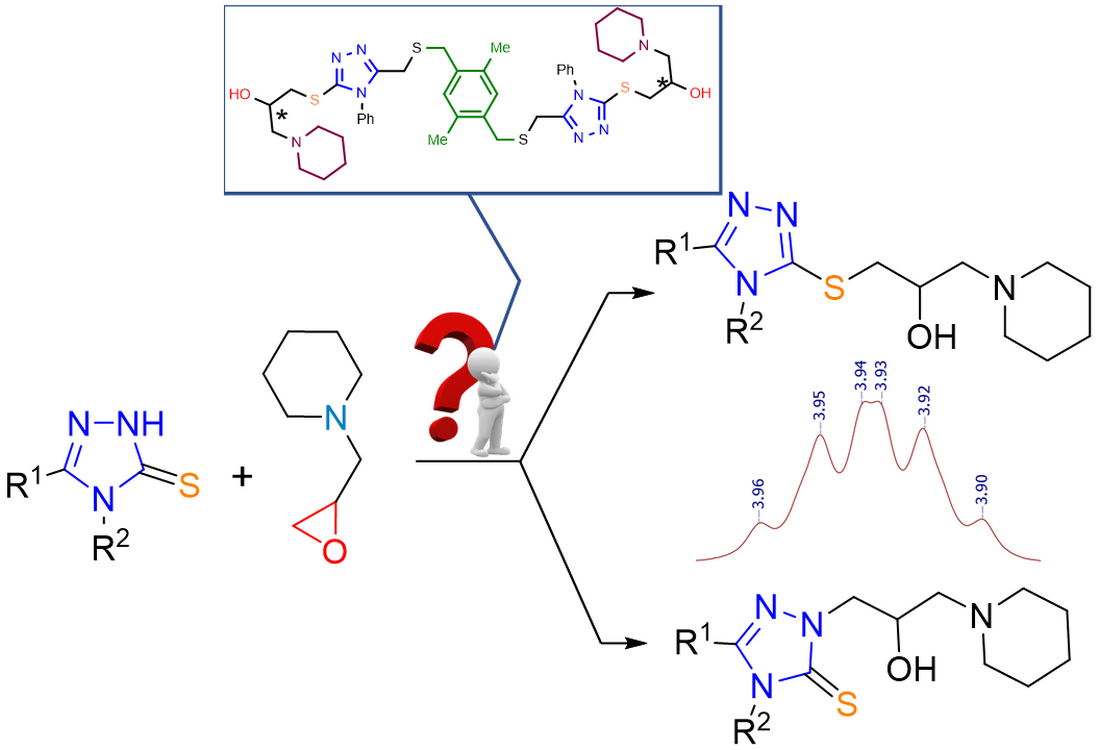
As examples of “Click Chemistry”, the reaction of 1-(oxiran-2-ylmethyl)piperidine with several 1,2,4-triazoles derivatives was studied. According to as a result, the reaction shows that the oxirane ring opens regiospecifically, according to Krasusky’s rule, without using a catalyst. The basic nitrogen present in 1-(oxiran-2-ylmethyl)piperidine has a catalytic (anchimer) effect.
Keywords:
Click chemistry
; thiol-epoxy reaction
; bis-1
; 2
; 4-triazole
; vicinal amino alcohols
; Krasusky rule
1. Introduction
The thiol-epoxy reaction is a “click” reaction that has drawn intensive attention in recent years due to its outstanding advantages, such as fast reaction rate, high selectivity, mild reaction conditions, and wide range of applications [1,2]. The thiol-epoxy reaction is used in the synthesis of polymers, materials with programmed properties, biologically active compounds, etc. [1,2,3,4,5,6,7,8,9,10,11,12,13,14,15,16,17,18,19,20,21,22].
Scheme 1.
“Click chemistry”: thiol-epoxy reaction.
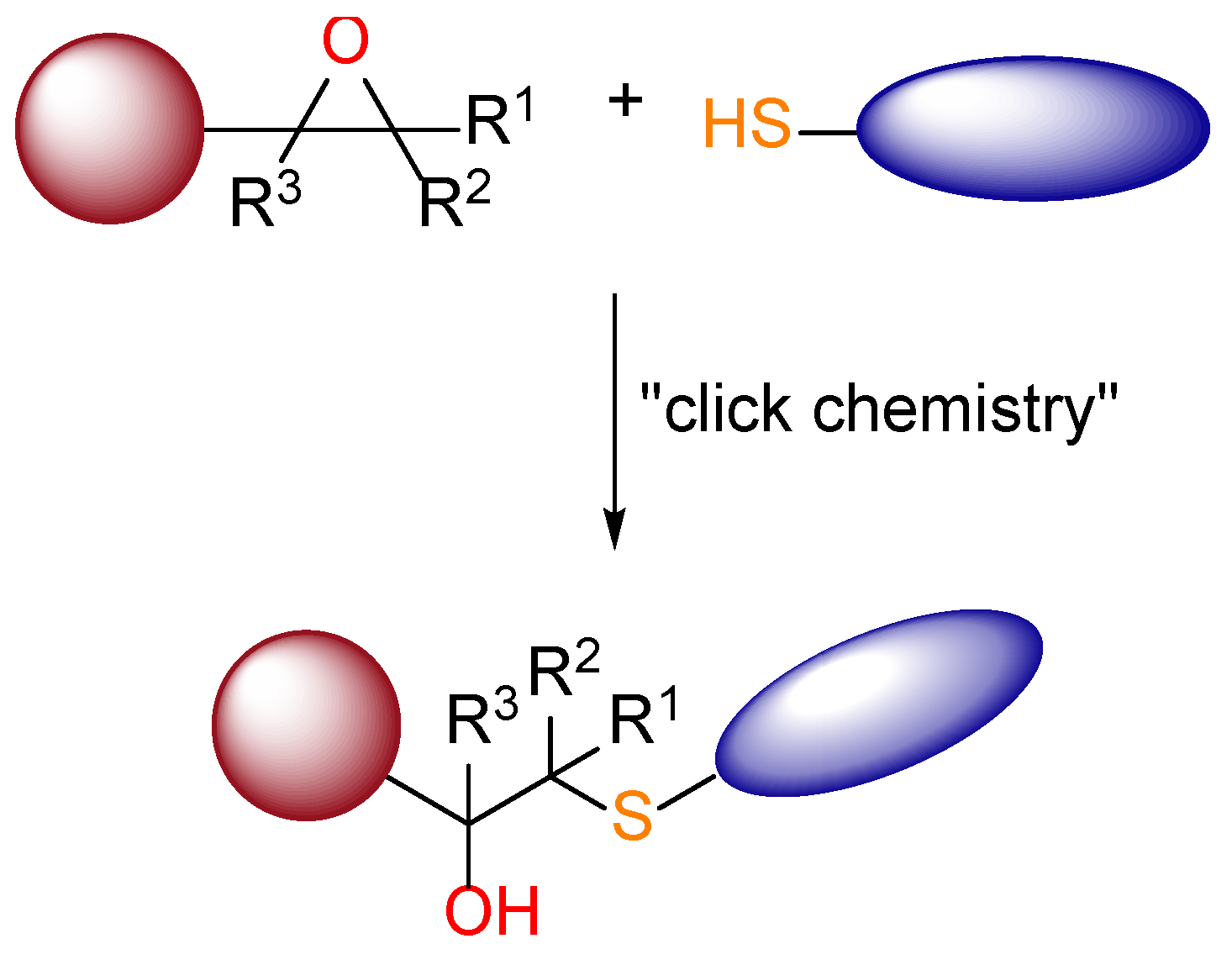
The reaction becomes particularly significant when oxiranes containing an amino group in the vicinal position react with thiols leading to a formation of vicinal amino alcohols with thioether bridge.
A number of vicinal amino alcohols are currently employed in medical applications, with some of these compounds functioning as β-adrenergic blocking agents, demonstrating targeted effects in inhibiting the stimulation of β-adrenergic receptor systems [23,24,25,26]. Figure 1 shows derivatives of vicinal amino alcohols that are used in medicine.
Salbutamol and propranolol are on the World Health Organization List of Essential Medicines [27] and represent the most important examples of therapeutic agents bearing this structural feature.
In addition to their high relevance in drug discovery [28,29,30], N-substituted vicinal amino alcohols are important building blocks in the preparation of added value chemicals [31,32] and ligands for catalysis [33,34].
Previously we have studied the reaction of epoxides of various structures with S-, N-, and O-nucleophiles, resulting in the synthesis of vicinal amino alcohols, lactones, and other compounds (Figure 2) [35,36,37,38,39,40,41].
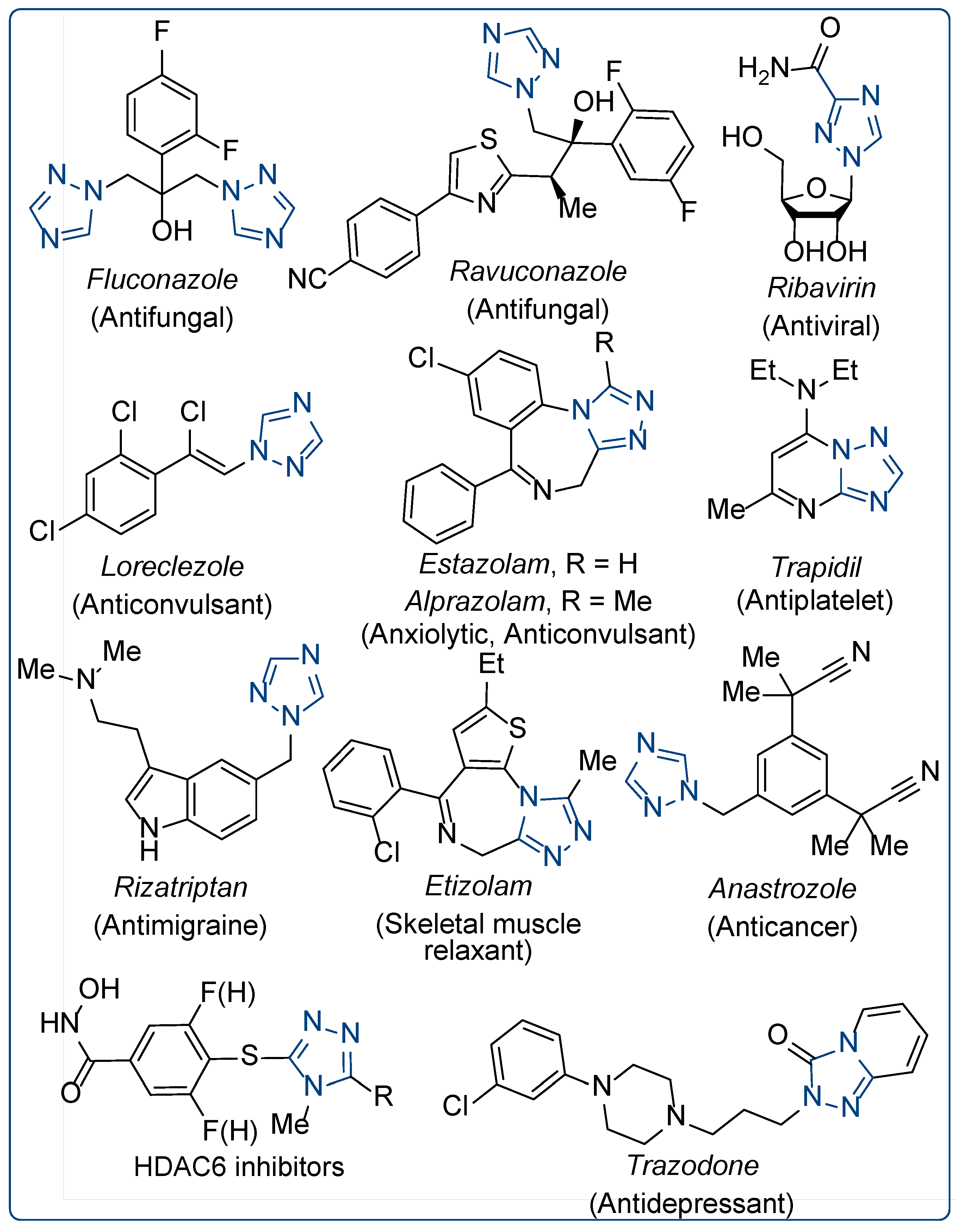
Similarly, derivatives of 5,4-disubstituted-2,4-dihydro-3H-1,2,4-triazole-3-thiones hold potential interest for developing novel bioactive compounds. This is because certain derivatives of 1,2,4-triazoles are recognized as bioactive compounds and are extensively used in medicine (Figure 3) [42,43,44,45,46,47,48,49,50,51].
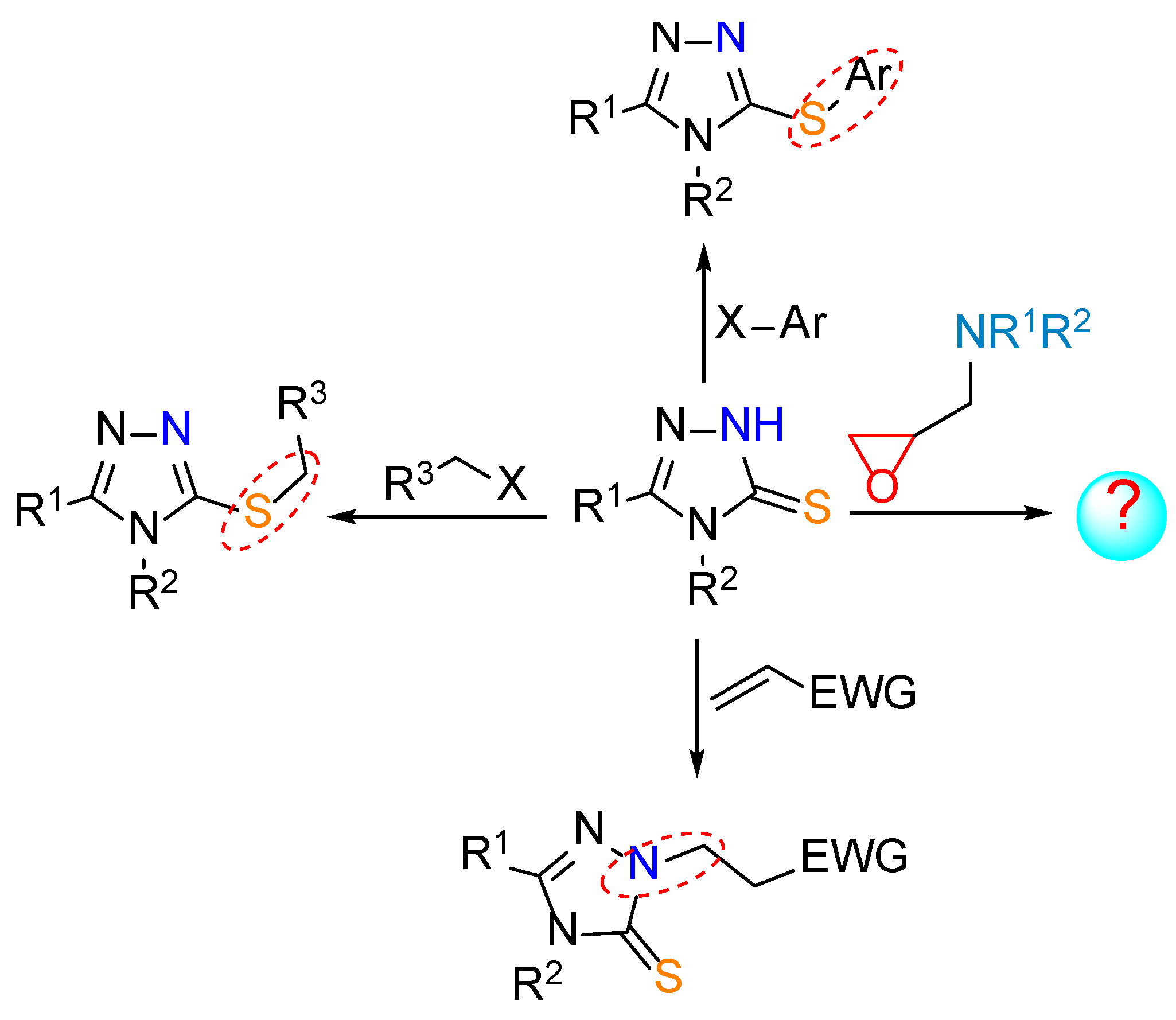
Our previous studies have shown that the alkylation of 5,4-disubstituted-2,4-dihydro-3H-1,2,4-triazole-3-thiones depends on the nature of the alkylating electrophile. In particular, alkylation with alkyl halides leads to S-alkylation, and in the case of activated conjugated systems, N-alkylation. The arylation reaction with arylhalides proceeds in systems utilizing Ullmann-type under Cu(0) catalysis conditions leads to S-arylation (Scheme 2) [52,53,54,55,56,57,58].
Given this prospect, it becomes intriguing to investigate the direction in which the alkylation reaction proceeds in epoxaid-2,4-dihydro-3H-1,2,4-triazole-3-thiones systems. With this objective in mind, this study aims to explore the alkylation potential of 5,4-disubstituted-2,4-dihydro-3H-1,2,4-triazole-3-thiones under “Click Chemistry” conditions.
2. Materials and Methods
1H and 13C NMR spectra were recorded on Varian Mercury 300 MHz or on Bruker Avance Neo 400 MHz spectrometer in DMSO/CCl4 mixture (1:3) or DMSO-d6. Chemical shifts (δ) in ppm are reported as quoted relative to the residual signals of solvents, for instance, DMSO-d6 (2.5 for 1H NMR and 39.5 for 13C NMR) as internal references. The coupling constants (J) are given in Hertz. ESI-MS spectra were measured with a Waters Xevo G3 QTof Mass Spectrometer. Spectroscopic measurements were performed on a Nicolet IS 50 FTIR spectrometer (Thermo Scientific Fisher, USA) coupled with an ATR accessory. TLC analysis was performed on “Silufol UV-254” plates. All reagents were of reagent grade and were used as such or distilled prior to use. Starting 1,2,4-triazoles were prepared as previously reported (1a, 1k, 1m-o, 1r [56]; 1f [58]; 1g – CAS 21358-12-3; 1j – CAS: 93378-58-6; 1v [52]; 1h, 1i [57]; 1e [59]; 1q [60]; 1u [61]). Melting points were determined on “SMP-10”.
4-propyl-5-(thiophen-2-yl)-2,4-dihydro-3H-1,2,4-triazole-3-thione (1b). Yield 84%, white solid, m.p. 135 °C. 1H NMR (400 MHz, DMSO/CCl4 -1/3) δ 13.77 (s, 1H, NH), 7.63 (dd, J = 5.1, 1.1 Hz, 1Hthph), 7.52 (dd, J = 3.7, 1.1 Hz, 1Hthph), 7.18 (dd, J = 5.1, 3.7 Hz, 1Hthph), 4.19 – 4.03 (m, 2H, NCH2), 1.84 – 1.67 (m, 2H, CH2CH3), 0.97 (t, J = 7.4 Hz, 3H, CH2CH3). 13C NMR (101 MHz, DMSO/CCl4 -1/3) δ 167.4 (C=S), 145.2 (C=N), 128.4 (CH=), 127.8 (CH=), 127.5 (CH=), 126.8, 45.1 (NCH2), 21.1 (CH2), 10.6 (CH3). IRνmax = 3094.23; 3083.14; 3062.41; 3006.96; 2959.23; 2927.41; 2911.50; 2869.56; 2819.42; 2793.38; 2757.71; 2723.00; 2683.46; 2583.66; 2573.54; 1792.03; 1719.23; 1648.36; 1623.29; 1571.22; 1544.22; 1515.29; 1480.10; 1458.89; 1443.46; 1432.85; 1400.55; 1372.59; 1352.82; 1323.89; 1299.79; 1282.91; 1253.02; 1230.36; 1217.83; 1204.81; 1145.03; 1102.60; 1085.73; 1070.78; 1060.17; 1035.10; 1014.37; 950.73; 942.06; 895.29; 867.81; 853.83; 846.11; 824.42; 779.58; 758.85; 750.17; 742.46; 727.51; 705.34; 694.73; 668.70; 660.50; 654.71; 577.09; 567.93; 493.21; 434.39; 423.30 cm-1. HRMS (ESI) m/z: [M + H]+ Calcd for C9H12N3S+ 226.0473; Found 226.0473.
5-(4-bromophenyl)-4-cyclohexyl-2,4-dihydro-3H-1,2,4-triazole-3-thione (1c). Yield 89%, white solid, m.p. 198 °C. 1H NMR (400 MHz, DMSO/CCl4 -1/3) δ 13.72 (s, 1H, NH), 7.74 – 7.58 (m, 2Harom), 7.46 – 7.35 (m, 2Harom), 4.39 – 4.17 (m, 1H, NCH), 2.38 – 1.91 (m, 2H, Cy), 1.86 – 1.67 (m, 4H, Cy), 1.67 – 1.53 (m, 1H, Cy), 1.37 – 1.19 (m, 2H, Cy), 1.16 – 0.99 (m, 1H, Cy). 13C NMR (101 MHz, DMSO/CCl4 -1/3) δ 166.5 (C=S), 149.8 (C=N), 131.4 (2*CH=), 131.1 (2*CH=), 126.1, 124.3, 56.8 (NCH), 29.5 (2*CH2), 25.4 (2*CH2), 24.4 (CH2). IRνmax = 3090.85; 3068.67; 3058.55; 3025.28; 2979.96; 2931.27; 2894.15; 2863.29; 2853.65; 2824.24; 2778.92; 2746.62; 2688.77; 1600.15; 1574.59; 1544.22; 1500.35; 1473.83; 1450.21; 1442.01; 1408.75; 1382.71; 1340.28; 1307.02; 1289.18; 1281.47; 1255.91; 1241.93; 1188.42; 1150.81; 1140.69; 1116.10; 1096.82; 1084.76; 1066.44; 1057.28; 1009.55; 995.57; 970.50; 942.06; 925.18; 895.77; 854.79; 832.13; 818.63; 793.08; 782.48; 759.33; 728.00; 718.84; 706.30; 670.14; 666.29; 629.16; 604.09; 539.01; 508.63; 484.05; 461.39; 451.74; 432.46; 420.41; 413.66 cm-1. HRMS (ESI) m/z: [M + H]+ Calcd for C14H1779BrN3S+ 338.0327; Found 338.0327.
5-(4-bromophenyl)-4-phenethyl-2,4-dihydro-3H-1,2,4-triazole-3-thione (1d). Yield 81%, white solid, m.p. 178 °C. 1H NMR (400 MHz, DMSO/CCl4 -1/3) δ 13.83 (s, 1H, NH), 7.61 – 7.54 (m, 2Harom), 7.31 – 7.25 (m, 2Harom), 7.20 – 7.11 (m, 3Harom), 7.04 – 6.98 (m, 2Harom), 4.27 – 4.17 (m, 2H, NCH2), 3.06 – 2.98 (m, 2H, CH2Ph). 13C NMR (101 MHz, DMSO/CCl4 -1/3) δ 167.1 (C=S), 149.9 (C=N), 136.9, 131.4 (2*CH=), 129.9 (2*CH), 128.4 (2*CH=), 128.0 (2*CH=), 126.1, 125.0, 124.0, 45.0 (NCH2), 33.1 (CH2). IRνmax = 3119.78; 3084.10; 3041.67; 3029.62; 2983.82; 2953.45; 2936.57; 2908.13; 2867.63; 2840.63; 2770.24; 1604.48; 1558.20; 1503.24; 1473.35; 1442.98; 1404.41; 1392.84; 1372.10; 1352.34; 1332.57; 1321.96; 1274.72; 1199.99; 1188.90; 1177.33; 1139.24; 1104.05; 1077.53; 1061.14; 1031.25; 1023.05; 1010.03; 967.61; 944.47; 925.18; 900.11; 836.47; 828.76; 776.69; 761.74; 754.03; 748.25; 731.37; 719.32; 698.59; 674.96; 658.57; 622.89; 600.72; 555.40; 538.04; 492.72; 454.64; 444.99; 417.03; 403.53 cm-1. HRMS (ESI) m/z: [M + H]+ Calcd for C16H1579BrN3S+ 360.0170; Found 360.0170.
4-allyl-5-(2-iodophenyl)-2,4-dihydro-3H-1,2,4-triazole-3-thione (1l). Yield 88%, white solid, m.p. 145 °C. 1H NMR (400 MHz, DMSO/CCl4 -1/3) δ 13.84 (s, 1H, NH), 7.96 (dd, J = 8.0, 1.1 Hz, 1Harom), 7.50 (td, J = 7.5, 1.1 Hz, 1Harom), 7.41 (dd, J = 7.7, 1.8 Hz, 1Harom), 7.28 (td, J = 7.7, 1.7 Hz, 1Harom), 5.69 (ddt, J = 16.1, 10.3, 5.7 Hz, 1H, CH=), 5.01 (dd, J = 10.3, 1.4 Hz, 1Ha, =CH2), 4.80 (dt, J = 17.1, 1.6 Hz, 1Hb, =CH2), 4.42 (dt, J = 6.0, 1.6 Hz, 2H, NCH2). 13C NMR (101 MHz, DMSO/CCl4 -1/3) δ 166.7 (C=S), 151.3 (C=N), 138.8 (CH=), 131.8 (CH=), 131.5 (CH=), 130.5 (CH=), 130.4, 127.8 (CH=), 117.9 (=CH2), 98.9 (=CI), 45.7 (NCH2). IRνmax = 3083.14; 3057.58; 3037.34; 2967.43; 2922.59; 2909.57; 2849.79; 2835.81; 2754.33; 2649.71; 1643.54; 1624.25; 1596.29; 1561.09; 1527.83; 1497.94; 1458.89; 1441.53; 1425.14; 1394.76; 1353.78; 1330.64; 1292.55; 1262.18; 1249.65; 1197.10; 1158.53; 1147.44; 1099.23; 1076.57; 1018.23; 993.16; 981.59; 948.81; 914.09; 870.70; 779.10; 754.03; 728.00; 719.80; 708.71; 664.84; 641.22; 617.59; 602.16; 576.13; 525.99; 484.53; 465.24; 444.03; 420.89; 404.50 cm-1. HRMS (ESI) m/z: [M + H]+ Calcd for C11H11IN3S+ 343.9718; Found 343.9726.
4-phenyl-5-(m-tolyl)-2,4-dihydro-3H-1,2,4-triazole-3-thione (1t). Yield 90%, white solid, m.p. 245 °C. 1H NMR (400 MHz, DMSO/CCl4 -1/3) δ 13.94 (s, 1H, NH), 7.52 – 7.43 (m, 3Harom), 7.30 – 7.23 (m, 2Harom), 7.18 – 7.07 (m, 3Harom), 6.99 – 6.92 (m, 1Harom), 2.25 (s, 3H, CH3). 13C NMR (101 MHz, DMSO/CCl4 -1/3) δ 168.5 (C=S), 149.7 (C=N), 137.4, 134.5, 130.3, 128.7 (CH=), 128.7 (2CH=), 128.3 (CH=), 128.2 (2*CH=), 127.7 (CH=), 125.6, 124.7 (CH=), 20.7 (CH3). IRνmax =3107.24; 3084.58; 3057.58; 3031.07; 2995.39; 2927.90; 2823.28; 2770.24; 2752.40; 1591.47; 1550.97; 1496.49; 1488.29; 1459.37; 1437.67; 1402.48; 1382.71; 1334.50; 1313.29; 1285.32; 1273.75; 1243.38; 1208.18; 1174.92; 1129.60; 1098.26; 1083.32; 1073.67; 1037.03; 1003.28; 977.25; 918.91; 885.17; 851.42; 796.94; 772.83; 737.16; 717.39; 700.52; 691.84; 668.70; 660.02; 620.97; 613.73; 545.27; 524.54; 513.94; 481.15; 442.10; 427.16 cm-1. HRMS (ESI) m/z: [M + H]+ Calcd for C15H14N3S+ 268.0909; Found 268.0931.
Dimethyl 2,2′-(((2,5-dimethyl-1,4-phenylene)bis(methylene))bis(sulfanediyl)) diacetate (ac).
Method A: 0.48 g (21 mmol) of sodium was dissolved in 25 ml of methanol, then 4.16 g (21 mmol) of (2,5-dimethyl-1,4-phenylene)dimethanethiol was added and the mixture was stirred at r.t. for 30min. Then 1.09 g (10 mmol, 0.95 ml) of ethyl chloroformate and 25 ml of methanol were added to the mixture and refluxed for 4h. Resulting mixture was left overnight, and the precipitate was filtered and washed with water and dried. Yield 84%.
Method B: 0.48 g (21 mmol) sodium was dissolved in 25 ml of methanol, then 2.22 g (21 mmol, 1.88 ml) methyl 2-mercaptoacetate was added and the mixture was stirred at r.t. for 30min. Then 2.03 g (10 mmol) of 1,4-bis(chloromethyl)-2,5-dimethylbenzene and 25 ml of methanol were added to the mixture and refluxed for w4h. Resulting mixture was left overnight, and the precipitate was filtered and washed with water and dried. Yield 89%. White solid, m.p. 100 °C. 1H NMR (400 MHz, DMSO/CCl4 -1/3) δ 6.99 (s, 2Harom), 3.75 (s, 4H, CH2CO), 3.69 (s, 6H, OCH3), 3.11 (s, 4H, SCH2Ar), 2.32 (s, 6H, ArCH3). 13C NMR (101 MHz, DMSO/CCl4 -1/3) δ 169.5 (2*C=O), 133.4 (2*C), 133.3 (2*C), 131.8 (2*CH=), 51.4 (2*OCH3), 33.4 (2*SCH2), 31.8 (2*SCH2), 17.9 (2*CH3). IRνmax = 3427.85; 3032.51; 3004.07; 2972.73; 2950.07; 2918.25; 2894.15; 2862.33; 2727.33; 1723.09; 1680.18; 1505.65; 1436.23; 1427.55; 1408.75; 1392.84; 1371.62; 1290.63; 1214.93; 1144.06; 1113.21; 1038.00; 1004.73; 936.75; 907.83; 866.85; 828.28; 795.49; 718.84; 700.03; 595.41; 579.99; 466.21; 424.26 cm-1. HRMS (ESI) m/z: [M + H]+ Calcd for C16H23O4S2+ 343.1038; Found 343.1048.
2,2′-(((2,5-dimethyl-1,4-phenylene)bis(methylene))bis(sulfanediyl))di(acetohydrazide) (ad). The mixture of 3.42 g dimethyl 2,2′-(((2,5-dimethyl-1,4-phenylene)bis(methylene))bis(sulfanediyl)) diacetate and 8 ml hydrazine hydrate in 10 ml of ethanol was stirred for 1h at r.t., then refluxed for 3h. Resulting mixture was left overnight, and the precipitate was filtered and washed with ethanol and water and dried. Yield 95%, white solid, m.p. 179 °C. 1H NMR (400 MHz, DMSO/CCl4 -1/3) δ 9.07 (br.s., 2H, NH), 7.03 (s, 2Harom), 4.11 (br.s., 4H, NH2), 3.77 (s, 4H, CH2CO), 2.96 (s, 4H, SCH2Ar), 2.30 (s, 6H, ArCH3). 13C NMR (101 MHz, DMSO/CCl4 -1/3) δ 168.3 (2*C=O), 134.0 (2*C), 133.3 (2*C), 131.7 (2*CH), 33.6 (2*SCH2), 32.1 (2*SCH2), 18.0 (2*CH3). IRνmax = 3329.98; 3307.32; 3255.25; 3206.56; 3140.99; 3015.64; 2991.05; 2963.57; 2953.45; 2933.68; 2914.40; 2847.38; 1654.14; 1622.81; 1501.31; 1458.40; 1433.82; 1396.21; 1376.93; 1325.34; 1296.41; 1240.00; 1217.83; 1178.78; 1127.19; 1117.06; 1034.14; 986.89; 920.36; 889.02; 853.83; 801.76; 780.06; 706.30; 696.18; 659.05; 582.88; 536.60; 463.31 cm-1. HRMS (ESI) m/z: [M + H]+ Calcd for C14H23N4O4S2+ 343.1263; Found 343.1263.
2,2′-(2,2′-(((2,5-dimethyl-1,4-phenylene)bis(methylene))bis(sulfanediyl))bis(acetyl))bis(N-phenylhydrazine-1-carbothioamide) (ae). The mixture of 1.026 g (3 mmol) 2,2′-(((2,5-dimethyl-1,4-phenylene)bis(methylene))bis(sulfanediyl))di(acetohydrazide) and 0.81 g (6 mmol) phenyl isothiocyanate in 5 ml ethanol was stirred at r.t for 1h, then was refluxed for 2h. The resulting mixture was left overnight, and the precipitate was filtered and washed with ethanol and dried. Yield 91%, white solid, m.p 210 °C. 1H NMR (400 MHz, DMSO/CCl4 -1/3) δ 10.03 (br.s., 2H, NH), 9.68 – 9.32 (m, 4H, NH), 7.55 (d, J = 8.0 Hz, 4Harom), 7.29 (t, J = 7.8 Hz, 4Harom), 7.15 – 7.02 (m, 4Harom), 3.83 (s, 4H, CH2CO), 3.14 (s, 4H, SCH2Ar), 2.33 (s, 6H, CH3). 13C NMR (101 MHz, DMSO/CCl4 -1/3) 180.3(2*C), 138.9 (2*C), 133.8 (2*C), 133.3 (2*CH), 131.8 (2*CH=), 127.6 (4*CH=), 124.1 (br, 6*CH), 33.5 (2*SCH2), 32.3 (2*SCH2), 18.1 (2*CH3). IRνmax = 3303.46; 3222.47; 3165.58; 3066.74; 3004.55; 2970.32; 2923.07; 2861.36; 1680.18; 1654.14; 1623.77; 1604.97; 1560.13; 1535.54; 1499.38; 1476.72; 1445.87; 1419.83; 1363.43; 1327.75; 1314.25; 1294.00; 1254.95; 1238.56; 1222.17; 1204.81; 1194.20; 1164.31; 1156.12; 1141.65; 1081.87; 1032.21; 996.54; 970.02; 928.56; 906.86; 897.22; 876.01; 837.92; 797.42; 752.58; 747.28; 731.37; 710.64; 690.87; 574.20; 502.85; 464.76 cm-1. HRMS (ESI) m/z: [M + H]+ Calcd for C28H33N6O2S4+ 613.1548; Found 613.1545.
5,5′-((((2,5-dimethyl-1,4-phenylene)bis(methylene))bis(sulfanediyl))bis(methylene))bis(4-phenyl-2,4-dihydro-3H-1,2,4-triazole-3-thione) (1w). The mixture of 1.23 g (2 mmol) 2,2′-(2,2′-(((2,5-dimethyl-1,4-phenylene)bis(methylene))bis(sulfanediyl))bis(acetyl))bis(N-phenylhydrazine-1-carbothioamide) and 0.35 g (6 mmol) KOH in 5 ml of water was refluxed for 4h. The resulting mixture was acidified with 6M HCl, the precipitate was filtered and washed with water and dried. Yield 88%, white solid, m.p. 270 °C. 1H NMR (400 MHz, DMSO/CCl4 -1/3) δ 13.72 (s, 2H, NH), 7.57 – 7.46 (m, 6Harom), 7.37 – 7.29 (m, 4Harom), 6.91 (s, 2Harom), 3.62 (s, 4H, CH2CNN), 3.42 (s, 4H, SCH2Ar), 2.21 (s, 6H, CH3). 13C NMR (101 MHz, DMSO/CCl4 -1/3) δ 168.2 (2*C=S), 148.6 (2*C=N), 133.4 (2*C), 133.2 (2*C), 133.2 (2*C), 131.6 (2*CH=), 128.9 (2*CH=), 128.7 (4*CH=), 128.0 (4*CH=), 32.8 (2*SCH2), 24.6 (2*SCH2), 17.9 (2*CH3). IRνmax = 3103.22; 3036.47; 2929.45; 1591.22; 1567.16; 1497.84; 1491.49; 1454.25; 1416.03; 1397.99; 1332.63; 1276.56; 1232.78; 1164.59; 1091.60; 1069.42; 1038.22; 1013.86; 921.36; 888.32; 843.82; 801.25; 785.33; 758.73; 742.69; 709.13; 692.17; 672.19; 613.42; 553.44; 503.60; 456.57 cm-1. HRMS (ESI) m/z: [M + H]+ Calcd for C28H29N6S4+ 577.1337; Found 577.1335.
General procedure of synthesys 1-((4,5-disubstituted-4H-1,2,4-triazol-3-yl)thio)-3-(piperidin-1-yl)propan-2-ols. Mixture of the corresponding triazole (2 mmol) and 1-(oxiran-2-ylmethyl)piperidine (2.2 mmol, 310 mg) was stirred in 50 °C 4 hours. Then the mixture was cooled down to r.t. and purified with flash chromatography (eluent: C6H6:MeOH:Et3N 50:1:1).
1-((5-isobutyl-4-propyl-4H-1,2,4-triazol-3-yl)thio)-3-(piperidin-1-yl)propan-2-ol (3a). Yield 68%, yellow oil. 1H NMR (400 MHz, DMSO/CCl4 -1/3) δ 4.74 (br.s., 1H, OH), 3.90 – 3.80 (m, 1H, CHOH), 3.80 – 3.72 (m, 2H, NCH2CH2CH3), 3.30 (dd, J = 13.2, 4.2 Hz, 1Ha, SCH2), 3.08 (dd, J = 13.2, 6.7 Hz, 1Hb, SCH2), 2.49 (d, J = 7.1 Hz, 2H, CH2CH(CH3)2), 2.46 – 2.33 (m, 4H, N(CH2CH2)2CH2), 2.31 (dd, J = 6.4, 1.8 Hz, 2H, NCH2CH), 2.16 – 2.05 (m, 1H, CH(CH3)2), 1.72 – 1.61 (m, 2H), 1.56 – 1.44 (m, 4H, N(CH2CH2)2CH2), 1.42 – 1.30 (m, 2H, N(CH2CH2)2CH2), 0.97 (d, J = 6.7 Hz, 6H, CH(CH3)2), 0.91 (t, J = 7.4 Hz, 3H, CH2CH3). 13C NMR (101 MHz, DMSO/CCl4 -1/3) δ 153.6 (SC=N), 149.3 (C=N), 66.8 (OCH), 63.3 (NCH2), 54.6 (2*NCH2), 44.4 (NCH2), 38.2 (SCH2), 33.2 (CH2), 26.5 (CH), 25.5 (2*CH2), 23.8 (CH2), 22.8 (CH2), 22.1 (2*CH3), 10.6 (CH3). IRνmax = 3258.63; 2931.75; 2871.01; 2853.17; 2796.28; 2757.23; 1514.33; 1465.15; 1442.49; 1428.03; 1398.14; 1383.68; 1366.80; 1351.86; 1342.21; 1300.75; 1280.02; 1244.83; 1225.06; 1202.40; 1168.17; 1156.60; 1116.58; 1088.62; 1039.93; 995.09; 962.79; 924.70; 898.18; 862.02; 804.17; 787.78; 745.83; 688.46; 656.16; 614.22; 592.52; 555.88; 514.90; 476.81; 469.58; 444.51; 430.05; 423.78; 416.07; 408.35 cm-1. HRMS (ESI) m/z: [M + H]+ Calcd for C17H33N4OS+ 341.2375; Found 341.2388.
1-(piperidin-1-yl)-3-((4-propyl-5-(thiophen-2-yl)-4H-1,2,4-triazol-3-yl)thio)propan-2-ol (3b). Yield 85%, yellow oil. 1H NMR (400 MHz, DMSO/CCl4 -1/3) δ 7.58 (dd, J = 5.1, 1.2 Hz, 1Hthph), 7.45 (dd, J = 3.7, 1.2 Hz, 1Hthph), 7.16 (ddd, J = 5.0, 3.6, 1.2 Hz, 1Hthph), 4.70 (br.s., 1H, OH), 4.06 (dd, J = 8.6, 6.8 Hz, 2H, NCH2CH2CH3), 4.00 – 3.87 (m, 1H, CHOH), 3.44 (dd, J = 13.2, 4.2 Hz, 1Ha, SCH2), 3.27 – 3.14 (m, 1Hb, SCH2), 2.42 (br.t., J = 5.1 Hz, 4H, N(CH2CH2)2CH2), 2.37 (dd, J = 6.4, 1.2 Hz, 2H, NCH2CHOH), 1.82 – 1.69 (m, 2H, NCH2CH2CH3), 1.59 – 1.49 (m, 4H, N(CH2CH2)2CH2), 1.46 – 1.36 (m, 2H, N(CH2CH2)2CH2), 0.95 (t, J = 7.4 Hz, 3H, CH3). 13C NMR (101 MHz, DMSO/CCl4 -1/3) δ 151.4 (SC=N), 149.0 (C=N), 128.0, 127.6 (CH=), 127.3 (CH=), 126.6 (CH=), 66.6 (OCH), 63.4 (NCH2), 54.6 (2*NCH2), 45.6 (NCH2), 38.4 (SCH2), 25.6 (2*CH2), 23.9 (CH2), 22.6 (CH2), 10.5 (CH3). IRνmax = 3297.68; 3100.01; 3078.32; 2931.27; 2876.31; 2851.72; 2797.24; 2757.23; 1652.70; 1565.43; 1467.56; 1458.89; 1432.37; 1416.94; 1386.57; 1366.32; 1351.86; 1334.98; 1300.75; 1278.09; 1250.13; 1232.77; 1209.63; 1155.63; 1141.17; 1115.62; 1086.21; 1039.44; 994.61; 962.30; 943.02; 896.74; 850.45; 787.30; 710.64; 648.93; 582.88; 543.83; 505.74; 490.79; 478.26; 461.39; 444.03; 420.89 cm-1. HRMS (ESI) m/z: [M + H]+ Calcd for C17H27N4OS2+ 367.1626; Found 367.1648.
1-((5-(4-bromophenyl)-4-cyclohexyl-4H-1,2,4-triazol-3-yl)thio)-3-(piperidin-1-yl)propan-2-ol (3c). Yield 87%, white solid, m.p. 109 °C. 1H NMR (400 MHz, DMSO/CCl4 -1/3) δ 7.70 – 7.55 (m, 2Harom), 7.46 – 7.33 (m, 2Harom), 4.73 (br.s., 1H, OH), 4.02 – 3.85 (m, 2H, 1H CHOH, 1H NCH), 3.47 (dd, J = 13.2, 4.3 Hz, 1Ha, SCH2), 3.25 (dd, J = 13.2, 6.7 Hz, 1Hb, SCH2), 2.42 (br.t., J = 5.3 Hz, 4H, N(CH2CH2)2CH2), 2.36 (dd, J = 6.4, 1.5 Hz, 2H, NCH2CHOH), 2.19 – 2.02 (m, 2H, Cy), 1.89 – 1.74 (m, 4H, Cy), 1.68 – 1.58 (m, 1H, Cy), 1.57 – 1.47 (m, 4H, N(CH2CH2)2CH2), 1.43 – 1.34 (m, 2H, N(CH2CH2)2CH2), 1.33 – 1.09 (m, 3H, Cy). 13C NMR (101 MHz, DMSO/CCl4 -1/3) δ 153.8 (SC=N), 150.1 (C=N), 131.4 (2*CH), 130.7 (2*CH), 126.8, 123.5, 66.6 (OCH), 63.5 (NCH2), 56.2 (NCH), 54.6 (2*NCH2), 38.3 (SCH2), 30.6 (2*CH2), 25.6 (2*CH2), 25.2 (2*CH2), 24.3 (CH2), 23.9 (CH2). IRνmax = 3185.83; 3062.41; 3036.37; 2931.27; 2856.54; 2796.76; 2781.81; 2757.71; 2745.17; 2694.07; 2668.52; 1595.81; 1567.36; 1465.15; 1440.08; 1410.67; 1389.94; 1362.46; 1345.11; 1288.70; 1272.79; 1258.32; 1213.49; 1200.95; 1183.60; 1157.56; 1146.47; 1129.12; 1105.01; 1061.62; 1041.37; 1025.94; 1010.52; 999.43; 971.47; 947.84; 928.07; 900.59; 892.88; 870.22; 855.28; 837.92; 823.46; 788.74; 764.64; 751.62; 731.37; 712.57; 690.39; 626.27; 592.52; 561.18; 530.81; 515.38; 483.08; 456.56; 443.07; 433.90; 421.37; 405.94 cm-1. HRMS (ESI) m/z: [M + H]+ Calcd for C22H3279BrN4OS+ 479.1480; Found 479.1489.
1-((5-(4-bromophenyl)-4-phenethyl-4H-1,2,4-triazol-3-yl)thio)-3-(piperidin-1-yl)propan-2-ol (3d). Yield 78%, yellow oil. 1H NMR (400 MHz, DMSO/CCl4 -1/3) δ 7.62 – 7.54 (m, 2Harom), 7.35 – 7.31 (m, 2Harom), 7.21 – 7.14 (m, 3Harom), 6.97 – 6.91 (m, 2Harom), 4.73 (br.s., 1H, OH), 4.21 (t, J = 7.4 Hz, 2H, NCH2CH2Ph), 4.00 – 3.90 (m, 1H, CHOH), 3.45 (dd, J = 13.2, 4.2 Hz, 1Ha, SCH2), 3.21 (dd, J = 13.1, 6.9 Hz, 1Hb, SCH2), 2.93 (t, J = 7.4 Hz, 2H, CH2Ph), 2.44 (br.t., J = 5.3 Hz, 4H, N(CH2CH2)2CH2), 2.39 (dd, J = 6.5, 1.5 Hz, 2H, NCH2CHOH), 1.61 – 1.50 (m, 4H, N(CH2CH2)2CH2), 1.48 – 1.38 (m, 2H, N(CH2CH2)2CH2). 13C NMR (101 MHz, DMSO/CCl4 -1/3) δ 153.5 (SC=N), 151.3 (C=N), 136.2, 131.3 (2*CH=), 129.8 (2*CH=), 128.3 (2*CH=), 128.1 (2*CH=), 126.3 (CH=), 126.2, 123.3, 66.6 (OCH), 63.4 (NCH2), 54.6 (2*NCH2), 45.3 (NCH2), 38.4 (SCH2), 35.0 (CH2Ph), 25.5 (2*CH2), 23.8 (CH2). IRνmax = 3282.73; 3086.51; 3062.89; 3027.21; 3001.18; 2931.75; 2851.72; 2797.72; 2757.23; 1599.18; 1567.36; 1496.49; 1454.55; 1432.37; 1385.60; 1353.78; 1334.02; 1300.75; 1276.16; 1240.97; 1206.74; 1177.33; 1155.63; 1115.14; 1091.99; 1067.89; 1039.44; 1007.14; 995.57; 970.98; 931.45; 891.43; 860.58; 827.79; 786.81; 764.64; 750.17; 728.48; 720.28; 698.10; 678.82; 625.79; 577.58; 549.13; 522.61; 496.10; 477.30; 452.71; 438.24; 430.53; 425.71; 419.44; 410.28 cm-1. HRMS (ESI) m/z: [M + H]+ Calcd for C24H3079BrN4OS+ 501.1324; Found 501.1328.
1-((4-phenethyl-5-(thiophen-2-yl)-4H-1,2,4-triazol-3-yl)thio)-3-(piperidin-1-yl)propan-2-ol (3e). Yield 92%, yellow oil. 1H NMR (400 MHz, DMSO/CCl4 -1/3) δ 7.58 (dd, J = 5.1, 1.1 Hz, 1Harom), 7.36 (dd, J = 3.7, 1.1 Hz, 1Harom), 7.28 – 7.14 (m, 4Harom), 7.12 – 7.06 (m, 2Harom), 4.68 (br.s., 1H, OH), 4.38 – 4.21 (m, 2H, CH2CH2Ph), 3.98 – 3.85 (m, 1H, CHOH), 3.40 (dd, J = 13.2, 4.2 Hz, 1Ha, SCH2), 3.16 (dd, J = 13.2, 6.8 Hz, 1Hb, SCH2), 3.01 (t, J = 7.8 Hz, 2H, CH2Ph), 2.43 (br.t., J = 5.3 Hz, 4H, N(CH2CH2)2CH2), 2.37 (dd, J = 6.3, 0.9 Hz, 2H, NCH2CHOH), 1.60 – 1.50 (m, 4H, N(CH2CH2)2CH2), 1.46 – 1.37 (m, 2H, N(CH2CH2)2CH2). 13C NMR (101 MHz, DMSO/CCl4 -1/3) δ 151.4, 149.0, 136.2, 128.3 (2*CH=), 128.2 (2*CH=), 127.7 (CH=), 127.3 (CH=), 126.9 (CH=), 126.4 (CH=), 66.6 (OCH), 63.4 (NCH2), 54.6 (NCH2), 45.4 (NCH2), 38.6 (SCH2), 35.1 (CH2Ph), 25.5 (2*CH2), 23.8 (CH2). IRνmax = 3302.98; 3102.90; 3085.55; 3064.82; 3026.73; 3001.66; 2931.27; 2851.24; 2797.24; 2757.71; 1603.52; 1583.75; 1565.43; 1496.49; 1474.31; 1454.06; 1431.40; 1416.94; 1386.57; 1354.27; 1333.05; 1301.23; 1276.65; 1255.43; 1240.49; 1224.58; 1210.60; 1175.88; 1155.63; 1115.14; 1086.21; 1039.93; 994.61; 961.82; 942.54; 906.86; 891.92; 850.94; 808.51; 786.81; 764.15; 748.73; 697.14; 648.93; 643.14; 620.48; 571.31; 539.49; 495.13; 478.74; 429.57; 420.41; 407.39 cm-1. HRMS (ESI) m/z: [M + H]+ Calcd for C22H29N4OS2+ 429.1783; Found 429.1796.
1-((4-phenyl-5-(m-tolyl)-4H-1,2,4-triazol-3-yl)thio)-3-(piperidin-1-yl)propan-2-ol (3f). Yield 83%, yellow oil. 1H NMR (400 MHz, DMSO/CCl4 -1/3) δ 5.88 (ddt, J = 17.2, 10.1, 4.9 Hz, 1H, CH=), 5.20 (dq, J = 10.4, 1.5 Hz, 1Ha, =CH2), 4.92 (dq, J = 17.1, 1.6 Hz, 1Hb, =CH2), 4.71 (br.s., 1H, OH), 4.53 (dt, J = 5.0, 1.9 Hz, 2H, NCH2 in Allyl), 3.92 – 3.80 (m, 1H, CHOH), 3.29 (dd, J = 13.2, 4.2 Hz, 1Ha, SCH2), 3.07 (dd, J = 13.2, 6.8 Hz, 1Hb, SCH2), 2.60 (t, J = 7.5 Hz, 2H, CH2CH2CH3), 2.40 (br.t, J = 5.2 Hz, 4H, N(CH2CH2)2CH2), 2.37 – 2.27 (m, 2H, NCH2CHOH), 1.82 – 1.69 (m, 2H, CH2CH2CH3), 1.58 – 1.47 (m, 4H, N(CH2CH2)2CH2), 1.45 – 1.35 (m, 2H, N(CH2CH2)2CH2), 1.01 (t, J = 7.4 Hz, 3H, CH3). 13C NMR (101 MHz, DMSO/CCl4 -1/3) δ 154.4 (SC=N), 149.5 (C=N), 131.7 (CH=CH2), 116.6 (=CH2), 66.7 (OCH), 63.3 (NCH2), 54.5 (2*NCH2), 45.0 (NCH2), 38.5 (SCH2), 26.2 (CH2), 25.5 (2*CH2), 23.8 (CH2), 19.7 (CH2), 13.4 (CH3). IRνmax = 3245.61; 3086.03; 2931.75; 2873.42; 2852.69; 2796.28; 2757.23; 1645.46; 1518.67; 1460.81; 1441.05; 1431.40; 1411.16; 1399.58; 1375.48; 1352.34; 1332.09; 1300.27; 1279.54; 1255.91; 1242.41; 1215.90; 1196.13; 1156.12; 1116.10; 1088.62; 1039.93; 994.12; 962.79; 915.06; 891.92; 862.02; 812.85; 786.81; 739.08; 685.09; 664.36; 615.18; 553.47; 478.74; 462.83; 442.58; 420.89; 411.25 cm-1. HRMS (ESI) m/z: [M + H]+ Calcd for C16H29N4OS+ 325.2062; Found 325.2083.
1-((4-allyl-5-benzyl-4H-1,2,4-triazol-3-yl)thio)-3-(piperidin-1-yl)propan-2-ol (3g). Yield 68%, yellow oil. 1H NMR (400 MHz, DMSO/CCl4 -1/3) δ 7.31 – 7.15 (m, 5Harom), 5.62 (ddt, J = 17.2, 10.3, 5.2 Hz, 1H, CH=), 5.09 (dt, J = 10.4, 1.3 Hz, 1Ha, =CH2), 4.87 (m, 2H, 1H, OH, 1Hb, =CH2), 4.41 (dt, J = 5.3, 1.7 Hz, 2H, NCH2 in Allyl), 4.09 (s, 2H, PhCH2), 3.95 – 3.82 (m, 1H, CHOH), 3.31 (dd, J = 13.2, 4.3 Hz, 1Ha, SCH2), 3.10 (dd, J = 13.2, 6.7 Hz, 1Hb, SCH2), 2.57 – 2.31 (m, 6H, NCH2), 1.62 – 1.47 (m, 4H, N(CH2CH2)2CH2), 1.47 – 1.37 (m, 2H N(CH2CH2)2CH2). 13C NMR (101 MHz, DMSO/CCl4 -1/3) δ 153.3 (SC=N), 150.4 (C=N), 135.4, 131.0 (CH=CH2), 128.1 (2*CH), 128.1 (2*CH), 126.3 (CH=), 117.2 (=CH2), 66.5 (OCH), 63.1 (NCH2), 54.4 (2*NCH2), 45.3 (NCH2), 38.4 (SCH2), 30.6 (CH2Ph), 25.3 (2*CH2), 23.6 (CH2). IRνmax = 3257.66; 3086.03; 3063.37; 3029.14; 2931.75; 2851.72; 2796.28; 2758.67; 1644.98; 1603.52; 1517.70; 1495.53; 1463.71; 1452.62; 1440.56; 1420.32; 1392.84; 1374.03; 1352.82; 1329.20; 1300.75; 1278.57; 1242.90; 1203.36; 1155.63; 1115.62; 1087.66; 1075.60; 1039.44; 993.64; 962.30; 928.07; 915.54; 862.02; 787.30; 751.62; 725.59; 695.69; 680.75; 616.15; 572.75; 553.95; 493.69; 478.74; 445.96; 425.23; 402.09 cm-1. HRMS (ESI) m/z: [M + H]+ Calcd for C20H29N4OS+ 373.2062; Found 373.2090.
1-((4-allyl-5-((4-chloro-2-methylphenoxy)methyl)-4H-1,2,4-triazol-3-yl)thio)-3-(piperidin-1-yl)propan-2-ol (3h). Yield 93%, colorless oil. 1H NMR (400 MHz, DMSO/CCl4 -1/3) δ 7.17 – 7.05 (m, 3Harom), 5.89 (ddt, J = 17.0, 10.4, 5.2 Hz, 1H, CH=), 5.24 – 5.15 (m, 3H, 1Ha, =CH2, 2H OCH2), 5.00 (dq, J = 17.1, 1.4 Hz, 1Hb, =CH2), 4.80 – 4.55 (m, 3H, 2H NCH2 in Allyl, 1H OH), 3.96 – 3.85 (m, 1H, CHOH), 3.39 (dd, J = 13.1, 4.3 Hz, 1Ha, SCH2), 3.16 (dd, J = 13.1, 6.9 Hz, 1Hb, SCH2), 2.42 (br.t., J = 5.1 Hz, 4H, N(CH2CH2)2CH2), 2.38 – 2.34 (m, 2H, NCH2CHOH) 2.16 (s, 3H, CH3), 1.58 – 1.50 (m, 4H, N(CH2CH2)2CH2), 1.45 – 1.38 (m, 2H, N(CH2CH2)2CH2). 13C NMR (101 MHz, DMSO/CCl4 -1/3) δ 154.1 (SC=N), 152.0, 150.6, 131.2 (CH=CH2), 129.8 (CH=), 127.8, 126.0 (CH=), 125.0, 117.5 (=CH2), 112.6 (CH=), 66.5 (OCH), 63.3 (NCH2), 60.1 (OCH2), 54.5 (2*NCH2), 45.7 (NCH2), 38.3 (SCH2), 25.5 (2*CH2), 23.8 (CH2), 15.7 (CH3). IRνmax = 3299.13; 3085.55; 2932.72; 2852.69; 2797.72; 2758.19; 1645.46; 1597.73; 1489.74; 1467.08; 1440.08; 1418.87; 1396.21; 1330.16; 1295.93; 1276.65; 1239.52; 1225.06; 1186.49; 1154.67; 1133.46; 1088.62; 1071.26; 1039.44; 1013.89; 994.12; 962.79; 930.49; 919.88; 877.93; 838.40; 803.69; 786.81; 746.80; 687.98; 654.23; 641.22; 590.11; 554.43; 513.94; 481.63; 468.14; 460.90; 441.14; 404.50 cm-1. HRMS (ESI) m/z: [M + H]+ Calcd for C21H30ClN4O2S+ 437.1778; Found 437.1794.
1-((4-allyl-5-((2,4-dichlorophenoxy)methyl)-4H-1,2,4-triazol-3-yl)thio)-3-(piperidin-1-yl)propan-2-ol (3i). Yield 68%, yellow oil. 1H NMR (400 MHz, DMSO/CCl4 -1/3) δ 7.38 – 7.32 (m, 2Harom), 7.26 (dd, J = 8.9, 2.6 Hz, 1Harom), 5.93 (ddt, J = 17.2, 10.6, 5.5 Hz, 1H, CH=), 5.31 (s, 2H, OCH2), 5.21 (dq, J = 10.3, 1.3 Hz, 1Ha, =CH2), 5.07 (dq, J = 17.0, 1.5 Hz, 1Hb, =CH2), 4.79 – 4.57 (m, 3H, 1H OH, 2H NCH2 in Allyl), 3.96 – 3.85 (m, 1H, CHOH), 3.39 (dd, J = 13.1, 4.3 Hz, 1Ha, SCH2), 3.16 (dd, J = 13.1, 6.8 Hz, 1Hb, SCH2), 2.41 (br.t., 4H, N(CH2CH2)2CH2), 2.35 (d, J = 6.4 Hz, 2H, NCH2CHOH), 1.57 – 1.50 (m, 4H, N(CH2CH2)2CH2), 1.45 – 1.37 (m, 2H, N(CH2CH2)2CH2). 13C NMR (101 MHz, DMSO/CCl4 -1/3) δ 152.2, 151.6, 150.0, 131.0 (CH=CH2), 129.1 (CH=), 127.4 (CH=), 125.6, 122.7, 117.9 (=CH2), 115.1 (CH=), 66.5 (OCH), 63.3 (NCH2), 60.9 (OCH2), 54.6 (2*NCH2), 45.9 (NCH2), 38.3 (SCH2), 25.5 (2*CH2), 23.8 (CH2). IRνmax = 3248.02; 3081.69; 3029.14; 2934.16; 2886.43; 2853.65; 2796.28; 2757.71; 1642.57; 1587.13; 1575.08; 1528.31; 1481.06; 1469.49; 1455.51; 1441.53; 1418.39; 1390.42; 1355.23; 1329.20; 1284.84; 1266.04; 1244.83; 1232.77; 1203.85; 1154.19; 1115.14; 1105.01; 1092.96; 1059.69; 1040.89; 1006.18; 995.09; 962.79; 932.90; 914.58; 890.95; 863.47; 833.58; 815.74; 802.72; 785.85; 722.69; 698.10; 687.02; 651.34; 641.70; 593.00; 555.40; 507.67; 490.79; 486.46; 467.65; 440.65; 421.85; 409.80 cm-1. HRMS (ESI) m/z: [M + H]+ Calcd for C20H27Cl2N4O2S+ 457.1232; Found 457.1252.
1-((4-phenethyl-5-(thiophen-2-yl)-4H-1,2,4-triazol-3-yl)thio)-3-(piperidin-1-yl)propan-2-ol (3j). Yield 87%, yellow oil. 1H NMR (400 MHz, DMSO/CCl4 -1/3) δ 7.52 – 7.46 (m, 2Harom), 7.28 (d, J = 7.9 Hz, 2Harom), 5.95 (ddt, J = 17.2, 10.5, 4.6 Hz, 1H, CH=), 5.31 – 5.18 (m, 1Ha, =CH2), 5.00 – 4.88 (m, 1Hb, =CH2), 4.71 (br.s., 1H, OH), 4.60 (dt, J = 4.3, 1.9 Hz, 2H, NCH2 in Allyl), 3.98 – 3.87 (m, 1H, CHOH), 3.41 (dd, J = 13.2, 4.3 Hz, 1Ha, SCH2), 3.18 (dd, J = 13.2, 6.8 Hz, 1Hb, SCH2), 2.47 – 2.38 (m, 7H, 4H, N(CH2CH2)2CH2, 3H CH3), 2.37 (dd, J = 6.4, 2.1 Hz, 2H, NCH2CHOH), 1.60 – 1.49 (m, 4H, N(CH2CH2)2CH2), 1.45 – 1.37 (m, 2H, N(CH2CH2)2CH2). 13C NMR (101 MHz, DMSO/CCl4 -1/3) δ 154.5(SC=N), 151.3 (C=N), 139.0, 131.8 (CH=CH2), 128.9 (2*CH=), 127.7 (2*CH=), 124.1, 117.0 (=CH2), 66.6 (OCH), 63.4 (NCH2), 54.6 (2*NCH2), 46.1 (NCH2), 38.4 (SCH2), 25.5 (2*CH2), 23.8 (CH2), 20.8 (CH3). IRνmax = 3275.50; 3085.07; 3025.76; 2931.27; 2852.20; 2796.28; 2757.23; 1645.46; 1617.02; 1574.11; 1478.65; 1452.62; 1431.40; 1386.09; 1352.82; 1330.64; 1300.75; 1279.54; 1256.40; 1201.43; 1186.01; 1155.63; 1114.65; 1087.66; 1039.44; 1021.61; 993.64; 983.52; 962.79; 916.50; 891.92; 861.54; 821.53; 786.81; 762.23; 727.03; 685.09; 639.77; 626.75; 579.50; 552.99; 530.81; 491.28; 438.73; 430.53; 414.14; 405.94 cm-1. HRMS (ESI) m/z: [M + H]+ Calcd for C20H29N4OS+ 373.2062; Found 373.2068.
1-((4-allyl-5-(2-bromophenyl)-4H-1,2,4-triazol-3-yl)thio)-3-(piperidin-1-yl)propan-2-ol (3k). Yield 81%, colorless oil. 1H NMR (400 MHz, DMSO/CCl4 -1/3) δ 7.72 – 7.67 (m, 1Harom), 7.49 – 7.37 (m, 3Harom), 5.69 (ddt, J = 17.2, 10.4, 5.3 Hz, 1H, CH=), 5.07 (dt, J = 10.2, 1.3 Hz, 1Ha, =CH2), 4.83 (dq, J = 17.0, 1.5 Hz, 1Hb, =CH2), 4.69 (br.s., 1H, OH), 4.43 – 4.30 (m, 2H, NCH2 in Allyl), 3.96 – 3.86 (m, 1H, CHOH), 3.38 (dd, J = 13.1, 4.4 Hz, 1Ha, SCH2), 3.17 (dd, J = 13.1, 6.8 Hz, 1Hb, SCH2), 2.51 – 2.28 (m, 6H, NCH2), 1.58 – 1.48 (m, 4H, N(CH2CH2)2CH2), 1.44 – 1.34 (m, 2H, N(CH2CH2)2CH2). 13C NMR (101 MHz, DMSO/CCl4 -1/3) δ 153.2 (SC=N), 150.8 (C=N), 132.4 (CH=), 132.2 (CH=), 131.6 (CH=CH2), 130.9 (CH=), 128.7, 127.2 (CH=), 123.3, 117.6 (=CH2), 66.5 (OCH), 63.3 (NCH2), 54.5 (2*NCH2), 45.9 (NCH2), 38.5 (SCH2), 25.4 (2*CH2), 23.8 (CH2). IRνmax = 3295.75; 3085.07; 3064.33; 3019.02; 2931.27; 2851.24; 2798.21; 2758.19; 2701.30; 1644.98; 1597.25; 1563.99; 1528.31; 1446.83; 1428.99; 1387.05; 1352.34; 1328.23; 1301.23; 1276.65; 1245.79; 1203.85; 1156.12; 1115.14; 1087.66; 1040.41; 1026.91; 993.64; 981.59; 962.30; 916.02; 891.92; 862.02; 768.98; 725.59; 712.57; 684.12; 647.96; 587.70; 567.45; 552.51; 511.04; 471.03; 451.26; 422.82; 403.53 cm-1. HRMS (ESI) m/z: [M + H]+ Calcd for C19H2679BrN4OS+ 437.1011; Found 437.1019.
1-((4-allyl-5-(2-iodophenyl)-4H-1,2,4-triazol-3-yl)thio)-3-(piperidin-1-yl)propan-2-ol (3l). Yield 72%, yellow oil. 1H NMR (400 MHz, DMSO/CCl4 -1/3) δ 7.98 (dd, J = 8.0, 1.1 Hz, 1Harom), 7.51 (td, J = 7.5, 1.2 Hz, 1Harom), 7.39 (dd, J = 7.6, 1.7 Hz, 1Harom), 7.28 (td, J = 7.7, 1.8 Hz, 2Harom), 5.73 (ddt, J = 17.1, 10.5, 5.3 Hz, 1H, CH=), 5.12 (dq, J = 10.4, 1.3 Hz, 1Ha, =CH2), 4.88 (dq, J = 17.0, 1.5 Hz, 1Hb, =CH2), 4.69 (br.s., 1H, OH), 4.46 – 4.29 (m, 2H, NCH2 in Allyl), 3.99 – 3.86 (m, 1H, CHOH), 3.42 (dd, J = 13.1, 4.4 Hz, 1Ha, SCH2), 3.20 (dd, J = 13.1, 6.8 Hz, 1Hb, SCH2), 2.43 (br.t., J = 4.8 Hz, 4H, N(CH2CH2)2CH2), 2.38 (dd, J = 6.4, 2.1 Hz, 2H, NCH2CHOH), 1.60 – 1.49 (m, 4H, N(CH2CH2)2CH2), 1.47 – 1.37 (m, 2H, N(CH2CH2)2CH2). 13C NMR (101 MHz, DMSO/CCl4 -1/3) δ 155.3 (SC=N), 150.8 (C=N), 138.7 (CH=), 132.7, 131.4 (CH=CH2), 131.3 (CH=), 130.9 (CH=), 127.5 (CH=), 117.7 (=CH2), 99.1 (=CI), 66.6 (OCH), 63.4 (NCH2), 54.6 (2*NCH2), 46.0 (NCH2), 38.6 (SCH2), 25.5 (2*CH2), 23.8 (CH2). IRνmax = 3293.34; 3085.55; 3058.55; 3033.48; 2983.34; 2930.79; 2850.76; 2796.28; 2757.71; 1644.98; 1590.50; 1559.65; 1525.42; 1441.53; 1428.03; 1386.57; 1351.86; 1328.23; 1300.75; 1272.79; 1245.79; 1203.36; 1155.63; 1115.14; 1087.66; 1039.44; 1016.78; 993.64; 980.63; 962.30; 916.02; 891.43; 861.54; 768.98; 720.76; 705.82; 679.78; 640.73; 587.22; 553.47; 509.12; 468.62; 459.94; 444.03; 421.85; 418.00 cm-1. HRMS (ESI) m/z: [M + H]+ Calcd for C19H26IN4OS+ 485.0872; Found 485.0896.
1-((4-allyl-5-(2-nitrophenyl)-4H-1,2,4-triazol-3-yl)thio)-3-(piperidin-1-yl)propan-2-ol (3m). Yield 89%, yellow oil. 1H NMR (400 MHz, DMSO/CCl4 -1/3) δ 8.25 – 8.14 (m, 1Harom), 7.91 – 7.76 (m, 2Harom), 7.70 – 7.59 (m, 1Harom), 5.77 (ddt, J = 17.1, 10.5, 5.4 Hz, 1H, CH=), 5.14 (dt, J = 10.3, 1.3 Hz, 1Ha, =CH2), 4.97 (dq, J = 17.1, 1.5 Hz, 1Hb, =CH2), 4.68 (br.s., 1H, OH), 4.52 – 4.37 (m, 2H, NCH2 in Allyl), 3.98 – 3.86 (m, 1H, CHOH), 3.44 (dd, J = 13.1, 4.3 Hz, 1Ha, SCH2), 3.20 (dd, J = 13.1, 6.9 Hz, 1Hb, SCH2), 2.43 (br.t., J = 5.3 Hz, 4H, N(CH2CH2)2CH2), 2.41 – 2.33 (m, 2H, NCH2CHOH), 1.62 – 1.49 (m, 4H, N(CH2CH2)2CH2), 1.47 – 1.38 (m, 2H, N(CH2CH2)2CH2). 13C NMR (101 MHz, DMSO/CCl4 -1/3) δ 151.3, 150.8, 148.4, 133.1 (CH=), 132.2 (CH=), 131.3 (CH=CH2), 131.0 (CH=), 124.4 (CH=), 121.9, 117.8 (=CH2), 66.5 (OCH), 63.4 (NCH2), 54.6 (2*NCH2), 46.1 (NCH2), 38.6 (SCH2), 25.5 (2*CH2), 23.8 (CH2). IRνmax = 3293.34; 3084.58; 2932.72; 2852.20; 2799.17; 2758.67; 1644.98; 1617.50; 1575.08; 1527.83; 1452.14; 1441.05; 1432.37; 1419.83; 1388.50; 1344.14; 1301.23; 1278.57; 1253.50; 1203.85; 1155.63; 1115.14; 1087.66; 1070.78; 1039.44; 993.16; 983.04; 962.79; 930.00; 891.43; 852.86; 786.33; 751.14; 728.00; 716.91; 697.14; 652.30; 589.63; 559.26; 534.19; 511.04; 479.22; 459.94; 442.10; 423.30; 576.13; 525.99; 484.53; 465.24; 444.03; 420.89; 404.50 cm-1. HRMS (ESI) m/z: [M + H]+ Calcd for C19H26N5O3S+ 404.1756; Found 404.1772.
1-((4-allyl-5-(furan-2-yl)-4H-1,2,4-triazol-3-yl)thio)-3-(piperidin-1-yl)propan-2-ol (3n). Yield 91%, yellow oil. 1H NMR (400 MHz, DMSO/CCl4 -1/3) δ 7.70 (d, J = 1.8 Hz, 1Hfur), 6.95 (d, J = 3.5 Hz, 1Hfur), 6.59 (dd, J = 3.5, 1.9 Hz, 1Hfur), 5.94 (ddt, J = 17.2, 10.3, 5.1 Hz, 1H, CH=), 5.26 – 5.13 (m, 1Ha, =CH2), 5.00 (dd, J = 17.2, 2.2 Hz, 1Hb, =CH2), 4.81 (dt, J = 5.2, 1.8 Hz, 2H, NCH2 in Allyl), 4.67 (br.s., 1H, OH), 3.97 – 3.85 (m, 1H, CHOH), 3.40 (dd, J = 13.1, 4.3 Hz, 1Ha, SCH2), 3.17 (dd, J = 13.1, 6.9 Hz, 1Hb, SCH2), 2.42 (br.t., J = 5.3 Hz, 4H, N(CH2CH2)2CH2), 2.36 (dd, J = 6.3, 1.5 Hz, 2H, NCH2CHOH), 1.58 – 1.49 (m, 4H, N(CH2CH2)2CH2), 1.44 – 1.36 (m, 2H, N(CH2CH2)2CH2). 13C NMR (101 MHz, DMSO/CCl4 -1/3) δ 151.2 (SC=N), 146.5 (C=N), 143.5 (CH=), 141.7, 131.5 (CH=CH2), 117.2 (=CH2), 111.2 (CH=), 110.8 (CH=), 66.5 (OCH), 63.3 (NCH2), 54.6 (2*NCH2), 46.4 (NCH2), 38.6 (SCH2), 25.5 (2*CH2), 23.8 (CH2). IRνmax = 3293.34; 3148.22; 3121.22; 3088.92; 2983.34; 2932.23; 2852.20; 2797.72; 2758.67; 2697.44; 1645.46; 1612.20; 1515.29; 1466.60; 1440.56; 1428.51; 1420.80; 1378.85; 1352.82; 1331.61; 1301.23; 1278.57; 1257.84; 1224.09; 1205.77; 1158.04; 1115.14; 1087.66; 1070.30; 1039.44; 1015.82; 993.16; 962.30; 915.54; 902.04; 885.17; 862.02; 821.53; 785.37; 742.94; 712.09; 684.12; 648.45; 592.52; 546.24; 496.58; 475.85; 444.03; 429.08; 413.66; 403.53 cm-1. HRMS (ESI) m/z: [M + H]+ Calcd for C17H25N4O2S+ 349.1698; Found 349.1708.
1-((4-allyl-5-(5-bromofuran-2-yl)-4H-1,2,4-triazol-3-yl)thio)-3-(piperidin-1-yl)propan-2-ol (3o). Yield 80%, yellow oil. 1H NMR (400 MHz, DMSO/CCl4 -1/3) δ 7.01 – 6.92 (m, 1Hfur), 6.64 – 6.55 (m, 1Hfur), 5.94 (ddt, J = 17.3, 10.3, 5.1 Hz, 1H, CH=), 5.28 – 5.18 (m, 1Ha, =CH2), 5.09 – 4.98 (m, 1Hb, =CH2), 4.83 – 4.72 (m, 2H, NCH2 in Allyl), 4.61 (br.s., 1H, OH), 3.96 – 3.83 (m, 1H, CHOH), 3.41 (dd, J = 13.1, 4.3 Hz, 1Ha, SCH2), 3.17 (dd, J = 13.1, 6.8 Hz, 1Hb, SCH2), 2.41 (br.t., J = 5.3 Hz, 4H, N(CH2CH2)2CH2), 2.35 (d, J = 6.4 Hz, 2H, NCH2CHOH), 1.59 – 1.49 (m, 4H, N(CH2CH2)2CH2), 1.46 – 1.36 (m, 2H, N(CH2CH2)2CH2). 13C NMR (101 MHz, DMSO/CCl4 -1/3) δ 151.6 (SC=N), 145.6 (C=N), 143.6, 131.2 (CH=CH2), 122.9, 117.5 (=CH2), 113.2 (2*CH=), 66.5 (OCH), 63.3 (NCH2), 54.6 (2*NCH2), 46.4 (NCH2), 38.6 (SCH2), 25.5 (2*CH2), 23.8 (CH2). IRνmax = 3308.77; 3140.03; 3120.74; 3087.96; 2984.30; 2932.23; 2851.72; 2796.28; 2757.23; 1645.46; 1613.64; 1514.81; 1465.63; 1441.05; 1426.58; 1420.32; 1378.85; 1353.30; 1331.12; 1301.23; 1278.09; 1256.40; 1205.29; 1155.63; 1114.65; 1091.99; 1039.44; 1012.45; 993.64; 962.30; 928.56; 892.40; 861.54; 786.33; 762.71; 709.19; 684.61; 649.41; 587.70; 548.65; 534.67; 510.08; 477.30; 459.94; 433.90; 414.14; 408.83; 403.0594 cm-1. HRMS (ESI) m/z: [M + H]+ Calcd for C17H2479BrN4O2S+ 427.0803; Found 427.0818.
1-((4-allyl-5-(pyridin-3-yl)-4H-1,2,4-triazol-3-yl)thio)-3-(piperidin-1-yl)propan-2-ol (3p). Yield 80%, yellow oil. 1H NMR (400 MHz, DMSO/CCl4 -1/3) δ 8.80 (d, J = 2.2 Hz, 1Hpyr), 8.66 (dd, J = 4.9, 1.7 Hz, 1Hpyr), 8.01 (dt, J = 8.0, 2.0 Hz, 1Hpyr), 7.48 (dd, J = 7.9, 4.8 Hz, 1Hpyr), 6.04 – 5.89 (m, 1H, CH=), 5.27 (dd, J = 10.5, 2.0 Hz, 1Ha, =CH2), 4.94 (dd, J = 17.2, 2.1 Hz, 1Hb, =CH2), 4.81 – 4.47 (m, 3H, 1H OH, 2H NCH2 in Allyl), 3.99 – 3.86 (m, 1H, CHOH), 3.44 (dd, J = 13.1, 4.3 Hz, 1Ha, SCH2), 3.20 (dd, J = 13.1, 6.9 Hz, 1Hb, SCH2), 2.43 (br.t., J = 5.0 Hz, 4H, N(CH2CH2)2CH2), 2.37 (dd, J = 6.4, 1.5 Hz, 2H, NCH2CHOH), 1.59 – 1.49 (m, 4H, N(CH2CH2)2CH2), 1.46 – 1.36 (m, 2H, N(CH2CH2)2CH2). 13C NMR (101 MHz, DMSO/CCl4 -1/3) δ 152.3, 152.1, 150.1 (CH=N), 148.1 (CH=N), 135.0 (CH=), 131.7 (CH=CH2), 123.2, 123.1 (CH=), 117.1 (=CH2), 66.6 (OCH), 63.4 (NCH2), 54.6 (2*NCH2), 46.3 (NCH2), 38.5 (SCH2), 25.5 (2*CH2), 23.8 (CH2). IRνmax = 3291.41; 3086.03; 3072.05; 3035.41; 2982.37; 2931.75; 2851.72; 2796.76; 2759.64; 1644.98; 1598.70; 1571.22; 1513.85; 1453.10; 1432.37; 1412.60; 1386.09; 1352.34; 1328.71; 1301.23; 1278.57; 1257.84; 1241.45; 1201.43; 1191.79; 1155.63; 1115.14; 1088.14; 1039.44; 1024.98; 994.12; 981.59; 962.79; 918.43; 891.43; 861.54; 812.37; 786.33; 764.64; 709.19; 687.02; 651.34; 620.00; 590.11; 551.54; 505.26; 479.22; 437.76; 424.26 cm-1. HRMS (ESI) m/z: [M + H]+ Calcd for C18H26N5OS+ 360.1858; Found 360.1876.
1-((4-allyl-5-(pyridin-4-yl)-4H-1,2,4-triazol-3-yl)thio)-3-(piperidin-1-yl)propan-2-ol (3q). Yield 89%, m.p. 86 °C . 1H NMR (400 MHz, DMSO/CCl4 -1/3) δ 8.77 – 8.60 (m, 2Hpyr), 7.71 – 7.52 (m, 2Hpyr), 5.99 (ddt, J = 17.2, 10.5, 4.5 Hz, 1H, CH=), 5.34 – 5.23 (m, 1Ha, =CH2), 5.01 – 4.90 (m, 1Hb, =CH2), 4.79 – 4.58 (m, 3H, 2H NCH2 in Allyl, 1H OH), 3.99 – 3.86 (m, 1H, CHOH), 3.45 (dd, J = 13.1, 4.3 Hz, 1Ha, SCH2), 3.20 (dd, J = 13.1, 6.9 Hz, 1Hb, SCH2), 2.49 – 2.25 (m, 6H, NCH2), 1.60 – 1.47 (m, 4H, N(CH2CH2)2CH2), 1.46 – 1.36 (m, 2H, N(CH2CH2)2CH2). 13C NMR (101 MHz, DMSO/CCl4 -1/3) δ 153.0, 152.3, 149.8 (2*CH=N), 134.1, 131.6 (CH=CH2), 121.4 (2*CH=), 117.2 (=CH2), 66.5 (OCH), 63.4 (NCH2), 54.6 (2*NCH2), 46.4 (NCH2), 38.4 (SCH2), 25.5 (2*CH2), 23.8 (CH2). IRνmax = 3190.17; 3084.58; 3045.53; 2985.75; 2969.84; 2929.34; 2917.29; 2849.79; 2806.40; 2774.58; 2755.30; 2730.71; 2669.48; 2552.81; 2519.54; 1644.50; 1604.97; 1557.24; 1515.29; 1451.65; 1428.03; 1411.16; 1379.34; 1367.28; 1326.30; 1312.32; 1301.72; 1284.36; 1255.91; 1235.67; 1221.68; 1201.43; 1186.01; 1154.19; 1116.10; 1087.17; 1066.44; 1049.57; 1039.44; 1016.30; 998.46; 988.82; 962.30; 925.66; 870.70; 857.69; 825.87; 790.19; 762.23; 728.48; 705.82; 699.07; 658.57; 582.88; 574.68; 557.81; 536.11; 511.04; 478.74; 457.53; 447.89; 422.82; 408.35; 403.53 cm-1. HRMS (ESI) m/z: [M + H]+ Calcd for C18H26N5OS+ 360.1858; Found 360.1862.
1-((4-phenyl-5-propyl-4H-1,2,4-triazol-3-yl)thio)-3-(piperidin-1-yl)propan-2-ol (3r). Yield 63%, colorless oil. 1H NMR (400 MHz, DMSO/CCl4 -1/3) δ 7.58 – 7.45 (m, 3Harom), 7.36 – 7.28 (m, 2Harom), 4.63 (br.s., 1H, OH), 3.91 – 3.77 (m, 1H, CH), 3.28 (dd, J = 13.2, 4.4 Hz, 1Ha, SCH2), 3.04 (dd, J = 13.2, 6.7 Hz, 1Hb, SCH2), 2.49 – 2.44 (m, 2H, CH2CH2CH3), 2.38 (br.t., J = 5.2 Hz, 4H, N(CH2CH2)2CH2), 2.29 (dd, J = 6.7, 2.4 Hz, 2H, NCH2CHOH), 1.62 – 1.53 (m, 2H, CH2CH2CH3), 1.53 – 1.45 (m, 4H, N(CH2CH2)2CH2), 1.41 – 1.32 (m, 2H, N(CH2CH2)2CH2), 0.87 (t, J = 7.4 Hz, 3H, CH3). 13C NMR (101 MHz, DMSO/CCl4 -1/3) δ 154.5 (SC=N), 150.3 (C=N), 133.2 (=CH), 129.3 (2*CH=), 129.2, 126.9 (2*CH=), 66.5 (OCH), 63.3 (NCH2), 54.5 (2*NCH2), 37.4 (SCH2), 26.4 (CH2), 25.4 (2*CH2), 23.7 (CH2), 19.7 (CH2), 13.3 (CH3). IRνmax = 3281.77; 3062.89; 2931.27; 2872.45; 2851.72; 2796.76; 2757.71; 1597.25; 1589.06; 1521.56; 1498.42; 1441.53; 1431.40; 1396.69; 1351.86; 1327.75; 1300.27; 1276.16; 1156.12; 1116.10; 1087.66; 1074.64; 1039.44; 1009.07; 994.61; 962.79; 891.43; 862.02; 808.99; 785.85; 770.90; 742.46; 696.18; 614.22; 602.65; 562.63; 499.95; 480.19; 470.55; 445.48; 419.92; 411.73; 405.94 cm-1. HRMS (ESI) m/z: [M + H]+ Calcd for C19H29N4OS+ 361.2062; Found 361.2073.
1-((4,5-diphenyl-4H-1,2,4-triazol-3-yl)thio)-3-(piperidin-1-yl)propan-2-ol (3s). Yield 83%, white solid, m.p. 97 °C. 1H NMR (400 MHz, DMSO/CCl4 -1/3) δ 7.59 – 7.45 (m, 3Harom), 7.37 – 7.24 (m, 7Harom), 4.68 (br.s., 1H, OH), 4.01 – 3.87 (m, 1H, CHOH), 3.43 (dd, J = 13.1, 4.4 Hz, 1Ha, SCH2), 3.18 (dd, J = 13.2, 6.8 Hz, 1Hb, SCH2), 2.44 (br.t., J = 5.4 Hz, 4H, N(CH2CH2)2CH2), 2.39 – 2.31 (m, 2H, NCH2CHOH), 1.61 – 1.49 (m, 4H, N(CH2CH2)2CH2), 1.46 – 1.36 (m, 2H, N(CH2CH2)2CH2). 13C NMR (101 MHz, DMSO/CCl4 -1/3) δ 153.6, 152.4, 134.0, 129.3 (2*CH=), 128.9 (CH=), 127.9 (2*CH=), 127.4 (2*CH=), 127.1 (2*CH=), 126.6, 66.4 (OCH), 63.3 (NCH2), 54.5 (2*NCH2), 37.4 (SCH2), 25.4 (2*CH2), 23.7 (CH2). IRνmax = 3450.51; 3104.35; 3085.55; 3049.87; 3012.27; 2934.16; 2918.25; 2855.10; 2787.12; 2757.71; 2736.01; 2696.96; 2647.79; 1596.29; 1497.94; 1473.35; 1457.44; 1445.87; 1425.62; 1377.89; 1356.68; 1330.16; 1304.61; 1282.91; 1271.82; 1257.36; 1246.27; 1214.45; 1176.85; 1153.71; 1118.99; 1095.85; 1073.19; 1043.30; 1032.21; 1006.66; 995.09; 970.98; 922.29; 906.38; 889.02; 861.54; 849.49; 834.06; 808.99; 791.64; 771.87; 729.92; 710.16; 694.25; 620.00; 614.22; 602.65; 584.33; 558.29; 514.42; 504.29; 482.12; 465.72; 425.71; 406.42 cm-1. HRMS (ESI) m/z: [M + H]+ Calcd for C22H27N4OS+ 395.1906; Found 395.1912.
1-((4-phenyl-5-(m-tolyl)-4H-1,2,4-triazol-3-yl)thio)-3-(piperidin-1-yl)propan-2-ol (3t). Yield 90%, yellow oil. 1H NMR (400 MHz, DMSO/CCl4 -1/3) δ 7.57 – 7.46 (m, 3Harom), 7.33 – 7.29 (m, 3Harom), 7.14 – 7.08 (m, 2Harom), 7.04 – 6.99 (m, 1Harom), 4.63 (br.s., 1H, OH), 4.01 – 3.87 (m, 1H, CHOH), 3.43 (dd, J = 13.1, 4.3 Hz, 1Ha, SCH2), 3.18 (dd, J = 13.1, 6.8 Hz, 1Hb, SCH2), 2.42 (br.t, 4H, N(CH2CH2)2CH2), 2.37 – 2.31 (m, 2H, NCH2CHOH), 2.28 (s, 3H, CH3), 1.59 – 1.49 (m, 4H, N(CH2CH2)2CH2), 1.45 – 1.36 (m, 2H, N(CH2CH2)2CH2). 13C NMR (101 MHz, DMSO/CCl4 -1/3) δ 153.6, 152.2, 137.2, 134.0, 129.6 (CH=), 129.3 (2*CH=), 129.1 (CH=), 128.2 (CH=), 127.7 (2*CH=), 126.4, 124.4 (CH=), 66.5 (OCH), 63.4 (NCH2), 54.5 (2*NCH2), 37.5 (SCH2), 25.5 (2*CH2), 23.8 (CH2), 20.8 (CH3). IRνmax = 3303.95; 3060.48; 3036.37; 2931.27; 2851.24; 2797.24; 2757.23; 1607.86; 1595.81; 1497.45; 1485.40; 1465.15; 1453.10; 1432.37; 1375.96; 1324.37; 1303.16; 1268.45; 1242.90; 1210.11; 1156.12; 1116.10; 1088.14; 1073.19; 1038.96; 1009.55; 994.61; 962.79; 911.20; 887.09; 861.06; 849.97; 788.26; 768.49; 717.87; 692.32; 680.75; 667.73; 608.43; 545.27; 525.03; 502.85; 481.15; 442.10; 429.57; 418.96; 410.28 cm-1. HRMS (ESI) m/z: [M + H]+ Calcd for C23H29N4OS+ 409.2062; Found 409.2082.
1-((4-phenyl-5-(p-tolyl)-4H-1,2,4-triazol-3-yl)thio)-3-(piperidin-1-yl)propan-2-ol (3u). Yield 85%, white solid, m.p. 115 °C. 1H NMR (400 MHz, DMSO/CCl4 -1/3) δ 7.56 – 7.46 (m, 3Harom), 7.34 – 7.26 (m, 2Harom), 7.26 – 7.18 (m, 2Harom), 7.11 – 7.03 (m, 2Harom), 4.60 (br.s., 1H, OH), 3.98 – 3.85 (m, 1H, CHOH), 3.41 (dd, J = 13.1, 4.3 Hz, 1Ha, SCH2), 3.16 (dd, J = 13.1, 6.8 Hz, 1Hb, SCH2), 2.41 (br.t., J = 5.3 Hz, 4H, N(CH2CH2)2CH2), 2.36 – 2.25 (m, 5H, 2H NCH2CH, 3H CH3), 1.59 – 1.47 (m, 4H, N(CH2CH2)2CH2), 1.45 – 1.36 (m, 2H, N(CH2CH2)2CH2). 13C NMR (101 MHz, DMSO/CCl4 -1/3) δ 153.6, 152.1, 138.6, 134.1, 129.3 (2*CH=), 129.1 (CH=), 128.5 (2*CH=), 127.4 (2*CH=), 127.1 (2*CH=) 123.7, 66.5 (OCH), 63.4 (NCH2), 54.5 (2*NCH2), 37.4 (SCH2), 25.5 (2*CH2), 23.8 (CH2), 20.7 (CH3). IRνmax = 3410.01; 3099.53; 3069.64; 3048.91; 2932.23; 2920.18; 2858.47; 2803.51; 2759.64; 2665.14; 1613.64; 1593.40; 1494.56; 1479.62; 1430.44; 1403.92; 1374.51; 1356.68; 1335.95; 1322.93; 1305.09; 1284.36; 1264.11; 1243.38; 1227.95; 1205.77; 1185.53; 1158.04; 1152.26; 1120.92; 1106.94; 1081.39; 1062.10; 1039.93; 1020.64; 1012.45; 1005.70; 992.20; 970.02; 947.84; 917.47; 890.95; 867.81; 847.08; 822.97; 798.87; 782.48; 769.46; 748.73; 725.59; 708.23; 694.25; 645.55; 633.50; 612.77; 583.84; 552.51; 525.51; 514.90; 498.51; 484.05; 478.74; 444.03; 424.26; 406.91 cm-1. HRMS (ESI) m/z: [M + H]+ Calcd for C23H29N4OS+ 409.2062; Found 409.2062.
5-benzyl-2-(2-(5-((2-hydroxy-3-(piperidin-1-yl)propyl)thio)-4-phenyl-4H-1,2,4-triazol-3-yl)ethyl)-4-phenyl-2,4-dihydro-3H-1,2,4-triazole-3-thione (3v). Yield 68%, yellow oil. 1H NMR (400 MHz, DMSO/CCl4 -1/3) δ 7.61 – 7.52 (m, 3Harom), 7.48 – 7.40 (m, 5Harom), 7.21 – 7.09 (m, 5Harom), 6.93 – 6.85 (m, 2Harom), 4.62 (br.s., 1H, OH), 4.44 (t, J = 7.3 Hz, 2H, NNCH2), 3.92 – 3.86 (m, 1H, CHOH), 3.83 (s, 2H, CH2Ph), 3.34 (dd, J = 13.2, 4.3 Hz, 1Ha, SCH2), 3.16 – 3.06 (m, 3H, 1Hb, SCH2, 2H NNCH2CH2), 2.39 (br.t., J = 5.1 Hz, 4H, N(CH2CH2)2CH2), 2.31 (d, J = 6.4 Hz, 2H, NCH2CHOH), 1.57 – 1.47 (m, 4H, N(CH2CH2)2CH2), 1.45 – 1.36 (m, 2H, N(CH2CH2)2CH2). 13C NMR (101 MHz, DMSO/CCl4 -1/3) δ 167.4, 151.5, 151.0, 149.3, 133.7, 133.6, 132.9, 129.4, 129.3, 128.9, 128.7, 128.2, 127.9, 127.7, 127.0, 126.4, 66.5 (OCH), 63.4 (NCH2), 54.5 (2*NCH2), 45.5 (NCH2), 37.6 (SCH2), 31.2 (CH2), 25.5 (2*CH2), 23.8 (CH2), 23.3 (CH). IRνmax = 3363.73; 3088.44; 3062.89; 3033.00; 2932.72; 2851.72; 2799.17; 2757.71; 1596.77; 1567.84; 1522.52; 1497.45; 1478.17; 1454.55; 1442.01; 1415.01; 1344.62; 1333.53; 1295.45; 1256.88; 1213.97; 1155.63; 1115.62; 1072.71; 1038.00; 1016.30; 995.09; 962.79; 918.91; 890.95; 862.02; 767.53; 722.69; 694.25; 679.30; 638.80; 614.22; 566.00; 533.22; 503.81; 477.30; 458.01; 436.80; 418.96 cm-1. HRMS (ESI) m/z: [M + H]+ Calcd for C33H38N7OS2+ 612.2579; Found 612.2579.
3,3′-((((((2,5-dimethyl-1,4-phenylene)bis(methylene))bis(sulfanediyl))bis(methylene))bis(4-phenyl-4H-1,2,4-triazole-5,3-diyl))bis(sulfanediyl))bis(1-(piperidin-1-yl)propan-2-ol) (3w). Yield 73%, white solid, m.p. 186 °C. 1H NMR (400 MHz, DMSO/CCl4 -1/3) δ 7.59 – 7.46 (m, 6Harom), 7.39 – 7.28 (m, 4Harom), 7.00 (s, 2Harom), 4.58 (br.s., 2H, OH), 3.94 – 3.83 (m, 2H, CHOH), 3.65 (s, 4H, CH2CNN), 3.53 (s, 4H, SCH2Ar), 3.38 (dd, J = 13.1, 4.3 Hz, 2Ha, SCH2CHOH), 3.12 (dd, J = 13.1, 6.8 Hz, 2Hb, SCH2CHOH), 2.40 (br.t., J = 5.3 Hz, 8H, N(CH2CH2)2CH2), 2.32 (d, J = 6.4 Hz, 4H, NCH2CHOH), 2.22 (s, 6H, CH3), 1.61 – 1.46 (m, 8H, N(CH2CH2)2CH2), 1.46 – 1.32 (m, 4H, N(CH2CH2)2CH2). 13C NMR (101 MHz, DMSO/CCl4 -1/3) δ 152.3 (2*N=CCH2), 151.5 (2*N=CS), 133.7 (2*C=CCH3), 133.2 (2*C=CCH2), 132.7 (2*NC=CH), 131.7 (2*CH=CCH3), 129.5 (2*CH=), 129.3 (4*CH=), 126.9 (4*CH=CN), 66.4 (2*OCH), 63.5 (2*NCH2CH), 54.5 (4*NCH2), 37.6 (2*SCH2CH), 32.6 (2*SCH2(C6H2)), 25.4 (4*NCH2), 24.0 (2*SCH2(C2N3)), 23.8 (2*CH2), 17.9 (2*CH3). IRνmax = 3447.62; 3070.12; 3055.17; 2960.68; 2948.63; 2920.66; 2851.72; 2803.03; 2759.15; 2735.53; 1496.49; 1445.39; 1435.26; 1409.23; 1403.44; 1388.01; 1374.03; 1354.75; 1325.82; 1321.00; 1303.16; 1279.06; 1253.02; 1238.56; 1222.65; 1171.54; 1151.78; 1116.10; 1090.07; 1069.82; 1044.75; 1028.84; 1007.62; 991.23; 964.23; 923.25; 916.02; 891.43; 859.61; 843.22; 833.58; 797.42; 781.03; 748.25; 702.93; 689.43; 663.87; 615.66; 582.40; 554.92; 486.94; 462.35; 426.19 cm-1. HRMS (ESI) m/z: [M + H]+ Calcd for C44H59N8O2S4+ 859.3644; Found 859.3639.
3. Results and Discussion
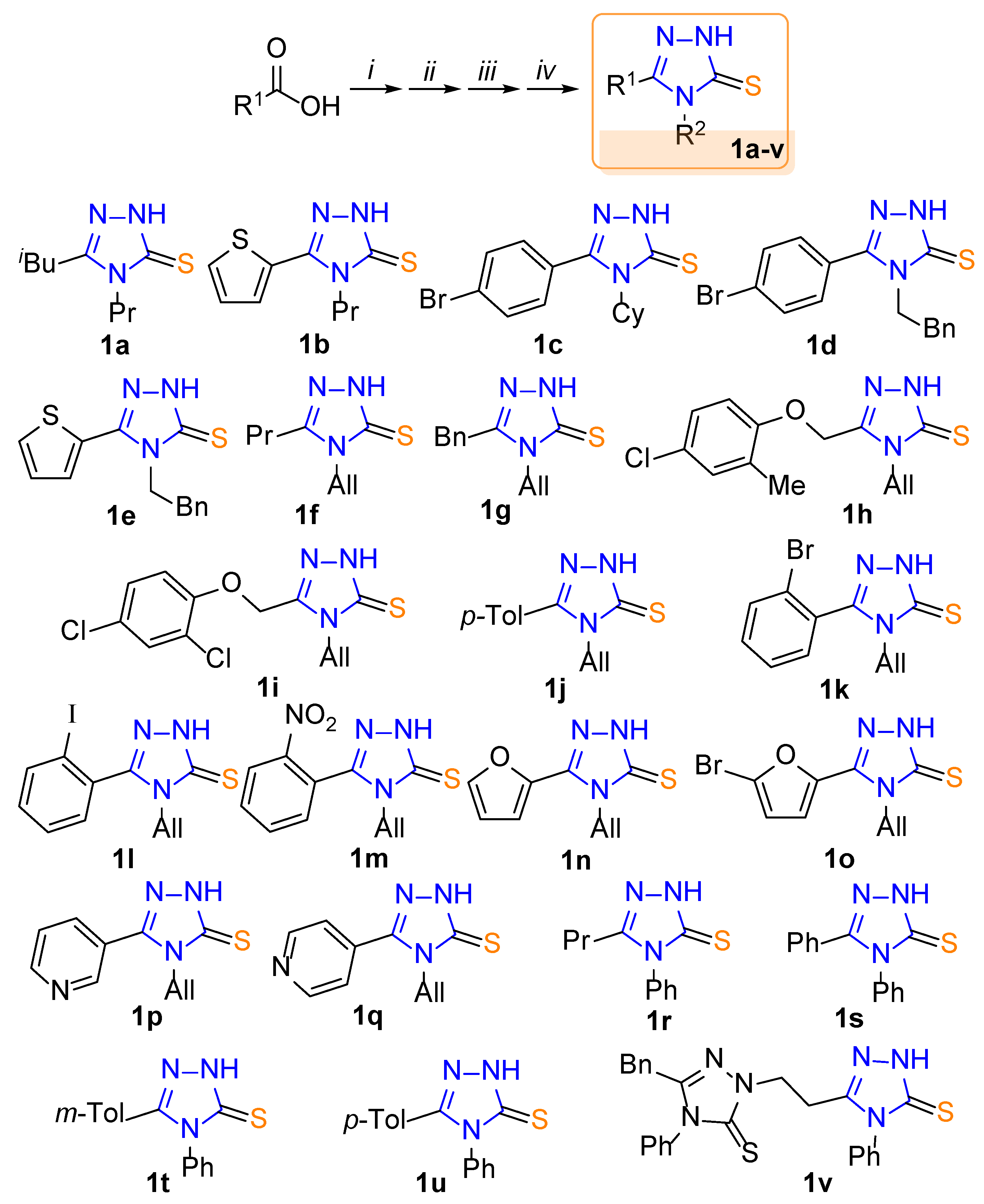
Initially, the starting triazoles with different substituents at the 4th and 5th positions (Scheme 3) were synthesized from the corresponding acids using the procedure described in the literature [52,56].
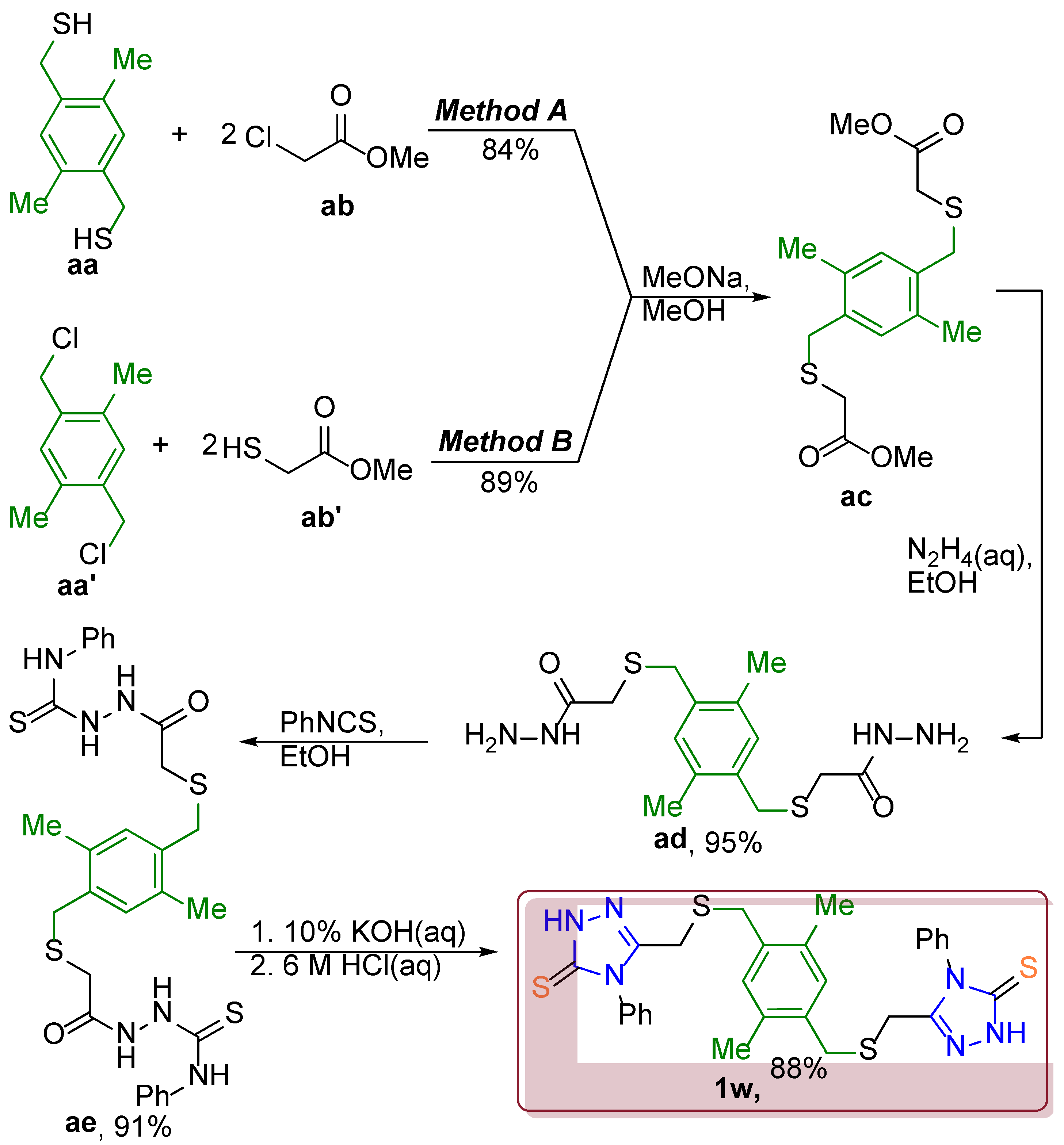
Bis-1,2,4-triazole 1w was synthesized according to the Scheme 4.
The starting bis-ester ac was synthesized using two methods. Method A involved the use of (2,5-dimethyl-1,4-phenylene)dimethanethiol (aa) and methyl 2-chloroacetate (ab), whereas Method B utilized 1,4-bis(chloromethyl)-2,5-dimethylbenzene (aa′) and methyl 2-mercaptoacetate (ab′). In both cases, the reactions were carried out under the same conditions in a methanol medium in the presence of sodium methylate. The bis-ester ac was obtained in almost the same quantitative yields. The synthesized ester was subjected to hydrazinolysis using excess aq. hydrazine in an ethanol medium. To construct the 1,2,4-triazole ring, the synthesized hydrazide (ad) was reacted with phenylisothiocyanate to give the corresponding bis(thiosemicarbazide) (ae).
For the cyclization of bis(thiosemicarbazide) (ae), the classic base cyclization using a 10% potassium hydroxide solution was utilized under heating conditions, which resulted in obtaining bis-1,2,4-triazole-3-thione 1w in relatively high yields.
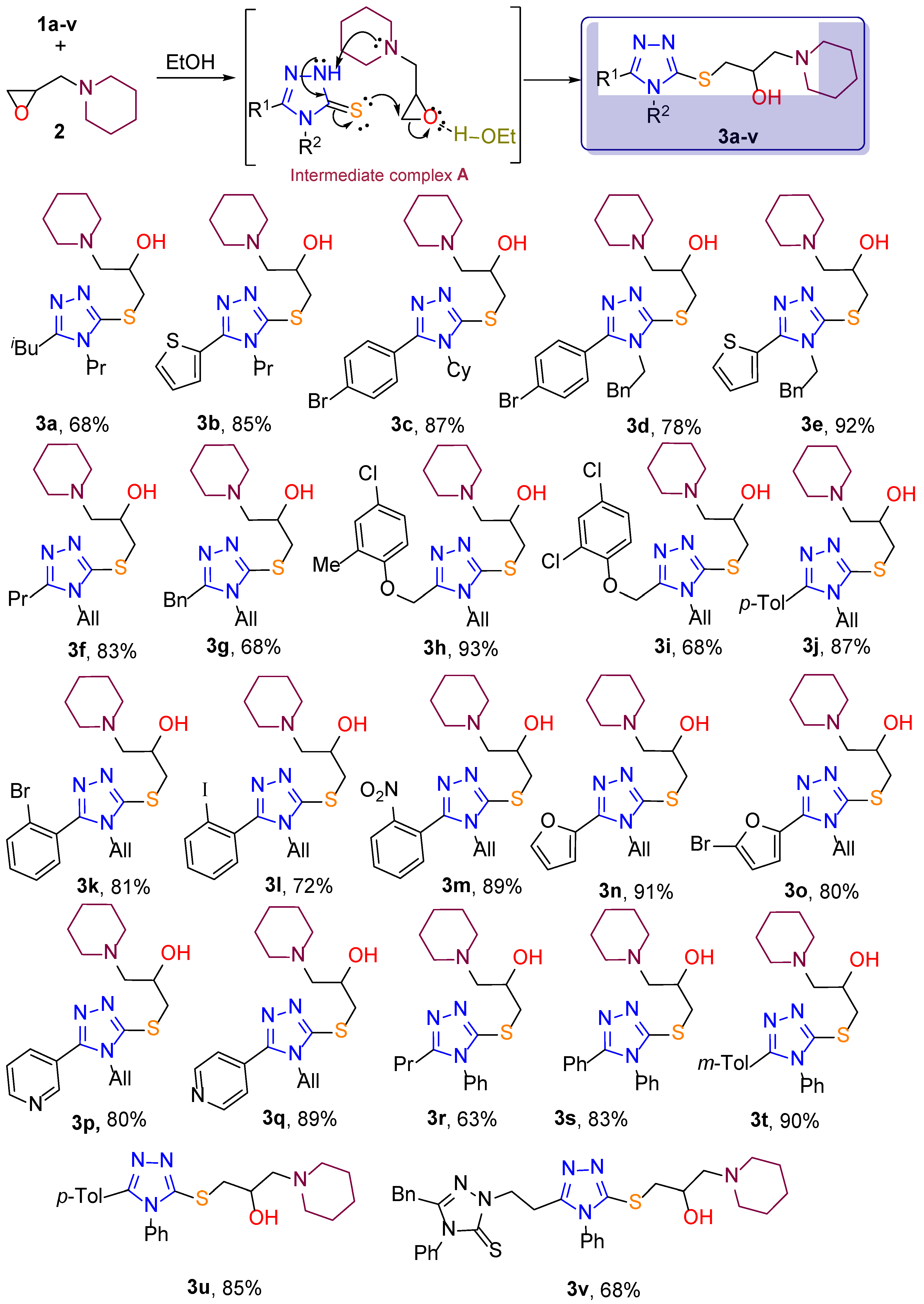
The reaction of the triazoles 1a-v with 1-(oxiran-2-ylmethyl)piperidine (2), which was synthesized according to the method of the article [35], was studied (Scheme 5).
The reaction proceeds without the use of basic catalysts because the nitrogen of the piperidine ring in compound 2 has an anchimer effect, that is, it plays the role of basic catalysis.
The solvent also plays an important role here; ethanol forms a hydrogen bond with the epoxide ring by polarizing the C-O bond [62,63,64]. In our opinion, intermediate complex A is formed during this reaction, which facilitates the course of the reaction. According to the Krasusky rule, the reaction proceeds regiospecifically and produces secondary alcohols. This is evidenced by the presence of the signal of the CH group at 3.8-4.0 ppm in the 1H NMR spectra.
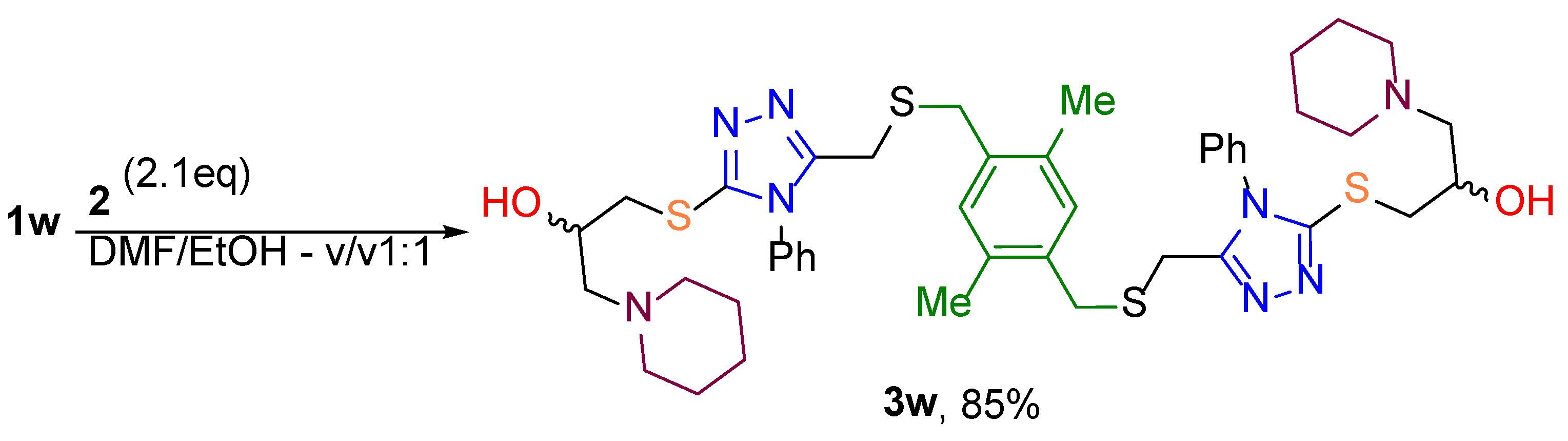
The structure of the compound 3w was confirmed by several 2D NMR spectra (HSQC, HMBC, NOESY). Interestingly, although the compound has two chiral carbons, there is only one set of signals present in both 1H and 13C NMR spectra. As it is known, NMR spectroscopy in achiral solvents cannot distinguish between enantiomers, thus there should be at least two chiral centers in the molecule to produce two different diastereomers with their corresponding spectra. However, the chiral centers being located far apart from each other, the symmetry and the conformational flexibility of the molecule can further reduce the number of different stereoisomers, which can be observed by NMR spectroscopy. In case of the compound 3w, using conventional NMR techniques it is impossible to determine if we observe the signals of meso isomer (R,S and S,R), the set of enantiomers (R,R) and (S,S) or even a set of stereoisomers with averaged signals.
5. Conclusions
The reaction of 1-(oxiran-2-ylmethyl)piperidine with 5,4-disubstituted-2,4-dihydro-3H-1,2,4-triazole-3-thiones can be used as an option for “click chemistry” because that it meets all requirements. The reaction is regiospecifically and produces secondary alcohols was obtained in good yields. The reaction proceeds with the nucleophilic attack of the sulfur atom of 5,4-disubstituted-2,4-dihydro-3H-1,2,4-triazole-3-thione, which is facilitated by the basic nitrogen present in 1-(oxiran-2-ylmethyl)piperidine, which has a catalytic (anchimer) effect. NMR techniques of the mixture of diastereomers resulting from bis-1,2,4-triazole reaction it is impossible to determine if we observe the signals of meso isomer (R,S and S,R), the set of enantiomers (R,R) and (S,S) or even a set of stereoisomers with averaged signals. This may be due to chiral centers being far apart.
Supplementary Materials
The following supporting information can be downloaded at the website of this paper posted on Preprints.org, Copies of 1H and 13C NMR spectra of all compounds.
Author Contributions
Investigation, A.V.P., A.A.S. and A.M.D.; Validation, K.S.A., M.A.S. and T.V.G.; Reviewing, V.G.N.; Conceptualization, A.S.G. All authors have read and agreed to the published version of the manuscript.
Funding
The research was supported by the Higher Education and Science Committee of MESCS RA (Research project 24LCG-1D009).
Data Availability Statement
The original contributions presented in the study are included in the article/Supplementary Materials, further inquiries can be directed to the corresponding author/s.
Conflicts of Interest
The authors declare no conflicts of interest, either of a financial or personal nature
References
- Zhen, Y.; Boen, D.; Yunfei, Y.; Kun, C. Thiol-epoxy click chemistry and its applications in macromolecular materials. Progress in Chemistry. 2016, 28, 1062-1069. [CrossRef]
- Khan, A. Thiol-epoxy ‘click’ chemistry: a focus on molecular attributes in the context of polymer chemistry. Chem. Commun. 2023, 59, 11028-11044. [CrossRef]
- Stuparu, M. C.; Khan, A. Poly(ß-hydroxy thioether)s: synthesis through thiol-epoxy ‘click’ reaction and post-polymerization modification to main-chain polysulfonium salts. J. Macromol. Sci., Pure Appl. Chem. 2022, 59, 2-10. [CrossRef]
- Xin, F.; Han, J.; Pan, H.; Sun, F. Surface microstructures and properties of thiol-epoxy/thiol-Si-methacrylate hybrid polymer networks prepared by UV-induced polymerization. J. Macromol. Sci., Pure Appl. Chem. 2020, 57, 355-362. [CrossRef]
- Konuray, A. O.; Fernández-Francos, X.; Ramis X. Analysis of the reaction mechanism of the thiol–epoxy addition initiated by nucleophilic tertiary amines. Polym. Chem. 2017, 8, 5934-5947. [CrossRef]
- Dhavale, R. P.; Parale, V. G.; Choi, H.; Kim, T.; Lee, K.-Y.; Phadtare, V. D.; Park H.-H. Epoxy-thiol crosslinking for enhanced mechanical strength in silica aerogels and highly efficient dye adsorption. Appl. Surf. Sci. 2024, 642, 158619. [CrossRef]
- Stuparu, M. C.; Khan, A. Thiol-epoxy “click” chemistry: Application in preparation and postpolymerization modification of polymers. J. Polym. Sci., Part A: Polym. Chem. 2016, 54, 3057-3070. [CrossRef]
- Lin, G.; Yin, J.; Lin, Z.; Zhu, Y.; Li, W.; Li, H.; Liu, Z.; Xiang, H.; Liu, X. Facile thiol-epoxy click chemistry for transparent and aging-resistant silicone/epoxy composite as LED encapsulant. Prog. Org. Coat. 2021, 156, 106269. [CrossRef]
- Konuray, O.; Fernández-Francos, X.; De la Flor, S.; Ramis, X.; Serra, À. The Use of Click-Type Reactions in the Preparation of Thermosets. Polymers. 2020, 12, 1084. [CrossRef]
- Peng, Y.; Cai, C.; Wang, C.; Zuo, Z.; Liu, X. Probing the glass transition in reversible cross-linked polymer composites. RSC Adv. 2019, 9, 15318-15322. [CrossRef]
- Ellson, G.; Prima, M. D.; Ware, T.; Tang, X.; Voit, W. Tunable thiol–epoxy shape memory polymer foams. Smart Mater. Struct. 2015, 24, 055001. [CrossRef]
- Hu, Y.-Y.; Bheemanaboina, R. R. Y.; Battini, N.; Zhou, C.-H. Sulfonamide-Derived Four-Component Molecular Hybrids as Novel DNA-Targeting Membrane Active Potentiators against Clinical Escherichia coli. Mol. Pharmaceutics. 2019, 16, 1036-1052. [CrossRef]
- He, B.; Hu, Y.; Xing, L.; Qing, Y.; Meng, K.; Zeng, W.; Sun, Z.; Wang, Z.; Xue, W. Antifungal Activity of Novel Indole Derivatives Containing 1,3,4-Thiadiazole. J. Agric. Food Chem. 2024, 72, 10227-10235. [CrossRef]
- Yalla, R.; Raghavan, S. Synthesis of solandelactone F, constanolactone A and an advanced intermediate towards solandelactone E from a common synthetic intermediate. Org. Biomol. Chem. 2019, 17, 4572-4592. [CrossRef]
- Romański, J.; Stefaniak, M. Facile Synthesis of Hydroxy-Substituted Thiacrown Ethers via Nucleophilic Ring Opening of Epoxides. Synthesis. 2019, 51, 2214-2220. [CrossRef]
- Nguyen, D. T.; Truong, G. N.; Van Vuong, T.; Van, T. N.; Manh, C. N.; Dao, C. T.; Thuy, T. D. T.; Van, C. L.; Khac, V. T. Synthesis of new indirubin derivatives and their in vitro anticancer activity. Chem. Pap. 2019, 73, 1083-1092. [CrossRef]
- Mamat, M.; Liu, C.; Abdukerem, D.; Abdukader, A. A visible-light-induced thiol addition/aerobic oxidation cascade reaction of epoxides and thiols for the synthesis of β-hydroxylsulfoxides. Org. Biomol. Chem. 2021, 19, 9855-9859. [CrossRef]
- Haggam, R. A. Microwave-assisted synthesis of double-headed derivatives of (4-amino-5-mercapto-4H-1,2,4-triazol-3-yl)-ethan-1-ol and study of their biological activity. Res. Chem. Intermed. 2021, 47, 3733-3749. [CrossRef]
- Hu, Y.; Hu, S.; Pan, G.; Wu, D.; Wang, T.; Yu, C.; Ansari, M. F.; Bheemanaboina, R. R. Y.; Cheng, Y.; Bai, L. Zhou, C.; Zhang, J. Potential antibacterial ethanol-bridged purine azole hybrids as dual-targeting inhibitors of MRSA. Bioorg. Chem. 2021, 114, 105096. [CrossRef]
- Wang, Q.; Xing, L.; Zhang, Y.; Gong, C.; Zhou, Y.; Zhang, N.; He, B.; Xue, W. Antiviral activity evaluation and action mechanism of myricetin derivatives containing thioether quinoline moiety. Mol. Divers. 2024, 28, 1039-1055. [CrossRef]
- Pirota, V.; D’Acerno, G.; Quadrelli, P. Synthesis of tetrazole- and imidazole-based compounds: prophetic molecules made real for biological studies. Arkivoc. 2022, 245-258. [CrossRef]
- Saeeda, S.; Saif, M. J.; Zahoor, A. F.; Tabassumc, H.; Kamald, S.; Faisal, S.; Ashrafa, R.; Khana, S. G.; Nazeerf, U.; Irfan, A.; Bhat, M. A. Discovery of novel 1,2,4-triazole tethered β-hydroxy sulfides as bacterial tyrosinase inhibitors: synthesis and biophysical evaluation through in vitro and in silico approaches. RSC Adv. 2024, 14, 15419-15430. [CrossRef]
- LiverTox: Clinical and Research Information on Drug-Induced Liver Injury [Internet]. Bethesda (MD): National Institute of Diabetes and Digestive and Kidney Diseases; Beta Adrenergic Blocking Agents. 2012. Bookshelf ID: NBK547852.
- Hersh, E. V.; Giannakopoulos, H. Beta-adrenergic blocking agents and dental vasoconstrictors. Dent. Clin. North. Am. 2010, 54, 687-696. [CrossRef]
- Helfand, M.; Peterson, K. Drug Class Review on Beta Adrenergic Blockers Final Report. 2005. Bookshelf ID: NBK47172.
- Miyajima, R.; Sano, K.; Yoshida, H. β-Adrenergic Blocking Agents and Intermittent Claudication: Systematic Review. Yakugaku Zasshi. 2004, 124, 825-831. [CrossRef]
- WHO essential medicines, 22nd edition (Last accessed: August 2022).
- Smith, C. D.; Wang, A.; Vembaiyan, K.; Zhang, J.; Xie, C.; Zhou, Q.; Wu, G.; Chen, S. R. W.; Back, T. G. Novel carvedilol analogues that suppress store-overload-induced Ca2+ release. J. Med. Chem. 2013, 56, 8626-8655. [CrossRef]
- Verma, A. K.; Singh, H.; Satyanarayana, M.; Srivastava, S. P.; Tiwari, P.; Singh, A. B.; Dwivedi, A. K.; Singh, S. K.; Srivastava, M.; Nath, C.; Raghubir, R.; Srivastava, A. K.; Pratap, R. Flavone-based novel antidiabetic and antidyslipidemic agents. J. Med. Chem. 2012, 55, 4551-4567. [CrossRef]
- Liu, A.; Huang, L.; Wang, Z.; Luo, Z.; Mao, F.; Shan, W.; Xie, J.; Lai, K.; Li, X. Hybrids consisting of the pharmacophores of salmeterol and roflumilast or phthalazinone: Dual β2-adrenoceptor agonists-PDE4 inhibitors for the treatment of COPD. Bioorg. Med. Chem. Lett. 2013, 23, 1548-1552. [CrossRef]
- Ang, W.; Ye, W.; Sang, Z.; Liu, Y.; Yang, T.; Deng, Y.; Luo, Y.; Wei, Y. Discovery of novel bis-oxazolidinone compounds as potential potent and selective antitubercular agents. Bioorg. Med. Chem. Lett. 2014, 24, 1496-1501. [CrossRef]
- Burns, J. F.; Chen, B.; Chen, C.-A.; Doller, D.; Edelmenky, E.; Jiang, Y.; Peterson, J. M.; Sabio, M.; Weiss, J.; White, A. D.; Wu, L.; Bhardwaj, R.; Chandrasena, G.; Boyle, N. J.; Huang, X. cis-1-Oxo-heterocyclyl-4-amido cyclohexane derivatives as NPY5 receptor antagonists. Bioorg. Med. Chem. Lett. 2014, 24, 1458-1461. [CrossRef]
- Guijarro, D.; Pablo, Ó.; Yus, M. Achiral β-amino alcohols as efficient ligands for the ruthenium-catalysed asymmetric transfer hydrogenation of sulfinylimines. Tetrahedron Lett. 2011, 52, 789-791. [CrossRef]
- Tasgin, D. I.; Unaleroglu, C. Enantioselective addition of diethylzinc to aldehydes catalyzed by β-amino alcohols derived from (1R,2S)-norephedrine. Appl. Organomet. Chem. 2010, 24, 33-37. [CrossRef]
- Mesropyan, E. G.; Galstyan, A. S.; Avetisyan, A. A. Syntheses on the basis of 4-(Oxiran-2-ylmethyl)morpholine. Russ. J. Org. Chem. 2006, 42, 1845-1847. [CrossRef]
- Mesropyan, E. G.; Avetisyan, A. A.; Galstyan, A. S. Synthesis of N-aryl derivatives of vicinal aminoalcohols. Russ. J. Org. Chem. 2007, 43, 1176-1179. [CrossRef]
- Mesropyan, E. G.; Galstyan, A. S.; Avetisyan, A. A. Syntheses proceeding from N-(oxiran-2-ylmethyl)-N-ethylaniline. Russ. J. Org. Chem. 2010, 46, 1296-1300. [CrossRef]
- Mesropyan, E. G.; Galstyan, A. S.; Avetisyan, A. A. Reactions of aromatic dithiols with diethyl 2-alkyl-2-(oxiran-2-ylmethyl)malonates. Russ. J. Org. Chem. 2012, 48, 373-375. [CrossRef]
- Mesropyan, E. G.; Ambartsumyan, G. B.; Avetisyan, A. A.; Galstyan, A. S. Reaction of phenyl glycidyl ether with some heterocycles. Chem. Heterocycl. Compd. 2008, 44, 650-653. [CrossRef]
- Mesropyan, E. G.; Avetisyan, A. A.; Galstyan, A. S.; Ter-Vardanyan, L. R. Reactions of aromatic dithiols with allyl glycidyl ether and 4-(oxiran-2-ylmethyl)morpholine. Russ. Chem. Bull. 2009, 58, 1528-1530. [CrossRef]
- Mesropyan, E. G.; Hambardzumyan, G. B.; Avetisyan, A. A.; Galstyan, A. S.; Khachatryan, A. G. Synthesis of 3-Allyloxy(2-hydroxypropyl)-5,5-dimethylhydantoin, 1-Allyloxy(2-hydroxypropyl)-substituted Benzotriazole and Benzimidazole, and N-allyloxy(2-hydroxypropyl)-substituted Pyrrolidone, Caprolactam, and Phthalimide. Chem. Heterocycl. Compd. 2005, 41, 962-966. [CrossRef]
- Campoy, S.; Adrio, J. L. Antifungals. Biochem. Pharmacol. 2017, 133, 86-96. [CrossRef]
- Wang, W.; Wang, S.; Liu, Y.; Dong, G.; Cao, Y.; Miao, Z.; Yao, J.; Zhang, W.; Sheng, C. Novel conformationally restricted triazole derivatives with potent antifungal activity. Eur. J. Med. Chem. 2010, 45, 6020-6026. [CrossRef]
- Sheng, C.; Che, X.; Wang, W.; Wang, S.; Cao, Y.; Miao, Z.; Yao, J.; Zhang, W. Design and synthesis of novel triazole antifungal derivatives by structure-based bioisosterism. Eur. J. Med. Chem. 2011, 46, 5276-5282. [CrossRef]
- Wang, S.; Jin, G.; Wang, W.; Zhu, L.; Zhang, Y.; Dong, G.; Liu, Y.; Zhuang, C.; Miao, Z.; Yao, J.; Zhang, W.; Sheng, C. Design, synthesis and structure–activity relationships of new triazole derivatives containing N-substituted phenoxypropylamino side chains. Eur. J. Med. Chem. 2012, 53, 292-299. [CrossRef]
- Yu, S.; Chai, X.; Hu, H.; Yan, Y.; Guan, Z.; Zou, Y.; Sun, Q.; Wu, Q. Synthesis and antifungal evaluation of novel triazole derivatives as inhibitors of cytochrome P450 14α-demethylase. Eur. J. Med. Chem. 2010, 45, 4435-4445. [CrossRef]
- Xu, K.; Huang, L.; Xu, Z.; Wang, Y.; Bai, G.; Wu, Q.; Wang, X.; Yu, S.; Jiang, Y. Design, synthesis, and antifungal activities of novel triazole derivatives containing the benzyl group. Drug Des. Dev. Ther. 2015, 1459-1467. [CrossRef]
- Elias, R.; Benhamou, R. I.; Jaber, Q. Z.; Dorot, O.; Zada, S. L.; Oved, K.; Pichinuk, E.; Fridman, M. Antifungal activity, mode of action variability, and subcellular distribution of coumarin-based antifungal azoles. Eur. J. Med. Chem. 2019, 179, 779-790. [CrossRef]
- Luo, Y.; Zhang, S.; Liu, Z. J.; Chen, W.; Fu, J.; Zeng, Q. F.; Zhu, H. L. Synthesis and antimicrobical evaluation of a novel class of 1,3,4-thiadiazole: Derivatives bearing 1,2,4-triazolo[1,5-a]pyrimidine moiety. Eur. J. Med. Chem. 2013, 64, 54-61. [CrossRef]
- Zoumpoulakis, P.; Camoutsis, C.; Pairas, G.; Sokovic, M.; Glamoclija, J.; Potamitis, C.; Pitsas, A. Synthesis of novel sulfonamide-1,2,4-triazoles, 1,3,4-thiadiazoles and 1,3,4-oxadiazoles, as potential antibacterial and antifungal agents. Biological evaluation and conformational analysis studies. Bioorg. Med. Chem. 2012, 20, 1569-1583. [CrossRef]
- Ghochikyan, T. V.; Zhamharyan, A. G.; Afrikyan, Sh. G.; Frangyan, V. R.; Galstyan, A. S. Novel Triazole-Containing “Dipeptides”: Synthesis, Molecular Docking and Analgesic Activity Studies. ChemBioChem. 2024, 25, e202300837. [CrossRef]
- Galstyan, A. S.; Ghochikyan, T. V.; Frangyan, V. R.; Tamazyan, R. A.; Ayvazyan, A. G. Synthesis of Novel Derivatives of 1,2,4-Triazoles. ChemistrySelect. 2018, 3, 9981-9985. [CrossRef]
- Galstyan, A. S.; Ghochikyan, T. V.; Samvelyan, M. A.; Frangyan, V. R.; Sarfraz, M. Synthesis, Study of the Biological Activity of New 1,2,4-Triazole Derivatives and Characteristics of the Relationship of the Structure and Biological Activity in a Series of the Latter. ChemistrySelect. 2019, 4, 12386-12390. [CrossRef]
- Galstyan, A. S.; Grigoryan, S. V.; Samvelyan, M. A.; Frangyan, V. R.; Yeganyan, T. H.; Ayvazyan, A. G.; Ghochikyan, T. V. On Features of Halocyclization of 4-Allyl-5-substituted-2,4-dihydro-3H-1,2,4-triazol-3-thiones and Synthesis of New Derivatives of 1,2,3-Triazoles. ChemistrySelect. 2022, 7, e202201283. [CrossRef]
- Samvelyan, M. A.; Ghochikyan, T. V.; Grigoryan, S. V.; Tamazyan, R. A.; Aivazyan, A. G. Alkylation of 1,2,4-triazole-3-thiols with haloalkanoic acid esters. Russ. J. Org. Chem. 2017, 53, 935-940. [CrossRef]
- Petrosyan, A.; Ayvazyan, A.; Ghochikyan, T.; Galstyan, A. Ligand-Free Copper(0)-Catalyzed C−S Ullmann-Type Cross-Coupling Reaction: S-Arylation of 5,4-Disubstituted 2,4-Dihydro-3H-1,2,4-triazole-3-thiones. Eur. J. Org. Chem. 2024, 27, e202400199. [CrossRef]
- Kochikyan, T. V.; Samvelyan, M. A.; Arutyunyan, V. S.; Avetisyan, A. A.; Tamazyan, R. A.; Aivazyan, A. G. Synthesis of 1,2,4-triazole-3-thiols and their S-substituted derivatives. Russ. J. Org. Chem. 2010, 46, 551-555. [CrossRef]
- Kochikyan, T. V.; Samvelyan, M. A.; Petrosyan, A. M.; Langer, P. D. Synthesis and properties of thiazolo[2,3-c][1,2,4]triazoles. Russ. J. Org. Chem. 2015, 51, 1469-1473. [CrossRef]
- Kirschberg, T.A.; Balakrishnan, M.; Huang, W.; Hluhanich, R.; Kutty, N.; Liclican, A. C.; McColl, D. J.; Squires, N. H.; Lansdon, E. B. Triazole derivatives as non-nucleoside inhibitors of HIV-1 reverse transcriptase—Structure–activity relationships and crystallographic analysis. Bioorg. Med. Chem. Lett. 2008, 18, 1131-1134. [CrossRef]
- Romaine, I. M.; Taylor, R. W.; Saidu, S. P.; Kim, K.; Sulikowski, G. A.; Zwiebel, L. J.; Waterson, A. G. Narrow SAR in odorant sensing Orco receptor agonists. Bioorg. Med. Chem. Lett. 2014, 24, 2613-2616. [CrossRef]
- Turky, A.; Sherbiny, F. F.; Bayoumi, A. H.; Ahmed, H. E. A.; Abulkhair, H. S. Novel 1,2,4-triazole derivatives: Design, synthesis, anticancer evaluation, molecular docking, and pharmacokinetic profiling studies. Archiv Der Pharm. 2020, 353, 2000170. [CrossRef]
- Enikolopiyan, N. S. New Aspects of the Nucleophilic Opening of Epoxide Rings. Pure Appl. Chem. 1976, 48, 317-328. 10.1351/pac197648030317.
- Omoto, K.; Fujimoto, H. Theoretical Study of Activation of Oxirane by Bidentate Acids. J. Org. Chem. 2000, 65, 2464-2471. [CrossRef]
- Kas’yan, L. I.; Okovityi, S. I.; Kas’yan, A. O. Reactions of Alicyclic Epoxy Compounds with Nitrogen-Containing Nucleophiles. Russ. J. Org. Chem. 2004, 40, 1-34. [CrossRef]
Figure 1.
Derivatives of vicinal amino alcohols used in medical practice (β-adrenergic blocking agents).
Figure 1.
Derivatives of vicinal amino alcohols used in medical practice (β-adrenergic blocking agents).
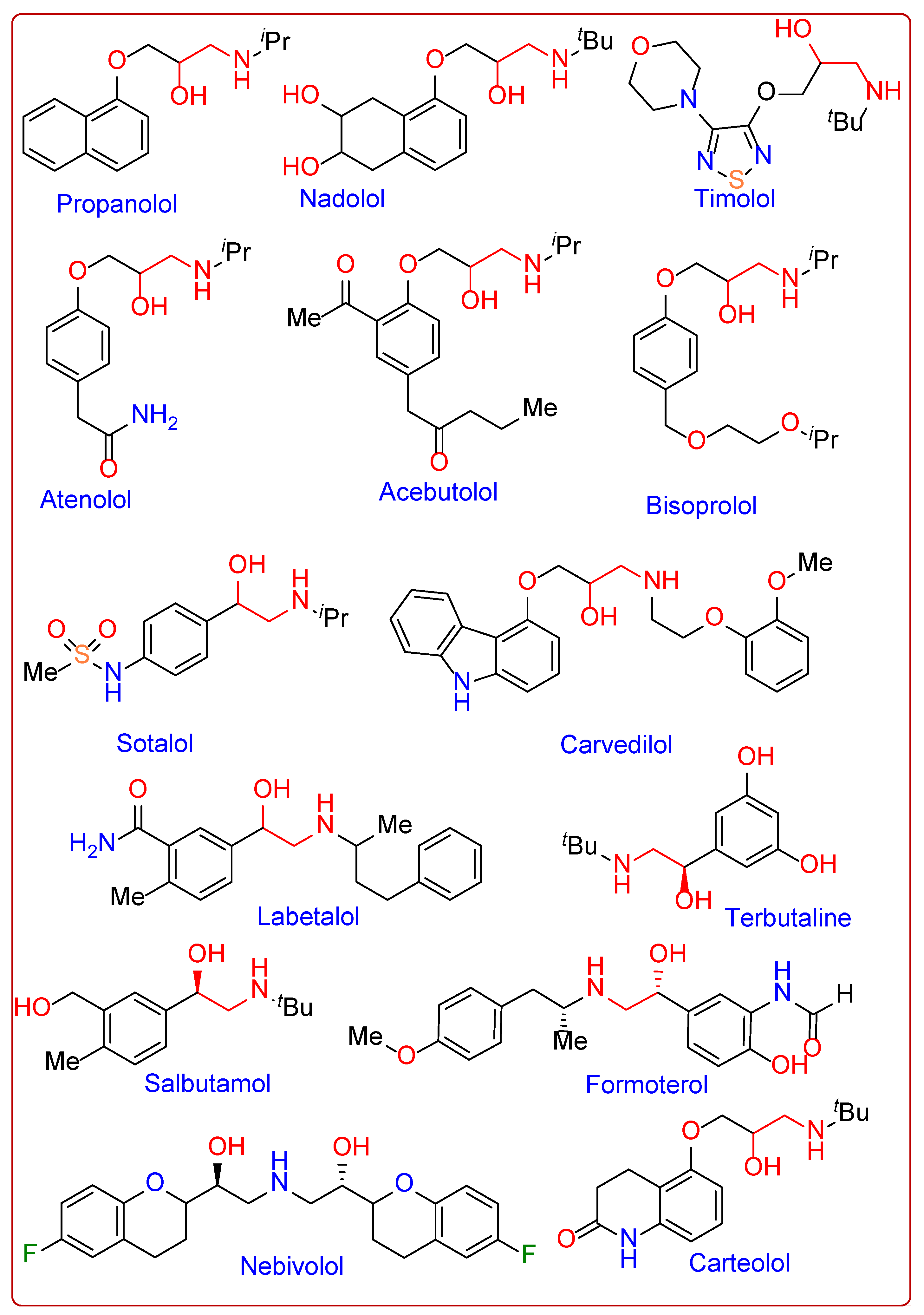
Figure 2.
Vicinal amino alcohols, lactones, and other compounds synthesized by our team.
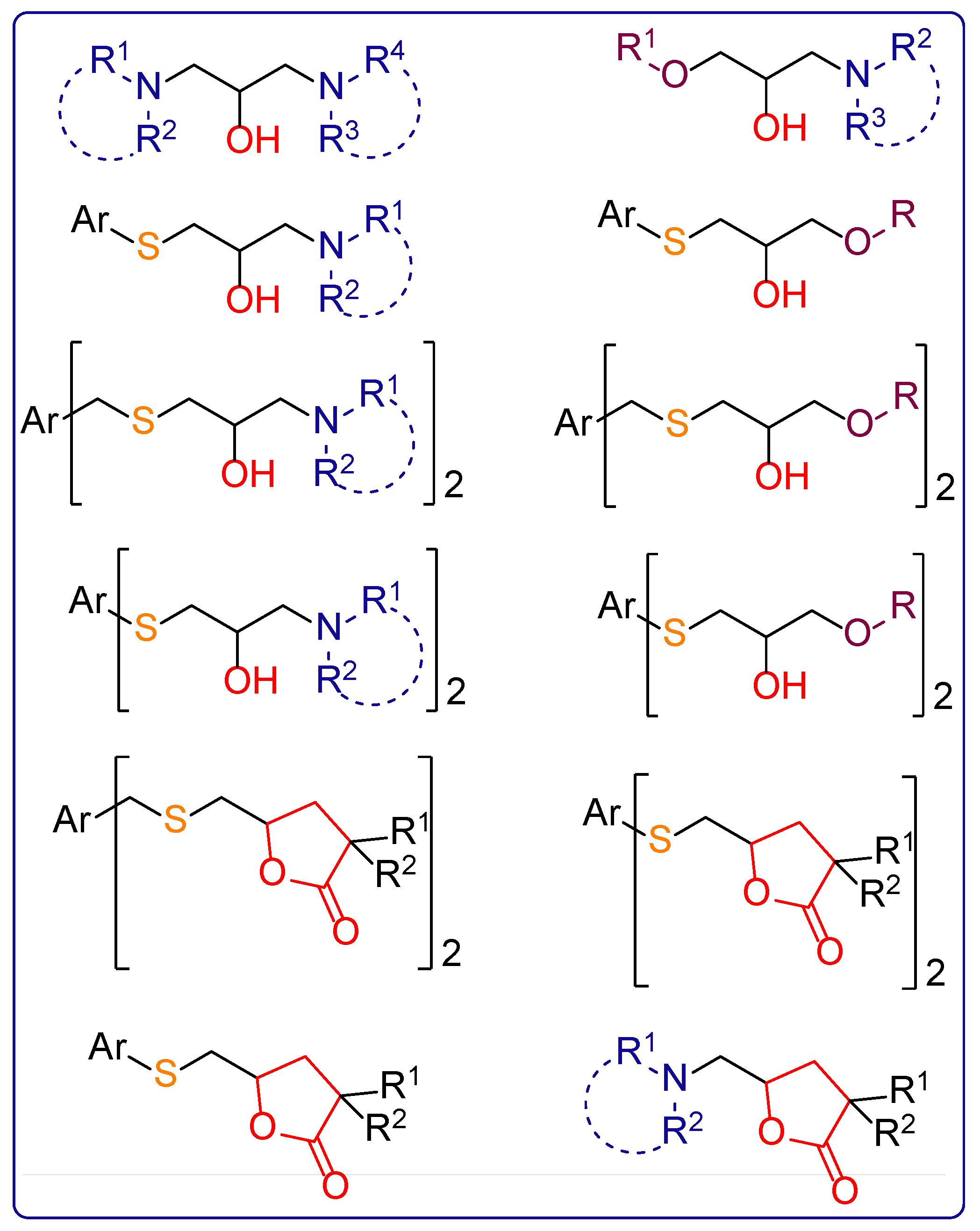
Figure 3.
Drugs with 1,2,4-triazole backbone used in clinical practice.
Scheme 2.
Reaction 5,4-disubstituted-2,4-dihydro-3H-1,2,4-triazole-3-thiones with electrophilic agents.
Scheme 2.
Reaction 5,4-disubstituted-2,4-dihydro-3H-1,2,4-triazole-3-thiones with electrophilic agents.
Scheme 3.
The synthesis of starting 5,4-disubstituted-2,4-dihydro-3H-1,2,4-triazole-3-thiones 1a-v. Reagents and conditions: i – EtOH/MeOH, H+ reflux; ii – N2H4∙H2O, EtOH, r.t. 1 h and reflux 4 h; iii – R2NCS, EtOH, reflux 4 h; iv – 10% sol. KOH(aq) 3 eq., reflux 5 h.
Scheme 3.
The synthesis of starting 5,4-disubstituted-2,4-dihydro-3H-1,2,4-triazole-3-thiones 1a-v. Reagents and conditions: i – EtOH/MeOH, H+ reflux; ii – N2H4∙H2O, EtOH, r.t. 1 h and reflux 4 h; iii – R2NCS, EtOH, reflux 4 h; iv – 10% sol. KOH(aq) 3 eq., reflux 5 h.
Scheme 4.
The synthesis of starting bis-1,2,4-triazole-3-thione 1w.
Scheme 5.
The synthesis of vicinal amino alcohols containing 1,2,4-triazole ring 3a-v.The reaction of the synthesized bis-1,2,4-triazole 1w with oxirane 2 was also investigated, and as a result the corresponding bis-vicinal amino alcohol 3w was obtained in good yields (Scheme 6).
Scheme 5.
The synthesis of vicinal amino alcohols containing 1,2,4-triazole ring 3a-v.The reaction of the synthesized bis-1,2,4-triazole 1w with oxirane 2 was also investigated, and as a result the corresponding bis-vicinal amino alcohol 3w was obtained in good yields (Scheme 6).
Scheme 6.
The synthesis of bis-vicinal amino alcohol 3w.
Disclaimer/Publisher’s Note: The statements, opinions and data contained in all publications are solely those of the individual author(s) and contributor(s) and not of MDPI and/or the editor(s). MDPI and/or the editor(s) disclaim responsibility for any injury to people or property resulting from any ideas, methods, instructions or products referred to in the content. |
© 2025 by the authors. Licensee MDPI, Basel, Switzerland. This article is an open access article distributed under the terms and conditions of the Creative Commons Attribution (CC BY) license (http://creativecommons.org/licenses/by/4.0/).
Copyright: This open access article is published under a Creative Commons CC BY 4.0 license, which permit the free download, distribution, and reuse, provided that the author and preprint are cited in any reuse.


