

Submitted:
07 March 2025
Posted:
10 March 2025
You are already at the latest version
Abstract
Environmental and agronomic factors strongly affect the development and quality of apple fruits. The presented study explain the genotype(G) x phenotype(P) x environment(E) relationships, shaping the fruit development phases and features of four apple cv.. We assessed the three-dimensional data concerning: expression profiles (fold change, in qPCR reaction) of eight genes related to fruit ripeness regulation; seasonal temperatures variation (year-to-year 2018-2020) and variation of fruit parameters: FW, IEC, TSS, TA and FF. The effects of each component GxPxE were calculated according to the Pearson correlation parameters (Log(p-value) plots). We observed that low temper-atures (especially before reaching the apple ripening phase), promoted an increase of gene activity and improve the fruit quality of four cultivars with different flowering/ripening dates: ‘Ligol’ (early flowering/late ripening reference cultivar), 'Pink Braeburn', 'Pinokio' and 'Ligolina'. We also found positive effect of low temperatures on the activity of AAAA1, AALA1, StG and AAXA genes as well as on the evaluated fruit quality parameters, and confirmed their dependence on genotype of the studied cultivars. The obtained results shed light to understand the complexity of mechanism of variability of fruit features and fruit harvest date. This knowledge may improve breeding programs on production of better quality of apple fruits.
Keywords:
fruit development
; fruit features
; phenotype
; genotype
; qRT‐CR
; functional markers
1. Introduction
The seasonal temperature changes have a huge impact on plant yield, fruit development and influence the variability of fruit features accepted by consumers. Global climate change is leading to unusual weather conditions, including temperature fluctuations, as well as annual average temperature increases [1]. In the period of 2000–2020, worldwide temperature have increased approximately about 2 °C and show rising trends in subsequent seasons (source GUS, https://300gospodarka.pl/[2]). In addition, high temperature have been known to induce the plant heat stress, affecting crucial growth stages, reducing photosynthesis and hampering plant development [3]. On the other hand, the low temperature, especially in apple blooming phase may also result in serious damages in plant organs and reducing plant yield [4]. Many authors also explain, that based on the temperature values in particular growing season, it is possible to assess fruit quality, fruit yield, and determine the optimal date for fruit harvesting [5,6,7].
Apple (Malus domestica Borkh.) is one of the most economically important fruit tree species grown worldwide. Apple fruits have many benefits for human health and are one of the favorite among consumers [8,9,10]. Most of them are crunchy, juicy, sweet and rich in vitamins, dietary fiber, polyphenols and minerals [11]. Their quality is determined by a number of individual features, most of which are controlled by many main genes and by smaller polygenes or oligogenes [12,13,14]. Long-term evolution, gene recombination and natural mutations have resulted in a high level of heterozygosity in the genome of this species [15]. Additionally, targeted selection and the influence of non-additive genetic effects contributed to the increase in the genome variability of apples, expressed in their phenotypic diversity [16].
The shape, taste, nutritional value, disease resistance and the possibility of their processing, storage and transportation are the priority in general apple fruit quality characterization for growers. The major determinants of individual apple fruits are also: their weight, appearance, color, consistency, taste, aroma and composition [17,18].
The average number of days from flowering until harvest as well as temperature condition seems to be the greatest factor impacting the yield phenophases [19]. The methods of calculation of degree-day accumulation or the sum of active temperatures in this precise period are also successfully used to predict the accumulation of desired substances like anthocyanins or sugars [7,20,21]. The phenological phases of fruit trees growth in temperate regions strongly depend on temperature conditions especially during winter and spring [22,23], even though, the selection of appropriate beginning of temperature calculation is disputable [24]. Organ growth also depends on the temperature accumulation from the flowering to fruit maturity period and can be stimulated by a fixed number of degree-days which allows comparing different evaluated seasons and locations [6].
The process of apple fruit development is well recognized and includes: the early period, in which intensive cell division and tissue expansion predominate (up to 70 days after full bloom); the maturation stage (lasts from 90 to approximately 150 days after full bloom), when the fruits possesses the prerequisites for use by consumers, and finally the ripening, known as an irreversible stage in which the fruits reach collective maturity [25].
At the early stage of fruit development, the process of regulation of the cell cycle is promoted and then the transcription level of the key genes, controlling cell division has a significant impact on the regulation of further fruit features [25]. In the model plant of A. thaliana, cell cycle is regulated by Cell Division Control Proteins, encoded by genes from the CDKB group. In fruits, they are closely related to the regulation of cell processes contributing to the increase of tissue mass, and their expression decreases as plants aging [26]. Our research, including the assessment of the activity of genes from this group, carried out for ‘McIntosh’ and ‘Golden Delicious’ fruits, collected at few time-points: before reaching harvest maturity (up to 120 days after full bloom) and at harvest stage, also confirmed a significant decrease in the number of their transcripts before reaching full fruit maturity [11].
Another factor regulating the phases of the cell cycle, activated during fruit development, is cyclin-dependent kinase (CKS1). By binding to proteins, CDKB acts as a protein regulating CDK gene activity [27] and also binds to the SCF complex involved in the degradation of kinase repressing protein (KRP) [27,28].
In subsequent fruit developmental process, the accumulated sorbitol and sulfur are quickly metabolized by the high activity of SDH (sorbitol dehydrogenase), invertase, SUSY (sucrose synthase), FK (fructokinase) and HK (hexokinase) to demands of plant cell energy, initiating cell division and increase in fruit weight. Then, the activity of these enzymes decreases and the starch degradation process is released, resulting in simple sugars accumulation (begins approximately at the 90 days after full bloom) and preceding the fruit ripening [25]. Reduction of FK activity preliminarily promotes the accumulation of starch in the cell vacuole, and in the late phase of fruit development, facilitates its breakdown and, together with SPS (sucrose phosphate synthase), StG (starch glucosidase) and StA (starch amylase), increases the sucrose synthesis, which significantly maximizing the total soluble sugars concentration upon reaching full fruit maturity [11,29]. Furthermore, sugar transport proteins encoded by MdTMT1 and/or MdTMT2 (tonoplast monosaccharide transporters) play an important role in controlling the accumulation of fructose and sucrose in apple fruits. The accumulation of such soluble simple sugars in ripe fruits determines their sweetness level [30]. Finally, over-ripening stage, initiated by the start of ethylene biosynthesis begins [25].
Thanks to the development of -omics technologies, such as genomics, transcriptomics, proteomics, metabolomics, and phenomics, as well as GWAS (Genome Wide Associated Studies), metabolic GWAS, structural analysis of variability, supported by molecular markers and other molecular technologies, a significant progress in genetic research of fruit plants characteristics has been achieved. Despite the long juvenile phase occurring in woody species such as apple greatly hampering the application of molecular tools, a significant and specific molecular markers (e.g., functional markers) are requested by breeders to improve the marker assisted selection of breeding materials [29].
The aim of the presented research was to define the relationship between local cli-mate changes, fruit parameters and activity of selected genes with known loci on the reference genome of Malus domestica, controlling fruit development processes. The presented observations may be useful for understanding the apple fruit ripening mechanism modulated by seasonal temperature changes which influence on the individual gene activity that will contribute in development of molecular markers successfully applied for monitoring of fruit trait.
2. Materials and Methods
2.1. Plant Material
For phenotypic-genotypic assessments, fruits of four winter apple cultivars: ‘Ligol’, ‘Pink Braeburn’, ‘Pinokio’ and ‘Ligolina’ (suitable for long-term storage), were collected in three subsequent seasons (2018, 2019 and 2020) and approximately with five-days intervals: 135(I), 140(II), 145(III) and 150(IV) after full bloom (DAFB). Even though all varieties are considered as winter ones, they significantly differ in the flowering time and the time of reaching physiological maturity. The picking time points were chosen according to FB dates for ‘Ligol’ cv., classified as early flowering (Table 1.). Fruits were harvested at the same time point intervals for all cultivars, to avoid the potential disequilibrium in their developmental stage. Due to the optimum harvest date (OHD), and for the research purpose, the cultivars were classified in groups: early-ripening (‘Ligol’), mid-ripening (‘Pink Braeburn’ and ‘Pinokio’), and late-ripening (‘Ligolina’).
In parallel, the material (fruit flesh) dedicated for molecular analysis (fruit flesh discs with a diameter of 2 cm, cut from 3 fruits/repetitions) was collected in the field directly into liquid nitrogen, transported to the laboratory, and stored at −80 °C.
2.2. Molecular Analysis
2.2.1. RNA Isolation and Reverse Transcription
RNA was isolated from a total 12 fruits of the above-mentioned (2.1) apple cultivars, according to the method described by Zeng and Yang [31]. Fruit flesh tissue, ground in liquid nitrogen was incubated for 20 min. (65 °C) in extraction buffer (CTAB). After centrifuging the samples in a mixture of chloroform and isoamyl alcohol (24:1, v/v), RNA molecule was collected from the upper fraction and precipitated with 10 M LiCl2 (overnight incubation, 4 °C). Finally, the centrifuged RNA preparations were dissolved in RNAse-free water (DEPC). The quality, degree of integration and concentration of the RNA preparations were assessed by micro-flow electrophoresis using the Agilent 2100 Bioanalyzer (Perlan Technologies) and the Expert 2100 software.
High-quality RNA samples (1 µg) were reversed transcribed into stable cDNA using the cDNA Synthesis Kit Affinity Script QPCR (Agilent). The reaction was carried out with the universal oligo-dT primer (0.1 µg/µL) and the reverse transcriptase (RT) under optimized thermal conditions: 25 °C/5 min., 42 °C/5 min.—oligo-dT annealing, 55 °C/15 min—RT, 95 °C/5 min.—enzyme inactivation (Biometra Basic thermocycler). The stable cDNA was then used as a template for quantitative amplification reaction (qPCR).
2.2.2. qPCR Tests and Data Analysis
From the NCBI database (https://www.ncbi.nlm.nih.gov/) (access March 2018) mRNA/CDS sequences of eight genes, involved in the regulation of fruit ripening processes were selected. In general, the evaluated genes were related to the secondary biosynthesis of metabolites, their transportation and regulation of catabolic reactions in various apple fruit tissues. Specific oligonucleotides, complementary to the sequences of selected genes were designed using Primer 3 PRO software, https://www.primer3plus.com/index.html (access April 2018). The acronyms of selected genes, gene functions and sequences of the designed oligonucleotides used in the study are listed in Table 2.
QPCR tests were performed with Kapa SYBR qPCR kit (KapaBiosystems, USA) in Rotor Gen 6000 thermal cycler (Corbett Research, Austria). In each experimental setup, two pairs of specific oligos, complementary to the sequence of evaluated gene and the reference Md18sRNA gene (stable in the experimental layout) were used in analogous reactions. The cDNA template was prepared in dilutions of known concentrations, enabling the calculation of a standard amplification reaction curve. The thermal profile of the qPCR reaction was as follows: 95 °C for 5 min. (polymerase activation), then 35 cycles were completed including the following steps: 95 °C for 15 s (denaturation), 60 °C for 20 s (oligonucleotide annealing), 72 °C for 20 s (detection of fluorescence level). Relative expression (fold change) normalized in regard to reference gene, was determined on the basis of single data points derived from real-time PCR amplification curve threshold cycles (Ct values) (2-∆∆Ct method described by Livak and Schmittgen [32]). For this purpose, Rotor-Gene 6000 Series Software 1.7 was used (Corbett Research, Australia).
The data of relative fold changes of gene activity calculated for collected fruit sample preparations were visualized with GraphPad Prism 10.0.3 software. Presented diagrams show a fold change in the number of gene transcripts with standard error (±) SEM at the significance of p-value: p < 0.05*, 0.01**, 0.001***.
2.3. Fruit Phenotypic Assessments
Ten fruits from each genotype were picked up at the same development periods, for instrumental measurements of phenotypic features.
Fruit weight, the internal ethylene concentration (IEC), total soluble solids content (TSS), titratable acidity (TA) and flesh firmness (FF) were measured for individual collected apple fruit.
Fruit weight, expressed in (g), was measured using WPS 2100/C/2 balance (Radwag, Radom, Poland).
For internal ethylene concentration (IEC), a 1 mL gas sample was taken from the apple core and injected into a gas chromatograph HP 5890 II (Hewlett Packard, USA) with a flame ionization detector (FID). The chromatograph was equipped with a glass column 6 mm in diameter and 1200 mm long, filled with aluminum oxide (Alumina F-1, 60/80 mesh). Results were expressed in µL/L (ppm).
Flesh firmness was measured on two opposite sides of the fruit using Zwick Roell Z010 (Zwick Roell, Germany) equipped with a Magness-Taylor 11,1 mm probe. The results were expressed in (N).
Total soluble solids (TSS) were measured in fresh fruit juice samples (prepared for individual fruits collected) with a digital refractometer Atago PR-101 (Atago Co. Ltd., Japan) and expressed as (%).
Titratable acidity (TA) was measured with an automatic titrator DL 50 (Mettler-Tolledo, Switzerland), using the standard titration method (0.1 N NaOH to the endpoint pH = 8.1). The results were expressed in % of malic acid.
2.4. Statistical Analyses
The effects of weather temperature changes observed for the evaluated seasons (2018–2020) in regard to the gene expression activity as well as fruits phenotypic features are presented as volcano charts, exhibiting the level of significance [Log(p-value)], with standard error of the mean (±SEM) of the variables. Each evaluated season was divided in three time periods regarding the highest temperatures fluctuations, observed from: February to April (an average temperature ranges between −1,6–14,9 °C), from May to July (an average temperature ranges between 14,9–17,7 °C) and from August to October (between 17,7 and 19,4 °C), until the day of harvesting ripe fruits. Relations between gene expression and temperature changes was determined using two-stage Benjamini linear increase procedure, as well as Krieger and Yekutieli with Q = 1%. Each row data was analyzed individually, without assuming a consistent standard deviation SD with the significance level of the t test at p < 0.05*, 0.01**, 0.001***.
The meteo data were collected from three consecutive seasons 2018, 2019 and 2020 from the METOS, Pessl Instruments station, localized in orchard in Skierniewice, Poland, where the evaluated apple cultivars grown. The climatogram of the seasonal temperature changes is presented on supplementary Figure S1. The linear regression analysis was performed to evaluate the mean differences for monthly temperature changes within the years of fruit evaluation. Analysis of variance was presented as SS stands for Sum of Squares = variation (lower SS ratio = higher variation), MS stands for Mean Square and F ratio of two independent chi-squared variables—representing the variation between sample means and within the seasons.
For evaluation of relations between the number of gene transcripts and values of evaluated fruit features the coefficient of determination using R2 test with the significance of p< p > 0,05 (*), 0,01 (**), 0,001 (***) and 0,0001 (****) was calculated. The correlation plots were constructed using GraphPad Prism 10.0.3 software.
3. Results
3.1. Changes in Relative Gene Expression in Fruit Flesh on Different Stage of Apple Fruit Ripening
For the ‘Pink Braeburn’, considered as mid-ripening cultivar, a significantly high level of AALA1, AAAA2, AAYA and StG gene expression was recorded in fruits collected 135 days (I) after full bloom. In the fruits of this cv., harvested 5 days later (II), significant activity of the AAAA1, AAFB, AASA, AAXA, and continuation of the activity of AAAA2, AAYA and StG genes was recorded. Then, the decrease in the activity of six selected genes (excluding AAAA1 and AAYA) was recorded in the fruits collected 145 (III) and 150 (IV) DAFB (supplementary Figure S2). Despite the significant variation in the activity of all genes analyzed in the study in the fruits of ‘Pink Braeburn’, the high level of transcript of AAYA maintained until reaching the harvest maturity stage.
In case of analyses of the fruits of ‘Pinokio’ (here also considered as mid-ripening cv.), collected just before the harvest date (IV), we have noted high activity of all tested genes. Similarly to ‘Pink Braeburn’, a significantly high level of activity of the AAAA1, AALA1 and StG genes was also observed in the fruits of this cultivar collected 140 (II) DAFB. Meanwhile, in comparison to ‘Ligol’ (reference early ripening cv.), all tested genes were overexpressed in ‘Pinokio’ fruits, collected at the harvest stage (150 (IV) DAFB).
Comparing to the ‘Ligol’, in fruit samples classified as late-ripening ‘Ligolina’ (both belong to the same sibling family derived from the ‘Linda’ and ‘Golden Delicious’ cross-pollination), collected 140 (II) DAFB, significantly high expression level of the AAAA1, AAFB and AALA1 genes was calculated. Moreover, the overexpression of AAAA1, AAAA2, AAYA as well as StG genes was observed in immature fruits of this cv. collected 135 (I) DAFB. Early activation of those genes could be as result of initiation of their transcription in the fruit cortex, as well as in the fruit flesh and remains over held for a much longer period in the fruits of mid and late-ripening varieties. For ‘Pinokio’ and ‘Ligolina’ all analyzed genes were significantly up regulated in immature (few days before harvest date, 145 DAFB) and ripe fruits (supplementary Figure S2.).
3.2. The Impact of Seasonal Temperature Changes on the Mechanism of Apple Fruit Development
3.2.1. Relationship Between the Temperature Variations in Evaluated Growing Seasons
An average temperatures collected from the meteo system showed negligible but significant variance between evaluated seasons (the highest temperature fluctuation in evaluated seasons was observed from February to June, Figure S1). The highest year-to-year variations of temperature were observed between seasons 2018 vs. 2019 and 2018 vs. 2020 (F ratio = 74.59 and 70.17 respectively). In addition, based on regression analysis the seasonal variation value was significantly higher in the case of comparison performed between 2018 vs. 2019 and 2018 vs. 2020 (SS ratio 263.4 and 317 respectively), while lower—between seasons 2019 and 2020 (SS = 507.1) (Table 3).
Figure 1.
Pearson correlation coefficient plots representing the temperatures difference mean ratio between individual months (from February to October) in compared seasons. .Moreover, analysis of linear regression and Pearson correlation coefficient (Figure 1B, the red dots represent individual month on average temperature ratio) showed the significantly higher deviation in case of comparison of the seasons 2018 and 2019, as well as between 2018 and 2020 (Figure 1C). The lowest level of seasonal temperature fluctuation was observed in accordance to comparison of seasons 2019 and 2020. In this comparison, the month temperature ratios are more densely distributed near to lines of trends (Figure 1A).
Figure 1.
Pearson correlation coefficient plots representing the temperatures difference mean ratio between individual months (from February to October) in compared seasons. .Moreover, analysis of linear regression and Pearson correlation coefficient (Figure 1B, the red dots represent individual month on average temperature ratio) showed the significantly higher deviation in case of comparison of the seasons 2018 and 2019, as well as between 2018 and 2020 (Figure 1C). The lowest level of seasonal temperature fluctuation was observed in accordance to comparison of seasons 2019 and 2020. In this comparison, the month temperature ratios are more densely distributed near to lines of trends (Figure 1A).
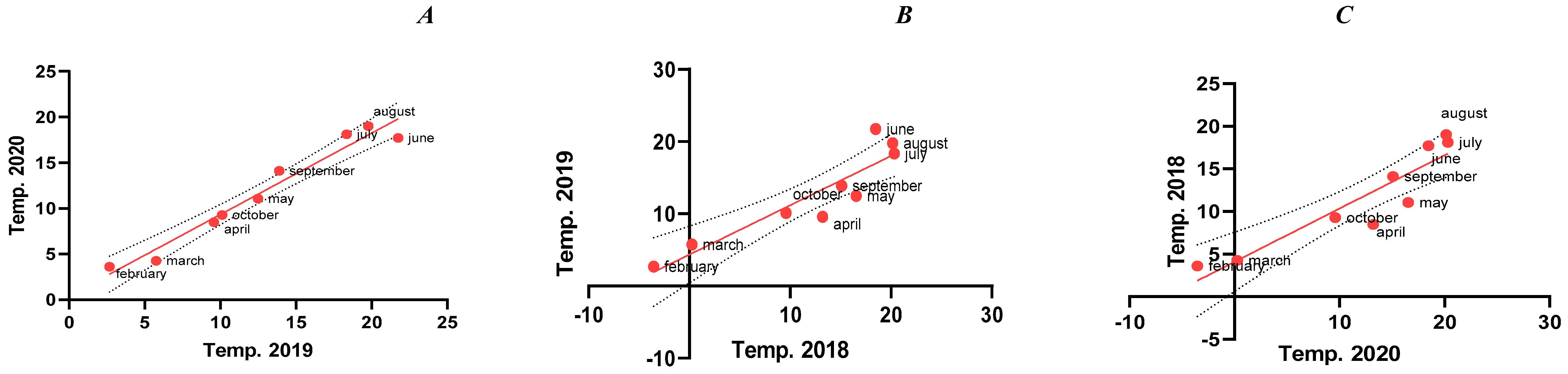
R square index also confirmed the higher (approximately 0.96) explained variation within the independent comparison of seasons 2018 and 2020. Presented data confirmed, that according to the temperature fluctuation, the seasons of 2018 and 2020 were the most diverse.
3.2.2. The Effect of the Seasonal Temperature Fluctuation on the Activity of Genes Employed in Apple Fruit Ripening Processes
The assessment of the effects (presented as volcano plots) of temperature changes on gene activity was carried out for the three temperature fluctuating periods from three evaluated seasons: early spring (showing the temperature range between −1,6 to 14.9 °C, at the turn of spring and early summer (14.9 to 19,4 °C), and autumn (temperature ranged between 19.4 to 17,7 °C, until the day of harvesting ripe fruits (supplementary Figure S3). On this basis, the effects of seasonal temperature changes on the number of gene transcripts were determined. The significance of seasonal temperature changes effects on the gene transcripts activity are presented as Pearson correlation matrix (Table 4.).
In the fruits of the mid-ripening apple cv. ‘Pinokio’, a significant increase in the activity of the StG gene (regulates the starch degradation pathway) was noted. Activation of this gene was promoted by lower spring temperatures, while higher temperatures significantly inhibited its number of transcripts (supplementary Figure S3, Table 4). Additionally, a decrease in StG activity was observed in case of this cv. (effect of fold change over 90x) when the temperature in the pre-harvest period ranged between 14 to 19 °C. In the fruits of the late-ripening cv. ‘Ligolina’, low temperatures significantly promoted the activation of the AASA gene. In addition, the higher temperature occurring in the seasons, especially in early autumn, significantly modified its activity. Simultaneously, in fruits of ‘Pink Braeburn’, lower temperatures favored an increase in the activity of the AALA1 gene (fold change ranged 179x) (Table 4., supplementary Figure S3). This type of regulation of AALA1 was recognized as occurring in the bark (cortex) of ripe fruits of the reference cv. ‘Royal Gala’ (Table 2. M&M). Moreover, for ‘Pinokio’ and ‘Pink Braeburn’ (mid-ripening cv.), negative impact of low temperatures in early spring was observed for AAXA and AAFB. At the same time, in ‘Ligolina’ (considered as ta late cv.), those genes were significantly activated when temperatures were higher during fruit ripening. For ‘Pinokio’ and ‘Ligolina’ cultivars, we have observed that the higher temperature (in summer) negatively impact the activity of all tested genes. Moreover, low temperature (especially spring frosts) showed positive effect on the increase in the activity of tested genes (excluding AAFB) in the fruits of ‘Ligolina’. In addition, AALA1 gene was significantly activated by lower temperatures in the genomes of apple cultivars, assigned in this research as early ripening. Meanwhile, in case of late ripening ‘Ligolina’ higher temperature of 17–19 °C forced the activation of StG and AAFB genes. A summary of positive and negative effects between gene activity and temperature occurring in the consecutive seasons are presented in Table 4.
3.2.3. Impact of the Seasonal Temperature Changes on the Apple Fruit Features
The highest effect of temperature changes in all evaluated seasons was noted for the fruit weight (FW) of ‘Pink Braeburn’. For this trait, a significantly negative relationship with temperature changes was estimated for fruits collected in the seasons 2018 and 2020 (comparison 2018 vs. 2019 and 2018 vs. 2020). Such relationships were olso observed in the fruit of early ripening ‘Ligol’ cv.. In addition, the possitive impact of temperature changes observed in seasons 2018 and 2019 on this trait was noted for ‘Pink Braeburn’, ‘Pinokio’ and ‘Ligolina’.
Simultinously, significantly negative or negligible relationship between all evaluated fruit traits in compared seasons 2018 vs. 2020 was observed for all apple cultivars tested. For ‘Pink Braeburn’ as well as for ‘Ligol’, changes in temperature conditions in the examined compared seasons 2018 vs. 2019 and 2018 vs. 2020 also respond in negative effect on the values of TA and FF traits. The negative or no significant effect of temperature fluctuations in regulation of TSS trait, observed in the same comparative seasons was noted for the fruits of all tested apple fruits (Table 5.).
Generally we have observed that in the comparisons in which the 2018 and 2019 seasons were included, temperature changes had the greatest significant effects in differentiating the assessed phenotypic traits. The volcano plots for the trait values in season comparments are presnted in suplementary Figure S4.
3.2.4. Correlation Between Gene Activities and the Values of Apple Fruit Characteristics
Based on the calculation of coefficient of determination (R2), the highest relationship was noted between AAYA and AAAA2 genes (R2 in the range of 0.46–0.99) and all the tested fruit quality parameters of the cultivars collected in different ripening dates (Table 6). Only in case of cultivars ‘Pinokio’ and ‘Pink Braeburn’ both genes did not show any correlation with IEC. Meanwhile, in the genomes of all tested apple cultivars, a significant correlation was noted between activity of analyzed genes (R2 ranged between 0.54–0.99, excluding AALA1 and AASA), fruit weight and fruit firmness. In case of ‘Pinokio’ cultivar, the activity of the AAFB gene was significantly correlated with all tested fruit quality parameters, while in the case of the reference cultivar ’Ligol’, four genes: AAAA1, AAFB, AASA and AAXA (R2 ranged between 0.65–0.97) showed a significant relationship between the number of gene transcripts and TSS value. Moreover, the lowest significnace between gene activity and evluated fruit features of ‘Pink Braeburn’ was noted for genes AALA1 and AASA. The R2 ratios and the level of significance (p > 0.05, 0.01, 0.001 and 0,0001) for all tested genes, fruit parameters and eveluated apple cultivars are presented in Table 6.
4. Discussion
Three years (2018–2020) of apple fruits evaluation preliminarily allowed us to recognize the mechanism of influence of weather conditions (in our case temperature fluctuations in evaluated seasons) on gene expression, general fruit development, and fruit features. There are several methods presenting the seasonal temperature variation such as average temperatures (e.eg. from October previous season to April next season [33]), degree days or by the sum of cumulative temperature (usually being the reference points: 0.0, 4.0, 5.0, 10.0 and 15.0 °C). The last attribute could be calculated while the temperature loggers are distributed around the tree [5,7]. For the fruit evaluation, presented in our study we have collected temperatures from all year period/per individual season from the METOS, Pessl Instruments station which collect the hourly temperature measurements, with the accuracy of ±0,01 °C. In addition, we have consider the equal time period including full bloom until fruit harvest, thus the fruit collection dates were in August, September and October, when the evaluated cultivars reaching maturation stage. As it was underlined by Łysiak and Szot, the winter critical temperature for apple growth ranges between −1.9 °C to −3,0 °C, injuring buds in the post bloom phenological period in the range from 10 to 100% respectively [5]. In our case in the period of February to April the temperature ranged (averagely in the season) between −1,6 to 14,9 °C (giving the total periodical sum of 16,5 °C). Taking into account those observations, our choice of seasonal temperature ranges seems to be clearly justified, since there is no accepted minimal and maximal base temperature defined so far. The author’s also underline that the automated metrological stations installed in orchards, are the obligatory devices to determine general temperature measurements and evaluate any correlation between indicated fruit parameters. These indices also give the possibility to predict the developmental stage of fruit dedicated for long storage [6].
In parallel fruit evaluated process, based on the available databases we have chosen, so far uncharacterized, gene sequences recognized in ‘Royal Gala’ genome, within the project of The Horticulture and Food Research Institute of New Zealand, and submitted in NCBI database (https://www.ncbi.nlm.nih.gov/) in 2004. As one of the structural gen, known to be involved in starch degradation pathway in apple fruit flesh, we have selected StG encoding starch glucosidase. Based on our previous research, StG was recognized as valuable functional molecular marker for apple fruit harvest date prediction [11].
We have analyzed the relationship of three-dimensional data: genotype (G) x phenotype (P) x environment (E), collected for three evaluated seasons. Despite relatively low temperature variation between the years of fruit assessment (R2 ranged between 0.85–0.96—the highest fluctuation of the temperatures was observed in the seasons of 2018 and 2019 and the year-to-year difference was −0.48) and due to significant variation in evaluated time periods in single season of observations, we were able to define the general interactions between the (E)x(G)x(P) components: weather annual changes, single genes expression changes and variation in fruit characteristics.
The relationships between seasonal temperature changes and gene activity regulation are presented on the scheme below.
Our data show the dynamics of the apple fruit development process occurring on the cell level and depending on the stage of fruit maturation as well as on the impact of the seasonal temperature changes. Interestingly, the inhibition of AAXA and AAFB by low temperatures before full fruit maturation was observed for mid-ripening cvs. ‘Pinokio’ and ‘Pink Braeburn’. This observation may confirm that both apple cvs. are at the similar developmental stages and temperatures can significantly modulate (accelerating or braking) their apple ripening cycle. Moreover, AAXA gene, known as up regulated in fruit apple cortex before full ripening of ‘Royal Gala’ (Table 2. M&M), showed down regulation in fruit flesh tissue of tested apples. In case of this gene we have observed down regulation of its expression in apple cultivars tested (excluding late-ripening ‘Ligolina’). In parallel, AAFB considered as being expressed in peel of ‘Royal Gala’, as well as StG, were significantly down regulated in the genomes of cultivars ripening earlier than ‘Ligol’. Moreover, the high temperature negatively impacted on the StG, AAAA1, AAFB, AALA1, AASA genes activity in the genomes of ‘Pinokio’ and ‘Ligolina’.
Negative impact of low temperatures noted for the AAFB gene, could occurred due to its involvement in regulation of fruit peel development, thus its inhibition in ‘Pinokio’ and ‘Ligol’ cultivars may be caused by ‘redirection’ of its transcription pathway from mesocarp cells to the skin cells. This may be adjusted by presence of transposable regulatory sequences present in Malus genome structure [34,35,36]. Brown, Telias and coworkers confirmed that the genetic variation occurred within the fruit developmental process is modulated by such transposable elements [37,38]. They can affect alternative transcription start site at the gene expression both at the transcriptional and post-transcriptional level [39]. Moreover, in our study, two genes AAAA2 and AAYA, did not show a significant relationship between calculated number of gene transcripts and temperature changes. Considering that the AAAA2 was described as to be active in the seeds of ripe fruits of the reference cv. ‘Royal Gala’ (Table 2 M&M), no relationship was determined between its expression profile changes and seasonal temperature fluctuations.
Generally, based on presented research we can conclude, that the high temperatures negatively affected the expression of analyzed genes, except AABF and AAAA1, for all apple genotypes tested (Figure 2). In case of AASA and AAYA, no significant impact of low and high temperature during fruit developmental seasons was observed. I must be taken into account that upper temperature in spring (up to 18 °C) is necessary for the significant activation of some important genes such as flower bud formation factor (FBF), while in autumn low temperature (below 11 °C for day and 7 °C at night) was the one which favorited its down regulation [40]. Moreover, low temperature (especially spring frosts) showed positive effect on the increase in the activity of tested genes in the fruits of ‘Ligolina’. AALA1 gene was significantly activated by lower temperatures in the genome of this apple cultivar, assigned in this research as late ripening. This may underline, that ‘Ligolina’ reflects significant cold hardiness.
It was also reported, that higher temperature significantly decreased the fruit quality parameters such as fruit acidity and anthocyanin content [41]. Our observations clearly confirmed that lower temperatures, occurred in autumn and during fruit ripening improved the value of apple fruit quality parameters (especially the balance between TSS and TA). In seasons 2018 and 2019 (mostly in 2019), fruit assessed 150 DAFB represented a significantly higher TSS content and lower TA content compared to the warmer season 2020. This may be as a result in an increase in the activity of most of the studied genes under the influence of lower temperatures. Many authors also confirmed that the final consumable value of apple fruits depends on the balance between the sugar and acid content [42,43,44]. As it was previously reported, in apple fruits, there is a positive correlation between the malic acid content and glucose content, but the malic acid content is negatively correlated with sucrose content [45,46,47].
Additionally, the presented results uncovered the relation of the temperature affection on TSS and TA in all analyzed apple cultivars and its correlation with the significant variation in the activity of the StG gene (structural gene of the starch degradation pathway), inhibited by high temperature and overexpressed under lower temperature exposition during fruit maturation.
In addition we have observed, that temperatures below 10 °C, recorded in the seasons 2018 and 2019 detected at the fruits maturity stage of evaluated apples (150 DAFB), promoted fruit internal ethylene production, and the fruits lost firmness faster.
A similar observation was described by Heide and coworkers, in which low temperature in autumn negatively effect on apple fruit mass and firmness of the ‘Jonagold’ and ‘Cox’s Orange Pippi’ cv. [48]. In addition, we have observed the effect of temperature fluctuation regarding apple fruit features also depended on the individual genotype studied, which approve the insights of other researchers [48,49]. In the results described by Chagne et al., the year effect generally impacted all fruit parameters except firmness measured at harvest [17,50]. Meanwhile, in our research we noticed opposite relationships and observed the significant year effect, in regard to the temperature changes, on loss of fruit firmness for all evaluated apple cultivars. Our data also bring the new shed light in the relationship of TSS and TA and the temperature influence on the fruit value of four apple cultivars, not reported so far.
The presented results confirmed the insights of the authors, underlying the complex response mechanisms involved in physiological and biochemical changes in plants, and shed light in understanding the general fruit development process [1,49,50]. Our study seems to be the first, explaining the aspect of relationship of components such as: gene activity, phenotype and environment in four different apple cultivars breed in Polish orchards. However, further directions of this type of research should concern also of other commercial apple cultivars in future analysis.
5. Conclusions
We performed a three-dimensional analysis for genotype x phenotype x environment to understand the response of an individual apple genotype to growth conditions. The developed model, based on functional molecular markers, dependent on genotype and an average temperature in the three seasons assessed, may allow for a more precise determination of the apple ripeness stage.
In the presented studies, we observed a better effect of low temperatures (seasons with relatively lower temperatures before full fruit ripening) on the activity of the analyzed genes, as well as on the values of the assessed parameters.
The obtained results may allow for early determination of the harvest date of fruits intended for direct consumption and long-term storage, as well as implementation of breeding programs aimed at improving the quality of apple fruits. The application of various data collection and following genome sequencing approaches brought the knowledge for understanding the mechanism of gene activation and silencing during fruit development. It gives quick definition of proper fruit harvest date, based on changes in expression profiles of genes from signaling pathways impacted by environmental condition.
Supplementary Materials
The following supporting information can be downloaded at the website of this paper posted on Preprints.org. Figure S1: Climate Graph of temperature fluctuations in the years 2018–2020. Figure S2: Expression profiles of selected genes in apple fruits on various stages of ripeness. Diagrams present an average relative fold change in the gene expression data with the standard error of the mean (±SEM) compared to earliest ripening cv. ‘Ligol’ and t-test significance calculation level at p < 0,05*, 0,01**, 0,001***, normalized to Md18sRNA gene (showing stable expression in the experiment layout). The data for ‘Ligol’, an early ripening control, are marked in red. Figure S3: Volcano plots showing fold changes (represented by Log(p-value)) of the number of gene transcripts in the average seasonal temperature intervals (−1,6 vs. 14,9 °C, −1,6 vs. 19,4 °C, −1.6 vs. 17,7 °C, 14,9 vs. 19,4 °C, 14,9 vs. 17,7 °C and 19,4 vs. 17,7 °C. Figure S4: Volcano plots showing relative changes (represented by Log(p-value)) of the value of: fruit weight (FW), Internal Ethylene Concentration (IEC), Total Soluble Solids (TSS), Titratable acidity (TA) and fruit firmness (FF) in regard with an average temperature fluctuation observed in the compared seasons (2018 vs. 2019, 2018 vs. 2020 and 2019 vs. 2020).
Author Contributions
Conceptualization, Keller-Przybyłkowicz Sylwia; methodology, Keller-Przybyłkowicz Sylwia, Kuras Anita, Rutkowski Krzysztof, Skorupińska Anna; software, Keller-Przybyłkowicz Sylwia; validation, Keller-Przybyłkowicz Sylwia, Rutkowski Krzysztof; formal analysis, Keller-Przybyłkowicz Sylwia, Idczak Bogusława, Strączyńska Krystyna, Czarnecka Renata; investigation, Keller-Przybyłkowicz Sylwia, Rutkowski Krzysztof; resources, Lewandowski Mariusz; data curation, Keller-Przybyłkowicz Sylwia; writing— original draft preparation, Keller-Przybyłkowicz Sylwia; writing—review and editing, Keller-Przybyłkowicz Sylwia, Rutkowski Krzysztof; visualization, Keller-Przybyłkowicz Sylwia. All authors have read and agreed to the published version of the manuscript.
Funding
This research was funded by the Polish Ministry of National Education: grant number ZHRS 1.3.1—statutory project.
Data Availability Statement
Data available on request.
Acknowledgments
We would like to give special thanks to Prof. Waldemer Treder and dr Krzysztof Klamkowski for the controlling of the meteo system, conversion and access to the meteo data.
Conflicts of Interest
The authors declare no conflicts of interest.
References
- Lee, J.-C.; Park, Y.-S.; Jeong, H.-N.; Kim, J.-H.; Heo, J.-Y. Temperature changes affected spring phenology and fruit quality of apples grown in high-latitude region of South Korea. Horticulturae 2023, 9, 794. [Google Scholar] [CrossRef]
- Available online: https://300gospodarka.pl/.
- Ruchel, Q.; Zandona, R.R.; Fraga, D.S.; Agostinettop, D.; Langaro, A.C. Effect of high temperature and recovery from stress on Crop-Weed interaction. Bragantia 2020, 79, 582–591. [Google Scholar] [CrossRef]
- Keller-Przybyłkowicz, S.; Lewandowski, M.; Korbin, M. Identification of the genome regions correlated with cold hardiness of apple rootstocks by transcriptomic analysis of differentially expressed candidate genes. Biuletyn Instytutu Hodowli i Aklimatyzacji Roślin 2019, 286, 415–418. [Google Scholar]
- Łysiak, G.P.; Szot, I. The Use of Temperature Based Indices for Estimation of Fruit Production Conditions and Risks in Temperate Climates. Agriculture 2023, 13, 960. [Google Scholar] [CrossRef]
- Łysiak, G.P. Degree days as a method to estimate the optimum harvest date of ‘Conference’ pears. Agriculture 2022, 12, 1803. [Google Scholar] [CrossRef]
- Łysiak, G. The sum of active temperatures as a method of determining the optimum harvest date of ‘S̆ampion’ and ‘Ligol’ apple cultivars. Acta Sci. Pol., Hortorum Cultus 2012, 11, 3–13. [Google Scholar]
- Eberhardt, M.V.; Lee, C.Y.; Liu, R.H. Antioxidant activity of fresh apples. Nature 2000, 405, 903–904. [Google Scholar] [CrossRef]
- Hyson, A.D. A Comprehensive Review of Apples and Apple Components and Their Relationship to Human Health. Advances in Nutrition 2011, 2, 408–420. [Google Scholar] [CrossRef]
- Oyenihi, A.B.; Belay, Z.A.; Mditshwa, A.; Caleb, O.J. “An apple a day keeps the doctor away”: The potentials of apple bioactive constituents for chronic disease prevention. Journal of Food Science 2022, 87, 2291–2309. [Google Scholar] [CrossRef]
- Keller-Przybyłkowicz, S.E.; Rutkowski, K.P.; Kruczyńska, D.E.; Pruski, K. Changes in gene expression profile during fruit development determine fruit quality. Hort. Sci (Prague) 2016, 49, 1–9. [Google Scholar] [CrossRef]
- Conner, P.; Brown, S.; Weeden, N. Molecular-marker analysis of quantitative traits for growth and development in juvenile apple trees. Theor Appl Genet 1998, 96, 1027–1035. [Google Scholar] [CrossRef]
- Cãtãlina, D.; Adriana, S.; Bozdog, C.; Radu, S. Estimation of genetic effects implied in apple inheritance of quantitative traits. J. Hortic. Forestry Biotechnol 2015, 19, 85–90. [Google Scholar] [CrossRef]
- Zheng, W.; Shen, F.; Wang, W.; Wu, B.; Wang, X.; Xiao, C.; Tian, Z.; Yang, X.; Yang, J.; Wang, Y.; et al. Quantitative trait loci-based genomics-assisted prediction for the degree of apple fruit cover color. The Plant Genome 2020, 13. [Google Scholar] [CrossRef]
- Sun, X.; Jiao, C.; Schwaninger, H.; et al. Phased diploid genome assemblies and pan-genomes provide insights into the genetic history of apple domestication. Nat Genet 2020, 52, 1423–1432. [Google Scholar] [CrossRef] [PubMed]
- Kumar, S.; Molloy, C.; Muñoz, P.; Daetwyler, H.; Chagné, D.; Volz, R. Genome-enabled estimates of additive and nonadditive genetic variances and prediction of apple phenotypes across environments. G3 2015, 5, 2711–2718. [Google Scholar] [CrossRef]
- Chen, Y.; Wen, X.; Sun, Y.; Zhang, J.; Wu, W.; Liao, Y. Mulching practices altered soil bacterial community structure and improved orchard productivity and apple quality after five growing seasons. Scientia Horticulturae 2014, 172, 248–257. [Google Scholar] [CrossRef]
- Liu, W.; Chen, Z.; Jiang, S.; Wang, Y.; Fang, H.; Zhang, Z.; Chen, X.; Wang, N. Research progress on genetic basis of fruit quality traits in apple (Malus x domestica). Front. Plant Sci. 2022, 13. [Google Scholar] [CrossRef]
- Cãpraru, F.; Zlati, C. Observations regarding yield phenophases of some diseases genetic resistant apple cultivars, in the conditions of Bistrita Region. Horticulturã 2009, 539–544. [Google Scholar]
- Howell, J.F. and Neven, L.G. Physiological Development Time and Zero Development Temperature of the Codling Moth (Lepidoptera: Tortricidae). Environmental Entomology 2000, 29, 766–772. [Google Scholar] [CrossRef]
- Spayd, S.E.; Tarara, J.M.; Mee, D.L.; Ferguson, J.C. Separation of Sunlight and temperature Effects on the Composition of Vitis vinifera cv. Merlot Berrie. Am. J. Enol. Vitic 2002, 53, 171–182. [Google Scholar] [CrossRef]
- Menzel, A.; Estrella, N.; Fabian, P. Spatial and temporal variability of the phenological seasons in Germany from 1951 to 1996. Global Change Biology 2001, 7, 657–666. [Google Scholar] [CrossRef]
- Gian-Reto, W. Plants in a warmer world. Perspectives in Plant Ecology. Evolution and Systematics 2003, 6/3, 169–185. [Google Scholar]
- Yang, S.; Logan, J.; Coffey, D.L. Mathematical formulae for calculation the base temperature for growing degree days. Agric. Forest Meteorol. 1995, 74, 61–74. [Google Scholar]
- Jansen, B.J.; Thodey, K.; Schaffer, R.J.; Alba, R.; Balakrishman, L.; Bishop, R.; Bowen, J.H.; Crowhurst, R.N.; Gleave, A.P.; Ledger, S.; McArtney, S.; Pichler, F.B.; Snowden, K.C.; Ward, S. Global gene expression analysis of apple fruit development from the floral bud to ripe fruit. BMC Plant Biology 2008, 8. [Google Scholar] [CrossRef] [PubMed]
- Boudolf, V.; Vlieghe, K.; Beemster, G.T.; Magyar, Z.; Torres Acosta, J.A.; Maes, S.; Van Der Schueren, E.; Inze, D.; De Veylder, L. The plant-specific cyclin-dependent kinase CDKB1;1 and transcription factor E2Fa-DPa control the balance of mitotically dividing and endoreduplicating cells in Arabidopsis. Plant Cell. 2004, 16, 2683–2692. [Google Scholar]
- Dewitte, W.; Murray, J.A. The plant cell cycle. Annu Rev Plant Biol. 2003, 54, 235–264. [Google Scholar]
- Spruck, C.; Strohmaier, H.; Watson, M.; Smith, A.P.; Ryan, A.; Krek, T.W.; Reed, S.I. A CDK-independent function of mammalian Cks1: targeting of SCF(Skp2) to the CDK inhibitor p27Kip1. Mol Cell 2001, 7, 639–650. [Google Scholar]
- Blanco, A.; Fernández, V.; Val, J. Improving the performance of calcium-containing spray formulations to limit the incidence of bitter pit in apple (Malus x domestica Borkh.). Scientia Horticulturae 2010, 127, 23–28. [Google Scholar] [CrossRef]
- Li, M.; Feng, F.; Cheng, L. Expression patterns of genes involved in sugar metabolism and accumulation during apple fruit development. PLoS ONE 2012, 7, e33055. [Google Scholar]
- Zeng, Y.; Yang, T. RNA Isolation from Highly Viscous Samples Rich in Polyphenols and Polysaccharides. Plant. Mol. Biol. Rep. 2002, 20, 417. [Google Scholar]
- Livak, K.J.; Schmittgen, T.D. Analysis of relative gene expression data using real-time quantitative PCR and the 2(-Delta DeltaC(T)). Methods 2001, 25, 402–408. [Google Scholar]
- Warrington, I.J.; Fulton, T.A.; Halligan, E.A.; de Silva, H.N. Apple Fruit Growth and Maturity Are Affected by Early SeasonTemperatures. J. Am. Soc. Hortic. Sci. 1999, 124, 468–477. [Google Scholar]
- Velasco, R.; Zharkikh, A.; Affourtit, J.; et al. The genome of the domesticated apple (Malus × domestica Borkh.). Nat Genet 2010, 42, 833–839. [Google Scholar] [CrossRef] [PubMed]
- Antonius-Klemola, K.; Kalendar, R.; Schulman, A.H. TRIM retrotransposons occur in apple and are polymorphic between varieties but not sports. Theor Appl Genet. 2006, 112, 999–1008. [Google Scholar] [CrossRef] [PubMed]
- Han, Y.; Korban, S.S. Spring: a novel family of miniature inverted-repeat transposable elements is associated with genes in apple. Genomics 2007, 90, 195–200. [Google Scholar] [CrossRef]
- Brown, S.K. Pome fruit breeding: progress and prospects. Acta Hort. 2003, 622, 19–34. [Google Scholar]
- Telias, A.; Lin-Wang, K.; Stevenson, D.E.; Cooney, J.M.; Hellens, R.P.; Allan, A.C.; Hoover, E.E.; Bradeen, J.M. Apple skin patterning is associated with differential expression of MYB10. BMC Plant Biol. 2011, 11, 93. [Google Scholar] [CrossRef] [PubMed] [PubMed Central]
- Feschotte, C. Transposable elements and the evolution of regulatory networks. Nature Rev Genetics 2008, 9, 397–405. [Google Scholar] [CrossRef]
- Abbott, D.L. and Bull, V. The effect of summer temperature on flower initiation and fruit bud development. Annual Report of Long Ashton Research Station 1973, 35–36. [Google Scholar]
- Yamada, H.; Ohmura, H.; Arai, C.; Terui, M. Effect of preharvest fruit temperature on ripening sugars, and watercore occurrence in apples. J. Amer. Soc. Hort. Sci. 1994, 119, 1208–1214. [Google Scholar] [CrossRef]
- Bai, Y.; Dougherty, L.; Cheng, L.; Xu, K. A co-expression gene network associated with developmental regulation of apple fruit acidity. Mol Genet Genomics 2015, 290, 1247–1263. [Google Scholar] [CrossRef]
- Zhang, B.; Han, Y. Genomics of fruit acidity and sugar content in apple. In Apple Genome; Korban, S.S., Ed.; Springer Nature: Switzerland, 2021; pp. 297–309. [Google Scholar] [CrossRef]
- Rui, L.; Yang, Y.-Y.; Zheng, P.-F.; Wang, C.-K.; Wang, X.; Li, H.-L.; Liu, G.-D.; Liu, R.-X.; Wang, X.-F.; You, C.-X. Genome-Wide analysis of MdABF subfamily and functional identification of MdABF1 in drought tolerance in apple. Science Direct 2022. [Google Scholar] [CrossRef]
- Ma, D.; Sun, D.; Wang, C.; Li, Y.; Guo, T. Expression of flavonoid biosynthesis genes and accumulation of flavonoid in wheat leaves in response to drought stress, Plant Physiol. Biochem. 2014, 80, 60–66. [Google Scholar]
- Musacchi, S.; Serra, S. Review: apple fruit quality: overview on pre-harvest factors. J. Sci. Hortic 2018, 234, 409–430. [Google Scholar] [CrossRef]
- Bui, T.A.T.; Stridh, H.; Molin, M. Influence of weather conditions on the quality of ‘Ingrid Marie’ apples and their susceptibility to grey mould infection. Journal of Agriculture and Food Research 2021, 3. [Google Scholar] [CrossRef]
- Heide, O.M.; Rivero, R.; Sønsteby, A. Temperature control of shoot growth and floral initiation in apple (Malus × domestica Borkh.). CABI Agric Biosci 2020, 1. [Google Scholar] [CrossRef]
- Zydlik, Z.; Kayzer, D.; Zydlik, P. The influence of some climatic conditions on the yield and fruit of replanted apple orchard. Pol. J. Environ. Study. 2023, 33, 4493–4501. [Google Scholar] [CrossRef]
- Chagné, D.; Daya Dayatilake, D.; Diack, R.; Murray, O.; Ireland, H.; Watson, A.; Gardiner, S.E.; Johnston, J.W.; Schaffer, R.J.; Tustin, S. Genetic and environmental control of fruit maturation, dry matter and firmness in apple (Malus × domestica Borkh.). Horticulture Research 2014, 1, 14046. [Google Scholar] [CrossRef]
Figure 2.
Scheme of the circular relationship between gene activity and seasonal temperature fluctuations. Down arrows show negative regulation of the gene activity and up arrows show positive effect on regulation of gene activity in regard to temperature changes. Symbol ⊥ underline no significant effect.
Figure 2.
Scheme of the circular relationship between gene activity and seasonal temperature fluctuations. Down arrows show negative regulation of the gene activity and up arrows show positive effect on regulation of gene activity in regard to temperature changes. Symbol ⊥ underline no significant effect.
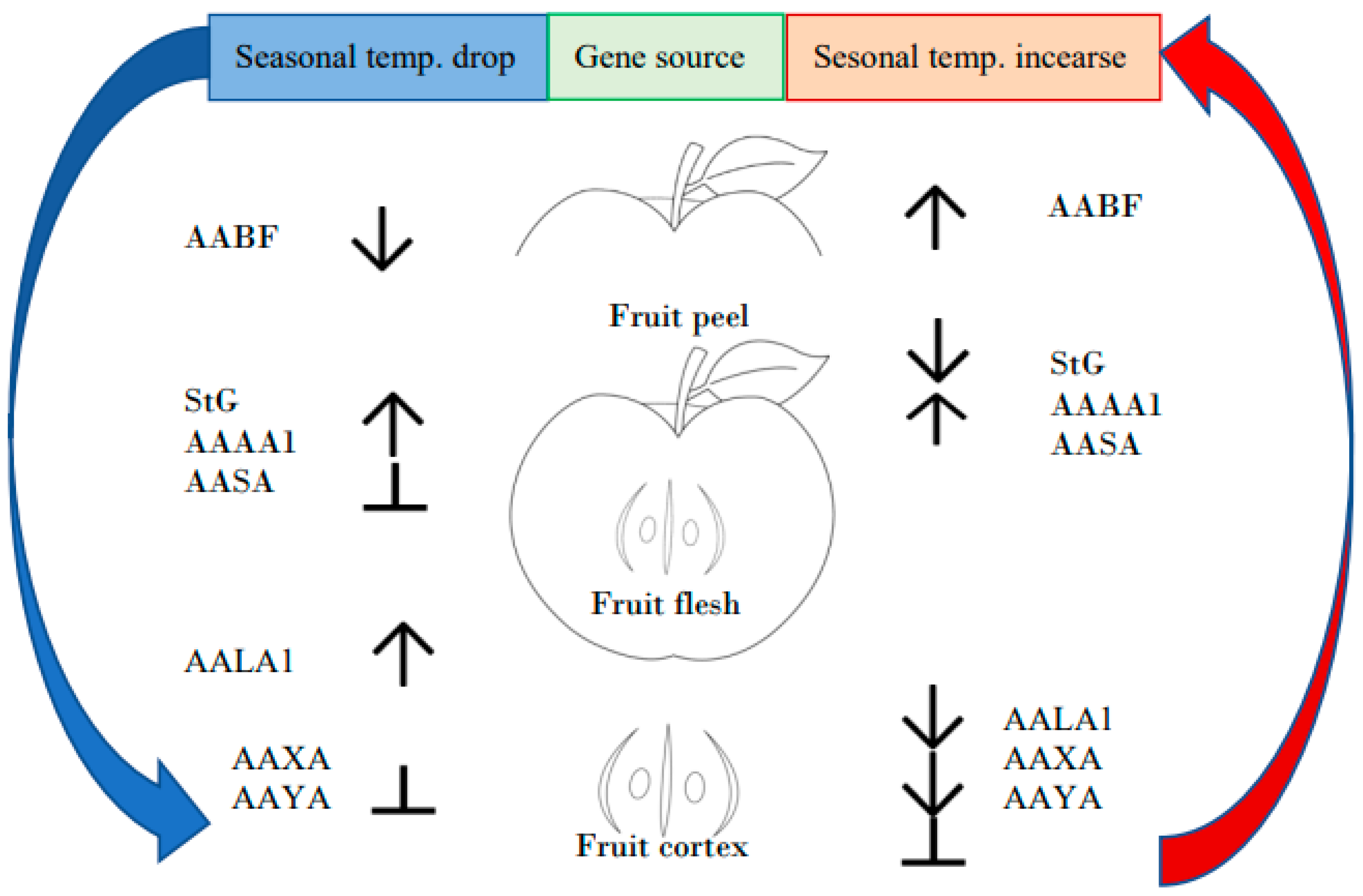

Table 1.
Fruit collection dates.
| Season/year 2018 | Season/year 2019 | Season/year 2020 | |||||||||||||
| Apple cv. | FB* | I | II | III | IV | FB* | I | II | III | IV | FB* | I | II | III | IV |
| ‘Ligol’ | 30.04 | 12.09 | 17.09 | 22.09 | 27.09 | 2.05 | 11.09 | 16.09 | 21.09 | 26.09 | 1.05 | 10.09 | 15.09 | 20.09 | 25.09 |
| ‘Pink Braeburn’ | 2.05 | 17.09 | 21.09 | 26.09 | 01.10 | 3.05 | 16.09 | 20.09 | 25.09 | 30.09 | 3.05 | 16.09 | 20.09 | 25.09 | 30.09 |
| ‘Pinokio’ | 3.05 | 16.09 | 20.09 | 25.09 | 30.09 | 5.05 | 18.09 | 23.09 | 27.09 | 2.10 | 4.05 | 19.09 | 22.09 | 26.09 | 01.10 |
| ‘Ligolina’ | 6.05 | 20.09 | 25.09 | 30.09 | 4.10 | 8.05 | 22.09 | 27.09 | 02.10 | 07.10 | 6.05 | 20.09 | 25.09 | 30.09 | 4.10 |
*FB- date of the full bloom of the apple genotype in evaluated seasons.
Table 2.
Putative function and localization of the selected genes and sequence of oligonucleotides complementary to their mRNA sequence.
Table 2.
Putative function and localization of the selected genes and sequence of oligonucleotides complementary to their mRNA sequence.
| Gen | Sequence ID/gene function and location | Oligo Forward | Oligo Revers |
| StG | EE663791 Starch glucosilase | atctcctcgcatcaacaac | agaagacggagagcagacca |
| AAAA1 | 020403AAAA006503CR/(AAAA) fruits of Royal Gala, 59 DAFB, seeds removed, M. domestica clone cDNA AAAAA00650, mRNA | cattcccggcaatcttacaaac | gaccagtcaccatcccaaat |
| AAFB | 020815AAFB001404CR/(AAFB) Royal Gala, apple skin peel, 150 DAFB M. domestica clone cDNA AAFB 00140, s mRNA | ggccgtagaatttccacatttc | acaacaatctcacaggtcctatac |
| AALA1 | 020208AALA001579CR/(AALA) Royal Gala 150 DAFB fruit cortex M. domestica clone cDNA AALAA00157, mRNA | caacaacgggaccagagataa | agcaggtttgagaagaaggg |
| AASA | 020514AASA003901CO/(AASA) Royal Gala 10 DAFB fruit M. domestica cDNA clone AASAA00390, mRNA | cggcaagaagtcaatgaagaac | tcccagaaccagagttgaaag |
| AAYA | 020308AAYA001283CR/(AAYA) Royal Gala 126 DAFB fruit cortex M. domestica clone cDNA AAYAA00128, mRNA | gatccatgaactcgtcgttga | cagggttcggacagaaagaa |
| AAAA2 | 030210AAAA009549CR/(AAAA) Royal Gala fruits 59 DAFB, seeds removed M. domestica clone cDNA AAAAA00954, mRNA | ggaagaacaggcttgctttg | aaatgacgtcccttcgctatta |
| AAXA | 021203AAXA001589CO/(AAXA) Royal Gala 126 DAFB fruit core M. domestica clone cDNA AAXAA00158, mRNA | ggcgactccaatacgatgaa | actgatgcagaatccacagag |
Table 3.
Analysis of variance and year-to-year correlation coefficient, between an average temperature changes within the evaluated months of fruit development.
Table 3.
Analysis of variance and year-to-year correlation coefficient, between an average temperature changes within the evaluated months of fruit development.
| Analysis of Variance | 2019 vs. 2020 | 2018 vs. 2019 | 2018 vs. 2020 | ||||||||||||
| SS | DF | MS | F | p value | SS | DF | MS | F | p value | SS | DF | MS | F | p value | |
| Regression | 507.1 | 2 | 253.6 | 17.40 | p = 0.0032 | 263.4 | 2 | 131.7 | 74.59 | p < 0.0001 | 317 | 2 | 158.5 | 70.17 | p < 0,0001 |
| R squared (R2)* | 0.853 | 0.9613 | 0.959 | ||||||||||||
| Difference between means | 0.9674 | −0.4753 | 0.4921 | ||||||||||||
| SE of difference | 0.4649 | 1.254 | 1.319 | ||||||||||||
*R-squared (R2) defining how well the independent variable(s) in a statistical model explain the variation in the dependent variable. It ranges from 0 to 1, where 1 indicates a perfect fit of the model to the data. SE—standard error value.
Table 4.
Effects of the gene activity and temperature changes within the evaluated seasons (ns—not significant). The higest value of the negative effects are in bold and italic, the higest values of positive effects are in bold. (SE—standard error).
Table 4.
Effects of the gene activity and temperature changes within the evaluated seasons (ns—not significant). The higest value of the negative effects are in bold and italic, the higest values of positive effects are in bold. (SE—standard error).
| temp −1,6 vs. 14,9 °C | temp −1,6 vs. 19,4 °C | temp −1,6 vs. 17,7 °C | temp 14,9 vs. 19,4 °C | temp 14,9 vs. 17,7 °C | temp 19,4 vs. 17,7 °C | ||||||||
| gene | Difference |
SE of difference |
Difference |
SE of difference |
Difference |
SE of difference |
Difference |
SE of difference |
Difference |
SE of difference |
Difference |
SE of difference |
|
| Pinokio | STG | 113 | 28,87 | ns | ns | ns | ns | 5,669 | 0,55 | −92 | 8,78 | −97,69 | 8,777 |
| AAAA1 | 17,2 | 4,01 | −3,1 | 0,5 | −109 | 4,7 | −3,7 | 0,22 | −110 | 4,68 | 46,97 | 1,844 | |
| AAFB | −33 | 0,81 | −36 | 1,3 | −55 | 1,67 | ns | ns | −22 | 1,85 | −18,33 | 2,122 | |
| AALA1 | 17,2 | 4,01 | ns | ns | −646 | 19,07 | −35 | 1,32 | −664 | 18,6 | −628,7 | 18,69 | |
| AASA | 23,6 | 2,18 | 21,2 | 2,2 | −640 | 6,6 | −2,36 | 0,35 | −664 | 6,23 | −661,5 | 6,235 | |
| AAYA | −1,4 | 0,054 | ns | ns | −1,2 | 0,044 | 0,895 | 0,22 | ns | ns | −0,687 | 0,2166 | |
| AAAA2 | 1,78 | 0,26 | ns | ns | 2,02 | 0,176 | ns | ns | ns | ns | ns | ns | |
| AAXA | 19,8 | 3,46 | 17,2 | 3,5 | ns | ns | −2,64 | 0,18 | −19 | 1,03 | −16,36 | 1,043 | |
| Ligolina | STG | 22,8 | 0,985 | −199 | 11 | 22,8 | 0,986 | −222 | 11,1 | 221,7 | 11,12 | ||
| AAAA1 | 54,2 | 0,155 | 7,57 | 1,8 | 54,5 | 0,162 | −46,6 | 1,84 | 0,4 | 0,08 | 23,63 | 1,896 | |
| AAFB | −95 | 2,297 | −21 | 1,9 | 73,93 | 2,96 | 96 | 2,28 | 22,17 | 1,896 | |||
| AALA1 | −3,7 | 0,39 | −23 | 1,9 | 0,94 | 0,034 | −19 | 1,93 | 4,6 | 0,39 | 23,63 | 1,896 | |
| AASA | 684 | 29,43 | 616 | 32 | 689 | 29,43 | −68,7 | 12,2 | ns | ns | 73,24 | 12,24 | |
| AAYA | 1,49 | 0,09 | ns | ns | ns | ns | −1,92 | 0,14 | ns | ns | ns | ns | |
| AAAA2 | ns | ns | ns | ns | ns | ns | ns | ns | −0,7 | 0,15 | ns | ns | |
| AAXA | 257 | 6,56 | 202 | 10 | 258 | 6,561 | −54,4 | 8,02 | 0,9 | 0,13 | 55,32 | 8,023 | |
| Ligol | STG | 26,3 | 3,84 | 40,9 | 3,7 | 36,7 | 3,674 | 14,59 | 1,12 | 10 | 1,12 | −4,145 | 0,0372 |
| AAAA1 | ns | ns | ns | ns | ns | ns | −1,09 | 0,05 | −1,1 | 0,01 | ns | ns | |
| AAFB | −1,1 | 0,07 | −1 | 0 | −10 | 1,45 | ns | ns | −9 | 1,45 | −9,154 | 1,45 | |
| AALA1 | 136 | 29,45 | 136 | 29 | 136 | 29,45 | ns | ns | ns | ns | ns | ns | |
| AASA | ns | ns | ns | ns | −2,1 | 0,25 | ns | ns | −1,3 | 0,25 | −1,501 | 0,139 | |
| AAYA | 1,28 | 0,23 | −5,3 | 0,3 | 1,68 | 0,17 | −6,55 | 0,32 | ns | ns | 6,945 | 0,285 | |
| AAAA2 | −0,8 | 0,06 | −3,5 | 0,5 | −2,8 | 0,19 | −2,75 | 0,53 | −2 | 0,2 | ns | ns | |
| AAXA | 257 | 6,56 | 202 | 10 | 258 | 6,561 | −54,4 | 8,02 | 0,9 | 0,13 | 55,32 | 8,023 | |
| Pink Braeburn | STG | −28 | 2,364 | −1,3 | 0,2 | −62 | 1,009 | 26,41 | 2,37 | −34 | 2,57 | −60,7 | 1,03 |
| AAAA1 | −51 | 6,137 | −27 | 1,8 | −1 | 0,035 | 23,61 | 6,41 | 50 | 6,14 | 26,14 | 1,84 | |
| AAFB | −223 | 34,7 | −2,2 | 0,1 | −1,2 | 0,082 | 221,2 | 34,7 | 222 | 34,7 | 1,019 | 0,103 | |
| AALA1 | 179 | 2,884 | 178 | 2,9 | 176 | 2,89 | −1,11 | 0,08 | −3 | 0,17 | −1,931 | 0,177 | |
| AASA | −151 | 4,321 | −3,8 | 0,1 | −1 | 0,092 | 146,8 | 4,32 | 150 | 4,32 | 2,88 | 0,16 | |
| AAYA | 4,86 | 0,13 | 6,07 | 0 | 6,17 | 0,061 | 1,217 | 0,12 | 1,3 | 0,13 | ns | ns | |
| AAAA2 | 0,56 | 0,085 | 1,48 | 0,1 | 1,44 | 0,091 | 0,912 | 0,01 | 0,9 | 0,03 | ns | ns | |
| AAXA | −40 | 5,26 | −5,1 | 0,2 | −2,3 | 0,107 | 35,34 | 5,26 | 38 | 5,26 | 2,741 | 0,207 | |
Table 5.
Effects of the apple trait values and temperature changes within the evaluated seasons (ns—not significant). The higest value of the negative effects are in bold and italic, the higest values of positive effects are in bold.
Table 5.
Effects of the apple trait values and temperature changes within the evaluated seasons (ns—not significant). The higest value of the negative effects are in bold and italic, the higest values of positive effects are in bold.
| cv. | Trait assesment | 2018 vs. 2019 | 2018 vs. 2020 | 2019 vs. 2020 | |||
| Effect | SE | Effect | SE | Effect | SE | ||
| Ligol | FW | ns | ns | −65,85 | 11,85 | −95,79 | 10,75 |
| IEC | ns | ns | ns | ns | ns | ns | |
| TSS | −1,51 | 0,4013 | ns | ns | ns | ns | |
| TA | −0,1912 | 0,03057 | −0,1123 | 0,01942 | ns | ns | |
| FF | −16,24 | 2,407 | −7,331 | 2,13 | ns | ns | |
| Pink Braeburn | FW | 46,36 | 4,687 | −58,89 | 17,7 | −105,3 | 18,26 |
| IEC | −9,873 | 2,374 | ns | ns | ns | ns | |
| TSS | −1,535 | 0,2852 | ns | ns | ns | ns | |
| TA | ns | ns | ns | ns | ns | ns | |
| FF | −10,53 | 2,364 | −7,884 | 1,801 | |||
| Pinokio | FW | 91,55 | 15,47 | ns | ns | −99,17 | 10,84 |
| IEC | −12,25 | 1,626 | ns | ns | 11,02 | 2,039 | |
| TSS | −1,338 | 0,4316 | ns | ns | ns | ns | |
| TA | ns | ns | ns | ns | ns | ns | |
| FF | ns | ns | ns | ns | ns | ns | |
| Ligolina | FW | 76,29 | 14,03 | ns | ns | −90,64 | 12,99 |
| IEC | ns | ns | ns | ns | ns | ns | |
| TSS | 0,8107 | 0,228 | 0,7883 | 0,1998 | ns | ns | |
| TA | ns | ns | ns | ns | ns | ns | |
| FF | ns | ns | ns | ns | ns | ns | |
Table 6.
Corelation matrix plot representing relationships between gene activity and the avarage value of fruit traits measured in evaluated seasons (FW-fruit weight, IEC-Internal Ethylelne Concentration, TSS, Total Soluble Solids, TA-titratabel acidity, FF-fruit firmness). The significance of the between analyzed components was calculated according to R2 test with p-value: p > 0,05 (*), 0,01 (**), 0,001 (***) and 0,0001 (****). The most significant phenotype—genotype correlation are presented in bold.
Table 6.
Corelation matrix plot representing relationships between gene activity and the avarage value of fruit traits measured in evaluated seasons (FW-fruit weight, IEC-Internal Ethylelne Concentration, TSS, Total Soluble Solids, TA-titratabel acidity, FF-fruit firmness). The significance of the between analyzed components was calculated according to R2 test with p-value: p > 0,05 (*), 0,01 (**), 0,001 (***) and 0,0001 (****). The most significant phenotype—genotype correlation are presented in bold.
| Apple cv. | Trait | StG | AAAA1 | AAFB | AALA1 | AASA | AAYA | AAAA2 | AAXA |
| Ligol | FW | 0,93**** | 0,94**** | 0,94**** | 0,79**** | 0,94**** | 0,94**** | 0,94**** | 0,94**** |
| IEC | 0,32** | 0,08 | 0,15 | 0,13 | 0,22* | 0,52**** | 0,46*** | 0,12 | |
| TSS | 0,04 | 0,97**** | 0,65**** | 0,07 | 0,97**** | 0,72**** | 0,93**** | 0,93**** | |
| TA | 0,32** | 0,15 | 0,15 | 0,13 | 0,42*** | 0,55**** | 0,55**** | 0,16 | |
| FF | 0,78**** | 0,97**** | 0,96**** | 0,09 | 0,97**** | 0,97**** | 0,97**** | 0,97**** | |
| Pink Braeburn | FW | 0,84**** | 0,85**** | 0,44*** | 0,58**** | 0,66**** | 0,90**** | 0,90**** | 0,87**** |
| IEC | 0,20* | 0,17* | 0,12 | 0,13 | 0,12 | 0,08 | 0,19* | 0,07 | |
| TSS | 0,10 | 0,06 | 0,09 | 0,09 | 0,08 | 0,85**** | 0,98**** | 0,0003 | |
| TA | 0,29** | 0,28** | 0,14 | 0,15 | 0,15 | 0,30** | 0,61**** | 0,19* | |
| FF | 0,59**** | 0,70**** | 0,006 | 0,035 | 0,09 | 0,98**** | 0,99**** | 0,83**** | |
| Pinokio | FW | 0,53**** | 0,02 | 0,78**** | 0,0006 | 0,0001 | 0,86**** | 0,86**** | 0,84**** |
| IEC | 0,31** | 0,14 | 0,46*** | 0,17* | 0,15 | 0,12 | 0,09 | 0,15 | |
| TSS | 0,25* | 0,13 | 0,33** | 0,15 | 0,14 | 0,98**** | 0,97**** | 0,003 | |
| TA | 0,34** | 0,14 | 0,56**** | 0,17* | 0,16 | 0,74**** | 0,65**** | 0,40*** | |
| FF | 0,002 | 0,088 | 0,52**** | 0,082 | 0,073 | 0,98**** | 0,98**** | 0,91**** | |
| Ligolina | FW | 0,31** | 0,78**** | 0,71**** | 0,86**** | 0,007 | 0,87**** | 0,87**** | 0,20* |
| IEC | 0,18* | 0,34** | 0,24* | 0,21* | 0,18* | 0,71**** | 0,86**** | 0,22* | |
| TSS | 0,12 | 0,13 | 0,11 | 0,12 | 0,16* | 0,98**** | 0,99**** | 0,17* | |
| TA | 0,18* | 0,34** | 0,24* | 0,20* | 0,18* | 0,65**** | 0,82**** | 0,22* | |
| FF | 0,001* | 0,54**** | 0,27** | 0,94**** | 0,09 | 0,99**** | 0,99**** | 0,009 |
Disclaimer/Publisher’s Note: The statements, opinions and data contained in all publications are solely those of the individual author(s) and contributor(s) and not of MDPI and/or the editor(s). MDPI and/or the editor(s) disclaim responsibility for any injury to people or property resulting from any ideas, methods, instructions or products referred to in the content. |
© 2025 by the authors. Licensee MDPI, Basel, Switzerland. This article is an open access article distributed under the terms and conditions of the Creative Commons Attribution (CC BY) license (http://creativecommons.org/licenses/by/4.0/).
Copyright: This open access article is published under a Creative Commons CC BY 4.0 license, which permit the free download, distribution, and reuse, provided that the author and preprint are cited in any reuse.


