

Submitted:
05 March 2025
Posted:
07 March 2025
You are already at the latest version
Abstract
Taekwondo is a physically demanding martial art that requires strength, flexibility, agility, and mental focus, with intense training and competition often leading to physical and psychological stress that can impair performance and well-being. While massage therapy is recognized for enhancing muscle recovery, reducing injury risk, alleviating stress, and improving sleep quality in athletes, its specific effects on Taekwondo athletes remain underexplored. This review aims to evaluate the impact of massage therapy on physical recovery, injury prevention, and psychological well-being in Taekwondo athletes through a comprehensive literature review of studies sourced from databases such as Science Direct, Google Scholar, Sport Discus, and PubMed, using MeSH terms including "massage therapy," "Taekwondo athletes," "muscle recovery," "injury prevention," "psychological well-being," "Swedish massage," "deep tissue massage," "sports massage," "performance optimization," and "sleep quality." The findings indicate significant improvements in muscle recovery, injury prevention, and psychological well-being among Taekwondo athletes receiving massage therapy. Thus, massage therapy emerges as an effective intervention for enhancing recovery, performance, and well-being in Taekwondo athletes, with further research recommended to optimize massage protocols for maximal benefits.
Keywords:
athletes
; massage
; martial arts
; sports massage
; performance optimization
Introduction
Taekwondo, a martial art originating in Korea, was initially developed to enhance combat abilities among soldiers and individuals [1]. Following the Korean War, it spread internationally and evolved into modern sport by the late 1950s [1]. Its inclusion in the Olympic Games in 1994 solidified its global prominence, making it one of the most widely practiced martial arts today [1]. Taekwondo is characterized by its dynamic, high-speed kicks and requires exceptional speed, power, and agility [2]. Competitors must combine physical prowess with strategic thinking, mental focus, and technical skill to succeed in bouts that alternate between intense bursts of action and periods of relative inactivity [2,3].
The demanding nature of Taekwondo necessitates rigorous physical preparation and mental resilience. Physical attributes such as aerobic and anaerobic power, muscular strength, flexibility, and agility are critical for success [2,4]. Equally important are psychological factors, as athletes must manage stress, maintain focus, and adapt to the high-pressure environment of competition [2,3]. These physical and mental demands make effective recovery essential for sustaining peak performance.
Massage therapy has gained recognition in sports medicine as a valuable tool for enhancing recovery and performance [5,6]. It is widely used in athletic populations to improve muscle recovery, prevent injuries, and alleviate stress, offering both physical and psychological benefits [7,8]. For Taekwondo athletes, who face unique challenges such as muscle fatigue from repeated high-intensity movements and mental strain from strategic decision-making, massage therapy could play a pivotal role. Research indicates that massage therapy promotes muscle relaxation, enhances circulation, and reduces delayed onset muscle soreness (DOMS), contributing to faster recovery after intense training or competition [9,10]. Additionally, the psychological benefits—such as reduced anxiety, improved mood, and heightened relaxation—are particularly relevant for athletes navigating the mental pressures of elite competition [8,9].
The physical and mental demands of Taekwondo make it essential for athletes to maintain optimal health and well-being to achieve peak performance [2,4,11,12]. With the increasing recognition of alternative therapies in sports medicine, massage therapy has emerged as a promising intervention to enhance athletes' recovery and overall performance [13]. While there is existing literature supporting the benefits of massage therapy in various sports disciplines [14,15,16,17], there is a lack of comprehensive reviews specifically focusing on its impact on Taekwondo athletes. This review aims to fill this gap by providing a comprehensive assessment of the existing literature on the effects of massage therapy on Taekwondo athletes' performance and well-being. By synthesizing the available evidence, this review aims to provide valuable insights and recommendations for athletes, coaches, and sports medicine professionals to optimize training regimens and improve competitive outcomes in Taekwondo.
Materials and Methods
Search strategy
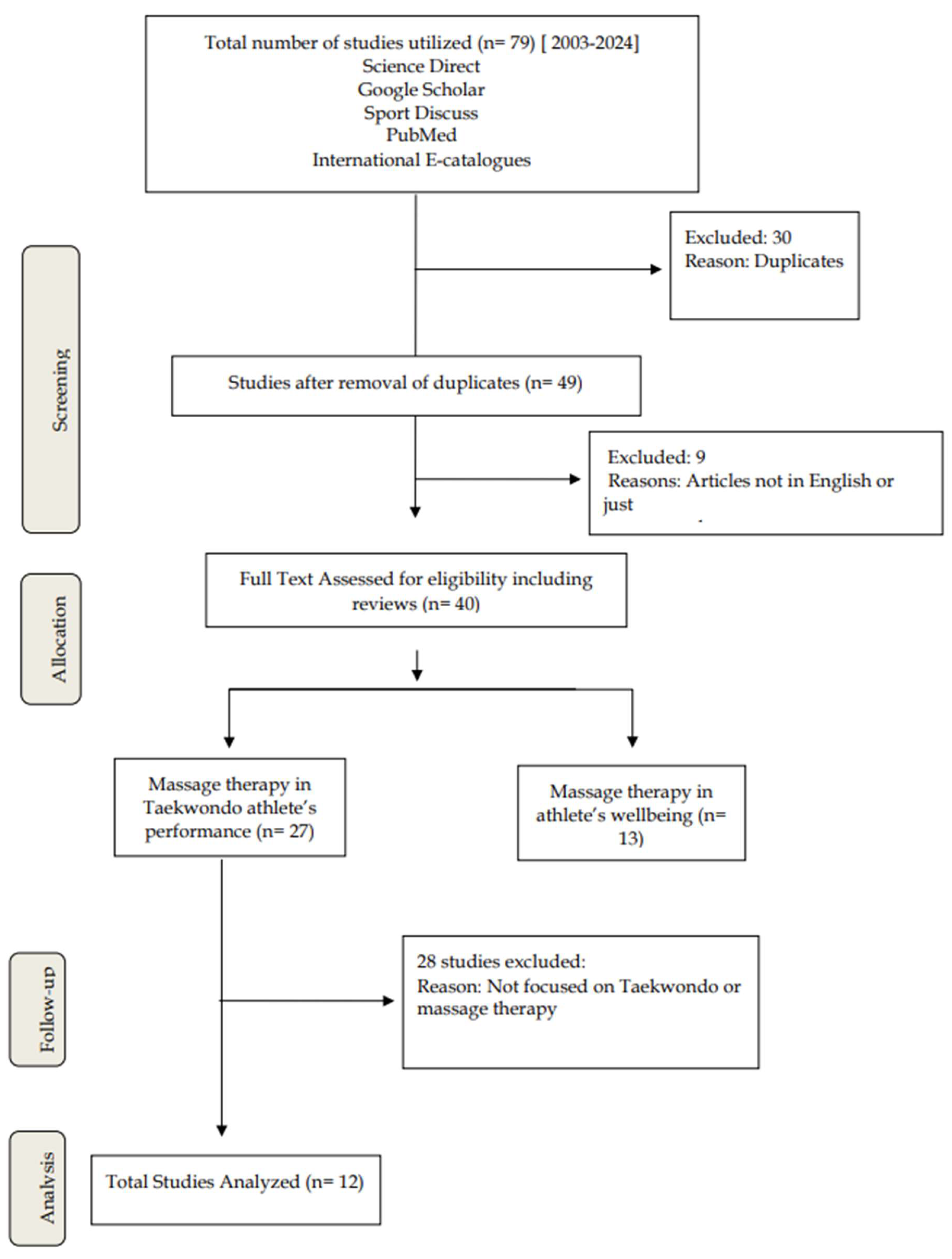
A systematic literature search was conducted following the Preferred Reporting Items for Systematic Reviews and Meta-Analyses (PRISMA) guidelines. Studies were sourced from various databases, including Science Direct, Google Scholar, Sport Discuss, and PubMed. A comprehensive keyword search was performed using MeSH headings and keywords, including "massage therapy," "Taekwondo athletes," "muscle recovery," "injury prevention," "psychological well-being," "Swedish massage," "deep tissue massage," "sports massage," "performance optimization," and "sleep quality." The search was limited to studies published between 1995 and 2024. Only peer-reviewed articles in English were considered, and the search results were categorized for discussion, as illustrated in Figure 1.
Inclusion and exclusion criteria
Inclusion criteria
The studies included in this review met specific criteria outlined during the search process. A keyword search using the aforementioned MeSH headings and keywords was conducted. These terms were combined and exploded for a comprehensive search of articles spanning from 2003 to 2024, as detailed in the data sources section. This broad search aimed to identify a diverse range of studies examining the effects of massage therapy on Taekwondo athletes' performance and well-being. Such a comprehensive approach serves as a foundation for future studies to delve deeper into the optimal strategies and interventions for enhancing the health and performance of Taekwondo athletes.
Exclusion criteria
To maintain the relevance of the research included in this review, specific exclusion criteria were applied. Full-text articles in the English language were exclusively considered for this study. Additionally, articles were excluded if they were not focused on combat sports, including Taekwondo, or if they were non-peer-reviewed articles, conference papers, and reviews. Studies were also excluded if they did not provide evidence demonstrating the effects of massage therapy on the physical and mental well-being of Taekwondo athletes.
Data extraction
The studies that did not meet the inclusion criteria were excluded from the analysis. Following the collection and analysis of significant data, which encompassed an examination of the effects of massage therapy on Taekwondo athletes' performance and well-being, the first author also evaluated eligibility for inclusion in a full-text article analysis. The final selection underwent approval by one of the co-authors, and any issues were addressed until clarity was achieved.
All the papers included in the analysis were sorted into two categories, either "massage therapy in Taekwondo" or "massage therapy in Taekwondo athlete’s wellbeing," based on the respective journals or conferences of publication and associated keywords. The data-gathering process involved extracting information from the papers. To evaluate the contributions of each study to the effects of massage therapy, details about analysis methodologies, types of massage therapy used, and outcomes related to physical and psychological well-being were collected. The findings were then systematically organized into distinct categories and placed within a comprehensive framework, which will serve as the structure for discussing the outcomes.
Results
This research utilized 79 full-text English-language papers obtained from 79 citations identified through electronic searches. After eliminating duplicates and reviewing full-text versions, 12 articles were retained for analysis. The study identified various types of massage and their effects on Taekwondo. Refer to Table 1 for the effects of massage on Taekwondo athletes' performance and Table 2 for the effects of massage on athletes' well-being.
Figures, Tables and Schemes

Table 1.
Effect of massage therapy on Taekwondo athletes’ performance.
| Type of massage | Study | Participants | Key findings | Citation |
|---|---|---|---|---|
| Swedish massage | Bayrakdaroğlu et al. |
12 Taekwondo athletes with more than five years of practice |
Significant improvements in dynamic balance (right foot) were observed with 10- and 15-minute protocols, regardless of the time of day (p < 0.05). | [10] |
| Pre-event massage | Mohamed Shapie et al. | 45 athletes aged 21 to 26 | Significant improvement in kicking speed was noted compared to control and static stretching groups (p < 0.01). | [18] |
| Fascial therapy | Unalmis et al. | 32 licensed Taekwondo players | Significant improvements in flexibility, balance, anaerobic power, and speed were found compared to the control group (p < 0.05). | [3] |
| Myofascial release | Mehmet Akarsu et al. |
21 Taekwondo players |
Significant improvement in vertical jump performance was observed after self-myofascial release compared to jogging and static stretching (p < 0.01). | [19] |
| Manual massage | Sykaras et al. | 12 elite female Taekwondo athletes | Lower reduction in peak eccentric torque of knee extensors was noted compared to control (p < 0.05). | [20] |
| Manual massage | Sykaras | 14 elite male athletes | No significant improvement in peak torque reduction after exercise-induced muscle damage was observed (p > 0.05). | [21] |
| General Massage therapy | Seo et al. |
24 male collegiate athletes |
Significant reduction in blood lactate levels post-exercise was observed compared to the control group (p < 0.01). |
[22] |
Table 2.
Effect of massage therapy on Taekwondo athletes’ well-being.
| Study | Participants | Key findings | Citation |
| Zadkhosh et al. | Youth wrestlers | Significant reductions in anxiety and stress were observed after a 10-session sports massage intervention (p < 0.05). | [23] |
| Pa et al. | 14 elite Malaysian tennis athletes | Significant reduction in cortisol levels and decreased pre-competition anxiety with sports massage therapy (p < 0.01). | [24] |
| Aeini | Female rowers | Significant decrease in fatigue and improvement in mood was found after 12 massage sessions (p < 0.05). | [25] |
Discussion
For centuries, massage has been used by healthcare professionals to help people with sickness and injuries [26]. It has both calming and invigorating characteristics that may impact an athlete's performance at different stages like before, during, and after training or competition [10]. Massage, broadly described as the manipulation of soft tissue, can be utilized to promote recovery, prevent injuries, and serve as a passive warming technique before performances [10]. There are different types of massage therapies including Swedish massage, sports massage, pre-event massage, myofascial release, fascial therapy, manual massage [27,28].
A study by Bayrakdaroğlu et al., [10] aimed to examine the effects of different durations of Swedish massage on the static and dynamic balance of Taekwondo athletes at different times of the day. The study involved twelve Taekwondo athletes with more than five years of regular practice [10]. They underwent static and dynamic balance tests after different massage protocols, including a no-massage protocol (NMP), a five-minute massage protocol (5MMP), a ten-minute massage protocol (10MMP), and a fifteen-minute massage protocol (15MMP), administered twice a day (morning and evening) on non-consecutive days [10]. The findings revealed significant improvements in dynamic balance, particularly in the right foot, among Taekwondo athletes who received a 10MMP or 15MMP compared to those in the NMP group [10]. Interestingly, these improvements were observed regardless of the time of day when the massages were administered [10]. The results suggest that the duration of massage plays a crucial role in enhancing dynamic balance in Taekwondo athletes, with longer massage durations leading to more pronounced improvements [10]. Furthermore, the study highlights the potential benefits of incorporating short-duration Swedish massages into pre-competition routines to optimize dynamic balance, a critical component of Taekwondo performance [10].
A study by Mohamed Shapie et al., aiming to compare the effects of static stretching and pre-event massage on kicking speed among Taekwondo athletes found massage to be of particular importance in Taekwondo athletic performance [18]. Forty-five athletes aged 21 to 26 were divided into control, static stretching, and pre-event massage groups [18]. Kicking speed was measured before and after intervention using a 10-second kicking speed test [18]. Results showed that the pre-event massage group demonstrated a significant improvement in kicking speed compared to the control and static stretching groups [18]. These findings underscore the importance of massage therapy as a preparation method for Taekwondo athletes, offering potential benefits in enhancing performance. By manipulating fiber arrangement, promoting better blood flow, and aiding in the removal of biological wastes like lactic acid, pre-event massage appears to have a positive impact on athletic performance [18].
A study by Unalmis et al., investigated the impact of an eight-week fascial therapy program on the physical fitness parameters of Taekwondo athletes [3]. Conducted to enhance performance and recovery, this study enrolled 32 licensed taekwondo players actively engaged in training [3]. The participants were divided into two groups: a fascial therapy group (FTG) and a control group (CG) [3]. The study implemented a comprehensive fascial therapy program, consisting of osteopathic fascial therapy and relaxation techniques tailored specifically for the lower extremities of the athletes [3]. The therapy sessions, lasting approximately 30 minutes each, were conducted up to twice a week for eight weeks [3]. The participants in the FTG received the fascial interventions before their regular Taekwondo training sessions, while those in the CG did not undergo any additional intervention apart from their usual training regimen [3]. To assess the efficacy of the fascial therapy program, various physical fitness parameters were measured before and after the intervention period [3]. These parameters included flexibility, balance, speed (20m sprint), anaerobic power (assessed through vertical jump and standing long jump tests), among others [3]. Statistical analysis revealed significant improvements in these parameters among the participants in the FTG compared to the CG [3]. Specifically, the FTG exhibited significant enhancements in flexibility, balance, anaerobic power, and speed, as evidenced by lower sprint times and greater jump distances [3]. In contrast, the CG showed no significant changes in these parameters over the same period [3]. These findings underscore the potential benefits of incorporating structured fascial therapy programs into the training regimens of taekwondo athletes. By targeting the fascial system, these interventions may contribute to improved physical performance and overall athletic development, offering athletes a valuable tool for optimizing their competitive edge.
A study by Mehmet Akarsu et al., investigated the immediate effects of self-myofascial release using foam roller techniques and static stretching methods on the vertical jump performance of Taekwondo athletes [19]. Employing a cross-sectional design with a randomized controlled experimental approach, the study recruited 21 Taekwondo players who had undergone three years of training and volunteered to participate [19]. The study implemented protocols that targeted muscle groups such as the quadriceps, hamstrings, adductors, and gastrocnemius, for both self-myofascial release and static stretching exercises [19]. Notably, the results showed a significant improvement in vertical jump performance following self-myofascial release using foam roller exercises compared to both 5 minutes of slow-paced jogging and static stretching (p<0.05) [19]. This indicates a promising immediate enhancement of Taekwondo athletes' vertical jump performance through self-myofascial release, highlighting its potential significance in optimizing athletic abilities.
Another study on manual massage focused on its effects on the peak torque of the knee extensors after short-term intense continuous concentric-eccentric isokinetic exercise [20]. The study aimed to investigate the possible effects of manual massage on concentric and eccentric peak torque of knee extensors when applied during intervals of exercise [20]. Twelve elite female Taekwondo athletes participated in the study [20]. Participants were subjected to continuous concentric/eccentric isokinetic exercise with manual massage applied during breaks to one extremity, while the other limb served as the control with passive intervals [20]. Peak torque was measured before and after the exercise protocol [20]. Results showed that for both groups, peak torque (concentric and eccentric) was reduced after the exercise protocol [20]. However, the massage group exhibited a significantly lower reduction for the eccentric type of muscle work (p < 0.05) [20]. Specifically, no statistical differences were noted in peak torque between extremities during the first two visits [20]. The findings indicated a significant difference in eccentric performance between limbs (F (1.22) = 8.27, p < 0.05) [20]. These results suggest that manual massage during isokinetic exercise intervals has an enhancing effect on the peak eccentric torque of the knee extensors, indicating its potential benefits in athletic performance and recovery [20].
A similar study on manual massage but investigating elite male athletes found that the application of manual massage during intervals of isokinetic exercise did not significantly improve the reduction in peak torque after exercise-induced muscle damage in the knee extensors [21]. Fourteen athletes participated in the study, undergoing continuous concentric and eccentric isokinetic exercises with manual massage applied to one leg during breaks, while the other leg served as a control with a passive interval [21]. Peak torque measurements were taken before and after the exercise protocol [21]. The results showed that both legs experienced a reduction in peak torque after the exercise, with the reduction being less in the leg receiving the massage [21]. However, this difference was not statistically significant (p > 0.05) [21]. Therefore, the application of manual massage during isokinetic exercise intervals did not improve the reduction in peak torque after exercise-induced muscle damage [21].
A study by Seo et al., [22] investigated the effects of electrical stimulation and massage therapy on blood lactate levels following anaerobic muscle fatigue in Taekwondo athletes. Conducted as a double-blind randomized controlled trial with 24 male collegiate athletes, the study aimed to compare the effectiveness of these interventions against a control group that rested post-exercise [22]. They found massage to significantly reduce blood lactate levels compared to the control group, indicating its efficacy in accelerating muscle recovery [22]. These findings suggest that massage therapy is effective in enhancing recovery, supporting its integration into post-training and post-competition routines for Taekwondo athletes to improve performance and well-being [22]. In practical terms, these findings support the use of massage therapy as a viable and effective method to aid recovery in Taekwondo athletes, helping to clear lactic acid more efficiently than passive rest. This can lead to improved performance, reduced muscle soreness, and quicker readiness for subsequent training or competition.
Many coaches and athletes widely apply massage in sports events because they believe, based on their observations and experiences, that it offers several body benefits. These include enhanced blood circulation, decreased muscle tension and neurological excitability, and an improved overall sense of well-being.
A study by Zadkhosh et al., [23] researching the effects of massage therapy on depression, anxiety, and stress in youth wrestlers found that after employing a 10-session intervention of 25-minute sports massages, significant reductions in anxiety and stress were observed in the experimental group compared to the control group, both with P < 0.001. Using the DASS Inventory, the study measured these outcomes before and after the intervention [23]. However, depression scores showed only a slight decrease and were not statistically significant (P = 0.955) [23]. These results suggest that massage therapy may effectively reduce anxiety and stress levels among youth wrestlers, highlighting its potential benefits for mental health in athletic populations.
A study by Pa et al., [24] investigated how sports massage therapy impacts cortisol levels and anxiety before competitions among elite tennis athletes in Malaysia. The study used a controlled experimental design with 14 elite Malaysian tennis athletes [24]. The study employed a treatment group that received sports massage therapy and a control group that did not receive any massage [24]. Using saliva samples and standardized psychological questionnaires, the study found that sports massage significantly reduced cortisol levels and decreased pre-competition anxiety among athletes [24]. These results indicate that sports massage therapy effectively lowers the physiological stress response and improves mental readiness.
Aeini [25] investigated how massage therapy impacts fatigue and mood among female rowers. The primary focus of the study was to determine whether regular massage sessions can reduce fatigue and improve mood in female rowers [25]. Female rowers underwent 12 massage sessions, and standardized questionnaires assessed fatigue levels and mood states before and after the intervention [25]. The results showed a significant decrease in fatigue levels among the female rowers who participated in the massage sessions [25]. This suggests that massage therapy is effective in alleviating physical fatigue. The study also found a notable improvement in mood among the participants [25]. The mood assessments indicated reduced negative mood states such as tension and confusion and an overall increase in positive mood [25].
Conclusions
This comprehensive review underscores the significant benefits of massage therapy for Taekwondo athletes, highlighting improvements in both physical performance and psychological well-being. The evidence from peer-reviewed studies reveals that various forms of massage therapy such as Swedish massage, pre-event massage, fascial therapy, myofascial release, and manual massage positively influence recovery, injury prevention, flexibility, balance, and psychological factors like anxiety and mood. For Taekwondo athletes and coaches, integrating massage therapy into training routines can optimize performance, reduce stress, and accelerate recovery. Future research should focus on refining these techniques and establishing evidence-based protocols tailored to the unique demands of Taekwondo.
Author Contributions
ML: SM, and MH contributed equally to this review article. Conceptualization, ML, SM, and MH; methodology, ML, SM, and MH; formal analysis, ML, SM, and MH; writing—original draft preparation, ML, SM, and MH; writing—review and editing, ML, SM, and MH. All authors have read and agreed to the published version of the manuscript.
Funding
This research received no external funding.
Institutional Review Board Statement
This study is a comprehensive review of published studies; therefore, ethics approval was not required.
Informed Consent Statement
Not applicable.
Data Availability Statement
No new data was created.
Acknowledgments
None.
Conflicts of Interest
The authors declare no conflicts of interest
Abbreviations
The following abbreviations are used in this manuscript:
CG Control Group
FTG Fascial therapy group
MMP Minute Massage Protocol
NMP No Massage Protocol
References
- Fong, S.S.M.; Ng, G.Y.F. Does Taekwondo training improve physical fitness? Phys Ther Sport 2011, 12, 100–106. [Google Scholar]
- Khayyat, H.N.; Sağır, S.G.; Hataş, Ö.; et al. Physical, physiological and psychological profiles of elite Turkish taekwondo athletes. Biomed Hum Kinet 2020, 12, 187–196. [Google Scholar] [CrossRef]
- Unalmis, Y.; Muniroglu, S. Examination of the effect of fascial therapy on some physical fitness parameters in taekwondo athletes. Sports Med Health Sci 2023, 5, 299–307. [Google Scholar] [CrossRef] [PubMed]
- Shaw, B.S.; Lloyd, R.; Da Silva, M.; Coetzee, D.; Moran, J.; Waterworth, S.P.W.; et al. German Volume Training for Health Promotion: Acute Vasopressor, Pulmonary and Metabolic Responses. Front. Physiol. 2022, 13, 1025017. [Google Scholar] [CrossRef]
- Weerapong, P.; Hume, P.A.; Kolt, G.S. The mechanisms of massage and effects on performance, muscle recovery and injury prevention. Sports Med 2005, 35, 235–256. [Google Scholar]
- Calleja-González, J. , Mielgo-Ayuso, J., Sampaio, J., et al. Brief ideas about evidence-based recovery in team sports. J Exerc Rehabil 2018, 14, 545–550. [Google Scholar] [CrossRef]
- Boguszewski, D. Application of physiotherapeutic methods to support training and post-exercise recovery of combat sports and martial arts contestants. J Combat Sports Martial Arts 2015, 6, 85–90. [Google Scholar] [CrossRef]
- Dakić, M.; Toskić, L.; Ilić, V.; Ðurić, S.; Dopsaj, M.; Šimenko, J. The effects of massage therapy on sport and exercise performance: a systematic review. Sports (Basel) 2023, 11, 110. [Google Scholar] [CrossRef]
- Hemmings, B.J. Physiological, psychological and performance effects of massage therapy in sport: a review of the literature. Phys Ther Sport 2001, 2, 165–170. [Google Scholar] [CrossRef]
- Bayrakdaroğlu, S.; Eken, Ö.; Bayer, R.; et al. Effects of Swedish massage at different times of the day on dynamic and static balance in taekwondo athletes. Healthcare (Basel) 2024, 12, 165. [Google Scholar] [CrossRef]
- Mathunjwa, M.; Mugandani, S.; Djarova-Daniels, T.; et al. Physical, anthropometric and physiological profiles of experienced junior male and female South African Taekwondo athletes. Afr J Phys Health Educ Recreat Dance 2015, 21, 1402–1416. [Google Scholar]
- Bridge, C.A.; Ferreira da Silva Santos, J.; Chaabène, H.; et al. Physical and physiological profiles of taekwondo athletes. Sports Med 2014, 44, 713–733. [Google Scholar] [CrossRef] [PubMed]
- Malone, M.A.; Gloyer, K. Complementary and alternative treatments in sports medicine. Prim Care 2013, 40, 945–968. [Google Scholar] [CrossRef] [PubMed]
- Hemmings, B.J. Physiological, psychological and performance effects of massage therapy in sport: a review of the literature. Phys Ther Sport 2001, 2, 165–170. [Google Scholar] [CrossRef]
- Moraska, A. Sports massage: a comprehensive review. J Sports Med Phys Fitness 2005, 45, 370–380. [Google Scholar]
- Davis, H.L.; Alabed, S.; Chico, T.J.A. Effect of sports massage on performance and recovery: a systematic review and meta-analysis. BMJ Open Sport Exerc Med, 2020; 6, e000614. [Google Scholar] [CrossRef]
- Brummitt, J. The role of massage in sports performance and rehabilitation: current evidence and future direction. N Am J Sports Phys Ther 2008, 3, 7–21. [Google Scholar]
- Mohamed Shapie, M.; Khiri, I. The effect between static stretch and pre-event massage on kicking speed score among university taekwondo athletes. Malaysian J. Sport Sci. Recreat. 2016, 12, 1–6. [Google Scholar]
- Akarsu, M.; Kurhan, C.O.; İlbak, İ.; et al. Acute effects of self-myofascial release through foam roller and static stretching methods on vertical jump performance of taekwondo players. J Pharm Negat Results 2022, 13, 2226–2230. [Google Scholar] [CrossRef]
- Sykaras, E.; Mylonas, A.; Malliaropoulos, N.; et al. Manual massage effect in knee extensors peak torque during short-term intense continuous concentric-eccentric isokinetic exercise in female elite athletes. Isokinet Exerc Sci 2003, 11, 153–157. [Google Scholar] [CrossRef]
- Sykaras, E. Effects of manual massage on peak torque following an exercise-induced muscle damage protocol of knee extensors in male elite Tae Kwon Do athletes. Int J Phys Educ Sports Health 2017, 4, 196–199. [Google Scholar]
- Seo, B.; Kim, D.; Choi, D.; et al. The effect of electrical stimulation on blood lactate after anaerobic muscle fatigue induced in taekwondo athletes. J Phys Ther Sci 2011, 23, 271–275. [Google Scholar] [CrossRef]
- Zadkhosh, S.M.; Ariaee, E.; Atri, A.E.; et al. The effect of massage therapy on depression, anxiety and stress in adolescent wrestlers. Int J Sport Stud 2015, 5, 321–327. [Google Scholar]
- Pa, W.A.M.W.; Salamuddin, N.; Zin, N.M.; et al. The effect of sports massage towards cortisol and pre-competition anxiety among Malaysian elite tennis athlete. J Contemp Issues Bus Gov 2021, 27, 654–660. [Google Scholar] [CrossRef]
- Aeini, M. Effect of massage on fatigue and mood in female rowers. Humanistic Approach Sport Exerc Stud (HASES) 2022, 2, 248–258. [Google Scholar] [CrossRef]
- Brummitt, J. The role of massage in sports performance and rehabilitation: current evidence and future direction. N Am J Sports Phys Ther 2008, 3, 7–21. [Google Scholar]
- Tsao, J.C.I. Effectiveness of massage therapy for chronic, non-malignant pain: a review. Evid Based Complement Alternat Med 2007, 4, 165–179. [Google Scholar]
- Paolini, J. Review of myofascial release as an effective massage therapy technique. Athl Ther Today 2009, 14, 30–34. [Google Scholar] [CrossRef]
Figure 1.
PRISMA Flow Chart of the study selection process
Disclaimer/Publisher’s Note: The statements, opinions and data contained in all publications are solely those of the individual author(s) and contributor(s) and not of MDPI and/or the editor(s). MDPI and/or the editor(s) disclaim responsibility for any injury to people or property resulting from any ideas, methods, instructions or products referred to in the content. |
© 2025 by the authors. Licensee MDPI, Basel, Switzerland. This article is an open access article distributed under the terms and conditions of the Creative Commons Attribution (CC BY) license (http://creativecommons.org/licenses/by/4.0/).
Copyright: This open access article is published under a Creative Commons CC BY 4.0 license, which permit the free download, distribution, and reuse, provided that the author and preprint are cited in any reuse.


