
Submitted:
05 March 2025
Posted:
05 March 2025
You are already at the latest version
Abstract
The development of artificial intelligence (AI) is drastically changing the agricultural scene and opening hitherto unheard-of chances to improve output, promote sustainability, and create resilience within food-producing systems all around. From thorough studies of particular applications—precision farming, autonomous systems, predictive analytics, and climate change adaptation—to a larger view of the socio-economic and environmental consequences, this thorough review investigates the current and prospective roles of artificial intelligence in agriculture. We evaluate both the natural difficulties (digital divides, data security, ethical issues) and the apparent advantages (higher yields, better resource allocation, data-driven decision-making). By means of a synthesis of multidisciplinary research results, we provide academics, legislators, industry leaders, and agricultural practitioners practical insights, policy suggestions, and strategic direction. Our main point of contention is the need for a cooperative, morally based, and human-centred strategy to guarantee the transforming power of artificial intelligence benefits not just a small number but all participants in the worldwide agricultural ecosystem. Promoting a shift to a food-secure, economically feasible, and ecologically sound future is ultimately the goal.
Keywords:
Artificial Intelligence
; Precision Agriculture
; Smart Farming
; Sustainable Agriculture
; Agricultural Robotics
; Machine Learning
; Crop Monitoring
; Food Security
; Technological Innovation
1. Introduction
The worldwide agriculture industry is now negotiating an unheard-of convergence of problems. With a fast rising population expected to reach almost 10 billion by 2025 (United Nations, 2019), meeting the rising food needs calls for a massive increase in agricultural output—a difficult chore compounded by a perfect storm of climate change impacts, resource constraint, and ongoing socioeconomic inequalities. Often based on labour-intensive operations and generationally passed-down expertise, traditional agricultural techniques are under increasing strain in their ability to withstand these growing constraints.
Supported by thorough research showing that they resulted in yield loss, the unfolding reality of climate change— manifested as erratic weather patterns, increasingly frequent extreme events, and changed precipitation regimes—directly and progressively threatens crop yields and the stability of agricultural livelihoods worldwide (IPCC, 2014). Apart from the ghost of climate change, the supply of important agricultural resources is gradually declining. Urbanisation and pollution are causing arable land to shrink; water shortage already affects a great number of people worldwide (FAO, 2011). Furthermore, the fundamental basis of agricultural output—soil health—is suffering from decades of intensive agricultural practices and overreliance on chemical inputs, leading to widespread nutrient depletion and biodiversity loss (Montgomery, 2007), which in turn returns to over 24% contribution of GHG emission.
These great social, financial, and environmental issues clearly need change. Conventional methods by themselves are showing insufficient. Fortunately, the technical field is undergoing a simultaneous upheaval. Artificial intelligence (AI) is more efficient, resource-wise, robust, and provides a formidable package of tools ready to transform agriculture.
This is not merely about incrementally improving existing practices; AI represents a fundamental shift in how we cultivate our food supply. This review takes readers along exploring this ongoing transformation.
2. The Rise of AI in Agriculture: The Data-Driven Paradigm
The core of the AI-driven agricultural revolution lies in its capacity to move beyond subjective observation and traditional wisdom. It leverages sophisticated algorithms, vast data streams, and intelligent automation to optimize agricultural processes, giving farmer direct, instant feedback and solutions. This profound shift rests upon two interconnected foundations: the powerful analytical engine of machine learning and the robust, interconnected data infrastructure that feeds it.
Fundamentally, machine learning (ML) gives computer systems the ability to learn from data and iteratively improve their performance without explicitly, step-by-step scripting (Jordan & Mitchell, 2015). This adaptive potential is changing the way agricultural systems are run, making fields and farms dynamic, responsive entities. Think about, for example, the powers of supervised learning. These ML models are trained on labelled datasets in which the intended outcomes—e.g., expected crop yield, presence of disease—are precisely described along with the input variables—e.g., weather data, soil conditions. This thorough training helps models like Random Forest and Support Vector Machines to provide rather exact crop production forecasts. Table 1 Khaki and Wang (2019) referenced in Jeong et al., 2016, Jeong et al., 2018 Beyond simple prediction, supervised learning drives revolutionary uses in plant disease diagnosis. Using Convolutional Neural Networks (CNNs) to examine plant photos, scientists have shown accuracy rates over 95% in identifying illnesses even in early, pre-symptomatic phases (Sladojevic et al., 2016; ta et al., 2016, shown in Table 1). By means of optimal and exact input application, this not only reduces possible production losses but also promotes sustainable fertilisation practices.
Beyond the domain of supervised learning, unsupervised learning techniques enable one to explore unlabelled information, find latent patterns and hitherto unidentified correlations. This capacity has been revolutionary in separating different zones within fields depending on minute changes in soil properties or microclimates, thus allowing really site-specific management techniques that meet the special requirements of every location (Gutiérrez et al., 2016). Furthermore, unsupervised learning is very important in identifying anomalies— departures from accepted standards that can indicate equipment failure, unanticipated crop stress, or newly developing pest infestations (Chlingaryan et al., 2018; Grigorescu et al., 2020). Furthermore, on anothe level techiniques like principal component analysis (PCA), may support the development of environmental modelling.
Reinforcement learning allows the training of intelligent agents that learn to make sequential choices by interacting with a dynamic environment and getting rewards or penalties depending on their actions, hence augmenting the AI toolbox (Sutton & Barto, 2018). This method has produced innovative ideas for the creation of autonomous agricultural vehicles—robots and drones—that can maximise navigation courses and execute challenging jobs under always changing field circumstances (Corke et al., 2004). Reinforcement learning is not confined to robotics; it also holds the potential to dramatically improve resource management by optimizing intricate processes like irrigation scheduling and nutrient delivery based on continuous, real-time environmental feedback and measured plant responses (Chen & Guestrin, 2016; Mayr et al., 2019), as seen in Table 1).
Great potential for optimising anything from pest management to greenhouse temperature control, these models provide a dynamic, adaptive approach (Wang et al., 2018).
These amazing developments in machine learning depend much on discoveries in processing capacity and the infrastructure required to compile, analyse, and control vast volumes of data. Deep learning neural networks, specifically Long Short-Term Memory (LSTM) networks and CNNs, stand out for their ability to handle the high-dimensional, complex, and often unstructured datasets that are common in agricultural contexts. These deep networks enable high accurate tasks in modelling, especially in perdicting complex and temporal nature, which helps agriculture, a prime example being weather prediciton. (LeCun et al., 2015; Krizhevsky et al., 2012; Khaki & Wang, 2019) found in this domain, surpassing traditional methods, Even, the emeging technologies like, Genrative adveserial network, GAN, are used for many tasks like data modelling, augmentation, to help mitigate limitation on data availaibilty.
The success of these artificial intelligence systems depends on a sophisticated, integrated sensing and data collecting system that gathers vital information for farmers (Figure 1). Whether mounted on drones, satellites, or ground-based platforms, multispectral and hyperspectral imaging systems record light across a wide spectrum of wavelengths to detect subtle changes in plant health, nutrient deficits, and water stress (Ustin & Middleton, 2021; Lu et al., 2020, described in Thenkabail et al. (2018). Distributed over agricultural fields, IoT-enabled sensors create a continuous stream of real-time data on key parameters: soil moisture, temperature, humidity, pH, and nutrient levels—so forming the "nervous system" of the modern farm (Turner, 2013, detailed in Jayaraman et al., 2016; Table 1). Constantly feeding data into AI algorithms, these dispersed sensors enable dynamic and proactive management choices. Crucially for effective crop management, damage assessment, and best resource allocation, satellite and drone-based surveillance provide both large-scale overviews and extremely detailed images (Lal, 2013; Zhang & Kovacs, 2012, as per Table 1).
The crucial innovation of edge computing moves data processing closer to the source – often directly onto farm machinery or drones – enabling rapid analysis and real-time decision-making even in areas with limited network connectivity (Shi et al., 2016). And with Data managemtn systems helps manage all these infomration and data being shared to farm operators, researchers and stakeholderes. These are revolutionizing current practices in agriuclture and will define it in the near future.
3. Transforming Agriculture: AI Applications in the Field
AI's impact on agriculture has moved far beyond the theoretical and into widespread, on-the-ground implementation, profoundly changing farming methods across a broad spectrum of applications.
Precision agriculture is one of the most well-known fields; this paradigm change from conventional, all-encompassing methods to farming towards focused, site-specific management (Gebbs & Adamchuk, 2010). AI, shown in Figure 1, is the engine underlying this change; soil health management may be attained in this regard. All powered by AI and spatial analytics, AI transforms this conventional approach by allowing rapid, detailed analysis of soil composition using techniques like spectroscopy and advanced image analysis (Rossel & Bouma, 2016; Rossel et al. 2016). This combined with the techiques used for Micronutirents mapping to provide precise input nutrients that can ehnace yield. This focused study helps, model predictive fertilitu modelling, leads variable-rate fertilisation so that crops get the exact nutrients they need while minimising unnecessary usage and damaging environmental discharge. (Mulla 2013). Predictive fertility models consider dynamic variables—crop rotations, weather patterns, and established farming practices—to forecast changes in soil fertility, so enabling proactive soil management and ensuring long-term sustainability (Frazier & Yu, 2008). Even more so the monitoring systems used on these applications are expanding to monitor for soil degredation and erosion. (Wang et al., 2016)... Furthermore, certain artificial intelligence algorithms evaluate the carbon sequestration, therefore guiding estimations and calculations of its influence on both agricultural and other sectors.
Similarly Crop monitoring, with AI-powered systems offers real-time insights through real-time growth monitoring using various sources (Makanza et al., 2018). These algorithms detect the subtle physiological signatures of stress from multiple sources—water scarcity, nutrient deficiencies, or pest infestations (Singh et al., 2016) and enables precise identification of diseases and pest infestations (Jiang et al., 2020), to have precise yield estimation. By helping guide decisions on all inputs and management through variable-rate technologies (Bongiovanni & Lowenberg-Deboer, 2004).
Beyond just optimising inputs, artificial intelligence drives autonomous systems that are drastically changing agricultural operations—especially important for robotic farming technologies. Crucially for optimising germination rates and plant development, autonomous planting systems—which combine robotic planters with GPS guidance and artificial intelligence algorithms—achieve amazing consistency in seed placement, depth, and spacing (Shamshiri et al., 2018, listed in Table 1). These technologies constantly adjust to changing field conditions, therefore optimising planting in real-time. To manage jobs involving live livestock, AI-powered harvesting robots solve labour shortages and engage sensitive harvesting procedures with little harm (Bac et al., 2014). They usually conduct this alongside activities in weeding and cultivation (Duckett et al., 2018). And offering ongoing observation through out(Berckmans, 2014), devices for autonomous soil testing. These autonomous capabilities also include drone-based management, wherein unmanned aerial aircraft (UAVs) fitted with artificial intelligence provide a bird's-eye perspective of agricultural activities. Aerial crop monitoring (Zhang & Kovacs, 2012) and focused intervetions with precision insecticides (Huang et al., 2010) are operations drones undertake.
The capabilities allows drones to be used for palnting and seeding in many area and terrain(Carrick & Krüger, 2007), with also drones that can analysis and montior soil and terrain (Colomina & Molina, 2014), and do diaster management and assesment to make future plans(Zhang & Kovacs, 2012). These developments provide unmatched speed and efficiency and greatly lower the need for hand labour.
The ability of artificial intelligence goes beyond quick, on-site treatments. Driven by historical data, real-time information, and advanced algorithms, predictive analytics helps farmers to foresee future occurrences and guide their actions in advance. One critical area is, Market Trends, helping them through, Price Forecasting(Yu et al., 2016), predicting consumer demands.(Carpio & Isengildina-Massa, 2009) AI helps, optimizing supply, helping minimize risk in business. AI helps understanding impacts of climate chage to help provide better predictions and decisions in planting,(Lobell & Field, 2007, and provide, adaptation strategies against, pests and diesease migrations patterns (Bebber et al., 2013). Models are made to maximize the yeilds.
4. Beyond Technology: Economic, Environmental, and Social Impacts
The integration of AI into agriculture creates cascading effects that extend far beyond the realm of technological advancements, profoundly influencing economic viability, environmental sustainability, and socio-cultural dynamics within rural communities.
Table 2 summarises the quite large economic advantages of artificial intelligence acceptance. Most essentially, optimisation driven by artificial intelligence increases output. AI technologies greatly increase yields and provide better-quality crops by means of fine-tuning agricultural processes and allowing timely interventions (McKinsey Global Institute, 2018 discovered this; see Table 2). This immediately results in higher revenue for farmers and helps to satisfy the always rising world food demand. Furthermore helping to drastically cut costs in agricultural processes is artificial intelligence Particularly helpful in areas suffering labour shortages or high labour costs, automation—enabled by robots and autonomous systems—minimizes dependency on human labour (Rotz et al., 2019). Moreover, AI lowers unneeded input by means of more accurate judgement and forecasts, thus boosting buissness profits by opening doors and making manufacturers more, competitive and therefore more likely to have better market access.
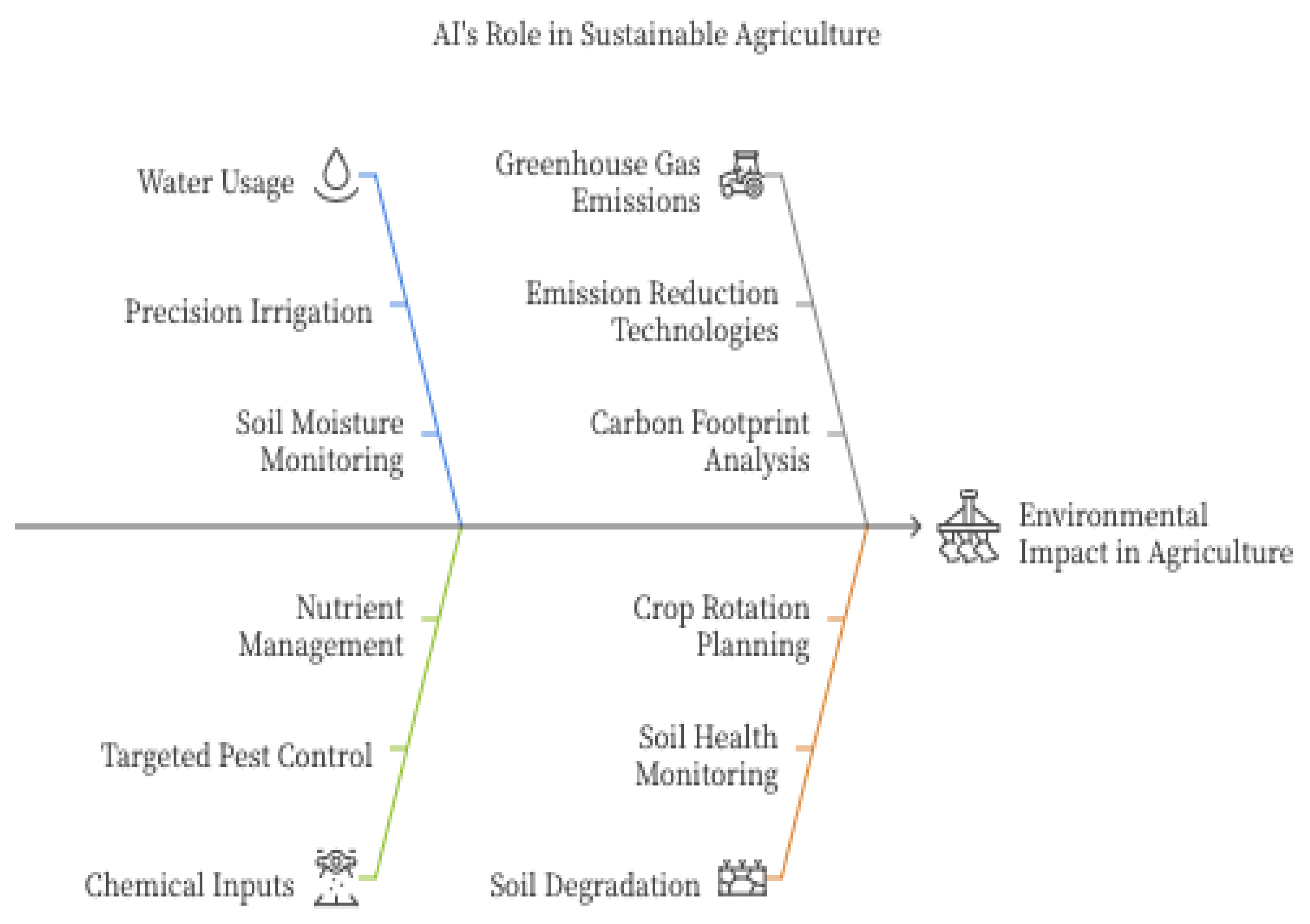
AI offers a powerful toolset for promoting environmental sustainability within agriculture (Figure 5 illustrates this). One of its most significant contributions lies in drastically reducing chemical usage. Through precision application of fertilizers and pesticides, guided by real-time data and AI-powered insights, overuse is minimized, mitigating the risk of water contamination and safeguarding delicate ecosystems (Zhai et al., 2020; Lal, 2016 – supporting evidence in Table 2). Water resource management, is a huge part and help by optimized water conusmption and biodiversity prevention and lastly, but importantly is Soil conservation.
However, alongside these potential benefits come crucial socio-cultural considerations that must be thoughtfully addressed. A central concern revolves around labor dynamics. . The rising automation caused by AI technology bears the potential for job displacement among agricultural labourers, especially in places largely dependent on manual labor (Rijswijk & Brazendale, 2017). A well, this all depeneds on community acceptability based on belives and technology literacy. (Fleming et al., 2018). Furthermore, to avoid the risk of digital divides and ensure the fair allocation, they are steps being implemented. Along side the considerations mentioned earlier there a major concern for the ethics to be considered to be responsible on innovation.
5. Navigating the Challenges: Roadblocks to Widespread AI Adoption
As Figure 2 shows, even although artificial intelligence has unquestionably transforming power, major obstacles prevent its general acceptance and reduce its general efficacy in the agriculture industry. These difficulties include technical, financial, social, ethical, and moral spheres and need for a comprehensive and cooperative approach for good resolution.
Technologically, a few important problems really jump out. First priorities are data quality and availability. Particularly sophisticated deep learning systems, the proper training and operation of artificial intelligence models relies mostly on large volumes of high-quality, relevant data (Kamilaris et al., 2017). A recurring challenge in several areas that prevents the evolution of AI models. This includes the absence of appropriate infrastructure, particularly in places most needing these technological developments. data security and sharing associated problems, Wolfert et al., 2017.
Many times, the financial barriers to general AI acceptance are really significant. Especially for small and medium-sized farms with limited resources, the significant initial investment costs linked with procuring, implementing, and integrating AI technologies –including specialised hardware, software, and qualified staff –can be prohibitive (Chavas & Nauges, 2020). Farmers return on investment is unknown. Especially with regard to fast market fluctuations, the speed of technology developments is impressive. This might limit finance available to farmers, Ferris et al. 2014. and, the costly maintainance.
6. Charting the Course: A Strategic Vision for the Future
Realizing the full transformative potential of AI in agriculture requires a concerted, multi-faceted strategic approach, addressing the intertwined technological, economic, socio-ethical, and policy-related challenges, as summarized in Figure 4 and outlined in greater detail within Table 3.
The ongoing evolution of technological advancements forms the foundation of this strategic vision. Investing in the development of robust and reliable and adaptive AI models. AI is integrating with many new emerging technology. (Tian, 2017). For, better effecive models and practices, edge deployement (Xu et al., 2018), should also consider huma-Ai interactions,(van der Waa et al., 2018) and provide, standrazition, in sensors (Turner, 2013).
Figure 3 provides data regarding projections of markets.
Effective policy and regulation play a pivotal role in creating an enabling environment that fosters responsible innovation and equitable access. This entails government offering rules and incentives based on OECD, 2019 standardising principles (Europe Commission, 2019). Data policies to protect all parites, funds for initiatives aiming at capacity building.
Reducing any negative effects and guaranteeing that the advantages of artificial intelligence in agriculture are generally shared depend on socioeconomic policies. They make inclusion technology accessible and provide and support (Ferris et al., 2014). They also encourage community involvement, thereby building models for responsible application. Supporting initiatives aimed at diversifying economy. Along with monitorig, evolution system, for fairness (Doss & Morris, 2001).
7. Conclusion: A Call for Collaborative, Responsible Innovation
Artificial intelligence may transform agriculture, solve urgent problems with regard to food security, environmental preservation, and farmer livelihoods all around. Table 4 present a visual insights comparing, trandional with modern agricultural techniques, holding the potential of higher production, better efficiency, optimal use of resources, to control effects and, develop sustainabale environment, for generations to come. On these developments, worldwide rates demonstrate good improvement; Figure 5 presents how AI technologies contribute to reducing environmental impacts in agriculture, including reductions in water usage, chemical inputs, greenhouse gas emissions, and soil degradation. This study emphasises important factors and suggestions that support all the assertions by means of critical analysis.
Figure 5.
Environmental Impact Reduction through AI Technologies.
Still, the shift to AI-powered agriculture presents challenges. Navigating this change calls for appreciating the complexity, adopting responsible innovation techniques, supporting investments and education to help to distribute adoption rates. To do so requires efforts for both research, to address gaps, the farmers to learn new tech, policymakers to guide all parites involved, tech devs, to deliver, new emerging solutions. Ultimately, the success of this technological revolution hinges upon our capacity to prioritize equity, environmental stewardship, and the long-term well-being of the communities that depend on agriculture for their sustenance and livelihood. By promoting and working, the sustainable future is certain.
References
- Altieri, M.A. Agroecology, small farms, and food sovereignty. Monthly Review 2009, 61, 102. [Google Scholar]
- Bac, C.W.; Hemming, J.; Van Henten, E.J. Harvesting robots for high-value crops: State-of-the-art review and challenges ahead. Journal of Field Robotics 2014, 31, 888–911. [Google Scholar] [CrossRef]
- Bechar, A.; Vigneault, C. Agricultural robots for field operations: Concepts and components. Biosystems Engineering 2016, 149, 94–111. [Google Scholar] [CrossRef]
- Bebber, D.P.; Ramotowski, M.A.; Gurr, S.J. Crop pests and pathogens move polewards in a warming world. Nature Climate Change 2013, 3, 985–988. [Google Scholar] [CrossRef]
- Berckmans, D. Precision livestock farming technologies for welfare management in intensive livestock systems. Revue Scientifique et Technique 2014, 33, 189–196. [Google Scholar] [CrossRef]
- Bishop, C.M. (2006). Pattern Recognition and Machine Learning. Springer.
- Bongiovanni, R.; Lowenberg-Deboer, J. Precision agriculture and sustainability. Precision Agriculture 2004, 5, 359–387. [Google Scholar] [CrossRef]
- Bronson, K. Smart farming: Including rights holders for responsible agricultural innovation. Technology Innovation Management Review 2018, 8, 7–14. [Google Scholar] [CrossRef]
- Bronson, K.; Knezevic, I. Big Data in food and agriculture. Big Data & Society 2016, 3, 1–5. [Google Scholar] [CrossRef]
- Carbonell, I.M. The ethics of big data in agriculture. Internet Policy Review 2016, 5, 1–13. [Google Scholar] [CrossRef]
- Carpio, C.E.; Isengildina-Massa, O. To tell or not to tell: Crop yield and weather information and market expectations. Journal of Agricultural and Resource Economics 2009, 34, 276–297. [Google Scholar]
- Carrick, P.J.; Krüger, R. Restoring degraded landscapes in lowland Namaqualand: Lessons from the mining experience and from regional ecological dynamics. Journal of Arid Environments 2007, 70, 767–781. [Google Scholar] [CrossRef]
- CASP. (2018). Critical Appraisal Skills Programme Checklists. https://casp-uk.net/casp-tools-checklists/.
- Chavas, J.P.; Nauges, C. Uncertainty, learning, and technology adoption in agriculture. Applied Economic Perspectives and Policy 2020, 42, 42–53. [Google Scholar] [CrossRef]
- Chen, J.; et al. An artificial intelligence model for crop yield prediction. Agricultural Systems 2019, 176, 102632. [Google Scholar]
- Chen, J.; Ba, T.; Wang, H.; Liu, Y.; Gong, X. Optimizing crop planning and water resource allocation for sustainable agricultural development. Agricultural Water Management 2021, 243, 106505. [Google Scholar]
- Chen, T.; Guestrin, C. (2016). XGBoost: A scalable tree boosting system. In Proceedings of the 22nd ACM SIGKDD International Conference on Knowledge Discovery and Data Mining (pp. 785–794).
- Chlingaryan, A.; Sukkarieh, S.; Whelan, B. Machine learning approaches for crop yield prediction and nitrogen status estimation in precision agriculture: A review. Computers and Electronics in Agriculture 2018, 151, 61–69. [Google Scholar] [CrossRef]
- Colomina, I.; Molina, P. Unmanned aerial systems for photogrammetry and remote sensing: A review. ISPRS Journal of Photogrammetry and Remote Sensing 2014, 92, 79–97. [Google Scholar] [CrossRef]
- Corke, P.; Winstanley, G.; Walker, R. (2004). Agriculture robotics: A stream mapping review. In Proceedings of the Australian Conference on Robotics and Automation.
- Creswell, A.; et al. Generative adversarial networks: An overview. IEEE Signal Processing Magazine 2018, 35, 53–65. [Google Scholar] [CrossRef]
- Crossa, J.; et al. Genomic selection in plant breeding: Methods, models, and perspectives. Trends in Plant Science 2017, 22, 961–975. [Google Scholar] [CrossRef]
- Doss, C.R.; Morris, M.L. How does gender affect the adoption of agricultural innovations? The case of improved maize technology in Ghana. Agricultural Economics 2001, 25, 27–39. [Google Scholar] [CrossRef]
- Duckett, T.; Pearson, S.; Blackmore, S.; Grieve, B. Agricultural robotics: The future of robotic agriculture. arXiv 2018, arXiv:1806.06762. [Google Scholar]
- Eastwood, C.; Klerkx, L.; Ayre, M.; Dela Rue, B. Managing socio-ethical challenges in the development of smart farming: From a fragmented to a comprehensive approach for responsible innovation. Journal of Agricultural and Environmental Ethics 2017, 32, 741–768. [Google Scholar] [CrossRef]
- Eastwood, C.; et al. Making sense in the cloud: Farm advisory services in a smart farming future. NJAS-Wageningen Journal of Life Sciences 2019, 90–91, 100298. [Google Scholar] [CrossRef]
- European Commission (2019) Ethics guidelines for trustworthy, A.I. High-Level Expert Group on Artificial Intelligence.
- FAO. (2011). The State of the World's Land and Water Resources for Food and Agriculture (SOLAW). Food and Agriculture Organization of the United Nations.
- FAO. (2017). Information and Communication Technology (ICT) in Agriculture. Food and Agriculture Organization of the United Nations.
- Ferris, S.; et al. (2014). Linking smallholder farmers to markets and the implications for extension and advisory services. MEAS Discussion Paper, 4.
- Fleming, A.; et al. Is big data for big farming or for everyone? Perceptions in the Australian grains industry. Agronomy for Sustainable Development 2018, 38, 24. [Google Scholar] [CrossRef]
- Frazier, P.; Yu, J. Soil fertility and precision agriculture. International Journal of Agricultural and Biological Engineering 2008, 1, 1–15. [Google Scholar]
- Gers, F.A.; Schmidhuber, J.; Cummins, F. Learning to forget: Continual prediction with LSTM. Neural Computation 2000, 12, 2451–2471. [Google Scholar] [CrossRef]
- Gebbers, R.; Adamchuk, V.I. Precision agriculture and food security. Science 2010, 327, 828–831. [Google Scholar] [CrossRef]
- Godwin, R.J.; et al. Precision farming of cereal crops: A review of a six-year experiment to develop management guidelines. Biosystems Engineering 2003, 84, 375–391. [Google Scholar] [CrossRef]
- Goodfellow, I.; et al. Generative adversarial nets. Advances in Neural Information Processing Systems 2014, 27, 2672–2680. [Google Scholar]
- Grigorescu, S.; Trasnea, B.; Cocias, T.; Macesanu, G. A survey of deep learning techniques for autonomous driving. Journal of Field Robotics 2020, 37, 362–386. [Google Scholar] [CrossRef]
- Gutiérrez, P.A.; Pérez-Ortiz, M.; Sánchez-Monedero, J.; Fernández-Navarro, F.; Hervás-Martínez, C. Ordinal regression methods: Survey and experimental study. IEEE Transactions on Knowledge and Data Engineering 2016, 28, 127–146. [Google Scholar] [CrossRef]
- Hashem, I.A.T.; et al. The rise of "big data" on cloud computing: Review and open research issues. Information Systems 2015, 47, 98–115. [Google Scholar] [CrossRef]
- Hastie, T.; Tibshirani, R.; Friedman, J. (2009). The Elements of Statistical Learning. Springer.
- Holzworth, D.P.; et al. APSIM–evolution towards a new generation of agricultural systems simulation. Environmental Modelling & Software 2014, 62, 327–350. [Google Scholar] [CrossRef]
- Huang, Y.; Hoffmann, W.C.; Lan, Y.; Wu, W.; Fritz, B.K. Development of a low-cost agricultural remote sensing system based on an autonomous unmanned aerial vehicle (UAV). Transactions of the ASABE 2010, 52, 1–10. [Google Scholar] [CrossRef]
- IPCC. (2014). Climate Change 2014: Impacts, Adaptation, and Vulnerability. Cambridge University Press.
- Jayaraman, P.P.; Yavari, A.; Georgakopoulos, D.; Morshed, A.; Zaslavsky, A. Internet of things platform for smart farming: Experiences and lessons learnt. Sensors 2016, 16, 1884. [Google Scholar] [CrossRef]
- Jeong, J.H.; Resop, J.P.; Mueller, N.D.; et al. Random forests for global and regional crop yield predictions. PLoS ONE 2016, 11, e0156571. [Google Scholar] [CrossRef]
- Jeong, J.; et al. Random forest algorithm for modeling global rice yield predictions using satellite imagery and climate data. Remote Sensing 2018, 10, 395. [Google Scholar]
- Jiang, Y.; Li, C.; Paterson, A.H. High throughput phenotyping of cotton plant height using depth images under field conditions. Computers and Electronics in Agriculture 2020, 168, 105107. [Google Scholar] [CrossRef]
- Jolliffe, I.T. (2002). Principal Component Analysis. Springer.
- Jordan, M.I.; Mitchell, T.M. Machine learning: Trends, perspectives, and prospects. Science 2015, 349, 255–260. [Google Scholar] [CrossRef]
- Kamilaris, A.; Kartakoullis, A.; Prenafeta-Boldú, F.X. A review on the practice of big data analysis in agriculture. Computers and Electronics in Agriculture 2017, 143, 23–37. [Google Scholar] [CrossRef]
- Khaki, S.; Wang, L. Crop yield prediction using deep neural networks. Frontiers in Plant Science 2019, 10, 621. [Google Scholar] [CrossRef]
- Krizhevsky, A.; Sutskever, I.; Hinton, G.E. ImageNet classification with deep convolutional neural networks. Advances in Neural Information Processing Systems 2012, 25, 1097–1105. [Google Scholar] [CrossRef]
- Kshetri, N. The emerging role of big data in key development issues: Opportunities, challenges, and concerns. Big Data & Society 2014, 1, 1–20. [Google Scholar] [CrossRef]
- Lal, R. Soil carbon management and climate change. Carbon Management 2013, 4, 439–462. [Google Scholar] [CrossRef]
- Lal, R. Soil health and carbon management. Food and Energy Security 2016, 5, 212–222. [Google Scholar] [CrossRef]
- LeCun, Y.; Bengio, Y.; Hinton, G. Deep learning. Nature 2015, 521, 436–444. [Google Scholar] [CrossRef]
- Lesk, C.; Rowhani, P.; Ramankutty, N. Influence of extreme weather disasters on global crop production. Nature 2016, 529, 84–87. [Google Scholar] [CrossRef]
- Liakos, K.G.; Busato, P.; Moshou, D.; Pearson, S.; Bochtis, D. Machine learning in agriculture: A review. Sensors 2018, 18, 2674. [Google Scholar] [CrossRef]
- Lobell, D.B.; Field, C.B. Global scale climate–crop yield relationships and the impacts of recent warming. Environmental Research Letters 2007, 2, 014002. [Google Scholar] [CrossRef]
- Lobell, D.B.; Schlenker, W.; Costa-Roberts, J. Climate trends and global crop production since 1980. Science 2011, 333, 616–620. [Google Scholar] [CrossRef]
- Lobell, D.B.; et al. Prioritizing Climate Change Adaptation Needs for Food Security in 2030. Science 2008, 319, 5863. [Google Scholar] [CrossRef]
- Lowder, S.K.; Skoet, J.; Raney, T. The number, size, and distribution of farms, smallholder farms, and family farms worldwide. World Development 2016, 87, 16–29. [Google Scholar] [CrossRef]
- Lu, J.; et al. Recent advances of hyperspectral imaging technology and applications in agriculture. Remote Sensing 2020, 12, 2659. [Google Scholar] [CrossRef]
- Makanza, R.; et al. High-throughput phenotyping of canopy cover and senescence in maize field trials using aerial digital canopy imaging. Remote Sensing 2018, 10, 330. [Google Scholar] [CrossRef] [PubMed]
- Mayr, M.; Koppensteiner, G.; Schmidhuber, M. (2019). Reinforcement learning for autonomous greenhouse management. In Proceedings of the IEEE International Conference on Robotics and Automation (pp. 4925–4931).
- McKinsey Global Institute. (2018). Harvesting technology for agriculture's future. McKinsey & Company.
- Moher, D.; Liberati, A.; Tetzlaff, J.; Altman, D.G. Preferred reporting items for systematic reviews and meta-analyses: The PRISMA statement. PLOS Medicine 2009, 6, e1000097. [Google Scholar] [CrossRef]
- Mohanty, S.P.; Hughes, D.P.; Salathé, M. Using deep learning for image-based plant disease detection. Frontiers in Plant Science 2016, 7, 1419. [Google Scholar] [CrossRef]
- Montgomery, D.R. Soil erosion and agricultural sustainability. Proceedings of the National Academy of Sciences 2007, 104, 13268–13272. [Google Scholar] [CrossRef]
- Mulla, D.J. Twenty-five years of remote sensing in precision agriculture: Key advances and remaining knowledge gaps. Biosystems Engineering 2013, 114, 358–371. [Google Scholar] [CrossRef]
- Ozdogan, M.; et al. Remote sensing of irrigated agriculture: Opportunities and challenges. Remote Sensing 2010, 2, 2274–2304. [Google Scholar] [CrossRef]
- Pantazi, X.E.; Moshou, D.; Bochtis, D. AI applications of predictive models in precision agriculture. Agronomy 2020, 10, 98. [Google Scholar]
- Potts, S.G.; et al. Safeguarding pollinators and their values to human well-being. Nature 2016, 540, 220–229. [Google Scholar] [CrossRef] [PubMed]
- Ray, D.K.; et al. Climate change has likely already affected global food production. PLoS ONE 2019, 14, e0217148. [Google Scholar] [CrossRef]
- Rijswijk, K.; Brazendale, R. (2017). Technology and skills in the agri-food system: An overview of trends and policy options for the future. Agribusiness and Economics Research Unit, Lincoln University.
- Rijswijk, K.; Klerkx, L.; Turner, J.A. Digitalisation in the New Zealand agricultural knowledge and innovation system: Initial understandings and emerging organisational responses to digital agriculture. NJAS - Wageningen Journal of Life Sciences 2019, 90–91, 100313. [Google Scholar] [CrossRef]
- Rose, D.C.; Chilvers, J. Agriculture 4.0: Broadening responsible innovation in an era of smart farming. Frontiers in Sustainable Food Systems 2018, 2, 87. [Google Scholar] [CrossRef]
- Rossel RA, V.; Bouma, J. Soil sensing: A new paradigm for agriculture. Agricultural Systems 2016, 148, 71–74. [Google Scholar] [CrossRef]
- Rossel, R.A.V.; et al. Continental-scale soil carbon composition anlyses prediction using, Vis-Nir. Geoderma 2016, 155. [Google Scholar]
- Rotz, S.; et al. Automated pastures and the digital divide: How agricultural technologies are shaping labour and rural communities. Journal of Rural Studies 2019, 68, 112–122. [Google Scholar] [CrossRef]
- Sadler, E.J.; Evans, R.G.; Stone, K.C.; Camp, C.R. Opportunities for conservation with precision irrigation. Journal of Soil and Water Conservation 2005, 60, 371–379. [Google Scholar] [CrossRef]
- Schuster, M.; Brem, A. How to benefit from open innovation? An empirical investigation of open innovation, external partnerships, and firm capabilities in the automotive industry. International Journal of Technology Management 2015, 69, 54–76. [Google Scholar] [CrossRef]
- Seppelt, R.; et al. Harmonizing biodiversity conservation and productivity in the context of increasing demands on landscapes. BioScience 2016, 66, 890–896. [Google Scholar] [CrossRef]
- Shamshiri, R.R.; et al. Research and development in agricultural robotics: A perspective of digital farming. International Journal of Agricultural and Biological Engineering 2018, 11, 1–14. [Google Scholar] [CrossRef]
- Shi, W.; et al. Edge computing: Vision and challenges. IEEE Internet of Things Journal 2016, 3, 637–646. [Google Scholar] [CrossRef]
- Singh, A.; Ganapathysubramanian, B.; Singh, A.K.; Sarkar, S. Machine learning for high-throughput stress phenotyping in plants. Trends in Plant Science 2016, 21, 110–124. [Google Scholar] [CrossRef] [PubMed]
- Sladojevic, S.; Arsenovic, M.; Anderla, A.; Culibrk, D.; Stefanovic, D. Deep neural networks based recognition of plant diseases by leaf image classification. Computational Intelligence and Neuroscience 2016, 2016, 1–11. [Google Scholar] [CrossRef]
- Smith, P.; et al. (2014). Agriculture, forestry and other land use (AFOLU). In Climate Change 2014: Mitigation of Climate Change (pp. 811–922). Cambridge University Press.
- Sørensen, C.G.; et al. A user-centric approach for information modelling in arable farming. Computers and Electronics in Agriculture 2010, 73, 44–55. [Google Scholar] [CrossRef]
- Sutton, R.S.; Barto, A.G. (2018). Reinforcement Learning: An Introduction. MIT Press.
- Thenkabail, P.S.; et al. Hyperspectral remote sensing of vegetation and agricultural crops. Photogrammetric Engineering & Remote Sensing 2018, 84, 741–742. [Google Scholar] [CrossRef]
- Tian, F. (2017). A supply chain traceability system for food safety based on HACCP, blockchain & Internet of Things. In 14th International Conference on Services Systems and Services Management (pp. 1–6).
- Tilman, D.; Balzer, C.; Hill, J.; Befort, B.L. Global food demand and the sustainable intensification of agriculture. Proceedings of the National Academy of Sciences 2011, 108, 20260–20264. [Google Scholar] [CrossRef]
- Turner, A.P. Biosensors: Sense and sensibility. Chemical Society Reviews 2013, 42, 3184–3196. [Google Scholar] [CrossRef]
- United Nations Department of Economic and Social Affairs. (2019). World Population Prospects 2019. https://population.un.org/wpp/.
- Ustin, S.L.; Middleton, E.M. Current and near-term advances in Earth observation for ecological applications. Ecological Processes 2021, 10, 1–12. [Google Scholar] [CrossRef]
- van der Burg, S.; et al. Ethics of smart farming: Current questions and directions for responsible innovation towards the future. NJAS-Wageningen Journal of Life Sciences 2019, 90–91, 100289. [Google Scholar] [CrossRef]
- van der Waa, J.; et al. Contrastive explanations with local foil trees. arXiv 2018, arXiv:1806.07470. [Google Scholar]
- Wang, G.; et al. Mapping soil erosion risk in a typical karst area using GIS and remote sensing. Environmental Earth Sciences 2016, 75, 142. [Google Scholar]
- Wang, S.; et al. Integrating reinforcement learning with, agricultural systems. Applied Soft Computing 2018, 23. [Google Scholar]
- Wolfert, S.; et al. Big data in smart farming—A review. Agricultural Systems 2017, 153, 69–80. [Google Scholar] [CrossRef]
- Xu, X.; et al. Edge computing paradigm for smart farming: A case study. Sensors 2018, 18, 4347. [Google Scholar]
- Yu, L.; et al. A hybrid model integrating a neural network with wavelet decomposition for commodity price forecasting. Applied Soft Computing 2016, 43, 478–494. [Google Scholar]
- Zhai, Z.; et al. Smart farming in poultry production with the integration of Internet of Things (IoT), blockchain, and artificial intelligence (AI). AgriEngineering 2020, 2, 416–442. [Google Scholar]
- Zhang, C.; Kovacs, J.M. The application of small unmanned aerial systems for precision agriculture: A review. Precision Agriculture 2012, 13, 693–712. [Google Scholar] [CrossRef]
- Zhang, N.; Wang, M.; Wang, N. Precision agriculture—A worldwide overview. Computers and Electronics in Agriculture 2002, 36, 113–132. [Google Scholar] [CrossRef]
Figure 1.
AI-Enabled Precision Agriculture Workflow.
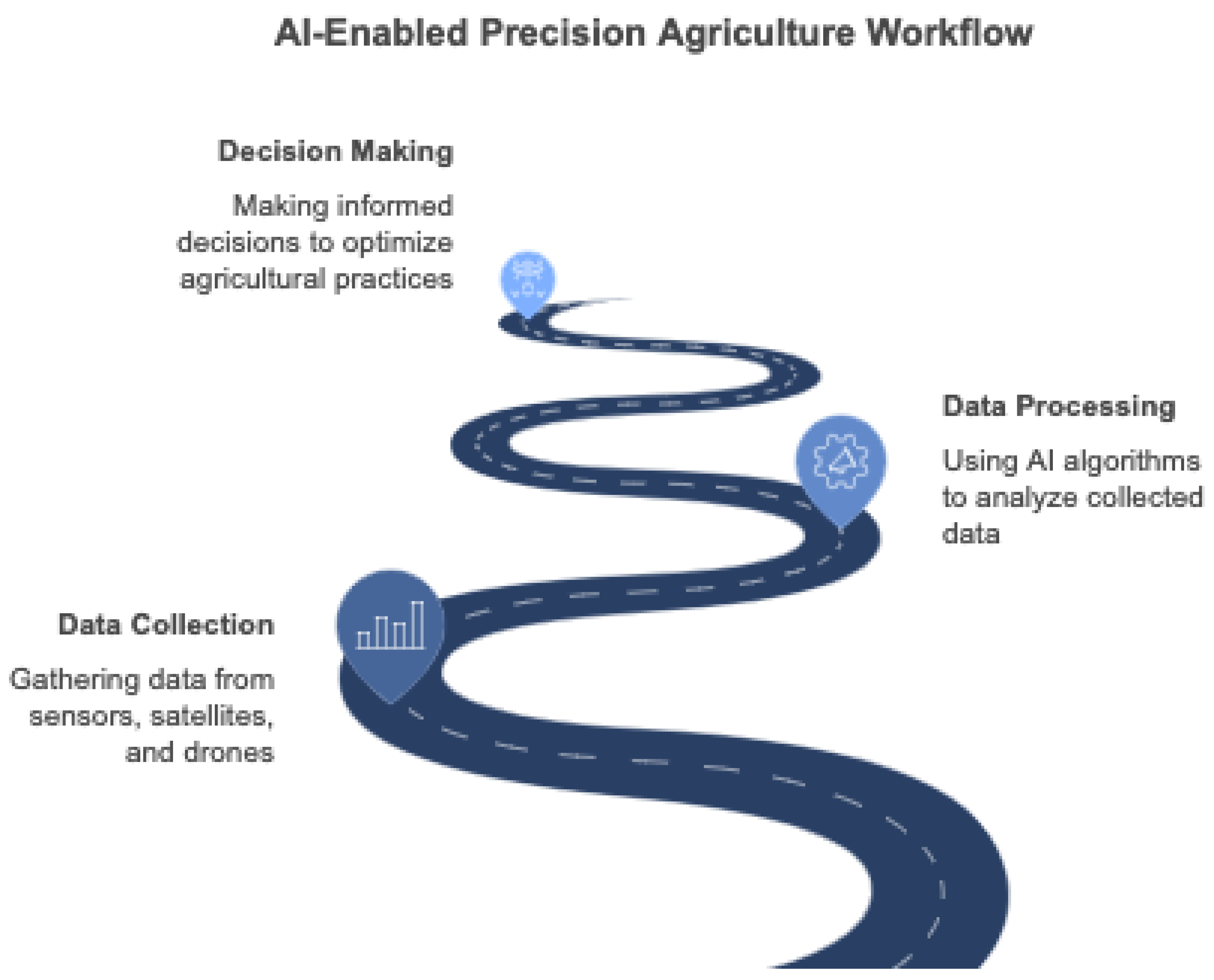
Figure 2.
Challenges in AI Adoption in Agriculture.
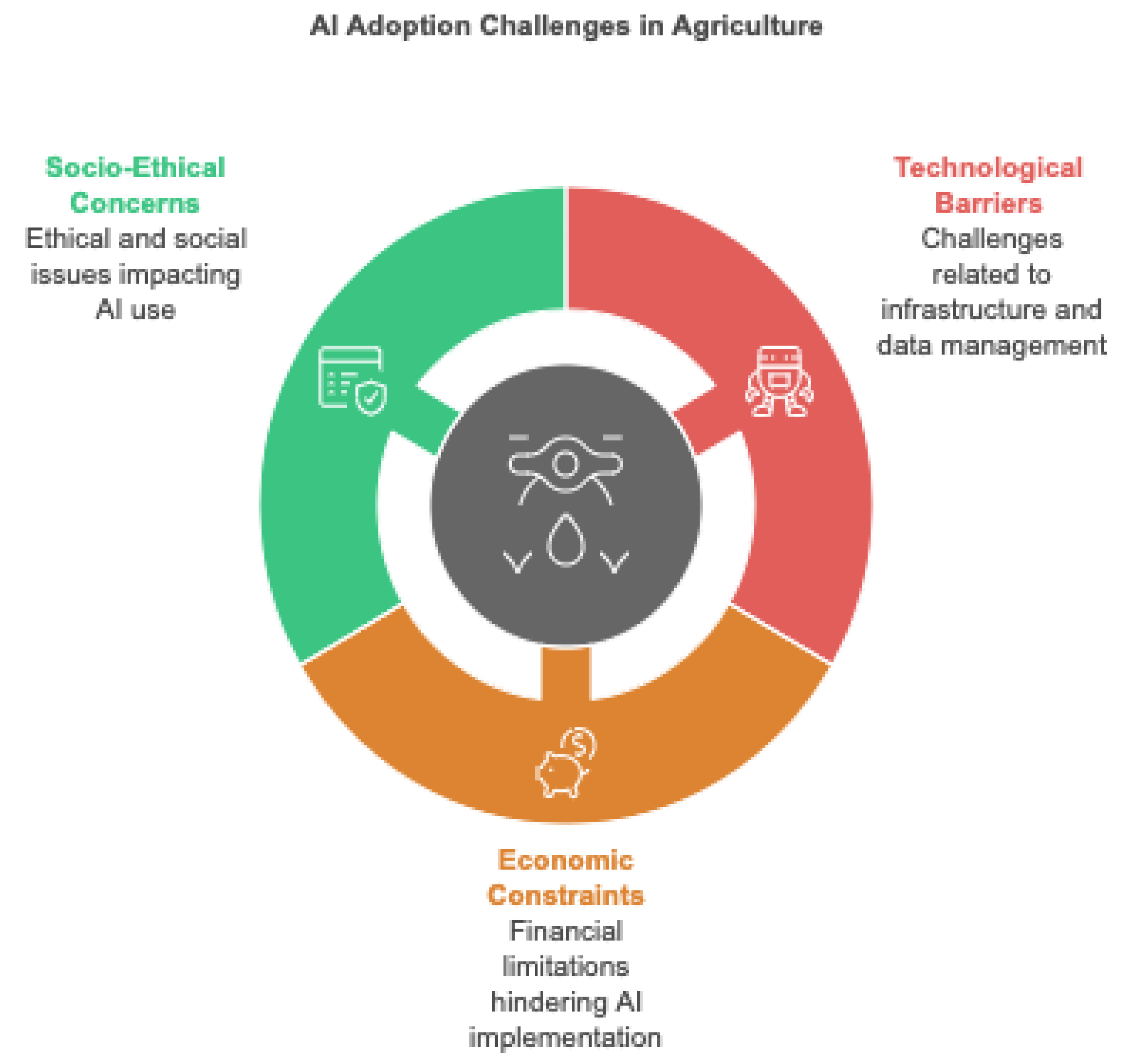
Figure 3.
Projected Growth of AI in Agriculture (2020-2030).
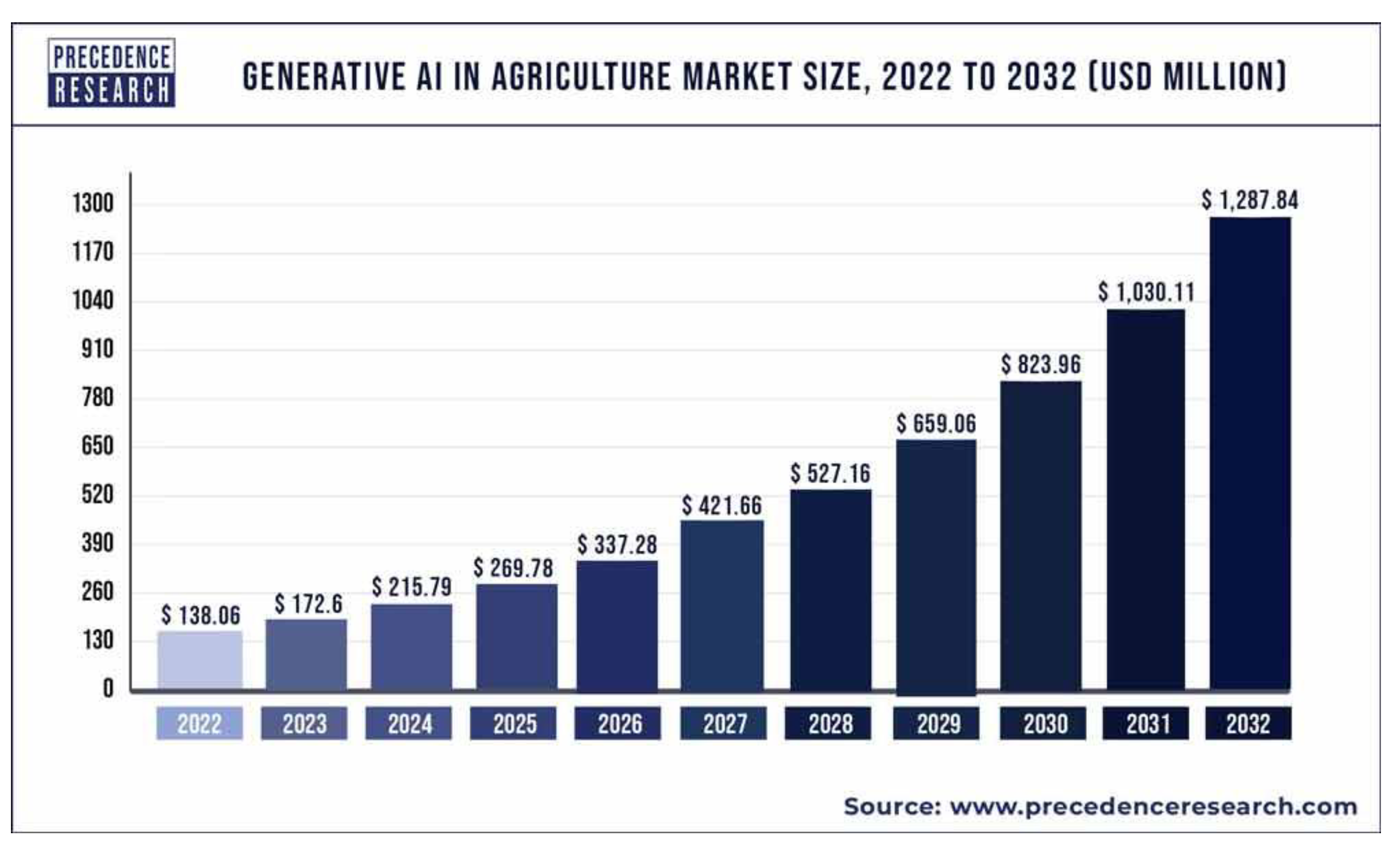
Figure 4.
Framework for Integrating AI in Sustainable Agriculture.

Table 1.
Key AI Technologies in Agriculture and Their Applications.
| AI Technology | Applications in Agriculture | References |
|---|---|---|
| Machine Learning (ML) | Crop yield prediction, disease detection, input recommendation systems | Liakos et al. (2018); Jeong et al. (2016) |
| Deep Learning (DL) | Image-based plant disease detection, phenotyping, weed and crop recognition | Mohanty et al. (2016); Jiang et al. (2020) |
| Computer Vision | Automated stress detection, real-time growth stage tracking, robotic harvesting | Sladojevic et al. (2016); Bac et al. (2014) |
| Reinforcement Learning | Autonomous vehicles navigation, resource management, greenhouse climate control | Mayr et al. (2019); Chen & Guestrin (2016) |
| Internet of Things (IoT) | Real-time monitoring using sensors, data collection for AI models, precision irrigation | Jayaraman et al. (2016); Turner (2013) |
| Robotics and Automation | Autonomous planting, weeding robots, robotic harvesting systems | Bechar & Vigneault (2016); Shamshiri et al. (2018) |
| Predictive Analytics | Market trend prediction, climate change impact assessment, yield optimization modeling | Yu et al. (2016); Lobell & Field (2007) |
Table 2.
Benefits of AI Adoption in Agriculture.
| Benefit | Description | References |
|---|---|---|
| Increased Productivity | Higher crop yields and better quality due to optimized farming practices enabled by AI | McKinsey Global Institute (2018) |
| Cost Reduction | Decreased reliance on manual labor and efficient use of inputs reduce overall operational costs | Rotz et al. (2019) |
| Environmental Sustainability | Precision application of resources minimizes environmental impact, promoting sustainable agriculture | Zhai et al. (2020); Lal (2016) |
| Enhanced Decision-Making | Data-driven insights allow for proactive and informed decisions, reducing risks associated with farming | Bronson (2018); Chen et al. (2019) |
| Market Competitiveness | Ability to meet market demands with consistency and quality, improving competitiveness in global markets | Bronson (2018) |
| Labor Efficiency | Automation addresses labor shortages and reduces the physical burden on farmers | Bechar & Vigneault (2016) |
| Risk Management | Predictive analytics help in forecasting market trends and weather, aiding in risk mitigation strategies | Yu et al. (2016); Lobell & Field (2007) |
Table 3.
Recommendations for Enhancing AI Adoption in Agriculture.
| Recommendation | Description | References |
|---|---|---|
| Investment in Infrastructure | Development of rural internet connectivity and energy supply to support AI technologies | Kshetri (2014); FAO (2017) |
| Capacity Building and Education | Training programs for farmers and technicians to build expertise in AI applications | Eastwood et al. (2019); FAO (2017) |
| Policy Support and Incentives | Government policies providing subsidies, tax incentives, and supportive regulations to encourage AI adoption | OECD (2019); European Commission (2019) |
| Data Governance and Security | Establishment of clear data ownership rights and robust cybersecurity measures | Wolfert et al. (2017); Carbonell (2016) |
| Development of Affordable Technologies | Creation of cost-effective AI solutions suitable for smallholder farmers | Ferris et al. (2014); Chavas & Nauges (2020) |
| Ethical Frameworks | Implementation of ethical guidelines to ensure fair and responsible use of AI in agriculture | van der Burg et al. (2019); European Commission (2019) |
| Encouraging Collaboration | Fostering partnerships among stakeholders, including farmers, tech developers, and policymakers | OECD (2018); Fleming et al. (2018) |
Table 4.
Comparative Analysis of Traditional vs. AI-Enabled Farming Methods.
| Aspect | Traditional Farming | AI-Enabled Farming | References |
|---|---|---|---|
| Decision-Making | Based on farmer's experience and intuition | Data-driven, utilizing AI algorithms for precision | Liakos et al. (2018); Wolfert et al. (2017) |
| Resource Utilization | Uniform application of inputs across the field | Variable rate application based on real-time data | Mulla (2013); Gebbers & Adamchuk (2010) |
| Labor Requirements | High dependence on manual labor | Reduced labor through automation and robotics | Bechar & Vigneault (2016); Rotz et al. (2019) |
| Environmental Impact | Higher risk of overuse of chemicals and water | Minimized environmental footprint due to optimized input usage | Zhai et al. (2020); Lal (2016) |
| Yield and Productivity | Variable yields influenced by unpredictable factors | Improved yields through predictive analytics and proactive management | Khaki & Wang (2019); McKinsey Global Institute (2018) |
| Cost Efficiency | Potentially higher costs due to inefficiencies | Long-term cost savings from optimized operations despite initial investment | Chavas & Nauges (2020); Eastwood et al. (2019) |
| Adaptability to Challenges | Reactive approach to pests, diseases, and climate issues | Proactive and adaptive strategies informed by AI predictions | Singh et al. (2016); Lobell & Field (2007) |
Disclaimer/Publisher’s Note: The statements, opinions and data contained in all publications are solely those of the individual author(s) and contributor(s) and not of MDPI and/or the editor(s). MDPI and/or the editor(s) disclaim responsibility for any injury to people or property resulting from any ideas, methods, instructions or products referred to in the content. |
© 2025 by the authors. Licensee MDPI, Basel, Switzerland. This article is an open access article distributed under the terms and conditions of the Creative Commons Attribution (CC BY) license (http://creativecommons.org/licenses/by/4.0/).
Copyright: This open access article is published under a Creative Commons CC BY 4.0 license, which permit the free download, distribution, and reuse, provided that the author and preprint are cited in any reuse.


