

Submitted:
05 March 2025
Posted:
05 March 2025
You are already at the latest version
Abstract
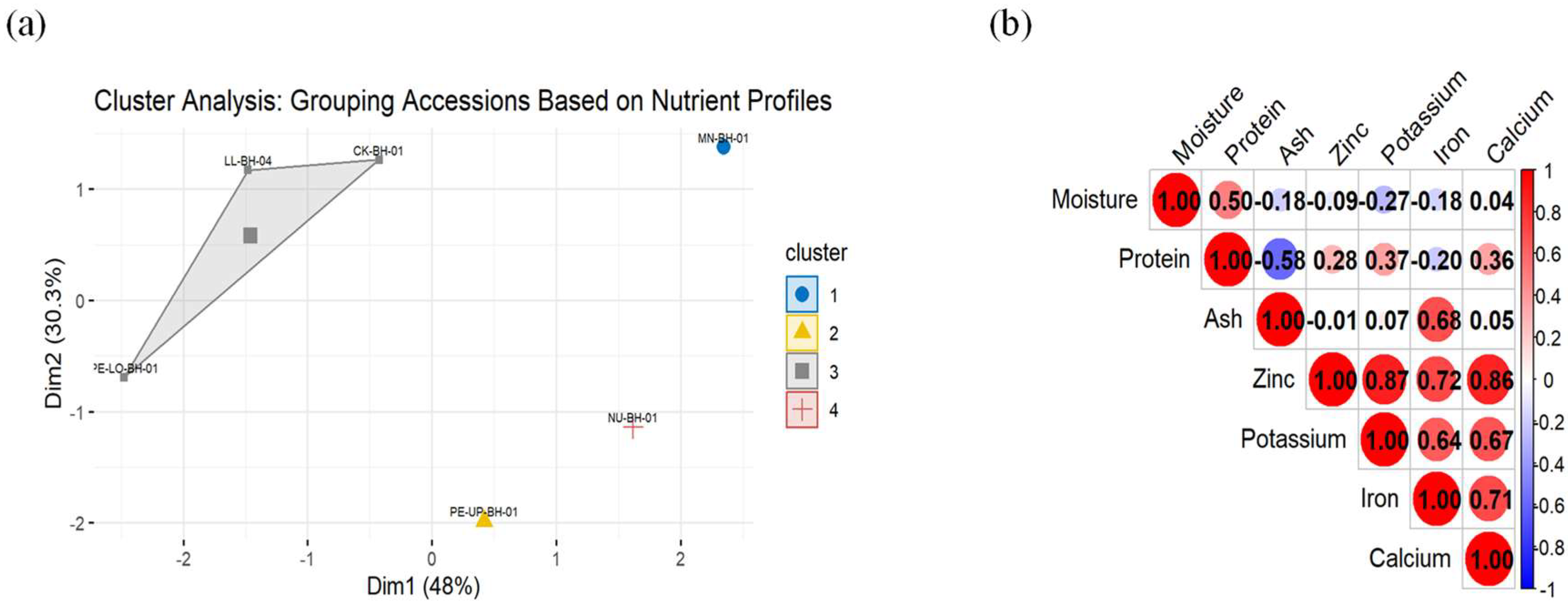
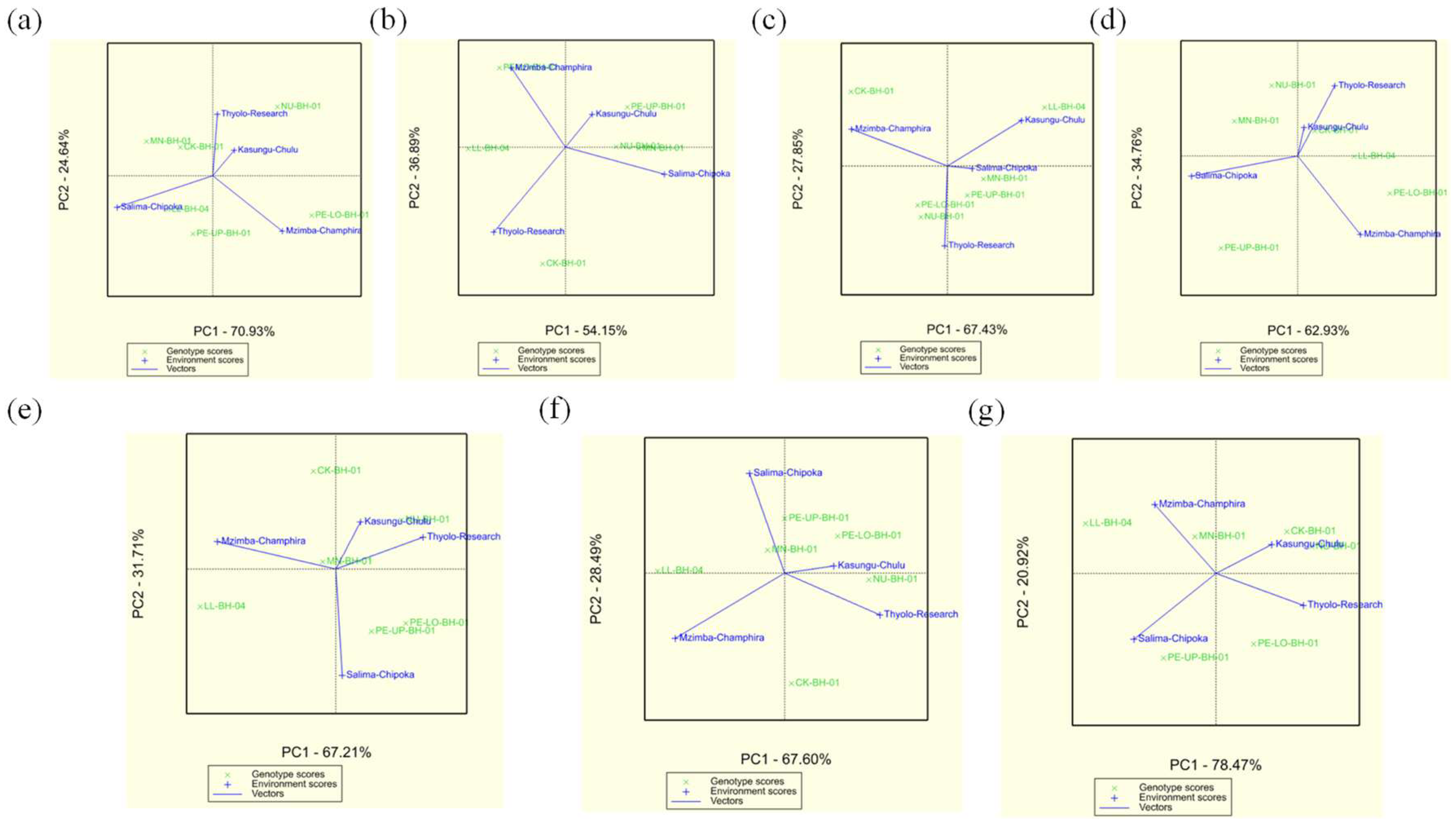
The chemical composition of amaranth leaves varies significantly across different accessions, with substantial differences in key nutrients, including crude protein, minerals, and micronutrients. This study evaluates the nutrient profiles of six amaranth accessions (MN-BH-01, PE-UP-BH-01, PE-LO-BH-01, CK-BH-01, NU-BH-01, and LL-BH-04), focusing on dry matter-based chemical composition and genotype-by-environment (G×E) interactions. Results show that MN-BH-01 exhibited the highest protein (43.18%), calcium (8.00 mg/100g), zinc (15.12 mg/100g), and potassium (19.47 mg/g) content, marking it as a potential candidate for nutritional enhancement. PE-UP-BH-01, notable for its elevated iron content (77.16 mg/100g), and LL-BH-04, exhibiting superior crude protein at some sites, also showed unique nutritional advantages. Nutrient composition varied significantly across locations, with genotype-by-environment interactions playing a crucial role in nutrient accumulation, particularly in iron and calcium. Cluster analysis revealed distinct groups based on nutritional content, with MN-BH-01 standing out for protein, iron, and potassium levels. Additive Main Effects and Multiplicative Interaction (AMMI) analysis further highlighted stable accessions (MN-BH-01, NU-BH-01) across multiple traits, essential for breeding programs. Farmers' preferences indicated that NU-BH-01 was the most favored for its flavor, yield, and marketability, while MN-BH-01 was least preferred due to bitterness. These findings provide crucial insights for the development of amaranth varieties with enhanced nutritional profiles and broader market appeal, guiding breeding strategies and biofortification initiatives.
Keywords:
Introduction
Materials and Methods
Plant Material Selection
Study Sites and Experimental Design
Soil Preparation and Fertilization
Sample Preparation
Proximate Analysis
Mineral Content
Statistical Analysis
Results
The Chemical Composition of Amaranth Leaves
Cluster Analysis of Nutrient Profiles and Correlation Analysis of the Variables
Chemical Composition of Amaranth Leaves Across Different Locations and Accessions
Additive Main Effects and Multiplicative Interaction (AMMI) Analysis
Farmer Preferences and Ranking of Amaranth Accessions
Discussion
Conclusion
Author Contributions
Data Availability Statement
Acknowledgments
References
- Baraniak, J.; Kania-Dobrowolska, M. The Dual Nature of Amaranth—Functional Food and Potential Medicine. Foods 2022, 11. [Google Scholar] [CrossRef] [PubMed]
- Bashyal, S.; Upadhyay, A.; Ayer, D.K.; Dhakal, P.G.C.B.; Shrestha, J. Multivariate analysis of grain amaranth (Amaranthus spp.) accessions to quantify phenotypic diversity. Heliyon 2022, 8(11), e11613. [Google Scholar] [CrossRef] [PubMed]
- Cechin, I.; da Silva, L.P.; Ferreira, E.T.; Barrochelo, S.C.; de Melo, F.P.deS.R.; Dokkedal, A.L.; Saldanha, L.L. Physiological responses of Amaranthus cruentus L. to drought stress under sufficient- and deficient-nitrogen conditions. PLoS ONE 2022, 17, 1–20. [Google Scholar] [CrossRef]
- Coelho, L.M.; Silva, P.M.; Martins, J.T.; Pinheiro, A.C.; Vicente, A.A. Emerging opportunities in exploring the nutritional/functional value of amaranth. In (Vol. 9, Issue 11). In Food and Function; 2018; Volume 9. [Google Scholar] [CrossRef]
- Ejieji, C.J.; Adeniran, K. Effects of Water and Fertilizer Stress on the Yield, Fresh and Dry Matter Production of Grain Amaranth ('Amaranthus cruentus’). Search.Informit.Org 2009, 37, 195–199. Available online: https://search.informit.org/doi/abs/10.3316/informit.632981648226333.
- Förster, N.; Dilling, S.; Ulrichs, C.; Huyskens-Keil, S. Nutritional diversity in leaves of various amaranth (Amaranthus spp.) genotypes and its resilience to drought stress. Journal of Applied Botany and Food Quality 2023, 96, 1–10. [Google Scholar] [CrossRef]
- Frei, J.; Wiesenberg, G.L.B.; Hirte, J. The impact of climate and potassium nutrition on crop yields: Insights from a 30-year Swiss long-term fertilization experiment. Agriculture, Ecosystems & Environment 2024, 372, 109100. [Google Scholar] [CrossRef]
- HRICOVÁ, A.; FEJÉR, J.; LIBIAKOVÁ, G.; SZABOVÁ, M.; GAŽO, J.; GAJDOŠOVÁ, A. Characterization of phenotypic and nutritional properties ofvaluable Amaranthus cruentus L. mutants. Turkish Journal of Agriculture and Forestry 2016, 40, 761–771. [Google Scholar] [CrossRef]
- Jahan, N.; Sarker, U.; Hasan Saikat, M.M.; Hossain, M.M.; Azam, M.G.; Ali, D.; Ercisli, S.; Golokhvast, K.S. Evaluation of yield attributes and bioactive phytochemicals of twenty amaranth genotypes of Bengal floodplain. Heliyon 2023, 9, e19644. [Google Scholar] [CrossRef]
- Jan, N.; Hussain, S.Z.; Naseer, B.; Bhat, T.A. Amaranth and quinoa as potential nutraceuticals: A review of anti-nutritional factors, health benefits and their applications in food, medicinal and cosmetic sectors. Food Chemistry: X 2023, 18, 100687. [Google Scholar] [CrossRef]
- Jimoh, M.O.; Afolayan, A.J.; Lewu, F.B. Nutrients and antinutrient constituents of Amaranthus caudatus L. Cultivated on different soils. Saudi Journal of Biological Sciences 2020, 27, 3570–3580. [Google Scholar] [CrossRef]
- Joshi, D.C.; Sood, S.; Hosahatti, R.; Kant, L.; Pattanayak, A.; Kumar, A.; Yadav, D.; Stetter, M.G. From zero to hero: the past, present and future of grain amaranth breeding. Theoretical and Applied Genetics 2018, 131, 1807–1823. [Google Scholar] [CrossRef] [PubMed]
- Kachiguma, N.A.; Mwase, W.; Maliro, M.; Damaliphetsa, A. Chemical and Mineral Composition of Amaranth ( Amaranthus L.) Species Chemical and Mineral Composition of Amaranth ( Amaranthus L.) Species Collected From Central Malawi. Journal of Food Research 2015, 4(4), 95–100. [Google Scholar] [CrossRef]
- Kandel, M.; Rijal, T.R.; Kandel, B.P. Evaluation and identification of stable and high yielding genotypes for varietal development in amaranthus (Amaranthus hypochondriacus L.) under hilly region of Nepal. Journal of Agriculture and Food Research 2021, 5, 100158. [Google Scholar] [CrossRef]
- Kumar, H.; Guleria, S.; Kimta, N.; Dhalaria, R.; Nepovimova, E.; Dhanjal, D.S.; Alomar, S.Y.; Kuca, K. Amaranth and buckwheat grains: Nutritional profile, development of functional foods, their pre-clinical cum clinical aspects and enrichment in feed. Current Research in Food Science 2024, 9, 100836. [Google Scholar] [CrossRef] [PubMed]
- Malik, M.; Sindhu, R.; Dhull, S.B.; Bou-Mitri, C.; Singh, Y.; Panwar, S.; Khatkar, B.S. Nutritional Composition, Functionality, and Processing Technologies for Amaranth. Journal of Food Processing and Preservation 2023, 2023, 1–24. [Google Scholar] [CrossRef]
- Modi, A.T. Growth temperature and plant age influence on nutritional quality of Amaranthus leaves and seed germination capacity. Water SA 2007, 33, 369–376. [Google Scholar] [CrossRef]
- Moore, J.C.; DeVries, J.W.; Lipp, M.; Griffiths, J.C.; Abernethy, D.R. Total Protein Methods and Their Potential Utility to Reduce the Risk of Food Protein Adulteration. Comprehensive Reviews in Food Science and Food Safety 2010, 9(4), 330–357. [Google Scholar] [CrossRef]
- Mukuwapasi, B.; Mavengahama, S.; Shegro, A. Grain amaranth : A versatile untapped climate - smart crop for enhancing food and nutritional security. Discover Agriculture 2024, 2, 1–17. [Google Scholar] [CrossRef]
- Nascimento, A.C.; Mota, C.; Coelho, I.; Gueifão, S.; Santos, M.; Matos, A.S.; Gimenez, A.; Lobo, M.; Samman, N.; Castanheira, I. Characterisation of nutrient profile of quinoa (Chenopodium quinoa), amaranth (Amaranthus caudatus), and purple corn (Zea mays L.) consumed in the North of Argentina: proximates, minerals and trace elements. Food Chemistry 2014, 148, 420–426. [Google Scholar] [CrossRef]
- Nyasulu, M.; Chimzinga, S.Z.; Maliro, M.; Kamanga, R.M.; Gal-, R.; Sefasi, A. Stability analysis and identification of high-yielding Amaranth accessions for varietal development under various agroecolo- gies of Malawi. Plant Genetic Resource 2024, 1–15. [Google Scholar]
- Oduwaye, O.A.; Porbeni, J.B.O.; Adetiloye, I.S. Genetic variability and associations between grain yield and related traits in a maranthus cruentus and A maranthus hypochondriacus grown at two locations. Journal of Horticultural Research 2016, 24. [Google Scholar] [CrossRef]
- Ojo, O.D.; Akinrinde, E.A.; Akoroda, M.O. Phosphorus use efficiency in amaranth (Amaranthus cruentus L.). International Journal of AgriScience 2011, 1(2), 115–129. [Google Scholar]
- Procopet, O.; Oroian, M. Amaranth Seed Polyphenol, Fatty Acid and Amino Acid Profile. Applied Sciences (Switzerland) 2022, 12. [Google Scholar] [CrossRef]
- Reyes-Rosales, A.; Cabrales-Orona, G.; Martínez-Gallardo, N.A.; Sánchez-Segura, L.; Padilla-Escamilla, J.P.; Palmeros-Suárez, P.A.; Délano-Frier, J.P. Identification of genetic and biochemical mechanisms associated with heat shock and heat stress adaptation in grain amaranths. Frontiers in Plant Science 2023, 14, 1–17. [Google Scholar] [CrossRef] [PubMed]
- Sarker, U.; Hossain, M.M.; Oba, S. Nutritional and antioxidant components and antioxidant capacity in green morph Amaranthus leafy vegetable. Scientific Reports 2020, 10(1), 1–10. [Google Scholar] [CrossRef]
- Sarker, U.; Oba, S.; Daramy, M.A. Nutrients, minerals, antioxidant pigments and phytochemicals, and antioxidant capacity of the leaves of stem amaranth. Scientific Reports 2020, 10(1), 1–9. [Google Scholar] [CrossRef]
- Singh, N.; Samarth, R.M.; Vashishth, A.; Pareek, A. Amaranthus as a potential dietary supplement in sports nutrition. CYTA - Journal of Food 2024, 22, 1–15. [Google Scholar] [CrossRef]
- Sithole, D.A.; Maliro, M.; Masamba, K.C.; Nalivata, P. Nutrient Composition of Chia Genotypes Cultivated in Different Environments of Central Malawi. Journal of Food and Nutrition Research 2023, 11(11), 678–682. [Google Scholar] [CrossRef]
- Skwaryło-Bednarz, B.; Stępniak, P.M.; Jamiołkowska, A.; Kopacki, M.; Krzepiłko, A.; Klikocka, H. Amaranth seeds as a source of nutrients and bioactive substances in human diet. Acta Scientiarum Polonorum, Hortorum Cultus 2020, 19(6), 153–164. [Google Scholar] [CrossRef]
- Stoilova, T.; Dinssa, F.F.; Ebert, A.W.; Tenkouano, A. The diversity of African leafy vegetables: Agromorphological characterization of subsets of AVRDC’s germplasm collection. Acta Horticulturae 2015, 1102, 67–74. [Google Scholar] [CrossRef]
- Toungos, M.; Babayola, M.; Shehu, H.; Kwaga, Y.; Bamai, N. Effects of Nitrogen Fertilizer on the Growth of Vegetable Amaranths (Amaranthus cruensis. L) in Mubi, Adamawa State Nigeria. Asian Journal of Advances in Agricultural Research 2018, 6(2), 1–12. [Google Scholar] [CrossRef]
- Yeshitila, M.; Gedebo, A.; Tesfaye, B.; Demissie, H.; Olango, T. M. Multivariate analysis for yield and yield-related traits of amaranth genotypes from Ethiopia. Heliyon 2023, 9, e18207. [Google Scholar] [CrossRef] [PubMed]

| Site | Time | pH | EC (µS/cm) | OM (%) | N (%) | P (ppm) | K (ppm) |
|---|---|---|---|---|---|---|---|
| Thyolo-Research | Before | 5.7 | 313.2 | 2.0 | 0.08 | 55.3 | 41.8 |
| After | 6.0 | 360.7 | 1.9 | 0.11 | 68.6 | 127.6 | |
| Mzimba-Champhira | Before | 6.2 | 391.1 | 0.6 | 0.03 | 18.7 | 57.5 |
| After | 6.3 | 375.4 | 0.8 | 0.08 | 35.6 | 160.0 | |
| Salima-Chipoka | Before | 6.3 | 378.0 | 0.6 | 0.04 | 25.4 | 65.5 |
| After | 6.6 | 443.5 | 0.2 | 0.06 | 32.3 | 159.9 | |
| Kasungu-Chulu | Before | 6.4 | 418.5 | 0.4 | 0.03 | 22.5 | 56.5 |
| After | 6.4 | 434.3 | 0.7 | 0.07 | 42.5 | 169.1 |
| Accession | Moisture content (%) | Ash (%) | Crude Protein (%) | Iron Content (mg/100g) | Zinc (mg/100g) | Calcium content (mg/100g) | Potassium (mg/g) |
|---|---|---|---|---|---|---|---|
| CK-BH-01 | 85.82c | 15.07c | 41.03d | 57.10b | 14.36b | 7.92bc | 18.03b |
| LL-BH-04 | 85.89c | 14.49b | 41.78e | 57.89b | 13.13a | 6.74a | 17.98b |
| MN-BH-01 | 85.07a | 14.56b | 43.18f | 68.21c | 15.12c | 8.00c | 19.47d |
| NU-BH-01 | 85.43b | 15.64d | 38.91b | 75.94d | 13.12a | 7.07a | 17.20a |
| PE-LO-BH-01 | 85.37b | 12.93a | 40.53c | 50.04a | 14.45b | 6.97a | 18.65c |
| PE-UP-BH-01 | 85.71c | 15.36cd | 40.53c | 77.16e | 14.61b | 7.55b | 19.73d |
| Grand Mean | 85.55 | 14.67 | 40.8 | 64.39 | 14.13 | 7.38 | 18.51 |
| P value | <.001 | <.001 | <.001 | <.001 | <.001 | <.001 | <.001 |
| LSD0.05 | 0.172 | 0.234 | 0.307 | 0.794 | 0.270 | 0.264 | 0.284 |
| Location | Accession | Moisture content (%) | Ash (%) | Crude Protein (%) | Iron Content (mg/100g) | Zinc (mg/100g) | Calcium content (mg/100g) | Potassium (mg/g) |
|---|---|---|---|---|---|---|---|---|
| Thyolo Research | PE-UP-BH-01 | 82.18bc | 12.40b | 40.14h | 47.63c | 18.49i | 9.26jk | 22.19mn |
| PE-LO-BH-01 | 82.45cd | 11.67ab | 40.32h | 51.11de | 18.95i | 9.29jk | 23.370 o | |
| CK-BH-01 | 83.48e | 17.47j | 31.42a | 65.62gh | 18.26i | 10.55l | 22.72no | |
| NU-BH-01 | 84.57f | 13.90cdef | 43.26ij | 93.29m | 18.09i | 9.81kl | 22.69no | |
| LL-BH-04 | 83.34e | 15.64i | 33.67bc | 69.61ij | 12.73ef | 6.70def | 16.93gh | |
| MN-BH-01 | 83.38e | 12.46b | 43.24i | 65.88 | 18.20i | 9.12ijk | 21.14lm | |
| Mean | 83.23b | 13.92b | 38.68a | 65.52c | 17.46d | 9.12d | 21.50c | |
| Mzimba-Champhira | PE-UP-BH-01 | 83.37e | 14.59defg | 36.21d | 83.05l | 13.89g | 7.40fgh | 19.24i |
| PE-LO-BH-01 | 85.13g | 13.72cd | 39.39gh | 76.54k | 12.55ef | 6.16bcde | 16.61fg | |
| CK-BH-01 | 81.75b | 11.39a | 57.57l | 50.93d | 16.74h | 9.20jk | 17.97h | |
| NU-BH-01 | 82.91de | 13.40c | 40.28h | 49.02cd | 12.00de | 6.18bcde | 16.28efg | |
| LL-BH-04 | 82.93de | 14.83ghi | 32.50ab | 68.07hi | 17.97i | 9.06ijk | 22.07mn | |
| MN-BH-01 | 80.50a | 11.54ab | 38.35fg | 41.52b | 16.39h | 8.41hij | 20.78jkl | |
| Mean | 82.77a | 13.25a | 40.72b | 61.52b | 14.92c | 7.74c | 18.83b | |
| Kasungu-Chulu | PE-UP-BH-01 | 89.28jk | 15.55hi | 39.20gh | 42.13b | 10.00b | 5.25b | 14.02b |
| PE-LO-BH-01 | 89.59k | 14.72fghi | 33.39bc | 30.66a | 10.52bc | 5.35bc | 14.86bcd | |
| CK-BH-01 | 90.38l | 14.69efgh | 36.57de | 39.18b | 11.41cd | 5.75bcd | 15.62cdef | |
| NU-BH-01 | 89.93kl | 16.86j | 34.54c | 56.14f | 10.91bc | 6.03bcd | 15.18cde | |
| LL-BH-04 | 88.64ij | 13.78cde | 56.50l | 31.39a | 8.20a | 4.03a | 12.02a | |
| MN-BH-01 | 88.59i | 16.68j | 47.57k | 54.21ef | 11.38cd | 6.39cdef | 16.03efg | |
| Mean | 89.40d | 15.38c | 41.29c | 42.29a | 10.40a | 5.47a | 14.62a | |
| Salima-Chipoka | PE-UP-BH-01 | 88.00hi | 18.89l | 46.58k | 135.85p | 16.06h | 8.29hij | 23.460 |
| PE-LO-BH-01 | 84.30f | 11.59ab | 34.60c | 41.83b | 15.76h | 7.08efg | 19.74ij | |
| CK-BH-01 | 87.67h | 16.72j | 38.57fg | 72.66j | 11.03bcd | 6.19bcde | 15.80def | |
| NU-BH-01 | 84.32f | 18.41kl | 37.56ef | 105.31n | 11.46cd | 6.26bcde | 14.66bc | |
| LL-BH-04 | 88.66ij | 13.72cd | 44.47j | 62.50g | 13.62fg | 7.19efg | 20.88kl | |
| MN-BH-01 | 87.80h | 17.56jk | 43.58ij | 111.24o | 14.48g | 8.09ghi | 19.95ijk | |
| Mean | 86.79c | 16.15d | 40.89b | 88.23d | 13.73b | 7.18b | 19.08b | |
| Pvalue | <.001 | <.001 | <.001 | <.001 | <.001 | <.001 | <.001 |
| Accession | Rank | Reasons |
|---|---|---|
| PE-UP-BH-01 | 4 |
|
| PE-LO-BH-01 | 3 |
|
| CK-BH-01 | 2 |
|
| NU-BH-01 | 1 |
|
| LL-BH-04 | 5 |
|
| MN-BH-01 | 6 |
|
Disclaimer/Publisher’s Note: The statements, opinions and data contained in all publications are solely those of the individual author(s) and contributor(s) and not of MDPI and/or the editor(s). MDPI and/or the editor(s) disclaim responsibility for any injury to people or property resulting from any ideas, methods, instructions or products referred to in the content. |
© 2025 by the authors. Licensee MDPI, Basel, Switzerland. This article is an open access article distributed under the terms and conditions of the Creative Commons Attribution (CC BY) license (http://creativecommons.org/licenses/by/4.0/).


