

Submitted:
04 March 2025
Posted:
05 March 2025
You are already at the latest version
Abstract
Research on the welfare of pet guinea pigs and connections between their behaviour and husbandry practices is scarce. Through an online survey among 1,181 guinea pig caretakers, we investigated husbandry practices (including social composition, housing type, free-roaming, enrichment, and feeding), human-animal interactions, and guinea pig behaviour. Most participating caretakers seemed attentive about their animals’ needs and welfare, as shown by the prevalence of self-built enclosures (42.8%) and fenced floor areas (21.1%), with various enrichment and furnishings, and mostly balanced nutrition. Husbandry practices that can negatively impact welfare such as individual housing and no constant access to hay were observed for 7.5% and 0.4% of the animals. Eating and resting next to conspecifics and locomotor play occurred several times per day in 87.6%, 48.1%, and 19.9%. Biting, running up and down and bar chewing were rare (several times per day in 0.4%, 2.9%, 0.7%). We found significant associations of guinea pig behaviour with human-animal interactions and housing conditions. For instance, affiliative behaviour and locomotor play and use of enrichment were more frequently reported in the case of more frequent positive human-animal interactions and food enrichment. Our results provide additional knowledge to support consultations on behaviour and husbandry practices.
Keywords:
guinea pigs
; welfare
; husbandry
; housing
; behaviour
; free-roaming
; enrichment
; human-animal interactions
; health
1. Introduction
Archaeological evidence suggests that guinea pigs were domesticated in the central Andean region as early as 6000-2000 BC [1]. Introduced to Europe by Spanish colonialists in the 16th century [2], these small rodents are now among the most popular companion animals in European homes. As their popularity continues to grow [3], it is important to ensure that their care needs are met, taking into account their natural behaviour and ecological requirements.
Guinea pigs are strict herbivores and require constant access to high-quality hay and chewing material, such as twigs, to maintain both their dental and gastrointestinal health [2,4,5,6]. As prey animals, they are easily frightened and can become highly stressed if they do not have sufficient opportunities to retreat and hide when disturbed [5,7]. Their wild counterparts spend a significant portion of their time foraging and moving in areas with shrubs and grass [5,8]. This suggests that domestic guinea pigs benefit from ample space to roam and environmental enrichment, which provides exercise, encourages locomotor play, and keeps them mentally stimulated [5]. Despite the critical impact of housing and management on the health, behaviour, and welfare of guinea pigs, there is limited information on whether the needs of guinea pigs kept as companion animals are being adequately met. This topic has recently attracted some research interest (for Germany: [9]; UK: [10]; [11]; New Zealand: [12]; [13]; Norway: [14]). However, the German study was a large-scale survey covering the housing of several exotic pets and included only a few specific questions on guinea pigs. Furthermore, findings from the UK, Norway, and New Zealand may not fully reflect husbandry practices in Central Europe.
Guinea pigs can be housed in a variety of ways, with setups ranging from cages or huts (with or without an attached exercise area) to pens (fenced indoor floor areas) or even free-range environments such as rooms, sheds, or gardens [10]. The composition of groups also varies considerably: they are kept individually, in same-sex pairs, mixed-sex pairs, harems (one male and two females or more), all-male groups, all-female groups, or small or large mixed-sex groups with up to 20 and more animals [5,15,16]. However, individual housing must be avoided due to the highly social nature of guinea pigs [5,15,17], and it is legally prohibited in countries such as Austria [18] and Switzerland [19]. Keeping all-male groups can be challenging because of the increased likelihood of agonistic (conflictual) interactions [15,20]. Similarly, maintaining very large mixed-sex groups can be demanding [21]. Strategies such as early castration of males and grouping them at a young age significantly improve the chances of successfully managing all-male or large mixed-sex groups [5,20]. Finally, rearing conditions and early social learning play a critical role in determining the long-term compatibility and well-being of guinea pigs in group settings.
Several studies have investigated the influence of group composition and social stress on the behaviour of guinea pigs in research lab settings. For instance, males reared with only one female after being removed from a large mixed-sex colony at 30 days of age showed significantly greater aggression towards conspecifics compared to males that remained in a large mixed-sex group [22]. Moreover, early social stress due to an unstable social environment led to behavioural masculinisation in female offspring [23]. In terms of environmental enrichment, Brewer et al. [24] found that laboratory guinea pigs with regular access to a roaming area showed higher levels of activity and more social interactions than those kept exclusively in cages. Previous studies on guinea pigs kept as companion animals mainly investigated associations between husbandry (e.g. soil conditions, feeding) and diseases, such as pododermatitis and dental diseases [3,11,25]. However, to our knowledge, only Harrup and Rooney [10] looked into associations between husbandry practices and the behaviour of guinea pigs kept as companion animals. They found that guinea pigs housed with conspecifics and provided with larger enclosures exhibited more frequent ‘positive behaviours’. These behaviours included lying on their side, standing on hind legs, ‘popcorning’ (locomotor play), emitting high-pitched vocalisations (typically in anticipation of food or reward), and gnawing on items within their enclosure. In contrast, guinea pigs housed with rabbits showed fewer ‘positive behaviours’ [10]. Beyond housing and group composition, human-animal interactions also influence the behaviour of animals (e.g.,[26,27]). To our knowledge, only two studies [28,29] have investigated the combined effects of human interactions and environmental variation on guinea pig behaviour, both in the context of animal-assisted therapy. In one study [28], the behaviour of guinea pigs was observed under three conditions: 1) during an animal-assisted therapy session with human interaction and permanent access to a ‘table cage’, a home-made enclosure with a house and other hiding places, mounted on a table; 2) during a therapy session without retreat possibility (i.e., placed on a person’s lap); and 3) during a control situation without human interaction while in the ‘table cage’. Guinea pigs in therapy sessions with retreat possibility hid more often, but not for longer, than those in the control situation when in the table cage without human contact. While comfort behaviours remained consistent, exploratory behaviour and locomotion significantly increased in the therapy setting with a retreat possibility [28]. In the second study [29], which also investigated the effects of the availability of a retreat possibility during animal-assisted therapy sessions on guinea pig behaviour and ear temperature as indicators of stress, freezing occurred more frequently in the absence of a retreat possibility, indicating increased stress responses. In addition, prolonged stroking of the animals during the therapy session was associated with greater increases in an eye temperature, which was interpreted as stroking potentially causing stress. Despite these findings, no studies have yet examined the influence of the human-animal relationship, such as the frequency and type of human-animal interactions, on the behaviour of guinea pigs kept as companion animals.
The present study aimed to explore the current husbandry practices, behaviour, and health status of guinea pigs in German-speaking households, as well as the human-animal relationship, to gain deeper insight into the welfare of pet guinea pigs. In addition, we investigated associations between husbandry conditions, human-animal relationships, and guinea pigs' behaviours. Our findings are intended to contribute to the development and refinement of welfare assessment protocols, improve husbandry guidelines, and promote knowledge to support behaviour consultations and care practices.
2. Material and Methods
The project plan and questionnaire were submitted to the ethics committee of the University of Medicine, Vienna. The committee confirmed that no ethics vote was necessary for this type of study, following guidelines for Good Scientific Practice and with Austrian national legislation. At the start of the questionnaire, participating caretakers were provided with detailed information in the informed consent section. They were informed about data protection regulations and that the study aimed to provide an overview of the husbandry of guinea pigs, their behaviour, and the human-guinea pig relationship, as well as to investigate possible connections between these aspects. It was emphasised that all responses would be analysed anonymously and that they could discontinue at any time. After consenting to participate, caretakers could start completing the survey.
2.1. Questionnaire Creation and Content
Parts of the questionnaire were adapted from previous studies assessing the husbandry, health, behaviour, and human-animal relationship in ferrets and chinchillas [30,31]. Additional questions specific to guinea pigs — targeting their behaviour, health, and husbandry — were newly developed based on extensive literature research, our research questions, and discussions among experts in animal husbandry, behaviour, welfare, human-animal relationship, and companion animal medicine. To ensure clarity and completeness, five guinea pig caretakers pretested the questionnaire. This helped identify unclear or missing elements, as well as potential issues with survey programming. Based on their feedback, ambiguities were reworded, and missing aspects were incorporated. The final questionnaire consisted of 72 questions, many with sub-questions. The number of questions participating caretakers would see and answer depended on the housing type (e.g. questions for caretakers keeping pairs or groups of guinea pigs would differ from caretakers with just one animal). In addition, there were no compulsory questions, thus participating caretakers could skip questions if they chose so. This approach was designed to enhance the quality of responses and reduce drop-out rates by avoiding reactance [32]. Fluctuating sample sizes resulting from this flexibility are reported in the results section. When more than one guinea pig was living in the household at the time of the survey, participants were instructed to base their answers only on the animal whose name came first alphabetically (referred to as A-animal in the survey, cf. [31,33]). This approach facilitated data analysis and helped ensure objective responses. In the manuscript, this animal is referred to as the ‘focus animal’.
The questionnaire comprised the following main sections relevant to the study:
General information on the ‘focus animal’: sex, if neutered, current age, breed, origin.
Focus animal husbandry: housing type/accommodation, with the accommodation defined as the main living area/area in which the guinea pig can stay up to 24 hours a day, i.e. (almost) all the time. Housing type drawings were included in the questionnaire to help pick the right accommodation (e.g., cage, self-built enclosure, larger fenced indoor floor area, separate ‘guinea pig room’, in which all areas are permanently accessible to the guinea pig(s), free flat housing, outdoor enclosure, all with or without additional permanent or temporary access to an exercise area; for details see Error! Reference source not found.). Per definition, an exercise area could be attached directly to the accommodation, or the guinea pig had to be brought there.
Figure 1.
Housing types: A: Cage without additional exercise possibility, B: cage with temporary additional exercise possibility, C: permanently open cage (door in red) with constant exercise possibility, D: self-built enclosure without additional exercise possibility, E: self-built enclosure with temporary additional exercise possibility, F: permanently open self-built enclosure (door in red) with constant exercise possibility, G: Larger fenced indoor floor area without additional exercise possibility, H: larger fenced indoor floor area with temporary additional exercise possibility, I: guinea pig room (not depicted), J: guinea pig room and temporary additional exercise possibility in other places (not depicted), K: free flat housing (not depicted), L: free flat housing and temporary additional roaming possibility (e.g. in cellar, or outdoors) (not depicted), M: outdoor enclosure without additional exercise possibility, N: outdoor enclosure without additional exercise possibility (e.g. in flat, garden) (not depicted). These pictures were included in the questionnaire to help select the housing system in which focus guinea pigs were kept.
Figure 1.
Housing types: A: Cage without additional exercise possibility, B: cage with temporary additional exercise possibility, C: permanently open cage (door in red) with constant exercise possibility, D: self-built enclosure without additional exercise possibility, E: self-built enclosure with temporary additional exercise possibility, F: permanently open self-built enclosure (door in red) with constant exercise possibility, G: Larger fenced indoor floor area without additional exercise possibility, H: larger fenced indoor floor area with temporary additional exercise possibility, I: guinea pig room (not depicted), J: guinea pig room and temporary additional exercise possibility in other places (not depicted), K: free flat housing (not depicted), L: free flat housing and temporary additional roaming possibility (e.g. in cellar, or outdoors) (not depicted), M: outdoor enclosure without additional exercise possibility, N: outdoor enclosure without additional exercise possibility (e.g. in flat, garden) (not depicted). These pictures were included in the questionnaire to help select the housing system in which focus guinea pigs were kept.
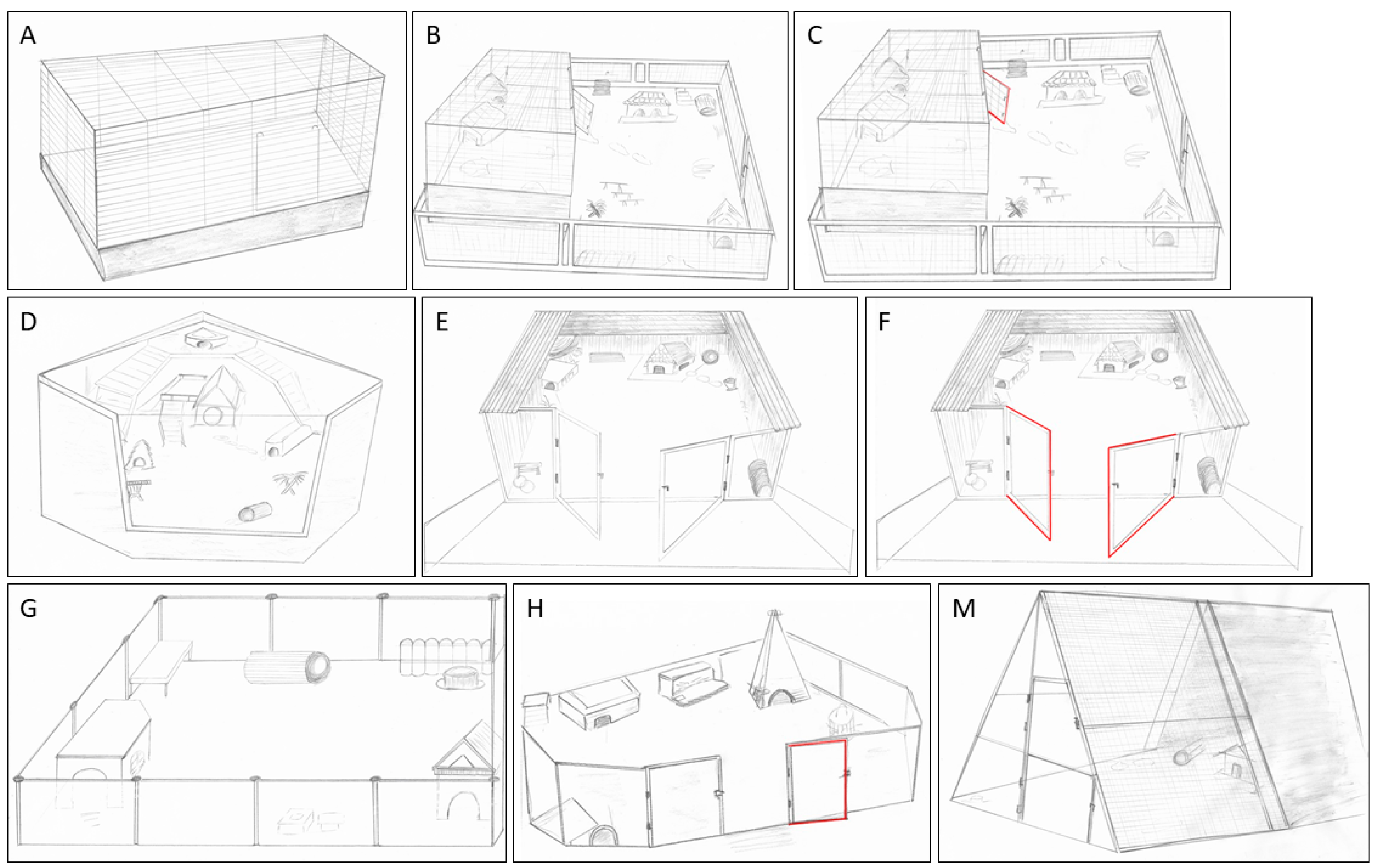
The husbandry section of the questionnaire included questions on various aspects of the guinea pig's living environment. Participating caretakers were asked about the number of animals living together with the focus animal in the same accommodation, group size increase or reduction within the last eight weeks, in case of solitary housing, reasons for solitary housing, group composition, keeping with other species in the same accommodation and frequency of presence of other species in the same room, dimensions of the accommodation, number of floor levels, availability of furnishings, frequency of providing specific enrichment; frequency of cleaning entire accommodation, changing litter, blankets or fleeces.
Feeding: frequency of feeding different food, treats, and supplements.
Health status and health care measures: current health status (healthy/sick), frequency of visits to a veterinarian, frequencies of different (health) care measures (including for instance control of ears, teeth, anal region, grooming, and cleaning of the nasal environment).
Guinea pig behaviour: frequency of observation of specific behaviours of the focus animal within the last month (7-point score from never to several times per day), for instance, various marking behaviours, teeth chattering, hiding during roaming; frequency of observation of selected social behaviours performed by the focus animal and directed towards the focus animal within last month, for instance chasing conspecifics, resting together with conspecifics, or spraying urine at conspecifics.
Human-animal interactions: daily time spent engaging with the focus animal (by hand-feeding, stroking, playing, training, observing, etc.), frequency of various human-animal interactions such as stroking, training, and playing with the focus animal.
Demographics: gender, age, occupation of the caretaker, country of residence, number of people (including children) in the household.
2.2. Survey and Requirements for Participation
The questionnaire was created using the online platform Survey Monkey®. It was accessible via a permanent link from the end of June 2020 until the end of September 2020. In the introduction, participants were instructed to ensure that only the primary caretakers of the guinea pigs participated in the survey. Eligibility required participants to currently own at least one guinea pig. The primary caretaker was defined as the individual most involved in the guinea pig's care, including feeding and spending the most time with the focus animal. If this person was a minor, an adult was required to fill out the questionnaire alongside them. Participating caretakers could only proceed to the questionnaire after providing informed consent to participate in the study and agreeing to its terms.
2.3. Recruitment of Participants
The survey was advertised via social media, in German-speaking guinea pig organizations on Facebook, and the Facebook page of the University of Veterinary Medicine. In addition, the link was sent via email to veterinarians, guinea pig organizations, the Austrian Veterinary Association, and guinea pig owners. As a means to increase motivation amongst potential participants, the option to take part in a raffle with non-cash prizes (cuddly accessories, treats, and books) was offered to participating caretakers who filled in the entire questionnaire.
2.4. Data Analysis
Data were imported into the statistics program IBM SPSS Statistics for Windows, Version 29.0 (IBM Corp., Armonk, N.Y., USA) and checked for plausibility (e.g. outliers, implausible answers). For descriptive statistics, minima, maxima, means, standard deviations, medians, frequencies, and percentages were calculated. Principal Component Analysis (PCA) was used to summarize the frequency of provision of various enrichment, (health) care measures, guinea pig behaviours (separately for social behaviours and behaviours in the main living area and during roaming), and human-animal interactions to a smaller number of components. The suitability of our data for PCA was confirmed using the Kaiser-Meyer-Olkin Measure of Sampling Adequacy (Kaiser-Meyer-Olkin criterion ≥ 0.5) and Bartlett’s test of sphericity (p < 0.05). Varimax rotation was applied to help simplify the interpretation [34]. For items to be included in the respective component, their component loadings had to reach 0.4 or exceed 0.4. If an item loaded on more than one component, it needed a loading exceeding 0.6 on the component it would be included in, while the loading on the other component had to be < 0.4 (cf. [31]). We reran PCAs after excluding variables with loadings below 0.4, as well as variables that loaded on more components in case they did not load higher than 0.6 on one, while loading lower than 0.4 on the other(s). We decided on the number of final components for the respective PCA based on the Kaiser criterion (Eigenvalue of at least 1.0), screen plot inspection, and component interpretability [34]. For the component labels, we considered the semantic content of the items. If only two items were included, we labelled the component after them. To allow a comparison of the components with the original scales of the items included, we calculated mean scores.
Housing types depicted as pictures were summarized into six categories: cage, self-built enclosure, larger fenced indoor floor area, guinea pig room, free flat housing, and outdoor housing (regardless of whether constant or temporary exercise outside the main enclosure was provided). To test for differences in frequencies of reported behaviour in relation to housing types, Kruskal-Wallis tests were used, followed by Mann-Whitney U-tests for post hoc testing because the dependent variables were non-parametric according to the Kolmogorov-Smirnov test.
In addition, we ran seven stepwise regression models to analyse associations of husbandry factors (other than housing type) and human-animal interaction components as well as focus on animal characteristics with guinea pig behaviour. Error! Reference source not found. provides a detailed overview of the independent variables included in the respective model. For the dependent variables ‘frequency of affiliative behaviours’, ‘frequency of going back into enclosure & hiding during roaming’, and ‘frequency of locomotor play & use of enrichment’ linear regression models were calculated. Through P-P plots the normal distribution of residuals was confirmed graphically, while the homoscedasticity assumption was confirmed by plotting the standardized residuals against the standardized predicted values resulting from the model. Multicollinearity was tested for by variance inflation factor, whereas the VIF-value had to be < 4.0. For ‘agonistic behaviours’, ‘competition for food’, ‘marking & teeth noises’, and ‘running up and down & bar chewing’ PCA-based subscale scores based on a frequency scale were dichotomized (occurrenc no/yes) to run logistic regression models because assumptions for linear regression models were not fulfilled. For all regression analyses for the inclusion of variables pentry = 0.10 and premoval = 0.15 were set using stepwise forward selection. Results with P ≤ 0.05 are referred to as significant, and with 0.05< P ≤ 0.1 as a trend. When data are shown as box plots, bold lines in boxes represent the median, while the lower and upper lines of boxes represent the first and third quartiles. Whiskers represent the highest and lowest values still within a range of 1.5 × interquartile range. Outliers (values between 1.5-3 × interquartile range) are indicated with a circle, while extreme values (outside of a range of 3 × interquartile range) are marked with an asterisk.

Table 1.
Overview of dependent variables (frequencies and occurrence no/yes) and independent variables of the linear and ordinal regression models. Always the same independent variables were entered as predictors in the three models for social behaviour and the four models for behaviours in the main living area and during roaming.
Table 1.
Overview of dependent variables (frequencies and occurrence no/yes) and independent variables of the linear and ordinal regression models. Always the same independent variables were entered as predictors in the three models for social behaviour and the four models for behaviours in the main living area and during roaming.
| Dependent Variables | Included Independent Variables |
|---|---|
| Frequency of affiliative behaviours Occurrence of agonistic behaviours (no/yes) Occurrence of competition for food (no/yes) |
Size of the enclosure/accommodation area including elevated areas and exercise areas in case of constant access Roaming frequency outside the enclosure Number of permanently accessible huts/caves/other Food enrichment Cat/dog toys Number of animals in the same enclosure as the focus animal Group size increase within the prior 8 weeks no (0) yes (1) Group size decrease within the prior 8 weeks no (0) yes (1) Daily time spent engaging with focus animal Frequency of lifting up Frequency of carrying & stroking Frequency of talking hand-feeding Female (0) vs. male (1) Age of focus animal |
| Frequency of going back into enclosure & hiding during roaming Frequency of locomotor play and use of enrichment Occurrence of marking behaviour & teeth noises (no/yes) Occurrence of running up and down & bar chewing (no/yes) |
Size of the enclosure/accommodation area including elevated areas and Exercise areas in case of constant access Roaming frequency outside the enclosure Number of permanently accessible huts/caves/other Food enrichment Cat/dog toys Individual housing yes (0) no (1) Number of animals in the same enclosure as focus animal Group size increase within the prior 8 weeks no (0) yes (1) Group size decrease within the prior 8 weeks no (0) yes (1) Frequency of presence of dogs in the same room frequency of presence of cats in the same room Daily time spent engaging with focus animal Frequency of lifting up Frequency of carrying & stroking Frequency of talking hand-feeding Frequency of training Frequency of health checks Frequency of cleaning & fur care Duration of residence of the focus animal at the caretaker’s Age of focus animal (only included in the frequency of locomotor play & use of enrichment) |
3. Results
3.1. Response Rate
A total of 1199 responses were collected through our questionnaire. However, after plausibility checks, 18 responses had to be excluded from the analysis due to significant similarities to other submissions, suggesting potential duplications (cf. [35]). Consequently, 1181 valid questionnaires were included in the final analysis, provided participating caretakers had answered the relevant questions. The majority of participants (85%) had heard from the survey through social networks (e.g. Facebook). Other sources included a guinea pig forum (15.9%), and acquaintances (6.2%, n = 881).
3.2. Participants Characteristics
The vast majority of participating caretakers were female (96.1%), 3.6% were male, and 0.3% were diverse (n = 861). Most participants resided in Germany (71.2%), followed by Austria (26.8%), 1.4% in Switzerland, and 0.2% each Italy and the Netherlands (n = 877). A small number of participants reported living in Denmark (0.1%) and Ukraine (0.1%). Regarding employment status, half of the participating caretakers were working fulltime (50.8%), about a quarter worked half-time (23.7 %), 7.6 % were undergoing training/in education, and 17.9% reported to be occupied otherwise (n = 878). The primary participants ranged in age from 8 to 70 years old (mean ± SD: 35.6 ± 10.4 years, median: 34 years, n = 879). Children were present in a significant proportion of households: 24.1% had children aged 10 years or younger, while 18% had children older than 10 years or teenagers (n = 810).
3.3. Characteristics of Focus Guinea Pigs
Approximately half of the focus animals were intact females (53%), while 2% were castrated females, 34.9% were castrated males, and 9.3% were intact males (n = 1118). Thus, 79.15% of males and only 3.58% of female guinea pigs were castrated. The neuter status was unknown for seven female guinea pigs (0.7%) and one male (0.1%). The most common breeds were smooth-haired (38.2%) and Abyssinian (26.1%, n = 1082). The guinea pigs were between one month and 10 years old, on average of 3.1 ± 1.9 years (median: 3 years, n = 1082). They had been living under the caretakers´ care between one month and ten years (mean ± SD: 2.3 ± 1.8, median: 2 years, n = 1087). The guinea pigs were most frequently acquired from individual people (26.9%), followed by breeders (25.9%), animal protection organisations (17.4%), pet shops (13.6%), and shelters (7.3% out of n = 1085). Only 3.7% of the guinea pigs had been bred by the caretakers.
3.4. Husbandry
3.4.1. Social Environment
At the time of the survey, 7.5% of the focus animals were kept alone in their enclosure, 21.7% were kept in pairs, 18.5% in a group of three, 16.1% in a group of four, and the remaining 27.8% in a group of five animals or more (n = 1043). The group size of the focus animal ranged from one to 81 (mean ± SD: 4.5 ± 5.3, median: 3). Among the 89 participating caretakers who housed their focus animal alone, 28 provided information on the reasons for solitary housing. Of these, 17.9% (5 out of 28) reported that the animal had been acquired form a solitary housing situation, 21.4% reported unsuccessful attempts at grouping, 3.6% (one caretaker) noted temporarily solitary housing following castration, 25% (7) reported the partner animal had died, and 7.1% (two caretakers) indicated that their guinea pigs were too old for group housing. Details on the social composition could be obtained from 918 participants. The most common group composition was a harem (46.7%), followed by mixed-sex pairs (11.8%), larger mixed-sex groups (10% with at least two males and together ≥ 5 animals), solitary housing (8.2%), and all male groups (7.2%). Male same-sex pairs were reported less often (5.7%), as were female same-sex pairs (5.2%), and all female groups (4.2%). Small mixed-sex groups (defined as more than one male with up to four animals in total) were the least common (1%, n = 9). While 66.6% stated that there was never a dog in the same room (not enclosure) with the focus animal, 11.7 % stated that there were dogs in the same room several times a day (n = 983). For cats, 79.8% stated that there were never any cats in the same room as the focus animals, while in 8.6% cats were reportedly there several times a day (n = 926). For more details on the frequency of the presence of dogs and cats in the same room as the focus animal, see Supplementary Material Table S1. When asked about housing other species with their guinea pigs, 91.8% of participating caretakers (n = 998) reported not keeping any other species in the same enclosure. Among those who did, rabbits were most common (5.8%), followed by chinchillas (0.2%), other rodents (0.2%), and various other species (2.4%). The latter included cats, dogs, chickens, quails, budgerigars, canaries, collared parakeets, and turtles.
3.4.2. Housing Type and Free-Roaming
Participating caretakers could select from fourteen housing types, which were defined in the questionnaire and illustrated in sketches (see 2.1, Questionnaire creation and content, Figure 1). The most commonly reported housing type was self-built enclosures without additional exercise options (27.7%), followed by larger fenced indoor floor areas without additional exercise opportunities (14.4%, n = 1,042). For cage-based housing, cages with temporary additional exercise possibility were most frequently reported (5.7%), followed by permanently open cages with constant exercise possibility (4.4%). Cage housing in a cage without additional exercise possibility (2%) was the least common. Only a small number of guinea pigs were kept in a dedicated room with (1.4%) or without (2.3%) temporary additional exercise possibility in other places. Even fewer could move freely all over the flat, with (0.5%) or without (1.7%) the possibility of temporary additional roaming , such as cellars or outdoor spaces. When housing types were grouped into six categories (regardless of whether permanent or temporary exercise outside the main enclosure was provided), self-built enclosures were most common (42.8%, n = 1042), followed by larger fenced areas (21.1%), outdoor enclosures (18.0%) and cages (12.1%). Guinea pig rooms (3.7%) and free-range flat housing (2.2%) were the least common.
The total size of the main living floor area without exercise area, even if permanently accessible, measured between 0.28 m2 and 270 m2 (mean ± SD: 6.35 m2 ± 14.63 m2, median: 3.00 m2, n = 904). Cages measured on average 2.83 m2 ± 3.14 m2 (median: 1.60 m2), self-built enclosures 3.59 m2 ± 11.63 m2 (median: 2.21 m2), larger fenced floor areas 5.73 m2 ± 7.46 m2 (median: 3.95 m2). Guinea pig rooms averaged 21.42 m2 ± 44.59 m2 (median: 12.00 m2), for free-range flat housing 17.70 m2 ± 15.43 m2 (median: 11.88 m2) were reported, and for outdoor enclosures 11.45 m2 ± 15.44 m2 (median: 7.00 m2). When elevated and exercise areas with constant access were included in the calculation of the main living area, it ranged from 0.28 m2 to 818m2 across all housing types (mean ± SD: 10.97 m2 ± 37.18 m2, median: 3.90 m2, n = 904). Approximately half of the guinea pigs were housed solely on the floor area (49.1 %), without any elevated platforms. About a quarter (24.9%) had access to two elevated areas or platforms, and 17.7% had one elevated area. 8.3% had three or more elevated areas (n = 919). Regarding exercise areas, 35.3% of the participants stated that the area was directly attached to the enclosure (but not necessarily always accessible), 32.9% indicated that the exercise area was somewhere else and that the animal had to be taken there, and 31.8% stated that they offered no additional roaming possibility (n = 958). Frequency of roaming was provided by 872 participating caretakers (see also Error! Reference source not found.). Among this sub-sample, the most common responses were no additional roaming outside the enclosure (34.7%), constant access to additional roaming area (15.1%), daily additional roaming (12.7%), and additional roaming several times per month (8.5%).
Free-roaming was assessed on a 15-point scale, with 1 = 'never' and 15 = 'constantly' (see Table 2). Access to this opportunity was least frequently offered in guinea pigs housed in larger fenced floor areas, with a mean score of 4.53 (SD = 4.75, median: 1; n = 191). Guinea pigs in self-built enclosures followed closely, with a mean score of 4.88 (SD: 4.37, median score: 3, n = 390), which suggests roaming observed several times per month in at least 50% of the animals (since score 3 equalled several times per month). Those kept in dedicated rooms had more regular access, with an average of four times per week (mean: 7.11, SD: 6.07, median score: 5 (=twice per week), n = 27). Guinea pigs housed in cages could roam more frequently, averaging five times per week (mean: 8.22, SD: 4.39, median score: 8 (=five times a week), n = 101). Outdoor-housed guinea pigs had the second highest roaming frequency, with a mean score of 8.53 (SD: 5.65, n = 144), corresponding to approximately more than five times per week and at least 50% of the animals could roam once per day (median score: 10). For guinea pigs in free flat housing, constant roaming was assumed, reflected by a score of 15 (SD: 0, median: 15, n = 16).
3.4.3. Furnishings and Enrichment
In terms of furnishings that were constantly available, 65 % reported offering drinking dishes, 51.7% nipple drinkers, 84.8% feeding dishes, 46.0% hammocks, 96.2% houses, 64.9% caves, 48.7% other retreats, and 79.2% tunnels or tubes (n = 943). When comparing the provision of drinking dishes and nipple drinkers, 19.0% of the focus animals had reportedly constant access to both drinking dishes and nipple drinkers, 46.2% had only drinking dish, 32.8% had only nipple drinkers, and 2.23% did not have constant access to either drinking dishes or nipple drinkers (n = 943).
Regarding the frequency of provision of various enrichment, tunnels made of fabric, plastic, willow, wood, etc. were offered most often (at least several times per day by 69.9%). In contrast, cat and dog toys were the least commonly offered (never by 93.7% and 92.3%, respectively). For details, see Error! Reference source not found..
A principal component analysis (PCA), was conducted to group enrichment items into components, explaining 47.7% of the total variance. Two components emerged from the analysis. The first component comprised the four items hay ball, wooden gnawing stick, feeding tree, and fresh twigs, and was thus labelled ‘food enrichment’. The second component comprised the two items cat and dog toys and was labelled after them. Carton boxes and tunnels were not included in the final PCA because their component loadings did not reach 0.4. Food balls and intelligence toys were excluded because of double loadings that were too close (did not exceed 0.6 for one component while being below 0.4 for the other. For further details, see Supplementary Material Table S2.
3.4.4. Human-Animal Interactions
The reported time spent engaging with the focus animal ranged from 0 to 10 hours per day (average 1.1 ±1.04 hours, median: 0.5 hours, n = 1060). Approximately half (48.7%) of the participants spent 0.5 hours per day engaging with the focus animals, followed by 22.8% who reported spending one hour and 8.7% who spent 1.5 hours daily. For more detailed information, refer to Supplementary Material (Table S3). Regarding human-animal interactions and activities, talking was the most frequently reported activity, followed by hand-feeding (see Table 3). A PCA was conducted to summarise human-animal interactions into three components, which together explained 59.2% of the total variance. The first component comprised the four items target, clicker, trick training, and agility and was thus labelled ‘frequency of training’. The second and third components comprised two items each and were labelled after them, ‘frequency of carrying around & stroking’ and ‘frequency of talking & hand-feeding’. See Supplementary Material (Table S4) for further details.
3.4.5. Feeding
Error! Reference source not found. provides a detailed summary of food and nutritional supplements that were provided to the animals according to participants' reports. 90.3% of the focus animals constantly had access to hay and only 0.4% were reportedly never provided with hay. Feed and supplements that were offered to the focus animals of the survey mostly ‘never’ were lime lickstones (‘never’ in 93.6%), bread (89.6%), salt lick (88.7%), concentrates with grains (84.4%), veterinarian food (82.0%), and nuts (81.2%). Vitamin supplements were also mostly absent from the animals’ diets (81.2%), while 13.2% received it occasionally.
3.5. Health Status, Care Measures, and Cleaning of Enclosures and Equipment
When asked about the current illnesses of the focus animal, 15.2% (n = 141) responded that it was currently ill (n= 929). The majority 82.2% indicated to take the focus animal to a veterinarian only when it had a health problem. While 2.8% reported never taking it to a veterinarian, 1.7% reported doing so less often than once a year, 5% once a year, and 8.2 % several times a year (n = 923). Health care measures performed by guinea pig owners most frequently were anterior teeth, ear, and anal region checks (by 54% to 59 % once per week, for details see Table 4). Summarizing (health) care measures using a PCA resulted in two components with three items each. Together they explained 74.1% of the total variance. The first component comprised anterior teeth, ear, and anal region checking and was labelled ‘frequency of health checks’. The second component comprising cleaning of the nasal and eye region as well as fur grooming was labelled ‘frequency of cleaning and fur care’. For further details, see Supplementary Material Table S5. Nail clipping was not included in the final PCA because the component loading did not reach the threshold of 0.4. More than half of the participating caretakers reported cleaning the entire enclosure once a week (54.9%), while 13.8% stated that they cleaned it daily. For more details on cleaning routines, see Table 5.
3.6. Guinea Pig Behaviour
3.6.1. Social Behaviour
Behaviours like eating simultaneously and peacefully next to conspecifics and resting together with a conspecific(s) (e.g. contact lying, sitting) were reported frequently (by 87.6% and 48.1% several times per day, see Table 5). Resting alone was reported several times per day for approximately half of the guinea pigs (53.0%). Behaviours rarely reported were, plucking out fur (never performed by focus animal in 96.9%, never occurred to focus animal in 97.3%), avoiding each other (never in over 90%), and fighting (never in 90.9%). For a detailed breakdown, see
Table 6.
The heat map shows frequencies of behaviours directed by the focus animal towards conspecifics and directed to the focus animal in the last month as reported by participating caretakers. Frequencies are depicted in the percentage of responses (n). The shade of orange darkens with increasing percentages.
Table 6.
The heat map shows frequencies of behaviours directed by the focus animal towards conspecifics and directed to the focus animal in the last month as reported by participating caretakers. Frequencies are depicted in the percentage of responses (n). The shade of orange darkens with increasing percentages.
| Behaviours Directed Towards Conspecifics and Directed to Focus Animal | n | Never | 1x/ Month |
Several Times/ Month |
1x/ Week |
Several Times/ Week |
1x/ Day |
Several Times/ Day |
|---|---|---|---|---|---|---|---|---|
| Bites conspecifics | 898 | 87.6% | 4.9% | 3.5% | 1.2% | 1.6% | 0.8% | 0.4% |
| Bitten by conspecifics | 896 | 89.7% | 5.4% | 2.5% | 0.6% | 1.2% | 0.2% | 0.4% |
| Chases conspecifics | 897 | 67.0% | 14.0% | 10.0% | 2.9% | 3.5% | 1.2% | 1.3% |
| Chased by conspecifics | 892 | 70.3% | 15.6% | 7.7% | 1.7% | 1.9% | 1.2% | 1.6% |
| Blocks conspecifics from food | 895 | 60.9% | 8.8% | 10.1% | 2.5% | 8.4% | 4.2% | 5.1% |
| Blocked from food by conspecifics | 897 | 67.4% | 8.7% | 9.8% | 2.1% | 6.8% | 2.3% | 2.8% |
| Sprays urine at conspecifics | 894 | 81.7% | 8.6% | 4.9% | 1.1% | 2.6% | 0.7% | 0.4% |
| Sprayed with urine by conspecifics | 893 | 80.6% | 8.5% | 5.9% | 1.2% | 2.0% | 0.8% | 0.9% |
| Plucks out fur from conspecifics | 895 | 96.9% | 1.7% | 0.9% | 0.1% | 0.4% | 0.0% | 0.0% |
| Fur plucked out by conspecifics | 896 | 97.3% | 1.7% | 0.6% | 0.0% | 0.4% | 0.0% | 0.0% |
| Food stolen by conspecifics | 892 | 32.3% | 10.3% | 14.8% | 4.9% | 17.0% | 8.2% | 12.4% |
| Steals food from conspecifics | 894 | 29.0% | 10.3% | 15.9% | 6.3% | 17.0% | 7.8% | 13.8% |
| Mounts on conspecifics | 891 | 63.0% | 14.8% | 12.1% | 2.0% | 5.7% | 0.6% | 1.8% |
| Mounted by conspecifics | 887 | 66.0% | 17.7% | 9.8% | 2.4% | 2.7% | 0.7% | 0.8% |
| Plays with conspecifics | 879 | 24.7% | 4.9% | 13.5% | 2.6% | 21.4% | 5.7% | 27.2% |
| Avoids contact with conspecifics | 889 | 90.7% | 3.6% | 2.5% | 0.3% | 1.7% | 0.3% | 0.9% |
| Avoided by conspecifics | 888 | 92.6% | 2.7% | 2.1% | 0.6% | 1.4% | 0.3% | 0.3% |
| Fighting with conspecifics | 891 | 90.9% | 5.3% | 1.9% | 0.7% | 0.7% | 0.6% | 0.0% |
| Rests together with conspecific(s) (e.g. contact lying, sitting) | 894 | 9.4% | 3.7% | 7.8% | 1.7% | 22.5% | 6.8% | 48.1% |
| Rests alone | 888 | 8.1% | 2.3% | 8.1% | 1.4% | 19.3% | 7.9% | 53.0% |
| Naso-nasal contact | 883 | 13.5% | 4.3% | 12.6% | 3.5% | 23.9% | 8.6% | 33.6% |
| Ano-genital sniffing (control) | 881 | 14.1% | 7.3% | 16.7% | 5.2% | 25.2% | 8.4% | 23.2% |
| Sleeps together with conspecifics in same house/tube | 892 | 18.0% | 5.6% | 11.1% | 2.6% | 19.2% | 7.5% | 36.0% |
| Eats simultaneously and peacefully next to conspecifics | 895 | 0.6% | 0.3% | 1.8% | 0.2% | 6.8% | 2.7% | 87.6% |
Following a PCA, behaviours displayed in a social context were summarised into three components explaining 46.35% of the total variance. The first component comprised five components (hunting conspecifics, being hunted, biting conspecifics, being bitten, and fighting with conspecifics) and was labelled ‘frequency of agonistic behaviours’. The second component, which was labelled ‘frequency of affiliative behaviours’, comprised resting with conspecifics, naso-nasal contact, anogenital sniffing, playing with conspecifics, and sleeping with conspecific(s) in the same house/tube and eating simultaneously and peacefully next to conspecifics. The third component included the four items of stealing food from conspecifics, food being stolen from the focus animal by conspecifics, as well as blocking conspecifics from food or being blocked by them and was thus labelled ‘frequency of competition for food’. Items excluded because of double loadings or loadings below 0.4 were ‘being avoided by conspecifics’, ‘avoids contact with conspecifics’, and ‘rests alone’, ‘fur plucked out by conspecifics’, ‘plucks out fur from conspecifics’, ‘mounts conspecific’, ‘mounted by conspecifics’, and ‘being sprayed with urine’. For further details, see Supplementary Material Table S6.
3.6.1.1. Differences in Social Behaviour in Relation to Housing Types
The reported social behaviours of guinea pigs did not show significant differences across housing types, i.e., cages, self-built enclosures, larger fenced indoor floor areas, guinea pig rooms, free flat housing or outdoor enclosures (‘frequency of agonistic behaviours’: H = 7.07, p = 0.216, n = 898; ‘frequency of competition for food’: H = 4.44, p = 0.488, n = 898; ‘frequency of affiliative behaviours’: H = 6.19, p = 0.288, n = 896).
3.6.1.2. Associations of Social Behaviour with Husbandry, Human-Animal Interactions, and Focus Animal Characteristics
Error! Reference source not found. presents the results of the regression models for the frequency of affiliative behaviour, as well as the occurrence of agonistic behaviour and competition for food. While the models for affiliative behaviours and the occurrence of competition for food were significant, the model for agonistic behaviours just showed a trend. Participants who provided more frequent food enrichment and engaged in activities such as carrying and stroking the focus animal more often reported a higher ‘frequency of affiliative behaviours’. Moreover, higher frequencies of affiliative behaviour were reported in male guinea pigs. Conversely, an increase in group size over the past eight weeks was associated with a lower frequency of affiliative behaviours. There was a trend suggesting that affiliative behaviour was more frequent in younger focus animals, and when participants were provided more permanently accessible huts/caves/other, spent more daily time engaging with the focus animal, and talked and hand-feed their focus animals more often.
‘Occurrence of agonistic behaviour’ tended to be more likely in the case of less frequent provision of food enrichment. ‘Competition for food’ was more likely reported in the case of less frequent carrying & stroking. In contrast, participating caretakers observing competition for food were more likely to report more frequent talking & hand-feeding. In addition, food competition was observed more likely in female focus animals.
Table 7.
Final stepwise linear regression model for the reported frequency of affiliative behaviours, and final stepwise logistic regression models for the occurrence of agonistic behaviours and competition for food. Behaviour subscales were calculated following a principal component analysis. For affiliative behaviours, subscales scores were obtained by calculating the mean of the items in the subscale. For agonistic behaviours and competition for food, subscale scores were dichotomized for the logistic regression models. Trends (p > 0.05 ≤ 0.1) are depicted in italics.
Table 7.
Final stepwise linear regression model for the reported frequency of affiliative behaviours, and final stepwise logistic regression models for the occurrence of agonistic behaviours and competition for food. Behaviour subscales were calculated following a principal component analysis. For affiliative behaviours, subscales scores were obtained by calculating the mean of the items in the subscale. For agonistic behaviours and competition for food, subscale scores were dichotomized for the logistic regression models. Trends (p > 0.05 ≤ 0.1) are depicted in italics.
| Dependent Variable | Predictor Variables and Model Summary | Estimatea | SEb | Betac | t | pd | |
|---|---|---|---|---|---|---|---|
| Frequency of affiliative behaviours | Number of permanently accessible huts/caves/other | 0.11 | 0.06 | 0.07 | 1.82 | 0.070 | |
| Group size increase within the prior 8 weeks no (0) yes (1) | -0.38 | 0.12 | -0.12 | -3.12 | 0.002 | ||
| Food enrichment | 0.22 | 0.05 | 0.18 | 4.55 | <0.001 | ||
| Daily time spent engaging with focus animal | 0.10 | 0.05 | 0.07 | 1.89 | 0.059 | ||
| Frequency of carrying & stroking | 0.07 | 0.02 | 0.12 | 3.21 | 0.001 | ||
| Frequency of talking hand-feeding | 0.07 | 0.04 | 0.07 | 1.84 | 0.067 | ||
| Age of focus animal | -0.04 | 0.02 | -0.06 | -1.74 | 0.081 | ||
| Female (0) vs. male (1) | 0.23 | 0.09 | 0.09 | 2.52 | 0.012 | ||
| Model: adj. R2 = 0.104, F = 10.78, p < 0. 001, n= 674 | |||||||
| Dependent Variables | Predictor Variables & Model Summary | Be | SE | ORf | Wald | pd | |
| (95% CI)g | |||||||
| Occurrence of agonistic behaviours | Food enrichment | -0.15 | 0.08 | 0.86 (0.73-1.01) |
3.55 | 0.060 | |
| Model: R2 = 0.007, Chi2 = 3.61, p = 0.058, n=676 | |||||||
| Occurrence of competition for food | Frequency of carrying & stroking | -0.17 | 0.47 | 0.84 (0.77-0.93) |
12.92 | <0.001 | |
| Frequency of talking hand-feeding | 0.26 | 0.08 | 1.30 (1.11-1.52) |
10.73 | 0.001 | ||
| Female (0) vs. male (1) | -0.45 | 0.21 | 0.64 (0.43-0.96) |
4.62 | 0.032 | ||
| Model: R2 = 0.056, Chi2 = 23.05, p < 0.001, n=676 | |||||||
a Estimate: estimated regression coefficient (linear regression). b SE: Standard error of estimate. c Beta: standardised regression coefficient (linear regression). d significance value. e B: regression coefficient (logistic regression). f OR: odds ratio. g 95% CI: 95% confidence interval of lower & upper bound of OR.
3.6.2. Behaviours Observed in the Main Living Area and During Roaming
Playing with toys and using enrichment was reported most frequently (Table 1, at least daily by 41.4%), followed by locomotor play (‘popcorning’, which was observed at least daily by 26.8%) and hiding during free-roaming (observed at least daily by 24.7% of participants). In contrast, running up and down and bar chewing at a certain cage location or between two specific places was reportedly observed least often (‘never’, within the last month according to 96.7 % and 91.1 % of the participants). Regarding marking behaviours, urine spraying was observed less frequently than marking with perianal glands (19.8 % versus 31.3 %). For more details, see Table 1.
Through a PCA, variables assessing the frequency of behaviours displayed by focus animals in the main living area and during roaming in the last month were summarised into four components explaining 59.5 % of the total variance. The first component comprised the items marking with perianal glands, urine spraying, teeth grinding, and teeth chattering and was labelled ‘frequency of marking & teeth noises’. The second component comprised the items hiding during free-roaming and trying to return to cage/enclosure during free-roaming and was named ‘frequency of going back into enclosure & hiding during roaming’. The third component was labelled ‘frequency of running up and down & bar chewing’, after the two items it comprised, and the fourth component (comprising popcorning (‘jumping attacks’) and the use of toys/enrichment) was labelled ‘frequency of locomotor play & use of enrichment’. For further details, see Supplementary Material Table S7. Fur nibbling and gnawing at furniture during roaming were not included in the final PCA because their component loadings did not reach the threshold of 0.4.
3.6.2.1. Differences in General Behaviour in the Main Living Area and During Roaming in Relation to Housing Types
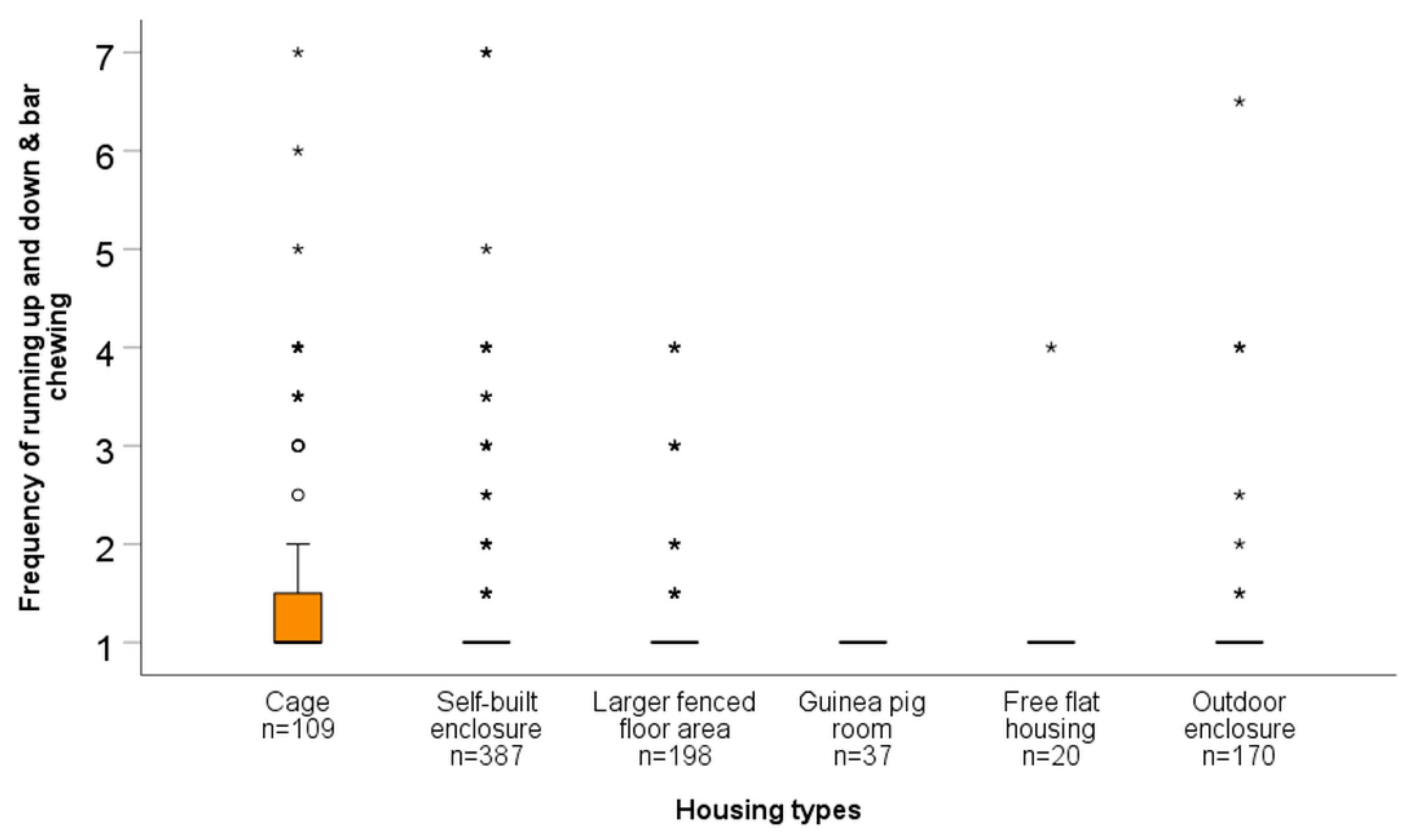
Kruskal-Wallis tests revealed significant overall differences in the ‘frequency of marking behaviours & teeth noises’ (H = 28.64, p < 0.001, n = 922), ‘frequency of going back into enclosure & hiding during roaming’ (H = 18.89, p = 0.002, n = 814), and ‘frequency of running up and down and bar chewing’ (H = 44.66, p < 0.001, n = 921). According to posthoc tests, ‘marking behaviours & teeth noises’ were reported less frequently for outdoor enclosures compared to cages, self-built enclosures, and larger fenced indoor floor areas, and less often for guinea pig rooms compared to self-built enclosures or larger fenced floor areas (see Error! Reference source not found., Error! Reference source not found.). According to caretaker reports, ‘going back into enclosure & hiding during roaming’ was observed more frequently in free flat housing, outdoor housing, and cage-housed guinea pigs compared to self-built enclosures and larger fenced floor areas (see Error! Reference source not found., Error! Reference source not found.). ‘Running up and down & bar chewing’ were observed significantly more often in cage-housed guinea pigs compared to those housed in the other five housing types. Additionally, ‘running up and down & bar chewing’ were significantly more frequent in guinea pigs housed in self-built enclosures or larger fenced floor areas compared to guinea pigs housed in dedicated guinea pig rooms, where such behaviours were never observed (see Error! Reference source not found., Error! Reference source not found.). For more details on the frequency scores for each behaviours by housing type, see Supplementary Material Table S8.
Figure 2.
Frequency of marking behaviours & teeth noises (mean score based on principle component analyses) in relation to housing types (frequency scale: never = 1, 1x/month = 2, several times/month = 3, 1x/week = 4, several times/week = 5, 1x/day = 6, several times/day = 7). Component values were calculated by averaging the included items.
Figure 2.
Frequency of marking behaviours & teeth noises (mean score based on principle component analyses) in relation to housing types (frequency scale: never = 1, 1x/month = 2, several times/month = 3, 1x/week = 4, several times/week = 5, 1x/day = 6, several times/day = 7). Component values were calculated by averaging the included items.
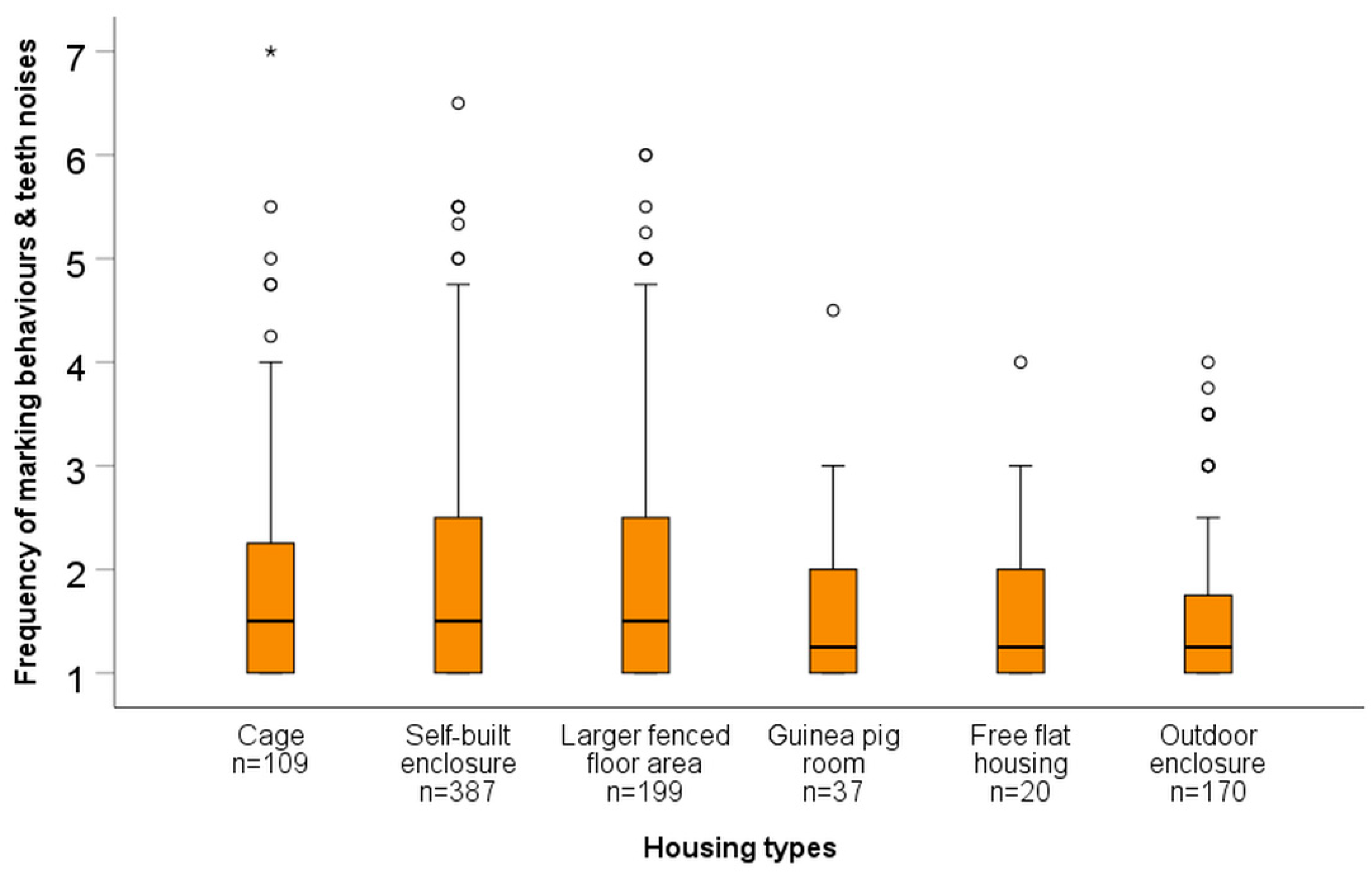
Figure 3.
Frequency of going back into enclosure & hiding during roaming (mean score based on principle component analyses) in relation to housing types (frequency scale: never = 1, 1x/month = 2, several times/month = 3, 1x/week = 4, several times/week = 5, 1x/day = 6, several times/day = 7). Component values were calculated by averaging the included items.
Figure 3.
Frequency of going back into enclosure & hiding during roaming (mean score based on principle component analyses) in relation to housing types (frequency scale: never = 1, 1x/month = 2, several times/month = 3, 1x/week = 4, several times/week = 5, 1x/day = 6, several times/day = 7). Component values were calculated by averaging the included items.
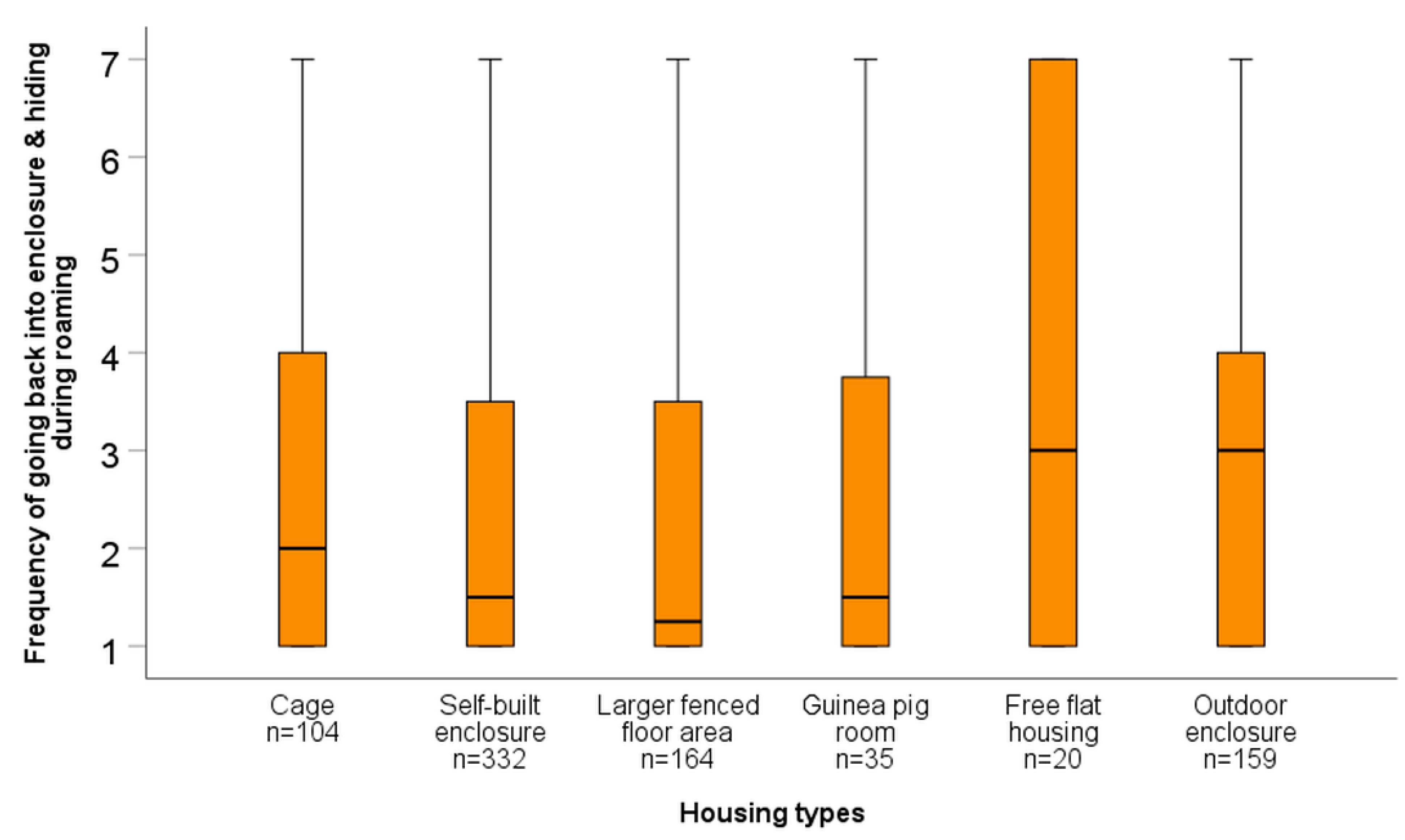
Figure 4.
Frequency of running up and down & bar chewing (mean score based on principle component analyses) in relation to housing types (frequency scale: never = 1, 1x/month = 2, several times/month = 3, 1x/week = 4, several times/week = 5, 1x/day = 6, several times/day = 7). Component values were calculated by averaging the included items.
Figure 4.
Frequency of running up and down & bar chewing (mean score based on principle component analyses) in relation to housing types (frequency scale: never = 1, 1x/month = 2, several times/month = 3, 1x/week = 4, several times/week = 5, 1x/day = 6, several times/day = 7). Component values were calculated by averaging the included items.
3.6.2.2. Associations of General Behaviour in the Main Living Area with Husbandry, Human-Animal Interactions, and Focus Animal Characteristics
The results of the regression models for the frequency of going back into the enclosure & hiding during roaming, the frequency of locomotor play & use of enrichment, the occurrence of marking behaviour & teeth noises as well as the occurrence of running up and down & bar chewing, are shown in Table 9. All models were significant. A higher frequency of going back into the enclosure & hiding during roaming was reported, when there were fewer animals in the same enclosure as the focus animals, when the focus animal was allowed more frequent roaming outside the enclosure, and when participating caretakers reported less frequent health checks. The frequency of locomotor play & use of enrichment was significantly higher when there were fewer animals in the same enclosure as the focus animals, and when more frequent food enrichment, talking and hand-feeding, training, and health checks were reported. In addition, ‘locomotor play & use of enrichment’ was reported significantly more often for younger animals. There was also a trend indicating that ‘locomotor play & use of enrichment’ was observed more frequently when participating caretakers stated to spend overall more daily time engaging with the focus animal. The occurrence of marking behaviour & teeth noises was more likely reported by participating caretakers who provided training and more frequent talking and hand-feeding. In addition, there was a trend for an increased likelihood of marking behaviour & teeth noises in case participants reported to spend overall more daily time spent engaging with the focus animal increased. Reports of running up and down & bar chewing were significantly more likely in the case of more frequent carrying and stroking, as well as training. Additionally, the likelihood of these behaviours tended to be higher in animals housed individually, without conspecifics in the same enclosure.
4. Discussion
This study aimed to explore the current husbandry, behaviour, and health status of guinea pigs in German-speaking households, as well as aspects of the human-animal relationship to gain insight into their welfare. In addition, we investigated how housing conditions and human-animal interactions might influence guinea pig behaviour. To our knowledge, this is the first study to investigate associations between behaviours of guinea pigs kept as companion animals and human-animal interactions. Our findings reveal that guinea pig behaviour is associated not only with housing conditions but also with human-animal interactions. Moreover, we provide a comprehensive insight into the welfare of companion guinea pigs and highlight potential welfare issues.
4.1. Insight into Current Husbandry Including Human-Animal Interactions, Health Status, and Behaviour of Guinea Pigs Kept as Companion Animals
4.1.1. Social Environment
Individual housing occurred in 7.5% of the focus animals. This is a higher percentage of animals kept without conspecifics than found in a German ([9]: < 2%), and a Norwegian sample ([14]: 3.5%). However, it is two to three times lower than the percentage of individual housing reported for New Zealand with 14% of guinea pigs [12], or for the UK with 21.4% [10]. Given guinea pigs´ social nature [5,15], individual housing should be avoided. In previous studies, the most common reason for individual housing were the death of a partner animal, unsuccessful attempts at grouping, and the animal´s prior solitary housing situation. These findings support the recommendation by guinea pig experts to keep at least three animals, reducing the likelihood that one animal will be left alone if a companion passes away [36]. This practice provides more time for slowly introducing new animals without one animal being completely isolated. To date, this is the first study to investigate reasons for individual housing in guinea pigs. In a similar survey among caretakers of pet rats, participants reported the following three reasons for single housing most often: lack of social compatibility, death of the partner animal, solitarily housing before adoption [35]. Problems with social compatibility seem to be more of an issue in pet rats though, because more than half of the rat caretakers (53%) mentioned it as reason for solitary housing in rats compared to only 21% of guinea pig caretakers in the present study.
In the present study, guinea pigs were kept most often in a group of five animals or more (27.8%), closely followed by guinea pigs kept in pairs (21.7%). This fits to the recommendations of experts that at least two guinea pigs should be kept together [5,16]. To our knowledge, this is the first study to assess social group compositions of guinea pigs kept as companion animals in detail. Our results reflect the recommended group compositions [5,16]: the harem was the most frequent structure (47%), followed by mixed-sex pairs (12%). Larger mixed-sex groups (at least two males and altogether five or more animals) were reported for only 10% of the focus animals, although such groups tend to have highly stable social structures[15]. One possible explanation for the less frequent keeping of large mixed-sex groups is the increased challenges in management monitoring for potential stress, and higher costs and time demands. All-male groups with three or more animals were reported only for 7%, likely reflecting participants´ awareness of potential issues with this group composition and their tendency to avoid it [16].
In the present study, 33% of the participating caretakers reported having a dog, and 20% reported having a cat. This is similar to findings from a UK survey among guinea pig owners, where 38% of the households kept dogs and 30% kept cats. However, the UK study did not assess how often these pets had access to the guinea pigs´ main living area [10]. Cameron et al. [12] only reported that guinea pigs had access to other animals (including dogs, cats, and chickens) in just 0.9% of cases, without further details. When asked about co-housing with other species, 5.8% of participating caretakers reported keeping guinea pigs with rabbits. This is higher than the 1.7% reported in the UK survey [10]. Co-housing guinea pigs and rabbits in the same enclosure should be avoided and is forbidden in Austria [18], as it can negatively impact the guinea pigs’ welfare. Differences in social behaviour, such as rabbits´ tendency to groom each other [37,38], can create stress, as allogrooming is considerably less common in guinea pigs [5]. Rabbits can also intimidate guinea pigs causing injuries with kicks [39]. Moreover, there are anecdotal reports of rabbits mounting guinea pigs, which may bother/stress guinea pigs. Recent studies have shown that guinea pigs housed with rabbits display fewer ‘positive behaviours’ indicating that such co-housing may negatively impact their welfare [10]. Additionally, rabbits can be carriers of Bordetella bronchiseptica, a pathogen of that is often fatal to guinea pigs [4,40].
4.1.2. Housing Type and Free-Roaming
In our sample of German-speaking households, only 2% of focus animals were kept in a cage without additional exercise possibility, a considerably lower percentage than reported in the UK [10]. This may be attributed to the fact that highly engaged and well-informed owners were more likely to complete the questionnaire. Supporting this we found that the most common housing type was a self-built enclosure without additional exercise possibility (27.7%), followed by larger fenced indoor floor area without additional exercise possibility (14.4%). Constructing an adequate accommodation oneself requires knowledge of the animals’ needs and it is likely more time-intensive. The average floor area of the accommodations was 6.4 m², significantly exceeding legal minimum requirements. For example, Austria mandates at least 0.6 m² for two guinea pigs [18], Switzerland requires 0.5 m² [19], and while Germany animal protection law does not specify dimensions, expert reports are used in legal disputes suggesting a minimum size of 2 m² [41]. Given that guinea pigs are very active and have a strong drive for locomotion [5], these legal minimum are likely insufficient to meet their needs. Free flat housing did occur in our study, but it was the least common type of accommodation (2.2%). It is questionable whether all participants understood the definition of free flat housing correctly, as some reported rather small spaces, with an average of 18 m2.
In the present study, guinea pigs received varying amounts of additional exercise, ranging from never (35%) to once per day (12.7%), and constantly (15.1%). In contrast, the opportunity for constant additional exercise was lower than in the UK survey, where 23.8% of the guinea pigs were reported as having an additional exercise area attached to their main living area[10]. The lower percentage in our study may be attributed to the differences in housing design. The most common housing type in our sample was a self-build enclosure with an average floor area of 3.6 m² (median 2.2 m²) which may be considered rather spacious. In comparison, Harrup and Ronney [10] found a median surface area of 0.77 m2 including multi-level enclosures. Furthermore, in the case of multi-level housing, guinea pigs had greater freedom of movement, possibly leading to perceiving additional exercise as unnecessary. In our sample, 24.9% of guinea pigs had access to two levels, 17.7% to a single-level enclosure, and 8.3% to three or more levels. This contrasts with findings from Norway, where 80.3% of guinea pig enclosures had only one level [14], and New Zealand, where single-level housing was most common (54.4%), followed by two (44.4%), and three levels (1.2%) [12].
4.1.3. Furnishings and Enrichment
Only 19% of participating caretakers provided both drinking dishes and nipple drinkers simultaneously. When acquiring new animals, it is advisable to offer multiple drinking options, such as water bowls and nipple drinkers. Guinea pigs first have to learn to drink from nipple drinkers, which in the worst case can even lead to the animal's death [39]. Hiding places were widely provided, with 96.2% of participants offering huts or other retreats. In addition to huts, various retreats and hiding places such as tunnels or caves were commonly available aligning with findings from Olsen [14], where 98.9 % of guinea pigs had retreat options. Cameron et al. [12] stated that 90.9% of the caretakers provided tunnel(s) and/or hideaway(s) within the guinea pigs living area and Bläske et al. [9] reported retreat possibilities for at least 95.9 %. Since guinea pigs are prey animals that instinctively seek shelter when threatened [5,36], sufficient hiding places are essential for their well-being [5]. A lack of retreat possibilities can impact the behaviour of guinea pigs [28,29] and likely their welfare. Guinea pigs are also neophobic and selective, often disliking sudden changes in water sources or diet [39]. However, early exposure to diverse enrichment items can help them adapt more readily [39]. This study did not look into protocols for changing furnishings, enrichment, and food. This warrants further investigation.
Focus animals in this study were provided with a wide range of enrichment items, including cardboard boxes, fresh branches, tunnels, food balls, and hay balls. However, the frequency of enrichment varied considerably, ranging from occasional to constant. Enrichment, particularly in the form of feeding (e.g., hay and twigs), is not only important for stimulating natural behaviours but also plays a crucial role in maintaining health, particularly dental health. Providing structured materials like hay encourages prolonged chewing, which is essential for controlling the continuous growth of guinea pig teeth. The duration and intensity of chewing are more critical for proper dental wear than the hardness of the food [4].
4.1.4. Human-Animal Interactions
To the best of the authors' knowledge, no previous study has assessed the amount of time owners spend interacting with their guinea pigs. The time allocated to guinea pigs is similar to, or slightly lower than, the durations reported for human-animal interactions in companion chinchillas and rats [31,35]. Nearly half of the guinea pig owners (48.7 %) reported spending half an hour per day engaging with the focus animal (e.g. stroking, talking, hand-feeding), followed by 22.8 % who spent about an hour. In rats, the average was higher with 1.6 hours per day, as was the median time with one hour [35]. For chinchillas, the durations reported most frequently for engaging with chinchillas were one hour (22.0 %) [31], followed by about half an hour (18 %) [31].
This is the first survey to investigate the frequency of different types of human-animal interactions in pet guinea pigs. The most common interaction reported was talking to the focus animal, which 88.2 % of the participating caretakers did multiple times per day. This aligns with findings from studies on pet rats or chinchillas, where talking to the animal was also the most frequent interaction (reported by 94.9% and 79.5% of caretakers, respectively) [31,35]. The second most frequent interaction was hand-feeding, with 54.9% of caretakers doing so several times per day. Stroking was the third most frequent interaction, though it was considerably less common than talking or hand-feeding. Only 22.9% stated that they stroke their focus animal several times per day and 31.2% percent stroked it occasionally. 22.4% stated that they never stroked the guinea pig. Since stroking has been identified as a potential stressor for guinea pigs [29], some of the caretakers participating in our study might be unaware of its possible negative effects. However, we did not inquire about the animals’ reactions to stroking or whether owners had deliberately habituated or desensitized them to this form of interaction.
When it comes to carrying guinea pigs, 49.8% of the caretakers reported never carrying their focus animal around. In a survey on chinchillas, 63.4% of the caretakers stated to never carry their chinchillas [31]. Gilhofer et al. [31] distinguished between caretakers who avoided carrying their animals because they assumed the chinchillas did not like being carried around (48.9%) and those who simply did not find it necessary or enjoyable (14.5%). Since guinea pigs are prey animals that generally dislike being stroked [5,36], it is reasonable to assume that, like chinchillas, they do not enjoy being carried. Therefore, it is likely that the majority of caretakers in this study refrained from carrying their guinea pigs for similar reasons.
Although clicker training and target training are very good tools to provide enrichment to guinea pigs [5], very few participants in this study reported engaging in such activities. The vast majority of participating caretakers stated that they had never trained their guinea pigs in any form. Clicker training, target training, agility, or trick training were never performed by 90.3%, 92.2%, 90.0%, and 79.8%, respectively. In contrast, training is far more common in rats kept as companion animals [35]. Similarly, in chinchillas owners reported lower training rates, mainly because they saw no need for it or assumed their animals would not enjoy it (for clicker training: 70.8%, for target training 68.9%), or stated their animal did not like it (for clicker training: 17.3%, for target training 19.1%, respectively). It can be assumed that also guinea pig caretakers partly do not train the animals because they see no need to do so or because they assume the animals do not like it. Further investigations into the reasons behind this reluctance, as well as promoting training as enrichment for guinea pigs would be worthwhile, especially given the cognitive skills of guinea pigs [42,43].
4.1.5. Feeding
Overall, most participating caretakers appeared well-informed about the nutritional needs of guinea pigs. The vast majority (90%) had constant access to hay, a crucial component for guinea pig health and welfare [2]. This aligns with the Norwegian study, where 93.3% of guinea pigs had continuous hay access [14]. In contrast, the UK survey reported a lower percentage (73%) [10]. In our sample, most guinea pigs (84%) never received concentrates with grains and nuts (81%), or they received these foods rather only occasionally. Wheat, oats, and corn are grains rich in starch and, when given in excess, disrupt the intestinal flora. Due to their high fat and protein content, seeds and nuts should be strictly avoided [4]. Other foods considered unhealthy, such as bread and processed treats, were also rarely included in their diet.
For a balanced diet, apart from constant access to hay [2], green fodder should be offered daily [5,36]. Many guinea pigs in the study likely received a diet rich enough in vitamin C. Green fodder was provided daily to 65% of the guinea pigs, a percentage comparable to the UK survey with 70% [10]. Additionally, 91% of participants offered vegetables daily, while salad and herbs were also commonly included in their diet (daily in 62% and 32% of cases, respectively). Vitamin supplements were administered more frequently in this study than in the UK sample, with at least 19% of guinea pigs receiving them occasionally, compared to just 7% in the UK study. However, unlike the UK survey, which accounted for vitamin C supplementation through fortified pellets, the present study did not assess this aspect [10].
4.1.6. Health Status, Health care, and Maintenance Measures
Approximately 15% of the participating caretakers indicated that their guinea pig was currently ill, a higher percentage than found in a Norwegian study (only 4.5%) [14]. This difference may be attributed to the larger sample size and broader recruitment methods used in our study. Olsen [14] had fewer than 300 participants and recruited exclusively through two Facebook groups, which may have resulted in a less representative sample, despite providing valuable insights into the welfare of Norwegian guinea pigs. There were no marked differences in feeding, age distribution, and housing conditions between our and the Norwegian sample, except for a higher percentage of individually housed guinea pigs in our study and a greater proportion of cage-housed animals in the Norwegian study. Our findings are also not directly comparable to those of Harrup and Rooney, as their study looked at the lifetime incidence of diseases rather than the current health status of the animals. Other surveys reported by guinea pig caretakers [9,11,13] did not assess the overall current health status. Future research should investigate this further across different countries, considering factors such as genetic diversity, breed differences, and potential inbreeding.
Unlike dogs, cats, and rabbits, guinea pigs do not require regular vaccinations and they are typically taken to a veterinarian only when clear signs of illness appear [39]. In this study, 82.2% of participants stated that they seek medical care only when their guinea pigs show health problems, and 2.8% reported that they had never taken the focus animal to a veterinarian. This is a higher percentage than in a UK study, where 74.4% of the caretakers stated to only bring their guinea pigs to a veterinarian when they think they are sick [10]. The rather irregular veterinary visits compared to other species can have various explanations. For example, Fawcett [39] suggests that the low purchase price may discourage owners from seeking veterinary care, and some owners view guinea pigs as ‘disposable pets’. Another possible reason for the lack of veterinary care is that the focus animal is young and might appear healthy, leading the owner to assume that a check-up is unnecessary.
More than 60% of the participants reported checking their guinea pig´s ears, anterior teeth, and anal region at least once a week or more frequently. Regular health checks are crucial, as guinea pigs, as other prey species, are adapt at concealing signs of illness until the condition becomes critical [44]. Owners who are well informed about the care, nutrition, and normal health of their animals are more likely recognise early symptoms and seek veterinary care promptly, compared to those who lack knowledge or do not prioritize their pet´s well-being [39]. Maintaining a clean living environment is essential for guinea pig health, as poor hygiene can lead to the proliferation of harmful bacteria and increase the risk of disease. Given that guinea pigs have a relatively weakly muscled gastrointestinal system, they must consume food almost continuously to keep digestion moving efficiently. This results in frequent defecation and urination, which they typically release everywhere in their environment, as they cannot be reliably house-trained [5]. Consequently, guinea pig enclosures become soiled quickly and require regular cleaning. In this study, 54.9% of the participants reported cleaning the whole enclosure once a week, while 31.0% cleaned it several times a week. Only 0.3% stated that they never cleaned the entire enclosure. However, this should be further investigated as some participants may have misunderstood the question. Thus, removing soiled bedding and cleaning specific areas rather than replacing all bedding at once, i.e. ‘spot cleaning’ [45]. In the absence of pathogens, preserving olfactory continuity might even be recommended, as guinea pigs can be sensitive to sudden environmental changes, and maintaining familiar scent profiles can contribute to their sense of security [46].
4.1.7. Guinea Pig Behaviour
Regarding social behaviour, predominantly affiliative interactions were reported, while agonistic behaviours were observed rarely. When agonistic interactions did occur, they were typically mild, such as chasing or blocking access to food. More severe behaviours that could result in injuries, such as biting and fighting, were very uncommon. A retrospective study examining 1,000 guinea pigs for signs of illness found bite marks in only five animals [25], highlighting the peaceful nature of guinea pigs towards their conspecifics.
Concerning other behaviours observed in the main living area and during roaming, repetitive behaviours such as running up and down between specific locations and bar chewing were reported rarely. This contrasts with findings from a UK survey, where 12% of the guinea pigs regularly showed bar gnawing [10]. Repetitive behaviour can have different causes. Stereotypical gnawing on the bars usually occurs in the same place in poor housing conditions such as individual housing, too little enrichment or in accommodation that is too small [5]. Also, inadequate gnawing options can lead to bars being nibbled on, and thus high-quality hay in unlimited quantities and suitable gnawing options should be provided [5]. However, this kind of gnawing can also occur as attention-seeking behaviour, in response to anticipation of certain foods or treats [5]. Our results related to the repetitive running up and down and bar chewing support the idea that in some of the animals, these behaviours may be more related to anticipation or attention-seeking than to inadequate housing conditions (see further discussion 4.2).
Expert literature identifies the most common behavioural issues in guinea pigs as: biting on bars, consuming inappropriate objects, conflicts or aggression towards conspecifics and/or people, and fur plucking [5]. These behaviours have the potential to negatively impact the human-animal relationship [47]. In the present study, undesirable behaviours such as gnawing on furniture and urine spraying were not reported for most animals. However, 33% of the guinea pigs had gnawed at furniture, and 20% had sprayed urine at least once in the month before the survey, with frequencies ranging from once per month to several times per day. Some participants might be highly tolerant of such behaviours, as has been observed in rabbits kept as companion animals [48], while others might prevent guinea pigs from roaming freely to avoid potential damage.
Fur plucking is described in the literature as a very rare occurrence in guinea pigs [5], which aligns with our results as 96.9% of the focus animals never engaged in fur plucking, and 97.3% had never been subjected to fur plucking by other guinea pigs. According to Schneider [5], fur plucking is primarily associated with an ectoparasitic infestation or social instability in the group.
‘Popcorning’ (playful jumping) and engagement with toys and enrichment were strongly associated, loading onto a single PCA component. Therefore, they were grouped under the label ‘frequency of playing & use of enrichment’. Both behaviours are commonly interpreted as indicators of good welfare [49]. Popcorning was observed at least several times per week in 52% of the guinea pigs, while 59% engaged with toys and enrichment at least several times per week. Thus, suggesting that many animals showed signs of positive welfare. This is also consistent with the results from a Norwegian [14] and a UK study [10], where 59.8% or 54% of the guinea pigs exhibited similar behaviours.
4.2. Associations Between Husbandry, Human-Animal Relationship, and Behaviours of Guinea Pigs
The classification of the housing type, summarised as cage housing, housing in self-constructed enclosures, housing in larger fenced indoor floor areas, guinea pig room housing, free-range flat housing, housing in outdoor enclosures, may be insufficient to explain differences in guinea pig behaviour as shown in our study. We found variations in specific behaviours, including the ‘frequency of marking behaviours & teeth noises’, the ‘frequency of going back into the enclosure & hiding during roaming’, and the ‘frequency of running up and down & bar chewing’, which differed between housing conditions. However, we did not find significant differences in social behaviour across housing types. One possible explanation is the considerable variation within each housing type, including differences in roaming opportunities, enclosure size, or stocking density. For example, ‘going back into the enclosure & hiding during roaming’ was observed more frequently in free-range flat housing, outdoor housing, and cage-housed guinea pigs compared to those in self-built enclosures and larger fenced floor areas. This could also be related to the fact that the participating caretakers provided fewer opportunities for free roaming in the latter two housing types. Another explanation is that free-range flat housing and outdoor housing often provide a large total area, which may include open areas without sufficient hiding spots. As prey animals, guinea pigs require numerous hiding places [5]. In these housing systems, participants might mistakenly assume that furniture or other furnishings provide adequate hiding places. However, this might not provide the necessary sense of security and may result in animals retreating into their enclosures more frequently. This highlights the importance of not only providing ample space but also ensuring that it is well-structured and includes appropriate hiding places. A large area without adequate shelters might be under-utilised, with guinea pigs showing a preference for staying close to walls, a behaviour known as thigmotaxis, or spending more time near their homes [5]. In the case of the cage-housed guinea pigs, a possible explanation for the more frequent ‘going back into enclosure & hiding’ could be that these animals may feel overwhelmed when outside their cage. As guinea pigs generally have less interaction with humans in the cage, they might show greater fear when exposed to a larger space and closer human proximity, resulting in more frequent retreats to their familiar spaces.
The significantly higher likelihood for the observation of ‘running up and down & bar chewing’ in cage-housed guinea pigs compared to those in other housing types may be due to the presence of bars, which are more common in cage systems. Another possible explanation is that small cages restrict movement and limit natural behaviours, leading to frustration. Environmental stressors such as lack of space and enrichment are known to promote repetitive behaviours [5,50]. Interestingly, neither enclosure size nor roaming frequency was a significant predictor for the occurrence of ‘running up and down & bar chewing’. However, ‘running up and down & bar chewing’ was observed significantly more often in guinea pigs housed in self-built enclosures or larger fenced floor areas than in those housed in dedicated guinea pig rooms, where these behaviours were never observed. This could again be related to the presence of bars, which were more likely to be included in self-built enclosures and fenced areas. Alternative explanations for no observation of ‘running up and down & bar chewing’ in guinea pig rooms could be that guinea pigs feel more comfortable and less stressed in separated areas, or that observation of the animals is reduced because they are housed in a separate room and are not constantly heard or seen. In addition, self-built enclosures or larger fenced floor areas were on average smaller than guinea pig rooms. It should be noted, though, that cages, self-built enclosures, and larger fenced floor areas often varied considerably in size, with some providing ample space for the animals and frequent opportunities to roam. Further research, including direct observation or video analysis, is needed to clarify the underlying reasons for more ‘running up and down & bar chewing’ in the smaller systems. The possibility that these behaviours are a form of attention-seeking, particularly in anticipation of feeding [5] should also be considered.
‘Marking behaviours & teeth noises’ were reported less frequently in outdoor enclosures than in cages, self-built enclosures, and larger fenced floor areas. A possible explanation is that guinea pigs housed in this way are not in the same habitat as their caretakers, making it less likely that these behaviours will be observed. Teeth noises, such as the sharpening of the incisors, can be either part of the threatening behaviour of guinea pigs [5] or an expression of pain [51]. Moreover, it has been suggested that tooth chattering may occur as sign of both agitation and relaxation, and information on the behavioural context as well as the body posture are necessary for the interpretation [21]. Marking behaviours also play an important role in their communication, as guinea pigs use perianal gland secretions to mark territory and urine to mark females during courtship [5]. Moreover, ‘marking behaviours & teeth noises’ were reported less frequently in guinea pig rooms compared to self-built enclosures or larger fenced floor areas. As with outdoor enclosures, this may be due to a reduced likelihood of observation by caretakers since animals housed in a separate room are not constantly heard or seen. Another explanation is that guinea pigs feel more comfortable and less stressed in a dedicated room, resulting in fewer agonistic interactions including threats. However, there were no differences in agonistic behaviour across housing types. Additionally, marking behaviour might have been easier to observe and detect in smaller enclosures than in larger ones.
Several husbandry factors, human-animal interactions, and focus animal characteristics were associated with the ‘frequency of affiliative behaviours’. Fewer affiliative behaviours were reported when the focus animal´s group had been expanded within the previous eight weeks compared to when they were housed in stable groups. This is consistent with Sachser et al. [22], who described that guinea pigs are highly social animals that thrive in stable group structures. To minimise severe agonistic interactions, new individuals should be introduced gradually in a neutral area under direct supervision [5,17].
Participating caretakers were more likely to report affiliative behaviour when food enrichment was also provided more frequently. Enrichment engages the animals both physically and mentally, contributing to overall improved welfare [52,53]. In turn, improved welfare might be reflected in increased affiliative and reduced agonistic interactions, potentially through chronic stress responses affecting behaviour. Such associations have been confirmed in rats, where affiliative behaviours were more likely to occur with reduced stress or absent stress, whereas stress promoted agonistic interactions [54]. This is supported by the trend we found in the present study for a higher likelihood of agonistic behaviour with less frequent food enrichment. Food enrichment is likely to be a very valuable resource for guinea pigs and might be especially relevant to their welfare, as it corresponds to the natural behaviour of foraging, gnawing, and continuous eating [5]. Moreover, guinea pigs tended to show more affiliative behaviours when participating caretakers provided a greater number of permanently available huts, caves, and other retreats. These structures provide opportunities to hide when feeling unwell or to avoid conflict with conspecifics. Experts agree that sufficient retreat and hiding spaces are essential for the welfare of guinea pigs, as a lack of it can lead to stress and impaired well-being [5,29].
Participants who reported more frequent affiliative behaviour were also more likely to engage in activities such as carrying, stroking, talking to, and hand-feeding their guinea pigs. They also tended to spend overall more time interacting with them. Similar observations have been made with dairy cows, where more positive human interactions were associated with more affiliative behaviour in the cows [55]. One possible explanation is that increased handling and interaction helps the guinea pig to become more accustomed to the caretaker, reducing stress and improving overall welfare, which may be reflected in more affiliative behaviour. Alternatively, guinea pigs that are naturally more affiliative with conspecifics might also be more sociable with humans, making them more likely to be stroked, carried around, and engaged with. Another explanation might be that those caretakers who spend more time engaging with their animals are simply more likely to observe and report affiliative behaviour.
Among the guinea pig characteristics, sex was significantly related to affiliative behaviour, while age showed a similar trend. Male guinea pigs displayed affiliative behaviour more frequently, which may be explained by the fact that most of them were castrated [56]. While castration can reduce social incompatibilities, learned aggressive behaviour may persist [20]. Early castration, performed before sexual maturity at around three to four weeks of age, prevents males from reproducing and allows them to remain in stable groups, which in turn promotes affiliative behaviour [36]. In addition, younger guinea pigs tended to exhibit more affiliative behaviour. Since the ‘frequency of affiliative behaviours’ was based on PCA that included playing with conspecifics and sleeping together in the same house or tube, this finding is consistent with previous research showing that playing is more frequent in young individuals [57] and reports that younger siblings are more likely to huddle and rest together [21].
The likelihood for the ‘occurrence of agonistic behaviour’ tended to be higher when food enrichment was offered less frequently. In the wild, guinea pigs spend most of their time foraging for food, so providing better food enrichment contributes to improved welfare by reducing monotony and discontent [58]. This, in turn, can reduce stress and, consequently, agonistic behaviour [54].
Caregivers who observed ‘competition for food’ were more likely to report talking to their guinea pigs and hand-feeding them. During hand-feeding, guinea pigs may try to steal food from each other, so more frequent hand-feeding can increase the likelihood of observing competition for food. To reduce such competition, it would be beneficial to provide enough food for all animals at the same time. Alternatively, the increased likelihood of food competition could be due to caretakers being more involved with their guinea pigs and observing them more closely, increasing the chance of noticing such behaviours. However, this explanation is less consistent with the finding that competition for food was less likely to be observed when participants carried and stroked their guinea pigs more often. This suggests that even more intensive engagement did not necessarily increase the likelihood of the ‘occurrence of food competition’. A reason for the reduced likelihood of observing competition for food in case of more frequent stroking and carrying around could be that these animals are generally more relaxed and less stressed. In this study, females were more likely to show competition for food than males. As with affiliative behaviour, one reason for this could be that most of the male animals in this study were castrated (79.1%). As a result, they might be more agreeable therefore less likely to show competition for food.
With group size and roaming frequency, two of the predictors of the ‘frequency of going back into enclosure & hiding during roaming’ were husbandry variables. With fewer animals in the same enclosure as the focus animals, a higher frequency of going back into the enclosure & hiding during roaming was reported. Since guinea pigs are highly social animals, they prefer to spend their time in a group and do not feel comfortable alone [5,17,59]. A possible explanation could be that if there are fewer individuals roaming overall, they might return to their enclosure as a safe place more often. The second husbandry variable predicting ‘frequencies of going back into enclosure & hiding during roaming’ was the frequency of roaming outside the enclosure. Interestingly, going back into enclosure & hiding during roaming was more frequent when animals could roam outside the enclosure more often. We would have expected the opposite, i.e. more fearful animals returning more often when roaming opportunities were reduced. A likely explanation for this finding might be that overall more roaming opportunities are inherently linked to the animals returning to their enclosures more often. As foraging periods in wild guinea pigs are interrupted by rapid seeking of shelter [5], the tendency of focus animals to seek out the enclosure in which they feel most comfortable could provide an explanation. Thus, it is assumed that also domestic guinea pigs like to retreat to their familiar surroundings, especially when eating. Anecdotal evidence suggests that guinea pigs like to grab food offered to them and take it back to their main enclosure. An alternative explanation could be that caretakers who allow their animals to roam more frequently observe the animals more intensively and therefore notice such behaviour more often. Moreover, the human-animal interaction variable health checks related negatively to the frequency of going back into the enclosure & hiding during roaming. More frequent health checks might habituate the animals to the caretakers. In consequence, the animals might feel more comfortable or at least less fearful in the presence of humans while roaming in their proximity. Therefore, they might return to their enclosures and hide less often. A precondition for habituation to occur would be that such health checks are not perceived as aversive.
Several husbandry and human-animal interaction variables, and focus animal characteristics related to the ‘frequency of locomotor play & use of enrichment’. The number of animals in the same enclosure as the focus animal related to the frequency of locomotor play & use of enrichment. If there were fewer animals in the same enclosure, the ‘frequency of locomotor play & use of enrichment’ was significantly higher. When guinea pigs are housed together in large groups, stable subgroups can form in which they feel more comfortable [22]. However, the management of such groups can be more demanding. As the number of animals increases, so does the risk of overstocking. Animals have limited access to important resources or there is social instability, all of which could be stressors for the guinea pigs. Animals can react to stressors by reducing play behaviour [60]. Therefore it is vital that caretakers carefully monitor their animals and make sure that all animals have access to important resources including hiding places, retreat possibilities, food, enrichment, and room for activity [5,36].
The importance of enrichment is underlined by the fact that the frequency of food enrichment provision was a significant predictor for locomotor play and the use of enrichment. The guinea pigs showed a significantly higher frequency of locomotor play & use of enrichment with more frequent provision of food enrichment. This may be explained not only by the fact that more enrichment increases the likelihood of enrichment use, but also by the fact that play might be affected. Food enrichment is an important part of keeping animals occupied and preventing boredom [58]. The activity is likely to increase their well-being, which they, in turn, express through increased play behaviour [60].
In addition, human-animal interaction variables were significant predictors for locomotor play and use of enrichment. The more often participating caretakers reported talking to the guinea pigs, feeding them by hand, and training them, the more often the focus animal showed play behaviour and used enrichment. Moreover, there was a trend for a higher frequency of locomotor play and use of enrichment with more daily time spent engaging with focus animal. More frequent positive or at least neutral human-animal interactions allow animals to habituate to their caretakers or even to develop a positive animal-human relationship [61]. This is reflected in less fear of humans or animals feeling (more) comfortable around them [61]. Talking to and hand-feeding them are suggested as good ways to communicate with these rather shy animals [5].
Another good way to interact with guinea pigs, as well as an activity and enrichment option, is training, which is supported by our results. Clicker training, conditioning, and learning commands can be fun for both the human and the guinea pigs if done correctly [5]. If the animals are sufficiently occupied, this could lead to better welfare, which can be reflected in increased play behaviour and exploration [60]. In human-animal interactions, it is important to monitor the animals’ behavioural responses to humans and to provide them with controllability and predictability [49,62]. For instance, the animals should have the possibility to retreat because this can reduce stress responses during human-guinea pig interactions [28,29].
Finally, the implementation of more frequent health checks was also related to a significantly higher frequency of locomotor play & use of enrichment. Regular health checks, which are also human-animal interactions, allow the guinea pigs to become accustomed to being touched and handled by humans, which can reduce their fear of humans. Moreover, regular health checks help to detect health problems early and thus increase the likelihood that the animals will stay healthy. Healthy animals will feel more comfortable than sick animals. Usually, activity and the frequency of playing are negatively affected in case of illnesses [60]. Finally, the younger age of the focus animals related to more frequent locomotor play & use of enrichment. As discussed for affiliative behaviour, which includes social play, it is expected that locomotor play will also occur more frequently in younger animals [57].
In the model for the ‘occurrence of marking behaviour & teeth noises’, only human-animal interaction variables were significant predictors. Marking behaviour & teeth noises were more likely to be reported in the case of more frequent training and talking & hand-feeding. Moreover, there was a positive trend regarding the daily time spent engaging with focus animal. The most likely explanation for this is that caretakers who spend overall more time with the animals might be better able to observe behaviours such as marking behaviour and teeth noises. Another explanation might be that the animals perceived these interactions as aversive, which was reflected in the teeth noises, which animals make during agonistic interactions [5]. Perhaps both explanations are true, and the relationship is not linear, but depends on the degree of fear or trust in people. On the one hand, animals with a good human-animal relationship might receive more frequent interactions and caretakers might be more likely to observe their behaviour, including marking and teeth noises in more detail. On the other hand, caretakers of very fearful animals might try to improve the human-animal relationship by offering food and talking to them, or training them. However, this might provoke agonistic behaviour such as certain teeth noises.
Running up and down and bar chewing are listed among behavioural problems of guinea pigs. However, both cannot only be an expression of a stereotypic behaviour, they can also reflect displacement behaviour, or represent attention-seeking behaviour [5]. When the participants carried and stroked the focus animals more often, the guinea pigs were more likely to run up and down and chew on the bars more often. This could either be a sign of stress, as guinea pigs are not animals that like to be stroked [5], or it could be displacement behaviour in expectance of impending feeding. They were also more likely to show these behaviours with increasing frequency of training. As training in guinea pigs is primarily conducted with food as a motivator, displacement behaviour in relation to food anticipation and frustration might be the most likely explanation. As guinea pigs are highly social animals [5,22], it is not surprising that the likelihood of potential repetitive behaviours such as running up and down and bar chewing tended to be higher in our study when the animals were housed individually and thus deprived of companionship. Hence the interpretation of repetitive behaviour due to social deprivation is a likely explanation in this case. However, this does not exclude attention seeking as a likely explanation, as animals housed without conspecifics might try to engage even more with their caretakers. A study in group-reared heifers that were tested either individually or with their pen mates in a novel enclosure showed that some of the isolated animals approached a stationary person while those in a group never did [63]. In summary, running up and down and bar chewing might be an indicator of impaired welfare in terms of abnormal repetitive behaviours in some animals, as seems to be confirmed by the association of these behaviours with individual housing. Similarly, it might indicate a response to stress elicited by carrying and stroking or training animals that are fearful of humans or overwhelmed by too close interactions. However, in other animals that have a good human-animal relationship such behaviour might indicate attention seeking, as discussed above. The interpretation is therefore not straightforward. To shed light on this, on site observations, ideally based on detailed video analysis are necessary. This study provides only a first insight, as it is, to the best of the authors’ knowledge, the first study to report such data.
Overall, better housing conditions (such as a greater number of retreats or hiding possibilities and more frequent food enrichment) and more positive human-animal interactions were associated with more frequent reports of behavioural indicators of positive welfare, including affiliative and play behaviour [49,64]. The importance of the social environment in terms of group stability is also underlined by the present study, with affiliative behaviour occurring more frequently in stable groups. Moreover, enrichment tended to reduce the likelihood of the occurrence of agonistic behaviour. Agonistic behaviour, particularly aggression, is used as an indicator of negative welfare in several species as more frequent or severe aggression can result in stress and injuries (e.g. [65], [66], [67], [68], [69]). Further research is needed to clarify the relationship between more frequent positive human-animal interactions and higher frequencies of affiliative behaviour in guinea pigs.
4.3. Limitations
Limitations inherent to studies based on surveys among self-selected samples of participating caretakers are that the results might not be representative of all participants. It is often assumed that more engaged and committed caretakers are more likely to take the time to participate in such studies [27,31,35]. This can to some extent explain that the overall welfare of the guinea pigs seemed to be very good. Nonetheless, potential welfare issues have been identified. Another point of criticism could be that the study relied on caretaker reports, which might be inaccurate to some extent for various reasons, such as misunderstood questions resulting in conflicting information [70], or biases in self-reported behaviour [71]. Self-reports may be less accurate for a number of different reasons, including memory and social desirability biases, leading to over- or underreporting of behaviours (for review, see [71]). However, self-reports have several advantages , such as flexibility, low cost, and in particular the possibility to investigate behaviours that cannot be observed otherwise without a considerable amount of effort, e.g. infrequent behaviours [71]. Also, the fact that animal behaviour was reported by the participating caretakers, rather that direct or video observation by trained observers, could to some extent introduce biases due to subjective views. We tried to avoid this by describing the guinea pig behaviours inquired after in the questionnaire as objectively as possible, similar to an ethogram, without interpreting it. Despite criticism questioning their validity [72] assessments of participants provide very valuable data since they know their animals best. Clearly, follow-up studies with observations of guinea pigs in their home environment would be interesting.
A limitation of not having a forced response is the fluctuating sample scize. However, a forced response option would have increased the risk of complete dropout of participants and could have reduced the quality of the answers [73]. Finally, as characteristic of epidemiological data collection, we could only test for significant associations. Thus, due to the very nature of the study, no conclusions on causal relationships can be drawn.
5. Conclusion
Our study provides extensive insight into guinea pig welfare in German-speaking households including husbandry practices, human-animal interactions, and animal behaviour that might reflect good or impaired welfare. In summary, the majority of participating caretakers appear well-informed about aspects relevant to the welfare of their guinea pigs. This is underlined by usually generous enclosure sizes and the most common housing systems being self-built enclosures and larger fenced floor areas. Furnishings, enrichment and appropriate food were also provided in sufficient quantities and frequency by most participating carers. Nevertheless, there is still room for improvement as 7.5% of the guinea pigs were still housed individually. Interestingly, a sizable percentage of participants reported never to provide additional exercise. Further clarification would be needed as to whether these participants considered the size of their guinea pigs´ enclosure to be sufficient. As for human-animal interactions, talking, hand-feeding, and stroking were the most common. An interesting finding was, that although guinea pigs are considered to be reluctant to be stroked, some of the participating caretakers still stroke them frequently. Since the animals’ reactions during or after the stroking sessions were not examined, but more frequent carrying and stroking related to more frequent affiliative behaviour, a reduced likelihood for the observation of competition of food and an increased likelihood for the observation of running up and down and bar chewing, further investigations would be necessary to clarify how these animals react to stroking. Although many participating caretakers check their guinea pigs at least once a week, they only take their focus animal to the veterinarian when necessary. Therefore, owner education to encourage annual check-ups would be necessary, also because more than one-sixth of the focus animals were ill at the time of the survey. In terms of social behaviour, affiliative interactions were mainly observed, whereas agonistic behaviours were seldom seen. Affiliative and play behaviour seem to be also useful indicators for good welfare in guinea pigs because they were observed more often in case of more food enrichment and more frequent positive human-animal interactions. For running up and down and bar chewing, which was rarely reported, the interpretations as repetitive behaviour and thus indicator of impaired welfare is not straightforward, but more research is needed. In some animals, it might rather be a means of attention seeking or a form of displacement behaviour while waiting for food. Overall, our findings promote the understanding of housing conditions and behaviour of guinea pigs kept as pets. Further studies including observations of animals are warranted to confirm our findings and to investigate new questions that have arisen.
Supplementary Materials
The following supporting information can be downloaded at the website of this paper posted on Preprints.org: Table S1: Presence of dogs and cats in the same room as the focus animal and frequencies thereof; Table S2: Principal component analysis of the different enrichment items; Table S3: Time spent on average per day engaging with the focus animal Table S4: Principal component analysis of human-animal interactions; Table S5: Principal component analysis of (health) care measures; Table S6: Principal component analysis of behaviours displayed in a social context; Table S7: Principal component analysis of behaviours in the main living area; Table S8: Frequencies of behaviours across housing types observed in the main living area and during roaming.
Author Contributions
Conceptualization, T.E., I.W.; methodology, T.E., I.W., S.W., F.K., C.A.; software programming, T.E.; data analysis, T.E., I.W., A.S.; writing—original draft preparation, T.E.; writing—review and editing, I.W., S.W., A.S., F.K., C.A.; supervision, I.W., S.W., F.K.; project administration, I.W.; All authors have read and agreed to the published version of the manuscript.
Funding
This research received no external funding.
Institutional Review Board Statement
The project was submitted to the ethics committee of the University of Medicine, Vienna. This committee reviewed the project proposal and determined that no separate ethics application was required for this type of study and research questions, following guidelines for Good Scientific Practice and with Austrian national legislation.
Informed Consent Statement
Informed consent was obtained from all subjects involved in the study.
Data Availability Statement
Restrictions apply to the datasets. The datasets presented in this article are not readily available because they must not be shared with 3rd parties and because of ongoing data analysis for follow-up manuscripts. Requests to access the datasets should be directed to [I. Windschnurer, ines.windschnurer@vetmeduni.ac.at].
Acknowledgments
The authors would like to thank all guinea pig caretakers for taking part in the survey.
Conflicts of Interest
The authors declare no conflicts of interest.
References
- Lord, E.; Collins, C.; deFrance, S.; LeFebvre, M.J.; Pigière, F.; Eeckhout, P.; Erauw, C.; Fitzpatrick, S.M.; Healy, P.F.; Martínez-Polanco, M.F.; et al. Ancient DNA of Guinea Pigs (Cavia Spp.) Indicates a Probable New Center of Domestication and Pathways of Global Distribution. Sci Rep 2020, 10, 8901. [Google Scholar] [CrossRef] [PubMed]
- Witkowska, A.; Price, J.; Hughes, C.; Smith, D.; White, K.; Alibhai, A.; Rutland, C. The Effects of Diet on Anatomy, Physiology and Health in the Guinea Pig. Journal of Animal Health and Behavioural Science 2017, 103. [Google Scholar]
- Langenecker, M.; Clauss, M.; Hässig, M.; Hatt, J.-M. Vergleichende Untersuchung zur Krankheits-verteilung bei Kaninchen, Meerschweinchen, Ratten und Frettchen. Tierarztl Prax Ausg K 2009, 37, 326–333. [Google Scholar] [CrossRef]
- Drescher, B.; Hamel, I. Heimtier und Patient Meerschweinchen, 3rd ed.; Enke Verlag: Stuttgart, Germany, 2012; pp. 15–23. ISBN 978-3-8304-1157-4. [Google Scholar]
- Schneider, B. Meerschweinchen. In Verhaltensberatung bei kleinen Heimtieren; 1st ed.; Schneider, B., Döring, D., Eds.; Schattauer GmbH: Stuttgart, Germany, 2017; p. 103. ISBN 978-3-7945-3112-7. [Google Scholar]
- McBride, E.A. Small Prey Species’ Behaviour and Welfare: Implications for Veterinary Professionals. J of Small Animal Practice 2017, 58, 423–436. [Google Scholar] [CrossRef]
- Baumans, V.; Van Loo, P.L.P. How to Improve Housing Conditions of Laboratory Animals: The Possibilities of Environmental Refinement. The Veterinary Journal 2013, 195, 24–32. [Google Scholar] [CrossRef]
- Asher, M.; Lippmann, T.; Epplen, J.; Kraus, C.; Trillmich, F.; Sachser, N. Large Males Dominate: Ecology, Social Organization, and Mating System of Wild Cavies, the Ancestors of the Guinea Pig. Behavioral Ecology and Sociobiology 2008, 62, 1509–1521. [Google Scholar] [CrossRef]
- Bläske, A.; Hofmann, N.; Schwarzer, A.; Ebner, M.V.; Bergmann, S.; Reese, S.; Erhard, M.; Wöhr, A.-C. Haltungsbedingungen und Herkunft von als Heimtiere gehaltenen (exotischen) Säugetieren in Deutschland (EXOPET). Berl Münch Tierärztl Wochensch 2018. [Google Scholar] [CrossRef]
- Harrup, A.J.; Rooney, N. Current Welfare State of Pet Guinea Pigs in the UK. Veterinary Record 2020, 186, 282–282. [Google Scholar] [CrossRef]
- Norman, R.; Wills, A. An Investigation into the Relationship between Owner Knowledge, Diet, and Dental Disease in Guinea Pigs (Cavia Porcellus). Animals 2016, 6, 73. [Google Scholar] [CrossRef]
- Cameron, K.; Holder, H.; Connor, R. Cross-Sectional Survey of Housing for Pet Guinea Pigs (Cavia Porcellus) in New Zealand. New Zealand Veterinary Journal 2022, 70, 228–232. [Google Scholar] [CrossRef]
- Cameron, K.; Holder, H.; Connor, R.; Gear, R. Cross-Sectional Survey of Husbandry for Pet Guinea Pigs (Cavia Porcellus) in New Zealand. New Zealand Veterinary Journal 2023, 71, 27–32. [Google Scholar] [CrossRef] [PubMed]
- Olsen, E. Health Survey of Pet Guinea Pigs in Norway. TDK Thesis, Institute of Animal Breeding, Nutrition and Laboratory Animal Science Department for Animal Nutrition and Clinical Dietetics University of Veterinary Medicine Budapest, Budapest, 2023. Available online: https://huveta.hu/bitstream/handle/10832/3841/521471468.pdf?sequence=1&isAllowed=y (accessed on 1 April 2024).
- Sachser, N.; Lick, C.; Stanzel, K. The Environment, Hormones, and Aggressive Behaviour: A 5-Year-Study in Guinea Pigs. Psychoneuroendocrinology 1994, 19, 697–707. [Google Scholar] [CrossRef] [PubMed]
- Sachser, N.; Künzl, C.; Kaiser, S. The Welfare of Laboratory Guinea Pigs. In The Welfare of Laboratory Animals; Kaliste, E., Ed.; Springer: Netherlands, Dordrecht, 2007; ISBN 978-1-4020-2270-8. [Google Scholar]
- Mancinelli, E. Guinea Pig Husbandry – Housing, Diet and Handling. Vet Times 2016, 46, 31. [Google Scholar]
- Verordnung Der Bundesministerin Für Gesundheit Über Die Haltung von Wirbeltieren, Die Nicht Unter Die 1. Tierhal Tungsverordnung Fallen, Über Wildtiere, Die Besondere Anforderungen an Die Haltung Stellen Und Über Wildtierarten, Deren Haltung Aus Gründen Des Tierschutzes Verboten Ist (2. Tierhaltungsverordnung). Available online: https://www.ris.bka.gv.at/GeltendeFassung.wxe?Abfrage=Bundesnormen&Gesetzesnummer=20003860 (accessed on 20 January 2025).
- 455.1 Tierschutzverordnung Vom 23. April. 2008 Des Schweizerischen Bundesrates. Available online: https://www.fedlex.admin.ch/eli/cc/2008/416/de (accessed on 20 January 2025).
- Donnelly, T.M.; Brown, C.J. Guinea Pig and Chinchilla Care and Husbandry. Veterinary Clinics of North America: Exotic Animal Practice 2004, 7, 351–373. [Google Scholar] [CrossRef] [PubMed]
- Lürzel, S. Lecture: Behaviour, Husbandry and Welfare of Companion Animals: Guinea Pigs. Veterinärmedizinische Universität Wien, 6 May 2020.
- Sachser, N. Sozialphysiologische Untersuchungen an Hausmeerschweinchen; Schriftenreihe Versuchstierkunde; Paul Parey: Hamburg, Germany, 1994; ISBN 3-489-58316-7. [Google Scholar]
- Kaiser, S.; Kruijver, F.P.M.; Swaab, D.F.; Sachser, N. Early Social Stress in Female Guinea Pigs Induces a Masculinization of Adult Behavior and Corresponding Changes in Brain and Neuroendocrine Function. Behavioural Brain Research 2003, 144, 199–210. [Google Scholar] [CrossRef]
- Brewer, J.S.; Bellinger, S.A.; Joshi, P.; Kleven, G.A. Enriched Open Field Facilitates Exercise and Social Interaction in 2 Strains of Guinea Pigs (Cavia Porcellus). Journal of the American Association for Laboratory Animal Science 2014, 53, 344–355. [Google Scholar]
- Minarikova, A.; Hauptman, K.; Jeklova, E.; Knotek, Z.; Jekl, V. Diseases in Pet Guinea Pigs: A Retrospective Study in 1000 Animals. Veterinary Record 2015, 177, 200–200. [Google Scholar] [CrossRef]
- Waiblinger, S. Agricultural animals. In Anthrozoology: human–animal interactions in domesticated and wild animals; Hosey, G., Melfi, V., Eds.; Oxford University Press: Oxford, UK, 2019; ISBN 978-0-19-875363-6. [Google Scholar]
- Windschnurer, I.; Häusler, A.; Waiblinger, S.; Coleman, G.J. Relationships between Owner and Household Characteristics and Enrichment and Cat Behaviour. Applied Animal Behaviour Science 2022, 247, 105562. [Google Scholar] [CrossRef]
- Gut, W.; Crump, L.; Zinsstag, J.; Hattendorf, J.; Hediger, K. The Effect of Human Interaction on Guinea Pig Behavior in Animal-Assisted Therapy. Journal of Veterinary Behavior 2018, 25, 56–64. [Google Scholar] [CrossRef]
- Wirth, S.; Gebhardt-Henrich, S.; Riemer, S.; Hattendorf, J.; Zinsstag, J.; Hediger, K. The Influence of Human Interaction on Guinea Pigs: Behavioral and Thermographic Changes during Animal-Assisted Therapy. Physiology & Behavior 2020, 225, 113076. [Google Scholar] [CrossRef]
- Köbrunner, D.; Waiblinger, S.; Stetina, B.U.; Künzel, F.; Windschnurer, I. Insight into Husbandry Conditions, Health, and Behavior of Pet Ferrets (Mustela Putorius Furo) among German-Speaking Ferret Owners. Journal of Veterinary Behavior 2020, 37, 8–19. [Google Scholar] [CrossRef]
- Gilhofer, E.M.; Hebesberger, D.V.; Waiblinger, S.; Künzel, F.; Rouha-Mülleder, C.; Mariti, C.; Windschnurer, I. Husbandry Conditions and Welfare State of Pet Chinchillas (Chinchilla Lanigera) and Caretakers’ Perceptions of Stress and Emotional Closeness to Their Animals. Animals 2024, 14, 3155. [Google Scholar] [CrossRef]
- Décieux, J.; Mergener, A.; Neufang, K.; Sischka, P. Implementation of the Forced Answering Option within Online Surveys: Do Higher Item Response Rates Come at the Expense of Participation and Answer Quality? Psihologija 2015, 48, 311–326. [Google Scholar] [CrossRef]
- Rooney, N.J.; Blackwell, E.J.; Mullan, S.M.; Saunders, R.; Baker, P.E.; Hill, J.M.; Sealey, C.E.; Turner, M.J.; Held, S.D. The Current State of Welfare, Housing and Husbandry of the English Pet Rabbit Population. BMC Res Notes 2014, 7, 942. [Google Scholar] [CrossRef]
- Pallant, J. SPSS Survival Manual: A Step by Step Guide to Data Analysis Using IBM SPSS; 7th ed.; Routledge: Abingdon, NY, USA, 2020; ISBN 978-1-00-311745-2. [Google Scholar]
- Schneidewind, S.; Lesch, R.; Heizmann, V.; Windschnurer, I. Exploring Pet Rat Care: A Comprehensive Survey of Husbandry, Health, Behavior, and the Associations between Caretaker Attitudes, Attachment, and Husbandry Practices. Journal of Veterinary Behavior 2024, 75, 1–19. [Google Scholar] [CrossRef]
- Morgenegg, R. Artgerechte Haltung ist ein Grundrecht - auch für Meerschweinchen; 5th ed.; tb-Verlag: Switzerland, Obfelden, 2012; ISBN 978-3-9522661-0-6. [Google Scholar]
- Magnus, E. Behaviour of the Pet Rabbit: What Is Normal and Why Do Problems Develop? In Practice 2005, 27, 531–535. [Google Scholar] [CrossRef]
- Mullan, S.M.; Main, D.C.J. Behaviour and Personality of Pet Rabbits and Their Interactions with Their Owners. Veterinary Record 2007, 160, 516–520. [Google Scholar] [CrossRef] [PubMed]
- Fawcett, A. Management of Husbandry-related Problems in Guinea Pigs. In Practice 2011, 33, 163–171. [Google Scholar] [CrossRef]
- Kameyama, H.; Fujimoto, Y.; Tomioka, Y.; Yamamoto, S.; Suyama, H.; Inoue, H.; Takahashi, E.; Ono, E. Pathogenicity of Bordetella Bronchiseptica Isolated from Apparently Healthy Rabbits in Guinea Pig, Rat, and Mouse. J. Vet. Med. Sci. 2022, 84, 574–581. [Google Scholar] [CrossRef]
- Tierärztliche Vereinigung für Tierschutz e.V. Merkblatt Nr. 159 - Heimtiere: Meerschweinchen (Stand: Oktober 2020) 2020. Available online: https://www.tierschutz-tvt.de/alle-merkblaetter-und-stellungnahmen/?no_cache=1&download=TVT-MB_159_Meerschweinchen_1.pdf&did=40 (accessed on 13 January 2025).
- Brust, V.; Guenther, A. Domestication Effects on Behavioural Traits and Learning Performance: Comparing Wild Cavies to Guinea Pigs. Anim Cogn 2015, 18, 99–109. [Google Scholar] [CrossRef] [PubMed]
- Brust, V.; Guenther, A. Stability of the Guinea Pigs Personality – Cognition – Linkage over Time. Behavioural Processes 2017, 134, 4–11. [Google Scholar] [CrossRef] [PubMed]
- Riggs, S.M. Guinea Pigs. In Manual of Exotic Pet Practice; 1st ed.; Mitchell, M.A., Tully, T.N., Eds.; Saunders Elsevier: St. Louis, MO, USA, 2009; Volume 18, pp. 456–473. ISBN 9781-4160-0119-5. [Google Scholar]
- Castelhano-Carlos, M.J.; Baumans, V. The Impact of Light, Noise, Cage Cleaning and in-House Transport on Welfare and Stress of Laboratory Rats. Lab Anim 2009, 43, 311–327. [Google Scholar] [CrossRef] [PubMed]
- Ellis, S.L.H.; Rodan, I.; Carney, H.C.; Heath, S.; Rochlitz, I.; Shearburn, L.D.; Sundahl, E.; Westropp, J.L. AAFP and ISFM Feline Environmental Needs Guidelines. Journal of Feline Medicine and Surgery 2013, 15, 219–230. [Google Scholar] [CrossRef]
- Normando, S.; Gelli, D. Behavioral Complaints and Owners’ Satisfaction in Rabbits, Mustelids, and Rodents Kept as Pets. Journal of Veterinary Behavior 2011, 6, 337–342. [Google Scholar] [CrossRef]
- Howell, T.J.; Mornement, K.; Bennett, P.C. Companion Rabbit and Companion Bird Management Practices Among a Representative Sample of Guardians in Victoria, Australia. Journal of Applied Animal Welfare Science 2015, 18, 287–302. [Google Scholar] [CrossRef] [PubMed]
- Boissy, A.; Manteuffel, G.; Jensen, M.B.; Moe, R.O.; Spruijt, B.; Keeling, L.J.; Winckler, C.; Forkman, B.; Dimitrov, I.; Langbein, J.; et al. Assessment of Positive Emotions in Animals to Improve Their Welfare. Physiology & Behavior 2007, 92, 375–397. [Google Scholar] [CrossRef]
- Mason, G.J. Stereotypies and Suffering. Behavioural Processes 1991, 25, 103–115. [Google Scholar] [CrossRef]
- Ewringmann, A.; Glöckner, B. Schmerzsymptomatik und/oder Umfangsvermehrung im kaudalen Abdomen. In Leitsymptome bei Meerschweinchen, Chinchilla und Degu, Enke Verlag: Stuttgart, Germany, 2012, 2nd ed.; Enke Verlag: Stuttgart, Germany, 2012; pp. 112–131. ISBN 978-3-8304-1091-1. [Google Scholar]
- Baumans, V. Environmental Enrichment for Laboratory Rodents and Rabbits: Requirements of Rodents, Rabbits, and Research. ILAR Journal 2005, 46, 162–170. [Google Scholar] [CrossRef]
- Newberry, R.C. Environmental Enrichment: Increasing the Biological Relevance of Captive Environments. Applied Animal Behaviour Science 1995, 44, 229–243. [Google Scholar] [CrossRef]
- Klein, Z.A.; Padow, V.A.; Romeo, R.D. The Effects of Stress on Play and Home Cage Behaviors in Adolescent Male Rats. Developmental Psychobiology 2010, 52, 62–70. [Google Scholar] [CrossRef]
- Menke, C.; Waiblinger, S.; Fölsch, D.W.; Wiepkema, P.R. Social Behaviour and Injuries of Horned Cows in Loose Housing Systems. Anim. welf. 1999, 8, 243–258. [Google Scholar] [CrossRef]
- Kaiser, S.; Korte, A.; Wistuba, J.; Baldy, M.; Wissmann, A.; Dubičanac, M.; Richter, S.H.; Sachser, N. Effects of Castration and Sterilization on Baseline and Response Levels of Cortisol—A Case Study in Male Guinea Pigs. Front. Vet. Sci. 2023, 9, 1093157. [Google Scholar] [CrossRef] [PubMed]
- Bekoff, M. The Development of Social Interaction, Play, and Metacommunication in Mammals: An Ethological Perspective. The Quarterly Review of Biology 1972, 47, 412–434. [Google Scholar] [CrossRef]
- Brandão, J.; Mayer, J. Behavior of Rodents with an Emphasis on Enrichment. Journal of Exotic Pet Medicine 2011, 20, 256–269. [Google Scholar] [CrossRef]
- Bradley, T.A. Normal Behavior and the Clinical Implications of Abnormal Behavior in Guinea Pigs. Veterinary Clinics of North America: Exotic Animal Practice 2001, 4, 681–696. [Google Scholar] [CrossRef]
- Held, S.D.E.; Špinka, M. Animal Play and Animal Welfare. Animal Behaviour 2011, 81, 891–899. [Google Scholar] [CrossRef]
- Waiblinger, S.; Boivin, X.; Pedersen, V.; Tosi, M.-V.; Janczak, A.M.; Visser, E.K.; Jones, R.B. Assessing the Human–Animal Relationship in Farmed Species: A Critical Review. Applied Animal Behaviour Science 2006, 101, 185–242. [Google Scholar] [CrossRef]
- Rault, J.-L.; Waiblinger, S.; Boivin, X.; Hemsworth, P. The Power of a Positive Human–Animal Relationship for Animal Welfare. Front. Vet. Sci. 2020, 7, 590867. [Google Scholar] [CrossRef]
- Veissier, I.; Le Neindre, P. Reactivity of Aubrac Heifers Exposed to a Novel Environment Alone or in Groups of Four. Applied Animal Behaviour Science 1992, 33, 11–15. [Google Scholar] [CrossRef]
- Rault, J.-L. Friends with Benefits: Social Support and Its Relevance for Farm Animal Welfare. Applied Animal Behaviour Science 2012, 136, 1–14. [Google Scholar] [CrossRef]
- Salas, M.; Temple, D.; Abáigar, T.; Cuadrado, M.; Delclaux, M.; Enseñat, C.; Almagro, V.; Martínez-Nevado, E.; Quevedo, M.Á.; Carbajal, A.; et al. Aggressive Behavior and Hair Cortisol Levels in Captive Dorcas Gazelles ( Gazella Dorcas ) as Animal-based Welfare Indicators. Zoo Biology 2016, 35, 467–473. [Google Scholar] [CrossRef] [PubMed]
- Manteca, X.; Amat, M.; Salas, M.; Temple, D. Animal-Based Indicators to Assess Welfare in Zoo Animals. CABI Reviews 2016, 1–10. [Google Scholar] [CrossRef]
- Martins, C.I.M.; Galhardo, L.; Noble, C.; Damsgård, B.; Spedicato, M.T.; Zupa, W.; Beauchaud, M.; Kulczykowska, E.; Massabuau, J.-C.; Carter, T.; et al. Behavioural Indicators of Welfare in Farmed Fish. Fish Physiol Biochem 2012, 38, 17–41. [Google Scholar] [CrossRef] [PubMed]
- Olsson, I.A.S.; Würbel, H.; Mench, J.A. Behaviour. In Animal Welfare, 2nd ed.; Appleby, M.C., Mench, J.A., Olsson, I.A.S., Hughes, B.O., Eds.; Cabi: Cambridge, UK, 2011; pp. 138–155. ISBN 9781780640808. [Google Scholar]
- Laister, S.; Regner, A.-M.; Zenger, K.; Winckler, C.; Brörkens, N.; Quast, R.; Knierim, U. Validation of social licking as an indicator for positive emotions. In Assessment of Animal Welfare Measures for Dairy Cattle, Beef Bulls and Veal Calves; Forkman, B., Keeling, L., Eds.; SLU Service: Uppsala, Sweden, 2009; pp. 95–112. ISBN 1-902647-81-5. [Google Scholar]
- Arhant, C.; Lesch, R.; Heizmann, V.; Schauberger, G.; Windschnurer, I. Risks Associated with Free-Roaming and Collar Use in Cats—An Online Survey. Journal of Veterinary Behavior 2022, 58, 23–36. [Google Scholar] [CrossRef]
- Kormos, C.; Gifford, R. The Validity of Self-Report Measures of Proenvironmental Behavior: A Meta-Analytic Review. Journal of Environmental Psychology 2014, 40, 359–371. [Google Scholar] [CrossRef]
- Christiansen, S.B.; Forkman, B. Assessment of Animal Welfare in a Veterinary Context—A Call for Ethologists. Applied Animal Behaviour Science 2007, 106, 203–220. [Google Scholar] [CrossRef]
- Décieux, J.; Mergener, A.; Neufang, K.; Sischka, P. Implementation of the Forced Answering Option within Online Surveys: Do Higher Item Response Rates Come at the Expense of Participation and Answer Quality? Psihologija 2015, 48, 311–326. [Google Scholar] [CrossRef]
Table 2.
Roaming frequency outside the enclosure was assessed using a 15-point score from 1 (never) to 15 (constantly).
Table 2.
Roaming frequency outside the enclosure was assessed using a 15-point score from 1 (never) to 15 (constantly).
| Frequency of Roaming Offered | n | % |
|---|---|---|
| Never | 303 | 34.7 |
| 1x/month | 23 | 2.6 |
| Several times per month | 74 | 8.5 |
| 1x/week | 36 | 4.1 |
| 2x/week | 37 | 4.2 |
| 3x/week | 38 | 4.4 |
| 4x/week | 37 | 4.2 |
| 5x/week | 31 | 3.6 |
| 6x/week | 18 | 2.1 |
| 1x/day | 111 | 12.7 |
| 2x/day | 19 | 2.2 |
| 3x/day | 0 | 0 |
| 4x/day | 1 | 0.1 |
| More than 4x/day | 12 | 1.4 |
| Constantly | 132 | 15.1 |
Table 3.
Heat map providing an overview of the frequency of offering different enrichment items (responses on a 7-point scale from never to constantly) and human-animal interactions (responses on an 8-point scale from never to several times/say). Frequencies are depicted in the percentage of responses (n). The shade of orange darkens with increasing percentages.
Table 3.
Heat map providing an overview of the frequency of offering different enrichment items (responses on a 7-point scale from never to constantly) and human-animal interactions (responses on an 8-point scale from never to several times/say). Frequencies are depicted in the percentage of responses (n). The shade of orange darkens with increasing percentages.
| Enrichment Provided | n | Never | Occasionally | 1x/ Week |
Several Times/ Week |
1x/ Day |
Several Times/ Day |
Constantly | |
|---|---|---|---|---|---|---|---|---|---|
| Cardboard box | 923 | 39.3% | 42.1% | 3.6% | 5.3% | 0.7% | 0.8% | 8.2% | |
| Logic toy | 915 | 55.7% | 28.2% | 5.0% | 7.1% | 0.7% | 0.2% | 3.1% | |
| Nibble wood | 898 | 54.1% | 27.2% | 4.2% | 4.8% | 1.0% | 0.3% | 8.4% | |
| Fresh branches | 938 | 5.4% | 35.1% | 15.4% | 25.1% | 4.5% | 1.2% | 13.4% | |
| Tunnel made of fabric, Plastic, willow, wood, etc.) |
930 | 7.0% | 13.9% | 1.8% | 5.8% | 1.6% | 3.4% | 66.5% | |
| Feeding tree (log with holes to be filled, attached to a wooden plate) | 919 | 66.9% | 19.9% | 2.9% | 3.8% | 0.9% | 0.4% | 5.1% | |
| Dog toys | 918 | 93.7% | 5.0% | 0.3% | 0.2% | 0.1% | 0.0% | 0.7% | |
| Cat toys | 921 | 92.3% | 5.5% | 0.2% | 0.3% | 0.1% | 0.2% | 1.3% | |
| Food ball | 923 | 56.6% | 29.7% | 3.5% | 5.2% | 0.8% | 0.4% | 3.9% | |
| Hay ball | 928 | 52.9% | 33.2% | 2.4% | 2.9% | 1.0% | 0.5% | 7.1% | |
| Human-Animal Interactions | n | Never | Occasionally |
1x/ Month |
Several Times/ Month |
1x/ Week |
Several Times/ Week |
1x/ Day |
Several Times/ Day |
| Stroking | 935 | 22.4% | 31.2% | 0.6% | 2.1% | 2.8% | 8.3% | 9.6% | 22.9% |
| Talking | 942 | 0.5% | 3.4% | 0.0% | 0.1% | 0.1% | 2.3% | 5.3% | 88.2% |
| Clicker training | 924 | 90.3% | 5.8% | 0.2% | 0.8% | 0.4% | 1.1% | 0.9% | 0.5% |
| Target training | 923 | 92.2% | 4.7% | 0.0% | 0.5% | 0.4% | 1.1% | 0.5% | 0.5% |
| Agility | 922 | 90.0% | 6.2% | 0.2% | 0.8% | 0.4% | 0.5% | 1.0% | 0.9% |
| Trick training | 924 | 79.8% | 11.9% | 0.0% | 0.9% | 1.3% | 2.6% | 1.4% | 2.2% |
| Hand-feeding | 940 | 2.0% | 8.2% | 0.1% | 1.2% | 1.3% | 12.4% | 19.9% | 54.9% |
| Carrying around | 932 | 49.8% | 22.7% | 1.4% | 2.0% | 7.2% | 6.5% | 6.2% | 4.1% |
Table 4.
Heat map giving an overview of the frequency of provision of different foods and supplements. Frequencies are depicted in the percentage of responses (n). The shade of orange darkens with an increasing percentage.
Table 4.
Heat map giving an overview of the frequency of provision of different foods and supplements. Frequencies are depicted in the percentage of responses (n). The shade of orange darkens with an increasing percentage.
| Food and Supplements | n | Never | Occasionally | 1x/Week | Several Times/ Week |
1x/Day | Several Times/ Day |
Constant Access |
|---|---|---|---|---|---|---|---|---|
| Hay | 940 | 0.4% | 1.3% | 0.1% | 1.1% | 2.3% | 4.5% | 90.3% |
| Straw | 925 | 39.5% | 25.6% | 3.4% | 3.2% | 0.4% | 1.1% | 26.8% |
| Dried herbs | 940 | 3.3% | 26.0% | 11.7% | 21.0% | 10.2% | 4.5% | 23.4% |
| Vegetable flakes | 936 | 12.3% | 31.3% | 8.7% | 18.1% | 17.6% | 6.3% | 5.8% |
| Hay pellets | 929 | 56.8% | 25.4% | 3.2% | 4.5% | 3.6% | 1.5% | 5.0% |
| Concentrates with grains | 928 | 84.4% | 8.4% | 0.9% | 1.6% | 1.6% | 0.2% | 2.9% |
| Compound feed without grains | 926 | 39.3% | 28.3% | 5.5% | 7.7% | 8.0% | 1.0% | 10.3% |
| Nuts | 930 | 81.2% | 15.5% | 1.1% | 0.6% | 0.5% | 0.2% | 0.9% |
| Veterinarian food | 920 | 82.0% | 14.5% | 0.7% | 0.9% | 1.1% | 0.4% | 0.5% |
| Green fodder | 937 | 0.9% | 11.5% | 3.4% | 19.3% | 16.5% | 26.6% | 21.8% |
| Vegetables | 941 | 0.0% | 2.1% | 0.5% | 6.0% | 23.6% | 46.1% | 21.7% |
| Culinary herbs | 935 | 2.8% | 22.0% | 8.3% | 34.9% | 12.5% | 11.4% | 8.0% |
| Fruit | 937 | 5.3% | 48.8% | 17.7% | 16.6% | 6.4% | 2.7% | 2.5% |
| Salad | 940 | 1.7% | 11.6% | 2.9% | 21.5% | 18.0% | 28.0% | 16.4% |
| Branches leaves | 938 | 6.3% | 35.9% | 12.8% | 24.0% | 5.7% | 1.8% | 13.5% |
| Bread | 940 | 89.6% | 8.3% | 0.6% | 0.5% | 0.3% | 0.0% | 0.6% |
| Treats | 936 | 59.9% | 27.9% | 2.6% | 2.9% | 4.1% | 2.4% | 0.3% |
| Lime lickstone | 935 | 93.6% | 3.1% | 0.2% | 0.1% | 0.0% | 0.0% | 3.0% |
| Salt lick | 934 | 88.7% | 3.5% | 0.1% | 0.0% | 0.0% | 0.0% | 7.7% |
| Nibble sticks | 934 | 64.7% | 29.0% | 2.8% | 1.2% | 0.3% | 0.0% | 2.0% |
| Nibble woods | 935 | 68.1% | 25.3% | 1.3% | 1.9% | 0.1% | 0.0% | 3.2% |
| Vitamin supplements | 934 | 81.2% | 13.2% | 2.0% | 1.2% | 1.9% | 0.2% | 0.3% |
Table 5.
Heat map giving an overview of health care measures and cleaning routines. Frequencies are depicted in percentage of responses (n). The shade of orange darkens with increasing percentage.
Table 5.
Heat map giving an overview of health care measures and cleaning routines. Frequencies are depicted in percentage of responses (n). The shade of orange darkens with increasing percentage.
| (Health) Care Measures | n | Never | Occasionally | 1x/ Month |
Several Times/ Month |
1x/ Week |
Several Times/ Week |
Daily | |
|---|---|---|---|---|---|---|---|---|---|
| Nail clipping | 928 | 4.6% | 29.5% | 47.2% | 0.0% | 18.3% | 0.2% | 0.1% | |
| Ear check | 929 | 1.8% | 18.1% | 16.9% | 0.0% | 56.9% | 4.0% | 2.3% | |
| Anterior teeth Check | 928 | 2.3% | 15.8% | 17.1% | 0.0% | 58.6% | 3.2% | 2.9% | |
| Fur grooming | 926 | 40.4% | 24.6% | 7.6% | 0.0% | 22.6% | 3.6% | 1.3% | |
| Anal region check | 927 | 2.7% | 15.6% | 12.6% | 0.0% | 54.0% | 8.4% | 6.6% | |
| Cleaning eye region | 923 | 37.4% | 32.1% | 4.2% | 0.0% | 18.9% | 3.8% | 3.7% | |
| Cleaning nasal region | 919 | 46.1% | 29.1% | 3.3% | 0.0% | 16.6% | 2.9% | 2.0% | |
| Cleaning of the Following Areas | n | Never | Occasionally |
1x/ Month |
Several Times/ Month |
1x/ Week |
2x/ Week |
> 2x/ Week |
Daily |
| Cleaning whole enclosure | 929 | 0.3% | 0.0% | 0.0% | 0.0% | 54.9% | 31.0% | 0.0% | 13.8% |
| Cleaning the whole exercise area | 750 | 11.1% | 0.0% | 0.0% | 0.0% | 46.8% | 23.7% | 0.0% | 18.4% |
| Litter only | 817 | 7.0% | 0.0% | 0.0% | 0.0% | 43.6% | 26.7% | 0.0% | 22.8% |
| Blankets/fleece (incontinence pads etc.) only | 641 | 27.9% | 0.0% | 0.0% | 0.0% | 23.9% | 17.0% | 0.0% | 31.2% |
Table 1.
Heat map showing the frequency of behaviours displayed by focus animals in the main living area and during roaming in the last month. Frequencies are depicted in the percentage of responses (n). The shade of orange darkens with increasing percentages.
Table 1.
Heat map showing the frequency of behaviours displayed by focus animals in the main living area and during roaming in the last month. Frequencies are depicted in the percentage of responses (n). The shade of orange darkens with increasing percentages.
| Behaviour Displayed in the Main Living Area and During Roaming | n | Never | 1x/ Month |
Several Times/ Month |
1x/ Week |
Several Times/ Week |
1x/ Day |
Several Times/ Day |
|---|---|---|---|---|---|---|---|---|
| Fur nibbling | 913 | 67.0% | 5.4% | 7.2% | 3.3% | 7.4% | 3.5% | 6.1% |
| Bar chewing | 913 | 96.7% | 0.9% | 0.5% | 0.4% | 0.3% | 0.4% | 0.7% |
| Running up and down at a certain cage location/between two specific places |
919 | 91.1% | 1.4% | 1.2% | 0.2% | 2.4% | 0.8% | 2.9% |
| Urine spraying | 913 | 80.2% | 6.1% | 6.5% | 1.8% | 3.9% | 0.3% | 1.2% |
| Rubbing anal region over the floor/marking with perianal glands | 913 | 68.7% | 5.8% | 8.3% | 2.4% | 9.1% | 1.8% | 3.9% |
| Teeth grinding | 909 | 78.0% | 6.6% | 6.6% | 1.9% | 4.1% | 1.0% | 1.9% |
| Teeth chattering (threatening behaviour) | 912 | 50.3% | 16.2% | 14.8% | 4.1% | 8.7% | 3.0% | 3.0% |
| Gnawing furniture during free-roaming | 838 | 87.5% | 3.3% | 4.3% | 1.1% | 2.1% | 1.0% | 0.7% |
| Hiding during free-roaming | 802 | 48.9% | 5.0% | 8.4% | 2.6% | 10.5% | 4.5% | 20.2% |
| Trying to return to cage/enclosure during free-roaming | 784 | 73.6% | 2.4% | 4.6% | 1.9% | 3.7% | 1.8% | 12.0% |
| Popcorning (‘jumping attacks’) | 895 | 16.6% | 8.4% | 18.0% | 4.9% | 25.3% | 6.9% | 19.9% |
| Using toys/enrichment (e.g. intelligence toys, tunnels) | 883 | 24.6% | 4.1% | 9.4% | 2.7% | 17.8% | 6.0% | 35.4% |
Table 9.
Differences in reported behaviours between the housing types (self-built enclosure, larger fenced floor area, free flat housing, and outdoor enclosure), according to post hoc testing (Mann-Whitney U tests) in case of overall significant difference in Kruskal-Wallis tests. Significant differences are marked in bold.
Table 9.
Differences in reported behaviours between the housing types (self-built enclosure, larger fenced floor area, free flat housing, and outdoor enclosure), according to post hoc testing (Mann-Whitney U tests) in case of overall significant difference in Kruskal-Wallis tests. Significant differences are marked in bold.
| Housing Types | |||||
|---|---|---|---|---|---|
| Housing Types | Self-Build Enclosure |
Larger Fenced Floor Area |
Guinea Pig Room |
Free Housing |
Outdoor Enclosure |
| Frequency of Marking Behaviours & Teeth Noises | |||||
| Cage | Z=-0.27 P=0.791 | Z=-0.73 P=0.466 | Z=-1.63 P=0.103 | Z=-1.10 P=0.272 |
Z=-3.20 P=0.001 |
| Self-build enclosure | Z=-0.64 P=0.523 | Z=-1.97 P=0.048 | Z=-1.31 P=0.189 |
Z=-4.53 P=<0.001 |
|
| Larger fenced floor area | Z=-2.16 P=0.031 | Z=-1.51 P=0.132 |
Z=-4.43 P=<0.001 |
||
| Guinea pig room | Z=-0.11 P=0.909 | Z=-0.42 P=0.672 |
|||
| Free housing | Z=-0.42 P=0.674 |
||||
| Frequency of Going Back Into the Enclosure & Hiding During Roaming | |||||
| Cage | Z=-2.16 P=0.031 | Z=-2.06 P=0.039 | Z=-0.97 P=0.333 | Z=-1.16 P=0.248 | Z=-0.85 P=0.398 |
| Self-build enclosure | Z=-0.22 P=0.825 | Z=-0.15 P=0.878 | Z=-2-12 P=0.034 |
Z=-3.36 P=0.001 |
|
| Larger fenced floor area | Z=-0.29 P=0.775 | Z=-2.15 P=0.031 |
Z=-3.06 P=0.002 |
||
| Guinea pig room | Z=-1.58 P=0.114 | Z=-1.48 P=0.138 |
|||
| Free housing | Z=-0.74 P=0.458 |
||||
| Frequency of Running Up and Down & Bar Chewing | |||||
| Cage | Z=4.79 P<0.001 | Z=-3.71 P<0.001 | Z=-3.54 P=<0.001 | Z=-2.07 P=0.038 |
Z=-5.42 P=<0.001 |
| Self-build enclosure | Z=-0.64 P=0.525 | Z=-2.02 P=0.043 | Z=-0.70 P=0.486 |
Z=-2.09 P=0.036 |
|
| Larger fenced floor area | Z=-2.23 P=0.026 | Z=-0.88 P=0.378 |
Z=-2.46 P=0.014 |
||
| Guinea pig room | Z=-1.36 P=0.174 | Z=-1.34 P=0.180 |
|||
| Free housing | Z=-0.08 P=0.939 |
||||
Table 10.
Final stepwise linear regression models for the reported frequency of going back into enclosure & hiding during roaming and the frequency of locomotor play & use of enrichment, and final stepwise logistic regression models for the occurrence of marking behaviours & teeth noises, and running up and down & bar chewing. Behaviour subscales were calculated following a principal component analysis. For going back into the enclosure & hiding during roaming and the frequency of locomotor play & use of enrichment, subscales scores were obtained by calculating the mean of the items in the subscale. For the dependent variables of the logistics regression models, subscale scores were dichotomized (occurrence no/yes). Trends (p > 0.05 ≤ 0.1) are depicted in italics.
Table 10.
Final stepwise linear regression models for the reported frequency of going back into enclosure & hiding during roaming and the frequency of locomotor play & use of enrichment, and final stepwise logistic regression models for the occurrence of marking behaviours & teeth noises, and running up and down & bar chewing. Behaviour subscales were calculated following a principal component analysis. For going back into the enclosure & hiding during roaming and the frequency of locomotor play & use of enrichment, subscales scores were obtained by calculating the mean of the items in the subscale. For the dependent variables of the logistics regression models, subscale scores were dichotomized (occurrence no/yes). Trends (p > 0.05 ≤ 0.1) are depicted in italics.
| Dependent Variables | Predictor Variables and Model Summary | Estimatea | SEb | Betac | t | pd |
|---|---|---|---|---|---|---|
| Frequency of going back into enclosure & hiding during roaming | Number of animals in the same enclosure as the focus animal | -0.03 | 0.02 | -0.09 | -2.22 | 0.027 |
| Roaming frequency outside the enclosure | 0.15 | 0.02 | 0.38 | 9.72 | < 0.001 | |
| Frequency of health checks | -0.25 | 0.09 | -0.11 | -2.83 | 0.005 | |
| Model: adj. R2 = 0.151, F = 34.27, p < 0. 001, n= 560 | ||||||
| Frequency of locomotor play & use of enrichment | Number of animals in the same enclosure as the focus animal | -0.04 | 0.01 | -0.10 | -2.65 | 0.008 |
| Food enrichment | 0.33 | 0.07 | 0.18 | 4.72 | < 0.001 | |
| Daily time spent engaging with focus animal | 0.13 | 0.08 | 0.07 | 1.80 | 0.073 | |
| Frequency of talking hand-feeding | 0.21 | 0.06 | 0.14 | 3.60 | < 0.001 | |
| Frequency of training | 0.26 | 0.08 | 0.12 | 3.08 | 0.002 | |
| Frequency of health checks | 0.31 | 0.08 | 0.15 | 3.87 | < 0.001 | |
| Age of focus animal | -0.21 | 0.03 | -0.22 | -6.02 | < 0.001 | |
| Model: adj. R2 = 0.206, F = 23.49, p < 0. 001, n= 609 | ||||||
| Dependent Variables | Predictor Variables and Model Summary | Be | SE | ORf | Wald | pd |
| (95% CI)g | ||||||
| Observation of marking behaviour & teeth noises | Daily time spent engaging with focus animal | 0.22 | 0.12 | 1.25 (0.98-1.60) |
3.31 | 0.069 |
| Frequency of training | 0.36 | 0.16 | 1.43 (1.05-1.95) |
5.06 | 0.025 | |
| Frequency of talking hand-feeding | 0.19 | 0.07 | 1.21 (1.05-1.39) |
7.11 | 0.008 | |
| Model: R2 = 0.057, Chi2 = 25.88, p < 0.001, n=627 | ||||||
| Observation of running up and down & bar chewing |
Individual housing yes (0) no (1) | -0.70 | 0.37 | 0.50 (0.24-1.04) |
3.48 | 0.062 |
| Frequency of training | 0.30 | 0.12 | 1.35 (1.07-1.72) |
6.17 | 0.013 | |
| Frequency of carrying & stroking | 0.19 | 0.05 | 1.20 (1.08-1.34) |
11.53 | 0.001 | |
| Model: R2 = 0.069, Chi2 = 22.82, p < 0.001, n=626 | ||||||
a Estimate: estimated regression coefficient (linear regression). b SE: Standard error of the estimate. c Beta: standardised regression coefficient (linear regression). d significance value. e B: regression coefficient (logistic regression). f OR: odds ratio. g 95% CI: 95% confidence interval of lower & upper bound of OR.
Disclaimer/Publisher’s Note: The statements, opinions and data contained in all publications are solely those of the individual author(s) and contributor(s) and not of MDPI and/or the editor(s). MDPI and/or the editor(s) disclaim responsibility for any injury to people or property resulting from any ideas, methods, instructions or products referred to in the content. |
© 2025 by the authors. Licensee MDPI, Basel, Switzerland. This article is an open access article distributed under the terms and conditions of the Creative Commons Attribution (CC BY) license (http://creativecommons.org/licenses/by/4.0/).
Copyright: This open access article is published under a Creative Commons CC BY 4.0 license, which permit the free download, distribution, and reuse, provided that the author and preprint are cited in any reuse.


