1. Introduction
The Emergency Department is characterized by different contexts, types of patients and actions [
1] that the professional must carry out in order to guarantee excellent assistance: in emergency services users are faced with a vast range of problems, ranging from minor health problems to ongoing impairment of vital functions. Nowadays, the definition of the skills of the Emergency Room nurse plays an increasingly important role in light of the intrinsic peculiarities of this professional figure and the responsibilities with which he or she is called upon to deal[
2].
In light of the heavy workload that correlates with Emergency Room units, it is clear how essential training and preparation must be for the professional who works there, as they are necessary tools in order to guarantee the best outcome for the patient but also to safeguard the professional himself from the risk of errors[
3]. Furthermore, adequate training is a tool to protect against the risk of emotional fatigue which, in a dynamic and high-tension department such as the one outlined here, if not adequately managed, can result in burnout[
4].
In order to guarantee the correct process of taking care of a patient with an altered vital function, the emergency room nurse must have high level skills due to the extreme heterogeneity in the typology of users[
5].
This paper originates from the perception of significant discrepancies found between the required skill requirement and that exhibited by the newly graduated nurses hired in the Emergency Department[
6], whose presence was characterized by a high turnover in correspondence with the onset of the recent Sars-Cov 2 pandemic and its continuous resurgences. Regarding what was found, there were dissimilar levels of training with consequent lack of homogeneity both in technical-practical skills (Cardio-Pulmonary Resuscitation, finding venous access of adequate caliber) and purely theoretical ones such as physical inspection assessment, placing emphasis on the priority of the symptoms.
Skills in managing emergencies are generally associated with an extremely specialized nurse[
7], according to the erroneous belief that the approach and treatment of critically ill patients are the exclusive prerogative of specialists employed in emergency rooms or intensive care units.
In effect, is our opinion that the figure of the nurse must include the ability to manage critical patients among his skills, as the first approach is often fundamental for defining the outcome; therefore, it is necessary to be able to act promptly. Approaching the critical or potentially critical patient therefore becomes a competence not only of the emergency nurse, but also, and above all, of every professional nurse, regardless of his working context. University training, therefore, must ensure that the future professional has the ability to promptly identify the patient's evolutionary risk not only on the basis of the sum of shared and universally recognized signs and symptoms but above all on the understanding of the clinical meaning of these indicators.
Aim of this work is to identify the skills required by nurses working in emergencies.
2. Materials and Methods
The research work was carried out in two phases: a first survey through an interview, the results of which were used to carry out the second phase, which consisted of a cross-sectional exploratory survey.
The research question is the following: What skills are required of the nurse who works in emergencies?
The cognitive objective is therefore to identify the skills required of the nurse who works in emergency.
Some emergency room nurses were interviewed. The tool consisted of an interview with 12 questions which had the aim of gathering opinions regarding the skills that an emergency room nurse must possess for the management of the patient who turns to the service.
The exploratory survey was carried out via an online questionnaire (Google platform). The sample was recruited with a cascade method by sending an e-mail message to Emergency Room nurses who in turn sent it to colleagues.
The proposed questionnaire was that of Dağ et al.[
8] with some additions that emerged from the interview survey carried out. The questionnaire was accompanied by the collection of socio- demographic data such as: age, gender, type of emergency room, qualification obtained and previous work experience.
3. Results
Interview
17 nurses working in the emergency room were interviewed. 4 nurses (23.5%) have worked in the emergency room for 5 to 9 years; 9 nurses (53%) for 10 to 19 years and 4 (23.5%) for more than 20 years.
From the analysis of the answers, the competence that emerged that most reflects the opinion of the respondents is "The need to know how to recognize and manage the patient's criticality and instability".
Other skills reported are:
- −
As regards the presence of errors committed in the emergency room, the participants in the study mainly refer to two categories: triage and assistance.
- −
In relation to triage, the errors reported are mainly inherent in the coding of the color code both for overestimation and for underestimation of the reported symptom with consequent failure to assign the correct priority.
- −
Regarding assistance, the participants focused on the causes that can lead to errors, such as the large influx of patients at the same time, interruptions, stress in emergency management and poor or lack of effective communication.
Study participants reported the need to implement knowledge regarding the recognition and management of critically ill patients who access the emergency room, improving clinical reasoning applied to clinical practice. Related to the application of clinical reasoning, the need to increase the number of hours of clinical training in the emergency room is also reported.
Stress management and communication both with the patient and with the various professional figures are reported as topics to be implemented.
Exploratory Investigation
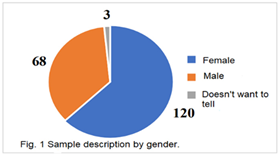
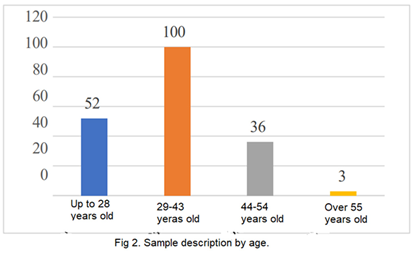
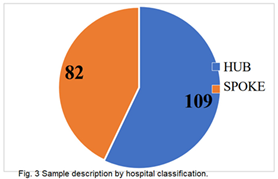
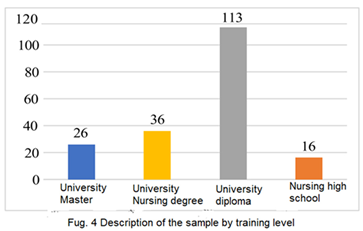
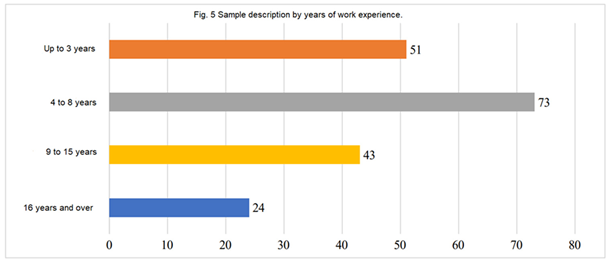
The sample consists of 191 nurses, whose representation is illustrated in Figure 1, Figure 2, Figure 3, Figure 4 and Figure 5.
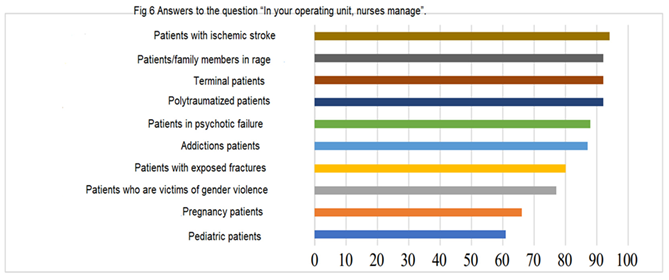
The typology of patients managed in the Operating Units of the participants in the survey is illustrated in Figure 6, the responses were ordered by priority deduced by performing a weighted average.
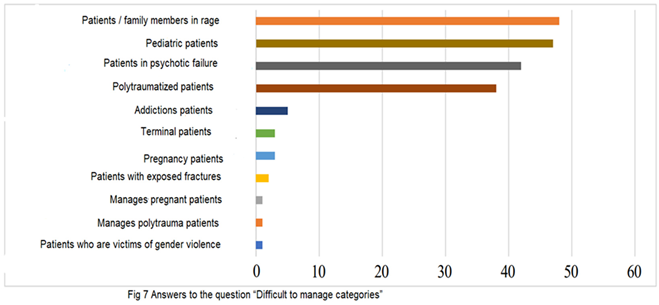
Participants were asked to indicate the category they consider most difficult to manage, the data obtained are illustrated in Figure 7.
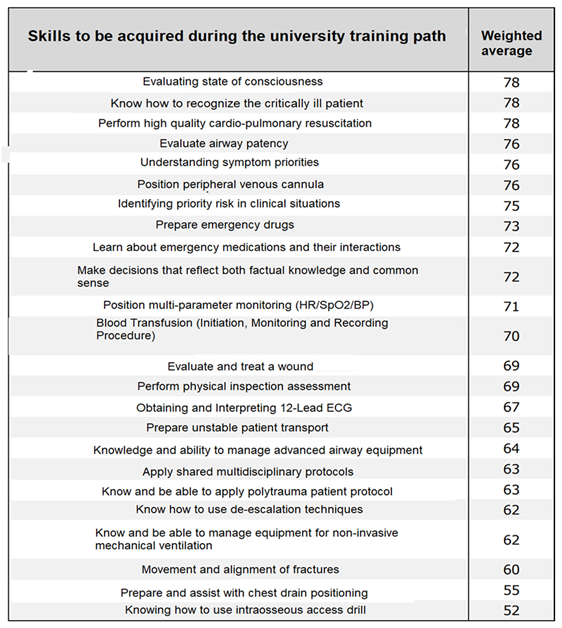
Action has been taken to define the skills considered most important to carry out a weighted average between those listed in the question: “How much Do you think it is important for the nurse to acquire each of the following skills during the Nursing Degree Course?”. The obtained values are presented in
Table 1 and organized in order of priority.
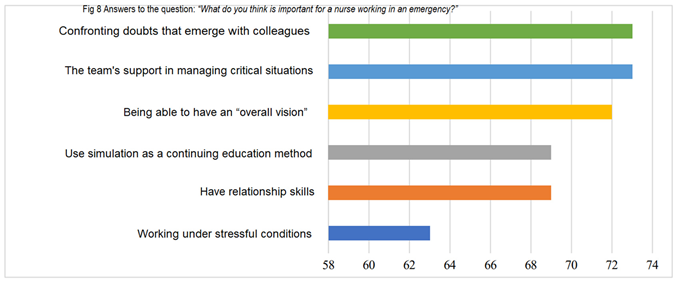
To the question: "How important do you think it is for the nurse who works in emergency?" participants could answer "Not at all", "A little", "Quite a lot", "A lot" or "I have never asked myself the problem". The answers were prioritized by performing a weighted average by assigning a score of 0 to the item "Not at all", a score of 25 to the item "A little", a score of 50 to the item "Quite a lot" and a score of 100 to the item "A lot", as illustrated in Figure 8.
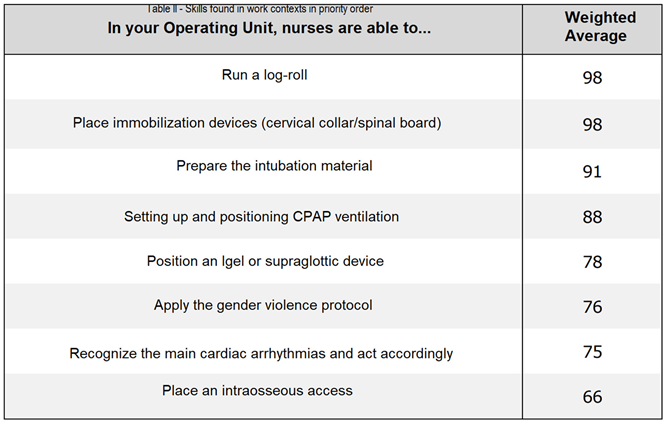
Regarding the question: “In your Operating Unit are nurses able to…”, study participants responded as shown in Table 2.
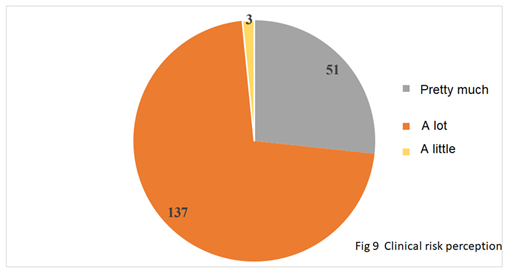
Regarding the question: “How present is the risk of errors in the Emergency Room?”, 137 subjects perceive the clinical risk as extremely present, only 3 (1.57%) interviewees declare that it is little perceived (Fig 9).
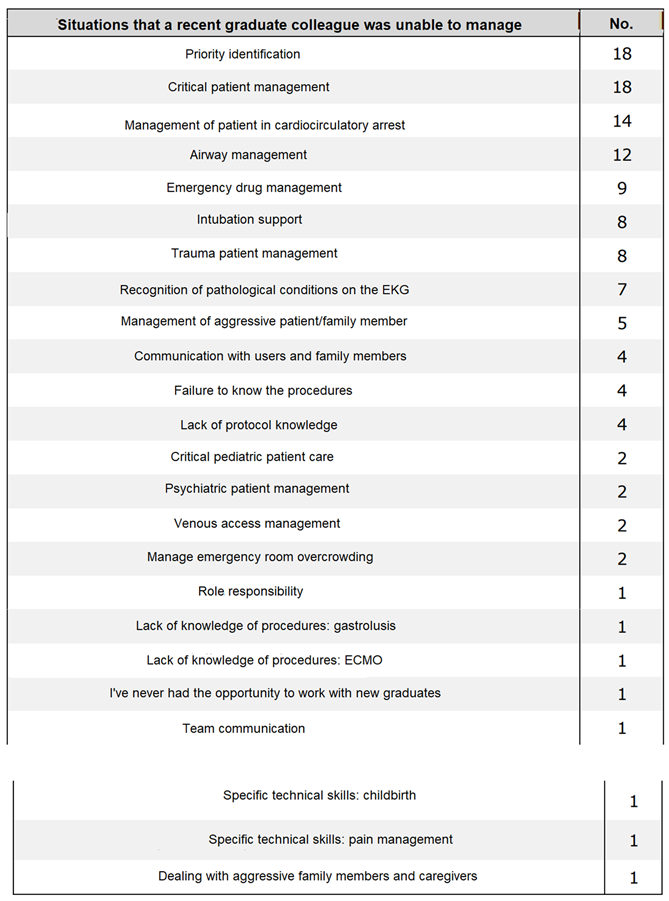
Furthermore, an evaluation of the contexts in which the new graduate presented management difficulties was requested, which are explained in
Table 3.
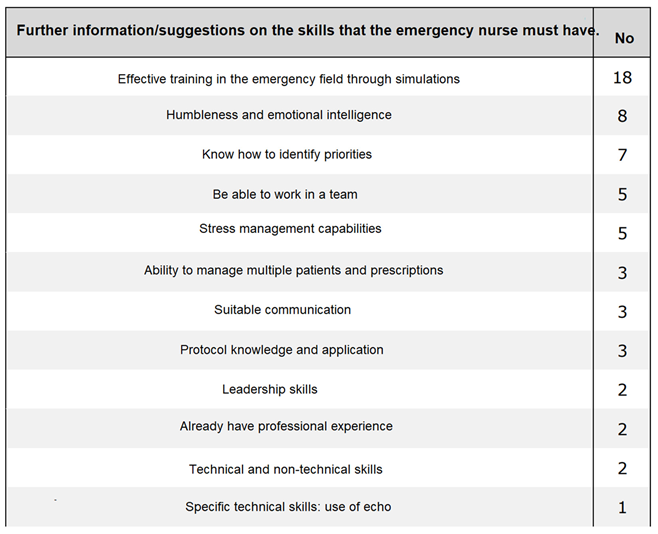
TThe last question investigated further skills that should be typical of the emergency room nurse, sorted by weighted average in order of priority, as illustrated in
Table 4.
4. Discussion and Conclusions
The data analyzed in this research are indicative in defining the skills that should be proper to a newly graduated professional in order to allow him to operate in a dynamic context such as emergency/urgency, without identifying management difficulties in certain situations, such as those illustrated in
Table 3.
The university course plays a preponderant role in the training of future professionals and any problems are immediately perceived during the first experience in the workplace, to a greater extent in a highly specific context such as an emergency/urgency.
It is therefore possible to draw up the skills that must be assimilated during the training course, based on the data expressed in Table 2, i.e. with the skills found in the various operational realities and ordered according to priority, but also, and above all, in
Table 1, i.e. the skills perceived as most important to acquire.
By analyzing the scores obtained, ordered by importance using a weighted average, it is possible to state that the “timely identification and management of the critically ill patient” is considered a priority, and must therefore be recognized through an inspection with assessment of the alteration of vital functions. “Evaluating the state of consciousness” is considered a priority and it is also considered important to know “how to manage the alteration found” i.e. the execution of high quality CPR in case of Cardiocirculatory Arrest or management of the airways in the patient with respiratory problems.
It is emphasized that “knowing how to use de-escalation techniques” is considered to have less priority in relation to practical skills such as “positioning multi-parameter monitoring” or “evaluating and treating a wound” but at the same time, with regard to the evaluation of cases considered to be more complex to manage, 78% of the interviewees consider it more difficult to “manage patients and family members in rage”, who, in relation to the data relating to the sample collected, are often found (139 cases).
The technical and non-technical skills identified and defined in order of priority, however, must also be declined in relation to the cases encountered, it was therefore necessary to identify those considered more difficult to manage. The most difficult patients to manage are those in rage; however, with regard to the analysis of what emerged from the questionnaire administered, pediatric patients, patients in psychotic decompensation and polytraumatized patients also appear to be difficult to manage. The management difficulty can therefore be correlated both to a small number of cases as in the case of the pediatric patient, who is often treated for 19 interviewees, while 142 respondents are only sometimes confronted with this case series, but also to the lack of training: the treatment of the pediatric patient, due to its peculiarities which are totally dissimilar to the treatments of adults, in fact requires continuous training to support that already acquired during the course of studies.
Polytrauma is often treated according to 152 respondents (79.6%), however, management is perceived as difficult; the perceived difficulty is therefore not attributable to the small number of the sample, therefore, the cause can be identified in the type of patient who appears extremely critical and at the same time at high evolutionary risk; an improvement strategy can be identified in adequate training with an appropriate share of university training in the field (internship, preclinical laboratory) in association with continuous multi-method training.
The student should therefore be trained in clinical risk management in order to be able to recognize "near misses" and fallacies specific to the work context before they translate into errors committed to the detriment of the patient; at the same time, training should be provided on "stress management" and on the interventions to be implemented to avoid it from translating into burnout or the desire to abandon the profession. As demonstrated in the work of Khamisa et al. [
9], where the correlation between stress and burnout is identified, in the study of Shah et al., [
10] which offers a focus on the factors associated with the development of burnout and in the study of Zhang et al.[
11] which focuses on the interventions to be implemented to avoid burnout that can be taught starting from university education.
With regards to the question relating to training, it is underlined that 151 subjects (79.1%) declared a very significant importance. It is appropriate, however, to point out that 10 subjects (5.2%) have never asked themselves questions about it. Although they represent a small percentage, they question the method of providing continuous training.
Author Contributions
For research articles with several authors, a short paragraph specifying their individual contributions must be provided. The following statements should be used “ConceptualizationT.M. and L.M. methodology, T.M. and L.M. validation, L.M..; resources, T.M..; data curation, T.M.; writing—original draft preparation, T.M. writing—review and editing, T.M. and L.M..; supervision, L.M.; All authors have read and agreed to the published version of the manuscript.”
Funding
“This research received no external funding
Conflicts of Interest
“The authors declare no conflicts of interest.”
References
- Jones T, Shaban R, Creedy D. (2015) Practice standards for emergency nursing: An international review. Australas Emerg Nurs J.; 18: 190 -203. [CrossRef]
- Crouch R, Brown R. (2018) Advanced clinical practitioners in emergency care: past, present and future. Br J Hosp Med (Lond); 79(9): 511-515. [CrossRef]
- Wright, A. L., Irving, G., & Selvan Thevatas, K. (2021). Professional values and managerialist practices: Values work by nurses in the emergency department. Organization Studies, 42(9), 1435-1456.
- Teymoori E, Zareiyan A, Babajani-Vafsi S and Laripour R (2022) Viewpoint of operating room nurses about factors associated with the occupational burnout: A qualitative study. Front. Psychol. 13:947189. [CrossRef]
- Flaubert, J. L., Le Menestrel, S., Williams, D. R., Wakefield, M. K. & National Academies of Sciences, Engineering, and Medicine. (2021). The role of nurses in improving health care access and quality. In The future of nursing 2020–2030: Charting a path to achieve health equity. National Academies Press (US).
- Yaghmaei, S., Raiesdana, N., & Nobahar, M. (2022). Novice nurses’ experiences from teamwork in the emergency department: A qualitative content analysis. International emergency nursing, 61, 101116.
- Liu, Q., Xie, C., Tan, J., Xu, L., Zhou, F., & Peng, L. (2024). Exploring the nurses' experiences in recognising and managing clinical deterioration in emergency patients: a qualitative study. Australian Critical Care, 37(2), 309-317.
- Dağ, G. S., Bişkin, S., & Gözkaya, M. (2019). Determination of nursing procedures and competencies in emergency departments: A cross-sectional study. Nursing&health sciences, 21(3), 307–315. [CrossRef]
- Khamisa, N., Oldenburg, B., Peltzer, K., & Ilic, D. (2015). Work Related Stress, Burnout, Job Satisfaction and General Health of Nurses. International Journal of Environmental Research and Public Health, 12(1), 652–666.
- Shah, M. K., Gandrakota, N., Cimiotti, J. P., Ghose, N., Moore, M., & Ali, M. K. (2021). Prevalence of and Factors Associated With Nurse Burnout in the US. JAMA Network Open, 4(2), e2036469. [CrossRef]
- Zhang XJ, Song Y, Jiang T, Ding N, Shi TY. Interventions to reduce burnout of physicians and nurses: An overview of systematic reviews and meta-analyses. Medicine (Baltimore). 2020 Jun 26;99(26):e20992. [CrossRef]
Table 1.
- Skills organized in priority order.
Table 1.
- Skills organized in priority order.
Table 3.
- Contexts in which management difficulties were encountered by the new graduate.
Table 3.
- Contexts in which management difficulties were encountered by the new graduate.
Table 4.
- Further information/tips on the skills that an emergency nurse should have.
Table 4.
- Further information/tips on the skills that an emergency nurse should have.
|
Disclaimer/Publisher’s Note: The statements, opinions and data contained in all publications are solely those of the individual author(s) and contributor(s) and not of MDPI and/or the editor(s). MDPI and/or the editor(s) disclaim responsibility for any injury to people or property resulting from any ideas, methods, instructions or products referred to in the content. |
© 2025 by the authors. Licensee MDPI, Basel, Switzerland. This article is an open access article distributed under the terms and conditions of the Creative Commons Attribution (CC BY) license (http://creativecommons.org/licenses/by/4.0/).