
Submitted:
28 February 2025
Posted:
04 March 2025
You are already at the latest version
Abstract
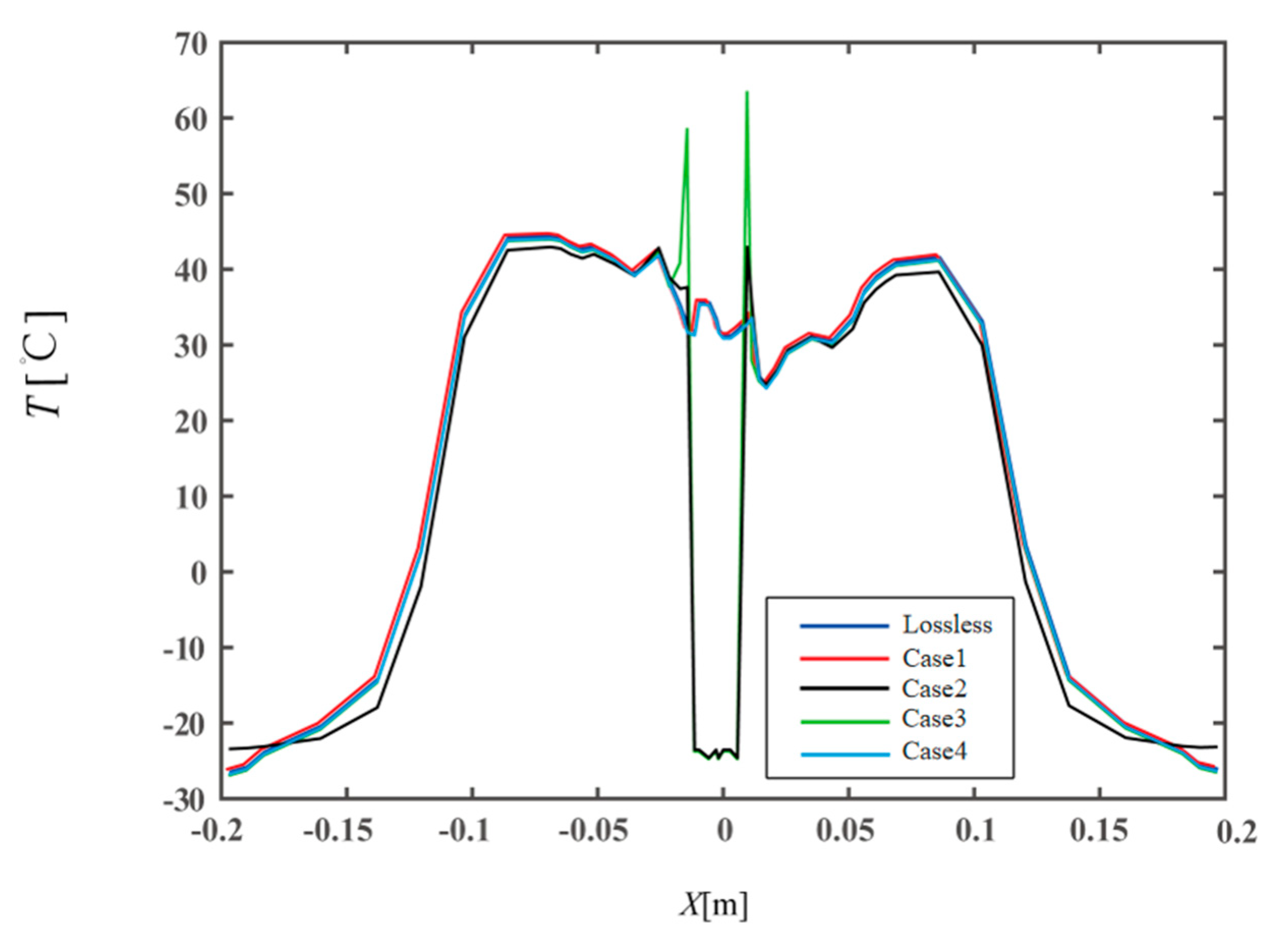
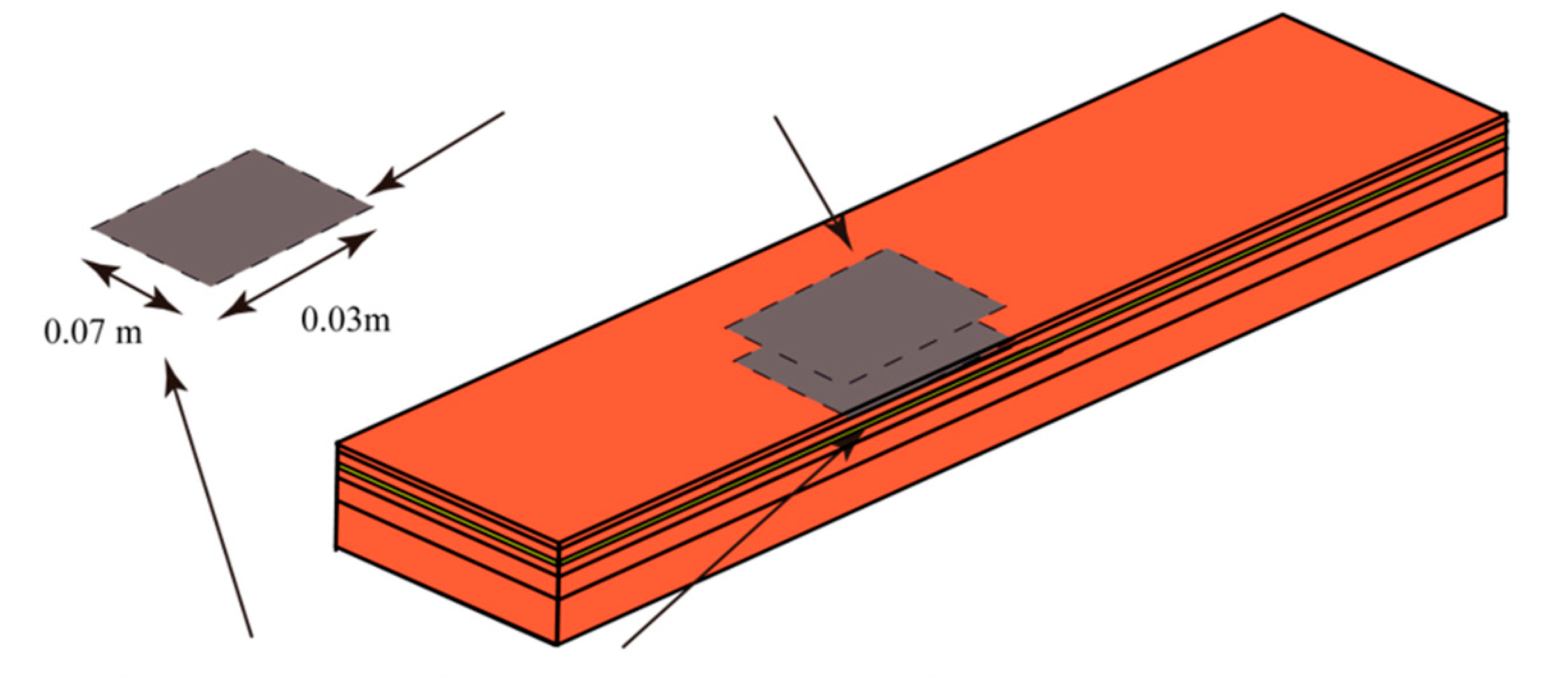
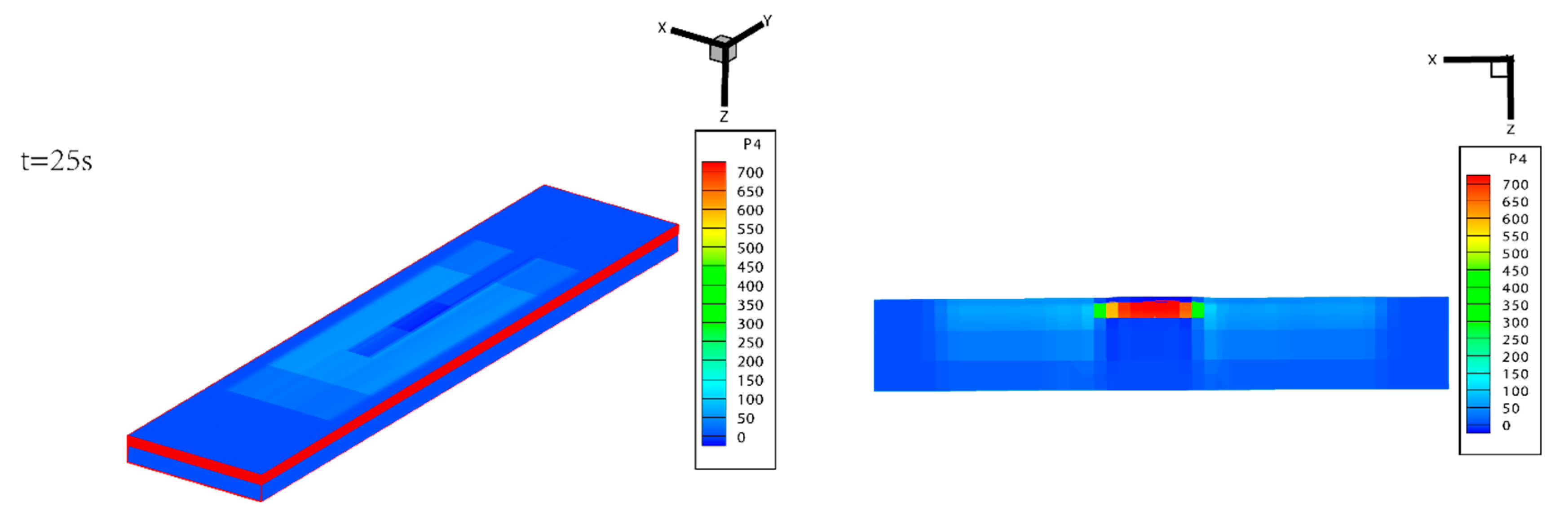
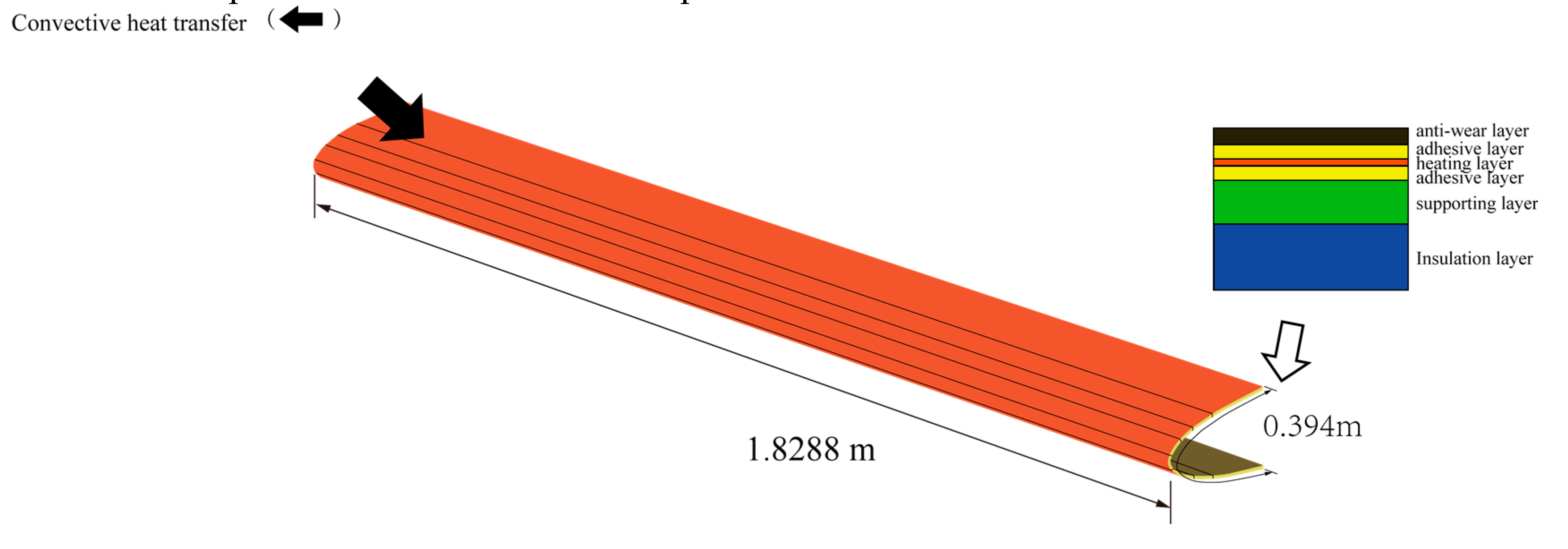
Electrothermal anti-/de-icing systems are widely used in aircraft, and the structures of these systems are generally consist of multiple layers laminated together. In service, laminated structures are prone to structural deformation and delamination, which can significantly affect heat conduction. Therefore, it is essential to study the temperature field of these electrically heated anti-icing structures during operation and analyse the impact of delamination damage on the temperature distribution. In this thesis, a dynamic multiphysical field study of an electric heating anti-icing structure is conducted using a thermal expansion layer-by-layer/3D solid element method. By studying the electric heating process of composite plates experiencing pre-positioned delamination, the thermal expansion layer-by-layer/3D solid element method considers the thermal convection boundary conditions as well as a constant heat source. In addition, to considering the influences of the geometric shape and delamination damage, we apply the thermal expansion layer-by-layer/3D solid element method to the electric heating anti-icing process of airfoil structures using a coordinate transformation matrix. The calculations show that when delamination damage is located above the heating layer, the maximum temperature of the structure reaches 450 °C at 50 s, which severely affects the normal functioning of the structure. Additionally, the surface temperature of the anti-icing system decreases to the ambient temperature at the delamination. In contrast, delamination damage located below the heating layer has a minimal effect on the surface temperature distribution. Moreover, the damage caused by multiple types of damage is greater than that caused by a single type of damage.
Keywords:
1. Introduction
2. Composite Wing Leading Edge Modelling and Anti-Icing Environment Settings
2.1. Composite Wing Leading Edge Modelling
2.2. Composite Material Anti-Icing Environment and Delamination Damage Setting
2.3. Validation of Calculation Methods
3. Finite Element Equations for Thermally Extended Layer-by-Layer/3D Solid Elements
3.1. Heat Mixed Variational Theorem
3.2. Finite Element Equation for Thermally Extended Layer-by-Layer/3D Solid Elements
4. Temperature Distribution of Composites with Multiple Delamination Damage Events
5. Surface Temperature and Thermal Stress Distribution of Airfoils with Preset Damage
6. Conclusions
Author Contributions
Funding
Data Availability Statement
Conflicts of Interest
Appendix A
References
- Lin, G.; Bu, X., Shen, X. Aircraft icing and anti-icing techniques, Beijing University of Aeronautics and Astronautics Press: Beijing, China, 2016; pp. 1–46.
- Kong,F. Analysis of the impact of icing on aircraft flight safety and protection techniques. Journal Article 2018, 69–70.
- Cao, S.; Wang, J. The development trend of low-speed impact delamination damage of composite laminates. Metallurgy and Materials 2021, 41, 139–140. [Google Scholar]
- Cheng, X. Modelling and Detection of Delamination in Plate Structures. Master's degree, Chongqing Jiaotong University, Chongqing, 2015.
- Johnson, A.; Holzapfel, M. Influence of delamination on impact damage in composite structures. Composites Science and Technology 2004, 66, 807–815. [Google Scholar]
- Li, S.; Reid, S.; Zou, Z. Modelling damage of multiple delaminations and transverse matrix cracking in laminated composites due to low velocity lateral impact. Composites Science and Technology 2004, 66, 827–836. [Google Scholar]
- Huo, L.; Kassapoglou, C.; Alderliesten, R.C. Influence of neighbouring damage on delamination growth in multiple indented composites. Materials & Design.
- Mao, Y. Analysis for Temperature Field and Thermal Stress of Composite Skin of Wings during Electrothermal Anti-Icing Process. Master's degree, Nanjing University of Aeronautics and Astronautics, Nanjing, 2018.
- Polla A; Frulla G; Cestino E. Coupled Thermo-Mechanical Numerical Modeling of CFRP Panel under High-Velocity Impact. Aerospace2023,10,.
- Tay E, T. Analysis of Delamination Growth in Laminated Composites with Consideration for Residual Thermal Stress Effects. Journal of Composite Materials 2002, 36, 1299–1320. [Google Scholar]
- Niu, Y. Lu C. Yao J. Effect of electro-thermal coupling on the residual strength of CFRP laminates containing prepositioning damage. Plastics Industry 2023, 51, 108–113. [Google Scholar]
- Reid, T.; Baruzzi, G.S.; Habashi, W.G. FENSAP-ICE: Unsteady conjugate heat transfer simulation of electrothermal de-icing. Aircr 2012, 49, 1101–1109. [Google Scholar]
- Zhengzhi W,Huanyu Z,Senyun L. Numerical Simulation of Aircraft Icing under Local Thermal Protection State. Aerospace 2022, 9, 84–84. [Google Scholar] [CrossRef]
- Morita, K.; Kimura, S.; Sakaue, H. Hybrid System Combining Ice-Phobic Coating and Electrothermal Heating for Wing Ice Protection. Aerospace 2020, 7, 102. [Google Scholar] [CrossRef]
- Shen X, Liu X, Lin G. Effects of anisotropic composite skin on electrothermal anti-icing system. Proceedings of the Institution of Mechanical Engineers, Part G: Journalof Aerospace Engineering 2019, 233, 5403–5413. [Google Scholar] [CrossRef]
- Lou Y, Bu X, Shen X. Simulation of and experimental research on rivulet model onairfoil surface. Aerospace 2022, 9, 570. [Google Scholar]
- Al-Khalil, Horvath C, Miller D, et al. Validation of NASA thermal ice protection computer codes. III-The validation of ANTICE. AIAA, Reno, NV, U.S., Jan. 6-9, 1997.
- Li, D.H.; Liu, Y.; Zhang, X. An extended layerwise method for composite laminated beams with multiple delaminations and matrix cracks. Int J Numer Methods Eng. 2015, 101, 407–434. [Google Scholar]
- Li, D.; Zhang, F.; Xu, J. Incompatible extended layerwise method for laminated composite shells. Int. J. Mech. Sci. 2016, 119, 243–252. [Google Scholar]
- Li, D.; Zhang, X.; Sze, K.; et al. Extended layerwise method for laminated composite plates with multiple delaminations and transverse cracks. Computational Mechanics, 2016, 58, 657–679. [Google Scholar]
- Li, D.; Zhang, F. Full extended layerwise method for the simulation of laminated composite plates and shells. Comput. Struct. 2017, 187, 101–113. [Google Scholar]
- Li, D. Delamination and transverse crack growth prediction for laminated composite platesand shells. Comput. Struct. 2016, 177, 39–55. [Google Scholar]
- Li, D.; Fish, J. Thermomechanical extended layerwise method for laminated composite plates with multiple delaminations and transverse cracks. Compos. Struct. 2018, 185, 665–683. [Google Scholar]
- Li, D.; Shan, W.; Zhang, F. Steady-state thermomechanical analysis of composite laminated plate with damage based on extended layerwise method. Arch Appl Mech. 2020, 90, 415–435. [Google Scholar]
- Li, D.; Ma, S. Dynamic thermomechanical analysis on composite sandwich plates with damage. Continuum Mech. Thermodyn. 2021, 33, 2167–2201. [Google Scholar]
- Morency F, Tezok F, Paraschivoiu I. Anti-icing system simulation using CANICE. Journal of Aircraft 1999, 36, 999–1006. [Google Scholar] [CrossRef]
- Benjeddou A, Andrianarison O. A heat mixed variational theorem for thermoelastic multilayered composites. Computers & Structures 2006, 84, 1247–1255. [Google Scholar]
- Li, D.; Ma, S. Study on Thermomechanical Extended-layewise/Solid-elements Method for Thermomechanical Problems of Thermal Barrier Coatings Structure with Damage. Aeronautical Science & Technology 2021, 32, 12–24. [Google Scholar]
- Yang, Y. China's aviation composites industry development outlook. Science & Technology Information 2022, 20, 161–163. [Google Scholar]
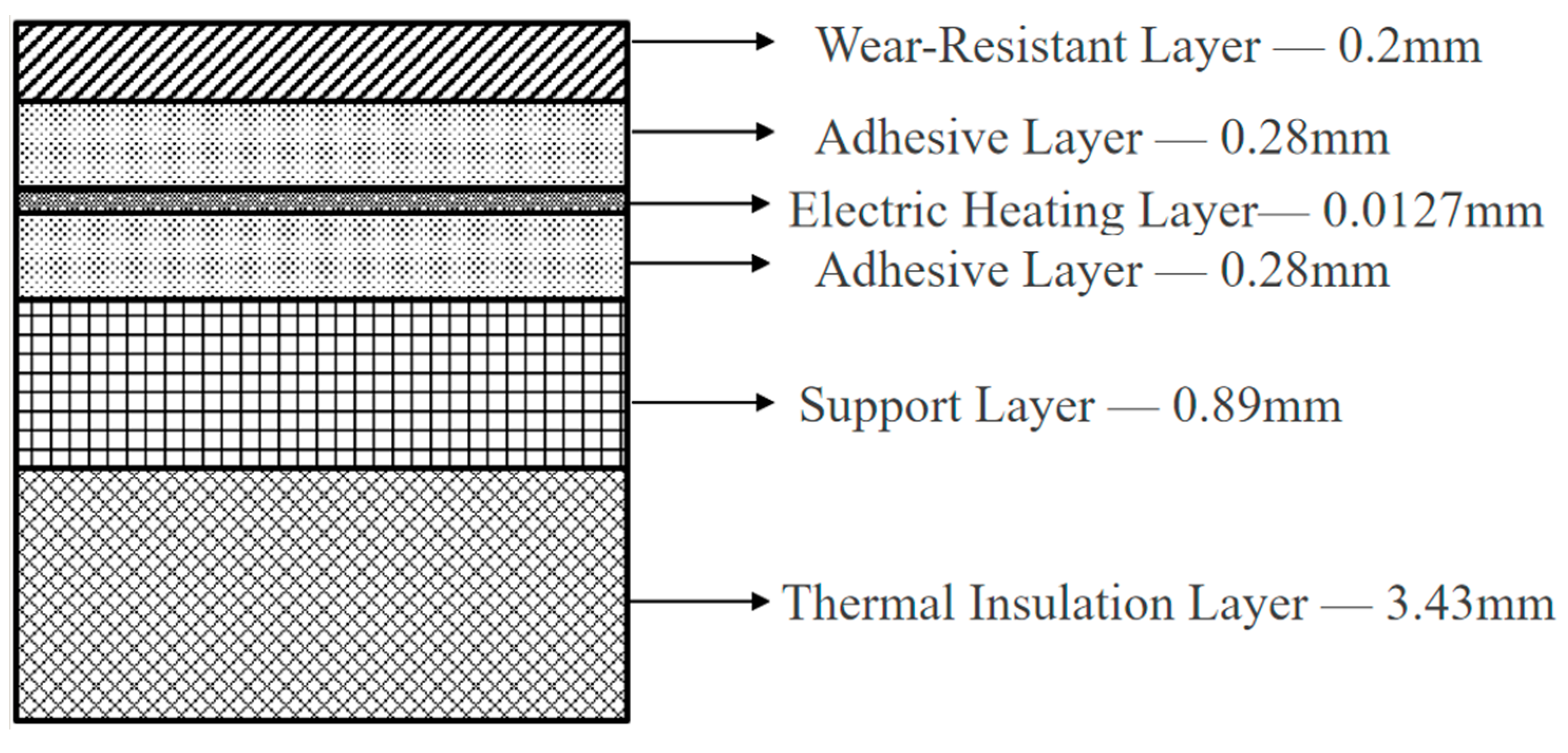

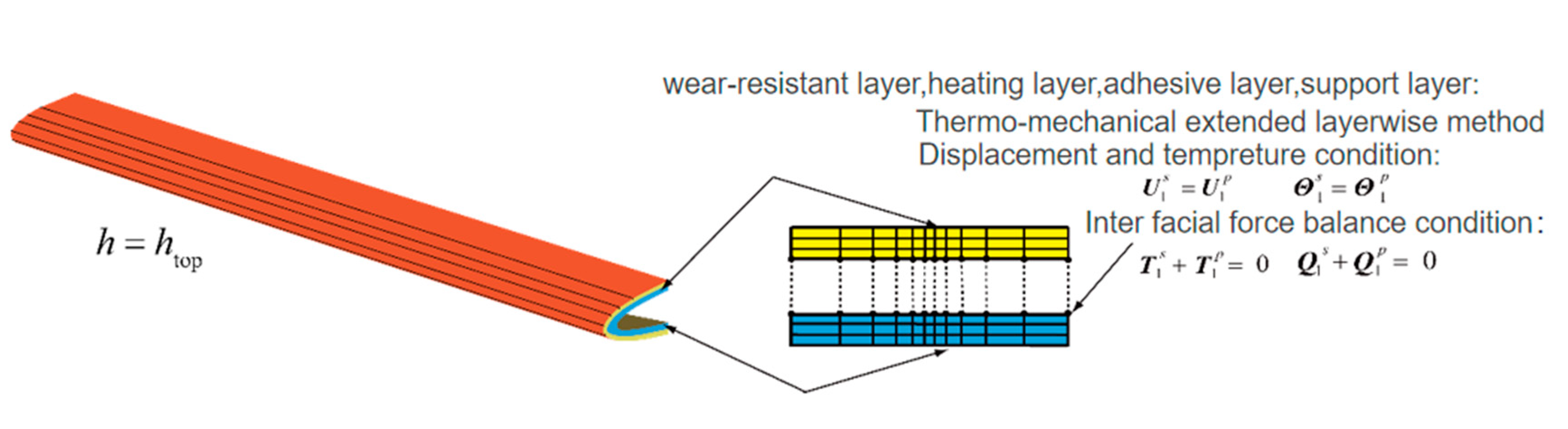
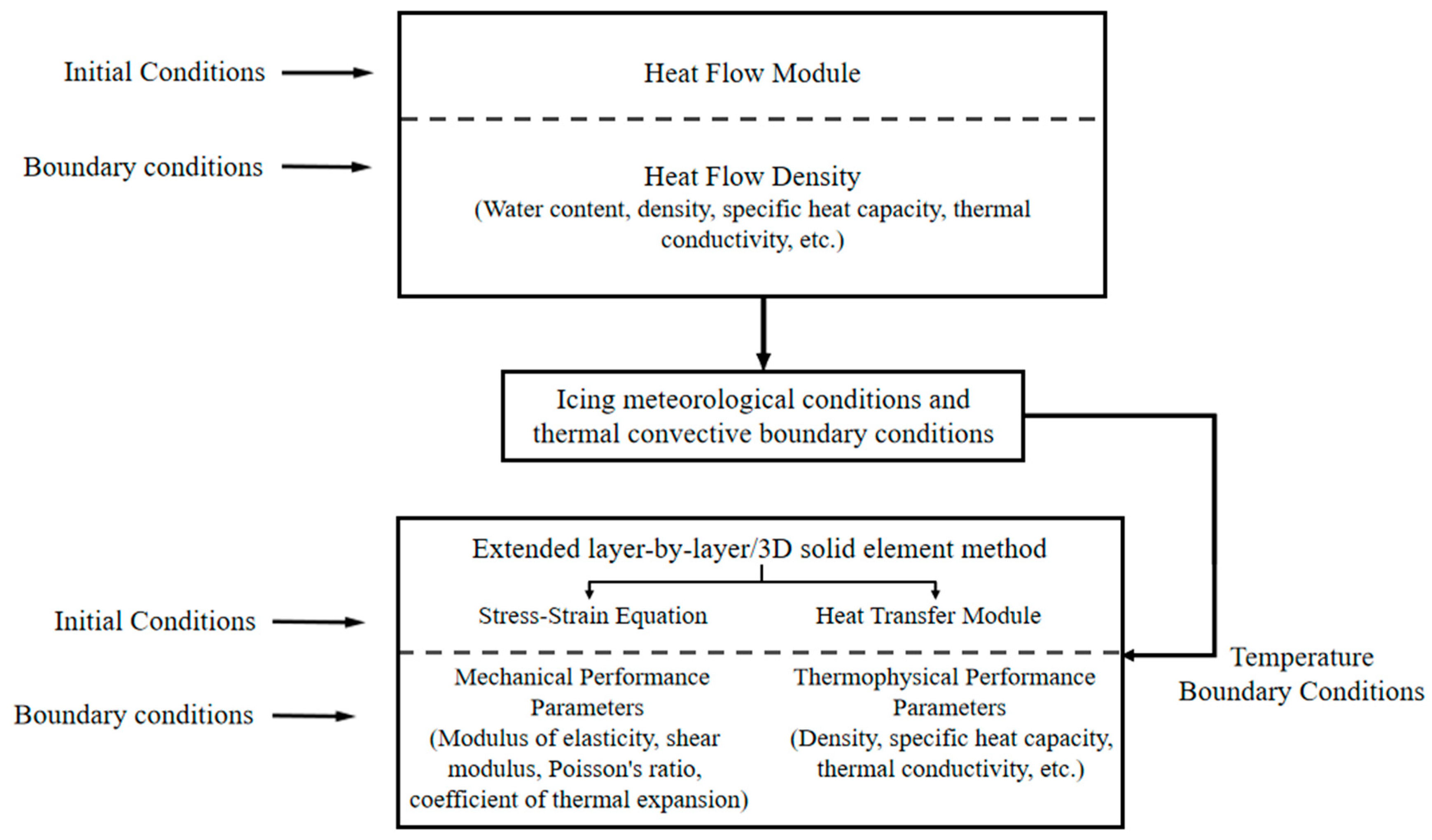
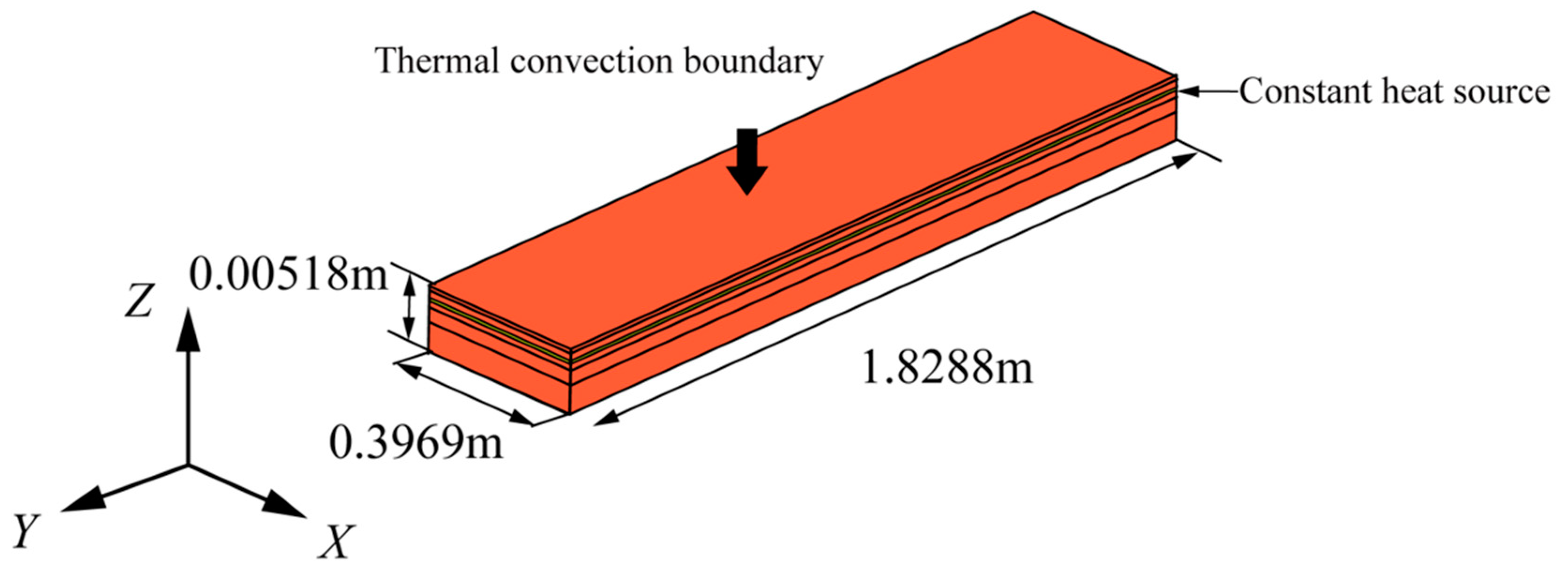

| λx W/(m·K) |
λy W/(m·K) |
λz W/(m·K) |
ρ kg/m3 |
Cp J/(kg·K) |
|
|---|---|---|---|---|---|
| wear-resistant layer | 16.265 | 16.265 | 16.265 | 8026 | 502.4 |
| adhesive layer | 0.256 | 0.256 | 0.256 | 1384 | 1256 |
| electric heating layer | 41 | 41 | 41 | 8907 | 385.2 |
| support layer | 0.294 | 4.4 | 0.294 | 1796.5 | 1570 |
| thermal insulation layer | 0.121 | 0.121 | 0.121 | 648.8 | 1130.4 |
| Heating Unit | F | D | B | A | C | E | G |
| X-direction width (m) | 0.0381 | 0.0254 | 0.0254 | 0.01905 | 0.0254 | 0.0254 | 0.0381 |
| Electric heating power per unit volume (109) | 1.587 | 1.709 | 2.563 | 3.417 | 2.074 | 1.465 | 1.465 |
| Heating Unit | F | D | B | A | C | E | G |
| Elastic modulus (GPa) |
Liner coefficient of thermal expansion(α×10-6/℃) | Poisson’s ratio | |
|---|---|---|---|
| wear-resistant layer | 193 | 16.5 | 0.29 |
| adhesive layer | 0.0078 | 200 | 0.49 |
| electric heating layer | 206 | 13.3 | 0.28 |
| thermal insulation layer | 3 | 40 | 0.35 |
| Elastic modulus (GPa) |
Liner coefficient of thermal expansion(α×10-6/℃) | Shear modulus (GPa) |
Poisson’s ratio | ||
|---|---|---|---|---|---|
| X | 10 | 17.8 | XY | 5 | 0.3 |
| Y | 45 | 4.9 | YZ | 5 | 0.3 |
| Z | 10 | 17.8 | XZ | 3.8 | 0.4 |
| Case | 67A |
| V∞, m/s | 89.4 |
| T∞, ℃ | -21.6 |
| LWC, g/m3 | 0.55 |
| MVD, μm | 20 |
| Angle of attack, α | 0 |
Disclaimer/Publisher’s Note: The statements, opinions and data contained in all publications are solely those of the individual author(s) and contributor(s) and not of MDPI and/or the editor(s). MDPI and/or the editor(s) disclaim responsibility for any injury to people or property resulting from any ideas, methods, instructions or products referred to in the content. |
© 2025 by the authors. Licensee MDPI, Basel, Switzerland. This article is an open access article distributed under the terms and conditions of the Creative Commons Attribution (CC BY) license (http://creativecommons.org/licenses/by/4.0/).


