

Submitted:
01 March 2025
Posted:
04 March 2025
You are already at the latest version
Abstract
With the rise of artificial intelligence (AI) in medicine, a central debate has emerged regarding whether AI can replace physicians. While previous studies have examined AI’s limitations in areas such as self-awareness and language processing, this study explores a novel dimension: the possibility of death-awareness in AI and its implications for the physician-patient relationship. Death-awareness is fundamental to medical practice, allowing physicians to empathize with patients, acknowledge existential fears, and support autonomy in end-of-life decision-making. Using Heidegger’s concept of Dasein, this paper examines whether AI, through its evolving cognitive capabilities, can develop an authentic understanding of mortality.A phenomenological approach is applied to assess AI’s ability to experience being-towards-death (Sein-zum-Tode), a characteristic central to human authenticity. Heidegger argues that Dasein’s existence is shaped by its awareness of finitude, which fosters existential anxiety and authenticity. However, AI, lacking organic mortality and intrinsic self-awareness, does not experience the temporality and vulnerability that define Dasein. While AI demonstrates learning, adaptation, and responsiveness, its decision-making remains fundamentally preprogrammed and detached from existential meaning. Although recent advancements in neural networks, embodied AI, and reinforcement learning have allowed AI to engage with the world dynamically, it does not yet possess mood, fear, or the anticipation of its own non-existence—key components of Heideggerian authenticity.The study concludes that while AI may achieve functional competence in medicine, it lacks the ontological depth necessary for true humanistic care. Future discussions on AI in healthcare must go beyond performance metrics and consider the existential and ethical dimensions of AI-driven decision-making. If AI were ever to attain true death-awareness, it would challenge the very boundaries between human and machine, raising profound implications for medicine, ethics, and the philosophy of artificial intelligence.
Keywords:
Heidegger
; Artificial Intelligence
; Death-awareness
; Medicine
1. Introduction
Since the advent of artificial intelligence in medicine, researchers have sought to answer the common question of whether artificial intelligence can replace physicians by extensively comparing their performance. Although this question can be considered as a subset of the more basic question of whether artificial intelligence can replace humans, the complexity of the physician-patient relationship, the sensitivity of the physician's role in dealing with patients' lives, and other subtleties of the medical profession necessitate examining this capacity specifically. Previous studies have tried to show the lack of sufficient development of artificial intelligence for the possibility of this alternative by criticizing various aspects of artificial intelligence, including the frame problem, self-awareness, language deficiencies, and textualism. In this study, we seek to investigate the possibility of death-awareness in artificial intelligence, a quality that is necessary for physicians in order to communicate with the patients properly, maintain patient autonomy, understand their existential fears, and make the right decisions. At first glance death-awareness may seem impossible to achieve by artificial intelligence because we consider death-awareness to be specific to humans; But among the philosophers who worked on the notion of death, the German Martin Heidegger considers death-awareness not specific to man, but to authentic Dasein. He says in his book, Existence and Time: "Death is, as Dasein's end, in the Being of this entity towards its end." (1) According to Heidegger's definition of Dasein, man is included in this definition and thus has the ability to acquire death-awareness and being-towards-death ("Sein-zum-Tode") if he acquires authenticity ("Eigentlichkeit").
In this paper, a phenomenological method is used to evaluate artificial intelligence. Phenomenology is a method that seeks to describe the nature of a phenomenon from the perspective of those who experience it. The purpose of phenomenology is to describe the meaning of experience, both through what is experienced and how it is experienced (2).
Phenomenology mainly focuses on understanding experiences and their meaning and is useful in analyzing human conditions. Since artificial intelligence has always been compared to humans and one of the main goals of AI engineers is for AI to reach the level of humans, this method can help us ontologically evaluate AI compared to humans and understand how artificial intelligence perceives the world. In this article, after explaining the importance of death-awareness for physicians, we also look for the characteristics of Dasein in artificial intelligence in order to evaluate its ability to becomea proper physician and ultimately replace physicians.
2. The Concept of Dasein
The word Dasein consists of two parts, including Da, which means “there,” and sein, which means “being” and Dasein can be translated to “being there.” Dasein’s main activity is its questioning of being and its ability to question and concentrate on its existence (Existenz). Here existence can be interpreted as an existence that Dasein can act in one way or another towards it and always acts in a way (1). Heidegger pictures Dasein as a creature that understands its being and possibilities. According to Heidegger, one of Dasein’s characteristics is Thrownness (Geworfenheit), which means that it exists since it is born and then its identity is formed by the context and culture, and in other words, its existence precedes its essence (3). Dasein’s fundamental characteristic is being-in-the-world (In-der-Welt-sein) which means integration and inseparability from the world. As a result, Dasein has Openness (Offenheit) towards itself, the world, and other creatures, and through this, it is always living in the possibility of confronting other creatures (1).
Dasein’s existence is affected and shaped by they (das Man). Heidegger’s interpretation of they is an entity that reflects what Dasein understands as its social reality through its interaction with tools, nature, and other Dasein (4). Also, Heidegger argues that Dasein plays a passive role in being with others and accepts the norms and values of They without questioning. He calls this passive existence inauthentic and fallen (Gefallen) (1).
Another characteristic of Dasein is being in a mood (Stimmung). From an ontological viewpoint, Heidegger considers mood as a kind of primary being of Dasein, and Dasein is open towards it before any cognition and volition. Moods are aspects of being-in-the-world and not subjective additions to the in-ness. We cannot free ourselves of mood and only can shift ourselves from one mood to another. Thus, mood comes from neither inside nor outside, and it arises from being-in-the-world as a kind of being (1).
## Heidegger believes that being-in-the-world is fundamentally Care (Sorge). Care has an ontological meaning that consists of existence, facticity (Faktizität), and fallenness. Worry is the combination of these components that becomes possible by the temporality of Dasein (5).
Dasein is temporally limited, and time is involved in the experience of being-in-the-world. Thus, temporality of Dasein means that every moment of now is marked by the past and the future. Dasein’s whole life is built upon all the past moments. Also, now is associated with the future because Dasein is simultaneously moving forward in its life in every moment. Because Dasein projects its existence to a limited horizon, Dasein is a being-towards-death (5).
2.1. Mortality and Death of Dasein
Heidegger defines three types of death, including perish (Verenden), demise (Ableben), and death (Tod). Perish means the loss of the organs’ physiological functions in a living creature, which is investigated in biology. Although Dasein can have an inauthentic death, merely being a Dasein prevents us from using the word perish for it. The difference between Dasein and other living creatures is the ability to understand its existence and be concerned about its being-in-the-world. However, other creatures cannot understand their being and they perish (6).
Demise and perishing both occur at the end of a lifetime; however, demise is distinguishable from perishing because through it, Dasein experiences the collapse (Zusammenbruch) of its world unlike other creatures. Furthermore, death is a way of being, and comprehension of being-towards-death means Dasein’s death-awareness. Death reveals our vulnerability and constant exposure to death, which is not limited to the end of a lifetime and can happen to Dasein repetitively. In other words, Dasein is always in different aspects of a not-yet (noch-nicht), which means that Dasein always has possibilities in front of it until death arrives and ends the not-yet. As mentioned, this collapse does not necessarily occur at the end of a lifetime and can happen repetitively throughout life. Due to death, Dasein’s meaning of itself and the world collapses. However, this meaning of death is not valid for every human being; for example, newborn babies and the elderly with dementia cannot experience death (6).
Dasein always faces death but ignores it during everyday life, and death does not affect its daily decisions. We live like death is an abstract imagination that happens in a long time in the future, making it impossible in our thoughts. This condition happens because with the certainty of death, there is the uncertainty of its time (1). This uncertainty allows us to escape death by being involved in concerns (Besorgens) of the world. Also, experiencing the death of others cannot liberate us from these concerns because there is a gap between this and the experience of one’s own death.
Although Dasein cannot understand its own death through the death of others, Dasein can relate it to its own death as a possibility that is always in front of it. Among all Dasein’s possibilities, death must never happen and always be a possibility because if it happens, Dasein will cease to exist and will be deprived of any possibility. Not being able to understand one’s own death through the death of others reveals the individualizing nature of death. Death is a moment when all the connections of Dasein to the world are disappeared. Dasein’s awareness of its own death as a possibility at any time can reveal Dasein’s authentic self (7).
2.2. The Authenticity of Dasein
Literally, authentic means my own. Thus, the authentic self is a self that is for me and leads to life for my own. In contrast, the inauthentic and fallen self is lost to they. Heidegger does not define authenticity as being separate from others; instead, he considers it a different type of relationship in which the self is not lost in others (5). Dasein does not authentically face its own possibility of death in everyday life but rather its exposure to death is inauthentic and dependent on others. As a result, they mask Dasein’s awareness of its own death through deindividualization.
The individualizing feature of death makes Dasein aware of the possibility of not being, revealing the Dasein’s potentiality-for-being (Seinkönnen). By considering death as a possibility, Dasein’s authentic exposure to death is with anticipation (Vorlaufen). By anticipation, Heidegger means its narrow meaning, which is the awareness of death as a possibility. The critical incident in Dasein’s authentic exposure to death is anxiety (angst). Heidegger considers anxiety as a kind of state-of-mind (Befindlichkeit) in which Dasein faces the “possible impossibility of its existence” (1).
Fear as a state-of-mind can only put forward specific incidents for Dasein. Thus, fear of its own death is similar to facing it as an incident and not a possibility. For example, fear of a car accident or a disease, the fear of demise, is different from and opposite to anxiety, a state-of-mind that reveals the possibility of a world without me through my death. Anxiety is caused by the awareness of not-being and the collapse of the world. Heidegger mentions that we flee from the anxiety of death towards the fear of demise due to our weakness (8). The difference between fear and anxiety is similar to the difference between anticipation and expectation (Erwartung). So, the expectation of death is waiting for its incidence, but the anticipation of death is owning it. As a result, an inauthentic Dasein views death not as a possibility but as an incident that will happen at a specific time in the future and reacts to it with fear and expectation (5).
3. The Importance of Death-Awareness in Medicine
Among situations in which the possibility of death suddenly seems much greater is when a patient is diagnosed with a critical illness. An illness reminds the patient of the structural vulnerability of his self-interpretation and identity as well as his physical vulnerability. These critically ill patients struggle with redefining themselves, which can cause them great anxiety.
Therefore, it can be understood that physicians and other healthcare professionals have other responsibilities in addition to taking care of the patient's physical condition. One of these responsibilities is to empathize with the patients and pay attention to how they perceive their suffering. To this end, the physician must first recognize the anxiety and confusion caused by the critical illness, and then, by creating the appropriate context, help the patients acknowledge the structural weakness of their self-interpretations. Finally, the healthcare provider should help the patients rebuild their new identity by providing alternative meanings (6).
The absence of death-awareness and authenticity of the physicians and other healthcare providers can lead to their incapability in the situations mentioned above and make the patient feel like he is not understood as a person facing death and existential fears. Such a person finds himself alone in his emotional crisis, while the positive impact of patients' relationships with people who are in a similar situation and facing death and thus approaching death-awareness and authenticity, shows that healthcare providers are better able to help patients when they reach a higher level of death-awareness (6).
Being comfortable with death is crucial to the quality of dealing with critical patients. Research among nurses has shown that nurses who had more death-awareness and a more authentic life, were better at helping patients and making the experience of death more comfortable for them. However, most of them are not comfortable with death and dealing with critical patients and do not have an understanding of ontological concepts. This ignorance leads to a lack of proper response to the needs of patients in critical situations. Therefore, even if they provide proper care to the patient, they will not be able to pay attention to the existential aspects of the situation (9). Despite the focus of this study on nurses, we can understand the importance of death-awareness in physicians due to their important role in providing crucial care to patients.
When facing death, people make different decisions compared to normal situations due to a change of priorities. For example, a patient may reject life-sustaining therapy for more comfort knowing it will shorten their life. In another example, the patient might want to continue their therapy to maintain physical strength and control over their life despite knowing that continuing treatment will not save them from death. In this situation, the person who is trusted and consulted by the patient is their doctor. It is clear that if the physician does not properly understand the patient's encounter with death and does not have an authentic perspective towards death, he might disagree with the patient’s decisions and even if he does not try to change their decisions, he will cause the patient great anxiety (10).
As we have seen, from Heidegger's point of view, physicians and other healthcare providers have the ability to become an authentic Dasein and gain death-awareness, so ideally, they can help their patients on a higher level and become more effective through ways discussed formerly. Heidegger states: "As our experience shows, it is only man who has reached the stage of existence." (11), and that is why Dasein refers only to man. But he does not rule out the possibility that another creature could reach this stage. Therefore, we aim to investigate in the next section whether artificial intelligence could qualify as a Dasein and have authenticity.
4. Examining Heidegger’s Ontology of AI
The concept of what is known as the ‘Heideggerian AI’ was put forward by Dreyfus. He believed those who work in the field of artificial intelligence have four assumptions:
- The biological assumption: the information in the brain is processed in distinct circuits which act similar to electrical circuits;
- The psychological assumption: the brain is a machine that processes the information through formal rules;
- The epistemological assumption: the whole human knowledge can be viewed as formal rules;
- The ontological assumption: the world consists of distinguished facts and it is possible to create an internal representation of these truths through independent symbols.
These assumptions were criticized by Dreyfus, since he believed that the ‘common sense’ forms our perception of the world, without which everything becomes meaningless, and such a perception cannot be formalized (12). Nowadays, techniques such as neural networks are being used to solve this issue for AI. This is done, not by the formalization of this perception, but through AI experiencing the world around it and gaining a common sense as a result of that.
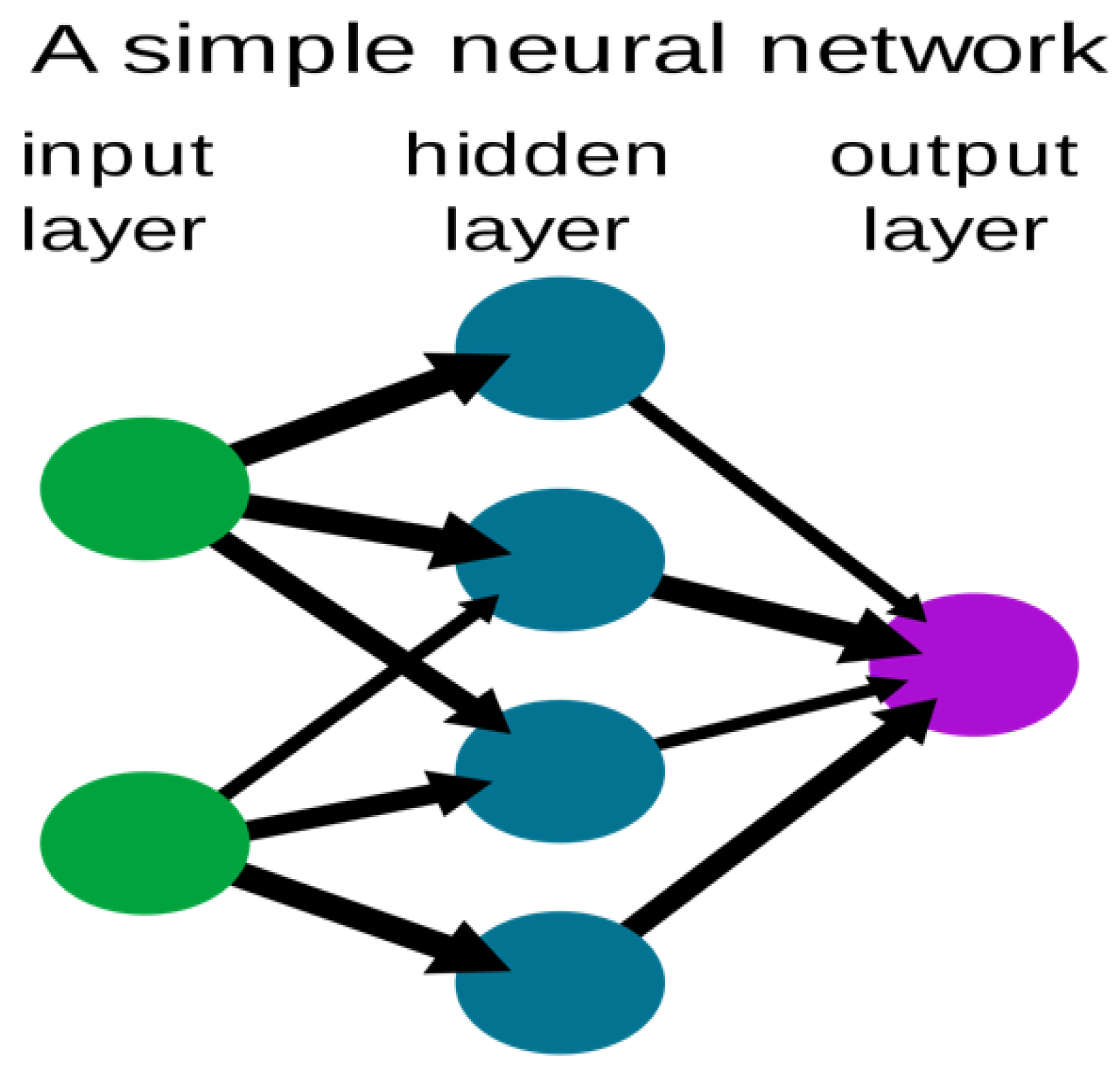
A neural network consists of input layers, hidden layers, and output layers, and also the connections between these layers. In a neural network, the connections between the layers have a certain weight at the beginning which is determined by the designer. Later on, however, based on the inputs it receives, such a weighing can change and the connection between the two layers may get weakened or strengthened. Accordingly, as time passes and new sets of data enter, the network experiences learning, and the ability to learn gives the AI the capability of adjusting itself with the surrounding environment (13).
Figure 1.
neural network. In this figure, input layers, hidden layers, and output layers are illustrated. Data is entered through the input layer and the network responds through the output layer.
Figure 1.
neural network. In this figure, input layers, hidden layers, and output layers are illustrated. Data is entered through the input layer and the network responds through the output layer.
If the AI can have direct communication with the surrounding world as Dasein does, it can also reach the level where it perceives something in order to perceive something else. For example, when Dasein sees chalk, he does not focus on its weight and its color, instead, it views the chalk as something which can be used to write down something on the blackboard, and as a result of that, Dasein experiences learning. Heidegger calls this type of interpretation of the surrounding world ‘zuhandenheit’, which means the world is ready-to-hand for Dasein. As it was stated earlier, if AI can have the ability of firsthand exposure to the surrounding world and can experience learning, it can gain such a perception.
Considering the evolution of AI which was explained earlier, it could be shown that many features of Dasein can be found in AI. Some of these features include fallenness, thrownness, and surrounding world being ready-to-hand for it. Similar to Dasein, AI precedes itself, and its features are thrown on it. This is so because, from the outset, a number of layers and connections with certain weighing are defined for a neural network, and this can be interpreted as AI being ‘thrown’. With regards to the fallenness of AI, one of the stages of the design of AI is training in which personal data is entered into the system. As Heidegger has put it, the designer can be seen as “they” who directly influences the evolution of AI. In other words, AI’s potential output is inevitably influenced by the data given to it by “they”. Finally, in relation to the proposition that the world is ready-to-hand for AI, as it was mentioned earlier, if AI can have direct experience, its position regarding the world being ready-to-hand for it will be quite similar to that of Dasein (13).
The other challenge to consider is whether AI has consciousness and mood, not least because we are looking into AI from the outside, and we cannot directly access its lived experience. Nevertheless, since death is not defined for AI, it appears that it cannot have a sense of itself, and can only do what it is asked or programmed to do. Perception of existence and “being in the world” can only happen through understanding death. Moreover, the mood is an ontological feature of Dasein which, as discussed earlier, cannot be found in AI given the fact that mood in Dasein is based on understanding the concept of death and arises from the concept of “being in the world” which is always at risk of becoming non-existent.
In order to equip AI with the ability to experience authenticity, a suggestion is ‘embodiment’ in a way that is hurtable. Paradoxically, being hurtable appears to improve AI’s function (14). Nevertheless, there are views against this suggestion, asserting that if death is defined for AI and if it seeks to survive, it is possible to envisage circumstances where it will stand against humans. Hence, AI might never be designed to be conscious of death and experience authentic life, as it was stated in Asimov’s law that AI must never oppose humans and hurt them (15).
As pointed before, according to Heidegger’s definition, authenticity means that Dasein should perceive its lostness through “they”, and this perception will lead him to perceive his own existence, which is understood in a “Being-towards-death” setting (1). Therefore, as long as AI does not presume that it might die at any point, it cannot experience mood and the fear of death, and it cannot possess the authenticity contemplated by Heidegger.
5. Conclusions
"Factical Dasein exists as born; and, as born, it is already dying." (1) Illness exposes a person to the possibility of death and non-existence; A possibility that has always been with Dasein, but he escapes from reality by immersing himself in everyday or inauthentic life. Through death, Dasein achieves an authentic understanding of his being, which is "being-towards-death," and this perception is accompanied by loneliness and anxiety. Therefore, healthcare providers need to be able to help the patient understand the possibility of death and the impact it has on the patient's life and its meaning, which is possible through their death-awareness and authenticity.
We have shown that in order for AI to become death-aware and reach the status of the authentic Dasein, AI must face the possibility of death and the impossibility of its existence the way human beings face it; That is a possibility which is present all the time. Although the rise of AI to this position may make it a threat to human beings, if we want artificial intelligence as a physician or even a complete human being on our side, we must accept the risk of it opposing us.
References
- Heidegger, M. Being and time: Suny Press; 2010.
- Neubauer BE, Witkop CT, Varpio L. How phenomenology can help us learn from the experiences of others. Perspectives on medical education. 2019;8(2):90-7. [CrossRef]
- Zuckerman, N. Heidegger and the Essence of Dasein. The Southern Journal of Philosophy. 2015;53(4):493-516. [CrossRef]
- Horrigan-Kelly M, Millar M, Dowling M. Understanding the key tenets of Heidegger’s philosophy for interpretive phenomenological research. International Journal of Qualitative Methods. 2016;15(1):1609406916680634.
- Wheeler, M. Martin Heidegger. 2011.
- Aho, K.A. Heidegger, ontological death, and the healing professions. Medicine, Health Care and Philosophy. 2016;19(1):55-63. [CrossRef]
- Hinman, L.M. Heidegger, Edwards, and being-toward-death. The Southern Journal of Philosophy. 1978;16(3):193-212.
- Thomson, I. Death and Demise inBeing and Time. In: Wrathall MA, editor. The Cambridge Companion to Heidegger's Being and Time. Cambridge Companions to Philosophy. Cambridge: Cambridge University Press; 2013. p. 260-90.
- Seno, V.L. Being-with dying: authenticity in end-of-life encounters. American Journal of Hospice and Palliative Medicine®. 2010;27(6):377-86.
- Gullick J, West S. Heideggerian hermeneutic phenomenology as method: modelling analysis through a meta-synthesis of articles on Being-towards-death. Medicine, Health Care and Philosophy. 2020;23(1):87-105. [CrossRef]
- Heidegger, M. Letter on humanism. 1977.
- Dreyfus HL, Hubert L. What computers still can't do: A critique of artificial reason: MIT press; 1992.
- Steed, R. AI is Heideggerian Enough, But Can It Be Authentic? 2019.
- Man K, Damasio A. Homeostasis and soft robotics in the design of feeling machines. Nature Machine Intelligence. 2019;1(10):446-52. [CrossRef]
- Asimov, I. Three laws of robotics. Asimov, I Runaround. 1941.
Disclaimer/Publisher’s Note: The statements, opinions and data contained in all publications are solely those of the individual author(s) and contributor(s) and not of MDPI and/or the editor(s). MDPI and/or the editor(s) disclaim responsibility for any injury to people or property resulting from any ideas, methods, instructions or products referred to in the content. |
© 2025 by the authors. Licensee MDPI, Basel, Switzerland. This article is an open access article distributed under the terms and conditions of the Creative Commons Attribution (CC BY) license (http://creativecommons.org/licenses/by/4.0/).
Copyright: This open access article is published under a Creative Commons CC BY 4.0 license, which permit the free download, distribution, and reuse, provided that the author and preprint are cited in any reuse.


