

Submitted:
01 March 2025
Posted:
03 March 2025
You are already at the latest version
Abstract
Blockchain is a decentralized, distributed, immutable ledger technology introduced in the late 1900s and got attention as the enabling mechanism for operating cryptocurrency transactions. Being a strong network, decentralized, immutable and almost impossible to be hacked, blockchain is the desired solution for transparency and digital security. Having multiple use cases across multiple domains, blockchain is the technology which has the potential to change the way we think of security and trust. In the last decade, the world also experienced a massive growth in the education sector with the introduction of education technology. The covid-19 pandemic forced lockdown influenced the growth of education technology. Businesses and governments experienced massive growth in the education sector globally. Incorporation of technology into education started from teaching and learning on videos calls and is now grown enough to involve artificial intelligence and machine learning. This advancement in the education industry enabled the facilities and growth but at the same time introduced new challenges and threats. The incorporation of technology also brings the threat of security, both cyber and ethical. Students and their details are exposed online, and this makes them sensitive towards cyber threats. Not only students but all the stakeholders exposed online are also sensitive towards cyber-attacks. These challenges in the education sector need to be addressed and solved. Researchers and scientists have found blockchain to be a potential solution to the challenges present in the education sector today. This paper presents a systematic review on the education technology and the potential of blockchain technology in solving the current issues in the education sector introduced through the incorporation of education technology in the last 5 years. Along with presenting the review, this paper also proposes a novel architecture of a learning management system based on blockchain and knowledge graph. The data sources explored to collect the studies for this systematic review are Complementary Index, Business Source Ultimate, eBook Index, Springer, IEEE Xplore and more. A sum of 15,855 studies were explored and screened to find a total of around 60 studies and reports to be included in this review paper. The complete process of identification, screening and selecting was a 5-step process and was done according to the PRISMA layout. The complete study is presented according to the PRISMA checklist and aims to present a clear and concise view of the current state-of-art of blockchain in education.
Keywords:
blockchain
; Ed-tech
; education technology
; LMS
; knowledge graph
I. Introduction
The last decade has been a revolutionary decade in the technology world. All of us shifted from key-pad mobile phones to touch-screen ones, smartphones inspired the creation of smartwatches and smart televisions. Consistently we are moving forward towards automation. The second half of the last decade experienced the popularity of Artificial Intelligence and inspired the innovation and creation of self-driving cars for us. We started digitizing everything around us, the documents, phone numbers, and even the cars. We were entertaining ourselves through the internet and were slowly adapting to the online mode of education (at some places on the earth).
Soon when covid-19 pandemic forced lockdown was enforced on us all, we were forced to stay at home. This was the time when education technology was implemented majorly all across the globe. The education technology introduced tons of new opportunities for businesses and scientists. The growth of the businesses were doubled in the time span of 10-12 months (et al. Alsoud, 2021; Sikandar, 2022). It started with teaching and learning on zoom calls and soon evolved to interactive lectures which included graphics, gamification and real time monitoring of the student (Turkawka,2019; et al. Njadat, 2021). The educational apps were created to deliver high level interactive teaching to the students of all ages while at home. Teachers learned to teach on laptops and smart boards rather than chalkboards, attractive animations were being used in the lecture slides and animated education videos were being created for children to make the learning intuitive and fun.
Some businesses also incorporated artificial intelligence and machine learning to their applications providing a study buddy to the users and making the monitoring of students actions and learning patterns much easier and more detailed. They started generating statistical and graphical reports about students’ learning patterns, strengths, weaknesses, mistakes, and achievements. This feature made the online learning fun as well as informative on behalf of parents and guardians.
In addition to this feature, the business started delivering the customized learning packages either on their own application or in collaboration with the schools or other educational institutes. This is the point when educational technology is now a part of life. Everyone is learning something or the other online and a ton of people are teaching online. Businesses were getting big investments from private investors as well as the government (Sikandar, 2022; et al. Timchenko, 2020). Digital education started receiving a separate segment in the annual budget list of the countries and the education system started changing for good.
The digital era not only digitized education and entertainment, but also the currency. A new term was introduced in 2012, “cryptocurrency”. It is a digital currency and can be bought or sold digitally. All these transactions take place through a highly secure and widespread network called “Blockchain”
(et al. Nassar, 2020; et al. Chekerevac, 2022; et al. Ting-Peng, 2021; et al. Solomon, 2019).
The term “Blockchain” was first introduced in the late 1900s but got popular when cryptocurrency gained popularity. Blockchain network was known before cryptocurrency came, but its potential was discovered with the cryptocurrency. Many people still use the terms “cryptocurrency” and “blockchain” interchangeably, but they are far different from each other. Cryptocurrency is a use case of the blockchain technology. Researchers studied the blockchain network and understanding its potential in changing the way we understand trust and security, many use-cases were suggested in finance, e-commerce, supply-chain, healthcare, and education.
In this review paper, we are discussing the potential of blockchain technology in changing the view of education and how the incorporation of blockchain networks can solve the current challenges in education technology. This paper presents a systematic review on potential use of blockchain technology or blockchain network in the education sector. Along with presenting a systematic review for the current work presented on the topic, this paper proposes a novel architecture of a learning management system based on blockchain network.
Education technology brought advancement into the education sector but at the same time introduced challenges in the education sector. These challenges ranged from security challenges to ethical challenges. The education technology did make a big change in the mode of receiving and delivering the education but at the same time introduced the cybersecurity and ethical danger among the stakeholders.
Blockchain technology is known for its security and use of blockchain network can solve the cybersecurity and ethical challenges of the education sector introduced by education technology. Many researchers have presented their studies and reports on the use of blockchain technology in the education sector, some of them also proposed a system architecture of their own kind to improve the security issues in the education sector today. Along with solving the cybersecurity, these studies try to solve the issues related to fraudulent actions regarding the education documents and certificates in the education sector (et al. Zoiyi Li, 2022; et al. Abdullah, 2021; et al. Yuchen, 2022; et al. Solomon, 2019; Md Aminul, 2022; et al. Fitra, 2020; et al. Xieling, 2022).
This work tries to study all the present literature in the domain and present a systematic review to the world and tries to analyze the current state of knowledge on the topic. From the study it is observed that researchers are addressing the potential use of blockchain technology in the education sector and are exploring potential solutions to the currently present challenges in the education sector. However, there is very little work present in involving the blockchain network in the learning management system and making the learning experience more secure and transparent.
This work aims to present a systematic review on blockchain in education technology and how it can solve the challenges in the education sector today. Identifying a total of 15,855 studies at the first stage of search and selecting around 60 documents including the studies and reports at the end of the screening process, this work discusses the currently present literature in 4 different parts ranging from “Rise of Education Technology”, “Market situation after edtech” to “Challenges in edtech” and “Blockchain - a potential solution to these challenges”, the paper discusses the literature and presents a critical review on them while comparing them.
At the end of this, in the last section before concluding, we propose a novel architecture of a learning management system based on blockchain technology. This architecture has 4 major parts and all of them are connected through a public blockchain network. The one thing which makes this architecture unique and different from all the others presented is the “Knowledge Graph”.
The proposed architecture connected the students and teachers for learning where students attend the lessons and complete the assignments assigned by the instructor where the teacher creates the lessons, assignments and the test papers and then grades the answer sheets of the students. All the data related to the actions of the teacher and the student on the application is stored in the blockchain network in the form of a ledger which is then updated in the knowledge which has the central nodes as the students and stores all the data related to them in the branch node and this way each node in the network is connected with other nodes either directly or indirectly.
This knowledge graph is accessible to many parties other than the student such as the education ministry and employment agencies. The proposed system is created on the assumption that the agencies like HRD ministry, higher education commission and the employment agencies are all connected with each other on a blockchain network, and their transactions are secure. Apart from this, the knowledge graph is centered at the students and stores the data in relation with the students. This structure of the knowledge graphs limits the potential storage capacity and structuring power of the knowledge and can be optimized in future work.
II. Methodology
The motive of this work is to present a systematic review of the scope and potential of blockchain technology in solving the challenges in education technology today. In order to present a systematic review for the existing literature and research work done in the domain, a procedure is followed. This section presents a brief explanation on the methodology followed to write this review paper.
1. Eligibility Criteria
The topic of this review paper is “Blockchain in education technology”. To collect the data and studies performed and papers presented by researchers in the field some specific inclusion and exclusion criterias were set at the beginning of this project. All the collected studies were grouped for further analysis in 2 broad groups as “Blockchain” and “Education Technology” and then 2 subgroups for each of them as “General Blockchain” and “Blockchain in Education” for “Blockchain” and “Rise of Edutech” and “Challenges in Edutech” for “Education Technology”.
Figure 01.
Grouping of all the studies collected for analysis.
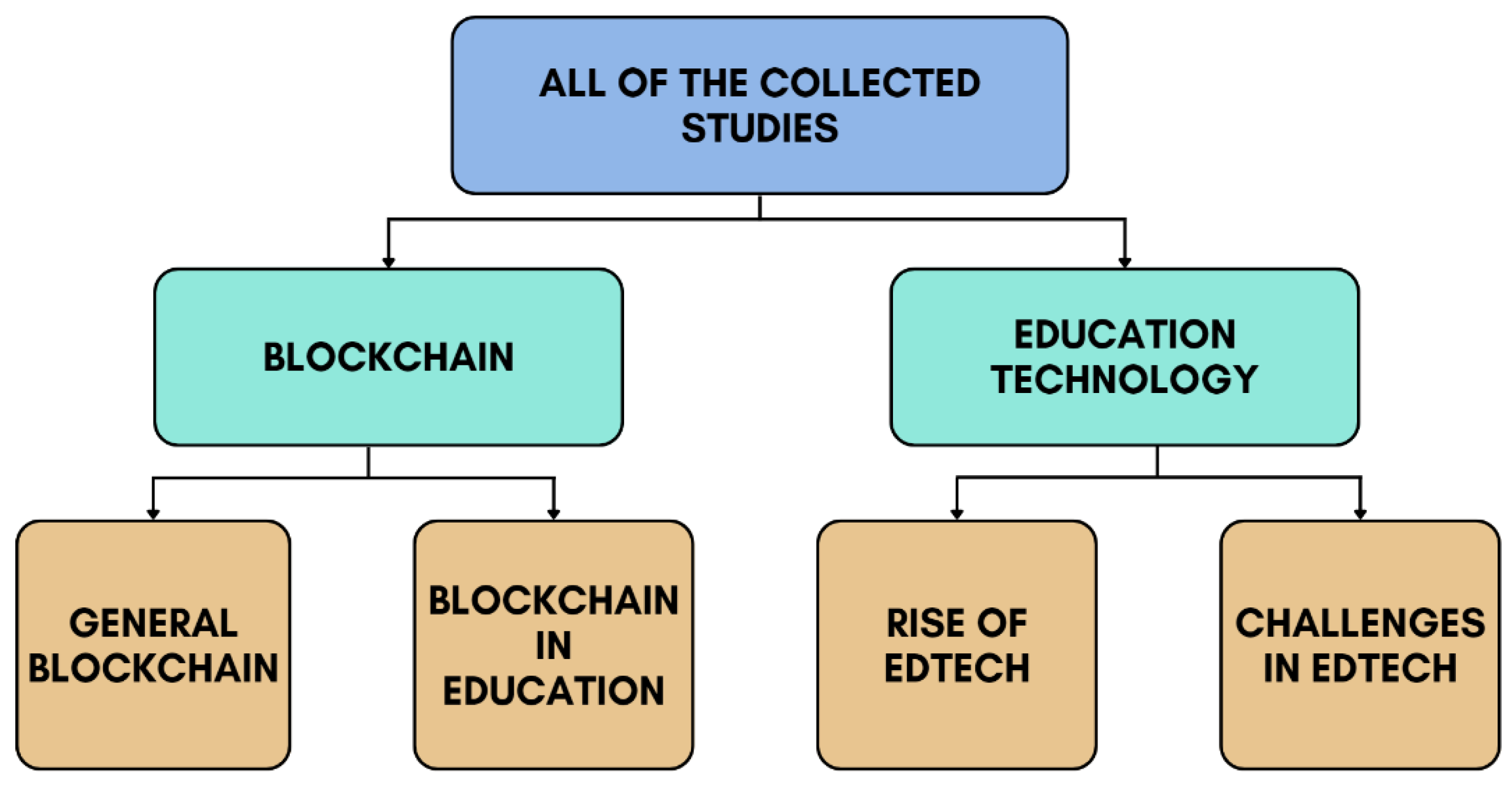
For analysis, papers and academic journals published in the period of 2018 to 2022 were selected explicitly. Among all the studies presented in this period, only those were selected who presented a general analysis on Blockchain technology and its potential for shaping the future for us and those discussing the applications of Blockchain technology in the education sector solving the challenges in the domain. The list of the count of papers and journals used in this work as per the year of publishing are given in the table below.

Table 01.
Number of studies as per year of publishing.
| No. | Publishing Year | No. of Studies |
|---|---|---|
| 1 | 2018 | 1 |
| 2 | 2019 | 2 |
| 3 | 2020 | 11 |
| 4 | 2021 | 14 |
| 5 | 2022 | 32 |
| Total | 60 |
The inclusion principle followed for choosing the studies for analysis was focussed on Blockchain technology and education technology. While performing the primary search for the studies, the work done on blockchain technology, explaining the details of blockchain technology and its potential applications were selected. Apart from this, the studies presented discussing the potential applications of blockchain technology into the education sector were chosen. Many of these studies presented a general perspective on the use of blockchain technology in education and its advantages, and others presented system architectures for the education sector based on the blockchain technology. These studies are discussed in detail in further sections of this work.
Furthermore, the academic journals, reports and quantitative studies presented on the rise of education technology in and around the world were chosen along with the ones sharing or reporting the probable challenges being faced due to the incorporation of education technology in the education system. The studies which were excluded from the list of final references for the review paper were those which presented an explicit analysis on the potential use of blockchain technology and its advantages in the domains like finance, insurance, supply chain, and all those other than education. Along with this, the case studies done in the domain of blockchain and education technology were not added in the list of studies analyzed for this review paper.
The primary search done for collecting the content for this work was done by using certain keywords as listed in the Table 02 along with the number of results obtained through them. From all the obtained results after searching using relevant keywords, all the duplicate records were removed and content according to the inclusion principle were selected. The list of the content selected according to their topic is listed in the table below.
The number of results obtained by using the keywords mentioned in the table above were checked thoroughly for any duplicate results. All the duplicate records were ignored and the remaining were checked according to the inclusion principle stated above. The number of studies selected for analysis for the review paper were 60. The list of these studies grouped according to the topics is given in Table 03. The flow chart below shows the complete procedure to search for the studies and the inclusion and exclusion criterias.
2. Information Sources
The databases, registers, websites and organizations searched for or consulted to identify the chosen studies are listed in Table 04. The data of when these papers or studies were published are given in Table 01 and the database where these were found are listed in Table 04.
A total of 08 databases were searched for identifying the relevant studies to be included in this review paper and a total of 15,825 results were obtained collectively from all the databases. All the selected studies were found on these databases and no search was done on any registers available online.
3. Search Strategy
The search strategy and selection process followed for selecting the studies included in this review paper is briefed in the form of a flow chart according to the PRISMA checklist in Figure 02. At first, the databases were searched using different keywords around the topic of this review paper. Through this, a total of 15,825 results were obtained through 8 research databases on the web.
Out of these 15,825 results, all were screened manually to identify the duplicate results and remove them from the list. In this process, 7,105 results/documents were removed as they were the duplicates of some studies. At this stage, we were left with 8,720 unique studies. These were the ones we obtained while searching the databases using certain keywords around our review topic. These 8,720 results were sent through the screening process, where 8,204 records were excluded, 15 were not retrieved due to membership restrictions and 440 were again excluded because of exclusion principles. All this screening process left a total of 60 results out of which 54 are studies and 06 are reports. These 60 results were finally included in the review paper.
III. Literature Review
The rise of technology has a major impact on the education sector. The pandemic forced the world to go online for everything from work to shopping, including learning. The sudden forced change has opened the doors of many opportunities in the Education sector. The EdTech industry has seen the major boom during covid pandemic and is now preferred by most of us. Every one of us wants to learn and grow from the comfort of our homes. Technology has made work easier and shopping even more fun and it is making the learning both easier and fun for students. This section talks about some current literature and works in the area of education technology and its challenges. This section aims to address the current problems in education technology and what are the potential solutions using blockchain technology presented till date.
- 1
- Rise of Technology in Education - The positive effects of implementation of technology in education
The rise of technology in the past one decade has been exponential in nature and will grow even faster in future. The impact of this rapid change has also changed the mode of education for us. On top of it, the covid-19 pandemic gave us the perfect opportunity to adapt this new way of learning and grow like never before.
- A.
- The Rise of Education Technology due to pandemic forced lockdown
(et al. Alsoud, 2021) Talks about the rise of edtech post covid-19 pandemic. The growth has been massive as some Edu-tech platforms have seen their user base double in the time span of 10 months. This growth was observed in both the segments, paid and free, unique users in the k12 segment and the one post K-12. According to the report by RedSeer and Omidyar Network India, as presented in (Economic Times, 2022) , the online education market for class 1-12 is projected to increase 6.3 times in the next one year and will create a $1.7 billion market. The post K-12 market is set to grow 3.7 times to touch $1.8 billion by next one year (et al. Alsoud, 2021).
Talking about the position and changes in the recruitment process and the impact of online education on job-seekers and recruiters, (et al. Alsoud, 2021) says that the job-seekers and recruiters are becoming better at traversing online mediums. The time when recruitment was frozen due to the pandemic, the online learning platforms helped job seekers to upskill seamlessly from the comfort of their home (et al. Alsoud, 2021). The effect of this has been seen by the recruiters as according to upGrad Data Labs, an internal arm for producing industry and company-specific data driven reports and insights, the average pay hikes were observed to be around 46% which is well above the industry standards of 20-30%. This change in the mode of education influenced everyone, students from metro cities and from non-metro cities were moving to online learning apps. For BYJU’s, an EdTech company in India, there was a massive uptake in users with over 40 million new students (et al. Alsoud, 2021). Both the companies, upGrad and BYJU’s believe that this growth, while accelerated by pandemic, is sustainable. According to (et al. Alsoud, 2021), BYJU’s says, over 75% of parents want their children to continue learning online, even post pandemic.
The rise of EdTech through EdTech start-ups in India has been studied by (Sikandar, 2022). He believes that in the past decades, technology has immensely contributed to education development and considerably impacted school education in India.
Until 2019, Edtech did not attract sufficient funding from the investors, but the covid-19 pandemic accelerated the online learning and gave birth to several Edtech start-ups across the globe (Sikandar, 2022). It is believed that education is the single most important thing that brings prosperity to millions of people in Asian countries (Sikandar, 2022).
Likewise (et al. Alsoud, 2021), (Sikandar, 2022) also believes that the flexibility and convenience brought through the remote mode of learning are likely to arouse interest and expectations towards online learning in a hybrid model soon. (Sikandar, 2022) believes that if the gap between traditional education and online education is bridged, it will bring immediate and revolutionary changes in higher education. The adoption of Edtech post covid-19 pandemic as given by (Sikandar, 2022) looks like many schools and higher educational institutions had shifted to digital space for imparting education for the first time. Many tried to replicate the classrooms and laboratories to understand their students at their level best with available tools.
- B.
- Potential of Edtech for shaping the future of the world
With somewhat similar views like (et al. Alsoud, 2021) and (Sikandar, 2022), (et al. Habsi, 2021) also talks about the potential of Edtech. What is unique here in (et al. Habsi, 2021) is that they talk about the potential of Edtech for refugee education. (et al. Habsi, 2021) explains e-learning as learning through electronic technology, consisting of the possibility of sharing and interacting material through electronic platforms on the one hand and to providing classes directly on the other hand through virtual classrooms. The world bank defines education technology, or EdTech as the usage of a variety of technological mechanisms, such as hardware, software, digital content, data, and information systems, to support teaching and learning, says (et al. Habsi, 2021). The potential of educational technology is immense and can contribute to bringing education to everybody. Technologies can open new possibilities to bring education to displaced children independent of the availability of infrastructure, says (et al. Habsi, 2021). They believe that technologies can increase the social well-being of refugee children through digital games and have potential to support teachers engaged in refugee education.
Talking about the digitalization in educational technologies, (Economic Times, 2022) presents a comparative study of Jordanian and Malaysian University in adapting education technology. (Economic Times, 2022) believes that technology has been used in education for decades, the use of projectors, online assignment submission and connecting students, instructors, and co-workers via internet devices, are all examples of implementing technology into education. The benefits of integrating technology into classrooms and at home for educational purposes are immeasurable. There is a good correlation between the educational system and the implementation of digital education technology in education as per (Economic Times, 2022).
About higher studies and adapting education technology, (et al. Njadat, 2021) presents their study on educational technology impacting the efficiency of the educational process in higher education. The study by (et al. Njadat, 2021) presents a descriptive-analytical approach of a 27 faculty member sample community. The independent variable here is education technology and the dependent variable is the educational system. Stating an opinion on the importance of using technology in higher education, (et al. Njadat, 2021) says that one of the most prominent things that modern technology can provide is accessing information and knowledge. Furthermore, (et al. Njadat, 2021) believes that education technology in higher education plays a role in developing the economy because it leads the economic reform. It is noted by (et al. Njadat, 2021) that the incorporation of technology in education came to meet the needs of learners, being an essential element in the education process, like flexibility providing sending and receiving information regardless of time and location.
It also promotes knowledge through diversity in the presented knowledge and enables the exchange of opinions and talking through electronics as it breaks the distance barrier, says (et al. Njadat, 2021). Sharing the reliability statistics of educational technology in higher studies, (et al. Njadat, 2021) share some quantitative knowledge about how technology is impacting the higher studies for good. The results after the SPSS analysis done by (et al. Njadat, 2021) show that almost all participants agreed with the idea of using technology in the educational process to enhance the efficiency and capacity building of the teachers and students. The following table shows the arithmetic averages, standard deviations, and ranks for the impact of using educational technology in higher studies as stated by (et al. Njadat, 2021).
Table 05.
Arithmetic averages, standard deviations, and ranks for the impact of using educational technology.
Table 05.
Arithmetic averages, standard deviations, and ranks for the impact of using educational technology.
| No. | Domain | Arithmetic Averages | Standard Deviations | Ranks | Level of significance |
|---|---|---|---|---|---|
| 1 | Educational purposes | 4.22 | 0.41 | 1 | High |
| 2 | Research purposes | 4.07 | 0.50 | 2 | High |
| Total Value | 4.14 | 0.38 | High |
This table from (et al. Njadat, 2021) shows the arithmetic averages, standard deviations and ranks of the educational purpose’s domain in descending order. Table 06 below shows that the educational purposes domain was high, as the arithmetic average reached 4.23 with a standard deviation of 0.41 (et al. Njadat, 2021). Table 06 further shows that using e-learning to improve the quality of the educational system in the Aqaba University College, where (et al. Njadat, 2021) experimented for these results, was highly significant, with an arithmetic average of 4.14 and a standard deviation of 0.38.
Table below, from (et al. Njadat, 2021) shows that the total value of the research purposes domain was high, as the arithmetic average reached 4.06, whereas for educational purposes, it was 4.14. The standard deviation for the research purposes domain as from the table is 0.50 which was just 0.38 for educational purposes. These 2 tables validate the hypothesis of (et al. Njadat, 2021) that “There is a positive impact of educational technology on improving the educational process from the viewpoint of faculty members.
Concluding the experiment results about the impact of educational technology in higher studies on educational purposes and research purposes domain at Aqaba College University, (et al. Njadat, 2021) says that the institution utilizes educational technology to promote student engagement and embed inquiry-based learning, critical thinking and technology competence. The infrastructure either promotes or discourages the use of technology in education, says (et al. Njadat, 2021).
Table 07.
Arithmetic averages, standard deviations, and ranks for the research purpose’s domain in descending order.
Table 07.
Arithmetic averages, standard deviations, and ranks for the research purpose’s domain in descending order.
| No. | Statements | Arithmetic Averages | Standard Deviations | Ranks | Level of significance |
|---|---|---|---|---|---|
| 9 | I use the internet to review some books and periodicals within my field | 4.61 | 0.5 | 1 | High |
| 8 | I use the internet to find out the latest scientific research developments in my field | 4.22 | 0.55 | 2 | High |
| 7 | I communicate with my students to be updated on some of the topics concerning the learning process | 4.11 | 0.58 | 3 | High |
| 11 | I use social media to have access to the most critical research issues that concern me | 3.94 | 1.16 | 4 | High |
| 10 | I participate in online forums within my field of specialty | 3.44 | 1.04 | 5 | Medium |
| Total Value | 4.06 | 0.50 | High |
Table 08.
List of EdTech Startups in Bangladesh.
| New Companies | Target Customers | Interesting Facts |
|---|---|---|
| Bohubrhihi | Young professionals | This is the vendor for the MOOC on “diversity, pluralism, and tolerance” |
| Shikho | 9th and 10th grade | It recently generated funding of $1.3 million (Kader 2021) |
| Durbin Academy | K-12 | 50,000+downloads on Play Store |
| Thrive EdTech | K-12 | Allows educators to help individual students through automation. |
| Upskill | Young professionals | Working to create a bridge between job seekers and industries |
| Eduhive | K-12 | The app has been downloaded over 100,000 times |
Table 09.
Ethical Issues Experienced by Learning Technology Practitioners.
| Issues | No. of Participants (n = 20) | Percentage |
|---|---|---|
| Copyright | 15 | 75% |
| Learner Privacy | 13 | 65% |
| Accessibility | 11 | 55% |
| Diversity | 7 | 35% |
| Conflict of Interest | 4 | 20% |
| Professionalism/Confidence | 3 | 15% |
- C.
- The education market situation post Edtech adoption
Studying EdTech in developing countries, (Rodriguez, 2022) found that Edtech interventions centered around self-led learning and improvements to instruction are the most effective forms of Edtech at raising learning outcomes. (Rodriguez, 2022) defines EdTech as an application of information and communication technologies in education. According to this definition in (Rodriguez, 2022) includes, but not limited to the distribution of existing technologies like the provision of devices with tailored software, adoption of existing technologies and the use of specialized communal computers.
There can be other driving forces to formulate the access to EdTech such as lack of other input like books, blackboards, or notebooks. EdTech consolidates these inputs into a single device which can be used by several students. (Rodriguez, 2022) says that in Nigeria and Niger, less than half of all the students had paper to write on, and in Togo there were approximately 66 students per math textbook.
Such large global inequalities in access have motivated initiatives such as the “One-laptop-per-child” (OLPC), where governments, donors and NGOs aim to have a computer-pupil ratio of one to one, either through the direct provision of laptops or through classroom setups for students, says (Rodriguez, 2022).
Likewise, talking about the Edtech market landscape, (Fouad, 2022) says that EdTech has been witnessing rapid growth around the world, with venture capital investments growing from $500m in 2010 to $16.1bn in 2020, and global EdTech expenditures growing at a rate of 16.3% since 2018. The massive growth in the global EdTech market is taking place despite the industry being at an early stage of its development (Fouad, 2022). As per the finding of (Fouad, 2022), the largest markets of EdTech remain in China and the USA, other markets have been expanding in the past few years, especially that of India, which is now considered an “EdTech powerhouse”. Although the covid-19 pandemic has negatively affected India’s GDP which contracted 7.3% in 2020-2021 (Fouad, 2022), its EdTech sector was an exception, with an increase in venture capital investment from $325m in 2019 to $1,833m in 2020.
Stating the probable benefits of edtech space solving real world problems in education, (et al. Alsoud, 2021) says that the pandemic has accelerated digital innovation in the edtech space to problems like cloud-based learning simulators for low bandwidth social collaborations in online classrooms, building interactivity and more. Institutions on the other hand are investing in upskilling the teachers, new grading system and are adapting to a new pedagogy as digital isn’t about taking the text online rather a completely new way of learning, says (et al. Alsoud, 2021). As said by the MD of Wiley India, Vikas Gupta says, K-12 will see digital as an augmentation to in person learning while higher education will adapt digital as an active part of the pedagogy, in (et al. Alsoud, 2021).
Presenting a comparative perspective of emerging massive open online course markets before and after covid-19 in India and Bangladesh, (et al. Amit, 2022) shares that Bangladesh already had a market of online education before the covid-19 enforced lockdown through the online platforms like the Khan Academy and 10 min school. (et al. Amit, 2022) shares the statements of the startup founder stating that “Bangladesh will see an increased rise in demand for online skills sharing platforms and education platforms for the K-12 bracket”. Bangladesh’s privately-run MOOC, 10 min School, which started operations in mid-2014, is said to be the pioneer in the Bangladesh EdTech landscape and has 1.79 million subscribers today, says (et al. Amit, 2022). The table below shows the list of edtech startups in Bangladesh as given by (et al. Amit, 2022)
Talking about the edtech market situation in India, (et al. Amit, 2022) says that India launched its own public MOOC in 2016 with 2000 courses and over USD 30 million paid to instructors. It has 50,000 subscribers as of 2020 and holds the position for second-highest Coursera subscriptions after the United States, says (et al. Amit, 2022). There are millions of Indian users according to each MOOC platform such as NPTEL 1.5 million users, mooKIT 0.1 million users, IITBX with 1.25 million users, Swayam 10 million users and Coursera 4.8 million users (et al. Amit, 2022).
The report from Global Data Point, titled “Edtech Market, Prescient & Strategic Intelligence Private Limited” reports the key findings of the education technology market. It says that the rising usage of the internet and smart devices drives the industry. The government’s financial help in developing countries like China and India, combined with the advancing accessibility of smart devices for students, is assisting the growth of the market, says (Financial Services, 2022). Individual learners generated above $100 billion in education technology revenue in 2021 and in the coming years, the usage of IT driven educational methods will grow the fastest among educational institutions (Financial Services, 2022).
Reporting about the edtech market situations in different countries, (Financial Services, 2022) says, In March 2020, the Los Angeles Unified School District (LAUSD) and the Public Broadcasting Service (PBS) signed a partnership to provide 700,000 LAUSD students with educational aids to counter school closure. The Indian Union Budget FY23 has assigned INR 1,04,278 crore to the education sector for the advancement of digital connectivity and to offer high-quality education, says the report from (Financial Services, 2022).
Presenting an analysis on the educational technology market, (et al. Timchenko, 2020) shares the global market results of the educational technology start-ups across the globe. According to (et al. Timchenko, 2020), the EdTech market showed a 14-fold increase in investments in venture capital from $500 million in 2010 to $7 billion in 2019. The first half of 2020, Edtech raised $4.5 billion, and is expecting an investment of $87 billion in the next 10 years, says (et al. Timchenko, 2020). As of July 2, 2020, there are 19 EdTech unicorns in the world that have collectively collected over $9 billion in total funding over the past decade. Together, 42 market leaders received nearly $16 billion in funding from investors.
Edtech global market is estimated at $186 billion as per (et al. Timchenko, 2020), taking into account the impact of covid-19, the market is expected to grow about 14.5% to 16.4% per year reaching $406 billion in 2025. By 2025 EdTech is expected to change in usage to drive the market annual revenues from $40 billion to $90 billion in annual revenue. Therefore, EdTech is expected to increase its share of education and training spending from 3.1% in 2019 to 5-6% in 2025 (et al. Timchenko, 2020). The graphs below show the global edtech expenditure in $bn and the most demanded Edtech products given by (et al. Timchenko, 2020).
Figure 03.
Global EdTech expenditure in $bn and most demanded Edtech products.

Figure 04.
Most demanding EdTech products.
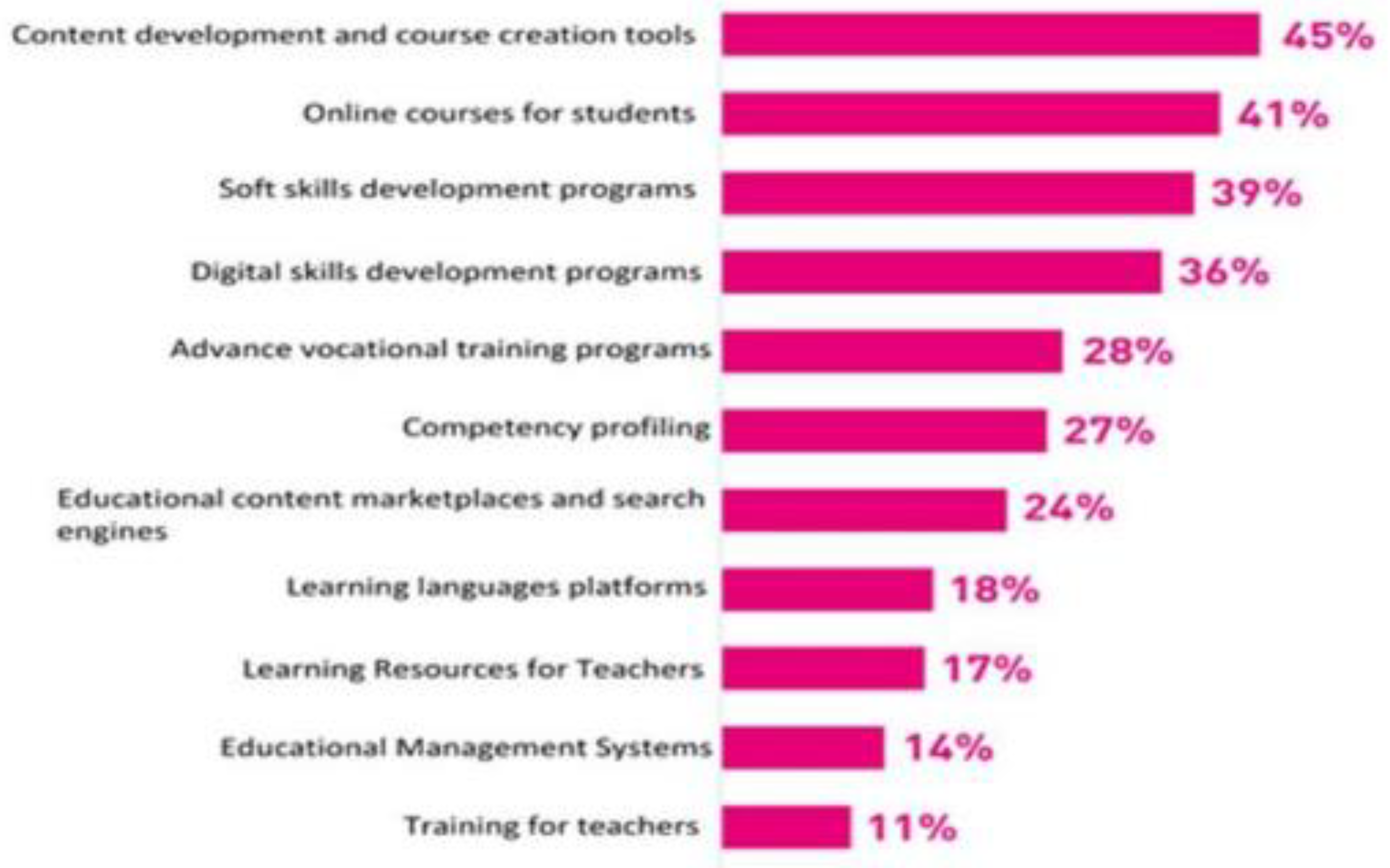
The most demanding Edtech products as given by (et al. Timchenko, 2020) are Content development and course creation tools, Online courses for students, soft skills development programs, digital skills development, advance vocational training, Competency profiling, educational content marketplaces and search engines, language learning, learning resources for teachers, educational management system and training for teachers.
The world has adopted education technology and governments have started investing in it and utilizing the benefits of education technology in various forms ranging from upskilling the youth to strengthening the country’s GDP. But technology always brings both the positive impacts as well as the negative impacts or challenges with it. In Edtech also there are several challenges faced by the Edtech start-ups, educational institutes, and the government.
- 2.
- Challenges in Education Technology - Security and Infrastructural Issues
The education technology brings ease and advancement to the teachers and students, but at the same time it brings some challenges with it. The adoption of education technology is not as easy and seamless as it seems. There are several challenges which come with the implementation of education technology. Some for teachers, some for students and some for the institutions. This section discusses some of the challenges in the EdTech industry and shares the views of some of the available literature in the domain.
- A.
- The Security Challenges faced by Stakeholders using Education Technology
The education sector is increasingly targeted by malicious cyber incidents, especially after the implementation of education technology resulting in huge financial losses, cancellation of classes and exams and breaches of the students’ and staffs’ data on a large scale. Talking about the security economics of EdTech, (Fouad, 2022) believes that the expansion of the Edtech industry and its growing innovation did not necessarily result in more secure products and services. In most cases, poor security practices by Edtech vendors have led to large scale data breaches, says (Fouad, 2022). The lack of regulations in this area also meant that the company was not obliged to inform users that their data has been exposed, and there was no clear evidence too that the company reported this incident to the Indian national computer emergency response team, says (Fouad, 2022). The risk of data breaches is not limited to the small Edtech start-ups. It also applies to bigger companies. Market concentration shifts cyber risks from minor nodes towards major players, making large companies more reachable to cyber attackers and exposed for attacks. This is because the bigger the information system of a particular entity is, the more vulnerabilities that it will likely comprise, and the larger the impact of an attack given the wide base of users (Fouad, 2022).
In some cases, says Fouad (2022), the breaches could result from a security flow in the supply chain. Giving example to this, he talks about one of the vendors’ of an Edtech company in India which is a conversational intelligence platform that improves sales performance. It was subject to a data breach in 2021 because of a server that was not protected with passwords that contained some of Byju’s sensitive data. This data included students’ names, email addresses, classes they are taking, in addition to parents and teachers’ phone numbers. Sharing some stats about the security issues in EdTech industry, Fouad (2022) says that according to a security report, 80% of the software applications that education institutions use around the world have “high flaw density” and old codebases, another report analyzed that more than 3000 Android mobile apps that were the most downloaded during the pandemic showed that over 50% of them had known security vulnerabilities.
Educational apps also had the highest number of vulnerabilities for which a known exploit (a malware that takes advantage of a software coding error) already exists. This makes education the top sector in terms of the number of vulnerabilities as compared to banking, gaming, health and fitness, among others, says Fouad (2022).
In most cyber incidents, end-users bear most of the costs. One reason why cybersecurity is economically challenging is the absence of strong incentives for vendors to prioritize security in software or hardware design.
- B.
- The Ethical Challenges of Education Technology
In recent years, learning and training has become digital, mobile and virtual to accommodate flexible education. Electronic technologies include presentation methods such as interactive multimedia, computer-based training, video conferencing, and distribution methods such as CD-Rom, Intranets, and the Internet.
Talking about the rise of ethical issues due to the phenomenal changes in the learning format, (et al. Hong Lin, 2006) says that the phenomenal technological advances that have impacted design and training practices have also given rise to a proliferation of ethical issues relating to the application of learning technology. A laundry list of such ethical issues given by (et al. Hong Lin, 2006) includes digital copyright infringement, violation of online private information, and misuse of learning technologies in learning situations. Such ethical issues pose challenges to those practitioners who have taken the responsibility for identifying and incorporating technology applications in design and training situations (et al. Hong Lin, 2006).
The ethical issues discussed by (et al. Hong Lin, 2006) in their work are Copyright, Learner Privacy, Accessibility, Diversity, Conflict of Interest and Professionalism/Confidence. Through a survey and some interviews, (et al. Hong Lin, 2006) gathered some data on the percentage of people who experienced the above-mentioned ethical issue during their digital learning. The results were tabulated as the one below, showing the number of participants in the interview/survey process and the percentage of people who agree with the ethical issue.
The most frequent ethical issue experienced by the learners is Digital Copyright, followed by the Learners Privacy, Accessibility and Diversity with Conflict of Interest and Professionalism as the least experienced ethical issues in digital learning.
Addressing a similar issue, (et al. Kousa, 2022) presents their study on AI ethics and learning challenges faced by EdTech companies. The specific issue addressed in (et al. Kousa, 2022) is the AI related ethical issues in the AIED. AIED is a part of education technology and ethical issues related to AI in education are also the ethical issues or challenges faced in education technology. Ethical challenges in learning were also approached from the viewpoint of machines and data management. All interviewees recognised and predicted ethical concerns, such as how to safely collect, process, share and store data. The management of personal and sensitive data is particularly challenging and important, says (et al. Kousa, 2022).
Sharing some unique views and concerns on Ethical Challenges of edtech, big data and personalized learning, centered on a twenty-first century student, (et al. Regan, 2019) says that the uptick in adoption of a variety of edtech applications at the K-12 level has also generated myriad policy debates, including proposed updates to existing federal laws and the introduction and adoption of numerous new state laws. Privacy is certainly an issue, as the use of edtech entails collection of more, and more granular, information about students, teachers, and families, as well as administrative details regarding the functioning of educational institutions (et al. Regan, 2019). With a unique viewpoint on the ethical violations through edtech, (et al. Regan, 2019) says that, A critical ethical concern raised with personalized learning is whether such programs constitute tracking and sorting of students that might be considered discriminatory.
Student tracking in the 1950s resulted in classrooms that were often divided by race, ethnicity, gender and class. Such tracking was obvious to parents, students, teachers and administrators at that time and thus the implications and wisdom of tracking became subjects of policy and social debate (et al. Regan, 2019). In contrast to this, the student tracking that appears to be occurring in 2018 is hidden from the view of students, parents and even teachers as it takes place behind computer screens, all thanks to edtech. The extent to which students might recognize they are being tracked through computer programs, and the impact that might have on learning outcomes is rarely discussed or researched (et al. Regan, 2019). Such ethical violations by the schools or educational institutes against students, teachers and parents are hard to point out or track. The flaw in education technology is helping the violators hide and continue doing unethical work.
The second concern long associated with privacy as shared by (et al. Regan, 2019) is that individuals should be able to remain anonymous or obscure if they so choose. But with an ever-increasing number of social relationships and practices becoming data points, it becomes more difficult for individuals to remain unidentified or unidentifiable. Algorithmic searches of datasets now can rather quickly diminish what had been high transaction costs on finding meaningful information. With big data, such distinctions are obscured as more and more bits of unidentified information can in effect be attached to a particular individual with just a bit of searching and analysis, says (et al. Regan, 2019). The third concern by (et al. Regan, 2019) involves the surveillance or tracking that provides more, and more detailed information, for big data analytics—and that big data requires to be even more powerful. The fourth ethical issue stated in (et al. Regan, 2019) is the concern regarding autonomy. The analytics powered by big data challenge individual autonomy, the individual’s ability to govern his or her life as that individual thinks best (et al. Regan, 2019). The fifth and sixth issues are the principle that individuals are treated fairly and equally and not discriminated against based on race, gender, age or other personal attributes—or based on factors of which they are not aware.
The sixth issue that has long been part of the debate about privacy, especially information privacy, is the question of the ownership of data about an individual. (et al. Regan, 2019) asks Does the individual “own” the information or does the third party holding the information in a database “own” the information? On this, (et al. Regan, 2019) thinks that as one moves further from either submitting personal information to one organization or clicking “I agree” on a website, any ownership in that information arguably fades.
The above-mentioned ethical challenges that come with education technology are crucial to be addressed with a new design of the education technology system. Apart from cybersecurity and ethical challenges, the adaption of education technology also brings the infrastructural and digital literacy challenges.
- C.
- The Infrastructural and Digital Literacy Challenges of Education Technology
Education technology is a big change in the way education is being delivered and consumed. Governments all over the world are investing millions of dollars in facilitating the incorporation of education technology into the education system of their country. Involving edtech is an advanced addition to the education system and also an expensive one. Access to education technology is a big prerequisite for the adoption of education technology.
Discussing Edtech and Access in their work, (et al. Hackman, 2022) says that access to edtech and access to infrastructure and resources is like a chicken and egg situation. They ask, “Does the lack of infrastructure make EdTech inaccessible, or has the cost and reliance on EdTech made it inaccessible to many?” and this question itself explains the infrastructural challenge of education technology in the market. (et al. Hackman, 2022) believes that instead of focusing on the superficial access rhetoric in the EdTech industry, the focus should be on creating resources and tools that can be readily available to all regardless of location or socioeconomic status. Significant determinants of access to educational technology according to (et al. Hackman, 2022) include access to electricity, access to internet, access to digital devices, digital literacy skills and the cost of internet. (et al. Hackman, 2022) thinks that digital skills are crucial in ensuring access because the lack of digital skills excludes many people from the digital space and denies them access to essential resources, which is an important point to be addressed while developing the system around technology. The rate of electrification has been accelerating in recent years, but still there are a billion people who do not have access to electricity. There are significant gaps in access between people living in urban and rural areas.
Despite the rapid migration to the digital space via the internet over the last decades, a significant disparity is also found in access to the internet among different income groups (et al. Hackman, 2022). Although access does not guarantee impact, providing various learning tools and speeding up access to the needs for every child and school is critical. (et al. Hackman, 2022) reports about the condition of accessibility around the world and says that an erroneous assumption exists among financially and educationally advantaged groups that universal access to technologies makes online learning possible, hence the advocacy for online learning, while on contrary to this belief, United Nations (2020) highlights that around 90% per cent of students in Sub-Saharan Africa do not have household computers, and 82% percent lack internet access. (et al. Hackman, 2022) argues uniquely about the issues related to the accessibility challenges in education technology and presents a strong argument regarding the same.
Coming up with a different approach about addressing the potential and challenges of education technology, (et al. Habsi, 2021) discusses the refugee education and impact of education technology in that domain, both the good and bad ones. Talking about the lack of infrastructural access to refugees, (et al. Habsi, 2021) says that Offline solutions might solve the problem imposed by a limited access to infrastructure. First and foremost, access to mobile phones and other electronic devices is highly variable, and this difference in ownership and in the prevalent type of technology used requires EdTech to be incredibly adaptable, versatile, and compatible with as many media as possible. He says, “Overall, the potential for new technologies to promote social skills is large. Through technologies, it might be possible for refugees to connect and feel part of a community and a learning network, but at the same time believes that the lack of digital literacy and affordability of education technology is being a barrier for them to utilize the best potential of the education technology.
Quite similar to these studies, but with a unique view toward the question, (et al. Lucas, 2022) believes that education technology brings the ease and challenge both at the same time. They categorize the challenges of online teaching and learning in 5 categories as Self-management, Work-life balance, Teaching-learning activities, Teacher-Student social interaction and Technological constraints. To all these their survey results says that with technology comes the challenges and to that we must grow and adapt for the advancement.
On this note, talking about the advancement in technology, we have popular and powerful technology with us. Blockchain technology. It is a new form of system which was introduced in the late 1900s and gathered attention with the introduction of cryptocurrency. How the world is looking at blockchain technology and its applications in the education industry is the question we will be addressing in the next section through some of the available literature on the topic.
- 3.
- Blockchain Technology - Potential Scope in Restructuring EdTech
The word Blockchain is often interchangeably used with the word cryptocurrency, but in reality, both the terms are quite different from each other. The term blockchain is the name of the technology which is used in functioning and managing the cryptocurrency network and data. Apart from cryptocurrency, there are many other applications of blockchain technology in the real world today.
- A.
- Blockchain Technology and its Applications
Blockchain technology is an emerging infrastructural technology that is believed to fundamentally transform the ways in which people trust and interact. Technology came into knowledge with the introduction of cryptocurrency and is now believed to be the solution to many real-world problems today. The rapid growth of cryptocurrency increased the interest towards blockchain technology and its applications.
Talking about blockchain technology and its applications, (et al. Chekerevac, 2022) presents the principles on which blockchain is based and analyzes the possibilities of the application of blockchain technology. The definition of the blockchain as given by (et al. Chekerevac, 2022) is as follows:
“A distributed ledger that facilitates the process of recording transactions and tracking assets in the business network”
The main difference between a classic database and a blockchain is how the data is structured, says (et al. Chekerevac, 2022). Classic databases collect data and store it in tables, but blockchains collect information in blocks. A filled block closes, compiles, and links to the previously filled block. All future new information will also be compiled into blocks and added to the previous blocks. In this way, data forms a chain, a blockchain as a timeline in which each block gets the correct timestamp when it is added to the chain (et al. Chekerevac, 2022). Comparing the blockchain technology’s functioning with that of Wikipedia, (et al. Chekerevac, 2022) says that a Wikipedia user receives an updated version of the „master copy” from centralized servers each time he logs in.
Wikipedia’s digital structure is like centralized databases used by banks and insurance companies, the military, and the police. It is a centralized system. With blockchain, each node on the network receives valid information about the transaction, confirms it, updates and registers it, and the most popular record de facto becomes the official record (et al. Chekerevac, 2022). The only difference between these is that Wikipedia is a centralized system and Blockchain is a decentralized system.
Presenting the study in the same domain, (et al. Kohli, 2021) talks about the strategic integration of blockchain technology into organizations. Describing the blockchain technology, (et al. Kohli, 2021) says,
“Blockchain is an emerging technology that enables two or more entities to conduct secure transactions.”
After a blockchain transaction is executed, it cannot be altered because the transaction information is encrypted. The transactions are safeguarded because they are sealed in a block, linked with other blocks in a chain, and then shared with nodes across the Internet (et al. Kohli, 2021). About utilizing the blockchain technology to its full potential, (et al. Kohli, 2021) says that, In order to gain full advantage of this new technology, however, it is important that managers view blockchain as strategic and integrate it into existing strategic infrastructure and in the future strategic planning.
Presenting an analytical study on the motivation of the adoption of blockchain technology, (et al. Ting-Peng, 2021) says that blockchain technology has the promise of transforming security and trust in digital transactions. However, concerns about the technical complexity and the benefits of deployment have blunted its adoption. Talking about the advantages of blockchain network, (et al. Ting-Peng, 2021) says that the potentially significant advantages from blockchain technology are anonymity, transparency, security, traceability, and efficiency of transactions, although the transparency and Anonymity refers to the non-identifiability of the sending and receiving parties to the transaction because blocks of transactions that are saved and stored in nodes are coded as a set of English letters mixed with numbers as traders’ names and are known only to the parties to the transactions.
Sharing their views on the potential of blockchain, (et al. Nassar, 2020) defines the blockchain technology with its key features as Transparency and visibility, Immutability, Traceability and Non-Repudiation and Smart Contracts.
The advent of blockchain technology over the last decade has led to the development of various use-cases of a decentralized system in multiple fields. One of these is education. The incorporation of technology into education has changed many things in the industry and has opened new doors for technical advancements in the domain.
- B.
- The Idea of Blockchain in Education Technology
Blockchain technology presents a decentralized paradigm where two parties can transact without relying on a mediating third party (et al. Ocheja, 2022). Which means, blockchain technology gives us a platform which is decentralized and allows us to be the owners of our stuff and perform the transactions without a mediator in between. This property of blockchain technology makes it a great potential solution for the challenges in the education industry today.
Presenting practical case studies on Blockchain in education, (et al. Ocheja, 2022) understands that the main features of blockchain technology making it very attractive to many fields including education are:
“The blockchain maintains a 25 ledger that is available to both parties and the authenticity of the ledger is guaranteed through a consensus algorithm. The main functions of a consensus algorithm are: to ensure that ledger entries are consistent, verify an actor can 29 write or modify them and prevent its compromise.”
Talking about the influence of trust on adoption and implementation of blockchain in education, (et al. Ramos, 2022) says that a significant part of educational institutions currently uses an obsolete and inadequate way to manage and authenticate student records and credentials, upon request, these credentials and transcripts are delivered in print, in sealed envelopes, directly to the interested parties. Verification of these documents is usually obtained by asking the issuing authority that needs to maintain a long-term file. Blockchain would provide the certificates in blocks without third-party intermediation, ensuring security to avoid false certificates, and it could provide secure access to participants, storing all certification identities and the whole process could be monitored by the supporting management of certification authorities and smart contracts. At the same time, blockchain could show anyone, anywhere, that the student has a diploma registered and validated in an integral and immutable way, says (et al. Ramos, 2022). The main benefits of blockchain when used in education field, as stated by (et al. Ramos, 2022) are:
- Security, concerning data protection, privacy and integrity.
- Better control over who and how student data is accessed.
- Increased accountability and transparency.
- Increasing trust between all parties included
- Facilitating communication between them.
- Reduction of costs associated with transactions and data storage.
- Authentication of students’ identities and their digital certificates.
- Improvement in the way learning outcomes and student performance are evaluated.
- Improved efficiency of exchange data and student record management.
- Improvement of student interactivity, blockchain system interoperability.
- Support for students’ career decisions.
Furthermore, talking on the similar issue, (et al. Zoiyi Li, 2022) presents their comparative study on Blockchain based solutions for education credentialing systems. According to them, blockchain can be a strong solution to following problems and issues in the credentialing systems in education.
- Difficulty of credentials recognition
- Damaged or tampered credentials
- Increasing cost of hiring and screening
- Deteriorating trust and value
- Identity theft and Centralized credentials governance
The desired attributes of an ideal credential as given by (et al. Zoiyi Li, 2022) are:
- Learner Control
- Verifiable
- Tamper-free
- Portability
- Employability-driven
With the use of blockchain technology, (et al. Zoiyi Li, 2022) believes that we can treat the issues and challenges in the credentialing system of education we are facing today. Certain properties of blockchain technology like Decentralization, Immutability, Self-sovereign and Tokenization makes it the best solution available for the cause, says (et al. Zoiyi Li, 2022).
Defining the blockchain technology as a tool to solve the challenges of education sector in developing countries, (Md Aminul, 2022) says that the education system is getting diversified, challenged, and blended for the overwhelming advancement of disruptive technology, and believes that blockchain technology can contribute to the education provider to tackle all those existing problems to create a comfortable learning environment to all irrespective to their economic backgrounds and geographic location. He understands blockchain as a large and global encoded data set that puts an end to the distribution or monopolization of data by the parts that interacted with that data. An enormous, decentralized, encoded, and open book of records in which experts influence the veracity of the data and guarantee its moral correctness were discussed.
About the idea of using blockchain in the education industry, (Md Aminul, 2022) says that, in terms of the education industry, the rapid development of distributed information and blockchain technology has prompted us to reassess and reexamine several fundamental components of existing education, literacy, and training frameworks. With the introduction of this new system of improvements, previously held beliefs about things like trust, value, security, and character are being called into question. The primary focus of blockchain research in the education sector is on the ways in which the technology might facilitate the safe, reliable, and auditable dissemination of knowledge, says (Md Aminul, 2022).
Researchers have discovered that Blockchain technology creates a setting where students may act as their own registrars and where third parties are not required to record or modify their grades. Education providers may also use blockchain technology, a decentralized data exchange, to issue, validate, and share certificates, which will assist to reduce the prevalence of certificate fraud (Md Aminul, 2022). The solution that blockchain provides when implemented in the education system, as listed by (Md Aminul, 2022) are:
- Intelligent agreements for courses and assignments
- Certifications, Report Cards, and Documentation
- Streamlining the payment of fee
- Universal admittance and Lower Expense
Likewise, (et al. Fitra, 2020) talks about blockchain education and smart courses of massive online open course using business model canvas. They believe that with the development of internet technology, online education, a new model of education, has been very popular. However, this mode of education still has many problems in terms of credibility, credit certification and certificates, student privacy, and various courses. There are several aspects of the education system that can be changed when the blockchain has been implemented. First, blockchain technology will accelerate the application of fully digital non-paper aliases, all types of diplomas or certificates that have been and will be issued by educational institutions can be stored on the blockchain network safely and permanently and with the application of more sophisticated technology, it can be used to record and verify other educational data, such as lists and transcripts (et al. Fitra, 2020). Second, in addition to permanent storage, digital diploma data on the blockchain is easily and quickly validated by its validity, without directly contacting the educational institution that issued it. Third, it can be utilized to facilitate payments between institutions. For example, proof of student tuition payments at the bank is available on the blockchain, says (et al. Fitra, 2020).
- 4.
- Blockchain in Education - Current Systems and Issues
As discussed in the previous section, about the potential benefits of using blockchain technology in the education system, this section we will be looking at some architectures already present which use blockchain technology in education systems and are making this safer and decentralized for us.
- A.
- Current systems using Blockchain in Education
Several initiatives have been made to apply blockchain technology into education technology and the education system today. New solutions in education through blockchain are being discussed among researchers.
Presenting a novel blockchain based architecture for education is presented by (et al. Solomon, 2019). The name of the system presented is the “SELI Project”. The project addresses the inclusion of different target groups such as the elderly, migrants, displaced youths, physically challenged, deaf and blind, through the proposal of a digital ecosystem that will allow the digital training of educators including higher education teachers, pre-service teachers, and trainers in the social service sectors to produce fully inclusive content and courses. The goal of the technical aspect of the project is to design a digital learning environment that leverages the project data, the seamless integration of pedagogy, and the activities required to make impact on learner achievement and retention (et al. Solomon, 2019).
The architecture of the SELI project includes blockchain based infrastructure, Courses and microsites, authoring tool, course organizer and learner analytics. The flow diagram for the SELI project as given by (et al. Solomon, 2019) can be seen below.
The SELI project architecture connects the microsites, course organizer, authoring tools, user and the teacher all through a blockchain network. The blockchain network performs the authentication, safety, data storage and accessibility throughout the learning management system. The SELI architecture is connected with the front end which is used by the end user and the access details regarding the students enrollment into the courses changes the way the course looks on the website or the application.
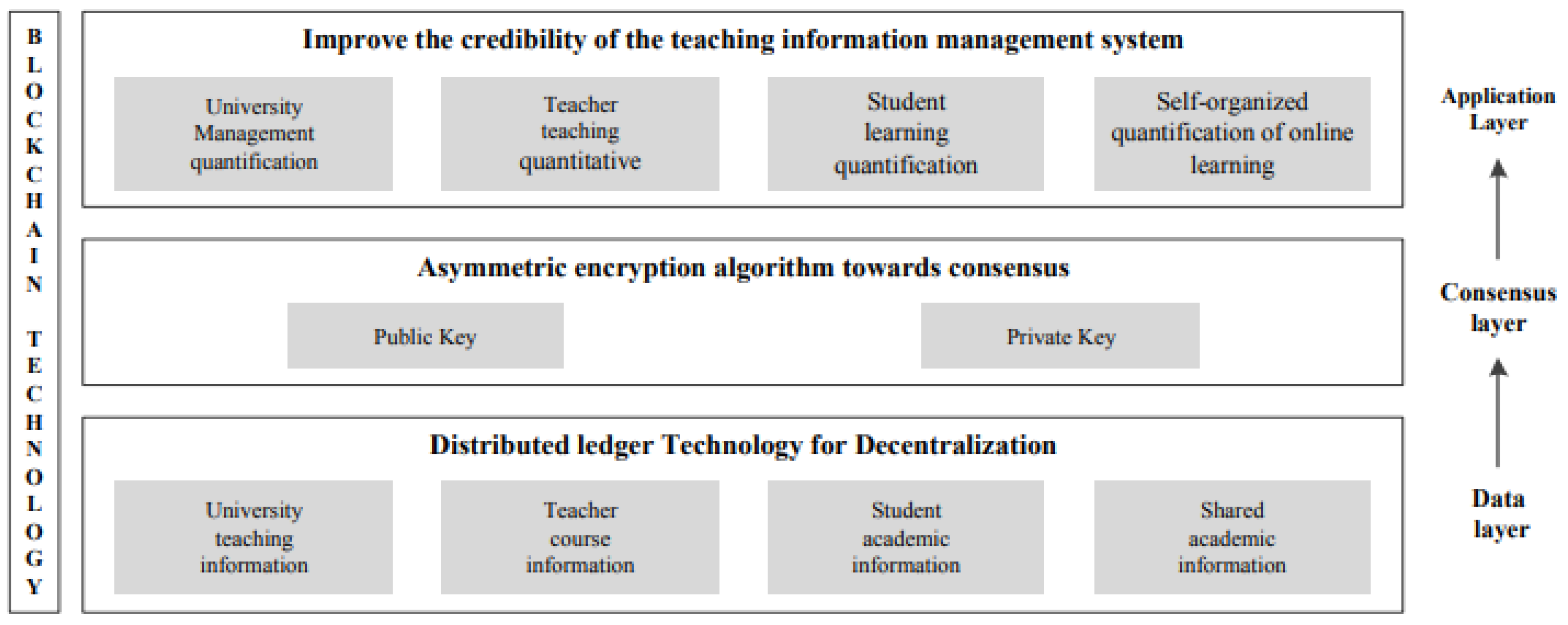
Presenting a teaching information management system based on blockchain technology, (et al. Linlin, 2020) believes that blockchain when used in the education system can improve the security of the teaching management in higher education. They try to explore the applications of blockchain in education management and their study will reflect three main aspects as Distributed Ledger Technology, Asymmetric encryption algorithm and Smart Contracts. The proposed architecture in (et al. Linlin, 2020) has 3 layers as Data layer, Consensus layer, and the last Application layer. The architecture given can be seen in the diagram below.
We thought that the security of information storage would be ensured, the credibility of data supervision would be enhanced, the cost of management would be reduced, and the efficiency of higher education management would be improved substantially if we could use the blockchain technology, says (et al. Linlin, 2020). The proposed architecture connects the different parts of higher education with each other through blockchain and adds a layer of security in the Teaching Information Management System for higher education institutes.
Figure 05.
SELI Project architecture (et al. Solomon, 2019).
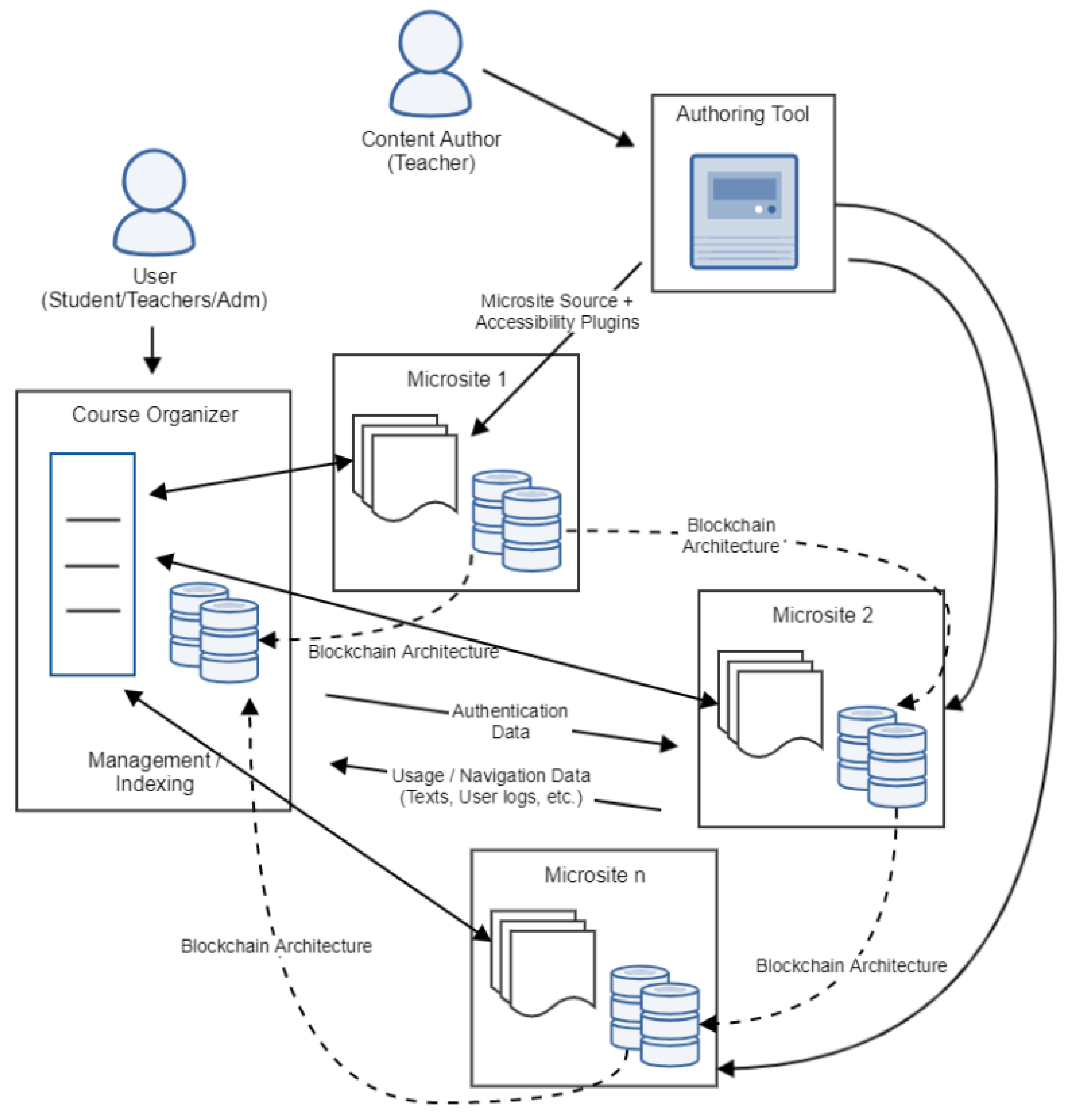
Figure 06.
Teaching Information Management System based on Blockchain Technology (et al. Linlin, 2020).
Figure 06.
Teaching Information Management System based on Blockchain Technology (et al. Linlin, 2020).
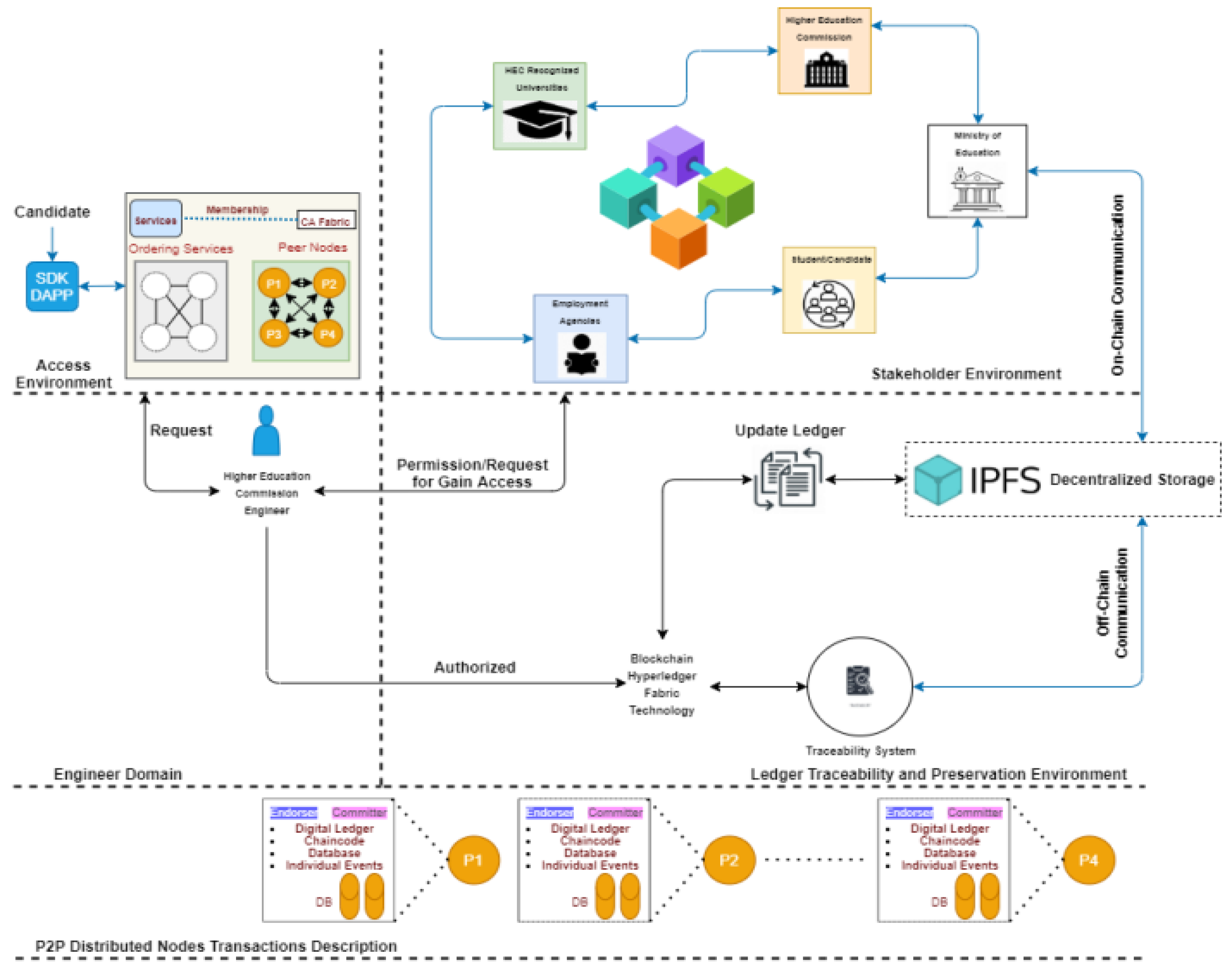
A secure degree attestation and verification traceability architecture for higher education commission is presented by (et al. Abdullah, 2021) in their work. Degree attestation verification and traceability are complex one-to-one processes between the Higher Education Commission (HEC) and universities. The procedure shifted to the digitized manner, but still, on a certain note, manual authentication is required, says (et al. Abdullah, 2021). The proposed architecture resolves certain issues in the current system like the process of issuing the degree certificate in multiple steps by the university or college as a centralized body. Potentially, blockchain technology could become a standardized platform to perform tasks including issuing, verifying, auditing, and tracing immutable records, which would enable the HEC, universities, and Federal Education Ministry (FEM) to quickly and easily get attested and investigate the forge proof versions of certificates (et al. Abdullah, 2021). The proposed blockchain hyperledger fabric-enables degree attestation verification and traceability architecture by (et al. Abdullah, 2021) can be seen as below in Figure 05.
The key features of the proposed blockchain hyperledger fabric enabling ubiquitous credential attestation traceability security, as given by (et al. Abdullah, 2021) are as follows:
- The higher education degree attestation traceability system requires a private key. The main objective is to sign the university academic credentials and issuance certificate to add verification signatures in every aspect.
- In this regard, a unique hash-encrypted ID generated in every content verification of the education certificate which allows stakeholders to trace records.
- This system also ensures credential contents, consistency, and degree records.
- At every level, hyperledger fabric smart contract technology manages and executes the digital contract, and a digital multi gesture is used to verify the contents of degree and information authorization.
Figure 07.
Proposed blockchain hyperledger fabric-enabled degree attestation verification and traceability
architecture (et al. Abdullah, 2021).
Figure 07.
Proposed blockchain hyperledger fabric-enabled degree attestation verification and traceability
architecture (et al. Abdullah, 2021).
Presenting their study for the system design for online foreign language education based on blockchain technology, (et al. Yuchen, 2022) propose an architecture with two formats as B/S and C/S where, C/S is an upgraded form of B/S architecture for the online foreign language education based on blockchain technology. The benefits of the proposed architecture by (et al. Yuchen, 2022) are;
B/S →
- Strong distribution and zero maintenance of client
- It can be accessed by multiple users at the same time
- Easy to maintain, upgrade and add new features
- Simple development and strong sharing
- Simple aspects of business expansion
C/S →
- Fast response
- The operation interface is beautiful and diverse
- Higher security, suitable highly confidential systems
- Strong transaction processing ability
The overall technical architecture of the online foreign language education system as given by (et al. Yuchen, 2022) is as follows:
Figure 08.
Overall technical architecture of online foreign language education system (et al. Yuchen, 2022).
Figure 08.
Overall technical architecture of online foreign language education system (et al. Yuchen, 2022).
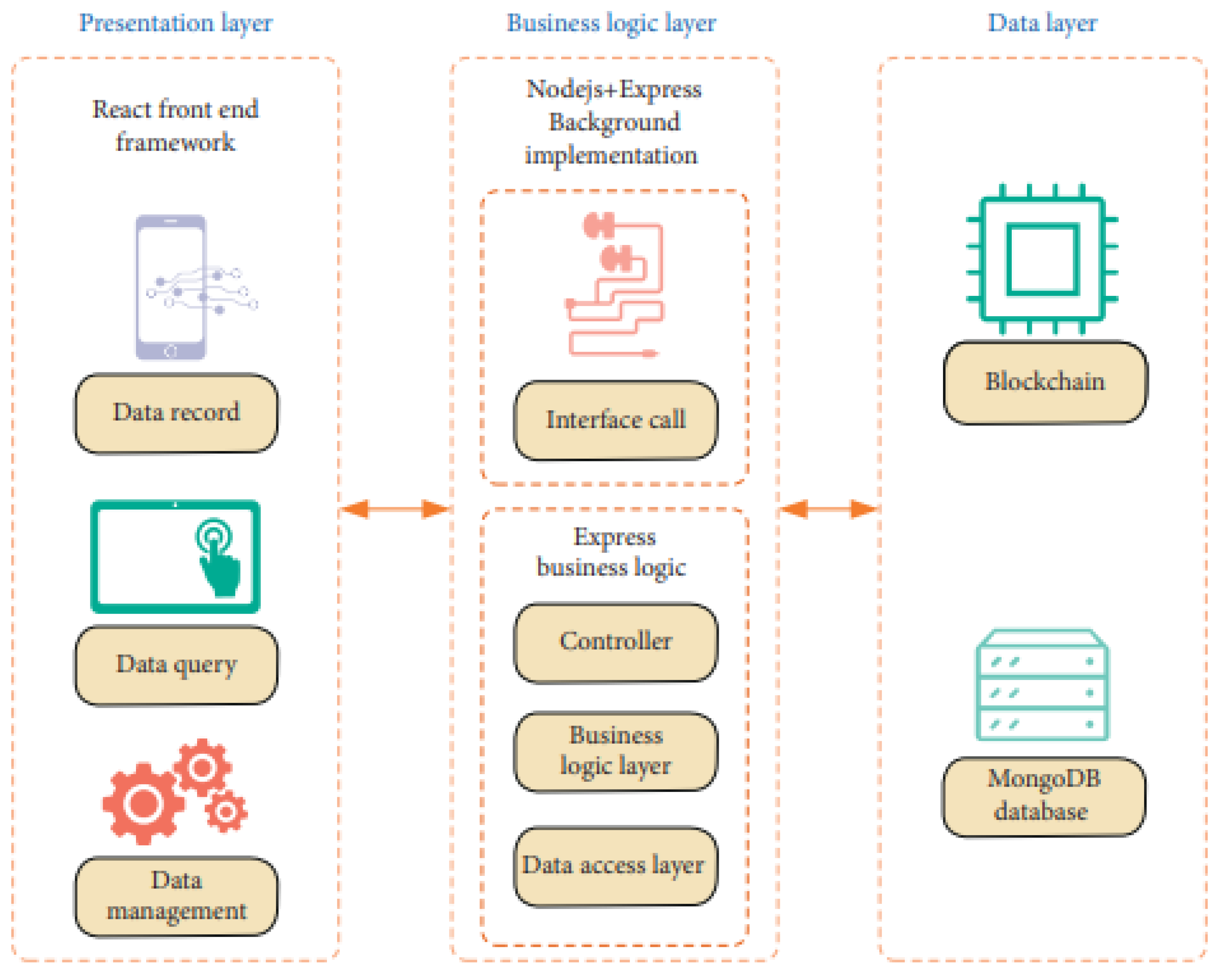
The architecture proposed by (et al. Yuchen, 2022) has multiple functions like Credit certification, Course certificate, Course learning, Course order, Course management, and User Management. Each of these features has at least one to at most 3 functions from applying for the course or service to getting the certification for the same. In the paper (et al. Yuchen, 2022), the author also presents the business logic flow for each of the features of the proposed system.
- B.
- Drawbacks, issues, pitfalls or loopholes - What are we missing?
From all of the relevant literature we discussed above, many discussed the rise of education technology, some addressed the rise of education market after incorporating education technology and comparing the market situations of edtech markets before and after covid-19 pandemic.
There are certain challenges in education technology regarding cybersecurity, ethical challenges related to digital as well as emotional threats regarding privacy of the user and other stakeholders of education technology.
To these challenges, the newly popular blockchain network came up as the best solution to the education system. The properties of blockchain network like Decentralization, Immutability, Self-sovereign and Tokenization makes it the best solution available for the cause. The blockchain network provides ownership to the users and a strong layer of security and monitoring of all kinds of action throughout the network through its properties.
Inspired by the idea of using blockchain into the education system, many researchers presented their unique architectures of the system for the education sector based on blockchain technology. All of the architectures proposed and presented till date are using blockchain to solve current challenges in the education technology or education industry as a whole. But most of these architectures are addressing the safe and decentralized generation of educational certificates using blockchain technology and smart contracts. Very little study has been done on incorporating blockchain technology with education in the learning management system. This work presents a novel architecture for the education system based on blockchain technology. The presented architecture is a learning management system based on blockchain technology.
The proposed architecture uses knowledge graphs and blockchain technology to operate and manage the learning process of an educational institute and this way, the proposed architecture is different and unique from the ones already presented by other researchers. Along with studying currently present literature on the topic, this work presents a novel architecture for a learning management system for the education system today based on blockchain technology.
IV. Design Implications
The rapid advancement of technology in the education sector has evolved opportunities for education technology. The covid-19 pandemic forced lockdown all around the world fueled the rapid growth of education technology and online education. Along with this, blockchain technology also experienced popularity through cryptocurrency in the last decade. Scientists and Businesses have encountered various use-cases of blockchain technology apart from cryptocurrency. One of the very intuitive use-cases is the incorporation of blockchain network in the education system.
In this work, we present a novel architecture of a learning management system based on blockchain and knowledge graphs. The proposed system is capable of managing all the tasks and processes involved in the education sector for all the stakeholders of the education system, including the teacher, student, the institution, government and corporate offices.
The learning management system based on blockchain technology proposed is a one stop solution for all the stakeholders of the education system including the educator, students, institutes and government. The high level architecture of the proposed system is given in figure below.
The interface of the learning management system is accessible by both the students and the instructor. Both of these use the learning management system for a different set of tasks. For instructor, the tasks are:
- Creation of teaching lessons
- Creating assignments for students
- Creating test papers and questionnaire for exams
- Checking and grading students’ answer sheets
Figure 09.
High-level architecture of proposed learning management system based on blockchain.
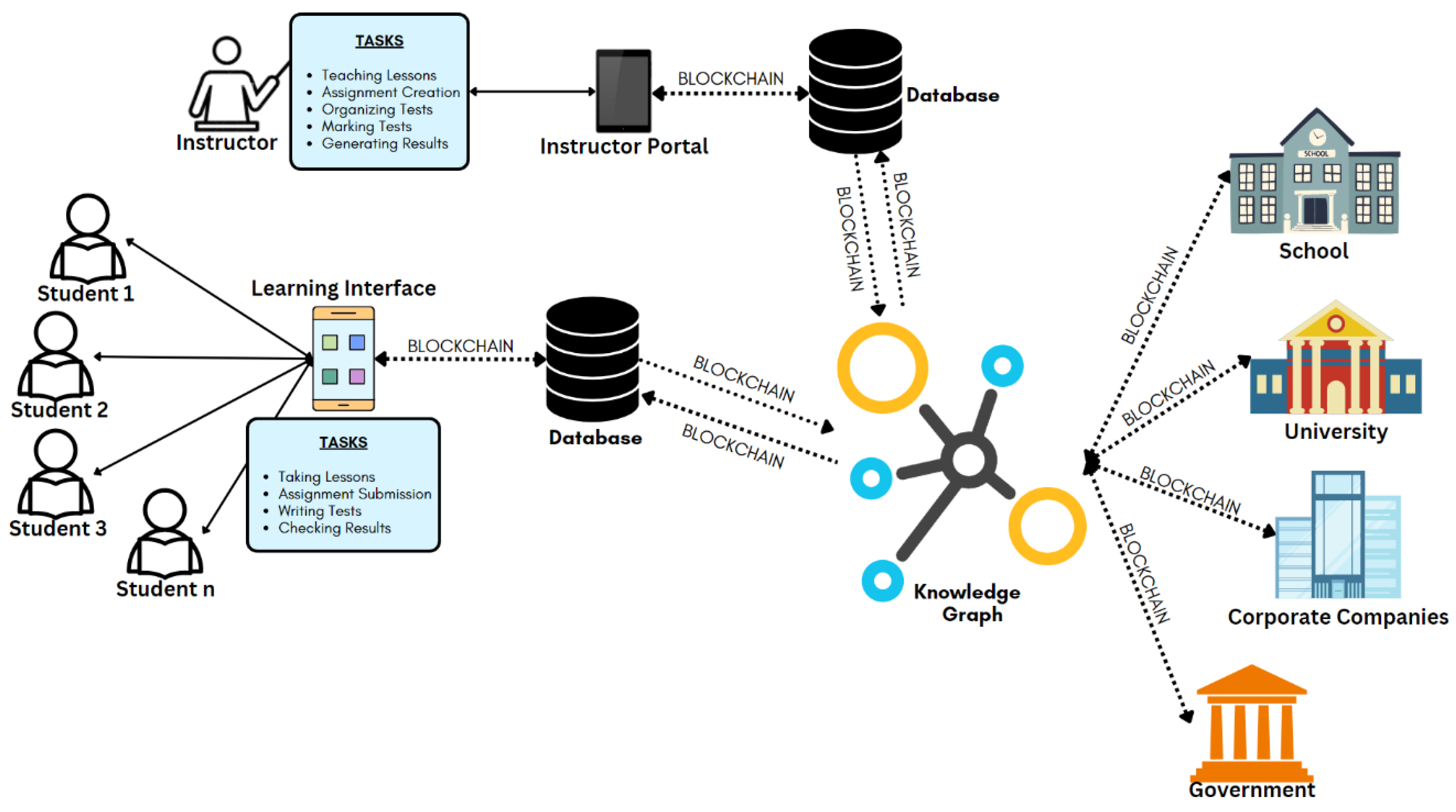
Similarly, the students can access the interface for certain set of tasks as:
- Watching teaching lessons for chosen course
- Completing and submitting assignments on or before the due date set by the educator
- Taking tests/exams for the courses enrolled
- Getting the results for the exams/tests written
The students and teachers are able to access the interface through their login id and password. These login ids and passwords are stored in a database along with other details of respective students and teachers. This database is further connected with the knowledge graph through the blockchain network as we can see in the diagram above.
- Knowledge Graph
The knowledge graph is a network in itself which has multiple nodes in it connected with each other. These nodes contain information in them, and the complete knowledge graph carries a complete set of information in it. There are several applications and use-cases of knowledge graph as it is a very systematic structure of storing information while saving the relationship between two or more pieces of information. Here, we are using the knowledge graph for storing the information of students regarding their education.
This knowledge graph is further accessible to multiple entities like schools, colleges, universities, corporate companies, and the government. With the help of the blockchain network all this information and access to this is secured and decentralized. The blockchain network here works as the mode of transaction between two stages of information storage, and the way of communication among different parts of the learning management system.
The motive of this learning management system is to provide a platform to people/education stakeholders where they can get all the information regarding the education history of a respective student or candidate. This system makes things intuitive for students by providing all the lessons, assignments, tests and certificates on a single platform. Also, all this data is secured by the blockchain network as well as shareable with anyone.
Similarly, for teachers also, the platform provides a one stop facility for all their tasks as an educator. They can record and share the lessons for their classes, assign the class assignments to students and monitor the submissions digitally. They can also grade the exams for students and generate the results online on this system only. All the information regarding their lessons, assignments and tests are stored in the database and then in the knowledge graph.
The knowledge graph contains all the information related to each student and teacher. The central nodes of the knowledge graph are assigned to the students and all the information related to their education is stored in the branch nodes of the graph. This kind of structure is present for each of the students in the network and is interconnected with each other through second or third branch nodes as they share similar information for the two or more students, like educator or the assignment. This way all the information in the knowledge graph is stored systematically and is connected with other information either directly or indirectly making the data stored structurally.
The low-level architecture design of the proposed learning management system is given in the diagram below. The system has a total of 4 steps or can say 4 parts as shown explicitly in the low-level architecture below. All these parts combine up through the blockchain network to give it the final learning management system.
The in-depth flow diagram of the proposed blockchain based architecture can be seen in Figure 10. The system architecture has 4 major parts. The list of these parts is as follows:
- Front-end interface (For users, students, and teacher for example)
- The database is connected with the blockchain ledger.
- The Knowledge Graph
- The group of entities connected through a blockchain network connected to the knowledge graph.
All these four parts of the network are connected with the blockchain network. In this system, we are using the public blockchain network. The reason for using the public blockchain network here is to make the system decentralized and secure. Along with this, the public blockchain network will make the sharing and validation of educational documents, certificates and achievements shareable and thus would make the education system transparent and fault proof and secure. The complete ecosystem of the Learning management system is explained in four steps below.
PART 1: Requesting and Receiving the Access
The first step is “Requesting and receiving access of the system”. The access is requested using the assigned user id and password. When the user enters the user id and password, the system checks for it in the database. If the entered details are correct, access is granted otherwise the system shows up error and denies the login request.
This process of requesting and receiving access is the same for both students and teachers. The only difference here is the interface they both log into. The students log into the learning portal while the educators log into the teaching portal as they have different tasks to do.
PART 2: Updating the Blockchain Ledger
After the students and teachers have logged into the system, they perform their respective tasks and thus generate data related to their profile. All this data is updated into the database in the blockchain network, called the ledger. The blockchain network here is the Hyperledger Blockchain Network. For each transaction, the system checks for any update in the information and if found the blockchain ledger is updated. All this is happening in real time and thus no information is left behind and everything is updated in the blockchain ledger.
PART 3: Updating the Knowledge Graph
The blockchain ledger is further connected with the knowledge graph. Here in this network, we have a single knowledge graph which contains all the information regarding the academic journey of a student and through that, the data regarding the teachers is also stored. The knowledge graph makes the learning management system much more intuitive as the data is stored in a very structured format. The central nodes of the knowledge graph are the students and the data related to their academic journey is stored in the branch nodes. The complete knowledge graph is connected at one or the other level. Each node is connected with other nodes either directly or indirectly.
PART 4: The Access of Knowledge Graph to Entities
The knowledge graph containing all the data for the complete academic journey is accessible to certain bodies like the student/parent, the institute, all the recognized universities, higher education commission, corporate entities or employment agencies and the education ministry of the country. This way, the complete academic history of an individual is transparent to everyone concerned and is very easily shareable. The complete system is decentralized and thus the ownership is in the hands of the student. The blockchain network is making this system impossible to be hacked and tracks and notes each and every transaction happening in the network.
The learning management system proposed here is a one stop solution for the student for his/her complete academic journey and stores the data in a systematic way. The access of this system is with the participants for the lifetime making it easier for students to keep their certificates and achievements secure and with them all the time throughout the life. Along with this, the system also creates a secure database about the citizens of a country about their educational details however small or big and provides this to the government of the country. This information can be very beneficial for intelligence agencies and other offices as this database will have very important details about the citizens of the country and makes the tracking and monitoring easy for officials if and when required as it will be impossible to get education and not be in this network. This network basically records the complete life of an individual in a way.
This brings us to the limitations and future scope of this study on incorporating blockchain technology into the education sector through a learning management system. The following are the research directions for this work and present the limitations and/or future scope on the topic.
- 1.
- Knowledge Graph and Blockchain
It was found during the research that it is possible to create a knowledge graph based on the blockchain network. It was out of the scope of this work but is a great research direction for future work in the domain.
- 3.
- Blockchain in Education - Smart Contracts
The type of blockchain used in the proposed system is the public blockchain. This does make this network hard to hamper but at the same time open up important information about people to everyone. Using smart contracts to grant access to this network is a good solution to this problem and a suggestion for future work in the domain.
- 3.
- Information in Knowledge Graph
The knowledge graph used in the proposed system is centered at the students and carries the information around them. It is the scope for future research to create a knowledge graph based on the blockchain network which centers both the students and the teachers and stores the data in a systematic manner accordingly. This way, the database created would work more than an educational details database and can be of great use for many industries.
- 4.
- Blockchain Network among Education Ministry and other Offices
In this work, it is assumed that we do have the Education Ministry, Higher Education Commission, Employment Agencies, Students and all the Recognized Universities connected with each other through a blockchain network. In reality, this section requires some more amount of research and application work to make such a system within countries in the world.
- 5.
- Use Cases of Blockchain based LMS other than Education
The proposed LMS based on blockchain is designed explicitly for the education industry. But there can be many more use cases of such a system with large and systematic databases. For future work, we must look for other use cases of such a system other than education.
V. Conclusion
The world has been through a massive growth in the technical sector. Everything around us is being upgraded to a technical version. Every industry, right from finance, e-commerce, transport, fashion to education, all of them are involving technology and creating a business model around it. Education technology has been with us for a decade now and got popular during the lockdown period forced by the pandemic. The schools and universities were forced to organize online classes, assignments and online tests. During this time, people started attracting towards the educational companies teaching and providing services online. Many businesses grabbed this opportunity and joined the booming industry of online education. The businesses were innovating new products and features in their applications and on their websites which were making online learning fun and intuitive.
Artificial intelligence, machine learning, gamification was being involved in learning. Schools and educational institutes started collaborating with these businesses to provide better online learning experience to students and parents. But, with good always comes the bad and likewise, with advantages of education technology, disadvantages also came in. The excessive use of internet and greater exposure of kids to the online world made them sensitive to cyberattacks. The large databases with crucial information of teachers, students, parents and the educational institute were prone to be hacked by anyone with bad intentions. Security became a major challenge for the education industry. Along with cybersecurity, ethical security was also a concern now.
Meanwhile, alongside this educational growth with technology, we saw the rise of blockchain technology which came into the world with cryptocurrency in 2012.
Blockchain technology is a decentralized, distributed ledger which stores the data in nodes and every action or entry once stored on the network can never be deleted, which means the blockchain network is immutable. It was first used in cryptocurrency and soon its potential in the finance sector was recognized.
Blockchain technology is seen as a promising technology which can change the view of trust and safety for us. Soon, the researchers unveiled the potential of blockchain technology is reshaping the functioning of many industries around the world, the supply-chain, banking, e-commerce, transport, and education.
Many scientists and researchers believe that blockchain technology is the best solution to the current day challenges in the education industry. The security concerns due to education technology can be solved using blockchain technology. Several researchers presented their work on incorporating blockchain technology into education in many different formats. Many of them suggested the use of “Smart Contracts” for generating the educational certificates and documents to avoid any fraudulent activity with the educational documents and to make the marksheets and degree certificates easily sharable. One more advantage of using smart contracts with blockchain to generate educational documents is to make the system decentralized. However, some researchers used blockchain technology in the learning management systems. This way they suggested an architecture which enables the functioning of a learning management system through a blockchain network.
This work presents a novel architecture of a blockchain based learning management system which uses the knowledge graph to store all the data and information of students inside branch nodes which are connected with the central node that is the student. This way, all the data is very well structured in the knowledge graphs and is also safe through blockchain network. This knowledge graph is also accessible to the education ministry and other offices making the information easily sharable and trackable. The proposed system uses public blockchain network and is completely decentralized.
Availability of data and materials
No.
Competing interests
Not applicable.
Funding
University of Colombo School of Computing.
Authors’ contributions
Author 1 – Structure & Writing the systematic review, Author 2 – Structure
& Revieing.
Acknowledgements
Not applicable.
References
- Aguilar-Alonso, I., & Levano, E. (2020). Architectures Based on Blockchain Technology for Information Systems in Public Institutions. 2020 IEEE International Conference on Sustainable Engineering and Creative Computing (ICSECC), Sustainable Engineering and Creative Computing (ICSECC), 2020 IEEE International Conference On, 30–35. [CrossRef]
- Lokesh, G. H., Valyagath Vadake Nalagath, U. M., Kuamr, V. V., Flammini, F., Ramaswamyaradhya, R. K., & Kannan, H. K. (2022). Providing Authentication and Privacy for University Certificates Using Smart Contracts in Blockchain Technology. Interdisciplinary Description of Complex Systems, 20(4), 398–412. [CrossRef]
- Cekerevac, Z., & Cekerevac, P. (2022). Blockchain and the Application of Blockchain Technology. MEST Journal, 10(2), 14–25. [CrossRef]
- Nassar, M., Salah, K., ur Rehman, M. H., & Svetinovic, D. (2020). Blockchain for explainable and trustworthy artificial intelligence. WIREs: Data Mining & Knowledge Discovery, 10(1), N.PAG. [CrossRef]
- Ocheja, P., Agbo, F. J., Oyelere, S. S., Flanagan, B., & Ogata, H. (2022). Blockchain in Education: A Systematic Review and Practical Case Studies. IEEE Access, Access, IEEE, 10, 99525–99540. [CrossRef]
- Ramos, C. R. dos S., & Queiroz, M. M. (2022). Blockchain in education: the influence of trust on adoption and implementation. RAUSP Management Journal, 57(3), 316–331. [CrossRef]
- Balcerzak, A. P., Nica, E., Rogalska, E., Poliak, M., Klieštik, T., & Sabie, O.-M. (2022). Blockchain Technology and Smart Contracts in Decentralized Governance Systems. Administrative Sciences (2076-3387), 12(3), 96. [CrossRef]
- Zhang, L., Ma, Z., Ji, X., & Wang, C. (2020). Blockchain: Application in the System of Teaching Informatization Management of Higher Education. 2020 3rd International Conference on Smart BlockChain (SmartBlock), Smart BlockChain (SmartBlock), 2020 3rd International Conference on, SMARTBLOCK, 185–190. [CrossRef]
- Ziyi Li, Z., Joseph, K. L., Yu, J., & Gasevic, D. (2022). Blockchain-based Solutions for Education Credentialing System: Comparison and Implications for Future Development. 2022 IEEE International Conference on Blockchain (Blockchain), Blockchain (Blockchain), 2022 IEEE International Conference on, BLOCKCHAIN, 79–86. [CrossRef]
- Agrawal, S., & Mishra, A. K. (2021). Deploying Blockchain in Education: Security, Challenges, and Solutions. 2021 5th International Conference on Information Systems and Computer Networks (ISCON), Information Systems and Computer Networks (ISCON), 2021 5th International Conference On, 1–5. [CrossRef]
- Luca Mainetti, Roberto Paiano, Matteo Pedone, Marco Quarta, & Elton Dervishi. (2022). Digital Brick: Enhancing the Student Experience Using Blockchain, Open Badges and Recommendations. Education Sciences, 12(567), 567. [CrossRef]
- Oleg Ye. Kaminskyi, Yulia O. Yereshko, & Sergii O. Kyrychenko. (2018). Digital Transformation of University Education in Ukraine: Trajectories of Development in the Conditions of New Technological and Economic Order. Інфoрмаційні Технoлoгії і Засoби Навчання, 64(2), 128–137.
- Abdullah Ayub Khan, Asif Ali Laghari, Aftab Ahmed Shaikh, Sami Bourouis, Amir Madany Mamlouk, & Hammam Alshazly. (2021). Educational Blockchain: A Secure Degree Attestation and Verification Traceability Architecture for Higher Education Commission. Applied Sciences, 11(10917), 10917. [CrossRef]
- Hsu, C.-H., Alavi, A. H., & Li, H. (2022). Guest Editorial : Blockchain in Smart Education. Educational Technology & Society, 25(3), 71–73.
- Vlad-Andrei ROTUNDU. (2022). Impact of Blockchain Technology: Benefits and Security Risk and Threats. Informatică Economică, 26(2), 37–45. [CrossRef]
- Birje, M. N., Goudar, R. H., Rakshitha, C. M., & Tapale, M. T. (2022). A Review on Layered Architecture and Application domains of Blockchain Technology. 2022 International Conference on Electrical, Computer and Energy Technologies (ICECET), Electrical, Computer and Energy Technologies (ICECET), 2022 International Conference On, 1–5. [CrossRef]
- Kwok, A. O. J., & Treiblmaier, H. (2022). No One Left behind in Education: Blockchain-Based Transformation and Its Potential for Social Inclusion. Asia Pacific Education Review, 23(3), 445–455.
- Hardini, M., Aini, Q., Rahardja, U., Izzaty, R. D., & Faturahman, A. (2020). Ontology of Education Using Blockchain: Time Based Protocol. 2020 2nd International Conference on Cybernetics and Intelligent System (ICORIS), Cybernetics and Intelligent System (ICORIS), 2020 2nd International Conference On, 1–5. [CrossRef]
- Park, J. (2021). Promises and challenges of Blockchain in education. Smart Learning Environments, 8(1). [CrossRef]
- Zhu, Y. (2022). Research on Real-Time Tracking Algorithm of E-Commerce Logistics Information Based on Blockchain Technology. Computational Intelligence & Neuroscience, 1–13. [CrossRef]
- Kohli, R., & Liang, T.-P. (2021). Special Section: Strategic Integration of Blockchain Technology into Organizations. Journal of Management Information Systems, 38(2), 282–287. [CrossRef]
- Song, Y., & Shen, Y. (2022). System Design for Online Foreign Language Education Based on Blockchain Technology. Computational Intelligence & Neuroscience, 1–16. [CrossRef]
- Jun Xiao, Yi Jiao, Yin Li, & Zhujun Jiang. (2021). Towards a Trusted and Unified Consortium-Blockchain-Based Data Sharing Infrastructure for Open Learning—TolFob Architecture and Implementation. Sustainability, 13(14069), 14069. [CrossRef]
- Tiago M. Fernández-Caramés, & Paula Fraga-Lamas. (2019). Towards Next Generation Teaching, Learning, and Context-Aware Applications for Higher Education: A Review on Blockchain, IoT, Fog and Edge Computing Enabled Smart Campuses and Universities. Applied Sciences, 9(21), 4479. [CrossRef]
- Liang, T.-P., Kohli, R., Huang, H.-C., & Li, Z.-L. (2021). What Drives the Adoption of the Blockchain Technology? A Fit-Viability Perspective. Journal of Management Information Systems, 38(2), 314–337. [CrossRef]
- Turkawka, G. (2019). A Gamified , Blockchain Based , Learning Record Store as a Personal Learning Environment could offer a Solution to the Human Right of Education. [CrossRef]
- Kim, S.-K., & Huh, J.-H. (2020). Blockchain Agreement for Self-identification of Online Test Cheating: Improvement of Algorithm Performance. 2020 20th International Conference on Control, Automation and Systems (ICCAS), Control, Automation and Systems (ICCAS), 2020 20th International Conference On, 1124–1133. [CrossRef]
- Tsai, C.-T., Wu, J.-L., Lin, Y.-T., & Yeh, M. K.-C. (2022). Design and Development of a Blockchain-Based Secure Scoring Mechanism for Online Learning. Educational Technology & Society, 25(3), 105–121.
- Fang, J., Guo, Q., & Guan, S. (2022). A Study on Competence of Teaching or Scientific Projects Research for Primary and Secondary School Teachers Based on Blockchain Technology. International Transactions on Electrical Energy Systems, 1–11. [CrossRef]
- Pardeshi, Komal. (2021). REVIEW OF BLOCKCHAIN ARCHITECTURE A SURVEY. JAC: A Journal of Composition Theory. 13. 239-248.
- Martins, V., Oyelere, S. S., Tomczyk, L., Barros, G., Akyar, O., Eliseo, M. A., Amato, C., Frango Silveira, & Ismar. (2020). A blockchain microsites-based ecosystem for learning and inclusion.
- Islam, M. A. (2022). Blockchain Technology: A tool to solve the challenges of education sector in developing countries.
- Oganda, F. P., Lutfiani, N., Aini, Q., Rahardja, U., & Faturahman, A. (2020). Blockchain Education Smart Courses of Massive Online Open Course Using Business Model Canvas. 2020 2nd International Conference on Cybernetics and Intelligent System (ICORIS), Cybernetics and Intelligent System (ICORIS), 2020 2nd International Conference On, 1–6. [CrossRef]
- Chen, X., Zou, D., Cheng, G., Xie, H., & Jong, M. (2022). Blockchain in smart education: Contributors, collaborations, applications and research topics. Education and Information Technologies: The Official Journal of the IFIP Technical Committee on Education, 1–31. [CrossRef]
- Alsoud, A. R., Al-Debei, M. M., M. G. M., J., Ab Yajid, M. S., Alshareef, H. N., & Ariffin, I. A. (2021). Digitalization in Educational Technologies for Edtech Solutions: A Comparatuive Study of Jordanian and Malaysian Universities. Educational Sciences: Theory & Practice, 21(4), 83–99.
- M.A., Sikandar. (2022). THE RISE OF EDTECH START-UPS IN INDIA.
- Tardy Hackman, S., & Reindl, S. (2022). Challenging EdTech: Towards a More Inclusive, Accessible and Purposeful Version of EdTech. Knowledge Cultures, 10(1), 7–21. [CrossRef]
- Al Habsi, S., & Rude, B. (2021). Refugee Education 4.0: The Potential and Pitfalls of EdTech for Refugee Education. CESifo Forum, 22(5), 43–49.
- Daniel Rodriguez-Segura.(2022).EdTech in Developing Countries: A Review of the Evidence. World Bank Research Observer, 37(2), 171–203. [CrossRef]
- Fouad, N. S. (2022). The security economics of EdTech: vendors’ responsibility and the cybersecurity challenge in the education sector. Digital Policy, Regulation and Governance, 24(3), 259–273. [CrossRef]
- Regan, P. M., & Jesse, J. (2019). Ethical challenges of edtech, big data and personalized learning: twenty-first century student sorting and tracking. Ethics and Information Technology, 21(3), 167–179. [CrossRef]
- Hong Lin, & Judith A. Kold. (2006). Ethical Issues Experiences by Learning technology Practitioners in Design and Training Situations, Copyright © 2006 Hong Lin & Judith A. Kolb.
- Kousa, P., & Niemi, H. (2022). AI ethics and learning: EdTech companies’ challenges and solutions. Interactive Learning Environments ; Page 1-12 ; ISSN 1049-4820 1744-5191. [CrossRef]
- Njadat, Eman & Jaafreh, Somaya & Almsaiden, Ahed. (2021). Educational technology and its impact on the efficiency of the educational process in higher education. Cypriot Journal of Educational Sciences. 16. 1384-1394. 10.18844/cjes.v16i4.5987.
- Amit, S., Karim, R., & Kafy, A.-A. (2022). Mapping emerging massive open online course (MOOC) markets before and after COVID 19: A comparative perspective from Bangladesh and India. Spatial Information Research, 1–9. [CrossRef]
- EdTech Market, Prescient & Strategic Intelligence Private Limited. (2022). Financial Services Monitor Worldwide.
- Timchenko, V. V., Trapitsin, S. Y., & Apevalova, Z. V. (2020). Educational Technology Market Analysis. 2020 International Conference Quality Management, Transport and Information Security, Information Technologies (IT&QM&IS), Quality Management, Transport and Information Security, Information Technologies (IT&QM&IS), 2020 International Conference On, 612–617. [CrossRef]
- Lucas, M., & Vicente, P. N. (2022). A double-edged sword: Teachers’ perceptions of the benefits and challenges of online teaching and learning in higher education. Education and Information Technologies: The Official Journal of the IFIP Technical Committee on Education, 1–21. [CrossRef]
- Telnov, Victor & Korovin, Yuri. (2020). Semantic Web and Interactive Knowledge Graphs as an Educational Technology. 10.5772/intechopen.92433.
- Saadati, Z., Zeki, C., & Vatankhah Barenji, R. (2021). On the development of blockchain-based learning management system as a metacognitive tool to support self-regulation learning in online higher education. [CrossRef]
- Ilkou, E. (2022). Personal Knowledge Graphs: Use Cases in e-learning Platforms.
- Rizun, Mariia. (2019). Knowledge Graph Application in Education: a Literature Review. Acta Universitatis Lodziensis. Folia Oeconomica. 3. 7-19. 10.18778/0208-6018.342.01.
- Yanmei Mao. (2021). Summary and Evaluation of the Application of Knowledge Graphs in Education 2007–2020. Discrete Dynamics in Nature and Society, 2021. [CrossRef]
- Sun, P., & Gu, L. (2020). Fuzzy knowledge graph system for artificial intelligence-based smart education. Journal of Intelligent & Fuzzy Systems, 1–12. [CrossRef]
- Zhihao Wu, & Fang Jia. (2022). Construction and Application of a Major-Specific Knowledge Graph Based on Big Data in Education. International Journal of Emerging Technologies in Learning, 17(7), 64–79. [CrossRef]
- Hongwei Yue, Hanhui Lin, Yingying Jin, Hui Zhang, & Ken Cai. (2022). Opening Knowledge Graph Model Building of Artificial Intelligence Curriculum. International Journal of Emerging Technologies in Learning, 17(14), 64–77. [CrossRef]
- Yang, Z., Wang, Y., Gan, J., Li, H., & Lei, N. (2021). Design and Research of Intelligent Question-Answering(Q&A) System Based on High School Course Knowledge Graph. Mobile Networks and Applications: The Journal of SPECIAL ISSUES on Mobility of Systems, Users, Data and Computing, 26(5), 1884–1890. [CrossRef]
- Xu, G., Jia, G., Shi, L., & Zhang, Z. (2021). Personalized Course Recommendation System Fusing with Knowledge Graph and Collaborative Filtering. Computational Intelligence & Neuroscience, 1–8. [CrossRef]
- Dingpu Shi, Jincheng Zhou, Dan Wang, & Xiaopeng Wu. (2022). Research Status, Hotspots, and Evolutionary Trends of Intelligent Education from the Perspective of Knowledge Graph. Sustainability, 14(10934), 10934. [CrossRef]
- Liao, D. (2022). Construction of Knowledge Graph English Online Homework Evaluation System Based on Multimodal Neural Network Feature Extraction. Computational Intelligence & Neuroscience, 1–12. [CrossRef]
Figure 02.
PRISMA 2020 flow diagram for new systematic reviews which included searches of databases and registers only.
Figure 02.
PRISMA 2020 flow diagram for new systematic reviews which included searches of databases and registers only.
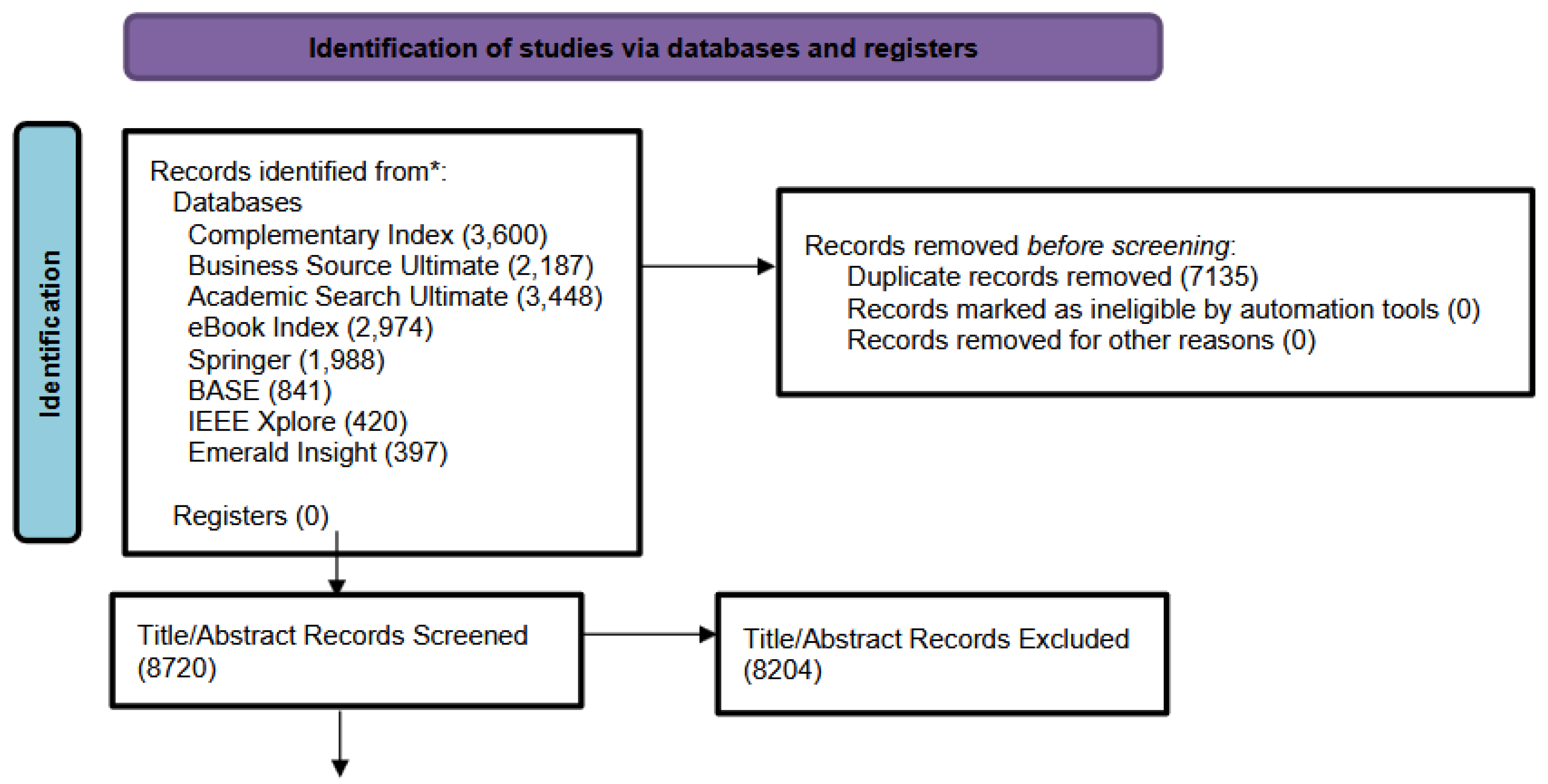
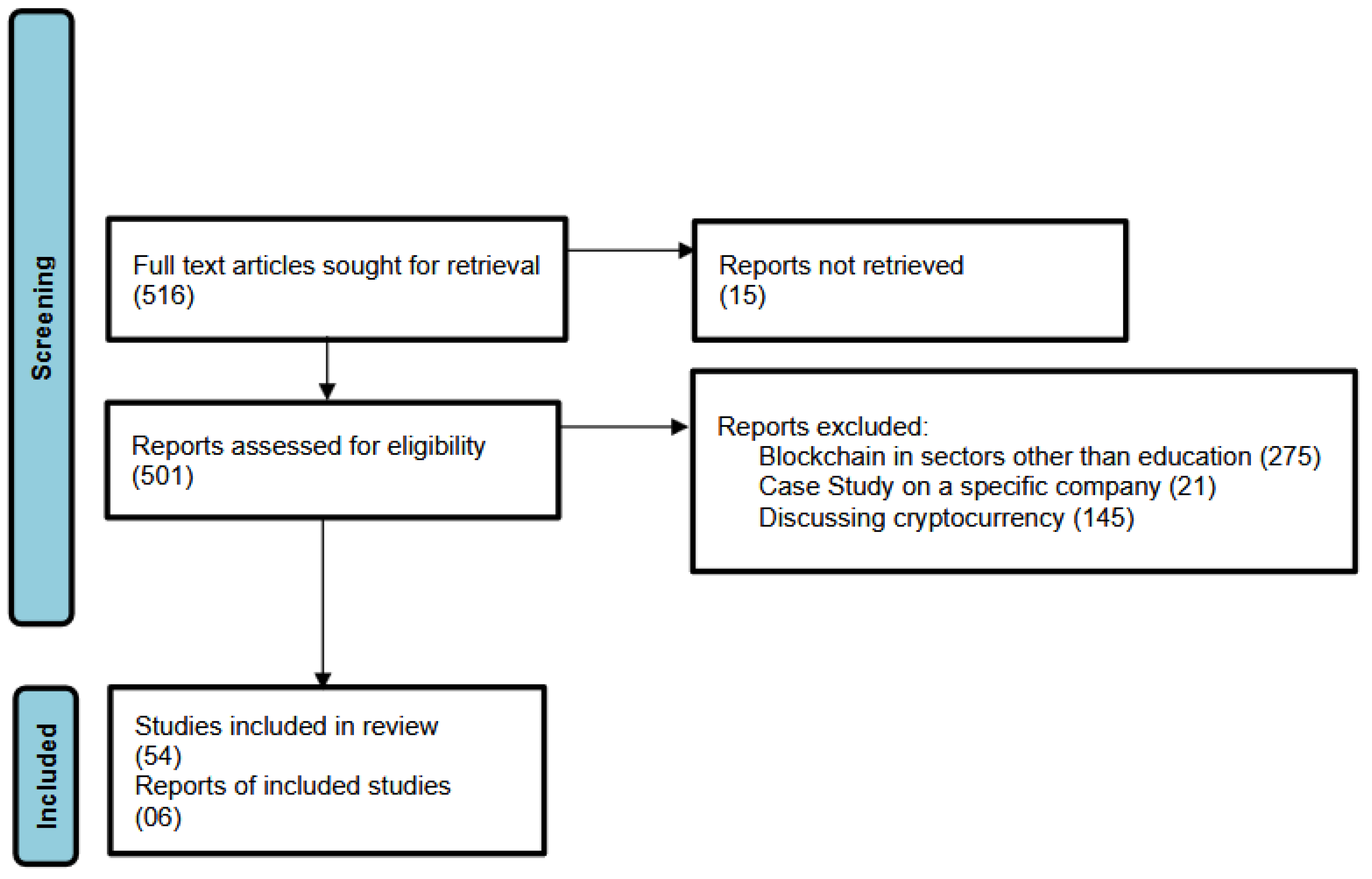
Figure 10.
Low-level architecture for proposed blockchain based learning management system.
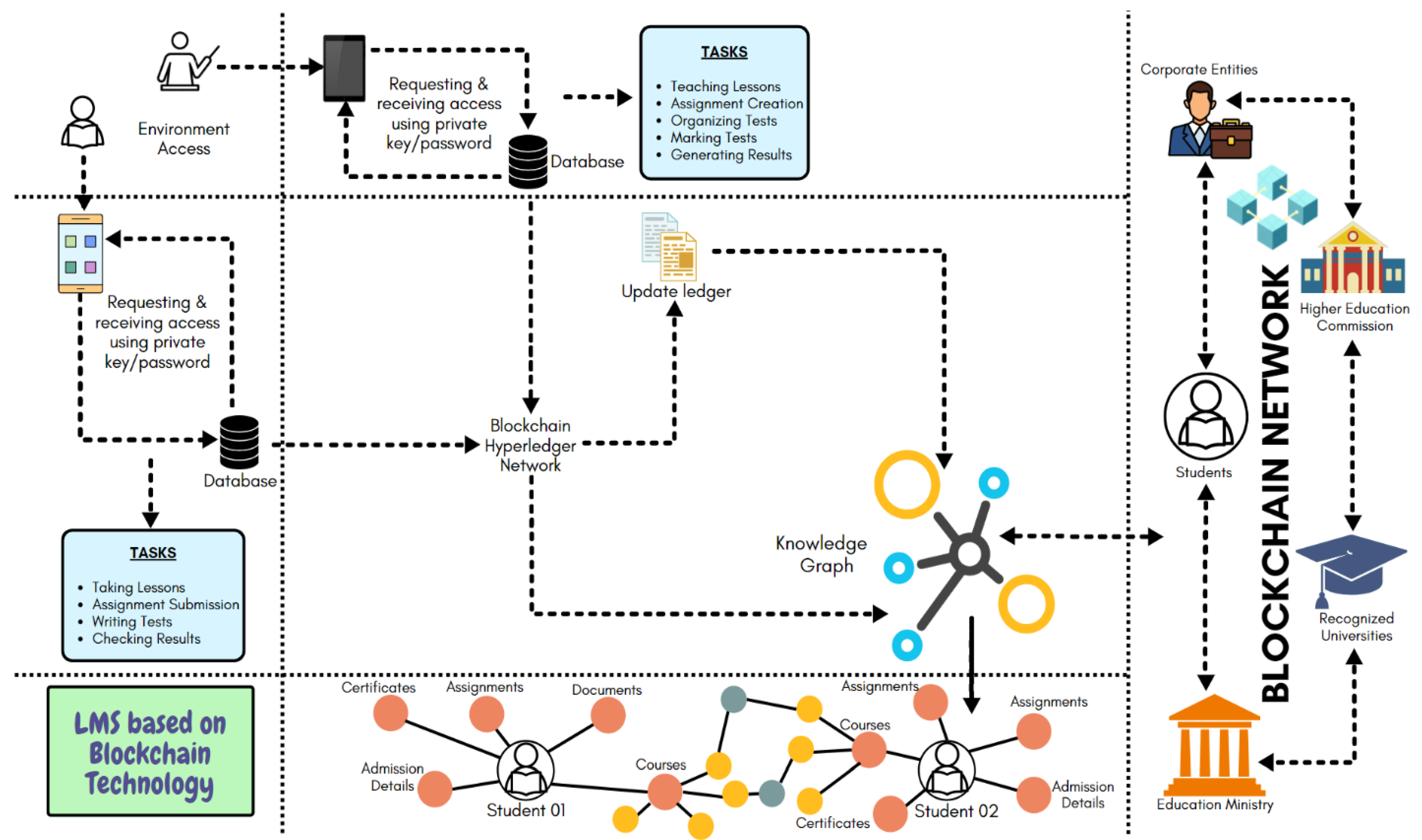
Table 02.
List of keywords and number of results.
| Keywords | Filters (if any) | No. of Results |
|---|---|---|
| Blockchain technology, Blockchain | Year (2018-2022), Lang. - English | 6,302 |
| Blockchain technology and Education | Year (2018-2022), Lang. - English | 2,758 |
| Blockchain technology and Education, Blockchain in education, Blockchain in edtech | Year (2018-2022), Lang. - English, Subject - Blockchain, decentralization, higher education, authentication, smart contracts, security, education | 2,036 |
| Education Technology | Year (2018-2022), Lang. - English, Subject - Education | 4,759 |
Table 03.
List of selected studies grouped by their domain.
| Domain | No. of studies |
|---|---|
| Blockchain Technology | 12 |
| Blockchain in Education | 20 |
| Education Technology | 15 |
| Knowledge Graph | 13 |
| Total | 60 |
Table 04.
List of Databases used.
| Database | No. of results |
|---|---|
| Complementary Index | 3,600 |
| Business Source Ultimate | 2,187 |
| Academic Search Ultimate | 3,448 |
| eBook Index | 2,974 |
| Springer Nature Journals | 1,988 |
| BASE | 841 |
| IEEE Xplore Digital Library | 420 |
| Emerald Insight | 397 |
Table 06.
Arithmetic averages, standard deviations, and ranks for the educational purpose’s domain in descending order.
Table 06.
Arithmetic averages, standard deviations, and ranks for the educational purpose’s domain in descending order.
| No. | Statements | Arithmetic Averages | Standard Deviations | Ranks | Level of significance |
|---|---|---|---|---|---|
| 3 | Using the e-learning system for marking | 4.61 | 0.5 | 1 | High |
| 1 | I use the internet to enrich my lectures | 4.27 | 0.75 | 2 | High |
| 2 | Downloading some educational programs from the Internet | 4.22 | 0.55 | 3 | High |
| 6 | Implementing feedback between my students and me | 4.22 | 0.55 | 4 | High |
| 4 | I use of presentations for my lectures | 4.05 | 0.87 | 5 | High |
| 5 | Using the e-learning system to prepare the tests | 4 | 0.48 | 6 | High |
| Total Value | 4.14 | 0.38 | High |
Disclaimer/Publisher’s Note: The statements, opinions and data contained in all publications are solely those of the individual author(s) and contributor(s) and not of MDPI and/or the editor(s). MDPI and/or the editor(s) disclaim responsibility for any injury to people or property resulting from any ideas, methods, instructions or products referred to in the content. |
© 2025 by the authors. Licensee MDPI, Basel, Switzerland. This article is an open access article distributed under the terms and conditions of the Creative Commons Attribution (CC BY) license (http://creativecommons.org/licenses/by/4.0/).
Copyright: This open access article is published under a Creative Commons CC BY 4.0 license, which permit the free download, distribution, and reuse, provided that the author and preprint are cited in any reuse.


