
Submitted:
01 March 2025
Posted:
03 March 2025
You are already at the latest version
Abstract
A series of new 3-alkyl substituted cis- and trans-(±)-3,4-dihydro-6,7-dimethoxy-1-oxo-1H-isochromene-4-carboxylic acids (cis-/trans-1-3) was synthesized through the reaction of 6,7-dimethoxyhomophthalic anhydride with aliphatic aldehydes of varying chain lengths. Their structure and configuration were elucidated using spectral methods, including 1H-, 13C-, DEPT-135-NMR, and HRMS analyses. A deductive conformational analysis was performed for determining the preferred conformations in solution and to explain the observed vicinal coupling constants.
Keywords:
homophthalic anhydride
; isochroman-1-one
; isocoumarin
; conformational analysis
; coupling constants
1. Introduction
Isocoumarins (1-oxo-1H-isochromenes) and their 3,4-dihydro derivatives (Figure 1) represent a class of natural and synthetic compounds [1,2] that exhibit a broad spectrum of biological activities. These include antimicrobial [3,4,5], antifungal [6,7], immunomodulatory [8], gastroprotective [9], antiallergic [10], antiulcer [11], anticancer [12,13,14], anti-inflammatory [13,15,16] properties, to name just a few.
Numerous natural and synthetic 3,4-dihydroisocoumarins are 3,4-disubstituted, thus forming two sigma diastereomers: cis and trans, defined by the position of the substituents around the plane of the heterocyclic ring system. Their configuration can be established using the vicinal coupling constant value between the H-3 and H-4 atoms (3J3,4) observed in the 1H-NMR spectra. Generally, coupling constants in the range 3 to 6 Hz indicate a cis configuration that favors a synclinal (sc or gauche) orientation of the protons, whereas those between 10 and 13 Hz suggest a trans configuration that favors an antiperiplanar (ap or trans) orientation (see Figure 3). However, it is noteworthy that both diastereomers are conformationally flexible and exist as a mixture of conformers, with some of them being preferable due to steric, electronic, or solvent effects. This factor is crucial because the preferred conformations define the compound’s properties. For example, they could influence physicochemical characteristics, reactivity, and interactions with other molecules, such as enzymes. Furthermore, one might incorrectly designate the configuration of an isolated or synthesized single diastereomer if the conformational flexibility is not considered. Therefore, it can be recommended that a set of different experimental relationships should be considered and utilized to address this issue. An example is the title compounds cis- and trans-(±)-3,4-dihydro-6,7-dimethoxy-1-oxo-1H-isochromene-4-carboxylic acids (1-3), of which one of the isomers (trans-1-3) do not conform to the established relationship for the coupling constants, regardless of the solvent, because of the preferred conformation it adopts in solution.
2. Results and Discussion
The targeted compounds 1-3 were synthesized following a known procedure outlined for the preparation of cis- and trans-(±)-3,4-dihydro-1-oxo-1H-isochromene-4-carboxylic acids with an aromatic or heteroaromatic substituent at C-3 [17]. The synthetic pathway (Figure 2) involves a reaction between a selected aliphatic aldehyde (octanal, decanal, undecanal) and 6,7-dimethoxyhomophthalic anhydride in dry chloroform, using DMAP as a catalyst at room temperature. This is followed by separating and purifying the resulting diastereomeric mixture via column chromatography. The diastereomeric ratios obtained from 1H-NMR analyses of the reaction mixtures and yields after the reaction work-up are listed in Table 1. Notably, DMAP was utilized for the first time in this reaction but proved to be an effective catalyst. Another important point is that the reaction's stereoselectivity is less pronounced compared to that of aromatic aldehydes [17], leading to a diastereomeric ratio trans/cis of 1.5. This can be attributed to steric effects, specifically the smaller effective volume of the aliphatic aldehydes compared to their aromatic counterparts.
Figure 2.
Synthesis of cis- and trans-1-3. R = aliphatic residue (-n-C7H15, -n-C9H19, -n-C10H21, compds. 1, 2, and 3, respectively).
Figure 2.
Synthesis of cis- and trans-1-3. R = aliphatic residue (-n-C7H15, -n-C9H19, -n-C10H21, compds. 1, 2, and 3, respectively).

The structure of the newly synthesized compounds was assigned using spectral methods, including 1H-, 13C- and DEPT-135-NMR, as well as HRMS analysis. NMR spectra were recorded in two solvents of different polarity – CDCl3 (nonpolar) and DMSOd6 (polar). The interpretation of the 1H-NMR spectra aligns with existing literature for similar compounds [17,18,19,20,21]. In the proton spectra of all compounds (see Table 2 and Supplementary materials), distinct peaks are evident regardless of their configuration and solvent used, including two singlets associated with the aromatic protons H-8 and H-5, along with another two singlets for the methoxy groups. Additional signals dependent on configuration reflect the cis- and trans-diastereomers – multiplets for H-3 and doublets for H-4.
As noted earlier, the configuration of cis and trans diastereomers is typically established by analyzing the vicinal coupling constant value (3J3,4) of H-3 and H-4 observed in the 1H-NMR spectra. However, as shown in Table 2, this method proved inadequate for the spectra recorded in DMSO, as the substitution pattern influences conformational preferences, leading to nearly indistinguishable values of around 3.3 Hz for 3J3,4 in both diastereomers.
To accurately assign the relative configuration, we referred to previously established correlations [17,18]. First, the base-catalyzed reactions of homophthalic anhydrides with aldehydes show stereoselectivity that favors the trans isomers (Table 1). Second, the chemical shifts of the H-3 and H-4 protons in trans isomers are shifted downfield compared to those in the cis isomer (Table 2). Third, the coupling constants 3J3,4 in the trans isomer vary with solvent polarity. The first two relationships hold for the spectra in DMSO, while the third required further experiments. To validate these relationships and unequivocally assign the configurations of compounds 1-3, we also recorded spectra in CDCl3 (Table 2). As shown, the change in solvent slightly affects 3J3,4 for the cis isomer, altering them from 3.3 Hz in DMSO to 3.1 Hz in CDCl3, while it significantly impacts the trans isomer, changing them from 3.3 Hz in DMSO to 4.5 Hz in CDCl3. We further employed a deductive approach and performed a conformational analysis to rationalize these results. For clarity, the two most preferred conformations of the isochromanone ring of both diastereomers are presented in perspective and as Newman projections along the C3-C4 bond in Figure 3. Based on the Karplus equation [22,23], ³J₃,₄ in the cis isomers are supposed to be in the lower range (3 to 6 Hz), regardless of the conformation (torsional angle of 60° in both conformations), while in trans isomers, they may vary from 3-6 Hz to 10-13 Hz depending on the torsion angle (60° for trans-1-3b and 180° for trans-1-3a, respectively).
Figure 3.
Conformational preferences of compounds cis- and trans-1-3.
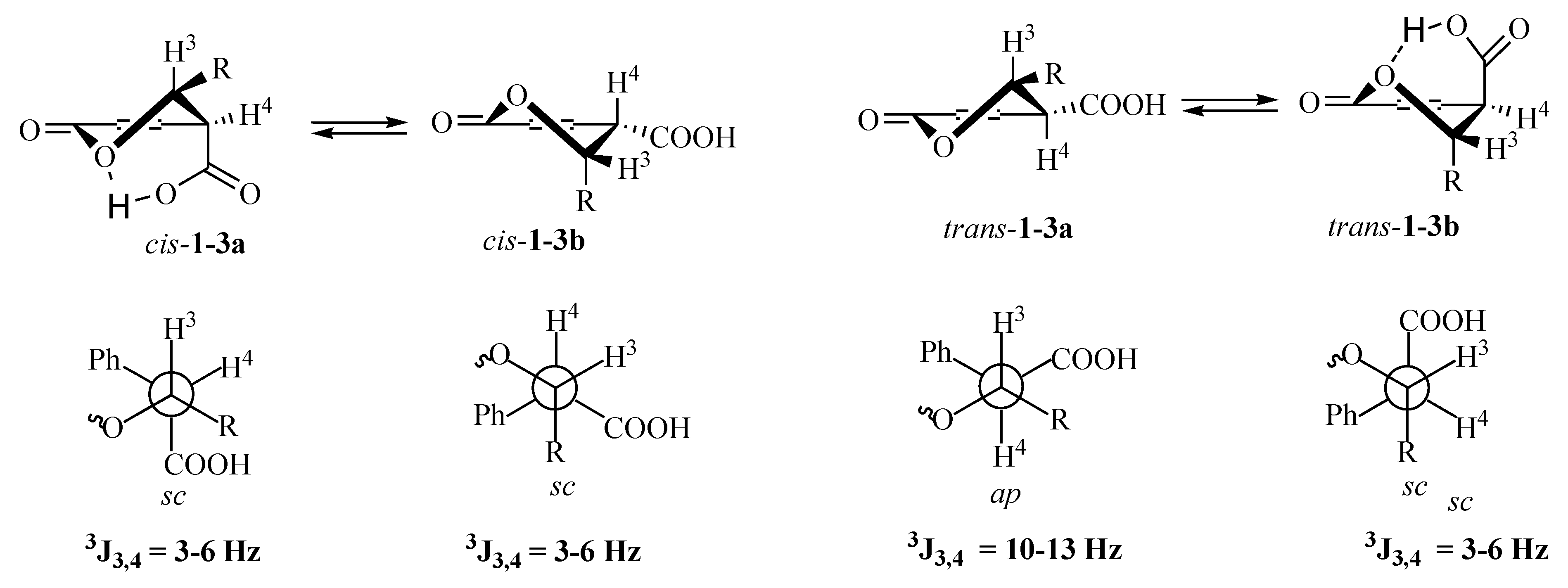
The data analysis allows us to conclude that the conformational equilibrium for the trans isomers predominantly favors conformers trans-1-3b, regardless of the solvent employed (3J3,4 in the range 3 to 6 Hz). However, we observed that the solvent does influence the preferred conformation to some degree, which is evident from the corresponding coupling constants changes. The favored conformation shows axial and pseudoaxial substituents at C-3 and C-4, respectively. This preference arises from reduced steric hindrance between the alkyl substituent and the carboxyl group in this conformation. While this differs somewhat from the established trends in cyclohexane systems, it can be linked to the presence of three sp2 carbon atoms in the ring structure, which eliminates 1,3-diaxial interactions and favors the antiperiplanar conformation of the larger substituents. Additionally, an intramolecular hydrogen bond between the carboxyl group and the lactone's oxygen atom (Figure 3) may also have contributed to this conformation, as well as to conformation cis-1-3a for the cis isomer.
3. Materials and Methods
3.1. General
All chemicals used in this study were purchased from Sigma-Aldrich (FOT, Sofia, Bulgaria). The organic solvents were of analytical grade and were used without further purification. NMR spectra were recorded on а Bruker Avance III HD (500 MHz and 126 MHz for 1H and 13C, respectively) using DMSO as а solvents. The chemicals shifts (δ) are given in ppm and J values are reported in Hz. Column chromatography was performed on Horizon High Performance FLASH chromatography system (HPFC) with cartridges filled with Silica gel 60 [particle size - 0.06-0.2 mm (70-230 mesh), MACHEREY-NAGEL, Düren, Germany]. TLC was performed on precoated 0.2 mm aluminium plates with silica gel 60 with fluorescence indicator, ALUGRAM SIL G/UV254, (MACHEREY-BAGEL, Düren, Germany). High-Resolution Mass Spectra (HRMS) were obtained on a Shimadzu LCMS-9050 (Shimadzu Handels GmbH., Korneuburg, Austria).
3.2. Synthesis
The corresponding aldehyde (1 equiv.) was added to a solution of 6,7-dimethoxyhomophtalic anhydride (1.1 equiv.) in 10 mL dry chloroform and DMAP (1 equiv.) was added. The resulting mixture was stirred for 1 h. at r.t. (22-23° C). At the end of the reaction (TLC monitoring), the obtained carboxylic acids were extracted with 10% NaHCO3 and the aqueous layer was acidified (pH = 3) with 18% HCl and extracted with EtOAc. The organic layer was dried with Na2SO4. The solvent was evaporated and the diastereoisomers of the corresponding (±)-3-alkyl-3,4-dihydro-6,7-dimethoxy-1-oxo-1H-isochromene-4-carboxylic acid were isolated via column chromatography (mobile phase: petroleum ether/EtOAc = 1/1 + formic acid).
3.2.1. Cis- and Trans-(±)-3-heptyl-3,4-dihydro-6,7-dimethoxy-1-oxo-1H-isochromene-4-carboxylic acids (1)
6,7-Dimethoxyhomophtalic anhydride (2.00 g, 9.00 mmol) reacted with octanal (1.05 g, 8.18 mmol) in the presence of 1.00 g (8.18 mmol) DMAP to give white crystals of 1 (2.63 g, 92 % yield). After purification and separation cis- and trans-isomer were acquired:
3.2.1.1. Cis-1, m.p. 132–134 ˚C (From CH2Cl2: Petroleum Ether)
1H-NMR (500 MHz, CDCl3): δ = 7.57 (1H, s, 8-CH), 6.73 1H, s, 5-CH), 4.62–4.57 (1H, m, 3-CH), 3.94 (3H, s, 7-OCH3), 3.93 (3H, s, 6-OCH3), 3.78 (3H, d, 3J3,4 = 3.2 Hz, 4-CH), 2.03–1.92 (1H, m, 1’-CH2), 1.85–1.74 (1H, m, 1’-CH2), 1.69–1.56 (1H, m, 2’-CH2), 1.53–1.42 (1H, m, 2’-CH2), 1.28 (8H, m, 3’-CH2, 4’-CH2, 5’-CH2, 6’-CH2), 0.88 (3H, 3J6’,7’ = 6.7 Hz, 7’-CH3).
13C-NMR (126 MHz, CDCl3): δ = 173.63 (C, C=O, COOH), 164.79 (C, 1C), 153.66 (C, 6C), 149.61 (C, 7C), 130.50 (C, 4aC), 117.71 (C, 8aC), 112.17 (CH, 8C), 109.25 (CH, 5C), 78.61 (CH, 3C), 56.32 (CH3, 6-OCH3), 56.26 (CH3, 7-OCH3), 47.07 (CH, 4C), 32.69 (CH2), 31.72 (CH2), 29.19 (CH2), 29.09 (CH2), 25.34 (CH2), 22.62 (CH2), 14.08 (CH3, 7’-CH3).
1H-NMR (500 MHz, DMSO): δ = 7.39 (1H, s, 8-CH), 7.02 (1H, s, 5-CH), 4.65–4.58 (1H, td, 3J3,1‘ = 7.0, 3J3,4 = 3.3 Hz, 3-CH), 3.86 (1H, d, 3J3,4 = 3.2 Hz, 4-CH), 3.84 (3H, s, 7-OCH3), 3.81 (3H, s, 6-OCH3), 1.81–1.68 (2H, m, 1’-CH2), 1.55–1.37 (2H, m, 2’-CH2), 1.37–1.20 (8H, m, 3’-CH2, 4’-CH2, 5’-CH2, 6’-CH2), 0.87 (3H, t, 3J6’,7’ = 6.8 Hz, 7’-CH3).
13C-NMR (126 MHz, DMSO): δ = 170.69 (C, C=O, COOH), 164.26 (C, 1C), 153.10 (C, 6C), 148.59 (C, 7C), 132.52 (C, 4aC), 117.19 (C, 8aC), 111.24 (CH, 8C), 110.14 (CH, 5C), 78.41 (CH, 3C), 55.97 (CH3, 6-OCH3), 55.68 (CH3, 7-OCH3), 46.41 (CH, 4C), 32.27 (CH2), 31.16 (CH2), 28.69 (CH2), 28.57 (CH2), 24.69 (CH2), 22.08 (CH2), 13.96 (7’-CH3).
HRMS (ESI) m/z calculated for [M-H]- C19H25O6-: 349.16566, found: [M-H]-: 349.16430.
3.2.1.2. Trans-1, m.p 134–136 ˚C (From CH2Cl2: Petroleum Ether)
1H NMR (500 MHz, CDCl3): δ = 9.23 (1H, s, COOH), 7.57 (1H, s, 8-CH), 6.73 (1H, s, 5-CH), 4.95–4.87 (1H, dt, 3J3,1‘ = 8.9, 3J3,4 = 4.4 Hz, 3-CH), 3.94 (3H, s, 7-OCH3), 3.92 (3H, s, 6-OCH3), 3.74 (1H, d, 3J3,4 = 4.4 Hz, 4-CH), 1.87–1.67 (1H, m, 1’-CH2), 1.67–1.48 (2H, m, 1’-CH2, 2’-CH2), 1.48–1.38 (1H, m, 2’-CH2), 1.38–1.15 (8H, m, 3’-CH2, 4’-CH2, 5’-CH2, 6’-CH2), 0.85 (3H, t, 3J6’,7’ = 6.8 Hz, 7’-CH3).
13C-NMR (126 MHz, CDCl3): δ = 175.83 (C, C=O, COOH), 163.95 (C, 1C), 154.14 (C, 6C), 149.51 (C, 7C), 128.88 (C, 4aC), 117.17 (C, 8aC), 111.95 (CH, 8C), 110.08 (CH, 5C), 79.05 (CH, 3C), 56.43 (CH3, 6-OCH3), 56.35 (CH3, 7-OCH3), 47.42 (CH, 4C), 33.92 (CH2), 31.81 (CH2), 29.21 (CH2), 29.16 (CH2), 25.42 (CH2), 22.70 (CH2), 14.17 (CH3, 7’-CH3).
1H-NMR (500 MHz, DMSO): δ = 7.37 (1H, s, 8-CH), 6.99 (1H, s, 5-CH), 4.88–4.81 (1H, ddd, 3J3,1‘ = 8.5, 3J3,1‘ = 5.2, 3J3,4 = 3.3 Hz, 3-CH), 3.93 (1H, d, 3J3,4 = 3.3 Hz, 4-CH), 3.84 (3H, s, 7-OCH3), 3.81 (3H, s, 6-OCH3), 1.64–1.46 (2H, m, 1’-CH2), 1.45–1.30 (2H, m, 2’-CH2), 1.30–1.15 (8H, m, 3’-CH2, 4’-CH2, 5’-CH2, 6’-CH2), 0.84 (3H, t, 3J6’,7’ = 6.9 Hz, 7’-CH3).
13C-NMR (126 MHz, DMSO): δ = 172.49 (C, C=O, COOH), 163.30 (C, 1C), 153.88 (C, 6C), 148.94 (C, 7C), 130.92 (C, 4aC), 116.98 (C, 8aC), 111.66 (CH, 8C), 111.33 (CH, 5C), 79.56 (CH, 3C), 56.34 (CH3, 6-OCH3), 56.10 (CH3, 7-OCH3), 47.01 (CH, 4C), 33.60 (CH2), 31.58 (CH2), 28.94 (CH2), 28.91 (CH2), 25.32 (CH2), 22.50 (CH2), 14.39 (CH3, 7’-CH3).
HRMS (ESI) m/z calculated for [M-H]- C19H25O6-: 349.16566, found: [M-H]-: 349.16363.
3.2.2. Cis- and Trans-(±)-3,4-dihydro-6,7-dimethoxy-3-nonyl-1-oxo-1H-isochromene-4-carboxylic acids (2)
6,7-dimethoxyhomophtalic anhydride (1.29 g, 5.8 mmol) reacted with decanal (0.83 g, 5.3 mmol) in the presence of 0.646 g (5.3 mmol) DMAP to give white crystals of 2 (1.71 g, 85 % yield). After purification and separation cis- and trans-isomer were acquired:
3.2.2.1. Cis-2, m.p. 137–139 ˚C (From CH2Cl2: Petroleum Ether)
1H NMR (500 MHz, CDCl3) δ 9.04 (1H, s, COOH), 7.58 (1H, s, 8-CH), 6.73 (1H, s, 5-CH), 4.61–4.56 (1H, m, 3-CH), 3.93 (3H, s, 7-OCH3), 3.91 (3H, s, 6-OCH3), 3.73 (1H, d, 3J3,4 = 3.0 Hz, 4-CH), 2.01–1.91 (1H, m, 1’-CH2), 1.84–1.73 (1H, m, 1’-CH2), 1.66–1.54 (1H, m, 2’-CH2), 1.51–1.39 (1H, m, 2’-CH2), 1.37–1.17 (12H, m, 3’-CH2, 4’-CH2, 5’-CH2, 6’-CH2, 7’-CH2, 8’-CH2), 0.87 (3H, t, 3J8’,9’ = 6.8 Hz, 9’-CH3).
13C-NMR (126 MHz, CDCl3): δ = 174.86 (C, C=O, COOH), 165.02 (C, 1C), 153.77 (C, 6C), 149.71 (C, 7C), 130.68 (C, 4aC), 117.80 (C, 8aC), 112.27 (CH, 8C), 109.40 (CH, 5C), 78.80 (CH, 3C), 56.43 (CH3, 6-OCH3), 56.37 (CH3, 7-OCH3), 47.24 (CH, 4C), 32.78 (CH2), 31.99 (CH2), 29.60 (CH2), 29.58 (CH2), 29.38 (CH2), 29.34 (CH2), 25.48 (CH2), 22.78 (CH2), 14.23 (CH3, 9’-CH3).
1H-NMR (500 MHz, DMSO): δ = 7.39 (1H, s, 8-CH), 7.02 (1H, s, 5-CH), 4.66–4.56 (1H, td, 3J3,1‘ = 6.9, 3J3,4 = 3.3 Hz, 3-CH), 3.85 (1H, d, 3J3,4 = 3.2 Hz, 4-CH), 3.84 (3H, s, 7-OCH3), 3.81 (3H, s, 6-OCH3), 1.81–1.67 (2H, m, 1’-CH2), 1.56–1.38 (2H, m, 2’-CH2), 1.38–1.19 (12H, m, 3’-CH2, 4’-CH2, 5’-CH2, 6’-CH2, 7’-CH2, 8’-CH2), 0.86 (3H, t, 3J8’,9’ = 6.9 Hz, 9’-CH3).
13C NMR (126 MHz, DMSO): 171.15 (C, C=O, COOH), 164.72 (C, 1C), 153.57 (C, 6C), 149.06 (C, 7C), 132.98 (C, 4aC), 117.65 (C, 8aC), 111.70 (CH, 8C), 110.60 (CH, 5C), 78.87 (CH, 3C), 56.42 (CH3, 6-OCH3), 56.13 (CH3, 7-OCH3), 46.88 (CH, 4C), 32.74 (CH2), 31.77 (CH2), 29.40 (CH2), 29.37 (CH2), 29.20 (CH2), 29.16 (CH2), 25.16 (CH2), 22.57 (CH2), 14.43 (CH3, 9’-CH3).
HRMS (ESI) m/z calculated for [M-H]- C21H29O6-: 377.19696, found: [M-H]-: 377.19538;
3.2.2.2. Trans-2, m.p. 140–143 ˚C (From CH2Cl2: Petroleum Ether)
1H-NMR (500 MHz, CDCl3): δ = 9.30 (1H, s, COOH), 7.57 (1H, s, 8-CH), 6.73 (1H, s, 5-CH), 4.94–4.88 (1H, dt, 3J3,1‘ = 8.9, 3J3,4 = 4.5 Hz, 3-CH), 3.94 (3H, s, 7-OCH3), 3.92 (3H, s, 6-OCH3), 3.78 (1H, d, 3J3,4 = 4.5 Hz, 4-CH), 1.84–1.72 (1H, m, 1’-CH2), 1.65–1.48 (2H, m, 1’-CH2, 2’-CH2), 1.46–1.36 (1H, m, 2’-CH2), 1.30–1.20 (12H, m, 3’-CH2, 4’-CH2, 5’-CH2, 6’-CH2, 7’-CH2, 8’-CH2), 0.86 (3H, t, 3J8’,9’ = 6.8 Hz, 9’-CH3).
13C-NMR (126 MHz, CDCl3): δ = 175.88 (C, C=O, COOH), 163.95 (C, 1C), 154.13 (C, 6C), 149.50 (C, 7C), 128.93 (C, 4aC), 117.18 (C, 8aC), 111.95 (CH, 8C), 110.05 (CH, 5C), 79.05 (CH, 3C), 56.42 (CH3, 6-OCH3), 56.34 (CH3, 7-OCH3), 47.45 (CH, 4C), 33.93 (CH2), 31.95 (CH2), 29.57 (CH2), 29.52 (CH2), 29.37 (CH2), 29.27 (CH2), 25.43 (CH2), 22.76 (CH2), 14.21 (CH3, 9’-CH3).
1H-NMR (500 MHz, DMSO): δ = 7.38 (1H, s, 8-CH), 6.99 (1H, s, 5-CH), 4.89–4.80 (1H, ddd, 3J3,1‘ = 8.5, 3J3,1‘ = 5.2, 3J3,4 = 3.3 Hz, 3-CH), 3.92 (1H, d, 3J3,4 = 3.3 Hz, 4-CH), 3.84 (3H, s, 7-OCH3), 3.81 (3H, s, 6-OCH3), 1.64–1.46 (2H, m, 1’-CH2), 1.44–1.30 (2H, m, 2’-CH2), 1.28–1.17 (12H, m, 3’-CH2, 4’-CH2, 5’-CH2, 6’-CH2, 7’-CH2, 8’-CH2), 0.84 (3H, t, 3J8’,9’ = 6.9 Hz, 9’-CH3).
13C-NMR (126 MHz, DMSO): 172.48 (C, C=O, COOH), 163.28 (C, 1C), 153.88 (C, 6C), 148.95 (C, 7C), 130.90 (C, 4aC), 116.98 (C, 8aC), 111.66 (CH, 8C), 111.32 (CH, 5C), 79.55 (CH, 3C), 56.33 (CH3, 6-OCH3), 56.09 (CH3, 7-OCH3), 47.00 (CH, 4C), 33.60 (CH2), 31.72 (CH2), 29.30 (CH2), 29.28 (CH2), 29.12 (CH2), 28.95 (CH2), 25.30 (CH2), 22.54 (CH2), 14.39 (CH3, 9’-CH3).
HRMS (ESI) m/z calculated for [M-H]- C21H29O6-: 377.19696, found: [M-H]-: 377.19486.
3.2.3. Cis- and Trans-(±)-3-decyl-3,4-dihydro-6,7-dimethoxy-1-oxo-1H-isochromene-4-carboxylic acids (3).
6,7-dimethoxyhomophtalic anhydride (0.611 g, 2.8 mmol) reacted with undecanal (0.426 g, 2.5 mmol) in the presence of 0.306 g (2.5 mmol) DMAP to give white crystals of 2 (0.76 g, 77 % yield). After purification and separation cis- and trans-isomer were acquired:
Cis-3, m.p. 143–145 ˚C (From CH2Cl2: Petroleum Ether)
1H-NMR (500 MHz, CDCl3): δ = 9.44 (1H, s, COOH), 7.58 (1H, s, 8-CH), 6.73 (1H, s, 5-CH), 4.60–4.55 (1H, ddd, 3J3,1‘ = 8.5, 3J3,1‘ = 5.4, 3J3,4 = 3.5 Hz, 3-CH), 3.93 (3H, s, 7-OCH3), 3.91 (3H, s, 6-OCH3), 3.73 (1H, d, 3J3,4 = 3.2 Hz, 4-CH), 2.00–1.90 (1H, m, 1’-CH2), 1.83–1.73 (1H, m, 1’-CH2), 1.65–1.54 (1H, m, 2’-CH2), 1.51–1.41 (1H, m, 2’-CH2), 1.35–1.20 (14H, m, 3’-CH2, 4’-CH2, 5’-CH2, 6’-CH2, 7’-CH2, 8’-CH2, 9’-CH2), 0.87 (3H, t, 3J9’,10’ = 6.8 Hz, 10’-CH3).
13C-NMR (126 MHz, CDCl3): δ = 174.90 (C, C=O, COOH), 165.04 (C, 1C), 153.77 (C, 6C), 149.70 (C, 7C), 130.68 (C, 4aC), 117.79 (C, 8aC), 112.26 (CH, 8C), 109.40 (CH, 5C), 78.79 (CH, 3C), 56.42 (CH3, 6-OCH3), 56.36 (CH3, 7-OCH3), 47.23 (CH, 4C), 32.77 (CH2), 32.00 (CH2), 29.68 (CH2), 29.64 (CH2), 29.58 (CH2), 29.43 (CH2), 29.34 (CH2), 25.47 (CH2), 22.79 (CH2), 14.22 (CH3, 10’-CH3).
1H-NMR (500 MHz, DMSO): δ = 7.38 (1H, s, 8-CH), 7.02 (1H, s, 5-CH), 4.66–4.55 (1H, td, 3J3,1‘ = 7.0, 3J3,4 = 3.3 Hz, 3-CH), 3.86 (1H, d, J = 3.2 Hz, 4-CH), 3.85 (3H, s, 7-OCH3), 3.82 (3H, s, 6-OCH3), 1.80–1.69 (2H, m, 1’-CH2), 1.56–1.38 (2H, m, 2’-CH2), 1.37–1.17 (14H, m, 3’-CH2, 4’-CH2, 5’-CH2, 6’-CH2, 7’-CH2, 8’-CH2, 9’-CH2), 0.86 (3H, t, 3J9’,10’ = 6.9 Hz, 10’-CH3).
13C-NMR (126 MHz, DMSO): 171.15 (C, C=O, COOH), 164.71 (C, 1C), 153.57 (C, 6C), 149.06 (C, 7C), 132.97 (C, 4aC), 117.65 (C, 8aC), 111.70 (CH, 8C), 110.59 (CH, 5C), 78.87 (CH, 3C), 56.42 (CH3, 6-OCH3), 56.13 (CH3, 7-OCH3), 46.88 (CH, 4C), 32.74 (CH2), 31.77 (CH2), 29.47 (CH2), 29.42 (CH2), 29.40 (CH2), 29.20 (CH2), 25.17 (CH2), 22.57 (CH2), 14.42 (CH3, 10’-CH3).
HRMS (ESI) m/z calculated for [M-H]- C22H31O6-: 391.21261, found: [M-H]-: 391.21055. 3.2.3.2. trans-3, m.p. 148–150 ˚C (from CH2Cl2: petroleum ether).
1H-NMR (500 MHz, CDCl3) δ 7.58 (1H, s, 8-CH), 6.73 (1H, s, 5-CH), 4.95–4.88 (1H, dt, 3J3,1’ = 8.9, 3J3,4 = 4.5 Hz, 3-CH), 3.94 (3H, s, 7-OCH3), 3.93 (3H, s, 6-OCH3), 3.78 (1H, d, 3J3,4 = 4.4 Hz, 4-CH), 1.78 (1H, m, 1’-CH2), 1.57 (2H, m, 1’-CH2, 2’-CH2), 1.43 (1H, m, 2’-CH2), 1.24 (14H, m, 3’-CH2, 4’-CH2, 5’-CH2, 6’-CH2, 7’-CH2, 8’-CH2, 9’-CH2), 0.87 (3H, t, 3J9’,10’ = 6.9 Hz, 10’-CH3).
13C-NMR (126 MHz, CDCl3): δ = 175.46 (C, C=O, COOH), 163.72 (C, 1C), 154.00 (C, 6C), 149.40 (C, 7C), 128.72 (C, 4aC), 117.10 (C, 8aC), 111.84 (CH, 8C), 109.91 (CH, 5C), 78.89 (CH, 3C), 56.30 (CH3, 6-OCH3), 56.23 (CH3, 7-OCH3), 47.28 (CH, 4C), 33.83 (CH2), 31.87 (CH2), 29.55 (CH2), 29.51 (CH2), 29.40 (CH2), 29.29 (CH2), 29.16 (CH2), 25.32 (CH2), 22.67 (CH2), 14.11 (CH3, 10’-CH3).
1H-NMR (500 MHz, DMSO): δ = 7.37 (1H, s, 8-CH), 6.99 (1H, s, 5-CH), 4.89–4.79 (1H, ddd, 3J3,1’ = 8.5, 3J3,1’ = 5.2, 3J3,4 = 3.3 Hz, 3-CH), 3.92 (1H, d, J = 3.3 Hz, 4-CH), 3.84 (3H, s, 7-OCH3), 3.81 (3H, s, 6-OCH3), 1.63–1.44 (2H, m, 1’-CH2), 1.44–1.30 (2H, m, 2’-CH2), 1.30–1.14 (14H, m, 3’-CH2, 4’-CH2, 5’-CH2, 6’-CH2, 7’-CH2, 8’-CH2, 9’-CH2), 0.86 (3H, t, 3J9’,10’ = 6.9 Hz, 10’-CH3).
13C NMR (126 MHz, DMSO): 172.48 (C, C=O, COOH), 163.28 (C, 1C), 153.88 (C, 6C), 148.95 (C, 7C), 130.90 (C, 4aC), 116.98 (C, 8aC), 111.66 (CH, 8C), 111.32 (CH, 5C), 79.55 (CH, 3C), 56.33 (CH3, 6-OCH3), 56.09 (CH3, 7-OCH3), 47.00 (CH, 4C), 33.60 (CH2), 31.74 (CH2), 29.42 (CH2), 29.35 (CH2), 29.28 (CH2), 29.14 (CH2), 28.95(CH2), 25.31 (CH2), 22.55 (CH2), 14.40 (CH3, 10’-CH3).
HRMS (ESI) m/z calculated for [M-H]- C22H31O6-: 391.21261, found: [M-H]-: 391.21098.
4. Conclusions
Six new 3-alkyl substituted cis- and trans-(±)-3,4-dihydro-6,7-dimethoxy-1-oxo-1H-isochromene-4-carboxylic acids (cis-/trans-1-3) were synthesized and analyzed using 1H-, 13C-, DEPT-135 NMR, and HRMS techniques. Conformational analysis was conducted to elucidate the preferred conformations in solution and clarify the observed vicinal coupling constants. The findings indicate that the compounds' flexibility should always be considered when determining their configuration.
Supplementary Materials
The following supporting information can be downloaded at the website of this paper posted on Preprints.org. 1H-, 13C-NMR and DEPT-135 spectra of compounds cis-/trans-1-3.
Author Contributions
S.S. and M.G.B. contributed equally to this article. All authors have read and agreed to the published version of the manuscript.
Funding
This research received no external funding.
Data Availability Statement
The original contributions presented in this study are included in the Supplementary Material. Further inquiries can be directed to the corresponding author.
Conflicts of Interest
The authors declare no conflicts of interest.
References
- Hill, R. Naturally Occurring Isocoumarins. Fortschr. Chem. Org. Naturst. 1986, 49, 1 -78.
- Napolitano E. The synthesis of isocoumarins over the last decade. A review. Org. Prep. Proced. Int. 1997, 29, 631-664. [CrossRef]
- Orfali, R.; Perveen, S.; AlAjmI, M.F.; Ghaffar, S.; Rehman, M.T.; AlanzI, A.R.; Gamea, S.B.; Essa Khwayri, M. Antimicrobial Activity of Dihydroisocoumarin Isolated from Wadi Lajab Sediment-Derived Fungus Penicillium chrysogenum: In Vitro and In Silico Study. Molecules 2022, 27, 3630. [CrossRef]
- Hussain, M.; Hussain, M.T.; Rama, N.H.; Hameed, S.; Malik, A.; Khan, K.M. Synthesis and antimicrobial activities of some isocoumarin and dihydroisocoumarin derivatives. Nat. Prod. Res. 2003, 17, 207-214.
- Devienne, K.F.; Raddi, M.S.G.; Coelho, R.G.; Vilegas, W. Structure-antimicrobial activity of some natural isocoumarins and their analogues. Phytomedicine 2005, 12, 378-381. [CrossRef]
- Nozawa, K.; Yamada, M..; Tsuda, Y.; Kawai, K.; Nakajima, S. Antifungal activity of oosponol, oospolactone, phyllodulcin, hydrangenol, and some other related compounds. Chem. Pharm. Bull. 1981, 29, 2689-2691.
- Kovacs, T.; Sonnenbichler, I.; Sonnenbichler J. Total synthesis of the toxin oosponol and of structural analogues and investigation of their antibiotic activities. Justus. Liebigs. Ann. Chem. 1997, 4, 773-777. [CrossRef]
- Matsuda, H.; Shimoda, H.; Yamahara, J.; Yoshikawa, M. Immunomodulatory activity of thunberginol A and related compounds isolated from Hydrangeae Dulcis Folium on splenocyte proliferation activated by mitogens. Biorg. Med. Chem. Lett. 1998, 8, 215-220. [CrossRef]
- Hamada, Y.; Hara, O.; Kawai, A.; Kohno, Y.; Shioiri, T. Efficient total synthesis of AI-77-B, A gastroprotective substance from bacillus pumilus AI-77. Tetrahedron 1991, 47, 8635-8652.
- Matsuda, H.; Shimoda, H.; Yoshikawa, M. Structure-requirements of isocoumarins, phthalides and stilbenes from Hydrangeae Dulcis Folium for inhibitory activity on histamine release from rat peritoneal mast cells. Bioorg. Med. Chem. Lett. 1999, 7, 1445-1450. [CrossRef]
- Shimojima, Y.; Shirai, T.; Baba, T.; Hayashi, H. 1H-2-Benzopyran derivatives, microbial products with pharmacological activity. Conversion into orally active derivatives with antiinflammatory and antiulcer activities. J. Med. Chem. 1985, 28, 3-9.
- Patel, S. K.; Murat, K.; Py, S.; Vallee, Y. Asymmetric total synthesis and stereochemical elucidation of the antitumor agent PM-94128. Org. Lett. 2003, 5, 4081-4084.
- Rauwald, H.W.; Maucher, R.; Dannhardt, G.; Kuchta, K. Dihydroisocoumarins, Naphthalenes, and Further Polyketides from Aloe vera and A. plicatilis: Isolation, Identification and Their 5-LOX/COX-1 Inhibiting Potency. Molecules 2021, 26, 4223. [CrossRef]
- Sukandar, E.R.; Kaennakam, S.; Raab, P.; Nöst, X.; Rassamee, K.; Bauer, R.; Siripong, P.; Ersam, T.; Tip-pyang, S.; Chavasiri, W. Cytotoxic and Anti-Inflammatory Activities of Dihydroisocoumarin and Xanthone Derivatives from Garcinia picrorhiza. Molecules 2021, 26, 6626. [CrossRef]
- Koopklang, K.; Choodej, S.; Hantanong, S.; Intayot, R.; Jungsuttiwong, S.; Insumran, Y.; Ngamrojanavanich, N.; Pudhom, K. Anti-Inflammatory Properties of Oxygenated Isocoumarins and Xanthone from Thai Mangrove-Associated Endophytic Fungus Setosphaeria rostrata. Molecules 2024, 29, 603. [CrossRef]
- Saikia, P.; Gogoi, S. Isocoumarin: General aspects and recent advances in the synthesis. Adv. Synth. Catal. 2018, 360, 2063-2075.
- Bogdanov, M.; Palamareva, M. cis/trans-Isochromanones. DMAP induced cycloaddition of homophthalic anhydride and aldehydes. Tetrahedron, 2004, 60, 2525-2530.
- Bogdanov, M.; Todorov, I.; Manolova, P.; Cheshmedzhieva, D.; Palamareva, M. Configuration and conformational equilibrium of (±)-trans-1-oxo-3-thiophen-2-yl-isochroman-4-carboxylic acid methyl ester. Tetrahedron lett., 2004, 45, 8383-8386. [CrossRef]
- Miliovsky, M.; Svinyarov, I.; Mitrev, Y.; Evstatieva, Y.; Nikolova, D.; Chochkova, M.; Bogdanov, M. A novel one-pot synthesis and preliminary biological activity evaluation of cis-restricted polyhydroxy stilbenes incorporating protocatechuic acid and cinnamic acid fragments. Eur. J. Med. Chem. 2013, 66, 185-192. [CrossRef]
- Miliovsky, M.; Svinyarov, I.; Prokopova, E.; Batovska, D.; Stoyanov, S.; Bogdanov, M. Synthesis and Antioxidant Activity of Polyhydroxylated trans-Restricted 2-Arylcinnamic Acids. Molecules 2015, 20, 2555-2575. [CrossRef]
- Svinyarov, I.; Bogdanov, M. One-pot synthesis and radical scavenging activity of novel polyhydroxylated 3-arylcoumarins. Eur. J. Med. Chem. 2014, 78, 198-206. [CrossRef]
- Karplus, M. Contact ElectronSpin Coupling of Nuclear Magnetic Moments. J. Chem. Phys. 1959, 30, 11-15.
- Karplus, M. Vicinal Proton Coupling in Nuclear Magnetic Resonance J. Am. Chem. Soc. 1963, 85, 2870–2871.
Figure 1.
Structure of isocoumarin and 3,4-dihydroisocoumarin core and title compounds 1-3.
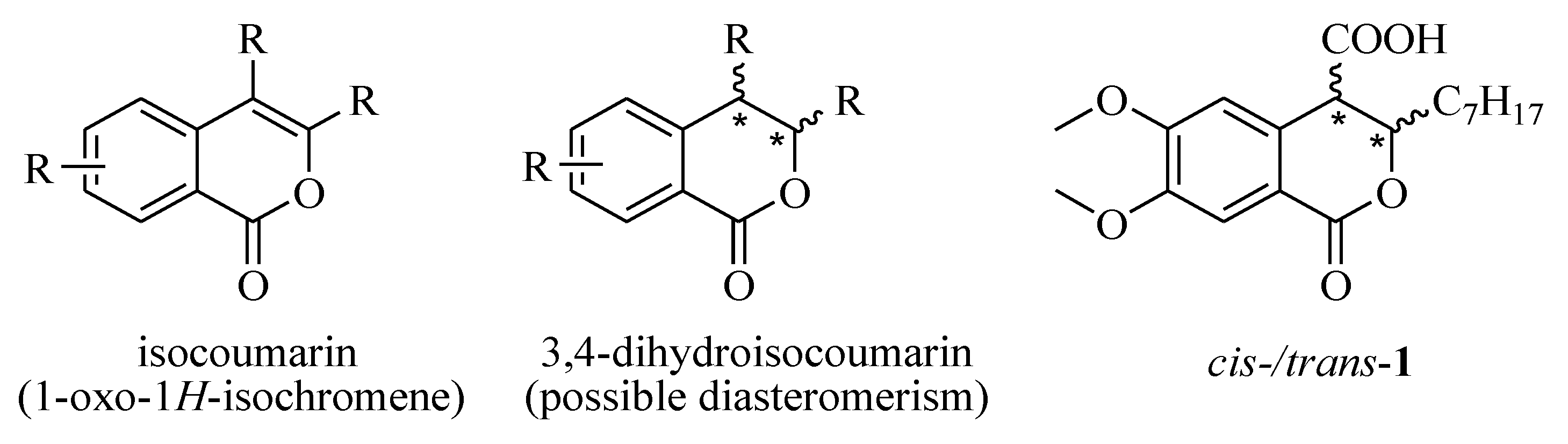

Table 1.
Yield and diastereoisomeric ratio of the synthesized compounds cis-/trans-1-3.
| R | Yeald, % | cis, % | trans, % | |
|---|---|---|---|---|
| 1 | – C7H15 | 92 | 40 | 60 |
| 2 | – C9H19 | 85 | 40 | 60 |
| 3 | -– C10H21 | 77 | 41 | 59 |
Table 2.
1H-NMR parameters of cis- and trans-1-3 at room temperature in different solvents. * Given is the multiplet center and range, in brackets; n.a. – not applicable.
Table 2.
1H-NMR parameters of cis- and trans-1-3 at room temperature in different solvents. * Given is the multiplet center and range, in brackets; n.a. – not applicable.
| Compd. | Chemical shifts (ppm), multiplicity and coupling constants (Hz) | |||||||||
|---|---|---|---|---|---|---|---|---|---|---|
| H-8, s | H-5, s | H-4, d | H-3, m* | 3J 3,4 | ||||||
| CDCl3 | DMSО | CDCl3 | DMSО | CDCl3 | DMSО | CDCl3 | DMSО | CDCl3 | DMSО | |
| cis-1 | 7.57 | 7.39 | 6.73 | 7.02 | 3.78 | 3.86 | 4.59 (4.62-4.57) | 4.62 (4.65-4.58) | 3.2 | 3.3 |
| cis-2 | 7.58 | 7.39 | 6.73 | 7.02 | 3.73 | 3.85 | 4.59 (4.61- 4.56) | 4.61 (4.66-4.56) | 3.0 | 3.3 |
| cis-3 | 7.58 | 7.38 | 6.73 | 7.02 | 3.73 | 3.86 | 4.58 (4.60-4.55) | 4.61 (4.66-4.55) | 3.2 | 3.3 |
| Average (cis) | 7.58 | 7.39 | 6.73 | 7.02 | 3.75 | 3.86 | 4.59 | 4.61 | 3.1 | 3.3 |
| trans-1 | 7.57 | 7.37 | 6.73 | 6.99 | 3.74 | 3.93 | 4.91 (4.95-4.87) | 4.85 (4.88-4.81) | 4.4 | 3.3 |
| trans-2 | 7.57 | 7.38 | 6.73 | 6.99 | 3.78 | 3.92 | 4.91 (4.94-4.88) | 4.85 (4.89-4.80) | 4.5 | 3.3 |
| trans-3 | 7.58 | 7.37 | 6.73 | 6.99 | 3.78 | 3.92 | 4.92 (4.95-4.88) | 4.84 (4.89-4.79) | 4.5 | 3.3 |
| Average (trans) | 7.57 | 7.37 | 6.73 | 6.99 | 3.77 | 3.92 | 4.91 | 4.85 | 4.5 | 3.3 |
| Δδ | 0.01 | 0.02 | na | 0.03 | 0.02 | 0.06 | 0.32 | 0.24 | 1.4 | na |
Disclaimer/Publisher’s Note: The statements, opinions and data contained in all publications are solely those of the individual author(s) and contributor(s) and not of MDPI and/or the editor(s). MDPI and/or the editor(s) disclaim responsibility for any injury to people or property resulting from any ideas, methods, instructions or products referred to in the content. |
© 2025 by the authors. Licensee MDPI, Basel, Switzerland. This article is an open access article distributed under the terms and conditions of the Creative Commons Attribution (CC BY) license (http://creativecommons.org/licenses/by/4.0/).
Copyright: This open access article is published under a Creative Commons CC BY 4.0 license, which permit the free download, distribution, and reuse, provided that the author and preprint are cited in any reuse.


