
Submitted:
01 March 2025
Posted:
03 March 2025
You are already at the latest version
Abstract
This perspective article describes our vision and proposal for the design and implementation of organic topological materials by using machine learning approach. We propose integrating advanced machine learning approaches with the state-of-the-art electronic simulation techniques to accelerate the discovery of organic topological materials which can lead to a new era of technologies in dissipationless nanoelectronics, solid-state spintronics, and quantum computing.
Keywords:
topological materials
; magnetic materials
; electronics
1. Introduction
The twenty-first century is witnessing the simultaneous emergence of two revolutionary fields of research: Firstly, the discovery of topological insulators (TI), which was the subject of the 2016 Nobel prize in physics, is at the verge of revolutionizing electronic and quantum technologies. These novel nanomaterials host non-trivial electronic states that conduct only at material boundaries, forming a unique medium for electrons to propagate without the loss of energy and with spin conservation, and hold promise for cutting-edge applications in dissipationless nanoelectronics, solid-state spintronics, and quantum computing [1,2,3,4,5]. The practical implementation of these resulting technologies will have a profound impact on diverse economic sectors by enabling ultimate-precision quantum sensing, ultra-secure communication, advancements in quantum chemistry, and the design of new drugs, among others. However, the progress towards industrial development of TI based technologies is presently slow due to the lack of efficient methods which can rapidly identify new TI materials with tuneable and scalable quantum properties. Secondly, a revolution in machine learning (ML) techniques is transforming almost every field of research [6,7,8]. A carefully trained ML framework can efficiently find optimal material structures by facilitating a rapid screening of the enormous parameter design space [9,10,11,12]. The purpose of this work is to propose a novel scheme which integrates these two frontiers of research to accelerate the discovery of new TI materials and enables a rapid transition from laboratory research to practical applications.
To date, topological insulators have been implemented only in inorganic materials [1,2,3,4,5]. Their experimental demonstration in organic materials is highly elusive and a subject of intense research [13,14,15,16]. Two-dimensional metal-organic frameworks (2D-MOFs) offer a promising platform to design engineered organic materials with tuneable electronic and magnetic properties [13,14,15,16]. The primary benefit of these novel nanostructures is that they can be synthesized efficiently, from the bottom-up, by coordination of building blocks (metal atoms and organic molecules) via the methods of supramolecular chemistry [17]. Additional advantages include broad tunability via organic functionalization, mechanical flexibility, low-cost, and ease-of-fabrication, offering plethora of opportunities for cutting-edge applications. However, identifying new 2D-MOF materials hosting topological electronic states is presently a grand challenge problem for the field of TIs and for the realization of anticipated technologies, and requires a two-fold development. Firstly, it demands a fundamental understanding of their topological character. Secondly, efficient methods need to be developed to screen the enormous design space of 2D-MOFs based on selection of building blocks and synthesis possibilities. Our vision in this work, as illustrated in Figure 1, aims to address both challenges simultaneously. By developing and applying high-end quantum simulation techniques, we propose to establish a comprehensive understanding of the structural, electronic, and magnetic properties of 2D-MOF structures. This will allow the investigation of magnetic ordering, spin structure, and the interaction with a range of technologically relevant substrate platforms, which will underpin the origin and robustness of the topological properties in these novel nanomaterials. This advanced knowledge and the associated data will be exploited to train an artificial intelligence or ML system such as a deep learning neural network to perform an efficient, systematic, and high-throughput prediction of suitable physical systems and the candidate materials required for the first experimental demonstration of an organic topological material. The strategy presented in this work can be broadly divided into the following three key steps:
- I.
- Fundamental understanding of electronic and magnetic properties of 2D-MOFs by advanced quantum simulations
- I.
- II. Development of a machine learning framework for high-throughput discovery and design of 2D-MOFs
- I.
- III. Theoretical prototype of a new experimental technique for exact-atom structural characterization of 2D-MOFs
2. Literature Background
TOPOLOGICAL PHASES IN 2D METAL ORGANIC FRAMEWORKS: Topological Insulators (TI) offer unique and nontrivial properties, which are governed by the underpinning quantum mechanical behavior, leading to the conduction of electrons at the edges while the bulk of the material interior is insulating. In these conducting boundary channels, the intrinsic magnetic moment of electrons (i.e. spin) is locked to their momentum. Due to spin-conservation and low-dimensionality, the TI materials host electronic currents without resistance and no energy loss [3,4], forming a promising medium for future technologies such as dissipationless electronics, spintronics and quantum computing.
Given the striking importance to the electronics industry, the search for new TI materials is presently a highly active and dynamic area of scientific research all over the world. Recent efforts have scoured large databases of materials, uncovering an astonishingly high number of materials with topological character [18,19]. However, these efforts have been only focused on inorganic materials. In organic materials space, a few theoretical studies on two-dimensional metal-organic frameworks (2D-MOFs) have predicted the presence of topological electronic states [13,14,15,16]. Because these studies were based on costly and time-consuming trial-and-error procedures, the progress is slow. Experimental demonstration of an organic TI is still an open question. This work aims to propose a first efficient and systematic study to discover new 2D organic topological materials, significantly contributing towards the advancement of the field.
The 2D-MOF materials which can be formed through coordination of π-conjugated molecules (e.g. polyperylenes, polyphenylenes) with transition and heavy metal atoms (e.g. Os, Ir, Pt, Au) demonstrate unique 2D structures (Figure 2(a)). The electronic properties of these materials exhibit gapless linear dispersion at the Dirac points, where the bandgap is opened up due to the large spin-orbit coupling (SOC) of the metal atoms (Figure 2(b)), such that the inversion of the valence and conduction band wave functions’ parity gives rise to topological edge states (Figure 2(c)). Thus, 2D-MOF materials, the topic of this project, offer an ideal platform to design and implement a first organic TI.
One of the key reasons for the great interest in 2D-MOFs is the availability of a large number of building units and a wide range of synthesis methods [17]. The size, symmetry, electronic and spin properties of 2D-MOFs can be engineered with exquisite atomic-scale precision via synthetic organic chemistry. The coordination between molecular ligands and metal atoms can be steered, via scanning tunnelling microscope (STM), on a large number of substrates including noble metal surfaces (Au, Cu, Ag, etc.) [20,21,22], semiconductor surfaces (silicon, TiO2) [23,24,25], and novel 2D materials (such as graphene [28] and transition metal dichalcogenides (TMDs) [29]), offering many possibilities for the design of functionalized advanced materials. However, a rigorous understanding of the electronic and spin properties of the assembled 2D-MOFs is crucial to optimize the resulting functionality [29,30]. This work proposes to develop and apply advanced theoretical models based on multi-scale physics (DFT, tight-binding (TB), STM and Fourier transform scanning tunnelling spectroscopy (STS) simulations) to establish a detailed understanding of the physical processes occurring during the adsorption and synthesis processes (e.g. changes of conformational, charge and spin states). Importantly, our proposal emphasizes on the interaction between 2D-MOFs and technologically relevant substrates such as silicon and 2D inorganic materials where the existing knowledge in the literature is highly limited.
MACHINE-LEARNING IN MATERIAL DESIGN: During the last few years, machine learning (ML) based material design has given birth to a new paradigm where the rapid designing of functionalized materials with optimized and targeted properties has been made possible [9,10]. Direct investigation of nanomaterial properties by solving complex many-particle quantum mechanics (e.g. ab-initio, DFT, TB) offers a limited scope due to the associated high computational costs. Alternatively, a ML framework, carefully trained by carrying out the rigorous theoretical analysis of selected materials, can rapidly screen a large database of unknown materials to reliably identify those of the same character at only a fraction of the computational cost. ML based material design is therefore an emerging topic at the forefront of research all over the world. In the field of the MOF materials, there has been a recent surge in the application of ML techniques to explore their vast parameter space to identify new structures with functionalities amenable for applications such as optimized gas absorption [32], electronic current conduction [33,34], prediction of molecule surface energies [35], and finding new 2D materials exfoliated from parent compounds [36]. ML approaches have not been yet applied to topological materials, in particular materials based on organic building units. Therefore, our proposal is expected to instigate an influential and timely development in an important field of research leading to the formulation and application of ML algorithms for the identification of new 2D-MOF materials exhibiting topological character. It is anticipated that such development will discover new knowledge and enable future technologies. Our proposal is based on a rigorous theoretical analysis of the fundamental structural, electronic and magnetic properties of 2D-MOF materials. The established knowledge and data from such analysis will provide crucial inputs for the supervised training of a ML framework to accelerate the discovery of novel 2D-MOFs.
3. Proposed Vision
Our proposal is based on the following key developments:
- I.
- FUNDAMENTAL UNDERSTANDING OF TOPOLOGICAL CHARACTER: In the first step, we propose to develop and apply high-end computational methods to address the following important open questions in the field of organic topological materials: (i) What is the role played by the chemical properties and symmetries of substrate surfaces on the coordination of metal atoms and molecular ligands to form specific 2D-MOF structures? (ii) How do the atomic-scale morphology and symmetry of 2D-MOFs translate into well-defined electronic and magnetic character? A key innovation will be to go beyond widely studied noble metal surfaces and emphasize on the investigation of novel and technologically relevant surfaces such as silicon and hybrid interfaces with 2D inorganic TIs as support platform for 2D-MOFs, seeking new avenues for manipulating their magnetic properties.
- I.
- II. MACHINE-LEARNING FRAMEWORK: Thousands of 2D-MOF structures are possible by combining metal atoms and molecule ligands as building blocks, yet only a handful are predicted to host topological states. No experimental demonstration of topological character in 2D-MOFs is, to date, achieved. How can we efficiently discover new 2D-MOF topological materials? is a grand challenge problem whose solution will advance the field of organic TIs. The highly innovative approach in our proposal will enable high-throughput screening of the enormous 2D-MOF design space by applying efficient deep learning techniques. The carefully trained machine learning algorithms will not only explore combinations of metal atoms and molecular ligands, but also novel structural morphologies and substrate platforms to identify optimized physical systems and candidate materials required to enable the first experimental demonstration of an organic TI material.
- I.
- III. EXACT-ATOM CHARACTERISATION TECHNIQUE: Interaction of a 2D-MOF structure with the substrate surface significantly perturbs its structural configuration, which in turn modifies the electronic and magnetic properties. How can we characterize 2D-MOF structures with atomic level precision? is crucial to design 2D-MOFs with robust topological properties. We propose to develop a new metrology technique to determine the exact real-space atomic positions in 2D-MOFs. An important innovation is that this technique will not only map the in-plane atom positions, but also provide critical information on the vertical displacements, where the resolution of the existing AFM and STM imaging methods is highly limited.
4. Methods and Discussions
The primary aim of this proposal is to integrate a comprehensive understanding of the topological character of 2D-MOFs with deep learning techniques to stimulate discovery of new 2D-MOF structures. and open new horizons for research at the forefront of science and technology. Below we provide details of the proposed methodologies, and the corresponding work-plans:
4.1. Fundamental Understanding of Topological Character:
Identifying and designing optimized 2D-MOF structures with an experimentally realizable topological signature is a challenging and non-trivial task with huge technological implications. We propose to develop and apply high-end computational methods based on multi-scale electronic structure calculations (DFT and tight-binding) coupled with high-resolution spin-dependent STM and Fourier transform STS (FT-STS) simulations to enable a fundamental understanding of the magnetization states in 2D-MOF systems. The electronic structure calculations involving computation of orbital charge densities (LUMO and HOMO states), relaxed molecular structures, local density of states (LDOS), and projected density of states (PDOS) will establish crucial knowledge by investigating how the interaction between a particular 2D-MOF and a surface govern the atomic-scale morphology, electronic coupling, and charge transfer mechanisms. The analysis of STM images and FT-STS maps will provide an exquisitely detailed insight into the momentum or k-space properties of the material and allow the resolution of electronic scattering properties of 2D-MOF systems. The development in this work can be divided into four steps:
STEP 1 – SUBSTRATE SURFACE ENGINEERING: The choice of substrate surface (see for examples in Figure 3) plays a crucial role in governing the overall structural, symmetry, chemical, electronic and magnetic properties of 2D-MOFs. Most theoretical studies so far are based on stand-alone MOF structures; however, the topological character of a 2D-MOF structure may alter or completely disappear after interaction with the substrate surface. In this step, we propose to fill this gap of knowledge by establishing an accurate understanding of the entire 2D-MOF/substrate system. Secondly, noble metal surfaces (such as Ag, Cu, etc.) have been the overwhelming choice in the reported studies for on-surface synthesis of 2D-MOFs [20,21,22]. Recently, a few experimental studies have explored novel 2D material surfaces such as graphene [28] as a promising weakly interacting substrate, but incisive theoretical guidance to this end is still lacking. Another highly interesting but emerging avenue is hybrid interfaces formed by coupling of MOFs with 2D topological insulators (TI) such as Bi2Te3 [37] and Bi2Se3 [29]. These novel systems can provide efficient ways to engineer the Dirac point and offer opportunities to tune spin dependent transport properties of the substrate for novel spintronic applications, and for designing new 2D magnetic materials. This step proposes to strive to understand and explore ways to design and engineer 2D-MOF/substrate combinations to preserve the topological character. An important innovation here is to focus on technologically relevant novel surfaces such as silicon and novel 2D TIs as a 2D-MOF support platform, which is expected to open new avenues for future technologies for example in quantum computing [26,27].
STEP 2 – UNDERSTANDING ELECTRONIC PROPERTIES: A comprehensive understanding of the spin-dependent band structures should be performed through DFT and tight-binding calculations, where the presence of electronic states in the bulk bandgap and spin-momentum locking would demonstrate a topological phase. A particular focus can be given to the investigation of the spin-orbit coupling (SOC) mediated gap opening mechanism. An important innovation here will be to systematically examine the role of SOC tunability on the topological character based on combinations of metal atoms and ligands, as well as the external effects such as strain and electric fields.
STEP 3 – SPIN TEXTURE OF TOPOLOGICAL EDGE STATES: In this step, high-resolution spin-polarized STM images and STS maps (such as shown in Figure 4) will be computed, which will provide a direct access to understand the magnetization states of 2D-MOF systems. Due to correlation between momentum and spin of such states, the investigation of local spin texture will reveal topological character. The spin-polarized FT-STS may offer a unique pathway to resolve electronic scattering properties of the 2D-MOF systems as a function of spin and hence provide direct insights into the possible local spin-momentum locking mechanism. The comprehensive STM simulator developed recently [39] which considers a detailed description of the STM tip state will allow the computation of functionalized tips going beyond the traditional bare metallic tips, providing another degree of freedom to gain insight into the electronic and spin properties of MOFs.
STEP 4 – LONG-RANGE ROBUST MAGETIC ORDERING IN 2D-MOFs: Step 4 proposes to investigate long-range magnetic ordering in 2D-MOF structures. Elucidating such magnetic properties can be important for understanding possible nontrivial topological electronic properties of these systems, since the latter can result from magnetic phenomena but also be the cause of well-defined spin structure. The presence of such spin structure in 2D materials provides an ideal platform for the realization of 2D magnets, which is presently a central focus of the research due to its huge technological relevance for novel applications including in sensing and hard-disk data storage. 2D-MOF structures can be engineered to implement 2D magnets by the selection of metal ions and the selection of structural morphologies [43]. However, the demonstration of robust magnetism in 2D-MOFs is still an open question and requires a rigorous and systematic theoretical understanding of the origin of ferromagnetic/anti-ferromagnetic character. The computational tools developed in Steps 1-3 above can be applied to develop a fundamental understanding of the magnetic signature in 2D-MOF materials, with the aim of identifying suitable building blocks (metal ions, molecular ligands) and the structural morphologies for the realization of long-range robust ferromagnetic character.
At the completion of the above four steps, we anticipate that: (i) The established knowledge will fill a critical gap on the fundamental understanding of structural, electronic and magnetic properties of 2D-MOFs, particularly their interaction with technologically relevant substrates. (ii) New experiments will be proposed to target optimized 2D-MOF and surface combinations for realization of topological quantum states in organic materials. (iii) The comprehensive understanding of the long-range magnetic order in 2D-MOFs will uncover novel structural symmetries for realization of 2D magnets.
4.2. Machine-Learning Framework:
This is the most ambitious part of our vision, in which we propose to formulate a machine learning (ML) framework with the capability of high-throughput screening of a large number of 2D-MOFs to identify structures that host topological phases at a fraction of the computational cost compared to the traditional full-scale quantum mechanical (DFT or tight-binding) simulations. So far, computer learning techniques have scarcely been applied to the design of topological materials [44], with no effort targeted towards 2D-MOFs. The progress is further hindered due to the limited availability of data on the electronic and spin properties of 2D-MOFs from experiments and theory. Therefore, to address the grand challenge of discovering the first experimentally viable topological 2D-MOF, a systematic development is needed.
One of the key reasons behind the immense technological interests in 2D-MOFs is the availability of a large number of building units (metal atoms and organic molecule ligands), as well as numerous possibilities for on-surface atomic-scale engineering of their morphology and symmetry by exploiting supramolecular chemistry [17]. This offers rich opportunities to design a variety of functionalized materials, targeting a wide range of applications. Despite large number of possibilities to form MOFs, only a handful of structures are currently predicted to host topological states, with experimental demonstration still elusive. The enormous design possibilities for 2D-MOFs present a challenging combinatorial design problem that can be addressed by exploiting the efficiency of deep learning techniques, which is the goal here. A detailed flow chart diagram is illustrated in Figure 5, which lays out our vision to deliver an all-inclusive theoretical framework with the capability of highly accurate prediction, and design, of 2D-MOFs hosting topological character. The idea underpinning the proposed tool is based on transfer learning approach in which the understanding of the correlation of structural features and fundamental material parameters with topological character is developed (4.1) and integrated this knowledge with artificial intelligence techniques such as by supervised training of a deep-learning neural network. The work in this subsection is divided in following three Steps:
STEP 1 – LEARNING AND TRAINING: In the context of topological character, a thorough and quantitative structure-property relationship (QSPR) study will be conducted by carefully establishing a correlation between the electronic and spin properties of 2D-MOFs with their composition, structure, and symmetry. The analysis and results from subsection 4.1 above will provide crucial data to the learning process. We propose to identify a list of material descriptors describing the building block units (metal atoms and molecular ligands), the role of spin-orbit coupling to create bandgap at Dirac points, and the symmetry arising from the connectivity of metal and organic molecules leading to the desired linear dispersion relation at the Dirac points in the electronic band-structure. To enable accurate and fast learning, the QSPR analysis will be conducted by employing a variety of advanced algorithms such as linear regression analysis, decision tree regression, and non-linear support vector machines [45]. The detailed insights obtained by QSPR will train an artificial neural network (NN) for high-throughput screening and computer-aided design of topological 2D-MOFs.
STEP 2 – HIGH-THROUGHPUT SCREENING AND PREDICTION: Based on the large number of building block units (metal atoms and organic molecular ligands), we propose to establish a comprehensive database of hypothetical 2D-MOF structures. For this purpose, the publicly available databases of 2D-MOF structures can be consulted [9,10]. The carefully trained and benchmarked deep learning neural network from the Step 1 above will perform a high-throughput screening of the large databases of hypothetical 2D-MOF structures and identify candidate 2D-MOF materials with the predicted topological character. Subsequently, the shortlisted 2D-MOFs will be rigorously studied by performing detailed DFT and TB simulations to confirm the presence of the desired topological and magnetic properties. The successful completion of this step will identify optimized combinations of 2D organic materials and substrate surfaces and propose new measurements to be carried out by the experimental teams.
STEP 3 – INVERSE DESIGN OF 2D-MOFs: The Steps 1 and 2 aim to identify topological 2D-MOFs via high-throughput screening of the large databases of pre-defined 2D-MOF structures; however, the ambitious goal of Step 3 here is to perform bottom-up designing of new 2D-MOF structures hosting topological states by exploiting inverse-design methods [11]. The idea is based on starting from a selection of metal atoms and molecular ligands and iteratively form different possible structures to target the desired band structure and magnetic properties. The existing literature has primarily focused on the hexagonal symmetries [13,14,15,16], but the square symmetry has recently revealed the presence of surprisingly robust magnetic character [43]. The ML framework will explore novel and unexplored symmetries for 2D-MOFs, which could be the key to search for the next breakthrough topological material. To systematically pursue this task, advanced Monte Carlo algorithms such as simulated annealing can be implemented in conjunction with quantum simulations to design optimized 2D-MOF structures.
4.3. Exact Atom Characterisation Technique (EACT):
The subsections 4.1 and 4.2 above focus on theoretically predicting candidate 2D-MOF/surface combinations hosting topological electronic states. In experiments the adsorption of 2D-MOFs on surfaces leads to significant changes in their physical structures, which in-turn strongly impact the presence of topological character. Therefore, it is crucial to understand the post-adsorption structural details of 2D-MOFs with atomic-level resolution.
For 2D-MOF structures, non-contact AFM (nc-AFM) [28,29] and functionalized STM imaging [46,47] scans are widely used to determine their structural details. The resulting images provide good resolution in in-plane directions, but present, at best, very limited information along the out-of-plane direction. In practice, the molecular adsorption leads to atom displacements along both in-plane and out-of-plane directions (see Figure 6). The objective of this subsection is to propose a new imaging technique prototype, hereafter labelled as exact atom characterization technique (EACT), to pinpoint the exact atomic positions in-situ via STM. The technique will be scalable to large-scale 2D-MOF structures and will enable an unprecedented understanding of the adsorption-induced conformational distortions. The critical knowledge obtained from EACT will allow engineering of electronic and spin properties of 2D-MOFs with exquisite precision.
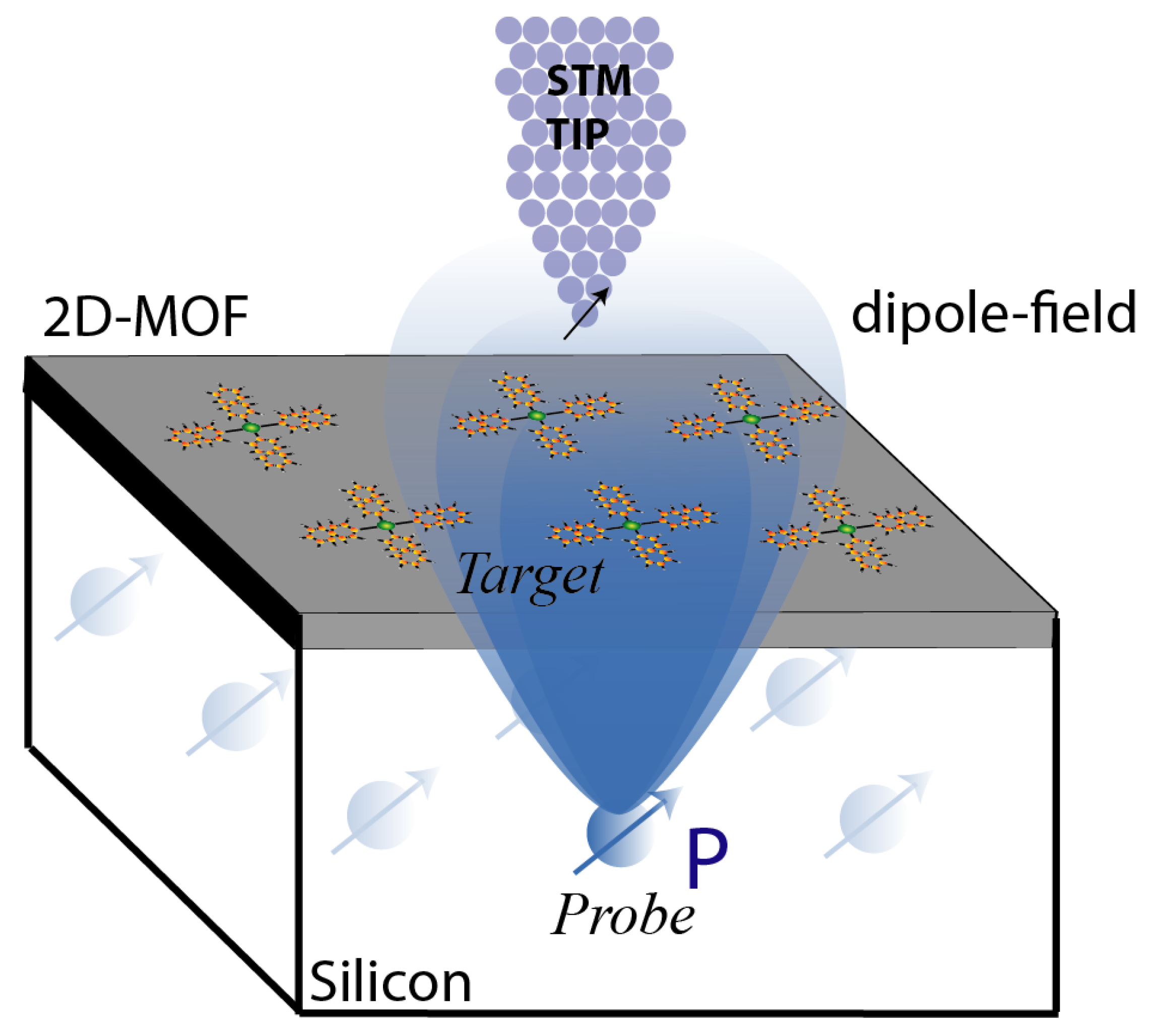
Recently, the dipole field originating from an NV-diamond has been proposed for atomic-scale imaging of 3D molecules [48]. Unlike NV-diamond, silicon (Si) offers a highly clean and a very well-understood surface. Moreover, it has been demonstrated that phosphorus (P) atoms can be fabricated and characterized in Si via STM lithography with single-atom level precision [39,49]. Coupled with very long coherence times of P nuclear and electron spins [50], the phosphorus-silicon (Si:P) system offers a highly promising platform for dipolar field imaging of 2D-MOFs. Indeed, a subsequent study has proposed Si:P platform for the imaging of 3-D molecules [53]. Here we propose to exploit the dipole field from electronic wave function confined on a phosphorus donor fabricated about 2-3 nm below the Si surface as a magnetic probe and interact with the dipole fields of the on-surface nuclei in the target 2D-MOFs (Figure 7). The dipole-dipole interaction will be controlled by an external magnetic field, which could be applied via spin-polarized STM tips [51]. A quantum protocol will be designed to effectively read-out the exact atomic locations of the nuclei spins in the target 2D-MOFs. The recently developed protocol [53] will provide a strong foundation for the formulation of EACT technique being proposed here. The development here can be achieved by completing the following three Steps:
STEP 1 – ELECTRONIC STRUCTURE OF Si:P:2D-MOF SYSTEM: We propose to establish a detailed understanding of the electron wave function and the resulting dipole field in a complete Si:P:2D-MOF system – a highly challenging problem which has not been done previously to the best of our knowledge. This non-trivial semiconductor/organic-material system cannot be understood through traditional DFT simulations, since the Si:P wave function has a very large spatial distribution which require simulations of over several million atoms [54,55,56,57]. Our earlier work has established an atomistic tight-binding model, which has in the past provided an excellent understanding of the Si:P electron wave functions [39,54,55,56,57]. This tight-binding method can be coupled with DFT theory to establish a new self-consistent DFTB method capable of investigating Si:P:2D-MOF electronic structure and providing an exact shape and orientation of the dipole-dipole field above the silicon surface. This will significantly advance our knowledge of silicon/organic material interfaces, a technologically relevant material.
A second important task in this Step is to examine the extent and the gradient of dipole fields as a function of the orientations of the applied magnetic fields, which will dictate the volume and resolution of imaging of atoms inside the target 2D-MOFs. We propose to optimize these parameters through a careful analysis of the dipole fields originating from the engineered placement of P atom arrays underneath the Si surface. The strength of the dipole field can be tuned by increasing number of closely spaced P atoms, thereby enhancing the confinement of wave function.
STEP 2 – QUANTUM PROTOCOL: At the heart of the proposed EACT technique is a quantum detection protocol which will enable readout of the atom types and positions in the target 2D-MOF structure. A highly cumbersome protocol was proposed for NV-based bio-molecular imaging [48], which can be drastically simplified by leveraging from the very long coherence times of both electron and nuclear spins on P atom in Si [53]. This can also provide additional flexibility in terms of detection and storage of the target nuclear spin information. The protocol will utilize already published pulse sequence [58] for decoupling of spins in the target 2D-MOF. At first the electron spin of P atom will interact with the MOF nuclei spins and acquire phase associated with the entire spin environment. This information will then be transferred to the nuclear spin of P atom, with very long coherence time. The external magnetic field will selectively rotate the target nuclear spins, which controllably interact with the Si:P electronic spin and transfer the information about their type and location. A measurement protocol will read the encoded information in Si:P and determine the target spin locations with high fidelity.
STEP 3 – ANALYSIS AND BENCHMARKING: The goal of the established EACT technique is to enable highly accurate structural analysis of 2D-MOF structures by bridging the gap between DFT based theoretical relaxations and experimental measurements. In this Step we propose to directly compare EACT results with the atomic details (atom positions, bond lengths and orientations, etc.) of theoretically relaxed 2D-MOFs. In particular, it is proposed to investigate 2D-MOF structures which have been experimentally assembled and structurally characterized via nc-AFM to further facilitate a high-level benchmarking of the existing theoretical and experimental methods.
At the conclusion of the above three Steps in subsection 4.3, we anticipate that: (i) a rigorous understanding of 2D-MOF structural properties resulting from the interaction between MOF and surface will be achieved, (ii) significant advancement of knowledge by bridging the gap between 3D DFT relaxations and 2D nc-AFM images, (iii) a prototype of a new imaging technique will be developed with clear pathway towards experimental implementations.
5. Conclusions:
In summary, 2-D metal-organic framework (2D-MOF) complexes are highly versatile material system which offer immense possibilities to custom-design next-generation electronic and magnetic materials. Due to vast number of possibilities in the material design space, it is challenging to explore the design space based on trial-and-error approaches. Here, we have presented our vision for an automated machine learning assisted exploration of 2D-MOF with the aim to find an experimentally viable organic topological material. We present a detailed step-by-step process which can be implemented in the lab and is expected to provide a systemic and rigorous understanding of 2D-MOF and their interaction with the substrate. We also present a new imaging technique which should allow high-resolution structural characterisation of 2D-MOFs.
References
- M. M. Konig et al., Science 318, 766, (2007).
- M. Hassan et al., Rev. Mod. Phys. 82, 3045, (2010).
- Y. L. Chen et al., Science 325, 178, (2009).
- J. E. Moore, Nature 464, 194, (2010).
- S. Souma et al., Phys. Rev. Lett. 108, 116801, (2012).
- S. Gicev et al., Quantum 7, 1058, (2023).
- M. Usman et al., npj Computational Materials 6, 19, (2020).
- B. Hall et al., Phys. Rev. Research 6, L032004, (2024).
- K. T. Butler et al., Nature 559, 457, (2018).
- P. D. Luna et al., Nature 552, 23, (2017).
- Franceschetti et al., Nature 402, 60, (1999).
- T. Moot et al., Mater. Discov. 6, 9, (2016).
- Z. F. Wang et al., Nano Lett. 13, 2842, (2013).
- L. Z. Zhang et al., Nano Lett. 16, 2072, (2016).
- Z. F. Wang et al., Nature Comm. 4, 1471, (2013).
- Z. Liu et al., Phys. Rev. Lett. 110, 106804, (2013).
- J.M. Lehn, Rep. Prog. Phys. 67, 249, (2004).
- E. Gibney, Nature 560, 151, (2018).
- K. Yang et al., Nature Materials 11, 614, (2012).
- Krull et al., Nature Communications 9, 3211, (2018).
- A. Schiffrin et al., ACS Nano 12, 6545, (2018).
- M. Capsoni et al., J. Phys. Chem. C 121, 23574, (2017).
- S. R. Wagner et al., J. Phys. Chem. C 118, 2194, (2014).
- H. Yang et al., Dalton Trans. 46, 2751, (2017).
- Sun et al., J. Phys. Chem. C 120, 14706, (2016).
- M. T. West et al., Advanced Quantum Technologies, 2300130, (2023).
- S.S. Gill et al., Software: Practice and Experience 52, 66-114, (2022).
- A. Kumar et al., Nano Lett. 18, 5596, (2018).
- M. Caputo et al., Nano Lett. 16, 3409, (2016).
- M. Castelli et al., Small 17, 2005974, (2021).
- J. Hellerstedt et al., Nanoscale Advances 4, 3845-3854, (2022).
- M. Fernandez et al., J. Phys. Chem. Lett. 5, 3056, (2014).
- M. Pardakhti et al., ACS Combinatorial Science 19, 640, (2017).
- Y. He et al., Phys. Chem. Lett. 9, 4562, (2018).
- A.P. Bartok et al., Science Adv. 3, e1701816, (2017).
- N. Mounet et al., Nature Nanotechnology 13, 246, (2018).
- P. Sessi et al., Adv. Materials 28, 10073, (2016).
- G. Pawin et al., Angew. Chem. Int. Ed. 47, 8442, (2008).
- M. Usman et al., Nature Nanotechnology 7, 609, (2016).
- M. Usman et al., Nanoscale 9, 17013-17019, (2017).
- M. West et al., Nanoscale 13, 16070-16076, (2021).
- M. West et al., Phys. Rev. Applied 17, 024070, (2022).
- W. Li et al., Chem. Sci. 8, 2859, (2017).
- M. Klintenberg et al., Appl. Phys. Res. 6, 31, (2014).
- M. Fernandez et al., J. Phys. Chem. C 117, 7681, (2013).
- Chiang et al., Science 344, 6186, (2014).
- B. de la Toree et al., Phys. Rev. Lett. 119, 166001, (2017).
- V.S. Perunicic et al., Nature Comm. 7, 12667, (2016).
- M. Fuechsle et al., Nature Nanotechnology 7, 242, (2012).
- F.A. Zwanenburg et al., Rev. Mod. Phys. 85, 961, (2013).
- T. Choi et al., Nature Nanotechnology 12, 420, (2017).
- K. Iwata et al., Nature Communications 6, 7766, (2015).
- V.S. Perunicic et al., arXiv:2112.03623, (2021).
- M Usman et al., J. Phys. Cond. Matt. 27, 154207, (2015).
- M. Usman et al., Phys. Rev. B 91, 245209, (2015).
- M. Usman, Computational Materials Science 193, 110280, (2021).
- M. Usman et al., Phys. Rev. B 98, 035432, (2018).
- “Annual Reports on NMR Spectroscopy”, Edited by G. A. Webb, Academic Press (1997).
- M. T. West et al., Mach. Learn.: Sci. Technol. 4, 035027, (2023).
- M. T. West et al., PRX Quantum 5, 030320, (2024).
Figure 1.
Our vision towards high-throughput discovery of 2D organic topological insulator materials by integrating advanced quantum simulations with machine learning algorithms. These novel materials hold promise for future technologies including spintronics, dissipationless electronic devices, and quantum computing.
Figure 1.
Our vision towards high-throughput discovery of 2D organic topological insulator materials by integrating advanced quantum simulations with machine learning algorithms. These novel materials hold promise for future technologies including spintronics, dissipationless electronic devices, and quantum computing.
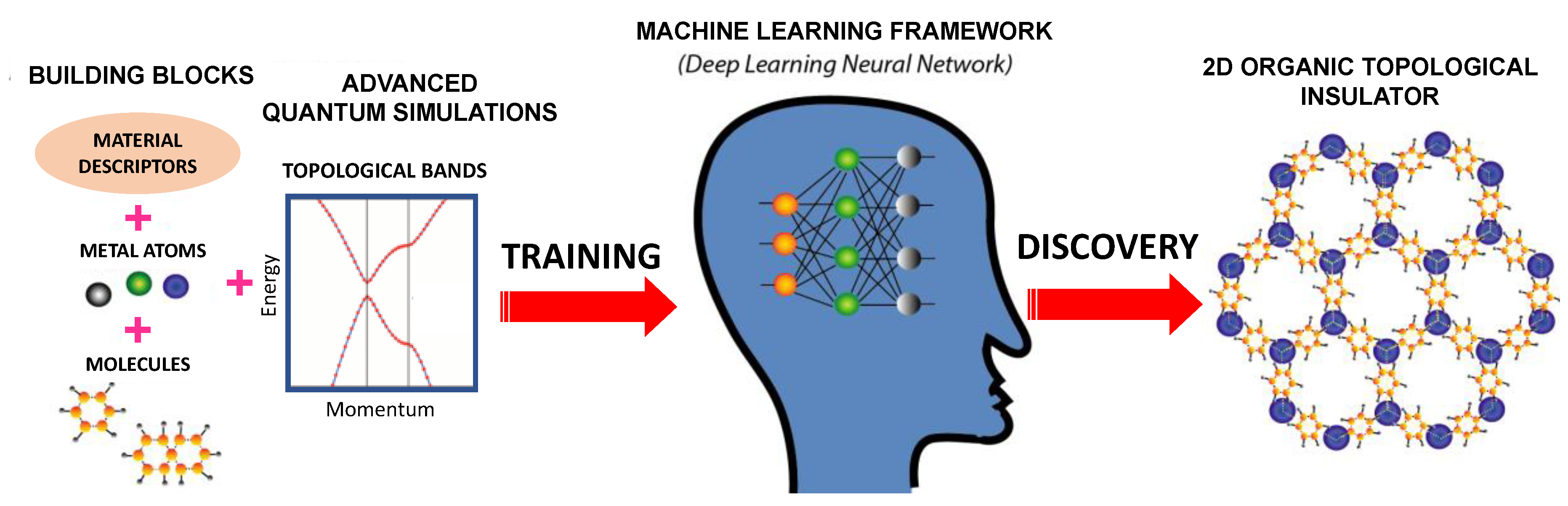
Figure 2.
(a) 2D-MOF as Kagome lattice. (b, c) Band-structure hosting topological edge states. This figure is reproduced from Ref. [13] Copyright American Chemical Society (2013).
Figure 2.
(a) 2D-MOF as Kagome lattice. (b, c) Band-structure hosting topological edge states. This figure is reproduced from Ref. [13] Copyright American Chemical Society (2013).
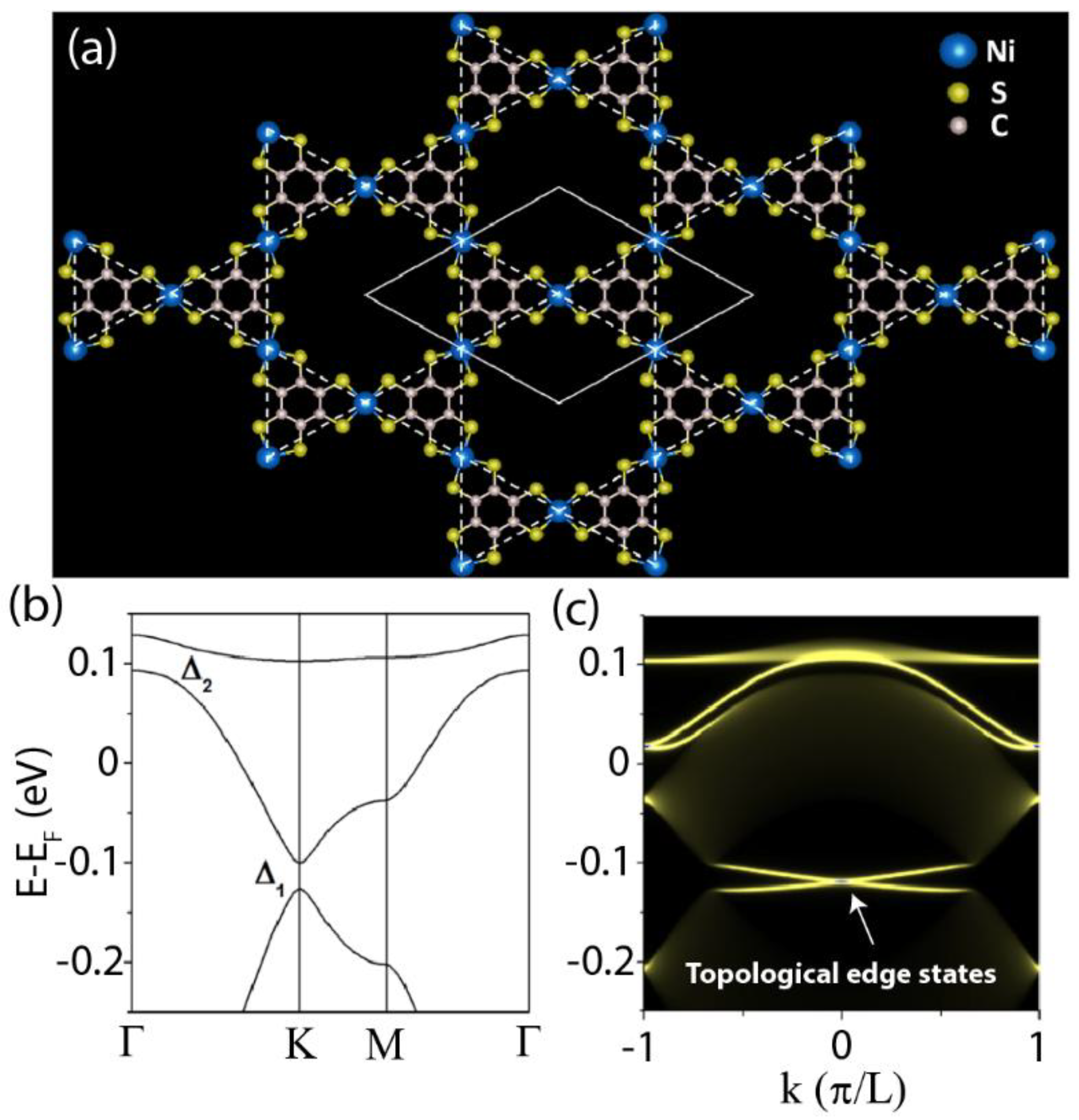
Figure 3.
2D-MOFs on different surfaces: (a) DCA on Cu(111) reproduced from Ref. [38] (b) DCBP3Co2 on graphene reproduced from Ref. [28].
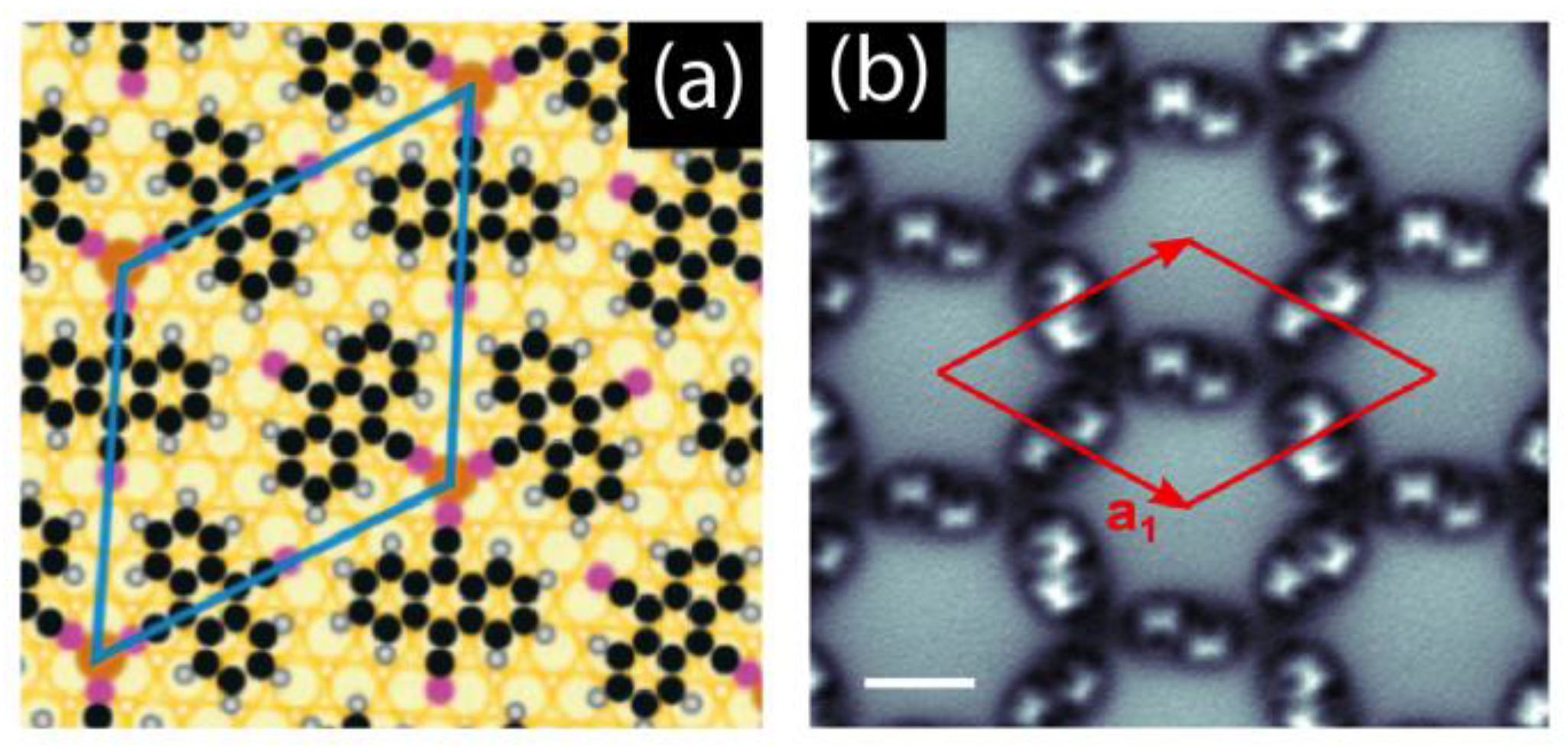
Figure 4.
Maps for Constant-height STS (top-row), FT-STS (middle row), and LDOS for DCA3Co2 MOF structure as a function of bias. This figure is reproduced from Ref. [28].
Figure 4.
Maps for Constant-height STS (top-row), FT-STS (middle row), and LDOS for DCA3Co2 MOF structure as a function of bias. This figure is reproduced from Ref. [28].
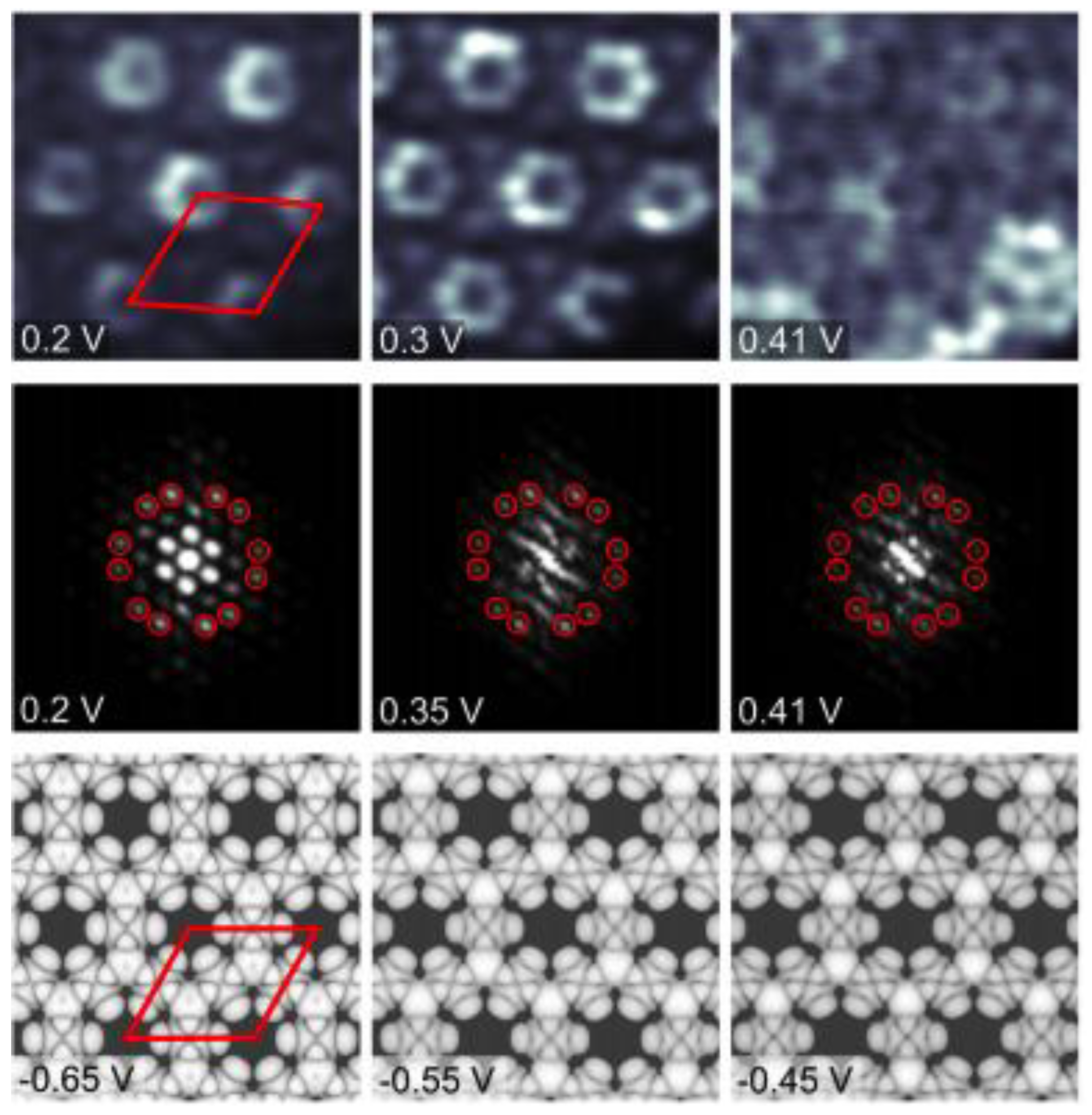
Figure 5.
Bringing it all together – a flow chart diagram of an all-inclusive theoretical framework, integrating rigorous quantum simulations with the machine learning techniques from to enable design and discovery of novel 2D topological organic materials.
Figure 5.
Bringing it all together – a flow chart diagram of an all-inclusive theoretical framework, integrating rigorous quantum simulations with the machine learning techniques from to enable design and discovery of novel 2D topological organic materials.
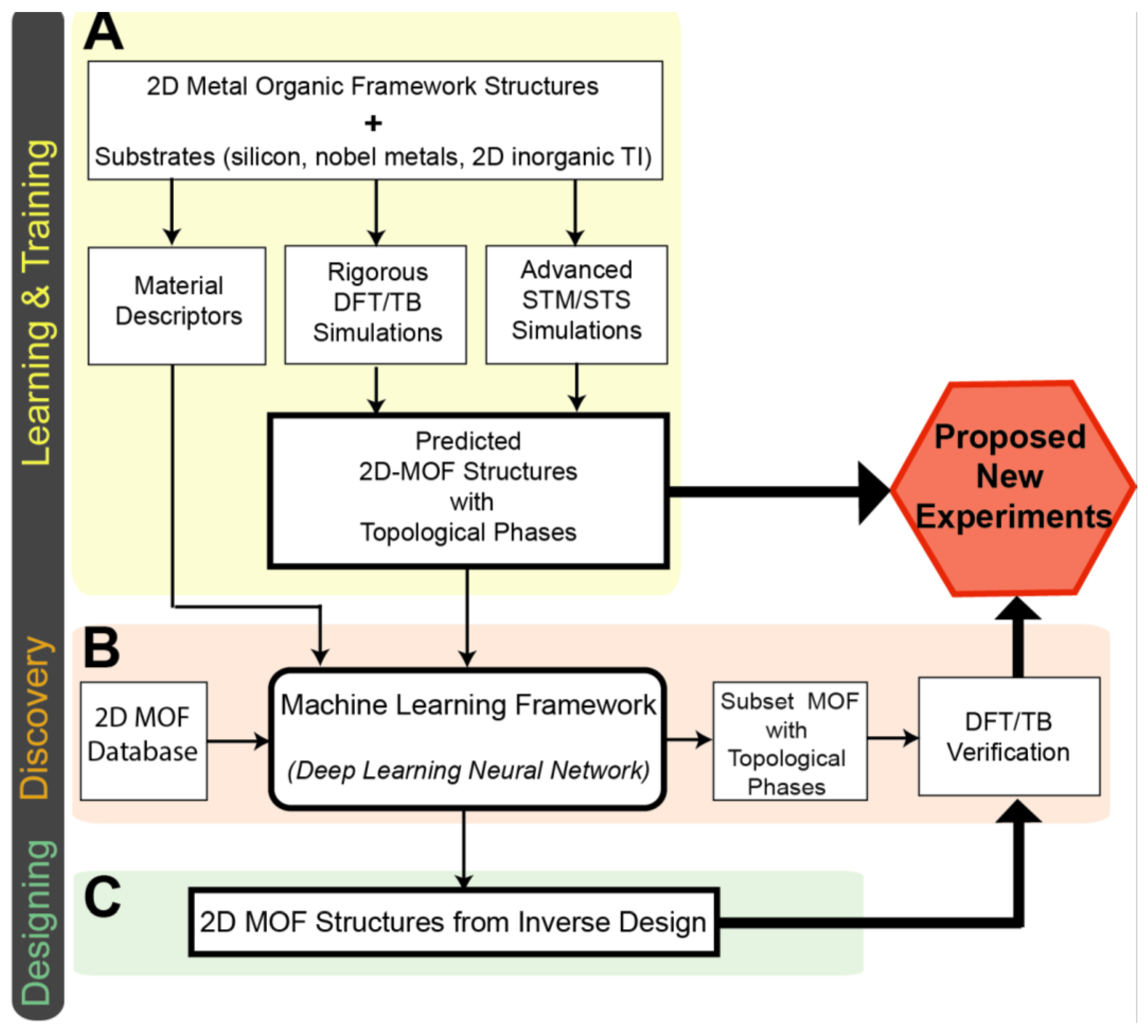
Figure 6.
PTCDA molecule adsorbed on Si surface. Significant vertical bending is clearly evident. This figure is reproduced from Ref. [52].
Figure 6.
PTCDA molecule adsorbed on Si surface. Significant vertical bending is clearly evident. This figure is reproduced from Ref. [52].
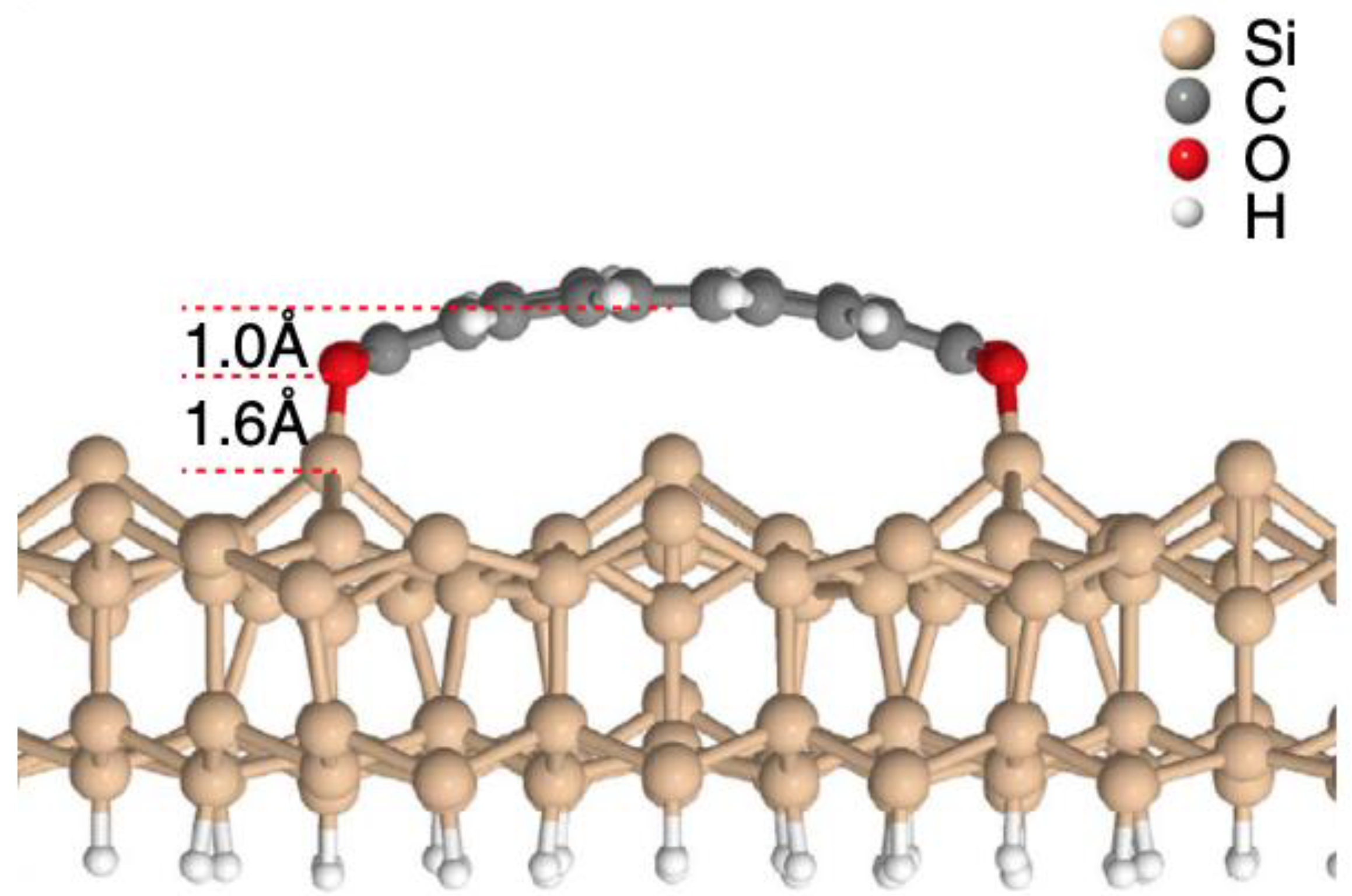
Figure 7.
Schematic diagram of the proposed EACT technique.
Disclaimer/Publisher’s Note: The statements, opinions and data contained in all publications are solely those of the individual author(s) and contributor(s) and not of MDPI and/or the editor(s). MDPI and/or the editor(s) disclaim responsibility for any injury to people or property resulting from any ideas, methods, instructions or products referred to in the content. |
© 2025 by the author. Licensee MDPI, Basel, Switzerland. This article is an open access article distributed under the terms and conditions of the Creative Commons Attribution (CC BY) license (https://creativecommons.org/licenses/by/4.0/).
Copyright: This open access article is published under a Creative Commons CC BY 4.0 license, which permit the free download, distribution, and reuse, provided that the author and preprint are cited in any reuse.


