

Submitted:
28 February 2025
Posted:
03 March 2025
You are already at the latest version
Abstract
In this paper, the impact of annealing at different temperatures (973 K, 1073 K and 1123 K for 1h) on the magnetic and microstructural properties of Mn-Fe-P-Si based glass-coated microwires is studied. Annealing significantly influences the magnetic and microstructural properties of Mn-Fe-P-Si glass-coated microwires. XRD analysis reveals that increasing the annealing temperature leads to a notable increase in the Fe₂P phase content, reaching a maximum at 1123 K, while simultaneously reducing the presence of secondary phases observed in the as-prepared sample. The reduction of secondary phases in Mn-Fe-P-Si -based microwires has a profound impact on their magnetic behavior. High coercivity values are observed in both the as-prepared and annealed samples,. However, annealing at higher temperatures (1073 K and 1123 K) results in a significant reduction in coercivity, decreasing from 1200 Oe for the sample annealed at 973 K to 300 Oe and 150 Oe, respectively. In addition, the sample annealed at 1123 K for 1h shows a notable paramagnetic behavior for loops measured from 200 K to 300 K. Meanwhile, the other samples show ferromagnetic behavior for all meas-uring temperature from 5 to 300 K. This study highlights the significant potential for tailoring and modifying various magnetic properties of Mn-Fe-P-Si glass-coated mi-crowires, including metamagnetic phase transitions, magnetic behavior, and the con-trol of magnetic response (hardness/softness). Such tailored properties make Mn-Fe-P-Si -glass-coated microwires promising candidates for a wide range of appli-cations.
Keywords:
Mn-Fe-P-Si alloys
; glass-coated microwires
; Taylor–Ulitovsky Technique
; annealing
; XRD analysis
1. Introduction
In recent years, the continuous development of magnetic micro & nanostructures has significantly advanced both fundamental scientific research and technological applications [1,2,3,4,5]. Unlike bulk magnetic materials, the systematic engineering of micro & nanomaterials has led to groundbreaking advances in areas such as the fabrication of magnetic micro & nano structures with tailorable physical properties, the exploration of multidimensional magnetic properties in magnetic micro & nanostructures, and their prospective applications [3,4,5]. In addition, precise control over the grain size, morphology, and phase content of magnetic micro & nanostructures is of paramount in determining their unique physical and chemical properties, which are essential for potential applications [6,7].
In particular, micro- and nanostructured magnetic materials that can undergo thermoelastic martensitic phase transitions (TMPTs) have emerged an attractive area of research due to their remarkable features [8,9,10,11,12,13,14,15,16,17,18,19,20,21,22,23,24,25,26,27,28,29,30,31]. These materials have a distinctive synergy of functions, presenting great opportunities for technological advancement. Prominent features encompass shape memory (SM), giant superelasticity (GS), magnetic field-induced strain (MFIS), and elastocaloric and magnetocaloric (EMC) effects [2,4,5,8,9,10,11,12,13,14,15,16,17,18,19,20,21,22,23,24,25,26,27,28,29,30,31,32,33,34].
In recent decades, there has been a surge of research dedicated to magnetocaloric materials, which serve as essential components in magnetic refrigeration systems [2,4,5,11]. Despite their potential, existing refrigerators often operate at relatively low frequencies (up to a few Hz), hindering their overall cooling efficiency [35,36]. Theoretical investigations have indicated that the cooling efficiency of magnetic refrigerators can be significantly enhanced by optimizing the shape of the magnetocaloric materials employed [37,38,39]. Specifically, it has been theorized that a magnetic materials composed of magnetocaloric microwires, such as Gd and NiMnGa wires, offers an optimal device configuration compared to powder or laminate structures [37,38,39]. The increased surface-to-volume ratio of magnetocaloric wires is expected to facilitate more efficient heat transfer between the magnetic refrigerant and the surrounding liquid.
Mn–Fe–P–Si alloys have emerged as promising magnetocaloric materials due to their substantial magnetocaloric effect near room temperature [40,41]. The low cost of these materials, which do not require expensive or critical elements, further enhances their appeal as viable candidates for large-scale cooling applications. MnFePSi alloys exhibit a hexagonal Fe₂P-type crystal structure (space group P62m) [42]. Within this structure, Mn and Fe atoms occupy specific sites: Mn atoms occupy pyramid-shaped sites (3g), while Fe atoms favor tetrahedral sites (3f) [42,43]. Neutron diffraction studies have elucidated the ferromagnetic (FM) state in these alloys, revealing the in-plane alignment of both Mn and Fe magnetic moments within the basal ab plane [43]. Density Functional Theory (DFT) simulations have further highlighted the unique mixed magnetism of Mn-Fe-P-Si, with Mn atoms maintaining a relatively constant magnetic ordering even above the critical temperature (Tc), while Fe atoms exhibit a significant increase in magnetic moment at Tc. The presence of Phosphorus (P) and Silicon (Si) atoms is crucial in enabling Fe atoms to develop a strong magnetic moment within Mn-Fe-P-Si alloys [43]. This combination of properties makes Mn-Fe-P-Si alloys highly promising for applications such as enhancing the efficiency of solid-state cooling systems and magnetic refrigeration technologies [44,45,46,47,48,49]. From a materials engineering perspective, achieving a high fraction of the desirable Fe₂P phase in Mn–Fe–P–Si alloys presents a significant challenge. Previous research has demonstrated that conventional methods often require prolonged heat treatment, spanning several days or months, at elevated temperatures to form a substantial volume fraction of the Fe₂P phase and ensure compositional homogeneity within Mn–Fe–P–Si materials [50,51,52,53,54]. Consequently, these production methods can lead to increased overall costs. The ongoing miniaturization trend in modern technology has extended to the field of magnetocaloric devices, further emphasizing the appeal of Mn-Fe-P-Si alloys [44,45,46,47,48,49,55,56,57,58,59,60,61,62,63,64,65,66]. A distinctive characteristic of Mn-Fe-P-Si lies in its versatility, allowing for its fabrication into various micro-scale structures, including particles, wires, ribbons, films, and complex layered configurations. The primary magnetic parameters of Mn-Fe-P-Si alloys, such as coercivity, thermomagnetic behavior, magnetic transitions, and Curie temperature, are significantly influenced by factors like chemical composition, annealing conditions, secondary phases, and fabrication techniques. Consequently, a wide range of Curie temperatures, spanning from 100 K to 470 K, has been reported [19,44,45,46,47,48,49,55,56,57,58,59,60,61,62,63,64,65,66,67]. This remarkable shape versatility of MnFePSi alloys translates into a plethora of potential applications [44,45,46,47,48,49,55,56,57,58,59,60,61,62,63,64,65,66,67].
Recently, we succeeded to fabricate Mn-Fe-P-Si microwires with Fe2P as the main phase. Interesting magnetic behavior, such as metastable magnetic phase transition, high coercivity, multistep magnetic behavior and interesting thermomagnetic curves with different magnetic field and temperature have been reported, which does not exist in the master bulk alloy [19,55,67].
Glass-coated microwires, particularly those with sub-micrometric diameters, have garnered significant attention due to their diverse applications, especially in the field of sensing technology [68,69]. These composite materials consist of a metallic nucleus coated by a thin, insulating glass shell. This unique structure offers several advantages. Compared to bulk or thin film forms Mn-Fe-P-Si microwires enable novel applications across various industrial sectors [68,69]. The glass coating provides mechanical and anti-corrosion protection for the metallic nucleus, preventing electrical short circuits and enhancing corrosion resistance, thereby extending the microwire's lifespan. Moreover, the thickness of the glass coating can be precisely controlled during the manufacturing process to meet specific application requirements.
The current study presents a comprehensive investigation of the structural and magnetic properties of Mn-Fe-P-Si glass-coated microwires. Notably, the influence of annealing conditions on the magneto-structural properties was explored, revealing significant differences in the physical properties of Mn-Fe-P-Si-based glass-coated microwires before and after annealing. Significant variations in magnetic parameters, including coercivity, presence of secondary phases, magnetic stability, thermomagnetic behavior, and microstructure, were observed upon altering annealing conditions. These findings underscore the heightened sensitivity of Mn-Fe-P-Si microwires to annealing compared to their bulk alloy counterparts. This sensitivity opens up promising avenues for tailoring intriguing physical phenomena, such as metamagnetic phase transitions and bi-stable magnetic behavior.
2. Materials and Methods
2.1. Fabrication of Bulk Mn-Fe-P-Si-Master Alloy
This study focuses on the fabrication and studies of thin, Mn-Fe-P-Si alloy glass-coated microwires. The fabrication process can be roughly divided into two main stages: the production of a bulk Mn-Fe-P-Si alloy ingot and the subsequent microwires preparation from this ingot. The first stage involves the meticulous production of a Mn40Fe30P15Si15 bulk alloy via ARC melting. The raw materials employed in the fabrication process consisted of high-purity crystals of manganese (Mn, ≥99.5%), iron (Fe, ≥99.99%), iron-phosphorus chunks (FeP, ≥98%), and silicon (Si, ≥99.999%). To compensate for potential manganese losses during the arc-melting process, an excess of 5 wt% of manganese was intentionally added to the initial mixture.
The powder mixture is then carefully transferred into a Cupper crucible specifically designed for high-temperature applications. The crucible is subsequently placed within a vacuum chamber filled with argon gas and subjected to an electric arc, inducing intense localized heat that melts the powder mixture. To ensure complete liquefaction and homogenization, the melting process is meticulously controlled. Upon complete melting, the electric arc is extinguished, and the molten metal is allowed to cool progressively under controlled atmospheric conditions. This controlled cooling promotes the formation of a uniform and homogenous Mn₄₀Fe₃₀P₁₅Si₁₅ bulk alloy ingot. To further refine the microstructural homogeneity and elevate the overall quality of the bulk alloy, multiple remelting cycles can be implemented. This involves repeating the melting and homogenization stages, typically for 5 cycles. Remelting contributes to refining the grain structure of the bulk alloy. Following solidification, the Mn₄₀Fe₃₀P₁₅Si₁₅ bulk alloy ingot undergoes comprehensive characterization to evaluate its structural and compositional properties. This characterization step is crucial for ensuring the quality and suitability of the bulk alloy for subsequent processing into microwires.
2.2. Preparation of Mn-Fe-P-Si Glass-Coated Microwires
Glass-coated microwires were fabricated using the Taylor-Ulitovsky technique, with a Duran glass coating (Figure 1b-d). For further details regarding the fabrication process and experimental conditions, please refer to previous studies [19,55,67,68,69,70,71,72,73]. The microwires produced have a total diameter (D) of 28 μm and a metallic nucleus diameter (d) of 14.7 μm. EDX analysis confirmed a chemical composition of Mn₄₀Fe₃₀P₁₅Si₁₅ with a deviation of approximately 0.5% from the nominal stoichiometry. This deviation can be attributed to manganese evaporation during the ingot melting and subsequent microwire preparation processes (casting and drawing). The as-prepared glass-coated microwires were encapsulated between two ceramic plates and subjected to annealing at 973 K, 1073 K, and 1123 K for a duration of 1 hour within a vacuum environment (pressure P = 2 x 10⁻⁴ Pa). A heating rate of 10 K/min was employed, followed by furnace cooling. To assess the potential influence of annealing temperature on chemical composition, EDX analysis was conducted on the annealed samples.
2.3. Characterization of the Structural and Magnetic Properties
Structural characterization of the samples was conducted using a Bruker D8 Discovery X-ray diffractometer equipped with CuKα radiation at room temperature. A θ-2θ scanning geometry with a step size of 0.02° and a range of 0° to 80° was employed.
Magnetic characterization was performed using a vibrating-sample magnetometer integrated within a Physical Property Measurement System (PPMS). Thermomagnetic characterization involved measuring magnetization as a function of temperature (T) under a constant applied magnetic field. Measurements were conducted at low field values of 50 Oe, aligned with the wire axis, within a temperature range of 5 K to 400 K. A zero-field-cooled (ZFC)-field-cooled (FC)-field-heating (FH) protocol was utilized to acquire the data. Initially, the sample was cooled from 400 K (paramagnetic state) in the absence of a magnetic field. Subsequently, a chosen magnetic field was applied, and magnetization data was collected during heating to 350 K (ZFC curve). Following this, without removing the field, data was collected during cooling (FC curve) and then during heating again (FH curve). A constant heating/cooling rate of 2 K/min was maintained throughout the measurements. Hysteresis loops were measured using a vibrating-sample magnetometer with a maximum applied field of 90 kOe aligned along the microwire axis within the temperature range of 5 K to 300 K. To facilitate comparison of results, all magnetic data were presented in terms of normalized magnetization (M/Msat or M/M₅K), where Msat (or M₅K) represents the magnetic moment measured at saturation field or at 5 K, respectively. The Curie temperature was determined by identifying the minimum point of the first derivative of the magnetic moment versus temperature curves. It is imperative to note that all characterizations, including magnetic measurements, X-ray diffraction (XRD) analysis, and morphological investigations, were exclusively conducted on the glass-coated microwire samples.
3. Results
3.1. Structure Characterizations
Figure 2 shows the X-ray diffraction (XRD) analysis conducted in as-prepared and annealed at 973 K, 1073 K, and 1123 K for 1 hour Mn-Fe-P-Si glass-coated microwires, reveal notable differences in their microstructural properties. All diffractograms exhibited a broad halo below 2θ ≈ 30° (not shown), attributed to the amorphous glass coating, as previously reported [34,67,68,69,70,71,72,73,74,75,76,77,78,79]. The as-prepared sample displayed three distinct phases, while annealed samples exhibited two phases. The predominant phase in all samples was Fe₂P with space group P-62m. Secondary phases included hexagonal Mn₅Si₃ (P6₃/mcm) in the as-prepared sample and cubic Fe₃Si (Fm-3m) in both the as-prepared and annealed samples at 973 K. Notably, the absence of the hexagonal Mn₅Si₃ phase in annealed samples at 1073 K and 1123 K for 1 hour, suggests that Mn atoms may occupy Fe sites, leading to an increase in the cubic Fe₃Si phase content. It was observed that annealing promotes an increase in the content of the main Fe₂P phase while reducing the amount of secondary phases in Mn-Fe-P-Si microwires. For the samples annealed at 973 K and 1073 K for 1 hour, an enhancement in the peaks intensities at 2θ values of 30°, 46.9°, 53.5°, and 65.3° was observed, indicating a higher content of the Fe₂P phase. For the sample annealed at 1123 K for 1 hour, only four peaks were observed at 2θ = 30° (200, Fe2P), 2θ = 35.1° (002, Fe3Si) and 46.3° (200, Fe2P), and 2θ = 53.5° (200, Fe2P) . Calculations of the lattice parameter revealed a slight decrease from a = 0.58 ± 0.02 nm for the as-prepared sample to a = 0.54 ± 0.02 nm for the sample annealed at 973 K for 1 hour, followed by a sharp increase to 0.61 ± 0.02 nm for the sample annealed at 1123 K for 1h (Table 1). These variations in microstructure and phase formation significantly influence the magnetic behavior of the annealed samples, as discussed in the following section on magnetic properties analysis. Additionally, an analysis of the average grain size (Dg) revealed a significant variation. Dg increased from 36 nm for the as-prepared sample to 133 nm for the sample annealed at 973 K for 1 hour and then reaching 147 nm for the sample annealed at 1123 K for 1h (Table 1).
3.2. Magnetic Hysteresis Loops Characterization
Figure 3 summarizes the magnetic hysteresis loops of Mn-Fe-P-Si-based glass-coated microwire samples measured at 5K. All magnetic measurements were performed in the in-plan configuration with the applied magnetic field aligned parallel to the wire axis, where the easy magnetization axis is expected. For as-prepared sample, a maximum magnetic field of about 90 kOe is used to have the fully saturated sample, while 30 kOe is used for the annealed sample. In addition, all magnetic measurements were performed keeping the glass-coated layer. As seen in Figure 3, notable changes in the magnetic behavior are found between the as-prepared sample and annealed for different temperature samples. Firstly, the as-prepared sample shows unsaturated hysteresis loops even at maximum applied magnetic field, i.e. 90 kOe, while the saturated hysteresis loops are observed in the annealed samples even below 5 kOe. Additionally, the hysteresis loops of as-prepared samples show unusual meta-magnetic transition and multi-step magnetic behavior at low temperature (see Figure 3b). Such unusual magnetic behavior is discussed in detail in our previous works [19,74,75,76]. For the sample annealed at 1123 K for 1 h, the hysteresis loops show an inclined shape that should be attributed to the micro magnetic structure induced by high temperature annealing process. From Figure 3b, it is evidenced that the sample annealed at 973 for 1 h exhibits hard magnetic behavior compared to the rest of the samples. Meanwhile, magnetic softening is observed in the sample annealed at 1123 K for 1h.
By investigation of Mn-Fe-P-Si glass-coated microwire samples at room temperature, i.e., T ≈ 300 K, notably different magnetic behavior is seen compared to the samples measured at 5 K. First, the as-prepared samples exhibit regular magnetic behavior without any distortion in the magnetic hysteresis loop. In addition, magnetic softening is evidenced by the hysteresis loops measured at 300 K at low magnetic fields (see Figure 3b and Figure 4b). Secondly, a notable reduction in the saturation field follows from complete saturation at a magnetic field below 5 kOe. The same behavior is seen in the annealed samples, in which the hysteresis loops measured at room temperature exhibit soft magnetic behavior compared to the loops measured at 5K. The softest magnetic behavior is observed in the annealed sample at 1123 K for 1 h. In addition, a strong paramagnetic contribution is seen in the sample annealed at 1123 K, where the hysteresis loop has almost liner shape (see Figure 4b).
Figure 5 illustrates the temperature dependence of coercivity (Hc) for both as-prepared and annealed Mn-Fe-P-Si glass-coated microwires. In general, the Hc(T) dependencies are typical for ferromagnetic behavior, with Hc increasing as temperature decreases from 300 K to 5 K. The sample annealed at 973 K for 1 hour demonstrated the highest Hc-value compared to the other samples. The maximum Hc value at 5 K is approximately 1200 Oe. For samples annealed at 1073 K and 1123 K, a notable reduction in Hc was observed, decreasing from 325 Oe to 150 Oe and from 175 Oe to 30 Oe, respectively, over the temperature range of 5 K to 300 K. This tunability of magnetic properties of Mn-Fe-P-Si glass-coated microwires by annealing can attributed to the internal stresses relaxation and the average grain size modification. The main origin of such internal stresses is the difference in thermal expansion coefficients of the glass coating and the metallic alloy [68,69,72]. Such internal stresses relaxation can induce modifications in the microstructure and magnetic properties of the metallic nucleus.
On the other hand, it was previously reported that the Hc(Dg) dependence of nanocrystalline materials shows a decrease in Hc for Dg ≥ 100 nm as Hc ~1/ Dg [77]. Therefore, the increase in Dg upon annealing should be associated with a decrease in Hc.
For better understanding the magnetic behavior of Mn-Fe-P-Si-based glass-coated microwires, thermomagnetic characterization was conducted by measuring magnetization as a function of temperature (T) under a constant applied magnetic field. The measurements were performed at low magnetic field (1 kOe and 5 kOe) (see Figure 6 and Figure 7), all aligned with the wire axis in the temperature from 5 to 400 K. (FC)-field-heating (FH) protocol was employed to acquire the data. Initially, the sample was cooled down from 400 K in the absence of a magnetic field. Then, a chosen magnetic field was applied, and the magnetization data was collected while heating the sample to 400 K. Subsequently, without removing the field, the data was collected during cooling (FC curve) followed by heating again (FH curve). A constant heating/cooling rate of 2 K/min was maintained throughout the measurements.
The FC curve for as-prepared sample shows different behavior compared to the annealed samples. While FH curve perfectly matches with the FH of annealed samples. More details about the thermomagnetic behavior of the as-prepared sample is discussed in our previous works [19,74]. FC and FH curves for annealed sample at 973 K show regular ferromagnetic behavior where, the magnetization increase monotonically by decreasing the temperature from 400-5 K. For sample annealed at 1073 K the same behavior is seen, but with two different slopes on M(T) dependence: the magnetization rate by decreasing the temperature is changed. This change in the magnetization rate and slopes is due to the existence of secondary phase, as will be discussed in the XRD section. For annealed sample at 1123 K for 1h, notable hysteric behavior is observed, where the separation between FC and FH appears at temperature range from 50-350 K. The hysteretic behavior indicates the common thermomagnetic behavior of the Fe2P-based alloys. Thus, the annealing affects the thermomagnetic response of Mn-Fe-P-Si-based glass-coated microwires.
The observed temperature dependence of magnetic properties (Hc, FC, and FH) aligns with the established correlation between microstructures and magnetic properties in annealed samples. Furthermore, the modest variation in magnetic properties of the annealed samples is likely attributable to the influence of internal stress and average grain size on the micromagnetic structure. Further investigation into the micromagnetic structure of the post-annealed MnFePSi samples is warranted to gain deeper insights.
Our findings suggest that annealing within the temperature range of 973 K to 1123 K for one hour induces recrystallization, grain size growth, atomic ordering, and a reduction in internal stresses within the microwires. These structural modifications contribute to the enhancement of the Fe₂P phase, which is responsible for the thermomagnetic response of Mn-Fe-P-Si-based alloys. Additionally, the distinct magnetic behavior observed in the annealed Mn-Fe-P-Si glass-coated microwires can be attributed to the emergence of two distinct magnetic phases with contrasting magnetic anisotropies.
4. Conclusions
In summary, our investigation demonstrates that high-temperature annealing at 973 K, 1073 K, and 1123 K for a fixed duration of 1 hour significantly influences the magnetic and microstructural properties of Mn-Fe-P-Si glass-coated microwires. Annealing processes effectively reduce the presence of secondary phases observed in the as-prepared sample, while enhancing the dominance of the Fe₂P phase, which is a key contributor to the material's thermal magnetic response. Notably, hysteresis loop analysis reveals that annealing suppresses the metamagnetic phase transition and multistep magnetic behaviors observed in the as-prepared sample, promoting ferromagnetic ordering. This transformation results in a more homogeneous magnetic response with a significantly lower saturation field below 5 kOe compared to the 90 kOe observed in the as-prepared sample. Furthermore, the sample annealed at 973 K for 1 hour exhibits the highest coercivity value, reaching approximately 1.2 kOe, while the lowest coercivity value is observed for the sample annealed at 1123 K for 1 hour, which exhibits a value of around 30 Oe. Interestingly, the sample annealed at 1123 K for 1h FC and FH curves demonstrate notable hysteretic behavior at temperature range 50-350 K. This study underscores the potential of annealing to tailor the magnetic properties of MnFePSi glass-coated microwires, paving the way for applications that leverage these tailored properties in glass-coated microwire technology.
Author Contributions
Conceptualization, M.S. and A.Z.; methodology, M.S, V.Z.; validation, M.S., V.Z. and A.Z.; formal analysis, M.S; investigation, M.S. and A.Z.; resources, V.Z. and A.Z.; data curation M.S and V.Z; writing—original draft preparation, M.S. and A.Z.; writing—review and editing, M.S. and A.Z.; visualization, M.S. and V.Z supervision, A.Z.; project administration, V.Z. and A.Z.; funding acquisition, V.Z., and A.Z. All authors have read and agreed to the published version of the manuscript
Funding
The authors are thankful for the technical and human support provided by SGIker of UPV/EHU (Medidas Magnéticas Gipuzkoa) and European funding (ERDF and ESF). This research was funded by the Spanish MICIN, under PID2022-141373NB-I00 project, by EU (Horizon Europe) under “INFINITE” (HORIZON-CL5-2021-D5-01-06) and “Harmony” (HORIZON-CL4-2023-RESILIENCE-01) projects, and by the Government of the Basque Country under Elkartek (ATLANTIS and MOSINCO) projects and by under the scheme of “Ayuda a Grupos Consolidados” (Ref.: IT1670-22 ). In addition, MS wish to acknowledge the funding within the Maria Zambrano contract by the Spanish Ministerio de Universidades and European Union –Next Generation EU (“Financiado por la Unión Europea-Next Generation EU”).
Acknowledgments
The authors thank the technical and human support provided by SGIker of UPV/EHU (Medidas Magneticas Gipuzkoa) and European funding (ERDF and ESF).
Conflicts of Interest
“The authors declare no conflicts of interest.”
References
- Hou, Y. L.; Sellmyer, D. J. Magnetic Nanomaterials: Fundamentals, Synthesis and Applications; John Wiley & Sons, 2017; pp. 3–546.
- A. Kitanovski, Energy applications of magnetocaloric materials. Adv. Energy Mater. 2020, 10, 1903741. [Google Scholar] [CrossRef]
- Burch, K. S.; Mandrus, D.; Park, J. G. Magnetism in two-dimensional van der Waals materials. Nature 2018, 563, 47–52. [Google Scholar] [CrossRef]
- P.V. Trevizoli, J.R. P.V. Trevizoli, J.R. Barbosa, Overview on magnetic refrigeration, in: A. Olabi (Ed.), Encyclopedia of Smart Materials, Elsevier, Oxford, 2022, pp. 395–406. [CrossRef]
- M. H. Phan, S.C. Yu, Review of the magnetocaloric effect in manganite materials. J. Magn. Magn Mater. 2007, 308, 325–340. [Google Scholar] [CrossRef]
- Zhu, K.; Ju, Y. M.; Xu, J. J.; Yang, Z. Y.; Gao, S.; Hou, Y. L. Magnetic Nanomaterials: Chemical Design, Synthesis, and Potential Applications. Acc. Chem. Res. 2018, 51, 404–413. [Google Scholar] [CrossRef] [PubMed]
- Lu, A. H.; Salabas, E. L.; Schuth, F. Magnetic nanoparticles: Synthesis, protection, functionalization, and application. Angew. Chem. Int. Ed. 2007, 46, 1222–1244. [Google Scholar] [CrossRef]
- M. Salaheldeen, V. M. Salaheldeen, V. Zhukova, J. M. Blanco, J. Gonzalez, A. Zhukov. The Impact of High-Temperature Annealing on Magnetic Properties, Structure and Martensitic Transformation of Ni₂MnGa-based Glass-Coated Microwires. Ceramics International, (2024). [CrossRef]
- Fernández-Pacheco, R. Streubel, O. Fruchart, et al. Three-dimensional nanomagnetism. Nat Commun. 2017, 8, 15756. [Google Scholar] [CrossRef]
- X. Moya, S. Kar-Narayan, N. D. Mathur, Caloric materials near ferroic phase transitions. Nature Materials 2014, 13, 439–450. [Google Scholar] [CrossRef]
- M. Kadic, G.W. Milton, M. van Hecke, M. Wegener, 3D Metamaterials. Nat. Rev. Phys. 2019, 1, 198–210. [Google Scholar] [CrossRef]
- L. Manosa, A. Planes, Materials with giant mechanocaloric effects: Cooling by strength. Advanced Materials 2017, 29, 1603607. [Google Scholar] [CrossRef]
- M. Salaheldeen, A. Wederni, M. Ipatov, J. Gonzalez, V. Zhukova, A. Zhukov, Elucidation of the Strong Effect of the Annealing and the Magnetic Field on the Magnetic Properties of Ni2-Based Heusler Microwires. Crystals 2022, 12, 1755. [Google Scholar] [CrossRef]
- L. Li, Z. Wu, S. Yuan, X.B. Zhang Advances and challenges for flexible energy storage and conversion devices and systems. Energy Environ. Sci. 2014, 7, 2101–2122. [Google Scholar] [CrossRef]
- F. Guillou, G. Porcari, H. Yibole, N. van Dijk, E. Bruck, Taming the first-order transition in giant magnetocaloric materials. Adv. Mater. 2014, 26, 2671–2675. [Google Scholar] [CrossRef] [PubMed]
- M. Salaheldeen, V. Zhukova, M. Ipatov, A. Zhukov, GdFe-based nanostructured thin films with large perpendicular magnetic anisotropy for spintronic applications. AIP Advances 2024, 14, 025308. [Google Scholar] [CrossRef]
- Y. Zhou, X. Zhao, J. Xu, Y. Fang, G. Chen, Y. Song, S. Li, J. Chen Giant magnetoelastic effect in soft systems for bioelectronics. Nat. Mater. 2021, 20, 1670–1676. [Google Scholar] [CrossRef] [PubMed]
- E. Bonnot, R. Romero, L. Manosa, E. Vives, A. Planes, Elastocaloric effect associated with the martensitic transition in shape-memory alloys. Phys. Rev. Lett. 2008, 100, 125901. [Google Scholar] [CrossRef] [PubMed]
- M. Salaheldeen, V. Vega, A. Ibabe, M. Jaafar, A. Asenjo, A. Fernandez, V.M. Prida, Tailoring of Perpendicular Magnetic Anisotropy in Dy13Fe87 Thin Films with Hexagonal Antidot Lattice Nanostructure. Nanomaterials 2018, 8, 227. [Google Scholar] [CrossRef]
- M. Salaheldeen, V. Zhukova, J. Gonzalez, A. Zhukov, Anomalous magnetic behavior in MnFePSi glass-coated microwires. J. Alloys Compd. 2024, 1002, 175244. [Google Scholar] [CrossRef]
- J. M. Hu, C.W. Nan Opportunities and challenges for magnetoelectric devices APL Mater. 2019, 7, 080905. [CrossRef]
- J. Liu, T. Gottschall, K.P. Skokov, J.D. Moore, O. Gutfleisch, Giant magnetocaloric effect driven by structural transitions. Nat. Mater. 2012, 11, 620–626. [Google Scholar] [CrossRef]
- M. Salaheldeen, A.M. Abu-Dief, L. Martínez-Goyeneche, S.O. Alzahrani, F. Alkhatib, P. Álvarez-Alonso, J.A. Blanco, Dependence of the Magnetization Process on the Thickness of Fe70Pd30 Nanostructured Thin Film. Materials. 2020, 13, 5788. [Google Scholar] [CrossRef]
- D. Y. Cong, L. Huang, V. Hardy, D. Bourgault, X.M. Sun, Z.H. Nie, M.G. Wang, Y. Ren, P. Entel, Y.D. Wang, Low-field-actuated giant magnetocaloric effect and excellent mechanical properties in a NiMn-based multiferroic alloy. Acta Mater. 2018, 146, 142–151. [Google Scholar] [CrossRef]
- M. Salaheldeen, A. Talaat, M. Ipatov, V. Zhukova, A. Zhukov, Preparation and Magneto-Structural Investigation of Nanocrystalline CoMn-Based Heusler Alloy Glass-Coated Microwires. Processes 2022, 10, 2248. [Google Scholar] [CrossRef]
- F. Narita, M. Fox A review on piezoelectric, magnetostrictive, and magnetoelectric materials and device technologies for energy harvesting applications. Adv. Eng. Mater. 2018, 20, 1700743–10.1002. [Google Scholar] [CrossRef]
- Y. F. Wu, H.C. Xuan, S. Agarwal, Y.K. Xu, T. Zhang, L. Feng, H. Li, P.D. Han, C.L. Zhang, D.H. Wang, et al. Large magnetocaloric effect and magnetoresistance in Fe and Co co-doped Ni-Mn-Al Heusler alloys. Phys. Status Solidi A. 2018, 215, 1700843. [Google Scholar] [CrossRef]
- V. Franco, J.S. Blázquez, J.J. Ipus, J.Y. Law, L.M. Moreno-Ramírez, A. Conde, Magnetocaloric effect: From materials research to refrigeration devices. Prog. Mater. Sci. 2018, 93, 112–232. [Google Scholar] [CrossRef]
- M. Salaheldeen, V. Zhukova, R. Lopez Anton, A. Zhukov, Dependence of Magnetic Properties of As-Prepared Nanocrystalline Ni2MnGa Glass-Coated Microwires on the Geometrical Aspect Ratio. Sensors 2024, 24, 3692. [Google Scholar] [CrossRef]
- T. Graf, S.S.P. Parkin, C. Felser, Heusler Compounds—A Material Class with Exceptional Properties. IEEE Trans. Magn. 2011, 47, 367–373. [Google Scholar] [CrossRef]
- K. Otsuka, C.M. K. Otsuka, C.M. Wayman, Shape Memory Materials; Cambridge University Press: Cambridge, UK, (1999).
- M. Salaheldeen, V. Zhukova, M. Ipatov, A. Zhukov, Unveiling the Magnetic and Structural Properties of (X2YZ; X = Co and Ni, Y = Fe and Mn, and Z = Si) Full-Heusler Alloy Microwires with Fixed Geometrical Parameters. Crystals 2023, 13, 1550. [Google Scholar] [CrossRef]
- V. G. Pushin, Alloys with a Termomechanical Memory: Structure, properties and application. Phys. Met. Metallogr. 2000, 90 (Suppl. S1), S68–S95. [Google Scholar]
- R. Cesare, J. Pons, R. Santamarta, C. Segui, V.A. Chernenko, Ferromagnetic Shape Memory Alloys: An Overview. Arch. Metall. Mater. 2004, 49, 779–789. [Google Scholar]
- M. Salaheldeen, A. Wederni, M. Ipatov, V. Zhukova, A. Zhukov, Carbon-Doped Co2MnSi Heusler Alloy Microwires with Improved Thermal Characteristics of Magnetization for Multifunctional Applications. Materials 2023, 16, 5333. [Google Scholar] [CrossRef]
- K. A. Gschneidner, V.K. Pecharsky, Thirty years of near room temperature magnetic cooling: where we are today and future prospects. Int. J. Refrig. 2008, 31, 945–961. [Google Scholar] [CrossRef]
- A. Smith, C.R.H. Bahl, R. Bjørk, K. Engelbrecht, K.K. Nielsen, N. Pryds, Materials challenges for high performance magnetocaloric refrigeration devices, Adv. Energy Mater. 2012, 2, 1288–1318. [Google Scholar] [CrossRef]
- M. D. Kuz’Min, Factors limiting the operation frequency of magnetic refrigerators. Appl. Phys. Lett. 2007, 90, 251916. [Google Scholar] [CrossRef]
- D. Vuarnoz, T. Kawanami, Numerical analysis of a reciprocating active magnetic regenerator made of gadolinium wires. Appl. Therm. Eng. 2012, 37, 388–395. [Google Scholar] [CrossRef]
- A. Zhukov, M. Ipatov, J.J. del Val, V. Zhukova, V.A. Chernenko, Magnetic and structural properties of glass-coated Heusler-type microwires exhibiting martensitic transformation. Sci. Rep. 2018, 8, 621. [Google Scholar] [CrossRef]
- X. F. Miao, S.Y. Hu, F. Xu, E. Brück, Overview of magnetoelastic coupling in (Mn, Fe)2(P,Si)-type magnetocaloric materials. Rare Met. 2018, 37, 723–733. [Google Scholar] [CrossRef]
- T. Gottschall, K.P. Skokov, M. Fries, A. Taubel, I. Radulov, F. Scheibel, D. Benke, S. Riegg, O. Gutfleisch, Making a cool choice: the materials library of magnetic refrigeration. Adv. Energy Mater. 2019, 9, 1901322. [Google Scholar] [CrossRef]
- B. Suye, H. Yibole, F. Guillou, Influence of the particle size on a MnFe(P,Si,B) compound with giant magnetocaloric effect. AIP Advances 2023, 13. [Google Scholar] [CrossRef]
- N. H. Dung, L. Zhang, Z.Q. Ou, E. Brück, From first-order magneto-elastic to magneto-structural transition in (Mn,Fe) 1.95 P 0.50 Si 0.50 compounds, Appl. Phys. Lett. 2011, 99, 092511. [Google Scholar] [CrossRef]
- M. Hudl, P. Nordblad, T. Björkman, O. Eriksson, L. Häggström, M. Sahlberg, Y. Andersson, E.K. Delczeg-Czirjak, L. Vitos, Order-disorder induced magnetic structures of FeMnP0.75 Si 0.25. Phys. Rev. B 2011, 83, 134420. [Google Scholar] [CrossRef]
- X. F. Miao, L. Caron, P. Roy, N. H. Dung, L. Zhang, W. A. Kockelmann, R. A. de Groot, N. H. van Dijk, and E. Bruck, Tuning the phase transition in transition-metal-based magnetocaloric compounds. Phys. Rev. B 2014, 89, 174429. [Google Scholar] [CrossRef]
- Ou. ZQ, L. Zhang, N.H. Dung, L. Caron, E. Bru¨ ck. Structure, magnetism and magnetocalorics of Fe-rich (Mn,Fe)1.95P1- xSix melt-spun ribbons. J Alloys Compd. 2017, 710, 446e51. [Google Scholar] [CrossRef]
- N. H. Dung, Z. Q. Ou, L. Caron, L. Zhang, D. T. Cam Thanh, G. A. de Wijs, R. A. de Groot, K. H. J. Buschow, E. Bruck, Mixed magnetism for refrigeration and energy conversion. Adv. Energy Mater. 2011, 1, 1215. [Google Scholar] [CrossRef]
- M. J. Neish, M. P Oxley, J. Guo, B. C. Sales, L. J. Allen, and M. F. Chisholm, Local Observation of the Site Occupancy of Mn in a MnFePSi Compound. Phys. Rev. Lett. 2015, 114, 106101. [Google Scholar] [CrossRef] [PubMed]
- X. F. Miao, L. Caron, Z. Gercsi, A. Daoud-Aladine, N. H. van Dijk, and E. Bruck, Thermal-history dependent magnetoelastic transition in (Mn,Fe)2(P,Si). Appl. Phys. Lett. 2015, 107, 042403. [Google Scholar] [CrossRef]
- F. Zhang, S. Smits, A. Kiecana, I. Batashev, Q. Shen, N. van Dijk, E. Brück, Impact of W doping on Fe-rich (Mn,Fe)2(P,Si) based giant magnetocaloric materials. J. Alloys Compd. 2023, 933, 167802. [Google Scholar] [CrossRef]
- Z. Zheng, H. Z. Zheng, H. Wang, C. Li, X. Chen, D. Zeng, S. Yuan, Enhancement of magnetic properties and magnetocaloric effects for Mn0.975Fe0.975P0.5Si0.5 alloys by optimizing quenching temperature. Adv. Energy Mater. 2022, 2200160. [Google Scholar] [CrossRef]
- A. He, V. Svitlyk, Y. Mozharivskyj, Synthetic approach for (Mn,Fe)2(Si,P) magnetocaloric materials: purity, structural, magnetic, and magnetocaloric properties. Inorg. Chem. 2017, 56, 2827–2833. [Google Scholar] [CrossRef]
- J. Lai, B. Huang, X. You, M. Maschek, G. Zhou, N. van Dijk, E. Brück, Giant magnetocaloric effect for (Mn,Fe,V)2(P,Si) alloys with low hysteresis. J. Sci. Adv. Mater. Dev. 2024, 9, 100660. [Google Scholar] [CrossRef]
- X. F. Miao, L. Caron, P.C.M. Gubbens, A. Yaouanc, P. Dalmas De R´eotier, H. Luetkens, A. Amato, N.H. van Dijk, E. Brück, Spin correlations in (Mn,Fe)2(P,Si) magnetocaloric compounds above curie temperature. J. Sci. Adv. Mater. dev. 2016, 1, 147–151. [Google Scholar] [CrossRef]
- M. Salaheldeen, V. Zhukova, J. J. Rosero-Romo, M. Ipatov, and A. Zhukov. Preparation and magnetic properties of MnFePSi-based glass-coated microwires. AIP Advances 2024, 1, 015350. [Google Scholar] [CrossRef]
- E.S.J. Rodin Ihnfeldt, R. E.S.J. Rodin Ihnfeldt, R. Chen, T. Feng, and S. Adapa. Low-cost magnetocaloric materials discovery. 2020 DOE Annual Merit Review 2020, 1–22.
- J. Lai, X. You, I. Dugulan, B. Huang, J. Liu, M. Maschek, et al-, “Tuning the magneto-elastic transition of (Mn,Fe,V)2(P,Si) alloys to low magnetic field applications. J Alloys Compd. 2020, 821, 153451. [Google Scholar] [CrossRef]
- J. Lai, X. Tang, H. Sepehri-Amin, and K. Hono, Tuning transition temperature of magnetocaloric Mn 1.8 Fe 0.2 (P 0.59 Si 0.41) x alloys for cryogenic magnetic refrigera-tion. Scr. Mater. 2020, 183, 127–132. [Google Scholar]
- M. Fries, L. Pfeuffer, E. Bruder, T. Gottschall, S. Ener, L.V.B. Diop, et al. “Microstructural and magnetic properties of Mn-Fe-P-Si (Fe2P-type) magnetocaloric compounds. Acta Mater. 2017, 132, 222–229. [Google Scholar] [CrossRef]
- D. Tu, J. Yan, Y. Xie, J. Li, S. Feng, M. Xia, J. Li, and A.P. Leung, “Accelerated design for magnetocaloric performance in Mn-Fe-P-Si compounds using machine learning. J. Mater. Sci. Technol. 2022, 96, 241–247. [Google Scholar] [CrossRef]
- F. Guillou, G. Porcari, H. Yibole, N. H. van Dijk, and E. Bruck, “Taming the first-order transition in giant magnetocaloric, materials. Adv. Mater. 2014, 26, 2671. [Google Scholar] [CrossRef]
- N. H. Dung, L. Zhang, Z. Q. Ou, L. Zhao, L. van Eijck, A. M. Mulders, M. Avdeev, E. Suard, N. H. van Dijk, and E. Bruck, “High/low-moment phase transition in hexagonal Mn-Fe-P-Si compounds. Phys. Rev. B 2012, 86, 045134. [Google Scholar] [CrossRef]
- H. Y. Yu, Z.R. Zhu, J.W. Lai, Z.G. Zheng, D.C. Zeng, and J.L. Zhang, “Enhance magnetocaloric effects in Mn1.15Fe0.85P0.52Si0.45B0.03 alloy achieved by copper mould casting and annealing treatments. J Alloys Compd. 2015, 649, 1043e7. [Google Scholar] [CrossRef]
- D. Tu, J. Li, R. Zhang, Q. Hu, and J. Li, “Microstructure evolution, solidification characteristic and magnetocaloric properties of MnFeP0.5Si0.5 particles by droplet melting. Intermetallic 2021, 131, 107102. [Google Scholar] [CrossRef]
- M. Yue, M.F. Xu, H.G. Zhang, D.T. Zhang, D.M. Liu, and Z. Altounian, “Structural and magnetocaloric properties of MnFeP1-xSix compounds prepared by spark plasma sintering. IEEE Trans Magn. 2015, 51, 11e4. [Google Scholar] [CrossRef]
- L. Luo, J.Y. Law, H. Shen, L.M. Moreno-Ramírez, V. Franco, S. Guo, N.T.M. Duc, J. Sun, and M-H. Phan, “Enhanced Magnetocaloric Properties of Annealed Melt-Extracted Mn1.3Fe0.6P0.5Si0.5 Microwires. Metals 2022, 12, 1536. [Google Scholar] [CrossRef]
- M. Salaheldeen, M. Ipatov, V. Zhukova, A. García-Gomez, J. Gonzalez, A. Zhukov; Preparation and magnetic properties of Co2-based Heusler alloy glass-coated microwires with high Curie temperature. AIP Advances 2023, 13, 025325. [Google Scholar] [CrossRef]
- A. Zhukov, P. Corte-Leon, L. Gonzalez-Legarreta, M. Ipatov, J.M. Blanco, A. Gonzalez, V. Zhukova, Advanced functional magnetic microwires for technological applications. J. Phys. D: Appl. Phys. 2022, 55, 253003. [Google Scholar] [CrossRef]
- H. Chiriac, T.A. Ovari, Amorphous glass-covered magnetic wires: preparation, properties, applications. Prog. Mater. Sci. 1996, 40, 333–407. [Google Scholar] [CrossRef]
- M. Salaheldeen, A. Wederni, M. Ipatov, V. Zhukova, A. Zhukov. Preparation and Magneto-Structural Investigation of High-Ordered (L21 Structure) Co2MnGe Microwires. Processes 2023, 11, 1138. [Google Scholar] [CrossRef]
- M. Salaheldeen, A. Garcia-Gomez, M. Ipatov, P. Corte-Leon, V. Zhukova, J.M. Blanco, and A. Zhukov, “Fabrication and Magneto-Structural Properties of Co2-Based Heusler Alloy Glass-Coated Microwires with High Curie Temperature. Chemosensors 2022, 10, 225. [Google Scholar] [CrossRef]
- V. Zhukova, A.F. Cobeño, A. Zhukov, J.M. Blanco, V. Larin and J. Gonzalez, “Coercivity of glass-coated Fe73.4-xCu1Nb3.1Si13.4+xB9.1 (0≤x≤1.6) microwires, Nanostructured. Materials 1999, 11, 1319–1327. [Google Scholar] [CrossRef]
- M. Salaheldeen, A. Wederni, M. Ipatov, V. Zhukova, R. Lopez Anton, and A. Zhukov, “Enhancing the Squareness and Bi-Phase Magnetic Switching of Co2FeSi Microwires for Sensing Application. Sensors 2023, 23, 5109. [Google Scholar] [CrossRef]
- M. Salaheldeen, V. Zhukova, J. Rosero, D. Salazar, M. Ipatov, and A. Zhukov, “Comparison of the magnetic and structural properties of MnFePSi microwires and MnFePSi bulk alloy. Materials 2024, 17, 1874. [Google Scholar] [CrossRef]
- M. Vázquez, Soft magnetic wires. Physica B 2001, 299, 302–313. [Google Scholar] [CrossRef]
- M. Salaheldeen, A. Garcia-Gomez, P. Corte-Leon, A. Gonzalez, M. Ipatov, V. Zhukova, R. Lopez Anton, and A. Zhukov, Manipulation of magnetic and structure properties of Ni2FeSi glass-coated microwires by annealing. J. Alloys Compd. 2023, 942, 169026. [Google Scholar] [CrossRef]
- R. Lóopez Antóon, J.P. R. Lóopez Antóon, J.P. Andres, J.A. Gonzalez, A. García-Gomez, V. Zhukova, A. Chizhik, M. Salaheldeen, A. Zhukov, Tuning of magnetic properties and Giant Magnetoimpedance effect in multilayered microwires. J. Sci.: Advanced Materials and Devices 2024, 100821. [Google Scholar] [CrossRef]
- G. Herzer, Modern soft magnets: Amorphous and nanocrystalline materials. Acta Materialia 2013, 61, 718–734. [Google Scholar] [CrossRef]
Figure 1.
Image of the experimental setup facility for the fabrication of Mn-Fe-P-Si glass-coated microwires. (a) Vacuum ARC melting, (b) Taylor-Ulitovsky method for production of glass-coated microwires, (c) and (d) the Mn-Fe-P-Si-based glass-coated microwires sketch.
Figure 1.
Image of the experimental setup facility for the fabrication of Mn-Fe-P-Si glass-coated microwires. (a) Vacuum ARC melting, (b) Taylor-Ulitovsky method for production of glass-coated microwires, (c) and (d) the Mn-Fe-P-Si-based glass-coated microwires sketch.
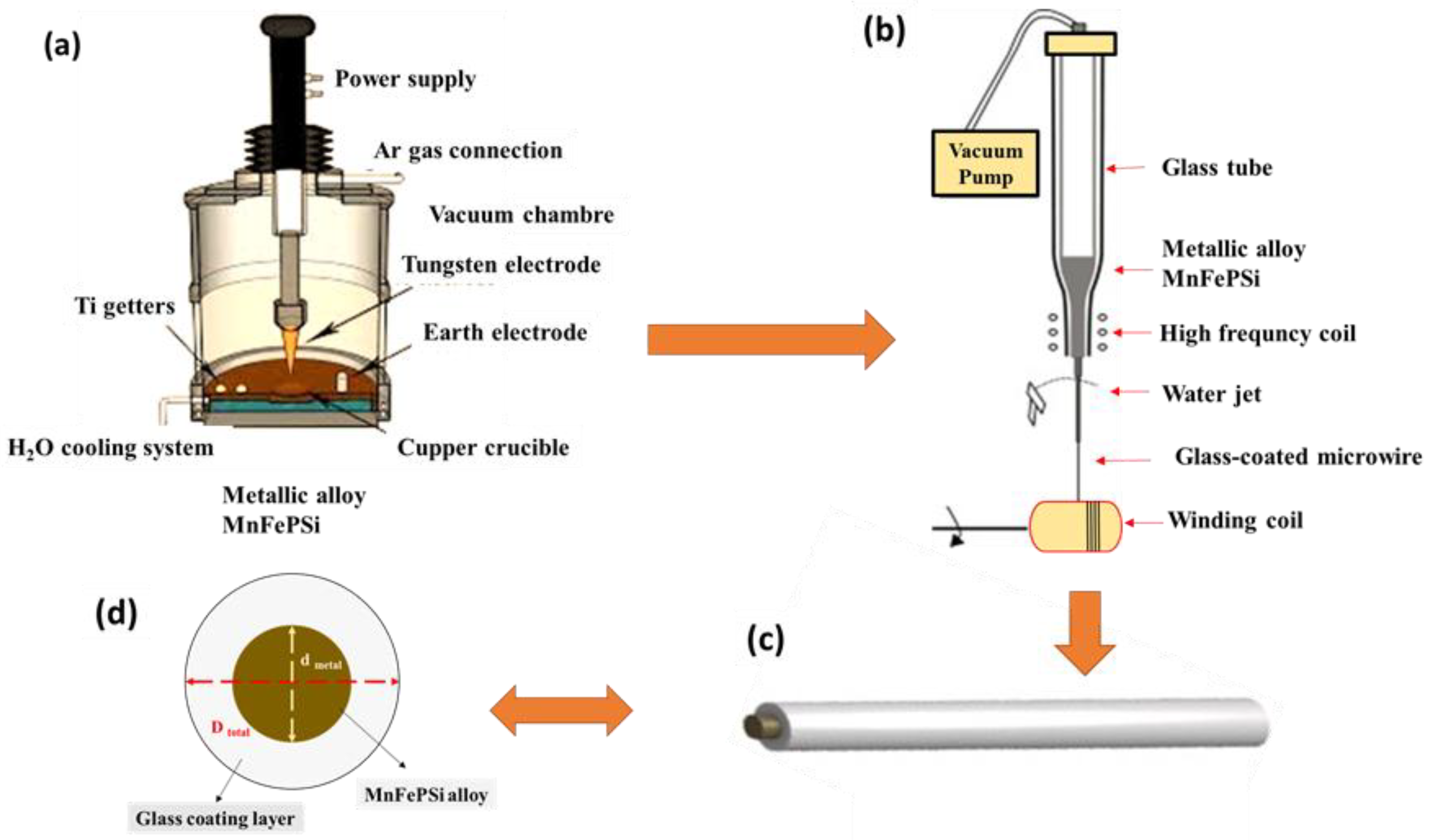
Figure 2.
Room temperature X-ray diffraction profile of as prepared and different temperature annealed 973 K, 1073 K and 1123 K for 1h of MnFePSi glass-coated microwires.
Figure 2.
Room temperature X-ray diffraction profile of as prepared and different temperature annealed 973 K, 1073 K and 1123 K for 1h of MnFePSi glass-coated microwires.
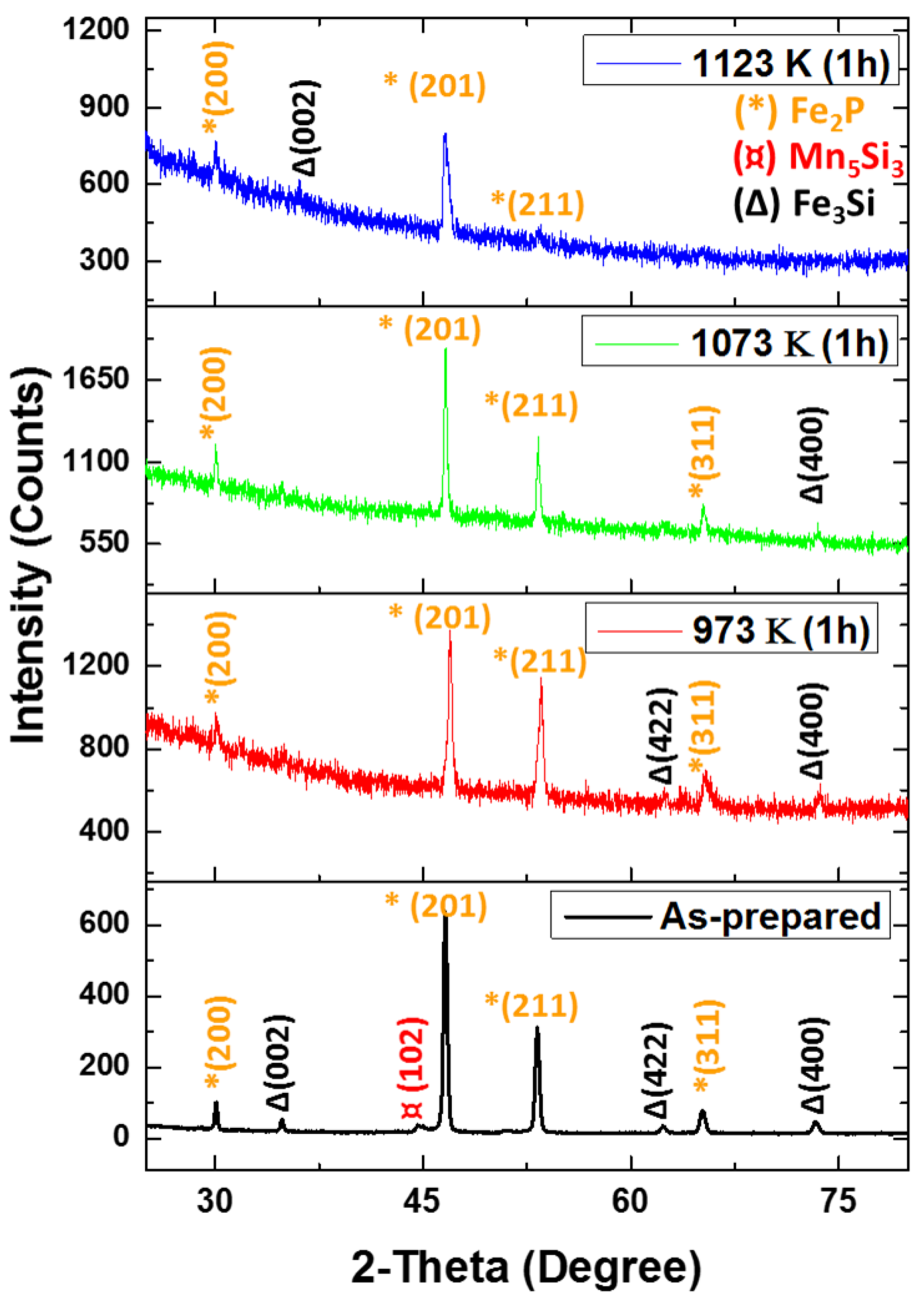
Figure 3.
The in-plane hysteresis loops of as-prepared and annealed at 973 K, 1073 K and 1123 K for 1h of Mn-Fe-P-Si glass-coated microwires measured at 5K (a) full measuring scale and (b) low scale.
Figure 3.
The in-plane hysteresis loops of as-prepared and annealed at 973 K, 1073 K and 1123 K for 1h of Mn-Fe-P-Si glass-coated microwires measured at 5K (a) full measuring scale and (b) low scale.
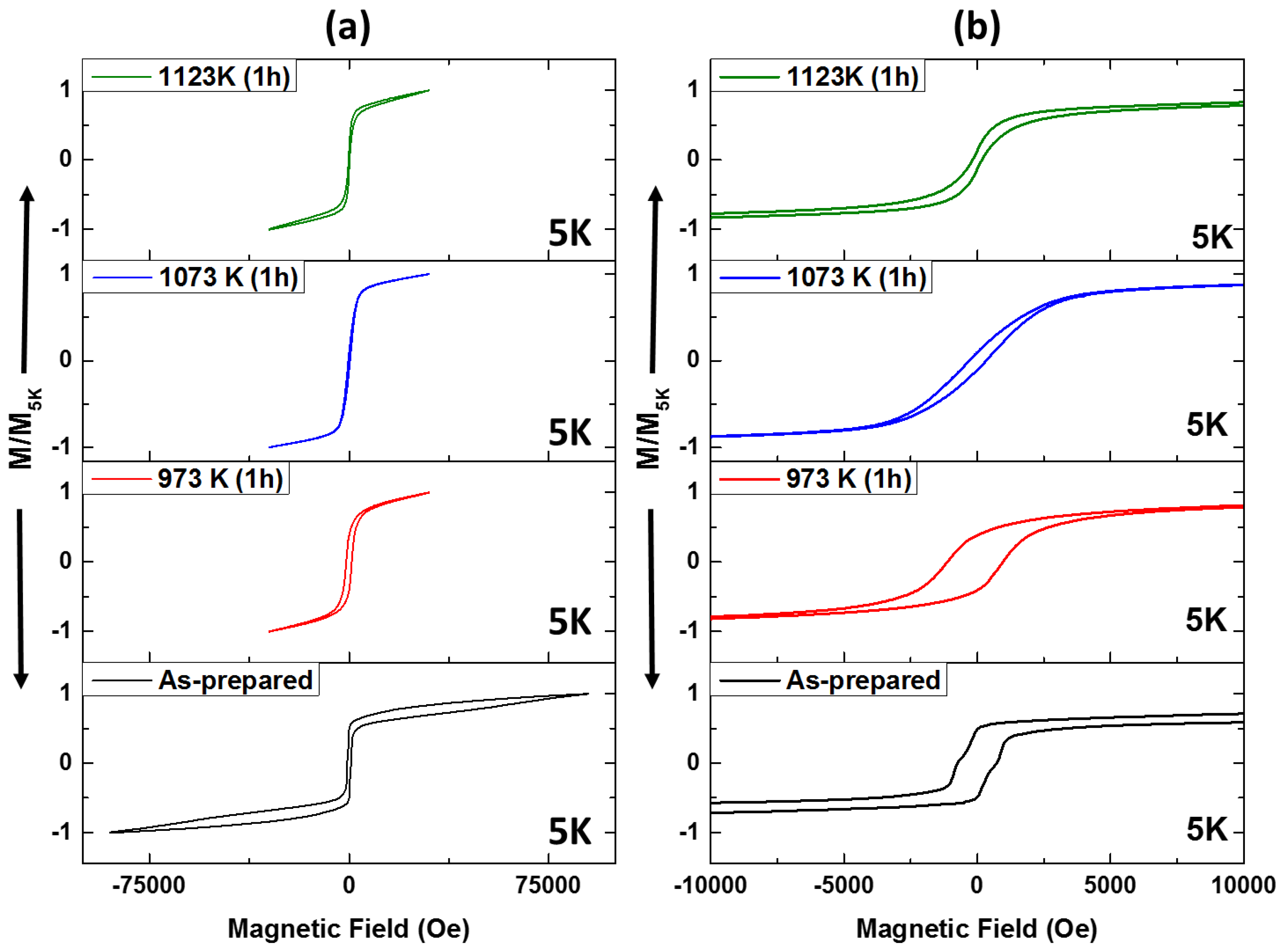
Figure 4.
The in-plane hysteresis loops of as-prepared and annealed at 973 K, 1073 K and 1123 K for (1h) of Mn-Fe-P-Si glass-coated microwires measured at 300K (a) full measuring scale and (b) low-field region.
Figure 4.
The in-plane hysteresis loops of as-prepared and annealed at 973 K, 1073 K and 1123 K for (1h) of Mn-Fe-P-Si glass-coated microwires measured at 300K (a) full measuring scale and (b) low-field region.
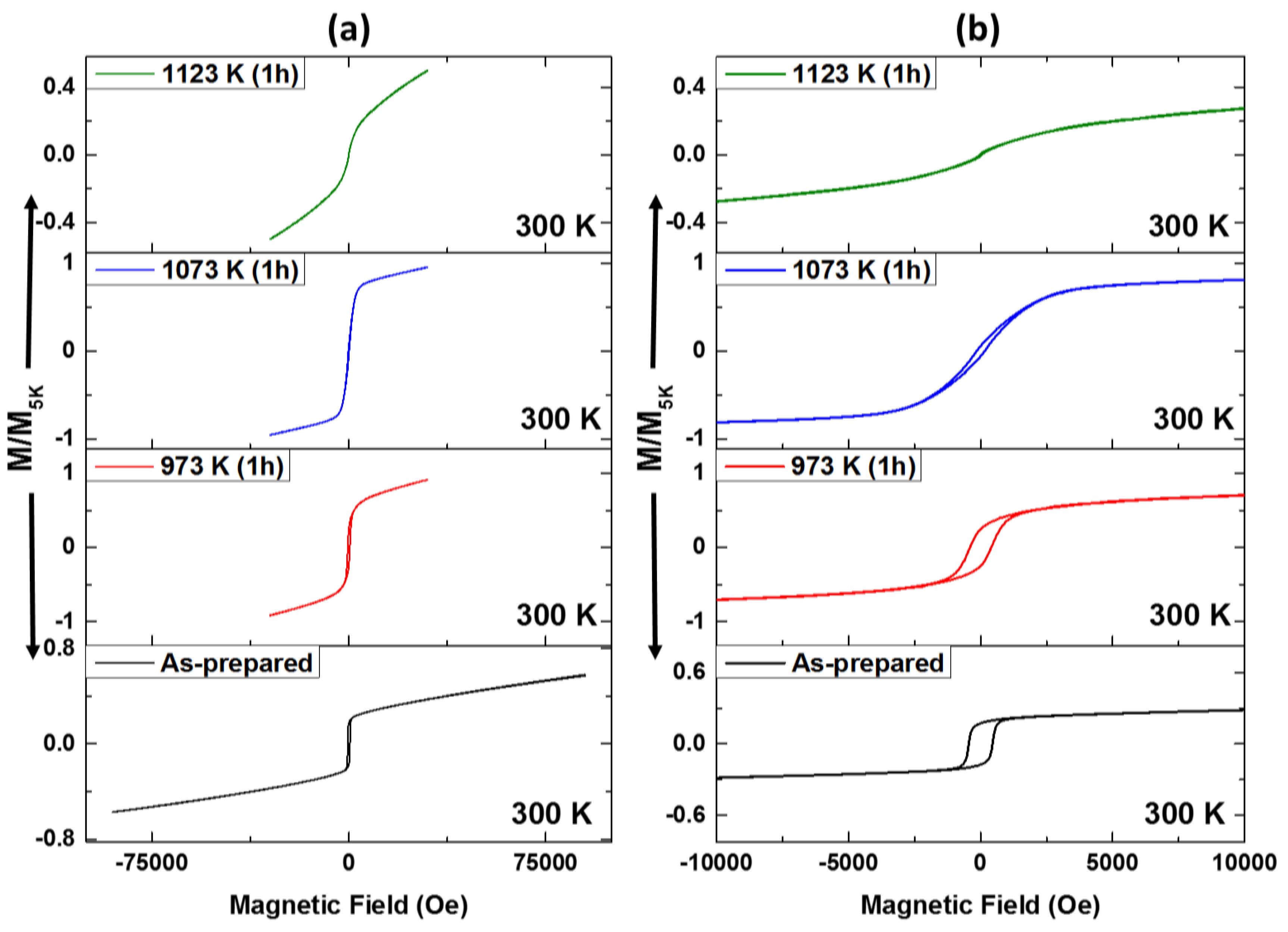
Figure 5.
Temperature dependence of coercivity, Hc, in Mn-Fe-P-Si-based glass-coated microwire, (a) as-prepared, (b) annealed at 973 K for 1h, (c) annealed at 1073 K for (1h) and 1123 K for (1h).
Figure 5.
Temperature dependence of coercivity, Hc, in Mn-Fe-P-Si-based glass-coated microwire, (a) as-prepared, (b) annealed at 973 K for 1h, (c) annealed at 1073 K for (1h) and 1123 K for (1h).
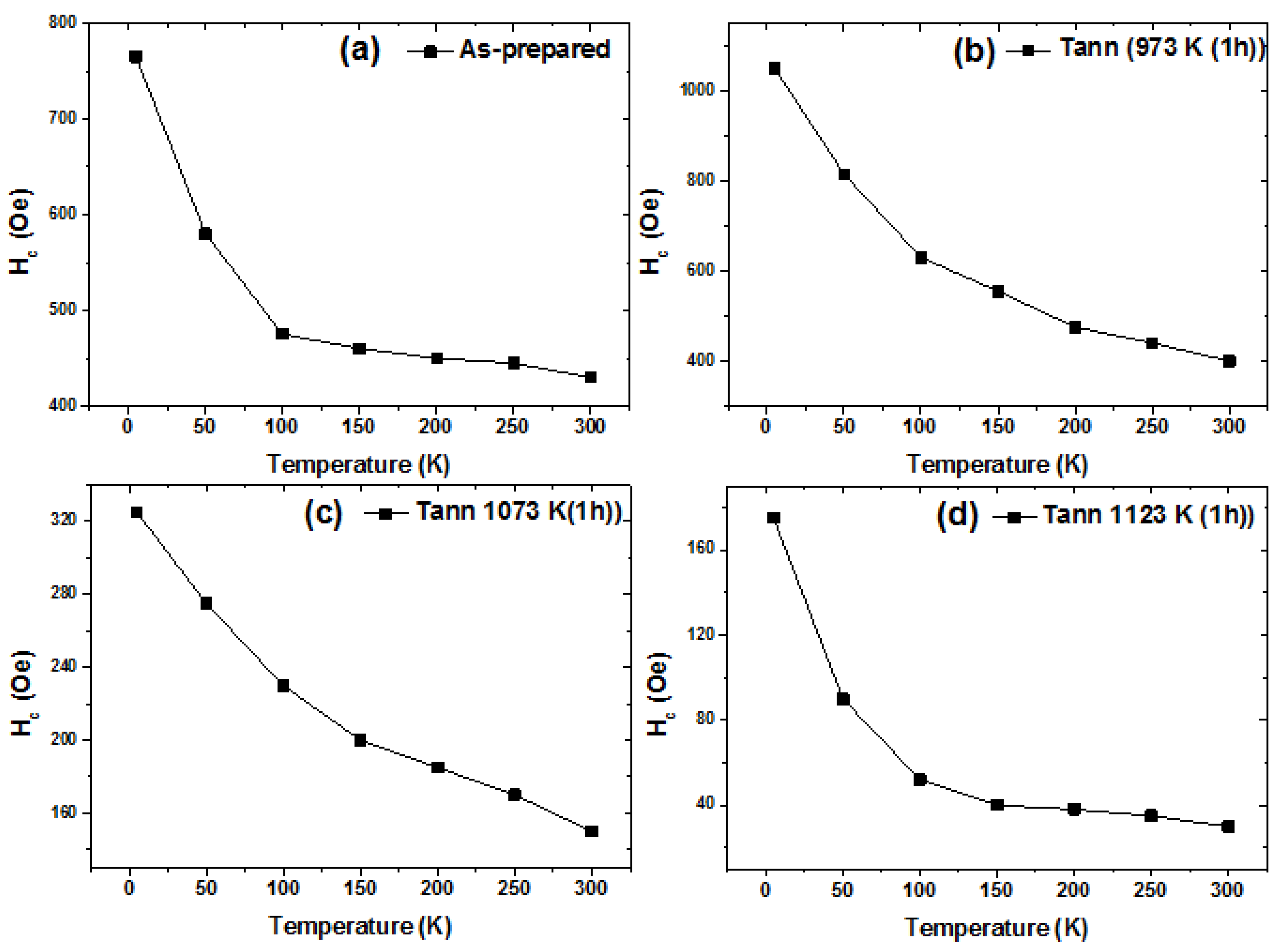
Figure 6.
FC and FH temperature dependence of as-prepared (a) and different temperature annealed (b) 973 K (1h) , (c) 1073 K (1h) and (d) 1123 K (1h) pf Mn-Fe-P-Si-based glass-coated microwire measured at magnetic field (H = 1 kOe).
Figure 6.
FC and FH temperature dependence of as-prepared (a) and different temperature annealed (b) 973 K (1h) , (c) 1073 K (1h) and (d) 1123 K (1h) pf Mn-Fe-P-Si-based glass-coated microwire measured at magnetic field (H = 1 kOe).
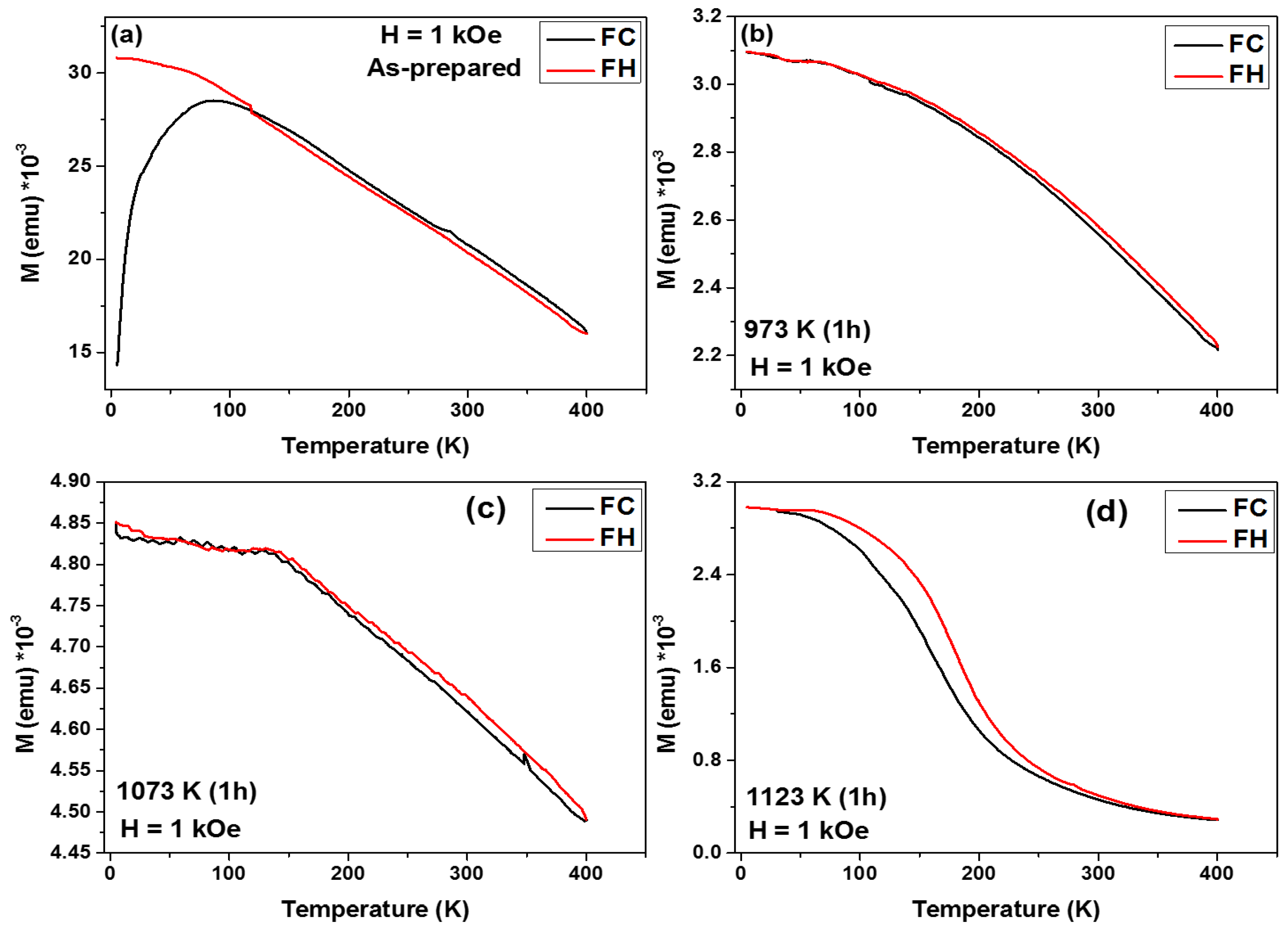
Figure 7.
FC and FH temperature dependence of as-prepared (a) and different temperature annealed (b) 973 K (1h) , (c) 1073 K (1h) and (d) 1123 K (1h) of Mn-Fe-P-Si -based glass-coated microwire measured at magnetic field (H = 5 kOe).
Figure 7.
FC and FH temperature dependence of as-prepared (a) and different temperature annealed (b) 973 K (1h) , (c) 1073 K (1h) and (d) 1123 K (1h) of Mn-Fe-P-Si -based glass-coated microwire measured at magnetic field (H = 5 kOe).
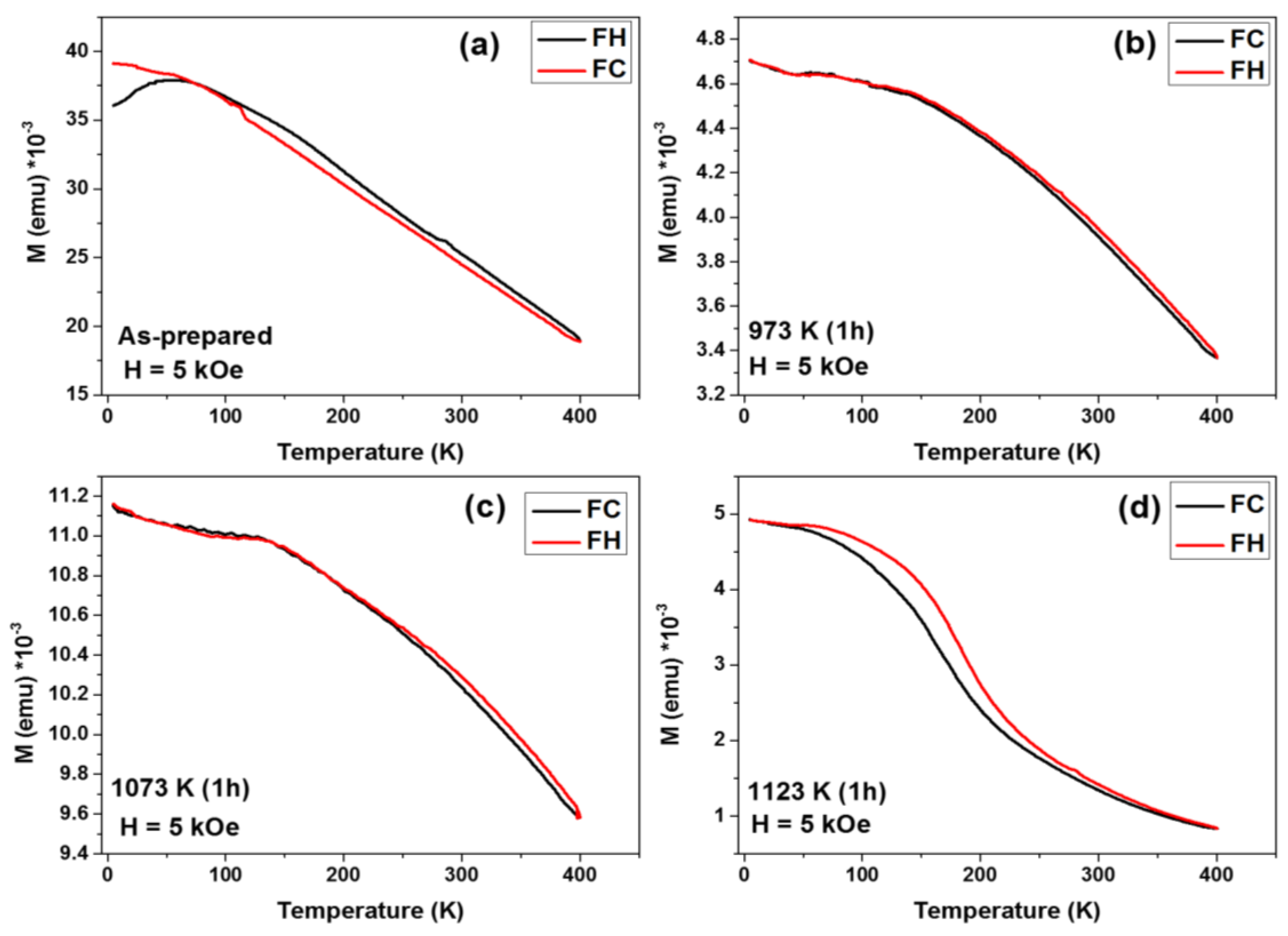

Table 1.
Chemical composition, lattice constant and the average grain size of as-prepared and different temperature annealing of Mn-Fe-P-Si-based glass-coated microwires.
Table 1.
Chemical composition, lattice constant and the average grain size of as-prepared and different temperature annealing of Mn-Fe-P-Si-based glass-coated microwires.
| Samples | Chemical composition | Lattice constant (a) nm | Dg (nm) |
| As-prepared | Mn₄₀Fe₃₀P₁₅Si₁₅ | 0.58 | 36 |
| 973 K (1h) | Mn₄₀Fe₃₀P₁₅Si₁₅ | 0.54 | 136 |
| 1073 K (1h) | Mn₄₀Fe₃₀P₁₅Si₁₅ | 0.60 | 141 |
| 1123 K (1h) | Mn₄₀Fe₃₀P₁₅Si₁₅ | 0.61 | 148 |
Disclaimer/Publisher’s Note: The statements, opinions and data contained in all publications are solely those of the individual author(s) and contributor(s) and not of MDPI and/or the editor(s). MDPI and/or the editor(s) disclaim responsibility for any injury to people or property resulting from any ideas, methods, instructions or products referred to in the content. |
© 2025 by the authors. Licensee MDPI, Basel, Switzerland. This article is an open access article distributed under the terms and conditions of the Creative Commons Attribution (CC BY) license (http://creativecommons.org/licenses/by/4.0/).
Copyright: This open access article is published under a Creative Commons CC BY 4.0 license, which permit the free download, distribution, and reuse, provided that the author and preprint are cited in any reuse.


