

Submitted:
01 March 2025
Posted:
03 March 2025
You are already at the latest version
Abstract
The rapid expansion of advanced technologies, including renewable energy systems, electric vehicles, and digital infrastructure, has significantly increased global demand for critical and precious minerals. This surge in demand has exacerbated resource scarcity, heightened geopolitical supply chain vulnerabilities, and intensified environmental concerns associated with traditional mining practices. As natural reserves continue to deplete, electronic waste (e-waste) has emerged as a promising secondary source for these valuable materials, offering a sustainable alternative that aligns with circular economy principles.
This paper provides an in-depth analysis of the opportunities and challenges associated with critical and precious mineral recovery from e-waste. It examines the latest advancements in recycling technologies, including hydrometallurgical, bio-metallurgical, and pyrometallurgical processes, which have demonstrated considerable potential in improving metal extraction efficiencies. The economic implications of e-waste recycling are also explored, highlighting cost-benefit analyses, market dynamics, and the financial viability of integrating recovered materials into industrial supply chains. Furthermore, the study evaluates existing policy frameworks and regulatory approaches governing e-waste management, emphasizing the role of international cooperation, extended producer responsibility (EPR) programs, and government incentives in fostering a sustainable recycling ecosystem.
To bridge existing gaps in e-waste management, this paper proposes strategic interventions aimed at optimizing recycling systems and establishing a resilient supply chain for essential raw materials. Key recommendations include the development of standardized recycling protocols, investment in cutting-edge material separation technologies, and the implementation of economic incentives to promote industry participation. By addressing technological, economic, and regulatory challenges, this study contributes to the broader discourse on sustainable resource management and the transition toward a more circular and resilient economy.
Keywords:
E-waste recycling
; critical minerals
; precious metals
; circular economy
; sustainability
; resource recovery
1. Introduction
The global demand for critical and precious minerals has surged in recent decades, driven by rapid industrialization, advancements in digital technologies, and the expansion of renewable energy infrastructure. However, the depletion of natural reserves of these essential materials poses a significant challenge to long-term resource sustainability. Figure 1 (data from Murthy and Ramakrishna, 2022) illustrates the available natural reserves, annual consumption rates, and projected depletion timelines for key metals such as gold, silver, platinum, and copper. The finite nature of these resources necessitates a paradigm shift towards alternative supply strategies to mitigate supply chain vulnerabilities and environmental degradation associated with primary mining operations.
One promising solution is the recovery of critical and precious minerals from electronic waste (e-waste), a concept aligned with the principles of the circular economy. E-waste contains a rich concentration of valuable metals, making it a viable secondary source that reduces reliance on virgin mineral extraction. The sustainable management of e-waste through enhanced recycling and resource recovery can contribute significantly to mitigating environmental impacts while ensuring long-term material availability (UNEMG, 2019; Elgarahy et al., 2024). Recent advancements in urban mining technologies, particularly in hydrometallurgical and bio-metallurgical recovery processes, have demonstrated substantial potential for extracting valuable metals from discarded electronic devices, reinforcing the viability of e-waste as a key component of sustainable resource management (Forti et al., 2020).
The environmental ramifications of primary mineral extraction, including habitat destruction, soil contamination, and greenhouse gas emissions, have intensified the need for alternative resource pathways (Paleologos et al., 2024; Mohamed et al., 2025). In this context, e-waste recycling has emerged as a sustainable and economically viable alternative, reducing environmental degradation while enhancing resource security and economic resilience (Kanwal et al., 2021; Filho et al., 2023; Mohamed, 2024b). E-waste recovery aligns with international sustainability goals by reducing landfill waste, conserving natural resources, and minimizing carbon footprints associated with traditional mining practices (Kaya, 2016; Jadhao et al., 2022; Mohamed, 2024a; Serpe et al., 2024).
Transitioning to a circular economy model requires an integrated approach that emphasizes material recovery, regulatory frameworks, technological innovations, and economic incentives (Mohamed, 2024a; Serpe et al., 2024). The rapid expansion of digital technologies and electronic consumption has led to an unprecedented surge in e-waste generation (Directive 2012/19/EU; Althaf et al., 2021; IEA, 2022). Between 2011 and 2023, global e-waste production increased from 35.8 million metric tons (Mt) to 61.3 Mt, with projections estimating it will reach 74.7 Mt by 2030 (Forti et al., 2020). This trend underscores the urgent need for enhanced recycling efforts, as current global recycling rates remain alarmingly low. In 2019, only 9.3 Mt of the 53.6 Mt of generated e-waste was recycled, representing just 17.4% of the total volume, highlighting a significant gap between waste generation and material recovery efforts.
This paper provides a comprehensive analysis of e-waste as a secondary source of critical minerals, examining the environmental, economic, and technological aspects of e-waste recovery. It explores the benefits and challenges associated with transitioning to a circular economy and investigates innovative strategies for improving material recovery and sustainability. By addressing current inefficiencies in e-waste recycling systems and proposing pathways for sustainable resource management, this study aims to contribute to the broader discourse on enhancing sustainability and circular economy principles in mineral resource utilization.
2. Methodology and Data Analysis
To analyze previously published cases, a comprehensive methodology was employed. The process began with an extensive search using scholarly search engines like Google Scholar, where relevant keywords were entered to retrieve a wide range of academic articles. These articles covered topics such as critical minerals, e-waste recovery methods, advancements in recycling technologies—including hydrometallurgical, bio-metallurgical, and pyrometallurgical processes—economic aspects of e-waste recycling, regulatory frameworks, international collaborations, manufacturers, suppliers and consumer engagement, and the role of digital technologies in e-waste management. After identifying the most relevant studies, their key findings were examined in detail. When necessary, references and cited sources were reviewed to gain further insights into the subject matter.
Following the assessment of scholarly literature, additional searches using non-scholarly search engines were conducted to supplement the gathered information. This step provided further context on material applications and industry developments.
For data analysis, a grounded theory approach was adopted due to its flexibility and iterative nature. The process involved systematically gathering data through online searches, using targeted keywords to refine results, and reviewing abstracts to determine relevance. A thorough analysis of full-length papers was then conducted to identify emerging patterns, points of agreement and disagreement, and key arguments made by authors. Finally, central themes and relationships were clustered to develop a comprehensive understanding of trends in the research data. This iterative approach ensured a nuanced and well-rounded analysis.
3. The Significance of Critical and Precious Minerals
3.1. Definition and Importance
Critical minerals, including lithium, cobalt, and rare earth elements (REEs), are vital for renewable energy, electronics, and defense sectors. Precious metals like gold, silver, and platinum are essential for electronic devices and high-performance applications such as batteries and semiconductors (IEA, 2022; Müller et al., 2025). The term "critical metals" refers to those essential for clean energy technologies, including wind and geothermal turbines (Archer, 2020), solar panels, electric vehicles (Zhang and Kong, 2022), and hydrogen production for energy storage (Gielen et al., 2023). Their criticality is determined by three factors: natural scarcity, supply chain risks, and economic and environmental feasibility of extraction (Table 1) (Müller et al., 2025). Global demand for critical metals has surged over the past decade due to population growth and their role in green energy technologies (European Commission, 2023; Fan et al., 2023; U.S. Geological Survey, 2023; Pandey et al., 2024). In 2023, clean energy applications drove strong demand increases, with lithium consumption rising by 30% and other key minerals like nickel, cobalt, graphite, and REEs growing by 8%–15% (IEA, 2022).
3.2. Geopolitical and Economic Implications
The supply chains of critical minerals are highly concentrated in a few regions, leading to geopolitical vulnerabilities and market volatility (Table 1) (Müller et al., 2025). China, for instance, dominates the production and processing of rare earth elements, while cobalt mining is largely controlled by operations in the Democratic Republic of Congo. This dependence on a limited number of suppliers poses a significant risk to technological and economic stability.
3.3. Environmental and Social Impact of Traditional Mining
The extraction of critical and precious minerals from primary sources involves extensive land use, high energy consumption, and pollution (Pan et al., 2022; Mohamed et al., 2025). Mining operations can lead to deforestation, soil degradation, and water contamination, often impacting vulnerable communities. The push for sustainable sourcing emphasizes the need to recover these materials from secondary sources such as e-waste to reduce environmental harm and promote ethical supply chains.
3.4. Growing Demand and Resource Depletion
The accelerating demand for electronics, electric vehicles, and renewable energy technologies has increased the consumption of critical minerals. However, many of these resources are finite, and their depletion raises concerns about long-term availability (Müller et al., 2024). E-waste recycling offers a means to supplement supply, ensuring the continued development of advanced technologies without exacerbating raw material scarcity (Nanjo, 1987; Nakamura and Halada, 2015).
4. E-Waste as a Sustainable Resource
4.1. Composition and Availability
E-waste contains a diverse array of valuable minerals, including copper, gold, silver, platinum, lithium, and rare earth elements (Fornalczyk et al., 2013). Figure 2 (data from Baldé et al., 2024) provides a comprehensive overview of the distribution of metals in e-waste in 2022, categorized into total metals, other metals, and precious metals.
These data highlight the quantities of various metals present in discarded electronics and their respective recycling rates, revealing significant disparities in recovery efficiency across different categories. Figure 2a illustrates the presence of total metals in e-waste, measured in billion kilograms (Kg). Iron (Fe) is the most abundant, accounting for 24 billion Kg, followed by aluminum (Al) at 4 billion Kg and copper (Cu) at 2 billion Kg. Smaller quantities of nickel (Ni) (0.52 billion Kg) and other metals (0.46 billion Kg) are also present. These metals constitute the largest fraction of e-waste materials, and their relatively high recycling rate of 60% suggests the existence of well-established recovery processes, particularly for iron and aluminum, which are widely used in infrastructure and electronics manufacturing.
Figure 2b highlights the presence of other metals (0.46 billion Kg) in e-waste, measured in million kilograms (Kg). Among them, zinc (Zn) is the most prevalent at 280 million Kg, followed by lead (Pb) (70 million Kg), tin (Sn) (44 million Kg), cobalt (Co) (34 million Kg), and antimony (Sb) (28 million Kg). These metals are critical for various industrial applications, including batteries, soldering, and electronic components. However, their recycling rate is alarmingly low at just 4%, indicating significant inefficiencies in current recovery technologies. This low rate can be attributed to the dispersed nature of these metals in complex electronic waste streams, making extraction challenging and often economically unviable.
Figure 2c presents data on the presence of precious metals (2 million Kg) in e-waste, measured in thousand kilograms (Kg). Silver (Ag) leads at 1,200 thousand Kg, followed by gold (Au) at 270 thousand Kg and palladium (Pd) at 120 thousand Kg. Additionally, smaller quantities of osmium (Os) (12 thousand Kg) and platinum group metals such as praseodymium (Pr), iridium (Ir), rhodium (Rh), and ruthenium (Ru) (9 thousand Kg) are also present. Despite their relatively small quantities compared to bulk metals, these elements hold significant economic value. The recycling rate for precious metals stands at 20%, reflecting a moderate recovery level. Specialized hydrometallurgical and pyrometallurgical techniques enable the extraction of gold, silver, and palladium, yet substantial losses still occur, emphasizing the need for enhanced e-waste recovery infrastructure.
Overall, Figure 2 underscores the urgent need to improve e-waste recycling technologies and policies. While total metals enjoy a relatively high recovery rate, other metals remain vastly underutilized, and even precious metals—despite their value—are not being recycled at optimal levels. Developing advanced extraction methods, strengthening regulatory frameworks, and creating economic incentives for e-waste recycling are critical steps toward enhancing resource sustainability and minimizing environmental impacts.
4.2. Environmental Benefits
Recycling e-waste reduces reliance on traditional mining, which is linked to extensive environmental degradation, greenhouse gas emissions, and habitat destruction (Rawat et al., 2020; Mohamed et al., 2025). Improper e-waste management results in the annual release of approximately 58 thousand kg of mercury and 45 million kg of plastics containing brominated flame retardants into the environment (Baldé et al., 2024). Effective e-waste management mitigates landfill accumulation, prevents hazardous substances from contaminating soil and water, and conserves natural resources (Ahirwar and Tripathi, 2021). Furthermore, the recovery of secondary raw materials through e-waste recycling has prevented the extraction of 900 billion kg of ore and avoided 52 billion kg of CO₂-equivalent emissions (Baldé et al., 2024). Additionally, metal recovery from e-waste generally requires less energy than primary ore extraction, contributing to a reduced carbon footprint.
4.3. Economic Viability
The estimated potential value of secondary raw materials in e-waste highlights the economic significance of metal recovery from discarded electronics. In 2022, the overall gross value of the metals contained in e-waste was estimated at USD 91 billion (Figure 3; data from Baldé et al., 2024). Among these, copper (Cu) holds the highest value at $19 billion, reflecting its essential role in wiring and circuit boards. Following closely, iron (Fe) and gold (Au) are valued at $16 billion and $15 billion, respectively. While iron is widely used in structural components, gold's high value stems from its role in high-performance electronic circuits. Nickel (Ni) and aluminum (Al) also contribute significantly to the overall value, with estimated recoverable amounts worth $14 billion and $11 billion, respectively. Nickel is commonly found in batteries and specialized alloys, while aluminum is used in casings and heat dissipation components. Additionally, palladium (Pd), a crucial element in electronic connectors and catalytic applications, holds a potential value of $8 billion.
Other metals, including cobalt (Co), tin (Sn), and silver (Ag), represent lower but still notable values at $2.3 billion, $1.4 billion, and $0.9 billion, respectively. Cobalt is primarily used in lithium-ion batteries, tin in soldering applications, and silver in high-conductivity components. Overall, this data underscores the immense economic opportunity in e-waste recycling. Recovering these valuable metals not only supports material sustainability but also plays a crucial role in advancing the circular economy by reducing reliance on virgin resources and minimizing environmental impact.
E-waste recycling creates economic opportunities by generating jobs in collection, processing, and advanced material recovery (Cucchiella et al., 2015). As demand for critical and precious minerals rises, urban mining from e-waste can provide a cost-effective alternative to raw material extraction, especially in regions lacking natural mineral deposits. With advances in refining techniques and economies of scale, the profitability of e-waste recovery is expected to improve, fostering long-term sustainability in the electronics sector.
4.4. Scalability and Potential for Circular Economy Integration
Despite the potential of scaling technologies such as additive manufacturing to minimize waste and enhance sustainability, significant challenges remain in their widespread adoption within a circular economy framework (Praveena et al., 2022; Al Rashid and Koç, 2023; Valera et al., 2023). A key barrier to the full deployment of these technologies in waste management is the integration of Industry 4.0 solutions with circular economy principles (Kamble and Gunasekaran, 2023; Karmaker et al., 2023).
The transition to a circular economy in e-waste recycling necessitates the design of electronic products with recyclability in mind, the establishment of robust collection networks, and the implementation of efficient material recovery processes (Mohamed, 2024a; Elgarahy et al., 2024; Serpe et al., 2024). By fostering collaboration among manufacturers, policymakers, and recyclers, scalable and sustainable e-waste management systems can be developed. A closed-loop approach that continuously recovers and reuses materials will not only reduce dependence on virgin resources but also enhance both economic and environmental sustainability.
5. Technologies for Mineral Recovery from E-Waste
Recovering valuable minerals from electronic waste (e-waste) is crucial for resource efficiency, sustainability, and reducing environmental impact. Several technologies are used for mineral recovery, each with distinct mechanisms and advantages (Cui and Zhang, 2008; Abdul et al., 2014; Khaliq et al., 2014; Shokri et al., 2017; Chauhan et al., 2018; Rene et al., 2021; Jadhao et al., 2022; Palanisamy et al., 2022; . Ramprasad et al., 2022; Battelle, 2023; Shahabuddin et al., 2023; Mohamed 2024a, M2024b). The primary methods include physical and mechanical separation, hydrometallurgical processes, pyrometallurgical processes, bio-metallurgy, and electrochemical processes.
5.1. Physical and Mechanical Separation
Physical and mechanical separation processes are the first step in e-waste recycling, aiming to extract valuable materials based on their physical properties without chemical modification (Mohamed 2024a, 2024b). These methods include shredding and crushing to break down e-waste into smaller pieces, followed by magnetic separation to remove ferromagnetic materials like iron, nickel, and cobalt. Eddy current separation is employed to recover non-ferrous metals such as copper and aluminum, while density separation (gravity and air classification) separates plastics, glass, and metals based on their weight differences. Additionally, electrostatic separation leverages variations in electrical conductivity to separate conductive metals from non-conductive materials. While these techniques are cost-effective and environmentally friendly, they are not efficient for recovering fine or mixed metal particles and cannot extract metals from complex compounds. These processes are shown in Table 2 with specific example for IT and telecommunication equipment. A typical physical–mechanical treatment plant for IT and telecommunication equipment follows a sequential process. Upon arrival, materials are sorted and cleaned by removing hazardous substances (e.g., ink cartridges, mercury-containing switches, and various batteries) and recovering valuable components like hard drives and PCBs. An initial mechanical treatment breaks casings to expose internal parts, followed by manual selection of valuable and hazardous components. The remaining material is shredded and undergoes a second manual sorting cycle before further shredding reduces it to a few centimeters. Finally, the shredded material is processed through eddy currents to extract non-ferrous metals, while magnetic separation isolates ferrous metals.
5.2. Pyrometallurgical Processes
Pyrometallurgy employs high-temperature treatments to extract and refine metals from e-waste (Zhang and Xu, 2016; Zhan et al., 2018; Faraji et al., 2022; Huang et al., 2022). The most common method is smelting, where e-waste is melted in furnaces to separate metals based on their densities. Roasting is another technique that converts metal compounds into oxides or sulfides for further refining. In more advanced applications, plasma arc furnaces use high-energy plasma to extract metals, while volatilization allows for the recovery of certain metals like mercury and zinc through controlled evaporation. Table 3 lists the various pyrometallurgical processes.
Pyrometallurgical methods, such as smelting and roasting, provide high recovery efficiency and fast processing by using high temperatures to extract metals from e-waste (Faraji et al., 2022). For example, copper smelting in a blast furnace effectively recovers copper, gold, and silver from printed circuit boards. Similarly, lead smelting extracts lead from batteries, while plasma arc furnaces refine precious metals from e-waste. However, these methods demand substantial energy, as furnaces must maintain temperatures exceeding 1,200°C. Additionally, they release air pollutants like dioxins, furans, and heavy metal vapors, requiring advanced filtration systems such as baghouse filters, electrostatic precipitators, and wet scrubbers to minimize environmental impact.
Pre-treatment is crucial to remove plastics and hazardous substances that could release toxic emissions during processing. For instance, printed circuit boards (PCBs) contain brominated flame retardants, which, when burned, generate harmful dioxins. Removing these plastics beforehand reduces the formation of hazardous compounds and improves metal recovery efficiency. Similarly, mercury switches and cadmium-containing components must be extracted to prevent toxic gas emissions during high-temperature processing. Thus, while pyrometallurgical techniques offer efficient metal recovery, they necessitate careful pre-processing and emission control measures to mitigate environmental and health risks.
5.3. Hydrometallurgical Processes
Hydrometallurgical methods involve using aqueous solutions to dissolve and extract metals from e-waste (Tasker et al., 2004; Akcil et al., 2015; Tunsu et al., 2015; Xiu et al., 2016; Tatariants et al., 2018; Veglio and Birloaga, 2018; Yousef et al., 2018; Chen et al., 2022; Mohamed, 2024b; Nan et al., 2024). The process (Table 4) typically begins with leaching, where chemicals such as sulfuric acid (H₂SO₄), nitric acid (HNO₃), or cyanide dissolve specific metals. Ammonia leaching is sometimes used for selective recovery of copper and nickel. Once the metals are in solution, solvent extraction (SX) employs organic solvents to selectively recover valuable metals, while ion exchange uses resins to capture specific metal ions. Finally, metals are recovered through precipitation, where reagents like sodium hydroxide help extract metals by adjusting the pH. Hydrometallurgy is an energy-efficient and highly selective method for recovering metals like gold, silver, and copper. While it produces lower emissions than pyrometallurgy, it relies on hazardous chemicals and requires extensive wastewater treatment. Effective reagent selection and proper waste management are crucial to minimizing environmental impact and operational costs.
5.4. Bio-Metallurgy
Biological methods, collectively known as bio-metallurgy, use microbes or plants to extract metals from e-waste in an eco-friendly manner (Pant et al., 2012; Villares et al., 2016; Brown et al., 2023). One of the most promising techniques is bioleaching, which utilizes bacteria such as Acidithiobacillus ferrooxidans and fungi to break down e-waste and dissolve valuable metals (Ji et al., 2022; Mokarian et al., 2022; Yaashikaa et al., 2022). For example, Nithya et al. (2021) used Pseudomonas balearica SAE1 to extract gold and silver and achieved a recovery rate of 68.5 %, and 33.8 %, respectively. Another approach, phyto-mining, involves using plants to absorb and accumulate metals from shredded e-waste (Chatterjee et al., 2020; Kafle et al., 2022). These processes are environmentally sustainable and have low energy consumption compared to traditional metallurgical techniques. However, bio-metallurgy is slow and requires specific conditions for microbial activity, making it less viable for large-scale industrial applications. Despite these challenges, ongoing research aims to optimize microbial efficiency and improve scalability.
5.5. Electrochemical Processes
Electrochemical methods recover metals through redox reactions driven by electric currents. One widely used technique is electrowinning, which extracts metals such as gold, silver, and copper by reducing metal ions from solution onto an electrode (Xiu et al., 2009; Murali et al., 2022). For instance, Murali et al. (2022) successfully recovered copper from e-waste through a bioleaching process followed by solvent extraction (SX) and electrowinning (EW). After copper recovery, precious metals (Au and Ag) were extracted using a thiosulfate process, followed by resin adsorption, stripping, and either electrowinning or cementation. Under optimized conditions, more than 94% of copper and less than 10% of iron were transferred from the e-waste leach solution during the loading phase, with a 92% stripping efficiency from the loaded organic phase. Electrowinning of the stripped solution produced electrodeposits with 99% purity and a current efficiency of 94.5%. Optimal conditions for achieving approximately 87% gold leaching recovery included 111 mM thiosulfate, 30.0 mM copper (II), and 0.32 M ammonia. The electrowinning tests further demonstrated that the gold fraction reached 81% when applying an electrode potential of -600 mV Ag/AgCl.
Electrorefining is another electrochemical process that purifies metals by dissolving impure metal at the anode and depositing pure metal at the cathode. For example, Mahyapour and Mohammadnejad (2022) reported that using an anode composition of 75% gold, an electrolyte with an ionic concentration of 2 M, a process temperature of 25°C, and a specific cathode current of 0.02 A/cm², resulted in the production of cathode gold with a purity of 95.3% when the electrolyte gold concentration was below 1 g/L. Additionally, Italimpianti refining plants in Italy can produce gold with a purity of 999.9/1000 from an initial composition of 900/1000, with a maximum silver content of 3% and total platinum group metals (PGM) of 0.1% (Italimpianti, n.d.).
Another electrochemical approach, electrocoagulation, utilizes an electric current to aggregate fine metal particles, enhancing their recovery (Jo et al., 2024; Al-Ajmi et al., 2025). These electrochemical processes offer high-purity metal recovery while generating minimal chemical waste, making them attractive for sustainable e-waste recycling. However, they require significant electricity input and are generally slower than pyrometallurgical methods. Their effectiveness is maximized when integrated with hydrometallurgical techniques, improving overall recovery efficiency.
A summary of the pros and cons of each mineral recovery technology from e-waste, described above, is shown in Table 5.
A detailed comparison of the five technologies for mineral recovery from e-waste, focusing on their effectiveness in recovering specific materials is shown in Table 6.
The recovery of metals from e-waste is essential for minimizing environmental impact and promoting the recycling of valuable resources. Different metals require different recovery methods, each with varying levels of efficiency and effectiveness.
- Gold (Au) and Silver (Ag): Gold and silver are among the most valuable metals found in electronic waste. They are best recovered through hydrometallurgical and pyrometallurgical methods, both of which are highly effective in extracting these precious metals. Additionally, electrochemical processes can also be used to recover gold and silver with high purity, ensuring that these valuable materials are efficiently separated and refined.
- Copper (Cu): Copper is commonly found in e-waste, particularly in circuit boards and wiring. It can be efficiently extracted using hydrometallurgy, pyrometallurgy, and electrochemical methods. These processes ensure high recovery rates of copper, which is a key material in electronics due to its excellent conductivity and recyclability.
- Rare Earth Elements (REEs): The recovery of rare earth elements (REEs), such as neodymium and dysprosium, is a more challenging task, as traditional recovery methods often struggle to extract these elements efficiently. While bio-metallurgy (using microorganisms to extract metals) shows promise for REE recovery, it requires further research and optimization to enhance its effectiveness and scalability.
- Platinum Group Metals (PGMs): Platinum group metals, including platinum, palladium, and rhodium, are highly valuable but are typically found in smaller quantities in e-waste. The most effective recovery methods for PGMs are hydrometallurgy and pyrometallurgy, which allow for the extraction of these metals with high efficiency.
- Ferrous Metals (Fe, Ni, Co): Ferrous metals, such as iron (Fe), nickel (Ni), and cobalt (Co), are best recovered using physical separation methods, such as magnetic separation, or through pyrometallurgical techniques. These methods effectively separate ferrous metals from other materials, ensuring that they can be recycled and reused.
Aluminum (Al): Aluminum is widely used in electronics, particularly in housings and casings. The most efficient recovery methods for aluminum include physical separation techniques, such as eddy current separation, or through pyrometallurgy. These methods are effective in extracting aluminum with minimal loss and ensuring that it can be reused in new products.
In summary, different recovery methods are suited to different types of metals, with hydrometallurgical and pyrometallurgical processes being highly effective for many precious and valuable metals, while physical separation methods are particularly useful for ferrous metals and aluminum. The recovery of rare earth elements still presents a challenge but offers significant potential for innovation with continued research into bio-metallurgy and other emerging techniques.
6. Challenges and Barriers
6.1. Technical Challenges
Recovering critical and precious minerals from e-waste is complex due to material heterogeneity and miniaturization of electronic components. Many devices contain multilayered structures, requiring advanced separation techniques. Additionally, the presence of hazardous substances such as lead, and mercury necessitates stringent handling measures. The challenge of achieving high recovery efficiency while minimizing environmental impact remains a significant barrier.
6.2. Economic Constraints
The economic feasibility of e-waste recycling is influenced by fluctuating market prices for recovered metals, high initial investment costs for advanced recovery technologies, and the cost of collection and transportation. In many regions, primary mineral extraction remains more cost-competitive due to established supply chains and economies of scale, making e-waste recycling less attractive without financial incentives (Tabelin et al., 2021).
6.3. Regulatory and Policy Gaps
The lack of uniform e-waste regulations across different regions significantly impedes global recycling efforts. Some countries have well-established extended producer responsibility (EPR) programs, which mandate a structured network for separate e-waste collection, efficient management systems, and monitoring tools. In contrast, other countries lack enforcement mechanisms, resulting in informal recycling practices and illegal e-waste exports (Escobar-Pemberthy and Ivanova, 2020). Strengthening regulatory frameworks and fostering international collaboration are crucial for ensuring responsible e-waste management.
In Europe, all countries have legislation or policies governing e-waste (Forti et al., 2020). Member states are required to extend the lifecycle of e-waste, implement separate collection systems, and meet specific recycling and treatment targets while combating illegal waste exports. The EU directive on e-waste (Directive 2012/19/EU) is founded on two key principles: extended producer responsibility (EPR) and the polluter pays principle (PPP). Under this directive, producers are accountable for the take-back and recycling of their products. However, inconsistencies in definitions have led to varied implementations across member states. Some enforce stringent controls on e-waste trafficking, while others adopt more flexible monitoring strategies. Despite the directive's goal of harmonizing e-waste management across Europe, these disparities create challenges for multinational manufacturers, who must navigate country-specific regulations rather than adhering to a unified framework (Andersen, 2022).
In North America, neither the United States nor Canada has federal-level e-waste regulations. Instead, e-waste management is governed at the state or provincial level. In the U.S., 25 states have enacted specific e-waste legislation, creating challenges for multi-state manufacturers like those faced by businesses operating across different EU member states (Schumacher and Agbemabiese, 2021). In Canada, e-waste recycling is primarily managed by the private sector through provincial stewardship programs (Shittu et al., 2021).
In Asia, of the 46 countries in the region, 29 lack national e-waste legislation (Forti et al., 2020). China, the world's largest e-waste producer, also remains a major recipient of illegally imported e-waste, with an estimated 8 million tons entering the country annually (Illes et al., 2015; Patil and Ramakrishna, 2020). India, on the other hand, has had e-waste-specific legislation since 2011, incorporating EPR principles (Patil and Ramakrishna, 2020). The E-Waste (Management) Rules (2016 & 2022) impose responsibilities on traders, producers, online retailers, and Producer Responsibility Organizations (PROs). In major Indian cities, e-waste recycling is an emerging and rapidly growing market (Bagwan, 2024).
Addressing these regulatory and policy gaps requires enhanced international coordination, standardized enforcement mechanisms, and incentives for sustainable e-waste management practices.
6.4. Consumer Participation and Awareness
Low consumer awareness and limited access to proper recycling channels contribute to poor e-waste recovery rates. Many consumers are unaware of take-back programs or lack incentives to participate. Education campaigns, financial incentives, and convenient collection systems are essential to encourage responsible disposal and improve material recovery (Borthakur and Govind, 2017; Kianpour et al., 2017; Pérez-Belis et al., 2017; Attia et al., 2021; Dhir et al., 2021; Nanath and Kumar, 2021; Thukral et al., 2021; Almulhim et al., 2022; Gilal and Shah, 2022; AbdulWaheed et al., 2023; Lyu et al., 2023; Nadarajan et al., 2023; Ran and Zhang, 2023).
7. Enhanced Strategies for Sustainable E-Waste Recycling
E-waste recycling is a critical component of a circular economy, where materials from discarded electronics are recovered and reused instead of being discarded in landfills or incinerators. To enhance sustainability in e-waste recycling, a combination of technological innovations, policy frameworks, consumer engagement, and cross-sector partnerships is necessary (Figure 4).
7.1. Adoption of Green Chemistry and Green Engineering in Design Processes
In 1998, Anastas and Warner introduced the twelve principles of Green Chemistry (GC), which have since undergone some modifications but still retain their core ideas (Anastas and Warner, 1998; Dube and Salehpour, 2014; Trombino et al., 2017). Over the years, these principles have contributed to significant advancements in the field, focusing on reducing hazardous chemicals, designing safer products, using safer solvents and reaction conditions, and utilizing renewable feedstocks (Table 7). Green Chemistry is primarily concerned with designing chemical processes and products that reduce or eliminate hazardous substances. The approach encourages the prevention of waste by avoiding its generation, maximizing the incorporation of materials into final products, and employing processes that produce minimal toxicity. It advocates for the use of safer chemicals, safer solvents, and auxiliary substances, while also promoting energy efficiency by conducting reactions at ambient temperatures and pressures whenever possible. Green Chemistry emphasizes the use of renewable feedstocks and the reduction of unnecessary chemical derivatives that could lead to waste. The principles also highlight the importance of catalysis over stoichiometric reagents to improve efficiency, designing chemicals that degrade into non-toxic components, and implementing real-time monitoring to prevent hazardous byproducts. Ultimately, the goal is to minimize the risk of accidents, such as explosions, fires, and environmental releases, through safer chemical processes.
Green Engineering (GE), introduced in 2003 by Anastas and Zimmerman, focuses on developing industrial processes that are not only economically viable but also reduce risks to human health and the environment (Anastas and Zimmerman, 2003). Green Engineering applies sustainability principles to product and process design, aiming to minimize both environmental and health impacts. The principles of Green Engineering emphasize the importance of preventing hazards rather than controlling them after they occur. It encourages the use of non-toxic, renewable, or recycled materials and advocates for reducing energy and material consumption in processes (Table 7). Green Engineering also stresses the need for simplicity and efficiency in design, promoting waste prevention and reducing energy-intensive separation steps. It aims to optimize the use of mass, energy, and space in system designs, and to ensure products are durable, functional, and long-lasting. The design of products with end-of-life considerations—ensuring recyclability and safe disposal—is another key focus. Moreover, Green Engineering favors the use of renewable resources over finite ones, encourages the development of resilient and adaptive systems, and advocates for considering the full lifecycle environmental impact of products, from production to disposal.
Together, Green Chemistry and Green Engineering principles guide sustainable innovations across industries like e-waste recycling, renewable energy, and material science. By combining these principles, industries can develop safer, more efficient processes that mitigate environmental and human health risks while fostering innovation and sustainability.
7.2. Employment of Digital Technologies
Digital technologies are playing an increasingly crucial role in enhancing the extraction of critical and precious minerals from e-waste. As the demand for these materials rises due to their importance in renewable energy technologies, consumer electronics, and electric vehicles, innovative approaches are needed to improve efficiency, sustainability, and economic viability. Various advanced technologies, including artificial intelligence (AI), the Internet of Things (IoT), blockchain, robotics, big data analytics, and digital twin simulations, are transforming e-waste recycling into a more precise and resource-efficient process (Figure 5) (DiFilippo and Jouaneh, 2017; Annamalai & Gurumurthy, 2020; Mishra, 2021).
7.2.1. AI and Machine Learning for Sorting and Identification
Artificial intelligence (AI) and machine learning have significantly improved the sorting and identification of valuable materials in e-waste (Noman et al., 2022). Traditional recycling methods rely heavily on manual labor or basic mechanical separation, which often results in lower recovery rates. AI-powered image recognition systems, combined with hyperspectral and X-ray fluorescence (XRF) technologies, can automatically differentiate materials based on their chemical composition and structure (Rapuc et al., 2020; Catelli et al., 2023; Akewar and Chandak, 2024). Machine learning algorithms can process vast amounts of data to classify components based on recoverability (Khonina et al., 2024; Preisler et al., 2024), ensuring that valuable elements like gold, silver, palladium, and rare earth elements (REEs) are efficiently separated. Additionally, predictive modeling allows recyclers to determine which e-waste items contain the highest concentrations of precious minerals, optimizing processing efforts and minimizing waste.
7.2.2. IoT and Sensor-Based Monitoring
The integration of IoT and smart sensors enhances real-time monitoring of e-waste recycling operations (Ali et al., 2021; Farjana et al., 2023). Sensors embedded within recycling facilities can track parameters such as temperature, pressure, chemical composition, and material flow rates. This data is used to optimize the efficiency of processes like hydrometallurgy, where chemicals are used to extract metals. For example, IoT sensors can monitor the acidity levels of leaching solutions to ensure the optimal recovery of metals while reducing chemical waste. Additionally, remote monitoring capabilities allow facility managers to oversee operations from a distance, ensuring consistent performance and identifying potential inefficiencies in the system. For instance, Bansod (2022) developed an IoT-based e-waste monitoring system that employs ultrasonic sensors, an Arduino Mega 2560 microcontroller, and GSM communication to detect and track e-waste levels in real-time. Key advantages include enhanced waste management, prevention of overflowing bins, and improved scheduling of waste collection. Also, Artang et al. (2023) adopted E-waste registration, QR code tracking, and Google API integration for effective monitoring. Such system enables stakeholders to track e-waste location effectively through unique identification, facilitating easy monitoring. Moreover, Thaseen Ikram et al. (2023) developed an IoT and fuzzy inference system with a genetic algorithm to create a waste disposal system for enhancing waste management efficiency, cost reduction, and resource optimization. Therefore, by leveraging sensor-based data, recycling plants can significantly improve resource recovery while minimizing energy consumption and environmental impact.
7.2.3. Blockchain for Supply Chain Transparency
Blockchain technology provides a secure and transparent method for tracking e-waste materials from collection to final processing (Ahmed and MacCarthy, 2023; Biswas et al., 2023; Cozzio et al., 2023). The recycling industry faces challenges such as the illegal export of e-waste, unethical mining practices, and a lack of visibility in material flows. It estimated that in 2019, 5.1 billion kg of e-waste were moved across countries, with 3.3 billion kg (65 per cent) considered uncontrolled (Baldé et al., 2024). East Asia, which has the capacity to recycle and process e-waste, receives e-waste, mainly from Western Europe (34.8 million kg), North America (29 million kg), Northern Europe (11.6 million kg) and South-east Asia (9.9 million kg). North America also has some level of intraregional e-waste flows (52.7 million kg) (Baldé et al., 2024).
By recording each transaction in a decentralized ledger, blockchain ensures the authenticity and traceability of recovered materials. This is particularly valuable for tracking rare earth elements and critical minerals, which are often sourced from regions with questionable labor and environmental practices. Furthermore, blockchain can facilitate compliance with international regulations by providing verifiable documentation of material handling and processing (Alamsyah et al., 2023; Hakkarainen and Colicev, 2023). This enhanced transparency not only builds trust among stakeholders but also supports the development of a circular economy by ensuring that recycled materials re-enter the supply chain responsibly (Jiang et al., 2023; Gupta et al., 2023; Khan et al., 2023; Naveenkumar et al., 2023).
7.2.4. Robotics and Automated Disassembly
Automation and robotics are transforming the way electronic devices are disassembled and processed, addressing the inefficiencies and risks associated with traditional manual disassembly methods (Cabri et al., 2022; Mohsin et al., 2024a&b). Manual disassembly is not only labor-intensive and costly but also exposes workers to hazardous substances commonly found in electronic waste (Wang et al., 2006; Lu et al., 2022). To overcome these challenges, researchers have been developing automated solutions to improve efficiency and safety in e-waste recycling.
In a study by Mohsin et al. (2025), an automated disassembly system integrating edge computing and the Internet of Things (IoT) was designed for waste printed circuit boards (WPCBs). The experimental results demonstrated that the YOLOv10 model achieved an impressive 99.9% average precision (AP), allowing for accurate real-time detection of electronic components. This capability significantly enhances the automated disassembly process by improving the precision and speed of component identification and extraction.
Advanced robotic systems, equipped with artificial intelligence (AI) vision and precision tools, play a crucial role in dismantling electronic devices such as smartphones, laptops, and circuit boards (Wegener et al., 2015; Rastegarpanah et al., 2021; Zang and Wang, 2022; Kaarlela et al., 2024). These robots can efficiently separate valuable components with minimal material loss, reducing waste and maximizing resource recovery. High-value components, such as microprocessors and capacitors, can be identified and extracted before undergoing chemical processing, ensuring the efficient reuse of critical materials. Additionally, robotic arms with laser or water jet cutting systems enable the precise separation of layered materials, facilitating the recovery of precious metals. By reducing reliance on manual labor and enhancing accuracy, robotic disassembly significantly improves the overall efficiency and safety of e-waste recycling operations.
Further advancements in AI-driven automation have been explored in recent studies. For instance, Sharma and Kumar (2024) proposed a computer vision-based system for real-time identification of electronic components from WPCBs. They employed the YOLOv3 model, leveraging publicly available datasets to improve electronic component recognition. Their study also introduced an automatic sorting system to streamline the recycling of valuable materials, optimizing the overall recycling process.
Similarly, Bassiouny et al. (2021) conducted a comparative analysis of traditional computer vision approaches and deep-learning-based methods for detecting and localizing e-waste components. Their findings indicated that deep-learning techniques, particularly convolutional neural networks (CNNs), outperformed traditional methods in terms of accuracy and robustness. This underscores the potential of advanced machine learning algorithms to further automate the disassembly and recycling of electronic waste, paving the way for more efficient and sustainable e-waste management practices.
7.2.5. Big Data and Predictive Analytics
Big data analytics enables recyclers to analyze global e-waste flows, optimize collection strategies, and predict future material demand (Nowakowski and Pamuła, 2020; Farjana et al., 2023). By aggregating information from waste management systems, manufacturers, and recycling facilities, big data tools can identify the regions and industries generating the highest volumes of valuable e-waste. This allows recyclers to focus on collecting and processing materials that yield the highest economic and environmental benefits. Additionally, predictive analytics can be used to forecast market demand for specific minerals, helping recyclers prioritize the recovery of in-demand elements like lithium, cobalt, and neodymium. By leveraging big data, recyclers can improve resource allocation, reduce inefficiencies, and maximize profitability while ensuring a steady supply of critical minerals for manufacturing industries.
7.2.6. AI-based Digital Simulation
Traditional metal extraction methods often rely on energy-intensive smelting processes that generate greenhouse gas emissions and hazardous byproducts. However, advanced hydrometallurgical and biotechnological techniques are providing more sustainable alternatives. Digital simulations powered by AI help optimize the leaching process by modeling various parameters, such as pH levels, temperature, and reagent concentrations, to maximize metal recovery while minimizing waste. For example, Ali et al. (2023) used machine learning to predict TGA data in e-waste pyrolysis. Additionally, bioleaching—a method that uses microorganisms to extract metals—has gained attention as an environmentally friendly solution. AI-driven models can predict microbial efficiency based on different material compositions, enabling recyclers to fine-tune bioleaching processes for higher yields. These digital innovations allow e-waste processing plants to achieve greater sustainability while reducing reliance on toxic chemicals and energy-intensive methods.
7.2.7. Digital Twins for Process Optimization
Digital Twin technology enables recyclers to create virtual replicas of e-waste processing facilities, allowing for real-time monitoring, testing, and optimization of recycling operations (Boschert & Rosen, 2016; Liu et al., 2021; Singh et al., 2022). By simulating different recycling scenarios, operators can identify inefficiencies, experiment with new extraction techniques, and optimize process flows without disrupting actual operations (Tao et al., 2018). This capability enhances decision-making by providing a risk-free environment to test improvements before implementing them in real-world facilities.
In addition to process optimization, Digital Twins can integrate IoT data to provide predictive maintenance insights, ensuring that machinery operates at peak efficiency while reducing unexpected downtimes (Rosen et al., 2015; Kritzinger et al., 2018). By continuously monitoring equipment performance and analyzing sensor data, Digital Twins help predict failures before they occur, enabling timely maintenance and minimizing costly disruptions. This contributes to more sustainable and cost-effective recycling operations.
The adoption of Digital Twin technology is expanding rapidly. According to Grand View Research, the global Digital Twin market was valued at USD 5.04 billion in 2020 and is projected to reach USD 86.09 billion by 2028, with a compound annual growth rate of 42.7% from 2021 to 2028 (Grand View Research, 2021). This rapid growth reflects the increasing recognition of Digital Twins as a valuable tool across industries, including e-waste recycling.
A practical example of Digital Twin implementation in recycling is its use in hydrometallurgical plants (Carpenter et al., 2018; Collins, 2018; PETRA DataScience, 2018; Kaarlela et al., 2020). By simulating various chemical reactions, Digital Twins enable recyclers to fine-tune metal recovery strategies before applying them in physical plants. This reduces the costs associated with trial-and-error experimentation while improving overall resource recovery rates. As a result, recyclers can achieve more efficient and environmentally sustainable metal extraction from e-waste, maximizing the value of recovered materials while minimizing waste.
In summary, the adoption of digital technologies is transforming the extraction of critical and precious minerals from e-waste, making the process more efficient, cost-effective, and environmentally sustainable. AI-driven sorting systems improve material classification and separation, IoT sensors enhance real-time monitoring and process optimization, and blockchain ensures transparency and ethical sourcing of recovered materials. Robotics and automation streamline the disassembly of electronic devices, reducing labor costs and increasing recovery rates. Meanwhile, big data analytics and predictive modeling allow recyclers to make data-driven decisions, ensuring optimal resource utilization. Advanced hydrometallurgical and biotechnological techniques, supported by AI simulations, are revolutionizing metal recovery processes, making them more sustainable. Finally, digital twins provide a powerful tool for simulating and optimizing entire recycling systems, reducing inefficiencies and improving long-term viability.
As the demand for critical minerals continues to rise, leveraging these digital technologies will be essential for meeting global sustainability goals, reducing dependence on virgin mining, and securing a stable supply of materials needed for the future of clean energy, electronics, and industrial applications. The continued integration of digital tools into e-waste recycling will play a pivotal role in advancing the circular economy, reducing environmental impact, and ensuring a more resilient supply chain for critical and precious minerals.
7.3. Advance Processing Technologies
7.3.1. Chemical and Biotechnological Processing
Chemical and biotechnological advancements have introduced more sustainable and selective methods for extracting valuable materials from e-waste. Hydrometallurgical techniques, including solvent extraction and ion exchange, have proven to be efficient in recovering metals such as gold (Au), silver (Ag), copper (Cu), and rare earth elements from printed circuit boards (PCBs). These methods provide an environmentally friendly alternative to traditional smelting processes by reducing energy consumption and minimizing hazardous waste production.
Several studies have demonstrated the effectiveness of these approaches in metal recovery. Barrueto et al. (2021) utilized acidic and basic ionic liquids (ILs) to extract Cu, Au, Ag, and cobalt (Co) from PCBs. Similarly, Serpe et al. (2015) and Rigoldi et al. (2019) employed a weak organic acid (citric acid) and ammonia buffer solution, as well as iodine-based systems (I₂(OH⁻) (aq.)/I⁻, I₂), to selectively recover base metals, Cu, Ag, and Au from PCBs. Further research by Alias et al. (2021), Serpe et al. (2023), and Asunis et al. (2024) focused on leaching mixtures based on organic acids to extract base metals from PCBs, highlighting the potential of organic acid-based hydrometallurgical methods.
Beyond PCBs, Rafiee et al. (2021) successfully applied weak organic acids to extract germanium (Ge) from semiconductor diodes. Cerchier et al. (2017) demonstrated that the combination of ultrasound and thiosulfate solution could effectively extract Cu, tin (Sn), Ag, and nanomaterials (NMs) from discarded cell phones. Hasegawa et al. (2013) employed mechanochemistry for the recovery of indium (In) from liquid crystal displays (LCDs), offering a mechanically assisted approach to metal extraction. Additionally, Łukomska et al. (2022) explored the use of ionic liquids (ILs) and deep eutectic solvents (DESs) as extraction media, enabling the selective transfer of Au and Cu into eco-friendly, water-immiscible phases.
These advancements in hydrometallurgical techniques illustrate the potential for more efficient and environmentally sustainable recovery of valuable metals from e-waste, reducing reliance on primary mining and promoting circular economy principles in electronic waste management.
Bioleaching is an innovative and environmentally friendly approach to extracting precious metals from e-waste, utilizing microorganisms to facilitate metal recovery without the need for harsh chemical reagents. Microorganisms such as Acidithiobacillus ferrooxidans, Acidithiobacillus thiooxidans, Leptospirillum ferrooxidans, and Sulfolobus sp. have been shown to effectively extract metals through biooxidation processes, enhancing the dissolution of valuable elements from electronic waste (Liang et al., 2010; Mishra and Rhee, 2010; Panda et al., 2017). These bacteria thrive in acidic conditions, accelerating the breakdown of metal sulfides and enabling the solubilization of target metals.
Another promising microbial approach involves cyanogenic bacteria such as Chromobacterium violaceum, Pseudomonas aeruginosa, and Bacillus megaterium, which facilitate metal recovery through cyanide leaching. These microorganisms produce biogenic cyanide, which strongly binds to transitional metals such as gold (Au) and silver (Ag), forming soluble metal–cyanide complexes that can be recovered from solution (Kumar et al., 2021; Merli et al., 2022; Abdol Jani et al., 2023). This biotechnological method offers a sustainable alternative to conventional cyanide leaching, reducing the environmental impact associated with synthetic cyanide use.
To enhance the efficiency of bioleaching, a two-step metal extraction process has been proposed. In this approach, an initial cultivation stage utilizes an acidophilic ferrous iron-oxidizing bacterial consortium, followed by the introduction of extremophilic microalgae to further improve metal solubilization (Arshadi et al., 2021; Golzar-Ahmadi and Mousavi, 2021; Narayanasamy et al., 2022; Nili et al., 2022). García-Balboa et al. (2022) demonstrated that this sequential microbial treatment optimizes metal dissolution rates and enhances recovery yields.
Additionally, integrating bioleaching with hydrometallurgical processes has shown significant potential in improving metal recovery from e-waste. The combination of microbial activity and chemical leaching creates a synergistic effect that maximizes extraction efficiency while minimizing environmental impact (Gadd, 2009; Thakur and Kumar, 2021; Ray et al., 2022; Rosa et al., 2022; Thacker et al., 2022; Van Yken et al., 2023). These advancements highlight the growing role of biotechnology in sustainable e-waste management, offering an effective alternative to traditional metallurgical techniques.
7.3.2. Multi-Stage Bioleaching and Bio-Recovery Process
The multi-stage bioleaching and bio-recovery process depicted in Figure 6 (Mohamed 2024b) represents an advanced, eco-friendly approach to extracting valuable metals and materials from waste printed circuit boards (WPCBs). This method integrates microbial activity, chemical reactions, and purification techniques to optimize resource recovery while minimizing environmental impact.
In Stage 1, the bioleaching process begins with pulverized WPCBs mixed with pyrite as a substrate. An acidophilic iron- and sulfur-oxidizing mixed culture is introduced to facilitate the breakdown of the metal components. These microorganisms play a crucial role in oxidizing sulfide minerals, releasing metal ions into the solution. To ensure optimal microbial activity, the pH is adjusted to 1.8, creating an acidic environment conducive to bioleaching. As a result, base metals such as copper, zinc, and nickel are selectively extracted, leaving behind a residue that contains non-leached components, which is then forwarded to the next stage.
Stage 2 focuses on the production of cyanogenic compounds using a co-culture of microorganisms, specifically Bacillus sp. and Pseudomonas sp. These bacteria are cultivated in the presence of nutrients and glycine, which serve as precursors for the biosynthesis of hydrocyanic acid (HCN) and cyanide ions (CN⁻). The biological production of cyanide is a key step in dissolving precious metals, such as gold and silver, from the remaining residue. This biogenic cyanidation approach offers a sustainable alternative to conventional chemical leaching methods, which often involve toxic reagents.
In Stage 3, the cyanide compounds generated in the previous stage are utilized to extract precious metals from the WPCB residue. The cyanide selectively binds to gold and silver, forming soluble metal-cyanide complexes that can be easily separated from the solid waste. Meanwhile, non-metallic materials such as silicon (Si) and aluminum (Al) remain as residual components. These residues are diverted to Stage 5 for further processing, ensuring that all valuable materials are effectively recovered.
Once the precious metals have been leached, Stage 4 involves their purification. This step removes unwanted impurities and concentrates the recovered metals for further refinement. Following purification, the extracted precious metals are subjected to Stage 4-1, where they undergo a reduction process to synthesize silver nanoparticles (AgNPs). These nanoparticles have a wide range of applications, including in medicine, electronics, and antimicrobial coatings, adding significant value to the recycling process.
The residual silicon and aluminum from Stage 3 are further processed in Stage 5 to recover nano-silica. Nano-silica is an industrially valuable material used in various applications such as construction, coatings, and advanced materials. This additional recovery step ensures that even the non-metallic components of WPCBs are utilized effectively, minimizing waste generation.
Finally, Stage 6 addresses environmental concerns by implementing bioremediation of excess cyanide. Since cyanide is highly toxic, any remaining cyanide in the system is broken down by specialized microorganisms that convert it into less harmful compounds. This crucial step ensures that the overall process remains environmentally sustainable and prevents the release of hazardous byproducts into the ecosystem.
Overall, this multi-stage bioleaching and bio-recovery process represents an innovative and sustainable approach to e-waste recycling. By integrating microbial-based metal extraction, advanced purification techniques, and environmentally friendly remediation strategies, this method maximizes resource recovery while minimizing environmental harm.
7.3.3. Thermal and Electrochemical Processing
Thermal and electrochemical techniques offer additional methods for recovering valuable resources while minimizing environmental impact. Recent advances in thermal processes have led to the development of vacuum metallurgy (VM) technologies, including vacuum pyrolysis (VP), vacuum distillation (VD), and vacuum reduction (VR). These technologies operate in low-pressure environments, leveraging the differences in vapor pressure of elemental metals at the same temperature to enable the separation and refinement of metals (Andooz et al., 2022). Compared to conventional pyrolytic processes, VM technologies offer advantages such as precise temperature control, reduced atmospheric emissions, and lower energy consumption.
Vacuum pyrolysis (VP) involves controlled heating under low pressure, causing the organic components of e-waste to vaporize and be removed as gases, leaving behind metal-rich residues that require further treatment for metal recovery. For instance, Zhang and Xu (2016) successfully applied VP to selectively recover cadmium (Cd) and zinc (Zn) from printed circuit boards (PCBs). Similarly, DER (2019) combined VP with vacuum centrifugal separation to extract solder and separate metal from non-metal residues in PCBs. Xing and Zhang (2016) utilized VP to recover lead (Pb) in the form of nano-powder from cathode ray tubes (CRT), while Huang et al. (2010) employed VP and VR to extract Cd from nickel-cadmium (Ni–Cd) batteries.
Vacuum distillation (VD), on the other hand, facilitates the separation and recovery of metals with high boiling points, such as gold (Au) and platinum (Pt). This method is particularly effective when a significant vapor pressure gap exists between target metals, as in the case of cadmium (Cd) and zinc (Zn). For example, Huang et al. (2022) applied VD with condensation techniques to recover palladium (Pd) and copper (Cu) from glass diodes.
Vacuum reduction (VR) is employed for the selective recovery of metals such as tantalum (Ta) and niobium (Nb) from e-waste. This process involves the reduction of metal oxides in a low-pressure environment, typically using hydrogen or other reducing agents, followed by the separation and purification of the recovered metals. He et al. (2014) used VR to recover indium (In) from liquid crystal displays (LCDs), while Xiao et al. (2017) and Tang et al. (2019) employed VR with condensation to recover cobalt (Co) and lithium carbonate (Li₂CO₃) from lithium-ion batteries.
The primary advantage of VM technologies lies in their ability to operate under vacuum conditions, which enables lower operating temperatures. This results in reduced energy consumption and lower rates of toxic by-products, making these processes more efficient and environmentally sustainable.
Electrowinning, an electrochemical deposition technique, is widely utilized for purifying extracted metals, enabling the production of high-purity materials that can be reintegrated into manufacturing processes. This method involves the application of an electric current to drive the reduction of metal ions in solution, leading to the deposition of solid metals onto an electrode. Due to its high selectivity and efficiency, electrowinning has become a crucial step in the recovery of valuable metals from e-waste.
Several studies have demonstrated the effectiveness of electrowinning in metal recovery from electronic waste. Sun et al. (2015) successfully employed electrowinning from an NH₃/NH₄⁺ solution to recover gold (Au) and silver (Ag) from printed circuit boards (PCBs), showcasing its ability to selectively extract precious metals. Wang et al. (2024) further expanded on this approach by using thiosulfate solution to recover copper (Cu) from PCBs, providing an alternative to conventional cyanide-based processes. Similarly, Sronsri et al. (2021) utilized electrowinning with an HCl/Fe(III)-HCl/(NH₂)₂CS system to extract Cu from PCBs, demonstrating the adaptability of this technique in different chemical environments.
Liu et al. (2022) explored the use of electrowinning in ethylene glycol for the recovery of Au from PCBs, highlighting the potential for non-aqueous electrolytes to improve efficiency and selectivity. Additionally, Diaz et al. (2017) applied electrowinning using an HCl/Fe(II) system to recover base metals from discarded cell phones, reinforcing the versatility of this electrochemical method across various e-waste sources.
These advancements in electrowinning underscore its critical role in sustainable metal recovery, offering a scalable and environmentally friendly solution for reintegrating extracted metals into the circular economy. By refining electrowinning processes and optimizing electrolyte formulations, researchers continue to enhance the efficiency and sustainability of this technique in e-waste recycling.
These technologies not only improve metal recovery rates but also contribute to reducing energy consumption and limiting the generation of toxic byproducts. By integrating these advanced sorting and processing technologies, e-waste recycling can become more efficient, sustainable, and economically viable.
7.4. Policy and Regulatory Support
Strong policy measures and regulatory frameworks are vital to ensuring responsible e-waste management on both national and global scales. Governments worldwide are increasingly recognizing the need to regulate e-waste recycling and encourage sustainable practices within the electronics industry. Effective policies can significantly improve recycling rates, promote eco-friendly designs, and reduce the negative environmental impacts of electronic waste. Figure 7 shows different policy and regulatory support programs for sustainable e-waste recovery.
7.4.1. Extended Producer Responsibility (EPR) Programs
Extended Producer Responsibility (EPR) programs serve as a critical policy mechanism to ensure that manufacturers take accountability for the entire lifecycle of their products, from production to end-of-life disposal (Khetriwal et al., 2009). These policies mandate that manufacturers assume responsibility for the collection, recycling, and safe disposal of electronic products once they are no longer functional.
EPR schemes have been implemented in a diverse set of product types, including electronics, vehicles, batteries, tyres, and packaging (Figure 8; data from OECD, 2016). A notable example of such regulation is the European Union’s Waste Electrical and Electronic Equipment (WEEE) Directive, which requires producers to manage their products in an environmentally sound manner, ensuring proper recycling and disposal. By enforcing these responsibilities, EPR programs contribute to reducing electronic waste and promoting a circular economy.
Several developed countries have implemented EPR programs tailored to their environmental policies and waste management frameworks. In Germany, the "Closed Substance Cycle Waste Management Act" mandates that manufacturers and distributors take back and recycle their products at the end of their life cycle, setting specific recycling targets to ensure compliance. Similarly, Sweden enforces EPR through the "Swedish Environmental Code (Miljöbalken)," requiring producers to report annually on their collection and recycling efforts, thereby fostering transparency and accountability. Norway’s approach, governed by its "Waste Regulations," obligates producers to finance and organize the collection and recycling of their products. This regulation not only ensures responsible waste management but also incentivizes producers to design products that are easier to recycle, aligning with broader sustainability goals.
North America also embraces EPR initiatives, with British Columbia, Canada, incorporating producer responsibility under its Environmental Management Act. This policy requires manufacturers to finance and manage recycling programs, ensuring electronic products are properly collected and processed at the end of their lifecycle. Similarly, Australia has implemented the "National Television and Computer Recycling Scheme," which places the onus on manufacturers and importers to fund and oversee the recycling of televisions and computers. By holding producers accountable, these programs enhance the sustainability of electronic waste management and encourage responsible product stewardship.
In Southeast Asia, Japan enforces EPR through the "Home Appliance Recycling Law," which mandates that producers establish collection and recycling systems for specified appliances. Additionally, the law encourages manufacturers to develop eco-friendly products, fostering innovation in sustainable design. South Korea’s approach, governed by the "Act on Resource Circulation of Electrical and Electronic Equipment and Vehicles" and the "Eco-Assurance System," sets recycling and collection targets that producers must meet. Under this framework, manufacturers are required to register with the government and comply with recycling regulations, ensuring a structured and efficient approach to waste management.
Beyond waste management, EPR policies also incentivize manufacturers to adopt eco-friendly product designs that facilitate easier repair and recycling. By promoting modular and repairable devices, these policies extend the lifespan of electronics, reduce environmental impact, and contribute to a more efficient circular economy. The integration of sustainability principles into product design ultimately benefits both consumers and the environment by minimizing waste generation and optimizing resource use.
7.4.2. E-Waste Collection and Recycling Laws
Many countries have implemented mandatory e-waste collection targets to prevent electronic waste from ending up in landfills or being improperly disposed of. These regulations aim to enhance recycling rates by ensuring that e-waste is collected in an organized manner, thereby reducing the risk of environmental contamination. By establishing clear legal frameworks and enforcing collection targets, governments seek to improve resource efficiency and minimize the negative environmental impacts of electronic waste.
In developing countries, the Gulf Cooperation Council (GCC) nations, as an example, have adopted various approaches to managing e-waste, reflecting their unique economic and environmental landscapes (Kavil et al., 2025). Saudi Arabia, for instance, has strengthened its regulatory framework by introducing Extended Producer Responsibility (EPR) programs to enhance e-waste management (Sayfan, 2018; Leclerc & Badami, 2020). In addition to regulatory measures, the Saudi government has introduced financial incentives for businesses that demonstrate significant efforts in designing products with recyclability, repairability, and reduced environmental impact in mind. To further support these initiatives, Saudi Arabia has invested in state-of-the-art recycling facilities capable of handling various types of e-waste, ensuring a more sustainable approach to waste management (Alameer, 2015).
The United Arab Emirates (UAE) has also implemented stringent regulations to govern e-waste disposal and recycling. Dubai has enacted specific e-waste regulations that not only mandate proper disposal practices but also actively promote recycling initiatives (Masud et al., 2022). These regulations emphasize the involvement of certified recyclers who adhere to strict environmental and health standards, ensuring that e-waste is processed in a responsible and sustainable manner (Masud et al., 2022). By integrating strict compliance requirements with environmental protections, the UAE has positioned itself as a regional leader in e-waste management.
Qatar is actively working to establish more formalized recycling processes for e-waste by developing infrastructure and regulatory frameworks that support responsible waste management (Moossa et al., 2023). In addition to regulatory efforts, Qatar has launched several national campaigns aimed at educating the public on the importance of proper e-waste disposal, fostering greater awareness and participation in recycling programs (Iattoni et al., 2021). Similarly, Kuwait, Bahrain, and Oman are currently in the initial phases of formulating and implementing specific regulatory frameworks tailored to e-waste management (Iattoni et al., 2021). These efforts highlight a growing commitment among GCC nations to address the challenges associated with e-waste through a combination of regulation, investment, and public awareness initiatives.
Deposit-refund schemes (DRS) have been introduced in various regions as a policy measure to encourage responsible disposal and recycling of electronic waste. Under a DRS, consumers pay a small deposit when purchasing electronic products, which is refunded upon returning the old devices for proper recycling (Laubinger et al., 2022; Guo et al., 2023). This system incentivizes consumers to participate in recycling programs and contributes to reducing environmental pollution caused by improper disposal of end-of-life (EoL) electronics.
The integration of DRS with other mandatory extended producer responsibility (EPR) policy instruments (Table 8) can create synergies, enhancing both the quality and quantity of recycled materials. Such synergies support the development of reuse systems and encourage eco-design practices among manufacturers (Laubinger et al., 2022).
Commonly implemented EPR instruments for financing or organizing kerbside collection of EoL products include product take-back requirements, Advance Disposal Fees (ADF), and upstream product taxes combined with downstream subsidies for waste management. When producers are responsible for financing and operating a DRS, it becomes an integral part of an EPR framework.
The effectiveness of a DRS in increasing collection rates has been widely recognized. By assigning a monetary value to returned products, the system incentivizes consumers and operators to collect more materials while ensuring higher-quality inputs for reuse, recycling, or environmentally sound disposal. Furthermore, research has shown that DRS plays a significant role in shaping consumer behavior, addressing challenges that other mandatory EPR instruments may struggle to influence (Guo et al., 2023). For instance, Guo et al. (2023) found that when consumers exhibit a high level of environmental consciousness, DRS proves to be the optimal policy choice.
Despite its advantages, the implementation of a DRS alongside other EPR policies may lead to financial and operational challenges. These include potential losses of economies of scale and unintended substitution effects that can disrupt existing waste management systems (Laubinger et al., 2022). Moreover, in countries where mandatory EPR policies are not in place, producers may voluntarily assume responsibility for waste management through product stewardship initiatives or Corporate Social Responsibility (CSR) programs. These voluntary approaches can complement regulatory measures, although their effectiveness may vary depending on industry commitment and consumer participation.
7.4.3. International Collaboration for E-Waste Management
International collaboration is essential in addressing the global challenge of e-waste, particularly concerning the transboundary movement of hazardous materials. The Basel Convention serves as a global treaty that regulates the movement of hazardous e-waste between countries ((Basel Convention, n.d.). Both the Basel Convention and Decision IX/6, adopted at the ninth meeting of the Conference of the Parties (COP9), aim to prevent the illegal dumping of electronic waste in developing countries, where it can cause significant environmental and health problems. Furthermore, with the recently adopted amendments to the Basel Convention, starting January 1, 2025, international shipments of electrical and electronic waste (e-waste) and scrap—whether intended for recovery (including recycling) or disposal—will be permitted only with the prior written consent of the importing country and any transit countries (U.S. Environmental Protection Agency, 2024). This marks the first time that non-hazardous e-waste and scrap will be subject to control under the Basel Convention.
Another crucial policy in e-waste management is Right-to-Repair legislation, which supports consumers and repair shops by ensuring access to spare parts, manuals, and diagnostic tools (Ozturkcan, 2024). This legislation mandates that manufacturers provide repair information, diagnostic tools, and service parts, promoting the repair and reuse of electronics. By extending product lifecycles, Right-to-Repair laws play a significant role in reducing e-waste generation. In 2022, major companies such as Samsung and Google partnered with DIY repair specialists iFixit to offer spare parts for their devices, making self-repair more accessible to consumers (Clark, 2022; Porter, 2022).
Through strong legislation, robust incentives, and clear penalties for improper disposal, governments can ensure responsible e-waste management. By enforcing these policies and fostering international cooperation, they play a pivotal role in creating a sustainable future for e-waste management.
7.5. Consumer Awareness and Participation
A significant barrier to effective e-waste recycling is low consumer engagement, as many individuals improperly discard their electronics due to a lack of awareness or the inconvenience of recycling. Increasing consumer participation in recycling programs is crucial for diverting e-waste from landfills and improving overall recycling rates. Understanding the psychological and behavioral factors influencing consumer decisions can help policymakers design more effective strategies to promote e-waste recycling.
Behavioral reasoning theory (BRT) suggests that individuals’ reasons for recycling e-waste include self-image concerns, perceived negative effects, and the salvage value of discarded electronics. Conversely, reasons against recycling include inconvenience, lack of support systems, and emotional attachment to devices (Yadav et al., 2022). Findings from BRT-based research have highlighted the importance of several key policy interventions: (i) providing clear information on recycling and collection centers, (ii) making explicit the reduced privacy and security risks associated with recycling, (iii) reducing transportation and management costs for e-waste recycling, and (iv) promoting the simplicity of the recycling process (Dhir et al., 2021a). A study by Jangre et al. (2022) using fuzzy decision modeling concluded that a lack of consumer awareness about product return options is a significant barrier to effective e-waste management in developing economies. Similarly, Kumar and Dixit (2018a) emphasized the role of policy, regulatory, and infrastructural barriers in shaping the efficiency of e-waste management systems.
While challenges persist, some developed countries have demonstrated successful e-waste management practices by holding stakeholders accountable for their actions (Murthy and Ramakrishna, 2022). Environmental education has been identified as an effective tool in increasing consumers’ willingness to pay (WTP) for proper recycling (Corsini et al., 2020; Ananno et al., 2021; Gilal et al., 2022; Yadav et al., 2022; Cai et al., 2023; Garg et al., 2023). Moreover, e-waste recycling intentions are influenced by factors such as environmental concern, subjective norms (i.e., social pressure), attitudes toward recycling, and the perceived benefits of appropriate e-waste disposal (Dhir et al., 2021b; Koshta et al., 2022).
To assess the most critical factors shaping consumer attitudes toward e-waste recycling, Jabbour et al. (2023) evaluated seven key criteria influencing consumer behavior. Using the analytic hierarchy process (AHP), they ranked these criteria in order of importance: (i) willingness to pay for e-waste recycling (AHP value = 0.205), (ii) attitudes toward e-waste recycling (0.200), (iii) perceived behavioral control (0.177), (iv) environmental concern (0.158), (v) e-waste recycling intention (0.101), (vi) awareness of recycling importance (0.087), and (vii) subjective norms, or social pressure (0.072). In another study, Michael et al. (2024) evaluated nine key criteria influencing consumer behavior. Using a combined Ajzen's Theory of Planned Behavior (TPB) and the Schwartz Norm Activation Model (NAM), they ranked these criteria in order of importance as: intention (0.474), willingness to pay (WIP) (0.331), publicity (0.291), personal norms (0.287), public awareness (0.230), environmental Knowledge (0.196), convenience (0.158), infrastructure (0.151), and data security (0.146). These findings highlight the need for targeted awareness campaigns and policy measures that address financial incentives, behavioral motivations, and infrastructural challenges to enhance consumer participation in e-waste recycling initiatives.
Consumer awareness and participation can be enhanced by implementing number of programs listed in Figure 9.
7.5.1. Public Awareness Campaigns
Educational initiatives are crucial in helping consumers understand the environmental and economic implications of improper e-waste disposal. Many individuals remain unaware of the toxic metals present in electronic waste, such as lead and mercury, which can leach into the environment and contaminate groundwater when improperly discarded (Nnorom et al., 2009). This lack of awareness highlights the need for targeted educational campaigns to inform the public about the potential hazards associated with e-waste mismanagement.
Beyond environmental concerns, consumers may not fully recognize the economic value of recycling electronic waste. Old electronics contain valuable materials, including gold, copper, and rare earth elements, which can be recovered and reused in manufacturing new products. Enhancing consumer knowledge of e-waste management can significantly increase their intention to participate in recycling programs (Afroz et al., 2020; Arain et al., 2020). Research conducted by Nduneseokwu et al. (2017) established a strong correlation between consumers’ intention to recycle e-waste and their level of environmental understanding. This finding underscores the importance of educational initiatives in fostering sustainable recycling behaviors.
The role of education in promoting environmental consciousness and facilitating proper e-waste management has been well-documented (Awasthi et al., 2016; Yin et al., 2014). Studies indicate that awareness levels regarding the willingness to recycle or repair e-waste among households remain significantly low (Islam et al., 2020; Parveen et al., 2019). For instance, Thi Thu Nguyen et al. (2019) found a significant relationship between awareness and residents’ willingness to recycle e-waste, demonstrating that increased knowledge can lead to more responsible disposal practices.
In some regions, the absence of environmental education and promotional campaigns has resulted in limited consumer awareness regarding e-waste management. In China, for example, a lack of environmental promotions contributed to a low level of awareness among consumers (Yu et al., 2014). To address this issue, Wang et al. (2018) suggest that public awareness campaigns should be conducted regularly, focusing on reducing environmental damage and educating consumers on the importance of e-waste recycling. Similarly, Park et al. (2019) emphasize that consistent publicity efforts can enhance e-waste collection rates, reinforcing the necessity of ongoing educational initiatives to drive sustainable consumer behaviors.
Public awareness campaigns play a vital role in promoting responsible e-waste disposal. Organizations such as the U.S. Environmental Protection Agency (EPA) have implemented initiatives to raise awareness about the environmental and health risks associated with improper e-waste management. In 2019, the EPA participated in the launch of the United Nations Industrial Development Organization (UNIDO) and Global Environment Facility (GEF) project, titled “Strengthening of National Initiatives and Enhancement of Regional Cooperation for the Environmentally Sound Management of POPs in Waste of Electronic and Electrical Equipment (WEEE).” This initiative brought together representatives from thirteen countries, along with regional and global experts, at a meeting in San Jose, Costa Rica, to discuss strategies for improving e-waste management practices (U.S. EPA, n.d.).
Beyond government-led initiatives, major technology companies have also contributed to e-waste recycling efforts by providing incentives for consumers to recycle old electronics. Companies such as Apple, Samsung, Dell, HP, and Microsoft have introduced trade-in programs that offer financial value in exchange for used devices, encouraging consumers to participate in recycling efforts (Portmet, 2023). These industry-led initiatives complement public awareness campaigns by making recycling more accessible and rewarding, ultimately helping to reduce the environmental impact of e-waste.
7.5.2. Accessible and Convenient E-Waste Collection Programs
To encourage recycling, it is essential to make the process as convenient as possible for consumers. Establishing e-waste drop-off centers in cities provides designated locations where people can safely dispose of their old electronics and significantly influences consumers’ intentions to dispose of e-waste (Saphores et al., 2006; Sidique et al., 2010; Arain et al., 2020; Shaharudin et al., 2020).
In addition, retailer take-back programs enable large electronics retailers to act as collection points, making it easier for consumers to return old devices when purchasing new ones. For example, British households will benefit from improved routes for recycling electronic goods from 2026, under government plans to have producers and retailers pay for household and in-store collections (The Guardian, 2023). In a recent study by Tari and Trudel (2024), it was found that consumers value a product more highly when it is part of a take-back program, which show a greater willingness to pay, and don’t require purchase incentives beyond the greater sense of “psychological ownership” that control of a product’s disposal provides.
Mobile collection drives are another effective strategy, with temporary e-waste collection events held in local communities to increase participation and provide a convenient recycling option for consumers who may not have access to permanent drop-off centers (The Apple International Community School, 2023).
7.5.3. Financial Incentives for Recycling
Financial incentives play a crucial role in enhancing consumer participation in e-waste recycling by offering direct economic benefits for responsible disposal of old electronics. One of the most widely adopted approaches is buy-back and trade-in programs, where consumers receive monetary compensation, store credits, or discounts on new purchases in exchange for returning their outdated devices for proper recycling (Das and Dutta, 2022). Such programs not only encourage responsible consumer behavior but also facilitate the recovery of valuable materials, reducing the environmental impact of e-waste.
In addition to trade-in initiatives, many countries have implemented reverse vending machines that allow consumers to deposit old electronic devices in exchange for cash, coupons, or vouchers. This approach enhances convenience and accessibility, making it easier for consumers to participate in recycling efforts while receiving tangible rewards (Cao et al., 2019; Hu et al., 2019). By providing financial motivation, these initiatives help foster a culture of sustainability and responsible consumption, further integrating circular economy principles into everyday consumer habits.
Leading technology companies have also embraced financial incentives as a strategy to minimize e-waste and promote sustainability. For example, Apple’s recycling and trade-in program encourages users to return their old Mac devices and other electronics in exchange for credit toward new products or proper recycling of non-tradeable items. This initiative not only reduces electronic waste but also aligns with Apple’s broader sustainability goals, contributing to resource recovery and circular economy practices (Beyond Surplus, 2024). Similarly, Amazon has introduced a trade-in program that allows consumers to exchange unused electronic devices for gift cards, providing an additional incentive for responsible e-waste management (About Amazon, n.d.).
By integrating financial rewards into e-waste recycling systems, governments and corporations can significantly increase consumer participation, enhance material recovery, and reduce the environmental footprint of discarded electronics.
7.6. Public-Private Partnerships (PPPs) in E-Waste Recycling
Public-private partnerships (PPPs) play a crucial role in scaling up sustainable e-waste management by fostering collaboration between governments, businesses, and non-profit organizations. These partnerships leverage resources, expertise, and innovative solutions from multiple sectors to enhance e-waste recycling efforts and ensure responsible disposal. Step (2020) highlights several case studies that showcase successful informal-formal partnership models across different countries. The primary goal of these partnerships is to achieve high recycling rates and meet legislative requirements under extended producer responsibility (EPR) or other take-back systems, particularly in low- and middle-income countries. Informal e-waste work is often characterized as small-scale, labor-intensive, and largely unregulated, typically operating without proper licensing and tax compliance (ILO, 2014). Establishing structured collaborations between informal and formal sectors is critical for improving the efficiency and safety of e-waste management.
One example of an effective informal-formal partnership is Karo Sambhav, a producer responsibility organization (PRO) in India, which has engaged informal workers to enhance e-waste collection, aggregation, and dismantling (Step, 2020). By integrating informal workers into the formal recycling system, the initiative has increased the volume of collected e-waste while improving working conditions and compliance with environmental regulations. Another successful case is the collaboration between the Reverse Logistics Group (RLG), Switzerland, and Traperos de Emaús Trujillo, Peru, which developed a stakeholder dialogue and legal framework for e-waste management. This partnership contributed to the introduction of EPR legislation in Peru in 2012 and its amendment in 2015, mandating annual collection and treatment targets for producers. Between mid-2016 and 2017, RLG successfully collected over 150 tons of e-waste through Traperos Emaús, accounting for more than 10% of its collection target (Step, 2020).
Similarly, Hinckley Recycling, Germany, and the Informal Association Building, Nigeria, have collaborated to support informal e-waste collectors. By the end of 2018, this partnership had facilitated the formation of an association of 40 informal collectors, providing them with training on safe e-waste handling, assistance in opening bank accounts, access to medical care, and fair compensation for their collected materials. Furthermore, Hinckley Recycling is actively working with regulators and stakeholders to establish an EPR system in Nigeria, promoting sustainable and inclusive e-waste management practices (Step, 2020). These examples underscore the importance of PPPs in formalizing the informal e-waste sector, ensuring environmental compliance, and fostering social and economic benefits for workers in developing economies.
Public-Private Partnerships (PPPs) in E-Waste Recycling can be enhanced by implementing number of programs listed in Figure 10.
7.6.1. Investment in Recycling Infrastructure
One of the key advantages of PPPs is the ability to co-invest in e-waste recycling infrastructure, including recycling facilities and collection systems. Governments and private companies can collaborate to fund the development of these systems, ensuring that recycling networks are widespread and accessible. E-waste recycling infrastructure significantly impacts the resident's recycling behavior (Tonglet et al., 2004; Zhang et al., 2015; Borthakur and Govind, 2017). For example, in India, the Electronic Waste Management Rules have encouraged private companies to partner with municipal authorities to set up collection networks, making it easier for consumers to recycle their e-waste in a responsible manner. Such partnerships can help build the infrastructure needed to handle the growing volume of e-waste in a sustainable and efficient way.
7.6.2. Encouraging Eco-Design in the Tech Industry
Public-private partnerships (PPPs) can play a crucial role in promoting eco-design within the technology industry by encouraging companies to develop products that are easier to recycle. One approach is to prioritize modular designs that facilitate easy disassembly and repair, making electronic devices more sustainable (European Commission, 2019; Schischke et al., 2019; Amend et al., 2022). Sustainable modular product design (SMPD) supports sustainability-oriented innovations (SOI) by enabling both product-level (technical design) and process-level (circular services) improvements across the entire product lifecycle. This includes aspects such as usage, recovery, and circularity, ultimately reducing the negative sustainability impact of technology products (Bustamante, 2020; Den Hollander et al., 2017; Hansen et al., 2009).
SMPD simplifies product recovery by allowing easy disassembly, reassembly, and upgradability, which lowers repair costs and provides environmental advantages over conventional product designs (Agrawal and Ülkü, 2013; Mesa et al., 2018). The adoption of a user-centric perspective in innovation is also vital to ensuring that these sustainability efforts translate into actual behavioral change. Lofthouse and Prendeville (2017) highlight that user engagement is key to unlocking the full potential of sustainability innovations, as users ultimately determine whether products are repaired and reused, thus extending their lifespan. Similarly, research by Nazlı (2021), Sonego et al. (2018), and van der Laan and Aurisicchio (2019) emphasizes that consumer involvement in circular measures is essential for realizing the environmental benefits of modular designs.
A study by Amend et al. (2022) explores the relationship between technological innovation and circular service innovation from a user perspective to better understand how SMPD can promote sustainability. The study recommends that companies should not discourage self-repair and should provide repair instructions alongside individual repair support services such as chatbots or hotlines. Additionally, products, services, and communication strategies should be aligned to enhance perceived repairability, ensuring that users are more inclined to repair their devices rather than discard them. Circular services must also match user attitudes toward the circular economy to prevent dissatisfaction, as services can be just as critical as modular design in fostering sustainability. Furthermore, value chain actors should implement additional circular services, including deposit systems for product take-back and managed secondary markets for used and refurbished devices. Another viable model is offering consumer electronic devices as a service, where customers pay a monthly fee and return the product at the end of the contract period for reuse by others.
Governments have a pivotal role in incentivizing sustainable product design by offering tax breaks or other financial benefits to companies that prioritize recyclability and sustainability in product development. By fostering a collaborative environment through PPPs, policymakers can drive innovation in eco-design, ensuring that technological advancements align with environmental sustainability goals. Encouraging companies to create products with a reduced environmental impact throughout their lifecycle will be key to achieving a more circular and resource-efficient economy.
7.6.3. Support for Startups and Research Initiatives
Governments play a crucial role in supporting startups and research initiatives that focus on developing sustainable recycling methods. The European Union has significantly contributed to innovation in the e-waste sector through programs such as Horizon 2020, which allocated EUR 93.5 billion for the period 2021-2027 ((European Commission, n.d.). These funds have been instrumental in fostering projects aimed at improving sustainability and enhancing the efficiency of recycling methods.
In Japan, the government actively supports various recycling programs and public awareness campaigns to educate the population on proper recycling practices. These initiatives help reduce e-waste generation and promote responsible disposal methods (METI, 2023). Additionally, numerous non-profit organizations have played a vital role in helping Japan achieve its e-waste reduction targets (Priyashantha et al., 2022; Rasnan et al., 2016).
South Korea has taken significant steps to improve e-waste management by amending its policies and regulations. The Ministry of Environment (MOE) and the Korea Environmental Industry & Technology Institute (KEITI) have been key players in these reforms, investing in new recycling technologies and conducting free public campaigns to raise awareness about e-waste recycling (Environmental R&D, 2023; Korea Environmental Industry & Technology Institute, 2023).
China has also implemented financial incentives to support e-waste recycling startups. The country’s green credit guidelines for the e-waste recycling industry, introduced in 2021, provide financial guarantees and technical assistance to startups. These businesses benefit from low-interest loans, enabling them to invest in innovative recycling technologies and expand their operations (Liu et al., 2023; Xu et al., 2023).
7.6.4. Cross-Border Collaboration
E-waste management is a global issue that requires international collaboration to address challenges such as cross-border waste movement and the development of global recycling frameworks. Organizations like the United Nations Environment Programme (UNEP) work closely with businesses and policymakers to establish global e-waste recycling frameworks that promote responsible waste management worldwide (UNEP, 2023). One notable initiative is the StEP Initiative (Solving the E-Waste Problem), which brings together governments, academia, and businesses to develop sustainable e-waste management practices on a global scale (Step, 2014). These cross-border partnerships are essential in creating consistent and effective policies that can be implemented across different countries to tackle the growing e-waste challenge.
Another significant effort in international cooperation is the Digital Cooperation Organization (DCO), a multinational intergovernmental initiative. Currently in its draft stage, the initiative is set to be tested among partner countries in the Middle East and Africa. Its objectives include reducing e-waste, unlocking economic value from discarded electronics, and promoting digital inclusion (SEGH, 2024). By fostering such international partnerships, countries can collaborate on strategies that enhance sustainability and drive innovation in e-waste recycling.
Strong public-private partnerships also play a crucial role in addressing the complexities of e-waste recycling. Governments, businesses, and non-profit organizations must work together to support innovation in sustainable practices and ensure that e-waste is managed responsibly on a global scale. Through these collaborations, stakeholders can develop new recycling technologies, improve waste collection systems, and raise public awareness about responsible disposal methods.
In summary, enhancing sustainability in e-waste recycling requires a comprehensive approach that integrates cutting-edge technology, effective policies, consumer engagement, and strong public-private partnerships. By implementing these strategies, it is possible to improve material recovery efficiency, reduce environmental pollution, promote circular economy principles, and ensure the long-term sustainability of electronics consumption.
7.7. Case Studies and Best Practices for Sustainable E-Waste Recycling
Implementing sustainable e-waste recycling strategies requires real-world examples of successful initiatives. Below are case studies and best practices from different regions, demonstrating how advanced technologies, policies, consumer engagement, and partnerships can enhance sustainability in e-waste management.
One successful example of AI-powered e-waste sorting is demonstrated by Stena Recycling Group in Sweden. This company has integrated machine learning, image recognition, and robotic automation to improve the sorting and separation of e-waste components. By employing electrostatic separation and AI-driven identification systems, Stena Recycling Group has achieved a 50% increase in recycling efficiency, reduced labor costs, and improved material purity (Stena Recycling Group; DTI).
Similarly, SWEEEP Kuusakoski and Recycleye in the UK have implemented an AI-powered optical sorting system for e-waste recycling. At SWEEEP’s site in Sittingbourne, Recycleye’s AI-driven optical sorter is positioned at the back end of the plant, where it distinguishes between higher-value items containing precious metals—such as copper, printed circuit boards (PCBs), cables, and brass—and lower-value materials like aluminum, plastics, steel, ferrous metals, and batteries. By automatically ejecting lower-value materials through AI-powered detection, the system enhances the purity of SWEEEP’s valuable waste streams, thereby improving recycling efficiency (Recycleye).
The key takeaway from these examples is that investing in AI-driven automation can significantly enhance e-waste processing efficiency. By leveraging machine learning and advanced sorting technologies, recycling facilities can achieve higher material purity, optimize resource recovery, and reduce operational costs, ultimately contributing to a more sustainable approach to e-waste management.
Another crucial strategy is Extended Producer Responsibility (EPR), which has been effectively implemented through the EU’s Waste Electrical and Electronic Equipment (WEEE) Directive. This policy mandates that electronics manufacturers finance the collection, recycling, and disposal of their products at the end of life. The directive enforces mandatory e-waste collection targets, deposit-refund schemes, and eco-design regulations to make products easier to disassemble and recycle. As a result, the EU has managed to collect over 4 million tons of e-waste annually, improving recycling rates for valuable metals. This case highlights that EPR policies are essential for holding manufacturers accountable and promoting sustainable product design.
Consumer engagement is another critical factor in e-waste sustainability. Japan’s Home Appliance Recycling Law (Figure 11) has created a highly efficient system by requiring consumers to return old electronics for proper disposal. The system is supported by retailer take-back programs, manufacturer responsibility mandates, and financial incentives that encourage participation (Hibiki, 2024). Due to these initiatives, Japan has achieved an 80% e-waste collection and processing rate, significantly reducing illegal dumping by 68% from 2002 to 2020 (MOE; https://www.env.go.jp/recycle/kaden/fuho/index.html). Illegally dumped home appliances can further be reduced if the current pay-after-use system is modified to incorporate a deposit-refund scheme (Hibiki, 2024). The key lesson from Japan’s approach is that financial incentives and convenient return systems can drive consumer participation in e-waste recycling.
Also, in Japan, the End-of-Life Vehicle Recycling Act has successfully facilitated the recycling of end-of-life vehicles; recycling rates for automobile shredder residue (ASR) and airbags were 92–94% and 92–100%, respectively, in FY2011, meaning that nearly all ASR and airbags collected were recycled (MOE; https://www.env.go.jp/recycle/car/situation1.html).
Public-private partnerships (PPPs) also play a vital role in advancing e-waste recycling. India’s E-Waste Management Rules 2022 have strengthened formal e-waste recycling infrastructure by encouraging collaboration between the government, recycling firms, and electronics manufacturers (Gupta, 2024; Bala and Nidhi, 2025). The Indian government has implemented certified recycling facilities, e-waste collection networks, and urban recycling centers in partnership with major tech companies like Dell, HP, and Samsung. These initiatives have led to a 30% increase in formal e-waste recycling within three years while creating green jobs in the recycling industry. The takeaway from India’s model is that collaboration between governments and the private sector accelerates e-waste collection and processing efforts.
A final example of best practices in sustainable e-waste management is the circular economy model, as seen in Fairphone, a Dutch electronics company (Buckley, 2023). Fairphone produces modular smartphones, allowing users to replace and upgrade components rather than discarding entire devices. The company also integrates recycled and fair-trade materials, reducing dependence on newly mined resources. In 2024, Fairphone released its Fairbuds, the first repairable wireless earbuds that scored a perfect 10/10 iFixit score (https://www.fairphone.com/en/impact/long-lasting-design/). As a result, Fairphone devices last significantly longer than conventional smartphones, reducing e-waste generation. This case demonstrates that modular design and sustainable material sourcing can help transition the electronics industry towards a circular economy.
8. Roadmap for E-Waste Sustainability Strategies
To effectively implement these sustainability strategies, an implementation roadmap (Table 9) can guide governments and industries. The first step is to invest in AI-powered recycling infrastructure to improve efficiency and material recovery. Next, Extended Producer Responsibility (EPR) policies should be adopted to enforce manufacturer accountability. Consumer awareness campaigns should be strengthened through educational programs and incentives, encouraging responsible recycling behaviors. Public-private partnerships should be expanded to increase funding and infrastructure for e-waste management. Furthermore, eco-design regulations should be enforced to ensure that electronic products are built for longer life cycles and easier recycling. Lastly, businesses should be encouraged to incorporate recycled materials and modular designs, fostering a more sustainable electronics industry.
In summary, sustainable e-waste recycling requires a multi-faceted approach that combines technology, policy, consumer participation, and industry collaboration. By learning from successful case studies and adopting structured implementation strategies, governments and businesses can reduce e-waste pollution, enhance material recovery, and transition towards a circular electronics economy.
9. Conclusion
E-waste recycling presents a transformative opportunity for securing critical and precious minerals while advancing sustainability and circular economy goals. By leveraging technological innovations, strengthening regulatory frameworks, and fostering global cooperation, we can establish a resilient and sustainable supply chain for essential raw materials. The way forward involves increased investment in research, implementation of stringent policies, and the development of international collaborations to enhance e-waste recovery efficiency. A circular economy approach, coupled with responsible consumer practices, will ensure a sustainable future for mineral resource management.
References
- Abdol Jani, W. N. F., F. Suja, S. I. Sayed Jamaludin, N. F. Mohamad, and N. H. Abdul Rani. 2023. Optimization of Precious Metals Recovery from Electronic Waste by Chromobacterium Violaceum Using Response Surface Methodology (RSM). Bioinorg. Chem. Appl., e4011670. [Google Scholar] [CrossRef] [PubMed]
- Abdul, K., R. Muhammad, B. Geoffrey, and M. Syed. 2014. Metal extraction processes for electronic waste and existing industrial routes: a review and Australian perspective. Resources 3: 152–179. [Google Scholar] [CrossRef]
- AbdulWaheed, K., A. Singh, A. Siddiqua, M. El Gamal, and M. Laeequddin. 2023. E-Waste recycling behavior in the United Arab Emirates: investigating the roles of environmental consciousness, cost, and infrastructure support. Sustainability 15: 14365. [Google Scholar] [CrossRef]
- About Amazon. Amazon Trade-in gives new life to old devices. Here’s how the program works. Available online: https://www.aboutamazon.com/news/devices/amazon-trade-in-program.
- Afroz, R., M. Muhibbullah, P. Farhana, and M. Morshed. 2020. Analyzing the intention of the households to drop off mobile phones to the collection boxes: empirical study in Malaysia. Ecofeminism and Climate Change 1: 3–20. [Google Scholar] [CrossRef]
- Agrawal, V. V., and S. Ülkü. 2013. The role of modular upgradability as a green design strategy. Manuf. Serv. Oper. Manag. 15: 640–648. [Google Scholar] [CrossRef]
- Ahirwar, R., and A. K. Tripathi. 2021. E-waste management: a review of recycling process, environmental and occupational health hazards, and potential solutions. Environ Nanotechnol Monit Manag 15: 100409. [Google Scholar] [CrossRef]
- Ahmad, N. I., Y. B. Kar, C. Doroody, T. S. Kiong, K. S. Rahman, M. N. Harif, and N. Amin. 2023a. A comprehensive review of flexible cadmium telluride solar cells with back surface field layer. Heliyon 9. [Google Scholar] [CrossRef]
- Ahmad, S., J. Steen, S. Ali, and R. Valenta. 2023b. Carbon-adjusted efficiency and technology gaps in gold mining. Resour. Policy. 81: 103327. [Google Scholar] [CrossRef]
- Ahmed, W. A., and B. L. MacCarthy. 2023. Blockchain-enabled supply chain traceability–How wide? How deep? Int. J. Prod. Econ. 263: 108963. [Google Scholar] [CrossRef]
- Akcil, A., C. Erust, C. S. Gahan, M. Ozgun, M. Sahin, and A. Tuncuk. 2015. Precious metal recovery from waste printed circuit boards using cyanide and non-cyanide lixiviants–a review. Waste Manag 45: 258–271. [Google Scholar] [CrossRef]
- Akewar, M., and M. Chandak. 2024. Hyperspectral Imaging Algorithms and Applications: A Review. [Google Scholar] [CrossRef]
- Akitsu, T. 2017. Descriptive Inorganic Chemistry Research of Metal Compounds. Intechopen Publishing: Available online: www.intechopen.com/books/5891.
- Al Rashid, A., and M. Koç. 2023. Additive manufacturing for sustainability and circular economy: needs, challenges, and opportunities for 3D printing of recycled polymeric waste. Mater. Today Sustain., 100529. [Google Scholar] [CrossRef]
- Al-Ajmi, F., M. Al-Marri, and F. Almomani. 2025. Electrocoagulation Process as an Efficient Method for the Treatment of Produced Water Treatment for Possible Recycling and Reuse. Water 17: 23. [Google Scholar] [CrossRef]
- Alameer, H. 2015. Integrated Framework for Modelling the Management of Electronic Waste in Saudi Arabia. Victoria University. [Google Scholar]
- Alamsyah, A., S. Widiyanesti, P. Wulansari, E. Nurhazizah, A. S. Dewi, D. Rahadian, and P. Tyasamesi. 2023. Blockchain traceability model in the coffee industry. J. Open Innov.: Technol., Mark., Complex. 9, 1: 100008. [Google Scholar] [CrossRef]
- Ali, L., K. Sivaramakrishnan, M. Shafi Kuttiyathil, V. Chandrasekaran, H. Ahmed, O. Al-Harahsheh, and M. Altarawneh. 2023. Prediction of Thermogravimetric Data in Bromine Captured from Brominated Flame Retardants (BFRs) in e-Waste Treatment Using Machine Learning Approaches. J. Chem. Inf. Model. 0: 14. [Google Scholar] [CrossRef]
- Ali, N. A.L., R. Ramly, A. A.B. Sajak, and R. Alrawashdeh. 2021. IoT E-Waste Monitoring System to Support Smart City Initiatives. International Journal of Integrated Engineering: vol. 13, 2, pp. 1–9. [Google Scholar]
- Alias, C., D. Bulgari, F. Bilo, L. Borgese, A. Gianoncelli, G. Ribaudo, E. Gobbi, and I. Alessandri. 2021. Food Waste Assisted Metal Extraction from Printed Circuit Boards: The Aspergillus Niger Route. Microorganisms 9, 5: 895. [Google Scholar] [CrossRef]
- Almulhim, A. I. 2022. Household’s awareness and participation in sustainable electronic waste management practices in Saudi Arabia. Ain Shams Eng J 13, 4: 101729. [Google Scholar] [CrossRef]
- Althaf, S., C. W. Babbitt, and R. Chen. 2021. The evolution of consumer electronic waste in the United States. J Ind Ecol 25, 3: 693–706. [Google Scholar] [CrossRef]
- Amend, C., F. Revellio, I. Tenner, and S. Schaltegger. 2022. The potential of modular product design on repair behavior and user experience–Evidence from the smartphone industry. Journal of Cleaner Production 367: 132770. [Google Scholar] [CrossRef]
- Ananno, A. A., M. H. Masud, P. Dabnichki, M. Mahjabeen, and S. A. Chowdhury. 2021. Survey and analysis of consumers’ behaviour for electronic waste management in Bangladesh. J. Environ. Manag. 282. [Google Scholar] [CrossRef]
- Anastas, P. T., and J. B. Zimmerman. 2003. Design through the Twelve Principles of Green Engineering. Env. Sci. Tech. 37, 5: 94A–101A. [Google Scholar] [CrossRef] [PubMed]
- Anastas, P. T., and J. C. Warner. 1998. Green Chemistry: Theory and Practice. Oxford University Press. [Google Scholar]
- Andersen, T. A. 2022. Comparative Study of National Variations of the European WEEE Directive: Manufacturer's View. Environ. Sci. Pollut. Res. 29, 14: 19920–19939. [Google Scholar] [CrossRef] [PubMed]
- Anderson, C. G. 2019. Antimony production and commodities. In mineral processing and extractive metallurgy handbook. Soc. Mining Metall. Expl. (SME): pp. 431–442. [Google Scholar]
- Andooz, A., M. Eqbalpour, E. Kowsari, S. Ramakrishna, and Z. A. Cheshmeh. 2022. A Comprehensive Review on Pyrolysis of EWaste and Its Sustainability. J. Clean. Prod. 333: 130191. [Google Scholar] [CrossRef]
- Annamalai, M., and K. Gurumurthy. 2020. Neural network prediction of bioleaching of metals from waste computer printed circuit boards using Levenberg-Marquardt algorithm. Comput Intell 36, 4: 1548–1568. [Google Scholar] [CrossRef]
- Arain, L., R. Pummill, J. du-Brimpong, S. Becker, M. Green, M. Ilardi, E. Van Dam, and R. L. Neitzel. 2020. Analysis of e-waste recycling behavior based on survey at a Midwestern US University. Waste Management 105: 119–127. [Google Scholar] [CrossRef]
- M. Trevor. 2020. 20-Geothermal Energy. Letcher, Future Energy, 3rd ed. M. Trevor. Elsevier: pp. 431–445. ISBN 9780081028865. [Google Scholar] [CrossRef]
- Arshadi, M., F. Pourhossein, S. M. Mousavi, and S. Yaghmaei. 2021. Green Recovery of Cu-Ni-Fe from a Mixture of Spent PCBs Using Adapted A. Ferrooxidans in a Bubble Column Bioreactor. Sep. Purif. Technol. 272: 118701. [Google Scholar] [CrossRef]
- Artang, S., A. Ghasemian, and I. Hameed. 2023. E-Waste Tracker: A Platform to Monitor e-Waste from Collection to Recycling. In Proceedings of the 37th ECMS International Conference on Modelling and Simulation (ECMS2023). Florence, Italy, vol. 37, ISBN 978-3-937436-80-7/978-3-937436-79-1. [Google Scholar]
- Asunis, F., G. Cappai, A. Carucci, M. Cera, G. D. Gioannis, G. P. Deidda, G. Farru, G. Massacci, A. Muntoni, M. Piredda, and A. Serpe. 2024. A Case Study Of Implementation Of Circular Economy Principles To Waste Management: Integrated Treatment Of Cheese Whey And Hi-Tech Waste. Detritus: vol. 28, p. 41. [Google Scholar] [CrossRef]
- Attia, Y., P. K. Soori, and F. Ghaith. 2021. Analysis of households’ e-waste awareness, disposal behavior, and estimation of potential waste mobile phones towards an effective e-waste management system in Dubai. Toxics 9: 236. [Google Scholar] [CrossRef]
- Awasthi, K., X. Zeng, and J. Li. 2016. Relationship between e-waste recycling and human health risk in India: critical review. Environmental Science and Pollution Research 23, 12: 11509–11532. [Google Scholar] [CrossRef]
- Bagwan, W. A. 2024. Electronic Waste (E-Waste) Generation and Management Scenario of India, and ARIMA Forecasting of E-Waste Processing Capacity of Maharashtra State till 2030. Waste Manag. Res. 1, 4: 41–51. [Google Scholar] [CrossRef]
- Bala, M., and R. Nidhi. 2025. E-Waste Management Rules 2022: Issues and Solution for Environmental Protection. [Google Scholar] [CrossRef]
- Baldé, C. P., R. Kuehr, T. Yamamoto, R. McDonald, E. D’Angelo, S. Althaf, G. Bel, O. Deubzer, E. Fernandez-Cubillo, V. Forti, V. Gray, S. Herat, S. Honda, G. toni, D. S. Khetriwal, V. L. di Cortemiglia, Y. Lobuntsova, I. Nnorom, N. Pralat, and M. Wagner. 2024. International Telecommunication Union (ITU) and United Nations Institute for Training and Research (UNITAR). 2024. Global E-waste Monitor 2024. Geneva/Bonn. Pdf version: 978-92-61-38781-5.
- Bansod, P. 2022. IoT Based Smart E-Waste Management System. Int. J. Res. Appl. Sci. Eng. Technol. 10: 881–890. [Google Scholar] [CrossRef]
- Barrueto, Y., P. Hernandez, Y. Jimenez, and J. Morales. 2021. Leaching of Metals from Printed Circuit Boards Using Ionic Liquids. J. Mater. Cycles Waste Manag. 23, 5: 2028–2036. [Google Scholar] [CrossRef]
- Basel Convention. n.d.Available online: https://www.basel.int/theconvention/overview/tabid/1271/default.aspx (accessed on 20 February 2025).
- Bassiouny, A. M., A. S. Farhan, S. A. Maged, and M. I. Awaad. 2021. Comparison of different computer vision approaches for e-waste components detection to automate e-waste disassembly. Proceedings of the 2021 International Mobile, Intelligent, and Ubiquitous Computing Conference (MIUCC), Cairo, Egypt; IEEE, pp. 17–23. [Google Scholar]
- Battelle. 2023. United States Energy Association: critical material recovery from e-waste. Final report. Subagreement no. 633-2023-004-01. Available online: https://usea.org/sites/default/files/USEA633-2023-004-01_CMfromEwaste_FINAL_REPORT.pdf.
- Bella, F., P. Renzi, C. Cavallo, and C. Gerbaldi. 2018. Caesium for perovskite solar cells: an overview. Chemistry European Journal 24. [Google Scholar] [CrossRef]
- 2024. Beyond Surplus Embracing Sustainability with the Apple Recycle Program: Benefits and Best Practices. Electronics Recycling, IT Equipment Disposal & Data Destruction Blog. Available online: https://www.beyondsurplus.com/embracing-sustainability-apple-recycle-program/.
- Biswas, D., H. Jalali, A. H. Ansaripoor, and P. De Giovanni. 2023. Traceability vs. sustainability in supply chains: the implications of blockchain. Eur. J. Oper. Res. 305, 1: 128–147. [Google Scholar] [CrossRef]
- Borthakur, A., and M. Govind. 2017. Emerging trends in consumers’ ewaste disposal behaviour and awareness: a worldwide overview with special focus on India. Resour Conserv Recycl 117: 102–113. [Google Scholar] [CrossRef]
- Borthakur, A., and M. Govind. 2017. Emerging trends in consumers’ e-waste disposal behavior and awareness: worldwide overview with special focus on India. Resources, Conservation and Recycling 117: 102–113. [Google Scholar] [CrossRef]
- Boschert, S., and R. Rosen. 2016. Edited by P. Hehenberger and D. Bradley. Digital Twin-The Simulation Aspect. In Mechatronic Futures: Challenges and Solutions for Mechatronic Systems and Their Designers. Springer International Publishing: pp. 59–74. [Google Scholar]
- Brown, R.M., A. Mirkouei, D. Reed, and V. Thompson. 2023. Current nature-based biological practices for rare earth elements extraction and recovery: bioleaching and biosorption. Renew Sustain Energy Rev 173: 113099. [Google Scholar] [CrossRef]
- Buckley, S. 2023. E-Waste no more: Fairphone and Framework show a better way forward for personal electronics. Available online: https://sustainablebrands.com/read/e-waste-no-more-fairphone-and-framework-show-a-better-way-forward-for-personal-electronics (accessed on 23 February 2025).
- Bustamante, M. J. 2020. Using sustainability-oriented process innovation to shape product markets. Int. J. Innovat. Manag. 24. [Google Scholar] [CrossRef]
- Cabello, J. 2021. Lithium brine production, reserves, resources, & exploration in Chile: an updated review. Ore Geol. Rev. 128: 103883. [Google Scholar]
- Cabri, A., F. Masulli, S. Rovetta, and M. Mohsin. 2022. Recovering Critical Raw Materials from WEEE using Artificial Intelligence. Proceedings of the 21st International Conference on Modelling and Applied Simulation, Rome, Italy. [Google Scholar]
- Cai, K., L. Wang, J. Ke, X. He, Q. Song, J. Hu, G. Yang, and J. Li. 2023. Differences and determinants for polluted area, urban and rural residents’ willingness to hand over and pay for waste mobile phone recycling: evidence from China. Waste Manag 157: 290–300. [Google Scholar] [CrossRef] [PubMed]
- Cao, K., X. Xu, Y. Bian, and Y. Sun. 2019. Optimal trade-in strategy of business-to-consumer platform with dual-format retailing model. Omega 82: 181–192. [Google Scholar] [CrossRef]
- Carpenter, J., S. Cowie, P. Stewart, E. Jones, and A. Offer. 2018. Machine Learning at a Gold-Silver Mine: A case study from the Ban Houayxai Gold-Silver Operation. In Proceedings of the Complex Orebodies Conference 2018, Brisbane, Australia, November 19–21; pp. 82–85. [Google Scholar]
- 2023. Catelli, E., Zelan Li, Giorgia Sciutto, Paolo Oliveri, Silvia Prati, Michele Occhipinti, Alessandro Tocchio, Roberto Alberti, Tommaso Frizzi, Cristina Malegori, Rocco Mazzeo. Towards the non-destructive analysis of multilayered samples: A novel XRF-VNIR-SWIR hyperspectral imaging system combined with multiblock data processing. Analytica Chimica Acta 1239: 340710. [CrossRef] [PubMed]
- Cerchier, P., M. Dabala, and K. Brunelli. 2017. Gold Recovery from PCBs with Thiosulfate as Complexing Agent. Mater. Sci. Forum 879: 289–294. [Google Scholar] [CrossRef]
- Chatterjee, A., R. Das, and J. Abraham. 2020. Bioleaching of heavy metals from spent batteries using Aspergillus nomius JAMK1. Int. J. Environ. Sci. Technol. 17: 49–66. [Google Scholar] [CrossRef]
- Chauhan, G., P. R. Jadhaob, K. K. Pant, and K. D. P. Nigam. 2018. Novel technologies and conventional processes for recovery of metals from waste electrical and electronic equipment: challenges & opportunities–a review. J Environ Chem Eng 6: 1288–1304. [Google Scholar] [CrossRef]
- Chauhan, G., P.R. Jadhaob, K. K. Pant, and K. D. P. Nigam. 2018. Novel technologies and conventional processes for recovery of metals from waste electrical and electronic equipment: challenges & opportunities–a review. J. Environ. Chem. Eng. 6: 1288–1304. [Google Scholar] [CrossRef]
- Chen, W., J. Zhang, Z. Yu, and X. Zhao. 2024. Structure and evolution of global lead trade network: an industrial chain perspective. Resour. Policy. 90: 104735. [Google Scholar] [CrossRef]
- Chen, Y., H. Shang, Y. Ren, Y. Yue, H. Li, and Z. Bian. 2022. Systematic Assessment of Precious Metal Recovery to Improve Environmental and Resource Protection. ACS ES&T Eng 2, 6: 1039–1052. [Google Scholar] [CrossRef]
- Chunxiang, C., H. BaoMin, Z. Lichen, and L. Shuangjin. 2011. Titanium alloy production technology, market prospects and industry development. Materials Design 32: 1684–1691. [Google Scholar]
- Clark, M. 2022. iFixit and Samsung are now selling repair parts for some Galaxy devices [Online]. The Verge. Available online: https://www.theverge.com/2022/8/2/23288062/ifixit-samsung-repair program-galaxy-s20-s21-tab-s7-plus (accessed on 12 March 2023).
- Collins, B. 2018. Anglo using ‘Digital Twins’, Robotics to Boost Mining: Q&A. Bloomberg New Energy Finance. Available online: https://about.bnef.com/blog/anglo-using-digital-twins-robotics-boost-mining-qa/ (accessed on 20 December 2021).
- Cooper, J., and J. Beecham. 2013. A study of platinum group metals in three-way autocatalysts. Platin Met. Rev. 57: 281–288. [Google Scholar] [CrossRef]
- Corsini, F., N. M. Gusmerotti, and M. Frey. 2020. Consumer’s circular behaviors in relation to the purchase, extension of life, and end of life management of electrical and electronic products: a review. Sustain. Times 12: 1–16. [Google Scholar] [CrossRef]
- Costa Peluzo, B. M., and E. Kraka. 2022. Uranium: the nuclear fuel cycle and beyond. Intern. J. Molecular Sci. 23: 4655. [Google Scholar] [CrossRef]
- Cozzio, C., G. Viglia, L. Lemarie, and S. Cerutti. 2023. Toward an integration of blockchain technology in the food supply chain. J. Bus. Res. 162: 113909. [Google Scholar] [CrossRef]
- Cucchiella, F., I. D’Adamo, S. L. Koh, and P. Rosa. 2015. Recycling of WEEEs: an economic assessment of present and future e-waste streams. Renew Sustain Energy Rev 51: 263–272. [Google Scholar] [CrossRef]
- Cui, J., and L. Zhang. 2008. Metallurgical recovery of metals from electronic waste: a review. J Hazard Mater 158: 228–256. [Google Scholar] [CrossRef]
- Cui, J., and L. Zhang. 2008. Metallurgical recovery of metals from electronic waste: a review. J Hazard Mater 158: 228–256. [Google Scholar] [CrossRef]
- Das, D., and P. Dutta. 2022. Product return management through promotional offers: The role of consumers’ loss aversion. International Journal of Production Economics 251: 108520. [Google Scholar] [CrossRef]
- Daware, S., S. Chandel, and B. Rai. 2022. A machine learning framework for urban mining: a case study on recovery of copper from printed circuit boards. Miner Eng 180: 107479. [Google Scholar] [CrossRef]
- Den Hollander, M. C., C. Bakker, and E. J. Hultink. 2017. Product design in a circular economy: development of a typology of key concepts and terms. J. Ind. Ecol. 21: 517–525. [Google Scholar] [CrossRef]
- DER. 2019. Design for Electronics Recycling: Best Practices. Available online: https:// resources.pcb.cadence.com/blog/2019-design-forelectronics-recycling-best-practices (accessed on 19 February 2025).
- Dhir, A., S. Malodia, U. Awan, M. Sakashita, and P. Kaur. 2021. Extended valence theory perspective on consumers’ e-waste recycling intentions in Japan. J Clean Prod 312: 127443. [Google Scholar] [CrossRef]
- Dhir, A., N. Koshta, R. K. Goyal, M. Sakashita, and M. Almotairi. 2021a. Behavioral reasoning theory (BRT) perspectives on E-waste recycling and management. J. Clean. Prod. 280: 124269. [Google Scholar] [CrossRef]
- Dhir, A., S. Malodia, U. Awan, M. Sakashita, and P. Kaur. 2021b. Extended valence theory perspective on consumers’ e-waste recycling intentions in Japan. J. Clean. Prod. 312: 127443. [Google Scholar] [CrossRef]
- Diaz, L. A., G. G. Clark, and T. E. Lister. 2017. Optimization of the Electrochemical Extraction and Recovery of Metals from Electronic Waste Using Response Surface Methodology. Ind. Eng. Chem. Res. 56, 26: 7516–7524. [Google Scholar] [CrossRef]
- DiFilippo, N. M., and M. K. Jouaneh. 2017. A system combining force and vision sensing for automated screw removal on laptops. IEEE Trans Autom Sci Eng 15: 887–895. [Google Scholar] [CrossRef]
- Dilshara, P., B. Abeysinghe, R. Premasiri, N. Dushyantha, N. Ratnayake, S. Senarath, A. Sandaruwan Ratnayake, and N. Batapola. 2024. The role of nickel (Ni) as a critical metal in clean energy transition: applications, global distribution and occurrences, production-demand and phytomining. J. Asian Earth Sci. 259: 105912. [Google Scholar] [CrossRef]
- Directive. 2012. 2012/19/EU of the European Parliament and of the Council of 4 July 2012 on waste electrical and electronic equipment (WEEE), Text with EEA Relevance. Off. J. Eur. Communities. [Google Scholar]
- Directive 2012/19/EU of the European Parliament and of the Council of 4 July 2012 on waste electrical and electronic equipment (WEEE). Available online: https://eur-lex.europa.eu/legal-content/EN/TXT/PDF/?uri=CELEX:32012L0019.
- Dostal, J. 2017. Rare earth element deposits of alkaline igneous rocks. Resources 6: 34. [Google Scholar] [CrossRef]
- Dube, M. A., and S. Salehpour. 2014. Applying the Principles of Green Chemistry to Polymer Production Technology. Macromol. React. Eng. 8: 7–28. [Google Scholar] [CrossRef]
- Elgarahy, A. M., M. G. Eloffy, A. K. Priya, A. Hammad, M. Zahran, A. Maged, and K. Z. Elwakeel. 2024. Revitalizing the circular economy: An exploration of e-waste recycling approaches in a technological epoch. Sustainable Chemistry for the Environment 7: 100124. [Google Scholar] [CrossRef]
- Environmental R&D. 2023. Korea environmental industry and technology institute. Available online: https://www.keiti.re.kr/site/eng/02/10219000000002020092205.jsp (accessed on 4 November 2023).
- Escobar-Pemberthy, N., and M. Ivanova. 2020. Implementation of Multilateral Environmental Agreements: Rationale and Design of the Environmental Conventions Index. Sustainability 12, 17: 7098. [Google Scholar] [CrossRef]
- European Commission. n.d.Horizon Europe. Available online: https://research-and-innovation.ec.europa.eu/funding/funding-opportunities/funding-programmes-and-open-calls/horizon-europe_en (accessed on 22 February 2025).
- European Commission. 2019. Communication on ‘The European Green Deal’ [WWW Document]. Available online: https://ec.europa.eu/info/files/communication-european-gree n-deal_en.
- European Commission. 2023. Study on the critical raw materials for the EU 2023: final report. Available online: https://single-market-economy.ec.europa.eu/sectors/raw-materials/ areas-specific-interest/critical-raw-materials_en.
- E-Waste (Management) Rules. 2016. Available online: https:// www.google.com/url?\sa=t&rct=j&q=&esrc=s&source=web& cd=&ved=2ahUKEwj1ppjivfuDAxVB2AIHHQlg Ag8QFnoECBYQAQ&url=https%3A%2F% 2Fgreene.gov.in%2Fwp-content%2Fuploads%2F2018% 2F01%2FEWM-Rules-2016-english23.03.2016.pdf&usg=AOvVaw1luqSO41p0g_GBiVPFS0n&opi=89978449.
- E-Waste (Management) Rules. 2022. Available online: https://cpcb.nic.in/uploads/Projects/E-Waste/e-waste_rules_2022.pdf.
- Fan, C., C. Xu, A. Shi, M. P. Smith, J. Kynicky, and C. Wei. 2023. Origin of heavy rare earth elements in highly fractionated peraluminous granites. Geochimica et Cosmochimica Acta Volume 343: 371–383. [Google Scholar] [CrossRef]
- Faraji, F., R. Golmohammadzadeh, and C. A. Pickles. 2022. Potential and Current Practices of Recycling Waste Printed Circuit Boards: A Review of the Recent Progress in Pyrometallurgy. J. Environ. Manage. 316: 115242. [Google Scholar] [CrossRef] [PubMed]
- Farjana, M., A. B. Fahad, S. E. Alam, and M. M. Islam. 2023. An IoT-and Cloud-Based E-Waste Management System for Resource Reclamation with a Data-Driven Decision-Making Process. IoT 4: 202–220. [Google Scholar] [CrossRef]
- Filho, W. L., R. Kotter, P. G. Özuyar, I. R. Abubakar, J. H. P. P. Eustachio, and N. R. Matandirotya. 2023. Understanding rare earth elements as critical raw materials. Sustainability 15: 1919. [Google Scholar] [CrossRef]
- Fornalczyk, A., J. Willner, K. Francuz, and J. Cebulski. 2013. E-waste as a source of valuable metals. October 2013. Archives of Materials Science and Engineering 63, 2: 87–92. [Google Scholar]
- Forti, V., C. P. Baldé, R. Kuehr, and G. Bel. 2020. The global e-waste monitor 2020. Bonn/Geneva/Rotterdam: United Nations University (UNU), International Telecommunication Union (ITU) & International Solid Waste Association (ISWA). 120. [Google Scholar]
- Forti, V., C. P. Balde, R. Kuehr, and G. Bel. 2020. Global E-Waste Monitor 2020. [Google Scholar]
- Funari, V., H. I. Gomes, D. Coppola, G. A. Vitale, E. Dinelli, M. de Pascale, and Rovere. 2021. Opportunities and threats of selenium supply from unconventional and low-grade ores: a critical review. Resources Conserv. Recycl. 170: 105593. [Google Scholar] [CrossRef]
- Gadd, G. M. 2009. Biosorption: Critical Review of Scientic Rationale, Environmental Importance and Significance for Pollution Treatment. J. Chem. Technol. Biotechnol. 84, 1: 13–28. [Google Scholar] [CrossRef]
- Garcıa-Balboa, C., P. Martınez-Aleson Garcıa, V. LopezRodas, E. Costas, and B. Baselga-Cervera. 2022. Microbial Biominers: Sequential Bioleaching and Biouptake of Metals from Electronic Scraps. MicrobiologyOpen 11, 1: e1265. [Google Scholar] [CrossRef]
- Garg, S., A. Ahmad, D. Madsen, and S. S. Sohail. 2023. Sustainable behavior with respect to managing E-wastes: factors influencing E-waste management among young consumers. Int. J. Environ. Res. Publ. Health 20: 81. [Google Scholar] [CrossRef] [PubMed]
- Gielen, D., P. Lathwal, and S. C. Lopez Rocha. 2023. Unleashing the Power of Hydrogen For the Clean Energy transition. Sustainable energy For All. World Bank Blogs. [Google Scholar]
- Gilal, F. G., S. M. M. Shah, S. Adeel, R. G. Gilal, and N. G. Gilal. 2022. Consumer e-waste disposal behaviour: a systematic review and research agenda. Int J Consum Stud 46: 1785–1803. [Google Scholar] [CrossRef]
- Gilal, F. G., S. M. M. Shah, S. Adeel, R. G. Gilal, and N. G. Gilal. 2022. Consumer e-waste disposal behaviour: a systematic review and research agenda. Int. J. Consum. Stud. 46: 1785–1803. [Google Scholar] [CrossRef]
- Golzar-Ahmadi, M., and S. M. Mousavi. 2021. Extraction of Valuable Metals from Discarded AMOLED Displays in Smartphones Using Bacillus Foraminis as an AlkaliTolerant Strain. Waste Manag 131: 226–236. [Google Scholar] [CrossRef]
- Grand View Research. 2021. Digital Twin Market Size, Share & Trends Analysis Report by End-Use (Automotive & Transport, Retail & Consumer Goods, Agriculture, Manufacturing, Energy & Utilities), by Region, and Segment Forecasts. Available online: https://www.grandviewresearch.com/industry-analysis/digital-twin-market (accessed on 20 December 2021).
- Gupta, M. 2024. India’s E-Waste Management Rules 2022: Strengthening Recycling and Promoting a Circular Economy. Available online: https://solarquarter.com/2024/12/20/indias-e-waste-management-rules-2022-strengthening-recycling-and-promoting-a-circular-economy/ (accessed on 22 February 2025).
- Gupta, S., S. Modgil, T. M. Choi, A. Kumar, and J. Antony. 2023. Influences of artificial intelligence and blockchain technology on financial resilience of supply chains. Int. J. Prod. Econ. 261: 108868. [Google Scholar] [CrossRef]
- Hagelstein, K. 2009. Globally sustainable manganese metal production and use. J. Environm. Management 90: 3736–3740. [Google Scholar] [CrossRef]
- Hakkarainen, T., and A. Colicev. 2023. Blockchain-enabled advances (BEAs): implications for consumers and brands. J. Bus. Res. 160: 113763. [Google Scholar] [CrossRef]
- Hansen, E. G., F. Grosse-Dunker, and R. Reichwald. 2009. Sustainability innovation cube-a framework to evaluate sustainability-oriented innovations. Int. J. Innovat. Manag. 13: 683–713. [Google Scholar] [CrossRef]
- Hasegawa, H., I. M. M. Rahman, Y. Egawa, H. Sawai, Z. A. Begum, T. Maki, and S. Mizutani. 2013. Recovery of Indium from End-of-Life Liquid-Crystal Display Panels Using Aminopolycarboxylate Chelants with the Aid of Mechanochemical Treatment. Microchem. J. 106: 289–294. [Google Scholar] [CrossRef]
- He, X., Y. You, W. Li, Y. Cao, L. Bi, and Z. Liu. 2024. The enrichment mechanism of indium in Fe-enriched sphalerite from the Bainiuchang Zn-Sn polymetallic deposit, SW China. Ore Geol. Rev. 167: 105981. [Google Scholar] [CrossRef]
- He, Y., E. Ma, and Z. Xu. 2014. Recycling Indium from Waste Liquid Crystal Display Panel by Vacuum CarbonReduction. J. Hazard. Mater. 268: 185–190. [Google Scholar] [CrossRef] [PubMed]
- Henckens, M. L., P. P. Driessen, and E. Worrell. 2018. Molybdenum resources: their depletion and safeguarding for future generations. Res., Conserv., Recycl. 134: 61–69. [Google Scholar] [CrossRef]
- Hibiki, A. 2024. Recycling Laws and Their Evaluation in Japan. In Introduction to Environmental Economics and Policy in Japan. Springer. [Google Scholar] [CrossRef]
- Hines, B. R., D. Turnbull, L. Ashworth, and S. McKnight. 2023. Geochemical characteristics and structural setting of lithium–caesium–tantalum pegmatites of the Dorchap Dyke Swarm, northeast Victoria. Australia. Austr. J. Earth Sci. 70: 763–800. [Google Scholar] [CrossRef]
- Holmes, R. J., Y. Lu, and L. Lu. 2022. Introduction: overview of the global iron ore industry. Iron ore. In Woodhead Publ. Series in Metals and Surface Engineering, 2nd ed. Edited by L. Lu. Elsevier, Woodhead Publishing: pp. 1–56. [Google Scholar]
- Hu, S., Z.-J. Ma, and J.-B. Sheu. 2019. Optimal prices and trade-in rebates for successive-generation products with strategic consumers and limited trade-in duration. Transportation Research Part E: Logistics and Transportation Review 124: 92–107. [Google Scholar] [CrossRef]
- Huang, Y. F., S. L. Chou, and S. L. Lo. 2022. Gold recovery from waste printed circuit boards of mobile phones by using microwave pyrolysis and hydrometallurgical methods. Sustain Environ Res 32: 6. [Google Scholar] [CrossRef]
- Huang, J., Q. Ding, Y. Wang, H. Hong, and H. Zhang. 2021. The evolution and influencing factors of international tungsten competition from the industrial chain perspective. Resour. Policy. 73: 102185. [Google Scholar] [CrossRef]
- Huang, K., J. Li, and Z. Xu. 2010. Characterization and Recycling of Cadmium from Waste Nickel–Cadmium Batteries. Waste Manag 30, 11: 2292–2298. [Google Scholar] [CrossRef]
- Huang, T., K. Lin, X. Tan, and J. Ruan. 2023. Recovery of Pure Lead and Preparation of Nano-Copper from Waste Glass Diodes via a Clean and Efficient Technology of Step-by-Step Vacuum Evaporation-Condensation. Resour. Conserv. Recycl. 190: 106799. [Google Scholar] [CrossRef]
- Iattoni, G., E. Vermeersch, C. P. Balde, I. Nnorom, and R. Kuehr. 2021. Regional E-waste monitor for the Arab states 2021. UNU/UNITAR, ITU. [Google Scholar]
- IEA. 2022. The role of critical minerals in clean energy transitions. In World Energy Outlook special report. International Energy Agency. [Google Scholar]
- Illes, A., K. Geeraerts, and J.-P. Schweizer. Illegal Shipment of E-Waste from the EU: A Case Study on Illegal E-Waste Export from the EU to China, 2015.
- ILO. 2014. Tackling informality in e-waste managment: the potential of cooperative enterprises. [Google Scholar]
- Islam, M., P. Dias, and N.. Huda. 2020. Waste mobile phones: survey and analysis of the awareness, consumption and disposal behavior of consumers in Australia. Journal of Environmental Management 275: 111111. [Google Scholar] [CrossRef]
- Italimpianti. n.d.Available online: https://www.italimpianti.it/en/catalogue/refining/precious-metals-electrolysis/electrolytic-gold-refining-plant-type-iao-a (accessed on 24 February 2025).
- Jabbour, C. J.C., A. Colasante, I. D'Adamo, P. Rosa, and C. Sassanelli. 2023. Comprehending e-waste limited collection and recycling issues in Europe: A comparison of causes. Journal of Cleaner Production 427: 139257. [Google Scholar] [CrossRef]
- Jadhao, P. R., E. Ahmad, K. K. Pant, and K. D. P. Nigam. 2022. Advancements in the field of electronic waste recycling: critical assessment of chemical route for generation of energy and valuable products coupled with metal recovery. Sep Purif Technol 289: 120773. [Google Scholar] [CrossRef]
- Jadhao, P. R., E. Ahmad, K. K. Pant, and K. D. P. Nigam. 2022. Advancements in the field of electronic waste recycling: critical assessment of chemical route for generation of energy and valuable products coupled with metal recovery. Sep Purif Technol 289: 120773. [Google Scholar] [CrossRef]
- Jangre, J., K. Prasad, and D. Patel. 2022. Analysis of barriers in e-waste management in developing economy: an integrated multiple-criteria decision-making approach. Environ. Sci. Pollut. Res. 29: 72294–72308. [Google Scholar] [CrossRef] [PubMed]
- Ji, X., M. Yang, A. Wan, S. Yu, and Z. Yao. 2022. Bioleaching of Typical Electronic Waste—Printed Circuit Boards (WPCBs): A Short Review. Int. J. Environ. Res. Public Health 19: 7508. [Google Scholar] [CrossRef] [PubMed]
- Jiang, P., L. Zhang, S. You, Y. Van Fan, R. R. Tan, J. J. Klemes, and F. You. 2023. Blockchain technology applications in waste management: Overview, challenges and opportunities. J. Clean. Prod. 421: 138466. [Google Scholar] [CrossRef]
- Jin, C., Z. Zhang, and Z. Cheng. 2024. Edited by R. Pandey, A. Pandey, L. Krmicek, C. Cucciniello and D. Müller. Carbonatites and related mineralization: an overview Alkaline Rocks and Their Economic and Geodynamic Significance Through Geological Time. Geol. Soc. London Spec. Publ. [Google Scholar]
- Jo, S., R. Kadam, H. Jang, D. Seo, and J. Park. 2024. Recent Advances in Wastewater Electrocoagulation Technologies: Beyond Chemical Coagulation. Energies 17: 5863. [Google Scholar] [CrossRef]
- Kaarlela, T., F. Villagrossi, A. Rastegarpanah, A. San-Miguel-Tello, and T. Pitkäaho. Robotised disassembly of electric vehicle batteries: A systematic literature review. Journal of Manufacturing Systems 74, 2024: 901–921. [CrossRef]
- Kaarlela, T., S. Pieskä, and T. Pitkäaho. 2020. Digital Twin and Virtual Reality for Safety Training. Proceedings of the 2020 11th IEEE International Conference on Cognitive Infocommunications (CogInfoCom), Mariehamn, Finland, September 23–25; pp. 000115–000120. [Google Scholar]
- Kafle, A., A. Timilsina, A. Gautam, K. Adhikari, A. Bhattarai, and N. Aryal. 2022. Phytoremediation: Mechanisms, plant selection and enhancement by natural and synthetic agents. Environ. Adv. 8: 100203. [Google Scholar] [CrossRef]
- Kamble, S. S., and A. Gunasekaran. 2023. Analysing the role of Industry 4.0 technologies and circular economy practices in improving sustainable performance in Indian manufacturing organisations. Prod. Plan. Control 34, 10: 887–901. [Google Scholar] [CrossRef]
- Kanellos, G., A. Tremouli, P. Tsakiridis, E. Remoundaki, and G. Lyberatos. 2023. Silver recovery from end-of-life photovoltaic panels based on microbial fuel cell technology. Waste BioMass Valorization 15: 75–86. [Google Scholar] [CrossRef]
- Kanwal, Q., J. Li, and X. Zeng. 2021. Mapping recyclability of industrial waste for anthropogenic circularity: a circular economy approach. ACS Sustain Chem Eng 9: 11927–11936. [Google Scholar] [CrossRef]
- Karmaker, C. L., R. Al Aziz, T. Ahmed, S. M. Misbauddin, and M. A. Moktadir. 2023. Impact of industry 4.0 technologies on sustainable supply chain performance: The mediating role of green supply chain management practices and circular economy. J. Clean. Prod. 419: 138249. [Google Scholar] [CrossRef]
- Katepalli, A., Y. Wang, and D. Shi. 2023. Solar harvesting through multiple semi-transparent cadmium telluride solar panels for collective energy generation. Solar Energy 264: 112047. [Google Scholar] [CrossRef]
- Kaya, M. 2016. Recovery of metals and nonmetals from electronic waste by physical and chemical recycling processes. Waste Manag 57: 64–90. [Google Scholar] [CrossRef]
- Khaliq, A., M. A. Rhamdhani, G. Brooks, and S. Masood. 2014. Metal extraction processes for electronic waste and existing industrial routes: a review and Australian perspective. Resources 3, 1: 152–179. [Google Scholar] [CrossRef]
- Khan, A. A., A. A. Laghari, M. Rashid, H. Li, A. R. Javed, and T. R. Gadekallu. 2023. Artificial intelligence and blockchain technology for secure smart grid and power distribution Automation: A State-of-the-Art Review. Sustain. Energy Technol. Assess. 57: 103282. [Google Scholar] [CrossRef]
- Khetriwal, D. S., P. Kraeuchi, and R. Widmer. 2009. Producer responsibility for e-waste management: key issues for consideration–learning from the Swiss experience. J Environ Manag 90, 1: 153–165. [Google Scholar] [CrossRef]
- Khonina, S. N., N. L. Kazanskiy, I. V. Oseledets, A. V. Nikonorov, and M. A. Butt. 2024. Synergy between Artificial Intelligence and Hyperspectral Imagining—A Review. Technologies 12: 163. [Google Scholar] [CrossRef]
- Kianpour, K., A. Jusoh, A. Mardani, D. Streimikiene, F. Cavallaro, K. M. Nor, and et al. 2017. Factors influencing consumers’ intention to return the end of life electronic products through reverse supply chain management for reuse, repair and recycling. Sustainability 9: 1657. [Google Scholar] [CrossRef]
- Korea Environmental Industry, and Technology Institute. 2023. Retrieved September 17, 2024, from Keiti.re.kr website. Available online: https://www.keiti.re.kr/site/eng/main.do.
- Koshta, N., S. Patra, and S. P. Singh. 2022. Sharing economic responsibility: assessing end user’s willingness to support E-waste reverse logistics for circular economy. J. Clean. Prod. 332: 130057. [Google Scholar] [CrossRef]
- Kritzinger, W., M. Karner, G. Traar, J. Henjes, and W. Sihn. 2018. Digital Twin in Manufacturing: A categorical literature review and classification. IFAC-PapersOnLine 51: 1016–1022. [Google Scholar] [CrossRef]
- Kumar, A., and G. Dixit. 2018a. Evaluating critical barriers to implementation of WEEE management using DEMATEL approach. Resour. Conserv. Recycl. 131: 101–121. [Google Scholar] [CrossRef]
- Kumar, A., H. S. Saini, S. Sengör, R. K. Sani, and S. Kumar. 2021. Bioleaching of Metals from Waste Printed Circuit Boards Using Bacterial Isolates Native to Abandoned Gold Mine. BioMetals 34, 5: 1043–1058. [Google Scholar] [CrossRef] [PubMed]
- Kumar, A. A., I. V. Sanislav, H. E. Cathey, and P. H. Dirks. 2023. Geochemistry of indium in magmatic-hydrothermal tin and sulfide deposits of the Herberton mineral field. Australia. Mineral. Dep. 58: 1297–1316. [Google Scholar] [CrossRef]
- Laubinger, F., A. Brown, P. Börkey, and M. Dubois. 2022. Deposit-refund systems and the interplay with additional mandatory extended producer responsibility policies. Environment Working Paper No. 208, OECD ENV/WKP 20. [Google Scholar] [CrossRef]
- Leclerc, S. H., and M. G. Badami. 2020. Extended producer responsibility for E-waste management: policy drivers and challenges. J. Clean. Prod. 251: 119657. [Google Scholar] [CrossRef]
- Lehmann, B. 2021. Formation of tin ore deposits: a reassessment. Lithos 403: 105756. [Google Scholar] [CrossRef]
- Li, H., W. Qin, J. Li, Z. Tian, F. Jiao, and C. Yang. 2021. Tracing the global tin flow network: highly concentrated production and consumption. Res., Conserv., Recycl. 169: 105495. [Google Scholar] [CrossRef]
- Li, X., H. Zhang, X. Zhou, and W. Zhong. 2022. Research on the evolution of the global import and export competition network of chromium resources from the perspective of the whole industrial chain. Resour. Policy. 79: 102987. [Google Scholar] [CrossRef]
- Liang, G., Y. Mo, and Q. Zhou. 2010. Novel Strategies of Bioleaching Metals from Printed Circuit Boards (PCBs) in Mixed Cultivation of Two Acidophiles. Enzyme Microb. Technol. 47, 7: 322–326. [Google Scholar] [CrossRef]
- Lin, S., J. Mao, W. Chen, and L. Shi. 2019. Indium in mainland China: insights into use, trade, and efficiency from the substance flow analysis. Resources, Conserv., Recycl. 149: 312–321. [Google Scholar] [CrossRef]
- Liu, F. W., T. M. Cheng, Y. J. Chen, K. C. Yueh, S. Y. Tang, K. Wang, and et al. 2022. High-yield recycling and recovery of copper, indium, and gallium from waste copper indium gallium selenide thin-film solar panels. Solar Energy Material. Solar Cells 241: 111691. [Google Scholar] [CrossRef]
- Liu, K., S. Huang, Y. Jin, L. Ma, W.-X. Wang, and J. C.-H. Lam. 2022. A Green Slurry Electrolysis to Recover Valuable Metals from Waste Printed Circuit Board (WPCB) in Recyclable pH-Neutral Ethylene Glycol. J. Hazard. Mater. 433: 128702. [Google Scholar] [CrossRef] [PubMed]
- Liu, K., Q. Tan, J. Yu, and M. Wang. 2023. A global perspective on e-waste recycling. Circ. Econ. 2, 1: 100028. [Google Scholar] [CrossRef]
- Liu, L., L. Zhang, S. Jiang, Z. Yuan, and J. Chen. 2023a. Global copper cycles in the anthroposphere since the 1960s. Resources, Conserv., Recycl. 199: 107294. [Google Scholar] [CrossRef]
- Liu, M., S. Fang, H. Dong, and C. Xu. 2021. Review of Digital Twin about Concepts, Technologies, and Industrial Applications. J. Manuf. Syst. 58: 346–361. [Google Scholar] [CrossRef]
- Liu, S., Y. Geng, Z. Gao, J. Li, and S. Xiao. 2023b. Uncovering the key features of gold flows and stocks in China. Resour. Policy. 82: 103584. [Google Scholar] [CrossRef]
- Lofthouse, V., and S. Prendeville. 2017. Edited by C. Bakker and R. Mugge. Considering the user in the circular economy. In PLATE (Product Lifetimes and the Environment) Conference Proceedings. IOS Press: Amsterdam: pp. 213–216. [Google Scholar]
- Lu, Y., B. Yang, Y. Gao, and Z. Xu. 2022. An automatic sorting system for electronic components detached from waste printed circuit boards. Waste Manag 137: 1–8. [Google Scholar] [CrossRef]
- Łukomska, A., A. Wisniewska, Z. Dabrowski, J. Lach, K. Wrobel, D. Kolasa, and U. Domanska. 2022. Recovery of Metals from Electronic Waste-Printed Circuit Boards by Ionic Liquids, DESs and Organophosphorous-Based Acid Extraction. Molecules 27, 15: 4984. [Google Scholar] [CrossRef]
- Lyu, T., H. Chen, and Y. L. Guo. 2023. Investigating innovation diffusion, social influence, and personal inner forces to understand people’s participation in online e-waste recycling. J Retail Consum Serv 73: 103366. [Google Scholar] [CrossRef]
- Mahmoudi, T., Y. Wang, and Y. B. Hahn. 2018. Graphene and its derivatives for solar cells application. Nano Energy 47: 51–65. [Google Scholar] [CrossRef]
- Mahyapour, H., and S. Mohammadnejad. 2022. Optimization of the operating parameters in gold electro-refining. Minerals Engineering 186: 107738. [Google Scholar] [CrossRef]
- Maldybayev, G., A. Karabayev, R. Sharipov, K. M. Azzam, E. S. Negim, O. Baigenzhenov, A. Alimzhanova, M. Panigrahi, and R. Shayakhmetova. 2024. Processing of titanium-containing ores for the production of titanium products: a comprehensive review. Heliyon 10. [Google Scholar] [CrossRef] [PubMed]
- Masud, M. H., M. Mourshed, M. Mahjabeen, A. A. Ananno, and P. Dabnichki. 2022. Global electronic waste management: current status and way forward. In Paradigm Shift in E-waste Management. pp. 9–47. [Google Scholar]
- Meixner, A., R. N. Alonso, F. Lucassen, L. Korte, and S. A. Kasemann. 2022. Lithium and Sr isotopic composition of salar deposits in the Central Andes across space and time: the Salar de Pozuelos. Argentina. Mineral. Dep. 57: 255–278. [Google Scholar] [CrossRef]
- Merli, G., A. Becci, and A. Amato. 2022. Recovery of Precious Metals from Printed Circuit Boards by Cyanogenic Bacteria: Optimization of Cyanide Production by Statistical Analysis. J. Environ. Chem. Eng. 10, 3: 107495. [Google Scholar] [CrossRef]
- Mesa, J. A., I. Esparragoza, and H. Maury. 2018. Development of a metric to assess the complexity of assembly/disassembly tasks in open architecture products. Int. J. Prod. Res. 56: 7201–7219. [Google Scholar] [CrossRef]
- METI related Laws. 2023. METI. Available online: https://www.meti.go.jp/english/information/data/la (accessed on 5 November 2023).
- Michael, L. K., S. S. Hungund, and S. K. V. 2024. Factors influencing the behavior in recycling of e-waste using integrated TPB and NAM model. Cogent Business & Management 11, 1. [Google Scholar] [CrossRef]
- Mishra, A. K. 2021. AI4R2R (AI for rock to revenue): a review of the applications of AI in mineral processing. Minerals 11, 10: 1118. [Google Scholar] [CrossRef]
- Mishra, D., and Y. Rhee. 2010. Current Research Trends of Microbiological Leaching for Metal Recovery from Industrial Wastes. Curr. Res. Technol. Edu. Top. Appl. Microbiol. Microb. Biotechnol. 2: 1289–1296. [Google Scholar]
- Mohamed, A. M.O. 2024a. Nexuses of critical minerals recovery from e-waste. Academia Environmental Sciences and Sustainability 1: 1–21. [Google Scholar] [CrossRef]
- Mohamed, A. M.O. 2024b. “Sustainable recovery of silver nanoparticles from electronic waste: Applications and safety concerns. Review Article. Academia Engineering 1, 3: 1–17. [Google Scholar] [CrossRef]
- Mohamed, A. M.O., E. K. Paleologos, D. Mohamed, A. Fayad, and M. T. Al Nahyan. 2025. Critical Minerals Mining: A Path Toward Sustainable Resource Extraction and Aquatic Conservation. Preprints. [Google Scholar] [CrossRef]
- Mohsin, M., S. Rovetta, F. Masulli, and A. Cabri. 2025. Automated Disassembly of Waste Printed Circuit Boards: The Role of Edge Computing and IoT. Computers 14, 2: 62. [Google Scholar] [CrossRef]
- Mohsin, M., S. Rovetta, F. Masulli, and A. Cabri. 2024. Real-Time Detection of Electronic Components in Waste Printed Circuit Boards: A Transformer-Based Approach, Torino, Italy. arXiv arXiv:2409.16496. [Google Scholar]
- Mohsin, M., X. Zeng, S. Rovetta, and F. Masulli. 2024a. Measuring the Recyclability of Electronic Components to Assist Automatic Disassembly and Sorting Waste Printed Circuit Boards. arXiv arXiv:2406.16593. [Google Scholar]
- Mokarian, P., I. Bakhshayeshi, F. Taghikhah, Y. Boroumand, E. Erfani, and A. Razmjou. 2022. The advanced design of bioleaching process for metal recovery: A machine learning approach. Sep. Purif. Technol. 291: 120919. [Google Scholar] [CrossRef]
- Moossa, B., H. Qiblawey, M. S. Nasser, M. A. Al-Ghouti, and A. Benamor. 2023. Electronic waste considerations in the Middle East and North African (MENA) region: a review. Environ. Technol. Innov. 29: 102961. [Google Scholar] [CrossRef]
- Müller, D., D. I. Groves, and M. Santosh. 2024. Metallic Mineral Resources: The Critical Components for a Sustainable Earth. University of Western Australia. [Google Scholar] [CrossRef]
- Müller, D., D. I. Groves, M. Santosh, and C.-X. Yang. 2025. Critical metals: Their applications with emphasis on the clean energy transition. Geosystems and Geoenvironment 4, 1: 100310. [Google Scholar] [CrossRef]
- Murali, A., Z. Zhang, A. E. Shine, M. L. Free, and P. K. Sarswat. 2022. E-wastes derived sustainable Cu recovery using solvent extraction and electrowinning followed by thiosulfate-based gold and silver extraction. Journal of Hazardous Materials Advances Volume 8: 100196. [Google Scholar] [CrossRef]
- Murthy, V., and S. Ramakrishna. 2022. A review on global E-waste management: urban mining towards a sustainable future and circular economy. Sustainability 14: 647. [Google Scholar] [CrossRef]
- Nadarajan, P., A. Vafaei-Zadeh, H. Hanifah, and R. Thurasamay. 2023. Sustaining the environment through e-waste recycling: an extended valence theory perspective. Aslib J Inf Manag. [Google Scholar] [CrossRef]
- Nakamura, T., and K. Halada. 2015. Urban Mining Systems. In Springer Briefs in Applied Sciences and Technology. Springer. [Google Scholar] [CrossRef]
- Nan, T., J. Yang, R. Aromaa-Stubb, Q. Zhu, and M. Lundström. 2024. Process simulation and life cycle assessment of hydrometallurgical recycling routes of waste printed circuit boards. J Clean Prod 435: 140458. [Google Scholar] [CrossRef]
- Nanath, K., and S. A. Kumar. 2021. The role of communication medium in increasing e-waste recycling awareness among higher educational institutions. Int J Sustain High Educ 22: 833–853. [Google Scholar] [CrossRef]
- Nanjo, M. 1987. Urban mine, Bulletin of the Research Institute for Mineral Dressing and Metallurgy at Tohoku University. Tohoku University: pp. 239–241. [Google Scholar]
- Narayanasamy, M., D. Dhanasekaran, and N. Thajuddin. 2022. Frankia Consortium Extracts High-Value Metals from eWaste. Environ. Technol. Innovat. 28: 102564. [Google Scholar] [CrossRef]
- Nassar, N. T., H. Kim, M. Frenzel, M. S. Moats, and S. M. Hayes. 2022. Global tellurium supply potential from electrolytic copper refining. Resources, Conservation, Recycling 184: 106434. [Google Scholar] [CrossRef]
- Naveenkumar, R., J. Iyyappan, R. Pravin, S. Kadry, J. Han, R. Sindhu, and G. Baskar. 2023. A strategic review on sustainable approaches in municipal solid waste management and energy recovery: Role of artificial intelligence, economic stability and life cycle assessment. Bioresour. Technol., 129044. [Google Scholar] [CrossRef]
- Nazlı, T. 2021. Repair motivation and barriers model: investigating user perspectives related to product repair towards a circular economy. J. Clean. Prod. 289. [Google Scholar] [CrossRef]
- Nduneseokwu, C. K., Y. Qu, and A.. Appolloni. 2017. Factors influencing consumers’ intentions to participate in a formal e-waste collection system: case study of Onitsha, Nigeria. Sustainability 9, 6: 881. [Google Scholar] [CrossRef]
- Ng, K. S., I. Head, G. C. Premier, K. Scott, E. Yu, J. Lloyd, and J. Sadhukhan. 2016. A multilevel sustainability analysis of zinc recovery from wastes. Resources, Conservation, Recycling 113: 88–105. [Google Scholar] [CrossRef]
- Nili, S., M. Arshadi, and S. Yaghmaei. 2022. Fungal Bioleaching of E-Waste Utilizing Molasses as the Carbon Source in a Bubble Column Bioreactor. J. Environ. Manage. 307: 114524. [Google Scholar] [CrossRef] [PubMed]
- Nithya, R., C. Sivasankari, and A. Thirunavukkarasu. 2021. Electronic waste generation, regulation and metal recovery: a review. Environ. Chem. Lett. 19: 1347–1368. [Google Scholar] [CrossRef]
- Nnorom, I. C., J. Ohakwe, and O. Osibanjo. 2009. Survey of willingness of residents to participate in electronic waste recycling in Nigeria–case study of mobile phone recycling. Journal of Cleaner Production 17, 18: 1629–1637. [Google Scholar] [CrossRef]
- Noman, A. A., U. H. Akter, T. H. Pranto, and A. K.M.B. Haque. 2022. Machine Learning and Artificial Intelligence in Circular Economy: A Bibliometric Analysis and Systematic Literature Review. Ann. Emerg. Technol. Comput. 6, 2: 13–40. [Google Scholar] [CrossRef]
- Nose, K., and T. H. Okabe. 2024. Platinum group metals production, 2nd ed. Treatise Process Metallurgy: Vol. 3, pp. 751–770. [Google Scholar]
- Nowakowski, P., and T. Pamuła. 2020. Application of deep learning object classifier to improve e-waste collection planning. Waste Manag 109: 1–9. [Google Scholar] [CrossRef]
- OECD. 2016. Extended Producer Responsibility: Updated Guidance for Efficient Waste Management. OECD Publishing: Paris. [Google Scholar] [CrossRef]
- Outteridge, T., N. Kinsman, G. Ronchi, and H. Mohrbacher. 2020. Industrial relevance of molybdenum in China. Advances Manufact 8: 35–39. [Google Scholar] [CrossRef]
- Ozturkcan, S. 2024. The right-to-repair movement: Sustainability and consumer rights. Journal of Information Technology Teaching Cases 14, 2: 217–222. [Google Scholar] [CrossRef]
- Palanisamy, M. M., V. R. Myneni, B. Gudeta, and S. Komarabathina. 2022. Toxic metal recovery from waste printed circuit boards: a review of advanced approaches for sustainable treatment methodology. Adv Mater Sci Eng 9. [Google Scholar] [CrossRef]
- Paleologos, E. K., A. M.O. Mohamed, D. N. Singh, B. C. O’Kelly, M. El Gamal, a. Mohammad, p. Singh, V. S.N. Goli, A. J. S Roque, J. A. Oke, H. Abuel-Naga, and E.-C. Leong. 2024. Sustainability Challenges of Critical Minerals for Clean Energy Technologies: Copper and Rare Earths. Environmental Geotechnics J. Published Online: February 02, 2024. , 1–13. [Google Scholar] [CrossRef]
- Pan, X., C. W. Y. Wong, and C. Li. 2022. Circular economy practices in the waste electrical and electronic equipment (WEEE) industry: a systematic review and future research agendas. J Clean Prod 365: 132671. [Google Scholar] [CrossRef]
- Panda, S., A. Akcil, N. Pradhan, and H. Deveci. 2015. Current Scenario of Chalcopyrite Bioleaching: A Review on the Recent Advances to Its Heap-Leach Technology. Bioresour. Technol. 196: 694–706. [Google Scholar] [CrossRef] [PubMed]
- Pandey, R., L. Krmíček, D. Müller, A. Pandey, and C. Cucciniello. 2024. Alkaline rocks: their economic and geodynamic significance through geological time. Edited by R. Pandey, A. Pandey, L. Krmicek, C. Cucciniello and D. Müller. Alkaline Rocks and Their Economic and Geodynamic Significance Through Geological Time. Geol. Soc. London Spec. Publ.: vol. 551. [Google Scholar] [CrossRef]
- Pant, D., D. Joshi, M. K. Upreti, and R. K. Kotnala. 2012. Chemical and biological extraction of metals present in E waste: a hybrid technology. Waste Manage 32: 979–990. [Google Scholar] [CrossRef] [PubMed]
- Park, J., C. Ahn, K. Lee, W. Choi, H. Song, S. O. Choi, and S. W. Han. 2019. Analysis on public perception, user-satisfaction, and publicity for WEEE collecting system in South Korea: case study for door-to-door service. Resources, Conservation and Recycling 144: 90–99. [Google Scholar] [CrossRef]
- Parveen, S., S. Yunfei, J. Khan, U. Haq, and S. Ruinan. 2019. E-waste generation and awareness on managing disposal practices at Delhi National Capital Region in India [Paper presentation]. 2019 16th International Computer Conference on Wavelet Active Media Technology and Information Processing; IEEE, December, pp. 109–113. [Google Scholar]
- Patil, R. A., and S. Ramakrishna. 2020. A Comprehensive Analysis of E-Waste Legislation Worldwide. Environ. Sci. Pollut. Res. 27, 13: 14412–14431. [Google Scholar] [CrossRef] [PubMed]
- Pérez-Belis, V., M. Braulio-Gonzalo, P. Juan, and M. D. Bovea. 2017. Consumer attitude towards the repair and the second-hand purchase of small household electrical and electronic equipment. A Spanish case study. J. Clean. Prod. 158: 261–275. [Google Scholar] [CrossRef]
- DataScience PETRA. 2018. World’s First Digital Twin for Mine Value Chain Optimisation. PETRA DataScience. Available online: http://www.petradatascience.com/casestudy/worlds-first-digital-twin-for-mine-value-chain-optimisation/ (accessed on 20 December 2021).
- Petranikova, M., A. H. Tkaczyk, A. Bartl, A. Amato, V. Lapkovskis, and C. Tunsu. 2020. Vanadium sustainability in the context of innovative recycling and sourcing development. Waste Management 113: 521–544. [Google Scholar] [CrossRef]
- Polyak, D. E. 2019. Vanadium. Available online: https://minerals.usgs.gov/minerals/pubs/commodity/vanadium/mcs-2019-vanad.pdf.
- Porter, J. 2022. Google joins Samsung in working with iFixit on a self-repair program [Online]. The Verge. Available online: https://www.theverge.com/2022/4/8/23016233/google-pixelsmartphones-ifixit-repair-program (accessed on 12 March 2023).
- Portmet. 2023. How biggest tech companies promote e-waste recycling? Available online: https://portmet.pt/en/how-biggest-tech-companies-promote-e-waste-recycling/ (accessed on 21 February 2025).
- Praveena, B. A., N. Lokesh, A. Buradi, N. Santhosh, B. L. Praveena, and R. Vignesh. 2022. A comprehensive review of emerging additive manufacturing (3D printing technology): Methods, materials, applications, challenges, trends and future potential. Mater. Today. Proc. 52: 1309–1313. [Google Scholar] [CrossRef]
- Preisler, Z., R. Andolina, A. Busacca, C. Caliri1, C. Miliani, and F. P. Romano. 2024. Deep learning for enhanced spectral analysis of MA-XRF datasets of paintings. Science Advances: vol. 10, 39. [Google Scholar]
- Priyashantha, A. K. H., N. Pratheesh, and P. Pretheeba. 2022. E-waste scenario in South-Asia: an emerging risk to environment and public health. Environ. Anal. Health Toxicol. 37, 3: e2022022. [Google Scholar] [CrossRef]
- Qian, X., J. Fang, J. Xia, G. He, and H. Chen. 2023. Recent progress and perspective on molybdenum-based electrocatalysts for water electrolysis. Int. J. Hydrogen Energy 48: 26084–26106. [Google Scholar] [CrossRef]
- Rafiee, P., S. Ghassa, F. Moosakazemi, R. Khosravi, and H. Siavoshi. 2021. Recovery of a Critical Metal from Electronic Wastes: Germanium Extraction with Organic Acid. J. Clean. Prod. 315: 128223. [Google Scholar] [CrossRef]
- Ramprasad, C., W. Gwenzi, N. Chaukura, N. Izyan Wan Azelee, A. Upamali Rajapaksha, M. Naushad, and et al. 2022. Strategies and options for the sustainable recovery of rare earth elements from electrical and electronic waste. Chem Eng J 442: 135992. [Google Scholar] [CrossRef]
- Ran, W., and L. Zhang. 2023. Bridging the intention-behavior gap in mobile phone recycling in China: the effect of consumers’ price sensitivity and proactive personality. Environ Dev Sustain 25: 938–959. [Google Scholar] [CrossRef]
- Rapuc, W., J. Kévin, D. Anne-Lise, S. Pierre, S. Pierre, S. Pierre, S. Pierre, S. Pierre, S. Pierre, S. Pierre, and S. Pierre. 2020. XRF and hyperspectral analyses as an automatic way to detect flood events in sediment cores. Sedimentary Geology Volume 409: 105776. [Google Scholar] [CrossRef]
- Rasnan, M. I., A. F. Mohamed, C. T. Goh, and K. Watanabe. 2016. Sustainable e-waste management in Asia: analysis of practices in Japan, Taiwan and Malaysia. J. Environ. Assess. Policy Manage. 18, 04: 1650023. [Google Scholar] [CrossRef]
- Rastegarpanah, A., H. C. Gonzalez, and R. Stolkin. 2021. Semi-autonomous behaviour treebased framework for sorting electric vehicle batteries components. Robotics 10, 2. Available online: https://www. mdpi.com/2218-6581/10/2/82. [CrossRef]
- Rawat, S., L. Verma, and J. Singh. 2020. Environmental hazards and management of E-waste. Environmental concerns and sustainable development. Amsterdam: Springer, 381–398. [Google Scholar]
- Ray, D. A., M. Baniasadi, J. E. Graves, A. Greenwood, and S. Farnaud. 2022. Thiourea Leaching: An Update on a Sustainable Approach for Gold Recovery from E-Waste. J. Sustain. Metall. 8, 2: 597–612. [Google Scholar] [CrossRef]
- Rene, E. R., M. Sethurajan, V. K. Ponnusamy, G. Kumar, T. N. B. Dung, K. Brindhadevi, and et al. 2021. Electronic waste generation, recycling and resource recovery: technological perspectives and trends. J Hazard Mater 416: 125664. [Google Scholar] [CrossRef]
- Rigoldi, A., E. F. Trogu, G. C. Marcheselli, F. Artizzu, N. Picone, M. Colledani, P. Deplano, and A. Serpe. 2019. Advances in Recovering Noble Metals from Waste Printed Circuit Boards (WPCBs). ACS Sustain. Chem. Eng. 7, 1: 1308–1317. [Google Scholar] [CrossRef]
- Rosa, E., S. Di Piazza, G. Cecchi, M. Mazzoccoli, M. Zerbini, A. M. Cardinale, and M. Zotti. 2022. Applied Tests to Select the Most Suitable Fungal Strain for the Recovery of Critical Raw Materials from Electronic Waste Powder. Recycling 7, 5: 72. [Google Scholar] [CrossRef]
- Rosen, R., G. Von Wichert, G. Lo, and K. D. Bettenhausen. 2015. About the Importance of Autonomy and Digital Twins for the Future of Manufacturing. IFAC-PapersOnLine 48: 567–572. [Google Scholar] [CrossRef]
- Rostek, L., E. Pirard, and A. Loibl. 2023. The future availability of zinc: potential contributions from recycling and necessary ones from mining. Resources, Conserv., Recycl. Adv. 19: 200166. [Google Scholar] [CrossRef]
- Saphores, J. D. M., H. Nixon, O. Ogunseitan, and A. A. Shapiro. 2006. Household willingness to recycle electronic waste: An application to California. Environment and Behavior 38, 2: 183–208. [Google Scholar] [CrossRef]
- Savinova, E., C. Evans, E. Lebre, M. Stringer, M. Azadi, and R. K. Valenta. 2023. Will global cobalt supply meet demand? The geological, mineral processing, production and geographic risk profile of cobalt. Resources, Conservation, Recycling 190: 106855. [Google Scholar] [CrossRef]
- Sayfayn, N. 2018. Sustainable Development in Saudi Arabia, Past, Present and Future. Massachusetts Institute of Technology. [Google Scholar]
- Schischke, K., M. Proske, N. F. Nissen, and M. Schneider-Ramelow. 2019. Impact of modularity as a circular design strategy on materials use for smart mobile devices. MRS Energy Sustain 6: 1–16. [Google Scholar] [CrossRef]
- Schumacher, K. A., and L. Agbemabiese. 2021. E-Waste Legislation in the US: An Analysis of the Disparate Design and Resulting Inuence on Collection Rates across States. J. Environ. Plan. Manag. 64, 6: 1067–1088. [Google Scholar] [CrossRef]
- SEGH. 2024. Sustainable cross-border e-waste management. Available online: https://segh.net/f/one-to-watch-sustainable-cross-border-e-waste-management (accessed on 22 February 2025).
- Serpe, A., G. G. De, A. Muntoni, F. Asunis, D. Spiga, A. A. Oumarou, S. Trudu, and M. Cera. 2023. Process for Production of a Leaching Mixture Starting from Dairy Waste Products, WO2023199263A1. [Google Scholar]
- Serpe, A., D. Purchase, L. Bisschop, D. Chatterjee, G. De Gioannis, H. Garelick, A. Kumar, W. J.G.M. Peijnenburg, V. M.I. Piro, M. Cera, Y. Shevahi, and S. Verbeek. 2024. 2002–2022: 20 years of e-waste regulation in the European Union and the worldwide trends in legislation and innovation technologies for a circular economy. RSC Sustainability. [Google Scholar] [CrossRef]
- Serpe, A., A. Rigoldi, C. Marras, F. Artizzu, M. L. Mercuri, and P. Deplano. 2015. Chameleon Behaviour of Iodine in Recovering Noble-Metals from WEEE: Towards Sustainability and “Zero” Waste. Green Chem 17, 4: 2208–2216. [Google Scholar] [CrossRef]
- Shahabuddin, M., M. Nur Uddin, J. I. Chowdhury, S. F. Ahmed, M. N. Uddin, M. Mofijur, and et al. 2023. A review of the recent development, challenges, and opportunities of electronic waste (e-waste). Int J Environ Sci Technol 20: 4513–4520. [Google Scholar] [CrossRef]
- Shaharudin, M. R., R. Said, C. Hotrawaisaya, N. R. Nik bdul Rashid, and F. S. Azman Perwira. 2020. Linking determinants of the youth’s intentions to dispose of portable e-waste with the proper disposal behavior in Malaysia. The Social Science Journal 60, 4: 680–694. [Google Scholar] [CrossRef]
- Sharma, H., N. Rawal, and B. Mathew. 2015. The characteristics, toxicity and effects of cadmium. Int. J. Nanotech. Nanosci. 3: 1–9. [Google Scholar]
- Sharma, H., and H. Kumar. 2024. A computer vision-based system for real-time component identification from waste printed circuit boards. J. Environ. Manag. 351: 119779. [Google Scholar] [CrossRef]
- Shittu, O. S., I. D. Williams, and P. J. Shaw. 2021. Global E-Waste Management: Can WEEE Make a Difference? A Review of e-Waste Trends, Legislation, Contemporary Issues and Future Challenges. Waste Manag 120: 549–563. [Google Scholar] [CrossRef]
- Shokri, A., F. Pahlevani, K. Levick, I. Cole, and V. Sahajwalla. 2017. Synthesis of copper-tin nanoparticles from old computer printed circuit boards. J Clean Prod 142: 2586–2592. [Google Scholar] [CrossRef]
- Sidique, S. F., F. Lupi, and S. V. Joshi. 2010. The effects of behavior and attitudes on drop-off recycling activities. Resources, Conservation and Recycling 54, 3: 163–170. [Google Scholar] [CrossRef]
- Singh, M., R. Srivastava, E. Fuenmayor, V. Kuts, Y. Qiao, N. Murray, and D. Devine. 2022. Applications of Digital Twin across Industries: A Review. Appl. Sci. 12: 5727. [Google Scholar] [CrossRef]
- Sonego, M., M. E.S. Echeveste, and H. Galvan Debarba. 2018. The role of modularity in sustainable design: a systematic review. J. Clean. Prod. 176: 196–209. [Google Scholar] [CrossRef]
- Sronsri, C., W. Sittipol, N. Panitantum, and K. U-yen. 2021. Optimization of Elemental Recovery from Electronic Wastes Using a Mild Oxidizer. Waste Manag 135: 420–427. [Google Scholar] [CrossRef]
- Step. 2014. Solving the E-Waste Problem (Step) White Paper. Recommendations for Standards Development for Collection, Storage, Transport and Treatment of E-waste. Available online: https://www.step-initiative.org/files/_documents/whitepapers/StEP_WP_Standard_20140602.pdf (accessed on 22 February 2025).
- Step. 2020. Case Studies and approaches to building partnerships between the informal and the formal sector for sustainable e-waste management. Available online: https://www.step-initiative.org/files/_documents/publications/Partnerships-between-the-informal-and-the-formal-sector-for-sustainable-e-waste-management.pdf (accessed on 21 February 2025).
- Sun, X., H. Hao, Z. Liu, and F. Zhao. 2020. Insights into the global flow pattern of manganese. Resour. Policy. 65: 101578. [Google Scholar] [CrossRef]
- Sun, Y. 2023. The use of aluminum alloys in structures: review and outlook. Structures 57: Article 105290. [Google Scholar] [CrossRef]
- Sun, Z., Y. Xiao, J. Sietsma, H. Agterhuis, and Y. Yang. 2015. A Cleaner Process for Selective Recovery of Valuable Metals from Electronic Waste of Complex Mixtures of End-of-Life Electronic Products. Environ. Sci. Technol. 49, 13: 7981–7988. [Google Scholar] [CrossRef] [PubMed]
- Tabelin, C. B., I. Park, T. Phengsaart, S. Jeon, M. Villacorte-Tabelin, D. Alonzo, and et al. 2021. Copper and critical metals production from porphyry ores and e-wastes: a review of resource availability, processing/recycling challenges, socio-environmental aspects, and sustainability issues. Resour Conserv Recycl 170: 105610. [Google Scholar] [CrossRef]
- Tang, Y., H. Xie, B. Zhang, X. Chen, Z. Zhao, J. Qu, P. Xing, and H. Yin. 2019. Recovery and Regeneration of LiCoO2-Based Spent Lithium-Ion Batteries by a Carbothermic Reduction Vacuum Pyrolysis Approach: Controlling the Recovery of CoO or Co. Waste Manag 97: 140–148. [Google Scholar] [CrossRef] [PubMed]
- Tao, F., J. Cheng, Q. Qi, M. Zhang, H. Zhang, and F. Sui. 2018. Digital Twin-driven Product Design, Manufacturing and Service with Big Data. In Int. J. Adv. Manuf. Technol. CrossRef: vol. 94, pp. 3563–3576. [Google Scholar]
- Tari, A., and R. Trudel. 2024. Why You Should Offer a Take-Back Program for Your Old Products. Environmental sustainability. Available online: https://hbr.org/2024/02/why-you-should-offer-a-take-back-program-for-your-old-products (accessed on 21 February 2025).
- Tasker, P. A., J. A. McCleverty, P. G. Plieger, T. J. Meyer, and L. C. West. 2004. 9.17 Metal Complexes for Hydrometallurgy and Extraction. In Comprehensive Coordination Chemistry II. Elsevier: vol. 9, pp. 759–807. [Google Scholar]
- Tatariants, M., S. Yousef, S. Sakalauskaitė, R. Daugelavičius, G. Denafas, and G. Bendikiene. 2018. Antimicrobial copper nanoparticles synthesized from waste printed circuit boards using advanced chemical technology. Waste Manag 78: 521–531. [Google Scholar] [CrossRef]
- Thacker, S. C., N. S. Nayak, D. R. Tipre, and S. R. Dave. 2022. Multi-Metal Mining from Waste Cell Phone Printed Circuit Boards Using Lixiviant Produced by a Consortium of Acidophilic Iron Oxidizers. Environ. Eng. Sci. 39, 3: 287–295. [Google Scholar] [CrossRef]
- Thakur, P., and S. Kumar. 2021. Pretreatment of Low-Grade Shredded Dust e-Waste to Enhance Silver Recovery through Biocyanidation by Pseudomonas Balearica SAE1. 3 Biotech 11, 11: 454. [Google Scholar] [CrossRef]
- Thaseen Ikram, S., V. Mohanraj, S. Ramachandran, and A. Balakrishnan. 2023. An Intelligent Waste Management Application Using IoT and a Genetic Algorithm–Fuzzy Inference System. Appl. Sci. 13: 3943. [Google Scholar] [CrossRef]
- The Apple International Community School Thi Thu Nguyen. 2023. E-waste collection drive-join us and make a difference! Available online: https://applecommunityschool.ae/wp-content/uploads/2024/02/circular-27-E-waste-collection-drive.pdf (accessed on 21 February 2025).
- Thi Thu Nguyen, H., R. J. Hung, and C. H. Lee. 2019. Determinants of residents’-waste recycling behavioral intention: case study from Vietnam. Sustainability 11, 1: 164. [Google Scholar] [CrossRef]
- Thukral, S., D. Shree, and S. Singhal. 2023. Consumer behavior towards storage, disposal and recycling of e-waste: systematic review and future research prospects. Benchmarking Int. J. 30: 1021–1072. [Google Scholar] [CrossRef]
- Tiwari, S. K., S. Sahoo, N. Wang, and A. Huczko. 2020. Graphene research and their outputs: status and prospect. J. Sci. Adv. Mater. Devices 5: 10–29. [Google Scholar] [CrossRef]
- Tonglet, M., P. S. Phillips, and A. D. Read. 2004. Using the theory of planned behaviour to investigate the determinants of recycling behaviour: case study from Brixworth, UK. Resources, Conservation and Recycling 41, 3: 191–214. [Google Scholar] [CrossRef]
- Trombino, S., R. Sole, M. L. Di Gioia, D. Procopio, F. Curcio, and R. Cassano. 2023. Green Chemistry Principles for Nano-and Micro-Sized Hydrogel Synthesis. Molecules 28: 2107. [Google Scholar] [CrossRef]
- Tunsu, C., M. Petranikova, M. Gergoric, C. Ekberg, and T. Retegan. 2015. Reclaiming rare earth elements from end-of-life products: a review of the perspectives for urban mining using hydrometallurgical unit operations. Hydrometallurgy 156: 239–258. [Google Scholar] [CrossRef]
- U.S. Environmental Protection Agency. 2024. Available online: https://www.epa.gov/hwgenerators/new-international-requirements-electrical-and-electronic-waste (accessed on 20 February 2025).
- U.S. EPA. n.d.Available online: https://www.epa.gov/international-cooperation/cleaning-electronic-waste-e-waste.
- U.S. Geological Survey. Mineral Commodity Summaries. 2023. Indium, 88–89. Available online: https://www.usgs.gov/centers/national-minerals-information-center/mineral-commodity-summaries.
- UNEMG-Environment Management Group. 2019. A New Circular Vision for Electronics: Time for a Global Reboot. World Economic Forum (WEF): Available online: https://www3.weforum.org/docs/WEF_A_New_Circular_Vision_for_Electronics.pdf.
- UNEP. 2023. Sustainable Future of E-waste. Available online: https://www.unep.org/ietc/news/story/sustainable-future-e-waste (accessed on 22 February 2025).
- Valera, E. H., R. Cremades, E. van Leeuwen, and A. van Timmeren. 2023. Additive manufacturing in cities: Closing circular resource loops. Circ. Econ., 100049. [Google Scholar] [CrossRef]
- Van den Brink, S., R. Kleijn, B. Sprecher, and A. Tukker. 2020. Identifying supply risks by mapping the cobalt supply chain. Resources, Conservation, Recycling 156: 104743. [Google Scholar] [CrossRef]
- van der Laan, A. Z., and M. Aurisicchio. 2019. Archetypical consumer roles in closing the loops of resource flows for Fast-Moving Consumer Goods. J. Clean. Prod. [Google Scholar] [CrossRef]
- Van Yken, J., K. Y. Cheng, N. J. Boxall, A. N. Nikoloski, N. Moheimani, M. Valix, and A. H. Kaksonen. 2023. An Integrated Bio-hydrometallurgical Approach for the Extraction of Base Metals from Printed Circuit Boards. Hydrometallurgy 216: 105998. [Google Scholar] [CrossRef]
- Veglio, F., and I. Birloaga. 2018. Waste Electrical and Electronic Equipment Recycling: Aqueous Recovery Methods. In Woodhead Publishing Series in Electronic and Optical Materials. Woodhead Publishing is an imprint of Elsevier. [Google Scholar]
- Villares, M., A. Işıldar, A. M. Beltran, and J. Guinee. 2016. Applying an exante life cycle perspective to metal recovery from e-waste using bioleaching. J Clean Prod 129: 315–328. [Google Scholar] [CrossRef]
- Vyas, S., S. Das, and Y. P. Ting. 2020. Predictive modeling and response analysis of spent catalyst bioleaching using artificial neural network. Bioresour Technol Rep 9: 100389. [Google Scholar] [CrossRef]
- Wang, D., Y. Liang, Y. Zeng, C. Liu, C. Zhan, P. Chen, S. Song, and F. Jia. 2024. Highly Selective Recovery of Gold and Silver from E-Waste via Stepwise Electrodeposition Directly from the Pregnant Leaching Solution Enabled by the MoS2 Cathode. J. Hazard. Mater. 465: 133430. [Google Scholar] [CrossRef] [PubMed]
- Wang, J., J. Guo, and Z. Xu. 2016. An environmentally friendly technology of disassembling electronic components from waste printed circuit boards. Waste Manag 53: 218–224. [Google Scholar] [CrossRef]
- Wang, X., A. Wang, W. Zhong, D. Zhu, and C. Wang. 2022. Analysis of international nickel flow based on the industrial chain. Resour. Policy. 77: 102729. [Google Scholar] [CrossRef]
- Wang, Z., D. Guo, X. Wang, B. Zhang, and B. Wang. 2018. How does information publicity influence residents’ behaviour intentions around e-waste recycling? Resources. Conservation and Recycling 133: 1–9. [Google Scholar] [CrossRef]
- Wegener, K., W. H. Chen, F. Dietrich, K. Dröder, and S. Kara. 2015. Robot assisted disassembly for the recycling of electric vehicle batteries. Proc CIRP, vol. 29, pp. 716–721. Available online: https://www.sciencedirect.com/science/article/pii/S2212827115000931. [CrossRef]
- Wu, M., K. Qiu, X. Diao, J. Ma, H. Yu, M. An, C. Zhi, L. Krmicek, and J. Deng. 2024. Edited by R. Pandey, A. Pandey, L. Krmicek, C. Cucciniello and D. Müller. The giant Baerzhe REE-Nb-Zr-Be deposit, Inner Mongolia, China, an Early Cretaceous analogue of the Strange Lake rare-metal deposit, Quebec. Alkaline Rocks and Their Economic and Geodynamic Significance Through Geological Time. Geol. Soc. London Spec. Publ.: vol. 551. [Google Scholar]
- Guo, X., X. Li, J. Bian, and C. Yang. 2023. Deposit or reward: Express packaging recycling for online retailing platforms. Omega 117: 102828. [Google Scholar] [CrossRef]
- Xiao, J., J. Li, and Z. Xu. 2017. Novel Approach for in Situ Recovery of Lithium Carbonate from Spent Lithium Ion Batteries Using Vacuum Metallurgy. Environ. Sci. Technol. 51, 20: 11960–11966. [Google Scholar] [CrossRef]
- Xing, M., and F.-S. Zhang. 2011. Nano-Lead Particle Synthesis from Waste Cathode Ray-Tube Funnel Glass. J. Hazard. Mater. 194: 407–413. [Google Scholar] [CrossRef]
- Xiu, F., and F. Zhang. 2009. Preparation of nano-Cu2O/TiO2 photocatalyst from waste printed circuit boards by electrokinetic process. J Hazard Mater 172: 1458–1463. [Google Scholar] [CrossRef]
- Xiu, F. R., H. Weng, Y. Qi, G. Yu, Z. Zhang, F. Zhang, and et al. 2017. A novel recovery method of copper from waste printed circuit boards by supercritical methanol process: preparation of ultrafine copper materials. Waste Manag 60: 643–651. [Google Scholar] [CrossRef] [PubMed]
- Xu, R., J. Peng, P. Zhang, C. Guo, X. Jiang, S. Lu, Y. Kang, Q. Xu, Z. Li, and Y. Wei. 2023. Plasma heavy metals and coagulation levels of residents in E-waste recycling areas. Environ. Technol. Innov. 32: 103379. [Google Scholar] [CrossRef]
- Yaashikaa, P. R., B. Priyanka, P. Senthil Kumar, S. Karishma, and S. I. Jeevanantham. 2022. A review on recent advancements in recovery of valuable and toxic metals from e-waste using bioleaching approach. Chemosphere 287: 132230. [Google Scholar] [CrossRef] [PubMed]
- Yadav, R., D. Kumar Panda, and S. Kumar. 2022. Understanding the individuals’ motivators and barriers of e-waste recycling: a mixed-method approach. J. Environ. Manag. 324: 116303. [Google Scholar] [CrossRef]
- Yakubchuk, A. 2023. Russian gold mining: 1991 to 2021, & beyond. Ore Geol. Rev. 153: 105287. [Google Scholar]
- Yin, N. K., A. Hassan, M. A. Mohammed, S. A. Saeed, I. O. Mohammed, and K. A.-F. Radwan. 2025. Electronic waste and environmental diplomacy: How GCC E-waste management interfaces with the Stockholm Convention. Journal of Hazardous Materials Advances 17: 100610. [Google Scholar] [CrossRef]
- Yin, J., Y. Gao, and H. Xu. 2014. Survey and analysis of consumers’ behaviour of waste mobile phone recycling in China. Journal of Cleaner Production 65: 517–525. [Google Scholar] [CrossRef]
- Yousef, S., M. Tatariants, V. Makarevičius, S. Lukošiūtė, R. Bendikiene, and G. Denafas. 2018. A strategy for synthesis of copper nanoparticles from recovered metal of waste printed circuit boards. J Clean Prod 185: 653–664. [Google Scholar] [CrossRef]
- Yu, L., W. He, G. Li, J. Huang, and H. Zhu. 2014. The development of WEEE management and effects of the fund policy for subsidizing WEEE treating in China. Waste Management 34, 9: 1705–1714. [Google Scholar] [CrossRef]
- Zang, Y., and Y. Wang. 2022. Robotic disassembly of electric vehicle batteries: An overview. 2022 27th international conference on automation and computing. ICAC, pp. 1–6. [Google Scholar] [CrossRef]
- Zhan, L., F. Xia, Y. Xia, and B. Xie. 2018. Recycle gallium and arsenic from GaAs-based e-wastes via pyrolysis–vacuum metallurgy separation: theory and feasibility. ACS Sustain Chem Eng 6, 1: 1336–1342. [Google Scholar] [CrossRef]
- Zhang, D., and Q. Kong. 2022. Green energy transition and sustainable development of energy firms: an assessment of renewable energy policy. Energy Econ 111: 106060. [Google Scholar] [CrossRef]
- Zhang, D., G. Huang, X. Yin, and Q. Gong. 2015. Residents’ waste separation behaviors at the source: Using SEM with the theory of planned behavior in Guangzhou, China. International Journal of Environmental Research and Public Health 12, 8: 9475–9491. [Google Scholar] [CrossRef] [PubMed]
- Zhang, L., and Z. Xu. 2016. A Review of Current Progress of Recycling Technologies for Metals from Waste Electrical and Electronic Equipment. J. Clean. Prod. 127: 19–36. [Google Scholar] [CrossRef]
- Zhang, W., L. Zhao, W. Wang, V. P. Nechaev, D. French, I. Graham, Y. Lang, Z. Li, and S. Dai. 2024. Enrichment of critical metals (Li, Ga, and rare earth elements) in the Early Permian coal seam from the Jincheng Coalfield, southeastern Qinshui Basin, northern China: with an emphasis on cookeite as the Li host. Ore Geol. Rev. 163: 105939. [Google Scholar] [CrossRef]
- Zhao, G., W. Li, Y. Geng, and R. Bleischwitz. 2023. Uncovering the features of global antimony resource trade network. Resour. Policy. 85: 103815. [Google Scholar] [CrossRef]
Figure 1.
Natural resources of some selected minerals: (A) Quantities and annual consumption rate; and (B) Depletion rate.
Figure 1.
Natural resources of some selected minerals: (A) Quantities and annual consumption rate; and (B) Depletion rate.
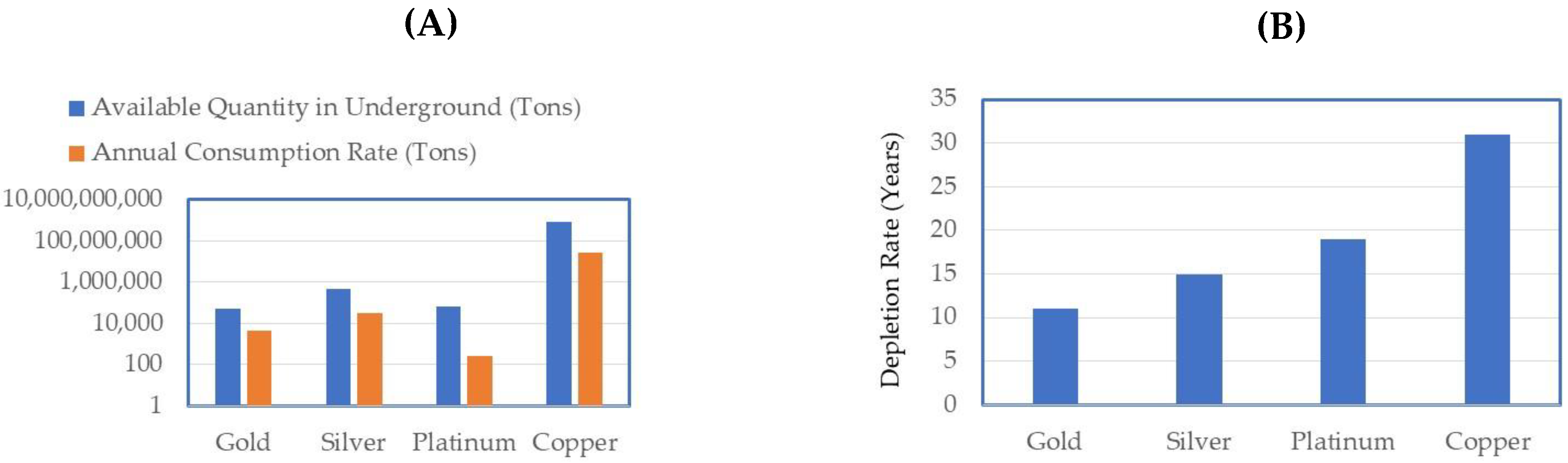
Figure 2.
Distribution of metals in e-waste in 2022, categorized into (A) total metals, (B) other metals, and (C) precious metals.
Figure 2.
Distribution of metals in e-waste in 2022, categorized into (A) total metals, (B) other metals, and (C) precious metals.
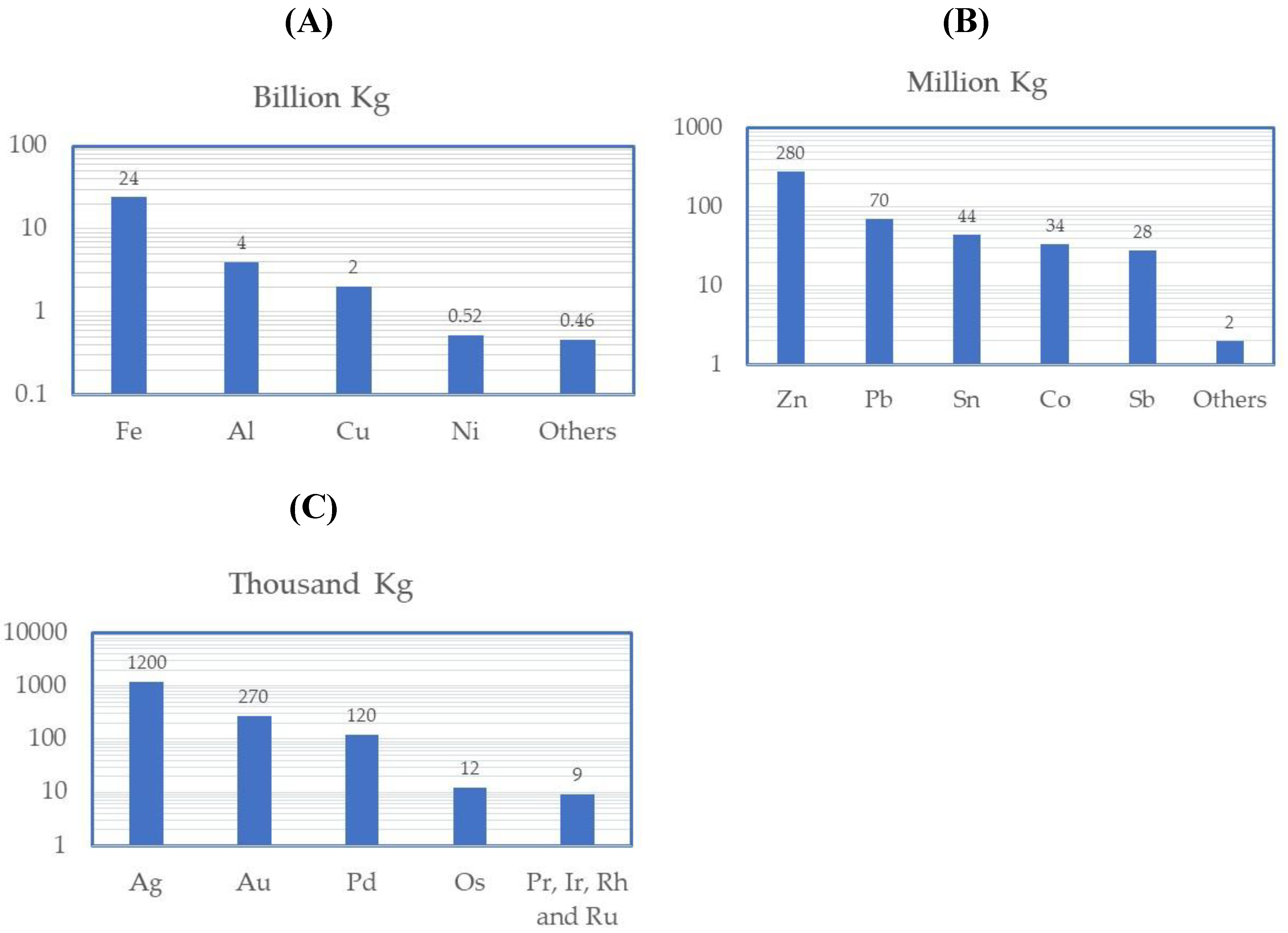
Figure 3.
Potential value in secondary raw materials in e-waste.
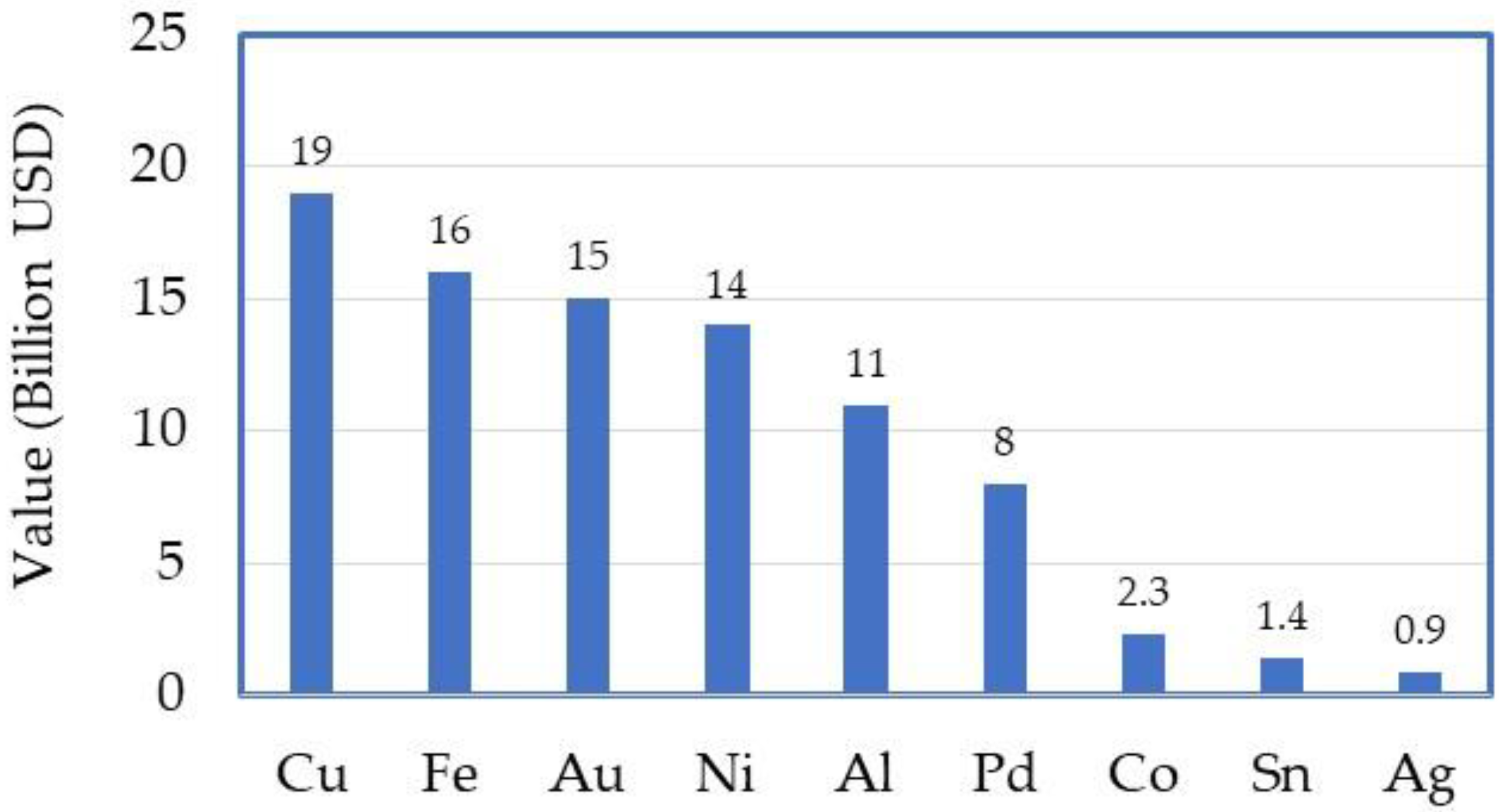
Figure 4.
Enhanced strategies for sustainable e-waste recycling.

Figure 5.
Digital technology applications for sustainable e-waste recovery.
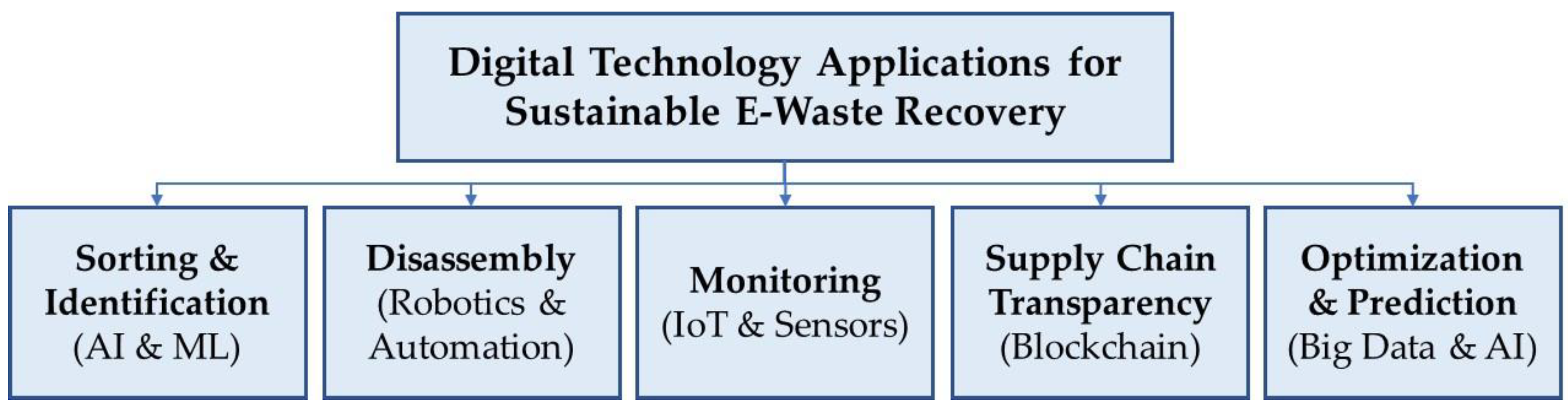
Figure 6.
Multistage processes for extracting base metals and precious metals, AgNPs, bioremediation of excess cyanide, and production of nano-silica from e-waste.
Figure 6.
Multistage processes for extracting base metals and precious metals, AgNPs, bioremediation of excess cyanide, and production of nano-silica from e-waste.
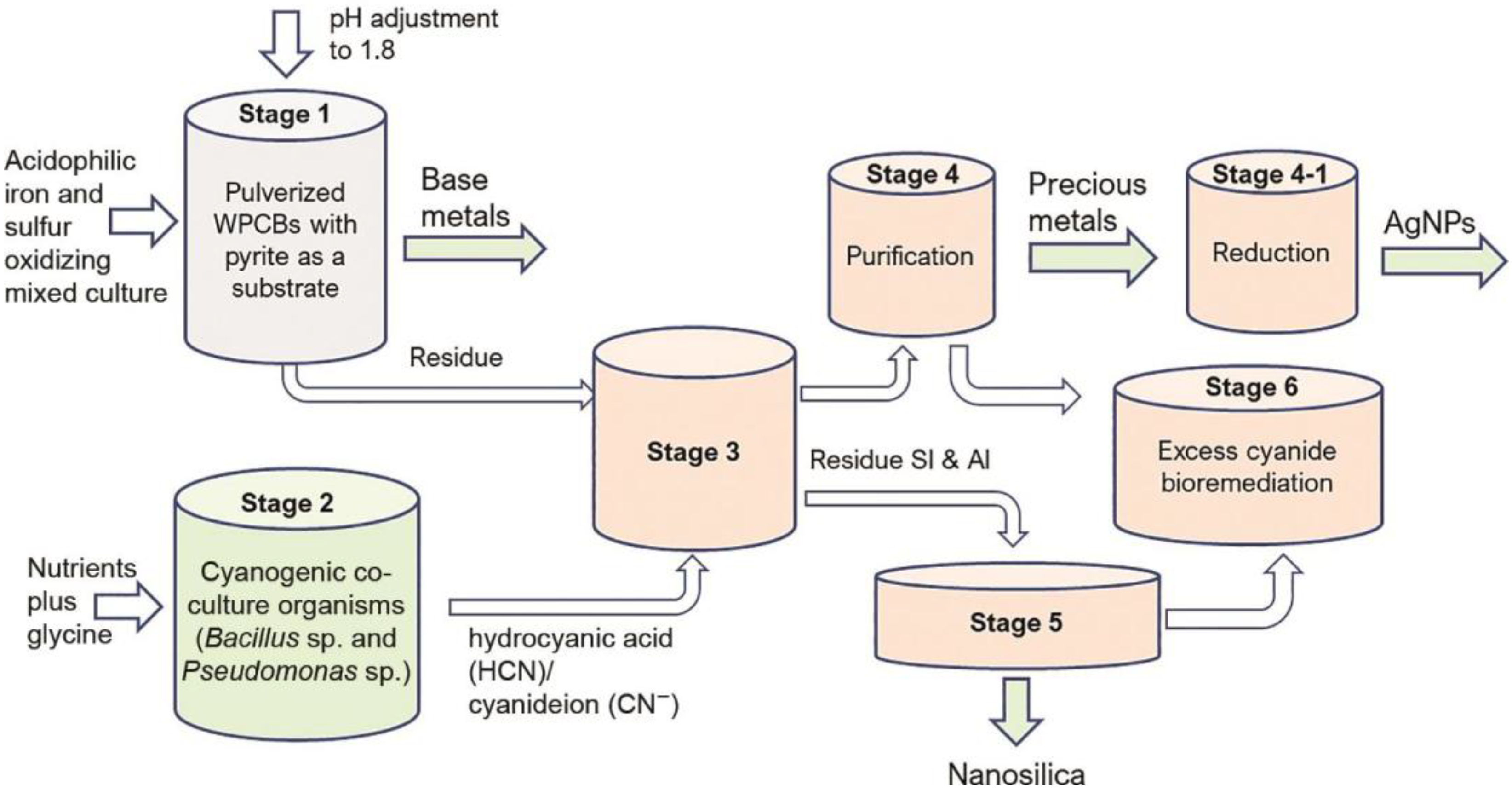
Figure 7.
Policy and regulatory support programs for sustainable e-waste recovery.
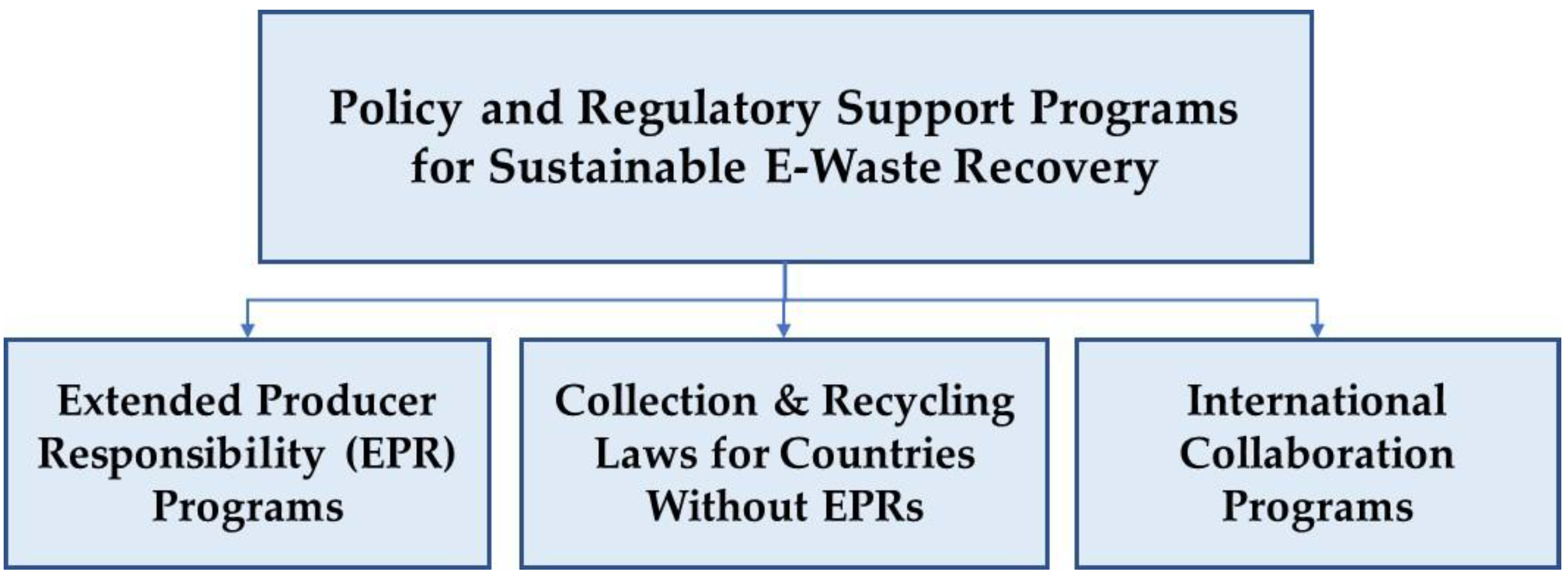
Figure 8.
Implementation of EPR in a diverse set of product types.
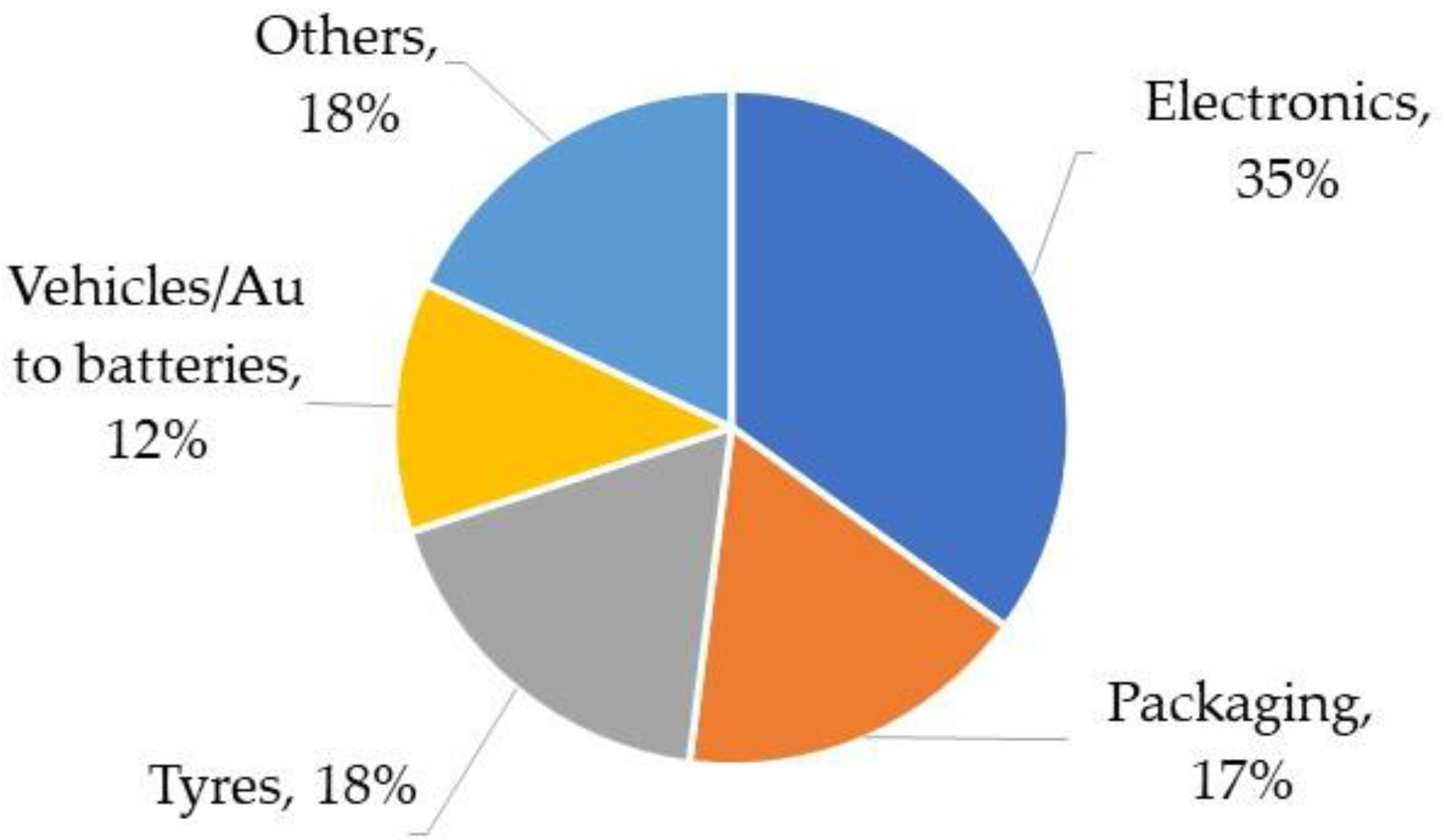
Figure 9.
Consumer awareness and participation for sustainable e-waste recovery.
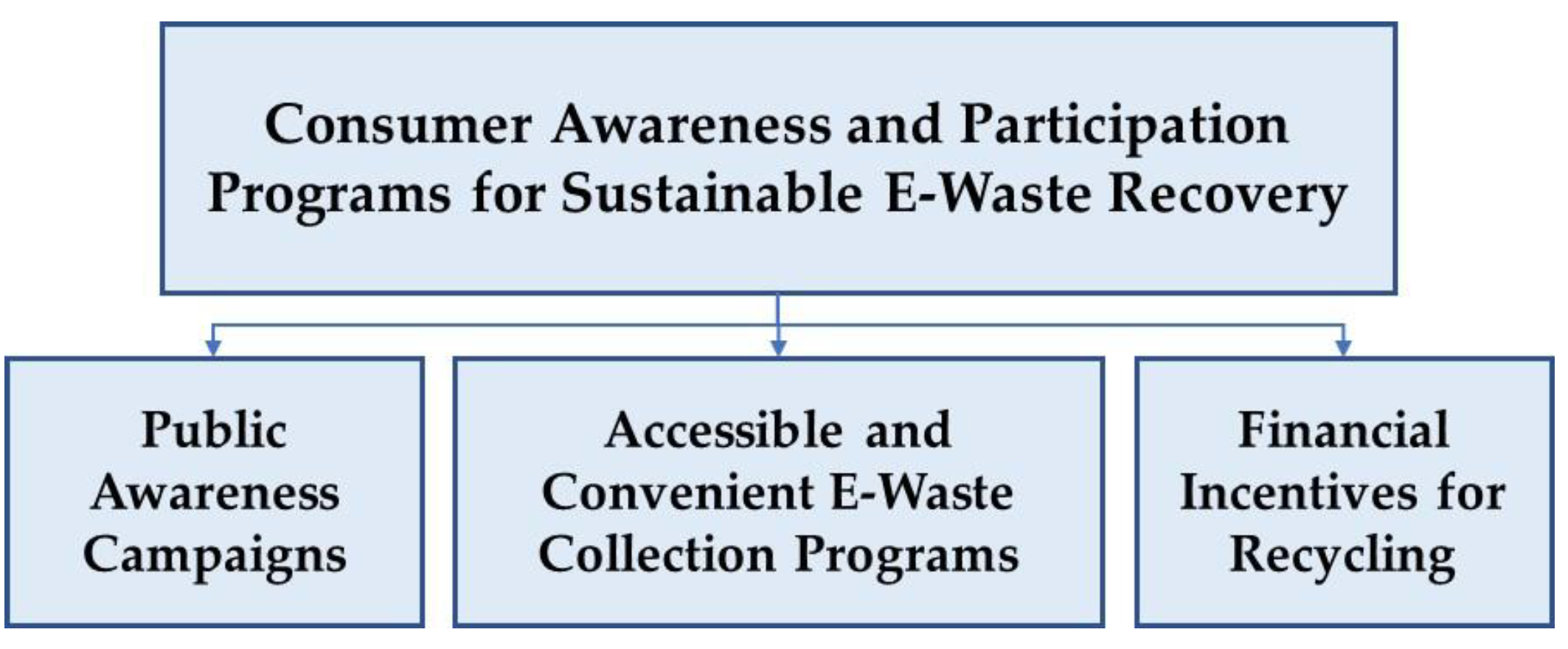
Figure 10.
Public-Private Partnerships (PPPs) programs for sustainable e-waste recovery.
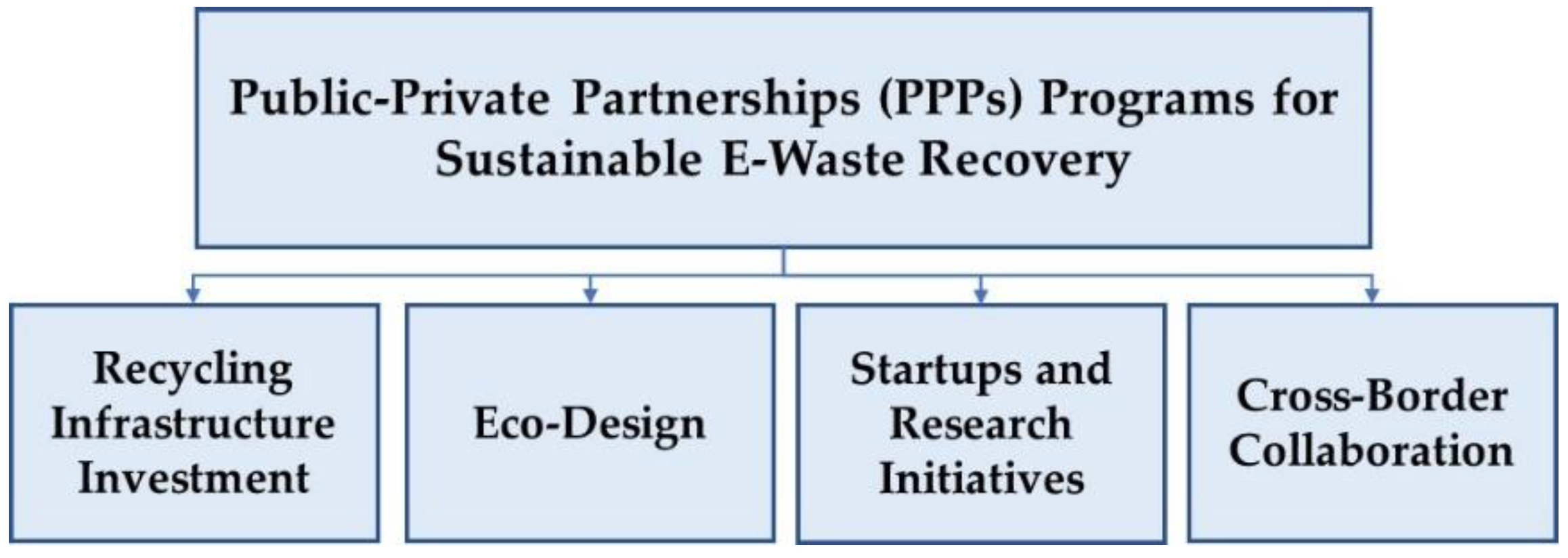
Figure 11.
Outline of Japan’s home appliance recycling law.
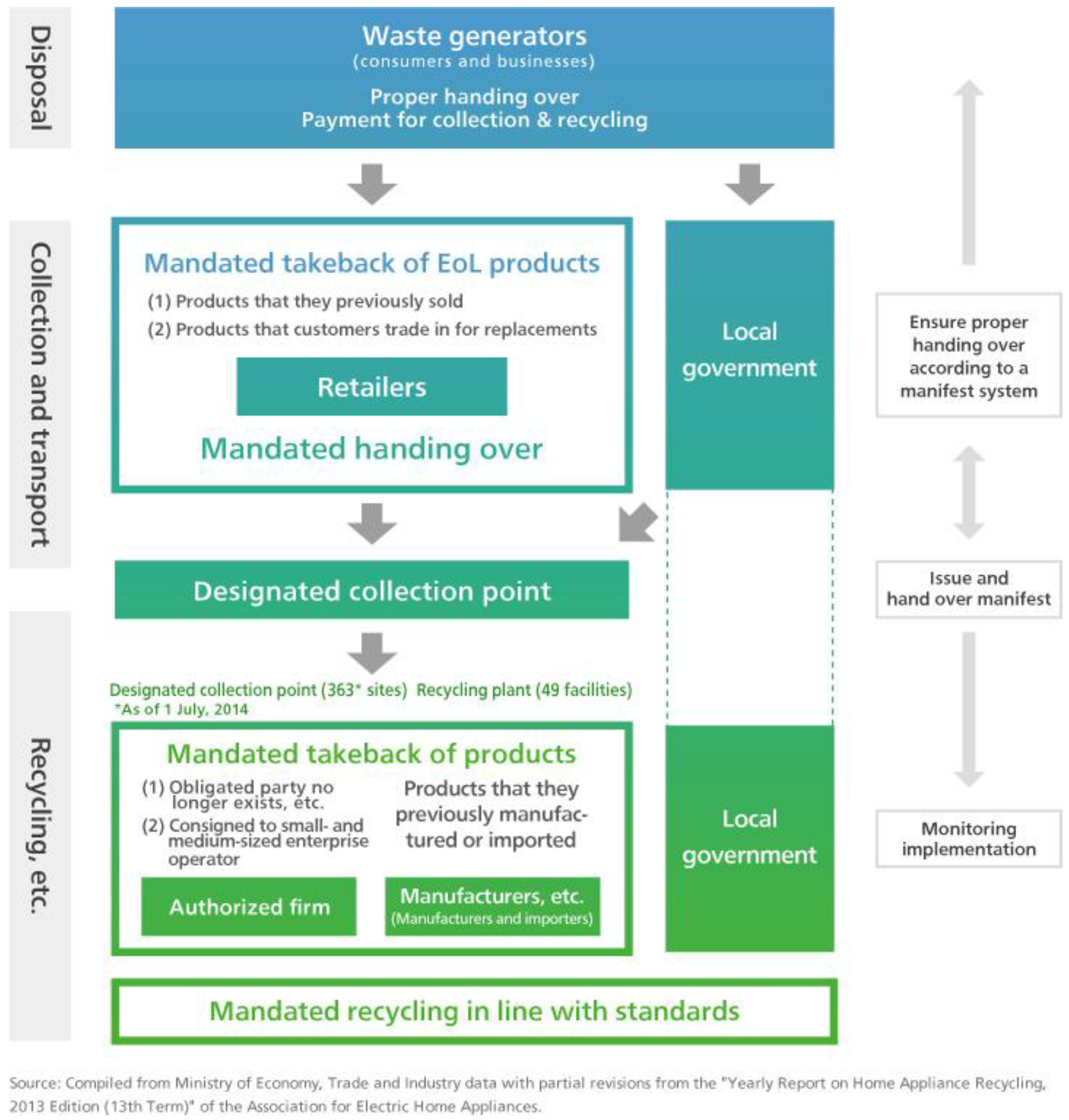

Table 1.
Major industrial applications of the critical metals with special emphasis on their respective roles for the clean energy transition and individual supply risks due to their heterogeneous distribution (Müller et al., 2025).
Table 1.
Major industrial applications of the critical metals with special emphasis on their respective roles for the clean energy transition and individual supply risks due to their heterogeneous distribution (Müller et al., 2025).
| Element | Important properties | Normal industrial uses | Clean energy use | Major producers | Supply risk | References |
|---|---|---|---|---|---|---|
| Aluminum | Conductive, flexible, durable, recycleable | Construction, electronics, aircraft, cars, power lines | Not critical | China, India | Moderate | Sun, 2023 |
| Antimony | Flame proofing compound | Nuclear energy, semiconductors, military, brake pads, paints, fire retardants | Wind turbines | China, India | High | Anderson, 2019; Zhao et al., 2023 |
| Cadmium | Fatigue and corrosion resistive | Electronics, semiconductors, batteries, aircrafts, pigments, nuclear technology | Solar cells | China, South Korea | High | Sharma et al., 2015; Ahmad et al., 2023a |
| Caesium | Higly reactive, pyrophoric | Optics, drilling fluids, atomic 'caesium' clock | Solar cells | Canada, Australia | High | Bella et al., 2018; Hines et al., 2023 |
| Carbon | Conductive, light weight | Graphene | Solar panels | China, Madagaskar | High | Mahmoudi et al., 2018; Tiwari et al., 2020 |
| Chromite | Durability, hardness, wear resistance | Steel industry, coatings, pigments, electronics, semiconductors, magnets | Not critical | South Africa, Turkey | Very high | Li et al., 2022 |
| Cobalt | Wear resistance, high strength, magnetic | Batteries, magnets, catalysts, steel industry | Lithium-ion batteries for EVs, super magnets | Democratic Republic of Congo, Indonesia | High | Van den Brink et al., 2020; Savinova et al., 2023 |
| Copper | High conductivity, antimicrobial | Electronics, wiring, construction, cars, aircraft, medicines | Solar and wind power, lithium-ion batteries for EVs | Chile, Peru | Moderate | Liu et al., 2023a |
| Gallium | Conductive | Electronics, semiconductors | Gallium hydride for hydrogen storage | China, Japan | High | Qin et al., 2015; Zhang et al., 2024b |
| Gold | Inert, high conductivity | Jewelry, electronics, cell phones, aircraft windows, medicines | Not critical | China, Australia | Moderate | Ahmad et al., 2023b; Liu et al., 2023b; Yakubchuk, 2023 |
| Indium | High conductivity, corrosion resistive, low melting point | Electronics, semiconductors, medicines, nuclear technology | Solar cells | China, South Korea | High | Lin et al., 2019; Kumar et al., 2023; He et al., 2024 |
| Iron | High strength, brittle | Steel industry, inks, catalysts, magnets | Not critical | Australia, China | Low | Holmes et al., 2022 |
| Lead | High density | Batteries, radiation shielding, plastics | Solar panels | China, Australia | Low | Chen et al., 2024 |
| Lithium | Resistance to abrasion in synthetic rubber | Ceramics, glass industry, batteries, greases, lubricants, rubber | Lithium-ion batteries for EVs | Chile, Australia | High | Cabello, 2021; Meixner et al., 2022 |
| Manganese | Corrosion resistive | Steel industry, pigments, dry cell batteries, resistors | Not critical | China, South Africa | Moderate | Hagelstein, 2009; Sun et al., 2020 |
| Molybdenum | Strength, corrosion resistive, conductivity | Steel industry, railway tracks, catalysts, pigments, lubricants, fertilizers | Not critical | China, Chile | Moderate | Henckens et al., 2018; Outteridge et al., 2020 |
| Nickel | Corrosion resistive, toughness | Steel industry, catalysts, plating, batteries, fertilizers | Lithium-ion batteries for EVs | Indonesia, Philippines | Moderate | Wang et al., 2022; Dilshara et al., 2024 |
| PGEs | Hardness, corrosion resitive, high melting points | Jewelry, catalysts, electronics, chemical industry | Car exhaust catalysts | South Africa, Russia | Very high | Cooper and Beecham, 2013; Nose and Okabe, 2024 |
| REEs | Magnetic, phosphorescent | Electronics, super magnets, fibre optics, superconductors, radar, high speed computers | Solar cells, wind turbines, EVs | China, USA | Very high | Dostal, 2017; Dushyantha et al., 2020; Wu et al., 2024 |
| Selenium | Photoconductive | Glass, steel industry, electronics, electrolysis, rubber, pharmaceutical industry | Lithium-Selenium batteries, solar cells | China, Japan | High | Funari et al., 2021; Liu et al., 2022 |
| Silver | High conductivity, antibacterial properties | Jewelry, electronics, semiconductors, batteries, medicines | Solar cells | Mexico, China | Moderate | Kanellos et al., 2023 |
| Tellurium | Piezoelectric | Semiconductors, catalysts, thermoelectrics, CDs, DVDs, | Solar cells | China, Japan | High | Nassar et al., 2022; Katepalli et al., 2023 |
| Thorium | Creep resistive at high temperatures, radioactive | Nuclear fuel for new generation power plants | Not critical | India, Brazil | Moderate | Akitsu, 2017; Jin et al., 2024 |
| Tin | Corrosion resistive, light weight | Alloys, plating, batteries, magnets | Solar cells | China, Indonesia | Moderate | Lehmann, 2021; Li et al., 2021 |
| Titanium | Hardness, resistive, light weight, chemically inert | Steel industry, military, aircraft, pigments, plastics, paper, medicines | Not critical | China, Mozambique | Moderate | Chunxiang et al., 2011; Maldybayev et al., 2024 |
| Tungsten | High melting and boiling points, high density | Steel industry, military, aircrafts, electronics, chemical industry | Wind turbines | China, Russia | High | Huang et al., 2021 |
| Uranium | High density, radioactive | Nuclear fuel, military | Not critical | Kasakhstan, Namibia | Moderate | Costa Peluzo and Kraka, 2022 |
| Vanadium | Toughness, shock and vibration resistance | Steel industry, pigments, magnets | Not critical | China, Russia | Moderate | Polyak, 2019; Petranikova et al., 2020 |
| Zinc | Corrosion resistive | Coatings, galvanization, rubber, cars, chemical industry | Zinc-ion batteries for EVs | China, Peru | Low | Ng et al., 2016; Rostek et al., 2023 |
Table 2.
Physical and mechanical separation processes.
| General Processes | An example for IT and Telecommunication Equipment Separation Processes |
|||
|---|---|---|---|---|
| Steps | Products | Manual Processing | Mechanical Processing | Products |
| Sorting and Dismantling | Separation of reusable parts | Sorting | Capacitors, tuners, batteries | |
| Mechanical Processing (size reduction and sorting | Separation of metals, plastics, etc. | Crushing | ||
| Eddy Current Separation | Separation of nonferrous metals | Sorting | Valuable and hazardous components | |
| Magnetic Separation | Separation of ferrous metals | Shredding | ||
| Density Separation | Separation of plastics | Sorting | Valuable and hazardous components | |
| Electrostatic Separation | Separation of conductive metals from non-conductive materials | Shredding | ||
| Disposal | Landfilling | Eddy current separation | Nonferrous metals | |
| Magnetic separation | Ferrous metals | |||
Table 3.
Pyrometallurgical processes.
| Pyrometallurgical Processes | Description |
|---|---|
| Incineration | E-waste is incinerated at high temperatures in a controlled environment, breaking down organic materials and combustibles while leaving metal-rich ash. |
| Smelting | Ashes or shredded e-waste are melted in high-temperature furnaces, allowing metals to separate from non-metallic materials due to their lower melting points. Valuable metals like copper, lead, and precious metals are collected in molten form. |
| Roasting | Metal compounds are converted into oxides or sulfides for further refining |
| Plasma arc furnaces | Metals are extracted using high-energy plasma |
| Volatilization | Certain metals like mercury and zinc are recovered through controlled evaporation |
| Cupellation | The metal-rich material is heated in a cupel (a porous container) with a blast of air, which oxidizes impurities and leaves behind the precious metals. It is used to recover precious metals like gold and silver. |
Table 4.
Hydrometallurgical processes.
| Hydrometallurgical Processes | Description |
|---|---|
| Leaching | Chemicals such as sulfuric acid (H₂SO₄), nitric acid, or cyanide (CN-) are used to dissolve specific metals. H₂SO₄ is used to extract base metals like Zn, Fe, Co, Pb, Al, and Cu. HNO₃ is used to extract base metals (including REE) and noble metals (i.e. Ag, Pd, Cu, Hg). Cyanide solutions are used especially for gold recovery, under strictly alkaline conditions in the presence of oxygen |
| Ammonia leaching | It is sometimes used for selective recovery of copper and nickel. With higher reduction potential metals, i.e. Cu and Ag, its action can be empowered by adding oxidants such as H2O2, (NH4)2S2O8, or others. |
| Solvent extraction (SX) | Solvent extraction selectively recovers specific metals using organic solvents that bind to target metal ions. For example, in copper recovery, the leachate containing dissolved copper ions is mixed with an organic solvent, such as a hydroxyoxime-based extractant, which selectively binds to copper. The copper-laden solvent is then separated and stripped using sulfuric acid to regenerate copper sulfate, which can be further processed into pure copper via electrowinning. This method is also used to extract rare earth elements (REEs) from e-waste, such as neodymium and dysprosium from magnets in hard drives. |
| Ion exchange | Ion exchange relies on resins to capture specific metal ions from the solution. For instance, gold recovery from e-waste uses strong-base anion exchange resins that selectively adsorb gold cyanide complexes from the leachate. The resin is then stripped with a suitable eluent, such as thiourea or sodium thiosulfate, releasing gold for further refining. Similarly, platinum group metals (PGMs) like palladium and platinum from catalytic converters in e-waste can be extracted using chelating resins designed to bind specifically to these elements. |
| Precipitation | Precipitation recovers metals by adjusting the pH of the solution using reagents that cause metal hydroxides or sulfides to form. For example: (a) Gold precipitation: Sodium metabisulfite or ferrous sulfate is added to a gold-bearing solution, reducing gold ions to solid elemental gold; (b) Nickel and cobalt recovery: By adding sodium hydroxide, nickel and cobalt precipitate as hydroxides, which can be further refined; and (c) Lead and zinc removal: Sulfide precipitation using hydrogen sulfide gas or sodium sulfide helps recover lead and zinc as insoluble sulfides from e-waste processing solutions. |
Table 5.
Summary of the pros and cons of each mineral recovery technology from e-waste.
| Technology | Pros | Cons |
|---|---|---|
| Physical & Mechanical Separation |
|
|
| Hydrometallurgical Processes |
|
|
| Pyrometallurgical Processes |
|
|
| Bio-metallurgy |
|
|
| Electrochemical Processes |
|
|
Table 6.
Technology Comparison for Specific Materials.
| Technology | Gold (Au) | Silver (Ag) | Copper (Cu) | Rare Earth Elements (REEs) | Platinum Group Metals (PGMs) | Ferrous Metals (Fe, Ni, Co) | Aluminum (Al) |
|---|---|---|---|---|---|---|---|
| Physical & Mechanical Separation | ❌ Not effective | ❌ Not effective | ✅ Good efficiency (electrostatic, density separation) | ❌ Not effective | ❌ Not effective | ✅ Good efficiency (magnetic separation) | ✅ Good efficiency (eddy current separation) |
| Hydrometallurgical Processes | ✅ Very effective (cyanide leaching) | ✅ Very effective (acid leaching) | ✅ High efficiency (acid leaching, solvent extraction) | ❌ Limited effectiveness | ✅ High efficiency (chloride leaching) | ❌ Limited effectiveness | ❌ Inefficient |
| Pyrometallurgical Processes | ✅ High efficiency (smelting, refining) | ✅ High efficiency (smelting) | ✅ High efficiency (smelting, roasting) | ❌ Not commonly used | ✅ Effective (high-temperature refining) | ✅ Effective for ferrous metals | ✅ Effective (high-temperature recovery) |
| Bio-metallurgy | ✅ Possible (bioleaching) | ✅ Possible (bioleaching) | ✅ Good efficiency (bioleaching with bacteria) | ✅ Promising research (microbial bioleaching) | ❌ Limited research | ❌ Not effective | ❌ Inefficient |
| Electrochemical Processes | ✅ High purity recovery (electrowinning) | ✅ High purity recovery (electrowinning) | ✅ Effective (electrowinning, electrorefining) | ❌ Not effective | ✅ Effective (electrorefining for platinum) | ❌ Inefficient | ❌ Inefficient |
Table 7.
Green chemistry and green engineering principles.
| Green Chemistry Principles | Green Engineering Principles | ||
|---|---|---|---|
| Principle | Description | Principle | Description |
|
Avoid generating waste rather than dealing with it after the fact |
|
Avoid hazards rather than controlling them after the fact |
|
Maximize the incorporation of all materials into the final product |
|
Use non-toxic, renewable, or recycled materials |
|
Use processes that generate minimal toxicity |
|
Reduce energy and material consumption |
|
Design products with minimal toxicity to humans and the environment |
|
Design for simplicity and efficiency |
|
Reduce or eliminate the use of auxiliary substances (e.g., solvents) |
|
Minimize waste and environmental discharges |
|
Conduct reactions at ambient temperature and pressure when possible |
|
Reduce energy-intensive separation steps |
|
Use renewable raw materials instead of depleting resources |
|
Optimize system design for efficiency |
|
Minimize unnecessary derivatization steps to avoid waste |
|
Design long-lasting, high-performance products |
|
Prefer catalytic reagents over stoichiometric ones to enhance efficiency |
|
Ensure recyclability and safe disposal of products |
|
Design chemicals that break down into non-toxic components |
|
Prioritize renewable resources over finite ones |
|
Implement in-process monitoring to prevent hazardous byproducts |
|
Account for changes and uncertainties in design |
|
Minimize risks of explosions, fires, and environmental releases |
|
Consider the environmental impact from production through disposal |
Table 8.
Integration of deposit refund system (DRS) with mandatory EPR schemes.
| Collection Type | Countries with EPR Schemes | Countries without EPR Schemes (Voluntary Schemes) |
|---|---|---|
|
|
|
| ||
| ||
|
|
Table 9.
Implementation Roadmap for E-Waste Sustainability Strategies.
| Step | Action | Key Stakeholders | Expected Outcome |
|---|---|---|---|
| 1. Improve Recycling Infrastructure | Invest in AI-powered sorting and robotics for automation | Governments, Recycling Firms | Higher efficiency, reduced labor risks |
| 2. Implement Extended Producer Responsibility (EPR) | Mandate electronics manufacturers to finance e-waste collection and recycling | Government Regulators, Tech Industry | Higher collection and recycling rates |
| 3. Strengthen Consumer Awareness Campaigns | Launch educational programs and incentives for responsible recycling | NGOs, Tech Companies, Media | Increased participation in recycling programs |
| 4. Expand Public-Private Partnerships | Encourage collaboration between government and private sector in e-waste recycling | Municipal Authorities, Private Investors | Increased funding and infrastructure expansion |
| 5. Promote Eco-Design and Right-to-Repair Laws | Require manufacturers to produce repairable and recyclable devices | Policy Makers, Tech Industry | Reduced e-waste generation |
| 6. Introduce Circular Economy Initiatives | Encourage businesses to use recycled materials and modular design | Corporations, Researchers | Sustainable product life cycles |
Disclaimer/Publisher’s Note: The statements, opinions and data contained in all publications are solely those of the individual author(s) and contributor(s) and not of MDPI and/or the editor(s). MDPI and/or the editor(s) disclaim responsibility for any injury to people or property resulting from any ideas, methods, instructions or products referred to in the content. |
© 2025 by the authors. Licensee MDPI, Basel, Switzerland. This article is an open access article distributed under the terms and conditions of the Creative Commons Attribution (CC BY) license (http://creativecommons.org/licenses/by/4.0/).
Copyright: This open access article is published under a Creative Commons CC BY 4.0 license, which permit the free download, distribution, and reuse, provided that the author and preprint are cited in any reuse.


