

Submitted:
26 February 2025
Posted:
27 February 2025
You are already at the latest version
Abstract
The evolving landscape of cybersecurity threats demands the modernization of Security Operations Centers (SOCs) to enhance threat detection, response, and mitigation. Security Orchestration, Automation, and Response (SOAR) platforms play a crucial role in addressing operational inefficiencies; however, traditional no-code SOAR solutions face significant limitations, including restricted flexibility, scalability challenges, inadequate support for advanced logic, and difficulties in managing large playbooks. These constraints hinder effective automation, reduce adaptability, and underutilize analysts’ technical expertise, underscoring the need for more sophisticated solutions. To address these challenges, we propose a hyper-automation SOAR platform powered by Agentic-LLM, leveraging large language models (LLMs) to optimize automation workflows. This approach shifts from rigid no-code playbooks to AI-generated code, providing a more flexible and scalable alternative while reducing operational complexity. Additionally, we introduce the IVAM framework, comprising three critical stages: (1) Investigation, structuring incident response into actionable steps based on tailored recommendations, (2) Validation, ensuring the accuracy and effectiveness of executed actions, and (3) Active Monitoring, providing continuous oversight. By integrating AI-driven automation with the IVAM framework, our solution enhances investigation quality, improves response accuracy, and increases SOC efficiency in addressing modern cybersecurity threats.
Keywords:
security operation center
; incident-response
; hyper-automation
; SOAR
; agentic-LLM
1. Introduction
Effective security operations are essential for safeguarding digital assets in an era of rapidly evolving cyber threats. The Security Operations Center (SOC) is the cornerstone of an organization’s defense strategy, continuously monitoring, detecting, and responding to security incidents. However, SOC teams are increasingly overwhelmed by the rising volume, complexity, and sophistication of security alerts, leading to operational inefficiencies and delayed responses [1]. These challenges underscore the urgent need for innovative solutions that streamline workflows and enhance SOC effectiveness.
Security Orchestration, Automation, and Response (SOAR) platforms have emerged as a transformative solution to these challenges. By integrating diverse security tools, automating repetitive tasks, and orchestrating complex workflows, SOAR platforms improve the speed and accuracy of incident response [2,3]. As a critical component of modern SOCs, these platforms enable organizations to manage an expanding threat landscape while maintaining operational efficiency [4,5]. Additionally, SOAR systems allow SOC teams to focus on high-value tasks, such as advanced threat hunting and strategic decision-making, by automating routine activities [6,7].
Despite their advantages, designing and implementing effective SOAR playbooks presents several challenges. These include ensuring the accuracy and relevance of automated actions [8], maintaining compatibility with diverse security tools [9], and continuously updating playbooks to address emerging threats [10]. To maximize the benefits of SOAR platforms, adopting best practices for playbook development and deployment is crucial.
To overcome the limitations of traditional SOAR implementations, this study introduces a novel methodology for hyper-automation in SOAR systems. The proposed approach leverages AI-driven agents to dynamically construct workflows tailored to each security event’s specific attributes, enhancing precision and flexibility. This innovation addresses the critical need for scalability and adaptability in SOC operations, particularly in an increasingly complex threat landscape.
This study further contributes to the field by providing the following key advancements:
-
Introducing the IVAM Framework for Agentic AI Workflows. This framework integrates multiple dimensions of analysis and action to optimize incident response through four core components:
- Investigation: Structures incident response into actionable steps based on tailored recommendations, aligning with threat-specific tactics, techniques, and procedures (TTPs) using the MITRE ATT&CK framework.
- Validation: Ensures the reliability and compliance of executed actions through Quantitative Risk Assessment (QRA).
- Active Monitoring: Maintains continuous oversight and dynamically refines real-time workflows to adapt to evolving threats.
-
Conducting LLM-Agentic Approach to SOAR Hyper-Automation. By integrating large language models (LLMs) with agentic AI processes, this research enhances SOAR capabilities through hyper-automation, enabling more efficient threat detection, response, and mitigation. This system dynamically generates workflows based on real-time threat intelligence, addressing the limitations of static playbooks by enabling:
- Context-aware automation: Tailored responses based on the unique characteristics of each security event.
- Enhanced scalability and operational efficiency: Optimized intelligent workflows that reduce manual intervention.
This study’s findings underscore the transformative potential of AI-driven SOAR platforms in modernizing SOC operations, enhancing incident response, and ensuring readiness for emerging cyber threats.
2. Background & Related Works
2.1. Types of Cybersecurity Automation
Integrating automation within Security Operations Centers (SOCs) has become essential for enhancing efficiency and effectiveness. Automation streamlines routine tasks, allowing human analysts to focus on complex threat analysis and decision-making. This synergy between human expertise and automated systems accelerates incident response while improving the accuracy of threat detection and mitigation [11]. Emerging approaches such as no-code, low-code, and hyper-automation each offer distinct advantages and challenges, shaping the future of SOC operations.
2.1.1. No-Code Automation
No-code platforms have transformed software development by enabling individuals with minimal or no programming expertise to create functional applications. These platforms leverage visual interfaces, drag-and-drop tools, and pre-built components, democratizing software creation and accelerating digital transformation [12].
Frameworks such as Security Orchestration, Automation, and Response (SOAR) illustrate how no-code solutions can thrive in hyper-connected environments like the Internet of Blended Environment (IoBE) [13]. By integrating automation with threat intelligence and dynamic responses, SOAR enhances scalability and security, addressing challenges across diverse domains.
No-code tools empower "citizen developers" to drive digital innovation within their organizations, eliminating the need for extensive coding expertise. This approach accelerates development cycles, reduces costs, and fosters adaptability key requirements in today’s fast-paced business landscape [12]. By supporting rapid deployment and iterative processes, no-code platforms align with the growing emphasis on agility and innovation.
However, despite these advantages, no-code platforms also present certain limitations. The lack of flexibility and customization in pre-built components may restrict the development of complex, highly specialized applications.
2.1.2. Low-Code Automation
Traditional risk management systems, often reliant on manual processes and legacy software, struggle to address the complexities and evolving nature of modern organizational risks [14,15]. Low-code automation has emerged as a transformative solution, enabling organizations to streamline processes, enhance compliance, and swiftly adapt to regulatory changes [16].
Low-code platforms are software development environments that require minimal hand-coding, allowing both technical and non-technical users to create and deploy applications with greater speed and efficiency [17]. By leveraging visual interfaces and pre-built components, low-code solutions reduce development time, lower operational costs, and foster innovation [18,19]. These capabilities are particularly valuable in risk management, where timely and accurate data-driven decision-making is essential.
Additionally, low-code platforms facilitate rapid prototyping and iterative development, enabling businesses to adapt quickly to changing market demands. This agility empowers teams to experiment with new ideas, refine processes, and stay ahead of industry trends without the constraints of extensive coding [20].
Furthermore, the integration of generative AI amplifies the potential of low-code platforms. By automating repetitive tasks, generating code snippets, and enabling natural language interactions, AI-driven low-code environments provide unprecedented customization and scalability. This synergy allows organizations to not only accelerate workflows but also tailor solutions to unique project requirements, paving the way for personalized and impactful applications [20,21].
However, despite these advantages, low-code platforms are not without limitations. Their reliance on pre-built components may restrict flexibility, particularly for highly specialized applications. Additionally, vendor lock-in can pose challenges as organizations outgrow platform capabilities, necessitating careful consideration of long-term scalability and interoperability.
2.1.3. Hyper-Automation
Hyper-automation is rapidly transforming modern industries by integrating advanced technologies such as artificial intelligence (AI), machine learning (ML), robotic process automation (RPA), and the Internet of Things (IoT) [22]. Unlike traditional automation, hyper-automation takes a holistic approach to automating complex business processes, enabling organizations to achieve unprecedented efficiency, accuracy, and innovation [23].
The rise of hyper-automation is driven by the increasing need for agility and scalability in a highly competitive global market. As organizations face growing pressure to adapt to evolving customer expectations and technological advancements, hyper-automation provides a strategic solution. By combining cognitive and operational capabilities, it empowers businesses to streamline workflows, enhance decision-making, and optimize resource utilization [24,25].
Recent studies highlight the transformative potential of hyper-automation across various sectors, including manufacturing, healthcare, finance, and logistics [26,27]. For instance, in manufacturing, hyper-automation facilitates the integration of smart factories, enabling real-time monitoring and predictive maintenance [28].
2.2. Frameworks for Constructing an Effective Incident Response
Cyber incidents such as ransomware attacks, phishing campaigns, and advanced persistent threats (APTs) highlight the need for robust Incident Response Plans (IRPs) [29] that can effectively detect, respond to, and recover from security breaches. Constructing an effective IRP requires a deep understanding of organizational risks and the application of proven frameworks that provide structured methodologies for incident management.
Several established frameworks have been developed to guide organizations in building resilient and efficient IRPs, each offering unique strengths tailored to different operational, strategic, and technical needs.
For instance, the NIST Cybersecurity Framework (CSF) provides comprehensive guidance across its five core functions:
- Identify: Recognizing and assessing security risks.
- Protect: Implementing safeguards to mitigate potential threats.
- Detect: Continuously monitoring for security incidents.
- Respond: Taking immediate action upon detecting threats.
- Recover: Restoring affected systems and minimizing impact.
This framework ensures a holistic approach to incident response and cybersecurity management [30].
Similarly, the MITRE ATT&CK Framework categorizes adversarial actions into three distinct components:
- Tactics: Represent the adversary’s overall objectives.
- Techniques: Describe the methods used to achieve those objectives.
- Procedures: Outline specific implementations of these techniques.
This level of granularity provides security teams with a clear understanding of real-world attack methodologies, improving their ability to anticipate, detect, and mitigate cyber threats [31].
2.3. Risk Assessment in Cybersecurity Domain
2.3.1. Quantitative Risk Assessment
The increasing complexity and prevalence of cybersecurity threats necessitate systematic, data-driven approaches to assess and mitigate risks. Quantitative Risk Analysis (QRA) is a methodology that evaluates risks using numerical measures, allowing decision-makers to estimate the likelihood and potential impact of specific events. Compared to qualitative methods, which often lack sufficient rigor for guiding critical security decisions, QRA provides a precise and actionable framework [32].
QRA applies probabilistic models to evaluate both the uncertainty and consequences of risks in a given scenario. The fundamental objective is to quantify risk exposure by combining the likelihood of threat events with their corresponding impacts. A widely adopted formula for this is:
In practice, this concept is extended to assess the Total Risk Exposure (TRE) [33], aggregating all identified risks as:
where represents the probability of the i-th threat event, and denotes the corresponding impact or cost of the event.
Building on these foundations, recent studies such as that of [34] introduced formal models to estimate the probability of data breaches and the associated costs over defined periods. These models integrate empirical data, such as historical breach records and industry benchmarks, to provide realistic and actionable estimates. By adopting such methodologies, organizations can prioritize risk mitigation strategies based on potential cost-benefit tradeoffs.
Additionally, integrating multifaceted classification approaches has further refined the quantitative assessment of cybersecurity risks. [35] proposed a systematic, extendable, and modular model for assessing information systems, offering a quantitative analysis grounded in a well-defined classification scheme. This approach underscores the importance of adaptability and modularity in addressing the ever-evolving nature of cybersecurity threats.
Advanced QRA techniques [32] often account for the dynamic nature of threats. For example, time-dependent stochastic models are used to represent risk as a function of time t:
where represents the time-dependent hazard rate, and denotes the impact as a function of time. These methods enable organizations to assess the effectiveness of mitigation strategies under evolving threat conditions.
By leveraging QRA methodologies, organizations can derive actionable insights, strategically allocate resources to high-priority vulnerabilities, and strengthen their adaptive capacity to counteract evolving cybersecurity threats.
2.4. Next-Generation SOAR Frameworks: Bridging AI, Automation, and Cybersecurity
Security Orchestration, Automation, and Response (SOAR) platforms integrate a variety of security tools and data sources, enabling organizations to automate repetitive tasks, orchestrate workflows, and streamline incident response processes [36]. By consolidating data and automating critical functions, these platforms significantly reduce the time required to address cybersecurity incidents, thereby protecting assets and minimizing potential damage [37].
Recent advancements in Artificial Intelligence (AI) and Machine Learning (ML) have further enhanced SOAR capabilities, enabling intelligent threat detection, adaptive response mechanisms, and improved decision-making [38]. By analyzing vast amounts of security data in real-time, AI and ML algorithms detect patterns and anomalies that may indicate potential threats. This allows security teams to respond more effectively and efficiently while reducing the cognitive burden on analysts.
As illustrated in Figure 1, the integration of AI/ML capabilities into SOAR systems aligns with the SANS PICERL framework [39], enhancing automated threat detection and incident response processes. The figure highlights how AI-driven SOAR solutions facilitate proactive security operations by leveraging machine learning for anomaly detection, threat intelligence correlation, and automated remediation workflows.
The integration of Artificial Intelligence (AI) and Machine Learning (ML) into Security Orchestration, Automation, and Response (SOAR) platforms has been widely explored in recent research. For instance, PHOENI2X, a European Cyber Resilience Framework, leverages AI-assisted orchestration to enhance business continuity and incident response for Operators of Essential Services (OES) [40]. This framework highlights AI’s role in streamlining complex workflows and enabling seamless collaboration among stakeholders.
Similarly, IC-SECURE introduces a deep learning-based system designed to assist security analysts in automating playbook generation, thereby improving incident response efficiency and reducing reliance on manual intervention [41]. Other significant contributions include behavioral honeypots, which adapt dynamically to attackers’ techniques to gather threat intelligence, and frameworks like APIRO, which optimize the integration and interoperability of security tools within SOAR platforms [42].
Recent innovations in SOAR platforms have addressed critical cybersecurity challenges, demonstrating their potential to redefine security operations through automation and orchestration. Among these advancements, AI-driven playbook generation, as shown by IC-SECURE, has automated the creation of tailored incident response strategies, ensuring consistent execution during cyber incidents while adapting to evolving threats [41]. Similarly, the PHOENI2X framework has revolutionized collaborative security operations by leveraging AI-assisted orchestration, facilitating real-time information exchange and decision-making. These innovations exemplify how SOAR platforms are transforming cybersecurity practices and strengthening organizational resilience [40].
Despite these advancements, challenges remain in adopting and implementing SOAR platforms. Organizations often struggle with tool interoperability and regulatory compliance, hindering seamless integration into existing security infrastructures. Additionally, the dynamic nature of modern cyber threats, such as those observed in the Internet of Blended Environments (IoBE), necessitates adaptive and scalable solutions [42]. These challenges underscore the need for continued innovation in SOAR architectures and methodologies to ensure their effectiveness in mitigating evolving cybersecurity risks.
2.4.1. Large Language Models (LLMs) Agentic AI in Cybersecurity Domain
The evolution of Artificial Intelligence (AI) has significantly transformed various sectors, with Large Language Models (LLMs) and agentic AI emerging as pivotal innovations in cybersecurity. Characterized by advanced natural language understanding and autonomous decision-making, these models are reshaping how cyber threats are detected, analyzed, and mitigated.
Prominent LLMs including OpenAI’s GPT series [43], Google’s Bard [44], Anthropic’s Claude [45], Meta’s LLaMA [46], Cohere’s Command R [47], and open-source models such as Hugging Face’s BLOOM [48], EleutherAI’s GPT-NeoX [49], DeepSeek-R1 [50], and Qwen [51] excel in processing and generating human-like text. Within cybersecurity, these models enhance threat intelligence by analyzing large volumes of unstructured data to uncover patterns indicative of malicious activity [52]. Furthermore, their ability to generate human-readable analyses and reports aids security analysts in efficiently interpreting complex threat landscapes.
A fundamental strength of LLMs lies in their adaptability. Fine-tuning them for specific cybersecurity tasks such as phishing detection, malware analysis, and vulnerability assessment can significantly improve detection accuracy while reducing human error. For example, Bommasani et al., [53] illustrate how foundation models enhance response times and support data-driven decision-making in security operations.
LLMs have evolved beyond their original language-based applications into comprehensive AI agents capable of multi-step reasoning, external tool integration, and system collaboration. This transformation has been driven by two key factors: advancements in prompting strategies and external capability integration.
Techniques such as "chain-of-thought" (CoT) and "chain-of-density" prompting enable LLMs to reveal their intermediate reasoning steps, thereby enhancing both interpretability and problem-solving performance [54]. These models improve accuracy and transparency by systematically decomposing complex tasks, making them more reliable for security applications.
Furthermore, LLM-based agents can now interface with external APIs, sensors, and actuators. Recent research demonstrates that LLMs can autonomously execute thousands of real-world tools by generating function calls in controlled environments [55]. Additionally, they can plan high-level actions for robotic systems without requiring extensive task-specific training [56]. This external integration marks the emergence of "embodied GPT" systems, where language models serve as interactive agents with both virtual and physical interfaces [57].
These advancements underscore the growing role of LLMs and agentic AI in cybersecurity, enabling automated threat detection, adaptive defense mechanisms, and intelligent decision-making in increasingly complex digital environments.
As a result, these models are increasingly seen as general-purpose AI agents capable of planning, reasoning, and decision-making [52,58]. They can be adapted to interactive environments, perform high-level policy generation, and exhibit consistency of style and coherence. Recent work highlights the potential to leverage LLMs for large-scale shared autonomy and zero-shot tool usage, expanding their capabilities in practical and real-world settings [59,60].
Figure 2.
Agentic AI anatomy (adapted from [61])
Figure 2.
Agentic AI anatomy (adapted from [61])
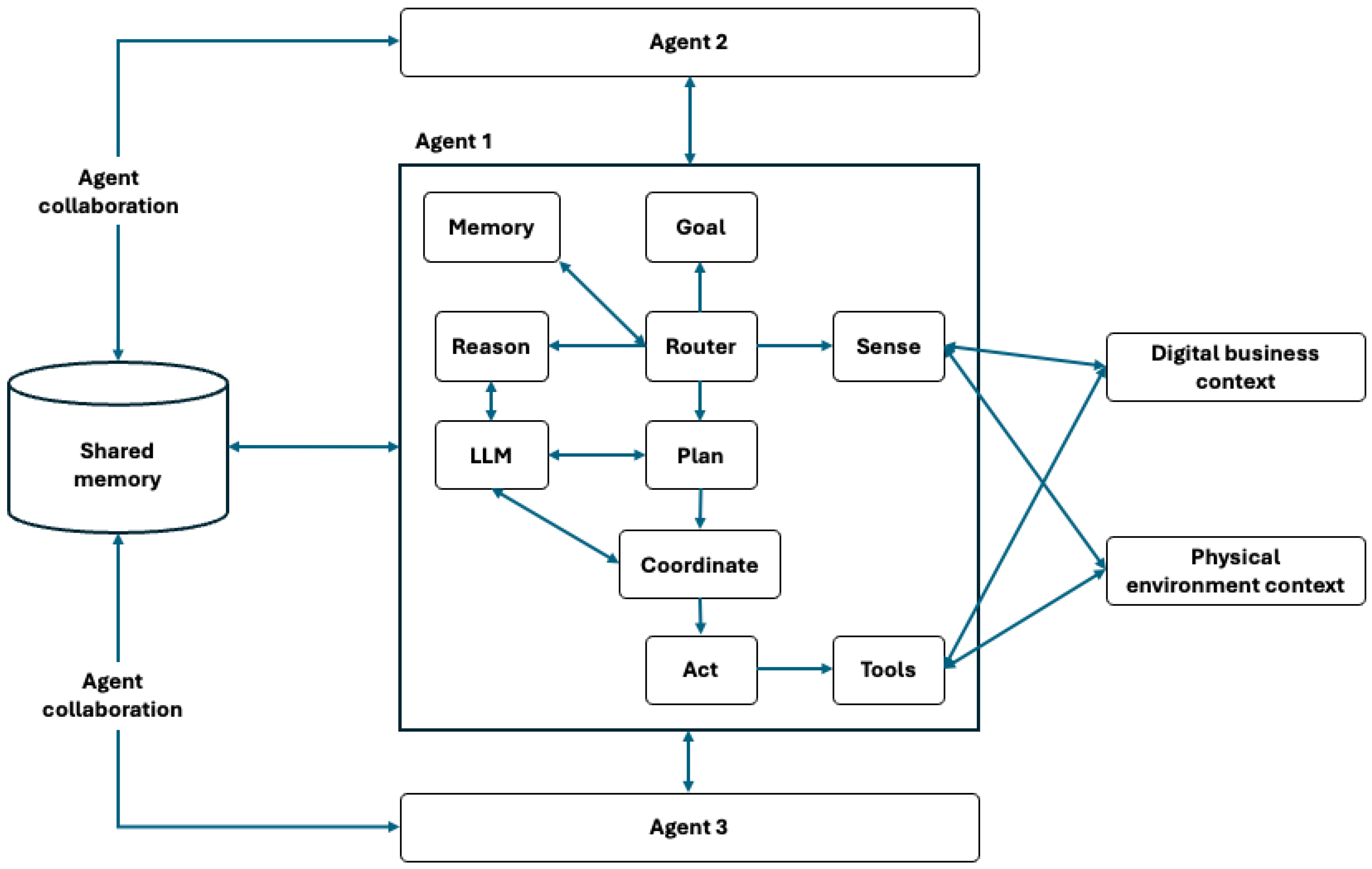
Agentic AI represents a significant advancement in cybersecurity, shifting from traditional reactive measures to proactive threat management. As shown in Figure 2, the unique anatomy of agentic AI comprises key components that enable autonomous learning and real-time adaptation. Unlike conventional systems that rely heavily on predefined rules and patterns, agentic AI leverages advanced machine learning algorithms to anticipate potential threats. This proactive capability allows it to neutralize threats in their early stages, preventing breaches before they occur. According to Mitchell et al., [62], deploying agentic AI in cybersecurity enables real-time monitoring and adaptive responses, significantly reducing the window of vulnerability.
In addition to predictive capabilities, agentic AI systems are adept at orchestrating complex security workflows. For example, these systems can coordinate the deployment of patches, conduct penetration tests, and simulate attack scenarios to bolster an organization’s defense mechanisms [63]. Cybersecurity frameworks can achieve unparalleled synergy by integrating LLMs with agentic AI, combining linguistic precision with autonomous operational efficiency.
Recent research underscores the synergy between LLMs and agentic AI in addressing complex cybersecurity challenges. For instance, Lin et al. [64] demonstrated how LLMs can efficiently parse and interpret threat intelligence reports, enabling faster incident response times. Similarly, Zhou et al. [65] highlight the role of agentic AI in automating vulnerability assessments, reducing manual intervention, and improving accuracy. These advancements are complemented by studies such as Wang et al. [66], which explore the ethical implications of deploying autonomous AI systems in cybersecurity, emphasizing the need for transparency and accountability.
Another critical area of research involves mitigating adversarial attacks on AI systems. Goodfellow et al. [67] introduced foundational concepts of adversarial examples, which continue to influence strategies for securing AI models. More recently, Johnson et al. [68] proposed novel defense mechanisms that leverage the capabilities of LLMs to detect and neutralize adversarial inputs in real-time, marking a significant step forward in AI-driven cybersecurity.
3. Methodology
3.1. The IVAM Framework
Traditional incident response methods often struggle to adapt to dynamic attack vectors and emerging threat tactics. To enhance the accuracy and comprehensiveness of incident response, this study introduces the IVAM Framework a structured approach that translates incident response instructions into a systematic technical flow. As illustrated in Figure 3, the IVAM Framework ensures a more methodical and effective response strategy.
The IVAM Framework integrates three well-established cybersecurity methodologies to ensure a more structured and intelligence-driven response:
- MITRE ATT&CK Knowledge Base for mapping tactics, techniques, and procedures (TTPs),
- NIST Cybersecurity Framework (CSF) for prioritization and procedural standardization, and
- Quantitative Risk Assessment (QRA) for structured risk evaluation.
By leveraging these methodologies, the IVAM Framework provides a systematic, adaptable, and intelligence-driven approach to incident response, enhancing each phase of the response lifecycle. It is structured into three interdependent stages: Investigate, Validate, and Active Monitoring. Each stage focuses on a distinct aspect of the incident response lifecycle while informing and reinforcing the others.
3.1.1. Investigation Phase
The investigative process involves collecting data from logs, Security Information and Event Management (SIEM) systems, endpoint telemetry, and threat intelligence feeds. Forensic analysis identifies root causes and threat vectors, prioritizing high-value targets and critical vulnerabilities. To enhance precision, the investigation integrates the MITRE ATT&CK and NIST frameworks [69], mapping collected data into structured technical steps.
Identify the Attack Type
Initially, it’s essential to collect indicators by gathering details from system alerts, user reports of suspicious logs, and automated detection tools such as Endpoint Detection and Response (EDR), Security Information and Event Management (SIEM), and Intrusion Detection Systems (IDS). This comprehensive data collection lays the foundation for understanding potential security incidents.
Once the data is collected, the next step is to classify the attack. This involves using signatures, patterns, or threat intelligence to categorize the nature of the attack, whether it be malware, phishing, or a web application attack. Accurate classification is crucial for determining the appropriate response strategy.
After classification, assessing the severity of the attack is imperative. This assessment evaluates the risk based on factors such as the complexity of the attack, the capabilities of the attacker, and the initial impact observed. Understanding the severity aids in prioritizing response efforts and allocating resources effectively to mitigate the threat.
Analyze Affected Files and Systems
In the process of investigating potential security incidents, a thorough examination of system modifications is essential. This begins with reviewing file changes to identify any unusual modifications, unexpected file extensions, or unauthorized registry alterations. Such anomalies can be indicative of malicious activity or system compromise.
Concurrently, it’s important to scrutinize system behavior by investigating logs and processes for anomalies. This includes monitoring for signs of privilege escalation, where unauthorized users gain elevated access rights, or abnormal resource usage that could suggest the presence of malicious processes or unauthorized applications consuming excessive system resources.
To further ensure system integrity, evaluating security tools is crucial. Utilizing forensic tools can aid in detecting compromised files or executables, providing a deeper analysis of the system’s state and uncovering hidden threats that may not be evident through standard monitoring.
By systematically reviewing file changes, monitoring system behavior, and employing forensic evaluations, organizations can effectively identify and respond to security incidents, thereby maintaining the integrity and security of their systems.
Determine the Scope of Infection
Identifying compromised endpoints is crucial for timely intervention in cybersecurity. Once these endpoints are identified, it’s essential to monitor for lateral movement within the network. This involves analyzing authentication records and system-to-system connections to detect unauthorized access or the spread of malicious activity. Monitoring for discrepancies in administrative tasks and unusual login activities can provide insights into potential lateral movement.
Additionally, analyzing network traffic plays a vital role in threat detection. Reviewing logs from firewalls, proxies, and Intrusion Detection/Prevention Systems (IDS/IPS) can help identify signs of data exfiltration or command-and-control communications. Tools like Wireshark and tcpdump can be utilized to examine network connections to and from the system, aiding in the detection of suspicious activities.
By systematically identifying compromised endpoints, monitoring for lateral movement, and analyzing network traffic, organizations can enhance their ability to detect, understand, and respond to security incidents efficiently.
Assess Data and Business Impact
In the aftermath of a security incident, conducting a thorough assessment is crucial to understand its implications and determine appropriate response measures. This process involves classifying the data involved, assessing the operational impact, and evaluating compliance risks.
- Classify Data: begin by identifying whether sensitive or regulated data, such as Personally Identifiable Information (PII), financial records, or intellectual property, was accessed or exfiltrated during the breach. Understanding the type of data compromised is essential for assessing potential risks and determining necessary remediation steps.
- Assess Operational Impact: evaluate the extent of business disruption caused by the incident. This includes measuring downtime, loss of productivity, and the resources required for recovery efforts. Understanding the operational impact helps in prioritizing response actions and allocating resources effectively.
- Evaluate Compliance Risks: identify any legal obligations arising from the breach, such as those under the General Data Protection Regulation (GDPR), Health Insurance Portability and Accountability Act (HIPAA), or Payment Card Industry Data Security Standard (PCI-DSS). Determine if notifications to affected individuals or regulatory bodies are necessary, and ensure compliance with relevant laws to mitigate potential legal consequences.
Identify the Initial Infection Vector
This process involves inspecting communication channels, reviewing access logs, investigating web applications, and considering physical access points.
Inspect Communication Channels: Begin by examining email gateways for signs of phishing attempts or malicious attachments. Phishing remains a prevalent method for attackers to gain unauthorized access, making it crucial to monitor and filter incoming emails effectively. Implementing robust email filtering solutions and educating employees on recognizing phishing attempts can significantly reduce this risk.
- Review Access Logs: analyze logs from Remote Desktop Protocol (RDP), Virtual Private Network (VPN), and Secure Shell (SSH) services to detect unauthorized access or brute-force attempts. Unusual login times, failed login attempts, and access from unfamiliar IP addresses can indicate potential security breaches. Regularly reviewing these logs helps in the early detection of unauthorized activities.
- Investigate Web Applications: examine server logs for any signs of exploitation, such as abnormal requests or injection attacks. Web applications are common targets for attackers seeking vulnerabilities to exploit, necessitating regular monitoring and prompt patching of identified issues. Utilizing web application firewalls (WAFs) and conducting regular security assessments can enhance protection.
- Consider Physical Access: assess the potential for security breaches through physical means, including the use of removable media or insider threats. Unauthorized physical access to systems can lead to data theft or the introduction of malicious software, highlighting the need for strict access controls and monitoring. Implementing measures such as surveillance systems, access badges, and security personnel can mitigate these risks.
By systematically inspecting communication channels, reviewing access logs, investigating web applications, and considering physical access points, organizations can effectively identify vulnerabilities and respond to security incidents, thereby maintaining the integrity and security of their systems.
Conduct Advanced Forensic Analysis
Following a security incident, it’s essential to conduct a thorough forensic examination to identify the root causes and understand the adversary’s methods. This process involves several key steps:
- Perform Forensic Analysis: begin by conducting memory forensics and disk analysis to uncover the root causes of the incident. Memory forensics involves capturing and analyzing the contents of a computer’s volatile memory (RAM) to identify malicious processes, open network connections, and other artifacts that may not be present on the disk. Disk analysis complements this by examining the file system and storage media for malicious files, logs, and other persistent indicators of compromise. Tools such as The Sleuth Kit can assist in this analysis.
- Map to MITRE ATT&CK: utilize the MITRE ATT&CK framework to identify the Tactics, Techniques, and Procedures (TTPs) employed by the adversaries. This globally accessible knowledge base categorizes adversary behaviors observed in real-world attacks, aiding in understanding and anticipating potential threat actions.
- Correlate with Threat Intelligence: compare the findings from your forensic analysis against known attack groups or malware families. By correlating observed TTPs with threat intelligence reports, you can attribute the attack to specific adversaries and understand their motivations and capabilities. This correlation enhances your organization’s ability to defend against future attacks by informing proactive security measures.
Containment and Mitigation
In the event of a security incident, implementing immediate and effective response measures is crucial to mitigate damage and restore system integrity. The following steps outline key actions to be taken:
- Isolate Affected Systems: promptly remove compromised endpoints from the network to prevent the spread of malicious activity. This containment strategy is essential to limit further damage and is a critical component of incident response frameworks.
- Block Malicious Entities: update security tools, such as firewalls and intrusion prevention systems, to block identified malicious IP addresses, domains, and file hashes. This proactive measure helps prevent further exploitation by known threats.
- Secure and Patch: apply the latest security updates to all systems to address vulnerabilities exploited during the incident. Reset compromised credentials to prevent unauthorized access, and enforce hardened configurations to enhance system defenses.
- Implement Best Practices: enforce the principle of least privilege by ensuring users have only the access necessary for their roles. Implement multi-factor authentication to add an extra layer of security, and establish network segmentation to contain potential threats and limit their movement within the network.
By executing these steps, organizations can effectively contain security incidents, mitigate their impact, and strengthen defenses against future threats.
3.1.2. Validation Phase
Once actions have been implemented, the framework employs Quantitative Risk Assessment (QRA) methods. AI agents estimate the probable impacts of specific incidents, including financial, reputational, or operational impacts.
Challenges of Asset Valuation
Accurate asset valuation presents significant challenges in modern, interconnected systems. Many organizations rely on intangible assets such as intellectual property, customer trust, or operational uptime, which lack fixed monetary equivalents. Additionally, asset values fluctuate due to market dynamics, reputational impacts, and external conditions, making static valuation methods unreliable.
Furthermore, financial and asset-specific data are often sensitive or confidential. Including such details in risk assessments can introduce security and privacy risks. Asset valuation may impose unnecessary burdens for smaller organizations or those with limited resources, hindering effective risk management [70,71].
Focus on Relative Quantification
Excluding asset value shifts QRA toward relative risk quantification, prioritizing comparative risk assessment over absolute financial estimates. Here, risk is framed as a function of likelihood and impact, where impact is evaluated across operational, reputational, and other relevant dimensions.
This approach aligns with the practical needs of AI agents, which prioritize actionable insights over precise financial estimations. By simplifying assessment processes and emphasizing agility, this method enables security teams to make rapid response and recovery decisions without exhaustive asset valuation.
Addressing Information Constraints
In practical scenarios, obtaining accurate and up-to-date asset valuation data for risk assessment poses significant challenges:
- Intangible Risks: factors such as reputational damage and regulatory penalties often lack direct ties to specific assets, making their valuation complex.
- Supply Chain Vulnerabilities: involving external stakeholders complicates comprehensive asset valuation due to varying data availability and reliability across the supply chain.
- Dynamic Operational Environments: rapid changes in operations can lead to fluctuating asset values, rendering static estimates unreliable and necessitating continuous monitoring.
These challenges underscore the need for adaptable and robust risk assessment methodologies that can accommodate the inherent uncertainties in asset valuation. To establish a Quantitative Risk Assessment (QRA) approach aligned with the NIST Cybersecurity Framework (CSF), the methodology typically involves calculating risk as a function of likelihood and impact. Since asset value information is excluded, the focus is on relative quantification rather than absolute financial values. Here’s a structured formula and breakdown:
where:
where:
By excluding asset value, QRA acknowledges these constraints and provides a streamlined, scalable approach for assessing risks. The relative metrics derived from likelihood and impact facilitate timely and actionable decision-making, even in resource-constrained environments.
3.1.3. Active Monitoring
The final stage underlines the continuous, iterative nature of effective incident response. Active Monitoring ensures that any intelligence gained and actions taken are fed back into the system in real time. If emergent threats or anomalies are detected, the cycle begins anew with an updated Investigate phase.
In practice, Active Monitoring involves a culture of constant refinement, where lessons learned feed directly into ongoing risk assessments and strategy, ensuring that the security posture continues to evolve in parallel with the threat landscape.
By weaving these three stages together Investigate, Action, Validate, and Active Monitoring the IVAM framework aims to deliver a balanced and repeatable approach to incident mitigation. Each phase draws on globally accepted standards and methodologies, ensuring that decisions are not made in isolation but rather anchored in risk-based insights, threat intelligence, and robust validation techniques. Over time, organizations implementing this framework can expect to reduce blind spots, streamline their response processes, and strengthen their overall resilience against adversarial tactics.
3.2. Agentic AI Security Response Construction
Agentic AI is an intelligent system that can autonomously analyze, decide, and execute security actions with minimal or no direct human intervention. Unlike traditional AI, Agentic AI possesses self-governing capabilities, enabling adaptive decision-making and orchestrated security operations across distributed environments.
A key advancement in this field is Agentic AI Security Response, which integrates AI-driven autonomous agents capable of proactive and coordinated responses to cyber threats. One essential aspect of this response mechanism is Security Response Orchestration, which involves coordinating multiple security tools, processes, and workflows to streamline incident detection, analysis, and mitigation.
Table 1 outlines the core responsibilities of the SOAR (Security Orchestration, Automation, and Response) Advisor Assistant, a key component in Agentic AI-driven security response. This AI-powered assistant enhances cybersecurity operations by performing various critical functions:
- Incident Response Analysis & Generation, analyzes log data and problem reports to detect security threats using industry-standard frameworks.
- Incident Mitigation & Resolution, provides mitigation strategies aligned with NIST CSF 2.0 and MITRE ATT&CK and generates remediation steps, including playbook automation.
- Automation & Technical Guidance, ensures security responses follow SOAR best practices and offers step-by-step technical procedures.
- Security Research & Advisory, utilizes vector databases and security repositories to provide evidence-based security recommendations.
- Conversational Efficiency & Memory, engages in professional, context-aware interactions while maintaining conversation history for enhanced accuracy.
This structured approach allows Agentic AI-driven security systems to autonomously manage cybersecurity incidents, reducing response times and improving the overall effectiveness of security operations.
3.2.1. End-to-end Mitigation Workflow Powered AI-agent
The mitigation workflow, as depicted in Figure 4, follows a structured process for detecting, analyzing, and mitigating cyber threats by integrating AI-driven recommendations with human verification. This approach ensures a balance between automation and expert oversight, optimizing security responses while minimizing potential risks.
The process begins with Log Event Collection, where a target endpoint equipped with SIEM detection identifies a security event. The event log, which contains crucial details about the detected attack, is then retrieved from the SIEM server.
Once collected, the data moves to the Data Enrichment module. Here, the system extracts critical attack information and maps it to MITRE TTPs (Tactics, Techniques, and Procedures) to better understand the attack’s technical characteristics. This enrichment process ensures that security teams comprehensively view the threat.
Using this enriched data, the Mitigation Recommendation phase leverages an AI-driven system to generate a precise response plan. These recommendations align with MITRE ID’s technical procedures, ensuring that the proposed mitigation steps are accurate and relevant to the nature of the attack.
The next phase, Building Technical Steps, involves formulating an action plan that outlines the necessary steps for mitigation. These steps serve as a structured guide to ensure an effective response.
Before execution, the workflow incorporates a Human Verification and Approval stage, where a security analyst reviews the proposed steps. The analyst can either approve, modify, or refine the plan, ensuring that the response is both effective and appropriate for the situation.
Once verified, the process moves to Execution of Mitigation, where the approved steps are carried out using dedicated security tools. This may involve applying security controls, blocking malicious activities, or deploying patches to neutralize the threat.
After the mitigation steps are executed, the process moves into the Evaluation and Refinement stage, where the effectiveness of the implemented measures is carefully assessed. This phase is crucial for determining whether the sent commands successfully neutralized the threat or require further improvement to achieve optimal performance.
If the executed instructions effectively mitigate the issue without unintended consequences, they are recorded as validated response actions for future use. However, if adjustments are needed, the system refines the approach by modifying commands, tuning execution parameters, or restructuring the mitigation sequence. This iterative process helps identify the most efficient and reliable response strategies based on real-world results.
By continuously analyzing whether each executed instruction needs improvement or has already achieved success, this phase ensures that the system consistently evolves and adapts, enhancing overall threat response performance over time.
3.2.2. Agentic AI Building blocks and Function
Figure 5 illustrates a proposed multi-agent system architecture designed to automate and enhance security incident response workflows. The proposed system encompasses three main layers: (i) Planning and Data Management, (ii) Model Orchestration and Task Decomposition, and (iii) Tooling and Execution. This layered approach ensures modularity, facilitates scalability and provides robust interfaces to external systems such as a Security Information and Event Management (SIEM) platform.
Leveraging LLMs for Agent-Powered Security Systems
DeepSeek-R1-Distill-Llama-70B [72] and Meta’s Llama-3.3-70B-Instruct [73] represent significant advancements in large language model development, each contributing uniquely to the field of artificial intelligence. DeepSeek-R1-Distill-Llama-70B is a distilled version of DeepSeek’s R1 model, fine-tuned from the Llama-3.3-70B-Instruct base model [74]. This model leverages knowledge distillation to retain robust reasoning capabilities while enhancing efficiency, achieving superior performance on complex mathematics and coding tasks compared to larger models.
On the other hand, Meta’s Llama-3.3-70B-Instruct is a text-only, instruction-tuned model optimized for multilingual dialogue use cases. It outperforms many available open-source and closed chat models on common industry benchmarks, providing enhanced performance relative to its predecessors [73]. Collectively, these models exemplify the rapid progress in developing efficient, high-performing language models capable of handling complex reasoning and multilingual tasks.
Planning and Data Management
At the core of the system is an advanced data refinement and management process, ensuring all security events and contextual information are pre-processed for downstream analysis. The system integrates:
- Data Refinement: incoming event data is cleansed, labeled, and structured for efficient processing.
- Security Incident Response Data: historical logs, real-time event monitoring, and domain-specific threat intelligence inform analysis and decision-making.
- Vector Database (Vector DB): a specialized database storing embeddings of security incidents, enabling rapid retrieval of past events with similar characteristics. This capability aids in contextualizing new threats and supports proactive response measures.
Model Orchestration and Task Decomposition
Effective security response requires intelligent task management and model orchestration, achieved through:
- Agent Router: an agent component that routes queries and tasks to the appropriate large language model (LLM) based on predefined rules, model specialization, or real-time performance metrics. It also utilizes the incident similarity engine, retrieving relevant cases from the vector DB to enhance contextual understanding.
-
LLM Models: two specialized LLMs power the system:
- -
- LLM Model Llama-3.3-70B-Instruct: focuses on broad security policies, general text processing, and strategic threat mitigation.
- -
- LLM Model deepseek-ai/DeepSeek-R1-Distill-Llama-70B: designed for deep, domain-specific security analysis and advanced query resolution.
Tooling and Execution Component
As illustrated in Figure 6, the Tooling and Execution component of the proposed system is designed to systematically manage security incidents through a structured pipeline, ensuring that each response is thorough, auditable, and effective.
Technical Step Builder
The Technical Step Builder is a structured pipeline that decomposes an overarching response strategy into smaller, auditable tasks, ensuring a systematic and efficient approach to incident management. Aligned with established incident management frameworks, this methodology emphasizes structured processes for effectively handling security threats.
The process begins with the step splitter, which breaks down large, complex tasks into manageable subtasks. This decomposition allows teams to address each component systematically, reducing the risk of oversight and improving execution clarity.
Following this, the system evaluation phase assesses the environment, identifying critical assets and evaluating system health metrics. A built-in feedback loop strengthens this step, collecting insights from previous response actions on targeted endpoints. These evaluations enable the AI agent to refine its strategies, optimizing mitigation efforts for both effectiveness and resource efficiency.
Subsequently, the risk assessment stage determines the potential impact and severity of the incident or proposed actions. Highlighting associated risks ensures informed decision-making, allowing teams to implement protective measures that minimize operational and security disruptions.
To accelerate the response process, the script constructor automates the creation of scripts for threat mitigation and incident response. Standardized execution through automation is essential, particularly during time-sensitive incidents that require swift and precise actions. Before execution, a Human Interrupt phase introduces expert review, refinement, and approval of proposed actions. This step integrates human judgment and contextual understanding, ensuring necessary adjustments for nuances that automated systems might overlook.
Implementing this structured pipeline enhances incident response efficiency, enabling precise threat management while balancing automation and human oversight.
Agent Executor
The executor plays a critical role in executing approved tasks through a suite of specialized tools. These tools facilitate comprehensive analysis, real-time mitigation, and system modifications, ensuring an efficient and effective incident response process. A key component of this system is the integration of static and dynamic analysis tools, which examine files and binaries to detect potential malicious content. These tools identify threats by analyzing behavioral patterns and code structures, enabling early detection and response.
Beyond detection, the executor employs active response mechanisms that automate real-time mitigations. This includes blocking malicious IPs, isolating compromised hosts, and deploying necessary patches to neutralize threats before they escalate. The system incorporates a code interpreter capable of executing or interpreting code dynamically to enhance adaptability. This feature allows for flexible incident response strategies, ensuring rapid adaptation to new and evolving threats.
For more direct intervention, the executor provides shell access, enabling command-line execution of system modifications. Security teams can implement immediate changes, reinforcing the system’s responsiveness and efficiency. Through this combination of advanced tools and automation, the executor ensures a seamless and proactive security response, minimizing risks while maintaining system integrity and performance.
3.3. System Automation Flow
Integrating a vector database into an incident response system significantly enhances efficiency and effectiveness. By storing incident data, historical records, and corresponding mitigation processes, the system can autonomously respond to recurring threats. When a security incident occurs, the database stores its characteristics and mitigation steps as vector representations. This approach captures complex relationships and patterns within the data, ensuring valuable insights are retained for future use.
Upon encountering a new incident, the system converts its attributes into a vector and searches the database for similar cases. Identifying incidents with comparable features can quickly retrieve effective response strategies, reducing analysis time and accelerating decision-making. Once a match is found, the system automatically retrieves the corresponding mitigation steps and adapts them to the current context. This includes fine-tuning parameters such as the target endpoint and necessary dependencies, enabling a precise and efficient response without manual intervention.
This methodology streamlines the incident response process, ensuring faster, more consistent, and highly accurate resolutions by leveraging previously validated solutions. Vector databases are particularly valuable in managing the complexity and scale of modern cybersecurity data, offering efficient high-dimensional querying essential for real-time threat detection and response in large-scale systems.
4. Agent Validation Result
To evaluate the feasibility of AI-driven threat mitigation, we implement a simulated cyber-attack using Wazuh as the Security Information and Event Management (SIEM) tool [75]. This study focuses on detecting and mitigating common brute force attacks [76]. The attack simulations generate security logs, which are processed by an AI-based threat mitigation system. The AI agent analyzes these logs and applies predefined countermeasures to neutralize potential threats.
The experiment is conducted in a virtualized environment using VirtualBox on Ubuntu 22.04.5 LTS, running on a 13th-generation Intel Core i7 processor. Following the guidelines from the Wazuh documentation [76], we establish a proof-of-concept setup for brute force detection, simulate relevant attack scenarios, and evaluate the effectiveness of AI-driven mitigation strategies.
4.1. Data Enrichment
Brute force attacks generate extensive raw logs that can overwhelm security analysts with low-level messages and fragmented information. Transforming these raw entries into actionable intelligence requires contextual enrichment, an automated process that augments basic log data with meaningful security insights. By integrating AI-enhanced data enrichment into traditional intrusion detection systems (e.g., Wazuh), AI agents can promptly identify critical details such as attack timelines, related hosts, and suspicious behavioral patterns.
As illustrated in Figure 7, the refined data yields a clearer overview of the affected target endpoint, the specific type of brute force attack, and standardized metadata about each event.
4.2. Agent-Based Mitigation Result
After identifying the security breach context, the next step involves feeding the extracted information into the Large Language Model (LLM) agent to generate a detailed response recommendation. Leveraging its advanced natural language processing capabilities, the LLM analyzes key aspects of the breach such as its nature, scope, and potential vulnerabilities, and formulates a systematic course of action. As shown in Table 2, the LLM agent breaks down the response into a series of technical steps, addressing both immediate threats and long-term mitigation strategies.
Compared to the traditional Security Orchestration, Automation, and Response (SOAR) workflow outlined in the Brute-Force Investigation - Generic playbook [77] which spans 38 distinct steps the AI-driven approach streamlines mitigation tasks into ten key actions. This optimized methodology highlights the LLM agent’s ability to abstract, prioritize, and consolidate remediation efforts, focusing on essential technical and procedural elements rather than detailing every granular sub-step. While the legacy SOAR workflow offers a highly detailed breakdown of individual tasks, the AI-driven approach enhances conceptual clarity, operational efficiency, and adaptability, ensuring that critical countermeasures are executed swiftly and effectively in response to a brute-force attack.
The AI agent offers a more detailed breakdown of each step, explicitly integrating security tools and best practices. For instance, when mitigating threats, it recommends Fail2Ban to block malicious activity and enforces password resets as an essential security measure. In contrast, XSOAR follows a more predefined approach by implementing threshold-based blocking and account lockouts, which, while effective, may lack adaptability to evolving security threats.
A strong emphasis on access control is evident in both approaches, particularly in enhancing Multi-Factor Authentication (MFA) and strengthening SSH security configurations. However, the AI agent provides more granular recommendations, such as using Google Authenticator for SSH access and enforcing stricter login policies like disabling root login and limiting authentication attempts. These measures demonstrate a proactive approach to preventing unauthorized access.
Forensic analysis is another crucial component of incident response. The AI agent suggests using AIDE for file integrity checks and auditd to monitor critical files, ensuring real-time detection of unauthorized modifications. While XSOAR also focuses on deep-dive investigations, it does not specify particular tools, implying that additional customization may be required for comprehensive forensic analysis.
When it comes to remediation and system restoration, the AI agent consolidates multiple steps such as isolating compromised systems, blocking malicious IPs, and reconfiguring security settings into a streamlined recovery process. XSOAR, on the other hand, treats remediation as a distinct phase, which may provide a structured but lengthier approach to restoring normal operations.
Incident documentation and compliance play a significant role in security management. Both methodologies emphasize thorough recordkeeping, but the AI agent explicitly aligns its response with compliance frameworks such as PCI DSS, HIPAA, NIST, GDPR, and GPG13. This focus on regulatory alignment ensures that security responses not only mitigate threats but also adhere to industry standards.
Finally, post-incident analysis and continuous improvement are essential to refining cybersecurity practices. Both XSOAR and the AI agent stress the importance of conducting debrief sessions and updating security policies based on lessons learned. However, the AI-driven approach provides a more structured mechanism for reviewing past incidents, identifying successes and failures, and incorporating these insights into future security strategies.
4.3. Brute-Force Quantitative Risk Assessment Result
A Quantitative Risk Assessment (QRA) was conducted to evaluate both the effectiveness and potential drawbacks of each proposed mitigation measure aimed at countering brute-force attacks. The results of this assessment are illustrated in Figure 8. The likelihood of encountering brute-force attempts is moderate to high, given their prevalence in cybersecurity incidents. Moreover, the impact of a successful brute-force attack can be significant, potentially leading to unauthorized access, data breaches, and reputational damage. By combining probability and impact, the relative risk associated with brute-force attacks is assessed as high, reflecting both the frequency of these incidents and the severity of their consequences.
Applying this QRA framework incrementally to each recommended mitigation step such as isolating affected systems, deploying Fail2Ban, or enforcing multi-factor authentication helps identify unintended consequences like legitimate user lockouts or performance overhead. As a result, the analysis informs whether the overall risk-reducing benefits justify the associated costs, enabling security teams to make data-driven decisions about prioritizing and implementing the most effective controls against brute-force threats.
4.4. AI-Driven Adaptive Error Resolution
Referencing Figure 9, the AI agent embarked on its task with precision, aiming to execute system commands seamlessly.
However, despite its efficiency, it encountered an obstacle and a persistent authentication requirement that halted its progress. As illustrated in the figure, the AI agent engaged in a diagnostic and remediation process, iterating through possible solutions before ultimately recognizing the necessity of human intervention.
Table 3 shows the AI agent’s repeated attempts to manage iptables under sudo privileges, all of which fail due to the requirement for a password. Each step concludes with the agent indicating that human intervention or a change in sudo settings is needed before proceeding.
Ultimately, the agent issues a Human Intervention Request and remains on standby for further instructions, highlighting the importance of valid authentication or suitably configured permissions to facilitate its automated tasks.
5. Discussion & Future Works
The AI-driven mitigation system demonstrates the benefits of integrating intelligent agents into cybersecurity workflows. This experiment showcased how AI-enhanced security measures, particularly in brute force attack scenarios, improve efficiency, precision, and adaptability compared to traditional Security Orchestration, Automation, and Response (SOAR) solutions.
A key finding is the effectiveness of data enrichment in transforming raw security logs into actionable intelligence. By contextualizing events through AI-driven analysis, the system provides a structured and interpretable dataset, reducing the cognitive load on security analysts. As illustrated in Figure 7, the enriched data includes critical attributes such as attack source identification, MITRE ATT&CK mappings, and incident response recommendations. This enhanced visibility ensures a more targeted and informed approach to threat mitigation.
Additionally, the AI agent-based mitigation process streamlines incident response by minimizing the number of steps required to contain and neutralize security breaches. As highlighted in Table 2, the AI-driven approach condenses the 38-step SOAR workflow into ten key actions, demonstrating its ability to prioritize and optimize remediation efforts. The efficiency gains observed in the AI-driven methodology underscore the potential of leveraging Large Language Models (LLMs) for cybersecurity applications, particularly in rapidly evolving attack landscapes where swift decision-making is crucial.
A comparative assessment of the AI agent and traditional SOAR methods reveals nuanced differences in handling security incidents. While SOAR platforms rely on preconfigured workflows and structured playbooks, the AI agent introduces adaptability by incorporating dynamic threat intelligence. For instance, the AI agent recommends specific mitigation tools such as Fail2Ban for automated IP blocking and AIDE for integrity monitoring, enhancing the flexibility and robustness of the response strategy. Additionally, the agent suggests proactive security hardening techniques, such as enforcing multi-factor authentication (MFA) and disabling root login for SSH, reflecting a forward-thinking approach to security management.
Despite these advantages, certain limitations of AI-driven mitigation must be acknowledged. The reliance on machine learning models introduces the potential for misclassification or false positives, which could lead to unnecessary security actions or disruptions. Additionally, while the AI agent provides more granular and adaptive recommendations, its effectiveness depends on the quality and completeness of the underlying training data. Future improvements should focus on refining the model’s decision-making capabilities through continuous learning and validation against real-world attack datasets.
Moreover, the interpretability of AI-generated recommendations remains a critical consideration. Security teams must understand and trust the AI agent’s outputs to fully integrate them into operational workflows. Enhancing explainability through transparent decision-making processes and human-in-the-loop validation mechanisms could help bridge the gap between AI-driven automation and human expertise.
Finally, the findings of this study demonstrate that AI-enhanced cybersecurity solutions significantly improve the efficiency and effectiveness of brute force attack mitigation. The AI agent’s ability to process large volumes of security logs, generate enriched threat intelligence, and provide optimized response strategies positions it as a valuable asset in modern security operations. Future research should explore expanding the AI agent’s capabilities to cover a broader range of cyber threats, such as phishing detection or ransomware mitigation, ensuring its adaptability to emerging attack vectors and evolving adversarial tactics.
Author Contributions
Conceptualization, I.; methodology, I.; software, R.K., Z.A.B., and G.A.N.; validation, R.K.; formal analysis, I. and R.K.; data curation, I. and R.K.; writing-original draft, I., S.H., and K.H.G.; writing—review and editing, I.; visualization, I., and R.K.; supervision, H.K.; project administration, H.K.; funding acquisition, H.K. All authors have read and agreed to the published version of the manuscript.
Data Availability Statement
Data is contained within the article.
Acknowledgments
This research was supported by the MSIT(Ministry of Science and ICT), Korea, under the ITRC(Information Technology Research Center) support program(RS-2020-II201797) supervised by the IITP(Institute for Information & Communications Technology Planning & Evaluation) and this research was supported by the MSIT(Ministry of Science and ICT), Korea, under the Convergence security core talent training business(Pusan National University) support program(RS-2022-II221201) supervised by the IITP(Institute for Information & Communications Technology Planning & Evaluation)
Conflicts of Interest
The authors declare no conflicts of interest.
References
- Crowley, C.; Pescatore, J. Common and Best Practices for Security Operations Centers: Results of the 2019 SOC Survey. SANS Institute Information Security Reading Room, 2019. Accessed: 2025-02-12.
- Team, T.I. Accelerate Incident Response with SOAR. Threat Intelligence Blog, 2025. Accessed: 2025-01-7.
- CREST. CREST launches comprehensive white paper on Maximising SOAR in the SOC - Global Security Mag Online. Global Security Magazine Online, 2023. Accessed: 2025-01-7.
- Logic, S. How SOAR can foster efficient SecOps in modern SOCs | Sumo Logic. Sumo Logic Blog, 2025. Accessed: 2025-01-7.
- Securaa. SOAR: Revolutionizing Security Operations Centers (SOC) Teams - Securaa. Securaa Blog, 2025. Accessed: 2025-01-7.
- Rapid7. Automating Threat Hunting with SOAR for Faster Response Times | Rapid7 Blog. Rapid7 Blog, 2019. Accessed: 2025-01-7.
- Security, D. How Smart SOAR Automates Threat Hunting | D3 Security. D3 Security Blog, 2025. Accessed: 2025-01-7.
- Saint-Hilaire, K.A.; Neal, C.; Cuppens, F.; Boulahia-Cuppens, N.; Hadji, M. Optimal Automated Generation of Playbooks. In Proceedings of the Data and Applications Security and Privacy XXXVIII; Ferrara, A.L.; Krishnan, R., Eds., Cham, 2024; pp. 191–199.
- Islam, C.; Babar, M.A.; Nepal, S. Architecture-Centric Support for Integrating Security Tools in a Security Orchestration Platform. In Proceedings of the Software Architecture; Jansen, A.; Malavolta, I.; Muccini, H.; Ozkaya, I.; Zimmermann, O., Eds., Cham, 2020; pp. 165–181.
- Playbook-Centric Scalable SOAR System Architecture Abstract 1 Introduction 2 Playbook-centric scalable SOAR system architecture and workflow 2.1 System architecture. Accessed: 2025-01-8.
- Tilbury, J.; Flowerday, S. Humans and Automation: Augmenting Security Operation Centers. Journal of Cybersecurity and Privacy 2024, 4, 388–409. [CrossRef]
- Kochale, K.; Boerakker, D.; Teutenberg, T.; Schmidt, T.C. Concept of flexible no-code automation for complex sample preparation procedures. Journal of Chromatography A 2024, 1736, 465343. [CrossRef]
- Lee, M.; Jang-Jaccard, J.; Kwak, J. Novel Architecture of Security Orchestration, Automation and Response in Internet of Blended Environment. Computers, Materials and Continua 2022, 73, 199–223. [CrossRef]
- Tyagi, A. Enterprise Risk Management: Benefits and Challenges 1 Enterprise Risk Management: Benefits and Challenges.
- Smith, D.; Fischbacher, M. The changing nature of risk and risk management: The challenge of borders, uncertainty and resilience, 200. [CrossRef]
- Luxoft. Transforming regulatory and GRC with low-code automation technologies | Luxoft Blog. Luxoft Blog, 2025. Accessed: 2025-01-13.
- Quantzig. Top benefits of low-code platforms that transforms your business in 2025. Quantzig Blog, 2025. Accessed: 2025-01-13.
- Technology, B. Low-Code Development: A Comprehensive Guide for 2025. Bacancy Technology Blog, 2025. Accessed: 2025-01-13.
- Intelliconnectq. Low-Code Platforms for Optimizing Operational Costs. Intelliconnectq Blog, 2025. Accessed: 2025-01-13.
- Sido, N.; Emon, E.A.; Ahmed, E.; Supervisor, E.; Falch, M. Low/No Code Development and Generative AI Thesis Report Title: Low/No Code Development & Generative AI.
- Desmond, M.; Duesterwald, E.; Isahagian, V.; Muthusamy, V. A No-Code Low-Code Paradigm for Authoring Business Automations Using Natural Language 2022.
- Rajput, A.S.; Professor, R.G.A. Hyper-automation-The next peripheral for automation in IT industries.
- Quargnali, G. Hyperautomation-intelligent Automation. Accessed: 2025-01-12.
- Engel, C.; Ebel, P.; Leimeister, J.M. Cognitive automation. Electronic Markets 2022, 32, 339–350. [CrossRef]
- Engel, C.; Elshan, E.; Ebel, P.; Leimeister, J.M. Stairway to heaven or highway to hell: A model for assessing cognitive automation use cases. Journal of Information Technology 2024, 39, 94–122. [CrossRef]
- Matthijs Bal, P.; Davids, J.; Garcia, E.; McKnight, C.; Nichele, E.; Orhan, M.A.; van Rossenberg, Y., The Psychology of Automation and Artificial Intelligence at Work: Exploring Four Fantasies and Their Leadership Implications. In Power, Politics and Influence: Exercising Followership, Leadership, and Practicing Politics; Akande, A., Ed.; Springer Nature Switzerland: Cham, 2024; pp. 575–592. [CrossRef]
- Kusiak, A. Hyper-automation in manufacturing industry, 2024. [CrossRef]
- Fedosovsky, M.E.; Uvarov, M.M.; Aleksanin, S.A.; Pyrkin, A.A.; Colombo, A.W.; Prattichizzo, D. Sustainable Hyperautomation in High-Tech Manufacturing Industries: A Case of Linear Electromechanical Actuators. IEEE Access 2022, 10, 98204–98219. [CrossRef]
- Agency, I.S. CISA | Defend Today, Secure Tomorrow. CISA Website, 2021. Accessed: 2025-01-8.
- Framework for Improving Critical Infrastructure Cybersecurity, Version 1.1, 2018. [CrossRef]
- Strom, B.E.; Applebaum, A.; Miller, D.P.; Nickels, K.C.; Pennington, A.G.; Thomas, C.B. MITRE ATT&CK®: Design and Philosophy. MITRE Technical Report, 2018. Accessed: 2025-01-8.
- Zadeh, A.; Lavine, B.; Zolbanin, H.; Hopkins, D. Cybersecurity risk quantification and classification framework for informed risk mitigation decisions. Decision Analytics Journal 2023, 9, 100328. Accessed: 2025-02-0. [CrossRef]
- Quinn, S.; Ivy, N.; Barrett, M.; Witte, G.; Gardner, R.K. NISTIR 8286B: Prioritizing Cybersecurity Risk for Enterprise Risk Management. Technical Report 8286B, National Institute of Standards and Technology (NIST), 2022. Accessed: 2025-02-06.
- Algarni, A.M.; Malaiya, Y.K. A consolidated approach for estimation of data security breach costs. 2016 2nd International Conference on Information Management (ICIM) 2016, pp. 26–39.
- Jouini, M.; Rabai, L.B.A.; Khedri, R. A Quantitative Assessment of Security Risks Based on a Multifaceted Classification Approach. Springer Journal of Information Security 2020.
- SANS Institute. SANS 2020 MITRE ATT&CK Whitepaper. Technical report, SANS Institute, 2020. Accessed: 2025-02-06.
- Bartwal, U.; Mukhopadhyay, S.; Negi, R.; Shukla, S. Security Orchestration, Automation and Response Engine for Deployment of Behavioural Honeypots. arXiv 2022. Accessed: 2025-02-06. arXiv:cs.CR/2201.05326.
- Kinyua, J.; Awuah, L. AI/ML in Security Orchestration, Automation and Response: Future Research Directions. Intelligent Automation Soft Computing 2021, 28, 528–543. Accessed: 2025-02-06. [CrossRef]
- Institute, S. Incident Response Cycle. SANS Resource, 2025. Accessed: 2025-02-21.
- Fysarakis, K.; Lekidis, A.; Mavroeidis, V.; Lampropoulos, K.; Lyberopoulos, G.; Vidal, I.G.M.; Terés i Casals, J.C.; Luna, E.R.; Moreno Sancho, A.A.; Mavrelos, A.; et al. PHOENI2X – A European Cyber Resilience Framework With Artificial-Intelligence-Assisted Orchestration, Automation & Response Capabilities for Business Continuity and Recovery, Incident Response, and Information Exchange. In Proceedings of the 2023 IEEE International Conference on Cyber Security and Resilience (CSR), July 2023, pp. 538–545. [CrossRef]
- Kremer, R.; Wudali, P.N.; Momiyama, S.; Araki, T.; Furukawa, J.; Elovici, Y.; Shabtai, A. IC-SECURE: Intelligent System for Assisting Security Experts in Generating Playbooks for Automated Incident Response. arXiv 2023. Accessed: 2025-02-06. arXiv:cs.CR/2311.03825.
- Sworna, Z.T.; Islam, C.; Babar, M.A. APIRO: A Framework for Automated Security Tools API Recommendation. arXiv 2022. Accessed: 2025-02-06. arXiv:cs.SE/2201.07959.
- OpenAI. GPT-4, 2023. Accessed: 2025-02-06.
- Google. Bard, 2023. Accessed: 2025-02-06.
- Anthropic. Claude, 2023. Accessed: 2025-02-06.
- Meta AI. LLaMA: Large Language Model Meta AI, 2023. Accessed: 2025-02-06.
- Cohere AI. Command R: Retrieval-Augmented Generation Model, 2023. Accessed: 2025-02-06.
- Hugging Face BigScience. BLOOM: BigScience Large Open-Science Open-Access Multilingual Language Model, 2023. Accessed: 2025-02-06.
- EleutherAI. GPT-NeoX: A Large-Scale Autoregressive Language Model, 2023. Accessed: 2025-02-06.
- DeepSeek AI. DeepSeek-R1, 2023. Accessed: 2025-02-06.
- Alibaba DAMO Academy. Qwen: Large Language Model by Alibaba, 2023. Accessed: 2025-02-06.
- Brown, T.; Mann, B.; Ryder, N.; et al.. Language Models are Few-Shot Learners. Advances in Neural Information Processing Systems 2020, 33, 1877–1901.
- Bommasani, R.; Hudson, D.; Adcock, A.; et al. On the Opportunities and Risks of Foundation Models. arXiv preprint arXiv:2108.07258 2021.
- Wei, J.; Wang, X.; Schuurmans, D.; Bosma, M.; Ichter, B.; Xia, F.; Chi, E.; Le, Q.; Zhou, D. Chain-of-Thought Prompting Elicits Reasoning in Large Language Models. arXiv 2022. Accessed: 2025-02-06. arXiv:cs.CL/2201.11903.
- Qin, Y.; Liang, S.; Ye, Y.; Zhu, K.; Yan, L.; Lu, Y.; Lin, Y.; Cong, X.; Tang, X.; Qian, B.; et al. ToolLLM: Facilitating Large Language Models to Master 16000+ Real-world APIs. arXiv 2023. Accessed: 2025-02-06. arXiv:cs.CL/2307.16789.
- Nair, V.; Schumacher, E.; Tso, G.; Kannan, A. DERA: Enhancing Large Language Model Completions with Dialog-Enabled Resolving Agents. arXiv 2023. Accessed: 2025-02-06. arXiv:cs.CL/2303.17071.
- Wang, H.; Zhao, L.; Chen, M. Ethical AI in Autonomous Cybersecurity: Challenges and Opportunities. ACM Transactions on Information and System Security 2023, 26, 1–18.
- Wang, G.; Lin, Z.; Peng, J.B.; Wu, Q.; Lu, S.; Gonzalez, J.E.; Abbeel, P.; Zhou, D.S. Voyager: An Open-Ended Embodied Agent with Large Language Models. arXiv preprint arXiv:2305.16291 2023.
- Ahn, M.; Brohan, A.; Chai, Y.H.H.; Canny, J.; Goldberg, K.; McGrew, B.; Ichter, B. Can Large Language Models Be an Alternative to Robot Motion Planning? arXiv 2022. arXiv:2206.05841.
- Singh, S.; Gupta, S.; Thakur, A.; Saran, A. ProgPrompt: Generating Situated Robot Task Plans using Large Language Models. arXiv 2023. arXiv:2304.05381.
- Arsanjani, M.S. The Anatomy of Agentic AI. Medium, 2023. Accessed: 2025-02-12.
- Mitchell, E.; Brynjolfsson, E. The AI cybersecurity revolution: Leveraging autonomous decision-making for proactive threat mitigation. Cybersecurity Journal 2022, 10, 45–67.
- Singh, R.; Patel, N.; Li, Z. AI-driven cybersecurity orchestration: From predictive analytics to automated defenses. Journal of Artificial Intelligence in Cybersecurity 2023, 8, 112–138.
- Lin, D.; Xu, Y.; Cheng, W. LLMs in Cybersecurity: Parsing and Interpreting Threat Intelligence Reports. Proceedings of the IEEE Cybersecurity Conference 2023.
- Zhou, K.; Wang, P.; Zhang, E. AI-driven Vulnerability Assessment: Automating Risk Identification and Mitigation. Journal of Machine Learning for Security 2022, 5, 189–210.
- Wang, L.; Chen, X.; Brown, A. Ethical Implications of Autonomous AI in Cybersecurity: Transparency, Accountability, and Governance. Artificial Intelligence Society 2023.
- Goodfellow, I.J.; Shlens, J.; Szegedy, C. Explaining and harnessing adversarial examples. arXiv preprint arXiv:1412.6572 2014.
- Johnson, R.; Kim, E.; Williams, D. LLM-driven Adversarial Defense: Real-Time Detection and Mitigation of Adversarial Attacks. Journal of AI Security Research 2023, 9, 155–178.
- Ismail.; Kurnia, R.; Widyatama, F.; Wibawa, I.M.; Brata, Z.A.; Ukasyah.; Nelistiani, G.A.; Kim, H. Enhancing Security Operations Center: Wazuh Security Event Response with Retrieval-Augmented-Generation-Driven Copilot. Sensors 2025, 25, 870. [CrossRef]
- Pupentsova, S.; Gromova, E. Risk Management in Business Valuation in the Context of Digital Transformation. Real Estate Management and Valuation 2021, 29, 97–106. Accessed: 2025-02-12. [CrossRef]
- Metin, B.; Duran, S.; Telli, E.; Mutlutürk, M.; Wynn, M. IT Risk Management: Towards a System for Enhancing Objectivity in Asset Valuation that Engenders a Security Culture. Information 2024, 15. Accessed: 2025-02-12. [CrossRef]
- AI, D. DeepSeek-R1-Distill-Llama-70B. Hugging Face, 2023. Accessed: 2025-02-12.
- AI, M. Llama-3.3-70B-Instruct. Hugging Face, 2023. Accessed: 2025-02-12.
- Documentation, G. DeepSeek-R1-Distill-Llama-70B. Groq Console Docs, 2023. Accessed: 2025-02-12.
- Wazuh. Wazuh: The Open Source Security Platform. Wazuh Official Website, 2025. Accessed: 2025-02-25.
- Wazuh. Detect Brute-Force Attack. Wazuh Documentation, 2025. Accessed: 2025-02-21.
- Networks, P.A. Brute Force Investigation — Generic. Cortex XSOAR Documentation, 2025. Accessed: 2025-02-24.
Figure 1.
Integration of AI/ML into SOAR platforms aligned with the SANS PICERL framework. (adapted from [38])
Figure 1.
Integration of AI/ML into SOAR platforms aligned with the SANS PICERL framework. (adapted from [38])
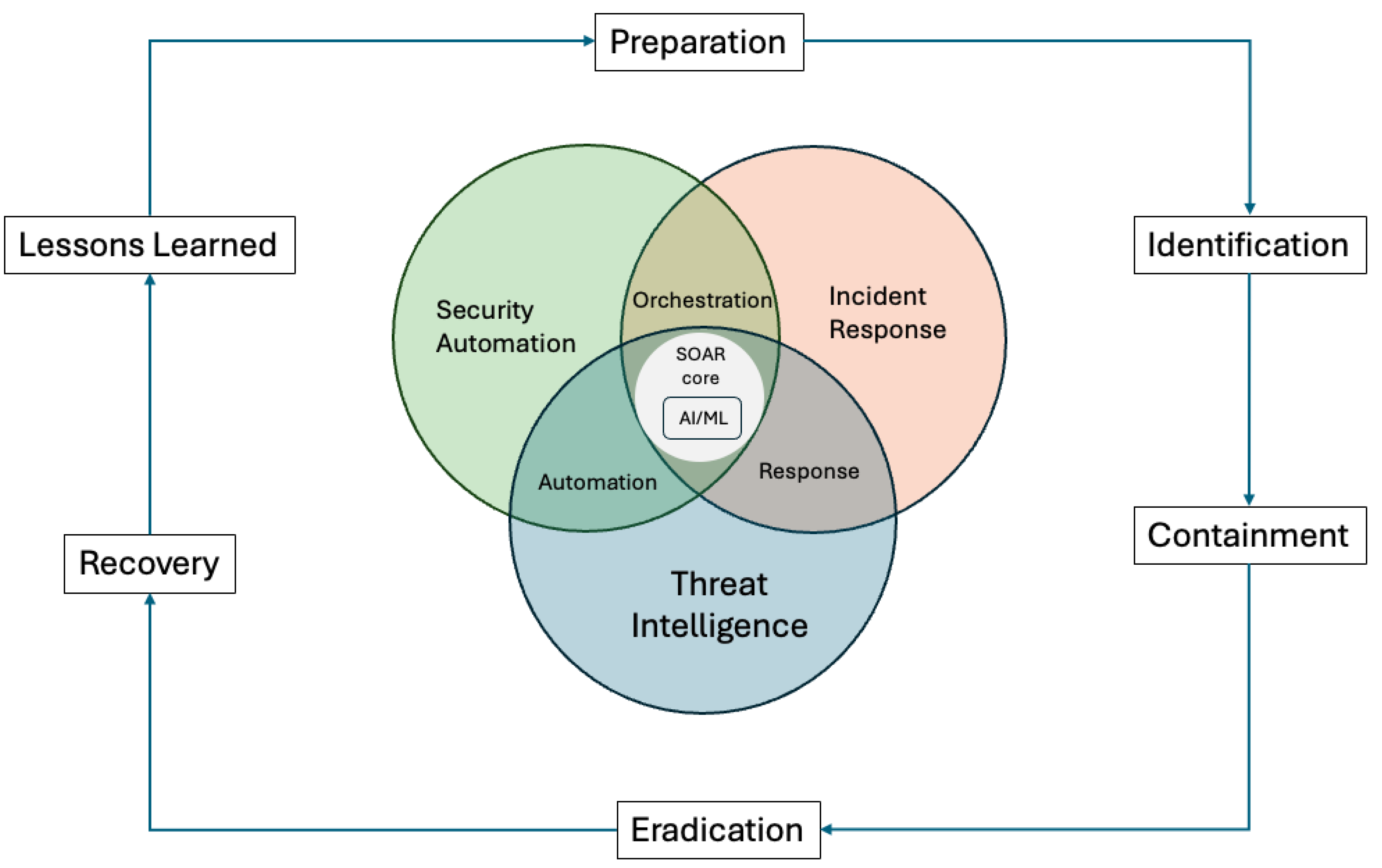
Figure 3.
IVAM Framework translating incident response instructions into a systematic technical flow
Figure 3.
IVAM Framework translating incident response instructions into a systematic technical flow
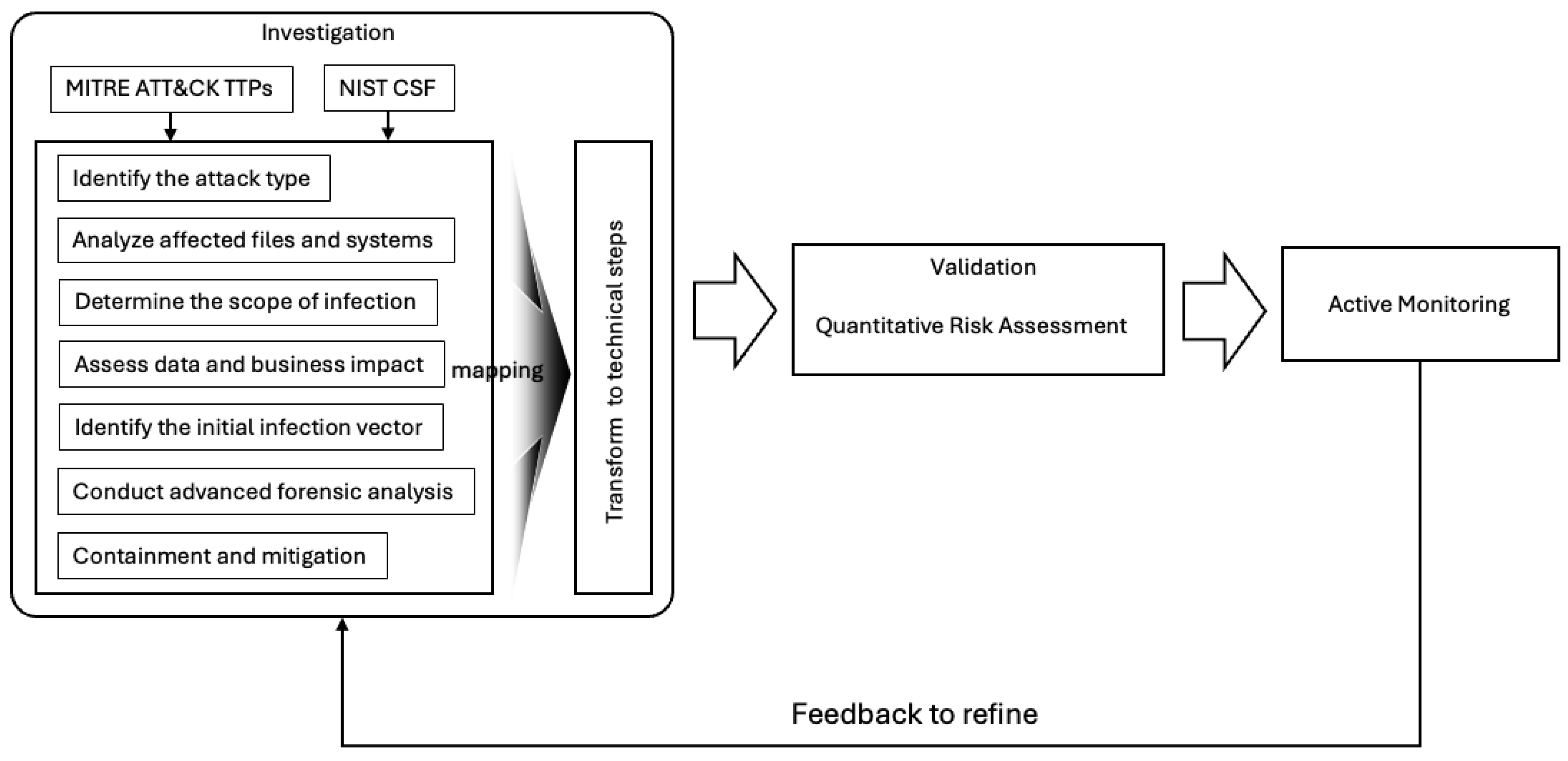
Figure 4.
Proposed incident response end-to-end workflow
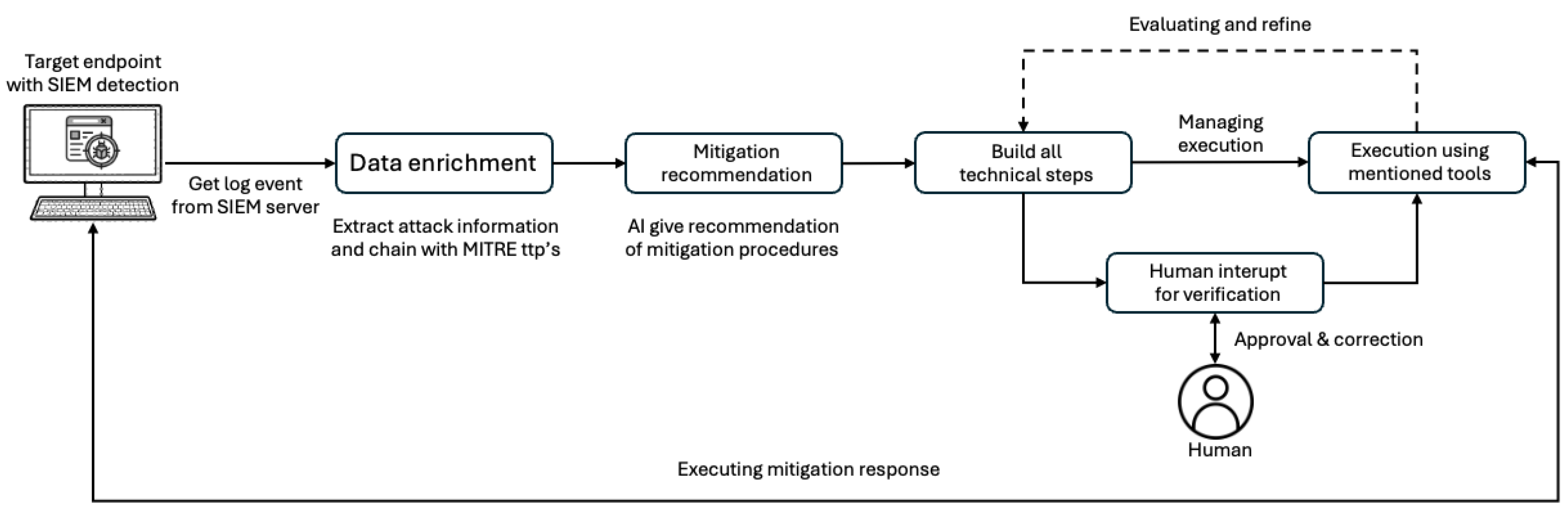
Figure 5.
Agentic AI high-level system architecture for automated security incident response
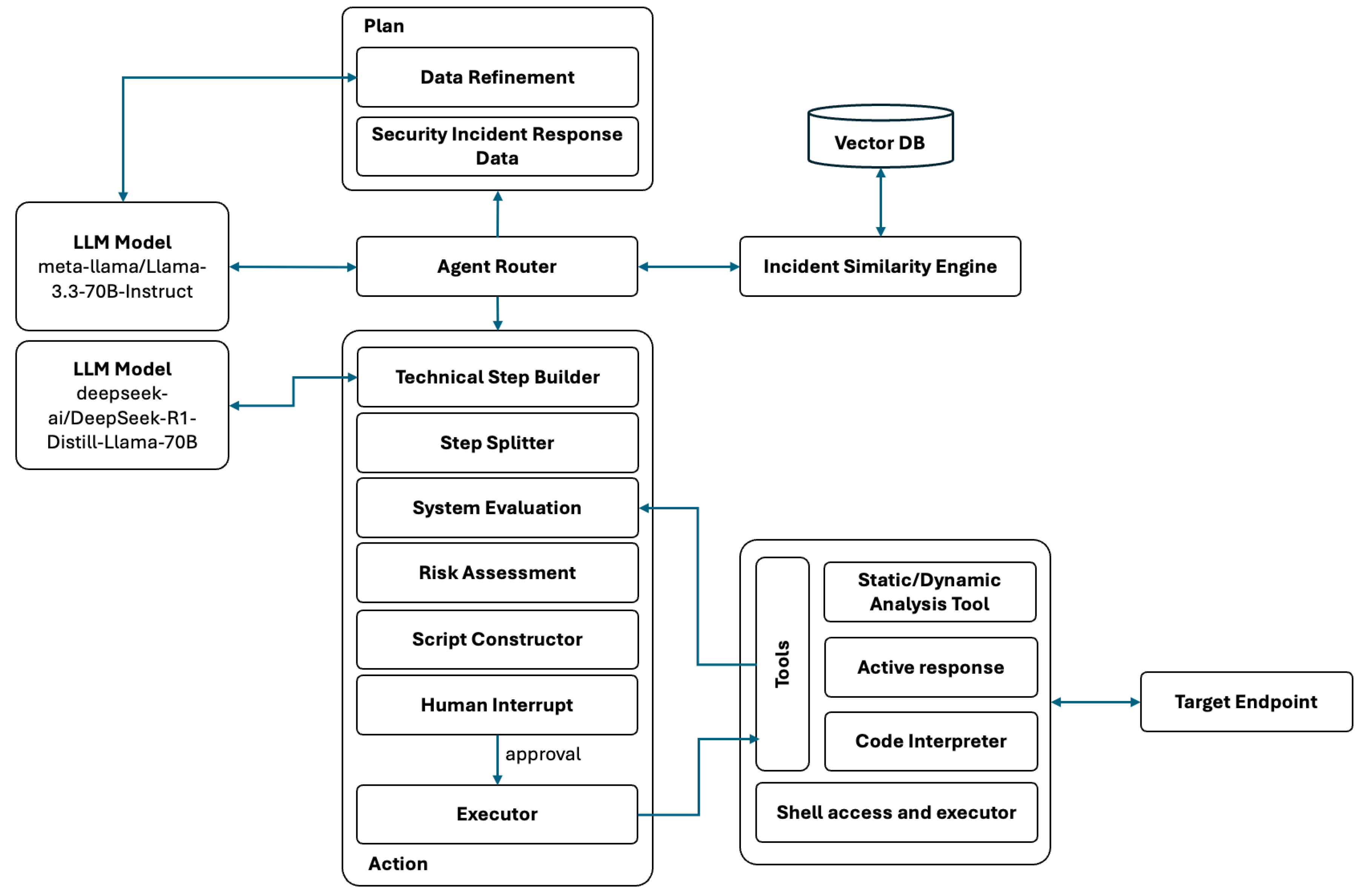
Figure 6.
Agent workflow illustrating tool integration and result evaluation
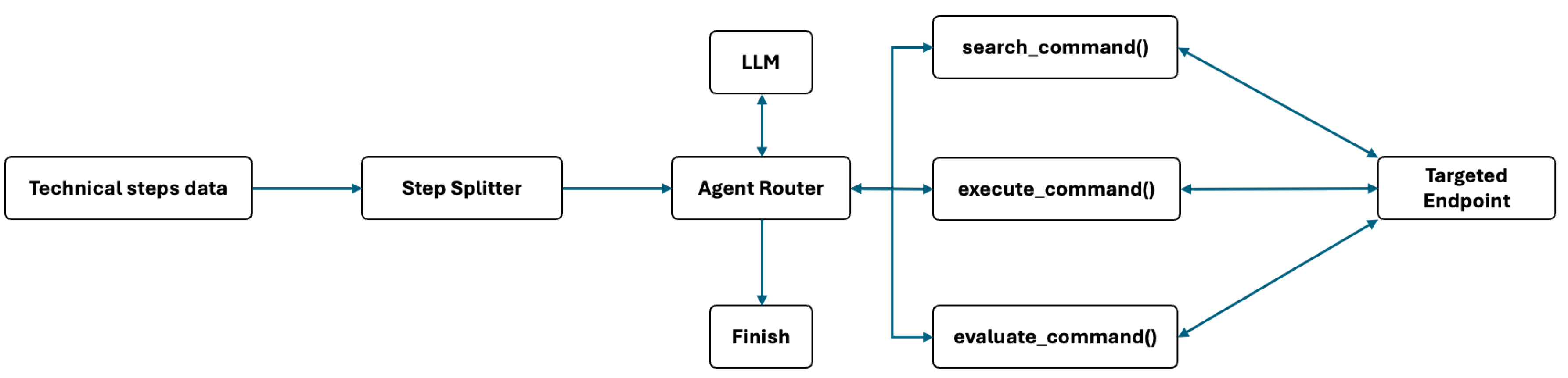
Figure 7.
Contextually enriched brute force attack detection output, highlighting the identified target IP, corresponding MITRE ATT&CK technique, relevant compliance requirements, and recommended incident response actions.
Figure 7.
Contextually enriched brute force attack detection output, highlighting the identified target IP, corresponding MITRE ATT&CK technique, relevant compliance requirements, and recommended incident response actions.
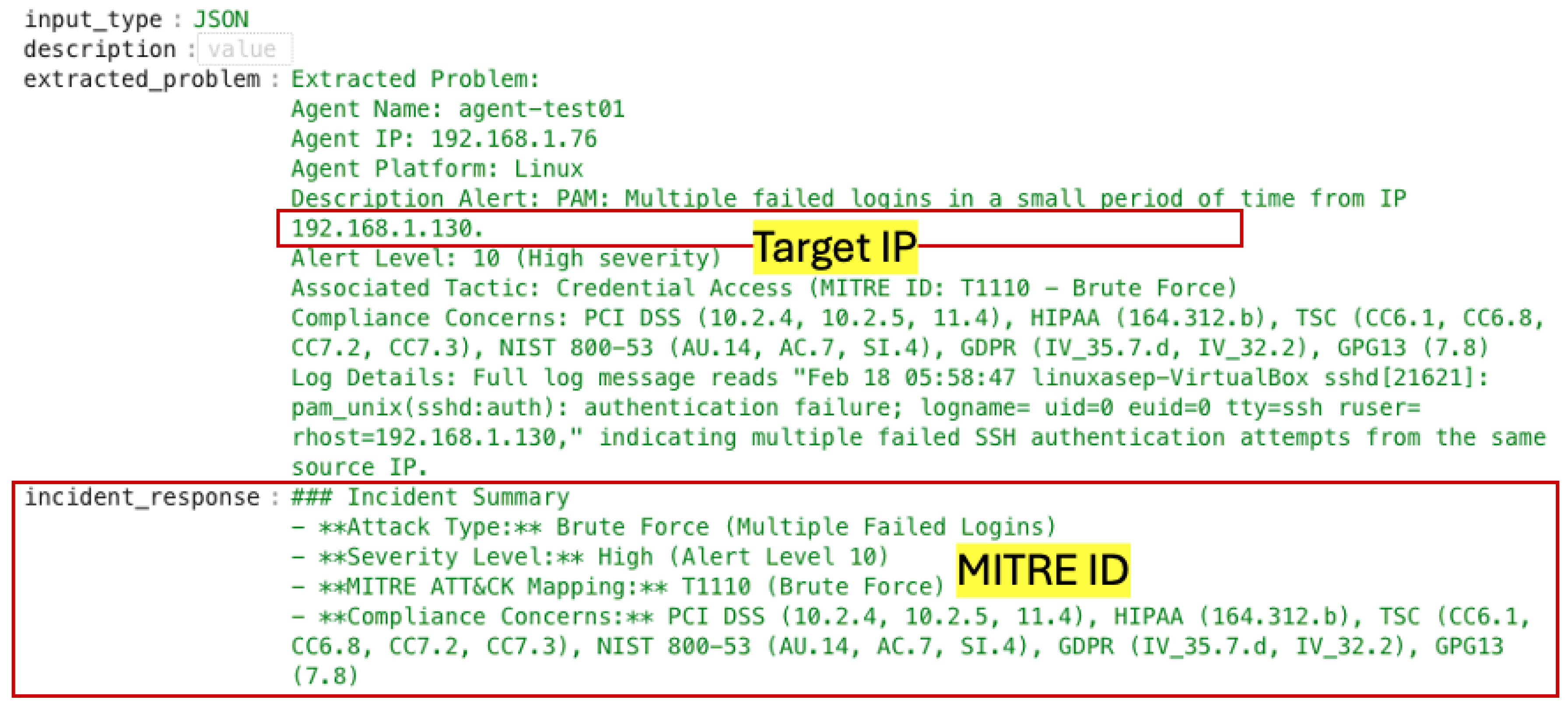
Figure 8.
QRA results for the brute-force use case.

Figure 9.
An AI-driven approach for diagnosing and remediating the encountered error.
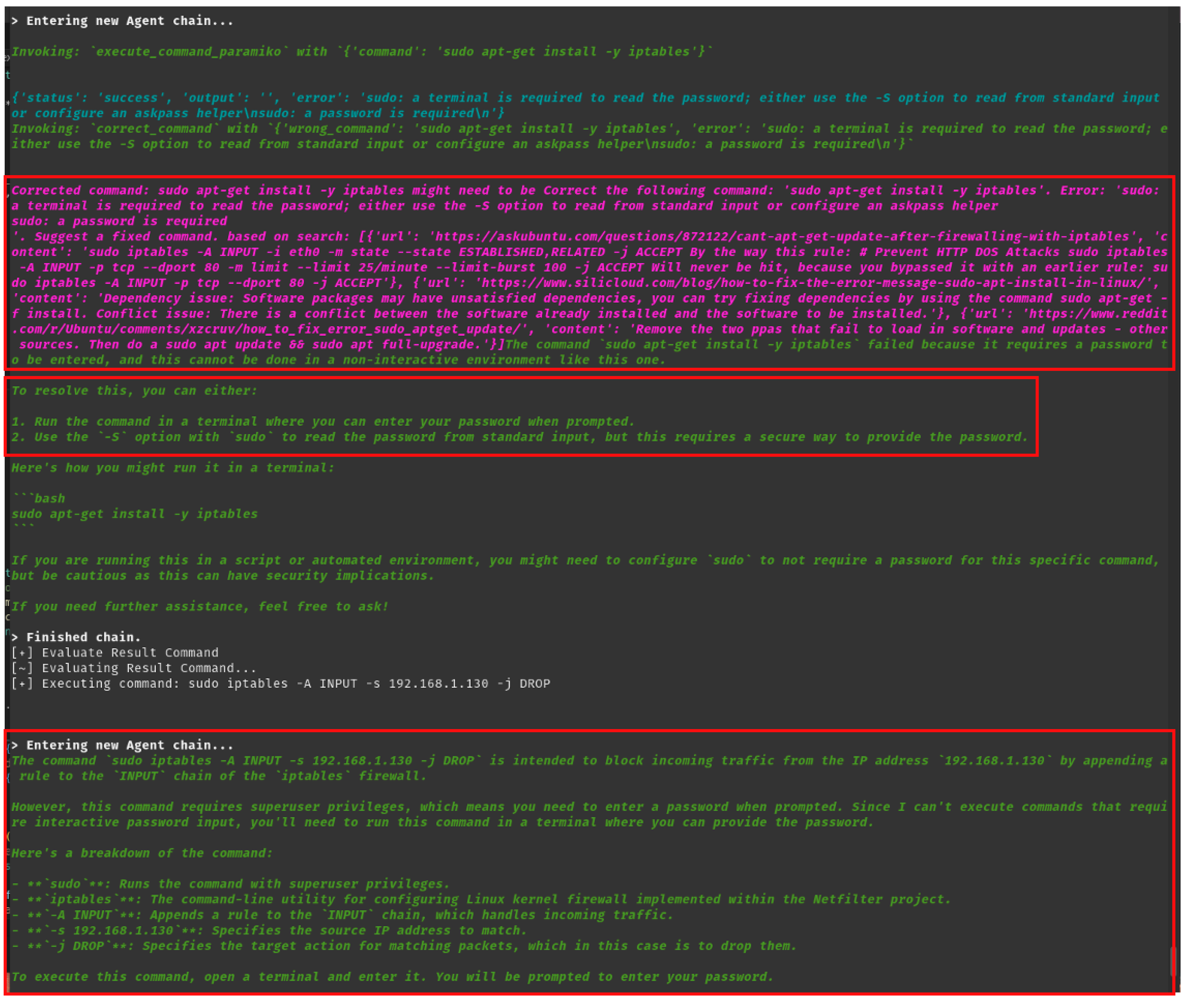

Table 1.
System prompt format for SOAR advisor assistant
| System Prompt Format |
|---|
| 1. Incident Response Analysis & Generation: |
| - Analyze log data and problem reports. |
| - Identify security threats using industry-standard frameworks. |
| 2. Incident Mitigation & Resolution: |
| - Provide mitigation strategies aligned with NIST CSF 2.0 and MITRE ATT&CK. |
| - Generate remediation steps, including playbook automation. |
| 3. Automation & Technical Guidance: |
| - Offer step-by-step response procedures. |
| - Ensure technical flow follows SOAR best practices. |
| 4. Security Research & Advisory: |
| - Utilize vector databases and security repositories. |
| - Provide evidence-based guidance. |
| 5. Conversational Efficiency & Memory: |
| - Engage professionally and contextually with users. |
| - Maintain conversation history for improved accuracy. |
Table 2.
Comparison of XSOAR Brute Force Investigation - Generic and Proposed AI-agent Implementation.
Table 2.
Comparison of XSOAR Brute Force Investigation - Generic and Proposed AI-agent Implementation.
| # | XSOAR Brute Force Investigation – Generic | Proposed AI-agent | Notes |
|---|---|---|---|
| 1 | Initial Detection & Triage Identify abnormal login attempts and confirm brute force indicators. | Incident Summary – Attack Type: Brute Force – Severity: High – Source IP identified (192.168.1.130) – Failure patterns in logs | Both approaches emphasize quick identification of brute force attempts. Early triage ensures correct prioritization and immediate response. |
| 2 | Gather Evidence & Analyze Logs Review system logs to confirm scope, timeline, and potential impact. | Step 2: Analyze Log Files – Reviewed /var/log/auth.log for failed attempts – Checked for “authentication failure” patterns | The AI agent’s procedure mirrors XSOAR’s approach by collecting evidence from relevant logs. Identifying compromised accounts or unusual sources is a shared goal. |
| 3 | Contain & Mitigate Ongoing Attack Block malicious IP addresses or isolate infected hosts. | Step 1: Isolate the Affected System – Block source IP via iptables – Disconnect or isolate the system if necessary | Both methods prioritize swift containment to stop the attack in progress. Blocking the malicious IP is a common immediate action. |
| 4 | Implement Protective Measures Use account lockouts or IP blocking tools to thwart brute force. | Step 3: Monitor and Block Suspicious IPs – Installed and configured Fail2Ban Step 4: Change System and User Passwords – Reset root and user credentials | XSOAR’s generic playbook recommends threshold-based blocking and lockouts. The AI agent explicitly uses Fail2Ban. Password resets align with best practices for compromised accounts. |
| 5 | Strengthen Access Controls Enhance MFA and tighten SSH settings. | Step 5: Enable and Configure Two-Factor Authentication – Google Authenticator for SSH Step 6: Harden SSH Configuration – Disable root login, restrict users, reduce MaxAuthTries | Both highlight multi-factor authentication and SSH hardening as key defenses. |
| 6 | Forensic Analysis Investigate system integrity, checking for unauthorized changes or malware. | Step 7: Conduct a Forensic Analysis – AIDE for file integrity checks – auditd to monitor critical files | XSOAR’s deep-dive investigation is addressed by the AI agent’s emphasis on file integrity checks and audit logging. |
| 7 | Remediation & Restoration Return systems to secure baseline once threats are removed. | Steps 1, 3–7 Combined – Isolation, IP blocking, reconfiguring, password resets | While XSOAR treats remediation as a distinct phase, the AI agent’s steps collectively restore normal, secure operations. |
| 8 | Documentation Record all findings, actions, and lessons learned. | Step 8: Document the Incident – Created incident_report.log – Logged detection, actions, and outcomes | Proper recordkeeping is essential for audits, compliance, and post-incident reviews. Both emphasize thorough documentation. |
| 9 | Policy Review & Compliance Check Review and update security policies for regulatory alignment. | Step 9: Review and Update Security Policies – Ensured compliance with PCI DSS, HIPAA, TSC, NIST, GDPR, GPG13 | Both approaches highlight the importance of aligning policies with relevant standards. Continuous improvement is a central theme. |
| 10 | Post-Incident Analysis & Lessons Learned Conduct a debrief, and refine IR processes. | Step 10: Conduct a Post-Incident Analysis – Debrief session, update plans, review successes/failures | A structured after-action review is key in both XSOAR’s process and the AI agent’s approach. Lessons learned to drive future improvements. |
Table 3.
AI Agent Execution Steps
| Step | Action Taken | System Response | AI Agent Analysis | Next Steps |
|---|---|---|---|---|
| 1 | Run sudo apt-get install -y iptables | Error: sudo: a password is required | Requires sudo authentication. | User runs manually or provides password via -S. |
| 2 | Suggested authentication alternatives | User input required | Needs user interaction. | User manually enters a password. |
| 3 | Ran sudo iptables -A INPUT -s 192.168.1.130 -j DROP | Error: sudo: a password is required | Same issue: requires authentication. | Configure sudo to allow execution without password. |
| 4 | Issued a Human Intervention Request | Awaiting user action | Execution blocked by authentication. | User must execute manually or adjust sudo settings. |
| 5 | Standing by for further instructions | Ready for next attempt | Awaiting user input. | User feedback required. |
Disclaimer/Publisher’s Note: The statements, opinions and data contained in all publications are solely those of the individual author(s) and contributor(s) and not of MDPI and/or the editor(s). MDPI and/or the editor(s) disclaim responsibility for any injury to people or property resulting from any ideas, methods, instructions or products referred to in the content. |
© 2025 by the authors. Licensee MDPI, Basel, Switzerland. This article is an open access article distributed under the terms and conditions of the Creative Commons Attribution (CC BY) license (http://creativecommons.org/licenses/by/4.0/).
Copyright: This open access article is published under a Creative Commons CC BY 4.0 license, which permit the free download, distribution, and reuse, provided that the author and preprint are cited in any reuse.


